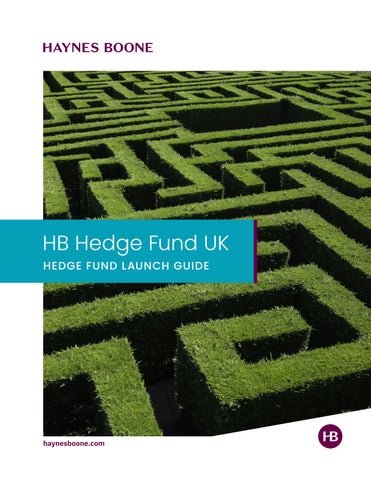
haynesboone.com HB Hedge Fund UK HEDGE FUND LAUNCH GUIDE
The Haynes Boone team are proud to present our Hedge Fund Launch Guide (UK). We hope our readers find this Guide a useful introduction to the process of bringing a new hedge fund to market and that it answers some of the questions you may have.
We would like to extend a huge thank you to our industry contributors –Abacus, Buzzacott, Centralis, Clement Advisory, FeMan Consulting, KPMG, Kroll, Ogier, Price Forbes, Reviresco Partners, Saffron Consulting, Vittoria & Partners, and Wagtails – for all their support over these last few months. I would also like to extend a special thank you to Jackie, Kathy, Lauretta, Chris and Ben for their dedication, perspiration and inspiration.
If you have any questions about the material set out over the following pages, please get in touch. There is a list of Haynes Boone contacts on page 3 and the area specialists are highlighted in each section. The guide is a living document so please do let me have any comments or suggestions for additional topics to cover.
PS – the legal sections in this guide are for discussion purposes only and should not be relied upon as legal advice. Please do reach out to a Haynes Boone investment management specialist and/or the relevant contributing law firm for specific questions.

James Tinworth
Partner | Head of Hedge Funds and Regulation in Europe
T: +44 (0)20.8734.2892
james.tinworth@haynesboone.com


Providing
innovative
legal
solutions across the USA, the UK and around the world.
You lead with ingenuity and innovation. Challenging the status quo. Pushing great ideas forward.
We provide legal solutions to help innovators raise money, grow your business and implement your strategy.
Haynes Boone’s Investment Management Practice Group is well-equipped to handle the needs of any emerging or established investment manager, private fund or family office, including providing advice with respect to fund formations, capital raising, registrations, financings, on-going operations, investments and regulatory matters. We have extensive experience representing sponsors, managers and funds, as well as investors, in various industries including, but not limited to, hedge, private equity, venture capital, credit and debt, digital assets, real estate, oil and gas, and infrastructure. We take pride in being able to provide our clients with current market and practical business advice, and value being their trusted counsellor.
Our hedge fund team in London is dedicated to the hedge fund and wider alternative assets industry. Our partners have decades of experience leading and advising both managers and investors on the formation of, and investment in, hedge funds across all major investment strategies.



VICKI L. ODETTE PARTNER | GLOBAL CHAIR - INVESTMENT MANAGEMENT PRACTICE GROUP vicki.odette@haynesboone.com T +1 214.651.5674 LONDON
JAMES TINWORTH PARTNER | HEAD OF HEDGE FUNDS AND REGULATION IN EUROPE james.tinworth@haynesboone.com T +44 (0)20.8734.2892
haynesboone.com
700 LAWYERS 19 OFFICES 40 MAJOR LEGAL PRACTICE AREAS
2024
KEY CONTACTS: 1
CONTACTS: US
Welcome
Key Haynes Boone UK Contacts


JAMES TINWORTH
Partner | Head of Hedge Funds and Regulation in Europe | London james.tinworth@haynesboone.com +44 (0)20.8734.2892
RONAN McCANN Partner | London ronan.mccann@haynesboone.com +44 (0)20.8734.2881
Key Haynes Boone US Contacts







VICKI L. ODETTE
Partner | Global Chair - Investment Management Practice Group | Dallas/New York vicki.odette@haynesboone.com
+1 214.651.5674
KELLIE BOBO
Partner | Austin/Dallas kellie.bobo@haynesboone.com +1 512.867.8411
C. ROBERT BRUNER
Partner | Dallas robert.bruner@haynesboone.com +1 214.651.5231
ZACH BURNETT Partner | Dallas zach.burnett@haynesboone.com +1 214.651.5240
MADELYN CALABRESE
Partner | New York
madelyn.calabrese@haynesboone.com +1 212.659.4997
RICARDO W. DAVIDOVICH
Partner | New York
ricardo.davidovich@haynesboone.com +1 212.835.4837
DAREN R. DOMINA
Partner | New York daren.domina@haynesboone.com +1 212.659.4963


KARMA SAMDUP
Partner | Head of Private Funds and Venture in Europe | London karma.samdup@haynesboone.com +44 (0)20.8734.2849
ANDREW PANNELL Partner | London andrew.pannell@haynesboone.com +44 (0)20.8734.2866






RICK M. FIJOLEK Partner | Dallas rick.fijolek@haynesboone.com +1 214.651.5570
EVAN HALL Partner | Austin/Dallas evan.hall@haynesboone.com +1 214.651.5831
ARIE HEIJKOOP Partner | Washington, D.C. arie.heijkoop@haynesboone.com +1 202.654.4563
RACHEL HASS REINUS
Partner | Orange County rachel.reinus@haynesboone.com +1 949.202.3063
SHELLEY J. ROSENSWEIG Partner | New York
shelley.rosensweig@haynesboone.com +1 212.835.4838
MATT S. STEWART Partner | Dallas matt.stewart@haynesboone.com +1 214.651.5012
TAYLOR H. WILSON Managing Partner | Dallas taylor.wilson@haynesboone.com +1 214.651.5615










haynesboone.com
4
3
FeMan Consulting Limited
Our Industry Contributors






5 6 Hedge Fund Launch Guide haynesboone.com Hedge Fund The Fund Section 1: Typical Fund Structures .............................................................................. 47 Section 2: Fund Domiciles Cayman, Ireland and Luxembourg .................................... 53 Section 3: Principal Documents 61 Section 4: Principal Parties ......................................................................................... 65 Section 5: Fund Directors ............................................................................................ 67 Section 6: Governance and Control ............................................................................. 69 Section 7: Choosing the Right Auditor ......................................................................... 71 Section 8: Liquidity Management 75 Section 9: An Alternative Approach: The Separately Managed Account ..................... 77 Running a fund and other considerations Section 1: U.S and Cayman Tax Considerations for Cayman Investment Fund Structures ................ 99 Section 2: UK Tax Considerations (the Investment Manager Exemption) ........................................ 103 Section 3: Cybersecurity and IT Infrastructure ................................................................................ 105 Section 4: Insurance 111 Contents 7 45 79 97 Raising Capital Sec tion 1: Marketing and Regulation ....................................................... 81 Section 2: Building a Brand ..................................................................... 93 Section 3: Top Tips for Raising Capital 95 Your Management Business Section 1: Choosing a Structure for your Management Business in the UK ........................................ 09 Section 2: UK Regulation: FCA Authorisation or Regulatory Hosting?................................................. 11 Section 3: FCA Authorisation: How to Navigate the Process ............................................................... 15 Section 4: FCA Authorisation: Capital Adequacy and Reporting 19 Section 5: Using a Regulatory Hosting Firm ........................................................................................ 21 Section 6: An Introduction to the Alternative Investment Fund Managers Directive (AIFMD) ............ 23 Section 7: U.S. Regulation ...................................................................................................................27 Section 8: Outsourcing .........................................................................................................................35 Section 9: Your People 39 Section 10: Insights from Hedge Fund COOs .......................................................................................41
Your Management Business

Choosing a Structure for your Management Business in the UK
Before starting the process to launch a fund, the founders must establish a business entity in the UK. The entity may act as the investment manager or the investment adviser in relation to the fund structure. For convenience, however, this section will refer to this UK entity as the ‘investment manager’.
CHOICES OF STRUCTURE IN THE UK
The UK remains a prominent domicile for investment management firms, however prospective entities must obtain FCA authorization, or use a regulatory hosting platform, before engaging in regulated activities. Please see Your Management Business - Section 2: UK Regulation: FCA Authorisation or Regulatory Hosting? for an overview of both regulatory routes. A UK investment management firm will typically choose between two corporate structures: an English limited liability partnership formed under the Limited Liability Partnership Act 2000 (“LLP ”) or an English private limited liability company formed under the Companies Act 2006 (“Ltd ”). Each has its own set of advantages for prospective managers.
THE LLP
The LLP structure combines features of two other corporate vehicles: it is treated as a partnership for tax purposes, but as a company (body corporate) for contractual and commercial purposes. A significant advantage of this combination is that it offers the greater flexibility of a partnership and enables LLP members to participate in business management without losing their limited liability status. However, the main selling point of the LLP is still its tax profile.
Generally, the majority of body corporates, including UK companies, are treated as ‘tax opaque’. The result of this is that some shareholders are subject to so-called double taxation i.e., they are taxed once at the company level and then again at the shareholder level on the distribution of profits. LLPs, on the other hand, are often not considered as separate legal entities for tax reasons, making them tax transparent. This means that there is no tax payable at the LLP level and any earnings made by an LLP are immediately allocated to its members, who are then subject to taxation based on their respective tax status and rates. This is subject to some caveats, including that LLPs continue to submit a partnership tax return to His Majesty’s Revenue and Customs (“HMRC ”) and continue to be treated as separate entities for VAT purposes. Despite this, the LLP remains the preferred structural option for UK investment managers due to its tax transparency, particularly where it is not intended that profits will be retained and reinvested into the business.
THE NUMBERS
UK corporate members of an LLP pay UK corporation tax (at the current rate of 25%) on profits and gains of the LLP that are allocated to them while UK individual members pay tax on trading income of the LLP that is allocated to them at an aggregate maximum of 47%, consisting of their personal income tax (up to 45% for additional
rate taxpayers, i.e., currently taxpayers with income above £125,140), and national insurance contributions (“NIC ”) of 2%. It is worth noting that, subject to the antiavoidance rules, income received by members of an LLP does not trigger the 13.8% employer’s NIC charge that is normally levied on salaries. As a result, the LLP structure provides additional tax savings for key individuals who would otherwise be paid a significant salary by a UK company. The LLP is made even more appealing by the fact that capital gains attributable to UK individual members are taxed at the lower UK capital gains tax rates.
THE LIMITED COMPANY
The limited company (“Ltd ”) is a more traditional corporate vehicle that is ‘tax opaque,’ which means there is tax at the level of both the Ltd and its shareholders. The aggregate tax burden on a UK individual receiving dividends from a UK company can be around 50%. It is worth noting that this double taxation cost does not apply to UK corporate shareholders, who are generally exempt from tax on dividends received. Nonetheless, certain dividend restrictions remain in place in UK company structures, such as the requirement for distributable reserves, and will apply in either case
WHY USE A COMPANY STRUCTURE?
The case for a company structure so far is not entirely encouraging. However, if the profits of an investment management business are reinvested back into the business, UK companies could provide a significant tax advantage. In these cases, UK corporations can provide a better tax profile than LLPs, as the only tax cost on profits reinvested by a corporation is the 25% corporation tax charge. In contrast, an LLP’s profit is directly attributed and taxed in the hands of its members regardless of whether it is distributed. Profits reinvested by an LLP are effectively taxed at rates of up to 47%. In such a case, a UK corporation would have 75% of its profits available for reinvestment after tax, whereas an LLP could have only 53%.


Furthermore, in an effort to combat perceived tax avoidance, HMRC has made the tax treatment of LLPs more complex, making it far more difficult to navigate. Historically, LLPs with mixed membership (corporate and individual) could take advantage of the lower corporate tax rate by redirecting profits they wished to invest to corporate shareholders. Now that mixed membership rules have been implemented, however, this favourable 25% tax on working capital is nearly impossible to achieve with an LLP. Additionally, HMRC has implemented anti-avoidance rules that, through so-called ‘salaried member’ provisions, can reclassify certain members of LLPs as ‘employees,’ triggering the 13.8% NIC obligation described above. This development further erodes LLPs’ competitive advantage over their Ltd counterparts. In summary, while an LLP is generally preferable for businesses seeking high annual pay-outs, investment managers seeking to re-invest and create working capital may still benefit from the traditional UK Ltd structure. A more detailed analysis of the differences between the LLP and the Ltd options is available on request
9 10 Hedge Fund Launch Guide haynesboone.com Hedge Fund
01
James Tinworth Partner | Head of Hedge Funds and Regulation in Europe T: +44 (0)20.8734.2892 james.tinworth@haynesboone.com Christopher Orford Associate T: +44 (0)20.8734.2827 christopher.orford@haynesboone.com
Authors
02
UK Regulation: FCA Authorisation
or Regulatory Hosting?
Haynes Boone has significant experience of advising start-up and first-time fund managers or advisers in the UK in relation to the regulatory options for their business.
FCA AUTHORISATION
If a client wishes to be the manager of a vehicle that satisfies the definition of an “Alternative Investment Fund” (AIF) (and hedge funds almost always satisfy this definition), the client will need to be authorised by the FCA to “manage an AIF”.
If the assets under management are under €100 million, then the client can become authorised as a small authorised UK AIFM. Some of the more onerous requirements of being an authorised full-scope UK AIFM do not apply to small authorised UK AIFMs (e.g. investor information disclosure requirements, fund annual report content requirements, requirements relating to liquidity, risk management, valuation, delegation and depositaries) and there will also be lighter “Annex IV” reporting requirements to the FCA. If the AUM exceeds the €100 million threshold in a non-temporary situation then a small authorised UK AIFM will need to apply to the FCA to become authorised as a full-scope UK AIFM. It should be noted that the AUM calculation should include any assets acquired through the use of leverage (which can involve the conversion of derivative instruments into the equivalent position in their underlying assets).
If the manager is managing a portfolio of assets but is not managing an AIF then it will need to be authorised by the FCA to “manage investments”.
There is a specific definition of “AIF” in English law with a number of elements and exemptions.
A manager will not be managing an AIF in the case of most segregated management accounts (SMAs) (i.e. directly managing the portfolio of a client or its investment vehicle) and sometimes it is possible for an investment vehicle to fall outside the definition of “AIF” (e.g. by being a fund of one, a vehicle for a pre-existing family group, a joint venture etc.).
There is also a specific approach to interpreting the activity of “managing an AIF” and the basic principle is that an AIF can only have one AIFM. Therefore, where there is a delegation of investment management by the AIFM of an AIF to a UK entity, that UK entity will almost always need FCA permission to “manage investments” and not to “manage an AIF”. However, the FCA may determine that the purported AIFM and/or its activities should be disregarded (e.g. where it fails the letter-box entity test1 ) and determine that the UK entity is the AIFM, requiring permission to “manage an AIF”. By way of examples, in a hedge fund context, where an authorised Luxembourg AIFM delegates investment management to a UK entity, that UK entity will be managing investments. In contrast, however, where a typical Cayman hedge fund claims to be its own AIFM, the FCA is unlikely to agree.
One consideration for a new manager, which is applying for FCA authorisation, is whether they need both the permissions of managing investments and managing AIFs from the beginning. A manager with only the permission to manage AIFs will not be able to manage a SMA without a variation of its permission to include managing investments.
It is worth noting that the FCA will always look at what any relevant individuals are doing in the UK in order to determine what permissions are required. Often a UK entity will be established in order to insulate other relevant entities from the UK’s regulatory jurisdiction. With respect to AI and systematic strategies, it is also worth noting that any argument to the effect that the management is taking place where the servers are located, rather than where the key individual(s) are will not be given much weight by the FCA.
Please refer to Your Management Business - Section 3: FCA Authorisation: How to Navigate the Process for a more detailed consideration of the FCA application process and Your Management Business - Section 4: FCA Authorisation: Capital Adequacy and Reporting Requirements for a look at the capital adequacy and reporting requirements that apply to FCA authorised firms.
The UK is currently working on updating and improving the UK’s regime for asset management, which largely derives from legacy EU law. In particular, the regulation of “small AIFMs” may change over the next few years
REGULATORY HOSTING
As an alternative to direct FCA authorisation, it is possible in the UK to use an existing FCA authorised firm as a regulatory host (also known as a regulatory umbrella or incubator).
There are a few versions of the regulatory hosting model in the UK, but the basic arrangements are the same. An individual (or individuals) (“PM”) wants to manage an AIF, manage investments or deal as agent without having its own entity authorised by FCA. PM can set up a UK entity (“PM Ltd”). PM Ltd and PM then enter into arrangements with a regulatory host. Under these arrangements, the host is appointed by the client and PM is seconded from PM Ltd
to the host with the intention of PM acting as the individual portfolio manager(s) or the dealer(s) at the host.
A fund would usually have PM Ltd’s branding.
Usually, but not always, PM Ltd is appointed as the host’s appointed representative (“AR”). As an AR, PM Ltd can provide non-discretionary investment advice, arrange deals in regulated investments and more easily market regulated investment products and services in its own name without requiring its own FCA authorisation. Whether or not PM Ltd needs to be an AR depends on what it wants to do in its own name (if anything) or whether it is comfortable to undertake all regulated activity through the host. The default position of some regulatory hosts is to make PM Ltd its AR, whether or not PM Ltd will be doing anything in its own name.
This model has been around in the UK for at least 15 years. It originally gained traction because applications for FCA authorisation were taking 9-12 months and sponsors wanted to launch their funds much sooner (it used to be a matter of weeks to get the model in place). In the beginning, the model was used as an interim measure until the manager had received its FCA authorisation. The model also provides several other advantages. In particular, the host should provide infrastructure, risk management and compliance support. The model can also provide managers with a good understanding of what it means to be regulated before the manager decides to become regulated in its own right.
You do still see managers who use the model as an interim arrangement, although the environment has shifted in two fundamental ways: (i) managers and hosts are generally happy for the arrangements to be longerterm and (ii) there are much higher barriers to becoming authorised and much greater uncertainty of capital raising and success.
11 12 Hedge Fund Launch Guide haynesboone.com Hedge Fund
The hosting model is now the default option for smaller first-time managers in the UK.
The regulatory hosting solution described above is not the same as becoming a “pod” at a multi strat/multi manager firm (such as Lighthouse, Millennium, Point72, Schonfeld, Man GLG et al). There are similarities and these firms would market the “pod” offering as being a form of regulatory hosting. It is not. At the end of the day, you and your team would be judged as employees of the multi strat firm – no matter how delineated your pod may beand the firm would ultimately be your principal source of capital. In the event of negative performance, capital can easily be pulled away from your pod and your pod could even be closed and you and your team dismissed. Please refer to Your Management Business - Section 5: Using a Regulatory Hosting Firm for a more detailed consideration of using a regulatory host.
Authors
James Tinworth Partner | Head of Hedge Funds and Regulation in Europe
T: +44 (0)20.8734.2892
james.tinworth@haynesboone.com
Christopher Orford Associate
T: +44 (0)20.8734.2827
christopher.orford@haynesboone.com
If a client wishes to be the manager of a vehicle that satisfies the definition of an “Alternative Investment Fund” (AIF) (and hedge funds almost always satisfy this definition), the client will need to be authorised by the FCA to “manage an AIF”.
1The letter-box entity test is set out in law and regulations. If the test is failed then the AIFM shall be deemed a letter-box entity and shall no longer be considered to be the manager of the AIF

13 14 Hedge Fund Launch Guide haynesboone.com Hedge Fund
03
FCA Authorisation: how to navigate the process
WHEN DOES AN ASSET MANAGER REQUIRE FCA AUTHORISATION?
The Financial Services and Markets Act 2000 (FSMA) prohibits any person without the required authorisation, or who can benefit from an exemption, to carry out regulated activities by way of business in the UK. Anyone seeking to perform discretionary portfolio management services from an establishment in the UK, unless doing so under an applicable exemption, would thus require FCA authorisation to perform certain regulated activities as defined in the FSMA (Regulated Activities) Order 2001 (RAO).
Fund managers managing private funds will typically require authorisation for managing an Alternative Investment Fund (AIF). Investment managers, including delegated portfolio managers and firms managing segregated client mandates, will require authorisation for managing investments and for certain connected activities such as dealing in investments.
In this section, we provide an overview of the FCA authorisation process, alongside guidance on how to navigate its challenges and complexities.
PREPARING A GOOD QUALITY APPLICATION
In 2023, the FCA highlighted that 20% of new firms were unsuccessful at achieving authorisation compared to just 7% in 2020-21.
Prospective applicants should not be discouraged by this data. The FCA has in recent years increased its scrutiny of new applications and taken a firmer stance by refusing or requesting the withdrawal of applications which do not meet expected standards.
It is important that firms make good efforts, and seek expert advice as necessary, to ensure that their application is of good quality and increase their chances of achieving FCA authorisation successfully and more quickly.
The FCA authorisation application pack is submitted online through the FCA’s systems and will typically include:
n Relevant FCA application forms confirming proposed regulated activities, financial resources available, senior manager positions and a range of questions to demonstrate how regulatory requirements will be met
n A tailored regulatory business plan covering
n The background to the business and an overview of the business model including growth strategy
n Details of marketing, customer journey and how you will engage with your target market
n Remuneration arrangements
n Governance arrangements for the regulated entity (and group, where applicable) and how core responsibilities will be divided between senior management
n An overview of IT systems and any material outsourcing
n Details of how the firm will maintain compliance and key risks to the business
n How the firm is/will be capitalised
n An overview of core policies specific to the business model such as conflicts of interest, complaints policies, market abuse and antimoney laundering
n Senior Manager Forms covering questions on key individuals’ backgrounds and supporting information such as CVs, regulatory references, skills gap analyses and criminal records checks
n Controller Forms posing questions on integrity of business owners as well as their financial standing
n Financial Forecasts of between 1-3 years (depending on the application) showing profit and loss, cash flow, balance sheet and regulatory capital forecasts
n Investment Management Agreements
n Where applicable, information about the fund supported by fund documents, depositary, custodian, prime broker and fund administrator details
n A compliance monitoring programme
Upon submission, applicant firms must also pay the FCA an authorisation fee which is typically £10,000 for fund or investment managers.
THE FCA ASSESSMENT OF THE APPLICATION AND ASSOCIATED TIMELINES
Once submitted, the firm’s application is allocated to, and reviewed by. an FCA case officer. The FCA case officer will engage with the firm to address any questions and areas where clarifications may be required.
The firm’s application will be assessed against the FCA’s ‘threshold conditions’. These are minimum standards that all firms must meet both at the point of authorisation and on an ongoing basis thereafter. More specifically, FCA will assess that each applicant meets specific standards with regards to their legal structure, location, availability of financial and non-financial resources and any links they might have with certain firms or individuals. The extent to which any of these factors might prevent effective supervision is also a key consideration for the FCA. Part of the assessment may involve interviews of key staff – with the compliance officer/MLRO most likely to be interviewed.
The FCA can take up to six months to assess and reach a decision on a complete application. This process can take up to twelve months, and sometimes even longer, if an application is deemed incomplete and does not meet expected standards of quality.
FCA PRE-APPLICATION SUPPORT
Alongside its statutory objectives of protecting consumers and ensuring that financial markets work well, the FCA also has objectives to promote competition and increase the international competitiveness and growth of the UK economy. As such, the FCA has made available pre-application support services to wholesale firms (https://www.fca.org.uk/firms/authorisation/ uk-wholesale-markets-support). These services are aimed at helping firms get to market more quickly, whilst maintaining appropriate regulatory standards. Through the pre-application services, wholesale firms, including asset managers, can request a pre-application meeting which is generally available to:
n An overseas firm seeking to set up or expand business in the UK
n A firm setting up business outside London/South East England
n Has an innovative or unusual business model
n Is involved in complex or high-risk activities (or will be of significant size)
During pre-application the FCA will clarify what is expected from applicant firms and provide additional support and guidance on the authorisation process. Pre-application meetings also allow case officers to understand a firm’s business in more detail. During the meeting the FCA will also highlight any concerns or potential risks linked to the proposed application. This gives applicants time to appropriately address these in their application for authorisation.
15 16 Hedge Fund Launch Guide haynesboone.com Hedge Fund
Our experience has been that most asset managers have found these meetings useful and that they can expedite the authorisation process.
CONCLUSION
Obtaining its own regulatory license from a leading global regulator like the FCA is an important first step for an asset manager. The effort required to achieve this should not be underestimated, particularly during the start-up phase while building the firm’s operational infrastructure, hiring staff, dealing with prospective investors and other challenges.
A start-up asset manager will greatly benefit from expert advice and support to successfully navigate the FCA authorisation process while, at the same time, more efficiently focus time and resources on setting up and growing its business.
Authors



Matteo Basso Managing Director, Compliance Consulting matteo.basso@kroll.com
Jon Hunsdon Head of Regulatory Transactions, Compliance Consulting jon.hunsdon@kroll.com
Obtaining its own regulatory license from … the FCA is an important first step for an asset manager. The effort required to achieve this should not be underestimated, particularly during the start-up phase…

17 Hedge Fund Launch Guide Hedge Fund
04
FCA Authorisation: Capital Adequacy and Reporting
PRUDENTIAL CAPITAL ADEQUACY RULES
These are driven by the MIFIDPRU and Chapter 11 of IPRU-INV which apply to firms that are classified as ‘Collective Portfolio Investment Management Firms’ (these are firms that are regulated under the AIFMD and have MiFID top-up permissions). Capital adequacy and liquidity requirement is driven by either ‘fixed overheads requirement’ or ‘funds under management’ requirement.
MIFIDPRU RULES
Classification as a ‘small and non-interconnected firm’ or a ‘non-small and non-interconnected firm’ (SNI or NonSNI) is determined based on a number of factors and thresholds.
The capital requirement is the higher of (i) Permanent minimum requirement (PMR), (ii) Fixed overheads requirement (FOR), and (iii) K-factor requirement (KFR) (applicable to Non-SNI firms only)
ICARA PROCESS AND WIND DOWN PLANS
All FCA investment firms including AIFMs are required to maintain and regularly update their ICARA process document.
A comprehensive ICARA should address the following:
n a clear description of your business model and strategy
n an explanation of the activities you carry out and connecting them to the MIFID permissions held and currently used by your firm
n an analysis of the effectiveness of your risk management processes and appetite for risk
n a detailed overview of the governance structure, linking this to the SM&CR
n a summary of the material harms your firm faces and the controls and mitigations in place
n an analysis of your capital and liquidity planning
n a summary of your compliance with the overall financial adequacy rule
n the outcome of stress testing you have conducted and managements response to these scenarios
n an overview of your wind-down planning, including the financial assessment of winding down your regulated business
An important part of the ICARA process is the preparation of an independent wind down plan which must discuss the following as a minimum:
n What is the estimated length of the wind-down period?
n What resources (both financial and non-financial) would be needed to implement it?
n Who needs to be available to assist the firm in winding-down?

 AuthorPriya Mehta Partner, Head of Regulatory Advisory and Reporting Services mehtap@buzzacott.co.uk
n How would the firm deal with redundancies and, conversely, which employees need to be retained with special financial arrangements?
n What systems (e.g., IT systems) need to be available to the firm during the winding-down?
n Will the firm need to engage professional advisors to wind-down?
n Has the firm considered the implications for any overseas offices and branches?
ANNEX IV REPORTING
In addition to the above, AIFMs have the obligation to report under Annex IV of the AIFM-Regulations to cover requirements under Article 24(1), 24(2) and Article 24(4) typically called as ‘Annex IV reporting’. The frequency and content of the reporting depends on the size of the assets under management, marketing status of the AIFs and the amount of leverage used by the AIFs. The returns include reporting on top instruments, principal exposures, concentrations, markets, geographical exposures, currency exposures, investor and portfolio liquidity, counterparties, leverage etc. at asset class and sub-asset class levels. Non-EEA AIFMs are required to report into each EU jurisdiction where the AIFs are marketed.

19 20 Hedge Fund Launch Guide haynesboone.com Hedge Fund
05 Using a Regulatory Hosting Firm
Getting authorisation from the FCA can be a struggle for new fund managers. Not only can it take a long time, but the time and resource requirements are quite onerous. Unfortunately, anyone wishing to manage someone else’s money, give advice, or even market funds in the UK needs to have the appropriate regulatory cover in place before doing so. This problem has spawned the growth of the regulatory hosting industry which allows people from new firms to operate under the hosting provider’s regulatory umbrella. This enables the people from the start-up firms to carry out regulated activities without their own firms being directly authorised by the FCA. This cuts the time and expense of obtaining and maintaining direct regulatory authorization.
There are two ways that hosting firms provide their services, and these are: 1) using the appointed representative regime, and 2) using the secondment of staff.
If the activities of a start-up only require advising and arranging activities, then they will be well served by the appointed representative regime. However, if the client wishes to manage money, then the regulatory host will use the secondment approach to take control of the portfolio management staff, essentially taking them on almost as if they were their own staff. However, they are neither employed nor paid by the hosting firm. The secondment allows the host to register them with the FCA so that they can conduct discretionary investment management activity. Then the host will become either the fund’s AIFM or a sub-delegated non-AIFM investment manager for a managed account or delegated portfolio management mandate.
The regulatory hosting firm will provide the compliance infrastructure to the client’s firm and in effect becomes equivalent to in-house compliance and risk oversight teams. When using a good hosting provider, which has experienced people in it, they will add a degree of relevant expertise that you may struggle to equal in your own team (at an early stage).
ADVANTAGES
n Speed - 4-6 weeks to onboard with the regulatory host rather than a direct authorization with the FCA which can take 6-12 months.
n Expertise, enabling you to concentrate on running the business.
n Independence in the oversight of the compliance and risk functions.
n Training opportunity, it gives a firm a much better idea of the responsibilities of running an FCAregulated business before they become regulated within their own right.
n Cost. In order to fully replace a regulatory hosting firm, the client would have to add additional people which would likely cost more than the reg hosting fees.
CHOOSING A REGULATORY HOSTING FIRM
It is common for some new start-ups to focus purely on the cost of the regulatory host and opt for the cheapest. This is not a terrible strategy, since in many cases the start-up is not seeking to immediately raise hundreds of millions and is simply looking to build a track record first. However, due to greater scrutiny from both regulators and investors, sometimes choosing the cheap option can backfire, by discouraging investors.
Here are some aspects of the hosting firms that are worth investigating:
n Some firms will rely heavily on technology to interact with their clients, as this helps to keep costs down. This can be quite efficient, but it is also important to be able to speak to someone who understands the regulations and can make pragmatic decisions about compliance options. Is the firm simply ticking boxes?
n Make sure that they understand your business and have the appropriate permissions to cover your intended activity. Make sure they understand your strategy, have the capacity to handle your growth, and have systems in place to provide effective surveillance.
n If you are looking to raise institutional investment, make sure the regulatory hosting firm will be able to pass institutional due diligence processes. While sometimes it can be attractive to choose a hosting firm that operates with a “light touch,” the client will regret the lack of suitable proficiency when it results in the failure to pass this extensive scrutiny of institutional investors. However, some start-ups are aiming to attract investors from noninstitutional sources, so the extra cost and effort involved in adhering to a higher standard may not be worthwhile.
n Ask about response times, will they answer your questions quickly. For example, how quickly will they approve your marketing materials?
Authors

 Joe Vittoria CEO
joe@vittoriapartners.com www.vittoriapartners.com
Sarah Donnelly Head of Sales
sarah@vittoriapartners.com www.vittoriapartners.com
n Ask for references. Is the firm growing? Is it attracting firms like yours? Do they sound like they understand your business?
n Ask your other service providers for recommendations, and preferably, some existing clients.
n Make sure you understand the different fee structures, are you paying a fixed monthly fee or are the costs based on AUM? Make sure that there are no additional fees in the fine print, like surcharges based on extra hours.
n Make sure that you are aware of any minimum and maximum contract periods.
n Ask how easy it will be to transition if you want to eventually apply directly for authorisation.
n Ask how the firm handles its regulatory capital requirements.
In the end, as with many decisions about service providers, you should feel comfortable in trusting your gut instincts – does the provider act like a partner, or do they just see you as a source of income?
21 22 Hedge Fund Launch Guide haynesboone.com Hedge Fund
06
An Introduction to the Alternative Investment Fund Managers Directive (“AIFMD”)
For investment managers operating from or marketing a fund in the United Kingdom or the European Union, the chief regulatory barrier will be the Alternative Investment Fund Managers Directive (AIFMD or the ‘Directive’), which has been implemented by member states across the EU and has been retained in UK law. Annoyingly, the EU member states and the UK have all implemented AIFMD in slightly different ways, although there are common features and a base set of requirements. The scope of AIFMD is broad and focusses on regulating the manager of a fund rather than the fund itself.
The provisions set out under AIFMD continue to apply in the UK (we set out what that means for marketing in Raising Capital - Section 1: Marketing and Regulation), but it is essential to note that the UK’s version of AIFMD is entirely separate from the EU’s version. The EU will treat the UK as a “third country” and the special treatment that is available under the EU’s AIFMD for EU managers and funds is not available to UK managers and funds. Also, the UK and the EU regulatory regimes are diverging and this divergence is expected to accelerate. For example, the EU is about to implement AIFMD 2.0 and has also amended the rules relating to “pre-marketing”. The UK is not taking the same approach.
WHO QUALIFIES?
AIFMD has a broad scope and sets out requirements for qualifying managers. Any entity in the EU or the UK managing an Alternative Investment Fund (AIF) must be authorised or registered as an Alternative Investment Fund Manager (AIFM) under AIFMD.
Also, any entity “marketing” any AIF within the EU or the UK will need to comply with the local AIFMD marketing requirements.
The definition of AIF given by the AIFMD includes any (non-UCITS) ‘collective investment undertaking, including investment compartments thereof, which raises capital from a number of investors with a view to investing it in accordance with a defined investment policy for the benefit of those investors’. This is a wide net and the requirements of the AIFMD apply across the industry.
In the UK, there is a specific approach to interpreting the activity of “managing an AIF” and the basic principle is that an AIF can only have one AIFM.
REQUIREMENTS
In broad terms, the requirements introduced by the Directive stand as follows:
n establishing conduct of business requirements, which include:
n ensuring fair treatment for investors
n managing conflicts of interest
n ensuring proper remuneration procedures
n providing accurate valuations and full disclosures to regulators and investors

23 24 Hedge Fund Launch Guide haynesboone.com Hedge Fund
n introducing minimum requirements for initial capital (set out below), a manager’s own funds and professional indemnity insurance (for more information see Running a fund and other considerations - Section 4: Insurance)
n mandating the appointment of authorised depositaries, who are tasked with safeguarding the investments of the fund, monitoring cashflows and checking that distributions are made correctly
n restricting the delegation of certain tasks, with a particular focus on the ability of managers to delegate portfolio and/or risk management roles
n imposing requirements on the use of leverage by the AIFM. In addition, the Directive gives regulators powers to restrict access to leverage or introduce other appropriate supervisory measures to prevent the build-up of systemic risk
In the UK, the FCA rules are primarily contained in the FCA’s Investment Funds sourcebook (FUND).
CAPITAL REQUIREMENTS
AIFMD sets out certain capital requirements, though these vary depending on whether the AIF is externally or internally manged by the AIFM.
Internally managed: If a fund’s governing body elects not to appoint an external AIFM – as might be the case for a corporate fund managed by its board of Directors – then the AIF itself must be authorised as an AIFM unless it qualifies as sub-threshold (see below). Internally managed AIFs must meet an initial capital requirement of EUR 300,000.
Externally managed: Alternatively, a legal person may be appointed, either by or on behalf of the fund to act as the AIFM. Unless it qualifies as ‘sub-threshold’, an external AIFM will be required to maintain initial capital
of EUR 125,000, in addition to holding own funds equal to the higher of:
n 25% of fixed annual overheads, or
n 0.02% of the amount by which total value of assets under management exceeds EUR 250,000,000. This amount is subject to a EUR 10,000,000 cap and the total amount can be reduced by up to 50% if the AIFM is granted a guarantee from a bank or insurer
Most hedge funds are externally managed, so these requirements are likely to apply to any start up manager wishing to be authorised as a full-scope AIFM under AIFMD.
‘SUB-THRESHOLD’
Most AIFMs need to be AIFMD authorised and comply with all associated requirements. However, qualifying managers can apply for ‘sub-threshold’ status. To qualify a manager must have total AIF assets under management (AUM) under either:
n EUR 100,000,000
n EUR 500,000,000, where the portfolios of AIFs consist of AIFs that are unleveraged and where investors cannot redeem their interest in the first five years after investing
These funds are still regulated by their competent authority under a ‘register and report’ regime (if available), but are subject to reduced AIFMD requirements. As a result, qualifying managers enjoy significantly lower compliance costs, making this a popular legal pathway for start-up fund managers. However, EU ‘sub-threshold’ managers will not eligible for the EU marketing or management passports that come with full AIFMD status.
In the UK, ‘sub-threshold’ AIFMs are referred to as “small AIFMs”. There is no realistic option for a UK hedge fund manager to be “registered” with the FCA as a small AIFM. Instead, the small UK hedge fund manager could become authorised with the FCA as a “small authorised UK AIFM”. Some of the more onerous requirements of being an authorised full-scope UK AIFM do not apply to small authorised UK AIFMs (e.g. investor information disclosure requirements, fund annual report content requirements, requirements relating to liquidity, risk management, valuation, delegation and depositaries) and there will also be lighter “Annex IV” reporting requirements to the FCA. If the AUM exceeds the small AIFM threshold in a non-temporary situation then a small authorised UK AIFM will need to apply to the FCA to become authorised as a full-scope UK AIFM.
MARKETING AND NPPRS
The AIFMD introduced significant restrictions on the ability of AIFs to be marketed within the single market without the marketing passport that comes with full EU AIFMD compliance. Similarly, the UK’s AIFMD regime imposes restrictions on the marketing of AIFs in the UK. See Raising Capital - Section 1: Marketing and Regulation for more information about the restrictions which might apply and the barriers posed by individual National Private Placement Regimes (NPPRs).
It should be noted that the UK’s AIFMD marketing regime disapplies some of the more onerous requirements for non-UK small AIFMs that are marketing AIFs in the UK.
POSSIBLE EXTENSION OF THE BENEFITS OF THE EU’S AIFMD TO NON-EU COUNTRIES?
The AIFMD contains provisions that could extend the marketing passport to non-EU domiciles in the future. Such a move has been contemplated in the past and the European Securities Markets Authority (ESMA) concluded in 2015 that that no obstacles existed to the extension of the passport to Guernsey and Jersey. In theory the UK should meet the same equivalence criteria. However, while the power to extend the marketing passport officially rests with the European Commission and ESMA, in practice the move would have to be approved by all 27 Member States. At present such a development seems highly unlikely.
25 26 Hedge Fund Launch Guide haynesboone.com Hedge Fund
James Tinworth Partner | Head of Hedge Funds and Regulation in Europe T: +44 (0)20.8734.2892 james.tinworth@haynesboone.com Christopher Orford Associate T: +44 (0)20.8734.2827 christopher.orford@haynesboone.com Authors
07
U.S. Regulation
Prior to advising assets attributable to U.S. persons (as defined in Regulation S 17 C.F.R 230.902(k)), an investment adviser located outside the United States must register with the United States Securities and Exchange Commission (“SEC”) or avail itself of an exemption from such registration. Most investment advisers obtain registration or an exemption from registration before even beginning to solicit U.S. persons in the United States. The below outlines important information non-U.S. advisers should possess when thinking about their regulatory exposures to the SEC.
DEFINITION OF INVESTMENT ADVISER
“Investment adviser” is defined in Section 202(a)(11) of the Investment Advisers Act of 1940 (the “Advisers Act”) as any person or firm that:
n for compensation;
n is engaged in the business of;
n providing advice to others or issuing reports or analyses regarding securities.
A person or firm must satisfy all three above elements to fall within the definition of “investment adviser” set out by the SEC.
a) Compensation – Generally, the receipt of any economic benefit, whether in the form of an advisory fee, a commission, or combination of the two satisfies this element.
b) Engaged in the Business – Generally, the factors used to analyze whether a person or firm is engaged in the business are (1) whether
the person or firm holds themselves out as an investment adviser; (2) whether the person or firm receives compensation that represents a charge for providing investment advice; and (3) the frequency and specificity of the investment advice provided.
c) Advising Others about Securities – Generally, a person or firm meets this element if they provide advice to others about specific securities, such as stocks, bonds, mutual funds, limited partnerships, and commodity pools. The SEC has stated that advice about real estate, coins, precious metals, or commodities is not advice about securities.
Exclusions from the definition of an “investment adviser” include the following: (1) US Banks and US Bank Holding Companies; (2) Lawyers; (3) Accountants; (4) Engineers; (5) Teachers; (6) Brokers and Dealers; (7) Publishers; (8) Government Securities Advisers; (9) Credit Rating Agencies; (10) Family Offices; and (11) Government Political Subdivisions.
EXEMPTIONS FROM REGISTRATION
The Advisers Act provides several exemptions from registration available to investment advisers located outside the United States that advise U.S. persons:
a) Foreign Private Adviser Exemption – Available to an investment adviser that (1) has no place of business in the United States; (2) has, in total, fewer than 15 clients in the United States and investors in the United States in private funds advised by the adviser; (3) has aggregate assets under management attributable to these United States clients or investors of less than USD $25 million; and (4) does not hold itself out generally to the public in the United States as an investment adviser. An adviser must “look through” private funds and count both its direct clients and each investor in any private fund it advises. Advisers utilizing the Foreign Private Adviser Exemption have no reporting obligations with the SEC.
b) Private Fund Adviser Exemption – Available to an investment adviser whose advisory clients are solely qualifying private funds and who has assets under management of less than USD $150 million managed at a place of business in the United States. An investment adviser that has any other type of client is not eligible for this exemption. An adviser with a principal office and place of business outside the United States may exclude its non-U.S. clients, such as a separately managed account whose beneficiary is not a U.S. person, and can continue to rely on the Private Fund Adviser exemption. This is the most common exemption from registration used by non-U.S. advisers. Investment advisers availing themselves of the Private Fund Adviser Exemption must report certain information about the business to the SEC
(more details below) and are referred to as Exempt Reporting Advisers or ERAs. Advisers relying on the Private Adviser Exemption have to file an initial report on Form ADV and update it at least annually thereafter.
c) Venture Capital Adviser Exemption – Available to an investment adviser that solely advises one or more qualifying venture capital funds, regardless of the amount of assets managed. An adviser with a principal office and place of business outside the United States may not exclude its advisory activities outside the United States and all of an adviser’s clients, including clients located outside the United States, must be qualifying venture capital funds. An adviser relying on the venture capital adviser exemption is an ERA and must therefore report certain information periodically to the SEC (more details below).
REGISTRATION WITH THE SEC
If an investment adviser cannot avail itself of the previous exemptions from registration, then registration with the SEC is required. Investment advisers registered with the SEC are aptly referred to as Registered Investment Advisers. In addition, there are certain triggering events/scenarios that require registration with the SEC, regardless of the exemptions. These scenarios are:
a) Separately Managed Accounts for the Benefit of One United States Person – An investment adviser that advises a separately managed account for the benefit of a single U.S. person, which includes a single corporate entity that is organized, incorporated, or domiciled in the United States, is required to become registered with the SEC unless they can avail themselves of the Foreign Private Adviser Exemption and the conditions thereunder.
27 28 Hedge Fund Launch Guide haynesboone.com Hedge Fund
Prior to advising assets attributable to U.S. persons (as defined in Regulation S 17 C.F.R 230.902(k)), an investment adviser located outside the United States must register with the United States Securities and Exchange Commission (“SEC”) or avail itself of an exemption from such registration.

29 30 Hedge Fund Launch Guide haynesboone.com Hedge Fund
b) ERISA – The U.S. Employee Retirement Income Security Act of 1974 (“ERISA”) is a United States federal law that governs the management and investment of U.S. private sector employee benefit plans.2 An investment adviser is a fiduciary under ERISA if it exercises discretionary authority and management over an “ERISA plan assets vehicle.” If an investment adviser’s private fund client has 25% or more of its assets attributable to ERISA plan assets, the fund automatically becomes an ERISA plan assets vehicle, and the investment adviser must comply with ERISA and become registered with the SEC.
c) Registered Investment Companies – An investment adviser is required to become registered with the SEC if it advises a “registered investment company,” a company that issues securities under the Investment Company Act of 1940 (the “’40 Act”) and commonly referred to as a ‘40 Act Fund or a RIC.
d) Investment Advice Provided from the United States – An investment adviser availing itself of the Private Fund Adviser Exemption (as outlined above) that operates at a place of business in the United States from which it provides investment advice must count all assets attributable to that U.S. operation towards the applicable USD $150 million threshold. If the threshold is exceeded (or, pursuant to the exemption, the investment adviser advises any client that is not a qualifying private fund), then it is required to become registered with the SEC.
EXEMPT REPORTING ADVISERS: REPORTING OBLIGATIONS AND ONGOING COMPLIANCE
Investment advisers relying on the Private Fund Adviser Exemption or Venture Capital Adviser Exemption must file the Form ADV Part 1A with the SEC to become ERAs.
The Form ADV sets forth the information the SEC requires investment advisers relying on an exemption from registration to submit to the SEC. ERAs complete a short form version of the Form ADV, Part 1A which is a standardized form application that requires information about the adviser’s business, ownership, information about private funds, specific advisory activities, business practices, and any disciplinary events of the adviser or its employees. Part 1A is organized in a check-the-box and fill-in-the-blank format.
A USD $150 filing fee is required to be paid by ERAapplicants upon initial submission of its Form ADV, Part 1A application. An ERA initial filing is submitted through the SEC’s online Investment Adviser Registration Depository (frequently referred to as IARD) portal and is effective upon acceptance by the IARD system.
Once an adviser files as an ERA, it must update the Form ADV, Part 1A periodically: (i) at least annually, within 90 days of their fiscal year end, or (ii) on an other-thanannual basis upon material changes to the Form ADV Part 1A’s substantive sections. An annual fee of USD $150 is charged for Form ADV annual updating amendments (no fee is applicable to other-than-annual amendments to the Form ADV).
All current information contained in Form ADVs filed with the SEC is publicly available through the SEC’s Investment Adviser Public Disclosure (frequently referred to as IAPD) website: www.adviserinfo.sec.gov.
ERAs are not subject to the majority of the rules and regulations contained under the Adviser Act due to their “exempt” status. However, ERAs remain subject to certain general elements of the Advisers Act and must adopt and implement policies, procedures, and controls covering the following areas:
n Pay-to-Play Rule
n Insider Trading Rule
n Whistleblower Protections
n Record Retention Rule
n Fiduciary Duty
n OFAC Sanctions
n Foreign Corrupt Practices Act
n Anti-Fraud Provisions
n Marketing into the U.S.
REGISTERED INVESTMENT ADVISERS (“RIA”): REPORTING OBLIGATIONS AND ONGOING COMPLIANCE
Applicants for registration with the SEC must file a Form ADV Part 1A, as well as the additional Form ADV Part 2A (both described below). Furthermore, RIA-applicants must prepare and maintain in their records a Form ADV Part 2B for certain supervised persons (Form ADV Part 2B(s) do not need to be filed with the SEC).
a) Form ADV, Part 1A – A standardized form application that requires information about the adviser’s business, ownership, clients, employees, information about private funds, specific advisory activities, conflicts of interest, business practices, and any disciplinary events of the adviser or its employees. Part 1A is organized in a check-the-box and fill-in-the-blank format.
a) Form ADV, Part 2A – Requires RIA-applicants to prepare a narrative brochure “in plain English” that includes disclosures pertaining to business practices, investment strategies, fees, conflicts of interest, ownership, industry affiliations, types of clients, brokerage practices, reviews of accounts, custody, proxy voting procedures, financial information, and any disciplinary events of the adviser or its employees.
b) Form ADV, Part 2B – Serves as a supplement to the Part 2A and contains information about each employee, or “supervised persons,” that provides investment advice to its clients, including their educational background, business experience, other business activities, and disciplinary history.
RIA-applicants must pay a variable initial filing fee of not more than USD $225, calculated based on an applicant’s regulatory assets under management.
Once the initial Form ADV application for registration has been submitted via the SEC’s online Investment Adviser Registration Depository portal, the SEC must either approve the applicant’s registration or institute an administrative proceeding to deny the registration within forty-five days.
31 32 Hedge Fund Launch Guide haynesboone.com Hedge Fund
If an investment adviser’s private fund client has 25% or more of its assets attributable to ERISA plan assets, the fund automatically becomes an ERISA plan assets vehicle, and the investment adviser must comply with ERISA and become registered with the SEC.
Once its registration with the SEC has been approved, a RIA must update its Form ADV Part 1A, Form ADV Part 2A, and Form ADV Part 2B(s) periodically: (i) at least annually, within 90 days of fiscal year end, and (ii) on an other-than-annual basis upon material changes to the Form ADV’s substantive sections. A variable annual fee of not more than USD $225 is charged for Form ADV annual updating amendments (no fee is applicable to other-thanannual amendments to the Form ADV).
All current information contained in Form ADVs filed with the SEC is publicly available through the SEC’s Investment Adviser Public Disclosure website: www.adviserinfo.sec.gov.
RIAs are subject to the full scope of the Advisers Act. The Advisers Act does not provide a comprehensive regulatory regime for advisers, but instead imposes a broad fiduciary duty to act in the best interests of their clients. Generally, there are five types of requirements on RIAs: (1) fiduciary duty to clients; (2) substantive prohibitions and requirements; (3) contractual requirements; (4) recordkeeping requirements; and (5) administrative oversight by the SEC.
RIAs must adopt and implement numerous policies, procedures, and controls.
Form PF – RIAs managing one or more private funds with at least USD $150 million in private fund assets under management must report certain information pertaining to such private funds to the SEC on a regular basis.
The Form PF categorizes RIAs based on the type and amount of assets under management attributable to private funds. The frequency of submission and the type of information required to be submitted depends on a RIA’s categorization:
n Large Hedge Fund Advisers – RIAs with at least USD $1.5 billion in hedge fund assets under management are categorized as “Large Hedge Fund Advisers” and must file Form PF within 60 days after the end of each calendar quarter.
n Large Liquidity Fund Advisers – RIAs with at least USD $1 billion in combined money market and liquidity fund assets under management are categorized as “Large Liquidity Fund Advisers” and must file Form PF within 15 days after the end of each calendar quarter.
n Large Private Equity Fund Advisers – RIAs with at least USD $2 billion in private equity fund assets under management are categorized as
“Large Private Equity Fund Advisers” and must file annually within 120 days of fiscal year end.
n All Other Private Fund Advisers – All other RIAs required to submit a Form PF must file annually within 120 days of fiscal year end.
From December 2023, Large Hedge Fund Advisers to “qualifying hedge funds” are required to submit current reports to the SEC via Form PF as soon as practicable, but not later than 72 hours, after the occurrence of one or more current reporting events at a qualifying hedge fund that they advise. Current reporting events include (1) extraordinary investment losses, (2) significant margin and default events, (3) termination or material restriction of a prime broker relationship, (4) changes in unencumbered cash, and (5) large withdrawal and redemption requests, inability to satisfy redemptions, or suspensions of redemptions.
From June 2024, private equity fund advisers, including but not limited to Large Private Equity Fund Advisers, who would otherwise be required to file annually within 120 days of fiscal year end, must file on a quarterly basis information pertaining to certain “private equity events” such as (1) execution of an adviser-led secondary transaction, (2) implementation of a general partner or limited partner clawback, and (3) investor election to remove a fund’s general partner or to terminate a fund’s investment period or the fund itself.
Importantly, if a RIA’s principal place of business is outside the United States, for purposes of the Form PF, the registrant may disregard any private fund that, during the adviser’s last fiscal year, was not a U.S. person, was not offered in the United States, and was not beneficially owned by any U.S. person.

Christian Director, Compliance Consulting crystal.christian@kroll.com
ANNUAL REVIEW OF COMPLIANCE PROGRAM
Rule 206(4)-7 of the Advisers Act requires a RIA to conduct a thorough review on its compliance program no less frequently than annually. An independent third party or the Chief Compliance Officer should undertake a review of the policies and procedures to determine the adequacy and effectiveness of their implementation. This review must include specific consideration of the following:
a) Changes in the firm’s business, affiliates, status of registration with various regulatory bodies or other circumstances which may require new policies, procedures, and controls;
b) Compliance matters that arose during the previous year; and
c) Changes to the Advisers Act or other applicable laws, rules or regulations that might require revisions to the compliance framework.
2ERISA covers U.S. private sector pension plans. Although government pension plans are not technically subject to ERISA, many such plans are subject to ERISA-like regulations pursuant to state legislation.
33 34 Hedge Fund Launch Guide haynesboone.com Hedge Fund
Authors
Managing Director, Compliance Consulting matteo.basso@kroll.com Crystal
Matteo Basso
08 Outsourcing
CORPORATE SERVICES
Setting up a company in the UK requires several key steps and adherence to certain legal requirements from the outset. First, the company name and legal structure need to be decided upon, typically investment managers would be a private company limited by shares (Ltd) or a limited liability partnership (LLP). Second, the company’s registered office address must be provided. This is the official address where all legal correspondence will be sent. Third, and depending on the structure, the details of the company’s directors, shareholders, LLP members and company secretary must be given. Additionally, the company’s Memorandum of Association and Articles of Association, which detail the rules governing the company’s internal affairs, must be prepared. The process can be completed online at Companies House or via a competent advisor, and there are fees associated with the registration process.
Corporate Governance is an important requirement of authorised firms. Annual filings at Companies House, such as confirmation statements and filing of financial statements, need to be done as well as event driven filings, such as changes in persons of significant control (PSCs) or Directors/Members. Maintenance of statutory registers and regular board minutes of a firm are also an important governance aspect of running a Company. Directors will have statutory requirements to ensure these are being done and maintained in accordance with legislation. Ongoing company secretarial services can provide value in a number of ways; saving time, reducing cost and, importantly, mitigating risk.
ACCOUNTING AND PAYROLL
Accountancy is an important element of any business operation, which requires time and attention to detail. Many firms outsource some or all of their accountancy and payroll needs as an efficient and cost-effective option which provides cost savings, access to specialised expertise, improved efficiency, greater flexibility, and compliance with legal and regulatory requirements. This allows firms to concentrate on maximising outputs in other parts of the firm. and focus on their core business activities.
As an FCA regulated firm developing the infrastructure and procedures necessary to maintain accurate financial records, provide information to relevant authorities, and manage all your day-to-day accounting needs to be considered as follows:
n Management accounts and bookkeeping – FCA regulated firms require strong financial control and must monitor the regulatory capital requirement at all times. Management accounts, underpin calculations and monitoring of regulatory capital, liquidity levels, provide necessary information for quarterly regulatory returns and form the basis for the audited year end accounts. As well as meeting a firm’s regulatory responsibilities, accurate and up-to-date records provide the foundation for accurate forecasting, providing firms important data needed to manage a business effectively.
n VAT – Once registered for UK VAT, it’s important to ensure correct record-keeping and application

35 36 Hedge Fund Launch Guide haynesboone.com Hedge Fund
of VAT rules, as well as the submission of quarterly VAT returns using Making Tax Digital (“MTD”) compliant software. In most cases, newly registered Firms will also have a HMRC inspection on their first submission which can be daunting but having the right advisor on hand can ensure it goes smoothly.
n Financial Statements – Firms will have a statutory requirement to provide year-end accounts of all UK entities to Companies House and will be subject to audit as an FCA regulated firm. It’s important to understand that due to the regulation, these financial statements will need to be audited within 80 business days of the year end.
n Payroll – Having experienced payroll advisors on hand ensure that a firm is able to pay employees correctly and on time. Ensuring that correct deductions are made for PAYE income tax and National Insurance contributions as well as other benefits such as pension, need to be done accurately and in accordance with HMRC requirements. Firms will also need to file monthly and annual reporting to HMRC including P11Ds for employees.
TAX COMPLIANCE
n When establishing an investment firm in the UK, you will need to decide on the type of entity in which you will undertake your investment firm activities, see The Fund - Section 1: Typical Fund Structures for more details.
n Once the structure is established, the entity may wish to register for VAT as it may be able to recover VAT on its expenses, and provided that the investment firms’ services are “outside the scope with a right to recover” (meaning that VAT is not charged on investment management services to the fund) this will result in an inflow of cash following the submission of the VAT returns.
n During the accounting period, the entity or certain individuals may require tax advice on a variety of matters, such as:
n Investment Manager Exemption
n Permanent establishments
n Reporting Fund Regime (see below)
n Employment Taxes
n VAT Recovery
When the accounting period has ended, the entity will need to prepare a tax return and computation. This will involve an analysis of the entity’s underlying transactions to determining the appropriate tax deductions and reliefs that may be available and to ensure that the correct amount of tax is payable. Individual members of an LLP and high earning employees/directors will also need to prepare their own personal tax returns and may require tax advice relating to transactions or planning outside of their employment or LLP activities. Typically, most firms outsource the entity and personal tax return and advisory services. Larger companies may also need to prepare tax calculations in year, if within the scope of the UK’s quarterly instalment payments regime.
n Reporting Fund regime
If the offshore fund is available to UK investors, it is important that you consider entry into the reporting fund regime. Where appropriate, by offering UK-resident individuals – through offshore funds that comply with the requirements of the Reporting Fund regime – the opportunity to enjoy gains that are taxed at lower rates than would otherwise be applicable, investment firms, improve the appeal of their fund range to existing and potential UK-resident individual investors and improve their chances of success. Entry into the reporting fund regime must be applied for. Once the Fund has joined the regime, it must prepare
and file with HMRC an annual reporting fund computation and investor summary (which helps investors complete their personal tax returns). The reporting fund computation and investor summary, typically need to be filed within six months from the end of the fund’s accounting period.
CLIENT SERVICES
n It is important to consider the digital services your outsourced service providers are able to offer, and how effectively they will deliver improvements to accessibility, client experience and efficiencies in time and cost.
n Your provider should have a digitised platform that has encrypted security on file sharing, real-time direct messaging capabilities, secure document storage, 24/7 access, video-call capabilities and seamless client-advisor collaboration.
n Working with a service provider who has a client portal which is also available via a mobile device, it is the perfect opportunity to enhance your provider relationships, modernise your practice, gain time back for yourself and manage your required services in a personalized and flexible manner.
n Digitisation is undoubtedly improving communication between provider and client, enabling the power to shift from companies to the consumer. Ensure that this is balanced with safe digital practices and a willingness to diligently test new developments that can add further value to your relationship.
Authors



Authors Elizabeth Fitzgibbons



Alistair Youngs

914.925.3558
jon.hanifan@centralisgroup.com
37 38 Hedge Fund Launch Guide haynesboone.com Hedge Fund
Nicole Jessup Head of FRR T: +44 (0)20.3404.0521 nicole.jessup@centralisgroup.co.uk
Head of Tax T: +44 (0)20.3404.1528
Alexander Prentice Commercial Director T: +44 (0)20.3404.1496
Sutharman Kanagarajah
sutharman.kanagarajah@centralisgroup.co.uk
alexander.prentice@centralisgroup.co.uk
Chief Commercial Officer
T: +44 (0)79.4050.5139 elizabeth.fitzgibbons@centralisgroup.com
Commercial Director
T: +44 (0)20.3404.1080
Director
alistair.youngs@centralisgroup.co.uk Jon Hanifan Business Development
T: +1
09 Your People
When you launch a hedge fund, HR is another item on your to-do list. Like most of the list, you know that it has to be done properly to manage the large investment you will make in the people within your business.
HR helps you manage the performance of your people, helps manage the risk and keeps your people costs within budget.
Whether it is you or a colleague looking after HR matters, you need to know you have everything covered well before you hire the first employee.
We would always think about splitting the tasks into three sections. Things you MUST do, things you SHOULD do and then things you COULD do.
MUST DO
The five things you must do if you are employing anyone in the UK:
n have a properly structured employment contract that will protect the company as well as meeting the requirement for the employee
n you must ensure the individual has the right to work in the UK
n pay the salary through a properly registered PAYE scheme
n you must enrol the employee onto an approved UK pension plan and make contributions
n you need to have Employer’s Liability insurance in place
SHOULD DO
Once you’ve got these arranged, you probably should consider the following:
n check that your documentation (eg employment contracts, offer letters, employee handbook) is appropriate for the business, protects the business and reflects the ethos or culture of the business
n undertake pre-employment screening - even if you have known or worked with the person previously you should still undertake this. This could be to satisfy investors, for a proper governance structure or for employee risk management etc.
n ‘you should also consider ongoing screening which is essential for FCA “senior manager” designated individuals (“SMF” ), highly recommended for certification staff (i.e. those carrying out FCA Certification Functions) and recommended for all employees
n use the HR Consultant for effective but not excessive HR admin
n help make new employees effective as possible as soon as possible by having an effective onboarding process
n consider the HR policies that your business will have e.g., holidays, maternity, paternity, sickness etc.
COULD DO
There will be many other questions that come up where you need help from an experienced HR Consultant such as:
n ongoing HR advice – disciplinary, grievances, disputes, performance issues, managing redundancies or dismissals etc.
n how to establish an effective annual performance review process for employees
n determining a suitable benefit schemes in conjunction with a benefits specialist that suits your budget and the ones valued by employees
n how to run an effective recruitment plan

n guidance on expat and international move packages
n helping to develop an in-house HR team when the business grows
WHAT NEXT?
Your fund launch will be different from others and there is no single way to handle these matters. Make sure that HR is looked after properly even before you plan to hire your first employee.
An effective HR Consultant will guide and advise you on the parts that need to be managed at the appropriate time they need to be done.
We would always think about splitting the tasks into three sections. Things you MUST do, things you SHOULD do and then things you COULD do.
39 40 Hedge Fund Launch Guide haynesboone.com Hedge Fund
Author FeMan Consulting Limited Mike Clyne Founder T: +44 (0)1732.832000 www.femanconsulting.co.uk
10 Insights from Hedge Fund COOs
Paul Clement and Anil Joshi share their top tips for new investment managers below.
WHAT MOTIVATES YOU?
Why are you launching your own hedge fund management entity? Is this just a financial and lifestyle decision?
Launching a new venture entails a large level of commitment. It can be counterproductive when starting up to have a rigid plan, expectation and direction. It should not be underestimated how key being fluid with plans and expectations is; especially when combined with detailed planning and a clear commitment to the ultimate goal. Resources to begin with are (normally) finite and will need to be carefully managed over the launch process.
FLEXIBILITY, OUTSOURCING, LEASING
The aim should always be to launch big, the plan should always be to launch small. Potential investors may not say no to you, but many will not concretely know the size of their ticket until very close to launch. It is important to avoid over-stretching resources in this period by agreeing to large inflexible liabilities.
Leasing assets is normally a better option then incurring large spending costs. Things are liable to change in the first initial months and renting space in a serviced office is normally a prudent option to start with. The quality and cost will vary but many providers offer telecoms and internet as part of their package. Look in particular
for those with tested business continuity plans that will satisfy both regulatory and Operational Due Diligence (ODD) requirements.
Employing staff naturally raises costs, although, it is all the expenses that are associated with these that can be more significant, think office space, software licences, office supplies etc. Initially, external suppliers of services such as IT, payroll, compliance monitoring and accounting can address these issues. Naturally, the impact of these may vary for you as the exact nature and complexity of your requirements should lead decision making at each stage.
LOCATING SERVICE PROVIDERS THAT ARE RIGHT FOR YOU
It cannot be understated as to how important it is to engage service providers who are well recognised and have a proven track record within the hedge fund industry. Their experience becomes invaluable when external shocks occur and they are able to continue providing their services regardless of this, with minimal (if any) disruption to you. It is best to use service providers that your prospective investors are familiar of and comfortable with. However, do not just select a service provider on reputation alone, make sure you do your own research and are happy that they will provide

41 42 Hedge Fund Launch Guide haynesboone.com Hedge Fund
the services you require. Names appearing as sponsors of industry events or in industry publications is not necessarily indicative of quality and instead could just be a well drilled marketing team. Explore the market to see what there is to offer and who is offering key differentials. An experienced Chief Operating Officer (COO) can identify what you require and what is just nice to have/superfluous, eliminating the unnecessary costs of additional services.
The cornerstone to getting the best out of these relationships is by building good relationships with the key people at each provider. Treating them more like business partners and less like a provider ensures that you can maximise the relationship. Make sure your interactions with them are collaborative and continuous, instead of isolated one offs. These providers are there to help you and so honesty with them can go a long way.
STICK TO YOUR EXPERTISE
Managing a business is a very different to managing a fund’s portfolio. Delegating the management of the business to a COO can be an excellent allocation of resources. Engaging a COO from the start will ensure that you can have a successful launch, both on time and on budget. COO’s will act as an ambassador for your fund in the market, help you manage your business plan, mitigate operational risks, manage investors and eventually become a trusted advisor to yourself. Anyone you plan to engage as a COO should have extensive experience in managing relationships with multiple service providers over a large number of years. This will allow them to identify the best partnerships for your business. This will save you both time and money in the long term.
OPERATIONAL DUE DILIGENCE
The ODD teams at prospective investors are increasingly more influential in the fund selection process. They are not there, however much it may feel like it, to catch you out. Instead it is important to work with them. Acquaint yourself with the industry standard Due Diligence Questionnaires to give you an idea of the range of issues that investors are considering. This is an important process and should not be treated as a tick box exercise to ‘pass’ the due diligence process. While is a minimum standard that must be complied with most investors are looking well beyond that and want to see your thought process around each provider you have selected and the services you have asked them to provide. During launch, investors will not expect you to have their ideal level of infrastructure, but they will expect you to keep them aware of your continuing plan to improve at each milestone you achieve. Your selected COO will be able to advise you on this throughout the launch process and beyond, ensuring your resources and budget are managed correctly while addressing these issues.
PERMANENT OR CONSULTANT COO
If it is difficult finding good employees, it can be even more challenging picking the right COO from the beginning. A permanent and correctly experienced COO will more than likely ask for a high base salary, a guaranteed bonus, market standard staff benefits as well as taking some equity in your business. There is no guarantee that after all this and the excitement of the launch, that you will be able to retain them, especially if there arises a change between their financial expectations and the updated business plan. It then
becomes awkward to explain to investors why your permanent COO has suddenly left your business. This also doesn’t address the fact that the skills required for the launch may be different to those you will need on an ongoing basis.
It is worth considering contracting with a specialist hedge fund COO consultant to guide you through your launch. They will have the right contacts to pick and deal with all of the service providers you require, manage the launch the fund and then assist with the recruitment and transition to a business team suited to the launch size. This does not mean though that you cannot retain them to provide ongoing services/advice. COO consultants are regularly involved in fund launches and this gives them a range of experience and a strong network which can prove invaluable to those starting out. An experienced COO consultant will already know the right questions to ask and how to identify the answers will which will save you time and money.
AN OVERVIEW OF THE COO’S ROLE
n act as the key point of contact for your legal counsel as they produce the documents required by local and offshore regulators
n assist with compliance, be that by supporting and overseeing the wider team or taking responsibility for designated roles (such as Compliance Officer/ Senior Manager within the FCA’s SMCR rules)
n oversee finances by producing a complete business plan, reconciling this plan with the bank accounts while also working with your appointed auditors and accountants to prepare VAT, tax returns, and the financial audit. A COO can also confirm and reconcile a fund’s NAV when required




n collate and provide internal update reports for your management team, summarising the firm’s financial position, any operational or compliance sign offs and any notable updates
n assisting with the sourcing and hiring of candidates. Focusing particularly on your backoffice requirements such as payroll, pension contributions, GDPR requirements and background checks
n ensuring you have the required internal policies/ manuals, including:
n AML Policy
n Anti-Bribery Policy
n Trade Error Policy
n PA Dealing Policy
n Conflicts of Interest Policy
n GDPR Policy
n Operating manual
n assist with all aspects of marketing your fund, be that on the investor outreach side or regulatory side
n manage the development, and subsequent maintenance, of robust operational infrastructure.
43 44 Hedge Fund Launch Guide haynesboone.com Hedge Fund
Joshi Anil Joshi CEO Saffron Consulting Limited anil@saffron.consulting Authors Paul Clement Director Clement Advisory Limited pclement@clement-advisory.com
Anil
The Fund

01 Typical Fund Structures
The relationship between the investment manager, the fund, its investors, and all other entities that make up that specific fund is an essential component of any successful fund launch. For the purposes of this guide, we have concentrated on three of the most popular fund structures: the components of the Master-Feeder, Stand-Alone fund, and Segregated Portfolio Company are listed below. The next section will cover the topics of fund domicile (the location where the fund is based) and vehicles (the legal form of the fund entities).
Many hedge fund managers also run Separately Managed Accounts (SMAs) on behalf of investors in addition to the main fund. While the assets in these accounts are invested by the fund managers using a similar approach to that employed for the fund assets, these accounts are often held separately from the fund. We go into additional detail about SMAs in The Fund - Section 9: An Alternative Approach: The Separately Managed Account
EVALUATING THE MASTER-FEEDER STRUCTURE
Under a Master-Feeder framework, feeder vehicles (Feeders) pass investment capital on to a single fund vehicle, which holds the portfolio and has the trading relationships (the Master). The Master-Feeder structure allows each Feeder to satisfy the regulatory or tax needs of different investor groups, while retaining the economies of scale and operational advantages of having a single portfolio held by a single entity and a single set of trading relationships. The main rational for using MasterFeeder structures is the tax benefits such arrangements offer funds targeting investors in multiple jurisdictions (the ‘US taxable’ and the “US tax-exempt” being the key examples). Ultimately, Master-Feeder structures increase the number of eligible investors a fund can accommodate. It is possible initially to establish only the offshore feeder and the Master (a “one-legged” master-feeder) and to add the LP Feeder at a later date if required.
THE STAND ALONE FUND
There are, of course, situations in which a Master-Feeder may not be preferable or practical. You might use a Stand-Alone fund type if your fund is just getting started or if the intricacy of a Master-Feeder is not necessary. Stand-Alone funds are straightforward—they consist of a single investor pool that makes investments in a single investment vehicle using a single investment strategy. This concept will work better for funds looking to raise capital from a smaller group of investors who can more readily be integrated into a single fund vehicle. A Stand Alone Fund may be able to accommodate either ‘US taxable’ or “US tax-exempt” investors but would probably need to be converted into a Master-Feeder structure if it was necessary to accommodate both to a material extent. Whether to start with a Stand Alone Fund or a “one-legged” master-feeder (described above) will need very careful consideration.
Authors
James Tinworth Partner | Head of Hedge Funds and Regulation in Europe
T: +44 (0)20.8734.2892
james.tinworth@haynesboone.com
THE SEGREGATED PORTFOLIO COMPANY
Christopher Orford Associate
T: +44 (0)20.8734.2827
christopher.orford@haynesboone.com
The Segregated Portfolio Company (SPC) is another concept that is frequently utilised for the introduction of new hedge funds. An SPC has a single investor pool, but it builds a variety of portfolios using various investment strategies. Each portfolio is kept separate from other portfolios in the fund and from the overall business. These divisions give SPCs additional strategic flexibility and enable fund managers to provide investors with a wider range of options within a large umbrella structure (a practice known as “plug and play”) while still achieving some economies of scale.
47 48 Hedge Fund Launch Guide haynesboone.com Hedge Fund
Master-Feeder
Combined assets from multiple “feeders” are invested into a separate vehicle. the “Master.”
Enables the investment manager to benefit from managing investments on behalf of only one investment vehicle, thereby reducing trading costs.
This structure is often used in order to comply with different regulations across multiple target investor groups.
1If a UK entity did not have the necessary FCA authorisation the
Manager would typically be the Regulatory
Either feeder could be added at a later date when sufficient investors of the relevant type invest. Note that US taxable investors would strongly prefer to invest via a LP Feeder but that it may be possible for them to invest in the Offshore feeder under the QEF regime. Historically, the LP Feeder has been a Delaware LP Feeder. Some clients, however, are launching funds with a Cayman LP feeder instead of a traditional Delaware LP feeder in order to mitigate some of the requirements of the new private fund adviser rules in the US.
Stand-alone Fund
and
Simple configuration structurally, being a single vehicle with a single investment strategy.
Funds of this nature are often used in start-up situations or where the additional complexity of a masterfeeder structure is not required
49 50 Hedge Fund Launch Guide haynesboone.com Hedge Fund
US Taxable Investors LP Feeder Offshore Feeder Non-US Investers and US Tax-Exempt Investors
Prime Broker Administrator $ Offshore Manager (if applicable) Investment Manager 1 Investment Advisor
Depositary/Custodian and
Investment
Umbrella entity.
Master Fund
Depositary/Custodian
Prime Broker Administrator $ Offshore Manager
applicable) Investment Manager 1 Investment Advisor 1If a UK entity did not have the necessary FCA authorization the Investment Manager would typically be the Regulatory Umbrella entity.
(if
Investors Fund
The Segregated Portfolio Company
The
This
Often
1If a UK entity did not have the necessary FCA authorisation the Investment Manager would typically be the Regulatory Umbrella entity.

51 52 Hedge Fund Launch Guide haynesboone.com Hedge Fund
relevant company
separate segregated portfolios, each ring-fenced from the assets
liabilities of other portfolios and the company itself.
creates
and
offers flexibility of strategy and investor base within a “plug and play” umbrella structure.
used to achieve economies of scale by centralising investment management and fund administration functions. Investors Investment Manager 1 Investment Advisor Depositary/Custodian and Prime Broker Administrator Administrator SP1 SP2
02 Fund Domiciles: Cayman, Ireland and Luxembourg
The jurisdiction your fund vehicle is established in (the “fund domicile”) will have significant implications on the fund’s operations and success throughout its existence and therefore needs careful consideration. Whilst similar commercial outcomes can be achieved in each of the jurisdictions considered here, a key requirement for a new fund is the ability to raise investment, and therefore the preferences of seed and target investor groups should be considered from the outset.
The Cayman Islands has historically been the jurisdiction of choice for open-ended funds raising capital from investors based in multiple different jurisdictions and is widely accepted internationally as a fund domicile by investors. That said, if the intention is to market the fund principally to investors based in the European Union (EU), Cayman funds can face some challenges which would be avoided by EU domicile fund vehicles. EU domicile can allow a fund to take advantage of the “passport” under AIFMD to market into any country within the bloc, whilst “gold-plated” AIFMD implementation in certain EU member states create regulatory hurdles for non-EU funds. Even where these are not in place, a non-EU fund would need to comply with the relevant “national private placement regime” for EU distribution, and these vary between EU member states. Non-EU funds pursuing ESG strategies distributed in the EU are subject to additional EU disclosure requirements. Historically, non-EU funds have sought to rely on “reverse solicitation” (accepting investors who approach the fund but who the fund has not actively marketed to) in accepting EU investors, however this approach has come under scrutiny by a number of EU country regulators and specific advice in this area should be obtained if you are considering this as the regimes vary significantly between individual EU jurisdictions. Funds primarily looking to market into the EU are increasingly looking to EU-domiciled funds (alone or as part of a master/feeder or parallel structures). Of
the various EU member states providing viable options for fund vehicles, Ireland and Luxembourg stand out both in terms of the legal and regulatory environments available and acceptance by investors
Investment managers established in the UK can opt for a fund vehicle domiciled in Luxembourg or Ireland, however, a management vehicle regulated in an EU member state will also be required to carry out certain functions in the case of a Luxembourg domiciled vehicle and the UK investment manager would need to complete a simple registration process with the Central Bank of Ireland in the case of an Irish domiciled vehicle. An Irish domiciled vehicle does not require an EU regulated management vehicle if the investment manager is willing to forgo the EU marketing passport. No equivalent restriction exists in relation to Cayman domiciled funds.
FUND VEHICLES: THE MAIN CONSIDERATIONS
The fund vehicle is the entity which investors will invest their capital in, which will carry out the investment activities and which will legally hold all fund assets. The features of this entity are therefore clearly important and the benefits, or limits, of the fund vehicle chosen will be important to its success. Each of the three jurisdictions considered here – Cayman, Ireland and Luxembourg – have particular strengths as jurisdictions and legal frameworks providing different options in terms of fund
vehicle. The types of vehicle offered cannot always be directly compared between jurisdictions, but there are some key elements that should be considered in deciding on the optimal vehicle for your fund:
n Terms: How flexible is the vehicle? Can you tailor the features and terms to meet you investment strategy needs and target investor groups?
n Liability: Does the vehicle provide limited liability to investors? Most investors will be reluctant to invest in a fund vehicle that does not allow them to restrict their liability to an agreed amount, and most fund vehicles allow for this.
n Tax: Is it tax efficient? There is, unfortunately, no single straightforward answer to this question as both investor domicile and investment asset class need to be considered. Fund vehicles established in Cayman, Ireland, or Luxembourg are generally able to achieve no or minimal tax leakage at the fund level, but specific advice should also be taken in the planning phase.
n Regulation: What regulations will apply to the fund vehicle? This is in part a jurisdictional question – different countries impose different regulatory requirements – but within a single jurisdiction there are often a number of regulatory categorisations which will impact the fund’s operations and costs. The most commonly used of these in each of Cayman, Ireland, and Luxembourg are explored below.
n Structure: Does one size fit all? Different investor groups may have different, and possibly incompatible, requirements; you may need to consider establishing more than one fund vehicle (possibly in more than one domicile) as a “masterfeeder” structure or parallel fund. The cost and effort of doing so is greater than for a stand-alone vehicle and this may be a deferred to after the first launch – however, there are steps that may be taken at initial set up which could make this easier to implement.
THE CAYMAN ISLANDS
The Cayman Islands has long been the domicile of choice for open-ended funds seeking international investment capital. Cayman’s historical ties to the United Kingdom, its stable, common law based, judicial system along with its geographical (and time zone) proximity to the United States give Cayman a natural appeal to the hedge fund industry. Onto this frame the Island has built a strong and deep offering of service providers and a regulatory environment which is responsive to the needs of the fund industry. Cayman has built a strong reputation as, and remains, one of the most cost effective and tax efficient domiciles for investment funds.
Cayman Islands legislation provides for a number of legal entity types suited to use as fund vehicles. In this guide we focus on the most common vehicle for open-ended funds: the Exempted Company.
EXEMPTED COMPANY
Exempted Companies are formed under the Cayman Islands Companies Act (Revised) (Companies Act) with separate legal personality. Exempted Companies are not permitted to carry on business within the Cayman Islands and are consequently exempted from certain requirements that locally operating companies must adhere to. An Exempted Company is required to have a registered office in the Cayman Islands and, if carrying out relevant financial business, must comply with Cayman’s Anti-Money Laundering Regime. The constitutive documents and share registers are not publicly available, providing significant commercial privacy. The Companies Act allows a high degree of flexibility when drafting company articles (including allowing for shares which are voting or non-voting and whose economic rights may be determined in the articles). Shareholders in an Exempted Company enjoy limited liability up to the value of their (fully paid) shares. An Exempted Company can be formed in a short period of time with minimal filing requirements and initially need
53 54 Hedge Fund Launch Guide haynesboone.com Hedge Fund

only have a single director and shareholder (neither or which need to be resident in Cayman).
REGULATION
Entities (of any type) established in Cayman and operating as investment funds are subject to regulation by the Cayman Islands Monetary Authority. (CIMA). Openended funds (ie funds allowing investors to withdraw at their option) are regulated under the Mutual Funds Act (Revised) (Mutual Funds Act). Closed-end funds (ie funds which do not allow investors to choose their exit timing) are regulated under the Private Funds Act (Revised). This guide focuses on open-ended funds and as such will only discuss the Mutual Funds Act.
There are four categories of registrable mutual funds, a fund registered under section 4(3) of the Mutual Funds Act (a s4(3) Fund ), a limited investor fund registered under section 4(4) of the Mutual Funds Act, an administered fund or a licensed fund.
A fund may qualify for registration as a s4(3) Fund if it restricts the minimum initial investment it will accept from each investor to KY$80,000 (US$100,000). This is by far the most common regulatory option used by hedge funds. Registration for a qualifying fund is made by filing the offering document and certain prescribed details with CIMA. Once registered, certain ongoing obligations exist, but there are no investment or leverage restrictions applicable, and the fund generally can determine its terms.
If the minimum initial investment requirement cannot be met, either limited investor funds (which may not accept more than 15 investors who must have the power to change the operator) or administered funds (which must have a Cayman licensed mutual fund administrator providing its principle office) may be used though either the limited number of investors or the added cost of the principal office make these less common. Licensed funds are designed to be suitable for retail investors and are generally not appropriate for hedge fund structures.
In addition to required filings, CIMA has published a number of rules relating to the operation of regulated mutual funds, including certain requirements regarding net asset value calculation policies, segregation of assets, the content of offering documents, corporate governance and internal controls. A regulated (corporate) fund must also have two directors who must register with CIMA.
OVERSIGHT
Regulated funds must make filings with CIMA of changes to offering documents and other prescribed information and must file their audited accounts annually with CIMA. CIMA has broad powers to inspect the operation of regulated funds, but funds are not inspected on a routine basis.
TAXATION
Exempted Companies (and other relevant types of fund vehicle) are not subject to any income, withholding or capital gains taxes in the Cayman Islands. Shareholders will not be subject to any income, withholding or capital gains taxes in the Cayman Islands with respect to their shares and dividends received on those shares, nor will they be subject to any estate or inheritance taxes in the Cayman Islands. Certain government registration fees are payable by an Exempted Company and by a mutual fund. Where the fund is seeking investment by US taxable investors, an Exempted Company can “check the box” to be treated as a pass through entity for US federal income taxes.
IRELAND
The Republic of Ireland benefits from a young, welleducated workforce along with a common-law based, well respected, legal system and is the only English speaking country in the EU. These advantages have enabled Ireland to develop into a one of the EU’s most successful financial centres and fund jurisdictions.
Ireland is the 3rd largest global investment fund centre and the 2nd largest in Europe. 1,053 fund managers from 54 countries have assets administered in Ireland. 40% of the world’s alternative investments fund assets are administered in Ireland and 17 of the top 20 global asset managers have Irish domiciled funds. The assets under management of Irish domiciled investment funds is in the region of €4 trillion, distributed among nearly 9,000 different Irish domiciled funds.
As with the Cayman Islands, Irish law offers a broad range of fund vehicle types, however, this guide will focus on the most commonly used vehicle for open-ended alternative investment funds, the QIAIF ICAV, and the QIAIF ILP.
QIAIF ICAV
The QIAIF Investment Limited Partnership ( ILP) offers the flexibility of a QIAIF (speed to market and flexibility) coupled with a limited partnership structure. The GP to the ILP may be a non-Irish corporate or non-corporate entity and the ILP may incorporate the usual provisions applicable to limited partnerships operating in the hedge fund space (eg. capital accounting, excuse and exclude provisions, capital commitment and contributions, drawdowns, defaulting investor provisions, carried interest, distribution waterfalls and advisory committees). An ILP which appoints an EU alternative investment fund manager ( AIFM ) under the Alternative Investment Fund Managers Directive ( AIFMD) may avail of the pan EU marketing passport
55 56 Hedge Fund Launch Guide haynesboone.com Hedge Fund
REGULATION
An ICAV must be regulated as a “UCITS”, “RIAIF” or “QIAIF”. UCITS are principally retail focussed products and are unlikely to be the regulatory regime of choice for a hedge fund targeting sophisticated investors (an ILP must be regulated as a RIAIF or QIAIF). Retail investor alternative investment funds (RIAIF) may be marked to retail investors (like UCITS) but with fewer restrictions on their eligible investments; however, such structures cannot be passported to other EU jurisdictions. QIAIFs by contrast are eligible for EU passporting and have very few investments restrictions (thought the CBI does require that significant disclosures are made). The minimum permitted investment in a QIAIF is EUR 100,000 and the categories of investor such a fund may be marketed to is restricted.
The majority of hedge funds selecting Ireland as a fund domicile have been structured as ICAVs regulated as QIAIFs. An increasing number of hedge funds are being structured as QIAIF ILPs.
OVERSIGHT
The CBI is the regulatory body with oversight over all fund vehicles established in Ireland. A QIAIF (both QIAIF ICAV and QIAIF ILP) may be authorised by the CBI within 24 hours of the submission of final documents (including the dated PPM or prospectus and executed service provider contracts). The directors and service providers must be pre-approved prior to the 24 hour filing. A non-EU investment manager is subject to a clearance process with the CBI which is generally completed within 2 weeks (and 1 – 2 days for an EU investment manager).
An ICAV must have at least 2 Irish resident directors and
all directors of an ICAV or directors an Irish corporate GP to an ILP must be approved by the CBI pursuant to its Fitness and Probity regime.
TAXATION
An ICAV is fully exempt from Irish taxes on its income and profits and there are no Irish taxes on distributions or redemptions to non-Irish resident investors or Irish tax exempt investors. Certain taxes may exist in relation to distributions arising from Irish domiciled real estate assets . An ICAV is not subject to any form of Irish subscription tax or tax on its assets under management. For non-Irish resident investors, no Irish transfer taxes apply to the transfer, exchange or redemption of shares in an ICAV. No capital duty is payable on the issue of shares. ICAV’s benefit from an exemption to certain VAT charges, including VAT on fund management and administration services. ICAVs are generally able to benefit from Ireland’s extensive double tax treaty network. Ireland has one of the most developed and favourable tax treaty networks in the world including double taxation treaties with 74 countries, minimising the effects of withholding taxes at the asset level. Unlike certain other Irish fund vehicles, ICAVs are eligible to “check the box” in relation to US federal income taxes (an important consideration if US taxable investors are expected).
The ILP is tax transparent for Irish tax purposes. All income, gains or losses of an ILP are treated as accruing to each limited partner for Irish tax purposes as if such income, gains or losses had accrued to the limited partners without passing through the ILP. There is no Irish stamp duty on the transfer, exchange or redemption of units in ILPs. As is the case with ICAVs, management and administration services to an ILP are VAT exempt.
LUXEMBOURG
Luxembourg is one of the world’s largest global financial centres, benefiting from flexible and attractive legal, regulatory and tax regimes and a significant concentration of professional service providers to the financial services industry.
Luxembourg’s investment funds industry ranks as the largest EU fund domicile jurisdiction and the second largest fund domicile jurisdiction globally.
Luxembourg’s legal system provides a wide range of potential fund vehicle structuring options and regulatory regimes including UCITS, regulated and unregulated alternative investment funds. Fund vehicles in Luxembourg will frequently be subject to the requirements of the rules governing the relevant corporate form and, as the case may be, the specific “product” law applicable to investment fund structures.
This guide will focus on the most popular form applied in the open-ended alternative investment fund context: the S.A. SICAV-RAIF.
SOCIÉTÉ ANONYME (S.A.) – SOCIÉTÉ D’INVESTISSEMENT À CAPITAL VARIABLE (SICAV)
An S.A. is a Luxembourg public limited liability company formed under the Luxembourg Law of 10 August 1915 (as amended) which, if formed as an investment fund subject to a product law providing for such possibility, may also benefit from the feature of having a variable capital and thus qualify as an investment company with variable capital – SICAV. This means its share capital will, at all times, be equal to the value of its assets and may be increased without recourse to a meeting of shareholders.
An S.A.-SICAV is incorporated in front of a notary and must have an initial capital on incorporation of EUR 30,000.
An S.A.-SICAV is usually managed by a board of directors issuing shares to investors. Considerable flexibility exists in terms of what can be provided to different share classes. When governed by a specific “product law”, such as the Law of 23 July 2016 on reserved alternative investment funds (RAIF Law), an S.A.-SICAV may also be formed with “compartments” allowing for the creation of an umbrella structure The board of directors must have a majority of Luxembourg residents in order to maintain Luxembourg substance for tax purposes, though it is possible to allocate voting decisions such that the approval of directors associated with the initiator of the fund is needed.
REGULATION - RESERVED ALTERNATIVE INVESTMENT FUNDS (RAIF )
An important feature of the continued success of Luxembourg as an investment fund domicile is the existence of the RAIF within the suite of regulatory options. Whilst a RAIF qualifies as an alternative investment fund ( AIF ) under the Alternative Investment Fund Managers Directive ( AIFMD), and is therefore eligible for marketing passporting in the EU via its AIFM, it is not subject to direct supervision by Luxembourg’s financial regulator – the Commission de Surveillance du Secteur Financier (CSSF). A RAIF must appoint a full scope AIFM (either based in Luxembourg or in another EU jurisdiction) as its alternative investment fund manager, responsible for risk and portfolio management. The AIFM may delegate portfolio management to another entity –allowing for portfolio management by a non-EU manager subject to certain regulatory requirements (including eligibility of the delegate) and the supervision by the AIFM. Besides the appointment of the authorised AIFM, RAIFs are required to appoint certain Luxembourg based service providers including their fund administrator, auditor and depositary.
57 58 Hedge Fund Launch Guide haynesboone.com Hedge Fund
A RAIF is required to have a minimum invested capital of EUR 1,250,000 (though this amount is subject to a 24 month ramp up period during which the capitalisation can be below this).
As RAIFs are not directly supervised by the CSSF, prelaunch regulatory applications are not required(though the AIFM needs to make certain regulatory notifications (management and marketing notification) in connection with the RAIF’s launch).
Shares or interests in RAIFs can only be offered to “well-informed investors” which includes professional and institutional investors as well as investors who have confirmed in writing that they adhere to the status of “well-informed” investor and either commit to at least EUR 100,000 or whose expertise and knowledge has been assessed as adequate by a credit institution or an investment firm.
OVERSIGHT
As a RAIF is not itself regulated by the CSSF; it does not come under its direct supervision. However, whilst RAIFs are routinely described as “unregulated” it may be more accurate to say that regulation of a RAIF takes a “hybrid” form in that it is required to appoint an authorised AIFM, which is subject to supervision by a European regulator, and indirect regulatory oversight is therefore provided. For AML/CFT purposes, the supervision of the RAIF is supervised by the Luxembourg’s Registration Duties, Estates and VAT Authority (Administration de l’enregistrement, des domaines et de la TVA – AEDT ).
TAXATION
Depending on their legal and regulatory status, most Luxembourg funds will generally either not be subject to or be exempted from corporate income tax, net wealth tax, withholding tax on distributions and not be subject to non-resident capital gain taxation in Luxembourg. Depending on whether a product law such as the RAIF Law applies, Luxembourg funds may however be subject to a subscription tax (often 0.01% rate of the fund’s
Hedge Fund Launch Guide
Authors




Richard Bennett
Partner | London, Hong Kong
T: +44.20.3835.9494 richard.bennett@ogier.com
Anne-Gaëlle Delabye
| Luxembourg Legal Services
T: +352.2712.2039
anne-gaelle.delabye@ogier.com
Oisin McCenaghan Partner | Ireland
T: +353.1.232.0286 oisin.mcclenaghan@ogier.com
NAV). Benefit from the extensive network of Luxembourg double taxation treaties (DTT) would need to be analysed on a case-by-case basis. Management services rendered to Luxembourg funds are usually VAT exempted. Luxembourg VAT may however be payable on certain other service provider fees.
CAYMAN, IRELAND,
OR LUXEMBOURG?
The range of potential fund domicile and fund vehicle structuring options can make the decision as to the optimal choice for your fund feel challenging. It can often therefore be helpful to focus on the most popular jurisdictions and structures in the first instance in discussion with your advisers and (if possible) key initial investors. For managers seeking an EU domiciled fund, Ireland and Luxembourg both provide regimes tailored to the fund industry, while Cayman’s longstanding position as a major fund domicile provides a well-trodden path for non-EU structures. Considering how these vehicles can provide similar outcomes, and where they differ, can assist new managers in clarifying your options. A high level summary table is set out below to assist your review.
59
Cayman s4(3) Fund Irish QIAIF ICAV or QIAIF ILP Luxembourg SA SICAV RAIF Investment restrictions? None Some limited regulatory restrictions Some limited regulatory restrictions Leverage Restrictions None None (other than loan origination QIAIF’s) No statutory restriction (but limit must be stated in offering document) Fund offering document required Yes (filed with CIMA) Yes (filed with CBI) Yes (no filing requirement) Investor Restrictions Minimum of US $100,000 initial investment Minimum of EUR 100,000 initial investment and restricted to certain investor categories Well-informed investors (institutional, professional and opt-in by a minimum EUR 100,000 initial subscription or external assessment confirmation) EU Marketing Yes – via National Private Placement Regimes AIFMD marketing passport AIFMD marketing passport Restrictions on Investment Manager Domicile No EU AIFM required if availing of the AIFMD marketing passport EU AIFM required Local directors required No Yes Yes Other local service providers required CIMA approved auditor Auditor Depository Administrator Auditor Depository Administrator Investor limited liability Yes Yes Yes Local taxation No No income or profits tax. No subscription tax. No distribution tax (unless Irish resident investors or Irish real estate assets). Broad VAT exemption on management and administration services. No local tax save where subscription tax applies. DTT access to be reviewed case-by-case. Broad VAT exemption on management services. Regulated Fund Yes – CIMA regulated Yes – CBI authorised No – AEDT supervision for AML/CFT purposes Master fund offering document required? No Yes Yes Master-feeder possible? Yes Yes Yes Umbrella structure possible? Yes Yes Yes
Partner
03 Principal Documents
The fund receives its legal and fiscal shape from its principal documents. What are the objectives of the fund, what are the terms for investors, and what are the fund’s service provider relationships? The documents listed below provide answers to these questions and more.
THE TEASER
A teaser is used to introduce the investment opportunity to potential investors. Only those aspects that identify and characterise the fund should be highlighted in the document, which should not be too detailed. The teaser’s objective is to pique curiosity at first.
THE PITCH BOOK / SLIDE DECK
The pitch book serves as a longer, more in-depth teaser. The document, which is typically created by fund sponsors or outside parties, should outline the fund’s strategy, expected returns, and managers. It is crucial to include any pertinent legal disclaimers, risk management policies, and major investment terms in the pitch book.
OFFERING
MEMORANDUM/ ISSUE DOCUMENT/ PROSPECTUS/ PRIVATE PLACEMENT MEMORANDUM (PPM)
The PPM should be viewed as partly “marketing material”, partly “regulatory/legal disclosure” and partly a “risk protection” document. It is essential to liaise with relevant service providers to verify that the statements contained within the PPM are accurate and not misleading.
As marketing material, the PPM is the single most significant marketing document. It must have all pertinent information regarding:
n the applicable process for subscription and redemption
n a description of the management team, their background, experience and track record
n the domicile
n any liquidity management tools, taking note of any redemption gates or applicable lock-up period
n the fund’s service providers
n leveraging powers
n the legal structure
n the offering
n investment restrictions (if any)
n the investment objectives and strategy
n a summary of management terms, including all costs and expenses related to the fund
n the targeted investors
This document should also contain further technical information, such as a summary of the fund’s and its investors’ tax profiles as well as its main risk factors, as appropriate.
THE GOVERNING DOCUMENT
The constitutional contract between a fund and its partners or shareholders is outlined in the governing document. The fund’s legal structure determines the actual character of the document. Articles of Association
or Incorporation will regulate alternative funds organised as companies or segregated portfolio companies, while Limited Partnership Agreements are utilised for limited partnerships.
THE SUBSCRIPTION AGREEMENT
The Subscription Agreement is executed to formalise the relationship between investors and funds. Investors explicitly recognise their comprehension of the risks associated with subscribing for shares and agree to be governed by the constitutional documents of the fund. Investors must then supply certain personal information to the fund, its managers, and its prime brokers in order to fulfil their duties under the know-your-customer and anti-money laundering laws, as well as providing any necessary covenants, warranties, confirmations undertakings, and indemnities. Their eligibility to invest in the fund must be covered by one of these confirmations.
SIDE LETTERS
If key investors are offered supplemental or modified terms to those in the PPM, subscription agreement or governing document these preferential terms will be set out in a Side Letter. Side Letters will typically grant certain investors waivers for or reductions to management fees, enhanced transparency, as well as special liquidity provisions (though the offer of preferential redemption rights has become more controversial in recent years). In many cases existing investors will request a Most Favoured Nation (MFN) clause, which will allow them to benefit from any more advantageous terms offered to future investors. Fund managers are required to disclose the details of any Side Letters under AIFMD.
The “investment contract” between the fund and an
investor comprises (1) the Offering Memorandum/ Issue Document/ Prospectus/ PPM; (2) the governing document; (3) the Subscription Agreement; and (4) any applicable Side Letters.
THE MANAGEMENT AGREEMENT
The Management Agreement will contain the details of the relationship with any offshore manager that the fund retains. Such agreements can cover a wide range of topics, but they should at the very least appoint the manager, and outline their responsibilities and the conditions under which the agreement will terminate. Many of the management duties of the manager under the Management Agreement will be delegated to the onshore investment manager (if applicable). The use of an offshore manager has become less common.
INVESTMENT MANAGEMENT AGREEMENT
The Investment Management Agreement will set out the relationship between the investment manager and the fund and/or offshore manager. Such agreements can cover a wide range of topics, but they should at the very least appoint the investment manager, and outline their responsibilities and the conditions under which the agreement will terminate. Depending on the arrangement, either the fund or its manager will pay a management fee to the investment manager. Additionally, a performance fee may also be paid to the investment manager. Where a regulatory hosting arrangement is being used, the Investment Manager would typically be the regulatory host entity. In such circumstances, there will also be other documents between the fund sponsor and the host that comprise the regulatory hosting arrangements.
See Your Management Business - Section 5: Using a Regulatory Hosting Firm for more details.
61 62 Hedge Fund Launch Guide haynesboone.com Hedge Fund
INVESTMENT ADVISORY AGREEMENT
Should the fund retain an investment advisor, the terms of the relationship between the investment advisor and the investment manager will be outlined in the Investment Advisory Agreement. Such agreements can cover a wide range of topics, but they should at the very least appoint the investment advisor, and outline their responsibilities, the terms of remuneration and the conditions under which the agreement will terminate.
ADMINISTRATION AGREEMENT
The Administration Agreement specifies the terms of the Administrator’s engagement. These agreements can cover a wide range of topics, but they should at the very least appoint the administrator, and outline their responsibilities, the terms of remuneration and the conditions under which the agreement will terminate.
PRIME BROKER AGREEMENT
If a prime broker is appointed, its relationship with the fund will be set out in the Prime Broker Agreement (and accompanying trading documents, including the ISDA). There is no industry standard for this document, but it will generally protect the prime broker in cases of fund solvency issues. A prime broker will normally act as custodian with respect to the assets that are allocated to it.
ISDA AGREEMENTS
The standard agreement used in over-the-counter derivative transactions is the International Swaps and Derivatives Association Master Agreement.
Authors
James Tinworth
Partner | Head of Hedge Funds and Regulation in Europe
T: +44 (0)20.8734.2892
james.tinworth@haynesboone.com
Christopher Orford Associate
T: +44 (0)20.8734.2827
christopher.orford@haynesboone.com
THE DEPOSITARY AGREEMENT
The Depositary Agreement will specify the extent of the depositary’s obligations. EU-domiciled funds must keep a local depositary that complies with all applicable AIFMD rules. EU-managers of non-EU funds, such as Caymandomiciled funds, (and UK managers of non-UK funds) may designate one organisation (or more) to satisfy the less rigid ‘depo-lite’ standards. In general, non-EU domiciled funds with non-EU managers do not need a depositary unless one is required to be appointed under local AIF marketing rules.
CUSTODIAN AGREEMENT
If a custodian is appointed the duties and services expected of that entity will be set out in the Custodian Agreement. Such agreements can be wide-ranging but should at the very least provide for the appointment of the custodian, its duties, the custody and sub-custody arrangements, the circumstances under which the agreement will be terminated and the remuneration terms.

63 64 Hedge Fund Launch Guide haynesboone.com Hedge Fund
04 Principal Parties
A fund’s performance depends heavily on having service providers who are knowledgeable, responsive, and focused. Below are a few of the key figures.
Haynes Boone has strong industry ties and our partners are delighted to guide you through the selection process.
OFFSHORE MANAGER
It may be the case that a fund will assign some management functions to an offshore management business (which then delegates the investment management function to an onshore Investment Manager). Offshore managers are typically set up as offshore private limited companies. If the onshore Investment Manager is in the UK it will be authorised by the FCA. The use of an offshore manager has become less common.
INVESTMENT MANAGER
The Investment Manager, who is authorized by the UK Financial Conduct Authority and is overseen by the fund’s board overall, implements the investment strategy for the fund and then manages its portfolio trading activities.
INVESTMENT ADVISER
Some fund structures call for the appointment of both an Investment Manager and an Investment Adviser. In an appointed representative arrangement, this is reasonably standard (please see Your Management BusinessSection 5: Using a Regulatory Hosting Firm for more information).
FUND ADMINISTRATOR
The Fund Administrator is responsible for determining the fund’s Net Asset Value (NAV) and any performance or management fees, as well as managing subscriptions and redemptions etc. and carrying out KYC/AML checks on investors. Additionally, they can be required to serve as a registrar or transfer agent.
FUND DIRECTORS
The directors of a fund, as the fund’s governing body, constitute the mind and management of the fund. The directors decide which service providers to appoint (including the Investment Manager), they should oversee the performance of those service providers and are generally relied on by investors to protect investors’ interests. Generally, all fund decisions that do not relate to investment management should be made by the directors.
LEGAL COUNSEL
The primary function of legal counsel during a fund launch is to advise the investment manager on the best structure and jurisdiction for its funds and to draft fund documentation. They will also be required to
communicate with local law firms who offer jurisdictionspecific knowledge.
PRIME BROKER
The Prime Broker serves as a conduit between the markets and the Fund. Typically, they offer the following three essential services: (1) securities lending (funding borrowing of stocks and bonds); (2) margin financing (funding borrowing money to buy stocks and bonds); and (3) consolidated reporting.
Prime Brokers may also facilitate capital introductions between fund managers and potential investors. Some Prime Brokers may also serve as a fund’s custodian and may be involved in the capital raising, marketing, or service provider selection processes.
CUSTODIAN
The investment manager appoints the custodian as a separate legal body with sole authority to represent the interests of the fund’s investors. The assets of the fund must be protected by the custodian. Please also see “Depositary” below.
DEPOSITARY
The depositary’s duties are threefold: safeguarding assets, cash monitoring and general oversight of the fund. This means that the depositary combines the roles of custodian and auditor. It is not uncommon for certain depositary duties to be provided by entities in the same group as the administrator. It is important to note that an all-EU UCITS or AIF fund structures require a fully authorised EU depositary. An EU manager of a non-EU AIF (and a UK manager of a non-UK fund) will be subject to reduced depositary requirements (‘depo lite’) when marketing to EU (or UK, in the case of UK managers) investors through private placement. See The FundSection 3: Principal Documents for more information.
Authors
FUND AUDITOR
Works with the administrator and/or depositary to audit the fund. KPMG give their thoughts on choosing the right auditor in The Fund - Section 7: Choosing the Right Auditor
REGULATORY UMBRELLAS OR HOSTS
The process of becoming fully authorised and regulated by the FCA takes a significant amount of time and may be a sticking point for funds which are otherwise ready to launch. Regulatory umbrellas or hosts provide funds with regulatory coverage until such a time as the investment manager can get the fund fully authorised. See Your Management Business - Section 5: Using a Regulatory Hosting Firm for more information.
CAPITAL INTRODUCTION/ PLACEMENT AGENT
Searches for prospective investors and introduces them to the fund manager.
FUND ACCOUNTANT
Works with the Investment Manager to ensure accurate bookkeeping but can also provide HR support in certain circumstances.
65 66 Hedge Fund Launch Guide haynesboone.com Hedge Fund
James Tinworth Partner | Head of Hedge Funds and Regulation in Europe T: +44 (0)20.8734.2892 james.tinworth@haynesboone.com Christopher Orford Associate T: +44 (0)20.8734.2827 christopher.orford@haynesboone.com
05 Fund Directors
The practice of effective governance and independent oversight is evolving. There are many items to consider when implementing effective/good governance and these are eloquently summed up by the CFA Institute’s guide to Investment Management Governance. “A good fund board is characterized by independence, transparency and a focus on the primacy of client interests. The well-managed board will ensure the appropriate organizational structure and supervision to prevent any conflicts of interest.” It adds “a fund board should be composed of at least a majority of independent board members acting independently from the management of the fund. An independent board is necessary to protect the interests of investors and mitigate any conflicts of interest that may arise between investment managers and fund investors in the operations of the fund. Board independence helps uphold the primacy of client interest over those of the investment manager.”
Independent directors should be able to demonstrate that they are free from all conflicts with the fund, the investment manager, administrator, legal firm, and other key service providers where relevant.
With the focus of regulators and investors on governance ever increasing, and new guidance and requirements being released recently, it is important that founders consider the qualifications, experience, independence and capacity of each director that is to be appointed to the board of the fund. The most effective boards will have members with complimentary skill sets. In addition, diversity has become important for many investors, so consideration should be given to the board composition.
It has become standard practice to have at least two independent directors combined with a member of the investment management team be appointed to the board, with further directors being added where there is added complexity and risk while still ensuring an independent majority.
Investors expect there to be representation of the investment manager on the board of the fund. This ensures that the investment manager has responsibility and liability at the fund level. Investors also expect all board members to be active members of the board, including attending all board meetings.
It is best practice for board meetings to be held quarterly, one of which should ideally be held in person by the directors (although the frequency of in-person meetings should be considered against the costs with respect to fund size and complexity). The board meetings should include all key service providers providing an update to the board on their activities including any risks to the fund either past or present.
ITEMS TO CONSIDER PRIOR TO APPOINTING AN INDEPENDENT DIRECTOR:
n Is the proposed independent director affiliated with any of the key service providers of the fund. Could the affiliation be considered a conflict?
n Does the proposed independent director have the relevant experience required to add value?
n Has the proposed independent director dealt with complex or extraordinary issues in the past, do they have the skill set to lead a fund in times of trouble?
n Does the proposed independent director have the capacity to take on the appointment? How many relationships/funds do they have?



Richard Scott-Hopkins
Cayman-based Independent Fund Director
RSH@centralisgroup.com
Kim Bishop Cayman-based Independent Fund Director
kim.bishop@centralisgroup.com
n How does the experience of the proposed independent director sit with other board members, and do they provide a complementary skill set?
n Will the proposed appointment align with the diversity requirements of the investors?
Independent directors should be able to demonstrate that they are free from all conflicts with the fund, the investment manager, administrator, legal firm, and other key service providers where relevant.
67 68 Hedge Fund Launch Guide haynesboone.com Hedge Fund
Authors
06 Governance and Control
ECONOMIC PARTICIPATION AND VOTING
Open-ended corporate hedge funds often choose one of two paths in terms of corporate governance…or a middleway between the two. The first is to issue voting shares to investors that are typically linked to the level of financial participation in the fund. The second is to issue, usually to an entity in the manager’s group or to an independent third party such as a foundation or trust, a small number of voting shares (with little or no economic rights) (often called “Managing”, “Management” or “Founder” Shares) and to issue investors with participating shares that have little or no voting rights but plenty of economic rights. Any voting rights conferred in relation to non-voting shares are typically limited to the class rights attaching to such shares.
The middle-way is to issue, usually to an entity in the manager’s group or an independent third party such as a foundation or trust, a small number of shares (with little to no economic rights) that have exclusive voting rights and/or veto rights over certain matters (again, often called “Managing”, “Management” or “Founder” Shares) and to issue investors with voting shares (subject to the exclusive voting rights and/or veto rights of the Managing Shares) that effectively have all the economic rights.
In addition to manager and investor preference, there are arguments for and against each of these routes and several considerations that need to be front of mind:
ONSHORE CONTROL
The relevant onshore authorities may wonder who “controls” the fund if an onshore entity has sufficient voting control in an offshore fund. The fund runs the risk of unintentionally becoming subject to an onshore tax regime in such situations.
QUORUM
The possibility that a fund will not be able to meet the necessary quorum at any particular meeting increases as more entities acquire voting rights. The fund’s ability to make decisions at crucial times will be hindered if the quorum requirements are not satisfied. The appointment of proxies can help to address this risk and, for example, a proxy clause could be added to the investor’s subscription documentation if the fund is only issuing voting shares.
INCREASED FLEXIBILITY
Managers can act more nimbly by having Managing/ Management/Founder shares. It will not always be possible or practical to call an emergency meeting of shareholders or to get the required majority of shareholders to pass a resolution. On a day-to-day level, the same is true. Any system for representing a large shareholder group is likely to be inefficient and may have trouble making decisions, however critical, quickly. It is important to remember that a Managing/Management/ Founder share arrangement does not grant the fund manager the power to do everything. Investor class protection rights, and the “investment contract” between each investor and the fund, will serve as a check on the extent of the fund manager’s voting powers.

GOVERNING BODY
Regardless of the structure utilised, it is essential that the fund and all pertinent third parties are under the oversight and supervision of an efficient governing body (this will be the board of directors, in the case of a corporate fund, or the board of directors of the general partner, in the case of a limited partnership fund). Together, the key fund documents and the network that surrounds the management company ( The Fund - Section 3: Principal Documents, The Fund - Section 4: Principal Parties and The Fund - Section 5: Fund Directors) should provide a clear framework for, and explanation of, the roles and relationships that make a fund function. The likelihood that a fund will fail to provide investors with the desired outcome is decreased by effective governance.
69 70 Hedge Fund Launch Guide haynesboone.com Hedge Fund
James Tinworth Partner | Head of Hedge Funds and Regulation in Europe T: +44 (0)20.8734.2892 james.tinworth@haynesboone.com Christopher Orford Associate T: +44 (0)20.8734.2827 christopher.orford@haynesboone.com Authors
07 Choosing the Right Auditor
Choosing the right auditor for your fund is essential. It helps to make sure you get the best out of the process. It is a relationship that will provide added value to both the fund and the investment manager.
KPMG in the Cayman Islands has set out the key factors that they believe firms should take into consideration below.
Whilst the audit process is there to make sure your fund is compliant, it’s also a chance to take a closer look at your major operational processes and identify any potential weaknesses. It could save you time in the long run, so you need an auditor that understands your business.
IDENTIFYING THE EVALUATION CRITERIA
Consider what you are looking for in your auditor and other professional advisers. This should relate to your current needs and your strategic plans. The factors that are important to you should form the evaluation criteria that you apply.
These may include:
n Understanding your business – how well do the prospective teams understand your investment strategy, the issues you face and the emerging industry trends?
n People - are the proposed audit team asset management specialists? Do they have the experience that you’re looking for? It is important that the audit team can address complex technical issues as it relates to how accounting and auditing standards are applied to your fund’s transactions.
n Relationship – is there a personal fit with
members of your team? Do the key audit Partners, Directors and Managers have the qualities to establish the type of relationship you prefer?
One of the many important relationships is that between the COO/CFO and the audit team. Management needs to be satisfied that the audit team has the appropriate level of staff, with the necessary experience and knowledge.
In particular, it is important that the audit Partner or Director has an appropriate working relationship with the COO/CFO and Board of Directors, General Partner or Managing Member (the Board) and that the audit Manager has an appropriate working relationship with the key finance staff and the administrator.
For some offshore funds, these audits may be subject to a “Multi-Firm Arrangement” model, whereby a local firm does the audit work, but another office issues the audit opinion. When operating under this model, it is important to
understand to what extent the audit Partner signing the opinion will be involved.
n Proactivity, ideas and strategies – to what extent has the potential audit team demonstrated that they will be proactive, bring new ideas and continually enhance their service to you?
Throughout the audit Request For Proposal (“RFP ”) process, the level of ideas brought to you will provide you with an indication of the type of performance you can expect in your relationship with the firm. Ideas brought to you upfront in the process also allow you to assess the team’s understanding of your business.
n Organisational fit – does the firm have the coverage that you need? Do their culture and values fit well with your organisation? The firm needs to be capable of serving the needs of the fund. It also needs to understand your priorities and values and ideally, display these characteristics itself.
n Commitment – how committed is the firm to providing you with the service you want? The level of input at Partner or Director level can be an indicator of the level of commitment that the firm has to developing a working relationship with you. How often you will have face-to-face meetings and calls with the lead audit Partner or Director?
n Approach – how well does the proposed approach to the work address your needs and provide the added value that you’re looking for? To what degree will the audit team involve valuation specialists in the audit process? How will the audit team meet a timeline that meets regulatory deadlines and works for you and the Board? Will they review and provide input on pro-forma financial statements in advance
of the period end? How will they work with your administrator? Will they provide a planning and closing presentation to your Board? To what degree will they use technology in the audit process?
n Independence – can the firm achieve independence? Prior to providing a proposal, the audit firm should perform certain independence checks to ensure there are no conflicts.
n Dedicated service professional input – to what extent do the firms have the dedicated service professional experience that you would like access to? Do they have in-house valuation specialists that can independently value complex investments, or will they need to outsource to other offices or third parties to provide these key valuation skills? Do they have a dedicated asset management tax practice?
n Fees – will you get good value for money on an ongoing basis? Management may be keen to demonstrate their tight control over the fund’s costs through a reduction in the audit fee, but this may not necessarily be in the interests of the Board, the shareholders, or even of management themselves. A more appropriate measure may be value for money rather than absolute cost.
APPOINTING A FIRM
After you have taken the above into consideration and you have reached a decision, best practice will be to notify all the decision makers and the Board as necessary, then inform all tendering firms. The lawyers may also need to be made aware of your choice of auditor, so that they can include the audit firm’s name and address in the fund’s offering documents.
71 72 Hedge Fund Launch Guide haynesboone.com Hedge Fund
AFTER THE AUDITOR SELECTION PROCESS
It is likely that both the winner and losers will ask for a debrief on their RFP performance. This is always a helpful learning exercise from the firms’ point of view.
For some jurisdictions, a consent letter from the auditor may be required as part of the regulatory registration process. The firm you have decided on will need to perform acceptance procedures, prior to issuing any such consent letter. These Know Your Client procedures may take 1-2 weeks to complete and should be factored into the timeline to launching your fund. To facilitate the process, it is helpful if you have copies of passports and utility bills ready for each key member of the management team and the Board.
Following completion of the acceptance procedures, an engagement letter will be issued.
Authors


Ben Blair
Partner, Audit
T: +1 345.914 4439 benblair@kpmg.ky
Paul McKechnie
Associate Partner, Audit

T: +1 345.939 5324 paulmckechnie@kpmg.ky

73 74 Hedge Fund Launch Guide haynesboone.com Hedge Fund
08 Liquidity Management
A foundational part of a shareholder’s relationship with a hedge fund is its ability to redeem in part, or the entirety, of its holdings on specified redemption dates within the agreements that manage the relation. Liquidity management is the consequence that flows out of this redemption obligation.
Liquidity concerns normally only arise when the number of shareholders exercising their redemption right exceeds the capacity of the fund to honour one or more redemption requests, normally caused by a failure of the investment strategy, adverse market conditions or a combination of both. When this failure to pay occurs, the investor-fund relationship is breached, and the fund may be stuck with just illiquid assets. To mitigate this issue, liquidity management tools are often baked into the fund documentation.
GATES
During periods of high traffic gates provide funds the ability to delay redemptions. Use of the mechanism generally include a redemption threshold (calculated on an aggregate basis) which, when met, the gate is triggered. It is possible to provide different variations for shareholder levels, fund-level or specific share classes. One example of a variation is a ‘stacked gate.’ This grants existing gated investors a redemption priority over later investors trying to redeem their holdings on the next redemption date. Investor views on gates, and their terms, ebb and flow in different directions.
SUSPENSION
It is common to grant directors of the fund the right to suspend redemptions (along with any determination of the net asset value) for a specified time period. This power can normally only be exercised once a specific set of conditions are met, however, this is something
that can vary from fund to fund with the articles of a fund potentially allowing directors more freedom in this regard. Suspension normally allows a fund to delay redemption payments even after a holding has been redeemed. However, this is only delay, once a redemption claim has been approved, it is not possible to retroactively invalidate it.
REDEMPTION IN KIND
If a liquidity crisis occurs, funds may have the option to meet any redemption requests made by transferring to investors underlying assets held by the fund in lieu of cash. The fund documents though must clearly establish the fund’s right to issue these ‘redemptions in kind’. It should be highlighted that securities issued by the company (such other classes of shares) are not considered eligible assets to form part of a redemption in kind. It is possible that shareholders may consent to part of their redemption be provided in the form of a new share class, but this is something that is to be agreed on a bilateral basis between the individual shareholder and the fund.
LONGER REDEMPTION/HOLDING PERIODS
It is possible to manage liquidity through increasing the notice requirements and period between redemptions to effectively lock investments into the fund for a longer. Commonly, this is employed at the launch of a fund for a limited period of time. This provides the fund’s management the ability to focus on raising capital without
having to worry about liquidity to the same degree. Longer redemption/holding periods may be made more attractive where used in conjunction with preferential fee rates.
MANAGING ILLIQUID INVESTMENTS
Not all funds employ strategies which focus on liquid investments. Those which invest in assets of a less liquid nature will need to ensure additional measures are in place to protect both the fund and its investors. The types of funds will structure their fund’s structures, procedures and documentation accordingly and investors into these funds will be fully aware of the assets types they are investing into. This does not mean managers who typically invest in liquid, assets cannot take advantage of illiquid opportunities as they arise.
n Side Pockets
Where liquid funds are presented the opportunity to invest into illiquid or hard-to-value assets, they may want to take the approach to segregate these from the fund’s more liquid portfolio through a ‘side pocket’, which prevents any redemption occurring until a ‘realisation event’ occurs. Side pockets often include a selection of investors who have indicated an interest in such assets and have an offer to invest in such baked into the initial fund launch which then bars any further entry of future investors. This provides the fund the ability to continue to accept new subscriptions and redemptions from future investors, while shielding the ‘potential value’ of the side-pocketed assets from these. Where these opportunities are seen to be an integral part of the fund’s strategy, then participating in any side pocket can be made mandatory but will still apply the liquidity benefits mentioned above.
This is not the say that side pockets are only created at launch. It is possible to create a side pocket after launch although this will generally be more complicated as it will normally require investor consent. Ultimately, this will come down to exactly how flexible the fund’s documentation is and its ability to quickly introduce new mechanisms which
Authors
christopher.orford@haynesboone.com
can take advantage of opportunities as they appear.
n Separately Managed Accounts
If Side Pockets are seen to be too complicated there are other options that can be used. Opening SMAs is an alternative option which allows managers to make investments on behalf of specific individual clients. More information can be found in The Fund - Section 9: An Alternative Approach: The Separately Managed Account.
n Stand-Alone
Funds
Where an illiquid asset presents an attractive opportunity but lies beyond a manager’s typical activities, it might be worth establishing a new dedicated closed-end fund which focuses solely on these opportunities. Stand-alone funds with their own capital and a structure designed for such investments are normally best placed to take advantage of the specific opportunity rather than bolting them onto existing investment funds. As can be expected, this will raise issues around the manager’s focus. Depending on the size of the manager, it may struggle to allocate time between two funds sufficiently, and any perceived ‘distraction’ has the potential to be concerning to existing investors while off-putting and prospective investors alike.
75 76 Hedge Fund Launch Guide haynesboone.com Hedge Fund
James Tinworth Partner | Head of Hedge Funds and Regulation in Europe T: +44 (0)20.8734.2892
Christopher Orford Associate T: +44 (0)20.8734.2827
james.tinworth@haynesboone.com
An alternative approach: the Separately Managed Account
Separately Managed Accounts (“SMAs”) came to real prominence in the wake of the 2008 financial crisis, and the transparency of the structure now has a proven track record of being attractive to potential investors in the years since. SMAs allow investors to benefit from the expertise of the hedge fund manager to invest on their own terms, while remaining in control of their assets.
HOW THEY WORK
An SMA (also referred to as an ‘dedicated managed account’) essentially comprises an account established with a third-party service provider and an investment management agreement. The account is established for the single investor and managed by the investment manager in accordance with the terms of the underlying agreement. As the account is in the name of the investor, they are able to maintain notional control of the account and can gain access to it at any time. SMA’s normally take about three months (though timings vary) to open. These accounts are not normally available to all investors due to the relatively high minimum capital requirements imposed to ensure the structure is economically viable, though these requirements may be waived if the SMA is being used as a proof of concept and track record.
SMAs are commonly established so that they sit alongside the primary fund to accommodate the specific needs of particular investors. These will typically track the investment strategy to the primary fund but may have some caveats due to investment restrictions.
The term “SMA” can also include more complicated structures, whilst still being for a single investor (e.g. funds-of-one and other single investor structures).
BENEFITS
One of the biggest selling points of an SMA is the high degree of control it provides. This can help alleviate concerns about potential fraud, transparency and liquidity issues, especially where the investment manager is either unproven or unknown. Under an SMA arrangement, the separation of powers are clear; the manager handles only handles the asset trading and has no responsibility for valuation, accounting or custody of the assets. A secondary benefit of this control is that the SMA will typically offer a better liquidity profile than a mutual fund with the account holders generally having a greater ability to replace/remove the manager or liquidate the portfolio in emergency situations.
SMA accountholders also benefit from the ability to use notional funding to leverage their investments for greater returns. Managed accounts with ‘notional funding’
provide investors the ability to only fund a proportion of the minimal capital requirements (normally somewhere between 25-75%). The extent to which this can be considered a ‘benefit’ is debatable as employing this mechanism is generally inadvisable with it significantly increasing the risks associated with running an SMA. Investors wishing to employ this strategy should be required to sign a disclosure agreement acknowledging they properly understand the risks with notional funding.
DRAWBACKS
SMAs have a high barrier to entry with sizable minimum capital requirements in order to even set one up. SMA structure’s may be created to alleviate investor concerns but they come with their set of risks. Accounts established alongside the primary fund may suffer from tracking errors, often caused by different policies in place for each, a failure to synchronise the launch of both, and a plethora of other potential operational setbacks. While the delegation of account holder responsibilities may make this model attractive, it does require certain level of understanding on the investor side. Direct control does not naturally translate into informed and effective oversight and without active control taking place, it could lead to greater risks. SMA-tracker arrangements also only suit certain investment strategies, commonly those which
focus more on liquid assets rather than illiquid ones.
Customised structures can also provide many a headache for investment managers. Regulatory issues may also arise for managers with SMAs that track primary funds due to the likely inclusion of ‘most favoured nation’ clauses inserted into SMA investment management agreements. Such clauses can create double standards between SMA investors and primary fund investors which may give rise to the impression of unfair treatment, which in turn may become a regulatory headache later down the line.
The term “SMA” can also include more complicated structures, whilst still being for a single investor (e.g. funds-of-one and other single investor structures).
77 78 Hedge Fund Launch Guide haynesboone.com Hedge Fund
09
James Tinworth Partner | Head of Hedge Funds and Regulation in Europe T: +44 (0)20.8734.2892 james.tinworth@haynesboone.com Christopher Orford Associate T: +44 (0)20.8734.2827
Authors
christopher.orford@haynesboone.com
Raising Capital

01 Marketing and Regulation
A cautious approach is needed towards marketing, particularly as stringent rules regulate the marketing of funds. Before starting the process of marketing in a certain jurisdiction, it is vital to understand the registration and authorisation requirements which apply for the types of investors the fund is targeting its marketing towards. Further problems arise where marketing is planned across several jurisdictions, as compliance with fund regulations and interaction with local authorities is needed in each jurisdiction in which the fund is marketed. The rare exceptions to this rule – reverse solicitation and pre-marketing –are explored further below.
One of the most significant regulatory barriers faced by funds is the EU AIFMD, although it does offer an exclusive marketing passport that can provide certain EU funds with access continent wide. With this in mind, EU marketing and non-EU marketing will be considered separately below.
THE UNITED STATES IN FOCUS: KEY CONSIDERATIONS
Managers to private investment funds wishing to attract US investors3 must consider all relevant US federal securities and related statutes. This section focuses on the main federal statutes for consideration.
(i) US Securities Act of 1933, as amended (the “Securities Act”).
Offers and sales of securities within the United States are subject to the registration requirements of the Securities Act and equivalent state securities regulatory regimes. As private investment funds (or private funds)
offer securities to eligible investors through the issuance of limited partner interests or limited liability company interests (or similar securities), a private fund is required to either register those securities with the Securities and Exchange Commission (the “SEC” or the “Commission”) or rely on one or more exemptions from such registration. Private fund issuers typically rely on an exemption from such registration (and the lengthy requirements that follow any such registration) which is found in Rule 506(b) of the Securities Act4. Under this exemption, the private fund would not be required to register its interests being offered to eligible investors so long as, among other things, the purchaser of such interests is an accredited investor and there is no general solicitation or general advertising involved in attracting such prospective investor. Private funds relying on this exemption must file a Form D and also file any state blue sky notice filings and pay filing fees depending on the states in which eligible investors who purchase interests in the private fund reside. Finally, the private fund must also ensure
that such eligible investors do not meet the “bad actor” test under Rule 506(d) of the Securities Act or invest in thresholds that do not taint the entire private fund’s offering.
(ii) US Investment Company Act of 1940, as amended (the “Investment Company Act ” or the “Company Act ”).
In addition to registration or exemption therefrom of the securities being offered to US investors in a private fund as discussed above, the private fund itself must determine if it is required to register as an investment company with the SEC under the Investment Company Act or if there are one or more exceptions from registration that can be relied on in lieu of such registration. Private funds raising capital from US investors generally do not register as an investment company under the Investment Company Act and instead opt to qualify for an exception from such registration pursuant to Section 3(c)(1) or Section 3(c)(7) under the Investment Company Act:
n Section 3(c)(1) generally provides that an issuer (i.e., a private fund) need not register as an investment company so long as the private fund does not publicly offer its securities and has 100 or fewer beneficial owners of its outstanding securities (for foreign issuers, generally only U.S. persons are counted although this is not always the case and must be analyzed in conjunction with counsel);
n Section 3(c)(7) generally provides that an issuer (i.e., a private fund) need not register as an investment company so long as the private fund does not publicly offer its securities and limits its beneficial owners to “qualified purchasers”5 (for foreign issuers, generally only U.S. persons are
counted although this is not always the case and must be analyzed in conjunction with counsel).
It should be noted that the above exceptions are nuanced and should be analyzed in conjunction with counsel (for example, in certain instances there are “look-through” rules that could apply which would have the effect of altering some of the calculations). We would also note that depending on the types of investments the private fund will be making, there may be other exceptions available to the private fund that are worth consideration. Please contact us with any questions.
(iii) US Commodity Exchange Act, as amended (the “CEA”).
If a private fund located in the US or a private fund with US investors engages in the trading of “commodity interests” (as defined herein), the private fund’s general partner and/or investment manager will need to either register with the National Futures Association (“NFA”) and the Commodity Futures Trading Commission (the “CFTC ”) as a commodity pool operator (a “CPO”) and/ or a commodity trading advisor (a “CTA”) or rely on an exemption from such registrations.
n CPO. A CPO is an individual or organization that operates a “commodity pool” and solicits funds for that commodity pool. A “commodity pool” is an enterprise in which funds contributed by a number of persons are combined for the purpose of trading futures or options on futures, retail off-exchange forex contracts, or swaps (i.e., commodity interests (as defined below)), or to invest in another commodity pool. A private fund would be considered a commodity pool if it engages in any trading of commodity interests6. A CPO is required to register with the NFA and the CFTC unless it can rely on an exemption from such registration. While
81 82 Hedge Fund Launch Guide haynesboone.com Hedge Fund
there are several exemptions available under the CEA that can be relied on, many sponsors of private fund issuers rely on the “de minimis” exemption found under Section 4.13(a)(3) of the CEA7. In a nutshell, as long as (I) the trading of commodity interests within the commodity pool (i.e. the private fund) is done on a “de minimis” basis, (II) all investors in the pool are “accredited investors” and (III) the investors in the pool are not marketed as or in a vehicle for trading in commodity futures or commodity options markets and the interests in the pool are exemption from registration under the Securities Act and are not marketed publicly (or at least in reliance on Rule 506(c)), then no CPO registration will be required. De minimis trading limits the amount of commodity interest trading that can be conducted within the private fund. Please contact us with any questions. The CPO of a private fund is typically the sponsor or general partner of the private fund.
n CTA . A CTA is an individual or organization that, for compensation or profit, advises others, directly or indirectly, as to the value of or the advisability of trading futures contracts, options on futures, retail off-exchange forex contracts or swaps (i.e., commodity interests). A CTA would be required to register with the NFA and the CFTC as such unless an exemption can be relied on. While there are several exemptions available under the CEA, many CTAs rely on Section 4.14(a)(10) which would permit exemption from registration as long as, during the course of the preceding 12 months, it has not furnished commodity trading advise to more than 15 persons and it does not hold itself out generally to the public as a commodity trading advisor. As a private fund would generally be deemed “1” person for this purpose, CTAs typically
rely on this exemption from such registration. The investment manager of the private fund typically serves as the private fund’s CTA. We note there are other CTA exemptions to consider, please contact us with any questions.
(iv) The US Investment Advisers Act of 1940, as amended (the “Advisers Act ”). Investment advisers have an obligation to determine whether they will be required to register under the Advisers Act as an investment adviser or whether they can rely on one or more exemptions from such registration. Registration as an investment adviser with the SEC is generally required once an investment adviser has regulatory assets under management of $100 million or more.8 However, there are exemptions from registration that investment advisers should consider when determining what their regulatory obligations are under the Advisers Act.
n The first exemption to consider is the foreign private adviser exemption (the “Foreign Private Adviser Exemption”). An investment adviser can rely on the Foreign Private Adviser Exemption if: (i) it has no place of business in the US, (ii) it has, in total, fewer than 15 clients in the US and investors in the US in private funds advised by the adviser, (iii) it has aggregate assets under management attributable to such clients and investors of less than $25 million and (iv) it neither holds itself out generally to the public in the US as an investment adviser nor acts as an investment adviser to any registered investment company or business development company. The Foreign Private Adviser Exemption is self-executing and any investment adviser that can rely on it need not make any filing with the SEC (although there may be other unrelated filings an investment adviser needs to make with the SEC separately).
n Another exemption an investment adviser may rely on if it has its principal office and place of business in the US or it cannot avail itself of the Foreign Private Adviser Exemption, is the private fund adviser exemption (the “Private Fund Adviser Exemption”). An investment adviser can rely on the Private Fund Adviser Exemption if: (i) it acts solely as an investment adviser to one or more qualifying private funds (i.e., private funds that themselves rely on either Section 3(c)(1) or Section 3(c)(7) of the Company Act) and (ii) it manages private fund assets of less than $150 million. Investment advisers that are relying on the Private Fund Adviser Exemption are often “mid-sized advisers” (i.e., advisers with between $25 million and $100 million of regulatory assets under management). These mid-sized advisers are typically subject to state registration, however, if a mid-sized adviser is exempt from registration as an investment adviser in the state in which it has its principal office and place of business (or is excluded from the definition of investment adviser in that state), then the adviser would likely be able to be treated as an exempt reporting adviser (an “ERA”). The ERA exemption, unlike the Foreign Private Adviser Exemption, is not self-executing and requires a filing with the SEC. Additionally, the ERA will be subject to certain substantive provisions of the Advisers Act and will be eligible for routine examination by the SEC.9 Please contact us with additional questions.
Registering With the SEC As an Investment Adviser or Claiming an Exemption as an ERA: The Key Steps
ESTABLISH AN IARD ACCOUNT
The electronic filing system for SEC registered advisers or ERAs is the Investment Adviser Registration Depositary (“IARD”).
As soon as the investment adviser has opened an account, it needs to complete the User Account Acknowledgement Form, Account Administration Entitlement Form and IARD Participant Acknowledgement Form. Following the filing of these forms, the adviser will need to fund the IARD Financial Account.
FORM ADV, PART 1A
Form ADV is the standard form used by investment advisers to register with the SEC and state securities authorities. Part 1 is in a check-the-box, fill-in-the-blank format. Complete Part 1A, paying particular attention to the sections concerning employees, clients, affiliates, fees, custodial arrangements, private funds, related persons, control and indirect ownership and participation or interest in client transactions.
FORM ADV, PART 2A
Part 2A involves narrative disclosures that advisers must provide to clients and prospective clients according to the SEC’s ‘brochure rule.’ This disclosure focuses on conflicts of interest, the manager’s methods of analysis and investment strategies, fees and compensations, brokerage arrangements, code of ethics, proxy voting, custody, other financial activities and affiliations and financial arrangements.
FORM ADV, PART 2B
Part 2B comprises information about advisory personnel providing clients with investment advice.
NOTICE FILINGS
It is possible that SEC-registered advisers may be required to produce notice filings with the states wherein they provide investment advice and wherein clients reside. On the basis that state notice filing requirements vary, individual state requirements must also be reviewed.
83 84 Hedge Fund Launch Guide haynesboone.com Hedge Fund
One of the most significant regulatory barriers faced by funds is the EU AIFMD, although it does offer an exclusive marketing passport that can provide certain EU funds with access continent wide.
85 86 Hedge Fund Launch Guide haynesboone.com Hedge Fund
COMPLIANCE MANUALS
SEC-registered investment advisers are required to (i) adopt and implement policies and procedures designed to avoid violations of the Advisers Act; (ii) review these policies annually for their adequacy and the effectiveness of their implementation; and (iii) appoint a chief compliance officer responsible for administering the policies and procedures.
PRIVACY
SEC-registered investment advisers are also required to adopt policies and procedures to protect and safeguard client data.
INSIDER TRADING
All SEC-registered investment advisers must have reasonably designed written policies and procedures to avoid the misuse of material non-public information by the adviser and its associated persons.
CODE OF ETHICS
SEC-registered investment advisers are required to adopt and enforce a code of ethics that creates a set of standards and conduct expected of supervised persons and reflect the adviser’s fiduciary duties. Advisers are also expected under SEC rules to review the trading activity of particular supervised persons of the adviser.
OTHER DOCUMENTS AND PROCESSES
Furthermore, registered advisers will need to review the following and bring them in line with SEC expectations:
n dentifying and mitigating any actual or potential conflicts of interest
n trading practices (such as the allocation of
investment opportunities, handling trade errors, execution quality and brokerage arrangements)
n proxy voting practices
n oversight of billing, general supervision and oversight, books and records systems, the adequacy of disclosures within documentation, custodial arrangements, cybersecurity and privacy policies and practices, vendor agreements, employee training and advertising practices
n internal audit and compliance reviews/forensic testing
MARKETING IN EUROPE
The European Union is the one of the largest single markets in the world and so an attractive market to sell into, but navigating the AIFMD can prove challenging and frustrating (we discuss this landmark Directive in Your Management Business - Section 6: An Introduction to the Alternative Investment Fund Managers Directive (AIFMD). Securing a marketing passport, negotiating National Private Placement Regimes (“NPPRs”), or relying on reverse solicitation to reach investors on the continent are key for fund managers looking to enter this space. We discuss each of these marketing options in the following section.
UK domiciled fund managers have lost access to the EU AIFMD marketing passporting and so must now navigate a significantly more complex system of national private placement regimes. For more information see our breakdown below.
SECURING AN EU PASSPORT
The most beneficial tool for marketing within the EU are the ‘passporting rights’ granted by AIFMD. The passporting rights allow an investment manager to carry out activities in any EU member state using only its home
state authorization through a ‘marketing passport’. This significantly impacts costs, while immediately gives funds a wide reach across the continent. Effectively, a ‘win win’. However, access to these passports is restricted to EU UCITS and EU AIFs with a EU AIFMs. While plans to extend AIFMD passporting rights to jurisdictions like Guernsey and Jersey have been put forward over the last few years, the European Securities and Markets Authority (“ESMA”) has yet to set out a timetable for such an extension to non-EU AIFMs and non-EU AIFs and any developments seem highly unlikely.
There are several options if you cannot secure the EU’s marketing passport. One is to simply rely on an exemption to authorisation in each state via the NPPRs. However, for a plethora of reasons this is not possible in all member states and complying with the requirements of every jurisdiction will quickly, and likely significantly, raise compliance costs and potentially become a regulatory nightmare. As a result, funds primarily targeting EU investors normally domicile the fund in an EU member state, such as Ireland or Luxembourg (we cover both in The Fund - Section 2: Fund Domiciles Cayman, Ireland and Luxembourg ) and establish their own local EU AIFM or work with a local third party EU AIFM. This, handily, brings the fund into eligibility for an AIFMD marketing passport, even if the fund may ultimately be managed by an investment manager from outside the EU.
MARKETING THROUGH NPPR IN THE EU
While AIFMD has raised significant walls in accessing the EU market, it does not mean that funds without a passport cannot market to continental based investors.
Non-eligible AIFs always have the option of complying with local NPPRs, governing individual member state marketing. As NPPRs were introduced via an EU-wide Directive, each member state had the ability to implement NPPRs as they saw fit, resulting in rules which are inconsistent between member states.
Ultimately, this means the NPPR of each member state contains country specific variations. Complying with multiple country-specific laws quickly raises compliance costs, assuming the fund can even secure authorisation in the first place. Many states have implemented a ‘gold plate’ within their NPPR regimes, effectively making marketing without an AIFMD passport almost impossible (e.g. France, Spain and Italy). That said, gaining access to other jurisdictions is achievable, particularly for countries such as Luxembourg which have applied minimal additional country specific requirements.
The following requirements determine the level of ease:
n local disclaimer or country specific wrapper/ supplement to material provided to investors (e.g. to offering document/private placement memorandum/ prospectus/slide deck)
n a prior written notification/ registration/ authorisation with local regulator
n length of regulatory approval period
n appointment of a local third party (e.g. a local paying agent/facilities agent/representative etc.)
n translation requirements
n monetary minima requirements
AIFMD: universal base set of NPPR requirements
The universal base set of AIFMD NPPR requirements, which apply in every member state are:
n a co-operation agreement/ memorandum of understanding (MoU) must be in place between the regulator in the country of domicile of the non-EU AIF/non-EU AIFM and the relevant Member State. In major jurisdictions it is likely that these are already in place
n the Financial Action Task Force (FATF) must not have designated the jurisdiction of the non-EU AIF/ non-EU AIFM to be ‘non-cooperative’.
87 88 Hedge Fund Launch Guide haynesboone.com Hedge Fund
n the AIFM will have to comply with certain AIFMD requirements. These include the requirement for the AIFM to make initial/ongoing AIFMD-mandated disclosures to investors, reporting certain specified information in respect of the fund and the AIFM to the relevant country competent authorities (“Annex IV reporting”); and meeting transparency requirements through issuing an annual report within six months of the financial year end for each relevant AIF. This annual report must contain both certain mandated information by the AIFMD and anything required under any specific rules or regulations issued by the relevant member state. The Annex IV reporting obligations are not overly onerous and, in particular, US AIFMs will find the content in the same vein as to that already required by the SEC’s Form PF.
PRE-MARKETING
Promotional activities which do not trigger a jurisdiction’s “marketing” requirement are referred to as ‘premarketing’. Pre-marketing could be a useful tool for an investment manager wanting to gauge interest or tap into particular cornerstone investors without needing to acquire full marketing authorisation, which in itself may be a lengthy and/or onerous process.
It is important, however, to approach pre-marketing carefully. The measure for whether pre-marketing is appropriate in a particular situation is determined by how “marketing” (in a regulatory sense) is defined. The UK does not consider the circulation to prospective investors of a draft Private Placement Memorandum (“PPM ”) as marketing under the UK’s AIFMD marketing rules, so long as it is set out that no subscription is possible. The EU, however, has recently defined “pre-marketing” as: “The provision of information or communication (direct or indirect) on investment strategies or investment ideas by an EU AIFM (or on its behalf) to potential professional
investors domiciled or with a registered office in the EU in order to test their interest in an AIF or a compartment that is not yet established – or that is established in the EU member state where the potential investors are domiciled or have their registered office – and which in each case does not amount to an offer or placement to the potential investor to invest in the units or shares of that AIF or compartment.”
“Pre-marketing” in the EU may now trigger certain local requirements and could impact on the availability of reverse solicitation arguments in the future. While the definition of “pre-marketing” refers to EU AIFMs, EU member states have been instructed to ensure that the national regimes should not disadvantage EU AIFMs visà-vis non-EU AIFMs. As ever, different member states are taking different approaches.
Before attempting to rely on pre-marketing exemptions, funds should subject them to prior scrutiny beforehand in any jurisdiction. Essentially, pre-marketing cannot take the place of an official marketing strategy.
REVERSE SOLICITATION
Answering unsolicited enquiries from investors does not fall in the definition of ‘marketing’ and so ‘reverse solicitation’ (or ‘passive marketing’) (as it is termed) is not classed as such under the AIFMD. As a consequence, it means it is one of the few ways in which AIFMs can respond to EU and UK investors without seeking authorization/registration or securing a ‘coveted’ marketing passport.
This, however, is not a reliable way to circumnavigate AIFMD. Unsurprisingly, it is only under a narrow set of circumstances which AIFMD allows a manager to rely on reverse solicitation. For the exemption to be available there must be no ‘direct or indirect’ contact. This applies to not just everyone in the AIFM’s organisation but also all third parties engaged by the AIFM (marketers etc.).
If a prospective investor has received a promotion from any of these third parties, it will invalidate any exemption relating to reverse solicitation that might have otherwise applied.
Unfortunately, the potential issues do not end there. The boundaries of reverse solicitation are not particularly clear. ESMA has not released any particularly clear statements on the matter, and EU regulators’ guidance on it gives contradictory advice. In effect this means that there is no guarantee that what is deemed to qualify as reverse solicitation in one member state will qualify in any of the others. Compounding this with the fact that the AIFM carries the evidential burden and perceived ‘non-compliance’ resulting in fines or potentially criminal sanctions, it quickly becomes clear that reverse solicitation must be handled with real care. If an AIFM is going to rely on this exemption, it is vital that it keeps detailed records of all client correspondence.
Failing to keep sufficient supporting documentation on the issue increases the risk that investors will use the exemption as a free ‘put option’. In other words, if the fund loses money, they could claim that the AIFM illegally approached them and then seek to claim the amount they originally invested before the loss occurred. The risks associated with reverse solicitation mean that it should only ever be considered on a case-by-case basis.
THE AIFMD IN THE UK AFTER BREXIT
The UK has onshored applicable EU law to ensure continuity of the UK legal order following its departure from the EU. So, while divergence between the UK and EU regimes is happening, securing marketing access to the UK through the UK’s NPPR continues to follow a substantially similar process as for other Member States, albeit in a pragmatic way. There have not been any significant UK additions to the base set of AIFMD
Authors
James Tinworth Partner | Head of Hedge Funds and Regulation in Europe
T: +44 (0)20.8734.2892
james.tinworth@haynesboone.com

Shelley J. Rosensweig Partner | Co-Head - Investment Management Practice New York and Global Co-Head of Business Development Committee
T: +1 212.835.4838
shelley.rosensweig@haynesboone.com
Christopher Orford Associate
T: +44 (0)20.8734.2827
christopher.orford@haynesboone.com
NPPR requirements and it is still very much possible for non-UK funds to secure marketing access to the UK. The only real additions are: a requirement to notify the FCA via its Connect system; the payment of a small initial and ongoing annual fee; and a requirement for Annex IV reports to be made via the FCA’s RegData system. FCA approval can usually be obtained in a few days.
For completeness, in respect of retail investors (i.e. investors that are not “professional investors”), the UK’s restrictions on financial promotion will still need to be complied with. Also, it should also be noted that the UK’s restrictions on financial promotion will need to be complied with to the extent that there is no “marketing” which is governed by AIFMD (whether or not the relevant investors are “professional investors”).
89 90 Hedge Fund Launch Guide haynesboone.com Hedge Fund

3In this section we use the term “US investors” or US persons” interchangeably and this term is defined in Rule 902(k) of Regulation S promulgated under the Securities Act of 1933, as amended.
4We note there is another exemption available that some private fund issuers rely on that is not discussed in this guide that can be found under Rule 506(c) under the Securities Act.
5Generally, a “qualified purchaser” is (i) a person with not less than $5 million in investments; (ii) a company with not less than $5 million in investments owned by close family members; (iii) a trust, not formed for the investment, with not less than $5 million in investments; (iv) an investment manager with not less than $25 million under management; (v) a company with not less than $25 million of investments; (vi) a company beneficially owned exclusively by qualified purchasers; and (vii) a “qualified institutional buyer”.
6A “commodity interest” means (1) Any contract for the purchase or sale of a commodity for future delivery; (2) Any contract, agreement or transaction subject to a Commission regulation under section 4c or 19 of the Act; (3) Any contract, agreement or transaction subject to Commission jurisdiction under section 2(c)(2) of the Act; and
(4) Any swap as defined in the Act, by the CFTC, or jointly by the CFTC and the SEC.
7Under Section 4.13(a)(3), “de minimis” trading means: (A) The aggregate initial margin, premiums, and required minimum security deposit for retail forex transactions required to establish such positions, determined at the time the most recent position was established, will not exceed 5 percent of the liquidation value of the pool’s portfolio, after taking into account unrealized profits and unrealized losses on any such positions it has entered into; Provided, That in the case of an option that is in-the-money at the time of purchase, the in-the-money amount may be excluded in computing such 5 percent; or (B) The aggregate net notional value of such positions, determined at the time the most recent position was established, does not exceed 100 percent of the liquidation value of the pool’s portfolio, after taking into account unrealized profits and unrealized losses on any such positions it has entered into.
(1) The term “notional value” shall be calculated for each futures position by multiplying the number of contracts by the size of the contract, in contract units (taking into account any multiplier specified in the contract), by the current market price per unit, for each such option position by multiplying the number of contracts by the size of the contract, adjusted by its delta, in contract units (taking into account any multiplier specified in the contract), by the strike price per unit, for each such retail forex transaction, by calculating the value in U.S. Dollars of such transaction, at the time the transaction was established, excluding for this purpose the value in U.S. Dollars of offsetting long and short transactions, if any, and for any cleared swap by the value as determined consistent with the terms of the code; and (2) The person may net futures contracts with the same underlying commodity across designated contract markets and foreign boards of trade; and swaps cleared on the same derivatives clearing organization where appropriate.
8How regulatory assets under management are calculated can be found in the instructions to Form ADV, question 5.
9There are other federal exemptions available that are not discussed in this section that should be considered by an investment adviser, in particular, investment advisers who solely advise venture capital funds may be eligible for the venture capital fund adviser exemption if they have less than $150 million in assets under management and only manage private funds investing in venture capital investments, as well as other State exemptions and/or registrations that may be applicable.
91 92 Hedge Fund Launch Guide haynesboone.com Hedge Fund
02 Building a brand
As the latest wave of consolidations and manager-level investments has shown, there is value in a brand. When an investor makes the final decision on whether to invest in your fund, or not, you will rarely be in the room. But your brand can be. Your brand is your ambassador – it opens doors and represents you when you can’t be there. It allows you to be in thousands of rooms, simultaneously, and make your case in absentia.
So, you’re starting your own hedge fund. Congratulations, sort of. What’s it called? [Street my office is on] Capital? Blue [topographical feature] Associates? [Type of vegetation] [type of mineral formation] Management? [Obscure mythical creature] Funds? [Pseudo-Latin word that could be a team name on The Apprentice] Investment Managers? It’s funny ‘cos it’s true…In a sector where having an edge is so coveted that firms will spend millions of dollars to improve trading latency by milliseconds, why are y’all so lazy when it comes to the first thing any potential investor will see?
BRANDING YOUR FIRM
Let’s get started.
“Brandstory”
Way before you start thinking about what to call your firm or what the logo should look like, you need to think about who you are and how that might be valuable to investors, and differentiated from what else is on offer in the market. This means taking the time to really think about why you decided to stop doing what you were doing and found your own firm (your backstory), what your ambitions are (your vision for the future), the values you hold most dear (what’s more important to you than money – “nothing” is a ruthless but acceptable answer if it’s the truth), and the types of investors you think will be most closely aligned with your answers to these questions (your key audiences). Many a fund has failed by
trying to be inoffensive to as many investors as possible, when they should have concentrated on being something that a much smaller group of investors would have absolutely loved.
Once you understand what you are and what your potential investors want, you can start drawing connections between the two, which is a far more natural and approachable way to think about asking for money.
You can capture most of this in your value proposition. This is a statement that you refer back to – it’s not something you necessarily trot out, verbatim, in conversation (but it can be, in a modified format). It explains:
l What you do
l Who you do it for (and what they get out of it)
l How the way you do it is distinctive from others
l How you are able to do this on a repeatable basis
Falling out of the value proposition and pulling focus towards three or four (please: not 6 or 11!) points of differentiation are your key messages. Think about what you want someone to repeat to their colleagues about you after you have finished a meeting. They need to be concise and memorable and respectful of the limits of your audience’s capacity (low) and motivation (lower) to spend mental energy thinking about your firm. No investor will ever care as much as you about what you do; the sooner you come to terms with that, the better.
Once you have those key messages ready, you can start talking about your fund to people who might actually invest. Except…you do actually need to name your firm and come up with a logo, don’t you?
Let’s get ’er done:
Now that you understand what makes you different and useful to your investors, you have a much better chance of coming up with a name that actually conveys some of the personality and of your firm. I’ve seen some of the worst advice ever on this topic “the biggest funds have threeletter names, so if you want to be successful, follow suit”. If you do this, you will fail. Or if you succeed, it will be despite your name, not because of it. Unless you are thinking of calling your firm something like Y.I.P. Capital Partners (I do NOT recommend this), how are you hoping to convey any kind of meaning? And, just as importantly, if you are doing this (or anything else, for that matter) to “look” like bigger and more successful firms – to “fit in” – just don’t. Investors will notice that you are not running $50bn out of 11 offices, I promise. And, in any case – the whole point at this stage of your development is to stand out, not fit in… The world doesn’t need another “ABC Capital Partners.”
I’ve seen awful advice around visual identity, too – again, you simply MUST make sure that what you develop expresses something about who you are and what you do. If another “consultant” tells me that “financial services logos should be blue”, I will not be responsible for my actions. My advice is to take some “marketing risk” – try something more expressive and actually invest in this process. Some people will hate it, but you shouldn’t care. One of the key assets of a strong brand is that it can signal to investors what to expect. It’s a beacon to the sorts of investors that actually might end up investing…but only if you let it express who you are.
BUILDING YOUR BRAND EQUITY
Another way of saying this is “increasing the value of your firm”. All other things being equal, the value you have created in your brand will be the determining factor (OK,


it’s the only one left…but hear me out) in how successful you will be in attracting capital into your firm, whether as investors in your strategies or in the firm, itself.
Now that your brand is ready, it’s time to invest in it. But where do you start?
First, you need to make sure that your major client-facing materials are on-brand. For most firms, this means your website, company and individual LinkedIn profiles, fund presentation and factsheets.
Think about what you write in these key areas, at least as much as how they look. Design is most useful when it supports a message – not when it “just looks nice”. You already have your messaging pillars from the work you did before you came up with a name for your firm. This is where you can leverage that effort.
And once you have everything sounding and looking right, you can start thinking about investor engagement, thought leadership and public relations. In essence, each is about telling the world you exist and drawing relevant stakeholders (in our case, mostly investors, but also potential hires) towards you, by sharing your knowledge and also, importantly, your personality.
It’s a good idea to be realistic about how much content you can really produce and to do this in chunks, well in advance of when it is needed.
As with everything I have mentioned, there are specialists, like me, who can help you do this to a very high standard, but if you follow the advice in this article, it should help you make a positive difference.
93 94 Hedge Fund Launch Guide haynesboone.com Hedge Fund
Matt Craig-Greene Director, Private Markets Advisory T: +44 (0)7428.796.373 matt@wagtails.co Author
03
Top Tips for raising capital
KNOW THE PEOPLE BEHIND THE STRATEGY
Before embarking upon the journey of helping to raise capital for a Hedge Fund strategy, or indeed for any product, the crucial first step is to spend considerable time getting to understand the backgrounds, motivations, personalities, and values of those who’s strategy you are considering. One must ensure that both parties are fully aligned and on the same page and if there are significant mismatches at the outset, these might well become greatly magnified as the relationship develops.
Both parties need to ensure this is a good match and that both are happy and excited about representing each other long-term. Some of the key qualities that are important for a successful relationship are: transparency (both contractually and information wise), communication skills (poor communication will lead to problems), integrity, and alignment.
There is no such thing as an excellent deal with a bad actor.
KNOW THE OWNERSHIP STRUCTURE
This applies to single manager Hedge Funds as much as it does to large institutional Asset Managers. It is important to understand the incentive structures of the core investment team as well as those of any external equity investors (if applicable). The operation needs to be aligned, sustainable, and incentivising.
KNOW THE STRENGTHS AND WEAKNESSES OF THE INVESTMENT TEAM
Clearly, even the best Portfolio Managers in the world will
have their strengths and their weaknesses both in terms of personality and in terms of portfolio management.
The same, of course, goes for excellent capital raising professionals – everyone has their strengths and their weaknesses. The key, however, is to invest time understanding what those are and to consider carefully if these are surmountable or indeed if there are glaring red flags that will cause potential investors to be put off. It is far better to take one’s time getting to know the portfolio management team and balancing all the various strengths and weaknesses at the outset, rather than rushing in and discovering them once you have started speaking to potential investors.
KNOW THE STRATEGY
One of the best pieces of advice I received early on in my career was during my final interview for a capital raising role at a leading Alternative Asset Management business. The advice was short and sweet, but it came from the founder of this very successful company who had taken the time to meet with me (itself a positive indication). He simply said, looking me in the eye, ‘Know the strategy’.
I don’t believe that, as a capital raiser, you need to know the strategy ‘better than the portfolio manager’ but I do fully agree that if you take the time to really understand the strategy and to keep fully up to date on developments then it makes for a much more powerful sell. In the case above, this was an Alternative Asset Manager with multiple strategies (each very different) and so I focused heavily at the outset on really studying them and noting down the qualities and differentiating points of each.
One of the core skills of a good sales professional should
be to sell oneself into a position where you know that the product you are seeking to sell with will be highly attractive to potential investors. This, of course, comes hand in hand with liking and believing in the strategy you are selling which naturally makes the process far more enjoyable and impactful – for everyone.
STYLE DRIFT, REPEATABILITY, CONSISTENCY
It is crucial to ensure that the investment team do not suddenly deviate from their stated investment strategy and thus veer off course from what investors (potential or current) are expecting and paying for. This is a red flag at any stage of a capital raising process but if examples of this are visible before partnering with a strategy, caution should be heeded.
Two other areas of importance are repeatability of the process and thus returns as well as the consistency of those returns over market cycles. This clearly takes time to demonstrate, but it is crucial.
KNOW YOUR AUDIENCE
It is crucial, when introducing a strategy to a potential investor, to take the time at the outset to really listen to the investor and to understand if this strategy could perhaps make sense for that investor. The product pushing approach tends to not be productive and not very pleasant for any party involved so investing the time in listening to the investor early on can save a lot of time for all involved.
Certain strategies will simply not be of interest to certain investors and that is totally fine and normal. Do not be put off.
BE CONSISTENT
It is important to be consistent at all times in terms of messaging and updating potential investors. Consistency builds stability of process and this is a strong long-term foundation.

BE HONEST

Integrity is of paramount importance. One must always be honest with investors or potential investors and not hide or cover up anything which may be considered to be a block on the process of raising capital or to avoid redemptions. This should be a natural quality for anyone, but sometimes external pressures may push one into a corner in this regard – do not deviate, always be honest, the relationship with the investor is the most important thing and both Hedge Fund and capital raiser should always put the investor’s interests before their own.
HAVE A LONG-TERM VIEW
Raising money for a Hedge Fund, by and large, takes time. Clearly there are exceptions to this but on the whole it will require a decent track record, certain AUM milestones and good performance. To that end, it is important to look at the process as a long-term undertaking and not be ruffled by the short-term challenges.
HAVE PATIENCE AND EMBRACE UNCERTAINTY
Finally, with this long-term view, it is important that one is patient and does not get disheartened by the constant variables of uncertainty that are always there (performance, capital investment, redemptions etc..). There are no certainties in life and there are even fewer in the Hedge Fund world, it is important to embrace that and to focus on the process. The outcome will be achieved, eventually, if the investment and capital raising functions do their jobs properly.
95 96 Hedge Fund Launch Guide haynesboone.com Hedge Fund
James Wellwood CEO & Founding Partner T: +44 20.4570.7730 www.revirescopartners.com Author
Running a Fund and Other Considerations

U.S and Cayman Tax Considerations for Cayman Investment Fund Structures
On the initial formation of funds, you may need to consider an array of U.S. tax considerations when starting operations, relevant tax elections, withholding forms, structuring decisions, and investor reporting needs.
Cayman investments funds will be subject to FATCA and CRS and have annual reporting to the Cayman Tax Information Authority.
U.S. TAX - ENTITY CLASSIFICATION
Entities that are organized in the Cayman Islands are eligible to make an election with the Internal Revenue Service (“IRS ”) to select how the entity will be regarded under U.S. tax law. This is called a check-the-box election and is completed by timely filing a Form 8832, Entity Classification Election, with the IRS.
In a typical Cayman Master-Feeder structure, the Master Fund will make a check-the-box election to be treated as a partnership for U.S. tax purposes. This election is critical to the Master-Feeder structure for U.S. taxable investors investing directly into the Master Fund, or indirectly via the U.S. Feeder Fund.
Check the box elections should also be considered for investors in complex investment fund structures, such as private equity and venture capital funds. It is important to engage with tax advisors in a timely manner to discuss the investment to allow for a consideration of options regarding the entity classifications and necessary elections.
Any entity making a check-the-box election will need to obtain a U.S. tax identification number referred to as an
EIN. This is completed by filing Form SS-4 with the IRS.
Tax advisors may assist in making these elections on behalf of the fund.
U.S. TAX – PARTNERSHIP RETURN
Funds that are treated as partnerships for U.S. tax purposes, are likely to be required to file Form 1065, U.S. Return of Partnership Income, with the IRS on an annual basis if the partnership is either organized in the United States or derives income from U.S. sources.
Form 1065 is due the 15th day of the third month following the partnership’s year end. Where a calendar year has been selected for the partnerships, the due date is March 15. It is general practice for partnerships that have a filing requirement to request a six-month extension with the IRS.
Partners will receive a Schedule K-1 and K-3 to report the partner’s share of the partnership’s income, deductions, credits, etc. These schedules are attached to Form 1065 when filed with the IRS.
Schedule K-1s and K-3s are often issued to partners in
advance of the Form 1065 being filed with the IRS due to partners’ requirements to pay tax by a certain date. While there is no due date for Schedule K-1s individually, the partnership will issue either final or estimate Schedule K-1s to the partners of the partnership by early April following the year-end. Estimates may also be requested before year-end by certain investors.
Generally, most investment fund partnerships are subject to the centralized partnership audit rules under the Bipartisan Budget Act of 2015 (“BBA”). Partnerships under the BBA must follow certain filing requirements including designating a partnership representative or, if eligible, elect out of the regime on a timely filed return. The partnership representative must have “substantial presence” in the United States. This can pose an issue for partnerships if the investment manager is not based in the United States. Third party service providers can be appointed by the partnership to act as the partnership representative.
PASSIVE FOREIGN INVESTMENT COMPANY “PFIC” REPORTING
Funds not organized in the U.S. and classified as corporate entities for U.S. tax purposes may need to provide PFIC annual information statements to their investors.
In a typical Cayman Master-Feeder structure, the Cayman Feeder will be considered a PFIC.
PFIC statements are not filed with any tax authority. However, the information provided by the PFIC is used by an investor to make a qualifying electing fund (“QEF ”) election and include reported income on the investor’s U.S. tax return.
Funds should monitor underlying investments that may
be considered PFICs to ensure elections are made timely or information is provided to the fund’s investors to make such elections. Absent of a QEF or mark to market election, gains or distributions from PFICs are subject to the excess distribution rules of Sec. 1291. In this situation, the income earned from a PFIC will be taxed at the ordinary income tax rate and may be subject to interest and penalties.
U.S. TAX - TRADER/INVESTOR CONSIDERATION
Federal tax law provides investors with different rules governing deductibility of management fees and other hedge fund expenses, depending upon whether the fund is deemed to be a “trader” or “investor”. Trader funds consider management and other hedge fund expenses to be incurred in carrying on their trade or business and pass the full deduction against hedge fund income along to their investors.
Investor funds separately state the management fee and other hedge fund expenses as “expenses incurred for the production or collection of income,” which are no longer deductible to non-corporate U.S. taxpayers of the fund.
Trader has not been defined, either in the Internal Revenue Code or in the Regulations; however, the courts have provided some guidance. On audit, the IRS has provided three important factors: (i) the frequency, extent, and regularity of the securities transactions; (ii) the manager’s investment intent; and (iii) the nature of income derived from the activity.
Hedge funds that are classified as traders are permitted to make an IRC Sec. 475(f) mark to market election with the IRS. This election could be desirable for certain hedge funds. Fund managers should consult with their tax advisor on the impact of this election.
99 100 Hedge Fund Launch Guide haynesboone.com Hedge Fund
01

U.S. TAX – OTHER MATTERS (UBTI, ECI, FOREIGN REPORTING)
There are many other U.S. tax issues that require consideration for investment funds. Depending on the investment strategy and type of investors, tax structuring may be complex.
Unrelated Business Taxable Income (“UBTI ”): Most U.S. tax exempt investors are subject to tax on U.S. effectively income (“ECI ”) and debt-financed investments. Foreign investors are also sensitive to any ECI exposure the fund may have directly or indirectly through investments held. If an investment fund generates or receives indirectly ECI, certain tax structuring should be considered to limit U.S. tax expense exposure and tax reporting to the IRS for the individual investors.
There has been increased scrutiny by IRS to the investment activities of offshore funds that may give rise to the offshore fund being engaged in a U.S. trade or business (“USTB ”). Protective filings (Form 1120-F, Form 8804) may be prudent when considering when the fund has taken the position that there is no USTB activity, however there may be uncertainty around the position taken.
Additionally, U.S. persons or entities that meet certain ownership levels, directly or constructively, in Cayman entities may result in the Cayman entity to be considered a controlled foreign partnership (“CFP ”) or a controlled foreign corporation (“CFC ”). The U.S. investor will likely require necessary tax information of the CFC and CFP to meet the investor’s U.S. tax filing obligations.
FOREIGN ACCOUNT TAX COMPLIANCE ACT “FATCA” AND COMMON REPORTING STANDARD “CRS”
Cayman Islands has a tax regulatory framework that prioritizes tax transparency and meets global standards. The regulations in place have increased the complexity of reporting requirements for investment funds and other Cayman Islands organized entities.

Investment funds are classified as financial institutions (“FIs”) and will be required to register with the IRS and obtain a global intermediary identification number (“GIIN ”) and register with the Cayman Tax Information Authority (“Cayman TIA”). Cayman FIs will report on an annual basis to the Cayman TIA and provide information on account holders that is exchanged with the United States and CRS reportable jurisdictions.
Cayman funds and related entities will complete U.S. tax withholding forms (Form W-8IMY, W-8BEN-E and W-9) and self-certification forms to open bank and brokerage accounts. Attention and care should be made to these forms as it may cause an unnecessary delay in the fund launch or result in miscalculation of tax withholding.
n Form W-8IMY: Cayman entities that are organized as limited partnerships or have made a check-thebox election to be treated as a partnership (i.e., Cayman Master Fund)
n Form W-8BEN-E: Cayman entities that are organized as non-partnerships and have not made a check-the-box election to be treated as a partnership (i.e., Cayman Feeder Fund)
n Form W-9: U.S. organized entities (i.e., U.S. Feeder Fund)
Other Cayman investment fund related entities, such as GPs, and Cayman investment management entities, may also be subject to FATCA and CRS based on the facts and circumstances of the entity.
101 102 Hedge Fund Launch Guide haynesboone.com Hedge Fund
Catherine
Partner, Tax T: +1 345.516.4306 catherinehouts@kpmg.ky Author
Houts
02
UK Tax Considerations (the Investment Manager Exemption)
By way of background, an offshore hedge fund will not be subject to UK corporation tax so long as it is not resident for tax purposes in the UK10 and does not carry on a trade in the UK through a permanent establishment (a “UKPE ”). Whether the business of the fund amounts to trading is a factual question and will depend on the nature of the activities.
A fund would have a UKPE if: (a) the fund has a fixed place of business through which the business of the fund is wholly or partly carried on; or (b) an agent acting on behalf of the fund has and habitually exercises in the UK an authority to do business on behalf of the fund.
A hedge fund’s strategy usually involves “trading” and the fund will not want its UK investment manager to amount to a UKPE. In order to prevent this, the arrangements between the manager and the fund will need to fall within the investment manager exemption (“IME ”).
Certain conditions need to be met in order to qualify for the IME. All of these conditions must be met in relation to the relevant transactions and failure to meet any one of them (other than the 20% test described in Condition D) would result in the exemption not applying and the transactions being potentially exposed to UK tax.
It should be reasonably straightforward to satisfy the following two conditions:
Condition A - the UK investment manager must be in the business of providing investment management services;
For these purposes, “investment management” includes investment advice but otherwise bears its normal commercial meaning.
Condition B - the transactions carried out by the investment manager must be carried out in the ordinary course of that business.
The other three conditions need some further exploration:
Condition C - the investment manager must act in relation to the transactions in an independent capacity.
This is defined as meaning that the relationship between the investment manager and the fund, is one that, having regard to its “legal, financial and commercial characteristics”, represents a “relationship between persons carrying on independent business that deal with each other at arm’s length.” In assessing this, HMRC will have regard to the overall circumstances of the relationship between the investment manager and the company.
HMRC have, however, set out certain specific instances where the “independent capacity” test will be treated as satisfied in relation to a non-¬resident company regardless of any other circumstances:
(A) One of those instances is where the fund is a “widely held collective fund”. This would not require the fund to be listed (or regularly traded) but instead requires that no majority interest is held by five or fewer persons and persons “connected” with them or that no interest of more than 20% in the fund is held by a single person and persons “connected” with that person (the fund being allowed, where necessary 18 months from the commencement of trading in the UK to meet this “widely held” definition);
(B) Another of these is that if the fund is not a “widely
held collective fund” it is either being actively marketed with the intention that it become one, or is being wound up or dissolved.
Condition D - the requirements of the 20% test must be met.
This requires that the beneficial holding of the manager, and all persons “connected” (for UK tax purposes) with the manager, in the fund, must at no time be sufficient for the manager, and all such “connected persons”, to be entitled to more than 20% of the total profits of the fund in an accounting period or a period of up to five years (the “qualifying period”). The percentage entitlement to profits of the manager, and “connected persons”, is looked at over the qualifying period so that, effectively, the entitlement for each separate accounting period is averaged.
If the average over the period exceeds 20% then the test can still be met if the manager intended to meet this condition but failed to do so (wholly or partly) for reasons outside its control, having taken reasonable steps to fulfil that intention.
It should also be noted that any performance-related fees paid to the manager will be ignored for the purposes of determining whether this test is met provided these are fees of a nature and amount that an independent manager would receive.
Where only this condition is not met, only the part of the income to which the manager, and “connected persons”, are entitled will not benefit from the IME and so would be potentially subject to UK corporation tax.
Condition E - the investment manager receives remuneration for provision of the services at not less
Orford
christopher.orford@haynesboone.com
than the rate that is customary for such business; and the manager must charge the fund a fee that, under general transfer pricing principles, represents an arm’s length rate for the services that the manager supplies to the fund: and that fee must be recognised by the manager as taxable income in its hands at the time when the fee is earned. In a hedge fund context, the starting point for determining customary remuneration is probably still a 1-2% management fee and a performance fee of 15-20%.
As well as fulfilling the five conditions set out above, the IME will only apply to exempt from UK tax “investment transactions” carried out by a UK manager on behalf of the fund. The meaning of that term is specified in Regulations11 .
It should be noted that derivative contracts that provide for physical, rather than cash, settlement fall outside the definition of “investment transactions”.
Transactions in “designated cryptoassets” now fall within the definition of “investment transactions”12 .
10Maintaining the offshore residency of an offshore fund is a well-trodden path, which has been made less of an issue, at least from a corporation tax perspective, for AIFs
11Investment Manager (Investment Transaction) Regulations 2014
12Investment Manager (Investment Transactions) (Cryptoassets) Regulations 2022
103 104 Hedge Fund Launch Guide haynesboone.com Hedge Fund
James Tinworth Partner | Head of Hedge Funds and Regulation in Europe T: +44 (0)20.8734.2892
Christopher
Associate T: +44 (0)20.8734.2827
james.tinworth@haynesboone.com
Authors
03
Cybersecurity and IT Infrastructure
The bedrock of any successful hedge fund lies in its dependable technological framework. Adapted to each fund’s individual strategies and structures, this foundation particularly matters for new managers, who must address underlying elements such as infrastructure, cybersecurity, and disaster recovery.
Today’s emerging hedge fund managers require corporate-grade technology, yet they must balance expertise and budgetary demands to implement it. To bridge potential gaps, smaller operations are more likely than ever to outsource their IT and cybersecurity.
The right Managed Service Provider (“MSP ”) will have institutional-grade tools and delivery, and its operations will have the built-in capacity to grow alongside clients. However, it’s essential to carefully evaluate potential MSPs before committing, as switching providers can prove challenging if a subpar service is received. Firms must ensure their MSP not only has the right tools and scalability, but also closely aligns with their unique requirements and long-term plans.
FACTORS TO CONSIDER IN SELECTING AN IT MANAGED SERVICE PROVIDER
Outsourcing technology delivery disperses risk across teams, enhancing operational robustness. But when evaluating MSPs, certain factors must come into play. You should consider what services are offered, how data is used to scale delivery, and how your technology needs will impact the service level agreement (“SLA”). It’s equally important to clarify how key performance indicators (“KPIs”) are measured and met.
Despite being small in headcount, businesses within alternative asset management require top-tier technology, especially as investor and regulatory scrutiny intensifies. Similarly, boutique MSPs face the challenge of maintaining quality while expanding. While IT service providers traditionally focused on setup and maintenance, security is now integral. Do they possess the requisite expertise and resources, including services like managed detection and response (“MDR ”)? It’s crucial to assess if their leadership can uphold farreaching expectations during growth.
The best MSPs will boast a pool of skilled talent and impressive talent retention rates. Just remember, however, that MSPs can only be so versatile, and some have limitations in terms of adaptability. When you have extremely specific requirements, you’ll need to work with a specialised team who can handle the workload and support the breadth and depth of your objectives.
FCA IT CONTROLS
One critical aspect that hedge fund managers must address is compliance with the Financial Conduct Authority’s IT controls, particularly for funds heavily reliant on technology or with AUMs exceeding $1 billion. These controls are the regulatory framework for access

105 106 Hedge Fund Launch Guide haynesboone.com Hedge Fund
control and business continuity, ensuring that confidential data is protected, and businesses have airtight protocols in the event of a disruption (either man-made or natural).
FCA IT controls encompass elements ranging from IT governance, strategy and culture, risk management, service mapping and design, service continuity, change management, incident management, third-party management, identity and access management, threat and vulnerability management, and physical environment. While an IT service provider can help managers meet many of these requirements, internal sponsorship and governance remain indispensable. Typically overseen by a tech-savvy COO, these responsibilities can vary among organisations.
To stay ahead of regulatory changes, hedge fund managers should study the more progressive and prescriptive SEC regulations, irrespective of their own regulatory status. The right MSP will embrace both the SEC and FCA frameworks. Adhering to SEC standards serves as a proactive defense against emerging regulatory challenges, so UK firms aligning with SEC benchmarks are best positioned to seamlessly adapt to emerging demands in areas like risk management, service mapping, incident response, and threat and vulnerability management.
REMOTE MANAGEMENT
Even the most steadfast in-office hedge fund companies need to at least be remote-ready, a lesson taught by the COVID-19 pandemic. But ironically, as many start to resume on-site work, emerging managers are displaying a fresh enthusiasm for having all founders physically present in one shared space. This collective approach aims to enhance collaboration and streamline decisionmaking.
Whether you have an in-person mandate (in a leased or serviced office), hybrid, or purely remote team, the technology will have to adapt to your work approach. Essential components like network provisions, endpoint delivery, and authentication methods play a pivotal role in your business applications and will potentially require hosting solutions.
If you want a dedicated in-house officer to manage, we recommend keeping an MSP in the loop as to who’s selected and what the process will be. You will also benefit from a primary and secondary line to ensure your circuits stay connected to the digital world. If you’re evaluating the IT service provider selection, ensure you understand how different people will interact and what exactly their responsibilities would be.
Furthermore, while critical line-of-business applications may fall outside of the corporate IT scope, identifying selected or potential products remains crucial. This involves authentication methods, network arrangements, endpoint delivery, and potentially, hosting the product itself.
CYBERSECURITY AND CONTROLS
Cybersecurity and controls are critical areas for hedge fund managers to focus on to protect their operations. With attackers becoming more agile and sophisticated, the threat of breaching vulnerable systems and compromising sensitive data poses significant risks to profits, reputation, and client relationships. Regulators are also taking a strong interest in understanding and assessing regulated firms’ resilience to cyber-attacks. A comprehensive cybersecurity strategy must therefore encompass people, processes, and technology.
PEOPLE
Hedge funds need to know there is enough talent to handle both standard and emergency requests. There should be clear primary and secondary roles as for who’s in charge and access to 24/7 support. The latter may come in the form of an outsourced team but can refer to in-house or co-managed services as well. Employees at all levels must be well-trained in cyber awareness and regular social engineering tests and tabletop exercises should be conducted to ensure employees know how to respond in the event of a threat. These simulations are crucial, as they provide a safe environment to test and improve crisis response strategies, enhancing co-ordination, decision-making, and overall cyber preparedness.
PROCESS
Your processes need to account for the following:
n Change Management: Ensure that all changes to IT systems can be completed quickly, with minimal disruption to operations.
n IT & Cybersecurity Policies: This roadmap (e.g., WISP, etc.) will outline policies, controls, and processes.
n Business Continuity Planning: Taking disaster recovery a step further, business continuity planning can eliminate virtually any downtime after a disaster.
n New Starter/Leaver Process: Hedge fund employees and MSPs should know how access will be deactivated and how new accounts should be established.
n Penetration Testing: Simulated attacks help engineers gauge what would happen in the event of the real thing.
n Principle of Least Privilege (“PoLP ”): Hedge fund employees should only be given enough access to information to do their jobs effectively.
n Vendor Due Diligence: When vendors often have access to sensitive data, multiple checks must be done on their integrity and cybersecurity measures.
n Vulnerability Management: Identify, manage, and remediate vulnerabilities across systems.
n Reporting: Data should include access, permissions, endpoints, and software for a more well-rounded analysis.
TECHNOLOGY
Cybersecurity technology encompasses a range of essential components to safeguard digital systems and data. These components should include:
n Backup Solutions: Implement regular data backups to an external storage location.
n Email Security: Use filters and encryption to prevent phishing attacks and data leaks.
n Endpoint Security: Install anti-malware software on all devices.
n Firewalling: Set up network barriers to block unauthorised access.
n Identify/Permission Management: Manage user access levels and permissions to sensitive data.
n Mobile Device Management (“MDM ”): Implement security policies on mobile devices to prevent unauthorised access to corporate data.
n Multi-Factor Authentication (“MFA”): Hedge funds should establish a multi-step account login process. However, MFA is not entirely foolproof –it must be coupled with complementary security measures.
107 108 Hedge Fund Launch Guide haynesboone.com Hedge Fund

n Patch Management: Keep software and systems up to date with the latest security patches.
n Secure Remote Working: Implement network segmentation and encrypted connections for safer remote access.
n Security Information and Event Management (“SIEM ”): Monitor and analyse system logs for suspicious or unusual activity.
n Vulnerability Scanning (ongoing): Regularly scan systems for potential weaknesses.
n Web Security: Use filters and firewalls to block malicious websites and prevent unauthorised access.
Certain cybersecurity measures are relatively simple for a hedge fund to organise and implement. More involved procedures, such as SIEM, take more effort, but they will also reveal weaknesses that often go undetected until a disaster. Hedge funds need to define how systems can be accessed on mobile devices, how far their firewalls will go to protect assets, and what products they will use as backup solutions. If you’re considering an MSP, consider how services like Managed Detection and Response will support your in-house technology.
REGULATORY
As regulatory requirements and investor expectations increase, hedge funds should ensure they are using the right technology solutions to meet mounting data retention and reporting obligations. Employing long-term retention tools allows for sustained log storage, crucial for incident identification and investigation, thereby aiding future prevention.

Approved communication channels are also vital. Using platforms such as WhatsApp for sensitive content can prove problematic, for example, due to inadequate monitoring and archiving. Ensuring sanctioned channels and providing guidance plays a key role in upholding effective and monitored communication practices.
Call recording and archiving additionally give staff enough information to dig into the details. Even if the hedge fund is not subjected to a specific law, these tools help staff go the extra mile without placing undue stress on their workloads. An MSP makes recommendations on which products would work best for a hedge fund and how they can be used in preparation for upcoming regulatory changes.
In the ever-changing alternative investment space, cyber resilience hinges on technology and strategy. Amidst regulations and rising investor demands, talented teams, strong processes, and innovative technology will bolster your organisation’s defences, supporting long-term digital strength.
109 110 Hedge Fund Launch Guide haynesboone.com Hedge Fund
Tom Cole Managing Director – UK & Europe T: +44 (0)20.7936.1799 tcole@abacusgroupllc.com Author
04 Insurance
Establishing a new investment manager and fund operation is a significant commitment, involving time, effort, patience and of course, finances.
The momentous journey of attracting investors, satisfying regulators, and appointing service providers is not easy. This demanding work requires protection of your firm, your people, and of course your investors. The financial institutions insurance sector can play a valuable role in providing this shield.
The importance of buying ‘collectible’ insurance protection necessitates the engagement of an expert and experienced broking partner to advise you, design the right insurance solution and to access high-grade insurers in the insurance market. Electing such a broker is key to ensuring not only high-grade protection, but also minimisation of cost and to have the right support in the unfortunate event things go awry.
The following sections give an insight into the types of insurance protection that should be considered, what classes of cover do, and for whom. It is intended to provide a simplified glossary of usual insurance terminology, and a short narrative on how you can prepare to maximise the best insurance outcome.
We also expand on some of the more technical (but important) factors to consider if you are considering utilising a third party ‘ManCo’.
TYPES OF INSURANCE NECESSARY
The most efficient and comprehensive insurance solution available to meet the needs of a manager, fund, and usual associated entities is an Investment Manager Insurance
(“IMI ”) policy - in the US often referred to as a General Partner Liability (“GPL” ) policy.
These policies are modular and allow firms to elect all or certain covers across:
a) Fund Manager Directors’ & Officers’ Liability
b) Fund Liability, and Fund Directors’ & Officers’ Liability
c) Fund Manager Professional Liability / Errors or Omissions
d) Crime / Fraud
e) Entity Employment Practices Liability
f) Regulatory Response
As a minimum, managers should elect to have a) – d) and f).
For Alternative Investment Fund Managers (AIFMs) seeking to address Professional Liability requirements through insurance (rather than ‘own funds’), the limit requirements are obligatory (and distinct from other regulatory capital requirements) at 0.9% of relevant assets for the annual limit and 0.7% on a per claim basis.13
These insurances have nuances such as limits being provided in the form of an ‘annual pot’ rather than a ‘per annum’ annually limitless sum. The ‘annual pot’ (termed “annual aggregate limit”) is available for a single claim but are designed to provide protection
in respect of claims made during the annual period. Particular attention should be given to the earliest date that negotiations with potential allocators and service providers took place, to ensure protection applies from the moment liability could attach.14
Insurance protection is not obligatory. Yes, there are regulatory and regime requirements and guidance that oblige managers to set aside capital as an alternative to insurance (Alternative Investment Fund Manager Directive (AIFMD), for example).
Simply adhering to codified rules, however, is not equivalent to a strategic risk-transfer approach to protecting your firm, your investors, your talent, and your reputation.
BOTTOMS VERSUS BALANCE SHEETS – WHAT DOES WHAT
For most firms, custody, depositary, and administrator arrangements reduce the potential for criminal losses. Obligations and exposures to liability are largely established through the terms of the fund documents. As such, professional liability (civil liability) coverage is paramount.
Professional Liability coverage seeks to contemplate the professional activities and services provided to clients (funds / managed accounts etc), whereas Directors’ & Officers’ (“D&O”) Liability coverage contemplates personal exposure to D&O15 attracted through the discharge of duties and obligations in capacities as directors and officers. (Note that these policies address members and partners in the same manner).
Simplified, professional liability cover provides protection to the firm’s balance sheet in the event of a claim made against the entity, while D&O liability cover provides protection to individuals.
DEMYSTIFYING ‘INSURANCE SPEAK’
Terminology used in the insurance world can be confusing. Examples of key terms, their ‘normal’ meaning, and key provisions, are as follows:
Retroactive Date
n This is the date from which your activities will be contemplated for coverage.
n For a new launch, it would be usual for insurance to become effective from the date the firm starts to trade, however the critical activities undertaken prior to launch (such as attracting allocations, drafting fund documents, appointing service providers, hiring talent, etc) are fundamental activities that attract risk and exposure, relevant to both professional activities and actions / activities as directors and officers. As such a ‘Retro Date’ needs to align with the date such activities commenced.
Limit of Liability / Indemnity
n This represents the ‘pot of money’ that will be available to address any claims made under the policy (usually on a per year basis).
Aggregate Limit
n In simple terms, ‘aggregate’ means the pot of money that is available to meet any claim or claims over the policy period (normally a 12-month period).
Deductible / Retention
n This is insurance speak for the ‘excess’ applicable to any claim - essentially the financial contribution you are required to make (or absorb) in the event of a claim before insurers will contribute to a covered claim.
111 112 Hedge Fund Launch Guide haynesboone.com Hedge Fund
Exclusions
n These are the activities, and behaviours for which insurers will not provide coverage. The drafting of exclusions necessitates careful consideration to maximise the coverage and to minimise the impact of the exclusions.
Circumstance(s)
n These are matters, occurrences, or events that have the potential to cause loss or damage to a third party to whom you are providing services, but yet have not developed into allegations or accusations from such third parties. The nature of these insurance products is such that timely notification of any ‘circumstances’ to insurers (in accordance with the policy requirements) is critical.16
Claims Made
n The principle of ‘claims made’ is fundamental to these insurance products. Unlike many other forms of insurance, these insurance policies contemplate coverage when a claim is made, rather than when the act or activity that is ‘alleged’ to have been the cause of the loss occurred or took place.17
Conditions
n These are the obligations placed on your business that need to be complied with, in order to avoid insurers being able to refuse, restrict or ‘haircut’ any coverage response following a claim.18
Author



Chris Jackson
Executive Director
+44 (0)7867.806.145
chris.jackson@priceforbes.com
Gareth Abbot
Managing Director
+44 (0)7787.286.449
gareth.abbott@priceforbes.com
HOW TO BEST PRESENT YOURSELF TO INSURERS
Your insurance policy should be considered as collateralising your business. The scope for a significant claim to severely damage or destroy the financial health of your firm is real.
Transparency, collaboration, and partnership should be the basis of your engagement with your insurer. Electing an expert broker to advise and guide on the engagements with your potential insurers will maximise the value of your premium spend when it matters.
MANAGEMENT COMPANIES – DELEGATION
The contractual eco-system within the alternatives sector is highly complex and exacerbated by regulatory regimes such as UCITS and AIFMD.
The complexities associated with outsourcing require expert understanding. The election of an expert broker is critical.

SERVING CLIENTS GLOBALLY
Founded in 1970, Haynes Boone provides a full spectrum of legal services across multiple sectors, including energy, financial services, private equity, and technology.
Every law firm believes culture is an important component of success. Haynes Boone’s culture is truly unique and provides our firm with strength and stability. Our culture is defined by our collaborative work environment and by putting our clients’ interests first. Our long-term view supports investing in the future of our firm and we are dedicated to being an outstanding professional services institution.
Although we often emphasize the “internal” aspects of our culture, the linchpin is outstanding client service and recognizing that our internal operations must support our clients’ best interests. To further our goals, we focus on recruiting self-motivated lawyers with strong work ethic and encourage communication and accountability. We continually focus on developing cutting-edge practices to create a working environment that provides the most interesting and challenging work experiences.
We carry with us the progressive, entrepreneurial spirit that has always animated our firm. We’ve always worked differently than other firms. We are committed to remaining forward-thinking and preparing for the dynamically changing world of business law.
We serve businesses around the world, including 26 percent of Fortune 500 companies, in a wide variety of industries, including financial services, energy, technology, aviation, transportation, and healthcare.
13A specialist broker to the alternatives sector will be able to advise you on these provisions.
14A specialist broker will be able to advise you on these ‘retroactive’ provisions.
15The definitions of director and officer are usually very expansive.
16Circumstance(s) needs to be considered against the ‘claims made’ nature of the insurance policy (see paragraph g)
17 The claims made nature of coverage is intertwined with ‘circumstance’, and ‘Retroactive Date’.
18A specialist broker will advise you on these conditions and, where appropriate, negotiate on language with the insurers
113 Hedge Fund Launch Guide LAWYERS BY REGION 410 TEXAS 156 EAST COAST AND CHICAGO 16 COLORADO 47 CALIFORNIA 11 LATIN AMERICA 3 ASIA 41 LONDON LAWYERS BY SUBSTANTIVE LEGAL PRACTICE 220 CORPORATE / BUSINESS TRANSACTIONS 177 BUSINESS LITIGATION 110 INTELLECTUAL PROPERTY 175 FINANCIAL TRANSACTIONS
EUROPE
114 ASIA
AFRICA
NORTH AMERICA
This publication is for informational purposes only and is not intended to be legal advice and does not establish an attorneyclient relationship. Legal advice of any nature should be sought from legal counsel. San
haynesboone.com
York
Alto
Antonio
© 2024
and
LLP
Worth
Francisco Shanghai The Woodlands Washington, D.C. New
Northern Virginia Orange County Palo
San
Austin Charlotte Chicago Dallas Dallas - North
Haynes
Boone,
Denver Fort
Houston London Mexico City