

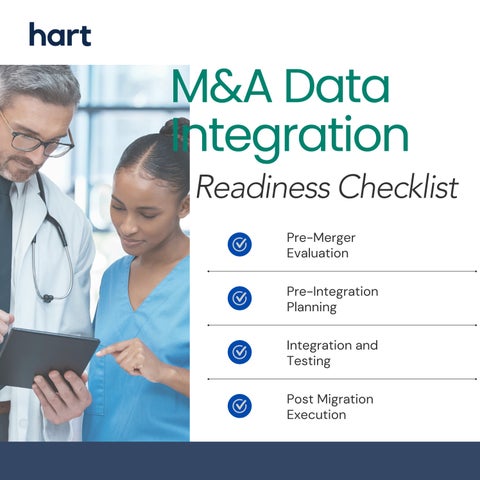
Pre-Merger Evaluation
Pre-Integration Planning
Integration and Testing
Post Migration Execution
Inventory both organizations IT systems. Do they have the same vendor? Is either system multitenant?
Identify data formats, storage locations and integration points
Document system capabilities and limitations.
Identify and address any gaps in data privacy or security protocols
Determine if you require a disaster recovery backup.
Determine if you need data “cleaned” to remove unnecessary historical files before transition.
Determine whether legacy systems include custom fields or proprietary formats.
Determine if images, labs, or documents/forms are required.
Determine the volume of data.
Involve IT, clinical, and administrative leaders from both organizations.
Determine any contractual data sharing requirements.
Define goals, timelines, and success metrics for the transition.
Identify a vendor to support the transition and any relevant data archival.
Review contracts with EHR vendors for both organizations.
Confirm licensing, support, and transition terms.
Identify differences in workflows, data capture, and reporting requirements.
Develop strategies to address potential misalignments.
Create a data mapping plan to align data fields between systems.
Determine master patient identifiers if needed for matching.
Standardize key data elements like patient demographics, lab results, and clinical notes.
Determine any record retention policies that should be applied prior to transition. For example children population.
Determining a phased, big-bang or hybrid transition strategy.
Determine the data extraction and load methods. Do you require interface work to load? Or a EHR vendor extraction?
Plan for legacy data archival should all data not be possible to transition.
Identify 10 unique “golden patients” from the originating EHR system.
Perform test migration on the sample set in non-production environment.
Validate data integrity, accuracy, and usability post-migration.
Configure the target EHR to accommodate unique workflows or forms from the acquired hospital.
Develop templates and tools to support clinicians during the transition.
Integrate the new patient record archival system into the acquiring EHR for single sign-on access.
Train staff on the new or updated EHR platform and if needed the new archival system.
Provide on-site support during the go-live period.
Track system performance and user adoption metrics.
Address issues in real time to ensure operational continuity.
Conduct post-migration audits to verify data completeness and accuracy.
Document findings and remediate any issues identified.
Use this checklist to guide your preparation, minimize risks, and ensure a seamless transition that safeguards patient data integrity, supports clinical workflows, and positions your health system for future success.