The Office of Communications and Marketing at Hanover College publishes The Hanoverian three times each year and enters it as third-class postage material at the Indianapolis Post Office.
Send comments to:
The Hanoverian Hanover College P.O. Box 108 Hanover, IN 47243-0108
Call 800-213-2179, ext. 7008 or email guthrie@hanover.edu
Dennis Hunt vice president for college advancement
Rhonda Burch
senior director of communications and marketing
Carter Cloyd
director of news services
Sandra Guthrie director of publications, editor, The Hanoverian
Ann Leslie Inman ’86 director of alumni relations executive director, alumni association board of directors
Joe Lackner director of web communications
Rick A Lostutter art director
Matthew Maupin director of creative services
Yuding Ai ’16, Yana Boltunova ’16, Miriam Cahill ’17, Maggie Huffer ’16,
Kylie Justus ’14, Georgia Lacy ’14, Nicki Lewis ’16, Felicia Nguyen ’15, Ashley Walker ’14, Hayley Cloyd and Dave Howard, contributing photographers
Angela Eden ’92, Benjamin Gleisser, contributing writers 2013-14 Alumni Association
Board of Directors
Misty Wick ’02 president
Barb Alder ’77 past president
John Pollom ’03 president elect
Amy Ochoa Carson ’04
Jason Crawford ’11
Dawn Doup ’98
Bonnie Wible Dyar ’82
Darin Edwards ’90
Benjamin Gunning ’08
Angela Semrau Kara ’08
Don Kobak ’89
Walter Kropp ’75
John Maudlin ’61
Kip McDonald ’07
Phil Mullins ’72
Ali Gantz O’Leary ’09
Chris Powell ’97
Hunter Rackley ’04
Chris Richardson ’98
Joshua Smith ’01
Jeff Tucker ’83
Nick Walter ’06
Jon Welty ’92
Misty Wick ’02
John Wittich ’79
Hanover College provides equal opportunity in education and employment.
In this issue Features
2 Charting Hanover’s future
President DeWine writes about the next phase in the College’s strategic planning.
3 Around THe QuAd And To THe PoinT
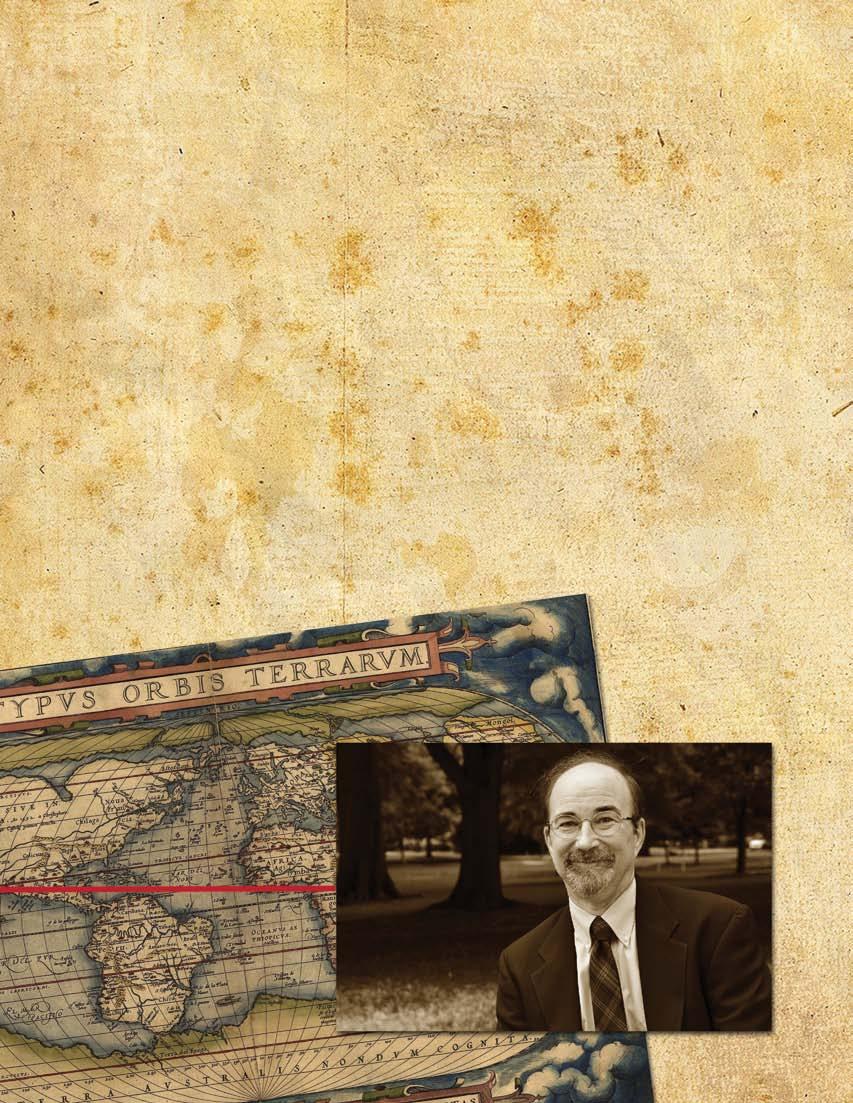
13 Mapping the City of Light
A model of urban planning since the late 19th century, Stephen Sawyer ’96 led a team of researchers to create a modern cultural map of Paris.
17 How big a sports fan are you?
When fans align themselves with a sports team, companies take notice. Vassilis Dalakas ’92 looks at the impact of this marketing tactic.
20 identifying pieces of the puzzle
Professor of Geology Heyo Van Iten was the first to confirm the identity of a 550-million-year-old fossil found last summer in Brazil.
22 The poem hunter
Athletics
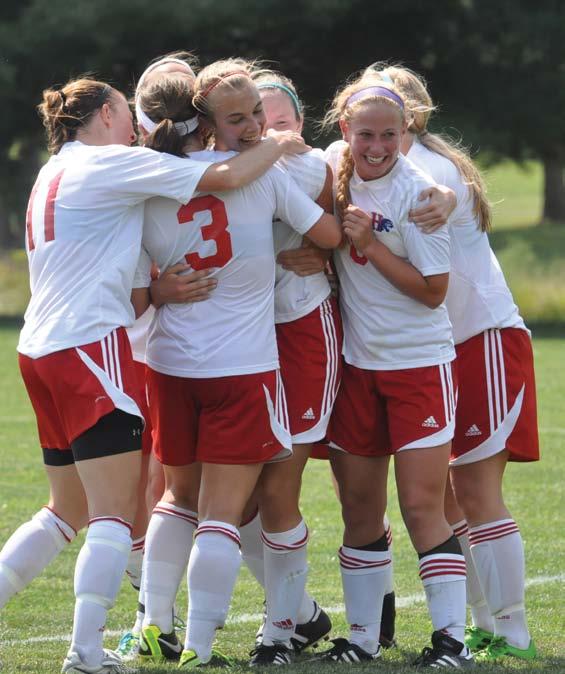
25 A winning quartet
For the first time in school history, four women’s teams win their conference championships in one season.
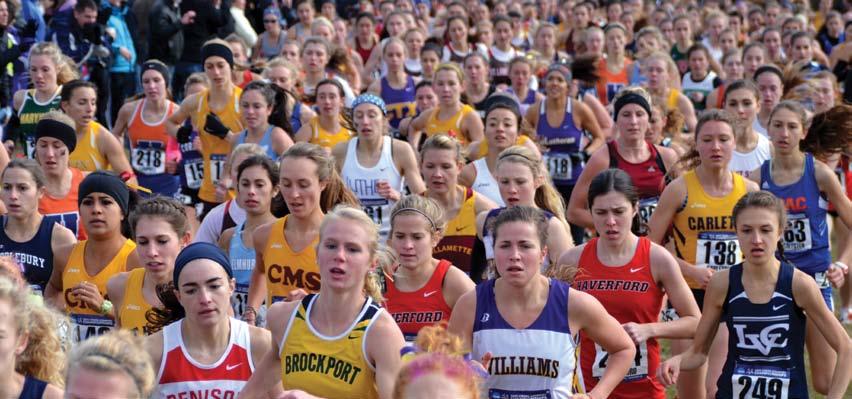
28 The 2013 NCAA Division III Cross Country National Championships
Hanover hosted the national championship for the third time this fall.
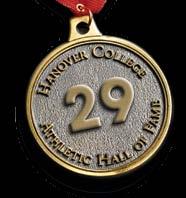
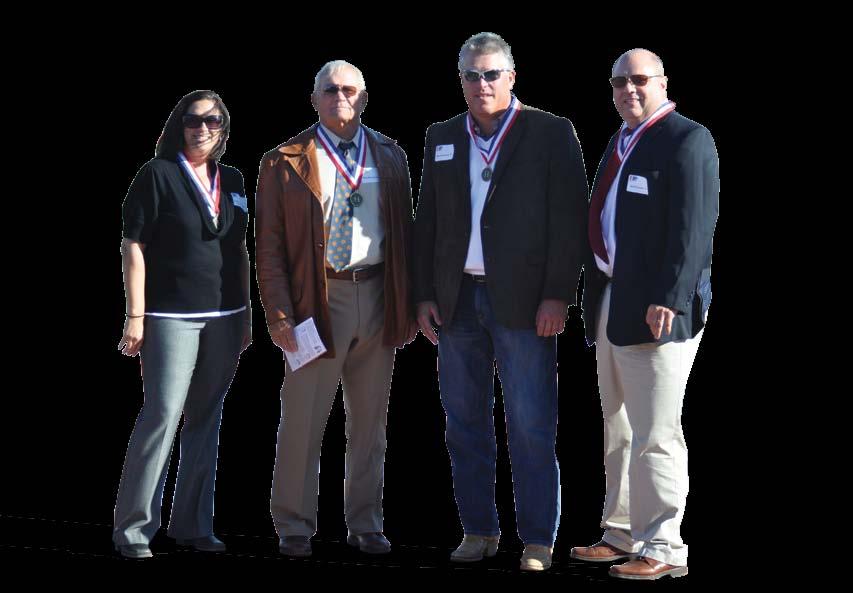
29 2013 Hall of Fame winners
Julie Campbell Beatty ’95, Robert Bergman ’61, Don Katzman ’81, Jeff Knecht ’86 and Ken Trinkle ’65 are the newest HOF inductees.
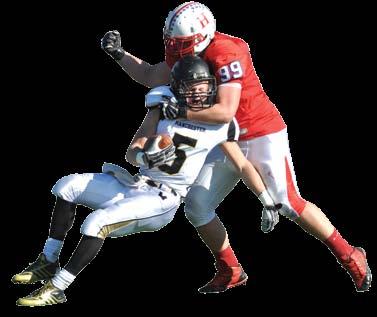
30 Sports wrap-up
A look at the fall season.
32 ALUMNI NEWS
41 END PIECE
The countdown begins again
Angela Eden ’92 recounts how her Hanover experience taught her the capacity to learn never diminishes.
On the cover: The Eiffel Tower, an iconic Parisian symbol. Photo by Hayley Cloyd.
By Sue DeWine, Ph.D.
Charting Hanover’s f u t u r e f
In this issue of The Hanoverian, we focus on research, including contributions made by our own faculty and that of alumni, many of whom hold academic posts and pursue active research agendas. I hope you enjoy reading about their discoveries.
The central theme of this article, however, is my personal invitation for you to become engaged in the process of charting Hanover’s future. My style of management has always been inclusive rather than exclusive. I would rather make the mistake of including too many people in the decision-making process, even if it causes confusion and chaos for a while until we sort out what works best. I believe Hanover’s constituents have much to offer to this conversation:
• Faculty not only teach students to think creatively and to analyze problems analytically, they have valuable insights and thoughtful observations about both the College and higher education.
• Staff are on the front lines and often know best what students want or need.
• Students learn how to tackle thorny issues. Since they are our customers, I believe it is imperative that we listen to what they tell us.
• Alumni lead interesting and important lives, often having a significant impact within their careers, their communities and their country. Why wouldn’t we want all of these talented groups to contribute to the future direction of the College?
I named our first strategic plan “Leveling the Playing Field: Strategic Initiatives for Hanover College 2009-2015.” Our goal was to increase enrollment and create a more stable financial model. We did that by enhancing the student experience, which led to a positive impact in these areas.
With an incoming class this fall of 354, Hanover College welcomed one of the largest incoming classes in our history, establishing a new record for total enrollment with 1,165 students for 2013-14. In addition to achieving this important milestone, this year’s class also set new records as the most ethnically and culturally diverse. More than 12 percent of incoming students are domestic students of color, while the international cohort has nearly doubled in size. That group now makes up seven percent of the total class.
Additionally, 12 percent of entering students have had an immediate family member (sibling, parent or grandparent) attend Hanover in the past. This percentage would be much higher if we considered aunts, uncles and cousins in the calculation and is a strong indication that the College remains a recognizable and deeply valued experience for our alumni.
Our 2009-2015 strategic plan identified 49 projects directly tied to enrollment and retention. Thirty-five are complete and in place and another five are in progress, leaving nine either unaccomplished or dropped from consideration. These successes came about through the hard work of every person on this campus.
In our next strategic plan, “Charting Hanover’s Future: A Strategic Plan for 2014 and Beyond,” we must continue our intense focus on making the students’ educational experiences so outstanding that our enrollment continues to grow and our reputation continues to strengthen. We must build on our strengths to meet the many challenges of the future. This will involve how well we respond to the real changes — social, economic, technological — facing higher education today. That task begins with sorting out the signal from the noise in the steady barrage of news and opinions about the costs and value of a traditional college education, about student loan indebtedness and post-graduation employment prospects. We must find the right combination of innovative ideas, since we want to be Hanover, not anyone and everyone else.
Our goal for students is that they find their passion and gain exposure to a career through internships, study abroad, special research programs and apprenticeships. We want our alumni to be successful professionally, socially, financially and physically, and acquire a sense of general wellbeing in their community and in the world.
At the same time, our next strategic plan must identify ways to reduce the cost of instruction without diminishing the special relationship with faculty, be more creative about accomplishing operating tasks, identify programs that attract today’s students, provide more opportunities for special experiences such as spring term off-campus courses and much more. We are only limited by our imagination and the practicality of our creativity.
Toward that end, we have formed a strategic planning committee on campus and among our trustees. This will be an open conversation that will hopefully engage you in the process. If you have ideas or suggestions you think we should consider I invite you to correspond with me as we chart Hanover’s future. Just write to me at dewine@hanover.edu.
In addition to your ideas, we need your continued support of Hanover students. We are in the final stage of the Live our Loyalty Campaign. Your gift, no matter what size, will help secure the future of Hanover College and see that these talented young people continue to experience a Hanover education.
Let me tell you just one short story about these Hanover students you support. Before I was directly connected to small private colleges I thought only wealthy families could afford to send their children to a school like Hanover. Not true. Our student body is equally divided among students from families with modest-tolittle income, middle income and higher-level income. We give out an extraordinary amount of financial aid. One student currently at Hanover is homeless. He is a very talented young person with great promise. Because of the kindness of alumni and friends he not only has his tuition covered but also has an emergency fund for incidentals. We are changing his life every day.
Your support to the Live our Loyalty Campaign makes stories like this one possible. Those words come directly from our alma mater, written more than 100 years ago. The dreams our founders had for Hanover are still true today: a rigorous education in a magnificent setting, preparing young people to enter a world filled with problems they can help solve.
Please join me in celebrating the results of our hard work and participate in a community-wide conversation about the next decade in the life of Hanover College. What an exciting time to be part of this endeavor.
The young math teacher in Massachusetts, Colleen Ritzer, tragically killed last October, had posted on her web page the following quote from Ralph Waldo Emerson: “To know that even one life has breathed easier because you lived, that is to have succeeded.” From all accounts she lived this message. We can all hope that others will say the same for us.
Sue DeWine
Hanover College awarded Lilly Endowment grant to improve employment opportunities
Hanover College has received a nearly $1 million grant from Lilly Endowment Inc. that will significantly enhance efforts to help its graduates find meaningful employment in Indiana. The award was part of $62.7 million in grants given to 39 accredited Indiana colleges and universities through the third round of the endowment’s Initiative to Promote Opportunities Through Educational Collaborations.
The grant will augment the College’s Business Scholars Program (BSP) and its new Healthcare and Biomedical Sciences Program (HBSP).
“Lilly Endowment’s grant will help students at Hanover and colleges across the state find meaningful employment in Indiana following graduation,” said President Sue DeWine. “Hanover College’s Business Scholars Program and our new Health and Biomedical Science Program are unique in that they combine the liberal arts with career preparation. Both identify ways to reach out to employers and connect them with Hanover graduates.
The state’s economy will benefit, and, most importantly, our students will greatly benefit
from this program. These programs will keep talented graduates in the state helping to solve business, government and education problems.”
Research commissioned by the Central Indiana Corporate Partnership (CICP) has identified “an imbalance between Indiana’s higher education pipeline and the economy’s concentration of high-skill employment.”
The BSP has worked to successfully correct this imbalance by matching employers with graduates who meet their needs. Established in 2004 with funding from the first two rounds of the endowment’s initiative, the BSP places 98 percent of its graduates in jobs or post-graduate programs within six months of graduation.
This grant will enable the BSP to build upon previous successes and raise its capacity to match a greater number of students with jobs in Indiana by establishing a statewide network of businesses and alumni to link students with mentoring, internship and employment opportunities in Indiana.
Additionally, the BSP will increase success at matching graduates with Indiana employers by hiring a permanent director of career
counseling who will build and maintain a statewide network of businesses, non-profits, and alumni for internships, mentoring and job placement; assessing and placing all students in appropriate internships; and matching students with employment in the state of Indiana upon graduation.
Based on the model of the BSP, Hanover’s new Healthcare and Biomedical Sciences Program (HBSP) will prepare graduates for employment and post-graduate training in healthcare fields and biomedical research in Indiana.
The HBSP will provide career discernment and enhanced preparation for students who selfidentify interest in a pre-health course of study, including medicine, veterinary and dentistry fields. This program will help incoming and first-year students choose from among the many healthcare and biomedical science career options; provide academic support and mentoring to increase retention of students expressing an interest in science, technology, education and math majors; and offer academic and administrative support for upper-level students seeking employment and applying for advanced training in healthcare and biomedical fields in the state of Indiana.
Both these programs rest on the core values of the College’s strategic plan, including a commitment to the liberal arts, strong writing and speaking skills, and education both inside and outside the classroom that combines intellectual and experiential preparation.
Toulmin Foundation endows $250K arts scholarship
Hanover College has received $250,000 from the Dayton, Ohio-based Virginia B. Toulmin Foundation for an endowed scholarship that will help students in the fields of music and theater.
The Virginia B. Toulmin Scholarship in the Performing Arts will support a student majoring in one of the above areas during all four years of study. Chosen by a panel administered by the College’s Regional Arts Partnership with the Indiana Arts Commission, preference will go toward a student from Seymour, Ind., or Jackson County, Ind.; the Toulmin Scholar will receive $12,500 annually.
“More than 95 percent of our students receive some form of financial aid,” said President Sue DeWine. “Not only will this scholarship allow our students to develop
their performing abilities to the fullest potential, it will help us ensure Hanover remains an affordable option for them.
I am extremely grateful to the Toulmin Foundation for their generous support.”
Born in St. Louis, Mo., Toulmin served as a public health nurse before taking a job as a nurse-stewardess on the St. Louis-Washington, D.C., line of the Baltimore & Ohio Railroad. It was there she met her husband, successful international patent attorney Harry Aubrey Toulmin Jr., son of the famed attorney who secured and defended the Wright Brothers’ patent for their flying machine.
After her husband’s death in 1965, Toulmin successfully ran Central Pharmaceuticals, based in Seymour, Ind., which her husband owned and on whose board she served.
The company thrived under her leadership, and Toulmin sold it for more than $178 million in 1995. She devoted the remainder of her life to philanthropy, generously supporting the arts, as well as health and human services organizations in the U.S. and around the world.
Vaughn establishes endowed scholarship for women
studying English
Hanover College has received $650,000 from the estate of Mildred McKim Vaughn ’34 to establish an endowed scholarship fund for the benefit of female students majoring in English.
At Hanover, Vaughn majored in English and Latin, and was a member of the Y.W.C.A., Social Science Club, Classical Club and Independent Women’s Organization. In addition to taking classes in library science at Butler University, she earned her master’s degree in education from Indiana University in 1953.
Vaughn served as a classroom teacher in the Harrison County Schools and Cannelton Schools for 43 years, retiring in 1977. She was a member of the Indiana State Teachers Association. Vaughn died Dec. 31, 2011 at age 99.
Gaunt to join Hanover board of trustees
James R. Gaunt ’67, retired president and CEO of Fifth Third Bank of Kentucky, has joined Hanover’s Board of Trustees, effective at the October 2013 meeting.
He began his nearly 40-year career in the banking industry with Fifth Third Bank in 1968. Over the years, Gaunt held various positions including branch manager, regional manager, retail administrator, commercial lender and executive vice president of Fifth Third Bancorp before becoming president and CEO of the Kentucky division in 1994, a position he held until his retirement in 2005.
Active in community service, Gaunt’s previous board memberships include serving on Bellarmine University’s (Ky.) board of trustees executive committee; co-chair and executive committee member of Greater Louisville Inc.; chair of the Louisville Sports Commission Board; Fund for the Arts chair and executive committee member and Metro United Way Louisville, among many others.
Bellarmine University awarded Gaunt the doctor of humane letters degree. Additional honors include the Tribute Award for Outstanding Service to the Commonwealth of Kentucky by Volunteers of America and the Leadership in Education Award for Business and Community by The Collaborative for Teaching and Learning in recognition of outstanding leadership in support of better schools and for tremendous contributions made to improve Kentucky’s communities.
Gaunt earned an MBA from the Colgate Darden Graduate School of Business Administration at the University of Virginia in 1980. He lives in Hilton Head, S.C., with his wife, Kate. The couple has two children.
Knowlton Foundation gift to endow scholarship
Hanover has received $100,000 from the Austin E. Knowlton Foundation, Inc. to establish the Austin E. Knowlton Endowed Memorial Scholarship.
The College will award one scholarship annually to an outstanding member of the incoming freshman class from Logan County, Ohio, with preference given to high school seniors interested in studying mathematics or a related field.
“We are very grateful to the Austin E. Knowlton Foundation, Inc. for their generosity in establishing this scholarship,” said President Sue DeWine. “Scholarships like this one are essential for our students to pursue their educational goals. We hope this is the beginning of a long and mutually satisfying relationship.”
Founded in 1981, the nonprofit Austin E. Knowlton Foundation seeks to promote and advance higher education in the United States and to provide direct grants and contributions to qualified colleges and universities.
Known as “Dutch,” Knowlton was the owner and chairman of the Knowlton Construction Company, an organization started in Bellefontaine, Ohio in 1937 and whose predecessors dated back to 1906.
Through his company, Knowlton was responsible for more than 600 major and significant construction projects throughout Ohio and the Midwest, including school buildings, hospitals, libraries and post offices.
A 1927 graduate of Bellefontaine High School, he was a member of The Ohio State University’s class of 1931, where he received a bachelor of science degree in architectural engineering. Knowlton became an avid sportsman with a 50-year interest in saddle-bred horses; he helped found the Cincinnati Bengals in 1967 and served as the National Football League team’s chairman for 20 years. He also was a shareholder in Major League Baseball’s Cincinnati Reds in the 1970s.
Knowlton died in 2003 at age 93.
Learn more at www.aekfoundation.org.
Hanover welcomes six new faculty
Nuan Gao joined Hanover this fall as assistant professor of history, specializing in modern Chinese history. Her research interests are in the cultural, intellectual, gender and diplomatic history of China. Gao previously served as visiting assistant professor at Stockton College (N.J.), and as an instructor at the University of California, Irvine. She earned her bachelor’s and master’s degrees from Peking University, and both master’s and doctoral degrees from the University of California, Irvine.
Diane L. Magary ’87 returned to her alma mater to serve as an assistant professor with the Business Scholars Program. Previous posts include director, marketing development at Ethicon Endo-Surgery; director of marketing and a member of senior management team at Cardima, Inc.; and at St. Jude Medical, Inc., Cardiac Rhythm Management Division as manager of market information and planning. Magary has a wide range of experience in international marketing, strategic planning, education, research and development, sales, information systems, and management. She earned her MBA from Duke University.
Assistant Professor of History J. Michael Raley’s dissertation examined the ways in which lay members of the late medieval northern religious movement known as the Brothers and Sisters of the Common Life strove to achieve formal legal recognition of their newly-emerging status medius. Prior to joining Hanover, he served as visiting instructor at Alma College, visiting assistant professor at Wake Forest University, and he has also taught at Northeastern Illinois University. Before turning to academia, Raley had a brief career as a professional symphony musician with the Louisville Orchestra. He earned a bachelor’s degree from Belmont College (now University) in Tennessee, master’s degrees from the University of Louisville (Ky.) and Southern Illinois University-Carbondale, and a doctorate from the University of Chicago.
Mridula Mascarenhas
Instructor of Communication Mridula Mascarenhas’ research focuses on public and political discourse and social movements using primarily a rhetorical perspective. She examines the ways in which individuals and groups enact identities, practice citizenship and engage in community building or conflict. Mascarenhas previously served as a full-time instructor at Saint Cloud State University and Ithaca College. She earned her bachelor’s from St. Xavier’s College (India), a master’s at Mumbai University (India), as well as a master’s from University of Wisconsin-Milwaukee.
Glené Mynhardt joins Hanover as assistant professor of biology from Iowa State University where she was an HHMI Postdoctoral Teaching Fellow. She held various graduate teaching positions at Ohio State from 20062012. Outside the classroom at Ohio State, Mynhardt curated plants in the Herbarium and updated one of the world’s largest bird song databases in the Borror Lab of Bioacoustics. Her primary interest is in beetle systematics, specifically the evolution of myrmecophilous beetles. Mynhardt earned a bachelor’s from the University of Texas at Austin, a master’s from Texas A&M University and a doctorate from The Ohio State University.
Mandy Wu serves as assistant professor of art history. Her dissertation, “Mortuary Art in the Northern Zou China (557-581 CE): Visualization of Class, Role and Cultural Identity,” uses newly excavated materials from tombs dated to the Northern Zhou period, including the tombs of Xianbei leaders, Xianbei and Chinese generals, and Sogdian merchants. Wu proposes that visual arts and mortuary ritual played a role in creating and/or maintaining multiple sociopolitical and cultural identities for these residents of Northern Zhou. In 2011-12, she was the An Wang Postdoctoral Fellow at the Fairbank Center for Chinese Studies at Harvard University. She previously taught as an instructor at Harvard and at the University of Pittsburgh. Wu earned her bachelor’s from Tunghai University (Taiwan), her master’s from the National Institute of the Arts (Taiwan), and a master’s and doctorate from the University of Pittsburgh.
Nuan Gao
Diane L. Magary ’87
Glené Mynhardt
J. Michael Raley
Mandy Wu
Research focuses on fight for supremacy
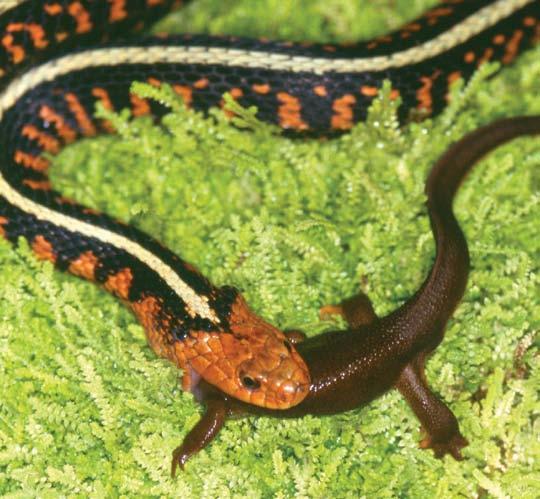
There’s a fight-to-the-death arms race happening in this country, but the combatants are some of the most least likely suspects. You can find them under rocks, in woodlands, forests, rivers and streams — even your own backyard.
Who are these deadly adversaries? None other than the newt, a type of salamander, and its nemesis, the common garter snake.
One variety, the rough-skinned newt (Taricha granulosa), can pack enough of the neurotoxin called tetrodotoxin to kill more than 100,000 mice in 10 minutes or wipe out up to 60 people.
It’s also the same toxin found in puffer fish, considered the second-most poisonous vertebrate in the world. Commonly served raw at sushi bars, this Japanese delicacy known as fugu can become a game of Russian roulette if the chef is having an off night.
According to research performed by faculty member Brian Gall, the snake is the newt’s only natural predator. Just a few point mutations in the reptile’s DNA are enough to diffuse the toxin’s effect.
“The toxin in newts causes selection on snakes for resistance, the elevated resistance then causes selection on newts to be even more toxic,” he said. “This process continues until we now have super-resistant snakes and super-toxic newts.”
Gall added that every other predator tested (birds, mammals, other reptiles, turtles, fish) has died within a few minutes. (These trials took place in the 1960’s when animal use rules were not as strict as today.)
Science News reported Gall’s findings, calling the newt’s toxic shock a defense mechanism. A newt will contort itself into a circle — a defensive posture adopted by several amphibians called unken — before the skin on its back appears to melt into a clear liquid.
While the toxin itself is odorless, he said there is a pungent companion compound that will sting the nose.
Biologists have yet to determine how the newt acquires the poison. Helping Gall in the lab is senior Kari Vollmer, who feeds the lab-reared newts a strict toxin-free diet, to determine if food plays a role.
Hanover’s assistant professor of biology has already learned that female newts deposit some of the toxin in their eggs.
“I found that there is only one invertebrate that can eat those eggs. It looks like there might be coevolution going on with newts and caddisfly larvae as well. It’s a similar system to snakes and newts, but on a much smaller scale.”
What do you do if your child wants to bring one of the cute critters home for a pet? Will you have to add a garter snake to keep the peace?
Philipp discovers a method for creating healthier oranges
We all know fruits and vegetables are healthy, but Associate Professor of Chemistry Craig Philipp has discovered a way to make one of them even better for you.
Working with Florida oranges still on the tree, he learned that by boring a hole into the fruit with a corkscrew and waiting only 10 minutes before picking, the invasion causes the orange to produce a greater level of polymethoxylated flavones, or PMF.
What does this mean to the consumer? The increased levels of PMF have been shown to reduce the risk of cancer, lower blood pressure and reduce LDL levels — the bad kind of cholesterol.
“We (do this) to simulate what we believe the orange thinks is an insect attack,” he said. “The stressed oranges have produced up to 30 percent more PMF, but what’s interesting is that it doesn’t do it at the wound site, but on the other side of the orange.”
Philipp’s students helped perform the lab analysis on the peel that led to this discovery. While he hasn’t learned yet why this occurs, Philipp believes it’s a means of cellular repair. He hopes to connect the students with a large university so they can pursue this important next step.
Battles’ new books look at classic medieval legends
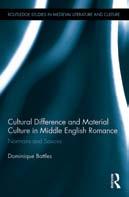
Professor of English Dominique Battles’ new book, “Cultural Difference and Material Culture in Middle English Romance: Normans and Saxons,” explores how the cultural distinctions and conflicts between Anglo-Saxons and Normans originating with the Norman Conquest of 1066 prevailed well into the 14th century and manifest in a significant number of Middle English romances including “King Horn,” “Havelok the Dane,” “Sir Orfeo,” “Sir Gawain and the Green Knight,” and others.
In addition to looking at how elements such as architecture, battle tactics and landscapes make a distinction between Norman and AngloSaxon cultural identity, the book examines the influence of the English Outlaw Tradition, and how poets made repeated contrasts between essentially Norman and Anglo-Saxon values, as well as ruling styles.
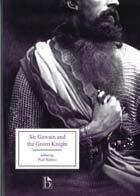
In a new edition of the medieval classic, “Sir Gawain and the Green Knight,” Professor of English Paul Battles has taken the challenging regional dialect of the original poem, considered one of the finest Arthurian tales, and made it accessible to students and general readers.
Battles’ edition provides extensive annotations of difficult words, thorough on-page explanatory notes and a comprehensive glossary to help readers encounter this masterpiece of English literature in the original language.
Written with Hanover students in mind, who suggested many improvements as they read earlier drafts of the work, the edition took almost ten years to complete.
“Seeing my students read this work in the original is so rewarding,” said Battles. “Now I’m thinking (about) what I can edit next.”
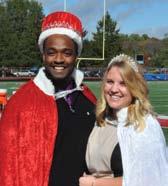
Although the weather didn’t cooperate, the cold and rain didn’t dampen the spirits of the more than 3,000 Hanoverians who filled the tailgate lot at this year’s Homecoming, Oct. 18.
It also didn’t hurt that the Panthers crushed the Bluffton University Beavers 41-0 in the big game!
Be sure to save the date for next year's Homecoming, Saturday, Sept. 20, 2014.
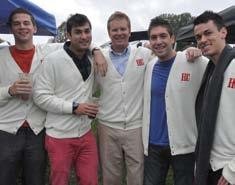
Sigma Chi chapter earns Peterson Award
Hanover’s Chi chapter of the Sigma Chi fraternity has earned the Peterson Significant Chapter Award at the 2013 Balfour Leadership Training Workshop. This is the first time the chapter has received this recognition since 1998 and the 13th time overall.
During the past academic year, the brothers were able to start their own full-service kitchen, revamp their philanthropy efforts and become more involved with leadership positions in student organizations.
“The culmination of our efforts has paid off with the recognition by the international fraternity that we are a significant chapter,” said Taylor Alexander ’15. “It was an incomparable joy to accept the Peterson Award with my fellow Chi Chapter Brothers. Being up on the stage, shaking our Grand Consul’s hand, it became apparent to me that we had made it once again. There were plenty of stumbling blocks along the way, and there yet remain challenges in the future, but we are more than prepared to progress beyond these and continue to increase the strength of our brotherhood.”
The Peterson Significant Chapter Award, sponsored annually by the Sigma Chi Foundation, is the highest honor that the fraternity bestows upon an undergraduate chapter. Named for 38th Grand Consul J. Dwight Peterson, the award recognizes excellent performance by chapters in all major areas of operation and programming.
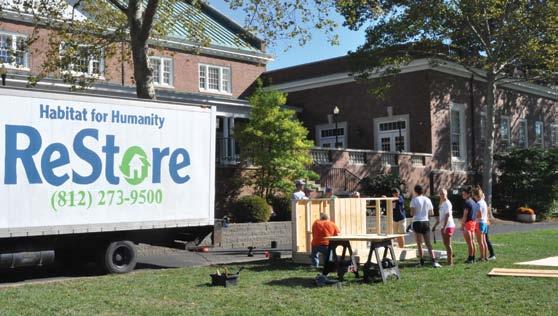
IFC/Panhellenic build playhouse for Habitat for Humanity
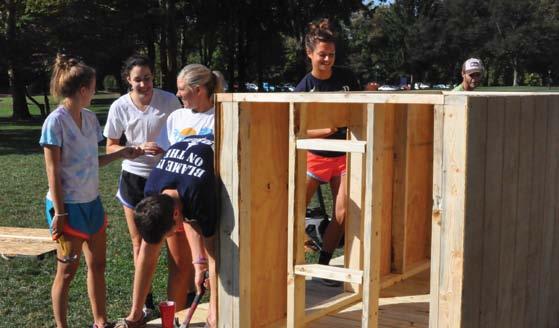
As a part of Greek Week, fraternity and sorority members partnered with Habitat for Humanity to build a playhouse for a local family who will move into a Habitat home. With advice and help from Lisa Steele, Kappa Alpha Theta’s advisor and Habitat volunteer, this project became a reality when 70-plus members of the Greek community hammered, drilled and painted to bring a little joy to a deserving family.
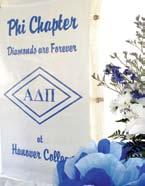
Phi Mu and Alpha Delta Pi A centenary celebration for
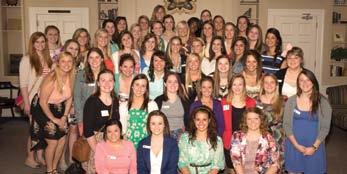
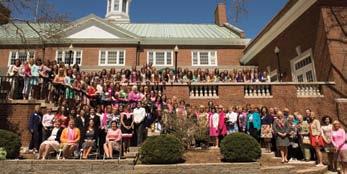
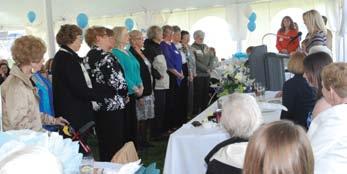
More than 100 sisters attended the centenary celebration of Phi Mu on Hanover’s campus, April 13. Organizing the event for Phi Mu’s Rho chapter were Shannon Veach Gibbs ’91, chapter adviser; Lisa Fleming ’82, current house corporation president; and RaeAne Lionetti Benkert ’96, current house corporation treasurer. The trio also received help from current chapter president and senior Lauren Ehler
The sorority presented a $10,000 check to President Sue DeWine to develop the Greek Leadership Training Endowed Fund. In return, DeWine presented Gibbs with the Chapter Advisor of the Year award, given by Hanover College to one chapter advisor each year.
Alpha Delta Pi also held its 100th anniversary festivities April 13. Cookie Howard Vargo ’66 and Julie Slayback Thacker ’87 coordinated the event for the sorority.
The highlight of the weekend was a lunch held at the Lanier Mansion in Madison, Ind. On display was a commemorative quilt made by senior Elizabeth Hollis.
In addition to a $5,000 gift from the sorority for the Greek leadership fund, Thacker presented a bench made by Madison Iron Works to DeWine for placement on campus.
2013 Hanover College
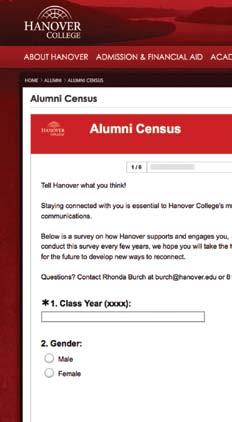
AlumniCensus
Census results show overall satisfaction, but need for changes
Last year, we initiated a conversation with our alumni through the census included in the winter issue of The Hanoverian. While overall the results were very positive, we learned there was a need for some changes. Here are just a few of the highlights:
What you said:
• A combined 88 percent rated The Hanoverian as the method they preferred most for receiving information, with 80 percent giving it the highest marks for overall quality.
• Of the sections you read most, 90 percent read all or almost all Class Notes, followed by the news briefs in Around The Quad (81 percent) and features (60 percent).
• Results were mixed regarding a digital version of The Hanoverian. A total of 38 percent indicated interest, but 40 percent did not. The remaining 22 percent was neutral.
What we’re doing:
• We’ve expanded the Around The Quad section significantly to provide better coverage and reduced the number of features by one.
• Athletics will include more news and stories about people; eventually we’ll move scores/rankings to our website.
• We plan to implement a digital version for smart phones and tablets at a later date. Until then, you can always read The Hanoverian online at hanover.edu/Hanoverian
In future issues we’ll report on changes to our e-newsletter, @Hanover, the HC website and alumni programs. Thank you to everyone who completed the 2013 Alumni Census!
Duggan Library celebrated 40th anniversary
The year 2013 marked the 40th anniversary of the opening of the Agnes Brown Duggan Library on Hanover’s campus. Built with gifts received from Duggan and her brother, J. Graham Brown, one of the College’s largest benefactors, the library opened its doors Sept. 5, 1973.
Covering three full floors, Duggan Library is home to more than 300,000 books, journals and audiovisual materials; the library also provides access to innumerable online sources.
A renovation in 2001 turned the attic into usable space, providing additional student study areas and an expanding collection. The Ken and Kendal Gladish Center for Teaching and Learning opened in the building this fall. Future plans call for a media technology room with videoconference capabilities and replacing the original furniture on the first two floors with new pieces that are configurable into spaces that allow for collaboration.
Leading a team of international researchers, this alum catalogued the cultural scenes of one of the world’s greatest cities.
or many people, mention Paris and immediately images such as the Eiffel Tower or Arc de Triomphe come to mind. They might think of sitting at an outdoor café while eating a croissant or window-shopping at legendary fashion houses like Dior or Chanel.
One of the world’s great cities, Paris is a place that evokes culture and sophistication.
For Parisians, however, their beloved city is more than a collection of tourist haunts. It is an intricate mélange of cultural scenes that reflect Paris’ history and contemporary life.
Taking a deeper look is historian Stephen Sawyer ’96, who chairs the history department at the American University of Paris and
founded its urban studies program. In 2009, armed with a $35,000 grant from the city, he led a team of 10 international researchers — many of them graduate students — to create the first-ever map of Parisian cultural scenes. The team produced a series of articles and a 200-page report for the city, and Sawyer presented the final results to an audience of 1,000 at Paris’ city hall.
Based on work done by sociologists Terry Clark and Daniel Silver, who use the term scene as a way to “codify crucial dimensions of significant experience that can be used for classifying the range of cultural meanings articulated in sets of amenities,” the project mapped cultural consumption in the capital and its impact on public transportation, political mobilization and individual narratives of urban experience.
An additional goal was to provide a framework of urban cultural experiences that would allow for data analysis in subject areas where there had previously been none.
“These are concepts that we are very familiar with in our everyday lives,” said Sawyer. “We may say that we like a given neighborhood or even an institution because it has a certain scene. However, to date, such appreciations have remained subjective.”
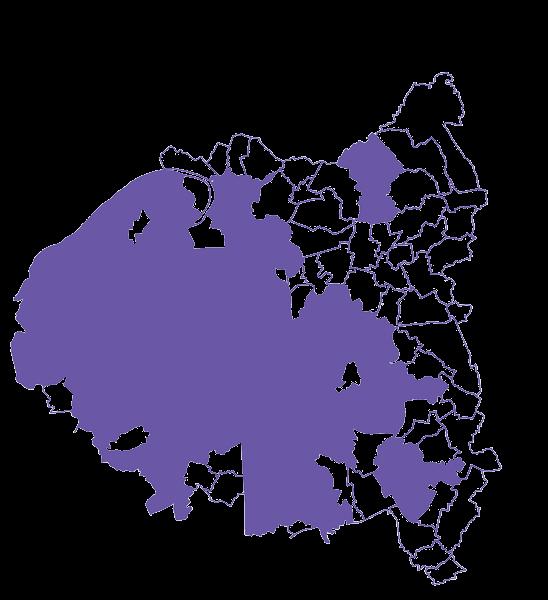
As have major cities like London and New York, Paris has seen a decline in its population with more and more people moving to the suburbs. The team decided to focus on the entire metropolitan region, rather than the city’s 20 arrondissements, or municipal districts.
“One of the major issues that’s facing Paris in the 21st century is how will (the city) interact with its suburbs,” he said. “If we could look at scenes, my hypothesis (would be) that they probably didn’t respect administrative boundaries between suburbs and the center of Paris in the same way that politics did.”
During the two-year project, the team developed a massive database of more than 100,000 amenities coded throughout the city. Doing so allowed them to identify three major scenes: Bobo, Underground and L’art de vivre.
An abbreviated form of the words bourgeois and bohemian coined by New York Times columnist David Brooks in his book, “Bobos in Paradise: The New Upper Class and How They Got There,” (Simon and Schuster, 2000) Bobos are college-educated professionals who have a mix of rebellious and social-climbing attitudes, or what might be described as Reaganism meets Woodstock.
“They don’t live in very nice neighborhoods because they like the edge. They like a little bit of the transgression, but they’re relatively wealthy and well off.”
Marked by a break in moral or legal codes, high levels of theatricality and low levels of state intervention, the Underground scene would feature alternative galleries, tattoo parlors, sex shops and a high density of loft space, what Sawyer called “post-industrial urban tissue.”
L’art de vivre, suggests pleasure, or the art of living well.
First on the agenda was creating a database of amenities, such as cafés, newspaper stands, clothing stores, hospitals, literally any type of establishment found on the street. The team then took these creature comforts and coded them according to a series of dimensions they took from classical sociology.
“Let’s take a boulangerie (bread store),” he said. “We’d ask, ‘On a scale of one to two, is this bread store traditional or very traditional? Is it a traditional activity to go to a boulangerie in Paris?’”
Other activities, such as going to a tattoo parlor, are negative or non-traditional, while going to a supermarket is neutral, since it’s only a case of trying to feed oneself.
Overall, the team looked at 16 different dimensions (including such categories as glamour, self-expression, formality and neighborliness), each of which would have a score. They would add all the scores, join each of the dimensions together, and create what Sawyer called recipes for each of the categories and see which neighborhoods had more or less of the dimension. Setting up the database was one of the early challenges.
“If you want to calculate every bread store in the Paris metropolitan region, you’re (looking at) upwards of 15,000 bread stores … and then we had to figure out ways of getting information on some very
Sawyer’s cultural map catalogued much more than typical tourist locales such as the Moulin Rouge or the Louvre.
specific amenities. For example, how do you find out how many sushi restaurants there are in the Paris metropolitan region? ... There’s no list.”
To find answers to such questions, Sawyer’s team purchased a series of web crawlers and merged data from different sources like the Yellow Pages and other website indices.
Determining the proper visual representation also proved difficult since in statistics, one of the challenges is the level at which to aggregate data. Sawyer’s team combined most of the data at a district level, but the goal was to view it at the metropolitan level. GIS mapping software helped solved the problem.
“How do you represent the Underground visually,” he asked. “It represents a whole set of issues. You don’t always want to (use) some sort of sterile map … there’s something very inappropriate about that.”
Another thing the team couldn't account for were establishments that closed after their inclusion in the database as well as new ones that opened after they had finished cataloging a specific neighborhood. The work became a synchronic study.
Despite these issues, Sawyer said what surprised him most was the extent to which the method worked.
“You see things every day when you walk through the city, and you know what these neighborhoods are like,” he said. “Then you see it on a map that you’ve developed after looking at 150,000 amenities and coding them with this innovative method, and it shows up to provide a new verifiable method and visual tool that clings very tightly to your basic everyday experience.”
Results from the project led to two conclusions about Paris. The first, which Sawyer believes in wholeheartedly, is the idea that in order to make a metropolitan Paris, there has to be a very intense effort to see
what is already on the ground before building it, (with) a voluntary policy about how to make the city more integrated.
“An integrated metropolitan Paris is not so much a question of making it, as it is seeing it,” he said. “Many everyday Parisians go into these various areas outside of (central) Paris. They don’t pay nearly as much attention to administrative and city boundaries as people think they do.
“People are much more driven by scenes and by what’s available, so there’s already a series of logic taking place, (as well as) people moving around the metropolitan area. In one sense it’s less a question of making metropolitan Paris, but figuring out how people are already using it and adapting it to their use.”
For his second conclusion, Sawyer found the scenes to be types of ecological niches, ones that are very fragile.
“If you build some huge structure, (potentially) in order to improve the neighborhood,” he said, “sometimes you can actually hurt the neighborhood more than you can help it.”
Along with the final report, the map project yielded a 25-minute pilot documentary created by AUP grad student Joe Lukawski about the Paris Underground scene; Sawyer served as narrator. He said he likes offering both undergraduate and graduate students the opportunity to contribute to and build directly off his research.
“It’s pretty amazing where undergraduate students will go if you take them there. That’s something I learned from Hanover.”
Similarly, Sawyer credits the College for allowing him to undertake a project on the scale of the Parisian cultural map.
“This is one of the great things about a liberal arts education,” he said. “At Hanover, I had to take sociology, I had to take psychology and fine arts, along with history, so I had a background in some of these things.”
Stephen Sawyer
Sawyer double-majored in history and French at Hanover, with minors in cultural anthropology and extensive course work in fine arts; he honed his language skills during a semester spent studying in Aix-en-Provence, France, near the southern port city of Marseille.
Graduating cum laude with honors, he attended the University of Chicago where he earned his master’s and doctorate. For his dissertation, Sawyer focused on the intersection between local Parisian and national politics from the Revolution to the midnineteenth century.
While writing his dissertation, he received a Fulbright grant to do research in the Paris archives, studying the history of Parisian municipal politics during the nineteenth century.
“In particular, I was interested in telling the story of local politics in a city that became one of the most revolutionary cities in history,” said Sawyer. “Unlike London before or after 1688, or Philadelphia in the years following 1776, the history of the Parisian municipality had never been examined across its revolutionary century.”
Even more intriguing was how the city became a model for modern urban planning in the second half of the nineteenth century — influencing cities such as Chicago, Cleveland and Washington, among others.
After completing his doctorate in 2008, during which time Sawyer had stints at the École Normale Supérieure in Paris and at the University of Chicago’s newly opened satellite campus in that city a few years later, he joined the American University of Paris and became department chair soon afterward.
Since his arrival at the AUP, Sawyer has written more than 50 articles and reviews, completed two manuscripts and published a number of collected volumes and translations, including previously unpublished lectures by French philosopher Michel Foucault. He continues to publish on the history of Paris during the Revolution and beyond, which has led to a broader interest in urban history.
“As I slowly settled into French life more permanently, I became increasingly interested in transnational history, especially a history with a strong eye toward French and American, as well as British history,” he said, noting his marriage to French national Cécile Roudeau-Sawyer, who teaches American literature at the Sorbonne.
“I was also obviously drawn to these questions for personal and professional reasons. My work here has focused a great deal on urban history and the history of the state. In both cases, I have focused on the complementarities of studying American and French urban and political history side by side.”
Since the project’s completion, Sawyer has set his focus on the comparative and interdisciplinary study of the state, a subject that has dominated much of his research. Earlier this year, he became the inaugural research fellow to the Neubauer Collegium for the Humanities at the University of Chicago to work on a project entitled “The State as History and Theory.”
Bringing together some of the field’s major players, Sawyer and his colleagues will try to tackle the question of the state, which he believes is one of the major issues of the 20th and 21st centuries, as the state’s role has ostensibly diminished in the face of privatization and globalization, according to the project website.
“The idea is, there are a lot of questions we would like answers to in the social sciences and the humanities that we can’t answer by ourselves,” said Sawyer. “We need more people. You can’t do physics the way Newton did it anymore. You need hundreds of people on these massive experiments. Humanities and social sciences are now in the same situation.
“Unfortunately, we have been less (eager) to join heads to solve big problems (within these fields). The idea of the collegium is to bring people together to attack really big problems, but obviously, then you need a lot of people involved.”
Combining the past and present comes naturally for Sawyer, who said urban history developed out of a nineteenth century antiquarian tradition of erudition in which the history of the city was treated as biography. Focusing on the birth, the development, occasional triumph or decline, this approach treated cities as independent units filled with details, idiosyncrasies and ultimately, a singular history.
While there is great value in these types of studies for the density of information they provide, he added that urban history and global studies have slowly moved away from such an approach, in favor of a focus on the structural similarities of cities and the relationships between them.
“As recent work on urban studies suggests,” said Sawyer, “what gives a place its specificity is not some long internalized history, but the fact that it is constructed out of a particular constellation of social relations, meeting and weaving together at a particular locus.”
Or as noted nineteenth-century author Henry James once said of Paris, “The great merit of the place is that one can arrange one’s life here exactly as one pleases … there are facilities for every kind of habit and taste, and everything is accepted and understood.”
■
BIG HOW a sports fan are you?
Imagine this scenario: you’re a diehard fan of the Indianapolis Colts. You never miss a game, whether you attend in person or watch it on TV. Even when they lose, you’re still devoted. However, you’re equally enthralled with Pepsi products, but there’s just one problem: they’re the sponsors of the Colts’ biggest rival, the New England Patriots.
So, what do you do? Do you continue to buy the product you love, knowing that in part, it finances a team you hate, or does your loyalty to your team take precedence?
These are the kind of questions Vassilis Dalakas ’92 asks on a regular basis as associate professor of marketing at California State University San Marcos. Specifically, he researches how people’s social identities as sports fans influence them as consumers and how companies use sports to reach their target customers.
“Using NASCAR as an example, there are companies that if you look at what they do, technically, the product itself has nothing to do with sports,” said Dalakas, noting detergent and other consumables. “Instead, they’re sponsoring a race car driver, and the reason they do that is because fans have such strong affinities for the athletes and the teams that they love, that it makes sense to market to them through sports.”
NASCAR fans proved to be ideal subjects for his research, since their passion matched that of what he saw in Europe. In one of his earliest studies, Dalakas looked at how their affinities
How people identify themselves with a sports team, and how companies market to those fans, is the focus on this alum’s research.
for a favorite driver translated into them loving the products of that driver’s sponsors; it was also one of the first studies to look at how fans felt about the rival driver’s sponsored products.
“Sports do involve rooting for a team, but by default, given the competitive nature, the rooting for one automatically involves rooting against somebody else,” he said. “Usually, when there are rivalries, the level of dislike is similar in intensity to the level of love for the (favored) teams.”
Companies can also choose to align themselves with a cause, e.g., General Mills “Box Tops for Education” campaign, rather than something more tangible like a sports team. Dalakas said any time a company chooses to market by association, it’s saying, “Buy us, not just because our product is good, but because we like what you like.”
The tactic can backfire, as it did in cases such as Abercrombie and Fitch CEO Mike Jeffries saying he didn’t want overweight women wearing his products or when Chick-fil-A president Dan Cathy tweeted his disappointment in the U.S. Supreme Court’s decision to shoot down the Defense of Marriage Act.
“The moment they do that, inevitably, by taking a position, as much as you get people to love you who are on the same side, you’re going to alienate all the others who are on the other side,” said Dalakas, noting that companies need to decide whether or not they want to play it safe.
“Those sports entities that evoke strong feelings, (either) positive or negative, for marketers, these are attractive properties,” he added. “While you are obviously taking some risks in that you’re alienating some people, the love and the passion from the ones who do love you is so strong, it makes it worth it. The worst thing that can happen is being connected to an entity that’s blah.”
Local companies can gain an even greater advantage by sponsoring the hometown team.
“If you are a car dealership in Dallas, it would be crazy not to connect with the Cowboys’ (football fans). The fact that people in (Washington) D.C. or Philadelphia hate the Dallas Cowboys is irrelevant because they’ll never come to Dallas to buy a car anyway … They’re not your target market.”
Fan passion is a subject with which Dalakas is very familiar. Growing up in Katerini, Greece, near the foot of Mount Olympus, he loved sports, especially soccer and basketball. When Dalakas came to Hanover in 1990, he started attending the Indiana Pacers’ games, much to the envy of his friends back home.
A passion for sports is what led Dalakas to his current field. He majored in business at Hanover, but the liberal arts gave him the opportunity to explore other areas. After graduation, Dalakas earned a master’s in European studies at Indiana University.
Initially, his idea was to return home and work in international business or possibly pursue a career in diplomacy. But when Dalakas took an elective course on consumer behavior, it changed everything. The class led to a doctorate in marketing at the University of Oregon’s Warsaw Sports Marketing Center, which was the nation’s first program of its kind at that time.
“I made my hobby part of my job, which is great, because now work doesn’t feel like work,” said Dalakas, before joking, “It also makes it easier when my wife complains I watch too much ESPN. (I tell her) ‘I have to watch, it’s my work.’”
One of the things he and his colleagues have learned is that the level of group identification varies, and it is the level that impacts the response toward the sponsor. Some fans may be indifferent, or if they have an affinity, it’s at a very low level. As the intensity increases, so does the fan’s level of passion and identity.
To illustrate, one of Dalakas’ studies, co-authored with Oregon State professor Colleen Bee, worked with two groups of college football fans: in one set were students who loved the Oregon State University Beavers; the other set of students had a low level of identification with the team.
Instead of simply assessing how the students felt about the team and its rival’s sponsors, Dalakas and Bee used different types of advertisements in which they manipulated arguments about the quality of the products.
Fake ads had groups like J.D. Power and Associates and Consumer Reports giving some of the products a high ranking; the others had ads with weaker arguments that only said the product was good, without any industry watchdog backing them up.
It turned out that people who had a low identification with their team evaluated the products based on the implied quality, independent of whether or not they had a connection to Oregon State football or its rival. However, fans who had a higher identification with their team ranked the products solely on the basis of being associated with the team or with the rival, regardless of the product’s quality.
“Essentially, somebody who is highly identified with a sports team is willing to buy an inferior product because it is associated with his or her own team,” said Dalakas. “(The person is also) willing to pass on a better product because it is associated with a rival. It really shows that the love and intensity for a sports team can make people act in truly irrational ways.”
Recently, he has turned some of his focus toward fans who experience an emotional schadenfreude taking pleasure in another’s pain ⎯which goes beyond their rival’s team simply losing.
Taking a look at how the extent of people’s like or dislike for a team makes them more or less likely to help someone in need, Dalakas and Cal State colleague Ben Cherry spent two weekdays at a location about a mile from the San Diego Chargers’ stadium. For three hours each day, Cherry sat dressed as a person in need with a piece of cardboard that read, “Please help.”
During one hour, he wore a plain white shirt; in another, he wore a Chargers shirt; and in the third hour, Cherry wore an Oakland Raiders shirt, the Chargers’ hated rival.
“What’s interesting is that wearing the San Diego shirt didn’t actually help (Cherry’s) cause. Part of (the reason) may be that people thought if he could afford a Chargers shirt, he probably wasn’t in need. Maybe people felt, ‘I like the Chargers,
too, but I don’t like homeless people, so I want to disassociate myself from you.’”
Although Cherry received a minimal increase in assistance wearing the Chargers shirt, when he wore a Raiders shirt, of the approximately 230 cars that passed by, only four stopped, two of them belonging to Raiders fans. Analyzing the final take, which the pair later donated to a homeless shelter, they found that only 12 percent of the money came during the hours Cherry wore the Raiders shirt.
“In addition, he got at least one person yelling at him, ‘Raiders suck,’” said Dalakas, “and another person telling him, ‘Well, that’s what you get,’ essentially implying that the reason he is in that position is because he likes the Raiders.”
While he still researches marketing, Dalakas found the above study so eyeopening that he has since shifted some of his efforts toward projects that have a social implication.
“I’m still a diehard fan, I’m still passionate about my teams, and wanting them to win and my rivals to lose,” he said. “(But) I do catch myself sometimes, when a rival player goes down, and my first reaction is to cheer … (I tell myself) be passionate about who you love, be passionate about who you hate, but don’t lose your humanity in the process.” ■
At left: Dalakas' colleague Ben Cherry portrays a homeless person to gauge people's willingness to help based on sports attire. Below left: Dalakas and his wife, Nicole, on the set of ESPN with daughters Sofia (left) and Katerina (right) in 2010. Since then, son Panos and daughter Lydia have joined the family in 2011 and 2012, respectively.
Finding a 550-million-year-old fossil is the first step; next, you have to identify it correctly. That’s where this professor comes in.
s an invertebrate paleontologist, Heyo Van Iten has an “Indiana Jones” aspect to his work, traveling to exotic places and making unexpected discoveries in some of the most gorgeous parts of the world.
This past summer, the Hanover professor of geology and his photographer spouse, Tatiana, traveled to Brazil to meet up with colleagues at the University of São Paulo. Earlier in the year, Van Iten confirmed the identity of a specimen found by a USP colleague as one of the oldest definite animal fossils ever discovered: a conulariid.
The fossil’s complex morphology indicated that the phylum Cnidaria, to which the conulariid belongs, has an even deeper evolutionary history that began earlier in geological time than originally thought.
Biologists who study comparative DNA believe the ancestral cnidarian came into being around 600 million years ago. The fossil Van Iten helped identify was a pretty advanced cnidarian coming in at about 544 million years ago.
“This is the first time anyone has found definitive fossil evidence of the presence of scyphozoan cnidarians (jellyfish) in rocks of Precambrian age,” he said. “What made the discovery even more surprising was that (my colleague) found it in rocks where no one would have ever guessed you’d find an animal this complex.”
Cnidaria contains more than 10,000 species of animals found exclusively in aquatic and mostly marine environments. Their
distinguishing feature is cnidocytes, specialized cells that they use mainly for capturing prey.
Conulariids are fossils preserved as shell-like structures made up of rows of calcium phosphate rods. Similar to a carrot with its leafygreen top, it features four prominently grooved corners to its conical shape with soft tentacles protruding from the wider end of the cone. While some are about the size of a snail, others grow to be more than three feet in length.
“You’re looking at a pretty simple creature here. It doesn’t have a mouth end and a butt end; it just has one opening into its digestive cavity,” said Van Iten. “It doesn’t have any organs: no brain, no eyes, no stomach. The polyp form (which makes the fossil) doesn’t move except for its tentacles.”
One of the things paleontologists try to determine is an organism’s role in the ecosystem and how the animal lived. Because conulariids are uncommon, the challenge is finding specimens where the animal was buried alive. Van Iten first had that opportunity in Brazil in 2002, where he saw clear evidence that conulariids lived in groups in a standing-up position.
“They had what we thought was their mouth end at the top, facing up, which is what you’d expect,” he said. “I thought, ‘Wouldn’t it be nice to find something like that in North America?’”
“They
are pieces of the puzzle that is the tree of life. Basically, what (I’m) trying to do is figure out the evolutionary relationships of all
major groups of animals.”
Several years after the first Brazil trip, Van Iten was able to do just that when a colleague took him to see a specimen at the New York State Museum in Albany and to the quarry where it was found.
“In a matter of a few hours, we found these gorgeous specimens (of conulariid) that clearly were preserved in their life orientation,” said Van Iten. “So, six years after looking at a deposit like this, with lots of conulariids that were buried alive, now we’ve got our own here in New York State.”
Fossils captured his interest at an early age when the son of a colleague of Van Iten’s father at Iowa State University showed him some labeled specimens. Van Iten began collecting them at about age seven and never stopped.
“They are pieces of the puzzle that is the tree of life. Basically, what (I’m) trying to do is figure out the evolutionary relationships of all major groups of animals.”
It takes a lot of training to be able to distinguish these types of fossils. Using microstructural analysis, Van Iten sections the fossil, cuts it into pieces, puts one under a scanning electron microscope
and views it at very high magnifications. Doing this enables him to see the details of the structure, which is how Van Iten is able to identify and learn about fossils, and present arguments for how the animal lived.
Accordingly, studying fossils is important for a number of reasons. He cited the oil and gas industry, which uses microfossils to help them estimate the age of the rocks at a specific location. Knowing when the formation of oil and gas occurred in the geological past, if the fossils in the area are of a similar age, it lets them know they’re on the right track.
Van Iten added fossils are the basis of a lot of our culture, with multiple applications that are not all purely academic.
“If we didn’t have fossils, our understanding of the history of life would be completely different,” he said. “We couldn’t invent something like a Tyrannosaurus rex just out of our heads from what we see living today. The life of the past includes forms that we could never have imagined … If you want to figure out the tree of life, you’ve got to have people who study fossils.” ■
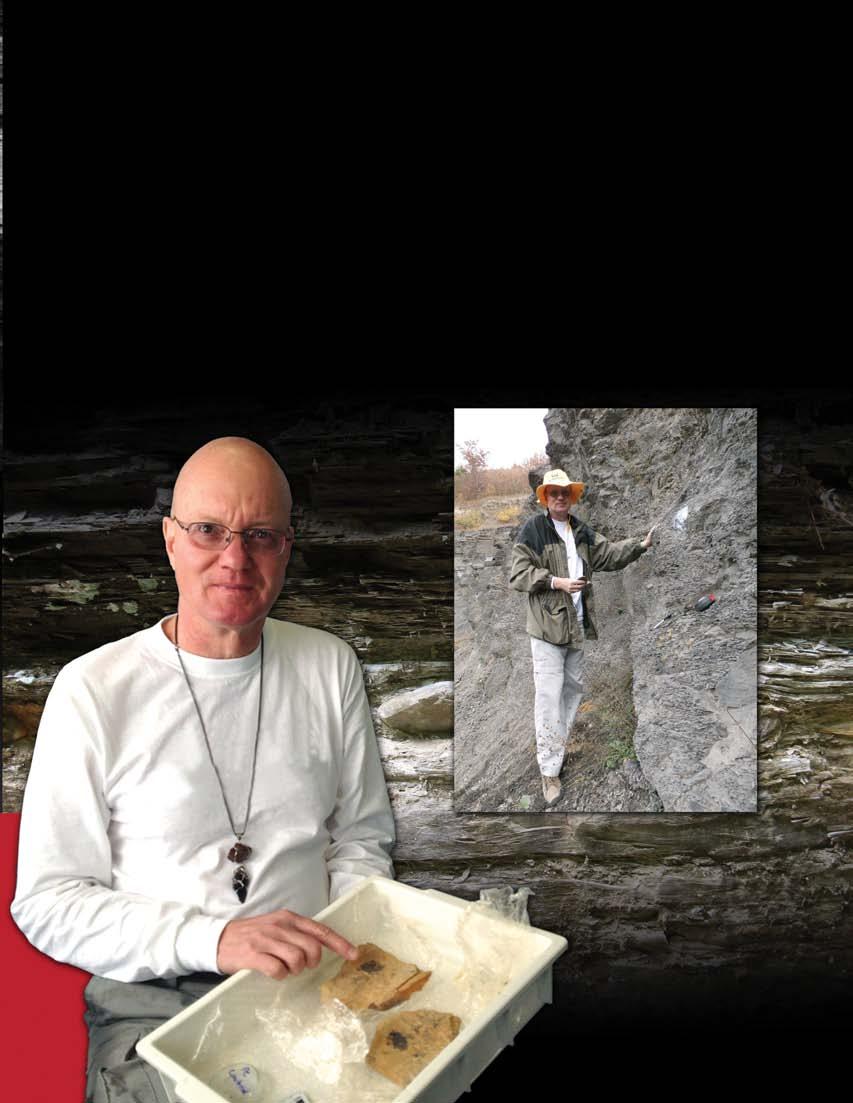
Above and at left: Van Iten searches for specimens at a quarry in upstate New York.
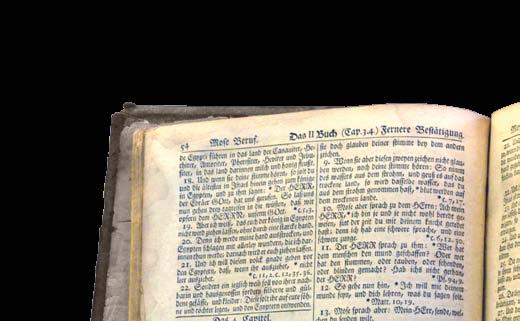
hen Karl Plank ’74 reads the poetry and stories found in the Bible, he often does so alongside verses written many centuries later, listening for thematic echoes or references that would take him back to the biblical texts and see them in an interesting way.
The process, called intertextuality, has turned Plank into a selfproclaimed poem hunter.
“If I am struck by a common pattern or a recurrent image in a poem that reminds me of something that I’ve read in the psalter, then I (try setting) them side by side and see how they behave and interact,” he said. “ … There’s no place you can go to look up what are all the allusions to a particular text, and even if you had such an index, it may or may not be helpful, since it wouldn’t tell you, for example, how the echoes functioned or what they meant.”
While intertextuality can occur in very explicit ways, such as alluding to or quoting an earlier text, Plank said at other times, it occurs more obliquely and subtly, through shared patterns or imagery.
“Intertextual interpretation reads one text in tandem with another and understands their interaction to create a new meaning that goes unobserved when one reads the texts separately,” he said. “Instead of speaking of what one text means, intertextual readings seek the meaning that emerges between the two.”
For example, when two people from different cultures meet, they may have preconceived ideas about each other based on negative stereotypes or other misinformation. After spending time together, their views regarding the respective cultures often change and broaden in positive ways. Intertextuality does the same thing, but with texts instead of people.
By letting the texts talk to each other, intertextuality wagers the meanings of both texts will transform in a dynamic process. When one text refers to another, Plank said it may be aggressive and critical, and the allusion becomes a kind of commentary that, in essence, rewrites the earlier text.
“It is not idle. It is a form of one text’s challenging and messing with the meanings of another,” he added. “It doesn’t intend to let that text alone, but to reimagine its meaning, perhaps to subvert it, perhaps to prolong it in some new fashion, but clearly to set it in motion.”
This kind of research tends to be less hypothesis-oriented than exploration-oriented. Plank doesn’t go in with an idea that he’s trying to demonstrate as much as seeking to discover the potentials and possibilities of the texts he reads.
But that doesn’t mean there haven’t been any intriguing discoveries. For example, in Denise Levertov’s poem, “O Taste and See” (1964), the poet encourages the reader to “taste and see … all that lives to the imagination’s tongue.” Plank called it an “unfettered relishing of all that the senses make available.”
Levertov then moves through a list of various things one might savor, chew or swallow, culminating in a reference to “living in the orchard and being / hungry, and plucking / the fruit.”
“As soon as she moves to the orchard, you see the potential of reading that ‘taste and see’ sequence in Psalm 34:8 as a counter to the temptation story in Genesis 3,” said Plank. “There, eating and having one’s eyes opened seems to transgress an important boundary. Yet, now, reading the psalm through the lens of Levertov’s poem, such tasting seems essential to celebrating and knowing the goodness of God. The psalm, much of which has an uptight, moral scheme, all of a sudden opens up into a more liberating possibility.
“It’s not something Levertov invents, but something her poem helps me see in the psalm, in its curious and rare use of the verb to taste and how that becomes a challenging imperative to engage a fuller world of human experience. I didn’t see (that) coming when I started to work on Psalm 34. The intertext took me there to see an implication I hadn’t thought of before.”
Studying the connections between texts and teaching his students to do the same is how Plank has spent the past 32 years at Davidson College. A private liberal arts college just north of Charlotte, N.C., he serves as the J.W. Cannon Professor of Religion, teaching biblical studies, and Jewish literature and thought.
Within the latter area, Plank looks at the genre of Midrash, the way in which ancient rabbis read scripture. He referred to them as the first great intertextualists and cited his second book, “Mother of the Wire Fence: Inside and Outside the Holocaust,” (Westminster John Knox, 1994) to make his case.
“There I had a historical case in point,” he said. “I saw how Jewish tradition, especially in the Holocaust, dealt with catastrophe not by denying its founding texts, but by reading them in light of contemporary experience.”
To illustrate, Plank wrote about the poet Yitzhak Katzenelson, who lived in the Warsaw ghetto before his murder at Auschwitz. When, on the night before they sealed the ghetto, Katzenelson proclaimed to his community, “You have come to an evening of the Bible,” Plank said he called for an urgent intertextuality by relating the biblical text to the event itself.
Making the connection between text; poets Levertov and Katzenelson.
“When you think of deportation, all of a sudden you have a curious resonance of Exodus or exile,” he said. “So, if you read a text like that when somebody’s just sealed the ghetto, you’ve got an implied intertextuality whether there’s another poem or not. It’s a fascinating choice of text for this secular Jew to read to this community (that night). I saw then that (intertextuality) really is the way in which religious tradition remains vital and responds to the interests and needs of a particular time.”
While Plank came to Hanover with a strong interest in religion, he not only credits the interdisciplinary format of the liberal arts and his double major in theological studies and music for leading him to his current vocation, he pays special homage to professors Jack Mathews and Gordon Campbell.
“When I took my first theology course (with Mathews), it hit home so well, that if somebody had asked me what I wanted to be when I grew up, I would have taken (that person) to his classroom, opened the door and pointed.”
With his own students, who Plank said often come to biblical studies with a preconceived focus, e.g., theological or historical, he begins teaching his subject by helping them get comfortable with looking at biblical poetry and stories from a different perspective.
As soon as they have their first “a-ha” moment, Plank said it really builds their appetite.
“I’ve found that students enjoy (intertextuality) and feel somewhat liberated with it, because it gives them new places to go where they’ve not been with these texts,” he said. “New questions, new possibilities … it’s interesting and valid to read the Bible as part of a literary tradition and to turn the full arsenal of literary criticism onto it.”
Plank agrees with those who consider intertextuality arcane, but said he also sees it as a paradigm for everything.
“If you see it as a process of making connections, it really is fundamental,” he said. “It’s part of the way we live … If you were building a community, do you want (one) where everybody gets along, or do you want a vital pluralism? With (intertextuality) you can have differences, but there’s still a relationship.”
One of Plank’s own connections is the idea that the way people read says a lot about the way they respond to others and vice versa.
“If you can welcome the difference of a voice in a text, you might also welcome the differences in somebody else. The implication of intertextuality is like a pluralistic culture. You get to welcome a variety of voices that don’t necessarily harmonize, yet hold something in common.” ■
A Winning Quartet
By Benjamin Gleisser
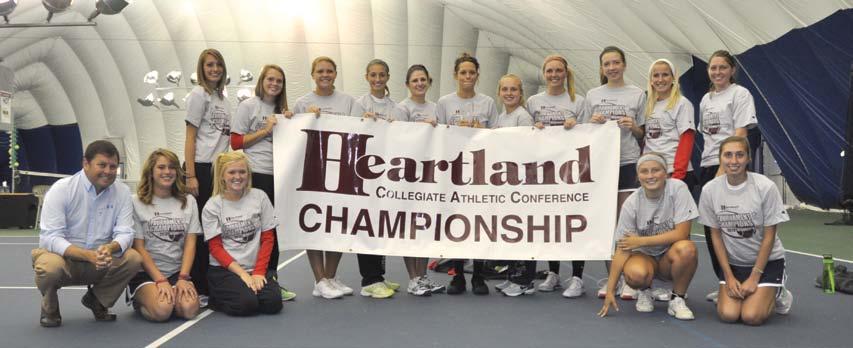
Four teams, four first-place finishes, four coach-of-the-year awards. The Panthers flexed their muscles in winning style when four women’s sports teams captured Heartland Collegiate Athletic Conference titles in one season for the first time in school history, bringing their prizes to Hanover College’s trophy case.
It’s an achievement that hasn’t happened since 1957, when four men’s teams accomplished the same feat.
The soccer team advanced to the second round of the NCAA III national tournament, where they lost a heartbreaking 1-0. This was the team’s best showing, however, and ended their season with a school-record 18 victories (18-2-2).
The Panthers also set school marks with 10 consecutive wins over the course of the season along with a 16-match unbeaten streak (14-0-2).
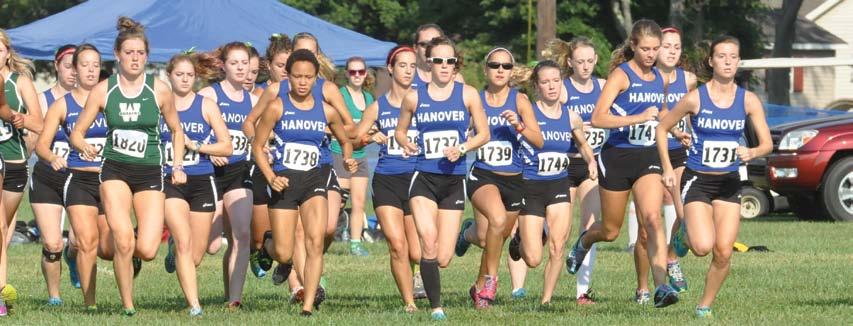
The cross country team claimed its first league championship since 2001, and seven members of that team earned allHCAC honors.
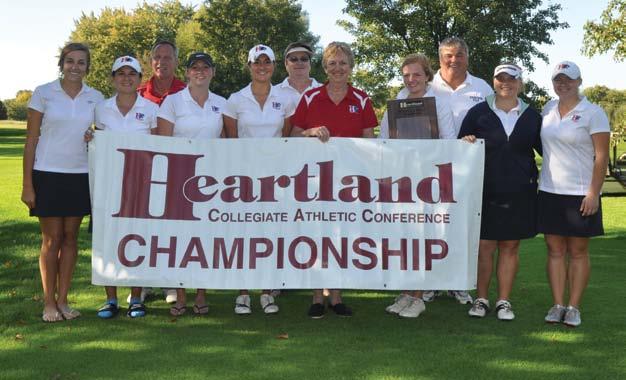
The golf team captured the conference championship with a record-setting performance led by Brooke McKay, who earned medalist honors for the second consecutive season.
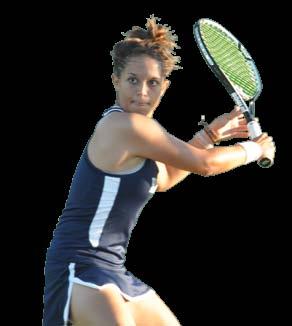
Women’s tennis grabbed the HCAC championship with a convincing 5-1 victory against the Rose-Hulman Institute of Technology, thanks to wins in two of its three doubles matches and in three singles matches.
Soccer Team Kicks Into High Gear
In the second round of the NCAA Division III national tournament game that saw more ups and downs than a roller coaster, the women’s soccer team played tough in a close 1-0 loss to Thomas More College.
The Panthers’ march to the nationals was a tough climb. The team captured its second conference title in three years by defeating Transylvania University, 2-1, thanks to two spectacular goals by Anna Cornacchione. The freshman’s strong play earned her the tournament’s most valuable player honor.
“Without the hard work and dedication from my team, there’s no way I would’ve earned the tournament MVP,” said Cornacchione. “Honestly, I was super surprised at the success I had. I was unbelievably nervous to start playing at the collegiate level, and it’s an awesome experience to have the outcome that we did!”
In round one of the NCAA tournament, Cornacchione and freshman Elaine Simpson each scored goals to lead the team to a 2-1 victory against Salem College. The playoff triumph marked the first in nationaltournament action for Hanover.
Unfortunately, the team’s historic season ended at the hands — or, rather, the feet — of Thomas More. The game was close: Hanover finished with three shots on goal as the Panthers mounted a last-ditch rally that fell short. Sophomore Rachel Alvis, Simpson and Cornacchione each had shots turned away, while sophomore goalie Morgan Cole recorded seven saves.
Still, the Panthers have a lot to roar about. The Heartland Conference named Cornacchione freshman of the year and co-offensive player of the year. Joining her on the conference’s first team were Alvis and seniors Chloe Hutchinson and Paige Byers. Cole and Simpson earned spots on the second team. Sophomore Megan Insley received honorable mention, while senior Rachel Evans garnered a spot on the league’s all-sportsmanship team.
Cornacchione credited Head Coach Jim Watts with the team’s success.
“(He) is an incredible coach who taught me how to play my position correctly and with confidence,” she said. “We spent the preseason working on our formations, and grasping the technical aspects of the game. We set high goals for ourselves and worked our tails off.
“Hopefully, next year we’ll have as much success as we did this year, because winning always makes things more fun.”
The Amazing Race
The cross country team won their first HCAC championship since 2001 by outrunning Manchester University 38-47, snapping their streak of four straight wins. With that triumph, Hanover became the first HCAC team to win championships in indoor track, outdoor track and cross country within the same calendar year.
“I wasn’t expecting to run that fast,” said Hinshaw, “but when I crossed the finish line 30 seconds better than my previous best time – whew!”
In addition to the team’s hard work, setting goals was another factor in their success.
Led by juniors Mackenzie Dye (23:22.30) and Claire Hinshaw (23:33), who finished sixth and eighth respectively, the terrific showing earned seven members of the women’s cross country team allconference honors.
“(Head) Coach (Josh) Payne helped us (focus) by being present at every practice to talk to us about what the workout for the day would be and why we were doing (it)” said Dye. “He encouraged us to set goals for ourselves and for the team at the beginning of the season and kept us accountable.”
Several runners recorded seasonbest marks at the meet, including freshman Cami Trachtman (23:34) and sophomore Rachel Smith
(23:37.2), who finished ninth and 11th, respectively. In addition, Dye, Hinshaw, Trachtman, Smith and sophomore Teresa Wiczynski claimed all-conference honors, while senior Janelle Lantz and freshman Mailika States earned honorable mention allHCAC honors.
Payne believes the achievements were the result of the team successfully executing the strategy he had taught them since day one.
“(Assistant) Coach (Brian) Power and I stressed running as a team, and passing opponents in packs as a way to break them mentally,” he said. “The (women) executed our strategy perfectly at the HCAC meet, and they had a great day.”
Fit to a Tee
Women’s golf aced the HCAC championship with a record-setting two-round 662 (332-330) to claim the program’s second conference championship in the past four seasons. Runner-up Rose-Hulman was a distant 697.
Hanover’s score was five strokes better than the previous conference record, set by the Panthers in 2010 when the squad posted a 667 (330-337) to win the program’s first league championship.
With the win, the Panthers will head to NCAA Division III national championship May 13-16 at Howey-in-the-Hills, Fla.
The women’s tennis team won the conference championship with a 5-1 victory against RoseHulman and secured a berth in the NCAA III national tournament May 19-24 in Claremont, Calif. Hanover’s last conference title in tennis was in 2008.
“I wasn’t surprised at our success, thanks to the depth on our team, and many great leaders that really motivated each other,” said Head Coach Richard Lord. “To go through the conference season undefeated and then qualify for the NCAA tournament is something we’ve not experienced before. Everyone’s extremely excited.”
With the team at 8-0 in conference play and 13-3 overall, Hanover opened the championship with wins in two of its three doubles matches.
Senior Danielle Miller, a three-time all-conference honoree, and freshman Mackenzie Spicer
took their match with an 8-6 win, while sophomore Allison Poston and freshman Mallory Noble bested their opponents 8-5. Miller, Noble and Poston also won their singles matches.
Spicer said the team stuck to their strategy of “concentrating on first-serve percentage and finishing points at the net” during the match.
“I love playing doubles with Dani and the intensity and chemistry that we share together in our play,” she said. “I think we were all blown away by how strong we actually were.”
Miller and Spicer received first-team all-HCAC honors; Miller for a 10-1 record at No. 1 in singles matches, while Spicer had an 8-3 mark at No. 2.
The duo combined for a 10-3 record in doubles matches.
Junior Brooke McKay fired a two-round total of 157, which earned her medalist honors for the second consecutive season. She became the third player since 1997 to win back-to-back individual crowns.
“I attribute my success to my love for the game,” McKay said. “Golf is my passion and without that enthusiasm, I wouldn’t have the desire to play as much as I do. Plus, (Head Coach Wayne) Perry gives great motivational speeches. Whenever I doubt my ability to play, he’s always there reminding me that I can be the best. It’s encouraging to have a coach who cares about how I perform and is willing to do anything to help me get to number one.”
“Golf is a game of control, concentration, and consistency,” said Perry. To be good you can’t afford to let much bother you on the course. I talk a bunch about self-discipline in college golf, confidence, and being ready physically and mentally. We talk a lot about team depth, which is our strength, and the key to our success and improvement.
“We broke a bunch of records this fall, but the one stat I always talk about is that every upperclassman improved her average from the year before. That stat is how we can motivate, recruit, and continue to build for the future.”
Other sharp shooters include freshman Brittany Gingerich, who took fourth place with a 167; sophomore Erika Shepherd landed at seventh place with a 170; and freshman Devan Smith was eighth with a 171. Each player received all-conference honors. Senior Sloane Hamilton’s 173 earned 13th place, and a spot on the all-sportsmanship team. She and her fellow Panthers are training for the NCAA Division III national championship.
“For that tournament, we’ll play five days straight in the heat and humidity, so we have to make sure we have enough stamina and our mental game stays strong, in addition to staying hydrated,” said Hamilton. “We worked hard as a team for this amazing opportunity.”
“Our practices set the standard for an intense work ethic and positive attitudes,” said Miller. “I loved how we supported each other during practices and during matches. I truly felt that we were all in it together.”
Sophomores Poston, Kelsey Jones and Alexis Taylor, along with Noble, were all-HCAC honorable mention selections.
Now, the team has its eyes on the trip to the NCAA tournament.
“I can't wait to see what’s next in store for us,” added Spicer. “I'm thrilled that our season isn't over yet and I think the NCAA III tournament will help us grow and prepare for our season next year.”
Danielle Miller
come from volleyball, football, baseball, basketball
Julie Campbell Beatty ’95, Robert Bergman ’61, Don Katzman ’81, Jeff Knecht ’86 and Ken Trinkle ’65 have each earned membership in Hanover College’s Athletic Hall of Fame. The induction took place during the 19th-annual ceremony held Nov. 9, in the Horner Health & Recreation Center.
As Hanover’s first four-time all-conference player in volleyball history, Beatty led the Panthers to a pair of Indiana Collegiate Athletic Conference titles and four 20-win seasons, including a school-record 30 wins in 1994. She was the first to record more than 1,000 career kills and 1,500 digs.
In addition to being the outstanding senior athlete, Beatty also set the College’s track record in the 100-meter dash in 1992. The mark stood for more than 20 years before being eclipsed last spring.
Bergman was a member of Hanover’s football squad for four years and earned all-Hoosier College Conference honors as a senior.
Professionally, he served as head football and track & field coach at the Rose-Hulman
Additional achievements include guiding the track program to a string of 27 consecutive meet victories during a three-year span.
Prior to his tenure at Rose-Hulman, Bergman served as head football coach at DePauw University during the 1977-1978 seasons.
A three-time all-Hoosier-Buckeye Collegiate Conference and all-NAIA District 21 linebacker for Hanover’s football squad from 1977-1980, Katzman was a first-team allAmerican during his senior year and earned honorable-mention all-American recognition as a sophomore and junior.
He finished his career as the leading tackler in school history, setting marks for most tackles in a game (33), season (190) and career (526).
Knecht was a three-time all-HBCC selection for Hanover's baseball team. As a sophomore, he was an NAIA all-District 21 honoree and tabbed as the squad’s most valuable player.
After setting school pitching records with nine wins in a season and 276 career innings, both marks stood until 2003. Knecht continues
Trinkle was a three-time all-Hoosier College Conference selection for Hanover’s basketball team. A four-year letterwinner, he was the program’s most valuable player as a junior and senior and an honorable-mention allAmerican selection as a senior.
A longtime high school basketball coach, baseball coach and athletic director, Trinkle finished his playing career with 1,068 points and currently ranks 32nd among the Panthers’ career-scoring leaders.
Started in 1995, the Hanover College Athletic Hall of Fame exists to recognize individuals who have served Hanover athletics with distinction, either by virtue of their performance as a coach, a team member, or by meritorious efforts on behalf of athletics, either as an undergraduate or in years after leaving the institution.
The hall of fame, which resides in the Horner Health and Recreation Center, currently honors more than 100 individuals who have left their mark on Hanover athletics.
Julie Campbell Beatty
Robert Bergman
Don Katzman
Jeff Knecht
Sports wrap-up
Football
School records for sophomore defensive lineman Jake Stilwell and senior placekicker Dylan Dunlop highlight the Hanover College football team’s 2013 campaign.
The Panthers finished with a 5-5 overall record, reeling off five straight Heartland Collegiate Athletic Conference wins and placing fourth in the league standings with a 5-3 mark.
Dunlop set the College’s career kick-scoring record. He made five field goals and converted 20 of 25 point-aftertouchdown attempts to boost his career total to 168 points. Dunlop’s effort eclipsed the mark of 166 points set by Dan Farrington from 1991-1994.
Britt, a three-time all-HCAC quarterback, completed 119 of 243 passes for 1,476 yards and nine touchdowns. He also rushed 119 times for 491 yards and a team-high eight touchdowns.
Stilwell, a finalist for the Cliff Harris Award as the nation’s top small-college defensive player, totaled 15 sacks to establish a new school singleseason record. His effort surpassed the mark of 14 set during the 1999 season by former allAmerican lineman Jason Welty.
Earning all-Great Lakes Region honors, Stilwell was a first-team all-conference selection after leading Hanover’s linemen with 50 tackles, including 33 solo stops and 18 tackles for loss (-103 yards). He also posted a team-high three forced fumbles and had one fumble recovery.
Joining Stillwell on the HCAC’s first team was junior running back Spencer Corrao, who earned first-team all-conference honors for the second consecutive season. Corrao led the Panthers’ ground effort with 684 yards on 142 carries with six rushing touchdowns. He also caught 13 passes for 175 yards and two touchdowns.
Seniors Dexter Britt, Brandon Foster and Matt McConnell, along with junior offensive linemen Ryan Hahn and Kevin Schlenker were each secondteam all-league honorees.
Just prior to the holidays, Britt played for Team Stars & Stripes in the 16th-annual Tazon de Estrellas “Bowl of Stars,” featuring all-star teams from NCAA III and CONADEIP, Mexico’s top collegiate athletic conference, in Monterrey, Mexico. Foster, a two-time all-conference linebacker, led Hanover’s defense with 93 tackles, including a team-best 47 solo tackles. He had 5.5 tackles for loss and one sack.
McConnell, a safety, tallied 49 tackles and one tackle for loss. He had one interception and was second on the squad with seven pass deflections.
Hahn, a two-time all-league honoree at center, and Schlenker, a starter at right tackle for three seasons, anchored the College’s offensive line. The pair helped the Panthers produce 305.1 yards per game, including nearly 140 yards per game on the ground.
Senior defensive backs Colin Alexander and Derrick Worden, in addition to junior linebackers Vince Peiffer and Justin Magaw, each received honorable-mention recognition.
Alexander, a safety, led Hanover’s secondary with 65 tackles. He had three tackles for loss, one interception, five pass deflections and two forced fumbles.
Worden, a cornerback, totaled 40 tackles and led the defensive unit with two interceptions and 34 return yards. He also posted five pass deflections, one forced fumble and a fumble recovery.
Peiffer ranked second on Hanover’s defense with 76 tackles and 12 tackles for loss.
Magaw racked up 75 tackles, with 10 tackles for loss and a sack. He had one interception, four pass deflections and a fumble recovery.
Senior linebacker Ethan Waltz was named to the Heartland Conference’s all-sportsmanship team. He tallied 19 tackles and one sack.
Men’s Cross Country
Men’s cross country posted its best recent showings in both the conference championship and the NCAA III Great Lakes Regional.
The Panthers scored 133 points to place fourth in the league championship, marking its best finish since finishing fourth in the 2005 HCAC meet and a second-place outing in 2004.
Junior Logan Wells and senior Brendan Kelly led Hanover’s effort. Wells covered the eightkilometer course in 26:43.1, placing ninth overall to earn all-conference recognition. Kelly claimed honorable mention all-HCAC honors with a 20th-place finish in 27:16.2.
Freshman Jake Hally placed 35th with a time of 27:51.3, while sophomore Drew Elston was 46th in 28:19.3. Senior Jason Holcomb completed the Panthers’ scoring, running 28:27.7 to finish 49th.
Hanover placed 22nd at the NCAA’s Great Lakes Regional, marking its best finish at the meet since the team placed 22nd in the event in 2002 and 19th during the 2000 season.
Jake Stilwell
Dylan Dunlop
Matthew Eldridge
Wells placed 66th in 26:38.0 and Kelly turned in a lifetime best 27:10.5 to finish 99th among 252 athletes.
Sophomore Ben Franke posted a time of 27:41.1 to place 140th, while Hally covered the course in 28:10.2 to finish 161st. Holcomb capped Hanover’s scoring in 186th place with a 28:40.3 effort.
Volleyball
Volleyball notched its fourth consecutive season with 16 or more victories. The Panthers finished with a 16-16 record and placed fourth in conference standings with a 5-4 mark.
Though the No. 5 seed in the HCAC’s post-season tournament, the squad defeated Rose-Hulman in the opening round and knocked off topseeded Defiance in the semifinals before falling to Bluffton in the championship.
The Heartland Conference named Kylie Justus, a senior defensive specialist, its most valuable defensive player for the third year in a row. Joining her on the HCAC’s first team was sophomore outside hitter Rachel Hasewinkel, who competed in her first season with the Panthers.
Justus earned the league’s top defensive honor in three of the six seasons the award has been presented. She led Hanover with 615 digs and ranked second in the HCAC with 5.38 digs per set.
Men’s Soccer
Additionally, Justus ranks second in school history with 2,108 digs, trailing only Elizabeth Loechle, who totaled 2,174 digs from 2004-07. She was fourth on the Panthers with 26 service aces and earned a slot on the HCAC’s allsportsmanship team.
Hasewinkel led Hanover’s offense with 369 kills. She ranked second in the conference with 3.17 kills per set and was fourth in the league with 3.51 points per set. Hasewinkel also added 282 digs, 29 total blocks and 23 aces.
Men’s soccer set a school single-season record for overall and conference wins, finishing the 2013 season with a 10-8-2 record, including a 6-2-1 mark and a third-place finish in the HCAC.
With previous postings of nine wins in a season two times, Hanover finished 9-7-1 overall in 2001 and 9-9-1 in 2002. The program notched five league wins in 2006 (5-2-1), 2008 (5-3) and 2009 (5-3). Freshman midfielder Matthew Eldridge and junior back Drew Roberts were among five members of the squad who received post-season honors from the HCAC. The league tabbed Eldridge as its freshman of the year and Roberts joined him on the conference’s first team. Additionally, Eldridge led the Panthers with 15 points, including a team-high seven goals and an assist. He was sixth in the conference with 2.89
Men’s Soccer
shots per game, seventh with seven goals and 10th in the league in scoring.
Roberts started all 20 matches in the backfield and keyed the Panthers’ defense, which posted eight shutouts and allowed 1.2 goals per match.
Senior forward John Wittich earned second-team honors. A two-time all-Heartland Conference selection, he was second on Hanover’s team with 14 points, scoring five goals and a team-best four assists. Wittich led the Panthers with 54 shots and 19 shots on goal. He ranked seventh in the conference with 2.85 shots per outing.
Sophomore back Jacob Thomsen received honorable mention. He netted two goals in his first season as a full-time starter.
The HCAC named junior midfielder Matthew Grau to its all-sportsmanship team for the third straight year. Also a two-time all-league honoree, Grau scored three game-winning goals during the season.
Drew Roberts
Logan Wells
Brendan Kelly
ALUMNI NEWS
We remember
KENNETH LIPP ’28, of Sun City, Ariz., died March 26, 2009 at age 103.
GRACE NIXON SOMMER ’33, of Miami Township, Ohio, died May 28, 2013 at age 101.
LOIS PURDY ’39, of Kissimmee, Fla., died May 26, 2013 at age 94.
MAX ZUFALL ’39, of New Albany, Ind., died June 26, 2013 at age 97.
JAMES BAKER ’40, of West Milton, Ohio, died Sept. 3, 2012 at age 95.
MAXINE HARDEN BAUER ’40, of Holland, Mich., died Sept. 2, 2013 at age 95.
MARY SIMONSON MALONE ’43, of Richmond, Ind., died June 27, 2013 at age 92.
RICHARD MELLIN ’43, of Sellwood, Fla., died Feb. 19, 2013 at age 91.
LUCILLE BUENTING BOHLKE ’44, of Indianapolis, died July 23, 2013 at age 90.
MARY LOU TASH THOMPSON ’47, of Plymouth, Ind., died May 6, 2013 at age 89.
DOTTIE VOILES ROSS ’48, of Charlestown, Ind., died Sept. 12, 2013 at age 86.
ROBERT SCHLETER ’49, of Seymour, Ind., died Dec. 24, 2013 at age 84.
BILL WENDT ’49 of Whiteland, Ind., died Oct. 6, 2012 at age 89.
BERNARD HEITZ ’50, of Madison, Ind., died Jan. 9, 2013 at age 87.
CATHERINE KIRCHMIER PIEMONTE ’50, of Salem, Mass., died April 5, 2013 at age 84.
LOIS BUTTERFIELD ALDRICH ’51, of Davenport, Wash., died Sept. 12, 2013 at age 85.
JIM HENNEGAN ’53, of Indianapolis, died July 23, 2013 at age 82.
BARBARA STUHLMACHER HEESCHEN ’53, of Gettysburg, Pa., died Dec. 1, 2013 at age 81.
SARA RAMSEY LIPP ’54, of Fort Wayne, Ind., died April 24, 2012 at age 79.
DAN MILLS ’54, of Decatur, Ind., died March 13, 2013 at age 80.
JIM BUTTERFIELD ’55, of New York, died May 8, 2013 at age 79.
MARILYN WHITACRE MCFADDEN ’55, of Kokomo, Ind., died Dec. 21, 2013 at age 80.
TOM CARTMEL ’56, of Westfield, Ind., died Nov. 27, 2013 at age 80.
DICK CIRA ’57, of Columbia City, Ind., died Aug. 17, 2013 at age 83.
JOHN HOLTZMAN-ROTHENBUSH ’58, of 'Littleton, Colo., died Nov. 10, 2013 at age 79.
SHARON TALKINGTON RENNER ’58, of Columbus, Ind., died Sept. 26, 2013 at age 78.
JAMES SARGENT ’58, of Greenwood, Ind., died March 29, 2013 at age 76.
JOAN ALLIGER ’59, of Fairport, N.Y., died Aug. 21, 2013 at age 76.
BETH PARENT BOHLSEN ’59, of Greenwood, Ind., died Nov. 17, 2013 at age 76.
JIM WAIZ ’59, of Sellersburg, Ind., died Jan. 30, 2012 at age 78.
RUBY BURNETTE HUNTER ’60, of Hanover, Ind., died Dec. 28, 2013 at age 96.
DAVE PARKINSON ’60, of Fort Myers, Fla., died June 28, 2012 at age 73.
NANCY MILLER STIMSON ’62, of South Bend, Ind., died Aug. 20, 2013 at age 72.
VIRGINIA BOEHM WORTHEN ’62, of Westbrook, Me., died July 7, 2012 at age 70.
TAMARA HELMS CHIPMAN ’64, of Shelbyville, Ind., died Dec. 6. 2013 at age 71.
NANCY DAVIS PANUM ’64, of Englewood, Colo., died July 18, 2013 at age 71.
LARRY DEAN ’65, of Batesville, Ind., died May 26, 2013 at age 69.
MIKE MCCLUNG ’67, of Coupeville, Wash., died July 2, 2013 at age 68.
ROSS ROWLAND ’67, of Muncie, Ind., died Aug. 14, 2013 at age age 67.
TOM MARECEK ’68, of Lake Zurich, Ill., died Feb. 5, 2013 at age 66.
MICKEY MCCORMACK COX ’69, of Hanover, Ind., died May 26, 2013 at age 89.
JIM FRIEND ’78, of La Porte, Ind., died Sept. 3, 2013 at age 57.
JAY KEMPER ’80, of Geneva, Ill., died Jan. 12, 2013 at age 54.
ROLAND BECHTEL ’82, of Sunman, Ind., died Aug. 27, 2013 at age 53.
LENORE DOWNEY, who taught English between 1966-68, died Jan. 13, 2013 at age 82.
CHANASAI TIENGTRAKUL, who taught anthropology from 2002-05, died April 12, 2013 at age 47.
EVELYN FRANKLIN, of Mooresville, Ind., died June 18, 2013 at age 99. The widow of WILLIAM FRANKLIN ’35, the couple established the John Keith Franklin Scholarship in their son’s memory. Preceding her in death was her sister-in-law, EDNA FRANKLIN HAYWARD ’36. Surviving are her two children, four siblings, nine grandchildren and extended family.
SALLY PETTICREW, of Indianapolis, died Oct. 4, 2013 at age 96. Widow of former trustee C. Richard Petticrew, the couple co-founded the Petticrew Foundation in 1962, which has made several million dollars in donations to a wide variety of charitable interests, including the Petticrew Computer Center at Hanover College.
Petticrew attended Purdue University, majoring in home economics, and taught American Red Cross lifesaving and swimming to the Purdue faculty and other Purdue students. She continued teaching these subjects at the Indianapolis Boys Club and taught reading at the Indianapolis Public Library.
Among her additional volunteer activities were 20 years as a Pink Lady at Winona Hospital and precinct work for the Republican Party.
Predeceasing Petticrew were her husband and two of her sons. Surviving are her four remaining children and their families.
Submissions:
(may be edited for content, length and/or style)
Mail: The Hanoverian, P.O. Box 108, Hanover, IN 47243
Online: classnotes.hanover.edu
Change of Address to: Advancement Services, P.O. Box 108, Hanover, IN 47243
E-mail address changes to: advancementservices@hanover.edu
To make a gift online: www.hanover.edu/give
To discuss a planned gift: Contact Kevin Berry ’90 at 800-213-2179, ext. 6813 or berry@hanover.edu
Class notes
1954
VIRGINIA HAYWORTH WILCOX has moved into Whitlock House in Crawfordsville, Ind. Her husband, David, died Jan. 4, 2013.
1955
MILT OTTE writes, “This past spring, DEL LEAR GLOYD arranged a luncheon in Naples, Fla., with BOB ’53 and LYNN KELLY BEACH ’54, and me and my wife, Carol. Good Hanover memories were had by all!” Contact Milt at motte65@comcast.net or at 4388 Bowling Green Circle, Sarasota, FL 34233, 941-379-8953.
1956
Quaker Books has published JANET
LARGENT OLSHEWSKY’s young adult historical novel, “The Snake Fence.” Set in Pennsylvania during the French and Indian War, the plot centers on a young Quaker lad struggling to define his own values and life direction apart from his family’s plans for him. Learn more at janetolshewsky.com.
1961
SUSAN GROPPENBECHER HAMANN retired in May 2013 after 18 years as a full-time professor at Chatfield College in the English department and 50 years in the profession. The college established an endowed scholarship in her name to assist non-traditional students. She and her husband, AL ’60, a retired Presbyterian minister, live at 3298 S.R. 131, Fayetteville, OH 45118. Contact them at ashamann@tds.net.
1962
JOHN SWALLOW recently completed an evaluation of the Asia-Pacific Partnership (APP) on Clean Development and Climate for the U.S. Department of State. He and his team studied for four months the successes and shortcomings of this APP energy efficiency, energy security and climate change mitigation program that involved Australia, China, Japan, India, Korea, Canada and the U.S. Swallow and his wife, Michelle, went to Colorado in August for a family reunion/vacation that included hiking in Rocky Mountain National Park. The couple also traveled to Turkey in September.
1964
HR Magazine has named DICK BEATTY one of the 20 most influential international thinkers for 2013.
1969
MIKE ROBINSON writes, “I am extremely proud of my son, Dallas, for participating in the Olympics in Sochi, Russia this February. He is a member of the U.S. bobsled team.”
1976
Classmates STEVE DILLS and STEVE WHITSITT, along with their wives Vicki and Ruby, enjoyed a week in Prague last July. Dills writes, “Besides doing all the tourist activities we traveled two hours by train to the small village of Namest. This is where Ruby's grandfather lived and is buried. The trip to Prague seemed like a road trip from our Beta Theta Pi fraternity days. Everyone laughed and had a great time. We all stayed well hydrated with the local beverages.”
1979
MARK WILHELM has retired after 34 years in public education, serving 11 years as a German teacher and 23 years as assistant principal. He became the principal at St. Susanna’s Catholic School in Plainfield, Ind., this fall, where he, his wife, Beth, and two sons have resided since 1987.
1980
FLO FOWLER CADDELL has authored the chapter, “Raising Money to Support the Arts in Your Public Library,” in an American Libraries Association book, “Bringing the Arts into the Library.” The chapter discusses the arts programming at the Frankfort, Ind., Library during BILL CADDELL ’66’s tenure.
1989
SUSAN FARRA graduated from Salmon P. Chase College of Northern Kentucky University with a doctorate in law and passed the bar exam February 2013.
1994
ANGIE CUNNINGHAM earned her MBA in human resource management from Indiana Wesleyan University, April 2013.
2002
Zionsville Community School District has named eighth-grade science teacher DEREK GRIMM its Teacher of the Year for 2013. He has taught in the middle school since 2003 and is married to KRISTI BOSO GRIMM ’00
TIM ROCAP has joined the Law Offices of Kovitz, Shifrin, Nesbit, as an associate attorney in the business/estate planning department. Located in Buffalo Grove, Ill., the firm also has an office in Chicago.
2003
JESSICA THORNBERRY married Loren Ackels July 13, 2013 in Cheyenne, Wyo. ASHLEY BOESTER-DEAN attended. The couple will continue to reside in Cheyenne where Thornberry serves as regional manager of school partnerships for Lindamood-Bell Learning Processes and Ackels is a chemist.
ANGELA ELLES will earn her master of fine art degree in poetry from Spalding University, which she will complete Spring 2014.
2004
ANDY BAUDENDISTEL and his wife, Crystal, announce the birth of their daughter, Lauren Maxine, Aug. 12, 2013, 7 lbs., 12 oz., 20.5 in. Both mother and baby are doing very well, and the family — including big brother, Landon — recently moved to Lawrenceburg, Ind., where Baudendistel works for Votaw & Schwarz and is the county attorney for Dearborn County; his wife is a registered nurse at Dearborn County Hospital.
2004
AMANDA WISCHMEIER KONKLE and her husband, Wes, announce the birth of their daughter, Avalee Sian, March 15, 2013. Konkle is pursuing a doctorate in English at the University of Kentucky.
2005
The Rubber Reparatory’s Pilot Balloon Church-House in Lawrence, Kan., has named STEVEN LAING, along with Title:Point Theatre, artist in residence.
We’re celebrating the unique connection we all share through a new concept, Hanover DNA. As DNA builds life and multiplicity, Hanover College has continually created and linked new possibilities of ideas and relationships. Those unlimited combinations transformed each of you into a unique Hanoverian. You have been rewired by your experience, so that Hanover became a part of you and you became a part of Hanover.
We want to celebrate each person’s role within the DNA, but we also want each person to recognize the benefits from being a part of that DNA network, and that the strength of the network depends on them serving their roles. Working together, we can create something greater than we could on our own.
Take a look at the newest opportunities we’ve created through Hanover DNA: Hanover After Hours
is a new way to get together with Hanover friends doing the kinds of things you want to do within your own community. No matter where you live around the world, you can designate a pay-as-you-go activity, and we’ll help get the word out.
You could:
• Meet at your favorite pub or coffeehouse
• Go to a concert or sporting event
• Run a 5K, go cycling or rock climbing
• Visit a museum, art gallery or the zoo
The possibilities are endless! For more information, visit hanover.edu/afterhours
The Alumni Advantage Program
consists of a variety of special discount opportunities offered on and off campus to Hanover College alumni at no charge. Watch for your exclusive Alumni Advantage I.D. card in the mail in February.
Alumni can register with Barnes & Noble Bookstore to receive monthly discount offers on HC gear at www. welcomebackalumni.
com. You can opt-in to receive emails with discounts on a monthly basis. Once you register, you will receive an email offer for 25 percent off an HC logo item (in store or online purchase). There’s even free shipping!
If you’d like to get in better shape or work off a few of those holiday pounds, consider a membership at the Horner Health and Recreation Center. The fitness center boasts more than 75 pieces of weight-lifting equipment and aerobic exercise machines.
As a Hanover College alum, you’ll receive a discounted price of $100 or more, depending on which membership you select when you sign up. Plus, if you register online, you can get an additional $25 off your already discounted price. Register now at hanover.edu/community/ hornermemberships. For additional questions, call (812) 866-7044.
Alumni spotlight
Dottie Scharf Burress ’50 isn’t sure if she’s made an impact on Hanover, but believes the College has had a large influence on her life ever since she arrived in the fall of 1946.
Burress met her late husband, Ralph ’50, in that first year; the couple returned to campus in 1953 and never left. She spent 28 years serving as executive secretary for the Jefferson County United Way and chaired the annual Madison Regatta Parade for 44 years with her long-time friend, Merel Horton.
Additionally, Burress has served as president of Hanover’s Southeastern Indiana Club since 2010. She is a longtime patron of the Community Arts Series, and a regular attendee at many College events.
“It was great raising our children here on campus,” she said. “Hanover’s been home for me for a long, long, time, and I just love it.”
Even though Clint Horine ’13 is a loyal and enthusiastic supporter of Hanover today, he initially wanted to attend a school further from his home in nearby Memphis, Ind.
The realities of a long-term, debilitating kidney condition and multiple surgeries forced him to stay close, and the familylike support Horine received at Hanover convinced him the decision was the right one. One reason was his professors, whom Horine found caring and challenging.
“Even after a surgery, (they) would always ask how I was doing first,” he said, “but a quick second comment was always ‘You know you have an assignment due.’”
During his senior year at Hanover, Horine met with alumni from across the country as a student ambassador for the Live Our Loyalty Campaign. He was so moved by the experience that he promised to contribute part of his first paycheck to Hanover.
Horine soon fulfilled that pledge as a management trainee at PPG Industries in Louisville, Ky.
Schuyler Culver ’88 came to Hanover with the goal of a career in engineering until a professor opened his eyes to the power of small business.
Describing his Hanover experience as freedom to discover himself, Culver has played an integral role in Hanover’s DNA by making an annual contribution to his alma mater every year for the past 22 years.
“I give as a small way to register my approval that Hanover should exist as a reasonable private college alternative to the large impersonal state universities,” he said. “I want middle class families to have private college options. I also want to keep alive those great memories by keeping Hanover alive and financially strong.”
After graduation, Culver earned an MBA in finance from Butler University and pursued a career in in that field. He currently serves as a business consultant for Transworld Business Advisors, working with business men and women looking to either buy or sell a business.
Barb Alder ’77 currently serves as director of Purdue University’s Office of Engagement, a position she took after 26 years with Verizon Communications Inc. Alder also serves on the Madison County Education Coalition steering committee, where she formerly chaired the College Readiness Committee.
Her connection to Hanover remains secure, having served as president of the College's Alumni Association board of directors, among her many community service activities.
“(What you learn) as the years go by is that the tie to Hanover actually grows stronger with time and distance,” she said. “Whenever I meet someone with a Hanover College connection, we have an immediate bond that is something only other Hanoverians can understand and appreciate.”
A business administration major and member of Kappa Alpha Theta at Hanover, Alder earned her MBA at Indiana University-Fort Wayne.
Hunger in America on the rise
If you’re eating a snack while reading this, it might be difficult to imagine that as of 2011 more than 50,000,000 Americans didn’t know where they would get their next meal, and that number is likely on the rise.
SUZY LEE ’06, who currently works for the Greater Chicago Food Depository while pursuing her master’s at DePaul University (Ill.), spent last summer organizing the efforts of 134 volunteers who surveyed residents in the Chicago area. The results will become part of the 2014 Hunger in America study coordinated by Feeding America, and will be the largest first-person client survey project conducted in the U.S. with data from 63,000 people in all 50 states.
Traveling to area food pantries, soup kitchens, shelters and other locations, Lee and her team would speak to a random sampling of clients who would complete the survey via tablet computer in their choice of languages — English, Spanish, Russian, Mandarin and Vietnamese — and received a $10 thank-you gift for participating.
“At one pantry a young mother said she would use her $10 thank-you to buy fresh meat for her daughters,” she said, noting that many pantries can't afford to provide more than canned meat products. “(The mother) said they hadn’t had fresh meat in more than a week, and she was so excited she could now buy it.”
To find out how you can help, visit feedingamerica.org.
Class notes
2005
TRACEY WEISHEIT PRICE and her husband, Anthony, announce the adoption of their first child, Zane Alexander, from Anchorage, Alaska, June 16, 2013. Zane is already thriving back in Indiana and the new parents have developed a great relationship with his biological mother.
2006
LIZ PALMQUIST married Justin Stafford, Sept. 7, 2013 at Historic Locust Grove in Louisville, Ky. Hanoverians in the wedding party included JENNIFER HILL ’05, ERIN SPIVEY and ROSE ZIMMERMAN CAPLE ’08. Also in attendance were DANIELLE MANZO ’08, BRIGID WELCH and CORTLAN WATERS BARTLEY ’08
The couple lives in Louisville, Ky., with their cat, Penny.
SARAH M. REYNOLDS married David Sayers April 27, 2013 in Lexington, Ky. Hanoverians who attended include HEATHER ANDREWS, KATIE MCPHERSON ’09 and NATALIE JONES GREEN ’05. The couple will be stationed overseas with the U.S. Air Force as general pediatricians.
2007
PAIGE BRADLEY MCDOWALL and her husband, David, announce the birth of their first child, son Nathan David, March 19, 3013.
2008
SHAUNA-LEIGH BAXA married JOSH AKERS ’06 May 26, 2012 at Gingerwoods in Prospect, Ky. Hanoverians in the wedding party included MOLLY THURMAN HOLLISTER, DANIELLE MANZO and MAISEL CALIVA ’06. Special guests at the
wedding included Robert Evans, professor emeritus of chemistry, and Yefim Katsov, professor of mathematics. Baxa attained her doctorate in pharmacy from Butler University (Ind.) in May 2012 and is now a pharmacist for Walgreens in Hopkinsville, Ky. Akers graduated from the University of Louisville School of Dentistry in May 2012; he is a Captain in the U.S. Army completing an AEGD residency at Fort Campbell, Ky. The couple resides in Clarksville, Tenn.
2009
VICKY SHAW CHRAÏBI graduated from the University of Minnesota Duluth with her master’s degree in water resources science. Her thesis was a paleolimnology study of Lake Superior, the results of which are now an exhibit at the Great Lakes Aquarium. During her time at UMD, Chraïbi received two Fulbright Canada-RBC Eco-Leadership Program awards. She currently attends the University of Nebraska-Lincoln as an NSFIGERT Fellow, and is working toward her doctorate in earth and atmospheric sciences with emphases in micropaleontology and science education. Chraïbi’s research is on the paleoecology and resilience of lake communities in Yellowstone National Park.
JENABA WAGGY completed her master’s degree in medieval studies from Western Michigan University, April 2013. Future plans include continuing to work in Kalamazoo, Mich., while working through the application process for seminary.
2007
TORY WATSON married Brad Ortman June 7 2013, in St. Augustine, Fla., followed by a reception in Indiana a few weeks later. The couple resides in Peru, Ind.
2000
Greg and ANNE GULYAS WOOD announce the birth of their twin daughters, Gemma Melody, 6 lbs., 14 oz., and Scarlet Harmony, 7 lbs, 2 oz., June 27, 2013. Their proud uncle is AARON GULYAS ’98
2002
MARK ’04 and ERIKA KAMP FAIRWEATHER announce the birth of their son, Carter Jacob, May 20, 2013. He joins big sister Madison, 4. The family resides in Boston while Mark Fairweather completes his surgical residency.
1998
CHRIS RICHARDSON and his wife, Kelly, announce the birth of their third child, Kyler Michael, June 5, 2013, 9 lbs., 1 oz., 20.5 in. His big brother, Braden, and big sister, Olivia, are very proud of their baby brother. Richardson serves as senior vice president with Manufacturers Capital, located in Sanford, Fla., and the family has relocated to Lake Mary, Fla. Contact him at crich1030@yahoo.com or 317-695-3000.
2003
JOHN and SARABETH RATLIFF POLLOM ’05 announce the birth of their second son, Charles Thomas, Dec. 10, 2012. Their first son, Will, may or may not already have a disciplinary file with Student Life.
2003
NATHAN and HANNA SCOTT MCARDLE announce the birth of their first child, Eleanor Sinclair, April 15, 2013. The happy family lives in Chicago where the new father has plans to incorporate his daughter into his weekly sand volleyball game. “Hang her baby carrier from the net,” was one of Nathan McArdle’s suggestions, to which his wife responded, “Don’t even ask for details on his plans for taking her golfing.”
2010
JENNI JOHNSON married Max Jacobs in Charleston, S.C., Feb. 24, 2013. The couple honeymooned in the Bahamas, and returned home to Charleston where Johnson continues to work for Apria Healthcare as liaison to the Medical University of South Carolina.
JESSICA PEEBLES married ROBERT SPENCER July 20, 2012 in an outdoor ceremony near The Point, followed by a reception in the Brown Campus Center. Hanoverians in the bridal party included JEREMY CASTLE, ANDREW HOFFMAN, SARAH CRAMER and LAURON HANEY ’12. Hanoverians who attended include JESSICA ANDREWS ’09, NATASHA GUFFEY ’11, MARISSA WALKER BOSSINGHAM ’11,
SETH DANIEL ’11, LEILA CAHILL ’14, ALEC and TIFFANY SHIGETA
LICHLYTER ’09, BRAD and EMILY
RAMSEY ROBINSON ’11, JASON and LAUREN BROWN TABER ’11, and BEN ’11 and ANNE WILMAN VOORHORST ’11 The couple honeymooned on Mackinac Island, Mich., and currently resides in Oxford, Ohio where they both attend Miami University. Peebles is working on her doctorate in ecology, and Spencer is working on his doctorate in neurobiology.
MARILEE YEAGER married Andrew Taylor June 22, 2013. Hanoverians in the wedding include
MEGAN SMITH SNYDER ’02 (matron of honor), ERICA PICKETT CARLSON (bridesmaid), PAIGE JONES ’11 (reader), BRIAN CARLSON ’09, and JUSTIN SMITH ’09. Professor of Music C. Kimm Hollis was the pianist. 2012
ELLEN SCHILDMEIER married Matt Bates Dec. 22, 2012. Many Hanoverians attended, including several of her Chi Omega sisters.
Calling all alumni!
We know you're out there,but we don't know how you are doing.Send us updates about your life,your career or your passions.Then make sure we have your correct email or home address, so we can always stay in touch.
countdown
The begins again
I spent the first semester of my freshman year of college running from myself. Inner truths lay suffocating beneath layers of religion, ignorance and a compulsion to please others. All it took was one little moment of confrontation, and I ran scared back home to southern Indiana and became a commuter student at Hanover, just in time to start the second semester.
Regrettably, I missed the student life part of Hanover. I didn’t join a club. I didn’t rush. I didn’t attend one football or basketball game, not one concert, not one play. Monday through Friday, my 1985 Chrysler Laser claimed a parking space around 7:45 a.m. and left it promptly at 4 p.m. to carry me back home to the same bedroom I’d occupied as a little girl.
But from 8 a.m. to 4 p.m., I belonged to my professors: Trout, Smucker, Jobe, Totten, Terry, Turner, Wolf, Brown and others. They stretched my mind, invited me to open it wide, fill it, then stretch it open again.
My opinions were challenged and my beliefs were informed and reformed time and time again. In fact, my hand and head actually ached from all the blank blue books set before me, into which they expected me to turn my learning into thoughts and my thoughts into words.
Those three-and-a-half years went by in a blink. And while they didn’t uncover the buried truths of who I am — that would come later — they did uncover within me a sense of who I wanted to be and built a launching pad that would, two decades later, raise my soul closer to its destiny.
At 40 years old, I set out to reclaim a dream deferred and enrolled in graduate school. That’s right, for my mid-life crisis, I had an affair with “Jane Eyre” and several of Charlotte Brontë’s counterparts: Alice Walker, Audre Lorde, Adrienne Rich, Virginia Woolf, Maya Angelou and so many others too numerous to mention.
Somewhere within me, I had the willpower and confidence to go after a master’s degree in English despite two crucial realities: years had gone by since earning my bachelor’s and that bachelor’s was in elementary education.
By Angela Eden ’92
I have now come full circle. This past fall, my partner and I moved our daughter, Ashley, into Donner Hall. She is set to experience all of Hanover, the living and the learning. My hope is that it will do for her what it did for me — open, stretch, fill, challenge, form, inform and reform her mind and her spirit. And no matter how long it takes to awaken within her — whether it’s instant or indefinite — the launching pad that is a Hanover College education will be there for her to use whenever she is ready to soar.
Angela eden ’92 is an author and inspirational speaker. The Indiana Historical Society chose her book, “If You Were Me: The Memoir of a Mother Torn Between What’s Right and What’s Easy,” as part of its 2013 author fair. The book is available through Amazon and at angelaeden.com.