District of Columbia any article of food or drug which is adulterated misbranded, within the meaning of this Act; and any person who shall violate the provisions of this section shall be guilty of a misdemeanor, and offense shall, upon conviction thereof, be fined not to exceed five hundred dollars or shall be sentenced to one year's imprisonment, both such fine imprisonment, in the discretion of the court, and for each subsequent offense conviction thereof shall be fined not less than one thousand dollars sentenced to ent, discretion of th ATED GOODS. the introdu ict of Columbia any other a, or from foreign country, article of food drugs which is ning of this hereby prohibi r for shipment any State or y other State Territory or the ry, or who shall receive in any Sta from any other Territory ntry, and having received, shall ay or otherwise, offer to deliv adulterated misbranded within shall sell or in the Dis United States adulterated offer to export to any fo or, and for be fined n irst offense conviction three hundred or be impr he discretion court: Provide d or adulterated within the provi to any foreign and prepar s or directions foreign purch ation or packing in conflic hich said article intended to b ld or offered sale for do all not exempt article Act.
AND REGULATIONS.
That the Secretary of the Treasury, the Secretary Agriculture, and the Secretary of Commerce and Labor shall make uniform regulations for carrying out the provisions of this Act, including thecollection and examination of specimens of manutured offered for sale in the District of Columbia or in any Territory of the United or which shall be offered for sale in unbroken packages in any State that in which they shall have been respectively manufactured or produced, which shall be received from any foreign country, or intended for shipment foreign country, or which may be submitted for examination by the food, or drug officer of any State, Territory, or the District of Columbia, any domestic or foreign port through which such product is offered
In this issue Features
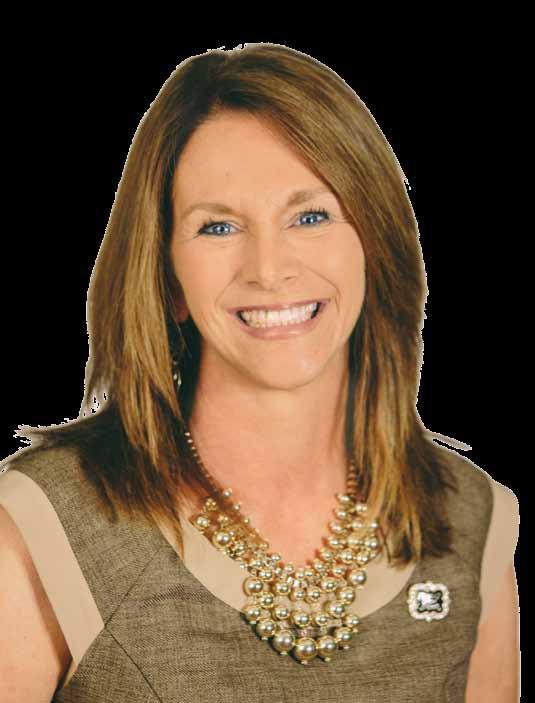
President Sue DeWine writes about the people she met at regional events to support Hanover’s Live Our Loyalty Campaign.
Sandra Guthrie director of publications, editor, The Hanoverian
Ann Leslie Inman ’86 director of alumni engagement
Joe Lackner director of web communications
Rick A Lostutter art director
Matthew Maupin
director of creative services
Felicia Nguyen ’15, Jingyi Wang ’15, Yana Boltunova ’16, Maggie Huffer ’16, Nicki Lewis ’16, Miriam Cahill ’17, Samantha McCain ’17, Haley Spalding ’17, Fernando Hernandez ’18, Darien Miller ’18, Casey Pennell ’18, Daniel Sanabria-Chaves ’18, Patrick Pfister, David Nantz
contributing photographers
Andrew Faught, Alan Schwemlein ’69 , David Springer ’08 contributing writers
2014-15 Alumni Association
Board of Directors
John Pollom ’03
president
Misty Wick ’02 past president
Phil Mullins ’72
president elect
Jason Crawford ’11
Ashley Crays ’08
Dawn Doup ’98
Bonnie Wible Dyar ’82
Darin Edwards ’90
Angela Semrau Kara ’08
Don Kobak ’89
Walter Kropp ’75
John Maudlin ’61
Kip McDonald ’07
Ted Merhoff ’92
Brent Minton ’94
Annie Tock Morrisette ’01
Dave Northam ’71
Ali Gantz O’Leary ’09
Chris Powell ’97
Mary Burch Hambrick Ratliff ’78
Chris Richardson ’98
Ron Starks ’83
Jon Welty ’92
John Wittich ’79
College provides equal
We asked several alumni who serve on the bench in Indiana to share their day-to-day experiences serving the judiciary.
How do lawmakers use science when it comes to making public policy? How do organizations use it to their advantage? Wendy Wagner ’82 studies how science and the law intersect.
Arguing before the U.S. Supreme Court is the holy grail for any attorney. Bill Thro ’86 appeared before the court twice.
The Live Our Loyalty Campaign has received nearly $55 million in gift assets, making it one of the most successful fundraising campaigns in the College’s history.
On the cover:
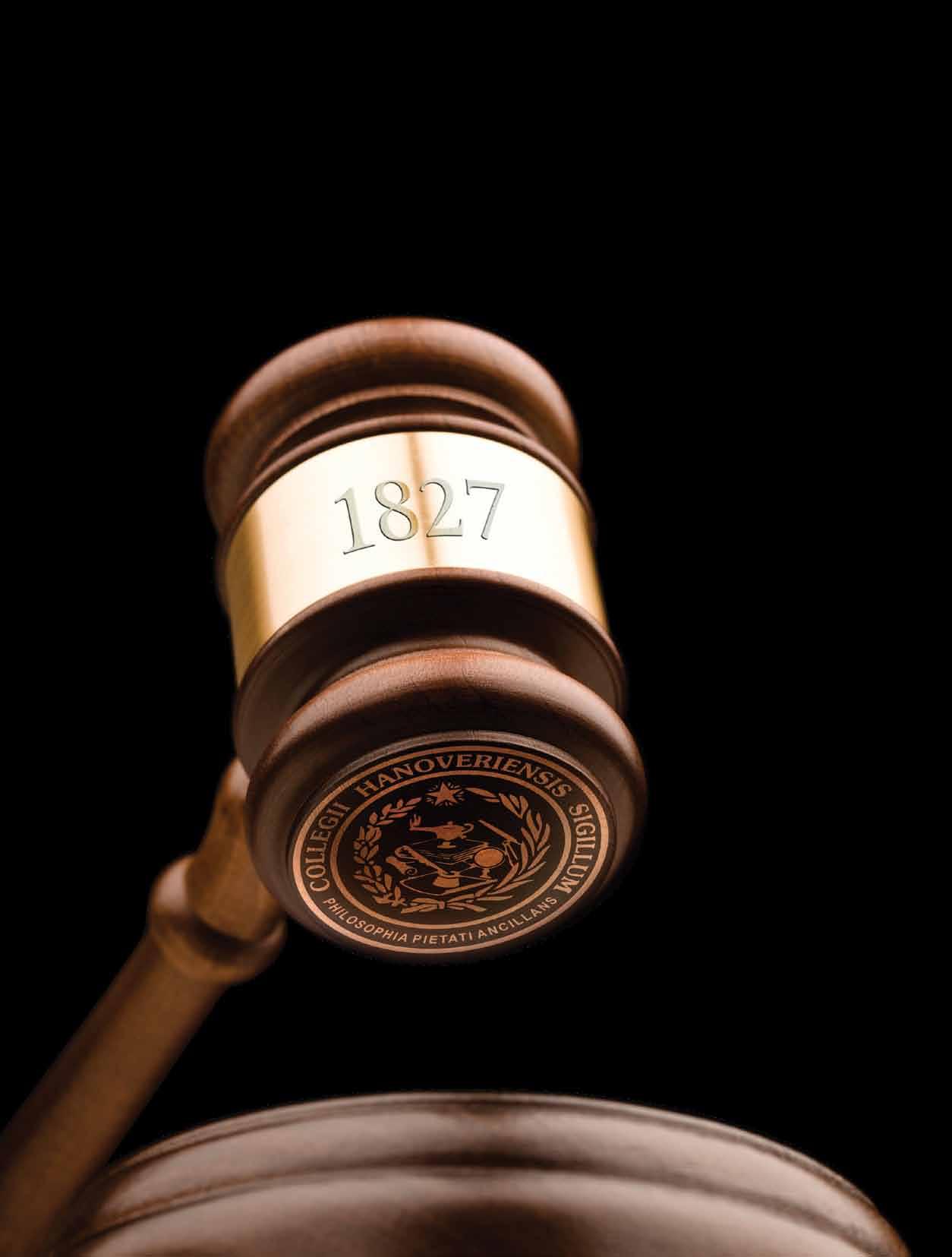
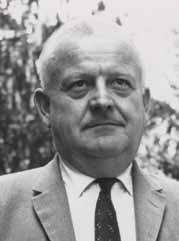
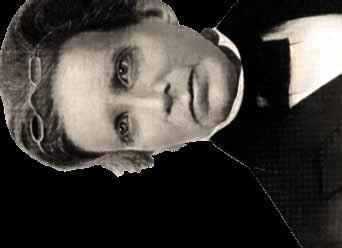
Harvey Washington Wiley, Hanover class of 1863, is the author of the Pure Food and Drug Act of 1906, a legal document that has affected countless lives. Part of the act’s text serves as the background on our cover.
Athletics
21 Five join athletic Hall of Fame
Anthony Brantley ’77, Brett Dietz ’04, Keith Hill ’59, Coach Wayne Perry and President Sue DeWine are this year’s inductees.
24 ALUMNI NEWS
PIECE
36 My gap year
Savanna Wofford ’14 has chosen to spend her first year post-Hanover determining how to make the next stage of her life meaningful.
Joyful Faces
As we wrapped up the Live Our Loyalty Campaign at Homecoming this year, I was reminded of the joyful faces I saw while traveling around the country to visit with alumni. There were the faces of the hosts, eager to share their homes and local spots, the faces of alumni who reconnected with old friends and the faces of the students we took along with us.
We all felt at home from all the warm welcomes we received, and, of course, we were. Hanover is wherever you are because it is in your DNA.
In numerous places I heard, “I didn’t know I had a Hanover alum living just down the street” or “It’s been so long since we’ve seen each other, I am so glad to reconnect.”
indianapolis:
Brick ’72 and Judy Warren, Kim Brant ’91
Chicago:
Greg ’72 and Kris Rector Gleason ’73
Tampa, Fla.:
Alex and Sue Seifert Williams ’65
hilton head, S.C.:
Jim ’67 and Kate Gaunt
denver:
Graeme and Carol Fairweather
naples, Fla.:
Bart ’64 and Linda Patton Luedeke ’64, Ross ’74 and Diana Hubbard
Ft. Lauderdale, Fla.:
Marty and Susanne Talmage Ellman ’65, Nick ’63 and Tricia Rutsis
We heard stories about your times at Hanover and what the place still means to you. It was those memories that no doubt drew you to this campaign. A record number of individuals gave (more than 5,000 gifts) at one of the highest levels of support ever. For the first time in recent history, we raised the entire amount needed for our outdoor athletic facilities; no loans, no debts.
I saw the joy of giving in the faces of so many of you. I saw tears in people’s eyes when individuals talked about friends and experiences from so long ago. I hope Hanover continues to put that joy in your heart and on your face.
What I will always treasure are the faces of the students who traveled with us. At each of the 16 regional receptions, we had one to three students that we put in contact with alumni so they could hear the students’ stories.
Louisville, Ky.:
Steve ’72 and Barbara Ellis, Bix ’72 and Jane Barnes Howland ’72
Baltimore: Stacy Kalamaros Skalski ’85, Peggy Miller Hinshaw ’85
Washington, d.C.:
Patricia Wyche Calore ’83
Austin, Texas: Hank ’70 and Nikki Hadden Faulkner ’71, Ken ’74 and Kendal Hegamaster Gladish ’75 dayton, ohio:
Kevin and Mary Makarius McDonald ’76
Cincinnati:
Jo Anne Imbler Clark ’79, Eric ’78 and Jan Patterson Haas ’79, Kevin ’82 and Jill Philbrick Keefe ’83, Faye Haas Wendel ’80
When alumni heard Clint Horine ’13 say he would give anything to have one more semester at Hanover or senior Megan Robinson (pictured below) say that because of her love for Hanover she wanted to one day replace me as president, they could not help being moved by those stories.
The students we took with us visited places they had not been before, some flew on planes for the first time, and all of them came away with a deep appreciation for the loyalty and dedication our alumni have for their alma mater.
These are the wonderful memories I will always cherish about this campaign. I wish you could experience as I do watching students take advantage of the gifts you have offered them. Later in this edition, you will find more details about what we all accomplished together. Know that if you were not part of this campaign you still can be by supporting some of the initiatives started here.
The faces of the students will always stay with me, because that’s what it’s all about, really. There is nothing more important than the experience we provide for these students. Thank you for helping to make those experiences richer and more fulfilling.
Sue DeWine, President
indianapolis:
Don ’55 and Marge Christie Dietel ’56, Beth Bodkin Bedwell ’64, Nina Vaughn Budd ’65, D. Wade Clapp ’77, Rick ’87 and Nikki Gray Shoultz ’89, Chris ’91 and Ann Archibald Stark ’93, Nate ’05 and Lauren Williams Littlefield ’04
Columbus, ohio: Andy ’58 and Ann Taff Anderson ’58, Bob ’68 and Jane Thorn White ’68
new York: Business Scholars Program of Hanover College
MESSAGE FROM THE PRESIDENT
Rankings note Hanover’s value, beauty
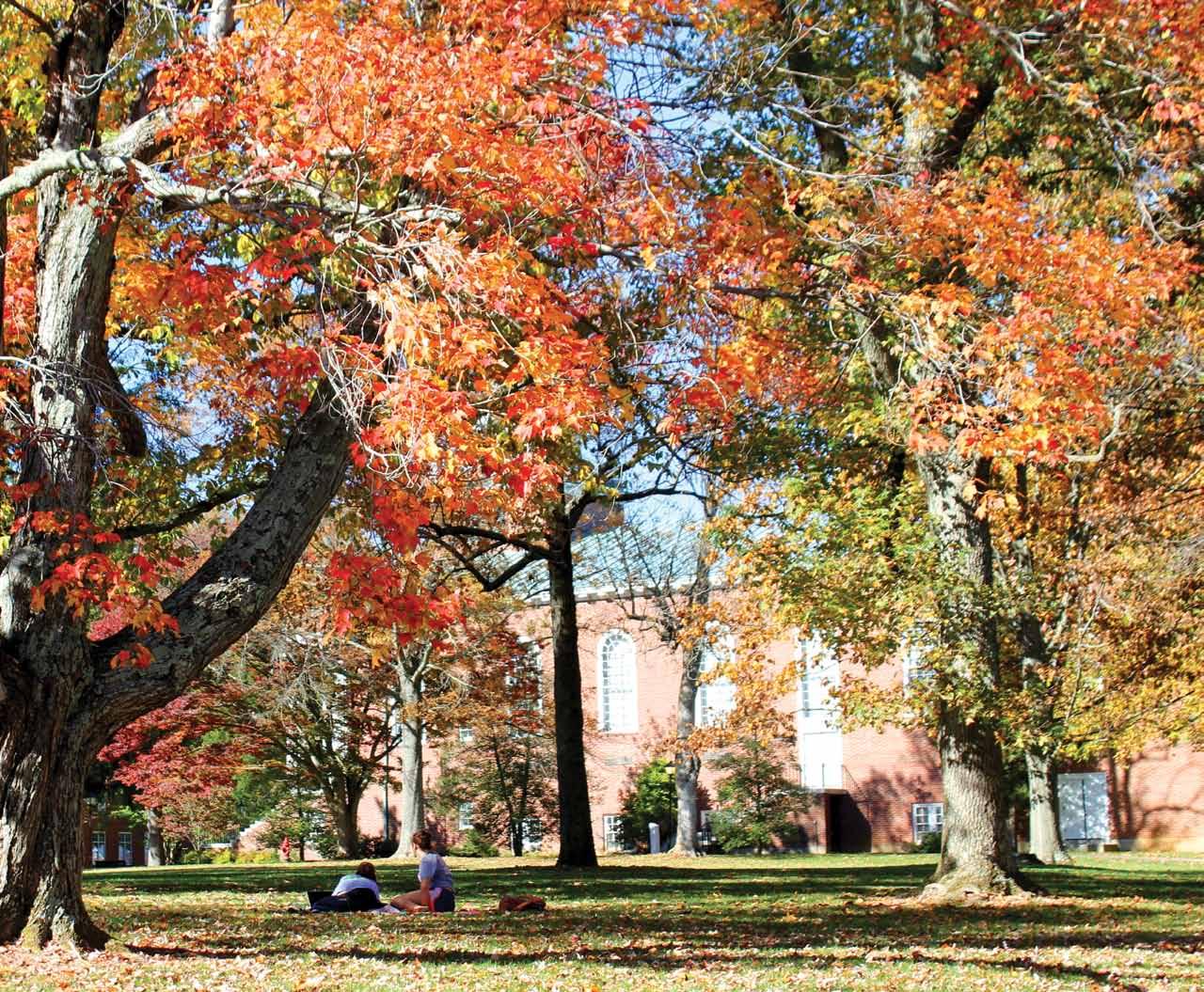
Hanover College continues to rank high on many publications. This year, the list of periodicals praised the College for affordability and value, as well as the beauty of the campus.
Washington Monthly has ranked Hanover ninth out of 100 on its “Affordable-elite Colleges” list. Among the criteria, the magazine noted the College’s low student loan default rate and the endowment funds per student.
Among liberal arts colleges noted in the magazine as a “Best Bang for the Buck” college, Hanover ranked 13th. The College was the top school in Indiana on both lists.
The Princeton Review named Hanover one of the nation’s best institutions for undergraduate education for the tenth consecutive year in its guide, “The Best 379 Colleges – 2015 Edition.”
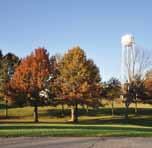
Hanover ranked 14th in the publication for most beautiful campus, up five points from the previous year. Also noting the College’s beauty was the website hercampus.com, which ranked Hanover 10th in the U.S. for having the best fall foliage.
Kiplinger’s included Hanover in its list of top 100 best value colleges. The personal finance publication’s rankings measure academic quality and affordability, graduation rates, cost and financial aid, and student indebtedness, based on data from 600 private schools. This is the fourth consecutive year the College has earned this distinction.
Additional publications that included Hanover on its top lists were both Forbes and Money magazines, and collegefactual.com, who all ranked Hanover as one of the top U.S. colleges, as well as niche.com, which gave the College an A for Greek life.
Education program earns accreditation from NCATE
Hanover College’s education program has earned accreditation once again from the National Council for Accreditation of Teacher Education (NCATE). A group of examiners visited the College in April, the result of preparations completed throughout the last two years to ensure that the program meets the national organizations standards of excellence. The examiners also interviewed more than 90 people, including students, alumni, administrators, faculty and staff, among others. The team — made up of volunteer teacher education professors
from universities in Michigan, Illinois, Missouri, West Virginia and Montana — visited five area schools affiliated with the Hanover’s program.
NCATE is in the process of transitioning to CAEP (Council for Accreditation of Educator Preparation), which comes with a set of new requirements. The CAEP Commission on Standards and Performance Reporting will transform teacher preparation by creating a rigorous system of accreditation that demands excellence and produces teachers who raise student achievement.
Specifically, the commission will develop accreditation standards for all preparation programs based on evidence, continuous improvement, innovation and clinical practice. The commission will also recommend transparent CAEP public accountability reporting with multiple measures, including those directly linked to student achievement.
Lauren Griffith joins Hanover to serve as assistant professor of anthropology. She spent the 2013-14 academic year as visiting assistant professor at the University of Arkansas. Previously, Griffith served as an instructor during the past several summers at Central Michigan University. Past research has focused on the Afro-Brazilian martial art capoeira and its diverse group of international practitioners. She plans to pursue an applied study of sustainable tourism in a small, Mayan community that is in the process of developing a new port. Griffith earned her bachelor’s degree at Texas A&M University, and her master’s and doctorate at Indiana University.
Susanne McDowell will serve as instructor of geology, having spent time as a teaching assistant and undergraduate research mentor at Vanderbilt University (Tenn.), the latter of which she was the co-leader of a three-year National Science Foundation Research Experience for Undergraduates. Additionally, McDowell has served as a teaching assistant at The University of North Carolina at Chapel Hill and as a teaching associate at Arizona State University. Her research focuses on magmatic centers within the continental crust, particularly systems that produce explosive eruptions,
including super-eruptions. McDowell earned her bachelor’s at Vanderbilt University, her master’s at The University of North Carolina at Chapel Hill, and her doctorate at Vanderbilt University.
Joining Hanover as assistant professor of biology is Pamela Pretorius. She recently completed a postdoctoral fellowship at the University of Minnesota and was the recipient of the competitive Minnesota Craniofacial Research Training Program (MinnCResT) grant. Pretorius was a guest lecturer for genetics at Augsburg College (Minn.), served as a graduate teaching assistant at the University of Iowa and mentored undergraduate and graduate students at both the University of Minnesota and Carleton College (Minn.). Her research focuses on understanding the molecular mechanisms underlying not only normal eye development, but also how genetic mutations disrupt cellular function in human disease. Pretorius earned her bachelor’s degree at Wittenberg University (Ohio) and her doctorate from The University of Iowa.
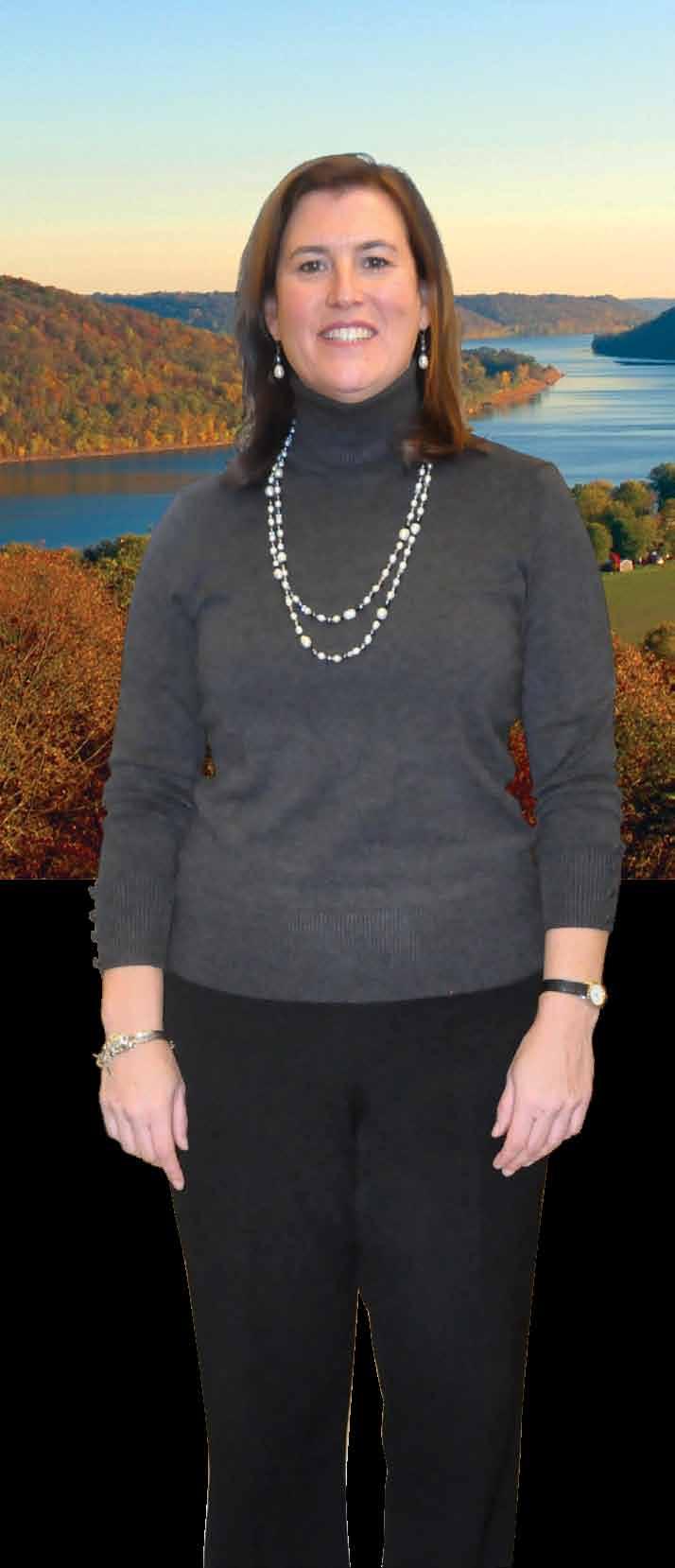
Katherine Knight Tuttle ’03 returns to her alma mater to serve as assistant professor of psychology. She has served as a research manager with Ipsos Marketing since 2008.
Tuttle’s teaching experience includes several semesters as a graduate student instructor at the University of Michigan. Her research interests include law and psychology, the combined area that comprised her dissertation, and the development of a social neuroscience theory of how negative health behaviors influence racial health disparities. Tuttle earned her master’s and doctorate at the University of Michigan.
Dustin Bailey joins Hanover as assistant professor of education. He has served for the past several years as visiting assistant professor, director of field experience and as a research associate at the Indiana University’s School of Education. Prior to this, Bailey served as a special education program coordinator for the Metropolitan School District Wayne Township in Indianapolis. His research focuses on bullying and harassment issues surrounding disadvantaged youth, including the stigma of labeling students receiving special education services. Bailey earned his bachelor’s, master’s and doctorate from Indiana University.
Lauren Griffith
Katherine Knight Tuttle
dustin Bailey
Pamela Pretorius
Susanne Mcdowell
Of all the efforts Oscar-nominated actor Woody Harrelson ’83 has made on behalf of the environment — as a raw vegan and organic farmer who uses solar energy to power his home in Hawaii — it is his love of trees and keeping North American forests intact for which he may be remembered most.
“I just really want to a see a paper revolution because they cut down between three and six billion trees a year, 40 percent of which goes to make paper products” he said during an interview on campus last March. “The effect of the paper industry around the world on the forests is devastating.”
Toward that end, he and business partner Jeff Golfman formed Prairie Pulp and Paper, which produces a stock made from 80 percent wheat straw, the leftover by-product of harvested crops, and 20 percent from wood fiber certified by the strict standards of the Forest Stewardship Council.
Harrelson has already convinced a number of entertainment companies to use the copy paper version in their offices and for scripts, including Lionsgate, producers of “The Hunger Games” film series in which he appears, and Creative Artists, one of the top talent agencies in the country.
Called Step Forward Paper, it is available at Staples stores in North America. Its use has already saved nearly 22,000 trees and reduced more than 12 million pounds of carbon dioxide, equal to the amount of emissions produced by 1,107 cars in a year.
Hanover College has joined Harrelson’s efforts, starting with this issue of The Hanoverian, printed on the company’s professional grade option.
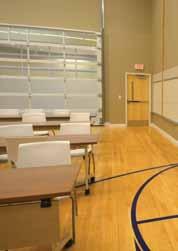
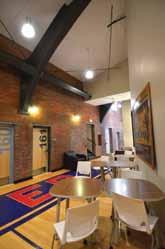
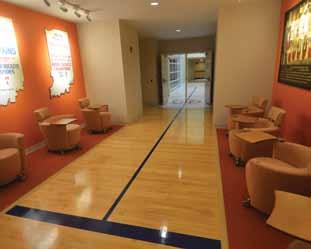
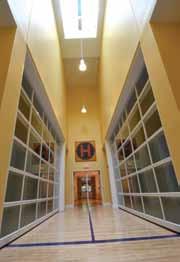
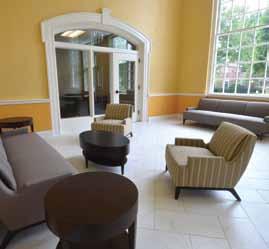
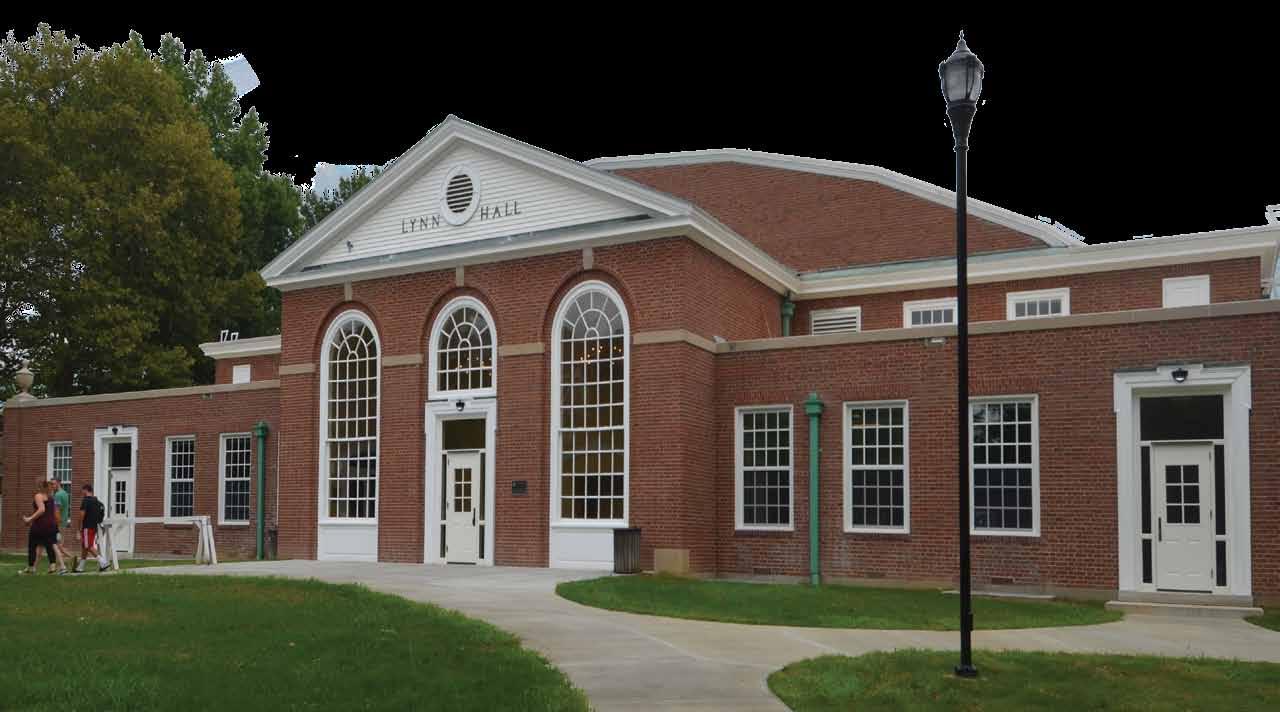
Lynn Hall transformed into multi-purpose space
Constructed in 1946, shortly after the conclusion of World War II, Lynn Hall has had a long history of use at Hanover College. The building, named after former Board of Trustees Chair Charles L. Lynn, was the home of Panther Athletics until construction on the Horner Center was complete in 1995.
What you see inside are reminders of this building’s history:
• A refinished basketball court with the original court markings.
• Wood from the bleachers used throughout the building, e.g., in the classrooms.
In the summer of 2013, construction began to renovate this space into a student residence hall. Through focus groups, students had said they preferred retaining and restoring the original structure rather than have a new building.
Jim Butz, of SPGB Architects, conceived the student suites, lounges and academic space while maintaining much of its history. The College dedicated the newly transformed building that 72 students now call home Sept. 19, 2014.
• The original painting of the word Panthers on the floor of room #144A, extending into the hallway.
Coach John Collier ’51, who gifted it back to the school for its current purpose.
• NAIA championship banners from the 60s, 70s and 80s in the center hallway.
• Pictures of winning basketball teams in both the east and west hallways.
• The original painting of the word Hanover on the floor of room #143A, extending into the hallway.
• The center court is in the hallway outside the classrooms. An older version of center court hangs on the wall above it. This cutout of the older center court occurred after the gym’s restoration following the tornado of 1974 and given to Head
• Original steel girders in the curved roof throughout the building and in the residential space on the second floor.
Monnin named president of Phi Mu
Before Beth Maxson Monnin ’83 came to Hanover, she knew she wanted to join a sorority. Both her parents had been taken part in Greek life, and Monnin believed joining was part of the collegiate experience.
After she arrived on campus and met the women of Phi Mu who would become her sisters, it solidified her decision.
“It was about the friendships and camaraderie of the chapter,” she said. “They were supportive of each other as members. I saw a lot of benefits to being a member of a national organization.”
Monnin continued her affiliation with the fraternity (the term sorority wasn’t in use at Phi Mu’s founding in 1852) working after graduation as a chapter consultant, helping collegiate chapters in the Northeast with operations and recruitment. That position was the first of many primarily volunteer roles she’s had within Phi Mu in the past 30 years.
Last July, Monnin became the second Hanover alumna elected national president of the organization; the first was Ada Martin Henry ’40, who served from 1974-78.
One thing that excites Monnin about her new role is being able to further leadership opportunities at the collegiate level, as well as for staff members and volunteers. Elected members receive training annually, and collegiate chapter members have multiple opportunities for development, one of which is an annual five-day leadership course held in the summer.
“I meet young women everywhere I go who will say to me, ‘Phi Mu changed my life,’ or ‘I’m a better person because of Phi Mu,’” said Monnin. “That really is the reason that I do what I do.”
Brant to lead business relationship efforts
Kim Brant ’91 returns to her alma mater as director of business relationships for the Business Scholars Program. Funded by a grant from Lilly Endowment, Inc., she will meet with leaders throughout the Indiana business community to develop a career-networking program to assist with job coaching, training and placement of Hanover’s Business Scholars students.
She will also meet with the program’s seniors to develop a highly detailed plan for their post-Hanover careers; mentorship will continue after graduation and beyond.
“One of the things I will address is the obstacles facing our graduates in obtaining jobs in Indiana,” said Brant. “Working with (business) leaders, as well as with Hanover alumni, I hope to expand opportunities for internships and job placement.”
“Kim’s extensive contacts in local and state government, cultural institutions and community organizations will be a great asset in extending Hanover’s reach,” added Jerry Johnson ’69, who serves as the program’s executive director. “As an alumna, she will be able to provide first-hand knowledge of how Hanover’s liberal arts education offers the kind of breadth, depth and skill set today’s employers want.”
Brant has more than 20 years of experience in nonprofit and government management with expertise in fundraising, leadership development and not-for-profit management. Over the course of her career, she has worked for Fort Wayne Museum of Art, Indiana State Museum Foundation and the Indiana Department of Natural Resources.
Education, finance and employee benefits mark AAA winners
Eric Ballenger ’81 currently serves as senior vice president of investments for the Axiom-Financial Strategies Group of Wells Fargo Advisors. He joined the company in 2009.
He began his finance career in 1991 with Hilliard Lyons in Louisville, Ky. After spending nine years there, Ballenger joined Smith Barney in 2000. In 2004, he joined the Smith Barney Investment Center at Your Community Bank.
Ballenger has been a regular contributor to WHAS Radio 84 with market commentary and has been on all three Louisville network television stations commenting on the market.
In community activities, he serves on the boards of directors for the Clark County Hospital Foundation and the Greater Clark Schools Foundation, the latter of which he has served as president since 1998.
At Hanover, Ballenger majored in economics, played basketball and was a member of Phi Gamma Delta fraternity. He is also a former member of Hanover’s Alumni Association Board of Directors.
Ballenger and his wife Leslie have three daughters and two grandchildren. The couple lives in Jeffersonville, Ind.
This year’s Alumni Achievement Award winners have used their liberal arts education to create highly successful careers.
Lisa Mills Hawker ’94, serves as president of Hylant’s Employee Benefits Division, where she is responsible for the overall growth, retention, profitability, best practices and strategic direction of the firm’s $36 million employee benefits operation.
As a nationally recognized speaker on employee benefits and health care reform, Business Insurance magazine named Hawker one of “50 Women to Watch;” that same year she earned the “20 Under 40” Leadership Award. In 2009, Hawker earned the Leadership Toledo Distinguished Community Leader Award.
Hawker is a member of the National Association of Health Underwriters, International Foundation of Employee Benefits, Worldwide Employee Benefits Network, the Society for Human Resource Management, and the Council of Insurance Agents & Brokers (CIAB). She also sits on the board of the CIAB’s Council of Employee Benefits Executives, as well as numerous insurance carrier advisory panels.
Hawker serves as chair for the Northwest Ohio division and the Ohio chapter of the March of Dimes. Additionally, she serves on the boards for the YMCA/JCC of Greater Toledo and for the Toledo Children’s Hospital.
At Hanover, she majored in biology and was a member of Chi Omega sorority. Hawker also did post-graduate work at Indiana University as well as continuing education in her field.
She and her husband Jon are the parents to twins Jackson and Katelyn.
Susan Martin Studds ’76 joined the National Intelligence University in January 2009 as provost, where she serves as the chief academic officer responsible for leading academic, research and engagement programs.
Previously, Studds held various roles with increasing responsibility at the National Defense University (NDU), including teaching courses in strategic leadership and decision-making in education as an element of national security. She also developed and taught the inaugural course in American Studies for the university’s International Fellows.
During her career, Studds has held positions in academic and student affairs at George Mason University (Va.), Miami University (Ohio), The Washington Center for Internships and Experiential Education (D.C.), and The University of Maryland, College Park, among others. She is also a trustee at Moravian College in Bethlehem, Pa.
Her awards include the Joint Distinguished Civilian Service Award, Joint Civilian Service Achievement Award, and the Superior Civilian Service Award.
At Hanover, Studds majored in speech and theater, and was a member of Kappa Alpha Theta sorority. She earned a master’s degree in counseling and student personnel from Miami University, and a doctorate in educational policy, planning and administration from the University of Maryland at College Park.
Studds and her husband Jeffrey ’77 are the parents to a son, John Martin.
Service, entertainment and exploration mark DYA winners
Emily Burks Perry ’99 is the founder, executive director and child forensic interviewer at Susie’s Place Child Advocacy Center. A licensed social worker, she has extensive experience in the field of child welfare, child protection and crimes against children with previous positions held in Indianapolis, Philadelphia, Portland, Ore., and Shelbyville, Ind.
Since the opening of Susie’s Place in 2009, with a second center in 2011, Perry has conducted more than 1,000 forensic interviews of alleged child victims and supervised more than 2,500 cases.
She works collaboratively with law enforcement, prosecutors, the Department of Child Services, medical teams, victim advocates and mental health clinicians to ensure that children are not further traumatized by the interventions intended to protect them.
The Indiana Coalition Against Sexual Assault gave Perry the 2010 Victim Advocate of the Year Award. Additionally, Susie’s Place earned the Avon Chamber of Commerce Distinguished Organization Award in 2010 and the 2014 Herb Keisling Award.
Perry is the president of the Indiana Chapter of National Children’s Alliance and is on the faculty of ChildFirst Indiana. She holds a master’s degree in social work from Indiana University.
At Hanover, Perry majored in sociology, played softball and was a member of Chi Omega sorority. She and her husband Brian live in Plainfield, Ind., and have two children.
This year’s distinguished Young Alumni winners each use their successful careers to help others.
John Resig ’01 is the president of Resignation Media, LLC, which produces theCHIVE, a photo-entertainment website launched in 2008, after cofounding the parent company in 2007 with his brother Leo.
The site earns more than 145 million page views per month. Resig also oversees the company’s associated ventures including theChivery, Tapiture, theBERRY, theBRIGADE, theTHROTTLE, Chive Charities, Chive Fest and Resignation Brewery.
Devotees of the site refer to themselves as Chivers. In response to their numerous requests to help those in need of assistance, theCHIVE has run several campaigns to support numerous charitable causes, including disabled and sick individuals with rare medical conditions, disabled veterans in need of quality of life enhancements, underfunded special needs education initiatives and organizations that provide emergency assistance/disaster relief. During charity flash drives that have gained national recognition, the Chive Nation has donated more than $1.6 million within hours.
At Hanover, Resig majored in English and theater. As a member of Beta Theta Pi fraternity, he served as social chair for two years running.
Not long after graduation, Resig left for Los Angeles and won the role of Deputy Kevin Ellis in the pilot episode of the critically acclaimed HBO Drama “True Blood.” He co-starred on the series for seven seasons until a vampire killed off his character.
Bill Wilcox ’01 serves as a senior exploration geologist at Chevron Corporation, where he is responsible for identifying and evaluating new natural gas prospects in Western Australia.
Wilcox has previously held several positions of increasing responsibility within Chevron, including a deepwater exploration role in the Gulf of Mexico, prospect development and appraisal off the coast of west Africa, and optimization of mature oil fields in the U.S. He has significant expertise in seismic interpretation, reservoir modeling, and economic risk analysis and evaluation.
During his tenure, Wilcox has received multiple awards recognizing excellence in subsurface characterization, prospect appraisal and technological innovation.
He earned his master’s in geology from Miami University in 2007. During this time, Wilcox conducted field work in Utah and Tibet, and led field courses across the western U.S. and Canada.
Wilcox supports geology students at both alma maters through campus outreach and mentoring. He has co-authored seven publications and is a member of the American Association of Petroleum Geologists and Society of Exploration Geophysicists.
At Hanover, Wilcox majored in geology, played football and ran track, and was a member of Beta Theta Pi. He currently resides in Perth, Australia, with his wife Laura.
Dean marks 40th anniversary of Nixon resignation
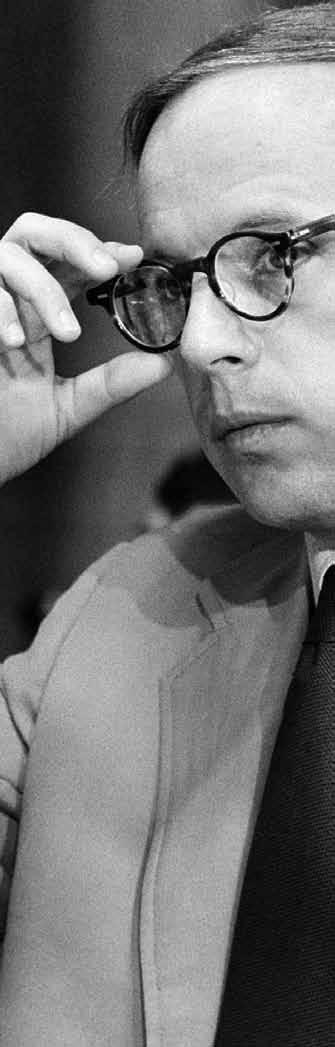
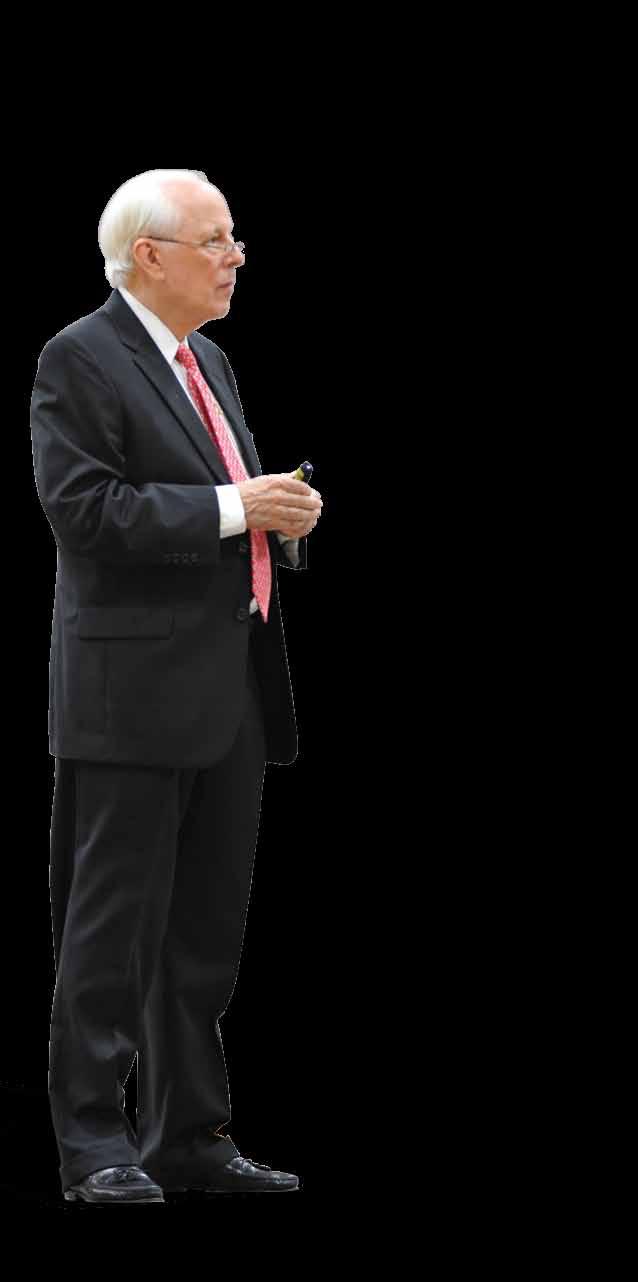
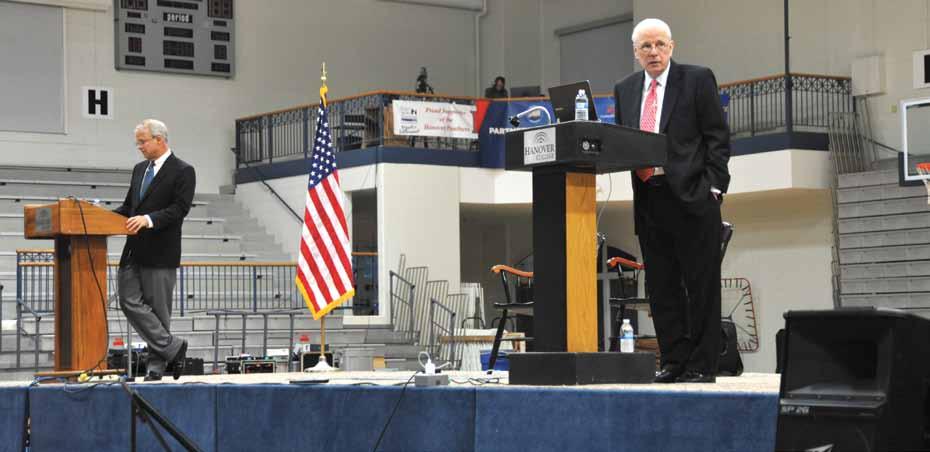
One of the central figures in the Watergate scandal that stunned the nation in 1974 visited Hanover’s campus in October. John Dean, hired at age 31 as the White House counsel to former president Richard Nixon, turned into the prosecution’s key witness, and his testimony ultimately led, in part, to the 37th president’s resignation.
Marking the 40th anniversary of that latter event, Dean came to campus in October, along with Cleveland attorney James David Robenalt, for their presentation “Watergate, Vietnam and the Nixon Defense.”
The pair gave an overview of the events that led to the downfall of a sitting president. Dean said he knew that initially Nixon had no evidence about the bungled break-in at the Watergate Hotel that took place the evening of June 17, 1972.
“But, did he create an atmosphere in which those who were involved in the break-in thought they were doing the right thing?” asked Dean. “You bet he did.”
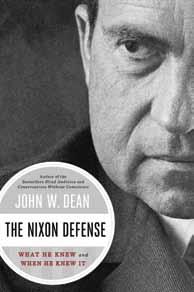
Having spent the past four years transcribing (with help from graduate students) nearly 1,000 of Nixon’s secretly recorded conversations, previously unreleased, as well as information from the National Archives and Nixon Library, he has a thorough understanding of the events as they happened. Dean used the information for his latest book, “The Nixon Defense: What He Knew and When He Knew It,” (Viking Adult, 2014) one of several he has written on the subject.
Nixon won the 1972 election against Sen. George McGovern (D-S.D.) in a landslide victory.
Robenalt said that although the American people had suspicions that the White House was involved in the Watergate break-in, it didn’t matter to them when it came time to vote.
After losing 50,000 people in Vietnam, Robenalt said Americans didn’t think we should just walk away, which is why they voted to re-elect the president. Nixon wanted “peace with honor.”
When he launched the “Christmas bombings” in December 1972 after talks with the North Vietnamese broke down, that act was the trigger that led to his downfall.
Even though Nixon had won with tremendous popular support, he lost both houses of Congress; both were solidly Democratic and planned to end the war when their session resumed in January of 1973.
Nixon’s decision to bomb Hanoi troubled quite a few senators because they considered it imperial. Once the Vietnam War was over, they voted unanimously to convene a committee to investigate the Watergate burglaries. Dean said if it had been at the height of the war, it’s unlikely (the committee) would have been interested in examining the situation, especially the Republicans who would have supported him.
In a subsequent interview, Dean and Robenalt agreed that Nixon’s political paranoia regarding his second term began after events such as the shootings at Kent State University in 1970.
Nixon also believed former senators Ted Kennedy (D-Mass.) and Edmund Muskie (D-Maine) were a threat to his re-election efforts.
“What Nixon guessed right was that the American people didn’t want what he called a ‘bug-out’ (in Vietnam),” said Robenalt. “That’s what made McGovern such a poor candidate. He could have been wrong about that. There could have been the opposite reaction based on what you were seeing on college campuses and the violent reaction to the war.”
Looking back, Dean said he doesn’t have any regrets about his actions during Watergate, other than perhaps not acting sooner.
“I would handle it a lot differently now at 75 years of age than I did in my early 30s,” he said. “I would have told Nixon off and walked out.”
Impartial decisions
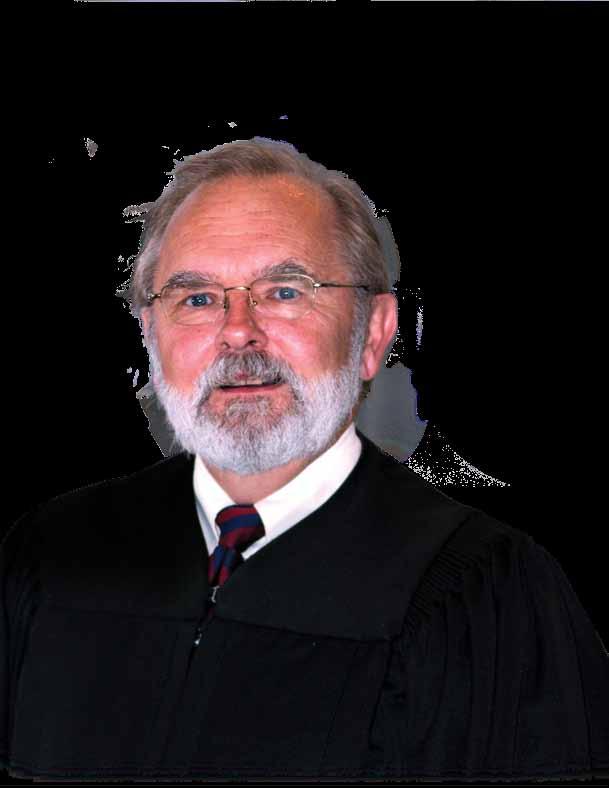
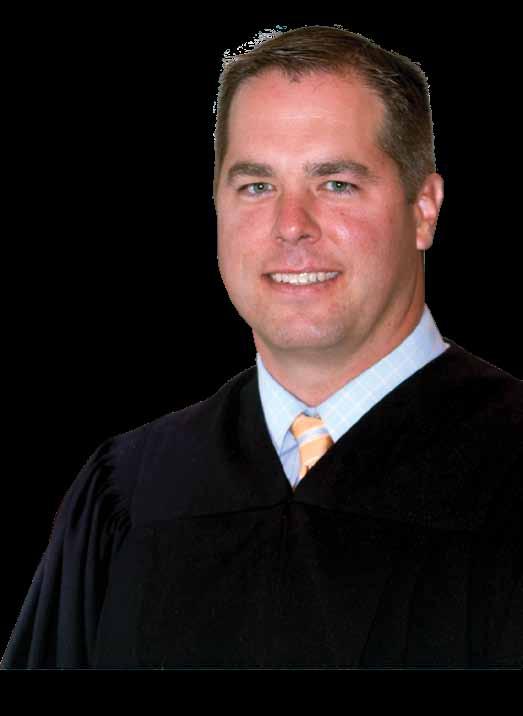
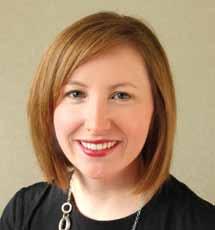
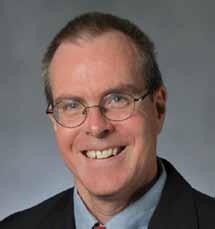
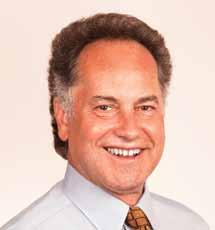
WOLF LANSINGER NORTHAM HILL
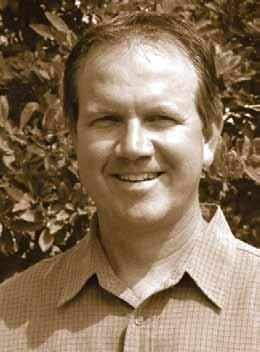
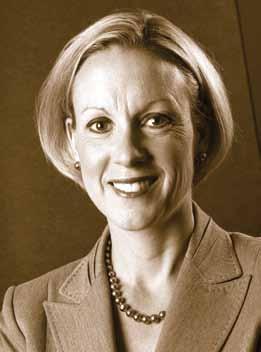
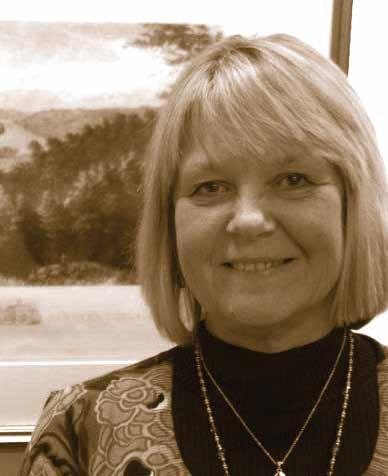
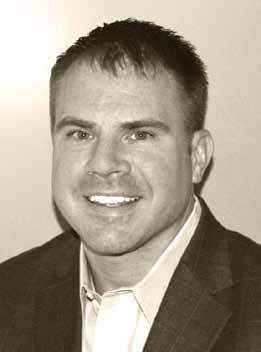
Being a judge means looking at all sides of an issue and rendering a fair and equitable decision. But what is the day-today job really like? What are the myths? We asked several alumni who serve as judges in Indiana to share their experiences.
Sitting in the courtroom, a judge is likely to hear anything. The case might be a set of divorcing parents, squabbling over who gets custody of the children. A tenant sues a slumlord for refusing to fix sub-standard housing. An employee sues for damages due to an illegal termination.
Whatever the attorneys and litigants bring to the courtroom, the judge must listen to all the facts closely and remain impartial before handing down a decision. The work is much different from advocating for a client and can often be an isolating experience.
It’s also the perfect job for someone with a liberal arts background, which may explain why Hanover has produced quite a few who serve on the Indiana judiciary.
Ralu Smith Wolf ’76, who began her career on the bench in 1988 serving the Muncie City Court, said when it comes to being a judge, there’s no such thing as a typical day. Dispelling the common myth that she spends the majority of her time in court, she is often at her desk reviewing pleadings and writing orders.
“Being in the courtroom on the bench is really the tip of the iceberg,” said Wolf, who currently serves as a judge for Delaware County’s Circuit Court 3. “Sometimes, people may walk through the courthouse and think, ‘Gee, there’s not much going on,’ because they don’t see activity in the courtroom. However, they don’t know (that) we’re here in the judge’s office working away on writing orders, or decrees of dissolution of marriage or following up on all the pleadings that are filed while we are in court.”
Wolf’s workload involves civil suits, e.g., divorce, foreclosures and protective orders, as well as criminal felony cases such as murder, armed robbery and drug dealing, among others. She considers criminal law her comfort zone due to her 20-plus years of judicial experience in Muncie City Court.
Concentration and quick thinking are two necessary skills for a judge. Wolf said she may have to make as many as five separate determinations on five individual cases in 10 minutes.
Life as a judge is not for the indecisive, and Wolf seldom second-guesses herself. She said she learned a long time ago how to pursue the decision-making process, how to have the necessary evidence, as well as the appropriate and relevant law in front of her before rendering judgment.
After practicing law for 20 years, Dave Northam ’71 realized he wanted a change. Though he liked his work, Northam realized making the decisions suited him better than serving as counsel.
He began his judicial tenure with the Rush County Court in 1996, which converted to a Superior Court in 2000, followed by Circuit Court in 2007. There are typically 2,000 cases annually.
Northam often has to decide cases with people he knows, something he believes is unlikely to occur for his friends who practice in a large city. Rush County has a system that allows Northam to recuse himself from a case if he feels the need, but that he doesn’t exercise that option often. However, he does consider it one of the hardest parts of being a judge in a small town.
“It often requires sacrifices for yourself and your family to remain fair and impartial, to avoid the appearance of any impropriety,” said Northam. “On occasions, I find myself having to distance myself from friends or situations while a case is pending. People do not mean any harm, but they want to talk to you about a case. Trying to explain that you cannot listen to them outside the courtroom can result in hurt feelings.”
One misconception is that serving as a judicial officer requires a great amount of wisdom. Northam likes to think of it more as common sense combined with the ability to see both sides of a situation. The skill
is particularly helpful for the often fervid nature found in family law cases. Northam said he thinks for the most part, people just want someone to listen to them and consider their position.
“It’s not going to be a perfect answer no matter what,” he said. “I tell people in the two to three hours they have to communicate a case to me, there’s no way they can (explain fully) what their life has been like. They would be better off in the same situation to spend the time in mediation where they can come up with their own agreement.”
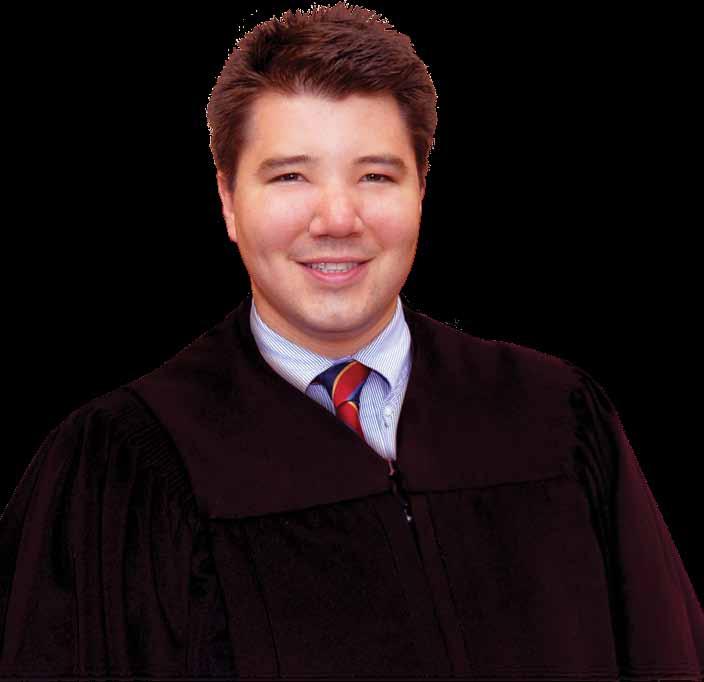
Brian Hill ’97 followed Northam as superior court judge for Rush County in 2007 when former Indiana Gov. Mitch Daniels appointed him to fill the vacancy. Northam had successfully run for the county’s circuit court just a couple of months prior.
The two have worked closely over the years, and Hill often relies on the elder judge’s experience.
“He’s been a great mentor; his door is always open,” said Hill. “Now that I’ve been on the bench for several years, it’s kind of a two-way street. Rarely does a day goes by that we don’t chat, (even when the topic isn’t) something pressing about what we’re doing in our jobs.”
Hill grew up in northeastern Rush County and lives in the century-old farmhouse owned by his great-grandmother. Most of the people he knew had good steady jobs, and he said it was a given for him to grow up and contribute to the community.
When he first took the bench, Hill had a somewhat hard-line approach when it came to dealing with young people who had made bad choices, telling them to have a little accountability for themselves and not to blame others.
Over time, however, his eyes opened to the challenges some of his defendants faced and he now takes great pleasure when he sees a former defendant turning things around.
“These kids don’t have anybody, aside from some teachers they only see for a few hours a day, who they can relate to getting up every morning and going to work,” said Hill. “It’s really rewarding to see kids pull themselves up by their bootstraps or (when) we can provide some services to help a child see what a productive life is.”
As a first-time judge, Joe Lansinger ’05 serves the New Castle City Court in Henry County. He works part time while continuing the law practice he joined six years ago with his father, John ’71, thanks to a provision in the statute that allows him to hear ordinance or traffic violations, the types of cases that he does not handle in his private practice.
Now three years into a four-year term, one of the challenges Lansinger faced at first was the same one he met as a young attorney: people taking him seriously. His father told him he’d also have trouble putting into context situations such as a divorce case where the couple has been married for 30 years, due to Lansinger’s lack of experience.
“It’s very difficult to look someone in the eye who’s twice your age and say, ‘This is how much it’s going to cost, and I’m going to be able to help you with it,’” he said. “You develop confidence (and) demonstrate your authority and expertise not by being condescending or abusing your power, but by showing you know what you’re doing. Once you can demonstrate (that), my experience has been that both clients and litigants won’t question your age.”
Much of Lansinger’s caseload involves city ordinance violations, such as properties with junk on the lawn or unlicensed cars on blocks. He said he looks at his work almost like an environmental court, though he admitted that wasn’t the legal definition.
“Whether an animal is vaccinated or not, there’s not a lot of room to argue. So for most cases, people admit (the violation) and then my role is to see that they get into compliance with the law.”
Lansinger’s job then is to determine the best way to do that, i.e., how much time to give them, will a fine serve as an impediment (if they don’t have money) or will it serve as an incentive to get things fixed?
All the judges agree their Hanover education gave them the tools they needed to be successful. For Lansinger, his sociology classes at Hanover gave him a necessary perspective into the differences between walks of life, types of people and choices made.
“(It gave me) the ability to see the big picture and to identify with clients and litigants,” he said. “New Castle is not a wealthy area. (Many) of my clients don’t have a lot of money … (my sociology classes helped) give me empathy and a better understanding for those who are less fortunate or in difficult situations.”
Hill, a history major, read and wrote constantly in his classes — skills he now puts to good use in his work. He said he also learned how to analyze and research properly.
“I remember Professor Curtis (history) introducing me to primary sources,” said Hill. “I always loved history but until I got to Hanover, I had always read someone else’s summary of what had happened ... That translated directly into law school (and reading) Supreme Court opinions.”
“Serving on the bench has a broader and more general skill set than some professions and even specialized areas of the law,” said Northam. I often tell interested students that if they enjoy being a student they will enjoy the practice of law or serving as a judge. Listening, reading, research, writing and problem solving are all critical skills for a judge. Whatever major a student has, I think Hanover’s liberal arts curriculum is a great way to learn these skills.”
However, it’s the personal attention Wolf received from professors like the late history professor Robert Bowers, among others, that made the biggest impression.
“Dr. Bowers was brilliant in his research and in his teaching, but you could always tell that he was interested in us personally,” she said. “I saw that in quite a few of my professors at Hanover. That’s one of the reasons I wanted to (attend). I wanted a small campus where I could interact with the professors, and I was able to enjoy that experience.”
When it comes public policy, governmental agencies take scientific research into account when making the laws we rely on to keep us safe.
But what happens when a group misrepresents the data for its own benefit?
How can the public trust that these regulations are truly in our best interests?
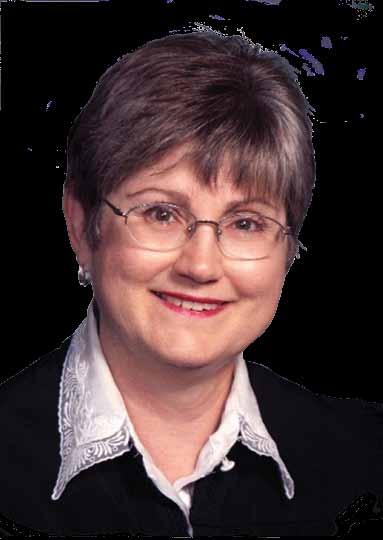
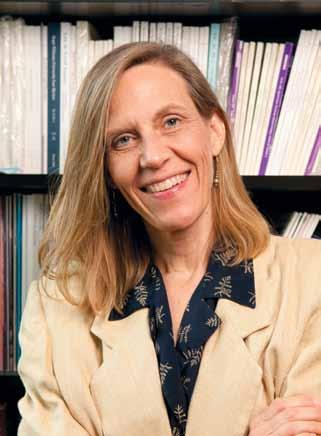
Researching this important area is Wendy Wagner ’82. A professor at The University of Texas at Austin, she is a leading authority on the intersection of law and science, with a particular emphasis on environmental policy.
“I look at institutional architecture and see how well it fits the problems we’re trying to solve,” said Wagner. “In other words, how have we designed a decision process to use lots of complicated information in a setting where there are going to be political actors who may want to hide the ball or cheat a little bit?”
As a leading authority on the use of science by environmental policymakers, this alumna studies how science intersects with the law.
In some projects, her research looks at how these agencies incorporate science into decisions that are only going to be partly about science.
For example, if the Environmental Protection Agency needs to decide what the standard for air quality should be, they need to understand what the scientific literature says about risks. Wagner said the available scientific research typically provides surprisingly few answers.
“There are limits of science, and we only know so much about effects on public health, so there are huge uncertainties. Plus, there are a lot of cost considerations, and it could be that we don’t really want to protect one in 10,000 folks, we only want to protect one in a million because it’s so expensive to protect at such a high level.”
Her goal is to understand how these organizations use science in the process, how other considerations fit in, what the role of the public is and how experts ensure that organizations are accountable for their decisions.
In “Bending Science: How Special Interests Corrupt Public Health Research,” (Harvard University Press, 2012) Wagner and co-author Thomas O. McGarity, a UT Austin colleague, looked at the different ways the existing
legal structure allows for stakeholders to play with data. The authors also posit that all groups, including the federal government, have done so in some way.
“Sometimes (the abuse) is to manipulate the role that science plays in the process, but usually, it’s to manipulate the findings from the research studies,” she said. “In some cases, the legal system is even designed in a way that actually enables this mischief, although the design choices are not always intentional.”
How easy is it for a company to take advantage? Wagner said it depends on what the company is trying to do and is specific to the setting.
One way is to design a study with the end result in mind, by framing the question in a specific manner, such as carefully designing/selecting the populations that you study.
Companies can also counter unwelcome results with a summons for every single piece of record in the researcher’s files. While some courts will ultimately quash those subpoenas, it doesn’t always work that way.
If the above methods fail, the sponsor’s attorneys might try to argue in court that the scientist has committed misconduct or file a defamation suit. The argument is that we shouldn’t use taxpayer dollars for fraudulent research.
“There’s generally no down side (for the company) to arguing a researcher has committed misconduct,” said Wagner. “(Instead) it shuts down the researcher for quite a while and can tarnish (his or her) reputation, even if there’s absolutely no basis for it.”
Unfortunately, there are no sanctions against the litigant if the researcher is able to prove the allegations are false.
Growing up in Munster, Ind., just south of Chicago, Wagner’s interest in advocating for the environment began at age seven. Pollution plagued the town, and in those days there were no federal laws to protect it.
“When the wind changed, you could smell the steel mills (in Gary, Ind.), and we lived probably 20 miles away. It was really bad, and I thought it wasn’t the way it should be.”
Determined to understand the problems, Wagner studied biology at Hanover and said in addition to an excellent education, the years gave her a confidence, an energy and an optimism that has made all the difference.
“I got a level of dedication from my professors that makes me feel so lucky to have had a school that invested so much in me and had so much confidence in me,” she said. “It was just a very caring, loving, hugely supportive four years of my life.”
Next, Wagner earned her master’s in environmental science, along with a law degree, both from Yale University (Conn.). Not long afterward, she worked for the Department of Justice’s Environmental and Natural Resources Division through their distinguished honors attorney program, followed by a stint at the general counsel’s office for the Department of Agriculture.
While at DOJ, her work focused on organizations that violated the Clean Air Act or contributed to hazardous waste sites.
“I had big, horrible sites that were badly polluted,” she said. “The idea was that we would sue all these responsible parties under the Superfund law and get them to clean up the site directly or pay for the cleanup. Most of the defendants were enormous companies and some were more than willing to pay cleanup costs because the law was so strong they knew they’d have to anyway.”
However, some of the defendants were poor people who just owned the land, but under the law they were also liable for millions of dollars. Wagner admitted she felt ethically conflicted.
“I was very uncomfortable proceeding against some of these people,” she said. “I understood why they were technically liable under the federal law … but when you’re down there on the ground destroying people’s lives the way I sort of had to, that wasn’t what I had imagined doing as an environmental attorney, (nor) was it what I had worked so hard to do.”
Realizing the disconnect between her idealism and the reality of her work, Wagner turned to academia and taught at a number of prestigious institutions, including Case Western Reserve University (Ohio), Vanderbilt University (Tenn.) and Columbia University (N.Y.). She has held her current tenured position on the law faculty at UT Austin since 2001.
Wagner said she isn’t sure whether or not her work has had an impact. At this point in her career, her goal is to look for and try to understand the problems, and to create a record of them. She plans to keep at it in the hope that her research will help, at least a little, in the long run.
“When we do have really rigorous legal processes for a particular issue, things go extremely well,” she said. “When we build it right, it’s amazing, and we end up with a democratic system that’s highly accountable … A little robust legal reform will go a long way.”
by Andrew Faught
Arguing before the Supreme Court is the holy grail for any attorney. This alum did so twice.
Wearing a crisp navy blue suit and a light blue tie, Bill Thro ’86 wasn’t about to rile the spirit of former U.S. Supreme Court Chief Justice William Rehnquist. It was Oct. 31, 2005, not even two months after Rehnquist’s death, and Thro was about to make his first oral argument before the court.
The chief justice, it turns out, was a sartorial stickler. Whether his unwritten dress code still held sway was anybody’s guess. Thro wasn’t taking any chances.
“One of the rules was that everyone had to wear either gray, dark navy blue or black. No browns, no seersucker,” said Thro, an adjunct professor of law and general counsel at the University of Kentucky since 2012. “The last thing I wanted justices to think is ‘Gee, why did that guy wear a brown suit?’ I wanted them to focus exclusively on the force of my argument.”
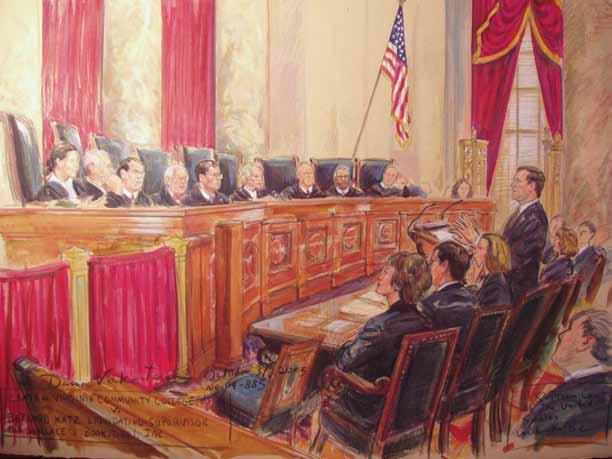
For Thro, then Virginia’s solicitor general, arguing the state’s position in Central Virginia Community College v. Katz was among a pair of professional high points in his 24-year legal career. Thro argued a second, unrelated case five months later. Of the nation’s 1.1 million practicing attorneys, fewer than 1,000 have appeared twice before the court. Far fewer have argued twice in the same session.
as one of two deputies, praised his former colleague for his “incisive analytical skills” and “photographic memory for case decisions.”
“Bill Thro is one of the best lawyers I have met in my 35 plus years of practicing law,” said Hurd. “Most importantly, like every truly great American lawyer, Bill is deeply devoted to sound constitutional principles and the rule of
“That loss was devastating. I had very much a sense of letting people down,” he said. “It’s been eight years now, and there’s still a sense of disappointment and a sense of what, if anything, could I have done differently or should I have done differently to win it.”
Thro argued the case knowing full well he could be out of a job the following week. Keeping his position required Virginia’s Republican nominee for attorney general, Bob McDonnell, to win the general election. He did, but by a scant 360 votes.
In his first case, a bookstore in bankruptcy proceedings was trying to collect debts owed to it from Central Virginia Community College and other schools operated by the state. The court ruled against Thro 5-4 (who argued for the college), with justices in the majority holding that states cannot invoke sovereign immunity — the longstanding constitutional provision in which states are not susceptible to lawsuits that they don’t agree to — as a defense in bankruptcy hearings.
More recently, legal observers have noted that the application of sovereign immunity has become less clear-cut. Thro learned this lesson the hard way.
“There was something about being around sick people that didn’t appeal to me,” said Thro.
It was at Hanover where the Kentucky native encountered his most profound influences in the area of constitutional law — Carl Metz, chairman of the political science department, and former history professor George Curtis, with whom Thro took two semesters of constitutional and legal history as a senior.
Those votes were enough for Thro to see another day in the court, and this time he tasted victory. In March 2006, during SanchezLlamas v. Oregon, he argued in favor of states being able to admit evidence against foreign nationals, even if the state violated the Vienna Convention requirement of failing to notify the home country consulate of the defendant’s detention. The vote was 6-3.
Never short on ambition, Thro decided he’d become a lawyer in the eighth-grade, after earning a law merit badge in the Boy Scouts and becoming enamored with the profession while watching the TV series “The Paper Chase.” He spurned suggestions of pursuing medicine
“It’s been almost 30 years since I had them for class, but there are things that they said in some of their lectures that I remember vividly,
“Because the decision reaffirms the uniqueness of American law and rejects the international legal norms, historians are likely to regard it as more significant than contemporary commentators and observers.”
Armed with degree in political science and business administration, he went on to earn a law degree from the University of Virginia.
Although Thro has argued 33 cases in lower appellate courts, he said nothing compares to
His argument, in a packed courtroom where “there’s very much a feeling of claustrophobia,” was everything Thro hoped it would be, despite some nagging nerves.
“There is no more. A trial lawyer can always
Rendering by courtroom sketch artist Dana Verkouteren
All attorneys then move into the courtroom, whether arguing the first or second case of the day, and the marshal of the court commences the day’s proceedings, including the tradition of three cries of the word “Oyez,” which originally dates from a medieval French word meaning “hear ye.”
and choice of Tums, aspirin and sewing kits to mend any wardrobe malfunctions.
Memories aren’t Thro’s only keepsake. Framed in his UK office are the four white goose-quill pens he garnered for arguing before the court. By longstanding tradition, lead attorneys and their co-counsel receive two pens apiece.
Those who know Thro say he’s well suited for the profession. William Hurd, who preceded Thro as solicitor general and who hired him as one of two deputies, praised his former colleague for his “incisive analytical skills” and “photographic memory for case decisions.”
When Thro argued Central Virginia Community College v. Katz — that day’s second case — he was unable to review his notes, for fear of making noise. But that wasn’t his only concern.
“Bill Thro is one of the best lawyers I have met in my 35 plus years of practicing law,” said Hurd. “Most importantly, like every truly great American lawyer, Bill is deeply devoted to sound constitutional principles and the rule of law.”
“I was very tempted to drink water that was in front of me because my throat was obviously dry from all of the nerves,” he said. “But at the same time, the (last) thing I needed was a situation where I would have to go to the bathroom halfway through my own oral argument.”
Once he was ready, Thro was struck by the scale of the court.
Never short on ambition, Thro decided he’d become a lawyer in the eighth grade, after earning a law merit badge in the Boy Scouts and becoming enamored with the profession while watching the TV series “The Paper Chase.” He spurned suggestions of pursuing medicine instead.
“You realize when you get to the podium how much closer you are to the justices than what you normally are in other courtrooms; you’re right on top of them,” he said. “If the chief justice had an onion bagel for breakfast, you’re aware of that.”
“There was something about being around sick people that didn’t appeal to me,” said Thro.
Somewhere, Chief Justice Rehnquist is blushing.
It was at Hanover where the Kentucky native encountered his most profound influences in the area of constitutional law — Carl Metz, chairman of the political science department, and former history professor George Curtis, with whom Thro took two semesters of constitutional and legal history as a senior.
“It’s been almost 30 years since I had them for class, but there are things that they said in some of their lectures that I remember vividly, as if it were yesterday,” Thro said.
Armed with degree in political science and business administration, he went on to earn a law degree from the University of Virginia.
adjoining the courtroom, where they have their choice of Tums, aspirin and sewing kits to mend any wardrobe malfunctions.
All attorneys then move into the courtroom, whether arguing the first or second case of the day, and the marshal of the court commences the day’s proceedings, including the tradition of three cries of the word “Oyez,” which originally dates from a medieval French word meaning “hear ye.”
When Thro argued Central Virginia Community College v. Katz — that day’s second case — he was unable to review his notes, for fear of making noise. But that wasn’t his only concern.
“I was very tempted to drink water that was in front of me because my throat was obviously dry from all of the nerves,” he said. “But at the same time, the (last) thing I needed was a situation where I would have to go to the bathroom halfway through my own oral argument.”
Once he was ready, Thro was struck by the scale of the court.
“You realize when you get to the podium how much closer you are to the justices than what you normally are in other courtrooms; you’re right on top of them,” he said. “If the chief justice had an onion bagel for breakfast, you’re aware of that.”
Somewhere, Chief Justice Rehnquist is blushing.
Since its inception in July 2010, the Live Our Loyalty Campaign has received nearly $55 million in gift assets, making it one of the most successful fundraising campaigns in the College’s history.
Hanoverians
When campaign chairs Mark ’71 and Marabeth Ice Levett ’71 took the words “live our loyalty” from Hanover’s alma mater to name the College’s fundraising campaign in 2010, they knew they were on to something, but even they might not have appreciated the unprecedented support given by 5,000-plus donors, more than 3,000 of whom were alumni.
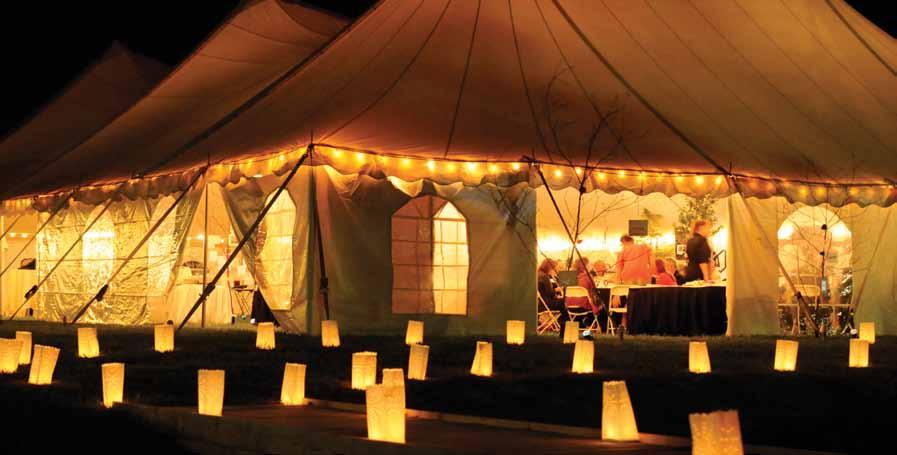
LIVE OUR LOYALTY: The Campaign for Hanover College generated nearly $55 million in philanthropic assets, one of the largest fundraising totals in the College’s 187-year history. President Sue DeWine made the announcement at this year’s Homecoming celebration Sept. 20 when the College dedicated several new outdoor athletic spaces.
“The results of this campaign are nothing less than remarkable,” said DeWine. “Not only did we have 100 percent participation among multiple constituent groups, 80 percent of current pledges are already in hand. This will go a long way toward strengthening the College for the future and improving our students’ experiences.”
In addition to alumni, every member of the College’s board of trustees, the alumni board and the parents’ board participated, while faculty and staff made gifts at an unprecedented participation rate of 71 percent.
Hanover’s Live Our Loyalty campaign was the result of a comprehensive planning process that established ambitious targets for recruitment and retention for a six-year period that ends in 2015. Along with capital improvements, funds raised will strengthen Hanover’s liberal arts education through support for academics, expanding student social activities, improving experiences for student-athletes, supporting talented students with scholarships and increasing the number of students studying abroad.
Toward the goal of strengthening academic distinctiveness, the political science department received a nearly $3.2 million gift from the estates of James T. McManaman ’39 and his wife Carolyn. The gift is the largest individual gift received during the campaign.
Funds from the McManaman gift brought former White House counsel and chief Watergate witness John Dean to campus in October to discuss the connection between the Vietnam War and the scandal that brought down former President Richard Nixon.
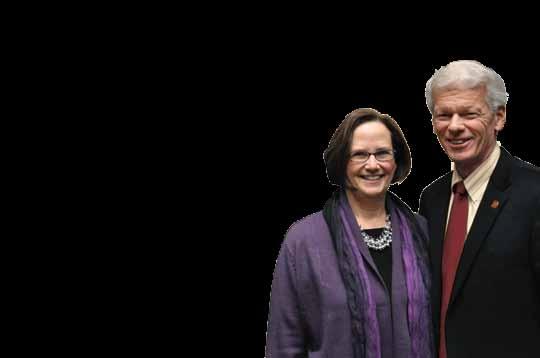
Mark ’71 and Marabeth Ice Levett ’71
live their loyalty
“The campaign was designed to enrich the lives of students at Hanover, and it really has touched their lives in so many ways,” said Marabeth Levett. “By that standard alone you could say the campaign was a success, no matter how much money was raised.”
Among the campaign standouts, the challenge to raise funds for the Shakespeare in England program led to more than $350,000 in commitments.
Capital improvements made up a significant portion of campaign dollars. Nearly 400 parent households contributed to modernize and update the technology in 10 classrooms in Classic Hall, the Lynn Center for Fine Arts, Goodrich Hall, the Faculty Office Building and the Science center.
Also enhancing the classroom experiences was a gift from Don Mount ’50, whose generous support modernized classrooms and teaching labs to instruct education students on the use of technology in their future classrooms.
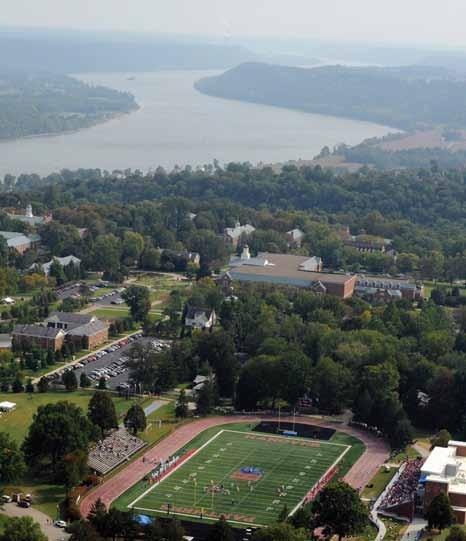
The most notable capital improvement, however, is the $7 million outdoor athletic complex that boasts a new stadium, press box, offices for the coaching staff and training room for treating athletes.
“Having the new stadium has a positive effect on me and the team every day,” said senior Caleb Williams, a member of the football squad. “I hope the teams to
come don’t take it for granted, because those of us who have been in both know the transformation is a night and day difference. It creates a more cohesive and encouraging environment for the entire team.”
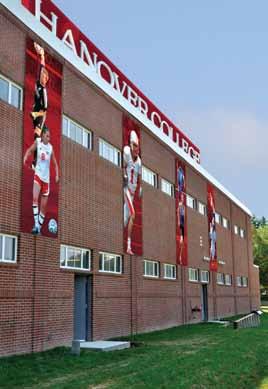
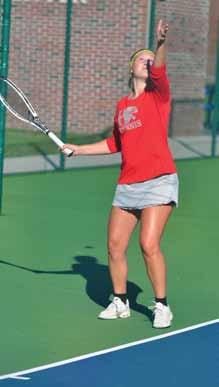
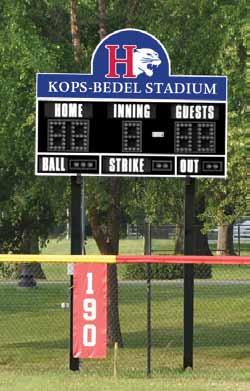
The Zeddies Tennis Center, made possible by a gift from Michael ’77 and Judy Zeddies and completed in 2012, features eight courts with an adjacent lighted pavilion for gatherings and events. Funds also renovated the softball and baseball facilities with new press boxes, bleachers and scoreboards, along with improvements to the dugouts. Soccer received new bleachers, team benches, ball net and scoreboard.
In May 2013, Hanover dedicated Ward and Jo Ann Withrow Student Activity Center, made possible by a gift from Jo Ann Flubacher Withrow ’63. Located on the ground floor of the Brown Campus Center, the space features a computer lab, pool tables, a study area, craft room, a movie viewing area and meeting space. The gift also went toward creating new offices for Student Life.
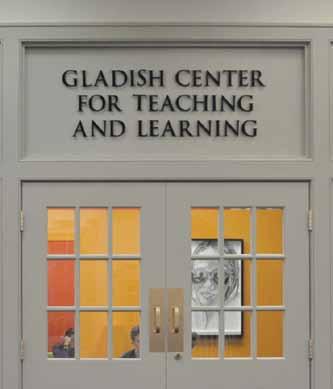
The Ken and Kendal Gladish Teaching and Learning Center, made possible by a gift from Ken ’74 and Kendal Hegamaster Gladish ’75, opened in the Duggan Library. Hanover dedicated the new facility during its Homecoming celebration in 2013.
Sodexo, Hanover’s food service vendor, sponsored a $1 million transformation of the Campus Center dining room, which opened fall 2013. Walls were removed near the food service lines to allow for more space and opening the offices near the area to account for the extra space.
“Current students are very impressed with the amount of alumni support,” said senior Derek Bast. “It gives us a better sense how committed they are, and how Hanover is moving forward.”
The cost of the campaign was two percent of the total funds raised. Typically, the costs associated with fundraising campaigns are six to eight percent of the total.
During the 2014 event, Hanover also hosted an open house to celebrate the $6 million renovation of Lynn Hall into a residence hall that houses 72 students. The building also contains classrooms and office space, utilized by the Career Center, the Office of Experiential Learning and the Study Abroad Office.
Thanks to you and your investment in the campaign initiatives, generations of Hanover students will be the beneficiaries of enriched academic programs, new facilities, quality social experiences and scholarships for talented students.
You can see a complete listing of campaign donors and volunteers at hanover.edu/giving/lol
Five join athletic
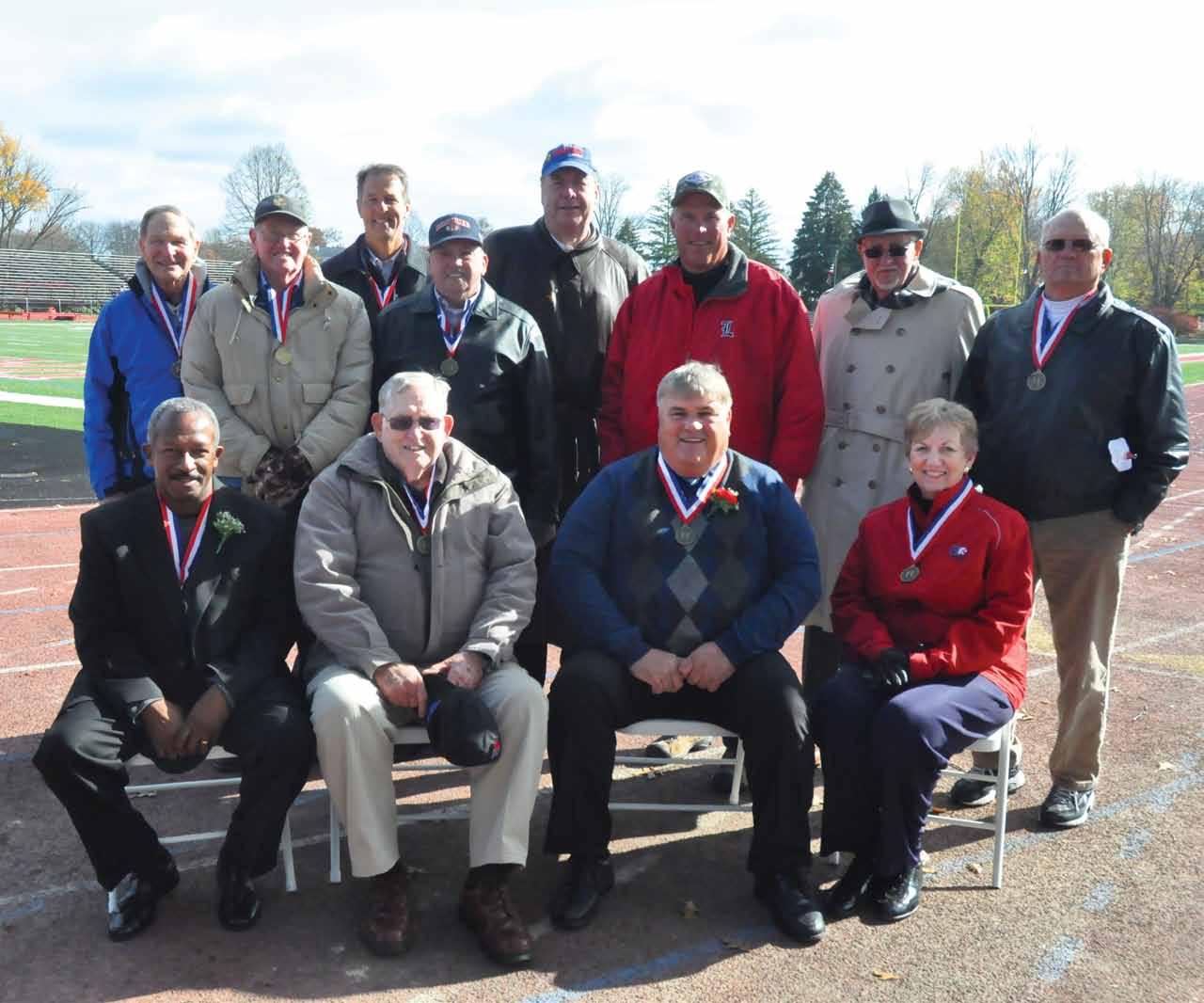
Anthony Brantley ’77, Brett Dietz ’04 and Keith Hill ’59, along with legendary coach Wayne Perry and retiring president Sue DeWine, were inducted into Hanover College’s Athletic Hall of Fame during its 20th-annual ceremony in the Horner Health & Recreation Center Nov. 1.
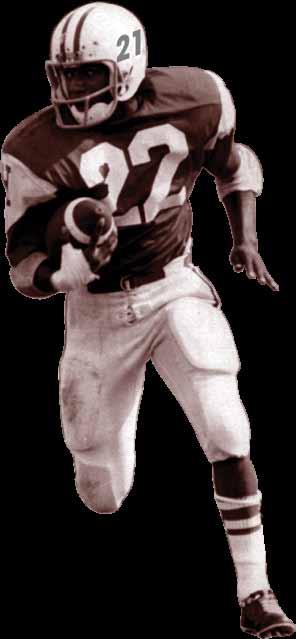
Brantley was a record-setting running back for Hanover’s football squad from 1973-1977. He was a first-team National Association of Intercollegiate Athletics (NAIA) all-American in 1975 and, after sitting out the 1976 season, was an honorable mention all-American selection in 1977.
attempts (527), rushing yardage (3,022) and rushing touchdowns (41) hold firm. Brantley ranks third among the Panthers’ career scoring leaders with 254 points.
Dietz, who was not able to attend the ceremony, spent time as a member of Hanover’s basketball, baseball and golf teams, but made his mark as a quarterback for the Panthers from 2000-2003. He helped Hanover win three Heartland Collegiate Athletic Conference football championships and also earn three berths in the national playoffs.
Row 2: Stan Totten, John Owensby ’59, Greg Clark ’72, Jerry Fishel ’63, Mark Gabriel ’70, Don Katzman ’81, Glen Bonsett ’49, Robert Bergman ’61. Row 1: Anthony Brantley ’77, Keith Hill ’59, C. Wayne Perry and President Sue DeWine.
A two-time all-Heartland Conference selection, Dietz led the nation in total offense in 2003 with 380.5 yards per game. He also set school singleseason records with 575 attempts, 360 completions and 4,031 passing yards. He eventually closed his collegiate career ranked third in Hanover career touchdown passes (67), fourth in career completions (583) and fourth in completion percentage (61.6%).
Dietz played professionally in Finland before moving to the Arena Football League, where he later became the first player to earn rookie-of-the-year awards in the AFL (Tampa Bay Storm, 2007) and AFL2 (Louisville Fire, 2006).
Hill was a four-year member of Hanover’s football and baseball teams. He was an all-Hoosier College Conference offensive lineman for the Panthers as a junior and senior. Hill helped Hanover earn HCC football titles in 1956, 1957 and 1958.
As a member of Hanover’s baseball squad, he was a third-team all-American outfielder as a senior when he batted .386 with 19 stolen bases. Hill also earned all-conference and team most valuable player honors.
Perry joined Hanover’s football staff as offensive line coach in 1979 and replaced Pete Compise as the head coach in 1982. He retired from football after the 2007 season, leading the Panthers to an Indiana collegiate record (all divisions) 174 wins.
The Heartland Conference named him coach of the year six times; Perry also earned the National Association of Intercollegiate Athletics (NAIA) District 21 coach-of-the-year honor seven times before Hanover joined the National Collegiate Athletic Association (NCAA) in the early 1990s.
His Hanover teams posted a 17488-2 record, along the way amassing eight conference championships, nine appearances in the national playoffs and each of the school’s four 10-win seasons.
Since leaving the football sidelines, Perry has guided Hanover’s men’s and women’s golf teams.
In addition to the growth of the program, his women’s teams have earned a pair of Heartland Conference titles and two berths in the NCAA Division III national tournament. The squads have combined to set every school team and individual 18-, 36-, 54- and 72-hole record.
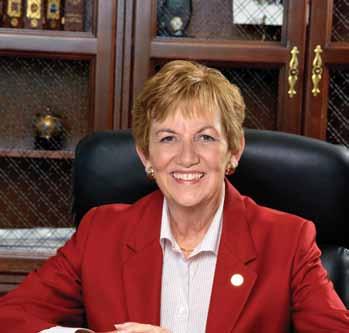
DeWine became the 15th president of Hanover College in 2007. During her tenure on campus, she has been an enthusiastic supporter of the College’s 18 athletic teams and worked to improve opportunities and facilities for student-athletes.
Under her leadership, Hanover has installed an artificial playing surface for football and lacrosse, constructed an eight-court tennis center and completed a major renovation of facilities for football and lacrosse, baseball, softball and soccer at a cost of nearly $8 million.
In addition, the athletic program launched men’s and women’s lacrosse programs and hosted two NCAA III national cross country championships.
Thanks to you the Live Our Loyalty Campaign generated more than $28 million in planned gifts. Your generosity not only helps to ensure an outstanding liberal arts education is affordable for those who meet our academic standards, it also provides support for student activities, study abroad, competitive outdoor athletic facilities and demonstrates Hanover College’s value around the world.
For more information about how you can make a planned gift to benefit future generations, contact Kevin Berry ’90 Director of planned giving and stewardship 800-213-2179, ext. 6813 or berry@hanover.edu
ALUmNI NeWs
MILDRED THOMPSON BLACKERBY ’35, of Oak Ridge, Tenn., died April 26, 2014 at age 101.
MOLLIE DORSEY WATTERS ’41, of Venice, Fla., died Aug. 13, 2014 at age 95.
JANE BARNETT THORPE ’44, of Rushville, Ind., died June 15, 2014 at age 92.
EMMY ROGERS HOLMES ’46, of Tipton, Ind., died July 23, 2014 at age 90.
JEANNE STORY MUNCIE ’48, of Northfield, Ohio, died June 18, 2014 at age 87.
DUANE DOUTHIT ’49, of Houston, died April 23, 2014 at age 91.
CLYDE SCHRICKEL ’49, of Cincinnati, died May 5, 2014 at age 87.
PHYLLIS GARRIOTT BARNARD ’50, of Yuma, Ariz., died July 4, 2014 at age 87.
DOTTIE SCHARF BURRESS ’50, of Hanover, Ind., died May 15, 2014 at age 85.
TOM HARVES ’50, of Greenbank, Wash., died Sept. 8, 2013 at age 90.
DALE KLAUSS ’50, of Ankeny, Iowa, died July 30, 2014 at age 86.
JOHN MOORE ’50, of Indianapolis, died Oct. 7, 2014 at age 86.
ARTHUR MORGAN ’50, of Indianapolis, died April 21, 2014 at age 88.
ANDY TAFF ’50, of Columbus, Ind., died May 10, 2014 at age 90.
DAVID DOUGLASS ’51, of Topeka, Kan., died March 2, 2014 at age 84.
GEORGE WENDT ’51, of Morton Grove, Ill., died June 13, 2014 at age 84.
BOB BEACH JR. ’52, of Indianapolis, died June 1, 2014 at age 83.
ANN KANZE MILLER ’52, of Canton, Conn., died Sept. 17, 2014 at age 83.
WILLIAM ZIMMER ’52, of South Bend, died Sept. 28, 2014 at age 83.
CAROLYN JOURDAN ’53, of Indianapolis, died Feb. 11, 2014 at age 82.
We remember
NANCY ROBERTS DAVIS ’54, of Argyle, N.Y., died May 7, 2014 at age 81.
DIC DAVIS ’54, of Springfield, Pa., died May 17, 2013 at age 81.
NORMAN GORDON ’54, of Columbus, Ga., died March 13, 2014 at age 81.
COLETA TURNER SMITH ’54, of Lexington, Ind., died Aug. 8, 2014 at age 81.
MARTHA SPENCER LEYDA ’55, of Waukesha, Wis., died March 5, 2014 at age 80.
SAMPS MCQUISTON ’56, of Hartford, Wis., died Sept. 16, 2014 at age 80.
MARY MAXWELL PIKORAITIS ’56, of Hendersonville, N.C., died March 12, 2014 at age 80.
NANCY WEDOW SNYDER ’56, of Crawfordsville, Ind., died March 27, 2014 at age 80.
DENNIS STEWART ’56, of Reidsville, N.C., died June 21, 2014 at age 79.
DELORES FLORY SHERFIELD ’57, of Castle Hayne, N.C., died May 1, 2014 at age 78.
TIM HALL ’59, of Indian Lake, N.Y., died March 22, 2014 at age 76.
JOHN JENKINS ’60, of Lexington, Ind., died June 1, 2014 at age 76.
DALE GIBBONS ’60, of Madison, Ala., died April 7, 2014 at age 75.
SMITH HAMMELRATH ’60, of Cincinnati, died July 10, 2014 at age 76.
HELEN PARKER ’61, of Des Moines, Iowa, died May 6, 2014 at age 75.
MARY ANN DRACH ’62, of Temple, Maine, died July 6, 2014 at age 74.
GAYLE SMALL HADDIX ’62, of Evansville, Ind., died Sept. 27, 2014 at age 74.
LUCIA COPE HULSTON ’63, of Kansas City, Mo., died Aug. 9, 2014 at age 72.
TOM SEIGLE ’63, of Jefferson City, Tenn., died May 30, 2014 at age 72.
PAULA SQUIRE YEAGER ’63, of Evansville, Ind., died May 24 at age 73.
ART NJUGUNA NDORO ’64, of Nakaru, Kenya, died Feb. 23, 2014.
LEWIS POWELL ’64 has died. No obituary information was submitted.
JEAN HUNSICKER WADE ’64, of Salt Lake City, died Sept. 5, 2014 at age 71.
TED HILL ’65, of Wooster, Ohio, died May 21, 2014 at age 71.
FRANK WEED ’65, of Buffalo Creek, Colo., died Sept. 3, 2014 at age 71.
STEVEN C. SPARROW ’67, of Arlington, Texas, died April 16, 2014 at age 69.
KATHY ROBERTS WOOD ’67, of Kokomo, Ind., died Sept. 14, 2014 at age 69.
MIKE PHILLIPPE ’69, of Bethlehem, Pa., died April 5, 2014 at age 67.
ROBERT WEAVER ’71, of Lewes, Del., died July 2, 2013 at age 64.
CHRISTINA SCHACH ROBINSON ’72, of Chagrin Falls, Ohio, died Sept. 5, 2014 at age 64.
MIKE NAVILLE ’73, of Lanesville, Ind., died Sept. 12, 2014 at age 63.
LINDA MOSS RUSTHOVEN ’73, of Falls Church, Va., died Jan. 6, 2013 at age 62.
RAY SCULFORT ’73, of Des Moines, Ia., died May 3, 2014 at age 63.
DANNY ROSS ’76, of Palm Springs, Fla., died July 12, 2014 at age 60.
BRYCE COX ’77, of Louisville, Ky., died Jan. 8, 2014 at age 58.
JEFF TERRY ’77, of Plainfield, Ind., died July 16, 2014 at age 59.
JEFFREY OFFUTT ’81 of Indianapolis, died Nov. 3, 2014 at age 55.
BRET WATTS ’81, of Indianapolis, died May 2, 2014 at age 55.
Instructor of English LOUISE DUUS, of Franklin Park, N.J. died June 17, 2014 at age 85. Duus served Hanover from 1953-57.
JAMES BOWLING, of Milan, Ind., died Dec. 3, 2014 at age 56. Bowling served Hanover as a custodial supervisor from 2008-14.
JERRY BRAWNER, of Hanover, Ind., died April 22, 2014 at age 68. Brawner served in the mailroom, managing the College’s printing for 44 years.
KRIS KINDELSPERGER ’71, of Columbus, Ind., died July 15, 2014 at age 64. At Hanover, he was a member of the Sigma Chi fraternity; he later joined the College in 1981 as director of alumni relations, eventually serving as vice president of development and as executive director of the Campaign for Hanover.
Kindelsperger left the College in 2000 to join Johnson, Grossnickle & Associates, a fundraising consultancy, becoming the firm’s president in 2002 where he was responsible for dayto-day operations management.
Previously, he served as admissions counselor and assistant director of admissions at the University of Louisville, where he earned his master’s in 1976. Kindelsperger earned his doctorate from Indiana University while serving as assistant to the dean at what is now the Robert H. McKinney School of Law.
Active in community service, Kindelsperger was involved with Girls Inc., Hanover United Methodist Church, the Community Foundation of Madison and Jefferson County, the Lions Club and Sigma Chi Fraternity.
Surviving is his wife, Roxie Reasor Kindelsperger ’72, and two children.
LINDA DUNCAN, of Hanover, Ind., died Nov. 22, 2014 at age 66. She spent 18 years at the College greeting students at the front desk in the dining room and swiping their meal cards. Duncan was also a dedicated Panther fan, attending nearly every home game for all the College’ s teams.
BILL GRIFFIN SR., of Hanover, Ind., died Aug. 29, 2014 at age 81. Griffin served on the football squad’s coaching staff for nearly 30 years.
Professor Emerita of Education GERTRUDE GERAETS, of Madison, Ind., died Nov. 3, 2014 at age 90. Born near Rock Elm, Wis., on the family farm, she earned a bachelor’s degree from the University of Wisconsin at River Falls and her master’s and doctorate from the University of Northern Colorado at Greeley.
Geraets began her teaching career in Wisconsin elementary schools, before turns in Washington and New Mexico. She taught at Eastern Oregon University before joining Hanover’s education department in 1967. During her teaching years, Geraets belonged to several education honoraries, as well as local, state and national education associations and community organizations.
After her retirement in 1989, Geraets volunteered at the Pope John School Library in Madison, Ind., and the Madison Jefferson County Public Library. She also served as a docent for the local historical societies.
Preceding her in death were her parents, five brothers, three half-brothers, three sisters and two half-sisters. Surviving are her brother, niece, and extended family and friends.
Professor Emeritus of English GEORGE CLARK, of Louisville, Ky., died April 19, 2014 at age 98. Born Sept. 8, 1915, in Indianapolis, Clark spent his early childhood in Delphi, Ind., before moving to Cleveland Heights, Ohio in 1929. He attended the College of Wooster (Ohio), graduating Phi Beta Kappa with a major in classics in 1938. After serving in the U.S. Army during World War II, Clark resumed the graduate studies he began at Princeton University (N.J.) and subsequently earned his doctorate in English at Yale University (Conn.) in 1948. Clark’s career was a blend of college teaching in the Midwest and government service abroad. He was a Fulbright scholar at the University of Mainz in Germany, and served as cultural attaché for the U.S. Information Agency in Germany and Haiti in the 1960s. From 1967 until his retirement in 1981, Clark served in the Hanover College English department. He retained a lifelong interest in travel, European and U.S. history. With his wife, he researched and edited a book and several articles on a variety of military and historical topics. Preceding him in death was his wife of nearly 66 years, the former Shirley Ellen Garlock. Surviving are four children, including Robert ’72 and Diana Halsey Clark ’74, Alice Clark ’72, Sarah Clark ’73, seven grandchildren and five great-grandchildren.
VINCENT HOLMSTROM, of Lake Forest, Ill., died May 12, 2010 at age 91. A graduate of DePauw University, he served in the Merchant Marines and spent his career as a sales representative to the die casting industry. Holmstrom was a former member of Sunset Ridge Country Club and North Shore Country Club, and an avid golfer and curler.
A member of the John Finley Crowe Society, which recognizes donors who give $100,000 or more, he endowed an eponymous scholarship, as well as a travel fund for theatre students.
Predeceasing Holmstrom were his wife and son Skip ’77. Survivors include his daughter-in-law and two grandchildren.
Trustee Emeritus THOMAS SCOTT ’51, of St. Clair Shores, Mich., died Aug. 30, 2014 at age 88. Born on Aug. 18, 1926 in Bedford, Ind., he served in the Pacific during World War II, and then attended Hanover where he majored in sociology and was a member of Phi Gamma Delta.
Scott enjoyed a successful career as a manufacturer's representative, first in South Bend, Ind., and then in Detroit. In addition, he was a partner, then principal owner, of an automotive wire and cable manufacturing business that remains in the family.
In community service, Scott was a Mason and served as an elder of Lake Shore Presbyterian Church. He also was a former member and past president of the Hanover College Alumni Association and served on the board of trustees from 1987-97.
Surviving are his wife, Marge Soelch Scott ’51, and four children, including Stephen ’74, Brian ’75, Melissa Scott Hollowell ’77 and Timothy ’83; along with eight grandchildren, including Katie Bottom Carlisle ’03; and five great-grandchildren.
Submissions:
(may be edited for content, length and/or style)
Mail: The Hanoverian, P.O. Box 108, Hanover, IN 47243
Online: classnotes.hanover.edu
Change of Address to: Advancement Services, P.O. Box 108, Hanover, IN 47243
E-mail address changes to: advancementservices@hanover.edu
To make a gift online: www.hanover.edu/give
To discuss a planned gift: contact Kevin Berry ’90 at 800-213-2179, ext. 6813 or berry@hanover.edu
Class notes
1951
After retiring in 1994, PHIL CORDES began writing a newsletter to his Hanover Phi Delt brothers and their families, exchanging news from one another. He has continued this practice, now twice a year, to recipients from California to Florida, including ED JEFFRIES ’50, JIM and RACHEL MATTHEW ZIMMERMAN ’52, JOHN MATTHEW, BILL and MARILYN MEGORDEN MCGREGOR ’52, DAVE MCGREGOR, RALPH and NANCY AUSTIN ANDERSON ’50 and LUCY LEROY HACK. Cordes and his wife Sandy have hosted a Phi Delt reunion since 1996, and in 2005, he started to co-host the reunion with JOHN SMITH ’53, BUD STURM ’50 and BUD BUNTON ’55. Those who attended this year were BILL BROCK ’53 and his wife Peg, DICK WALKER ’54, CAROLYN BRIGGS VERMILYA ’52, JOHN SMITH ’53 and his wife Jean, BUD STURM ’50 and his wife Shirley, LOWELL ’53 and ANN STEVENSON INNIS ’53, Cordes and his wife Sandy, LIN ERDMAN ’54 and his wife Jane. 1958
JINNY KELLER TENNANT writes, “JOHN TENNANT ’57 and LYNN POWELL ’56 are now members of the Dyer Presbyterian Church in Dyer, Ind. The two had a chance meeting at Homecoming three years ago. At Hanover, Tennant was a member of Beta Theta Pi fraternity and Powell was a Sigma Chi. They are both happy that another church member, ALLYSA RETSKE ’17, is now a sophomore at HC.”
1967
MARY BURKERT BALPH and her husband MARK ’81 have moved to Charlottesville, Va., where they are the innkeepers at the Dinsmore House Inn, an eight-room bed-and-breakfast near Monticello. She writes, “We're excited, not only to be back in the B&B business, but to be in a new area of the country, to meet new people and to actually get a paycheck!” Contact them at mark12mary31@msn.com or 1211 West Main Street, Charlottesville, VA 22903.
TERRI STONEBURNER has retired from the Minnesota judiciary after serving for 10 years as a district court judge and for 14 years as a judge for the Court of Appeals. She will continue to serve periodically on the Court of Appeals as a senior judge.
1980
The 2014 edition of Chambers USA has recognized JACKIE M. BENNETT, JR. as a leader in litigation: general commercial practice area in the state of Indiana. Chambers ranks both lawyers and law firms based on the research of more than 150 full-time editors and researchers.
1981
GREG MANSHIP earned his doctorate in bioethics from Loyola University Chicago in May 2014.
1983
The Hoosier State Press Association honored PAT LANMAN ’83 with its highest award, the Distinguished Service Award. He is the owner and publisher of Vevay Media Group newspapers in Switzerland County, Ind. In 2012, Lanman earned the association’s Charlie Biggs Community Service Award for his involvement in the Switzerland County community.
Additionally, he serves as pastor of Olive Branch Baptist Church near Vevay, Ind., and as president of the Switzerland County Sheriff's Merit Board. Lanman is also a member of the Switzerland County School Corporation Endowment Corporation. He and wife JACQUITA UPCHURCH LANMAN ’83 have three daughters and one grandson.
1988
DAVE MURRAY and ANGIE KEYS MURRAY ’89 celebrated their 25th wedding anniversary July 1, 2014. They have three boys, Cody, 22, Cole, 19, a sophomore at Northern Kentucky University, and Cade, 15, a freshman at Delphi Community High School. The Murrays reside in Delphi, Ind. where Dave Murray works at Indiana Packers Corporation, while Angie Murray works at home and volunteers in the school and local community. Contact them at damurray5@yahoo.com
1990
ANDY AAVATSMARK spent nearly two weeks in March 2014 leading students from Watkinson School (Conn.) on a service-learning trip to Uganda where the group worked at a primary school on the Rwanda border. They installed computers and taught the students and teachers how to use them. The group also traveled north to volunteer at Ziwa Rhino Sanctuary and spent several days touring Uganda’s Queen Elizabeth and Murchison Falls natural parks where they saw elephants, lions, giraffes, crocodiles, antelope, hippos and much more.
1991
After 21 years as a classroom teacher and football coach, PATRICK SCHOOLEY now serves as dean of students at Fishers High School in Fishers, Ind. He has spent the last seven years teaching at Fishers and served as interim dean this past spring. Schooley writes, “I'm very excited about this new professional challenge, and I'm thrilled to have the opportunity to supervise a few children of my Hanover classmates.”
1995
ANNE ROBERTS COCHRAN and her husband Rob announce the birth of their son William Isaac, April 20, 2014. He joins his big sister Sophia Elizabeth, born Aug. 18, 2009. The family lives in Kernersville, N.C.
1998
The law firm Whitham Hebenstreit & Zubek, LLP, has named ERIC ENGEBRETSON a partner in its firm. He is a 2001 graduate of the Indiana University Robert H. McKinney School of Law and will continue to practice in the noncriminal general practice of law, including bankruptcy, family law and estates.
Houghton College (N.Y.) has named KIM GARDNER POOL director of its new Vocational Opportunities and Career Advising Office (VOCA). VOCA will focus on increasing student awareness of vocation, expanding and coordinating internship opportunities, and strengthening the approach to career readiness and transition to the workplace. Her experience
includes serving as assistant director of the career center and coordinator of graduate school information at the University of Illinois at Urbana-Champaign, as career consultant for Career Keys in Evansville, Ill., and for the career management center at the University of Rochester’s Simon Graduate School of Business, among others. Pool earned a master of science degree in higher education from Southern Illinois University at Carbondale.
1999
JEFF and ERICA VIDMER FRITSCHE announce the birth of their daughter Margaret Klare, March 20, 2014. She joins big brother Ben, 7, and big sister Kate, 5. The Fritsches live in Rye, N.Y.
2000
The National Park service has named PATRICK BREEN its bureau procurement chief. He will supervise procurement, acquisition policy, grant awards and the charge card program, which accounts for nearly $1 billion in annual obligations. He lives in Annandale, Va., with his wife Sarah and children Connor, 5, and Emma, 2.
On snowy nights, The Point belongs to coyotes
By David Springer ’08
The only time I’ve ever seen coyotes in the wild was at Hanover College. Putting off a looming assignment, I strolled aimlessly toward The Point where a layer of snow and the late hour muted the already quiet campus. Neither the coyotes nor I were aware of each other until I rounded a corner.
Seven stood in a snowy field off the road; the nearest was just 20 feet away. They were pale against the snow in the moonlight, and I halted at their sudden presence. We watched each other, held in thrall. I was too stunned to move or even think. They stood still among the Neolithic stones of the outdoor classroom, as if they were in the process of petrifaction.
At some signal, or a communal decision that I wasn’t an object of interest, they dispersed. They moved leisurely through the field, across the road on which I stood, and finally into the woods. A lone straggler trotted down the road for some distance, following its gentle curve before leaving it to enter the forest.
Through their departure I remained frozen, afraid I’d ruin the experience if I took another step or breathed too loud. I’d intruded and seen something that wasn’t meant for me. I’d walked that road and sat among those stones dozens of times, but this was a world outside my own. On snowy nights, The Point belonged to the coyotes.
As I set off, my mind returned from its reverie. My heart pounded, and it occurred to me that anything might have happened. I hadn’t realized coyotes even lived in Indiana, and I’d certainly never seen them.
For all I knew, they might have attacked because I was alone, or approached because they’d been fed by campers in the past.
As it was, the coyotes had drawn me into their silent world that had always existed beneath my own and were content to leave it at that.
I wasn’t ready to retreat to the safety of electric lights and slamming dorm room doors. I preferred to remain in the night, so I kept walking and quietly hoping as I rounded every corner. There were frequent night walks in college, but these flashes of true nature were rare. Most of the time, my journeys contained shorn grass, trimmed shrubs and carefully landscaped, manmade beauty. Even when camping or hiking, I’d mostly observed nature from trails, a tourist in the natural world.
I had grown up thinking that nature was something to experience only when I was in the mood. I felt comforted by my ability to leave the wilderness behind for the controlled climate of man-made structures.
After the coyotes, I realized that you never really leave the wild. You can cut the grass and pave orderly paths, but the animals know this was their home first and will always claim it for their own.
Hanover was my home for four years, but the coyotes had been there before I’d arrived, and would remain long after I’d gone. I grew to love the experience for its surrealism and mild danger, casting myself as an adventurer in the Indiana night.
I never really stopped looking for the coyotes. Almost 10 years later and many miles away, I sometimes find myself drawn out into the moonlit night. If I walk quietly enough, I can almost feel them, silent in the snow, just out of sight.
You can read more of Springer’s writings on his blog, narrativetwist.wordpress.com.
My favorite Hanover memories
By Alan Schwemlein ’69
When I think about my years at Hanover College, the memories come back so clearly. I had learned about the school during my senior year of high school, and next thing I knew, it was time to pack.
I arrived on campus early for football practice. As freshmen (aka The Hamburger Squad), we would scrimmage with the varsity team who often outweighed us by 50 pounds at some positions. What we lacked in size, however, we made up for in beauty, or at least that’s what they told us.
The only thing worth remembering about the practices were how big the linemen were compared to high school and deciding which injured body parts could be taped up to help get through the next session.
One Saturday after practice, the coaches took us to the Madison Regatta. Since I had only seen Gold Cup unlimited power boat racing on TV, it was so exciting to get up close to famous hydroplanes like Miss Budweiser, Miss Bardahl, Miss Roostertail and Miss Madison.
Those boats clocked in at nearly 160 miles per hour on the back straight during races; I can still close my eyes to imagine the guttural roar of those 2,000 horsepower airplane engines. During the races, the boats frequently propelled out of the water like low flying airplanes. The evening ended with fireworks, then we returned to the campus.
After the remaining students arrived, we had a pep rally. In an attempt to make us feel important, after the introductions President John Horner, Deans Harold Haverkamp and Glen Bonsett, and Coaches Dutch Struck and Wade Roby shook our hands, and the cheerleaders hugged us. That probably was the closest this country boy had ever been to really beautiful girls. I blushed and was almost unable to return their warm greeting. Freshman had to wear green and red beanies to dinner. Crowe Hall was usually too busy, loud and boisterous for me to get any work done. The only place to find peace and quiet seemed to be the second floor of the library.
My routine was to go there after dinner for a couple of hours and then walk over to The Cabin. I clearly remember walking across the mall past the Donner Hall parking lot. The front of the building was old brown logs.
As you walked up to the door you heard the background music. The most popular was, of course, The Beatles. “She Loves You” and “I Want to Hold Your Hand” were my favorites. Everyone else, too, I guess.
We would sit around small tables, drink a Coke and talk. Something like beer was out of the question. I don’t even remember if students were allowed to smoke. I sure didn’t. I had never seen so many pretty girls in one place before.
The one thing that I do remember clearly was that I fell in love about 10 times a day. Of course, I didn’t have a clue about what to do next.
Hard to believe how time (and life, for that matter) has slipped by, one little day at a time. So slowly and smoothly that you can’t feel it, but look around, and you will see the little reminders everywhere.
Written with help from Linda Burns Brown ’69, Ron Cunningham ’69, Jim Snow ’69 and Pat Beer Shryock ’70
Do you have a memory you’d like to share in The Hanoverian? Email your story to Sandra Guthrie at guthrie@hanover.edu.
Class notes
2000
CRAIG CAMMACK married Joseph Coleman July 12, 2014 in Chicago, following the adoption of their sons Gabriel and Connor, June 26. The family resides in Lexington, Ky.
2001
ALEX CRISAFULLI married Meg Dunne May 10, 2014 in Oak Park, Ill. The Rev. SCOTT RUDOLPH ’00 performed the ceremony. Other Hanoverians who attended include JIM FREEMAN, BRIAN HERRMANN, MATTHEW SCHUHMANN, CALEB STATON and BRYAN BOSTA ’02. The couple resides in Washington, D.C.
2002
MISTY WICK has joined Bethesda Lutheran Communities, a national provider of supports and services for people with intellectual and developmental disabilities and their families, to serve as a major gift officer. She will lead Bethesda fundraising efforts in Indiana, Michigan, Ohio, Kentucky, Tennessee and West Virginia. Wick earned her master’s in journalism and communications in 2007 from Boston University (Mass.). This fall, Wick began serving as the alumni representative to Hanover’s Board of Trustees.
2004
ALEX and HEIDI STEMM VIX announce the birth of their first child, son Isaac Christian, Aug. 20, 2014. The couple reports he is a happy and adventurous little boy.
2006
KRISTEN OLIVE WICKHAM and her husband Aaron announce the birth of their first child, daughter Olivia Mae, Oct. 25, 2013.
2010
AARON WILLIAMS graduated from the University of Kentucky College of Medicine in May 2014 with summa cum laude honors. Accepted into one of the top general surgery residency programs in the country at the University of Michigan, Williams started his seven-year general surgery residency training last June.
2011
CASSI BINKLEY married 2nd Lt. Anthony Friday, May 17, 2014, in the company of several Hanoverians and Phi Mu sisters. Binkley is a graduate student working toward her doctorate at the University of Kentucky College of Medicine. Friday is on active-duty service with the U.S. Army.
CHELSEA HANNER served Ice Miller LLP as a summer clerk in its Indianapolis office. She is currently a law student at the Indiana University Robert H. McKinney School of Law. Hanner lives in downtown Indianapolis with her fiancé ERIC KURTH ’08 and their dog Eleanor.
CHRISTINA HOWARD married DeAngelo Pollard May 4, 2012 in Indianapolis. The couple announces the birth of their son Andrés Savion, Jan. 5, 2014, 8 lbs., 22.5 in.
From the Alumni Board President:
Greetings and salutations (I knew that liberal arts education would come in handy) from your Alumni Association Board of Directors!
The board of directors’ goal is to cultivate loyal relationships between you and the College. We do this by developing, promoting and facilitating programs you support and that enhance Hanover’s stature. We hope you’ll give of your skills and resources to Hanover in return.
I’ve commandeered this page of The Hanoverian to better facilitate communication between the board and you, the alumni. In future editions, you can look forward to the Alumni Board President informing you in depth about volunteer opportunities, social events and other updates from Hanover College.
For now though, I’m on a word count, and you’ve probably already flipped to the class notes section anyway, so I’ll just give some quick heads-up announcements.
This year’s Pub Night is Feb. 12. You can show your love for Hanover College by hosting a site no matter where you are in the world. It’s a great way for alumni to get together with old friends to share memories as well as make some new ones.
Just in case you can’t make the February date, there will be an additional Pub Night June 18 to celebrate John Finley Crowe’s birthday. Get together with your fellow alumni to honor our founder.
One of the best new traditions on campus is the annual Student-Alumni Networking Day, a full day of speaking panels, interactive workshops, and free hors d’oeuvres designed to get current students thinking about their careers and place them near alumni working in those fields. If you are employed and available March 14, 2015, please contact Margaret Krantz in HC’s Career Center at krantzm@hanover.edu.
Another date to keep on your radar is May 9 for Panther Philanthropy Day, a day that’s all about volunteerism and is a fantastic excuse to come back to campus during spring term and get a Hinkle’s milkshake. More details as the date approaches.
Finally, for those of you who are long-range planners, Homecoming 2015 will take place Oct. 3. Be sure to pencil it in on your brand-new 2015 calendar.
I’ll see many of you in the real world, and all of you back here in the next issue of The Hanoverian. In the meantime, please feel free to email any questions, comments, or concerns to jpollom@gmail.com.
And if your immediate thought after reading this is that someone else could do a much better job, send his or her name to Ann Leslie Inman ’86 at inmana@ hanover.edu. We’re always looking for new recruits.
John Pollom ’03
To view profiles of the current Alumni Association Board of Directors, visit hanover.edu/alumni/association.
The Hanover College Career Center offers numerous services and resources to alumni at no cost.
• Career consultation
• Networking assistance
• Résumé critiques and mock interviews
• And much, much more!
Visit careercenter.hanover.edu/alumni/ for a full menu of services.
Join the Hanover Career Alumni Network on LinkedIn.
Like our Facebook page for career postings and job search tips.
Follow us on Pinterest.
Alumni spotlight
Sean Points ’93 serves as an associate scientist for the Cerro Tololo Inter-American Observatory (CTIO) in La Serena, Chile. For the past 10 years, he has participated in CTIO’s Research Experience for Undergraduates (REU) program.
“As a project and instrument scientist, I am responsible for ensuring that the instruments at the telescopes are ready to be used by visiting astronomers,” said Points.
“(I also help) them plan their observations, teach them how to use the telescope instrumentation during their observing run and assist with the reduction of their data at the end of their telescope run.”
The desire to help Hanover students share his fascination with physics and astronomy led Points to help establish The Darryl Steinert Award for Research in Physics.
This past summer, Jeff Blair ’70 made his second 150-plus mile walk across northern Indiana following the historic Lincoln Highway to raise funds for the Alzheimer’s Association and the Lincoln Highway Association. In 2011, his pilgrimage raised $22,000.
Blair’s dedication to Hanover has led him to serve on the Business Scholars Program Board for several years. He comes to campus annually to teach business classes, help students sharpen their interview skills and résumé writing, and assist with internship placement.
‘Hanover gave me treasured lifetime friendships and a work discipline that has served me well,” said Blair. “I’m a big believer in the liberal arts.”
His career began as a management trainee in the medical supply business, and he retired as CEO of the leading medical research organization NAMSA. Blair currently serves as the company’s board chairman, as well as on additional business boards.
Bonney Hartley ’04 serves as the historic preservation assistant for the StockbridgeMunsee Band of Mohican Indians, of which she is a tribal member. Working to repatriate cultural items, Hartley also consults with federal agencies to protect Mohican sites threatened by construction projects mainly in the New York State Hudson River Valley area.
“I like knowing we are protecting pieces of our tribe’s history that would otherwise be lost for all of time,” she said. Previously, Hartley managed a grant-making program at the United Nations Secretariat of the Permanent Forum on Indigenous Issues; re-designed a grant-making program for Native American traditional foods projects in the Bay Area; and served as the community services program director for the Native American Health Center.
Hartley was the recipient of the American Indian Heritage Month Local Unsung Hero Award in 2013.
While taking several different career paths, Emily Hankley Berger ’04 was able to serve her community.
She worked in programming and development roles at the Indianapolis Public Library; served as a board member for Youth Connections of Johnson County and the Indianapolis chapter of First Book; and volunteered for School on Wheels, the Indiana Arts Commission, the American Library Association, Connect-2-Help and Giving Sum.
In 2013, Berger joined Granite Capital Partners, a private equity firm, as vice president of acquisitions. She credits Hanover with preparing her to navigate such a significant career transition.
“My involvement in extracurricular activities at Hanover laid the foundation for continued volunteerism and networking after graduation, and that has since opened many doors for me,” said Berger. “I didn’t know a great deal about finance when I started in this new role, but at Hanover I learned how to apply new knowledge in a variety of subject matters, and that’s been invaluable to me now.”
As professor of law in the Health and Human Rights Clinic at Indiana University’s Robert H. McKinney School of Law, Fran Quigley '84 and his students work with low-income clients in Indianapolis.
Involved in many social justice activities, he is the author of “Walking Together, Walking Far: How a U.S. and African Medical School Partnership Is Winning the Fight Against the HIV/AIDS Pandemic” (Indiana University Press, 2009) and “How Human Rights Can Build Haiti: The Activists, the Lawyers, and the Grassroots Movement” (Vanderbilt University Press, 2014).
Not only has Shelley Cooper ’08 been able to make a living pursuing her dreams as a theater professional, her art has taken her to Europe and Southeast Asia.
The soprano performed her one-woman show on the life of opera legend Maria Callas at the International Performing Arts Institute in Bavaria, Germany in 2011 and again this November at the Bangkok Theatre Festival in Thailand.
Currently, she teaches voice and musical theater performance at Mahidol University in Bangkok, the nation’s capital. She credits her liberal arts education for teaching her the invaluable lessons of becoming independently motivated.
“It is the most exciting and rewarding work that I could ever hope to do,” he said. “I get to work alongside inspiring people and for causes that can change lives for the better. On a good day, we may even be helping pull the arc of the moral universe a little bit toward justice.”
Tom Roberts ’78 has taught fourth grade at Trinity School in New York, a K-12 collegepreparatory school, for the past 23 years. He considers that age an optimal time for learning as students are old enough to focus, while young enough to be captured by the joy of learning.
To create a positive environment, Roberts has instituted class rituals, based on lessons he learned from the late Professor Emeritus of Psychology Harve Rawson at Englishton Park.
He said one of the best things he learned was how to affirm kids in a way that is specific to them individually.
“At Englishton, we had to find that inner (non-judgmental) voice about the kids and hopefully ourselves, so that they experienced a kind of positive affirmation about themselves, maybe in a way that they never had in their lives. It was a short program of 10 days, (but) you saw a tremendous response.”
Accolades like this are common for the popular teacher who has earned two awards for his work, one in 2009 and another in 2010.
“(At Hanover) I didn’t have someone over me all the time telling me what to do,” she said. “I had teachers who supported and guided me through this (process) but I learned that if I wanted to get things done in my career, I had to do them myself.”
Outstanding leadership and volunteer service in multiple areas is how Shannon Veach Gibbs ’91 stays connected to her alma mater. A history major and management minor, she has served on the Alumni Association Board of Directors for seven years, including a stint as president.
Gibbs chaired her class reunions in 2006 and 2011, worked with students as a member of the HanoverCAN LinkedIn group, as a presenter at Student Alumni Networking Day and supported the College through the James Blythe Presidents’ Club, among many additional contributions.
“Alumni volunteers play a valuable role,” she said. “I believe very strongly that it is important to continue the cycle. I benefited from someone else who volunteered their time, so this is my time to repay their generosity by volunteering my time for this generation.”
a new home for alumni
The Office of Alumni Engagement and Annual Giving recently moved to the third floor of the J. Graham Brown Campus Center.
The space will include memorabilia displays, alumni archives and yearbooks, student work areas, and office space for alumni engagement and annual giving staff.
Located near the Alumni Lounge, the new office is close to several meeting and event spaces. You can also access it by elevator.
The move provides alumni with a more central, welcoming area to visit when they return to campus and gives staff more opportunities for daily interaction with future alumni.
We can’t wait to welcome you to campus! Contact us at 812-866-7012 or hughes@hanover.edu to arrange a visit.
Can’t make it back to campus? You can still stay connected!
• Update your email address at hanover.edu/alumni/keepintouch
• Check out the monthly @Hanover for events in your area
• Visit us at hanover.edu/alumni
• Like us on Facebook
Questions? Ideas? Contact us at 812-866-7013 or inmana@hanover.edu.
2013-2014 giving at a glance
Alumni with the most consecutive years of giving: Jim ’65 and Julie Irwin Richter ’65, 50 years
Giving by constituency: 2,601 total donors; 1,966 were alumni (76%); 141 were faculty/staff (5%); 321 were parents (12%); 147 were friends (6%); 26 were other (1%)
Highest giving participation rate: Class of 1964, 35.7%
Greek chapters with the highest giving participation rates: Phi Mu, 21%; Lambda Chi Alpha, 20%
Number of gifts of $1,000 or more: 365
Total raised for the Hanover fund: $832,612
Annual donors are the cornerstone of Hanover College’s success, ensuring that the best and brightest students have access to a transformative educational experience. Annual gifts support student scholarships, academic programs and each aspect of the student experience — an experience aimed at preparing students for successful careers, meaningful service and lifelong learning.
We appreciate each of our donors who renew their commitment to Hanover College each year with an annual gift. Please consider joining them with your gift of any size.
2011
PAIGE JONES married RICKY MCGEE ’12 May 10, 2014 in Columbus, Ind.
CARA MULHALL ’13 served as a bridesmaid, JT HAMM served as the best man, and NICK DANIELS and ANDREW KITCHEL were groomsmen.
DWAYNE PRIFOGLE ’85, uncle of the groom, was a reader. Several additional Hanoverians attended. The couple honeymooned in the Cayman Islands and currently live in Columbus where Jones is an ER nurse, and McGee works as a corporate travel coordinator.
ANNE WILLMAN married BEN VOORHORST April 27, 2013. Hanoverians in the wedding included ANDREA THOMAS (bridesmaid), BRIAN LAWRENCE (best man), SPENCER GRAY (groomsman), KELSIE VAN DYKE (reader) and MICHAEL LAVINA (usher). Several additional Hanoverians attended.
2012
RACHEL EDWARDS married MARK FREY ’11 July 27, 2013 in Columbus, Ohio. Hanoverians who attended include SCOTT ’85 and STACIA DILLABAUGH EDWARDS ’86, CATHLYNN NIGH ’86, HEATHER HOPF, CATHERINE FREELAND, LYDIA ANDERSON ’13, MARSHALL HERBST ’11, JARED REVLETT, JACOB PORTER ’14, CLAYTON MANNERING ’10, TYLER MUDD ’11, MIKE HANSFORD ’10, RICH ’10 and ERIN DAUGHERTY GIORDANO ’10, CAMERON RODE ’11, KRAIG and ERIN HAAS ECKSTEIN, MEGAN PRIEST, KATIE ARTHUR, ELLEN SCHILDMEIER BATES, HEATHER WASHBURN, CARRIE BURKHARDT, RYAN OLIVER ’13, BEAU HEULSTER ’11, NATOSHA WOOD, JT HAMM,
CHRIS ROSE ’15, NICK ROSE ’13, DAVE HIDER ’13, CJ CROFT, MATT BOBER ’11 and ADAM BARGA ’09
Did you recently get into grad school? Get a promotion? Win an award? Get married or want to show off a new member of the family? Share it with your classmates by posting your news and photos online. It’s a great way for you to keep in touch with your Hanover friends and for us to keep in touch with you, too! It’s quick and easy.
classnotes. hanover.edu
Come stay at Hanover in our newly renovated options, only a short walk to The Point. Lynn Hall and the Campus Center offer new guest suites with rich furnishings: two queen sized pillow-top beds, a refrigerator, private bath, flat screen TV and a private entrance.
Set up a group stay with former classmates or your family in our new Garritt Street Guest House, a classic, three-bedroom Georgian-style home. Relive old times or make new memories in this fully furnished house with a living room, family room, kitchen and dining room.
For more information and availability, contact David Collier at the Campus Center at 812.866.7119 or collier@hanover.edu.
My Gap Year
by Savanna Wofford ’14
As I approached graduation back in May, my college career felt a little like the last piece from a wall of dominos: close to tipping over, but without a sense of purpose other than being the last one to fall. Being on the cusp of Commencement is a powerful achievement, yet I found myself in unfamiliar territory.
I’ve always had the preceding years of my life set out for me, just as my mother would lay out my clothes when I was younger. Eventually, I learned to dress myself, and my mother no longer needed to act as my wardrobe consultant, which mirrors the process of being in an educational institution for 17 years and then beginning to venture out into a career.
Throughout the evolving stages of my life, I’ve come to appreciate the obtaining of knowledge both in and out of the classroom. Opportunities made available to me, like The Philadelphia Center and studying abroad, have taught me to be proactive and independent in accomplishing tasks and challenging myself.
I have also learned to find the correlation between my skills and passions. As a communication major at a liberal arts institution, I have gained great confidence in my ability to think analytically and express my voice, such as through public speaking or visual media.
My four years at Hanover College have been imperative to my development as a young woman, and I am continuing this
growth by taking a gap year. So far, I have worked with footage from the documentary my class shot in Northern Ireland during May Term.
Over the summer I started an entrepreneurial project showcasing my brother’s artistic abilities through a website and video blog series focusing on his projects.
There are plenty of graduates who left Hanover set up with a job that they are passionate about or plans to attend graduate school. I was not at that point last May; I needed time to focus on what I want so I can make this next stage of my life meaningful.
One of my goals is to go on a mission trip within this year so that I may experience more worlds other than my own. My passion for challenging myself and pushing outside of my comfort zone have led me to amazing learning opportunities and linked me to individuals with similar perspectives and goals.
Interning and observing nonprofit and philanthropic environments also solidified how I want to use my intelligence and courage in the future.
Earning my degree from Hanover College was one of my proudest accomplishments. While this next stage of my life will not be as linear as in the past, I believe I am more than prepared and optimistic for what the future will bring me.
Savanna Wofford ’14 is from Harrodsburg, Ky. She majored in communication and was a member of the Business Scholars Program.
Post Office Box 108 Hanover, IN 47243-0108 www.hanover.edu
President DeWine’s last Hanover Gala as president, will be Friday, May 8, at the Science Center. It will be particularly memorable for her since this annual evening with dancing and food, provided by Sodexo, started as a celebration of her inauguration, and this final gala will be in honor of her presidency.