To be removed from this magazine’s circulation, please call 01923 237799 or email circulation@hamerville.co.uk.
Subscriptions to Professional Builder are available at the following rates: UK: 1 year (11 issues) –£30.00 post paid Europe & Overseas: 1 year (11 issues) –
£70.00 post paid
Airmail: 1 year (11 issues) –
£99.00 post paid
viewpoint
THE JIGSAW APPROACH
I was recently fortunate enough to be invited to a factory tour of a prominent manufacturer within the industry. It’s an admittedly fun part of the job, that provides a peak behind the curtain and a real look into how things are made.
While this factory has been built to produce tiles, and the manufacturer is traditionally known for being in that bricks, blocks and tiles space, it’s by no means the only offering the company has. Over the years, this manufacturer, along with other key construction players, has dramatically increased the breadth and depth of products it has under its sleeve. Where it was once just able to offer some individual elements that are used in a house, it has graduated to an entire roof system that gives you everything you could ever need, even Solar PV and battery storage, which is guaranteed for 15 years. Beyond that, it is now offering a whole house retrofit system that can catapult a drafty outdated build into the 21st century.
“The
at a window and basing the size of a radiator off of that.
At the same time, other restrictions are tightening. The Building Safety Act requires a Golden Thread of information, one that backs up each decision you’ve made and is designed to prevent tragedies like that of Grenfell Tower. It’s this, along with savvier homeowners with evolving sensibilities that creates the need for guarantees, EPDs and all the rest. Bills have never been higher. Couple that with a cost of living crisis and a troubled homebuying market and the result is potential customers who want to ensure they’re getting their money’s worth for the upgrades they desperately need.
builder they’d worked with had treated the house like a problem to solve, rather than something broken that was impossible to fix. With extra insulation, solar PV and battery storage, they’re now more than future ready.”
These services represent a shift that seems to have reached the construction industry, where manufacturers are increasingly focused on solutions and systems rather than individual products. Think of it as looking at how the pieces of a jigsaw puzzle relate to the overall image on a box, rather than just staring at an individual piece and hoping it fits where you’ve put it.
Why the change, you may ask. Well, our industry is one that’s going through an extreme period of change. You’re probably all sick to death of hearing about the Future Homes Standard and Net Zero 2050 goals, but they are on the way. If we’re going to be capable of delivering these new requirements, the ways in which we work are going to have to change. Gone are the days of just looking
The word retrofit seems to have this bogeyman quality to it. But it doesn’t have to. Despite what the naysayers proclaim, heat pumps can work in preexisting homes. In fact, I went to a friend’s house in Leeds recently. We got on the topic of sustainable heating and I oh so assuredly claimed that they’d never be able to get a heat pump to work in this house (early 20th century, high ceilings and a small back garden among other things). I was smugly told to go out the back door and look above the kitchen window, where they’d deftly installed one. The builder they’d worked with had treated the house like a problem to solve, rather than something broken that was impossible to fix. With extra insulation, solar PV and battery storage, they’re now more than future ready.
While there will be homes out there that will really struggle to get a heat pump going and see the benefits of it, the conversation doesn’t need to stop there. With whole house approaches, there’s a vast wealth of homes waiting to be upgraded and a tidy profit for the trades waiting to be made.
THE WINNER TAKES IT ALL
FMB’s Master Builder drives away in £42,000 Isuzu D-Max
The Federation of Master Builders (FMB) has celebrated the handover of a £42,000 Isuzu D-Max DL40 truck to R & M Williams Limited, the Neathbased firm crowned Overall Master Builder of the Year 2025.
R&M Williams earned the top national FMB accolade for its £10m restoration of Swansea’s historic Palace Theatre, a derelict Grade II-
listed building brought back to life as a modern workspace and cultural hub. The handover was led by Isuzu - the headline sponsor of the 2025 awardswith R&M Williams receiving the Isuzu D-Max DL40, finished in Obsidian Grey and fitted with site-ready accessoriesincluding an over-rail liner, towbar, and bespoke ‘Master Builder of the Year’ decals.
DON’T DO IT YOURSELF
Tradespeople in demand from DIY-shy homeowners
Laying vinyl flooring, fixing cracks in walls and replacing grout are some of the basic home improvement tasks DIY-shy homeowners are likely to turn to professionals for, according to a new report from 3M.
Richard Davies, Home Improvement Shopper Marketing Lead for 3M, said: “The insights from our research paint a picture of opportunity for tradespeople, because while confidence in DIY tasks is low amongst homeowners, it enables tradespeople to step in and help ensure they can achieve their vision to a professional standard.”
NEW STARTERS
CITB’s specialist New Entrant Support Team (NEST) helps over 1,500 apprentices join the industry in six months 1,521 apprenticeship starts were supported by NEST between April – September 2025, an increase from 943 in the same period in the previous year. In the last full financial year 2024-25, CITB’s NEST supported 4,000 apprenticeship starts, almost doubling from the previous financial year 2023-24 – and it is currently on track to outperform this in 2025-26 financial year.
FOR MORE DETAILS VISIT: WWW.RDR.LINK/BBV004
PARK AND RIDE
Parking fines estimated to cost trades over £119 million a year
Tradespeople across the UK are struggling with costly parking problems, according to new research from Direct Line business insurance. Over the past year, tradespeople are estimated to have been issued with 2.3 million parking tickets and fines highlighting the ongoing challenge of finding legal parking near job sites. Almost half (48%) of those surveyed have turned down jobs because they couldn’t park within sight of their job site, citing concerns about tool theft.
THE PLACES TO BE
Astrak’s Construction Hotspot Index reveals Leeds, Bristol and Manchester are leading the way in UK construction growth
With the construction industry showing strong momentum, new data has revealed that Leeds is the top construction hotspot. The index considered several factors including the number of construction job ads and jobs per 10,000 people, the number of planning application decisions and housing completions, and the number of construction businesses per capita.
KNIPEX is adding something special to the toolkit this season with the launch of a limited edition 200mm TwinGrip (82 01 200 S02), a collector’s version of one of its most in-demand pliers. It is a strictly limited edition, finished in grey atramentised steel with black slimline grips and bronze-coloured lettering, and engineered to stand out as much as it stands up to hard use. Each pair comes in festive gift packaging so it’s the ideal Christmas gift for anyone who appreciates great tools.
BACK TO BACK
37,000 people in construction currently on long term sick leave – musculoskeletal issues second leading cause
Between 60% - 80% of Brits will suffer from back pain in their lifetime, and construction workers are disproportionately affected. To build awareness about the importance of proactively looking after your back health in construction, the British Chiropractic Association (BCA) has launched the Stand:Stretch:Stride Rule – a practical, three-step framework designed to help workers take control of their back health.
HYBRID WORKING
Industry-first trial proves hybrid heating technology is a highly effective solution to lower carbon heating for UK homes
The joint research project between manufacturer Worcester Bosch and University of Salford took place at the latter’s Energy House Lab - a full-scale reconstruction of a pre1920 end-terrace home, that could simulate different outdoor temperatures ranging from -3°C to 16°C. The trial involved a ‘bivalent parallel system’ - where a heat pump and boiler run in parallel via a smart ‘hybrid manager’. The heat pump acts as the primary heat source, with the boiler only adding supplementary heat to meet demand when the outdoor temperature drops.
WINNER WINNER
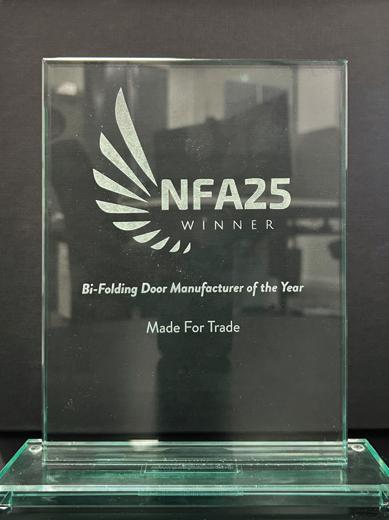
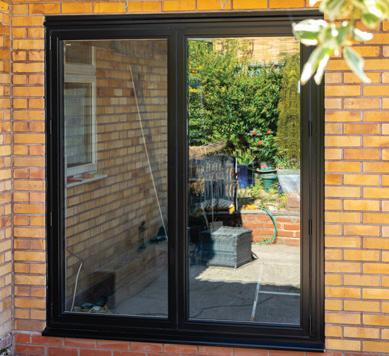
Made for Trade wins Bi-folding Door
Manufacturer of the Year and Conservatory Product of the Year at the 2025 National Fenestration Awards
Ian Bousfield, Marketing Manager at Made for Trade, said:
“Winning never gets old, but carrying all these awards to the car is becoming a two-person job. Joking aside, this is a huge recognition of the team and our trade customers. We keep pushing design and engineering forward because installers deserve products that make life easier, support them to win more work and look incredible for homeowners when the job is complete. A huge thank you to everyone who voted for us again this year.”
ILL-GOTTEN GAINS
Tool theft costs
UK tradespeople £294m a year
This figure comes from new analysis of claims data from Simply Business. East Anglia emerged as the most affected region, accounting for nearly one in five (18%) tool theft claims the insurance provider received last year. The findings highlight a growing threat to the livelihoods of skilled workers, as the value of stolen goods continues to rise. October was the peak month for tool theft in 2024, coinciding with the clocks going back and darker evenings, which provide more cover for opportunistic theft.
The FUTURE of the Industry
CITB’s specialist New Entrant Support Team helps over 1,500 apprentices join the industry in six months
The Construction Industry Training Board (CITB) has released its mid-year figures for its New Entrant Support Team (NEST). The figures show that NEST has already supported 1,521 apprenticeship starts between April –September 2025, an increase from 943 in the same period in the previous year.
The figures also show that in the same period this year, 9,201 employers were engaged, with the aim to recruit an apprentice into their business, a 48% increase compared to the same period in 2024. In the last full financial year 2024-25, CITB’s NEST supported 4,000 apprenticeship starts, almost doubling from the previous financial year 2023-24 – and the team is currently on track to outperform this in the 2025-26 financial year.
NEST helps make finding, recruiting and retaining an apprentice or new entrant easier for employers, and works closely with them to remove any barriers they may face employing and retaining new entrants, particularly apprentices.
CITB’s Construction Workforce Outlook report estimates that the UK needs to recruit 47,860 extra workers each year to meet demand for housing, infrastructure and maintenance. For construction to have
the workforce it needs in the future, investment in training that supports people into jobs is crucial. This is at the heart of CITB’s Strategic and Business Plans.
As part of the Government’s £600m investment into construction skills, CITB will invest £32 million to fund over 40,000 industry placements each year for all Level 2 and Level 3 learners, those
Deb Madden, CITB’s Executive Director, Customer Engagement and Operations, said: “Construction employers need to be confident that they’ve got effective and prompt support available to meet their skills and training needs. NEST is providing exactly that, and it’s great to see the year-on-year increase in the number of employers and learners the team is supporting.
“A strong pipeline of apprentices and construction workers is required to build the millions of homes and hundreds of infrastructure projects needed. We’re really pleased to see how impactful NEST is, and I look forward to seeing the good work continue to give employers access to hands-on, dedicated support.”
About the Construction Industry Training Board:
The Construction Industry Training Board (CITB) is the designated industry training board for the construction sector in England, Scotland, and Wales. Its remit is to assist the construction industry in attracting talent and to champion skills development, with the overarching goal of building a better Britain, and its purpose is to support the construction industry in sustaining a workforce that is skilled, competent, and inclusive, both for the present and the future. CITB is committed to ensuring that the construction industry remains at the forefront of skills development and innovation, fostering a robust and diverse workforce that is equipped to meet the evolving needs of the sector. For more information, visit www.citb.co.uk
studying NVQs, BTECs, T Levels and advanced apprenticeships. CITB will also double the size of its NEST programme to support SMEs in recruiting, engaging, and retaining apprentices.
FIND OUT MORE ABOUT NEST ON
We give our verdict on new products in our unique site tests, but now we want to give you the chance to try them – AND KEEP THEM – for yourself! All you have to do to enter the free draws is simply just type in www.rdr.link followed by the unique code.
FREEFOR ALL!
5 X SITE CASES
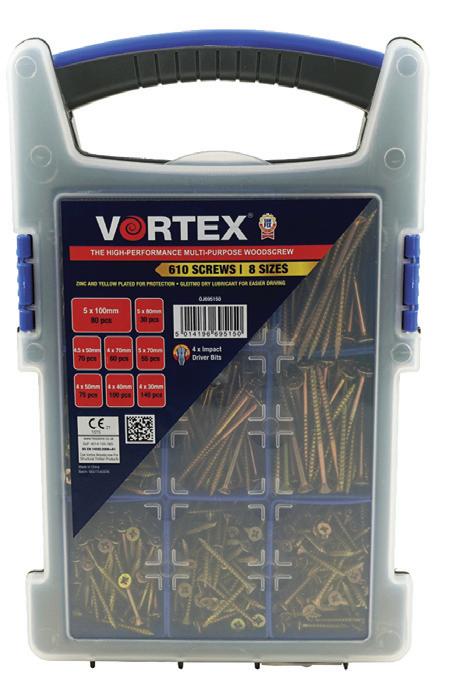
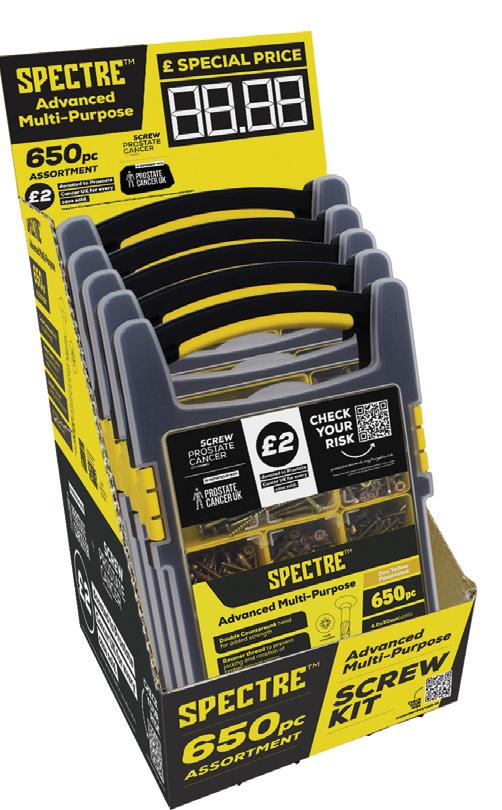
VORTEX® HIGH-PERFORMANCE WOODSCREWS
The Vortex® site case holds over 600 screws covering six of the most popular sizes. Vortex® screws are recognised in the industry for their premium quality and tailored product features. They easily power through hardwood, softwood, plywood, chipboard, MDF, uPVC and thin sheet metal. The high-quality zinc and yellow waxed finish offers protection from corrosion and helps to drive in easily. Have we got screws for you! Use the rdr link below to enter.
1
COLD WEATHER KIT
CARHARTT
BEANIE, FLEECE AND SOCKS
With temperatures dropping and site work showing no signs of slowing down, staying warm through the winter months is essential. That’s why Carhartt is giving one lucky Professional Builder reader the chance to win a cold-weather Christmas bundle packed with work-ready warmth.
Up for grabs:
1 HAMPER & 4 RUNNER UP PACKS
TALON
FORTNUM & MASON AFTERNOON TEA HAMPER PLUS PIPESNUG AND FLUESNUG PACKS
Talon is giving installers the chance to put their feet up in style with a giveaway celebrating its time-saving sealing solutions, PipeSnug and FlueSnug. Five lucky winners will each receive a PipeSnug and FlueSnug pack crammed full of sizes, including the new FS5 – and one will also win a luxury Fortnum & Mason Afternoon Tea hamper.
This giveaway is a reminder that the right tools don’t just make work easier, they make time for the good stuff too. Win a well-deserved tea break!
Carhartt Beanie – A staple on site and off, this thick-knit beanie is made from 100% acrylic and features the classic Carhartt patch. One size fits all, warmth guaranteed. Heavyweight Fleece – Ideal for layering under a jacket or throwing on over your workwear during frosty starts.
Winter Socks – Made with sweat-wicking and insulating yarns, these tough socks offer full-cushion comfort that keeps your feet warm without overheating – perfect for long days in steel toe boots. Whether you’re on scaffolding, in the van or heading into the yard, Carhartt’s cold-weather kit has your back.
20 CARTRIDGES
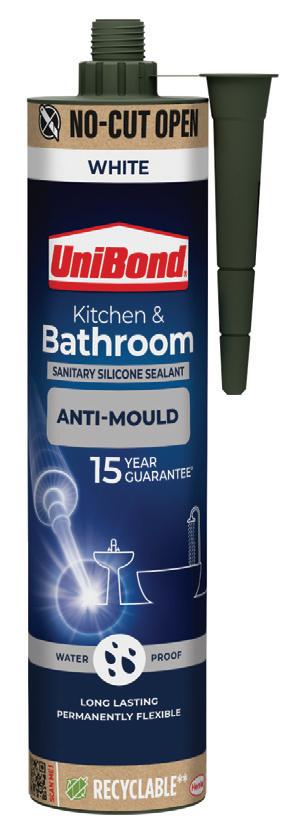
UNIBOND NEXT GENERATION OF CARTRIDGES
With a recyclable cardboard tube –and 73% less waste – UniBond Next Generation of Cartridges are the sustainable choice. The clever no-cut opening means it’s 33% faster to use, with no knives needed.
Enter now to win and one of 20 Next Generation Cartridges could be yours.
3 X SETS OF 3
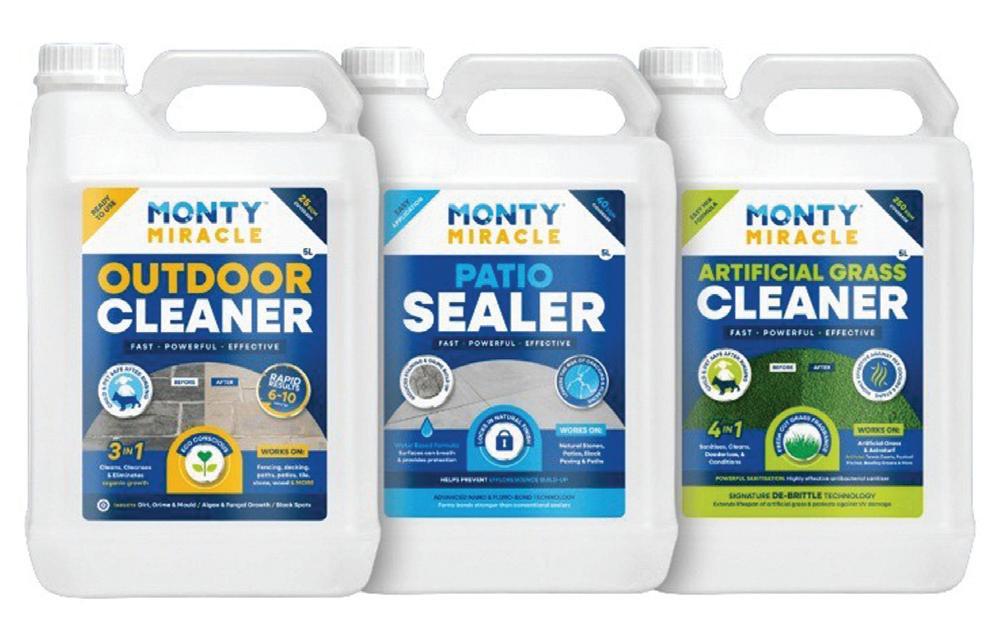
MONTY MIRACLE
COMPLETE YOUR CLEAN PRODUCTS
Monty Miracle is offering its new “Complete Your Clean” line of products: Outdoor Cleaner, Artificial Grass Cleaner and Outdoor Sealant - in 5L bottles.
The easy-to-use outdoor cleaning range uses a patented formulation which significantly reduces time, costs & resources needed for landscaping, amenity management, turf care, and related outdoor cleaning tasks. Get your clean on, three sets of three are up for grabs.
PAIRS OF SAFETY BOOTS
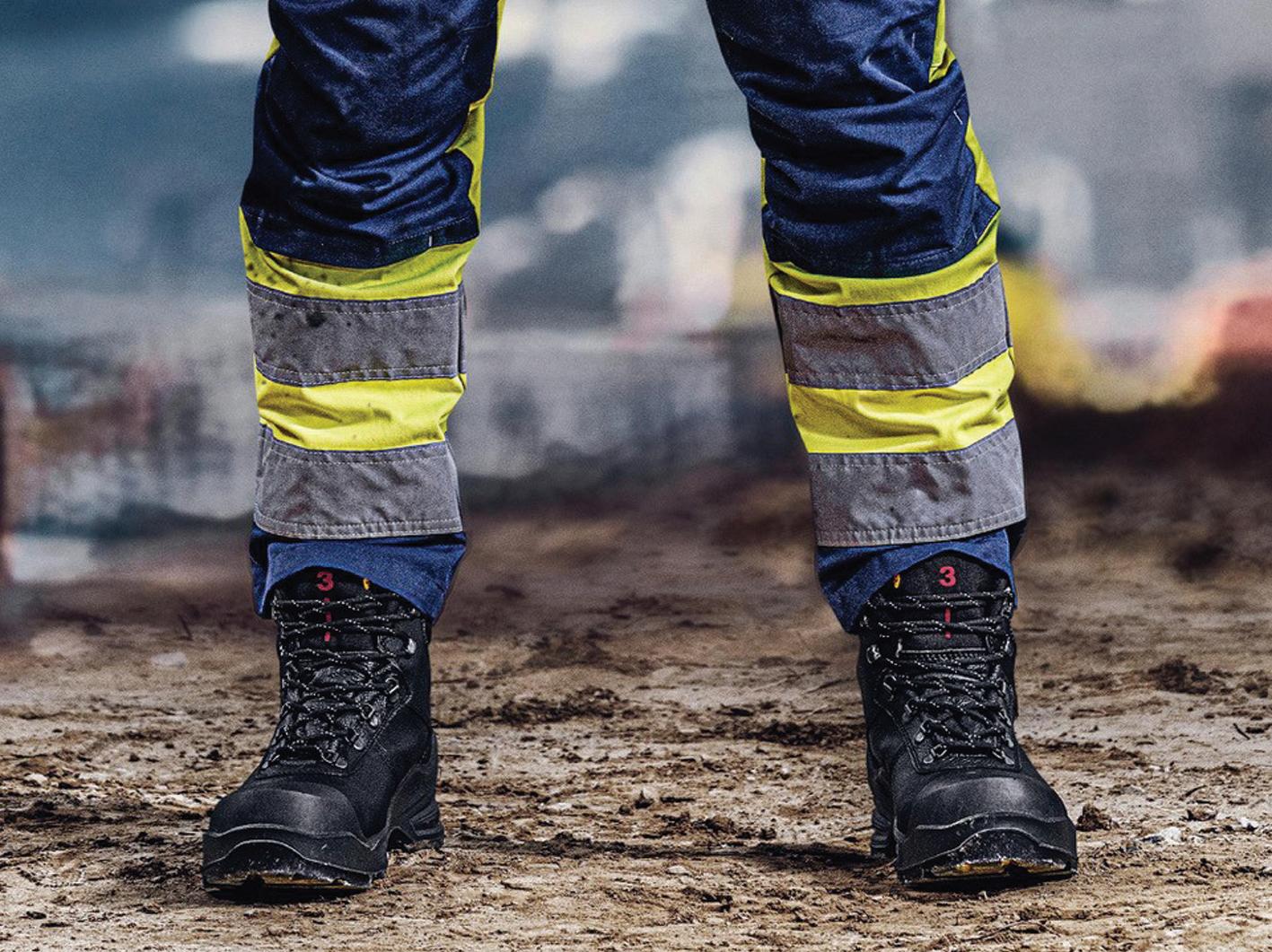
3 QUATRO SAFETY BOOT
The uvex 3 quatro is the successor to the iconic uvex quatro pro and is designed to deliver lasting comfort and support, ensuring workers can focus on the job rather than their footwear. uvex i-PUREnrj rebound technology, bionom x design ensure superior comfort alongside enhanced safety features and inclusive sizing for practicality. The best just got better. Three pairs must be won!
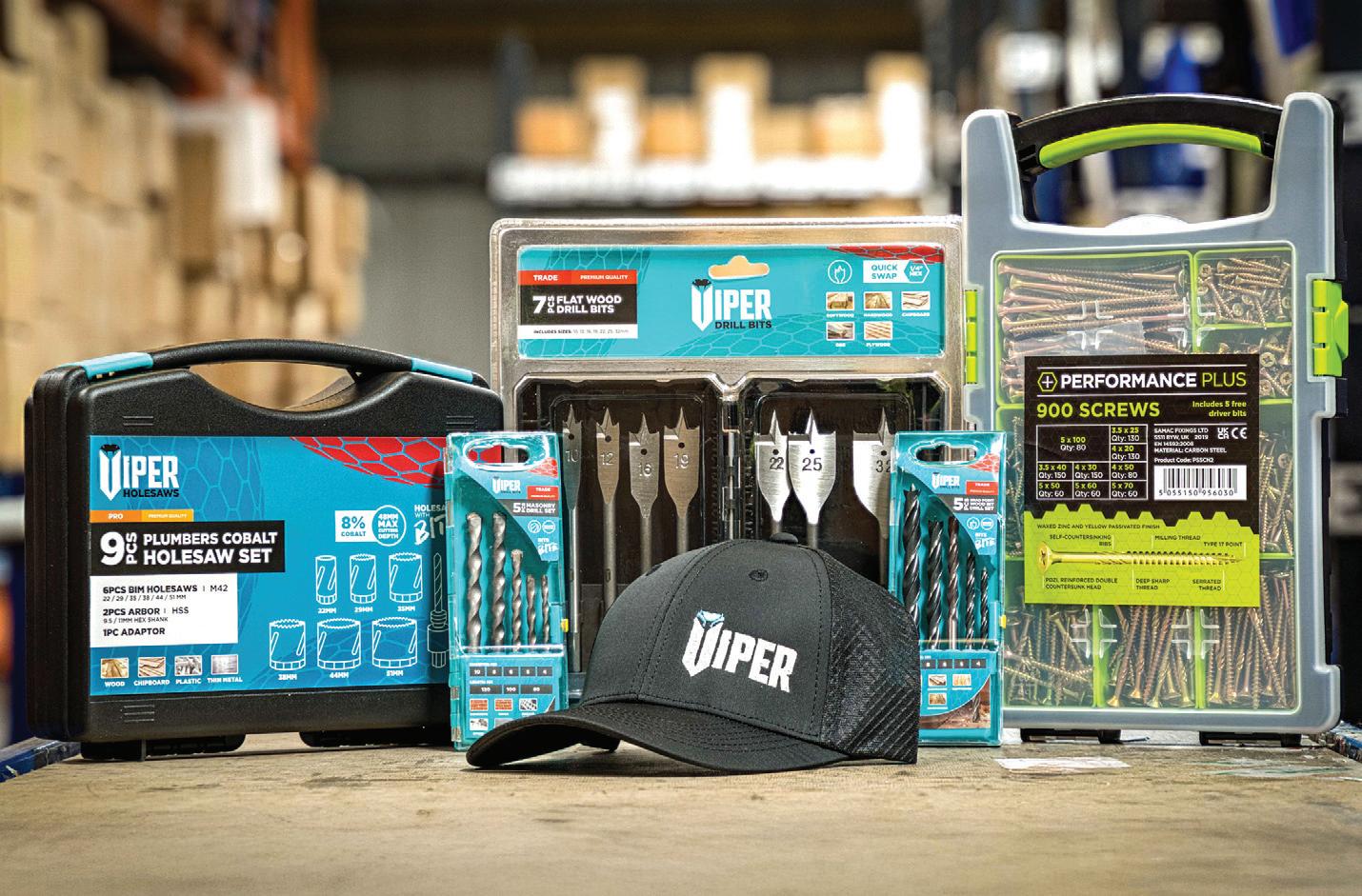
5 X FESTIVE FIXINGS BUNDLES
SAMAC
QUALITY DRILLING ACCESSORY BUNDLES
Samac Fixings is giving away 5 topquality drilling accessory bundles for Christmas – and you can’t beat this ‘six of the best’ set!
Every prize includes:
1x Brad point wood drill bit set
1x Holesaw set
1x Wood spade bit set
1x Masonry Drill bit set
1x Performance Plus Case
1x Viper branded mesh cap
Hit 2026 running - with Samac Fixings!
COMPETITION
‘GUTTERLY’ IRRESISTIBLE
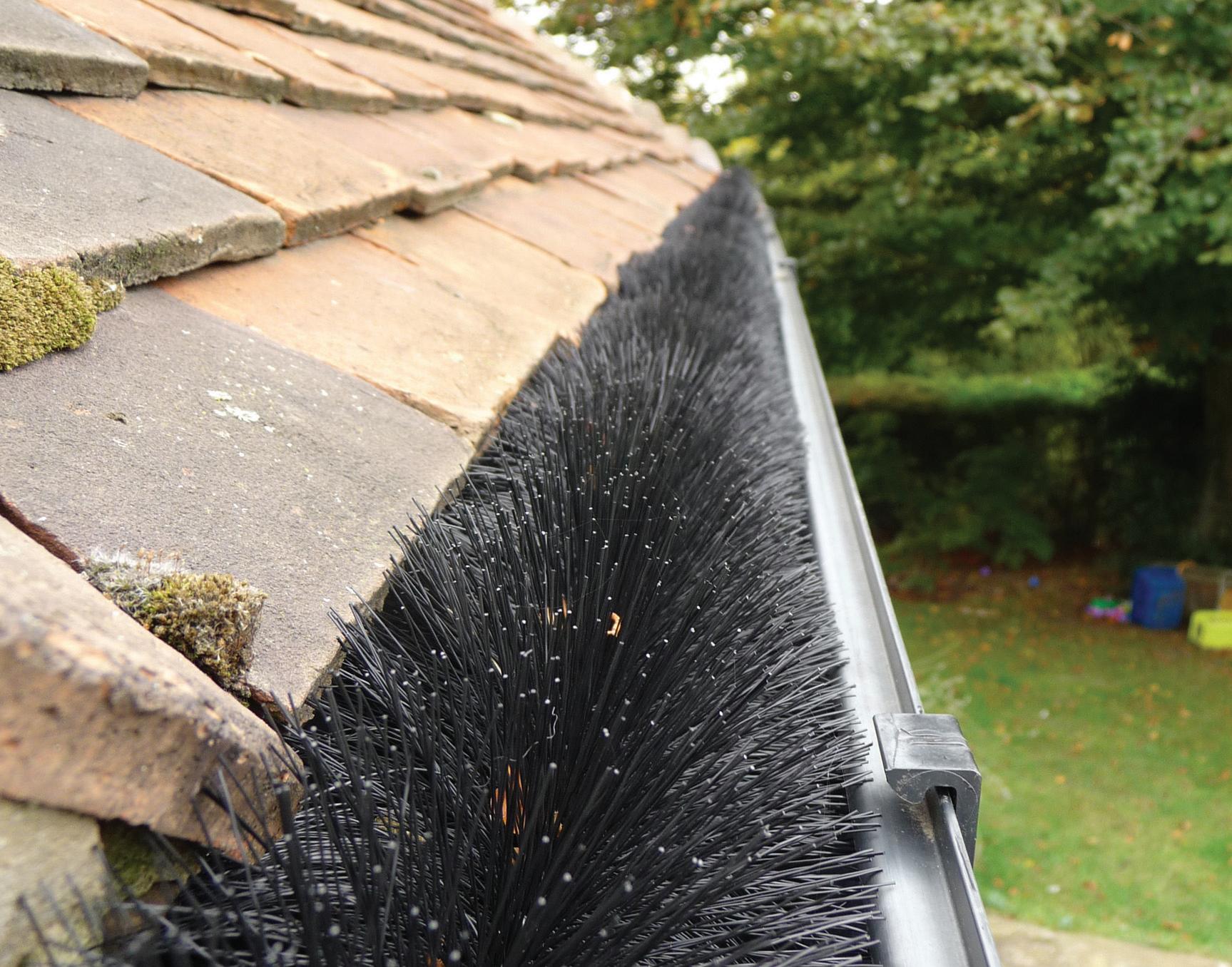
There are some jobs that you might be inclined to put off but if you plan on procrastinating over gutter maintenance, you might regret it. The problem is of course water overflow which, when it trails a stain down render or brickwork, is not only unsightly, but could potentially do serious damage. Any debris that hits the roof, including leaves, will most likely find its way into the guttering – and it won’t take long before it builds up.
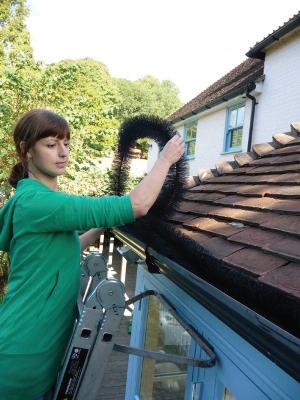
As the company name would suggest, Easy Innovations is in the business of keeping things simple, and that’s certainly the case with the property maintenance expert’s Hedgehog Gutter Brush. The device is as uncomplicated as can be to fit, with no specialist knowledge required, and will quietly guard against the detritus that would otherwise clog your rainwater system, keeping it clean for years. Manufactured using a hard-wearing combination of a stainless-steel wire core and UV-resistant polypropylene bristles,
this long lasting and durable solution comes with the reassurance of a 10-year guarantee. In fact, its makers claim that it is virtually indestructible.
Maintenance made easy
If you or your client does happen to live in one of those leafy avenues where dense deciduous trees are shedding their verdant load onto a roofscape every autumn it is recommended that the Hedgehog Gutter Brush is taken out and cleaned every couple of years or so. Given the ease with which that task is completed, however, this is a very straightforward proposition. It should also be noted that – as with any gutter guard system – it will not prevent silt build-up, or the growth of vegetation due to drifting seeds.
The Hedgehog Gutter Brush has earned its place as the market leading solution by virtue of its versatility. It will automatically adapt to virtually any shape of gutter and the 4metre lengths are available in six diameters – 50mm, 75mm, 100mm, 125mm, 150mm or
A HEDGEHOG EASY SCOOP! WIN
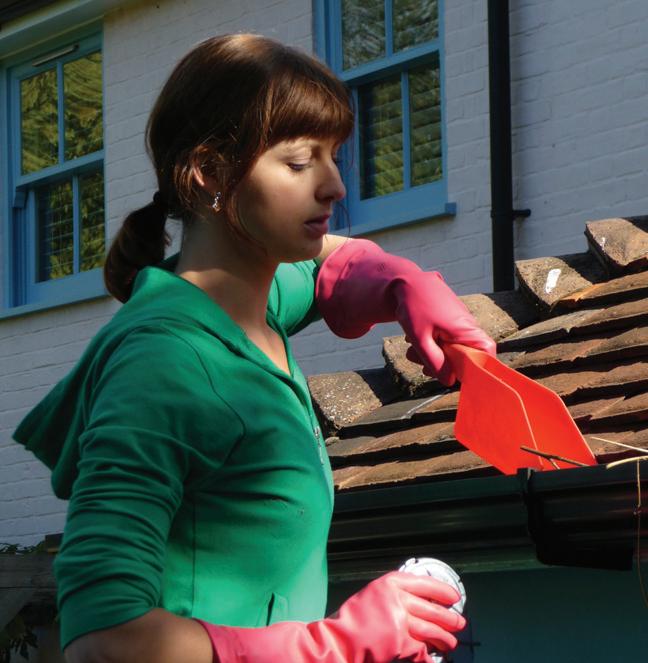
If you’ve only just discovered the genius of the Hedgehog Gutter Brush, and you need to clean your gutters prior to installing it, then reach for the Hedgehog Easy Scoop. Made from durable polypropylene, it flexes to fit a gutter, and has a host of other uses around any home.
It can be deployed as a gardening tool, for instance, whether that’s spreading grass seed and fertiliser or potting mix. If you’re a dog lover, then it’s a handy pet food dispenser and pooper scooper in one.
Win yourself a Hedgehog Easy Scoop by answering the following question: In what country is the Hedgehog GutterBrush manufactured?
Anyone who enters with the correct answer will receive a Hedgehog Easy Scoop, limited to the first 50 correct entries.
Enter at WWW.RDR.LINK/BBV021
200mm. At the same time, it can also be utilised as a pathway drain brush. Moreover, the 100mm and 125mm sizes come in a choice of black, white or brown.
WIN BIG!
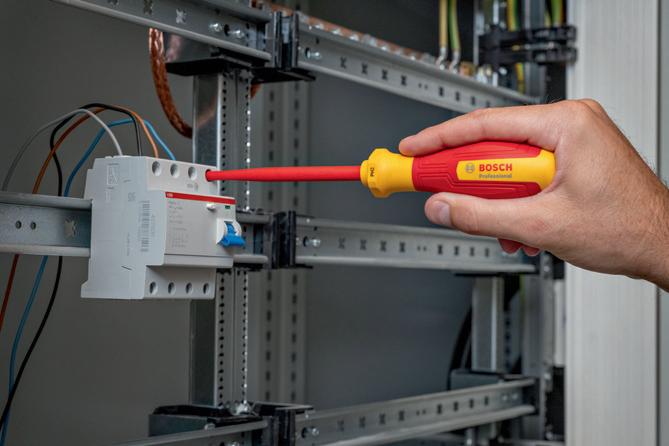
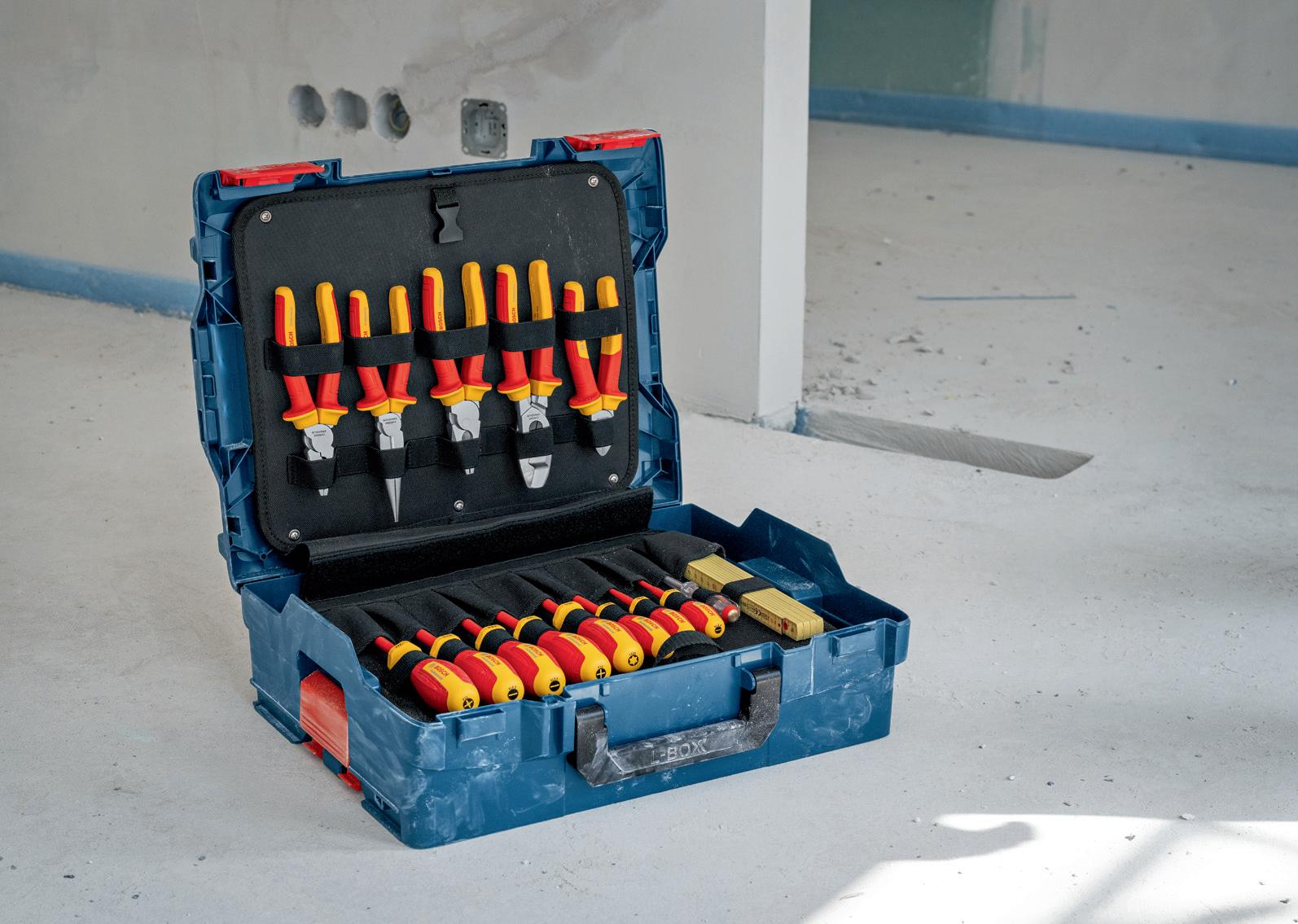
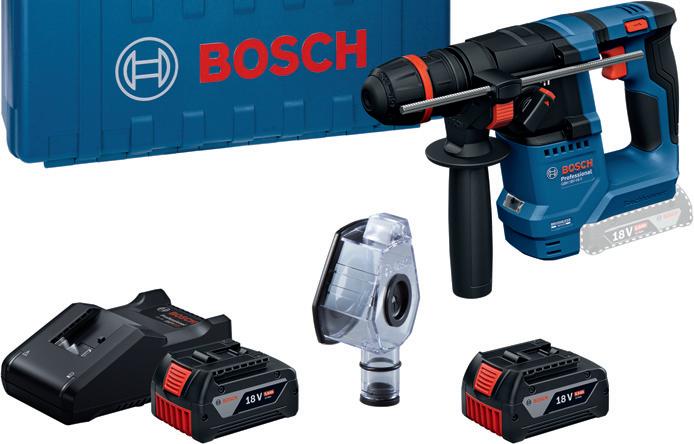
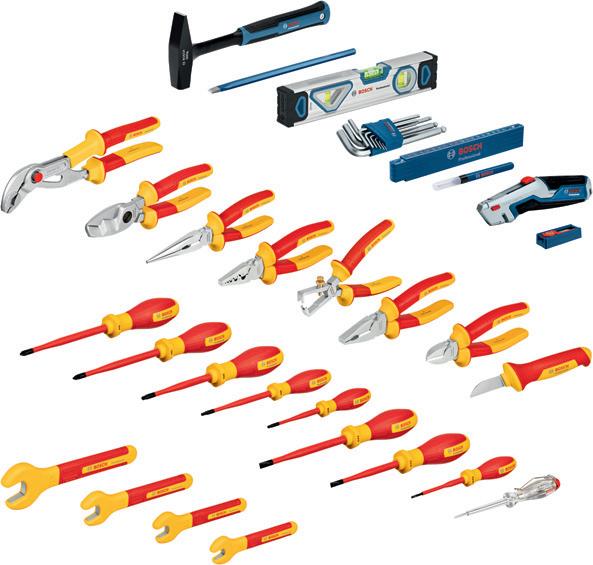
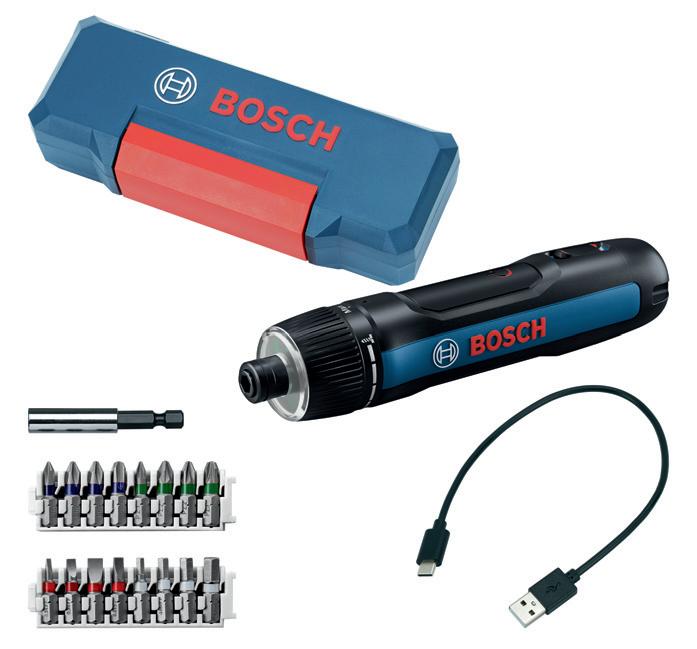
The ultimate electrician’s bundle is up for grabs! Professional Builder has teamed up with Bosch to give one lucky reader the chance to win an incredible electrician’s prize package worth over £1,200!
Get ready to level up your toolkit! Bosch is giving you the chance to win a premium prize bundle packed with our most trusted professional tools and accessories – built for precision, power and performance.
Let’s take a look at what’s inside:
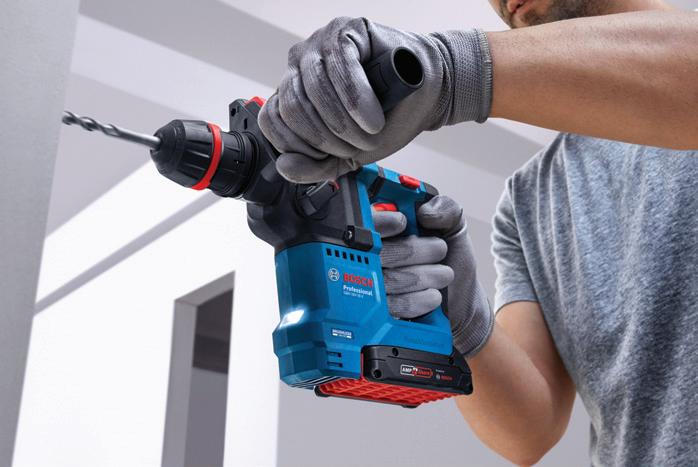
SDS-Plus drill is built to go wherever your work takes you.
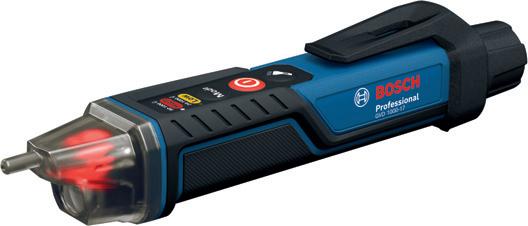
GVD 1000-17 Noncontact
Voltage Tester
Stay safe and confident on every job. The Bosch GVD 1000-17 detects live voltage instantly, no contact required. Compact, durable and easy to use, it’s the essential pocket tool every tradesperson should carry. Precision and safety in one from the brand you trust.
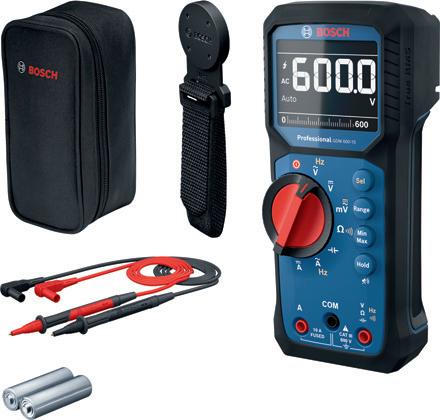
GDM 600-15
Digital
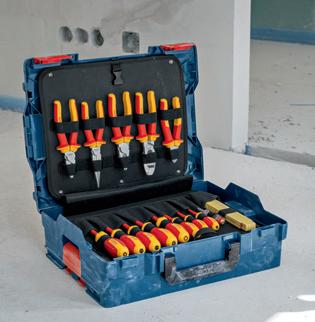
Electrician Case 37pc Professional Power, precision and organisation in one tough case. The Bosch 37-piece Electrician Set brings together all the essential bits, drivers and accessories a pro needs on site – neatly arranged and built to last. Always ready for the next install, repair or upgrade, this is the ultimate companion for any electrician.
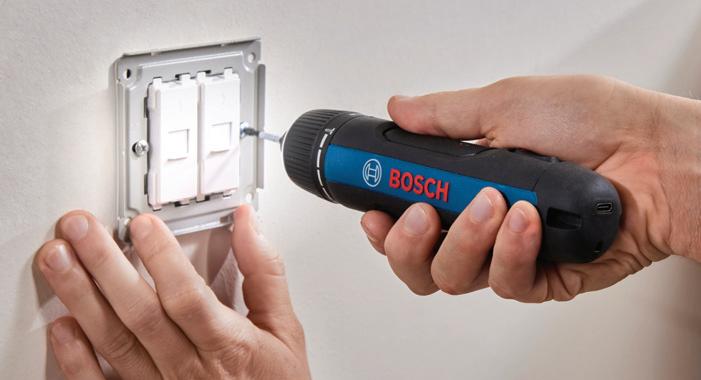
Compact, powerful and smart, it’s perfect for quick installations, repairs or assembly work. When efficiency meets innovation, you get Bosch Go.
GBH 18V-18 X Professional Compact Hammer Drill SDS-Plus
NEW! Meet the latest powerhouse in the Bosch range – the GBH 18V-18 X Compact Hammer Drill. Lightweight yet unstoppable, it’s engineered for pro performance on tough jobs. With two 5.0Ah batteries, fast charger, dust extraction and carry case, this brand-new
Multimeter
Accuracy you can rely on. The Bosch GDM 600-15 Digital Multimeter delivers professionalgrade measurement for every electrical task. Built tough for daily use, it combines precision, safety and reliability giving electricians full confidence in every reading. Bosch performance, in the palm of your hand.
Don’t miss your chance to win the ultimate Bosch Pro bundle! Five top-tier tools and accessories to power your trade like a true professional! Enter now and upgrade your toolkit for free.
TOP PRODUCTS 2025
Throughout the year Professional Builder’s print and digital platforms are replete with all the industry’s latest products, ideas and innovations.
Every December we recognise some of the highlights and in the following pages you’ll find our Top Products 2025. These are the solutions that can make you more profitable, productive
THE INNOVATION
AWARD 2025
and provide the peace of mind of a job well done. So, if you haven’t discovered them already, be sure to make use of our digital reader enquiry service by entering the relevant rdr.link into your browser for more information.
A very merry Christmas to all our readers and here’s to a promising and profitable 2026!
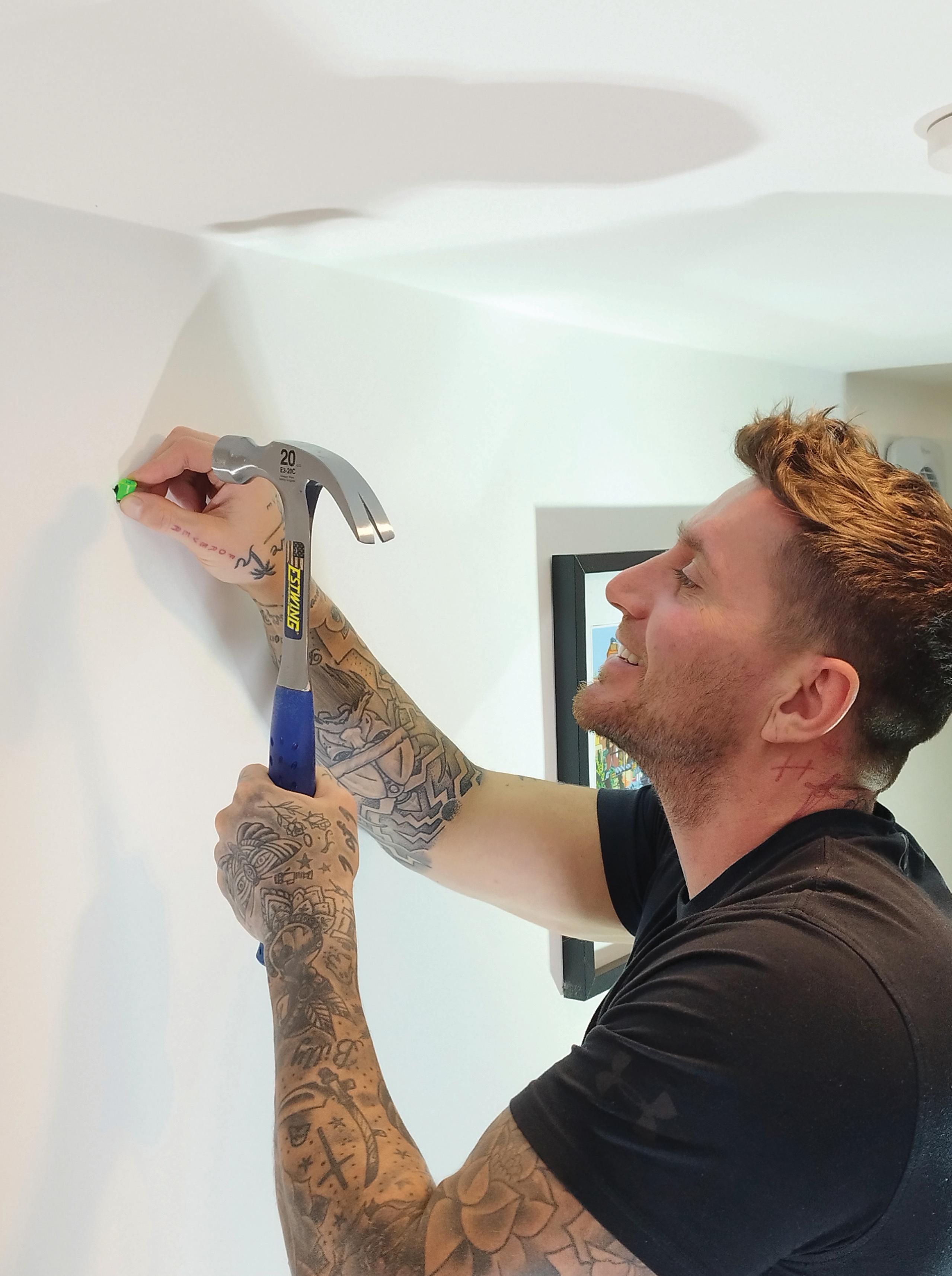
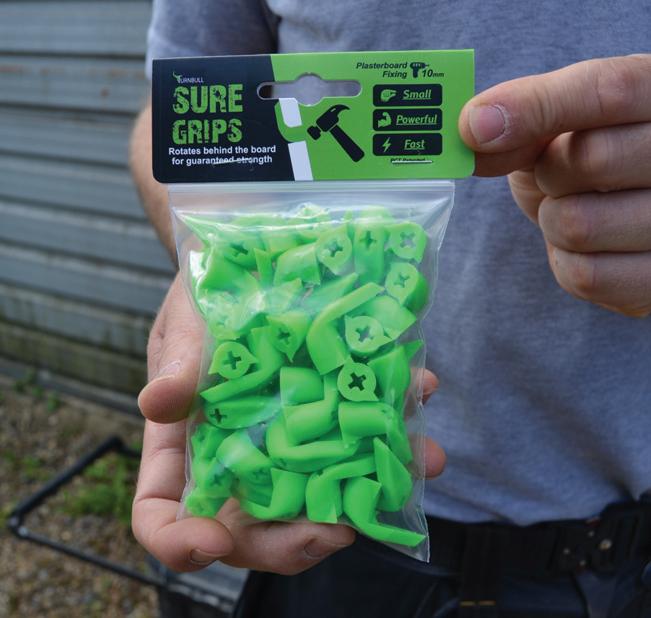
This year’s Professional Builder Innovation Award goes to James Turnbull and his wall plug innovation: SureGrips
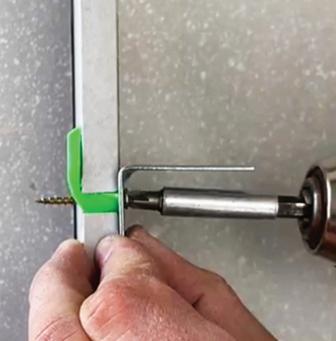
James Turnbull’s SureGrips featured in Professional Builder’s February issue earlier this year. Working as a carpenter, James is certainly experienced in using fixings and, a few years ago, decided to do something about a gap he saw in the plasterboard fixings market.
“I’ve been a carpenter for 20 years and one of the problems that I really found was there’s a number of fixings on the market, and while the larger ones are fine for strong fixings, when you’ve got smaller brackets, these larger fixings are visible around the perimeter. They’re great fixings and I use them myself, but they’re also expensive at about £1 a fixing. When you’re using 20 or 30 a day, it’s a super expensive way of putting things on wall that can come out of your wages.” James explains.
“There’s a complexity with these larger fixings too. They’re quite an intricate thing, you have to drill a hole using an undercutting tool on some of them and try and get things to move around the back of the wall. So, the idea was to come up with something that
was super small, simple, fast and cheap that would get you a strong fixing. Most small plasterboard fixings tend to rely on deforming themselves and pulling back against the other side of the wall to hold your screw. These fixings can then either break , or not engage correctly, and you’re unable to tell if they’ve even worked correctly.”
SureGrips, James’ answer to these problems, is a UK manufactured, PCT patented 10mm fixing which he designed using his CAD skills from his carpentry business. The fixing is suitable for any 4.0mm or 4.5mm gauge woodscrew, (which will handily fit most brackets you’d put up) working like a cantilever. Keeping it easy breezy, James has opted for simple physics to be the basis of the plug’s strength. And strong it is! While there’s no official max load limit yet, James has a number of videos across his social media accounts showing just how strong SureGrips are. In one, he loads up a bookshelf with 98kg in dumbbells borrowed from his neighbours before it
came down. This isn’t the end either, with larger variations of the fixing coming soon in the future!
Getting that kind of strength with the size of a smaller plug seems like a bit of a revelation for the industry. Because SureGrips can be installed in any orientation too, there’s nothing stopping you from putting a number in close proximity to each other when required, something that isn’t possible with the larger circular fixings that take up more valuable wall space. Not having any garish bits of plastic poking out round the sides of a bracket is a bonus too, providing a nice clean finish to any installation. With SureGrips, James has kept things simple using his real-world experience. SureGrips works as a smaller fixing with the power of a larger one that you can rely on every time. James attests himself that if he uses a plug and it fails, he won’t be trying it again. Sometimes, it’s best to keep things simple.
TOP PRODUCTS 2025
For
A. PROCTOR
GROUP’S PROCTOR AIR®
This vapour permeable, highly water resistant roofing underlay is certainly a breath of fresh air! Proctor Air® allows even very complex pitched roofs to breathe, without the need for air gaps or secondary venting. Condensation forming is rendered virtually impossible and it can be used on roofs featuring solar PV.
WWW.RDR.LINK/BBV025
SOLID GEAR
TIGRIS GTX AG MID BOOTS WITH BOA FIT SYSTEM
Whilst they look like they’re engineered for a war zone, the S3 safety class Solid Gear Tigris GTX AG Mid boots feel as light as ballet slippers. It’s the BOA Fit System that’s the cherry on top. Designed to be opened and closed 5,500 times, it’s as easy as can be: push in the dial to engage, turn to tighten and pull up for quick release.
WWW.RDR.LINK/BBV026
BRITISH GYPSUM GYRPOC PRO MIX LITE
Joint like a pro with British Gypsum’s Gyproc Pro Mix Lite. This ready-mixed jointing compound is used for achieving seamless plasterboard joints and angles. There’s no need to faff about with mixing or worrying about water requirements on site as this handy hand applied tub is ready to use.
WWW.RDR.LINK/BBV027
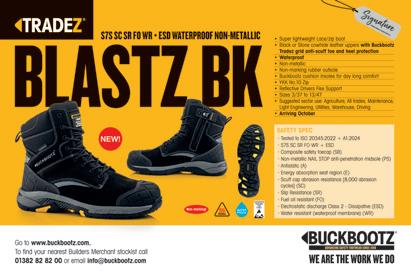
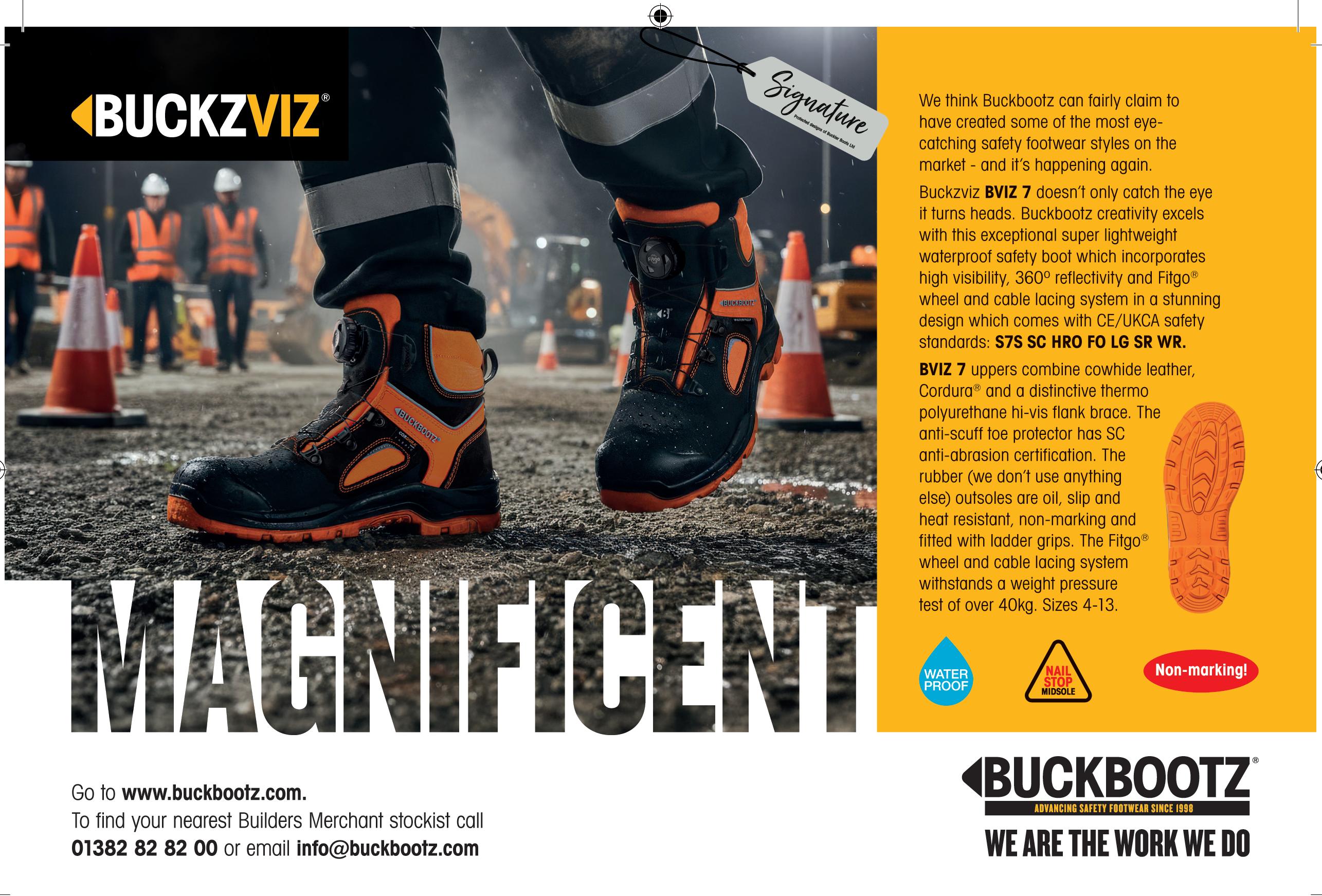
BUCKBOOTZ BLASTZBK TRADEZ HIGH LEG SAFETY BOOTS
If you’re looking for a safety boot that’ll give you good bang for your buck, look no further than the Buckbootz BLASTZBK Tradez High Leg. With an S7 certification, there’s not many boots that come with more protection than this one. Key features include a zipper/lace combo for hassle-free taking on and off and front/back anti-scuff grid protection. They’re also available in a snazzy stone colour.
WWW.RDR.LINK/BBV028
CARHARTT FORCE SUN DEFENDER™ LIGHTWEIGHT SHORT-SLEEVE
T-SHIRT
Beat the heat with Carhartt’s Force Sun Defender™ t-shirt that boasts fabric with UPF 40+ sun protection. Engineered to shield you from harmful UV rays, it’s perfect for long days outdoors, with sweat-wicking technology to help you stay dry, no matter how hard you’re working.
WWW.RDR.LINK/BBV029
BUNKER
LOADUP STACKING SYSTEM
Lock and load with Bunker’s Load-Up Stacking System. Our testing expert Tibby Singh was thoroughly impressed with the 9piece set he tried out. An extended tenyear warranty backs up the superior build quality of this modular system that boasts a range of options, sturdy wheels, reinforced lids, metal latches, and IP65 weather-resistant seals.
WWW.RDR.LINK/BBV030
EVOLUTION TOOLS
R260DCT-LI CORDLESS 260MM DISC CUTTER
Experience the next evolution in power tools with the R260DCT-Li
Cordless 260mm
Disc Cutter with automatic water-fed dust suppression and premium thin kerf diamond blade. It features a huge 100mm depth of cut that rivals many 12” saws and is designed to cut all common masonry materials, decorative stone, and rebar concrete. It’s portable, lightweight, and perfectly balanced.
WWW.RDR.LINK/BBV031
FESTOOL HLC 82 CORDLESS PLANER
Festool’s HLC 82 cordless planer makes woodworking ‘plane’ sailing! Meet your new reliable companion on the construction site and in the workshop when it comes to quick adjustment work. It has a wide range of applications thanks to a removable chamfer adaptor, boasts a 25 mm rebate depth and has a chip depth that can be precisely set between 0 and 2.5 mm.
WWW.RDR.LINK/BBV032
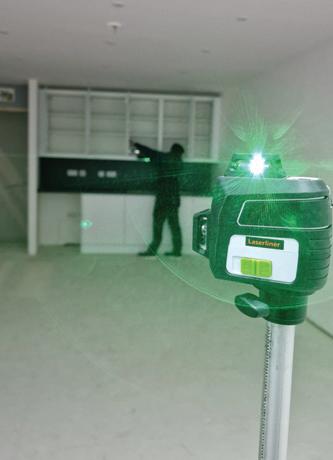
LASERLINER POCKETPLANELASER 3G
Now that’s what I call a laser sharp tool! Tibby Singh also got his hands on the Laserliner PocketPlane-Laser 3G, which left quite the impression. As the name would suggest, this is small enough to fit in a holster pocket. It has three dimensions,
TOP PRODUCTS 2025
For more information on each of our winners use the relevant www.rdr.link for more information online
has a visibility of 60m with its receiver (and 30 without) and is USB-C rechargeable with a runtime of 9 hours.
WWW.RDR.LINK/BBV033
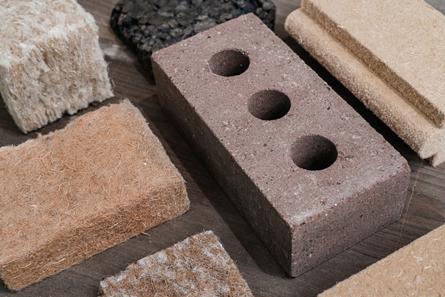
KENOTEQ K-BRIQ
Creating a new sustainable method of construction, ‘briq’ by ‘briq’! The patented K-BRIQ is produced from nearly 100% recycled construction and demolition waste, with the addition of a binder and is hydraulically compressed rather than kiln fired. All that, together with low temperature curing, adds up to a brick with dramatically reduced CO production in its manufacture.
WWW.RDR.LINK/BBV034
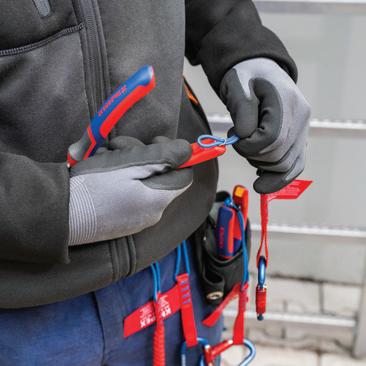
KNIPEX TETHERED
TOOLS
Knipex’s tethered tools are your friends in high places. The German handtool expert designed clips to prevent accidental drops that could cause injury or damage below. The clip is quick and simple to attach – no tools needed, just slide it into place and it can safely hold tools up to 1.5 kg. The range of compatible tools includes everything from pliers and grips to shears and cutters.
WWW.RDR.LINK/BBV035
MAKITA
CORDLESS 18V FRAMING NAILER
LXT DBN900
The Makita Cordless 18V Framing Nailer LXT DBN900 is one tool that’s definitely nailed it! The nailer is designed to handle 50mm-90mm nails,
making it versatile enough to tackle framing and other construction tasks with ease. It is equipped with both single-fire and bump-fire modes, teeth on the nose for help with skew nailing and a depth adjustment dial.
WWW.RDR.LINK/BBV036
MARLEY SOLAR ROOF SYSTEM
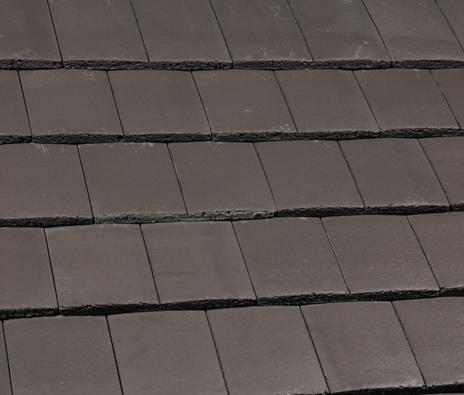
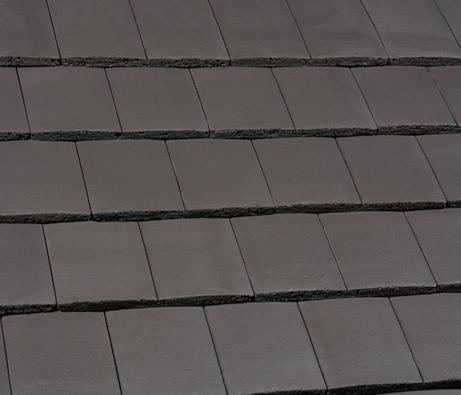
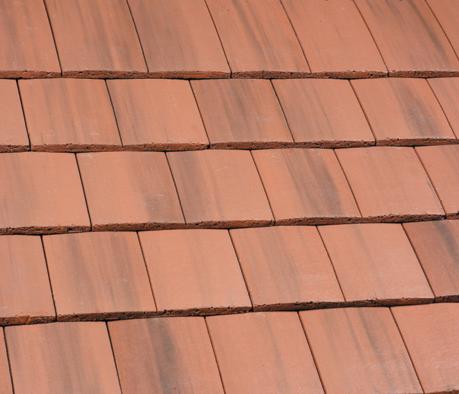
The sky’s the limit with Marley’s Solar Roof System. The SolarTile® builds the foundation with smooth-inline and in-built solar panels. Add to that highperforming underlays, ventilation, verges, ridges, hips and more and there’s nothing else you could really want or need. There’s even solar inverters, battery storage and an EV Charger!
WWW.RDR.LINK/BBV037
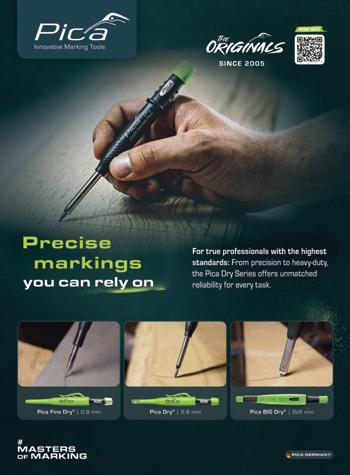
PICA DRY RANGE
Take your ‘Pica’ of this great range of professional construction markers. The Pica Dry is suitable for almost all material surfaces. Whether dry or wet, smooth or rough, dusty or rusty, thanks to the extensive range of leads, you are perfectly equipped for any project. The latest newcomer to the Pica range is Pica Powder, which leaves green fluorescent chalk-based markings with a spray burst for holes up to 250mm.
WWW.RDR.LINK/BBV038
SANIFLO UP
There are few products more classic than the Saniflo UP, originally designed by SFA over 60 years ago. It is the original macerator pump unit that allows installation of an extra WC almost anywhere in your home when a conventional solution isn’t possible. The
latest iteration replaces older existing versions of the same name easily and can pump up to 4 m vertically or 100 m horizontally.
WWW.RDR.LINK/BBV039
SCANGRIP TOWER 8 CONNECT
Why trip over separate lights and stands when you can get the whole tower in one? The Scangrip Tower 8 Connect is a built-in LED floodlight and tripod combo that stands tall and shines even taller, blasting out up to an impressive 8,000 lumens. Compatible with all major 18V/20V battery packs, just slap on the SCANGRIP CONNECTOR that matches your tool brand, and you’re good to glow.
WWW.RDR.LINK/BBV040
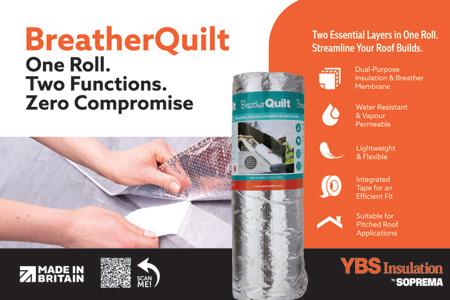
YBS INSULATION BY SOPREMA BREATHERQUILT
It’s two for the price of one with YBS Insulation’s BreatherQuilt! This roll works as both insulation and a breather membrane. It’s suitable for pitched roof applications, has an integrated tape for easy fitting, and is lightweight and flexible as well as water resistant and vapour permeable.
WWW.RDR.LINK/BBV041
TOP PRODUCTS 2025
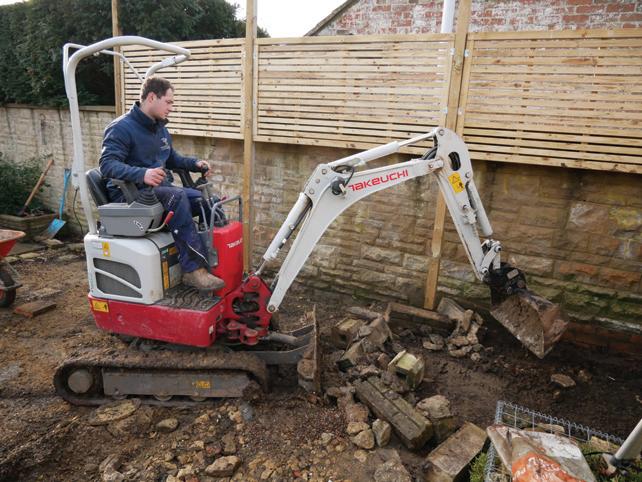
TAKEUCHI TB210R
The 1.1 tonne Takeuchi TB210R is an exemplary example of a mini excavator. We got out on site with Maxwell Steele of Marlake Landscaping to experience this piece of plant up close. Samll but mighty, the TB210R’s expanding track frame can tuck in to a width of just 750mm, boasts a maximum dig depth of 1,755mm, together with a dump height 2,120mm.
WWW.RDR.LINK/BBV042
TOTECTORS RUSHDEN AT
Is it a trainer? Is it a running shoe? No it’s a safety shoe! Looks can certainly be deceiving when it comes to the Totectors
Rushden AT. A lightweight aluminium toecap that’s resistant to 200 joules maintains the low-profile design. That’s joined by a penetration resistant plate. It’s also 100% waterproof and boasts 360° TPU welded protection.
WWW.RDR.LINK/BBV43
TOYOTA PROACE CITY ELECTRIC
Our long-term loan of this nimble and compact electric van has proved to be ace! If you’re looking to make the transition from diesel, or indeed you
already have, then the Toyota Proace City Electric is a very good example in the small van category. It combines on road prowess with practicality and should be a serious option for the trades.
WWW.RDR.LINK/BBV044
TUFFX GLOW HEATED GLASS
TuffX is certainly ‘glowing’ for gold with its heated glass offering. Glow comprises a sealed unit layered with an intelligent, invisible conductive coating that is electrically heated to convert electric power to emit radiant heat into the home. The glass is thermostatically controlled and, using infrared technology, the glass surface temperatures reach 35-40°C with an average hourly cost of around 9p per bifold door.
WWW.RDR.LINK/BBV045
VORTEX® WOODSCREWS
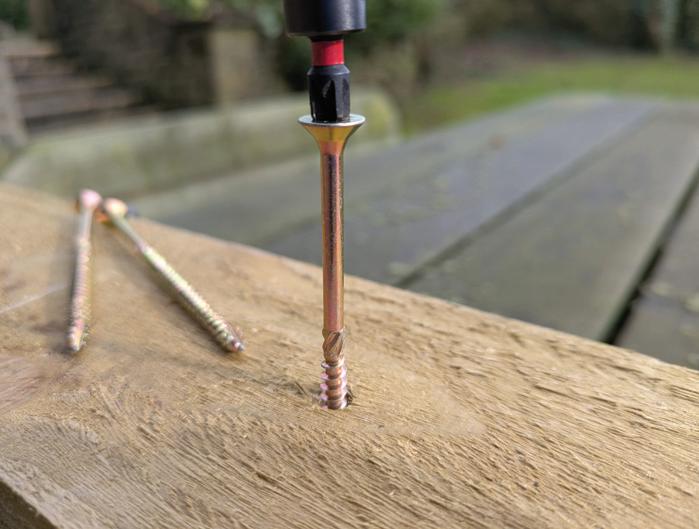
Screwsflash! Vortex continues to impress with its wide array of options in its woodscrew range and refined quality. Sharp milling ribs under the head assist with effective countersinking, eliminating the need to countersink the wood before insertion. Why ‘woodn’t’ you give them a go?
WWW.RDR.LINK/BBV046
WAVIN OSMA HEPVO
As homes become more compact and deadlines more demanding, the need for smarter, more adaptable plumbing
solutions is clear. With their space efficiency, long-term reliability and installer-friendly design, waterless traps like Wavin’s Osma HepvO are fast becoming the go-to solution for today’s housing challenges. The redesigned HepvO boasts a 15-year guarantee.
WWW.RDR.LINK/BBV047
WERA IMPAKTOR SYSTEM
From a bespoke blend of steel to diamond hardened tips and the TriTorsion system, there’s a lot of effort that goes into a product as small as a Wera Impaktor bit. It’s this level of detail that makes the difference. The full range offers users a comprehensive choice, ensuring they always have the correct solution for the job.
WWW.RDR.LINK/BBV048
working in winter
WINTER WARMERS
Work won’t wait for the weather. Carhartt looks at how layering up for warmth, comfort and flexibility is crucial when the temperature drops out on site
When the weather turns, builders don’t have the luxury of downing tools. Mixing concrete in the drizzle, fitting frames in the frost or finishing brickwork in the wind, the job goes on. The trick is to stay warm without bulking up, dry without overheating and protected without feeling restricted. That’s where smart layering and clever clothing tech come in.
Carhartt’s been kitting out hardworking people for more than a century and its range combines toughness and durability with materials and designs that make working in easier. But it’s not just about grabbing the thickest jacket on the rack; knowing what the different labels mean and how each layer plays its part, helps you pick the right kit for the conditions.
Base layers
Getting cold on site doesn’t just come from the weather. If you work hard sweat and then stop, the moisture cools on your skin and you can get chilly quickly. A good base layer that prevents this from happening, is your first defence.
Carhartt’s Force™ range uses FastDry™ technology to wick sweat away and keep you dry. Unlike heavy thermals, Force™ fabrics are lightweight, quick-drying and
“The best winter setups work together: moisturewicking base layers, flexible mids and outer shells that handle whatever the weather throws at you.”
breathable, helping regulate body temperature even when you’re in and out of warm spaces or working up a sweat. Force™ is odour-fighting and made to stretch so it won’t bunch up under thicker layers. The Force™ range is wide and includes hoodies, sweatshirts, trousers, socks and the t-shirt range has been reengineered to be even more comfortable with new mesh side panels and flat seams so there’s no irritation to the skin.
Mid layers
The middle layer’s job is to trap heat while letting air move freely but it’s hard to achieve with thick jumpers or heavy fleece. This layer needs to be flexible so looking for clothing that incorporates Rugged Flex™ makes a big difference. Rugged Flex™ is built into the fabric, providing extra stretch in key areas so you can lift, bend and reach without feeling pulled tight.
The Rugged Flex™ range includes shirts, trousers, vests and joggers. Pair them with a Force™ base layer and you’ve got a combination that’s warm, comfortable and built to move.
YOUR CHANCE TO WIN!
50 years of the Active Jac
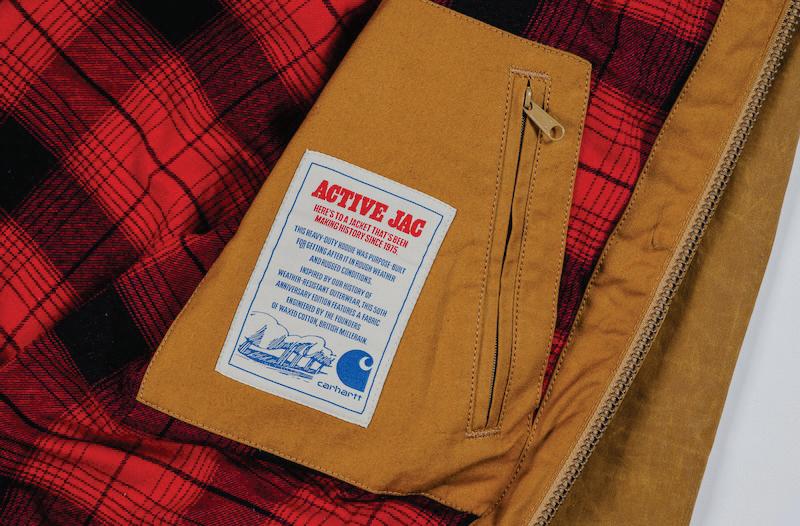
You can’t talk winter workwear without mentioning the Carhartt Active Jac. First released in 1975, it’s as much a part of site life as steel-toe boots and takeaway coffee. The combination of cotton duck fabric, ribbed cuffs and flannel lining makes it one of those rare jackets that gets better the longer you wear it.
Today’s versions combine that heritage toughness with the latest technology and options include Wind Fighter™ to block drafts, Rain Defender™ for water resistance, and Rugged Flex™ for stretch. Whether it’s the Montana Active Jac or the Red Firm Duck Active Jac, they’re designed for all-day comfort, warmth and protection in tough conditions.
Now celebrating its 50th anniversary, the Active Jac remains a true icon of workwear. To mark the milestone, Professional Builder and Carhartt are giving away three jackets. To enter visit WWW.RDR.LINK/BBV058
Outer layers
Once the base and mid layers are doing their job, the outer shell takes on the elements. The right jacket will block wind, shed rain and still allow heat to escape.
For most British winters, Carhartt’s Rain Defender™ works a treat. It’s a durable water-repellent finish that makes moisture bead and roll off, keeping you dry during light showers or damp conditions.
When the rain really sets in, Storm Defender™ is more suitable. It’s a fully waterproof but breathable barrier that stops external moisture getting in while allowing sweat vapour out. That means no
clammy waterproof feeling, just dry, balanced comfort all day.
Winter gear doesn’t have to mean sacrificing mobility for warmth. Another label to look out for is Carhartt’s Full Swing™. Rather than adding stretch to fabric, this builds movement in with biswing panels at the back, extra room in the elbows and underarms and stretch seams in high-motion areas. It means when you’re laying blocks, fitting joists or swinging a hammer, the jacket moves with you instead of bunching or pulling. The design was developed with feedback from builders and tradespeople who wear
Carhartt every day, so it’s tuned to realworld work rather than theory.
The best winter setups work together: moisture-wicking base layers, flexible mids and outer shells that handle whatever the weather throws at you. Carhartt’s approach combines fabrics and designs that complement each other, so you can adapt as conditions change.
Building sites don’t slow down for winter and the right layers mean you don’t have to either.
Darren Binns at Jefferson Tools highlights the heating solutions that keep you warm, safe and productive through the toughest season
The next few months will test everyone’s resilience. As the weather turns and daylight hours shorten, maintaining safe, workable conditions becomes a major challenge for anyone working out on site. Cold temperatures can be uncomfortable, affect concentration, increase accident risks and slow down productivity.
According to the Health and Safety Executive (HSE), employers are required under the Workplace (Health, Safety and Welfare) Regulations to provide a reasonable indoor temperature. The guidance suggests at least 16°C for most work, or 13°C where strenuous physical effort is involved. When it comes to outdoor work, the rules are less specific: employers must provide protection from adverse weather, and site facilities must be kept at a comfortable temperature. The message, however, is clear: warmth isn’t a luxury, it’s a legal and safety requirement. From portable heaters to energy-efficient infrared systems, having the right equipment in place is vital to keeping teams comfortable and operations moving.
No two construction environments are the same and neither are their heating needs. Temporary buildings, open workshops, enclosed areas and outdoor
working in winter
THE HEAT IS ON!
Heating in draughty areas
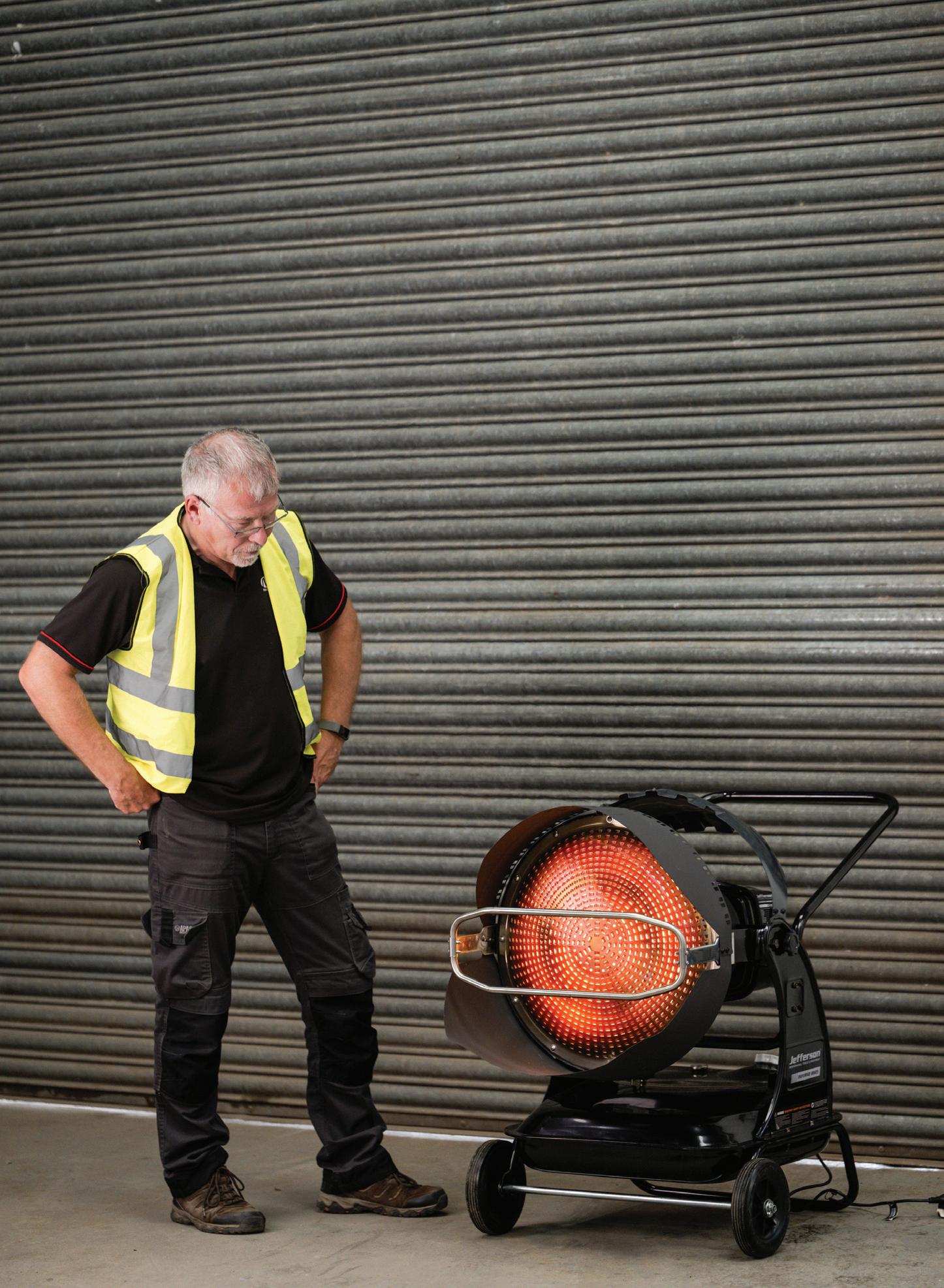
Infrared heating is one of the most versatile options for construction environments. Instead of warming the air, infrared models heat objects, materials and people directly, much like the sun’s rays. This makes them ideal for draughty or semi-open spaces where warm air would otherwise dissipate quickly.
Jefferson’s Inferno Infrared Oil Heater range, available in outputs up to 125,000 BTU, provides fast, even warmth for large workshops or partially enclosed areas.
These models operate quietly and cleanly, using diesel, kerosene or paraffin fuels and their built-in thermostatic
controls and automatic shut-off functions ensure cost-effective, safe performance.
The larger 125,000 BTU model runs for up to 12 hours on a single fill, making it a dependable choice for long shifts or overnight use.
Small or enclosed spaces
For indoor areas where ventilation is limited, such as site offices or welfare units, indirect heating is the safer choice. Jefferson Tools Inferno Indirect Oil
Heaters deliver clean, fume-free heat by separating the combustion process from the airflow. Warm air is channelled through ducting while exhaust gases are
working in winter
vented safely outside.
Unlike infrared models, which heat objects directly, indirect heaters warm the air itself, delivering clean, dry heat without fumes or condensation. They are ideal for occupied spaces where people are working or staying for extended periods and ventilation is limited. Their thermostatic control maintains a steady temperature without constant adjustment, while efficient fuel use makes them a reliable, costeffective choice for longer construction projects through the colder months.
Not every site requires high-output oilfired heating. Smaller workshops, garages and temporary enclosures can benefit from compact, plug-in systems like Jefferson Tool’s PTC Industrial Electric Fan Heaters. Using ceramic heating elements, PTC technology provides steady, odour-free warmth with excellent energy efficiency. Because they produce no fumes, they’re safe for enclosed areas and ideal for maintaining comfortable, controllable heat in smaller workspaces.
The 2800W model offers dual heat settings and a fan-only mode for air circulation, while the 2000W version is lightweight and portable enough for quick
relocation between rooms or work areas. With self-resetting thermostats and powder-coated housings, they’re a reliable choice for enclosed, wellventilated environments where precision heating and safety are priorities.
Fast heat for open sites
When the cold sets in across large, open workshops or partially sheltered sites, space heaters come into their own, offering rapid, high-volume heat output, ideal for drying out equipment or maintaining workable temperatures in vast spaces.
Using a direct combustion process, Jefferson Tools’ Inferno Space Heater range, available in 60, 105, and 150 models, generates immediate warmth, distributing it evenly across large areas. Best suited to well-ventilated environments, each unit is engineered for safety with thermal motor protection, flame control, and heavy-duty steel casing. While only two models feature solid rubber wheels, the lightweight design and integrated handle make the range easy to move, combining mobility with serious heating power.
Ready for the cold ahead
Heating solutions are more than a comfort measure; they’re central to maintaining site safety and compliance. Cold working conditions reduce dexterity, slow reactions and increase the likelihood of slips, trips and mistakes.
There’s a wide range of heaters to choose from and picking the right one will depend on the size of the space, how it’s being used and how long it needs to stay warm. Infrared heaters minimise wasted energy by directing warmth where it’s needed most, electric PTC models provide cost-effective, instant heat for smaller spaces while indirect oil heaters maintain clean airflow where people are working continuously indoors. Every winter brings its own challenges, but with the right equipment, preparation and planning, sites can stay operational and workers protected.
WINTER WORK
With stark temperatures between inside and outside, it is in winter that condensation rears its ugly head the strongest. Preventing condensation takes a joined-up approach, and insulation is a big part of it. David Milner, Technical Team Lead at Celotex, shares more about why smart insulation choices, backed by expert guidance, are key to keeping moisture at bay and present a lucrative opportunity for home improvements during the cold season
Effective condensation control in buildings can be summed up as a three-pronged strategy: insulate correctly, provide adequate ventilation and manage the movement of moisture.
QWhat causes condensation in buildings, and why is it a problem? When we talk about condensation risk, we are really talking about two different types of condensation, surface condensation and interstitial condensation.
Q
What is surface condensation?
Surface condensation refers to moisture that forms on the surface of a building element when warm, humid air comes into contact with a cooler surface. It may occur as a light dampness or, if the accumulation of moisture is large enough, it could form into droplets that run down the surface. This process occurs when the surface cools the surrounding air below its dew point temperature, the point at which air can
no longer hold all its water vapour, causing condensation to form on the surface. The dew point varies depending on the air’s temperature and relative humidity. Window panes are the most obvious example of surface condensation occurring, because window glass is usually significantly cooler than other surfaces. If a wall or ceiling is cool enough (or the air humid enough) for condensation to occur on its surface.
QWhat is interstitial condensation?
The same principles apply here to moistureladen air coming into contact with a cooler surface. The difference is that interstitial condensation refers to the process occurring within the layers of the building fabric, rather than on exposed surfaces. The obvious problem is that the condensation is unseen. Over time, this can wet materials within the building’s structure. Thermal insulation materials can lose performance if they become wet; timber elements can begin to decay over
For interstitial condensation to occur there must be some failure in the vapour-closed nature of the construction, there may be a penetration of the AVCL. This allows air and moisture to pass into the construction. That air then needs to meet a cooler surface to the external side of the insulation layer. Poor installation of insulation, which leaves gaps or voids, can also allow warm air to circulate to cold surfaces and increase the condensation risk.
QHow do U-values and thermal performance relate to condensation risk?
Airtightness is therefore also critical, alongside an appropriate insulation specification and effective ventilation to maintain air quality and remove excess moisture.
Among the measures that can be employed to control condensation are raising temperatures: either of the air, or of building element surfaces.
A well-insulated building slows heat transfer, but heated air movement must also be considered. If there are pathways in the fabric that allow warm air to escape, a significant proportion of heating energy can be lost through air leakage (exfiltration) and the entry of cold air (infiltration).
Better-insulated building fabric with lower U-values slows the rate of heat loss and keeps surface temperatures warmer. When surfaces are warmer, humid air is less likely to cool below its dew point on contact, making surface condensation less likely.
QWhat are the best insulation solutions for condensation control?
Insulation that achieves lower U-values plays a key role in reducing condensation risk, beyond just meeting minimum regulations.
Thermal bridges are areas in otherwise well-insulated building fabric where the
“Better-insulated building fabric with lower U-values
continuity of insulation (and possibly of vapour control measures too) is interrupted.
Discontinuity of insulation in the building envelope can create pathways for heat loss, which lower local surface temperatures and increase the risk of condensation. And where insulation is not continuous, these cooler surfaces can become prime spots for surface or interstitial condensation.
Getting thermal bridging right is just as important to condensation control as it is to complying with energy efficiency requirements. Little wonder, then, that BS 5250:2021 Moisture management in buildings - Code of practice provides detailed guidance on the importance of junction detailing and its role in moisture management.
Why finding the right insulation boards can help with thermal bridging solutions
When detailed correctly (including fixing details, service voids and vapour control measures as necessary), the right insulation boards can help to provide the continuous layers of insulation that limit the transfer of heat, reduce air leakage, and help maintain warmer internal surface temperatures.
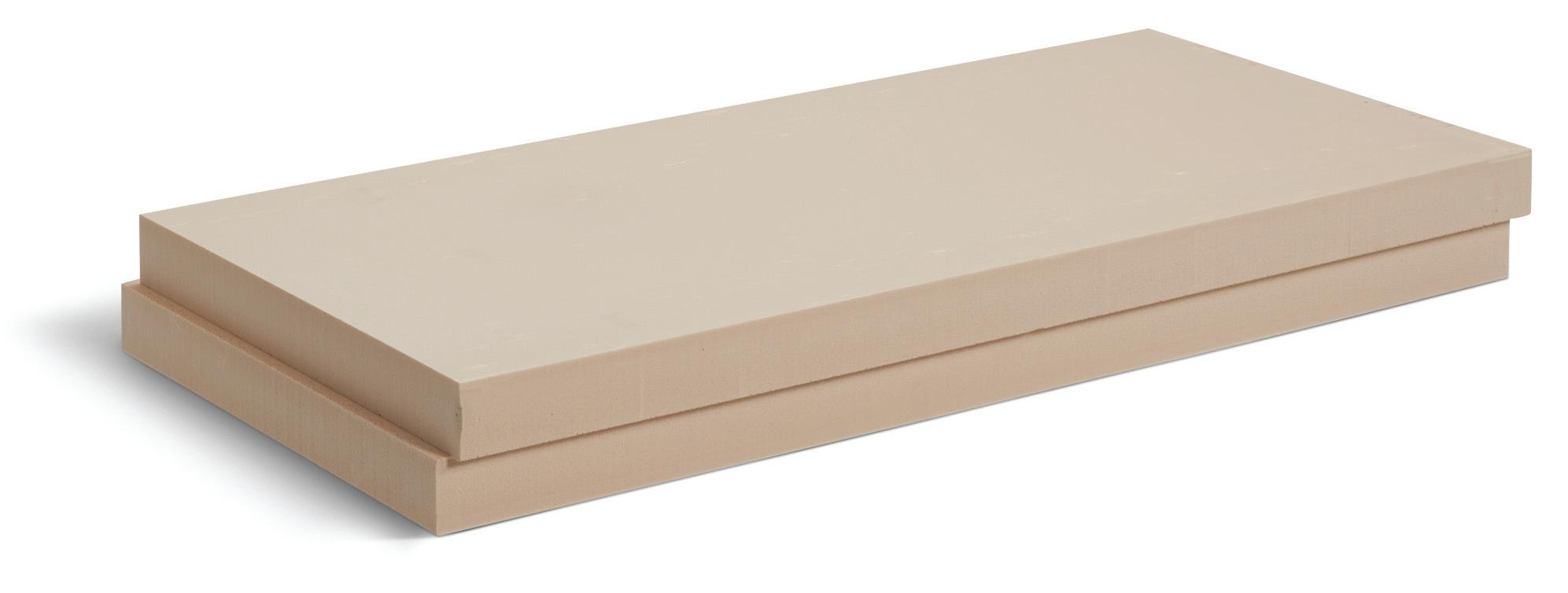
Celotex’s range of PIR insulation boards – including GA4000 and TB4000 – can be specified for floors, walls and roofs to help achieve low U-values. Try the Celotex online U-value calculator, which includes a built-in condensation risk analysis, to accurately assess condensation risks. – can be specified for floors, walls and roofs to help achieve low U-values. Try the Celotex online Uvalue calculator, which includes a built-in condensation risk analysis, to accurately assess condensation risks.
With darker nights rolling in and the risk of tool theft increasing, PB talks to Van Guard about the top tips for keeping your van safe
EN GARDE!
New data from Simply Business has shown that tool theft cost UK tradespeople as much as £294 million in 2024 alone. Indeed, this particular form of crime seems to be growing in impact with added van security becoming a necessity rather than
providing the perfect cover for their unscrupulous acts. With this in mind, we spoke to the experts at Van Guard for their top tips for upping your van security.
A combined approach
Unfortunately, there isn’t just one easy
the reality is thieves will have a knowledge of multiple weak points and methods; be that tampering with locks or attacking the body of the vehicle. The secret to upping van security and making your tools all the harder to take is to use a combined approach.
It is precisely for this reason that Van Guard Accessories offers a wide range of solutions to back each other up. Read on to hear about the security essentials worth considering:
Slamlocks
Anti-Peel Bracket
Hooklocks
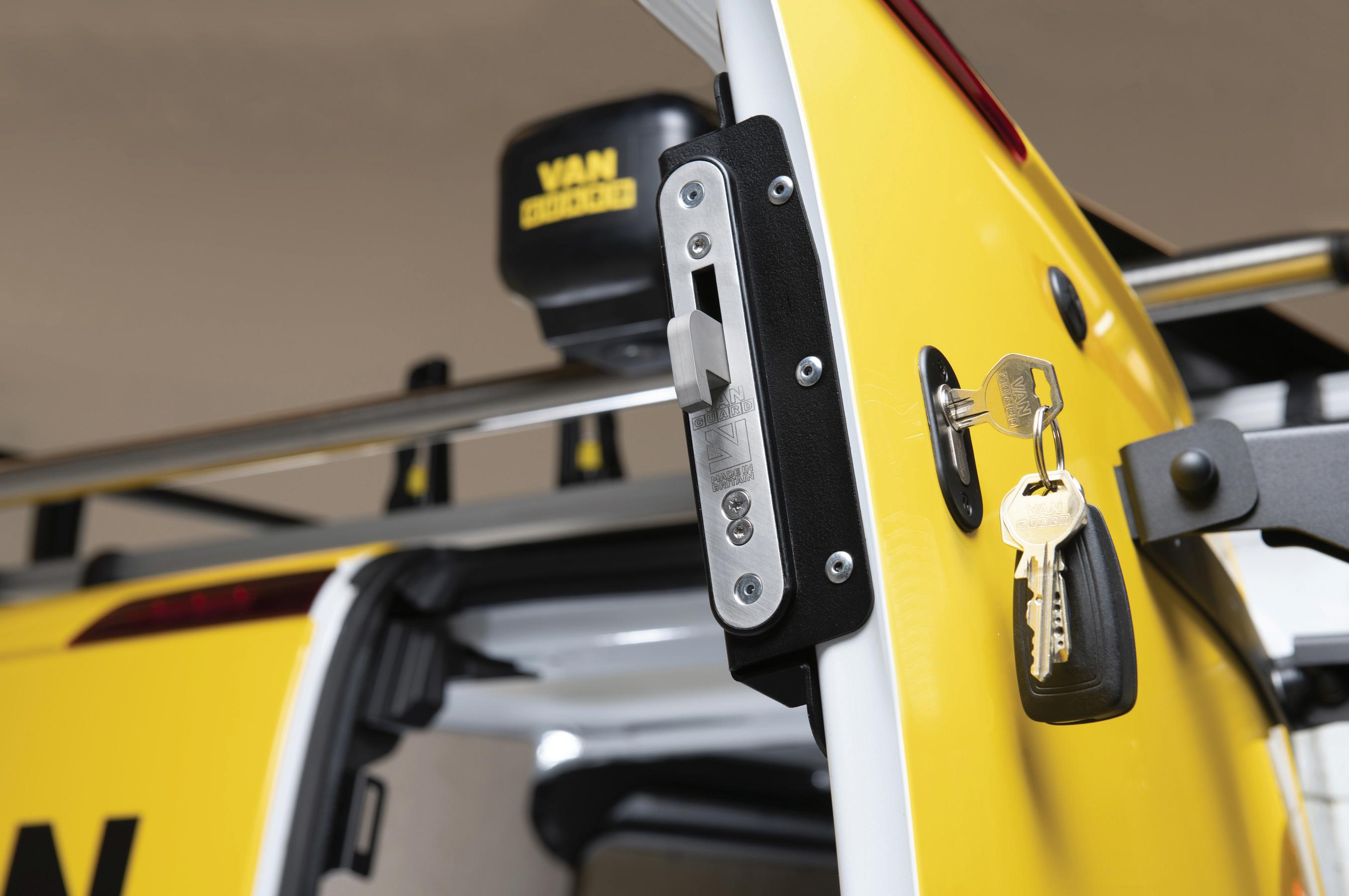
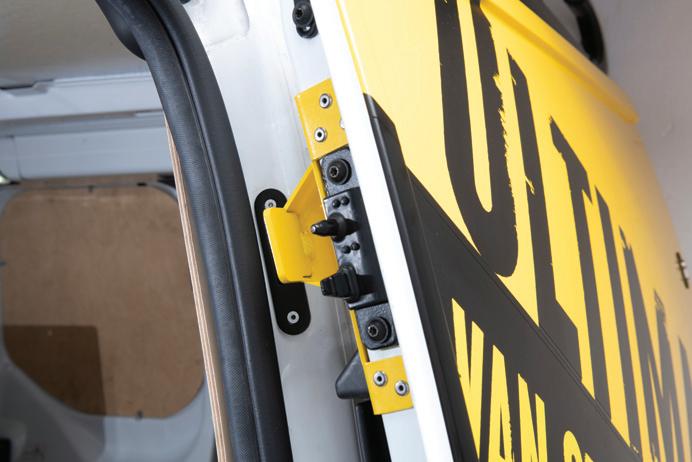
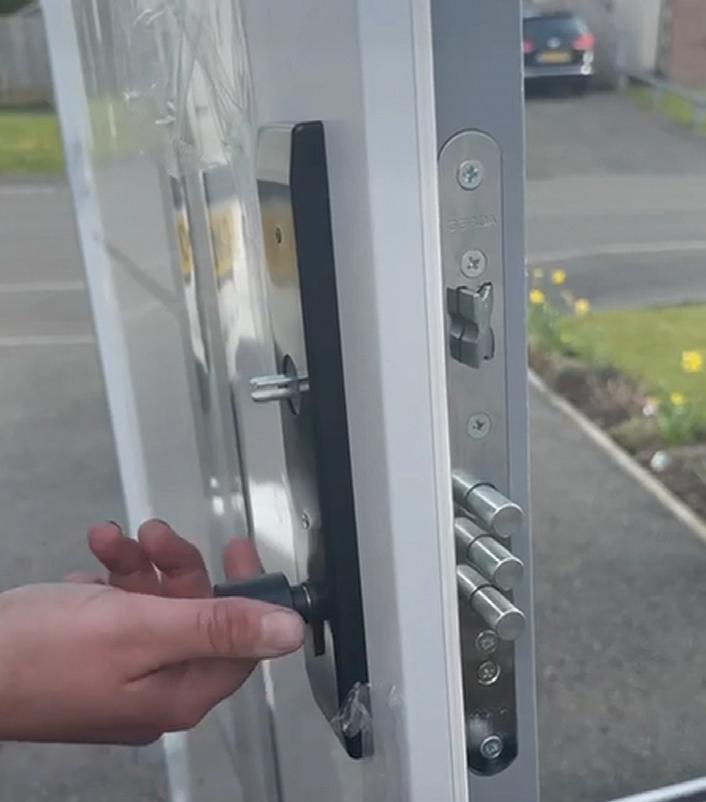
The ULTILock Hooklock is a high-security, hook-style bolt that locks into a reinforced receiving bracket, making it significantly more resistant to brute force attacks using hand tools or leverage. Fitted as an extra to the van’s factory locks, hooklocks work as a strong show of force to deter attempted entry. With a first of its kind Sold Secure Gold status and police preferred Secured by Design accreditation, the ULTILock Hooklock presents a strong security upgrade. Being externally mounted, the hooklock is also designed as a deterrent. The longer it might take for thieves to break in, the more they may think twice about whether it’s worth the hassle.
The ULTILock Hooklock at a glance
✔ Gold Standard Security
✔ Antidrill and antisnap casing
✔ Cylinder resistant to pick, bump and drill attacks
✔ Controlled key system with three keys included per lock
✔ Precise, vehicle specific fitment for major van models
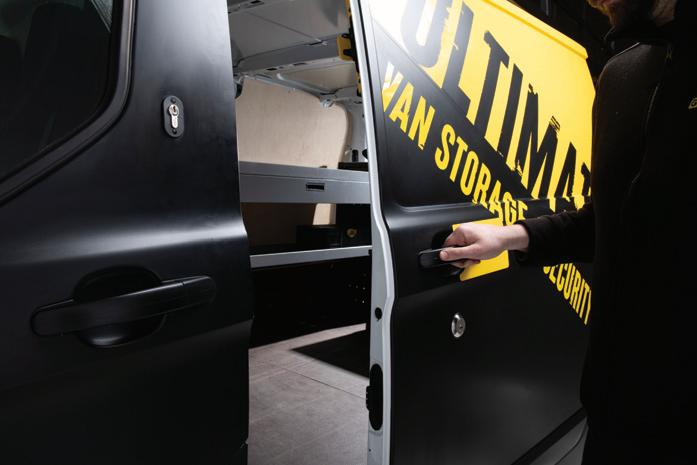
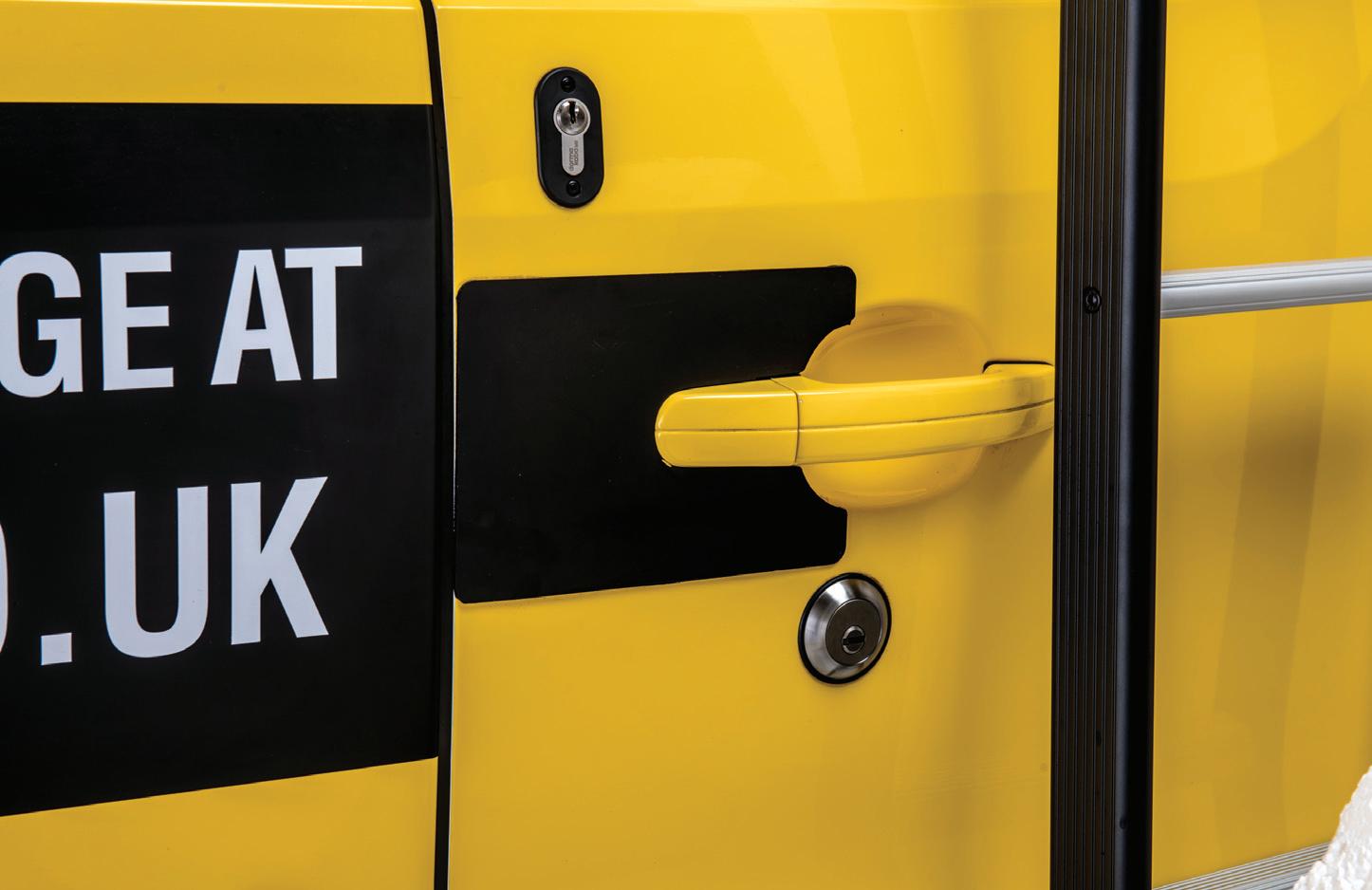
Hooklocks aren’t the only lock options for the security conscious. Van Guard also has a deadlock alternative. Featuring a straight bolt, a secure dimple key to guard against lock picking and Silver Standard Sold Secure rating, this offers reliable protection for just about every van in the UK market. Slamlocks too, present a different option and will automatically lock the doors when they’re closed.
Despite their designed strength, locks themselves may not be enough. After all, a lock alone might not cut it if someone decides to just drill a big hole in the side of your van. Mechanical locks combined with shielding components such as loom guards, anti-peel brackets, and internal cable shields can all work together to make it as difficult as possible for potential attack.
Shielding
Van security is made all the more difficult by the thieve’s ability to innovate their methods; a challenge that security manufacturers are constantly rising to. One such example is cases where thieves
drill through door panels to get to internal locking cables. It’s with this in mind that Van Guard have created a range of internal and external shielding options, made from 304-grade stainless steel. Internal shields are best placed behind door skins or near lock mechanisms to act as barriers and prevent entry even if the outer body is damaged. Meanwhile, external shields work twofold: a visible deterrent to potential thieves and a costeffective repair option after an attack. This avoids the expense and downtime of replacing entire panels or doors. It’s a clear sign that your trusty workhorse won’t go down without a fight.
A complex crime
As a tradesperson, time is money. It’s that factor that makes tool theft an even crueller form of crime. If a van is broken into, it’s not just what’s been taken that’s a consideration. Chances are, the van in
Here’s a handy breakdown of what shielding can be used to help against break-in:
Handle Shields
✔ Protects the area around the OEM handle against attack
✔ Guards internal locking mechanisms
Internal Shields
✔ Discreet added protection
✔ Made from high-grade 304 steel
External Shields
✔ Protects against attacks to vulnerable areas of the door
✔ Can act as repair plates after an attack
Loom Guards
✔ Protects easily accessible wiring looms from being cut
✔ Easy, no-drill fit
Anti-Peel Brackets
✔ Protect against ‘peel and steal’ attack method
them in your van if there’s a gaping hole inthe side of it to invite further opportunists. While this guide isn’t the one silver bullet to stopping tool theft and ensuring it never happens, it certainly makes a good start. Prevention and deterrents are always better than trying to fix the damage after it’s already been done.
FEEL THE FREEZE!
There’s always a lot more pressure to fix a heating system as quick as can be in winter compared to the summer. Nobody likes being stuck in the cold. Be that your customers or you, working on a job. Time is money in the trade so the quicker you can say job done the better.
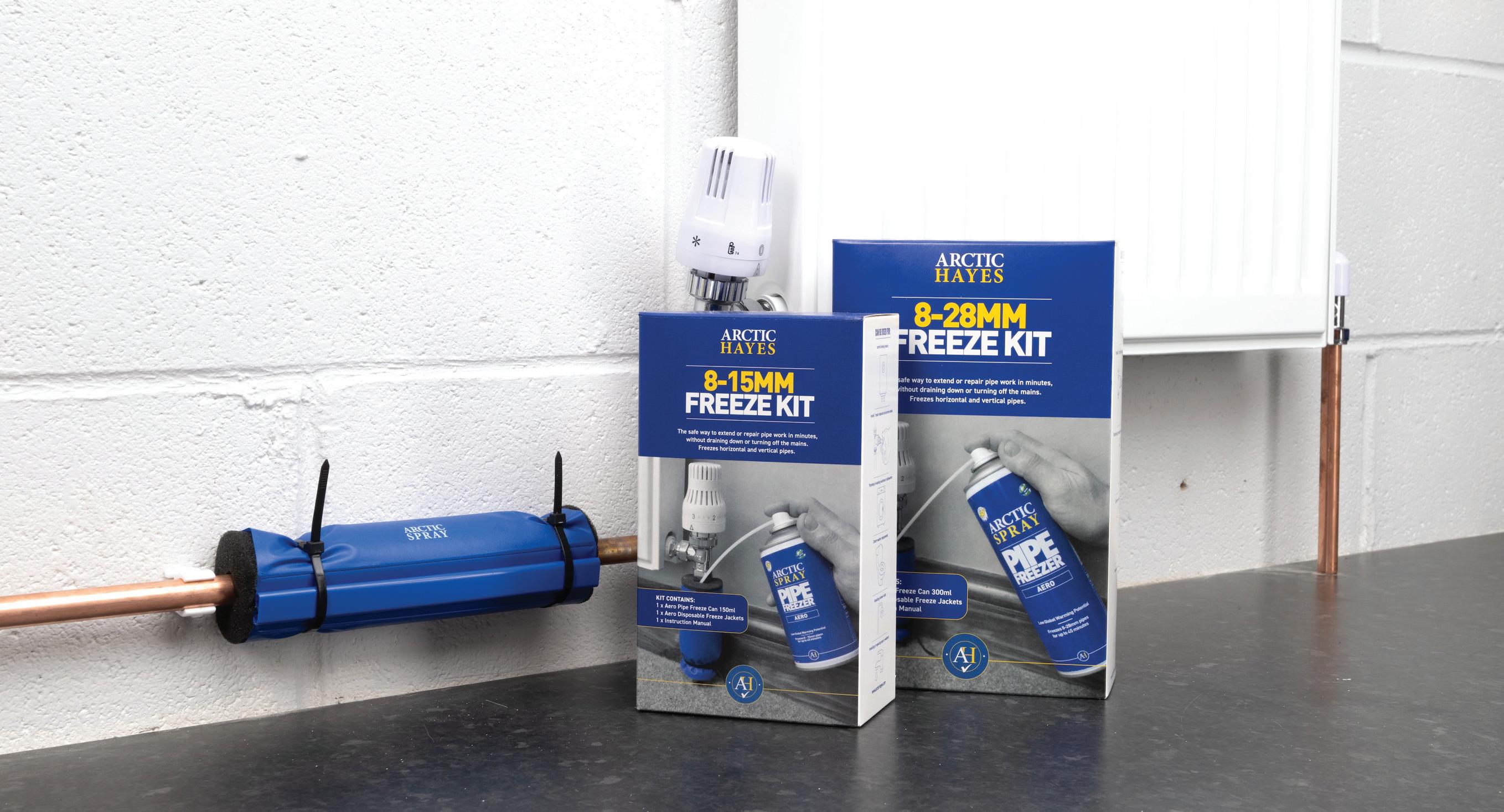
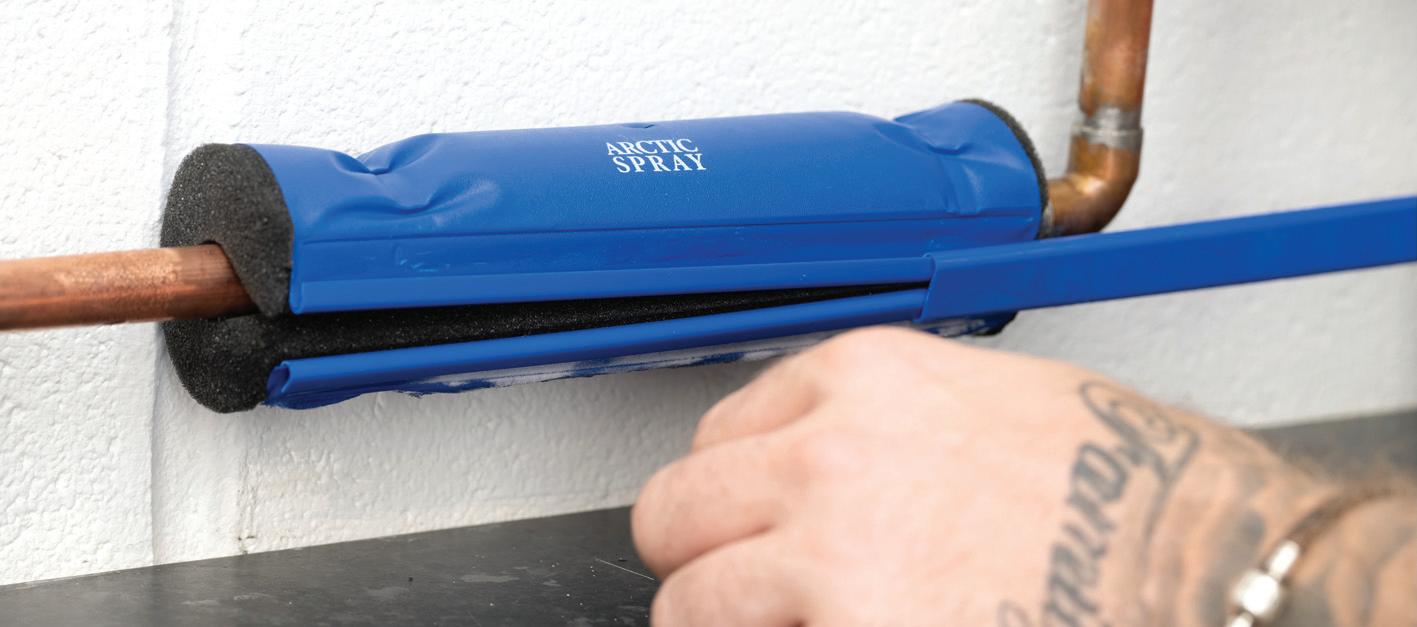
Arctic Hayes’ Pipe Freeze kits have been trusted by professionals for nearly 60 years, since its original patent in 1966. The company says its Pipe Freeze kits can reduce job time by an average of 85 per cent, based on a two-hour drain down and refill while on a standard 15mm copper pipe, the Professional Pipe Freeze kit can also freeze pipes for up to 45 minutes.(subject to pipe dimension)
The easy-to-apply Freeze Spray forms a temporary ice plug in the pipe so that work can be carried out with a minimum of disruption. There is no need to locate a stop-cock or service valve and it also reduces the potential for water spillage and property damage. There are three different types of kit in the range; ‘Aero’, ‘Professional’ and ‘Electric’, with each kit catering for a range of pipe sizes and a number of applications. The kits are simple to use and can freeze pipes in just a few simple steps.
Repairing pipework can mean hours in the cold draining down an entire plumbing system. PB gets to grips with a solution that saves you and your customers time out on site
STEP BY STEP
Step One
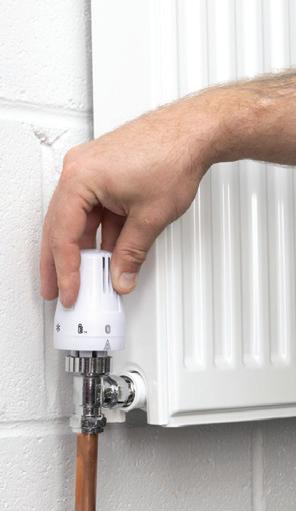
Set up involves switching off the pump to ensure the water is not flowing and closing any valves. The system temperature should be cool, ideally below 20 degrees Celsius.
Step Two
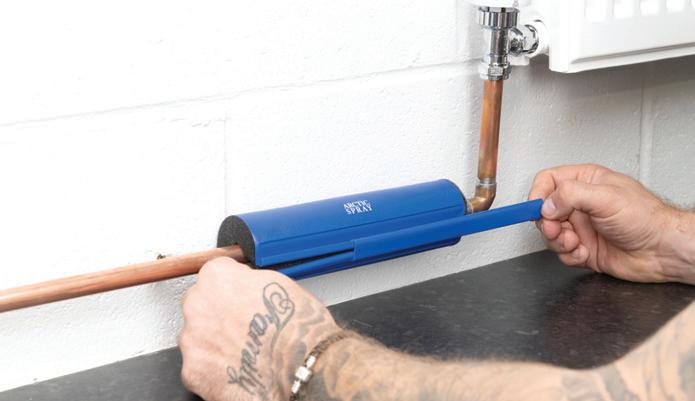
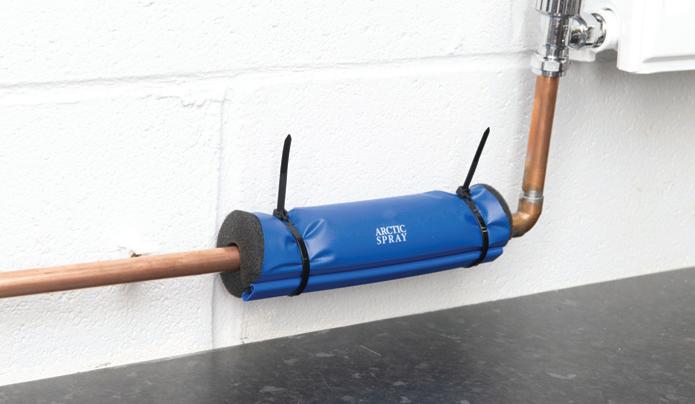
Attach the freezing jacket to the pipe, ensuring it’s as secure as possible. Fit the cable ties provided to each end and tighten.
Step Three
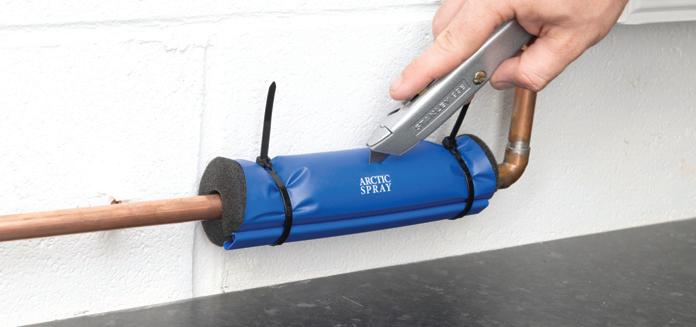
Make a small incision in the top. Take the can of Pipe Freeze and add the nozzle to the can and you’re ready to go.
Step Four
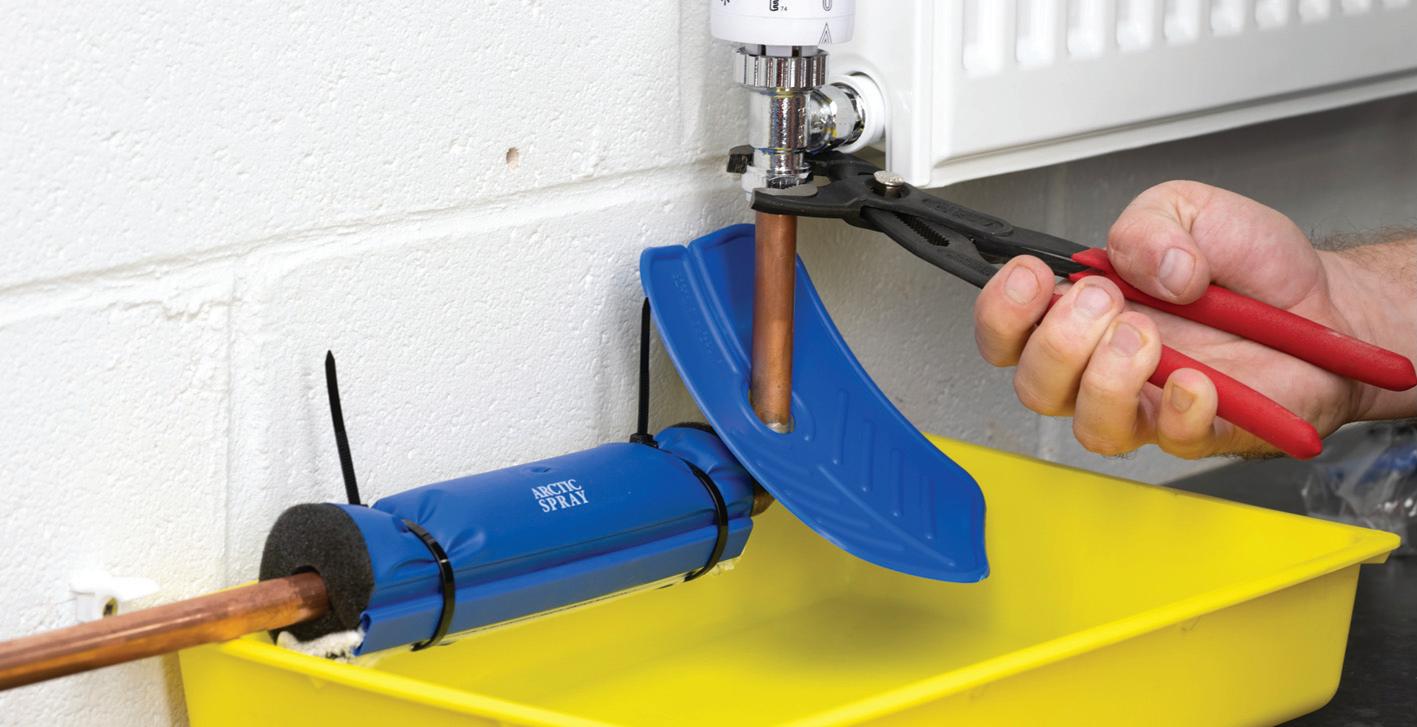
Insert the pipe into the jacket and spray for around 10 seconds. Leave for a few seconds to avoid any flooding in the jacket (you’ll see refrigerant leaking out the jacket if you spray too much). Repeat until you have used the dose indicated on the side of the can or you hear the click sound, which indicates the ice plug has formed. Wait a further five minutes, or 10 minutes if the pipe is plastic.
Step Five
Now you can safely carry out your job with no need to drain down. Pipe freezing reduces your total job time by up to 85% on average.
Step Six
When you’re finished, it’s time to remove the pipe-freezing jacket. Cut the cable ties off and remove the jacket. Always allow the jacket to defrost and dry before packing away. This will help prolong the life of the jackets.
There are three different types of kit in the range; ‘Aero’, ‘Professional’ and ‘Electric’. Each kit caters for a range of pipe sizes and number of applications. Choosing the right one for the job at hand is easy – Arctic Hayes has a ‘Find Your Freeze’ selector tool on its website to make finding the right Pipe Freeze product even easier.
The Pipe Freezer ‘Aero’ is a disposable kit featured in this step-by-step guide and contains enough refrigerant to perform one or two freezes on pipework up to 28mm and can be used for jobs such as changing a radiator valve, replacing a stopcock or other service valves.
painting, decorating, sealants & adhesives
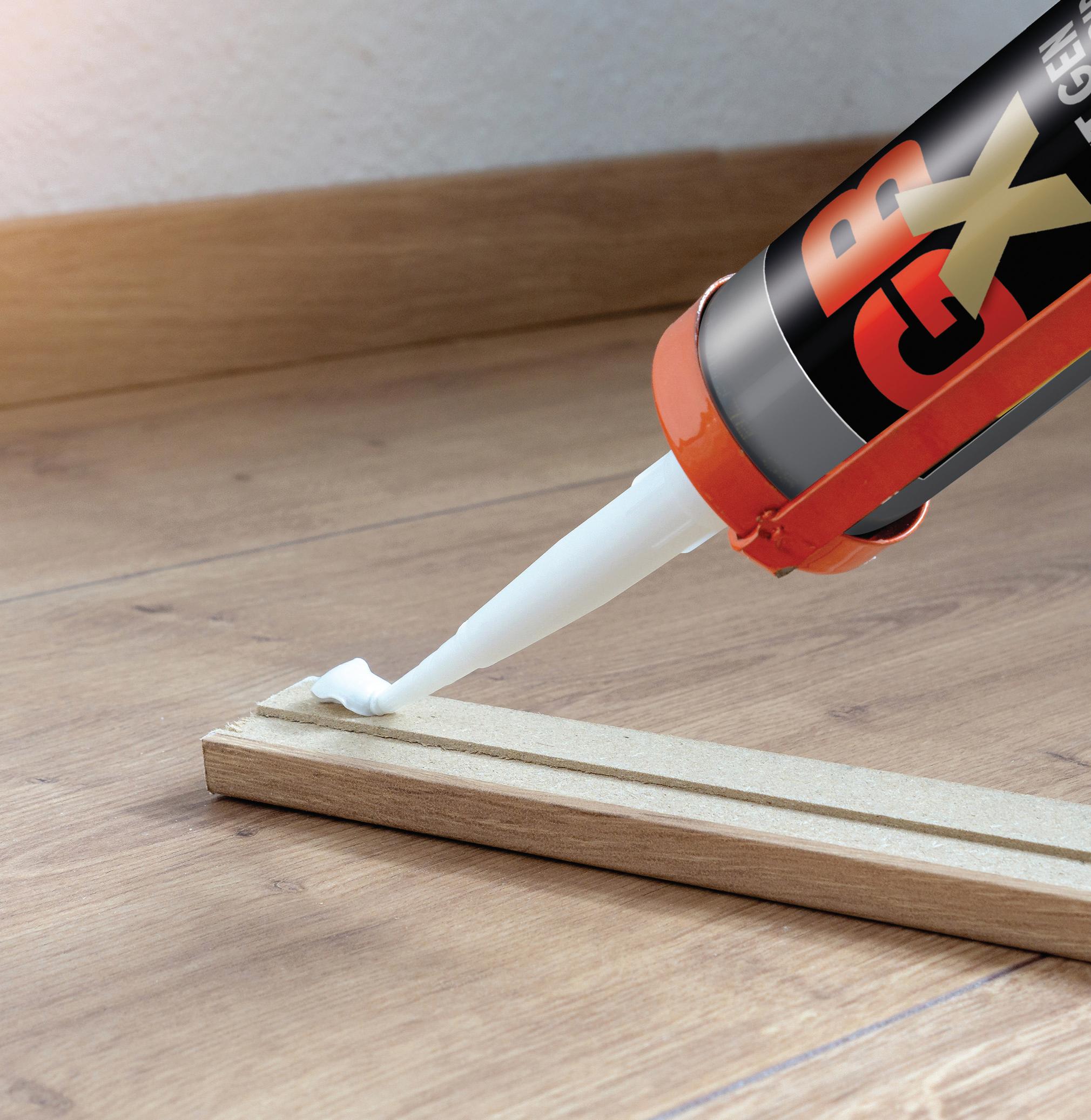
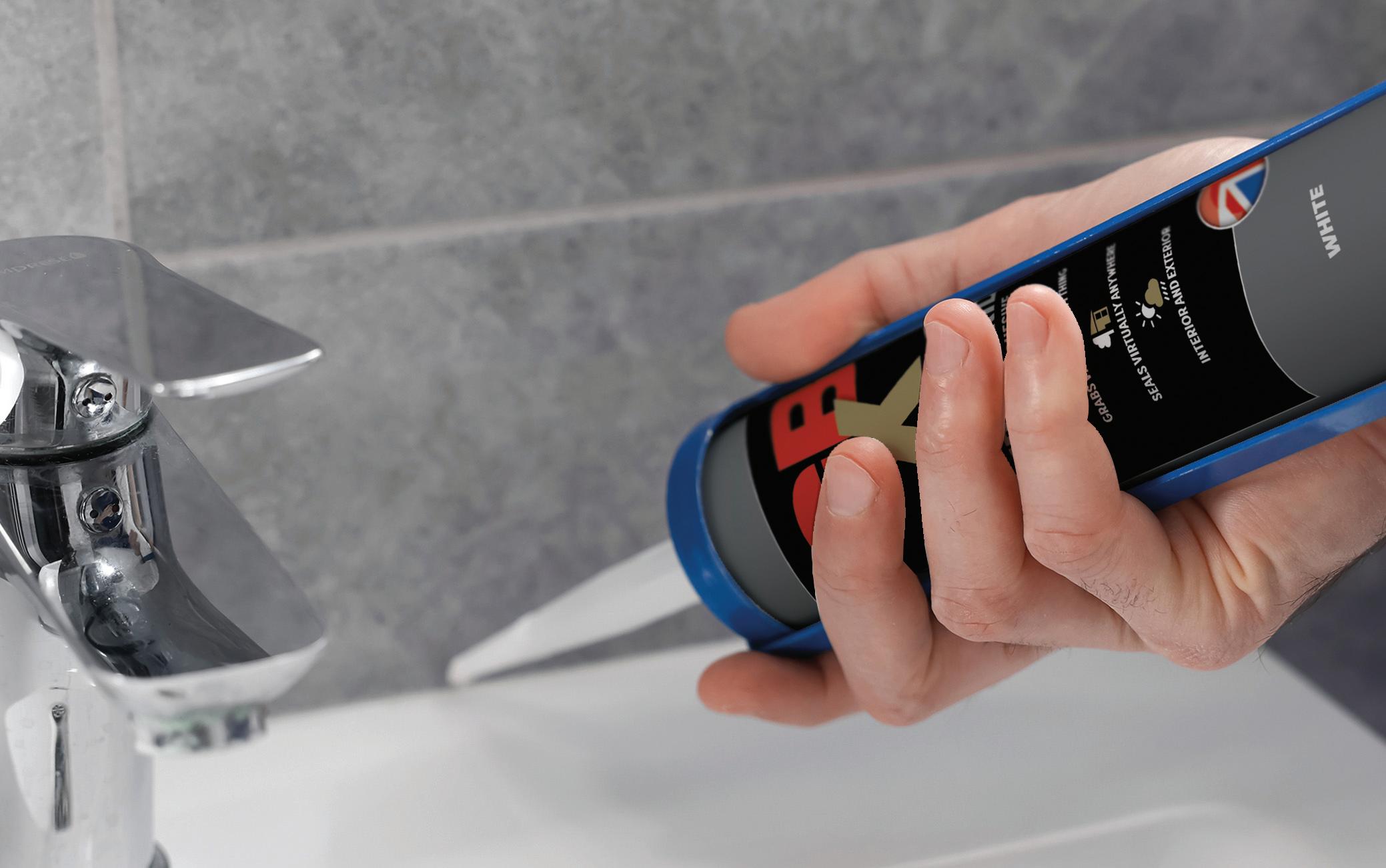
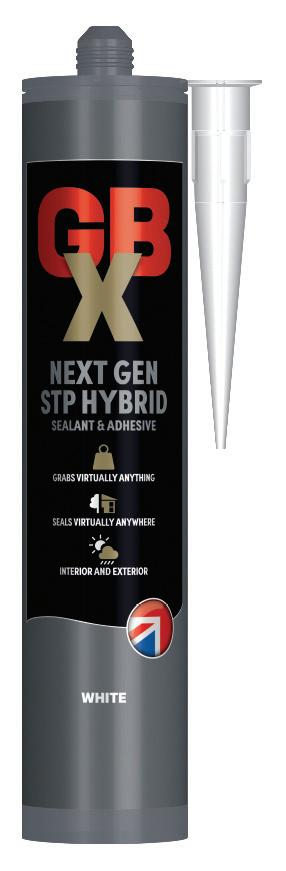
Throughout its history, Bond It has created more than its fair share of cutting-edge sealants and adhesives. Its latest product looks set to maintain that track record. Professional Builder learns more about the launch of GBX
GENERATION PERFORMNCE NEXT
the evidence of how advances in technology are continuing to improve our day-to-day lives can be found everywhere. The job site is no exception but if you think that leaps forward in capability are limited to our more glamorous bits of kit
that’s helping to spearhead this evolution.
“Innovation has continued to be central to Bond It’s longstanding success as one of the UK’s leading manufacturers of sealants, adhesives and building chemicals” explains Ian
market - including some of the very first hybrid sealants and adhesives.
“The launch of GBX continues that tradition of developing new and next generation products able to deliver trailblazing levels of performance.
“GBX is a tool bag essential and an ideal solution for most sealing and bonding tasks encountered by builders, joiners, plumbers, tilers, roofers, window fitters and maintenance contractors”
The next step in hybrid technology
GBX builds on the success of Bond It’s hybrid sealant and adhesives which offer all of the benefits of silicone and polyurethane products but with none of either materials’ drawbacks.
Thanks to their ability to deliver the very best of both worlds, hybrids have become the go-to choice for a wide range of trades and an even wider range of tasks.
GBX is a next generation hybrid with advanced characteristics.
It has been created in line with Bond It’s commitment to ongoing product R&D and its production is made possible thanks to the manufacturer’s investment into new and state-of-the-art manufacturing technology.
“The launch of GBX is a milestone in the development of hybrid sealants and adhesives” comments Ian.
“It uses a base polymer developed by Bond It and which we can produce entirely in house. This complete control has enabled us to tailor GBX’s formulation so
precisely that it can set new standards in a whole host of ways.”
A tool bag essential
Bond It has given careful consideration to ensuring GBX delivers remarkable performance in all the areas that are important to today’s trade professional.
Specifically, it has been engineered to offer an impressive combination of better than ever levels of adhesion, flexibility, tooling, resistance and durability. Best of all, these new benchmarks in capability can be enjoyed across all manner of applications.
GBX can bond to practically every material, regardless of whether it’s porous or nonporous. That means it can be used on metals, masonry, glass, plastic, ceramics, timber and much more.
GBX is also UV and water resistant and can be effectively applied to wet surfaces and even under water to stop leaks. As such, it is suitable for both
interior and exterior use.
In addition, GBX is over-paintable, highly flexible and will not crack or shrink. It also contains a biocide, which retards mould and mildew growth, making it suitable for sanitary applications and has been ISEGA certified as safe for use in food production, packaging, and preparation areas.
Plus, GBX contains no solvents or isocyanates. Consequently, it is odourless and emits fewer VOCs (volatile organic compounds) contributing to improved health and safety and reduced environmental impact.
“GBX is a tool bag essential and an ideal solution for most sealing and bonding tasks encountered by builders, joiners, plumbers, tilers, roofers, window fitters and maintenance contractors” adds Ian.
“We are excited by its potential and by its enormous possibilities. We are sure that following its recent launch, it will give the trade plenty to get excited about too.”
FACE LIFT
PB looks at a historic home that has been transformed into a modern dual residence with Crown Trade’s timeless tones
Sheffield-based RGR Construction has completed the conversion of an impressive nine-bedroom residential property into two semi-detached homes, the first has also been fully renovated and is on the market for sale.
Led by RGR founder Roger Raven and his wife Amanda, who directed the interior design, the project brought together thoughtful spatial reconfiguration with specialist product and colour support from Crown Paints.
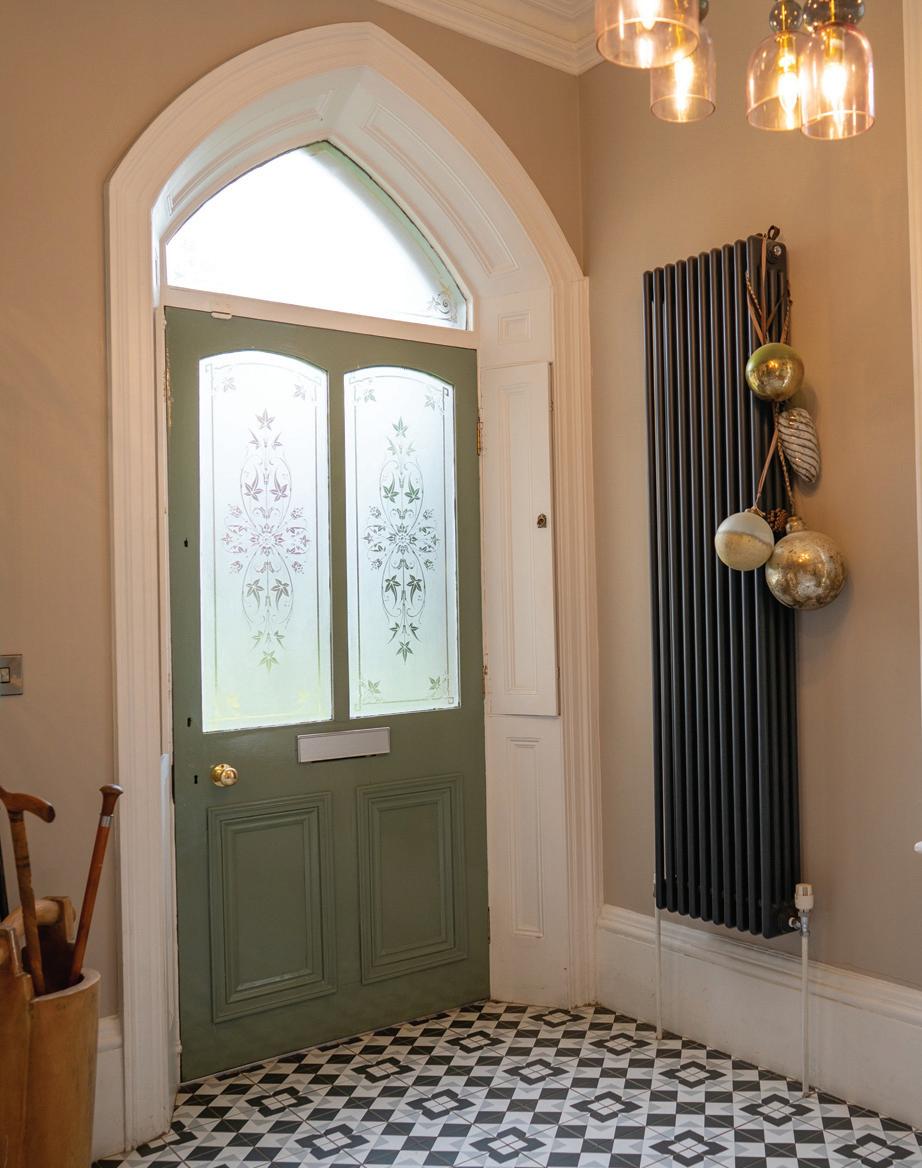
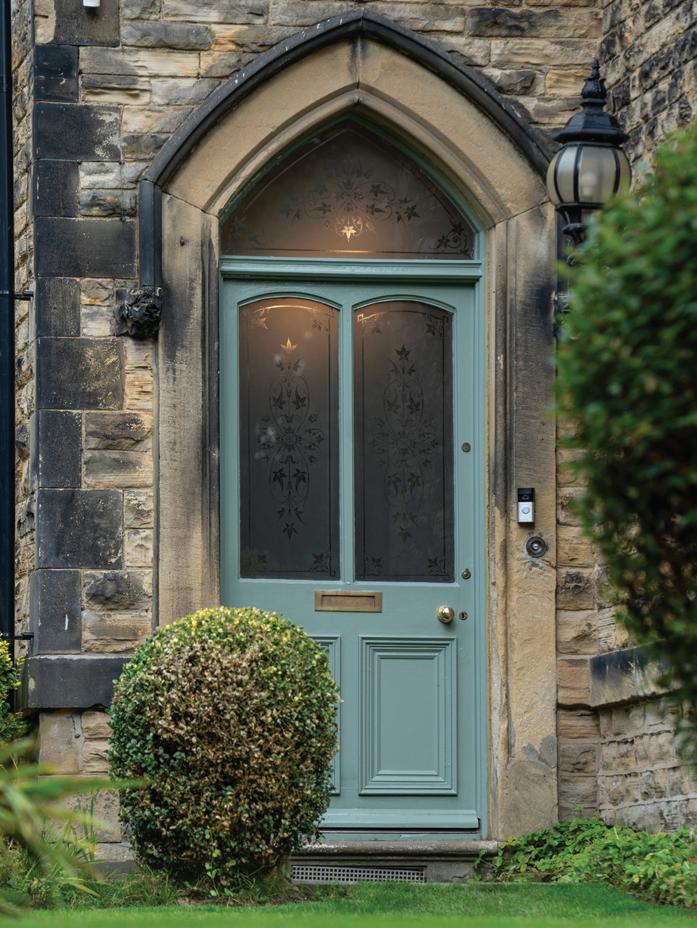
The period character and charm of the 1860 house in Beauchief, near Sheffield, has been carefully preserved, while the house has been split into a four-bedroom and five-bedroom home, which are practical and well suited to modern living.
To begin the transformation, the interior was stripped back to bare brick. Original features such as doors, stone flooring, wooden shutters, servant bells, and decorative coving were carefully
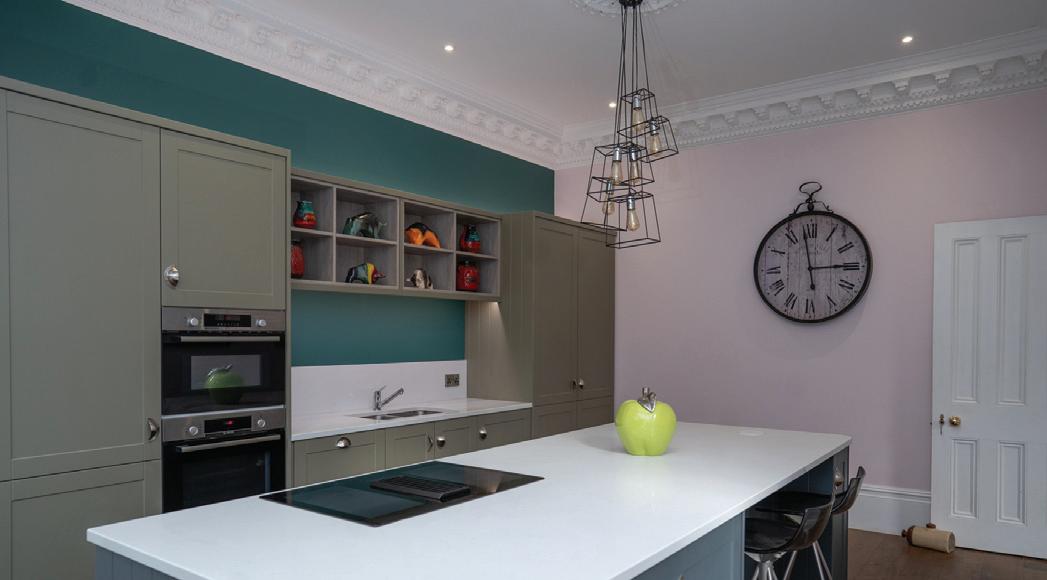
preserved wherever possible. In areas where details had been lost – including sections of coving in the kitchen –authentic replacements were sourced from specialist suppliers. One standout detail is the use of coving inspired by designs found in Winston Churchill’s Cabinet War Rooms.
Working closely with Sarah Taylor, Manager at Crown Decorating Centre Chesterfield, Amanda developed a bespoke palette using Crown’s advanced colour match technology. The aim was to highlight the property’s heritage features while ensuring visual harmony across both homes.
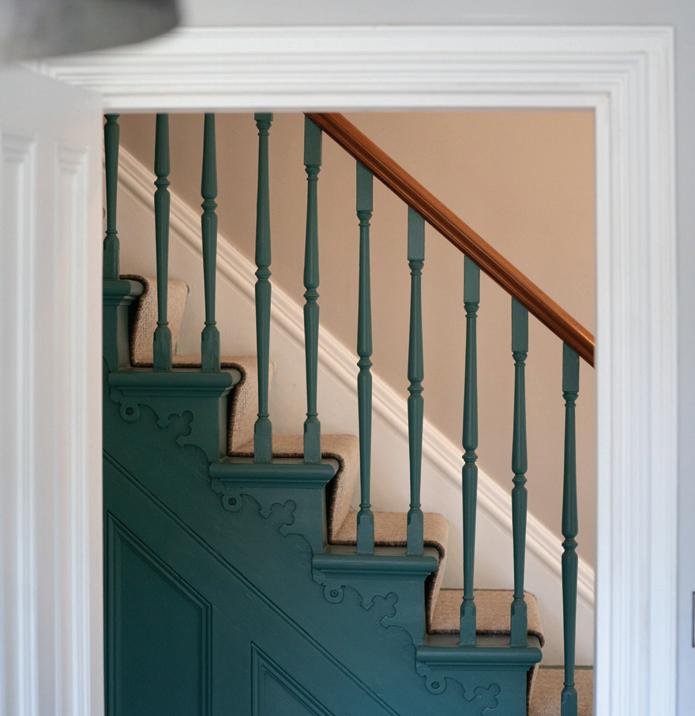
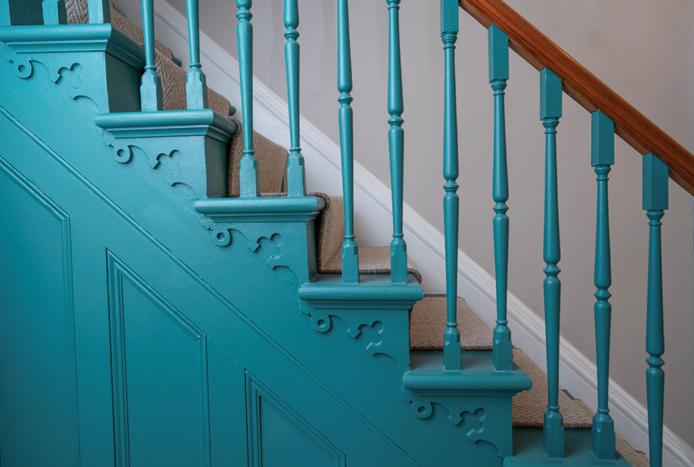
The resulting palette – which included clay tones, white, and green – delivered a refined balance of tonal contrast and cohesion. Bold shades were used to emphasise architectural focal points, such
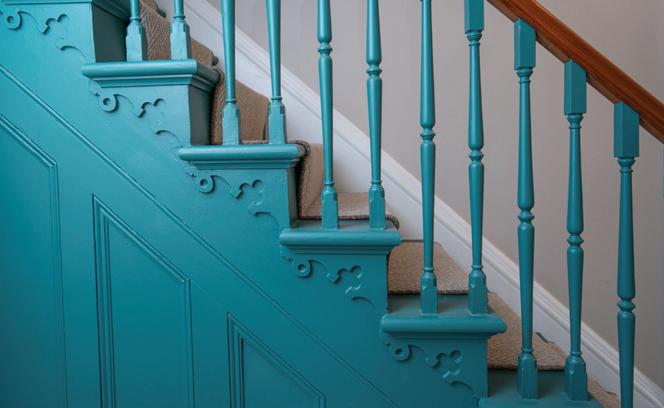
as the statement staircase and feature kitchen wall in a blue-based green, Collage, while Crème de la Rose, a warm blush-pink, and East Village, a putty-toned beige, were used to link transitional spaces and establish a sense of calm, continuous flow. This thoughtful use of colour highlights period detailing while grounding the interiors in a fresh, contemporary scheme.
A comprehensive specification of Crown Trade and Mcpherson products
supported the renovation across internal and external surfaces. This included durable finishes for high-traffic areas, quickdrying trim solutions, and robust masonry paints for the exterior – each chosen for its performance, ease of application and long-lasting finish. In total, approximately 283 litres of Crown Paints products were used.
Amanda Raven, who led the interior design, commented: “Crown Paints played a central role in helping us realise our design vision. Crown Trade is a longstanding partner of ours and was the obvious choice for this ambitious renovation –helping us throughout the colour selection process and ensuring each space was tailored to suit the property’s character.
The colour matching service meant we could be really specific, and still get the exact shades we wanted for every surface – inside and out – often within a day of placing the order.”
Sarah Taylor, Manager at Crown Decorating Centre, Chesterfield, said: “It was a pleasure to support Amanda throughout this project. Her clear design vision made for a really creative collaboration, and together we were able to build a scheme that felt both timeless and personal.
“With Crown’s advanced colour matching capabilities and the breadth of the Crown Trade portfolio, we were able to specify finishes that balanced design integrity with robust performance –ensuring the finished result honoured the property’s character while meeting the demands of modern living.”
painting, decorating, sealants & adhesives
PAINT THE TOWN GREEN
Jason Burns, MD of Shurtape UK, looks at the ways in which builders can bring sustainability into their painting and decorating services
Painting and decorating is a reliable repeat service for professional tradespeople.
On average, British consumers redecorate their living spaces once every 25 months, which makes for consistent demand and regular work for professionals. This is reflected in the fact that the UK painting industry is currently valued at £3.5billion, with around 80,000 painters and decorators in the UK, according to UnionLearn.
There have been some changes within
A report from The Roundup last year revealed that 78% of people feel that sustainability is important; 62% of people say they “always or often” seek products to purchase because they are sustainable, 55% of consumers are willing to pay more for eco-friendly brands and a whopping 84% of customers say that poor environmental practices will alienate them from a brand or company.
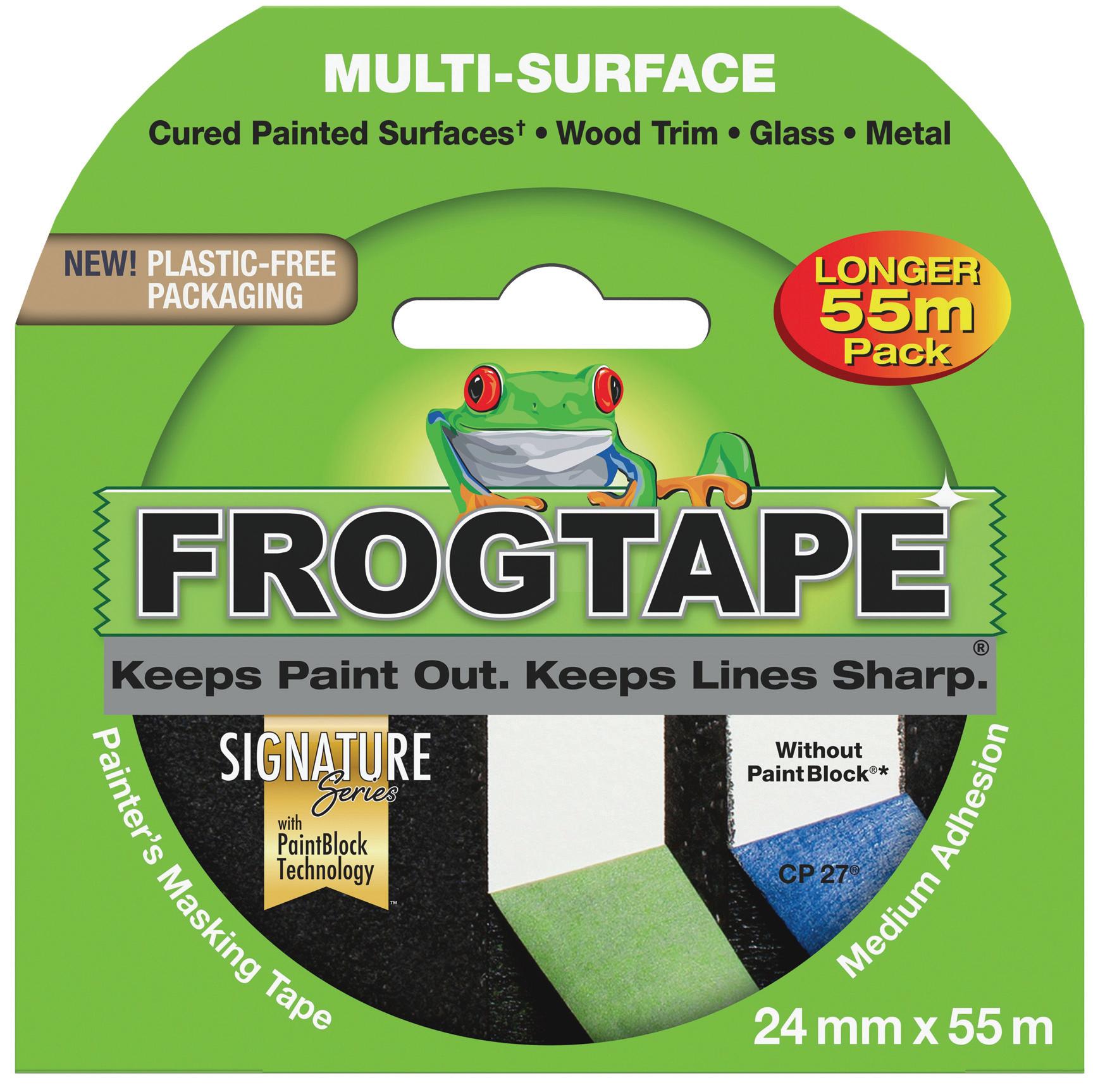
It’s something that we are very aware of at Shurtape. We provide a range of decorating tapes as well as DIY and
masking tapes, and it’s our job as a market-leader to strive to improve and be more eco-friendly wherever we can be. We use FSC-certified paper for our FrogTape decorating tapes and a hot melt adhesive system, so we’re offering a much more sustainable solution without diminishing the quality of our products. And we have just invested in replacing our FrogTape plastic containers with more sustainable cardboard packaging, which is rolling out over the coming months. Changing the iconic containers is no
small move. The priority for our packaging is of course to protect the popular product, as it’s stored and transported on a global scale and needs to perform as it is expected to: delivering straight lines without paint bleed. But it’s also important to recognise the importance of using renewable and recyclable materials as much as possible. So we’ll be eliminating thousands of kilograms of plastic annually with the launch of these new cardboard packs, which are created from environmentally responsible FSC certified paper board. They’re easy for merchants to stock and will still provide on shelf standout, through our recognisable colours, and will still also communicate brand messages and info on production, usage, storage and responsible disposal.
Small changes all make a difference. To quote Mondi, a leading expert in sustainable packaging, “Paper where possible, plastic where needed.”
The UN has set 17 sustainability targets to meet by 2030 - and this impacts on all decisions going forward. Business and consumer audiences are more aware of making responsible decisions and for younger people entering the housing market, this could become even more high on the list –climate change is the number one concern for Generation Z. According to Uswitch, 76% of UK potential home buyers now actively seek out
sustainable features when looking for a property, so when providing a painting and decorating services, tradespeople can look to include the following:
■ Low VOC paints
Most paint brands promote their low VOC
■ Reclaimed wood
Working with salvaged wood is great way to balance out the use of new timber and something that consumers look for if they are replacing banisters or installing panelling or shelving.
■ Bamboo products
This fast-growing resource is renewable and proving to be an excellent material in flooring, furniture and textiles as well as smaller painting accessories such as handles and trays.
■ Recyling centres
Take-back programmes and local paint disposal centres are important to ecoconscious consumers and usually quite convenient for tradespeople to find.
Encourage upcycling
Helping customers choose timeless designs and working with them to upcycle furniture wherever possible will not cannibalise the core workload, instead it expands your offering while reducing waste and encouraging the longevity of products through repurpose and re-use.
By adopting sustainable building practices –using eco-friendly materials, improving energy efficiency, and reducing waste –builders can help protect natural resources, lower greenhouse gas emissions, and create healthier living spaces, which homeowners are increasingly seeking.
Part of being a tradesperson will always be remaining competitive –but promoting any of these ‘greener’ practices and services will always be of value to homeowners and commercial customers who have their own sustainable goals.
Beyond the practical benefits, choosing eco-conscious tools, products and practices demonstrates your desire to make choices that positively impact your customers and the wider environment. So making sustainable changes wherever possible is a sensible business solution –as well as an ethical one.
painting, decorating, sealants & adhesives
SMOOTH AS GLASS
What’s the best way to skim an existing plastered wall? PB hears from Okarno and Nathan at NR
Having to skim an existing plastered wall is common during refurbishments. For instance, we all know that when wallpaper is removed it usually reveals small indentations and blemishes in the underlying plaster. This usually requires some remedial work before applying a paint finish.
Here, Victoria Bramley, Product Manager at Okarno, looks at how one painter and decorator went about the task using a roller applied wall
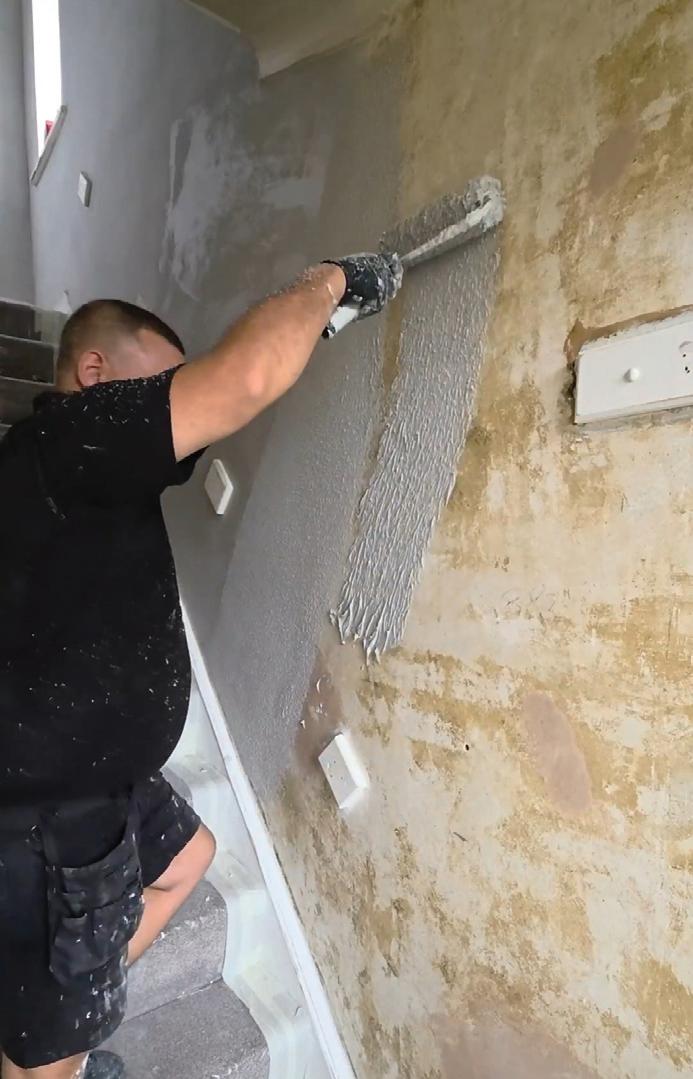
Roller applied coverings are now an indispensable go-to product for a growing number of painters and decorators looking for a quick fix, as we find out here from Nathan at NR Decorators:
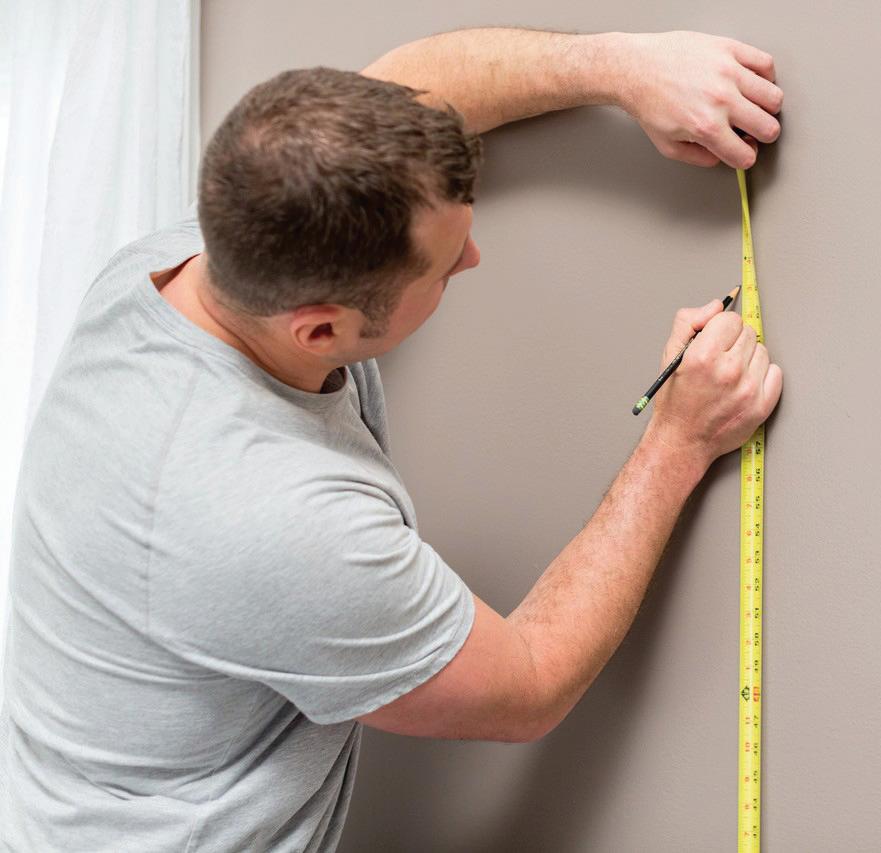
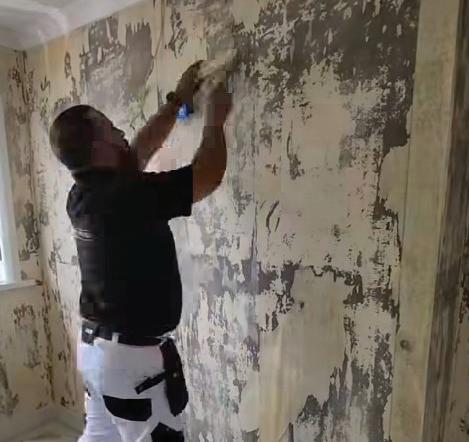
Step 1: Remove existing wallpaper, lining paper and any loose surface materials.
Proper surface preparation is crucial to ensure optimal adhesion and finish. First of all, sand the surface and fill deep cracks before application. Ensure that the surface is clean, dry, and free from loose debris.
Roller-applied coverings like Dalapro Roll Nova can also be used over textured surfaces on walls and ceilings. In these cases, it is recommended to sand down the most pronounced textures to ensure a smoother finish. Multiple thin coats may be necessary to achieve the desired result.
Nathan’s Tip: Taping around sockets and fixtures can help achieve a cleaner application and prevent mess.
Decorators
covering –a quick and easy way of creating what Nathan describes as a ‘smooth as glass finish’.
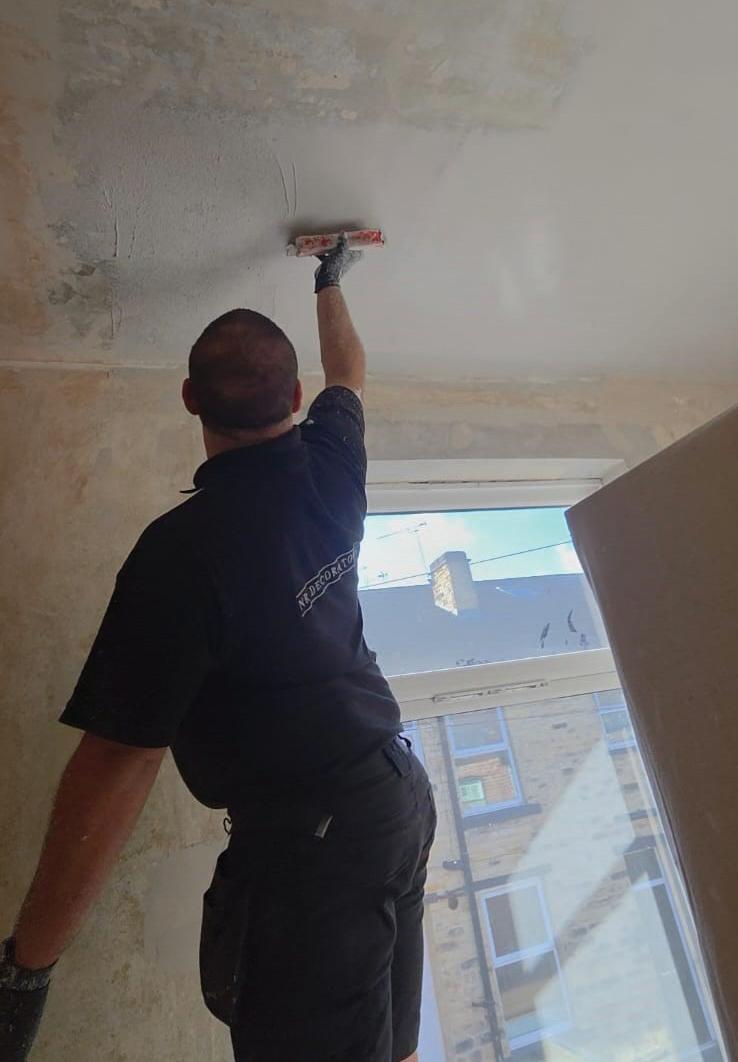
For this task, the tools you will need are a speed max paint roller and skimming blade. The approach Nathan takes is a quick and easy way to skim a wall or ceiling and, while it isn’t a substitute for traditional plastering skills –good plasterers are always going to be busy - it does allow him to quickly get the wall ready for final decoration.
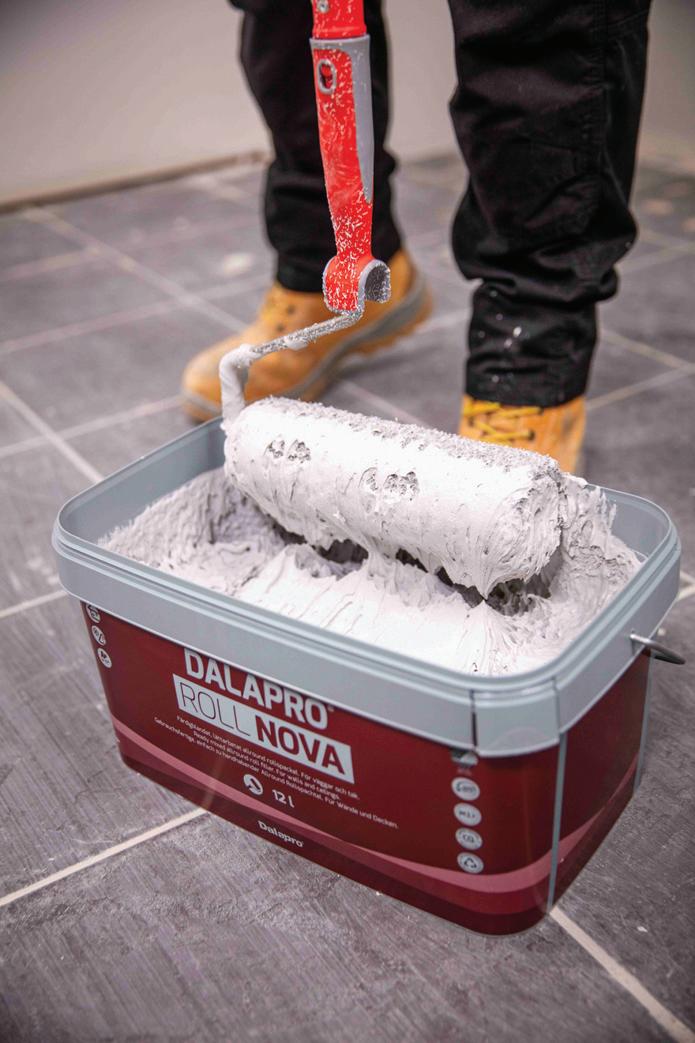
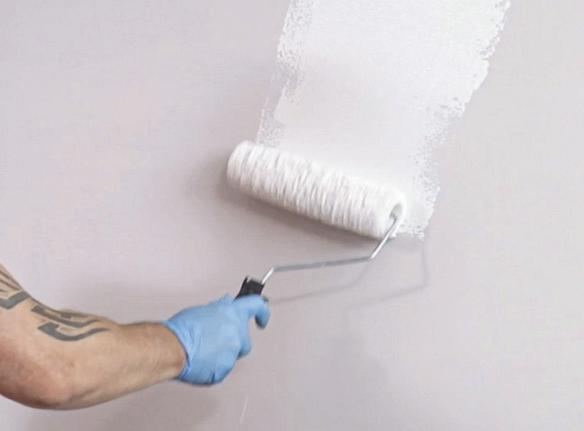
Step 2: Products like Dalapro Roll Nova can be applied using a standard roller. You will need a medium to high-pile roller and roller pole. Once the covering has been applied to the wall, use a skimming blade to smooth it.
Nathan’s Tip: Dalapro Speed Max paint rollers work really well as the fibres are designed to pick up more material and then evenly distribute it when rolled onto the surface. Make sure you plunge it into the mixture so it is fully loaded.
Step 3: Roll straight into the wall.
The creamy texture of this rollerapplied covering ensures smooth application and excellent adhesion to various surfaces, including plasterboard and textured finishes, making it suitable for both minor repairs and larger wall coverings.
Each tub covers an area of 12m2 at 1mm thickness. This calculation tool is a quick and easy way to find out how much you need: WWW.RDR.LINK/BBV067
Step 4: Smooth the material using a skimming blade.
The product is suitable for thin smoothing in both renovation and new plasterboard construction.
With an average drying time of around eight hours, roller-applied coverings allow you to apply the product in the late afternoon, and it will be dry the following day, depending on environmental conditions such as humidity and temperature.
Nathan’s Tip: I find that good ventilation can help speed up the drying process.
Step 5: Once the surface is fully dry, lightly sand and then brush clean.
Nathan’s Tip: I prefer to use a 120 to 240 grit sandpaper to get a really smooth finish.
Step 6: You’re now ready to apply the paint or other wall finish of choice.
Job done!
Thanks to Nathan at NR Decorators for demonstrating why he uses Dalapro Roll Nova.
While effective for surface repairs, roller-applied coverings cannot entirely replace traditional plastering techniques, especially for more complex jobs.
For major repairs or where the integrity of the underlying structure is compromised, only a skilled plasterer can provide the detailed work required to restore the surface correctly. Similarly, in the case of listed or heritage buildings, traditional plastering techniques may be necessary to preserve the building’s historical accuracy and appearance.
Dalapro Roll Nova is available from merchants and stockists around the UK.
FOR MORE INFORMATION ON DALAPRO, VISIT
WWW.RDR.LINK/BBV068 FOR MORE FROM NR DECORATORS VISIT WWW.RDR.LINK/BBV069
Dulux unveils its Colours of the Year 2026
OUT OF THE BLUE
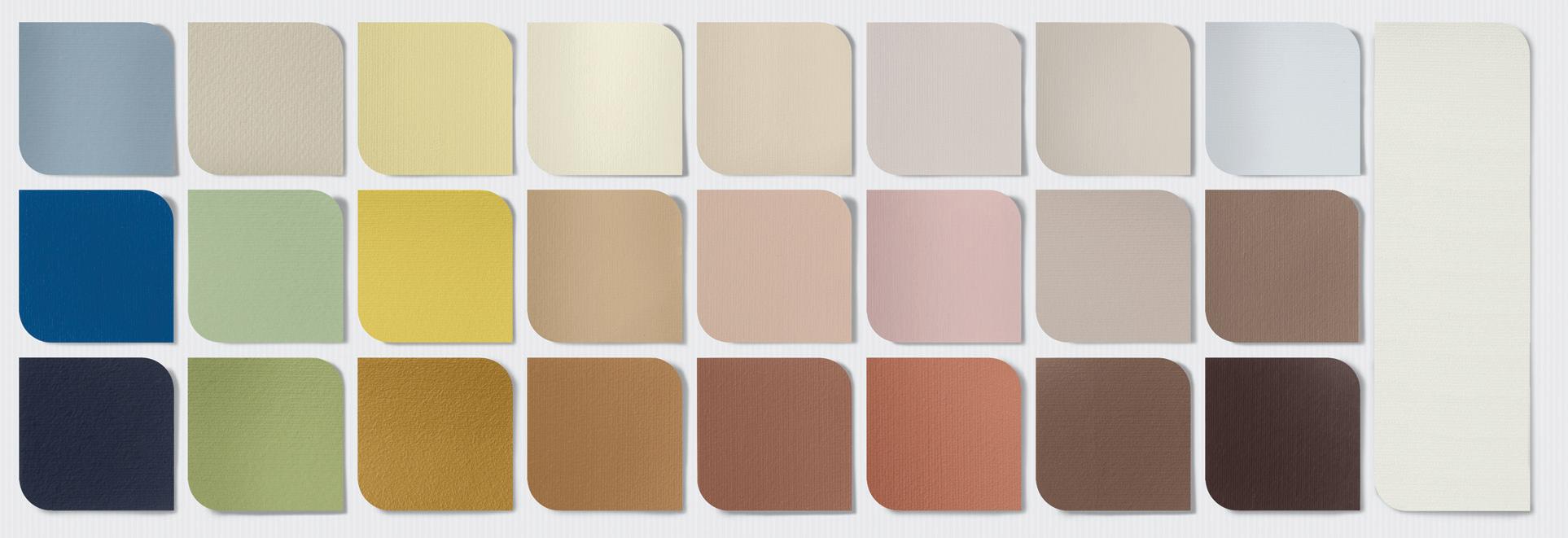
The Dulux Colours of the Year
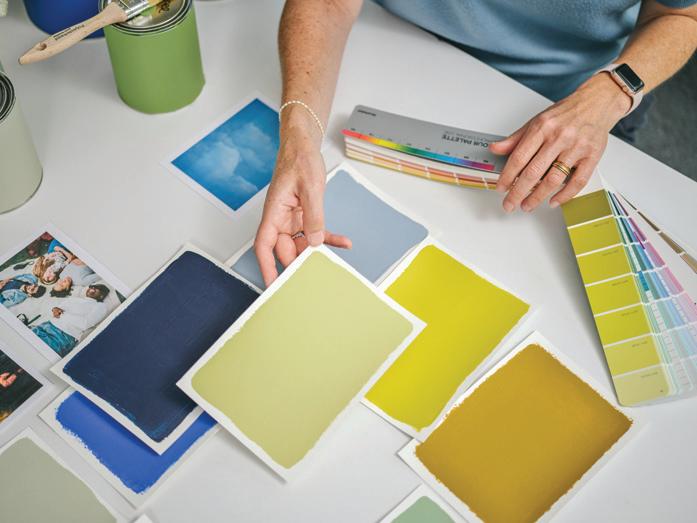
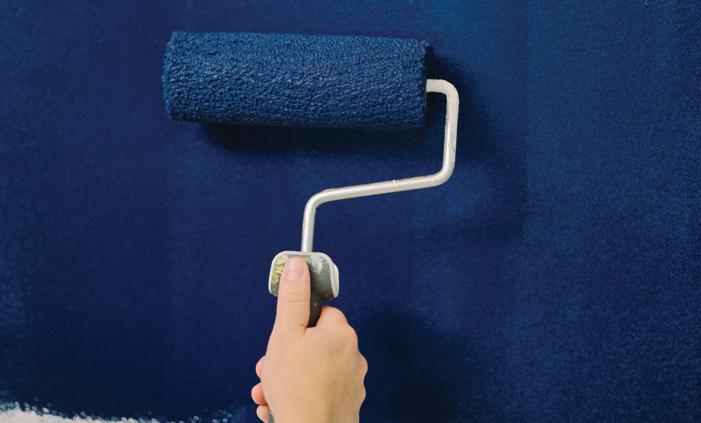
2026 are three versatile blues: light Mellow Flow™, dark Slow Swing™ and vibrant Free Groove™. They were chosen following the company’s extensive annual trend research and provide decorators with a selection of shades that reflect the mood of every environment.
Whether painter decorators are looking to give an old room a new lease of life or find that little edge to a spacious extension, Dulux’s 2026 winning pallete has been selected to help in every way.
AkzoNobel’s Global Aesthetic Centre has been translating trends into desirable colours for more than 30 years. Its annual ColourFutures™ trend forecast meeting brings together in-house experts, international architects, designers and journalists to share insights into how people’s reactions to the world impact colour choices. For the first time, three colours were selected which all have common ground, but each bring a unique quality.
of Mellow Flow™ to the meditative, calm and grounding nature of Slow Swing™,
and the vibrant, exciting and uplighting Free Groove™ there is a shade to suit any brief. Used individually or in combination, the Colours of the Year 2026 offer professionals the flexibility to create multiple expressions of energy, mood and pace.
The Rhythm of Blues™ collection is also complemented by interior and exterior palettes, making it easier than ever for tradespeople to find the right colours for their project.
Marianne Shillingford, Dulux Creative Director and Colour Expert at AkzoNobel, explains: “Blue has been the world’s favourite colour for years – but it’s far from one note. It delivers a sense of fluidity, relief, stillness and freedom, which is exactly what’s needed in today’s fastpaced world.
“It’s roots in nature give us something to connect to, as well. When we see light blues like Mellow Flow™, we might think of soothing springs or sunrise skies, for example, or be reminded of the deep ocean’s chilled stillness with a dark blue like Slow Swing™. Whereas Free Groove™ offers a more intense heat, like that of summer pool parties. Some of us are slowing the beat to recharge and find
balance, while others are looking to crank up the volume and create spaces that are simply fun.
“Rhythm of Blues gives us the opportunity to do both – it’s a family of colours that can soothe, steady or excite, depending on how you play it. This collection offers colours you can find peace in, and colours you can dance to, centred around three distinct rhythms to offer endless possibilities for changing the pace of your space.”
For further advice and guidance on how to use the Colours of the Year 2026 for the next project, decorators can use the Dulux Trade Paint Expert Visualiser App, to bring the colour schemes to life for customers.
Professional
Podcast
AND YOU CAN TOO, AS WE CATCH UP WITH SOME OF THE CONSTRUCTION INDUSTRY’S MOST INTERESTING AND KNOWLEDGEABLE CHARACTERS ON THE NEW GROUND BREAKING PROFESSIONAL BUILDER PODCAST WITH LEE JONES AND EDWARD KELLY LEARN A NEW BUSINESS SKILL OR FINE TUNE AN OLD ONE FROM THE GUYS AND GIRLS AT THE SHARP END, WHO HAVE BEEN THERE, DONE IT AND GOT THE PB T SHIRT TO BOOT!
Construction projects have challenging schedules and cost pressures. To address this, choosing materials that streamline on-site work without sacrificing durability is key. Kevin Taylor, Training and Technical Support Manager at Marley, shares insights into the advantages of using the Ashmore Interlocking Double Plain roof tile
With any roofing installation – either on a new build property or a refurbishment project - avoiding delay is vital, as work on the roofscape could setback other areas such as providing safe access for fellow trades to get on with their tasks inside.
The Ashmore Interlocking Double Plain roof tile gives builders the opportunity to complete roofing work efficiently, as well as benefit from material cost reductions
The Ashmore offers a mock bond and a hidden interlock at the tail, giving the appearance of a traditional double-lap plain tile roof but with the ease and speed of installation of a large format interlocking tile.
Speed up installation
Whilst most concrete tile roofs require at least 60 tiles per m2, opting for the Ashmore solution enables tile saving with just 17.5 tiles required per m2. Fewer tiles equal less time on the roof, enabling contractors to optimise the roof install and finish works more quickly, which can be especially important on new-build developments where pace of construction
RAISING THE ROOF
is essential to enable other trades to get inside properties and for scaffolding to be dropped.
Save on material costs
Choosing the Ashmore can help reduce material costs by delivering better coverage per tile and using less supporting roof components such as battens, when compared with standard concrete tiles.
Concrete plain tiles require a least 10 linear metres of batten per m2 of the roof space, whilst the Ashmore can be installed with as low as 5.3 linear metres of batten per m2 of the roof. Depending on project type, this is an almost 50% saving on the quantity of battens needed, helping to cut the financial burden on a roofing job.
Lower pitch benefits
The Ashmore tile can be laid to a much lower pitch than plain tiles, enabling it to be selected for more roofing-related projects. It provides a plain tile appearance for roofs which would not otherwise be suitable. Compared to the
35° minimum pitch of a concrete plain tile, the Ashmore delivers a minimum pitch of 22.5°. It also comes with matching fittings and dry fix accessories.
Tile Weight
With weight a critical consideration for any roof structure, it is important to reduce strain on the whole structure where possible. Again, the Ashmore delivers tangible weight benefits versus a standard concrete tile. The weight of the Ashmore can be as low as 48kg per m2, compared to the 78kg/m2 found with concrete plain tiles. The ability to install a lighter roof means additional construction costs such as using larger rafters or incorporating extra supports will not be needed.
Popular colours
Finally, the Ashmore range offers three distinctive colours that emulate the most popular tones of the clay and concrete plain tile range, including Old English Dark Red, Smooth Brown and Smooth Grey. It enables a new roof to sit seamlessly into its surroundings and delivering distinctive design and finish options.
Ashmore Smooth Brown
Ashmore Smooth Grey Rig Ashmore Dark Red
INSIDE KNOWLEDGE
Knauf Insulation gives a guide to insulating party and internal partition walls
Whether you’re working on new homes, building extensions, converting a loft or refurbing a property, it’s likely that you’ll need to tackle internal partition and party walls. In some ways, this is more challenging than insulating an external wall, because the regulations are often more nuanced and the performance requirements can be less obvious.
That’s why we’ve written this guide to insulating party and internal partition walls to help ensure acoustic, thermal and fire performance that meets regulations and the expectations of your customers.
What’s the difference between insulating party and internal partition walls?
These two types of walls have different requirements for insulation performance:
Internal partition walls divide up the space inside a single property. The main priority when insulating these is acoustic performance.
Party walls are walls shared between two separate homes – seen in blocks of flats, semi-detached and terrace homes. Acoustic insulation is still crucial here, but so is thermal efficiency.
partition walls is to provide acoustic insulation. While this may be less important between a kitchen and a living room, having a quiet home office space or bedroom will be vital. The three keys to effective acoustic insulation are adding mass, separation, and absorption:
acoustic applications available. Because these walls have a lower mass compared to masonry walls, it’s even more critical to add absorption and separation.
Separation reduces impact sound transferred through the structure such as footsteps. We’d recommend using acoustic clips to fix the plasterboard to the wall studs. These clips are designed to absorb vibrations and reduce sound transfer between elements in the build-up.
least and a glass mineral wool roll, such as our Acoustic Roll or OmniFit® Thermal
The goal when insulating party walls is to get the U-value down to an effective 0.0 W_m2k
The main goal when insulating internal partition walls is to provide acoustic insulation
and Sound Slab, is your best bet for internal partition walls. Many people think that rock mineral wool is the go-to product, but glass mineral wool performs just as well and is easier to handle. The rolls can be friction fitted between studs. Make sure it fits snugly but isn’t compressed, as this can affect its acoustic performance.
The hidden heat loss in party walls
The conventional wisdom on party walls for a long time was that they do not significantly contribute to heat loss, but Building Regulations now correctly identify that thermal bypass causes substantial heat loss in terraces and semidetached properties. If the party wall cavity is left uninsulated, cold air from outside travels up through the cavity, creating a chimney effect that draws heat from both properties up into the roof.
If you’re working on new builds, the insulation has likely been considered in the house design. The goal is to get the Uvalue down to an effective 0.0 W/m2k, meaning there is only negligible heat loss in the cavity. The recommended approach is to fully fill the cavity, which is typically 75mm wide, with an insulation product that also provides acoustic and fire performance such as glass mineral wool.
Glass mineral wool slabs such as Masonry Party Wall Slab and Timber Frame Party Wall Slab can be friction fitted between the leaves of the blockwork and the wall ties. Make sure the slabs are tightly butted so that the fibres ‘knit’ together to maximise acoustic and thermal performance.
In many older properties, this cavity is left uninsulated. Retrofitting these cavities is usually done with a blown-in product such as Supafil®. This kind of retrofitting is often triggered by a customer looking to do a loft conversion, which requires the party wall to be insulated to be compliant with Building Regulations.
Fire safety
Fire safety must always be considered when insulating buildings. Increasingly, insurers, local authorities and clients require non-combustible materials in external walls, regardless of height or use, to minimise fire risk.
Retrofitting party wall cavities is usually done with a blown-in product such as Supafil®
insurers, local authorities and clients
non-combustible
All CE or UKCA marked insulation is classified under the Euroclass system, which measures combustibility, smoke, and flaming droplets, from F (easily flammable) to A1 (non-combustible). Products rated A1 or A2-s1,d0 are classed as noncombustible and will not significantly contribute to the spread of fire.1
Knauf Insulation’s glass and rock mineral wool products meet this standard, achieving A1 or A2-s1,d0 ratings. However, always check the specific Euroclass rating of individual products, as performance can vary.
Insulating internal partition and party walls properly isn’t just about meeting Building
Regulations, it’s about creating homes that are quieter, more energy efficient, and safer for the people living in them.
From stopping sound transfer in internal partition walls to eliminating hidden heat loss in party wall cavities, the details matter. That means choosing the right type of insulation for each application, installing it correctly, and paying attention to junctions, gaps, and how materials interact. Whether you’re working on a new build, a retrofit, an extension or a loft conversion, a wellinsulated internal structure is something
The three keys to effective acoustic insulation are adding mass, separation, and absorption
Increasingly,
require
materials in external walls, regardless of height or use, to minimise fire risk
FAD OR FUTURE?
Neil
Turner, UK Technical Manager at Ecological Building Systems,
answers some FAQs on why natural insulation materials are becoming more popular for building refurbishments
QWhy are natural insulation materials becoming more popular?
A Builders and contractors are choosing natural insulation materials because of high demand from customers for sustainable low-carbon buildings. These materials are particularly well suited for renovation projects and older buildings, as their breathable properties help manage moisture, reducing the risk of condensation and mould. This makes them a practical choice for customers working on sympathetic restorations, or new builds that are required to achieve high thermal performance with low environmental impact.
QWhat are natural insulation materials typically made from?
A Natural insulation materials are usually made from renewable resources, giving builders a sustainable alternative to traditional products. For example, Gramitherm® is made from 70% grass and 20% recycled jute fibres, providing good thermal and sound insulation. IndiBreathe
helps regulate moisture and reduce the risk of condensation, while BBA certification ensures consistent performance. Because these materials use far less energy to produce than synthetic insulation, they carry a much lower carbon footprint, meeting the demand for more sustainable buildings.
QMany builders are reporting that customers are increasingly asking for natural insulation materials that help them reduce their carbon footprint. But do they have other benefits too? In short, is natural insulation really worth the effort?
A Yes, natural insulation does more than just lower the carbon footprint. It helps to increase the thermal performance of a building and control humidity, which means fewer problems with damp. Because it is a breathable material, it allows moisture vapour to escape instead of trapping it inside the walls, creating a healthier indoor environment. Natural insulation also improves acoustic performance, so it reduces noise travelling through floors and walls.
QHow does natural insulation improve thermal performance?
A Natural insulation improves thermal performance by helping buildings maintain stable indoor temperatures throughout the year. Its relatively high density and specific heat capacity allow it to store and release heat more effectively than many synthetic options. In winter, this means it retains warmth indoors, while in summer, the stored thermal energy helps to slow down overheating. Choosing an insulation material like Gramitherm® and IndiBreathe Flex® made from hemp and recycled jute fibres, which can hold and release heat slowly, helps to
keep indoor temperatures cooler in summer and warmer in winter, providing year-round comfort.
Q Are there any challenges or complexities with fitting natural insulation?
A Fitting natural insulation is generally very straightforward. Unlike many synthetic alternatives, natural insulation is made from non-irritating fibres and does not release harmful toxins during cutting or installation. This helps to create a healthier and more comfortable working environment.
The main consideration is planning ahead and preparing the building for the installation of natural insulation to get the best thermal performance and maintain breathability. Most modern products are designed to be installed using standard techniques, so it is hassle-free to work with. Gramitherm®, for example, can be installed in roofs between rafters, in stud walls, suspended floors and lofts between ceiling joists, making it versatile and straightforward to install.
QCan a building be made airtight with natural insulation?
A Yes, a building can be made airtight with natural insulation when combined with airtightness membranes, such as Pro Clima Intello Plus. These membranes manage moisture and help prevent condensation, which also contributes to energy efficiency.
Most modern natural insulation products, like Gutex Multitherm boards made from recycled wood chips, are
designed to work smoothly with these techniques. That means builders can achieve the same airtight standards as with conventional insulation, while still benefiting from the thermal, acoustic and air-quality advantages that natural insulation provides.
QDoes it have the same fire ratings as traditional insulation?
A Fire performance is an important consideration for natural fibre insulation. When exposed to flame, these materials tend to char rather than ignite quickly. It is possible to achieve an REI rating of up to 90 minutes, tested from both inside and outside according to EN13501-2.
QWhere can I buy natural insulation?
A Specialist suppliers now stock a wide range of natural insulation products, from hemp and jute insulation to wood fibre boards. At Ecological Building Systems, we’re committed to supporting
tradespeople by sourcing and supplying high quality natural building materials and this is backed by technical advice from our expert team, product training in person or via webinars and telephone support, when needed.
CHAIN REACTION
With the over fragmentation of supply chains, it’s no surprise that material sourcing and procurement can be a headache for builders and contractors, especially with more complex projects. Time pressures, delivery coordination, inconsistent lead times, the compatibility of products, and administrative overheads are just some of the challenges faced on a daily basis when trying to source quality materials from multiple suppliers. On top of this, the need to juggle different account terms, varying service levels and unpredictable stock availability can quickly slow down progress.
Simplifying and streamlining this process where possible can be a huge advantage, providing you and your team with more time to focus on delivering a high-quality job out on site. One way of doing this can be to use a single supplier across several areas within a build.
Scott Wolters, Building and Flooring Products Sales Director at EGGER UK, explores the value of working with a sole supplier, from
streamlined processes
to greater control of quality
Single supplier approach
There are many benefits of a sole supplier approach. From a practical perspective, as well as improved delivery coordination, with all deliveries coming from a single source, you can save valuable administration time. Imagine not having to chase hundreds of different purchase orders, input multiple new suppliers onto your accounting system, or liaise with countless account or customer service departments.
Enhanced quality
In addition to streamlining the procurement process, working with a smaller circle of suppliers can even
contribute to enhanced build and finish quality. When you consistently work with one supplier, you can build a stronger relationship with it and its wider team, providing you with greater access to its technical support, product expertise and customer service. This can be a lifeline when dealing with installation challenges or compliance questions. Rather than explaining your project repeatedly to different reps, a single supplier who knows your work can offer faster, more tailored advice.
You can also benefit from greater assurances of consistent product quality and standards. For example, if you use a trusted supplier for your structural,
decorative and flooring needs, you can rest assured knowing that products supplied across the different applications will be subject to the same internal processes, batch testing and quality control. Especially important in fast-paced environments, such as residential developments, refurbishments and modular builds, this can help you to minimise the likelihood of callbacks or issues further down the line.
Consistency across the board can also bring with it operational peace of mind. When site teams are already juggling tight timelines, having familiar materials –delivered on time, in full and performing as required – can help prevent unnecessary delays. Over time, these small efficiency improvements can add up, especially for tradespeople managing several projects consecutively.
Wood-based building products
Let’s take wood-based building solutions as an example. There can be multiple applications for the use of wood-based materials across any build, from structural flooring boards or OSB, to decorative interior finishes such as kitchen cabinetry or office desks, and even laminate flooring, the ideal choice for busy family homes. At EGGER, as a leading woodbased materials manufacturer, we manufacture a variety of product solutions at our Hexham and Barony plants, using high-quality materials and conduct regular quality checks in our on-site laboratories.
“At EGGER, as a leading wood-based materials manufacturer, we manufacture a variety of product solutions at our Hexham and Barony plants, using high-quality materials and conduct regular quality checks in our on-site laboratories.”
brings with it clear carbon and environmental advantages, with wood an inherently renewable material. As well as using wood from certified, sustainably managed forests, look for manufacturers who use a high volume of recycled wood content within production. This could range from sawmill by-products, such as hackchips and saw dust, to recycled industry waste. When wood is used across
EGGER UK
We supply the construction and housebuilding sector with our comprehensive range of building products, decorative panels and flooring – manufactured using locally sourced wood and recycled material. Our structural flooring boards are ideal for domestic flooring, refurbishments, new build projects and modular applications, with a tongue and groove profile precision cut to ensure a tight, consistent fit and easy installation.
Our EGGER Decorative Collection 24+ offers a comprehensive range of products for furniture and interior design projects. On-trend decors and surfaces are available across Decorative Faced Boards, Laminates, Worktops and Edging.
While our new Flooring Collection 25+ delivers on-trend designs and enhanced functionality, with over 200 realistic woodgrain and tile designs, suitable for use with underfloor heating and offering impressive impact and sound insulation.
STAIRWAY TO HEAVEN
Stair safety is one of the most critical and frequently underestimated aspects of building design. Each year, thousands of accidents occur on domestic and public staircases, often due to poor construction, missing handrails or inadequate guarding. According to recent research, 43% of UK adults reported experiencing a stairrelated accident within the last 12 months, with around 60% of these incidents occurring in the home. The most common causes included slippery surfaces and the absence of continuous, accessible handrails.
These figures highlight a vital truth: a well-designed staircase is about far more than aesthetics. It’s a functional safety feature that must meet regulatory standards, provide stability and ensure accessibility for users of all ages.
Richard Burbidge explains why good design and regulation compliance matter in stair safety
The role of the balustrade in safety and design
A balustrade’s primary purpose is to prevent falls but it can also serve as a striking architectural feature. The best systems combine form and function,
ensuring compliance without compromising on looks.
In domestic properties, building regulations require handrails to be positioned 900 mm above the pitch line on stairs and 900 mm on landings. In public or commercial environments, that height increases to 900 mm on stairs and 1100 mm on landings to provide additional security. Any drop exceeding 600 mm must be guarded and no gap within the balustrade should allow the passage of a 100 mm sphere.
This rule is designed to prevent young children from slipping through or becoming trapped. Equally important, balustrades should not be designed in a way that encourages climbing, which is why horizontal rails or ladder-style layouts are unsuitable in homes with young families.
Strength tested for safety and reliability
All Richard Burbidge balustrade systems are independently tested and, when installed in accordance with the manufacturer’s instructions, conform fully to UK Building Regulations. Every component is engineered to meet the 0.36 kN horizontal load requirement specified in Approved Document K, which ensures the balustrade can safely withstand everyday use without deflection or failure.
For contractors, this provides an important reassurance. Using components from a single, tested system eliminates the risk of incompatibility and guarantees a consistent level of safety and performance. Each Richard Burbidge system is designed, manufactured and strength tested as a complete unit, giving installers and homeowners peace of mind that the finished staircase is compliant, robust and built to last.
The importance of continuous handrails
Handrails are often the first line of defence in preventing stair-related accidents. To be effective, they must run continuously along the flight, be positioned within easy reach and allow users to steady themselves quickly if they lose balance.
Wall-mounted handrails have become increasingly popular in enclosed staircases and they are particularly valuable in homes with older residents or people with limited mobility. Every Richard Burbidge handrail design can be wall-mounted, offering flexibility and a unified appearance across both open and enclosed stair sections.
can see tread edges and changes in level, while non-slip step surfaces reduce the risk of slipping.
“Safety and accessibility are at the heart of everything we design,” explains Kris, Technical Manager at Richard Burbidge. “Our handrails are crafted from timber, a naturally warm, tactile material that allows for a smooth, continuous run between posts. It gives users confidence and control while also complementing the overall look of the staircase.”
Lighting, surfaces and overall safety
Beyond the balustrade and handrail, other design elements can significantly affect safety. Good lighting ensures that users
distribution and avoid excessive glare or shadows, particularly in enclosed stairwells. Adding contrasting nosings or finishes can also help to make edges more visible, improving both safety and accessibility.
Design support for professionals
Richard Burbidge recognises that even experienced contractors and designers benefit from expert technical support. To help ensure safe, compliant and visually cohesive results, the company offers a dedicated design service for the trade.
This bespoke service provides professionals with tailored advice, design drawings and product recommendations for any project, whether it’s a domestic renovation or a large-scale commercial build. The design team works closely with builders and specifiers to ensure that every installation meets UK Building Regulations while achieving the desired aesthetic outcome.
‘WATER’ GOOD
PB hears
from Premier Panel Products
about a panel that can take the heat…and the rain
IDEA
Ask any builder what they want from a panel product, and fire safety and weather resistance are likely to be near the top of the list. In today’s building environment, it’s not enough for materials to just do the job — they’ve got to meet tougher building regulations, keep projects moving, and save time on site.
That’s why fire-retardant panels are becoming a must-have, especially when working on loft conversions, extensions, or custom builds where compliance and client peace of mind matter more than ever. But here’s the trade-off: fireretardant boards don’t like getting wet. Leave them exposed to the elements for long (which, let’s face it, happens all the time in the UK) and they can swell and warp, wasting both time and money.
On the other hand, water-resistant boards can handle the weather, with no need to tarp up every night or rush the roof on. But they won’t tick the fire-safety box.
That’s left a lot of builders asking the same question: Why can’t we have a board that does both?
Enter DryGuard FR, a fire-retardant and water-resistant plywood panel now exclusively available through Premier Forest Products.
This unique plywood has been developed using groundbreaking technology pioneered by our partners at leading European manufacturer, Paged. DryGuard FR offers advanced water and fire protection in a single board,
combining two essential features that builders have long wanted but never had access to, all in one solution.
The product features a hydrophobic coating that significantly reduces moisture absorption (EN 927-5), and a fire classification of B-s1, d0 (EN 13501-1), the highest possible for wood. These characteristics make it ideal for use in demanding environments where safety and durability are non-negotiable.
DryGuard FR is suitable for use in roofs, floors and walls and the REACHcompliant coating not only resists rainwater but also allows the building to breathe, helping to prevent damp and mould while promoting healthier
breathability is particularly important in domestic construction, where airtightness and insulation can create moisture challenges if materials aren’t correctly specified.
The board has undergone rigorous testing and is certified to the following standards:
• Reaction to fire class: B-s1, d0 (EN 13501-1)
• Water resistance: EN 927-5
• Mould resistance: EN 927-3
“We also understand how important ease of use is on site. That’s why DryGuard FR is available in a choice of standard sizes
- 2500 x
1220
mm,
mm to
1250
mm
and 2440
x
and thicknesses from 12
30 mm. We offer custom sizing and rim shaping, as well as tongue-and-groove jointing for straightforward floor and roof installations.”
It is also CE1 certified and sourced from responsibly managed forests, to support meeting the requirements of sustainable construction.
In addition to fire and water performance, DryGuard FR has been tested for structural strength and stiffness in roof and floor sheathing applications. This testing was carried out at the Lukasiewicz Research Network – Institute of Wood Technology, confirming the product’s suitability for structural use.
Paged designed DryGuard FR to work across a wide range of projects, from domestic renovations and small-scale new builds to larger commercial or public sector settings such as schools, hospitals, airports and server rooms. It’s a truly versatile solution that simplifies compliance without compromising on practical needs.
We also understand how important ease of use is on site. That’s why DryGuard FR is available in a choice of
standard sizes - 2500 x 1250 mm and 2440 x 1220 mm, and thicknesses from 12 mm to 30 mm. We offer custom sizing and rim shaping, as well as tongue-andgroove jointing for straightforward floor and roof installations. The panel can be cut on formatting machines, and we also provide CNC machining options, including edge machining, hole drilling and milling, all to support faster assembly and precision fitting on site.
DryGuard FR builds on the success of our original DryGuard plywood, first launched in 2021, which offered water resistance for up to 90 days. With the addition of fire retardancy, the new version delivers an in-demand upgrade while maintaining all the benefits of the original, including reduced drying times, fewer delays, and the confidence to keep building even when the weather turns.
The core material, thickply Polish Pine, is sustainably sourced and treated to slow
water absorption without impacting structural integrity. It’s low in formaldehyde and VOC emissions and carries a Type III Environmental Product Declaration (EPD), supporting responsible and environmentally aware construction.
DryGuard FR is the result of our collaboration with our customers across the UK and our commitment to solving real-world problems. It’s a world-exclusive product that sets a new standard in panel performance and is designed to give the trades exactly what they’ve been asking for: a board that does it all.
Premier Forest Products is a vertically integrated timber operation engaged in the importation, processing, machining, engineering and wholesale distribution of timber and timber products from its multiple sites in the UK.
MATERIALS MATTER
Gav Brown, Managing Director of Think Timber, a strategic partner to the timber staircase sector, discusses how the use of sustainable, low-carbon building materials, such as timber, is the key to
The built environment is one of the most carbon-pollutive sectors. According to the 2024-25 Global Status Report for Buildings and Construction, global construction activities account for more than a third (34%) of all carbon emissions, with 10% produced from embodied carbon alone – the emissions produced during the construction of buildings.
With a rapidly growing population and urbanising economy in the UK, there is a clear preference for masonry construction, particularly in England, where it accounts for nearly 90% of housing. This widespread use of masonry heavily relies on a set group of materials which, due to their extremely energyintensive production processes, have a negative impact on the environment.
For example, the world’s production of cement alone contributes approximately 8% of global carbon emissions. As the demand for housing continues to rise, so too does the industry’s environmental burden. So, by shifting towards the use of
more sustainable, low-carbon building materials, like timber, the industry can significantly reduce its environmental impact and continue to deliver highquality housing.
With national targets accelerating change toward sustainability, building environmentally friendly homes has become a necessity rather than a choice – laying the foundations for a greener future. Whether you’re a link in the supply chain or an onsite brickie, everyone has an essential role to play in helping the industry meet net zero by 2050.
A timeless material
Since the time of the Romans, timber has remained a constant in construction, adapting along the way to meet the
“The Timber Construction Roadmap represents a turning point in the industry. Not only does it encourage the use of timber in construction but also influence the integration of timber and more sustainable choices to deliver more cost-effective, sustainable and industry-compliant housing.”
demands of modern buildings. However, as new building materials, like masonry and steel, saturated the market, timber gradually took a back seat, its role becoming overshadowed. This was particularly true after the Great Fire of London in 1666, which led to stricter regulations favouring fire-resistant materials like brick or stone.
But despite its decline in use, timber never truly disappeared from construction, as its environmental benefits and versatility are widely recognised and valued. Scotland, in particular, continue to use timber in construction due to its abundant resource and building traditions more seen in rural areas. In 2019, the Structural Timber Association found 92% of newly built homes were timber-framed, in stark contrast to England at 9%.
The UK government now aims to revitalise timber’s role across the nation by promoting timber as a primary construction material – especially in new housing developments. The end goal: to directly address climate change, solve the housing crisis, and boost economic growth.
Why timber?
Timber is one of a kind; it has the lowest embodied carbon of any mainstream building material. Its industry use is extremely important to support the move to a net zero economy, as it has the possibility to construct net-positive buildings—where carbon stored in timber exceeds the emissions produced over a building’s lifecycle. However, the sustainability benefits of timber can only be recognised when it is sourced ethically, and unfortunately in today’s market, it is all too common for endangered timber, such as mahogany or American ash, to be harvested and sold illegally. These unethical practices contribute to the global issue of deforestation, further exacerbating the climate crisis.
Timber also has the potential to be repurposed, whether that’s being converted into biomass energy or a new end-product. Engineered timber is one example of the material being recycled. Made from small timber fragments that would have otherwise been neglected, this simple innovation offers the opportunity to produce a stronger material by orienting timber’s strength properties and reducing common defects in the raw product, such as knots.
With timber’s natural ability to store carbon and recyclable values, combined with its suitability for modern methods of construction, timber is uniquely positioned to help meet both environmental and housing targets.
Timber in Construction Roadmap
In February 2025, the government published an updated ‘Timber in Construction Roadmap’ which laid out a national strategy to increase timber use across the sector. Currently, the UK only produces 20% of its timber needs, making it the third largest net-importer of timber in the world. By importing such materials, this results in an increase of emissions due to overseas transport and creates
vulnerability to the supply chain.
Addressing issues head-on, the Timber Construction Roadmap highlights the government’s commitment to support the timber supply chain and reduce reliance on imported wood. The policy paper outlines a clear target to increase tree canopy and woodland cover in England to 16.5% by 2050 – stimulating tree planting and boosting sustainable, homegrown timber.
The future of timber in construction
To align with this shift toward greater timber use in construction, housing developers need to ensure they adopt more sustainable practices at every stage, from sourcing responsibly managed timber to futureproofing projects with energy-efficient designs. Partnering with businesses who share the same commitment to environmentally conscious, futureproofed builds will be central to delivering long-term success in the rapidly evolving built environment.
The Timber Construction Roadmap represents a turning point in the industry. Not only does it encourage the use of timber in construction but also influence the integration of timber and more sustainable choices to deliver more costeffective, sustainable and industrycompliant housing, with the government’s national targets in mind.
GET SCREWED
ForgeFix, one of the UK’s leading distributors of fixings, fasteners and associated products to the trade, has announced a partnership with Prostate Cancer UK for a year-long series of awareness building and fundraising initiatives
ForgeFix will deliver its ‘Screw Prostate Cancer’ campaign with an aim of getting 100,000 men to take the award-winning Prostate Cancer UK online risk checker and to raise £100,000 for the charity throughout the year.
To reach these ambitious targets the company will be launching several initiatives including the creation of a bespoke promotional product range to raise money for Prostate Cancer UK. They are also undertaking a year’s worth of exciting employee-led fundraising campaigns as well as a Guinness world record attempt.
ForgeFix will be using Spectre as the public-facing brand for the partnership with Prostate Cancer UK, as it uses its position within the male dominated construction industry to raise awareness of a disease that affects 1 in 8 men.
To hammer home the lifesaving partnership, ForgeFix is launching a bespoke ‘Screw Prostate Cancer’ Spectre screw case with a range of its well-known multi-purpose screws, which will feature a unique Prostate Cancer UK QR code for end-users to scan and complete the charity’s risk checker via an online portal. Every time merchants
The partnership will be a marathon not a sprint, with two members of the intrepid team from ForgeFix also pledging to running four marathons in four countries across the UK – in Belfast, Edinburgh, London and Newport. For all four marathons the ForgeFix runners will be in a bespoke Screw Prostate Cancer suit – in the shape and style of a screw – and what’s more, they will be aiming to complete at least one of these challenges in a world record breaking time…for a participant dressed as a tool.
The partnership between ForgeFix and Prostate Cancer UK – which will also be supported by ForgeFix’s sister company Harrison & Clough – officially goes live on 1st January 2026.
Commenting on his company’s partnership with Prostate Cancer UK, Paul Swift, Managing Director ForgeFix, said, “We’re hugely passionate about supporting Prostate Cancer UK and breaking down the stigma that still exists around prostate cancer. 89% of the construction sector is made up of men and we’re using this campaign to reach out to our network to raise important funds but also boost awareness around this critical health issue.”
1 in 8 men will get prostate cancer, and it is now England’s most common cancer. It’s also the only major cancer without a screening
programme. You’re at higher risk if you’re over 50 and your risk increases as you get older. If you’re Black, or if your dad or brother have had it, you’re at even higher risk.
Prostate Cancer UK Head of Partnerships
James Steven said: “We are delighted that ForgeFix and their staff will help fund lifesaving research and raise vital awareness about prostate cancer, the most common cancer in men.
“The ForgeFix family across the UK are a brilliant demonstration of people coming together against prostate cancer. From innovative promotion of our groundbreaking risk checker to going the extra mile – or 26.2 – across the UK, they’re all doing something great to fund more groundbreaking research and work towards a screening programme, to catch prostate cancer early and save lives.
“1 in 8 men will be affected by prostate cancer, but the good news is if caught early this disease is curable. We thank ForgeFix for teaming up with us and look forward to working with them. This partnership will make a huge difference to men affected by this disease – and their loved ones too.”
WHO’DA THUNK IT?
GERDA explains its satisfying ‘thunk’ and how its making door installations easier
What’s your go to front door when replacing an old one, or for new builds? Chances are it’s a composite. They are after all touted as the number one selling entrance door on the UK market. Their popularity is based on low maintenance, good looks and great security.
But they are not without their problems. Some ranges can be prone to bending and warping. Colours can fade, and their U-values are often misquoted. The result of which can lead to a multitude of headaches. On average, low quality composites have a potential
warping or bowing risk of 10 to 15%.
However, as with all trends, the dominance of the composite is coming to an end, and the push for a product which performs better has led to a growing interest in steel and aluminium doors that not only look the business, but compete effectively on price, give you good margins, and can guarantee absolutely no (expensive) remedial call backs year after year of installation.
matched the level of quality he would expect himself, and that his trade installers would be able to fit without any risk of bowing or warping.
Danny Williams is the managing director of Pioneer Trading Company, a window manufacturer who knows his craft. Having supplied composite doors from various manufacturers over the years, he understood intimately the problems they could create and the ensuing headaches that never seemed to go away. Danny’s solution? To create his own range of front door – one that
“They represented 80 – 90% of the problems I had with my clients, and I resented the damage they did to us commercially,” said Danny. “An installer who worked with me on housing projects always used to talk about the Gerda brand of doors – a household name in Poland akin to how Everest used to be here in the UK. That set me off on a voyage of discovery, which ended in Pioneer becoming the UK distributor for Gerda residential doors.”
What sets the Gerda brand apart is that they are engineered using steel and aluminium. Far from being the cold, industrial designs that might immediately come to mind, they are warm, welcoming, and reassuring. But what is truly important is their structural integrity. It is impossible for them to warp, crack or flex, meaning that they will give limitless performance for decades to come.
“Quite simply, you fit it once and you will never hear from the customer again –except for more work because of the great job you already completed!” continued Danny. “The beauty of the Gerda is that it is so superbly engineered that when installed it opens and closes as smoothly as a knife through butter, closing with a satisfying ‘thunk’ that will soon punctuate the homeowner’s day in a
way that is reassuring and comforting.”
The full range of Gerda doors are manufactured to withstand the more extreme hot and cold East European temperatures in Poland, which makes their navigation of the UK’s more temperate climate an absolute breeze! The design and engineering of the metal components guarantee a consistency in performance that is unachievable by the more modular make up of most composite doors.
UK front door U-value verification UK building regulations set a minimum Uvalue for entrance doors of 1.4 W/m2k. It is vital that you triple check the veracity of any claims around U-values and composite doors, as there are stories of ‘fudging’ compliance.
“I’m not making any particular assertions, but this is a ticking time bomb of an issue so best be aware and prepared,” continued Danny. “In short, every single Gerda door is more than compliant, with some U-values as low as 0.8 W/m2K. Energy efficiency is not an aspect of these doors that you need be concerned about, and we do have all the compliancy proof that you need should that be necessary”.
that we market in the UK, to cover the wants and needs of a wide range of properties. And price wise they sit comfortably between the more premium composites, and the real top end doors with the eye watering price tags,” said Danny Williams. “Aesthetically and structurally, there is not much that separates the top end with the Gerda brand, which brings that premium door option within the price bracket of a much larger demographic.”
Any massive tide takes a while to turn, but there is a definite shift in the wind of front doors in the UK, and Gerda has already got its sails up and running with it. As the Gerda ‘Thunk’ slowly infiltrates the consciousness of British homeowners, the building industry itself will benefit from the quality, and margins, it finally brings to
GENERAL BUILDING
WINDOW & DOOR SEALING MEMBRANE
FR Window & Door Sealing Membrane +, also referred to as ME007, is illbruck’s latest fire-rated (FR) solution for sealing windows and doors. ME007 is strong, robust and comes in a range of widths ranging from 100mm right up to 1000mm, all in 50mm increments. It is a Class B, permanently UV resistant, high strength polyester, airtight and fully watertight membrane, suited for use on ‘relevant and higher risk’ buildings.
FIBRE CEMENT BOARD
Bluclad Proboard has been added to Cedral’s product range. A highperformance fibre cement board for external applications, its prime use is to provide a good, stable surface for a direct render facade – either smooth or textured. Manufactured to BS EN 1247, Bluclad is a ventilated carrier board. With a fire classification of A2-s1,d0, the product is available in a thickness of 10mm and a standard size of 2400 x 1200mm.
LANDSCAPING FABRIC
Having successfully launched new versions of its Landtex and Weedtex products containing 20% recycled content earlier in 2025, landscaping fabric specialist Growtivation has now developed its Drivetex and Draintex fabrics to also incorporate 20% recycled content.
Importantly, these greener fabrics are being sold at exactly the same price as the original 100% virgin material fabrics and achieve the exact same performance level landscapers have come to expect.
CONCRETE STAIRCASES
Milbank Concrete Products is proud to announce the official launch of the refreshed brand identity and website for Kallisto Stairs, its luxury subbrand specialising in bespoke precast concrete staircases. The rebrand includes a new logo, refined visual identity, and the launch of a modern website that reflects Kallisto’s position in the high-end architectural and residential market.
JOB MANAGEMENT SOFTWARE
Fergus, the job management software built by tradies for tradies, has launched an Open API (Application Programming Interface) – a significant move for users who want their software to go further. This new capability means Fergus can now connect with other software and websites more easily, giving switchedon tradespeople and their teams the flexibility to customise how Fergus fits into their wider digital setup.
INTERIOR WALL PANELS
Naturepanel from Grant Westfield has extended its portfolio following the launch of its newly created Wood Slat collection.
Grained Alpine White, Grained Angora Grey, Grained Stone Green and Beige Grey Lorenzo Oak have been added to the Wood Slat range. Panels are quick and easy to install thanks to the Hydrolock tongue and groove system, which creates a smooth and seamless waterproof finish and come with a 30year warranty.
FIELD OPERATIVE MANAGEMENT
A new cloud-based scheduling solution designed to simplify and streamline field service management for smaller businesses and service operatives has been announced by jobmate. jobmate Planner was developed to help SMEs and field operatives stay on top of challenges such as last-minute job cancellations, urgent emergency call-outs, people skills, certification requirements, and the need for real-time visibility. It offers a simple drag-and-drop interface that makes scheduling and job reallocation quick and effortless.
WWW.RDR.LINK/BBV083
HOT ON THE SCENE
Professional Builder is excited to announce the launch of Professional Builder Weekly a brand-new mobile first digital platform designed with the UK’s trades in mind.
Working in the construction industry often means being on the move a lot. The trades are out and about, not sat at a desk behind a computer screen. That means that when it’s time for a break, or you’ve got a spare 5 minutes when you get to a job too early, the main thing you’ll have to hand in the van to pass the time is your phone (or perhaps even the latest issue of Professional Builder!).
It’s with this scenario in mind that we’ve cooked up PB Weekly platform that is designed specifically for those who want to consume their content quickly, visually and on the move. It is a scrollable, fast, video rich, editorially-led mobile experience.
Features at a glance
✓ New exciting competitions and giveaways each week
✓ Videos of tool reviews, product tests and more
✓ Brand new entirely fresh and up-todate feed every 7 days
✓ Viewable anytime, anywhere
✓ Questions and polls
Simple & practical
Being user-friendly was incredibly important when designing this new platform. There are few things as irritating as trying to navigate something incredibly complicated on your phone. As such, PB Weekly is laid out simply and clearly. It’s easy to read, with no pinching and zooming required and presented in a straightforward, sensical manner that boasts scroll-and-go layout, bitesized, fast-loading content. Those who sign up will be treated to a scrollable feed of content that’s been hand picked by the Professional Builder team to be worthwhile and interesting. It’s quick, easy and visual and works wherever you do –be that in the van, on site, or during a tea break.
SO, IF YOU’RE NOT ALREADY RECEIVING PB WEEKLY, WHY NOT SIGN UP AT PBWEEKLY.CO.UK AND JOIN THE 120,000 UK TRADESPEOPLE ALREADY MAKING THE MOST OF IT.
ADVERTISEMENT INDEX
Here is a useful summary of all the adverts that appear in this issue of Professional Builder Each is listed with its page number and a direct URL that will get you straight to the relevant online information
Wienerberger....................................................(inside front cover)
GET IT CHECKED
This month we are going to cover kidney cancer (also known as renal cancer). Cancer of the kidney is the 6th most common cancer in the UK –yet I don’t think we hear about it very much!
According to statistics from Cancer Research UK, the number of cases is on the rise- since the early 1990s incidence rates have increased more than 94%. That’s a huge increase in the number of cases. So why is renal cancer on the rise? It could be because it is more common in older people and we have an aging population. Most cases each year are diagnosed in people over forty, with a third being over 85 years old at diagnosis.
Other factors recognised in the risk of developing renal cancer include being overweight, smoking, having medical conditions like high blood pressure or a strong family history of kidney cancer. Some genetic conditions that affect the kidneys also increase the risk. Over one third of cases of kidney cancer are thought to be preventable, that’s approximately 4700 of the 13,800 diagnosed each year –a huge number! Looking after yourself, losing weight and taking your medication for high blood pressure if you need it, will all help reduce the risk of developing renal cancer.
So what are the signs of kidney cancer? As a GP I don’t get many people walking in and saying: “I’m worried about kidney cancer”. Our kidneys are two solid organs that work away our entire lives and honestly, unless they get an infection, or kidney stones, or stop working dramatically, most people would not give them a second thought! Often kidney cancer is picked up incidentally during investigations for other reasons. There may be no symptoms at all, but when it does show signs, these might include:
• Seeing blood in your pee
• A lump or swelling in your back, under your ribs, or in your neck
• Pain in the side between your ribs and waist that does not go away
• Loss of appetite or losing weight
without trying to
• Having no energy
• Having a persistently high temperature
• Sweating a lot, including at night.
If cancer on the kidney is found or suspected, you are referred to the Urology specialists at the hospital. Investigations for kidney cancer may involve ultrasound scans, CT scans, a cystoscopy (camera test into the bladder) and biopsy (using a needle to get a sample of the cancerous growth). Further
THIS MONTH, GP ALICE FITZGIBBON COVERS RENAL CANCER
scans may be needed if the cancer is suspected to have spread.
Renal cancer has a number of different treatments, and they all depend on the kind of cancer, the location of it, if it has spread and your general health and fitness. If the tumour remains localised to the kidney, surgery to remove it might be offered. There are specialised treatments that can be used to kill tumour cells using radio waves (radioablation) or by freezing them (cryotherapy). Chemotherapy and radiotherapy are offered in some cases too.
Survival of kidney cancer depends on the stage at which it is found. Cancer that is only found in the kidney has the highest treatment success rate. Of the smallest tumours that are treated, 90 % of people are still alive after 5 years. If the cancer has spread when it is discovered, around 15% of people will be alive after 5 years.
As we have seen, some of the signs of kidney cancer may be subtle and easy to ignore. Never ignore the important symptoms of unexplained weight loss, fatigue, sweats and pain. If you see blood in your urine, even once, you need to see the GP to have it looked into. Don’t ignore it!
“Over one third of cases of kidney cancer are thought to be preventable, that’s approximately 4700 of the 13,800 diagnosed each year –a huge number!”