

![]()


At BYU, we’ve been producing high quality research for years. And now we have the title: R1.

By Belle Lewis
Eighteen million people feel BYU has a place as a research behemoth. Or at least that’s what Scholars Archive (BYU’s repository of academic research) tells us.
Just look at the download numbers. Since the website’s creation, more than 18 million information seekers have downloaded research on 865 disciplines. In fact, while you read this article, approximately 20 people will access Scholars Archive and download research.
BYU’s huge presence in the research community is an open secret. We’ve been producing high quality research for years. And now we have the title: R1.
In a 2024 speech to BYU faculty and staff, President Shane Reese announced that, as of 2025, BYU would be classified for the first time as a Research 1: Very High Spending and Doctorate Production University.
Carnegie Classifications of Institutions (the governing body that gives research designations to universities) stated that in 2025, universities that “spend at least $50 million on research and development and produce at least 70 research doctorates” will receive the R1 designation.
And with that, BYU was in a new category.
“BYU has traditionally had an R2 designation,” Reese said. “But for over a decade, and prior to the university’s efforts to make a more complete accounting of research expenditures, BYU has produced more than 70 Ph.D.s per year and has
reported annual research expenditures approaching $50 million.”
And while this designation means that BYU will officially join the ranks of the nation’s top-research-producing universities, BYU has already had a lot of success in producing relevant research on all types of groundbreaking ideas.
Take the most downloaded article on Scholars Archive, Spencer Palmer Christensen’s “Social Media Use and Its Impact on Relationships and Emotions,” as an example. Completed in 2018 when Christensen was a master’s degree student in the BYU School of Communications, this article has made a splash in the burgeoning field of social media research. It has been downloaded more than 180,000 times.
“I’m actually really surprised it has been downloaded that many times,” Christensen said. “It has also been cited over 70 times in other articles that have been published.”
But what made Christensen’s article so impactful? It’s his unique approach. While most of the research at the time focused on the negative impacts of social media, Christensen wanted to discover if this exponentially growing entity really deserved their rap.
“I was a little bit biased going into it thinking that it was all negative, but I came out with a neutral perspective,” Christensen said. “There is a lot of good that comes from social media. Its neither good nor bad. It depends on how you use it.”
His findings illustrated how our decisions to utilize social media were the greatest indicator of
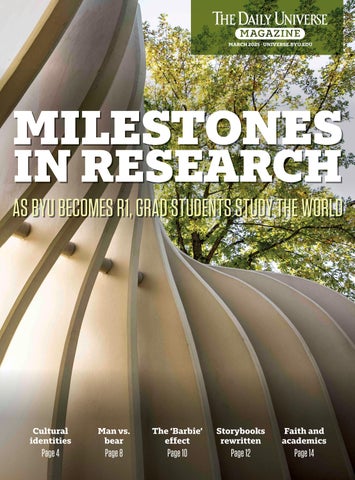
L. TOM PERRY SPECIAL COLLECTIONS/ALTERED BY ABE TULLIS “The Tree of Wisdom” sculpture by Frank Nackos in its original location outside the Harris Fine Arts Center in 1975. The sculpture was commissioned for BYU’s centennial.
whether it was good and bad. And while this perspective on social media might be more common now, Christensen’s research was certainly on the breaking edge.
So simply put: BYU-sponsored research projects matter.
“Research helps us understand,” Christensen explained. “Sometimes we go through our lives without realizing what we are feeling. Research starts to ask those questions that get us thinking ‘maybe there is something else in here that I’m unaware of.’ It continues the conversation.”
And BYU is continuing a lot of conversations.
In 2024, Scholars Archive uploaded hundreds of articles by post-graduate students in a variety of disciplines, in addition to many more published articles by BYU faculty and even research papers by undergraduate students. Their work advances some of today’s most crucial conversations. Some of their theses and dissertations cover relevant and exceedingly niche topics, while others tackle some very prominent current conversations.
To celebrate BYU’s new status as an R1 institution and highlight some of the research that BYU graduate students have conducted, we’ve selected some of the many interesting, important and meaningful reports published in 2024. The articles included in this issue highlight some of that research.
Because as BYU finally achieves an R1 designation, it won’t just be 18 million people that have turned to BYU for research. It will be 18 million and counting.
By Ethan Pack
Do you have good memories of writing in high school? Thinking back, how confident did you feel in your ability to put pen to paper (or text to screen) and write something you were really proud of?
Katie Francom, an English teacher at Layton High School who completed her master’s degree at BYU in 2024, wanted to find out just how effective writing groups are at helping students overcome their fear of writing and building their self-confidence. Francom has been teaching at Layton High since 2017.
“I so enjoyed being back in a classroom and talking with people who are nerdy about the exact same things I’m nerdy about,” Francom said.
And while writing groups might not seem like the nerdiest focus, Francom focused on answering her research question like a member of the most devoted fandom: How do writing groups in high school affect students’ self-confidence in their writing? Her BYU Department of English thesis, titled “The Effects of Writing Groups on Student Self-Efficacy,” was the result of three years of research.
Francom says she became interested in writing groups and self-confidence when she took a summer writing program at BYU.
“It was the first time in my adult life I’d been writing consistently and getting feedback, and I loved it,” Francom said.
Her experiences in writing groups
at BYU made her wonder how they could benefit her own students.
“All of the things that built my confidence in writing had always been social, whether it was from peers or from professors giving me feedback,” Francom says. “So I just started to feel like, well, if that’s how I decided I was an okay writer, that might have an effect on my students too.”
Self-efficacy and self-esteem are pretty similar terms, but actually mean slightly different things, Francom explains in her thesis. Self-efficacy is the level of belief that one has in their ability to accomplish a task, while self-esteem is concerned with judgments of self-worth. Francom wanted to study how writing groups affect students’ ability to improve on their writing and receive feedback. She asked her 11th grade Honors English class for help.
Fifty-nine students participated in 10 writing groups over the course of the Fall 2023 Semester. Groups consisted of three to four students, and the students themselves were allowed to have some say in who their group mates would be, based on who they felt comfortable sharing their writing with.
“Though a teacher will always be seen as the ultimate authority in the room, I wanted the students to feel they had some ownership over their group,” Francom writes in her thesis.
“[Writing groups] were something that I probably would have done in my classroom anyway, so I don’t think they even noticed that we were doing a study, except the fact that I
gave them surveys,” Francom said. “But the writing groups themselves just felt like part of the classroom experience.”
Francom gave the class three writing assignments over the course of the semester — a personal narrative to develop a strong personal writing voice, a response to an ethical question in order to write with a clear claim and maintain a professional style, and a literary analysis paper on “Pride and Prejudice” to develop nuanced claims and back them up. In each group meeting, students would share parts of their writing and receive feedback from the other students.
After each meeting, the students would fill out a short reflection survey on their experience. The purpose was to discover how the students felt about their groups. Francom also gave the students three longer surveys throughout the semester, designed to measure their self-efficacy. This survey included questions like, “Do you enjoy writing?” and “What part(s) of the writing process are you most confident in?”
Ultimately, while the collected data showed that 26 of the 59 students expressed a change in their confidence, and 14 of those 26 showed an increase in self-efficacy, the study couldn’t conclusively say that writing groups improved students’ self-efficacy.
“For some of the groups, this was really successful, and they did get really invested,” Francom says. “Some of the groups, by the end of the year, are meeting for 30 or 40
minutes just talking in detail about everyone’s writing and really like cheerleading for each other, but then other groups, it was a hoop to jump through.”
Even though the data didn’t show significant differences in students’ self-efficacy, Francom noticed a change in the students.
“I did see even the students who didn’t say their confidence moved at all, I did see them become more confident in talking about writing, in noticing different features of each other’s writing as the year went on, and then enjoying talking about it in class,” she says. “The discussions got livelier and livelier.”
She suggests anyone who wants to improve as a writer should find people willing to give honest feedback.
“If you really care about improving your confidence in writing, find people who care about your writing and will give you honest feedback,” Francom says.
And as for advice Francom has for teachers who might want to try writing groups themselves?
“Do it. Try writing groups and be consistent. They definitely work better if you’re doing them once a week rather than if you’re sporadically doing them, but make sure you set it up upfront with what your expectations are and teach [participants] how to give feedback.”


By Amy Ortiz
Spanglish... Much like its structure and composition, la definición del Spanglish is messy. It’s neither Spanish nor English, but rather an intricate and spontaneous mix of both — one that often seeps its way into the daily lives and conversations of those who hold some form of Hispanic and American heritage.
For me, a mexicana who emigrated from México to Utah at 9 years old, adopting the fluid exchange between these two worlds of language came naturally. Less natural, however, was learning to navigate the weight of my own and others’ perceptions.
You see, while many view Spanglish as the fun and quirky result of an interlinguistic interaction, others perceive it as a “corruption of Spanish and English, a ‘linguistic pollution’ or ‘the language of a “raced,” underclass people,”

according to Bonnie Urciuoli’s 2013 book “Exploring Prejudice: Puerto Rican Experiences of Language, Race and Class.”
For a long time, these differing opinions created some tension within me. On the one hand, I felt speaking Spanglish representaba mi habilidad de navegar dos mundos (represented my ability to navigate two worlds). But on the other, I felt that — like the hybrid language itself — mi identidad was messy, lacking a singular, universal definition.
While this tension describe solo mi experencia, I know I’m not the only one. Yes, the process of discovering one’s identity as a multicultural or multiracial person is complex and unique to each individual. But feeling torn between two or more languages, cultures and racial categories is not uncommon.


as young adults, had a greater sense of pride in their identity and who they were,” Jasperson said.
The future is diverse
Though I am multicultural — not multiracial — these findings are incredibly relevant to me.
Whether it was by showing us an old photo album, teaching us to make tamales desde cero (from scratch) or creating opportunities for mis hermanos and me to participate in cultural traditions, my parents played an integral role in keeping my ethnic identity alive, all while encouraging me to honor and celebrate the culture and traditions of the country in which I now live.
Yet, seeing that the multiracial population is expected to triple by the year 2060 — going from 6.9 percent to 20 percent, according to a Pew Research study — the odds that both you and I will have regular interactions with multiracial individuals will only keep rising.
That means we must be conscious of how we interact with multiracial and multicultural communities, and do our part to instill the pride that Jasperson identifies in her thesis.
So, what can we do?

“(It) comes up all the time ... like on forms, when someone asks what race you are, it’s still pretty rare that you can check more than one box, or that you can even check a box that says, ‘I’m two or more races.’ You’re kind of forced to pick one,” BYU graduate Jennie Jasperson said. It is Jasperson’s personal experience with this conflict and the lack of published research surrounding the development of multiracial identities that inspired her to dedicate her graduate research to exploring how parents or caregivers shape their children’s sense of pride and self-esteem in their multiracial identity. Jasperson’s thesis, “Exploring How Caregiver Multiracial Socialization is Related to Multiracial Identity Pride, Self-esteem, and Racial Political Identity in Emerging Adulthood,” was completed in 2024 in the BYU School of Family Life.
To explore the relationships among multiracial individuals and their caregivers, Jasperson
asked a group of 387 multiracial young adults, ages 18-29, to complete a series of surveys.
Some survey questions asked participants to describe how much they agreed with statements such as: “I am proud of being a multiracial person,” or “I wish I could have more respect for myself.”
Others asked: “How often did your mom or dad talk to you about your racial identity?” and “Did they try to expose you to cultural traditions or practices?”
The results of Jasperson’s study boil down to this: How parents exposed their children to and engaged them with their multiracial identity was the greatest indicator of future pride and confidence in their unique identity.
“I found that when parents engaged more in ... having conversations with their kids about what it means to be mixed race or exposing them to cultural traditions ... then their kids,
We can openly celebrate the dual identities that inform the lives of both multiracial and multicultural people.
For me, this looks like speaking Spanglish, honoring my family and cultural traditions, and being willing to create my own blend of Mexican and American traditions, too. The spirit and thrill that accompany each of these practices keep me grounded and strengthen my connection to the various parts of myself.
As for parents, Jasperson advocates for them to foster cultures of inquiry and communication where multiracial kids can have the opportunity to ask questions and discover all parts of themselves, without fear of judgment or rejection.
“It can be a hard thing to navigate,” Jasperson said. “Even in my study, a lot of participants shared like, ‘My parents didn’t really know how to help me feel comfortable’ ... (or) ‘They made me feel bad about the way I looked.’”
But Jasperson’s advice extends to all of us, too. We may not be parents of multiracial or multicultural children, but through our conversations and interactions with others we, too, can create safe spaces where people of all backgrounds — including ourselves — feel comfortable.
This brings me to my last point: Todos, no matter who we are and where we come from, carry a unique blend of identities — spiritual, physical and cultural, among others. And, like Spanglish, learning to connect with these identities is messy. However, as we actively dedicate time to nourish our roots and cultivate all parts of ourselves, we will find we are more than just the sum of our parts. We are all human, hijos de Dios, learning to navigate the world of identities within us.
Jennie Jasperson
“Exploring How Caregiver Multiracial Socialization is Related to Multiracial Identity Pride, Self-Esteem, and Racial Political Identity in Emerging Adulthood” unvr.se/multiracial


By Jackie Durfey
In school psychologist Jenny Rowley’s school district, you’re almost as likely to hear students greeting each other with “hola” or “nı haˇo” as you are to hear “hey.” Rowley works in schools with dual language immersion (DLI) programs, where students learn a foreign language by attending school in that language.
In 2008, the Utah Senate passed a bill that created funding for schools to implement DLI programs. Since then, DLI has exploded in Utah, which ranked third in the country for number of DLI programs, following New York and California as of 2021. By 2023, Utah was home to 301 DLI programs that taught at least one of six languages: Spanish, Chinese, Portuguese, French, German and Russian.
The Utah Board of Education says there are many benefits for children enrolled in DLI programs. In addition to learning a second language, children develop cultural competency and are prepared for the global job market. What’s more, children’s cognitive skills such as creative problem solving improve and they perform as well as or better than non-DLI students on standardized tests.
Now in its 17th year, DLI in Utah has surpassed expectations. This raises the question: Is Utah prepared to handle such a rapidly growing program?
As Rowley worked in DLI schools, she began noticing unequal class sizes, unbalanced distribution of students with behavioral and academic challenges, and even dissatisfaction among teachers. Rowley wondered if these issues were isolated incidents or if she was witnessing part of a statewide trend. Her curiosity led to the development of her thesis “Identifying Barriers to Sustainability of Dual Language Immersion Programs in Utah Schools.” She completed the


thesis in 2024 as part of her work toward a graduate degree in the BYU Department of Counseling Psychology and Special Education.
Rowley’s quantitative study was complemented by qualitative work from another graduate student, Amy Hawks, who completed her thesis “Attitudes, Opinions, and Beliefs of Teachers Toward Dual Immersion Programs in Utah Schools” the same year. Together, Rowley and Hawks exposed potential weaknesses in Utah’s DLI programs.
Hawks and Rowley’s faculty advisor, Terisa Gabrielsen, was adamant that the purpose of their studies is to improve DLI programs, not tear them down.
“We don’t want to criticize DLI. Now that it’s going really well, we have the ability to look at the effects in the school and now turn our attention to some of these issues,” Gabrielsen said.
For her thesis, Rowley surveyed 580 parents, teachers, staff and administrators in DLI schools, asking them to rate how much they agreed with statements about DLI in their schools. Respondents included both DLI and non-DLI participants.
Rowley found that individuals directly involved with DLI had more positive experiences in the school community compared to those not involved with DLI. She also found that both DLI and non-DLI participants generally agreed less with the statement “School community (teachers, admin, staff, and students) is more connect-
ed because of the DLI program.” This division was concerning to Rowley.
“A DLI school which houses both a DLI and non-DLI community cannot sustain this disunity long-term without identifying and addressing the barriers in place,” Rowley wrote in her thesis.
Gabrielsen said DLI can create a sense of elitism among students in the program. She said it’s important for DLI facilitators to ask themselves how they can create a culture supportive of all students, whether or not they participate in DLI.
Rowley found the inequities in student distribution to be an additional roadblock to DLI sustainability. Gabrielsen explained that when a student struggles academically in the DLI curriculum or consistently displays disruptive behavior, the teacher and parents may decide to move that student to a general education classroom. Ultimately, this leads to a concentration of academically and behaviorally challenged students in general education classrooms that teachers may not be prepared for. While Rowley’s thesis doesn’t suggest any concrete solutions for this issue, she does encourage those in DLI schools to be mindful of this phenomenon as they plan for future school years.
Hawks took a different approach to her thesis. She interviewed 12 DLI teachers to gauge their attitudes towards different aspects of the program and identify potential areas of improvement. Her findings were similar to Rowley’s: teachers reported a divide between DLI and non-DLI
students and teachers in DLI schools. The good news? There are potential solutions. One common theme in respondents’ interviews was the need for a standardized DLI curriculum. Many DLI teachers reported creating their own curriculum as the year went on, spending their own money and personal time on development. This made it difficult to coordinate with non-DLI teachers in the school, further contributing to the division of teachers in DLI schools. Teachers in Hawks’ survey felt that a statewide standardized DLI curriculum and teacher training would lessen their stress and improve unity in schools.
Additionally, teachers noted that the rapid growth of DLI programs has led to overcrowding in classrooms. They felt that more space and smaller class sizes would allow them to develop better relationships with students and give them the one-on-one help they need.
Ultimately, Rowley, Hawks, and Gabrielsen believe DLI programs in schools can have great benefits for students. They also believe that certain issues must be further examined and solutions eventually implemented to keep Utah’s 301 DLI programs thriving. Utah has led the way for DLI programs in other states, Gabrielsen said, and she hopes it will continue to do so.
However, as we actively dedicate time to nourish our roots and cultivate all parts of ourselves, we will find we are more than just the sum of our parts. We are all human, hijos de Dios, learning to navigate the world of identities within us.
The chart on the right shows dual language immersion programs by state as of 2021. Utah is one of five states that make up 60% of all programs in the U.S. (American Councils for International Education).
Jennifer Leigh Rowley “Identifying Barriers to Sustainability of Dual Language Immersion Programs in Utah Schools” unvr.se/dualimmersion


By Mckenna Jensen
Dragging a Sitka Blacktail deer 200 yards in bitter Alaskan cold is, in a word, difficult.
That’s why my uncle, Neal Jensen, and his hunting partner, Steve Sawyer, decided to ditch the trek to the beach and stop next to a dense thicket of alder. In the bitter cold, with western winds gusting toward the coast, Jensen and Sawyer began quartering the animal.
Over the next 40 minutes, they carefully quartered the deer, packed the meat into bags, and removed the cape with the head, placing it in a game bag at the edge of the trees. With the work finished, the two hunters began heading out. Jensen hoisted his 85-pound pack onto his back, strapped on his gloves, and looked toward the path. What happened next was a blur of adrenaline.
Suddenly, a Kodiak grizzly bear was 15 feet away and charging.
According to the Alaska Department of Fish and Game, Kodiak grizzlies are the largest bears in the world. A large male can stand over 10 feet tall on its hind legs, 5 feet tall on all fours, and weigh up to a staggering 1,500 pounds.
The bear reached the tree line, paused briefly to sniff the deer head and cape, then let out a growl and charged at full speed toward Jensen. Backing up quickly, Jensen managed to grab Sawyer’s rifle, a 300 Win Mag, but only took a few more steps before stumbling onto his back.
“I remember Steve yelling, ‘Shoot! Shoot! Shoot!’” Jensen recounted. “I shot the bear as it was about to reach me.”
The bear staggered, thrashing in tight circles and gnawing at his wound, before charging downhill, crashing through the dense alders.
Jensen’s chilling experience, while terrifying, highlights a larger issue: increasing numbers of human-bear conflicts (HBCs) across North America. And what’s causing a spike in these potentially fatal encounters? Human incursions in bear country.
According to former BYU graduate student Cody Robert Miller’s thesis, “Human-Bear Conflicts in North America (1880-2020): A Comprehensive Analysis of Patterns, Outcomes and Interactions,” over 2,100 bear-human incidents were recorded across North America between 1880 and 2020. Miller’s thesis was completed in 2024 as part of his requirements for a master’s degree in the Department of Plant and Wildlife Sciences.

“It is essential that we understand the factors associated with HBCs in North America so that wildlife managers can make appropriate, science-based recommendations about how to avoid, and if necessary, survive such incidents,” Miller said.
Grizzlies are involved in the majority of HBCs, often reacting with defensive aggression when they feel startled or threatened. But this doesn’t mean that Black Bears can’t cause some havoc. They’re actually seven times more likely to treat humans as prey. It’s this attitude towards humans that contributes to a higher fatality rate in black bear encounters. Polar bears, the apex predators of the Arctic, are the deadliest of all, with 22% of their interactions ending in tragedy.
Most HBCs stem from surprise encounters, curiosity, or food attraction. Hikers and hunters are the most common groups involved, with hiking making up 27% of recorded incidents. Miller’s research emphasizes the importance of staying in a group, as solo individuals are far more vulnerable. Being in a group of three or more people drastically reduces injury rates when stumbling upon a bear.
Time of year and environment also play roles. Most encounters occur in summer, also known as the peak of outdoor activity season. Grizzlies are


Size 13 winter boot next to track of the bear that attacked Neal Jensen.
more likely to attack in areas with poor visibility, so watch out for dense, thick forests. Black and polar bears are often found in open spaces.
Miller’s research study also reveals how preparation saves lives. Bear spray, for example, is effective in 90% of conflicts, while firearms succeed 78% of the time. Firearms are less efficient due to the chaotic, high-adrenaline nature of attacks. Using a gun in such chaotic, high-adrenaline moments requires a high level of skill. Access to tools like bear spray or a firearm significantly lowers the odds of injury.
There’s an old saying that illustrates the difference between recommended reactions for different types of bear encounters: “If it’s brown, lay down. If it’s black, fight back.”
Reflecting on his bear encounter, my Uncle Neal Jensen said, “I think 99 out of 100 times I would not have stopped the bear and would have been mauled or worse.”
His words serve as a bleak reminder that, no matter how prepared or skilled we may be, the


Travel in groups
There is safety in numbers
Keep deterrents handy
Bear spray or a firearm could save your life when accessible
Avoid attracting bears
While camping, keep sites clean and store food properly
Know the terrain
Unfamiliar, dense forests can cause surprise run-ins
Make noise
Let the bear know you are there


In the late 19th century, Latter-day Saint women were considered by some “as anything from poor, destitute, slow-witted, and deluded, to subjugated slaves of their husbands and sexually promiscuous,” according to new research by BYU graduate student JoLyn D. Brown. However, Emmeline B. Wells set out to correct this perspective by compiling a poetry anthology in which individual Latter-day Saint women could celebrate their culture and share their beliefs in a personal, non-threatening medium.


wilderness is a volatile place of caution. By understanding bear behavior, respecting their habitats, and practicing outdoor safety, we can navigate these shared spaces more wisely, ensuring the safety of both humans and wildlife alike. master’s “Songs

Wells’ anthology, “Songs and Flowers of the Wasatch,” debuted at the 1893 Chicago World’s Fair. In addition to poetry, it included artistic representations of flowers typical to Utah. Brown’s reconsideration of this book of poems was created in 2024 as part of the requirements for her master’s degree in English at BYU. Her thesis is titled “Songs and Flowers of the Wasatch: Rhetorical Aesthetics and Latter-day Saint Women’s Poetry.”


Cody Robert Miller
“Human-Bear Conflict in North America (1880-2020)”
unvr.se/manversusbear
To a modern audience, swirly letters typeset against a flowered background might seem trite, especially in the face of the challenges that plagued Latter-day Saint women at the time. And indeed, 19th century poetry was received poorly in the early 20th century because of its typical rhyme schemes and seemingly childish rhetorical choices. However, the topics in “Songs and Flowers of the Wasatch” were anything but juvenile. Eliza R. Snow, known as the lyricist of the hymn “O My Father,” declares the existence of Heavenly Mother, and Wells reflects on death in a poem called “At Evening.”


What early critics missed, according to Brown, is that “Songs and Flowers of the Wasatch” wasn’t about peacocking or experimental rhetorical tricks, but rather it was specifically crafted to package the deepest parts of these women for an unsympathetic audience of their contemporaries. The poems countered popular portrayals of life among Latter-day Saints both thematically and in form. The poems, mostly about nature, death and spirituality, adhered strictly to classic rhetorical forms to indicate that they observed moral codes and were refined, therefore humanizing themselves to the

prevailing culture of the day.
Brown postulates that when “Songs and Flowers of the Wasatch” arrived in Chicago, it was well-received not in spite of, but thanks to, its familiar forms and nostalgic themes. Displayed in a cozy living-room type setting alongside “paintings, needlepoints, wood carvings, and written publications,” it showed “more thoroughly than a single speech could that the women in Utah were refined, well-educated, civic minded, moral, and Christian by all the standards of womanhood expected of the day.”
20th that Wasatch” wasn’t about peacocking or expercrafted in speech could that the women in Utah were


These poems relied on the aesthetic experience of their audience, hoping that describing a quiet evening in their world and the true feelings of the heart would invite empathy rather than enmity from those outside the Latter-day Saint faith.
Early Latter-day Saint women used poetry

Early Latter-day Saint women used poetry as both a mirror and a bridge—reflecting their personal experiences while reaching out to a disapproving world. Their words countered misrepresentation not with argument, but with beauty, familiarity, and quiet defiance. “Songs and Flowers of the Wasatch” presented them as educated, thoughtful and deeply connected to their faith and environment.

argument, but with beauty, familiarity,

Following the fair, the Ladies Literary
Following the fair, the Ladies Literary Club in Salt Lake City, which had previously shunned Latter-day Saint women, extended a “special invitation” to Wells, and opened their doors to the other women. Brown concludes that connections made in Chicago led to the regional convention of the National American Woman Suffrage Association being held in Salt Lake City in 1895.

“I desire to do all in my power to help elevate the condition of my own people, especially women,” Wells wrote.
elevate the condition of my own people,
Her work on this anthology did just that. Through poetry, these women documented their lives, challenged misconceptions and quietly claimed a space for themselves in the broader literary and social landscape.

Through poetry, these women documented quietly claimed a space for themselves in the

JoLyn D. Brown

“Songs and Flowers of the Wasatch: Rhetorical Aesthetics and Latter-day Saint Women’s Poetry” unvr.se/flowers


By Lauren Willardson
Religion and politics are considered taboo at the dinner table, but how do similarities or differences in these beliefs affect parent-child relationships?
That is one question Emily de Schweinitz Taylor, a recent Ph.D. graduate from BYU’s Department of Psychology, sought to answer in her 2024 dissertation: “The Influence of Religious and Political Discrepancies on Parent-Adolescent Social Cohesion.”
After settling on the topic, Taylor found relatively little research had been done about both religious and political affiliations together, specifically where teenagers and young adults were concerned. This lack of research, Taylor said, has led to the perpetuation of assumptions and anecdotal evidence.
From previous research, Taylor learned that children generally follow their parents’ views of politics and religion. To build on existing research and add the influence of political identities, Taylor used the Family Foundations of Youth data set to observe child-parent connections from teenage years into adulthood. This study oversampled for members of The Church of Jesus Christ of Latter-day Saints and was conducted in Utah, California, and Arizona. Taylor defined five main classes to organize respondents based on varying ratios of political and religious involvement among the parents and adolescents. When using this data to measure parent-child connection, she defined “connection” as how emotionally connected the child or teen felt to their parents.
The data showed that families that were more politically conservative and more religious reported the best child-parent connection overall.
The lowest parent-child connection was shown in groups that were unsure of or slightly against religion and also unsure of political affiliation. Interpreting this data, Taylor said that the more religious and politically convicted groups having better connection tends to show the importance of a firm ideological foundation in a child’s upbringing.
Other results from the study confirmed past data that children tend to reflect the political and religious affiliations of their parents. As such, researchers believe that most fundamental religious and political change happens between the ages of 18 to 30. However, the research also suggested that, while parents are generally assumed to be more religious than their children, this is not always true.
Taylor said that she has observed rifts in political or religious opinions that can cause estrangement within a family. In such cases, there are two extremes. On the one hand, parents often try to use coercion or hard rules with their children to gain their compliance. This, Taylor said, almost always backfires in terms of connection.
On the other hand, parents also sometimes leave their former beliefs to support a child after the child claims their parent must “choose” between the two. This is also a false dichotomy, Taylor said. She noted that her research backed the success of empathy in familial connection, emphasizing that this does not mean abandoning beliefs, but rather modifying traditions and family social practices so that all members can feel that they belong.
Emily
de
Schweinitz Taylor
“The Influence of Religious and Political Discrepancies on Parent-Adolescent Social Cohesion” unvr.se/conversations


By Emily May
Women dressed in pink swarmed movie theaters on July 21, 2023, to watch the biggest movie of the year, “Barbie,” which grossed more than $1.4 billion worldwide that year. But, when America Ferrera, as Gloria, delivered her now-famous monologue, beginning with, “It is literally impossible to be a woman,” the atmosphere among these women shifted. They felt understood.
Her monologue of a woman’s experience was so profound that it not only brought women worldwide to tears but stuck with them long after the film was over. This was the case for BYU master’s graduate Taylor Michelle Gale.
“It’s really powerful to be a woman,” Gale said.
What set the movie apart was not just its vibrant pinks or childlike humor but the way it communicated the lived experience of women every day and the harmful effects of a patriarchal society.
Gale’s 2024 master’s thesis, titled simply “Barbie,” was completed as part of the requirements for a graduate degree in the School of Communications. Gale analyzed every scene in the film for depictions of feminism, matriarchy/patriarchy, hypermasculinity, objectification, and the ultra-thin body ideal. She found the film is rampant with these themes, shown to be either empowering or detri-
mental to the experiences of women.
“Gloria’s impassioned plea underscores the struggles women face in a world fraught with contradictory expectations and systemic inequalities, urging for recognition and change,” Gale wrote in her thesis. “Gloria is pleading with women to understand they are enough, to know their worth and value is present in more than their looks alone, that they, women, can be anything they hope to be, that they can, and should, do things for themselves and take back their power.”
Barbie told Gloria she “isn’t good enough for anything” because she hasn’t become president or a Supreme Court justice—objectively extraordinary achievements—like her fellow Barbies.
But feminism isn’t just about extraordinary women, it’s about celebrating all women—all girls, all mothers, all women without children, all women with jobs, all women without jobs, all women whose spouses stay home instead and all women who are just trying to make it through the day.
In her thesis, Gale said the feminism exhibited in the film is meant to encourage diversity and individuality in women.
“Barbie’s slogan is, ‘You can be anything.’ To instill that in young girls and boys and just young individuals, I think that’s super important,” Gale said.
The film’s themes of objectification
and the ultra-thin body ideal are two sides of the same coin.
Women are expected to achieve this ultra-thin body if they want privilege and male attention because this is what our patriarchal society has labeled as “attractive.” But, despite possibly believing life is better for “attractive” women, they’re faced with a new issue—objectification. Just as Barbie is ogled by the men she encounters in the Real World, women who meet these beauty standards become the targets of catcalling and harassment.
Objectification seeks to strip women of their intelligence by reducing them down to a body. For women, beauty is a loselose situation.
“The researcher emphasizes the urgent need for women and girls to view themselves as more than their bodies, for only then can men begin to see them in the same light,” Gale wrote in her thesis. “Women are intelligent, capable, and their voices are meant to be heard. To challenge patriarchal norms, society must move beyond superficial judgments and recognize the full humanity of women, allowing their intellect, talents, and contributions to be valued more than their appearance.”
By Elizabeth Williams
As technology disrupts virtually every area of life, human language translators are competing with computers that promise speed and technical accuracy. The human translators counter with nuanced understanding of culture and context.
So which is the superior translator: human or machine?
Catherine Marshall dove into this question in her graduate thesis entitled “A Comparative Analysis of Human and Machine Translation.” Marshall completed the research in 2024 as part of the requirements for her degree in the BYU Department of Linguistics. She compared human ATA (American Translation Association) exams against machine exam responses.
Marshall says the ATA Exam is one of the most difficult translation exams with an 80 percent fail rate. It’s designed to be a mid-career exam; even experienced translators can fail. The exam requires an excellent knowledge not only of the language’s vocabulary but of the nuances and culture associated with it. The examinee must translate two complex passages in a limited time frame.
Marshall got her hands on 326 graded human exams and went to work comparing them to responses given by several machine translators, including Microsoft Translator, a Neural Machine Translator and its trusty friend GPT-4, a Large Language Model translator.
The machines were forced to translate the same passages the humans had been tested on. Despite the clear advantage of machinery, there was no clear winner.
Marshall found there was no significant difference between the number of errors in human and machine translation. However, there was a difference in the type of errors in each translation process.
This brings us back to our opening scenario— how can you tell if you’re reading a machine’s work?
Marshall’s research showed that the human responses had spelling errors, mistranslated phrases, wrong words, and other typical “human” slip-ups.
The machines aced the technical side of translation but suffered a staggering blow with overly literal errors. She found that machines are familiar with “everything and nothing” at the same time. What they lack is the subjectivity and emotional intelligence that comes from lived human experiences.
This is humorously explored in an old Studio C sketch entitled “Google Translate.” That comedic story ends with a woman’s lover accidentally declaring war on her family in gruesome detail. It’s a funny sketch to watch, but there are real-life consequences of the machine’s fatal flaw.
Studio C got one thing right: For these high stakes situations, machines are helpful with speed and complex terms (not everyone knows the translation of “defibrillator” off the top of their head). Humans finish the job by correcting the literal errors so that the user can properly understand its use.
Humans finish the job by correcting the literal errors so that the user can properly understand its use.
Marshall’s thesis asserts that we need both machine translation and human translation for the best final product.
“I think it would be a mistake for either world to ignore the benefits that come with the other,” she concluded.
Catherine Marshall
“A Comparative Analysis of Human and Machine Translation Quality” unvr.se/translate


By Chloe Peterson
Picture a powerful person.
Your first thought was probably not a small young girl in a red coat.
You may have imagined someone who better fits the description of another character from the classic tale… think big muscles and a wide toothy grin.
This mental bias is supported over and over in classic folk literature, especially children’s stories. But how does this disparity in the placement of power affect the way the reader views their own power—especially if that reader is a small child—and how would it change their self-view if the story were modified to place the characters they identified with in positions of power?
In her thesis, “Power in Picturebooks: A Teacher’s Critical Multicultural Analysis of Illustrated Versions of Little Red Riding Hood,” BYU graduate student Adrianna Galtieri explores how “reimagined versions of the classic tale can open important conversations about courage in the face of danger, living up to (or down to) parents’ expectations, reimagining focus and distraction, and positioning oneself as an agent of positive change.”
Galtieri completed the thesis in 2024 as part of the requirements for her master’s degree in the BYU Department of Teacher Education.
“But not this girl …”
After reading dozens of versions of the Little Red Riding Hood story, Galtieri chose six reinterpretations she felt would allow for a rich review of how the themes of the classical story


might compare to other retellings.
These versions included wordless picture books, depictions of the tale from different cultural backgrounds, and even a version where the big bad wolf is in cahoots with granny to surprise Little Red with a birthday party.
One version in particular flipped the familiar portrayal of power on its head.
In Bethan Woollvin’s 2020 illustrated children’s book titled “Little Red,” the story progresses as we would expect: a little girl sent into the woods, encounters a wolf, tells the wolf where she is going… so on and so forth resulting in a devoured granny.
The modification that makes all the difference is in the character of Little Red — as Galtieri puts it, “she is perhaps the scariest predator in the woods.”
Woollvin describes the disturbing and dangerous circumstances our protagonist finds herself in, then assures the audience that this may have scared other little girls, “...but not this girl.”
Little Red is unfazed by the wolf’s schemes, and instead of being a victim of her circumstance, she is depicted as confident and in control.
A picture of her holding an axe is followed by an illustration of her returning home to her mother with a smile on her face, this time wearing a wolf skin cape over her red one.
Unlike the traditional tale which casts Little Red in a role that is consistently acted upon, Woollvin cast Little Red as the actor and gave her the axe (and the power).
Mirrors and windows
In her thesis, Galtieri references a multicul-


tural analysis of children’s literature by Maria Botelho and Masha Rudman. Their 2009 book is “Critical Multicultural Analysis of Children’s Literature: Mirrors, Windows and Doors.” Botelho and Rudman describe how children need stories to fulfill two main functions: to mirror their own lives and to open windows to new perspectives.
Through these stories children “can meet people across lines of social difference (e.g., cultural, class, language, sexuality, age, ability, and geography), providing vantage points from which readers can view multiple lives,” Botelho and Rudman wrote.
As an educator, Galtieri emphasizes that folk literature should be prevalent in classrooms, and she encourages other educators to open space for discussions about how various fictional wolf characters may appear in students’ real lives.
“When educators and their students analyze texts for the ways they depict characters’ power in traditional tales and modern-day retellings, they will find surprisingly fresh perspectives, as well as frustrating reifications” Galtieri wrote.
If children see Little Red conquering her big bad wolf, the mirror theory would empower them to face the big bad wolves in their own life. And maybe when the small young girl in the classroom is asked to picture a powerful person, she sees a little girl in a red riding hood, or even better: She sees herself.
Adrianna Catherine Galtieri
“Power in Picturebooks: A Teacher’s Critical Multicultural Analysis of Illustrated Versions of Little Red Riding Hood” unvr.se/bookpower


By Mckenna Schmidt
In October 2018 I visited Utah to tour colleges. BYU was the first stop but last on the list of where 17-year-old-me thought she wanted to end up after high school.
My dad and I waited in the Hinckley Center for our tour to start. I remember how beautiful it was, the pleasant music and warm light pouring through the windows. I felt this bubbly anticipation as we loaded into the golf cart. I wish I could say I remembered more from that day, more of what I learned about BYU. But what I really remember is the feeling. I remember I practically skipped back to the car and no other college we toured those next few days measured up or left me with that glow.
This bubbly, joyful anticipation of all the possibilities open to me at BYU hasn’t left me in all the years after. It got me through the anxiousness and fear of preparing my application and waiting for the decision. It got me through the fear of leaving home and being on my own. It got me through the last four years of testing center exams and 8:00 a.m. classes and finals weeks.
The same feeling I had on that fall morning six years ago is still with me as I walk the campus grounds for the thousandth time—the feeling of what a gift it is to be here in this light-filled,
God-directed place of learning.
“At BYU, you get this dual focus that imbues your education with a double dose of wonder,” BYU Senior Anya Searle said.
Searle is the type of student who even from the beginning of her time here was seeking to wring out every drop of goodness and enlightenment this university could offer her, both intellectually and spiritually. Throughout her educational experience, she has grappled with perfectionism around high academic achievement but reflected on how the spiritual emphasis of a BYU education has helped her frame her efforts in a new light.
“The whole purpose of being here in life is to learn both from our successes and from our failures. Knowing that failure was never the backup plan—failure is the plan—has been instrumental in my academic success and growth,” Searle said. Searle is entering her final semester and is preparing to leave BYU and begin a masters program at another university. I know for myself the thoughts of leaving this campus in just a few months leaves me with a subtle ache and quiet sadness. I will miss being surrounded by so many people who love Jesus and are striving to know Him better. I will miss the professors who treat me with such kindness and believe in my grand potential. I will miss the prayers in classes
and hearing the bells chiming familiar hymns. Searle and I may be entering this closing chapter of our time here but for the university as a whole it is the beginning of a new one. January 1st marks the second half of BYU’s second century, an anniversary memorialized in an unforgettable way through President Kimball’s “Second Century” address given in 1975. The experience had by Searle and so many students is in large part due to the vision laid out so clearly in this historic address.
“As scholars you must speak with authority and excellence to your professional colleagues in the language of scholarship, and you must also be literate in the language of spiritual things. We must be more bilingual, in that sense, to fulfill our promise in the second century of BYU,” Kimball said.
BYU’s mission to be something more than another successful university is not accomplished easily. It is the combined efforts and revelation of good men and women who are seeking to truly make BYU fit for the Kingdom of God not the accolades of the world.
One of the ways is through its prioritization of the highest quality undergraduate teaching by professors. It offers a “to the one” type of mentorship and relationship reflected in Christ’s teachings: even as we become greater in the

world’s eyes and grow in knowledge and experience He asks that we use our gifts to serve and bless others (Matt. 23:11).
Another way is through the integration of university institutions outside of the main academic colleges such as the Wheatley Institute or the Maxwell Institute. These institutions work to uphold and promote core values of The Church of Jesus Christ of Latter-day Saints.
The Wheatley Institute focuses on family, religion, and constitutional government as essential pillars for a flourishing society. Through university fellows and student scholars, they work to promote research, collaboration, and policy to promote these three tenets. The work done there shows up in student courses, academic journals, and worldwide conferences. It also shows up on the ground in places like Africa where fellows are creating jobs through family history initiatives and closer to home where research is being done to better understand and to improve outcomes for LGBTQ+ individuals.
With a focus on the restored gospel of Jesus Christ, the Maxwell Institute serves as a hub for meaningful research, thought-provoking publications, and public initiatives that inspire faith while advancing knowledge. The institute’s associate director, Rosalynde Welch, emphasized how the Maxwell Institute has the unique
privilege of focusing solely on the university’s religious foundation, a foundation once present in many secular institutions that can easily be lost, she said.
“At the Maxwell Institute, we can excavate down and find the religious roots of what a university’s mission is,” Welch said.
The namesake of the institute, Elder Neal A. Maxwell gave an address titled “Why a University in the Kingdom?” in the same month as President Kimball’s. He also spoke on the significance of BYU’s religious foundation.
“Clearly, therefore, BYU parallels, but is not in, the secular stream of American universities; it is instead a unique tributary to mankind that springs from the fountain of the gospel,” Maxwell said.
As BYU moves into the second half of its second century, this vision remains vital. Maxwell asserts that for the university to fulfill its mission, it must expand its reach beyond campus, becoming a beacon of light and service to the world.
Welch echoed this sentiment, saying, “We’re not to hoard what we have just for ourselves. It has to start with us, but then we’re to take that light and give it freely to the world.”
BYU’s future depends on its ability to share the insights and truths cultivated on its campus. The
mately, reflecting on the privilege and responsibility it is to uphold the values of this university.
“We see ourselves as serving the BYU campus community first, and then the community of saints beyond that, and then the world beyond that,” Welch said.
Through its bright students, exceptional research, and vital institutions, BYU has the capacity to bring true relief to the world. This requires not just maintaining its religious and academic standards but embracing the responsibility to serve on a global scale.
“The Church and, therefore, BYU are entering together an era when the ‘ensign to the nations,’ the ‘light unto the Gentiles,’ will shine forth,” Maxwell said.
Students like Searle and leaders like Welch are examples of this. Searle is determined to continue to bridge the gap between her academic and spiritual lives and share her perspective of faith no matter where she is in the next chapter of her life.
“BYU is where you get your training wheels and learn how to have that dual focus. Going out into the world is really just putting that to the test. Enter to learn, go forth to serve. That’s really what the BYU motto means to me in this context,” Searle said.


