Wednesday January 29, 2014
Kaieteur News
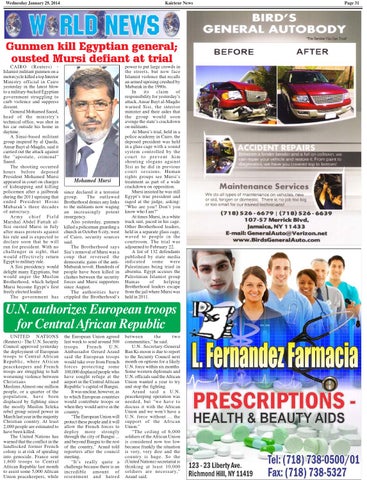
Gunmen kill Egyptian general; ousted Mursi defiant at trial CAIRO (Reuters) Islamist militant gunmen on a motorcycle killed a top Interior Ministry official in Cairo yesterday in the latest blow to a military-backed Egyptian government struggling to curb violence and suppress dissent. General Mohamed Saeed, head of the ministry’s technical office, was shot in his car outside his home in daytime. A Sinai-based militant group inspired by al Qaeda, Ansar Bayt al-Maqdis, said it carried out the attack against the “apostate, criminal” Saeed. The shooting occurred hours before deposed President Mohamed Mursi appeared in court on charges of kidnapping and killing policemen after a jailbreak during the 2011 uprising that ended Preside n t H o s n i Mubarak’s three decades of autocracy. Army chief Field Marshal Abdel Fattah alSisi ousted Mursi in July after mass protests against his rule and is expected to declare soon that he will run for president. With no challenger in sight, that would effectively return Egypt to military rule. A Sisi presidency would delight many Egyptians, but would anger the Muslim Brotherhood, which helped Mursi become Egypt’s first freely elected leader. The government has
Mohamed Mursi since declared it a terrorist group. The outlawed Brotherhood denies any links to the militants now waging an increasingly potent insurgency. Also yesterday, gunmen killed a policeman guarding a church in October 6 city, west of Cairo, security sources said. The Brotherhood says Sisi’s removal of Mursi was a coup that reversed the democratic gains of the antiMubarak revolt. Hundreds of people have been killed in clashes between the security forces and Mursi supporters since August. The authorities have crippled the Brotherhood’s
power to put large crowds in the streets, but now face Islamist violence that recalls an armed uprising crushed by Mubarak in the 1990s. In its claim of responsibility for yesterday’s attack, Ansar Bayt al-Maqdis warned Sisi, the interior minister and their aides that the group would soon avenge the state’s crackdown on militants. At Mursi’s trial, held in a police academy in Cairo, the deposed president was held in a glass cage with a sound system controlled by the court to prevent him shouting slogans against Sisi as he did in previous c o u r t s e s sions. Human rights groups see Mursi’s treatment as part of a wide crackdown on opposition. Mursi insisted he was still Egypt’s true president and raged at the judge, asking: “Who are you? Don’t you know who I am?” At times Mursi, in a white track suit, paced in his cage. Other Brotherhood leaders, held in a separate glass cage, waved to people in the courtroom. The trial was adjourned to February 22. A list of 132 defendants published by state media indicated some were Palestinians being tried in absentia. Egypt accuses the Palestinian Islamist group Hamas of helping Brotherhood leaders escape from the jail where Mursi was held in 2011.
U.N. authorizes European troops for Central African Republic UNITED NATIONS (Reuters) - The U.N. Security Council approved yesterday the deployment of European troops to Central African Republic, where African peacekeepers and French troops are struggling to halt worsening violence between Christians and Muslims.Almost one million people, or a quarter of the population, have been displaced by fighting since the mostly Muslim Seleka rebel group seized power in March last year in the majority Christian country. At least 2,000 people are estimated to have been killed. The United Nations has warned that the conflict in the landlocked former French colony is at risk of spiraling into genocide. France sent 1,600 troops to Central African Republic last month to assist some 5,000 African Union peacekeepers, while
the European Union agreed last week to send around 500 troops. French U.N. Ambassador Gerard Araud said the European troops would take over from French forces protecting some 100,000 displaced people who have sought refuge at the airport in the Central African Republic’s capital of Bangui. It was unclear, however, as to which European countries would contribute troops or when they would arrive in the country. “The European Union will protect these people and it will allow the French forces to deploy more strongly through the city of Bangui ... and beyond Bangui to the rest of the country,” Araud told reporters after the council meeting. “It’s really quite a challenge because there is an incredible amount of resentment and hatred
between the two communities,” he said. U.N. Secretary-General Ban Ki-moon is due to report to the Security Council next month on options for a likely U.N. force within six months. Some western diplomats and U.N. officials said the African Union wanted a year to try and stop the fighting. Araud said a U.N. peacekeeping operation was needed, but “we have to discuss it with the African Union and we won’t have a U.N. force without ... the support of the African Union.” “The ceiling of 6,000 soldiers of the African Union is considered now too low because frankly the situation is very, very dire and the country is huge. So the (United Nations) secretariat is thinking at least 10,000 soldiers are necessary,” Araud said.
Page 31