‘The math wars have casualties’: Conflicts over math permeate district, fuel debates over equity, accessibility
Amann Mahajan Forum Editor
In response to a lawsuit brought by parents in 2021, Santa Clara County Superior Court Judge Carrie Zepeda filed a court order on Feb. 6 determining that Palo Alto Unified School District’s method of placing students in math courses violates the Math Placement Act of 2015. Those filing the lawsuit charged that PAUSD failed to “systematically take multiple objective academic measures of pupil performance into account” when determining math placement, relying solely upon a student’s course in the previous year to determine placement for the next and offering little to no recourse for students who feel they have been misplaced. Zepeda ruled in the parents’ favor and ordered PAUSD to adopt a placement policy using objective measures, collect and report data regarding placement and assign a placement checkpoint during the first month of the school year, among other requirements.


“Despite extremist proposals (and mandates), there is a rational middle ground, and many teachers seek it. The math wars have casualties— our children, who do not receive the kind of robust mathematics education they should.”

 Berkeley professor Alan Schoenfeld
A month later, on March 20, San Francisco Unified School District parents filed a lawsuit on the district’s math placement policies. The same day, researchers from Stanford University had shared the results of a study showing that SFUSD’s delaning initiative—which proposes that all students begin with Algebra 1 in ninth grade—was not increasing representation of Black and Hispanic students in advanced courses, contrary to the program’s initial goals.
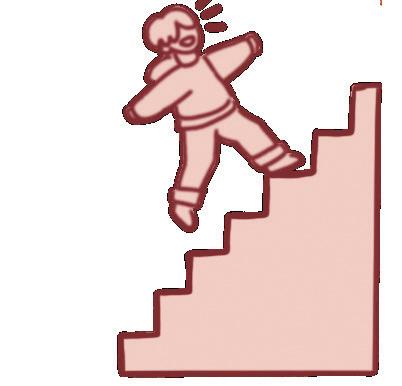
These events are just the latest battles in Silicon Valley’s “math wars.” Over the years, parents, students, educators and administrators have participated in a tugof-war over how math classes and pathways should be structured, who is being represented and what is being taught. Through looking at these past developments, we can better understand the conflicts of the present day.
Starting in the 1960s, “new math” took the nation by storm. According to a 1974 New York Times article, its purpose was “to stress the whys rather than the hows of mathematics, and to deemphasize the drill and rote learning that had been the substance of traditional mathematics education.” In PAUSD, schools such as Ohlone Elementary School were set up in response to the open education movement, which utilized these new pedagogical methods. In 1974, some parents pushed the district to open Hoover Elementary School as a “back-tobasics” option for students, emphasizing traditional modes of teaching math.
The issue reemerged in 1995. After PAUSD classrooms adopted reforms, including group work and student-led problem solving, a group of Palo Alto parents formed Honest Open Logical Debate, an organization advocating for traditional mathematics over new methods. In 2009, the district adopted the elementary school curriculum Everyday Mathematics despite a petition signed by 700 residents urging the district to reconsider what they saw
as a curriculum lacking rigor.
More recently, in 2019, amid heated debate, PAUSD middle schools were delaned so that all students would take Algebra 1 in eighth grade. In 2021, after the publication of the new California Mathematics Framework, the



increased pressure on students when more options for acceleration are provided. “The moment we put multivariable calculus on our pathway, that’s (now) the highest class—so now I guess MIT wants you to get there, and it’s just going to double down the pressure to
Palo Alto Unified School District Henry M. Gunn High School 780 Arastradero Rd Palo Alto, CA 94306 NON-PROFIT ORG U.S. Postage P A I D Permit #44 Palo Alto, Calif. P. 18 Sports Read about individual and team sports! Check out our website! gunnoracle.com Follow us on social media @gunnoracle
“ Emma Cao
The root of the problem
Integrating all students
Student Executive Council details prom planning process
Victor Dang Reporter
Gunn’s annual junior and senior prom will be hosted at the Exploratorium on April 22. The Exploratorium is a museum of science, technology and art located in San Francisco, with exhibits centered around guest participation.
Student Activities Director Lisa Hall expects this year’s prom to be more popular due to the interactive activities —which include creating giant bubbles, playing with sand on a rotating table and walking on a footbridge covered in fog—that the venue offers. “A lot of (students) are interested in more of the kinds of scientific or explorative exhibits that the Exploratorium has,” she said. “Students who might not otherwise attend prom if it was just a dinner (are) more likely to go because there are other activities that they can participate in.”
said. “Besides the location, everyone still goes on buses (and) there will be the same kind of food, so not many things have changed.”
The process that goes into selecting prom locations begins long before the start of the school year. “About two years in advance, we start looking at venues,” Hall said. “We work with an event planner who helps us choose some locations, and we try to rotate them just because the large majority of our juniors and our seniors attend prom both years.”
“Students who might not otherwise attend prom if it was just a dinner (are) more likely to go because there’s other activities that they can participate in.”
Student Activities Director Lisa Hall
Hall also noted changes regarding COVID-19 guidelines. “Last year, we required (participants) to have copies of vaccines and boosters before being able to go to prom,” she said.“This year, that isn’t a requirement.”
With these changes in mind, Dance Commissioner senior Adele Davis still expects the prom experience to be similar to that of previous years. “People expect the same things from prom every year, so as long as we stick to tradition, they’re going to be pretty happy about it,” she
After that, Student Executive Council members narrow down the selections. “We bring in the dance commissioner and all of our current juniors and sophomores—maybe freshmen if it’s way far out—to choose which of these locations fit our needs,” Hall said. Davis elaborated upon the venue booking process. “The reason that the venues are considered and booked so far in advance is because of how competitive the bookings can become,” she said. “There are a bunch of schools in the same area all trying to get the same venues. The sooner you choose which one you would like to be at, then it’s more likely that they are actually available on the weekend and time you want.
Junior Angeline Hu is looking forward to this year’s prom. “I plan to just hang out with my friends,” she said. “That’s what I do at most dances—run around and talk to a lot of people. I think that’ll be pretty fun.”
Prom 101: Info and tiPs comPiled by The Oracle

All students must bring their ID to be admitted. Any guests also must have their ID and guest form.

Bags should be the size of a clutch purse or smaller. Bringing a jacket is also recommended.
Bus boarding will take place at Gunn with staggered check-in times. Buses will not wait for late students.
Specific information about bus seating, the menu and more can be found at gunnsec.org a week before prom.


Lawsuit generates equity discussion in district math education
Math—p.1
children stem from a lack of connection with the community. “The attitude is, ‘These kids that are doing academics outside of schools are cheating (and) are being abused by their parents,’” she said. “You can hear it from the people speaking at board meetings, or even the board members. It’s, ‘We would not do that to our kids. Therefore, it’s not right for you.’”
Because of this dynamic, some parents have found it difficult to communicate with those at the district level. “(There is a) complete cultural disconnect, and (the district is) projecting their own biases on people that come from very different places,” Cohen said. “It’s a huge power for the school district—especially with the students that are children of immigrants—and that power is being abused.”
“(The teachers) want to support you, but they don’t really understand fully how the student could feel.”
Sophomore Amy Torres
Some take issue with all of these arguments, noting that they divert the focus from students who are struggling to those who are already excelling. Math teacher Daniel Hahn felt that this dynamic was present in the current lawsuit. “My understanding of the (Math Placement Act) was that it was introduced to help the students that were struggling, the disadvantaged students, get a fair shot at being in the mainstream,” he said. “(But) in the wording of it, it says every student should be placed according to their level—it’s pretty subjective as to what the student’s level is.”
Sara Woodham, founder of Parent Advocates for Student Success—a group advocating for improved outcomes for historically underrepresented students— voiced a similar sentiment at the March 28 school board meeting, pointing out disingenuity in arguments for more advanced pathways in middle school. “With 68% of Black and brown ninth graders not meeting our district goal of any geometry level this year, conflating lack of representation of (historically underrepresented) students and skipped math classes as an equity issue is naive or wilfully ignorant,” she said.
Because of this conflation, students’ struggles with non-accelerated coursework are sometimes disregarded. Sophomore Amy Torres, who took algebra in eighth grade, again in ninth grade and is taking it again this year, finds this disconnect apparent in her classroom. “(The teachers) want to support you, but they don’t really understand fully how the student could feel,” she said. “The student could be struggling in class, (still) not understanding a subject that (could) have been learned years ago.”
Still, Cohen notes that raising the floor and the ceiling aren’t mutually exclusive: Other districts, such as Cupertino Union, utilize middle-school laning, but their economically disadvantaged students have outperformed PAUSD’s on the California Assessment of
Student Performance and Progress. In the 2021-2222 school year, PAUSD reported around 30% of economically disadvantaged middle schoolers meeting or exceeding standards, while Cupertino Union reported 60%.
District officials, when contacted about the math curriculum, either did not respond or said they could not comment due to the pending lawsuit.
A critical point in the debate
These debates over equity come amid the backdrop of national pedagogical disputes in mathematics. In April 2022, the Florida Department of Education rejected 42 math textbook submissions because they were found to “incorporate prohibited topics or unsolicited strategies,” including “references to Critical Race Theory (CRT), inclusions of Common Core and the unsolicited addition of Social Emotional Learning (SEL) in mathematics.”
Similar controversy broke out after the aforementioned 2021 California Mathematics Framework was released. An open letter signed by over 1,000 STEM professionals found that the framework had a counterproductive approach. “For all the rhetoric in this framework about equity, social justice, environmental care and culturally appropriate pedagogy, there is no realistic hope for a more fair, just, equal and well-stewarded society if our schools uproot long-proven, reliable and highly effective math methods and instead try to build a mathless Brave New World on a foundation of unsound ideology,” it reads.
“There is a complete cultural disconnect, and (the district is) projecting their own biases on people that come from very different places. It’s a huge power for the school district—especially with the students that are children of immigrants—and that power is being abused.”
Lawsuit plaintiff Edith Cohen
Wang believes that PAUSD has been adopting this mindset in no large part due to the influence of Stanford University Graduate School of Education professor Jo Boaler, a controversial figure in mathematics education whose research methods have been questioned on multiple occasions. Boaler helped author the aforementioned 2021 California Mathematics Framework, and her research was cited to support PAUSD’s delaning initiative in 2019. She is also the co-founder of YouCubed, an organization that currently provides the curriculum for PAUSD’s Introduction to Data Science course.
Wang added that Boaler’s pedagogical approach is not supported with statistical evidence, citing faulty data from SFUSD influencing the California Math Framework. In one instance, the data claimed that delaning decreased the repeat rate of Algebra I from 40% to 8%, but parent advocacy group Families for San Francisco used data obtained via public records requests to determine that
this rate drop could be attributed to an elimination of a course exit exam previously required to pass the course, not just delaning.
According to Vakil, rather than emphasizing reformed pedagogy, classes and pathways restricting advancement for some students, the district should work to raise the ceiling for everyone. “What they should be focusing on is getting people of color, people with disabilities, people who like math but aren’t in (higher level math) and people who live in poverty who like math and could excel in math, into these higher-level math lanes and give them the supports necessary to succeed,” he said. “That would be how you should apply social justice to math.”
Solving the equation
The “math wars” have become a microcosm of political polarization in the nation as a whole, as is evident from the controversy over Boaler’s policies and the rejection of the math textbooks in Florida. Fletcher Math Instructional Lead Becky Rea noted that this disconnect can remove nuance from an issue such as math education. “Our country in general has become really party-lined politically,” she said. “I feel like there’s a lot of thoughtful people that go, ‘Well, there are pieces of this that I agree with and pieces of that,’ and that is becoming harder— having (people) that fit into multiple categories.”
The need to surmount these divisions is clear: According to Berkeley professor Alan Schoenfeld, who chronicled these conflicts in an article titled “The Math Wars” published in the journal “Educational Policy,” those harmed by these math wars too often end up being the students. “Despite extremist proposals (and mandates), there is a rational middle ground, and many teachers seek it,” he wrote. “The math wars have casualties— our children, who do not receive the kind of robust mathematics education they should.”
In light of these consequences, Rea finds communication to be the best solution. “I get how hard it must be to (think), as a parent, ‘I know what my kid should have and you’re not giving my kid what I think my kid should have,’” she said. “It’s got to be hard, (so) I always want to have those conversations and get the emotions down.”
Percent of e conomically disadvantaged students who met or exceeded california’s mathematics standards: 61.24%
cuPertino u nion school d istrict 34.7% Palo alto unified school district Source: 2021-22 CAASPP results by economic status
News 2
“ ”
“ ”
Michelle Koo
“ ”
THEORACLE
780 Arastradero Rd. Palo Alto, CA 94306
(650) 354-8238
www.gunnoracle.com
Editorial Board
Editor-in-Chief
Katie Shih
Managing Editors
Raphael Semeria
Arjun Shah
News
Michelle Koo
Chris Lee
Safina Syed
Forum
Carly Liao
Amann Mahajan
Features
Katie LaWer
Irene Tsen
Madison Yue
Centerfold
Lise Desveaux
Hila Livneh
Sports
Kenneth Soh
Ellie Yuan
Lifestyle
Vivian Studdert
Becca Wu
Michael Zhang
Online
Kaitlyn Chen
Charlotte Qian
Photo Editor Chinyoung Shao
Graphics Editor
Irene Hong
Staff
Business/Circulation
John Li
Kelvin Xu
Oracle/SEC Liaison
Safina Syed
Graphics Artists
Emma Cao
Elise Hu
Aarushi Kumar
Natalie Lam
Chaewon Lee
Jenny Lee
Aeron Man
Sophie Rong
Ruhani Suresh
Sarah Xie
Photographers
Yoochan An
Gracie Easton
Grace Gao
Owen Koehler
Naomi Wang
Reporters
Diya Bose-Malakar
Vivien Chen
Kaylee Cheng
Maddie Cheung
Victor Dang
Anne Dong
Paul Garofalo
Yueun Hong
Annabel Honigstein
Dan Honigstein
Sophia Hwangbo
Jeffrey Kang
Zoe Leontis
Isha Sinha
Lita Sone
Dylan Sperandio
Nicholas Weng
Bryan Xiao
Fiona Xiong
Ya-An Xue
Adviser
Kristy Blackburn
Monthly News Bites: Campus highlights
As part of an impact project—personal projects Student Executive Council members undertake with the goal of improving the school—seniors Scott Lee, Jack Poon and Michael Zhang as well as sophomore Chloe Wang have begun producing Titan News Updates, weekly announcements that inform the student body of news and upcoming events at Gunn. The first Titan News Update was released on Feb. 27, and there have been five episodes released since then.
Titan News Update
On March 24, Gunn held elections for the 2023-24 school year’s student council positions. Junior Class President Nathan Levy was elected Associated Student Body president, a position that allows him to extend his leadership across the entire school. “As the ASB president, you’re not at the forefront of all the events, but you’re making sure everything’s going to plan,” he said.
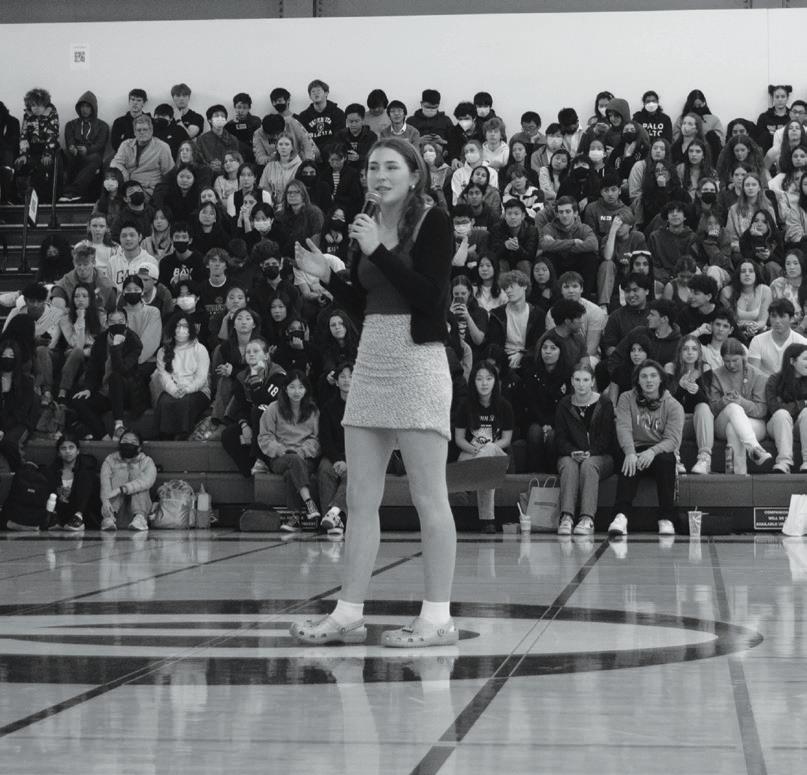
Levy’s election left a spot open for current Junior Class Vice President Maya Perkash to become senior class president, where she plans to take the lead with homecoming preparations. “There’ll be a lot of work with other class officers to see what’s feasible for homecoming,” she said.
The junior class presidential election was decided in a runoff on March 29, with Sophomore Class President Melinda Huang

Lantern Night
Anchor Jack Poon believes that TNU can fill a similar role as the morning announcements that were produced by the Titan Broadcast Network. “It’s been a couple of years since TBN has been a thing, and we were the last class to really remember it,” he said. “We wanted to bring it back, especially since now we’re back in person and PA announcements have been used a couple of times.”
ultimately winning the position. Huang plans to expand on the connection she already has with her class and increase participation in class events. “We had our first class bonding event (this year),” she said. “I want to incorporate more fun and give people more opportunities to make friends.”
Although the elections are over, the Student Executive Council has yet to decide who will be filling the appointed officer positions. These officers—Publicity Commissioners, Diversity Commissioners and Special Events Commissioners to name a few—will be appointed to the council through an application and interview process. These results will be announced by the end of April.
—Written by Becca Wu
On March 30, the Best Buddies Club hosted Lantern Night in collaboration with Palo Alto High School’s Best Buddies Club and Palo Alto Unified School District’s Futures special education program. The event was held in the amphitheater from 7 to 8 p.m. and concluded Gunn’s first Neurodiversity Week. During the event, students snacked on pizza and boba while engaging in various activities, such as creating a collaborative mural and participating in a scavenger hunt.
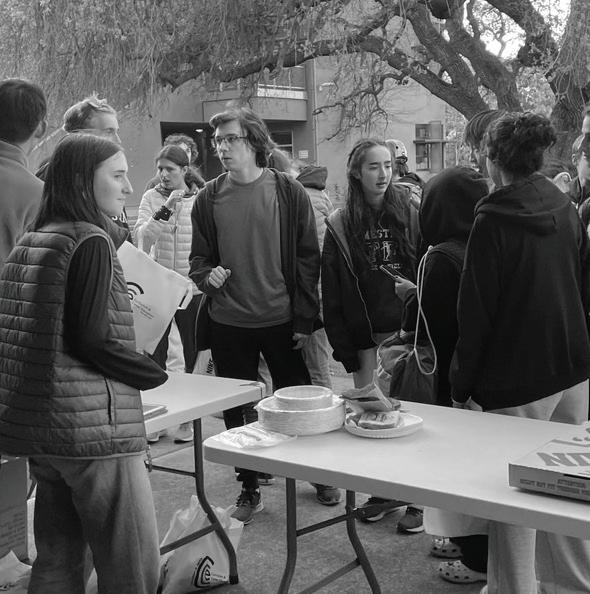
The goal of the event, along with other activities hosted by Student Executive Council during the week, was to increase awareness on neurodiversity.
Co-Diversity Commissioner junior Angelina Rosh was pleased with Lantern Night and felt that it served as a strong close to the week’s events. “Seeing so many students come to our lantern lighting and take the time
INBOX
The Oracle strongly encourages and publishes signed Letters to the Editor and Comments. Comments are generally shorter responses, while Letters are longer pieces of writing.
Please include your name, grade and contact information should you choose to write one.

“I liked that The Oracle included all the grades’ opinions on certain topics. I thought it was an interesting way to see how people thought of things.”
—Frank Zhang, 9
“The story about privilege was super impactful and moving.”
—Karen Tang, 10
“I enjoyed the features section of this issue. Reading about the remnants of past classes and the content creators of each class allowed me to make new connections with people and places I see every day on campus.”
Although TNU currently makes one video a week, SEC hopes to eventually produce daily video announcements. “Right now we only do weekly (announcements) because SEC doesn’t have the time to do daily broadcasts,” Poon said. “But in the future, perhaps that might be something we can bring back—(it) probably would have to be run through Mr. Corpuz’s broadcast class.”
Senior Daniel Carlstrom prefers receiving the weekly announcements through TNU, rather than the typical Schoology update or Instagram post. “It feels more approachable,” he said. “There are people talking to me instead of just a Schoology update.”
Students or clubs who want to announce upcoming events or news on TNU can email Student Activities Director Lisa Hall.
—Written by Lita Sone
SEC Elections
to engage with our activities gave me hope for a more inclusive student population,” she said. “As diversity commissioners on SEC, one of our main priorities for this year was celebrating neurodiversity, as it is often overlooked.”
Junior Jackson Kanegan felt that the Lantern Night was a novel experience. “I really enjoyed how this event allowed me to experience interacting with a community that I’ve never spent much time with previously,” he said. “I had a lot of fun, and the free food was obviously a bonus.”
Rosh hopes that the event raised awareness on a topic that isn’t well-talked about. “We hope this week inspired students to have a greater consciousness for how they navigate neurodiversity,” she said.
—Written by Diya Bose-Malakar
Letters and Comments may be edited to meet space requirements, and the writer is solely responsible for the accuracy of the content.
Letters to the Editor, Comments and ideas for coverage may be sent to oraclegunn@gmail.com. These letters do not need to be from current students.
Have feedback on this issue? Fill out the feedback form at tinyurl.com/OracleApril2023
—March 9, 2023—
—Isaac Wang, 11
News 3 Friday, April 14, 2023
Sophomore Chloe Wang and senior Jack Poon host Titan News Update on March 7.
Photo courtesy of Student Executive Council
Junior Ruth Jaquette gives her speech in the Titan Gym during the SEC elections assembly.
Michael Zhang
Students wait in line for pizza, boba and lantern making materials at the event.
Photo courtesy of Angelina Rosh
PAUSD implements updated nutrition guidelines
Charlotte Qian Online Editor
On Feb. 3, the Biden administration proposed new public school nutrition standards that aim to reduce sugar and sodium content in school meals. Some changes at Gunn include limiting certain high-sugar items and serving more locally sourced options.
During the COVID-19 lockdown, PAUSD and many other school districts faced food supply issues. According to School Board President Jennifer DiBrienza, they were partially caused by new laws that mandated schools to provide free lunch to all students, forcing them to turn to prepackaged items.
“Every school district in the state was suddenly serving more students, so there have certainly been times that levels of sugar content and processed foods have been higher than we wanted.”
School Board President Jennifer DiBrienza
Although sugar content in school meals increased as a result of supply chain shortages and the subsequent transition to prepackaged items, the district is now incorporating locally sourced food options through increased grant funding. “One of the challenges in providing free and reduced lunch was sourcing food,” DiBrienza said. “Every school district in the state was suddenly serving more students, so there have certainly been times that levels of sugar content and processed foods have been higher than we wanted.”
Under the Biden administration’s new guidelines, public schools can no longer offer more than 20% of refined
grains or large amounts of high-sugar foods. Furthermore, sodium levels need to be below 2,300 milligrams for students who are 14 and older.
While current PAUSD meals already comply with these changes, the district has also implemented its own guidelines, eliminating the following items from being served due to their high sugar contents: juice, craisins, lemon and banana bread, UBR cookies, Benefit bars, Mini Cinnis and strawberry bagels. Sophomore Nithila Subramanian noted how her and her friends will miss certain items. “I feel slightly disappointed,” she said. “I have a friend who really loves them so she’ll probably be really upset.”
DiBrienza, however, noted that not all high-sugar products will be eliminated. “Because it is a new federal regulation, the folks producing the food are working on reducing the sugar content and how processed it is because they want to sell it to school districts,” she said.
Furthermore, PAUSD is creating more stringent restrictions to transition out of prepackaged COVID-19
meals, which were heavily reliant on sugar and refined carbohydrates. Because the district hires an external company, Sodexo, to provide meals, the major changes will occur in Sodexo’s meal production process. DiBrienza attributed the school board’s choice to contract Sodexo to its relatively healthy choices and reasonable prices.
According to Food Services Director Alva Spence, students can expect healthier food options in the future. As of April 2023, half of the school meals are made from scratch, and menu items such as the Cara Cara oranges and spring mix are locally sourced.
Although most of Gunn’s food is currently prepared at Palo Alto High School and then reheated at Gunn due to ongoing construction, the kitchen facility that is currently being built will provide new opportunities for food services to implement changes, according to Spence. “I can’t tell you how excited our department is to get (the Gunn) facility finished,” she said. “To have the facilities and equipment and to be able to (create healthier meals) will really send it into a whole other level.”
FooD For thoUght: ProPoSeD FeDer Al School meAl nUtrition gUiDelineS
• Breakfast cereals would be limited to no more than six grams of added sugar per dry ounce.
• Flavored milks served with school meals would be limited to 10 grams of added sugar per 8 fluid ounces.
• There would be a 10% reduction of weekly sodium limits every two school years between 2025 and 2030.
• Schools would be required have 80% of grains served to be whole grain, which maintains current regulations.
Source: United States Department of Agriculture
PAUSD, City of Palo Alto adopt eco-friendly transportation services
Anne Dong Reporter
Palo Alto’s transportation services have become more environmentally friendly in recent years through ongoing efforts to promote sustainable practices.
Palo Alto Unified School District has started by replacing some older diesel school buses for greener electric ones. The district recently received a grant from Bay Area Air Quality Management for two electric buses, which are scheduled to arrive before the end of April.
PAUSD’s current fleet consists of larger buses that are powered by diesel and compressed natural gas along with smaller gasoline-powered vehicles. According to Green Team President senior Katie Rueff, these vehicles carry harmful environmental impacts. “(Diesel) is not just a carbon producing thing when it burns, but it’s contributing to a larger system of overconsumption,” she said. “A couple decades ago, there was this whole movement to replace diesel with natural gas because they were like, ‘Oh, it’s natural, and it’s gas, so it’s much better for the atmosphere.’ But actually, (methane) gas is much more potent.”
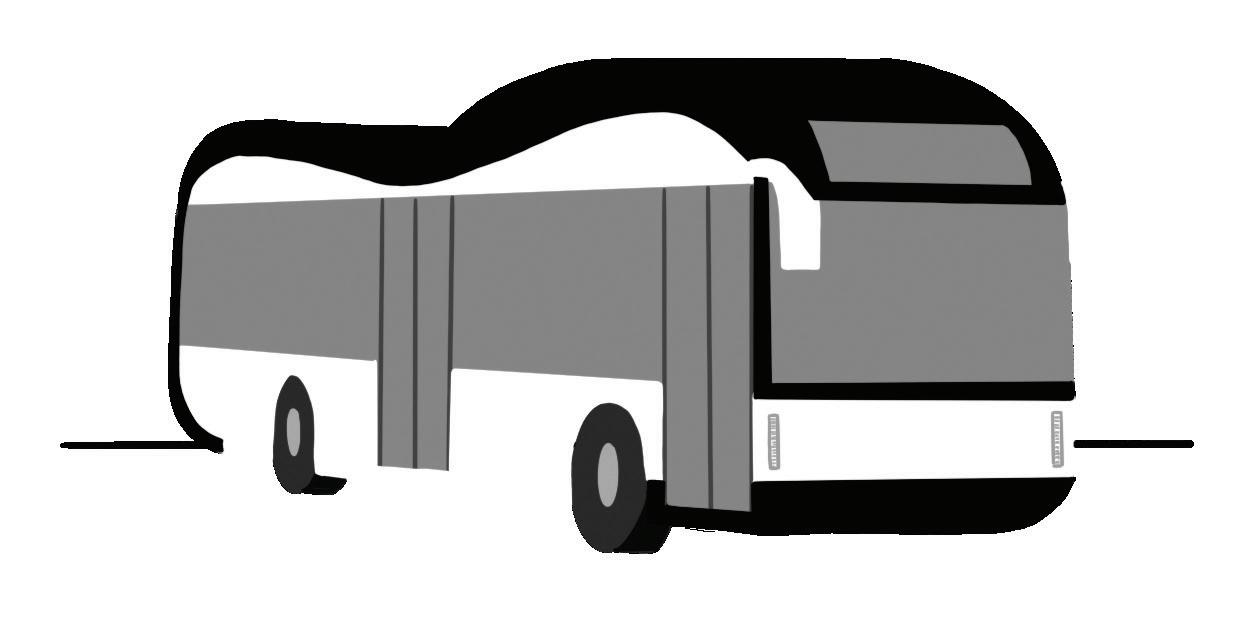
The use of diesel buses also affects students’ well-being, especially for those with preexisting medical conditions: The California Air Resources Board estimates that exposure to diesel particulate matter causes 730 cases of cardiopulmonary death each year. Although diesel buses may impact student health, Transportation Supervisor Andrew Ramirez emphasized that their detrimental effects have lessened over time. “The new diesel buses are not as clean (as the electric buses), but they are getting a lot cleaner than they were 20 years ago,” he said.
Junior Maya Perkash has worked alongside peers in her Advanced Authentic Research project to call for the use of more eco-friendly transportation alternatives
within the district. Although her ultimate goal is to help the district transition to an entirely electric fleet, Perkash doesn’t expect this process to be immediate. “It’s not very feasible to take diesel buses that are still working out of commission early,” she said. “But I definitely think that if they start switching now, it’ll happen a lot sooner because each diesel bus has about 20 years of run time. Every time they buy a new diesel bus, that’s 20 more years before the fleet could potentially be all electric.”
“Each diesel bus has about 20 years of run time. Every time they buy a new diesel bus, that’s 20 more years before the fleet could potentially be all electric.”
Junior Maya Perkash
According to Ramirez, however, the district is still hesitant to transition to an all-electric fleet. “During a disaster, you want something that’s going to be able to last two or three weeks if, for whatever reason, the systems go down,” he said. “You don’t want to go all electric and just be sitting with a bunch of buses in your yard that you can’t use.”
Furthermore, Ramirez noted the various logistical issues that need to be resolved in order to effectively maintain the new fleet. “The turnaround for broken (electric) buses that need repair is much longer right now,” he said. “(In terms of) the infrastructure, recharging buses that might not be here on site—maybe on a field trip—is something that has to really be worked out.”
Although these concerns and issues have slowed the
At A gl Ance: PAUSD’S new electric bUSeS
• Each bus costs between $400,000 and $500,000.
• The electric buses are quieter because their engines do not require the mechanical valves, fans or gears of traditional combustion engines.
• Although the new buses do not release diesel or methane vapors, they have lower ranges.
implementation of a full electric fleet, Rueff is content with the district’s efforts. “It’s awesome that PAUSD is thinking about investing more in converting the public transportation they offer, which (encourages students) to be more sustainable in their lives,” she said.
At the city-wide level, Palo Alto launched rideshare service Palo Alto Link on March 7. This program gives commuters the ability to carpool to a location within Palo Alto with someone taking a similar route. According to Palo Alto Transportation Planning Manager Sylvia StarLack, there are numerous benefits that stem from having fewer vehicles on the road. “If everyone is in their own car, then the capacity of the road is less, (causing) traffic and congestion,” she said. “If we can reduce greenhouse gasses by sharing rides (as well as) getting people into buses (and) trains, it’s better from an environmental perspective, but also from (a) quality of life perspective.”
Palo Alto Link’s fleet currently consists of 10 vehicles: seven hybrid Toyota Sienna minivans and three electric Tesla Model 3 sedans. Similar to the district’s efforts with electric buses, the city hopes to continue electrifying its transportation fleet. “We put in a grant to see if we can convert everything to electric in the future,” Star-Lack said. “Part of this issue was supply. There just aren’t a lot of those vehicles available that are all electric right now. More and more are coming online, so we know (that) in the future, we’ll be able to do it.”
Along with the environmental benefits of these new transportation services, Perkash hopes that they will also have a positive impact on communities outside of Palo Alto. “Palo Alto acts as a trailblazer for a lot of climate issues, so other neighbors and the state look to (us) as a role model,” she said. “If we’re starting these efforts now, that will have a lot more of a domino effect than just (within) our city.”
Michelle Koo
News 4
“ ”
“ ”
EDITORIAL: The Opinion of The Oracle



District, students must take responsibility for unsustainable practices, use effective communication to make changes
Gunn, and the Palo Alto Unified School District as a whole, is renowned for its high levels of academic achievement and accomplished alumni. Often, however, Gunn’s academic reputation diverts focus from some of its faults. If a student were to walk around Gunn’s campus after brunch or lunch on an average day, they would notice an abundance of thin plastic bags littering the floor alongside other plastic wrappers and trash. Even though the district has made improvements in sustainable practices, its failure to communicate its progress to community stakeholders has created a disconnect between those creating policy and those being affect by it. This issue has only been compounded by a lack of initiative from the student body in working alongside the district and holding them accountable for improvements in sustainability.
In 2014, the U.S. Green Building Council's Center for Green Schools published a sustainability framework, which was designed to emphasize sustainability and ecofriendly practices within the American school system. The framework was subsequently adopted by PAUSD. Importantly, this framework defines communication as a crucial step in maintaining sustainable practices, equal in importance to the initiatives themselves. “Everyone in a school, especially leaders, communicates the vision through their actions; they walk the talk by modeling the behaviors they desire to see,” the framework reads. “When actions accurately reflect the vision, change efforts are more successful.”
According to a survey conducted by The Oracle with 91 responses, 78% of Gunn students believe that the district has not done enough to ensure that their campuses and administrative practices are eco-friendly. It is likely because of this lack of communication that such a large percentage of students believe the district has not done enough: They are not aware of all the efforts to create ecofriendly practices made on the district’s part.
At Gunn, efforts made to foster sustainable practices in food services are limited by the state of its facilities, which are currently under construction. According to Food Services Director Alva Spence, all Gunn food service activities currently occur in multi-use classrooms where on-site meal preparation is impossible, forcing the district to resort to pre-packaged plastic alternatives. These practices overshadow the efforts made in promoting ecofriendly food services district-wide, and lead students to believe that the district does not care about sustainable practices. In reality, the district has pushed for the use of reusable flatware and other sustainable practices at other school levels. For example, at Addison Elementary School, milk dispensers and stainless steel cups, preportioned produce in stainless steel containers and reusable flatware have become the norm, replacing single-use alternatives.
The district has also placed emphasis on other domains outside of food services. According to Chair of the
Sustainable Schools Committee Rachel Gibson, PAUSD has recently increased the use of sustainable practices in construction, purchased a fleet of electric buses and coordinated waste sorting between sites. Still, the district has rarely shared evidence of these improvements to community members and students. Communication on the subject is crucial, as it makes the community aware that the district does in fact care about sustainability and, more importantly, incentivizes community members to contribute to initiatives themselves.
This communication issue is not only limited to food services. The district’s main form of communication on sustainability consists of an untimely, vague section of their website that provides limited insight into initiatives taken. It details certain overarching goals but fails to provide any explanation in regard to their execution and current status. Take, for example, a sentence detailing the district’s goal of achieving net zero waste emissions: “Beginning in the 2015-16 school year, PAUSD and City of Palo Alto entered an innovative collaboration to promote the concept of zero waste across PAUSD’s school campuses.” The district provides no further information and current updates on the subject besides this statement.
By neglecting to communicate its progress and goals, the district forgoes community support and confidence in its initiatives, decreasing their effectiveness. As an organization that prides itself on fostering a community of collaboration, the district should be held accountable when not communicating with its partners. The framework it adopted promises that it will be “making efficiency goals and annual reduction targets public” and “publicizing goals and results.” The framework cannot be effective until the district makes good on these promises.
Still, district initiatives can only be effective if the majority of students stand by them, which is not always the case. For example, pre-pan demic food services experimented with the use of reusable trays at middle and high schools to cut down on single-use waste. However, the trial was short-lived, as students would destroy the reusable items. According to the same survey conducted by responses, 73.6% of Gunn students believe that the student body has not done enough to ensure that their surroundings are eco-friendly. Student attitudes and perspectives on sustainability are crucial components in meeting eco-friendly goals throughout the district. It is unde niable the number of initiative student leaders—including the Student Executive Coun cil, the Sustainable Fashion Club and the Green team—have taken towards making schoolwide improvements. No matter the
efforts from student-run organizations, though, largescale change cannot be achieved without help from the majority of students.
Often, making sustainable decisions in schools results in a trade-off that requires students to be flexible and open to new possibilities. Using reusable flatware and other items introduced in food services, for example, will soon require students at Fletcher Middle School to eat in one location as opposed to anywhere on campus. With construction for new food service facilities at Gunn underway, the possibilities for changes in food service practices are more than likely. Students must be open to the possibility of change if they want to see more sustainable practices on campus. Ultimately, sustainability requires the district and students to work collaboratively and hold each other, as well as themselves, responsible for meeting standards. The district must make achievable goals and communicate progress with community members that can hold them accountable. The district must also encourage student participation in policymaking. At the same time, students must uplift themselves to have proactive attitudes toward waste management and be flexible with eco-friendly policies.
Source: Self-selected survey sent out to Gunn students by The Oracle from March 29 to April 9, with 91 responses.
Rise of meat substitutes renders carnivorism obsolete
Paul Garofalo and Carly Liao Reporter and Forum Editor
Restaurants across the country are rapidly expanding their menus to include plant-based substitutes for meat products in order to meet growing customer demand. This upsurge in popularity is due to increasing concerns about the effects of meat consumption on animal welfare and the environment. As many plant-based meat substitutes taste nearly identical to animal meat, the choice to consume less animal meat is simpler than ever. Students should turn to eating meat substitutes rather than meat itself, as these substitutes comprise a more ethical diet contributing to the welfare of the planet and the animals inhabiting it.
Meat production has a significant impact on the environment: According to a study conducted by the University of California, Davis, livestock are responsible for 14.5% of global greenhouse gas emissions worldwide. By replacing beef burgers with plant-based burgers, greenhouse gas emissions would decrease by 89%, water use by 87% and land use by 96%, according to the Good Food Institute. Even without a large-scale overhaul of animal meat, the individual choice to consume plantbased meat can still make a noteworthy difference in reducing agricultural expansion and environmental damage. Thus, meat alternatives are more sustainable and environmentally friendly because they require fewer resources and generate substantially lower greenhouse gas emissions.
In addition to the environmental impacts, ethical concerns surrounding meat consumption are helping plant-based meat gain traction. According to the World Animal Foundation, 99% of farm animals in the U.S. live on factory farms, which practice intensive agriculture
designed to maximize production while minimizing costs. These farms raise animals in confined spaces such as cages where their movement is extremely inhibited. To keep up with the growing global demand for meat, many farms also forcefully feed or inject hormones into their livestock. For those who are uncomfortable with the ethics of modern factory farming, plant-based meat substitutes provide the taste and texture of meat without contributing to animal suffering.
Still, though plant-based meat is a more sustainable option, it is also often a more expensive one. Meat processing companies are larger and can produce higher quantities of meat at lower cost, while plant-based meat— though growing in popularity—is still a relatively niche industry that has not yet developed economies of scale. Thus, there are many who simply do not have access to sustainable meat alternatives because of their location or income. Nevertheless, for those who do have the ability to choose, plant-based meat is the more ethical, environmentally friendly choice.
5 Forum Friday, April 14, 2023
22% of Gunn students think that the district has done enouGh to ensure that their campuses and administrative practices are eco-friendly.
RaphaelSemeria
The Elements of Writing Confidence: English curriculum should emphasize grammar, style
riod for a semicolon, for example, allows students to relate two ideas more closely; using a colon conveys a sense of drama and anticipation. Even the absence of a hyphen can change the meaning of a phrase, turning the orange-juice seller (who sells orange juice) into an orange juice seller (who is orange and sells juice of an undetermined variety).


 Irene Tsen Features Editor

Gone are the days of sentence diagramming, organically structured essays and high school term papers. Students who know about the subjunctive mood, present continuous tense or nominative case likely learned them from studying foreign languages or grammar books. This trend in education to leave grammar pedagogy behind is reflected in Gunn’s English classes, which focus on literary discussion centered around student opinions and participation. While this use of class time makes students strong critical thinkers, Gunn’s English curriculum should work to better support writing skills in terms of grammar, style and practice so that students have more confidence in their writing.
Gunn English classes vary greatly in the ways and extents to which they cover grammar and usage. Only some classes feature it prominently in their curriculum, leading to a disparity in these key skills. Since the correct employment of grammar and mechanics and understanding of usage is foundational to good writing, students could benefit from broader and more consistent instruction on grammar and mechanics.
These details empower a piece of writing. They give it nuance. They help readers interpret students’ writing the way it was intended. And despite the proliferation of grammar-checking tools available, these resources are not always reliable and may suggest edits not in line with students’ intentions. The use of these tools also represents a form of outsourcing in which students replace learning grammar with using external tools.
Correct grammar and mechanics becomes ever more crucial when the difference is a question of credibility. A cover letter with glaring grammatical errors, for instance, significantly undermines the perceived ability of the applicant. Students can be much more confident in their work outside of school—application materials, resumes, reports—when they are certain it adheres to basic English conventions, focusing their attention on polishing the content instead.
Another factor that could bolster students’ confidence in writing is more instruction on how best to structure arguments. Students should learn how to organize their thoughts so that they follow in the most logical order, and how to reason their way through an argument. Sometimes, this necessitates writing within a more natural organizational structure, as opposed to the fiveparagraph essay (which is rarely, if ever, used in postsecondary education or in writing-heavy jobs). Shifting the emphasis from five-paragraph essays, which provide a useful but restrictive breakdown, could better prepare students to tackle college and real-life writing.
teachers from assigning homework due on Monday, teachers often hesitate to assign writing practice, instead sticking to reading and discussion preparation.
Still, teachers can dedicate more class time to short writing exercises—separate from work time for assessments—or assign prompts graded on completion to bolster students’ writing practices. With more frequent, sustained practice, students are more likely to be confident in their writing and to develop style, going beyond simple, conventional English to a “distinction, excellence, originality and character in any form of artistic or literary expression,” according to Webster’s New World College Dictionary. Confidence and style are closely linked skills: With practice and experimentation in different ways of expressing the same thought, students grow to be more confident in their writing choices and develop a stronger voice. That voice is what makes writing compelling.
Confidence
ways of
Incorrect grammar can profoundly change the meaning of a sentence. Take, for example, the often-used comparison of “let’s eat Grandma” and “let’s eat, Grandma.”
One reason for this limited grammatical and organizational instruction is that class time is often spent on discussions breaking down reading or student perspectives, helping students build their critical-analysis skills. While these skills matter, their utility is limited by what students can express on paper. Students analyze ideas and literary works to be able to share those thoughts with others. Without being able to order their thoughts clearly and choose the right words with style—both of which require a handle on grammar and mechanics— students communicate their thoughts less precisely and effectively. Their intended meaning may be lost to readers.
Along with more detailed writing instruction, English teachers can incorporate more opportunities to practice writing. Given the reduced number of times each class meets per week, where teachers could have assigned four to five assessments per semester on the older schedule, they now can only assign an average of two to three, along with smaller assignments. Limited by the three-classes-a-week schedule and by the new homework policies’ preventing
The current curriculum does support students’ English skills in important ways. Its flexibility, giving teachers extensive agency over content and teaching methods, allows students to learn varied skills, engage in wideranging activities and examine topics through diametric lenses. The focus on discussions, in large or small groups, puts students in control of their learning and in personal connection with the topic—they develop an original interpretation by synthesizing their lived experiences with their own and others’ insights from the source material. Most of all, teachers are passionate about what they teach and ready to dedicate time to help students individually, promoting a love of English literature and writing. Still, according to a survey from The Oracle with 104 responses, only 26.0% of students felt prepared or very prepared for college writing, while 39.4% of students felt the same levels of preparedness for college mathematics.
These numbers may point to an overemphasis on STEM classes, but more importantly, they should nudge the English curriculum toward small but meaningful changes: more complex analysis of grammar and conventional usage, more instruction on advancing a cogent argument in a less restrictive structure and more opportunities to write and develop style. These are the paths to elevate writing confidence.
54% of gunn students find
6 Forum
Emma Cao GRAMMAR MECHANICS
WRITER’S TOOLKIT
STRUCTURE
Source: Panorama Social and Emotional Learning Survey taken by Gunn students in fall 2022.
”
“
“ ”
and style are closely linked skills: With practice and experimentation in different
expressing the same thought, students grow to be more confident in their writing choices and develop a stronger voice.
Without being able to order their thoughts clearly and choose the right words with style—both of which require a handle on grammar and mechanics—students communicate their thoughts less precisely and effectively.
Competition proves integral to success in varying fields, strengthens motivation, assurance in abilities
many musicians and athletes are able to improve significantly.
Michelle Koo News Editor


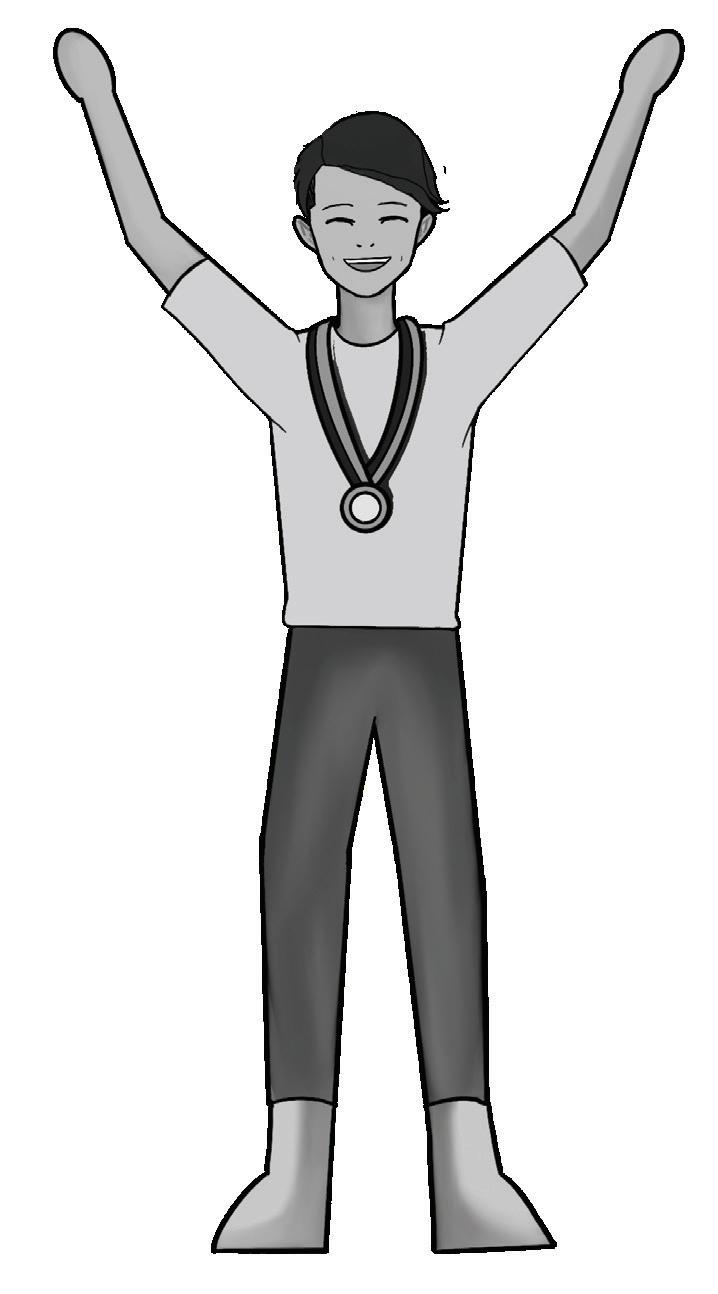
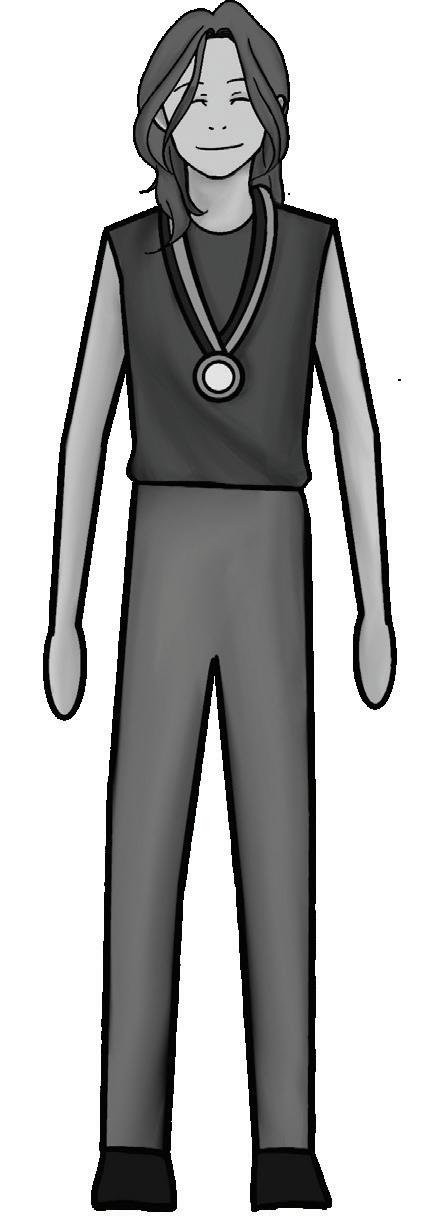
Competition is a staple of student life. Whether found in sports, academic olympiads, music contests or everyday classes, competition constantly motivates students to do their best. Gunn is best known for extreme competition, which drives students, teachers and parents to deemphasize the positive aspects of competition. Though the effects of extreme competition are real, it is important to realize that some amount of competition is necessary to excel in any discipline, whether it be athletics, academics or music. With moderation, competition is essential for individuals to set goals, find motivation and push themselves beyond their limits to become successful.
Competition is not always a hostile, zero-sum game played against fearful adversaries. It also encompasses gentle rivalries between friends who help push one another to their limits. Competition can even be striving to reach the level of a role model that one looks up to. In healthy competition, people seek to improve themselves to become a better version of themselves, rather than rise above others to become a superior or put others down.
Competition plays a serious role in both athletics and music, and it is an inevitable experience for all individuals who pursue their discipline seriously. Students compete to attain certain seatings in instrument sections or team placement onto varsity or junior varsity. Additionally, for every sport, there are rankings of the best athletes or teams, public records of wins and losses and championships celebrating the most talented. Similarly, in music, grand prize winner performances are shared, and top-ranking musicians can be granted special opportunities and recognition. With events and rankings, participants naturally begin comparing themselves to others, as they meet and see people who inspire them. This sort of competition is necessary for individuals to strive for improvement and reach higher levels of excellence. A journal publication from Frontiers in Psychology titled “The power of competition: Effects of social motivation on attention, sustained physical effort, and learning” concluded that competition results in enhanced attention and sustained physical effort. Competition activates the brain’s reward system, increasing effort and motivation, and hence allows individuals to reach more advanced levels of skill and performance.
Additionally, many athletes and musicians have role models that they look up to. Musicians listen to renowned professional performers play their current repertoire as a reference. As they practice, many aim to mimic and adapt their idols’ styles. The same goes for athletes. Athletes may try to mimic the form and movements of their favorite professional players to improve and adapt their skills. Role models do not necessarily have to be professionals—they can be peers and people in one’s own community. Through this form of comparative learning,
Academically, competition can be the root of motivation for students to excel in fields of study. In fact, according to a research study conducted by Yusuf Canbolat from Indiana University, in an environment with increased competition, students had improved academic outcomes in both humanities and STEM subjects, especially if they were students from underperforming schools. Olympiads are another example of the positive impact competition can have on academics. The Mathematical Association of America, which created the American Mathematics Competitions, states that their program fosters “a love of mathematics through classroom resources and friendly competition.” Similarly, the American Chemical Society, which sponsors the U.S. National Chemistry Olympiad, states that the olympiad is “designed to stimulate and promote achievement in high school chemistry.” Olympiads such as these allow students to reach beyond what they learn at school, helping them to become more successful academically, and build a solid foundation for their future.
Overall, competition inspires and motivates students. Still, too much competition can be harmful. When a

person’s sole purpose in life is to beat a peer or to stand out among hundreds of others, rather than to expand their knowledge and improve themselves, the effects are neither healthy nor beneficial. Extreme competition can also lead to burnout, excess stress and mental health concerns. Studies from the Department of Psychology of the University of Quebec found that competition emphasizing winning at all costs decreases intrinsic motivation: the drive to do something for inherent satisfaction or enjoyment, rather than an external reward. In an overly competitive environment, one can lose passion and motivation in one’s activities.
The college applications process is an example of how extreme competition can be toxic. As students apply to prestigious schools, the desire to stand out and the pressure to succeed can lead to cheating and other dishonest actions as students feel the need to win at all costs. Such mindsets only result in a ruined reputation and do not expand a student’s education—rather, they inhibit it. However, seeing competition as an opportunity to grow can help students improve themselves and their education. Because of the motivation it provides, moderate amounts of competition can help students excel across the disciplines they pursue.
95.6%
FACES IN THE CROWD: HOW has healthy competition affected you?



“It helps me find a way to work effectively if it’s healthy competition. I also found it helps people figure out how to act more positively in competitive situations.”
“I think healthy competition is a good way to get more intense in games, especially for me. Feeling the pressure helps me to try harder and be better for the team.”
“I’m not a very competitive person, but I think some form of competition can be healthy. It can help motivate you or help you enjoy something more.”
7 Forum Friday, April 14, 2023
“(Competition) affects me positively, I believe that it drives me and my performance to be better.”
—Compiled
by Hila Livneh
—Kai Lobell, 11
—Jerry Jia, 12
of Gunn students think non-extreme amounts of competition can help people become more successful at school or in their extracurricular endeavors.
Source: Self-selected survey sent out to Gunn students by The Oracle from March 29 to April 9, with 113 responses.
—Noelle Milivojevic, 9
—Hanna Fischl, 10
Natalie Lam
Ruhani Suresh



8 Advertisement
Car enthusiasts fuel their passion through projects
Car lovers on campus further their passion in a variety of ways: taking the Automotive Technology classes, working on personal projects, attending car meetups and more.
For many car enthusiasts, such as junior Jordan Minion, their interests stemmed from the environment around them. “I was always interested in auto work because some of my friends have it as a hobby,” she said. “I’d already studied (the subject) before taking the auto class.”
Though junior Ethan Casale has always liked cars, Gunn’s Automotive Technology classes fostered his hobby of working on them. “I’ve always been interested in cars since I was a kid, and I’ve been working on bikes a lot,” he said. “Then the auto class at school really sparked my interest in working on cars myself.”
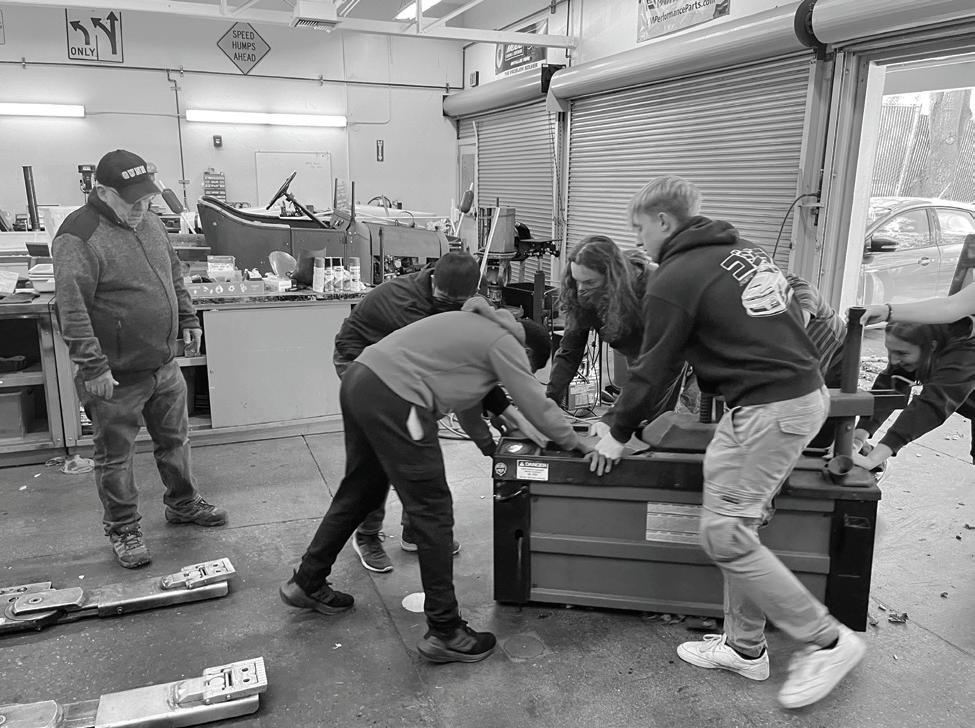
The Automotive Technology classes, led by teacher Mike Camicia, provide students with a way to explore their interests and get hands-on experience with cars. Students work on cars in the auto yard and also bring in their own cars for repairs if needed.
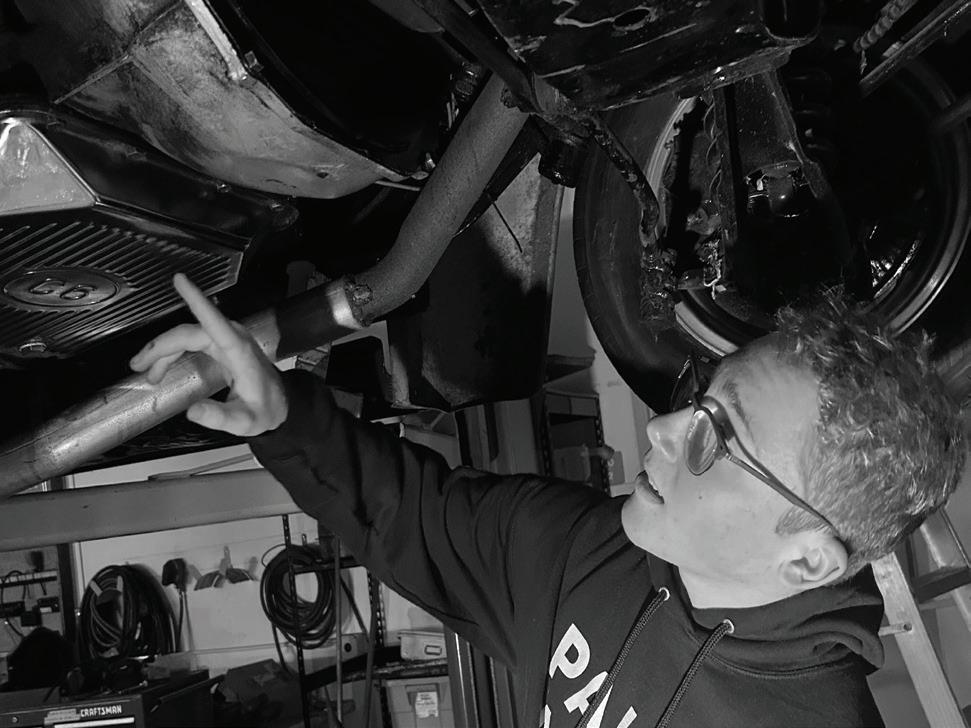
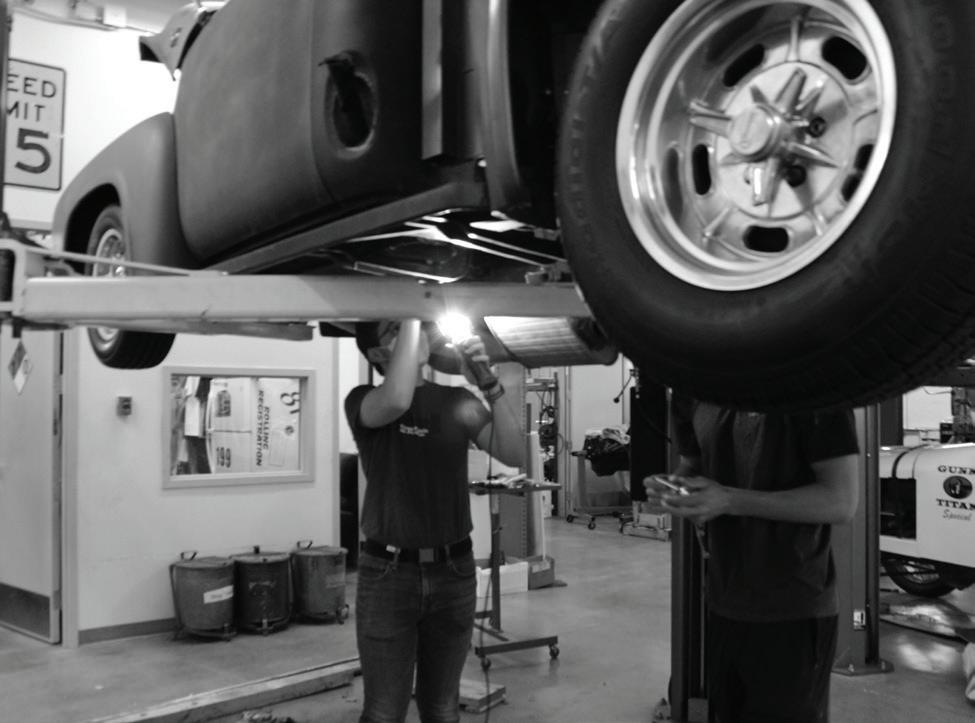
Freshman Cole Akin, a student in Automotive Technology 1, enjoys the class’ deep dive into cars and hands-on work. “It is an amazing class,” he said. “Mr. Camicia, the auto teacher, is so friendly, and the projects (he) has introduced us to are unimaginable. In the first two months of that class we were already taking apart engines. It was an incredible experience.”
Minion, who is simultaneously taking both of the Automotive Technology courses, also appreciates the class projects they are able to work on. “We dissected an engine together, so we were allowed to take it apart and put it back together,” she said. “That was really cool and it showed you the inner workings.”
Similarly, Casale, who is taking Automotive Technology 2, enjoys the practicality of their classwork.
“Right now we’re building a 1920s Model T Ford from scratch, and we’re putting a rotary engine in it,” he said.
“It’s really good and heartening that Gunn has an auto shop,” he said. “I think it’s great that students have the opportunity to still do that.”
sell it a little bit higher, so we did that sometimes in high school. You could say we were flipping the cars. It was a hobby but we also profited.”
As high schoolers, many students are beginning to drive and buy their own cars. For many, this means having their own car to work with to their heart’s content.
Personal projects in the community
Additionally, Eggert and his friends would do car maintenance and modifications. “We used to do custom rims and low-profile tires,” he said. “We would change the suspension lower. In the ’80s that was very popular—lowering cars.”
Junior Lucy Shark works on her own car at home. When she was younger, she learned how to work with cars by watching her dad work around the garage. “I got into cars because my dad likes cars,” she said. “Growing up, I was just around that.”
While she learned mostly through observation and not hands-on work, Shark now works on a Dodge Charger she bought herself. “It was kind of a beater when I bought it, which means it wasn’t in good condition,” she said. “It didn’t run, so I fixed it up to run. It’s still kind of finicky and inconsistent sometimes. But I fixed it up, and it’s now my car.”
Casale, in addition to taking Automotive Technology for the past two years, works on personal projects including a modification build for his car. “I have a 1989 BMW,” he said. “I’m doing a drift stance build on it. It’s a lot of fun, and I work on it almost every day.”

Casale enjoys seeing his time and effort turn into a tangible result. “I have a vision for my car,” he said. “It keeps me going. It’s something that I look forward to doing, something that I have motivation to do. I really like seeing it come together. I’m excited for what’s in the future.”
While Minion currently doesn’t have a car of her own, she often takes on projects and repairs for others. “I’ve done repairs with my friends’ cars,” she said. “I change my friends’ oil, I’ve done tire changes, but nothing too crazy.”
When he was in high school, Eggert worked on cars with his friends, repairing and selling them for a profit. “My friends and I had a hobby of working on cars, like changing oil and rotating tires,” Eggert said. “We found that we could buy a car at a low price and
Junior Nathan Yost volunteers at a Mercedes-Benz shop, where he helps professional shop mechanics repair customers’ cars. Yost has found the process to be difficult but still rewarding. “It’s fun—frustrating sometimes—but mostly quite fun,” he said. “Sometimes the Mercedes people who are building the car put the engine together outside of the car. Then I have to take it apart and put it back together inside the car.”
Car enthusiasts are also able to connect with others beyond the school community. Car shows are a place where people can meet others with interest in and experience working with cars. Yost has had the opportunity to attend car shows and meet people with shared interests around the neighborhood. “I went to Cars and Coffee, which is where a bunch of real, regular people bring their cars,” he said. “Every year, I also try to go to the auto show in San Francisco when it comes.”
Casale also enjoys attending car meets when he finds the time. “I go when I can on the weekends, and it’s a lot of fun because you meet people and just talk about cars,” he said.
With how frequently cars are used in everyday lives, having an understanding of automotive technology can be valuable. Minion appreciates her experience in fixing cars and its real-life applications. “We use cars everyday to get everywhere, and it’s one of the most important inventions ever,” she said. “Being able to know how it works is super useful for later in life when you have to
In an age where cars are becoming more and more advanced, Eggert also believes that having a basic knowledge of cars is essential for all. “Even if you don’t want to work on cars yourself, the more you know about cars, the more appreciative you’ll be,” he said. “It’s good for everybody to know about them, just the same way you would know about your computer or home systems. The more you know, the more you’ll be equipped if you take it to a service person, and the more you have a chance at getting a good deal.”
—Written by Vivien Chen
Features 9 Friday, April 14, 2023
Junior Nathan Yost shines a light to replace screws on the Automotive Technology class car.
Junior Ethan Casale is building a drift stance on his 1989 BMW.
gunn auto Tech class
Katie LaWer Carly Liao Arjun Shah
Photo courtesy of Nathan Yost
Yoochan An
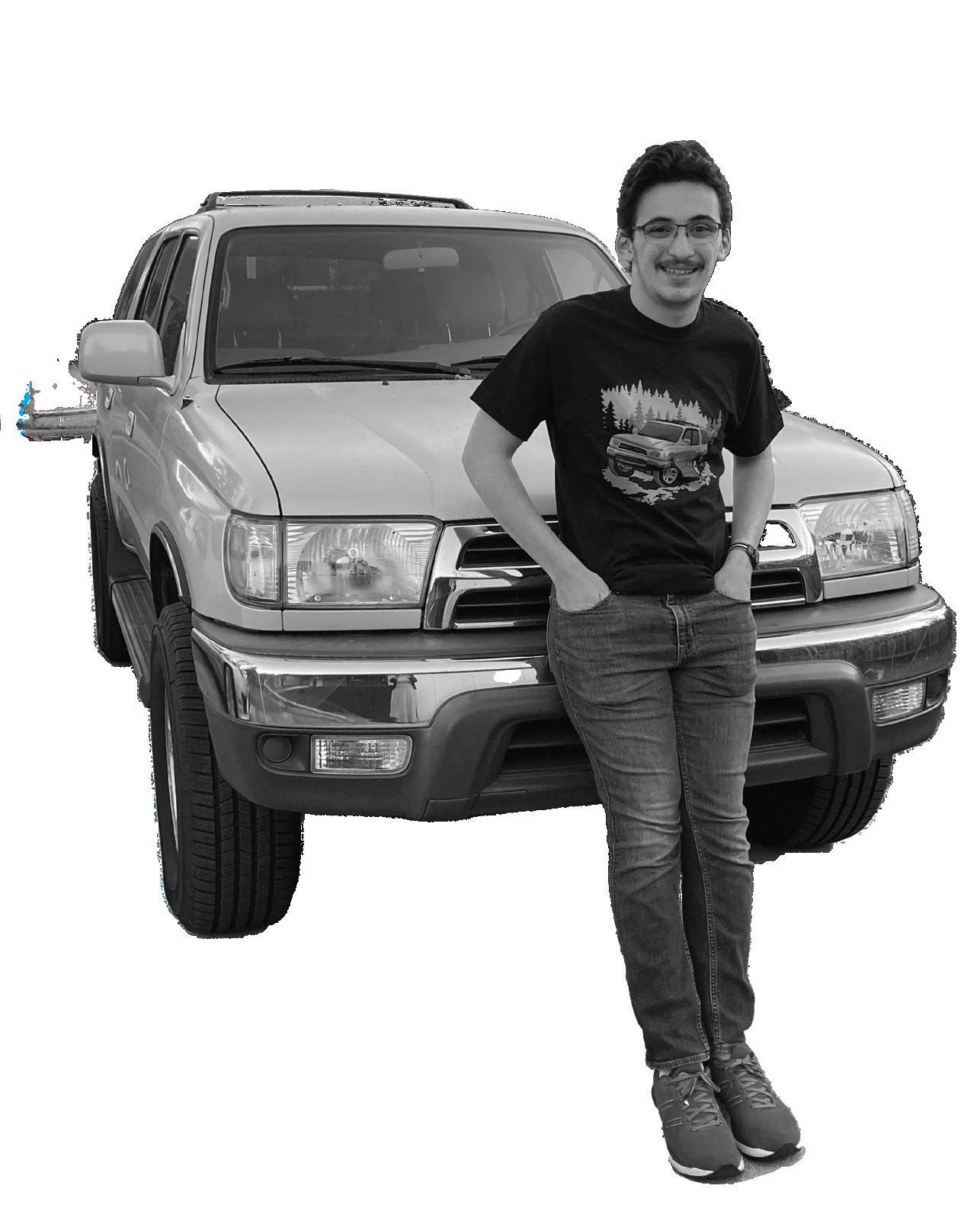
Junior Nathan Yost has replaced the taillight housing and air filter, and completed an oil and oil filter change in his family’s 1999 Toyota 4Runner.
Freshman Cole Akin explains different components of the auto class car during second period.
Auto Tech teacher Mike Camicia instructs students as they place a tire mounter onto a car lift.
Campus camaraderie: Teachers keep bonds
Shaina Holdener and Terence Kitada

In 2012, English teacher Shaina Holdener was completing her Masters in Education in the Stanford Teacher Education Program, when she was told to choose a group for a project. “I was just like, ‘Okay, this is a make-or-break situation, when who you pick is going to determine everything,’” she said. So, she decided to work with English teacher Terence Kitada, a fellow student in the STEP program who would get his part of the work done. She was already acquainted with him from working together at Sequoia High School. Little did they know that their working together in the program would flourish into a strong friendship, lasting into the working world for more than a decade. As adults, friends from high school or college can find it harder to catch up. Even though Kitada still regularly contacts his friends from high school, it takes a lot of organizing to see each other. “When we see each other—maybe twice a year, because we’re all married and have kids—it takes a lot of organizing,” he said. However, it’s different when it comes to Holdener. Their classrooms are nearly right across from each other’s, so after a long day of teaching, seeing each other just takes a few steps across the hallway. “There pretty much (isn’t) a day when we wouldn’t see each other,” Kitada said. Holdener agrees, crediting the strength of their friendship to seeing each other daily. “It only helps that you see each other every single day,” she said. “When you’re an adult, you have to put that effort in. You have to contact each other and make plans.”

When they’re not talking face-toface, like most friends, the two text each other often. “It’ll be midnight, late into the


night when we’re trying to grade, and we’ll be like, ‘Time for a meme break,’” Holdener said.
Seeing each other regularly helps, but it is far from the only thing that has formed the foundation of their friendship. Holdener and Kitada share several similar interests. For one, they share similar professions and tastes in entertainment, which they often talk about. “We tend to talk a lot about work just because that’s what we share in common,” Kitada said. “But in addition, (we) have shared interests in general. I think that’s part of the reason why we’re friends: We both have the same sense of humor or things that we both like, like manga, books or the same type of movies and TV shows.”
Additionally, they both enjoy video games, which they bond over outside of school. “When Final Fantasy 15 came out, we played it at the same time in our own houses, but we’d text each other about it, like, ‘How far did you get?’” Holdener said.
After being friends for so long, Holdener and Kitada often think similarly. “Even if we don’t say anything in the moment, afterwards, if we talk, we go, ‘Are you thinking what I was thinking’? and then we end up thinking the same exact thing,’” Holdener said. “Even though there are differences, the way we are as humans, the way we are as teachers, there’s a lot of overlap there.” Their similar personalities have even coined them the nickname, “the Steptwins,” given to them by office secretary Martha Elderon. The “step” part comes from where they met and how close they are despite not being biologically related, like stepsiblings.
Because they have been friends for so long, the duo have built a lot of trust. Holdener feels as though she can confide in Kitada whenever she needs someone to listen. “I can trust Mr. Kitada and go to him and say anything,” she said. “I know he’s not going to judge me for it or think I’m weird. And then he’ll hear me out. In reverse too, he can say whatever to me, and I’ll hear it out and give him thoughts if he wants it, or just sit and be someone to say something to.”
Written by Lita Sone
Dr. Heather Mellows and Maria Powell
Biology and anatomy teacher Maria Powell met chemistry teacher Dr. Heather Mellows while they were teaching chemistry together at Gunn. Mellows came a year earlier than Powell, and, as teachers in the same department, Mellows became a mentor figure for Powell. “She (was) very patient and generous with me as a new teacher,” Powell said. “She has a skill that just carries through all the aspects of her life, where she can break things down into very simple chunks and explain them. (She was) willing to explain it three or five times if I needed to without being judgmental.”
Powell believes one of many benefits of working with Mellows in the same school is that they can encourage each other to take on new experiences. “Dr. Mellows is responsible for getting me to be on stage to do anything,” she said. “I think there’s no way in hell I would have ever been on stage in the staff musical (without her encouragement). She (tells me), ‘I’ll do it. I’ve done it. You do it. Let’s do it.’”
Working in the same department has also allowed for the two teachers to share common ground. “We can commiserate with work situations,” Mellows said. “We (also) have a lot of understanding of what challenges there are and what joys there are in work.”
The teachers have also grown closer outside of school. Powell, for example, has helped Mellows with pet-sitting in the summer. “(Mellows) had a habit of traveling the world in the summer,” Powell said. “So in the summertime, our family was a cat camp for her orange cat. When Dr. Mellows (had finished) teaching in Turkey for two years, I flew to Turkey to pick up her cat because she was going to spend the summer visiting her family in England and going on a safari.”
The two teachers also strengthened their friendship through shared passions such as softball. “I knew that (Powell) played softball, so I invited her to play on the softball team I was playing on,” Mellows said. “So I got to know her outside of work as well.” Powell and Mellows play together on a team called JERKS, and this love for softball has created unforgettable memories between the two teachers. They have also chaperoned Model United Nations conference trips together. “We have some good stories from various adventures across the country with the students,” Mellows said.

Powell and Mellows have come to cherish different aspects of their friendship. Powell values Mellows’ unconditional acceptance and their varied strengths. “The things we bring to a conversation aren’t the same,” she said. “(Mellow is) always asking me biology questions, and I’m always asking her physics and chemistry questions. We have some rich conversations because we have different strengths.”
On the other hand, Mellows values their support for each other. “She gets my sense of humor, which I appreciate,” she said. “She has my back and knows my history because (our friendship has) been so long.”
In the future, Powell sees herself continuing to work together with Mellows, both in and outside of school. “We have a nonprofit company called Bad-Ass Grannies, BAG for short,” she said. “(We make) greeting cards that are for anniversaries and birthdays, counted by the periodic table. Dr. Mellows writes fortunes, and I write poems about the birthday or anniversary, mostly in iambic pentameter. When we no longer work here, we could open (up) that store and have our little kiosk of greeting cards.” Mellows also agrees that their friendship will continue into retirement. “There’ll be more adventures to come,” she said. “(I’m) counting on our baking (passion) and greeting-card business for an income and the connection after we retire.”
Written by Sophia Hwangbo
10 Features
Hong and Sophia Hwangbo
Photo illustration by Irene Hong and Lita Sone
strong over shared interests, professions
Phillip Lyons and Diane Ichikawa

English teacher Diane Ichikawa and social studies teacher Phillip Lyons have both taught at Gunn for almost two decades, with a friendship stretching just as long. Their commonalities have brought them together, and what they value about their friendship keeps it going strong.
The year she was hired, Ichikawa said around 30 new staff members were brought on. The next year, another 30 were hired, Lyons included. “Most of us were of the same age, so many of us bonded very quickly.” Ichikawa said. “About half of the current teaching staff were hired within those first two years of my career, and my friendships with those people are pretty tight.”
Lyons attributes the camaraderie between the two in part to the layouts of the classrooms at the time.
“When I first got here, the English department and social studies department were in the same building, and we shared offices, so everybody knew each other pretty well,” he said. “Back then, we were all pretty young, so we would socialize on the weekends—people would sometimes go out to get dinner or to bars.”
As time has passed, weekend get-togethers have taken more planning. “Things have definitely changed a lot—people get older and get married and have kids, like myself.” Lyons said. The departments of social studies and English have since been separated, with the English department moving to the N-building and social studies to the F- and C-buildings. “I try to make a point to leave my classroom and walk around the school to visit their classrooms and say ‘hi,’” Lyons said.
Ichikawa and Lyons both grew up in the Bay Area and share a mutual friend group. The two teachers are also UCLA alumni and enjoy catching up on updates from their alma mater, such as the college’s qualification for the NCAA Sweet 16 during March Madness. “Sadly, UCLA lost by three points last night,” Ichikawa said.
The two also share similar personality traits. “He’s kind of a quieter person, an introvert, and I am too, so I think some of the times when we don’t talk in big groups, people tend to think: ‘oh well they’re snobby,’ and I think maybe he and I

had the same reputation,” she said.
Over his years in the district, Lyons has witnessed numerous changes, including in administration. “Everyone comes in with a new vision for what they want changed,” he said. The continuity of Lyons and Ichikawa’s friendship is something he’s especially appreciative of, given both teachers’ long history with the school. “It’s nice to know people who have an institutional memory of this place: the way it used to be and of how it’s changed over time,” he said.
Lyons also admires Ichikawa’s professional approach and her intelligence, while Ichikawa appreciates the deep conversations that she can share with him, characterizing Lyons as a fount of knowledge. She also thinks he is warmer than most may think. “He’s also a really loving father, and it’s fun to see him with his kids,” she said. “He’s funny and can really make you laugh. He’s also a decent dancer when it comes to ’80s music. If you throw on some OMD (Orchestral Manoeuvres in the Dark), he might start busting some moves. He gets a reputation for being really harsh—after all, his last name is Lyons—but I think he’s way more of a kitten than people realize.”
Lyons and Ichikawa continue to set aside time to spend with each other, maintaining their friendship through hikes in their free time or just spending time together when available. “We do set aside time to go out to lunch together, if we ever have common preps,” Ichikawa said. Both teachers look forward to their friendship in the future, especially after retirement. “It can only get better as we get older and have more time in our lives,” Ichikawa said.
Written by Maddie Cheung
Daissy Tabares and Rosanna Peña
Spanish teacher Daissy Tabares and therapist
Rossana Peña first connected in Sept 2021 at a meeting through a student who knew them both.
The first thing that struck Tabares when she met Peña was the culture they shared. As they are both from Mexico, Tabares and Peña speak Spanish and share similar childhood experiences. “It was like seeing myself on campus,” she said. As she got to know Peña more, Tabares saw just how committed Peña was to her values. “She really meant business when it came to something that was important to her,” Tabares said.
When Peña first got to know Tabares, she knew right away that Tabares was sweet and kind. More interactions revealed how much Tabares cared about other people, especially her students. “She is a very big advocate for her students,” Peña said. “If her student is struggling with a staff (member) or classwork, she will always be talking to them and helping them out.” Throughout their one-and-a-half years of friendship, Peña and Tabares have shared many meaningful memories together. One that stands out the most is chaperoning last year’s Prom. They took time before the dance to get dressed up Tabares’ classroom. “We were getting ready with our little mirrors, putting makeup on and everything,” Peña said. Another memorable moment they shared was when they met outside of school for the first time around Halloween in 2021. They dined together at Estrellita, a Mexican
cuisine restaurant, on San Antonio Road. Peña was dressed as Princess Peach while Tabares was dressed as Mavis from “Hotel Transylvania.” Complete opposites costumes-wise, they still easily connected through their conversation. Tabares values that their strong relationship is built on good communication. She explained that they are adept at seeing different perspectives and attempting to understand each other. “We just have a really good balance and are very open to each other’s feedback,” she said.
Peña values her friendship with Tabares because of the mutual love and humor that lies between them. Whenever one person is upset, the other manages to find a way to cheer them up, and they always end up laughing together. “I feel that we are very supportive of each other, knowing that she can come to me and I can go to her for anything,” Peña said. Tabares added that they intuitively understand each other, which connects them as well. “We can just look at each other and still say so much without actually saying anything,” she said.
Part of their closeness comes from seeing each other every day. Both Tabares and Peña share their appreciation for working at the same high school. For Tabares, it brings back past memories, as if she were back in high school again, attending classes with her close friend. Peña believes that having a close friend present on campus allows her to step away from work at times. “It’s really nice because I can connect my personal life with my work,” she said. “It’s the best of both worlds.”
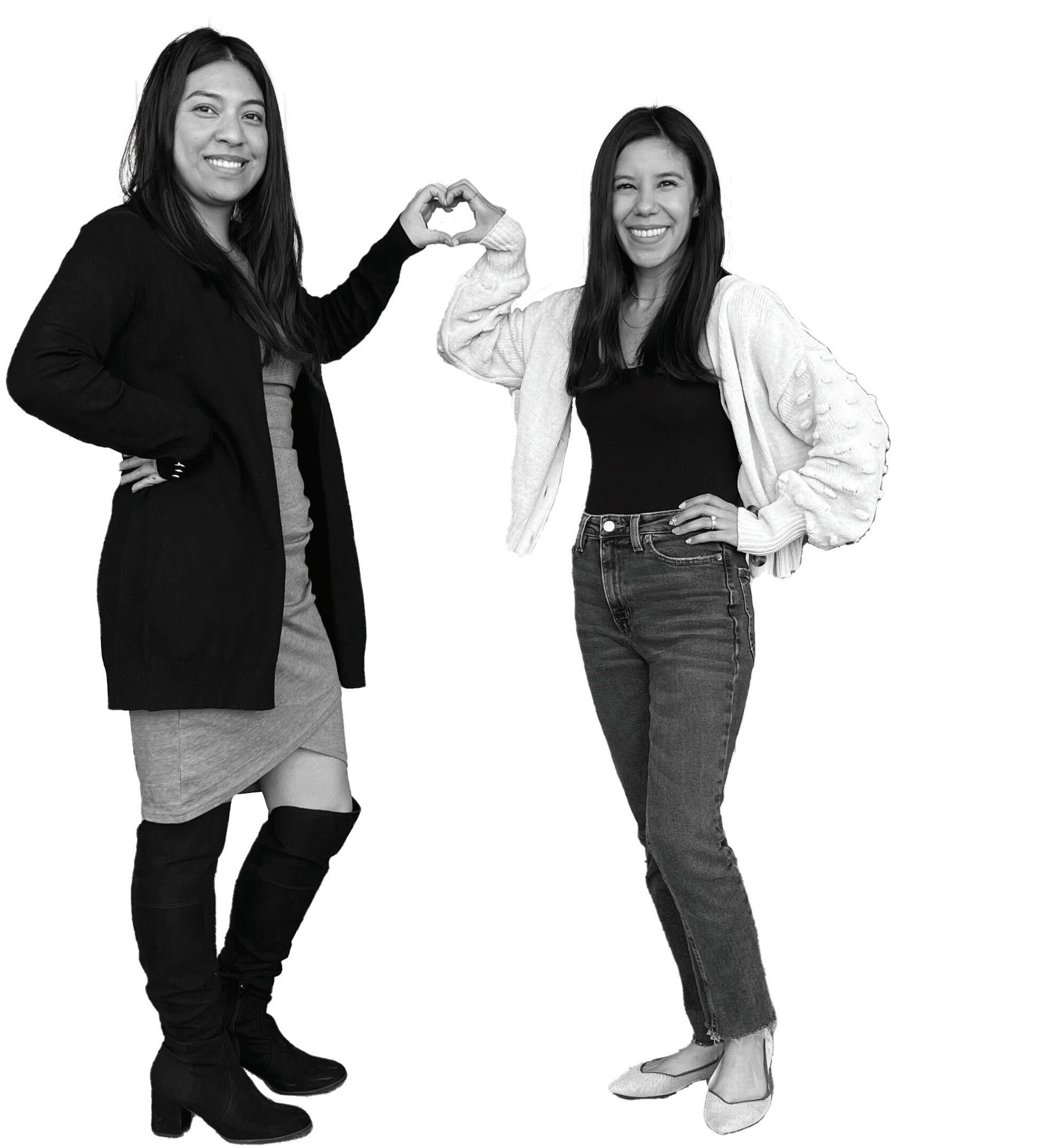
As the years go on, both Peña and Tabares believe that their friendship will continue to stay strong. Even if one or the other decides to leave Gunn, they promise to make an effort to continue seeing each other and stay patient. “It will only get stronger,” Peña said.
—Written by Yueun Hong
11 Features Friday, April 14, 2023
Photo illustration by Irene Hong and Yueun Hong
Natalie Lam
Photo illustration by Irene Hong and Katie LaWer
My password journal
Childhoods are filled with excitement—whether it’s experiencing a first crush or going through trivial friend group drama, an eightyear-old’s life is filled with secrets. However, with a roaming sibling or a sneaky friend, it’s unlikely for one to find a safe space to express these thoughts in an intimate fashion. Luckily, My Password Journal was here to listen.
Developed in the early 2000s, My Password Journal was designed by Girl Tech founder Janese Swanson. It is an interactive toy journal that uses voice recognition and requires a spoken phrase to unlock. The journal is inside a plastic case around the size of a regular notebook. The phrase spoken by the owner unlocks the cover and reveals a notebook, an invisible ink pen, a bendable glow light lamp that reveals the ink and a small compartment behind the notebook. In those sheets of papers, one could write their secrets, desires and more, knowing that they are the only one with access to this private information. The compartment behind the notebook allows one to store treasured personal possessions
hidden away from outsiders. Intruders were not welcomed and were warned away by an intruder alert— pre-recorded by the owner—that played whenever the wrong keyword phrase was spoken.
Swanson’s mission was to encourage the implementation of technology (overwhelmingly found in boys’ toys) in girls’ toys and overcome gender stereotypes in the toy industry. After Girl Tech was bought by electronic game company Radica Games, a branch of toy company Mattel, My Password Journal became manufactured in more colors. My Password Journal was discontinued in 2014, but collected or used versions can still be found.
BeybladeS
The excitement of yanking the ripcord out of the launcher. The thud of the rubber tip of the top striking the plastic stadium. The sound of the beys clinking and clanking against each other. These are all typical aspects associated with a past childhood craze: Beyblades. Revived in the 2010s due to the anime series Metal Fight, Beyblade first emerged in 1999, crafted by the Japanese company Takara.
The origins of the toy date back to 17th century Japan, where spiral shelled tops called beigoma were wrapped in a cord of string that would be rapidly unfurled to produce the spinning effect, much like their modern-day counterparts.
Originally, Beyblades were manufactured using plastic

Rainbow Looms
As most 2000s kids would know, accessories were always the key to any great outfit. Whether it be plastic Disney princess high heels or a snap-on bracelet, every pair of low-rise jeans and crimped hair took kindly to some fun add-ons. Not long after Silly Bandz—the peculiarly shaped animal elastics—took the world by storm, a more complex and endearing form of rubber band jewelry was born: Rainbow Loom.
First introduced in 2010, the colorful rubber bands and 3-tiered plastic loom quickly became a staple in the house of every elementary school child. Capable of making over 100 styles of jewelry, Rainbow Loom was most commonly used to make chunkystyle bracelets, which kids tended to stack from their wrists to their elbows.

The viral DIY jewelry kit peaked in 2013 when it seemed like the colorful rubber bands could be found at every summer camp in the U.S. Rainbow Loom quickly had risen to an activity of camp prestige, sitting in the arts and crafts bins with other timeless crafts.
Though most used the kits to make fun bracelets and necklaces,


but transitioned to metal in 2008. The introduction of the metal finish came with another feature: interchangeable, customizable parts which permitted endless experimenting. Along with the anime series and innovative design choices, aggressive marketing strategies including the use of engaging commercials and social media posts, thrust Beyblade into the limelight in the early and mid-2010s.
Beyblade, at its core, is easy to understand. At a cue of “3, 2, 1, rip,” players would launch their tops simultaneously into a stadium shaped like a bowl. Due to the slopes of the stadium, the Beyblades would inevitably careen towards each other and clash, losing more and more spin with each collision. The last one left spinning would be declared the victor. The simple rules and low skill floor, along with the unique mold of the toy, made Beyblades easy to pick up and hard to put down for many children in the early 2010s.

select users have made more daring crafts such as purses and charms. These stand-out creations went far beyond the scope of the users manual, but now can be found in a simple YouTube tutorial.
Though the viral trend met its match in 2017 with the rise of TikTok and other popular social media sites amongst Gen Z, the colorful craft experienced a resurge in popularity during 2020.
Despite its limited success with today’s youth, who prefer spending time online to doing DIY crafts, Rainbow Loom is a lost fragment of the 2010s which deserves credit as a nostalgic item for today’s teenagers.

Centerfold 12
—Written by Jeffrey Kang
—Written by Fiona Xiong
—Written by Vivian Studdert
Annabel Honigstein
Lise Desveaux
LiseDesveaux
WHICH DISNEY CHANNEL ORIGINAL MOVIE ARE YOU?

It’s finally Friday! You are most likely…





A. Singing your heart out during karaoke night
B. Writing a new song in your room
C. Catching a wave at the beach
D. Brainstorming ways to take over the world
What is the most important to you?
A. Your hobbies
B. Winning
C. Having fun
D. Fighting for justice
How would you describe your fashion style?
A. Glamorous
B. Casual
C. Beachy
D. Edgy
If you were in a band, what would be your role?
A. Lead singer





B. Songwriter
C. Drums
D. Guitar
If you chose mostly As...
You’re “High School Musical”! You’re definitely not afraid to be outgoing and don’t stick to the status quo. You love having a bit of drama in your life, even if it involves friendly competition. Channeling your inner Sharpay, you love to dress up. The world is your stage and you are the lead character. A dedicated person, you thrive in specific areas and have a penchant for everything and anything artistic. You love to be part of a team.
If you chose mostly Cs...
You’re “Teen Beach Movie”! Fun times and tan lines are constantly on your mind. You are fun-loving, spontaneous and always ready to go on an adventure. Your confidence and charm is magnetic, attracting the attention of all those around you. Loyalty is incredibly important to you, and you value your friendships much more than the average person. You like to put a fun modern twist on things. Surf’s up!
What is your drink of choice?
A. A crisp bottle of water
B. A fizzy soda
C. A creamy milkshake
D. A cool glass of lemonade
Date night! Where are you headed?

A. A theater to watch the newest musical
B. A karaoke club to sing your heart out

C. A local diner for some comfort food
D. A lake for an evening walk
Which club would you be most likely to join?
A. Drama club
B. Cooking club
C. Surfing club
D. Band club
It’s summer time! You are most likely…
A. Spending your days at a lavish resort
B. Having fun at a summer camp or internship
C. Catching a wave at the beach
D. Crafting a master plan to reach your goal
If you chose mostly Bs...
You’re “Camp Rock”! You never shy away from hard work when it comes to achieving your dreams. Although you can be overly idealistic at times, you remain down-to-earth. Staying true to yourself is one of your defining characteristics. Nothing makes you happier than having fun with your friends while exploring your passions. Music is something you can’t live without, and the thought of performing in public does not scare you one bit. Let your creativity shine through, it’s always just the thing you need when things get tough.
If you chose mostly Ds...
You’re “Lemonade Mouth”! Fitting in has never been a priority of yours—you’re proud to be who you are. You love to embrace the things that make you unique. Standing up for your beliefs is important to you, and you aren’t afraid to go the extra mile to achieve your goals. You never shy away from taking initiative, and although you can have a bit of a rebellious nature, it all comes from your heart of gold.
—Compiled by Diya Bose-Malakar
enterfold 13 Friday, April 14, 2023
—Compiled by Diya Bose-Malakar Aeron Man
Chinyoung Shao
Student Equity Committee focuses efforts to promote equity
On Feb. 24, leaders from four clubs out of the 26 clubs invited attended the most recent equity training. Student Equity Committee co-leader senior Madison Yue, who is also a Features Editor for The Oracle, believes that without club leaders’ attending these training sessions, clubs are less well equipped to represent their cultures and foster inclusion in their clubs. “It was concerning that cultural clubs and leaders didn’t attend the training, as they are a component in working towards making a more equitable campus,” she said. The Student Equity Committee was founded in 2021 during remote learning through Zoom meetings, held by Assistant Principal Courtney Carlomagno. Their main goal was to discuss topics regarding the importance of a safe environment for all students on campus.
The Student Equity Committee’s weekly meetings aim to make sure all students feel not only heard, but also represented. Equity training aims to educate students, staff and the wider community on equityrelated topics on campus and help create a community of leaders who are dedicated to making change at Gunn. The Student Equity Committee is split into four main subcommittees: cultural events, curriculum review/audit, outreach to middle schoolers and communications. Student Equity Committee member junior Danny Cox has been involved in the Outreach to Middle Schoolers Committee, where members of the committee work closely with Fletcher Middle School. “We are working to foster the involvement of Fletcher and have been able to form a committee at their school where they work on their own project,” he said. “We are planning on going to the school soon to see how much progress they have made.”
“We all, in some way, shape or form in our lives, have a level of ability to use our voices to advocate for others.”
with outside organizations to talk about race, religion, sexuality and how Gunn as a whole can better represent each student. For example, in partnership with Race-Work, they have hosted training sessions with guest speaker Dr. Lori A. Watson, CEO of Race-Work. She has fostered a collaborative space where student leaders can brainstorm ways to improve their community. According to Carlomagno, the administration decided to have Dr. Watson train students rather than lead the equity committee directly to garner a greater student voice in equity initiatives. “She has done some training with our staff, but not as much as we would like,” Carlomagno said. “We decided instead to focus on students and get them really passionate so they can bring staff on board. This year and last year, Dr. Watson came and did different training sessions for students, and now has started to offer additional options of training for our staff, students and parent community.”
—History teacher Tracie Carroll
At the most recent training, the committee met in Carroll’s classroom to draft their future objectives. “We need a site-wide community agreement with nonnegotiables on what the staff and the students can expect of each other, and the parents in the community as well,” Carroll said. “That’s going to allow us to be able to have conversations about why something is not okay, because we’ve all agreed as a community what the expectations are. Without this clear vision of what it looks like, we’re going to continue having these disconnected, disorganized, scattered pieces that we have now.”
Top: An all-day equity training with guest speaker and Race-Work CEO Dr. Lori A. Watson involves small-group discussions.
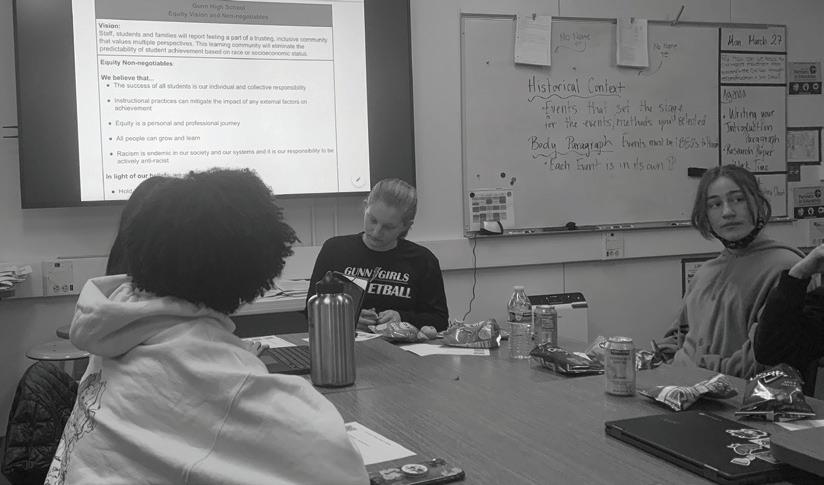
Middle: Student leaders brainstorm ideas to make the campus more equitable.
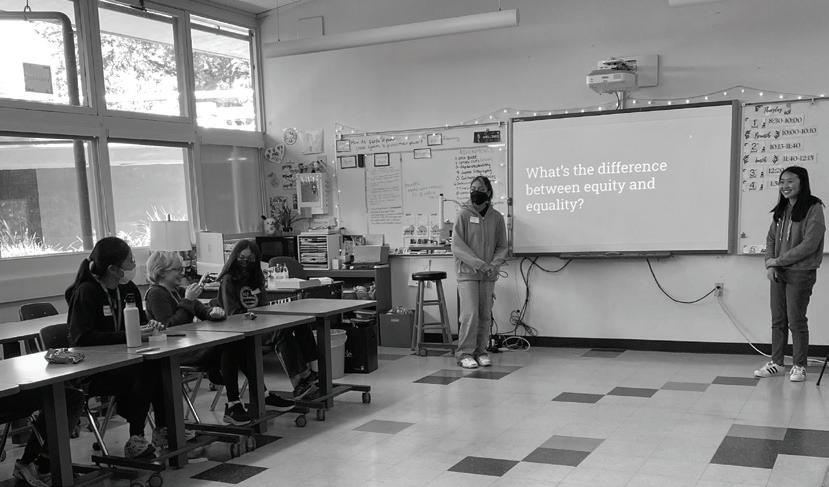
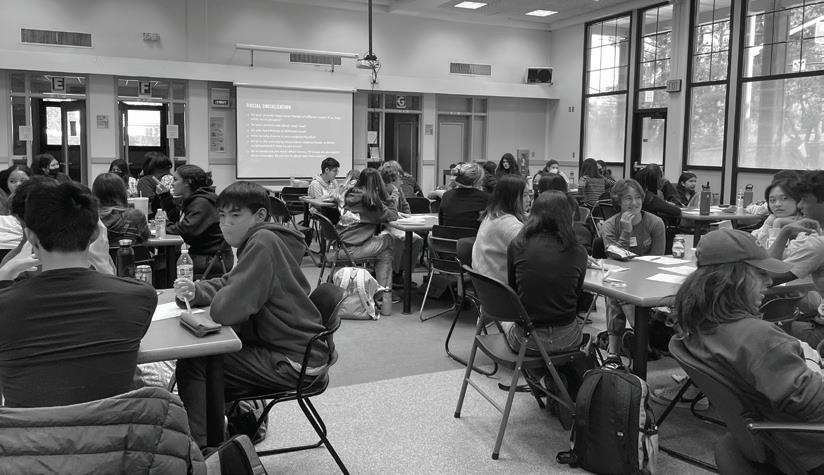
Bottom:
History teacher Tracie Carroll explained that attending equity trainings is important because it empowers students to have an impact. “We all, in some way, shape or form in our lives, have the ability to use our voices to advocate for others,” she said. “Going to these trainings helps provide tools to be able to advocate not only for yourself, but for others. You learn, practice and become more comfortable at calling people in and drawing attention to things in a way that creates change.”
Currently, the Student Equity Committee has been working
This year, the staff has been working on introducing equity training for the parent community. The training would allow parents to learn different tools for dealing with inequities and ways to educate others. Carroll, who has been working with Carlomagno, explained what the training process would look like for parents. “My goal this year is working on getting parent trainings to happen through Gunn, so they can learn about tools and strategies and also get a snippet of what the training sessions are like,” she said.
If you are interested in participating in equity trainings, contact Assistant Principal Courtney Carlomagno, ccarlomagno@ pausd.org.
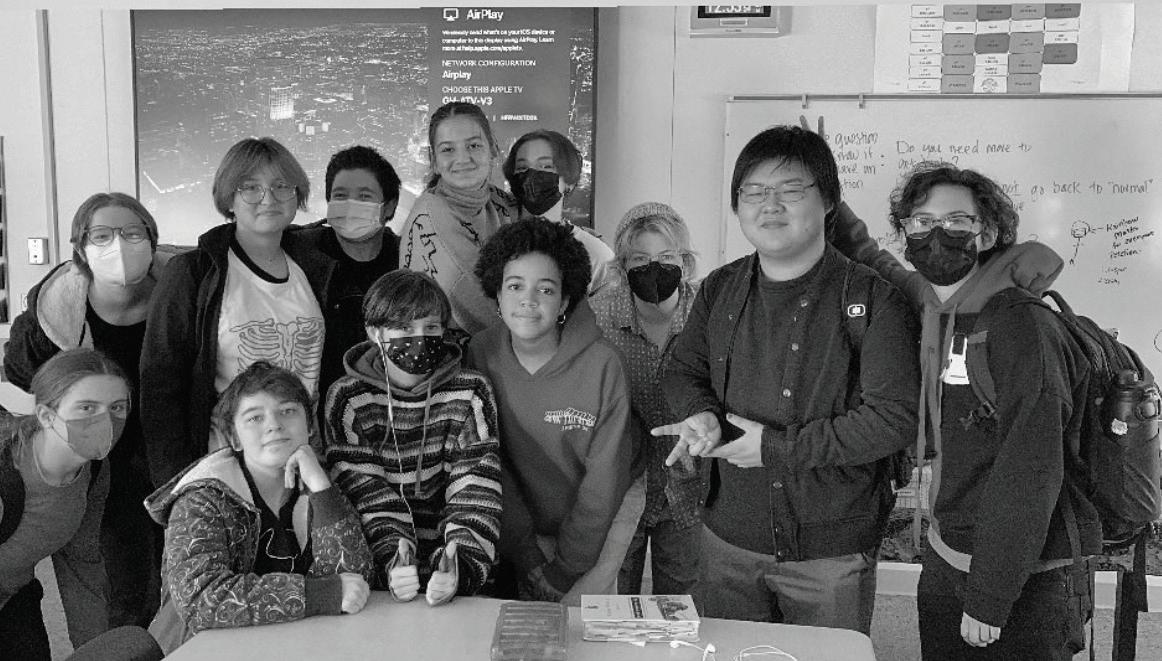 —Written by Zoe Leontis
LGBTQ+ community shares complexities of campus life

Two years ago, Co-Diversity Commissioner sophomore Sophia Howell and her mom settled into their nighttime routine of watching their favorite television series, “Glee.” As they watched, however, Howell’s attention was fixated on something other than the musical comedy in front of her. With high school on the horizon, Howell thought that the time was finally right. With a final push of reassurance from the queer characters in “Glee,” she came out to her mom as bisexual and biromantic. Her mom gave an accepting smile, and they resumed their episode.
“It was really perfect,” Howell said.
Although Howell feels comfortable in her identity at home, she’s noticed varying degrees of support on campus. The biggest challenge, according to Howell, has been the constant threat of microaggressions, stemming from a place of ignorance and homophobia. “People tend to joke about being gay or being transgender around me, and it makes me feel uncomfortable in my own skin,” she said. “Because even among people who know that I’m bisexual, they have a false perception that I might be okay with the joke, even though it’s not okay. It’s harmful for everyone in the (LGBTQ+) community, or even for straight people to be listening to that.”
they draw where they think any sexuality is okay, but (you’re) going too far if you’re changing your gender. So (my parents) were kind of in that boat. They didn’t care what gender people liked, but if you’re born as a girl, you have to identify as a girl.”
Although often lumped together, members of the LGBTQ+ community have varied beliefs. Debates, fighting and prejudice occur even within the community, manifesting in biphobia or transphobia. Donnelly believes that it’s crucial to recognize this intersectionality—different privileges that exist within overlapping social categorizations—in the queer community. “There are many people who are from the LGBTQ+ community who are also from other groups that have been oppressed,” he said. “There are queer Black people and trans people who grew up in poverty. It’s important to recognize that. I may not have gender privilege, but I have race privilege, and it’s important to take notice of that and fight for people who don’t have the same privileges (as you).”
vibrant community.”
—Co-Diversity Commissioner sophomore Sophia Howell
Freshman Socs Kaleba, who identifies as nonbinary and pansexual, has noticed the efforts made to be more inclusive of the LGBTQ+ community on campus. Despite these efforts, they still notice lingering homophobia and stereotypes. “My teachers are really good about using my pronouns, and Gunn has created a pretty good community with a lot of awareness and correction if teachers are being insensitive,” they said. “But there are definitely still stereotypes around (members of the LGBTQ+ community). How I’ve dealt with it is, if it’s not their business, I don’t tell them. There’s a lot more to a person than whom they love and how they see themselves.”
However, for junior Jasper Donnelly, who identifies as trans-masculine and bisexual, school is where he feels the most comfortable since he tends to surround himself with supportive friends. At home, though, he struggles with feeling completely accepted by his parents. Donnelly’s parents are both lesbian, so coming out about his sexuality was easy. Talking to his parents about his gender identity, on the other hand, was a lot more difficult for Donnelly. “People in the LGBTQ+ community can be really transphobic,” he said. “And there’s some line that

Howell also recognized the importance of acknowledging the complexity of queer identities. “As a Diversity Commissioner, I’d love to see an intersectional diversity event,” she said. “For example, we can have the Gender-Sexuality Alliance involved in highlighting the LGBTQ+ community and Black creators in the same event.”
Despite valuing education and representation, Howell acknowledged that it isn’t queer people’s jobs to educate straight people. She encourages people to take their own steps to educate themselves, and to find an encouraging environment where they feel safe to ask questions. “I don’t think I would have realized I was queer without such a supportive and vibrant community,” she said. “I think having a bunch of resources and other LGBTQ+ people around Palo Alto has helped me a lot in coming to terms with my own identity and exploring (different) facets of the LGBTQ+ community.”
—Written by Kaylee Cheng
Middle:
14 Features
“I don’t think I would have realized I was queer without such a supportive and
Student Equity Committee coleader senior Madison Yue and junior Angeles Tejeda present on equity trainings at Fletcher Middle School.
Zoe Leontis
Photo courtesy of Socs Kaleba
Photo courtesy of GSA
Kaylee Cheng
Safina Syed
Courtesy of Stephanie Castillo Baltazar
Top: English teacher Jordan Wells displays a pride flag to welcome LGBTQ+ students.
Freshman Socs Kaleba shows off pride with a creative makeup look.
Bottom: In November, the Gender-Sexuality Alliance gathers for a photo after learning about the midterm elections in relation to LGBTQ+ rights.
International exchange students acclimate to Gunn environment, make lasting memories
Spain: Sophomore Didac Vega
Adjusting to earlier dinner times was only a fraction of sophomore Didac Vega’s international exchange experience. While attending Gunn for the past year, Vega adjusted to a different lifestyle than the one he had in Spain as well as enriched his knowledge of American culture.
Vega has enjoyed Gunn’s highly involved student life. “During Homecoming Week, everyone was super invested in (showing) school spirit, which is not something we have in Spain,” he said.
Vega was also surprised by the amount of time students dedicate to school sports in the U.S.—back home, sports are more like a hobby. Vega, who plays tennis, appreciates the consistency. “I like that we have practice every day,” he said. “In Spain we have practice two days a week, but here people are very serious about their sports.”
At the same time, Vega didn’t expect the academic environment to be as competitive as it is, due to his more laid-back high school experience in Spain. “Gunn is very competitive compared to (high schools in) Spain,” he said. “Everyone takes everything so seriously here, but in Spain it’s more about having fun. People are way too stressed.”
While most of his expectations were met, he was still surprised by the academic rigor Gunn offered. “I thought school was going to be super easy,” he said.
Prior to attending Gunn, Vega saw videos online poking fun at American students’ lack of basic knowledge on certain subjects like geography. “I was expecting that,” he said. “It was shocking when kids here weren’t like that.”
However, Vega found Gunn’s social life very similar to his high school experience in Spain, and didn’t find it hard to adjust. “Getting used to the schedules was very easy for me,” he said. “It was very similar to Spain, but it was exciting to see a lot more diversity than I expected. There are more nerdy people than I thought, though.”
Yet, Vega also experienced hardships during his time studying abroad. “Being without my family and living by myself was difficult,” he said. “I had to learn to be more mature. Since I lived with a host family, I had to balance being a part of the family (while) not being too dependent on them.”
Overall, the experience of adjusting to Gunn has been positive for Vega. “Being an exchange student didn’t make the adjustment hard,” he said. “I think it was mainly because I’m a new student. It was a cool experience, and I definitely recommend it to other students.”
—Written by Hila Livneh
Denmark: Sophomore Christina Finne-Ipsen
Sophomore Christina Finne-Ipsen moved to Denmark from Palo Alto at the age of 2. After growing up in Denmark, she wanted to return to Palo Alto to experience teenage life from a different perspective. “I wanted to challenge myself to be in a new country with a different language and culture,” she said.
Part of the reason Finne-Ipsen decided on the U.S. in particular was because she was already familiar with English. “I wanted to see how life in the U.S. really is, because I see it on social media and it’s very different from European teenage life,” she said.
A difference Finne-Ipsen noticed between Palo Alto and Denmark is the strong emphasis placed on academic achievement at Gunn. “In Denmark, high school is more for fun and a time for friends,” she said.
In her first few months as an exchange student, Finne-Ipsen found it difficult to relate to how students often have a regimented schedule between school, homework and sports. “Back in Denmark, you go out with people after school, to the mall or a cafe,” FinneIpsen said. “You don’t eat dinner at home—you’re out with your friends. Sports are a thing, but not a lot of people do it in high school.”
Finne-Ipsen found that students in Palo Alto are generally more sheltered than those in Denmark. “There are a lot of things that kids are not allowed to


Germany: Junior Ella Brueser


Eating a hot dog smothered with mayo and ketchup was just one of the experiences that has stood out to junior Ella Brueser during her time in the U.S. so far. As an exchange student from Berlin, Germany, Brueser has shifted from eating foods like schnitzels to eating American foods like burgers. “The best part about America is trying new foods,” she said.
Brueser came to Gunn this semester through the Council on International Educational Exchange program. “The reason I decided to go on an exchange trip was to improve my English and go on an adventure,” she said. Brueser is staying with her host family, who have two students going to Gunn, until mid-June.
The main difference that Brueser finds between Palo Alto and Germany is the environment. “I like Palo Alto, but everything is far away,” she said. “You have to have somebody drive you everywhere, which is different from Berlin, where you can walk around to get to places.”
Another difference is how many Gunn students are involved in extracurricular activities after school. “Everyone is very interested in something,” she said.
During her time at Gunn, Brueser has played a variety of sports, as her school in Germany doesn’t have any sports teams. She tried basketball and track and field, but ultimately stuck with badminton. “I like to play team sports, but badminton is a nice experience where you play
individually or as a pair,” she said.
In addition to trying new sports, Brueser has gone on many food adventures. She has compiled a long list of iconic American restaurants that she wants to try, such as Shake Shack, Taco Bell and Popeyes. “It’s nice that there are so many opportunities to try different foods, like Japanese or Italian,” Brueser said.
As someone who has lived in a major city in Germany for the majority of her life, Brueser’s favorite memory of her time studying abroad so far was going to San Francisco with her host family. “I really liked being in a city again,” she said. At the same time, she has enjoyed seeing the sunsets and views of the Bay Area. “In Berlin, there are tall houses everywhere, so it’s not that common to see a nice view,” Brueser said.
With her last day in Palo Alto, June 15, approaching, Brueser has created a “last-week list.” This list details all of the activities she wants to complete on her last week in the U.S. Activities on this list include going to Six Flags, swimming in the ocean and celebrating her birthday. “I want to do everything on that list and see people for the last time,” she said.
—Written by Madison Yue
do (in Palo Alto),” she said. “The parents are really protective.”
She was also surprised by the difference in school spirit between Denmark and Palo Alto. “Everybody is just so hyped, and that’s a feeling I want to take back to Denmark,” she said.
Her most memorable moments at Gunn were during Homecoming Week. “There’s so much community,” she said. “Everybody was just dressed up and (and) it was amazing that everybody was so happy to be at school and to be together.”
Along with enjoying participating in school events, Finne-Ipsen also likes how Palo Alto has a little of everything to explore. “There are stores, there is nature—there’s generally a lot to do,” she said. Nearing her last few months in the Bay Area, Finne-Ipsen will miss the school opportunities and inclusive environment at Gunn the most. “Here, school is not just school, but it’s a place where you can do sports, be part of clubs (and) do whatever you want,” she said. “There’s a space for everybody here because there’s so much diversity.”
—Written by Isha Sinha
15 Friday, April 14, 2023 Features
MadisonYue
Isha Sinha
Graphics
Irene Tsen
by Chaewon Lee
athletes Strengthen Skills
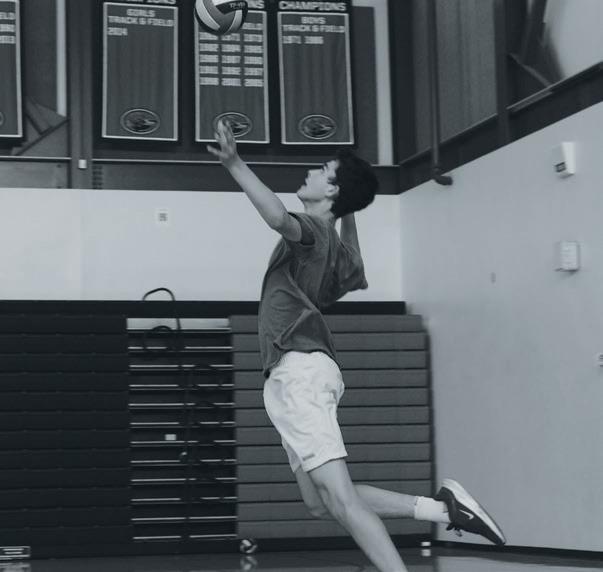
Junior Amrit Joshi described the strong bonds the baseball team has formed over the course of the season. “There’s a lot of camaraderie and we enjoy being around each other,” he said. “We have a kind of a brotherhood and bond that I don’t think can be met in any other way other than through a team environment.”
He also described how the team is approaching the rest of the season after a rough start. “Right now, we’re just focused on winning one game at a time,” Joshi said. “We want every game to feel like it’s a must-win game so that we’re pretty much always playing with our backs against the wall because we tend to play better that way.”
Joshi pointed out some areas of improvement for the team.
Lacrosse team captain sophomore Luke Hines explained how the improvements the boys’ lacrosse team made from last year have impacted their success this year. “We’ve gotten off to a great start at 5-2 (wins to losses), which sets us up nicely for a shot at the league title,” he said. “We’re in a lot better shape than last year because our defense has improved a lot and we’ve introduced a lot more plays on offense. The newer players have also been improving a lot since the start of the season because we’ve encouraged them to practice on their own.”
He also described some complications of the season. “Multiple games and practices have been cancelled because of the weather,” Hines said. “Even when we do have practice, people skip and this stunts our progression as a team.”
Girls’ Lacrosse
“Something that we should improve on is our will to win because sometimes we tend to be a little lackadaisical when things aren’t going our way,” he said. “We all need to have more of a devotion to winning by any means necessary.”
—Written by Kenneth Soh
Current reCord: 1-13
next home game: 4/15 at 12 p.m. vs san mateo HigH scHool

Hines reflects on his favorite part of the season so far. “It felt great when we beat Woodside,” he said. “They were talking a lot and were expected to beat us, but we ended up beating them 11-6.”
—Written by Kenneth Soh
Current reCord: 5-2
next home game: 4/15 at 11 a.m. vs latino college prep
Freshman Lena Duggan detailed her highlights and lowlights of the girls’ lacrosse season so far. “Some highlights of the season have been a couple really tough, hard-fought games against good teams,” she said. “Los Gatos was a really good game where we fought hard. Some lowlights have been losing games where we could have done better and running suicides at practice.”
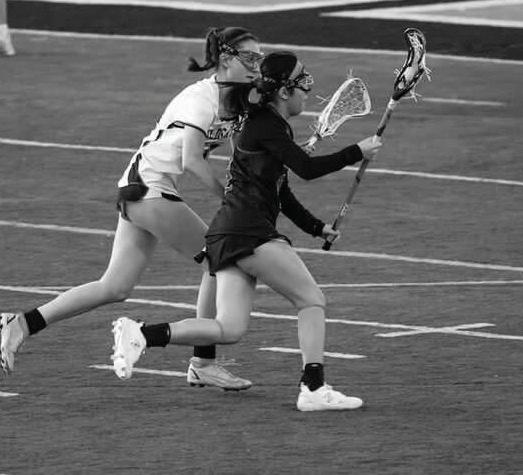
Duggan also reflected on the team’s goals this season: to make it to Central Coast Section. “For the past couple of years, the seniors have made it to CCS, so we want to get them there again this year and give them a great final season,” she said.
Looking toward the rest of the season, Duggan hopes that the team improves their level of play and chemistry with each other. “I’m looking forward to seeing how our team grows together
Freshman Roy Lao explained his goals for the diving team and how the divers have improved throughout the season. “We’ve made it a goal to try to have everyone be able to compete because in diving, there are requirements to compete and so far we’ve done that pretty well,” he said. “In the future, we want everybody competing in varsity.”
Lao is confident that the team will be able to reach this goal given the level that the team is performing at. “Our team has definitely improved throughout the season,” he said. “The people that just started learning diving have been doing very well for people that have never done it before.”
Lao reflected on his favorite parts of the season so far. “My favorite part of the season was the first meet just because I got
Boys’ Golf
Boys’ Lacrosse

and improves,” she said. “I’m also looking forward to playing the tough teams that we weren’t able to beat, but maybe the second time around we will.”
—Written by Kenneth Soh
Current reCord: 5-6
next home game: 4/14 at 7 p.m. vs castilleja HigH scHool
to meet some divers from other high schools,” he said. “I also love getting to see people that haven’t dove before coming in and trying it since I think that’s a really good experience. You can help them out and see them through their learning process.”
—Written by Kenneth Soh
Current reCord: 5-0
next home game: 4/14 at 7 p.m. vs mountain view HigH scHool
Freshman Alexander Thu reflected on the team chemistry of the boys’ golf team. “My favorite part of the season has been having such a great team,” he said. “Everyone’s having fun and being nice to each other. The teamwork has been great and we’ve been having fun.”
Recent tough weather conditions have significantly affected the golf team’s playing capabilities. “We’ve had quite a bit of practices and games rained out,” he said. “(Once) when we went to practice, there were 40 miles per hour winds and tumbleweeds rolling across the green.”

Thu appreciates the growth the team has undergone, however, he hopes the team can still improve before the end of the season. “We’ve been practicing really hard and going at
The boys’ volleyball team has had a rough start to the season, losing the majority of their games. Despite these losses, the team has been able to maintain their energy each game. Sophomore Arda Turgut highlighted the team’s continued efforts. “Even if we lose a game, we always have team spirit and we meet after every game to talk about what we can improve on,” he said.
Amidst the team’s struggles this season, there have also been triumphant moments. “A highlight for me was our game against Wilcox where we had a great save and the home crowd went wild,” Turgut said. “It’s always nice to have the support of the crowd and it really helped raise our energy.”
Turgut explained that the focus for the rest of the season is to continue improving and enjoying the experience, not the
Diving
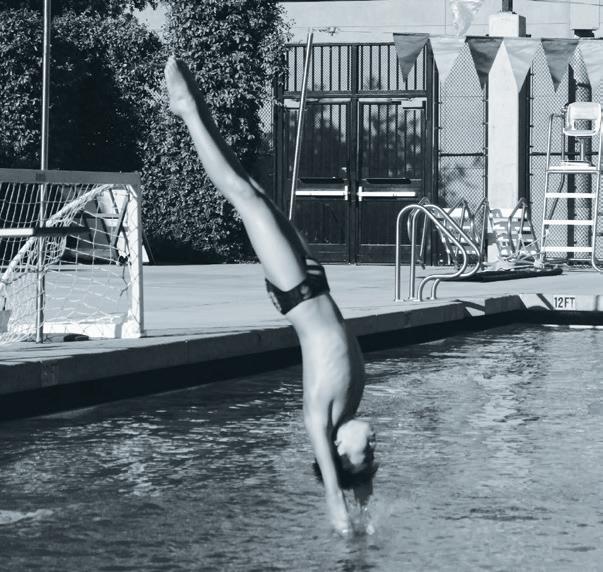
it even in the rain,” he said. “We’ve also been training in some pretty tough courses. We’ve grown a lot throughout the season already, even though it’s only been a month or two. We’ve been putting in the work and I would like to see growth in the short game, chipping and putting around the greens.”
—Written by Kenneth Soh
Current reCord: 5-2
next home game: 4/18 at 3:30 p.m. vs milpitas HigH scHool
outcome of each game. “It doesn’t really matter if we win or lose, as long as there is improvement,” he said.
—Written by Ya-An Xue
Boys’
Current reCord: 2-7
next home game: 4/18 at 6:45 p.m. vs santa clara HigH scHool
Baseball
Volleyball
Ellie Yuan
Courtesy of Luke Hines
Ellie Yuan
Courtesy of Lena Duggan
Courtesy of Sam Zeng
16 SportS
Ellie Yuan
during Spring Sports Season
Despite this year being her first on the badminton team, freshman Xiwen Liang has found the team to be welcoming and comfortable to be in. She highlighted the close community within the team that has led to friendships on and off the courts. “The team is very supportive of each other, both in practice and in games and we’re always cheering each other on,” she said. “I’ve made a lot of friends by being on the team.”
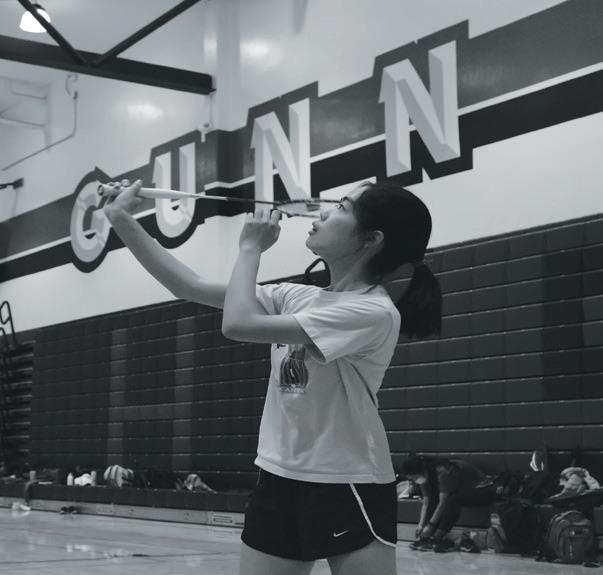
Despite the success that the badminton team has found building team chemistry, there have been setbacks. “Because of the weather, we had to reschedule some of our away games and also, sometimes we don’t have enough players to play in a match, so we have to forfeit some matches,” Liang said.
Because Liang has had a positive experience so far, she is
Softball
excited to play with the team for the rest of the season. “I’m looking forward to improving my skill over the season, meeting new people and having fun playing,” she said.
—Written by Ya-An Xue
Current reCord: 2-5
next home game: 4/20 at 5:15 p.m. vs los altos HigH scHool
With the departure of last year’s seniors, this year’s softball team is mostly underclassmen. Softball co-captain junior Lauryn Selvaraj highlighted the process of adjusting to the new players and creating a cohesive team. “Because most of us haven’t played that much together in high school, it’s a very new-looking team,” she said. “Last year, we were really good because we had a lot of seniors, so we’re trying to make that happen again.”

Despite a rough start to the season, which included many losses and games canceled due to the harsh weather, Selvaraj is looking forward to the rest of the season and seeing the team’s growth. “I’m excited for the games, especially the Paly game because I have a lot of friends on that team and I want to play
Sophomore Sophia Guibas highlighted the strong community she has found within the girls’ swim team. “During meets, it’s really fun cheering on my friends and also seeing myself improve,” she said. “Last year, (the team spirit) wasn’t that big, but this year it’s improved a lot and we always cheer for each other during races.”

With new coaches this year, the swim team has experienced better organization and attendance during practice sessions. “It’s nice that we have two coaches, one main coach and an assistant coach, because he splits it up between JV and varsity,” Guibas said. “This is really great because it’s a smaller group of people that one coach is looking over so you can get more attention.”
Boys’ Swimming
them,” she said. “Our goal is finishing up the season a lot better than we started by improving and becoming more of a team.”
—Written by Ya-An Xue
Current reCord: 4-7
next home game: 4/24 at 4 p.m. vs mills HigH scHool
In addition, Guibas explained the team’s hopes for the rest of the season. “I’m looking forward to the weather getting better because swimming in the rain and cold is not fun, and getting faster as a team,” she said.
—Written by Ya-An Xue
Current reCord: 1-3
next home game: n/a
The boys’ swim team has had a successful beginning of the season, winning almost all of their meets. Freshman Nathaniel Yoon reflected on the team’s high performance. “We’ve had some hard practices this year with our new coach, and we won all of our meets so far,” he said. “The season has been going great.”

For Yoon, the swim team is filled with many familiar faces, despite this being his first year on the school team. “The team community is good and I know a lot of people because they are also on my other swim team,” he said. “There are some people that I don’t know as well, but we’re still a close team.”
The goal for the team this season is to compete and place highly at CCS, as well as continue winning at meets. “We’re
The boys’ tennis team has had a successful start of the season, winning most of their games and attending many tournaments. Sophomore Jerry Guo is excited to spend the rest of the season improving with his teammates. “I’m looking forward to CCS at the end of the season and also bonding more with my teammates to play as a team,” he said.
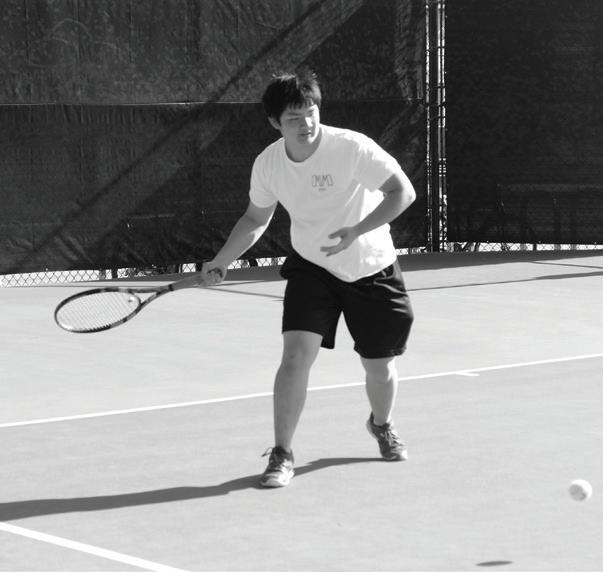
Despite their success, there have been some unexpected challenges. “There have been some injuries on the team, but there haven’t been any major lineup changes,” Guo said. “Also, many of our matches were canceled and rescheduled because of the rain, so we had four games in one week which was really tiring.”
Despite these setbacks, Guo is looking forward to spending
Track and Field
Girls’ Swimming
trying to get first or second (in CCS),” Yoon said. “I think we’re doing well, so we might beat Paly this year. Overall, I’m confident in our ability to compete at CCS.”
—Written by Ya-An Xue
Current reCord: 3-1 next home game: n/a
the rest of the season with his teammates. “The team is really accepting and welcoming and there is a big sense of community within the team itself,” he said. “I really enjoy being part of the team, having fun and making memories.”
—Written by Ya-An Xue
Current reCord: 6-2
next home game: 4/20 at 4 p.m. vs saratoga HigH scHool
The track and field season started out slowly, due to many meets being canceled because of the rain and wind. Junior Jacob Hilbert explained the challenges that come with bad weather. “We had to reschedule some games and even had a tri-meet against two other schools,” he said. “It wasn’t the best situation, but it worked out in the end.”
Because the track and field team couldn’t find an official coach for certain events, such as sprints, the sprints team is led by team captains. “A student sprinter just stepped up and leads warmups,” Hilbert said. “There have been captains in previous years, but I think the captain’s work is definitely way more this year.”
Hilbert also highlighted his goal of competing at CCS this
Boys’ Tennis
year, and how the team is helping him get there. “I hope to qualify for CCS with pole vault, since it’s my first year doing it,” he said. “It’s really nice having the team’s support and spirit encouraging me to improve.”

—Written by Ya-An Xue
Current reCord: 4-1 in dual meets next home game: n/a
Badminton
Ellie Yuan
Ellie Yuan
Yoochan An
Ellie Yuan
Courtesy of Lauryn Selvaraj
17 SportS Friday, April 14, 2023
Courtesy of Jacob Hilbert
Team, individual sports offer varying benefits
Sports are often applauded for teaching valuable qualities, such as perseverance and patience.
Team sports such as basketball and soccer require collaboration while individual sports such as tennis and wrestling emphasize self-reliance. It is beneficial to understand the key differences and similarities between team and individual sports to understand how sports function as a whole.

Team Sports
Some of the most popular sports in the world are team sports—with images of lifting trophies, winning a game and team spirit often coming to mind. At the same time, team sports are a constant work-in-progress as a team accrues experience, deals with failure and ultimately succeeds together.

Team sports provide a welcoming environment. For junior Celine Safa, who plays volleyball and soccer, being a part of two team sport communities has forged lasting connections in high school. “(The) benefits of volleyball and soccer have been socializing and becoming really close with my teammates,” she said. Similarly, freshman Sophia Kim values the atmosphere of group sports she experienced during her time with the water polo, soccer and swim teams. “My favorite aspect is the team because everyone is supportive and it’s very high energy,” she said. Oftentimes, individual effort is overshadowed by a team dynamic. Like a puzzle, a team is composed of athletes with unique attributes who must cooperate to maximize team success—one star player cannot win a game alone. Through experience, the team builds confidence and trust.
Wrestling coach and Physical Education teacher Braumon Creighton recognizes the challenges of ultimate success in a team setting. “Team sport success is harder to control,” he said. “For a sport like football, it’s really hard to have success unless you have 11 people pulling their weight and working hard for the same goal.”
For team sport athletes, there is an additional mental stressor: letting the team down. Judgment from teammates hinders self-confidence and leads to social ostracization. “For teams, the mental obstacle would be letting the team down on a crucial play, (one that could be the) difference between winning and losing,” Creighton said. Kim echoed


this sentiment and believes that competing in swim relays creates more pressure than competing alone. “If it’s a relay, you don’t want to let your teammates down,” she said. “You want to make sure you swim fast, don’t mess up a dive or get your team disqualified.”
Team sports frequently have a natural dynamic of competition within the team. However, this usually creates greater depth and positive encouragement for improvement. Safa believes that competition in team sports is often healthy. “In my experience with team sports, your teammates provide you support and healthy competition rather than toxicity, because in the end they want you and the team to succeed,” she said.

Individual Sports

Individual sports operate differently, as athletes face the task of tackling challenges alone. In turn, athletes learn intrinsic motivation, develop mental toughness and become self-reliant. Oftentimes, they are their biggest opponent.
In the rigorous conditions of individual sports, the mentality more closely resembles that of every man for himself. Growing up in a competitive wrestling environment, Creighton understands the attitude of individual sport athletes. “In individual sports, you would probably rather win yourself than see your team win,” he said. “It doesn’t have to be that way, but we can be a little more selfish because we don’t necessarily have to share.” Still, individual sports can also teach athletes to play fairly and respect their opponents.
Individual sports hone personal improvement and self-responsibility. Tennis player freshman Jacob Jiang appreciates the flexibility and personal aspect of individual sports. “Individual sports are about an individual’s own strategy and their own movements performed to perfection,” he said. At the same time, Jiang believes that misconceptions about tennis—such as seclusion—are not necessarily true. “Personally, it never feels isolating to play tennis,” he said. “It’s like communicating with your clone; you cheer yourself up (and) tell yourself to hit crosscourt.”
Individual sport training revolves around improving technique and strengthening weaknesses. Athletes partake in individualized drills, exercises and conditioning

to maximize performance. Safa, who also sprints and hurdles on the track and field team, approaches running training differently. “You only have yourself to focus on, and it forces you to hold yourself accountable for your own training and progress, so the goals that I set for myself look different than the goals that I would set with my team,” she said. “In order to push towards a personal record, I train in a much more personalized manner, rather than training towards larger (and broader) team goals.”
Individual sports in high school still provide socialization. While athletes compete individually, they are still part of a bigger team working towards a common objective. Jiang, who plays singles tennis, is still able to bond with and rely on his teammates. “(For) high school tennis, it is more like a team environment, as people cheer you on just like at any other soccer or baseball game,” he said. “Coaches get to talk to you between points and you get to talk to your teammates.”
Overall Benefits
Multi-sport participation can also complement an athlete’s skill set. For Kim, being a swimmer aids her progress on the water polo team. “Since I swam before I started water polo, I already had experience in the water and that gave me an advantage,” she said. “Water polo gives you good endurance and builds strength for swimming.”
Ultimately, both individual and team sports teach athletes valuable life skills and provide an opportunity to train the mind and body. Creighton believes that all sports teach athletes valuable skill sets, especially under challenging circumstances. “The goal-setting skills that you develop are so valuable, and you learn to deal with disappointment,” he said. “People who have played sports have dealt with challenges before, so they have more practice. They’ve developed drive, grit and ability to delay gratification and can continue to get up and go again. That is a valuable life skill, and sports is a great platform to teach that.”
–Written by Ellie Yuan
42.9%
Source: Self-selected survey sent out to Gunn students by The Oracle from Mar. 28 to April 7 with 49 responses.
34.7%
18 SportS
of students athletes in both individual and team sports find team sports to be harder
of student athletes in both individual and team sports find individual sports to be harder
Source: Self-selected survey sent out to Gunn students by The Oracle from Mar. 28 to April 7 with 49 responses.
Graphics by Sarah Xie
IS P.E.’s curriculum helpful to students?
Dylan Sperandio Reporter Nicholas Weng Reporter


High school can be a very stressful place. For students who need to spend many hours studying for difficult classes, or completing scores of tedious homework assignments, P.E. not only gives them an opportunity to exercise, but also helps reset their brains and gives them the opportunity to play new sports.
P.E. provides a crucial mental break from the many rigorous and mentally taxing classes that most students take. Physical activity, according to many studies, leads to better mental health and happiness. So as long as students put in effort during P.E., they will head to their next class both relaxed and refreshed. On the other hand, if students had a prep instead, there would be less of a chance of this happening, since generally, completing homework or scrolling through social media isn’t exactly a refreshing thing to do.
P.E. forces students to try out sports that they might otherwise not have had the time or opportunity to have done. Regardless of whether or not they go on to be professionals, trying it out in a low-stakes environment like P.E. can be a very enjoyable experience. Futhermore, it might encourage students to pursue it further outside of school, and maybe turn it into a life-long hobby.
While a significant portion of the student body believes that a prep period or an additional class may be more useful than P.E., it has more to offer beyond compulsory exercise and fun. Over the course of the year, P.E. cycles through many sports, with each sport taking up an average of four weeks, or 15 hours of class time. With such little time, it is difficult for students to develop the necessary skills and techniques required to be successful in any one of the sports. While that might not seem ideal, this is actually one of the ways that P.E. helps students. By trying something completely new in such a fast-paced environment, students are actually honing their ability to learn skills quickly, which many would argue is very important.

In conclusion, while many students may not like P.E., it forces them to exercise, provides them with a break, and lets them have fun. Although there may be problems with P.E.’s implementation at Gunn, the pros of the program far outweigh the cons, and thus, P.E. is beneficial for students.
Source: Physical Education Framework for California Public Schools
Physical Education classes are a place where students are able to exercise and try out new sports. Some even consider it a time to relax and get some fresh air during a day of classes. However, Gunn’s P.E. classes are insufficient for the needs of students because too many sports are taught and classes do not provide enough time to exercise.
Even with P.E., students aren’t getting enough exercise. According to a study conducted by UCLA in 2018, 80% of teenagers in California fail to exercise for the CDC’s recommended amount of one hour per day for five days each week. Gunn’s classes fall short of this number, with students spending around four hours per week in P.E., as opposed to the five needed. As well as not meeting federal recommendations, the hours spent in P.E. are not used efficiently. After transition periods like changing into P.E. clothes, students spend a lot of time standing around and chatting with friends.
According to P.E. teacher Steve Ames, a goal of the Gunn P.E. curriculum is to teach students physical literacy, which is the confidence and competence to engage in physical activities. One of the ways the curriculum achieves this is by introducing a variety of sports to students. However, too many sports are taught. According to “The Little Book of Talent” by Daniel Coyle, learners should give eight weeks of time to a new skill. It cites many prominent eight-week training programs. But with the average P.E. unit being just four weeks long, students do not have enough time to develop the skills necessary to engage in it outside of school.
Some say that P.E. gives students a break from rigorous classes. However, P.E.’s purpose is to have students exercise. Done properly, the course is exhausting, not fun. Some people also say that P.E increases mental health, but the opposite is true, as events such as fitness testing, timed miles and graded skill checks for sports put even more stress on students.
To address some of these problems, teachers could make sure students are always doing an activity instead of wasting time, or focus on a select few sports instead of covering a variety. But, unless serious changes are made, the Gunn P.E. program does not serve the needs of students as too many sports are taught, which leads to not enough time being spent on each sport.
37.1% of StudentS who have cut claSS cut p.e.
Source: Western Accredidation of Schools and Colleges (WASC) survey with 124 responses
The Oracle Recommends new sports for Gunn athletics
Sport 1: Table Tennis
As an official tournament in the Olympics with an estimated 300 million players worldwide, table tennis has cemented itself as one of the world’s most prominent sports. Part of its popularity comes from its adaptability–table tennis requires little space and minimal equipment. The sport is friendly to new players: Anyone without prior experience can easily pick up a paddle since table tennis can be adapted to all skill levels. Participation in table tennis enhances hand-eye coordination and sharpens reflexes, improving players’ overall athletic capabilities.

Furthermore, playing table tennis over a period of time is proven to positively influence neurological function. Studies from the European Journal of Sport Science found that table tennis engages multiple neural networks and regions in the brain, especially the regions that handle decision-making and motor skills. In addition to its neural benefits, table tennis yields considerable physical health gains. Its
Sport 2: Futsal
Despite futsal’s basis on soccer, the indoor version of the world’s most popular sport involves high-paced action with more goal-scoring, dribbling and highlight-reelworthy plays. Only five players from each side are on a futsal court at a time, so each player receives more touches. Furthermore, players comprise an integral part of their team’s offense and defense, encouraging positional versatility. In futsal matches, each half is only 20 minutes long and unlimited substitutions are allowed, which incentivizes teams to attack and counterattack more aggressively. Also, futsal is played on an indoor court roughly the size of a basketball court, which creates situations where space is tight and players have to rely on their skill and instinct to maneuver past defenders.
Additionally, futsal players constantly make split-second ingame decisions due to the sport’s fast pace. Developing the ability to effectively make these decisions will improve athletes’ spatial awareness, which can be translated to many other sports. As flashy as the sport is, futsal maintains an emphasis on teamwork. In order to win the ball back on defense or send the ball into the back of the net, players must coordinate their movements and communicate constantly. Soccer players in particular receive valuable off-season training from futsal. Many of today’s most prominent professional soccer players acknowledge that playing futsal at a young age has helped them improve their skills, including

swift rallies challenge athletes’ stamina and reflexes. Furthermore, as a sport without physical contact, players do not risk many types of serious injuries that could otherwise happen. Table tennis also builds a high level of endurance because athletes train to maintain a consistent level of performance and focus during their matches. Gunn already boasts a robust table tennis player base and holds an annual student-organized tournament. Forming an official school team would allow players to pursue the sport more seriously, refine their skills by playing against others and create a social outlet for them to form new friendships and strengthen existing ones.
Messi, Ronaldo and Neymar Jr. Futsal is a thrilling sport for its players, but it has garnered plenty of fans who also appreciate the game’s intricacies. As a spectator sport, futsal has everything that fans desire: short games, plenty of action and displays of skill and creativity. If added to Gunn, the sport will no doubt foster teamwork, individual prowess and a supportive fanbase for its athletes.
—Compiled by Bryan Xiao
19 Friday, April 14, 2023
SportS
YES NO
Graphics by MichelleKoo
“StudentS are provided with opportunitieS to improve their health-related phySical fitneSS aS well aS to underStand advanced conceptS related to phySical fitneSS.”
HUMOR: culprits caught for campus crimes
Eating in the library
There’s a certain code when it comes to keeping Gunn’s sacred library clean—a code that some people still manage to ignore by eating under its roof.
Not only is it a health hazard, with crumbs and spills inviting ants or termites, but it’s also a disruption to the peaceful study environment. No one wants to hear loud chewing or slurping while trying to focus on their DeltaMath.
But let’s not forget about the potential damage to school property. Food stains, crumbs in keyboards and sticky chairs are just some of the horrors that our heroic librarians have to contend with on a daily basis.

Please, please think twice before bringing your chips and boba into the library. It’s not only disrespectful to your peers and school property, but it’s also an unforgivable crime that can have lasting consequences. Save the snacks for the quad, and let’s keep our library clean and pest-free—because eating in the library? It might be a novel idea to some, but pesky mess-makers ought to turn a new page.

Vandalizing Bathrooms
The ultimate crime to be committed at Gunn is not just a problem for the school administration: It’s a problem for the students, too. Sure, carving initials with a heart sign on a bathroom stall might seem like a harmless prank, but imagine just how much seeing it would pain a heartbroken young freshman.
Every toilet that gets clogged with paper towels and each saddeningly empty soap dispenser takes up valuable time from our custodial staff, who we all know are already overworked with all of the plastic bags that litter the quad—playing the vandal just doesn’t help anyone. Messing up the bathroom also creates an uncomfortable and unsanitary environment for everyone. No one wants to enter a suspicioussmelling stall or parkour across broken tiles on the floor. It’s not fair to the students who are simply trying to finish up their business.

Each student has small ways to show appreciation for the school and make everyone’s life a little bit easier. Plus, who knows—you might be able to apply your graffiti skills in the art building and become a modern Basquiat.
denying the pool
There’s a saying at Gunn that goes, “If you deny the existence of the pool on top of Spangenberg Theatre, you’ll be jailed in the Spangenberg dungeon.” Source: unknown. But what’s so special about this pool that denying its existence is such a heinous act?
Legend has it that the pool was built back in the 1960s as a secret training facility for the school’s Olympic-level swim team. It’s said to be accessible only by a concealed backstage entrance, and the only way to get in is by swiping a secret keycard that only Gunn administration have access to.
Now, some skeptics might try to tell you that the pool doesn’t exist. They’ll say it’s just a myth passed down from one generation of Gunn students to the next. But those of us who know the truth acknowledge that denying the existence of the pool is simply unacceptable.

So, the next time someone tries to tell you that there’s no pool on top of Spangenberg Theatre, just smile and nod. They might not be ready to face the painful truth. But for the rest of us, we’ll keep practicing our dives and dreaming of the day we’ll make it onto the Olympic swim team.
jumping the lunch line
Everybody has seen the suspects in action, hopping the fence to take their share of the trove hidden away behind the P-building walls. Once the post-lunch bell stampede concludes, about four-fifths of the school seems to be stuck behind the steel grates and concrete pillars of the dreaded line. Those who violate the sanctity of the queue are committing truly heinous deeds.
Luckily, our beloved campus monitors are there as security to lay down the law on those trying to practice their hurdles. They’re known for no-nonsense attitudes and passionate protection of the lunch line. If you think you’ll get past them, you might want to think again.
Let’s be real for a second. At one point or another, we all face the infinite stretch of students ahead of us and the human river that balloons out from the end of the metal grates. It’s a struggle, but one we share. To bypass this test of Gunn spirit is not only shameful in and of itself, but everyone behind you sees exactly what you’re doing—regardless of how subtle you think you’re being.
—Compiled by Kelvin Xu
Lost Gunn traditions mark shifts in student body
With every graduating class, a small series of memories, nicknames, inside jokes and traditions are inevitably lost. Factor in the COVID-19 pandemic—which kept students away from campus for almost two years—and one will come to find that even some of the most beloved and longstanding traditions have ceased to exist on campus. From traditions that altered the everyday student experience, such as sitting in designated areas during lunch, to online confessions pages and even morning announcements from the Titan Broadcast Network, these are some examples of how some of the most famous and followed Gunn traditions have come and gone.
LUNCH SEATING
Most current seniors are able to recall a stricter enforcement of seating culture. Just three years ago, it was an unquestioned school standard for the seniors to sit at the “senior quad,” the turf patch and benches in front of the P-building. Similarly, freshmen would sit at the “freshmen quad,” the concrete amphitheater and large field stretching from the parking lot to the N-building. Nowadays, students sit wherever they like, regardless of grade. “I never felt any pressure to sit in the freshman quad when I got here,” freshman Mikkel SmaabergArnhoff said. “My friends and I just decide to find a spot that we like, and so I guess our grade level didn’t actually matter in the end.” Indeed, the way SmaabergArnhoff described today’s seating culture is more or less the assignment sophomores and juniors had back when a so-called system was followed: find an unclaimed spot on campus, and sit there.
The fact that freshmen and seniors are now choosing to sit wherever they want is certainly a new development. While the majority of freshman quad lunch-goers may still be freshmen, and the majority of senior quad lunchgoers may be seniors, it is visible that the system is far less
strict today. In fact, one is virtually guaranteed to find students from any grade sitting in any area on campus.
GUNN
Today’s Titans, who primarily use Instagram and Snapchat, may be surprised to hear that one of the largest online pages in Gunn history was run on Facebook. In its heyday, the Gunn Confessions group had hundreds of followers and thousands of posts, which were largely anonymous submissions. Students submitted anything from confessions of secret crushes to complaints about classes to requests for personal advice. With the waning popularity of Facebook and the pandemic slowing student activity, it seems the account was taken down a few years ago, as it is now locked on Facebook. However, many similar accounts have attempted to reach the same popularity. Last year, an anonymous website, which was active for several weeks, allowed students to submit potential romantic couples. Earlier this school year, an Instagram confessions account made waves for a week, but was later taken down. While a student forum may never again reach the same popularity as Gunn Confessions, it seems that online pages have and will continue to occasionally pop up and challenge its title.
Unlike grade-based lunch seating and Facebook confessions, one lost Gunn tradition has recently been on a comeback: school announcements. Current seniors recall receiving morning announcements almost every day, which were in video format and produced by the Titan Broadcast Network as part of the video production class in 2019 and early 2020. The announcements continued less consistently through the online 2020-21 school year,
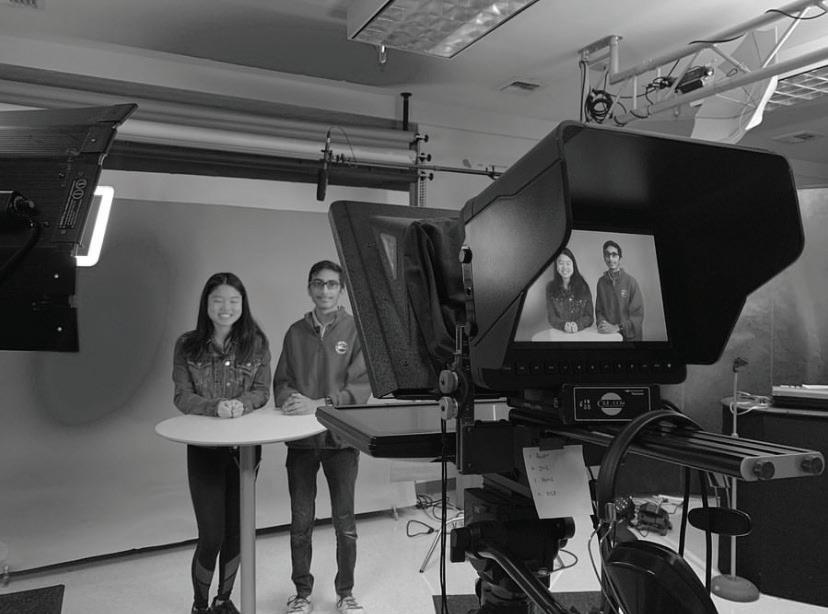

but stopped soon afterwards. The class still exists, but interest in producing TBN went down after COVID-19, as new students were not familiar with the program. Since classes returned to campus, some teachers have made a habit of reading online announcements from the daily bulletin. However, video-format updates have recently returned with weekly Titans News Updates, produced by members of the Student Executive Council.
Just like everything in life, traditions come and go. Whether it’s online forums, news updates or even seating culture, every passing year marks the emergence of new traditions and the fading of old ones. Yet for those who miss traditions that have departed, all hope is not lost. Even if some once-beloved traditions no longer exist at Gunn, fragments of them still remain in yearbooks, old articles from The Oracle and in the memories of thousands of alumni. One just has to look hard enough to rediscover them.
—Written by Dan Honigstein
Photo courtesy of @gunnbroadcast
TBN hosts smile for the camera while filming in 2019.
Becca Wu
CONFESSIONS
20
Titan Broadcast network
Lifestyle
Promposals, preparations create potential stressors
During high school, many students highly anticipate what is oftentimes the final dance of the year: prom. This year, it will be held at The Exploratorium in San Francisco. Last year, the dance was held at City View at Metreon. In the lead-up to prom at Gunn, classrooms, lunch lines and bike cages are filled with conversation in anticipation of the yearly event. Yet all of this excitement comes with a cost, according to Dance Commissioner senior Adele Davis. “It’s a much bigger dance (than others), not in terms of how many students go, but (in terms that) it’s a really big part of high school,” she said. “Prom is a huge part of the high school experience for a lot of people, so there’s a little bit more pressure about making sure that it is the dream night everyone wants.”
This dream night also comes with possible pressures, such as finding the perfect dress or attending with a date. Junior Elizabeth Jackson notices the obligation that comes with public promposals. “(Promposing) in a public space (brings) a pressure in and of itself to say yes,” she said. “You don’t want to embarrass the person asking and you don’t want to make everybody who’s watching upset.” Jackson underscores the importance of not feeling like you have to say yes just because the promposal was in front of other people. “If the person who’s asking in public to go to prom with you is confident enough to do it in front of a group, then they should be prepared for you to say no because that’s just how asking someone works,” she said. “Don’t be afraid to say no because it’s definitely not your fault if they feel hurt, since they should have prepared for either situation.”
As the Vice President of the Title IX club, Jackson emphasizes that the expectation to agree to a promposal can be a form of
unhealthy communication. “Promposals are along the same lines as love-bombing: a grand gesture of love that makes it really hard for someone to escape that situation.” While at times there is a forceful culture surrounding asking a date to prom, students oftentimes abide by an etiquette when it comes to public promposals. “Most people don’t do promposals if they don’t already know that the person is going to say yes,” Davis said. “There aren’t a lot of promposals (at Gunn) that get rejected because it’s

In addition to feeling pressured into saying yes through promposals, there is also a lot of encouragement among peers to find a date. In comparison to other dances, there is more emphasis on attending prom with a date. “A lot of people feel the pressure of having a date where homecoming is a little bit more casual (and) a lot of people are comfortable just going with their friend group,” Davis said.
In addition to finding a date, many students are pressured to spend large sums for a perfect outfit and ideal prom experience. “There’s definitely an expectation that you have to spend a lot of money on prom,” Davis said. “You have to buy the tickets, dresses or tuxedos—and even renting them is expensive. People get a lot of stuff done in preparation, and prom is an expensive event for a lot of people. There is that pressure of looking your best. There is also that culture of spending a lot of money for this one night.”
Jackson agrees that the prom atmosphere compels many to ramp up their spending. “If you’re planning on going to prom, there really is no escape from spending that much money. While (some) people at Gunn can already spend the money, it isn’t fair for everyone,” she said. “There’s a whole atmosphere that’s built around prom to just spend money, to buy the ticket and then get some type of outfit together.”
To combat these expenses, Gunn has initiatives in place such as scholarships for students to help pay for tickets and the Prom Dress Closet, a project which collects donations of prom dresses, suits and tuxedos to be donated. In addition to school-provided solutions, there are also other ways for individuals to spend less on prom, according to Jackson. “Even if they don’t seem obvious, there are ways to go to prom without spending hundreds and hundreds of dollars,” she said. “You can borrow a dress from somebody else or rent one. Thrift shops also have amazing dresses.”
Upcoming concerts, festivals to rock your world
Beyoncé - Levi’s Stadium
Beyoncé is coming back on stage this summer to bring more iconic performances. After releasing her latest album, “Renaissance,” the singer announced on Feb. 1 that she would be going on her eighth world tour to promote her new music and reunite with fans.
“Renaissance” is Beyoncé’s seventh studio album and celebrates queer culture. Inspired by the history of the underground queer-ballroom scene, she created an album filled with house-music songs in homage to the black queer roots of music. She released “Renaissance” in July of 2022 and revealed it to be the first part of a three-act project that she recorded over the pandemic. It is filled with 16 songs, most of which are upbeat and feel-good. Two of the songs on the album made it on Billboard’s top 10: “Break My Soul” peaked at number
one and “Cuff It” shot to number 10.
She starts her tour for this album in Stockholm, Sweden, on May 10 and will perform throughout Europe until July, when she will start the North American leg of her tour. In total, her tour will last five months, from May to September, and includes performances in 40 cities. Beyoncé will perform locally at Levi’s Stadium in Santa Clara on Aug. 30.
Fans are thrilled about this announcement as this is her first tour since 2016 when she performed her album “Lemonade” on her tour “Formation.” Following the “Formation” tour, she went on the “On The Run Tour” with her husband Jay-Z after the release of their joint project, “Everything is Love.” Beyoncé has built a record as a standout performer, and the promise of yet another
Outside Lands - Golden Gate Park
California is a great place to be if one is a music festival lover. Although Coachella is often viewed as the pinnacle of music festivals in the state, there is one festival that often, undeservingly, slips under the radar: Outside Lands.
The Outside Lands Music and Arts Festival is an annual event that takes place in San Francisco’s Golden Gate Park from Aug. 11 to 13. Produced by Another Planet Entertainment, Superfly and Starr Hill Presents, the event is the largest independently owned music festival in the U.S. The music festival is a full-day event, going from 11 a.m. to 10 p.m. on Friday and Saturday and from 11 a.m. to 9:40 p.m. on Sunday.
Throughout the day, attendees can enjoy musical
performances, food and drinks and shop Outside Lands merch. The festival also has five different spots to listen to music. The main stage, the “Lands End Stage,” is where the main performers of the night play. Then, throughout the festival, there are smaller stages where other performances occur, such as the “Twin Peaks,” “Sutro” and “Panhandle” stages. There is also the “Soma” tent where people can listen to house and disco music without interruption.
Every year the music festival brings on amazing artists, and this year’s lineup is no different. Big names are performing on the 2023 stage, such as Megan Thee Stallion, Kendrick Lamar and Lana Del Rey. Outside Lands is also a great place to discover new artists. In
set of great performances made ticket sales rise. Through online ticket-selling websites, tickets went on sale on Feb. 23, and were sold using the Verified Fan process. People first signed up to have the chance to participate in an early sale, allowing them to get better seats with the original pricing. Currently, Beyoncé tickets for the Bay Area stadiums range between $200 dollars for nosebleeds and $3,000 for VIP seating. However expensive seats may be, fans are dedicated to seeing Beyoncé live, promising to show up in numbers. So far, the singer has sold 2.2 million tickets for the “Renaissance” World Tour, earning a spot on The Billboard’s year-end Top Tours chart.
the long list of well-known artists are performers that might have gone unnoticed in the past year. This year’s festival will also include international artists.
Because of the high-quality performances, tickets to Outside Lands are expensive. There are three types of tickets for a full three days at the festival: the General Admission ticket costs $449, the General Admission+ ticket costs $674 and the VIP ticket costs $1,029. Currently, the General Admission+ and VIP tickets are sold out, but there is still a chance to grab general admission tickets.
—Written by Safina Syed
—Compiled by Lise Desveaux
Shao
Becca Wu Chinyoung
21 LifestyLe Friday, April 14, 2023
Irene Hong
An enclave of Eichlers: Palo Alto’s midcentury modern homes carry storied histories, deepen community bonds
“Carefully planned by one of the most brilliant architectural firms in the country, (Eichlers) make other homes seem obsolete by comparison,” a 1949 promotional brochure reads. “Scores of families have already learned that living in an Eichler-built home brings a whole new way of life—a life made easier, more convenient and pleasant because of the advances in modern design that are built into every Eichler home.”
This unique architecture that dominates southern Palo Alto was created by real estate developer Joseph Eichler. Though he first worked as a dairy businessman, living in a home designed by famed architect Frank Lloyd Wright inspired him to think of ways he could bring modernist home elements to the general public. In 1949, he founded Eichler Homes Inc. and partnered with various architectural firms to deliver on this objective.
Eichler Homes Inc. marketed three key priorities: design, community and affordability. These concepts are best illustrated through Palo Alto’s Greenmeadow neighborhood, an area of the city bounded by Alma Street, East Charleston Road, Middlefield Road and San Antonio Road. There, Eichler sold homes featuring open floor plans, post-and-beam construction and clerestory windows—windows located at the top of a structure’s wall. When they were first introduced to the market in 1950, the homes were sold at a modest price of $17,000. They were also in close proximity to the Greenmeadow Community Center, which housed a pool and a clubhouse to host various events. According to Greenmeadow resident junior Naya Nebriaga, the community center continues to be an integral part of the neighborhood today. “Every weekend (there’s always) something going on,” she said. “They have barbeques, wine tastings for the adults and home renovation tip sessions.” In many aspects, Eichler’s architectural legacy has
“An Eichler-built home brings a whole new way of life—a life made easier, more convenient and pleasant because of the advances in modern design that are built into every Eichler home.”
—1949 promotional brochure
endured the test of time: Out of the 2,700 Eichler homes originally built in Palo Alto, Atria Real Estate Founder Kevin Swartz estimates that roughly 2,000 of them still remain. Some Eichler owners, such as Nebriaga, have opted to modernize their homes to make them more suitable for 21st-century living. “When we moved, we had to redo all of the plumbing and electrical and add insulation to the walls,” she said. “This past summer, we also invested in HVAC units for all of the rooms.” While renovations are oftentimes necessary, Eichler Network Director Marty Arbunich noted their potential to detract from the classic Eichler aesthetic. “Many remodels are off the mark, and this could be attributed to one key factor: not having a clear understanding of the architecture at the onset,” he wrote in an email. While remodeling their Eichler, Nebriaga’s family recognized this risk and ensured that the new changes would complement qualities such as the interior-exterior fluidity. “When we renovated the house, we made sure that the floorings were very similar to the outside concrete area, so that it was a seamless transition,” she said. Along with Eichler’s architectural legacy, his community ideals still pertain today, according to Swartz. “The sense of community, parades and block parties are really unique to Eichler homes,” he said. “The people who are buying and living in these homes all love their Eichlers and have a common denominator between them. It’s a great asset to the neighborhood and families, being able to participate in that.” Nebriaga also enjoys the sense of community that owning an Eichler affords her. “Our neighbor next door wants to renovate, and they’re asking us questions on what to do because renovating an Eichler is different from renovating a regular home,” she said. “If I have a friend who lives in an Eichler, it’s also really cool to see their layout, because in a way, the houses are supposed to be
very similar, but each one is super different depending on what they decided to do with the interior design.”
Despite their numerous benefits, Arbunich does not foresee similar community-oriented developments being built in the future. “In the Bay Area, we’ve simply run out of space to develop new tracts of any kind,” he said. “When Eichler was building in the postwar (period), there was plenty of available land, but so much of that has been filled over the past 60 to 70 years.”
Unlike design and community, Eichler’s third ideal of affordability has fallen short of maintaining a modern-day relevance. In February, the median sale price of a home in Greenmeadow was $1.97 million, over 10 times Eichler’s original asking price adjusted for inflation. According to freelance writer Bo Crane, Eichler’s reasonable asking prices facilitated racial integration in Palo Alto. “Eichler was the first local builder to proclaim that he favored selling houses to buyers of various racial and ethnic backgrounds,” he wrote in a Palo Alto Online article published in February. “The Greenmeadow tract welcomed Eichler’s first Black homebuyers.”
Although Eichler’s socially progressive values resonate with many, the Bay Area’s low housing supply and high demand have impeded their continued application. “I’ve heard many Eichler homeowners and buyers comment on how they were aligned with the history of how he was inclusive and wasn’t discriminating,” Swartz said. “But there are a lot of people who want to live in an Eichler, and they’re looking for where they could possibly afford one. The price is definitely a big barrier.”
Nevertheless, Arbunich believes that when it comes to fostering a strong sense of community, few neighborhoods can match Eichler neighborhoods’ camaraderie and cohesion. “Eichler owners are different in that regard,” he said. “It would take a lot of education and instilling pride in home ownership to build a (similar) support network behind most other communities.”
—Written by Chris Lee
Different styles of eichler homes exhibit efficiency
Front-Gable eichler
• Roof that extends beyond the exterior siding
•
• Clerestory windows under gabled roof
•
• Vertical wood panel siding
•
• Entry door often recessed or on the side facade

Flat rooF eichler
• One-story structure with flat roof
•
Flat with Shed- rooF eichler

• Low-pitched roof over one bay of the house
•
• Exposed beams or braces under gables
•
• Clerestory windows under gabled roof
•
• Carport or enclosed garage
•
• Vertical sidelite windows next to entry door
• Entry courtyard or atrium
•
• Exposed rafter rails
—Compiled
Becca Wu 22 LifestyLe
Sophie Rong
by
April Games Page
Sustainability Word Search
Earth Day Mini-Crossword

ACROSS
Large bird of prey symbolic of the U.S.
Color used to reflect ecofriendly practices; “going
Massive; popular brand of frozen and canned vegetables when combined with 6-across
Unscramble the circled letters!
Famed French city where 2016 international climate accords were signed To mix together, as you would a smoothie
Laid by a fish or a bird
Greek goddess of earth Fantasy species of tree creatures originating from Middle-earth
—Games compiled by John Li
Stop by Room P-115 during 5th period or lunch next week with the completed puzzles for a candy prize!
____”
3. 6. 7.
Biodiversity Carbon Climate Conservation Deforestation Ecology Ecosystem Endangered
1. 2. 3. 4. 5. DOWN
FINISHED?
1 2 3 4 5 6 7 3 6 5 2 8 4 1 1 2 8 3 8 2 5 6 6 9 5 2 1 3 7 5 6 7 4 2 1 5 9 7 7 1 5 9 6 8 8 4 3 7 2 1 Sudoku
Environment Flower Greenhouse Habitat Ocean Ozone Recycling Reforestation Solar Summer Sustainability Turbine Water Wildlife Wind Winter
23 LifestyLe Friday, April 14, 2023
Misinformation on social media exacerbates political polarization Students should engage with different opinions
Annabel Honigstein Reporter


During the 2016 presidential election, operators of the pizza parlor Comet Ping Pong began receiving threats from right-wing activists who erroneously believed the shop was the center of a pedophile sex ring involving presidential candidate Hillary Clinton and other liberal political elites. On Dec. 4, 2016, a 28-year-old man from North Carolina came to the pizza parlor with a rifle to “rescue the children” after seeing numerous posts spread on extremist sites and social media apps. These posts, often using the hashtag “#pizzagate,” propagated the falsehoods being spread in rightwing circles about the shop. #Pizzagate typifies the real-life impacts of fake news disseminated through online media. It can promote polarized political views and sometimes even threaten democracy. Given these dire consequences, students must make an effort to work on their media literacy skills to become responsible citizens.
Before working to combat misinformation, it is essential to understand what political polarization truly is, as well as how social media has contributed to it. Britannica describes political polarization as “extreme and longlasting partisanship in a two-party system that results in the division of a country’s entire population into two diametrically opposed political camps.” According to social studies teacher Laurel Howard, as this polarization intensifies, the incumbent party’s followers behave in a more autocratic manner to stay in power. On the other side, opponents are more willing to resort to undemocratic means to undermine their potence. Consequently, those on the opposite extremes of the political spectrum tend to be less likely to work with one other on bipartisan efforts. This is relevant now more than ever: A Pew Research Center analysis from 2022 found that, on average, Democrats and Republicans are ideologically farther apart today than at any time in the past 50 years. This dynamic can severely damage democracy and encourage citizens to become blindly loyal to their parties.


In the U.S., extreme points of view have been easily disseminated on social media in the digital age. This contributes to the widening gap between political parties by providing avenues for extreme groups to circulate fake news. In the #pizzagate conspiracy, the false theory was promoted on social media through the use of apps such as Reddit and Facebook. More recently, far-right groups helped organize the insurrection at the Capitol on Jan. 6, 2021, over social media sites.
Social media algorithms also make it easier for the average citizen to confirm their own
political beliefs, rather than explore others, thus facilitating further polarization. These algorithms personalize the content that users see on the app based on their past behavior and interactions, using previously liked or shared posts to continue to recommend similar or related content that the user might want to engage with. This can lead to a bubble (or echo-chamber) effect in which users are only exposed to content that reinforces their beliefs, contributing to intense confirmation bias. Interacting with different points of view necessitates strong media literacy skills so students can draw their own opinions. Interacting with others who hold diverse perspectives, sentiments and experiences can extend our knowledge, shape our viewpoints and enhance our societal connections. However, if individuals opt out of these conversations, instead isolating themselves from those with different political beliefs, it only fosters and encourages division.
In a 2021 survey conducted by research foundation Reboot, 27% of respondents said social media made them “less tolerant” of people who have opposing points of view. When people fail to interact with those with opposing viewpoints, they lose an essential part of their critical thinking abilities. As future—or current—voters, it is crucial that Gunn students learn how to be responsible and knowledgeable citizens who are able to engage with those that may have beliefs differing from their own.

A significant part of this issue is learning to identify the information’s credibility. There are several ways to assess a piece of information’s credibility, whether it be an Instagram post discussing recent news or a retweet of an article. First, simply slow down: When skimming through an article, one may forget to be analytical and critical of the writing and might blindly follow disinformation. It is crucial to determine whether the information is echoed in multiple sources. For example, if one finds something on social media, they should look to see if there is similar content in other reputable sources, such as the Associated Press or perhaps a textbook. Additionally, people tend to get pulled in by statistics that lack context. For instance, if a news source states that 20% of people are affected by an issue, take a moment to check the subtext and see how many people were surveyed. 20% of a small sample of the population is different from 20% of the entire population. Put the statistic into perspective. Finally, it is important to assess word choice in the media. When reading the information, search for inflammatory words, specifically adjectives, that may imply biases and specific narratives that the source is trying to push. Word choice, specifically in regard to adjectives, can shift the entire meaning of a text. These steps may seem minuscule, yet their impacts are great. Making these efforts to improve media literacy can stop the mindless resharing of the type of disinformation that pushes our society further and further apart.
Katie LaWer Features Editor
Like many other young Americans, I have developed political beliefs that are a reflection of both my personal values and those of my community. However, my experience growing up with divorced parents with differing political views has made my journey in developing my personal political viewpoints unique. As I have grown older and learned about politics in school, as well as gained a broader view of world issues, I have been able to determine my own beliefs independent of my parents’ rhetoric.
My parents, both lawyers, talked to me about politics from an early age, although they often had differing opinions on the same issues. I absorbed different perspectives on concepts such as healthcare and taxes that, at the time, went mostly over my head. In my early years, I often didn’t know what to believe when I was hearing different sides of a political argument from my parents. As a result, I often found it difficult to express my own opinions within my family. However, the more I became aware of politics, learned about history and spoke with my friends about these same topics, the less inclined I felt to stay silent about my beliefs. For instance, I identified towards the left of the political spectrum while my father identified more to the middle with fiscally conservative views. This disagreement sometimes resulted in heated debates. Although talking through my thoughts and opinions helped me think about and question my beliefs, it wasn’t always pleasant. There were times I felt any normal conversation with my father would devolve into another disagreement. Often, I questioned my own patterns of thought, wondering how my perspective could be so different from his.
In some ways, this act of questioning was good. I wasn’t stuck in a political echo chamber with the people around me. Over the years, I’ve learned to accept that the differing life experiences and perspectives my father and I hold have had strong effects on our political views. My father grew up in the 1980s and attended the U.S. Military Academy West Point. This environment is very different from anything I have experienced growing up in Palo Alto. I still encourage my father to try and see things from my point of view, just as I agree to acknowledge his. He hasn’t been able to alter my views, and I have not been able to change his. Still, our relationship has improved as we have both grown as individuals and learned to focus on areas of shared interests. The most important thing I have learned is the ability to make up my own mind. I now know that what my parents believe does not dictate my opinions or whom I vote for.
Above all, my experience has taught me that it is valuable for students to form their own political beliefs and ideas instead of simply swallowing the information they are first presented with. If we don’t question the things we are told, we lose the opportunity to learn and grow in our beliefs, even if it can often be difficult in a family setting. As students, we have the opportunity to learn from our families, but also the responsibility to challenge some of the more harmful beliefs of the past to create a future of our own making.
24 Forum Chinyoung Shao
