
BASED ON THE PARAMOUNT PICTURES FILM WRITTEN FOR THE SCREEN BY NORMAN KRASNA, NORMAN PANAMA & MELVIN FRANK
MUSIC AND LYRICS BY:

BASED ON THE PARAMOUNT PICTURES FILM WRITTEN FOR THE SCREEN BY NORMAN KRASNA, NORMAN PANAMA & MELVIN FRANK
MUSIC AND LYRICS BY:
BOOK BY:
ORIGINAL STAGE PRODUCTION DIRECTED BY WALTER BOBBIE
ORCHESTRATIONS BY LARRY BLANK
VOCAL AND DANCE
ARRANGEMENTS BY BRUCE POMAHAC



Welcome to Gulfshore Playhouse and our production of Irving Berlin’s White Christmas. From toe-tapping music and lyrics to a heartwarming story and exciting choreography, this musical is the perfect way to spend your holiday season. We hope you enjoy the show and wish you the happiest of holidays!
The musical White Christmas begins in December of 1944, in the midst of World War 2, not long after the song “White Christmas” debuted in 1942. Gaining popularity, the song became an anthem of hope and home, serving as a reminder to our brave troops as to why they were fighting and what they were fighting for. “White Christmas” became more than a simple holiday melody, but a song that transcended religious and political divides.
As the show progresses, we move to 1954, postwar, to a time of connection, community, and optimism. It reminds us of the beauty in helping our fellow man, gratitude for those who have come before us, and a loyalty and admiration for our shared history.
White Christmas may take place in a different time, but it continues to remind new audiences, young and old, about the importance of family, home, and tradition throughout the holiday season.
As you watch today’s performance, I hope that the characters inspire you to see the good in others and how kindness and bravery can leave an ever-lasting impact. White Christmas shows us how heroes come in all shapes and sizes, and that opening your mind and your heart will pave the way for goodness.
It is our wish that White Christmas will put you in the holiday spirit and transport you to a simpler time of optimism and connection. May our production bring you joy, happiness, and the will to spread holiday cheer to the rest of the world.
Happy Holidays!
Dann Dunn Director



Irving Berlin was born ‘Israel Berlin’ on May 11, 1888. His family immigrated to New York in 1893. When his father died, Berlin, who had just turned 13, took to the streets in various odd jobs, working as a busker singing for pennies, then as a singing waiter in a Chinatown Cafe. In 1907 he published his first song, “Marie from Sunny Italy,” and by 1911 he had his first major international hit “Alexander’s Ragtime Band.”
Over the next five decades, Irving Berlin produced over 1000 ballads, dance numbers, novelty tunes and love songs that defined American music for much of the century. A sampling of just some of the Irving Berlin standards includes “How Deep Is The Ocean,” “Blue Skies,” “White Christmas,” “Always,” “Anything You Can Do,” “There’s No Business Like Show Business,” “Cheek To Cheek,” “Puttin’ On The Ritz,” “A Pretty Girl Is Like a Melody,” “Heat Wave,” “Oh! How I Hate To Get Up
In The Morning,” “Easter Parade” and “Let’s Face The Music And Dance.” In a class by itself is his believer song, “God Bless America.”
Berlin was equally at home writing for Broadway and Hollywood. He wrote seventeen complete scores for Broadway musicals and revues, and contributed material to six more. Recent musicals created from his screen work include Irving Berlin’s White Christmas (Broadway, across the USA, Canada and Great Britain), and Top Hat, winner of the 2013 Laurence Olivier Award for Best New Musical.
Among the Hollywood movie musical classics with scores by Irving Berlin are Top Hat, Follow The Fleet, On The Avenue, Alexander’s Ragtime Band, Holiday Inn, Blue Skies, Easter Parade, White Christmas, and There’s No Business Like Show Business.
An intuitive businessman, Irving Berlin was a co-founder of ASCAP (American Society of Composers, Authors and Publishers), founder of his own music publishing company, and with producer Sam Harris, builder of his own Broadway theatre, The Music Box. An unabashed patriot, his love for - and generosity to - his country is legendary, exemplified by his establishing The God Bless America Fund, which receives all income from his patriotic songs and distributes it to the Boy Scouts and Girl Scouts.
His actions were acknowledged with such accolades as the Army’s Medal of Merit from President Truman in 1945; a Congressional Gold Medal for “God Bless America” and other patriotic songs from President Eisenhower in 1954; and the Freedom Medal from President Ford in 1977.
On September 22, 1989, at the age of 101, Irving Berlin died in his sleep in his town house in New York City. Berlin was survived by three daughters and their families at the time of his death.
Bob Wallace and Phil Davis are two army buddies during World War II. When we first meet them, it’s 1944 and they are attempting to improve troop morale by putting on a holiday show. General Waverly interrupts their holiday performance to let the men know that he is being sent back home and he hopes that Christmas Even in 10 years will be better than it is at that moment.
Ten years later, in 1954, Wallace and Davis are two traveling performers who sing and dance across the country. After their performance on The Ed Sullivan Show, Wallace and Davis meet a pair of sisters named Judy and Betty Haynes. They watch the sisters perform their own song and dance routine and then spend the rest of the night dancing. Judy and Phil Davis take to each other right away, but Bob Wallace and Betty don’t see eye to eye.
After Judy and Davis dance with each other through the night, they learn that they are headed in opposite directions. Wallace and Davis are headed to Florida to perform their number, and Betty and Judy are headed to Vermont to perform theirs. Judy and Davis make a plan, they will trick Wallace into getting on the train to Vermont so that everyone can see snow during the holidays. They also hope that Wallace and Betty will get to know each other better.
Once everyone is on the train, Wallace quickly realizes that he is not going to Florida. Judy and Davis convince Wallace and Betty that Vermont will be beautiful and covered with snow, and that everyone will have a great time. But when they get to Vermont, they find that there is no snow to be seen.
The group checks in to an inn that is run by Wallace and Davis’s old commanding officer, General Waverly. He has invested his savings into the inn and it is about to go bankrupt. All of the guests have canceled their reservations because of the lack of snow. The four performers all agree to help out General Waverly by putting on a spectacular holiday show. The only place they can do their performance is in the Inn’s barn. Unbothered by the less than ideal location, Wallace and Davis call up everyone that was working on their production and bring them up to Vermont. The Inn’s concierge, a faded performer named Martha, also takes an interest in the production.
As they are working on the show, Wallace and Betty start grow closer. The two begin to understand each other. Wallace also meets Waverly’s young granddaughter Susan. She tells him that her grandfather tried to rejoin the army, but that he was rejected, leaving Waverly feeling forgotten and unimportant.
Wallace comes up with a plan to boost the General’s spirits. He reaches out to his contact Ralph Sheldrake at The Ed Sullivan Show and asks him to send out letters to all the men who served under Waverly in the war, asking them to come up to Vermont to surprise him as part of a “secret plan”.
When Sheldrake calls back later, Martha the concierge answers the phone. Sheldrake lets her know that the “secret plan” is all set. Martha assumes Sheldrake is trying to buy the Inn, and that Wallace is going to help force the General to sell the Inn.
Martha tells Betty about what she heard. Betty then confronts Wallace about what she thinks he is doing, even though Wallace is innocent and is trying to do something kind.
Rehearsals for the Inn’s holiday show are in full swing, but tempers are starting to run high. Judy is angry at Davis because he keeps flirting with some of the chorus girls in the show. Betty has left Vermont and gone to New York City because she is angry at Wallace.
When it is time to rehearse Betty and Judy’s number and no one can find them, Wallace and Davis put on their costumes and perform it instead. Once the number is through Wallace learns that Betty has gone to New York and takes off after her.
Betty is performing on her own in a beautiful place called the Regency Room in New York City. Wallace finds her. He brings Sheldrake to watch her sing and the two men explain their “secret plan”. Betty agrees to come back to Vermont.
Before they leave the city, Wallace makes one final appearance on The Ed Sullivan Show, asking all men who served under Waverly in the war to come to the Inn in Vermont.
When Wallace and Betty get back to Vermont, Judy and Davis tell them that they have gotten engaged. The General’s granddaughter Susan also lets them know that she will have her very own act in the holiday show.
On the night of the show, Martha convinces Waverly to wear his old Army uniform. Wallace and Betty finally confess their love for one another just before the show starts. All of the men from Waverly’s division surprise him. The show goes perfectly.
Snow begins to fall.
Though the United States didn’t officially enter the War until after the bombing of Pearl Harbor in December 1941, preparation had been underway for several years. After Nazi Germany conquered France in May 1940, there was broad support for conscription as many felt war was inevitable and the United States was under prepared.
On September 16, 1940, the US instituted the Selective Training and Service Act, requiring all men between the ages of 21 and 45 to register for the draft. This was the first peacetime draft in US history. Those selected were required to serve at least one year in the armed forces. One year later, as the war intensified, 18 more months of mandatory service were added. Following the bombing of Pearl Harbor, the term of service extended to the duration of the war plus six months, and the age range was extended to all men 18 to 64 years of age.
Military leave policies were vital for troop morale and efficiency, but they were governed by strict military regulations. To obtain leave, soldiers had to submit a request which required specific documentation, including forms that needed approval from commanding officers. This process aimed to balance the needs of the military and the well-being of its personnel.
There were two types of leave:
• Rest and Recuperation (R&R) which allowed soldiers to step away from the front lines temporarily. They might spend time in nearby safe zones or even visit home if circumstances permitted.
• Emergency Leave which might be given in the event of a family crisis, illness, or death of a close relative.
Infantry (Army and Marine) was just 14% of the troops overseas but they bore the brunt of the fighting on the ground, suffering 7 out of 10 casualties. In addition to fighting on the front lines, the infantry performed physical labor like transporting food, clothing, weapons, and medicine.
“YOU WERE NOT FIGHTING EVERY MINUTE. THERE WERE TIMES OF SHEER BOREDOM AND JUST PLAIN HARD WORK. UNLOADING SHIPS IS HARD WORK. UNLOADING SUPPLIES IS HARD WORK. ALL SUPPLIES AT GUADALCANAL HAD TO BE UNLOADED AT THE BEACH AND LOADED INTO TRUCKS AND THEN DISTRIBUTED SO THAT THEY ALL WOULD NOT BLOW UP AT ONE TIME. THE WAR IS ACTUALLY PLANNED BY THE OFFICERS, BUT IT IS FOUGHT BY THE PRIVATES AND THE PRIVATES DO 99 PERCENT OF ALL THE HARD WORK. MY RECOLLECTION OF WORLD WAR II AND GUADALCANAL IS LARGELY A MATTER OF HARD WORK AND HUNGER AND SHEER TERROR AT NIGHT FOR SHORT PERIODS OF TIME. … SO, I THINK WE DID WHAT WE HAD TO DO AND WE REALLY HAD NO CHOICE. YOU COULDN’T LEAVE AND GO HOME. YOU WERE THERE.”
-SIDNEY PHILLIPS, VETERAN
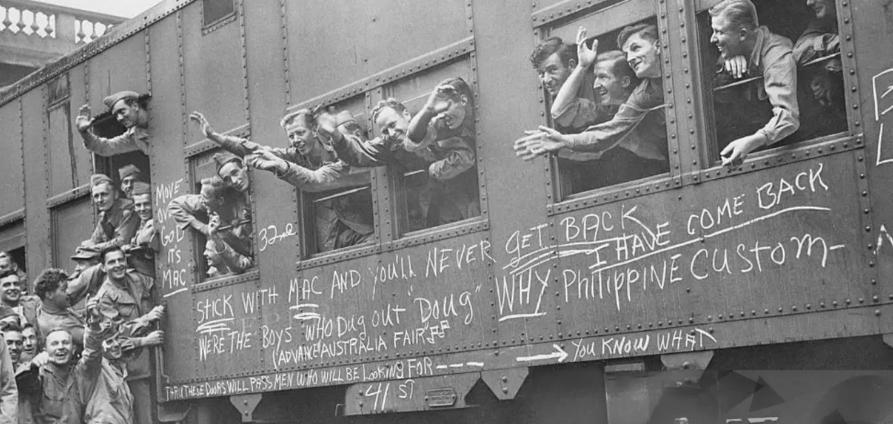
The order of discharge was determined by factors like length of service and number of dependent children. Once discharged, soldiers were sent to domestic “separation centers” where they received vocational counseling, a medical exam (which would serve as the basis for a disability claim) and a pitch to re-enlist. On the last day of the center, there was a departure ceremony, the final act of which was to award discharge papers, a record of service denoting the terms of separation (honorable or dishonorable). Anything other than ‘honorable’ disqualified a veteran from the GI Bill and could imperil job prospects.
Most soldiers were eager to return to civilian life, but discharge could be a jarring experience and a source of anguish for those who had grown accustomed to life at war and bonded to their comrades. Many were anxious about returning to the place and people they left when they entered service because so much had changed in their absence. Author Maxwell Droke advised veterans that their transition to civilian life would be easier
“WERE IT NOT FOR TWO THINGS: YOUR FAMILY AND FRIENDS.”
Congress passed the Servicemen Readjustment Act of 1944 (the G.I. Bill). This bill aimed to prevent the turmoil of readjustment after the previous war (high unemployment for veterans) by providing a series of entitlements designed to enhance opportunities in a modern economy.
This included:
• Reimbursement for education and vocational training
• Credit towards loans for a home or business
• Up to one year of unemployment compensation for veterans
For Black veterans, readjusting involved returning to the inequalities of American life: segregation, institutionalized racism, and pervasive bigotry. Because of this, not as many opportunities were available to them, including those within the GI Bill. The Bill delegated oversight of benefits to individual states or private institutions to institute according to their preferences, which meant that Black beneficiaries were often excluded.
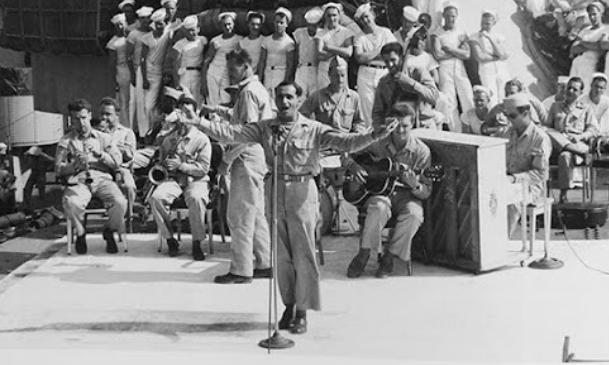
Some of the major problems experienced by soldiers abroad were monotony and boredom. Franklin D. Roosevelt said,
“ENTERTAINMENT IS ALWAYS A NATIONAL ASSET. INVALUABLE IN TIME OF PEACE, IT IS INDISPENSABLE IN WARTIME.”
The United Service Organizations Inc. or USO sought to help these men be great soldiers, but also to be great citizens when they returned home.
The USO was created as a physical network of stateside club locations where service members could go relax, socialize, and get a taste of the civilian world. Although USO dances and other center offerings helped fill troops’ recreational time, it didn’t take long for the organization’s leaders to realize the pressing need for live, quality entertainment for the growing number of GIs.
To fill that need, in October 1941, the USO worked with entertainment executives to create a new branch of the organization called USO Camp Shows, Inc. That month, it sent its first overseas tour, featuring comedians Laurel and Hardy, Chico Marx and Broadway tap dancer and film star Mitzi Mayfair to the Caribbean to entertain troops.
Hollywood professionals worked together with the USO team to schedule, coordinate, and put on fullfledged shows for all types of military audiences, organized into four circuits: Victory, Blue, Hospital, and Foxhole. The first two remained stateside, the Hospital was tasked with visiting the wounded, and the Foxhole went overseas. The Foxhole Circuit traveled to entertain GIs in Europe, Russia, Central Africa, Alaska, and the South Pacific.
The first performers arrived in the United Kingdom in 1942. Big names like Bob Hope, the Andrews Sisters, Dinah Shore, and more eagerly volunteered their time and talents. Marlene Dietrich was also a familiar face, making two USO tours during the war.
Before fall 1944, the War Department limited shows to five people, so most acts consisted of a vocalist, comedian, dancer, novelty act, and a magician or accordionist. These were easily transported and highly entertaining. By late 1944, however, the American Theater Wing’s production of The Barretts of Wimpole Street toured overseas, becoming the first overseas “legitimate theater” unit.
They played in “liberated” theaters in Italy and France to enthusiastic reception. There were overseas tours of musicals with companies as large as sixty people, such as Oklahoma! in the Pacific and Our Town in Europe. The Army’s entertainment branch reviewed and approved each show and once approved, it could not be altered.
USO performers lived very similarly to the troops they entertained. They were subject to the orders of their Commanding Officer, as they were stationed in war zones. Sometimes they lived out of trucks and tents, sometimes in abandoned houses that were at risk of getting hit by enemy fire.
Entertainers signed an oath of secrecy, promising not to divulge sensitive information about their tour unless otherwise permitted. A 1944 guide for performers stated, “You’re in the Army now.” They were expected to perform offstage duties as well. The same guidebook stated:
“OFF STAGE YOU HAVE ANOTHER JOB—JUST AS IMPORTANT AND REWARDING. TO THESE MEN FAR AWAY FROM HOME YOU REPRESENT HOME. EAT YOUR MEALS WITH THEM. AFTER THE SHOW, SIT AROUND AND TALK TO THEM. THEY’RE HUNGRY FOR NEWS FROM HOME…”
Some even became deeply involved and found themselves in dangerous situations. Marlene Dietrich was an OSS spy, and comedians Jane and Joe McKenna were captured by Germans and held prisoner in 1944. A total of 37 USO entertainers were killed. By VE Day, the USO was putting on 700 shows per day. By the end of the war, they’d sent over 7,300 entertainers overseas, putting on an estimated 420,000 performances for over 130 million service member attendees.
In Gulfshore Playhouse’s production of White Christmas, there are two incredibly talented young actresses sharing the role of Susan Waverly, General Waverly’s granddaughter. The Education team sat down with them to chat about their experience working on a professional production as students.

Tell us about your history. What have you two done before this point?
Alice: I’ve been acting since I was about 5 years old. I started in junior community plays, and then I was like, “Oh, my God, I love this so much I want to keep doing this.” In 2023, I booked my first professional show. It was A Christmas Carol at the Orlando Shakes and I played Lucy Cratchit. Recently, I’ve done To Kill a Mockingbird as Scout, and I was in the ensemble of Jesus Christ Superstar And now this!
Solei: I fell in love with acting because my mom is a dance teacher, and she used to work at a theatre. And I was just like, ‘Oh my gosh, I want to be on stage. I want to be like the older kids.’ So I started doing shows. I played Annie in Annie here, and I’ve done multiple shows at The Naples Players. When I was five I was Lulu in the Broadway tour of Waitress at Artis-Naples. I’ve also been on stage in The Music Man at Barbara B. Mann, that was a great experience working with all these professionals.
Tell us a bit about what the process of working on White Christmas has been like. What does like an average day look like for you?

Alice: Our call time usually starts around 11, but some days it starts at nine. We have a beautifully chaotic rehearsal and then we have a hour and a half lunch and we’ll just hang and eat and we’re back to rehearsal. Everyone in the cast is so talented, and we’ve all been working so hard. We actually had our designer run before we came here.
Solei: It takes a lot of preparation, because you need to know your lines, your songs, and your dances. But in the end, it’s such an amazing experience getting to bond with all these professionals and I’m so blessed to just be here and do this.
What have you learned during this process?
Alice: I feel like I really learned how to connect with my character more than I ever have in the past. Everyone is so talented and it made me really start to think about who Susan is, and I came up with a little backstory for her –
Can you tell us a bit about that backstory?
Alice: Obviously, she grew up in Pasadena, and I always thought she the perfect child. She got bullied a lot in school for being a teacher’s pet.
She had never really found something that was interesting to her and was always just okay about everything. Then she met Martha, and then she found out that Martha’s this big Broadway star. She thought, “If I do that, then I’m interesting”. And then she found that show business was actually her calling.
If you could give another student performer one piece of advice: What would that piece of advice be?
Alice: I would say just never stop learning. Never pass up the opportunity to learn something and connect with people, because you can learn so much from a single person. It’s insane.
Solei: I would probably say, don’t get in the way of your own self, because I’m guilty of that a lot. So just go for it. Don’t doubt yourself. You got this. Just believe in yourself.
Talk about the experience being at Gulfshore Playhouse and how encouraging staff and your creative team has been behind you over these past few weeks of rehearsal.
Alice: Gulfshore Playhouse is a really amazing space with so many kind and amazing people. It’s been very comfortable. A little bit stressful, but very very comfortable. I don’t feel pressured to be perfect all the time, which is good. I always feel like it’s okay if I mess up, obviously I don’t want to mess up, but it’s okay if I do.
Solei: Everybody’s so complimentary. We’ll be off the scene and everybody will be like, “Oh, that was so good. Like, you guys are so amazing.” It’s just a really healthy and kind environment to be in.
You’re working with Sara Brians, who’s a Broadway choreographer. You’re working with Dann Dunn, and you’re working with Trevor Pierce. Tell me a little bit about the creative team and what it means to be working with these professionals.
Alice: Dann is a really amazing director. Whenever we’re staging, he goes quickly, but he always makes sure that you know what’s happening and that we understand. He explains things very clearly. Trevor is an amazing music director and has really helpful advice on songs. Sara is really careful. She’s not a perfectionist, but if something’s wrong, she’ll go back and fix it, which is really good for me because I’m a bit of a perfectionist.
Solei: I think everybody’s so fun to work with. Trevor always brings amazing energy into the room. Dann always makes sure that we understand and he’s awesome and Sara is an amazing choreographer. The amount of work she put into these numbers is crazy. The numbers are beautiful, and it’s such a good show.

1. What speaks to you the most about this show? What did you really want to get across to the audience through your design?
This show is about the magic of Christmas and how it can bring people together. We absolutely wanted to highlight that Christmas spirit, but without giving too much away too early. This production was a challenging one to find the underlying current that carries through the entire story, but ultimately we aimed to emphasize the big production numbers and the creation of them within the script—using light, sleek textures, and simplified units to let those moments shine.
2. When designing the set for a production, what do you look for when you first read a script?
When I first read a script, I try to experience it as much like an audience member as possible. It’s the only time I’ll get to feel the surprises or jokes naturally, so I let myself just enjoy it. Then I go back and read it again, this time outlining the major themes, like friendship, loyalty, and hope, and noting what each scene needs in order to function. If the dialogue mentions snow falling outside the barn doors, I should probably make sure there are barn doors on stage. Then I read the script for a third time! This time I start playing detective. I look for small clues about how the set should look and feel, but also about who the characters are and how their environments reflect them. I pay attention to hints about location, weather, and anything that shapes the world they live in. All those little details go into my notes, which stay close at hand throughout the entire design process.
3. What was rewarding about designing the set for White Christmas? What was challenging?
The most rewarding part was getting to work with a team of artists I’ve collaborated with before to create some true holiday magic on stage. Because we already had a shared shorthand and trust, we were able to jump right in with open conversations about ideas and opportunities to make the production as spectacular as possible. The biggest challenge, as always, was working within the constraints of both budget and time. We have a set amount of money for materials and a limited window to build and install everything, which means some ideas inevitably need to be scaled back. But that’s where the collaboration really shines! Our team works together to problem-solve and find creative solutions that maintain the artistic integrity of the design. Everyone involved truly wants this show to be the best it can be, and that collective effort is something I’m deeply grateful for.
Age Range: Grades K-5
Time Frame: 45 min.
Lesson Objectives:
Students will be able to describe the process of snowflake formation and explain why snowflakes have six sides, demonstrating their understanding by constructing scientifically accurate snowflake models and creating multiple patterns using molecule manipulatives.
Standards:
• SC.K.N.1.2
• Make observations of the natural world and know that they are descriptors collected using the five senses.
• SC.K.N.1.4
• Observe and create a visual representation of an object which includes its major features.
• SC.2.P.8.2
• Identify objects and materials as solid, liquid, or gas.
• SC.2.P.8.4
• Observe and describe water in its solid, liquid, and gaseous states.
Language Demands:
• Speaking - Students will communicate their discoveries and observations with their peers.
• Listening - Students will listen to instructions and follow verbal instruction to complete tasks.
Materials:
Water molecule cutouts, snowflake pattern pages, child scissors
Preparation:
1. Before class, print and cut out six water molecules per student (or per group if having students work together.
2. Print out paper fold patterns (one per student).
1. Introduce the idea that water is made up of very small things called molecules. These molecules have three parts: One big part in the center, and two smaller parts coming off the sides, kind of shaped like Mickey Mouse. (For older students, you can introduce the term ATOM, and explain these are two small Hydrogen atoms and one large Oxygen atom)
2. Ask students what they have observed happens to water as it starts to get colder. For instance, what happens to a cup of water if I put it in the freezer?
3. Pull six students
a. Instruct these students to stand as close together as they can, as if it was very cold in the classroom.
b. The students may naturally form a tight clump. This is what water molecules do when they get cold! When water freezes, huddle together in groups of six.
4. Give each student (or group of students) six water molecules. Give students some time to explore what different shapes and patterns they can make with their water molecules.
a. After students have had time to explore, have them put all of their molecules into a hexagon shape. This is the shape that water molecules take when snowflakes form! This is why all snowflakes have six sides.
1. Hand each student a Snowflake Pattern Page.
2. Instruct your students hold their paper with the lines on the BOTTOM of the page.
1. Fold your paper hamburger style, keeping the lined section visible.
2. Fold your paper hot dog style, keeping the lined section visible. It should now be a square.
3. Hold your paper with the “scissor” section facing down.
4. Fold the edge of paper in towards the center, along the printed lines.
5. Flip the paper over.
6. Fold the edge of paper in towards the center, along the printed lines.
7. Cut the top of the paper off, roughly along the dotted line.
8. From here, your student may cut out different patterns into the sides of their snowflake.
9. Unfold your snowflakes!
Criteria Exceeds Expectations (3)
Following Directions
Fine Motor Skills
Understanding Snowflake
Structure
Completes all steps accurately and independently
Snowflake construction demonstrates advanced, precise fine motor skills
Correctly uses manipulatives and clearly explains why snowflake has six sides
Meets Expectations (2)
Completes most steps accurately with minimal guidance
Snowflake construction demonstrates gradelevel appropriate fine motor skills
Needs Improvements (1)
Completes few steps or requires significant guidance
Snowflake construction shows limited control or below grade-level fine motor skills
Uses manipulatives correctly and provides a basic explanation for six-sided structure Uses manipulatives incorrectly or cannot explain sixsided structure


Age Range: Grades 6-12
Time Frame: 60 - 90 minutes.
1. Students will create costume designs for characters in Irving Berlin’s White Christmas using simple textual analysis and visual research.
2. Students will determine important components in a written summary of White Christmas and analyze a brief character description in order to create a costume design that is rooted in historical research and textual analysis of Irving Berlin’s White Christmas.
Standards:
1. CCSS.ELA-LITERACY.RI.9-10.1
• Cite strong and thorough textual evidence to support analysis of what the text says explicitly as well as inferences drawn from the text.
2. CCSS.ELA-LITERACY.SL.9-10.1.
• Come to discussions prepared, having read and researched material under study; explicitly draw on that preparation by referring to evidence from texts and other research on the topic or issue to stimulate a thoughtful, well-reasoned exchange of ideas.
3. CCSS.ELA-LITERACY.SL.9-10.4
• Present information, findings, and supporting evidence clearly, concisely, and logically such that listeners can follow the line of reasoning and the organization, development, substance, and style are appropriate to purpose, audience, and task.
4. Standard 1 SS.6.W.1
• Utilize historical inquiry skills and analytical processes.
5. ELA.10.C.2.1
• Present information orally, with a logical organization and coherent focus, with credible evidence, creating a clear perspective.
• Speaking - Students will communicate their discoveries with their peers. Students will communicate their designs and their inspirations with a partner.
• Listening - Students will listen to instructions and follow verbal instruction to complete tasks. If the summary is read aloud, students will listen to the summary and draw conclusions based on the summary read.
• Reading - Students will read the summary and character descriptions and determine the important information included within them.
• Writing - Students will write one to two sentences that describe their reasoning behind decisions they made as part of the design process. This writing will have to include what they chose, why they chose it and how they intend to use it.
Materials:
PRINTED: Summary of White Christmas, Character Descriptions, Croquis (or blank costume templates).
1. Before class, print out copies of the attached “Croquis.” Croquis is French for “quick sketch” and is the term that many costume designers use to refer to the blank body forms they use for design. There are multiple options so students can pick the base they are interested in working on. You can print as many as you’d like of each.
2. Print out copies of the summary and character description. This lesson can be done in small groups or individually. Small groups are recommended for students who are beginning to explore text analysis. Print out enough copies for each student/group to have a copy of both the summary and the character descriptions.
1. Introduce the idea of costume design. Instructors can find images of famous costumes that their students would recognize, such as Pirates of the Caribbean, Shrek, and K-Pop Demon Hunters.
2. Informal Pre-Assessment: Ask the students what they know about costume design.
a. If students are struggling to figure out what they know about costume design, ask them what they notice about the costumes of their favorite characters.
Guiding questions:
a. Do characters always wear the same costume?
b. What does their costume tell us about them?
c. Does it communicate their profession? Their socio-economic status? Their status in the world?
d. Does their costume stay the same the whole show?
3. As students process what costumes communicate about character, ask them about their own way of dressing.
a. Do they always wear the same outfit? Why do they change their outfit?
b. Students will begin to notice that in life our outfits (or costumes) change to match our moods, our location, and our role. Example: A teacher dresses differently than a student. Students dress differently when they are at home, or hanging out with friends.
4. Reinforce that the job of a costume designer is to communicate information about the character and the world of the play to the audience.
Note: World of the Play is the Who, What, When, Where, Why of a play.
1. The instructor will hand out copies of the White Christmas summary (attached below).
a. Differentiation: The instructor can either read the summary out loud and ask students to follow along, have them read it individually, or separate the students into groups.
b. Inform students that while they are listening/reading, they are finding out as much information as they can about the world of the play. They can highlight, write down, or notice the 3 places that are mentioned in White Christmas.
2. Students will share out the 3 locations that they noticed in the summary. Here is a of the locations mentioned in the summary (NOTE: this is not a complete list of locations in the play):
• The Western Front in WWII - 1944, The Ed Sullivan Show , The Train to Vermont, General Waverly’s Inn, The Barn behind General Waverly’s Inn, Betty’s performance in New York City
3. Once students have chosen a location, they will determine which characters appear in the location.
For example, if a student chooses “Western Front in WWII”, they would note that Bob Wallace, Phil Davis, Sheldrake and General Waverly are in that location.
4. Students, with instructor help, should determine WHEN each location takes place. Much of the play takes place in December 1954. The Western Front takes place on Christmas Eve, 1944.
5. Students will determine which characters are in all three of the locations they’ve decided to focus on.
Reinforce to students that they should choose a location that has more than one character in it, ideally 3+ characters.
6. As a group or individually, students will choose one location to focus on. They will be creating the costumes for the character(s) in this location.
Materials:
Technology for visual research (computers, phones - if trusted). If students need support with their technology use, they can be split into groups. Each group will focus on one location. They will do their character research together.
1. They will read over the character descriptions (attached below). After reading over the character description, the student will decide which ONE character they want to research. This does not have to be the only character they design.
2. Students will find a minimum of 3 images. These images will show their historical research, representation research, and character research.
a. Image 1 Historical research - what would this person have worn in 1944 or in 1954. What were people wearing then?
b. Image 2 Representational research - what are some colors, shapes, and textures they associate with this person. This can be: images from modern runways, images of textures like corduroy, or an image of something they relate with this character.
Note: Reinforce that students will need to explain their choice, so it has to relate to their design in some way.
c. Image 3 Character Research - what are some things (items, songs, images) that they associate with the character.
Example: goofy hat for Phil, a more serious outfit for Bob, an image of SpongeBob to represent Phil’s joyful personality.
4. Students will place these images in either a presentation or a document. They will write one to two sentences about why they chose each image.
Example sentence template: “I chose ______ because I liked that it ________. It showed ______ about my character.”
5. Students will present these after they finish their Designs.
1. After compiling the three images, students will receive a croquis. This is theirs to design their costume on. At the top, they will write: Name, Character, Location, and a few facts about their character that seems important to them.
2. They will design the costume. Depending on time and interest, students can design a costume for 3 different characters in one location or for the same character in 3 different locations.
3. Students should be able to describe why they made the choices they did. They will be able to connect their design to the historical research they did and draw connections between components of the characters personality and their costume.
Context:
An important role of a costume designer is to display their designs and to communicate why they created this design. They share these designs with the director, actors, musicians, and- most importantly - the people who are going to create the designs.
Some costume designers create beautiful images of their designs, but many costume designers aren’t great at drawing. The important thing is that they communicate what they’ve designed and why.
1. Students will present their designs and research.
Suggested: Students will pair up and present to their partner and then have their partner present their design to the class.
2. Students must:
• Say which character they designed.
• Explain what they found when they did their image based research.
• Explain why they chose the character and the images in the research.
• Explain why their costume fits the character, the location, and the story.
3. After the student presentations, ask the students to turn their costume design over. They will write their answers on the back of the costume design and turn them in at the end of your class.
• Why is it important to analyze a play before designing a costume?
• What did you discover while going through the costume design process?
• How did your image research help you develop your costume?
• Which character would you like to design next? Why?
Bob Wallace (Age range: 25 - 35)
Bob is the serious, business minded side of Wallace and Davis. He is sweet, but he hides that sweetness under layers of protection. He does not appreciate some of the sillier things Phil Davis gets into, but he puts up with him anyways.
Phil Davis (Age range: 25 - 35)
Phil is the fun-loving side of the Wallace and Davis duo. He’s goofy, sweet, and very popular with the ladies. He wants Bob to be happy and is willing to trick him in order to get him to do something nice for himself.
Haynes (Age range: 24 - 29)
Betty is the responsible older sister to Judy. She does not appreciate lying, even if it benefits her. She is extremely talented, but she’s more devoted to her sister than to show business.
Judy Haynes (Age range: 20 - 24)
Judy believes that it’s alright to lie and trick people if it will make things better in the end. She is ambitious and charismatic. She wants her sister to be happy more than anything else.
- 65)
General Waverly is trying to adjust to life after the military. He is a disciplined man who is extremely well loved by the people in his life, even if he can be grumpy sometimes.
Watson (Age range: 48 - 64)
Martha is the energetic housekeeper who keeps the Inn running smoothly. She wants the General to succeed and is willing to do whatever it takes to help him get there. She is a retired Broadway star and has an excellent sense of humor.
Susan is smart beyond her years. She pays close attention to everything and tends to know more than she lets on. She takes her grandfather’s work seriously and wants him to be happy. She can be a little sneaky in order to get what she wants.
Ralph Sheldrake (Age range: 34 - 39)
Ralph is a professional in the entertainment industry. He knew Phil and Bob back in the army and wants to support them however he can.


Students will explore how Irving Berlin’s lyrics in White Christmas reflect the emotions and experiences of the WWII era, then will apply their understanding by writing thoughtful, ageappropriate letters of appreciation to Veterans.
Materials Needed:
Paper, colored pencils, laptops for older students, Student notebooks or lined paper for responses to reflection questions.
Introduction
“ENTERTAINMENT IS ALWAYS A NATIONAL ASSET. INVALUABLE IN TIME OF PEACE, IT IS INDISPENSABLE IN WARTIME” - FRANKLIN D. ROOSEVELT
• White Christmas is based on an extremely popular song written by Irving Berlin. Irving Berlin wrote this song in the early 1940s. He wrote this song both as a nostalgic remembrance of a time gone by, but also as a bit of a joke. He imagined it would be best performed by Hollywood stars sitting around the pool in sunny California. He did exactly that in the 1942 movie “Holiday Inn”
• Due to the beginning of American involvement in World War II a few months after he wrote it, “White Christmas” transformed to have a different meaning. As American men began enlisting to fight in World War II, the song caught on as a way to remember the beautiful days you used to know. The soldiers fighting overseas listened to the song and welcomed the nostalgia for their lives back at home.
• Read over the original lyrics to “White Christmas” by Irving Berlin.
• Students will turn to the person next to them to answer these questions. One of the partners will share out what the other partner said. Students can also write down their answers on a sheet of paper that will be turned in at the end of class.
• Question 1: How does the Intro of the song change its meaning?
• Question 2: Irving Berlin later took out the intro. Why do you think he did that?
• Question 3: Why do you think that American soldiers overseas in World War II loved this song so much?
• Question 4: What do you think this song meant to the soldiers overseas? For Middle School/High School Students:
• Ask your students to read over Life of a WWII Soldier on Pages 7-10
• As they read, guide them to pay attention to the components that describe what life was like for soldiers before and after World War II.
• Either written or with a small group, ask them to answer Question 3 and 4 again, using some examples from the text. How did their understanding of how this song fits into the context of World War II change?
1. One of the important characters in White Christmas is General Waverly. He was a general in World War II, which meant that he was very successful in the military. However, when he returned home due to an injury, he struggled to find work. He purchased the Inn where our main characters go to perform. He went from being a very successful man during wartime to a man on the verge of bankruptcy in the time of peace.
2. In White Christmas, they sing “What Can You Do With A General?”
Read:
• Students will either read the lyrics on page 32 or listen to Bing Crosby’s song.
• As they listen, they will pay attention to what it tells us about a General’s experience after World War II.
Discuss:
• With a new partner, students will discuss what they learned from the song. Using examples from the lyrics, they will explain how they think Generals were treated after the war. Students are then invited to infer why generals were treated in that way.
• They will share out their answers for how they were treated and some potential reasons people weren’t willing to help them out.
High School/Middle School Students:
• Connecting this song to the Life of a WWII Soldier reading:
• Students will either write down or discuss in a small group what information they heard in this song and how it related to the factual information in the Life of a WWII Soldier reading.
1. Contextualizing:
• People who served in the military, like General Waverly, are called Veterans.
• Much like General Waverly, some of the Veterans who come back from war have a hard time adjusting to life after they get back. There are a lot of organizations in our community both in Naples and in Southwest Florida that support veterans and assist them in adjusting to their new lives.
• Much like in White Christmas, holidays can be hard for people. It’s a time that many people are around family and friends. When someone isn’t able to be around family and friends, it can be incredibly difficult.
2. Introducing:
• We are going to write letter to Veterans across the United States to let them know we are thinking of them and to thank them for their service to the United States.
How and Why to Write A Letter:
• Students are welcome to generate ideas for why you write a letter instead of sending an email or a text. Maybe: A letter can feel more personal. A letter shows that someone took time and really thought about you.
How to write a letter:
1. Make sure that someone else can read what you write. It’s okay if you need to type it or ask someone to help you write. If writing is difficult, a picture that you’ve drawn is always appreciated.
2. Begin your letter with a greeting.
3. Introduce yourself. Do not include student’s last name. Example: My name is Tracy. I love reading books about Dragons and hanging out with my best friend.
4. Tell a story or draw picture. In this situation you are not going to get a letter back. Let them know some fun details about you!
5. Thank the Veteran for their service.
6. End the letter with a hope or wish for the future.
7. Finish the letter with a sign off.
• You can send these letters to the BRAVE Organization. It’s suggested that you compile all the letters and place them in a larger envelope or box and send it to them.
Here are their Guidelines for Letter Writing:
• Hand-written letters must be legible with large print. No worries if you’re not artistic– make your card as what you’d like to receive.
• Avoid religion and politics, if possible. Your letter should resonate with anyone.
• Please exclude the date (day, month, and year).
• Be creative! Recipients love it when the letters are personal. We encourage you to make your letters detailed, thoughtful and heartfelt. If you are hand-writing a letter, feel free include a drawing!
• Be kind and thoughtful (more than talking about yourself). This is a one-way letter exchange, meaning you will not receive a letter back, so remember that no reciprocation attached is part of the beauty of your act of kindness, and the recipients don’t feel burdened by feeling obligated or being unable to respond.
• Leave your enveloped letters unsealed and unstamped and put them in a larger envelope or box to send.
• Share your act of kindness! We love seeing photos of your letter writing, and it helps promote our cause more than you know. Tag us @brave.mission
• Send us as many cards as you can! We accept letters year-round, and your contributions are greatly appreciated.
The Organization Address: BRAVE Organization
P.O. Box 821
Boystown, NE 68010
Other Veterans Organizations in and around Naples:
• The Spirit of ‘45: SWFL Veterans Alliance
• Warrior Homes of Collier - Providing housing for Veterans in Collier County
• Collier County Veterans Council - Some Programs Include: The Veterans Council & American Red Cross Care Package Program, Wreath Laying Ceremony at Naples Freedom Memorial Park.
Assessment
• Students can generate an answer to the questions about Irving Berlin’s lyrics and song choices.
• Students use 1 - 2 pieces of evidence from the White Christmas “Life of a WWII Soldier” reading to support their opinions.
• Students use 1 - 2 pieces of evidence from Irving Berlin’s lyrics to support their opinions.
• Students talk about the subject matter with their peers during the given discussion time.
• Students identify how writing letters is different than other modes of communication and suggest possible situations where letter writing can be used.
• Students write a letter that:
• Reflects their grade appropriate language ability.
• Includes the stated components of a strong letter.
• Is completed and ready to be shared at the end of the lesson.
by Irving Berlin
[Intro]
The sun is shining, the grass is green
The orange and palm trees sway There’s never been such a day In Beverly Hills, L.A
But it’s December the twenty-fourth And I am longing to be up North
[Verse 1]
I’m dreaming of a white Christmas
Just like the ones I used to know Where the treetops glisten and children listen To hear sleigh bells in the snow
[Verse 2]
I’m dreaming of a white Christmas
With every Christmas card I write May your days be merry and bright And may all your Christmases be white
[Verse 3]
I’m dreaming of a white Christmas
Just like the ones I used to know Where the treetops glisten and children listen To hear sleigh bells in the snow
[Verse 4]
I’m dreaming of a white Christmas
With every Christmas card I write May your days be merry and bright And may all your Christmases be white
[Outro]
May your days be merry and bright
And may all your Christmases be white
And may all your Christmases be white (All your Christmases be white) And may all your Christmases be white (All your Christmases be white)
And may all your Christmases be (All your Christmases be white) (All your Christmases be white)
By Irving Berlin
When the war was over, why, there were jobs galore
For the G.I. Josephs who were in the war
But for generals things were not so grand
And it’s not so hard to understand
What can you do with a general
When he stops being a general?
Oh, what can you do with a general who retires?
Who’s got a job for a general
When he stops being a general?
They all get a job but a general no one hires
They fill his chest with medals while he’s across the foam
And they spread the crimson carpet when he comes marching home
The next day someone hollers when he comes into view “Here comes the general” and they all say “General who?”
They’re delighted that he came
But they can’t recall his name Nobody thinks of assigning him
When they stop wining and dining him
It seems this country never has enjoyed
So many one and two and three and four star generals Unemployed.
Calisthenics (n)
Gymnastic exercises designed to develop physical health, usually performed with no equipment.
Conformists (n)
People who unquestionably follow what is considered “normal” or conventional.
Concierge (n)
A member of a hotel staff in charge of special services for guests, as arranging for theater tickets or tours.
Court-Martial (n)
Refers to when a soldier goes before a military, army, or naval court. Often results in some kind of punishment.
Division (n)
A group of soldiers that serve under the same Major General in the Armed Forces.
Ethel Merman (n)
An American actress who appeared on Broadway from the 1930s to the late 1970s. One of the most theatre actresses of all time.
Frivolous (adj)
Un-serious or silly.
G.I (n)
“Government Issue,” a member of the US Armed Forces.
Galoshes (n)
A pair of waterproof over shoes. Similar to rain boots.
Gaudy (adj)
Tacky, or overly flashy.
Grand Central Station (n)
Train station in New York City. It is the third busiest train station in North America, and has been in service since 1913.
Gutenberg Bible (n)
One of the first books printed on the printing press. It is roughly 12 in by 16 in, and weighs about 60 pounds.
Insomniac (n)
Someone with insomnia. These people struggle to fall asleep and stay asleep.
Larceny (n)
Theft. Taking someone else’s things for your own.
Patrick Henry (n)
A founding father, best known for the quote, “Give me liberty or give me death!”
Pension (n)
In the Armed Forces, soldiers would receive a pension after completing their service.
Piker (n)
Someone who is cheap or frugal.
Proposition (n)
An offer, especially used in business.
Revue (n)
A collection of songs and dances, put together without a storyline.
Sardi’s (n)
A restaurant in New York City. Famous for being a spot where Broadway stars enjoy pre- and postshow meals.
Scheme (v)
To plan something secretly. Often used negatively.
Schussing (v)
To go down a straight hill on skis.
Shanghai (v)
To bring someone somewhere by trickery.
Spinet(n)
A small upright piano.
Switchboard (n)
Used to transfer and connect calls on old fashioned telephones.
Tactical (adj)
Thoroughly planned out in advance.
Telegram (n)
A brief message sent between people who are far apart. Like an old-fashioned email or text message.
A Late night TV show that ran from 1948 to 1971. Hosted a wider variety of acts, like musical groups, dances, skits, etc.
Great White Way (n)
Another name for Broadway. An area of New York City that is home to many theatres and performances venues.
The Regency Room at the Imperial (n)
A luxury event space at a hotel in New York City.
Toboggan (n)
A small sled.
Underhanded (adj)
Dishonest and crafty.
A New York City gossip column that ran in the newspaper from the 1920s to the 1960s.
Jane & Steve Akin, Patty & Jay Baker, Glenda & Rich Struthers
SEASON BENEFACTORS
Karen & Gary Gregg, Nancy G. Lauridsen, Sandi & Tom Moran, Susan Regenstein & Barry Frank, John & Carol Walter
SEASON AMBASSADORS
Anonymous, Marsha & Gary Bertrand, Grampy’s Charities- Jim & Jonatha Castle, Bev & Art Cherry, Nancy & Tom Gallagher, Marguerite Hambleton, Paul & Barbie Hills, Jenny & Rich Housh, George & Patricia Kraus, Laird A. Lile, Simone & Scott Lutgert, James & Brigitte Marino, Bettina McKee, Cynthia & Mike Scholl, Jane & Dave Wilson, Debbie & Bruce Yarde
Patricia & Jim Bosscher, Kathleen Cain, Bob & Laurie Champion, Robert & Joan Clifford, Sheila & Chris Cole, Bobbi & David Drobis, Dyan Fazzone, Kathleen & Brendan FitzGerald, The Habbershon Family, Matthew Hagan, Vicki Herche & Graeme Murray, Mitchell Hertz & Anne Carlucci, Steven & Sarah Jackson, Liz & Jim Jessee, Sarah Raup Johnson, Larry Kaye & Casey Skvorc, Pamela & Bob Krupka, Tammy & Mike Kutsch, Diane Landgren, Debra & Vince Maffeo, Geraldine Moss, F.E. & Jack Nortman, Joan & Mahendra Parekh, Gail Kern Paster, Anthony & Beverly Petullo, Melissa & David Shockley, Patricia Sweet & Bill Marsh, Patrick Trompeter & Monica Orcutt, Julie & Steve Vanderboom, Jane Walsh, Tereska & Jerry Whitson, Joanne Wyss
Anonymous, Mary & Phil Beuth, Lee & Peter Bewley, Richard & Jane Borchers, Cheryl & Randall W. Byrnes, Michael & Judy Cheteyan, John & Patricia Cochran, Norman & Suzanne Cohn, Jim & Shirley Curvey, Kyla & Rich de Asla, Mary F. Drazan, Sandy & Bill Haack, Libby & Ed Harshfield, Ken & Karen Heithoff, Jean & Leo Hertzog, Catelyn Juliano & David Deutsch, Heidi & James Kargman, Barbara K. Lupient, Mary Lou & Bob Maier, Sherie Marek, Phil McCabe, Carolyn & Don McCulloch, Gerry McGraw, Pat & Tony McMunn, Dan & Ann Meyer, Joanne & Jeffrey Miller, Kristin & John Miller, Kimberly Moss & Bob Fisher, Louise & Larry Ost, Cindy & Tony Panzica, Ann Ratner, Dottie & John Remondi, DeAnna & Rick Rondinelli, Kathy & Ned Sachs, Pam & Fred Sasser, Janet & Peter Swinburn, Lisa & Warren Thomson, The Vincent Von Zwehl Memorial Fund, Kathy & Paul Weaver, Blaine & Tom Wells, Kristen & Michael Wynn
CORPORATE SEASON BENEFACTOR
CORPORATE SEASON AMBASSADORS


CORPORATE EXECUTIVE PRODUCERS+

CORPORATE EXECUTIVE PRODUCERS