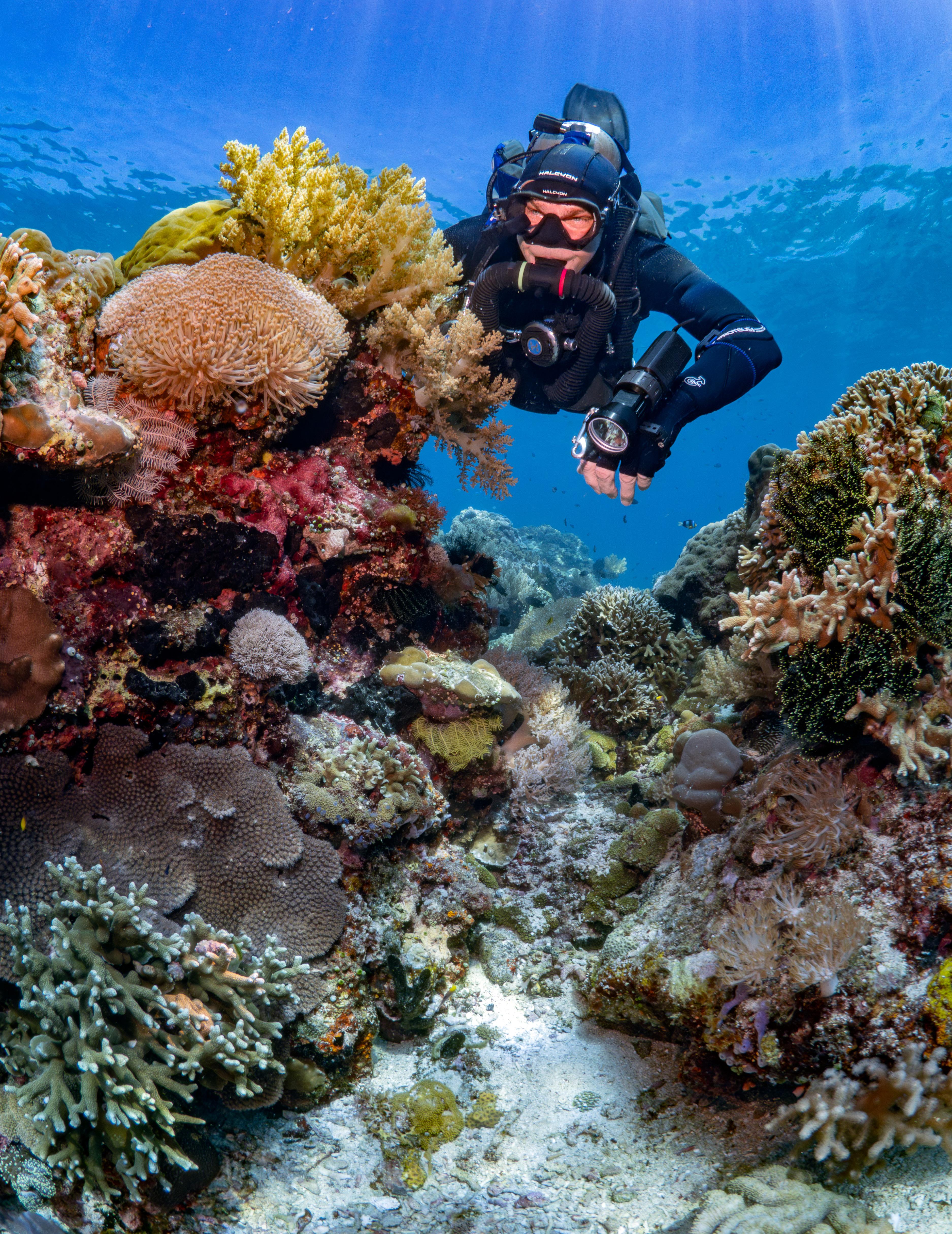
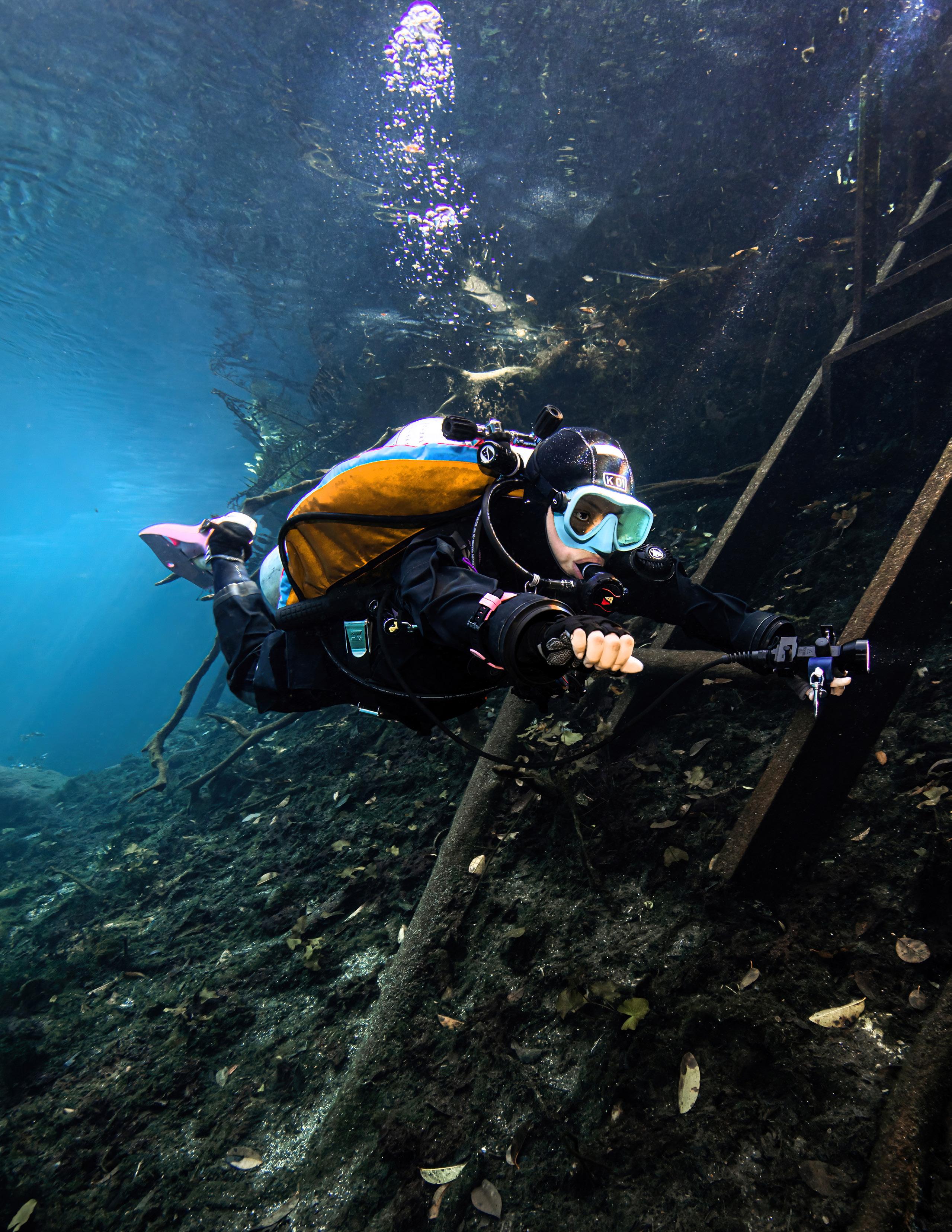
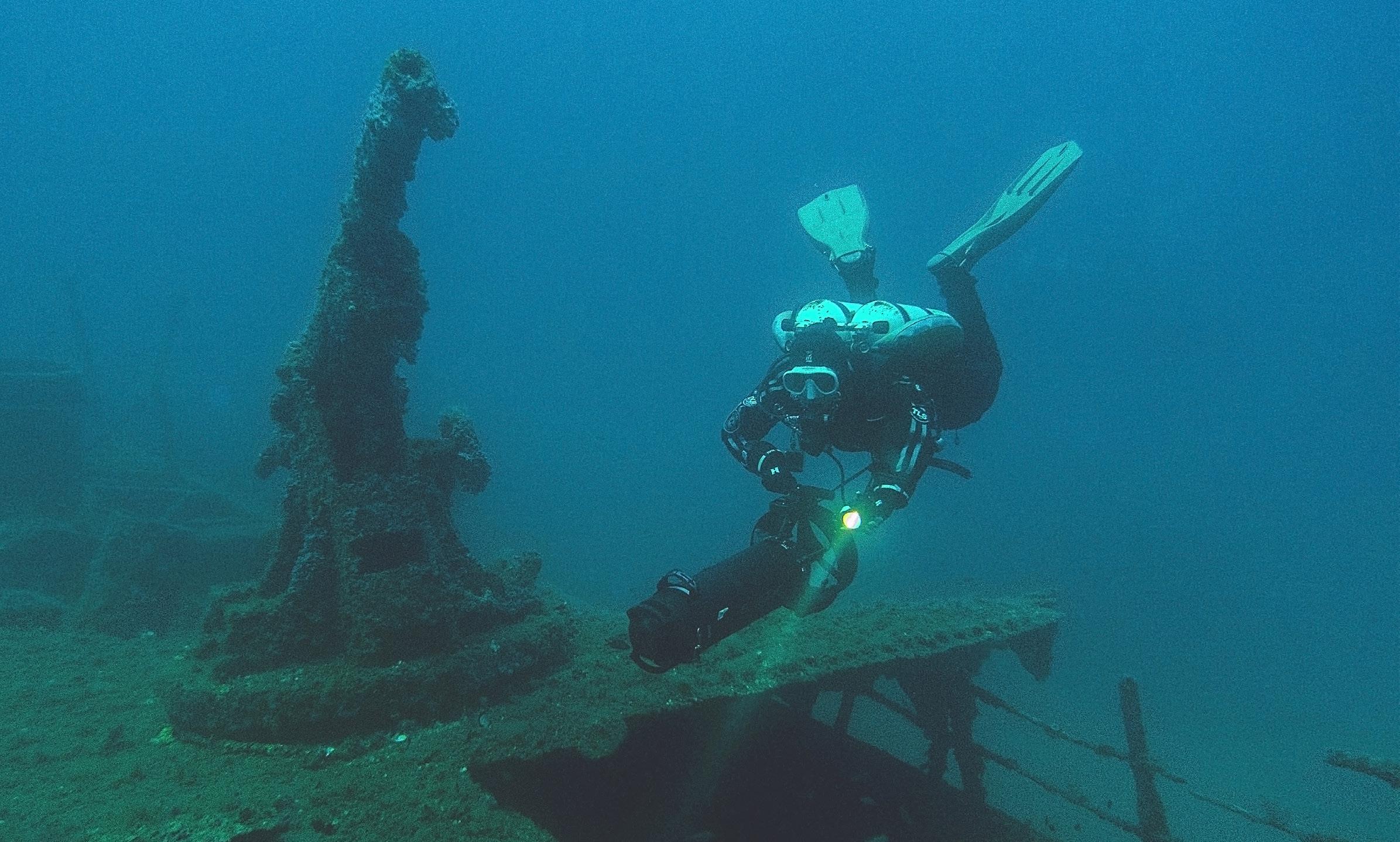
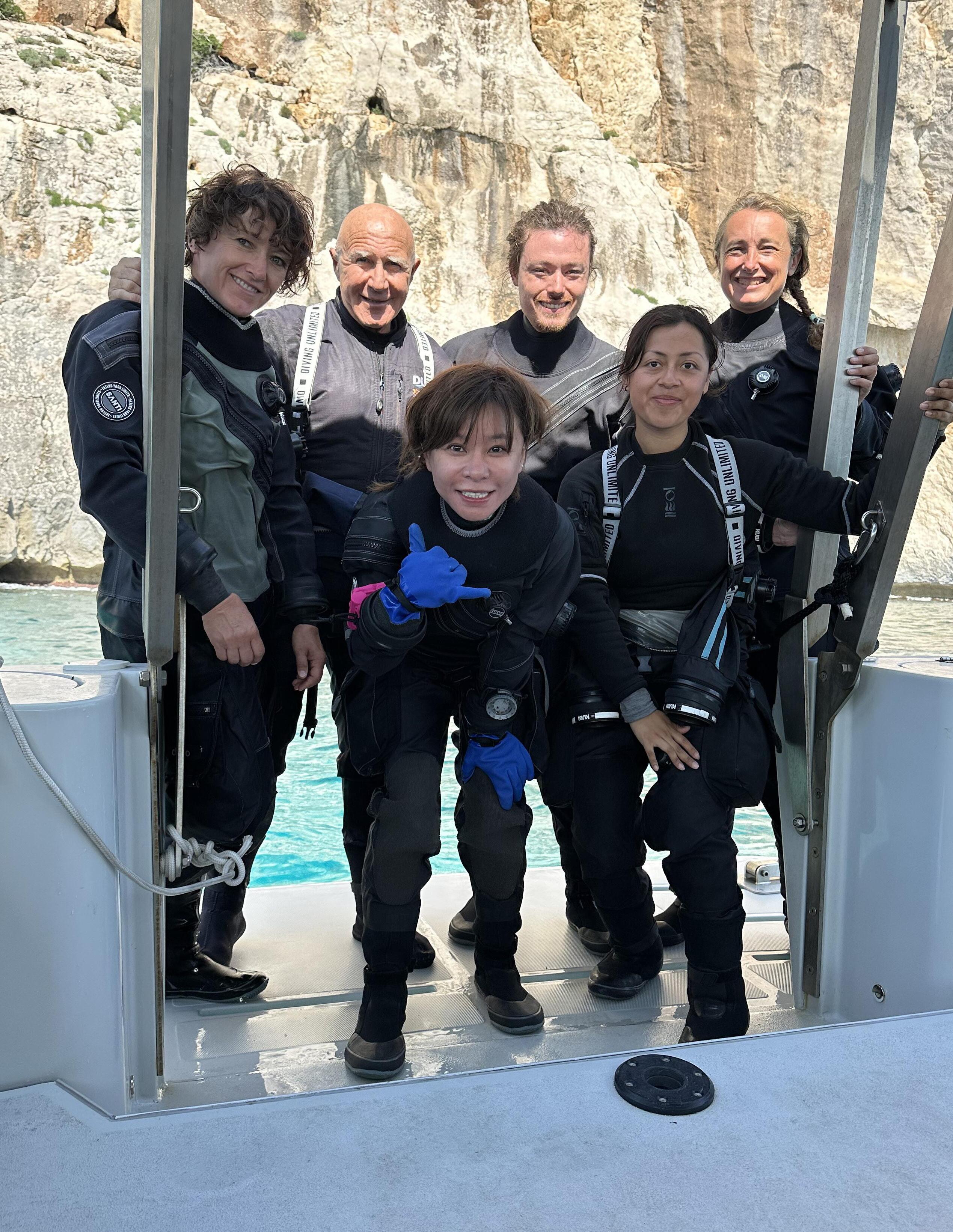
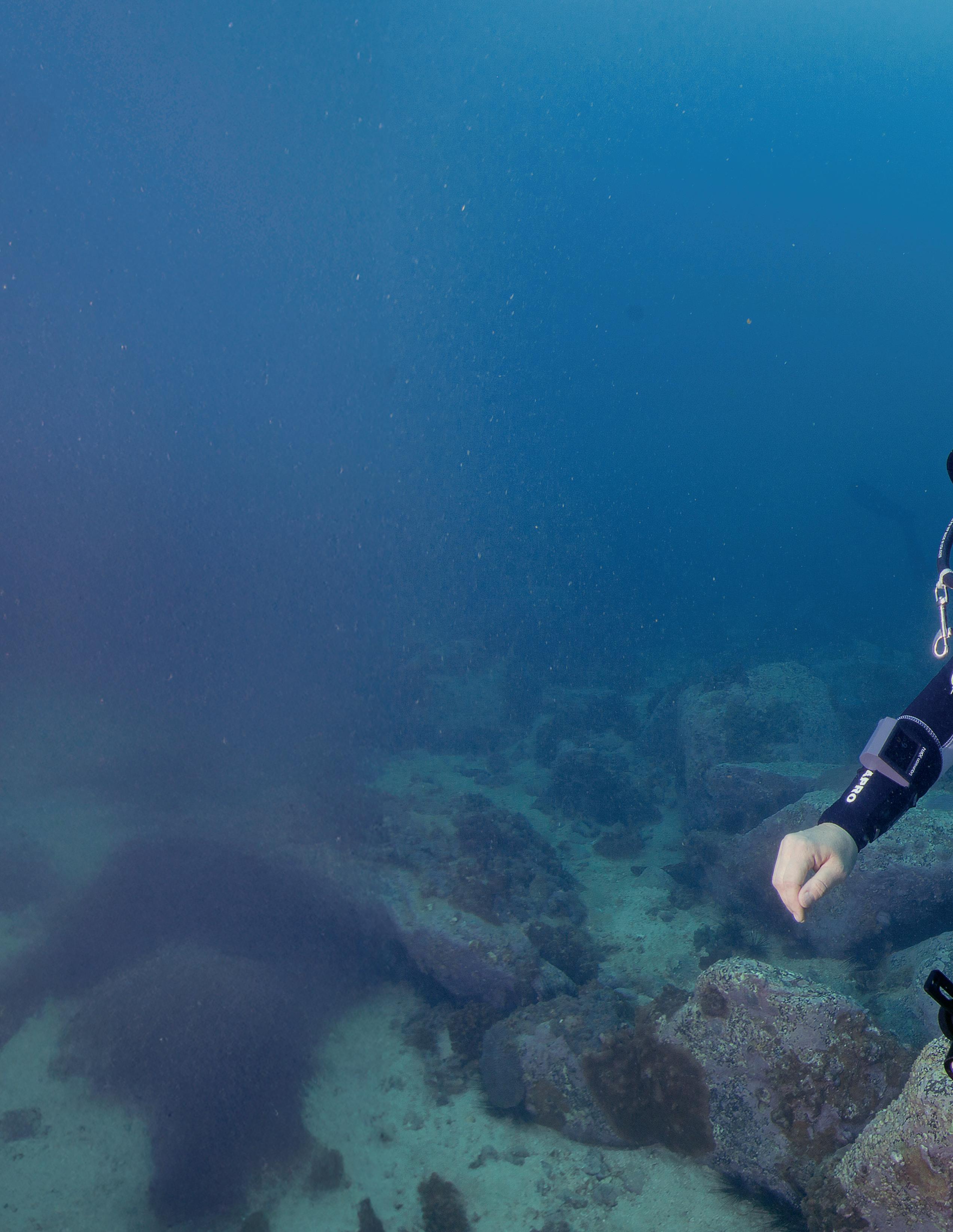
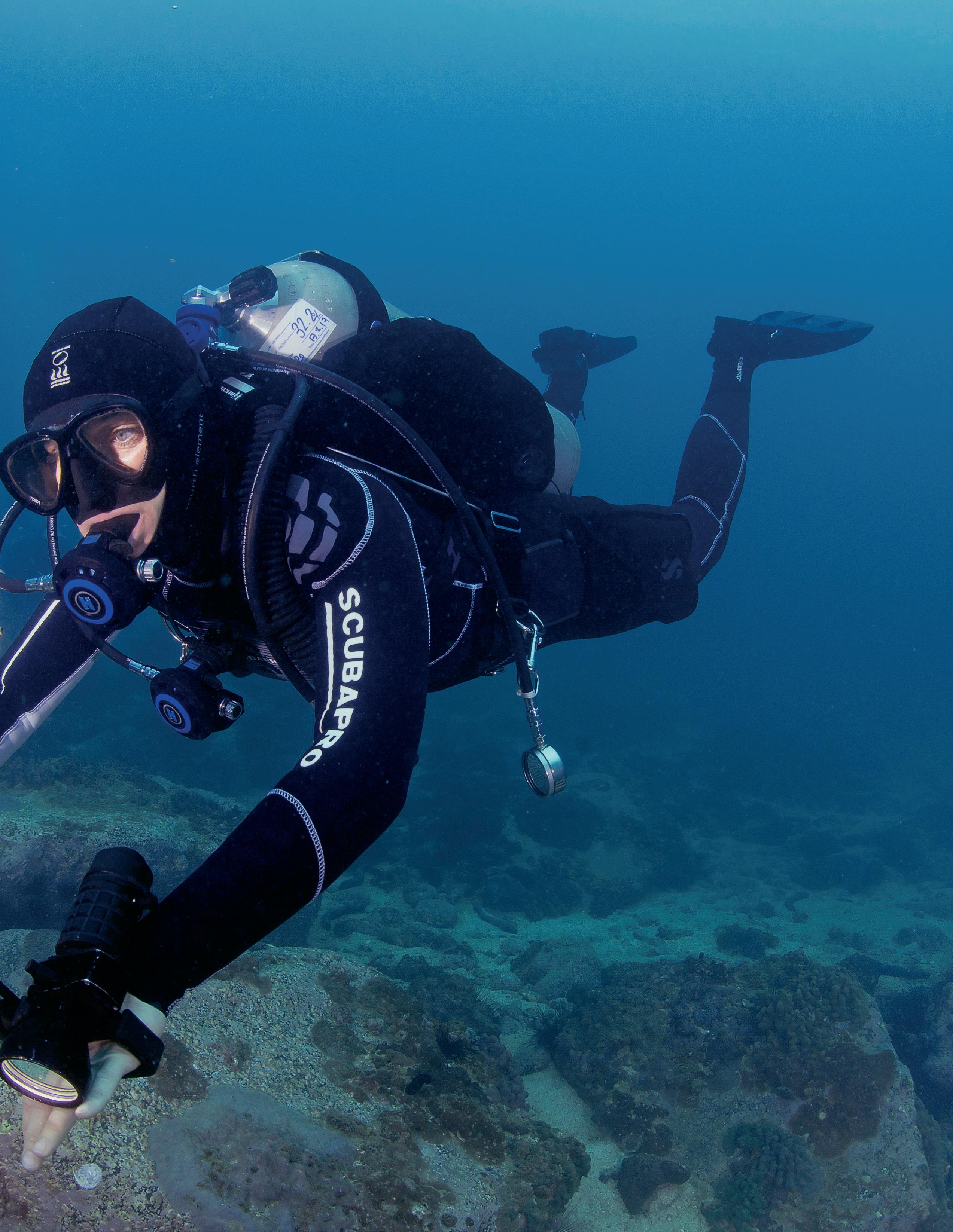
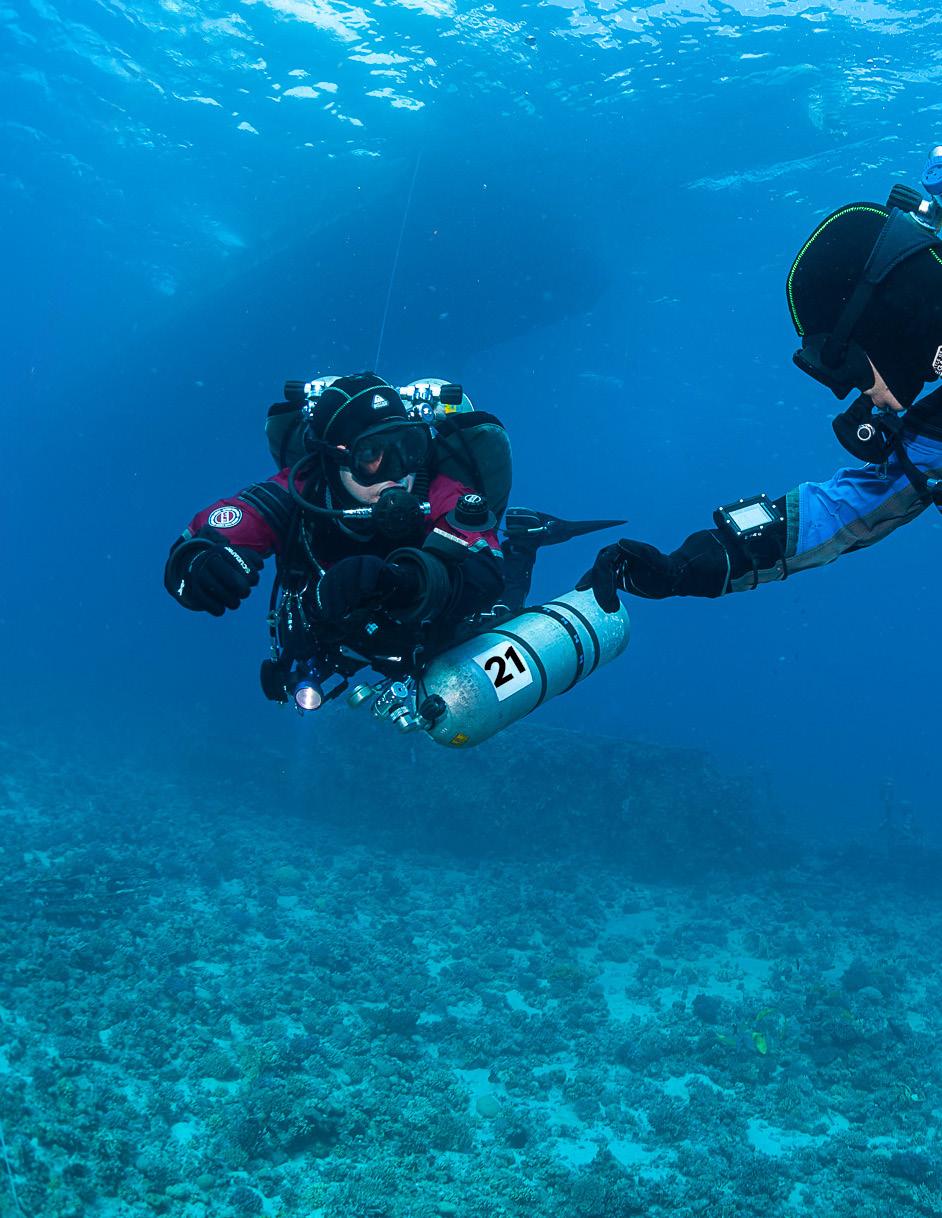
Island hopping the Philippines: A recreational diving adventure
PROVISIONAL – NOW WHAT?
Not a failure, but an invitation to practice and develop mastery
TEACHING NEW DIVERS
How to give students a solid grounding from their very first dive
STABILITY
The foundation of competence, comfort, and control
EDITOR’S LETTER
MOTHER WATER
The term “Mother Earth” is a bit of a misnomer, considering almost two-thirds of our planet is covered by oceans and lakes. While calling her “Mother Water” might sound strange, it is perhaps more accurate. This issue features a piece on a recent GUE trip exploring shallow coral reefs in the Philippines. Tropical reefs occupy a relatively narrow band around the Equator, but if diving activities are limited strictly to the areas between the Tropics of Cancer and Capricorn, one is missing out on some of the finest diving available.
The appeal of the tropics is obvious. Warm water, vibrant environments, and exotic marine life attract divers from across the globe—particularly from Europe and North America. It is easy to love the carefree lifestyle of shorts, T-shirts, and sandals, even if only for a brief vacation. However, diving in temperate and cold waters has distinct merits that deserve recognition.
First, dive travel is not always carbon-friendly. Local diving closer to home leaves a significantly smaller environmental footprint than a long-haul flight to a tropical destination. Environmental stewardship is a core value for many divers, and reducing travel distance is a practical way to honor that.
Another advantage of cold-water diving is the visibility; it is often exceptional—at times even better than in nutrient-rich tropical oceans. Furthermore, some of the most significant wreck diving in the world is found far outside the tropical zone. While the diversity of marine life may not be as abundant as on a reef, many of the same fascinating biological phenomena can be observed by the patient explorer who knows where to look.
As the saying goes: It’s not cold to dive in cold water—it’s cold to be cold. Diving technology has evolved exponentially since the post-war
era when Jacques Cousteau reportedly smeared animal fat on his skin to stave off the freeze while spearfishing in the Mediterranean. Today, we have access to flexible drysuits made from space-age materials, high-performance functional undergarments, and even battery-powered heated insulation to maintain warmth on long, demanding dives.
After all, if the water is still liquid, it is warmer than the freezing point. We think nothing of skiing or participating in winter sports in temperatures far colder than the water we dive in. Staying warm is simply a matter of being appropriately dressed for the occasion. There is a profound satisfaction in using refined skills and advanced technology to master the elements, allowing us to explore beautiful, inhospitable environments that remain hidden to most. Whether in the tropics or the Great Lakes, the magic of “Mother Water” is waiting.
Dive safe and have fun!
Jesper Kjøller Editor-in-Chief jk@gue.com
Quest
Editor-in-chief
// Jesper Kjøller
Design and layout
// Jesper Kjøller
Copy editing
// Pat Jablonski
// Kady Smith
Writers
// Jenn Thomson
// Gemma Thomas
// Jesper Kjøller
// Andy Wilson
// Kirill Egorov
// Jarrod Jablonski
// Daniel Riordan
// Fred Devos
// Todd Kincaid
// Chris Le Maillot
Photographers
// Kirill Egorov
// Jesper Kjøller
// Jenn Thomson
// Gemma Thomas
// Julian Mühlenhaus
// Dimitris Fifis
// Carolina Wells
// Wesley van Vliet
// Emőke Wagner
// Fabio Sagheddu
// Rich Wilson
// Frank Aron
// Martin St-Amant
// Dave Bunnell
IN THIS ISSUE
6
14
HQ CORNER // TEACHING NEW DIVERS
The first underwater breath mixes awe with hesitation. Great divers are built through deliberate, patient training rather than instinct. By prioritizing a thoughtful teaching philosophy over shortcuts, GUE instructors transform beginners into confident, stable divers who find genuine joy in the water.
FROM SARDINES TO WHALE SHARKS
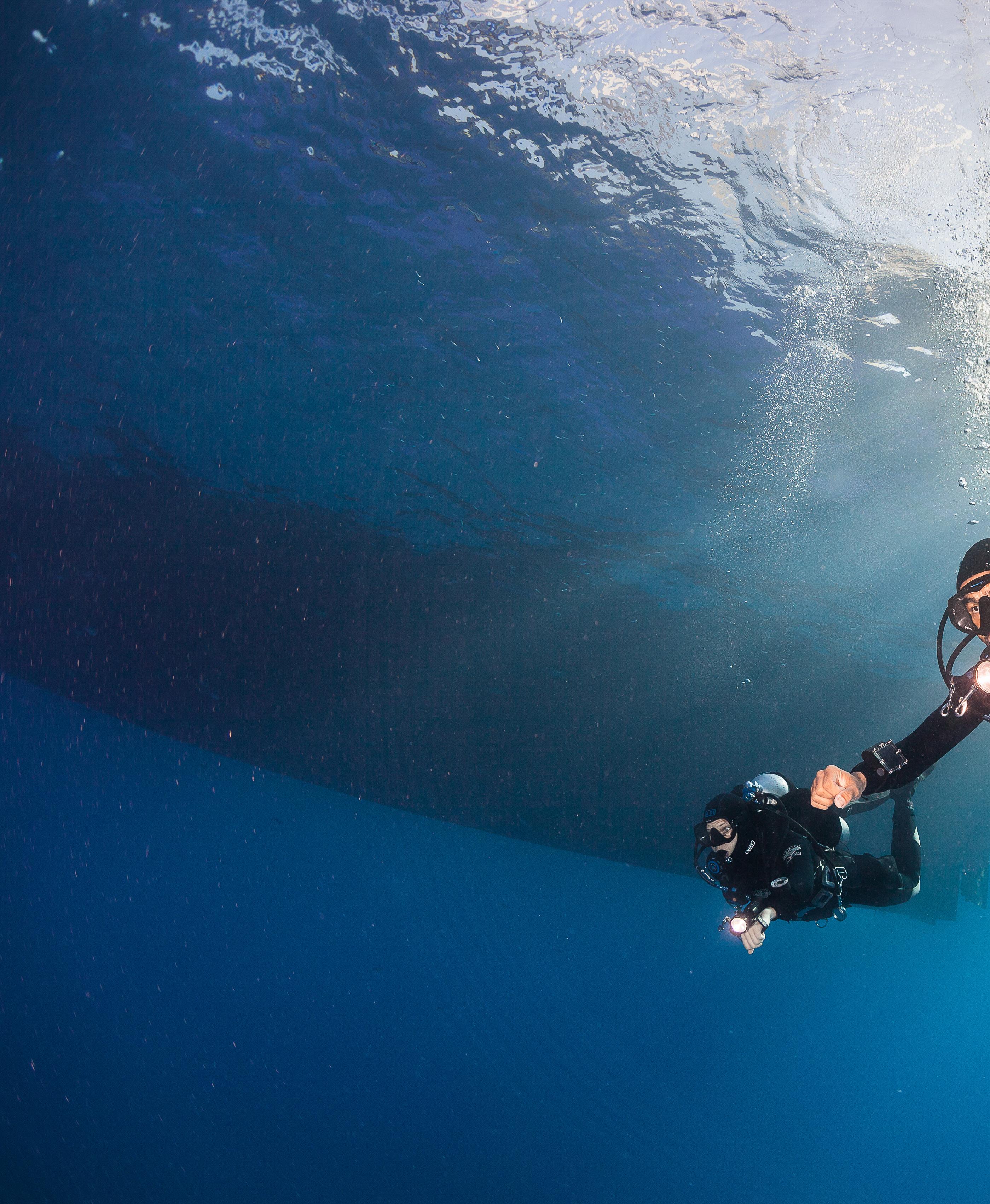
Last August, GUE divers embarked on a transformative Philippine journey, blending a stay at the lush Atlantis Dumaguete resort with a voyage on the welcoming Atlantis Adventurer liveaboard. It was a week defined by exploration, laughter, and unforgettable magic.
28 38 44
NOT YET // THE PROVISIONAL RATING
GUE trainee Andy Wilson reframes the “provisional” rating not as failure, but as an invitation to mastery. By overcoming equipment hurdles and the social media “comparison trap,” she embraces a non-linear path toward becoming New York City’s first female GUE instructor.
PORTFOLIO // FRANK ARON
Inspired by childhood snorkeling memories, veteran diver Frank captures the ethereal play of light and shadow underwater. Using technical cave photography skills and powerful illumination, he transforms flooded mines and wrecks into dramatic, space-like landscapes that emphasize scale and structure.
STABILITY // THE FOUNDATION
GUE training prioritizes stability—the ability to remain motionless and intentional in the water. Much like a building’s foundation, stability is essential; a weak base limits progress, while a strong one enhances a diver’s capacity, safety, and overall enjoyment.
56
CAVE // FORMATION AND DEVELOPMENT
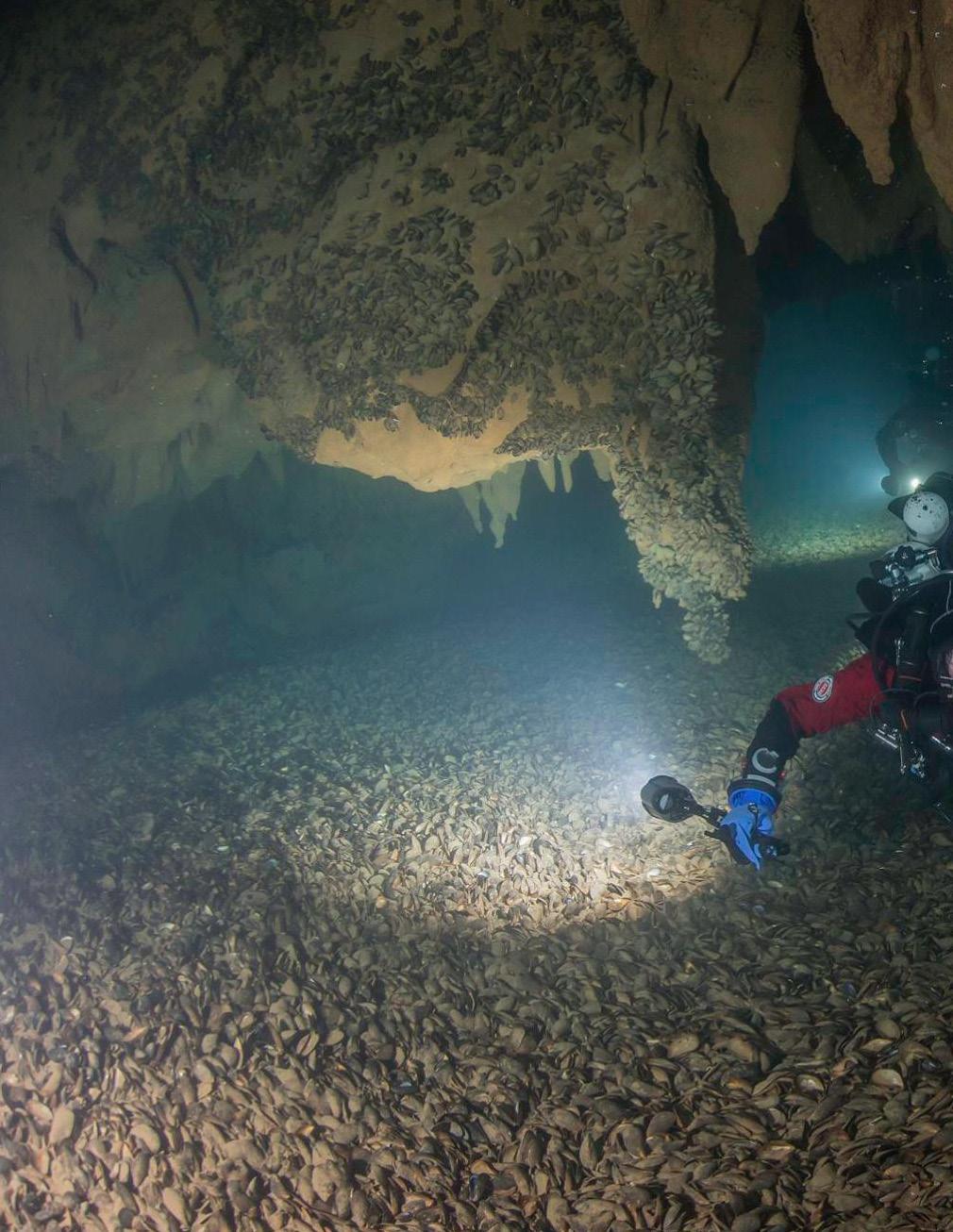
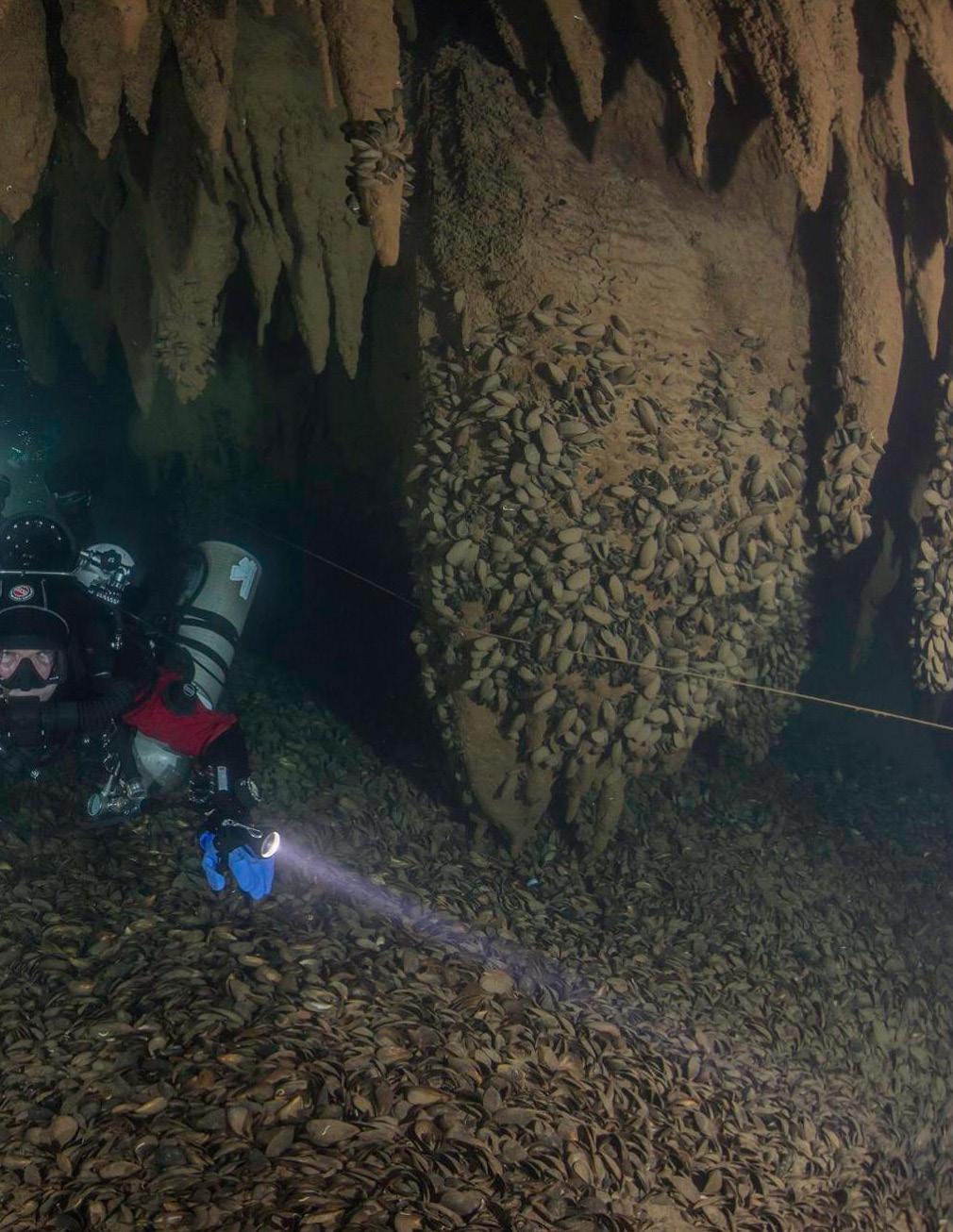
This last installment in our cave series details diverse subterranean structures beyond dissolution caves. It covers karst aquifer patterns, coral reefs, sea caves, and volcanic lava tubes, alongside tectonic movements, melting glaciers, and ancient manmade qanat water tunnels.
HQ CORNER
– Setting students up for success TEACHING NEW DIVERS
Most divers can remember the feeling of breathing underwater for the first time. It is a mix of awe, excitement, and a moment of hesitation where you wonder, “Am I really meant to do this?” For new divers, it is an instant where curiosity meets fear, and the outcome of that moment often determines whether diving becomes a lifelong passion or something they quietly set aside.
Great divers are not born. They are shaped gradually with deliberate guidance, steady practice, and more patience than most people realize. This article is not about hidden agency techniques or instructor-only secrets. Instead, it explores the teaching philosophy and the steps taken to give Open Water students the best possible foundation from their very first dive. The result? Creating confident, stable, and genuinely happy new divers. Whether you are already a diver, preparing to become one, or simply curious about what thoughtful training really looks like, you will find the process more engaging and more human than you might expect.
PHOTO JENN THOMSON
TEXT GEMMA THOMAS WITH JENN THOMSON
PHOTOS JENN THOMSON, GEMMA THOMAS & JULIAN MÜHLENHAUS
Across the industry, few topics generate as much discussion as this one: Should new divers be taught on their knees, or should they learn while neutrally buoyant from the very beginning?
Supporters of the kneeling approach argue that this method stabilizes students, reduces task loading, prevents them from drifting away or losing control, and keeps the learning process simple. They also claim it is the only practical option when working with larger groups. On the other hand, many instructors advocate for teaching new divers while they are neutrally buoyant. Their reasoning is that kneeling is not a position used in real diving. Achieving it requires divers to be overweighted, which often leads them to remain overweighted on future dives. When students start without any ingrained habits, they tend to develop buoyancy control, trim, and balance far more naturally and effectively.
Step one: surface clinics with a snorkel – learning to balance in the water
“I knew there had to be a better approach. The real question was how to set students up for success without overwhelming them.
When I first began teaching, I relied on the kneeling method. Students stayed still on the bottom, stable and easy to manage. Skills were checked off one by one, and then we moved directly to the first dive. At that point they were somehow expected to descend in control. Some stayed vertical and kicked themselves upward, others struggled with equalizing, and some sank unexpectedly fast. Managing these issues simultaneously was nearly impossible. It was stressful, and it was not fair to the students. They were completing skills, but they were not becoming divers.
I knew there had to be a better approach. The real question was how to set students up for success without overwhelming them. The answer, surprisingly, was to start at the surface. Not on dry land, but floating on the water, where dives actually begin.
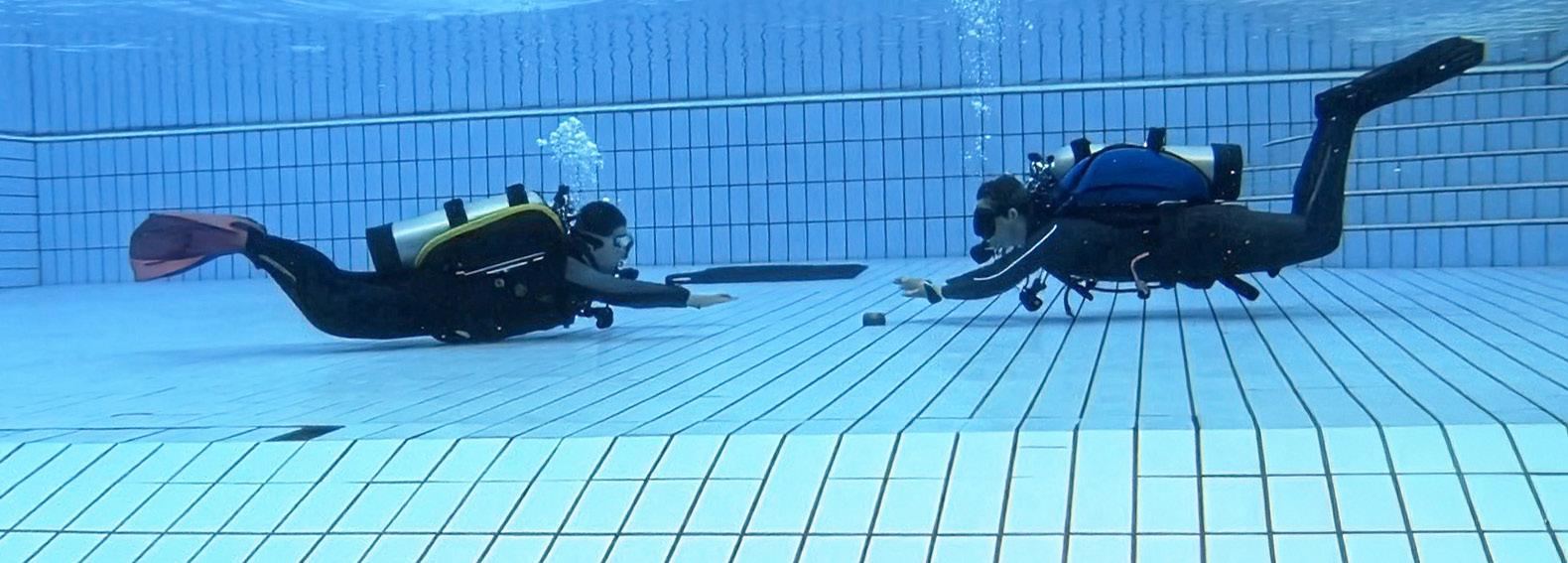
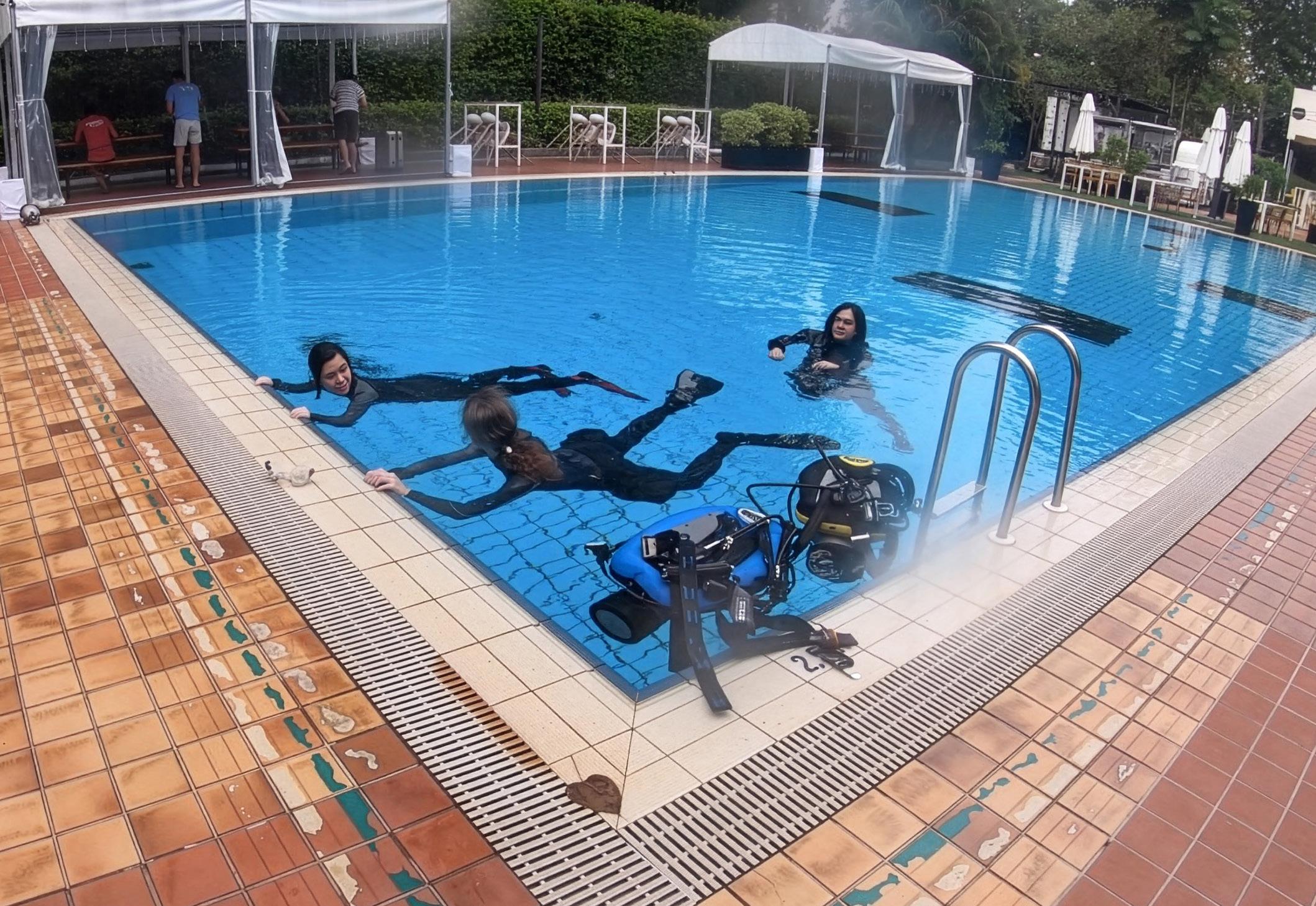
If you observe one of my beginner classes, you will not see a row of students kneeling at the bottom. Instead you will see something that looks more like a snorkelling session. Students float on the surface while wearing masks, snorkels, and fins. Yes, a snorkel! They learn to balance their bodies, breathe comfortably through their mouths, and clear their masks. For some, who might not have even snorkelled before, they will feel what it is like to get water in their mouths and use their right hand to clear a snorkel—setting themselves up for regulator clearing. It is a simple, approachable introduction that sets the tone for everything that follows. Students learn faster when they feel safe and comfortable. Their ears and their worries about equalizing do not distract them, and they are not yet dealing with buoyancy. They can learn that moving their legs to one side causes them to roll left and right, and so they can play around with correcting their balance in a contained environment, ultimately making them a more confident diver in the future. This calm, steady beginning may seem basic, but it is one of the most underrated parts of diver training, and possibly one of the most important.
Step two: building propulsion fundamentals at the surface
Once students feel relaxed on the surface, we start exploring movement. We teach finning techniques before they ever put on scuba gear. Why? Because on the surface they can clearly watch the instructor demonstrate, discuss technique in real time, and most importantly, feel the movement of their fins through the water. They do all this without worrying about buoyancy. When they feel what a proper frog kick or flutter kick should be, something clicks. Some students move backward before they ever go underwater. Some glide forward, some remain
still, but all begin to understand how their bodies influence their movement. Challenging them to cross the pool in the fewest kicks turns efficiency into a fun competition. Play and technique support each other beautifully.
Some teach the propulsion techniques on land or on tables. I advocate much more for in-water surface clinics. The same reason applies—starting out where they are meant to be from the beginning. Land exercises activate different muscles than in-water exercises, and so the students are learning how the kick is mastered and feels in the correct environment. It is also a moving surface, so getting students to position themselves and each other correctly sets up the team dynamics from the start.
Step three: “dry-runs” – but make it in trim and floating on the water
Only once students know how to move do we put them into scuba gear. We revisit the mask and regulator skills and confirm they can perform them on the surface with full equipment before they ever breathe underwater.
Surface clinics build muscle memory and team dynamics in the actual environment.
Teaching at the surface was not my first idea. I initially tried having students lie on the bottom of the pool. It did not help. Equalization issues increased. Students panicked when clearing their masks. Some tried to bolt to the surface. Even that one meter of water added stress rather than reducing it. In contrast, the surface eliminated ear problems and buoyancy issues, and students could stand up anytime they needed. Yet they still learned how to control their bodies and find a balanced, horizontal position. From initial Open Water skills to more complex ones (for example, regulator/inflator hose failures and swapping masks), all can be practiced on the surface before an initial descent.
Step four: the power of productive mistakes – letting students play
When the students finally go underwater, we do not rush straight into the standard list of skills. Instead, we let them swim around in shallow water. We let them experiment with their breathing and gear. They can experiment with their propulsion and balance techniques learned
PHOTO GEMMA THOMAS
FACT FILE // GUE OPEN WATER DIVER
Whether you are new to the diving world, you’ve taken a course outside of GUE before, or you’re looking to improve your skills after a few years of not diving, the GUE Open Water Diver course is a great starting point. This course will build the foundations for your diving skills no matter what attracted you to diving.
WHAT WILL I LEARN?
The GUE Open Water Diver course is designed to develop the essential skills required for all sound diving practice. It allows the non-diver to cultivate a platform that supports comfort, confidence, and competence in the water, as well as more advanced training in the future.
A GUE Open Water Diver certification means that divers will be certified to dive with their diving team without the supervision of a dive professional, to a maximum of 21 m/70 ft.
from snorkelling and swimming around on the surface. They then start to connect theory to practice—a big inhale makes them rise; relaxed breathing keeps them steady. We observe and let students feel these effects for themselves, letting them make mistakes without getting too far, of course. For example, students eventually realize how much gas is too much to add when they make the mistake for themselves, without them being instantly corrected.
A few minutes of initial chaos gradually shifts into controlled movement in one meter of water. Students stay off the bottom and away from the surface. Only when they are calm and steady do we start repeating skills at depth. Going slow helps us go fast. That early time spent swimming builds comfort and stability, which makes the more demanding skills easier to perform cleanly.
Although still a little chaotic, the first dive of the course is now much less stressful for both instructor and students. Students are more aware of their surroundings and can appreciate
PREREQUISITES AND DURATION
Applicants for a GUE Open Water Diver program must:
• Be a minimum of 12 years of age.
• Be physically and mentally fit.
• Be a non-smoker.
• Be able to swim.
• Obtain a physician’s prior written authorization for use of prescription drugs, except for birth control, or for any medical condition that may pose a risk while diving.
The GUE Open Water Diver course is usually conducted over five to six days and includes at least ten aquatic sessions (confined water sessions) and six open water dives, and at least 40 hours of instruction, encompassing classroom, land drills, and in-water work. The student prepares using GUE’s Mastery Learning platform.
what they are seeing. Witnessing the underwater world for the first time is a memorable experience, and I am lucky enough to relive that excitement through my students. Watching their faces light up when they encounter their first turtle or shark is genuinely rewarding.
Step five: Slow is smooth and smooth is fast
At first the process appears slow. But with comfort and confidence comes a growing eagerness to learn new skills. By the end of their course they can share gas, hold stops during ascents, manage equipment failures, and even attempt rescue scenarios. Because the early steps are calm and supportive, the more complex skills at the end feel achievable and far less intimidating. And when the Open Water course ends, students often look like experienced divers. They can control their buoyancy, move against currents, and feel in control of their environment. They can plan and execute their dives confidently.
“Teaching neutrally buoyant from the beginning requires more patience, more creativity, and a willingness to rethink old habits.
After the course, divers have the buoyancy and control necessary to plan and execute dives with confidence.
February 2026 · Quest
PHOTO JENN THOMSON
There is a myth that new divers are not capable of much. It is simply not true. When we teach with patience, progression, and respect for how people learn, new divers rise to every challenge. I have seen brand-new divers hover mid-water, swim in perfect trim, and move with the ease of people who have been diving for years. The difference is not natural talent. It is the method.
Could I teach this way with larger groups? No. Realistically, three students is the maximum I can manage at once. For newer instructors, one or two is a better starting point.
Teaching neutrally buoyant from the beginning requires more patience, more creativity, and a willingness to rethink old habits. But it gives students confidence early, builds genuine competence, and makes diving safer, smoother, and far more enjoyable. They move with confidence because they earned it through practice, support, and steady challenges that made sense. Your role shifts naturally from coach to mentor to teammate as they grow.
Your greatest success is when they “don’t need you anymore.”
Gemma Thomas
Gemma began diving after moving to Singapore in 2009, where regular access to the water led to a long-term commitment to high-quality training and diver development. She became a GUE Instructor in 2016, focusing on recreational and foundational courses, with an emphasis on strong fundamentals, comfort, and skill mastery. She teaches GUE Open Water, Advanced Open Water,
Performance Diver, and Fundamentals, and is an Instructor Evaluator for Open Water, Advanced Open Water, and Fundamentals. Her approach emphasizes consistency, confidence, and decision-making.
Gemma has participated in projects in Italy involving photogrammetry and biological sampling, and is part of the team developing GUE’s Mastery Learning courses.
New divers can achieve perfect trim and mid-water hovering, moving with an ease typically reserved for those with years of experience.
February 2026 · Quest
FROM SARDINES
TEXT THE HALCYON/GUE DIVE TEAM
PHOTOS DIMITRIS FIFIS
WHALE
PHOTO DIMITRIS FIFIS
SARDINES TO
WHALE SHARKS
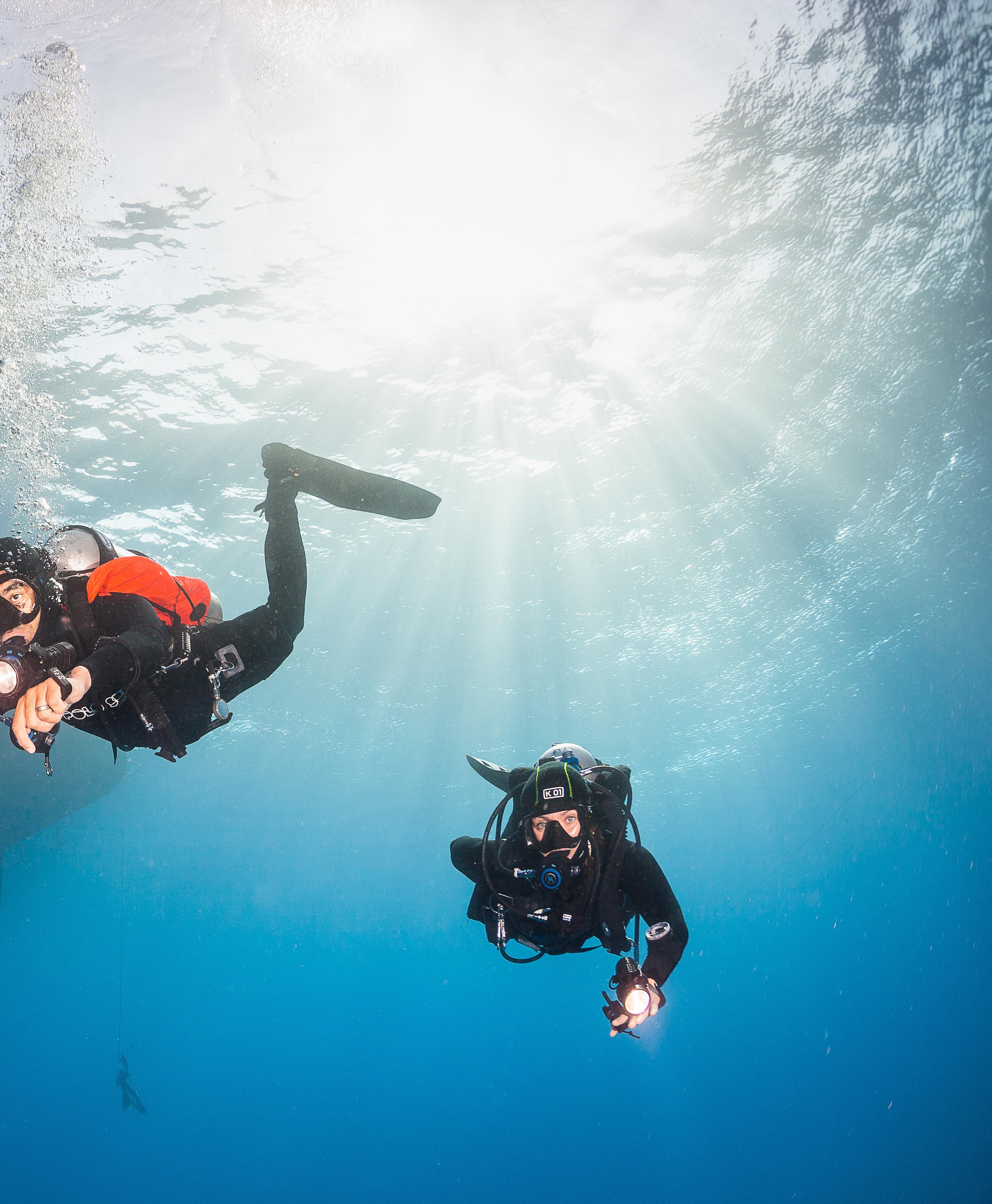
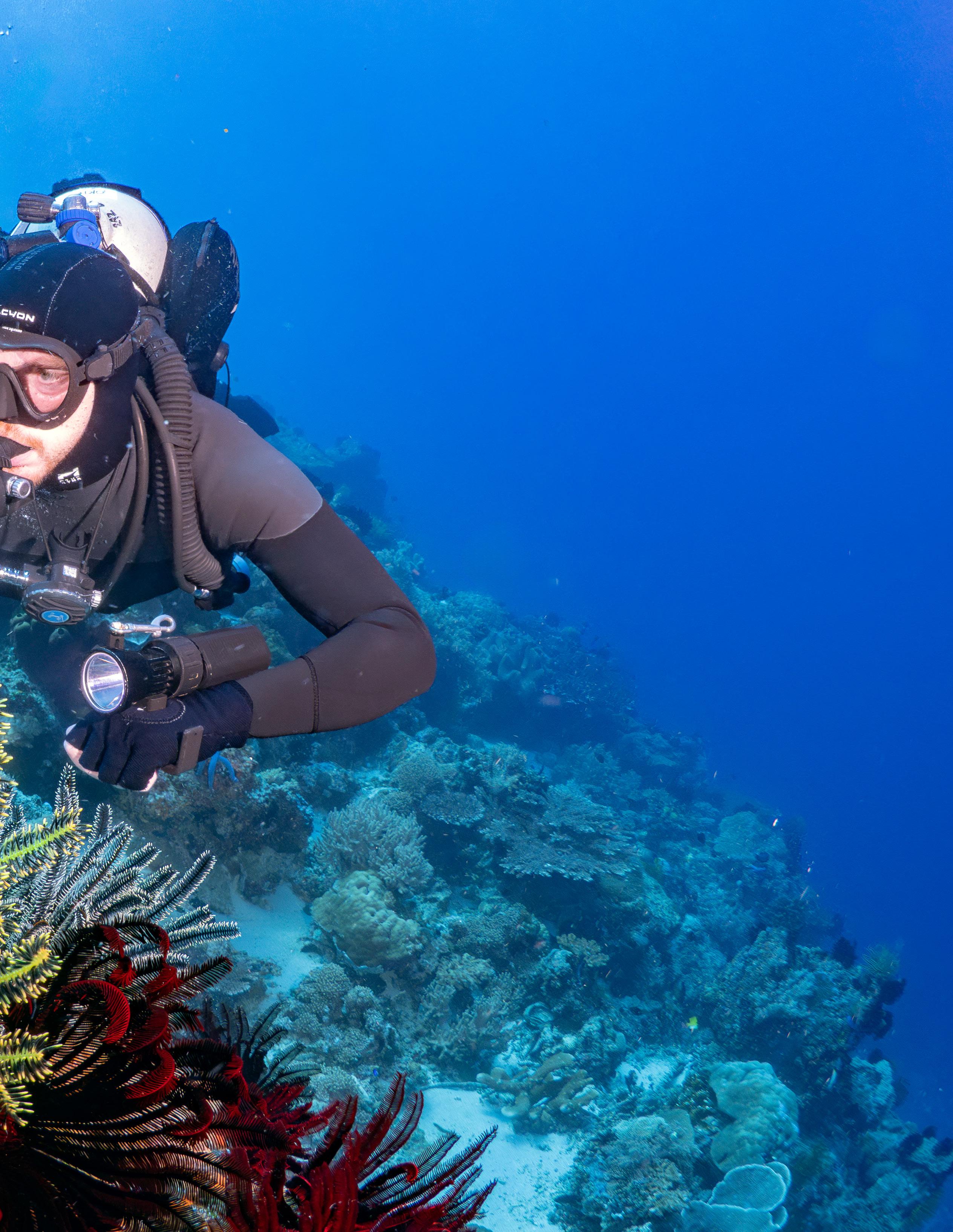
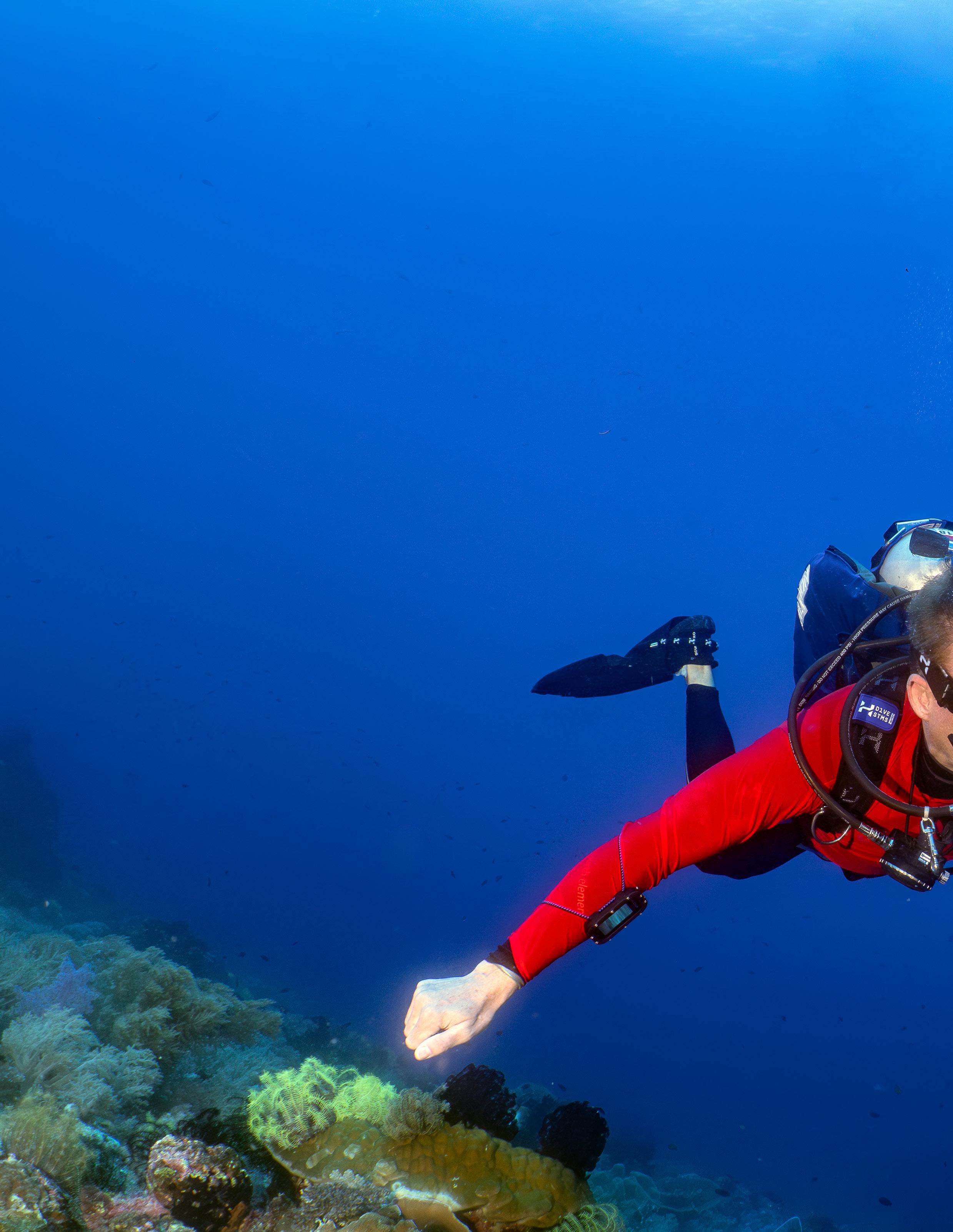
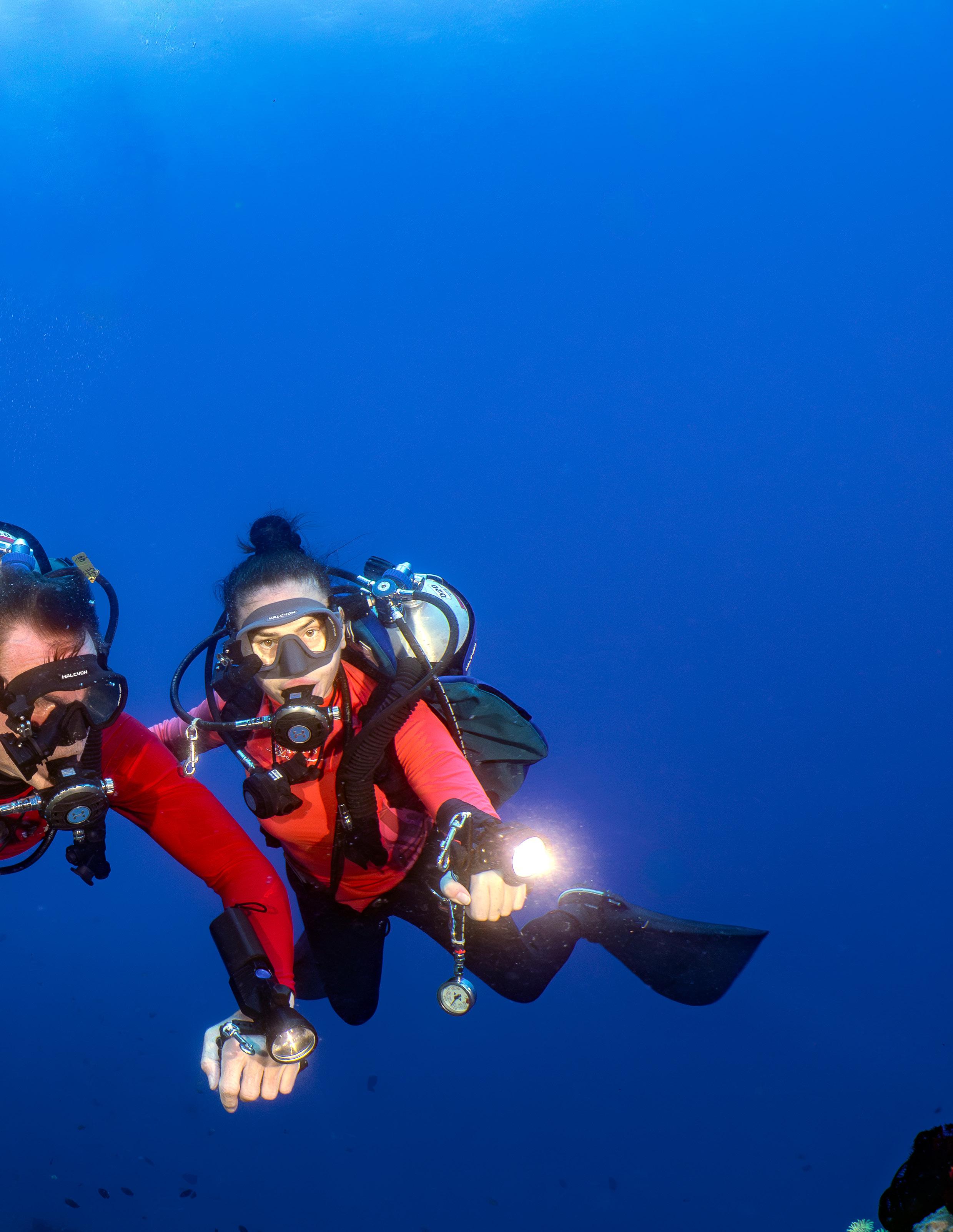
The silent, bubble-free Halcyon Symbios CCR allows divers to get closer to marine life than ever before.
PHOTO
There
are
dive trips, and then there are journeys—the kind that linger long after your gear is packed away.
This
past August,
gathered in
laughter,
a spirited group of GUE divers
the Philippines for a week of exploration,
and
underwater
magic. The trip blended the best of both worlds: tranquil days at the lush seaside resort of Atlantis Dumaguete and a liveaboard voyage aboard the Atlantis Adventurer, the most welcoming dive vessel we’ve ever experienced.
From the first sunset over the Sulu Sea to the laughter shared after or during dives, it was clear that this would be no ordinary expedition. Each day unfolded into a celebration of diving, camaraderie, and discovery—an experience that unitved technical explorers and recreational divers alike beneath a shared love for the ocean. What followed was a demonstration of how innovation, hospitality, and shared passion can come together to elevate the diving experience into something unforgettable.
Atlantis Dumaguete: Sanctuary of Life
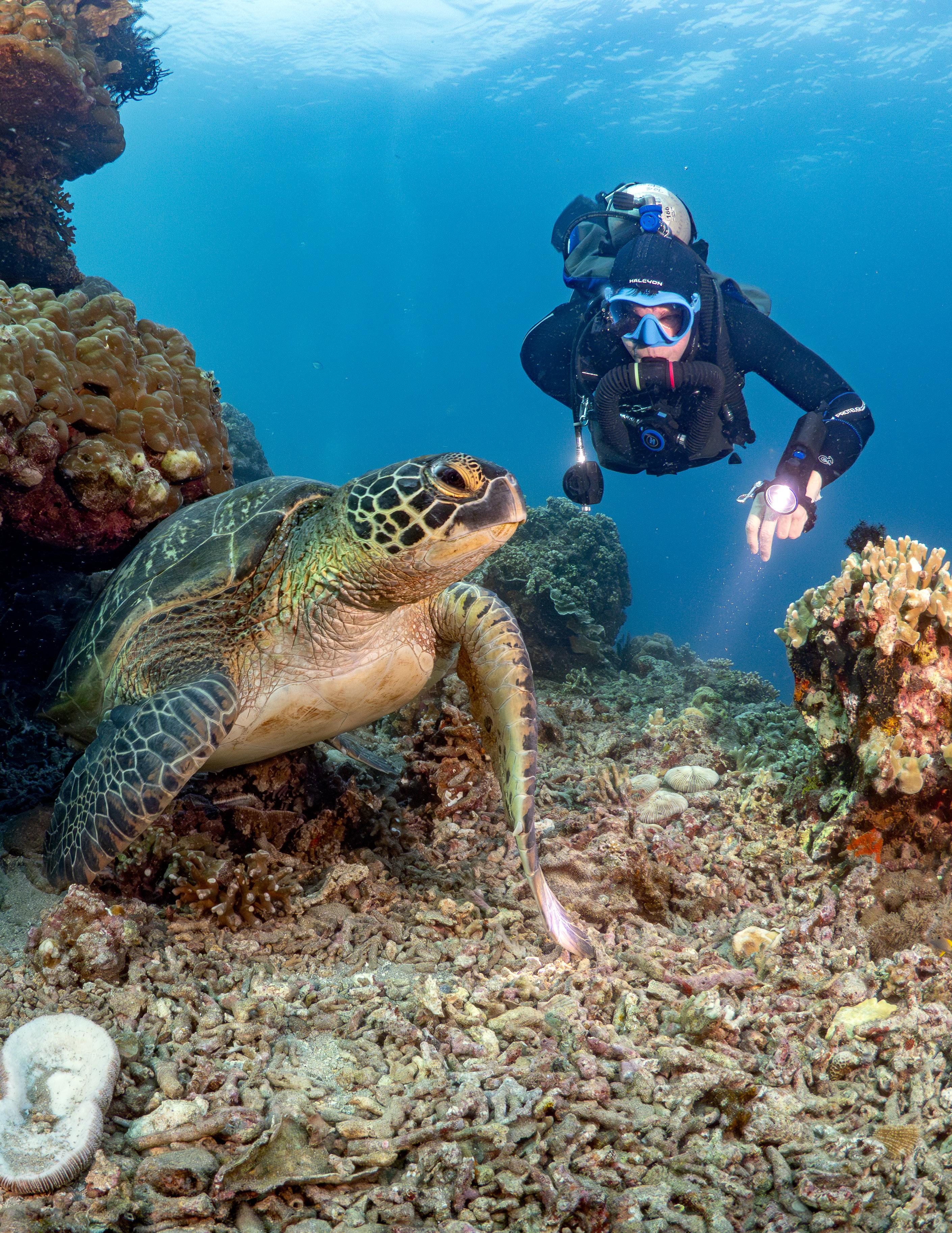
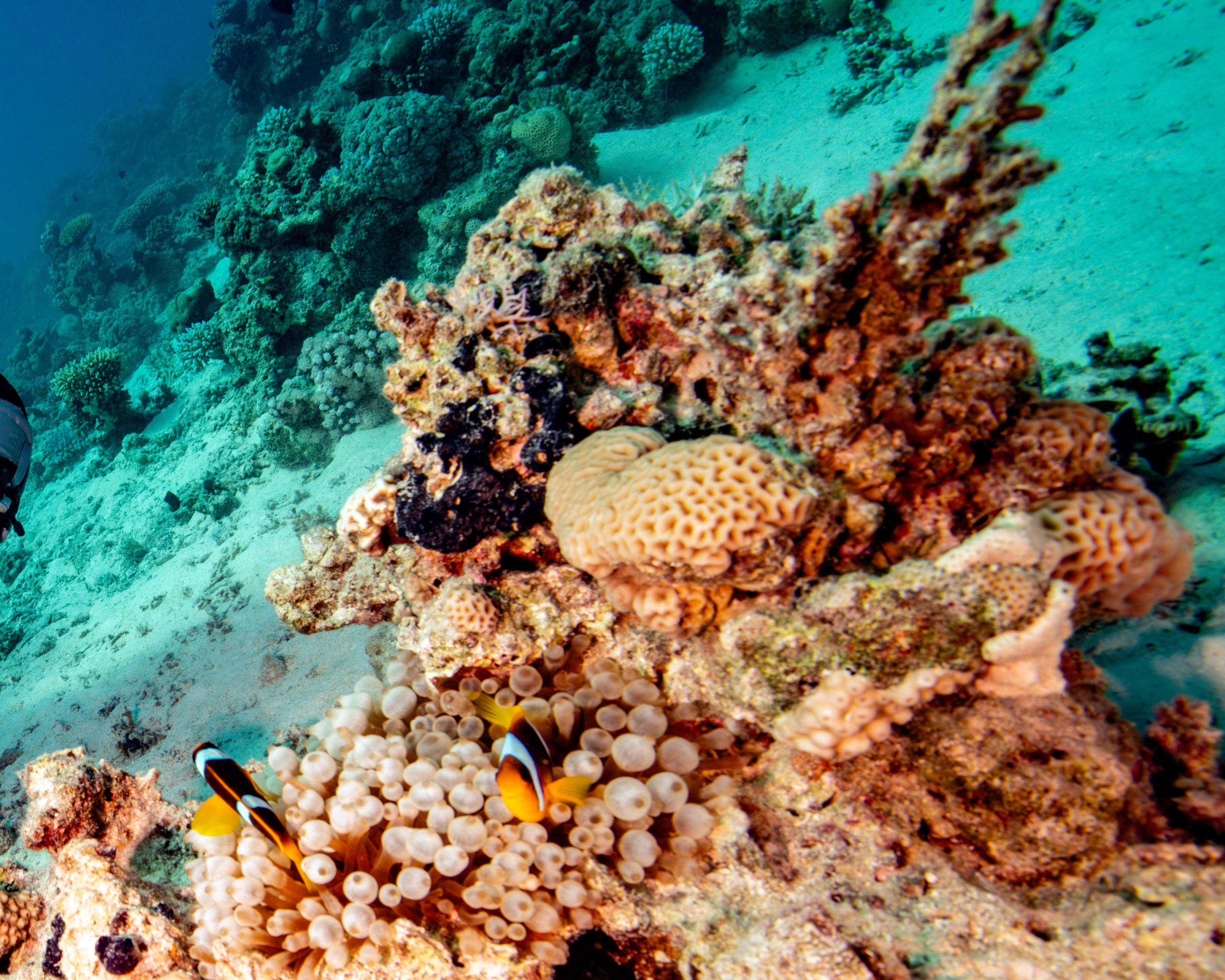
Nestled in the province of Dauin, Atlantis Dumaguete offers a gateway to one of the most biodiverse marine regions on Earth. More than 440 species of reef-building corals flourish here, supported by thriving marine sanctuaries that protect delicate ecosystems and sustain the greater Visayas region. From the famous Apo Island to the slopes of the house reef, every dive promises wonder—turtles gliding through coral gardens, Anthias swarming like confetti, and macro life so rich it feels infinite.
The dive guides at Atlantis Dumaguete are experts not only in navigation but in storytelling. They know the names of the resident frogfish, where the mandarinfish emerge at dusk, and how to find the tiniest creatures hidden among coral branches. On any given day, you might hover over a flamboyant cuttlefish
changing color in hypnotic patterns, or watch a blue-ring octopus unfurl its warning display beneath your light. For underwater photographers, this is paradise—a place where patience is rewarded with living art.
Camera comfort
Photographers delight in the endless variety: ornate ghost pipefish, frogfish, seahorses, and the surreal play of light on coral. The Atlantis team ensures every detail—from camera handling to dive logistics—feels effortless. Dedicated camera facilities provide well-lit, climate-controlled workspaces with 110v and 220v outlets, letting image-makers prepare and maintain their systems between dives. As Atlantis Photography Ambassador Marty Snyderman notes, “Divemasters and boat captains are happy to take instructions regarding how you’d like your camera system handled, or let you do it all yourself without offense taken.”
Meals are another highlight. Served fresh and prepared with local ingredients, each dish reflects the resort’s philosophy of thoughtful indulgence. The kitchen staff, attentive and creative, happily accommodates vegan, gluten-free, and other special requests, ensuring everyone feels at home between dives. Dinners often stretch late into the evening, with stories traded across tables and the sound of waves mingling with laughter. It’s this blend of comfort and connection that makes Atlantis Dumaguete feel more like a community than a resort.
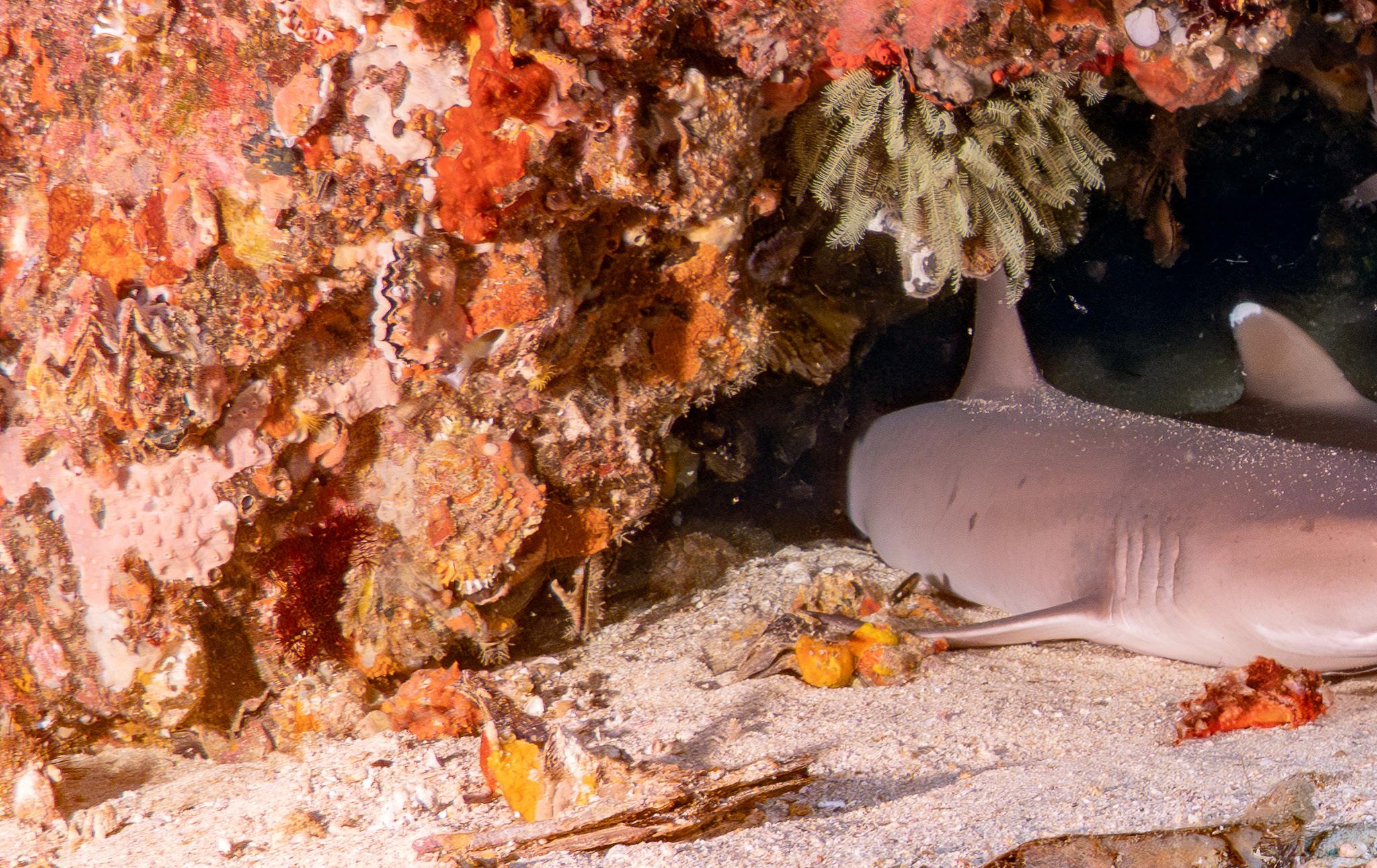
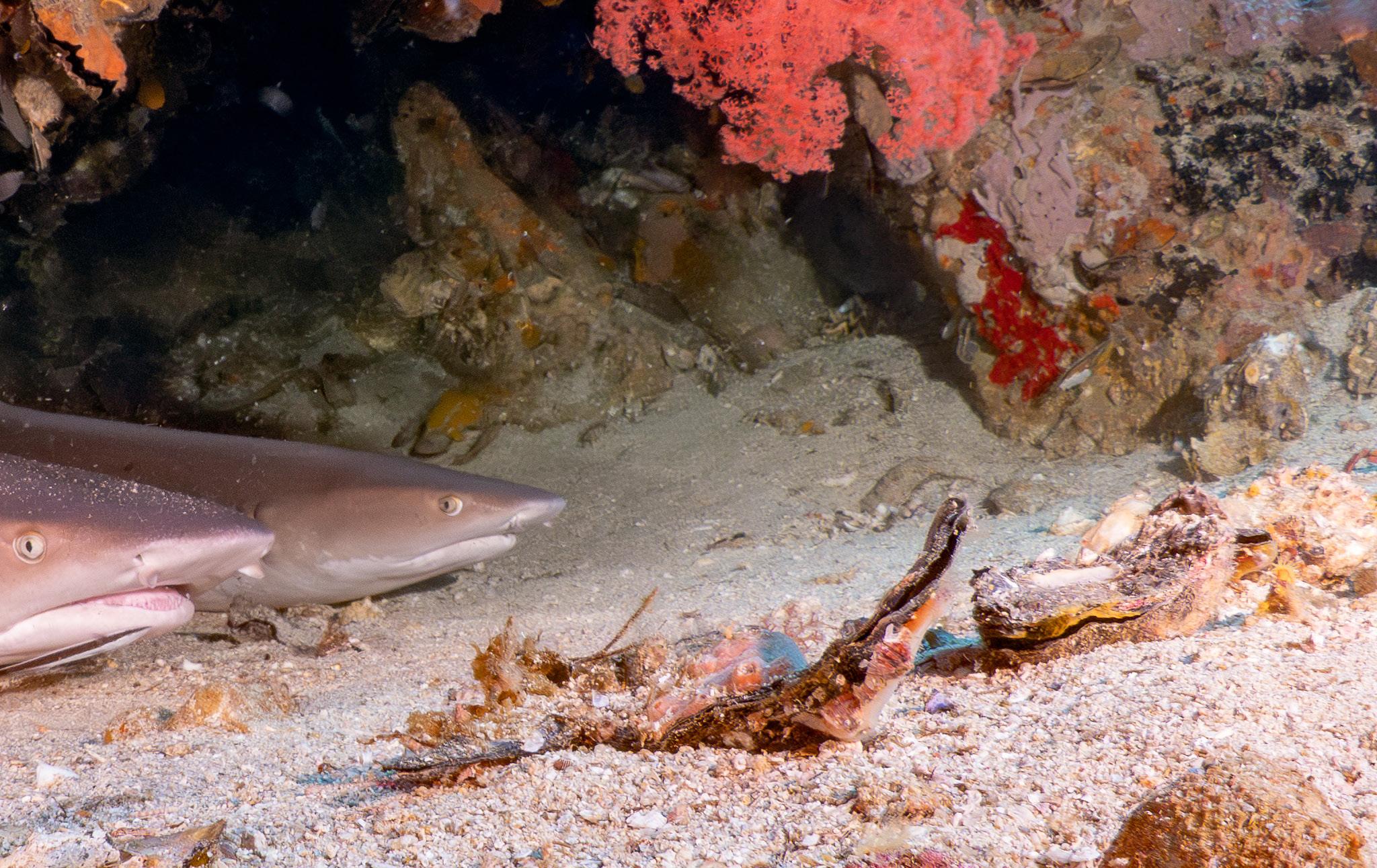
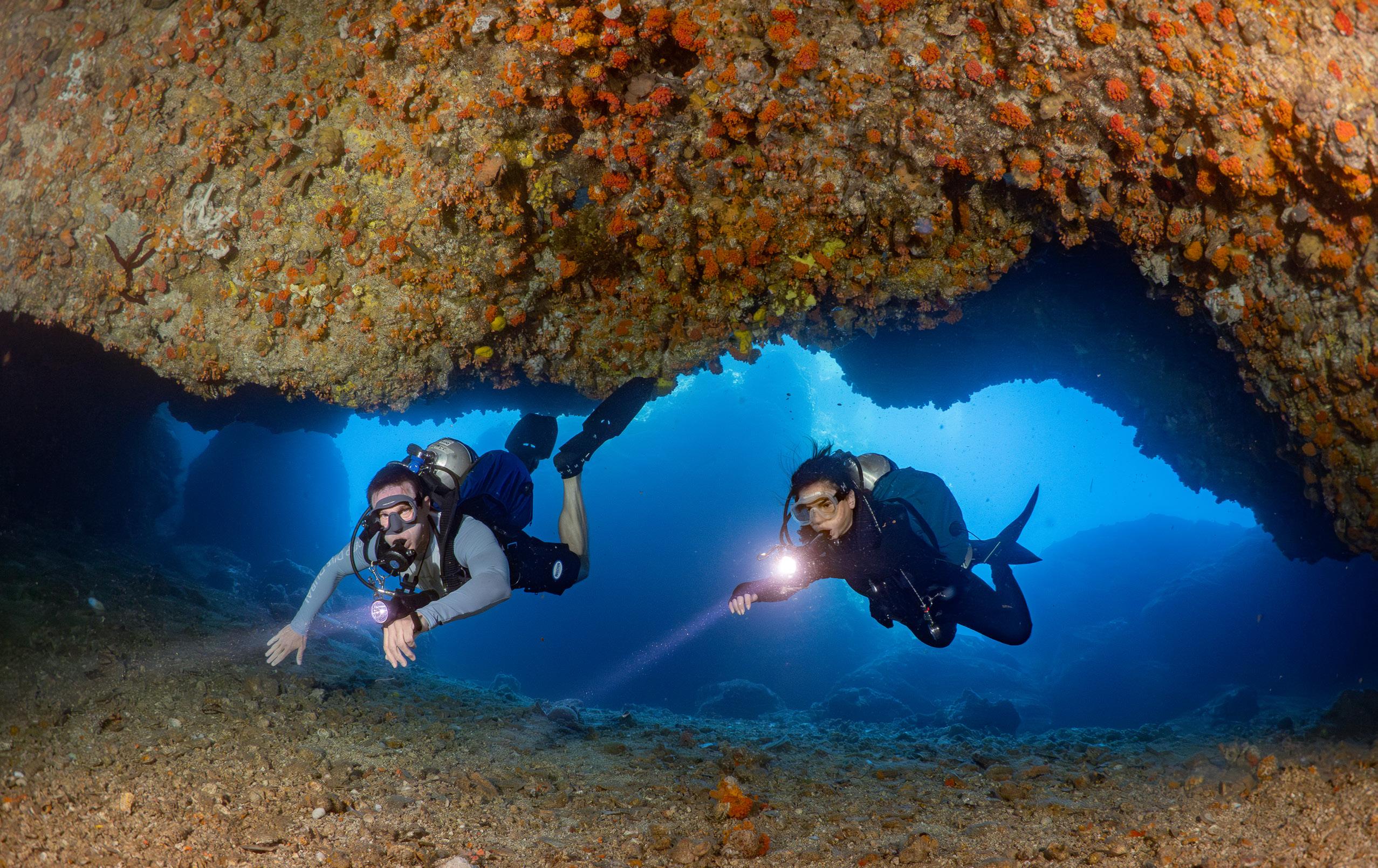
Pescador Island’s underwater caves provide a perfect sanctuary for whitetip reef sharks, which can often be found resting on the sandy floor during the day.
The Atlantis Adventurer
When it was time to board the Atlantis Adventurer, excitement rippled through the group. The liveaboard—formerly the Truk Aggressor—has been beautifully reimagined for comfort, safety, and exploration. At 32 m/107 ft long and staffed by an exceptional crew, she carries divers to some of the Philippines’ most iconic sites: Pescador, Gato, Kimud Shoal, Balicasag, Pamilacan, and Sumilon. Each site brings a new facet of the Philippines’ underwater heritage.
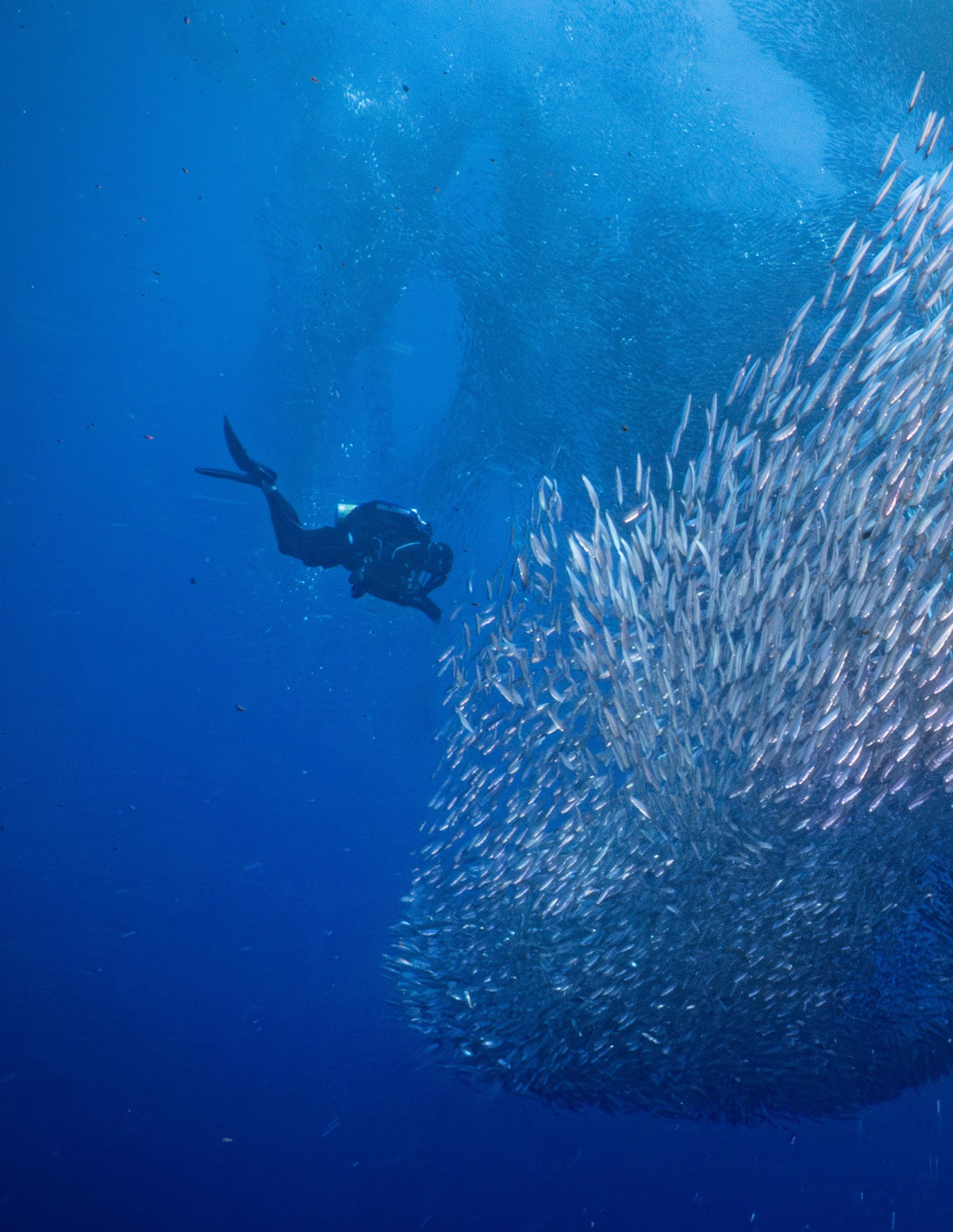
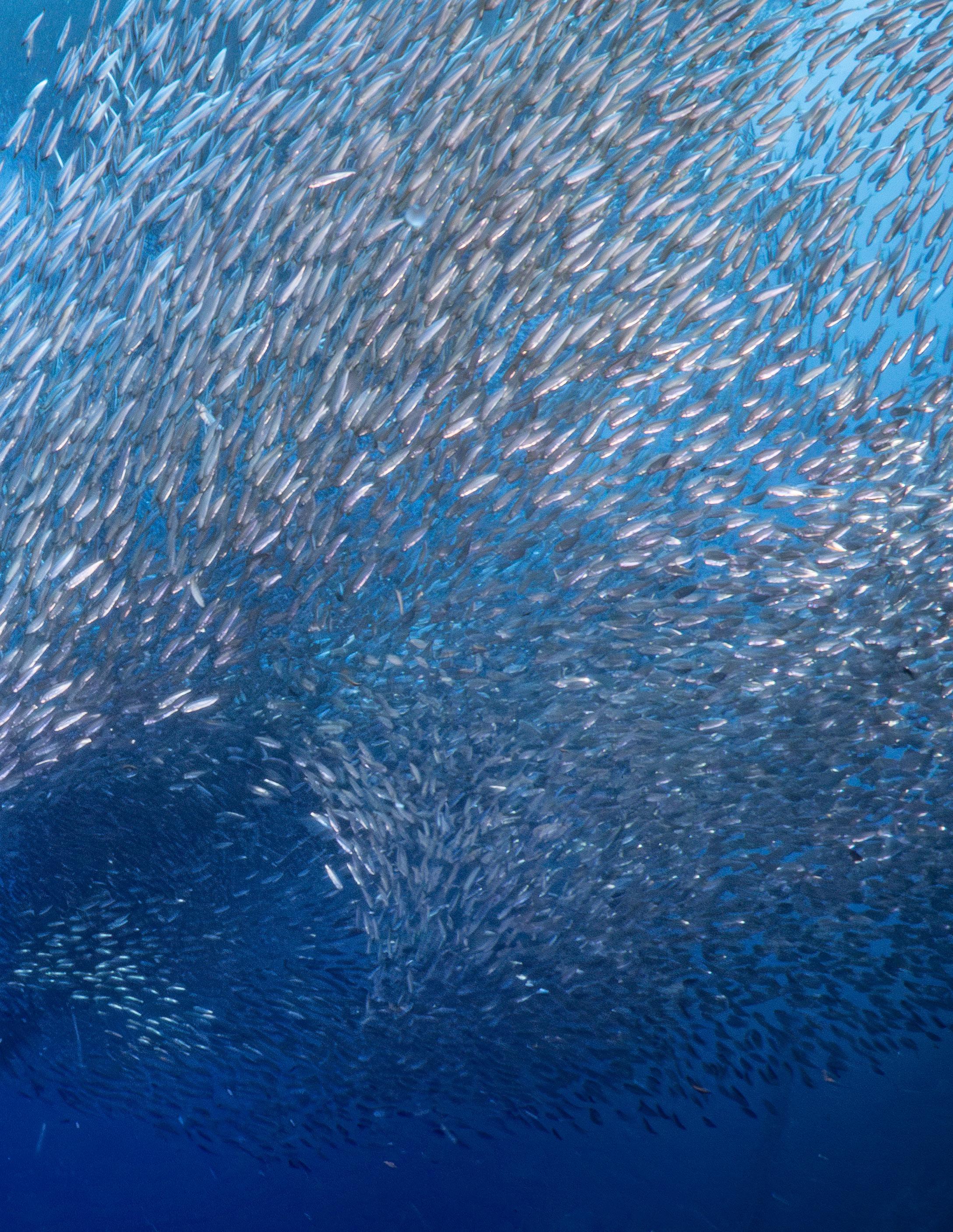
At Pescador, walls draped in coral give way to swirling sardine balls that shimmer like liquid silver. Gato Island reveals its famous tunnels and the mesmerizing dance of cuttlefish and frogfish, while Kimud Shoal delivers one of diving’s most breathtaking encounters: thresher sharks emerging from the deep. Balicasag Island enchants with turtle cleaning stations and schools of jacks, while Pamilacan’s coral walls host sea snakes, reef sharks, and vibrant gardens of hard coral. Finally, at Oslob and Sumilon, the group experienced unforgettable whale shark encounters, a fitting crescendo to a journey through the
heart of the Coral Triangle. Floating eye-to-eye with the largest fish in the sea is a humbling, intimate reminder of our place in the vast blue world. The sight of these gentle giants gliding past, unhurried and serene, stays with you long after the bubbles fade.
Carefree luxury
Life aboard the Adventurer blended professionalism with warmth. The 15-member crew greeted each returning diver with towels, snacks, and smiles. Between dives, divers relaxed on the sun deck, edited photos in the lounge, or swapped stories over tropical fruit smoothies. Some gathered on the upper deck for socializing under the stars, while others enjoyed the quiet rhythm of the ocean. Every detail—from neatly labeled gear stations to nightly briefings—reflected the precision and pride of a team that genuinely loves what they do.
Meals were chef-prepared and plated with flair—hearty breakfasts, elegant lunches, and dinners featuring grilled marlin, vegetable curry, and roasted pumpkin soup. The galley’s cre-
ative team became legends of the trip for their mastery of flavor and timing. Beer, wine, and local rum were available, but the true indulgence came from the camaraderie. Between dives, the lounge transformed into a hub of photo editing and storytelling, the air thick with laughter and the occasional burst of applause for a particularly good macro shot.
The Adventurer’s itineraries are carefully chosen to balance relaxation and adventure. The crew’s ability to anticipate needs—from adjusting schedules to setting up and preparing all relevant equipment—gave everyone a sense of calm confidence. Even on challenging dives, the professionalism shone through, and the joy of discovery never dimmed.
Innovation below the surface
Beyond the natural beauty, this journey carried a pioneering spirit. Several members of the GUE team were conducting field testing for new features of the Halcyon Symbios™ Rebreather and its integrated ecosystem. Over multiple dives, the Symbios demonstrated flawless perfor-
mance—from shallow macro sessions to deeper profiles at Kimud Shoal and Balicasag. The unit’s intuitive controls, comfort, and minimal buoyancy shift impressed everyone.
Divers also trialed new Symbios-enabled features, including a refined Buddy Screen, allowing easy viewing of a buddy’s dive data on either rebreather or open-circuit platforms. The ability to swim by a dive buddy and quickly check critical parameters is both useful and fun. Meanwhile, some recreational divers in the team loved experimenting with the real-time trim position via the Symbios Tank Pod. The latter allowed divers to monitor trim and gas supply data directly through the Symbios HUD or Handset, fostering team awareness and safety. As one diver noted, “Having real-time data at eye level changed the way we communicate underwater—it’s like diving in the future.”
The combination of GUE’s team protocols and Halcyon’s advanced equipment provided a joyous and engaging experience for everyone, exploring the future of diving while enjoying the simple pleasures of lived experience. Symbios
“Each diver came away transformed, not only by what they saw beneath the surface but by what they shared above it.
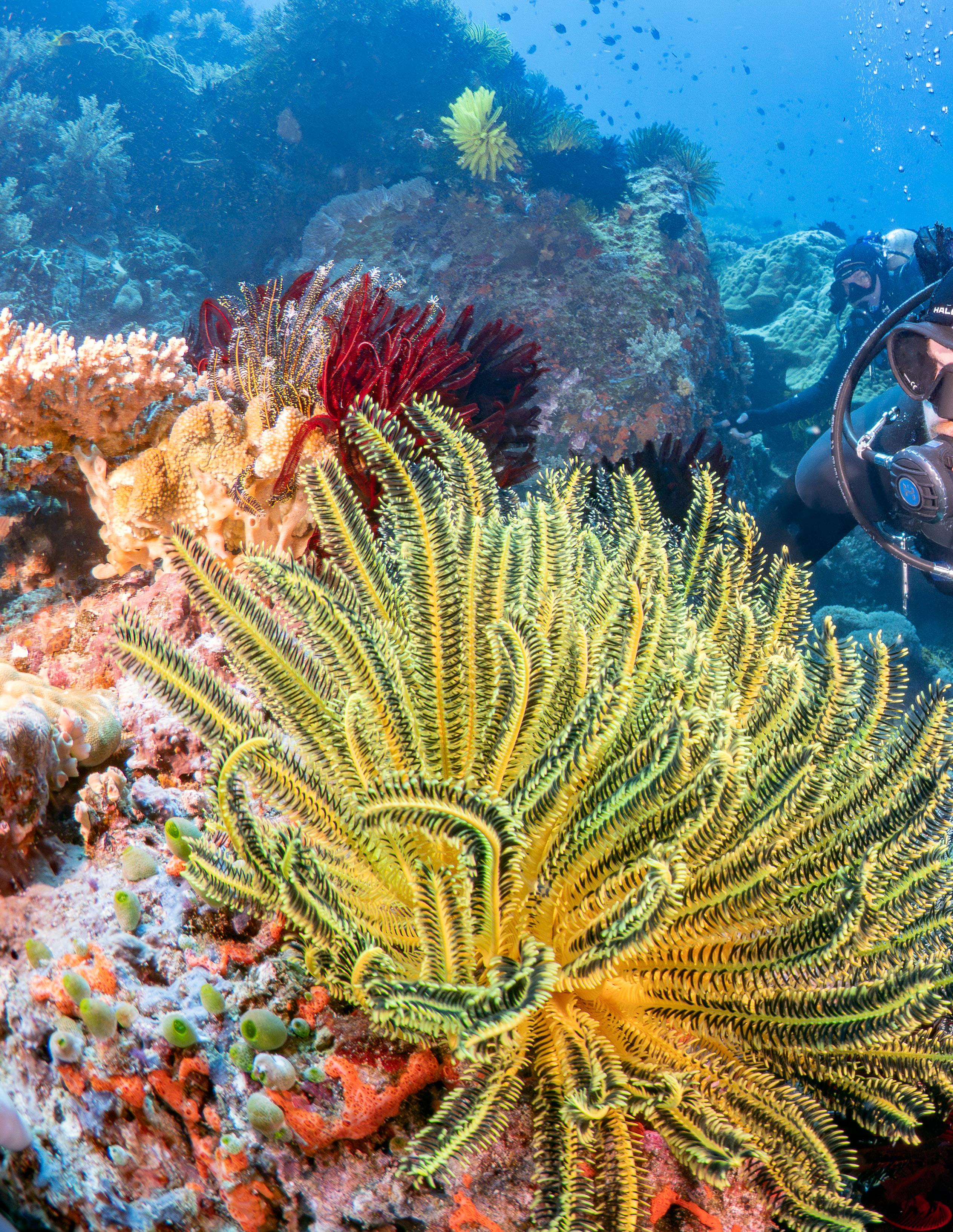
Feather stars aren't plants—they are actually echinoderms, making them distant relatives of sea stars and sea urchins. They can even "walk" or swim by waving the arms.
Renowned for its dramatic limestone geology, Pescador Island features a honeycomb of caverns and swim-throughs.
rebreather divers worked seamlessly alongside open-circuit teammates, sharing insights and data that will help refine the next generation of dive technology. Watching advanced technology operate in perfect harmony with the diver—and the ocean—was a reminder that the future of exploration is already here.
Shared moments, enduring memories
The week unfolded as a celebration of both technology and togetherness. Evenings brought sing-alongs under the stars, birthday surprises, and shared reflections over the day’s dives. One unforgettable sunset found dolphins racing the bow, while laughter and quiet satisfaction filled the air. The upper deck became a sanctuary of its own, where stories, jokes, and dreams flowed as freely as the sea breeze.
Each diver came away transformed, not only by what they saw beneath the surface but by what they shared above it. The Atlantis crew, with their warmth and meticulous care, set a standard that redefines dive hospitality. Whether helping with camera gear, remembering everyone’s
favorite snack, or ensuring a smooth liveaboard crossing, they embodied the spirit of the Atlantis motto: “Arrive as a guest, leave as a friend.”
As the trip drew to a close and gear was stowed away, no one was quite ready to leave. The Philippines had given us something beyond adventure; it offered connection, discovery, and the reminder that all dives feel like an exploration when innovation meets heart. The gentle sound of waves against the hull and the last sunset over the Sulu Sea seemed to whisper a promise: we will return.
Across all these destinations—Moalboal–Pescador, Gato–Malapascua, Kimud Shoal, Balicasag Island, Pamilacan Island, and Oslob & Sumilon—divers are treated to a stunning variety of habitats, exceptional coral health, and a wealth of marine life. From the shimmering sardine runs of Cebu to the graceful thresher sharks of Malapascua and the turtle-strewn reefs of Balicasag, these sites represent the best of Philippine diving and a living showcase of how vibrant and resilient the country’s underwater ecosystems remain.
PHOTO DIMITRIS FIFIS
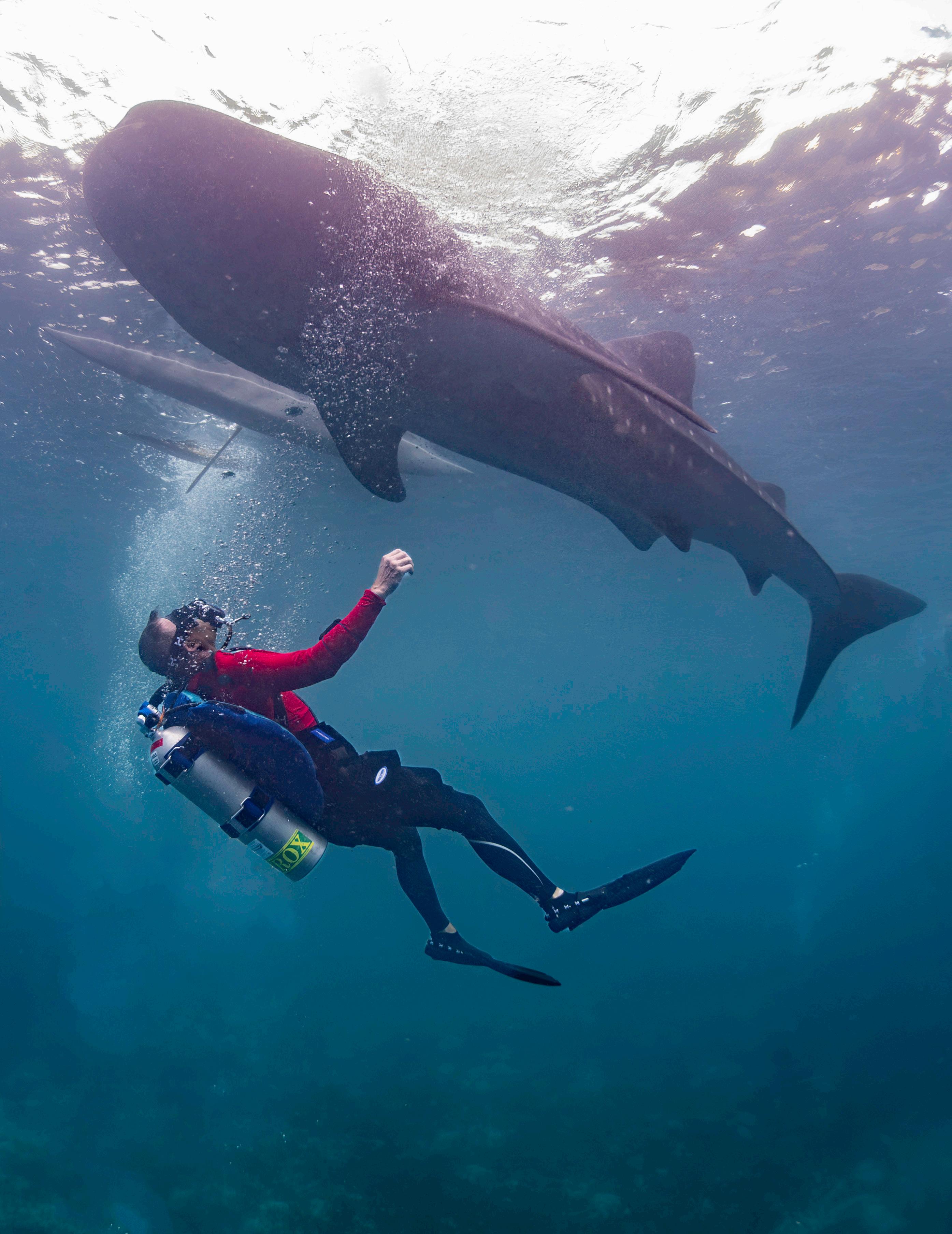
Gliding with these serene giants is a humbling dance that stays with you long after the bubbles fade.
PHOTO DIMITRIS FIFIS
FACT FILE // DIVE SITES
MOALBOAL–PESCADOR
Just off the coast of Cebu, the Moalboal–Pescador area is famed for its dramatic marine scenery and vibrant reef life where divers are surrounded by large, shimmering schools of sardines—a spectacle that blankets the reef wall and draws in predators and smaller reef fish alike. At Pescador, the reef drops away in a richly coral-covered wall adjacent to the famous Cathedral cave system, where giant frogfish and other cryptic creatures hide in the shadows. In the Coral Garden, our team found healthy hard and soft corals with scorpion fish and a host of reef dwellers making their home among the branches. The deeper coral walls remain spectacular, showcasing a dense, thriving ecosystem.
GATO–MALAPASCUA
The offshore island of Gato, near Malapascua, is a marine reserve and sea-snake sanctuary known for its impressive biodiversity. At the Southeast Corner, our team encountered cuttlefish, frogfish, and other camouflaged creatures among the coral. The East Side and Yellow Tip Reef were excellent for our team of photographers due to the abundance of nudibranchs and the vibrant mandarin fish that perform their sunset courtship dances. Gato Island’s rugged underwater terrain featured caverns and tunnels where whitetip reef sharks could be found resting, and its currents keep the
Field-testing the Symbios head-up display on Pamilacan Island’s coral reefs.
reefs swept clean and full of life. The coral here was exceptionally healthy, supporting both pelagic and macro species in equal measure.
KIMUD SHOAL
Kimud Shoal presented engaging encounters with thresher sharks with a reef life that is just as rewarding, with frogfish, anemone fish, schooling jacks, and barracuda adding variety to the spectacle. The shoal’s broad coral plateau supports a diverse marine community, and the surrounding blue water teems with pelagic life. With great visibility and robust coral growth, Kimud Shoal offers a perfect combination of big-animal excitement and healthy reef ecosystems.
BALICASAG ISLAND
Balicasag Island is renowned for its coral walls, crystal-clear waters, and rich marine biodiversity, and it did not disappoint. At Diver’s Heaven, our team was treated to numerous sea turtles gliding effortlessly over reefs covered in sponges and hard corals. The Black Forest site treated us to schooling jacks and gentle drift dives, leaving us to float magically past coral-covered slopes. Cathedral showcased a variety of reef fish in brilliant color, while Marine Bay offered the magic of a night dive filled with octopuses, crustaceans, and hunting fish emerging from the dark. Balicasag’s reefs are remarkably well-preserved, thanks to local protection efforts, making it one of the healthiest and most picturesque islands in the Visayas.
PAMILACAN ISLAND
Pamilacan Island rewarded our divers with a mix of vibrant reefs and pelagic encounters. At the North Wall, reef sharks were regularly spotted patrolling along the drop-offs, while the Coral Garden delighted our photographers with sea snakes, shrimp, and tiny reef creatures. Pamilacan is also an excellent site for observing the interaction between small reef inhabitants and larger predators, with consistently strong coral health and visibility. Its tranquil setting and variety were a striking blend of beauty and serenity.
OSLOB & SUMILON
Year-round In Oslob, divers have the extraordinary opportunity to see whale sharks—a breathtaking encounter with the ocean’s largest fish. Despite the crowds, swimming alongside these huge fish is an unforgettable experience. Meanwhile, nearby Sumilon Point and Cottage Point provide exceptional reef diving, with fields of coral teeming with reef fish and sea fans. Sumilon’s protected marine reserve status has helped preserve its excellent coral cover, making it a superb complement to Oslob’s big-animal spectacle. Together, they offer a rare mix of close-up megafauna encounters and thriving coral ecosystems.
FACT FILE // CEBU
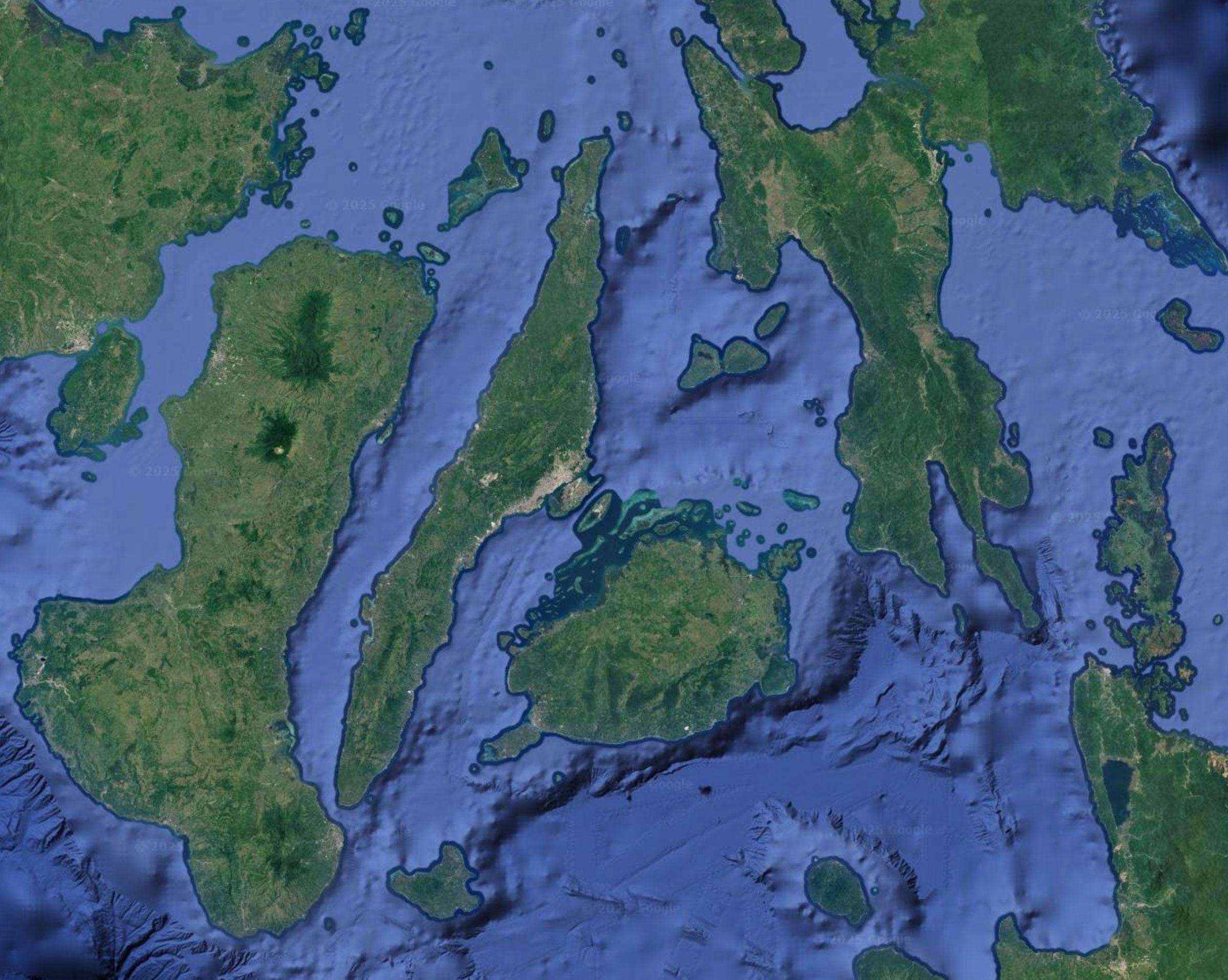
Cebu’s allure for divers isn't just in the water— it’s in the tectonic and bathymetric drama of its location. This slender, 196-kilometerlong island sits at the heart of the Visayan archipelago, carved by the Tañon Strait to the west and the Cebu Strait to the east.
Geologically, Cebu is a raised limestone plateau, which creates the dramatic "walls" that define its coastline. In Moalboal, the island shelf drops vertically from a mere 3 m/10 ft to over 40 m/130 ft just a stone’s throw from the beach. This sheer underwater cliff face is the stage for the famous "Sardine Run," where nutrient-rich currents rising from the 500 m/640 ft deep Tañon Strait
THE PHILIPPINES
support a massive biomass of pelagics and cetaceans.
To the north, the geography shifts to submerged volcanic ridges. Monad Shoal, a massive 1.5 km/1 mi wide plateau, rises from the abyss to within 20 m/66 ft of the surface. This unique "sunken island" serves as a natural cleaning station for Pelagic Thresher Sharks, who ascend from depths of to these shallow crests at dawn.
The Danajon Bank, located off northern Cebu, is one of only six double barrier reefs in the entire world, creating a unique microecosystem of high coral density and calm lagoons.
Balicasag Island
Dumaguete City Atlantis Dive Resort
CEBU
Cebu City
Moalboal
Apo Island
Malapascua
Oslob
Pamilacan Island
Born in Athens, Dimitris Fifis began diving in 1991, transitioning from a 23-year career in the Hellenic Navy to professional diving in 2009. His experience spans managing dive centers, working in the mega-yacht sector, and a long-standing involvement with GUE.
The Coral Triangle reveals exceptional biodiversity, supporting an astonishing variety of corals and reef fish.
Currently the Senior Operations Manager at Deep Dive Dubai, Dimitris focuses on diver safety, exploration, and underwater filming. A technical diving specialist, he is a core member of the Halcyon CCR development team and a factory trainer for the Symbios CCR, dedicated to advancing high-level education and equipment standards.
Dimitris Fifis
Lessons learned from a provisional rating
PHOTO CAROLINA WELLS
TEXT ANDY WILSON
PHOTOS CAROLINA WELLS, WESLEY VAN VLIET, EMŐKE WAGNER, FABIO SAGHEDDU & RICH WILSON
NOT YET
Receiving a provisional rating is a common yet rarely discussed reality in GUE training. For many, it can feel like a setback, but for 2025 NextGen Legacy Project recipient Andy Wilson, it became a masterclass in humility and growth. Faced with equipment hurdles and the pressure of traveling for her Cave 1 course, Andy realized that "not yet" isn't a failure— it’s an invitation to mastery. In this candid reflection, she explores the "comparison trap" of social media, the value of honest selfassessment, and how embracing a non-linear path is shaping her journey to become New York City’s first GUE instructor.
While Andy worked toward her cave diver certification, she continued to enjoy exploring wrecks whenever possible.
Receiving a provisional rating is something many GUE divers experience, yet few talk about openly. Through the GUE NextGen Scholarship, I became part of a global community of divers: teammates, mentors, and friends from all over the world. Over time, I noticed a quiet pattern in conversations. Occasionally, someone would mention, almost in passing, that they or someone they knew had received a provisional rating. It was rarely expanded on. It often came with a small laugh or a quick change of subject, as if to soften the moment and move on.
It made me wonder why we don’t talk about it more.
Provisional ratings exist for a reason. They are a deliberate part of GUE’s mastery-based training system, but they are often misunderstood. For many divers, especially those early in their diving journey, a provisional can shake confidence or trigger doubt. It can feel personal, even when it isn’t.
I want to talk about it openly, not because my experience is unique, but because it isn’t. And
because understanding what a provisional really means can change how we approach learning, teamwork, and long-term excellence.
This is my experience receiving a provisional rating for GUE Cave 1 and why it became one of the most valuable learning periods of my diving journey.
Before the course
I spent time preparing for Cave 1. I did a lot of diving, trained intentionally, and felt mostly ready to take on the challenge. I had already learned, many times, that growth often comes from discomfort, and I was excited for the next step.
About a month before the course, my husband (also one of my Cave 1 teammates) and I became severely ill and had to postpone the course. While I had felt well-prepared for the original dates, I didn’t have the opportunity to refresh my skills before the rescheduled course.
Because my health had kept me out of the water for nearly two months, the new drysuit I
PHOTO WESLEY VAN VLIET
Cave diving in Sardinia, where Andy finally earned her GUE Cave 1 certificate after a long journey.
PHOTO FABIO SAGHEDDU
had been looking forward to using remained dry as well. I entered the course having spent only about twenty minutes in it. It wasn’t an ideal situation and I was aware of the risk, but it was one I believed I could manage.
The course itself was demanding, mentally and physically—six long days.
It quickly became clear to me that the boots in my suit had a lot of extra room, making buoyancy and trim difficult to manage while learning cave skills. What might have otherwise been a minor issue became a persistent distraction while task-loaded.
On the night of day four, I found myself practicing reel work in the hotel room. I used chairs and furniture to practice primary and secondary tie-offs. Each repetition felt increasingly comfortable. But still, I could not shake off the feeling. It felt like a sense of clarity.
scenarios. They also highlighted areas where refinement was necessary. Maintaining stability while task loaded, anticipating buoyancy changes faster, and engaging a stronger frog kick for more power and efficiency.
In the days that followed, I reminded myself that I had work to do and that was okay. This is part of my journey.
Understanding provisional
One of the most important lessons GUE teaches is that learning is rooted in mastery, not speed.
Mastery means skills that hold up under stress. It means stability, awareness, and execution that don’t consume excessive mental bandwidth. It means being able to adapt when conditions change, not just perform when everything goes right.
“In the days that followed, I reminded myself that I had work to do and that was okay. This is part of my journey.
I sat at the edge of the bed and turned to my husband.
“I think I’m getting a provisional.”
Necessary refinement
There had been no mention of this from the instructors at this point, but it didn’t have to be said. I knew I wasn’t quite where I needed to be.
After a long training day at Mayan Blue, it was time for the instructors to evaluate us individually. The outcome was a provisional, as I had anticipated. I was a bit disappointed but not surprised. I respected their judgment and trusted the process. They made it clear I was close, and that mattered to me.
The caves will be here for many years to come; learning is not a race.
The instructors’ feedback helped me further understand why a provisional rating was the right outcome at that time. They described me as a thoughtful and calm diver in the cave. Someone with good situational awareness, strong communication, and that I possessed the ability to understand and navigate complex
A provisional rating fits naturally into this philosophy. It simply means “not yet.”
People learn at different paces, and pace is not a measure of eventual success. Progress matters. Grit matters. Honest self-reflection matters. These ideas were also heavily stressed during my GUE instructor training course (ITC), and they have stayed with me since.
What a provisional does not mean is failure. We often stand in our own way by being too hard on ourselves or attaching our identity to outcomes instead of growth.
The comparison trap
One challenge that’s easy to overlook, especially today, is comparison.
As diving—and GUE in particular—becomes more visible and more popular, social media is flooded with images and videos of people doing impressive dives, passing demanding courses, and progressing quickly. It’s inspiring, but it can also be misleading.
Social media rarely shows the full story: the time spent practicing, the setbacks, the provisional ratings, the failed attempts, or the time spent refining fundamentals between courses.
Andy is aiming to become the first GUE instructor in the New York City area.
What we see is usually the highlight not the process. Without context, it becomes easy to draw conclusions that may not be accurate.
Comparison can quietly shift the focus away from learning and toward outcomes. Instead of asking, “Am I becoming a better diver?” it becomes tempting to ask, “Why am I not where they are yet?”
That mindset isn’t helpful and it isn’t honest. Everyone’s path looks different. Timing, access to mentors, local conditions, finances, equipment, health, and life circumstances all play a role. Progress without context is an incomplete picture.
I fell into this trap myself. Seeing what others were doing made it easy to measure my progress against theirs. I replayed moments from the course in my head over and over again, thinking about what I could have done different-
ly. I compared myself to my teammates. Even though everyone had their own challenges, I felt like the weakest member, and that was difficult to sit with.
Mastery learning
In a system like GUE, where team cohesion and mutual reliance are fundamental, the realization that you are the weakest member can feel heavy. No one wants to be the limiting factor. But over time, I’ve come to see that discomfort differently. The idea that “the team is only as strong as its weakest member” isn’t meant to shame. It’s meant to motivate. It shifts the focus away from ego and toward responsibility. If I want to be a strong teammate, the answer isn’t comparison—it’s commitment to getting better. That internal questioning extended beyond the Cave 1 course. With an ITC scheduled just
PHOTO RICH WILSON
Performing the classic blind gas-sharing exit dry run during Cave 1 training in Mexico.
months later, I even questioned whether continuing to pursue the GUE instructor path was realistic for me.
I’m early in my diving career, and I don’t have thousands of dives. I’m aware of that. But hearing experienced GUE leaders say they’re excited about my long-term potential, including eventually becoming a GUE instructor, has been incredibly encouraging. It reinforced that progression isn’t about where you are relative to others right now, but about consistency, humility, and willingness to do the work.
I’ve spent a lot of time self reflecting and found myself returning to the principles I value most: deliberate practice and repetition, honest self-assessment, and surrounding myself with strong teammates who care. They made me realize that this experience might actually make a better instructor. More relatable, more empathetic, and better equipped to support future students.
Hard work compounds. Skills build. Confidence follows competence. And comparison, when left unchecked, can distract from all three.
Mastery isn’t performative. It’s built quietly, over time, often out of sight.
Traveling for training
Another factor that often amplifies the weight of a provisional rating is travel.
Many divers invest significant time, money, and logistics to attend courses far from home. When training requires flights, accommodations, and limited vacation days, it’s tempting to compress everything into a narrow window, leaving little room for additional practice time, weather delays, or getting sick, just to name a few.
I’ve spoken with several divers who were deeply upset by provisional outcomes largely because they hadn’t planned for that possibility. This is a mindset worth examining. Confidence is important but so is having the ability to check your expectations. Many factors can shorten or complicate a course, and travel can amplify that impact. When travel is involved, a reevaluation may be weeks or months away instead of days. That gap can make a provisional feel heavier than it actually is.This was true for me as well.
PHOTO EMŐKE WAGNER
Exploring the caves of Andy’s native Mexico.
PHOTO CAROLINA WELLS
There are no caves in City. I knew returning to cave diving would require travel. Although I love Mexico, my home country, and planned to return after the course, I initially had different expectations. I had pictured returning to Mexico as a Cave 1 diver ready to do Cave 1 dives. When the provisional outcome shifted that plan, I had to recalibrate—not my goal but my timeline.
This is an aspect of diving worth acknowledging when planning training.
“
from senior leadership within GUE. Every session reinforced the same principle: improvement comes from focused practice with the right people.
By the time my Cave 1 reevaluation took place, I felt calm, not because I expected a particular outcome, but because I trusted the preparation behind it.
I strongly encourage traveling for courses. Training outside your home environment exposes you to new teammates, different diving styles, unfamiliar environments, and a broader diving community. Those experiences are valuable and often transformative. Building buffer time into your schedule, mentally and logistically, can change how you experience a provisional outcome.
A provisional isn’t a setback, it’s feedback. But it’s much easier to receive that feedback constructively when time pressure isn’t part of the equation.
Doing the work
After the course, I went straight to work, focusing on addressing the feedback from the instructors.
I spent a full day cave diving one-on-one with another instructor, revisiting cave procedures and fundamentals from a different perspective. During the session, I practiced reel work, and I focused on mimicking his propulsion mechanics. That focused work paid off and I’ve since received positive feedback on my frog kick.
In the months that followed, I revisited cave procedures repeatedly, writing them out until they were second nature. I focused on skills that required more commitment and follow-through, particularly under task loading. I dove with local teammates, traveled to Sardinia for my ITC, and received one-on-one feedback
I also addressed my equipment challenges pragmatically and creatively. With drysuit boots that were simply larger than ideal, I ended up having to wear three pairs of socks to reduce gas trapping. It wasn’t elegant, but it worked. With this, I learned an important lesson about not carrying unresolved problems into future dives.
By the time my Cave 1 reevaluation took place, I felt calm, not because I expected a particular outcome, but because I trusted the preparation behind it. The instructor, a mock student, and I spent time in Bel Torrente cave where I demonstrated cave-specific skills before moving out to the cavern and open water sections to complete the remaining skill demonstrations before the evaluation.
I earned my Cave 1 pass.
What I’ve learned
This experience reinforced something I already knew about myself: perseverance shapes my path. Most things don’t come easily but it's important I keep going. The route may not be linear, but progress is inevitable when effort is honest and consistent.
It also reminded me how critical strong teams are. Growth happens faster and more sustainably when you surround yourself with people who value safety, mastery, and accountability over ego and shortcuts.
Most importantly, it strengthened my belief in high standards. GUE’s standards exist to protect divers and to preserve a culture of competence, confidence, and comfort. Experience dives between courses are not obstacles; they are opportunities for skills to solidify.
This experience didn’t slow me down. It sharpened me. Did this happen to you? If you’ve just received a provisional rating: your instruc-
tor sees your potential. This is an invitation to refine. You will get there.
If you’re considering quitting: pause and stabilize. Learning at a different pace does not disqualify you from excellence. The longer route may actually make you a stronger diver.
And if you want to be a better teammate: acknowledge how this can feel. One day, you may recognize the same struggle in someone else and know exactly how to support them.
As a future instructor, I believe transparency matters. When students see that instructors face challenges too, and work through them, they are more likely to trust the process and themselves.
Looking ahead
Training, travel, and anticipation can make a provisional rating sting. But courses do not guarantee certifications. Experience does.
Today, I am registered for Cave 2. I feel more prepared, more self-aware, and more deliberate in my practice than ever before.
My journey hasn’t been linear and that’s okay.
Andy Wilson
Mexico-born, NYC-based Andy Wilson is a GUE recreational instructor candidate, cave diver, and 2025 NextGen Legacy Project recipient. With global experience across caves, wrecks, and cold-water environments, she is interning to become New York City’s first GUE instructor. Andy balances her diving career with her role as a pharmaceutical quality engineer, bringing a systems-based approach
to safety. Passionate about accessibility and inclusion, she supports diverse communities through mentorship and representation. From diving year-round in the Northeast to creating content, Andy is committed to making highquality diving education more equitable and accessible to all.
Master of shadows FRANK ARON
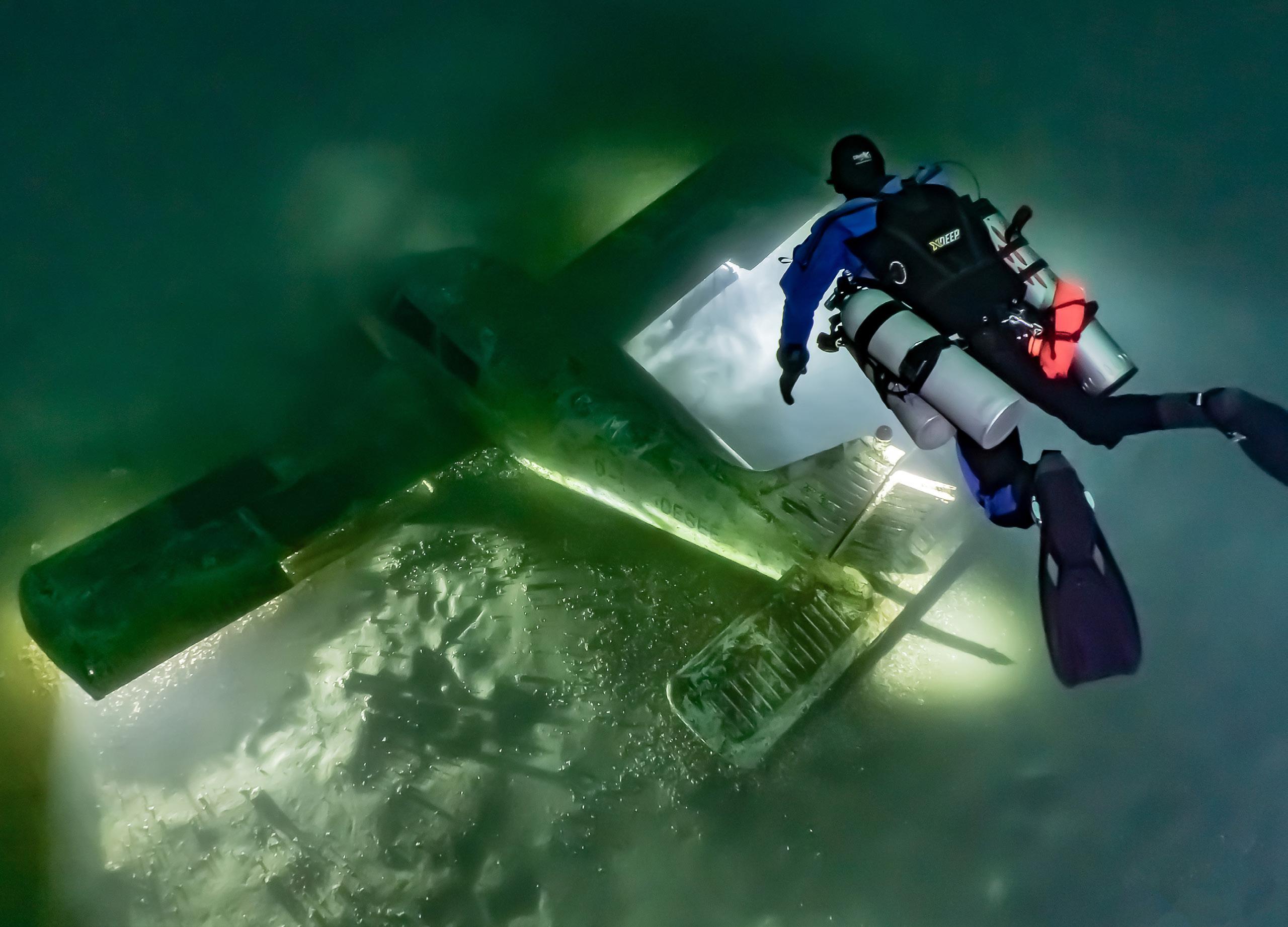
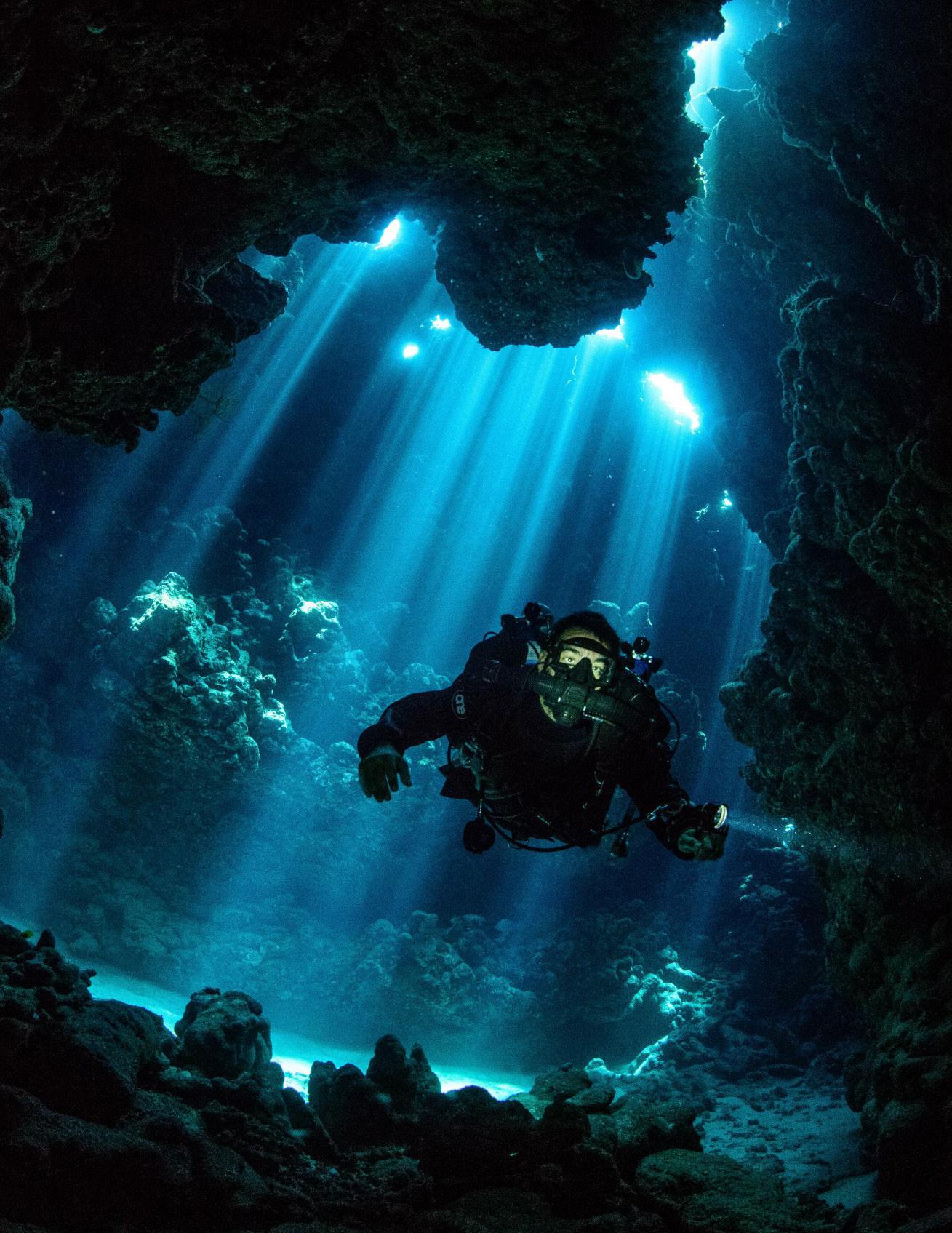
It’s this game of light and shadow that fascinates me, Frank says, reflecting on his first snorkeling trips in the 1970s with his father in the Mediterranean Sea. Sunlight illuminated the blue water, creating an atmosphere akin to floating in outer space.
That memory resurfaced in early 2020, shortly before the COVID-19 pandemic reached Germany. Frank was diving in his favorite flooded quarry in northern Germany. The water was crystal clear, and as the sun peaked over the edge of the quarry, its beams illuminated the scenery and recreated that sensation of flying through space.
A scuba diver since 1986 and a technical diver since 1998, Frank began his underwater photography journey in the early 1990s with a Nikon Coolpix. His initial attempts focused on fish portraits, octopuses, and images from French caves. However, that specific moment in the quarry
LOCATION Kreidesee, Hemmoor, Germany
CAMERA Sony A7C
LENS Sony SEL-28/20, Nauticam WWL-1
HOUSING Nauticam NA-A7C
EXPOSURE 1/10 sec, f/8, ISO 8000
LIGHT/STROBE Several video lights (40,000 lumens total)
revealed his true calling: capturing underwater landscapes draped in light and shadow.
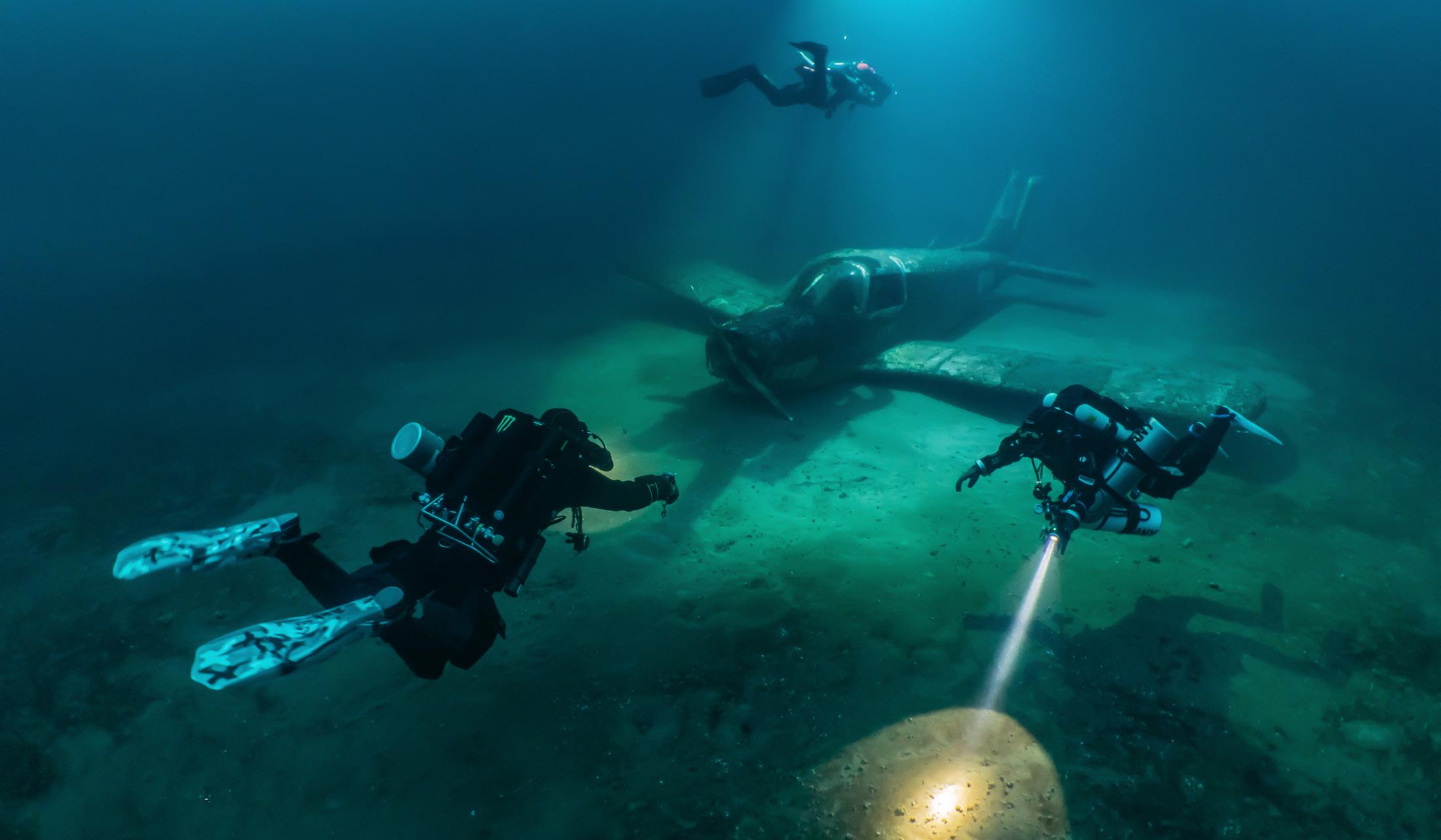
As an active dry caver for many years, Frank successfully transferred his cave photography expertise to the underwater environment. Inspired by world-class photographers like Alex Dawson, he realized this style could be applied to the flooded slate mines near his home. Northern Germany offers several slate mines with distinct characteristics, complemented by limestone mines in eastern Germany.
His cave diving certification provides seamless access to these environments. By using powerful video lights (such as the BigBlue VL65000), he creates intentional beams and shadows to define structures and highlight key elements of the scenery. In his work, the diver is often emphasized through strategic illumination, serving both as a focal point and a sense of scale.
Today, Frank applies these techniques to wreck photography, primarily in the Mediterranean where his journey began.
www.franks-unterwasser-fotos.de
LOCATION See im Berg, Quarry lake, Messinghausen, Germany
CAMERA Sony A7C
LENS Sony SEL-28/20, Nauticam WWL-1
HOUSING Nauticam NA-A7C
EXPOSURE 1/40 sec, f/9, ISO 2500
LIGHT/STROBE Bigblue VL65000 P
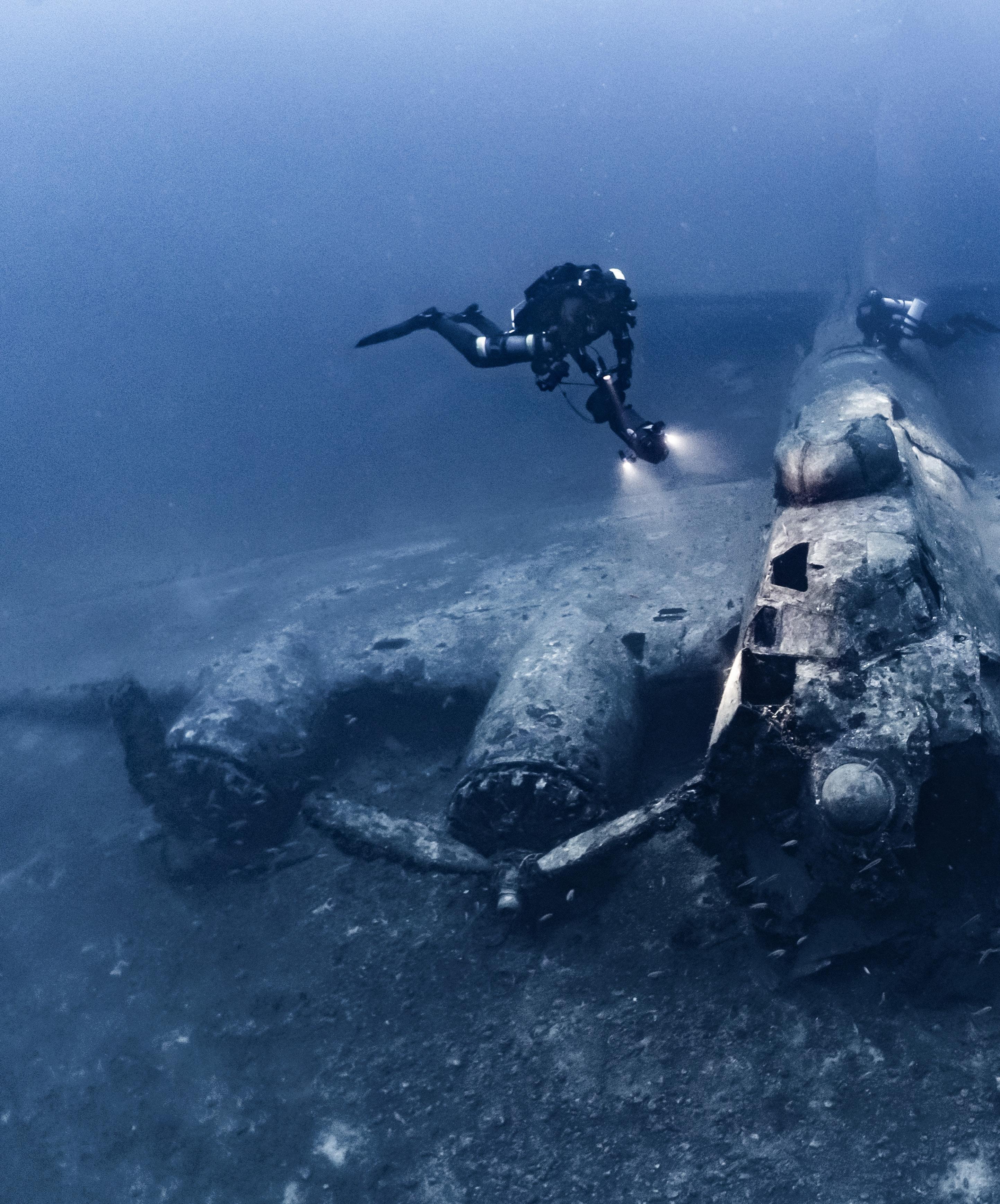
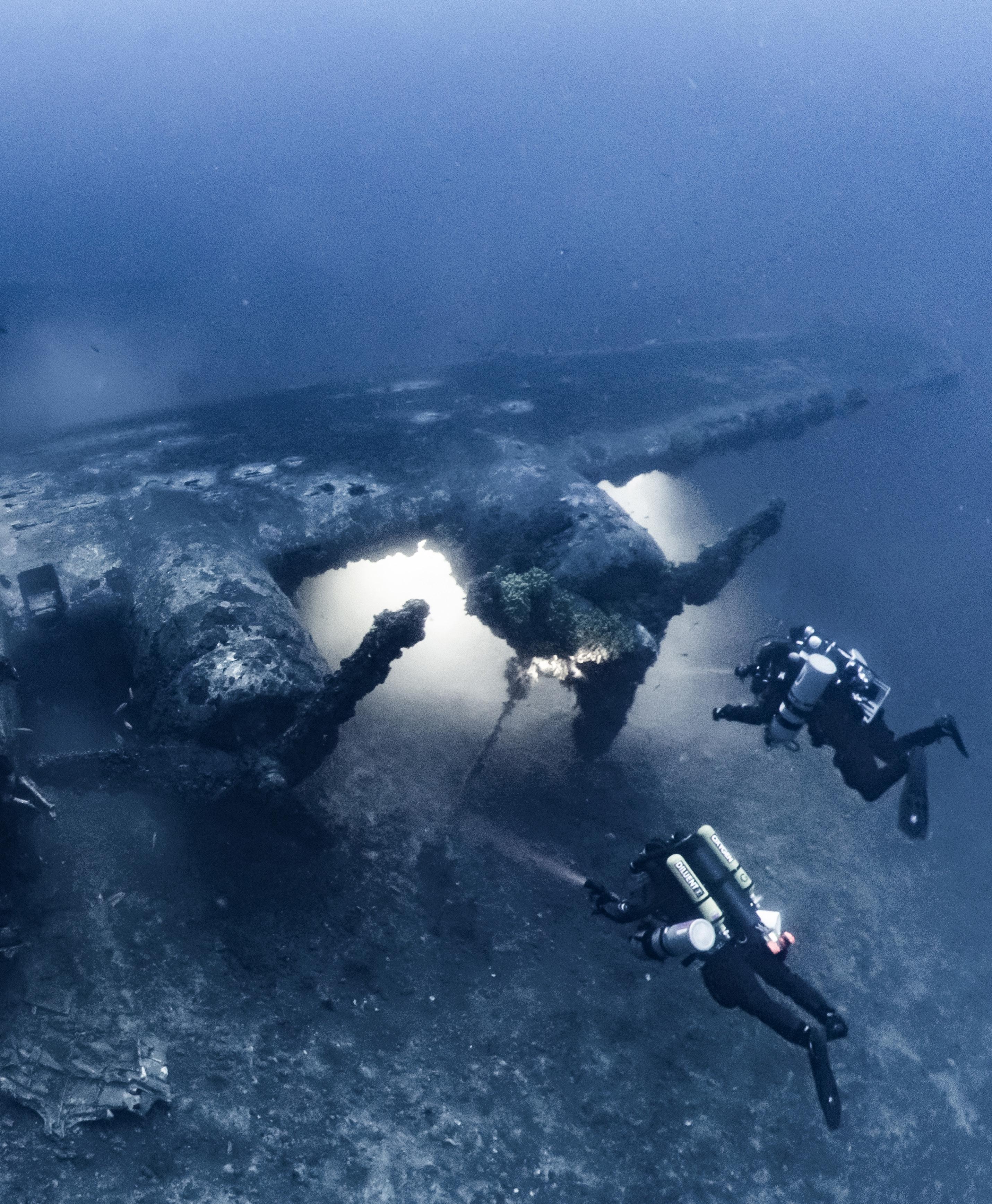
LOCATION B17, Island of Vis, Croatia
CAMERA Sony A7C
LENS Sony SEL-28/20, Nauticam WWL-1
HOUSING Nauticam NA-A7C
EXPOSURE 1/30 sec, F/7.1, ISO 1250
LIGHT/STROBE Bigblue VL65000 P
LOCATION Kreidesee, Hemmoor, Germany
CAMERA Sony A7C
LENS Sony SEL-28/20, Nauticam WWL-1
HOUSING Nauticam NA-A7C
EXPOSURE 1/30 sec, f/7.1, ISO 10000
LIGHT/STROBE Bigblue VL65000 P and other video lights (50,000 lumens total)
L IGHT/STROBE Bigblue VL65000 P and other video lights (70,000 lumens total)
STABILITY
At the core of GUE’s training philosophy is an emphasis on stability, the ability of divers to maintain their position, nearly motionless, in the water column. This view holds that changes in body position should be the result of intention, not inadvertent action. GUE’s belief is that stability in diving is analogous to the foundation of a building: if the foundation is weak, the building will also be weak. Thus, GUE emphasizes the development of these important skills, enhancing diving capacity while greatly enriching fun and safety.
– THE FOUNDATION OF COMPETENCE, COMFORT, AND CONTROL
PHOTO KIRILL EGOROV
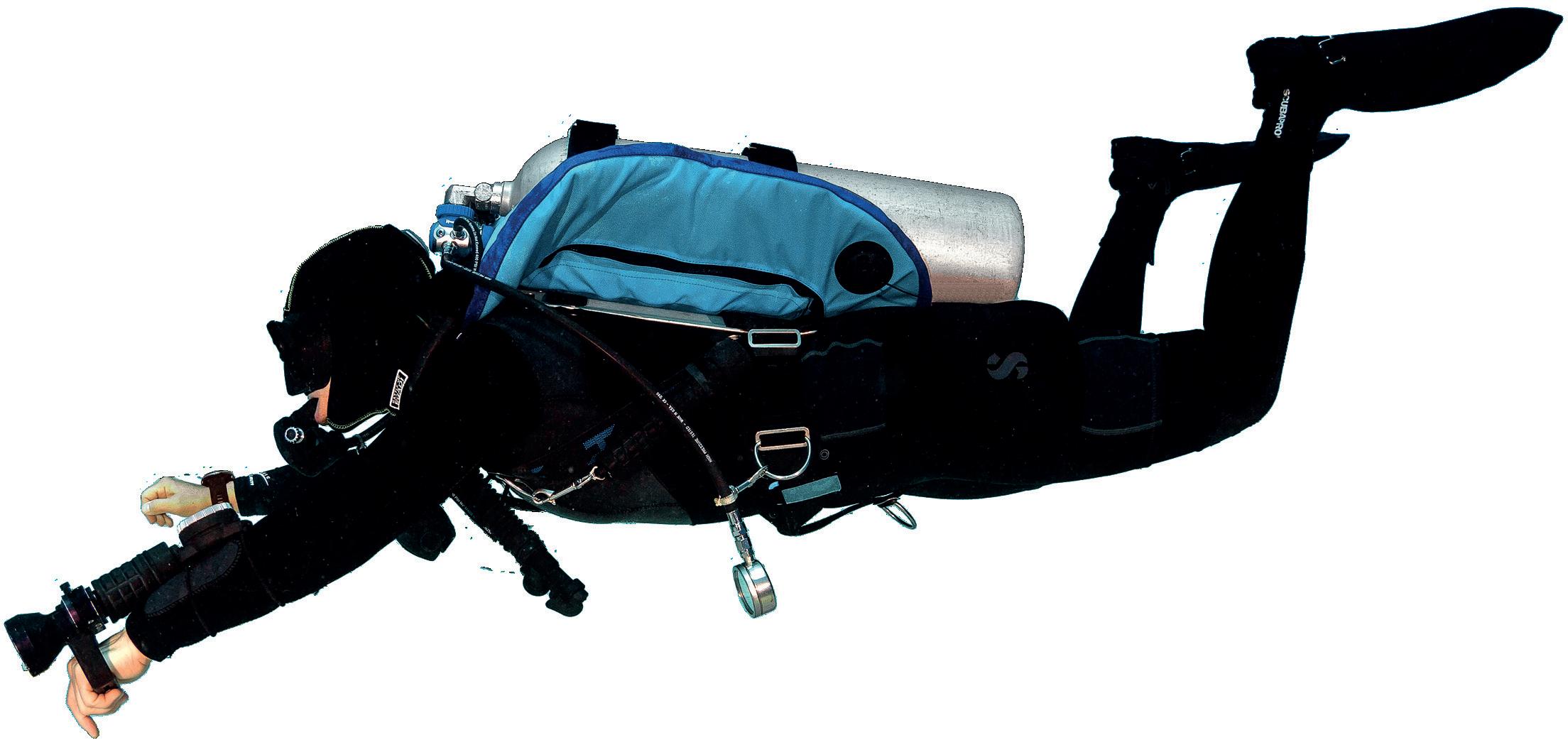
Maintaining a flat, horizontal position reduces swimming resistance, improves propulsion efficiency, and provides the most stable platform.
Being unable to hold a specific position in the water column is not just frustrating—it can be dangerous. An uncontrolled ascent to the surface can hurt a diver as easily as an automobile accident. However, beyond being dangerous, not being stable in the water makes every task more difficult; some tasks even become impossible. Taking a photograph, shooting video, stopping to admire a fish, doing a gas switch, sharing gas, picking up a stage bottle, and a host of other actions are undermined by constant fluctuations in depth, flailing body parts, poor body orientation, and inefficient control of propulsion.
There is evidence that the norm in the industry is to devalue the importance of stability in entry-level training. This occurrence is somewhat understandable, as the negative consequences of an unsound foundation may go largely unappreciated unless something goes wrong, at which point the cracks in the foundation will reveal themselves quickly. Dives can be adversely affected by minor problems involving equipment or fellow teammates, which can result in, at the least, more stress and less fun and, at the worst, more serious problems. Moreover, transitioning to more advanced diving with
a weak foundation sets the stage for a range of difficulties and places divers in unnecessary danger. These divers must also work much harder to overcome bad habits.
GUE maintains that it is best to address and refine fundamental skills from the outset—that is, from the time novices begin their recreational diving classes. It will make a vast difference to the divers, not only if they decide to continue with more ad-vanced forms of diving, but also at the recreational level. Divers will become much more comfortable, learn faster, and gain greater competence in wide-ranging and seemingly divergent skills. Everything becomes easier, safer, and more enjoyable.
Actually, the time needed to develop reasonable stability is not significantly greater than the time spent in most training programs. The sad irony of mainstream diver training is that it does not include this aspect within its required outcomes. However, developing stability does require coordination of four basic components: buoyancy, weighting, trim, and balance.
Mastering buoyancy
To cultivate good buoyancy, divers need to understand which variables affect their buoyancy and how to control them. Ultimately, diving is a constant balancing act. To control their position
in the water, divers must balance negatively buoyant elements of their configuration and makeup—e.g., body composition and certain equipment—against positively buoyant elements such as their lungs and thermal suits. Gases expand as divers ascend, and gases compress as they descend, making divers positively or negatively buoyant. As a result, divers being in control of their position in the water is not without its complexities. But the challenges subside and the value quickly becomes obvious for those who commit to developing this incredibly important skill.
Between the extremes of being positive or negative is neutral buoyancy. This is the point where the sum total of elements is balanced; divers are neither rising nor sinking. Buoyancy control can be defined as a diver’s successful management of this balancing act. When divers are in control of their buoyancy, they can deliberately select a negative, positive, or neutral position, using these various states to their advantage during ascents or descents, or while hovering comfortably in midwater.
Unnecessary stress
Divers with poor buoyancy control will struggle to maintain position in the water column. They will constantly rise and fall, adding or dumping gas, inhaling or exhaling in a sometimes frantic attempt to hold a particular position in the water. These underwater gymnastics cause divers to artificially modify their natural breathing cycle, often resulting in the accumulation of carbon dioxide. This accumulation can lead to anxiety, confusion, headaches, rapid breathing, lack of focus, and unfortunately, even more difficulties with buoyancy control. Whatever divers’ underwater goals are, achieving them will be easier if they possess good buoyancy control.
“Additionally, divers are not only responsible for their personal safety but also that of their teammates, and an individual struggling with buoyancy control may not have the capacity to support their dive buddy or deal appropriately with emergencies confronting the team.
Increased task load, stress, or any distraction while diving may cause loss of buoyancy control in divers whose buoyancy skills are weak. Loss of control in such situations may lead to unintentional descent, reaching beyond safe depth limits; conversely, they may experience an uncontrolled ascent to the surface.
Proficient buoyancy control makes all aspects of diving easier and safer. The more precisely divers can manage the shifting states of buoyancy, the better their control in the water and the less they will have to work while diving. In contrast, lack of buoyancy control makes all aspects of diving more difficult. Poor buoyancy control is cited as a contributing factor in many diving incidents, and many dive training agencies run specific courses to improve knowledge and skill in this area. Proficient buoyancy control is critical for a variety of reasons, not the least of which is the fun and enjoyment it allows. Feeling in control provides a level of satisfaction and proficiency that cannot be fully appreciated until the skill is properly developed.
These variations in depth can cause potentially serious medical consequences, including damaged eardrums (reverse block), vertigo, embolism, and decompression illness, among others. Proficient buoyancy control, on the other hand, provides a critical element of stability that empowers divers to confidently execute all phases of a dive.
Additionally, divers are not only responsible for their personal safety but also that of their teammates, and an individual struggling with buoyancy control may not have the capacity to support their dive buddy or deal appropriately with emergencies confronting the team. The more divers struggle with buoyancy control, the less capacity they have to manage their diving or be effective team members in support of others.
Solid fundamental skills like trim and balance make complex tasks, such as photography or gas switches, much easier underwater.
Environment
Some of the most beautiful underwater environments are also quite fragile. A coral reef might take many thousands of years to form, but divers can do a great deal of damage in a single dive. Many individuals dive while negatively buoyant, fearing an uncontrolled ascent to the surface or merely being unaware of their in-water position. These actions typically encourage intermittent contact with the surrounding environment—for example, pushing off a reef or wreck without considering refined buoyancy control as a more appropriate solution. Divers with unsound buoyancy skills contribute to coral destruction, obliterate millennial geological formations in caves, and damage wreck interiors. Such contact may also be detrimental to divers. Not only will poor buoyancy control increase the risk of divers damaging their own
equipment (e.g., puncturing a drysuit), but it may also result in injury (e.g., burns from touching fire coral).
How to control buoyancy
Buoyancy control is not just about maintaining position at a desired depth. It is also about maintaining control during dynamic portions of the dive: while descending or ascending and throughout the bottom phase of the dive. Many individuals dive while remaining somewhat negative and compensate with arm and leg movements, increasing fatigue and respiratory stress. Instead, divers should be sure they are weighted correctly and make small adjustments to their buoyancy (add or release small volumes of gas).
A slow, smooth descent is best managed by adding gas to the buoyancy compensator (BC)
in small bursts and referencing a depth gauge to better measure rate of travel. As divers descend, they should add gas slowly but consistently to ensure the rate of descent does not become too rapid. If done accurately, stopping at the planned depth will not require a large inflation of the wing; a small top-up will bring the descent rate to zero and stop the divers, who will come to rest in a neutrally buoyant position.
Upon reaching the planned depth, divers should stop to verify neutral buoyancy, which is achieved when they remain stable in the water column, in the middle of their breathing cycle, and without using movement to adjust position. Adjusting BC volume should again be managed in small increments. These divers will be slightly positive at the top of their breathing cycle (after inhaling) and slightly negative at the bottom of the cycle (after exhaling).
Finding and re-finding neutral buoyancy will be a frequent exercise as divers change depth throughout a dive. As divers ascend, gas expansion from reduced pressure will cause them to become positive, necessitating that they release gas from the BC. During descent, they should also anticipate adjustments, remaining ready to add gas to the BC (or drysuit, if applicable) before and especially as they near the targeted depth. The anticipation of these changes is a critical element of efficient management of buoyancy control.
Precise buoyancy control can be particularly important during ascent given the variety of complications that can manifest with poor control. Greater precision can be achieved by dumping gas in small, frequent bursts from the suit and wing to maintain a constant rate of ascent. Divers should also find it much easier to
PHOTO JULIAN MÜHLENHAUS
control an ascent that is broken into segments. For example, divers aiming for a 9 m/30 ft per minute ascent speed can check their gauges to determine if they have moved 3 m/10 ft every twenty seconds and either accelerate by adding gas or decelerate by dumping gas. Also, picking a way-point along the ascent, e.g., 50% of the depth, allows divers to ensure that they slow their ascent properly well before reaching the more crucial shallow water zone.
Causes of poor buoyancy control
Mastering buoyancy is a challenging process. It requires not only regular practice but also understanding that equipment preparation, position, and management play an important role in acquiring the skill. Scuba equipment has a huge impact on the diver underwater, so how it is set up and whether it is used in a consistent way will define the success of mastering buoyancy.
Overweighting is an almost universal practice in the diving industry. Since it is easier to control students weighted to the bottom of a pool, the practice usually starts during a diver’s first scuba experience. Because it is quicker and “easier” to overweight than to carefully evaluate appropriate ballast, most divers continue bad habits and add extra weight throughout their diving careers. This extra weight requires additional gas in divers’ BC systems (and drysuits, if used), requiring more management and causing greater instability, since the gas often moves in opposition to divers’ body positions. Large volumes inside a BC also require greater care during venting, as the additional pressure can release a notable burst of gas, causing buoyancy fluctuations to be more dynamic. Properly weighted divers have less gas to manage, and the adjustments will be more subtle and easier to execute. To avoid overweighting, readers should review the proper weighting guidelines in this article.
Unstable head-to-toe horizontal position (later referred to as “trim”) and balance (left to right position) are often caused by poor equipment configuration. These configuration choices often include overweighting, as well as poorly fit equipment. These and many oth-
er configuration choices create unnecessary anxiety and stress. Divers struggling against these disadvantages are unlikely to maintain good buoyancy control; they will have difficulty managing breathing control and will attempt to compensate with arm and leg movement, which actually leads to further instability, fatigue, and often, a loss of control.
The importance of practicing buoyancy control has been historically underemphasized. In most entry-level training, these skills are taught late in the process, leaving divers with little time to gain appropriate buoyancy skills. The more time spent on this critical skill, the more enjoyable diving will be, and the probability of successful outcomes with subsequent training is greatly enhanced. All divers should recognize that proficiency in such a fundamental skill as buoyancy control will lead to easier, safer, and more enjoyable diving.
Weighting
The significance of proper weighting should be relatively clear in relation to buoyancy control, but there are more aspects to correct weighting, and these can greatly affect diving performance, safety, comfort, and fun.
Improper weighting (too much or too little) promotes instability and can be a cause of dangerous situations in all diving environments. For example, overweighted divers may struggle to slow and control their descent in deep water and descend beyond safe limits; they might also suffer from any range of pressure-induced injuries. The excess weight might be hard for divers to swim against, even preventing them from reaching the surface. They might also struggle to maintain sufficient buoyancy while at the surface, leading to exhaustion, stress, and possible ingestion of water. Having insufficient weight can also be dangerous, as divers may become too positive and have trouble remaining at depth, causing uncontrolled ascents, missed decompression, or team separation. In technically demanding environments, both positive and negative conditions can quickly become critical when divers disturb bottom sediments and lose visibility or miss important decompression stops.
GUE emphasizes refining fundamental stability from the start, making every future dive much easier, safer, and significantly more enjoyable.
“
The significance of proper weighting should be relatively clear in relation to buoyancy control, but there are more aspects to correct weighting, and these can greatly affect diving performance, safety, comfort, and fun.
PHOTO JULIAN MÜHLENHAUS
A balanced rig ensures divers are neither overweighted nor underweighted, allowing for total control during both descents and shallow stops.
PHOTO JESPER KJØLLER
Proper weighting involves balancing a number of factors. These include: counteracting the positive buoyancy of a neoprene suit that will become much less buoyant at depth, dive cylinders becoming lighter due to the consumption of gas, and the need to manage these changing aspects alongside the fluctuating ambient pressures through deep and shallow water.
The balanced rig
The previous overview outlines many important aspects to diver safety and comfort. GUE’s equipment configuration captures these components in a simple but useful manner. The “balanced rig” is a set of dive gear that has appropriate weight; that is, divers are neither overweighted nor underweighted. This configuration should allow divers to comfortably perform the shallowest required stop, assuming a nearly empty set of cylinders (when the rig is lightest) while also allowing the diver to swim to the surface from depth (at its heaviest).
Divers measuring their equipment at these two extremes ensure that they can manage both a failed BC at depth and a controlled ascent at the end of a dive, when the system is most positive.
tablishment of good in-water position, due to a concentration of weight on one part of a diver’s body (often, around the waist).
Trim and balance
Though the terms are often used synonymously, buoyancy, trim, and balance are distinct elements of a stable platform. Buoyancy refers to the negative and positive forces working to sink or lift divers, while trim and balance refer to divers’ “attitude” in the water: whether they are horizontal on the head-to-toe axis (trim) or tilted along the left-to-right axis (balance). When mastered, they greatly reduce swimming effort and gas consumption, thus supporting more relaxing and longer dives.
“The “balanced rig” is a set of dive gear that has appropriate weight; that is, divers are neither over-weighted nor underweighted.
Creating a balanced rig involves careful selection of dive components. Each component piece is taken into consideration: regulators, backplate, tanks (and the type of gas inside), thermal protection (drysuit, undergarment, or wetsuit), and the volume of the buoyancy compensator (wing). Based on this evaluation, an amount of weight is estimated which would allow the aforementioned buoyancy test. In some cases, swimming one’s system from depth with a failed BC might require removing some weight, and this should be considered as part of the evaluation, i.e., how much weight should be removable. A large, removable quantity of weight is uncomfortable to wear and will usually hinder the es-
While diving in the vast majority of environments, a horizontal (flat) position in the water is ideal. This position produces the least resistance, provides the most stability, notably improves the efficiency of propulsion techniques, and promotes better buoyancy control. However, horizontal trim is not desirable in every situation; what is always desirable is appropriate trim relative to the environment. For example, divers following the contour of the bottom must adjust their positions according to changes in this environment (such as individuals following a reef or technical divers inside a cave or wreck). Likewise, divers must remain aware of their left-to-right position and avoid using hands or fins to reposition. Proper trim and balance are achieved by conscious body positioning, equipment placement, and appropriate weighting. As with most worthwhile skills, perfecting these aspects takes time and practice.
All divers should seek to expend energy in areas that encourage the enjoyment of a dive or the achievement of their diving goals. The clearest path toward this outcome is found in maximizing output while minimizing effort. Divers with a streamlined configuration, in proper trim, and with good balance, will be more stable and
Stability prevents accidental contact with fragile coral reefs, preserving underwater environments for many future generations to enjoy.
expend less energy, reducing gas consumption and stress while extending dives and leading to greater enjoyment underwater. These divers are less apt to develop problems during the dive and more able to move quickly when offering assistance to a struggling teammate. Finally, divers in poor trim will direct the thrust of their fin up or down, rather than directly behind where it best serves their movement. These errant fin kicks can also disturb visibility or damage the environment. Divers in proper position swim more efficiently and with less effort, benefitting themselves, their dive team, and the environment.
Achieving proper trim and balance means establishing a pivot point at which divers are in control and comfortable. Making certain adjustments to weight placement and/or body
position can allow divers to remain in their desired position without effort. The four elements involved in establishing proper trim and balance are body position, buoyancy control, weighting, and equipment placement.
Equipment and weighting
Placing weight on one end of a body will pull that area downward. For example, heavy fins pull downward on the feet. In some cases, this is desirable, such as while using a dry suit. In other cases, it requires divers to overcome these forces, such as trying to counteract a heavy weight belt. The best option is to minimize equipment imbalance and thus reduce the effort required by manipulations of body position. There are many options for fine-tuning weight
PHOTO JESPER KJØLLER
distribution, including specialty weight fixtures and standard weight belts, as well as different cylinder types and materials that can increase or decrease weighting in a particular part of the body. Wing-style BC systems tend to offer the most flexibility, with a variety of options for material and specialty weight. These backmounted BCs also make proper trim easier to maintain by more evenly distributing gas along the length of a diver’s torso and around their breathing cylinders.
Developing control
A variety of influences attract divers to the underwater world. Some seek tranquility and relaxation, while others enjoy the spectacle of unique aquatic life. Other divers are thrilled by exploration of unknown territories, including caves and wrecks.
Still others make diving their profession by teaching diving or conducting research in underwater archaeology or ecology. Every task that divers perform requires the same fundamental skills; they all need to control their position in water. Whether simply clearing their masks or collecting samples in a cave, the same set of basic skills are necessary. The need for solid buoyancy control and the benefits found in proper trim with good balance remain the foundational blocks for all skilled divers. Taking a bit more time to develop these skills will have a profound effect on your diving. This is true even if you never dive below 30 m/100 ft and merely prefer to be relaxed and comfortable in nearly any environmental setting, and it is profoundly true if you have any advanced diving aspirations.
CAVE DIVING CAVE FORMATION AND DEVELOPMENT
TEXT FROM THE GUE PUBLICATION DEEP INTO CAVE DIVING WITH CONTRIBUTIONS FROM KIRILL EGOROV, JARROD
JABLONSKI, DANIEL RIORDAN, FRED DEVOS, TODD KINCAID & CHRIS LE MAILLOT PHOTOS KIRILL EGOROV, JESPER KJØLLER, MARTIN ST-AMANT & DAVE BUNNELL
FORMATION DEVELOPMENT PART TWO
PHOTO KIRILL EGOROV
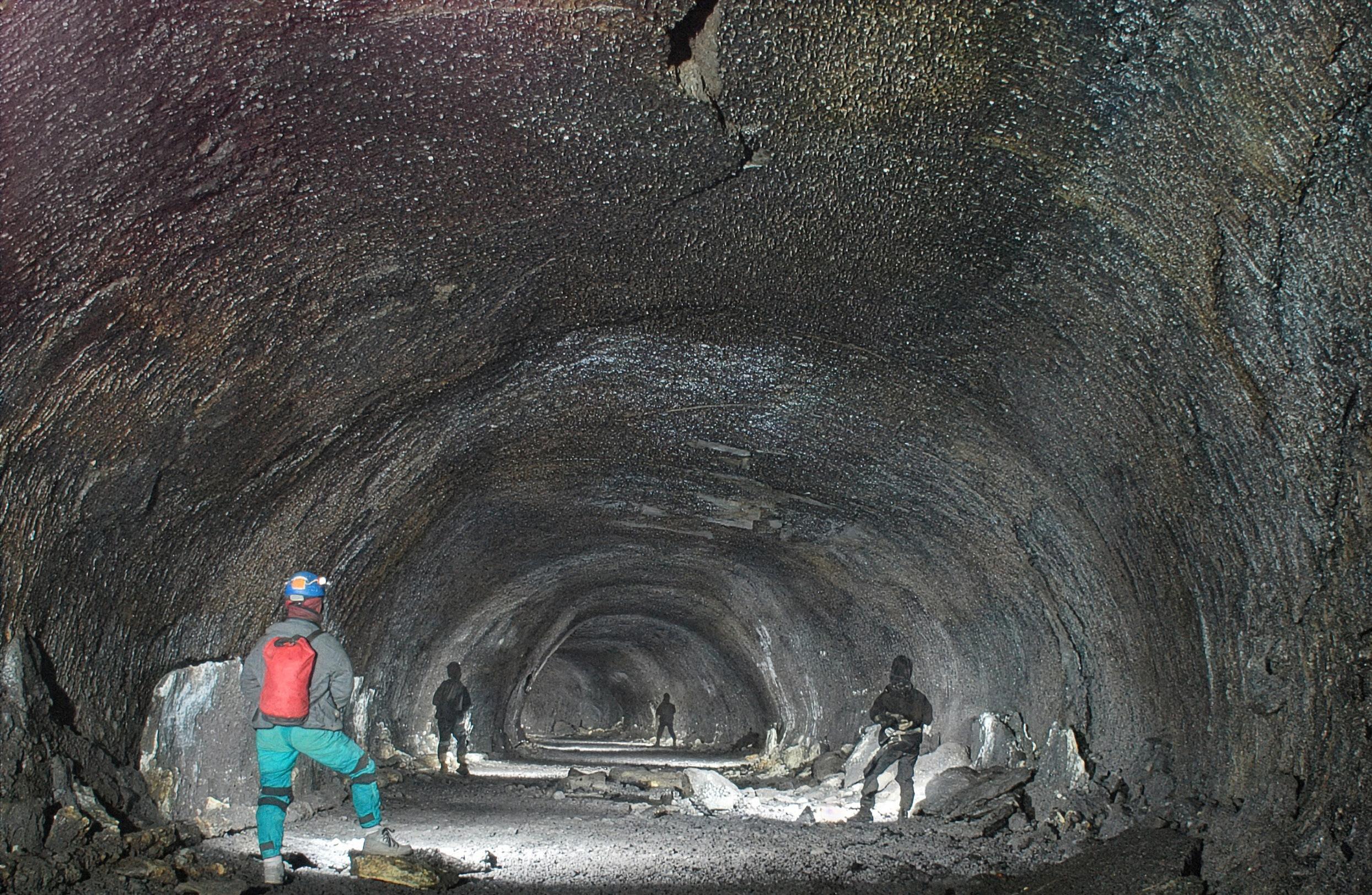
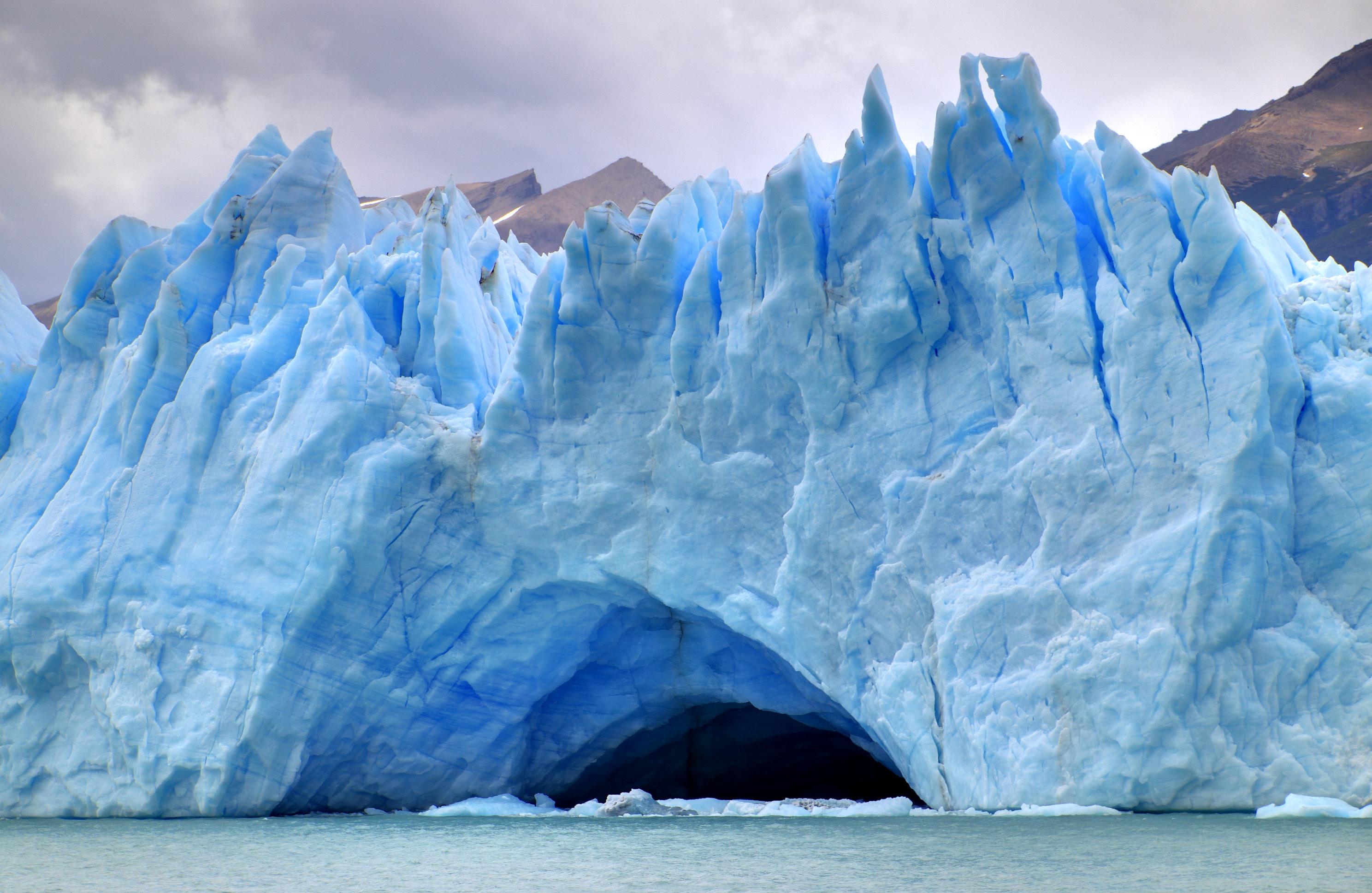
This second part of our exploration into cave formation and development moves beyond the dissolution caves of karst environments to examine the varied subterranean structures found worldwide. We dive into the diverse cave patterns found in karst aquifers (such as the massive Floridan aquifer), including branchwork and anastomose patterns, and the surface features like karst windows and springs. The discussion then expands to include coral caves formed by living reefs, sea caves sculpted by wave action, and the complex lava tubes created by volcanic flows. Finally, we investigate tectonic caves resulting from bedrock movement, unstable glacier caves formed by meltwater, and the remarkable manmade water tunnels known as qanats.
Karst windows typically develop in unconfined regions of an aquifer where a fracture in the host rock connects the land surface to a dissolved underground flow path. Karst windows therefore have both upstream and downstream passages. They are usually small features where the water table is often barely visible at the surface. Russell’s Rub, north of Ichetucknee Spring near Fort White, Florida, is a perfect example of a karst window. Occasionally, a sinkhole intersects an already established underground flow path, as has occurred at New sink and Jim sink in O’leno State Park north of High Springs, Florida. In these
cases, the distinction between karst windows and sinkholes refers to the formation process, because both have the same hydraulic function. Springs and seeps are the focal points of groundwater flow through an aquifer. Though springs discharge water from all types of permeable material, the largest springs discharge water from well-developed cave systems. Topographically, springs occur at or near the local groundwater base level. Perennial springs, those that discharge water year round, typically discharge directly to the sea or to rivers and streams. Occasionally springs discharging to rivers undergo flow reversals when the elevated hydraulic head in a flooded river forces water back into the cave system through the spring
“Occasionally springs discharging to rivers undergo flow reversals when the elevated hydraulic head in a flooded river forces water back into the cave system through the spring opening.
opening. Little River Spring east of Branford, Florida, is susceptible to reversals when the Suwannee River is in its flood stage. Not all springs discharging to rivers undergo flow reversals. When an underlying cave system is hydraulically connected to an overlying river at places other than the spring discharge point, significant quantities of water are exchanged between the river and the cave. In those cases, an increase in river stage will equate to increased spring discharge, though the water clarity may become significantly reduced. The Devil’s Ear cave system near High Springs, Florida, is one example of a well-developed cave system hydraulically connected to an overlying river where as much as 60 percent of the spring discharge consists of river water that circulates down from the overlying Santa Fe River.
Although karst aquifers occur throughout the world, the Floridan aquifer underlying much of North Florida and South Georgia is one of the largest. Because of a unique combination of high rainfall and geologically young, flat lying, and highly soluble limestone, the Floridan aquifer contains some of the largest and most extensive underwater caves in the world. More than 300 springs discharge an average of 30 billion liters/8 billion gallons of water to Florida’s major rivers every day. Of the 78 largest springs on the North American continent, 27 discharge from the Floridan aquifer and provide more than 242 million liters/64 million gallons of fresh water every day.
Cave patterns
Cave exploration and mapping efforts in the last several decades have culminated in the classification of cave development into four end-member patterns. Branchwork caves, sometimes called dendritic caves, consist of passages that join as tributaries to a trunk that discharges at a major spring and are the most common type of explored cave both above and below the water table. Network caves (e.g., Wind Cave, South Dakota) are angular grids of intersecting fissures formed by the dissolution of nearly all of the major fractures within regions of soluble rock. Anastomose caves (e.g., Devil’s Ear Cave, Florida) consist of intersecting curvilinear tubes that usually create a two-dimensional braided pattern with many closed loops. Spongework and ramiform caves are the least common type of explored cave and consist of interconnected solution cavities of varied size and shape that connect in a seemingly random three-dimensional pattern.
Of the four types of cave patterns mentioned above, branchwork and anastamose caves are the most common types of explored underwater caves. Branchwork caves tend to develop where the aquifer is at least partially covered by impermeable material and the hydraulic gradient is relatively steep. In these regions, recharge to the aquifer occurs through discrete locations such as sinkholes that break through the impermeable layer. Water is carried from the discrete recharge points through increasingly large conduits to down-gradient springs.
Coral caves are stunning, yet sharp coral, powerful surges, aggressive marine life, and intricate passages pose risks of injury, disorientation, stress, and limited emergency access.
PHOTO JESPER KJØLLER
A perfect example of this type of karstification can be seen in the Woodville Karst Plain where over 48 km/30 mi of phreatic conduits have been mapped that connect the upland recharge area through numerous sinkholes and karst windows to down-gradient springs. The largest of these is Wakulla Spring (946 billion liters/250 million gallons per day). Other examples of branchwork caves in the Floridan aquifer include: Silver Springs Cave that discharges to the Oklawaha River (1.9 million liters/500 million gallons per day), Manatee Springs Cave on the Suwannee River (416 million liters/110 million gallons per day); and Blue Springs Cave on the Withlacoochee River (280 million/74 million gallons per day).
Kirkgoz-1 Spring Cave and Duden Spring Cave are examples of branchwork caves in the Taurus Mountain and Antalya Travertine aquifers of southern Turkey. Anastomotic caves tend to develop in regions where there is no impermeable layer on top of the aquifer and there is a relatively shallow hydraulic gradient. In Florida, these regions typically correspond to flat topographic lows where rainfall infiltrates directly to the aquifer. The lesser hydraulic gradient allows individual conduits to meander along bedding planes or other geologic structures first connecting to each other and finally discharging through smaller magnitude springs and seeps. In regions where the limestone surface is dissected by rivers or streams, such as the western Santa Fe River basin, part or all of the stream flow is often diverted into the underlying conduits. Many rivers and streams in Florida, such as the Santa Fe and Alapaha Rivers, are diverted underground immediately after they flow into regions where the Floridan aquifer is not covered by impermeable material. Even after the rivers discharge back to the land surface,
groundwater and river water are continually exchanged because the aquifer is in direct contact with the riverbed. Devil’s Ear Cave in the western Santa Fe River basin of North Central Florida near High Springs is a perfect example of an anastomotic cave that both distributes and receives water from an overlying river.
Coral caves
“Not all springs discharging to rivers undergo flow reversals. When an underlying cave system is hydraulically connected to an overlying river at places other than the spring discharge point, significant quantities of water are exchanged between the river and the cave.
Coral caves are formed by living coral that grows together to form cavities and passages through the formation and can therefore be found wherever reef development is prolific (tropic and sub-tropic regions of eastern continental margins). Typically, coral caves form when Staghorn and/or Elkhorn coral grow together at the top of narrow canyons in a reef or on a shelf wall. In most cases, overhead openings in coral caves allow light to penetrate into underlying passages but may or may not be large enough for divers to negotiate. Coral caves tend to be limited in areal extent; however, penetrations of 30 m/100 ft can be achieved in large reef complexes. Since coral caves are formed in living coral, most caves will be located in 10-50 m/30150 ft of water. Divers deciding to enter coral caves should be wary of several hazards.
• Sharp coral can cut skin and equipment.
• Surges generated by surface wave action can toss a diver against cave walls and increase stress and exertion levels.
• Coral caves provide homes for a wide variety of marine life, including moray eels, sharks, rays, and various other fish that can be threatening to a diver when confronted in confined spaces.
• A multiplicity of interconnecting passages can disorient a diver and impede direct access to the surface or a dive partner in the event of an emergency.
Sea caves
Sea caves are formed by the mechanical erosion of rock cliffs by wave action in an ocean or lake. The wave action preferentially erodes zones of weakness in a cliff that become enlarged by hydraulic pressure that builds up in eroded areas with continued wave action. Over time, holes, commonly known as blowholes, can develop in the rear roof of sea caves and release trapped and pressurized air to the atmosphere in the form of a misty spray. In many cases, the releases are periodic and occur only after sufficient pressure has accumulated to drive trapped air into the back of the cave and out through the blowhole (e.g., Thunder Hole, Acadia National Park, Maine, U.S.).
Sea caves occur on almost every cliffed headland or coast where waves break directly on rock cliffs, and they are rarely more than a few hundred meters long. Passage geometries can vary from narrow crevices isolated within zones of weakness in the cliff rock to large dome-like chambers in less competent rock or wider zones of weakness. Water levels in sea caves are
determined by the tides. At low tide, many caves are accessible by foot or by boat, whereas at high tide, the same caves can be completely underwater. Most sea caves are located in shallow water where the wave action is strongest; therefore, surges in sea caves can be very strong and acutely dangerous to the unwary diver.
Lava caves
Lava is molten rock at or near the land surface formed by volcanic activity. Lava caves form in volcanic rocks by flowing lava or by the diffusion of volcanic gasses through flowing or stagnant lava. Lava caves form very close to the land surface and are therefore easily destroyed by erosional processes. As a result, such caves are usually found only in recent lava flows, those that are less than 20 million years old.
Lava tubes are the longest and most geometrically complex of the volcanic caves. Lava tubes are the channels of lava rivers that, at some earlier time, flowed downslope from a volcanic vent or fissure. Lava tubes develop best in a highly fluid type of lava known as pahoehoe
Cave formations in Manatee Springs in Florida, USA.
flows in which volatile components of the lava reduce cooling rates and viscosity. Lava tubes are rarely found in denser ‘A‘ā flows or in the more massive block lavas.
As a pahoehoe lava flow advances downslope from a volcanic vent or fissure, the sides begin to congeal due to differential cooling rates, and more and more of the flowing lava is confined to a progressively narrowing channel. Gradually, the surface of the flow becomes crusted over and may also be covered with solid blocks of lava that have been rafted along in the flow. As more and more of the surface crusts over, the supply of fluid lava feeding the advancing front of the flow is confined to a roughly cylindrical tube beneath the surface in the center of the original channel.
As the volcanic eruption at the vent or fissure subsides, the amount of lava flowing downslope subsides. Fluid lava in the tubes continues to flow, causing the tubes to drain. The combustion of gases released from the lava maintains a high temperature within the flow and can create a black glaze over the walls of the tubes. The
draining of the tube may take place in stages, so that benches or ledges are formed along the walls. Lava dripping from the ceiling will solidify into lava stalactites, while lava dripping onto the floor gives rise to lava stalagmites. The floor of a lava tube will often have a ropey pattern parallel to the flow direction, showing how the final draining lava was frozen into place. Other features of the moving lava, such as trenchlike channels in the floor, lava falls over ledges, ponded lava, and embedded blocks, may also be frozen into place.
Lava tube features and geometry
In their simplest form, lava tube caves are long tunnels of uniform diameter oriented down the slope of the volcano from which they formed. Tube walls consist of solidified lava and, in some cases, the floor can be covered with sand or other unconsolidated material that is carried into the caves by water. Lava tube roofs are typically very thin, and breakdown will often produce blocks of fallen ceiling material distributed on tube floors. “Skylights” form when large
Looking down the axis of a classic lava tube passage in Lava Beds National Monument, California, USA.
segments of a tube collapse, exposing the tube and through-flowing lava (if the collapse occurs during the formation of the tube) to the atmosphere. When skylights form at the upper end of a tube, the tube can create a trap for cold mountain air, creating sufficient conditions for infiltrating water to freeze and create various types of ice formations that can persist into summer months and, in some cases, perennially. Underwater lava caves, in either fresh or saltwater environments, most likely formed above the water surface and were subsequently filled as a result of rising water tables or rising sea levels that occurred because of other geologic processes.
Lava tubes can also have complicated geometries. Where slopes are gentle, the original lava river may branch into a distributary pattern near the toe of the volcano. If two or more of the distributed branches become drained, the resulting lava tube will branch in the downstream direction. New lava flows may override older flows and result in the formation of additional lava tubes on top of existing ones. When younger flows melt or fall through the roof of older tubes,
a 3-D network of tubes is created. Collapses can break lava tubes into segments and, in fact, most continuous lava tubes are only a few hundred to a few thousand meters long, whereas the original lava flow can often be mapped for tens of kilometers from a point of origin.
Small caves are produced in regions of active volcanism by at least three other processes. These are (1) pressure-ridge caves, (2) spatter cone chambers, and (3) blister caves. As with lava tubes, underwater caves of these types will most likely result after groundwater or sea levels have risen and flooded the cave environment.
Pressure-ridge caves are formed beneath ridges in a lava flow that are oriented perpendicular to the direction of flow. The ridges form in the upper part of a flow where the lava has solidified but buckles due to the movement of molten lava underneath. The buckled crust appears as ridges several meters to tens of meters high that are elongated perpendicular to the direction of flow. Pressure-ridge caves are sometimes formed beneath the ridges by the mechanical lifting of the roof rock. Such cavities
PHOTO DAVE BUNNELL
typically measure 1-2 meters in height, have a roughly triangular cross section, and can be several hundred meters in length.
Other volcanic cave types
Spatter cone chambers are dome shaped cavities that form when molten lava drains out from blobs of ejected lava that solidify together (spatter cones). Chamber sizes vary between meters and tens of meters in diameter.
Blister caves form when trapped steam or other gases lift layers of lava while it is still in a plastic state, producing small dome shaped cavities similar to spatter-cone chambers. Blister caves are generally small, ranging from one to a few meters in diameter, but they often occur in great numbers in many lava flows rich in volatile components.
In the United States, lava caves are found chiefly in the Pacific Northwest mainland: Northern California, Washington, Oregon, and Idaho, as well as in Hawaii. One of the longest lava caves (measuring 3.4 km/2.1 mi in length) is a lava tube known as Ape Cave on the southern flank of Mount St. Helens in Washington. A large number of lava tubes also occur beneath a nearly flat plain in the Bend region of Central Oregon. Many of these are related to fissure eruptions rather than to a single volcanic cone. Lava tubes are commonly found in other young volcanic regions of the world, notably in the Canary Islands, in Iceland, along the East African Rift Valley, and in parts of Australia.
Tectonic caves
Tectonic caves are formed by a mass movement of the bedrock that separates rock masses along pre-existing joints or fractures. The resulting caves are usually high, narrow fissures that have nearly planar walls with matching erosional patterns on opposite sides of any passage. Ceilings are most often created by a flat bed of rock, usually of different composition, that did not move or that moved along some different fracture plane.
Tectonic caves can be formed by any geologic force that causes rocks to move apart; however, the most common mechanism is gravity sliding. Tectonic caves are most often found in
regions where massive rocks dip gently and are elevated above valley floors, as is the case along many ridges and mountains. Shale layers between beds of massive rocks provide zones of weakness parallel to direction of rock slippage and can facilitate mechanical slippage. Gravity causes the massive rocks to slip and separate along vertical fractures, which then become tectonic caves. The amount of slippage must be small for the cave to maintain its roof, otherwise the slippage can result in the formation of open canyons or catastrophic landslides.
Tectonic caves occur in many geologic settings, both above and below water, and in great numbers, since they are produced by minor slippages in various types of massive rocks, including sandstone, granite, basalt, and limestone. Tectonic caves are among the most common caves, but they are rarely noticed or catalogued. They contain few, if any, features that attract attention and are usually quite small, measuring between several meters to a few hundred meters in length. Most tectonic caves consist of a single passage that extends into a hillside along major fractures. Some of the largest tectonic caves have a grid or network pattern that matches the pattern of the fractures or joints and have a similar appearance to dissolutionally-widened fractures in limestone.
One of the best-known underwater tectonic caves is Devils Hole, Nevada, which was created by extensional faulting in the Basin and Range Province of the Southwestern U.S. rather than by gravity sliding. The cave is a near-vertical open fault zone, approximately 3 m/10 ft wide and 20 m/66 ft long, that intersects the water table approximately 17 m/55 ft below the land surface. Below the water table, the cave opening extends at least 130 m/426 ft deeper.
Tectonic cave examples
Aside from its depth and location in the arid Southwestern U.S., Devils Hole is perhaps one of the most politically and scientifically interesting underwater caves in the United States. President Truman established Devils Hole as a National Monument in 1952, in part, to protect an endemic species of fish known as the Devils Hole pupfish. As a National Monument, Devils
Hole became a focal point in one of the longest environmental battles in North America (19671984) when groundwater development by a private entity threatened to reduce water levels at Devils Hole and thus threaten the pupfish. In their 1976 decision, the U.S. Supreme Court stated that in designating a parcel of land as a National Monument, the federal government is entitled to groundwater resources necessary to accomplish the purpose of the reservation even if those resources had not been specifically appropriated. The decision was also the first Supreme Court decision to apply water rights to groundwater.
Scientifically, Devils Hole has become the focus of considerable debate over paleoclimate records due to discrepancies between isotopic data collected from subaqueously precipitated calcite deposits covering the walls of the cave and data from calcite shells of microorganisms collected from ocean floors. The Devils Hole data challenges an established concept that climate fluctuations are generated by periodic
changes in the Earth’s orbit called Milankovitch Cycles. Specifically, the Devils Hole data shows that interglacial periods were up to twice as long as predicted by the Milankovitch theory. There is an ongoing effort to confirm the Devils Hole record at other locations worldwide.
Talus caves are another form of tectonic cave that are created by interconnected spaces between boulders piled up on mountain slopes. Most talus caves are very small, both in length and in cross section; however, some have explorable passages of considerable length. Some of the largest talus caves occur among granite blocks in New York and New England, where integrated systems of passages between boulders have been mapped for several kilometers. Underwater talus caves can be found to varying degrees along most rocky coastlines.
Glacier caves
Glacier caves form near the base of glaciers between the glacial ice and the underlying bedrock. They are similar to dissolution caves in
The Perito Moreno Glacier is a massive, advancing glacier in Argentina's Los Glaciares National Park.
PHOTO MARTIN ST-AMANT
that they are created by the removal of the solid material by water. Rather than being dissolved from the host rock, however, glacier caves are created when meltwater from the surface of a glacier drains downward through crevasses (enlarged vertical fractures typically oriented in a curvilinear pattern perpendicular to the long axis of a glacier) to the base of a glacier and then melts conduits out of the ice as it flows downgradient between the ice and the underlying bedrock. Glacier caves are sometimes called ice caves; however, that term is also commonly used to describe caves containing ice formations (e.g., the famous ice caves in Austria, Eisriesenwelt, Werfen, and Dachstein Eishohle).
Glacier caves may reach lengths of several kilometers. Mature caves of this sort are tubular conduits, often with intricately sculptured walls. Some of them have a branching pattern and are similar to dendritic dissolution caves, in that they are created by the joining of independent flow paths that connect multiple inputs with a common discharge point. Because they form along the ice/bedrock contact, the floors of glacier caves usually consist of rock, while the walls are composed of glacial ice. Water levels in most glacier caves fluctuate seasonally, wherein the caves can be completely underwater during summer months and dry during winter months.
than in most rock environments. Frequent fracturing associated with glacier movement can truncate through-cutting caves, cause collapse, and rapidly effect changes in water flow conditions. Therefore, exploration in glacier caves should be approached with extreme caution.
Qanats
“Glacier caves are probably the least stable of all cave environments due to the mobility of the glaciers through which they develop. The ice composing a glacier moves from the zone of accumulation at the top of the glacier to the zone of ablation at the bottom of the glacier.
Glacier caves are probably the least stable of all cave environments due to the mobility of the glaciers through which they develop. The ice composing a glacier moves from the zone of accumulation at the top of the glacier to the zone of ablation at the bottom of the glacier. Rates can be as high as several centimeters per year. In most cases, ice velocities vary throughout the horizontal, longitudinal, and vertical components of a glacier, giving rise to stress-related fractures that occur over much shorter timescales
A qanat is a manmade cave designed to tap the water table beneath an alluvial fan or hill slope and conduct groundwater to lower lands for irrigation and drinking water. Qanat technology represents one of the most ancient forms of underground aqueduct construction and probably originated in Armenia during the 1st millennium A.D. Qanats are most common in North African countries and the Middle East, where they became an established form of irrigation early on and are still utilized to varying degrees today. The technology was ported to Spain in the 8th century during the Arabic occupation of the Iberian Peninsula and was consequently brought to Mexico and Central America in the 16th and 17th centuries. Qanats are long, straight, and nearly horizontal tunnels that connect lower valleys, croplands, and villages with a master well dug into the water table on the flank of a hillside or alluvial fan. The tunnels typically intersect a series of vertical shafts, spaced 15 to 150 m/50 to 500 ft apart, which facilitate access and airflow into the tunnel during the excavation. Tunnel profiles tend to be elliptical and are seldom larger than 1 m/3 ft wide by 1.5 m/5 ft high. Qanat lengths vary widely and are dependent on the needs and geographical constraints of the community for which they were designed and constructed. Some qanats contain multiple tunnels that connect multiple master wells with one or more discharges. The longest known qanat system is in Persia and contains more than 27 k/16 mi of mapped tunnels.
GUE PREMIUM DIVE CENTERS
Area 9 Mastery Diving – Kralendijk, Bonaire
www.masterydiving.com
Base1 – Sardinia, Italy
www.baseone.it
Deep Dive Dubai – Dubai, UAE
www.deepdivedubai.com
Dive Centre Bondi – Bondi, NSW, Australia
www.divebondi.com.au
Duikcentrum de Aalscholvers – Tilburg, Netherlands