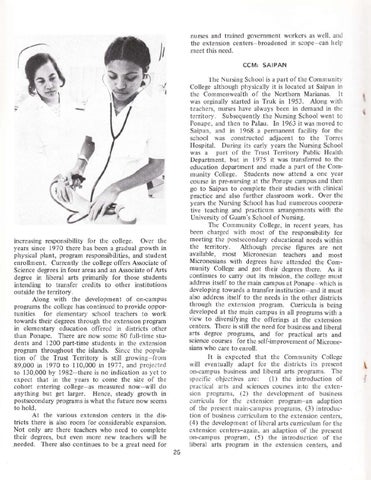
nurses and trained government workers as well, and the extension centers-broadenedin scope-can help meet this need. CCM: SAIPAN l'he Nursing School is a part of the Community College although physically it is located at Saipan in the Commonwealth of the Northern Marianas. It was orginally started in Truk in 1953. Along with teachers,nurseshave always been in demand in the territory. Subsequentlythe Nursing School went to Ponape,and then to Palau. In 1963 it was moved to Saipan, and in 1968 a permanent facility for the school was constructed adjacent to the Torres Hospital. During its early years the Nursing School was a part of the Trust Territory Public Health Department, but in 1975 it was transferred to the education department and made a part of the Community College. Students now attend a one year course in pre-nursing at the Ponape campus and then go to Saipan to complete their studies with clinical practice and also further classroom work. Over the years the Nursing School has had numerouscooperative teaching and practicum arrangementswith the University of Guam's School of Nursing. The Community College,in recent years, has been charged with most of the responsibility for meeting the postsecondaryeducationalneedswithin the territory. Although precise figures are not available, most Micronesian teachers and most Micronesians with degrees have attended the Community College and got their degreesthere. As it continues to carry out its mission, the collegemust addressitself to the main campusat Ponape-which is developingtowards a transferinstitution-and it must also addressitself to the needsin the other districts through the extension program. Curricula is being developed at the main campus in all programs with a view to diversifying the offerings at the extension centers. There is still the need for businessand liberal arts degree programs, and for practical arts and sciencecourses for the self-improvementof Micronesianswho care to enroll. It is expected that the Community College eventually adapt for the districts its present will on-campus businessand liberal arts programs. The ( 1) the introduction of specific objectives are: practical arts and sciencescourses into the extension programs, (2) the development of business curricula for the extension program-an adaption of the present main-campusprograms, (3) introduction of businesscurriculum to the extension centers, (4) the developmentof liberal arts curriculum for the extension centers-again,an adaption of the present on-campus program, (5) the introduction of the liberal arts program in the extension centers, and
-ld
*
increasing responsibility for the college. Over the years since 1970 there has been a gradualgrowth in physical plant, program responsibilities, and student enrollment. Currently the collegeoffers Associateof Sciencedegreesin four ateasand an Associateof Arts degree in liberal arts primarily for those students intending to transfer credits to other institutions outside the territory. Along with the development of on-campus programs the college has continued to provide opportunities for elementary school teachers to work towards their degreesthrough the extension program in elementary education offered in districts other than Ponape. There are now some 80 full-time students and 1200 patt-time students in the extension program throughout the islands. Since the population of the Trust Territory is still growing-from 89,000 n 1970 to 110,000 in 1977, and projected to 130,000 by 1982-there is no indication as yet to expect that in the years to come the size of the cohort entering college-as measured now-will do anything but get larger. Hence, steady growth in postsecondaryprograms is what the future now seems to hold. At the various extension centers in the districts there is also room for considerableexpansion. Not only are there teachers who need to complete their degrees, but even more new teachers will be needed. There also continues to be a sreat need for
26
t I q