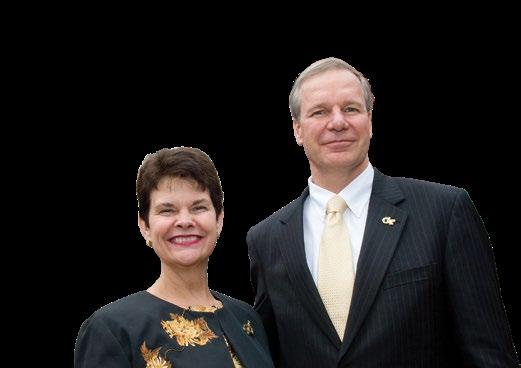
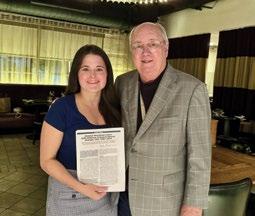
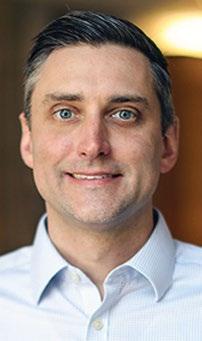
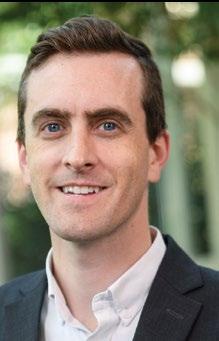
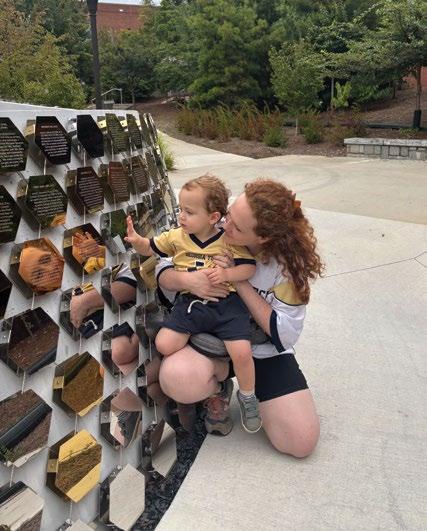
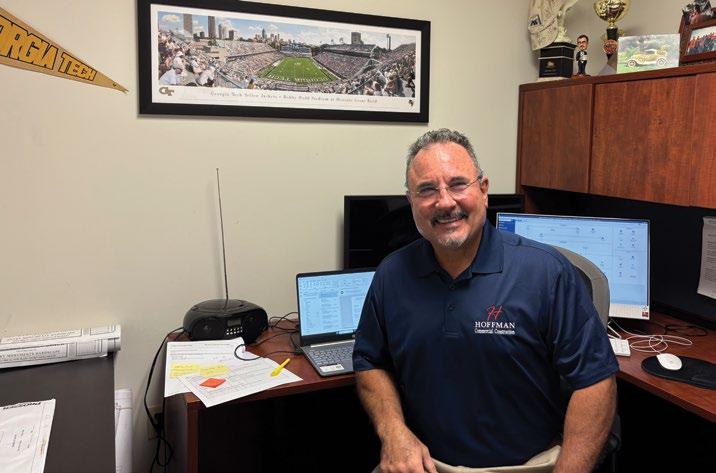
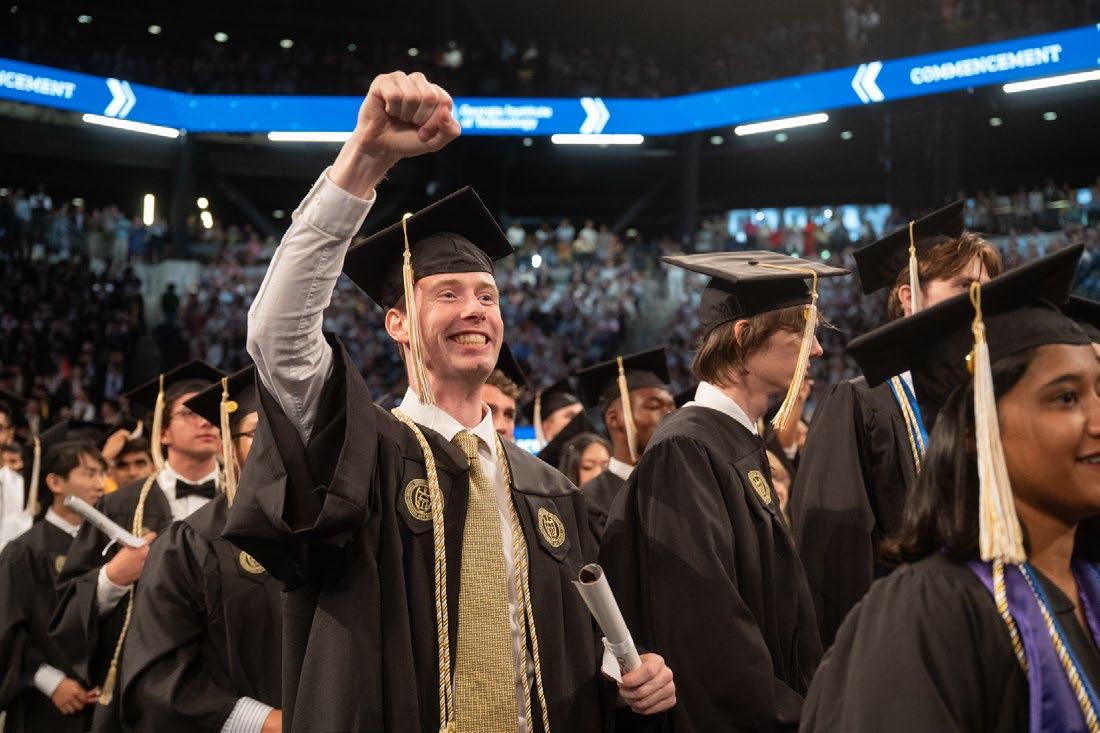
“We believe in Tech’s mission, and it matches up with what we hope for Cole and his friends as they graduate and move on to impact society and the world around them.”
— Grant Campbell, Georgia Tech Parent Board Member
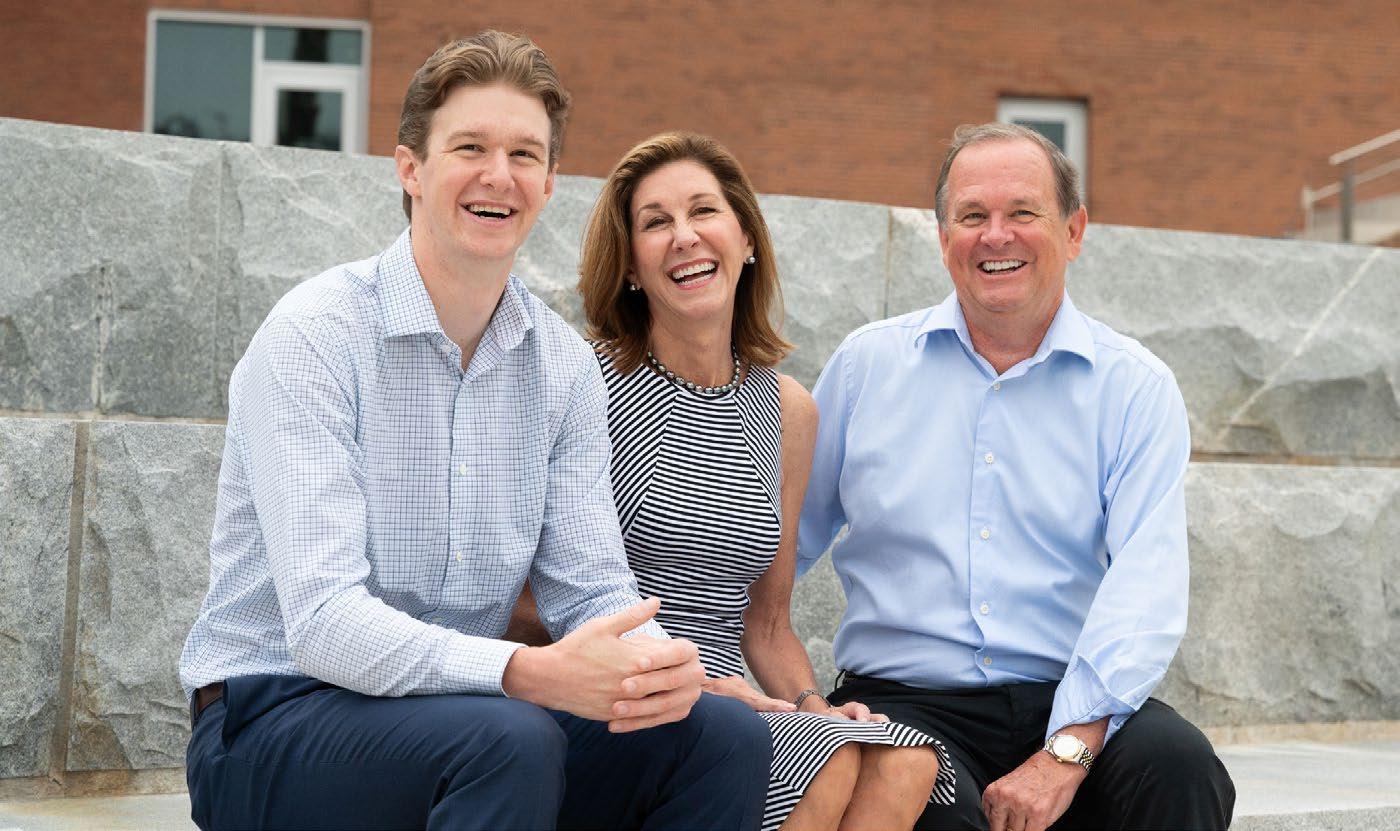
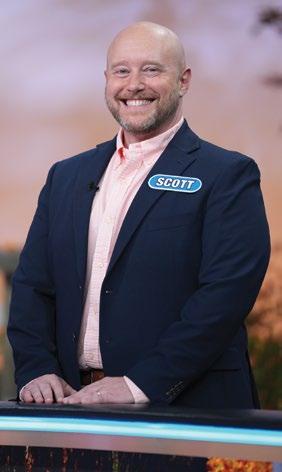
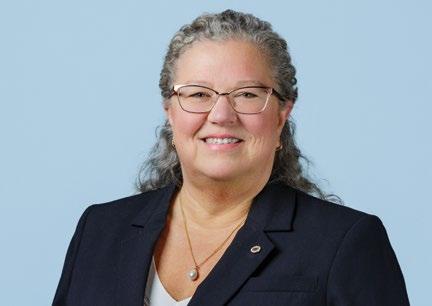
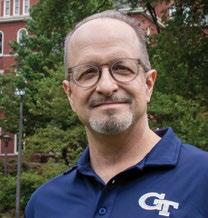
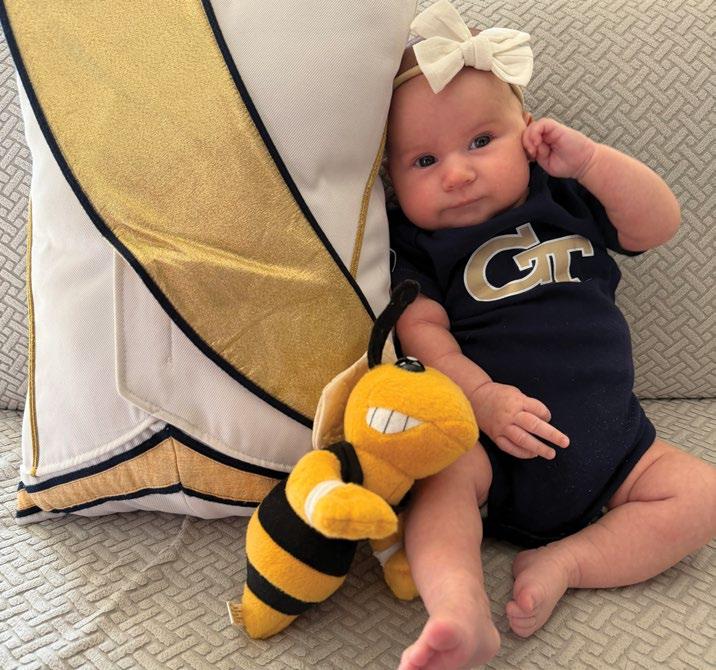
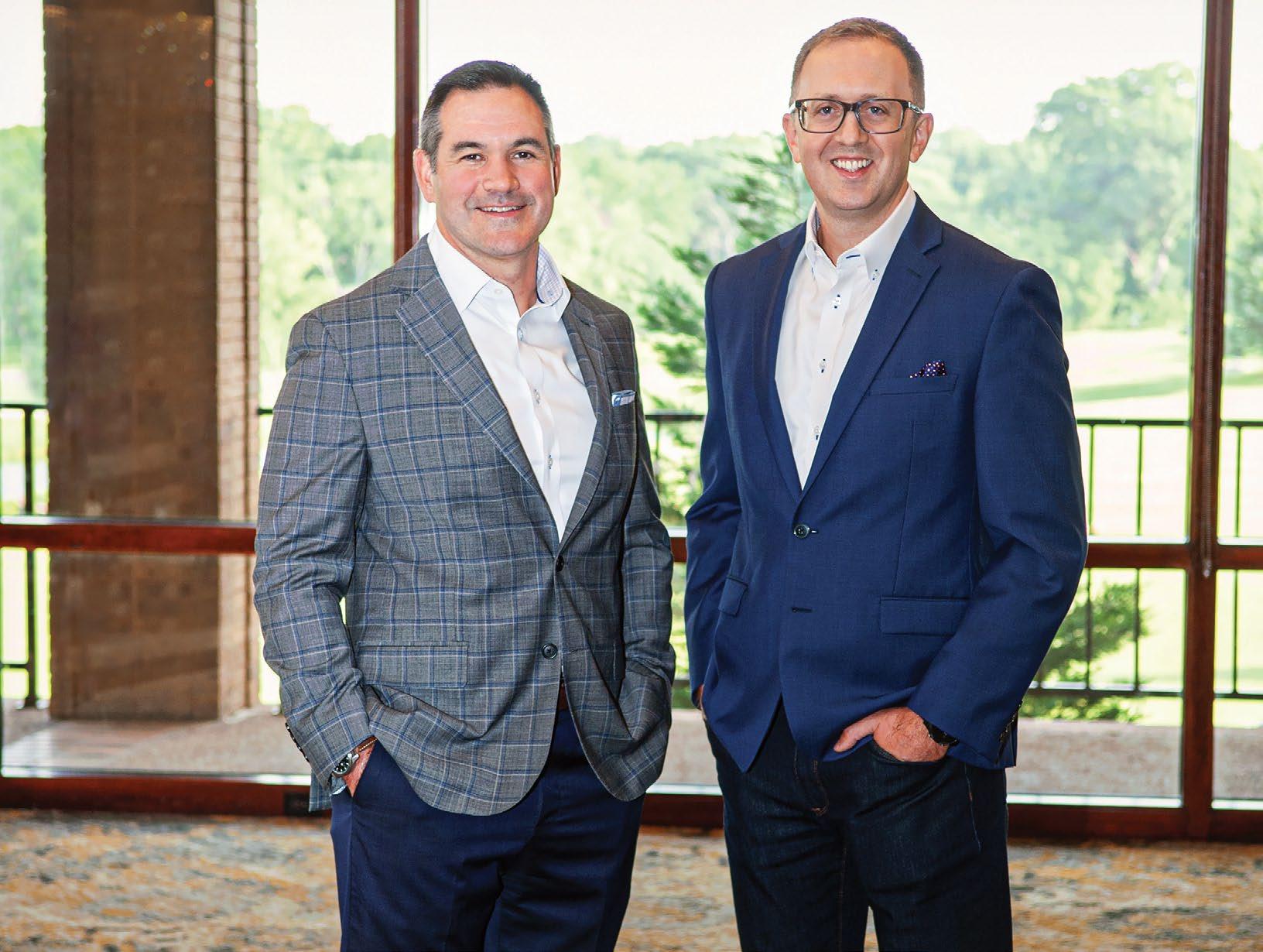
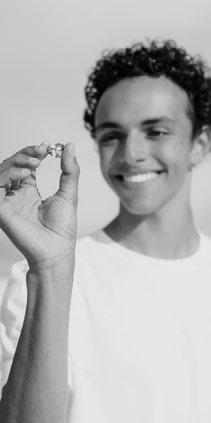
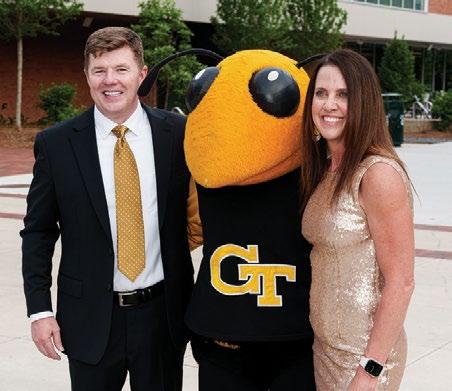
For the Campbells, giving back is a core family value. Grant and Michele Campbell began the conversation around philanthropy with their son, Cole, at a young age. Now that Cole is in his final year as a mechanical engineering student at Georgia Tech, the couple has continued this conversation which led them to support a family legacy endowment and make a planned gift to Tech through a will provision.
Grant and Michele joined the Georgia Tech Parent Board when Cole came to the Institute in 2019. They were impressed by the way Tech prioritizes students and inspired by the mission to improve the human condition. “Tech is living its mission and caring for students, and it comes through in watching students interact with faculty,” said Grant.
The Campbells also are impressed by the Institute’s interdisciplinary approach that combines engineering
with business, sustainability, and medicine to effectively prepare students. “Everything at Tech is using the intelligence that these students have to change the world,” Michele said.
Cole mirrors his parents’ enthusiasm for the Institute. “I’ve loved every second of being at Tech, and it definitely has felt like home for the past four years,” he said. “I would not be where I am right now without Tech.”
The Campbells decided that including the Institute in their estate plans was a perfect way to come together as a family and make meaningful impact. “We were thrilled to include an organization in our will that aligns with our family values,” Michele said. “And we want to do something to help make a difference in the community and world and that encourages Cole to think deeply about his own philanthropy.”
W DRIVEN TO CREATE
WHEN YELLOW JACKETS come together, it doesn’t take long before innovation takes hold.
Chris Klaus, Cls 96, HON PhD 25, founded Internet Security Systems from his dorm room; Tom Noonan, ME 83, joined, later becoming its chairman, president, and CEO. Another product of alumni collaboration is Flock Safety, founded by Garrett Langley, EE 09, Matt Feury, CS 11, and Paige Todd, Mgt 07.
That’s the spirit of Georgia Tech: Innovation. Research. Collaboration. And campus is a hub of resources for budding entrepreneurs.
Since its founding in 2014, CREATE-X has launched more than 770 startups, with over $2.8 billion in valuation. The Advanced Technology Development Center (ATDC), Georgia’s technology startup incubator, is also housed right here on campus. Many Yellow Jackets have taken advantage of that proximity, and rightfully so. FIXD, a car repair sensor developed by three Tech alumni, is one example of a startup that worked with ATDC to scale its impact. This year alone, four alumni-founded companies—Gatherly, PorterLogic, Solopulse, and Speedscale—graduated from ATDC.
More than 800 entrepreneurs, alumni, investors, and corporate executives are part of TI:GER’s network.
CREATE-X director Rahul Saxena, ME 97, wants Tech to be the No. 1 startup campus in the nation. With new Yellow Jacket businesses launching every day, that goal feels more attainable than ever. Read about several of these impressive entrepreneurs in this issue. They’re a small representation of the many Yellow Jackets who have launched businesses throughout the nation. You can find more in the Scheller College of Business Alumni Business Directory at Scheller.gatech.edu/ directory/businesses.
In terms of projects launching on North Avenue, the proposed Welcome Center, outlined in the most recent Campus Comprehensive Plan, will become a major gateway to campus to welcome alumni and visitors. See page 74 to learn more about this transformative project.
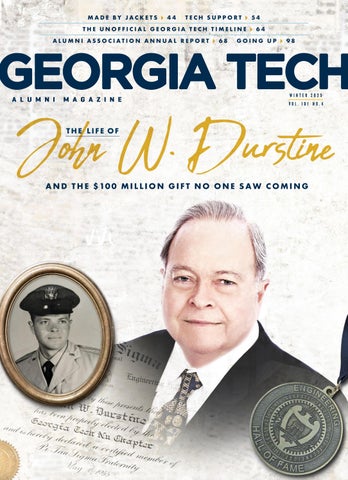
In this issue, you’ll find the Alumni Association Annual Report, read about John Durstine’s $100 million gift to Tech, gain insights from business owners, and discover great gifts in the Made by Jackets product guide.
Yellow Jackets don’t wait for the future— we build it.
Go Jackets!
The TI:GER Program (Technology Innovation: Generating Economic Results) is also included in Tech’s entrepreneurship framework. The program transforms budding ideas into market-ready innovations.
DENE SHEHEANE, MGT 91 PRESIDENT GEORGIA TECH ALUMNI ASSOCIATION
VOL. 101 | NO. 4
PRESIDENT & PUBLISHER
Dene Sheheane, Mgt 91
VP STRATEGIC COMMUNICATIONS
Lindsay Vaughn EDITOR
Jennifer Herseim
DIRECTOR
Hedberg COPY EDITOR
Barbara McIntosh Webb
COPYWRITER
Sharita Hanley
STUDENT ASSISTANTS
Alisha Tan, Joanna Xiao
EXECUTIVE COMMITTEE
Chair
Rita Breen, Psy 90, MS IE 92
Past Chair/Finance
Tommy Herrington, IM 82
Chair Elect, Vice Chair/Roll Call
Jimmy Mitchell, CE 05
Vice Chair of Engagement
Sam Westbrook, IE 99
Member at Large
Meredith Moot, Mgt 08
Member at Large
Alex Muñoz, Mgt 88
Member at Large
Amy Phuong, IA 05, MBA 14
Member at Large
Kenji Takeuchi, ME 94
BOARD OF TRUSTEES
Tommy Antonino, BA 15, MSA 22; Donnie Beamer, Econ 05; Matt Bishop, CmpE 06; Alexia Borden, IE 01; Jacky Cheng, IE 17; Kim (Kilpatrick) Civins, Mgt 92; Catherine Cooper, IE 90; Cynthia Culbreath, IE 93, MS IE 95; Adam Fuller, Mgt 93; Sid Gore, ME 17, MS ME 20; Derek Goshay, IE 93; Ryan Greene, ME 00, MS Econ 01; Craig Hyde, CmpE 05; TJ Kaplan, PP 13; Brandon Kearse, ME 08, MS CE 10; Kayla Kelly, Econ 16; Olivia Langevine, IAML 13; Sabrina McCorvey, IE 90; Mihir Pathak, ME 08, MS ME 10, PhD ME 13; Susan (Sutherland) Piña, IE 93; Kyle Porter, Mgt 04; Josh Roberts, IE 02; Sonia Sardana, IE 12; Greg Sitkiewicz, IE 00; Kofi Smith, IE 99, MBA 09; Miya Smith, IE 03; Russell Smith, Cls 98; Peter Stewart, CE 97; Casey Swails, Mgt 07; Rani Tilva, BA 18; Paul Trotti, ME 00; Hayley Tsuchiyama, ChBE 18; Ben Utt, IM 81; D’Andre Waller, ME 17; Kourtney Wright, CS 15, MS CS 23; Liz (Harriss) York, Arch 90, M Arch 95
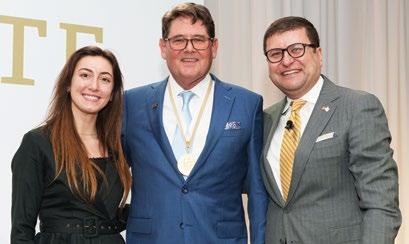
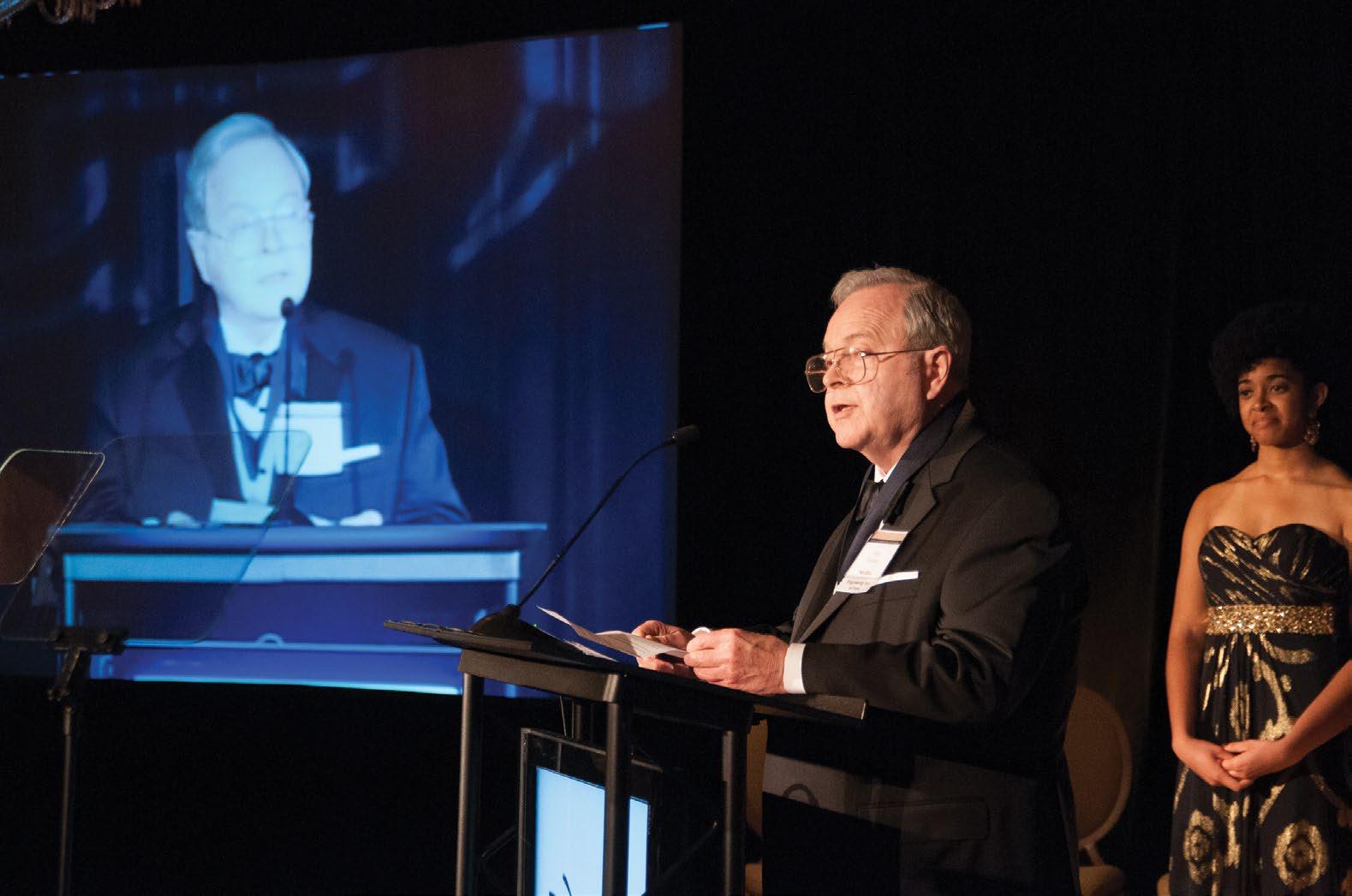
Serial entrepreneur Tom Noonan, ME 83 (center), with student ambassador Katherine Dickenson, CS 25, and Magd Riad, IE 01, at the Gold & White Honors Gala in 2023.
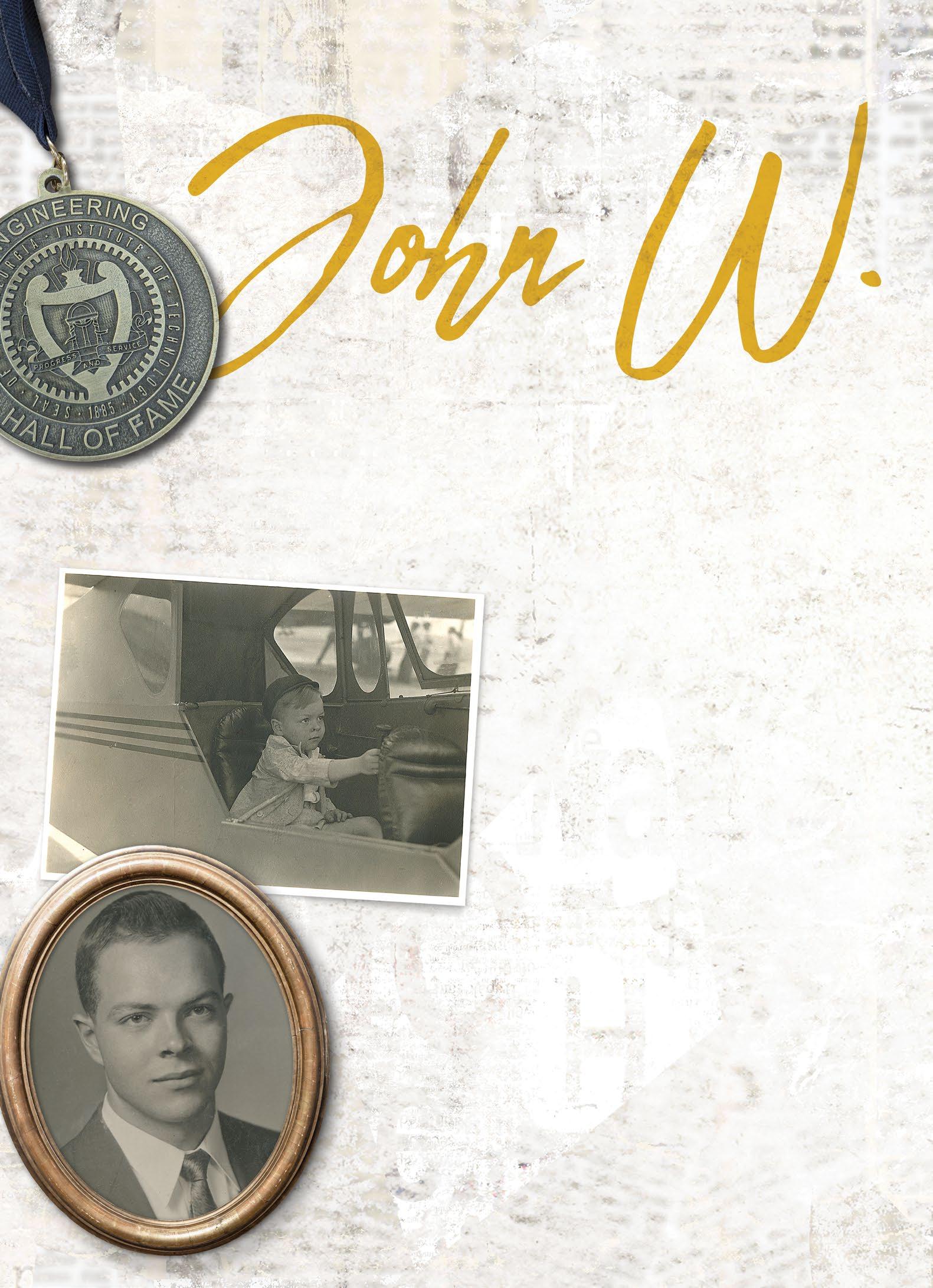
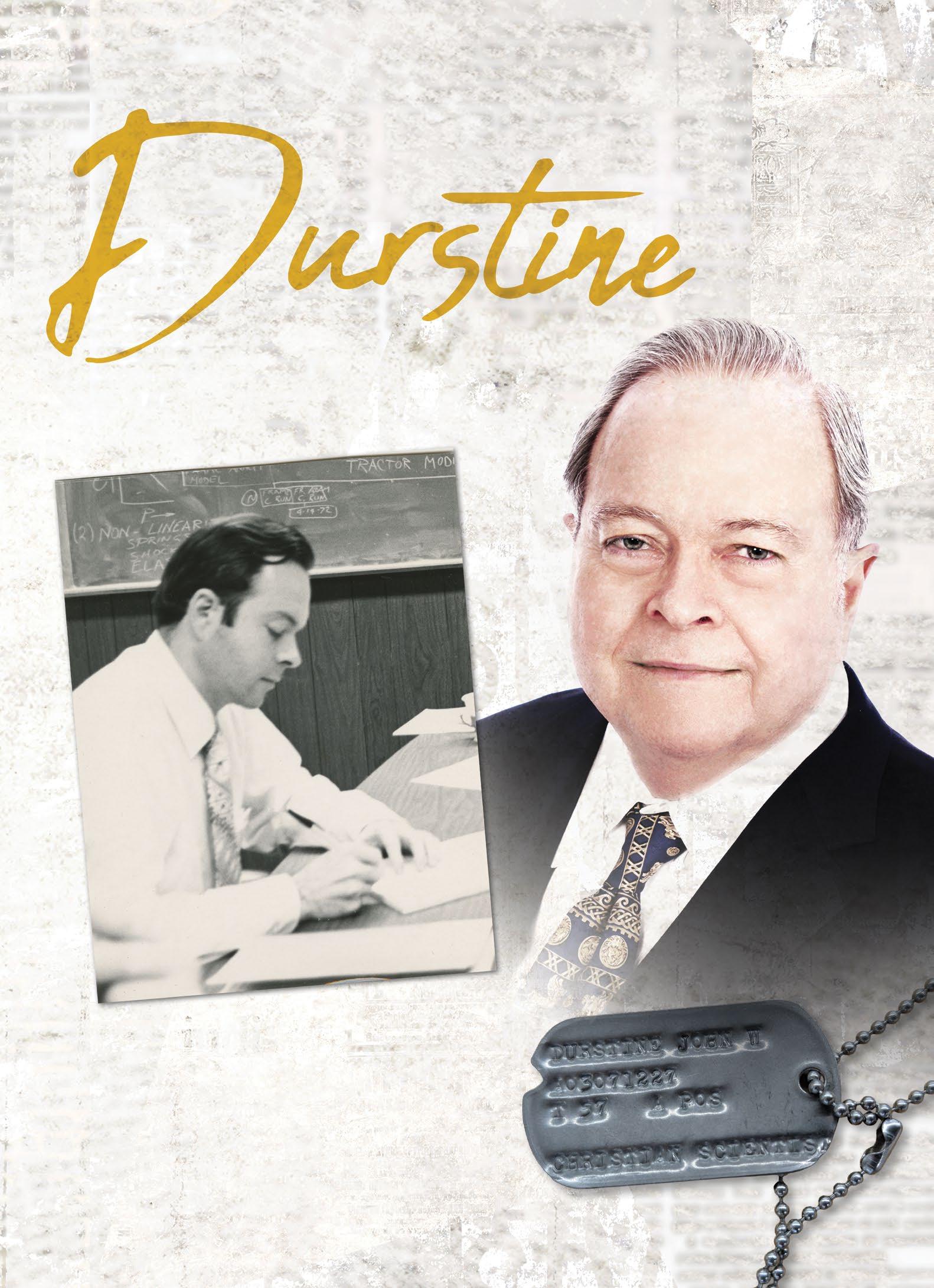
JOHN W. DURSTINE
The mechanical engineering alumnus led a private life and loved Georgia Tech. When he died in February, he left a $100 million gift that no one saw coming.
MADE BY JACKETS
Discover products proudly designed and crafted by Yellow Jacket entrepreneurs that you can gift or enjoy yourself.
TECH SUPPORT
Help! These Tech entrepreneurs pose their real-world startup questions to Tech executives, who share advice.
DEPARTMENTS
TIMELESS TRADITION
The Mini 500 tricycle race is held each year during Homecoming. Teams (four racers and three pit crew members responsible for tire rotations) must complete 8 laps around Peters Parking Deck. This year, Phi Kappa Theta captured first place.
AROUND CAMPUS
Tech Secures
Biltmore Relaunches as a Strategic Hub for Entrepreneurship 13
Smith Restored 14
the Curtain of The Wizard of Oz at
LETTERS TO THE EDITOR
STELLAR CO-OP EXPERIENCE
IT WAS WITH STRONG INTEREST that I read the Fall 2025 GT Alumni Magazine , especially about projects in space and the Moon. I was a sophomore EE in December 1967 when I reported to IBM Huntsville to begin my co-op assignments working on the Saturn V rockets for the Apollo program. IBM had the contract with NASA to build the Instrument Unit, the “brains” of the Saturn V rockets. The Instrument Units provided navigation, guidance, telemetry, and mission control of each Saturn V rocket flight. I conducted hardware acceptance testing and software programming for flight verification and failure analysis of five Apollo missions including the Apollo 7, 8, 10, 11, and 13 missions. I remember seeing bulletin boards at the IBM Huntsville offices with a quote by Wernher von Braun, lead designer of the Saturn V. The quote was, “If the Saturn V is 99.9% reliable, there will be 5,600 defects.” It was an exciting and unforgettable experience and one of the reasons I treasure my time at Tech. Go Jackets!—Everett “Stony” Stonebraker, EE 71, of Coral Gables, Fla.
FACULTY IMPRESSIONS
IN 1966, Tech Professor Alson H. Bailey was my Ordinary Differential Equations professor. He gave a strict appearance each morning as he entered the classroom after we all had been seated. His lectures were wonderful. As we conquered each new type of equation, he would say, “We have new challenges to face. A new type of equation that doesn’t yield results. But you are up to the challenge. Your thought processes have worked. You have succeeded.” And so, as the term progressed, we all felt that we could meet each new challenge. And near the end of the term, he actually smiled as if to say, “You met the challenge. Now go take on any new interest and forge new universes in your path.” I recall this experience as if it happened yesterday. Another GT legend was Tech librarian Dorothy Crosland. In 1968, after a classmate encouraged me to listen to Brahms’ Symphony No. 1, she helped me get the LP record. It started me on a course of loving classical music. She was instrumental in transforming Tech library into a genuine library science environment. She also played a major role in the emergence of Tech’s School of Information Systems.
—Mel Bost, Phys 69, MS NE 70
FEEDBACK
Send a letter to the editor about a story from this issue to editor@alumni.gatech.edu
Correction: In the Fall 2025 Alumni Magazine, Volume 101, Issue 3, we incorrectly listed Charles R. “Chip” Berezin, PhD AE 95, as deceased. He is alive and well, enjoying hiking, biking, and sailing in his retirement. We apologize for the error.
YELLOW JACKET CONTROL-LINE PLANE
TECH’S RESIDENT GLASSBLOWER
EDITOR, I THOROUGHLY ENJOYED the Fall 2025 issue of the GT Alumni Magazine. As a co-op in the early 1960s, I was involved with many military and NASA contracts, and just maybe had a small part in the Space Race. This brought back many memories. On page 98, the Yellow Jacket control-line airplane was featured. In the 1950s, and even through the early 1960s, I put in many hours building and piloting all types of miniature aircraft. To add to the article, these planes were constructed of varying grades and strengths of balsa wood and Sitka spruce. The struc tures were covered with a paper/cloth fabric called “Silkspan”; Mat Waites’ tea bag analogy was spot-on. We then painted the mod el with “dope,” which was a lacquer-type of paint that had an odor of dead-ripe bananas. The control-line airplanes only had an elevator, so the “steering” was either up or down. The engines were a single cylinder, most often with a displacement (combustion chamber) of less than ½ cubic inch. These engines used a fuel made of methyl alcohol, nitro-methane, and additives such as castor oil for lubrication. They were 2-cycle, and as the piston was on the upstroke, it would suck in the fuel/air mixture and compress it. The external battery did not provide heat; it merely passed a current through the glo-plug’s spiral nichrome wire to make it glow orange hot inside for the first few seconds during starting. Basically, these engines were sort of operated like a diesel, creating its own sustaining combustion heat via high compression. On the downstroke, the expanded hot gases would blow out through a port in the side of the cylinder as the new fuel in the chamber was at the same time pushed into the firing chamber. Polluting and inefficient, yes! They were built for simplicity, light weight, and power.—Robert Hoenes, EE 66
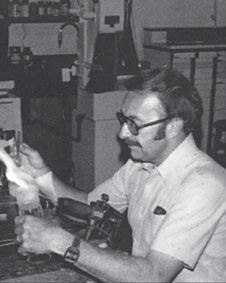
I READ DON LILLY’S OBITUARY in the Fall 2025 Alumni Magazine. From the day I walked in, I was more than impressed by the glass shop at Georgia Tech. Most chemistry students do their own glass work. D. Lilly was an outgoing and sarcastic sort of guy who told you how dumb you were while saving your life or career. I worked for E. C. Ashby organometallic chemistry. Don made numerous unique pieces of glassware required by Ashby’s group. We did chemistry that burst into flame or exploded in air (trimethylaluminum, etc.) and were required to keep everything in an inert atmosphere. I’m not sure we could have functioned without him. For me, his master work was a device for measuring viscosity of water/ air-sensitive solutions like liquids via two capillaries inside a water jacket and entirely enclosed in an inert atmosphere. Students and post-docs tended to hang out in Don’s area when they weren’t working or killing time (waiting for a reaction to finish or a chromatogram to run). The glass shop was a unique feature at Georgia Tech that certainly gave our students an advantage over similar schools. We (Ashby) were in bitter rivalries with research groups around the world.—George E. Parris, PhD Chem 74
AROUND CAMPUS
DEMO DAY
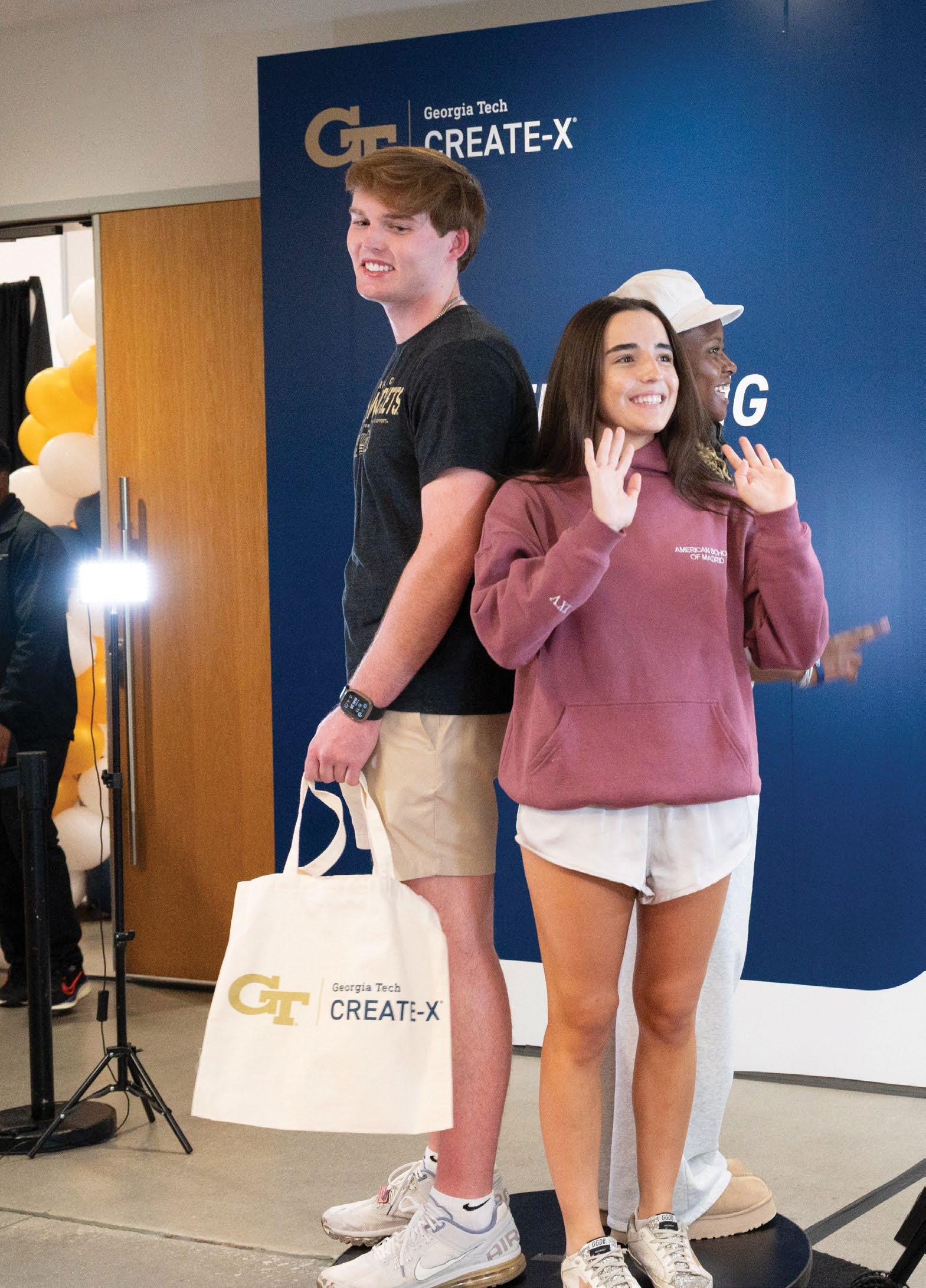
More than 200 Yellow Jackets pitched their companies at Demo Day this past August. The showcase featured CREATE-X’s 12th cohort of founders. Since its launch, CREATE-X startups have grown a total portfolio valuation of more than $2.8 billion.
GEORGIA TECH SECURES MULTIPLE NO. 1 RANKINGS
GEORGIA TECH continues its upward trajectory in the latest U.S. News & World Report Best Colleges 2026 rankings, released Sept. 23. The Institute moved up to No. 32 among national universities, improving one spot from last year. Among top public national universities, Georgia Tech held steady at No. 9, and it achieved No. 1 rankings across several categories. Check out the Institute’s latest rankings.
—AYANA ISLES
COMPUTER SCIENCE ADVANCEMENTS
In computer science, Georgia Tech climbed to No. 5 overall, the highest national ranking in its history.
No. 1 Mobile/Web Applications
No. 2 Cybersecurity
No. 3 Software Engineering
No. 5 Artificial Intelligence
No. 7 Computer Systems
No. 10 Programming Languages
No. 10 Theory
ACADEMIC DISTINCTIONS
No. 3 Internships and Co-ops
ENGINEERING EXCELLENCE
Georgia Tech’s undergraduate engineering programs remain a cornerstone of its national reputation, ranking No. 3 overall, up from No. 4 last year.
No. 1 Biomedical Engineering
No. 1 Environmental Engineering
No. 1 Industrial and Systems Engineering, which has now held the top spot for 25 straight years
No. 2 Aerospace Engineering
No. 2 Chemical Engineering (up from No. 3)
No. 2 Civil Engineering
No. 3 Electrical Engineering (up from No. 4)
No. 3 Materials Engineering
BUSINESS PROGRAM MOMENTUM
The Scheller College of Business held its place among the nation’s best, ranking No. 19 overall.
No. 3 Most Innovative Schools (continues a streak of top-5 placements)
No. 12 Senior Capstone
No. 16 Best Colleges for Veterans (maintaining its position from last year)
No. 21 Best Undergraduate Teaching (up 10 spots)
No. 33 Undergraduate Psychology (up 30 spots)
No. 2 Management Information Systems
No. 3 Analytics
No. 6 Supply Chain Management (up from No. 7)
No. 6
No. 34
Production/Operations
Management (up from No. 8)
Finance (up 9 spots)
No. 36 Marketing
No. 40
Accounting (up from No. 48)
*Not all Georgia Tech colleges, schools, and subjects are ranked every year by this organization.
THE BILTMORE RELAUNCHES AS A STRATEGIC HUB FOR ENTREPRENEURSHIP
GEORGIA TECH PLANS TO TRANSFORM
THE ICONIC BILTMORE INTO A HUB OF INNOVATION IN TECH SQUARE.
BY ANGELA BARAJAS PRENDIVILLE
THE BILTMORE is one of Atlanta’s most historic landmarks, and Georgia Tech is planning to make it the latest engine of innovation in Tech Square.
Built in 1924 and acquired by the Georgia Tech Foundation in 2016, The Biltmore has long stood as a symbol of Atlanta’s growth, once serving as a central point for the city’s business and social life. Now it begins its next century as a future-looking hub for entrepreneurship, where founders, researchers, investors, and industry leaders can collaborate to launch world-changing ventures.
“This is more than a building—it’s a launchpad for Atlanta’s future,” says Georgia Tech President Ángel Cabrera, MS Psy 93, PhD Psy 95. “We’re not just reinvigorating a landmark; we are creating space for more startups, more opportunity, and more innovation that moves Atlanta forward.”
The revitalized Biltmore will house over 100,000 square feet of key pillars
of Georgia Tech’s innovation ecosystem, including the headquarters for Tech’s flagship student startup accelerator CREATE-X, Quadrant-i, the Office of Technology Licensing, VentureLab, the Corporate Engagement Office, the Venture Investment Hub, and additional strategic partners.
“We’re honored to have been engaged by the [Georgia Tech] Foundation to help bring Georgia Tech’s vision to life,” says David Tyndall, BC 83, an original co-developer of Tech Square and CEO of Collaborative Real Estate, which will oversee The Biltmore’s redevelopment.
“The Biltmore is the centerpiece of Tech Square, and now it will become an international crown jewel of innovation. This will be a place where founders build, investors engage, and the future takes shape,” Tyndall says.
NEW RESIDENCE HALL TO BE NAMED FOR FORMER TECH PRESIDENT, FIRST LADY
THE NEW RESIDENCE HALL on Curran Street expected to be complete in 2026 will be named the Bud and Val Peterson Residence Hall, honoring the tenure of Tech’s 11th president and first lady.
G.P. “Bud” Peterson served as president from 2009 to 2019. Under his leadership, Tech enhanced student programs and grew enrollment; increased collaboration and built strategic partnerships; expanded its global reach; executed Campaign Georgia Tech; and more than doubled new research awards, exceeding $1 billion for the first time in 2019.
Peterson has remained involved with the Institute as President Emeritus, a Regents’ Professor in the George W. Woodruff School of Mechanical Engineering, and a member of the steering committee for Transforming Tomorrow: The Campaign for Georgia Tech.
As first lady, Val Peterson was a dedicated presence on campus and an ardent supporter of students and faculty. She served as a chief spokesperson for the Tech Ends Suicide Together initiative when it launched in 2016 and was a mentor to students and campus organizations. The Petersons have both been recognized as honorary alumni by the Georgia Tech Alumni Association for their devotion to the greater good of Georgia Tech.
—INSTITUTE COMMUNICATIONS
D.M. SMITH RESTORED
THE REFRESH PRESERVES MANY HISTORICAL ASPECTS OF THE ORIGINAL BUILDING.
BY JENNIFER HERSEIM
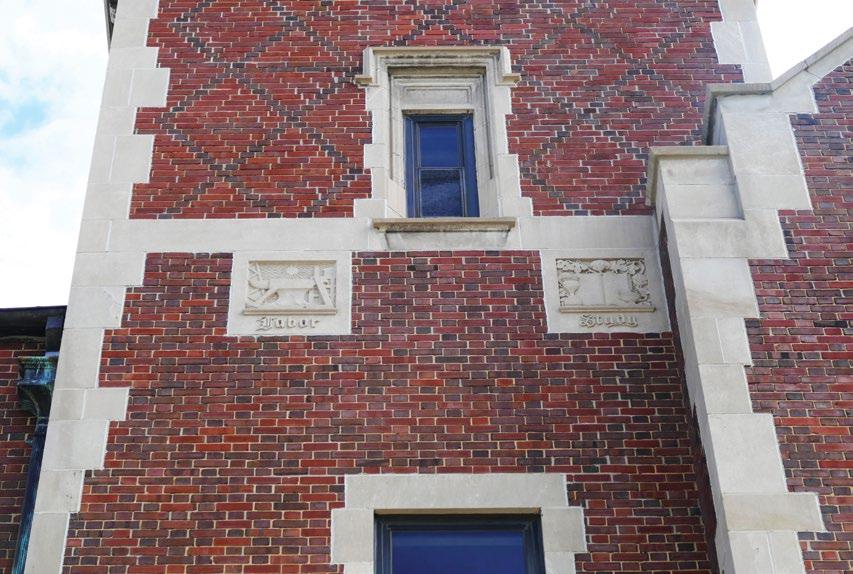
MMANY ALUMNI WILL REMEMBER taking a class in the iconic D.M. Smith Building at the heart of campus on Cherry Street, across from the Georgia Tech Library. Built in 1923, the red brick building with collegiate Gothic details received a well-deserved restoration to bring the building into the new century.
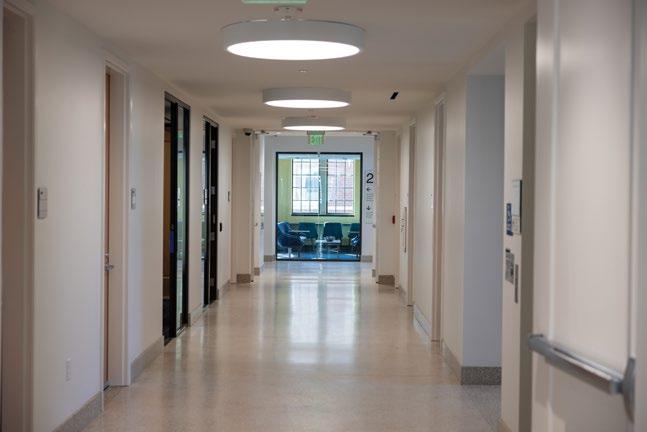
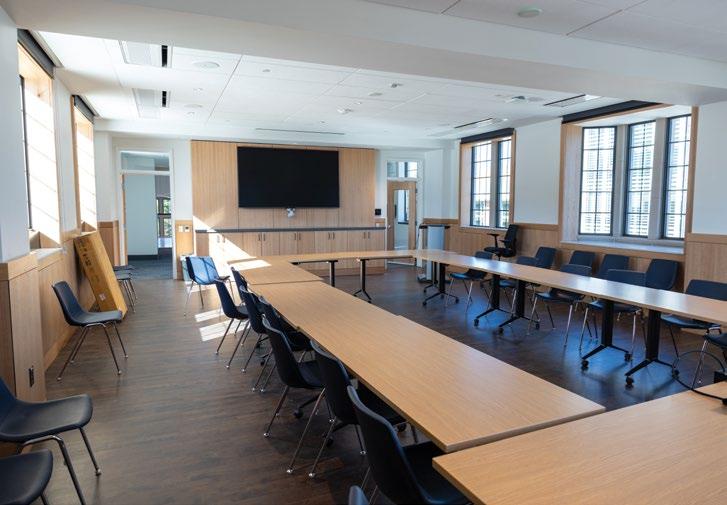
While enhancing accessibility, functionality, and sustainability, the refresh also preserved the building’s rich history. During construction, crews made several discoveries, including uncovering metal panels that were used in the original lecture halls to reveal skylights in the ceiling and hundred-year-old signatures from Tech students on the walls of a hallway. The signatures and skylight panels were saved and highlighted as well as original wood flooring, which was salvaged for reuse.
Two gas cylinders were found under the auditorium and will be displayed in the waiting area. The original terrazzo floors were preserved along with some of the woodwork at the main entrance. Several slate chalkboards will also be rehung in spaces in the building.
The restoration also electrified D.M. Smith, which originally relied on steam from the central plant. The upgrades are in alignment with Tech’s carbon-reduction goals.
The Jimmy and Rosalynn Carter School of Public Policy moved into the building at the end of October.
Construction of the front entrance along Cherry Street.
View of the staircase facing Cherry Street.
AROUND CAMPUS
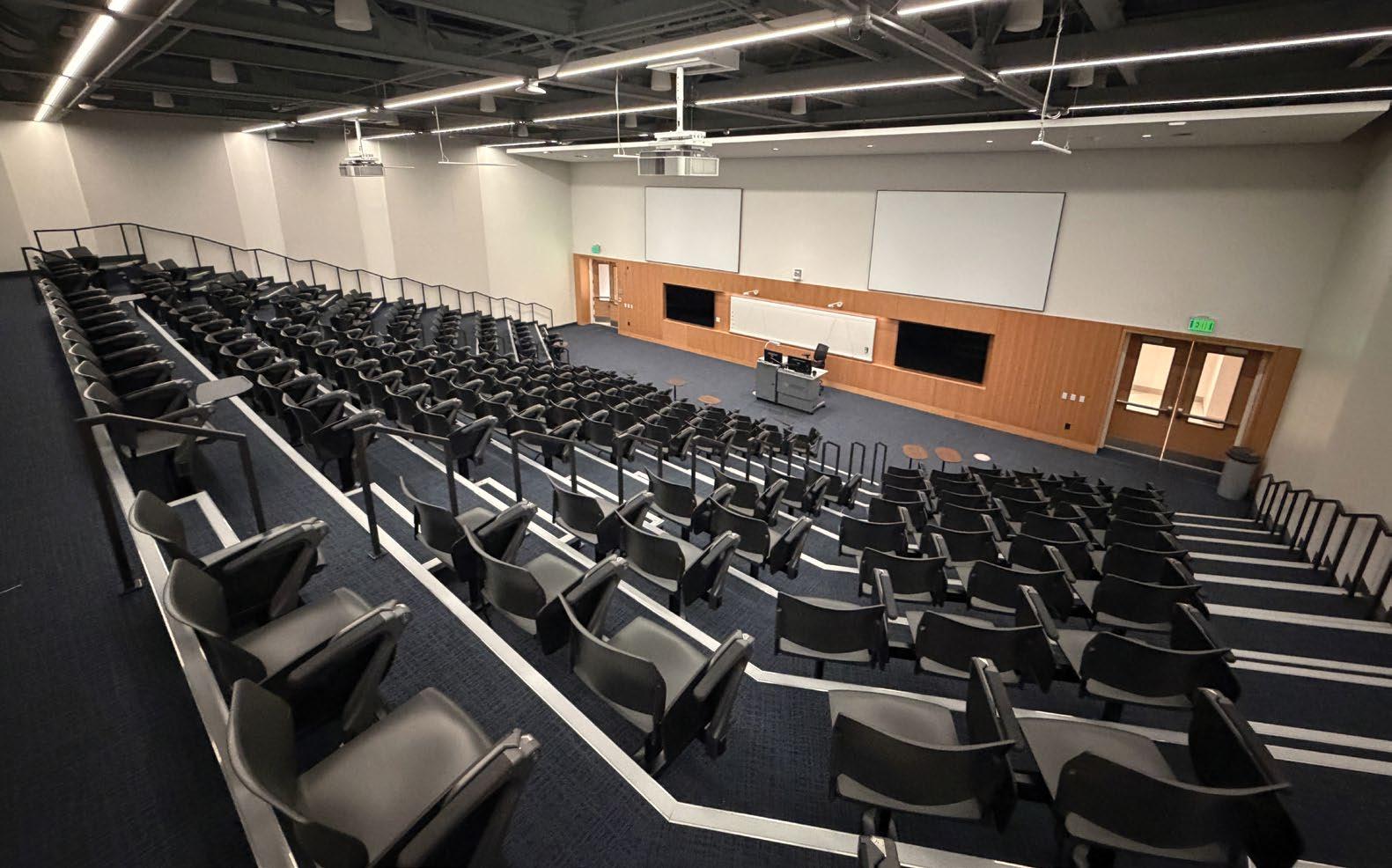
Renovated classroom space includes upgrades to technology and accessibility.
The building now houses the Jimmy and Rosalynn Carter School of Public Policy.
View from D.M. Smith looking east toward Midtown Atlanta.
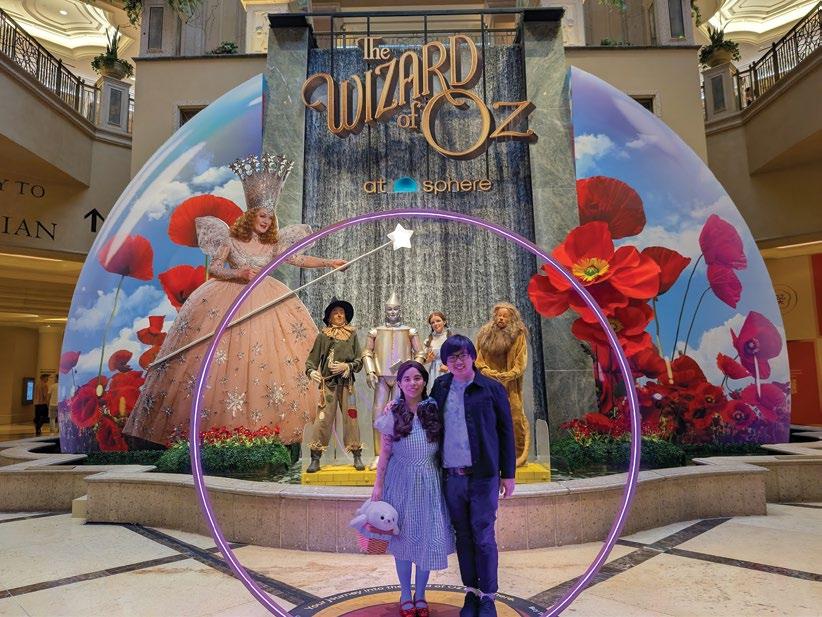
BEHIND THE CURTAIN OF THE WIZARD OF OZ AT SPHERE
GEORGIA TECH ALUMNI PLAYED A ROLE IN BRINGING THE 1939 CLASSIC TO THE LAS VEGAS SPHERE’S 160,000-SQUARE-FOOT INTERIOR SCREEN.
BY JOSHUA PRESTON AND BEN SNEDEKER
SSEVERAL GEORGIA TECH ALUMNI, as well as Distinguished Professor Irfan Essa, lent their expertise to help “reconceptualize” the film for the August 28 premiere of The Wizard of Oz at Sphere. Essa, the senior associate dean of the College of Computing, leads Google DeepMind’s Atlanta lab, which played a pivotal role in the project. “When the request came to us, I was almost jumping up and down,” says Essa. “This is the best opportunity to showcase the magic we develop using AI.”
The project relied on bespoke versions of Google’s generative artificial intelligence platforms to move from grainy film negatives to “ultra-ultra-high definition imagery that will pop inside Sphere,” according to a Google blog post about the project.
Many alumni were involved, including core members Steven Hickson, PhD CS 20, Albert Shaw, CS 16, MS CS 17, and Meera Hahn, PhD CS 22, and other contributors like Daniel Castro Chin, CS 13, PhD CS 19, Grant Schindler, CS 03, MS CS 06, PhD CS 10, Pedro Velez, MS CS 17, and Amit Raj, MS ECE 17, PhD ML 22.
Shaw, a senior machine-learning researcher with Google, shared his experience and some behind-the-scenes details about what it took to bring Dorothy’s adventures to life in 16K resolution.
Q: The Wizard of Oz at the Sphere—what is it in your own words? Why is it a big deal?
A: The Wizard of Oz was one of the iconic pioneers of Technicolor filmmaking, so it’s a bit poetic that we were able to adapt it to the unique Sphere experience. This project wouldn’t have been possible two years ago. To me, it’s truly been incredible to see the very cutting edge of technology and artistry come together to create this amazing experience that transports you into the Land of Oz.
Q: What did you contribute to the project directly or indirectly? How did it push you professionally, and were there any moments of “wow” or “wonder” that are special to you?
A: Last year my teammate at Google, Meera Hahn, and I were working on an out-painting model (an AI-based technique for expanding images beyond their original borders)
Albert Shaw, CS 16, MS CS 17, at the premier of The Wizard of Oz at Sphere
when our manager, Steven Hickson, told us about a project with The Wizard of Oz. We were all like, “That’s crazy! Is it even possible? That resolution is insane!” We didn’t think it would all happen or that it was technically possible. It’s been a crazy journey to get where we are now.
For my part, Meera and I took the out-painting model we had been developing and specialized it for the film. This involved fine-tuning it on the original movie and characters, plus tackling a lot of new problems, like figuring out how to make something significantly bigger while keeping motion and characters consistent.
This project really showed me the huge gap between research and application. It also raised a number of new research questions that we’ve been exploring. We then worked to scale up the model so a whole team could use it to process the entire movie. We even got to run many of the shots ourselves, from testing to custom workflows for some of the most challenging scenes.
Working directly with the Magnopus creatives in Los Angeles was one of the most amazing experiences I’ve had. We built a great workflow where we’d improve what the artists gave us, and they’d improve our outputs to feed back into the models and repeat the process.
In the back of my mind, I was always thinking, “I really hope this all works out.” It wasn’t until I saw the first scarecrow scene (my favorite scene in this version) on the full Sphere—after all our back-and-forth iterations, artist touch-ups, and compositing with full CG renders—that I was like, “This is really going to work!” It’s incredible what everyone achieved together.
Starting in May, I also gained a broader understanding of the entire process by serving as an ML Tech Lead, supporting other workflows for the Super Resolution and Performance team.
Q: From a technology and AI standpoint, in lay terms, what stands out to you?
A: What amazes me is how quickly we were able to enable this and how it wouldn’t have been possible if we had started even a year earlier. It’s been amazing being in the middle of this revolution in video and other generative models. However, putting it into professional filmmaking at this unprecedented 16K resolution, with the quality and character consistency we achieved, was amazing.
ALUMNUS RAHEEM BEYAH NAMED PROVOST
GEORGIA TECH DOUBLE JACKET RAHEEM A. BEYAH, MS EE 99, PHD ECE 03, has been named the provost and executive vice president for Academic Affairs of Georgia Tech.
Beyah has served as the dean of the College of Engineering and Southern Company Chair since 2021. Previously, he served as Tech’s vice president for Interdisciplinary Research, inaugural executive director of the Online Master of Science in Cybersecurity program, and the Motorola Foundation Professor in the School of Electrical and Computer Engineering. He also served as interim Steve W. Chaddick Chair of the School of Electrical and Computer Engineering.
Beyah cofounded Fortiphyd Logic, an industrial cybersecurity company. He received the National Science Foundation CAREER award in 2009. He is a member of numerous national organizations, including the American Association for the Advancement of Science (AAAS), the American Society for Engineering Education (ASEE), a lifetime member of the National Society of Black Engineers (NSBE), a Fellow of the Institute of Electrical and Electronics Engineers (IEEE), and an Association for Computing Machinery (ACM) distinguished scientist.
GRADUATE STUDENT WINS GEOGUESSR WORLD CHAMPIONSHIP
RADU CASAPU , a graduate student in the School of City and Regional Planning, won the 2025 GeoGuessr World Championship in Copenhagen, Denmark. The online game challenges players to identify specific locations using Google Street View in a race against the clock.
TECH SPIN-OFFS
THE INSTITUTE REPORTED ITS MOST SUCCESSFUL YEAR IN
RESEARCH COMMERCIALIZATION.
BY JENNIFER HERSEIM
IIN THE LAST FISCAL YEAR, Georgia Tech reported record-breaking numbers in research commercialization, with more than 460 new invention disclosures and 124 patents issued. Backed by a strong startup ecosystem, more researchers are translating breakthroughs in the lab into viable companies that solve real-world problems. To strengthen that startup mentality, Georgia Tech even has a vice president of commercialization and chief commercialization officer. Serial entrepreneur and former CREATE-X director Raghupathy “Siva” Sivakumar assumed the role in the fall of 2021.
Below are just a few of the successful companies that have spun out of Georgia Tech research:
MICRON BIOMEDICAL
A pioneer in the field of microneedle technology, Mark Prausnitz founded Micron Biomedical with Sebastien Henry and Devin McAllister in 2012. Rather than use a traditional needle injection to deliver vaccines and medicines, Micron Biomedical offers drug delivery that can be painlessly self-administered with dissolving microarray technology. It could redefine vaccination and drug delivery. Micron’s patches have already been used in clinical trials to deliver measles and rubella vaccines in The Gambia. Prausnitz, who is a Regents’ Professor and Regents’ Entrepreneur, has launched several companies based on microneedle research, including a separate company that has an FDA-approved product to treat inflammation in the eye. Prausnitz is the J. Erskine Love Jr. Chair in Chemical and Biomolecular Engineering.
CARDIOSENSE
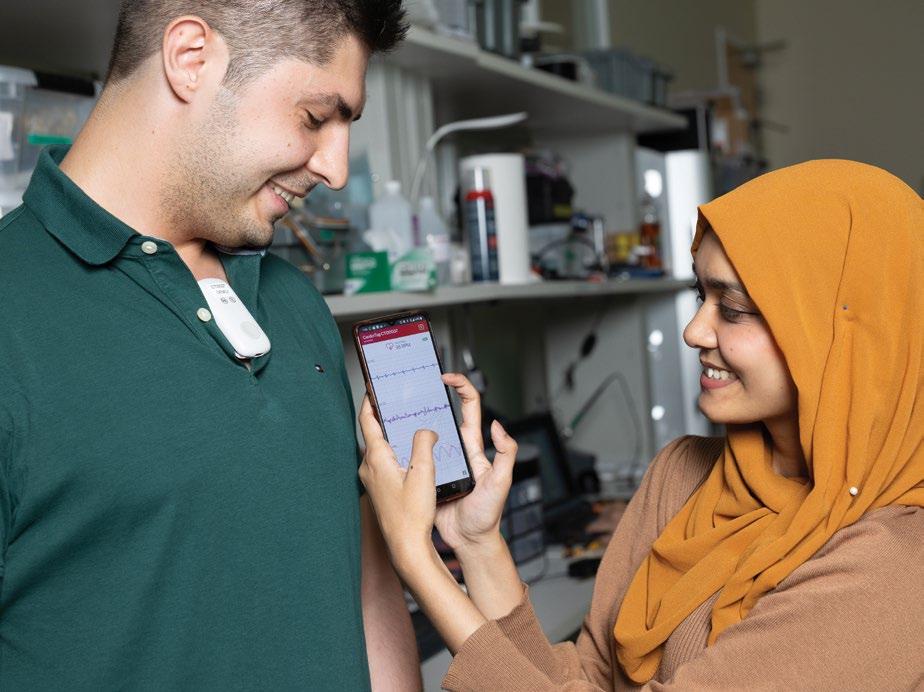
Tech Professor Omer Inan has spent decades researching non-invasive physiological monitoring. In 2020, he cofounded Cardiosense, which combines a wearable device with AI to detect early signs of cardiac disease before symptoms appear. The company’s CardioTag sensor, which earned FDA 501(k) clearance, non-invasively monitors cardiac mechanics, electrophysiology, and peripheral blood volume pulsatility. AI algorithms analyze three types of signals captured by the sensor—electrocardiogram (ECG), photoplethysmogram (PPG), and seismocardiogram (SCG)—to output an estimate of cardiac filling pressures. The technology could help provide earlier interventions that save lives. Inan is Regents’ Entrepreneur, associate chair for Entrepreneurship and Strategic Initiatives, and Linda J. and Mark C. Smith Chaired Professor in the School of Electrical and Computer Engineering.
SANGUINA
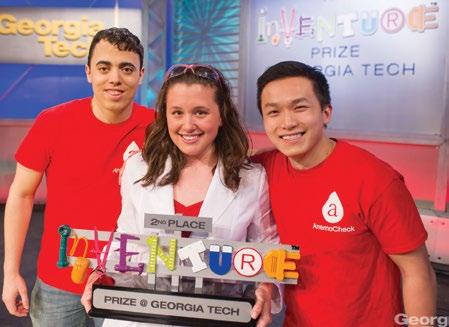
Approximately 1.9 billion people in the world live with the blood condition anemia. One of those is Erika Tyburski, BME 12, who began working on an instant anemia screener while she was a student at Georgia Tech. She met Rob Mannino, BME 13, PhD BME 18, who also has the condition. In 2013, the two took second place at Tech’s InVenture Prize with their first AnemoCheck prototype, a disposable screening tool for anemia. One year later, they launched Sanguina, and in 2023, the FDA cleared AnemoCheck Home, the only FDA-cleared home anemia test with instant results.
Tyburski and the AnemoCheck Team won second place at the 2013 InVenture Prize.
ANDSON BIOTECH
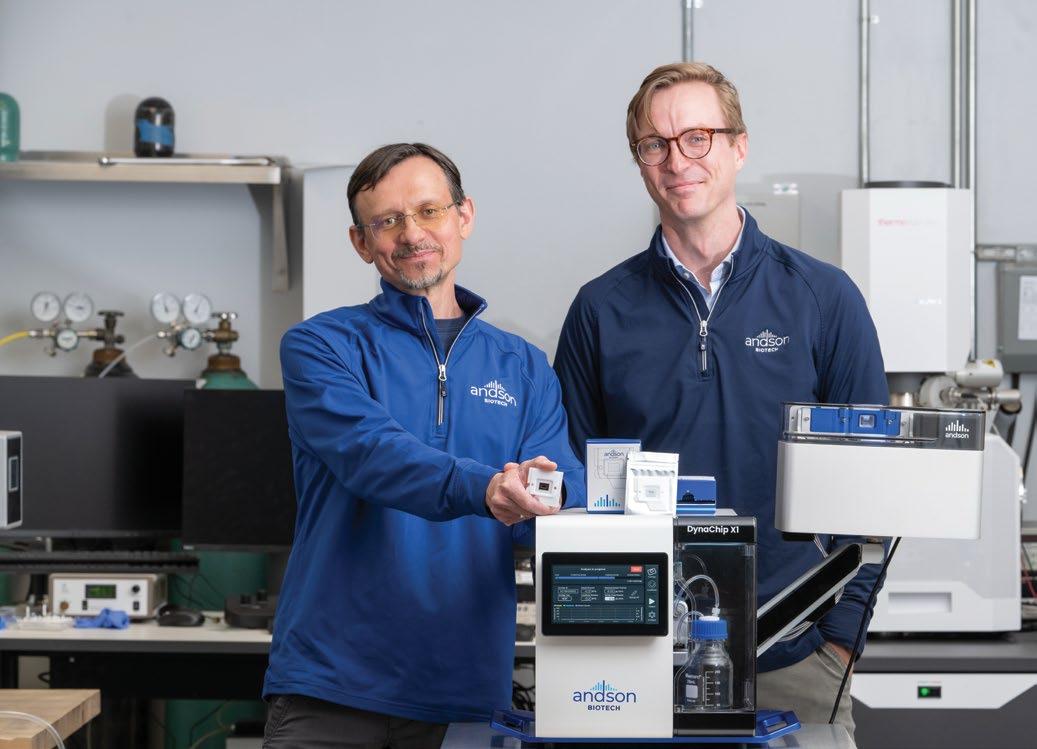
When Mason Chilmonczyk, MS ME 17, PhD ME 20, was a postdoctoral researcher at Georgia Tech, he developed a breakthrough technology to make the development and production of cell and gene therapies easier. He developed a microfluidic device that significantly cuts down the analysis time of traditional mass spectrometry, which is essential for developing biotherapeutics, from hours to minutes. With Tech Professor Andrei Fedorov, he co-founded Andson Biotech, a biotools company to commercialize the innovation through their DynaChip platform technology. The innovation simplifies sample preparation for mass spectrometry, and the technology has the potential to accelerate the development of established biotherapeutics (monoclonal antibody-based therapies) and emerging modalities (mRNA and gene and cell therapies).
Tap into Tech’s Angel Network
The Georgia Tech Angel Network connects Tech founders to a strong network of Tech alumni entrepreneurs for capital, mentorship, and contacts. The group includes successful alumni entrepreneurs, such as Chris Klaus, Cindy Bi, and Sean Henry, who help fellow Yellow Jackets scale their businesses. Interested Tech founders can submit a pitch deck, team details, and a link to their website to get started. They will typically receive a check-in from an angel within 2 to 3 weeks.
Visit GTangelnetwork.com to learn more.
Top 15 $2.8B+ 65
Number of new technology licenses reported by Georgia Tech in the last fiscal year, a 210% increase from the previous year in licenses, and a 140% increase in total licenses executed.
Total valuation of CREATE-X startups. The entrepreneurship program has produced more than 770 startups since it began in 2014.
The Institute is in the top 15 public universities for U.S. patents filed, according to the National Academy of Inventors.
39,000
Students who have pursued international experiences since Tech’s Study Abroad Office opened 30 years ago in 1995.
Andrei Fedorov and Mason Chilmonczyk cofounded Andson Biotech.
Building upon the success of the best-ever fiscal year and an overall record-breaking year for Georgia Tech, we recently announced the largest individual gift in the Institute’s history — a $100 million gift to the George W. Woodruff School of Mechanical Engineering from the estate of mechanical engineering alumnus John W. Durstine. We are grateful for donors like John Durstine — and for all of you — who are contributing to the success of the campaign and making a profound difference at Georgia Tech now and for generations to come.
We are on track to surpass the $2 billion initial target for Transforming Tomorrow: The Campaign for Georgia Tech, which now stands at more than $1.7 billion with over two years remaining. We are focused on meeting the overall campaign goal with strength across all areas. These priorities include ensuring every College meets its goal; advancing our student support goal of $700 million, which includes both undergraduate and graduate student support; elevating our research initiatives; and funding key capital projects like the Aerospace Engineering Building and the Medical Innovation Building
Winning Research Team Gives
Back
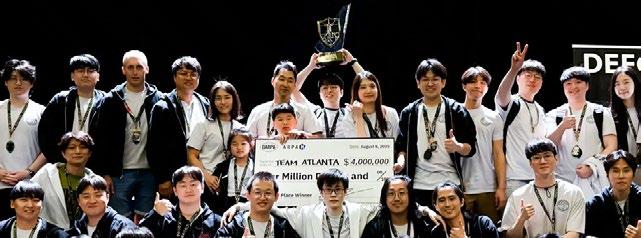
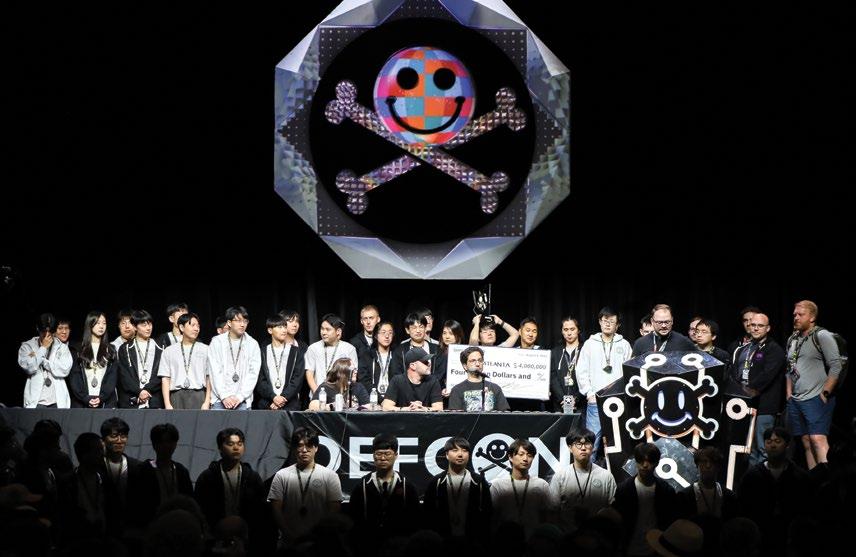
Team Atlanta, a group of Georgia Tech students, faculty, and alumni, achieved international fame when they won DARPA’s AI Cyber Challenge (AIxCC) and its $4 million grand prize. AIxCC was a two-year-long competition to create an artificialintelligence-enabled cyber reasoning system capable of finding and patching vulnerabilities on its own.
The Atlantis system was Team Atlanta’s submission. Atlantis is a fuzzer — or an automated software that finds vulnerabilities or bugs — and the team enhanced it with several different types of large language models. The team was comprised of hackers, engineers, and cybersecurity researchers. The Georgia Tech alumni on the team also represented their employers, which include KAIST, POSTECH, and Samsung Research.
The Georgia Tech students and postdocs have donated $2 million of their prize back to the Systems Software and Security Lab in the School of Cybersecurity and Privacy, supporting their ongoing research.
To learn more or to make a gift to cybersecurity research, contact Jason Zwang, senior director of Development, College of Computing, at jason.zwang@cc.gatech.edu.
OF ENGINEERING
Philanthropy to Fuel a New Home for Aerospace Engineering
The Daniel Guggenheim School of Aerospace Engineering is a globally recognized program that prepares students to address the current and future needs for human flight and space exploration. It is home to the nation’s No. 1 ranked public undergraduate and graduate aerospace programs and educates more than 2,000 students.
The AE School is currently housed in outdated buildings that were constructed in the 1930s and 1960s. Class locations and research labs are dispersed throughout multiple buildings across campus. Georgia Tech sees capital improvements as an essential factor in maintaining its stellar reputation and propelling the School’s expansion to realize its transformational goals. The School plans to build a new 225,000-square-foot complex for aerospace education and research. Advanced laboratories will support work in aerodynamics, robotics, artificial intelligence, autonomous systems, propulsion, and space technology — creating a collaborative environment that matches the School’s national reputation.
Planning is underway to define programming and research elements. The initial total cost is estimated at approximately $200 million. Donor support will enable the School to build this new facility, allowing us to prepare the nation’s future aerospace innovators and leaders. The new complex will strengthen research and industry partnerships, reinforcing Georgia Tech’s commitment to advancing Atlanta and Georgia as national leaders in aerospace innovation, economic development, and technological excellence.
To make a gift or commitment to the Aerospace Engineering Building, contact David Zaksheske, senior director of Development, College of Engineering, at davez@coe.gatech.edu.
COLLEGE
Kent Richard Hofmann Foundation Supports Students
Through the Invest in the Best Scholarship Challenge, the Kent Richard Hofmann Foundation has provided transformative scholarship support for architecture students, doubling the impact of their seven-figure gift through the dollar-fordollar challenge.
With the establishment of the Kent Richard Hofmann Scholarship Endowment, Georgia Tech now has the the opportunity to award more than a dozen scholarships annually to architecture students with financial need, providing access to a Georgia Tech education and changing the trajectory of these students’ lives. The endowed scholarship is named in memory of Atlantabased architect and philanthropist Kent Richard Hofmann, honoring and perpetuating his legacy and celebrating his impact on current and future generations of architecture students.
To provide essential support for students in the College of Design, contact Kelly Smith, director of Development, College of Design, at kelly.smith@design.gatech.edu.
First McEver Archaeology Chair Named
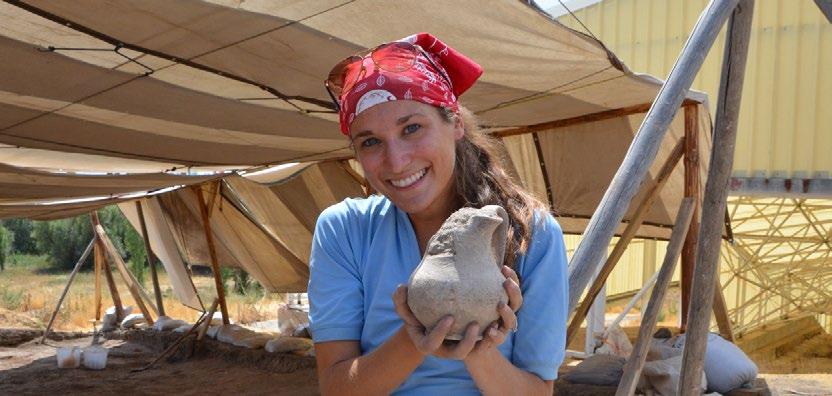
For the first time at Georgia Tech, the School of History and Sociology will offer archaeology classes beginning this spring. The courses will be taught by Allison Mickel, the first professor to hold the H. Bruce McEver Chair in Archaeological Science and Technologies. Mickel, who researches the impact of excavations on local communities, has excavated in Jordan, Turkey, Kenya, and the United States.
Bruce McEver, IE 1966, established the chair because he sees Georgia Tech as a potential major innovator in the world of archaeology technologies, an area which has seen dramatic change in recent years. “Georgia Tech brings to the table a range of technical disciplines that can help accelerate the use and effectiveness of new innovations in archaeology research,” he said. “This program gives Georgia Tech a chance to play an integral role as part of the larger archaeology research community in the United States and beyond.”
To support promising faculty in the School of History and Sociology, contact Lauren Kennedy, director of Development, Ivan Allen College of Liberal Arts, at lauren.kennedy@dev.gatech.edu.
Faculty Fellowship to Empower Integration of AI
The Bill Kent AI in Higher Education Faculty Fellowship will help empower educators with the knowledge and skills necessary to integrate AI tools into their teaching practices — and help to transform higher education at Georgia Tech.
“We deeply appreciate the generosity of the Dr. Bill Kent family in establishing this first philanthropic gift to our new College. Their generous support will allow us to encourage practical applications of AI and foster an appreciation for its ethical use,” said William Gaudelli, inaugural dean of the College of Lifetime Learning. “This Fellowship will ensure we grow and learn about its use thoughtfully, developing highly innovative and engaging pedagogical experiences for all life’s stages.”
The effort will be led by the College’s Center for 21st Century Universities, Georgia Tech’s living laboratory for fundamental educational change.
Philanthropic support will enhance the College of Lifetime Learning’s ability to empower educators to improve the learning experience. To make a gift, contact Ashley Coogan, assistant vice president for Unit Development, at ashley.coogan@dev.gatech.edu.
IVAN ALLEN COLLEGE OF LIBERAL ARTS
COLLEGE OF LIFETIME LEARNING
College of Sciences Surpasses Campaign Goal
The College of Sciences has exceeded its $75 million campaign target, raising $78 million and counting as part of the Institute’s historic philanthropic effort, Transforming Tomorrow: The Campaign for Georgia Tech.
“Achieving this milestone reflects the generosity and deep commitment of our alumni, donors, and friends to advancing science education and research,” said Susan Lozier, dean of the College of Sciences and Betsy Middleton and John Clark Sutherland Chair. “We are energized by this momentum and grateful to everyone who has supported us through investment in our success as we continue to fundraise for key priorities such as endowed faculty positions, graduate fellowships, undergraduate scholarships, and innovative teaching and experiential learning.”
The College of Sciences is the first College at Georgia Tech to reach its goal. As the campaign continues, the College of Sciences will remain focused on expanding student opportunities, accelerating scientific discovery, and supporting faculty excellence.
Giving Together: Scheller College Young Alumni Advisory Board
Members of the Scheller College Young Alumni Advisory Board combined their support to make the first-ever gift in support of Scheller College’s Need-Based Scholarship Endowment. This is part of a new giving initiative designed to expand access and opportunity for students through collective donor support of need-based scholarship endowment funds — one each for the College of Computing, College of Design, College of Engineering, College of Sciences, Ivan Allen College of Liberal Arts, and Scheller College.
Each pooled endowment fund begins with gifts and commitments totaling at least $25,000, creating a foundation that grows over time and ultimately supports named scholarships. Donors can help build a lasting legacy without having to establish a six-figure endowment in the near term.
This significant gesture from the Scheller College Young Alumni Advisory Board reflects the power of alumni collaboration and a shared interest in investing in students and the future of Scheller College.
To join others in contributing to Scheller College’s Need-Based Scholarship Endowment, contact Duante Stanton, senior director of Development, Scheller College of Business, at duante.stanton@scheller.gatech.edu.
To support the College of Sciences’ top priorities, contact Dan Warren, director of Development, College of Sciences, at dan.warren@cos.gatech.edu.
Providing Critical Flexibility Through the Athletics Director’s Initiative Fund
It remains important that Georgia Tech Athletics has the ability to be nimble and react quickly to an ever-changing landscape. Unrestricted gifts to the Athletics Director’s Initiative Fund can be used at the discretion of the director of Athletics to address unexpected critical needs as they arise. Ryan Alpert will shape Georgia Tech Athletics by these five cornerstones:
• Being relentlessly competitive
• Aligning with Georgia Tech’s academic mission and Institute leadership
• Investing strategically
• Prioritizing people
• Leading with integrity
Unrestricted gifts to the Athletics Director’s Initiative Fund begin at $25,000. ATHLETICS
To provide essential, flexible support for Georgia Tech Athletics, contact Robby Poteat, executive associate athletics director for Development, at rpoteat@athletics.gatech.edu.
Sharp Reappointed Medical Innovation Hub: Where Technology Meets Medicine
Leslie Sharp has been reappointed to a second five-year term as dean of Libraries at Georgia Tech. This decision followed a review process, which included feedback from faculty, staff, students, and external library colleagues and an evaluation of Sharp’s performance and accomplishments during her term.
Sharp, who has served as dean of Libraries since 2020, has played a pivotal role in advancing Georgia Tech’s mission of supporting research, teaching, and learning across the Institute. Her leadership has guided the Library’s focus on interdisciplinary collaboration and expanded services, saving students, faculty, and staff more than $2.12 million in 2024 through course reserves, interlibrary loan, Gadgets equipment lending, locker rentals, and room reservations. Sharp’s work has ensured that the Library is one of the most desirable places on campus to study, work, and collaborate.
To support Dean Leslie Sharp’s vision for the Library, contact Heather Howarth, director of Development for the Library, at heather.howarth@library.gatech.edu.
Honors Program Named
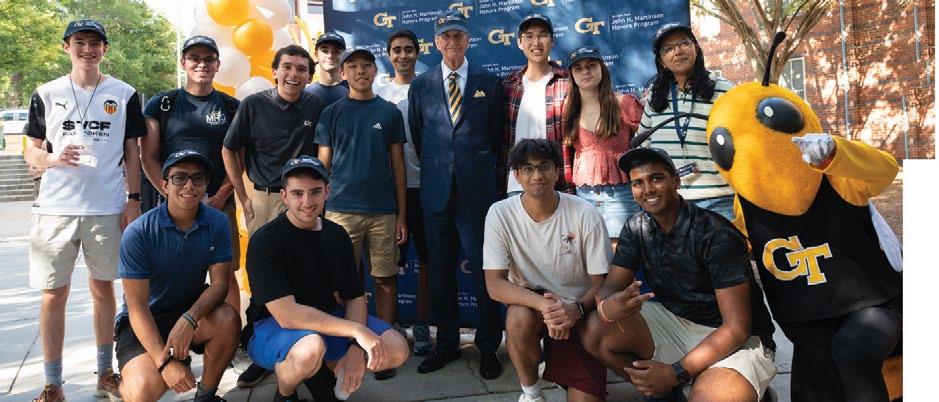
Georgia Tech’s Honors Program has received a transformative $10 million commitment from philanthropist and venture capitalist John H. Martinson. In recognition of his generous investment, the program will now be known as the John H. Martinson Honors Program.
Georgia Tech is launching a bold initiative to redefine and accelerate transformational health and medical innovations, from discovery and development to real-world impact, through the creation of the Medical Innovation Hub and state-of-the-art Medical Innovation Building. This effort responds to the urgent need to address treatments gaps, rising healthcare costs, and limited access to advanced care. The Hub builds on Georgia Tech’s strengths in engineering, biosciences, neuroscience, computer science, AI, and social sciences; the Georgia Tech Research Institute, Tech’s applied research arm; and 11 Interdisciplinary Research Institutes (IRIs).
The Medical Innovation Hub brings together researchers, entrepreneurs, clinicians, and healthcare experts through Georgia Tech’s extensive partnerships with hospitals, industry leaders, startups, government agencies, global health organizations, and peer universities to tackle pressing health challenges and move solutions to market faster. This $300 million-plus initiative includes $200 million for the Medical Innovation Building. Additional funding will be used by the Medical Innovation Hub to support faculty, students, visiting experts, and programmatic initiatives across affiliated IRIs. Georgia Tech seeks philanthropic and public support to realize this vision, which promises to transform healthcare, improve lives, and prepare students for leadership in the 21st-century economy.
To learn more about Georgia Tech’s efforts to transform healthcare, contact Meg Hendryx, associate vice president for Principal Gifts, at meg.hendryx@dev.gatech.edu.
Martinson is a longtime advocate for excellence in higher education and has provided significant philanthropic support for honors programs at several leading institutions across the country. As a result of this commitment, Georgia Tech will expand and enhance its Honors Program to serve more students, enrich the undergraduate experience, and elevate the program’s national standing.
“We are deeply grateful to Mr. Martinson for his generosity and commitment to the next generation of leaders,” said Georgia Tech President Ángel Cabrera. “Through this extraordinary investment in the newly named John H. Martinson Honors Program, we will help more of our students reach their full potential and expand the high-impact opportunities available to them.”
Martinson is chairman of Martinson Ventures, a private technology investment firm. His personal connection to Georgia Tech runs deep — his father, Raymond Martinson, earned a mechanical engineering degree from Tech in 1941.
To provide opportunities for talented Georgia Tech students to thrive, contact Emily Wong, director of Development, at emily.wong@dev.gatech.edu.
HOMECOMING TREAT
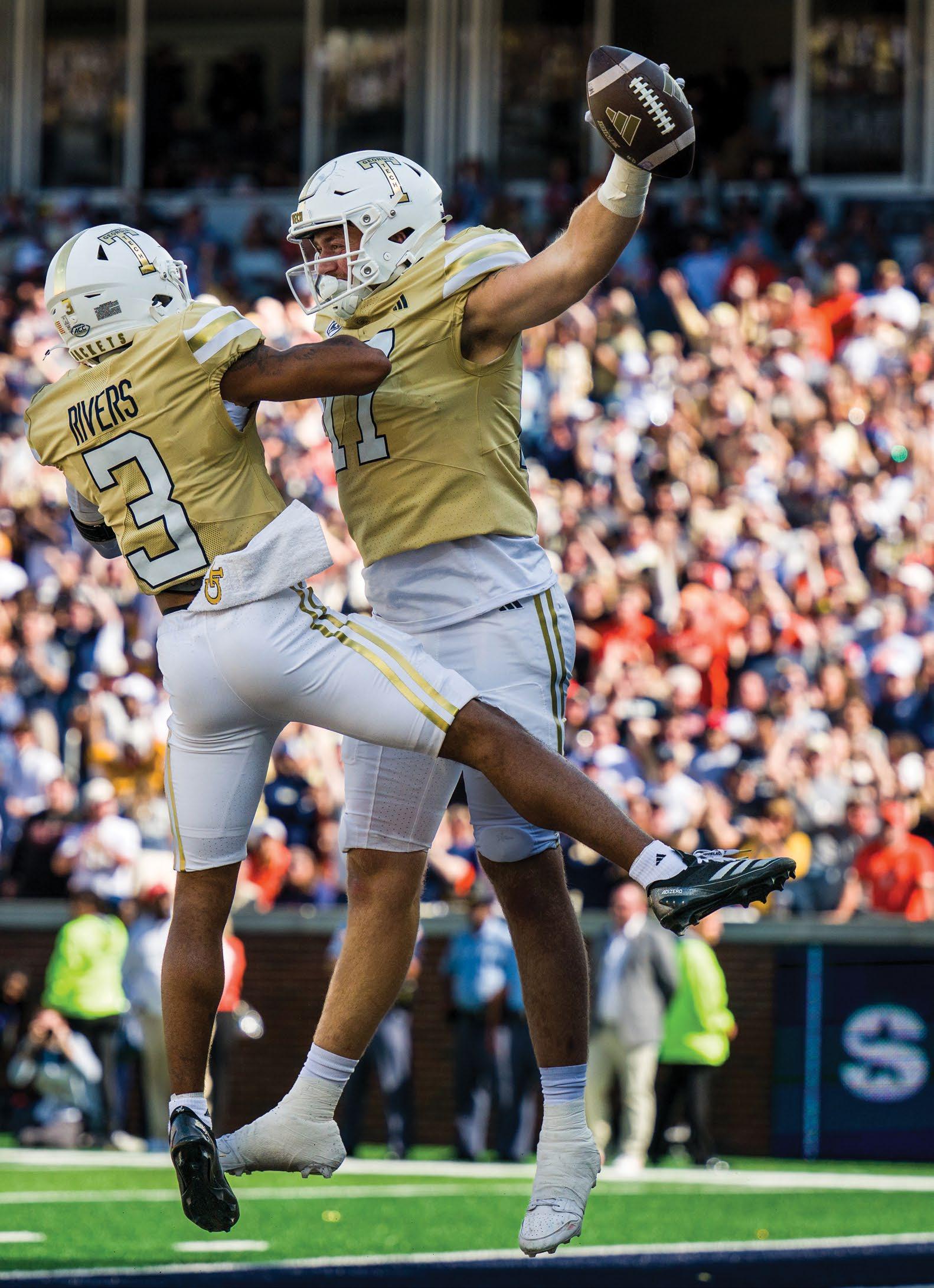
The Jackets’ win against Syracuse put Tech 8-0 for the first time since 1966. Coach Brent Key, Mgt 01, also became the first Tech alumnus to win 8 or more games in a season since Bill Curry, IM 65, in 1985.
TECH PLAYER TURNS BASEBALL INTO BUSINESS
IN THE ERA OF NIL, DREW BURRESS IS LEARNING HOW TO MANAGE CLASS, PRACTICES, AND ENTREPRENEURSHIP.
DDREW BURRESS knows the business side of baseball.
His father, Andy Burress, a former Major League catcher and outfielder, went on to own 5 Star National, one of the largest youth baseball development organizations in the U.S. Even as Burress played on those traveling teams as a child, honing the on-field skills that would one day make him a collegiate star and budding big-league prospect, he watched his dad handle the behind-the-dugout machinations of budgets, taxes, investments, and sponsorships.
That experience is serving Burress well as he enters his junior year as an All-American outfielder with the Georgia Tech Baseball team, negotiating the wild new world of NIL.
Starting in 2021, a series of laws permit college athletes to be compensated for monetary use of their name, image, or likeness (NIL). Previously prohibited from making money lest
they lose their amateur status, student athletes can now endorse brands, conduct training camps, and even start their own businesses. “I feel like I came at just the right time with NIL,” says Burress. “I think as athletes, we do a ton. People recognize us. Realistically we are working full-time—playing, training, weightlifting, practicing— plus going to school. Those are long days.”
Burress’ growing portfolio includes partnerships with Adidas, Associated Credit Union, several trading card companies, and Perfect Game, an organization that stages baseball travel team tournaments and events like his dad. Burress provides an occasional endorsement and, implicitly, continued excellence on the field. In return, Burress says, he’s getting more from NIL than just spending cash—he’s getting real-world financial experience that, along with his classes as a business major in the Scheller College of Business, will prepare him for a future in the professional world and beyond.
“You see a certain percentage of professional athletes that are broke
BY TONY REHAGEN
after so many years used to living a certain lifestyle that they can’t afford after their playing days,” says Burress. “Sometimes you get the wrong people in your ear. NIL has pushed the calendar forward for a lot of college athletes and put responsibility on us earlier so we can learn those lessons.”
One of the first lessons Burress learned was to ask for help with his newfound income. He reached out to Atlanta’s BIP Financial Advisors, where a group of Tech baseball alumni work and help student-athletes like Burress. “Whether it’s this year or 30 years from now, my playing days will one day be over,” he says. “I want to make sure I’m putting my money in the right places and setting myself up for the future.”
Of course, Burress’ closest advisor is the one he’s had his entire life.
“One of the things my dad has always talked to me about is respecting the game of baseball,” says Burress. “It’s done so much for my family and me. It’s what I love to do. And if you’re doing something you’re passionate about, you’ll be more successful.”
GEORGIA TECH ATHLETICS CELEBRATES HOMETOWN HEROES
TECH INTRODUCED THE HOMETOWN HERO PROGRAM, HONORING ALUMNUS BRIGADIER GEN. MARK MASSARO, CE 98, DURING THE OCT. 25 HOMECOMING GAME.
GEORGIA TECH ATHLETICS debuted the Hometown Hero program during Tech’s Homecoming football game versus Syracuse. The program recognizes outstanding individuals from the Georgia Tech community who have gone above and beyond to make a positive impact.
Each month, a selected Hometown Hero is honored at a Tech athletics event, where their story and connection to Tech is shared with fans. These heroes include, but are not limited to, current or former military members, first responders, teachers, and other outstanding people in the community.
The inaugural hero for the month of October was Brigadier General Mark Massaro, CE 98. Massaro is the Commander of the 96th Test Wing at Eglin Air Force Base, Florida. He leads military, civilian, and contractor personnel, directing all base operating support, infrastructure, and
services support for the Air Force’s largest installation and over 19,000 joint personnel. He ensures personnel accomplish the 96th Test Wing’s missions of developmental testing and evaluation of conventional munitions, command and control systems, aircraft avionics and guidance systems, and radar cross section measurement.
He earned his commission in 1998 as a distinguished graduate from ROTC Detachment 165 at Georgia Tech before he proceeded to pilot training. He has deployed as an F-16 Fighting Falcon pilot flying in support of Operation Allied Force, Southern Watch, Iraqi Freedom, and Enduring
Freedom. He served as an Experimental Test Pilot at Eglin and Edwards Air Force Base, conducting flight test operations in the F-16 and F-35 Lightning II.
Massaro is a Command Pilot with more than 2,200 flight hours in more than 30 aircraft and has flown more than 100 combat hours in the F-16. He is a five-time distinguished graduate of multiple academic programs, most notably the Eisenhower School for National Resource Strategy, National Defense University, Washington, D.C. He has been awarded the Legion of Merit, three Meritorious Service Medals, and an Air Medal, among many other accolades.
Community members and fans can submit Hometown Hero nominations at ramblinwreck.com/hometown-hero. One winner will be chosen each month through April 2026 to be recognized at a Georgia Tech sporting event.
FOLLOWING THE DODD WAY
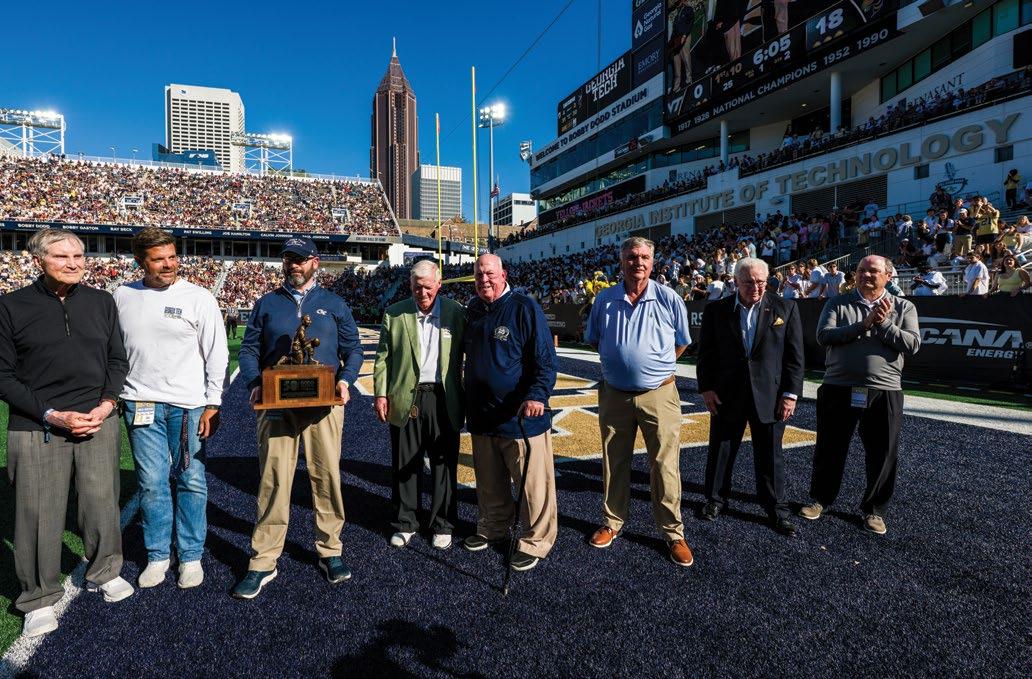
Georgia Tech honored five recipients of The Dodd Trophy, named in honor of legendary Coach Bobby Dodd, during the Oct. 11 game against Virginia Tech. The five former honorees who have ties to Tech are George O’Leary, Paul Johnson, Bobby Ross (represented by his son, Rob), Bill Curry, and Ralph Friedgen.
SPORTS SHORTS
AVCA T.E.A.M. AWARD HONORS VOLLEYBALL ALUMNA
GEORGIA TECH VOLLEYBALL PLAYER
Development Assistant Luanna Emiliano, ALIS 25, received her first post-graduate honor off the court as she received the AVCA T.E.A.M. Award. The AVCA T.E.A.M. Awards—which promote Togetherness, Empowerment, Accessibility, and Mentoring—are a demonstration of the association’s commitment to the volleyball coaching profession and the sport itself.
Emiliano joined the Georgia Tech volleyball coaching staff as a player development assistant in July 2025 and enters her first season with the program after graduating from Tech in May of 2025. During her senior season at Tech, Emiliano appeared in 119 sets across 31 matches. She finished her senior season with nine kills, 1,011 assists (8.49 assists/set), 28 service aces, 294 digs, and four block assists. Her collegiate career was highlighted by 13 doubledoubles in the 2024 season, 80 total across her career.
GEORGIA TECH ATHLETICS
RUTLEDGE NAMED LOMBARDI AWARD SEMIFINALIST
HE IS ONLY THE THIRD IN TECH HISTORY TO BE NAMED A SEMIFINALIST FOR THE AWARD.
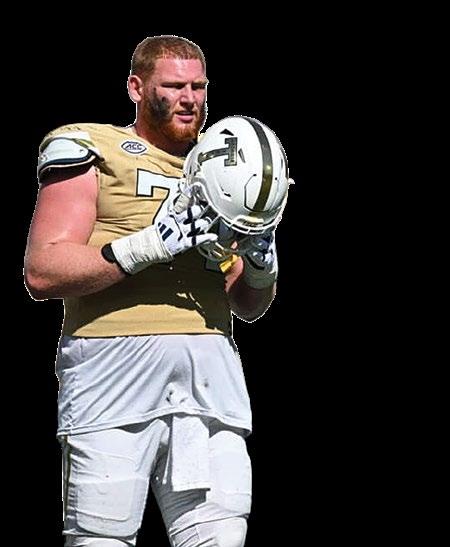
GEORGIA TECH OFFENSIVE GUARD KEYLAN RUTLEDGE has been selected as one of 13 semifinalists for the 2025 Lombardi Award. The Lombardi Award honors college football’s top lineman or linebacker. A 6-foot-4, 330-pound senior, Rutledge is one of only three offensive linemen on the list of 13 semifinalists and the only guard. He is the third Lombardi Award semifinalist in Georgia Tech history and the first Yellow Jacket to earn the distinction since defensive lineman Coleman Rudolph, Cls 95, in 1992. Defensive lineman Rock Perdoni, Mgt 73, was a finalist for the first-ever Lombardi Award in 1970.
Rutledge is the leader of a Georgia Tech offensive front that has paved the way for the Yellow Jackets’ success this season, including a top-10 national ranking in total offense (482.1 ypg), 13th in rushing offense (221.0 ypg), and a tie for sixth with just six sacks allowed through Tech’s first nine games of the season.
A 2024 first-team all-American, Rutledge is looking to become the first Yellow Jacket to be named all-American in consecutive years since offensive line Omoregie Uzzi, BA 12, MS Econ 19, in 2011 and 2012.
The 2025 Lombardi Award will be presented on Dec. 10, after press time, in Houston. Since its inception in 1970, the Lombardi Award annually honors the college football lineman or linebacker who embodies the discipline, character, and excellence of legendary coach Vince Lombardi.
GEORGIA TECH ATHLETICS
WADE AND SHELTON LEAD JACKETS AT ACC CHAMPIONSHIPS
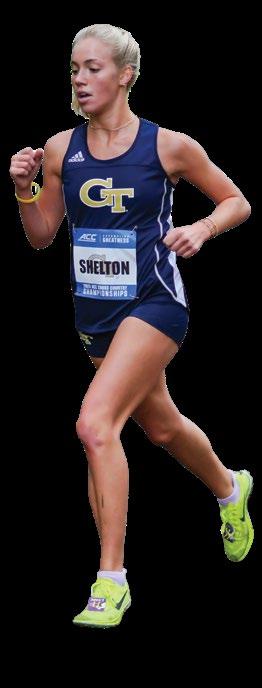
THE GEORGIA TECH men’s and women’s cross country teams finished their races at the 2025 ACC Cross Country Championships on Oct. 31. The men’s team finished 13th as the women’s squad placed 17th.
Taylor Wade was running in 117th place midway through the race at the 4K split before he sprint ed home to cross the line in 68th at 24:08.0.
The junior passed 49 racers in the final half of the race to finish as the lead Yel low Jacket in the 8K race.
Claire Shelton broke out of the pack to record her first top-100 finish in the postseason at 21:02.2. The sophomore led the Jackets in the 6K race.
The men’s squad recorded three top-100 finishes. Shelton was the lone female un derclassman for Tech to place inside the top 100 across both races.
GEORGIA TECH ATHLETICS
Advance your career with Georgia Tech’s Online Master of Science in Analytics.
A Top-5 nationally ranked program designed for working professionals.
• 100% online
• Complete in 24–36 months
• Total tuition under $12,000 Fall 2026 applications now open.
“The
OMS Analytics program gave me the opportunity to enhance what I was already doing and made my skills portable across a wider set of fields.”
Patrick Kriengsiri
Online Master of Science in Analytics
• Top-5 nationally ranked
• 100% online
• Complete in 24-36 months
• Total tuition under $12,000
• Self-paced course load
• 3 specialized areas of study:
- Analytical Tools (Data Analytics)
- Business Analytics
- Computational Data Analytics (Data Science)
• No GMAT/GRE required
IN THE WORLD
BRINGING KIT CARS TO A U.S. MARKET
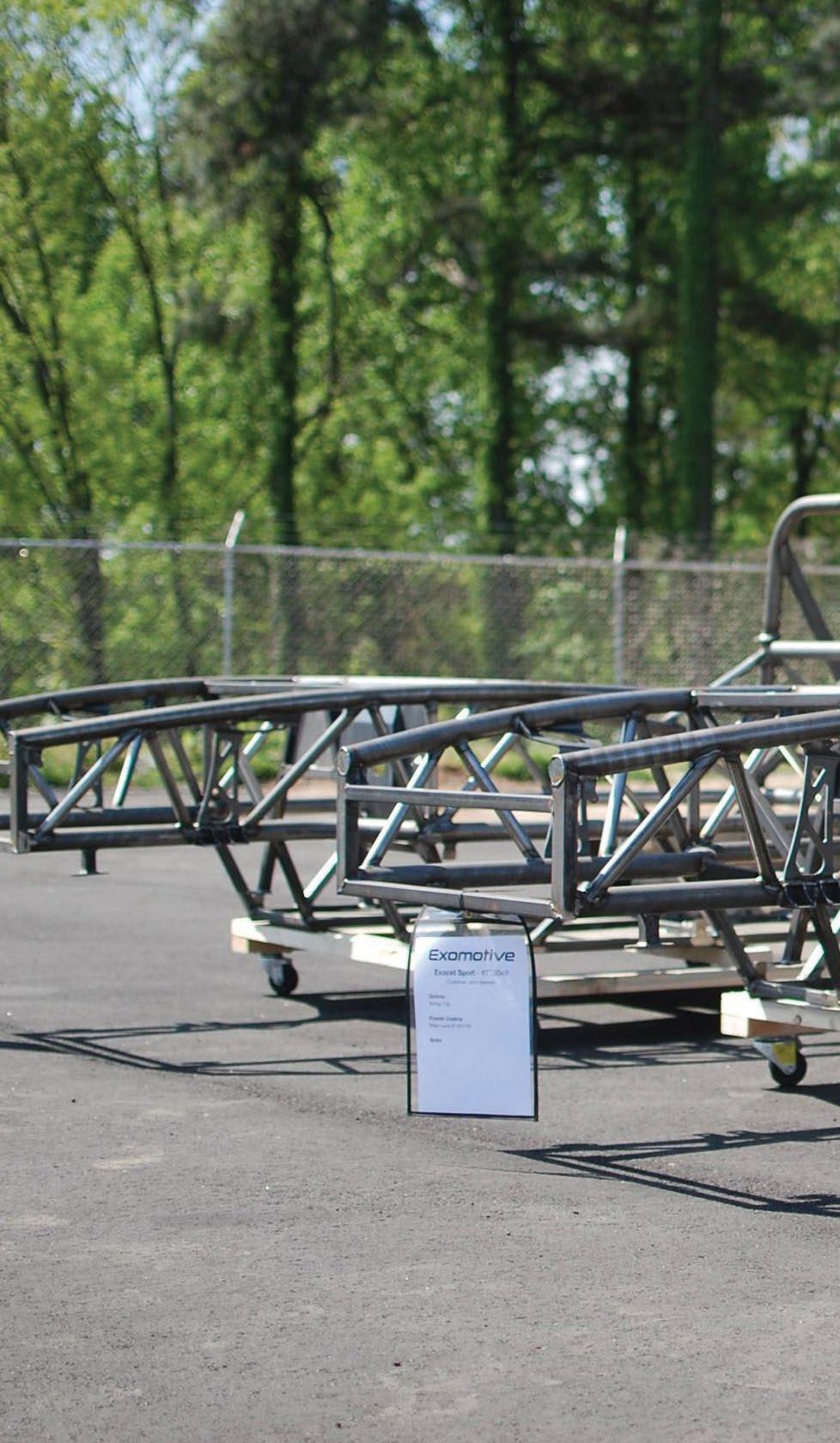
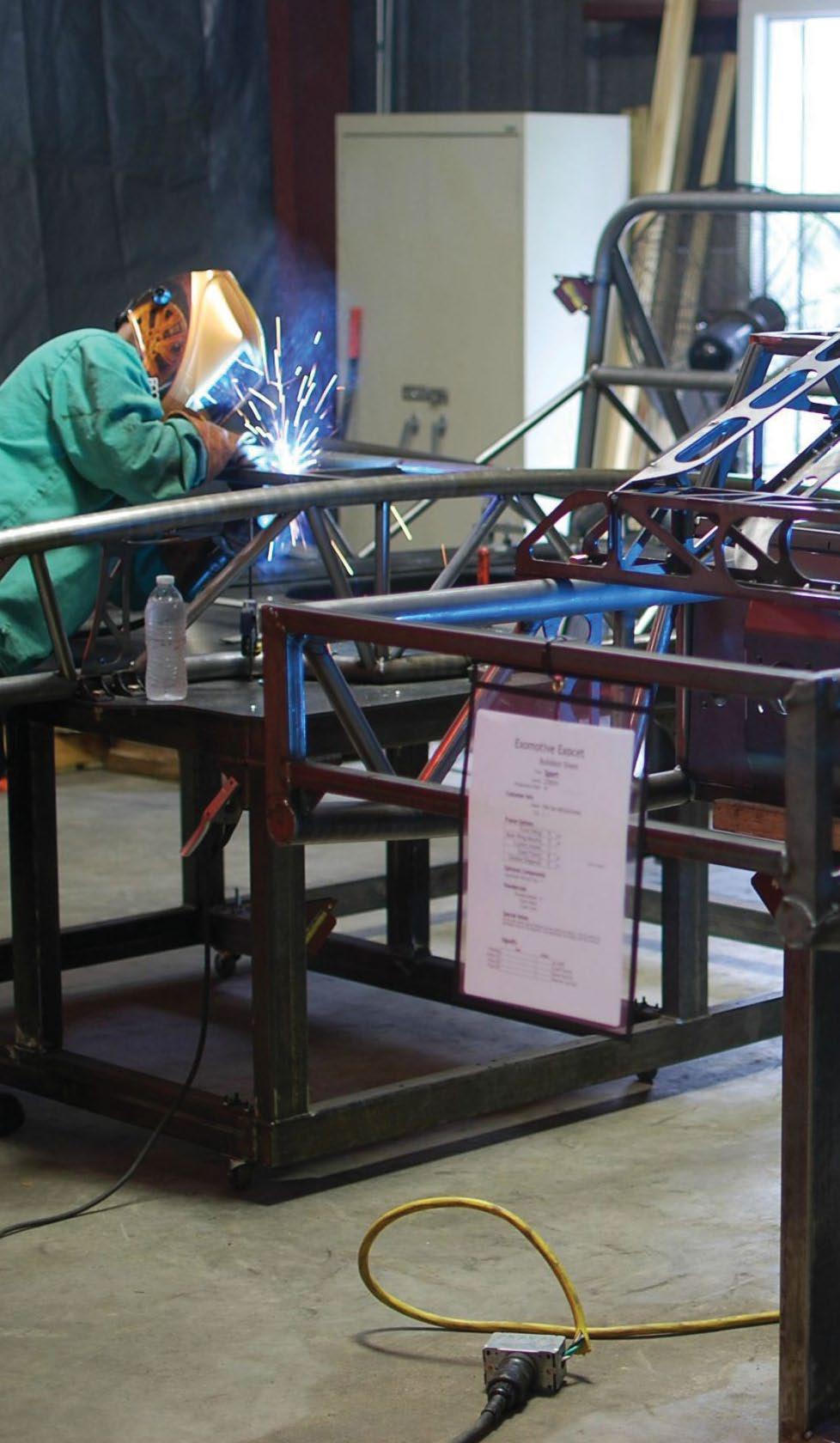
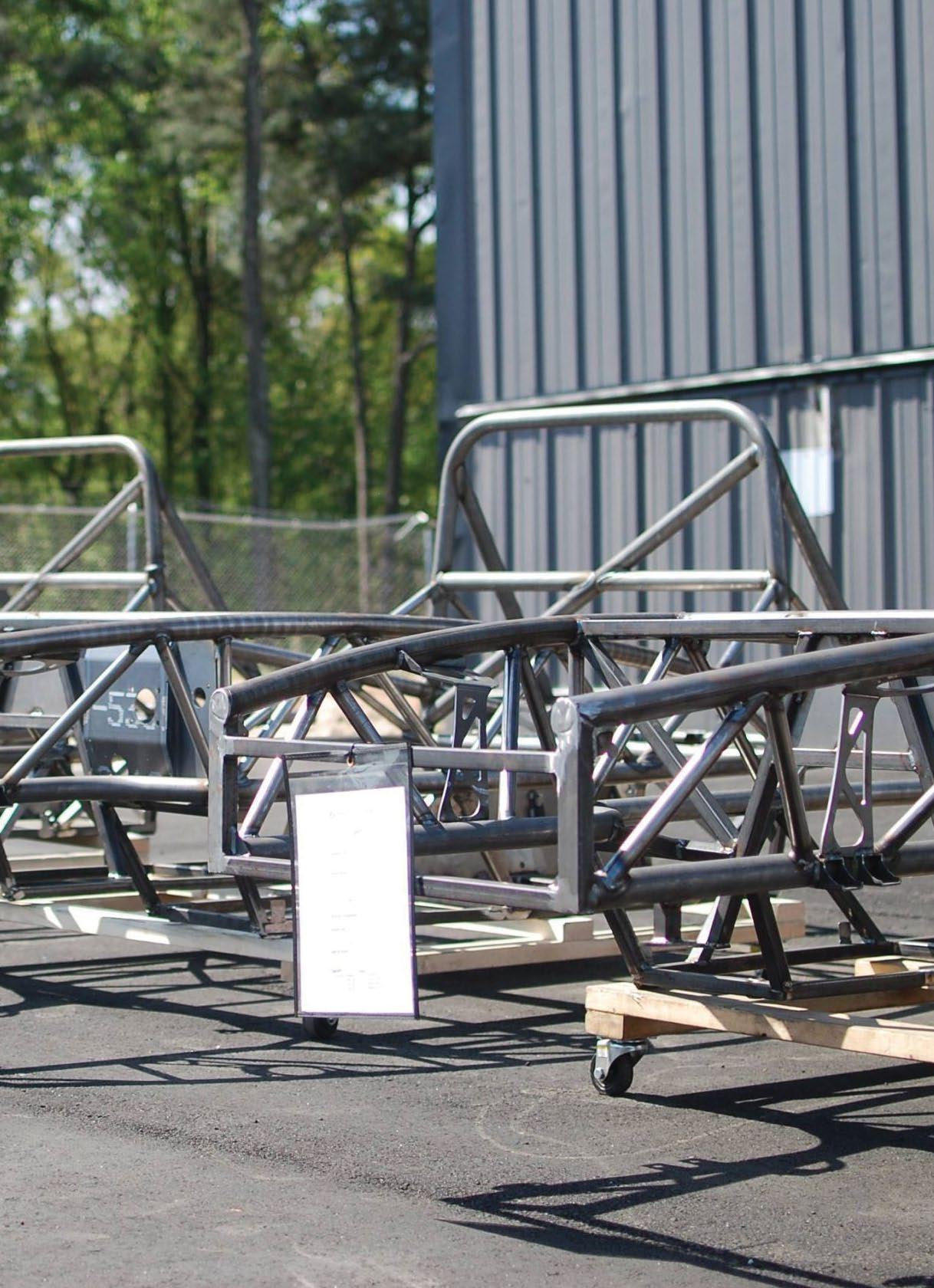
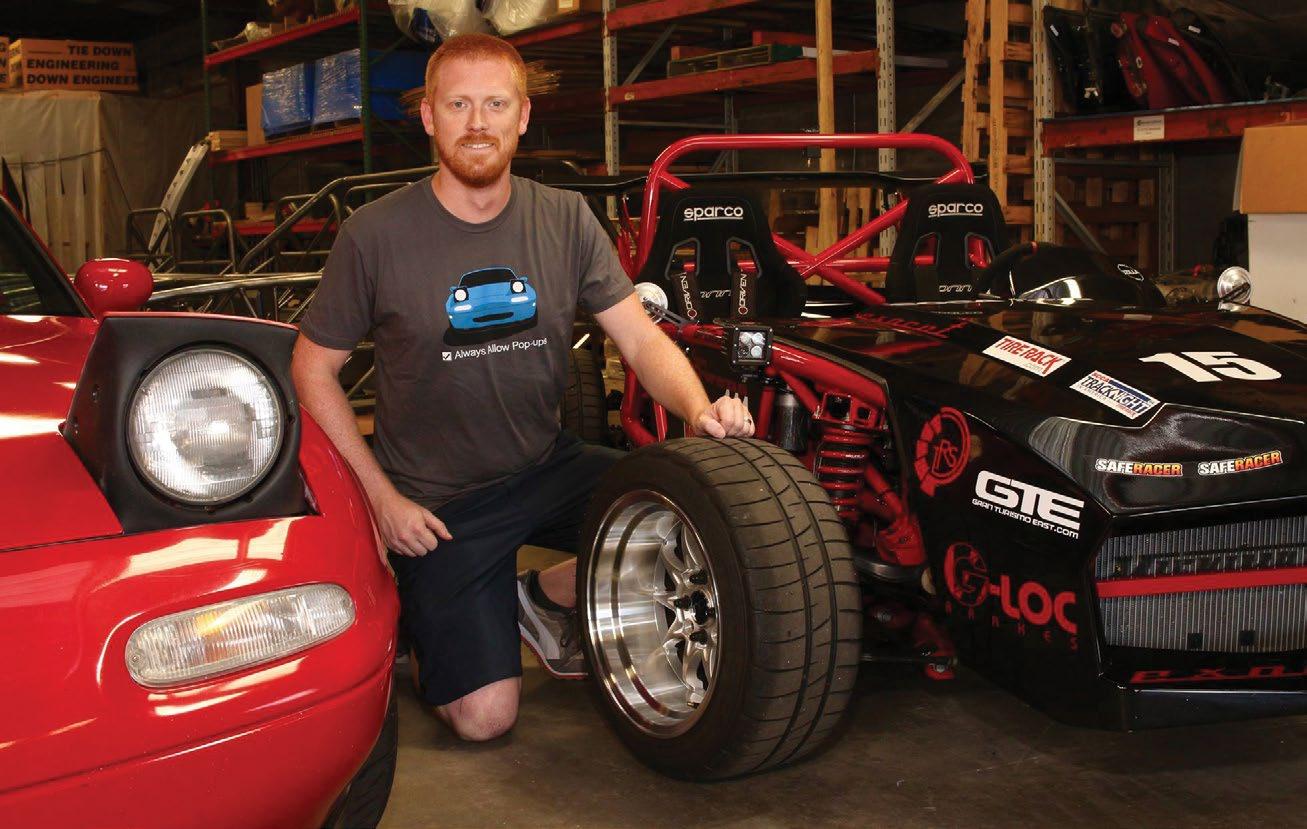
Kevin Patrick, Mgt 05, teamed up with Warren van Nus, ME 12, to bring the Exocet, an easy-to-build kit car from the U.K., to left-handside drivers in the U.S. market. Atlanta-based Exomotive provides the classic kit car, with an electric version in the works.
The Exocet has been re-engineered from the U.K. version to allow left-hand-side driving for American drivers.
BEHIND THE WHEEL WITH EXOMOTIVE’S FOUNDER
THE ALUMNUS-FOUNDED BUSINESS PROVIDES AMERICANS WITH THE EASIEST KIT CAR IN THE WORLD TO BUILD FOR AROUND $10K.
BY CHRIS QUIRK
AA SELF-DESCRIBED ADRENALINE JUNKIE,
KEVIN PATRICK, MGT
05, is game for just about anything, including motor sports, canopy piloting, or some other pulse-raising pastime.
Now the former member of the Georgia Tech Skydiving Club is on a mission to bring the thrill of open-cockpit racing—or just tooling around town if you like—to car hobbyists of all levels.
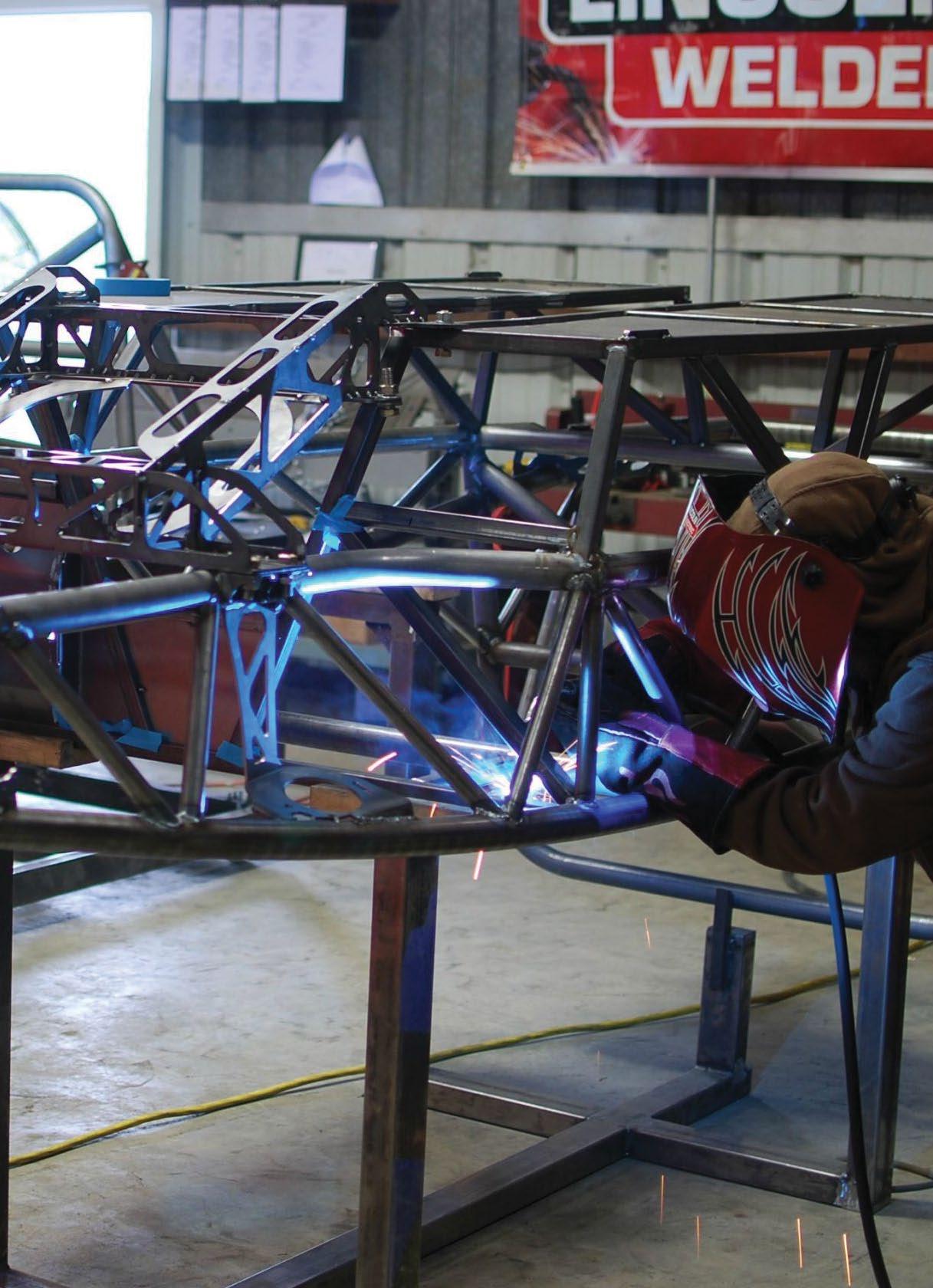
Patrick’s company, Exomotive, based in Atlanta, manufactures frame and body kits for his custom version of the Exocet, an exoskeletal sports car, which Patrick calls the easiest kit car in the world to build. Get a drivetrain from one of the thousands of Mazda Miata donor cars that have been mothballed, drop it into the frame, and you’re ready for the road or track. “This is an open-topped, lightweight car, and it’s extremely fun to drive,” says Patrick, who estimates the average cost for a complete car to be around $10,000. Not cheap, but not out of range for a lot of serious hobbyists.
Long a racing enthusiast, Patrick became enamored with the original Exocet, built by Mills Extreme Vehicles in Staunton, England. Patrick decided to retool it for the left-driver-seat U.S. market. “I was interested in the concept of utilizing all of the design components and driveline of the Miata, because it’s about the most popular two-seater car in the world, and they’ve made so many of them over the years.”
Patrick built his first Exocet in his garage, and was soon zipping around Atlanta, catching the eyes of pedestrians and fellow drivers.
Warren van Nus, ME 12, first learned of Patrick’s enterprise when he came across an article with a video on the Jalopnik website showing Patrick’s Excocet slowly crumpling under the bumper of an SUV that was being backed out of a gas station by an unwitting driver. “I recognized the gas station as being in the Atlanta area. Curious, I looked up Exomotive, reached out to Kevin, and coordinated a meeting at his shop,” says van Nus.
Van Nus, who was a member of Georgia Tech Motorsports
and Georgia Tech Solar Racing, joined Exomotive, and partnered with Patrick to redesign the Exocet for the U.S. market, and improve the build experience for hobbyists. “The goal was to marry the body work and the chassis in one piece, and reduce the weight. That’s the magic sauce, and we ended up saving anywhere from 700 to 900 pounds. Subtracting weight makes you faster everywhere,” says Patrick. And while the exoskeletal Exocet has exposed tubes and wheels that increase drag, Patrick estimates that with the right Miata driveline and configuration, the Exomotive Exocets can hit the 120-mph range. “The Exocet can be quite a nice track weapon.”
Patrick has also developed a prototype for an electric model of the Exocet with the help of Ben Horst, ME 16, using the guts of a Tesla Model S and its 52-kWh battery pack. This car can move. “It did zero to 60 in 2.8 seconds,” Patrick says. “It feels like the fastest golf cart you’ve ever been in.” The release of the Electrocet, as the duo dubbed it, is on hold as they work out safety procedures for the build. “If you touch the wrong thing or drop your wrench on the wrong spot with these high voltage batteries, it can kill you immediately,” he says. “Most of the people putting these cars together are typical folks looking to have some fun, so we are going to make sure the car is safe.”
The Exomotive Exocet has generated a community of
“IT DID ZERO TO 60 IN 2.8 SECONDS,” PATRICK SAYS. “IT FEELS LIKE THE FASTEST GOLF CART YOU’VE EVER BEEN IN.”
hobbyists and racers who share tips and gather for events, including a Facebook Exocet Owners Club. Patrick also regularly organizes track day events for Exocet owners at raceways like Atlanta Motorsports Park.
The experience of driving the Exocet is categorically different from the typical driving experience, says Patrick; thus the allure. “You can certainly build lightweight Miatas or other cars, but when you take the top off, so to speak, without the pillars in front of you, it’s much more like a motorcycle,” he says. “It’s very different and quite mind-blowing for some people, especially when you get to the higher speeds. They’ve never experienced anything like that.”
Kevin Patrick, Mgt 05, launched Exomotive in 2011.
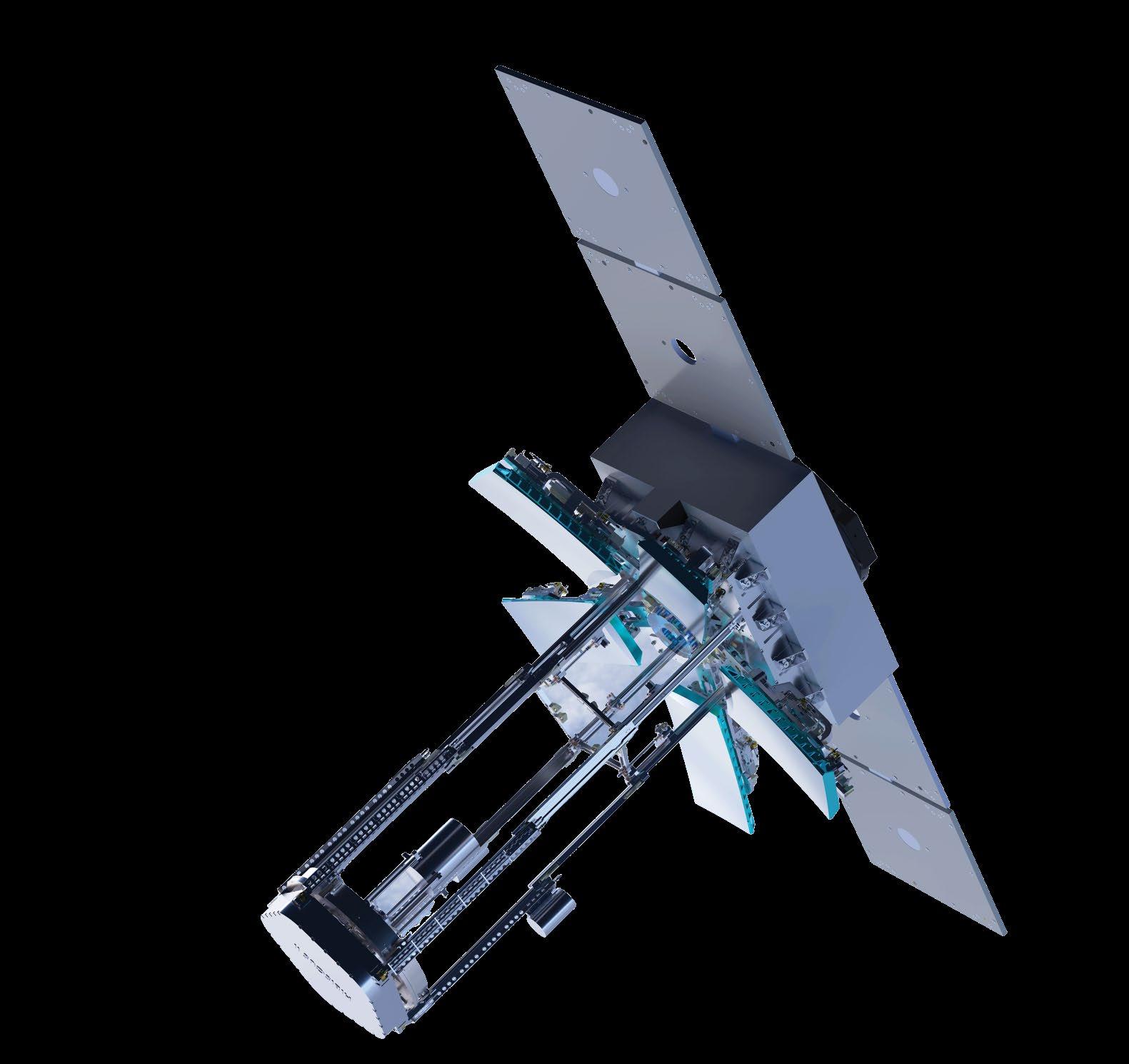
FFOR MARCO GOMEZ-JENKINS, AE 11, ME 11, it’s all about a clear vision. These days as cofounder and CEO of Cambridge-based SuperSharp Space Systems, he is preparing for an early 2027 scheduled launch of his company’s first high-resolution thermalimaging satellite, which will launch from a SpaceX rocket.
“The unfolding space telescope allows you to fit very large telescopes in small packages,
launching a small box and deploying a telescope for 10 times the resolution per unit cost,” he says.
This satellite will be about the size of a washing machine and will operate in lower orbits of 500 kilometers (310 miles) in altitude. It will allow for the creation of global temperature maps, which can be useful for agriculture and energy efficiency.
“It’s heavily related to climate change because the dynamic temperature maps, for example, can monitor the energy efficiency of buildings,” says
Gomez-Jenkins, who also co-founded the Costa Rica Institute of Technology’s Space Systems Laboratory. “It’s a big problem in Europe, in particular, because of the age of some of the infrastructure. We can help to identify buildings for retrofitting to help with emissions when it comes to cities. Our technology also can detect heat stress in crops. This way, before physical changes occur, you can see crops that are dehydrated. It’s an early warning system that can help boost overall yields of the season.”
AN AEROSPACE CAREER LAUNCHED
Growing up in San José, Costa Rica, it was hard for Gomez-Jenkins to see an aerospace career in his future, but it was his time at Georgia Tech that put it in focus.
He remembers one lecture, in particular, by Georgia Tech Professor Lakshmi Sankar.
“The professor’s enthusiasm and knowledge was part of the spark for my career,” says Gomez-Jenkins. “You had professors who had worked for JPL and on Mars rover missions, and hearing their experiences opened my mind where I could see that a career in the space industry was something that was really plausible. I can tell you that if Georgia Tech didn’t have an aerospace engineering program, I would not be doing what I’m doing today.”
Gomez-Jenkins started looking into creating his own company because he
had seen companies like SpaceX develop their own satellite constellations or their own rockets, he says. “Before SpaceX came along, the industry was dominated by space agencies and big contractors. It’s now changed, and it’s demonstrated that you can build a space company and provide products and services and grow the industry overall.”
As he awaits the first quarter of 2027
for his company’s satellite launch, he sees it as the next opportunity in a career where imagination, teamwork, and entrepreneurism can mix for success.
“From solving the problem of space debris to the opportunities of the lunar economy—not just sending people to the Moon but exploring its possible resources and building permanent space stations—it’s a time of unlimited possibility.”
“YOU HAD PROFESSORS WHO HAD WORKED FOR JPL AND ON MARS MISSIONS. HEARING THEIR EXPERIENCES OPENED MY MIND,”
GOMEZ-JENKINS SAYS.
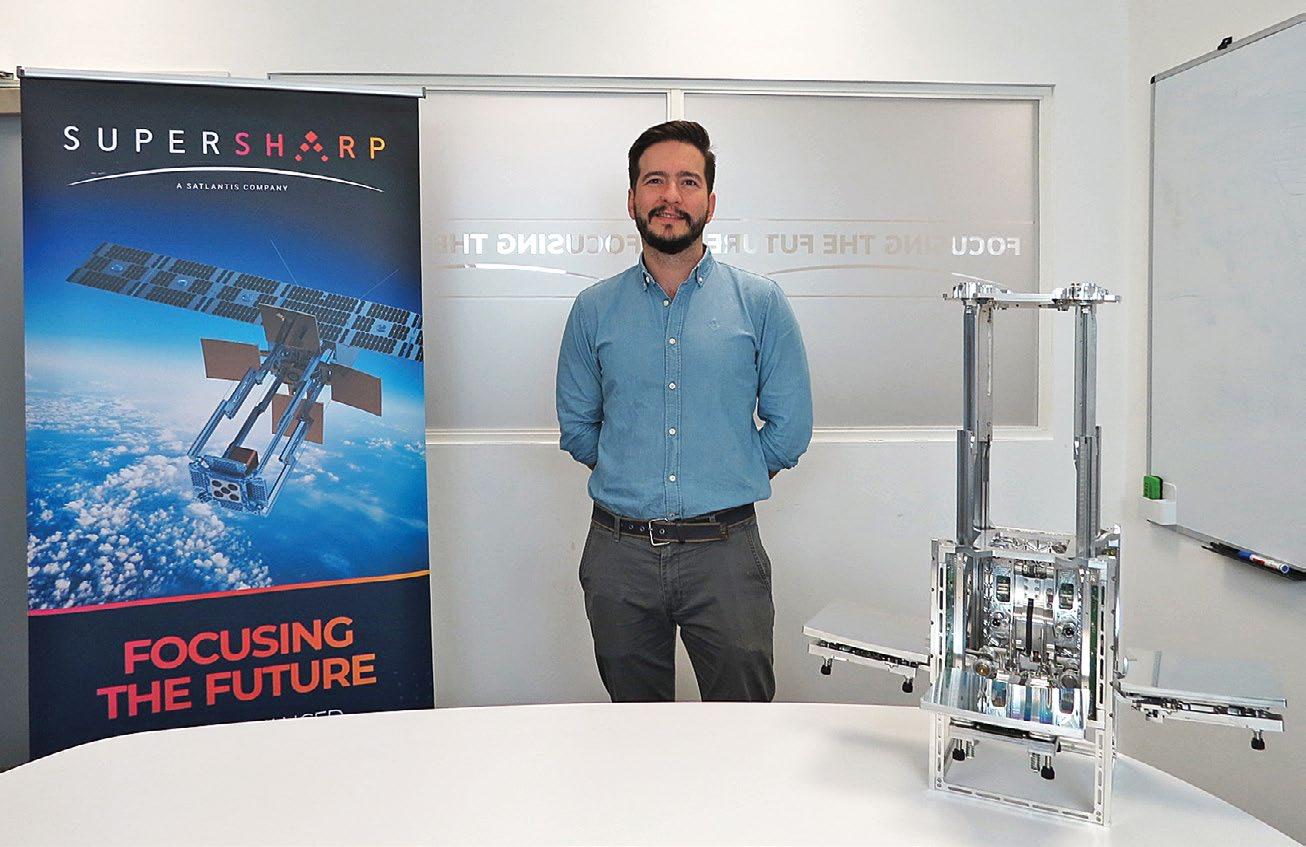
Marco Gomez-Jenkins, AE 11, ME 11, found his niche as an entrepreneur in the growing field of satellite image technology.
FROM THE BOOKSHELVES
ENJOY THESE RECENT TITLES FROM ALUMNI AUTHORS.
MYSTERY
CHASING FIREFLIES
LAURIE OSBORNE, IE 84
Samantha Singh, a 28-year-old interior designer and Park City shop owner, has no memory of her life before the age of 16, of growing up in Georgia, or of having a twin sister, Alli. After finding a clue to her past in some old boxes belonging to her deceased parents, Samantha and her younger sister, Laila, travel to a quaint suburb of Atlanta, where her past begins to unravel. Samantha discovers how one innocent night camping in the nearby woods with long forgotten friends changed everything after a gut-wrenching scream and a deadly discovery.
CHILDREN’S A FLEA FOR JUSTICE: MARIAN WRIGHT EDELMAN STANDS UP FOR CHANGE
ILLUSTRATED BY TEMIKA GROOMS, CE 98
Marian Wright Edelman is a flea for justice. Just like her hero, Sojourner Truth, Marian pushes for change even when it’s uncomfortable. She makes people itch, just like a flea. In this historical and political picture book biography about Black perseverance, Grooms uses her art for storytelling to inspire others to think and improve our world.
GEORGIA HISTORY
MORE HISTORIC RURAL CHURCHES OF GEORGIA
SONNY SEALS, IM 65
This much-anticipated follow-up to the best-selling Historic Rural Churches of Georgia (2016) documents even more rural churches and communities founded prior to 1900 throughout the Peach State. With more than 250 stunning color images, the new volume chronicles the historical, community, religious, and architectural significance of 50 new sites, including a special focus on African American churches pre- and post-Emancipation.
NONFICTION
PRESIDENTIAL SECLUSION: THE POWER OF CAMP DAVID CHARLES FERGUSON, NRE 96
After his three and a half years as the Camp David historian and Presidential Chaplain, Ferguson has written his first book to provide glimpses into the hidden world of this Presidential retreat located in Maryland. During his time at Camp David, he scoured records and memoirs for engaging stories and conducted hundreds of tours for personal guests of the President. Ferguson’s accessible storytelling will draw you into the wonders of Camp David as if you are walking the historical private trails with your own personal tour guide.
POETRY
UNDEFEATED: POEMS OF VICTORY
CARY C. ANDERSON, MGT 72
Inspired by sports poetry and a passion for Georgia Tech athletics, this is Anderson’s first book of poetry. It takes the reader on a journey of what it looks like to live an undefeated life, through faith, patriotism, sports, family, and friends. Yellow Jacket fans will especially appreciate the poem “Heisman Walks in Buzzville” from this collection.
NONFICTION
WHAT’S RIGHT WITH AMERICA
CO-AUTHORED BY LARRY ALDRICH, CE 74
From the vision of our Founding Fathers to the resilience and determination that have shaped our history, What’s Right with America explores what makes the country uniquely capable of thriving in times of change. With inspiring stories and thought-provoking analysis, authors Paul Johnson and Larry Aldrich reveal how America’s prosperity is rooted in more than just economic might—it’s grounded in values like freedom, individual empowerment, and deep commitment to justice and liberty.
Learn From Anywhere: 100% Online Graduate Programs
Elevate your career with 100% online graduate programs designed to fit your life. Whether you want to harness the power of data or strengthen your leadership foundation, Scheller's programs provide you with the expertise and tools to succeed – wherever you are.
Length
Semester Starts Fall (August) and Spring (January) M.S. Major in Management Online
9 months full-time or 2 – 3 years part-time
Length Two semesters
Semester Starts Fall (August) and Spring (January)
Curriculum
Build a broad business foundation with core courses and electives in operations, finance, strategy, marketing,leadership, accounting, and more
Curriculum
Learn about data tools, visualization, machine learning, unstructured data, and turning information into actionable insights
Take the next step forward. Expand your network, accelerate your growth, and prepare for leadership in today’s fast-changing business world.
The
1957 mechanical engineering alumnus led a humble, private life, but one thing was clear: his love for Georgia Tech. When he died in February, he left a $100 million gift that no one saw coming.
By Kelley Freund
A young Durstine in the seat of an airplane. When he joined the military, he had aspirations of becoming a pilot.
Afew months after John Warren Durstine, ME 57, passed away in February, Georgia Tech President Ángel Cabrera received word that Durstine had left his entire estate to the Institute. When told those assets added up to $100 million, Cabrera said he nearly fell off his chair.
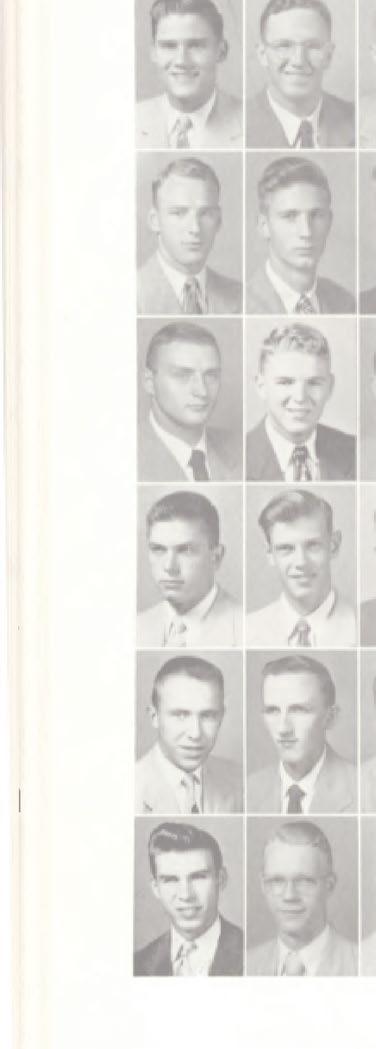
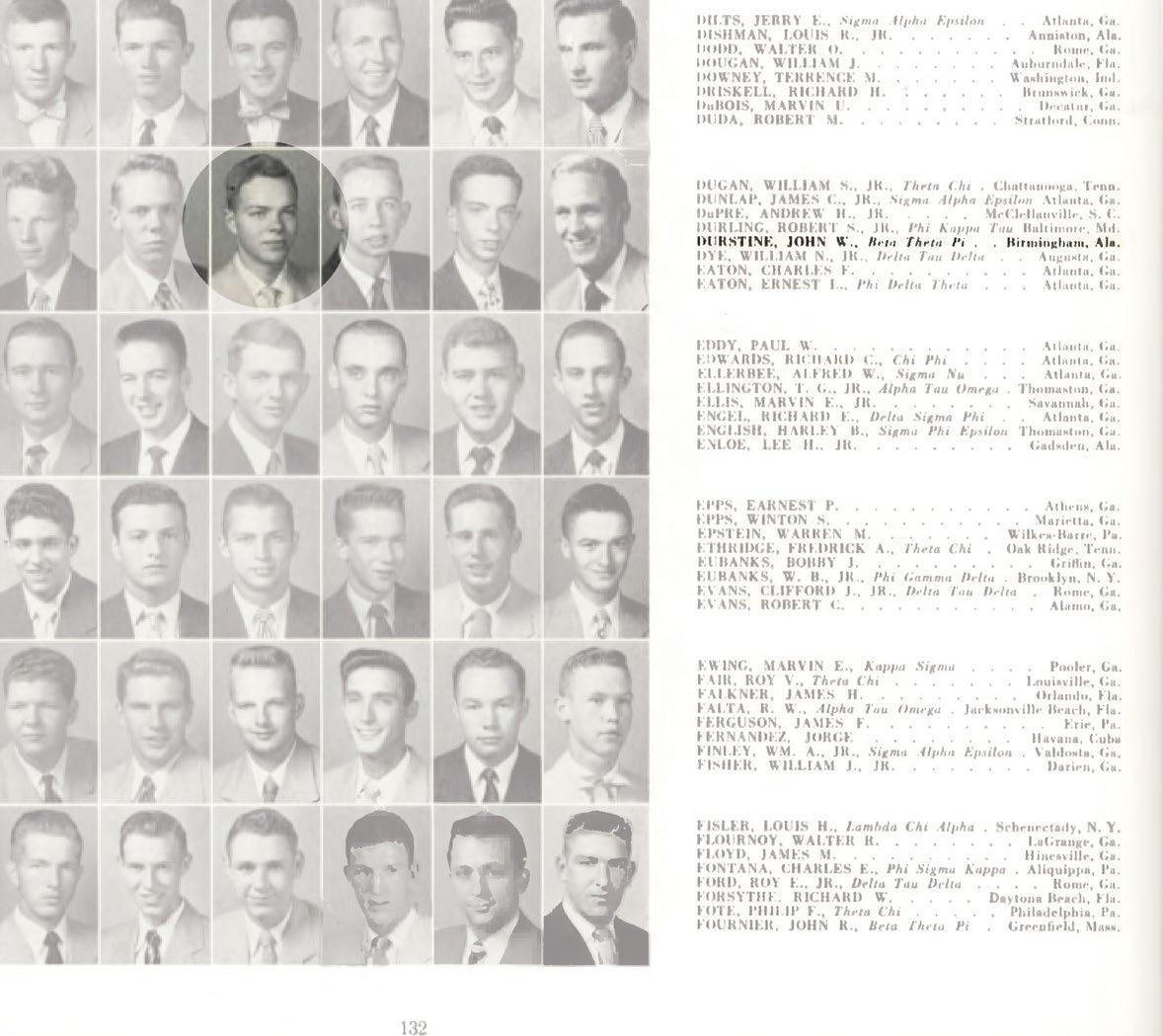
Cabrera had never heard of Durstine. In fact, it seems few people have. Those who did know him say he was mild mannered and bright, and that he loved Georgia Tech. But even to those who met him, Durstine was a bit of a phantom. During his time at Tech, he seems to have only been in one photo in the school’s yearbook. He never married and had no children, and no obituary was written for him. Even his exact role with Ford Motor Company, where he spent 32 years, was not clear.
Durstine spent three decades at Ford Motor Company in truck and light vehicle design, powertrain strategy, and advanced systems engineering.
So who is this man who left the Institute its largest single gift in history?
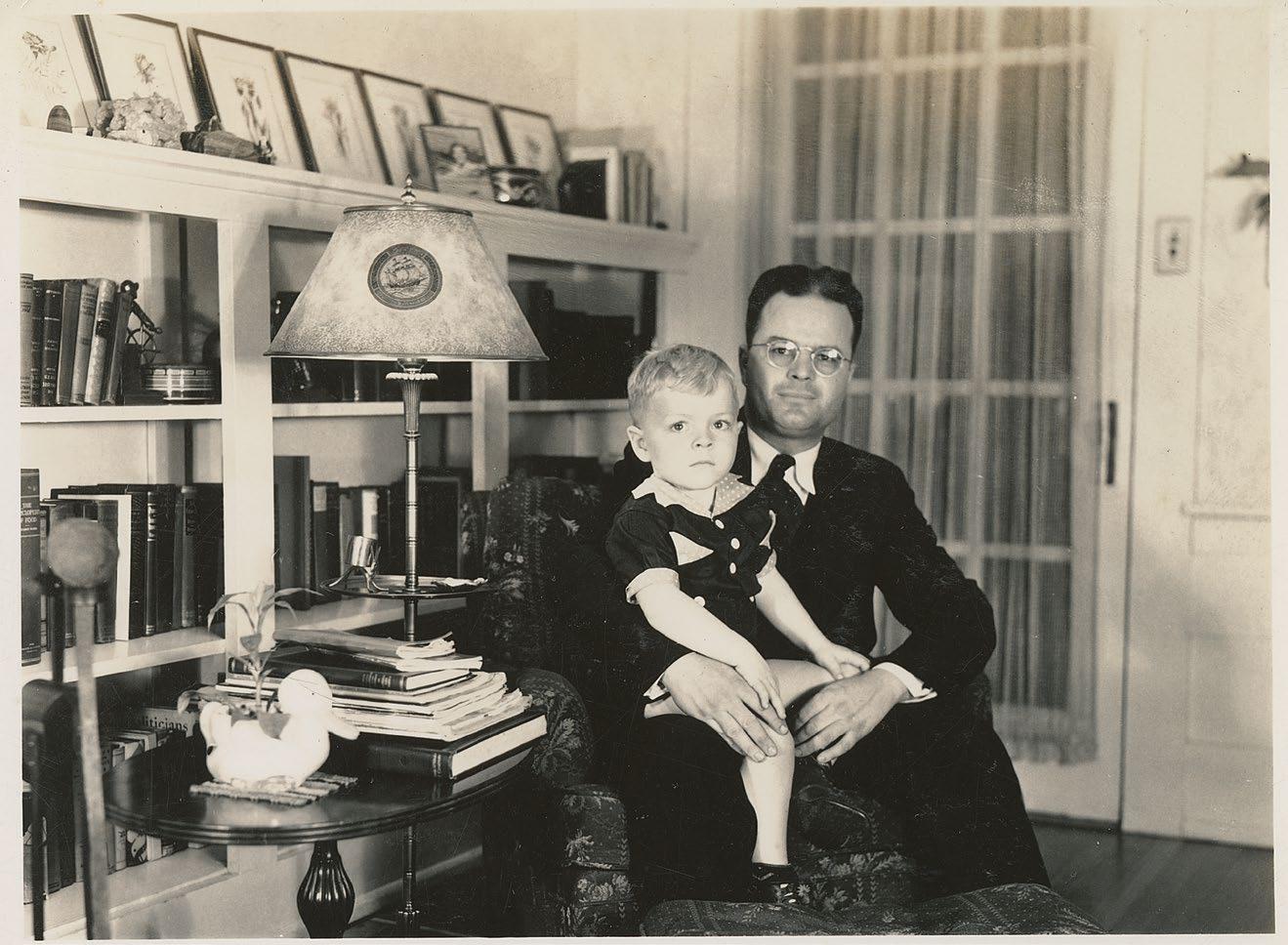
Durstine was a native of Birmingham, Alabama. He had a sister, Joan, who was four years younger to the day. According to notes written by Ann Dibble, a former director of gift planning at Tech, Durstine liked to build things and began creating birdhouses out of apple crates when he was 6 years old. He probably took after his father, who was an engineer and fluent with transmitter radios. At least once, his father used his radio to transmit to Australia using the Kennelly-Heaviside layer in the earth’s ionosphere, causing the lights in his neighborhood to flicker.
The Durstine household must have been one that stressed the importance of education. Durstine headed to
Georgia Tech and went on to receive an MBA from Harvard. According to Dibble’s notes, in high school he wanted to be a surgeon and started out as a physics major at Georgia Tech before switching to mechanical engineering. Joan attended Duke University and later earned her PhD from Indiana University.
Wayne Waddell, EE 56, was a classmate of Durstine’s at Tech; the two met while pledging Beta Theta Pi.
“I don’t know how or when it happened, but I remember John telling me he had had a serious accident,” says Waddell. “After that, he became dedicated to exercise and rebuilding his body, and he lived on a strict schedule. Nothing interrupted it.”
In fact, Durstine made the Dean’s list three years in a row while at Tech
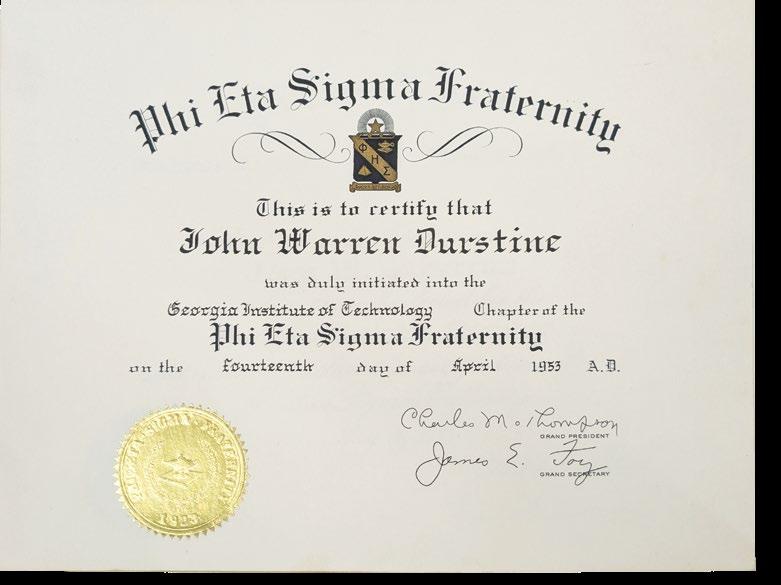
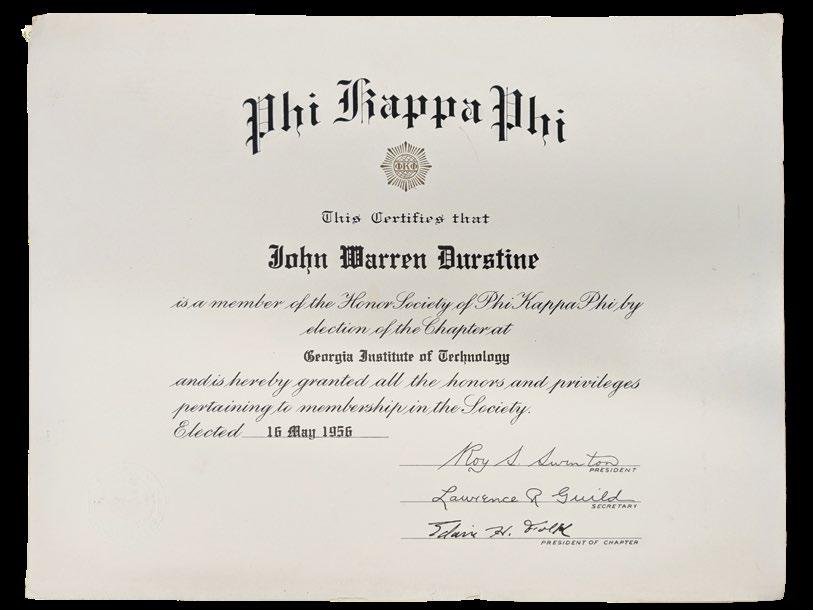
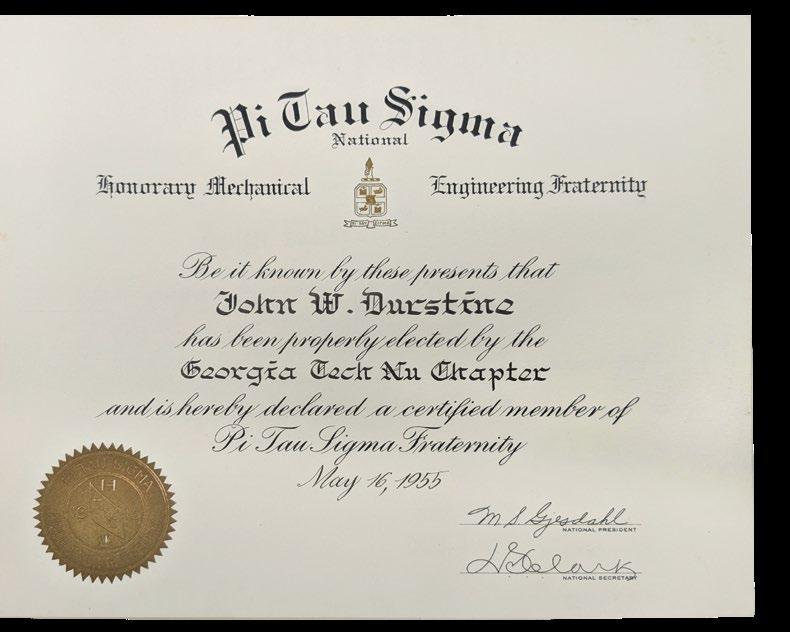
and was elected in 1953 to the national freshman honorary fraternity, Phi Eta Sigma. He was a member of the honors engineering fraternity Tau Beta Pi and graduated from Tech with honors.
Waddell says Durstine lived in a dormitory all four years at Tech but came to the fraternity house for meals. One year, Durstine’s dormitory floor housed several football players who decided to play a practical joke and mess with Durstine’s strict schedule. Somehow, they set Durstine’s clock back a few hours. When his alarm went off, he got up and began his usual preparation for the day. The football players even showed up in the common bath area, some shaving and others showering so that Durstine wouldn’t catch on. It
Durstine became an engineer like his father, John Elliot Durstine.
was winter, so it was still dark in the mornings, and Durstine was none the wiser as he set out to the Beta house for breakfast. There, instead of his meal, he discovered a group of architecture students pulling an all-nighter around the dining room table. Waddell remembers that Durstine took the joke well.
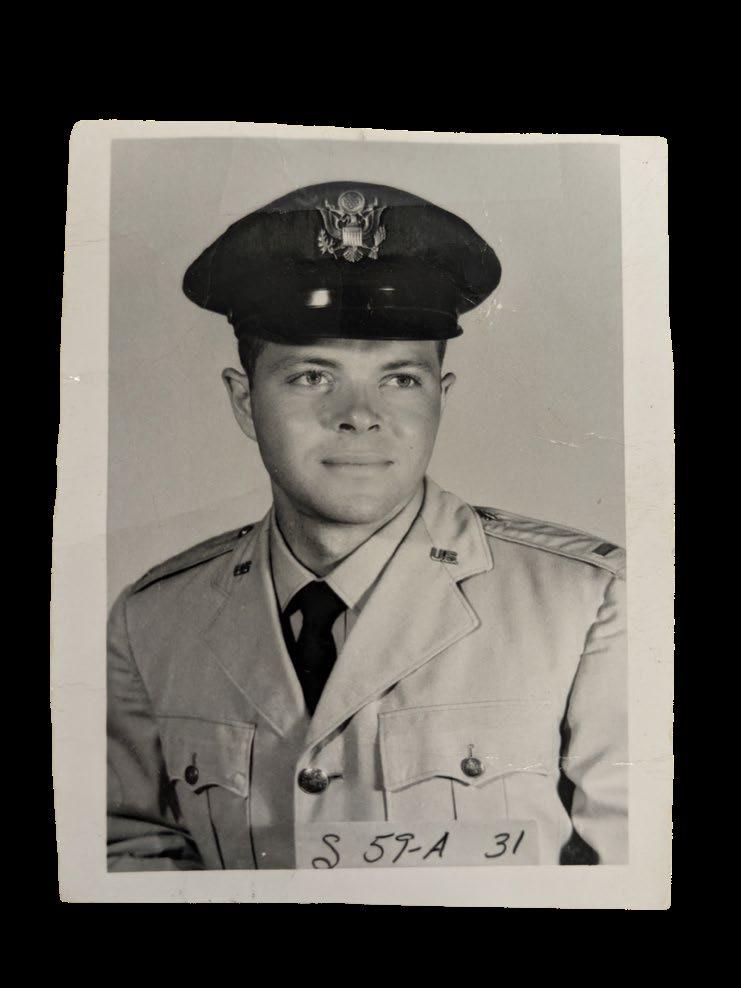
In January 1957, the Georgia State Examining Boards issued an Engineer-In-Training certificate indicating Durstine had passed his Professional Engineering exam. After graduating third in his class from Tech, Durstine served in the U.S. Air Force. He joined because he wanted
to fly planes, but there was a change to service contracts during his time serving, and he would not meet the years of active duty required to fly. (Top Gun would become his favorite movie.) Later, when reflecting on his years in the Air Force, Durstine remembered the intense cold, whiteouts, and seeing the Northern Lights during his first station in Goose Bay, Labrador. He was eventually transferred to Palm Beach, Florida. Later as the base was closing down and units were pulling out, Durstine ended up as the only officer on base with a small group of enlisted men. He wrote to Waddell, “I must be the
only first lieutenant base commander in the Air Force.”
He earned his MBA from Harvard Business School in 1962 and took a job with Ford Motor Company in Dearborn, Michigan, where he spent more than three decades. During his time with Ford, he helped shape truck and light vehicle design, powertrain strategy, and advanced systems engineering. He authored a technical report on the truck steering system that won the L. Ray Buckendale Lecture Series award in 1973. His first donation to Georgia Tech was a $100 gift to Roll Call, the Institute’s annual fund, in 1978, and his philanthropy continued over the next decades. Ward Winer, who served as chair of Tech’s George W. Woodruff School of Mechanical Engineering, recognized Durstine’s success in the
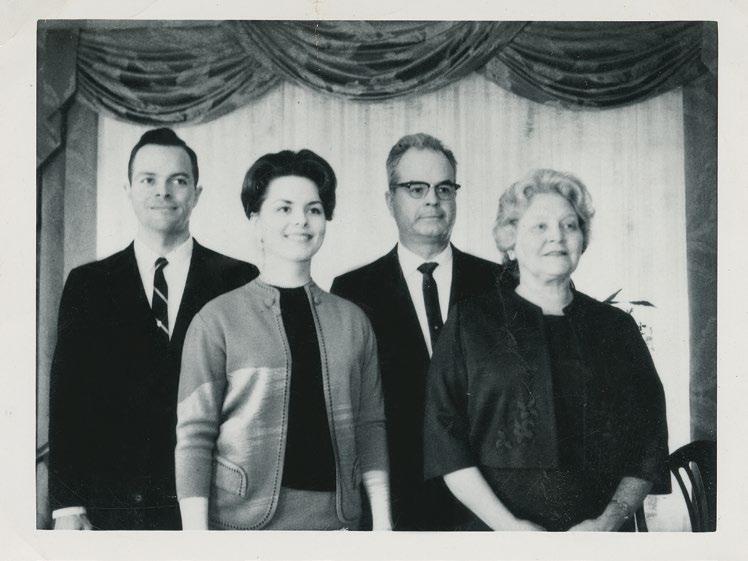
The Durstine family (L-R): Durstine, his younger sister, Joan, his father, John E., and his mother, Reba Marie (Towle).
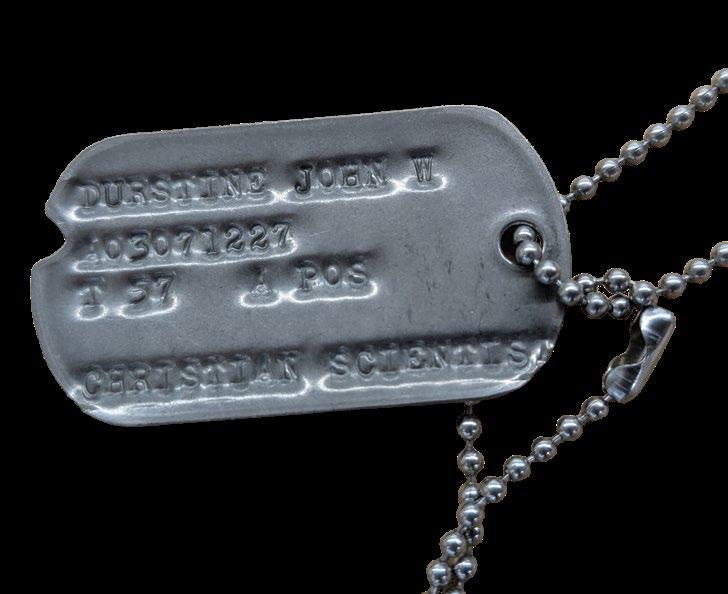
Durstine in the U.S. Air Force.
automotive industry and potential for continued philanthropy. When Winer retired in 2008, he told his successor, William Wepfer, “Keep on eye on John Durstine. There’s something there.”
Wepfer, along with Dibble, began visiting Durstine in Michigan, most of the time meeting him for lunch at Durstine’s favorite Italian restaurant, Andiamo. Wepfer says Durstine would bring a satchel that contained a manila folder, which was all of his estate planning. At some point, he had become very good at investing, apparently doing most of his own research—at his home, there were shelves of company prospectus documents with underlined passages.
“Comparing anyone to Warren Buffet is absurd, but I think there was a little bit of Warren Buffet in him,”
A top student, Durstine was a member of several honor societies while at Tech.
Wepfer says. “He had a very analytical mind and a good sense of how the world works. I think he was a master day trader before day trading got a bad name.”
At lunch, Wepfer says Durstine probed him about the mechanical engineering school and the kinds of things they were working on. Wepfer says that in retrospect, Durstine was using those meetings to get feedback to create his estate plan.
But Georgia Tech wasn’t the only topic discussed during these meetings. Durstine hated small talk, but he liked to brag about his sister, Joan, and her work in the Dallas art scene. Wepfer and Dibble discovered that Durstine was a lifetime learner. During his time with Ford, he learned Japanese for his twice-a-year trips to Japan. Later, he took classes at
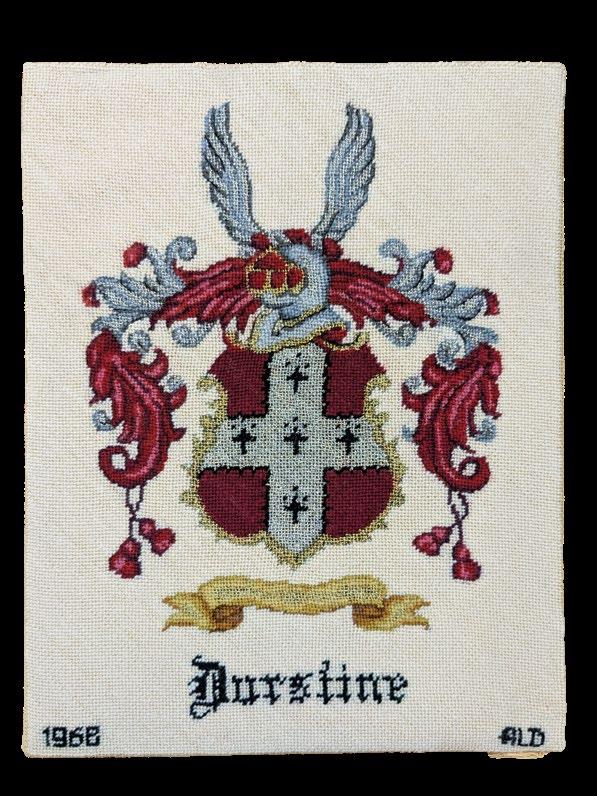
a technical college to learn to wire houses for sound, security, and computer systems. (Durstine noted in a letter that these technologies didn’t exist when he left Georgia Tech.) He was also interested in genealogy, researching the Durstine family history and attending a reunion in 1992 in Pennsylvania. He kept meticulous records and notes from his trip from Detroit to the reunion.
One time, Wepfer took Durstine to a motorsports competition held at Michigan International Speedway and hosted by the Society of Automotive Engineers. Durstine spent the day with Tech’s team.
“It was magic,” says Wepfer. “He interacted with the students and asked them good, tough questions. There were two times I saw the man incredibly happy. That was one of them.”
The other was when Durstine was inducted into the College of Engineering Hall of Fame in 2014.
Durstine was interested in his family’s history and owned this cross-stitch of his family’s crest.
“He loved it,” Wepfer says. “He was grinning from ear to ear.”
In 2010, Durstine had told Wepfer and Dibble that the estimated value of his estate was $10 million. The two were instructed not to reveal the amount to anyone, and they kept that promise for fear of Durstine going back on his word. Wepfer believed that the $10 million estimate was conservative. But no one expected the $100 million that came Tech’s way in February.
Durstine left instructions that the funds should be used to recruit and support faculty for the Woodruff School; it was clear he had been paying attention during all those lunch
meetings with Wepfer. When Wepfer became chair of the Woodruff School in 2008, mechanical engineering programs across the country were experiencing a surge in popularity and enrollment, and Wepfer was trying to recruit more faculty. It was difficult to recruit senior professors without having an endowed chair, and he says even now, universities need to have discretionary money for junior faculty to support graduate students, do work in a laboratory, or travel. Durstine’s gift will establish endowed chairs, professorships, and faculty awards. This will help Georgia Tech recruit, develop, and retain worldclass professors, ensuring that the
Institute will continue to be a place that sets students up to lead successful lives, just as it was for Durstine. Cabrera says that he wishes he could’ve met Durstine so he could ask him a million questions. But as we know, Durstine wasn’t one for small talk.
“Perhaps that’s why he arranged things the way he did,” Cabrera says. “He wanted the gift to do all the talking—to send us a simple yet powerful message: Make Georgia Tech stronger and continue to transform the lives of generations of talented students so they can do great things. And that’s the best way for us to thank him—to make sure we do just that.”
Durstine at the Georgia Tech College of Engineering Hall of Fame ceremony in 2014.
EVERY YEAR, COMPANIES CAN’T WAIT TO SCOOP UP TALENTED GEORGIA TECH GRADUATES.
For many Yellow Jackets, entrepreneurship is the real calling. They see a problem and jump to solve it, launching a business along the way. That’s how Brandi Brown, Bio 13, a military veteran, bioengineer, and mother, ended up founding a wellness company. She’d heard of the benefits of mushrooms, but couldn’t find a brand she trusted, so created her own. “Our goal is to elevate people’s lives with the natural power of mushrooms,” she says. For others, Tech provided a community of like-minded cofounders. North Avenue Cellars, for instance, was founded by four alumni united by a passion for both wine and Georgia Tech. Even more entrepreneurs have grown out of the Institute’s thriving startup ecosystem.
On the next few pages, discover products proudly crafted by Yellow Jackets that you can gift or enjoy yourself.
COMPILED BY JENNIFER HERSEIM | PHOTOS BY KAYLINN GILSTRAP
BOMBCHEL
Launched on the fashion scene in 2012 by Archel Bernard, STC 11, Bombchel is an ethical African fashion brand featuring bold designs celebrating African style and culture. “I started my business to support African women and show the world that everyone deserves something beautiful— something ethically made that directly supports the incredible makers across Africa,” Bernard says. Designs are produced in Liberia by The Bombchel Factory’s all-women staff. Take these African folding fans in Tech colors to game days on The Flats to stay cool and cheer on the Yellow Jackets in style.
SOUTHERN PEACH PASTRIES
The custom macarons and royal icing sugar cookies from Southern Peach Pastries blend European chic with Southern charm. Beth Meyer Gaines, Mgt 04, left a career in event production in L.A. to travel the world, which led her to train in London to become a pastry chef. She later worked under a James Beard Award–winning pastry chef before moving back to Atlanta to start her own business. Her creative desserts include custom GT-themed cookies, macarons, mini tarts, dessert shooters, pavlovas, and drop cookies.
Custom GT cookie sets start at $78/ dozen, $48/dozen for GT-printed macarons SouthernPeachPastries.com, hello@southernpeachpastries.com
FIXD AUTOMOTIVE INC.
Not everyone is a car person. Thankfully, John Gattuso, ME 15, teamed up with Julian Knight, EE 15, and Frederick Grimm, IE 14, to build a car sensor paired with a smartphone app that gives drivers easy-to-digest information and provides cost estimates for repairs. Launched in 2014 as part of the first batch of Tech’s CREATE-X, FIXD has sold over 3 million sensors.
$19.99 (shop.fixdapp.cm/lp/sensor67, get 67% off link that comes with a free trial of FIXD Premium) Fixd.com and Amazon
GRUBBLY FARMS
If chickens are on your holiday recipient list, these nutritious snacks are an irresistible treat packed with supplements and nutrients that will keep your flock happy. Cofounded by Sean Warner, BC 15, and Patrick Pittaluga, BA 14, Grubbly Farms—a CREATE-X startup—uses sustainable insect-based animal feed, rich in protein.
$19.99 Grubblies 1 lb.
Hometown Harvest grubblyfarms.com
PINKIE PADS
Sana (Rizvi) Clegg, Mgt 03, and cofounder Fiona Simmonds are two moms who teamed up to create these small-sized organic period pads designed for tweens and teens. The non-toxic, disposable pads come in soft, striped drawstring baggies that make them cute enough to pass to a friend without any stigma.
$8.99/combo pack (18 count) available in-store or online at Amazon, Walmart, Target, CVS, and Wegmans
REVELRY GAMES
Revelry Games, unlike most party games, isn’t centered around drinking. These games, designed for both drinkers and non-drinkers, are “gameplay first, sipping second,” says founder Danza Huey, MBA 15. Huey created the games during the pandemic and kick-started his journey in entrepreneurship by joining the second cohort of Target Accelerators’ Forward Founders.
Revelry Games takes a twist on nostalgic classics like Old Maid and Slapjack.
$25 Revelry.Games
$28 youth compression arm sleeve; $30 adult compression arm sleeve vettexsports.com
VETTEX SPORTS
Mat Quon, BME 19, MBA 24, and Michael Pullen, BME 21, created the LZRD Grip Arm Sleeve, a patented grip-enhancing compression football arm sleeve to provide players with protection from the ground without compromising their grip on a football. The idea originated from a senior design class project, grew through CREATE-X, and now they have an office in Tech Square. They’ve partnered with over 60 universities and high schools as well as angel investors, including Georgia Tech Athletics. As of November, the company, previously named LZRD Tech, has rebranded to Vettex Sports to expand to sports beyond football.
Author of The Black Hair Care Revolution, Yetunde Jude, Text 97, launched Yelani to provide plant-based hair care and eco-friendly accessories to uplift Black women by making it easier to embrace their natural textures. She quit using chemical hair relaxers in college and was frustrated when she couldn’t find products that supported her curls without harming her body. The oil elixir nourishes your scalp and promotes hair growth, while the conditioning shampoo provides a 2-in-1 formula for intense moisture and hydration.
PROXY WELLNESS
Roxanne Kaiser, BA 15, built Proxy out of her own search for natural, non-CBD, non-THC options while living with panic disorder since 2017. Proxy’s plant-based wellness gummies are designed to support mental health without the drowsiness, side effects, or next-day slump from other products. Four premium supplements address a core need. Take Panic Mode—or Panic Sour, if you prefer a tangy gummy—for anxious moments, Just Chill for daily stress and sleep support, and Grow Lush for hair, skin, and nails.
$24.99, available on Amazon Prime, Instagram, Facebook, and TikTok (@feelproxy) Proxywellness.com
FEELING CRAFTY?
Download this free Georgia Tech cross-stitch pattern for yourself or as a gift for a Yellow Jacket fan in your life. GTAlumni.org/Downloadables
ZIPSTRING
“The smile of wonderment” is how cofounder and Tech student Stephen Fazio describes the extreme joy that ZipString brings. The handheld toy suspends a string in the air for tricks that seem to defy physics. The idea for ZipString began at Georgia Tech during a RoboJackets winter design hackathon. “We were tasked to design a PCB (Printed Circuit Board) smaller than a credit card that could do anything, and the coolest project would win,” says Fazio, who cofounded ZipString with Austin Hillam. Fazio won the hackathon, and a video of the toy in action went viral on TikTok in 2021. They have since appeared on ABC’s Shark Tank, and the toy has sold over 1 million units.
$60, Cabernet
Sauvignon, Napa Valley, Oakville
$40, Pinot Noir, Russian River Valley
$32, Red Wine, Sonoma County
$27, Sauvignon Blanc, Russian River Valley
$37, Sparkling Sauvignon Blanc, Russian River Valley NorthAvenueCellars. com (Use code GTAA10 for 10% off your order)
$24.99 original; $29.99 Luma (glow-in-the-dark) + accessory pack available at Zipstring.com, Amazon, Walmart, and Target
NORTH AVENUE CELLARS
Inspired by a shared passion for wine and Georgia Tech, four alumni came together to launch North Avenue Cellars in 2023, offering the best of California’s wine country with the spirit of Georgia Tech. Winemaker and founder Charlie Fauroat, Cls 08, has spent 15 years producing premier wine across the globe. He and Niraj Shetty, ChE 02, Mgt 05, Charlie Cichetti, Mgt 04, and Mike Ramsey, Mgt 05, created North Avenue Cellars as a celebration of the innovation, integrity, and craftsmanship that they learned at Tech. Every bottle is “a reminder that great things can grow from the connections that stand the test of time,” Fauroat says.
SECTION 103
Steven Little, Mgt 06, loves being at the intersection of sports and design. As a Georgia Tech alum and a passionate Yellow Jacket fan, his Section 103 is a combination of creative design and entrepreneurial spirit. Launched in May 2021, the apparel company is an official licensee of Georgia Tech. The exclusive designs are voted on by fans and feature high-quality screen printing.
$65, Feliz Bobby Dodd Ugly Christmas Sweatshirt, $35, Georgia Tech Hat Section103.com
$28 via subscription or $35 as a one-time purchase. Use code 40Under40 for 50% off. Gulfspore.com
GULF SPORE
Brandi Brown, Bio 13, founded Gulf Spore, which offers mushroom supplements made from whole mushrooms, not powders or fillers. Every bottle comes with a publicly available third-party lab report, showing how much of each compound it contains. Four liquid extracts are available: Reishi eases stress, Lion’s Mane sharpens focus, Cordyceps boosts stamina, and Turkey Tail supports immune balance.
KIID COFFEE
When 7-year-old Ethan Sanborn broke his leg twice just over a year apart, his parents, David, TFE 08, and Lauren Sanborn, Mgt 07, started researching tasty beverages to boost his nutritional intake. David brewed up a coffee-like drink for Ethan and his brother that was packed with calcium, magnesium, and Vitamin D. The kids loved the taste, and Ethan asked if he could start selling the drink, and Kiid Coffee was born. This nutritional, milk-based “coffee” drink has less caffeine and sugar than most chocolate milk or chocolate protein shakes available.
$14/12-serving bag, Kiidcoffee.com
TECH SUPPORT TECH SUPPORT
These Yellow Jacket entrepreneurs pose startup questions to seasoned Tech business executives.
AS TOLD TO DANIEL P. SMITH ILLUSTRATIONS BY CHARLIE LAYTON
wound packing, an area lacking accessible and effective training aids.
Using 3D printers, we created an arm replicating bloodflow through various wound types. Through feedback, testing, and additional iterations, we developed a high-fidelity, low-cost training aid that found immediate interest. The first week we started accepting orders at RD Medical, in fact, we sold our first set of arms to Metro Atlanta Ambulance. Over the last year, we’ve continued to scale sales with first responder agencies and, more recently, technical colleges.
We’re engineers, so we’re good at building things. However, sales are not our core competency. At what point do we raise money and pivot from founder-led sales to hiring a full-time sales team?
Deborah Kilpatrick, ESM 89, MS ME 94, PhD ME 96, is a partner with Sonder Capital, a Silicon Valley–based venture firm partnering with cutting-edge companies to transform standards of care in the medtech and healthtech landscapes. She received the 2025 John B. Carter, Jr. Spirit of Georgia Tech Award.
that hits all founders at one time or another. One thing to know immediately: Founders like you are often the company’s best salespeople. You understand the company better than anyone. You’ve practiced the foundational message and pitch more than anyone. And you made the company’s first sales. So you should never really stop selling because you are the unique voice of your company. Now, when it comes to hiring a sales team, I’d look for signals the company is getting close to a repeatable sales process. If you have more than 10 customers and you’re hitting a 20 to 30 percent close rate on qualified leads, for instance, those are signs there’s probably something repeatable here. Then, maybe you hire one to two full-time sellers who work directly with you to learn the pitch and sales motion. As deal volume grows, you can incorporate a junior salesperson to focus on sales operations or enablement to maximize efficiency of your commercial
effort overall.
Before investing in a sales team of any size, however, it’s my strong opinion you should have solid hygiene around customer relationship management (CRM) because that’s the foundation of scaling a sales team and how it operates. For me, the earlier you can tighten things up in this area, the better, because it establishes discipline and allows you to align incentives in creative ways. For me, it’s pragmatic, not magic. “Plan the work and work the plan” is real.
As a founder, you will never really stop selling, but your sales role should evolve to focus on your most important and significant customers and strategic partnerships. And because you know your product better than anyone else, your involvement here always provides an important feedback loop to your product team. In the end, building a successful sales team takes intention and focus, just like when you started the company in the first place.
QWHAT ARE SOUND STRATEGIES FOR CONVERTING INBOUND LEADS INTO HIGH-VALUE CLIENTS?
helped us get off the ground. Since then, we’ve bootstrapped things, relying on the profit margins of the business, growing to 35 team members and various form factors, including stickers and a premium metal version. We recently crossed 2 million devices sold and have 1.3 million users on our platform.
We’re in the early stages of building out our sales team, and we want to convert the inbound volume of requests into high-value clients and subscriptions. What strategies and tips would you offer for accomplishing that objective?
Kofi Smith, IE 99, MBA 09, is the founder of Atlanta-based Keystone Management, a fully integrated facility management, construction management, program, and property management company. He previously served a 10-year stint as president and CEO of the Atlanta Airlines Terminal Company.
I am truly amazed and inspired by your ability to achieve such significant growth in such a short period of time. I also founded my company during the pandemic, so I understand firsthand how remarkable it is to build a team of 35 and reach 1.3 million users—an incredible accomplishment by any measure.
As you continue to scale your business—both in clients and subscriptions—I’d like to share
HOW DO I CUT THROUGH THE NOISE TO MAKE OUR CASE TO DECISION-MAKERS?
Jonathan Fitch, IE 23, cofounder, GlucoSense
three key principles I emphasize in my Entrepreneurship in Construction course at the Georgia Tech School of Building Construction. These concepts may help you as you prepare to scale effectively and sustainably.
First, prepare to scale intentionally by ensuring you have the people capacity, production capacity, and capital capacity to support your growth. The worst thing is to grow too fast, swell, and then burst because you did not anticipate or target how much growth you would like to experience.
Second, segment your clients strategically into categories so that you know where to devote most of your people resources, such as enterprise/corporate accounts. You can then leverage technology and AI to efficiently serve smaller businesses and individual users that require less human touch.
Third, put in place repeatable systems and standardized processes for qualifying leads, setting expectations for response times, and tracking conversion from leads to high-valued client adoption.
Lastly, if you haven’t already, I highly recommend reading The Lean Startup, by Eric Ries, and The $100M Journey, by John St.Pierre. Both offer excellent insights into sustainable scaling and operational excellence.
I’ve lived with Type 1 diabetes
15 years now, and despite having access to the latest diabetes treatment technologies—including insulin pumps and continuous glucose monitors (CGMs)—I still experi enced an unpredictable seizure during finals week in my junior year at Tech. That experience sparked the creation of GlucoSense in 2023.
GlucoSense is a highly personal, autonomous care platform for people living with diabetes, about one in nine adults globally. Our proprietary technology turns existing data from CGMs and wearable devices into straightfor ward guidance on blood sugar patterns, empowering people with diabetes to make fewer, more-informed decisions about their lifestyle and better manage their condition.
At present, we have several thousand users across all 50 states, we’ve secured a partnership with Dexcom, and we recently launched pilots across Georgia with Wellstar, the largest health system in the Southeast. When a user connects their CGM to GlucoSense, we see up to 47 percent weekly active engagement, which is a significant figure for a healthcare app.
We believe the best way to scale our business is through adoption by major health payers. We have a compelling case to make for them, including up to a five-times return on investment through a reduction in ineffective forms of care and avoidable events, such as ER visits. Leaders at these enterprises get bombarded with pitches, though. So how do we cut through the noise and earn the opportunity to state our case before decision-makers?
I’d start by saying there’s no mass
You earn your way before decision-makers through networking, referrals, and putting yourself out there in the industry.
A good starting point is going to conferences where you think these individuals will be. Good companies are always looking for the next big thing. They want innovation. They want products and services capable of enhancing their business. So, attending conferences is one way to get yourself, your business, and your product in front of these players to spark a relationship.
If you’re raising money, then do so with an eye on firms who can provide high-value connections. Having relationships with the right venture capital firms can bring a network to the table you can leverage to drive your business’s growth. Think about who can make introductions, not just who can write a check. And network—heavily. If you’re doing work
Paul Brown, Mgt 89, is the cofounder and CEO of Inspire Brands, a multibrand restaurant company headquartered in Atlanta. Inspire’s portfolio includes more than 33,000 Arby’s, Baskin-Robbins, Buffalo Wild Wings, Dunkin’, Jimmy John’s, and SONIC restaurants around the globe.
with one firm, might they give referrals to others or make a call on your behalf? Are there Tech alumni you might contact? I get a lot of calls from people I respect—vendors, colleagues, peers, and others—who ran across a product or technology they think I might be interested in, and I give them time because I know them and trust | their judgment. Consider who can play a similar role for you.
Collectively, actions like these can generate positive momentum and create opportunities to get before decision-makers and share your story.
Acro the Globe
WITH YELLOW JACKETS
FLORENCE
Disc er Italy
Ancient sites, priceless art, and unforgettable cuisine. Step into a world where beauty lingers in every detail. Take part in time-honored traditions and wander through breathtaking landscapes. Travel with those who know the Good Word and create meaningful memories that last a lifetime.
Flavors of Sicily | May 15–23, 2026
Ramblas & Rivieras | September 4–14, 2026
Eternal Rome and Italy by Rail | October 12–20, 2026
ALUMNI HOUSE
ONE HELLUVA HOMECOMING!
Yellow Jackets celebrated, cheered, and danced at Buzz Bash and the BAO After Party on October 24.
Georgia Tech Timeline
Georgia Tech Timeline
The most memorable moments as reported by alumni. From the big wins to the even bigger gatherings, every era of students had their claim to fame.
The most memorable moments as reported by alumni. From the big wins to the even bigger gatherings, every era of students had their claim to fame.
Women admitted as undergraduates & Football National Championship
Women admitted as undergraduates & Football National Championship
1952
1952
1969: First tricycle race around Peters park
1969: First tricycle race around Peters park
1961
1961
First Black students enrolled & the Ramblin’ Wreck rolls in
First Black students enrolled & the Ramblin’ Wreck rolls in
Ramblin’ Raft Race
Buzz becomes an o cial team member
1980
1980 Buzz becomes an o cial team member
1972
1972
Calculators come to campus
Calculators come to campus
ACC
Ramblin’ Raft Race
1980–85: Did not take drownproo ng!
1980–85: Did not take drownproo ng!
—Carla Perry, IE 82
—Carla Perry, IE 82
1991: The bon re after the Braves won the World Series
1991: The bon re after the Braves won the World Series
—Renee Butler, IE 96, MS OR 99, PhD IE 03
—Renee Butler, IE 96, MS OR 99, PhD IE 03
2020: The beginning of the pandemic. The last few days on campus with everyone in person was such a shared experience!
2020: The beginning of the pandemic. The last few days on campus with everyone in person was such a shared experience!
—Gigi Pavur, EAS 20
—Gigi Pavur, EAS 20
2021: The parade around campus after the Braves won the World Series. —Jack Purdy, BA 22
2021: The parade around campus after the Braves won the World Series. —Jack Purdy, BA 22
STORD, A “UNICORN” BUSINESS FOUNDED BY TECH ALUMNUS SEAN HENRY, HAS BEEN LISTED ON INC 5000’S LIST FOR FIVE STRAIGHT YEARS.
BY KRISTIN LOWE
IIN OCTOBER 2015, just two months into his first semester at Georgia Tech, Sean Henry, Cls 19, launched Stord, LLC, an omnichannel fulfillment and integrated software solution. Stord continues to scale rapidly, with over 1,500 employees and a valuation of $1.5 billion. Henry’s vision is long-term. “I admire the Bezos and Zuckerberg approach to make one thing really massive through constant innovation. Hopefully, we can earn the right to be a public company in the next few years.”
FROM DORM ROOM TO BOARDROOM
When Henry arrived at Tech as a freshman, he didn’t expect to build one of the fastest-growing commerce enablement companies in the nation. But his entrepreneurial instincts quickly led him down a path that would redefine his future and reshape the e-commerce industry.
An Atlanta native, Henry planned to get a bit further away from home than Tech. A Dean’s Scholarship from the Scheller College of Business, combined with Georgia’s HOPE and Zell Miller scholarships, made the hometown school an
FROM FRESHMAN IDEA TO BILLIONDOLLAR COMPANY
economically smart choice. What sealed the deal was a tour of ATDC (Advanced Technology Development Center) and the first of several impactful conversations with Craig Womack, associate dean of Undergraduate Programs.
“I really wanted to go to a school that valued the outcome of education,” Henry says. “During the tour, I heard a lot about Scheller’s focus on career, salary, and entrepreneurship, and that really resonated with what I was going into college intent on doing.”
Today, Stord offers end-to-end services for B2B and DTC brands with a physical network of global fulfillment centers and AI-powered technologies, unlocking award-winning consumer experiences at scale. They power over $10 billion in commerce annually. Impressive results for an idea that took shape when Henry was just 18.
“A few days before classes began, I was telling my family about my summer job in Germany at a manufacturing company,” Henry says. “As I described the challenges we faced there, I realized they reminded me of the problems I encountered when I was running my own e-commerce business. I thought it would be interesting to build something to solve these issues. The rough idea for what became Stord came together over dinner that night.”
As he juggled classes, he also registered the business, started building a pitch deck, and applied for the prestigious Thiel Fellowship, which requires recipients to drop out of college. He credits Scheller for supporting his leap into entrepreneurship. “I sat down with Craig Womack and said, ‘The business is growing. I have employees. I’m getting my first real investment. I can’t do both well.’” Womack’s response? Encouragement and a safety net. “He said, ‘We want to foster more entrepreneurship. If things don’t work out, reapply. We’ll welcome you back with open arms.’”
LESSONS FROM FAILURE
Despite Henry’s age, Stord’s success wasn’t a stroke of beginner’s luck. He opened an eBay account at 7 years old to sell his Christmas presents. He experimented with everything, from flipping electronics to launching a sports arena messaging app, which ultimately failed.
Failure taught him critical lessons. “I learned the importance of having a technical co-founder, not outsourcing,” he says. “I learned not to be scared off by competitors. And I learned to build something really big and impactful.”
When a global logistics company backed out of an early investment in Stord to build a competitor, Henry didn’t waste time wallowing in defeat. Instead, he led Stord to move faster and stay closer to the customer. “We grew to be five times bigger than the competitor’s division and took it over from them. We learned not to be afraid of competitors.”
LEADERSHIP AND THE NEXT GENERATION
Henry’s leadership philosophy centers on customer obsession and continuous iteration. “We don’t build what I want or what investors want. We build what the customer wants,” he says. “Founders who are problem-obsessed, not solution-obsessed, are the ones who succeed.”
Learn from Sean Henry and more Tech entrepreneurs this March during the panel, The Startup Journey: From Idea to Impact. Visit, GTAlumni.org/ Career for more details.
Henry’s invested in over 20 early-stage startups, focusing on founders who are “unstoppable.” He’s discovered that a successful business is not about the idea or traction. It’s about whether the founder is going to run through walls to solve problems.
“WHAT HAPPENED TO THE THIRD STREET TUNNEL?” –JOHN GENTER, MGT 07
In 2008, the Georgia Tech Police Department (GTPD) made the decision to close the Third Street Tunnel due to escalating concerns about criminal activity. This decision followed the eighth annual Campus Walk, during which President Emeritus G. Wayne Clough, CE 63, MS CE 65, HON PhD 15, along with campus administrators, GTPD, and student leaders, toured the campus to identify areas with safety issues. The tunnel was among several locations flagged as unsafe. Today, the tunnel remains closed, and the Fifth Street Bridge, which was renovated in 2006 to create a park-like setting, is the main way that students cross to Tech Square. During football games and other major events at Bobby Dodd Stadium at Hyundai Field, the tunnel opens for designated pedestrians to travel between campus and midtown for a limited amount of time.
“My freshman dorm room was right by the tunnel. When I’d close the Tech Square Starbucks for the night, I’d save the pastries that were going to be thrown out to give to the unhoused in the tunnel that I encountered on my way back to the dorms.”
–John Genter, Mgt 07
“I used to cross there. I used to give homeless people my basketball sweatshirts, shoes, and a bunch of Arby’s sandwiches, when it was still there.”
–Robert Brooks II, Mgt 04
Submit your question or share a memory at GTalumni.org/Wrecksplain.
GEORGIA TECH ALUMNI ASSOCIATION
ANNUAL REPORT
FISCAL YEAR 2025
ALUMNI BY COLLEGE
More than 220,000 living alumni represent the Institute. These Yellow Jackets live in 100% of the states in the U.S. and 160 countries across the globe, and they are united by Georgia Tech. See the following stats to learn more about your fellow Ramblin’ Wrecks.
TYPES OF DEGREES ALUMNI HAVE
*does not equal total living alumni where alumni are counted in multiple colleges.
1 2 3 4 5 6 7
and employer statistics provided
WHERE ALUMNI RESIDE
Top 5 States
*According to last-known address.
Top 5 Countries (The top country is the U.S., where 89.95% of alumni reside.)
*According to last-known address.
TOP 12 EMPLOYERS OF YELLOW JACKETS
Georgia Tech Google Microsoft Amazon Apple Meta
Lockheed Martin The Home Depot Georgia Tech Research Institute Amazon Web Services Delta Air Lines The Boeing Company
Note: All statistics as of June 30, 2025. Totals do not equal 100% where information on class year or college is unavailable.
LETTER FROM THE CHAIR
DEAR YELLOW JACKETS,
Whether you spent long hours studying in the Student Center or found moments to blow off steam at the old SAC, Tech left a mark and shaped who you are. With more than 220,000 living alumni and a continued ranking among the nation’s top universities, the Institute’s legacy of excellence is stronger than ever.
As we move through Fiscal Year 2026, I am looking forward to connecting more often, engaging more closely, and actively supporting the next generation of Jackets. That’s why I’m calling this the “Year of Impact.”
Whether you choose to attend or host a local gathering, mentor students, support Roll Call, or participate in professional development opportunities, I invite you to step up and take the lead in making this an impactful year for yourself and others. Explore Alumni Travel, cheer on the Jackets at athletic events, or dive into webinars that grow your skills and network. The Alumni Association offers countless ways to stay involved.
I’m excited to see you and work alongside you this year. Whether you’re a recent graduate or a seasoned alum, the Alumni Association is here for you for a lifetime.
Stay connected. Visit GTalumni.org/getinvolved to discover how you can give back and make an impact.
Go Jackets!
RITA
BREEN, PSY 90, MS IE 92
GEORGIA TECH ALUMNI ASSOCIATION CHAIR FY 2026
THE ALUMNI ASSOCIATION IS HERE FOR YOU FOR A LIFETIME.
VISION
The vision of the Alumni Association is to build an enduring community with all alumni standing in proud support of Georgia Tech and each other.
MISSION
The mission of the Alumni Association is to champion and serve our alumni and the Institute through programming and engagement that fosters lifelong relationships and philanthropic support.
VALUES
The Alumni Association’s culture, aligned with the Institute, is built on our core values of Community, Excellence, Innovation, Collaboration, Integrity, and Respect.
EXPENDITURES
ASSOCIATION FINANCES FISCAL YEAR 2025
LIABILITIES AND NET ASSETS
NO FLUFF, JUST FACTS: STARTUP ADVICE FROM ENTREPRENEURS
PAST 40 UNDER 40 HONOREES SHARE BUSINESS LESSONS ABOUT SCALING COMPANIES, PROTECTING IP, AND MAKING HIGH-STAKES DECISIONS.
BY SHARITA HANLEY
“SOME OF THE BEST entrepreneurial lessons come not from textbooks, but from candid conversations with founders who’ve lived through the highs and lows,” says Tina Dorr, PhD Chem 12. The Institute is a hub of business leaders who embody such wisdom. “Tech instills a culture of collaboration. Jackets know that no challenge is solved alone, and that’s exactly what entrepreneurship requires,” Dorr explains.
That collaborative spirit was evident when alumni gathered to share their business journeys at “Leadership Lessons from the Trenches,” an Atlanta Intown Network event hosted June 12 by the Georgia Tech Alumni Association.“We intentionally chose panelists with very different journeys—some in tech, some in consumer goods, some scaling fast, others growing steadily,” Dorr, who is vice president of Professional Development for the Network, says. “What they all had in common was authenticity and a willingness to share the challenges behind the glossy headlines.”
STEVEN LITTLE, MGT 06
Founder of Section 103 and product design manager at Hudl
“Be passionate. And remember, you don’t have to know everything or do everything perfectly to start something. I have learned everything I know about starting a business as I’ve gone through the process. Ask people who have done it before. Ask AI. Just try things, learn, and keep going.” Little founded Section 103 in 2021.
NELSON DAVIS, CE 07, MS CE 08
Analytic Vizion Founder
“Every decision you make is a statement of values. While this is always true, it is especially true as you get your startup off the ground. Do not weigh every decision as if it is the same. Recognize what is a $10 bet versus what is a $1,000 bet.” Analytic Vizion is a data and analytic consulting firm.
TOM MULCAHEY, MS ME 10, PHD ME 14
CSA Medical Inc., CTO and COO
“If you are going to invest in patents or other forms of intellectual property (IP), educate yourself enough on claim language to understand the key components that build value for your venture. Know what your non-negotiables are and take time to brainstorm ways competition may try to get around your IP and other technologies that could generate the same end effect. IP can be expensive, so make sure you fight for the features that will bring a return on the investment or abandon quickly if things get too narrow.”CSA Medical Inc. is developing RejuvenAir, designed to treat the combination of COPD and chronic bronchitis.
A Message from President Cabrera
Our campus continues to evolve in extraordinary ways, but one thing remains timeless: our commitment to develop leaders who advance technology and improve the human condition. This mission is at the heart of Georgia Tech’s continued success, and it is why we are routinely recognized as a national and global leader. It’s also one we cannot ful ll without your generous Roll Call support.
You may have seen some of our recent accolades:
• Georgia Tech was named the best value public college by The Princeton Review for the third consecutive year.
• Forbes recognized Georgia Tech among the top 10 “new Ivies” for a second year in a row.
• U.S. News & World Report ranked Georgia Tech among the top 10 public universities in the country for 2025.
• The National Science Foundation has ranked Georgia Tech’s research enterprise No. 1 in the U.S. among institutions without a medical school for four years in a row.
None of this would be possible without your support. That’s why I invite you to join me in contributing to the 79th Roll Call, which is now in full swing. Together, we can ensure that Georgia Tech’s legacy of excellence and opportunity endures for generations to come.
Your Roll Call gi is also a vital part of Transforming Tomorrow: The Campaign for Georgia Tech. By supporting our students, research, campus, and community, you’re building a foundation that ampli es our impact both locally and globally. Let’s come together, as Yellow Jackets always do, to take Georgia Tech to a greater level of excellence and impact than ever before. Your gi makes a di erence. Let’s Transform Tomorrow together.
Sincerely,
Ángel Cabrera President, Georgia Institute of Technology
Scan to give now!
A WELCOME CENTER TO CAMPUS
A PLANNED STATE-OF-THE-ART WELCOME CENTER WILL REIMAGINE THE NORTH AVENUE CORRIDOR.
AA MULTI-USE WELCOME CENTER on North Avenue will serve as the “front door” to Georgia Tech and bring together students, alumni, prospective students and their families, athletes, faculty, and staff.
Designed to strengthen Georgia Tech’s connection to the community and reflect Tech’s status as a top university, the Welcome Center is the first part of a multiphased effort to reimagine and enhance the North Avenue corridor. It will feature sleek architecture and include immersive digital experiences demonstrating the Institute’s technical prowess and
innovation against the picturesque backdrop of Tech Tower and Bobby Dodd Stadium at Hyundai Field.
The planned facility is part of Georgia Tech’s Comprehensive Campus Plan, which was unveiled in November 2023. Located across from Tech Tower and adjacent to the Alumni House, the center will include needed modern event and meeting spaces while providing interactive experiences that will feature the Institute’s rich
heritage, current day experience, and future potential. As a central entry point for campus, the facility will welcome community members and provide vital administrative space.
Construction costs for the new center are expected at $60 million for phase one.
The Georgia Tech Foundation is seeking private philanthropy to secure the financial resources necessary to build the Welcome Center.
Alumni House (renovated)
Welcome Center
Renderings show a portion of the Welcome Center in front of the Burge Parking Deck and across from Tech Tower Lawn.
RAMBLIN’ ROLL
CLASS NOTES & ALUMNI UPDATES
FASTEST LAP
Vehicle Dynamics Engineer Drew Cattell, ME 08, completed a 6:49.275 lap in a yellow Corvette ZR1X at the 12.9-mile Nürburgring this summer in Germany. Cattell, who is not a professional racecar driver, broke the record for the fastest lap in an American car. “Achieving our Team Corvette goal of being the fastest North American production car around the Nürburgring was a mixture of pride, joy, and honestly some relief that everything came together on this trip!” Cattell says.
CLASS NOTES
LUCINDA BABERS, IE 87, is taking on a new role as the chief operating officer of her hometown of Montgomery, Ala. Babers comes into this role after four years in Washington, D.C., serving as the deputy mayor of operations and infrastructure.
Brennan pictured with Professor Bill Todd, IM 71, in whose class she first learned what epidemiology is.
SKYLER BRENNAN, BIO 14, recently published a paper in the Emerging Infectious Diseases journal as a co-first author. She has been the zoonotic disease epidemiologist at the Georgia Department of Public Health since 2019, where she is responsible for surveillance of notifiable diseases transmitted from animals to humans, such as rabies and many bioterrorism agents. The paper was about suspected local transmission of melioidosis in two Georgia residents after Hurricane Helene.
ALEX BORES, CS 21, was named to Time’s AI 100 list. Bores is a New York State assembly member who has drafted legislation concerning AI safety and reporting.
JASMINE BURTON, ID 14, joined Forbes’ Nonprofit Council. Burton is the inaugural Atlanta executive director of America’s Promise Alliance. She’s also cofounder of The Anchor School and founder of Wish for WASH.
TEAM ATLANTA WINS $4M DARPA CHALLENGE
TEAM ATLANTA, made up of a group of Georgia Tech students, faculty, and alumni, achieved international fame August 8 when they won DARPA’s AI Cyber Challenge (AIxCC) and its $4 million grand prize.
AIxCC was a two-year-long competition to create an artificial intelligence-enabled cyber-reasoning system capable of autonomously finding and patching vulnerabilities.
“This is a once-in-a-generation competition organized by DARPA about how to utilize recent advancements in AI to use in security-related tasks,” says Tech Professor Taesoo Kim.
“As hackers, we started this com-
petition as AI skeptics, but now we truly believe in the potential of adopting large language models (LLM) when solving security problems.”
The Atlantis system was Team Atlanta’s submission. Atlantis is a fuzzer—an automated software that finds vulnerabilities or bugs—and they enhanced it with several different types of LLMs. The team was comprised of hackers, engineers, and cybersecurity researchers. The Tech alumni on the team also represented their employers, which included KAIST, POSTECH, and Samsung Research. Kim is also the vice president of Samsung Research.—JOHN POPHAM
BOGACHEK APPOINTED OAS EXECUTIVE DIRECTOR
MICHAEL BOGACHEK, IE 00, was appointed the inaugural executive director of the Organization of American States (OAS).
The OAS is a regional organization that brings together 35 independent states of the Americas, promoting democracy, human rights, security, and
development. The Office of the Executive Director provides leadership and guidance on administrative support activities. Bogachek, who previously was the chief operating officer of VativoRx, serves on the board of trustees for the Georgia Tech Alumni Association.
CLASS NOTES
ALUMNI FINALISTS FOR PRESTIGIOUS YOUNG SCIENTIST AWARD
RYAN LIVELY, CHBE 06, MS CHE 10, PHD CHE 11, AND MATT M c DOWELL, MSE 08, were chosen as finalists for the 2025 Blavatnik National Awards for Young Scientists. Three winners were announced in a ceremony on October 7. The awards recognize scientific advances made by researchers in the United States across the following disciplines: Life Sciences, Chemical Sciences, and Physical Sciences & Engineering. Lively and McDowell are Georgia Tech researchers in the College of Engineering. Lively, the Thomas C. DeLoach Jr. Endowed Professor in the School of Chemical and Biomolecular Engineering, was recognized for pioneering scalable membrane and separation technologies that will reduce industrial
carbon emissions and energy use, transforming carbon capture and chemical purification worldwide. McDowell, the Carter N. Paden Jr. Distinguished Chair in the School of Materials Science and Engineering, was recognized for transformative developments in the understanding of solid-state battery internal interfaces, enabling key innovations and addressing challenges in their design.
SCHATZMAN RECOGNIZED FOR CONTRIBUTIONS TO VERTICAL FLIGHT
NATASHA SCHATZMAN, AE 11, MS AE 14, PHD AE 18 (pictured center), received the inaugural Alex M. Stoll Award earlier this year from the Vertical Flight Society (VFS). The award is in honor of the late Alex M. Stoll. It
recognizes a professional in the field of vertical flight who demonstrates an exceptional commitment to advancing the mission of their organization, who makes extraordinary contributions to the well-being and happiness of their colleagues, and who elevates their organization’s culture and morale. Schatzman works in aeromechanics at NASA’s Ames Research Center.
ELAHEH DEMIRCHELI, ARCH 09, MS ARCH 14, was named as one of the Northern California Commercial Real Estate Power Women for her impact on advancing the commercial real estate industry. Demircheli works at the intersection of real estate development, architecture, and technology, advancing data-driven strategies for multifamily housing, large-scale mixed-use districts, and masterplanned communities.
JOSE “PEPE” FUNDORA, EE 14, owner of Cork & Glass and co-owner of Casa Nuova Italian Restaurant, was named to Georgia Trend ’s “40 Under 40” for 2025.
NATALIE KENT, IA 04, won the 2025 Department of Defense Creativity in Contracting (Non-Major Defense Acquisition Program) Award for demonstrating exceptional creativity and efficiency in awarding a $1.45 billion Research Other Transaction agreement in support of DARPA’s Next-Generation Microelectronics Manufacturing program.
GEORGE RAY, MGT 09, PP 09, joined Helen Sloat and Stan Jones to found Gold Dome Partners, a boutique firm focused on Georgia state and government local relations. The three were behind the popular “Gold Dome Report.”
DR. VALERIE MONTGOMERY RICE, CHEM 83, was elected to the Georgia Power Board of Directors. She is the president and CEO of Morehouse School of Medicine.
McDowell
Lively
GABRIEL ALFONSO RINCONMORA, MS EE 94, PHD EE 96, was recognized with the IEEE Circuits and Systems Society Charles A. Desoer Technical Achievement Award, the IEEE Region 3 Joseph M. Biedenbach Outstanding Engineering Educator Award, and the IEEE Atlanta Outstanding Educator Award. He teaches in Georgia Tech’s School of Electrical and Computer Engineering (ECE). He was recently honored with the ECE Distinguished Faculty Achievement Award as well.
NutraSky, led by CEO CONNOR RYAN, MBA 22, was recognized at No. 69 on Inc. 5000’s list of the top growing companies in the country.
Vol Case & Container, owned and operated by MATTEO VALLES, ME 16, was recognized at No. 3,532 on the Inc. 5000’s list of the top growing companies in the country.
YELLOW JACKET COMPETED ON WHEEL OF FORTUNE
SCOTT DINERMAN, STC 03, competed on Wheel of Fortune on September 30. Dinerman, director of marketing for the Marcus Jewish Community Center of Atlanta, placed second, winning $7,950. The episode featured the biggest winner in the show’s history, who won more than a million dollars. Prior to his current role, Dinerman worked at the Georgia Tech Alumni Association for more than 19 years.
GOSTIN ELECTED IEEE 2026 PRESIDENT-ELECT
JILL I. GOSTIN, MS MATH 89, has been elected 2026 Institute of Electrical and Electronics Engineers (IEEE) president-elect. Pending board acceptance in late November of the election results, Gostin will begin serving on January 1.
Previously, Gostin was principal research scientist at the Georgia Tech Research Institute (GTRI). In April 2025, she retired from GTRI. She
ALUMNUS NAMED CIDI’S EXECUTIVE DIRECTOR
BILL CURTIS-DAVIDSON, MS IDT 98, was named executive director of Georgia Tech’s Center for Inclusive Design and Innovation (CIDI). He brings 25 years of experience in academia and industry to the position. “Since I left Tech as a researcher and adjunct faculty in Industrial Design, my career has given me the opportunity to gain global
experience in accessibility,” says Curtis-Davidson. “A consistent focus of mine has been exploring how to bake inclusive design into an organization’s DNA, while creating environments where disabled people can drive that integration informed by their lived experiences.”
worked in the Sensors and Electromagnetic Applications Lab in the Software Engineering and Architecture Division of GTRI, serving as a project director and principal investigator for multiple projects. She joined GTRI in 1985, working 10 years full-time and12 years part-time, before returning full-time in 2007. Within IEEE, she has served as a corporate officer, IEEE vice president, chair of the Member and Geographic Activities Board, Region 3 director, member of the boards of governors of the IEEE Computer Society and the IEEE Aerospace and Electronics Society. She serves in multiple roles with IEEE, including as MOVE USA Communications chair and member of the Governance Committee.
Curtis-Davidson is widely recognized in the field for his translational research, his award-winning thought leadership on accessibility of emerging technologies (including immersive technologies and AI), and his expertise in humancentered design.
BIRTHS
1. MICHAEL FISCHLER, CMPE 12, MS CS 19, and Jessica Fischler welcomed their daughter Parker Rae Fischler on August 7, 2025.
2. SCOTT GOODSON, ME 13, and Kate Goodson welcomed their son Brooks Powers Goodson to the family on August 27, 2025. Brooks arrived a few weeks
early—just in time to watch the first Yellow Jacket game of the season with his big sister Elsie.
3. HERMAN RYALS, AE 13, and EMILY (LEWIS) RYALS, BME 13, are excited to announce the birth of their daughter, Roxanne Marie Ryals, on September 1.
4. LEE WHETSTONE, IM 82, and Cheryl Whetstone are excited to introduce their granddaughter Emma-Loraine to the Yellow Jacket lifestyle. Fittingly, EmmaLoraine was born this year on Pi Day.
OUT & ABOUT
1. MARIANA CORONADO, NEUR 24, and MATTHEW PINTO, BA 24, were married on June 14. They reside in Atlanta.
TOURING IN STYLE
Eric Mozley, Mgt 11, visited Great Sand Dunes National Park, climbing epic dunes. While in Colorado, he also watched Georgia Tech get their first football win of the season.
WRECKS AT WORK
PAUL HOFFMAN, CE 82, started Hoffman Commercial Construction, a General Contractor in Jacksonville, Florida, in 2016. His office is filled with Georgia Tech photos and memorabilia!
WRECKS AT WORK
In the next issue, the Alumni Association is celebrating Wrecks who work in healthcare. Send us your on-the-job selfies at GTalumni.org/wrecksatwork.
PROGRESS REFLECTED
Zola (Zalesky) Lopeman, IE 17, MS HS 18, brought her son Charlie to see Pathway of Progress for the first time after the Yellow Jacket football team took down Gardner-Webb. Charlie, unprompted, high-fived the trifecta tile honoring his mother as Reck Club president, Wreck driver Hillary Degenkolb, CM 16, and Student Body President Jen Abrams, PP 17.
IN MEMORIAM
WE REMEMBER & HONOR THE FOLLOWING
1940s
William D. Clarke, AE 46, of Hazel Green, Ala., on Aug. 8, 2023.
Edward L. Daugherty, Cls 47, of Atlanta, on Aug. 21.
Edwin J. “Ed” Lowrey, ChE 49, of Black Mountain, N.C., on Oct. 30, 2023.
Lamar J. Perlis, IE 49, of Cordele, Ga., on July 8.
Calhoun N. Winton, Cls 46, of Franklin, Tenn., on April 15, 2024.
1950s
Andrew J. “Joe” Adkisson, IM 59, of Dover, Del., on May 23.
Bobby E. Almand, IM 59, of Shady Dale, Ga., on Aug. 1.
John A. Bennett, AE 55, MS AE 56, of Marietta, Ga., on Aug. 1.
Andrew P. Bettick, ME 53, of Akron, Ohio, on Aug. 11.
James E. Boswell, ChE 55, of Huntsville, Ala., on Aug. 20.
Jonah J. “Joe” Byer, Arch 52, of Palm Beach Gardens, Fla., on May 13.
EUGENE MARION ESPY: LEGENDARY HIKER
EUGENE “GENE” MARION ESPY, IM 50, of Atlanta, on August 22. Born on April 14, 1927, in Cordele, Georgia, Espy became Cordele’s first Eagle Scout in 1943 and graduated in 1944 as valedictorian and senior class president from Cordele High School. He left Georgia Tech to serve in the U.S. Navy. Returning after World War II, he played clarinet in the marching band and joined the Alpha Tao Omega fraternity.
Espy embraced all the adventures that the outdoors offered. He built wooden powerboats, taught himself to water ski on Lake Blackshear, and boated 300 miles solo down the Ocmulgee River to the Intracoastal Waterway. He told captivating stories of his 740-mile solo bicycle trip at age 16, hitch-hiking in college, and his motorcycle ride up Stone Mountain. At 24, he became the second
thru-hiker of the Appalachian Trail. Espy succeeded in his 123day thru-hike on Sept. 30, 1951, by reaching Mount Katahdin in Maine. He returned over the years to section-hike. Espy delighted in visiting Amicalola Falls State Park Visitor Center to meet hikers and see his 1951 hiking equipment on display. In 2011, he was inducted into the Appalachian Trail Hall of Fame. Although he wrote his autobiography, The Trail of My Life , and often gave speeches and interviews, Espy always expressed interest in others’ outdoor adventures. While his early career included overseeing the building of shrimp trawlers and the manufacture of clothing, he spent 30 years as an
Walter L. Byrd, IM 53, of Gainesville, Ga., on Oct. 27, 2023.
Phillip L. “Lamar” Clemons, Arch 52, of Tallahassee, Fla., on June 29.
Eugene F. “Gene” Cox, Chem 50, MS Chem 51, of Atlanta, on May 29.
Charles E. Dodd, Cls 59, of Cumming, Ga., on Sept. 12, 2024.
Richard B. Falk, IM 50, of Tampa, Fla., on June 8, 2024.
George T. Fulton, IE 51, of Marietta, Ga., on June 7.
aeronautical engineer at Robins Air Force Base. He was a member of Highland Hills Baptist Church, the Macon Exchange Club, the Macon Lions Club, the Macon Touchdown Club, the Appalachian Trail Conservancy, ALDHA, the Georgia Appalachian Trail Club, and the Georgia Wilderness Society, which established The Gene Espy Award.
Espy was preceded in death by his parents, Alto Lee Espy and Iona Peterman Espy, and his brother, John Lee Espy. He is survived by his wife of 71 years, Eugenia, his daughters Ellen Holliday and Jane Gilsinger (Jim), his two granddaughters, and numerous nieces and nephews.
Charles A. Gibson, IE 59, of Kingsport, Tenn., on July 31.
John F. “Jack” Glenn Jr., Cls 59, of Atlanta, on June 27.
John V. Grant Jr., CE 52, of Lady Lake, Fla., on Jan. 5.
Sterling T. “Tucker” Grigg Jr., IE 59, of Sea Island, Ga., on Aug. 19.
Roy H. Harris, EE 51, of Burlington, N.C., on Aug. 31.
Carroll B. Hart, Text 57, of Greenville, S.C., on July 11.
William N. Hoyer, Arch 53, of Houston, Texas, on June 12.
Alan G. Jones, Chem 59, of Paoli, Pa., on Dec. 3, 2024.
Samuel H. “Sam” Jopling, ME 50, of La Canada Flintridge, Calif., on Aug. 9.
Jerry A. King Sr., IE 59, of Sanford, Fla., on March 29.
Andrew J. Kosinski Jr., ME 59, of Souderton, Pa., on June 19.
James H. Kovarik, Cls 54, of Winter Garden, Fla., on June 23, 2023.
William H. “Bill” Leslie, IE 58, of Atlanta, on Oct. 3, 2023.
Julius E. Lloyd, ChE 52, of Ogden, Utah, on Jan. 28.
Lawson H. Lowrance, Arch 56, of Chapel Hill, N.C., on July 28.
Henry W. Maclin Jr., IM 51, of Mobile, Ala., on May 2.
Will D. Magruder, Cls 56, of Canton, Ga., on May 1, 2024.
Harold E. McCleskey, IE 58, of Lake City, Fla., on Aug. 14.
Robert E. “Bob” McCrary Jr., IM 58, of Evans, Ga., on Sept. 4, 2023.
Cecil R. Merritt, ME 59, of Gadsden, Ala., on Dec. 7, 2024.
Robert T. Meyer, AE 52, MS AE 72, of St. Simons Island, Ga., on Aug. 9.
Meyer H. “M.H.” Miller, IM 53, of Atlanta, on Jan. 22, 2024.
Harold B. “Blair” Minick, IM 54, of Lilburn, Ga., on Sept. 10, 2023.
CHARLES GREGORY DAVIS: BETA PSI FOUNDATION PRESIDENT
CHARLES GREGORY “GREG” DAVIS, IE 74, of Canton, Ga., on Aug. 27. Davis was a proud brother of the Bill George Beta Psi Chapter of Sigma Chi Fraternity at Georgia Tech. At the time of his passing, he was president of the Beta Psi Foundation, a role he held proudly and an organization that held deep personal meaning to him.
Davis worked for Scott Paper Company (acquired by Kimberly-Clark) for most of his career. He also served as a captain in the U.S. Army Reserves. He was a faithful member of St. Thomas Aquinas Catholic Church, an active member of the Knights of Columbus, and a passionate supporter of
Georgia Tech Athletics. A lifelong golfer and longtime member of Woodmont Country Club, he was happiest on the golf course or working in the yard. Born in Augusta, Georgia, he proudly attended the Masters Tournament at Augusta National for more than 60 years.
In retirement, he found great fulfillment in substitute teaching at Cambridge High School, especially in the Math Department. He enjoyed fishing, gardening, planning family
gatherings, cheering on Georgia Tech football and basketball, and most of all, watching his grandchildren excel in their sports.
He was preceded in death by his parents, William “Billy” Davis and Betty Owens Davis. He is survived by his wife, Sandra Carrio Oates Davis; his children, Matthew Oates (Brian Winslow), Patrick Oates, and Carrie Baker (Jeff); four cherished grandchildren; his brother, Glenn Davis (Karen); and many loving in-laws, nieces, and nephews.
Thomas D. Moreland, CE 55, MS CE 62, of Sugar Hill, Ga., on July 24, 2023.
Wilmer K. Paine, IM 55, of Dallas, Texas, on Aug. 4.
John E. Patten, CE 52, of Valdosta, Ga., on Aug. 19.
Troy E. Pfannkuche, EE 56, of Northridge, Calif., on May 27.
Wallis C. Rainwater, ME 53, of Merritt Island, Fla., on Oct. 18, 2024.
James F. Ralphe, ChE 58, of Colorado Springs, Colo., on Sept. 3, 2024.
Charles M. “Chip” Ritchie, ME 54, of Wilmington, N.C., on Sept. 14.
James O. “Jim” Rose Jr., IE 58, of Llano, Texas, on April 3.
Ronald R. Rowland, IM 59, of Carrollton, Ga., on Aug. 14.
James W. “Jim” Ryan, MS EE 55, of Peachtree City, Ga., on July 9.
Henry A. “Hank” Saye, IE 58, of Oxford, N.C., on Aug. 22.
Irvin L. Serenco, IM 59, of Memphis, Tenn., on Dec. 12, 2023.
Guy F. Sillay, Arch 58, of Cumming, Ga., on Aug. 2.
Melvin J. Sires III, ChE 55, MS NE 61, of Aiken, S.C., on Sept. 8, 2024.
Patrick G. “Pat” Smith, IE 52, of Augusta, Ga., on April 24.
Victor Smolen, Arch 50, Arch 51, of Silver Spring, Md., on June 6.
Conon D. Swann, EE 52, of Columbia, Tenn., on Aug. 26.
Donald R. Thomas, IM 59, of Watkinsville, Ga., on Sept. 2.
BENJAMIN MAXWELL PETERS: ATTORNEY & DEDICATED COMMUNITY LEADER
BENJAMIN MAXWELL PETERS, IM 60, of Monroe, La., on July 12. After graduating from Georgia Tech, Peters earned his Law degree from Tulane University Law School. He served as a commissioned officer in the U.S. Navy for three years before relocating to Monroe in 1967, where he began the practice of law with Hudson, Potts & Bernstein. He later became a sole practitioner and served as assistant attorney general for the State of Louisiana from 1972 to 1992, primarily representing Northeast Louisiana University. He was also co-owner of Peters, Merritt, Oliver Company, Inc., a general contracting and real estate development firm, where he played an integral role in the development of the Northeast Louisiana Surgical Center in Monroe, Shreveport, and
Alexandria. He served on the boards of Ouachita National Bank, Premier Bank, and Bank One Louisiana. He also served as the chairman of the Board for OEDC Land Corps.
He was president of the Ouachita Valley Council of Boy Scouts of America; board of trustees member for the Public Affairs Research Council; Monroe Chamber of Commerce (treasurer and board member); Northeast Louisiana University Foundation (board of directors member); secretary of the Northeast Louisiana Land Corporation and president of the Industrial Development Board of North Louisiana; president of Northeast Louisiana Industries, Inc.; member of Rotary International Foundation (Paul Harris Fellow); president and state board
member of the Ouachita Chapter of the Easter Seals Society; member of Optimist Club International; chairman of the board for the Carolyn Rose Strauss Rehabilitation Center; and chairman of the Leadership Division for the United Way. Peters was also the recipient of the Clarke M. Williams Leadership Award and the Silver Beaver Award, the highest recognition a local Boy Scouts of America council can bestow upon its adult volunteers.
An avid hunter and fisherman, Peters was a founding member of the Salt Lake Farm Hunting Club, where he made lifelong memories with friends and family.
He is survived by his wife, Nancy Kay Brown Peters, and his children, Mollie Peters Everett (Andy); Benjamin Maxwell Peters Jr. (Ainslee); Sara Peters Butler (James); Nolan Peters (Kathleen); Jonathan Potts Peters (Lauren); and 14 grandchildren.
IN MEMORIAM
Howell C. Walker Jr., Text 53, of Dublin, Ga., on Aug. 15.
Turner E. Warmack, IM 50, of Mableton, Ga., on Sept. 16.
1960s
William B. “Bill” Andrews, IE 67, of Tyrone, Ga., on Aug. 7, 2024.
Francisco J. “Jose” Arechaga, IE 64, of Miami, Fla., on Aug. 23, 2024.
William S. Beckett, Math 67, MS IS 68, of Snohomish, Wash., on May 23.
Steven J. Bernhardt, Cls 68, of Cumming, Ga., on July 31, 2024.
Robert E. Bjorensen, Cls 67, of Pensacola, Fla., on Dec. 6, 2024.
Ernest C. “Sandy” Blackard Jr., ME 61, of Decatur, Ala., on Aug. 5.
Ira J. “Jerry” Bowen, ChE 68, of Baton Rouge, La., on July 27.
Kendall L. Brady, IM 60, of Oak Ridge, Tenn., on Sept. 13, 2024.
Carl K. Bragg, ME 66, of Brooklet, Ga., on July 28.
Elliott C. Brown, IM 60, of Suwanee, Ga., on June 27.
John R. Buchan, IE 62, MS IE 67, of Winchester, Tenn., on Dec. 7, 2023.
Robert C. “Carl” Cannon, IM 67, of Marietta, Ga., on July 30.
Oktay Cene, IE 63, of Carrollton, Ga., on June 30.
Joseph R. Chambers, AE 62, of Yorktown, Va., on May 8.
Leslie A. “Allen” Cole, Text 69, of Dalton, Ga., on Aug. 6.
DANIEL ERIC TANCREDI: PROUD YELLOW JACKET
DANIEL ERIC TANCREDI, ECON 97, of Brooklyn, New York, on August 23. Tancredi passed away at age 50 after a courageous year-long battle with pancreatic cancer. Born in 1975 to Vincent and Terry Tancredi, he attended Tottenville High School on Staten Island, N.Y., before enrolling at Georgia Tech in Atlanta, where he earned a degree in Economics.
During his years at Tech, he developed a lifelong passion for Yellow Jacket basketball under the legendary Coach Bobby Cremins. Following college, Tancredi built a successful 25-plus-year career in finance, most
recently serving as senior vice president of Commercial Credit at Bank of America. To know him was to know his many passions and the wide circle of friends he made through them.
Joseph D. “Joe” Cornwell III, Phys 62, of Bethesda, Md., on April 8.
Lewis O. Crawford, ME 65, of Concord, N.C., on April 6.
Malcolm A. Creek, EE 65, of Ellijay, Ga., on Aug. 20.
Dennis D. Crissey, EE 65, of Carrollton, Ga., on Aug. 13, 2024.
Richard L. “Rick” Cromer, Text 66, of Greensboro, N.C., on July 17.
Emerson R. “Ross” Daniel III, Text 68, of Roswell, Ga., on July 3.
John P. “Phil” Dellasega, Cls 64, of Georgetown, S.C., on May 16.
Frank E. Drsata, Psy 67, of Huntington Beach, Calif., on Aug. 4.
Rufus N. “Neal” Ensley, ME 60, of Waynesville, N.C., on Aug. 24.
From a young age, Tancredi was an avid comic book reader and collector. He rarely missed conventions like Comic-Con and Dragon Con, where he connected with artists and built an impressive collection of original comic art. He was also a devoted music
lover, attending countless concerts over the years— from the Beastie Boys to Nine Inch Nails to Oasis. He was one of a kind—curious, loyal, and always quick with humor. He is remembered for his funny shirts, signature Stüssy style, and unforgettable personality. He is survived by his father, Vincent. In lieu of flowers, his family requests donations be made in his name to the Georgia Tech Athletic Association or to Memorial Sloan Kettering, where he received care.
Jacinto J. Garcia, Arch 67, of Orlando, Fla., on March 17, 2024.
Stanley S. Goldberg, Phys 60, of New York, N.Y., on April 7.
John H. “Jack” Gottsche, IM 64, of Ocean Springs, Miss., on Aug. 13.
John D. Green, IM 68, of Niceville, Fla., on Aug. 20.
Leonard A. “Lenny” Greene, EE 68, of Highlands, N.C., on Sept. 14, 2023.
Eurith B. “Brack” Greer, IM 62, of Alpharetta, Ga., on May 16, 2023.
William L. “Bill” Haralson, IM 60, of Nashville, Tenn., on July 23.
Charles D. Heard Jr., IM 62, of Canton, Ga., on Nov. 23, 2023.
Anthony C. Heywood, Arch 60, Arch 62, of Seattle, Wash., on Nov. 18, 2024.
Larry D. Holland, EE 61, MS EE 63, of Hiram, Ga., on May 23.
Wilburn K. “Kelly” Hudson Jr., Text 67, of Rome, Ga., on Aug. 17.
Larry S. Hutchinson, IM 66, of Adrian, Ga., on July 18.
DANIEL HOWARD BRADLEY : DEDICATED CIVIC AND ALUMNI LEADER
DANIEL HOWARD BRADLEY, IM 61, of Savannah, Georgia, on Dec. 3, 2024.
For over 56 years, Bradley was president of Dixie Plywood Company, with headquarters in Savannah and distribution centers in 11 cities. In 2019, he oversaw the sale of the company to an Employee Stock Ownership Plan (ESOP), whereby the company became 100% employee-owned. He also served as president of Bradley Plywood Corporation and Chatham Service Bureau, Inc.
While at Georgia Tech, he served as vice president of Kappa Alpha Order. As an alumnus, he remained active with Tech for many years, serving as a member of the Georgia Tech National Advisory Board, trustee of the Alumni Association, member of the College of Management Advisory Board, member of the Georgia Tech Regional Engineering Program/Georgia Tech Savannah Advisory Board, and member of the regional Georgia Tech President’s Scholarship Committee. His service extended to many community organizations. He was an active member of Wesley Mon-
umental United Methodist Church for over 76 years. He was a member and former president of the Oglethorpe Club, former president and founding member of the Chatham Club, member and former chairman of the Board of Governors of the Cotillion Club, and a member and former Governor of the Board of Stewards of the Century Club. He was also a member of the Savannah Yacht Club, the St. Andrews Society of Savannah, the Society of Colonial Wars in the State of Georgia, the South Carolina Yacht Club, the Savannah Golf Club, and the Forest City Gun Club.
vice chairman of Hospice Savannah, Inc., and on the board of trustees of Savannah Country Day School, the Telfair Museum of Art, the Savannah Foundation, Savannah Speech and Hearing Center, and the Mighty Eighth Air Force Foundation. He was a former member of the Young Presidents’ Organization and the World Presidents’ Organization. In 2000, he was inducted into the Hardeman Province Court of Honor of Kappa Alpha Order.
For over 20 years, he served on the advisory board of the Salvation Army, including a term as chairman. He was a member and former director of the Rotary Club of Savannah. He served 12 years as a member of the St. Joseph’s Hospital Board of Trustees. He served as a member of the board and
He is survived by his wife of 54 years, Judith “Judy” Fessey Bradley; a son, Daniel Howard Bradley, Jr. (Yancey Whitaker Bradley), of Savannah; his daughter, Louise Houston Bradley Johnson (David Greenewald Johnson), of Spartanburg, S.C.; five grandchildren; and several beloved nieces and nephews. He was predeceased by his parents, Waldo Bradley and Helen McNatt Bradley, his brother William Waldo Bradley, and his sister, Jane Bradley Wheeler.
Olin M. Lacy, CE 61, of Longville, La., on June 13.
Joseph H. Lane, IE 64, of Raleigh, N.C., on Aug. 2.
Paul B. Langford, PhD Chem 62, of Nashville, Tenn., on Aug. 30, 2024.
Ronald L. Ledford Sr., MS IS 68, of Talking Rock, Ga., on July 20.
Franklyn C. “Frank” Leister, IM 60, of Jonas Ridge, N.C., on Feb. 19.
Robert P. “Bob” Lewis Sr., Text 62, of Newnan, Ga., on July 8.
Dan W. McIntyre, IM 62, of Marietta, Ga., on May 2, 2024.
Patrick F. McMahon, IE 66, of Atlanta, on July 10.
Emory L. Moore, IE 61, of Seneca, S.C., on April 26.
James L. “Jim” Moore, EE 60, of Jackson, Miss., on Aug. 2.
Enoch L. Moser, EE 64, of Merritt Island, Fla., on March 1.
Frank W. Osgood, M CRP 60, of Palm Coast, Fla., on Aug. 21.
Thornwell L. Ramsey Jr., AE 64, of Houston, Texas, on May 24.
Richard V. Reynolds, Math 65, of Littleton, Colo., on April 8, 2024.
Richard H. Rhodes, IM 65, of Monroe, Ga., on June 17.
Charles N. Sanders, MS IM 69, of Fayetteville, Ga., on Aug. 6.
Charles D. “Doug” Scales, IE 61, of Atlanta, on Aug. 27.
Dwight M. Sheftall Jr., IE 62, of Roswell, Ga., on July 13.
Henry H. Simmons, IM 62, of Marietta, Ga., on Sept. 5, 2024.
Charles F. Sims, IM 64, of Fort Valley, Ga., on Aug. 30, 2023.
Mallory L. Smith, IE 64, of Oxford, Ga., on Aug. 7.
Ronnell M. Sprenkle, CE 60, of New York, N.Y., on Aug. 16, 2024.
Charles W. Ten Eick Jr., IE 60, of Simpsonville, S.C., on Nov. 19, 2023.
William C. Thacker, Math 65, of Bossier City, La., on Aug. 3.
Theodore Titus IV, EE 68, of Tallahassee, Fla., on July 6.
William J. Todd, Phys 64, MS IE 65, of Mooresville, N.C., on June 26, 2023.
William D. “David” Turner, IM 64, of Peachtree Corners, Ga., on July 13.
Eric J. Vasse, AE 66, of St. Louis, Mo., on June 17.
William E. Vinson, IM 64, of Fort Worth, Texas, on July 18.
William M. Wagner, MS Phys 69, of Mount Desert, Maine, on Jan. 4, 2025.
Thomas M. “Michael” Warren, IM 64, of Metairie, La., on May 12, 2024.
William F. Webber, Phys 62, of La Jolla, Calif., on Aug. 18, 2023.
Larry B. Whitworth, Text 66, MS Text 68, of Barnesville, Ga., on Nov. 3, 2024.
Carter N. Williams IV, MS CE 68, of Richmond, Va., on Aug. 26.
Edward L. Wyatt, ChE 66, of Atlanta, on May 29, 2023.
Jere P. Zollicoffer, EE 64, of Winston-Salem, N.C., on Aug. 26.
1970 s
William H. “Billy” Attridge, Text 71, of Dahlonega, Ga., on June 17.
EDITOR’S NOTE
For the In Memoriam section of the Georgia Tech Alumni Magazine, we will include an abbreviated version of each obituary in print. Full obituaries can be found at gtalumni.org/InMemoriam. To report a death, please email updates@gtf.gatech.edu.
Donald E. Bickham, IM 71, of Buford, Ga., on July 12.
Phyllis R. Boros, MS Bio 74, of Austell, Ga., on Aug. 13.
Thomas E. Brewer, PhD EE 77, of Stone Mountain, Ga., on July 14.
Thomas R. “Randy” Carpenter, Mgt 72, of Knoxville, Tenn., on July 17.
David E. Clark, MS ICS 71, of Princeton, W.Va., on July 11.
Clayton E. Crouch, Psy 73, of Athens, Ga., on Sept. 19, 2024.
Charles L. “Chuck” Cudlipp Jr., EE 79, of Gibsonia, Pa., on July 13.
Robert J. “Bob” Dalton, ME 74, of Maumelle, Ark., on Dec. 2, 2024.
Robert O. Dawkins, Arch 75, of Covington, Ga., on Sept. 20, 2024.
Donald J. Feltner, EE 72, of Check, Va., on Jan. 31.
Frank W. Fordham, CE 72, of Athens, Ga., on Sept. 9, 2024.
Ralph E. Gretzinger III, Math 70, of Dallas, Texas, on July 20.
WILLIAM D. PLOEGER, IM 63, of Columbus, Ga., on August 27. Ploeger excelled in football, basketball, and golf, receiving scholarship offers to Clemson for football, to the University of Georgia for basketball, and to Georgia Tech for golf. He decided on Georgia Tech and played on the freshman basketball team before fully committing to golf. He served as captain of the 1963 Yellow Jackets golf team and was named an honorable-mention NCAA All-American.
After graduating, he became a successful insurance executive, working for The Jordan Agency from 1963 to 1999. Most recently, he worked part-time for Oakbridge Insurance Company and Striffler Hamby Mortuary.
Senior Amateur. In 2000, he participated in the U.S. Senior Open and the British Senior Open. In 1999, Golf Digest ranked him as the top senior amateur. In 2002, Golfweek ranked him as the No. 1 Senior Amateur golfer in the U.S.
Ploeger, affectionately known as “Chief,” won the Golden Isles Invitational championship in Brunswick a record 11 times. He also won the Georgia Senior Championship four times and captured the 1999 USGA
He was a devoted member of his beloved Green Island Country Club’s Early Birdies Golf Group, where he found both camaraderie and joy on the course. Ploeger was inducted into the Glynn County Sports Hall of Fame, Georgia Tech Sports Hall of Fame, Georgia Golf Hall of Fame, Georgia Sports Hall of Fame, Senior Amateur Hall of Fame, and Chattahoochee Valley Sports Hall of Fame for his outstanding accomplishments in the game of golf.
Beyond the fairways, he gave generously of his time and talents through community leadership, leaving an impact that reached far beyond the game he loved. He served as past
president of the United Way and The Boys Club of Columbus. He was a former member of the Rotary Club of Columbus.
“Golf is what I do, it is not who I am,” he would say. His passion for the game was undeniable, but his legacy lives in the family he adored, friendships he nurtured, the community he helped lead, and the love he shared so freely.
Ploeger was preceded in death by his parents, Paul Hamilton Ploeger, Jr., and Winifred Bowers Ploeger; his brother Paul Hamilton Ploeger, III; and his mother-in-law, Christine Gillespie. He is survived by his wife, Alta Gillespie Ploeger; his daughter, Allison Ploeger Young (Richard); his two grandsons; his stepchildren, Tiffany Beach Patten (Ben), Ben Beach (Tiffany), and Calvin Collins (Josie); six step-grandchildren; his brother Robert Bowers Ploeger (Joyce); his father-in-law, Rev. Hilton Gillespie; brothers and sisters-in-law, Carole Ploeger, Wendy and Billy Mathis, John and Celeste Gillespie, and Joe Norton; and a host of nieces, nephews, cousins, and friends.
WILLIAM D. PLOEGER: GOLF HALL-OF-FAMER
Gary L. Hollis, EE 70, MS EE 71, of Sarasota, Fla., on July 7.
Steven D. Hunt, CE 72, of North Fort Myers, Fla., on April 28, 2023.
Thomas M. Kehoe, IM 74, of Charlotte, N.C., on June 13.
Walter E. Keiser, ME 74, of Fayetteville, Ga., on March 2, 2023.
Michael S. Knight, ChE 70, MS ChE 70, of Cumming, Ga., on July 25.
Laura M. Landgraff, MS Chem 79, of Vail, Ariz., on June 30.
Robert W. “Bubba” Lee, IE 70, of Gulf Shores, Ala., on July 29.
Charles D. Mays, BM 73, of Atlanta, on June 20.
Nicholas W. “Wright” McCartney Jr., IE 75, of Kent, Wash., on Nov. 13, 2024.
Michael A. McKenzie, IM 74, of Roswell, Ga., on Jan. 28.
James J. “Jim” Mercure, ChE 78, of Marietta, Ga., on June 21.
John L. Morrison, Mgt 72, of Atlanta, on Aug. 23.
Douglas C. Otto, MS EE 70, of Mobile, Ala., on July 4.
William P. Padgett III, Text 72, of Rome, Ga., on June 24.
Wayne E. Pasko, MS NE 72, of Clearwater, Fla., on Feb. 22.
Timothy C. Ponder, MS ICS 71, of Marietta, Ga., on May 29.
Michael N. Quarles, CE 73, of Temple Terrace, Fla., on July 8.
Steve A. Rentfrow, EE 75, of Cordele, Ga., on March 26.
Michael Richardson, Arch 77, M Arch 79, of Fernandina Beach, Fla., on June 23.
Gerard R. Rodriguez, AE 70, of Milton, Fla., on Feb. 5.
Malcolm F. Schaeffer, MS GeoS 76, of Charlotte, N.C., on Dec. 21, 2023.
James C. Shields, ME 73, of Birmingham, Ala., on July 17, 2023.
William L. Stephenson, Arch 78, M Arch 84, of Atlanta, on May 3.
Larry E. Williams, IM 70, of Tampa, Fla., on July 2.
1980 s
Olukayode M. Adejumo, M CRP 84, of Tampa, Fla., on July 12.
Emery W. Coffey III, IE 83, of Woodstock, Ga., on Nov. 22, 2024.
Ralph C. Denig, MS EE 83, of Mesa, Ariz., on Jan. 24.
Donald L. Garrison, EE 83, of Goodyear, Ariz., on Nov. 5, 2024.
Henry W. Harvey, IM 84, of Clarkdale, Ga., on Nov. 9, 2024.
Susan J. Marett, MS IM 84, of Athens, Ga., on June 10.
Robert J. Morast, MS CE 82, of Phoenix, Ariz., on July 16.
Kenneth H. Northcutt, IM 81, of Alpharetta, Ga., on Aug. 24.
Stephen R. Preston, IE 83, of North Charleston, S.C., on Aug. 20.
John A. Sheffield, IM 80, of Alpharetta, Ga., on Nov. 4, 2024.
Lester N. Tennant, IE 80, of Ocala, Fla., on Aug. 5, 2024.
Elizabeth R. “Beth” (Rary) Thompson, Bio 81, of Marietta, Ga., on July 7.
Susan B. (Lewis) Tyson, IM 84, of Macon, Ga., on Aug. 28, 2024.
Carl H. Wohlers, MS OR 80, of Raleigh, N.C., on Nov. 16, 2024.
1990s
Susan M. Adams, PhD Mgt 93, of Sudbury, Mass., on Aug. 17, 2024.
Bruce A. Burney, M CRP 94, of Brevard, N.C., on Aug. 19.
Kiriti Gupta, MS MetE 93, of Stone Mountain, Ga., on March 1.
Benjamin W. Morgan, MS HP 92, of Raleigh, N.C., on May 21.
Jeffrey J. Woodard, EE 97, of Charleston, S.C., on Aug. 31.
2000s
David W. Schmidt, Mgt 04, of Marietta, Ga., on Aug. 13.
Robert M. Yarrington, Bio 01, of Lilburn, Ga., on Aug. 29.
2010s
Ford M. Lannan, MS Chem 12, on Aug. 3.
Shaun Thompson, MS CS 18, of Lincoln, Neb., on July 4.
Joshua John S. Trinidad, ChBE 15, of Atlanta, on July 29.
FRIENDS
Thomas G. “Tom” Cousins, of Brookhaven, Ga., on July 30.
Robert E. Green, of Atlanta, on July 1.
Ruth Kanfer, of Alpharetta, Ga., on Aug. 13.
Kaye Litzinger, of Duluth, Ga., on June 25.
Ann Powers, of Englewood, Fla., on Sept. 19, 2023.
JAMES LEE ADAMS, JR.: INNOVATIVE GEORGIA FARMER
JAMES LEE ADAMS, JR., IM 65, of Camilla, Ga., on October 1. After graduating from Georgia Tech, Adams obtained his MBA at Auburn University, in 1966. Upon graduation he joined Lockheed Aircraft Corporation. After marrying Sue Martin the following year, in January of 1968, they moved to Camilla, Ga., where they resided the remainder of their lives. Their marriage lasted over 52 years.
Adams joined his father in his farming operation and soon adopted farming innovations, including the use of computers, center pivot and drip irrigation, yield monitors, and precision agriculture. He and his farming associates set numerous yield records—300-plus bushels of corn, 100-plus bushels of wheat, and so forth. He was the first in the state to transition from row crops to solar electric generation.
Adams made many contributions to agriculture, including being instrumental in creating the soybean check-off, financing market development and research, and assisting in writing several state Farm Bills. He served on the Agriculture Policy Trade
Committee (APAC) from 1987 to 1992, participating in formulating GATT and NAFTA negotiations. He was a leader in overturning the European Agricultural Policy by filing a 301 complaint against the European Economic Community. He served as president of the American Soybean Association (ASA) and chairman of its board in the late 1980s. He also served as chair of the Georgia State Farm Service Agency state committee from 1992 to 2001. Progressive Farmer named him “Man of the Year in Service to Southeastern Agriculture” in 1992.
Adams was a member of Leadership Georgia Class of 1986 and at times served on the Board of Trustees of Abraham Baldwin Agricultural College and the University of Georgia Research Foundation. The University of Georgia inducted him into its Agricultural Hall of Fame in 2000. He was twice named “Farmer of the Year” in Georgia, in 1992 and 2000. He was chosen as Lancaster/Sunbelt Expo Southeastern Farmer of the Year in 2000.
In the early 1970s, he was president of Camilla Rotary. He taught Sunday School at Camilla First Baptist Church and Camilla United Methodist Church and was chairman of Deacons at the Baptist Church and chairman of the board at the Methodist Church. He was twice president of Camilla Chamber of Commerce, was founder of Westwood Schools, and served on the board of directors. He was Citizen of the Year in Camilla in 1989. In 2021, the Georgia Pecan Growers Association honored him with the Jack Thompson Award.
Adams is survived by his first wife, Sue, and their three daughters: Victoria Ruth Adams Davis (Kip), Susan Lee Adams Glass (Mark), and Sarah Lynne Adams; and seven grandchildren. He is also survived by his wife, Barbara Ford Lapham, of Camilla; step-daughter, Susie Collins (Kyle); step-son, Jimmy Lapham (Tara); five step-grandchildren; his sister, Nan Borland Adams Williamson (Eddie); and many nieces and nephews.
HANDS-ON EXPERIENCE: THE START OF GEORGIA TECH’S CO-OP PROGRAM
FROM LEHIGH TO CINCINNATI TO ATLANTA, THE IDEA OF COOPERATIVE EDUCATION
SPREAD TO GEORGIA TECH.
BY JACK PURDY, BA 22
Georgia Tech co-op students in 1912 testing boilers at the Atlanta Water Works station on Hemphill Avenue.
IIN 1912, 24 years after the Georgia School of Technology opened its doors, the Cooperative Education (Co-op) Program began at Tech. President Kenneth G. Matheson was facing an academic attrition problem with students. Seeking ideas, he visited the University of Cincinnati to see a new kind of program, then known as the “Cincinnati Plan.”
The concept came from Herman Schneider in 1902, who had noticed his engineering students at Lehigh University were struggling to grasp the material. Additionally, the graduating students who worked at the nearby steel mill often were put on probationary periods because they didn’t have enough hands-on experience to immediately step into their roles.
Schneider came up with a plan to have students alternate their time
between taking classes and working real engineering jobs. While it slowed down progress in the classroom, the time away made up for itself in preparing graduates for the workforce.
Thoroughly impressed, Matheson returned to Tech and initiated a committee led by Professor Thomas Branch to study the feasibility of a co-op program at Tech. At a June 1909 Tech Board of Trustees meeting, the results of Branch’s findings were
presented, showing that “it puts students in position to enter upon their work immediately on leaving college, and with a certainty of employment.”
That same year, Matheson discreetly ran his own trial with a single student, George Semmes, ME 1910, who worked at the Gibbs Gas Engine Company during the 1909–’10 school year.
The program was approved for a trial in fall 1912 and Branch became dean of the program.
The Georgia Railway & Power Company was one of the first employers. Tech students worked for the company in gas power generation and streetcar maintenance in Atlanta. Rail companies were a popular option for students since as employees they could ride the trains for free and they received insurance.
Co-op students lived in Cloudman Dormitory, pictured here in 1939.
Matheson served as president of Georgia Tech from 1902 to 1922. He brought the idea of cooperative education to Tech, which began its co-op program in 1912.
A CO-OP DORM
In 1932, Cloudman Dormitory was built and it became the residence hall for co-op students. The co-op director’s office was also located in the dorm so that staff and students were all under the same roof.
In 1939, Harrison Dorm was built and housed upperclassmen co-op students. Starting in the 1950s, Techwood Dorm was also used to house co-op students.
LARGEST VOLUNTARY CO-OP PROGRAM IN THE COUNTRY
As defense funding increased at Tech prior to the United States’ entry into World War II, the demand for Tech students increased as well. In 1941, a record 771 students were enrolled in the program. By the co-op program’s 75th anniversary celebration in 1987, it had become the largest voluntary co-op program in the country (it remains No. 1 today) and sixth largest overall.
A major change to the program came in 1998, when the Georgia Board of Regents voted to shift all University System of Georgia schools
to the semester calendar. Previously, Georgia Tech had been on a quarter calendar. Starting in fall 1999, the co-op program transitioned to the semester program. The transition went smoothly with only a 4% dropoff in enrollment a full year into the semester system.
As more work-based learning opportunities, such as internships, emerged at Tech and following the Covid-19 pandemic, co-op enrollment has decreased.
Nevertheless, it was and still remains a key way for Tech students to make industry connections, gain real-world experience, and pay for college—all while completing their degrees.
“The co-op program provided me with a foot in the door of a very major corporation. Had I graduated without that co-op experience, I don’t know what I would’ve done or where I would’ve ended up,” said John Goodwyne, Jr., IE 62, for the book A Century of Progress: The History of Cooperative Education at Georgia Tech. Goodwyne worked eight quarters at the Ford Motor Company.
Cloudman Dormitory features two panels on the front tower representing the work and study components of the co-op program.
CO-OP CLUB AND BRIAEREAN HONOR SOCIETY
Two social organizations that still exist today were born out of the Co-op Program: the Co-op Club and the Briaerean Honor Society. The Co-op Club began in 1915, organized by the original class of co-op students. Like other fraternities and clubs on campus, they sponsored events and participated in intramural sports. The club hosted one of the main balls, the Mechanics Ball.
The Briaerean Honor Society is the honor society for the Co-op Program, which includes upperclassmen with GPAs above 3.0. In the past, the society ran its own events, including a welcome event called “Smoker,” where campus leaders spoke to students and cigarettes were provided for the listening audience.
Co-op Club members meeting in 1940.
Practice your elevator pitch Join the Georgia Tech Alumni Association group on LinkedIn and pitch your company, your idea, or yourself to fellow Jackets.
THE EXPERT
Paul Judge, MS CS 01, PhD CS 02, has cofounded three companies, including Tech spin-out Pindrop, and invested in over 100 startups. He’s been an ATDC entrepreneur-inresidence and he’s managing partner of Open Opportunity Fund, where he invests in outstanding, overlooked entrepreneurs.
How to stand out
The best pitch is really simple, clear, and human. It’s not about impressing someone; it’s about making a connection. Don’t fill it with buzzwords. Explain the problem you’re solving and why it’s important. The goal is to spark enough curiosity to get to the next meeting.
Traits investors look for
Insane passion about a problem. It can’t just be about having an idea and wanting to make money. That’s not long-lived enough because building a company is hard. It typically takes 7 to 10 years to work out. There are going to be bad times that make you want to quit, so you need persistence and perseverance. That requires you to be tied to the problem in a way where it’s part of your purpose.
Mistakes to avoid in fundraising
Some people start chasing funding too early, when they should be chasing a team, customers, and partners. There are proof points you can build around your business to make it more fundable. With AI, you can build a prototype faster than ever and use it to reach out to more customers.
Managing cash flow
Funding is like an oxygen tank, and you’ll run out unless you do one of two things: either get to profitability or hit a certain number of milestones to earn the next set of funding. One mistake I see is spending too long on a victory lap after a funding period and not making progress. You might waste three, four, or five months and that could be the difference between surviving or not.
Building teams
Think of it as building an Olympic team. You need to recruit the best. That might mean calling 10 people just to find that one person who believes in your vision. A new entrepreneur might want to take the easy route of only calling their friends, but you have to go beyond that to truly build a world-class team. That’s one of the first tests: Will you swing for the fences in the level of talent you aim to recruit?
Advice for Yellow Jackets
Take the chance. Be more afraid of not trying in the first place than of failing. And the second part is don’t quit. The thing that separates successful entrepreneurs from unsuccessful ones is mostly perseverance.
Build a better Georgia Tech for future generations and continue the Institute’s legacy of excellence by being a part of Roll Call’s Leadership Circle. The generosity and dedicated giving of Leadership Circle donors builds future leaders by laying the groundwork for current student success.
Special opportunities for recent graduates! To learn more, visit GTalumni.org/LeadershipGiving