26 Capitol View 4o Remembering Herren's
•
ALUMNI MAGAZINE
Spring 2001
56 Winning Hand
The Global Learning & Conference Center is the perfect home for corporate and association meetings, business retreats, educational seminars and training and development needs.
Over 32,000 square feet of meeting space. 27 conference rooms including, 5 amphitheaters ranging 75 to 250 seats and 22 meeting rooms ranging 20 to 96 seats, with a total seating capacity of more than 1,000: all rooms equipped with ergonomic seats and spacious desks. State-of-the-art technology to broadcast your program anywhere in the world. Adjacentto a 252-deluxe room hotel, a 1,500 space parking deck, and numerous restaurants and retail establishments. Located in the heart of Midtown Atlanta's business district, near the North Avenue and Midtown M ARTA stations, and interstates 75/85.
Book Your Meeting Now ••> 404-385-3500 84 5th St. NW • Atlanta, Georgia 30308-1031
Warm Hospitality Cool Technology >:
MEMBER INTERNATIONAL ASSOCIATION OF CONFERENCE CENTERS
For More Information Visit www.glcc.gatech.edu
Carolyn M. and W. James Goldin IM 1954 • An Atlanta native. Graduated from Brown High School and entered Tech as a freshman in 1950. Worked his way through Tech, delivering mail and working at grocery stores. Also worked aL Metro Atlanta YMCA teaching classes in athletics to underprivileged children. • Was promoted to Cadet Colonel and Group Commander of Georgia Tech ROTC program. After graduating from Tech, served five years in the United States Air Force. • Career of nearly 35 years with Atlanta Gas Light Company, beginning as a salesman and retiring as Senior Vice President of Marketing. During that time served as Chairman of Marketing Section, Southern Gas Association and American Gas Association. • Elected to American Gas Association Industrial-Commercial Hall of Flame in 1978, and received the Southern Gas Association's Distinguished Service Award in 1994. • Served as President, Atlanta Jaycees; President, Peachtree Atlanta Kiwanis Club; and Secretary, Atlanta Rotary
Club. • Married Carolyn Middlebrooks on lune 30, 1956; two children, William David and Stephen James. Planned Gifts: • Used commercial real estate to fund charitable remainder unitrust to establish unrestricted endowment for general support of Georgia Tech. A section of the Fourth Street Apartments will be named Carol and Jim Goldin House in recognition. • Life Member of AlexanderTharpe Fund • Gifts to Class of 1954 40th and 50th Reunions • Long-time loyal Roll Call supporter Notable Quotation: "This was a gift I have always wanted to make. I rank Georgia Tech only behind my family and my church. The Georgia Tech degree has opened many doors for me, and I don't think I would exchange my experiences at Georgia Tech for any other in the entire world."
Georgia Tech
[; <oxu II f m> b-)i f t.ow C< Ocoxu II nxrd ill
For more information on leaving a legacy at Georgia Tech through a bequest or life-income gift, please contact: Office of Development • Planned Giving • Atlanta GA 30332-0220 • or call (404) 894-4678
Carol and Jim Goldin are among the 818 members of Founders' Council who have made lifeincome gifts or estate provisions of at least $25,000 for the support of Georgia Tech.
GeorgiaTechSi Alumni Magazine
Jm
9^amW Volume 81, Number 4
Capitol View
Robots & Ethics
Rutt Bridges' political education has been fast, expensive and very public. Since 1999, he has pumped $10 million into his Bighorn Center for Public Policy and dozens of campaigns. In five years, he transformed himself from a geophysicist seeking meaning in his life to the most "influential nonelected official in the state of Colorado."
Ron Arkin, a Regents professor in the College of Computing and director of the Mobile Robot Lab, contends that the next great consumer technology will arrive in the form of personal robots. The innovations will be accompanied by a host of ethical concerns about human-robot interaction.
a
Phil Gordon Plays a Winning Hand
Around the Corner from Everywhere Herren's became distinguished on restaurant row for fine dining and as the meeting place for Atlanta's movers and shakers, visiting celebrities, movie stars and those who liked to rub elbows with the greats. It was notable for a mischievous boast — the world's second best apple pie — and sumptuous sweet rolls.
Phil Gordon is a professional poker player who has won more than $1 million in tournaments. Since 2001, he's won two World Poker Tour championship events, which led to his role as analyst for the Bravo network's "Celebrity Poker Showdown."
bw2005PREVIEW Viewpoint Showstopper
Feedback Readers write
In Focus • Scholar Athletes - Georgia Tech athletes score high marks in a new NCAA program • Genetic Ethics — Exploring issues surrounding genetic engineering of humans
• Building Tomorrow — Advanced Computing Building underway • Lucky Dogs Alumnus Chris and Kate Kiley rescue purebred sporting dogs
Tech Notes Pursuing Innovation; Laundry Call — No
Waiting; Worthy Women; Alumni Magazine, Tech Win Awards; Management Wing Honors Adler; Georgia Dome Hosting Tech Graduates; Young Alumni Gaining Momentum
Tech Foundation James W. "Jim" Bowyer, CE 64, referees audits and examines potential conflicts of interest among Georgia Tech Foundation volunteers and staff members.
did the unbelievable twice in 1955.
Interview
Faculty Profile
Uzi Landman, Regents professor and Institute professor of physics, was among the first to pull back the curtain on the peculiar physics of nanoscience.
Deborah Turner: Teaching Accountability
m Almanac The unheralded Yellow Jackets basketball team
Book Report Reviews of books by and about Tech alumni and Tech interests
Photo Finish World-class Ranking
4*
Some Some Someo Ktii
Tech by providing funding for student scholarships and the recruitment of a world class faculty, while enhancing the value of your own Tech degree? You can be, by supporting Roll Call.
Your Gift Enhances the Value of Every Tech Degree GEORGIA TECH ALUMNI ASSOCIATION • 58th ANNUAL ROLL CALL
Georgia Tech's future is in your hands.
Make your Roll Call gift or pledge today.
Be that someone.
(404) 894-0756 or (800) GT-ALUMS Donate online at www.gtalumni.org under Give Back to Tech
V I E W P O I N T S <<
Georgia Tech Alumni A s s o c i a t i o n Joseph P. Irwin, IM 80, Publisher John C. Dunn, Editor Maria M. Lameiras, Senior Editor Kimberly Link-Wills, Senior Editor Neil B. McGahee, Senior Editor Gary Goettling, Contributing Editor Everett Hullum, Design
Showstopper Design We've given the GEORGIA TECH ALUMNI MAGAZINE a new look. We want your publication to be a compelling read so we asked our designer, Everett Hullum, to give us a revamped magazine.
Alumni Association Executive Committee
"I decided early in the process that I wanted to display a showstopper photograph every so often — a photograph that has the power to grab a reader, and with the kind of photographs the ALUMNI MAGAZINE uses, that was easy," Hullum says.
Carey H. Brown, IE 69 Chairman
We think and we hope that you'll agree that he accomplished the goal in this issue.
L. Thomas Gay, IE 66 Past Chairman
One element that you might not necessarily notice, but that helps make this magazine more readable and enjoyable, is the rhythm of photographs, major articles and features. You'll move from a "quick read" to a thoughtful, longer article every few pages.
J. William Goodhew III, IM 61 Chairman Elect/Treasurer Janice N. Wittschiebe, Arch 78, MS Arch 80 Vice Chairman Activities C. Meade Sutterfield, EE 72 Vice Chairman Roll Call William J. Todd, IM 71 Vice Chairman Communications Joseph P. Irwin, IM 80 President
Advertising Melinda McGuire (404)894-0765 • E-mail: melinda.mcguire@alumni.gatech.edu
In developing his design, Hullum worked to "pace" the magazine with a mix of dynamic photos and major articles about Georgia Tech and our alumni. You'll notice many of the standard departments such as Tech Notes, Almanac and Faculty Profile have received a new, more open look. The Alumni Almanac will also give a new emphasis on Tech's great traditions. And we've added some new departments like In Quotes, In Focus and Interview. Our goal in redesigning the magazine is to produce a publication — words and images — so woven together that it flows seamlessly. We know you're busy. We know our magazine competes for your limited time. So we want to make reading our magazine an experience you'll anticipate and find worth your while.
Georgia Tech Alumni Magazine (ISSN: 1061-9747) is published quarterly (Summer, Fall, Winter and Spring) for contributors to the annual Roll Call of the Georgia Tech Alumni Association, 190 North Ave. NW, Atlanta, GA 30313. Georgia Tech Alumni Association allocates $10 from a contribution toward a year's subscription to its magazine. Periodical postage paid at Atlanta, GA and additional mailing offices. © 2005 Georgia Tech Alumni Association Main Number (404) 894-2391. Postmaster: Send address changes to Georgia Tech Alumni Magazine, 190 North Ave. NW, Atlanta, GA 30313. Editorial phone (404) 894-0750/0760. Fax (404) 385-4637. E-mail: editor@alumni.gatech.edu; gtalumni.org. Georgia Tech Alumni Magazine • Spring 2005
Season Tickets are available now! Don't miss any of the action this fall at Bobby Dodd Stadium! Support your Yellow Jackets as they aim for their 9th consecutiv bowl game!
2 0 0 5 Home Fo Sept. 10 Sept. 17 Oct. 6 Oct. 2 9 Nov. 5 Nov. 2 6
North Caro Connecticut
Wake For Georgia
or ticket information, visit ramblinwreck.com or call 1 -888-TECH-Tl code ALUMNI whe A
m
^4i
Schedule
FEEDBACK<<< Misdiagnosed Disorder After suffering unidentified complaints for many years, my husband, Chuck Kelley, IM 55, was diagnosed with carcinoid syndrome in 1993, a year after his retirement from IBM. The syndrome is now being recognized as pertaining to only a fraction of those having carcinoid tumors, which have been determined to be a slow but deadly (if untreated) metastatic cancer. Carcinoid, a neuroendocrine disorder, is considered an "orphan disease" with no formal funding for research and promotion of awareness - yet. It is one of the most misdiagnosed of disorders. Its symptoms often are thought to indicate Crohn's disease, irritable bowel, the result of diet, allergy, stress, ulcers or even female problems due to the characteristic facial flushing caused by release of excess serotonin and other substances. Doctors are (often) taught it's so rare they'll probably never see a case, as we were told in the beginning that we would likely never meet another with it. Now we know hundreds, thanks mainly to the Internet and the Carcinoid Cancer Foundation (www.carcinoid.org). Carcinoid was so named because it resembled carcinoma but is so slow it was thought to be benign until comparatively recently. "If you don't suspect it, you can't detect it" is our motto, and there's a fairly simple test to prove it. Although carcinoid cancer seems to be on the rise, it's probably just receiving a higher incidence of recognition. In a recent campaign, our state support groups have collectively petitioned the U.S.
closely with the doctor attitude of telling no one! You have done an incomplete portrayal of cancer treatment that is not expected from my school. Shame on you! Cliff Reed, CE 67 Douglasville, Ga.
Moving Tribute Postal Service for a stamp on the order of the breast cancer stamp, the sale of which would earn several cents each for carcinoid cancer research and "put us on the map." With all the scientific minds at Tech, we wanted to spread the word to your receptive and activist group. We have given the cancer research issue of the ALUMNI MAGAZINE (Winter
2005) to our oncologist. Harriet S. Kelley Agnes Scott College 55 Dallas
Proton Beam Therapy I was very interested in the articles on cancer (Winter '05). I fully expected some information on proton treatments. There was none. This fits in with my horror story for prostate cancer treatment. I was diagnosed with prostate cancer in March 2004. I also have multiple sclerosis and received chemotherapy (Novantrone) to slow progression before the cancer diagnosis. I was not informed that the chemo treatment would adversely affect my immune system. My local doctor had never treated a cancer patient with MS, so he was smart enough to find someone who had. Sloan-Kettering Cancer Center in New York had treated several and my records were sent
there and reviewed by a doctor. Phone discussions between the doctors recommended; • No surgery (probably die on the table) • No radiation treatment (miserable life afterward) • No seed implants (miserable life afterward) • No hormone treatments (miserable life afterward) • No chemotherapy (immune system already too degraded) • Projected one to 10 years left (go home and die). Proton treatments were never mentioned. ABC television broadcast a news story about successful treatments of cancer by proton beam therapy. I researched on the Internet and found Loma Linda University Medical Center had been using proton treatments for cancer since 1991. They have a 90 percent success rate treating prostate cancer. I called and there is no problem treating me. I now must wait to determine the degree of success. I am told that an early test would give false results. The bottom line is that I was given no hope by the medical profession. While your article points to future possibilities, proton treatment is here today and has a 90 percent success rate. The ALUMNI
I was deeply moved by Seth Gannon's tribute to Tyler Brown (Winter '05), the Georgia Tech alumnus who died in Operation Iraqi Freedom. As an alumnus of North Georgia College and State University and a first lieutenant in the Georgia Army National Guard, I feel closely connected to Tyler Brown and mourn his loss, even though I did not know him. Seth Gannon wrote poignantly of Tyler's sacrifice for our country. I thank you for sharing it with fellow brothers and sisters in arms. Joshua Preston Dahlonega, Ga.
We Welcome Mail The ALUMNI MAGAZINE welcomes
letters. Please include your full name, address and telephone number. Letters may be edited for clarity, space and content. MaiI/e-mail to: Georgia Tech Alumni Publications 190 North Ave. NW Atlanta, GA 30313 Fax: (404) 385-4637 editor@alumni.gatech.edu
MAGAZINE article fits in very
Georgia Tech Alumni Magazine • Spring 2005
I'm very content in who I am and what I've done and where I'm going. I wonder sometimes if there is going to be another chapter. What's the next chapter? I'm a little young, I don't have good insurance and I do miss the challenge sometimes. I do miss the action. Bobby Cremins
FORMER YELLOW JACKETS BASKETBALL COACH
There is a lot of misunderstanding between the United States and Arab countries, based on differences in relic/ion and ideology, but
science is a language We all Speak, and the advances it brings can help fuel the economies of countries like Egypt, Jordan and Lebanon, which don't have the tremendous oil wealth that some of the other Arab countries have. Mostafa El-Sayed REGENTS PROFESSOR, SPEAKING TO THE AMERICAN ASSOCIATION FOR THE ADVANCEMENT OF SCIENCE IN WASHINGTON, D.C., IN FEBRUARY
Correctly applied technology can improve security, but incorrectly applied technology — such as reliance on sensors that may or may not detect the actual agent being used — could create a false sense of security. We need to think about everything in terms of a systems engineering approach. Very little has been done to integrate comprehensive systems.
Jiri "Art" Janata GEORGIA TECH PROFESSOR OF CHEMISTRY WHO SPECIALIZES IN SENSING AND ANALYTICAL INSTRUMENTATION
The perception of crime A lack of political discussion results in bottled-up feelings about the way people live. It makes for a dangerous undertone in the community. Without discussion, it makes it easy to misunderstand. Alexandra Pajak
in Atlanta is the issue, not that there's really crime.
I
€P
I 1
I've done a lot of the police ride-arounds. I know statistically j f l
how safe it is downtown. So it is all about perception
FIRST-YEAR GRADUATE STUDENT, WHO PUBLISHED TWO CONTRIBUTIONS TO "WHAT
that we don't break through
WE THINK: YOUNG VOTERS SPEAK OUT"
to the people in the suburbs. Because if we get them
Georgia Research Alliance/Rilly Hnwait
He was the symbol of Tech's acceptance of computing as a major new thrust at the university. Tech was the first institute to form a separate college of computing and
One of the things engineering needs to do is emphasize the impact it has on society in personal ways. Don Giddens DEAN OF THE COLLEGE OF ENGINEERING
coming downtown and doing multiple venues, / think we'll win hugely. Jeffery S. Swanagan, MS TSP 93 EXECUTIVE DIRECTOR, GEORGIA AQUARIUM
Pete was its champion. i,,,.
He made it a separate major college in its own right, not tucked away in a math department. John Gehl FORMER COLLEAGUE OF PETE JENSEN, A 30-YEAR FACULTY MEMBER WHO DIED FEB. 6
I think the Atlanta Convention and Visitors Bureau should market to families around the world, build a notion that
you have not been a good parent unless you've brought your children to Atlanta. Dennis Kelly, ME 76 PRESIDENT AND CEO OF ZOO ATLANTA
FOCUS fflWnstocopher Gooley
10
Georgia Tech Alumni Magazine • Spring 2005 I
MS,: J
m #•• Cph n In k U l> 11UI CI I A t l l 1616S
Georgia Tech athletes scored high marks in a new NCAA program aimed at improving graduation rates. The academic progress rate measures each Division I athlete's classroom performance and teams that score below 925 — the NCAA's equivalent of a 50 percent graduation rate — risk losing scholarships. Overall Tech's score was 964, sixth best in the ACC. Five Tech programs — men's golf, men's tennis, women's cross country, women's softball, women's swimming and women's tennis — received perfect scores. This year, low academic progress rate results earn a warning, but penalties — including scholarship reductions, recruiting limits and postseason tournament ineligibility — will be imposed next year.
Supporting Music At Georgia Tech
Frank Clark, Ph.D. Director & Professor Music Department
During this school year, Georgia Tech Music students and faculty have benefited from the use of quality new Yamaha Pianos, Yamaha Disklaviers, and Yamaha Clavinovas. These outstanding pianos are loaned to us by Yamaha Corporation of America at no cost. This generous program allows us to use outstanding pianos on a daily basis; pianos that are well beyond our budget capacity At the end of this school year, these pianos will be made available for purchase at very reduced prices to the Georgia Tech Alumni, Faculty, and Staff. These pianos are less than one year old, have been meticulously maintained, and come with a new warranty Please support the Georgia Tech Music Department with your purchase. Having quality pianos is essential to providing the best education for our Georgia Tech students.
Preview Appointments for GT Faculty, Staff, & Alumni. Call 678-985-8586 Now to schedule your Appointment
Event will be held at the Couch Music Building Friday & Saturday, April 29 & April 30 Financing, delivery, and warranty services will be provided by England Piano, the local authorized Yamaha piano dealer. Any remaining pianos will be sold to the general public on Sunday, May 1.
Georgia Tech Alumni Assoc i a t jon
Georgia Tech Music Dept.
# YAMAHA
I NFOCUS)> >
Genetic Ethics "One of the chief difficulties in understanding and addressing the policy and ethical issues surrounding genetic engineering of humans is the novelty of this technology," says Roberta Berry, an associate professor in Georgia Tech's School of Public Policy. Berry says the U.S. Constitution provides the framework for debate. The Constitution's "foundational norms" — promotion of welfare, science and the useful arts, the protection of liberty and equal protection — are part of Americans' shared political heritage, Berry says. Debate ensues about how to apply these norms in such cases as embryonic stem cell research. "But controversy has arisen about whether other values — in particular, the safety of human subjects and the sanctity of human life — have been given short shrift in the push to make scientific and technological breakthroughs," she says. "Genetic engineering will be one focal point of debate about this interface between science, technology and society because it will force consideration of the value and meaning of human life itself." Photo: Caroline Joe
Georgia Tech Alumni Magazine • Spring 2005
Georgia Tech Distance Learning and Professional Education
ADVANCE YOUR CAREER by earning a Master's Degree via Distance Learning: • • • • • • •
Aerospace Engineering Civil Engineering Electrical & Computer Engineering Environmental Engineering Industrial & Systems Engineering Mechanical Engineering Medical Physics
ENHANCE YOUR SKILLS by taking professional development short courses in: • • • • • • • • • •
Architecture Computer Education Defense Technologies Economic Development Engineering Environmental Management Language Programs Logistics Management OSHA & HAZMAT
Specialized Certificate Programs and hundreds of courses offered annually!
m
POLISH YOUR COMMUNICATION SKILLS by enrolling in English as a Second Language daytime & evening classes
404.385.3500 www.dlpe.gatech.edu Global Learning & Conference Center Over 32,000 s q . ft. of meeting space, 27 multi-purpose meeting rooms, spacious lobby and outdoor courtyard for receptions, wireless technology throughout the facility • BOOK YOUR MEETING TODAY!
INFOCUS>>>
Building Tomorrow Now under construction in the heart of campus, the 210,000square-foot Christopher W. Klaus Advanced Computing Building will include research and class labs, faculty offices, classrooms and a 200-seat auditorium. The building's facilities — focused on research, graduate education and interaction with industry and community groups — will include some of the most advanced computing labs and innovative educational technology in the world. The building also will include a number of environmental and sustainable features. Construction on the $63 million project is slated for completion in April 2006. The building is funded in part by a $15 million gift from Christopher W. Klaus, founder and chief technology officer of Internet Security Systems and founder and CEO of Klaus Entertainment. Photo: Christopher Gooley
Spring 2005
>>>INFOCUS
Georgia Tech Alumiii Magazine ÂŤ Spring 200!:
Chris Kiley, ME 92, and his wife, Kate, run Field of Dreams Gun Dog Rescue, a volunteer organization that finds and cares for abandoned, sometimes abused, hunting dogs. Last year they found homes for more than 120 pointers, setters and other sporting breeds. Although neither of the Kileys had ever hunted, the numbers of displaced sporting dogs languishing in shelters
disturbed them. While the majority of the rescued dogs are English pointers, they also see Brittanys, English setters, springer and cocker spaniels, German shorthaired pointers and Labrador retrievers. On the Kileys' kitchen table, there's an album of cards and photos from grateful people, thanking the couple for uniting them with their dogs, GT Photo: Caroline Joe
^"ty *w* •Tfm^tfp
Georgia TecWAkimi
TECH NOTES Pursuing Innovation
"The next years will be marked by integration of biological knowledge with the engineering sciences and we couldn't be in a better place to build the future of biology than at Georgia Tech, where we already have strengths in engineering and computational science." John McDonald
More than 400 people attended the Alumni Association-sponsored "Georgia Tech: innovating Here and Now," which highlighted some of the cutting-edge research being conducted in nanotechnology, bioengineering and engineering. The seminar was the Alumni Association's first live Web cast and was viewed by more than 100 people around the world via Internet, said Joe Irwin, president of the association, who moderated the event. The Web cast can be viewed at http://gtalunrni.0rg/site/rage/l lereAndNow. As an introduction to the presentations by faculty research leaders on Feb. 15, President Wayne Clough said Georgia lech is uniquely positioned to be a world leader in innovation. "Innovation is the intersection between the creation of knowledge and the real world, taking ideas and moving them through to the point
where there is a creation that can be used," said Clough, CE 64, MS CE 65. Panelists were John McDonald, chair of the School of Biology and head of the Ovarian Cancer Institute Laboratory; U/i Landman, holder of the t .iliaway chair in physics and director of the Georgia lech Center for Computational Materials Science; and Gary May, LB 85, executive assistant to the president and Motorola professor in electrical and computer engineering. McDonald said the future of biology is moving away from specialization and toward integration, a plus for Georgia Tech with its strengths in engineering and computational science. Computational science has also had, and continues to have, a great impact on nanotechnology, Landman said. "We live in a very interesting intersection of science and technology where development of computational science intersects with the ability to create and control nature on a very small scale." The landmark discoveries that have been made in nanotechnology are all computationally driven, he said. May, who has specialized in the semiconductor manufacturing industry, said many of the technologies being pioneered at Tech will move into the marketplace, much as artificial intelligence techniques are being used to improve the semiconductor manufacturing process today. "One of the tools that we use are neural networks," he said. "We have taken artificial intelligence technology to create our crude approximation of how a brain would work" to cut down on multimillion dollar mistakes in the very precise semiconductor manufacturing process.
Laundry Call — No Waiting Doing laundry on campus is going high tech. When a washer is available or their laundry is done, Georgia Tech students can expect their cell phones to ring. A new software program linking 400 washers
18
Georgia Tech Alumni!
Georgia Tech Alumni Magazine • Spring 2005
19
>> > T E C H N O T E S
For the National Museum of Patriotism exhibit, "we wanted women who were very connected to Georgia. And we tried to come up with a balance of different careers and time periods." — Ashley Smith Tech student and principal researcher on the Georgia women exhibit
and dryers in 17 campus laundry rooms to students' computers and cell phones goes online this fall. With the LaundryView system, Tech students will be able to log onto a Web site that will show them which washers and dryers are free in which laundry rooms at any given time, says Rich Steele, director of Tech's student center. Once they've set their clothes spinning, users can walk away. An e-mail and cell phone text messaging service students can sign up for online will send them a note to tell them when their load is ready to be taken out of the washer or dryer. Students will pay an extra 25 cents per load for the service and other laundry room upgrades. "We will be replacing all of the old washers with new front-loading washers and dryers, which will be more efficient. We will also have new ventilation systems to keep them as efficient as possible," Steele says. Bob Tuttle, chief technology officer at Mac-Gray Corp., the company that developed the LaundryView software, says about a dozen colleges around the country use the online notification system. Tech is the first university in Georgia and the largest in the country to put the online system into campus-wide use, Tuttle says.
Worthy Women Dorothy Crosland, who spent her career building the Institute's book collections as the Georgia Tech librarian and worked toward the admittance of female students in the 1950s, is among a dozen women being honored at the National Museum of Patriotism in Atlanta. The exhibit, "Georgia Historic Women of Achievement," began as a tribute for Women's History Month in March and will now be displayed at the museum through June. While volunteering at the museum, Marilyn Somers, director of Tech's Living History Program, was invited to create an exhibit. "I thought it would be a good project for our students, so we came up with the concept," Somers says. The students researched a file of 156 Georgia women to select the women featured. "We already had a video on longtime Tech library director Dorothy Crosland and Ellen Bryan, who was a prominent figure in Girl Scouting, but
20
Georgia Tech Alumni Magazine • Spring 2005
the students picked the rest," Somers says. "I was quite surprised at some of the women they picked." Other women in the display include Eleonore Raoul, the first woman to graduate from Emory's School of Law; author Margaret Mitchell; Rebecca Latimer Felton, the first female U.S. senator; blues singer "Ma" Rainey; and Girl Scouts founder Juliette Gordon Low. Crosland ran Tech's libraries for 44 years under four Tech presidents from 1927 until 1971 and started the library's rare book collection in the 1950s when she purchased the first edition of Sir Isaac Newton's "Principia Mathematica," published in 1687. She also championed the cause of the admission of women to Tech. Ashley Smith, a senior history, technology and society major, performed all of the research for the project; sophomore Heather Pritchard produced all of the graphic design; and students Sejdefa Dozic, Alex West and Wryen Meek provided support for the project. The project was partially funded through a
Keith HadleyMtato Journal-Constitution
Georgia Tech students Ashley Smith and Alex West assemble an exhibit honoring historic Georgia women at the National Museum of Patriotism in Atlanta. Smith researched the history of the Liberty Bond dress she is arranging that was made in 1914 and was worn by women selling bonds to support the United States'efforts in World War I. The display will run through June.
donation from Rosalyn Zakheim of Culver City, Calif., in honor of her late father, Benjamin D. Zakheim, IM 38. The National Museum of Patriotism is at 1405 Spring St. in Midtown. Hours are 10 a.m. to 4 p.m. Tuesday through Thursday and Saturday and Sunday.
Alumni Magazine, Tech Win Awards in CASE Competition
Goodhew, vice president of Intelligent Systems Corp. in Atlanta, is also chairman-elect and treasurer of the Alumni Association executive committee. >» ALUMNI MAGAZINE.
Photographs by alumnus Bill Goodhew — including this lion — garnered top honors for the ALUMNI MAGAZINE in the
recent CASE competition.
A photo essay shot by alumnus Bill Goodhew earned the GEORGIA TECH ALUMNI MAGAZINE an award of excellence, one of six honors won by Georgia Tech communications groups in the 2005 Council for the Advancement and Support of Education District III recognition program in February. The photography series by Goodhew, IM 61, and article by senior editor Kimberly Link-Wills, "Images of Adventure," appeared in the Fall 2004 Georgia Tech Alumni Magazine • Spring 2005
21
>>TECHNOTES
The magazine's sister publication, Tech Topics, received a special merit award. For the second consecutive year, Tech's Research News & Publications Office won the grand award for the top media relations program, which communicates the Institute's cutting-edge research to international, national and local media. Research News & Publications also received an award of excellence for Research Horizons magazine, the publication supported by the Georgia Tech Research Institute and the vice provost for research and graduate studies. The research magazine also received a special merit award for a photo by Gary Meek of the "All-in-One" dental tool being developed by GTRI. A special merit award went to Institute Communications and Public Affairs for the online photo galleries the department provides to campus communication offices.
Phil Adler s "teaching ability and interest in and compassion for students are something that all Georgia Tech professors should
Management Wing Honors Adler
aspire to."
— Mack Reese IM 83, MS Mgt 85 Phil Adler is known for a remarkable memory that
allowed him to maintain a long-term relationship
Georgia Tech's commencement, which has packed the Alexander Memorial Coliseum during recent years, is moving this spring to the wide-open spaces of the Georgia Dome. The Institute will observe its 221st commencement rcises at 9 a.m. on May 7 and will include both undergraduate and graduate students. More than 2,500 students have petitioned to graduate this semester. Spring commencement has outgrown the Alexander Memorial Coliseum, which no longer can accommodate all the chairs for graduates on the floor.
Domi
Will Host Spring Graduates
•P ^
TJZ
m
"1
1 1 I :
rTTT'
<m
Iss -! ' 1 1
A
lil
=H" i
BMnOMa • SSlwKW,
1
M B se'iflMi Georgia Tech Alumni Maga/ine • Spring 2005
with many students he taught during his nearly 40year career at Georgia Tech. Neither have his former students forgotten Adler, who retired in 2000 as professor emeritus of strategic management. A group of alumni have established an enduring tribute to him, naming the fourth-floor north wing of the Management building the Donna L. and Dr. Philip Adler Jr. Faculty Excellence Wing. About 45 alumni helped surpass the $750,000 goal to raise a total of $925,000. The space will house faculty offices, which is only appropriate, according to Mack Reese, IM 83, MS Mgt 85, who led the drive. "His teaching ability and interest in and compassion for students are something that all Georgia Tech professors should aspire to," Reese says. "He's always been available for me after I graduated and continues to be to this day I've gone to him for advice on ideas and challenges I've faced in my own business. He's a friend in every respect of the word." His wife of nearly 40 years, Donna Gibson Adler, died of cancer last June. They met when he was an assistant management professor and she was a secretary in the School of Chemical Engineering.
Young Alumni 'Going Strong' The Young Alumni Council has momentum. Now it's moving to overtake some important goals — involvement, input and bigger and better events. "The momentum of the council is going strong," says Tony Chan, IE 93, MS IE 98, of Atlanta, who chairs the 20-member body. "We've got a hardworking group." Chan says the council, which was formed nearly two years ago, has come up with a slate of ideas for young alumni in the areas of communications, networking and social activities. The council plans to offer new initiatives in the upcoming months, including creating a Young Alumni Mentor Program, sharing benchmark studies on the best young alumni programs across the country, making better connections with graduates at commencement and improving club communications, he says, GT More information may be obtained by e-mailing Chan at tony_s_chan@hotmail.com.
CAMPUS IMAGES The Tech Tower. What do you feel each time you see it? The nervousness of your freshman year? The excitement of pledge week? The elation of receiving your diploma?
3 ways to order: QCALL TOLL 1REE 1 -800-GT-ALLJMS
@ FAX 404-894-5115 © MAIL nx Merchandise Georgia Tech Alumni Association 19<) North Avenue Atlanta, GA 30313 Mail Order
Form
Is your order for
L~) yourself? 0 a gift? • both? 0>7T.
TOTAL
Lithograph in cherry frame
$149 ea.
Color print laminated
$119 ea.
Lithograph $199 ea. with diploma opening Subtotal Tax (<JA RliSIDRNTS ONLY) SUBTOTAL X 7%
Whatever it means to yon, one tiling is sure.. .TheTech Tower creates memories like no other location on the (leorgiaTech campus.And there is nothing like keeping those recollections as fresh as the day they liappened. In our search to capture the very essence of this timeless landmark, the Georgia Tech Alumni Association has found this exquisite rendering of The Tech Tower. We are pleased to offer this illustration to you as an exciting addition to your home or office, livery detail of this beautiful piece is presented with excellence in mind. The original art is hand-rendered pen and ink, expertly colored by professional illustrators.
Enjoy your artwork, and all the stories you're sure to recall.
Total Amount Due (PROOUCT+SUBTOTAL
Lithograph in elegant cherry frame • Limited edition, numbered and signed • Genuine cherry wood frame • Includes certificate of authenticity • Ready to hang
$149
Color print laminated $119 on reverse shadow hox • Print is raised away from background • Classic black mat • Ready to hang
+ LAX +
S&ll)
All orders are shipped UPS ground. Please allow 2-3 weeks delivery from time order is received. Billing
Select from 3 options
$14.95 ea.'
Shipping & Handling
(Please
print):
Name Address City
State
Zip
Daytime phone • Visa/MasterCard
• American Express D Discover
Card # Expiration Date Name (AS IT AW I.A US ON CARD)
Signature (RJBQUIRBD
Lithograph in large cherry frame with diploma opening $ 199 • Limited edition, numbered and signed • Ready lor you to easily insert your diploma • Includes certificate of authenticity © 2002 Landmark Publishing Corp., Atlanta, GA All rights reserved.
TOR CXBDtT CARD ORDT.RS)
Your leading source for Campus Images'
LANDMARK \\ w vv.laiKlmarkpuhlishing.com
•
T
V
>>>TECHFOUNDATION
environmental analysis and permitting, engineering design, construction plan preparation, construction administration and project closeout — it's a fullservice operation." About half of the firm's business is performed for private developers building planned communities, subdivisions and commercial projects, he says. "We've done several multi-thousandacre developments."
Making the Grade Jim Bowyer referees audits, conflicts of interest By Gary Goettling
James W. "Jim" Bowyer received a phone call from Georgia Tech Provost Jean-Lou Chameau a few years ago. "I said that maybe the call meant he was coming to take back my diploma," Bowyer laughs. In truth, it was Bowyer himself who Chameau was trying to get back to Tech — as a member of the Civil Engineering Advisory Board. Bowyer, who earned a civil engineering degree in 1964 and a master's in sanitary engineering in 1966, served on the Alumni Association Board of Trustees during 1992-95 and as president of the Central Florida Georgia Tech Club in 1992. Bowyer acceded to Chameau's request and subsequently agreed to serve on the board of the Georgia Tech Foundation. Now in his third year, Bowyer has chaired the audit committee for the past 18 months. "We select an auditor, receive the results of the audit and determine whether to accept the audit," he explains; the committee reports directly to the Foundation board rather than to the executive committee.
24
represent an improper conflict, he adds, "but it does have to be disclosed." Bowyer's association with Georgia Tech predates his student days. His father, Fred L. Bowyer Sr., graduated in 1922 and his older brother, Fred Jr., earned a civil engineering degree in 1958. Bowyer's son, Samuel, has maintained the tradition, graduating in 1995 with a degree in civil engineering.
The other half is primarily government work — interstates and interchanges, roads, bridges and related transportation design.
"I went to an outstanding high school that had a very strong math and science program," Bowyer recalls. "I applied to a couple other schools and was accepted, but I decided on Tech."
Just as Orlando today is not the small town where he set down his roots in the early '70s, Georgia Tech is a much larger, more prominent and academically diverse institution than it was in Bowyer's day. But more important, Bowyer says, while other institutions have responded to changing times by compromising academic standards, Tech has remained steadfast.
To attend the quarterly Foundation meetings in Atlanta, Bowyer flies in from Orlando, where he is chairman and CEO of Bowyer-Singleton & Associates. He co-founded the firm in 1972 with Ralph Singleton, since retired, to provide civil engineering, land surveying and mapping services in the growing Orlando market.
Another task for the audit committee involves examining potential conflicts of interest among Foundation volunteers and staff.
Central Florida has experienced spectacular change over the past three decades, and much of it originated at Bowyer's drafting board. The firm began with three employees and a few basic services and has grown as dramatically as the region itself to employ more than 170 people at four offices.
"For example, if someone works for a firm that invests for Georgia Tech, some of that person's compensation comes from Tech indirectly through the investment fees it pays," Bowyer says. Such a situation does not necessarily
"We do almost everything from planning to various types of engineering," says Bowyer, who in 1988 received the Chamber of Commerce Business Excellence Award. "We do land planning, surveying and mapping,
Georgia Tech Alumni Magazine • Spring 2005
"We were part of a group that worked on the Orlando airport, one of the finest airports in the world," Bowyer says. "We did all the ground transportation infrastructure including roads, parking lots and ramps."
"If someone can't make the grade, they can't make the grade," he says. Tech's commitment to academic quality is one reason why, when Bowyer decided to scale back his extracurricular activities, the Foundation made the cut. "I think I'm basically a fairly generous person and I like to help people," he explains. "But several years ago I was involved in lots of things and I wasn't able to do an effective job with any of them because there just wasn't enough time. "I decided I was going to choose a couple things, so in addition to the time I spend with my business and family, my next priority is my church and after that is Tech. It ends there." G T
FINANCIAL STRATEGIES FOR SUCCESSFUL RETIREMENT SPONSORED BY
Georgia Tech Alumni Association
T u e s d a y s , May 3, 10, 17, 2 4 6:30 p.m. to 9:00 p.m. Georgia Tech Alumni Association Alumni/ Faculty H o u s e 190 North Avenue NW Atlanta, GA 3 0 3 1 3 David W. O'Brien, Senior Vice-President - Investment Officer, and Jean O'Brien Frank, Financial Consultant, are with Wachovia Securities LLC, Member NYSE & SIPC. The Georgia Tech Alumni Association has offered this course since 1998 and the value of this program is learning through real life situations applied to your specific needs. To register, please contact Maris Ozug, Business Development Manager by April 29, 2005. E-mail: maris.ozug@alumni.gatech.edu I 'hone: 4O4.894.O700 Fax: 404.894.0790
i
right; Courtesy Colorado Tourism Otfice
Georgia Tech Alumni Magazine • Spring 2005
Capitol View Rutt Bridges is hoping to build a better Colorado By Susan Greene Photography by Denver Post/Glenn Asakawa
hen Democrats took control of both houses of Colorado's Legislature in January, they had Rutt Bridges largely to thank. Being on the winning side of the election gives new political clout to the Cherry Hills Village entrepreneur who since 1999 has pumped about $10 million into his Bighorn Center for Public Policy and dozens of campaigns. Bridges' political education has been fast, expensive and very public. In five years, he transformed himself from a geophysicist seeking meaning in his life into what Colorado Democratic Party chairman Chris Gates calls the most "influential nonelected official in the state of Colorado." Bridges' personal history underscores the tenacity that led him from poor, Southern roots to gamble his family's future on a software program that ultimately made them millionaires 70 times over. Now he's mulling a run for i governor in 2006. "I've made all the money I need to make in life, and I think it's time average people have someone in office to stick up for their interests," he says. For a guy with a team of top political spin meisters, Bridges, Phys 73, MS GeoSci 75, is unusually
W
i
candid about what he calls his "screwups." And for an insider who cuts more campaign checks than most anyone in the state, he speaks with surprising disdain about the back-scratching and political posturing that will affect his decision on whether to run. "Look, I'm not going to spin my way into public office," says the 53-year-old Democrat. "The question is, can you ever do the big things if you don't do the little things? The question is, do you care about it too much if you're willing to give up so much to get there?"
Roots in Georgia Clay
S
amuel Rutt Bridges grew up on the edge of Albany, Ga., the son of a church secretary and a water well driller. The late Ruth and Ray Bridges raised their kids in a converted military shack where their only son shared a bedroom with his two older sisters until moving to the living room at age 11. He was a skinny kid, an average student who excelled at making homemade rockets. At 6, he shoved match heads into pens and lit them on fire. By high school, he was using German technology to build liquid-fuel rockets that he blasted four miles high. Bridges worked starting at age 8 on his dad's welldrilling rig. Digging ditches in the red Georgia clay, he says, "made me really appreciate an education." He got that education at Georgia Tech. There he Âť >
RIDGES HIT A "CRISIS POINT" IN 1998. HE HEADED TO BORA BORA TO PONDER HIS FUTURE. "I STARTED THINKING ABOUT MY DEATHBED AND REALIZED I HAD TO DO SOMETHING THAT WAS BIGGER THAN MYSELF."
B
met Barbara Haas, a secretary at the School of Geophysical Sciences whom he married in 1976. The couple lived for five years in Houston while Bridges worked as a geophysicist for Chevron. In 1980, he moved the family to Denver, bought an early personal computer and starting writing software in hopes of selling it to oil companies. Son Jeff Bridges recalls the oil bust in the mid-1980s, when his family ate Taco Bell so often that he couldn't even look at Mexican food again until college. "Anybody in their right mind would have declared bankruptcy during that period," Rutt Bridges says. Instead, he spent two years pounding out hundreds of thousands of lines of computer code for a program that would analyze sound reflections from the earth to identify likely oil and gas deposits. He wore a favorite T-shirt at the time that read, 'TT1 sleep when I'm dead." The software was a hit, helping oil companies locate oil before having to drill. In 1994, Bridges and a few employees sold Advance Geophysical Corp. to Landmark Graphics for stock worth $70 million. Bridges worked as Landmark's chief technical officer until 1998, when that company sold out to Halliburton and he and Barbara Bridges cashed out about $30 million each in stock. "If my dad hadn't continued to live credit card to credit card when all indications said he should be a midlevel manager at somebody else's corporation, he never would have achieved what he did," says Jeff Bridges, now a 24-year-old veteran of three congressional campaigns. "His career was just meteoric," adds former Gov. Dick Lamm, a founding Bighorn board member. "He rolled some really big dice." As Rutt and Barbara Bridges hit the jackpot financially, their marriage was fizzling. On their 20th anniversary in 1996, the couple shared a bottle of champagne and exchanged gifts, then amicably separated, agreeing to evenly split their fortune and custody of Jeff and their younger son, Cody, now 15. They remain close friends to this day. They pooled most of their money in the venture capital companies that they hired Steve Leatherman — who handled the sale of Bridges' company to Landmark a few years earlier — to run. They own more than 90 percent of Quest International Management and its associated venture capital firms, which invest in about 25 mostly Colorado-based companies ranging from high-tech start-ups to manufacturers of natural food products. Quest was an early investor in John Hickenlooper's restaurant businesses before Hickenlooper became Denver's
28
Georgia Tech Alumni Magazine • Spring 2005
mayor. Bridges and Hickenlooper, both geoscientists and moderate Democrats, have become close friends. Bridges lent Hickenlooper office space during his transition into office. The mayor, in turn, gave Bridges the scooter he'd ridden in his campaign ads. Bridges — who estimates his wealth between $30 million and $40 million — also emerged as one of Colorado's top philanthropists. Last year, he and Barbara Bridges donated a $2.75 million building to Colorado Public Radio, the largest gift ever to the radio station.
Awkward Political Start
B
ridges lends his sprawling downtown loft for dozens of charitable and political fund-raisers each year. The space houses most of his Native American pottery collection, which he has hired a full-time curator to manage. He bought his first pot in 2000, admiring the medium as one of the few purely American art forms. In four years, his so-called "pot habit" has grown to 1,400 antique and new pieces in what has become one of the world's largest private collections. "There's a fine line between hobby and obsessive-compulsive behavior," Bridges admits. With Leatherman managing his business and charitable ventures, Bridges hit what he calls a "crisis point" in 1998. He headed to Bora Bora for a month to sit on a beach and ponder his future. Though he could have afforded to stay at that resort for the rest of his life, he says, "I started thinking about my deathbed and realized I had to do something that was bigger than myself." He began with a research paper on the need to DNA fingerprint a wider range of felons. Then-Rep. Jennifer Veiga carried the bill, for which Bridges testified. It passed. Bridges was hooked, embarking on a full-time political career marked by lavish expenditures of time and money, yet awkward missteps and miscalculations. He started hanging around the statehouse, lobbying unsuccessfully for a bill to conduct the 2000 presidential primary election exclusively with vote-by-mail ballots. "I was winging it. I didn't know the rules. Boy, was I ignorant," he recalls. He made other missteps as well. At times, he has exceeded federal caps for political contributions and, awkwardly, had to ask candidates for some of his money back.
Bashing Heads — Figuratively
I
n 1999, Bridges launched his bipartisan think tank, which he named after the state animal — the bighorn sheep that bashes heads with its rivals during rutting season. His goal:
Bridges answers e-mail at his home in Cherry Hills Village, Colo., flanked by statues of bighorn sheep, the emblem of his bipartisan policy institute. He founded the Bighorn think tank to inspire "practical, common-sense solutions, not partisan solutions" to problems confronting Colorado's citizens.
"to find practical, common-sense solutions, not partisan solutions, to the issues facing Colorado." Bighorn's founding board included Lamm and former U.S. Sen. Gary Hart, both Democrats; former Colorado State University president Al Yates and economist Tucker Hart Adams, both unaffiliated; and developer Steve Schuck and software entrepreneur Ed McVaney, both Republicans. In its first big move, Bighorn pushed for a registry of residential phone numbers that would be off-limits to telemarketers. The bill got crushed in 2000 but passed the next year. Today, more than half of Colorado homes are on the no-call list. It was a huge populist victory and, to this day, Bighorn's only widely known accomplishment. In 2002, Bridges went on to sink $1.3 million into two ballot initiatives he hoped would moderate Colorado politics. One sought to scrap the caucus system that he thought polarized both major political parties. The other sought to increase voter turnout by expanding the use of mail-in ballots in Colorado's elections. Both measures were trounced on Election Day after what strategists say was Bridges' failure to make the case about why Coloradans should change their election procedures so radically. Bridges took the defeat hard. He acknowledges he went into a several-month funk and left Bighorn somewhat rudderless.
Meantime, the center's 10 staffers busied themselves trying to turn other pet interests of Bridges into public policy. For example, Bighorn researched plans for a state-regulated jitney system that would use federal money to subsidize private vans serving areas beyond public transit lines. It also studied the viability of work camps and Global Positioning System anklets for repeated sex offenders and pedophiles. Though neither idea came to fruition, both exemplify Bridges' interest in "using technology for the public good." Critics deride Bridges' agenda as idiosyncratic, even petty. "They're 'nannystate' issues — pushing forth a concept of government that 'we're going to solve all your little problems, we're going to wipe your nose and change your diapers,'" says former Republican state Senate President John Andrews. Schuck — who recently resigned from Bighorn's board — lauds Bridges' intentions but laments that he didn't pick loftier issues for the think tank to tackle. "I don't believe we ever rose to the level of the capability of the individuals around the table," he says.
Earning a Stack of lOUs
I
n March 2004, Bridges jumped into another new venture, elected politics, by announcing his candidacy for the Democratic nomination for U.S. Senate. Ten days later, >» Georgia Tech Alumni Magazine • Spring 2005
29
F HE RUNS, BRIDGES FACES QUESTIONS OF STYLE. "HE CAN BE BRUSQUE, RUDE, THOUGHTLESS. HE THINKS THAT IF YOU (TALK) ENOUGH, YOU'LL GET A RESULT. THAT MIGHT BE A CHALLENGE ON THE CAMPAIGN TRAIL" incumbent Republican Sen. Ben Nighthorse Campbell backed out of his re-election bid, and Bridges — along with U.S. Rep. Mark Udall — bowed out of the race to make way for state Attorney General Ken Salazar, who ultimately won the seat. Even after ending his candidacy, Bridges held onto two key campaign advisers — former AFL-CIO political director Tyler Chafee and Mark Eddy, spokesman for Democrat Rollie Heath's failed gubernatorial bid. For much of 2004, they and Bighorn focused on the state's fiscal crisis, addressing ways of reforming the constitutional Taxpayer's Bill of Rights, which forces lawmakers to refund tax money while making budget cuts. Bridges became the most public face behind a coalition of nonprofit groups, businesses, labor unions and local governments pledging to take the TABOR battle all the way to the November election. Then, facing a standoff with Andrews and Gov. Bill Owens, the coalition backed off in late July, announcing it lacked the momentum to put the proposal on the ballot. Some in the group felt betrayed, complaining Bridges had left them holding the bag in what they saw as a calculation to avoid being on the losing side of yet another ballot issue. "That's a fair criticism," Bridges responds. Frustrated by the stalemate on TABOR, he then set about changing the makeup of the Legislature that controls Colorado's purse strings. He and fellow millionaires Tim Gill, Jared Polis and Pat Stryker backed a quiet effort to target legislative races where Republicans looked weak. Their plot worked, and Democrats regained control of both chambers for the first time in 44 years in the only wholesale statehouse turnover in the nation. The victory — which cost Bridges about $1 million in contributions — repositioned Bighorn to have vastly more clout in the legislative session that opened Jan. 12. Another $1 million in contributions to voter registration drives last year snagged him a stack of IOUs among Democrats who benefited from higher youth and minority turnout.
Centrist Effort 'Naive' Meantime, Bridges is decidedly out of the closet about his Democratic leanings since his short run for the Senate. He now calls his centrist experiment "naive," saying Bighorn "wasn't a great return" on his $4 million investment. For months, he demurred on the topic of a possible run for governor, saying he was focused on his November wedding to Annie Cleaver, the 37-year-old owner of a household management business that counted Bridges among its clients.
30
Georgia Tech Alumni Magazine • Spring 2005
Now that Bridges has tied the knot, he acknowledges that he's eyeing a gubernatorial run. "I've learned a lot of things in business and public policy that make me uniquely qualified," he says. "I don't have any financial or power trip incentives to do this." One factor affecting his decision is who else might seek the Democratic nomination. He says he would step aside for Udall, a more seasoned politician. If he runs, Bridges would face questions about his style. "He can be brusque, rude, thoughtless. He's a linear thinker. He thinks that if you (talk) enough, you'll get a result," says Bighorn executive director Peggy Lamm. "That might be a challenge on the campaign trail." Like millionaire candidates Bruce Benson, Pete Coors and Tom Strickland before him, Bridges also would face questions about the personal wealth that affords him three homes, allows him to charter private jets and reserves a private stash of sake at one of his favorite hangouts, Sushi Den. He also would face the challenge of communicating to voters what he says so convincingly in private — that he realizes he has been very lucky and wants to recreate Colorado government to be more compassionate, efficient and responsive to the public. Should he decide not to run, Bridges would continue his work at Bighorn. He downplays his political ambitions and likes to quote a Zen saying about how success can be so fleeting. "If you have a bowl you love, they say, you have to be able to hold it over the stone floor and imagine it smashing into a million pieces," he explains. "Until you can do that, you can't really love the bowl." Still, Bridges treats his new place in life gingerly. During a recent fund-raiser at the Tea Room, he invited guests to look around his loft, but asked them not to touch his pueblo pots. One guest, liberal comedian Al Franken, seized the opportunity to juggle an especially large pot behind Bridges' back. "Oh my God, do you know how much that costs?" Bridges gasped. "What?" Franken asked. "Three thousand dollars," Bridges said. Franken then pretended to drop it. Bridges, guests say, was the only one in the crowd who didn't laugh, GT Susan Greene is a staff writer for the Denver Post. This article appeared in the Jan, 2 edition of the Denver Post and is reprinted by permission.
O-fost 'Your EKcxt Event at t(x cAumni Aousc
Lonycnicncc
Georgia Tech A l u m n i House
190 N o r t h A v e .
Event
I A t l a n t a , GA 3 0 3 1 3
Space
I 404.894.2391 I g t a l u m n i . o r g / h o u s e
Yellow Jacke
the Mov
Another benefit from the Georgia Tech Alumni Association Preferential * * * * * * *
treatment
Minimum of a 55% discount on all interstate relocations. Free Full-Value Coverage up to $50,000. 15% discount on all Georgia and Florida intrastate moves. Guaranteed on time pick-up and delivery. Personalized attention from start to finish. Top rated drivers will be assigned to all Yellow Jacket shipments. Sanitized air-ride vans.
Contact Tom Larkins (The Ramblin' Relocator) for details on this program
1-800-899-2527 or e-mail him at tom.larkins@atlanticrelocation.com
Atlantic Relocation Systems/ Interstate Agent for
ATLAS VAN LINES 1909 Forge Street Tucker, GA 30084 * A portion of the proceeds collected from the transportation costs will be paid to the Georgia Tech Alumni Association
Jt Georgia Tech g / a Alumni Association
Georgia Tech Alumni Magazine • Spring 2005
31
In 1942, only 20 years after the word robot had been first used — in a play by a Czech writer, Karel Capek, and perhaps in reaction to it since Capek's robot kills a human being — science fiction writer Isaac Asimov wrote "Runaround," a story about robots that contained the original Three Laws of Robotics: A robot may not injure a human or, through inaction, allow a human being to come to harm; a robot must obey orders by human beings except where such orders would conflict with the first law; and a robot must protect its own existence as long as such protection does not conflict with the first or second laws. Typically, the folks in Hollywood didn't pay attention and the result has been a plethora of robots, both good and evil. Can you name the robots on these pages? For the answers — and for insight into the kinds of robots Georgia Tech researchers already are working on and planning — turn the page. > »
Georgia Tech Alumni Magazine • Spring 2005
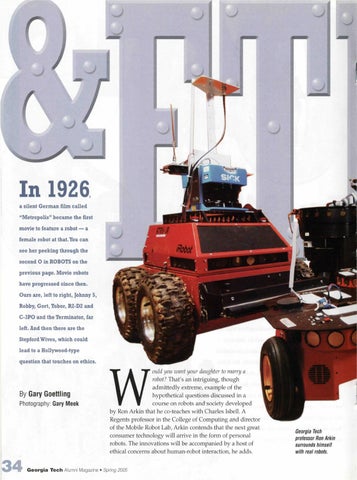
In 1926 a silent German film called "Metropolis" became the first movie to feature a robot — a female robot at that. You can see her peeking through the second O in ROBOTS on the previous page. Movie robots have progressed since then. Ours are, left to right, Johnny 5, Robby, Gort, Tobor, R2-D2 and C-3PO and the Terminator, far left. And then there are the Stepford Wives, which could lead to a Hollywood-type question that touches on ethics.
By Gary Goettling Photography: Gary Meek
34
W
ould you want your daughter to marry a robot? That's an intriguing, though admittedly extreme, example of the hypothetical questions discussed in a course on robots and society developed by Ron Arkin that he co-teaches with Charles Isbell. A Regents professor in the College of Computing and director of the Mobile Robot Lab, Arkin contends that the next great consumer technology will arrive in the form of personal robots. The innovations will be accompanied by a host of ethical concerns about human-robot interaction, he adds.
Georgia Tech Alumni Magazine • Spring 2005
Georgia Tech professor Ron Arkin surrounds himself with real robots.
For decades, robots have toiled at repetitive assembly line jobs and other industrial work, explored space and the oceans, and handled bombs and other hazardous materials. Following years of growth, mainly in industrial robotics, the market flattened out around 1985. In the past few years, research and development have once again started to rise, driven by the application of computer technology advances to robotic systems. The increased sophistication and capability of robotics have naturally led to wider applications. For example, robots
clean supermarket floors in Europe and tidy up subway stations in Paris. The most promising new market niches for robots may be in the consumer sectors. Only recently have robots begun to invade the home, led by automated lawn mowers, vacuum cleaners and toys. There's even a home security robot that also functions as a mobile smoke alarm. "Suppose you've gone on a trip and you thought you left the garage door open," Arkin says. "You could log into the robot remotely via the Internet and have it check the status of your home." Although the automated sentry has yet to catch on with the public, more kinds of personal robots are on the > Georgia Tech Alumni Magazine • Spring 2005
35
way — many more. "The field sometimes gets a little bit ahead of itself," Arkin says, adding that the challenge, as with any new technology, "is finding a place where these systems can survive and prosper not only from a technological basis but from an economic basis as well." The introduction of robots to the general public may be sluggish at first, but it is inevitable, says Arkin, reflecting a consensus among roboticists worldwide. Among the tasks frequently mentioned as suitable for personal or domestic robots are housecleaning, cooking, helping care for elderly or disabled people, tutoring and secretarial tasks. As robots become more animated and sophisticated, Arkin says, they may even be designed as humanoid companions, teaching humans how to dance, for example.
The Robotics Frontier
T
his first generation of personal robots is rising from advances in microelectronics, machine vision, voice recognition, microelectronic mechanical systems called MEMS, artificial intelligence and numerous other computing technologies. "Georgia Tech is starting to push together as a coherent group," Arkin says, "trying to make big things happen here by drawing faculty from mechanical engineering, the College of Computing, aerospace engineering, industrial and systems engineering, electrical and computer engineering, biomedical engineering and the Georgia Tech Research Institute." A report issued last fall by the U.N. Economic Commission of Europe and the International Federation of Robotics predicts a 700 percent increase in the number of industrial and domestic robots worldwide by 2007. The annual study, which for the first time includes domestic or personal robots in its research, notes that 405,000 domestic robots were sold worldwide in 2003, mostly lawn mowers and vacuum cleaners. One of the most publicized autonomous personal robots is AIBO, Sony's "pet" dog. Introduced in 1999, AIBO's internal package of artificial intelligence software, sensors and machine vision allows the dog to interact with humans in a canine manner and "learn" from its environment. AIBO's behavior changes the more it interacts with people, mimicking the natural maturation process. And when its batteries run low, AIBO plugs itself into its recharger for a nap. >Âť
Artificial Intelligence Robots may not reason why, but they can reason about and react to their environment
lumnus Tom Collins, a senior research engineer in the Georgia Tech Research Institute, works in the Mobile Robot Laboratory with colleagues in the College of Computing to create machines that can make complex decisions. They are developing software that enable robots to autonomously perform missions like foraging for mines, explor-
A
RflBOTHTHKS A 700 PERCENT JUMP IN THE NUMBI 36
Georgia Tech Alumni Magazine • Spring 2005
Photo: Stanley Leary
Alumnus Tom Collins works with a robotic machine in Georgia Tech's Mobile Robot Laboratory. Collins works with sensors to develop methods of acquiring and processing perceptual data for robots in real time. More than 30 Tech faculty are involved in robotics research in 15 robotics-related laboratories.
ing dangerous territory and establishing mobile communications links, says Collins, ME 80, MS EE 82, PhD 94. More than 30 Tech faculty are involved in robotics research working out of 15 robotics-related laboratories. More than 40 courses related to robotics are taught on campus. In fact, Collins introduces robotics to all sophomore com-
puter engineering and electrical engineering students with a robot project in a required digital hardware design laboratory course. Ron Arkin, director of the Mobile Robot Lab, develops high-level, behavior-based robotic software that captures both sensing and acting with "schemas," basic software elements that can combine in many ways to produce robot behaviors. Collins maps the software onto robot platforms and sensors, acquiring and processing perceptual data for robots in real time.
"It is not enough just to provide robots with preplanned strategies," Collins says. To help robots learn, the researchers use a variety of techniques. Learning momentum, a technique pioneered by Arkin and his research team, involves teaching a robot that if a behavior is working well, it should continue doing it. The robot adapts its behavior in response to the environment and its own performance. Another technique called reinforcement learning uses computer-generated "rewards" to tell the robot it has made good decisions — and should continue doing so.
ER OF ROBOTS WORLDWIDE IS PREDICTED BY 2007 Georgia Tech Alumni Magazine • Spring 2005
37
"The goal is to create robots that will be your partners, be your friends and not only entertain you, but become a part of your life on a daily basis," says Arkin, who is a consultant to Sony on AIBO's software architecture. At about $800 each, AIBO isn't accessible to the mass market just yet, though it's worth remembering that a dozen years ago, a digital camera cost upward of $10,000. Arkin also consults for another Sony invention, the 28-inch-tall QRIO humanoid. The familiar science fiction image of how a robot ought to look and act, QRIO can dance, recognize individuals and voices, converse, locate and kick a ball, play catch and jog — autonomously. About 100 of the silver-colored robots have been built. They serve as company showpieces, performing at venues all over the world. QRIO is too pricey for the consumer market, but Sony expects to offer some kind of humanoid personal robot in the near future. Honda's Asimo robot is another sophisticated prototype. At 48 inches in height, it's tall enough to flip light switches and open doors. It can also carry heavy boxes and climb stairs. Honda researchers are working to replace Asimo's portable joystick control with autonomous command architecture. In addition to Sony and Honda, companies with substantial research and development investments in personal robotics include Electrolux, Matsushita Electrics, NEC, Intel, Fujitsu and Lego.
Spin-off Technologies
I
n the United States, the overwhelming majority of financial support for robotics research and development comes from the Department of Defense. That doesn't mean advances in personal or other nonmilitary robots are entirely neglected, says Arkin, whose Mobile Robot Lab is one of the funding recipients. "Don't confuse the application with the science," he explains. "We're trying to understand the basic principles of intelligence and how to put them to work in a variety of different domains. Basic humanrobot interaction issues, like how to design systems people can use effectively, are relevant to both military and civilian applications. So much of what we do has tremendous spin-off technology potential." Much of the lab's work aims to identify and combine the elements of reflexive behaviors Âť>
T
ucker Balch, an assistant professor in the College of Computing, is studying the behavior of bees in the hive and colonies of ants to "unleash the secrets of colonies to use the findings in developing teams of robots." Balch and his colleagues in the college's "Borg Lab" are using a computer vision system for automated analysis of animal movement to track honeybee activities to ultimately inspire the design of robots and computers. "We believe the language of behavior is common between robots and animals," Balch says. "That means, potentially, we could videotape ants for a long period of time, learn their 'program' and run it on a robot." While challenges include differences between the motor and sensory capabilities of robots and insects, Balch believes the behavior of social insects such as ants and bees can offer ideas about organizing a cooperative colony of robots capable of complex operations. Balch anticipates using animal behavior information to design robots that work with people in unknown environments such as those encountered by law enforcement officials or the military. In a related initiative with Emory University's Yerkes National Primate Research Center, monkeys are being observed with a similar computer vision system. Balch and his research team hope studies will yield behavior models that can be employed in computer code.
Bee-ing Robots! Georgia Tech researchers want robots to learn animal behavior
RfFTMHTCS THE GOAL IS TO CREATE ROBOTS T 38
Georgia Tech Alumni Magazine • Spring 2005
Nicole Cappello
M Will BECOME PART OFYOUR EVERYDAY LIFE Georgia Tech Alumni Magazine • Spring 2005
39
with cognitive functioning to create autonomous, decision-making robots. The process is aided by techniques that help a robot "learn" from its interaction with the environment. Human-robot interaction, military applications — these issues are also addressed in Arkin's robots and society class. "What are we doing in terms of military applications? Is this appropriate use? Should robots be able to employ lethal force?" Arkin asks rhetorically. "At some point, do we trust the machines more than we trust ourselves? "My concern right now is not to formulate doctrine, but rather to formulate a consciousness among roboticists and robotic scientists that these questions need to be asked," he says. "Georgia Tech, through this course development, has provided me a wonderful forum to share those questions with my undergraduates." Another group of issues is raised by the prospect of human-robot interaction on a daily, more personal basis. "We're creating robotic systems that can work their way into your life and make you feel things unlike any other kind of artifact that existed previously," Arkin says. "Is that appropriate? What are the limits, if any, for establishing this kind of humanrobot interaction?"
Considering the Consequences
A
lthough these questions are meant to stir discussion rather than resolution, there is virtue in considering the ethics of a new technology in advance of its deployment, according to Arkin. "Historically, technologists have been woefully ignorant of the implications of what they created," he says. "I would probably put myself in that category until a few years ago. Research and development will move forward, but we still need to understand what the consequences are, then come to grips with them and determine whether we should do anything about them." Maybe marriage to a robot isn't such an absurd question after all. If it happens, perhaps an ordained humanoid would officiate. As for music, here's something to keep in mind: This past December, on a stage erected in front of Sony's Tokyo headquarters, a quartet of QRIOs flawlessly performed "Ave Maria" on handbells, GT
M
Look, Up in the Sky! It's an unmanned aerial vehicle
ove over, Superman, here comes a flying robot. Right now the roles of the unglamorously named unmanned aerial vehicles are primarily for defense and the military sponsors much of the research. But, as we have learned from NASA, technology adapts and the benefits for the civilian population can be very rewarding. Now UAVs equipped with video cameras, for example, can fly ahead of military troops, law enforcement officers or firefighters and send back a bird's-eye view of a potentially dangerous area. While that is a technological feat, Georgia Tech researchers would like these flying robots to do more — something akin to thinking. They want a UAV to have a sense of a changing situation and the ability to react. Giving UAVs flying sense is something scientists at the Georgia Tech Research Institute are especially qualified to do. GTRI enjoys an international reputation for its array of sensors, including electro-optics, infrared, radar, acoustics and chemical and biological sensors. Researchers are integrating two of these sensors, radar and chemical, into small UAVs for testing. In the future, UAVs equipped with Doppler radar and capable of detecting movement could do aerial patrols or guard duty. In a combat situation, UAVs integrated with chemical sensors that use laser techniques could detect and monitor chemical agent clouds released by weapons of mass destruction. Tech researchers and several partner institutions and organizations have successfully built, tested and flown the first rotary wing UAV, a helicopter called GTMax, operating on innovative software that enables flight control fault identification and reconfiguration, adaptive control and agile maneuvering. The innovative software-enabled control system for UAVs was developed at Tech for the Defense Advanced Research Projects Agency and the Air Force Research Laboratory. Georgia Tech's primary contribution was an open control platform that gives the UAV the ability to reconfigure its software system autonomously in flight.
MBOTSraiS ROBOTICISTS MUST COME TO GRIR 40
Georgia Tech Alumni Magazine • Spring 2005
Photo: Gary Meek
Researcher Dan Campbell tests a chemical sensor mounted in the nose of an unmanned aerial vehicle. BELOW: GTMax, an unmanned aerial vehicle that operates on innovative software, successfully soars during a test flight.
S WITH THE IMPLICATIONS OF WHAT THEY CREATE Georgia Tech Alumni Magazine • Spring 2005
41
UZI LAN1
T ER V I E W
"Cows and camels don't fly, gorillas don't swim and nanorobots don't exist. Nobody has ever built a nanobot. A robot implies an autonomous structure. The whole proposal of building nanorobots that would operate independently, and with selfreplicating capabilities, is misguided conceptually, methodologically and practically." — Uzi Landman Professor of physics
42
In his 1992 novel "Prey," author Michael Crichton posits a world threatened by swarms of self-replicating, autonomous nanoscale-sizc robots — nanobots. A number of scientists and academics agree with the general concept, and in some cases the threat, described in Crichton's fiction. But you won't find Uzi Landman anywhere near that crowd. A Regents and Institute professor of physics and the Fuller E. Callaway chair in computational materials science, Landman's research was among the first to pull back the curtain on the peculiar physics of nanoscience more than two decades ago — long before anyone even used the term. Landman's research interests also embrace surface and materials science, solidstate physics, microscopic hydrodynamics, statistical physics, chemical physics, computational physics and chemistry. Although convinced that nanotechnology portends many benefits to society in the future, the notion of nanorobots or nanobots is "utter nonsense," Landman says.
How long have you been involved in nanotechnology? 1 have a center at Georgia Tech for computational materials science and we have activity in several areas, with an emphasis on computer simulation and modeling of materials properties in the nanoscale. Our interest in the properties of materials on the nanoscale started some 20 years ago. For a while it was regarded mainly as a branch of
Georgia Tech Alumni Magazine • Spring 2005
theoretical research, then it became possible experimentally to actually produce these materials as well as observe and detect them. I'll give you an example. Take gold and make a wire out of it. When it is in microscopic size — microns or millimeters, it doesn't matter — you can conduct electricity through it and measure the resistance of this wire. But when you reduce the diameter of this wire to the nanoscale, maybe five to 10 atoms along the diameter, it conducts electricity in a completely different way. It's still gold; you didn't make a new material, but it exhibits completely new behavior because of its smallness. By the way, these nanowires were discovered in our laboratory through computer simulation in the late '80s, culminating in an article in the magazine Science in 1990. These theoretical predictions were subsequently corroborated in several laboratory experiments. So nanotechnology provides an approach for developing new materials? Nanoscience is the science of the new properties that appear when materials are reduced to the limits of the nanoscale. Part of it is devoted to the making of new materials, but it relies mostly on the fact that
when one goes to small sizes, the properties of materials change. In other words, small is different. So instead of changing the chemical composition of a material, here you have a new parameter — namely size — that by itself changes the property of the material, although it is made of the same chemical element. It has been speculated that intelligent nanobots could one day be injected into the human bloodstream to perform surgery or even serve as weapons. On the opposite end are the doomsayers who contend that nanorobots pose a potential threat. What do you think? I must tell you that I dislike the word "nanorobots." This implies
DMAN something artificial, you know? And because of science fiction, it also implies something that is kind of magical and people go and extrapolate that into the idea of robots taking over the world. There are even people who go around and talk about robots that will make factories to make other robots and so on. This is utter nonsense. Cows and camels don't fly,
gorillas don't swim and nanorobots don't exist. Nobody has ever built a nanobot. Of course one can fabricate certain nanoscale structures, and this has been demonstrated. However, a robot implies an autonomous structure. The whole proposal of building nanorobots that would operate independently, and with self-
Don't Expect Nanobots in Nanoscience's Future Interview by Gary Goettling Photography by Gary Meek
replicating capabilities, is misguided conceptually, methodologically and practically. All that said, there are certain machines, mechanical instruments, that are going to be built and are being built on the nanoscale. I'd rather call them nanomachines. > »
juiuffi I « I W OHM Ma la*
»as»x
• <*»«'"'
'i'
«* * »
i
*-#}£
.,f3fflr>.f.l># w«m
lagazine • Spring 2005
> > INTERVIEW Could a nanomachine be mechanical? "In collaboration with engineers at Georgia Tech and my theoretical physics group, we are working on nanojets. These jets are small and they can squirt material into a cell without breaking the cell wall. So, if you fill these jets with the right drug, they will deliver the drug to cancer cells selectively, without killing healthy cells or spreading the debris of the malignant ones."
Yes, you could have mechanical devices, though it depends on how you define mechanical. I suppose if it has a gear wheel or if it rotates or has moving parts, it qualifies as something that has a mechanical aspect to it. What might a nanomachine look like, and how would it be used? One application people talk about would be used for targeted drug delivery. You would need nanostructures that could identify malignant cells, be able to dock with them and then there must be some kind of mechanism for pushing the drug out into the cell. One possibility are nanosize devices that could be navigated inside the body. These structures may have some ability to respond to an external magnetic field, for example, so you could move them through the
Georgia Tech Alumni Magazine • Sprin
body. These structures would contain sensing units that identify chemically or physically malignant cells and attach to them. Now, inside these structures are little containers that hold molecules of a drug that will kill the cancerous cells. In simulations, in collaboration with engineers at Georgia Tech and my theoretical physics group, we are working on nanojets. These jets are small — 10 to 50 nanometers on the diameter or as small as one-hundredth of a micron — and they can squirt material into a cell without breaking the cell wall. It is needleless injection, in other words. So, if you fill these jets with the right drug, you can structure them into the nanomachines and they will deliver the drug to cancer cells selectively, without killing healthy cells or spreading the debris of the malignant ones. This may serve also as a method for targeted injection of genetic materials into cells — that is, "gene nanoartillery."
What about self-assembly for nanomachines and structures? Is that a scientific possibility or just science fiction? There are materials called C-60 or carbon nanotubes. Do you know how people make these things? It's unbelievably simple! In one of the methods you take two graphite rods and put them a certain distance apart, then apply high voltage between them to burn the rods. This arcdischarge process produces little soccer balls made of 60 carbon atoms or elongated structures called carbon nanotubes. Nobody knows for certain how it happens — and trust me, it's not for lack of trying — but this rather simple process forms exquisite structures that exhibit unusually high stability and have remarkable properties. For example, carbon nanotubes have a tensile strength 100 times higher than steel, at about one-sixth the weight. The beautiful thing about the nanoscale is that nature can make wonderful materials through a process called selfassembly. You really do not have to do chemical synthesis at some high level — the material simply gathers itself together. This is one of the properties we don't understand so well, but it has been observed on numer-
ous occasions in the nanoscale that nature operates according to certain self-selection principles that govern materials' shapes, sizes and forms. We already have a name for chemical machines that produce chemicals: enzymes. An enzyme is basically a nanoscale machine, and it works wonderfully. Body biology is a fantastic example of an evolutionary system that developed the ability to reproduce itself, the ability to build new materials and duplicate materials. DNA replicates itself, right? Nature builds these structures because nature always tries to build the most robust molecules, the most robust nanostructures. If you want to call that self-assembly, fine. The point is nature gives this process to us. I believe that if we can harness nature in a useful way to make nanoscale materials, this is the future of nanotechnology because it is really the least-
expensive way of making materials — let nature assemble it. But we need also to remember that biology evolved in the service of biology. In other words, the mission of biology is to support life processes, not necessarily technological ones. So in order to make use of nature's ability to self-select and self-assemble, we have to understand these processes and employ or mimic nature in a creative and compatible way. Some say that nanotechnology has the potential to spark a kind of industrial revolution. Do you agree? People say this is the nanotechnology revolution. It will be like an industrial revolution. Well, this might happen and I believe that sometime it will become
a tremendous boon to society. But one thing should be kept in mind. This technological revolution will depend tremendously on science. Why? Because we do not know what these materials do when we take them to the nano size, and we don't have the blueprints to make devices. It's not a simple matter of scaling down. You have to redesign everything because the materials behave differently, and you need first to discover and understand how they behave and under what conditions "small is different." Then you may be able to harness these nanoscale materials and their novel properties and launch the so-much-talked-about nanotechnological revolution, GT
"If we can harness nature in a useful way to make nanoscale materials, this is the future of nanotechnology because it is really the least-expensive way of making materials — let nature assemble it.'
\
V> \ \ , l
Georgia Tech Alumni Magazine • Spring 20C
45
Attention New Parents... and grandparents, aunts, uncles, sisters, brothers and friends! The Georgia Tech Alumni Association invites you to enroll your child in the
<$afey <®h%% Clhfa « All club members will receive Canvas Bag • Buzz Hooded Towel • GT C a p Buzz Bib • Sipper Cup • and Much More Enroll by returning the order form and your check for $39.95 +7% tax ($2.80) (in Georgia only)and $6.00 for shipping and handling made payable to Georgia Tech Alumni Association 190 North Avenue, NW Atlanta, GA 30313 Please allow 3 weeks for delivery.
Ordered by: Name:. Merch:$39.95
Telephone #:. Gift card should read:.
S&H:
$ 6.00
Tax:
$
Send to:. Baby's sex: D Male
TOTAL $_
D Female
Shipping Address: (No P.O. Boxes please)
Payment Information: D Visa
D MC
D Discover
D AMEX
D Check
Credit Card #: Exp. date: Signature
.
Qeorgia Tech Return Address Labels Additional Logo Choices:
Your Name Your Address Your City, State and Zip Code Acnud Size of Label 2"x .()25'
w
for 120 Color Labels Includes Shipping and Handling
Your Purchase Supports Georgia Tech Programs! •Show Your Georgia Tech Spirit •SelfSticking •High Quality
'Unique Gift Idea 'Fast Delivery 'Satisfaction Guaranteed
t£f ,. I |T7sT
Circle the logo you'd like on your labels! First Line. Second Line Third Line _ Fourth Line (if desiredl. Name on (Iredit (lard
.Exp. Date.
Credit Card Number Type of Credit Card
Complete form and mail with credit card information or check for $7 to: Merchandise Georgia Tech Alumni Association 190 North Avenue Atlanta, GA 30313 Make checks payable to Georgia Tech Alumni Association
Order online at www.gtalumni,org/merchandise
LUMNI
Years The unheralded Yellow Jackets basketball team did the unbelievable twice in 1955 — upsetting the topranked Kentucky Wildcats on their court and at Tech. At Kentucky, 5-9 guard Joe A Helms stole the ball in the final seconds and sank a one-hand jumper to give Tech a 59-58 win. It broke a string of 129 consecutive wins at home for the Wildcats. Kentucky coach Adolph Rupp played the good loser and said the victory by coach John "Whack" Hyder's team was "no fluke." The rematch on Jan. 31 was billed as "Revenge Night" by the Wildcats, but the Jackets jumped off to a 5-0 lead and never looked back. Tech won the rematch 65-59.
v
\
Years 1 C C U 9 Georgia Tech
received a grant from the Daniel Guggenheim Fund of $300,000 — the largest in the school's history at that time — to establish a school of aeronautical engineering. "This will give us the only aeronautical engineering school in the South," said President M.L. Brittain. The Guggenheim building was designed in the "English Collegiate" style by Harold Bush-Brown, head of Tech's department of architecture, and architecture professor J.H. Gailey. Among the building's features was a wind tunnel.
Years The name of the College of Industrial Management was changed to the College of Management. The name change reflected the broader scope of the college's curriculum and, by dropping "industrial," eliminated a source of confusion.
Georgia Tech Al
By Ed Negri
H
erren s
became distinguished on restaurant row for fine dining and as the meeting place for Atlanta's movers and shakers, visiting celebrities, movie stars and those who liked to rub elbows with the greats. It was notable for a mischievous boast — the world's second best apple pie — and sumptuous sweet rolls.
Around the Coiner from Ever 48
Georgia Tech Alumni Magazine • Spring 2005
Prizefighter Charlie "Red" Herren opens Herren's Restaurant
Guido Negri buys half interest in Herren's
„^j5V^*-"LP-__aJi^i!_j»_gi^
EDITOR'S NOTE: Longtime restaurateur Ed Negri, ME 47, has
collected his remembrances in a book written with Michael J. Cain and released by Roswell Publishing Co. The following edited excerpts are from "Herren's: An Atlanta Landmark."
I
n 1934, in the middle of the Great Depression, a redheaded prizefighter named Charlie Herren decided to go into the restaurant business. He started in a little hole in the wall near Five Points and then moved to 84 Luckie St. To no one's surprise, he called his place Herren's Restaurant. In 1939 he sold a one-half interest to my father, Guido Negri. Daddy and Charlie Herren arranged a deal whereby they would be partners for a year and then Daddy would buy the other half of the business. That's when my life took a different turn, though no one, least of all me, suspected it at the time. I was going to Boys High School in Atlanta and courting beautiful Jane Fuller. The coming war was a long way off, and I was hoping to be accepted as a mechanical engineering student at Georgia Tech. Once Daddy became Herren's sole owner, he started making improvements. In those days there was no air conditioning and he was aware that something had to be done to improve his guests' comfort in the summertime. As we entered 1941, Daddy went ahead with his expansion plan, which included Atlanta's first built-up refrigerated air-conditioning system to be installed in a restaurant. Daddy had been the popular manager of the Piedmont Driving Club for many years, and he was well known to Atlanta's business leaders. The newly expanded and more comfortable Herren's became the meeting place for Atlanta's
50
Georgia Tech Alumni Magazine • Spring 2005
Guido Negri becomes full owner of the restaurant Ed Negri enters Georgia Tech
Atlanta's first built-up refrigerated airconditioning system installed in Herren's
movers and shakers along with those who liked to rub elbows with the greats. All the action was downtown at night and Herren's was right in the middle of it all. At one time we even used the slogan "Around the corner from everywhere," and, in Atlanta, it was the truth! In the evening, downtown Atlanta was swarming with activity with five major theaters and all the nightclubs of those days. The Rialto Theater, right next door, showed all the best Columbia releases of the day and the Paramount and Loew's Grand had all the first-run movies from those studios. The Fabulous Fox, not far away, was one of the world's most exciting theaters with its twinkling star ceiling, drifting clouds, Mighty Moeller organ and "Arabian Nights" decor. I had entered Tech in the fall of 1940 in the Class of '44 and came within a whisker of making the Dean's List in my freshman year, thanks to my days at Boys High. I was majoring in mechanical engineering and had never considered becoming involved with the restaurant, even though my summer jobs in '40 and '41 were at Herren's. Daddy, taking the war in stride, quickly volunteered for any duty his government saw fit. He particularly pointed to his linguistic skills (he spoke five languages) and touted himself as being able to speak and understand Southern. As he awaited his call from Uncle Sam, he added some humor to his menu with phrases like: "Remember Wake Island. Use less sugar and stir like hell." And he offered "Free French" fried potatoes in tribute to those Frenchmen who had escaped Hitler's net. At Tech, we had entered an accelerated program of studies, eliminating summer vacations so four-year courses could be completed in three years. I was having a tough time with
1942
In August, Guido Negri dies at age 56 Guido s widow, Amalia, runs Herren's through the end of World War II, despite war rationing
physics, calculus, chemistry and dating when tragedy struck. In August of 1942, Daddy developed a bleeding ulcer and was taken to the hospital. He died unexpectedly a few days later at the age of 56. The war around the world was going full force and business was booming. Suddenly my mother, Amalia, with little restaurant experience, was left to run Herren's all by herself. Herren's managed to survive wartime shortages of help and food, rationing, price controls and no shortage of sticky fingers. With the war's end ... I had returned from my stint in the Army Air Corps, which had ended as a flying instructor at a twin engine school in Marfa, Texas. I now had a family of one gorgeous wife and two rambunctious boys, Steve and Paul. I was working at the restaurant and working on finishing my education, which had been interrupted in the middle of my senior year. I managed to struggle through and finally received my BS ME diploma with the class of 1947.1 was now out in the job market that had recently become overcrowded as wartime demand subsided and the market was flooded with millions of returnees. At the same time, the usual smooth flow of people entering the job market every year had been severely distorted. Many of the boys who had departed high school and college in '42 and '43 as fresh-faced boys were suddenly home as adult family men, all looking for jobs. I finally managed to find work with Delta Heating and Air Conditioning Co. My title, as I remember it, was engineering cadet, but my job was bottom man on the totem pole in the furnace and air-conditioning business. It was a dirty job, crawling around among the cobwebs under old houses, putting together furnaces and duct work. I loved it!
A couple of months into this wonderful job, I received a fateful call from Mamma. She ... insisted I was needed. Against my better judgment, with no knowledge of the restaurant business, with no desire to become involved and over Jane's strong objections, I returned to 84 Luckie St. I have sweated over that last sentence because it makes no sense, but you had to know Mamma to know that she was the personification of the European matriarch and an extremely persuasive person. That's how a guy with a BS in mechanical engineering from Georgia Tech spent his entire 41-year business life in the restaurant business.
RESTAURANT ROW
O
ur location was just one door west of Forsyth and only one block separated us from Peachtree Street where Luckie began. In only one mile, at the edge of the Georgia Tech campus, the name changed to Hemphill. A well-known business on this portion of the street was the controversial Pickrick Restaurant, our polar opposite during the integration days of the '60s. A mile farther the name changed to Northside Drive, which in its northern reaches led to the mansions o\ many of Atlanta's leaders, including Atlanta's great and courageous mayor Ivan Allen. On the corner, next to us, was the Rialto Theater. Diagonally across from it was the Piedmont Hotel, built in 1903, with a fine dining room known far and wide during the early part of the century. On a small corner of that property there had been a restaurant site occupied by a Krystal, succeeded by Johnny Reb's, followed by The Sportsman. Across Forsyth Street from the Piedmont, practically in our front yard, was the Ansley Hotel. Later renamed The Dinkier Plaza, it was home to the Rathskeller, Owl Room >  Georgia Tech Alumni Magazine • Spring 2005 ^
VZVt Ed Negri earns mechanical engineering degree at Georgia Tech, enters restaurant business full time
(complete with blinking-eyed owls on top of the columns) and Starlight Roof, where Hollywood stars performed in a theater in the round. I remember attending a performance and noted Cesar Romero lighting a cigarette with a Herren's match. Many of the stars dined regularly at Herren's and I fell in love with Marcia Hunt! The southeast corner of Luckie/Forsyth once housed the Melba Cafeteria, which became the La Louisianne Restaurant, then an Oriental restaurant and finally Leb's with its downstairs nightclub, Pigalley. Farther down that block to the south of our intersection on Forsyth Street there were a number of smaller eating places, the most notable of which was Venables, widely known for its friendly owner, its wooden counter and scrumptious country vegetables. Around the corner from them and upstairs was The Ellen Rice Tea Room, which later moved up on Forsyth Street on the other side of the Dinkier Hotel next to the Carnegie Library and was called Dave Rice's. To our west, Luckie Street was almost entirely composed of restaurants, the first one being Harry's Steak House right next to us. On the corner below, just across Fairlie Street was originally Harvey's, then later housed another Herren's (Charlie sold out to Guido, but couldn't stay out of the business), then the Belmont Steak House. The neighbor of this building housed the Davis Brothers Restaurant. Also in the block was an early version of Howard Johnson's, later followed by a Chinese restaurant. On the other side of the street, the corner building belonged to the Ship Ahoy, which opened its doors the same year we did, in 1934. It later became the Knight's Table, which was ultimately torn down and converted to a parking lot. Farther down the block were a number of small places, one called The Old South that became Venables when that establishment's building on Forsyth was demolished. A block farther down was the Brown Derby and even farther out were a
52
Georgia Tech Alumni Magazine • Spring 2005
Herren's gets Atlanta's first lobster tank
number of small counter-type cafes. South on Fairlie Street, just behind Herren's, was Emile's French Cafe and its neighbor, Margaret's Tray Shop, a highly popular lunchtime eatery. During World War II, the offices in downtown Atlanta were dubbed "Forsyth Street foxholes" by Atlanta columnist Ernie Rogers, who mentioned Herren's frequently. He called us "Ye Olde H's." Here's why: After Charlie Herren sold his remaining interest to Guido, he returned to downtown Atlanta with another Herren's Restaurant ("back by popular demand"). People were confused and remained so. Guido consulted an attorney who was one of our regulars but was told, "How can you prove he's hurting your business? You've got them standing in line and he's empty." That year Duncan Hines felt it appropriate to advise his legions of readers to be sure to go to the old Herren's Restaurant, which was one of his recommendations for many years. So to differentiate the two restaurants, puckish Guido had a tiny neon sign made to go above our marquee. It transformed Herren's into Ye Olde Herren's. Later, one of Amalia's managers was looking for an appropriate logo and came across the New England town crier we used for years afterward. Still later, with Mr. Herren's other place long gone and Guido gone to the Great Dining Room in the Sky, we hired a decorator. He saw the "Ye Olde" and the town crier logo and we ended up with an Old New England decor, complete with a wallpaper mural of Newburyport, Mass., on one large wall. That wallpaper became the back page of our lunch menus.
MOM'S APPLE PIE
M
any years ago Atlanta had a very fine restaurant called Mammy's Shanty, owned by Floridian Charles Creighton and operated by my friend Preston Weeks. Mr. Creighton operated in Florida with large signs proclaiming "The World's Best Apple Pie." When he bought the
Negri elected president of Atlanta Restaurant Association
Herren's daily bakes 2,000 of its trademark sweet rolls
Herren's completes expansion project
Herren's gains reputation as "Atlanta's place to meet," begins two-decade reign as premier site of "power broker lunches." It remains one of downtown's finest restaurants until its closing
Herren's voluntarily desegregates, leading the way among a select group of establishments that peacefully opened their doors to everyone
Shanty, he added that slogan to the sign and his apple pie to the menu. In our town at that time was another entrepreneur named Tom Ham, who was one of God's gifts to comedy. He and his partner operated a number of places called Seven Steers with a hilariously funny menu and decor. When Tom saw Mr. Creighton's sign he could not resist it. His menu immediately offered "The World's Roundest Apple Pie." Not to be outdone, another restaurant whose name escapes me jumped on the bandwagon with "The World's Flattest Apple Pie/'As we sat pondering this flurry of one-upmanship, someone said just the right thing at the right time and we changed our menu. We offered "The World's Second Best Apple Pie." We instructed our staff on the proper response to anyone who asked, "If yours is second best, whose is first?" My answer to the question was, "Mom's apple pie is best," and I quickly added, "Your mom's, not mine."
ARE WE INSURED?
W
e ordered Atlanta's very first lobster tank from a firm in St. Louis and anxiously awaited its arrival. When it failed to arrive, the manufacturer supposedly shipped another. When it eventually arrived it turned out to be the first one that was shipped. It had been sitting around a truck terminal for months because nobody knew what it was and could not identify it when inquiries were made! What a monster I had created! 1 averaged at least one hour each day working on the tank and frequently said, "I want to be buried in it." After I played nursemaid to this mechanical marvel for many years, Atlanta Journal columnist Ernie Rogers dubbed me "Atlanta's lobstertrician!" When everything went right, we displayed 90 gallons of sparkling clear (filtered down to three microns for you engi-
Herren's integration trivia: Veteran writer Roy Blount says Vernon Jordan, future president of the National Urban League, then working for a regional civil rights organization, was among Herren's first African American customers. Blount recalls: "Fred Powledge, a local newspaper reporter, broke a century of ignominious decorum by crying out across the room, 'Vernon! It's great to see your black face in here!'"
neers) refrigerated seawater. We had cleared a spot in our front window for the tank, where it generated great attention from passersby. The local newspaper ran a page-wide strip of pictures of people looking at something ... with the caption "What Are They Looking At?? See Page 6." Of course, page six had a close-up of a lobster in our tank.
DISASTER
O
nce you show that you're willing to spend your time doing things other than pursuing your career, it's relatively easy to say "yes" and find yourself doing some volunteer work. Usually people think of you in your field, decide that you are some kind of expert and then flatter you into submission. Such was the case when the Red Cross came to call. They knew that I had been in the restaurant business a long time, donated a lot of blood and was obviously a sucker for a good deed project. So, they asked me to serve on the Disaster Committee. My duty was to help see that volunteers were fed as they did their thing in pursuit of whatever sort of relief or help work was at hand. The racial unrest around the country came to Atlanta in the form of riots near the stadium area. We heard about it on the radio and saw it on TV. Atlantans will remember pictures of Mayor Ivan Allen Jr. (another Boys High boy) courageously standing on a police car addressing the crowd. While we were watching all this on TV, the phone rang and Beautiful Jane handed it to me. It was none other than the mayor's secretary. "We've got 500 (or some such number) police officers down at the stadium to control things and it's time to feed them. Call your Red Cross buddies and get to work!" When she finally accepted the idea that I didn't control the Red Cross or even know where to start, she came back with, "But you're the food man and these men are >  Georgia Tech Alumni Magazine • Spring 2005
53
vm.
Tra Lower dining rooms converted to art gallery featuring local artists; collection changes monthly. "We served dinner in the Gallery on Friday and Saturday nights. Evelyn King played the piano and sang to liven things up." Waitresses dressed in artist smocks and berets. On opening night, Mayor Ivan Allen Jr. provides ribbon-cutting honors; many notables attend, including the governor's wife, Betty Sanders, a well-known artist in her own right
hungry and need to be fed." Racking my wife's brain, I finally called The Varsity, which Atlantans know as the world's largest and most splendiferous drive-in. The stories you can hear about the place are endless, entertaining and probably all true. Mr. Gordy (Frank, the owner and originator, said to be a dropout from Georgia Tech in the '20s and one of the world's Great People) was not available, so I talked to his manager. I explained the problem. He simply said, "What do you need and when can you pick it up?" I ordered 300 hamburgers, 300 of their famous chili dogs, 300 fried apple pies, 300 fried peach pies and enough french fries to bury the Queen Mary. "I'll be there in about 30 minutes." "It'll be ready," was his laconic reply.
Negri serves as president of the Georgia Restaurant Association
Negri helps save the Fox Theatre from the wrecking ball. Fox Theatre history notes first "Save the Fox" meeting held at Herren's on July 10
Herren's patrons range spectrum of Atlanta's movers and shakers, from Martin Luther King Jr. to bank president Mills Lane
Protest Open Restaurants Here," the story told of neatly dressed whites picketing a number of restaurants, carrying neatly printed signs that read, "Do not eat here. The owner of this business is a leader for integration." Several restaurants were mentioned, including Herren's, and the article identified Lester Maddox as a "spokesman for segregationist causes." "There will be a few at first," he was quoted as saying, "but it may run into the thousands before it is terminated." That summer Jane and I were in the dining room at every meal. If anything untoward happened, I didn't want my staff to suffer for our decision. As things turned out, we never had a problem related to integration of the restaurant. Looking back, I wonder what all the hoorah was about. My lawyer had told me 10 percent would be for us, 10 percent against us and the rest couldn't care less.
INTEGRATION — WHAT WAS IT ALL ABOUT?
O
ur first black guests turned out to be Dr. (Lee R.) Shelton, his wife Delores and his mother-in-law, Mrs. Alberta Walker. Since my statement had appeared in the paper (Atlanta Constitution, June 23,1963), all those who objected had stayed away so that there was no stir as I seated them in the front dining room. As one might imagine, Jane and I received a great deal of attention from those who disagreed. Some bold individuals even called us at two and three in the morning to give us a bucket of raspberries along with uncomplimentary pronunciations of our family name. Many called to harass us during the day and we received more than our share of illiterate (and unsigned) cards and letters, many of which I still have. We were picketed by members of the Ku Klux Klan. The Atlanta Journal, on June 27,1963, carried a story on page 14 written by Fred Powledge. Headlined "White Pickets
54
Georgia Tech Alumni Magazine • Spring 2005
SWEET ROLLS AND OTHER GOODIES
T
alk to anyone about Herren's and somewhere in the conversation they will invariably mention sweet rolls or cinnamon buns or sticky buns. Years ago, in the early days of Herren's, someone made the first sweet roll and placed it in a basket of hot Parker house rolls. Nothing has been the same since. So popular were these rolls and so frequent the recipe request that we published it ourselves as a giveaway. Our waxed take-home bag conveyed this treasured information. For many years this recipe went home with every take-out purchase; the bag was also used as our doggy bag. To celebrate our 45th anniversary, we handed out one of these bags with a dozen hot sweet rolls to everyone who dined with us on that day. Herren's closing was noted on the front of the Metro
PFFi
FEEF Negri helps launch the Boys High Alumni Association
Negri helps save the Wren's Nest, home of author Joel Chandler Harris
On Nov. 13, Herren's serves its last meal
section of the Atlanta JournalConstitution on Nov. 14,1987. The story carried the recipe.
WHAT HAPPENED
A
fter being 53 years in the same location and serving millions from all over the world, Herren's finally closed its doors on Friday, Nov. 13,1987. During its last two or three years, it began to dawn on me that the end was approaching. But like the old-fashioned, gutsy entrepreneur 1 thought I was, I kept telling myself, "It's gonna get better." It did — some. And it didn't —• mostly. Over the years we had seen many buildings razed and replaced by some of the monoliths you now see in downtown Atlanta. Many were simply replaced by parking lots, pending someone's decision to build. Some properties simply became vacant. Downtown Atlanta was gradually dying, even though we had the appearance of progress. Down the street from us was a skeleton, the remnants of the old Georgia Hotel, stripped down to its steel bones and trash-strewn concrete floors. It stood there for many years while various developers unsuccessfully attempted its redevelopment. It was even used once as the set for a movie. (Its director, John Huston, stars and others lunched daily at Herren's for many days.) Today our old neighborhood stands almost totally deserted. The Rialto Theater closed shortly after we did and now ... has finally been taken over by the Performing Arts Center for Georgia State University. (Our building) was ultimately bought by the present owner, who converted it into a home for Theatrical Outfit, Atlanta's second-oldest theater company. RIP — reauiescat in pace — which in Southern means no more sweet rolls, GT
Theatrical Outfit, an Atlanta theater company, reopens the renovated Herren's building as its new 250-seat venue. "Ed Negri helped save the Fox Theatre and now our theater company is helping save the building of his beloved Herren's," says artistic director Tom Key. "The city is a better place for Ed Negri."
Herren's Sweet Rolls 1 cup milk 1/4 cup (1/2 stick) butter, cut in slices 1/4 cup granulated sugar 1 1/4 teaspoons salt 2 packages yeast 1/4 cup warm water
4 cups all-purpose or bread flour, sifted 2 cups granulated sugar 4 tablespoons cinnamon 1/4 cup (1/2 stick) butter, melted
In a saucepan, boil milk. Add sliced butter, sugar and salt and set aside to cool. Transfer to an electric mixer fit with a dough hook. Add yeast to water and stir into milk mixture. Add flour, about half at a time, and beat well. Let rest for 15 minutes. Knead until smooth. Place dough in a buttered bowl, cover with a cloth and let rise until double in size, about an hour. In a bowl, combine sugar and cinnamon. Lightly butter two 13by-9-inch baking pans and sprinkle with some of the sugar mixture. Divide dough into four equal pieces. Working with one piece at a time, roll out dough on a lightly floured board to about 1/4-inch thick and about eight inches square. Lightly brush surface with melted butter. Sprinkle some sugar mixture generously over entire surface. Starting at one side, roll dough into a tube. Continue rolling back and forth until it is about 12 inches long. Cut into wheels approximately a half inch wide and place flat in the pans, a little space between them. Do not overcrowd. Brush the tops with butter and sprinkle with sugar mixture. Let stand at room temperature for one hour. Preheat the oven to 350 degrees. Bake for 18 to 20 minutes. Let cool one minute, then promptly remove rolls to prevent sticking. Approximately 50 servings
Georgia Tech Alumni Magazine • Spring 2005
'•"-•*•*"-.*. ••.•'".WH'W*-*** *• %<**< 4 . 4 4 * 4 * 4 4 4 '
1
**--
Winning hands, Las Vegas and commenting on — as well as playing — poker are all part of the lifestyle of Georgia Tech alumnus Phil Gordon (inset photo, on dealer'sright). J.as Vegas photo: Las Vegas News Btireau/LVCVA.
Georgia Tech Alumni Magazine • Spring
"f • • ——
By Maria M. Lameiras
i£&s£U3&&L
*
•
I
- .
liii i
u?:*iai# * ^
- an
II
till ft i* it it
II i II
•w*ar
A
—
DIIi l i
B
rf , p « ™ ^ _ j j If
ILD
i^—ii
^ u - J . *S?
T^BTflBMT^^BBBV
^
T**iitlii;nfti'i-'-—»• Tl
" ^^-V "»
BBMBBBI
jBr'"*"
L^MU
-T" t 2t I
4 I:
«J%:
• Georgia Tech Alumni Magazine • Spn'ngi 2005
* -~
Phil Gordon, left, who provides expert poker commentary for Bravo's "Celebrity Poker Showdown,"chats with show host Dave Foley on the set,
A
t 6 feet 9 inches, Phil Gordon is highly visible as he strolls through the casino at the Bellagio in Las Vegas, but his stature isn't the only remarkable thing about him. The 34year-old Georgia Tech alumnus is a professional poker player who has won more than $1 million in tournaments, only the latest of his successes in life. Gordon, ICS 91, was the principal software architect for Netsys Technologies and became a millionaire at age 26 when Cisco Systems bought the company out. He set out on a world adventure, backpacking through 50 countries before pursuing his dream of playing poker professionally. Since 2001 he's won two World Poker Tour championship events, which led to his role as analyst for the Bravo network's "Celebrity Poker Showdown."
58
Georgia Tech Alumni Magazine • Spring 2005
Although he is now comfortable in his own frame, Gordon says his physical size led to awkwardness and a sense of alienation in high school. He was smart enough, however, to pursue college at age 15. "It was brutal in high school. I was 6-7 and 150 pounds. I was very uncoordinated. I was also completely bored in school. I wanted to go to Georgia Tech, but it was a two-stage process to convince my parents it was a good idea," Gordon says. "They weren't quite ready to let me go to Tech at 15, but I guess 16 was OK, so I went to DeKalb Community College during 10th and 11th grades." After his junior year, Gordon dropped out of high school. "I realized that after 11th grade I would have my two-year degree from DeKalb College before I graduated from high school," he says. With an excellent college grade
point average and an SAT score near 1500, Gordon received a President's Scholarship at Georgia Tech in 1987 at age 16. He entered Tech as a sophomore physics major. "Not a bigger geek have you ever seen, and that's saying a lot for Tech," Gordon wisecracks. "I was a little younger than everyone else, but having been in college for almost two years gave me a maturity a lot of freshmen don't have." Gordon, who learned poker at age 7 from his great-aunt, Lib Lucas, discovered a passion for bridge at Tech. "I learned to play in the Georgia Tech student center my first year and I played for hours every day. I think I attended one out of every five classes. To keep the President's Scholarship you have to maintain a 3.2 GPA, so I figured out what I needed to do to keep my scholarship — an A in this class, a B in that class — and that's what I did.
"NOT A BIGGER GEEK HAVE YOU EVER SEEN, AND THAT'S SAYING A LOT FOR TECH. I WAS YOUNG, BUT HAVING BEEN IN COLLEGE FOR ALMOST TWO YEARS GAVE ME A MATURITY A LOT OF FRESHMEN DON'T HAVE."
Bridge was more important to me," he says. Gordon helped restart the bridge club at Tech and, after his junior year, took time off from his studies to play in tournaments around the country. "I had three quarters to go in my physics major and I was traveling around the United States playing bridge. My mother called me her delinquent genius. Mom loved it when I was a high school dropout and I was at Tech, but being a college dropout and running around playing bridge wasn't as great. That made me realize I needed to go back and get my degree," he says.
The Natural Thing
G
ordon knew he didn't want to continue his physics studies. "The home PC generation was beginning to pick up steam and I knew it was going to be a growing field and I could make a mark there. Computer science was a very natural thing to me," he says, adding that he had been taking computer science classes as electives along the way. "I was the typical computer nerd. In the seventh grade I got my first Apple 2E and I didn't leave my room for the next three years." Just before classes began in the fall of 1990, Gordon went to computer science professor William A. "gus" Baird and told him he wanted to switch to a computer science major but still graduate with his class in the spring. "He gave me some tasks to do. When T finished them, he said he knew I could do the work, but that it was sink or swim. If I wanted to graduate, I had to complete all off the lowerranked courses, but prerequisites would be waived for me," Gordon says. Over the next three quarters,
Gordon took 21 computer science courses, averaging about 21 class hours per quarter.
The Beach Option
U
pon graduation, Gordon was torn between two job offers. He could go to Japan with Mitsubishi and work in its artificial intelligence division or take a job as an engineer with a company in Santa Cruz, Calif. "I was 20, so I took the job on the beach in Santa Cruz," Gordon says. "If I had to do it over, I would take the other job. I didn't like the job in Santa Cruz and with the other job I at least would have learned Japanese." After a year, he joined Lockheed Missiles & Space in the company's artificial intelligence research center. He spent two years with Lockheed before he decided to make another change. "I told them I was quitting to become a professional poker player. That same day I had lunch with three friends who had quit Lockheed to form Netsys Technologies. I told them I was quitting to play poker and they said, 'If you want to take a gamble, come work for us for six months, then play poker,'" Gordon says. "It took so much guts for me to decide to go professional that it was hard to decide what to do, but these were three of the smartest guys I've ever met, so I went to work with them."
tion to Thailand and Indonesia that July. "I went to the temples and I rode elephants and I went white-water rafting and I got my scuba certification. While I was there I had an epiphany. I started doing the math and I thought, 'Why do I want to go back and kill myself working? I've got enough money to not have to work ever again,'" Gordon says. "That trip opened my eyes to the possibilities of being 26 and having enough money to not answer to anyone." Two days after returning to California, Gordon announced his retirement from Netsys, "much to the consternation of just about everyone," he adds. In September, after a visit to his Aunt Lib in South Carolina, he began an odyssey that would take him through 50 countries over the next five
iV&«*¥
He became the Palo Alto, Calif., start-up's principal software architect and first employee. Three and a half years later, in spring 1997, Cisco Systems bought Netsys for $95 million in stock and cash. Gordon took a solo, two-week vacaGeorgia Tech Alu nni Magazine • Spring 2005
years from Africa and South America to Malaysia and Australia to Sweden, Denmark and Holland. "I gave everything to Goodwill except what I put in my backpack and took a flight to South Africa. I figured if I could do Africa and do it well, everything else would be easy," he says. Although his family was concerned that he would be out of touch for weeks at a time, traveling to remote and primitive locations, Gordon carried one piece of equipment that garnered a great deal of curiosity from other backpackers — his laptop. "One of the reasons I started my Web site was to let my family and friends travel with me. I didn't do it for mass consumption, but I really was one of the first people to take a laptop and a digital camera around the world with me," he says. His travelogue is now available on his Web site, www.philgordonpoker.com.
No Compromises
A
lthough his world journey was sometimes difficult, particularly traveling alone, Gordon wouldn't have done it any other way. "It was lonely sometimes, but when you travel with a friend or someone else, you are limited, there is always a compromise. I never compromised. 1 did what 1 wanted, when I wanted, how I wanted. That is tremendously powerful," he says. His favorite locale was the first he visited, Thailand. He also got the most pleasure from countries not often seen on tourists' travel itineraries. "I have been to almost every city in Europe and I got a lot more out of Third World countries than I did out of any of them," he says. "I'm not sure I could do the same trip again in the same way. It was very hard, but it was very rewarding. Adversity, when you work through it, teaches you about yourself. You work through it and you persevere and you are better because of it."
60
Georgia Tech Alumni Magazine • Spring 2005
"AT TECH, I GOT A WORLD-CLASS EDUCATION AND THE OPPORTUNITIES THAT CAME WITH A TECH DEGREE. TECH SET ME UP FOR SUCCESS. WHAT YOU MAKE OF YOUR DEGREE IS A PRODUCT OF LUCK AND DETERMINATION, BUT HAVING IT FROM TECH GIVES YOU A STEP UP."
When he returned to the United States in 1999 after almost two full years of travel, Gordon settled in Lake Tahoe, Nev, and began his professional poker career, continuing his backpacking adventure between tournaments. Since then he has won more than $1 million in poker tournaments, breaking into the big time with a fourth-place finish at the 2001 World Series of Poker championship event in which he won $400,000 and a spot on the Travel Channel documentary "Inside the World Series of Poker." "I'd had a lot of success in tournaments, but suddenly being on TV and performing well made all the difference in the world," Gordon says. "Now everyone who watches that show knows who you are." In 2002, he had two final table appearances at World Series of Poker events. Then, in October of that year, he played in the professional division of the World Poker Tour Aruba Poker Classic tournament, beating out seven of the top players in the world to win the professional division and a $250,000 first prize. During the tournament, Gordon met actor Hank Azaria, an avid poker player who mentioned that he and a colleague were developing a tournament show for celebrity poker players and they needed an expert to provide commentary. "I told him to sign me up," Gordon says.
Ultimate Fund-raiser
W
hile he was at the Aruba tournament, Gordon's beloved Aunt Lib died of cancer. "I went to visit her for a week while she was in the hospital, then left for Aruba. We spent some quality time together. She'd just get so tickled when she'd beat me in poker. She'd tell all the nurses I got bluffed out by a 90-year-old," Gordon says. Shortly after her death, Gordon and his best friend and fellow professional poker player Rafael "Rafe" Furst
came up with the idea for what they dubbed the Ultimate Sports Adventure, a tour around the United States in a huge recreational vehicle to major sporting events. They used the tour to raise money for the Cancer Research and Prevention Foundation through appearances at the events. They started at the Super Bowl in January 2003 and ended at the same event in February 2004. They had raised more than $100,000 for the foundation. Gordon took time out during the sports tour to film the first episodes of "Celebrity Poker Showdown." "We've done 30 episodes now," he says. "We do six episodes at a time — five rounds, then the championship game." As the poker expert on the show, Gordon provides celebrity players with a booklet he penned entitled "Twenty Short Tips for Better Texas Hold 'Em." He says the booklet has led to great popularity among the stars who appear on the show. "When they show up on set, there's usually a fight over who gets individual time with me," Gordon says with a laugh. "They all want special tips on how to win."
says Gordon, who has started a video production company to create instructional poker DVDs. In addition to the three months a year he spends on set for "Celebrity Poker Showdown," he has also been doing speaking engagements and is developing a new radio show on poker he hopes to sell for national syndication. "I spend more time talking about poker than I do playing." His Hollywood connections will soon make him even more visible. This year Gordon will have acting roles in two movies, one of which will be a spoof of the professional poker lifestyle tentatively starring William H. Macy and Ben Affleck. "At Tech, I got a world-class education and the opportunities that come with a Tech degree," he says. "Tech set me up for success. What you make of your degree is a product of luck and determination, but having it from Tech gives you a step up on everyone else." GT
A 4 ¥
f
All Aces
I
n March 2004, Gordon won the World Poker Tour's Bay 101 Shooting Stars tournament and a purse of $360,000. Since then he has continued playing, but is changing his poker strategy. In September his book, "Poker: The Real Deal," was published by Simon & Schuster and he is already working on a second book, tentatively called "The Little Green Book of NoLimit Hold 'Em," a title loosely based on "Harvey Penick's Little Red Book: Lessons and Teachings from a Lifetime in Golf." "I guess I'm a little more focused on the business of poker right now," Georgl
Alumni Magazine • Spring 200,
>>>BOOKREPORT Paul Rudolph: The Florida Years By Christopher Domin, MArch 93, and Joseph King, MArch 93
A
rchitect Rudolph was best known for his large "brutalist" buildings, such as the Yale Art and Architecture Building. But earlier in his career, Rudolph designed some 80 houses in Florida between 1946 and 1961 that used innovative construction materials and represented American modernism. Domin, an architect and assistant professor at the University of Arizona, and King, a Florida architect, packed the book, published by Princeton Architectural Press, with drawings and duotone photographs — and a tip of the hat to Georgia Tech.
M
The co-authors write, "While coming of age as architects along the west coast of Florida in a landscape increasingly homogenized by air conditioning and land development, Paul Rudolph's architecture stood alone in our eyes as a rigorous counter argument. We both independently found our way to the graduate program at the Georgia Institute of Technology under an engaging program organized by Guiseppe Zambonini. Bolstered with this education and a sincere interest in Sarasota's intense contribution to midcentury modernism, we continued our work as designers and educators with a timeconsuming avocation of searching out buildings designed by Rudolph." The book has earned the Outstanding Book Award for 2004 from the Southeast chapter of the Society of Architectural Historians.
Payne at Pinehurst: The Greatest U.S. Open Ever By Bill Chastain, IM 79
A
lumnus and sportswriter Chastain follows the late golfer Payne Stewart's performance at the 1999 U.S. Open.
62
Georgia Tech Alumni Magazine • Spring 2005
Stewart, who died in a plane crash the same year he won that tournament, stood out from the PGA crowd with his colorful plus fours and tarns. "Furman Bisher, the Atlanta Journal-Constitution's longtime columnist, would take inventory of Stewart's choice of fashion and characterize him as a fellow 'whose mother must have dressed him.' Au contraire," Chastain writes. "Stewart's fashion sense came from his father, who sold box springs throughout the Midwest, employing an outrageous wardrobe to make his sales calls. Bill Stewart believed if you made a living selling it was a good idea to stand out. His method for standing out was to wear sport coats that would rival legendary sportscaster Lindsey Nelson's; canary yellow, pastels and plaids were the rule, basic blue —taboo." "Payne at Pinehurst" offers a playby-play of the 1999 U.S. Open and is packed with quotes from other golfers who were in the running to win — including David Duval, Mgt 93. The book, with a foreword from Stewart's widow, was published by St. Martin's Press. Chastain also is the author of "The Streak" and "The Steve Spurrier Story: From Heisman to Head Ballcoach."
Poker: The Real Deal By Phil Gordon, ICS 91, and Jonathan Grotenstein
B
efore plunging into "Poker: The Real Deal," it would be time well spent to review the glossary of terms at the end of the book. For a novice, it will be essential knowledge for reading the book without numerous flips back to the list. For the more experienced player, it will be a good refresher.
This enjoyable book is both a solid technical guide and an entertaining look at playing poker for fun and profit. Throughout the book are sections called "Your Defining Moment." These
are, in essence, pop quizzes covering the section just completed, opportunities for the reader to immediately put into practice the tidbit of poker theory just presented. "I'm a controlled risk taker. That's why I play poker. You can't be a good craps player. You can't be a good slots player. You can't be a good keno player. But if you study and you practice, you can be a good poker player," says Gordon, ICS 91. "Poker is the only game in the casino in which a good player has a long-term, positive expectation for winning. I equate it a lot to the stock market. Say you pick 10 stocks and four go down, but six go up. If you are able to do that over many years, you will make money." Gordon contends that, outside the basic rules of the game, "there's no always in poker. Contrary to what some books (and even more players) will tell you, the only 'right' way to play poker is the way that consistently wins you money. Even if that means being inconsistent."
In the Footsteps of Daniel Boone By Randell Jones, CE 71, MS CE 78
J
ones takes readers on a meticulously researched tour of 85 sites related to Daniel Boone in Pennsylvania, Virginia, North Carolina, Tennessee, Kentucky, Ohio, Missouri, Maryland, West Virginia, Michigan and Florida. Jones, who earned an MBA at the University of North Carolina-Chapel Hill, has been a consultant for the National Park Service and a performer at the National Storytelling Festival. He also has written "Overmountain Victory Trail National Historic Trail Educational Program," co-written "Dangerous Opportunity: Making Change Work" and was co-editor of "Scoundrels, Rogues and Heroes of the Old North State." Besides leading readers directly to stone markers, graves, caves and cab-
ins, Jones separates fact from fiction, notably the truth that Boone loathed coonskin caps and never wore one. The publication of "In the Footsteps of Daniel Boone" is timely. Jones notes in the preface that this year will mark the "250th anniversary of Braddock's defeat on July 9,1755, during the French and Indian War; Boone was a wagoner and escaped the massacre. It is the 240th anniversary of Boone's exploration of Florida in the fall of 1765. It is the 230th anniversary of Boone's marking of the historically significant Wilderness Road through Cumberland Gap during March and April 1775. It is the 220th anniversary of the rise of his international fame after the publication of The Adventures of Col. Daniel Boon' the year before on his 50th birthday." Part of the "In the Footsteps" series tracing historical figures, the book was published by John F. Blair.
The Thames By Jonathan Schneer
G
eorgia Tech professor Schneer's book "charts the river's importance from prehistoric to modern times" and provides an "intimate portrait of the waterway at the heart of English history." Schneer teaches modern British history at Tech and also is the author of "London 1900: The Imperial Metropolis." According to a review by Columbia University's Deborah Valenze, Schneer's latest book "guides us along a renowned element of the English landscape with an alert and seasoned eye, surprising us with stories drawn together by this common watery thread. Famous spectacles, private reveries, urban designs — from these, he sketches a deeply satisfying survey of centuries, captured through the prism of history lived on and along the River Thames." G T
Georgia Tech Alumni A s s o c i a t i o n
@&0 ^aMQ&aMu/b r B ^ ^ W * leaAe ma/yk umw* ca/eviclatf6 • :/'n<((((/, - /}_/<((/ 20 • >/,.', . }y/>r m&idmtl'
OMimm
/J/J (\j'f(//rrif( wenfae
2 0 0 5
»'*• < //{/rut/a. ({jr(<Mt'«
Own YOUR piece of Georgia Tech History!
T
his brand-new edition of our 1930 Model A Ramblin'Wreck has been completely recast in fine detail with new features such as two-tone pleated seats, school pennants and vintage logos on the fender walls, whitewall tires and authentic license plates.
This is a great gift for every Tech fan — and perfect for any occasion.
Please send
me...
replica(s) of the Ramblin' Wreck $39.95 = $_ shipping ($5.00 per Wreck) = $_ Georgia residents add 7% ($2.80 per Wreck) = $. TOTAL = $.
NAME
STREET
CITY
STATE
ZIP
CREDIT CARD: U MASTERCARD J VISA NUMBER
EXP. DATE
SIGNATURE
DAYTIME PHONE (
)
PHONE ORDERS: Call Toll Free: (800) GT-ALUMS
Order your new edition today!
SEND MAIL ORDERS TO:
Official Ramblin'Wreck Georgia Tech Alumni Association Alumni House Atlanta, G A 30332-0175
Georgia Tech Alumni Magazine • Spring 2005
63
FACU
LTYPROFILE
Professor Deborah Turner instills an appreciation in her students for what could be considered a dry discipline. "I teach every level from our executive master's degree program to PhD to undergraduate and it gives you so much perspective to see how each type of student views the importance of accounting."
64
Georgia Tech Alumni Magazine • Spring 2005
Management professor's assets earn respect of colleagues, students By Maria M. Lameiras Photo by Caroline Joe
A
ssociate professor Deborah Turner thinks the U.S. Congress needs to .take an accounting class. "Congress puzzles me when it makes tax cuts without reducing spending," says Turner, an associate professor of accounting in the College of Management. "It is really troublesome to those who think about things like this every day." A CPA with her bachelor's and master's degrees and PhD in accounting from Georgia State University, Turner has taught managerial accounting, financial reporting and taxation classes at Tech for 20 years. She believes the idea of a "simplified tax code" is fantasy. "It is all talk when they talk about simplifying the tax code," Turner says. Congress has tried before, she observed, and "it never comes out simple, it is always more complex." Turner adds, "There is a whole group of accountants and lawyers who feed on each new tax law change. This is how they make their living." Âť>
Georgia Tech Alumni Magazine • Spring 2005
>>FACULTYPROFILE
Turner's classes include both financial and managerial accounting."Financial accounting is for people outside the company. It helps them read and understand the financial statements and the SEC filings required of a company."
66
Turner has earned the 2004 Class of 1940 W. Roane Beard Outstanding Teaching Award. She has been published in Accounting Horizons, Management Accounting, Advances in Taxation and the Journal of Applied Business Research. She is a member of the American Institute of Certified Public Accountants, the American Accounting Association, the Financial Executives Institute and the American Women's Society of Public Certified Accountants, which has twice awarded her for outstanding contributions to accounting literature. "My plan was to go to law school, but when I contacted my professors for letters of recommendation, one of them sold me on an academic career. When he retired eight years ago, I told him he'd lied. He said I'd have summers off," Turner says with a laugh.
Rewarding Careers
T
urner says the award from the Class of 1940 was gratifying because, although the nomination came from her fellow faculty, her former students carried the momentum for the honor. Carolyn Davis, PhD Mgt 03, director of the Technological Innovation: Generating Economic Results (TPGER) program in the College of Management, says of Turner, "When this lady walks into a classroom, the students applaud." Faculty colleagues contacted recent graduates to send in letters of recommendation. "The word just spread. The committee received 60 to 70 letters from my former students from over all 20 years saying I had made a difference in their lives," Turner says. "One is a CFO for Siemens, one is a controller at Home Depot, another is a CFO for a hospital and there are partners in big CPA firms. It is so rewarding to see the success they have had in their careers." Before she pursued her graduate studies, Turner spent three years in public accounting. She says the contacts she established while working for Coopers & Lybrand and over the years as a consultant in the Atlanta business community have helped in her academic career. "It helps to know so many people in Atlanta. Many of my colleagues are from somewhere else and have that global scope, but I bring those local contacts with me," says Turner. "The College of Management faculty only has one other Atlanta native. That wide network in the business community has helped me get students into
Georgia Tech Alumni Magazine • Spring 2005
internships and permanent placements." After receiving her doctorate, Turner had interviews at business schools all over the United States — including San Diego State University, the University of Houston, Emory University and the University of Georgia — because demand is very high for PhDs in accounting. "People who have their PhDs in accounting usually go into academia, but they have so many alternative opportunities outside of academia," she says. "There is so much demand for people with those credentials that there are many reasons to go into accounting other than academics, but I love to learn. If I could get paid to go to school, I would." Turner has passed on her love of learning by instilling an appreciation in her students for what could be considered a dry discipline. "I teach every level from our executive master's degree program to PhD to undergraduate and it gives you so much perspective to see how each type of student views the importance of accounting," she says. "Our executives bring in all of this experience and they appreciate the importance of it, but I do teach prerequisite courses and I have a passion for the knowledge and how I can convince those students that this is important." The Bottom Line urner teaches both managerial accounting and financial accounting courses. "Financial accounting is for people outside the company. It helps them read and understand the financial statements and the SEC filings required of a company," she says. "Managerial accounting is about understanding the systems of a company in terms of cost analysis, budgeting and performance evaluations. Most of our executive master's students are seeking this knowledge because they have great technical experience, but they can't move to the next level without these skills." Turner says her classes become more relevant when she can relate concepts to real-world situations. "Evaluating how financial markets view some accounting measures seems so trite until you see an Enron or a WorldCom go under," she says. "Then the impact of the financial markets' reaction to financial reports seems a lot more important." GT
T
'Providing Exceptional Service Since 1965'
Buzz by our Web Site
For those on the way up, Epps is the only way to fly! Are you looking for a better way to travel? Call Georgia's leading Charter provider. With a fleet of 2 Lear 60s, 2 Lear 35s, a Citation II, a Pilatus PC-12, 4 King Air 200s, and a King Air 90, Epps is sure to have the right aircraft for your t r i p . Find out for yourself w h a t hundreds of Atlanta's top executives already know!
gtalumni.org 770.458.9851
Atlanta (PDK)
www.eppsaviation.com
St Simons Island and the Golden Isles A Great Place to Work, Play or Retire! Call Me for Real Estate Opportunities in Georgia's Golden Isles!
To determine your loan eligibility and discuss the best loan options for you, contact a Nelnet Loan Advisor today.
Toll-free 1.866.4CONSOL (426.6765)
Your Yellow Jacket REALTOR® Herb Miles, BSIM 67 Cantrell Properties, Inc. (877) 638-1010 Buzz@HerbMiles.com
vvivw.aluiTinicorisoUclation.rielnet.net The Consolidation loan interest rate is calculated by taking the weighted average of the rates on the federal loans you are consolidating, rounded up to the nearest one-eighth percent. Nelnet reserves the right to modify or terminate its borrower incentives at its discretion without prioi notice Interest tales described above are in effect through June 3 0 , 2 0 0 5 , unless otherwise indicated. Other conditions including the length of repayment are as important as the interest rate when considering whether consolidation is right for you. Yout borrower's rights may change when you consolidate your student loans, please refer la your Borrower Rights and Responsibilities statement or contact a Nelnet Loan Advisor for more information. To qualify, borrowers must be in repayment or in the grace period with a combined total of ol least $ 7 , 5 0 0 in qualified student loan debt, ond less than 9 0 days delinquent O20CM Nelnet. Nelnet is a registered s.
• mark of Nelrsel. Irx: Ait rights reserved
Georgia Tech Alumni Magazine • Spring 2005
orld-class Ranking >orgia Tech ranks among the world' engineering and technological informatio.. schools, according to the Times of London. In classifying the top 100 engineering and :hnological information schools in the rid, the Times placed Georgia Tech >. 17. Twenty-eight universities in the hited States were included among the top 00 schools worldwide. Tech was ranked No. 7 among the American universities. Eight Australian universities made the list, seven from the United Kingdom and six from Germany. The Times' top five are the University of California at Berkeley, Massachusetts Institute of Technology, Stanford University, Indian Institutes of Technology and the Imperial College .ondon. Earlier, the Times had listGeorgia Tech as No. 65 among the EaMIi ^universities.
Georgia Tech Alumni Magazine • Spring 2005
Georgia Tech A l u m n i Association
r
J> j l\
5 4TI:I ,1 | vsotri LJ? n Tfmt%-J
THERE'S ONLY ONE CREDIT CARD PROGRAM FOR YELLOW JACKETS. Whether you're back at Georgia Tech or off traveling the world, take the card that's got Yellow Jackets covered. The no-annual-fee, Georgia Tech Alumni Association credit card offers 24-hour Customer service and is accepted at millions of locations and ATMs worldwide. And it's the only credit card program that actually supports your Alumni Association every time you use it. Each and every purchase generates valuable support for the Alumni Association and its student and alumni programs, at no additional cost to you. Plus, you'll save money thanks to a remarkably low introductory Annual Percentage Rate on cash advance checks and balance transfers. It's a great deal for Yellow Jackets. Apply now.
Call 866-GET-MBNA Please mention priority code XVAH. There are costs associated with the use of this credit card. To request specific information about the costs, you may contact M B N A America Bank, N.A., the exclusive issuer and administrator of the Platinum Plus credit card program, by calling 1-800-523-7666 or writing to P.O. Box 15020, Wilmington, DE 19850. TTY users, call 1-800-833-6262. MBNA, MBNA America, and Platinum Plus are service marks of M B N A America Bank, N.A. MasterCard is a federally registered service mark of MasterCard International Inc. and is used pursuant to license. Š2001 MBNA America Bank, N.A. AD-08-01-0134
IM WL T-IV
OUR FREQUENT FLIER PROGRAM CAN TAKE YOU TO SOME UNEXPECTED PLACES. A+ REWARDS. IT'S MORE ACCOMMODATING. Redeem for any flight* any airline, anywhere in the world. Use your American Express Card for even faster rewards through December 31, 2006. For more information, see www.airtran.com/programs/aplus/amex.jsp.
'Applicable to A+ Rewards re not be available on all flights
A i Rewards Use travel on AirTran Airways is subject to capacity controls,, lltlons apply and arc available at aplusrewards.com. ŠAirTran Airways 2005