School of ELECTRICAL ENGINEERING HE Department of Electrical Science T at Georgia Tech was approved by the governing commission of the school in 1896, and funds were appropriated for its equipment by the General Assembly the same year to be paid in 1897 and 1898. About the same time, the Rockefellerendowed General E d u c a t i o n B o a r d promised President Lyman Hall the sum of $10,000, provided he could secure an equal amount by June 19, 1902. The success of the drive was announced on that date at Commencement Exercises. The twenty-five young men who received their degrees that day made up the largest class in the history of the school at that time. Responsibility for the purchase of the equipment was charged to President Hall and Professor Floyd Furlow. Furlow left Tech a few years later and rose to the presidency of Otis Elevator Company. He served as a trustee of the school for many years. The degree of Bachelor of Science in Electrical Engineering was first offered in the catalog for the academic year 1896-1897. In 1901 the present Electrical Engineering building was completed at a total cost of $15,000.
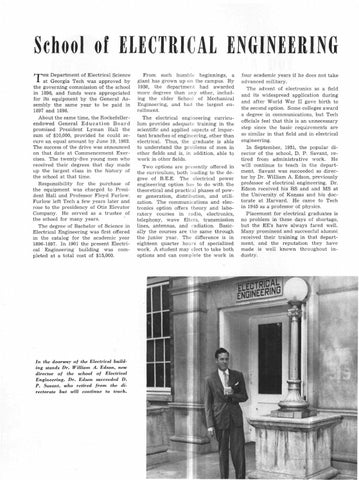
In the doorway of the Electrical building stands Dr. William A. Edson, new director of the school of Electrical Engineering. Dr. Edson succeeded D. P. Savant, who retired from the directorate but will continue to teach.
From such humble beginnings, a giant has grown up on the campus. By 1950, the department had awarded more degrees than any other, including the older School of Mechanical Engineering, and had the largest enrollment. The electrical engineering curriculum provides adequate training in the scientific and applied aspects of important branches of engineering, other than electrical. Thus, the graduate is able to understand the problems of men in other fields and is, in addition, able to work in other fields. Two options are presently offered in the curriculum, both leading to the degree of B.E.E. The electrical power engineering option has to do with the theoretical and practical phases of power generation, distribution, and utilization. The communications and electronics option offers theory and laboratory courses in radio, electronics, telephony, wave filters, transmission lines, antennas, and radiation. Basically the courses are the same through the junior year. The difference is in eighteen quarter hours of specialized work. A student may elect to take both options and can complete the work in
four academic years if he does not take advanced military. The advent of electronics as a field and its widespread application during and after World War II gave birth to the second option. Some colleges award a degree in communications, but Tech officials feel that this is an unnecessary step since the basic requirements are so similar in that field and in electrical engineering. In September, 1951, the popular director of the school, D. P. Savant, retired from administrative work. He will continue to teach in the department. Savant was succeeded as director by Dr. William A. Edson, previously professor of electrical engineering. Dr. Edson received his BS and and MS at the University of Kansas and his doctorate at Harvard. He came to Tech in 1945 as a professor of physics. Placement for electrical graduates is no problem in these days of shortage, but the EE's have always fared well. Many prominent and successful alumni received their training in that department, and the reputation they have made is well known throughout industry.