THE 6TH AUSTRALIAN GEOLOGICAL CONVENTION
The weather was kind, and there was a relaxed, indeed happy, atmosphere about the event which took place at the ANU between 20 and 25 February.
Five hundred people came to hear 250 papers read, to take part in lively discussion, and to attend business meetings of specialist groups. With a welcoming buffet on the first evening, a barbecue the following day, and a dinner two days later, it was a full week for everyone.
Although final figures are not yet available, the financial position seems to be assured, and the Society should benefit from a modest profit.
The organising committee was grateful for the support it received from geoscience institutions such as BMR, ANU, CCAE, and the Territories Division of the Society; and from a number of individual volunteers who shared the load of looking after the registrants. And finally to the registrants themselves for corning to the Convention, and for making it a success.
Seventh Australian Geological Convention
The N.S.W. Divisional Committee has accepted an invitation to act as host of the next G.S.A. Convention in Sydney. It is tentatively scheduled to be held from 27 August to 2 September 1984.
Australian Coal Geology Volume 4 Parts 1 and 2
The above volume, being the Proceedings of the Symposium: Coal Resources; Origin, Exploration and Utilization in Australia, is presently available. Copies are available from the GSA Business Manager, Sydney, or (over the counter) from J. W. Beeston, 24th Floor, Mineral House, Brisbane. Price is $30-00, the volume includes 49 papers.
Field Conference 1983
The Queensland Division Field Conference for 1983 will be held in the Biloela-Moura-Theodore-Cracow areas from Friday afternoon the 10th June to Monday 13th June (Queen's Birthday long week-end. It is planned to concentrate on the Permian, economic geology andstratigraphy of the area. The coal mine at Moura and trial cut at Theodore will be visited.
The cost of the Field Conference (including guide book, bus travel, hotel/motel accommodation and meals) will be $155 from Brisbane. Registrants joinging the field conference at Biloela will be required to pay $125.
Further enquiries may be made by ringing S. Parfrey (07)224 4929 or D. Trezise (07)224 6993
ABSTRACTS No. 9 - Sixth Australian Geological Convention, Canberra 1983. LITHOSPHERE DYNAMICS AND EVOLUTION OF
Price: $13.50 (includes surface mail postage)
Contact the Sydney Office
THE SOCIETY HAS TWO NEW HONORARY MEMBERS
- DAVID BROWN AND BERYL NASHAR -
The 1983 Council received nominations for Honorary Membership for Emeritus Professor David A Brown and Emeritus Professor B Nashar. These nominations were carried with acclamation at the General Meeting of the Society on 24 February 1983. Honorary Membership is bestowed upon those members who have served both the Society and the earth sciences with dedication and distinction, and the rules permit no more than fifteen Honorary Members.
David Brown's greatest contribution to the Society undoubtedly has been his two terms of Honorary Editor - in the periods 1964 to 1969, and 1976 to 1978. The former term was immediately followed by his Presidency of the Society. Concurrently with those pressing duties in the late 1960s and early 1970s he was also able to successfully serve as President of Section C of ANZAAS and Dean of Faculty of Science at the Australian National University. He is well known for his co-authorship of the text book Geological Evolution of Australia and New Zealand, and has published extensively on his speciality - Polyzoa from the Pacific and Antarctic region. Perhaps his greatest contribution to modern geology is his work with E Irving plotting the distribution of labrinthodonts as a function of Palaeolatitude, published in 1964. It formed an important part of the evidence supporting continental drift. He later e x tended this work to all the late Palaeozoic and Triassic terrestrial vertebrates. More recently David Brown has served the geosciences in Australia and overseas by his numerous translations of Russian literature.
Beryl Nashar has played a major role in fostering the development of the Hunter Valley Branch of the Society, the only Branch which has been continuously active since the society's foundation. She has served many terms as Branch Chairman of the New South Wales Division. Her appointment as Head of the School of Geology at Newcastle University College, and then as Foundation Professor of Geology upon the inauguration of the University of Newcastle spanned a vital period which saw her charged with a task of successfully building up a geology department from very small beginnings On being called to serve as Dean of the Faculty of Science, she achieved the distinction of becoming the first woman in Australia to act in the capacity of Dean of any faculty. Her publications, starting with those under her maiden name of Beryl Scott, have ranged over several fields, but have concentrated on her main interests of investigating the mineralogy, petrology and genetic relations of the Carboniferous and Permian volcanic associations of eastern New South Wales, and the conditions of formation of secondary minerals in basic lavas. Two books written by her - "Geology of the Hunter Valley" and "Geology of the Sydney Basin" - have aimed to excite an interest in geology in students and the intelligent layman. Throughout her career, Beryl Nasher has been untiring in her efforts to advance the cause of women in the earth sciences. She retired as an Emeritus Professor in 1980.

STATIGRAPHIC NOMENCLATURE
The Stratigraphic Nomenclature Committee has at various times called for comment on drafts of the proposed "Field Geologist ' s Guide to Lithostratigraphic Nomenclature in Australia ". Many have been received and duly considered At its last meeting, in February 1983 , the Committee realised that there was still considerable division of opinion on the nomenclature of igneous and metamorphic rock units, and decided to defer publication of this section of the Guide pending further consideration .
A new approach to igneous and metamorphic rock unit nomenclature which had been presented in the Draft North American Stratigraphic Code of 1981 was discussed at the February Committee meeting . The complete Code, now finalised is to be published in the May 1983 volume of the Bulletin of the American Association of Petroleum Geologists. The Committee has obtained permission to publish the igneous and metamorphic section of the Code in order to stimulate comment amongst Australian geologists .
This e x tract is presented below . You are invited to study it and consider to what e x tent this approach could be applied in the nomenclature of igneous and metamorphic rock units in Australia . Please submit your comments to Mr J. Brownlow, of the NSW Subcommittee, whose address is Geological Survey of NSW, Department of Mineral Resources, GPO Bo x 5288, Sydney, NSW , 2001 .
H . R . E Staines Convener Stratigraphic Nomenclature Committee
EXTRACT FROM NORTH AMERICAN STRATIGRAPHIC CODE By North American Commission on Stratigraphic Nomenclature 1983 Published b y The Am e rica n Association of Petroleum Geologists P . O . Bo x 979 Tu l sa , Ok la homa 7 4 101, U . S.A
Figure 3.--LITHODEMIC AND LITHOSTRATIGRAPHIC UNITS.
A lithodeme (upper case) of gneiss (A) contains an intrusion (B) that was deformed with the gneiss. A and B may be treated jointly as a complex. A younger granite pluton (C) is cut by a dike of syenite (D), that is cut in turn by unconformity I. All the foregoing are in fault contact with a structural complex (E). A volcanic complex (G) cuts unconformity I and is built upon it. Laterally equivalent volcanic strata in orderly, mappable succession (h) are treated as lithostratigraphic units (lower case). A gabbro feeder to the volcanic complex, where surrounded by gneiss (G') is readily distinguished as a separate lithodeme, and named as a gabbro or an intrusion. All the foregoing are overlain, at unconformity II, by sedimentary rocks (j) divided into lithostratigraphic units.
LITHODEMIC UNITS
Nature and Boundaries
Article 31.--Nature of Lithodemic Units. A lithodemic / unit is a defined body of predominantly intrusive, highly deformed, and/or highly metamorphosed rock, distinguished and delimited on the basis of rock characteristics. In contrast to lithostratigraphic units, a lithodemic unit generally does not conform to the Law of Superposition . Its contacts with other rock units may be sedimentary, extrusive, intrusive, tectonic, or metamorphic (Fig. 3).
Remarks. (a) Recognition and definition.--Lithodemic units are defined and recognized by observable rock characteristics. They are the practical units of general geological work in terranes in which rocks generally lack primar y stratification; in such terranes they serve as the foundation for studying, describing, and delineating lithology, local and regional structure, economic resources, and geologic history.
(b) Type and referenc e localities.--The definition of a lithodemic unit should be based on as full a knowledge as possible of its lateral and vertical
_/ From th e Greek demas, -os: "living body, frame".
variations and its contact relationships. For purposes of nomenclatural stability, a type locality and, wherever appropriate, reference localities should be designated.
(c) Independence from inferred geologic history.--Concepts based on inferred geologic history properly play no part in the definition of a lithodemic unit. Nevertheless, where two rock masses are lithically similar but display objective structural relations that preclude the possibility of their being even broadly of the same age, they should be assigned to different lithodemic units
(d) Use of "zone".--As applied to the designation of lithodemic units, the term "zone" is informal. Examples are: "Mineralized zone", "contact zone:, and "pegmatitic zone".
Article 32.--Boundaries. Boundaries of lithodemic units are placed at positions of lithic change. They may be placed at clearly distinguished contacts or within zones of gradation. Boundaries, both vertical and lateral, are based on the lithic criteria that provide the greatest unity and practical utility . Contacts with other lithodemic and lithostratigraphic units may be depositional, intrusive, metamorphic, or tectonic.
Remark. (a) Boundaries within gradational zones.--Where a lithodemic unit changes through gradation into, or intertongues with, a rock-mass with markedly different characteristics, it is usually desirable to propose a new unit. It may be necessary to draw an arbitrary boundary within the zone of gradation. Where the area of intergradation or intertonguing is sufficiently extensive, the rocks of mixed character may constitute a third unit.
Ranks of Lithodemic Units
Article 33.--Lithodeme. The lithodeme is the fundamental unit in lithodemic classification. A lithodeme is a body of intrusive, pervasively deformed, or highly metamorphosed rock, generally non-tabular and lacking primary depositional structures, and characterized by lithic homogeneity. It is mappable at the Earth's surface and traceable in the subsurface. For cartographic and hierarchical purposes, it is comparable to a formation (see Table 2) .
Remarks. (a) Content.--A lithodeme should possess distinctive lithic features and some degree of internal lithic homogeneity. It may consist of (i) rock of one type, (ii) a mixture of rocks of two or more types, or (iii) extreme heterogeneity of composition, which may constitute in itself a form of unity when compared to adjoining rock-masses (see also "complex", Article 37).
(b) Lithic characteristics.--Distinctive lithic characteristics may include mineralogy, textural features such as grain-size, and structural features such as schistose or gneissic structure. A unit distinguishabl e from its neighbors only by means of chemical analysis is informal.
(c) Mappability.--Practicability of surface or subsurface mapping is an essential characteristic of a lithodeme (see Article 24d)
Article 34.--Division of lithodemes. Units below the rank of lithodeme are informal.
Article 35.--Suite. A suite (metamorphic suite, intrusiv e suit e , plutonic suite) is the lithodemic unit next higher in rank t o lit h od e me It
comprises two or more associated lithodemes of the same class (e g , plutonic, metamorphic). For cartographic and hierarchical purposes, suite is comparable to group (see Table 2).
Remarks (a) Purpose.--Suites are recognized for the purpose of expressing the natural relations of associated lithodemes having significant lithic features in common , and of depicting geology at compilation scales too small to allow delineation of individual lithodemes. Ideally, a suite consists entirely of named lithodemes, but may contain both named and unnamed units.
(b) Change in component units.--The named and unnamed units constituting a suite may change from place to place, so long as the original sense of natural relations and of common lithic features is not violated
(c) Change in rank.--Traced laterally, a suite may lose all of its formally named divisions but remain a recognizable, mappable entity Under such circumstances, it may be treated as a lithodeme but retain the same name. Conversely, when a previously established lithodeme is divided into two or more mappable divisions, it may be desirable to raise its rank to suite, retaining the original geographic component of the name. To avoid confusion, the original name should not be retained for one of the divisions of the original unit (see Article 19g).
Article 36. Supersuite. A supersuite is the unit next higher in rank to a suite. It comprises two or more suites or complexes having a degree of natural relationship to one another, either in the vertical or the lateral sense. For cartographic and hierarchical purposes, supersuite is similar in rank to supergroup.
Article 37 --Complex An assemblage or mixture of rocks of two or more genetic classes, i.e., igneous, sedimentary, or metamorphic, with or without highly complicated structure, may be named a complex. The term "complex" takes the place of the lithic or rank term (for example, Boil Mountain Complex, Franciscan Complex) and, although unranked, commonly is comparable to suite or supersuite and is named in the same manner (Articles 41, 42)
Remarks. (a) Use of "complex" .--Identification of an assemblage of diverse rocks as a complex is useful where the mapping of each separate lithic component is impractical at ordinary mapping scales. "Complex" is unranked but commonly comparable to suite or supersuite; therefore, the term may be retained if subsequent, detailed mapping distinguishes some or all of the component lithodemes or lithostratigraphic units.
(b) Volcanic complex.--Sites of persistent volcanic activity commonly are characterized by a diverse assemblage of e x trusive volcan i c rocks, related intrusions, and their weathering products. Such an assemblage may be designated a volcanic complex.
(c) Structural complex.--In some terranes, tectonic processes (e.g. shearing, faulting) have produced heterogeneous mixtures or disrupted bodies of rock in which some individual components are too small to be mapped. Where there is no doubt that the mixing or disruption is due to tectonic proces~ such a mixture may be designated as a structural complex, whether it consists of two or more classes of rock , or a single class only. A simpler solution for some mapping purposes is to indicate intense deformation by an overprinted pattern.
(d) Misuse of "complex".--Where the rock assemblage to be united under a single, formal name consists of diverse types of a single class of rock, as in
many terranes that expose a variet y of either intrusive igneous or high-grade metamorphic rocks, the term "intrusive suite", "plutonic suite", or "metamorphic suite" should be used, rather than the unmodified term "complex". Exceptions to this rule are the terms structural complex and volcanic complex (see Remarks c and b, above).
Article 38.--Misuse of "Series" for Suite, Complex, or Supersuite. The term "series" has been employed for an assemblage of lithodemes or an assemblage of lithodemes and suites, especially in studies of the Precarnbrian This practice now is regarded as improper; these assemblages are suites, complexes, or supersuites. The term "series" also has been applied to a sequence of rocks resulting from a succession of eruptions or intrusions. In these cases a different term should be used; "group" should replace "series" for volcanic and low-grade metamorphic rocks, and "intrusive suite" or "plutonic suite" should replace "series" for intrusive rocks of group rank.
Article 39.--General Provisions. The formal name of a lithodemic unit is compound. It consists of a geographic name combined with a descriptive or appropriate rank term. The principles for the selection of the geographic term, concerning suitability, availability, priority, etc., follow those established in Article 7, where the rules for capitalization are also specified.
Article 40.--Lithodeme Names. The name of a lithodeme combines a geographic term with a lithic or descriptive term, e.g., Killarney Granite, Adamant Pluton, Manhattan Schist, Skaergaard Intrusion, Duluth Gabbro. The term formation should not be used.
Remarks. (a) Lithic term.--The lithic term should be a common and familiar term, such as schist, gneiss, gabbro. Specialized terms and terms not widely used, such as websterite and jacupirangite, and compound terms, such as graphitic schist and augen gneiss, should be avoided.
(b) Intrusive and plutonic rocks.--Because many bodies of intrusive rock range in composition from place to place and are difficult to characteri z e with a single lithic term, and because many bodies of plutonic rock are considered not to be intrusions, latitude is allowed in the choice of a lithic or descriptive term. Thus, the descriptive term should preferably be compositional (e.g., gabbro, granodiorite), but may, if necessary, denote form (e.g., dike, sill), or be neutral (e.g., intrusion, pluton_/). In any event specialized compositional terms not widely used are to be avoided, as are form terms that are not widely used, such as bysmalith and chonolith. Terms implying genesis should be avoided as much as possible, because interpretations of genesis may change.
Article 41.--Suite Names. The name of a suite combines a geographic term, the term "suite", and an adjective denoting the fundamental character of the suite; for example, Idaho Springs Metamorphic Suite, Tuolurnne Intru s iv e Suite, Cassiar Plutonic Su i te. The geographic name of a suite may not b e th e same as that of a component lithodeme (see Article 19f). Intrusiv e assemblages, however, may share the same geographic name if an intrusiv e lithodeme is representative of the suite.
Article 42.--Supersuite Names. The name of a supersuite combines a geographic term with the term "supersuite".
_/ Pluton - a mappable body of p lutonic ro ck
This notice must be important. I have received four (no, at la st count six) copies. Don't say we aren't trying to help.
APPLICATIONS FOR GRANTS
25TH INTERNATIONAL GEOLOGICAL CONGRESS FUND
Income from this Fund is to be devoted to support of scientific meetings other than international congresses, and to public lectures to be held in Australia in the subject area of Earth Sciences. In 1984 special funds will be available to assist young promising geologists to attend the 27th International Geological Congress in Moscow.
The Australian Academy of Science's National Committee for Solid-Earth Sciences will meet in late August 1983 to disburse funds for use during the calendar year l984.
Organisations, institutions and individuals are invited to submit applications for grants for use in 1984. Information should be supplied on the particular scientific meeting or activity to be supported and a brief description of the role of the scientist(s) for whom a grant is sought. In the case of public lectures, details of the proposed speaker, who should be from overseas, the topic for presentation and the proposed venues should be given.
During the past year grants provided travel support to geologists attending the 6th Australian Geological Convention and contributed towards the costs of speakers invited to the Symposium on Evolution and Biogeography of Early Vertebrates and to the Third Biennial Conference of the Australian Society of Exploration Geophysicists.
The Academy wishes to encourage young geologists to contribute to the development of the geology in Australia. This year a significant proportion of the funds available will be to assist promising young geologists to attend the IGC meeting in Moscow.
Further information on the format applications should take is available from the Executive Secretary, Australian Academy of Science, PO Box 783, Canberra City, ACT , 2601. Applications should be received by l August 1983.
Congratulations to Ken(ton) Stewart Wall CAMPBELL, elected F.A.A. in April . His 9itation reads:
"Dr Campbell is a geologist of breadth and distinction His work over 25 years in palaeontology and stratigraphy in Australia and the United States is unparalleled and has gained him wide recogni- tion. He has served as President of the Association of Australian Palaeontologists and was the Clarke Memorial Lecturer of the Royal Society of NSW in 1975. Since 1964 he has been a Reader in Palaeontology in the Department of Geology at the Australian National University and has played a vital role in training the next generation of Australian geologists."
Volcanology in the Western Pacific
In conjunction with the "XVth Pacific Science Congress", Unesco organized a "Meeting on Training and Research in Volcanology in the Western Pacific", in Dunedin, New Zealand, on 5 and 6 February, 1983, in collaboration with the New Zealand Department of Scientific and Industrial Research and the New Zealand Sub-Committee for Volcanology.
Twenty-one specialists took part in the meeting; they were from: Australia, Indonesia, Japan, New Zealand (12), Papua New Guinea, the Philippines, the United States of America, and UNESCO (2).
The meeting reviewed the progress in the development of the proposal for a regional project in volcanology since the Unescosponsored mission of May-June, 1982 (see "Australian Geologist" No. 39, June 1982), and made suggestions for the modification of the proposed gathered in Dunedin, a revised project proposal for training and research in volcanology in the Western Pacific has been made.
This document has been sent to the National Commissions for co-operation with Unesco of the countries directly concerned by the proposed project (i.e. Indonesia, Papua New Guinea, the Philippines, New Zealand and Australia). The UNESCO Regional Office for Science and Technology for south-east Asia is requesting the governments of these countries to consider this project proposal with a view towards official government endorsement vis a vis the United Nations Development Programme. If at least two governments in the region officially express their endorsement to the UNDP, the UNDP will evaluate the project proposal for approval under its Inter-country Programme.
A. pevelopment Objectives
The ultimate aims of this project are: first, to reduce the loss of human life, and damage to buildings, public works, farmlands, and recreation areas by having staff who are better able to predict volcanic activity and thus warn populations and take other measures for the protection of property and lands.
Second, to economically exploit the products of volcanic phenomena, such as geothermal energy and mineral deposits.
Third, to further an understanding of the process governing the evolution of the earth's crust.
B. Immediate Objectives
The immediate aims of the project are: to train personnel in volcanology; to improve monitoring methods and instruments on active volcanoes; to provide specialist services in times of volcanic crisis; to improve the collection and dissemination of data on volcanoes and their activity; to promote research on specific areas of volcanology in the Western Pacific; to improve regional and global co-operation in volcanology.
C. Special Consideration
The Western Pacific region covers the convergent boundaries of three of the Earth's major lithospheric plates, and is therefore characterised by extremely high concentrations of volcanoes and high frequencies of earthquakes. The region includes 11 countries and one territory (Table 1) that between them account for about one-third of the total number of volcanoes on the Earth's surface (excluding deep-sea submarine volcanoes). The volcanoes are predominantly of the explosive type, and have caused tens of thousands of casualties during the last 100 years, as well as considerable damage and destruction to property and agricultural areas. For these reasons, nations in the region, through organizations such as the International Association of Volcanology and Chemistry of the Earth's Interior (IAVCEI), the International Union of Geodesy and Geophysics (IUGG), and UNESCO, have expressed the need for greater efforts in training of personnel, research and surveillance of volcanoes, and in the provision of equipment (Table 1) .
Geoscientist"s interested in this project should contact:
Mr EL Fisher Secretary
Australian National Commission for Unesco Department of Education Woden A.C.T. 2606 - Australia for further information.
The Fifth Regional Congress on Geology, Mineral and Energy Resources of Southeast Asia, GEOSEA V, will be held in Kuala Lumpur, Malaysia, April 1984.
For further information, write to
The Organizing Secretary, GEOSEA V, GEOSEA
Geoloaical Society of Malaysia, c/o Dept of Geology, University of Malaya, Kuala Lumpur, Malaysia. Telephone:
DEPARTMENT OF SCIENCE AND TECHNOLOGY BILATERAL SCIENCE AND TECHNOLOGY AGREEMENTS 1984 P rogramme 03-577036
Revised closing date for applica ti ons by Australian scientists and technologists for activ ities between 1 July and 31 December 1984 under the Science and Technology Cooperation Agreement with Mexico is 1 Sep tember 1983, a month earlier than previously advised. Correspondence should be sent to:
The Director, International Activities, Department of Science and Technology, P.O. Box 65, BELCONNEN, A.C.T. 2616.
TWELFTH INTERNATIONAL SEDIMENTOLOGICAL CONGRESS
CANBERRA AUGUST 1986 - "SEDIMENTS DOWN-UNDER"
CALL FOR PROPOSALS
The organizing committee of the 12th International Sedimentological Congress is looking for ideas, volunteers and help from the sedimentary community in the organizing and running of this Conference scheduled for the last week in August 1986. We can guarantee plenty of headaches and hassles: in return the rewards should include a great deal of satisfaction and international recognition.
Although early days yet, we solicit ideas, offers for help, comments etc. on the following items:
1. Technical Sessions
2. Symposia
3. Workshops
4. Excursions
In their infinite wisdom (or foolhardiness) the preparatory committee whilst vying for the Congress to be held in Australia, compiled a list of likely topics and excursions as a guide to the sorts of things that Australia could offer to the international sedimentological community. This list is shown below as a guide; it is not meant to be exhaustive.
In keeping with the theme of Sediments Down-Under the Conference will concern itself not only with depositional, but also with post-depositional environments, tracing the evolution of sediments through their diagenetic history. It is planned to include the following topics in the scientific programme -
Archean depositional environments
Proterozoic depositional environments
The role of cyanobacteria in depositional environments
Precambrian and Palaeozoic glacigene sedimentation
Arid environments - ancient and modern
Reef carbonates
Low-gradient river systems and their sediments
Catastrophism in the sedimentary record
Anoxic events
The sea-level record
The accu_~ulation and diagenesis of organis-rich sediments
Volcanogenic sediments
Sedimentation in tectonically active areas
Iron-rich sediments
Shale-hosted base metal deposits
Uraniferous sediments
Phosphorites
Tropical weathering
Beach processes and placers
Weathering and economic geology
Compaction in sediments
Coal-depositing systems
Diagenesis in evaporitic sequences
Groundwater, porosity and diagenesis
Manganiferous sediments
Oil shale environments
Mineral and energy resources in sediments
The sediments of the Southwest Pacific, Indian and Southern Oceans
Local Geological Excursions
In addition to the many scenic attractions in the region, Canberra is also ideally situated for short geological excursions. Depending on demand, these short (one-two day) excursions will be held both before and after the conference and will include -
1. Yass Basin
2. The Tasman Geosyncline around Canberra
3. The Sydney Basin
4. Glacigene sediments of the NSW south coast
5. Engineering geology of Canberra
6. Sediments of the Eden-Comerong-Yalwal Rift Zone
7. Surficial materials of the Tarago-Nerriga region
8. Engineering geology of the Snowy Mountain hydro- electric scheme
Major Field Trips
Depending on the number of participants the following one-two week field trips will be organized before or after the Congress -
1. The sediments of the South Island of New Zealand
2. Volcanoclastic sequences of the North Island of New Zealand
3. Papua-New Guinea: Huon Peninsula and the Markham Valley
4. Papua-New Guinea: Port Moresby area - Angabanga RiverYule Island
5. New Caledonia and Fiji
6. Devonian reefs of the Canning Basin
7. Shark Bay and Lake McLeod
8. The BIF's and associated sediments of the Hammersley Basin
10. Proterozoic sequences of the Flinders Ranges
11. Paleozoic sequences of central Australia (Amadeus Basin)
12. The Tasman Geosyncline
13. Lower Palaeozoic carbonates and phosphorites of the Georgina Basin
14. Sediment-hosted mineral deposits of northern Australia (Mount Isa, Duchess, McArthur River, Pine Creek, Groote Eylandt)
15. The Great Barrier Reef
16. The coal resources of Eastern Australia
17. The energy resources of southeastern Australia (Sydney Basin, Gippsland)
18. The coastal environments of southeastern Australia
19. The continental environments of central Australia
If you want to organize a technical session, run a symposium or lead a field excursion let us know. If you know someone who you feel could do one of these, but is too modest to say so, please let us know.
Comments to Keith Crook, Chairman, Organizing Committee 12th I.S.C , Department of Geology, ANU, PO Box 4, Canberra ACT 2600.
Postscript - Information Required
From Potential Excursion Leaders
Please give the title of the excursion, followed by a concise description of the important sedimentological features of the region to be examined. This is most important, as people having perhaps scant knowledge of Australia and the southwest Pacific will need to be convinced that your excursion is one they shouldn't miss. This synopsis, which will appear in the first circular, may largely determine the number of excursions run.
In addition, try to give the following details:
Transport: bus, plane, 4-wheel drive safari, etc.
Maximum number of participants, duration, distance to be travelled, probable starting and finishing points.
Accommodation: Hotel, motel, chalet, camping. Commercial accommodation is probably preferable unless all equipment for camping can be supplied by excursion leaders.
Cost: Your best estimate; it will obviously depend heavily on the type of accommodation. Production of guidebooks will be the responsibility of excursion leaders, and should also be included in the cost.
Locality map: Sufficient detail to allow us to compile a set of general maps for the first circular.
From Technical Session Convenors
Theme: Title and brief synopsis of symposium/session
Convenor: Name(s) of possible convenor(s)
Participants: Names of potential participants
INTERNATIONAL GEOLOGICAL CONGRESS, MOSCOW, 4-14 AUGUST 1984
Section 4: Sedimentology. CALL FOR PAPERS
Keith Crook, Co-Convenor of Section 4, advises that abstracts are required by l Sept. 1983. They should be typed, camera-ready, in a frame 18cm wide by 26 cm high, in the following format:
AUTHOR'S NAME and institutional affilliation
leave 2.5 cm
TITLE OF PAPER
leave 2.5 cm
Body of abstract ....... .
Abstracts should be sent unfolded to : Organising Committee, 27 International Geologicai Congress, Institute of the Lithosphere, USSR Academy of Sciences, 22, Staromonetny, Moscow 109180, USSR o
Themes in Sedimentology include:
C.04.1.l Hypergenesis (Chemical & Physical Weathering) & Sedimentogenesis (sedimentation, including transportation &depositional processes). Problems of recent and ancient weathering and the formation of regoliths. Transportation and accumulation of sediments under various conditions including recent and ancient rivers and underwater currents o Basinal deposition. Special attention will be paid to processes occurring at the continent-ocean boundary. Chairmen include MoR.Leeder (UK).
C.04 1.2 Sedimentological Processes and their Controlling Factors. Discussion of the genesis of sedimentary rocks and minerals peculiar to specific climatic, geomorphic and geological environments (special attention will be paid to processes in arid regions) o Characteristics of diagenesis and metamorphism of sedimentary rocks o The specific character of sedimentary processes in production of cover sequences on continents and in oceans. Chairmen include V.A oGostin (Aust).
C. 04.1.3 Palaeogeographic and Facies Analysis. Facies Models. Palaeogeography of various stages of geological history of th Earth. Chairmen include N Trauth (France).
C.04 ol.4 The Role of Climate in Sedimentation and Sedimentary Processes o Climatic changes in the history of the Earth and their influence on sedimentation in general. The influence of climate on the various stages of sedimentary rock formation Lithological indicators of climate in the geological history of continents and oceans. Chairmen include ToR. Walker & D. Williams (USA)
C 04 l o5 Carbonate & Halogenic Deposits
Mineralogic and petrographic characteristics of carbonate and halogenic deposits and their secondary alteration. Modern and ancient carbonate and halogenic accumulation and its evolution in the history of the Earth
Carbonate and halogenic facies and formations o Connnercial minerals associated with carbonate, reef and halogenic deposits o Chairmen include CoL oVo Monty (Belgium)
So04 o2 ol Sedimentation and Geotectonic Regimes (Chairmen include J o Leggett - U.K o) o
So04 o2 o2 Evolution of Sedimentary Ore Deposits (Chairmen include GoC. Amstutz (Germany) & Po Eo Cloud (USA) o
Co06 ol ol Sedimentary Layers in Oceans and Seas: Formation and Structure Types of deposits in different structural and climatic zones of oceans o Peculiarities of sedimentation in early stages of sedimentary cover formation. Formation of thick sediment piles in oceans and seas o Chairmen include KoAoWo Crook (Aust) & Eo Winterer (USA) o
Other Sections include Coal (Larry Harrington) and Phosphorites (Peter Cook)
The Australian Academy of Science in Canberra has a few copies of the Second Circular for the Congress o
COGS
The Consortium for Ocean Geosciences of Australian Universities (COGS) held a business meeting in Canberra on February 25. Progress reports were presented on the Tripartite South Pacific Marine Geoscience Program, the Australia-Japan cruise to investigate the New Britain Trench, the Advanced Ocean Drilling Program and the marine geoscience workshop in Townsville latter this year associated with WESTPAC III
It now seems very likely that the Advanced Ocean Drilling Program will commence in October, 1984 using SEDCO 472 or a similar drilling ship. The proposal for Australian Membership of this new extension of IPOD is still being considered by the Government.
The new COGS executive consists of:
Chairman: Dr.Gordon Packham (Syd. Univ.)
Deputy Chairman: Dr. Keith Crook (ANU)
Secretary Treasurer: Dr. Jock Keene (Syd. Univ.) and Dr. Vic Gostin (Adelaide Univ.)
Anyone wishing to participate in or receive further information on the above programs should contact Jock Keene, Department of~ Geology and Geophysics, University of S y dney, 2006.
GEOLOGICAL SOCIETY OF NEW ZEALAND
The annual conference of the Geological Society of New Zealand will be held at Auckland, 14-18 November 1983 and will coincide with the centenary of the University Geology Department. Further information from the Conference Secretary, A.P. Mason, c/- Department of Geology, University of Auckland, Private Bag, Auckland.
Sedimentary Structures by J.D. Collinson and D.B. Thompson, 1982. Allen and Unwin, 194p. paperback $24.95.
This book nicely fills a gap in the range of sedimentology text books available. In ten chapters it deals with the origin and significance of most sedimentary structures as well as outlining what to do in the field and how to do it. It is not an atlas of sedimentary structures although it is a relatively comprehensive book.
The structures formed in epiclastic sediments are dealt with in detail, however, those found in carbonates and pyroclastic deposits receive scant treatment considering their significance as to processes and their potential importance in resource exploration. For example, the significance of stylolites is dealt with very briefly and there is no mention of fenestrae. One final criticism is that some of the photos are too small and dark to identify the features illustrated (for example: Figs. 3.4; 6.28) and others lack a scale (for example: Figs. 6.61; 8.5). In some cases the plates have no explanation other than to ask for an interpretation from the reader. I feel this is a waste of valuable plates in a book like this.
The references at the end of each chapter are divided into several sub-lists under the headings field experience, laboratory experience, light reading, essential reading, further reading and extra references relating to figure captions.
Despite the drawbacks mentioned above the text is useful as a reference for students and practicing field geologists.
Sedimentology: Process and Product by M.R. Leeder, 1982. Allen and Unwin, 344p. paperback $29-95.
This book joins several others published recently to compete for the undergraduate market found in sedimentology courses. Overall I am impressed with its content and the presentation is well thought out.
The book is divided into 8 Parts with a total of 31 chapters. The first third of the book deals with the origin of sediment grains, fluid flow and sediment transport, bedforms and sedimentary structures. These topics are well illustrated with photographs and line drawings and the chapter on fluid properties and fluid motion is at a more advanced level. The second third of the book analyses environments and facies. The introductory chapter deals with tools and data collecting for such analyses but fails to mention seismic stratigraphy. The individual chapters on particular environments are brief but adequate for this level. The final third of the book covers diagenesis and includes an elementary, but welcome, chapter on hydrocarbons (coal and oil). It is a pity that most sedimentology texts either ignore the "economic" aspects of sedimentology or isolate them into sections away from where the facies are analysed.
One drawback of the book is the failure to mention volcanogenic sediments and facies. Despite this I would recommend it for second year level courses and for those geologist~ who may have lost contact with recent thinking in this field. The book is of manageable size with up-to-date and well sellected references.
J. Keene
Cooke - Ravian Volume of Volcanological Papers
Edited b y R . W. Johnson Geological Survey of Papua New Guinea, Memoir 10 , 1981 , 265 pp PNG Kina 22 . 00 (Geological Survey of Papua New Guinea , P O Bo x 778 , Port Moresby) .
This handsome volume comprises 25 papers dealing with aspects of the volcanology of a number of volcanoes in Papua New Guinea, especially in the Bismarck v olcanic arc, situated off the north coast of New Guinea, and where 10 of the 14 acti v e volcanoes in Papua New Guinea occur . The volume is dedicated to the memory of Robin Cooke and Elias Ravian , volcanologists of the Geological Survey of Papua New Guinea , who so tragically died on 8 March 1979 while in a vo l canological observation camp on the rim of the inner caldera of Karkar volcano
The Bismarck volcanic arc is associated with the zone of interaction between the Inda-Australian and Pacific lithospheric plates in a region where two additional small crustal plates have developed. The eastern part of the arc through New Britain lies above a northerly dipping Benioff zone, but the western part of the arc lacks a well-defined Benioff zone . Along this arc occur many volcanoes built mainly from lavas and pyroclastics of basaltic to andesitic composition . Fourteen of the papers in the volume deal with aspects of the geology and eruptive history of particular volcanoes in the Bismarc k volcanic arc, including Kadovar, Barn, Manam, Karkar, Long Island, Ritter Island, Langila, Pago and Ulawun. Four of the papers are concerned with Karkar volcano, and one of these provides a description of the phreatic explosive episode that resulted in the death of Cooke and Ravian . The papers contain a wealth of new information on these stratovolcanoes, which are a continuing hazard to the populace because of their propensity to erupt explosively .
Of the three papers on Rabaul , one deals with the products of the latest major explosive eruptions , which are shown to be much larger than historical eruptions, and the other two papers are concerned with an aeromagnetic survey of the caldera and some palaeomagnetic measurements on young lavas respectively . The remaining papers provide information on youthful volcanism at various localities elsewhere in Papua New Guinea, including the Manus Island area, Bougainville and eastern Papua Some of the papers make good use of historical records in attempting to reconstruct the earlier volcanic history of particular volcanoes .
Authors of the papers are mainly from the Geological Survey of Papua New Guinea and the Bureau of Mineral Resources, together with some contributions by earth scientists from universities, including Auckland, Macquarie, New South Wales and Papua New Guinea . Appropriately, Robin Cooke is author or coauthor of nine of the papers , illustrating his involvement and commitment to volcanological studies in Papua New Guinea. These papers were completed by coauthors or in the case of those for which Cooke is sole author, the editor , R . w. Johnson compiled the papers from notes and drafts of manuscripts
concluded bottom of page 22
1. Symposia - Preliminary notice
FRACTURES AND THEIR ECONOMIC SIGNIFICANCE
(Convenor: Dr. R. A. Glen) and
MODERN AND ANCIENT ACCRETIONARY PRISMS
(Convenor: Dr. E. C. Leitch)
To be held in Sydney late in February 1984 with a threeday field trip to the New England Fold Belt associated with the latter.
The symposia will feature a number of overseas specialists but there will also be an opportunity for local contribution. Contact the Conveners for further early information.
2. Newsletter - The specialist group newsletter will be published in early October. Articles, comments, letters etc. relevant to the activities of the Grcup are solicited. Forward to the Editor:
Dr. John Shepherd, ACIRL, PO Box 83, North Ryde, NSW 2118.
Deadline: 30th September
3. Bermagui Conference - Multiple Deformation Foliation Development, 4-10.2.84 - for details see Australian Geologist No. 43.
we didn't catch the 12th but the BMR Petroleum and Minerals Review Conference will be held 21-22 March 1984, and 13th BMR Symposium - 17-18 April 1984.
The contact person for both conferences is Mrs. E. E. Young, Bureau of Mineral Resources, P.O. Box 378, Canberra, ACT 2601 (telephone: (062) 499623)
(Continued from page 21)
The volume is well produced on high quality paper with clear diagrams and good use of colour and monochrome photographs, although some of the latter are unfortunately printed too dark. Interest- ingly, there is also an abstract with each paper in Tok Pisin (New Guinea Pidgin). Usefulness of the volume would have been enhanced for the general reader by inclusion of a short summary paper on the regional geological setting. This book is a most appropriate memorial to Cooke and Ravian, and should be of particular interest to those concerned with volcanology and volcanological hazards.
Ian McDougall
MEMOIRS OF THE ASSOCIATION OF
AUSTRALASIAN PALAEONTOLOGISTS
The Association will publish Memoirs as an irregular companion series to its already-established journal Alcheringa. These may be major wor ks that are too l o ng for publication in Alcheringa, o r collections of papers from a p art icular meeting or on a uniform topic.
The first Memoir is a collection of papers fr om the Dorothy Hill Jubilee Meeting held in Brisbane on the 9th ,10th September, 1982. Its contents are: -
Dorothy Hill
7
Bruce Runnegar and John S. Jell 9
Early evolution of dipnoan dentitions and a new genus Speonesydrion K. S W. Campbell and R. E. Barwick. . . 17
A new diplacanthoid acanthodian from the Late Devonian of Victoria J. A. Long...... . ........... 51
Structure and function of the exothecal tissue of Somphocyathus coral/oides Taylor and allied regular Archaeocyatha ..................
The receptaculitid Soanites from the Early Ordovician of China .......
Middle Cambrian Sphinctozoa (Porifer a) from New South Wales
David I. Gravestock. 67
. Guo Sheng Zhe: 75
John Pickett and Peter A. Jell. 85
An annotated bibliography and review of Austr'llian fossil sponges John Piclrett
Molluscan phylogeny revisited
Early Ordo vicia n fa unas from the Mount Windsor Subprovin ce, northeastern Queensland .. R. A He nderson 145 Trilobites and microfossils from the Middle Ordovician of Surprise Bay, southern Tasmania, Australia : .. Clive Surrett, Brian Stail and 177 John Laurie
Chinese Ordovician trilobites housed in the Smithsonian Institution W. T. Chang and P.A. Jell .......... 195
Early Devonian ech inoderms from Victo ri a (Rhombifera, Bla stoidea and Ophiocistioidea)
Ast ogeny i n the Devonian rugose coral Phillipsastrea nevadensis from northern Canada
Symbioses of Devonian rugose corals
Primary biogenic structu·res and diagenetic history of Timorphyllum wanneri (Rugosa), Permian, Timor, Indonesia ....
Redescription of the Permian aulostegid brachiopod Taeniothaerus subquadratus (Morris 1845), the type species of Taeniothaerus Whitehouse .. . ....
Peter A. Jell 209
James E. Sorauf. 275
S. M. Parfrey 289 Permian to Triassic changes in life
Regeneration of calcification in the Adeonidae (Bryozoa: Cheilostomata)
The Devonian miospore genus Geminospora Bal me 1962: a reapp ra isal based upon topotypic G. lemurata (type species) ...
J. M. Dickins 297
R. E. Wass .
Geoffrey Playford 311 Jugasporites Leschik 1956, a Late Palaeozoic operculate pollen genus
C B. Foster ......... 327 Eocene pollen of probable proteaceous affinity from the Yaamba Basin, central Queerisland Murray J. Dudgeon .
A new plant genus, possibly a marattialean fern, from the Mi ddle Triassic of eastern Aus trali a Jo hn A Webb 363
Mero. Ass. Australas. Palaeontols. No. 1 Dorothy Hill
Jubilee Memoir Price $20
Subsequent Memoirs will include --- Archaeocyatha from lower parts of the Lower Cambrian carbonate sequence in South Australia
D. I. Gravestock
Mesozoic dinoflagellate biostratigraphy of Australia
R. Helby, A. Partridge, L. Stover et al
Series Editor is Dr P . A. Jell, National Museum of Victoria, 285-321 Russell Street, Melbourne, Victoria, 3000, Australia. Authors intending to submit manuscripts for publication in the Memoir series should contact the editor at the very earliest stage of preparation for detailed instructions on manuscript assembly. In general, format and style will follow Alcheringa.
What is described as 'our long-awaited remote sensing catalogue, the first of its kind ever published', is available for US$5.00 to cover postage and handling, by either writing or calling:
Ryder Geosystems
445 Union, Ste . 304, LAKEWOOD, CO 80228, U.S.A.
SCIENCE RESEARCH IN AUSTRALIA: Who Benefits?
Phone: (303) 988-4853
An ANU Public Affairs Con erence will be held at the Coombs Lecture Theatre, Australian National University, June 23 and 24, 1983. Only $95 00. Enrolment closes Friday , June 10 Contact:
Conference Officer, Science Research , Centre for Continuing Education, The Australian National Univ~rsity, G.P.O. Box 4, CANBERRA, A.C.T 2601
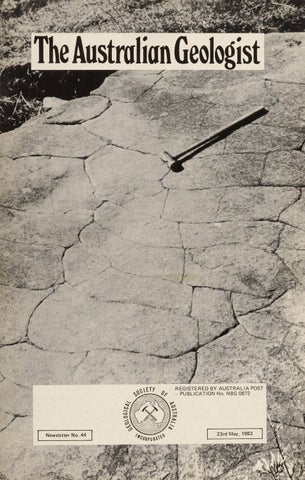
Cover Photo. Cracking in greywackes, Split Rock Dam site near Manilla New South Wales. Pattern or chance?
SALT LAKES IN ARID AUSTRALIA
Studies in hydrology, stratigraphy, and palaeoenvironment 17-18 October, 1983
A workshop organized at the Australian National University under the auspices of the SLEADS (Salt Lakes, Evaporites and Aeolian Deposits) program. No registration fee!
Persons wishing to present papers are requested to notify the organizers before 26 August 1983. To enable the volume of abstracts to be distributed at the meeting, the deadline for receipt of abstracts is 30 September 1983.
There will be a one-day excursion near Canberra to Lakes George and Bathurst on Sunday, 16 October 1983. Interested persons should inform the organizers of their intended participation before 30 September 1983.
Further information can be obtained from A. R. Chivas, Research School of Earth Sciences, A.N.U., G.P.O. Box 4, Canberra, A.C.T. 2601, telephone (062) 493247, or from P. De Deckker, Research School of Pacific Studies, A.N.U. (same postal address), telephone (062) 494312.
Hollow-flight auger at work on the sale crust of Lake Frame. This drill is owned and operated by the Department of Biogeography and Geomorphology and the Research School of Earth Sciences as partners in the SLEADS program.
--4v---~
AUSTRALIAN SOCIETY OF EXPLORATION GEOPHYSICISTS
SHORT COURSE
MAGNETICS & GRAVITY FOR GEOPHYSICISTS & GEOLOGISTS
Science Centre, 35-43 Clarence Street, Sydney, N.S.W. August 22-26, 1983
Instructors: D.W. Emerson, D.A. Clark
COST:
ENQUIRIES:
$850 incl. teas, lunches ($750 ASEG members) ·-
D.W. Emerson, Course Organizer (02 692 2031, 692 2912
WORKSHOP ON COAL GEOLOGY IN SOUTHEAST ASIA
I. Place and Date: Seoul, Korea, October 3-8, 1983 (Mon.-Sat.)
II. Objectives:
A. To provide opportunities for both instruction and exchange of ideas. Instruction will consist of lecture and laboratory format, in addition to a field excursion.
B. To help resolve some of the problems related to the use of coal resources and exploration.
C. To promote and strengthen the existing bonds between member countries, and to encourage continued co-operation and exchange.
III. Participants: Representatives from academia, industry, government plus all other interested geoscientists. Approximately 50 individuals are expected to attend. The travel costs for one representative from each developing country will be paid by Unesco funds. Living expenses in Seoul for all participants will be paid by the supporting organizations.
IV. Papers: Those invited to present papers should bring sufficient copies to the workshop to be distributed to participants at the time of registration. Each country representative should be prepared to present country report on coal geology.
V. Workshop is organized by:
Korean National Commission for Unesco, Seoul National University (SNU)
Organizing committee:
Chairman - Bong Kyun Kim (Seoul National University, S.N.U.)
Secretary - Jeong Hwan Kim (Seoul National University, S.N.U.)
Preliminary registration by participants and abstracts of the papers should be received before August 1, 1983.
For further information contact:
Dr. Bong Kyun Kim
Dept. of Geological Sciences
Seoul National University Seoul 151, Korea 26
A Workshop on methods of teaching Earth Science in Asian High Schools is being held 12th-18th July 1983, at Chiangmai, Thailand; organized by the Association of Geoscientists for International Development and the Department of Geological Sciences, Chiangmai University in co-operation with the Canadian Geoscience Council, the Australian Development Assistance Bureau, and Commission on Geology Teaching, International Union of Geological Sciences.
For further information contact:
Dr. Theerapongs Thanasuthipitak, Dept of Geological Sciences Faculty of Science, Chiangmai University, Chiangmai 50002, Thailand
NEW PUBLICATIONS
or Dr. Mike Katz, Geology Dept., University of N.S.W.
Report No. 7: Mineral Exploration Techniques in Tropical Rain Forests
Edited by D. J.C. Laming and A. K Gibbs Price: US$25,00, Developing countries US$12.50
Report No. 8: Strategies for Small Scale Mining and Mineral Industries
Edited by J.M. Neilson. Price: US$12.00, Developing countries US$6.00
Report No. 9: Geochemistry in Zambia. Edited by D. C. Turner Price: US$5.00, Developing countries US$3.00
Course not e s o nRock as Construction materials, by P. J. Clutterbuck, O. G. Ingles, C. J. Talbot. Price: US$12.00, Developing countries SU$6.00
Directory of Geoscience Departments in Universities in Developing Countries, 3rd edn, 1983. Edited by B. K. Tan and S. Chandra Kumar. P rice: US$8.00, Developing countries US$4.00.
Order from: AGID Headquarters AIT, G. P .O. Box 2754, Bangkok, Thailand.
or Dr. Mike Katz, Dept Geology, University of New South Wales
A training program for Geoscientists in Development on Applied Quaternary Geology, August 22 - October 15, 1983, sponsored by Association of Geoscientists for International Development (AGID), Netherlands Government, Geological Survey and universities, UNESCO and Asian Institute of Technology (AIT), will be held at the Asian Institute of Technology, Bangkok, Thailand.
For details contact: Dr. Prin y a Nutala y a, Course Director, AGID, Asian Institute of Technology, GPO Box 2754, Bangkok 10501, Thailand. Telex: 84 2 76 TH
NEW WORK ON SEDIMENTARY ENVIRONMENTS AND TECTONIC SETTINGS OF THE ADELAIDE SYNCLINE
A dynamic two day symposium at the Australian Mineral Foundation, Adelaide, on Friday 9th December and immediately following the symposium "S.A. The Place to Explore".
This is the start of a new generation of thought on the "Geosyncline". Can you contribute? If you can please contact,
The Secretary, AGSETS, C/- S.A. Department of Mines and Energy, Box 151 EASTWOOD POST OFFICE. 5063
A REUNION OF STAFF, PAST AND PRESENT, STUDENTS AND GRADUATES OF THE BROKEN HILL DIVISION OF THE U.N.S.W. WILL BE HELD ON SATURDAY, JULY 9TH, 1983. FOR PARTICULARS CONTACT DR. K. VOST OR MRS. L. BLACK PHONE (080) 6022.
The Agricultural History Society, University of Missouri-Columbia, and Soil Conservation Service announce a symposium on the history of soil and water conservation at Columbia, Missouri, May 24-26, 1984. Susan Flader of the university and Douglas Helms of SCS are the symposium coordinators. Please submit proposals and requests for information to Douglas Helms, Historian, SCS-USDA, P.O. Box 2890, Washing, D.C. 20013, by September 10, 1983.
WANTED FOR PURCHASE
One complete copy of the Society's Journal Vol. 23 (1976). Any member wishing to sell this now out of print issue to replace a missing copy at the Yale University Library please contact -
Professor Peter F. Howard School of Earth Sciences Macquarie University North Ryde NSW 2113 Phone 88 9215
Armin Aleksander Opik
Dr Opik, or just Opik, as he wished to be addressed, was born in Estonia, in 1898 He created two careers in the earth sciences, both immensely productive and innovative. At the University of Tartu he was awarded the degrees of Magister Mineralogiae (1926), Doctor Philosophiae Naturalis (1928), and Privat Docent (1929). In 1930 he was appointed as Professor of Geology and Palaeontology and Director of the Geological Museum and Institute, posts held until he left Estonia in 1944. The period 1925-1944 was one of intense research productivity, with the publication of some 75 papers on almost all aspects of Estonian geology and palaeontology, including highly significant monographs which have become standard reference works for students of palaeontology in particular throughout the world. In recognition of this body of work, he was appointed Estonian Laureate for Science in 1935.
After leaving Estonia in 1944, he spent some time teaching in Germany and working with S. von Bubnoff on a compilation of the regional geology of Europe.
In May 1948 Opik began his second career at the age of 50 when he arrived in Australia and joined BMR where he is particularly remembered for his long-term involvement with the regional geological mapping of central and northern Australia. This provided him with the opportunity to compile a comprehensive body of mostly palaeontological information from hitherto geologically poorly known areas of the "outback", and to begin the arduous task of making this information known to science. Some 45 further publications, including 12 definitive monographs accruing from this work have laid firm foundations for Australian geology and palaeontology.
As a result of his contribution to geological sciences, Dr Opik received many honours. They include appointment as an overseas correspondent of the Palaeontological Society of America (1928), election as a foreign member of the Geological Society of London (1938), election to fellowship of the Australian Academy of Science (1962), and honorary membership of the Geological Society of Australia (1965). He was the Clarke Memorial Lecturer of the Royal Society of New South Wales for 1965, and was awarded the Charles Doolittle Walcott medal by the U.S. Smithsonian Institution in 1962. He was a member of the International Union of Geological Sciences Subcommission on Cambrian Stratigraphy, and twice acted as Chairman of the Commonwealth Territories Division of the Geological Society of Australia.
Opik was an intellectual giant. He was one of the few remaining gentlemen natural historians in the traditional sense: a private man, gracious and creative, raconteur with a finely tuned sense of humour, a prolific writer and dispenser of ideas until the end. By profession an internationally renowned geologist, he was also a poet, linguist, philologist, philosopher, student of the ancient world, chess player, seafarer, and compassionate father. His first poetry was published in 1919, and recently a volume of the Canadian journal, Mana, has published a collection of Opik's poems in the Estonian language whose subject matter is based on Australian aboriginal mythology.
The world, as well as Canberra, will be the poorer for the passing of a man of such fascinating complexity.
J.H. Shergold
THERMAL IONISATION AEI MS 12 MASS SPECTROMET E R
Includes computer controlled (HP9825T) peak hopping via a Varian FR41 controller, and data acquisition via Cary 401 electrometer and HP3456A DVM. The system retains MS12 filament and magnet power supplies and electron multiplier. Vacuum is established with ion pump (analyser) and diffusion pump (source).
Instrument in good working order and is routinel y used for Rb/Sr, Pb/Pb and U/Pb geochronology, fission product studies and trace metal determinations.
Available: June/July, 1983
Price: $75,000
Further information from:
Dr. J. de Laeter WA Institute of Technology Kent Street _ Bentley, WA, 6102
Ph: (09) 350 7093
FRIENDS OF THE GEOLOGICAL AND MINING MUSEUM
(NEW SOUTH WAL ES)
A meeting of interested people was held at the Museum on Sunday, 20th February, 1983, and unanimously voted to form a Friends' Society. A working party was established to prepare a draft constitution meeting and a further meeting was held on SUNDAY, 10th April.
The Museum urgently needs the practical help of geoscientists not just amiable goodwill at present. Contact
Friends of the Geological & Mining Museum Society 36 George Street SYDNEY, N.S.W. 2000
and write to the new minister Hon. Kevin Stewart M. L.A. in support of the poorman's geological education centre.
held its Annual General Meeting on 20th April, 1983 Council for 1983 were elected as follows:
K. Glasson President
D Probert Vice President
L . Ingall Treasurer
P Haskins Secretar y J Bryan Councillor
G . Gibbons Councillor
K. Mosher Councillor
Officers and
In addition to those elected, the following continue as Councillors for 1983 :
C L. Adamson
D W. Emerson
P N Jamieson
D . H . Probert
K A Richards/J. Bein J. Tomson
M. J. Turbott
After the business meeting the newly appointed Minister for Mineral Resources (N.S.W . ), Mr. Kevin J. Stewart M.L.A., gave a brief address.
HIGH GRADE METAL DEPOSITS IN EASTERN AUSTRALIA
One day a symposium to be jointly sponsored by the N.S . W. Dept . of Mineral Resources and the Sydney Mineral Exploration Discussion Group will be held at the Shore Inn, Artarmon, on Friday September 23, 1983 . Technical papers, poster and trade displays will cover a wide range of topics . A social function will follow the technical papers.
Papers are invited covering all aspects of the geology, case histories and problems of exploration, evaluation and economics of high grade -metal deposits, i . e. deposits which may sustain profitable returns over a wide range of economic and operating conditions. Proposed papers should be discussed before June 17, 1983, with the Director of the Geological Survey of N.S.W., Dr N. Markham, who will forward details to the selection committee.
Poster and trade displays are invited and suppliers of equipment and services are urged to consider displaying their latest exploration technology. Contact Mr G.I. Wilson at Sydney 27-1773, for further information.
Registration information programme and other details will be available at a later date Persons interested to receive further information, circulars and registration details should contact Margaret Frend at Sydney 436-1056.
GEOSTATISTICAL ORE RESERVE ESTIMATION
June 27 - July 1, 1983
Hilton International! Syd ne y, Australia
Short course b y Dr. Michel David, Geostat Systems Inter nationa l, Inc., in co-operation with Gamma Geostat International, Inc A gift at $750.
For more information, telephone (514)4 8 7-4010 telex: 05- 25 134 MTL
Montreal Canada.
PERIODS
LICENTIOUS
VERY RECENT
RECENT
CRETINOUS
PLASTICINE
OVALTINE
LI STER I NE
UGLY SCENE
OBSCENE
VISINE
METATARSAL
CREOSOTE
STYPTIC
CRYPTIC
ORTHOPEDIC
OBSTREPEROUS
PESTIFEROUS
ARTESIAN
OVARIAN
PRESBYTERIAN
COLLEGIAN
PRECOCIOUS
PROPHYLACTIC
CATATONIC
ATONAL