
The Australian Geologist
Newsletter Editor
D. F. Branagan Dept Geology/Geophysics
University of Sydney
NSW 2006
Phone: (02)692 2358 or 692 2912

Secretary Bridget C. Youngs
South Australian Oil & Gas Corpn Pty Ltd
P.O. Box 55
GLENSIDE S.A. 5065
Phone: (08) 79 9251
THE PRESIDENT'S PAGE
How old is our Society? In this instance I do not refer to when it wa s founded, but to the age of our constituent members.
An analysis of informatio~ submitted by many of you in 1980 in response to a request for members' age (in order to determine the financial impact of introducing the category of Retired Member) has provided some pertinent statistics. Fifteen hundred members responded out of almost three thousand, so it is probably valid to interpret the data in general terms as representative of the total.
On this basis the majority of our members (about 40%) are in their 30's, and a minority (2%) are in their 70's, with our oldest members born at the turn of the century. However, our "average" members are in their 40's; whereas those in their 20's comprise less than 15%.
I find the low proportion of younger members to be both surprising and disappointing. We are all aware of the large number of geologists who have entered our profession from tertiary studies since the early 1960's and this is shown to some extent by the number in their 30's. Nevertheless, if we cannot attract more new members in their 20's, our Society will become a numerically decreasing and ageing group, unleavened by young people. I strongly encourage all of you, especially those involved with Tertiary education, to bring the merits of our Society to the attention of students and young graduates, and to nominate ' them for membership.
With regard to the Australian Geoscience Council, the recent postal vote of Society Council members was overwhelmingly in favour of joining the Geoscience Council. I must stress again that the Geoscience Council is not another association which everyone is expected to join, but that our Society will be represented by two members to be elected to the Australian Geoscience Council. It is also important to recognise that the recently formed Australian Institute of Geoscientists is a quite different, separate, entity, now completely independent of the Geological Society, and involved with the professional, as opposed to the learned, aspects of geoscience.
Colin D. Branch
Ne=letter No.3'

The Australian Geologist
EDITORIAL
TRUNDLING ON
May, 1981
Recent news on the Rundle project tells us that history still repeats itself even in geological circles.
A project of the proposed magnitude of Rundle obviously requires an enormous amount of initial geological work before a decision can be made that it is feasible.
It is disappointing therefore to see that enthusiasm has once again run ahead of exploration and only quite late in the piece was it realized, and publicized, that there are geological problems which jeopardize the feasibility of the whole operation
Australia is littered with abandoned crush.ers and treatment plants built in euphoric conditions prior to real evaluation of the particular mineral resource. Our profession will really have got somewhere when it can convince the decision-makers that geology has to be done before the decisions are made .
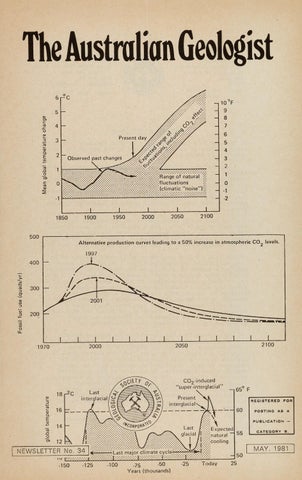
There is one bright note in the Rundle postponement for the energy conscious. Our cover picture shows some projections of atmospheric C02 levels based on alternative production curves. These are taken from the U.S. Council on Environmental Qu ality document 'Global Energy Futures &the Carbon Dioxide Problem (January 1981), which discusses what the Council says 'may ' present the ultimate environmental dilemma'.
What are the maximum levels of C02 which the atmosphere can tolerate? What will be the effect of increased or decreased use of fossil fuels? Can science and technology solve the problems of C02 pollution in the atmosphere?
Although these questions are perhaps fringe matters for most of our profession th.ere is no doubt that production of fossil fuels is a starting point for the whole sub j ect and there we are deeply involved Are we also concerned?
There is no doubt in my mind that this matter is just another example of the need for us to do our homework first. Geologists are already contributing to the study of this whole problem but much more needs to be done. What we do in Australia with our coal and oil shale will have global effects
CEQ Chairman Gus Speth feels that the co 2 problem 'should become a factor in making energy policy and not simply be the subject of scientific investigation' . In a final burst of purple prose Speth says 'the responsibility for the co 2 problem is ours - - - we should accept it in a way that recognises our role as trustees of the earth for future generations
If you feel like analyzing the document in detail, or just reading what it says copies may be obtained from the Council on Environmental Quality, 722 Jackson Place N.W. , Washington D.C 20006 - they are probably free by courtesy of the U . S. taxpayers. You are asked to enclose a selfaddressed mailing label .
The topic is now open for debate in these columns(? pages).
FIFTH AUSTRALIAN
GEOLOG!CAL , CONVENTION
• SEDIMENTS THROUGH THE AGES
PERTH 17-21 AUGUST 1981
KEYNOTE SPEAKERS
PROF. A.G. WALKER (McMaster University, Canada), an eminent authority on stratigraphy and sedimentation, sedimentary processes, and depositional facies models, will speak on: IS THERE LIFE AFTER "FACIES MODELS"?
PROF. P.R. VAIL (Sen. Res. Scientist, Exxon Production & Research Co., Houston, U.S.A.), a foremost authority on seismic stratigraphy, will speak on: SEISMIC STRATIGRAPHY
PROF. A. BUTTON (South Dakota School of Mines & Technology, Rapid City, U.S.A.), a Precambrian sedimentologist internationally known for his work on the regional settings and origins of ore deposits, wi II speak on: REVIEW OF UNCONFORMITY CONTROLS ON MINERALIZATION THROUGH PRECAMBRIAN TIME
MAWSON LECTURE
(Inaugurated under the auspices of the Australian Academy of Sciences through the 25th International Geological Congress Fund)
PROFESSOR BRUCE RUNNEGAR (University of New England)
THE CAMBRIAN EXPLOSION: ANIMALS OR FOSSILS?

TECHNICAL SESSIONS
TECHNICAL SESSIONS INCLUDE OTHER INTERNATIONALLY KNOWN EXPERTS AND COVER TOPICS IN THE FIELDS OF:
SEDIMENTOLOGY
PETROLEUM GEOLOGY ECONOMIC GEOLOGY COAL GEOLOGY
STRUCTURAL GEOLOGY PALAEONTOLOGY GEOCHEMISTRY/MINERALOGY ENGINEERING GEOLOGY
SOCIETY MATTERS
JUNIOR V-P ELECTION
A total of 538 ballot papers was received for the recent election of the 'Junior' Vice-President 1981-1983 carried out by the Commonwealth Territories Division. The count of votes on 2 March 1981 showed that Dr. M. J. Rickard has been favoured by the majority of the voters for the position of 'Junior' Vice-President of the Geological Society of Australia Inc. for the period 1981-1983.
The Committee of the Commonwealth Territories Division would therefore like to nominate Dr. M. J. Rickard to the Council for the position of 'Junior' Vice-President for the period 1981-1983.
Journal of Earth Sciences?
There has been a favourable reaction to the suggestion of the creation of an Australian Journal of Earth Sciences in some quarters. The Divisions are now being canvassed for their opinions.
W. R. Browne Medal
Closing date for nominations for the W. R. Browne Medal (1981) is 31st May. The Executive would like to make a presentation at the August Convention. Anyone who has made a notable contribution to Australian Geology is eligible: they need not reside in Australia, be Society members, or academics.
Code of Ethics
In the Supplement to Journal, Vol.27, Nos. 1 & 2, in last line of p.16, for 'Rule 42' read Rule 6.
Sir,

Australian Journal of Earth Sciences
I must wholeheartedly applaud the long overdue moves outlined in the March edition of the Australian Geologist towards a national journal catering for all the earth sciences. In no way do I wish to detract from the publication records of GSA, BMR and others, but I must admit to a certain envy of my Canadian colleagues who have a national journal with a substantial reputation catering for the various earth sciences. As a geophysicist I can understand the attitude of those colleagues in Australia who have no option but to publish in overseas journals which have a high circulation and access to specialist referees.
Whoever undertakes to promote a national journal must be seen to have the support of a wide cross section of the earth scientists in Australia if it is to succeed. The various Academy sub-committees with responsibilities for the geological, geochemical, geophysical and geodetic sciences must be persuaded to face up to their national responsibilities for promoting Australian earth science publications.
The publications of GSA and other societies will inevitably be affected by a national journal; however I hope these interests will not impede the national interest.
D. M. Finlayson B.M.R., Canberra.

THE CIRCUM-PACIFIC MAP PROJECT
by H. F. Doutch
The Circurn-Pacific Map Project (CPMP) aims to produce geologic, tectonic, en ergy and reso urces maps of the Pacific Ocean and its margin s. The whole of Australia is included. Each theme is covered b y five sheets at 1:10 million scale. Summary one-sheet Pacific Basin maps at 1:20 million scale are also planned.
The Project was initiated by a group of earthscientists in Menlo Park, California, in 1973, and became an activity of the Circum-Pacific Council for Energy and Mineral Resources in 1974. AAPG has played a leading role in Council activities and provides map publication funds. At the moment USGS Menlo Park co-ordinates project work and supplies drafting services.
Compilation of the maps begins with collation of information by 'Quadrant' chairmen, and is compiled- at Menlo Park. Quadrant chairman are: for the NE, Ken Drummond, Canada; SE, Jose Corvalan, Chile; SW, Fred Doutch, BMR Austr alia; NW, Chikao Nishiwaki, Japan; Antarctica, Campbell Craddock, USA. The four quadrants overlap by up to 15°; the Antarctic and SW sheets both cover the whole of New Zealand.
Map themes are Geography, Geology, Plate Tectonics, Tectonics, Geodynamics, Mineral Resources, and Hydrocarbon Resources. Some map elements are compiled in Menlo Park for the whole project area - for example, bathymetry, seismicity, sea bed sediments, and much of the Geodynamics map - and sent to Quadrant chairmen for comment. Chairmen have panels of experts to make such reviews, and also to do the bulk of quadrant compilation. The panel for the SW Quadrant is likely to include any experts within and outside the area known to the chairman, who is happy to involve more of them in the work.
The Geography Map has been published. It shows topographic contours, major towns, rivers and geographical names, and bathymetry as known in 1974. It is available from the American Association of Petroleum Geologists, P.O. Box 979, Oklahoma 74101 USA, price US$12 per sheet (it is not available from the Quadrant Chairman). A similarmap with a 2° grid of latitudes and longitudes, printed in black and while only, and intended as a plotting base, costs US$6 per sheet. Sales enquiries about any of the project maps should be sent to the address above.
The Plate Tectonic Map is the next to be published, hopefully by mid-1981. It is designed to show the active lithospheric plates, their boundaries, and associated geologic phenomena. Present-day movements of the plates are illustrated by seismicity, volcanism, and relative

motion at plate boundaries; one proposal for absolute motions will probably be shown. Older movements are covered by magnetic reversals in oceanic crust, relict spreading axes, and selected intraplate £aults. Oceanic, island arc, passive margin and continental terrains will probably be differentiated and young allochthonous parts of them indicated. A team of SW Quadrant experts is currently setting the record straight.
The Geologic Map may go to the printer mid-1981. Most Quadrant first drafts are nearly complete and require only minor revisions to land areas and adjustments in overlap areas; all quadrants await completion of seafloor sediment mapping by Floyd W. McCoy and Carol Mountain of Lamont-Doherty Geological Observatory. Their work is based on smear-slide analysis of cores, using the large LOGO collection as a data base, and other useful information. Ten sediment categories are being mapped. · Further detail is available from them, from CPMP, Menlo Park, USGS, or from quadrant chairmen. The geology of Australia has been compiled by BMR map compilation section, offshore Australia by Derk Jongsma when with BMR, and Oceania by H. P. Wittekindt when based in Fiji.
The Tectonic Map is part compiled for all quadrants, although the legend is still being debated. Traditional structural symbols will be used. The Compilation Guide lists two major rock categories - Basement Rocks, consisting of metamorphic, intrusive igneous, and submarine volcanic rocks; and Cover Rocks, which are deformed sedimentary rocks (too deformed to contain hydrocarbons), basin deposits, platform strata and terrestrial volcanic rocks. It is still not absolutely clear what these categories cover and how they are related. Erwin Scheibner, Geological Survey of NSW, has compiled a tectonic map of the southern half of Australia to CPMP's satisfaction, and the rest of the continent will be treated in the same way. Wittekindt compiled a map of Oceania which will marry with Scheibner's, more or less, and the product will be presented for comment at the annual project meeting in Menlo Park in May 1981.
The Geodynamics Map will combine epicentres, focal mechanisms, crustal thickness, gravity, heatflow, lithospheric stress, Holocene fault movement, major lineations, geothermal sites and various aspects of volcanoes. Magnetic and geoid anomalies maps may appear as smallscale i~sets. Little compilation has been done in any of the quadrants except the NE. The SW Quadrant chairman would be glad to hear from people interested in contributing to this map.
The Mineral Resources Map will show mineral localities on land and mineralised areas on the seafloor. Deposit symbols will be composites (wherever possible) that indicate metal/mineral content, geologic/geometric class, size, and

age of mineralisation. The map's geologic or tectonic background is still open to experiment by quadrant compilers, although the NE quadrant has been practically completed to the satisfaction of many. The SE quadrant is nearly finished; the others have some way to go. In the SW quadrant there is only a compilation for Oceania by Wittekindt; collating the information required for the map for Australia is a formidable task that no-one has been able to undertake so far.
The last 1:10 million scale map proposed so far is the Hydrocarbon Resources Map. Its elements are oil and gas fields, oil shale, oil(tar) sands, coal-bearing areas, isopachs to show sedimentary basins, and the geology of basement outcrop. Colour proofs of the NE and SE quadrant compilations have been made, but revisions are contemplated . The NW quadrant compilation is well advanced. Compilation has not begun on the SW quadrant base, but 1:10 million scale coal, and petroleum and oil shale maps being prepared in Canberra for other purposes have highlighted difficulties in using the CPMP legend for adequately showing Australian information. The debate continues. The deadline for completing compilation is mid,1981.
Themes to be summarised on the 1:20 million scale Pacific Basin maps are still to be decided, although it is almost certain that plate tectonics will be one. Resources may well be another.
The Circum-Pacific Map Project maintains liaison with international programmes and projects with common interests. These include CGMW, ESCAP, CCOP, CCOP/SOPAC, IPOD, IGCP, SEATAR, IOD and IDOE. The SW quadrant covers much the same area as CGMW's Subcommission for Australia and Oceania, for which BMR supplies the Vice-President and is responsible for compiling CGMW maps of kinds similar to CPMP's. The quadrant {s also the southeastern half of the ESCAP region, for which similar maps are also produced occasionally.
U See I.G.C.P. works
The Australian Unesco Committee for I.G.C.P. has made available its Minutes of the meeting of 23 October, 1980, which reviewed its Australian activities. They are, as ~any readers will be aware, quite extensive. If you want to know more get a copy from Mr. J. Elson, Aust. Natnl Commission for UNESCO, P.O. Box 826, Woden, A.C.T. 2606.
Like to Guess a hazard?
Contact Mr. Elson (see above) also if you wish to apply for post SC-A* - organising the work of the natural hazards units of UNESCO (as if it didn't already have enough!) in Paris. Applications close 30 June, 1981.

THE GEOPHYSICS OF THE ELURA OREBODY, CO~AR, NEW SOUTH WALES
Symposium Papers, edited by D. W. Emerson
Published by the Australian So c i ety of Exploration Geophysicists, 35-43 Cl a rence Street, Sydney. $(Aust.)31 - 00 including surface po st age .
ASEG seems to have a winner with this volume which has already attracted considerable attention here and overseas.
An uncountable (but accountable) number of authorssomewhere about forty - present what is probably the most detailed geophysical study ever carried out on a single small mineralised area of the earth.
It is hard to imagine what geophysical method might have been left untried in the exercise which covers only about ten years from the original detailed geological field work, although there was some useful regional work carried out in the 1940-50 period.
The most interesting feature of the volume for an outsider is that the old and tried methods proved the best - airborne and ground magnetometer and gravity being by far the most cost-effective methods used.
The major lesson for future geophysics work here and in many other parts of Australia is the need for a much better understanding of the weathered zone (and groundwater behaviour) if electrical methods are to be proved effective, something which was pointed out by Brough ton Edge and Laby just fifty years ago!
The papers are generally well edited and readable but hand-lenses are required to interpret some diagrams which have been reduced rather too drastically.
Symposium papers are not always successfully put together into a useful volume. This is not such a one. The enthusiasm of the scientists and technicianp involved comes through very clearly.
This will be a standard geophysical volume both for practitioners and students for quite a few years I suspect.
The editor and ASEG have done a very good job David Branagan.
Specialist Group in Tectonics and Structural Geology doe sn't.want, too much publi~ity for its
INTERNATIONAL CONFERENCE ON DEFORMATION PROCESSES IN TECTONICS 9 - 15 Augu st 1981. Alice Springs, Central Australia. for which more than 80 have al ready registered. By using shear determination a few more might be fitted in. Information about the Conference and field trips may b e obtained from:
Dr. G. P. Price, Conference Secr etary , c/o Division of Applied Geomechanics, C.S.I.R.O. P.O. Box 54, Mt. Waver ley, Victoria, 3149. phone (03)235 1247.

CENE THIS SEMANTIC SNIPPET?
PAL-EOCENE, PALAEO-CENE, PALEO-CENE, PAL-AEOCENE?
I was taught Paleocene, but my confid.ence was later shaken when I presented a paper to your journal. The spelling is Palaeocene, Americanisms! the Editor said. In my search for TRUTH, textbooks were unhelpful; y es, the Americans spelt it Paleocene, and the English Palaeocene, but with some e x ceptions on both sides. Onl y one author commented on the origin of the word; Holmes (1966) gave its Greek roots as naAa ios and Ka ivos (Palaioskainos) Berggren (1972) and Hedberg (1976) were no help - both being Americans !
Reading Leonard Wilson's biography of Lyell, I discovered Lyell originally gave the name Acene for "a group older than Eocene yet apparently by position and genera of shells tertiary". He suggested Palaeosynchronous for what is now Miocene. He did not use either term in his published subdivision of 1831, which consisted of Eocene, Miocene and Pliocene. Lyell was aware his Eocene was a very long time interval, and would probably be split into three. He recommended Eocene be kept for the middle unit if this split ever took place. It was not until 1874 that a French Professor of Botany called Schimper formall y used "Periode paleocene" (p. 680 Schimper, 1874), based on the antiquity of plant macrofloras (or all things!).
With the help of Neil McKellar-Steward, librarian of the SADME and Ro y al Society of S. Aust., I delved into ancient , and learned tomes of the Geological Society of London and Geological Magazine, in an attempt to disco v er the original rendering In 1877, P. Martin Duncan, M.B., F.R.S. ga v e his presidential address to the Geological Society of London • In it, he said "An attempt has been made to establish a zone intermediate between the European Cretaceous and Eocene, under the title of Palaeocene".
The following y ear J . Starkie Gar d ner in Geol. Mag. said of the English Eocenes : "the aspect of its flora is so ancient that it is difficult not to agree with Saporta, Schimper and others who place in in the Pal-eocene".
But in 1908 the same journal was using Palaeocene . To confuse the issue, an article by a Danish geologist used Paleocaen .
The En g lish "ae" is simpl y a rendering of the Greek root " a i" as in palaeontology (ancient beings), and the French "e" represents the same root. However, one normally transliterates "e" to "e" in English. U S.G.S. Bulletin 769 (Wilmarth, 1925) has an e x cellent resume of Era, Period and Epoch definitions , quoting relevant parts of Schimper in full. It is here that the derivation from the Greek roots is confirmed. But all this is no help, did Schimper construct his Paleocene by taking the
Pal from Palaios and adding it to Eocene or did he mean to produce a ne~ name by adding the t wo Greek roots together? Presumably Schimper's correspondence, or French journals, may contain the answer, but it seems best to use PALEOCENE (PAL-EOCENE) which reflects the French spelling and is in accord with its original derivation by splitting Lyell's Eocene. It was defined by a Frenchman, so at least the English cannot complain of Americanization of their spelling!
References
BERGGREN, W. A., 1972. A Cenozoic time-scale - some implications for regional geology and paleobiogeography. Lethaia, 2, 115-215.
DUNCAN, P. M., 1877. The anniversary address of the President. J. Geol. Soc. (Land), 30, 41-88.
GARDNER, J. S., 1888. On the correlation of the Gres de Belleu with the Lower Bagshot. Geol. Mag., 2 (Ser. 3), 188-199.
GRONWALL, K. A. & HARDNER, P., 1908. Paleocaen red Rugaard i Jydland og dets fauna (1907). (Palaeocene strata in Denmark, near Copenhagen). Geo l. Mag., 2 (new series), 41-88.
HAUG, E., 1911. Traite de geologie II. Les Periodes geologiques. Librairie Armand Colin (Paris).
HEDBERG, H. D., 1976. International stratigraphic guide. John Wiley & Sons (New York).
HOLMES , A., 1966. Principles of Physical Geology. Thomas Nelson & Sons Ltd. (Melbourne).
SCHIMPER, W. P., 1874. Traite de paleontologie vegetale. Bailliere, Tindall & Cor. (London).
WILMARTH, M. G., 19 25 The geologic time classification of the United States Geological Survey compared with other classifications, accompanied by the original definitions of Era, Period and Epoch terms. Bull. U.S. geol. Surv. 769.
WILSON, L. G., 1972. Charles Lyell: The years to 1841: The revolution in geology. Yale University Press (New Haven).
ROGER CALLEN S.A.D.M.E.

BANG ON
A bi-monthly Bulletin of Australian News in Geomathematics (BANG) commenced circulation in February , 1981. It aims to bridge the communication gap between theorists and practitioners, by percolating information about upcomin g conferences (here and overseas), seminars, courses , workshops, overseas visitors, new publi ca tions, etc.
SCIENTIFIC EXCHANGES The Australian Academy of Sciences has exchange agreements with the Japan Society for the Promotion of Science and Academia Sinica under which Australian scientists may vis it Japan or China. For information about the terms of the visits and applications write to: Australian Academy of Science, P.O. Box 783, Canberra City, A.C.T. 2601

EXPANDING EARTH SYMPOSIUM
This symposium,convened and organised by Professor Sam Warren Carey,was held at the University of Sydney from February 11 7 14, 1981. The symposium followed by some 25 years Sam Carey's continental drift symposium and was similarly to be opened by Sir Mark Oliphant; unfortunately due to the radar technicians' strike he was unable to make it. 140 delegates from Australia and overseas came to hear the three days of formal papers where a wide body of divergent opinion on Earth expansion and its consequences was presented.
As can be expected with such a contentious subject no firm conclusion was reached as to the validity of the expansion theory. Notwithstanding this there was some agreement that a small expansion could have occurred in the order of a few hundred kilometres in the last 500 million years.
Opponents of Earth expansion have some powerful arguments to refute, especially those of Dr Hugh Owen's reconstruction anomalies and the Tethyan faunal provinces put forward by J. K. Davidson and Dr Fakhruddin Ahmed. For the Precambrian, Dr Embleton's presentation on behalf of Embleton, Schmidt and Fisher, of the common apparent polar wander curves for North America, Africa and Australia lends support to an expansion model.
In the anti-expansion camp Professor Stewart's evidence against rapid Mesozoic expansion {"Quantitative Limits to the Palaeoradius of the Earth") and the problems associated with ocean water accumulation demand detailed analysis. Jim Dooley's elegant analysis of the gravitational fields expected from the "orange peel effect" in continental slabs on an expanding Earth and their absence in central Australia is very persuasive.
There were many other noteworthy papers especially those of Jovan Stocklin, Ken Plumb, Andrew Glickson, Edward Tyron and, of course, from Professor Carey, whose contributions were as controversial as ever. It is evident that neither an expansionist nor a subduction model can solely explain global tectonics, and if anything this symposium demands a syncretic approach to the opposing theories.
Finally the symposium offered an opportunity to laud a man with the breadth of vision and courage to take established dogma head on. A generation of geological students who know him as a teacher, and the Australian geological community find in him a fund of original ideas.
Bargain Basement on Floor Ten
Take half your money with you if you go to the Society's office to buy back issues of the Journal etc. (see enclosure in last issue) or post all of it (mostly $2 per copy) if you can't get there in person - incredible value. Help the Society's cash flow in.

Sir:
I refer to your editorial comments (Newsletter No. 33, pp. 3 and 8) in which you discussed the need for education in geology, particularly at high school level. You mentioned, quite rightly, that the numbers of students studying geology 'compare poorly with the numbers who are studying biology'.
The principal reason why students of biology outnumber those of geology is not an inherently greater inte~est in biology, but is the lack of a suitable geology text book. Some years ago the numbers of biology students were comparable with those of geology students today. The upsurge in interest in biology resulted from the publication of the 'Web of Life', which was a text designed specifically for Australian biology students.
The lack of a suitable Australian geology text book may be more keenly felt by teachers than by students. Many of the secondary school teachers, and particularly those attached to the smaller schools, have little training in geology. However their qualifications in teaching are such that, given the right text book, they would be quite capable of teaching geology at secondary school level. Such a book is not available at present, but the Australian Academy of Science, in collaboration with the Salisbury (S.A.) College of Advanced Education is preparing one and it should be published within a year or so.
However the above remarks follow from a tacit assumption that some knowledge of geology is a 'Good Thing', but presumably there is just as much reason to support the teaching of biology, botany and any other similar science. While we may accept this as a generality we, as geologists, must accept the responsibility for pushing the geological barrow. Members of the general public should have some better understanding of geology, partly because they need some facts on which to base their opinions which, at some time, they will express at the polls or similar places. To quote your 'Editorial', "The populace at large is woefully ignorant of the principles of a subject which affects their living standards to a considerable degree".
The G.S.A. is actively, although not actively enough, concerned with geological education. Most of the 2,500 odd members of our Society are probably unaware of the existence of a Standing Committee within the structure of the Society - known as the Education Committee. This is a peculiar body in that it rarely, if ever, meets and the membership of the committee is unknown to me although I am, nominally, the Convener of it. Whatever effective work is done results from the efforts of the various State Education Sub-committees which, surprisingly, are not subcommittees of the Federal Education Committee but of the relevant Divisional Committees.

The G.S.A. Victorian Education Sub-committee, in conjunction with the Victorian Education Department, is preparing a geological excursion 'Guide' for Victoria, for use at secondary school level or by anyone interested, and other educational projects are being undertaken by some of the corresponding Sub-committees of other States.
F. Canavan, Melbourne.
Frank Canavan adds: The modest contribution from Victoria is the preparation of a 'Geological Excur~ion GuideVictoria' which hopefully will be followed by corresponding versions for the other States. Small as this project is it has taken two years to get off the ground, largely due to difficulties in funding - the final participants were various mining companies which provided cash, and the Education Department which provided a teacher (author) for a year. I hope it will be published early in 1982.
1981 QUEENSLAND FIELD CONFERENCE
The Queensland Division will hold this year's Field Conference from 6th to 8th June 1981 on the Mineral Industry of the Brisbane-Ipswich area. The Conference will inspect the major mining and mineral processing operations· of coal (Ipswich), heavy mineral sands (North Stradbroke Island), and clay (Strathpine) and also look at a sand and gravel working, the Mount Coot-tha quarry, and the Brisbane oil refinery.
from:
Registration forms and particulars are available
Hon. Secretary, GSA Queensland Division, G.P.O. Box 1820, BRISBANE, 4001. Qd. phone: 07-224 4972 or 224 4981.
Speaking volumes for the Society
Deakin University Library, Victoria 3217, would like to have a complete set of the Society's Journal. It requires' volumes 1 to 15. Gifts to public institutions are tax deductible - does anyone want to benefit? However if you need the money and not the publicatio'ns the library is prepared to negotiate. Contact Craige Hicks (052)47 111.
A La Carte
The Unesco Press, Paris has issued some updates to its scientific map and atlasses catalogue of 1976. There are maps to suite all tastes and wall spaces.
PENNIES from HEAVEN
Write in haste to the Australian Academy of Science, P O. Box 783, Canberra City , A.C.T. 2601 , or telephone (062) 48 6011.
APPLICATIONS FOR GRANTS - 1982 25TH INTERNATIONAL GEOLOGICAL CONGRESS FUND
Income from this Fund is to be devoted to support of scientific mee t ings other than international congresses and public lectures to be held in Australia in the s ubject area of Earth Sciences
The Australian Academy of Science's National Committee for Geological and Geochemical Sciences will meet in August 1981 to disburse funds for use during the calendar year 1982.
Organisat i ons , institut i ons and individuals are inv i ted to submi t app l icat i ons for grant s for use in 1 982. App l ications will r equire detai l s of the particul ar sc i entific meeting and a b r ief descr i p t ion of the role of the sc i entist(s) for whom a grant is s ought , or include details of the other purposes for which f i nancial s u pport is sought. In the ca s e of p u b l ic l ectures , deta il s of the p r oposed speaker , who should be an overseas speaker, the top i c for presentation and the proposed venues should be given.
Applications should be made on the official form which is available from the Executive Secretary, Australian Academy of Science, P.O Box 783 , Canberra City, A.C . T . 2601
Applications should be received by 1 June 1981.
GEOLOGICAL SOCIETY OF NEW ZEALAND CONFERENCE , HAMILTON November 23 - 26 , 1 981
This year ' s Annual Conference is to be he l d at the University of Wa i kato , Hamilton , from Monday 23rd to Thursday 26th November Both pre - and post - Conference field trips will be conducted A workshop on "Volcanism in the Central North Island" wil l also be held immediately following the Conference, from Friday 27th to Sunday 29th November , based at Turangi, with field trips to Tongariro National Park. To obtain the First Circular for the Conference giving details and calling for papers, p l ease contact Dr R. M Briggs , Earth Sciences Department, University of Wa i kato , Hamilton, New Zea l and.
MOUNT ISA GEOLOGY SYMPOSIUM
A symposium on Mount Isa Geology, co - sponsored by the Australasian Institute of Mining and Metallurgy (North West Queen s land Branch) and the Bureau of Minera l Resources wi l l be held in the Mount Isa Civic Centre , and is scheduled for Tuesday and Wednesday , Sept 15 and 16, 1981
Enquiries to:
Dr G. M Derrick,
c/o Bureau - of Mineral Resources

Phone : (062) 499111
P O Box 378, Canberra City , A.C . T. 2601
Telex: 62109
c A J Towsey , Honorary Secretary , The Au s tralasian Institute of Min i ng & Metallurgy, P O. Box 1175 , Mou~t Isa , Qd 4825
Phone : (077) 44 3342
Telex: AA49562

13TH IMA MEETING
The first circular for the 13th Meeting of the International Mineralogical Association has now been distributed. The conference will be held at Varna (or, more probably, in one of the nearby Black Sea coast resorts), Bulgaria, from 19th-25th September, 1982.
The main topics will be:
1. Crystal Chemistry; Parageneses and Systematics of Minerals.
2. Crystal Growth and Morphology; Phase Equilibria.
3 . Physics of Minerals.
4. Gem Minerals.
The languages of the conference will be English and Russian.
The Secretary-General of the 13th Meeting is Dr. Vesselina Breskovska, Department of Mineralogy, University of Sofia, Bould , Russki 15, Sofia 1000, Bulgaria.
Preliminary registration forms (to ensure receipt of subsequent circulars) may be obtained from: Dr. E . R. Segnit , CSIRO Division of Mineral Chemistry, P.O. Box 124, Port Melbourne, Vic . 3207.
They 're on again (? still)
UNESCO sponsored post-graduate training courses are being held during 1981-82 in the following topics:
Fundamental & Applied Quaternary Geology
Remote Sensing Applications
Mineral Exploration
Engineering Geology
Geothermi cs (Belgium) (Holland) (Italy) (Austria) (Hungary)
Geochemical Prospecting
Mining Exploration & Exploration
Exploration Geophysics (Czechoslovakia) Geophysics (Holland) (India)
Mineral Exploration (France)
Seismology & Geophysics
Crystallography, Mineralogy, Geothermal Energy
Photointerpretation
(German Dern. Repub.) Metallogeny (Spain) (Japan) (Colombia)
Contact the editor for details of any specific course, or Aust. Nat . Commission for UNESCO, Dept. of Education, P.O Box 826, Woden, A.C.T. 2606.
AUSTRALIAN WATER RESOURCES COUNCIL
SEVENTH GROUNDWATER SCHOOL
Date: 10th-2lst August, 1981
Venue: Australian Mineral Foundation, Adelaide.
The course is designed for graduates of geology and engineering (in particular mining and civil engineering) who are involved or wish to become involved in the investigatio~ development and management of groundwater.
Journal - sad - istic?
Dr. Emil Rod of 9 Minns Road, Gordon, N.S.W., Phone: 02-4985162 moving soon to less commodious quarters, is anxious that his favourite journals should find good homes. He has a variety of popular titles
Bull. G. Soc. Amer., 1953-80; Geology 1973-80; Bull. A.A.P.G., 1948-80; Jnl Geophys. Res., 1960-80; EOS 1963-80; Q.J.G.S. (& Jnl) 1957-80; Q.J. Eng. Geol., 1967-78; Geotimes 1957-80; Science 1971-74; Tectonophysics 1973-75; Aust. Jnl Sci. 1964-79; Aust. Oil & Gas 1963-71; 19th Int. Geol. Congress 1952; 21st Int. Geol. Congress 1960; Eclogae Geol. Helvetiae 1971-80~ at low, low prices. Should you want long or short runs you will probably be accommodated. The rush has already started. Please contact Emil direct. (It is not necessary to mention this journal).

FOR SALE: any re~sonable offer accepted.
Jl. of Sed. Pet. 1969-1980 (v.39-50: 47 issues)
Sedimentology 1970-1972 (v. 15-19: 10 issues)
Qtly Jl. Geol. Soc/Jl. Geol. Soc. 1969-1976 (v. 125-132: 34 issues)
Earth Science Reviews 1969-1977 (30 issues)
The Geographical Jl. (London) 1970-1979 (29 issues)
Contact: P. Denman, 44 King's Park Road, West Perth, W.A. 6005. (09 322 5022)
The Centre for Field Research, P.O. Box 1, University of N.S.W., Kensington, N.S.W. 2033, may be able to arrange field research support - particularly people. Contact the centre for details.
Looking for workers?
The Geological Society of Turkey helps its members with their professional problems, one of which is finding them employment. If you want a 'specialized gee-scientist' for your institution contact: Dr. Ali Uygun, Secretary General, Tlirkiye Jeoloji Kurumu, P.K. 464-Kizilay, Ankara - Turkey.
Looking for a Working Group?
The Working Group on Mediterranean Ophiolites will be dealing with Ophiolites and Actualism, 18-19 December, in Florence, Italy. Field trips will be on for the hardy in the Apennines.
Contact: Prof. Luigi Beccaluva, Institute di Petrografia, Via Gramsci 9, 43100 Parma, Italy.
The AUSTRALA SI AN SEOIM ENTOLO GISTS GROUP of GSA announces
TWOWORKSHOPS ONSED IM ENTAR Y ROC KS
Workshop No 1: CA RBONATE SEOIMEMTS, led by Dr Chris Kenda l l of Gulf Research, Pittsburg
Dates: 3 August 1981 (9am) -8 Augus t (6pm)
Venue & co - sponsor : Geology Dept., Australian National University
Conveners: Keith Crook and Peter Davies
Topics include : cement s) ; Pacific & (Jura s s ic carbonate
diagenesis and cementation (incl. exotic & s upratidal Bahamas & Persian Gulf facies , geometry & cementation ; At l an t ic reefs ; Shelf , she l f ma rgin & basin car bonates of Moroc c o) ; Permian, Guadalupe Mtns ; sea leve l & carbonates ; reser v oi r s through space & time.
Organisation : Sessions 9-1, 2-5 30 daily ; Field day 8 August Lectures , seminar - discussions , lab sessions Participants are encouraged to bring samples, thin sections & pho t os for l ab sessions ; and ma terials to support contr i butions to discu s sions. A few 20 - 30 minute papers by part i cipants may be scheduled : make offer s to the conveners
Accommodation : Some University House rooms are being held ; phone UH & ask for ' geo l ogy workshop accommodation ' ; or make you r own arrangements , unless you require very low- cost accommodation , in which case check form.
Charge: (Workshop fee only): Staff of profit-making institutions: $100 ; Staff of non- profi t institutions : $50 ; Graduate students : $25 ; Undergradua te & Honours students supported by statement from supervisor/department head : FREE.
Enro l men t dead l ine : 1 J uly 198 1 Enquiries : (062 ) 49 2059/2056
CARBONATE WORKSHOP ENROLMENT (send with cheque drawn to ' ANU Geology Workshop ' to Secretary, Geology Department , ANU , GPO Box 4, Canberra ACT, 2600 by 1 July 1981)
Name Address . Affiliation . . S t atus . ... Phone (w) (h)
Please enrol! me for the CARBONATE WORKSHOP I enclose a cheque for$ as workshop fee.
I require low- cost
Signature

Please book same and notify me.
workshop No. 2: CLASTIC SEDIMENTARY FACIES led by Prof. Roger Walker, McMaster University, Hamilton, Canada
Dates: 26 -30 October 1981
Venue & co-sponsor: Dept. of Earth Sciences, Monash University, Clayton, Victoria.
Conveners: Ray Cas & Keith Crook
Topics: Pluvial facies; shelf & slope facies; turbidite & related facies.
Charge: To be determined; however, the rates will not exceed those ---stated for Workshop No. 1.
Organisation: Lectures and seminar-discussions on four days. One field day near Melbourne. Further details, and information about charges, accommodation and enrolment will be sent to people who return the form below by 31 August 1981. Enquiries: (03) 541 3793

CI.ASTIC FACIES WORKSHOP (send to Secretary, Dept. of Earth Sicences, Monash University, Clayton, Vic, 3168, by 31 August 1981).
Please send me further information about the Clastic Sedimentary Facies workshop.
Name Affiliation .
Address Status Phone
I will require low-eost accommodation D Signature ..................
SCAR FACES UP
The Oc tober 1980 SCAR (Scientific Committee on Antarctic Research) meeting held at Queenstown, New Zealand , accepted an Australian invitation to conduct the Fourth International Symposium on Antarctic Earth Sciences at the Univers i ty of Adelaide from 15 to 21 August, 1982. Previous confe rences have been he l d at Cape Town (1963) , Oslo (1970) and Madison (1977) at seven year intervals. The Adelaide conference has been brought forward to 1982 because that year is the centenary of the birth of Sir Douglas Mawson , who apart from his Antarctic work, was Professor of Geology at the University of Adelaide from 1921-1952.
Organizations which to date have agreed to sponsor the symposium include SCAR, the International Union of Geological Sciences (IUGS), the Australian Academy of Science , the Australian Academy of Technological Sciences , the Geological Society of Australia and the University of Adelaide .
All aspects of Antarctic Earth Sciences will be discussed at the meeting. A detailed programme is at present being formulated by an international steering committee. The convenor of the symposium is Dr. Robin Oliver , Geology Department , University of Adelaide.
Further information on the symposium can be obtained from the Secretary of the symposium:
J.B. Jago, School of Appli ed Geology, South Austra li an Institute of Techno l ogy , P O Box 1 , INGLE FARM, South Australia 5098.

Friends of the Sedgwick Museum
We are aware that many geologists, both in Great Britain and in other parts of the world, have not only an affection for the S M., but a real interest in its future development Therefore we announce here the formation of a club, " Friends of the Sedgwick Museum " , which will have to be self-financing eventually , and which wou l d be intended to provide regular news of work in the Museum and also give members an opportunity to partic i pate in and influence to varying degrees some of the activities. We invite interested geologists, palaeontologists and museum workers , whether ex- Cambridge or not , amateur or professiona l, to write to the undersigned for further details.
R. B. Rickards, Friends of the Sedgwick Museum, Dept of Earth Sciences,
Inqua XI : Moscow, 1- 9 August 1982 Downing Street , Cambridge , CB2 3EQ.
Contact the Secretary General, Dr. Ismai l P. Karta shov, Geological Institute, USSR Academy of Sciences , Pyzhevsky 7, Moscow 10901 7 , U.S .S.R.
England

OBITUARY
MICHAEL WILSON
Dr. Michael Matthew Wilson, Lecturer in Geology at the University of Queensland and the current chairman of the Queensland Division of the Geological Society of Australia, was killed in a glider accident on 1st February 1981, at the age of 45 years.
Mick Wilson graduated with 1st Class Honours in Geology and Mineralogy from the University of Queensland in 1964, and joined the staff of the Department of Geology and Mineralogy as a tutor and later senior tutor; he was appointed a lecturer in 1971.
His early g~ological interests were in mineralogy and geochemistry, and their application to mineral exploration. His research on the metamorphic and mineralogical features of the glaucophane-bearing rocks of southeast Queensland led to the award of a Ph.D. degree, and the Zinc Corporation Prize, in 1973.
Mick Wilson was extremely well liked by his students to whom he was always available for guidance and advice. His attention to student theses at all levels went far beyond the call of duty, and he seemed to prefer to invest his time and energy deliberately in people rather than the pursuit of his own research publication record. His concern for the progress of former students in their professional life extended to manpower supply in the mineral industry, the professional status of geologists, and changing demands on geological education.
A sense of professional responsibility towards society prompted him to express an opinion publicly wherever ignorance and neglect of geological phenomena became evident and hazardous, as for instance in improper coastal development.
For several years, he has served on the Queensland Division Committee of the Geological Society of Australia, last as Chairman. As such, he represented the Geological Society on the University Mineral Industry Advisory Committee and on the government's Department of Education Mineral Industry Advisory Committee. He was also the current convener of the Geological Education Subcommittee of the Queensland Division.
AUSTRALIAN INSTITUTE OF GEOSCI ENTISTS
G P.O BOX 4883, SYDNEY 2001 lELEPHONE : (02) 92-1786
FORMATION OF AUSTRALIAN INSTITUTE OF GEOSCIENTISTS
The Memorandum and Articles of Association for the Australian Institute of Geoscientists have now been submitted to the New South Wales Corporate Affairs Commission for incorporation.
The response to the circular requesting expression of interest in joining AIG has been very encouraging with 437 positive responses up to 12th March, 1981. All respondents will be supplied with application forms. In case any respondents do not receive application forms it is mentioned that some persons signed the response form but did not include their name and/or address
An initial problem for applicants will be to locate members of AIG to act as their sponsors So that sponsors may be identified up-dated membership lists will be frequently issued and each applicant will be supplied with the latest list.
Arrangements exist for AIG to use part of the Australian Geologist as its newsletter and arrangements will be made for AIG members who are not members of the Geological Society of Australia to receive copies of the Australian Geologist. It is hoped that this scheme will promote the spread of information among members of the profession in Australia.
It is emphasised that although GSA has sponsored the formation of AIG with the support of PESA and ASEG, the various bodies will be completely independent, will complement each other, and will avoid duplication of activities.
It is not anticipated that AIG will issue a regular publication apart from the contri-0ution to the Australian Geologist. It will however issue special publications on relevant subjects as a service to members.
C.L. Adamson Chairman - Provisional Committee.

is meeting over the weekend 6-8 June to study 'Minerals of the Granite Areas of South-East Australia. Contact the Sec-letary, P.O. Box R35, Royal Exchange, Sydney 2000.

FIFTH AUSTRALIAN GEOLOGICAL CONVENTION
KEY NOTE SPEAKERS
PROF G. WALKER, Professor of Geology McMaster University, Ontario, Canada, is an eminent authority of stratigraphy and sedimentation, sedimentary processes and depositional facies models. His title i s:
IS THERE LIFE AFTER FACIES MODELS?
DR. P.R. VAIL, Senior Research Scientist with Exxo n Production and Research Company, Houston, U.S.A., is the foremost authority on Seismic Stratigraphy - recognition of sedimentary environment and cycles using seismic methods. His subject will be:
SIESMIC STRATIGRAPHY
PROF. A. BUTTON, Assoc.Professor South Dakota School of Mines & Technology, Rapi d City, U. S .A., is an int ernationally known Precambrian sedimentologist who has applied sedimentology to the regional setting and origin of ore deposits. His title is
REVIEW OF UNCONFORMITY CONTROLS ON MINERALIZATION THRU PRECAMBRIAN TIMES.
INVITED SPEAKERS
MANY OTHER INTERNATIONAL GEOLOGISTS WILL BE PRESENTING PAPERS AT THE CONVENTION .
MAWSON LECTURE
An occasional address, the Mawso n Lecture is being instituted under the a uspi ces of the Australian Acadarny of Science through its 25th International Geological Congress Fund. The inaugural lecture will be presented as part of the Convention by PROFESSOR BRUCE RUNNEGAR of the University of New England, and his title will be THE CAMBRIAN EXPLOSION; ANIMALS OR FOSSILS.
POSTER DISPLAY
Limited facilities will be available for poster displays. Interested participants are invited to submit outlines of subject material and space requirements to the Convention Secretary before June 30th 1981.
Theme:
SEDIMENTS THROUGH THE AGES PERTH 17-21 AUGUST 1981