TAG – May 1978 – Issue 18

Page 1


Acting Editor:

Dr. Eric Middlemost,

Dept. Geology & Geophysics, The University of Sydney, N.S.W. 2006.

Phone: Sydney 692-2067.

Society Office:

Business Manager, Miss L. C. Tuckwell, Suite 9, 6th Floor, Perpetual Trustee Building, 39 Hunter Street, Sydney, 2000.

Phone: Sydney 231-4969

THE PRESIDENT'S PAGE

OUR SYDNEY OFFICE has become a hot-spot. the question.

To move or not to move, that is

The concept of most scientific societies sharing common premises offers options of sharing - switchboard, photocopying, computer, relieving staff during illness or furlough, committee rooms and meeting halls, bulk storage, cleaning, and security. Many of us are members of several of the societies involved. Council in July 1974 adopted the policy to move into Science House as soon as it became practicable. But when we quit Gemology House, Science House in Gloucester Street had been acquired by government, and the replacement Science Centre in Clarence Street was still in the planning stage, so the Society set up its office in the Perpetual Trustee Building in Hunter Street, where our administration has become increasingly content in surroundings befitting the prestige of our Society. Personal contacts waxed warm and fruitful, very generous arrangements were made for computer services now located in the same building, and generally the feeling firmed, this is our home, let us stay.

Executive became aware in May, 1977 of contrary opinion, but was not alerted that the Hunter Street lease came up for renewal at the end of January until a few weeks before its expiry, leaving little time to negotiate a new contract. Meanwhile the Executive had requested the Administrative Officer to investigate the question of location of our Sydney office. He reported in December in very unfavourable terms concerning the accommodation then offered at the Science Centre. At the same time we were offered renewal of the Hunter Street lease for five years on existing terms, which he recommended we accept.

Although the Executive has the responsibility of running the Society between Council meetings (which may be two years apart), my view is that the Executive should be very reluctant to finalize an action which Council could not revoke should it choose to do so when our stewardship comes up for ratification. Therefore the Executive resolved to renew the Hunter Street lease for one year, and to request the Administrative Officer with his Sydney Office Committee to prepare a detailed report for the Townsville Council meeting in August. The effect of this was to maintain the interim status quo and to leave a breathing space of five clear months after the Council meeting for the implementation of whatever decision Council might take.

Meanwhile some members of the NSW Division reopened the question. Science Centre offered different much more favourable space, which we were pressed to accept forthwith lest it not be available later. The Administrative Officer, supported by his predecessor in that office, recommended that whereas these premises were much superior to those previously offered, the Hunter Street office should be retained. Executive reaffirmed its December decision on the original grounds, with the additional compelling reason that now that we had signed the contract for twelve months extension, the cost of breaking it would be too costly. However the Executive requested the Administrative Qfficer to try to negotiate with Science Centre an option which would secure to Council complete freedom of decision.

My personal view is that in the long term the shift to the Science Centre has much to commend it. Entirely new computer arrangements will be necessary anyway within a couple of years. New neighbourly goodwill would in due course germinate and grow in the new environment. On the short term however, the move would cost the Society something like 2000 dollars, along with considerable disruption of services and some staff unhappiness.

EDITORIAL

All who peruse this issue of The Australian Geologist will discover that an interesting, yet difficult stage, has been reached in the evolution of the G.S.A. The convener of our Professional and Legislation Committee has provided a thought provoking article that should add fuel to the debate on whether, or not, Australia requires a Geological Institution to "advance the profession and practice of geology and allied disciplines". Another important and controversial topic that is discussed, is the publication policy of the G.S.A. Dr. R. Underwood examines the results of the questionnaire that was published in the September, 1977 issue of The Australian Geologist. Please write and let us all know your views on these important topics.

The Third working Group Meeting of International Geological Correlation Program Project 114, Biostratigraphic datum planes of the Pacific Neogene, will be held at Stanford University, June 26-28, 1978. The theme of the meeting will be "Correlation of tropical through high latitude marine Neogene deposits of the Pacific Basin". J.C. Ingle and W. 0. Addicott, co-chairmen, are planning a pre-meeting field conference in the California Coast Ranges that will study Neogene sequences in the Los Angeles, Venture, and Salinas basins. Information and abstract forms can be obtained from Addicott (U.S. Geological Survey, 345 Middlefield Road, Menlo Park, California 94025).

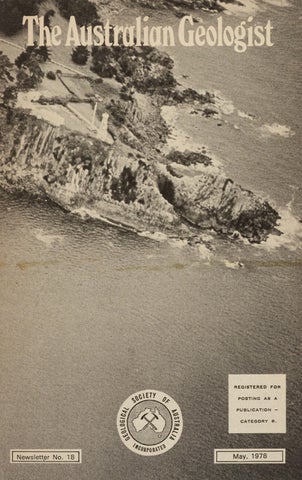
Cover photograph: The Eden Rhyolite of Devonian Age, Eden Peninsula, New South Wales.

NEOGENE DEPOSITS

Sir,

For nearly three years now, a handful of professional and amateur mineral enthusiasts have been running "The Australian Mineralogist" as a supplement in "Australian Gems and Crafts" Magazine. The editors aim to publish short contributions on Australian mineralogy, with a leaning towards the middle ground as far as technicality is concerned, so that we cater for the widest possible spectrum of interest. The publication is abstracted for Mineralogical Abstracts and all reports suggest that readership extends as far as the U.S.A. and Europe Quite a number of university libraries have subscriptions.

Our urgent need, however, is a continuous supply of suitable papers. Ideal contributions are those on new mineral discoveries, summary articles on new or old localities or notes on exceptional specimens. Regular columns are devoted to new species available for collectors and to the activities of the Mineralogical Societies of Victoria and New South Wales.

Contributions should be relatively short and succinct. Photographs, and if possible, chemical analyses are encouraged, but great quantities of technical data are not. Therefore , not a great deal of work is involved in putting papers together. These need not pre-empt more detailed papers intended for publication in international journals, but rather should be complementary.

It is a reasonable assumption- that at least once in their careers, research students, university lecturers and company geologists discover something of interest from a mineralogical angle, but either ignore it, or assume that it wouldn't be of sufficient interest to warrant writing up. It doesn't pay, however, to underestimate the value or interest of any mineralogical discovery which appears out of the ordinary. The editors of Australian Mineralogist would be only too pleased to be the judge, and look forward to a flood of contributions.

Bill Birch National Museum of Victoria, 285 Russell Street, Melbourne.

Sir 1

The other evening I was thumbing through some back issues of "The Australian Geologist" when I noticed, in the Editorial in Newsletter No. 12 (Dec. 1976), that mention was made of the text "Forensic Geology" by Murray and Tedron. The Editor further mentioned that he knows of no geologists engaged in forensic work in Australia. I am pleased to say that my employers, The Australian Mineral Development Laboratories (Arndell have for quite a number of years engaged at least one senior geologist full time on physical forensic work ( i.e. the study of paints, glasses, soils, fibres, etc) and lately I have become partly i~volved in this fascinating field of endeavour.

Dear Sir,

As a frustrated investigator into the geological and geochemical history of the Australian Meat Pie I was very interested to read -I assume that the text is complete and correct - of Permian meat pies evidently capable not only of speech but of the use of the telephone (P.A. Leo McNettick in The Australian Geologist, December 1977, p. 15).

It is true that early Sessions of Federal Parliament, members of which had not then developed the capacity for the shouting of abuse that they possess today, were commonly disrupted by a mysterious loud buzzing apparently of subterranean origin, later traced to the decaying 10,000 meat pies buried nearby after the opening of Parliament in 1927. (20,000 had been ordered but attendance and appetites were, perhaps understandably, small).

That Permian meat pies were capable of speech suggests that evolutionary decline is affecting this famous Australian institution. It bodes ill for the nation's future. Matters are the more alarming in that according to the Bulletin successful attempts to breed wooden tomatoes have been made in Australia. In this respect the recent discovery of orgasms in sawdust, brought to the public's attention on New Zealand Radio by the Ministry of Energy Resources, Mr. Gill~ in person, is not without significance.

Hector McDoon - Crawford Director and Sexton Centre for Terminal Studies Cape Farewell New Zealand

*For Ministry of Energy Resources please read Ministry of Health - the two Ministers have similar names - H.McD-Craw.

Dear Sir,

PROFESSIONALISM IN THE UNITED KINGDOM

The Institution of Geologists, a professional organisation, has recently been formed with headquarters in London. Close liaison with the Institution (IG) has been established through Prof. J. K. Knill, the IG Honorary Secretary, and permission has been granted to reprint, in The Australian Geologist, articles from The British Geologist, the IG quarterly newsletter. IG, of course, requires that due acknowledgement be made in order to preserve their copyright.

The GSA Professional and Legislation Committee will report to GSA Council in August this year on the formation of an Australian professional organisation. As Convener of this Committee, I consider that the accompanying article from the September 1977 issue of The British Geologist is of particular interest and hence I submit it for reprinting in The Australian Geologist.

Colin L. Adamson, 43 Holt Ave., Cremorne, NSW 2090.

IG - Why you should join now

During the short life of APIPG a thousand geologists have shown enthusiasm, interest or curiosity sufficient to invest at least £5 to find out what it is all about. The Association has been left in no doubt that an Institution is needed and that Institution - your Institution - is now in being.

All geologists in APIPG have been sent copies of application forms with accompanying explanatory notes. Many who are already sure of the value of the Institution have applied, or are in the process of doing so Others (mistakenly, we believe) have decided that the Institution is of no value to them. We hope at some future date that we may demonstrate otherwise.

A third group is still uncommitted. Although probably in favour of the Institution in principle they see two main difficulties:

The cost of "yet another subscription"- a very understandable problem in present circumstances

The effort of preparing an application with suitable professional documents and a possible interview

The question continues to be "what is in it form me?" (see John Shanklin in British Geologist (1/2) 75) and "is it going to be worth the effort?"

The objects -0f the institution are detailed in Clause 3 of the Memorandum of Association. First and foremost the Institution exists to advance the profession and practice of geology and allied disciplines; to maintain proper professional standards and ethics; to disseminate information about geologists, geophysicists, earth scientists and their fields of interest; to promote understanding of the effects of geological processes on man and to encpurage the responsible use of the earth's resources. Much has been written in the pages of British Geologist about how such objects can be achieved but in summary, four aspects are all-important:

1. Communication within the Profession -e g. British Geologist, articles, letters and comments. Special publications (such as Opportunities for Geologists). Regional Group meetings.

2. Services. to the Profession - e.g establishment of an administrative and legal service providing guidance to members on subjects such as careers, contracts, consultancy fees, professional liability etc. Surveys of employment conditions, salaries etc., and the structure of the profession. Exchange of information on employment requirements, prospects etc , in other words, a type of 'employment bureau'.

3. Improvement and Maintenance of Professional Standards - e.g. encouragement of employers' responsibility to ensure adequate professional training in the early years of employment, leading to presentation of reports and interview for Corporate Membership . Codes of professional conduct .

4. Communication and Influence outside the Profession - e.g. geological comment and influence on national policy matters such as energy, minerals, water, construction, the environment etc. Recognition and parity with other professions having established Institutions. Public relations of the profession. Promotion of our profession to avoid clashes of interest with other professions such as Chartered Surveyors, Civil Engineers etc. The question of registration in the context of the EEC

If there is any one aspect which stands out over and above all others it is communications. The science of geology has always been well served with information Until now, the profession of geology has had no communications s y stem We have everything to gain b y meeting and talking; discussion our experiences and our different disciplines, and comparing our mistakes. In the field of education and training, more contact between universities, government and industry can go far to ensure that courses are tailored to the community's requirements.

Why should you join NOW? The Institution exists for geologists. The services it has been planned to provide, and which have been provided so far to a limited extent b y voluntary effort. require resources. Modest premises are now

available and secretarial facilities are being arranged. Salaries, rent, rates, telephone etc have to be paid on time so that a rapid built up of membership is required if we are to avoid a cash problem. Our message is to join the Institution and contribute your subscription, and then please get involved. Make use of the Institution's services (enquire about, for example, the employment situation (we may not know yet but your questions will show us what we have to find out) , make your views known through the British Geologist, contribute to your Regional Group (or form a new one), meet your opposite numbers. The Institution now exists; it is your Institution and, your support NOW will ensure that you keep informed and that the service is available when you really need it.

THE PUBLICATION POLICY REVIEW: SURVEY RESULTS AND ANALYSIS

All members were sent questionnaires in the "Australian Geologist"; 955 (38%) responded (i.e about 1500 did not). The questionnaire was designed to survey members views, seeking to know if there was a majority for present policy, and if not, to determine alternatives. I report responses received up to 20th February in each subquestion, the significant majority votes and the significant differences between subsets. Much useful comment has been received so frequently expressed views are reported here also.

Definitions

A Member is an Ordinary member; member and respondents are equivalent terms; Authors are those who have submitted papers to the Journal (whether accepted or not); significant means less than 5% probability of occurrence by chance, measured by chi-squared tests against null hypotheses of tied votes and that subsets were samples of a single population. Tabulated results are given in the order Members, Associates, Students, Honorary and the total of these. (Number of Authors in brackets.)

Responses in Detail

Question 1 asked membership grade (860, SS, 37, 3 = 955). Grades were scored separately and comparisons Associates:Members and Students:Members are reported

Question 2 asked for subject area. Most marked more than one, so answers were sieved as follows; 1) first or only preference; else 2) on the judgement of comment; else 3a) as stratigraphers if they also marked other soft rock specialities or 3b) petrologists if they also marked mineralogy-geochemistry (a common nex4s); else 4a). Other if written in, or 4b) ore deposits if marked; else 5) the most general discipline of those marked.

Q. 2 & 3: Subject area by Authorship

This rough breakdown has been used in the analysis of Question 3, which asked if you had ever submitted a paper to the Journal, and if so was it accepted. 184, 5, 0, 1 = 190 had, and 149, 3, 0, 2 = 154 were accepted. Of course, Associates and Students were significantly less likely to have submitted papers but there was also a significant difference in the profile of subject area between Authors and Non-Authors, with fewer "Ore Deposits" and more "Petrology'! "Structure & Tectonics" and "Stratigraphy" in the former set.

On the question of balance, Q4, a majority of all respondents wanted more emphasis on Special Publications (but a substantial minority wanted no change and Authors were not so keen as Non-Authors) Majorities wanted no change in emphasis on the Journal, with Students and Authors significant components of a substantial minority wishing more emphasis. Similarly, the majority wanted no change in emphasis on the "Australian Geologist", but in this case the substantial minority for more emphasis was significantly poor in Students and Authors. The voting was clearly for no change in emphasis on Newsletters.

Q 4: Balance by Membership Grade and Authorship More Emphasis No Change Less Emphasis

Aust Geologist

Journal

Spee. Pub. Newsletters

228, 18, 10, 1=257(35) 195, 10, 17,0=222(53) 444,33,26,0=503(73) 104, 5, 5, 1=115(15)

429,29,25,2=485(138) 511,25,21,2=559(124) 323,15,16,2=356 (81) 464,37,32,1=534(112)

62, 4,6,0= 72(10) 114,11,1,0=126 (9) 76, 2,1,1= 80(23) 170, 4,5,0=179(45)

Journal readers, Q5, were mostly satisfied with the present standard of typography, scientific quality and bibliographies. Dissatisfied voters were significantly more likely to be Authors than Non-Authors, and were more liable to offer comments, which included tilts at the unimaginative cover, the luxury of the paper and the poor state of indexing . A very significant pattern of voting was dissatisfaction at the proportion of w6rk of interest and the mix of papers from each field, with satisfaction that can best be described as "resigned" at the proportion of good work in Australian geology that sees publication in the Journal. This dissatisfaction- was mainly expressed by the Ordinary members who had not submitted a paper, and both Authors and Students voted counter to the trend.

Comments consistently urged more papers on "practical geology", on economic, ore depositional and ore genetical, petroleum, exploration, geophysical, engineering and environmental geology, or, less constructively, merely said "too academic", or "little of interest to me".

Q.5: Reader Satisfaction by Membership Grade &Authorship

Satisfied

Typography

Scientific quality

Bibliographies

Proportion of interest

Australian content

Mix from each field

804 ,49, 44, 3=900 (170) 741, 44, 43, 3=831 (159) 779, 45, 43 ,3=870 (165) 324, 21, 21, 3=369 (103) 340,21,21,1=383 (86) 355, 20, 29, 3=407 ( 103)

Dissatisfied

38, 1, 1,0= 40(14) 73, 3, 1,0= 77(24) 29, 1, 2,0= 32(11) 483,30,21,0=534(66) 289, 15, 13,3=320(77) 442,26,15,1=484(73)

Thinking of themselves as contributors, prospective or actual, the great majority of respondents were satisfied with all aspects of the Journal. Numbers of members omitted to respond to question 6, on the grounds of no experience; increased overseas exposure of the Journal would be welcomed by both satisfied and dissatisfied contributors, according to comments. The minority dissatisfied with spread of circulation both geographically and amongst specialists consisted of significantly more Authors, and these were also more dissatisfied with procedures for acceptance and with prospects for their new ideas. Students on the other hand were generally less dissatisfied than Members.

Q.6: Contributor Opinion by Membership Grade &Authorship

Spread, geographically Spread, amongst specialists

Publication speed Papers: acceptance Papers: improvement

Prospects for new theories

Satisfied

441,25,24,1=491(116)

359, 20, 19, 1=399 (105)

366, 23, 17, 1=407 (135) 270, 16, 16, 1=303 (140) 262,15,15,2=294(139)

221,13,15,0=249 (87)

Dissatisfied

67,1,0,0= 68(35)

131,5,0,0=136(52)

87 ,2,6,0= 95(26)

37, 1,1,0= 39(27)

25,2,0,0= 27(13)

83,3,0,_v 87(39)

Of the ideas in question 7, that of inviting reviews of the state-of-theart in various fields of geological endeavour, Q7h, was most welcome to respondents, with comments about the narrowness of papers often cross-referenced to question 5d about the proportion of papers of interest. Students were less interested in this idea than Members. Respondents whose comment indicated that they were thinking of·book reviews were not scored for this badly worded question.

There was also a barely s i gnificant majority for a microfiche edition of the Journal, often qualified by requests that tabular and formal descriptive material, Q7f, be microfiched in a pocket at the back of the Journal. But most, especially students, want such material at hand, not in an "on request" form.

Page charges were decidedly not wanted.

A substantial majority rejected the proposal for author-prepared papers, comments making the points that this would be difficult for field, poor, and independent geologists, and that it would reduce the typographical beauty of the Journal. Some rejections were qualified by comments that it would be OK if voluntary, under careful editorial control, and if it would speed things up. Interstingly enough, these two proposals to effect economies at the expense of authors, when considered together, turned out to be significantly less unacceptable to Authors who had already submitted papers, than to Non-Authors who had not.

Equally substantial majorities rejected the two Journal-divi ding options, Q7b & c. Here comment was polarised between enthusiastic splitters, often cross referencing their dissatisfaction with the proportion of matter of interest to them at present, Q5d, and the lumpers who thought geologists ought to be generalists. Many commented on the greater cost and editorial burden, the bad experience of other Societies who were trying this, and the smallness of the offering of papers coming to the Society. Authors were more positive in their rejection, and Associates less opposed than Non-Authors and Members respectively.

A barely significant majority voted to reject the proposal 7a for a voting, non-subscribing class of membership; Authors being more opposed, Students and Associates less opposed than the average. Comments were that the Journal was the r ai s on d ' et r e of the Society and members ought to read it, and that this option would be so popular that the cost would be likely to become prohibitive for the few remaining subscribing members.

Finally the Collins-Patterson proposal 7i for a new monthly publication was barely rejected, with 51 % against. Here Authors and Non-Authors were opposed - the former strongly rejecting the proposal the latter weakly endorsing it. Many would like advertising to support and appear in some form of "Australian Geologist" but not in the Journal, and many would like to hear more of the proposal before judging.

Q.7: Suggestions by Membership Grade &Authorship

Yes

Non-subscribing voters

Journal in Sections

Journal as Separates

Page charges

Author-prepared copy

Archived tables

Microfiche edition

Invited reviews

New Monthly

377 ,32,29 ,2=440 (72) 284,24,20,0=328 (33) 294,26,17,0=337 (44) 132, 4, 3,2=141 (43) 265,13,12,1=291 (69) 325,15, 7,1=348 (77) 364,19,2 2,2=407 (81) 589 ,31,36, 1=657(133) 320,27,23, 1=371 (57)

No

443,17, 15, 1=476(109) 521, 25 ,23, 3=572 (148) 507, 25 ,27, 3=562 ( 132) 488, 26,32, 1=54 7(122) 438, 19 ,23, 2=482 (89) 490,31,36,1=558(100) 318,18,16,1=353 (76) 139,26,25,2=192 (39) 360,20, 19,2=401(117)

The questionnaire was adapted by the Publication Policy Review SubCommittee from a draft prepared by Underwood. Non-members D. Burton, P. Roberts, K. Szalay and E. Underwood helped with scoring. Executive deliberated on the results at its February meeting, where it was told that the Honorary Editor, Professor D .A. Brown disassociated himself from the form of the questionnaire and its results; that the number of papers in various topics that appear in the Journal mirrors the number submitted; that short notes etc. are accepted and can be r apidly processed; and that editorial policy favours enough detail in papers that readers can form a judgement of the worth of the work. Executive deliberations are reported elsewhere. This factual report on the results and analysis was prepared by Underwood and approved by Executive on the 20th March, 1978.

Rob Underwood, Geology Section, Hydro-Electric Comm., Hobart, Tasmania.

NEW MICROFILM LIBRARY - GEOLOGICAL SURVEY OF W.A.

A microfilm library has been established by the Geological Survey of Western Australia. It contains the Survey's pu~lications and company exploration data on 16 and 25 mm film respectively. Three printer-readers and a number of readers are available for use by the public when consulting these reports.

The company exploration d ata on relinquished tenements are the beginnings of an "open file" system. At present there are 63 rolls of film containing mineral exploration data and 57 rolls containing onshore and offshore petroleum exploration data. The material is adequately indexed and the system will be enlarged periodically as other company reports on hand are checked and filmed for release.

The Record series of reports are to be available on microfiche commencing with 1977. In the future Records will be classified as publications.

APPLIED MAGNETIC INTERPRETATION SYMPOSIUM

REGISTRATION: Open to all geophysicists and geologists who are interested; the fee of $20 will cover morning and afternoon teas and the abstracts.

PAPERS: Titles and outlines to be submitted as soon as possible. It is intended to publish the papers. Final date for abstracts (300 words) 31st May, 1978.

PLACE: University of Sydney, Department of Geology and Geophysics.

TIME: August 9th and 10th, 1978.

ORGANISER: Dr Don Emerson, Dept Geology and Geophysics, University of Sydney, NSW 2006. Phone: (02) 692-1122 x2031, x2912.

THEME: Geological Interpretation of Ground and Airborne Magnetic Data from Mining and Hard Rock Environments. - How can we elicit meaningful geological information from measurements in the field and in the laboratory?

TOPICS: Sulphide and oxide ore bodY, search; Regional geological lithology, structure; Petrophysics: susceptibility, anisotropy, Crustal studies: basement tectonics, deep bodies; Mathematical: and enhancement; Case Histories: magnetics and other methods; mathematical methodology papers are not being sought).

informationremanence; data processing (please note:

There will be time for 12 papers, preferably two on each of the above topics. It is proposed to record discussion of the papers and to publish that too in edited form.

NEW ZEALAND VOLCANOLOGICAL & GEOTHERMAL STUDIES GROUP

FOURTH CONFERENCE - DECEMBER 6-9, 1977 .

Early in December last year, about 50 volcanologists assembled on the lower slopes of Mt Ruapehu, the highest active volcano in New Zealand. The object of this meeting, rather than being a re-enactment of a pagan ritual involving virgins and volcanoes, was in fact to find out what everybody else was doing with their particular volcano. These symposia are held every four years , their raison d'etre being to discuss the latest developments in the subject, and to enable the various divisions of the DSIR and the universities to co-ordinate projects in volcanology and geothermal research.

The conference got underway on Tuesday afternoon. Seven papers were presented that afternoon for the symposium on " Tongariro National Park Volcanism" Discussion included the geology, petrology , se ismic activity , p rediction of eruptions and eruptive mechanisms of the three volcanoes, Mts Ruapehu, Tongariro and Ngauruhoe. Surprisingly the authors managed to agree on most of the features found in the park, although there is still disagreement concerning the petrogenesis of the andesites erupted in this region . Two "main" results emerged from this session, (i) the possible existence of a body of magma under the end of the Chateau golf course, with the concomitant suggestion that when the position of the magma body is pinpointed one might "drill down to it and see what happens"; (ii) it was also decided to hunt for the "roche noir" of the region, the hornblende andesite of Tama Lakes, which has been causing problems since 1926, principally because nobody could agree as to where to find it

The evening concluded with an informal gathering in the Tavern. Four hours later, most of the participants managed to find their way to their accommodation On a cultural note, New Zealand beer is less alcoholic than Australian beer , thus requiring a larger (or lager) intake than is no rmal However, its diuretic potential is much greater. (What about ambient temperature? Ed.)

The weather, which had been beautiful on Tuesday, low cloud and drizzle, cleared the following day, much to the disappointment of the lazier members of the conference, who now had to face a full day ' s hiking over the volcanoes. The party , bar those who had good excuses, split into three groups and either ascended Mt Ruapehu, tramped across Mt Tongariro, or descended into the Tongariro Power Scheme. Numbers in the Tavern were drastically reduced that night.

Thursday provided an opportunity for the geochemists to hold the floor with papers on the mechanisms and chemistry of the geothermal a reas of New Zealand, Long Valley, California, and Mt Erebus. After a q uick lun ch , everybody raced out into the field for short field trips. The writer co-led the trip to Tama Lakes (five rather spectacular maars on the saddle between Mts Ruapehu and Tongariro ; 20km round trip) to hunt for the hornblende andesite. With typical malevolence, the weather broke just as we reached Tama Lakes, with gale force winds, rain and sleet. Armed with the typical fortitude of true geologists. the group decided that since we were there we might as well stay. While the weather worsened we managed to examine the more important features of the maars. Two hours later we -had still not found the hornblende andesite and discovered that no-one had a hip flask

The conference dinner was held that night at the "Chateau Tongariro" and it was on par with their normal catering for large groups. Fortuitously, the dinner was distinguished by its complete lack of speeches and a great deal of after-dinner hilarity, with the more musically minded conference delegates providing assorted styles of noise at the piano.

To accommodate several late papers the general session started at 8.00 on Friday morning, with a number of people at the back of the hall in vario us stages of "bright-eyed " awareness. The papers dealt mainly with New Zealand volcanoes, past and present, thus allowing participants to draw some correlation between the Tongariro volcanoes and those of the rest of the region. Important points that came to the fore were the similarities between the various occurrences of high-alumina basalts that had erupted during New Zealand's history, also the stage that has been reached in the mathemati cal modelling and subsequent prediction of the volcanic eruptions. However, the most spectac ular part of the

proceedings was photographs of the interior of White Island volcano after the recent major eruption. This was a none-too-subtle reminder of the active nature of North Island.

Generally , the feeling among delegates was that the conference was a success Personally, looking back over the conference, I believe it served its purpose admirably.

GEOLOGICAL SOCIETY OF

The GSM has a worldwide membership of about 300 geologists interested in S.E. Asia and surrounding areas. Full and student membership is open to graduates and studonts respectively in geology or related fields, while associate membership is open to any person or body interested in geology. Annual dues are US$7 for both Full and Associate members with an entrance fee of US$2. Society publications are available to members either free or at reduced prices.

Publications

Geological Map of the Malay Peninsula (1:100,000, coloured) compiled by D. J. Gobbett. March 1972. US$1.60 (folded flat). (For -airmail add US$1.00).

Bulletin Series:

Bulletin 1 - 1968 - Studies in Malaysian Geology. 79 p. US$1.50. add US$3.30). (For airmail

Bulletin 2 - 1968 - Bibliography and Index of the Geology of w. Ma laysia and Singapore. 152 p. US$5.00 (softcover), US$7.50 (hardcover). (For airmail add US$4.60 (softcover); US$6.20 (hardcover).

Bulletin 3 - 1970 - Papers in Geomorphology and Stratigraphy of Malaysia with Bibliography Supplement. 146 p. US$5.00. (For airmail add US$5.00).

Bulletin 4 - 1970 - Papers in Petrology, Structure and Economic Geology. 100 p. US$5.00 (For air . .ail add US$3. 70).

Bulletin 5 - 1973 - The Search for Tungsten Deposits. 70 p. US$5.00. (For airmail add US$3.00).

Bulletin 6 - 1973 - Proceedings, Regional Conference on the Geology of S.E. Asia held at Kuala Lumpur, March 1973. 334 p. US$10.00 (hardcover only). (For airmail add US$12.60).

Bulletin 7 - 1973 - Papers on Malaysian Geology with Bibliography Supplement. 138 p. US$6.00. (For airmail add us $4.60).

Bulletin 9 - Collection of papers presented at the ~975 IGCP Circum Pacific Plutonism Project, 5th Meeting in Kuala Lumpur. US$12.00.

Abstracts of Papers - Regional Conference on the Geology of S.E. Asia, March 1973. 64 p. US$3.00. (For airmail add US$3.00).

Field Guide 1 - 1973 - Field Guide for a 7 Day, One Thousand Mile, Geological Excursion in Central and South Malaya (West Malaysia and- Singapore). 40 p. US$2.50. (For airmail add US$2.30).

In preparation:

Bulletin 8 - Collection of Papers on Geology of Malaysia and Adjacent Regions. US$6.00.

All prices include surface postage.

Other publications of the Society include a bi-monthly Newsletter (WARTA GEOLOGI), Presidential Addresses (1968-) and some miscellaneous papers, abstracts and reprints.

For enquiries about the Society, membership or publications, write to the Honorary Secretary at the following address: The Geological Society of Malaysia, c/o Dept. of Geology, University of Malays, Kuala Lumpur 22-11, Malaysia.

Association of Australasian Palaeontologists

This specialist group of the Geological Society of Australia has recently elected a new committee comprising the following office-bearers:

President

Vice-President

Treasurer

Secretary

Editor

Dr. P. R. Evans

Mr. W. K. Harris

Dr. P. G. Quilty

Dr. J. w. Pickett

Associate-Professor B. D. Webby

Assistant Editor Associate-Professor J. Roberts

The Publicity Officer is Dr. B. A. Engel.

To the date of writing three issues of its journal, Alcheringa, have appeared and a fourth, vol. 2, pts. 1 & 2, should be published ahead of this issue of The Australian Geologist.

Membership, at around 400, is increasing steadily and, provided the costs of printing Alcheringa are contained, this publishing venture should achieve a condition of sustainable viability in two or three years. At its present subscription rates of $10-00 to members of the Geological Society of Australia and $15-00 to non-members, Alcheringa is good value for money. How long these rates can be maintained is a question that the new committee will, no doubt, be examining. The launching of a new specialist journal at the present time is no easy matter. In an attempt to economise on printing costs while retaining the option of producing lengthy descri_ptive palaeontological accounts, A.A.P. has introduced microfiche copies of its journal. The first such microfiche was produced as a sample for distribution at the Second North Ame~ican Palaeontological Convention in August, 1977 and covered Alcheringa, vol. 1, nos. 1 & 2, with the plates from Jack & Etheridge's 1892 monograph, The geology and palaeontology of Queensland and New Guinea as a bonus. The second microfiche covered Alcheringa vol. 1, nos. 3 & 4 and included descriptive text that was additional to the printed text of the journal. The Jack & Etheridge plates were again included in the microfiche, which was distributed with the double issue of the journal. That issue opened with an editorial by Bruce Runnegar and Rod Gould which put the case for microfiche publication and invited comments on this innovation from subscribers and potential authors. Remarkably few such comments have been received by the editors.

In launching Alcheringa, very considerable financial support has come from the sale of the booklets produced by the Queensland Palaeontographical Society as annotated illustrations of Queensland fossils, arranged by stratigraphical systems. A.A.P. has recently been investigating the possibility of publishing broadly similar booklets for other states or regions and preliminary negotiations have taken place with a commercial publisher.

Other sources of funds for launching Alcheringa and sustai ning its publication have derived from journal subscriptions, gifts from Foundation Donors and from industrial enterprises.

A considerable saving in Alcheringa printing costs came from A.A.P's successful application for the federal government's subsidy, known as the Book Bounty. Credit for that successful application for the Book Bounty belongs largely to A.A .P' s former secretary, Dr. Malcolm Walter. Subsequently a successful application for the Book Bounty has been made for the Journal of the Geological Society of Australia. Another benefit to flow to the parent society's journal from the publication of Alcheringa is the extra page space available in the former as a result of the diversion of palaeontological and biostratigraphic papers to the specialist journal.

Members of the Geological Society of Australia who are not members of A.A.P., and other readers, will see from the foregoing note that the former Specialist Group in Palaeontology and Biostratigraphy has continued to prosper , and in enterprising ways, since its 1974 merger with the Queensland Palaeontographical Society.

T. B. H. Jenkins 13th April, 1978.

FOCUS ON OUR SOUTHERN HERITAGE

NATIONAL CONFERENCE, 1978 - Under the direction of The Conservation Council of S.A. (Inc.) and the Department of Continuing Education, University of Adelaide. September 16th - 22nd, 1978.

Venue: The University of Adelaide. Registration fee: $35-00.

PROGRAMME

Saturday, 16th September:

* Conference Opening - Principal speaker: Mr. Harry Butler, noted for his popular ABC TV series "Life in the Wild".

Sunday, 17th September;

* Field trips

Monday, 18th September:

South Australia's contribution to the National Estate

* Natural Environment

* Aboriginal Culture

* The Built Environment

Appraisal of key and endangered sites.

Tuesday, 19th September:

Focus on the National Estate in S.A. (Part 1)

* The Arid Lands

* The Flinders Ranges

* The Impact of Man of the Arid Environment

* Controls on the Use of the Arid Lands

* Workshops

* Contributions from clubs and societies

Wednesday, 20th September: Case Studies

*Full-day excursions to Hahndorf, Kapunda, Onkaparinga Estuary/Aldinga Scrub

*Half-day excursions to Hallett Cove, Port Adelaide, Five Creeks, Industrial Archaeology, Birds of the Salt Fields.

*Conference dinner at a McLaren Vale winery.

Thursday, 21st September: Fringe Activities

* Trips to Botanical Gardens, Historial Buildings of Adelaide, Art Gallery, Museum.

Focus on the National Estate in S.A. (Part II)

* The Coastal Environment

* Coastal Management

* General discussion

Focus on the National Estate in S.A. (Part III)

* The Murray River

*Mt.Lofty Ranges

Friday, 22nd September: Avenues for Action

A day of workshops relating to the theme of "Action". Summing up and discussion of topics raised during the conference. Resolutions and guides to action.

PRE - CONFERENCE EXCURSION - September 13th-15th,1978. Cost approx. $75 per person.

*Adelaide, Meningie, Goolwa, Murray Mouth (on M.V. Aroona), Lake Alexandrina, Lake Albert, Narrung, Pt. McLeay, Hell's Crossing, Parka Point, Chinaman's Well, Fairview, Jip Jip Rocks, Desert Camp, Keith.

POST-CONFERENCE EXCURSION - September 23rd-26th 1978. Cost approx. $100 per person.

*Adelaide, Quorn via Alligator Gorge, Pichi Richi Pass, Warren Gorge, Buckaringa Gorge, Mt, Remarkable, Devil's Peak, Simmonston, Kanyaka, Oraparinna, Wilpena Pound, Sacred Canyon, Flinders Ranges - including Blinman, Aroona Valley, Bunyeroo Gorge, possibly Parachilna Gorge, Moolooloo

INFORMATION FROM: Dr David Corbett, Dept.Continuing Education, Univ. of Adelaide.

ETHOPIAN INFORMATION AVAILABLE

Members involved with African or other developing countries in a technical capacity might like to know of the existence, in my personal library, of a series or rather unique volumes on Ethiopia. I would be happy to make them available by arrangement and to exchange views with any who might be interested Compiled during my two years in the country, some of the material is of no importance, but much of it is of considerable interest and importance. Copies of four volumes were bound and left with the Ethopian Institute of Geological Surveys prior to my departure.

By way of background, it concerns the many facets of building the Geological Survey of Ethiopia. My assignment with the UN Office of Technical Co-operation was from 2 May 1975 to 30 June 1977, the appointment United National Project Manager with the Ethiopian Ministry of Mines and Energy.

My team of 11 selected international experts from both eastern and western countries worked closely with each other and with four experts from British Technical Co- operation. The volumes were our joint contributions to the records .

About 50 national professional officers included field geologists, geophysicists, laboratory personnel and mining engineers - the latter were involved with the Government alluvial gold mining operation in Sidamo Administrative District (This, we now have reason to believe, is the land of Ophir of Biblical times).

One cannot over-estimate the importance of man- to - man communication across cultural and political barriers in difficult and, indeed, sad times. With imagination and sincerity in communication it is possible to see even ingrained political/ religious hostility thaw, giving way to co-operation, personal motivation and friendliness up to a point. The perils to expatriate experts and their objectives in going too far in this, raising the group morale to a point where it conflicts with the time-honoured national custom~ry conditions, have to be judged. The close two-way collaboration with one's top-level national counterpart is the key to success or failure in team operations, but even then overall responsibility can be politically dynamite. It is not sufficient to be only a sound technicalprofessional engineer. The human engineering side is often even more important.

My role was helped by learning the official language, Arnharic, during the first six months for an hour a day. It is never easy to mellow deeply entrenched national suspicions and prejudice in the minds of men , so necessary if industry and Government are to be brought together. The information that has been compiled in these volumes relates to the complexities of strengthening the minds, personalities, professional competence and the attitudes of young trained men who will be entrusted all too soon with responsibilities to accord with their country's aspirations.

I hope this information will be of value.

Johnline Research Pty. Ltd Box 1675, G.P.O., Sydney 2001.

Note: The editor wishes to acknowledge that the Book Review on page ] 2 of the last issue of The Australian Geologist was by Mr. Ian G. Percival.

Turn static files into dynamic content formats.

Create a flipbook