TAG – March 1981 – Issue 33

Page 1


Newsletter Editor

D.F. Branagan Dept. Geology/Geophysics

University of Sydney

N.S.W. 2006

Phone: (OZ) 692 2358 or 692 2912

Secretary Bridget C. Youngs

South Australian Oil & Gas Corpn. Pty. Ltd. P.O. Box 55

GLENSIDE S.A. 5065

Phone: (08) 79 9251

THE PRESIDEi~T'S PAGE

I trust that for all of you 1981 will be a most stimulating, successful and satisfying year.

In all expectation this year also will be a good one for our Society, particularly so with an excellent team in Western Australia preparing the 5th Australian Geological Convention to be held in August.

Nevertheless, the letter from G.R. Mcilveen in Newsletter 32 should make us all stop and think about the Society's future: in part he asks "Is the role of the main journal relevant?". Many members may say this is a non-question: of-course our journal is relevant! On the other hand, this question reflects the concern I expressed on this page in Newsletter 30 about the numerous papers of good quality prepared and presented by members at Specialist Group meetings and elsewhere which are not subsequently submitted to the Journal of the Geological Society of Australia for publication.

Much of this Society's reputation is gained from the high standard of our journal. If we allow this standard to fall because members do not submit papers, the reputation of the Society and its Specialist Groups also will fall.

Elsewhere in this Newsletter Ron Vernon, the Society's Editor, discusses some possibilities being explored in relation to the future of our journal. Over the next month or two this matter will be discussed in detail by the Executive and we welcome your comments on what you consider to be the most appropriate publication policy for our Society.

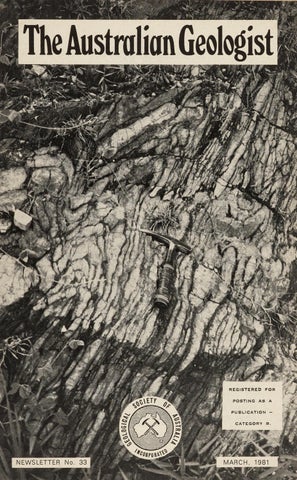
Cover Photo: Folded quartzites, Barron River Metamorphics (?Middle Palaeozoic). Cairns. Qld.

The Australian Geologist

Newsletter No 33 March, 1981

EDITORIAL

It doesn't need a gallup poll to show that once again the profession is in a boom period. Government Surveys and other instrumentalities have lost staff by the scores as private industry draws them with financial and other attractive carrots .

The embargo on employing geologists from overseas has been lifted and once again we will see an influ x of experienced workers probably mostly from Africa. Unlike our previous boom period there is a serious undersupply in North America at present and there will be few workers corning from that region.

It is ironic that such booms create a greater demand for basic information which is usually gathered and disseminated by the government surveys, and there is considerable pressure placed on the surveys when they are least able to do their job. Few of the governmentsState or Commonwealth - of the last 20 years have had the initiative to stimulate the geological surveys during periods of low demand for their services, so we continue with the piecern·eal approach to the assessment of the country's mineral resources, which is akin to our approach to their exploitation.

Perhaps things might change if we had politicians who knew just a little about geology. This can onl y happen when we have a well-informed communit y. The populace at large is woefully ignorant of the principles of a subject which affects their living standards to a considerable degree . As I have said in the past there is an urgent need for geologists to sell geology to the people, and particularly to our educators.

Although there are several thousand students studying geology in the upper classes of South Australian and New South Wales High Schools, the numbers are, I believe, much lower in other states, and in general compare poorly with the numbers who are studying biolog y. This is a serious imbalance which can be traced in part back . to the virtual absence of geology in the lower y ears of high school where the rote learning of rock and mineral names is still in vogue in some places.

The structure of the high school syllabuses and organization of timetables also has much to do with the low numbers studying geology in the later years. Most schools will not teach it unless a reasonably large class can be assembled, so the few who wish to study geology usually end up doing something else

cont. page 8 3.

Letter:s to the Editor

Sir:

In reply to G. R . Mcilveen (Newsletter No. 32, December 1980), I completely agree with his concern, regarding the need for current geological research in coal geology being made available, to both coal geologists and others involved in related disciplines.

It was for this very reason that the specialist journal 'Coal Geology' was created. My bookshelf boasts some six years worth of the Society's journals, published prior to the formation of the Coal Geology Group. Coal related papers number in the vicinity of two for the six years.

In the last two years of 'Coal Geology', six papers have been published, fourteen from a symposium in 1979 and about twenty-two from a 1980 symposium are at late stages of publication, and the response by authors is increasing. This is partly (I concede not entirely) due to the advent of a separate journal which all Australian coal geologists can readily identify with and contribute to, knowing that the information will reach those of like interests. Coal research is now becoming readily available in published form, thanks to 'Coal Geology'.

James W. Beeston Geological Survey of Queensland Sir:

The most recent edition of the Society's Journal (vol 27, pg. 45-53) was distinguished by a paper compiled by John Parker in which the abstracts of a "Symposium on the Gawler Craton, 11th December 1979" were collated.

I believe this to be a most welcome departure from the usual editorial content and urge that the practice be encouraged.

All too many important conferences and symposia come and go, with inadequate dissemination of the new knowledge presented therein. The attendance at a given conference is not only a reflection of the general interest in the topic, but is also strongly affected by factors such as location, cost, timing, work priorities and so on.

By way of specific example, I believe that the abstracts for each Australian Geological Convention should be published in the first edition after the particular convention. Not to do so is to stultify their impact.

If the past non-publication policy has been the fault of the editorial strictures I request that consideration be given to broadening them: if otherwise I urge convenors of symposia to push harder to allow fuller justice to the efforts of those who have produced the papers.

Andrew J. Drummond.

\An Abstract Series is being inaugurated this year. This will be

\_;;eparate from the Journal. A special cover desiqn has been prepared. Ed.

An Australian Jou rnal of Earth Science?

In the most recent issue of "Search" (vol. 11, No. 10) there appeared an article entitled "The 'Australian Journals of Scientific Research'", which consists of extracts from a report to the Executive of CSIRO and the Council of the Australian Academy of Science, and their agreed action on the recommendations. Recommendation R3 (p.339) is of particular interest to our Society, namely:

"That the A. J. Soil Research be renamed as the A. J. Earth Sciences, to include geological, hydrological and soils research in its coverage. This recommendation was not accepted, but it was agreed that the scope of the journal should be monitored."

The last sentence implies that action to create an Australian Journal of Earth Science may well be taken by the CSIRO and the Academy, as soon as the y think it is appropriate to do so. Our Society must have a major say in any such move, and, in fact, we would be better off if we were the prime movers, rather than being dragg~d into it by some other organization.

It seems to me that our Journal is not exactly being swamped by good articles, and that most people publish overseas if they can, except for those whose work is clearly of local interest only. I believe that this is partly because of the continually increasing number of overseas journals (especially commerciallybased ones), the generally easier refereeing in overseas journals, and especially the fact that our journal is not widely read or highly regarded internationally.

If we could establish a top-quality, well-produced, frequently-appearing journal, we could put it on an international footing quickly, in my opinion. The Canadian Journal of Earth Sciences is an excellent example, which we could take as a model. Its circulation is larger, but not much larger (say 4,500?) than ours, and yet it is well recognized internationally. An equivalent Aust. J. of Earth Sciences should attract many papers that now go overseas - provided we can guarantee (1) efficient processing of papers, (2) international circulation, and (3) a very broad coverage (so that general and specialized articles in virtually any aspect of Earth Science would be welcome).

How do we implement this? Obviously the Society membership would have to agree to any change, but, if the Executive feels it is worth approaching the members, a plan will have to be available. 5

It seems to me that the JGSA could be combined with the BMR Journal, but that the Aust. Journal of Soil Research may well be too specialized to be included; (I am told that it is largely devoted to soil physics these days). Whatever is done, it will need the cooperation of the Society, the BMR, the CSIRO (Division of Mineralogy) and the Academy, which would put the new journal on a sound financial footing (and make it independent of the dreaded Book Bounty). It should have a professional editor who is an earth scientist and who would be responsible, not only for supervising a carefully selected editorial board of wide earth-science coverage, but also for copy-editing; (the combination of these two functions was strongly supported in the "Search" article). Presumably we would need a suitable office and at least one assistant.

As our main Commonwealth geological organization, the BMR is an obvious place to house the office, especially as it has good editorial facilities available. It ma y add some prestige to the organization, at a time when it needs it, and may also foster some cooperation between the BMR and the CSIRO. I believe that any Society cooperation with the BMR can be only beneficial to the interests of geology in this country. Presumably part of the Society membership dues would be channelled into the new journal, just as at present.

I suggest a meeting between our President, the BMR Director, the Chief of the CSIRO Division of Mineralogy, and a suitable official of the Academy (with or without the relevant editors - in our case, John Truswell should also be included) to make a preliminary assessment of the value of a new Journal combining the interests of all the organizations concerned. I think that the days of the honorary editor are numbered, especially if we want to compete with overseas journals.

Fifth Convention Perth 1981

A total of $3000 has been put aside by the Society to subsidize the visit of full-time students to the Convention. Watch for advertisements on procedures.

New Company Member

Since the list issued in December, Santos has joined the company supporters of the Society.

AUSTRALASIAN

SEDIMENTOLOGISTS GROUP CONFERENCE, CANBERRA, 1-2 December, 1980

A very successful A.S.G. meeting was held at the Canberra College of Advanced Education, attended by the vast majority of the eighty-five registrants. The relative remoteness of the venue at the CCAE at Belconnen was more than compensated by the excellent program organized by convenor Max Brown (CCAE), helped by Peter Cook, Peter Ward, Keith Crook, Bob Byrne and others. Two days of formal papers, an A.S.G. business meeting, informal BBQ lunches and a conference dinner were followed by two three-day field trips. Four themes were represented in the formal presentations: Quaternary temperate shelf sedimentation (1 paper), saline lakes sedimentation (5 papers), epeiric sea sedimentation (3 papers), and Tasman Geosyncline sedimentation (15 papers). 10 poster papers were also displayed on these themes. The theme of the first field trip, led by Mike Owen and Ray Cas, was "Siluro-Devonian volcanogenic sedimentation in the Lachlan Fold Belt", covering the region from Canberra to Bathurst, N.S.W. Up to 21 participants were involved. The theme of the second trip, led by Brian Jones, was "Stratigraphy and sedimentation in the southern Sydney Basin, N.S.W." Up to 16 participants examined excellent exposures along the N.S.W. coast from Bateman's Bay to Sydney.

A pleasing aspect of the conference was the range of backgrounds represented: university, government and semi-government, and industry. Amongst the university representatives it was encouraging to see not only strong attendance by graduate students, but also some very competent contributions. The A.S.G. session in Hobart in January, 1980, and here again in Canberra saw renewed interest by industry geologists in the activities of the sedimentologists' group. The new executive hopes that this trend will continue and will work towards this end. In Hobart; sedimentologists with interests in the sedimentological aspects of volcanogenic successions brought into focus this developing and economically significant topic. This aspect was again well represented at the Canberra meeting. Another new group to "fly the flag" in Canberra, were those with interests in saline lake sedimentation. The A.S.G. now boasts a diverse crosssection of interests under its umbrella, a situation which promises a healthy future and which should be developed to cater for the interests of all its members.

At the business meeting, the committee for 1981-82 was elected as follows:

Chairman: Ray Cas, Earth Sciences, Monash University Deputy Chairman: Larry Frakes, Earth Sciences, Monash University

Sec./Treasurer: Jock Keene, Geology, Melbourne Univ.

Committee: Barrie Bolton, Earth Sciences, Monash Univ. Mike Garratt, Geological Survey of Victoria. ASG Councillor: Keith Crook, Geology, A.N.U. 7.

Ideas for activities for 1981-82 were canvassed, including a suggestion by Graeme Taylor for a field conference in May, 1982 (venue to be decided by the new committee). The visit by Ken Hsu in August-October, 1981, was announced. A large number of participants indicated their intention of attending the "Sediments through the ages" convention in Perth, August 1981. A brief general business meeting of the A.S.G. will be held then. A business meeting of COGS (Consortium for Ocean Geosciences of Australian Universities) was also held in Canberra during the A.S.G. meeting. The committee elected for 1981-82 was:

Chairman:

Deputy Chairman,

Secretary/Treasurer: Committee:

Peter Cook John Veevers Keith Crook Dave Falvey

The major business item discussed was the forthcoming March workshop at which Australian involvement in the Deep Sea Drilling Project will be discussed (L. Frake~ pers. comm.).

Finally, thanks again to Max Brown and helpers for a very useful conference. Thanks also to the outgoing, Hobart-based A.S.G. executive for their efforts in managing and developing the affairs of the A.S.G. during 1978-80, and for handing the new committee a financially sound balance sheet.

Ray Cas

THINK SMALL

The Microscopical Society of Australia is holding a symposium at Macquarie University during May 1981 with the theme "Quantitative Microscopy". Associated with the symposium will be a photomicrographic competition. Attendance at the symposium and participation in the competition is NOT confined to MSA members.

Contact: Mrs. Jeanette Gregory (Treas.) School of Biological Sciences Macquarie University North Ryde 2113.

Phone: (02) 88 9476

Continued from page 3.

Unless something is done, by the geologists, the situation certainly won't improve. There is an urgent need for the Society, the Geoscience Council to be, and other interested bodies to look at this problem and to make some attempt to solve it. The provision o~ good texts is important but we need to look more particularly at the structure of education and how geology can play its part in the primary and secondary education systems.

Magma Charter?

or

Processes in Magma Chambers

In spite of transport strikes a large audience (about 200) assembled in Glasgow on the 15th and 16th May 1980 at the meeting convened by the Volcanic Studies Group of the Geological Society, in the modern Department of Geology building, to hear fifteen papers presented by eight local and seven overseas speakers.

The stress during the first day was on the physical properties of magmas, with models based on deduced density, buoyancy and convection properties of magmas of different composition (R.S.J. Sparks: S. Blake) and experiments with model tanks in which saline solutions are heated and cooled to simulate stratification, convection and mixing in magma chambers (T.N. Irvine of the Geophysics Lab.; A. R. McBirney of Oregon).

The now well-studied magma chamber under Kilauea volcano provided another model, added to by studies of the cooling of three recent lava lakes formed in the east rift zone (T.L. Wright). Only the first speaker (S. Maaloe of Bergen) considered an alternative to the traditional "bell-shaped cavity filled with liquid rock", arguing that for abyssal tholeiites at least the magma reservoir is a disperse system, although discrete chambers may form in the mantle below oceanic islands.

Most of the other papers presented dealt with granitic or gabbroic bodies now exposed at the surface. A number of interesting features such as "igneous load casts" (J.R. Wilson), and density grading, cross-bedding and slump structures (I. Parsons) were described, and in two papers by M.R. Sharpe of Pretoria and C.A. Lee of Johannesburg the latest ideas on the Bushveld Complex were presented. In these and other papers the implications for volcanic eruptions were not always made clear.

A growing interest in the physical properties of magmas was apparent ("double-diffusion" was the conference catchword). Bigger and better model tanks may be needed e.g. swimming pool size as suggested by Irvine. Once such simple models become better known and their real complexities appreciated, can we expect the geochemists and geophysicists to solve it all for us with a series of computer models?

Abstracts of most of the papers appeared in the "Geological Society's Newsletter" for March 1980, and the papers of the meeting are being collected together for publication as a thematic issue early in 1981 in the Journal of the Geological Society.

Before the meeting a number of participants examined a magma chamber in the field - on the Island of Rhum, in perfect summer weather. Two local excursions were offered also at the end of the meeting.

A display of recent books included two of special interest. The first was Howel Williams and Alexander R. McBirney's "Volcanology" (Freeman, Cooper & Co., San Francisco). This is the latest volcanology text book, written by two distinguished authors in this field, and is notable also for its unusual figures - you either like them or loathe them. The second book was Payson D. Sheets and Donald K. Grayson's "Volcanic Activity and Human Ecology" (Academic Press, New York). The editors have put together numerous discussions of the effects of volcanic activity, written especially for this book, some being of more interest to geologists than others. For example we can learn whether present- day Hawaiians worry about future eruptions, and how the town destroyed by Paricutin has been rebuilt.

E. B. Joyce Department of Geology University of Melbourne.

SECOND J. J. FRANKEL MEMORIAL LECTURE given at The University of New South Wales, School of Applied Geology, on Thursday, 16th October, 1980

SUMMARY

GEOLOGICAL ORE SEARCH - THE NEXT TWENTY YEARS by K. Wright, Manager- Resource Development, Geopeko

To meet the requirements for raw materials into the next century geological science will move to develop realistic and useful concepts upon which to base detailed exploration. This will come from careful observation of field data from all sources, careful analysis of these data to determine their relevance and significance in relation to ore search, and the application of the results to yield area and target selection.

It is suggested that many mineral deposits are associated with sedimentary (including volcanic detrital) rocks that s h ow e vidence of rapid deposition and burial, of ancient high pore flui d pressures, of structures which have developed and been active since early diagenesis, and of fluid movement from such deep wet zones through earl y de v eloped fluid migration paths. Moreover, it appears that the mineralizing processes operate most effectively under regional tension rather than compression. Exploration will have to give par- ticular attention to the recognition of environments of sediment deposition, burial, subsurface behaviour, and subsequent dewatering. The concept that many deposits are associated with specific geological times is linked to the processes described.

Learn about the North-East Tasmania Conference.

Copies of the Abstracts are available from the Society's office at a price.

Antarctic Symposium 1982

The Society is a sponsor of this symposium which is now being planned by an active committee. Further details to come.

The Tenth BMR Symposium will be held at the Australian Academy of Science Building in Canberra on 5 & 6 May 1981

Theeking the Thecae

GRAPTOLITE WORKING GROUP OF THE INTERNATIONAL PALAEONTOLOGICAL ASSOCIATION

SECOND INTERNATIONAL CONFERENCE

"Palaeoecology and Biostratigraphy of Graptolites", will be held September 1-10, 1981, at the Department of Geology, Cambridge University, England, with post-conference field excursions based at Aberystwyth University, Wales.

A selection of papers presented at the conference will be published.

The cost of attending the full meeting, including registration, full board accommodation at Christ's College, Cambridge and Aberystwyth University, field meeting transport, and a copy of the conference volume when published, will be approximately £200.

Those interested in attending the conference who have not been receiving conference circulars should contact Miss Amanda Chapman or Dr Barrie Rickards at the Sedgwick Museum, Downing Street, Cambridge CB2 3EQ, England for further details. Local contact is Lawrence Sherwin, Sydney, 02-241-3662.

The

Heat's On

April 8-10, 1981 will see many heavies on H.E.A.T., the International Symposium on the Hellenic Arc and Trench being held in Athens, Greece.

Most of the proceedings will be all Greek to the local inhabitants as papers will be given in English or French.

Get on the hot line right-away (Tel. Athens 362.8988) or do it the cool way by writing to

Prof. S. S. Augustithis

International Symposium on ....... , National Technical University (Dept. Mineralogy- Petrography- Geology)

P.O. Box 1006, Athens, Greece.

There is no truth in the rumour that this conference will be held under arc lights.

1988 and all that.

The geologists of the Apple Isle are girding their loins to prepare a new geology of Tasmania. Are there any other Divisions planning appropriate cerebrations?

Book Review: Modern Quaternary Research in SE Asia

This book is the fourth of a series devoted to Quaternary research in southeast Asia. The preface states that the book's immediate concern is the study of prehistoric man. One might imagine that the editor of the series would invite authors to devote themselves to a Quaternary theme of substance. But this book is not thematic and its reports are disconnected pieces of work. I will not mention all the contributions.

Siesser and Orchiston point out that the planktic species Globigerinoides obliquus is found in the claystone surrounding the Sangiran Homo erectus mandible C. Arguing from extinction dates elsewhere for G. obliquus, they date the mandible to over 1.6 m.y. old.- East African chauvinists may well feel a touch of nervousness.

Jacob looks at the fossils colloquially known as Solo Man. Their age he considers to be more like 0.3-0.9 m.y. than the mere tens of thousands of years often vaguely attributed to them. Jacob views their anatomy as close to the conventional H. erectus of Java . He makes frequent summary statements aboutlikeness and unlikeness, but without resorting to the self-discipline of comparative multivariate distance statistics. So the reader is left with no comprehension of how close the Solo skulls are to H. erectus in Java, when H. erectus in Java is compared with other prehistoric crania.

Viewing prehistoric relations between Indonesia and Australia, Orchiston neatly disposes of von Koenigswald's careless claim that stone artifacts, looking like the Australian tula adze flakes, have been found in Indonesia.

After these disjointed articles on human prehistory the book gives us something non-human, namely articles on Stegodon, the deglaciation of Mt Kinabalu and Holocene sea-levels. Finally the editor himself publishes a chapter on recent ·palaeolithic research in Java. This chapter reads like the text of an illustrated lecture but the reader, without the advantage of slides and sites and objects, is left with only a whetted appetite.

This carefully bound book has no more thematic unity than a set of articles in a journal. It is indeed difficult to understand why the articles were not allowed to find their way into appropriate journals. They are in no special sense interdisciplinary. I would hope that, when planning future books in this series, the editor will commission authors to write on a particular theme . Even now there is no shortage of serious and interesting themes in the Quaternary of southeast Asia. And one day, perhaps, we shall have clear evidence that Australopithecines inhabited Java and that H. erectus in Java is earlier than in Africa.

Book Review

THE GEOLOGY OF NEW ZEALANDChief Editor : R P Suggate assisted by G. R. Stevens & M T. Te Punga Government Printer, Wellington, N. Z., 1978. Price: N.Z . $92-50 .

It would be a brave person who would today attempt single-handed to write a geology of Australia.

On the other hand there hav e been at least four authors who have produced in the past few years geological syntheses of the geology of New Zealand.

Although their success can be attributed partly to the physical size of that country it is probably also the result of a long histor y of systematic study of New Zealand under one co-ordinating body - the Geological Survey - and the presence of a somewhat more compact literature than e x ists on Australia and which can be grasped by a determined investigator.

One of the four solo authors mentioned above, G. R Stevens with M. T. Te Punga has acted as associate editor under R P. Suggate to prepare this sumptuous two volume offering prepared essentially by the New Zealand Geological Survey. It is quite beautifully produced , with a range of top quality colour and black and white photographs largely by the Survey's photographer D. L . Homer. In addition to the two sheets of the New Zealand 1:1,000,000 map (including the ,s) printed in 1972 there are numerous other fold-in coloured maps and sections .

The te x t,to which nearly forty writers have contributed,is divided into Eleven Chapters - an introductory one which discusses the New Zealand environment both physical and faunal, nine chapters which discuss the geology and a final chapter on the fossil. record and palaeogeography. The geological chapters are constructed on the basis of the broad subdivisions which have been recognized in New Zealand geology, the geosynclinal phase extending from Precambrian to Jurassic and the Rangitata Orogeny dealt with in volume one, and the late mobile phase - Cretaceous to Recent and encompassing the Kaikouran Orogeny discussed in volume two .

Within this framework palaeontological evidence is outlined followed b y discussion of relevant regional stratigraphy (based on periods of the geological time scale), and separate discussions on petrology. Specific chapters deal at appropriate times with the orogenies, volcanism and metamorphism.

Despite this systematic treatment the material is heavil y dependent on the use of New Zealand Series and Stages(really provincial biostratigraphic units)which ha v e become entrenched in the literature . While these may be grasped by the majorit y of New Zealand geologists they are somewhat of a headache for anyone approaching the literature (or the rocks!) for the first time

Fortunately each volume has end papers which set out this fearsome list against the perhaps equall y daunting European stages. Equipped with this essential material one can deal more confidently with the Waimean, Waimaungan, Waiwheran, Waitotoran, Waipipian, Waiauan, Waitakian, Whaingaroan, and Waipawan stages which occur interspersed in the Tertiary and Quaternary. As for the Otiran, Oturian, Okehuan .... . let no more be said, although in the field their reality may well prove to be questionable .

It is not possible in a newsletter of this size to go into the detail one might like on these volumes - to discuss for instance the stages mentioned above, differing opinions which exist on glaciation or recent tectonics in New Zealand, when the late mobile phase began etc.

The criticism which these volumes will probably most readily receive is that despite a 1978 date of printing they depict the geology essentially in terms of ideas from before the plate-tectonics era . This is the result of a long period of birth. The material was essentially complete in 1972. Supplements bring the material up to date in 1975 but printing delays and arguments on pricing seem to have been responsible for the non-appearance of the book until about 1980. Few individual geologists will be able to afford the near $100 asked for 'these volumes, but they should be in every geological library Despite their shortcomings they will be valued for years to come as essential reference books on New Zealand geology and as monuments of the arts of geological editing and printing .

David Brana g an

4 H G (nee C) Calling the Class o f ' 66

Organiser extraordinaire Helen Gibson (n e e Colton) - who will ever forget her Glenbawn Camp expertise? - is c o-ordinator of a grand reunion of the Sydney Uni v ersit y Class of '66 which is planned for the week- e nd of 6-9 June 1 98 1, in Brisban e of all places

The whereabouts of the follo wing are u nc er t ain : Des A. Buckhorn, Gord on Hart, Pe ter Pollard, Christopher Ston e, Gr a ham Willett, George D. Austen .

Pl e ase write and tell Hele n where y ou ar e Othe rs who know about it alread y should send details of their rec o rds (or v i c e ve rsa)

since graduation to Mr s. Helen Gibson, 10 9 Eversleigh Rd., Scarborough 40 2 0 - p ho ne 07 - 283 -1393

International Geological Correlation Programme

The Australian Unesco Committee for IGCP met in Canberra in October 1980 and discussed a wide variety of topics including Australian representation on the IGCP board and scientific committee, gaps in the IGCP programme, the Unesco 1981-83 Mineral and Energy Resources Programme, the proposed Regional Network for Volcanological Studies in the Western Pacific, the proposed project - Neogene and Quaternary Palaeohydrology of Low Latitude Deserts, the Regional Network for Geosciences in South-East Asia, funding Australian IGCP initiatives, Regional workshop on Rock Phosphate .

The IGCP Committee of six, with invited observers and several UNESCO officers meets yearly. For information contact the Chairman, Professor J. F. Lovering, Department of Geology, University of Melbourne, or Mr J . Elson, Federal Dept. of Education, Canberra, representing UNESCO .

DIVINE GUIDANCE

Paul Whincup of Layton Groundwater Consultants, Perth sent an interesting letter to the National Water Well Association's Journal recently, outlining his experiences with water diviners in a W.A. challenge.

The ABC organised a test there using ten cardboard boxes, a kilo of brass and a kilo of real gold(!) with Paul Whincup as adjudicator. Twenty one diviners used a variety of sticks, wires, keys, pendulums and fingers to $eparate the brass from sand in one test. One long distance diviner 'used a method which required him to stand back 80 m and take a sight on each box from four different points of the compass - a fairl y time consuming exercise'. 'Eventually all twenty-six diviners stood proudly by the box of their choice, with only one box not having the courtesy of a diviner alongside. Surprise, surprise. Yes, you have guessed correctly, box No. 2 with the kilo of brass was the only one not divined. The odds against that happening must be quite large'.

Whincup adds 'For the record we in Western Australia do not have a requirement for diviners who c an locate sand, for that is a commodity we sandgropers have in great abundance'.

Five diviners picked the gold the first time through (Whincup thinks the security guard might have helped!), but missed it next time.

Space prevents the rest of the tale to be related. One diviner managed a 50 % success rate but the overall rate was 17.6 % (against a statistical chanc.e of 1 8% ).

Perhaps water is easier to find.

We are happy to advertise

Geological HOWLERS!

for the Geological Society of Glasgow.

Here are a few titbits

Greenland Volcano in Eruption by arrangement with The Times.

The streak of a rock is the colour shown when scraped with a pet.

If no fossils are found, the rock is either PreCambrian or igneous.

An oil field consists of one or more related poos.

Rocks have ability - not all of them - to pass water at high pressure.

The mineral resources of the area are negligent.

If you would like some 54 pages of this stuff, including pictures, the editor of Aust. Geol. has ordered a limited number at about $2.50 (including postage), otherwise write to Dr CM Farrow, Geology Department, University of Glasgow, Glasgow Gl2 8QQ, Scotland, enclosing 1.15.

Sink Tank?

Third lnternational Ocean Disposal St'mposium, October 12-16, 1981

Woods Hole ,

Turn static files into dynamic content formats.

Create a flipbook
TAG – March 1981 – Issue 33 by GSAustralia - Issuu