ff an Geologist
Newsletter
Editor:
D F Branagan
Dept Geology/Geophysics
University of Sydney
N.S.W. 2006 · phone : (02) 692 2358 or 692 2912

PRESIDENT'S PAGE
Secretary: Dr. R. E. Smith
CSIRO Division of Mineralogy
Private Ma il Bag P.O Wembley, W.A.6014
A sma l l item o f busine ss but with p ro f ou nd implicati o n s emerged at t he Perth Cou n c il, and is i n d a nger of es c aping o ur attention. The Society, through a t least one of its Divisi o ns recently co-sponsored a symp o sium on Cainozoic Evoluti o n of S.E. Australia. The organisers are commended on their enterprise and skill in s taging what was obviously a most s uccessful symposium, and thi s is precisely the type of activity the S o ciety should e ncourage. An intere s ting situation arises because the s ymposium finished with a modest cash surplus. Perhaps it would have been even more interesting if it finished with a d e ficit!
The question now arises to whom does this money belong ? Council decided against establishing a Standing Commit t ee on Cainozoic Studies to administer this money, and there the matter rests. We can confidently expect that similar situations will re-occur.
The Society simply has no administrative machinery to deal with these situations. We have formally adopted a procedural guide for conventions which specifies that the incorporated body through its Federal Executive takes responsibility for surpluses or deficits. Significantly, the la s t three major conventions (Fourth and Fifth Conventions, and the Archaean Symposium) grossed surpluses close to $30,000. Before anyone yells "rip-off" - let me say that all symposia should be self-funding, and the size of the surplus depends on the contingencies and thresholds that are required by prudent planning. All these symposia were funded through modest registration fees and represented excellent value for money.
Even with national events there seems to be some reluctance for organising committees to see their wellearned money channelled into "consolidated revenue". For regional or specialist events this reluctance may be more ma nifest as it raises the spectre of "central funding".
However, I believe the Society needs to expand its Procedural Guide to ensure that arrangements for staging regional and specialist symposia are formalised, and that some pre - arranged formula is e s tablished for handling surpluses or deficits, particularly where co-sponsors are involved.
Perhaps we should look at establishing a Special Fund into which all surpluses are placed. A register could be kept in which are recorded the amounts and sources of depo s its, and the organising committee's recommendations on how this money should be used. The fund should be available for any Society-sponsored event for such purposes as initial floats for further meetings, invited speakers and publication of proceedings. This fund could be expected to grow to the point where finances no longer constrain our publication policies.
Dennis Gee
Newsletter No.37
The Australian Geologist
EDITORIAL

De cember 5, 1981.
Correspondence and phone calls from many parts of Australia make me more aware than most members of the extent of the activities of the Society and its individual members in promoting the profession of geology. The success, or otherwise, of such efforts depends largely on the energy and enthusiasm of particular secretaries and local committees and is a consequence of the determination of Society members over the years to resist, as far as possible, centralisation of the Societ y 's affairs.
Despite some ob v ious drawbacks, the passing of executive management from d ivision to division ensures a freshness in approach and a wider involvement of members in guiding the Society's affairs than might otherwise occur.
Dennis Gee in his President's page comments on one success story - the accumulation of funds from various conventions in recent years - and makes a very practical suggestion on how these funds should be handled.
While modest profits from confe r ences are to be app l auded, much of it comes fro m registration b y nonmembers. The Society would surely benefit more by having a regular income from a larger number of members. If y ou, as a member, feel t h e Society h as somet h i n g to offer, why not tell y our non-member friends? Better still, the direct action of giving a membership form may yield more rapid results.
Despite the fact that registration fees for the Society's Perth Convention were kept low for students, and that the Society offered to help with finance for travel there were too few students enrolled at the conference. W.A.I.T. students told me recently that registration at the conference was too expensive for them.
It is essential that such potent i al (future ) members should be encouraged to join the Society. We certainly aren't working hard enough at it at the moment. Perhaps some of the surplus confere n ce funds could be put to good use in encouraging student membershi p An y const r uctive ideas would be welcome.
This issue contains a few lightweig h t pieces for the summer madness period. Best wishes to all members for Christmas and the New Year. The ne x t issue s h ould appear in March.
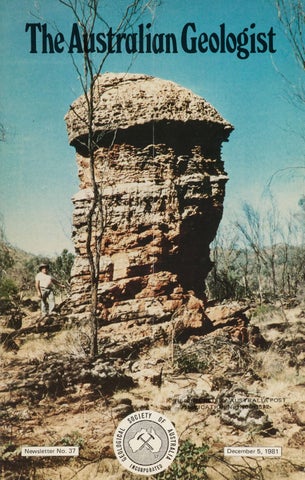
Cover Pho t o: Upper cros s - bedded p or tion of the Enga Sa nd s tone (Ea r l y Ca rbonif erous ), Bo n a p a rte Gulf Bas in , W A , oth erwi se Mu r r a y J o hn s tone & cap rock Pho to: G M Bee r e
Apology
In the la s t i ssu e the editor o mi tted to acknow l e d ge that the c over picture wa s drawn by Vic Gostin during th e rare moments of r e s t in the Perth Council Meeting
Othe r s k e t c h e s by Vic a r e i nc lude d i n this iss u e 3

AUSTRALIAN INSTITUTE OF GEOSCIENTISTS LIMITED
If you wish to register these are your contacts:
NEW SOUTH WALES
Adamson, C.L.
Blumer, J.M.
Cramsie, J.N.
:Emerson, D.W.
Foskett, W.E.
Glasson, K.R.
Haskins,P.
Ingall,L.N.
Jamieson, P.N.
Kennedy, H. D.
Lawrence, M.
Leggo, Dr. M.D.
McElroy, Dr. C.T.
Mosher, K.G.
Richards, K.A.
Ryall, Dr. W.R.
Thomson, J. Turbott, M.J.
VICTORIA
Denham, Dr. J. I.
Duncan, Dr.D.M.
Irvine, H.J.
Plimer, Dr. I.R.
Richards, Dr. S.M.
Rutter, Dr. H.
AUSTRALIAN CAPITAL TERRITORY
Brunnschweiler, Dr. R.O.
Crook, Dr. K.A.W.
Rickard, Dr. M.J.
TASMANIA
Bishop, Dr. J.R.
Williams, Dr. E.
Leamen, Dr. D.E.
WESTERN AUSTRALIA
Lord, J.H.
Marjoribanks, Dr. R.W.
Sappal, Dr. K.K.
Twist, R.K.
QUEENSLAND
Jones, P. Elliott, Dr. M.
NORTHERN TERRITORY
Kirkpatrick, B.L.
Le Messurier, P.E.
SOUTH AUSTRALIA
Branch, Dr. C.D.
Fander, H.W.
Hopwood, Dr. T.
Milton, B.E.
Stapledon, Prof.D.H. Trueman, N.A.
Consultant
J.M.Blumer & Associates
Department of Mineral Resources
Sydney University Consultant
Australian Aquitaine Minerals
Wongela Geophysical
Offshore Oil
Otter Explorations
Consultant
Amax
McElroy, Bryan & Associates Consultant
Esso Consultant
Earth Sciences Computer Services
Kennecott
B.H.P. Western Mining (Bairnsdale)
B.H.P.
North Broken Hill
Aberfoyl e
Geophysical Exploration Consultants
Consultant
A.N.U.
A.N.U.
Mitre Geophysics Department of Mines Consultant
Consultant
Anaconda
W.A.Institute of Technology Geopeko
Department of Mines Consultant (Mt.Isa)
Geopeko Department of Mines & Energy
Department of Mines & Energy
Central Mineralogical Services. Consultant
Department of Mines & Energy
S.A.Institute of Technology
Western Mining
NEW A.I.G. ADDRESS & TELEPHONE NUMBER
Science Centre, 35 Clarence Street, SYDNEY. N.s.w. 2000
Telephone: (02) 29.7747
Letter to the Editor
Sir:
In reply to the letter by John Webb and Neil Ar~hbold in "The Australian Geologist" No. 36, abbreviations of words used by the "Bibliography and Index of ~eology" ea~ be used to construct abbreviations of any Journal article not listed, using the relatively logical arrangem~nt of words used in this list It is proving m~ch easie~ to use than the old system. If it fails, we will certainly go to complete journal names but for the time being I will persist with abbreviation~, in order to save as much space as possible.
Ron Vernon Honorary Editor JGSA

Sir:
The presidential address by Colin Branch to the recent Australian Geological Convention (Australian Geologist, No. 36) raised some pertinent matters concerning the public's impression of geologists. Since the public knows nothing about academic geologists, the popular image is that of the industr y geologist, so this letter is mainly concerned with them, although certain criticisms apply also to some geologists of the academic persuasion.
Suggestion that geologists speak publicly about issues of public concern has one problem : the public concern is usually opposed to the interests of company geologists. The average Fred Nurk is suspicious of these geologists, and rightly so, since they are highly paid professionals and hence are members of an elite class which has vested interests in one of the most powerful groups in this countrythe mining industry.
"Where are our Harry Butler's of geology?" asks Colin Branch. Part of the answer is that Harry Butler is a conservationist, geologists are not. Company geologists have shown that they have no concern for our environment. When did they ever speak out against the mining of uranium, the incursion on aboriginal land by uranium and oil prospectors? When did they speak up against proposed oil exploration on the Great Barrier Reef? When did they oppose the building of dams in south-west Tasmania? When did they oppose limestone quarries in areas containing important cave systems, as at Mt. Etna in Queensland and South Marulan in N.S.W.? When did they speak out against quarries and mines in national parks, or beach sand mining at Myall Lakes? When did they speak out against the exploitative role of large oil and mining companies in third world countries?
In my (undoubtedly biased) opinion industry geologists are either more interested in money than in these issues, or they don't have the courage to take a stand against the company viewpoint.
If several geologists pursued political careers their contribution to the development of our nation would be equal to that of any politician - approximately zero. The best contribution geologists can make is to develop a social conscience and start considering people rather than profits.
Vince Morand University of
Sydney.

GEOLOGY IN COLOUR IS BETTER?
Barry J. Cooper
Most geologists do not make a habit of commenting about the quality of their publications. However I will make an exception on this occasion due to the nature of the response to one of my efforts.
"Eocene to Miocene Stratigraphy of the Willunga Embayment" was published in late 1979 as Report of Investigations No. 50 of the Geological Survey of South Australia. The monograph essentially deals with the geology of a small region 30 km south of Adelaide. Fifteen colour photos were dispersed through the first 30 pages of text in addition to a coloured front cover.
The coloured illustrations are the reason for this note All comments from geologists about the monograph have invariably made reference to these. Most believe that the geology is simply better illustrated with colour rather than black and white photos. Some people also recognise the value of colour illustrations in future field studies of an area either for research or teaching. Two years after issue of the Willunga Embayment monograph, I appreciate that colour illustrations do provide better documentation of geological data.
Amongst the plethora of geological journals available today, very few encourage colour illustration And where journals do publish colour, the author usually bears responsibility for the additional cost. With the response to my colour illustrated paper in mind, I think there may be a need if not a demand for more colourful geology journals.
Could the journal of the Society be more successful if it insisted on colour illustrations as normal practice? Would geology researchers, teachers and general professionals be more attracted to a journal which publishes in colour? The cost of production of a colour journal would definitely be higher but this factor would be reduced if there were simply more subscribers.
Certainly the success of a journal is determined not only by presentation, but also by the nature of its contents. And the best papers will most likely be attracted to a journal which publishes using the best and most versatile methods.
When the Society reassesses the role and purpose of its journal in the near future, I suggest that the Society consider the possibility of producing a top class colour illustrated journal even if it means seeking ~upport from outside sources and placing careful limits on the size of the production. Such an undertaking certainly involves risk, but it is certainly worth considering.
SYMPOSIUM
COAL RESOURCES
THE ORIGIN, EXPLORATION AND UTILIZATION OF COAL IN AUSTRALIA
MELBOURNE - NOVEMBER 15-19, 1982
Sponsored by the Coal Geology Group
KEYNOTE SPEAKER - DR HAROLD GLUSKOTER
Dr Gluskoter has had a distinguished career in coal reasearch,and for many years led the coal section of Illinois Geological Survey. He has recently established a research group in the Mining and Synthetic Fuels Division, Exxon Production Research Co., Houston, Texas, USA.
SECTION TOPICS
BROWN COALS
e Occurrence and Formation
e Properties and Chemistry
• Utilization
• Classic Fields
MINE GEOLOGY AND DEVELOPMENT
• Mining Methods
• Planning and Design
• Geotechnical Investigations
• Case Histories
PAPERS

COAL MEASURE EVALUATION
• Geophysical and Downhole Methods
• Data Systems
• Coal Evaluation
• Basin Analyses
REGIONAL REVIEWS
• Geology
• Coal
e Mining History
Keynote papers will be delivered by invitation, but papers on the theme are invited. Abstracts should be submitted by 1st March 1982, and the paper (for distribution at the Symposium) by 31st August 1982. Notification of intention to submit a paper should be made as soon as possible.
FIELD SEMINAR
One- and two-day excursions to the Latrobe Valley and Gippsland are offered. These will visit the SEC Brown Coal Mines on Thursday 18th November, and continue to other outcrops in the Tertiary and Mesozoic coal measures on the Friday. Participants will have the option of returning to Melbourne Thursday evening.
REGISTRATION: Members of Coal Group $ 95 Non-members $110 (a 5 % surcharge will apply to registrations received after 1/10/82).
NOTICE OF INTEREST
Excursion:
• Will attend
• Hope to attend
• Would like second circular
•Will submit an abstract (include title)
• One day (approx. $30)
• Two days (approx.$100)
ADDRESS: __________________
NAME: _______________
COMPANY OR AFFILIATION:
PHONE:
Return to: ---------------- ---------Dr CW Mallett, CSIRO, Division of Applied Geomechanics P.O. Box 54, MOUNT WAVERLEY, VIC. 3149.

"Beds" or "beds"?
The term "Beds" was originally recommended by the Australian Code of Stratigraphic Nomenclature for a sequence of strata whose thickness and lithology were incompletely known. It has been a useful term in areas where insufficient detail has been mapped to permit definition of formations and groups. Many such "Beds" units have been erected in Australian stratigraphy.
Under the provisions of the International Stratigraphic Guide, however, the term "Beds" now has a very different connotation: it describes a sequence of strata which are very well known and which are completely defined (I.S.G., Section 5.C.4). A "Bed" is now a named distinctive layer in a member or formation, e.g. Baker Clay Bed; and a sequence referred to as "Beds" is a continuous succession of several such units. Such a sequence would be well enough known to be given member or formation status, e.g. Marcus Limestone Beds.
In view of these provisions of the I.S.G. it is now necessary to reconsider the nomenclature of Australian units that have been defined as" Beds". There are several possible ways of adapting their nomenclature to the new standard:-
1. If such units are only being referred to in literature, without further field work being done, their names should be quoted informally, e.g. "Laurel beds", and the units should be regarded as informal units.
2. If the top and the bottom of such units can be nominated as boundary stratotypes, and the intervening strata are well enough known, it may be possible to formalise the unit and redefine it as a formation, e.g. "Laurel Formation".
3. If the unit contains one or more defined formations as well as otherwise undefined strata, it may be definable formally as a group, e.g. Laurel Group, provided that the upper and lower boundaries can be specified. The Australian Code restricted the term "Group" to a sequence consisting entirely of named and defined formations, but the I.S.G. allows it to be applied to a sequence which includes undesignated strata.
The Stratigraphic Nomenclature Committee is opposed to the proliferation of informal names, and considers that units described as" beds" should not be established lightly. It recommends that authors should, as far as possible, avoid using such informal nomenclature. It is preferable either to define the unit as a formation or a group, or to avoid using a geographic name altogether.

Equal caution should be exercised in establishing a group without any constituent defined formation. It is the formation which is the primary building-block of stratigraphy, and initial investigation of any area should aim at establishing units of this category.
All of these topics are considered in the second draft of the "Field Geologist's Guide to Lithostratigraphic Nomenclature in Australia", which is now available for perusal from Conveners of Divisional Subcommittees of the Stratigraphic Nomenclature Committee.
H. R. E. Staines Convener Stratigraphic Nomenclature Committee.
PERMIAN GEOLOGY OF QUEENSLAND
Queensland Geological Symposium Series l4th July-l6th July, 1982 University of Queensland, St. Lucia
Organised by: Queensland Division of the Geological Society of Australia in conjunction with the Geological Survey of Queensland.
Topics : I. Energy Resources, II. Sedimentology, III. Palaeontology, IV. Tectonics, v. Geophysics, VI. Metalliferous Deposits, and VII. Economics & Engineering.
The Geological Survey of Queensland has offered to make available for display, representative cores of the rock units of the Bowen Basin, at the Zillmere Core Library.
Registration Fee (includes abstract and published volume):
GSA Members - $40: Non-members - $60: Student members - $5. There will be a 50 % levee for payments received after 1st June, 1982.
For further information, please contactDr. C. B. Foster, Geological Society of Australia, Queensland Division, G.P.O. Box 1820, BRISBANE Queensland 4001.
Sydne y Offic e Laur e l Tu ckwe ll, th e Society 's busi ne s s ma n ag e r is locate d on th e 10th Floo r , Ch allis House, Ma rt in P lace , Sy dn ey
The pho ne n umb er i s ( 02 ) 231 46 9 6 8

SUGGESTED OUTLINE FOR NEW MINERAL DESCRIPTIONS by the Commission on New Minerals and Mineral Names of the International Mineralogical Association*
This "suggested outline" is largely based on a previous paper with the same title by Donnay and Fleischer (1970).
All Manuscripts that describe new minerals and new synthetic crystalline phases have a good deal in common. Nearly all the leading mineralogical journals now require that proposals of new mineral names be approved in advance by the I.M.A. Commission on New Minerals and Mineral Names. To save the authors and the referees time and trouble, we are listing below the subtitles followed by brief descriptions that the authors should attempt to deal with whenever possible. It is evident that not all the data suggested can be obtained, especially on small samples, but enough data must be provided to characterize the mineral unambiguously; as a rule this will require, as a minimum, a quantitative chemical analysis or some other proof of its chemical individuality, X-ray powder data and basic optical data. The details under Occurrence, Storage of type specimen and Name below are always required.
In general, polytypes should not receive individual mineral names, but should be designated in accordance with the "Report of the I.M.A.-I.U.Cr. Joint Committee on Nomenclature" (Bailey, 1977). Exceptions to this rule may be considered if supported by evidence of striking differences in the properties of the polytypes involved. New members of the pyrochlore or amphibole groups should be named in accordance with the schemes proposed by the subcommittees of the Commission (pyrochlores Hogarth, 1977; amphiboles Leake, 1978). The same holds for new members of mineral groups the classification and nomenclature of which may be reconsidered in the future (pyroxenes, micas, zeolites, etc.).
Other guidelines, highly recommended and in no way conflicting with the present suggestions, are formulated by the Commission on Crystallographic Data of the International Union of Crystallography (Kennard et al., 1967) and by the Commission on New Minerals and Mineral Names of the All-Union Mineralogical Society of the Academy of Sciences of U.S.S.A. (1975, 1977). The -criteria of the Soviet Commission are recommended in particular as far as polymorphs (especially for Order-Disorder polymorphs), solid solutions, mixed layer minerals, metamict minerals are concerned.
The requirementsfor amorphous minerals are currently under consideration.
Authors proposing new mineral names should read carefully the statement by F. Permingeat (approved by the I.M.A. Commission) in Hey et al. (1961).
*Submitted by E. H. Nickel, Australia's representative on the Commission.

Introduction. Statement of name, mineralogical classification (oxide, sulphate, etc.) and relationships, generalized characterization.
Occurrence. Locality (in identifiable form), type of host rock, paragenesis (including associated minerals, replacements, alterations, texture), abundance of mineral (tons or micrograms?), size of crystals.
Chemistry. Chemical analysis (state of purity of samples); if electron-probe (or other instrumental) analyses were used, give the standards used, the number of determinations, and the range of values, as well as the averages; actual and idealized formulae; determinative chemical reactions, especially fusibility and solubility; synthesis and stability relations, if known; DTA and TGA, especially for minerals containing volatiles.
Crystallography. Cell dimensions and volume, all with standard deviation (state numerical value of X-ray wavelength used); Laue class, diffraction aspect or space group (state extinctions observed); number of formula units (for actual formula) per cell (see Hey, 1939 and 1954); observed and calculated densities (discrepancy calls for comment); indexed X-ray powder data with relative intensities; relations to known phases; crystal structure, if determined (if not, state whether the structure has been determined or whether suitable material will be made available to another laboratory for structure determination).
Goniometric axial ratio(s) and angles; crystal forms and form combinations; habit, malformation; cleavage(s) (Miller indices, quality, facility), twinning (twin law and composition surface); gliding, parting.
Physical properties. Colar, luster, streak, grain size; Mohs-hardness or, at least for opaque minerals, micro-indentation hardness (Vickers) according to the rules of the I.M.A. Commission on Ore Microscopy (Criddle, 1980); pyro- and piezo-electric properties; magnetic susceptibility; fluorescence; for transparent minerals containing H 2 0 or OH, infrared absorption spectrum.
Optical properties. For transparent minerals, indices or refraction, optical sign, 2V, dispersion(s), optical orientation, elongation, pleochroism. Any optical property which may be observed on cleavage fragments or on prominent planes (Buttgenbach, 1953; Taylor, 1948).
It is recommended that the relationship between chemical composition, density and refractive indices be checked by the Gladstone-Dale rule (Mandarino, 1976, 1978, 1979). If there are difficulties, if the data are incomplete or approximate, an explanation is desirable.

For opaque minerals, colour in air and oil; pleochroism, anisotropism (intensity and colours), polishing hardness and quality; reflectances in air and oil at least at the four standard wavelengths 470, 546, 589, 650 nm, or better at every 20 nm from 400 to 700, stating the band width of the monochromator, the aperture used in the measurements, the standards of reflectance, the manufacturer of the oil; all these data for opaque minerals must be given according to the rules of the I.M.A. Commission for Ore Microscopy (Criddle, 1980).
Storage of type specimen. State where (preferably a national museum) and how much type material is deposited, giving identification number(s) if possible.
Name. Derivation, pronunciation (preferably with international phonetic symbols). If a mineral is named for a living person, his or her consent must be obtained. If it is proposed to change an existing name, or to redefine an already named mineral, the person who gave the previous name must, if living, be given an opportunity to comment on the proposal.
REFERENCES
BAILEY, S. W. (1977) Report of the I.M.A.-I.U.Cr. Joint Committee on Nomenclature. Amer. Miner. 62, 411-415.
BUTTGENBACH, H. (1953) Les mineraux et les roches (8th ed. with J. Melon) Paris, Dunod; Liege, Vaillant-Carmanne. See Table VIII, pp. 735-39.
COMMISSION ON NEW MINERALS AND MINERAL NAMES OF ALL-UNION MINERALOGICAL SOCIETY OF THE ACADEMY OF SCIENCES OF U.S.S.R. (1975) On the procedure for confirmation and the requirements to characterize new minerals [in Russian]. Zap. Vses. Miner. Obshchestva 104, 521-525. (1977) On the criteria used in the consideration of new ------;;\inerals [in Russian]. Zap. Vses. Miner. Obshchestva 106, 686-687.
CRIDDLE, A. J. (1980) Editorial policy for the second issue of the IMA/COM quantitative data file. Canad. Miner. 18, 553-558.
DONNAY, G. and M. FLEISCHER (1970) Suggested outline for new mineral descriptions. Amer. Miner. 55, 1017-1019.
HEY, M. H. (1939) On the presentation of chemical analyses of minerals. Miner. Mag. 25, 402-412. (1954) A further note on the presentation of chemical ---a-nalyses of minerals. Miner. Mag. 30, 481-497. , c. GUILLEMIN, F. PERMINGEAT and J.P. DE ROEVER (1961) ~cisions de la Commission des noveaux mineraux et des noms des mineraux de l'Association Internationale de Mineralogie. Bull. Soc. Fr. Miner. Crist. 84, 96-104.
HOGARTH, D. D. (1977) Classification and nomenclature of the pyrochlore group. Amer. Miner. 62, 403-410.
KENNARD, 0., J.C. SPEAKMAN and J. D. H. DONNAY (1967) Prim~ry crystallographic data. Acta Cryst. 22, 445-449.
LEAKE, B. E. (1978) Nomenclature of amphiboles. Amer. Miner. 63, 1023-1054. Bull. Miner. 101, 453-467. Miner. Mag. 42, 533-563. Miner. Petr. Acta 22, 195-224.

MANDARINO, J. A. (1976, 1978, 1979) The Gladstone-Dale relationship. Part I: Derivation of new constants. Canad. Miner. 14, 498-502. Part II: Trends among constants. Canad. Miner. 16, 169-174. Part III: Some general applications. Canad. Miner. 17, 71-76.
TAYLO~ D. (1948) Optical properties in cleavage flakes of rock-forming minerals. 80 pp. Quebec, Universite Laval, Geologie et Mineralogie.
GEOPHYSICAL PROSPECTING IN DEEPLY WEATHERED TERRAINS
The proceedings of a seminar held at the University of Western Australia in December 1981, entitled Geophysical Prospecting in Deeply Weathered Terrains, are available. The volume, which contains ten articles and a selected bibliography of the available geophysical literature on the subject, has been edited by H. A. Doyle, J.E. Glover and D. I. Groves. It can be ordered from University Extension, The University of Western Australia, Nedlands 6009 for $13, which includes postage ($12 in Western Australia).
"Third International Kimberlite Conference, 1982", Clermont-Ferrand, France, September 8th-llth, 1982. The conveners are A. Nicolas, and J. Kornprobst. Additional information may be had from:
The Secretary of the Third International Kimberlite Conference, Laboratoire de Tectonophysique, Universite de Nantes, 2 rue de la Houssiniere, 44072 NANTES Cedex. France.
First International Eclogite Conference, lst-2nd September 1982, Clermont-Ferrand, France. Further information may be had from:
D. C. Smith,
Convenor of the First International Eclogite Conference, Museum National d'Histoire Naturelle, 61 rue de Buffon, 75005 PARIS France.
13th Meeting of the International Mineralogical Association varna, Bulgaria, 19th-25th September, 1982
The second circular and registration forms for this meeting have now been distributed. A copy may be obtained from the undersigned.
The scientific program will cover the following areas:
SECTION 1. crystal chemistry, paragenesis and classification of minerals
SECTION 2. Growth and morphology of crystals of minerals; phase equilibria
SECTION 3. Physics of minerals.
SECTION 4. Gem minerals
The meeting at the Druzhba seaside resort (Black Sea coast) will be followed by mineralogical field trips. There is a choice of three, from $235-$250 each , running from 26th-30th September.
Registration is $87, and accommodation ranges from (B & B) $19 (lowest shared) to $54 (highest single) if pre-paid.
E. R. Segnit
CSIRO Division of Mineral Chemistry P.O. Box 124, Port Melbourne, Vic. 3207.

PARTICIPATION OF TERTIARY TEACHERS OF EARTH SCIENCES IN AUSTRALIAN MINERAL FOUNDATION COURSES
The Council of the Australian Mineral Foundation has accepted.my representations that there is much to be gained by an increased participation of academic geologists from tertiary teaching institutions in the courses of the AMF. The majority of courses offered have had little or no participation from academic geologists mainly, it is thought, because of the significant cost of course fees coupled with transport and living expenses while attending the c o urses. However the Director of the AMF, Dean Crowe, is prepared to do what he can to assist genuinely interested academic earth scientists in attending appropriate courses. If you are teaching earth sciences in a tertiary institution and you have a burning and real desire to attend an AMF course but lack supporting funds, then you should apply to him (Mr. D. S. Crowe, Director, Australian Mineral Foundation, P.O. Box 97, Glenside, S.A. 5065) giving details of your reasons why you want to attend, and your curriculum vitae. The written support of the chairman of your department would also help your request particularly if the department is able to meet your travel and accommodation costs.
J. F. Lovering AMF Council Member Representing Universities (Schools of Geology)
ASSOCIATION OF AUSTRALASIAN PALAEONTOLOGISTS
DOROTHY HILL JUBILEE MEETING, UNIVERSITY OF QUEENSLAND BRISBANE, 9-10 SEPTEMBER 1982
In order to honour Emeritus Professor Dorothy Hill, C.B.E., Ph.D., F.R.S., F.A.A., and the great contribution she has made to geological education and research in Australia, the Association of Australasian Palaeontologists will hold a two-day meeting and Jubilee Luncheon on the occasion of her 75th birthday in September 1982. While all interested persons are cordially invited to attend and·contribute to these functions, and to the special issue of Alcheringa which will result from the meeting, it is hoped that her former students, professional colleagues and Members of the Association will make a special effort to be present and to contribute their best work for the meetin9 and for publication in Alcheringa. Please contact Dr. J. S. Jell, Chairman of the Organising Committee, Department of Geology and Mineralogy, University of Queensland, St. Lucia, Queensland 4067 for further details.

Book Reviews
Biogeochernical cycling of Mineral-Forming Elements edited by P.A. Trudinger & D. J. Swaine Elsevier, Amsterdam, 1979. US$97-50
Oddly enough this book does not seem to have received a review in any Australian journal despite its editorship and its considerable Australian content.
Some 25 authors have looked at the behaviour in nature of seven major element cycles (carbon, phosphorus, iron, manganese, sulphur (sulfur for the mods), silica and uranium), with major emphasis on carbon and sulfur. The purpose of the book is to 'review current knowledge of the major biological processes which are involved in these geochemical cycles and which influence, directly or indirectly, the formation, dissolution and transformation of minerals.' Specific minerals have been selected on the basis of their quantitative or economic significance. As might be expected this equates somewhat closely with the available biogeochernical data.
The opening chapter by the editors (assisted by G. W. Skyring) is an excellent summary of the complex relationships which exist between biochemical, chemical and physical processes today and which have been active during geological time. They acknowledge the limitations in present knowledge of many aspects of the subject, but point out that there are likely to be major advances in the corning decades as the many new technological tools (e.g. satellite imagery, electron and ion probes and computer-assisted analysis) come to be fully utilised. The two last chapters look at the practical aspects of the topic in the context of agriculture (V. J. Kilmer) and industry (B. J. Skinner), the latter being concerned mainly with the availability of minerals through mining and previously published in the American Scientist. These essays are, of course, complete in themselves and make interesting and fruitful reading as they underline the value of the various lines of research described in the earlier chapters, which have been followed in the past and which are needed in the future, in view of man's dependence on the various mineral cycles.
The book has a useful glossary of terms and each chapter ends with copious references up to 1978. It is interesting to find virtually no reference to the classical geochemical texts by Goldschmidt, Mason, Fersrnan and others, and Breger's more specialist work on organic geochemistry seems to be also forgotten. Such is progress.
This book contains an immense amount of information which will be useful to a wide variety of researchers. This is both its strength and its weakness. I know it has been used by speleologists, agricultural scientists and economic geologists. The librarians

hide it on the biology shelves so you might miss i t. The volume is the third in a series 'Studies in Environmental Science' which covers a broad spectrum but there can be little if any link between the volumes.
Elsevier's usual high prices preclude its presence in most individual research libraries, but keep it in mind when y ou ha v e a biogeochemical problem. This book co v ers a wide field indeed and does it e x tremel y well.
D Br ana g an.
A. G. Smi t h , A M Hu r ley a nd J.C . Br i d e n , 19 8 0
P h a n e r ozoic pa l eocont i ne n t a l wo r l d maps , Camb r idge Uni ve rs ity Pre ss , vi + 98 - pp
How un fortu n ate it i s t h at n eit h e r paleomagn etism n o r a n y oth e r q u a nti tative tec hn iq u e y i e lds pa l aeolo n g i t u de . Wi t hout su c h a co ntr ol t h e acc ura te r ec ons t ru c tion of a n c i e nt geog r a phi e s of t he glo b e i s imp ossi bl e. Th e a u t h o r s o f t hi s wo rk are caref ul to di sc l a i m t ha t t h ei r maps a r e palaeogeogr a p h ic maps in t h e st r ict se ns e . Nevert h e l e ss , t h e p r esent col l ectio n is mu c h the b e s t an d mo s t co mpre h e ns ive s et of palaeocontine n ta l maps so f ar p r o du ce d a nd wi l l b e a n in va l u abl e too l fo r an y on e wis h i n g t o pla ce h i s / h e r data in th ei r co rr e ct c ont ex t.
The book is divided into two sections. The first comprises thirteen sets of maps of the Cainozoic and Mesozoic at 20 Ma intervals, including a set for 10 Ma, and is essentially an updated version of the map book published b y Smith and Briden in 1977. The second section comprises nine sets of maps at 40 Ma intervals with the oldest at 560 Ma (early Cambrian). The authors admit in their introduction to this second section that their Palaeozoic maps do not gi v e complete or necessarily unique solutions to the problems. A comparison with the Palaeozoic maps produced b y Scotese et al. (J. Geol. 87, 217-277) re veals a number of significant differences,relating for example to the number of separate continents and microcontinents recognized, and the weight given to palaeoclimatic or faunal evidence where it appears to conflict wi th that from palaeomagnetism. The present authors a r e "unifiers" rather than "fragmenters" and also in most cases prefer the palaeomagnetic e v idence. Chi n a and Kazakhstan are as a result not treated separately, as I believe they should be.
It would ha v e helped users judge the degree of uncertaint y inherent in the maps if a s u ccinct summar y of pro v isos had been supplied - e.g. the early Palaeozoic position o f Gondwanaland depends fairly heavil y on data from Australian rocks magnetized re l atively weakly near the palaeomagnetic equator. Appropriate to these days of heightened awareness of cop y right the user is reassured by a note on the reverse of the title page that photocop y ing of the maps and their reproduction in research journals are permitted.
A valuable tool for global s y nthesizers, and a joy for lovers of palaeo-jigsaw puz z les.
A . A. Da y .

International Union of Geological Sciences
"An Outline of the Marine Triassic in China" by Wang Yi-gang et al., edited by Dr. E T. Tozer, is the latest in a new series of IUGS publications intended to make some of the results of IUGS activities readily available around the world at modest prices. Other titles, authors, costs and other details on all the volumes released so far under the series are set out below. Prices listed are in U.S. dollars and subject to change without notice.
Sheng Shen-fu. THE ORDOVICIAN SYSTEM IN CHINA, Correlation Chart and Explanatory Notes. IUGS Publication No . 1 (1980), 7p. , 3 figures, 6 tables and 1 correlation chart, $6 -0 0.
Dean , W. T. THE ORDOVICIAN SYSTEM IN THE NEAR AND MIDDLE EAST, Correlation Chart and Explanatory Notes. IUGS Publication No. 2 (1 980 ), 2"2p. , 1 figure and 1 correlation chart, $6-00.
Moreno, J. L. L. (ed) METALOGENESIS EN LATINOAMERICA (METALLOGENESIS IN LATIN AMERICA), International Symposium, February 306, 1980, Mexico, D.F. IUGS Publication No. S- (1981), 360p., 1 correlation chart (in English & Spanish), $15-00.
Webby, B. D., THE ORDOVICIAN SYSTEM IN AUSTRALIA, NEW ZEALAND AND ANTARCTICA, Correlation Chart and Explanatory Notes. IUGS Publication No 6 (1981), 64p., 1 table and 1 correlation chart, $6-00.
Wang Yi -ga ng, et al. AN OUTLINE OF THE MARINE TRIASSIC IN CHINA, IUGS Publication No. 7 (1981), 2lp., 2 tables and 1 map, $6-00.
NB: Order all five of the above for only $35-00 (U.S.) total.
Contact: EPISODES Secretariat, Room l77, 601 Both Street, Ottawa, Canada, KlA OE8.
IUGS publications may also be purchased in French francs from: The IUGS Secretariat, Maison de la Geologie, 77 rue Claude Bernard, Paris 75005, France.
PALAEONTOLOGICAL ASSOCIATION MEMBERSHIP AND SPECIAL OFFER
A special offer to new ordinary and student members includes the opportunity to purchase Special Papers in Palaeontology at reduced prices. Included in the offer are Special Papers nos. 8 -1 6, five of which deal with Australian fossils, at less than half normal discount price to members.
Annual subscription to the Association is £15 (ordinary membership) and £9.50 (student membership). All members of the Association receive issues of the quarterly journal Palaeontology, and the circulars.
The offer closes on 31 December 1981. Cont~ct B. D. Webby, Dept of Geology & Geophysics , University of Sydney 2006, if you would like an application form sent immediately.
JOINT G.S.A. - P.E.S.A. CONVENTION - THE EROMANGA BASIN
A three day convention will be held on the above topic from 10th to 12th November 1982 inclusive, at the Australian Mineral Foundation in Adelaide. The convention is designed to attract a wide range of personnel from academic institutions, geological surveys and private companies throughout Australia.
The Eromanga Basin is a large sedimentary basin of Jurassic to Cretaceous age, which extends over four states (N.T., S.A., Qld., N.S.W.). Significant quantities of hydrocarbons, mainly oil, have been discovered in the sequence, and much more may lie undiscovered. Today, intensive studies of all aspects of the geology of the basin are being conducted by a wide varie~y of organisations, and it is the aim of this convention to draw these groups together.
The G.S.A.-P.E.S.A. symposium has two themes:
A. Towards a Comprehensive Basin Analysis
B. Hydrocarbon Potential of the Eromanga Basin
An invitation is extended for the submission of titles of contributions to be presented either as a paper or as a poster display. Review papers are welcome, particularly those combining data from various states.
Persons wishing to receive future circulars on the conference should write to:
"Eromanga Basin Convention" c/o D. Gravestock, Dept Mines & Energy, Box 151, Eastwood, 5063. phone (08) 272 5711
AUSTRALIAN CONTINENTAL REFLECTION PROFILING (ACORP) PROGRAM
A Workshop on Deep Reflection Profiling, to which a COCORP representative will be invited, is being planned for early February 1982 at a venue to be decided. Limited funds to attend may be available. Persons interested should contact the Secretary, Dr. John Moss, at the BMR.
The Eleventh BMR Symposium will be held at the Australian Academy of Science Building in Canberra on 4 and 5 May 1982.

For that last-minute Christmas gift Abstracts from the 5th (Perth) Convention.
$6.00 posted from the Sydney Office A book of puzzles to delight young and old

18 19. 20 22 23. 24 . 25 . 26. 29 . 31. 33 34. 35. 37. 38. 39 . 41. 43 . 45 46 . 47. 48 . 50. 52. 54 55 . 56 . 58 59 . 62. 63 64.
A crystal class and a pole to a crystal face.
All of Colin mixed in a doubled ca l cite prism .
A shee p in debt - notes afte r a very short bee with two arms.
A t housand I see as pl aty mi ne r a l s.
Black rock in a fast plane.
A rim is 51 phosphorous.
Southeaste r n "loco metal".
Friendless Paleocene precedes Oligocene
This prec i ous metal i s a ba ckward s hor t Rhod e Is l and
Has mixed vo l canic py r oc l astic deb r i s .
To wash fo r gold in a duricrust of hard calcareous soi l laye r.
Otherwise a short feldspar.
US petrol hydrocarbon
I see easte r n s hor t gl acier mater i a l.
Capone gas i s wing l ike .
Taxi, o ' see honey (abbrev ) is po li shed round.
Li mping, left, left , to 9- across 1~ith thin layers.
A flat beach bench may be right thousand .
Short altitude, wi t h 1 in eate n PbTe .
Late Triass i c r hod i um equa l s twitch .
Igneous rock di vision afte r or der i s past of ri ng
Comp l etely erode Ed Back is unc l othed.
Confused man get lodestone .
A different Ian h as a charged atom .
A mixed type of masochis m is c austic (or even an hydrous sodium carbonate) . .
A backward rodent i$ bl ack and viscous .
Igneous rocks with >66 % s,o 2 are non - alkaline
Some bore waters are in had
Inuits (a nag ) are at their nor ma l
Leonard's lozenge - sha ped ore body .
Between L and O from pyro l usite
Of jo ints and tennis

DOWN 2. 3. 4. 6 . 7. 8 9 10. 12. 14. 20. 21. 25. 27. 28. 30. 32. 33. 36. 3 7. 40. 42. 43. 44. 49. 51. 53 55. 57 58 60 61.
MgSi0 3 and MgS i 03 have state tines (anag .).
A chloride of ammonium and mercury was thought to be the "salt of wis dom" (a lche m.).
A spoilt pie is an alterat ion pre fix.
Gibber or, for example, desert a r mo r.
Lane contains a special boat and it, and becomes Pb 2so 5
Maul cat f i r (anag .) if very lm-1 in silica.
A monkey 1-1ith ten is the first - formed part of a gastropod
Eastern car up the flume .
Mixed trim ice and microcrystal line li mestone
Sponge support 1 see you below the starting price a nd before the short l ane
A slightly short bee in bery l.
The second- most common earthly e lement is up.
South Australia, see, may burn nothing or one boy up with a sugary texture.
Colin Short in the saddle (but on a glaciated hill )
One of the longest units of geological time are up (
Re~arding are in manu fact uring plant s for hard to melt materials. , ' 1f"~}/~:J
External characteristics of mineral s are customs.
3 14159 over 100.0 and a ritual mafic (even ultramafic) rock. •·• , I
Gape up within see perco lation. - - ~"' , ~\
~~x:d5~i:ht:::~r:~: :r:~~~a:;:e::l:i~:~nerally).
Pumped into a mine or a coastline ty pe up
Waterwe lls and robes (anag.).
Mum, gee mum, your rock is molten. / ,-----
Can up, concerning pea rl shell lining. '-
Neith er thorium or borea l. --__ ~'- ) .A'f:
Northeast upon inert gas. ' l-.. • C:::. ~~"'""
Lit up over eastern thin baked clay plate .
Short diopside and a pea.on the in cli nation of a bed
Si ng without words on an isolated karst hill.
Ms is not dol'm to a rare earth.
Nickel up, but a soft metal.
(This is a slightly mo dified version of a non-cryptic crossword l'lhich ap peared in the magazine of the University of \~ollongong Geo logical Society.)
A (2 x 10) 2 CRYPTIC CROSS\~ORD
by
R A Facer, Dept. of Geo l ogy , Uni ver sity of Wo ll ongong

CLUES
ACROSS
1. Nee Carmen (anag ) , she has mag netic memory
5 A friend has a part to pl ay , er (\.Jm) , i f the li nes are oi ly
9 Abb r eviated Aust r al i an Regiment is sy mbo li cal l y gassy
11. Rays in minera l s , t he star is me (a nag .)
13 Fat her i s shor t l y bet wee n the actin i des and t he ur anium ser i es
14 A t11inned r utile crystal has a bend d01-m in the eastern misspelt night
15 I see a backward step in this enormous sol id 11ater
16 A thousand in a tossed pole on plateau edges (or valley sides) after some flow
17 Former backl1ard makes a short inert gas.
Go backwards for Christmas to Page 18 if you haven't