The Australian Geologist
Newsletter No. 40 15 August, 1982.
Editorial
The Department of Horne Affairs & Environment has issued an important discussion paper on a National Conservation Strategy for Australia. While it is largely devoted to examining Living Resource Conservation for sustainable development there are many sections devoted to non-renewable resources and geological factors are clearly regarded as significant to much of the discussion. Unfortunately the time for comment is limited (15 September 1982) so the time for thinking and acting is now.
Several matters in this issue of the Australian Geologist impinge on the above paper. In the first place conservationist Vince Morand replies to his many critics, makes some interesting points about the nature of reality and implies that as geologists we should have a more sympathetic attitude towards nature. The reaction from so many members to his earlier letter was interesting but raised the old spectre - are geologists only talking to themselves still? What does the community know of our work? Robyn Stutchbury and the N.S.W. Education Sub-Committee (see elsewhere) are concerned with the current suspicion of mining and geology in the community, so it is apparent that many lay people feel as Vince Morand does .
A similar point is made by M. Dane Picard, that expert reviewer, in an article in Geology (May 1982) about the book Language of the Earth edited by Rhodes & Stone, which I have not yet seen. Picard notes that an important theme throughout the book is the 'relationship of humans to the earth'. He continues - 'artists and geologists hold that humans were once part of the earth, rising from the sediment of a primeval shore, but still as rooted in rocks as Rodin men and women. Yet, humans now attack nature, exploiting mineral and hydrocarbon resources as rapidly as they are discovered. The product of the exploitation has been an extremely high living standard for some of the world's people. But the earth is no longer a mother to most humans - part of the price of exploitation. The invoice shows a large balance. On the calendar of geologic time, the bill is due. Exploitation will shortly end. In order to survive, the human race must return to the earth?'
Poetic clap-trap or prophetic vision? Opinion among the members will certainl y differ although I suspect the former idea will be favoured by the majority. However there is more than a grain of truth in Picard's comments. Pollution of the Great Lakes (one fifth of the earth's total freshwater) may well be now irreversible. Dammin g of the Nile seems to have caused catastrophic events in the Nile Delta, irrigation schemes in Pakistan resulted in untold damage to the land, the Ord River scheme has provided doubtful benefits for Australia. And the list could go on, will Roxby Downs, Franklin River - - - benefit the countr y ?
The geological input into schemes such as the last two is considerable and is at a high level of expertise. Such information is usually supplied by those who are concerned to see the schemes g o ahead.
The decision-makers, our pol iticians by and large, have no such e xp ertise to guide th em or to balance the natural bias which
must exist among the protagonists, although there are in many cases constraints in the shape of environmental impact statements and public enquiries. In the decision area geologists are certainly under-represented.
However it is interesting that various bodies required to prepare E.I.S. are now coming to the Geological Society (via its Sites & Monuments sub-committees) for advice and information.
The current trough in the development scene perhaps will cause some members to shift ground a little. What is the reality of the supply and demand of minerals and energy in this country? Can geologists do more to inform the public on such matters? Is it more appropriate that individuals carry out such operations or can a body, such as the Society, speak with a single unanimous voice? These are serious and important questions both for this Society and for the future of Australia. Perhaps some input into the National Conservation Strategy Discussion Paper would be a useful step in the right direction.
President's Page, cont. from p.2.
Our publication review should be in the hands of Divisions, Branches and Specialist Group by the time members read my page. It takes the form of a review of our financial and publication situation, but at this stage contains no specific recommendations on future courses. These recommendations should follow logically from the review, and should crystallise over the next three months, during which time I hope to discuss the review with Divisions. We envisage that the recommendations will be submitted to Council in February 1983. I think it would be appropriate at this stage tu advise members that the Executive is generally in favour of continuing with the Journal. But I repeat, recommendations will be
based upon the general feeling we receive from committees and members. Whatever other traps we fall into, it won't be the questionnaire.
TAA have kindly given me a free airfare to travel to the capital cities, and I will take this opportunity to speak to divisions on geology and Society administration, and explain some of the ideas that seem to be worrying some Divisions. We appreciate the feed-back from Alex Grady, Graham Taylor and Gerhard Hoffman on the 'special fund'. I think the operative words are "Society events of national importance". Members may also be interested to know that Laurel Tuckwell and Krish Sappal have recently placed funds in IBT deposits which attract interest of 19%. These are available only if the deposit is "large".
With regard to the TAP offer, it seems that it applies only to capital cities, or to where Airbusses can fly. I may not therefore be able to visit Branches. This offer from TAA arises because the Society adopted TAA as the official carrier for the Sixth Convention.
In our review of the Societies activities, we conclude that we need to encourage geologists in industry. In this respect one of the more interesting suggestfons we have received is to stage an annual lecture tour by distinguished geologists with an economic flavour. This would require support from some source, ~nd we are exploring this one further. If any one has any specific ideas could they write to me personally. It would be inappropriate for us to receive "nominations" through the geo-media.
Dennis Gee
Sir:
My last letter to the Australian Geologist has provoked some discussion on the relationship between geologists and the environment (Australian Geologist No. 38), and it is about time such fundamental issues were discussed. After all, this is the obvious place for such discussion, although in the past there has been some reticence to mention the fairly suspect relationship between geologists and the multinational corporations.
Geologists in industry have certainly taken offence at my opinions but this is hardly surprising: when applying for a job in industry one is usually asked what one's views on uranium mining are, or even aboriginal land rights. Obviously if one doesn't give the right answer one doesn't get the job - this is discrimination on political grounds. Thus to work in private industry one must conform to the political views of the employers.
Some points made in the replies to my letter should be enlarged upon. For a start, I did not advocate the cessation of all mining activity; my view is the quite reasonable one that there should be no mining or quarrying operations in national parks, wilderness areas and areas of irreplaceable scenic and scientific value, including the Great Barrier Reef (despite Graham Brown's views to the contrary). Anyone who thinks a national park or wilderness area can accommodate a mining operation just doesn't understand the concept of national parks.
Our need for fuel and materials is not so desperate that we need to dig them up wherever they occur - the consumer society in which we live is geared to wastage of both energy and resources. Just think of the amount of material that goes into such unnecessary and downright harmful activities as weapons manufacturing. Conservation of energy and materials is both cheaper and more desirable than expanding the extractive industries. We can be selective about the location and scale of mining and quarrying activities, selective enough to find alternatives to proposed sites in areas such as I have mentioned above.
Some of the respondents to my letter seemed to imply that mining companies are in business solely because of an altruistic desire to provide the world with basic materials; the truth is that their main and usually only motive is profit. The resources developed by mining companies may maintain the standard of living of Graham Brown and other geologists, but they don't do much for the aborigines living in both country and city. It seems that anyone who shows a little idealism is considered to be "unrealistic". I wonder why the rich and powerful always want "reality" to prevailcould it be because reality for them is a comfortable lifestyle with few of the problems faced by aborigines, students, or average working people?
F. Canavan claims that the work done by a company geologist is not itself likely to have much effect on the environment - this is just passing the buck. Without the geol9gist a project cannot go ahead. If geologists refuse to do the exploration work for a project that is not in the best interests of the community, then that operation will not proceed. As an example I think that no geologist should agree to work on the construction of dams in
Tasmania's South-west. The damming of the Franklin River cannot be justified on any grounds, including economic, and the refusal of geologists to work on this project would help save the Franklin. Such a move would no doubt cause other members of the scientific community with an interest in the area (e.g. biologists, ecologists, and anthropologists) to regard geologists more highly than they do now.
I must admit that I was naive in my assessment of Harry Butler; his recent appointment in Tasmania showed that he is not the conservationist some of us thought he was and that the views expressed on his TV series are not necessarily those that he applies in practice, especially when large sums of money are involved It may be that this is the "Harry Butler" type that Don Reid and Chris Giles mention. I do, however, think that a TV show about geology, similar in concept to Harry Butler's, would be a very good idea as long as it shows the public what in fact a geologist is -a scientist engaged in the study of the earth and its history, a small part of which is concerned with economically useful deposits.
As for Graham Brown's assertion that I am a professional protester supported by the rest of society, the concept of a "professional protester" is utterly absurd and reflects the level of paranoia amongst industry geologists. Where does the money come from which pays the huge salaries which most geologists receive? It ultimately comes from the rest of society which provides the labour force for companies and the people who pay inflated prices for the final products. It is the rest of society whichhas a right not only to resources which can be dug up out of the ground and sold, but also to those which are free for everyone to enjoy.
Vince Morand Universit y of Sydney (Postgraduate student, not staff member)
Sir:
Ian Percival's review of "Illustrations of New Zealand Fossils" (The Australian Geologist, March 1982) is perceptive and thorough . The price of this handbook is NZ$5.S0, plus $2.40 postage (surface mail), equivalent to A$5.75 (total) at present exchange rates. It is available from:
Science Information Division, DSIR, P.O. Box 9741, Wellington, New Zealand.
Finally, a handbook of 20 mm x 29 mm would be pocketable, but legible only by handlens. It is 20 cmx20 cm!
Dave Francis Geological Editor, N.Z. Geological Survey.
INTERNATIONAL CONFERENCE ON GROUNDWATER AND MAN
The Internati onal Conference on Groundwater and Man is to be held in Sydney from 5-9 December 1983 It is the first international groundwater conference to be held in Austra lia.
The Secretary Groundwater and Man Conference P.O. Box 1929, Canberra City, ACT 26 01, 6.
Sir:
New South Wales Government's threatened closure of the Geological & Mining Museum
On June 8th it was announced in the Daily Telegraph that the Geological & Mining Museum in Sydney's Rocks area is to be given two years in which to become self-supporting. The Premier's press release stated that the alternative is disposal or closure. Even with the most dedicated staff prepared to work entirely without salary it would still be difficult for this museum, indeed any museum of significant function and size, to achieve selfsupporting status . The undersigned would appreciate suggestions from any member of our society as to possibilities for earning revenue or gaining industry patronage.
The Museum has adequately housed the State government's geological collections since the completion of the building in 1909. It is favourably situated to act as a public relations showcase and information centre concerning the "Backbone of Australia" - the mining industry. This is on account of the ever-increasing numbers of people now visiting the Rocks area. At present the Museum display area is about equally divided between mineral resource categorizations and "pure geology" type displays such as volcanoes, classification of silicates, fossils, regional geology etc. If desired by the government, the objects available for display and education could be easily enough rearranged into a 100% promotion of mining and exploration. In this respect the Geological & Mining Museum might be more flexible than the Australian Museum which is run by a Board of Trustees. Throughout its history the Museum has provided a free geological inquiry, identification and assay service; and for many years has supplied rock and mineral specimen sets to schools throughout the State. In light of the recent press release it seems likely that the Public Service Board may instruct that these money-spending (instead of money-earning) functions should cease. Were that to happen it would be a sad reflection on the present state of society or politics, that we cannot sustain basic geological services to the public which many former and smaller generations of N.S.W. populace were quite capable of maintaining. When the inquiry and educational services of a geological museum are threatened because they do not make money it suggests in general that geologists have failed to give all levels of society (especially politicians) an understanding of why geology is very relevant to their standard of living and well-being.
Accepting that the government's current economic difficulties and mismanagement make it essential to cut back in functions and staff numbers within the Public Service is not the same as acceptin g the right of a small number of so far anon ymous individuals to "dispose" of collections which are surely part of our State's geological heritage. Even if fears for the Museum prove to be only partially grounded in fact, I feel that the matter is sufficiently important to be inquired into by the appropriate bodies within GSA dealing with matters of geological education and heritage.
John G. Byrnes
Sir: PALAEOCENE V. PALEOCENE
Curt Teichert's (1982) letter cannot be left unchallenged, for instance:
1. It is Palaozan in German - not Paleozan. The problem is thus unfortunately the same there as in English, the umlaut a corresponding to ce or ae. All German or German/English, German/French, etc. dictionaries I have looked at (Schweizer Lexikon 1947, Dorian 1970, Macmillan 1976) say Palaozan, and so does e.g. v.Bubnoff (1954) Some people may write Paleozan. I found one in the Jahrbuch (Hofle 1972) but other articles in the same publication use Palaozan (Hinsch 1974, Hinsch & Ortlam 1974) which is the well established usage in Germany and Switzerland. In cuddly Austria they have it both ways - it is Palaozan in the index of th e official Rundschau of the Geol. Bundesanstal t but most authors write Paleozan.
2. The harmless plug for ANCIENT AUSTRALIA (Brunnschweiler 1969) was simply meant to save umpteen lines of text here because that book, in one short paragraph, explains origin and meaning of all the names used for the Epochs of the Cenozoic (or Kainozoic). I don't know of any other general geology text which does that in such a simple way.
3. Of course, Schimper meant paleo-eocene, not paleo-cene. The latter would not only be a paradox (old-new) but a synonym for "eocene" to boot (old-new for dawn-of:-the~new). He clearly meant the older part of the Eocene or, ai Haug (1920) expressed it, "eocene ancien". In other words ·: The older part (palaios/palaeo) of the period of the dawn (eos) of the new (kainos transliterated to cene).
4. My manner of combining the above three Green words was in no way meant to be an exercise in abbre viating, it was simply exemplifying how some of the letters involved can be struck out to reduce the lot to the desired word. And if somebody had to separate my name as Brunnschwe-iler? So what? As long as he had all the 14 letters in the right order - it is a lot better than Brunnsc-hweiler!
5. Teichert's final advice to simply "follow usage" immediately 2 provokes the question: Whose usage? This, if anything - and not dubious guides to stratigraphi~ classification - would be a proper problem for the I.S.S.C. of the I.U.G.S. to consider and decide.
6. To conclude I freely admit that I too am perfectly in favour of writing PALEOCENE (and Paleozan in German) all the more as the original meaning "Older Eocene" comes through clearly. So, Curt says, who cares how it all came about? Well, I think we all should. Geology has a long history, why not know something about it?
Rudi Brunnschweiler Canberra
REFERENCES
BRUNNSCHWEILER, R. 0., 1969 - ANCIENT AUSTRALIA. Ex Laseron, c., 1954/55. Angus & Robertson, Sydney, p. 198.
BUBNOFF, S. van, 1954 - GRUNDPROBLEME DER GEOLOGIE. Berlin.
DORIAN, A. F., 1970 - DICTIONARY OF SCIENCE AND TECHNOLOGY (German/English) Elsevier, Amsterdam.
HAUG, E., 1920 - TRAITE DE GEOLOGIE. A. Colin, Paris, vol. 2, pt. 3, p. 1397-2024 (fide Teichert, 1982).
HINSCH, W., 1974 - Das Tertiar im Untergrund van Schleswig-Holstein. Geol. Jb., A, 24.
HINSCH, W. and ORTLAM, C., 1974 - Stand und Problem der Gliederung des Tertiars in Nordwestdeutschland. Geol. Jb., A, 16.
HOEFLE, H.-C., 1972 - Mikropalaontologische und sedimentpetrogra- phische Untersuchungen zur Klarung der Deckentektonik und Stratigraphie des Ultrahelvetikums (Leibensteiner Decke) im Vorarlberg und im Allgau. Geol. Jb., A, 1.
MACMILLAN & CO., 1976 - DICTIONARY OF EARTH SCIENCES. London.
SCHWEIZER LEXIKON, 1947 - Zurich.
TEICHERT, C., 1982 - Palaeocene v. Paleocene. Aust. Geologist 38.
Sir: Palaeocene vs. Paleocene
I was pleased to see my little note reproduced in Newsletter no. 38. I had set it up so that I hoped you could reproduce it directly from my copy, but apparently this was not possible and you had it retyped. In this process, a few mistakes were introduced.
1. On p.5, second paragraph, line 7, the reference to Wilmarth is 1925, not 1972.
2. The last sentence in the same paragraph should read: "The correct abbreviation of TTO'.AO'.lO S is, or course, TTO'.A or TTO'.AO'. l O "not the other way round.
3. On p.6, the first sentence of the second paragraph read in my original: "It seems clear then that the correct sequence of transliterations, in English English mind you, was TTO'.AO'. l O •••• " You will no doubt agree that deletion of the comma after "transliterations" and of one "English" changes the meaning of the sentence to the point of incomprehensibility. "English English" is, of course, English as written in England, as opposed to "American English", where this whole problem does not exist (as explained in my opening sentence).
Curt Teichert
Sir:
The normal fare of the Australian Geologist these days is a bit heavy for me and I confess not to peruse its pages with the fascination that I have hitherto. Admittedly the occasional delightful drawing filling up an odd space, or even a spillover onto its pages of the ideological warfare between Socialist and Capitalism does raise my level of interest somewhat, but such gems are rather far between. Consequently it was with surprise and delight that I noticed a mushroom adorning the cover of the latest issue.
As I understand it, this is a geological mushroom and not edible. But it did cause me to wonder how many Australian geologists are into ~ushro~ms. I'm pretty well office-bound myself, with only my fluid inclusions for company, but I do sneak off during the occasional lunchtime to collect a few Boletus or Lycoperdon for breakfast from the cemetery across the road. But it strikes me that among the Australian field geological fraternity there must be many intrepid experts who have got their fangs into our fungal friends, and survived, and I'd be interested to exchange notes. There must be someone who has discovered the habitat of some truffles, or the princely Morchella. We might even manage to raise the level of the occasional field camp cuisine by a notch or two.
Bon appetit
Ron Wilkins CSIRO Division of Min
eralogy, North Rvde.
[There is no reason why Ron Wilkins couldn't start on the fungus we featured. Mike Rickard of Canberra has brought to my attention the short 'Note on the Edible Earth from Fiji' by Corney, David & Guthrie published by the Royal Society of N.S.W. in 1899 from which the following extracts are taken:
"The natives, that is the women, eat small portions of it at times, and assert that it has some salutary influence over the later stages of pregnancy. It seems not unlikely that it may relieve some of the disagreeable or painful sensations incidental to that condition; and the practice may have arisen in consequence. The natives have no specific name for this earth, calling it merel y Qele kana, which means 'edible earth'.
At Tavuki, on the north side of the island of Kadavu, it is met with in the solid, and the people cut it into brick-shaped blocks with which they face up the raised foundation mounds upon which their dwellings are constr ucted. The women there also eat it in small quantities.
At Naitasiri, on the bank of the Rewa river, the Indian coolies who work on the sugar plantations recently quarried out some three quarters of a ton of the earth, which by degrees the y ate. In their case it was noticed that those who were aff licted with the small intestinal nematode called Anchylostomum duadenale were a lmost always geophagists; but it is uncertain whether the discomforts arising out of the presence of this worm in the intestine give origin to a craving which the ingestion of the earth seems to partially satisfy, or whether the habit of earth-eating occurs first and is the means of introducing the ova of the parasite. Moist earth is understood to be the principal habitat of these ova during the extra-corporeal stage of their life-history, and therefore the latter supposition has received, perhaps, the most support.
The material consists of a v er y soft, p a le pink, clayey material, with small white patches of similar substance and occasional lumps of gre y to reddish chalcedony Its hardness is less than 1 on Moh's (sic) scale."] 10.
The Australian National Commission for Une sco and the School of Earth Sciences at Sydney's Macquarie University hosted an international training course on phosphate ge olog y from 17 May to 1 June.
The course was convened by Professor Peter Howard, of Macquarie University and was attended by fifteen people from eleven countries in the Asia-Pacific region, including China, India, Indonesia, Korea, Malaysia, Nepal, Pakistan, Papua New Guinea, Sri Lanka, Thailand and Vietnam; and one person from Zambia. •
Other contributors to the course included Dr. P. J. Cook, of the Australian National University, Dr. J. Shergold, of the Bureau of Mineral Resources, Geology and Geophysics, Dr. G. M. McClellan, of the International Fertilizer Development Center of Alabama in the United States, Mr. J. K. Rogers, of Western Mining Corporation, Mr. P. Pritchard, of Mobil (Australia), Mr. F. Egginton, Director of the National Drilling and Training Unit, Sydne y , and several scientists from CSIRO. Macquarie University provided laboratory facilities and services for the course.
The course was financed through the Australian Development Assistance Bureau, Unesco Paris, the Australian National Commission for Unesco, the Association for Geoscientists in Development and the Australia-China Council, with support from CRA Limited, Mount Isa Mines Limited, and International Minerals and Chemical Corporation in the United States.
The group spent three weeks in Australia including five da y s examining phosphate deposits in the Mount Isa re gion. Australia has become a world leader in several areas of phosphate research since the discovery of large phosphate deposits in Queensland in 1966.
The International Geological Correlation Program of Unesco established an international project on phosph ate deposits (Project 156) in 1977, and Dr. Cook and Dr. Shergold were appointed project leaders. The project has grown to involve several hundred scientists from about thirty countries and is regarded by Unesco as one of the leading geological projects of its type. It has provided a new understanding of the distribution and mode of formation of phosphate deposits. Its importance extends from pure science into the practical area of assisting many developing countries to find their own phosphate deposits.
Unfortunately, many of the world's developing countries including those with the largest populations lack major phosphate deposits and have the greatest need to increase their food production. Many of these countries also do not have the necessary foreign exchange to purchase large quantities of phosphate from other countries. Therefore, it is increasingly crucial that they find and develop phosphate deposits of their own if they are to improve agricultural prod uction at a rate necessary to feed their expanding populations.
Get Happier with APEA
Australian Petroleum Association Ltd. has ava ilabl e for loan a wide range of very useful audio-visual and teaching material (covering sedimentological, geophysics and geothermics). For details contact the Research Librarian, Mi ss Laurel Baigent, phone (02) 27 6718.
Sir:
In answer to "Education sub-committees take note " (p.25 The Australian Geologist, 18th June 1982), please do take note that on the excursion mentioned all four members of the Education sub-Committee of the G.S.A. (N.S.W.) were in attendance. Further the same sub-committee was responsible for initiating and in helping to organise another excursion "The Diatremes of Sydney" (held Saturday, 15th May, 1982) for members of the G.S.A.
Whilst on the subject, this Committee feels that the education sub-committees of other states may be interested to know of its current activities and involvements. There are four members: Mr. Chris Evans, Science Master, Dover Heights Boys' High School, Member N.S.W. Geology Syllabus Committee; Mr. Rob Corkery, Consultant Geologist; Mr. Bill Lee, Bankstown Technical College, Member N.S.W. Geology Syllabus . Committee; Ms. Robyn Stutchbury, Education Officer, Geological and Mining Museum. The sub-committee meets at 4.00 p.m. on the third Tuesday of each month at the Geological & Mining Museum, 36 George Street, Sydney (phone 241 3662).
We are concerned with the apparent suspicion towards mining, and geology in general, that is currently prevalent in the community. With this in mind we have set as tasks a number of objectives which hopefully will have the long-term effect of helping to alleviate some of this suspicion. It is felt that geologists themselves should take a more active role and it is hoped that members of the G.S.A. will be available to assist where possible.
To achieve these objectives the Education Sub-Committee will attempt to wade through the following, listed in order of priority:
1. Survey the members of the G.S.A. (N.S.W. Division) through the August G.S.A. Newsletter.
2. Survey members of the mining and extractive industries in order to determine what they are currently contributing to general education and their plans for the future.
3. The compilation of a document or register which lists all resource material on geology and mining available to the community. It is planned to confer with other organisations who are considering to tackle a similar task.
4. Investigate the possible need for an intermediate journal which would contain articles of a more general nature.
At this stage it seems important for this committee to form a liaison with other Education Sub-Committees and with other Sub-Committees such as that of the Sites and Monuments. We would welcome contact with these groups.
Geological & Mining Museum, 36 George Street, SYDNEY NSW 2000.
Robyn Stutchbury, Convenor, Education Sub-Committee, G.S.A. (N.S.W. Division)
GEOCHEMICAL EXPLORATION IN ARID AND DEEPLY WEATHERED ENVIRONMENTS
Association of Exploration Geochemists - Australian Regional Meeting, Perth, 23-26 May 1983.
Including: Joint Session with Specialist Group in Economic Geology of Geological Society of Australia: "Geochemistry and Genesis of Ore Deposits Associated with Weathering"
For further information contact - Mr. R. A. Young, Secretary, Organising Committee, AEG Regional Meeting, P. 0. Box 91, Beomost, W.A. 6104.
AUSTRALASIAN QUATERNARY ASSOCIATION (AQUA)
Notes on meeting of Quaternary Scientists, Sydney, 13 May 1982
As foreshadowed in the National Committee letter of January 13th, 1982, to all subscribers of the Quaternary Newsletter, a meeting was held at Macquarie University on the occasion of the recent ANZAAS Conference. That meeting, at 5 p . m. on Thursday May 13th, followed the symposium on "Man and Environment in Australia" under section 25A, Archaeology. Some 55 persons attended, representing a wide range of Quaternary activities in Australia, with a fair sprinkling of Kiwis. The meeting addressed itself to two questions presented to it as motions from the National Committee: (A) to establish an Australian Quaternary Organisation with a minimum of formality, and (B) to ensure the continuation of a suitable publication (Newsletter).
In the 30 minutes discussion that preceded the motions, various speakers, acknowledging the need for some association of Quaternary workers, stressed the following points:
(a) There is now widespread interest and activity in that period of geological time representing Man's occupation of the globe.
(b) Developments in Australia and New Zealand have not only mushroomed in the past 10 years, but are marked now by a high degree of professionalism amongst the practitioners of the many skills involved.
(c) It is not beyond the realms of possibility that Australia may wish to host an INQUA meeting within the next decade. If so, we must prepare now by identifying a structure and group of people who would speak collectively for Australian Quaternary workers
(d) In a letter from Jane Soans, and by personal statement from Mat McGlone, the meeting was told of New Zealand's interest and desire to be involved in any association, stressing the need to be "Australasian" rather than restricted to "Australian" in outlook.
(e) Amongst the lively and diverse replies received in response to the NC's January circular, two points were specially noteworthy:
(i) A strong measure of support for an association was expressed in letters from India, New Zealand, and Papua New Guinea as well as from Australian workers.
(ii) Norman Tindale, writing from Palo Alto, requested his name be listed as a foundation member and provided a cheque for $100 as a measure of sincerity and encouragement.
When the motion was put, the meeting resolved unanimousl y to establish an Australasian Quaternary Association (AQUA).
With reference to the continuation of the Newsletter, Martin Williams reiterated an offer to establish an editorial group of four centred on Macquarie University School of Earth Sciences to 13.
continue its production. The meeting, in expressing its gratitude to Martin, was conscious that the future welfare of any association would depend heavily on the continued success of the Newsletter.
In addressing itself to clarification of details such as forms, structure and programme of any Association, the meeting resolved to ask the National Committee (scheduled to meet in Canberra in mid-June) to add two additional members to its ranks to draw up details. Rhys Jones and Sandra Bowdler or their nominees were asked to assist. These people, constituting an Interim Committee, were charged with the task of drawing up guidelines for the Association, such details to be circulated in the Newsletter for ratification or amendment by subscribers (AQUA members) at the next representative meeting of Quaternary workers, time and place to be decided.
It was stressed and agreed that the Association structure and operation must quickly be seen to be separated from the Academy Committee which remains (as do all National Committees in Australia) a body that meets infrequently and is tied in its functions to the Academy of Science. Meanwhile, all previous subscribers to tie Newsletter will be kept on the mailing list and invited to renew their subscriptions to both the Newsletter and AQUA membership.
So here's cheers, skol, slainte, gambe - with AQUA!
On second thoughts, wash in it but do we have to drink it? Maybe just one short toast.
Jim BowlF>r
DOROTH Y HILL JUBILEE MEETING
9-l0th September, 1982
University of Queensland, St Lucia, Brisbane
In order to honour Emeritus Professor Dorothy Hill, C.B.E., Ph.D., F.R.S., F.A.A., and the inestimable contribution she has made to geological education and research in Australia, the Association of Australasian Palaeontolo g ists will hold a two-day meeting and Jubilee Luncheon on the occasion of her 75th Brithday in September 1982. All interested persons are cordially invited to attend. Registration fee: $10, Jubilee Luncheon, Friday, September 10th: $30. Please forward fee s to Dr John Jell, Chairman of the Organizing Committee, Department of Geology & Mineralogy, University of Queensland, St Lucia, Queensland 4067, by August 27th.
W.A. Division is organising yet another safari style excursion, this time to the southern Murchison-Yalgoo region, from 31 August (p.m.) to 3 September (p.m.) 1982. Those participat in g will visit Golden Grove Cu-Zn deposits, Mt Mulgine Mo-Cu deposit and Mt Magnet gold deposits as well as key geological outcrops along t~e way: The excursion will undoubtedly attract a full house and is designed to be good value for money at $30 for members. "Friends" will have to pay $50.
Contact for re g istration, further information, etc.:
John Baxter Dept Geology & Geophysics, W.A.I.T. Hayman Road, Bentley, W.A. 6102. phone: (0 9) 350-7220.
BOOK
REVIEW
:
Archaean Geolog y.
Edited by J . E . Glover and D. I . Groves Spee . Publ . 7, Geol . Soc . Austral., 515pp, 1981.
This well-edited and attractively presented volume contains forty two papers delivered to the Second International Archaean Symposium in Perth, 1980 It is a state-of-the~art presentation, with most of the contributions dealing with the results of recent studies by active researchers
An introductory section sets the scene with a succinct review by G J H McCall of current ideas on the origin and early history of the Earth (and Moon) There are si x other sections in the book - regional reviews; geochronology; sedimentary and volcanic rocks; granitoids and gneisses; mineralisation; and conceptual models . Naturally the emphasis is on the Australian Archaean, with half of the papers discussing aspects of the Yilgarn and/or Pilbara blocks. Sixteen papers deal with Archaean terrains in other continents and four present conceptual models.
The limited space available does not permit more than a general comment on the scope of the individual papers. The regional review papers deal with the Yilgarn block (D . Gee et al.) and the Pilbara block (A. Hickman), seismic modelling of the crustal structure of these two blocks (B . Drummond et al.) , a plate tectonic model for the Archaean of southern Africa (J . Barton), the Napier complex of Antarctica (P . James and L . Black), the southern Canadian Shield (P. Sims and Z . Peterman), the Slave Province (W. Padgham), the Alben Shield (V. Kazansky and v. Moralev), the north China Shield (Sun Dahzong and Wy Changhua) , and granulines in the Brazilian Shield (E Wernick).
The geochronology contributions comprise a review of Rb-Sr data for the Yilgarn and Pilbara cratons (de Laeter et al.), and papers describing age determination investigations of selected areas of the Yilgarn block (D. Niewland and W. Compston; H Chapman et al ), dating by ion microprobe of zircons in gneisses from southern Western Australia and Wilkes Land, Antarctica (J Lovering et al.), and Rb-Sr, Pb-Pb studies of northern Labrador gneisses (K. Collerson et al . ) .
The papers on sedimentary and volcanic rocks include four on the Pilbara block, which discuss geological and geochemical relations between volcanic rocks (M. Barley; A Glikson and A. Hickman) , and sedimentological features of the older (J. Dunlop and R. Buick) and y ounger (K Eriksson) sequences. Other papers describe calc-alkaline volcanism in the Yilgarn block (C. Giles) , chemical sediments of the Charwar Craton of India (S . Naqvi et al.), the geochemistry of the Isua (R Gill et al ) and Malene (C Friend et al ) suites of West Greenland, and evidence from rare earth elements for the composition of the Archaean crust (S . R . Taylor and s . McLennan) .
Papers on the Archaean granitoids and gneisses discuss two of the Pilbara batholiths (L . Bettena y et al .; R . Da v y and J . Lewis), high grade g neisses of the northwestern Yilgarn block (j Muhlin g ) , o xy gen isotop e and oth e r geochemical features of granites from southwestern Australia (A. Wilso n ), the Limpopo
Mobile Belt (R. Fripp), migmatites adjacent to the Barberton greenstone belt (L. Robb), and the Fiskenaesset anorthosite complex of West Greenland (J. Myers).
The mineralisation section, unfortunately, only attracted four papers. These deal with the metallogenesis of base metal deposits of Western Australia (R. Marston and D. Groves), the sulphur isotope composition and genesis of the Golden Grove copper deposit of the Yilgarn block (P. Seccombe and K. Frater), the structure and iron ore deposition in the Koolyanobbing greenstone belt of the Yilgarn Block (A. Griffin) and the use of rare earth element geochemistry in exploration for volcanogenic massive sulphide deposits (P. Thurston). A paper(s) on Archaean gold mineralisation would have rounded out this section.
Papers in the conceptual models section deal with the first preservation of crust and ocean formation (U. Costa et al . ), magmatic cycles and evolution of Archaean granitic crust in southern Africa (C. Anhaeusser and L. Robb), geochemical constraints on the generation of Archaean granites (K . Condie), the origin of horizontal structure in high-grade terrains (R. Park), and the evolution of the Eastern Goldfields province of the Yilgarn block (N. Archibald et al.).
In the decade following the first Archaean Symposium in Perth in 1970, there was a dramatic increase in the research effort e xp ended on ancient terrains. This book succeeds in bringing together many of the results that were obtained and the conclusions drawn from them. I most highly recommend it to all who are interested in the early history of the Earth. It represents good value at $22-50 to members of the Geological Society of Australia ($27-50 for non-members).
Ian B. Lambert Baas Becking Geobiological Laboratory
Letter to the Editor
Sir,
I wish to clarify one aspect of a book review on the 'Ordovician System in Australia, New Zealand and Antarcticacorrelation chart and explanatory notes' which appeared in Newsletter No. 39 of the 'Australian Geologist'. When reviewers make value judgements about aspects of production and presentation such comments are only helpful to the reader if put in the conte xt of price of the publication; but in this instance no price was quoted. It may be worth purchasing a 'cheaply produce~ volume if it is available at a bargain-basement pr ice, but not if it is expensive. This particular volume is one of a series of cheaply produced and cheaply priced IUGS publications on the Ordovician S y stem of the World. Copies are available from the Episodes Secretariat, Room 177, 601 Booth Street, Ottawa, Canada KlA 0E8 for $6.00 U.S. each (including postage).
Barry Webby
BOOK REVIEW:
Ok Tedi: The Pot of Gold by R. Jackson. Published by The University of Papua New Guinea. 199 pp, colour plates, 8 text figures, 5 tables.
Price: Hardcover Kl 1. 9 5 in PNG (approx. $17-00 Aust.)
Softcover K6.95 in PNG (appro x. $10-00 Aust.)
Accounts of mineral exploration and eventual mine development are often written many years after mine operation or even after mine closure. Not infrequentl y, they are glossy publications written and published by the public relations section of the mining company concerned, usually with more than an element_of self congratulatory back-patting, myopia towards the less attractive aspects of mining and a condescending attitude to local people affected by the mine. As such, these publications are to me usually boring, even nauseating.
Richard Jackson, however, has written a warts-and-all study of the discovery, geology, economics, ecology and anthropology of the Mt Fubilan copper/gold prospect in Papua New Guinea. This prospect, better known as Ok Tedi, the name of the river which drains the mine area, is situated 17 kilometres from the Irian Jaya border in dense jungle literally drowned by annual rainfall of 8000 mm (almost 1 inch rain per day). Jackson's interest stems from his involvement in the project as a consultant on Ok Tedi to the Papua New Guinea Government and from his first-hand knowledge of the Min, the local people who had seen few Europeans prior to the arrival of mineral exploration parties. Most of the central figures mentioned in the book are known personally by Jackson and this adds, rather than detracts from his account, as problems encountered in prospect development were human in origin as much as geological, geographical and economic.
The book firstly examines the geology and geography of the mine area at a level which the la ym an should be able to understand. It then focusses on the Min and Ningerum peoples whose lives will be irrevocably changed by mine construction. Jackson contrasts their traditional life and beliefs with their now rapidly acquired world wiseness. One chapter is devoted to the contrast between Kennecott' s success in the fields of exploration and public relations (building schools, hospitals etc) on the one hand, and their disastrous vacillati on following political independence in 1975 on the other hand. The following chapter concerns the entry of BHP, Amoco and a German consortium into the prospect and their eventual founding of a mine.
One large chapter is devoted to environmental aspects of mining. Perhap s the most interesting chapter is the penultimate, describing the impact and benefits for all partie s concerned with the development.
Jackson's style is easy to read; it's almost folksy at times. His tongue in cheek dry humour often underlines the seriousness of some classic blunders by the private sector and Government. Illustrations are easy to understand, well drafted and support the text. The 16 colour plates reveal much of the striking country and peoples of the area, both expatriate and local. A twelve page index is provided. My first edition copy suffers from many
typographic errors, which will presumably be corrected in a second printing. Imperial and metric units seem to be used in different parts of the text and chemical formulae are not written in accepted form, but otherwise the book is well produced. It is unfortunate that more time wasn't spent on these simple editorial items.
I thoroughly enjoyed the book because of my increasing familiarity with Papua New Guinea and the exploration/mining scene in this country. However, I would also recommend it: to senior company geologists as a guide to how not to conduct negotiations with government in one developing country; to academics as an insight into the behind the scenes problems faced by their company colleagues; to students and anyone else for a glimpse at the seemingly endless, often frustrating politicking and research required for prospect and mine establishment; and to anyone interested in a fascinating part of Papua New Guinea history from 1965, through the politically quixotic seventies.
R. Rogerson Geological Survey of Papua New Guinea
FIRST CIRCULAR AND CALL FOR PAPERS
Geology, Mineralisation, Exploration: Western Tasmania
A Symposium in honour of the late K. 0. Reid Queenstown, November 20, 1982
The Tasmanian Division of the Geological Society of Australia Inc. is planning to hold the above Field Conference at Queenstown over the period November 19-21, 1982.
The Division feels that this is an appropriate way to honour the late Kerry Reid, former Chief Geologist of the Mt Lyell Mining and Railway Company, Queenstown. Kerry was widely known for his contributions to our understanding of West Coast geology and was an active member of this Society over a number of years.
Papers will be presented at Queenstown on Saturday, November 20 and it is planned to conduct both pre- and post-Symposium excursions. The Keynote Speaker will be Dr R. W. Henley, Department of Scientific and Industrial Research, New Zealand. Dr. Henley's interests include geothermal systems and their relationship to ore genesis. Excursions will include some typical cross-sections of the geology of Western Tasmania and visits to a number of mining areas. The pre-Symposium excursions will commence in Burnie early in the morning of Friday, November 19.
Accommodation and a Symposium Dinner have been arranged.
Papers falling within the scope of the Symposium title will be welcome. A deadline of October 1, 1982, has been set for receipt of e x tended abstracts.
Please address correspondence to Pet e r Baillie, SymposiumSecretary, c/o Department of Mines, G.P.O. Bo x 124B, Hobart, 7001. Telephone enquiries to (002) 306141, 306186, 302500.
The Silurian System in New South Wales, (ed. John Pickett) Dept Mineral Resources, Geol. Surv . N.S.W., Bull 29, 1982, 264 p , 5 pl. (Softcover, $14 95)
The Silurian System in New South Wales is edited by John Pickett, with contributions by seven other workers experienced in various aspects of the subject. These in turn drew on the published and unpublished research of dozens of other workers, as is quickly evident from reading almost any page of this useful reference volume. The coverage of the geology of a single System of New South Wales should have kept the project down to a size that could be handled reasonably quickly, and with a good chance of the scientific content being up to date at the time of publication. It is a pity, therefore, to note that in this case the final manuscript was four years in press.
The first section deals with the paleogeographic and stratigraphic history of the System and is written by the editor. Each Stage is discussed with the aid of lithologic sketch maps of the southeastern part of the State, where most of the known Silurian rocks occur The next section comprises a brief review of the various stratigraphically useful Silurian fossil groups, with rugose corals covered by R. A. McLean, tabulates by J. G. Byrnes, conodonts and stromatoporoids by J. W. Pickett, and graptolites, brachiopods, trilobites, and microplankton by L. Sherwin. The third and longest section is a catalogue of stratigraphic units, organized alphabetically within nine regional zones. Each unit is written by one of the eight contributors, with the author clearly identified. The final section is a tabulated listing of intrusive units. Illustrations comprise 21 figures and 5 plates. Most of the figures are found within the text but five arepresented separately as plates in an accompanying folder. Plates 1 and 2 are correlation tables, plates 3 and 4 are compilation maps of parts of the Cowra Trough and Molong Geanticline, and plate 5 is a map showing the distribution of Siluro-Devonian granitic rocks.
By far the largest and probably the most valuable part of the work is the exhaustive review of stratigraphic units. These comprise useful summaries with adequate reference to the sources and the geographic location of the type areas.
I was asked to review the volume at a time when I was back collecting in the Cowra Trough after an absence from Australia of si x teen years. I naturally had a particular interest in the treatment of those areas where I had earlier personal involvement. I found several discrepancies in the area which I know well between Garra and Cudal. The map on plate 3, compiled by Bradley, refers a large area of Late Silurian tuffaceous sandstones and shales in the vicinity of Manildra to the Goonigal Group whereas the map on plate 4, compiled by Byrnes, names these deposits the Fairhill Group and assigns them to the Earl y Devonian . Stratigraphic column 4 on plate 1 shows the Fairhill Group whereas the text on pages 102-108 us es the term Goonigal Group. The two compilation maps show the geology and structure immediatel y west of the town of Garra completely differently. That of Bradle y can be demonstrated to be correct by anyone wishing to seek out the distinctive 19.
Trimerella-bearing limestones which characterize the Wenlockian age deposits of the area. The Byrnes compilation shows the same area as Devonian and includes structures across which it would be impossible to draw a meaningful section. Geologic maps, after all, have to make sense, and where they do not the weaknesses are usually very evident.
Other workers will probably have their own little gripes where they see proprietary areas chopped and changed around as part of regional syntheses, although compilations covering many thousands of square kilometres and gleaned from the work of numerous geologists are bound to include anomalies. Why two relatively small areas of the Central-west were chosen for inclusion as maps rather than other regional studies such as those of Packham in the Hill End Trough or Link in the Yass Basin in unclear.
Except for the dearth of maps, this publication summarizes well our present knowledge of the Silurian geology of New South Wales. It also demonstrates the great amount of biostratigraphic work and field mapping which remains to be done before any true understanding of these rocks is attained. John Pickett (personal communication) has explained how he hoped conodont studies would solve many of the dating problems and how disappointing the yields proved to be. Nevertheless, a great deal of detailed work with conodonts and graptolites, together with studies of shelly communities and sedimentary facies, will be required before there is any significant further progress. Cataloging and compiling is a valuable service but cannot hide the fact that most of the ground work remains to be done.
This publication is attractively presented at a reasonable price. A great deal of painstaking effort has gone into it and it will remain a convenient reference for many years to come.
Norman M. Savage
Principles of Mineral Behaviour, by A. Putnis and J. D. C. McConnell; Blackwell Scientific Publications, Oxford, 1980, 257 pp.
This is an excellent book for geologists interested in learning more about basic intracrystalline processes in minerals. It covers such processes as polymorphism, exsolution, diffusion, order/disorder, crystal structures and kinetics of intracrystalline processes. It also deals in more detail with selected specific problems, namely the transformation of cubanite ordering and exsolution in omphacite, behaviour of pyrrhotite, and the nature of the intermediate plagioclases. The approach is atomistic, microstructural, and non-mathematical. Transmission electron micrographs are used to illustrate fine microstructures. The book is well produced, apart from many of the line drawings, which are surprisingly poor, although they do convey the intended information.
The book does not cover changes of state, heterogeneous equilibria or deformation processes, so that it deals only with a restricted aspect of mineral behaviour, namely intracrystalline processes. Even so, it should be useful for geologists interested in metamorphism, ore deposits and subsolidus igneous processes.
Ron Vernon.
ENGINEERING GEOLOGY SPECIALIST GROUP
Symposium: "Landslide Hazards in Hillside Development"
Venue: Griffith University, Nathan, Brisbane
Date: 29th November 1982
Keynote Address: Mr. P. Hollingsworth (Peter Hollingsworth and Associated Consultants)
Papers: Mr. w. Willmott (GSQ) - geological aspects.
Mr. G. Rogers (Beaudesert Shire Council) - Local Authority involvement.
Mr. N. Morrison (Soil Surveys) - engineering consultants involvement.
Insurance Confederation - protection available.
Enquiries: EGSG Secretary or State Representatives.
6th Australian Geological Convention, Canberra 20th - 25th February 1983.
The EGSG Technical Sessions for the Convention are to be held on the general topic "Man as a Geological Agent". The keynote speaker will be Professor F. C. Beavis (Uni. N.S.W.)
Papers are called for now and your intention to present a paper together with a brief synopsis (<200 words) should be submitted as soon as possible to the Secretary of EGSG. Papers on other topics will be considered. A post conference excursion entitled "Cainozoic Geology of the ACT and its influence on urban development", and led by Mr. Jim Kellett (BMR) has been arranged for the 26th February, 1983.
EGSG Papers Series NO. 2 has been compiled and distributed to EGSG members. The publication consists of papers presented at the EGSG Technical Sessions of the 5th Australian Geological Convention, Perth. Extra copies are available for sale at a cost of $3.00 per copy. Contact Secretary EGSG.
Phone: 07-224 4965 (work hours)
I. D. Hair c/o Geological Survey of Qld. , G.P.O. Box 194, Brisbane 4001.
TIN IN SOUTH-EASTERN AUSTRALIA
Jointly sponsored by the N.S.W Dept of Mineral Resources and the Sydney Mineral Exploration Discussion Group, a one day symposium will be held at the Shore Motel, Artarmon, on Friday, September 17, 1982 to discuss the geology, exploration and ev~luation of tin deposits in south-eastern Australia. A social function will follow the technical papers.
Poster and trade displays are invited and suppliers of equipment and services are urged to consider displaying their latest exploration technology. Contact Dr. G. G. Lowder at Pancontinental Mining Ltd., Sydney, for further information.
Persons interested to receive further information, circulars and registration details should contact Margaret Frend at Sydney on 436 1056.
Dates:
Venue:
Speakers:
SKARN WORKSHOP
Lecture/Demonstration Series, September 10-12 Field Trip, September 13-15, 1982.
Geology Department, James Cook University, Townsville, Queensland.
Marco T. Einaudi, Stanford University
Teunis A. Kwak, La Trobe University
Bill Lacy, Gregg Morrison, Mike Rubenach,
Cost: Registration and Information:
EGRU Members: $135; Full-Time Students: James Cook University. Non-Members: $15. $165
Cost includes $10 accommodation deposit.
Economic Geology Research Unit, Geology Department, James Cook University, Townsville. Queensland 4811. phone: (077)814397 or (077)814726.
The Fourth J. J. FRANKEL MEMORIAL LECTURE will be delivered by
• ROY WOODALL, A.O.
Director of Exploration, Western Mining Corporation.
Title: A MATTER OF CONFIDENCE: Lessons from 50 years of scientific mineral exploration.
Time: 5.30 p.m., Thursday, 9th SEPTEMBER 1982.
Place: Lecture Theatre Ll, Applied Science Building (Lower Campus), Kensington. (Parking available)
The lecture will be followed by a buffet dinner in the Senior Common Room (Roundhouse). The cost inclusive of drinks is $12-50 per person and payable to the School of Applied Geolog y. Please send your names and cheques to the Senior Administrative Officer, School of Applied Geology, University of New South Wales, Box 1, Kensington, NSW 2033 by Tuesday, 31 August 1982. In view of limited places an early booking is advisable.
FOURTH INTERNATIONAL SYMPOS IUM ON ANTARCTIC EARTH SCIENCES
University of Adel aide, August 16-20 1982
The Fourth International S ymp osium on Antarctic Earth Sciences will be held from 16-20 August 1982 at the University of Adelaide, where Sir Douglas Mawson, one of the pioneers of Antarctic exploration, was Professor of Geology from 1921-1952. This ye ar is the centenary of Mawson's birth. 22.
Nominations are now invited for the W. R. Browne Medal which will be presented at the Seventh Australian Geological Convention in Canberra in February 1983.
This award is made for each executive term, to a person distinguished for contributions to the geological sciences of Australia. Such contributions normally shall be through publication of original research, but education and administration or any combination of these may be considered in awarding the medal. In general, the award is made to a senior person, and one who is seen to have served well Australian geological sciences. Any group or individual member may nominate a person by submitting a written justification that may be used as a basis for citation. Nominations will remain under consideration for a period of five years, and previous nominations which are held by the President, are still current, but may be added to with additional data. Previous recipients of this award are Professor E. S. Hills, Professor Dorothy Hill and Dr. N. H. Fisher.
Nominations, and supporting data should be sent to the President, Dr. Dennis Gee, Geological Survey of Western Australia, 66 Adelaide Terrace, Perth, W.A. 6000, by September 30, 1982.
The 3rd International Training CoursJ on TECTONICS, SEISMOLOGY and SEISMIC RISK ASSESSMENTS, will be held October 28-November 24, 1982, at Potsdam, German Democratic Republic, organized by the ACADEMY OF SCIENCES OF THE GDR, CENTRAL INSTITUTE FOR PHYSICS OF THE EARTH, POTSDAM, GDR, and sponosred by UNITED NATIONS EDUCATIONAL SCIENTIFIC AND CULTURAL ORGANIZATION.
Contact Prof. Dr. H. Kautzleben, Director, Central Institute for Physics of the Earth.
Petroleum Geology of the southeastern North Sea including the onshore areas
INTERNATIONAL CONFERENCE, The Hague, the Netherland November 24-26, 1982.
contact c/o Netherlands Congress Centre, P.O. Box 82000, 2508 EA THE HAGUE, The Netherlands.
THE EARTH RESOURCES FOUNDATION - THE UNIVERSITY OF SYDNEY.
C.R. (Sandy) Longworth, Chairman of Longworth & McKenzie Pty. Limited, consulting engineers, has accepted the appointment as Chairman of The Earth Resources Foundation.
Mr. Longworth succeeds Mr. K. A. Richards, Director, Esso Australia Limited, who recently retired as Chairman of the Foundation, a position he had held since the Foundation's inception in 1976. Mr. Richards, who is also Chairman of the Australian Petroleum Exploration Association, remains on the Executive of the Foundation.
P. c. Dunn, Mining Engineer, Corporate Banking Division, Bank of New South Wales, has accepted appointment as Deputy Chairman.
The Earth Resources Foundation is a non-profit organisation concerned with continuing education and research and development programmes in the applied geosciences. A council drawn from industrial organisations, government agencies and the University of Sydne y is responsible for its management.
SENIOR RESEARCH FELLOW
The Department of Mineral Sciences at the American Museum of Natura~ History is seeking an Economic Mineralogist or Geologist. The maJor responsibility is to carry out a vigorous research program on mineralogy as related to ore deposits and is of relevance to the mining industry. Research may encompass field and/or l~boratory studies or the origin and history of ore deposits, ore mineralogy, and theoretical aspects of ore formation.
The term of appointment will be, at present, for one year, renewable for up to five years. It is anticipated that funding beyond this period will be available through support from the mining industry.
A Ph.D. is required and the position is primarily intended for someone with a proven track record in either academic or industrial research. A person with experience is also expected to have a strong publication record in academic journals.
Candidates are invited to submit a resume, salary requirements, and the names of three references familiar with their work to:
Dr. Martin Prinz, Chairman, Department of Mineral Sciences, THE AMERICAN MUSEUM OF NATURAL HISTORY, Central Park West at 79th Street, New York, N.Y. 10024. U.S.A.
These materials should be submitted b y October 1. 1982_.
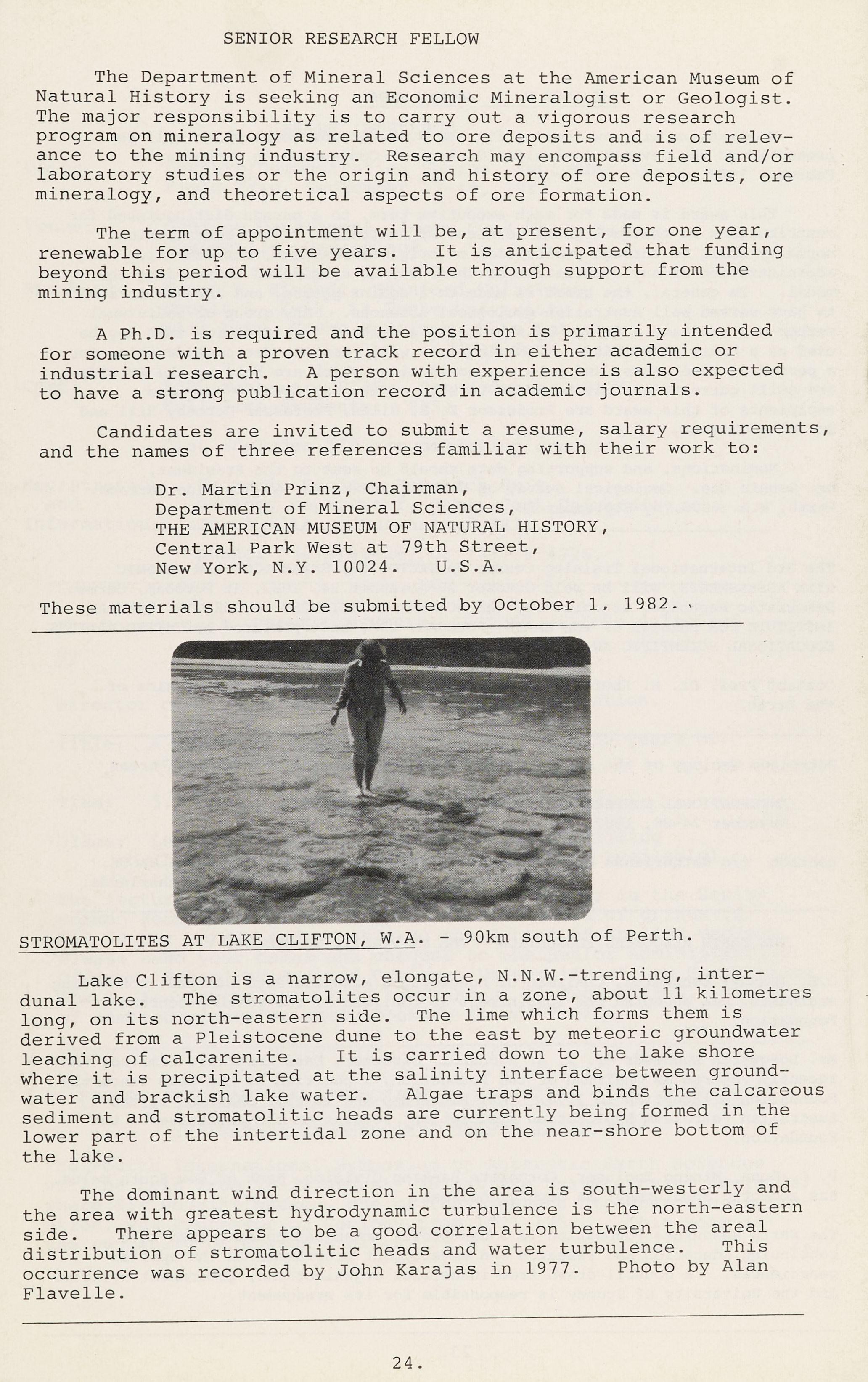
STROMATOLITES AT
Lake Clifton is a narrow, elongate, N.N.W.-trending, interdunal lake. The stromatolites occur in a zone, about 11 kilometres long, on its north-eastern side. The lime which forms them is derived from a Pleistocene dune to the east by meteoric groundwater leaching of calcarenite. It is carried down to the lake shore where it is precipitated at the salinity interface between groundwater and brackish lake water. Algae traps and binds the calcareous sediment and stromatolitic heads are currentl y being formed in the lower part of the intertidal zone and on the near-shore bottom of the lake.
The dominant wind direction in the area is south-westerly and the area with greatest hydrodynamic turbulence is the north-eastern side. There appears to be a good correlation between th e areal distribution of stromatolitic heads and water turbule nce. This occurrence was recorded by John Karajas in 1977. Photo by Alan Flavelle.
LAKE CLIFTON, W.A. - 90km south of Perth.