The Australian Geologist
EDITORIAL
1st August 1981
This issue features no substantial articles and is largely bits and pieces . Nevertheless it contains some important information about the Society's affairs as we come to the end of another executive reign.
The Society has been well served by its president, secretary and treasurer and other executive officers in the past, and the retiring team led by Colin Branch, Bridget Youngs (I'm spelling it right at last), and Jim Jago are no exception to this rule.
The financial report, printed within, shows that the Society has a solid economic foundation. Although this may be partly the result of the unavoidable delays in publishing the journal and consequent smaller pay outs during the past year, it is largely due to the harsh but necessary parsimony of earlier treasurers and some canny investing.
However we must not forget the large amount of voluntary work which is done by many organisations on behalf of the Society. In this respect it is clear that rotation of the executive from division to division has materially helped the development of the Society. This rotation has also involved many more people in Society affairs than would have been likely had a centralised executive location been established. The combination of varying executive with a central office maintained full-time has worked well.
There can be little doubt that most members are getting value for their money. Our subscription rates remain reasonable and our Convention fees are not absurdly astronomical. Long may this situation prevail! On your behalf I welcome the incoming executive from W.A. May it (?they) enjoy a stimulating period in office.
NOW AVAILABLE -
Geological Society of Australia
ABSTRACTS Nu'!lber 1
ABSTRACTS Number 2
COAL, TIN SURFICIAL DEPOSITS AND GEOLOGY OF N.E. TASMANIA
Nov. 1980 $7.50
AUSTRALASIAN SEDIMEN'IDLOGISTS GROUP CONFERENCE Dec. 1980 $7.50
Send your order and payment to:
Geological Society of Australia Inc., 10 Martin Place, Sydney, NSW 2000.
Sir,
This concerns the two letters, one from Roger Callen and the other from Frank Canavan, which appeared in the May 1981 Newsletter GS A on pp 9 / 10 and 12/13:
PALAEOCENE, SEMANTICS, EDUCATION AND ALL THAT
There was really no need for Roger Callen (Newsl. May 1981, p 9 / 10) to go searching all over the literature in various languages for an explanation of the origin and meaning of the concept PALAEOCENE. As some proverbs say : The best things are commonly found at home. Just pick up the 2nd edition of ANCIENT AUSTRALIA (1969, Angus & Robertson, Sydney). Most libraries have a copy even though the book is merely a "popular" introduction to geology and therefore rarely considered worth reading among us professionals . Nevertheless - on the f irst two pages of Chapter 14 (i e. pp 197/198) the story about the Cainozoic and its Epochs is given to the layman and amateur or to the young student in the simplest terms I could manage
It so emerges that all four semantic derivation suggestions listed by Roger Callen in the subtitle are wrong ! The simple fact is that the word Palaeocene is constructed from the roots of three - not two - Greek words, namely :
PALAt~$ - EO$ - KAINOS makes PALA'EO'CENE
As for the meaning of these and other such Greeterkiary terms, just read through that page 198
I am simply telling you what I was taught by my teachers at Zurich University nearly 50 years ago and I trust, dear colleagues, you too will find the whole thing very logical and reasonable just as I did and do The percentage (or Recent species) idea, incidentally, was first proposed by the Frenchman Deshayes in the 1820s A Dutch palaeontologist (K . Martin, 1879 / 80) later appliedwith some reservations - the system and developed it in conne x ion with his comprehensive studies of the Tertiary faunas of Java
But now to Frank Canavan's letter about education, committees (prone and standing) of the G.S .A. , etc. I agree, the lack of effort in the educational field on the part of most members of our Societ y is certainl y deplorable. We have obviously very little influence, directly or indirectl y through the teachers, at the most important level - that of the high school, but I disagree with Frank when he suggests that it is the lack of a suitable textbook for such high school environments which is responsible (Newsl . May 1981 , p. 12) .
(cont page 10)
NEWS FROM THE NERVE CENTRE
The Society is well set for a good Convention in Perth thanks to the hard work of the local division and there has· been good support from members who will be venturing across the continent to see how the better half lives. Retiring Secretary Bridget Youngs managed to badger reports from most bodies within the Society and the Council Meeting, scheduled now for August 15th, looks set to be a fruitful one and not the most contentious (o~ hopefully, longest) in the Society's turbulent history.
As usual there have been delays in submitting audited accounts of various divisions, branches and specialist groups for 1980. The Society is not helped by these delays as it strengthens the argument for centralised accounting which has been proposed, particularly by the Society's Auditors, numerous times in the past few years.
The Society, through the President, has protested to the Prime Minister about the introduction of fees for students in geology undertaking higher degrees.
The Executive has recommended that submitted, acceptable Papers from the Perth Convention be published in one volume, if practicable. Early collaboration between the Honorary Editor and the convener of future conferences is recommended to plan publication of convention papers.
Sandy Renwick, still suffering from the excesses of IGC 1976, has accepted the plum job of Organiser of the Society's 6th (really the 7th) Convention in Canberra in February 1983.
The Executive rejected an impassioned plea from the G.M. to hold the 1983 Convention in Broken Hill during the centenary yeqr of that fair city - perhaps the local branch will spring to the rescue? On the other hand a proposal for a Special Publication on Broken Hill geology was approved in principle.
To go to the other extreme it is possible that the Society will also make a Special Publication of papers from the 4th International Symposium on Antarctic Earth Sciences.
Solidarity reigns forever! The national committees of the Australian Academy of Science for geology and geophysics are now one, viz. Solid Earth Sciences Committee. The Society also has an interest in the Environmental Science Committee, and a more --i mportant, formal role in connection with the 25th IGC Fund.
Maud McBriar of Adelaide has taken over temporarily from Neville Stevens of Brisbane as Federal Convener for Geological Monuments.
Mawson Institute of Antarctic Research, University of Adelaide (contact Mrs Ka y Mead) requests any information, papers etc. relating to Mawson and his colleagues.
Standards Association of Australia has sent a Draft Standard for Iron Ores. Contact the Secretary if you must see it.
NOTICE FROM THE HONORARY EDITOR OF THE J G.S A
One of the main current problems in editing the Journal concerns the abbreviations of titles of scientific publications. Rhonda Staude (the editorial assistant), Warren (her husband, who has been extremel y helpful, in an honorar y capacity) and I have torn out considerable amounts of hair in arriving at all to~ arbitrar i decisions on abbreviations. So I have decided that, with Vol. 29 (Nos 1-2) - due to appear on 31 March 1982 - we will fol l ow precisel y the abbreviations used by the Bibliography and Index of Geology in its List of Serials (Cumulati v e Bibliography), published by The American Geological Institute. A copy of the abbreviations of the more common journals will be available f rom me , on request.
Therefore , I ask all authors preparing papers at present to use the abbreviations in the above list.
The abbreviations will still be italicized and the format for references will remain the same as at present .
The Tectonics and Structural Geolog y Newsletter, No . 7 of the Society 's Specialist Group, was published in December 1980. This contained reports on the Tasman Orogen Project, the 4th AGC in Hobart and the Gottingen (West Germany) Conference. The bulk of the newsletter was taken up with a resume of current structural and tectonic research being conducted in Australia n and New Zealand Uni v ersities and Institutes, There are currentl y 333 members in the Group.
The As s oc i ation o f Geo s ci e n t ists for In t ern a t i ona l Deve l opmen t (AGI D) is spons o r ing a 'Wor k s hop on the Rol e o f Edu c ational In st it u t e s i n Na t u r al Re sour ces Deve lopme n t i n Southe as t Asia', whi ch will be he l d in Man il a , The Phi l ippines, on 1 7 Novemb er 1 98 1.
Contact : Dr B K Tan , Conven o r , AGID Geosc i ence Education Work s hop, Department of Ge ology , Univer s i t y of Malaya , Kuala Lumpur, Malays i a 6
Association of Geoscientist• for International Development
In February, 1981, the Association of Geoscientists for International Development (AGID) opened its new global headquarters at the Asian Institute of Technology (AIT) in Bangkok, Thailand, where its President, Dr Prinya Nutalaya is based. The former secretariat in Caracas is now operating as a Regional Office for Latin Ammerica and the Caribbean under the supervision of Dr Alirio Bellizzia, and a new Regional Office for Africa has also been established at Ahmadu Bello University in Nigeria where both AGID's PastPresident, Prof. Deborah Enilo Ajakaiye, and Council member Michael E. Woakes are loc~ted.
The decision to move the Headquarters to Asia was taken by the Council in Paris, 1980, in recognition of the major accomplishments of the past two years in increasing the membership and organizing activities in Latin America, and in order to build up the Association in Asia and the Pacific, where the cost of operations are also lower than those in Venezuela. AIT, a post-graduate engineering institution for the whole of Asian region, is providing facilities and services to the new Headquarters, which is housed in the Geotechnical Division. Discussions are now underway to explorepossible avenues for cooperation with the Asian Regional Geoscience Network, various IGCP Asian projects, the ESCAP Regional Mineral Resources Development Center and other Asian organizations and individuals.
In Caracas, the Regional Office is now working in close co-operation with the Consejo Consultivo de Directores de los Servicios Geologicos de Latinoamerica, of which Dr Bellizzia is also the Executive Secretary. Aguas Subterraneas, AGID's bimonthly Spanish newsletter on groundwater begun in 1979, is now produced jointly by AGID and Consejo, as is Secuencia, a new information bulletin also in Spanish, focussing on mineral resources. The editor for both of these publications is Victor Ricaldi, who is also assisting the Consejo in the publication of its own Segela, a news-sheet in Spanish and English on current geoscience activities in the region.
In the last six months the Caracas Office has organized in co-operation with other Latin American groups five training courses: alluvial gold prospecting (Peru), applied mineral economics (Brazil), alluvial tin deposits (Bolivia, using instructors from Malaysia), groundwater (Ecuador), and well drilling techniques (Bolivia). Planning for further training courses and workshops in the region is now underway.
The Nigerian Office launched its own program in January, 1981, with the publication of the first issue of the bilingual, French-English, West Africa Geoscience Newsletter. Plans are also being formulated for other regional activities, for example in the fields of drilling techniques and small scale mining and mineral industries.
Enquiries regarding publications and memberships in the Association, and comments and proposals concerning activities are welcomed and may be addressed to the Headquarters or to either of the Regional Offices.
Headquarters: AGID, Asian Institute of Technology, Box 2754, Bangkok, Thailand.
Regional Offices: AGID, Apartado 3672, Carmelitas, Caracas 1010A, Venezuela. AGID, Depts Physics & Geology, Ahmadu Bellow University, Box 393, Zaria, Nigeria.
The Society is a member of AGID paying the princely yearly subscription of $75.
ENGINEERING GEOLOGY GROUP
ELECTS NEW COMMITTEE
Following an election by ballot, the executive committee of the Engineering Geology Group has moved to Queensland during May 1981, where it will remain for the next two years.
The new committee comprises Dr. G. W. Hofmann (Geological Survey of Queensland) as chairman, Mr. I. D. Hair (Geological Survey of Queensland) as secretary, Mr. J.E. Martin (Geological Survey of Queensland) as treasurer, and Messrs. D. Aubrey (Queensland Water Resources Commission) and G. Miles (Queensland Main Roads Department) as committee members. State representatives are Messrs. E. J. Minty and R. B. Smith (both Department of Main Roads) for New South Wales, Mr. A. Davies (Utah Development Co.) for Queensland, Mr. M.A. Cobb (Department of Mines and Energy) for South Australia, Mr. B. Weldon (Department of Main Roads) for Tasmania, Dr. E. K. Carter (Bureau of Mineral Resources) for the A.C.T., and Mr. C. Key (Main Roads Department) for Western Australia.
ENGINEERING GEOLOGY GROUP
SYMPOSIUM ON ENGINEERING, GEOLOGY AND ENVIRONMENT
May 1982 (2-3 days talk, 2 days walk) BRISBANE
Papers relating case histories or general treatment are called for on every conceivable topic.
Contact: Mr. I. D. Hair, Secretary, Engineering Geology Group, c/- Geological Survey of Queensland, G.P.O. Box 194, Brisbane, Qd 4001.
KERRY OWEN REID
Kerry Reid, Chief Geologist of the Mt Lyell Mining and Railway Company Ltd., Queenstown, Tasmania, died suddenly on April 16th, 1981, shortly after his 40th birthday.
Kerry was an Honours graduate of the University of Tasmania, and joined the Mt Lyell Company in 1966. He became Chief Geologist in 1968. He took a leading role in the promotion of geological activities on the West Coast and in developing the high degree of intercompany communication and co-operation which now exists. He maintained a keen interest in the affairs of the Geological Society, being industry representative on the Divisional subcommittees for Professionalism and Legislation, Geological Monuments and Education. He was also closely involved with the West Coast branch of the A.I.M.M.
Kerry's open and friendly attitude impressed all who came to Mt Lyell, and the generous hospitality of hirnand his wife Sue will be remembered with pleasure by numerous local, interstate and overseas visitors.
Kerry was a keen fisherman and camper, and had a deep love for the mountains and lakes of his native state. He was an enthusiastic worker and a loyal and highly valued member of the company staff.
Kerry's death, which came as a result of a rare viral infection, represents a great loss to the geological fraternity in Tasmania and to his many friends.
Keith D. Corbett
BICENTENNIAL HISTORY OF AUSTRALIAN SCIENCE
The Australian Academy of Science is proposing to celebrate the bicentenary of Australia by publishing in 1988 one or more volumes dealing with the history of science and applied science in this country since 1788.
For further information contact:
The Committee Secretary, Mr. Peter Vallee, Academy of Science, P.O. Box 783, Canberra City, A.C.T. 2601.
Letters (continued from page 4)
In other words, what was or is wrong with the afore mentioned "popular" ANCIENT AUSTRALIA (of which a 3rd edition is in preparation)? As can be seen from the first part of this letter, even professionals may find valuable information there. After all, "popular science" books are not necessarily written by ignorami, and they are certainly aimed precisely at that part of the general public which the Standing Committee of the G.S.A. is trying to tickle or supposed to try to tickle.
Rudi Brunnschweiler
Canberra
Sir,
Your anguished correspondent Roger Callen (No. 34, May 1981) omitted to quote the one reference I was brought up to accept as the 'Ultimate Authority' on English spelling and philology.
The Shorter Oxford Dictionary (Little et al., 1972) housed in our library differs only from the Society Editor in suggesting that "palaeo" should appear complete with the dipthong "ce "; most of the ENGLISH dictionaries I have consulted agree in attributing "paleo-" to the "U.S.".
It seems to me that honours are with The Editor!
John Richards
LITTLE, W., FOWLER, H. W. & COULSON, J. (Eds), 1972.
The Shorter Oxford Dictionary. Third Edition with corrections; ONIONS, C. T. (Ed.), Vol. II, p. 1416.
Sir,
Not only examiners come across howlers, Company geologists do too. A farmer's reply to my inquiry about rock cropping out on his farm informed me that "there's a volcanic fault over in those hills - well the must be 'cause there's shells there. I did geology at school, you know".
Ann Wright, Canberra.
Permian Publication Please
Special Publication No. 2, Permian of Australia is sought by earnest student. Would someone who has risen to the Mesozoic sell a copy to -
Mr. G. Binns, 624 Rocky Point Road, Sand Souci, N.S.W. 2219.
The End of the End?
AUSTRALIAN QUATERNARY NEWSLETTER is defunct Are the Friends of the Pleistocene the next to go?
The Australian Quaternary Newsletter has ceased publication with issue No. 15, August 1980 , which appeared in January 1981.
Jeannette Hope, the former editor, advises those interested to look to the Australian Archaeological Association which will a c cept as members even 'vaguely interested lay persons', and which produces a newsletter.
Contact Maureen Johnson (Treasurer's Assistant!) Dept of Prehistory Research School of Pacific Studies
A.N.U., P.O. Box 4, Canberra, ACT 2600
with your initial $15. will be $10 next year.
If you prove acceptable it
UNIVERSITY OF NEW SOUTH WALES ' School of Applied Geology and
GEOLOGICAL SOCIETY OF AUSTRALIA
N.S.W Division
are sponsoring
The third J.J. FRANKEL MEMORIAL LECTURE, which will be delivered by
MR. FRANKS. JEFFRIES
Geological Co - ordinator, Esso Australia
Title: GEOLOGICAL MODELS IN THE EIGHTIES
Time: 5 30 p.m. Wednesday , 2nd September, 1981
Place: Lecture Theatre Ll, Applied Science Building (Lower Campus), Kensington (Parking Available)
The lecture will be followed by a buffet dinner in the Senior Common Room (Roundhouse). The cost inclusive of predinner drinks is $10 per person and payable to the School of Applied Geology Please send your names and cheques to the Administrative Officer, School of Applied Geology, University of New South Wales, Box 1, Kensington, N.S.W. by Monday, 24th August, 1981.
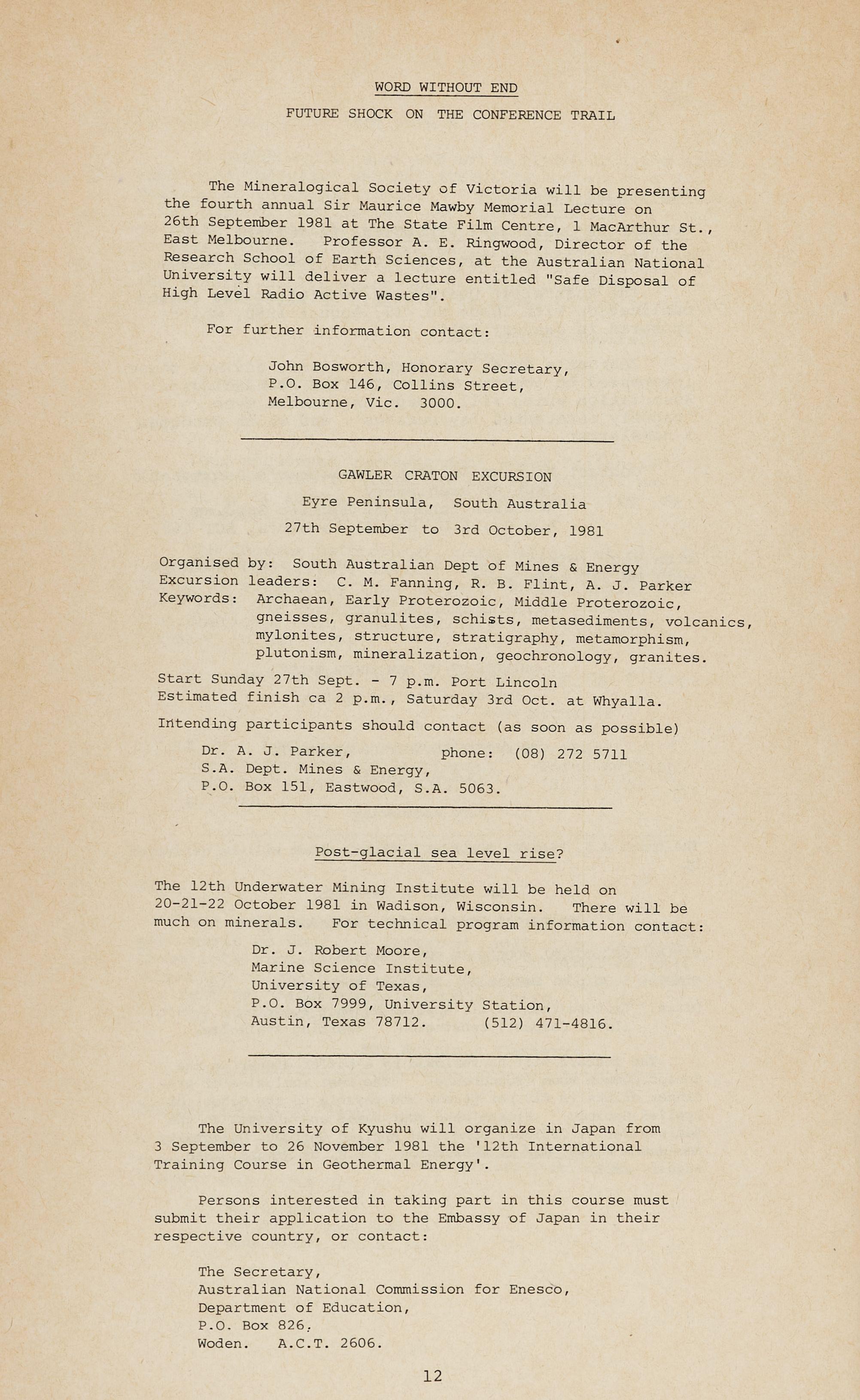
WORD WITHOUT END FUTURE SHOCK ON THE CONFERENCE TRAIL
The Mineralogical Society of Victoria will be presenting the fourth annual Sir Maurice Mawby Memorial Lecture on 26th September 198 1 at The State Film Centre, 1 MacArthur St ., East Melbourne Professor A E. Ringwood , Director of the Research School of Earth Sciences , at the Australian National University will deliver a lecture entitled "Safe Disposal of High Level Radio Active Wastes".
For further information contact:
John Bosworth , Honorary Secretary , P.O. Box 146 , Collins Street, Melbourne, Vic 3000.
GAWLER CRATON EXCURSION
Eyre Peninsula , South Australia
27th September to 3rd October, 1981
Organised by : South Australian Dept of Mines & Energy Excursion leaders: C M Fanning, R. B Flint , A J Parker
Keywords : Archaean, Early Proterozoic, Middle Proterozoic , gneisses, granulites , schists, metasediments , volcanics, mylonites , structure , stratigraphy, metamorphism , plutonism , mineralization , geochronology , granites.
Start Sunday 27th Sept. - 7 p.m. Port Lincoln Estimated finish ea 2 p m., Saturday 3rd Oct at Whyalla.
Irttending participants should contact (as soon as possible)
Dr. A J Parker , phone: (08) 272 5711
S.A . Dept Mines & Energy, P.O Box 151, Eastwood, S.A. 5063.
Post - glacial sea level rise?
The 12th Underwater Mining Institute will be held on 20 - 21 - 22 October 1981 in Wadison , Wisconsin There will be much on minerals. For technical program information contact :
Dr. J. Robert Moore , Marine Science Institute , University of Texas, P.O Box 7999, University Station, Austin , Texas 787 1 2. (512) 471-4816
The University of Kyushu will organize in Japan from 3 September to 26 November 1981 the '12th International Training Course in Geothermal Energy'
Persons interested in taking part in this course must submit their application to the Embassy of Japan in their respective country, or contact:
The Secretary, Australian National Commission for Enesco, Department of Education, P.O. Box 826, Woden A.C.T. 2606.
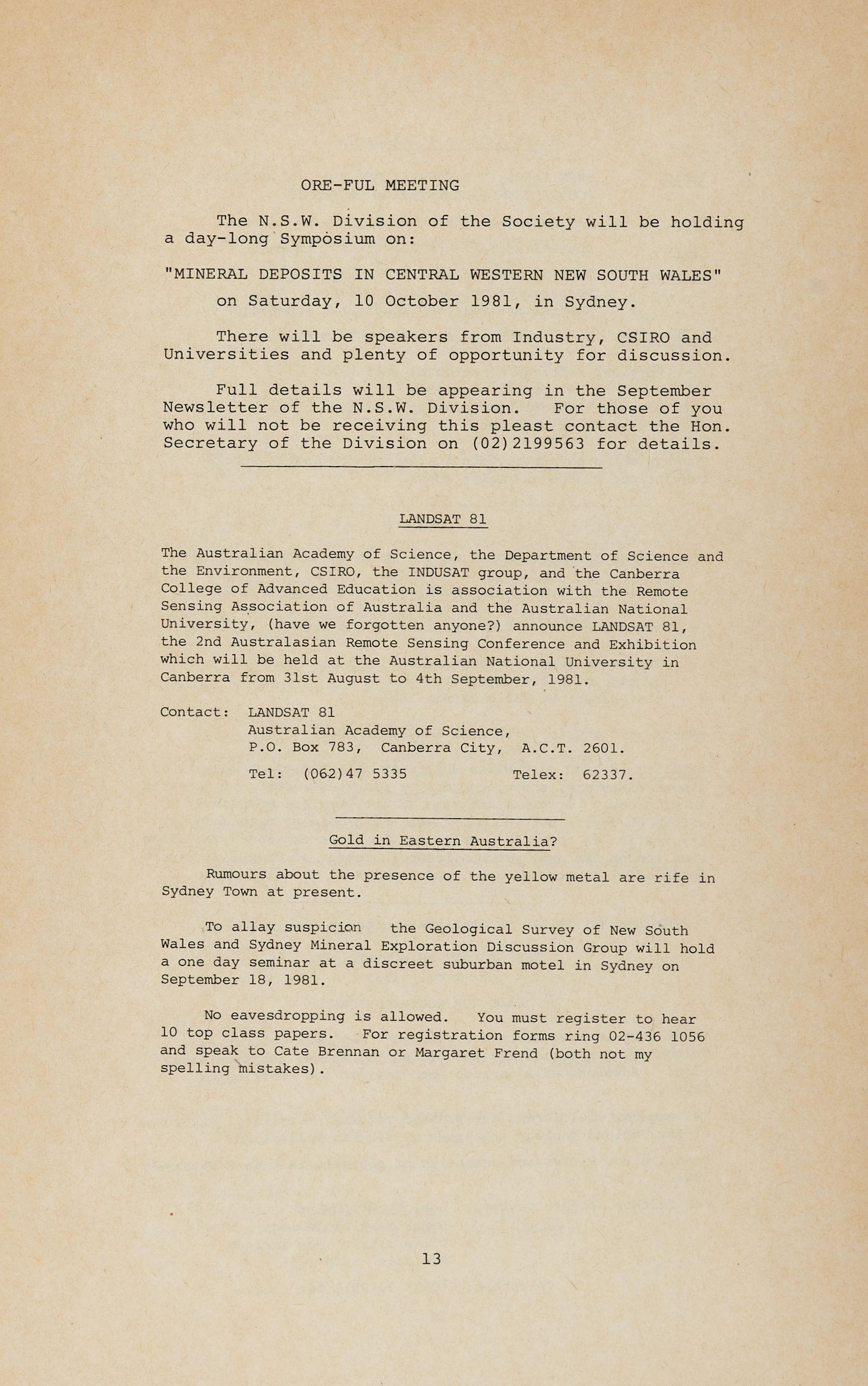
ORE-FUL MEETING
The N.S.W. Division of the Society will be holding a day - long symposium on:
"MINERAL DEPOSITS IN CENTRAL WESTERN NEW SOUTH WALES" on Saturday, 10 October 1981, in Sydney.
There will be speakers from Industry, CSIRO and Universities and plenty of opportunity for discussion.
Full details will be appearing in the September Newsletter of the N.S.W. Division. For those of you who will not be receiving this pleast contact the Hon. Secretary of the Division on (02)2199563 for details.
LANDSAT 81
The Australian Academy of Science, the Department of Science and the Environment, CSIRO, the INDUSAT group, and 'the Canberra College of Advanced Education is association with the Remote Sensing As sociation of Australia and the Australian National University, (have we forgotten anyone?) announce LANDSAT 8 1, the 2nd Australasian Remote Sensing Conference and Exhibition which will be held at the Australian National University in Canberra from 31st August to 4th September, 19 8 1.
Contact: LANDSAT 81
Australian Academy of Science, P.O. Box 783, Canberra City, A.C.T. 2601.
Tel: (06-2)47 5335
Telex: 62337.
Gold in Eastern Australia?
Rumours about the presence of the yellow metal are rife in Sydney Town at present.
To allay suspicion the Geological Survey of New South Wales and Sydney Mineral Exploration Discussion Group will hold a one day seminar at a discreet suburban motel in Sydney on September 18, 1981.
No eavesdroppi n g is allowed. You must register to hear 10 top class papers. For registration forms ring 02-436 1056 and speak to Cate Brennan or Margaret Frend (both not my spelling mistakes).
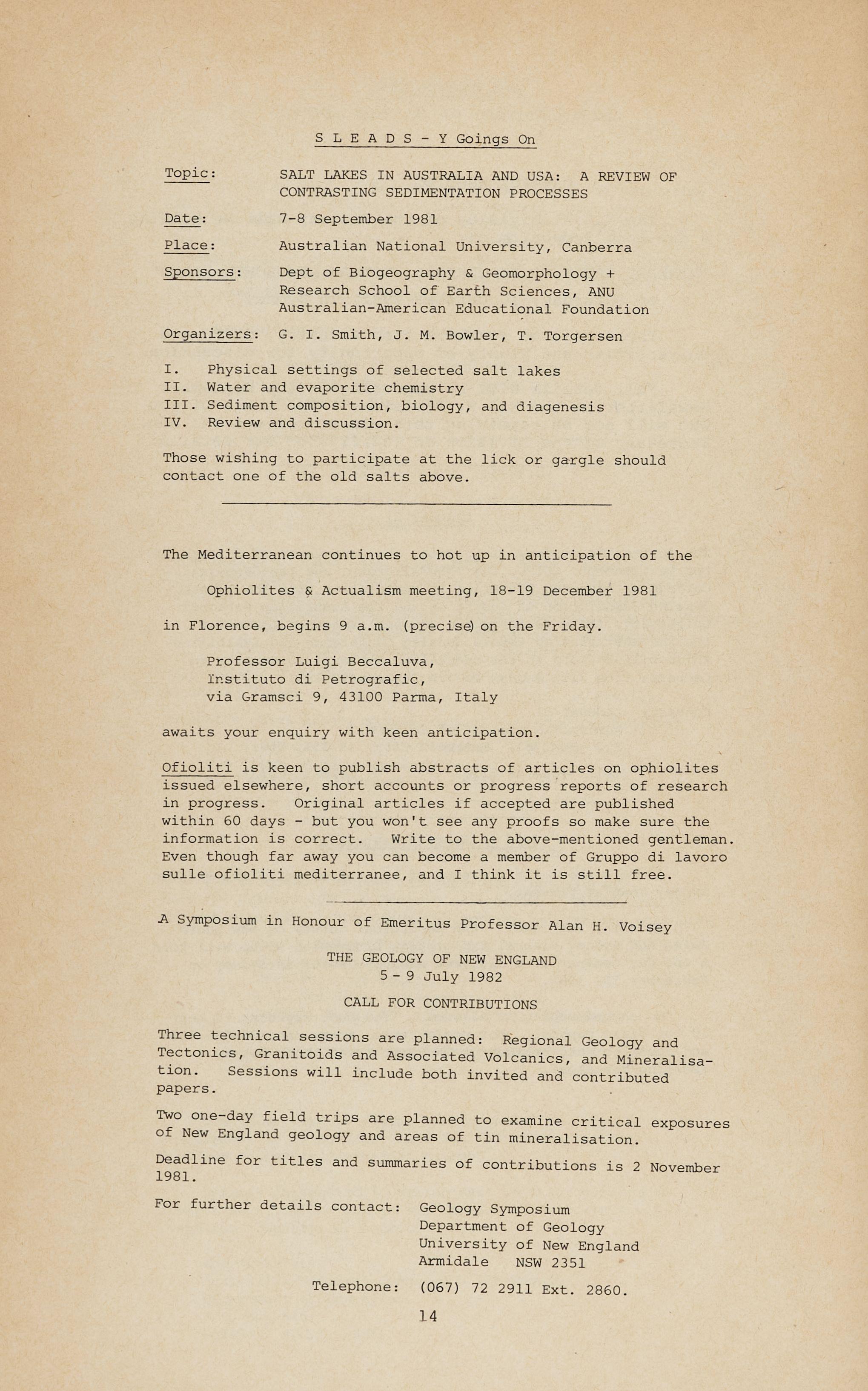
s LE AD s - y Goings On
Topic : SALT LAKES IN AUSTRALIA AND USA : A REVIEW OF CONTRASTING SEDIMENTATION PROCESSES
Date : 7 - 8 September 1981
Place: Australian National University, Canberra
Sponsors: Dept of Biogeography & Geomorphology+ Research School of Earth Sciences , ANU
Australian - American Educational Foundation
Organizers: G. I. Smith, J M Bowler , T Torgersen
I Physical settings of selected salt lakes
II. Water and evaporite chemistry
III. Sediment composition , biology, and diagenesis
IV Review and discussion.
Those wishing to participate at the lick or ga-rgle should contact one of the old salts above
The Mediterranean continues to hot up in anticipation of the Ophiolites & Actualism meeting , 18 - 19 December 1981 in Florence, begins 9 a.m. (precis~ on the Friday.
Professor Luigi Beccaluva, Ir.stituto di Petrografic , via Gramsci 9, 43100 Parma , Italy
awaits your enquiry with keen anticipation
Ofioliti is keen to publish abstracts of articles on ophiolites issued elsewhere, short accounts or progress reports of research in progress. Original articles if accepted are published within 60 days - but you won't see any proofs so make sure the information is correct. Write to the above-mentioned gentleman. Even though far away you can become a member of Gruppo di lavoro sulle ofioliti mediterranee, and I think it is still free
.A Symposium in Honour of Emeritus Professor Alan H Voisey
THE GEOLOGY OF NEW ENGLAND 5 - 9 July 1982
CALL FOR CONTRIBUTIONS
Three technical sessions are planned: Regional Geology and Tectonics, Granitoids and Associated Volcanics, and Mineralisation Sessions will include both invited and contributed papers
Two one - day field trips are planned to examine critical exposures of New England geology and areas of tin mineralisation.
Deadline for titles and summaries of contributions is 2 November 1981.
For further details contact: Geology Symposium Department of Geology University of New England Armidale NSW 2351
Telephone : (067) 72 2911 Ext. 2860
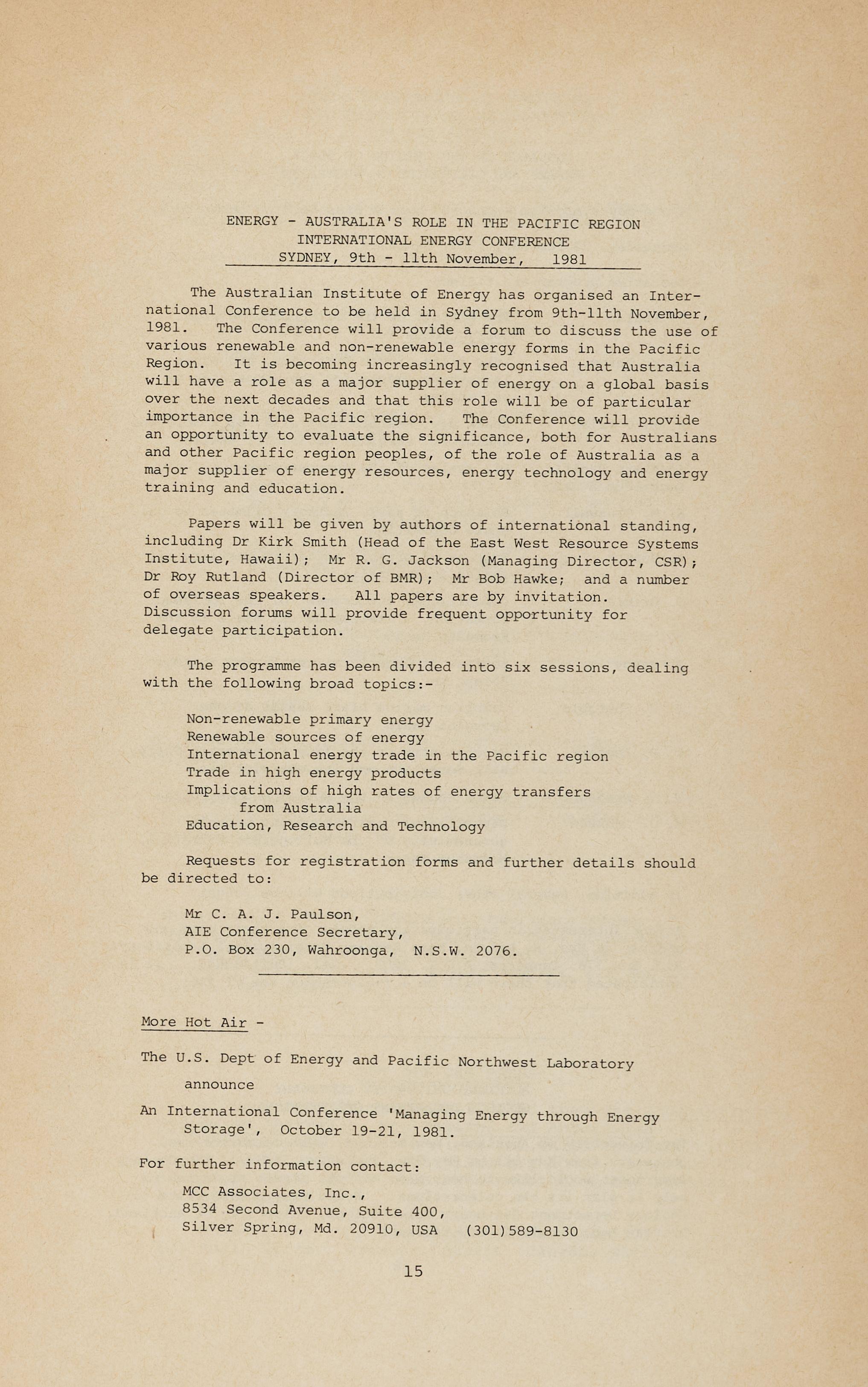
ENERGY - AUSTRALIA'S ROLE IN THE PACIFIC REGION INTERNATIONAL ENERGY CONFERENCE
SYDNEY , 9th - 11th November, 1981
The Australian Institute of Energy has organised an International Conference to be held in Sydney from 9th-llth November, 1981. The Conference will provide a forum to discuss the use of various renewable and non-renewable energy forms in the Pacific Region It is becoming increasingly recognised that Australia will have a role as a major supplier of energy on a global basis over the next decades and that this role will be of particular importance in the Pacific region . The Conference will provide an opportunity to evaluate the significance, both for Australians and other Pacific region peoples, of the role of Australia as a major supplier of energy resources, energy technology and energy training and education.
Papers will be given by authors of international standing, including Dr Kirk Smith (Head of the East West Resource Systems Institute, Hawaii); Mr R. G. Jackson (Managing Director, CSR); Dr Roy Rutland (Director of BMR); Mr Bob Hawke; and a number of overseas speakers All papers are by invitation . Discussion forums will provide frequent opportunity for delegate participation
The programme has been divided into six sessions, dealing with the following broad topics:-
Non-renewable primary energy Renewable sources of energy
International energy trade in the Pacific region Trade in high energy products Implications of high rates of energy transfers from Australia Education, Research and Technology
Requests for registration forms and further details should be directed to :
Mr C A. J. Paulson, AIE Conference Secretary, P O. Box 230, Wahroonga, N . S.W. 2076.
More Hot Air -
The U.S. Dept of Energy and Pacific Northwest Laboratory announce
An International Conference 'Managing Energy through Energy Storage' , October 19 - 21, 1981
For further information contact:
MCC Associates, Inc., 8534 Second Avenue, Suite 400, Silver Spring, Md. 20910, USA (301)589 - 8130
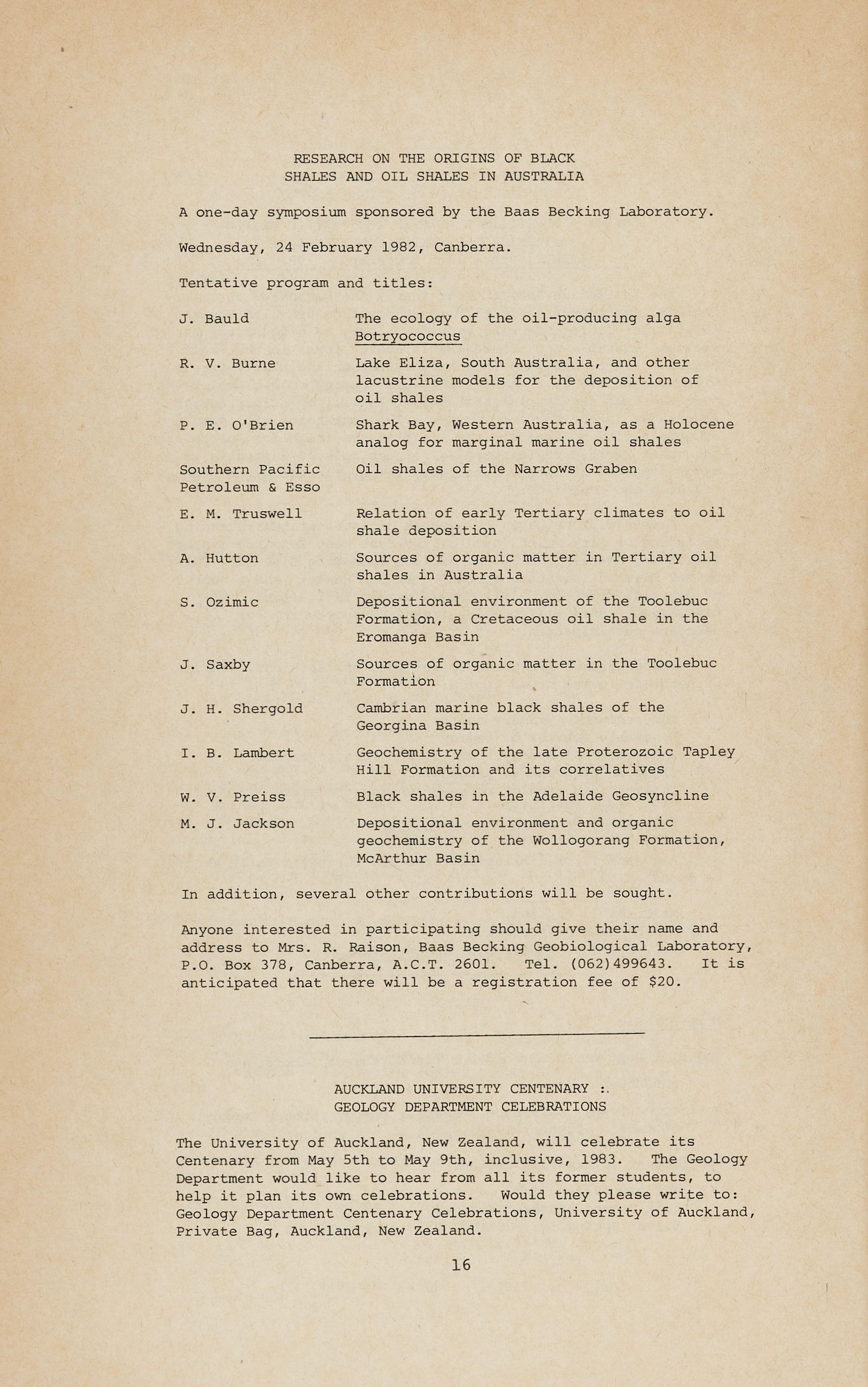
RESEARCH ON THE ORIGINS OF BLACK SHALES AND OIL SHALES IN AUSTRALIA
A one-day symposium sponsored by the Baas Becking Laboratory. Wednesday, 24 February 1982, Canberra.
Tentative program and titles:
J. Bauld
R V Burne
P E. O'Brien
Southern Pacific Petroleum & Esso
E. M. Truswell
A. Hutton
S. Ozimic
J. Saxby
J. H. Shergold
I. B. Lambert
w. V. Preiss
M. J Jackson
The ecology of the oil - producing alga Botryococcus
Lake Eliza, South Australia, and other lacustrine models for the deposition of oil shales
Shark Bay, Western Australia, as a Holocene analog for marginal marine oil shales
Oil shales of the Narrows Graben
Relation of early Tertiary climates to oil shale deposition
Sources of organic matter in Tertiary oil shales in Australia
Depositional environment of the Toolebuc
Formation, a Cretaceous oil shale in the Eromanga Basin
Sources of organic matter in the Toolebuc Formation
Cambrian marine black shales of the Georgina Basin
Geochemistry of the late Proterozoic Tapley Hill Formation and its correlatives
Black shales in the Adelaide Geosyncline
Depositional environment and organic geochemistry of the Wollogorang Formation, McArthur Basin
In addition , several other contributions will be sought.
Anyone interested in participating should give their name and address to Mrs. R. Raison, Baas Becking Geobiological Laboratory, P.O. Box 378, Canberra, A.C.T. 2601. Tel (062)499643. It is anticipated that there will be a registration fee of $20.
AUCKLAND UNIVERSITY CENTENARY :. GEOLOGY DEPARTMENT CELEBRATIONS
The University of Auckland, New Zealand, will celebrate its Centenary from May 5th to May 9th, inclusive, 1983. The Geology Department would like to hear from all its former students, to help it plan its own celebrations. Would they please write to: Geology Department Centenary Celebrations, University of Auckland, Private Bag, Auckland, New Zealand.
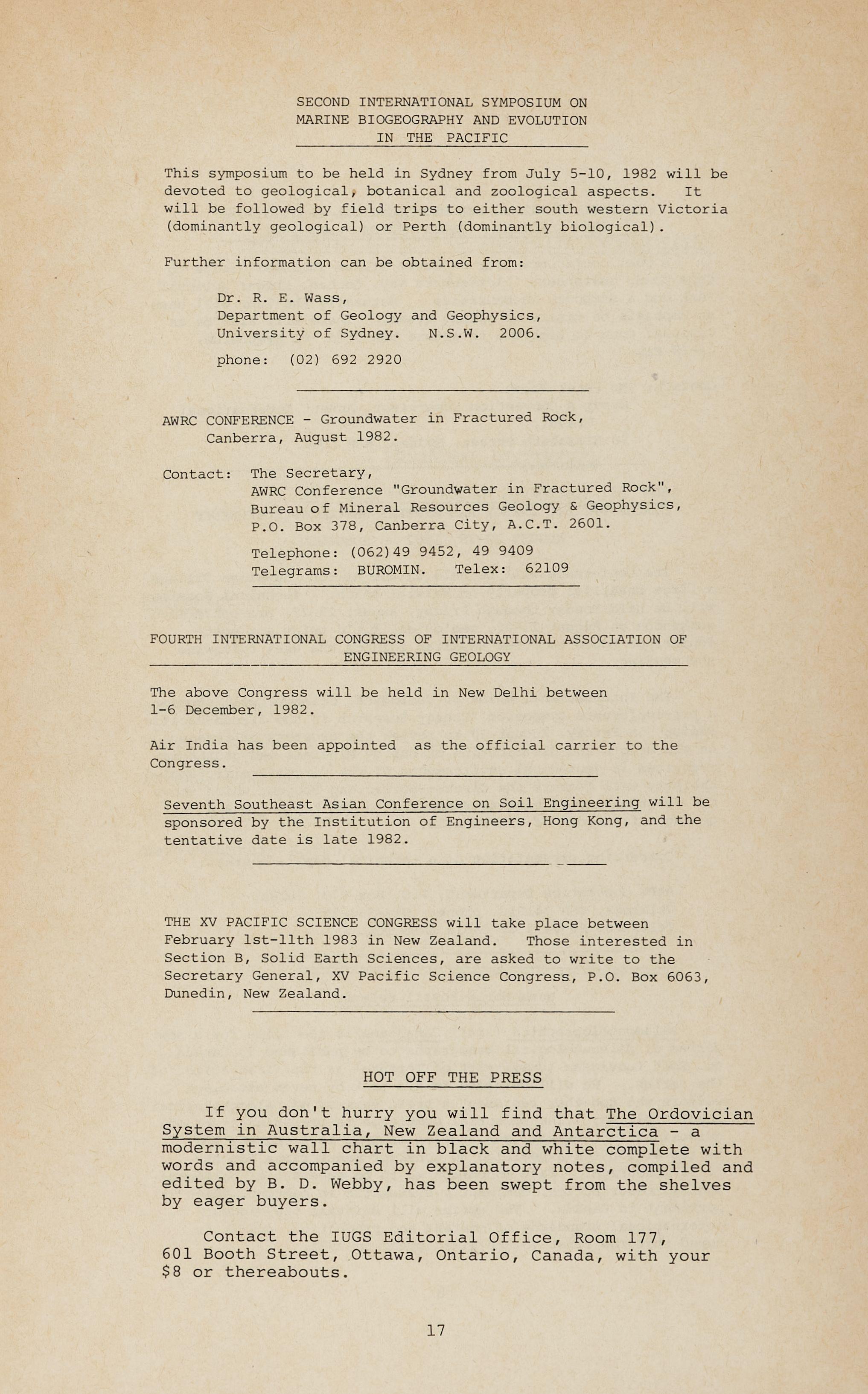
SECOND INTERNATIONAL SYMPOSIUM ON MARINE BIOGEOGRAPHY AND EVOLUTION IN THE PACIFIC
This symposium to be held in Sydney from July 5-10, 1982 will be devoted to geological, botanical and zoological aspects. It will be followed by field trips to either south western Victoria (dominantly geological) or Perth (dominantl y biological).
Further information can be obtained from :
Dr. R. E. Wass, Department of Geology and Geophysics, University of Sydney. N.S.W. 2006 phone: (02) 692 2920
AWRC CONFERENCE - Groundwater in Fractured Rock, Canberra, August 1982.
Contact: The Secretary, AWRC Conference "Groundwater in Fractured Rock", Bureau of Mineral Resources Geology & Geophysics, P.O. Box 378 , Canberra City, A.C.T. 2601.
Telephone: (062)49 9452, 49 9409
Telegrams: BUROMIN. Telex: 62109
FOURTH INTERNATIONAL CONGRESS OF INTERNATIONAL ASSOCIATION OF ENGINEERING GEOLOGY
The above Congress will be held in New Delhi between 1-6 December, 1982.
Air India has been appointed as the official carrier to the Congress.
Seventh Southeast Asian Conference on Soil Engineering will be sponsored by the Institution of Engineers, Hong Kong, and the tentative date is late 1982.
THE XV PACIFIC SCIENCE CONGRESS will take place between February lst-llth 1983 in New Zealand. Those interested in Section B, Solid Earth Sciences, are asked to write to the Secretary General, XV Pacific Science Congress, P.O. Box 6063, Dunedin, New Zealand.
HOT OFF THE PRESS
If you don't hurry you wi ll find that The Ordovician System in Australia, New Zealand and Antarctica - a modernistic wall chart in black and white complete with words and accompanied by explanatory notes, compiled and edited by B. D. Webby, has been swept from the shelves by eager buyers.
Contact the IUGS Editorial Office, Room 177, 601 Booth Street, Ottawa, Ontario, Canada, with your $8 or thereabouts.
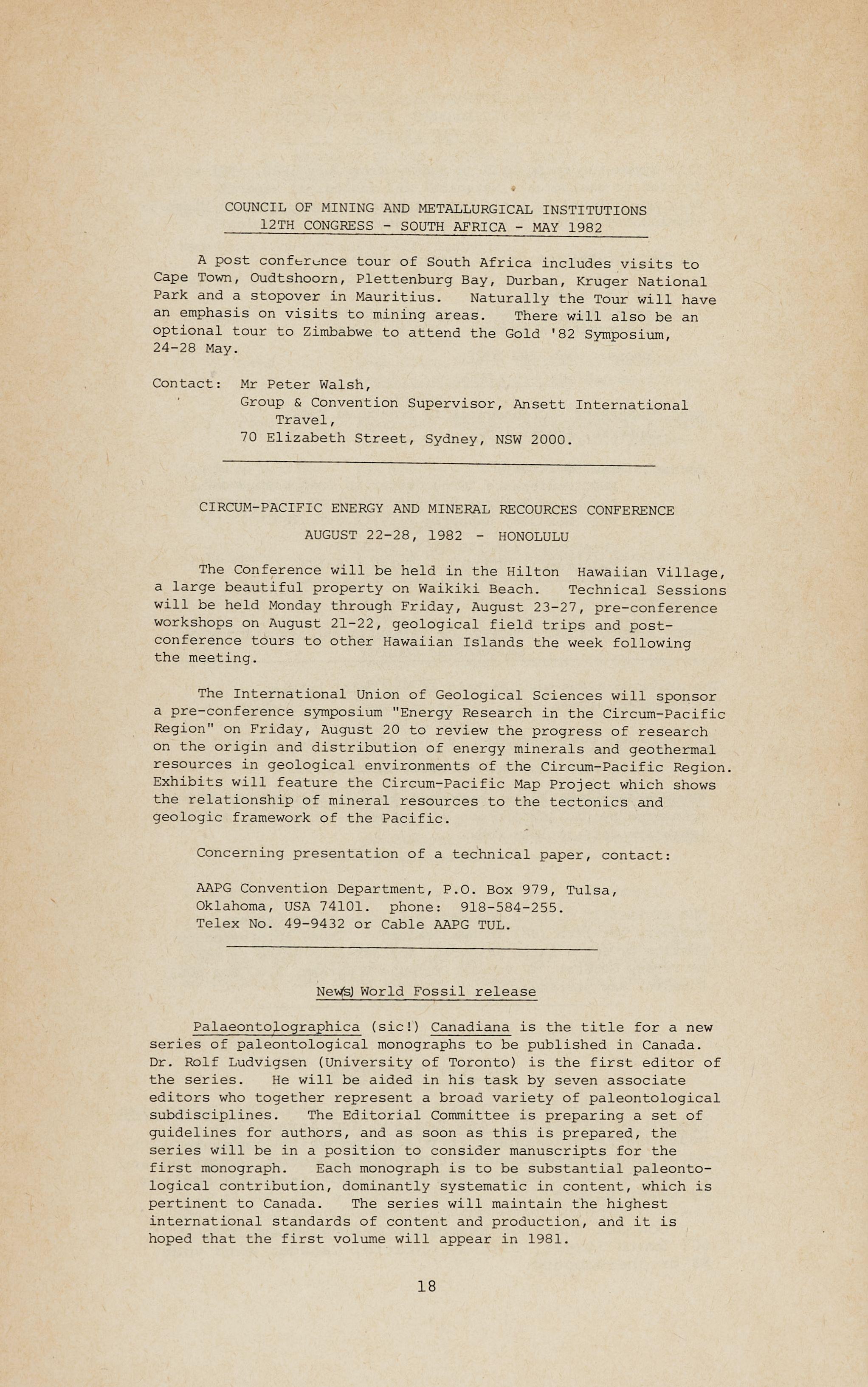
COUNCIL OF MINING AND METALLURGICAL INSTITUTIONS
12TH CONGRESS - SOUTH AFRICA - MAY 1982
A post confcrunce tour of South Africa includes visits to Cape Town, Oudtshoorn, Plettenburg Bay, Durban, Kruger National Park and a stopover in Mauritius. Naturally the Tour wil l have an emphasis on visits to mining areas. There will also be an optional tour to Zimbabwe to attend the Gold '82 Symposium , 24-28 May
Contact : Mr Peter Walsh, Group & Convention Supervisor , Ansett Internat i onal Travel , 70 E lizabeth Street , Sydney , NSW 2000
CIRCUM-PACIFIC ENERGY AND MINERAL RECOURCES CONFERENCE AUGUST 22-28, 1982 - HONOLULU
The Conference will be held in the Hi lton Hawaiian Village , a large beautiful property on Waikiki Beach. Technical Sessions will be held Monday through Friday, August 23 - 27 , pre - conference workshops on August 21 - 22, geological field trips and postconference tours to other Hawaiian Islands the week fo llowing the meeting.
The International Union of Geological Sciences will sponsor a pre - conference symposium " Energy Research in the Circum-Pacific Region " on Friday , August 20 to review the progress of research on the origin and distribution of energy minerals and geothermal resources in geological environments of the Circum - Pacific Region. Exhibits will feature the Circum - Pacific Map Project which shows the relationship of mineral resources to the tectonics and geolog i c framework of the Pacif ic.
Concerning presentation of a technical paper , contact :
AAPG Convention Department , P.O. Box 979 , Tulsa , Oklahoma , USA 74101 phone: 918 - 584-255 Telex No 49-9432 or Cable AAPG TUL
Ne$) World Fossil release
Palaeonto~ographica (sic ! ) Canadiana is the tit le for a new series of paleontological monographs to be published in Canada . Dr. Rolf Ludvigsen (University of Toronto) is the first editor of the series He will be aided in his task by seven associate editors who together represent a broad variety of paleontological subdisciplines The Editorial Commi ttee is preparing a set of guidelines for authors , and as soon as this is prepared , the series will be in a posi tion to consider manuscripts for the first monograph. Each monograph is to be substantial paleontological contribution, dominantly systematic in content, which is pertinent to Canada The series will maintain the highest international standards of content and production , and it is hoped that the first volume will appear in 1981.
GEOLOGICAL SOCIETY OF AUSTRALIA INCORPOF..ATED
Contents:
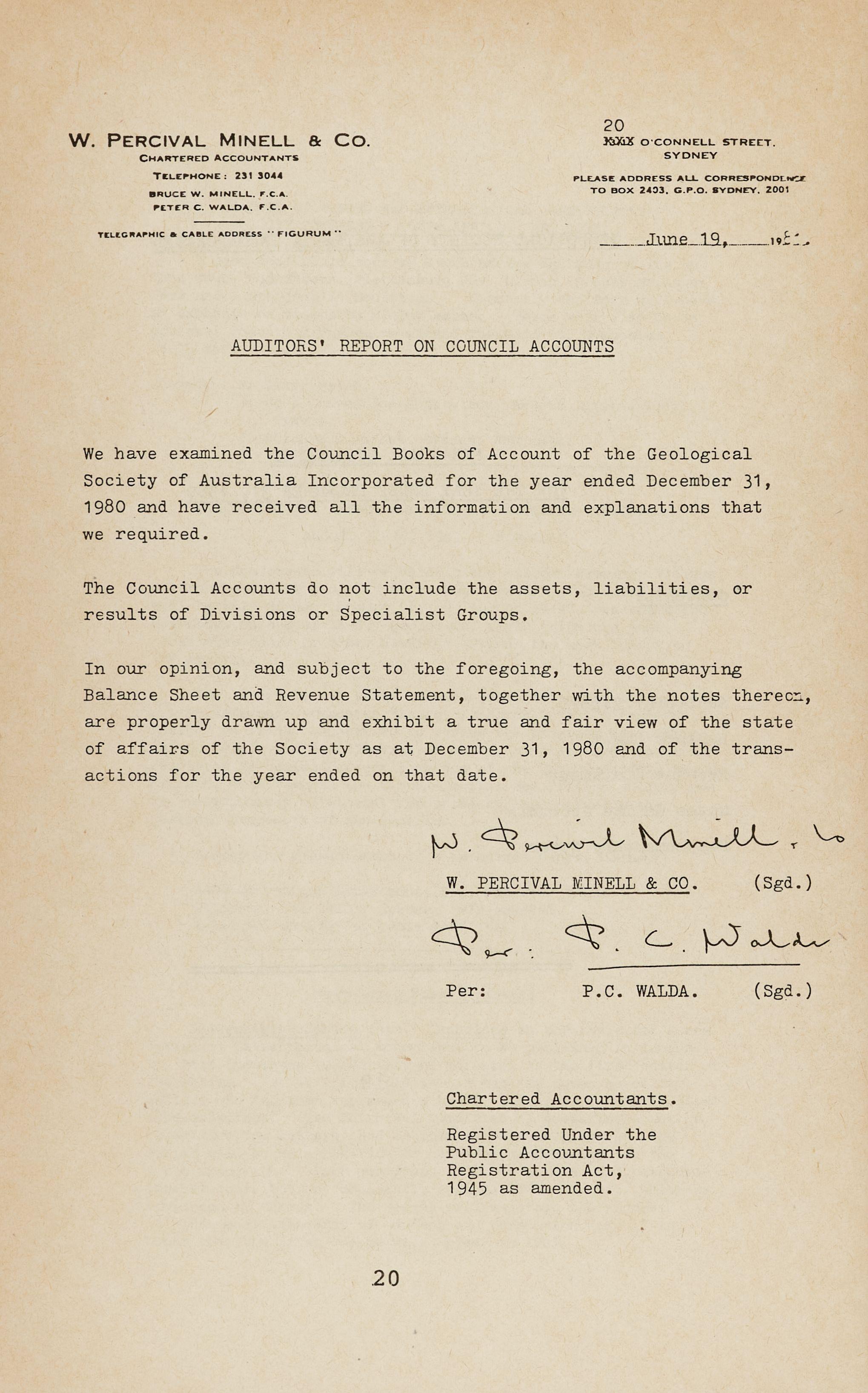
FINANCIAL STA TEMEN TS FOR THE YEAR ENDED DECEMBER 31, 1980
Auditors' Report
Balance Sheet
Revenue Stat ement
Notes On The Accounts
Supplementary Notes
W. PERCIVAL MINELL 8: CO.
CHARTERED ACCOUNTANTS
TELEJ-HONE: 211 304.
IIAUCC W. MINELL. 1'".C A
P'ET£R C. WALOA. F C.A
TCLt.C"A,-HIC
AUDITORS' REPORT ON COUNCIL ACCOUNTS
/
We have examined the Council Books of Account of the Geological Society of Australia Incorporated for the year ended December 31, 1980 and have received all the information and explanations that we required.
The Council Accounts do ~ot include the assets, liabilities, or results of Divisions or Specialist Groups.
In our opinion, and subject to the foregoing, the accompanying Balance Sheet and Revenue Statement, together with the notes therec~, are properly drawn up and exhibit a true and fair view of the state of affairs of the Society as at December 31, 1980 and of the transactions for the year ended on that date.
W. PERCIVAL MINELL & CO. Per: P.C. WALDA.
Chartered Accountants.
Registered Under the Public Accountants Registration Act, 1945 as a.mended ( Sgd.) (Sgd.)
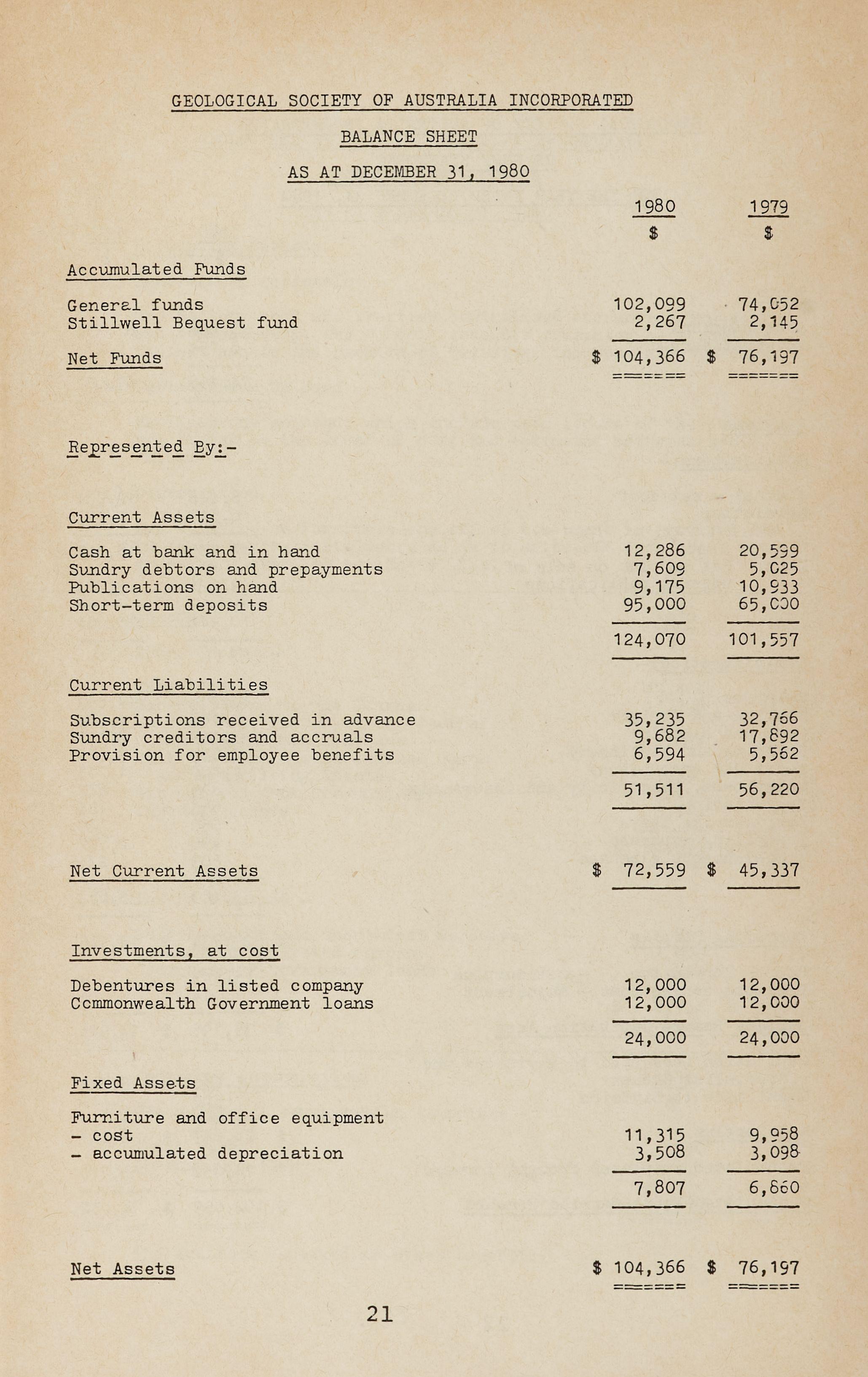
BALANCE SHEET
AS AT DECEMBER 31, 1980
Accumulated Funds
General funds
Stillwell Bequest fund
Net Funds
Current Assets
Cash at bank and in hand
Sundry debtors and prepayments
Publications on hand
Short-term deposits
Current Liabilities
Subscriptions received in advance
Sundry creditors and accruals
Provision for employee benefits
Net Current Assets
Investments, at cost Debentures in listed company Ccmrnonwealth Government loans
12,286 7,609 9,175 95,000 124,070 35,235 9,682 6,594 51,511 20,599 5,C25 10,933 65,CJO 101,557 32,766 17,892 5,562 56,220 $ 72,559 $ 45,337
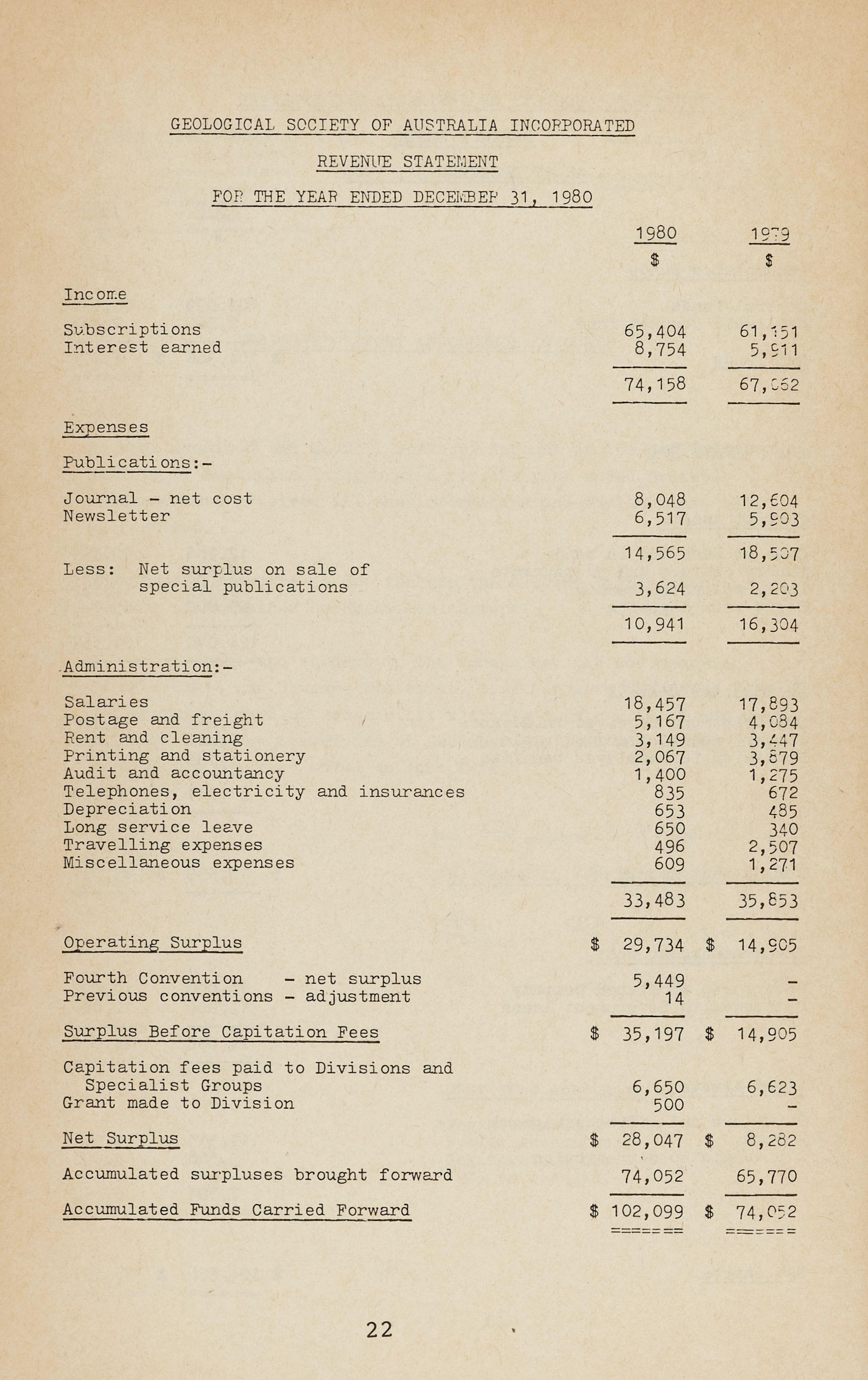
GEOLOGICAL SOCIETY OF AUSTRALIA INCORPORATED REVENUE S'IATEf,JENT
FO F? THE YEAR E~'T)ED DECE!iill EP 31 , 198 0
Svbscriptions
Interest earned
Expenses
Publications:-
Journal - net cost
Newsletter
Less: Net surplus on sale of special publications
.Administration:-
Salaries
Postage and freight
Rent and cleaning
Printing and stationery
Audit and accountancy
Telephones, electricity and insurances
Depreciation
Long service leave
Travelling expenses
Miscellaneous expenses
Operating Surplus $
Fourth Convention - net surplus
Previous conventions - adjustment
Surplus Before Capitation Fees
Capitation fees paid to Divisions and Specialist Groups
Grant made to Division
Net Surplus
Accumulated surpluses brought forward
Accumulated Funds Carried Forward
$ $ $ 1980 19'79 $ $ 65,404 8,754 74,158 8,048 6,517 14,565 3,624 10, 941 18,457 5,167 3,149 2,067 1,400 835 653 650 496 609 33,483 29,734 5,449 14 35,197 6,650 500 28,047 74,052 102,099 $ $ $ $ 61,:51 5,S11 12, c04 5,S03 --18,587 2, 2C• 3 --16,304 --17,893 4,084 3,L47 3,579 1,275 672 485 340 2,507 1,271 35,853 14,905 14,9 05 6,623 --8,2 82 65,770 74,052
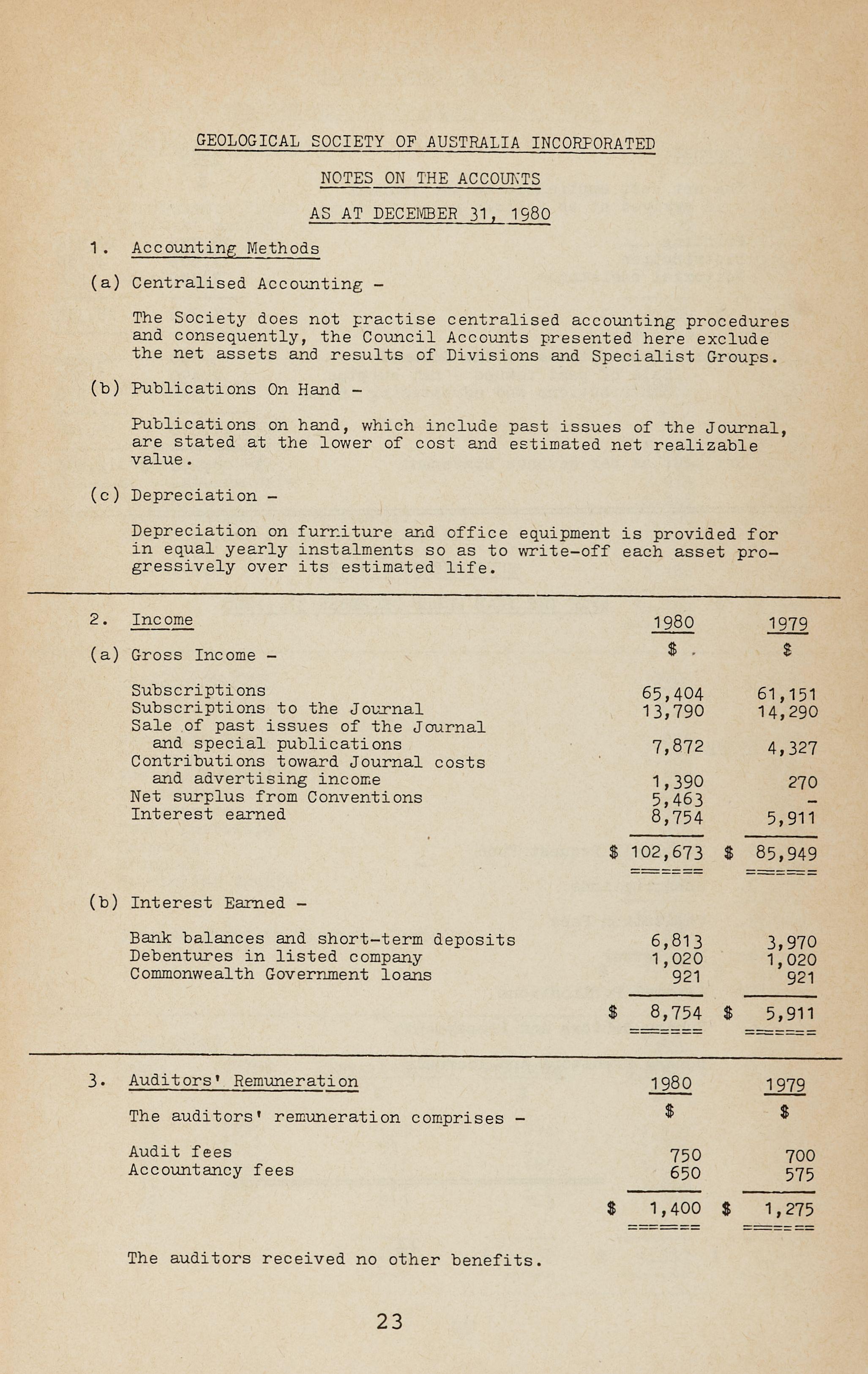
GEOLOGICAL SOCIETY OF AUSTRALIA INCORPORATED
NOTES ON THE ACCOUKTS
AS AT DECEMBER 31, 1980
1. Accounting Methods
(a) Centralised Accounting -
The Society does not rractise centralised accounting procedures and consequently, the Council Accounts presented here exclude the net assets and results of Divisions and Specialist Groups.
(b) Publications On Hand -
Publications on hand, which in c lude past issues of the Journal, are stated at the lower of cost and estimated net realizable value.
(c) Depreciation -
Depreciation on fur~iture and office equipment is provided for in equal yearly instalments so as to write-off each asset pro- gressively over its estimated life.
2. Inco~
(a) Gross IncomeSubscriptions Subscriptions to the Jov.rnal Sale of past issues of the Journal and special publications Contributions toward Journal costs and advertising income Net surplus from Conventions Interest earned
(b) Interest EarnedBank balances and short-term deposits Debentures in listed company Commonwealth Government loans
85,949 3,970 1,020 921 $
3. Auditors' Remuneration
The auditors' remuneration comprisesAudit fees Accountancy fees
The auditors received no other benefits.
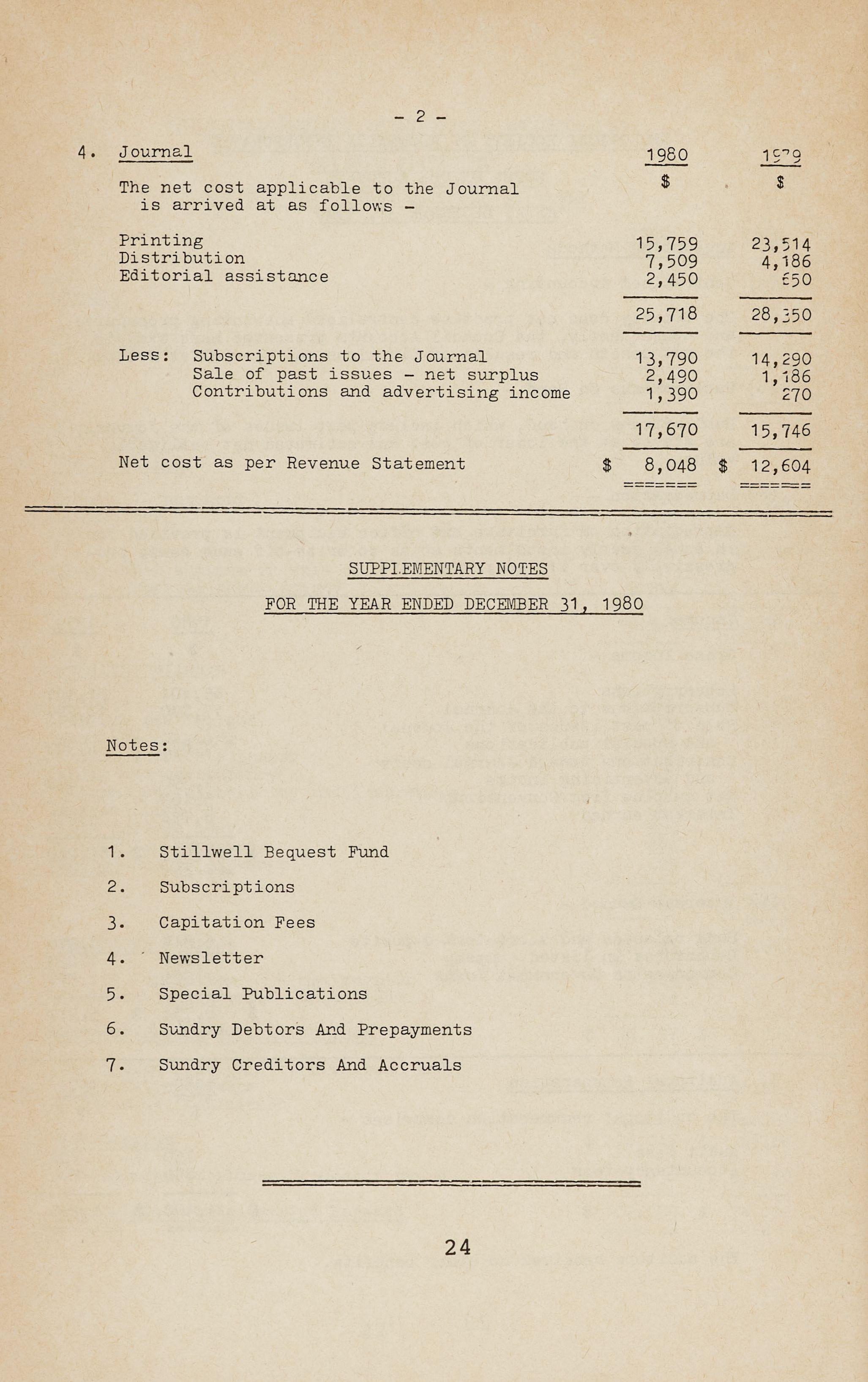
4. Journal
The net cost applicable to the Journal is arrived at as follO\rn -
Printing Distribution
Editorial assistance
Less: Subscriptions to the Journal Sale of past issues - net surplus Contributions and advertising income
Net cost as per Revenue Statement SUPPI.EMENTARY NOTES 1980 $ 15,759 7,509 2,450 25,718 13,790 2,490 1,390 17,670 $ 8,048
1C-,0 $ 23,514 4,186 E50 28,250 14,290 1,186 270 15,746 $ 12,604
FOR THE YEAB EJ'illED DECEIVIBER 31 , 1980
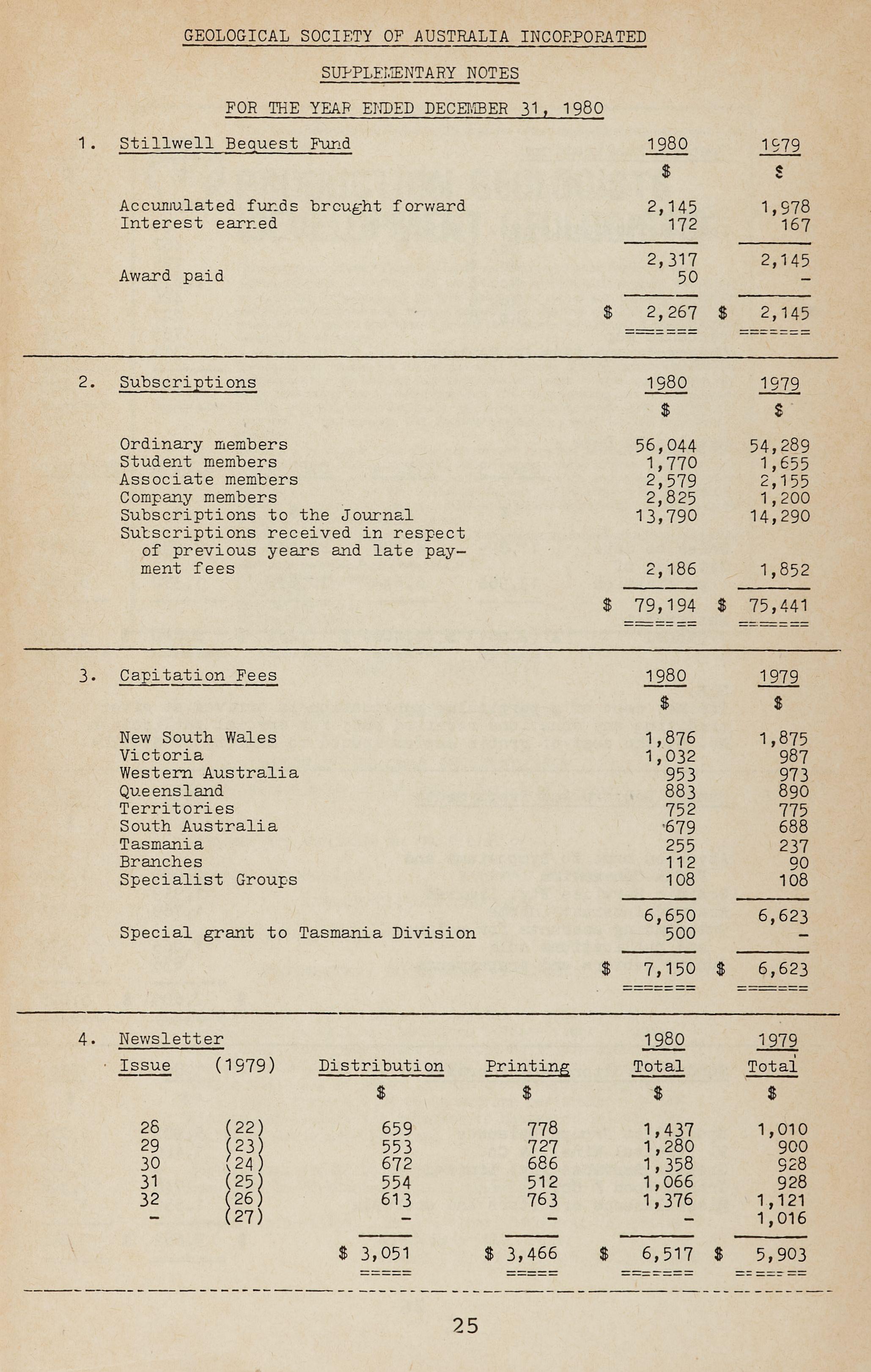
1. Stillwell Bequest Fund
Accumulated fur..ds brought forward Inter est earr_ed Award paid
2. Subscriptions
Ordinary members
Student members
Associate members
Company members
Subscriptions to the Journal
Sulscriptions
3. Capitation Fees
4. Newsletter
5,903
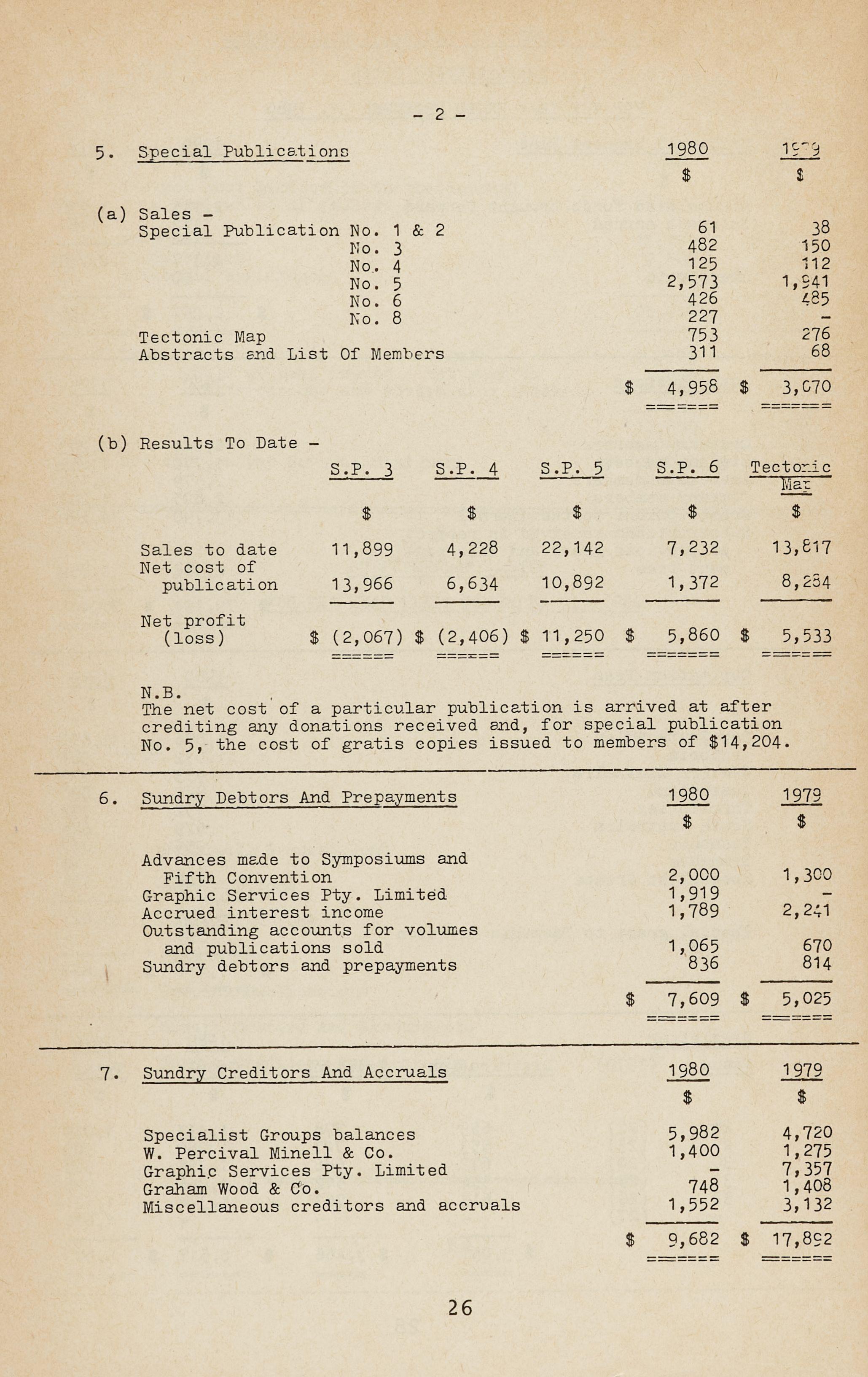
N.B.
The net cost of a particular publication is arrived at after crediting any donations received and, for special publication No. 5, the cost of gratis copies issued to members of $14,204.
for volumes and publications
and
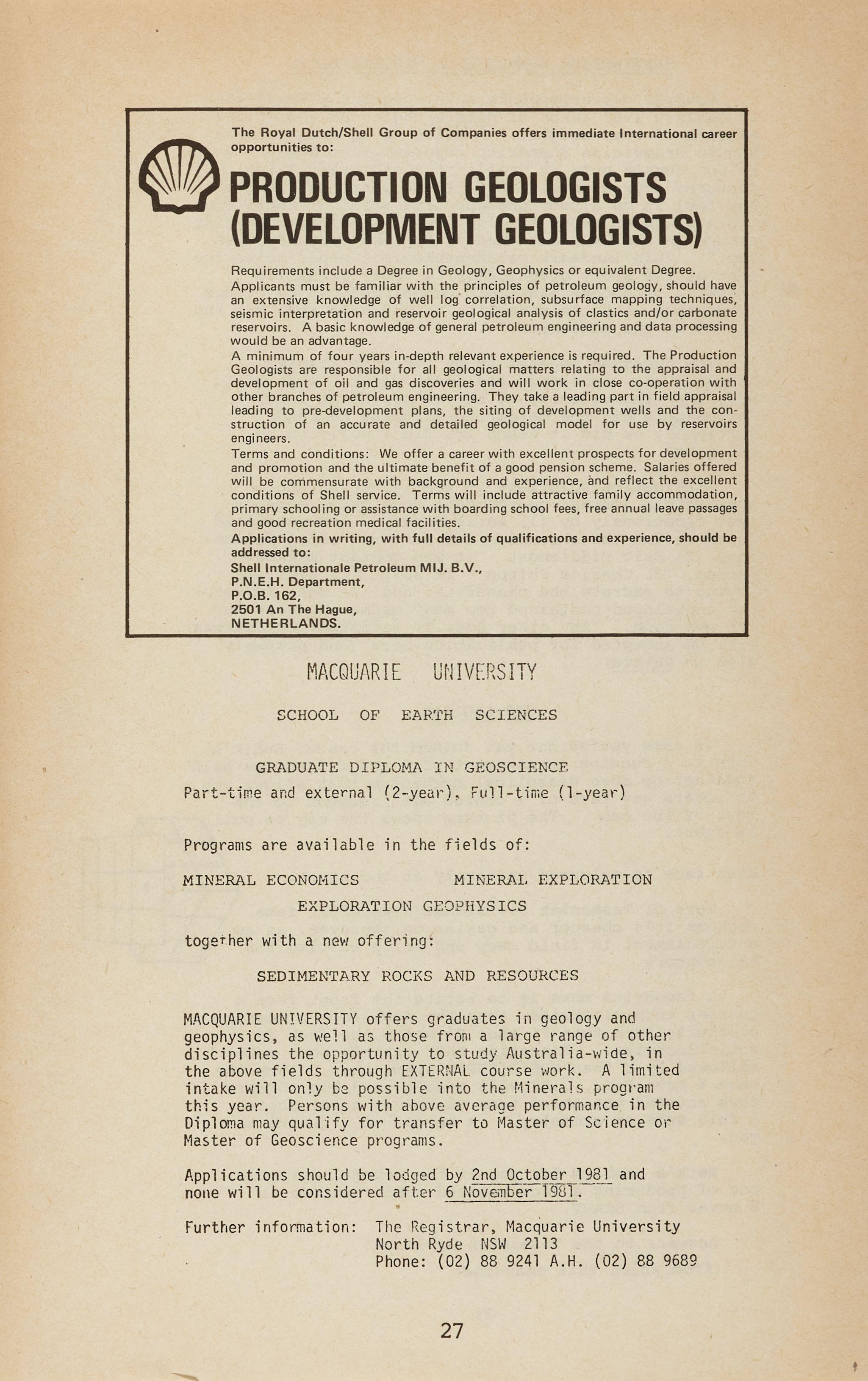
The Royal Dutch / Shell Gr o up of Companies offers immediate International career