The Australian Geologist
Acting Editor: Dr. Eric Middlemost, Dept. Geology & Geophysics, The University of Sydney, N. S. W., 2006.
Phone: Sydney 692 2067.
Soci e ty Office: Business Manager, Miss L.C. Tuckwell, Suite 9, 6th Floor, Perp e tual Trustee Building, 39 Hunter Street, Sydney, N.S.W.
Phone: Sydney 231-4696
THE PRESIDENT'S PAGE
SPECIAL GROUPS are important - but administrative headaches. Conceived with enthusiasm through the keenness of an individual, some flourish for a time, but with the passing of their initiators, arms are twisted to fill offices from duty rather than enthusiasm, action dwindles, until members billed annually complain that they have heard nothing and received nothing. Nevertheless, I would encourage new specialist groups. Enthusiasts invigorate the Society. But easy establishment should mean easy disestablishment. Termination is unpalatable, but if groups were set up from general meeting to meeting, all that were functioning and so-wished would continue, but those which had served well, but were no longer really needed would expire gracefully, perhaps to be reborn later with new virile genes. Moribund wood weakens the whole, but pruning stimulates lusty new shoots. Some groups are perennial sores, not from budget strain but because the Treasurer cannot drag out of them a financial statement. Auditors have repeatedly criticised because money collected by the Society for its groups cannot be properly documented. Auditors have recommended that a ll such moneys should be held by the Treasurer, and that each group should have an imprest of size suitable for its operations, replenishable on call in exchange for vouchers. This would not restrict or reduce funds availab le to a group, but the precise amount held either as cash or vouchers would be known, and the consolidated balances would be at interest instead of lying sterile in a dozen current accounts. After one uns a tisfactory audit, Co uncil moved to withhold finance from groups, but relented when all promised faithfully to behave; in the sequel, few did so. To receive a qualified audit report is untenable, more so to remain vulnerable to official sanctions for breach of the law regulating incorporated bodies. We must put our house in order.
This Society long represented Australia at International Geological Congresses, but when the IGC spawned the International Geological Union the Australian Academy of Science by virtue of its charter became the official contact, and we were reduced to co-sponsorship of the 25th congress. Apart from internatiopal relations, the Academy awards the accolade of peer recognition in science. Of course some get in who really do not merit it and some more worthy are ignored, but in this the Academy is no better nor worse than peer refereeing of papers, Royal civil honours, martial decorations, or the hatting of cardinals. Such public recognition would be a valuable and necessary national function even if the Academy finished there. Regretfully it largely does, for the Academy falls far short of the goals of its charter. It publishes annually an impressive list of members of its many national committeesmere paper facades, pretending activities which do not occur. After many years on the National Committee for Geological Sciences, I withdrew several years ago because it was an utt er waste of time. The Academy requests this Society to nominate a representative for three-year terms, but he has forma lly "resigned as the Society's representative on this totally moribund committee" In mid 1977 even the chairman of this committee resigned in disgust, but was persuaded to continue in office protem. Two professors from universities other than the three involved in the foregoing have told me that being members has achieved nothing more than a row of pompous year - books cluttering their shelves until tossed into the waste-paper basket. Even during the 1977 crisis over the disgraceful attempt to divert the $70,000 surplus from the IGC into the Acad emy's own coffers the Academy's National Committee for Geological Sciences was not consulted despite its chairman's urgent request. Hence, persistent moves within our Society to speak and act on national issues of concern to our science, and do what the Academy should do. Fifty years ago as Rover Scouts we were given epaulettes with the word "Service", not as an honour, but as an additional load on our s houlders indicating a duty to serve. Likewi s e FAA should mean more than ent ry to a mutual admiration society, but the acceptanc e of a duty to shoulder national responsibilities in science. The Academy must grow up, for otherwise this Society must gird itself to do for geology what th e Academy has failed to do.
EDITORIAL
When you read this editorial the Third Au stralian Geological Convention at the James Cook University, Townsville will be over, and decisions on whether ou r Society should form a specialist group in engineering geology, and/or assume the role of obstetrician and bring into being an Institution of Professional Geologists, will have been made. However, the heated discussions that the se topics have produced in "The Australian Geologist" have shown that this publication can be of inestimable value in keeping our Council and Executive in touch with our members and their ideas. If yo u would like to see changes in the Geological Society of Australia, or in any of the spec ialist group s, plea se write to "The Australian Geol ogist" so that we can all examine y our ideas.
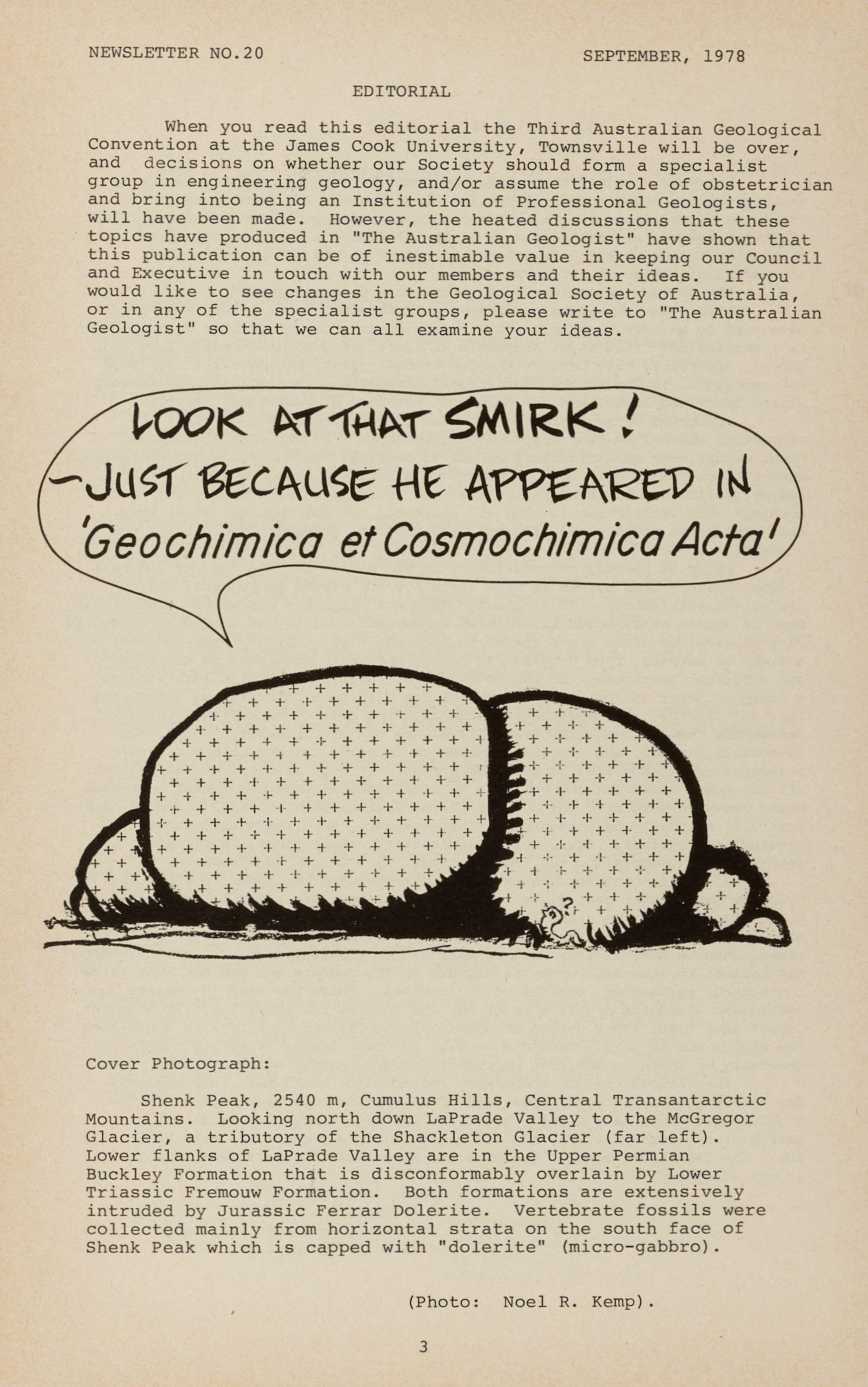
Cover Photograph:
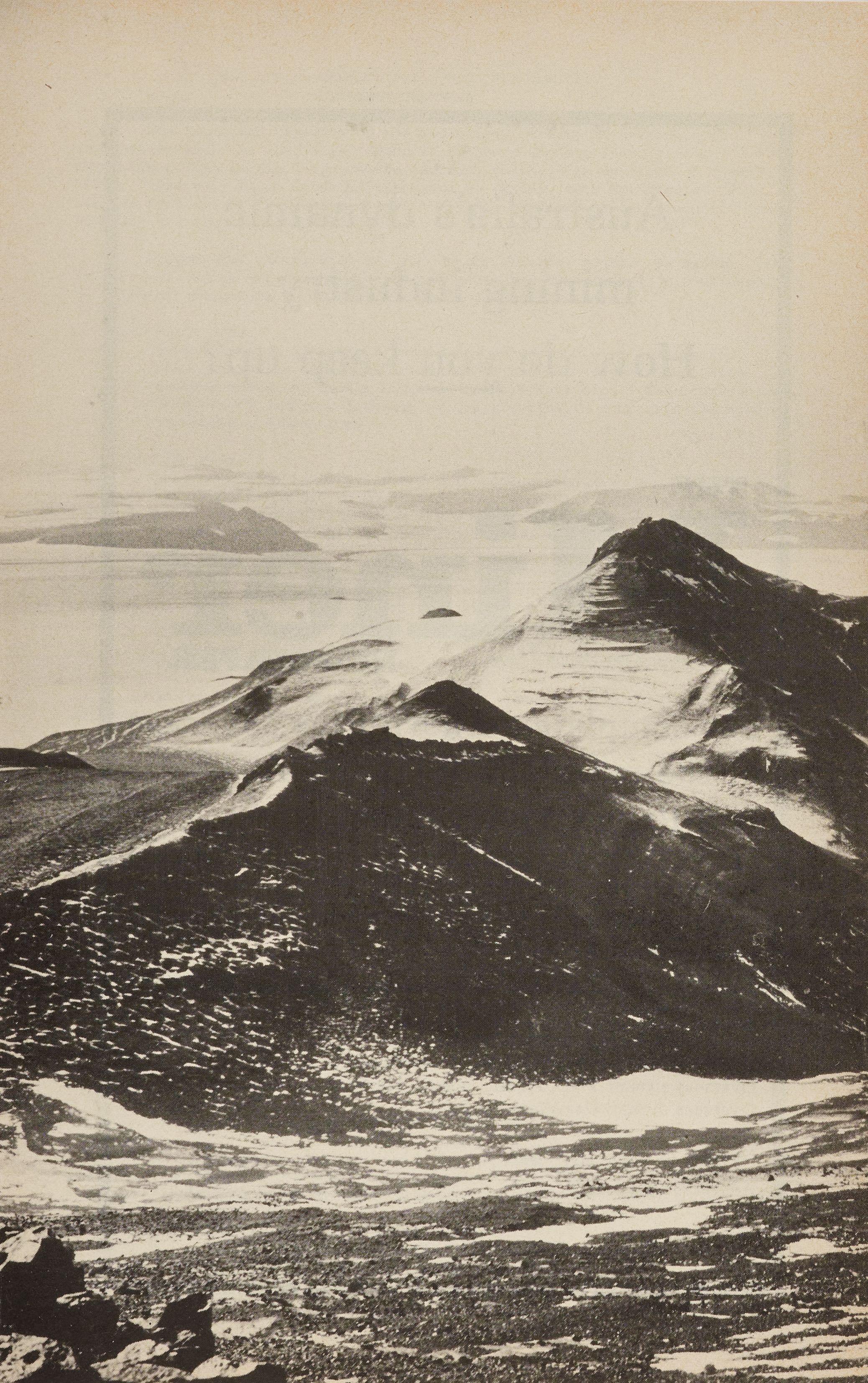
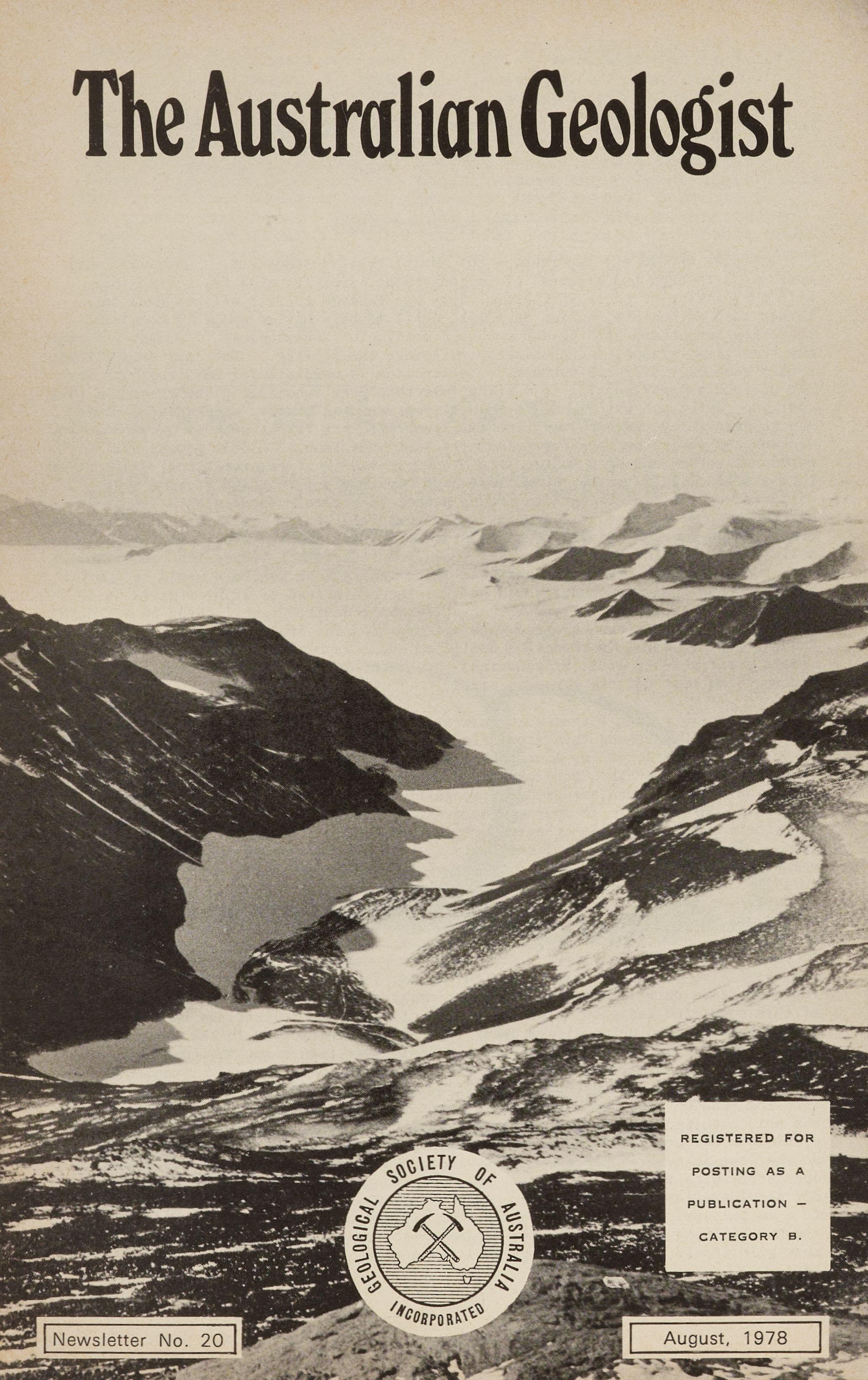
Shenk Peak, 2540 m, Cumulus Hills, Central Transantarctic Mountains. Looking north down LaPrade Valley to the McGregor Glacier, a tributary of the Shackleton Glacier (far left). Lower flanks of LaPrad e Valley are in the Upper Permian Buckle y Formation that is disconformably overlain by Lower Triassic Fremouw Formation. Both formations are extensively intruded by Jurassic Ferrar Dolerite. Vertebrate fossils were collected mainly from horizontal strata on the south face of Shenk Peak which is capped with "dolerite" (micro - gabbro).
(Photo : Noe l R. Kemp).
Dear Sir,
REGSITRATION OF GEOLOGISTS
For some time now there have been various reports of GSA Committees working towards compulsory registration of geologists and I note that one of the terms of reference of the new Professional and Legislation Committee is to "Continue towards the establishment of legislation for registration of geologists". Personally I find this aim repugnant and object ot the GSA being involved in non-technical matter of this type.
Why do many geologists support compulsory registration?
With ever-increasing government interference in our lives, some people have come to believe that by passing laws one can produce morality or competence in a profession. This is as laughable as legislating to make people like each other! Apparently they believe that government job-licensing will: (a) keep out imposters, (b) raise the professional standards of geologists, (c) prevent mining booms and busts, and (d) "protect" the user of geological services.
Advocates of registration say that the consumers have no means of protecting themselves from unscrupulous operators. Do our certificates and other established qualifications amount to nothing? Do our voluntary professional associations, which only accept members of a declared standard of experience and/or qualification, lack credibility? Do interviews, references, etc. mean nothing? The implication is that all operators are unscrupulous until they have signed the magic piece of paper, and that the consumer cannot think for himself.
There is plently of opportunity in the market for the consumer to make a wise choice - this system is used right now for hiring geologists, and is perfectly satisfactory. If a consumer does not check the operators' credentials, then of course he deserves the results he may get. It may be that some consumers of geological services are prepared to take the risk, and pay lower fees for advice, or service, from unqualified people who may nontheless, be experienced and efficient operators. Do the advocates of registration think that signing a piece of paper and paying a government fee will make unscrupulous geologists less so? Further, the advocates assume that the army of bureaucrats which will presumably "administer" all this, will all be me_n of character, wisdom, and impeccable honesty, and therefore immune to bribery, unapproachable by vested interests and insensitive to pressure groups. It must also be remembered that all the paper shuffling and shifting of registrations from one drawer to another costs money. Therefore, the cost of the geological services will increase this cost will naturally be passed on to the consumer. We already have enough regularions, controls, laws, rules, limitations, impositions, "obligations", intervention, compulsion, etc. in our lives - let us not seek more.
I question the motives of geologists who want the power to wield the "geopick" over other geologists. Should anyone have the right to force others to do their bidding by using the power of the State. This is how Mao, Stalin, and Hitler operated; and how their counterparts still operate today. In these times, when we have already lost so many of our rightful freedoms, the GSA should not be seen to interfere with the privacy of its members who did not want to be registered, regimented, controlled or licensed. Those who wish to operate under controlled standards are free to do so, and can set the entry level at whatever levels they like. In a system of voluntary associations, geologists would have the choice not to join. Needless to say, the most sought after geologists will generally be those in the most reputable and progressive associations.
The introduction of compulsory registration would mean that suddenly one day the lack of a piece of paper (and of course the necessary payment to the government), would make a fully qualified and experienced geologist not a geologist any more, and deny him his basic right to perform the work he trained for. The GSA should abandon its attempts at politicking in fields in which it is not concerned.
Yours faithfully,
A.J. Weil,
32 Gilbert Crescent, Yarrawonga Townsville, Queensland, 4810
PROFESSIONALISM
Dear Sir
I must take issue with .M:!ssrs. Minty and Crook.
Firstly, I endorse Bill Bamford's views regarding the establishment of an engineering geology specialist group within GSA. If some geologists think AGS is too mechanical or too dominated by engineers, it's up to the geologists to redress the balance!, and this is not just a matter of putting their views to the relevant committees. I would suggest to Tim Minty that if all of his engineering geologists were members of AGS, they should be doing the dominating at least in N.S.W. I would also remind Tim, and others of like mind, that the professional body which ably supports and services the practising professional geologist is the Aus.I.M.M.
The latter observation leads to some comment about Dr. Crook's letter which has, to my mind, more cause for concern. Many practising economic geologists who joined the GSA at its founding in 1953 did so out of consideration for the more altruistic and less economic aspects of geology. I don't believe that the professional geologist and mining engineer members of GSA are relatively indifferent to concern about professionalism in geoscience. However, many of us prefer to consider such matters as the concern of our membership in our professional body, i.e. the Australasian Institute of Mining and Metallurgy.
No real evidence is advanced to suggest that another body is required or that GSA needs to be restructured to handle the objectives of professionalism.
Nor does Dr. Crook offer any real evidence to support his assertion that the GSA must now evolve, or stagnate, after freely admitting that the learned society model has been so successful in promoting the advancement of science.
Why does Dr. Crook think that a learned society is not socially relevant and would be less effective in putting its views to politicians, than a professional body.
What does Dr. Crook mean by an effective national geoscience polLcy? Does he suggest that the GSA take a stand on such issues as uranium mining or atomic energy? If so, in what direction?
If GSA attempts to assume a wider role than its present function, duplicating the functions of existing professional bodies and thereby tending to inhibit its long standing objectives, it could rapidly become as irrelevant as Dr. Crook fears it will become if it does not. Thus, before any plebiscites are he ld, members should consider that possibility very carefully.
Yours faithfully
David Svenson (R.W. Miller & Co Pty Ltd
PO Box 76 North Quay Qld 4001
MURRAY RIVER BASIN
Dear Sir,
In July 1977, the Riverina Branch of the Australian Society of Soil Science held a symposium on "The Hydro-Geology of the Riverine Plain of South-East Australia". The Conference was attended by about 70 research scientists and those actively associated with the administra tio n of irrigation districts throughout this region.
The proceedings are now available for purchase from: The University Cooperative Bookshop Ltd., R.C.A.E., P.O. Box 588, Wagga Wagga, N.S.W. 2650. This publication costs $10-00 (Aust.) plus $2-00 (postage and packaging).
Yours faithfully,
R.J. Crouch
Soil Conservation Service Box 5146 P.O. South Wagga N.S.W. 2650.
WHITHER ENGINEERING GEOLOGISTS?
Dear Sir,
Perhaps ten percent of the members of our Society would call themselves Engineering Geologists. It would therefore seem reasonable for them to form a Specialist Group and there are moves to do so. I advocate that links be formed with the Australian Geomechanics Society. This body began in 1970 and "exists for the purpose of implementing the learned society function of the [two Sponsoring Institutions] in the field of geomechanics ". It has geologists among its members, and it is the Australian affiliate of the International Association of Engineering Geology, the International Society of Rock Mechanics and others.
The advantage of the Geomechanics Society is that it is a forum for geologists and engineers to meet, and a Specialist Group is not. I propose that the Society should become third sponsor of the Geomechanics Society together with the Aus. I.M.M. and I. Eng. Aust. In 1974 Ken Warner of the Queensland Division initiated a move for co-sponsorship, but it fell through. Now I understand the Geomechanics Society has requested that discussions be resumed. Engineering geologists will be best served if the Geological Society co-sponsors the Geomechanics Society, and this is the way they should urge their Society to proceed.
Rob Underwood
The Hydro-Electric Commission
G.P.O. Box 355D, Hobart, Tasmania, 7001.
The Cwnulus Hills , 175°W, 85°S , in the Queen Maud Mountains, are aptly named for when the cloud comes down it stays down. Fortunately bad weather prevented us working for only two out of the six weeks in the 77-78 field season During this period over one hundred fossil vertebrate specimens including fish, amphibians and reptiles were collected. Thirty specimens are especially noteworthy for their completeness, good preservation or because they represent unknown taxa. Of these thi r t y , nine are complete or largely complete skeletons ; nine are well preserved or largely complete skulls , and twelve are other potentially diagnostic skeletal elements such as lower jaws, clavicles , vertebrae and limb bones.
Contemporaneous fo s s{ls have been known from the Knocklofty Sandstones and Shales in Tasmania for more than 120 years. A rich deposit at Old Beach just north of Hobart, has been worked during the past 16 years, much of this work was carried out by John Cosgriff when he was a Senior Research Fellow in the Department of Geology in the University of Tasmania. Extensive road widening of the Old Beach Road following the Tasman Bridge disaster resulted in the complete removal of the remaining part (about 50 tonnes) of the fossiliferous clay-pellet conglomerate lens. Subsequently 3- 4000 bones and pieces of bone were removed from this site. John returned to Tasmania in 1975 and 1976 and on the latter visit invited me to join his team in Antarctica .
In October , 1977 I joined the U.S. NSF team which included John Cosgriff and his two post- graduate students, Bill Hammer and John Zawiskie. In Christchurch, New Zealand I became disguised as a "Usarpy" (i e. a member of the United States Antarctic Research Program). Four and a half hours in a U S. Navy Cl41 Starlifter took us from Christchurch to McMurdo Station which is the U.S Base on Ross Island. During the next fortnight we collected all our food and equipment for the coming field season , and participated in a 3- day Survival School run by N S. instructors. We also went on a 4-day , 70 km expedition to familiarize ourselved with all the equipment under Antarctic conditions. Being caught in a blizzard whilst camping in a Scott tent at Cape Evans was an experience not to be forgotten. A further fortnight was spent in McMurdo on standby , waiting for ou r "put in" flight to the Cumulus Hills which are a f urther 1000 km south. Finally , in late November, along with several tonnes of equipment , we were "put in" to the McGregor Glacier by a Ski - equipped LC - 130R Hercules .
Camp was established on the Glacier at 1500 m ASL near the site of the camp of the 1970/71 field party. This group had sampled most of the Triassic outcrops throughout the Queen Maud Mountains and had deemed the Cwnulus Hills the most suitable locality for future collecting Our accommodation was a Jamesway insulated Hut, heated by a free - standing diesel - fueled burner. In theory this gave us the distinct advantage over living in tents as we could come back after work to an ambient temperature of between 15-20°C. In practice, due to the extremely stratified air in the hut, the temperature ranged from -3°C at floor level to +3S't at roof level.
The Shackleton Glacier and its tributary, the McGregor , run N-S and E-W respectively flanking the western and northern limits of the Cumulus Hills. After a day of careful probing the glaciers were traversed by "Ski - doo" i.e. motorised toboggan
The geological sequence in the Cwnulus Hills is similar to that found in Tasmania. Both the Upper Permian Buckley Formation (coal measures in part) and the local Cygnet Coal Measures contain Glossopteris. The Lower Triassic Fremouw Formation consists predominantly of alternating sandstone and siltstone that gradually give way to more shaley horizons in the overlying Falla Formation This sequence is , more or less, duplicated in Tasmania with the Lower Triassic Knocklofty in the south and the slightly older Ross Sandstone in the centre that passes up into the Cluan, Tiers and Brady Formations. On the basis of the Tiers Formation Late Scythian and the Brady, Carnian. The Upper Triassic Coal measures of the Tasmanian East Coast and Fingal Valley contain plants such as Dicroidium odontopteroides, .Q_. dutoitii and Xylopteris elongata, which are also found in the Upper Triassic Falla Formation in the Queen Maud Mountains . Both sequences are extensively intruded by Jurassic dolerites (micro-gabbro).
The dominant rock type in the Cumulus Hills is "dolerite" and it occurs in dykes and sills and on scree slopes. Sandstones, shales and coal measures of the Buckley Formation make up the non-Triassic exposures to about 85% of the outcrop not covered by ice and snow. The remaining outcrop is Triassic in age. Two-thirds of this sequence is relatively unproductive Middle and Upper Fremouw and Falla Formation. Thus the bulk of the fossil material comes from only 5% of the outcrop area of the Hills.
Not until the fifth day of searching were we rewarded with our first finds: some fish scales, a Ceratodus (lungfish) jaw and several amphibian and reptilian jaws and other bones. These were in a pellet conglomerate but th e later finds of simi-articulated skeletons and complete skulls were in the greenish mudstones and siltstones representing the flood p la in regime under which most of the Fremouw was deposited. Removal of the fossils, was facilitated by the use of a petrol-driven jack hammer and a circular masonary saw, which worked well once the problems of starting and running them at about 2400 m altitude and in -15° to -20°C temperatures were resolved. Under these conditions applying plaster bandages to the fossils in situ prior to their removal using the power tool was not the normal straightforward procedure of more temperate latitudes. On one such occasion we admitted defeat very quickly as the wind coming off the nearby South Polar Plateau at 50 knots meant that we were working in a chill factor of -45°C. Wrapping up fossils in rolls of "TP " with bare hands is nothing compared with applying wet plaster bandages similarly unclad. Notwithstanding these practical problems 116 fossils were collected and preliminary identifications suggest a number of new taxa.
Many of the fossils collected by the 1970/71 field party have since been identified and described in the American Museum publication Novitates, by Dr. E .H. Colbert, John Cosgriff and Dr. J.W. Kitching. These included two new labyrinthodont amphibians, the brachyopid genus Austrobrachyops and the lydekkerinid genus Cryobatrachus. In Australia brachyopid labyr inthodonts occur in the Lower Triassic Blina Shale, W.A., the Gosford Formation, N.S.W. and the Knocklofty, Tasmania, while the lydekkerinid genus Chomatobatrachus is also found in the Knocklofty. The reptiles included an anapsid, the co tylosaurian genus Procolophon, two synapsids, the anomodont genus Lystrosaurus and the theriodont genus Thrinaxodon and an eosuchian and t;-1ecodont which have yet to be described. Procolophon, Lystrosaurus and Thrinaxodon occur also in the Lystrosaurus Zone of the Lower Triassic Beaufort Series of the South African Karroo
The material collected last summer included: Colbert and Cosgriff's labyrinthodont genera Austrobrachyops and Cryobatrachus and bones representing two further families previously unknown on the continent, Capitosauridae and Rhytidosteidae and possibly a third, Microphalidae; the previously described reptiles Procolophon, Lystrosaurus and Thrinaxodon and also a new anomodont larger than Lystrosaurus, together with a new theriodont larger than Thrinaxodon as well as two Eosuchian skulls and skeletons of, as yet, unidentified reptiles. The two scales and the Ceratodus jaw were the only fish r emains found.
Bill Hammer and John Zawiskie have been improving their preparator y techniques back at Wayne State using duplicate material from Old Beach. They expect ot take a year to eighteen months, under John Cosgriff's supervision, preparing the Cumulus Hills fossils. Under an agreement with the NSF the Tasmanian Museum will receive 15 % of the fossils collected. These should enhance the display, now under preparation, comparing the geology of souhtern Tasmania with that of the Cumulus Hills. It will feature photographs and the better specimens of the 200 kg of general geological material collected last summer in the Cumulus Hills .
.Noel R. Kemp
Tasmanian Museum, G.P.O. Box 1164M Hobart, Tasmania, 7001.
8th International Geochemical Exploration Symposium Hannover , West Germany, April 10-15, 1980.
The Federal Institute for Geosciences and Natura l Resources extends an invitation to the 8th International Geochemical Exp loration Symposium in Hannover. We hope, that Hannover will provide a good opportunity for a friendly meeting of geochemists from East and West. Hannover is situated in the very centre of Europe. The highways from: southern to northern and from western to eastern Europe intersect at the " hannover Autobahn Cross ". There are direct train connections to nearly all European capitals. Hannover Airport has direct flights to London , Paris, Copenhagen, Berlin, Frankfurt, Munich and others and is thus connected with the rest of the world A three (or four) day program of technical sessions is planned. The Symposium will be held in the " Beethoven- Hall " of the "Stadthalle Hannover " Connected with the " Stadthalle" is the "Hotel Am Stadtpark" , where members of the Symposium can be accommodated , meals taken and smaller groups may meet. The Symposium is planned for April 10 - 15, which is about one week after Easter and just prior to the beginning of the " Hannover Trade Fair " ("Hannover-Messe"). Preliminary suggestions for the main topics of the Symposium :
(1) Geochemical prospecting in well populated areas (with respect to contamination by old mine workings and modern industrial operations) :
(2) Geochemical exploration surve ys for mineral development in industrially less developed countries (results from United Nations and other programs) , case histories ;
(3) Geochemical and combined geochemical and geophysical methods for exploration of hydrocarbons ;
(4) Advances in the methods of the evaluations of geochemical exp lorati on data;
(5) Analytical problems with elements which are useful in exploration work but are normally found only in minor concentrations.
In addition to the technical sessions a "poster session" is planned The " poster session" may especially help those, whose knowledge of English is not good enough to give , discuss or understand lectures. In the poster session there will be direct contact between the presenter and interested colleagues who will provide help in translating. A pre-symposium excursion to prospecting sites and areas , and to stratiform deposits (i.e. Meggen , Kupferschiefer) in Western Germany is planned A one-day excursion to the Harz mountains will be organized, including an underground visit to either a vein-type Pb-Zn or a stratiform polymetallic deposit (Bad Grund or Rammelsberg). Alternatively another one-day excursion will be organized for those interested in exploration for hydrocarbons : visit of the outcrops of the oil - shale deposit at Schandelah near Braunschweig - visit of the " ErdolMuseum" in Weitze (old and modern methods of exploration and production of oil; underground mining of oil- sands etc ) A visit to the Federal Institute for Geosciences and Natural Resources and its laboratories is also planned during the symposium.
A post- symposium one week excursion will visit Southern Germany (2 days) and by friendly invitation of the Czech Geological Office in Prague , geochemicaJ exploration areas (for tin and other ores) in Czechoslovakia (3 days). The excursion will end in Prague.
Another post-symposium excursion may be organised to Southern Germany and Austria
Hannover has an old German-English historical and cultural tradition. The kings of Hannover for more than a hundred years were also the kings of England (i.e. George IV) The non-technical program will include a visit to the royal and other historical places of the town (i.e. the baroque style castle and garden of Herrenhausen). An opera performance in the "royal theatre " will be offered.
A visit to Goslar is planned. The history of mining at Rammelsberg will be shown during this excrusion.
A visit to the "Ducal-town" of Celle with many mediaeval frame-houses is possible. This visit will be concluded by a concert in the baroque "Schlosstheater". Additionally, the non-technical and spouses' program will include v~sits to a brewery, the "Volkswagen" factory, a chocolate factory and the Furstenberg China factory
A circular describing details of submission of papers , accommodation, non-technical activities, and field trips will be sent to those persons who contact: Dr. H. Gundlach Organiwing Committee
8th International Geochemical Exploration Symposium P.O. Box 510 153 D - 3000 Hannover 51 W - Germany.
"UP-DATE" YOUR COAL GEOLOGY
Geologists who have recently entered, or who are trying to enter the coal industry may be interested in a Short Extension Course in coal Exploration, Mining and Beneficiation that is to be offered by The N S .W. Institute of Technology from 4th to 15th December , 1978 The two-week intensive course is intended for practising field geologists whose irregular schedule of field commitments prevents them from attending regular part-time classes at Tertiary Institutions , yet wish to know more about modern coal geology .
The course was developed in conjunction with leading geologists in the coal industry It covers the full range of topics with which a coal geologist needs to be familiar, including coal analysis, petrology, depositional environment and exploration techniques, as well as methods of coal mining , processing and utilization. Guest lecturers from the coal industry will further extend the basic course material, providing an up- to-date summary of current developments in several key areas. A 3-day field excursion, a course handbook and an end- of-course luncheon are included.
Because Australian Government funding of Teriary Institutions does not cover courses of this type, a tuition fee of $250 per person will be charged . A maximum of 18 students only can be accommodated.
Interested? further details.
Then write to the address below for a brochure giving Applications close on October 27th, 1978.
Dr . C.R Ward, Department of Applied Geology , The N.S W. Institute of Technology, Box 123 , P.O. Broadway. N.S.W. 2007. (Telephone: (02) 218-9454)
On the 25th May, 1978, Mr. Mike O'Brien of the Australian Heritage Commission addressed a meeting of the Victorian Division on the function of the Commission, and the compilation of the Register of the National Estate. The Commission was set up as a result of the 1974 findings of the Hope Committee. At present it has a staff of 12, 2 of whom deal with nature conservation. Mr. O'Brien is the officer responsible for the eastern half of the continent. As most relevant controlling powers are vested in the states the role of the Commission is essentially advisory and educational.
The Commission operates by asking for nominations for inclusion in the Register. These are evaluated and if considered suitable are advertised so that objections may be lodged. The following are some of the topics disucssed by Mr. O'Brien: (1) the diversity of people's expectations of a national park, (2) the diversity of types of reserves in various states, (3) the limited Federal powers, (4) the limited State finances, and (5) the safeguards available to limit the power of the Commission.
(From Victorian Division Newsletter No. 95, June 1978.)
INTERNATIONAL
CONFERENCE ON MINERAL
EXPLORATION TECHNIQUES
The AGID International Conference on Mineral Exploration Techniques in Tropical Rain Forests, was held in Caracas from November 18 to 23rd, 1977. It was followed immediately by a short training course on practical techniques which lasted until December 3, 1977. The Conference was attended by some 100 participants (including 55 from Latin America, 17 from Africa and 8 from Asia), all of whom were actively involved in rain forest terrains. The 5th Venezuelan Geological Congress and the 1st IberoLatin American Geophysical Congress, which were held concurrently, provided an additional opportunity for discussion and exchange of ideas and experiences.
Individual sessions were held on Remote Sensing , Geophysics, Geochemistry, Environmental Impact and Exploration Strategies with an emphasis on the latter topic where participants addressed themselves to the question of how to develop exploration programmes in the severe conditions that exist in rain forest regions While no genuine concensus of opinion was expected or achieved, the nearly 70 case histories provided much food for thought among the participants.
The training course that followed was attended by some 30 young geoscientists from Asia, Africa and Latin America, who had earlier participated in the Conference. The first four days were based in Caracas and concentrated on remote sensing techniques as applied in Venezuela. This was followed by an extended field tour to rain forest regions in the Venezuelan Andes and in the flatlands of the Guyana Shield. Here participants visited several mining properties which had been located using modern geophysical, geochemical and remote sensing. The opportunity to see at first hand other rain forest regions and to discuss with Venezuelans appropriate exploration techniques was clear l y of great value.
A 25 page Preliminary Record of the meeting is now being distributed, and work has already started on editing the background papers and the discussions for a final publication. This should be available in 1978 and will undoubtedly make a major contribution to our understanding of mineral exploration in tropical rain forests.
Those wishing to be notified when the final report is published should write to: AGID Secretariat, Dept. of Geology, Memorial University, St. John's, Nfld., Canada, AlB 3X5.
INTERNATIONAL GEOLOGICAL CORRELATION PROGRAM
PROJECT 129: LATERITIZATION PROCESSES
The IGCP Project 129 'Lateritization Processes' was proposed and is being organized by the Geological Survey of India. The proposal is for an international effort at understanding and determining factors responsible for laterite formation by means of multi-disciplinary field and laboratory research on lateritization processes and products. The following fields of interest have been proposed:
1. Classification.
2. Distribution, geomorphology, stratigraphy and structural history.
3. Palaeoclimatic and palaeogeographic controls on laterite formation.
4. Genesis.
5. Geochemistry and mineralogy.
6. Study and exploration of lateritic ores: iron, bauxite, nickel, etc.
7. Geochemical exploration in lateritic terrain.
8. Laterites and lateritic soils in agriculture.
9. Experimental laboratory studies.
10. Age determinations.
People interested in participating in this project are invited to contact the undersigned for further details. If sufficient numbers are interested, local v-Jorking Groups can be formed to discuss Australian participation in the Project.
Dr. C.R.M. Butt, Correspondent: IGCP Project 129, C/- CSIRO, Division of Mineralogy, Private Bag, Post Office, WEMBLEY, Western Australia, 6014.
AUSTRALIAN GEOMECHANICS SOCIETY VICTORIA GROUP
WEDNESDAY, 11TH OCTOBER, 1978
At Country Roads Board Theatrette, Denmark St., Kew.
"A PENETRTING INVESTIGATION"
Insitu measurement of shear strength b y penetrometers is a rapidly expanding field. Dr. J. Holden of the Country Roads Board, will discuss the development of penetrometers and their application to foundation design.
Dr. A. Parkin will describe calibration experience with penetrometers in Melbour n e and Norway.
Prior to the meeting, C.R.B. penetrometer equipment will be on display.
MASTERS IN ENVIRONMENTAL SCIENCE
The programme is designed to emphasize the scientific knowledge and techniques necessary for a proper environmental assessment of any proposed activity and as such, should be particularly suitable for practising professionals in Industry or Government who wish to update their qualifications in line with the emerging needs of the State. As well as emphasising the necessary scientific skills in the fields of atmospheric science, waste treatment and environmental management, the programme also highlights the economic, social, political and legal aspects of environmental affairs. All of the courses are directed towards local environment problems and in-field experience is emphasized. With access to the new Environmental Science complex, students may be involved in such diverse areas as airborne sampling, wind tunnel studies, remote sensing, waste treatment monitoring and analysis, and computer simulation of ecological systems. The normal minimum admission requirement is a bachelor's degree in science or engineering or equivalent, plus two years work experience. For a student completing the programme in the minimum time, the degree consists of one year of full-time study and one year of part-time study. The full-time component may be undertaken on a two year part-time basis.
Further details from Dr. Tom Lyons, School of Environmental and Life Sciences, Murdoch University, Murdoch, Western Australia, 6153.
New Publications of the Association of Geoscientists for International Development
1) "MINERAL RESOURCE MANAGEMENT IN DEVELOPING COUN'l'RIES: STATE PARTICIPATION, PRIVATE ENTERPRISE, OR BOTH?"
Editor, M.E. Woakes, approx. 35 pages, Paper, (June 1978) US $6. 00
The proceedings of a Symposium organized by AGID at the 25th International Geological Congress held in Sydney, Australia, August, 1976, attended by over 200 people from 3 7 countries. Includes the -full text of the keynote address by well-known Papua New Guinea-based consultant K.M. Phillips, together with the transcripts of panel contributions and summaries of background papers. Among the major themes discussed at length are:
,Why state control of mineral resource development?
.To what extent state control?
.What form of state control?
.Appropriate technology?
2) DIRECTORY OF GEOSCIENCE DEPARTMENT IN DEVELOPING COUNTRY UNIVERSITIES
Editor, Victor Ricaldi, approx. 50 pages, Paper, (June 1978) approx. US $8.00
This is the first in a projected annual or biennial listing of geoscience departments in universities in developing countries. For each of nearly 100 departments in 42 countries it lists all academic staff and their highest degrees and specialties, courses and degrees/diplomas awarded, average number of students enrolled and graduated recently, opportunities for vacation employment, scholarships available to nationals and nonnationals, and year in which department was established. Also indicated are those departments eager to establish contact with visiting geoscientists, and an indication of local support that they may be able to offer. The Directory, the first of its kind, is an invaluable starting point for programs of technical cooperation.
SYMPOSIUM ON GEOLOGY AND MINERALISATION OF NORTHWEST TASMANIA
The Tasmanian Division of the Geological Society of Australia in conjunction with the Specialist Group in Economic Geology is running a symposium at the Burnie Civic Centre, Burnie, on the 11th and 12th of November 1978. There will be an informal gathering on Friday, 10th November at "Four Seasons Town House" from 8.00p.m. and a ful day of lectures and discussion on Saturday the 11th.
A symposium dinner will be held on the Saturday night. On Sunday, 12th of November, tbree excursions will be offered, each finishing in mid-afternoon to allow air departure to Melbourne. These excursions are:-
(i) Moina area.
This excursion is being arranged in conjunction with Comalco Pty. Ltd. The Moina area contains numerous tin and tungsten orebodies which are related to the Devonian grantie intrusion. The lode system consists of numerous ore-bearing quartz veins in contact metamorphosed limestone and sandstone.
(ii) Kara Mine.
This excursion is being arranged in conjunction with MacIntyre Mines Ltd. and is limited to 25 people. The Kara Mine is currently producing scheelite from magnetiferous skarn of the Ordovician Gordon Limestone in the contact aureole of the Devonian Hou setop Granite.
(iii) A geological cross-section of the Dial Range Trough. Fore shore exposures between Cooee and Ulverstone will be examined to show the contrast between rock sequences that form the Trough margins (relatively unmetamorphosed and metamorphosed Precambrian sequences) as well as the varied sedimentary fill (megabreccia - volcanic rocksfossiliferous slump deposits) of the Cambrian Dial Range Trough.
For the Kara Mine excursion it will be necessary to bring gumboots; and boots are required for the Moina excursion.
Prospective participants in the symposium are asked to contact P.W. Baillie, G.P.O. Box 124B , HOBART, Tas. 7001, by the 16th October 1978. Phone (002) 303503.
"Australia's Mineral Energy Resources - Assessment and Potential"
This publication of the Earth Resources Foundation contains papers and discussions presented to a seminar held at The University of Sydn ey, May 22-23, 1978. Price $15-00 plus 80~ postage - $15-80.
Copies of this publication are available from: The Earth Resources Foundation, Edgeworth David Building, The University of Sydne y, N.S.W. 2006.
5th IRAQI GEOLOGICAL CONGRESS
This congress will be held in Baghdad from 28th to 31st December, 1978, and it will be followed by a field trip by bus through the northern Iraq mountain ranges from 1st to 6th January, 1979.
Registration forms are available from: Dr. I.I.M. Kassab, D.G. Geological Survey and Mineral Exploration, P.O. Box 986, Alwigah, Baghdad, Iraq.