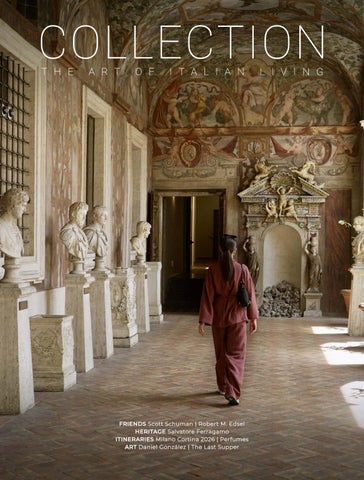
THE ART OF ITALIAN LIVING COLLECTION

FRIENDS HERITAGE SIGNALS ITINERARIES ART


![]()

FRIENDS HERITAGE SIGNALS ITINERARIES ART


by Cristina Fogliatto
For Lungarno Collection, art has never been a matter of ornament. It is a genuine value — a living part of how we welcome our guests and of the identity that defines each of our brands. It is a form of beauty that inspires, a creative presence that takes shape within our spaces and becomes a shared language with those who stay with us, opening a dialogue with the city. Art has always been part of our hotels: in the exhibitions that animate interiors, in projects that extend into rooms and urban contexts, and in permanent collections that do more than decorate — they help shape the character of each space. Every work translates a personal perspective; every detail expresses an approach to hospitality where beauty is never an end in itself, but an experience — a space for exchange, emotion, and connection. The selection of images that follows offers only a glimpse of what has been built and cultivated over the past thirty years: a journey shaped by research, intuition, and choices of courage, in which art remains central to a continuing story of elegance, sensitivity, and enduring beauty.

October 19 – November 5, 2023


April 23 - October 23, 2022


July 3 - August 27, 2024


22
EDITORIAL From Welcome to Experience by Leonardo
Ferragamo
24 - 27
SCOTT SCHUMAN Style Revolution
28 - 31
ROBERT M. EDSEL Miracles
LIFESTYLE
32 - 43
SALVATORE FERRAGAMO
Welcoming as an art
44 - 49
ANNIVERSARY
Thirty Years of Hosting
ART &
50 - 55
TREND
Casa Italia
56 - 59
DANIEL GONZÁLEZ
The invented reality
60 - 65
ITINERARY
Coup de Théâtre
66 - 71
EXPERIENCE
Eyes Closed


72 - 77
MARCO CONFORTOLA
Olympic Peaks
78 - 81
DANIELA KRALER
Alpine Allure
TASTE
82 - 89
FOOD&DRINK
Ritual of Taste
EDITOR IN CHIEF
MATTEO PARIGI BINI
CO-EDITOR IN CHIEF
TERESA FAVI
EDITORIAL DIRECTOR
VALERIANO ANTONIOLI
MANAGING EDITOR
CRISTINA FOGLIATTO
PUBLISHER
GRUPPO EDITORIALE
(ALEX VITTORIO LANA & MATTEO PARIGI BINI)
GRUPPOEDITORIALE.COM
EDITORS
SABRINA BOZZONI, FRANCESCA LOMBARDI, VIRGINIA MAMMOLI, MARTINA OLIVIERI
CONTENT REVIEWER
ANNALISA SIBILLO, PATRIZIA TYFANIUK
PHOTOGRAPHERS
PAG 16, 22, 35, 36, 37, 42, 46, 47, 49 ALESSIA MORELLINI; PAG 23 MIKI NAKANO PAG 24, 27 SCOTT SCHUMAN; PAG 32 VALERIA RANIOLO; PAG 39, 78 LORENZO COTROZZI PAG 41 ARCHIVIO FOTO LOCCHI; PAG 44 MANUEL ZUBLENA; PAG 50, 53, 54, 55 STEFAN GIFTTHALER PAG 56, 59 NICCO LEONE; PAG 60-61 NICCOLÒ RASTRELLI; PAG 64 (ABOVE) MARTIN PROVEDA PAG 64 (BELOW) PIERPAOLO PAGANO; PAG 75 ENRICO BIGNO POZZI
COVER PALAZZO ATTEMS, ROMA
PH. ALESSIA MORELLINI
ART EDITORS
MELANIA BRANCA, CLELIA GIARDINA
TRANSLATIONS
TESSA CONTICELLI, LANDOOR
ADVERTISING DIRECTOR
ALEX VITTORIO LANA
ADVERTISING
EMANUELA MATTIOLI, ALESSANDRA NARDELLI
EDITORIAL OFFICE
GRUPPO EDITORIALE SRL
VIA CRISTOFORO LANDINO, 2 - 50129 FIRENZE - ITALY
PH +39.055.0498097 - REDAZIONE@GRUPPOEDITORIALE.COM
WWW.GRUPPOEDITORIALE.COM
BARONI & GORI
COPYRIGHT


PORTRAIT FIRENZE
Lungarno degli Acciaiuoli, 4
Florence 37 rooms and suites

HOTEL LUNGARNO
Borgo San Jacopo, 14
Florence 62 rooms and suites

PORTRAIT ROMA
Via Bocca di Leone, 23
Rome 14 rooms and suites

GALLERY HOTEL ART Vicolo dell’Oro, 5
Florence 72 rooms and suites

RISTORANTE BORGO SAN JACOPO
Florence Florence-River view gourmet experience

701 ROOFTOP BAR
Florence

PORTRAIT MILANO Corso Venezia, 11
Milan 73 rooms and suites

PALAZZO OTTAVIANI Piazza degli Ottaviani, 4r
Florence 10 apartments

CAFFÈ DELL’ORO
Florence Contemporary Italian restaurant

Sophisticated mixology with a breathtaking PICTEAU
BISTROT & BAR
Florence Mediterranean flavours and vintage cocktails
Booking & Info Lungarno Collection Borgo S.S.Apostoli, 29 | Firenze Ph. +39 055 27264000 | reservations@lungarnocollection.com

10_11
BAR-GIARDINO-RISTORANTE
Milan Contemporary style, Italian taste

THE FUSION BAR & RESTAURANT
Florence Tapas, world dishes & cocktail bar

Leonardo Ferragamo, President of Lungarno Collection

Almost 30 years ago, my family and I ventured into the world of hospitality, bringing with us the experience, passion, and enthusiasm that have characterized our journey in fashion. The harmonious dialogue between these two worlds is rooted in deep knowledge and a rich heritage, along with a clear vision for the future.
At the heart of our evolution is the legacy of my father, Salvatore Ferragamo, whose vision of Italian excellence and pioneering spirit, illuminated by my mother Wanda’s love, have guided us. Just as my father began by welcoming clients into his iconic showroom and many of our locations and stores worldwide, we aim to extend the same warmth and hospitality to our guests, offering experiences imbued with beauty.
Our hotels are more than just places to stay; they are destinations where history, style, and relationships converge. With a commitment to leveraging our diverse knowledge and expertise, we provide authentic and unique hospitality, fostering relationships and creating personalized experiences that blend tradition and innovation.
For us, evolution signifies continuity, consistency, and an ever-present vision for the future.
Ours is a world where every stay is a specific story, and every single guest is a cherished part of our journey.


In 2005, Scott Schuman reshaped fashion photography with The Sartorialist. His vision was simple: to let fashion meet everyday life through spontaneous street portraits. Drawing on the legacy of great image-makers, Schuman turned his glimpses of real life into art, and street style into vivid high fashion, capable of expressing a distinctly individual point of view. In his photos, ordinary people and celebrities engage in a game of style that erases differences, giving importance only to personality. In his photographs, ordinary people and celebrities share the same stage; differences fade, and personality becomes the only narrative. His visual language now lives on in a Taschen volume dedicated to Milan, the city he chose as his muse, second only to New York.
How did you develop the photographic language that brought you worldwide recognition?
I never planned to be a photographer. I wanted to be a fashion designer. Although I’m self-taught, my understanding of fashion and style helped me get noticed. I worked very hard in the early years to develop a unique photographic style, borrowing elements and moods from photographers like August Sander, Paolo Roversi, Bruce Weber and Lartigue.
How do you choose your subjects?
I don’t really look for anything; I just react to what I’m seeing. Can elegant and unexpected work together?
What most people call “elegance” is often just good manners and a certain grace. Cary Grant was the perfect example — even when he wasn’t wearing a suit.
In your view, are clothes really a form of communication, or do we sometimes give them too much importance?
My father didn’t care about fashion, but he understood exactly how to dress
‘ I NEVER PLANNED TO BE A PHOTOGRAPHER.
I WANTED TO BE A FASHION DESIGNER ALTHOUGH I’M SELF-TAUGHT, MY UNDERSTANDING
FASHION AND STYLE HELPED ME GET NOTICED’
for a country club, a business meeting or a social gathering. Everyone, regardless of age, background or culture, understands the power of appearance and what it signals.
Which direction do you believe fashion is moving in?
Fashion is becoming as segmented as entertainment, food or music. There’s something for everyone, but no overarching trends guiding the whole industry. This might be good or bad culturally, but it’s too early to know what it means historically.
Excellence in terms of style, but also food and hospitality: what draws you most to Italy?
People in Italy genuinely care about creating and preserving beauty. In America, we’re almost embarrassed to care that much about making something simply beautiful. Here, it’s seen as an achievement, and that’s very charming.
Portrait hotels in Milan, Florence, and Rome: what connects them and what gives each its own character?
The Milan location is already an important part of the city’s social life. The Florence and Rome properties are incredibly beautiful, and staying there connects you directly to the cities and their culture.
How would you define the art of Italian style?
Italian style isn’t something people put on; it’s something the live in! What do you appreciate most about Italian style in men’s and women’s fashion?
In Italy, more than anywhere else, the obsession with quality and fit is paramount. Italian vanity insists that fashion must enhance your best features - and that only happens when clothes truly suit you. It all comes down to fit and quality.

Milan
Now is the moment when Milan takes its place alongside the big three cites of Italy: Rome, Florence and Venice now have Milano on their same level!

Architecture
From the canals of the Naviglio Grande to the stones of Via Brera, to the glass dome of the Galleria Vittorio Emanuele II and the chrome surfaces of Fondazione Prada, the city’s mix of architectural styles is seen as a luminous reflection of its people
‘ ITALIAN VANITY INSISTS THAT FASHION MUST ENHANCE YOUR BEST FEATURES - AND THAT ONLY HAPPENS
YOU’

Elegance
“I see style and beauty in 80 and 90 year olds in Milan, which is at odds with the youth-obsessed US”
The book
Scott Schuman, now based in Milan, combines portraits with striking cityscapes, guiding us through the streets of one of Europe’s most stylish cities.


ROBERT M. EDSEL

“I once lived in Florence, in the hills of Bellosguardo, where Henry James, Nathaniel Hawthorne, and James Fenimore Cooper wrote some of their most important works, and where Galileo Galilei studied the stars. One day, while crossing the Ponte Vecchio - the only major bridge in Florence not destroyed by the Nazis as they fled the city- I asked myself: how did so many priceless works of art survive the war, and who were the people who saved them? That question didn’t just change the trajectory of my life, it charted the course. These are the words of Robert M. Edsel, author of the #1 New York Times bestseller, The Monuments Men The same clarity and narrative force can be found in his later book, Saving Italy. Edsel has devoted much of his life to studying the scholar-soldiers who protected Europe’s artistic heritage during World War II. The Monuments Men, which has been translated into more than thirty languages, served as the inspiration for the 2014 film directed by Academy Award recipient George Clooney”. Which Italian location best represents the spirit of the Monuments Men?
A powerful example is the Camposanto in Pisa, now a UNESCO World Heritage Site, which was hit by a mortar that severely damaged its 14th-century frescoes. Thanks to the Monuments Men—particularly Captain Deane Keller—tens of thousands of fragments from more than 1,500 square meters of Frescoes, an area larger than the Sistine Chapel ceiling, were salvaged and later reassembled. In 2002, the remains of Deane Keller were buried inside the Camposanto, the only non-Italian granted this honor, with the inscription Amicissimus ad amicus
Leonardo’s Last Supper, miraculously preserved in Milan, stands as a symbol of resilience. What struck you most as you retraced its survival?
Robert M. Edsel, the author of The Monuments Men
I’m always struck by how few people realize that this work exists today because of sheer luck. On August 16, 1943, a British Lancaster bomb detonated just 25 meters from the Refectory. The east wall was destroyed, the wooden girders
collapsed, crushing the vault. For nearly two years, Leonardo’s painting was protected only by sandbags and a tarp. It’s extraordinary that it survived at all. In Florence, the Ponte Vecchio was spared while everything around it was destroyed. Did Italy’s beauty influence its enemies?
Hitler admired Florence and its museums more than Mussolini. Certain German art historians understood the city’s value. The German consul, Dr. Gerhard Wolf, was later honored for his efforts to save Florence from destruction. That said, destruction is intrinsic to war. Hitler ordered the demolition of Florence’s other bridges - mistakenly believing the Ponte Vecchio was the city’s most important. He preserved it by blocking access with 15-meter-high rubble piles on both sides of the river. The result was the destruction of the medieval towers that for centuries had defined the Tuscan capital’s elegance and influence. Milan, Florence, Rome: which museums best tell these stories of salvation?
Hundreds of masterpieces that may now be admired in the Uffizi, Palazzo Pitti, and the Bargello - works by Caravaggio, Botticelli, Raphael, Rubens, Michelangelo, and Donatello - were looted by German forces and later returned thanks to Monuments Men Deane Keller and Fred Hartt.
If the Monuments Men returned today, what should they protect first?
Today, Monuments Officers operate in both Italy and the United States. The Monuments Men and Women Foundation has long collaborated with the Carabinieri Command for the Protection of Cultural Heritage. But protecting cultural heritage is a shared responsibility. Private organizations - Friends of Florence and Amici degli Uffizi, for example - play a vital role and deserve the support of the public
Your personal advice?
Read Saving Italy Then take a map of Florence, lace up some comfortable shoes, and walk the city . Visit Fred Hartt’s grave and say thank you- for his scholarship, his vigilance, and his love of the city. Study the Four Seasons statues on Ponte Santa Trinita. Look closely at the fractures left by the destruction of the bridge in August 1944, then compare them with pre-war photographs. Notice what was broken, what was rebuilt, and how memory was stitched back together in stone. Florence tells its story to those willing to look carefully- and to understand why it looks the way it does today. That act of looking, and of understanding, is why I wrote the book.
In Edsel’s writing, the pursuit of displaced artworks across Italy unfolds like a true spy story

The stories Edsel recounts are many, among them the rescue of Leonardo’s Last Supper and Donatello’s Saint George.


Monuments Men played a decisive role-one that every visit to an Italian museum or historic site quietly recalls.


SALVATORE FERRAGAMO REFLECTS ON FAMILY LEGACY AND HOW HOSPITALITY HAS SHAPED THEIR IDENTITY OVER THE PAST 30 YEARS
Text Teresa Favi
From the villa in Fiesole to Lungarno Collection, Ferragamo hospitality is defined by details, warmth and gestures that endure.
“We were dining at our family home in Fiesole, when, suddenly, a heavy spoon fell to the floor, echoing with a sharp metallic sound. We all turned instinctively. Audrey Hepburn, instead, didn’t flinch: she kept eating as if nothing had happened, sparing the waiter any embarrassment. She wasn’t just elegant and sophisticated.
It was one of many stories shared by Wanda Ferragamo, wife of the renowned “shoemaker of dreams,” who at the Palagio — the family villa on the hills just outside Florence — welcomed guests from around the world visiting the city to have shoes made by her husband. Salvatore Ferragamo, son of Ferruccio and grandson of Wanda and Salvatore, grew up — alongside his twin brother James and twenty-one cousins — across the family homes, absorbing from an early age a quiet, instinctive savoir-faire that has, for the past thirty years, shaped the identity of the family’s hotels. What elements best express your family’s DNA in the way you welcome guests?
Our family has always aimed to convey authenticity, quality and a sense of understated luxury, expressed through natural elegance. In hospitality, as in high fashion, every detail matters: the balance of spaces, restrained yet refined décor, and service that is precise without ever being intrusive. People are central - courteous, attentive, professional - capable of creating an atmosphere that feels both warm and discreet. Together, place, aesthetics, service and relationships define our heritage: sincere gestures, thoughtful details and genuine connections that make each experience memorable without excess. The opening onto the Arno from the Uffizi Courtyard


A visit to Florence for a pair of custom-made shoes by Salvatore
often became a memorable experience - an encounter so remarkable that even Hollywood’s greatest stars could not resist

Welcoming guests as if in one’s own home: understated elegance, authentic craftsmanship, naturalness, and human warmth. This is the Ferragamo style
What is your earliest memory connected to hospitality, and how did it shape your outlook?
I remember my grandmother Wanda at the Palagio — the care with which she prepared the table for each guest, the way she dressed, the attention she gave to every detail. She taught me that hospitality is not a gesture, but an attitude: an expression of respect and grace that leaves a lasting impression. What principles guided your grandmother’s approach to hosting?
An attention to detail that extended even to flowers, whether grown in the garden or carefully chosen specifically for the occasion or space. For her, flowers were works of art — a way to set the mood and convey care. This sensitivity, combined with restraint and naturalness, was central to her style, the same approach she brought to leading Ferragamo after my grandfather Salvatore’s early passing.
Do you remember her in the kitchen?
Very clearly. Those moments are among my fondest memories. Nonna Tà - as we all called her - originally from Campania, cooked simple dishes rich in history and authentic flavour. I especially remember her orecchiette with pilea, a plant similar to nettle, with a fresh, slightly minty taste, grown in her garden. A dish of great simplicity, yet full of character.
Over the past thirty years, Lungarno Collection has shaped hospitality into a language of style. How have you experienced this evolution?
I’ve seen hospitality grow into a true language of elegance and Italian identity. Alongside pride, there is a strong sense of responsibility — to protect and nurture what has been built with care, while continuing to offer experiences that feel genuine and refined.
Today the group speaks of “The Art of Italian Living.” What does this phrase reflect about you and your family?
For us, welcoming is instinctive. In Italy, hospitality lives in everyday gestures, craftsmanship and tradition — elements that naturally become experience and connection. It’s a way of living well, of creating bonds that last, built on consistency, respect and the belief that true hospitality is measured over time, through relationships and a genuine sense of generosity.

Text Valeriano Antonioli, CEO Lungarno Collection

Three decades ago, the Ferragamo family asked themselves what their ideal hotel would be like. “It doesn’t exist,” was the answer. “So we’ll create it.”
They set their sights on a project that reflected their identity, their Florentine roots, their dreams and emotions, while remaining open to new horizons. Entering the world of hospitality did not simply mean expanding their sphere of activity, but reinterpreting the philosophy of fashion in experiential terms, transforming a stay into an indelible memory.
Thus, in 1995, under the leadership of Leonardo Ferragamo, Lungarno Collection was born, with the unprecedented goal of building a hotel brand that was not an extension of the fashion brand, but one inspired by the family’s values: timeless elegance, craftsmanship, and personalized service.
A new era of hotel design began, with Michele Bönan working on his first hotel project alongside Leonardo Ferragamo, giving life to a creative journey that has now lasted 30 years and has enabled us to develop a niche identity capable of generating immersive, meticulously curated experiences, always set in iconic locations.
Valeriano Antonioli, CEO of Lungarno Collection, discusses how hospitality has changed over the decades and what the future holds for the hotel group.
At the outset, Lungarno Collection represented an absolute novelty on both the Italian and international scene. Hotel Lungarno, overlooking the Arno like a boat, with its elegant white and blue tones, was a 19th-century residence transformed into a new, intimate, and welcoming property, conveying the feeling of being a guest in the Ferragamo family home. At a time when the word “luxury” in hospitality still meant tradition and formality, our challenge was to introduce design as a distinguishing element and a personal, engaging approach, anticipating what would later become the era of boutique hotels.


Today, thirty years later, Lungarno Collection is a consolidated group, comprising iconic properties such as Hotel Lungarno, Hotel Continentale, Gallery Hotel Art, and Lungarno Apartments, as well as the exclusive Portrait Collection, which includes Portrait Firenze, Portrait Roma, and Portrait Milano.
Our offering goes beyond hospitality alone and embraces culinary excellence as well, with Michelin-starred restaurants such as Borgo San Jacopo, Caffè dell’Oro, and The Fusion Bar & Restaurant, along with landmark bars in Florence and Milan. Our goal remains to offer authentic, discreet, and deeply personal experiences, capable of creating emotional connections with each city and every guest. Looking to the future, the Lungarno Collection group will continue to grow while preserving its identity. We aim to complete the Italian “Grand Tour” by bringing the Portrait Collection to the country’s main cultural cities and to develop strategic partnerships that can ensure sustainable, high-value projects for all stakeholders. At the same time, we integrate wellness, sustainability, and smart technology, without ever losing sight of human capital, which is and remains the most important resource for any successful hotel.
Over these thirty years, Lungarno Collection has demonstrated that fashion, design, and hospitality can blend harmoniously, creating indelible memories and redefining the very concept of a hotel. Our mission remains to guide guests, inspire them, and accompany them on an experience that unites elegance, culture, and well-being, so that they leave our properties with the feeling of having lived moments that are truly unique and unrepeatable.
The Lungarno Collection hospitality, born from the vision of Leonardo Ferragamo, blends design, craftsmanship, and Italian warmth into intimate and sophisticated experiences.


Palazzo Ottaviani combines history, elegance, and contemporary luxury, offering elegant suites in the heart of Florence
Text Teresa Favi
In Italy, the idea of ‘home’ extends far beyond a physical place; it is a cultural cornerstone. It is a welcoming space shaped by warmth, closely tied to family and friends, to conversation and time spent around a table, to meals prepared with care that become shared habits. It is where relationships are built and sustained, where gestures form a quiet language passed down through generations, where a way of living reveals itself through details, objects, and atmosphere. This distinctly Italian notion of home — a balance of familiarity, warmth, and understated beauty — has become a reference point for the evolution of high-end hospitality, increasingly focused on recreating for guests an authentic sense of belonging, refined intimacy and personalized comfort.
And home is where this story begins a contemporary vision of luxury that places the idea of ‘home away from home’ at the centre of the hospitality experience. In these pages, the theme is explored through two perspectives. On one side, Paola Dezza, Editor-in-Chief of Il Sole 24 Ore del Lunedì and a specialist in real estate and hospitality, examines how this shift has redifined the concept of luxury travel. On the other, Diego di San Giuliano — guardian of the legacy of both his father, Marquis Giuseppe Paternò Castello di San Giuliano, and his mother, Fiamma Ferragamo, as well as of Palazzo Ottaviani in Florence. He offers a personal account of how attention to detail often translates into a new, quintessentially Italian approach to hospitality. Diego di San Giuliano recalls how this sensibility was rooted in his family long before the Palazzo Ottaviani project. “My father turned every small detail into a work of art, whether it was a miniature railway or a table setting,” he explains. In that home, every gesture reflected care, beauty, and an instinctive attentiveness to guests. That same attention — to craftsmanship, to handmade objects, to thoughtful beauty — guided the restoration of the Florentine palazzo.
This personal vision lies at the heart of the Lungarno Collection project. In the center of Florence, just steps from Piazza Santa Maria Novella, Palazzo Ottaviani has been transformed into ten refined suites that bring together heritage and contemporary comfort. “We wanted to create a form of contemporary luxury that respects the history and character of the neighborhood,” Di San Giuliano explains. Working with with architect Luigi Fragola, the design draws inspiration from Italian Rationalism of the 1940s, visible in the nearby Santa Maria Novella train station: clean geometries, noble materials such as travertine, wood and marble, and a color palette that suggests light, restraint, and balance. Beyond its elegant aesthetic, Palazzo Ottaviani carries a deeper narrative. It reflects the layered history of Florence itself. “The building has lived many lives, from the sixteenth-century Oblate nuns to meetings held during the First World War. Our aim was for guests to sense these layers, without compromising contemporary comfort,” Diego notes. Arches, vaults, and staircases coexist with an atmosphere that feels lived-in and welcoming. Each suite reflects the spirit of the neighborhood and the city — and the enduring Italian ability to turn hospitality into a lived experience. From her vantage point observing the evolution of high-end hospitality, Paola Dezza shares this view of Italy as a form of home. “Hotels are no longer just places to stay; they have become destinations in themselves, experiences that shape the journey,” she explains. Today, true luxury lies in making each guest feel individually considered: tailored services, refined yet approachable spaces, and a team capable of anticipating needs naturally. “Exclusivity today comes from a sense of familiarity,” she adds. According to Dezza, the Ferragamo family played a defining role in this shift, introducing a concept of luxury closely tied to place and identity. “Their ability to select meaningful locations and approach hospitality as a highly personal craft has set a standard that continues to influence the industry.” Looking ahead, Dezza identifies three elements that will define excellence in high-end hospitality: the strength of the destination, the quality of service, and a culinary offer capable of expressing local identity through flavour and storytelling. Through the revival of historic buildings such as Palazzo Ottaviani and the growing importance of the ‘home away from home’ philosophy, Italy continues to be where luxury and hospitality intersect. A place where history, culture, and contemporary living meet — and where care, attention, and heritage are felt in every detail.
Hospitality is tailor-made: comfort, understated elegance, and warmth make guests feel at home


The polished wood of Palazzo Ottaviani blends warmth and sophistication, welcoming guests with elegance
History, art, and design come together in harmony, transforming Palazzo Ottaviani into a unique destination


Text Francesca Lombardi
Gallery Hotel Art in Florence continues to deepen its relationship with contemporary art, this time in a more intimate and emotionally engaged way.
On view until May are the works of Argentine artist Daniel González, presented in Florence for the first time with The Invented Reality, curated by Valentina Ciarallo. The exhibition transforms the hotel into a space of reflection and lightness, where art becomes a shared gesture- one that speaks of joy, gratitude, and beauty, almost like a small, collective ritual. We met the artist during his time in Florence.
What does this project stem from?
From an ancient gesture: sewing, which I learned from my grandmothers, both seamstresses. I use technical materials such as Mylar- the same used in thermal rescue blankets- and I work entirely by hand. Every two and a half centimeters, I make three stitches: one to hold, two for safety. It’s a slow, almost meditative process. A larger piece can take up to five weeks. But it’s precisely this pace that allows the words to emerge naturally within the material.
Why did you choose seemingly simple words, like I love you, Nice, Thank you?
They may appear simple, yet they’re often the hardest to say. Telling a mother, a friend, or a partner “I love you,” acknowledging someone’s beauty, or recognizing a job well done - these are gestures we tend to hold back. My work brings those restrained feelings into the open, turning them into something shared.
Local festivals: what is their connection to your work?
I’m inspired by parish and local festivals: moments when social distinctions dissolve and a sense of collective lightness takes over.
That shared emotional language represents the main source of insight for my work.
Gold and silver recur in your work. What do they represent?
Silver belongs to the city of the dead; gold to the city of the living. One example is Golden Gate, a recent work at the Monumental Cemetery of Bergamo, where the entire piece is built on this contrast.
The two worlds flow into one another, without a clear boundary. It’s a reminder that life asks for presence- and that these realms are deeply connected.
During your event in Florence, you gave away small objects; what was their meaning?
I didn’t want the focus to be about the gift itself, but the gesture. The day of the event coincided with Thanksgiving, and I invited guests to write a note of gratitude, to keep or send. I also handsewed small pins and bracelets to give away.
On show are other works connected to your childhood in Tuscany…
Yes. A series of containers - flower pots - made using the artisanal technique of sequin embroidery. They recall the tin food cans my grandmother reused as planters. When I asked her why she used those peculiar objects, she gave brief explanations. My imagination filled the gaps, and I became convinced those jars - like my works today - had special powers.
What do you hope viewers feel?
Not necessarily aesthetic pleasure. I’m interested in emotion: beauty, surprise, even discomfort or unease. Any response that opens a dialogue is welcome.
Your work requires intense focus. How do you sustain it?
I played tennis for years, which taught me discipline. In tennis, you play one point at a time, : if you miss a point, you focus on the next one. When I sew, I focus only on the seven centimeters in front of the needle. It’s a physical practice that teaches you to live in the here and now.
What does ‘Italian excellence’ mean to you?
The art of artisanal expression and skill. Italy has a deep history of precision, care, and craft. Even Ferrari is, at its core, a craft-based company. Italian heritage is built on workmanship and curiositythe same values that shaped your own story.
With slow and meditative stitching, González’s art conveys universal emotions through gold, silver, and gestures of gratitude


A TOUR OF THE CENACLES, INCLUDING SYMBOLS, PERSPECTIVES, SURPRISES AND INEVITABLE MISTAKES
Text Rossella Battista

a timeless moment
Between the 14th and 16th centuries in Italy, many monastic orders entrusted the great artists of the time with the decoration of convent refectories, and the ‘Cenacle’ genre ended up enriching these spaces intended for meals with images consistent with their function. The most common theme was the Last Supper, interpreted in many variations. It was Florence, owing to the involvement of the great Renaissance masters, that established the model and, in particular, inspired the most famous Last Supper in the world, the one painted by Leonardo da Vinci in Milan. It was during the Renaissance, in fact, that the ‘table scene’ truly came to life, filled with vibrant emotions, as if the apostles in these frescoes could merge with the monks themselves.
MILAN
It was Leonardo, in the Last Supper at Santa Maria delle Grazie in Milan (1494-98), who understood it in a masterful way. In that rectangle 8.8-meters wide and 4.6-meters high, the artist created an extraordinary spectacle. There was absolute correspondence between fiction and reality: the friars, who had their refectory there, ate at the same tables painted by Leonardo. Even the foods depicted are those that were served when Milan was under the rule of the Sforzas. Another interesting detail is the fact that the plates reflect the color of the clothing nearby, from which it can be deduced that they must have been made of pewter, as was customary then. Further evidence that Leonardo intended to represent Jesus and the apostles as ordinary people is provided by the fact that the halos of the apostles and Jesus were completely eliminated! And in wanting to go further in capturing the modernity of the Last Supper, in its innovative three-dimensional pictorial representation, it almost seems as if Leonardo created the first immersive virtual reality artwork in
Cenacle of Sant’Apollonia, Firenze Andrea del Castagno: Apostles show clear, expressive gestures, bringing life and individuality to the Last Supper


Convent of San Marco, Florence Ghirlandaio: Apostles gathered around a table, with spring-like garden symbols in the background
history. Surely, many years before that commission, the young Leonardo may have seen Ghirlandaio at work in Florence at Ognissanti (1480), busy painting his Last Supper for the Humiliati friars. But instead of the fresco, Leonardo chose to paint with tempera on dry plaster, a technique that allowed for reconsiderations and longer working times, but which over the centuries has doomed the painting to relentless deterioration. This says a lot about the fact that what we see today is nothing compared to how it must have appeared to the public at the time!
The frescoes by Ghirlandaio, on the other hand, have survived, introducing, both in Ognissanti and in the Convent of San Marco, a room opened like a loggia. In the background appear cypresses, palms, orange trees, birds, each carrying symbols linked to the Passion. These loggias brought spring, or perhaps Paradise, into the austere refectories. The artist gathered the apostles around a well-laid table, covered with a stylish tablecloth, and played with the transparency of jugs and glass cups. While in San Marco the figures, for the Dominicans, only suggest a slight dialogue, in Ognissanti they react with astonishment, hesitation and disbelief to Jesus’s words. Leonardo, instead, forced them to stand up, to jostle, to dramatize the scene. The reason is simple: for the first time, all the apostles are sitting on only one side of the table, which is too short. Hence, the device of grouping them in threes, arranged in a strict perspective. The restorers even found the nail of the vanishing point in Jesus’s right ear. Andrea del Castagno had adhered to an equally precise perspective around 1450, working for the nuns of Sant’Apollonia in Florence. He was the first to give form and expression to the apostles, like Thomas looking up in doubt, while still remaining faithful to the tradition of the panel topped by the Crucifixion.
ROME
That tradition was also taken up by Cosimo Rosselli in 1482 in his intense Last Supper in the Sistine Chapel in Rome. Sent by Lorenzo de’ Medici, along with other artists, to seal peace with Pope Sixtus IV after the Conspiracy, he revived the ancient semicircular table of early Christian mosaics, enriching it with a lively Flemish descriptiveness. Judas is seated in front of Jesus, with a black halo; on the table there is only the chalice, reminiscent of the Eucharist. The dog, a symbol of fidelity, faces the cat, a symbol of evil. It would be almost didactic were it not for the four young men in contemporary clothing who—coup de théâtre—like in a game of mirrors, transpose the sacred event into the real world.


Text Virginia Mammoli
Historic home of Officina Profumo-Farmaceutica di Santa Maria Novella in Florence.
Above: Ambra, one of the main fragrances of Officina ProfumoFarmaceutica di Santa Maria Novella
There are itineraries you won’t find on maps, yet you recognise them instinctively. What follows traces a perfume journey through Milan, Florence and Rome, celebrating addresses chosen without hesitation, frequented over time and quietly passed on. Places returned to with loyalty, then shared like a trusted secret with children and grandchildren, handed down with the same ease as a DNA shaped by style, taste and memory. Walking in today means stepping into an invisible lineage, where every bottle speaks of a personal education in beauty. Our route touches three exceptional addresses, linked by an approach that has become increasingly rare: genuine service. Here guidance is informed, cultivated through experience and attention, but above all driven by a sharp human instinct that doesn’t persuade, but responds. Perhaps this is their real strength: making every client feel they are exactly where they belong. In Milan, in its historic home on Corso Monforte, Mazzolari welcomes you like a grand bourgeois apartment – elegant yet familiar. The assistants are not simply knowledgeable; they seem to understand you almost immediately, as if a few words were enough. Across more than a thousand square metres, the boutique hosts an extensive selection of niche perfumery – Amouage, Creed, Maison Francis Kurkdjian – alongside Mazzolari’s own creations, born from the curiosity of founder Augusto and carried forward by his son Alessandro. Among them, Monforte 2 stands out: a tribute to the original address, where mandarin, lemon and bergamot meet orange blossom and musk, recalling a small shop opened in the 1950s that grew alongside the city, becoming a point of reference for Milanese clientele. In Florence, stepping inside the Officina Profumo-Farmaceutica di

Campvs Martivs, a fragrance by Campomarzio70, a tribute to the grandeur of the Roman Empire
Essential Cocktail by Campomarzio70, the ready-to-drink signature cocktail collection featuring six key ingredients from the world of perfumery. On the next page: the Campomarzio70 boutique on Via Veneto.


Santa Maria Novella on Via della Scala means entering a space where history feels tangible. Marble floors, seventeenth-century jars, antique furnishings and a chapel frescoed in the fourteenth century by Mariotto di Nardo frame the experience. Here tradition isn’t preserved — it is practiced. Moving between the large wooden counters feels almost like walking through a museum, and choosing a fragrance becomes a dialogue with the city itself. Acqua della Regina, created for Catherine de’ Medici on the occasion of her wedding to Henri II of Valois, carries within the opulence of Renaissance, while Ambra and Incenso, from the I Giardini Medicei collection, evoke the Florence of courts, citrus groves and aromas arriving from distant lands. In Rome, the journey becomes more intuitive at Campomarzio70’s Essential Stores, including the latest opening on Via Veneto. The experience begins with listening: memories, preferences, ingredients that resonate deeply. From there, accords take shape, building a tailored olfactory path. It is a contemporary ritual, shaped with the care of a family that has lived with perfume for four generations. This is how scents like The Essential Blend No. 52 emerge, inspired by the courtyard of Palazzo Gomez-Silj — candied mandarin, winter light, Roman fountains. Or Campvs Martivs, a tribute to the grandeur of the Empire and to the city’s enduring pulse. Then there is Blend Floreale, where perfumery meets mixology in a gesture that reflects Rome’s present-day energy. Three cities, three distinct ways of capturing a sense of place. In each, perfume becomes an invisible passport: all it takes is a breath, and the trail unfolds, carrying traces of both past and present.

The Mazzolari store on Corso Monforte in Milan. Above: Monforte 2, the fragrance dedicated to this historic addres

Text Teresa Favi
In 2026, Italy will host the Winter Olympic Games in Milan–Cortina, featuring 116 events across 16 disciplines — including the Olympic debut of ski mountaineering — spread across Milan (ceremonies, hockey, skating and short track), Valtellina (Livigno and Bormio, for freestyle skiing, snowboarding, men’s alpine skiing and ski mountaineering), Cortina d’Ampezzo (curling, skeleton, women’s alpine skiing, bob), Val di Fiemme (ski jumping and Nordic skiing) and Anterselva (biathlon). These widespread Games, united by the theme of Harmony, lead us to Marco Confortola: world-renowned mountaineer, alpine guide, ski instructor from Valtellina and helicopter rescue technician. Last summer, he reached his fourteenth 8,000-meter peak, carrying with him the Olympic flag as a symbol of the upcoming Games. On the occasion of the release of his sixth book, Il Silenzio dei Giganti (Mondadori Electa), he reflects on the deep connection between mountains, sport and life, with Milan–Cortina 2026 as a shared horizon. You carried the Olympic flag to your 14th eight-thousander. What did it mean to plant it on the summit of Gasherbrum I? It was a great honor. I carried it with me throughout the expedition, through storms and cold, all the way to the final step. That flag rep-
Marco Confortola brings the art of mountaineering to Milan-Cortina 2026 with skill and passion
resents Italy’s strength and its beauty.
Valtellina, your home, is one of the key Olympic locations and the setting for the debut of ski mountaineering. How would you describe this discipline?
Ski mountaineering is effort and freedom, but above all, understanding the mountain. It’s a sport I practice, teach and guide: it combines technique, endurance and respect for nature. Our valley — I live in Valfurva, in the Stelvio National Park — offers ideal terrain, and guides from around the world train here, in the Ortles-Cevedale range, among historic baitas like Forni, Branca and Pizzini, as well as newer ones such as Sunny Valley. It’s the mountain at its most authentic: you climb with skins, reach the summit, then descend through fresh snow. It demands awareness, safety and sensitivity.
When did your passion for the mountains begin?
As a child, I learned to ski almost before I could walk. By the age of four, I was already at three thousand meters with my father. From Achille Compagnoni, a great mountaineer from Valfurva, I inherited the dream of high peaks. Over time, passion became a profession: mountain guide, rescuer, climber. The mountains taught me respect, discipline and awareness. As a guide, what does it mean to pass on this passion?
Teaching is a privilege. From the writings of Ardito Desio, leader of the 1954 K2 expedition, I learned that science and passion can coexist. A mountain guide must know how to read the mountain, understand it and respect it. What is the most important lesson the mountains have taught you?
Knowing when to stop, and learning how to listen. In the mountains — as in life — silence helps you understand when and how to act. It teaches patience, respect and humility: values that are rare, but essential. You’ve written several books about your experience. What motivates you to write?
Sharing. I’ve written five books, and the sixth — a photography book — has just been published. The previous one, Le lezioni della montagna, focuses on values I also bring into corporate training: trust, communication and teamwork. I’ve been a mountain rescuer for thirty-five years. Helping others is my greatest achievement. What would you suggest to those visiting Italy for the Winter Olympics?
Don’t miss anything. Every discipline has its own character: Nordic skiing is pure endurance, freestyle is creativity, giant slalom is spectacle, ski mountaineering is intensity. The Winter Olympics celebrate beauty, precision and emotion.

Marco Confortola, a world-renowned mountaineer, alpine guide, ski instructor from Valtellina and helicopter rescue technician, was born and live still today at Valfurva village


Any places not to miss around the Olympic areas?
In Valtellina, the Sunny Valley lodge - a new symbol of hospitality at 2,700 meters. In Cortina, Lagazuoi, with its extraordinary views. In Milan, breakfast at Portrait - I’ve imagined it many times while travelling (he smiles). And in Val di Fiemme, the craft wood workshops: there, the mountains are still a living culture.
After climbing all fourteen eight-thousanders, what comes next?
Spending more time with family and friends. To young people, I always repeat five simple rules: listen, study, play sports, dream, and never give up. I’ll keep climbing, of course - but also teaching and sharing. The mountains, like life, are not only about reaching the summit, but about learning how to see the world with gratitude.
Ski mountaineering: freedom, effort, and respect for the mountains in Olympic Valtellina


From the highest peaks to Olympic slopes: Confortola teaches silence, patience, and courage
In July 2025, Marco Confortola summited Gasherbrum I. On the top he raised the Lombardy flag, symbolically tied to Milano-Cortina 2026, celebrating a historic feat


TextTeresa Favi

Arriving in Cortina d’Ampezzo feels like stepping into a place suspended between time and landscape, where nature, culture, and style coexist with harmony and ease. In the heart of the Dolomites, this spirit has taken tangible form for decades through Franz Kraler, a luxury maison that brings together history, creativity, and a contemporary outlook. Daniela and Franz Kraler—she from Verona, he of Habsburg heritage, both guided by a cosmopolitan sensibility— have shaped a universe that speaks the language of Italian style, expressed with Alpine charme. In Cortina d’Ampezzo, Franz Kraler now unveils the complete transformation of its boutique: 800 square meters reimagined as an immersive space, where materials, surfaces, and light turn shopping into a sensorial experience. “Cortina is a place where landscape and culture meet naturally,” Daniela explains. “Here, luxury is not about display, but about discretion, attention to detail, and respect for what surrounds us.” Throughout the town, this balance is evident—from boutiques to mountain huts, from ski slopes to typical wooden baitas—each offering its own character and approach to hospitality. For Daniela, local roots, fashion, and welcoming are not separate worlds, but parts of the same system that defines Italian living. “History preserves, fashion interprets, hospitality creates relationships. When these elements connect, something lasting takes shape—not an abstract idea of luxury, but a tangible feeling made of places, people, empathy, and gestures.” This vision also reflects the evolution of contemporary hospitality, increasingly personal and intimate. “Today, welcoming means building relationships,” she points out. “In our boutiques, as at Chalet Franz Kraler—our ski bar and new gathering place recently opened at the foot of the Tofane peaks—details matter, but the people that choose to be a part of it matter more.” Look-
ing ahead to the 2026 Winter Olympics, Daniela suggests how to experience Cortina like a true local: First, take in the landscape the Dolomites reveal themselves through walking and listening. Then choose sincere local experiences, from historic cafés like Club Moritzino to artisan workshops. And finally, follow the most familiar flavors: mountain huts, alpine scents, and small cultural discoveries that truly tell the story of this place.” Her personal map includes everyday landmarks: Ampezzan Fiori, Rifugio Alverà, the Sovilla bookshop, the International Pharmacy with its natural creams—places where local character, understated charm, and memory come together. Her gaze then turns to Milan, the other end of the Olympic axis. “Milan is a constant conversation between past and present,” she explains. From small cafés in the center to Portrait Milano, from Langosteria to historic trattorias like Trattoria della Pesa, the city is a fertile ground for inspiration: galleries, showrooms, the Duomo, Santa Maria delle Grazie, the Mudec. Places that speak an international language without losing their Italian identity.”
And between the two cities, one stop is essential: Verona. “A return to my roots, to the city where I was born—its history, art, and local wines. A pause that makes the journey itself part of the experience.”
Between Alpine memory, understated luxury, and tailored hospitality, Daniela Kraler traces the thread that connects Cortina to Italy’s capital of style: a path shaped by iconic places, history, and beauty, with the Franz Kraler boutiques as a point of reference—an expression of elegance and cultural sensibility with an eye towards the future, set against the backdrop of the 2026 Winter Olympics.
Along the Cortina–Milan axis, Daniela Kraler transforms luxury and hospitality into unique experiences, blending local heritage with contemporary taste

Chalet Franz Kraler, a restaurant and ski bar, will also host exhibitions, meetings, installations, and performances. It is a beautiful new space open to everyone
Created in collaboration with the Craffonara family of the legendary Club Moritzino, the new space will host exhibitions, meetings, installations, and performances


A JOURNEY THROUGH MILAN, FLORENCE, AND ROME ONE RITUAL AT A TIME
Text Teresa Favi
At Portrait properties, everyday Italian gestures - coffee, meals, gatheringsbecome moments of connection and discovery
In Italy, food is rarely just a meal. It’s habit, memory, and culture — expressed through gestures that are often familiar rather than ceremonial: a moka on the stove in the morning, Sunday lunch, a late plate of pasta shared at the end of the night. These gestures repeat themselves in homes, cafés, and kitchens across the country, forming a vocabulary of daily life that needs no explanation. They anchor the day, mark transitions, and create a sense of continuity that feelsboth personal and collective, shaping how time is experienced. They are learned early, repeated often, and rarely questioned. At Portrait, these gestures become part of the guest experience. Each property offers a way to get to know the city — not through its landmarks alone, but its everyday rhythms. The rituals are subtle, narrated through the beauty of their innate simplicity, yet they shape the atmosphere from morning to evening. They invite guests to understand the city by following the cadence of its most natural habits.
In Milan, it’s the Spaghettata di Mezzanotte at 10_11. A simple dish of aglio, olio e peperoncino served at the bar, when the evening stretches and conversation doesn’t slow down. The courtyard of the former seminary takes on a spontaneous energy — a moment of belonging that feels instinctively local. It’s a ritual that doesn’t require any anticipation; it just happens, almost inevitably, as the hour grows late and the night finds its second wind. The apparent minimalism of the dish becomes its strength: a reflection of side of Milan often missed — social, informal, and comfortable with the unplanned. In Florence, it’s Buona Domenica at Caffè dell’Oro — a Sunday lunch prepared by Chef Luca Armellino. The menu is designed for sharing:
At Caffè dell’Oro, in Firenze, Chef Luca Armellino guides guests through a journey of seasonal flavors


Breakfast at Portrait Milano: moka coffee aromas, and colors mark the start of the day
seasonal recipes, Mediterranean flavours, dishes that speak to comfort and time spent well. It’s a ritual that brings together guests and locals around a table that feels lived-in, elegant, and open. The experience is shaped by a steady flow of plates and conversation that comes naturally. Sunday is, after all, the day spent with the people you choose — those you’re truly comfortable around. Through food and atmosphere, Caffè dell’Oro recreates that sense of familiarity and tradition, turning lunch into a shared moment rather than an occasion.
Further south in Rome, the ritual begins before the kitchen. Portrait’s cooking classes start at a historic market, where Chef Alessia guides guests through the stalls — choosing ingredients, listening to stories, learning what’s in season. Then it’s onto the rooftop, where iconic Roman dishes are made in a setting that’s hands-on, informal, and full of conversation. The city remains present throughout, its pace and background noise part of the experience. Across all properties, the morning begins with a moka; in this case, it is the Pulcina by Alessi, designed by the architect Michele De Lucchi. Like any good moka pot, it improves with age. The sound and smell come first,then the taste. It’s how mornings begin in many Italian homes, where coffee is made in the same kitchens year after year, turning a simple act into the moment that opens the day.
These aren’t performances — they’re habits. And they’re what define a place. At Portrait, they’re brought into focus: everyday rituals that offer a way to understand Italy through the act of paying attention, not as a visitor passing through, but as someone briefly folded into its daily life.
Guests gather in the former seminary courtyard to share late-night bites at


PRADA
Small in black leather Via Montenapoleone, 8 Milano


FERRAGAMO
1940s sandals
Via de’ Tornabuoni, 14r Firenze


MAX MARA
Jewel brooch
Antonia,


Antonia, via Sant’Andrea, 10


SO_LE STUDIO


Gold leather bracelet


Antonia, via Sant’Andrea, 10 Milano


Via Sant’Andrea, 10 - Milano


FENDI Golden reflection


Largo Carlo Goldoni, 420 - Roma


The mechanics of love Via de’ Tornabuoni, 73r Firenze


ERMANNO SCERVINO
A bow is forever Via degli Strozzi, 32r Firenze


VALENTINO
Hippie shoulder bag
Piazza di Spagna, 38 Roma


ARMANI
Leather belt with jewel buckle
Via Sant’Andrea, 9

FANI GIOIELLI
Domed gold ring with diamonds
Via de’ Tornabuoni, 72 Firenze


MICHELE BÖNAN INTERIORS
Ski-Rafia seat upholstered in natural fiber
Limonaia Torrigiani, Via dei Serragli, 144 - Firenze


ALESSI

Pulcina coffee maker by Michele De Lucchi Via Manzoni, 14 Milano


KARTELL
Albert table Via Carlo Porta, 1 Milano


CASA

Maiolica verde cups
Corso Venezia 7 Milano


1860
100% sheets Via Manzoni, 11 Milano


Frakki chandelier by Michele De Lucchi Via Monte Napoleone, 10 Milano


Volver sofa dameda.eu


FORNASETTI Plate


BORGO SAN JACOPO
Panoramic
gourmet restaurant
Borgo San Jacopo, 62 Firenze


ST. AMBROGIO FOOD MARKET
Authentic products
Piazza Ghiberti
Firenze


The only original Affogato Via Isola delle Stinche, 7r Firenze


MARCHESI 1824
Temple of Pastry
Via Monte Napoleone, 9 Milano
TAVERNA TRILUSSA
Typical Roman dishes Via del Politeama, 23-25
Roma


10_11
Sophisticated and relaxing restaurant & bar
Via Sant’Andrea, 10 Milano


Where The Negroni cocktail was born
Via


The best Roman bakery
Via dei Chiavari, 134 Roma


BEEF-BAR
Exclusive restaurant in the heart of Milan
Via Sant’Andrea, 10 Milano


FONDAZIONE ALDA FENDI
25 spaces for artist residencies and an art gallery Via del Velabro, 9a Roma
COLLEZIONE ROBERTO CASAMONTI
20th- and 21st-century art
Piazza Santa Trinità, 1 Firenze
MUSEO SALVATORE FERRAGAMO
Dedicated to the history of the company and its founder Piazza Santa Trinità, 5r Firenze

GALLERIA BORGHESE
A fascinating journey through the centuries Piazzale Borghese, 5 Roma


FONDAZIONE
ACHILLE CASTIGLIONI
A studio museum devoted to research and sharing stories of Italian Design and Castiglioni’s family
Piazza Castello, 1 Milano

FONDAZIONE
PRADA
Dedicated to the experimentation of visual languages

Largo Isarco, 2 Milano


VILLA AND BARDINI GARDENS
All of Florence in a single glance Via dei Bardi, 1r and Costa San Giorgio, 2 Firenze