
February 6th, 2026
February 6th, 2026
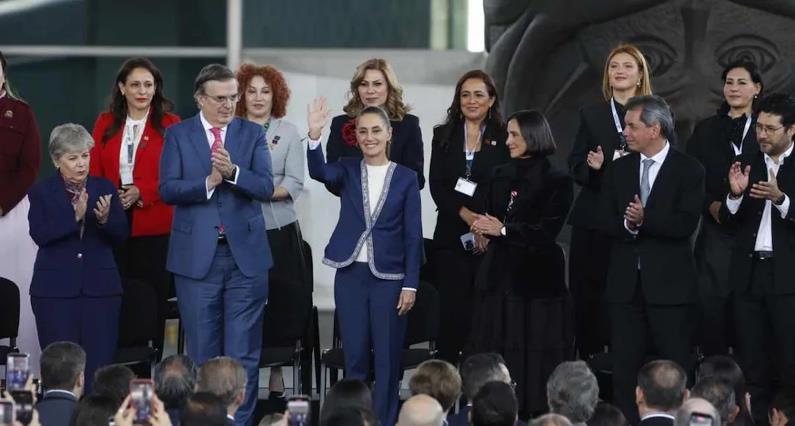
Mexico’s federal government and the private sector held a high-profile investment promotion event aimed at reinforcing confidence in the country’s economic outlook for 2026. President Claudia Sheinbaum led the First National Investment Promotion Meeting, joined by key cabinet members, including Secretary of Economy Marcelo Ebrard, as well as development bank officials and business leaders from across the country.
During the event, authorities highlighted that Mexico’s investment portfolio has expanded by roughly 10% this year, reaching more than USD 406 billion and encompassing over 2,500 projects nationwide Officials emphasized coordinated efforts across ministries to facilitate, accelerate, and safeguard investments, while development banks outlined new credit guarantees and financing tools to support small and medium-sized enterprises. Also, business representatives stressed the importance of energy availability, infrastructure, and streamlined permitting to sustain momentum.
In parallel, the Ministry of Economy informed that foreign direct investment (FDI) inflows reached USD 40.9 billion in the third quarter of 2025, representing a 14 5% increase compared to the same period in 2024; underscoring the government’s message of policy certainty under the Plan Mexico.
Source: EL UNIVERSAL, GOBIERNO DE MÉXICO

President Claudia Sheinbaum stated that the ongoing USMCA review is “very advanced” and expressed confidence it could be concluded before the end of 2026. She emphasized that discussions remain framed as a technical review rather than a full renegotiation. The government’s confidence aims to project stability and continuity in North American trade relations, and the emphasis on progress reflects Mexico’s strategy to position itself as a constructive partner, while seeking to avoid the economic and political risks associated with a more contentious renegotiation process.
Source: FORBES
Mexico and the United States have signed a bilateral action plan to protect critical minerals supply chains, signaling closer strategic alignment ahead of the 2026 USMCA review The agreement, described by U S officials as unprecedented, establishes cooperation mechanisms to reduce North America’s exposure to global supply disruptions, amid efforts to curb dependence on China for minerals and rare earths.
Under the plan, both governments will spend the next 60 days identifying priority minerals of shared interest and coordinating trade and industrial policies across the value chain, from extraction to advanced manufacturing. Key elements include joint geological mapping, information-sharing between the U.S. Geological Survey and Mexico’s Geological Service, and the identification of mining, processing, and manufacturing projects of mutual interest, potentially extending to third countries
For Mexico, the agreement strengthens its positioning as a strategic partner in North American industrial policy, while complying with U S trade and security priorities
Source: EL FINANCIERO, USTR

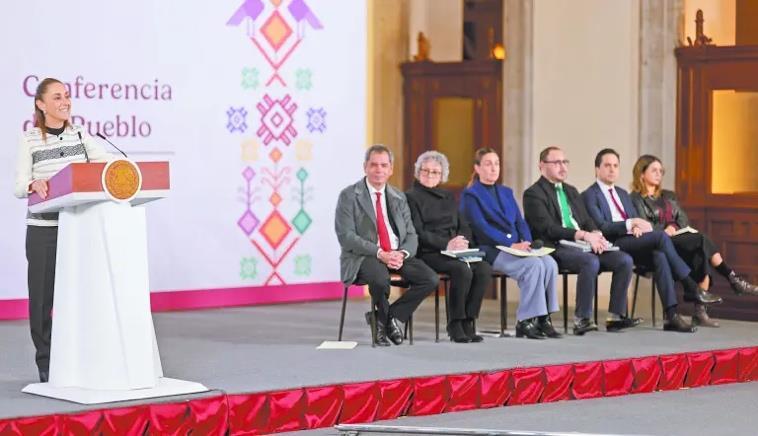
Mexico’s federal government unveiled a historic public and mixed investment plan in infrastructure totaling up to MXN 5 9 trillion through 2030, as part of the broader Plan Mexico strategy. Presented during President Claudia Sheinbaum’s morning conference, the initiative aims to boost economic growth while advancing social welfare and regional development
Finance Minister Edgar Amador detailed that MXN 5 6 trillion will be invested between 2026 and 2030 across eight strategic sectors, following a review of more than 1,500 federal projects Energy will receive the largest share (54%), followed by railways, highways, ports, health, and water infrastructure. Sheinbaum emphasized that public investment will act as a development catalyst, reinforced by private participation under state-led rules. She stressed that new schemes avoid past “onerous” concessions, preserve public control, and ensure sustainable financing. Authorities also announced a new Strategic Investment Planning Council to monitor execution, prioritize projects, and reduce administrative bottlenecks, signaling a more centralized and transparent approach to longterm infrastructure development.
Source: EL ECONOMISTA
President Claudia Sheinbaum announced that the federal government will promote legal changes to link agricultural exports with compliance with labor rights The proposal aims to address longstanding labor abuses in exportoriented agriculture and align trade policy with social and environmental standards, amid heightened scrutiny of labor practices in global supply chains Under the proposal, exporters would need to obtain a labor compliance certificate demonstrating that production volumes correspond to formally contracted workers with access to social security. The scheme would involve labor inspections coordinated with state governments The initiative may also help preempt trade disputes or labor complaints under the USMCA framework, where labor enforcement has become more prominent.
Source: REFORMA
Carlos Aceves del Olmo announced he will not seek reelection as secretary general of the Confederation of Mexican Workers (CTM), ending a decade-long tenure. The decision triggers an internal succession process ahead of the CTM’s National Congress in late February, marking a leadership change in one of Mexico’s most historically influential labor organizations Potential successors include senior CTM figures such as Alfonso Godínez, Tereso Medina, and Fernando Salgado. The leadership change at the CTM could have broader implications for Mexico’s labor landscape, particularly toward labor reform enforcement, wage negotiations, and overall engagement with the federal government
Source: EL HERALDO
Initiative Amending Provisions of the Constitution Regarding Circular Economy and Solid Waste Management
• Presented by: Dep Luis Enrique Martínez (PT)
• Objective: Aims to guarantee the right to a clean and healthy environment through comprehensive solid waste management and the promotion of a circular economy. Assigns environmental liability for improper waste management, empowers Congress to legislate on these matters, and authorizes municipalities to implement integrated waste management plans
• Status: Presented to the Plenary on February 1st.
Initiative Amending the General Law of Ecological Balance and Environmental Protection, Regarding Environmental Enforcement
• Presented by: Dep. Luis Enrique Miranda (PVEM)
• Objective: Creates a National Registry of Environmental Offenders administered by SEMARNAT to publicly record individuals and companies convicted of environmental crimes. The registry aims to prevent repeat offenses, support enforcement decisions, strengthen transparency, and enhance environmental oversight
• Status: Presented to the Plenary on February 2nd
Initiative Amending the Federal Labor Law, Regarding the Right to Real Labor Disconnection
• Presented by: Sen Saúl Monreal Ávila (MORENA)
• Objective: Establishes the right of workers to real labor disconnection, allowing them to refrain from responding to work-related communications outside legal or agreed working hours
• Status: Published in the Parliamentary Gazette on February 4th
Initiative Amending the Constitution, Regarding Electoral Reform
• Presented by: Chamber of Deputies (Citizen Initiative)
• Objective: Seeks to reform the political-electoral framework by redistributing public financing to promote fairer competition among political parties, granting public funding to independent candidates, strengthening oversight of campaign spending, regulating digital political propaganda, and preventing early campaign activities.
• Status: Turned to commissions on January 21st
Initiative Amending Article 73 of the Constitution, Regarding Artificial Intelligence Legislation
• Presented by: Sen. Karina Isabel Ruiz Ruiz (MORENA)
• Objective: Empowers the Congress of the Union to enact legislation regulating artificial intelligence, providing a constitutional basis for future federal laws governing its development, use, supervision, and oversight, while ensuring legal certainty, institutional coordination, and alignment with public interest and technological innovation objectives
• Status: Presented to the Plenary on February 4th
Initiative Amending Article 73 of the Constitution, Regarding an Artificial Intelligence Law
• Presented by: Sen Saúl Monreal Ávila (MORENA)
• Objective: Authorizes Congress to enact a General Artificial Intelligence Law establishing principles, coordination mechanisms, and regulatory frameworks for the development, use, supervision, and control of AI systems, ensuring the protection of human rights, legal certainty, transparency, ethical standards, innovation, and the public interest.
• Status: Presented to the Plenary on February 4th.