USMCA
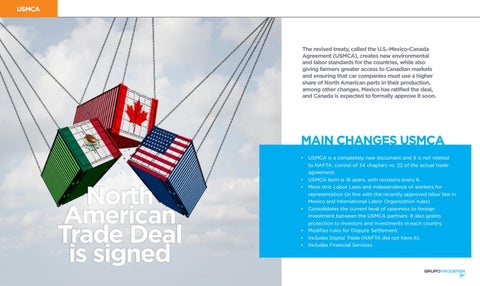
The revised treaty, called the U.S.-Mexico-Canada Agreement (USMCA), creates new environmental and labor standards for the countries, while also giving farmers greater access to Canadian markets and ensuring that car companies must use a higher share of North American parts in their production, among other changes. Mexico has ratified the deal, and Canada is expected to formally approve it soon.
MAIN CHANGES USMCA
North American Trade Deal is signed
• USMCA is a completely new document and it is not related to NAFTA, consist of 34 chapters vs. 22 of the actual trade agreement. • USMCA term is 16 years, with revisions every 6. • More stric Labor Laws and independence of workers for representation (in line with the recently approved labor law in Mexico and International Labor Organization rules) • Consolidates the current level of openness to foreign investment between the USMCA partners. It also grants protection to investors and investments in each country. • Modifies rules for Dispute Settlement. • Includes Digital Trade (NAFTA did not have it). • Includes Financial Services.
USMCA
MAIN CHANGES USMCA AUTO INDUSTRY: Rules of Origin: • Regional Value Content (RVC) of 75% • Labor Value Content: 40% must be produced in an area of high
USMCA RESPONDS TO THE 21ST CENTURY ECONOMY MODERNIZES NAFTA’S DISCIPLINES, ADAPTING THEM TO THE NEW NEEDS OF THE 21ST CENTURY ECONOMY
GUARANTEES CERTAINTY IN TRADE AND INVESTMENTS
STRENGTHENS NORTH AMERICA’S COMPETITIVENESS
INCLUSIVE AND RESPONSABLE REGIONAL TRADE
wages (minimum of US $ 16 per hour). • Additionally, at least 70% of the steel must originate in North America. • Essential parts also need to comply with 75% VCR including engines, chassis & body parts, transmissions, axels, suspensions, drive train and batteries. • Vehicles that do not meet the ROO may be exported by paying the 2.5% Most Favored Nation (MFN) tariff, currently applied by the US. The revised North American trade pact was signed just weeks after Trump signed a partial trade deal with China. White House officials said the hardball tactics the president used to extract changes from U.S. trade partners had proved effective.
US-CHINA
U.S.-China Trade Deal U.S. and China signed Phase 1 trade deal on Jan 15th, to ease the long-running trade tensions between the world two biggest economies. The deal served as a solid step for U.S. and China reaching further agreements in trade which can benefit both countries and the world economy.
SUMMARY • Intellectual Property Protection, the parties reach agreement in trade secrets and confidential business information protection, pharmaceutical-related intellectual property, combating counterfeits on major e-commerce platforms, deterrent-level penalties, enforcing copyright and related rights, additionally reinforce bilateral cooperation on intellectual property protection and implementation. • Technology Transfer, to enhance mutual trust and cooperation in technology transfer, the parties agree: Businesses from each country should be able to operate “openly and freely” without pressure to transfer their technology to foreign business partners in the other country. Sharing tech blueprints “must be based on market terms that are voluntary and reflect mutual agreement. Government shall not support or direct the outbound foreign direct investment activities of its persons aimed at
US-CHINA acquiring foreign technology with respect to sectors and industries targeted by its industrial plans that create distortion. • Trade in Food and Agriculture Products: The parties will enhance the cooperation and increase trade scale in agriculture products. Both parties acknowledge the importance of each Party adhering to its World Trade Organization (WTO) commitments with respect to the provision of domestic support. Also, China agreed to steps that allow more market access for U.S. dairy products, poultry, beef, fish, rice and even pet food. • Financial Services: Each Party requests that the other Party ensure fair, effective, and nondiscriminatory participation in its market for banking, credit rating, electronic payment, assets management, insurance, security, fund management, future services and services suppliers of the other Party, that includes quickly reviewing license applications from other party service companies. The deal sets April 1st 2020 as deadline for China to allow branches of U.S. financial institutions to provide securities investment-fund custody services. • Resolving Business Disputes: Both parties agree the creation of a dispute-resolution office, addressing longstanding complaints from the U.S. business community that their disagreements with Chinese partners haven’t been fairly resolved. It laid out the framework for officials in U.S. and China to discuss how to implement this mechanism, including information sharing and an appeals process.
KEY POINTS IN BILATERAL TRADE DUTY CALLS: Prior to the agreement, the U.S. agreed to cut the tariff rate to 7.5% from 15% and held off on tariffs of 15% that were set to take effect in December. This agreement doesn’t amend the 25% tariff imposed to most technology and advanced manufacturing goods. Tariff reduction ceased further duty escalations; it helps to relief manufacturers from both countries. Tariff Impose Date
Value of Goods
Imposed Tariff
New Tariff
May, July, Aug-19
$250
B 25%
25%
1 Sept 19 15 Dec 19
$120 $170
B 15% B 15%
7.5% 0%
CHINA PURCHASE: In the trade scale, China agrees to increase the purchase of manufactured goods, energy, agriculture and services from U.S. in next two years as following.
U.S. Export to China of top of 2017 Base in $Billion SERVICES ENERGY AGRICULTURE MANUFACTURED GOODS
Source: U.S. White House
USMCA
RECOMMENDATION FOR MANUFACTURING COMPANIES After two years of negotiation, the phase I trade agreement between U.S. and China reflects a periodical win-win deal for both countries and helps to stabilize the trade relationship. With the pressure of world economy slowing down and China’s push to further open the market, this trade agreement is interest of all countries and contributes to global economy. We suggest companies digest the full agreement document and understand the implication to your particular industries in short term. Most importantly, companies should prepare operational strategy to navigate trade complexity and uncertainty in long term. When it comes to manufacturing companies:
• Most products under advanced manufacturing category, auto parts, machinery, building material, furniture…etc are still under 25% of duty. We suggest companies prepare for the new norm that the duty may remain for a long-haul and adjust supply chain accordingly. • Companies prepare the supply and custom declaration timely, if your products are on the list of duty reduction or suspension, taking advantage of the window of time prior agreement. • With the technology transfer clause stating that businesses from each country should be able to operate “openly and freely” without pressure to transfer their technology to foreign business partners, manufacturing companies specially need to follow up the implication of this clause, and build up own core competence and technology in global trade. • In trade compliance, the phase I trade agreement rolled out detailed industry related regulations. Companies should also pay attention to technology requirement, intellectual property protection and export administration regulations ..etc. when import and export goods, in additional to classification and duty measures. Implementing a trade compliance management system is highly recommended to effectively deal with the constantly changing trade environment.
MEXICO
SALARY EXPECTATIONS IN MEXICO 2020 Results of the 2020 Wage Outlook Survey
150
104,318
Participating companies
Results of the 2020 Wage Outlook Survey number of unionized positions
What is the percentage of salary increase predicted for union members in 2020?
5.33%
States SL
5.3%
NL
5.2%
COAH
5.2%
CDMX
Contract review month
5.4% 6. 1%
BC
6.4%
GTO JAL
estimated average salary increase
4. 1%
33% January 24% February 16% March
150
35,640
Participating companies
Sum of nonunionized positions
What is the percentage of salary increase predicted for executives, middle managers and administrators in 2020?
5.38%
States SL
estimated average salary increase
5.4%
NL
5.2%
COAH
5.2%
CDMX
6.2%
BC
6.2% 6. 0%
GTO JAL
4.2%
Salary increase month 25% January 23% February 16% March
FOR FURTHER INFORMATION CONTACT YOELLE ROJAS I yrojas@prodensa.com ABRIL ESCANDÓN I aescandon@prodensa.com