P.O. Box 991 Groton, Massachusetts 01450-0991
Groton School The Quarterly • Fall 2015
BACK
CIRC LI
G
PAID
North Reading, MA Permit 6
Change Service Requested
N
Non-profit Org. U.S. Postage
Groton School • The Quarterly
Groton School
20 15
Our Schoolhouse
AY
1899 meets 2015
FOLLOW GROTON:
PR
IZ
E
D
Fall 2015 • Volume LXXVII , No. 3
William Amory Gardner, one of the founding masters of Groton School, owned the Mayflower, a schooner that won this Tiffany sterling cup— the Weld Cup—on August 28, 1893. On the cup is the Mayflower’s winning time in the yacht race off Marblehead, Massachusetts—three hours, fifty-five minutes, and seven seconds. Also engraved on the cup are the names of the runners-up, the Marguerite and the Constellation, as well as the Yampa, which competed but did not finish. The Weld Cup, measuring about 12.5 inches high, was not the Mayflower’s first prize. According to school archivist Doug Brown ’57, before Mr. Gardner owned the boat, it had won the America’s Cup.
Harry’s Gift, Henry’s Legacy
H
ARRY PRATT and Henry Bakewell,
study mates from the Form of 1955, forged a friendship at Groton School that spanned more than 60 years, until Henry’s death in 2012. In 1968, this bond led Henry to name Harry as godfather when his daughter Ann (Ann Bakewell Woodward ’86) was born. Fast forward past Ann’s graduation from Groton through her years of volunteer work for the school as form agent, head of the Alumni Association, and as a member and now vice president of Groton’s Board of Trustees, through which she has been deeply involved in planning the Schoolhouse expansion project. During these busy years, Ann saw her godfather Harry only occasionally, and their conversations never unearthed the ironic fact that Ann’s work to upgrade Groton’s Schoolhouse would result in the dismantling of the old science wing, whose design and construction Harry had overseen when he served on Groton’s board, from 1970 to 1985. When Harry learned of this coincidence, over Reunion Weekend in May, he laughed out loud: his own goddaughter, following in his footsteps to serve the school they both love, was helping lead an effort that would demolish the wing he had worked on in 1974. Harry found this irony positive rather than painful. “I am so proud of Ann,” he says. “She is incredibly smart and thoughtful and accomplished— what an asset to Groton’s board.” Harry decided to join Ann and her husband Gordon in supporting the Schoolhouse construction and designating the building’s new Fabrications Lab in memory of Henry Bakewell. Stretching to make the best gift possible, Harry structured his contribution in two parts: an outright gift plus a share of his 401(k) retirement plan. “Naming Groton as a beneficiary of one’s retirement
plan is particularly smart if your spouse and children won’t really need it,” he says. “If your retirement plan is left to your children, they may have to pay double taxes on it—income tax and, on top of that, estate tax. It makes far more sense to assign your retirement plan to Groton and remove it from your taxable estate.” Harry couldn’t be more pleased to join Ann in supporting this project. “I was at her christening,” he says. “Don’t forget, Groton was still all boys back then, so the idea never crossed my mind that one day she’d grow up to attend Groton, much less help to lead the board. I’m thrilled the Fab Lab is named for her dad, but I think his greatest legacy to Groton School is Ann herself.” Spoken like a proud godfather.
Harry Pratt ‘55, top of page and above, with his goddaughter Ann Bakewell Woodward ‘86, at her wedding in 1995
For more information about including Groton School as a beneficiary of your retirement account, please contact Elizabeth (Betsy) Ginsberg, Senior Leadership Gift Officer, at 978-448-7584 or eginsberg@groton.org.
Mike Sperling
Groton School Fall 2015 • Volume LXXVII, No. 3
The Quarterly
Our Schoolhouse 1899 meets 2015 The renovated and expanded Schoolhouse has opened. Take a look at how your Schoolhouse has changed, while in many ways remaining the same. page 16
Prize Day 2015 page 26
Reunion Weekend page 48
D E P A R T
M
E
N T
S
2 Message from the Headmaster 3 Letters 4
Circiter / Around the Circle
10
Personae / Profiles
62
Voces / Chapel Talks
70
De Libris / Books
72
Grotoniana / Arts & Athletics
80 In Memoriam 82 Form Notes 110 Groton Babies Ellen Harasimowicz
The Form of 2015
Cover photo by Tom Kates
Annie Card
Message from the Headmaster
T
he wait is over. In the spring Quarterly, I wrote about the renovated Schoolhouse as I imagined it would be. I can now report that the new STEM (Science, Technology, Engineering, and Mathematics) addition blends gracefully with our humanities classrooms, the Forum is quickly becoming a community crossroads, and new labs and classrooms are inspiring our students. Thanks to Schoolhouse 2.0, Groton has indisputably vaulted itself into a leadership position when it comes to 21st-century learning environments. How fortunate are the students and faculty who became the very first occupants of this stunning space! What I couldn’t anticipate in the spring was how much our students would light up the architecturally beautiful spaces, and how much the bricks and mortar could further our efforts to be a more inclusive community. When I walk through the Forum, the library, a classroom, or even a hallway, I see interaction among students of all forms and all backgrounds. In that interaction is evidence of inclusion. The library, in particular, signals our more inclusive community because it now truly belongs to everyone. Previously in Hundred House, library resources now reside in what formerly was the Hall. Second Formers, Sixth Formers, and everyone in between focus intently on their books and computers, tapping away at assignments. The new library encourages communication within and among forms.
Editor Gail Friedman Design Irene Chu
Contributing Editors Kimberly A. Gerighty Elizabeth Z. Ginsberg P’16 Jessica Hart Elizabeth Wray Lawrence ‘82 Allison S. MacBride John D. MacEachern P’10, ‘14, ’16 Amy Sim Photography/Editorial Assistant Christopher Temerson
2
Groton School Quarterly
•
Fall 2015
The Forum, a three-story atrium connecting the old Schoolhouse to the new, offers spaces for gatherings small and large. It was designed with community in mind, beckoning people to stop, to greet, to contemplate, and to grab a snack in the café. Our labs and STEM classrooms are witnessing new levels of interaction as well. They were designed for efficiency and scholarship, but also for creativity and collaboration. A third of the students admitted to Groton this year noted that STEM was among the factors attracting them to Groton. Indeed, in recent years we have woven interdisciplinary STEM approaches throughout our math and science curricula, and now we have the facilities to support the enhanced program. Our students will showcase skills built upon these interdisciplinary threads, which rest upon a time-tested, rigorous foundation in the sciences and mathematics. Groton students leave our Circle equipped to pursue and ultimately become leaders in their area of interest, whether that is classics, world languages, or STEM disciplines. To use terms from technology, generous donors have given us the hardware in the form of this spectacular Schoolhouse. It is now up to us, the teachers, to hone in and develop the metaphorical software—the intellect—that will make ours a truly 21st-century learning environment. Please consider a visit to our open Circle. You’ll find the Schoolhouse as inviting as ever and the Groton embrace tangible. You’ll understand why I, and the full community, are smiling—for we are both enthusiastic and grateful for the gifts bestowed upon us. It is hard to imagine that Groton could get even more beautiful. When you see this new and improved heart of our campus, the work happening within its walls, and the inclusive atmosphere it encourages, I think you’ll agree that it has.
Temba Maqubela Headmaster
Editorial Offices The Schoolhouse Groton School Groton, MA 01450 978 - 448 -7506 quarterly@groton.org Other School Offices Alumni Office: 978 - 448 -7520 Admission Office: 978 - 448 -7510
Groton School publishes the Groton School Quarterly three times a year, in late summer, winter, and spring, and the Annual Report once a year, in the fall.
LETTERS
Pam Clarke (“Leadership Training,” Groton School Quarterly, Spring 2015) was head at three schools in addition to Doane Stuart: Trevor Day School (New York, NY), St. Paul Academy and Summit School (St. Paul, MN), and Masters School (Dobbs Ferry, NY). You publish a great magazine. Keep it up. How about a list of Groton graduates going on to become school heads? Frank Ashburn (“FDA”) and Arthur Milliken (“Prof ”) were a couple of giants in the field. Peter Bunting
Editor’s Note: Great idea . . . following is a list of Groton graduates who went on to be heads of school. Those with an asterisk also were on our list of Groton faculty who later led schools. Please send the names of those we missed to quarterly@groton.org. Frank Ashburn 1921 Brooks School, North Andover, MA
William Polk ’58 Groton School, Groton, MA
Jiraorn Assarat ’97 Anubaan Assarat School, Bangkok, Thailand
*Charles Rimmer ’44
George Bartlett ’48 South Kent School, Englewood, NJ
Jennifer Ayer Sandell ’82 Girls’ Middle School, Palo Alto, CA
Aaron Cooper ’94 Elisabeth Morrow School, Englewood, NJ
*Charles W. Sheerin Jr. ’44
John Crocker 1918 Groton School, Groton, MA George Davison ’75 Grace Church School, New York, NY John Finley ’88 Epiphany School, Boston, MA A. Brooks Harlow Jr. ’53 Fay School, Southborough, MA Arthur Milliken ’22 Westminster School, Simsbury, CT Thomas Morse 1914 Belmont Hill School, Belmont, MA Robert Parker ’57 Emma Willard School, Troy, NY
Pingree School, South Hamilton, MA
Woodberry Forest School, Woodberry Forest, VA Whitney Slade ’77 Rumsan Country Day School, Rumson, NJ (also St. Michael’s Country Day and Tower School) Craig E. Smith Jr. ’85 Episcopal High School, Houston, TX Lawrence Monk Terry 1918 Middlesex School, Concord, MA
*William Webb ’93
Fountain Valley School, Colorado Springs, CO
Edric Amory Weld 1917 Holderness School, Plymouth, NH Lucretia “Lukie” Osborne Wells ’81 Buckingham Friends School, Lahaska, PA
CORRECTIONS We apologize for misidentifying the child of Elizabeth Gardiner ’83 and Andrew Marshall in the Winter 2015 Quarterly. Please see Elizabeth and Andrew’s daughter, Alice, on page 110. Two tributes to Nancy and Craig Gemmell were inadvertently omitted from the spring issue: “My favorite memory of Nancy is from my first year at Groton. She was the dean of students and Aimeclaire Roche was assistant head. In the first months of my tenure, Nancy, AC, and I undertook an enormous task of conducting a study of student
life — great fun, but a huge amount of work. At one stage, we each took a part of the findings to synthesize. When we came together to share our results, AC and I (who had both studied classics as undergraduates) arrived with charts that looked eerily like Latin verb synapses. Nancy arrived with pages of elegant prose. After a hearty laugh all ‘round, we realized that it was actually a wonderful combination. That’s one of the things I love most about Nancy. She has a wonderful way of weaving raw data into beauty, of breathing life into the driest of tasks. I have loved working with her and
will sorely miss her as a master teacher, tireless advocate of students, and a dear friend.” — Former Director of Counseling Melinda Stewart “When we were in Second Form, a group of my friends and I sent Mr. Gemmell a long list of props that we needed for a skit for English class. At the bottom of the list, we included a singing monkey. We didn’t actually need it, but we thought we were really funny to ask for it. (We weren’t.) A few days later, we returned to our dorm to find all of the props in our inner common room. On top of the pile was a stuffed Curious
George. Mr. Gemmell sent us an email later saying that although the monkey couldn’t sing, it was a very good hummer and was the best he could do with such short notice. After the skit, we made him a thank you card with Curious George on the cover. He told us later that he kept the card and that he showed it to his wife, Ms. Hughes. To this day, I believe that the greatest compliment you can get from Mr. Gemmell is that he showed whatever you sent him, be it an email or a card, to Ms. Hughes. Curious George still sits on my desk, still unable to sing.” — Blair Donohue ‘18
www.groton.org
3
Tom Kates
What is GRAIN?
GRoton Affordability and INclusion
GRA I N
Groton’s Commitment to Affordability
G
roton School has welcomed the first group of students admitted since the groundbreaking affordability initiative known as GRAIN was announced last November. GRoton Affordability and INclusion (GRAIN) cemented the school’s commitment to making Groton accessible to families in all income brackets, including those neither high- nor low-income. GRAIN froze tuition for three years, through the 2017–18 school year; increased the number of students on financial aid; and guaranteed that Groton School would consider all applicants without regard to their ability to pay. After one year of the three-year freeze, Groton’s tuition retreated from the #1 to the #14 position among peer schools. More importantly, the school’s Board of Trustees approved funding models for GRAIN that recognize the importance of providing financial aid to those in the middle income or professional classes—those who typically assume they will not qualify for aid. A $5 million gift, from a supporter who wishes to remain anonymous, kicked off GRAIN last November. Since then, the initiative has raised more than 4
Groton School Quarterly
•
Fall 2015
$16 million, and fundraising continues. Another early supporter of GRAIN, alumnus Pete Briger ’82, explains why GRAIN is resonating within the Groton community. “Groton is appropriately focusing on the future rather than the past,” he says. “GRAIN allows for more flexibility in the financial profile of applicants in the admissions process, making it more likely that we will have an impact on the future leaders of tomorrow.”
freezing tuition has a cost, so does raising tuition. “A tuition freeze isn’t a cost, it is a forgone revenue opportunity.” says Groton School Trustee William Gray P’15. “Raising tuition also has a cost, mainly in the form of a more restricted applicant pool.” The GRAIN announcement generated considerable attention among applicants and other independent school leaders. Applications to Groton increased from both financial aid and
“A tuition freeze isn’t a cost, it is a forgone revenue opportunity. Raising tuition also has a cost, mainly in the form of a more restricted applicant pool.” William Gray P’15, Trustee The Board of Trustees deliberated over several months to create funding models that would allow for the tuition freeze and the increased financial aid to support GRAIN without touching faculty/staff compensation or programming. Underlying the discussions was recognition that while
full-pay families (bucking a national trend that shows declining applications from those who can afford full tuition). The total number of applications to Groton for the 2015–16 school year was about 8 percent higher than the number submitted for the previous year. The school’s acceptance rate
Why GRAIN? Under the leadership of Headmaster Temba Maqubela, inclusion has become a primary focus of school life. Inclusion in all respects, including socioeconomic inclusion, is a priority. The headmaster and the board recognized that a school that does not attract a substantial number of applicants from every possible income bracket is not as inclusive as it could be. Groton is trying to encourage students to apply whose families have been turned off by tuition sticker shock, and the school wants to make sure it does not turn away a candidate for financial reasons. Will GRAIN help fund international families? Yes, Groton has long offered financial aid to international students, though most aid goes to American students. How is Groton paying for this? Gifts are an important source of funding for this long-term initiative. Other funding strategies include a temporary increase in the school’s endowment draw, which will remain conservative, and plans to ask those parents who are able to consider paying the actual cost of a Groton education, which is about $33,000 higher than tuition. Are budget cuts planned to help with funding? No. The trustees have made it clear that GRAIN will not affect faculty or staff compensation; academic, residential, or other programming; or any day-to-day school functions. How much has been raised so far? About $16 million. We expect our endowment draw to revert to pre-GRAIN levels once we raise $25 million.
circiter
Q&A
“Middle-income families need to get the message that we understand that they are saving for college. We will help put a Groton education within their reach.” Temba Maqubela, Headmaster has remained among the most selective: 12.4 percent of applicants were accepted for the 2015–16 school year. Groton’s Board of Trustees has deemed GRAIN the school’s numberone strategic priority. “The trustees unanimously had no doubt that making Groton School accessible to all without regard to their ability to pay should be our top priority,” says Board of Trustees President Jonathan Klein P’08, ’11, ’18. “The best education in the land should be available to all who meet the standards for admission, and that is exactly what GRAIN aims to achieve.” GRAIN and the school’s broader focus on affordability and inclusion rest upon Groton’s desire to be a community based on fairness and equal opportunity, and upon an overarching goal to provide students with the best secondary school education possible. “Inclusion in all respects, including socioeconomic inclusion, is an important ingredient of an outstand-
concentrated in the extremes of the socioeconomic spectrum. The more perspectives, backgrounds, and experiences our students bring to Groton, the better a Groton education will be.” GRAIN has sparked discussion about affordability at other boarding schools—another goal of the Groton initiative. At least one other school did not raise tuition between 2014–15 and 2015–16, and many are discussing ways to increase middle-income representation. GRAIN tackles the reality that the cost of a top-level education has substantially outpaced income growth. An independent school education has become increasingly unaffordable, even to those who could afford it a few decades ago. In 1983, according to U.S. census data, Groton’s boarding tuition equaled 38 percent of the average U.S. household income. By 2013, it was 76 percent. “We are trying to attract talented students who wrongly assume they
“GRAIN allows for more flexibility in the financial profile of applicants in the admissions process, making it more likely that we will have an impact on the future leaders of tomorrow.” Pete Briger ’82 ing education,” says Groton School Headmaster Temba Maqubela, who has stressed the importance of an inclusive community since joining the school in July 2013. “The Board of Trustees recognized that steadily rising tuition had contributed to the school’s applicant pool becoming increasingly
cannot afford to attend Groton,” says Mr. Maqubela. “We have fully funded students of modest means for many years and will continue to do so. Middle-income families need to get the message that we understand that they are saving for college. We will help put a Groton education within their reach.”
www.groton.org
5
circiter
Roosevelt Scholar Shares Groton Stories
N
oted Roosevelt scholar Kathleen Dalton visited Groton in mid-April, giving a Chapel Talk and a midday lecture on several Roosevelts, including Teddy, Eleanor, and Groton’s most famous graduate, Franklin Delano Roosevelt 1900. Dalton, author of Theodore Roosevelt: A Strenuous Life, a history teacher at Phillips Academy Andover, and an instructor at Boston University, introduced students to the close relationship between Groton School founder Endicott Peabody and President Theodore Roosevelt. Dalton covered a broad swath of history in her Roosevelt primer, including the influence Peabody had on FDR at Groton, the social programs FDR supported that remain in effect today, and the influence of Eleanor Roosevelt and other women on public policy.
During the morning Chapel Talk, Dalton described how young Theodore Roosevelt and Endicott Peabody watched disapprovingly as their peers “gave in to dissipation and drunkenness.” They often traveled to Boston’s Trinity Church to hear preacher Phillips Brooks, who sold them on the value of “muscular Christianity,” which Dalton explained as “a belief that Christian faith could be revitalized and made a living force in a new generation of young men if sports and outdoor activity became like a spiritual practice and a means to combat sin.” Theodore Roosevelt maintained extremely close ties to Peabody, and ended up marrying Peabody’s cousin. The Groton rector was an usher at the president-to-be’s wedding. Dalton said that Teddy Roosevelt
Kathleen Dalton
Trevor Fry ‘15, Monica Bousa ‘15, and Gail Friedman
Circlefest Celebrates Pure Fun, Joy of Spring
O
n a Saturday evening in early May, faculty, and faculty children, who all conGroton’s first-ever Circlefest drew virtutributed to a festival of positive energy. The ally the entire community onto the Circle. smell of stone-oven pizza and BBQ wafted No one could resist the fun, the food, the over the Circle, enticing people to picnic. games, or the beautiful, sunny weather. “I had been wanting to try an event like Five inflatables — boxing, jousting, a this since the start of the school year,” said bungee run, dueling ladders, and an obstaDirector of Student Activities Tim Leroy. cle course — joined lawn games and the roly- “Spring is one of the best times of the year poly challenge of bubble soccer to create a on campus — weather is slowly warming up, carnival-like atmosphere, delighting students, kids are outside on the Circle, and Prize Day
6
Groton School Quarterly
•
Fall 2015
contacted Peabody when his four sons were born to enroll them in Groton. Theodore Roosevelt Jr., Kermit, Archie, and Quentin all attended Groton. Even after he was in the White House, Teddy remained close to the school. “After he became president in 1901, as he found himself in the middle of labor disputes and racial conflicts and struggles with big businesses, TR would not turn down Reverend Peabody’s invitation to speak at Groton’s twentieth Prize Day in 1904,” Dalton said. When Eleanor, Theodore’s niece, ended up caring for her brother, Hall, she sent Hall to Groton as well. “As a young woman working as a teacher and Junior League volunteer with poor children in the tenements of New York, Eleanor would take the train to Groton and visit Rector and Mrs. Peabody with her brother, Hall, and she would look in on her cousins TR Jr. and Kermit, too,” Dalton said. As the world knows, Eleanor married
Franklin, who had been greatly influenced by his Groton education. “Franklin listened with care when the Rector insisted that it was a Christian’s obligation to battle for just causes, which reinforced Franklin’s father’s reminders that Christianity required the rich to help the poor,” Dalton said. “Franklin became a member of the Groton Missionary Society, volunteering to care for the 84-year-old widow of a black Civil War drummer who lived near the school, and he worked with poor boys in the Boys’ Club of Boston and became the director of the Groton summer camp in New Hampshire. During his Groton years, Franklin excelled at few subjects except punctuality and Latin, but he showed his parents he was ready to act upon his social concerns.” FDR and Eleanor sent their own four sons to Groton. Peabody put politics aside in his support for his former student. “Even though Rector Peabody did not vote for FDR, he welcomed him home to Groton in
1932 to speak to the students,” Dalton said. “Peabody reported that, ‘I reminded the boys that it was our constant effort to persuade our graduates to take an interest in politics with a view to service to the nation . . . Now that Franklin has been elected, we shall of course back him up.’” Peabody presided over the service marking FDR’s first term in office. During Dalton’s midday lecture, she delved into the Roosevelts’ impact on America and paid particular attention to Eleanor and the unsung women who influenced public policy. She discussed topics including Prohibition, the Progressive Party’s legacy, FDR’s approach to bank failures in 1932, and how the ailing FDR made “fateful decisions” shortly before his death. Dalton ended her lecture with a photograph of Winston Churchill, FDR, and Joseph Stalin at the Yalta Conference, concluding, “There’s Groton, in the middle of world events.”
Carole Gates P’15
is quickly approaching. Having an event on campus where all of the students, faculty, and families could attend was my goal.” The evening ended with Talladega Nights, a movie chosen by the students, projected on an outdoor inflatable screen. It capped an inaugural event that sets the bar high for the future. Says Tim: “I’m already thinking about Circlefest 2016 and what we can add to next year’s event.”
O
n May 30, the school christened its newest rowing shell, the Samuel B. Webb Jr. ‘57. Above, rowing program head Andy Anderson instructs Sam Webb in the proper way to drizzle the bow of his namesake with water collected from the finish lines of the most significant race courses such that the boat “will develop a taste for those waters ... I collect it in bottles from the finish lines of important race courses where we race,” said Andy. “So there is typically some Lake Quinsigamond, some Thames River in Henley, England, and some Nashua River water. Those are our big three. I pour a bit of each into the silver cup and that’s what we use.” An anonymous donor underwrote the new shell and specified that it be named for Sam, who although he never rowed, has long been a fan of the sport. The new boat, made by Resolute, is a state-of-the-art racing shell made to fit boys with exceptionally long legs, of whom Groton has several.
www.groton.org
7
circiter Lauren Kochis ’17 and Anson Jones ’17, Matthew Higgins-Iati ’17 and Marianne Lu’19, and Hannah Simmons ’17
Beyond the Circle, a Community Day of Service
T
he entire Groton student body fanned out across the local area on May 17 to paint, plant, clean, and otherwise engage with the community. It was the school’s second Community Day of Service, but the first to include the whole school.
Students worked at 19 sites in eight towns, including Groton, where they sang for seniors at RiverCourt Residences, cleared trails in Keyes Woods, painted fences at town facilities, played with residents of Seven Hills Pediatric Center, participated in a
local wellness walk, and gardened at the town senior center. In addition, students helped with gardening at the homes of several elderly Groton residents. Outside of the town of Groton, students cleaned at the Sterling animal shelter, gardened at
Grandmas Electrify Remote Villages ong before Nobel Prize-winning economist Amartya Sen concluded that the key to combating rural poverty in the developing world is giving women a greater role in village life, Bunker Roy set up the Barefoot College deep in the heart of Rajasthan, an arid, poor state in western India. Roy, with Meagan Fallone, who handles Barefoot College’s global outreach, captivated students and faculty during a May lecture, explaining that the college has taught thousands of women to become technically proficient in more than seventy countries in Asia, Africa, and Latin America. In 2010, Time magazine named Roy one of the one hundred most influential people in the world. Barefoot College teaches women practical skills, such as how to construct and maintain solar cookers and solar lamps. When they return home they transform their villages, first, by raising the quality of life by bringing electricity with their new devices, and, second, by changing the traditional social dynamic by emerging as role models for other women in the village and awing men with their useful expertise. Roy and Fallone explained that the college carefully selects as its students grandmothers, who upon their return teach their children and grandchildren what they have learned. Fallone and Roy call these grandmothers “force multipliers” because they reach so many people. After the lecture, about fifty curious and
8
Groton School Quarterly
•
Groton Student Named Presidential Scholar
Gail Friedman
L
I
Meagan Fallone of Barefoot College enthusiastic students peppered Roy and Fallone with questions at a reception at the Headmaster’s House. Fallone described how inspiring it is to see women from different regions of the world develop friendships while building circuit boards. Roy challenged students to reconsider the role of their education by pointing out that few so-called educated people, including some of the brightest minds at places such as Harvard, can do the work that the illiterate women of the world have shown Roy that they can do when given the opportunity. — Tom Lamont P’09, ‘12, ‘15, history teacher
Fall 2015
n May, Malik Jabati ’15 was named a U.S. Presidential Scholar, a highly selective honor given to top students by the U.S. Department of Education. One male and one female scholar are chosen from each state, plus fifteen additional at-large honorees and twenty arts scholars. Malik was given the honor in his home state of Virginia. In his application, Malik named former Groton science teacher Tim Reed as the teacher who had most influenced him. Tim taught Malik chemistry, but also advised him, coached his soccer team, and was an affiliate in his Second Form dorm. Malik now studies at University of North Carolina, Chapel Hill, where he is a Morehead-Cain Scholar.
Photos by Christopher Temerson
Kasumi Quinlan ’15, Luke Holey ’16 and Ali Lamson ’16, and Matt Winter ‘16 Growing Places in South Lancaster and the Acton Arboretum, performed at the community center in Leominster and Nashoba Park Assisted Living in Ayer, served dinner at Our Father’s House in Fitchburg, served brunch at Our Lady of Grace Catholic Church in
Pepperell, helped with landscaping at the Heading Home Shelter in Roxbury, and sorted furniture at Household Goods Recycling of Massachusetts in Acton. The Community Day of Service was a chance for students and faculty to step outside their routines
and think about the world outside Groton’s Circle. “The act of getting beyond our gates reminds us that life is bigger than our conception of it. It is bigger than our workloads or our interpersonal drama,” says Director of Community Engagement and English Teacher
Jonathan Freeman-Coppadge, who planned the event. “We are called to come out of our own small worlds and experience life to the full, and that is a refreshing challenge.”
Sowon Lee ’15, Marianne Lu ’19, and Andrew Bassilakis ‘16
Mary Muckenhoupt
Christopher Temerson
Girl Rising, Fund Raising Holly Green Gordon ‘89, founder of Girl Rising, accepting funds collected by Lilias Kim ‘18 (right) and Frances McCreery ‘17 (not pictured). Girl Rising improves the lives and education of girls around the world.
Classics Students Stack Up Honors on National Exams
E
ighty-three percent of Groton’s Latin students earned cum laude or higher honors on the 2015 National Latin Exam, and, of these, about 75 percent earned maxima cum laude or summa cum laude. Three students received a perfect score: Andrew Bassilakis ’16, Sowon Lee ’15, and Marianne Lu ’19 (above). Of the 204 Groton students who took the exam, sixty-three earned summa cum laude, sixty-three maxima cum laude, twenty-two magna cum laude, and twenty cum laude. Andrew and Sowon also received blue ribbons for nearly flawless work on the
National Ancient Greek Exam. Ninetythree percent of Groton students who are taking Ancient Greek earned recognition for outstanding performance on that exam. Sowon also was recognized by the National Latin Exam Committee for receiving summa cum laude honors on the exam for four consecutive years. Other students receiving special recognition from the National Latin Exam Committee: Alaric Krapf ’15, for achieving summa cum laude on the National Latin Exam for five consecutive years, and Jared Belsky ’15, Layla Varkey ’15, and Katherine McCreery ’15, for earning summa
cum laude honors four of the past five years. In other Latin news, the Classical Association of the Middle West and South awarded Cynthia Cheng ’16 a scholarship for her excellent performance in the 2014 –15 Advanced Latin Translation Contest. And Andrew Bassilakis, Cynthia Cheng, and George Klein ’16 represented Groton School in the 2015 Brookline Certamen, a regional competition in Brookline, Massachusetts, where they placed second. Kudos to Groton’s young classicists, and to the teachers who inspire them.
www.groton.org
9
Andrés Velasco ’78
personae
Refuge from a Coup Andrés Velasco ’78, former finance minister of Chile, came to Groton when his family fled the repressive regime of Augusto Pinochet. He answered questions for the Quarterly.
You landed at Groton after your father was exiled from Chile under the rule of Augusto Pinochet. What was life like for you when the coup happened? As the son of a politician who opposed the new government, did you feel personal danger?
Inés Galaz
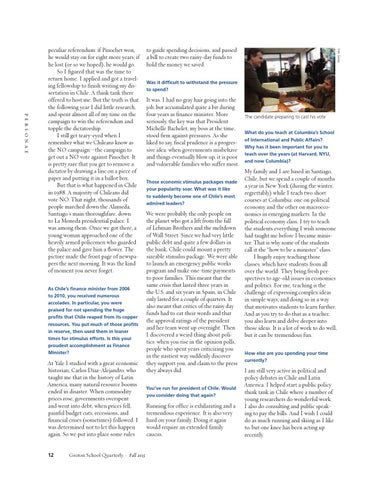
Andrés Velasco during his presidential campaign, talking to media just before he votes in the primary
10
Groton School Quarterly
•
Fall 2015
I did not feel personal danger. But I have very vivid memories of that period. At the age of 12, I remember standing in line with my mother trying to buy groceries. Americans and Europeans often think of the Allende government of 1970–73 in Chile as an intriguing socialist experiment. Middle-class Chileans who were around at the time remember it as the time when inflation got out of hand and you had to stand in endless lines to get rice, cooking oil, or toilet paper. When the coup d’état that toppled [Salvador] Allende came in September 1973, it was not a surprise. As in Yeats’ Ireland, things fell apart and the center could not hold. The country was divided into two irreconcilable camps. People who did not share your ideas became your enemies. It was all bound to end badly. Yet the Pinochet coup and the violence it unleashed were difficult even to comprehend. On the morning of the coup, a family friend who lived in the neighborhood was summoned over the radio to turn himself in at a military base. “I have done nothing and so I have nothing to fear,” he said when we traipsed down the street to visit. “I will
check in with military commanders and be back for lunch,” he added. Instead, that friend was arrested and spent months in a concentration camp, only to be released into exile.
»
When news of human rights violations under General Pinochet spread, my father, a law professor, became the lawyer to many of the victims and their families. As a result I learned things I was not supposed to know about.
Did you explain any of this background to new classmates at Groton when you arrived? How did they react?
Yes I did. We talked about it into the night many times. Of course, the reactions were pretty varied. Some of the kids in my dorm were politically sophisticated and asked informed questions. Others did not even know where Chile was. I remembered being asked, when
lasting impression. It was a truly amazing class. He would give us famous essays minus the last couple of pages, and then ask that we imagine and write the ending ourselves. I remember being given Shooting an Elephant by George Orwell and having to decide for myself: would the English policeman in Burma (Orwell himself ) shoot the elephant that had gone mad, even though the whole town depended on the elephant for transport and plowing the soil? Mr. Gula also taught us the importance of opening lines in setting the mood for a good essay. If my memory serves me right, the elephant
Then I discovered a weird thing about politics: when you rise in the opinion polls, people who spent years criticizing you in the nastiest way suddenly discover they support you, and claim to the press they always did. Before coming to Groton I went to an English school in Santiago (the same school my three kids go to today). The school was less than a mile away from Villa Grimaldi, a detention and torture center where Michelle Bachelet, the president of Chile today, was once held. Because I had heard it from my parents, I knew what went on there. I tried telling some of my schoolmates. They mostly did not believe it. Many people did not want to believe it. Their lives went on, and the news was just too disquieting. I guess that is what Hannah Arendt meant by the banality of evil in Nazi Germany. Not only do torturers come home in the evening to play with their children, people carry on. They fall in love and marry and have kids and worry about holding on to their jobs and paying the bills at the end of the month. That, as much as naked repression, is what gives dictatorships their staying power. But of course, many courageous people did speak up, and risked a great deal in doing so. My father was one of them. I myself was playing soccer at school on a Friday afternoon when a friend turned up breathless to tell me my father had been arrested. For three days we did not know where he was. Until suddenly we received a phone call from Buenos Aires, Argentina, where
I first arrived at Groton, whether we had ice cream in Chile. Others asked whether we had TV. Things went better after we figured out we had all grown up watching the same cartoon shows— Yogi Bear, The Road Runner, The Flintstones, and The Jetsons. Hard to believe, but TV shows can bring people together. How was such a short stay at Groton? Was a year long enough for the school to have an influence on you?
I was there for only a year, but the school and its teachers had a big influence on me. I took great European history and American literature classes. Learned a great deal about expository writing. Made great friends. Participated in some midnight activities in the woods that I cannot recall—at least not in print. And a year at Groton helped me get into Yale, which was no small thing. Did you have a particularly influential teacher, coach, or advisor? Are you still in touch with any Groton friends?
Mr. Tronic, the librarian, was always kind to me and introduced me to what are some of my favorite books to this day. But it was Mr. Gula and his expository writing class that made the most
piece begins: “Only once in my life was I important enough to be hated by large numbers of people. It was during my years as an Imperial Policeman in Burma.” (Or something like that—Orwell surely said it better.) But the point is that a beginning like that makes you want to read the rest. I still see friends from Groton regularly, whether in Boston, New York, or London. With others, we correspond over email. Tony Borden ’79, who lived in the room next door during Sixth Form, lives in London, and we see each other quite regularly. Same with other Grotonians. When Consuelo, my wife, and I got married on the beach in central Chile in 2003, a Groton and Yale contingent of nearly thirty people came down for the party—and stayed much longer than originally planned. You went to college in the U.S. your whole family was able to return to Chile a few years later. Did you face any repercussions being back in Chile after your family’s exile?
After Yale I went to Columbia for a PhD in Economics. When I was beginning to write my dissertation, my parents were allowed back into the country. And at around that time the Chilean opposition agreed to participate in a
www.groton.org
11
personae
To what degree did you understand the political climate and what drove your parents to exile in the United States?
he had been shipped after arrest and was now in hiding. From there he went to Venezuela, and then the whole family reunited in the U.S.
As Chile’s finance minister from 2006 to 2010, you received numerous accolades. In particular, you were praised for not spending the huge profits that Chile reaped from its copper resources. You put much of those profits in reserve, then used them in leaner times for stimulus efforts. Is this your proudest accomplishment as Finance Minister?
At Yale I studied with a great economic historian, Carlos Díaz-Alejandro, who taught me that in the history of Latin America, many natural resource booms ended in disaster. When commodity prices rose, governments overspent and went into debt; when prices fell, painful budget cuts, recessions, and financial crises (sometimes) followed. I was determined not to let this happen again. So we put into place some rules 12
Groton School Quarterly
•
Fall 2015
to guide spending decisions, and passed a bill to create two rainy-day funds to hold the money we saved. Was it difficult to withstand the pressure to spend?
It was. I had no gray hair going into the job, but accumulated quite a bit during four years as finance minister. More The candidate preparing to cast his vote seriously, the key was that President Michelle Bachelet, my boss at the time, What do you teach at Columbia’s School stood firm against pressures. As she of International and Public Affairs? liked to say, fiscal prudence is a progresWhy has it been important for you to sive idea: when governments misbehave teach over the years (at Harvard, NYU, and things eventually blow up, it is poor and now Columbia)? and vulnerable families who suffer most. My family and I are based in Santiago, Chile, but we spend a couple of months Those economic stimulus packages made a year in New York (during the winter, your popularity soar. What was it like regrettably) while I teach two short to suddenly become one of Chile’s most courses at Columbia: one on political admired leaders? economy and the other on macroecoWe were probably the only people on nomics in emerging markets. In the the planet who got a lift from the fall political economy class, I try to teach of Lehman Brothers and the meltdown the students everything I wish someone of Wall Street. Since we had very little had taught me before I became minispublic debt and quite a few dollars in ter. That is why some of the students the bank, Chile could mount a pretty call it the “how to be a minister” class. sizeable stimulus package. We were able I hugely enjoy teaching those to launch an emergency public works classes, which have students from all program and make one-time payments over the world. They bring fresh perto poor families. This meant that the spectives to age-old issues in economics same crisis that lasted three years in and politics. For me, teaching is the the U.S. and six years in Spain, in Chile challenge of expressing complex ideas only lasted for a couple of quarters. It in simple ways, and doing so in a way also meant that critics of the rainy day that motivates students to learn further. funds had to eat their words and that And as you try to do that as a teacher, the approval ratings of the president you also learn and delve deeper into and her team went up overnight. Then those ideas. It is a lot of work to do well, I discovered a weird thing about polibut it can be tremendous fun. tics: when you rise in the opinion polls, people who spent years criticizing you How else are you spending your time in the nastiest way suddenly discover currently? they support you, and claim to the press they always did. I am still very active in political and policy debates in Chile and Latin America. I helped start a public policy You’ve run for president of Chile. Would think tank in Chile where a number of you consider doing that again? young researchers do wonderful work. Running for office is exhilarating and a I also do consulting and public speaktremendous experience. It is also very ing to pay the bills. And I wish I could hard on your family. Doing it again do as much running and skiing as I like would require an extended family to, but one knee has been acting up caucus. recently.
Inés Galaz
personae
peculiar referendum: if Pinochet won, he would stay on for eight more years; if he lost (or so we hoped), he would go. So I figured that was the time to return home. I applied and got a traveling fellowship to finish writing my dissertation in Chile. A think tank there offered to host me. But the truth is that the following year I did little research, and spent almost all of my time on the campaign to win the referendum and topple the dictatorship. I still get teary-eyed when I remember what we Chileans know as the NO campaign—the campaign to get out a NO vote against Pinochet. It is pretty rare that you get to remove a dictator by drawing a line on a piece of paper and putting it in a ballot box. But that is what happened in Chile in 1988. A majority of Chileans did vote NO. That night, thousands of people marched down the Alameda, Santiago´s main thoroughfare, down to La Moneda presidential palace. I was among them. Once we got there, a young woman approached one of the heavily armed policemen who guarded the palace and gave him a flower. The picture made the front page of newspapers the next morning. It was the kind of moment you never forget.
Reverend Danielle Tumminio
A “Radical Welcome” for Groton’s New Chaplain
G
roton School has a new spiritual leader, the Reverend Danielle Tumminio, who took over as school chaplain at the start of the 2015–16 school year. Like chaplains before her, the Reverend Tumminio leads morning services, welcoming the community and setting the tone for each day; she also teaches, offers pastoral care and advice, and integrates fully into school life through dormitory supervision and other community roles. In her application letter, the reverend promised to create a culture of “radical welcome” to people of any faith, gender, or position. She explained that her goal in the classroom has been “empowering my students to think theologically and draw their own conclusions about matters of faith.” Dr. Tumminio has a PhD in practical theology from Boston University, master’s degrees in sacred theology and divinity from the Yale Divinity School, and a bachelor’s degree in English language and literature from Yale University. She has been a lecturer at Yale University, where she designed and taught an enormously popular course known as Christian Theology and Harry Potter, which attracted international attention for its unique integration of religious thought and
Tom Kates
culture. Material for that class informed the first of her three books, God and Harry Potter at Yale. The Circle is pleased to welcome not just Dr. Tumminio, but also her husband, Eric Hansen, and their daughter, Annie. Mr. Hansen has jumped right into school life as well, as a physics teacher. Dr. Tumminio’s hiring cul minates a thorough search process for an ordained Episco pal priest to lead and inspire Groton. “We are in the rare position to be welcoming a serious theologian who relates extraordinarily well to students, a proven teacher and mentor who understands Groton’s commitment to educat ing the whole student,” says Headmaster Temba Maqubela. “It was daunting to think about someone who could meet the standards set by Chaplain Beth Humphrey, but we have been fortunate. I see the fresh energy, scholarship, and wisdom that Reverend Tumminio is bringing to the Circle.” Dr. Tumminio has received numerous grants, which have supported her study of Biblical Hebrew in Israel, of trauma and reconciliation, and of religious poetry composi tion, among other endeavors. At the Yale Divinity School, she received the Dwight-Hooker Prize for doctoral studies in theology. In addition, Dr. Tumminio has led worship as assistant or associate priest at three Massachusetts churches. She has also served on the Yale Divinity School Alumni Board, the Yale Boston Board, and the Theology and Post modernity Group of the American Academy of Religion. The new chaplain already seems to understand the values that define Groton. “It is my belief that the life of the spirit is intrinsically interrelated with the life of the mind,” she says, “and that cultivating each can lead to actions that change our world.” — Gail Friedman
www.groton.org
13
personae
Flying,
with the Groton Network by Naomi Wright ’13
I
am in LA, sitting in the fifth row of the relatively empty Microsoft Theater for a closed rehearsal. It’s Black Entertainment Televison Awards week. Actress and awards host Tracee Ellis Ross is suspended from the ceiling, flying awkwardly fifty feet above my head when the thunderous cackle of my boss, Black Entertainment Television (BET) President of Programming Stephen G. Hill ’80, fills the theater. Per usual, his laugh draws everyone’s attention and compels me to peek up from my laptop for a glimpse of Tracee flipped upside down in mid-air. I then avert my attention back to the producers’ table, where Mr. Hill, whose reactions are consistently more animated than the performances, already has his brow furrowed, questioning whether the song lyrics are funny enough for the number. That’s when the familiar feelings flood in— amazement, humility, and disbelief. How did I get here? I felt overwhelmingly fortunate to be living out my dream. If you had told me that the stars would begin to align for me last January when I downloaded the Groton School alumni app, I probably would’ve laughed. In fact, I laughed that we even had an app to begin with. However, after using it for two minutes, I discovered that I could search alumni by their company of employment. As an aspiring producer, my fingertips raced through all of the film companies and television networks in the New York area. I took down a list of Groton alumni who work in the field and first tried my luck with Tim Walker ’88, an associate producer at HBO Real Sports. In my meeting with Mr. Walker, he told me that if I got to meet with any television executives, I needed to do all my research on the company and the person’s work in order to have a well-informed conversation. He advised me to always show up with an agenda and a few ideas for the show or network. As a nineteen-year-old, I thought such behavior would be way too forward, but Mr. Walker promised that it would set me apart from the pack. 14
Groton School Quarterly
•
Fall 2015
Networking: Stephen Hill ’80 and Naomi Wright ‘13
Lillian Harris ’15
“JIMTERNS” IN THE NATION’S CAPITAL Loulie Bunzel ’13 and Catherine Walker-Jacks ’13 also found their summer internships through the Groton network — but they learned of it the old-fashioned way, through word of mouth. They described their summer experience:
T
his summer we interned for Congressman Jim Cooper ’72, P’08, ’14 of Tennessee in his Washington office. Over the years, he has provided summer internships to seventeen Groton graduates. Congressman Cooper runs a unique and rigorous internship program. Unlike most members of Congress, he
devotes significant time to his interns. Each day we met with him for “Intern Time,” during which we discussed issues of the day and shared our opinions. Additionally, as “Jimterns” we completed daily writing assignments, graded by the congressman himself. The internship was intense; Congressman Cooper joked
So when I showed up to the intimidatingly flawless Viacom skyscraper for an informational interview with Mr. Hill, I handed him a detailed agenda of what I wanted out of our meeting. It didn’t feel like enough. I was sure I blew it when he asked me what I want to do in life: I lost myself in the gigantic windows of his twenty-eighth-floor office and managed a few meaningless stutters. He helped me to the conclusion that I really had no idea what I wanted to accomplish in this lifetime. To my utter disbelief, an hour after that meeting I got a call from Mr. Hill’s executive assistant, Danielle Carrington, inviting me to work in his office over the summer. I tried to be mature and contain myself over the phone as I danced in circles around my room. Little did I know, Ms. Carrington would be my immediate supervisor and a great mentor. In the first two weeks of my internship, she taught me unforgettable lessons of discipline,
Loulie Bunzel ’13, Rep. Jim Cooper ‘72, P’08, ’14, and Catherine Walker-Jacks ’13. Seventeen Groton graduates have interned in the Tennessee Congressman’s office (so far). that it was his job to keep our brains from “frying on the beach” during the summer. He certainly succeeded, pushing us to work our hardest every day, especially on improving our oral and written communication skills. “America can’t be number-one unless you are number-one,” he often told us. We won’t forget interning
attention to detail, how to build good relationships, and the importance of keeping a positive attitude. Mr. Hill’s dedication, genuine creativity, generosity, and passion for entertaining have not only affirmed
»
And how many interns can say that their boss stops to address their existential crises about the meaning of life or even asks them what they learned at work that day? my interest in television, but also challenged me to consider how I can affect people through the medium in meaningful ways. And how many interns can say that their boss stops by to address their existential crises about the meaning of life or even asks them what they
for Congressman Cooper; we gained not only an inside look at the legislative process, but also invaluable knowledge and advice from a veteran congressman of almost twenty-five years. An added benefit: sharing an apartment with our formmate, former “Jimtern” and summer White House Intern Hugh McGlade ’13!
learned at work that day? Mr. Hill and Ms. Carrington put immense trust in me, which has given me countless opportunities to grow and learn experientially in my field. Through my experience, I realize the importance of connection, not just to my vision and desires, but also to the people who are engaged in the kind of work I aspire to do. I realize we have a great extended family in the Groton network. When I think of Tracee Ellis Ross suspended in mid-air, I am reminded that I too am learning, in my own way, to fly with amazing people. For this, I am tremendously grateful, excited, and full of hope.
»
Alumni—please download the Groton School app. For more information, go to www.groton.org/ alumniapp.
www.groton.org
15
Photographs by Tom Kates
The Forum, looking westward through the windows of the Gammons Recital Hall
1899 and 2015 have
merged inside Groton’s Schoolhouse. The result: an architectural tour de force, deftly integrating the original iconic structure—which is virtually unchanged—with the new.
The building is also a missiondriven masterpiece, providing a sound foundation beneath both the school’s academic program and its ethos of inclusion. Take a look inside Groton’s Schoolhouse—now prepared for the next century.
OUR SCHO 16
Groton School Quarterly
•
Fall 2015
OOLHOUSE www.groton.org
17
Students study in the McCormick Library, amidst the beautiful woodwork of what formerly was the Hall. Nearly 40,000 books moved over from the former library space in Hundred House, while about 3,400 stayed behind in what is now used, primarily by Hundred House residents, as a reading room.
18
Groton School Quarterly
•
Fall 2015
✚ The new Schoolhouse is energy-efficient. Despite its increased size, heating (and now cooling) will cost the same or less as before, thanks to geothermal wells installed under the Circle, the teardown of the inefficient science wing, light and movement sensors throughout, skylights and energy-efficient glass, and other energy-saving measures.
www.groton.org
19
The entryway from the library into the Forum takes advantage of the majestic windows of the former Hall. Through the doorway, students enter the fifty-foot-high Forum (opposite page) and its many areas for meetings, study, and conversation.
20
Groton School Quarterly
•
Fall 2015
www.groton.org
21
Math teacher Cathy Lincoln explains a diagram to John Cecil ’17. The new addition provides state-of-the-art classrooms and labs for the STEM (Science, Technology, Engineering, and Mathematics) subjects. STEM-related facilities take up about 20,000 square feet of the 45,000-square-foot addition. Above, the Forum’s staircase, a community crossroads, includes amphitheater seating that is suitable for small meetings and performances as well as impromptu conversations.
22
The hallway outside the Schoolroom now has natural light and three comfortable seating areas. Inset: Front staircases were rebuilt to look as they did in the early days of the Schoolhouse. Above, on the second floor, windowed pods sit atop the Forum, ready for individual or group study. At work: Claire Peabody ’16.
www.groton.org
23
Science and Engineering teacher Bert Hall shows Wells Burrell ’16 how to use a 3-D printer inside the new Fabrications Lab. Above, chemistry teacher Nathan Lamarre-Vincent and his students conduct an experiment in one of the new labs. Throughout the new classrooms, students are solving problems on writable walls and projecting their work, wirelessly, for their classmates.
24
Groton School Quarterly
•
Fall 2015
Paula Marks teaching Anatomy in the front of her classroom, with laboratory space in the rear Below, Headmaster Temba Maqubela’s Organic Chemistry class sometimes spills outside the classroom to work out problems on movable, writable display boards. Pictured: Mr. Maqubela with Varsha Harish ’16, Peter Zhang ’17, Alex Taber ’16, Christopher Ye ’17, and, at the board, Yanni Cho ’16.
www.groton.org
25
From top left: Headmaster Temba Maqubela pinning a rosette on Ejaaz Jiu; Vuyelwa Maqubela and Whit Lippincott; Olivia Ladd-Luthringshauser; Mrs. Maqubela and Philippe Heitzmann; right, Sowon Lee
26
Photographs by Mike Sperling
Prize Day 2015 ON SUNDAY, May 31, eighty-eight members of the Form of 2015 tossed their boaters into the air and commenced their journey toward college and beyond. Torrential downpours pelted the tent on the Circle but did not drown out the spirit of the speakers or graduates. Christopher Isham ’71, vice president and Washington bureau chief of CBS News, delivered the keynote address, stressing the importance of four values central to a Groton School education—service, critical thinking, confidence, and teamwork—while giving listeners a glimpse of his career adventures around the world. Also speaking were Headmaster Temba Maqubela, Board of Trustees President Jonathan Klein P’08, ’11, ’18, and Lily Edwards ’15, the student Prize Day speaker. Prize Day speeches are on the following pages. Prize Day ended with Mr. Maqubela directing the graduates, as other Groton headmasters have before him, to “Go Well!” The graduates tossed their straw boaters in the air, and off they went.
www.groton.org
27
AY
2015
PR IZ
E
D
Be Real, Do Good
Headmaster Temba Maqubela introduced Board of Trustees President Jonathan Klein p’08, ’11, ’18, who delivered this Prize Day address:
G
ood morning, everyone, and thank you to Temba. First things first, I would like the Form of 2015 to please pay attention because there will be a couple of moments during my talk where there will be participation, as well as a little bit of Q&A. So I hope you will be ready for that. I need you for the speech—thanks. I am honored to be here for my first Prize Day as the president of the Board of Trustees of Groton School. Prize Day has always been one of my favorite events, and to participate in the graduation of the Form of 2015 is an enormous pleasure for me. However, I ask you to be tolerant and kind, as I follow in the footsteps of my extremely eloquent predecessor, Jamie Higgins. I was recently fortunate enough to attend commencement at Yale, and I will borrow from some words of wisdom that day by Vice President Joe Biden. And I will now deviate from my
28
Groton School Quarterly
•
Fall 2015
Board of Trustees President Jonathan Klein P’08, ’11, ’18
prepared remarks. I am sure many of you have heard that Joe Biden’s son, Beau Biden, died last night. For somebody to lose one child is unimaginable; to lose two—I have no words. Let me return to what Vice President Biden said at Yale a couple weeks ago. He stressed something that was quintessentially Grotonian when he observed that most successful people understand, and I quote, “that a good life, at its core, is about being personal, being engaged. It’s about being there for a friend or colleague. It’s about loving someone more than yourself.” Today, people who love you more than they love themselves surround you. Today is one of those rare moments when the most precious people in your life are gathered just to celebrate you. So, your most important duty today is not what you think. It is not to receive your diploma. It’s not to plan some craziness for this evening and for the rest of Senior Week. It’s not even to have your last handshake at Groton. Those are important, but your most important duty is to show gratitude to the people who have been instrumental in getting you to this important milestone in your lives. I am following the lead of my predecessor, Jamie Higgins, in asking all of you, the Form of 2015, to please now stand, turn, face your parents, your families, your faculty, and your friends—I know that you would like to give them a massive and heartfelt round of applause. They’ve certainly earned that
applause, and you know it more than most. By the way, your participation is not yet over. The Q&A comes later. Returning to Vice President Biden’s words about a “good life, at its core, being personal, being engaged”— Groton is the finest school in the country for many reasons, not least because students here have the opportunity to establish special relationships, to be connected and engaged with one another and the broader community and enjoy being part of an intimate environment where there are high standards of both character and learning. Yes, we have asked much of you during your time at Groton. We have an extremely rigorous academic program. You have been challenged—inside the classroom, on the Circle, and beyond. We have set high expectations, and we ask you to try your utmost to meet them. It’s better to have lofty goals and expectations and work hard in an attempt to meet them than to set the bar low and feel a false sense of achievement in clearing that rather low bar. This means that it has been very tough at times. There have been disappointments and setbacks. Yet, you have come through and are here today. So a massive congratulations to the Form of 2015! Many talks in the Chapel and also at this podium, stage, dais—I am not sure what we call it—have referred to the current Groton motto. Can you please all shout to me the current Groton motto? [Cui servire est regnare] Now the reason I asked you to shout it
out is that I am incapable of pronouncing it. Latin was not one of my strong points at school. Now, I’m told by my three children—two of whom have now graduated from both Groton and college and one who is still here cringing in embarrassment somewhere out there as I speak—that the motto is an oftrepeated theme. As the main objective of this talk—and don’t worry, I am keeping it brief—is to keep you awake and listening, I will not dive into it in any detail, but I will simply summarize it and remind you of what it says. It basically encourages you to go out in the world and do good. In the Jewish tradition, this is called tikkun olam—or “repair the world.” We can debate and discuss ad infinitum whether the world is more or less broken now than it was in the past. Yet the fact remains that there is much to do, and our motto is as relevant now as it was in the early years of the twentieth century when it replaced the first motto—and I will be asking what that one is quite soon. Many Grotonians have gone on to improve our world, clearly the most famous of whom was Franklin Delano Roosevelt. I have no doubt that many of you in the Form of 2015 will also serve your communities and the wider
world in meaningful and powerful ways. So you, the Form of 2015, have been granted extraordinary advantages and privileges in attending this place. Never forget, that is an honor and a privilege granted to very few—and now that you are heading out of our small community of Groton into the wider world, quite simply, do good. Because with great privilege comes responsibility. Groton’s original motto is still very relevant today, even though the current one replaced it a few years after the school was founded. Please help me, and shout out the original motto so I don’t have to attempt my Latin. [Esse quam videri] This means “to be rather than to seem.” This originally comes from an essay by the great orator Cicero, who writes, “Few are those who wish to be endowed with virtue rather than to seem so.” The historian Sallust also used this in one of his letters describing his friend Cato the Younger as, and I quote, “preferring to be good rather than to seem so.” Cicero expanded on this theme with the observation that most people would rather seem moral than actually be so. These Roman authors also use this quote in reference to virtue and morality. So my second message to the Form
of 2015 is best expressed in my hoping that you will always be authentic, moral, and honest. In language that may be more colloquial to you: Just be real. Get real. And in language that is more colloquial to us older folks: Remember to behave with character and authenticity. This will enable you to lead a life of character and meaning, no matter what you do in your life beyond the Circle. You are a special form. Now, you might think that speakers say to every form, “You are a Special Form.” Let me tell you why you are a special form. I was talking to your headmaster last night— and I now deviate from my prepared remarks at great risk to my marriage— and he made it clear to me—now I’m nervous—he made it clear to me that in thirty years plus of teaching, this has been one of the most special forms he has ever come across. Hugh Sackett has been here for sixty years, and I have not had the opportunity for him to opine on your form, but I certainly will. The Groton School community is proud of you and your myriad accomplishments. We have complete confidence that you will continue to make us all proud in the years ahead. So, on behalf of the Board of Trustees and the entire Groton community, I salute you, the Form of 2015.
“
A good life, at its core, is about . . . loving someone more than yourself.
Willy Anderson, Molly Prockop, Johnny Lamont, Samantha Volpe, Trevor Fry, Becca Kimball, and Jared Belsky
www.groton.org
29
AY
2015
PR IZ
E
D
Tributes and Farewells
Temba Maqubela speaking; seated, Sam Webb ’57, Jonathan Klein, and keynote speaker Christopher Isham
John Lyons, history teacher extra-
ordinaire and football and hockey coach—the only teacher-coach and head football coach in the ISL, Groton parent Form of 2012, former department head. Like his father, Tom, John is an authority on constitutional law. His father welcomed me on the east side of 495 where we worked together at Andover for twelve years. John was much more nuanced about what he said regarding Groton compared to Andover, where he graduated. John, thank you for your service in the old-school, yet crucial, triple-threat mode.
Headmaster Temba Maqubela congratulated faculty completing twenty years at Groton and bid farewell to departing faculty and staff:
A
lthough we are celebrating the Form of 2015, there are members of the faculty and staff I would like to acknowledge. The first are those who have been at Groton School for twenty years. They will be honored more fully at another event, but I ask that they stand here and receive our gratitude for their loyalty to the school. Ralph Heyman, housekeeping. No
matter the time of day, Ralph never fails to check and see whether the Schoolhouse is ready for us or not. Thank you, Ralph. Jason Torres, groundskeeper. From time to time, I walk away from the office to have breakfast with Jason and his peers, and we have a good laugh about how I only come when the weather is good whereas they are out working rain, snow, or intense heat— and do so with pride.
30
Groton School Quarterly
•
Fall 2015
Paula Marks, biology teacher, dorm
head, and coach; Groton parent Forms of 2009 and 2012. Known for her dedication to her students, her students were equally dedicated to her, and we were touched to see so many of her students sitting in the supporting section when she gave her memorable Chapel Talk. Rebecca Stanton, French teacher and department head, advisor to the Debating Society, Groton parent Form of 2009, former dorm head. She was otherwise known as Madame, which I have resorted to calling her because she carries herself with that rare dignity and grace that comes with legendary teachers with nothing more to prove. There are only a handful of child advocates who are as dedicated to children as Madame Stanton.
***
OUR CELEBRATION today includes a fond farewell not only to members of the Form of 2015, but also to those long-standing members of the faculty who will be moving on to new destinations. Beth Humphrey has for five years led
Chapel services four mornings a week, taught two or three classes, given pastoral care to students and faculty alike, conducted weekly Episcopal services— and sewn countless costumes for our theater program. It’s no wonder that she feels ready to retire! In her dealings with everyone, Beth is full of grace, humility, and selflessness. We will miss her prayers and gentle ways, and, Beth, “Grace, mercy, and peace to you.” Tim Reed has taught students chem-
istry and much more during his years here. A long-time affiliate in the Second Form dorm, he gently but firmly guided students through their transition to boarding school. He was also a regular on the thirds soccer pitch, shepherding our youngest players. Tim twice led student trips to Uganda together with his wife, Margaret. We already miss Tim as he heads into a well-earned retirement. Melinda Stewart has guided and
helped our students through both difficult and good times. She is known for her profound sense of empathy and her tireless advocacy of causes in which she believes. Melinda cares deeply for students and colleagues alike, and many
have turned to her for comfort and support. After ten years as the director of counseling, Melinda is retiring, and we wish her well as she begins to have time to do all the things she has put on hold while she served our school. Cathy Folts has been a member of the faculty for twelve years, teaching Spanish, working with Groton Community Service, helping with Dory’s and Scudder’s, and leading the World Languages Department. Her students found her classes lively, engaging, and varied, and they appreciated her extraordinary generosity in giving extra help. Cathy has been on sabbatical this year, a sabbatical she delayed in order to serve the school, an act of kindness characteristic of her. She has found that she enjoys her newfound freedom, so has decided to leave the school. We miss her, but are comforted by the fact that she will be living close by in Concord.
A few minutes ago, when we acknowledged those who have served the school for twenty years, Hale Smith should have been among that group. Our CFO for twenty years, Hale has decided to retire. Over his two decades here, he has transformed the Business Office into a truly professional office. He
has overseen all the financial matters of the school with his typical caution and, most importantly, forged wonderful relationships with many here on campus. Because of his deep sense of loyalty to and knowledge of Groton School, I prevailed on him to postpone his retirement to serve the school as I came on board. We are grateful for all that he has done on behalf of the school, and he and Tucker will be deeply missed. Craig Gemmell and Nancy Hughes
arrived at Groton School twenty-one years ago, Nancy to teach English and Craig to teach biology. Energetic, ambitious, and deeply committed to the school, both played many different roles during their time here. Nancy has been a department head, a dean of students, the advisor to Groton Community Service, a dorm head, a coach, and, of course, a brilliant English teacher. She forges deep connections with students, and her former advisees and students stay in touch with her for years after they graduate. With skills also honed at Groton, Craig, too, is known for the connections he makes with students, whether that be as a teacher, coach, or dorm affiliate. During his time here, Craig has been a college
counselor and, most recently, the assistant head of school for program. With boundless energy and attention to detail, he has helped to shepherd the design of the Schoolhouse addition and renovation. Together, Craig and Nancy developed the school’s annual Global Ed trip to Peru. They are taking their prodigious talents north, to lucky Brewster Academy, where Craig will be the head of school. We know that they will stay in touch, and that, among other things, they will be present for the grand opening of the building that Craig spent so much time bringing into existence. I offer special thanks to Connie Brown, our expert registrar. Connie has worked at Groton since 1997 and for twelve years has been the registrar, attending to countless details in the reporting of grades and comments, transcripts, and course selection for every student. Connie blesses us all daily with her smile and infinite patience. Connie is retiring next month, so this is her last Prize Day. I am grateful to her for all that she has done for the school, and especially for the manner in which she does it. We wish her well as she embarks on new adventures.
31
AY
2015
PR IZ
E
D
Ready to Lead Headmaster Temba Maqubela addressed the Form of 2015:
Peter Nam, Layla Varkey, and Ryan Metro
O
ne of the graduating senior’s siblings gave me an idea to talk about the growth of the Sixth Form. I pondered the implication of the phrase—growth of the Sixth Form—and realized I had to go beyond: “I have big dreams for each and every one of you” or “Inclusion is our story,” which you have heard often from me. Your dreams were to focus on passing the next test or doing well on the next paper or even beating St. Mark’s in lacrosse, or Andover in tennis, or even Belmont Hill in baseball. You were not thinking about this day or beyond Prize Day. Now that the day has finally come, I will tell you the dream, and it is not necessarily the cliché you hear about
being leaders of tomorrow. My dream is for you to be equipped to lead and to serve when called upon to do so or when the need arises. This is a rather humble outlook on the meaning of cui servire est regnare—be ready to lead when the need arises or when called upon to do so. Having said that, I can say with absolute conviction (and I promise I am not biased) that if or when called upon to lead in any situation, every member of this form will be ready to do so. Why this conviction, you might ask? What undergird Groton School are the unshakable pillars of scholarship, service, spirituality, and globalism. I have observed Groton’s way of preparing malleable and ductile minds of teenagers, and it is extraordinary. As evidence, let me briefly take you through two of these pillars: Scholarship—There are few independent schools that demand more of the students on a daily basis than Groton does. And in doing so, the school has ensured that the students are imbued with foundations of scholarship over a period of at least 165 teaching days per year, mostly five periods per day. When you were in Lower School, supervised study hall and no gallivanting taught you the discipline and work ethic you will take with you wherever you go. In addition, as a result of Groton’s academic program, you’re departing with a working knowledge of classics as well as proficiency in another language; writing and appreciation of literature that is second to none; unparalleled schooling in the humanities and the fine and performing arts; and a strong foundation in mathematics, sciences, and
Top row: Alaric Krapf and his father, Trustee Alex Krapf; Lillian Harris; Tyler Sar Center row: Annie McElgunn; Turner Banwell; former Registrar Connie Brown, Marie Wesson, and Board President Jonathan Klein Bottom row: Tania Gray and her father, Trustee William Gray; Bob Congdon
“
My dream is for you to be equipped to lead and to serve when called upon.
technology. This ensures that you are steeped in scholarship in the true sense of the word, a hallmark of the school for 131 years and counting. While tweaking and teaching in a contemporary manner to accommodate and meet the demands of the twentyfirst century, the passing down of information from generation to generation without interruption—except for vacations, long weekends, and Surprise Holidays—has been a continuum that started with the Rector Peabody himself and went through Jack Crocker and all the way to your very capable teachers today. That is the pillar of scholarship that has stood the test of time. Now on to the second pillar: globalism. While members of your form went to such varied places as Peru, Tanzania, Uganda, Rome, India, and South
Africa, it is the reciprocity that roots the global education opportunities on our Circle. The world’s being at Groton provides the most compelling evidence of our pillar of globalism. From Boston to Botswana, Bermuda to Beijing, the world is at Groton. This moment in the history of Groton School will be told for generations to come. You would be hardpressed to find both a headmaster, president of the board, and trustee parent who, despite being close in age, had to attend segregated schools in their native country of South Africa, yet who, today, in the United States, are given the honor of partaking in the graduating exercises of one of the finest secondary schools anywhere. This is the triumph of America! This is the triumph of Groton, and this is part of the
www.groton.org
33
history of your form. Today we are not sad in the real sense. As I told Noah, for me S-A-D represents Success, Accomplishment, Delocalization of the Sixth Form. I know you thank your teachers for toiling selflessly in order for you to succeed. You thank the staff for clearing your path figuratively and in a real sense. You thank your parents, grandparents, and other relatives and friends who have come to see you in this special moment of happiness and triumph. You thank your peers, without whom you would be mere individuals, instead of being the beautiful united macromolecule we will always remember as the great Form of 2015. In English they say, all good things must come to an end; in Xhosa, we say okungapheliyo kuyahlola, which means, what doesn’t end brings about bad karma. Therefore, hasta luego, à tout à l’heure, totsiens, and thank you, Xie-xie, gam sa ham ni da, abrigato, sayonara, hambani kahle. Happy trails to you.
34
Taichi Kobayashi, Grace Liggett, Whit Lippincott, Ryan Metro, Brittany Zhang, and Cam Ayles
“
You are steeped in scholarship in the true sense of the word, a hallmark of the school for 131 years and counting.
ZE D PRI AY 2
5 01
Wise Elder, for a Moment The graduates chose Lily Edwards ’15 to deliver the student Prize Day speech:
Student Prize Day Speaker Lily Edwards ’15
H
ello friends, family, and others. Well, here we are. Prize Day 2015. We have spent the past one, two, three, four, or even five years imagining what this day would be like. What it would feel like, what it would look like. It’s a day we have all dreamed about, feared, anticipated, wondered at. And here we are, boaters on our heads, diplomas waiting for us, and family in the audience recording hours of footage, which we will be forced to watch later. I don’t know about you all, but that’s the scariest part for me. The zoom on our video camera is very aggressive. If you think about it, Prize Day is a lot like the day we die. It is the end. It is the end of a life we will never have again. The end of what we have come to know. We will never understand
what it feels like to live through Prize Day until we do so ourselves. It is a singular experience that we all know is coming, but don’t know the truth of until it happens. As I look down at all of us here on our deathbeds, I can’t help thinking that if Prize Day is death, then Groton is life. The Groton experience is like a lifetime, and each form, Second through Sixth, represents a different stage in that lifetime. Some arrive here in Second Form as newborn babies, and we all graduate in Sixth Form as seniors, retired and ready to move on. So, let’s start with Second Form. As I said, the Second Formers are babies. They have been born into this new world of boarding school, they are small and cute, and nobody treats them like human beings. They’re sort of like
toys we all enjoy cuddling. A certain Sixth Former has said many times that the Second Formers are so adorable, she just wants to punch them in the face. Not aggressively, of course, lovingly. Like the lives of babies, the Second Form experience is a relatively carefree one. Or at least, the older kids look down on it as such. But the Second Formers take everything very seriously. They wake up at 6:00 a.m. to study for English vocab quizzes, work on essays for hours, and beat themselves up over grades. They have the same tantrums that babies have, which the older kids are concerned about and help to calm down, but always look at as slightly unnecessary. Their work does not count towards college, and as we all know, that’s all that matters. But seriously, they don’t have to worry about doing any better than their best. In a Groton kid’s school career, that is a beautiful luxury. They can run riot in the Schoolroom during their five-minute study hall break, have water balloon fights in the courtyard outside Brooks House, and pass wind for five whole seconds so loudly during study hall that everyone turns and looks. But they’re Second Formers. No one gets annoyed, or really cares, because they’re our cute little baby siblings. But like proud parents, we are always blown away by what our newborns can do. I remember in my first year here, Second Formers Mac Galinson and Phoebe Fry took the school by storm with their unreal music talent. Rand Hough was an incredible mathematician; Caitlyn DiSarcina was on varsity basketball. Last year, Lilias Kim was a lead in the musical. The newborns
www.groton.org
35
PR IZ
E
D
AY
2015
that go to Groton School are like the babies on YouTube who can play the ukulele even though the only word they know is “mama.” Then there’s Third Form. Third Form is like the toddler years. To delve further into this analogy, I looked up “characteristics of toddlers” on Google the other day, and I would just like to list a few of my results right now. In the toddler phase, kids are learning to do things for themselves, are working to become independent but still very much need the guiding hand of a parent, get easily excited, have short attention spans, and are very active. Now replace the word “toddler” with the words “Third Former” and you have a summary of what it is like to be in ninth grade. I am a Third Form prefect, and I can strongly attest to the fact that these girls are working to be independent, but still very much need a guiding hand. For many Third Formers, it is their first year away from home, so for the first time they have to look after themselves.
In my experience, cleanliness is where they run into the most trouble. Like toddlers, Third Formers do not know how to clean up after themselves. I remember one evening walking into the common room and seeing the remnants of some kind of feast scattered all over the small space. There were pizza boxes lying open, half hanging off the table; soda bottles strewn haphazardly around the floor, their caps long detached from their dripping necks; a French fry stuck in the crevice of the couch, ketchup already applied. A few days ago, someone left a used Band-Aid stuck on the wall of the shower. What I find interesting about this is that someone had to make the decision to remove the BandAid and put it on the wall because it was far too high up to have just fallen off. If you’re going to be nasty, clean up your tracks, that’s all I’m saying. Third Formers also have the everpresent energy of toddlers—this constant electricity pulsing through their bodies. Because of this energy, they hate bedtime, and never, ever want to go to
Johnny Lamont, Max Gomez, Frasier Wright, and Anthony Chu
36
sleep when they are told. I can’t tell you how many times I have been looking on Facebook or Instagram after 10:30 lights out and have seen that one of our young ladies has changed her profile picture or posted a formal pic on Instagram with #nofilter. I remember one time looking on Snapchat and seeing that someone’s Snapstory was of the majority of our dorm in one room with the caption, “Up all night!” Very sneaky, girls. You think you’re getting away with it, but we always know. But the great thing about toddlers and Third Formers is that they always know how to make the adults smile. In the Third Form dorm this year, I have had some of the funniest, most memorable check-ins of my Groton career, so for that, thank you. Especially that one time when we all brushed our teeth in the mall. We will do anything to teach our kids good hygiene. Once you have grown out of the toddler years, spent a summer in the ’tween years, you return for Fourth Form as a belligerent teen. You are not
“
You could taste the angst. I could’ve made an angst pie. Still, I made two of my best friends that night.
young enough to be considered cute and cuddly, but not old enough to be in with the grown-ups. I remember in Fourth Form when the movie Boarding School Love came out, we were all furious that only the Fifth and Sixth Formers got invited to the premiere, and we didn’t. Even though Lower School was behind us, and three-quarter walls a fond memory, we still were not allowed to sit at the big kids’ table. It’s interesting because in Fourth Form, you want to be treated like an adult because you want all of the perks of being an adult, like being invited to movie premieres and getting to spend free periods in your dorm rather than in the Schoolroom, but you also don’t want the responsibilities of an adult. You don’t want to have to write your first research paper, you don’t want your grades to actually count. So what are you supposed to do? How are you supposed to act? Why doesn’t anyone just understand what you’re going through? Why doesn’t anyone ever pay any attention to you? I think that’s essentially the issue with Fourth Form, and why it is the stroppy teen year. No one really pays any attention to you. You aren’t young and new, so no one feels the need to look after you. You have a lot to do, but don’t have the workload of Fifth Form, so no one is checking up on you and making sure you aren’t having heart attacks. You aren’t the leaders of the school, so no one goes to you for advice. You are in the middle. Bang in
the middle. And it’s hard to know what to do in the middle; it’s hard to feel understood. Because of this, the angst in Fourth Form is pretty hardcore. I was a new Fourth Former, and the second week of school I was still terrified and followed along with whatever the people who were willing to talk to me were doing. That led to skipping 80s Dance with Kriska and Sam, even though I really wanted to get down to Thriller. I actually know a good portion of the dance, and I wanted to make a name for myself at my new school. But as fate would have it, instead of boogie-ing, Kriska, Sam, and I went to the boys varsity soccer field. For a while we just wandered around the perimeter, talking of everything and nothing. When we got tired, we laid our backs against the cold bleachers. We looked up at the stars and sang the song Yellow by Coldplay, specifically the line, “Look at the stars, look how they shine for you” for about half an hour. You could taste the angst. I could’ve made an angst pie. Still, I made two of my best friends that night. Fourth Form, like the teenage years, is a strange, confusing time. You still
have study hall, but you are allowed to be out from 9:45–10 p.m. You have check-in with all the big kids, but are still the youngest in the room. You are part of Upper School and can sit on the Upper School side in the Dining Hall, but you stick to the few tables right near the stairs. All you want is to be part of something, part of a group. That’s why you start your indie rock band, The Hippogriffs. But then you never tell anyone so it never materializes. But don’t stop believing. After the year of limbo, Fifth Form hits you like a bus filled with bricks covered in cement. It’s sounds pretty painful, and trust me, it is. For those of you who haven’t experienced this yet, God bless. For those of you who have survived, God bless. Fifth Form is the adult years, the years where people go out into the grueling working world and try to make something of themselves. Success is given to a select few, while mediocrity and financial instability remain for the rest. People in younger forms have often told me that they have no idea who the Fifth Formers are because they never see them. This is similar to not seeing working parents until the weekends
Holly McNaughton, Vuyelwa Maqubela, and (with camera) Charlotte Mellgard
www.groton.org
37
AY
2015
PR IZ
E
D
“
Like retirees, Sixth Formers realize in their last year what actually matters. What other people think of you is not on that list.
Hugh Cecil, Britton Pyne, Frank Bruni, and Ejaaz Jiu
because they are out late doing their jobs. Fifth Formers are out late hiding in the corners of the library, hunched over U.S. History and AP Bio readings, praying that it will all be over soon. Like adults, Fifth Formers are constantly exhausted and complaining that they don’t seem to have the energy they once had. I often left class last year, too tired to write notes in a straight line, to go to the bathroom. There I would just sit and close my eyes for a few precious moments. I remember one particularly painful night, working on my U.S. research paper, when I literally fell asleep at my computer while I was typing. I closed my eyes to rest them for just a second while my fingers continued tapping at the keys. When I opened them again, my cheek was pressed against the “b” key. I looked up at my computer and there were twenty pages of line after line of b’s. Since I couldn’t be bothered to start writing again, instead of highlighting the b’s and getting rid of them all at once, I deleted them one by one. I had to leave the library for check-in before I finished. Throughout Fifth Form, you are trying to establish yourself, like adults on a career path. You are constantly trying to keep your grades up to a certain standard, get top scores on 38
Groton School Quarterly
•
Fall 2015
the SATs and APs, and participate in a virtually impossible number of extracurricular activities to seem “wellrounded.” In the meantime, you are also trying to find a cure for cancer and a way to solve world hunger and poverty, otherwise you simply will not go to college. When you get a bad grade, you feel like you’ve been fired from your dream job, and nothing will ever be OK again. Your life will swirl into a pit of despair, and you will never be able to climb back out. Then you get a good grade on a quiz, and you find the strength to keep fighting. Adults do it for a lot of money; we do it for college, which costs a lot of money. Although it is hard, the great thing about Fifth Form is the freedom. You finally get to organize your time the way you want it to be organized. You do work when you want to do work, instead of in study hall. You can socialize when you want to socialize. You can be out until 10 o’clock. Now that really makes you feel like an adult. Your time is in your hands, and you can use it to get ahead or to go to Dory’s, but it’s your choice. For the first time we have the choice, and that makes Fifth Formers like adults. Little mini adults running around with Red Bulls in their hands. And last, but absolutely not least, is
Sixth Form: retirement. The end, the last year, the time to be whatever you want to be. To take whatever classes you want to take and to finally be free of bringing home the bacon. Sixth Form is the time when you can yell at the young kids for standing on your lawn because you have worked darn hard for this lawn and have a right to sit on it in peace. It is the time when you can walk around the Circle screaming whatever nonsense you want because you have experienced enough to have people think you know what you’re talking about. I think a prevalent retirement symptom in Sixth Form is the napping. Now I can’t speak for all of you, but certainly in my Sixth Form year I have spent a considerable amount of time sleeping. Every morning when I wake up, the first thing I do is strategically plan when in my day I have time to nap. Even if I only have ten minutes to spare, I will close my eyes and dream of when I have more time to sleep. Maybe this is a me problem. Anyway, one of my favorite achievements from Sixth Form was walking into the Dining Hall in my onesie. It was on the snow day, and I was wearing my onesie in bed. I was so warm and cozy that I really did not want to change for lunch. So I didn’t. I
tugged my boots over my sock-monkey feet and strutted out of the dorm and into the Dining Hall. As I paraded into the lunch line, I saw the way people glanced over at me. I saw the judgment. But I felt comfortable, free, and happy, and that was all that mattered to me. I realized at that moment that I finally did not care what people thought. I had gone through my life at this school, I had worked, I had cried, I had busted my butt; by golly, I deserved to go into the Dining Hall in my onesie. That’s one of the greatest things about Sixth Form, and what you should all look forward to: not caring what people think about you anymore. I feel, like retirees, Sixth Formers realize in their last year what actually matters. What other people think of you is not on that list. I like to view myself, as I am sure all of us Sixth Formers do, as the wise grandparent who always has the right advice, whether the kids want it or not. We have gone through everything the little ones are going through now, and I think, like grandparents who have experienced life, we can often know the
right thing to say to get them through. I am so proud of us, because I think that we have truly done a wonderful job this year. I think we have tried to lead the school in a positive direction and have done everything in our power to help those younger than us onto the right path. I will never forget the meetings my prefect group had with Mrs. Bannard. We would sit together and talk about what we could do for our girls if we thought anything was wrong. I will never forget people like Bruce helping his advisee with homework whenever he could. I will never forget the time I taught a certain Third Former that it is Nut-ella not Nootella. A lesson I hope he will always remember. And now here we are, the day we die. The day Groton life ends. Something I have noticed is that when someone graduates, they are ever referred to by those still on campus in the past tense. For example, “Oh my gosh, Lily Edwards was the coolest person ever in the world.” That really makes it seem like there is nothing
beyond Groton, that life truly does stop on this day. But it doesn’t. I promise you. We wouldn’t be sitting here if our parents’ lives stopped after high school. Neither would they. This is the end of a life, a very special, meaningful life that has made us into who we are at this moment. But it is also the beginning of a new one, a reincarnation so to speak. The definition of reincarnation is “the religious or philosophical concept that the soul or spirit, after biological death, can begin a new life in a new body.” Our souls, or the essence of who we are as people, our personalities and beliefs, will stay with us as we move on. But we will have the opportunity to grow and change, to become even more than what we already are. We are not dying today, we are being reborn, and we are taking what we have learned from this life to help us in the next one. I wish you all everything you could possibly hope for in your reincarnation, because heaven knows you have given that to me. And please, for the love of all that is good, keep in touch. Thank you.
Elizabeth Dickson, Brittany Zhang, Charlotte Mellgard, Faith Ocitti, Layla Varkey, Jenna Blouin, Olivia Ladd-Luthringshauser, and Daisy Collins
39
AY
2015
PR IZ
E
D
Critical Values, Unlikely Heroes, and Other Stories Christopher Isham ’71, vice president and Washington bureau chief of CBS News, delivered the keynote Prize Day address:
T
hank you, Vuyelwa, and thank you, Temba. Groton is so lucky to have you both here. Your warmth and leadership are an inspiration to everyone on this Circle. I want to start by saying congratulations to the Form of 2015, and to everyone who helped you get here—the outstanding Groton faculty, your friends, and, of course, your parents. Congratulations to you as well. I would also like to tip my hat to Hugh Sackett, who has been widening the horizons of Groton students for sixty years. In addition, Hugh is a renowned archeologist who conducts important digs every year in Greece. And perhaps most importantly for me and my formmates and many, many, many students here over the years, he was always a source of wisdom, advice, and understanding. Thank you, Hugh. This is a great honor, although I must confess, I never expected to be up here. My time here was sometimes 40
Groton School Quarterly
•
Fall 2015
Keynote speaker Christopher Isham
referred to as “the bad years.” Our headmaster thought we were “restless.” Others thought us contentious. Those were turbulent years—it was the late sixties, a time of war, riots, and assassinations. Being kids, our response here at Groton was to grow our hair long, listen to rock and roll, and smoke cigarettes. We thought we were cool, and that we could change the world. We must have been so irritating. We are at now another turbulent moment in history. New fault lines are appearing, countries are being torn apart, refugees are spilling across borders, and business models are being disrupted. But unlike the 1960s, we now live in a connected world. That means that street riots in Baltimore, fighting in Ramadi, earthquakes in Nepal are happening right here, in your dorms, on your smartphones. But you don’t have the option of growing your hair long or being unruly and thinking you solved the problem—because we already did that. So what do you do? As Groton graduates, you have the great privilege of being able to choose what kind of life you will lead and how you will make your mark on the world. The key here is to do what interests you, and don’t be afraid to change direction, perhaps more than once.
I actually did a little reporting on the Form of 2015. You have an impressive range of interests and talents—one of you writes his own music, one of you already has a recording contract, one of you is a U.S. Presidential Scholar and is already doing graduate-level research in chemistry, one of you is adapting The Adventures of Tom Sawyer for the stage, one of you is even a world-class water skier, one of you is a math genius, and one of you is an actress whom we will see on Broadway. Now that I think of it, I’m not sure why I am up here giving you advice—you should be giving me advice. I went to college thinking I wanted to be a sculptor or a photographer, but I went into journalism and over the years have had nine different jobs at three different networks. The result— I am not quite as cool, and I have much less hair. I would like to talk about four different values that are central to this school, values that have helped me at every step of my journey as a reporter along the way, values that I think you will find useful no matter where your path takes you: service, critical thinking, confidence, and teamwork. Groton’s motto is cui servire est regnare—to serve is to rule. Service can
take many forms and all of you will find There was the Bosnian man who may be the most obvious question that different ways to serve. managed to escape a Serbian death is never asked. I once found myself For me, it was telling stories. In squad by playing dead. When we met in Lebanon interviewing an Islamist my line of work, one encounters many him, he was not able to tell us exactly militant leader who was believed to be people who rule—presidents, would-be where the executions had been comresponsible for two huge truck bombs presidents, kings, and generals. mitted, but he was able to draw from that killed 299 U.S. Marines and French But the most impressive people memory a map of the scene on a remote soldiers in 1983. We did the interview were the unlikely heroes—ordinary farm—the configuration of the farm in the bombed-out ruins of a Hezbolpeople with extraordinary courage. buildings and their relationship to the lah training camp, and there were ten There was the young South African road. My team matched his hand-drawn Kalishnikov rifles pointed at the back of trade unionist who drove across the map to satellite imagery. We alerted the my head as I conducted the interview. country in a beat-up old station wagon International Criminal Court in The My question was—“Are you a terrorist?” organizing migrant mine workers. He Hague. They launched an investigation, Now, I was asking a gentleman explained to them through a bullhorn, excavated the site, discovered the mass who could have my head blown off in their multiple dialects, that they actu- grave, and confirmed the executions. with the wink of an eye if he was a ally had rights as workers and human The evidence of this and other war mass murderer, so I added the word beings. We captured the faces of these crimes finally led the U.S. and our allies “sir.” “Are you a terrorist, sir?” He gave young workers as they realized freedom to intervene and stop the killing. a long-winded answer which essenwas possible. His mine workers union These stories show how, in the face tially said that he was OK with the job and the other black trade unions were of oppression or tyranny, the human description. Lesson learned—you can the leading edge in bringing about the spirit is resilient, and the desire to be ask anyone any question as long as you end of apartheid in South Africa. free is not easily extinguished. But it are polite about it. There was the young Afghan sometimes needs help. Someday you Another of the great gifts Groton woman who smuggled a camera under may find yourself in the right place to gave me was confidence—belief in her burkha to film a brutal execution provide that help. That is service—that myself. in the soccer stadium in Kabul. The is leadership. One story—in 1998, I told my boss Taliban were putting to death a woman At the heart of a Groton education that I wanted to conduct an interview accused of adultery. This courageous is critical thinking, and key to that is with an emerging terrorist leader by the young woman risked her life to expose asking questions. It should be obvious name of Osama bin Laden. “Where is the hidden state of terror under the that if you don’t know what to ask, you he?” he asked. Taliban. won’t get the answer. The key question “Afghanistan,” I said.
Kriska Desir
“
I was asking a gentleman who could have my head blown off with the wink of an eye if he was a mass murderer, so I added the word ‘sir.’ “Are you a terrorist, sir?” 41
“How much will it cost me?” he asked. “$30,000,” I said. My boss exploded: “Why the hell should I spend $30,000 to go halfway around the world to interview some Arab that no one has ever heard of?” “You will be hearing about this guy,” I said, “and we can get ahead of the story.” I persisted, he finally agreed, and we did the interview. It was the interview that revealed bin Laden’s doctrine and exposed the full dimensions of the threat. Two months later, bin Laden launched the twin attacks against our embassies in Kenya and Tanzania. Confidence allows you to follow your instincts, to be competitive, to take risks, to lead.
Top row: Britton Pyne with Vuyelwa Maqubela; Nala Bodden, Kasumi Quinlan, and Olivia Ladd-Luthringshauser Center row: Will Popik, Charlotte Mellgard and Evan Haas, and the headmaster with Cam Cullen Bottom row: Gina Kim and Ace Cowans; the headmaster with Max Gomez; Danny Lopez, Mercy Radithupa, and Dorien Llewellyn
But be careful of its evil twin— arrogance. This is what happens when you are so confident that you forget to ask yourself the tough questions and refuse to listen to dissenting voices. So be confident, but be skeptical of orthodoxies of all kinds. Question your assumptions and be ready to listen to the intellectual insurgents. They might just be right. And finally, even if you have all the right ideas, you will need help. Here at Groton, you’ve been taught the importance of teamwork. This is the scull on the river whose oars all hit the water at exactly the same moment, pulling the boat forward toward the finish line. Teamwork is essential to my business—producing television. What
we put on the air is dependent on the work of many—reporters, producers, cameramen, engineers, and editors. They all do very different things, but to produce good work, their efforts must be in synch. Whatever direction your life takes, you will always need a team to accomplish your objectives—and that team will need to be pulling in the same direction. Service, critical thinking, confidence, and teamwork. These are your building blocks—don’t leave them around like a pile of Legos. Use these building blocks well, keep your friends and family close, be polite (especially when you’re interviewing terrorists), find someone to love, have some fun along the way, and you will thrive.
ZE D PRI AY 2
5 01
2015 Groton School Prizes The Charles Lanier Appleton Prize Awarded to members of the Sixth Form who have greatly served the school John Lamont and Katherine McCreery The Bishop Julius Atwood Literature and History Prize Created by the late Right Reverend Julius Atwood for the best scholar in the combined fields of history and literature Derek Xiao The Rogers V. Scudder Classics Prize Given in memory of Rogers Scudder, a distinguished teacher of Classics and a much loved member of this community Anne McCreery The Perry History Prize Given by Mrs. Eliza Endicott Perry to the best scholar in the field of history Charlotte Patten Mellgard and Britton Pyne The Thorpe Science Prize Created by Mrs. Warren Thorpe for the member of the Sixth Form who has been the most successful in developing an appreciation of the spirit and meaning of science
made the greatest contribution to the theater program Elizabeth Dickson and Bruce Ramphal The George Livingston Nichols Prize Awarded for the best essay on a historical subject Noah Altshuler The Isaac Jackson Memorial Prize Awarded to the best mathematics scholar in the Upper School Cameron Derwin and Fei Fang The World Languages Prize Trevor Fry, Rebecca Kimball, and Matthew Ko The Hudson Music Prize Given by the friends of William Clarke Hudson ’56 to recognize effort and progress in music during the school year Chenyu (Michael ) Ma The Anita Andres Rogerson Dance Prize Alejandra Maria Pablos The Photography Prize Charlotte Patten Mellgard
Frank Bruni, Luna Goodale, Caroline Morss, Kelsey Peterson, and Alaric Krapf
The Choir Cup Awarded to the Sixth Form chorister who has exhibited musical growth in sight reading and vocal technique Trevor Fry The Franklin D. Roosevelt Debating Prize Given in memory of Franklin D. Roosevelt 1900 by W. Averell Harriman 1909 Luka Bakic and Alaric Manton Krapf The Endicott Peabody Memorial Prize Given in memory of the Reverend Endicott Peabody by the Sixth Form of 1945 for excellence in the field of religion and ethics Evan Guang Haas
Fei Fang and Evan Haas The Reginald Fincke Jr. Medal Given by the Sixth Form of 1928 in memory of First Lt. Reginald Fincke Jr. and awarded to a member of the Sixth Form who has shown in athletics his qualities of perseverance, courage, and unselfish sportsmanship
The Butler Prize for Excellence in English Given by Mrs. Gilbert Butler Noah Altshuler and Samantha Crozier The Dennis Crowley Drama Prize Given by Todd C. Bartels ’01 to a member of the Sixth Form who has
Simon Colloredo-Mansfeld and Ace Cowans
William Richardson
www.groton.org
43
The Cornelia Amory Frothingham Athletic Prize Given by her parents and awarded to a girl in the Sixth Form who has demonstrated all-round athletic ability and has shown exemplary qualities of leadership and sportsmanship
The Reverend Frederic R . Kellogg Upper School Art Prize Given in his memory in recognition of distinguished work in art
Dorrie Jane Varley-Barrett
The Laura J. Coolidge ’85 Poetry Prize Given in her memory by her husband, Peter Touche, to a member of the Upper School who has shown a love for the power of poetic expression and a sustained interest in writing and reading poetry
The Tronic Award Given in honor of Michael G. Tronic and awarded to a member of the Sixth Form who has made especially good use of the resources of the library and has shown strong interest in the life of the mind Fei Fang and Layla Susan Varkey The Elizabeth and Margery Peabody Award Given to a member of the Sixth Form, other than a school prefect, whose contributions to the community demonstrate sensitivity, strength of character, leadership, and integrity Layla Susan Varkey The Asma Gull Hasan 1993 C IRCLE V OICE Journalism Prize Acknowledges outstanding leadership in creating, editing, and producing the school’s newspaper Derek Gu Xiao The Carroll and John King Hodges Prize Given in memory of Carroll Hodges, Form of 1905, and John King Hodges, Form of 1910, to a Sixth Former who has distinguished him- or herself in a capacity to be designated by the headmaster
Suzanne Kuczynski
Turner Banwell, Lillian Harris, and Hugh Cecil
The following awards were presented on the Saturday evening before Prize Day: The John Jay Pierrepont Prize Given to the best mathematics scholar in the Lower School Jiayi (Catherine) Qiao
The Lower School Shop Prize Lucy Patricia Chatfield The Lower School Creative Writing Prize
Tyler Sar and Dorrie Varley-Barrett
Zara Ali The Heard Poetry Prize Langa Chinyoka The Upper School Shop Prize
The William V. Larkin ’72 Award Given to the Groton student who best exemplifies uncommon courage and perseverance in meeting a challenge or overcoming adversity
The Roscoe C. Thomas Mathematics Prize Given by the Form of 1923 and awarded to a member of the Fifth Form for excellence in mathematics Yuqing (Nancy) Xue
Robert Delmas Gooch IV
•
Charles Townsend Hardy Hawkings
Sophie Meejin Park
Charlotte Hamilton Wallace
Groton School Quarterly
The G ROTONIAN Creative Writing Prize Given by the Grotonian Board of 1946 to a member of the Upper School for the best example of prose fiction written in the past year
The Lower School Studio Art Prize
Evan Guang Haas
44
Ella Susan Capen
Fall 2015
The Monte J. and Anne H. Wallace Scholar Given to a student who has completed the Fourth Form in recognition of scholastic excellence, as well as those qualities of character and commitment so important to the Groton community Charles Townsend Hardy Hawkings The Richard K. Irons Public Speaking Prize Established in 1972 by McGeorge Bundy ’36 and Arthur T. Hadley ’42 in honor of their teacher Richard K.
ZE D PRI AY 2
Isabel Maria Kendall The Rensselaer Medal Awarded to a Fifth Form student who has distinguished him- or herself in mathematics and science Yang Hyun (Yanni) Cho
The Gadsden Prize Given in memory of Jeremiah Gadsden of the Form of 1968 by his classmates and friends to a member of the Fifth Form who has demonstrated inspirational leadership, encouraging social and interracial understanding in the Groton community John ( Jack) Fitzpatrick The Harvard Book Prizes Awarded to two members of the Fifth Form who exemplify excellence in scholarship and high character combined with achievement in other fields The first Harvard Book Prize, given by Harry Eldridge ’20 in memory of his brother Francis H. Eldridge ’24 Yang Hyun (Yanni) Cho The second Harvard Book Prize, given by Mark A. Medlinsky ’76 in memory of his father
Rachel Hardej, Bob Congdon, Cam Cullen, and Annie McElgunn
The New England Science Teacher’s Award Evan Guang Haas The Fels Science Prize Given in honor of Stephen B. Fels, Form of ’58, awarded to a member of the Lower School who has demonstrated exceptional enthusiasm for and proficiency in the experimental aspects of scientific inquiry An Nguyen and Paul Michaud The Bertrand B. Hopkins Environmental Sciences Prize Given by the Form of 1948 Angus Cameron Bankston Warren The O’Brien Prize Given by the Hoopes family to a member of the Lower School who has shown qualities of integrity, loyalty, enthusiasm, and concern for others
Anna Thorndike The Williams Book Prize Given to a member of the Fifth Form who has demonstrated intellectual leadership and has made a significant contribution to the extracurricular life of the school Zahin Das
The Jefferson Book Award Given to a member of the Fifth Form the faculty considers to best represent the Jeffersonian ideals of scholarship, leadership, and citizenship Angus Warren The Dartmouth Book Award Given to a member of the Fifth Form who is of strong character, has made a positive impact on the life of the school community, and has excelled in at least one non-academic area Sophia (Sophie) DiCara The Wellesley Book Prize Given to young women who have been top scholars in high school as well as talented performers in extracurricular areas Rosalie (Rose) Lovy The University of Chicago Book Prize Given to a member of the Fifth Form the faculty considers most dedicated in deep intellectual inquiry in a range of academic disciplines Yuqing (Nancy) Xue The Frederick Greeley Crocker Memorial Award Katherine (Kaly) Emily Spilhaus ’12
Katherine (Kaly) Spilhaus ‘12 received the Frederick Greeley Crocker Prize during Prize Day weekend.The award goes to a college junior whose service and achievement bring honor to him- or herself and to Groton, and who has used the opportunities presented during college purposefully and constructively.
Jeong Hyun (Lilias) Kim
www.groton.org
45
5 01
(Doc) Irons, presented to the student who most logically and effectively presents his or her ideas during the R.K. Irons Speaking Contest, held at Groton each spring
The Form of 2015 Noah Jay Emanuel Altshuler Summa Cum Laude
Lily Isabel Edwards Magna Cum Laude
Alaric Manton Krapf Summa Cum Laude
William Wakeman Anderson Cum Laude
Fei Fang Summa Cum Laude
Olivia Haven Ladd-Luthringshauser Magna Cum Laude
Michael Cameron Ayles
Daraja Lobi Foster
Luka Bakic Cum Laude
Trevor Hummon Fry Cum Laude
John Lansing Lamont Cum Laude
Turner Godwin Banwell
Michael Wayne Gates Cum Laude
Jared Dennison Belsky Magna Cum Laude
Nicholas Arthur Godridge
Jenna Lyn Blouin
Maximilian Armbrust Gómez Cum Laude
Nala Bodden Cum Laude
Robert Delmas Gooch IV Magna Cum Laude
Michael Borghi
Sowon Lee Summa Cum Laude Grace Leigh Liggett Cum Laude Philip Whitmore Lippincott Cum Laude Dorien Lewis Llewellyn Magna Cum Laude
Luna Ivy Goodale
Daniel López Trujillo Magna Cum Laude
Tania Alicia Buchanan Gray Cum Laude
Chenyu Ma Summa Cum Laude
Evan Guang Haas Summa Cum Laude
Anne Temple McCreery Summa Cum Laude
Hugh Brownlow Amherst Cecil
Rachel Ann Hardej Cum Laude
Tsz Ngai Rock Chiu Magna Cum Laude
Katherine Carlisle McCreery Magna Cum Laude
Lillian French Harris Cum Laude
Anthony Tian Ming Chu Summa Cum Laude
Anne Katherine McElgunn Cum Laude
Philippe Frédéric Robert Heitzmann Magna Cum Laude
Virginia Dance Collins
Jenna Hong Summa Cum Laude
Monica Jean Bousa Magna Cum Laude Frank Michael Bruni Magna Cum Laude Jason Christopher Cahoon
Simon Rudolf Colloredo-Mansfeld
Rein vanderLinde Irving
Robert Ramsdell Congdon Magna Cum Laude
Malik Savoy McNeil Jabati Summa Cum Laude
Ace Cowans Cum Laude
Patrick Gates McGavick Cum Laude Holloway Elise McNaughton Magna Cum Laude Charlotte Patten Mellgard Magna Cum Laude
Ejaaz Jiu
Ryan Scott Metro Cum Laude
Samantha Tomoyo Crozier Cum Laude
Averell Henry Jones Cum Laude
Caroline Williams Morss Magna Cum Laude
Cameron D. Cullen
Gina Kim Cum Laude
Hyeong Jun Nam Magna Cum Laude
Rebecca Anne Kimball Summa Cum Laude
Faith Abiria Ocitti
Cameron Ames Derwin Cum Laude Kriska Desir Cum Laude
Jeun Ko
Elizabeth Molyneaux Dickson Magna Cum Laude
Taichi Kobayashi Magna Cum Laude
46
Groton School Quarterly
•
Fall 2015
Benjamin Carl Osterholtz Alejandra Maria Pablos Magna Cum Laude
ZE D PRI AY 2
Bruce Ramphal Summa Cum Laude
William Edward Popik Magna Cum Laude
William Theodore Paul Richardson Cum Laude
Molly Sharp Prockop Cum Laude
Tyler Kunthel Sar Magna Cum Laude
Britton Nicoll Pyne Cum Laude
Katerina Slavicinska Cum Laude
Kasumi Alysia Quinlan Magna Cum Laude
Erik William Tuveson
Mercy Radithupa Cum Laude
College
5 01
Kelsey Mira Peterson Magna Cum Laude
Samantha Renee Volpe Marie Elizabeth Wesson Magna Cum Laude Peter Hager White Cum Laude Fraser Jackson Wright Derek Gu Xiao Summa Cum Laude Emma Louise Zetterberg Magna Cum Laude
Layla Susan Varkey Summa Cum Laude Dorrie Jane Varley-Barrett
Brittany Ping Zhang
Number attending
Bowdoin College
Duke University
University of Chicago
Durham University
Brown University
Elon University
Tufts University
George Washington University
Boston College
Hamilton College
Dartmouth College
Johns Hopkins University
Harvard University
Kenyon College
New York University
Middlebury College
University of North Carolina, Chapel Hill
Pennsylvania State University
University of Virginia
Pomona College
Yale University
Princeton University
Bates College
Rollins College
Georgetown University
Sewanee: University of the South
Massachusetts Institute of Technology
Stanford University
Northwestern University
United States Naval Academy
University of Richmond
University of Mississippi
Williams College
University of New Hampshire
Babson College
University of Notre Dame
Baylor University
University of Oxford
Boston University
University of St. Andrews
Brandeis University
University of Texas
Claremont McKenna College
University of Vermont
Colgate University
Vanderbilt University
College of William and Mary
Wake Forest University
Columbia University
Washington and Lee University
Cornell University
www.groton.org
47
From the Form of 2010, celebrating their fifth reunion: Harsh Govil, Will Stemberg, Austin Anton, Michael Shin, and Ian Anderson
N
early five hundred alumni and friends swarmed the campus May 8–10 for Reunion Weekend. They came from graduation years ending in 5 and 0 and ranged from the nineteen graduates of the Form of 1955 to fifty-four first-timers from the Form of 2010. Those attending reunited with old friends, visited classes, toured the Schoolhouse renovation, watched Groton teams compete, competed themselves on the Triangle Run, cheered on inductees into Groton’s Athletic Hall of Fame, and listened to a Sunday Chapel homily by the Reverend William A. Fisher ’90. They attended two informative panel discussions: the morning panel, “Networking with the Groton Women’s Network,” featured Christy ConnorTanner ’87, Merrill Stubbs Dorman ’95, Holly Green Gordon ’89, Andrea Picott ’90, Rebecca Lynch Rutherfurd ’00, and Caroline Silverman ’05, who told stories
48
Groton School Quarterly
•
Fall 2015
illustrating how Groton helped build connections and careers. The afternoon panel, “What You Don’t Know about the Entertainment Industry,” featured Aura Davies ’95, Steve Hill ’80, Alex Manugian ’90, Bree Taylor ’05, and moderator Peter Cook ’80. They discussed the changing media landscape, covering topics from individuals’ very different ideas about what news is, to CNN’s 24/7 breaking news focus (even when there is no breaking news), to the many people (hands raised) who have binge-watched series online. As always, highlights of the weekend were the headmaster’s address and ceremonies honoring the Distinguished Grotonian, George C Lodge ’45 (see page 55), and Cui Servire Award winner, Ellen Curtis Boiselle ’85 (see page 54). We’re already planning for the 2016 reunion! If you graduated in years ending in 1 or 6, mark your calendars for May 20–22, 2016.
Photographs by Mary Muckenhoupt
Reunion Weekend 2015
www.groton.org
49
1. Newt Brainard ’85 with his Groton daughters, Georgia ’16 and Lucy ’14 2. Sarah McGowan Cregan, Viveca Gruen, Michelle Jewett, and Sarah Cooper Danaci, from the Form of 1995 3. Alec Webb ’70, Hunter Lewis ’65, and Megan Camp 4. Andrea Picott ’90 and Rebecca Lynch Rutherfurd ’00 at the Groton Women’s Network panel discussion 5. Science faculty member Bert Hall leading a tour of the Schoolhouse renovation 1
3
4
5
50
Groton School Quarterly
2
•
Fall 2015
6. Members of the Form of 2010 walking from the headmaster’s address to lunch 7. The Wise and Davis ’90 families enjoying ice cream 8. 1960 formmates Bill Nitze and Geoff Gund comparing notes in a class 9. 1990 formmates catching up at the Saturday evening reception 10. Burr O’Connor ’90, Kate Milliken Vaughey ’90, and Charles Anton ’75, finishing the 2015 Triangle Run
6
7
8
9
10
www.groton.org
51
1. And they’re off—the start of the Triangle Run 2. Co-moderator Holly Green Gordon ’89 with Christy Connor-Tanner ’87 and Merrill Stubbs Dorman ’95, at the Groton Women’s Network panel discussion 3. From the Form of 2010, Thea Fisher, Maddi Bruce, and Julia Dwyer 4. Alex Manugian ’90, speaking at the panel discussion on entertainment and media, with co-panelists Steve Hill ’80, Bree Taylor ’05, and Peter Cook ’80 listening 5. Julie Cluett ’85, Charlie and Diana Devens ’55, Jan van Roijen ’55, and Kurt Mueller ’55, touring the new library reading room 6. From the Form of 2000, Jaime Lau, Sharyn Cura, Bill Roshia, Todd Fuhrman, and Alexia Hernandez-Soria
1
2
3
4
5
52
Groton School Quarterly
•
Fall 2015
6
7. 1970 Formmates Richard Norton, David Hadden, and George Motley 8. Sarah Frelinghuysen Zemaitis ’05 with daughter Louisine 9. Philip Kunhardt ’70 with wife Margie and Alec Webb ‘70 10. Jamil Sylvester-John ’05 and Charlie Alexander 11. David Hadden ’70 with his wife, Sara, looking at their daughter’s name 12. From the Form of 1995: Margaret Metz, Jane Blair Oberle, Christian Oberle, and Tony Perez-Marques 7
8
13. From the Form of 2010, Jennessa Battaini, Amelia Barnett, Kimberly Mitchell, and Elizabeth Small 14. From the Form of 2010, Coco Minot, Rachel White, Dennis Cottreau, and (back row) Trudy Lei, Will Stankiewicz, and Brett Frongillo, watching the Groton boys baseball team
9
10
11
12
13
14
www.groton.org
53
Cui Servire Est Regnare Award
Ellen Curtis Boiselle ’85 This year’s Cui Servire Est Regnare Award went to Ellen Curtis Boiselle ’85, a child development specialist in Children’s Hospital Boston’s Department of Neurology who focuses on the development of mathematical skills.
The Cui Servire Award is given annually to outstanding alumni who, through their exceptional contribution to the school or the world, have truly lived up to the school’s motto, cui servire est regnare. Ellen Curtis Boiselle ’85 and Distinguished Grotonian George C. Lodge ’45 with Headmaster Temba Maqubela
Ellen Curtis Boiselle ’85 accepted the award with these remarks:
I
WAS QUITE surprised when Betsy
Lawrence called to inform me of this honor. Until she and I spoke, I had never explicitly thought about my work with children and families as “service” per se. It’s just work that I felt was important and interesting, and work that I enjoyed. But as rewards such as this give one an opportunity to reflect, I began to think about just why I ended up doing what I am doing, and the role that Groton played in that path. Now there are many lessons that I learned at Groton. With my formmates, I learned about differential equations, the poetry of Galway Kinnel, and the challenge of dissecting a fetal pig. And like all good Grotonians, I learned the school’s motto, and, thanks to my Latin classes with Mr. Alexander, I learned what it meant. And then there were lessons related to being a member of a school community: the importance of being on time; of taking care of one’s physical environment. There was also that pesky lesson about keeping a somewhat orderly room—not an easy task at the time. Thanks to Groton, I now have what has been recently termed PTBSD—posttraumatic bed-making stress disorder. Symptoms include a deep and abiding 54
Groton School Quarterly
•
worry—which persists throughout adulthood—that Dean Holden or Dean Congleton will magically appear on one’s doorstep and hand out demerits for an unmade bed. To this day, I do not leave the house without making my bed. Lesson learned. But there are other less explicit but more important lessons that shaped who I am and that are now central to my work. There’s the satisfaction that comes from working together to solve a problem and the importance of being thorough and not settling for easy solutions. There’s the value of telling the hard truth; and the grace that comes from choosing to be inclusive rather than exclusive, from extending a kindness rather than settling for indifference. But if I had to select just one lesson— one gem—that stands above all others that I learned at Groton, it would be the power and importance of being a good listener. From my perspective, listening is part of the hidden curriculum at Groton—it’s not something that one gets tested on, but it is the warp and woof of how this community operates. Now on the face of it, listening is easy. But really listening—taking the time to try to understand what someone is saying and to understand his or her
Fall 2015
point of view—can be difficult. Listening takes patience and it takes time—both of which are often in short supply. And there are times when listening can be difficult and uncomfortable, all the more so when what is being said challenges one’s values and beliefs. But, at its base, listening connotes respect—respect for the importance of another’s story, another’s perspective, and another’s values, culture, and experience. And those are the very things that allow us to effectively engage with and serve one another. Listening enables understanding— not agreement—but understanding. And there are few things more powerful in this world than allowing someone to truly feel that he or she has been listened to and understood. At Groton, I learned how to listen, and, equally importantly, I felt understood. So I gratefully accept this award on behalf of all those Groton faculty, staff, and fellow students who taught me to listen, who listened to me, and from whom I learned so much. And if anyone has Jake Congleton’s and Joan Holden’s cell phone numbers, I will gladly text them daily pictures of my beautifully made bed, replete with hospital corners.
Distinguished Grotonian
George C. Lodge ’45 Since 1977, Groton School has presented the Distinguished Grotonian Award to a graduate whose life of highly distinguished service reflects the essential values of the school.
George C. Lodge, a professor emeritus at Harvard Business School, built a long and storied career in government and education. He was director of information at the U.S. Department of Labor, an assistant secretary of labor under Presidents Eisenhower and Kennedy,
chairman of the International Labor Organization, and a candidate for Senate in Massachusetts (against Ted Kennedy). A keen observer of politics, he has written numerous books, as well as the article “Is Congress Broken?” in the Winter 2012 Groton School Quarterly.
George C. Lodge accepted the award with these remarks:
I
AM HONORED to receive this award
and thank you for thinking that I deserve it. It was suggested to me that I take a few minutes to discuss the impact of my Groton experience on my life and career. I arrived here, a homesick twelveyear-old, in the fall of 1939 as World War II began, and graduated six years later a few months after the Germans surrendered. The war was constantly with us, the deaths of Groton boys mourned in Chapel day after day. My fear was that the war would be over before I could join up. I enlisted in the Navy and was called up on my eighteenth birthday in July 1945. My formmate Dan de Menocal and I went to boot camp together. As we stood naked to receive our medical shots, a voice boomed out. “Has anyone here ever sung in a choir?” My hand went up. My years in the school choir landed me in the Choir Company, a choice assignment—160 men and boys who performed on Sundays for the five thousand inmates of the camp. We were being trained to man the landing craft that would go ashore on the islands of Japan. Half of us would be killed, we were told. Of course, it would be the other guy, not me. On August 14, 1945, we were rehearsing the “Hallelujah Chorus.” Our director came in: “Well boys, the Japs must have heard you. They just surrendered.”
The next moment when my Groton years changed my life was after boot camp. Hopes for sea duty had been replaced by washing soup bowls in Newport, Rhode Island, for three thousand men a meal. My records got lost so it appeared that soup bowls would be the peak of my naval career. Each morning, walking back to the barracks for a short break between meals, I noticed a sign on a building: “Navigation and chart correction.” I went in. At the end of a long hall in a small office sat a full commander in dress blues. He looked like Ronald Coleman. I stood in the doorway in my egg-smeared dungarees. “What can I do for you?” he said. I stuttered rather badly then but managed to say that I knew six different methods of celestial navigation. Philip Nash, my math teacher, had taught me this in a Sixth Form tutorial. “Can you compute sunrise and sunset?” the commander asked. I could, I said, and within minutes I was out of the scullery and teaching sunrise and sunset. I wrote Mr. Nash my thanks and got a nice letter back. The student body in my time bore little resemblance to the remarkable boys and girls you have here today—some of whom have dazzled me in my Harvard classroom. But we had magnificent teachers—Doc Irons, Paul Wright, Bob Moss, Phil Nash, Zoo Zahner, Fritz Deveau, and many more. Two nights a week, I would go to Bob Moss’ house to discuss Gunnar
Myrdal’s An American Dilemma, the first thorough analysis of racial discrimination in the United States. There was born my propensity to protest. In 1960, I was thrown out of the Metropolitan Club in Washington for taking a black friend to lunch. When I was thirteen, Fritz Deveau was starting what became the Groton School Band. He confronted me one day with his icy blue eyes. “George, you will play the clarinet. A teacher will be here from Ayer next week.” I played second clarinet. Today I joyfully and gratefully play third clarinet in the Dane Street Community Concert Band in my hometown. We were, of course, inundated with religion. Daily chapel, twice on Sundays, sacred studies. I’m ashamed to say that on the faith or creedal side of things I have not done well, but Groton gave me what has become a lifelong interest in the history of religion and theology. In fact, most of my books deal with applied theology— what I call ideology. It gets us into a lot of trouble in the U.S. We don’t practice what we preach and we have hard time preaching what we practice. You may recall the Tea Party fellow who said: “Don’t let big government take away my Medicare.” Groton has shaped my life in many ways. Perhaps most of all, in teaching me how to write—not great writing, but serviceable writing. My stutter, for many years, excluded a career that required talking. So I was a newspaper reporter. I went to Washington as a speechwriter. My first book landed me at Harvard, where writing is part of the job. Looking back on my school days, I see enormous gratitude mixed with the remembrance of stifling rules and much punishment for violating them, entailing lots of forced labor, washing windows and shoveling coal. Individualism was not encouraged. One of my friends was caught running off one day to take flying lessons. The next thing we knew, he was going to Brooks. Groton was demanding, rigorous, tough. When I joined the Navy, I felt oddly liberated. But I shall always be grateful for the extraordinary efforts of my teachers and for all they did for me. The school was hard, but it made life easy. Life after Groton was a piece of cake.
www.groton.org
55
Groton Inducts New Members to Athletic Hall of Fame
Groton School inducted two teams and four individuals into its Athletic Hall of Fame during Reunion Weekend— Charles Alexander, Mark Blood ’50, John “Parkie” Keyes ’60, Mark Yannetti ’90, and the 1994 field hockey and football teams.
Top right, 1994 field hockey: Coach Kathy Leggat, Captain Margaret Metz, Captain Meredith Gordon Naftalis, Claudia Asano, Jane Blaire Oberle, and Sarah Stillman FitzGerald Right, 1994 football: Captains Topher Watts ‘95 and Tim Bass ‘95. Second row, Henry Nuzum ‘95, Coach Jon Choate ‘60, Pijo Akuete ‘96, Coach Jake Congleton, Captain Andrew Caspersen ‘95, Dave Cusack ’95, Mike Gingas ‘95, Coach David Black ’80, Coach Charlie Alexander, Coach Bill Polk ‘58, and Freddy Erazo ‘95
Charles C. Alexander ‘82 The son of a schoolteacher and coach, Charles Alexander left an indelible mark on generations of Groton students — in the classroom and on the playing fields and squash courts — during his forty-eight years at the School, 1960–2008. A true advocate of the hard right over the easy wrong, Mr. Alexander taught students that participation and effort count more than simply winning. Mr. Alexander coached varsity football from 1960 to 2006 and varsity baseball from 1962 to 2007. He also helped introduce squash to Groton, was the first
56
squash coach, and continued to coach squash from 1964 to 1980. A baseball write-up in the 1962 yearbook summed it up: “Mr. Alexander is a coach not only dedicated to the best in the sport but to the growth and welfare of every individual on the squad and in the system.”
Mark Blood ‘50 A three-sport athlete best known for his exploits on the baseball diamond, Mark entered Groton as a Second Former and anchored Groton’s infield for the next five years, mostly at shortstop. In 1949,
Groton School Quarterly
•
Fall 2015
he was an integral member of “the Groton nine,” the first champion of the newly formed Private School Baseball League. In football, Mark distinguished himself as a passing quarterback. In four seasons of varsity basketball, he proved to be an effective scorer and deft ball-handler. Mark returned to Groton in 1969 as an English teacher and coach. He brought the same level of enthusiasm, preparedness, candor, and humor to his coaching that he used in his classroom. Emphasizing the importance of greater competitiveness and strategic tactics, he took over the
varsity soccer program in 1972. His 1974 and 1979 Gummere Cup championship squads were known for their outstanding scoring and defensive toughness. As the varsity baseball coach from 1974 to 1984, Mark brought this same level of passion and commitment, emphasizing the importance of both the physical and mental sides of the game. As Independent School League (ISL) champs, the 1976 squad was noted for its smart play, efficient pitching, and potent hitting. Following Mark’s sudden death in 1984, the ISL soccer coaches created the Mark H. Blood Trophy,
Staying active as a fan and participant in several sports, he has remained focused on tennis during the last three decades. A top-ranked senior doubles player for ten years in the Pacific Northwest United States Tennis Association, Parkie has played on three teams that won national championships. William and Philip Blood flanking Jake Congleton which is awarded annually to the team that best exemplifies the spirit of the game of soccer through its enthusiasm, effort, sportsmanship, dignity, and competitiveness. (Written by William Blood ‘76 and Phillip Blood ‘82)
John “Parkie” Keyes ‘60 John “Parkie” Keyes earned a combined twelve varsity letters in football, basketball, baseball, and tennis; captained the latter three sports his senior year; and received the Reginald Fincke Jr. Medal, awarded to a Sixth Former who has demonstrated perseverance, courage, and unselfish sportsmanship. Parkie would attribute much of his success to two Groton Hall of Fame coaches, Jim Waugh and Jake Congleton. Their ability to inspire players and teach leadership skills allowed Parkie to succeed as quarterback, point guard, and shortstop during his Sixth Form year. After Groton, he played three years of baseball and a year of squash at Harvard, as well as many intramural sports. After college, Parkie coached varsity basketball and baseball for a combined thirty-plus years in high schools on the east and west coasts. He also ran a summer tennis camp in New Hampshire for ten years.
Mark Yannetti ‘90 Mark Yannetti has built a career around professional hockey, as both a player and a scout. He played 380 games as a professional hockey player but, after sustaining a career-ending injury in 2000, began his National Hockey League scouting career with the Toronto Maple Leafs. In 2006, Mark became the Los Angeles Kings’ director of amateur scouting. After helping the Kings rise from twenty-ninth place to Stanley Cup Champions in five years, Mark was honored to have his name engraved on the Stanley Cup twice, and to be
on the ice of the Staples Center to hoist the iconic trophy in 2012 and again in 2014. At Groton, Mark received ten varsity letters in three sports. He was awarded three First Team All-League honors in hockey, two in soccer, and two in lacrosse. During his Fourth and Fifth Form years, Mark participated in the U.S. Olympic Development Program and was named one of
the country’s best hockey players in his age group. He participated in the national team tryouts at the U.S. Olympic Training Center and was selected to play in the High School All American Hockey Tournament in both 1989 and 1990. Mark played one year of varsity hockey at Brown University, winning the Ivy League Championship, then transferred to Williams College, where he received All-League and AllAmerican honors in hockey.
1994 Field Hockey Team The 1994 varsity field hockey team had the sport’s most successful season in Groton School history, with a record of 13–1–1. The last regular season game was a hard-fought victory over St. Mark’s, which Groton had not beaten in eight years. After the regular season, Groton was tied with St. Paul’s for first place in the ISL and was the top-seeded team in the smallschool division at the NEPSAC tournament at Hotchkiss. They went on to win the tournament, beating Berkshire, St. George’s and Holderness. The closest game was against St. George’s, the number-four seed, in the semifinal game, when in the fourth minute of double-sudden-death overtime, Claudia Asano ‘95 pushed in the winning goal. The 1994 field hockey team, coached by Kathy Leggat, was characterized by extraordinary skill and amazing team dynamics. All-League players were Claudia Asano, Gayley Blaine ’95, Barkley Kinkead ’95, and Margaret Metz ‘95 (captain & MVP); Meredith Gordon ‘95 (captain) received honorable mention. Also on the team: Chandler Bass ’96, Jane
Blair ‘95, Jennifer Field ’97, Sarah FitzGerald ’95, Carol Jin Yoon ‘96, Emily Oates ‘97, Hillary Roselund ’95, Robyn Schmidek ‘96, Harmony Spongberg ’97, and Nancy Wheeler ‘96.
1994 Football Team Considered one of the most talented teams to pass through the Circle gates, Groton’s 1994 football team featured an explosive offense, a stifling defense, and ended the season with a 7–1–0 record. While it averaged one of the largest margins of victory over its opponents of any Groton team, it is most proud of its defense, which held the opposition to one of the lowest pointsagainst averages in the history of the school. Over the playing careers of the Sixth Formers, the team was named ISL co-champions and never lost a game to St. Mark’s. The 1994 team, led by captains Tim Bass ’95, Andrew Caspersen ‘95, Topher Watts ’95, and Spiritual Leader Freddy Erazo ‘95, featured eleven All-League members (Tim Bass, Andrew Caspersen, Topher Watts, Mike Gingras ‘95, Henry Nuzum ’95, Darren Van Blois ’95, Zach Wheeler ’95, Wilton Yeh ’95, Pijo Akuete ’96, John Mayhall ’96, and Justin Miller ’96). Tim and Andrew received First Team All-League recognition two years in a row, and Andrew was named MVP of the Independent School League, the highest honor ever bestowed upon a Groton football player. The 1994 football team’s success capped the Hall of Fame coaching career of Jake Congleton, one of the winningest coaches in Groton School history.
www.groton.org
57
Form of 1955 Front row: Jan van Roijen, Carolina van Roijen, Susan Williams, David Schroeder, Jim Sheffield, Harry Pratt, Frances Pratt, Kurt Mueller, Peter Higginson, Tiffany Bingham Andrews, Nick Ourusoff Back row: Chris Rand, Shelley Schieffelin, John Schieffelin, Wheaton Vaughan, Lee Barnes, Woody Ives, Dick Bentley, Manuela Mueller (behind Dick), Carolyn Bentley, Charlie Devens, Diana Squibb Not pictured: Nick Emery, Bob Burnett, Goodhue Pfaelzer
Form of 1960 Front row: Bill Nitze, Peter Rand, Harry Pollock, Jon Choate, Peter Elliston, Geoff Gund Back row: Gill Cochran, Nat Pierce, Jake Congleton
Form of 1965 Front row: Phil Clock, Pieter Schenkkan, Bart Kelly, Martha Kelly, Hunter Lewis, Nora Voorhies, Bill Boyd, Quentyn Webb, George Cheever Back row: Al Kilborne, Terry Considine, Ted Kiendl, Priscilla Martin, Don Bordley, Ian Alsop, Charlie Miller, Bobby Scott, Doug Voorhies, Jeremy Hubball, Paul Andrews, Bill Ladd
58
Groton School Quarterly
•
Fall 2015
Form of 1970 Front row: Brie Quinby, Leslie Post, Sara Hadden, David Hadden, William Baer, George Motley, Margie Kunhardt, Philip Kunhardt, John Woodward-Poor, Jeanne WoodwardPoor, David Cleveland, Megan Camp, Arvid Nelson Back row: Evan Cowles, Arthur Post, Stephen Hartshorne, Walter Perry, George Winter, Francis Richards, Tom Cleveland, Larry Bogard, Malcolm Davidson, Alec Webb, Richard Norton Standing on grass:
Form of 1975 Front row: Susan Lodge, Fred Lodge, Brian Neligan, Paul Windels, Arch Perkins, Judith Rivkin, George Davison, Charles Anton, Lanette Smith, L. Dawne O’Dell Back row: John Wallace, Gordie Gardiner, Rob Curry, Toby Dilworth, Dana Lanzillo, George Leone, Margie Leone, Andrew Shire, John Tarpey, George Smith, W. Lee Jones
Form of 1980 Front row: Brad Kulman, Stephen Hill, Harry Davison, Tim Forster, Kevin Griffith, John Gannon, Crista Herbert (Gannon) ‘81, Angie Harris, Laura Howat, David Black Back row: Andy Reyes, Peter Cook, Tory Smith Walsh, Lauren Pittelli, Tim Dilworth, Bruce Carvalho, Regina Carvalho, Josh Groves, Jim Conzelman, Bill Perry, George Biddle
www.groton.org
59
Form of 1985 Front row: Newton Brainard, Georgia Brainard ‘16, Emma Cusano ‘16, Lucy Stone Cusano, William Knuff, Ira Hochman, Tommy Sutro, Whitman Knapp, Dave Calfee, Lucas Giersch, Connor Giersch, Pat Giersch, Anne Giersch Middle row: Gretchen Hamilton, Hal Pratt, Greg Smith, David Bratt, Margaret Khayat Bratt, Ann Wells Parrish, Ellen Curtis Boiselle, Sarah Stearns Fey, John Wright Back row: Jack de Valpine, Nicholas de Valpine, Julia Cluett (partially hidden), Amy DiBuono Graham, Kristin Smalley Priscak, Tiffany Hood, Chauncey Hood, Michael Cherry, James Cherry, Kate Westengard, Emily Smith, Cannon Quigley Campbell, Jane Leibowitz Moggio, Anthony Evans-Pughe, Pegram Harrison, Michael Parrish, Norman Veenstra, Andrew Kunkemueller
Form of 1990 Front row: Bennett and Gabriella O’Reilly, Ryan Dobbins, Gage Dobbins, Amy Augenblick, Elizabeth Patterson, Marshall Clarke, Adrian Clarke, Maribel Clarke, Myles Wright, Crawford Seeley, Campbell and Hayden Ardrey, Wesley Davis, Marina Davis, John and Julian Davis On grass: Gray and Chapin Dobbins Middle row: Peter O’Reilly, Kojo Blankson, Bebe Morrissey, Jean Song, Callie Rogers Emery, Andrea Picott with daughter, Margaux, three boys unidentified boys, Pila Rocafort-Varela, Staci Seeley, Christopher Seeley, Sara Becton Ardrey ‘91, Guy Ardrey Back row: Burr O’Connor, Maurie Curran, Josh Cobb, Charlotte Fisher and Will Fisher, Susan Guswa, Andrew Guswa, Alex Manugian, Noel Theodosiou, Gwathmey Gomila, Moylan Gomila ‘17, Liza Gurall Snell, Hillary Burgin Murnighan, Charlie Wise, Stephen Pellegrino
Form of 1995 Front row: Andres Erazo, David Cusack, Ben Naftalis, Sam Naftalis, Teddy Naftalis (baby), Meredith Gordon Naftalis, Bjorn Carey, Henry Carey, Corey Binns, Hazlet Carey (baby), Fiona McCarthy, Bob Anderson, Elisabeth Motley Tillinghast, Matt Boucher, Merrill Stubbs Dorman, Clara Dorman, Julie Rusczek, Greta White, Jasper White Back row: Farzaneh Paslar, Ariana Paslar, Mario Paslar, Henry Nuzum, Castia Sierra, Freddy Erazo, Alejandro Erazo (baby), Jaime Alencastro, Alani Mercedes Alencastro, Carol Seeley, Elizabeth Sporleder, Wellen Bang (baby), Eugene Bang, Leah Talbot, Jim Talbot, Aura Davies, Margaret Metz, Jane Blair Oberle, Topher Watts, Christian Oberle, Sarah Stillman FitzGerald, Sarah Cooper Danaci, Mike Gingras, Aoife Gingras (baby), Kelly Lynema
60
Groton School Quarterly
•
Fall 2015
Form of 2000 Front row: Adrian Martin, Vern Peterson-Cassin, Rennie Taylor, Todd Fuhrman, Stacy Sifleet, Joy Savchenko, Sharyn Cura, Sarah Lawrence Middle row: Hilary Weiss, Charlotte Howard, Rebecca Rutherfurd, Chris Mercaldi, Kea Molnar, Alexia Hernandez-Soria, Carter Denny Back row: Bill Roshia, Eden Self, Cate Summers, Oliver Storm, James Herbert, Adam Gordon, Mike Press
Form of 2005 Front row: Caroline Silverman, Malia Chan, Liz Wright, Natalie Johnson, James Light Second Row: Sarah Frelinghuysen Zemaitis, Becky Zoller, Anna Schroeder, Bree Taylor, Alison Holmes, Hallie Lynch, Libby Denniston, Chrissie Oken, Jamil Sylvester-John Third Row: Holly Sjogren, Becky Zofnass, Anna Steim, Theo Higginson, Lizz Slark Carlson, Cait Arner, Amory Minot, Brendan Fitzgerald Back row: Tom Schaefer, Ollie Smith, Jake Gray, Bucky Marshall, Andy Kalaris, Alex Littauer, Tripp Burwell, Alexander Howard
Form of 2010 First Row: Ike Okorafor, Brett Frongillo, Hugo Spaulding, Liza MacEachern, Julia Nestler, Michael Shin, Chris Padilla, Jun Gi Kim, Will Stankiewicz, Lauren Mullins, Madeleine Hicks, Dominique Fequiere, Skylar Cruz, Trudy Lei, Harling Ross, Bryn E. Garrity, Jillian Howe Second Row: Helena Duffee, Austin Anton, Dennis Cottreau, Amelia Barnett, Coco Minot, Jane Bang Third Row: Will Stemberg, Harsh Govil, Cristina Hackley, Jo Peller, Paige McDonald, Ian Anderson, Virginia Walsh, Anne Badman, Nina Milbank, Julia Dwyer, Thea Fisher, Maddi Bruce, Rachel White, Jennessa Battaini, Elizabeth Small, Kimberly Mitchell, Beth McKie, Jonathon Rodriguez
www.groton.org
61
A C H A P E L TA L K
by Layla Varkey ’15 April 7, 2015
Being Whole voces
A
s I’m looking out onto these rows of new, hopeful, maybe a little nervous faces, I can’t help but remember myself five years ago. I know this sounds a little strange, but I kind of see myself in all of you. Still, every single one of you looks much more composed and put-together than I was on my own Revisit Day in 2010. It seems like time passes differently here, and I can’t believe how quickly the years have gone by. The truth is, I really have grown up here, and this place has witnessed more change in me than I ever thought possible. I seriously wish that you all had known me when I was younger. I know I seem pretty cool now, but it hasn’t always been that way. Allow me to just paint you a little picture of the first fourteen years of my life. First off, as many of you know, yes, I was born with six extra teeth. In my nasal cavity. I’ve gone through four oral surgeries to get them all out. I wasn’t a particularly social child, so growing up, I guess the local oral surgeon’s office really was the closest thing I had to an “after school hang-out.” There’s more. I’ve only told a few of you this, but throughout middle school, I had a little condition called hyperhidrosis. For those of you who don’t know, hyperhidrosis is a condition in which a person sweats excessively, unpredictably, and unexplainably. I tried every deodorant and antiperspirant on the market, but nothing ever worked. So for years, I was condemned to the fate of being “The Sweaty Girl” of Roosevelt Intermediate School. I was also a synchronized swimmer at my local YMCA. Our team name was the Westfield Y Aquaducks. This, also, is apparently not as cool as I once thought it was. The regular swim team had a cruel habit of coming to the end of our practices to splash Gatorade at us and call us “Aquadorks.” I spent almost twenty hours every week in the pool, and one thing you should know about synchronized swimmers is that they are not actually allowed to wear goggles. This meant that the eyes behind 62
Groton School Quarterly
•
Fall 2015
my glasses were constantly droopy, watery, and bloodshot. Not to mention the fact that I perpetually smelled like chlorine. If it isn’t clear, I have been very, very familiar with feelings of embarrassment while working my way through the New Jersey public school system. But on top of all of that, I had to navigate the territory of growing up Indian in an almost completely white town. I was the kid who brought chicken curry and rice to school in my little blue Thermos. After a few hours in the coat closet, my lunchbox always had a very distinctive smell. And no matter how quickly I tried to eat my food, my peers always found incisive, well-timed comments like, “Ew, that really stinks.” I was painfully envious of their sticky PB&J sandwiches and their neon orange mac and cheese. There was actually one year where at the top of my Christmas wish list, I wrote “Lunchables” because I thought it would make fifth grade a little easier. There were other times, too, when being Indian was a source of stress or embarrassment. I had one particularly awful Halloween when I tried to dress up as Princess
Layla, Lily Edwards, Kriska Desir, and Emma Zetterberg
“
The first time I saw the pictures of the terrorists, I honestly felt like I was on fire. Because they looked like me, the threat was inside me. Jasmine. In my ten-year-old mind, she was, after all, the only Disney princess I could reasonably dress up as. I spent weeks getting ready for that day. I had the most beautiful costume in the world, and a special sparkly headband just for the occasion. I was getting tons of candy, especially Reese’s Peanut Butter Cups, and everything was going wonderfully. That is, until the horrifying woman at 78 Lawrence Avenue asked me, very loudly, how I got this brown paint all over my body. I was so shaken and so embarrassed that I couldn’t do anything but drop my pillowcase full of candy and sprint all the way home. It hurts to say this out loud now, but that night, when I was in the shower, I remember half-hoping that if I scrubbed hard enough, the paint would just flake off my skin and rush down the drain. But I guess if I had to pin down one event, one moment, at the center of all my insecurities, it would be September 11, 2001. I live about 40 minutes away from New York City, which means that nearly everyone in my town commutes to the city for work. Many of my classmates lost their parents on 9/11, and my town has been forever transformed since then. I think all of us have experienced 9/11 in some way, and all in different ways. There are people in this room whose lives were changed by 9/11 in ways I could never imagine, and I am so thankful, every day, that I didn’t lose anyone in the attacks. Still, 9/11 affected me in a different way, a smaller and more secret way. I remember so clearly the grief, the tragedy, the confusion. And I remember even more clearly that the first time I saw the pictures of the terrorists, I honestly felt like I was on fire. Because they looked like me, the threat was inside me. Somehow, I blamed myself for the grief and the tragedy and the confusion. I know it’s irrational, but since then I felt that the color of my skin betrayed me. That it made me seem dangerous, other, someone that shouldn’t be trusted. My dad couldn’t go to work for a few weeks afterwards. Someone shattered our windshield and left a sign that just said, in all caps, “GO HOME, YOU ARIBS.” Now, this would have been a lot more ominous if it weren’t for the fact that Arabs was spelled A-R-I-B-S. But the fact is, I just didn’t always feel a sense of belonging growing up. And truthfully, a lot of it came from myself. For a long time, being Indian was something I really didn’t want to think about, and I thought constantly about how much easier life would be if I weren’t.
I think the only thing that saved me from this was my parents. For years, they took me to Indian language classes every Sunday. Although I didn’t appreciate it at the time, today I am so thankful that I can read and write Malayalam, my mother tongue, fluently. It’s connected me to my family so much. I love being able to read my grandfather’s newspaper over his shoulder and watch Indian soap operas with my grandmother. Then for years, my parents took me to Indian classical dance lessons with a beautiful, incredibly talented, eighty-five-year-old woman named Kamala Aunty. She taught me all the dancers’ prayers and all the intricate footwork, and honestly, she gifted me with one of the most beautiful art forms in the world. When I danced with her and five other girls, veena music floating in the background, I remember feeling completely comfortable in my own skin, maybe for the first time. Then each week, my parents drove the extra hour to take me and my siblings to an Indian church that had services in Malayalam. And all of this let me meet other Indian kids my age who were funny, confident, and proud of where they came from. That helped a lot. But what I am forever grateful to my parents for is taking me back to India every single summer for as long as I can remember. It’s hard for me to even begin to explain the way I feel when I’m there. It starts the second I walk off the plane at the Chennai International Airport. Every year, I take a moment to just stand on the runway, and I breathe in this intoxicating smell of smoke and rain and salt. And when I stand in the middle of that bright and exploding city, when I listen to the music of its honking horns and laughing children, I feel that I can never be so in love with a place again. And I’ve felt that exact same feeling over and over on mountain tea estates and in rainy rice paddies and by the jackfruit tree outside my grandmother’s house. I’ve stood on the southernmost tip of India, where three seas meet, to watch the sun set all around me, and it was so beautiful all I could do was cry. Because I was born in July, I’ve spent the past seventeen birthdays blessed by family and laughter and the most delicious food in the world. I don’t know how to explain to you all, in words, what it is. It’s eating steaming hot fried fish from the river outside, using nothing but a banana leaf as a plate. It’s my grandmother tearing up as she shows me her wedding sari and all of her bridal jewelry that she hopes I’ll wear one day. It’s going to my parents’ high school reunion in the middle of mountains blue with eucalyptus and seeing the place where they met, the place where the threads of my life began. And when I dance, it’s the pleats of silk, it’s the anklets, the jasmine in my hair and the henna on my hands, and I feel like I’ve finally found a way to express the love I feel for this life. And I guess it’s not really just about the places I’ve been or the things I’ve seen. But the time I spent in India growing up was so formative for me. I got to spend time with the people—my people—whom I’d always tried to
www.groton.org
63
Layla with family, in India
voces dissociate myself from, just because it seemed easier. The people I met in India were strong, innovative, and exuberant. They were colorful and infectiously in love with life. I respected them, I admired them, and for the first time, I was proud to be one of them. And because I could finally stop worrying about looking or eating differently than everyone else, I came into myself. I wasn’t trying to hide anything. And even now, this feeling hasn’t really changed. I feel like, in a way, I meet myself again every summer. I remember myself every summer. So for a long time, I had two completely separate selves. Over the summers, I reconnected with my identity in a way that I so badly needed. But when I went back to school in New Jersey, I didn’t talk or even really think about the experiences and memories I’d formed. I still wasn’t comfortable sharing it all with the people around me, because I didn’t think that they’d understand—or worse, that they wouldn’t care. I just wasn’t comfortable sharing myself. And now I’m here, in this Chapel, and sometimes I feel like I couldn’t be farther from the smoke and the sound and the cities that I fall in love with every year. But somehow, in ways that I never expected, this place has bridged that gap for me. I mean, all of you have bridged that gap for me. From the first moment I came here, I met people who cared about where I came from and gave 64
Groton School Quarterly
•
Fall 2015
me space to share it. I met people who saw me completely, and I no longer felt that I had to dissociate from any part of myself. Throughout the past five years, I’ve been able to connect the sides of myself that were separated for so long. I feel whole here. My “school self ” and my “summer self ” are finally one and the same. And I’ve finally found the feeling of belonging that I wanted so badly growing up. Just the fact that I’m up here talking about all of this, in front of all of you, speaks to how far this place has helped me come. So, this isn’t just about me being Indian (even though I know that’s pretty much all I’ve talked about). What I want to say is that I know it can be easy to deny parts of yourself, maybe because they’re hard to deal with or make other people uncomfortable. But I want to tell you that when it comes to exploring those things, there’s so much more for you to gain than there is to lose. Growing up is hard, and it’s always bittersweet. There will be—as there have always been—times and people that make you question if it’s worth opening up and being vulnerable at all. But please, don’t close yourself off. Deepen, but don’t darken. It’s not always easy, but it’s worth it to feel things fully, to feel yourself fully. Maybe for some of you, the time isn’t now, or the place isn’t here. But I hope that one day you’ll find the space to look deeply and share yourself. Trust that you’ll find people who accept and love you all the more for it. I can honestly say I’ve found a room full of them right here. People like Chenyu, who came to my house and ate six of my favorite rice pancakes with coconut milk and chicken curry—with his hands, like an expert. People like Daisy, who has sat through the sheer agony of getting her eyebrows threaded with me at the Indian salon. People like Johnny, who has seen more Bollywood movies than I have and is always willing to talk about them. People like Mr. Capen and Laurie Sales, who have always encouraged me to explore my culture in my writing. I’m still not quite sure what I’ve ever done to deserve this place or all of you. You have all shown me that there are people who understand, and there are people who care. I never thought I’d say this, but here I’ve actually found that my story has connected me to all of you. So I’m thankful. I’m thankful for the moments and months spent in India that shaped me into the person I am now. I’m thankful for the long drives to church and the hours spent over Malayalam workbooks. I’m thankful for the chicken curry in my little blue Thermos and I’m even more thankful that my parents never bought me Lunchables. Because I promise, all the things, little or large, that have ever embarrassed you or separated you from other people will make you fascinating, brilliant, and resilient. And it’s worth it to feel those things fully—because you’ll be coming to meet yourself. I don’t think there’s anything better or more beautiful than that. I’ve come so far from the girl sitting in this Chapel on Revisit Day five years ago. Thank you, always, for helping me get here.
A C H A P E L TA L K
by Noah Altshuler ’15 April 6, 2015
Crayon Scribbles
I
n second grade, I fell in love with Kate Fitzgerald. She was a new girl in my class, with fair, freckled skin, buckteeth like mah-jongg tiles, and glasses that made her eyes look like pool balls. She had big, bony knees that buckled like a foal’s, and a brown ponytail that swung back and forth when she walked. My second grade best friend, Elliott Patterson, fell in love with Sia Williams at around the same time. Sia, another new second grader, was shorter than Kate, with dark, charcoal eyes, chalk-white skin, and bright steel braces that shined when she smiled.
Already hopeless romantics in the second grade, Elliott and I were so in love with Sia and Kate that we could barely think about anything else. And so almost every day, after school, we would rush back to Elliott’s house to dream together, racing up the stairs on all fours to his bedroom where, in uncontrollable excitement, there was only one thing we could do, and only one thing worth doing: DRAW. Elliott kept the crayons in a coffee cup on his desk. Using our favorite colors (scarlet red for me, shamrock green for Elliott), we would spend hours drawing pictures of ourselves on dates with the girls we loved. Now, Elliott was more ambitious than I, drawing grand construction-paper epics of weddings and honeymoons while I stuck with Kate and me feeding ducks. But regardless, before I went home each day, Elliott and I would lift up his bed like the lid of a treasure chest, and stuff our illustrations like money under his mattress. Over time, however, Elliott and I grew apart. When we ended up in different third grade classes, and chose to play different sports (something like football for him and, God knows, crocheting for me), we stopped hanging out. But still, I never forgot about our masterpieces hidden beneath the bed. Years later, when we were both about to start high school, I ran into Elliott in Harvard Square. We talked about schools, and girls. He talked about sports. I didn’t talk about sports. But he seemed detached, like one of those cool, letter-jacket high school stereotypes so idolized for their indifference. So I had to ask. “Elliott, remember those drawings from second grade? Are they still under your bed?” He looked at me out from under his snapback and flow, and scoffed: “No way, man. I burned those, bro. They were so dumb.”
www.groton.org
65
“
I’d never actually talked to her before, but that didn’t stop me from being totally, absurdly, and unaccountably in love at her.
Noah paused throughout his chapel talk to perform original songs.
I was shocked. And I was sad. But not because I’d lost the drawings, because I’d lost a friend. Somewhere along the way, Elliott had been taught that it wasn’t cool to care, that falling in love, let alone drawing about it, was lame, or soft, and so he stopped. But I never did. Now, let’s talk about Groton. In Third Form, I fell in love with—well, for the sake of anonymity, let’s call her “Circe.” So this “Circe” was way out of my league, and I knew it (and everyone else knew it) but that didn’t stop my feelings, as doubtless that never stops anyone’s. Just as with Kate in second grade, in Third Form, I was full throttle in love with, or better said, in love at Circe. To be clear, I’d never actually talked to her before, but that didn’t stop me from being totally, absurdly, and unaccountably in love at her. Now, I’d best be clear: the odds weren’t looking great. In fact, in my Third Form winter, I wasn’t only on thirds squash, I was on thirds “love.” In Third Form, I was a low ladder, water boy, bench player for thirds romance. But I still had hope. This time would be different. If only I 66
Groton School Quarterly • Fall 2015
could tell her how I feel, then things couldn’t possibly fail— it’s science! (Clearly STEM wasn’t working out either.) But I got an idea. So, with no crayons and no Elliott, I wrote a song. It’s called “The Contest.” [Noah played the song.* ] In Third Form, that song dealt with the part of myself I hated most: my lack of confidence. I hated my inability to talk to girls, or to the one girl, and so with “The Contest” I tried to address that insecurity, and, in one sense, overcome it, if only for the couple of minutes it takes to sing. While more complicated than a crayon drawing, that song was a similar release, a catharsis, however “jaunty,” of a passion that needed so desperately to be expressed, to be sung, to someone, to anyone—or I guess in the case of this morning, to everybody. Now, that bubbly, romantic jive worked for Third Form, like the crayon weddings, honeymoons, and feeding ducks worked in second grade, but Fourth Form was an entirely different matter. In Fourth Form, I suffered not from a lack of confidence, but from its excess, so much so that I didn’t only talk to the new girl I loved, but I professed that sentiment, and professed it repeatedly and publicly for months to her and to just about anyone who would listen.
As the year progressed, however, I slowly became disillusioned with my “romantic readiness.” I was rejected, flat out, and repeatedly. Just as I had in Third Form and second grade, I felt more emotion that I could hold inside myself. It was time to draw something new; it was time for a new song. This one’s called “Invisible.” [Noah played the song.* ] The worst thing about rejection, or about depression, or about suffering at large is that you feel entirely alone. At least that’s how I’ve felt. You feel as though no one has ever gone through what you are going through, that you are entirely helpless and hopeless. But then you draw—or you write, or sing, or act, or dance, or tell your story any way you know how, to anyone who will listen, if only yourself. James Baldwin wrote: “You think your pain and your heartbreak are unprecedented in the history of the world, but then you read. It was books that taught me that the things that tormented me most were the very things that connected me with all the people who were alive, or who had ever been alive.” In art, we bear witness to our own deepest truths, those profound vulnerabilities which make us more than the sums of our molecular parts: our excitements, our disappointments, our triumphs and embarrassments, those elements of ourselves which make us most profoundly human, which in their joy and pain make us, in the fullest sense, alive. As Steinbeck wrote: “There is more beauty in truth, even if it is a dreadful beauty. The
“
storytellers at the city gate twist life so that it looks sweet to the lazy and the stupid and the weak, and this only strengthens their infirmities and teaches nothing, cures nothing, nor does it let the heart soar.” The heart soars, I’ve found, when we find, and express, our most human and vulnerable selves. And that’s what art is. For me, these songs show, or are in themselves, those vulnerable, foolish, embarrassing moments in which I am most myself, where I am a fool in that quixotic way and am most alive and in touch with all who are alive, or who have ever been alive. Over the years, I have come to understand that any short story I’ve ever written, or any song, any poem or any play, is just the crayon scribbles of a second grader. I’ve never been afraid to fall in love, to laugh and cry, to run to coffee cups for crayons and try to capture it all. In the end, that’s art—and life—and being “cool” pales in comparison. I would like to play you one last song. But before I do, I want to remind you all, as a very wise, very old man once wrote, that “my story is important not because it is mine, God knows, but because if I tell it anything like right, the chances are you will recognize that in many ways it also yours.” Thank you all. This one’s called “Fool.” *
* You can view Noah’s talk, including the songs, on our online Chapel Talk archive at www.groton.org/chapeltalks.
The heart soars, I’ve found, when we find, and express, our most human and vulnerable selves.
Jared Belsky, Trevor Fry, Tyler Sar, Robert Gooch, and Noah Altshuler
www.groton.org
67
A C H A P E L TA L K
by Monica Spencer Green ’87, Trustee April 24, 2015
Lessons
from Behind the Scenes
voces
I
n 1984, I came to Groton in Fourth Form, shy, quiet, barely fourteen, and I spent a lot of time in that first year trying to be invisible. I was the youngest student in my form, I had never studied Latin or Greek, and I had no athletic ability: I’m pretty sure I was afraid someone would notice I didn’t belong at Groton. I must have hoped that if I kept my head down, made passing grades, and didn’t get into trouble, I could sneak out undetected in three years. My lack of qualifications was very nearly exposed that first winter when it came time to select a sport. I had muddled through thirds field hockey in the fall without incident. But ice hockey or squash was really too daunting. A kind Sixth Former suggested I could substitute the Dramat for my winter athletic requirement, which came as an enormous relief. But acting (!?) was out of the question. Since I knew how to sew, I signed up for the Costume Department. And thus was born a love of the theater that has been for me, at various times, an extracurricular activity, a community, a career, a hobby, an escape, and a gift that I love to share with my friends and family. At first, it was about the responsibility and the craft of working on the tech staff. I moved from costumes to props and sets over my time at Groton, and I loved the creative project of beginning with a text and ending with the illusion of a place and a time. Resources were limited and I cringe at my memory of the “production values” of a few painted flats and some scruffy furniture handed down through the ages. But I credit Groton, and Mr. Harmon in particular, for giving me the autonomy, and the patience, and repeated trips to the Ayer lumber yard, to learn on the job. With an electric drill, a staple gun, and a few like-minded students, we created illusion. We did it for the fun of it, for the tangible result of seeing our work on opening night, for the joy of working together on a project larger than ourselves. 68
Groton School Quarterly
•
Fall 2015
“
I must have hoped that if I kept my head down, made passing grades, and didn’t get into trouble, I could sneak out undetected in three years.
Monica Spencer Green ’87
“ When I got to college, more and more it was about the people. I studied English literature and I read many plays. But mostly, I worked on dozens of productions—as a designer, stage manager, producer, stagehand, dresser, whatever was needed. And I found a dedicated group of students who shared my enthusiasm for the art form. I was involved with a student-run organization that had raised some money from alumni and held a segregated account in the college endowment. (We’ll come back to that.) We produced a season of six or seven plays every year. Collaborating with talented classmates to select material, put together a production team, cast and produce a show was exhilarating, and I made lifelong friends. I will not brag about the talents of my classmates, which surely have burnished in my memory over time. But a few are still performing, and I follow their careers, and their Twitter feeds, with keen personal interest. When I graduated, I pursued an opportunity to work in the administration of a large, nonprofit, off-Broadway theater. The company had been innovative in raising capital to support for-profit, Broadway productions of their most successful shows, and I learned a great deal about the professional theater, and about the business of theater. I worked in a lively community of people who devoted their days to the company and their evenings to the arts. Mostly, I developed taste. I went to the theater five nights a week for two or three years—and not just the theater, but also the opera, music, dance, museums. We were not highly compensated, but I lived a very rich life. I remember a friend confessed that his favorite place in the world was Lincoln Center Plaza, any night at a quarter to eight: Sometimes we would go and just sit there, to feel the electricity in the air. In those fifteen minutes before curtain, truly anything could happen. I learned so many things during that time, including professional skills: I learned a craft, some tricks of the trade, how to get free or cheap tickets to any performance in the city; I learned to collaborate, to improvise, how to come through when, truly, the show must go on. But the most important thing I learned as an audience member, and that was how to listen: how to set aside my daily routine or my expectations or my doubts and immerse myself in the life of the play, walk in the shoes of the characters. I remember evenings that were
But the most important thing I learned as an audience member, and that was how to listen.
transcendent, and disappointing too. But there is always something to see; often it is just not what you expect. Maybe the stagehand forgot to unlock the door upstage center, and the actor has to find a different route offstage; maybe the leading lady is sick and the understudy goes on for the first time, with the generous encouragement of the company. You may see the debut of a new star, an antihero made human, or an angel descend from the rafters. It was not long before I decided to make my career elsewhere. I went to business school; I worked in finance; I found that my experience translated very well to the private sector. The one thing I relied on the most was the ability to listen, empathy. I was an unusual MBA student and a more atypical investment banker. Adopting the perspective of a client, a boss, or a peer was natural for me, made it easier to be successful, and made me feel like I had a place. All the while, I kept in touch with that undergraduate theater organization. Over time, it fell to me to report at the annual alumni meetings on the performance of the endowment account. And the original contribution of $45,000 in 1985 grew to more than a million dollars. The extraordinary results came, in part, from an innovative style of investment management that was just beginning to be adopted at universities, foundations, and other large investors across the country. Today I work on the investment staff of a foundation, making financial decisions with the objective to increase the funds available for grants, year after year. The foundation promotes the contributions of the humanities and arts to the well-being of diverse and democratic societies. It is a happy accident that the foundation is a significant funder of the performing arts, and I feel very fortunate to deploy my working hours and financial skills in service to a mission that speaks directly to my interests. I’ve held this job for almost ten years; but twenty years ago, it did not exist in the same way. Thirty years ago, I could not have imagined it would interest me. Groton students are talented, and dedicated, and bright; it is right that you should have ambitious plans for yourselves, and high expectations. I encourage you also to perk up your ears, try something new, walk in someone else’s shoes from time to time. You may be surprised where it leads you. www.groton.org
69
new releases
1
2
3
4
5
â–ş Please send information about your new releases to quarterly@groton.org.
Book summaries were provided by the authors and/or their publishers. 70
Groton School Quarterly
•
Fall 2015
1
3 The Broken House Tom La Farge ’65
Cloud, a high-level Russian hacker, has acquired a nuclear weapon from the USSR’s Cold War arsenal. Fueled by a dark and personal vendetta, he has put it onto an anonymous trawler, piloted by jihadists, headed straight to America. In Independence Day, the fifth in Ben Coes’ New York Times bestselling Dewey Andreas series, Dewey is still drowning in grief after the tragic murder of his fiancée. A CIA agent, he has lost his focus, his edge, and the confidence of his superiors. Learning of the missing loose nuke and picking up chatter about an impending terrorist attack, the most talented C.I.A. agents chase both Cloud and the bomb. Acting on credible intelligence, two teams are sent to Russia to grab Cloud. But it’s a trap, and now America’s last hope of stopping the bomb is an unofficial agent gone rogue — Dewey Andreas. With only three days left, Dewey must find the elusive Cloud and avoid a terrorist attack on Independence Day. To do so, Dewey will risk everything.
The Broken House, first volume of a three-part series called The Enchantments, opens an exploration of the impact upon history of imagination. Set in a world itself imagined (with strong flavors of North Africa), The Broken House explores the tension between two kinds of invasive image. One kind, sharp-edged and immediate, emerges from war to ripen in the imagination of the men and women who fought and experienced being “up against it.” The other occupies the minds of elite players in a doomed despotic court and draws them into increasingly elaborate performance. Many characters move between both situations. Shandimus, a commander of engineers, is sent to fight a war he cannot win, but which he learns to lose elegantly while enriching himself. ’Nna, an army whore and cook, is driven by war and shame to quit her uniform and climb through the ranks of court as courtesan, actress, and hostess. The reader will find absorptive images of war, magic, cuisine, a garden, gardenderived poetics, a magic-based theater, and a catastrophic naval battle enacted in miniature, interspersed in a narrative about rising and falling in society, with images providing lift or weight.
2 Celebrate Smiles Pia Hargrove Raymond ’96 Illustrated by Eden Marryshow Celebrate Smiles, an endearing tale of one little girl’s birthday surprise, teaches self-esteem, love, and thankfulness, while celebrating the power of smiles. The author, a social worker, says one of the most powerful moments of motherhood was experiencing her son’s first smile, ultimately inspiring her to write about that facial expression’s power to lift people’s spirits. Pia also has created “Circle Time with Celebrate Smiles,” a workshop that combines literacy skills with a creative project to foster self-esteem.
4 Rude at Rowing: 1964’s US8s Robert Whitney ’61 Bobby Whitney recalls his college years as a classical studies major and heavyweight crew oarsman in Rude at Rowing, set amidst U.S. Rowing’s outstanding comeback from the miseries of the 1960 Rome Summer Olympics, when the U.S. had placed only sixth in the eight-oared event. U.S. Rowing had fallen off its high wall of uninterrupted eight-oared goldmedal wins since 1904, but to the rescue came Harvard’s varsity crew under Coach
Harry Parker, which competed against the best US8s. They helped take home the gold in 1964, a momentous triumph in the annals of rowing history.
5 Italy Invades: How Italians Conquered the World Christopher Kelly ’77 and Stuart Laycock Recreating their success with America Invades, Christopher Kelly and Stuart Laycock take another global tour, this time starting from Italy and exploring that country’s military involvements throughout the ancient and modern worlds. From the empire building of the Romans, through the globe-spanning Age of Exploration, to the multinational cooperation of NATO, Italy has conquered and explored countries as diverse and far-ranging as Cape Verde and Mongolia and Uruguay. With the additional guide of maps and photographs, the reader can visually follow the Italians as they conquer the world. The book also contains an excerpt from the never-before published An Adventure in 1914, written by Christopher Kelly’s maternal great-grandfather, Thomas Tilestone Wells. Wells served as the American consul general to Romania each summer; in the summer of 1914, as war exploded across Europe, he was there with his wife and two children. Italy Invades: How Italians Conquered the World, full of restless adventurers, canny generals, and the occasional scoundrel, is a fast-paced and compelling read.
www.groton.org
71
de libris
Independence Day Ben Coes ’85
Photographs by Jon Chase
Charlie Patton ’16, Michael Gates ’15, John Cecil ’17, and Hugh Cecil ’15 Opposite page, Sunny Chai ’16
Boys Crew 23–6 From the first boat to the fourth, the Groton varsity crew had a superb 2015 season. Led by Co-captains Mike Gates, Simon ColloredoMansfeld, and Hugh Cecil, the sixteen boys and their four exceptional coxswains dedicated themselves throughout the winter and spring to attain the strength, fitness, and rowing skills needed to be champions. Their tenacity paid off with April wins over BB&N, Nobles, St. Mark’s, and Middlesex. At the annual Pomfret Regatta, the team nearly swept a field comprising Pomfret, Taft, and Deerfield, with three first-place finishes and one second-place (only a deck). Then it was on to the Wayland-Weston Invitational Regatta to face tougher competition from
72
Groton School Quarterly
•
Fall 2015
perennial champions Belmont Hill, a very fast Bromfield crew (that would go on to the U.S. Junior National Championships), and again Deerfield. The result: a fifth, two seconds, and a lonely first place. It was time to regroup, shuffle the lineups, and find more speed. And speed we found with a sweep of Brooks and Belmont Hill on the Charles, a feat not equaled in two decades of competition with BelHill. At the penultimate race of the year, the team swept a much-improved Nobles team to win the Cook Trophy on our home waters, the Nashua River. Then the crew moved onto Lake Quinsigamond to the New England Interscholastic Rowing Association Championships. Our fourth boat led the way with an 8.7-second
win over Belmont Hill. The third boat followed suit, beating Belmont Hill by a length. The second boat fought hard and secured a second-place finish a length behind Belmont Hill. The final race of the fours saw Deerfield, Lyme/Old Lyme from Connecticut, Belmont Hill, and Groton vying for the win. Deerfield secured the victory, but the battle of the race and of the day was between Groton and Lyme/Old Lyme for second place. Groton won the start, Lyme/Old Lyme pulled even and took half a length, and Groton powered back and regained the lead. With two hundred meters to go, the boats were even, bow ball on bow ball, with the lead changing back and forth with each stroke. Beep, beep: Lyme/Old Lyme took second, and Groton third by 0.3 seconds.
SPRING SPORTS
Girls Crew 5–4 Winter seemed to lock us in its grip this spring, but the Nashua River thawed two weeks before crew preseason started and the girls were able to row on the river through the snow and rain. The team, excited to improve on the 2014 season, worked with enthusiasm in the early weeks until, unfortunately, two Sixth Formers were injured and out for the season, including Co-captain Caroline Morss ’15, even before the racing season got
underway. This created a very young team, with two Fourth Formers on the first boat and four complete novices rowing on the lower varsity boats, including a Second Former. Co-captain Olivia Ladd-Luthringshauser ‘15 and Sowon Lee ‘15 fearlessly led the team and the first boat with quiet strength on a daily basis, while Caroline supported the team on the shoreline during every race. We did have more wins than losses this season, with our best day at Pomfret, when the first and second boats beat Taft, Pomfret, and Southfield, losing only to the Deerfield boat. The third and fourth boats beat everyone and came off the water beaming! The first boat’s best race was a massive win over Middlesex and Brooks midway
through the season. There were disappointing losses too, such as our defeat by St. Mark’s on our home course. The first boat also lost to Nobles at the Cooke Cup dual race, but our other boats bested Nobles, allowing Groton to keep the Cooke Cup for the seventh year in a row. The overall racing season was mixed, with some nice wins and some crushing losses, but what stood out was this team’s enthusiasm for the sport of rowing and for each other. They took every loss as a learning opportunity, and their unending capacity to keep going, to push harder, and to try again enabled them to get the most out of their short time on the water this spring. — Coach Tiffany Doggett P’17, ’19
www.groton.org
73
grotoniana
With two firsts, a second, and a third, Groton edged out Belmont Hill for the overall point trophy and for the best team in New England. — Coach Charles Hamlin
Girls Tennis 13–2 grotoniana
What began as a scattered group with promise developed into an outstanding tennis team this spring, which finished second in the Independent School League. A solid core of six returning Fifth and Sixth Formers (Katherine McCreery, Sunny Chai, Annie McCreery, Charlotte Mellgard, Claire Peabody, and Jessica Saunders) joined a handful of Lower Schoolers (Gloria Hui, Elechi Egwuekwe, Catherine Qiao, Marianne Lu, and Sangah Lee) who were new to Groton but certainly not new to tennis. It took some time for this disparate group to pull together, but before long they looked like one big Groton team, supporting each other as they worked hard in practice and competed with confidence. An early, narrow win over Deerfield and an equally narrow loss to Andover brought the team’s record to 2–1, but by the time the seeding for New Englands was done, Groton had run off ten consecutive victories, including impressive wins over perennial powerhouses
74
Groton School Quarterly
•
Fall 2015
Thayer and Nobles. On the strength of that record, Groton was named the third seed in the Class A New England Championship and made the trip out to Hotchkiss to live up to that high billing, beating Hotchkiss before being put out by an impressive Andover team. After the tournament, the team suffered only its second regular-season loss (to an otherworldly Milton team) before finishing with a solid, satisfying win over a much-improved St. Mark’s squad. By season’s end, this group had developed great team spirit, exemplified by how enthusiastically the players pulled for each other, match after match, even as they took turns sitting out of the playing lineup. This is an impressive note worth explaining, since it won’t show up in the record books: The Groton team was so strong and deep this year that they achieved their remarkable record even while sharing playing time from match to match. All eleven players competed in singles at some point during the season, and all eleven also competed in doubles. Whatever list of
names appeared on the lineup on any given day, the Groton players on court never failed to compete both fairly and well, earning the respect of teammates and opponents alike. Future teams will miss Co-captains Katherine McCreery and Annie McCreery and fellow Sixth Former Charlotte Mellgard, and will owe these three a debt of gratitude for injecting the spirit of Groton tennis into a group of new players this year. — Coach Dave Prockop P’15, ’17
Boys Tennis 10–5 The boys tennis team finished the season with ten wins, including a thrilling 4–3 victory against Deerfield to begin the spring and a 10–5 triumph against archrival Milton in the last week of the season. With strong leadership from Captain Robert Gooch ’15, the boys earned many points throughout the lineup. MacGregor Beatty ’17, Michael You ’16, Sam Girian ’18, Peter White ’15, Nico Davidoff ’17, and Aaron Jin ’19
Caroline Perera Barry
Opposite page, clockwise from top left: Simon Park ’17; Alexandra Conner ’16; MacGregor Beatty ’17; Eleonor Wolf ’17 (cox), Arabella Peters ’18, Sophie Conroy ’19, Annie ColloredoMansfeld ’18, and Olivia Potter ’18 This page, left, boys crew after winning the NEIRA championship title Below, Anna Thorndike ’16 and Will Richardson ’15
played consistently in the top six for singles, while Robert was a mainstay in doubles. Harry Jones ’15 became injured but played effectively in doubles early in the season. For their strong play, the boys earned an invitation to the New England A Championships, where they lost an exciting match in the quarterfinals to Kingswood Oxford, 4–2. Sam and Aaron both came up winners in that contest, yet Groton lost the doubles point and other singles matches. With the majority of the squad back next year, plus a very strong JV team (that finished the season without a loss under the coaching prowess of Cort Pomeroy), prospects seem bright next year for improving on the 2015 campaign. — Coach John Conner
Baseball 7–10 With high expectations coming into the season, the baseball team’s final 2015 record (7–10 overall, 6–9 in the ISL) was
disappointing, despite the tremendous effort put forth since the first day during spring break in Florida. With four returning starters from the Sixth Form, three of them captains, we had outstanding experience and leadership to lean on and build from. With the historic snow still covering the field upon our return from sunny Florida, we traveled to local turf fields to begin the 2015 campaign. As it turned out, it was a tale of two months for the Groton Nine. April tested our desire and will to work, as we lost seven out of our first eight contests. The lone win came at home against Thayer. A combination of poor defense and spotty hitting hurt the team as they stumbled out of the gate. The starting rotation also had to deal with a few significant injuries that impacted more than just the pitching. Throughout this tough time, the boys continued to show up to practice with a positive attitude and work hard every day, hoping to turn the season around. And so they did. As May rolled around, so did a hot streak for Groton. With the defense
making the routine plays and the bats stringing together big hits, the boys ran off six wins in nine games to salvage the season. One Friday afternoon, highly ranked Phillips Andover came to the Circle, and Groton pounded out double-digit hits to capture a 7–3 upset win. Other highlights included a blowout win on Reunion Weekend against St. George’s and a thrilling, late-inning comeback against Rivers. The biggest win of the season, however, was against the defending league champions, Belmont Hill. As they were marching to their third league title in a row and a championship game showdown with BB&N, they didn’t expect the fight that Groton brought. With tremendous pitching from Third Form lefthander Nick David, great team defense, and an offense sparked by a long home run off the bat of Sixth Form Co-captain Ejaaz Jiu, Groton stunned the perennial ISL powerhouse with a 5–4 win. In our final game of the year, against rival St. Mark’s, tremendous pitching by Sixth Form Co-captain Johnny Lamont, solid
www.groton.org
75
grotoniana
defense, and an explosive hitting attack helped us secure our fourth win in a row against the Lions. The 11–3 win was a culmination of hard work, dedication, and the desire to win from a team that struggled to put it all together during the first half of the season. With the victory, the boys were able to add to their navy blue headwear collection, as tradition dictates that the losing team must hand over their hats to the victors. This year’s team was led by Sixth Form Co-captains Ejaaz Jiu, Johnny Lamont, and Ben Osterholtz. Ejaaz earned All-League honors for the second year in a row and was the team’s top hitter. Playing hurt for most of the season, he was the on-field leader who always came to play and pushed his teammates to do the same. Behind the plate, he was one of the top catchers in the league and took control of the pitching staff. His leadership and talents will be sorely missed at Groton, and we wish him the best of luck as he continues his baseball career at Bowdoin. Johnny, a three-year varsity player, dominated the ISL on the mound during his Groton career, earning his second All-League selection. A tireless worker, defensively and at the plate, he provided the quiet leadership that was critical in our turnaround this spring. Groton has not seen a pitcher of his ability in a long time, and he will be missed greatly as he moves on to Williams. Ben capped a tremendous threeyear Groton career with an up-and-down season due to injury. One of the top pitchers in the league since he set foot on the Circle, Ben battled shoulder issues all year but showed the determination and grit to compete when called upon. His best outing was a masterful start against Andover, where he had them off balance all afternoon while securing a win for the Groton Nine. We’ll miss his leadership, work ethic, and dedication as he moves on to pitch for Bowdoin in the fall. With five experienced starters coming back and young talent blossoming, the Groton Nine look forward to a strong year in 2016. With the drive, desire, and work ethic which have been passed on from the Sixth Form (from the co-captains and Derek Xiao), our team has established itself as one that has a chance to win every game in one of the toughest leagues around. With the hard work, attention to detail, and the will to compete, the Groton Nine will look to maintain the program’s desire to win and put together a successful 2016 campaign. Please follow us on Twitter at @GrotonSchool9 for daily updates, scores, and highlights as the season unfolds. —Coach Glenn DiSarcina P’13, ’17
76
Groton School Quarterly
•
Fall 2015
Girls Lacrosse 6–9–1 The Groton girls lacrosse team had a competitive season, despite a rocky start after a hard week of spring training in Florida. The Groton girls fell to their first two opponents, Tabor and Governor’s. With the snow starting to melt off the New England fields, the Groton girls refocused themselves and came into their next game against Dana Hall reenergized. Groton walked away from Dana Hall with a 13–7 victory. That first win kicked off an impressive fourgame winning streak against Lawrence, Thayer, and Phillips Andover. With a new dynamic on the field, a win against longtime rival Thayer, and a last minute one-goal victory against Andover, the Groton girls discovered new confidence in themselves and made a huge statement in the league. As the girls headed into the middle of the season, they had to prepare to face some of the league’s top contenders. After a strong run, the Zebras fell to a very impressive St. Paul’s squad, and then took on Nobles, another of the league’s top teams. The game began with a challenging first half, and the team went into halftime down by seven goals. Determined to stay in the game, Groton rallied and lost by only one goal, for an inspiring comeback and a final score of 11–10. After that amazing second half, the Groton girls felt ready for any team in the league. The rest of the season was peppered with highlights, such as big wins against Brooks and St. George’s and an exciting tie against Milton. Although the Zebras confronted a few losses, they stayed in every game and never lost by more than three goals. Overall, the Groton girls proved that they could be a threat in the very competitive Independent School League. Although Groton is losing four starting seniors next year, we have a lot of young talent and expect to achieve great things next season. With a very talented group of rising Sixth Formers, Groton is in good hands. — Coach Rebecca Moore
Boys Lacrosse 5–11 Co-captains Frank Bruni and Will Richardson, as well as fellow Sixth Formers Cam Ayles, Turner Banwell, and Ace Cowans, proved to be exemplary leaders this spring, instilling traits in our team such as grit, determination, work ethic, spirit, and persistence, all against the backdrop of a challenging season. A solid core of the team traveled to Arizona during spring break, where we enjoyed playing against quality programs that helped prepare us for our demanding league schedule.
Decimated throughout the season by illness and injury, we nonetheless stood tall and strong, battling hard against some of the higher-ranked teams in the East. Heartbreaking one-goal losses against Nobles (11–10), Roxbury Latin (8–7), and Thayer (9–8), and nailbiting defeats at the hands of Middlesex, Rivers, St. Paul’s, and St. Mark’s tested our resolve. We were able to push four top-ten teams to the brink, with game outcomes not evident until the waning moments of play. Wins over Lawrence, Milton, and BB&N were satisfying, as were victories over non-league foes Pingree and Berwick. Our focus this year was to play “for others,” to dedicate our daily cause to our teammates and those in our lives who are important to us. The coaches can clearly attest that the team fulfilled this goal. Much gratitude and credit go to the aforementioned Sixth Formers, as well as to Coaches Greg Hefler, Greg Twogood, Peter Fry, and Jamie Funnell. We are fortunate to have such strong program unity. We also appreciate the enthusiastic and positive spirit of our parents, alumni, and supporters. Finally, we are excited about the up-and-coming prospects, as well as the leadership potential of the Form of 2016. — Coach Bob Low
Track Groton track and field continued to grow in popularity, with forty-one girls and boys, who qualified for the New England Championship meet in May. We practiced at the Ayer High School track with faculty Ronnie Dixon coaching the long jumpers and hurdlers, Nihal Kayali leading the distance runners, Sally Klose coaching shot put and javelin, and the head coach, Bill Maguire, working with the sprinters. This season we fielded our first group of high jumpers, with Kai Volcy ’17 winning the women’s high jump at the New England’s with a best jump of 4-feet, 10-inches. At the same meet, Zizi Kendall ’17 won the women’s pole vault with a vault of 8-feet, 6-inches. Maddy Forbess ’16 was second in the 1500-meter, just one second behind the winner. The women’s team tied for seventh place overall out of the twenty schools who competed. On the men’s side, Fraser Wright ’15 won the 800-meter race at the ISTA Championships with a personal best time of 2:01:67, earning All-League honors. Congratulations to Sixth Formers Fraser, Taichi Kobayashi, Cam Cullen, and Grace Liggett for their leadership and for a great season. — Coach Bill Maguire
Clockwise from top left: Annie McElgunn ’15, Stefano Viacava ’16, Arthur Jelin ’16
VARSITY BASEBALL Most Valuable Player Ejaaz Jiu ’15 Hustle Award Arthur Jelin ’16 Most Improved Award Ward Betts ’16 ISL All-League Ejaaz Jiu ’15 Johnny Lamont ’15 ISL Honorable Mention Ward Betts ’16 Captains-Elect Jack Fitzpatrick ’16 Arthur Jelin ’16
BOYS VARSITY LACROSSE
GIRLS VARSITY LACROSSE
BOYS VARSITY CREW
GIRLS VARSITY CREW
Most Valuable Player Will Richardson ’15
Most Valuable Player Anna Thorndike ’16
Most Improved Player Aron Cho ’16
Most Improved Player Phoebe Fry ’17
Captains-Elect Nick Barry ’16 Charlie Patton ’16 Andrew Sudol ’16
Captains-Elect Nena Atkinson ’16 Ross Ewald ’16 Candace Tong-Li ’16
Coaches’ Award Turner Banwell ’15 Frank Bruni ’15
Coaches’ Award Charlotte McLean ’17
ISL All-League John Beatty ’16 Will Richardson ’15 ISL Honorable Mention Mike Brown ’16 Frank Bruni ’15 Taggart Eymer ’17 Captains-Elect John Beatty ’16 Mike Brown ’16 Wells Burrell ’16
G
ISL All-League Anna Thorndike ’16
ISL Honorable Mention Rachel Hardej ’15 Anne McElgunn ’15 NEPSWLA All Star Anna Thorndike ’16
Captains-Elect Sammy Johnson ’16 Sydney Pagliocco ’16 Anna Thorndike ’16
BOYS VARSITY TENNIS
GIRLS VARSITY TENNIS
ISL All-League MacGregor Beatty ’17 Sam Girian ’18 Michael You ’16
Coaches’ Award Annie McCreery ’15 Katherine McCreery ’15
2016 Captain-Elect Michael You ’16
ISL Honorable Mention Annie McCreery ’15 Katherine McCreery ’15 2016 Captain-Elect Sunny Chai ’16
TRACK Most Valuable Runner Maddy Forbess ’16 Most Improved Runner Kai Volcy ’17 Coaches’ Award Alexandra Conner ’16 Taichi Kobayashi ’15 ISL All-League Fraser Wright ’15 ISL Honorable Mention Zizi Kendall ’17 All New England Zizi Kendall ’17 Kai Volcy ’17 2016 Captains-Elect Alexandra Conner ’16 Maddy Forbess ’16 Stefano Viacava ’16
www.groton.org
77
Christopher Carey Brodigan Gallery FALL EXHIBIT
“Recalculation: Past & Present” Judith Jaffe September 30 – November 13, 2015
grotoniana
“Recalculating” by Judith Jaffe
A
rtist Judith Jaffe calls her fall exhibit in the Brodigan Gallery “a pictorial journey of my inner world.” As an octogenarian, Jaffe has had decades of observation, of pain and joy, to color that world. “Recalculation” includes somber works from the 1980s that Jaffe once considered finished; she recently discovered that, thanks to a new, 78
Groton School Quarterly
•
more joyous perspective on life, they were not. She went on to repaint and collage them, letting her art play out that evolving pictorial journey. The pendulum-swinging nature of life, the inherent switchbacks and contradictions, informs Jaffe’s work. “I once read that in life, there is much cruelty and terror, but also a wondrous and overpowering beauty,” says Jaffe, who received her
Fall 2015
BFA from Tufts and a degree from
the School of the Museum of Fine Arts. “Both forces are necessary, and together they create a mysterious and remarkable world, a world that dwells at the heart of all my work.” The Brodigan Gallery, in Groton’s Dining Hall, is open from 9 a.m. to 5 p.m. on weekdays (except school holidays). It is free and open to the public.
de Menil Gallery FALL EXHIBIT
“We Shall” Photographs by Paul D’Amato September 17 – November 17, 2015
I
n “We Shall,” Paul D’Amato uses large-format photography to paint the complex nuances within some of Chicago’s most troubled neighborhoods. Determined not to generalize or simplify, the photos defy glib media representations of the poor, of public housing, of urban decay. D’Amato earned his MFA at the Yale University School of Art and has received numerous awards and grants; his work has been published in a wide range of newspapers, magazines, and books and shown in museums and galleries around the world. The photographer recognizes how his own role intertwines with that of his subjects; he describes the relationship as “a kind of collaboration and performance on both sides of the camera. For it to work,” he says, “we both have to come to an accord on what will lead to the most emotionally resonant and believable picture . . . relationships are formed that allow us to try again, often as many as a dozen times over a period of years. The subjects perform enactments of themselves, which I shape into a photograph. You could say they write the lyric and I compose the melody.” D’Amato urges viewers to distinguish the photograph from the person depicted. “The people in the pictures move, talk, respond to one another, and their appearance is constantly changing,” he says. “These images, then, don’t represent the west side, this class, this race, even this time. All of that has an existence that is independent of this work and is beyond the scope of photography. “In the end, the work is about establishing and playing with a sequence of relationships: between myself and my subjects, between the formal elements in the pictures, between one image and another, and between the viewer and the photograph.”
“Shavondra, Chicago, 2005”
The de Menil Gallery is open 9 a.m. to 3 p.m. on weekdays (except Wednesdays) and 11 a.m. to 4 p.m. on weekends (except school holidays). The de Menil Gallery is free and open to the public.
www.groton.org
79
Thomas DeGray, Faculty 1979-1989 April 20, 1939 - May 24, 2015 by William Polk, Former Headmaster
T
P
OM DEGRAY and I started our teach-
ing careers at the Lawrenceville School. He subsequently left there to become director of admissions at Western Reserve Academy. A year after my appointment as headmaster of Groton, I persuaded Tom to join me as director of admissions, with a mandate to diversify the student body, which he believed in deeply and executed faithfully. Jake Congleton, who coached and taught at Groton for thirty-eight years, often told me that hiring Tom DeGray was one of the best decisions I made as headmaster. I agree with that. In addition to being a wonderful ambassador for the school, Tom was an incredibly hard worker who was clear about the goals he wanted to accomplish, and went about his business with great integrity and without pretentions. Chris Oldham ’84 captures the typical way in which Tom conducted himself as director of admissions in a letter to Tad ’84, Tom’s son: “When we were going through my father’s papers we found an envelope full of correspondence from when I was looking at boarding schools. There were a number of letters between him and your dad. I was struck by how honest, personal, and kind your dad was. He spoke not as someone trying to sell the school but as one helping a young father make a difficult decision that would affect the entire family. He was not an admissions director to a prospective parent, but a father to a father. That is also the kind of person I remember him being.” Chris Seeley ’90 speaks for many when he writes: “I would not be where I am today if it were not for Tom DeGray. Tom admitted me to Groton as an eighth grader, and he treated our family like we were the most important folks at the school during our visit. His kindness, his warmth, and his passionate concern for all people were the hallmarks of his work; his commitment to excellence and diversity certainly made Groton a welcoming place for me and for many other students. I think of Tom often, and I carry his spirit in my own work as a school administrator. He was and is a bright light in my life. Anyone who knew him saw that light in his smile.”
80
Groton School Quarterly
•
Fall 2015
A vigorous, at times outspoken, advocate for what he thought was right and in Groton’s best interest, Tom never left any question about what he stood for. According to James Socas ’84: “Someone described him as having quiet strength. While I think that is true, I don’t always remember him as being so quiet, especially on the lacrosse field!” Chris Alexander ’84 adds: “He was such a remarkable person in so many ways, though the way in which he was always true to himself really stands out for me.” Along with Ellen, Tom made the DeGray house a home away from home for his advisees and for the many friends of Tracy ’81, Tad ’84, and Terri ’88. Rebecca Archer ’87
underlines this when she writes: “Mr. DeGray was my chosen advisor at Groton. I adored him. He welcomed me into his home, took me out for ice cream, and treated me as if I were the most interesting, witty, lovable person on earth. His wife, Ellen, was also so kind and welcoming to me when I was so far away from home. I can see Mr. DeGray’s smile and the twinkle in his eye and his loping slightly hunched walk. I haven’t spoken to the family in years, but I feel the love as if it were yesterday. Terri was my good friend, and while I did not know Tad or Tracy very well, they were always kind to me and treated me like a member of their family.” Michael Lesene ’84 notes: “Mr. DeGray was never my teacher, but he was my coach, mentor, friend—a genuine ‘father figure’ whom I loved immensely, as well as his immediate family with whom I connected. I always felt a special connection to his openness, embracing diversity, honesty, and sense of humor. We always made each other laugh.” Tom shared laughter with a lot of us. Three years ago, I called Tom to tell him that he appeared in Ben Coes’ ’85 latest thriller as a senator who played on the Senate hockey team with an attitude and high elbows. Although quite sick at the time, Tom got a big kick out of that and laughed his way through all of the Senator DeGray passages. I always thought the Peddie School, where Tom was headmaster from 1981–2001, was fortunate to have Tom when Ambassador Walter Annenberg gave the school a $100,000,000 gift. This did not puff up Tom one bit, and he never lost sight of the values he wanted the school to embrace and the vision he had for it. He remained as he was before, a steady hand at the helm, a valued colleague to other headmasters, and a loyal friend. The way in which Tom lived his life was the most important gift he gave to the communities he served. His values, concerns, humor, and talent enriched and made a significant difference to lives of students and faculty alike.
P
P
Jake Congleton, former faculty and coach, remembers: “Tom and I shared a lot of history. We both were born and spent our early years in lovely Newark, New Jersey; we both graduated from suburban Jersey high schools; and we both went to similar colleges, Williams and Wesleyan. We had mutual friends like Jim Waugh, Bill Polk, and Hobart Hardej, who all taught with us. “Tom and I both probably were considered ‘jocks’ by those who knew us, but Tom was something else! At Williams, he was a very tough nose guard in football, despite weighing less than 170 pounds. He wrestled in winter and played lacrosse in spring. “At Groton, he coached football with me and headed the lacrosse program. In winter, he played intramural basketball and skied, and in summer played both golf and tennis. My biggest complaint about Tom was that when he was at Groton, I regularly beat him at golf (mainly because he couldn’t putt), but after he went off to become headmaster at Peddie, I never came close to beating him again. (I should mention that Peddie has its own golf course.) In our mature years, my drives got shorter and his seemed to get longer! He was the senior champion more than once at his golf course in Beaufort, South Carolina. Meanwhile, he was winning tennis championships in Rangley, Maine during the summers. Tom didn’t like to lose; he also was a regular at our Friday night poker group at Groton, where he rarely lost. “The DeGrays and Congletons had some epic vacations together. Tom could never sit still, so there was always a lot of physical activity, including marathon cross country ski treks, even at night. For more than twenty years, we celebrated New Year’s Eve in Maine, although we rarely lasted till midnight. One year there was no snow in Maine, so a bored Tom took out our metal rowboat and played ice cutter on our half-frozen cove. When our son, Mike, got married in the Virgin Islands, the four of us spent the week before the wedding sailing in the British Virgins, sipping a favorite libation called BBCs, and snorkeling, which Tom made a memorable experience. We also spent a wonderful week together in Maui. Thinking back to all this history, what stands out is what fun Tom was—his unique sense of humor and his colorful way of describing both events and people.” Tom was a great headmaster, director of admission, teacher, and coach, but he was an even greater friend. I still haven’t gotten used to the idea that this very unique and wonderful friend is gone. For all of us who knew him, how lucky we were.
www.groton.org
in memoriam
Jim Waugh, former faculty and coach, remembers: “I first met Tom at Lawrenceville, where I had the good fortune to coach football both with him and for him. His performances in the locker room, in which he assessed the misadventures of the day’s practice, were always educational and, more often than not, highly entertaining. “Since our coaching together had led to a close friendship, I was excited to meet up with him again at Groton. As a coach, Tom was always well-prepared, intense, concerned with the development of each individual player, and dedicated to having the team as a whole perform to the best of its ability. It goes without saying that his players loved playing for him. “Over the years, I envied Tom’s extraordinary athletic ability, delighted in his particular brand of humor, and applauded his resolve to act on his own convictions.
Convivial, upbeat, modest, and absolutely authentic, he was one of my all-time favorite persons to just hang out with, and I can honestly say that losing to him in crazy high-low, every-other-card-in-the-deck-is-wild poker games was some of the worst fun I ever had.’”
81
Form notes
R Form Notes are now password-protected. Members of the Groton community may read them online by signing in at www.groton.org/myGroton.
Harry’s Gift, Henry’s Legacy
H
ARRY PRATT and Henry Bakewell,
study mates from the Form of 1955, forged a friendship at Groton School that spanned more than 60 years, until Henry’s death in 2012. In 1968, this bond led Henry to name Harry as godfather when his daughter Ann (Ann Bakewell Woodward ’86) was born. Fast forward past Ann’s graduation from Groton through her years of volunteer work for the school as form agent, head of the Alumni Association, and as a member and now vice president of Groton’s Board of Trustees, through which she has been deeply involved in planning the Schoolhouse expansion project. During these busy years, Ann saw her godfather Harry only occasionally, and their conversations never unearthed the ironic fact that Ann’s work to upgrade Groton’s Schoolhouse would result in the dismantling of the old science wing, whose design and construction Harry had overseen when he served on Groton’s board, from 1970 to 1985. When Harry learned of this coincidence, over Reunion Weekend in May, he laughed out loud: his own goddaughter, following in his footsteps to serve the school they both love, was helping lead an effort that would demolish the wing he had worked on in 1974. Harry found this irony positive rather than painful. “I am so proud of Ann,” he says. “She is incredibly smart and thoughtful and accomplished— what an asset to Groton’s board.” Harry decided to join Ann and her husband Gordon in supporting the Schoolhouse construction and designating the building’s new Fabrications Lab in memory of Henry Bakewell. Stretching to make the best gift possible, Harry structured his contribution in two parts: an outright gift plus a share of his 401(k) retirement plan. “Naming Groton as a beneficiary of one’s retirement
plan is particularly smart if your spouse and children won’t really need it,” he says. “If your retirement plan is left to your children, they may have to pay double taxes on it—income tax and, on top of that, estate tax. It makes far more sense to assign your retirement plan to Groton and remove it from your taxable estate.” Harry couldn’t be more pleased to join Ann in supporting this project. “I was at her christening,” he says. “Don’t forget, Groton was still all boys back then, so the idea never crossed my mind that one day she’d grow up to attend Groton, much less help to lead the board. I’m thrilled the Fab Lab is named for her dad, but I think his greatest legacy to Groton School is Ann herself.” Spoken like a proud godfather.
Harry Pratt ‘55, top of page and above, with his goddaughter Ann Bakewell Woodward ‘86, at her wedding in 1995
For more information about including Groton School as a beneficiary of your retirement account, please contact Elizabeth (Betsy) Ginsberg, Senior Leadership Gift Officer, at 978-448-7584 or eginsberg@groton.org.
P.O. Box 991 Groton, Massachusetts 01450-0991
Groton School The Quarterly • Fall 2015
BACK
CIRC LI
G
PAID
North Reading, MA Permit 6
Change Service Requested
N
Non-profit Org. U.S. Postage
Groton School • The Quarterly
Groton School
20 15
Our Schoolhouse
AY
1899 meets 2015
FOLLOW GROTON:
PR
IZ
E
D
Fall 2015 • Volume LXXVII , No. 3
William Amory Gardner, one of the founding masters of Groton School, owned the Mayflower, a schooner that won this Tiffany sterling cup— the Weld Cup—on August 28, 1893. On the cup is the Mayflower’s winning time in the yacht race off Marblehead, Massachusetts—three hours, fifty-five minutes, and seven seconds. Also engraved on the cup are the names of the runners-up, the Marguerite and the Constellation, as well as the Yampa, which competed but did not finish. The Weld Cup, measuring about 12.5 inches high, was not the Mayflower’s first prize. According to school archivist Doug Brown ’57, before Mr. Gardner owned the boat, it had won the America’s Cup.