The Hesscairn Guide to Learning_Sample Pages

Page 1


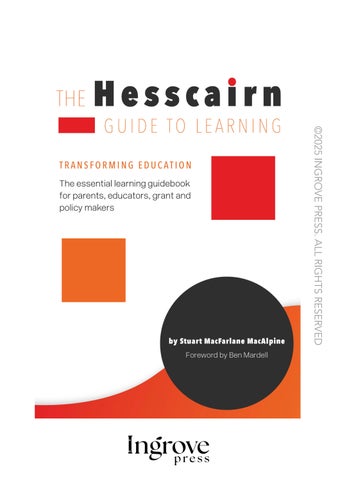
The Hessca rn GUIDE TO LEARNING

Transforming Education

The essential guide to learning for parents, educators, grant and policy makers

Foreword by Ben Mardell

Stuart MacFarlane MacAlpine

A catalogue record for this book is available from the National Library of Australia

© 2025 Ingrove Press. All rights reserved.

©Text copyright Stuart MacFarlane MacAlpine.

This work is protected by copyright. Apart from fair dealings for the purposes of study, research, criticism or review, or as permitted under the Copyright Act 1968 (Cth), no part should be reproduced, transmitted, communicated or recorded, in any form or by any means, without the prior written permission of the copyright owner.

PO Box 3160 Mentone East, Victoria 3194, Australia

Phone: (03) 8686 9077

Website: www.ingrovepress.com

Email: orders@ingrovepress.com

Code: GE2132

ISBN: 9781923412149 (Paperback)

ISBN: 9781923412989 (eBook)

Published and printed in Australia

Ingrove Press (formerly Grift Education)

For permission to reproduce material from this publication, please contact orders@ingrovepress.com

Dedicated to the educators in my family. My father, Euan A. M. MacAlpine, my mother Wendy A. MacAlpine, my wife Francesca S. MacAlpine, and headmistress extraordinaire, Margaret Boogarh.

CHAPTER SEVEN

Educational Transformation – from the Industrial Model to the Regenerative Model

CHAPTER 8

FOREWORD

If you are meeting my friend Stuart MacAlpine through this book you are in for a treat. Stuart brings two of his many wonderful attributes to this volume. First, Stuart is incredibly well read. The Hesscairn Guide to Learning draws on the works of philosophers, psychologists, linguists, neuroscientists and more. Second, Stuart has an uncanny ability to synthesise and explain complex issues in clear and engaging ways. The Guide brings together research from academic disciplines with the story of Roger Bannister (the first human to run a sub-four-minute mile), the Māori concept of Akō, The LEGO Group’s ‘business paradoxes’ and the works of Shakespeare, Ovid, Samuel Johnson and Aesop to answer two overarching questions:

■ What is learning?

■ What are our [educational] systems [e.g., classrooms, schools, national curricula] transforming from and to?

These are important and timely questions. I am writing this foreword from a sweltering Cambridge, Massachusetts in the U.S. where we are on track to have the hottest summer in recorded history. This, of course, after last year being our hottest summer on record.

This change in climate alone will have enormous and unforeseen ecological, political and social consequences. Throw into the mix AI and other technological changes and we have what some call VUCA (volatile, uncertain, complex and ambiguous) times. While there is consensus that such times demand changes in educational systems, there is little agreement on what these changes should look like, especially in the details of daily practice. This is in part because the questions Stuart names lack clear answers.

This is where The Hesscairn Guide to Learning comes in. As Stuart acknowledges, there is not a simple, iron clad answer to the question of what is learning. Instead, Stuart provides us with MacAlpine’s taxonomy of learning. The taxonomy is a map of the terrain, allowing us to consider what learning does and does not involve. It provides a clear explanation of different kinds of learning (knowledge, skills, understanding, processes, competency, expertise and character) and the interconnections between them. It explains the complex phenomenon of learning in plain language.

Map in hand, Stuart takes us through an explanation of education (not to be confused with learning), and the design process to create conditions for learning (with a host of evocatively named pointers that include ‘Rasselas and the moon’, ‘the golden apples’ and ‘the butterfly in hand’). He writes about educational innovation, the taxonomy helping navigate innovation to what end.

The book provides what it takes to create a Hesscairn, Stuart’s term for one’s ideal educational practice. Importantly, your Hesscairn does not have to be his. There is more than one way to proceed.

But proceed we must. At its core, the book is a call to action to provide learners with something better than the outdated, industrial transmission model that still dominates much of the educational landscape.

For this reason, The Hesscairn Guide to Learning is for anyone engaged in a project of supporting learning–teachers, school leaders, policy makers, parents, citizens concerned with the future of our young people and students. If you fall into any of these categories, I’m sure you’ll enjoy meeting Stuart.

Ben Mardell, Cambridge, Massachusetts, July 2025

Ben Mardell, PhD. is the atelierista and pedagogista at Newtowne School in Cambridge, Massachusetts (USA). He is also a research affiliate at LifeLong Kindergarten at MIT’s Media Lab and co-editor of The Remake, an online newsletter about playful learning in a time of rapid climate change. Ben was Principal Investigator on the Pedagogy of Play project, a collaboration between Harvard Project Zero and the LEGO Foundation.

CHAPTER ONE

THE HESSCAIRN GUIDE TO LEARNING

You are curious about learning and education: perhaps you are a new parent thinking about all the choices that lie ahead of you, and how to support your child; perhaps you are a teacher or educational leader, who is qualified but still feels that someone hasn’t told you about the full picture of what learning is; perhaps you are a grant maker or policy maker, who finds yourself in a position where you are making big decisions about learning and educational programmes, but it seems like no one fully explains to you why your organisation or government makes certain choices and knows how to measure their impact and you’re not entirely sure if they know. If any of these fit, or you are just intrigued by learning – you are in the right place.

Our understanding of what learning is and how we ‘educate’ people is undergoing a fundamental transformation. As far back as 2017, Claus Schwab announced that the Fourth Industrial Revolution powered by AI and the internet of things would transform our lives and the way we think about learning, just as previous industrial revolutions had (Schwab, 2017). His prediction at that time might have seemed a little overstated, but recent seismic changes caused by the disruption of a global pandemic, moving school online for millions, a wellbeing crisis and the explosion of AI mean his predictions now seem prescient and urgent.

To illustrate the sense of urgency, in 2022 the UN hosted one of the largest gatherings on education ever held, the Transforming Education Summit, for the first time gathering education ministries from across the world to discuss how to ‘transform’ education (United Nations, 2022). This was based on ‘a global crisis in education’. There was a clear sense that educational systems were not fit for purpose nor meeting our evolving needs as societies.

Yet, if you were to ask those who were delegates of that UN Conference, ‘When you say learning, how do you define that word?’ and ‘When you say transform education … from-what and to-what are you transforming?’, you would be unlikely to get a coherent or clear answer. All the delegates shared a fundamental belief that ‘education is in crisis’ and that current ‘education systems are no longer fit for purpose’ in the words of the conference’s vision statement (United Nations, 2022) but there is widespread ambiguity about exactly what we mean by learning, education and how it relates to children’s development.

This book seeks to address fundamental questions: what do we mean by learning and education? And what kinds of education are we transforming to and from?

An analogy to healthcare systems helps to understand the difficulty of defining what commonly used words mean to us and understanding what kinds of transformation are required. Let’s imagine we are talking to a government minister responsible for the health system, and asked two questions:

■ What do you mean by ‘health’ or ‘healthcare’?

■ How are you ‘transforming your systems’?

Let’s explore these questions. What is healthcare? Is healthcare responding to disease and ill health, or is preventative healthcare the focus? When we say ‘health’, what is included? Mental health, fitness, fertility, dentistry, mindfulness and spirituality? Given the huge impact social inequality has on health, should that be part of healthcare? Is managing stress part of health? As we increasingly become aware of happiness and wellbeing as significant aspects of a country’s success, does the healthcare system have anything to do with happiness? (see national statistics like the World Happiness Report, Helliwell et al., 2024). If we were to measure if a country is ‘healthy’, what would we measure? Fitness, weight, life expectancy, freedom from infectious disease, inherit able conditions, nutrition, dignity in old age, freedom from pain, mental wellbeing or quality of developmental experiences?

So, with health, it is both a question of definition and then a problem related to the systems that must be in place to achieve and measure our goals in relation to that definition. The same is true of learning and education. When it comes to learning and

education, something is clearly not working – but we don’t necessarily have a clear view of what learning and education are and what kinds of systems we require.

Let’s ask the following questions in relation to learning:

■ What is learning?

■ What are our education systems transforming from and to?

What is learning? Is learning about transferable skills? Is learning about competencies? Is learning what exams measure? Does learning include wellbeing and happiness? If it does, how can you ‘teach for’ these? Is education’s purpose to rank and select the best students, or is it about including everyone – and if we include everyone, what does success look like? Income inequality plays a huge role in current educational outcomes in most countries – why and how are we letting down those who need support the most? Should the wider goals of education be about wellbeing, academic disciplines, national identity, globalisation, self-actualisation or saving the planet from the imminent permacrisis we have created? As if that were not enough, how do we educate in the age of generative AI?

And then what is the best measure of learning at a societal level? Is learning measured by tests in class, or formal exams in school? Is it measured by IQ scores of a population? Is it measured by literacy and numeracy, and if so, what is the best way to test these, lifelong and in school? Is it measured by engagement with education, attendance statistics and years of education? Is it measured in outcomes like number of graduates in specific subject areas? Is it measured by lifelong economic activity and the size of the economy? Should it rather be measured by degrowth and choices by people to lead more sustainable lifestyles? Is it wellbeing and flourishing? Is it creativity scores of individuals? Is it measured by the number of patents registered? Is it competitive advantage in research and development? Is it social cohesion? Is it moral and social values? Is it health outcomes from a healthy life? Is it feelings of autonomy and meaning in learners? Is it the growth of AI leaving humans on universal basic income with no jobs to do? Is it about the nature of our society and the impact we have during a time of mass species extinction? What exactly are we trying to learn to be, do and achieve, and why are we doing that?

So, you see why the ministers at the Transforming Education world summit found it hard to answer the question of ‘what is learning?’ and ‘what are we transforming from and to?’

Both questions do have straightforward answers – or at least there are straightforward ways of approaching how to think about them in order to have a coherent answer. The approaches to doing so are just not clearly written down in one place.

The aim of this book is to address exactly that need for clarity. The goal is not to say, ‘here is the right answer’ but rather, ‘here is the range of approaches you can take’. And if you know the options, then you know why you are choosing to explore a particular approach and what success might look, feel and sound like. That might be success as a parent, an educator, a grant maker or policy maker.

A hospital or healthcare system might say: we value mental health and mindfulness, alongside treatment of diseases, and, therefore, we invest in the following staff, facilities and programmes. So, likewise, an education system could say: because we take learning to be concept-based and include competencies, we have moved away from exams to include project-based work and impact projects in partnership with employers.

To help us think about learning and education and anchor our thoughts for the chapters ahead, I wanted to turn to a review of a school of particular note and importance in this book, and, indeed, one that gives the title to the work.

About 30 minutes from the outskirts out of the metropolis that sits at the meeting place of so many great civilisations, languages and cultures past and present, you could be forgiven for missing the stone gates, sitting shaded under gnarled, richlyleaved trees, that lead to Hesscairn, my favourite, though little-known school.

The drive invites you into the light open woods which border the school, clearly a place of childhood play, with evidence of outhouses and camps from the junior school children, but you also notice some of the sculptures that are so thoughtfully placed to provoke the adolescents who take to the woods to think or talk with friends in their ample down time. Beyond, foothills and mountains lead to adventure, and you’ll often see groups of students heading out to camp or explore.

When you first see the main school area, you are struck by its elegance. Though the original buildings are hundreds of years old, a spirit of human enterprise, bricolage and responsiveness has shaped them into a village, with atriums, cloisters and squares, where children and adults of all ages are mingled as they go about learning, talking, socialising and reading – these are places of thought and being. The school farm has a blurred border with the main school, and animals occasionally stray into areas where children might be having a lesson outside, causing a flurry of excitement.

The nearby metropolis means that for all its sense of retreat and safety, the cultural winds of the world blow through the school. And as it is a community school, for all its internationalism, children who elsewhere might go to specialised schools seamlessly take their place here as part of the community with a strong sense of inclusion and belonging.

The teachers here are equally diverse, and many are quirky, with passions and enthusiasms that are evident around the school. The teachers have a deep interest in and responsiveness to the individual children they grow with, and the children feel

safe and stimulated by the conversations they have with their guardians. Parents are often in and out of classrooms, supporting, helping and learning.

Classrooms often have all their high windows and doors open, and classes spill out on to grass or between year groups. Learning is infused wherever you look, but with an understated grace which stops it ever feeling like anything but curiosity and pleasure.

Whilst there is a comforting quiet and sense of history, the children are clearly engaged with the politics and technology of today and regularly go out to the metropolis to participate in the avant-garde of culture, art and technology. This relationship between school and metropolis also allows Hesscairn students to engage in aesthetics and cultivate an appreciation for nature, art, music, theatre and all the wonderful things that provide foundations for a love of the beauty of life and other people.

Spirituality is cultivated, not prescribed. It is everywhere from the meditation room to the silent glades of the forest. The metropolis means that the students come from a hundred cultures but find common ground at Hesscairn.

The learning is planned, but as a negotiation between the student and teacher, based on the rich conversations the teachers have in their quiet evenings as they sit and talk under trees in the dappled twilight. The teachers are passionate about knowledge and understanding of the world. They enjoy the life they lead with the children, always discovering and exploring together.

Staff largely live on campus, spaced out in the woods, and some in boarding houses, where flexible boarding allows students to decide how and when they would like to be a part of the resident school community. Boundaries are fluid at Hesscairn, and family and school life are hard to distinguish – yet there is privacy when needed for all.

Students who graduate from Hesscairn often come back to the school to revisit a place that gave them a bedrock of a good life. It is noticeable how diverse the paths they pick are, and yet they seem to share a kindness for others and appreciation for life that stays with those who have lived within the community.

Turn static files into dynamic content formats.
Create a flipbook
Issuu converts static files into: digital portfolios, online yearbooks, online catalogs, digital photo albums and more. Sign up and create your flipbook.