Compassionate Coaching sample pages

Page 1


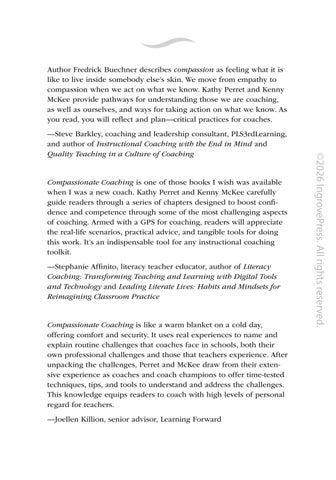
Author Fredrick Buechner describes compassion as feeling what it is like to live inside somebody else’s skin. We move from empathy to compassion when we act on what we know. Kathy Perret and Kenny McKee provide pathways for understanding those we are coaching, as well as ourselves, and ways for taking action on what we know. As you read, you will reflect and plan—critical practices for coaches.

—Steve Barkley, coaching and leadership consultant, PLS3rdLearning, and author of Instructional Coaching with the End in Mind and Quality Teaching in a Culture of Coaching

Compassionate Coaching is one of those books I wish was available when I was a new coach. Kathy Perret and Kenny McKee carefully guide readers through a series of chapters designed to boost confidence and competence through some of the most challenging aspects of coaching. Armed with a GPS for coaching, readers will appreciate the real-life scenarios, practical advice, and tangible tools for doing this work. It’s an indispensable tool for any instructional coaching toolkit.

—Stephanie Affinito, literacy teacher educator, author of Literacy Coaching: Transforming Teaching and Learning with Digital Tools and Technology and Leading Literate Lives: Habits and Mindsets for Reimagining Classroom Practice

Compassionate Coaching is like a warm blanket on a cold day, offering comfort and security. It uses real experiences to name and explain routine challenges that coaches face in schools, both their own professional challenges and those that teachers experience. After unpacking the challenges, Perret and McKee draw from their extensive experience as coaches and coach champions to offer time-tested techniques, tips, and tools to understand and address the challenges. This knowledge equips readers to coach with high levels of personal regard for teachers.

—Joellen Killion, senior advisor, Learning Forward

Instructional coaching is both rewarding and challenging. In Compassionate Coaching, Kathy Perret and Kenny McKee address some of the most difficult parts of coaching and help both new and experienced coaches understand how to effectively navigate through those areas. This book is both insightful and practical and will be a valuable reference for years to come.

—Sherry St. Clair, author of Coaching Redefined: A Guide to Leading Meaningful Instructional Growth

Compassionate Coaching provides a clear roadmap for navigating the barriers to instructional improvement teachers face. As former teachers and current coaches themselves, Kathy Perret and Kenny McKee identify and define six situationally based teaching barriers, offer coaches guiding questions for effective conversations, and outline planning tools and resources to move practice forward. Throughout the text, clear examples illustrate the barriers, and action-oriented professional learning (for both teachers and coaches) illuminate a way through. This is a book I will continue to refer to in my coaching work with both teachers and leaders.

—Allison Rodman, professional learning designer and facilitator, author of Personalized Professional Learning: A Job-Embedded Pathway for Elevating Teacher Voice

Compassionate Coaching

Compassionate Coaching

How to Help Educators Navigate Barriers to Professional Growth

First published in 2021 by ASCD.

Copyright ©2026 Ingrove Press and ASCD. All rights reserved.

Published in Australia under license by Ingrove Press.

ASCD® is a registered trademark of the Association for Supervision and Curriculum Development.

PO Box 3160 Mentone East, Victoria 3194, Australia

Phone: (03) 8686 9077

Website: www.ingrovepress.com

Email: orders@ingrovegroup.com

No part of this publication may be reproduced, stored in a retrieval system, or transmitted in any form or by any means, electronic, mechanical, photocopying, recording, or otherwise, without the prior written permission of the copyright holder.

Code: ASC2309

ISBN: 9781923412309

Printed in Australia. Ingrove Press (formerly Grift Education), a division of Ingrove Group. For permission to reproduce material from this publication, please contact orders@ingrovegroup.com.

To the coaches in our own lives, formal and informal, personal and professional, who supported our growth in the ways that mattered, built our confidence, and coached us with compassion.

To our families, friends, and colleagues who listened, discussed, and took care of business while we wrote, rewrote, and wrote even more.

To our #educoach buddies and our amazing PLN for inspiring, teaching, and pushing us to be better each day.

To you, the reader, who thought this book could help your coaching journey, we appreciate your support and look forward to learning from you as we continue our goal of #compassionatecoaching.

Foreword

Has there ever been a time with a greater need for compassionate coaching? As I write this, we have lived through more than a year of the COVID-19 pandemic, an event unlike any we’ve experienced in our lifetimes. People around the world are encountering difficulties that no one could ever have anticipated. Our family members, friends, and colleagues have seen their jobs turned upside down—if they still have jobs—or they watched helplessly as the pandemic had a devastating impact on the health of loved ones.

Coaches stand at the crossroads of all this change. They continue to do their best to support teachers who don’t know what their jobs will look like from one week to the next. They work with teachers who are asked to teach online, then teach face-to-face, and then teach hybrid—and to do it all with applications they’ve never used before. I’m certain there are thousands of educators who would say they only survived the pandemic (professionally) because of the help of their coaches.

Coaches need to cram to learn all the new apps and strategies so they can support teachers. Carrying their own personal burdens, they must work with compassion when teachers have difficult moments. They must persist, even though they, too, don’t know exactly what their job will entail or how it will change. They must show heroic compassion.

Now, thankfully, they have Kathy Perret and Kenny McKee’s book, Compassionate Coaching, to help them do this extremely challenging work.

We can better understand the value of this book when we consider the unique work that coaches do. Coaches facilitate what I refer to as “inside out” professional development. Unlike “outside in” professional development—where leaders choose practices that teachers are expected to learn—“inside out” coaching begins with the real-life challenges teachers face. And that is precisely where this book is focused: the interior landscape of coaching.

Perret and McKee provide heaps of useful ideas coaches can use as they conduct “inside out” professional development with teachers. Specifically, the authors provide tools and knowledge coaches can use as they work with teachers who are experiencing a lack of confidence, failure, overload, or disruption. Perret and McKee also have suggestions for coaches who are partnering with teachers in challenging school cultures or who feel isolated. Truly, any coach will find something useful in the pages of this book.

The pandemic is temporary, but the human spirit is impossible to stop, and we will move on to face other challenges. In the meantime, we have Compassionate Coaching to help us get through. Then, when we are finally on the other side of COVID-19, we will have this book to help us address the new challenges that come our way.

Introduction: Breaking Through

A substantial amount of research on coaching, both within the education world and outside of it, has been published over the last decade— so how to best coach teachers should be clear-cut at this point, right? Well, kind of. Although we know more than ever about how to make coaching programs successful, many educators still find the process to be harder than they’d imagined.

From our discussions with instructional coaches, teachers, and other school leaders, we’ve found that there are several common barriers to instructional improvement—and we have also seen how personalized coaching empowers teachers to navigate these barriers. In our experience, coaching with compassion and in a way tailored to the individual can result in transformational improvements to student achievement and teacher work satisfaction. In some cases, this kind of coaching can even shift the trajectory of whole schools.

Surmounting Barriers

Whether you are currently in a teaching role or not, if you’re reading this book, you’ve probably had teaching experience. Think back on your students. Did any of them face barriers to learning? Perhaps you had a student who took on too many responsibilities and had trouble juggling them, so you helped him figure out a plan. Or maybe you had a new student who didn’t know where she fit in, so you suggested some clubs she could join.

Most of the barriers you’ve helped students surmount have probably been related to the five core competencies identified by the Collaborative for Academic, Social, and Emotional Learning (CASEL): self-awareness, self-management, social awareness, relationship skills, and responsible decision making. By developing these competencies in children, we are able to address the needs of the whole child (Durlak, Weissberg, Dymnicki, Taylor, & Schellinger, 2011), but adults also need to develop these competencies—which is where instructional coaching can support teachers in navigating barriers.

Becoming a Coach

When you began coaching, you entered a new dimension of the school environment. Chances are you landed your new position due to your own skills and experiences in the classroom. Someone saw leadership characteristics in you, even if you yourself weren’t aware of them. You were hired because of your unique qualities—your content expertise, perhaps, or your rapport with your peers, student achievement results, growth mindset, or a combination of these qualities and others.

We (Kathy and Kenny) both entered our coaching positions due to our content backgrounds. Kathy had a strong literacy background both as a classroom teacher and consultant; Kenny had studied and refined his classroom into a place for student-centered English language arts. With some help from instructional coaching literature, training, and input from other coaches on Twitter, we set out on a path of trial and error, with no choice but to get comfortable with figuring out our roles day to day.

You, too, probably entered your position with more questions than answers about instructional coaching. You’ve had to get comfortable with learning in the moment. In his book The Learning Challenge (2017), James Nottingham proposes that there are seven stages to what he calls the “Learning Pit”: (1) pick a concept, (2) identify

contradictions, (3) examine options, (4) strive for meaning, (5) connect and explain, (6) enjoy clarity, and (7) apply and relate. These stages can serve as a roadmap for coaches, both in working with teachers and for breaking through barriers we face in our own practice.

Compassionate Coaching

It is important to remember that barriers to effective teaching are neither permanent states nor character traits; rather, they are temporary challenges we can overcome with the right methods. In this book, we identify six common barriers teachers face and six corresponding practices for surmounting them, which we refer to as compassionate coaching focus areas (see Figure 0.1).

FIGURE 0.1

Teaching Barriers and Compassionate Coaching Focus Areas

Barrier

Lack of Confidence

Failure

Overload

Disruption

Isolation

School Culture Challenges

How It Feels

I don’t have the skills to do my best work right now.

I don’t have the power to do my best work right now.

I don’t have the time to do my best work right now.

I don’t have the processes to do my best work right now.

I don’t have the community to do my best work right now.

I don’t have the environment to do my best work right now.

Compassionate Coaching Focus Area

Partnership (Chapter 2)

Empowerment (Chapter 3)

Prioritization (Chapter 4)

Routines (Chapter 5)

Connection (Chapter 6)

Openness (Chapter 7)

Addressing Reluctant Teachers

A popular request on our #educoach Twitter chat is for insight on how to coach teachers who are resistant to the process of coaching. However, the more we discussed this topic, the more we realized that resistance is really just a symptom of greater underlying problems. If teachers appear reluctant to be coached, it’s worth considering whether the issue lies with the coaching program itself. In some cases, schools have built programs they refer to as “coaching” programs but are really something else entirely.

Successful coaching is a humanistic, compassionate process that places the teacher and the students at its center, and good coaches foster supportive and productive relationships that improve student learning. Otherwise, we are just people who know some stuff and like showing off that we know it.

Even when a school has a solid coaching program in place, some teachers may still have reservations about working with a coach. To reach these teachers, coaches need to learn about the specific barriers they face and personalize their support in compassionate ways. To that end, each chapter of the book highlights one of the common barriers for teachers shown in Figure 0.1 and then offers strategies for implementing compassionate coaching in the corresponding focus area.

About This Book

Developing this book was an extensive process for us. We began by asking reflective questions: When did the people we coach most struggle? When was our coaching most successful, and to what could we attribute this success? Then we interviewed teachers, coaches, and school leaders we admire; developed working theses; and consulted peer-reviewed research to test our ideas. We revisited our favorite educational books, and we asked our personal learning networks what had made them excel at coaching. Our book is therefore built on the

work of many people, and we are so appreciative to be part of such a thriving coaching community.

Although our focus is on situational barriers in this book, we are fully aware of the many existing systemic barriers to great teaching and learning, including issues related to school safety, discrimination, and inequity of resources. The help we offer here is intended to support, empower, and retain the human capital (the people) in our schools, but we acknowledge that systems also have an influence on both students’ learning and teachers’ work lives. We encourage you to get involved in organizations and movements that work to improve our educational systems. Advocacy is also an act of compassion.

Teachers are the most critical assets for ensuring that students learn effectively, and it is our pleasure to support them in compassionate ways to do their best work. Other coaches who walk this path will also find fulfillment in their work and, hopefully, come to see themselves as essential agents who make positive and lasting investments in their schools, communities, and society.

Thank you for taking this journey with us! We look forward to learning how this work plays out in your coaching practice.

Charting a Course for Effective Coaching

Most of the time, when we embark on a journey, our every action revolves around the destination. We enter the destination into our GPS to guide us, and we travel on the combination of paths we know will get us there successfully. The same is true of successful coaching journeys. The destination—effective coaching—comes first and foremost. Of course, not all trips are smooth sailing. We hit distractions, roadblocks, and detours, and when we do, we need to focus clearly on the problem to see us through. The challenges keep us on our toes, but when we stay focused on the destination rather than the barriers, we are able to move forward. In this chapter, we’ll discuss the essential elements of a successful coaching journey, including what you’ll need to get going and some ways to help make sure your trip is a smooth one.

Setting Your GPS

Using a GPS is simple—you enter your destination, and away you go. If you get off track, your trip is recalculated to get you back on course using incremental steps. In coaching, you also need a system that can show you the way to your destination and get you back on track when you veer off course. This is where the Instructional Coaching GPS comes in; it’s a reflective exercise for knowing exactly where you’re going and how to get there. Whereas the GPS in a literal journey stands for “global positioning system,” in the Instructional Coaching

Turn static files into dynamic content formats.

Create a flipbook
Compassionate Coaching sample pages by IngrovePress - Issuu