A G M
N EX T
Sa tu Po rday rt Sy July dn 2 ey nd H @ all & 9:00 Zo a om m
Mary Lake Association
2022 Spring Newsletter
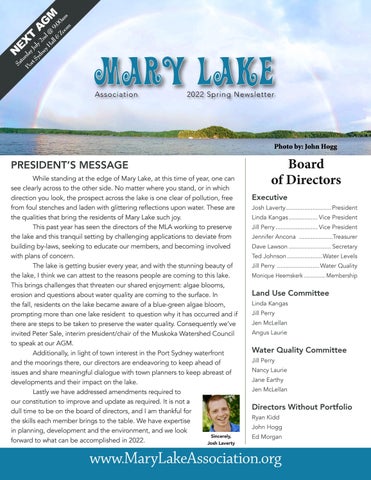
Photo by: John Hogg
PRESIDENT’S MESSAGE While standing at the edge of Mary Lake, at this time of year, one can see clearly across to the other side. No matter where you stand, or in which direction you look, the prospect across the lake is one clear of pollution, free from foul stenches and laden with glittering reflections upon water. These are the qualities that bring the residents of Mary Lake such joy. This past year has seen the directors of the MLA working to preserve the lake and this tranquil setting by challenging applications to deviate from building by-laws, seeking to educate our members, and becoming involved with plans of concern. The lake is getting busier every year, and with the stunning beauty of the lake, I think we can attest to the reasons people are coming to this lake. This brings challenges that threaten our shared enjoyment: algae blooms, erosion and questions about water quality are coming to the surface. In the fall, residents on the lake became aware of a blue-green algae bloom, prompting more than one lake resident to question why it has occurred and if there are steps to be taken to preserve the water quality. Consequently we’ve invited Peter Sale, interim president/chair of the Muskoka Watershed Council to speak at our AGM. Additionally, in light of town interest in the Port Sydney waterfront and the moorings there, our directors are endeavoring to keep ahead of issues and share meaningful dialogue with town planners to keep abreast of developments and their impact on the lake. Lastly we have addressed amendments required to our constitution to improve and update as required. It is not a dull time to be on the board of directors, and I am thankful for the skills each member brings to the table. We have expertise in planning, development and the environment, and we look Sincerely, forward to what can be accomplished in 2022. Josh Laverty
Board of Directors Executive Josh Laverty............................ President Linda Kangas.................. Vice President Jill Perry.......................... Vice President Jennifer Ancona .....................Treasurer Dave Lawson.......................... Secretary Ted Johnson......................Water Levels Jill Perry .......................... Water Quality Monique Heemskerk............... Membership
Land Use Committee Linda Kangas Jill Perry Jen McLellan Angus Laurie
Water Quality Committee Jill Perry Nancy Laurie Jane Earthy Jen McLellan
Directors Without Portfolio Ryan Kidd John Hogg Ed Morgan
www.MaryLakeAssociation.org
THE RESULTS ARE IN! INDIVIDUAL REPORTS
Last summer, the entire shoreline of Mary Lake was assessed for development, vegetation and habitat as part of the Love Your Lake (LYL) Shoreline Assessment Program. This information was used to create a unique and tailored shoreline property report for each property owner.
The goal of the Love Your Lake program is to educate and engage waterfront property owners to sustain healthy shorelines or make improvements to their shorelines. This will improve water quality and lead to a cleaner, healthier lake for future generations.
LAKE WIDE RESULTS
The MLA does not have access to individual property reports. However, we have received a report with lake wide data for Mary Lake. This report will be made available on the Mary Lake Association’s website www.marylakeassociation.org This report is invaluable and provides a great benchmark for measuring future changes to the shoreline health of our lake. Some results from the 2021 Love Your Lake Assessment: 340 properties were surveyed totalling about 24 km of shoreline. To date, almost 100 people have ordered a digital copy of their property report and seven people have ordered a hard copy.
By now, if you own waterfront property on Mary Lake, you should have received a letter from the Muskoka Watershed Council with your individual survey code and the instructions to access your personalized report.
According to the Values Survey that was completed by some of the owners, many were interested to learn more about their activities and how they affect water quality, wildlife habitat and the overall health of the lake.
Your property report includes a photo and a summary of the features observed on your property, including voluntary recommended actions you can take to protect or restore your shoreline. The report also explains how these actions can positively contribute to the health of Mary Lake.
The most important issues and actions identified by owners included:
If you did not receive your report, please reach out to Jill at jillperry@live.ca and she will have the survey code emailed directly to you.
• Limit boat wakes near shore • Create/enforce stricter rules for new development • More water quality testing for algae/aquatic vegetation, bacteria, clarity and chemical contamination • Water levels • Septic re-inspection program • Provide education materials to property owners
When you love something, you take care of it and Mary Lake is no different. We want it to be here for future generations and if we start taking care of it now, it will be here for years to come. So let’s read our property reports and learn more about what we can do to protect the health of our lake.
EY DN Y
PORT S
YACHT CLUB
Calling All Sailors!
Port Sydney Yacht Club
is Looking For New Sailing, Crew & Social Members! • Races are every Sat at 2:00 pm • After Party at 4:30 following races!
• Meet New People on the Lake • Albacore boats available for use
Email Sue Tovee serious_sue@hotmail.com 2
Membership Update Welcome to the good season where all turns green, the water warms up and soon you will be out and about. The winter was long and even mid April you start to wonder if it will ever turn into spring, then it begins and within 2 weeks we went from super cold and wintery into a beautiful stretch of nice weather. Our grandkids were swimming early May! Maybe I thought the winter was super long as we didn’t get away to the Sunny South this year. Our membership is still growing; 209 members as of now. I did clean up our membership list a bit with members who never responded or updated their membership payment. I will be bugging others that are slow in responding. It seems that without an in-person AGM, the communication regarding membership payments is lacking. Our AGM was always the perfect day for you to hand in your payment, or I could remind you face to face. We will be up to date soon. With the membership, the Lost & Found is also my portfolio. Not much so far - some dock sections found here and there but no sight of the owners yet. Email me and I will update you if your item is found. A huge task this year was cleaning up the propane group membership. Only those with their MLA membership up-to-date will enjoy these discounts from Superior. Due to staff changes at Superior and some rogue persons coming in the “back door” the propane discount list had to be cleaned up. A lot of work, but we finally arrived at a complete list. The window to sign up for this program is always limited. Besides setting up an account with Superior, it is also important that your equipment is checked, so all is up to date. This takes time and I was lacking information from Superior as to whether members were actually signed up or if they stepped away. If there is any interest from you, please let me know. I am ready for a new season on Mary Lake; hope to see you here or there!
Monique Heemskerk
Membership Director, Mary Lake Association
Bugs in the Mud WE NEED YOUR HELP!
Sunday July 31st, 10:00 am
Jennifer McLellan jen.mclellan@mac.com or call 519-574-7059 Please meet us at the Town dock in Port Sydney to help with the counting. 3
AGM SPECIAL GUEST SPEAKER Dr. Peter Sale will be speaking about our recent Blue Green Algae Outbreak IT’S NOT YOUR GRANDPARENTS’ MARY LAKE ANYMORE… In October 2021, a blue-green algae warning was posted for the Port Sydney beach area and officials warned it was toxic. Is this a warning from Mother Nature? Algae are important, essential members of our lake community but they become a hazard when they thrive too well. The result? No swimming – for humans or pets. No purifying lake water to consume. No eating the fish. And this could last for weeks. SO WHAT CAN WE DO? Dr. Peter Sale, Chair of the Muskoka Watershed Council has graciously agreed to speak at our Annual General Meeting this year. And we guarantee you’ll get some new insights from his talk about algae and algal blooms, and their connection to humans, climate change, and phosphorus levels. Dr. Peter Sale
Laminated Map Will be Available at the AGM for only $10
Lawr Isla
1 THE TOWN DOCK SHORE A significant sedimentary deposit has built up at the mouth of the creek about 100 metres north-west of the town dock. Shallow water extends out about 50 metres from the shore.
Dead Isla
Mary Lake
2
Isle of Pines
Snowshoe Island
Crown Island
MOODIE POINT Shallows extend in a 50 to 75 metre radius from Moodie Point (the easterly point at the entrance to the river) and continue well to the east, past Clyffe House dock. In the early 1900’s, the steamer Ramona ran aground more than once on Moodie Point, to be rescued by her competitor, the Gem.
Buckhorn Island
4 Forrest Island
3 1
3 RAYMOND’S BLUFF Shows the significant shallows which extend north from Raymond’s Bluff toward the easterly point on Forrest Island. Shallow water extends out about 100 meters and runs north for about three quarters of a kilometer.
4
THE REMAINS OF AN OLD CRIB perhaps used to anchor log booms off the Dollar Wharf in the late 1800’s lie about 50 meters offshore - NO PHOTO
4
Rocky Island
2
5
7
rence and
5 GIBSON’S CREEK Boaters should remain a good hundred meters from shore near Gibson’s Creek (north of the old Muskoka Lodge). Entry to the creek is tricky, but is rewarded with a view of an 8 metre high waterfall. Recomended for small boats only.
dman’s and
6
6
5
DEADMAN’S ISLAND - CAMP MINI-YO-WE A shoal of boulders extends east from Deadman’s Island for about 40 metres. Sandy shoals extend out a good distance from shore to the north of the camp. It is better to steer a course outside this channel, remaining to the north of the island.
Navigating Mary Lake 7 HEAD OF THE LAKE Very significant shallows have built up over centuries where the Muskoka River enters the lake. It is important to follow the dog-leg channel marked by buoys. Remember the rule: “Red Right Returning” meaning keep the red buoys on your right when upbound against the current.
5
2020 Aerial Photography and Research by Ted Johnson Design and Layout by Greg Crawford
Steamboat Service on Mary Lake
July 15 this year will be the 125th anniversary of the launching of the steamer Gem, built in Port Sydney and providing regularly scheduled service to Huntsville.
The road from Bracebridge to Huntsville was very rough following its construction in the mid eighteen sixties. Local entrepreneurs from around Mary Lake recognized that passengers and freight haulers far preferred smooth water travel. They noted that northbound travellers chose to take a steamer from Gravenhurst to Bracebridge rather than bounce along the Muskoka Colonization Road and that water transport was significantly less expensive than road. But a challenging obstacle cut off Port Sydney from the lakes to the north: the ten-foot waterfall and rapids below Fairy Lake.
At the request of several local businesspeople, the village’s mill owner Albert Sydney Smith facilitated the construction of the 80-foot side-paddlewheel steamer Northern on the land adjacent to his house beside the Port Sydney Dam. An historical plaque marks the spot today. For twenty years the Northern served Port Sydney and the lakes until she was beached at Huntsville’s Memorial Park where her remains still lie on the lakebottom.
Launched in 1897, the Gem served Port Sydney for twenty five years. Shown here in about 1908, her proud owner stands beside her at her Port Sydney berth with a load of tanbark destined from his mill to the Huntsville tannery. Above him to the left are Christ Church and the Cheese Factory.
The paddle wheeler Northern was built in Port Sydney and began service in 1877, shortly after the Huntsville lock was built.
In 1873 the federal Department of Agriculture and Public Works provided up to $20,000 for the construction of a lock. In 1875 the lock began operation and the way was opened for steam navigation.
Her successor was the Gem, financed by Albert Sydney Smith and built in the Village by local carpenter Paul Gendron. She was christened by Louie Forrest (of Forrest Island fame), a relative of Mr Sydney Smith, at her launching on July 15,1897. A party followed and Mr Sydney Smith hosted his Port Sydney neighbours to a cruise around Mary Lake. Residents of Utterson were treated to a moonlight cruise later in the summer.
www.FABRICARE.ca Huntsville, Bracebridge, Gravenhurst, Orillia, Barrie 6
Initially the Gem was 35 feet long and cruised majestically at eight miles an hour. In addition to providing regular service to Huntsville, she served as a tug, towing log booms down the lake to the Sydney Smith mill, and carrying loads of hemlock bark from the sawmill to the tannery in Huntsville. (Tanning of hides to produce leather was an extraordinarily polluting process in those days. Tannin from bark and natural chromium were used to soften and preserve leather. At the Huntsville tannery the waste from the process was dumped directly into Hunters Bay, just where the waters of the Bay enter the Muskoka River. We shudder to think what may lie there in the sediment at the bottom.)
The Gem went through three incarnations. Late in 1903, six years after her launch, she caught fire at the dock in Huntsville. She was rebuilt and lengthened to fifty-one feet and resumed service less than a year after the fire. In 1912, with growing demand for cargo transport, she was again lengthened to fifty-three feet and widened. Sadly, her career came to an end early in the 1920’s following the death of Captain Casselman in a winter accident in the woods. She remained hauled up on her marine railway just upstream of Stayers’ Point on the river above the Port Sydney dam. Following the passing of Albert Sydney Smith in 1925 she was sold to the May family of Huntsville and was stripped down for use as a tugboat until the mid thirties when she was broken up. By then, with improved roads and vehicles, the steamboat era on our lakes was drawing to a close.
The Gem at the Jenner family’s Clyffe House dock circa 1913, readying for a Sunday afternoon cruise.
An important service offered by the Gem was to pick up milk cans from the farms along Mary Lake. She called frequently at the farms of the Thoms family of Thoms Bay, the Somersets at Mud Creek, the Lawrences (subsequently Gryffin Lodge), the Rumballs and Forrests, and the Jenners at Clyffe House. In the absence of refrigeration, milk was processed to produce cheese -particularly the high-quality Ontario cheddar- which could be stored for long periods. Albert Sydney Smith’s brother-in-law, H M Johnson of Hayesville and Stratford, had expertise in cheese production and in 1897 a cooperative cheese factory was organized and built in Port Sydney beside the dock which came to be known as the “Cheese Dock”. Here the Gem made regular deliveries.Any farmer with a product needing delivery or any lakeside resident wishing to travel to Port Sydney or to Huntsville could simply raise a signal flag to hail her and Captain Casselman would steer the passing steamer to their dock for a pickup.
In a picture worth a thousand words an automobile -probably the Clarke family’s brand new taxi- awaits the Gem’s arrival at the Town Dock in 1916. The steam navigation era will soon end, displaced by improved roads and gasoline powered vehicles.
(In the late 1990’s I met the late Harvey May who told me what was left of the Gem’s hull sank off the May property on the north shore of Lake Vernon. Several aerial inspections of the area have revealed nothing; perhaps an underwater expedition is in order…)
Ted Johnson
(Much of the above was drawn from the book “Port Sydney Past” by the late George H Johnson, the author’s father.)
7
The Hazards of the Water is a wondrous thing, and the quality and beauty of the waters of Mary Lake are something that most, if not all, cottagers on the lake can attest to. As beautiful as these waters are, there are hazards that make some water dangerous. 2021 saw yet another tragedy take place at the Port Sydney Rapids, a tragedy that highlights how serious the water can truly be. To aid in enjoyment of the water, we’ve compiled a diagram of how the water moves in the rapids and some descriptions of good practices when choosing to swim in the current.
Terms to know:
River right/left: This refers to left and right sides of the river when facing down-stream
Eddy: Where the main stream of current meets a standing pool of water, the current feeds back upstream and back into the current. Where the two meet will form little whirlpools called an eddy line.
Note: The Mary Lake Association does not endorse swimming in the rapids, nor should this article be considered sufficient training or instruction to do so safely.
Features and Hazards
The Port Sydney rapids have features that are formed by current. Some make for fun, and others make hazards consisting of either dangerous features or obstacles. In 2021 the water management of the dam has taken to opening only one side at a time, which dramatically changes the shape of the water, and concentrates the energy into narrow channels. Additionally, sections of rock have broken off, changing the shape of the water over the past 20 years, creating new hazards to be discovered in the spring following the thaw.
Hole: Where the bottom of the river drops, the water also drops, creating a vacuum on top, where the water recirculates back onto itself. There are 2 holes at Port Sydney, one at the bottom of the otter slide and one that forms at the top in high water. If small enough in stature, or in high water, the hole will recirculate you and push to the center of the river. Ideally you should go over the hole, but if caught, the best way out is to tuck into a ball, protecting the back of your head, and go down where the current is strongest.
Boil: When current hits an obstruction, the water is redirected in 3 dimensions to go up, down and around the obstacle. When the obstacle is submerged, this creates boils of water traveling upwards to the surface. A boil line forms at river-left at the top below the first hole. Sugarbush Hill Maple Farm 2389 Muskoka Rd #10 Huntsville, On P1H 2J3 705-787-9787 info@sugarbushhill.com
www.sugarbushhill.com Stop in For a
Maple Creemee Soft Ice Cream We Have Tubs to Take Home! 8
Undertow: Where current drives the water downward, this could be from a whirl pool, eddy line or obstacle. An undertow forms at the top of the rapids when only the right side of the dam is opened. This undertow is deep and is found river-right, where people often jump from a rock or tree.
Port Sydney Rapids Observe the water prior to entering. Many emergencies are avoidable if you take the time to discuss what the water is doing and plan for it.
SAFETY TIPS: Wear a PFD. You might be a good swimmer, but even strong swimmers can be fatally hurt by an unseen hazard or a bad situation
Have a plan. How will you get where you want to go? How will you get back? Most of the time you will have to swim against or across current to get there. Go feet first when going with current. your legs and feet can feel and absorb hidden obstacles and impacts can be avoided
Be sober. alcohol and swimming in the current do not mix well. You can get vertigo and lose your sense of direction, or suffer severe consequences including death Don’t go alone. Have someone with you who can help in case of emergency.
The diagram below highlights features and some known hazards in the water.
9
An Orderly Spring Runoff and an Unsettling Climatic Phenomenon This year’s Spring Freshet ended early, and as many readers will have noted we avoided the severe flooding that occurred three times in the past decade and was threatening to become the ‘new normal’. We benefited from an absence of climatic extremes. The three variables which most influence the spring runoff in March and April are: -the snow-water equivalent (SWE) of the upstream snowpack, -the intensity of spring rains, and -the number of consecutive irregularly hot days. The season began with ‘normal’ SWE in Algonquin Park, the source of much of the flood water on the Muskoka River Watershed. April rains were moderate, and we experienced no heat wave until after the snow had disappeared. The Ministry of Natural Resources and Forestry (MNRF) drew our lake down to a relatively normal pre-runoff level in mid March. In past years when the SWE has been higher they have drawn it down much further than they did this year. A mistake in the drawdown can lead to disastrous results if we experience sudden heavy rains or high temperatures, but that didn’t happen this year and our lake and the Muskoka River up to the Huntsville dam remained well under control. The flow on the Big East River upstream from us peaked on April 10. The ice on Mary Lake went out a few days later on April 15, well before the level of the lake peaked on April 28.
That peak level could have been much lower and reached much earlier were it not for the re-logging at the Port Sydney dam on about April 18. This slowed our runoff, probably in an effort by the Ministry to maintain a head of water for hydro power production by Lakeland Power at the powerdams between us and Bracebridge. Nonetheless the peak level attained in late April was below target and, importantly, about 9cm or 4” below the decking on ‘typical’ docks on Mary Lake and the River. By mid May, in the wake of an extraordinarily long heat wave, the level had settled to either side of the summer target, some thirty days ahead of schedule. Several days of rain late in the month brought the level up to about 10 cm (4”) above target. We have written in past Newsletters about the local impacts of climate change. Perhaps it is worth noting that that extraordinarily long heat wave in early May was symptomatic of the problem. Arctic warming is causing the jet stream in the upper atmosphere to change its path from a gentle sine curve across Canada to a dramatically oscillating curve dipping deep into the United States and then swinging well up toward the High Arctic.
10
This can create a stationary low pressure area, bringing day after day of cool temperatures and rains to the west of the jet-stream, while to the east a stationary dome of high pressure can cause day after day of cloudless skies and relentless heat. This phenomenon displayed itself in the first half of May as the Red River flooded Manitoba farm fields while the flow of the Muskoka River over the Port Sydney dam slowed to a trickle and cottagers streamed north to launch boats and bask on their docks weeks ahead of normal.
12 Suggestions on What You Can Do About Extreme Weather! Extreme Weather is now part of our lives and we are going to have to live with it. 1.Protect natural areas that can hold back water in Spring. 2. Prevent top soil removal. 3. Avoid tree cutting. 4. Obey fire control warnings. 5. Have an emergency evacuation plan. 6. Have a 72 hour supply of canned goods. 7. Know your hydro emergency numbers.
The heat dome delivered birdwatchers a cornucopia of warblers and flycatchers in a migration that had previously been slowed by cool weather across the US. The first hummingbird was noted by one observer on May 7, prompting a local oldtimer to comment reassuringly: “Nothing unusual in that; hummingbirds always show up in time for Mothers’ Day.” Ted Johnson Director for Water Levels Mary Lake Association
8. Get your air conditioner serviced before summer. 9. Check your elderly neighbours after bad weather. 10. Check that you are insured for flood damage on your cottage. 11. Threatening weather..listen to local Radio & TV for flash flood warnings. 12. Watch local weather radar.. Huntsville, Ontario, Canada Weather Radar | AccuWeather
CLYFFE HOUSE RESORT Family Vacations Since 1886
Dave Scott Owner/Manager
www.clyffehouse.com
dscott@clyffehouse.com 11
1-866-335-2236
Cottagers have asked about early settlers around the lake The Cottagers In the years before the war, cottagers had begun to settle around the lake. In some cases people who had visited the lodges liked the area so much that they decided to buy their own piece of heaven. In other cases they were attracted by a sense of adventure or the stories that friends had told.
BIRKSWYLD COTTAGE Shortly after the railroad was completed through to Huntsville in the 1880s a group of teachers came north from Stratford to spend their summer in Muskoka. Presumably they had heard stories of the Port Sydney area from Sydney Smith’s sister who lived in Stratford or from Sydney Smith himself who usually spent part of the winter there. Among the teachers were Frances and Emily Garden. They took the train to Huntsville and then took a steamer down the river to Mary Lake and thence to Mainhood’s Wharf. (later the site of Muskoka Lodge just east of Snowshoe Island) They had rented the Rumball homestead just east of what is now known as Forrest Island for the summer. The house was called Springmount. Here the group can be seen at the house. By 1890, they had formed such an attachment to the area that they bought land nearby on the lake. They had Arthur Clarke build the present cottage on the lot in 1904 making it arguably the oldest cottage on the lake. Since the cottage was originally surrounded by birch trees, it was called Birkswyld. The cottage was in the midst of Harry Trollope’s farm. His house and hen house were to the north; his barn and vegetable garden were to the east (the barn is still there beside Muskoka Rd. 10) and his potato patch was to the south. His boat livery business and boat house were also to the south
and became known as Hilarity Hall. It was named after a giant amusement park in Portland Oregon that opened a Hilarity Hall in 1918.
George, Emily and Francis Garden
Birkswyld originally had a boathouse, but after nearly 80 years it had to be removed. The cedar siding shingles, however, are still the original ones. Prior to WW 1 much of the provisions for Emily, Frances and their brother Jack came by boat from Huntsville or from local farmers. It was stored in a cold cellar dug into the hillside. In the 1920’s, like other cottagers, an ice box was the way food was cooled. At the cottage the ice box was made of oak and lined with galvanized tin. Ice which had been buried in sawdust during the winter would be brought from the ice house next door at the Trollops.
Murray, Arthur and Vic Clarke cutting ice at the town dock 12
In 1933 electricity came to the area and to the east side of the lake in 1945. Along with it came refrigerators. Water from the lake was initially carried and later pumped up to a holding tank. Each bedroom would be equipped with a basin and a pitcher of water as well as the chamber pot under the bed. Laundry was done by a scrub board and a hand wringer. The impressions written by Norah Malone Garden…who married Jack’s son Gordon (See Appendix Six) gives a more complete description of the interior of the cottage. Jane Garden who presently lives in the cottage in the summer is the third generation of the Garden family to treasure it. Few of these original Muskoka cottages remain. They are a nostalgic reminder of the erstwhile days of ‘cottaging’.
DOWN MEMORY LANE COTTAGES Clyffe House had only been operating for a few years before the guests began to want to have a place on the lake of their own. Bob Jenner, the owner of Clyffe House, decided to take advantage of this and in 1910 had the area between the point and the cliff surveyed into nine lots. The first two cottages built on these lots were at the extreme ends of it. They were built within four years. The cottages along this stretch are described in “These Memories I leave to You”. The style of cottages built before WW 1 often combined the cottage and a boat house like these two.
The cottage burned down in 1923. The Copp family, who were related to the publishing family in Toronto, replaced the cottage with the present one. They had been guests at Clyffe House and were one of the early members of the Yacht Club on the lake. The cottages that were built before WW 2 from west to east along this stretch of shore were The McLaughlin Cottage, The Doran Cottage, The Field Cottage, The Ansell Cottage, (later the Wood Cottage) and the Bell Cottage The third cottage to be built in this group was that of the Doran Family about 1912. It was the third from the west end. Although the Dorans lived in High Park Toronto, they employed a builder from New England. It featured large porches, five bedrooms and tongue and groove paneling in the interior. Once again there was a strong link between the family and Clyffe House. Unlike many of the cottages of the day it had a water system involving a hand pump and a tank which supplied gravity fed water on demand.
The Doran Cottage
The Ansell family owned the fifth cottage from the west and of the group and bought it in the 1920’s. It was of a The Bell Cottage The McLauglin Cottage more traditional Muskoka design, but the Doran builder added dormers. Once again the Ansells had strong connections to Clyffe House and the son Ross Ansell The two Bell sisters were teachers and stayed here for even played on the Clyffe House baseball team called the many years with their brother’s son. The cottage was not “Invincibles.” torn down until the 1950’s. They would come to Utterson by train and then to the cottage by horse and buggy This excerpt is from driven by Arthur Clarke who operated a livery service. Like “The Newcomers” many of the cottagers along this stretch of shoreline, they written By Ryan Kidd ate their meals at Clyffe House. and is available in local stores and from Dr. John McLaughlin was a dentist from Cleveland. His Trafford Publishing daughter Jean played violin at the dances at Clyffe House. 13
Shoreline Naturalization Before and After Photos These photos, courtesy of Love Your Lake, show that a healthy shoreline... one with native vegetation - is also a beautiful shoreline.
For more information and inspiration visit htt ps : //loveyour lak e . ca/natural-s hor eline/
Monique Heemskerk Sales Representative
LAKES of MUSKOKA Realty
705-787-6594 Cell
realestatemuskoka@gmail.com