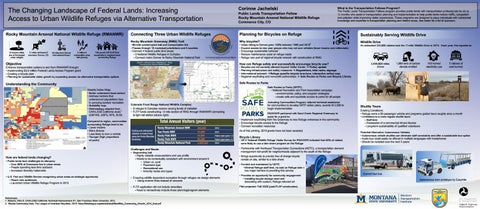
The Changing Landscape of Federal Lands: Increasing Access to Urban Wildlife Refuges via Alternative Transportation Rocky Mountain Arsenal National Wildlife Refuge (RMANWR)
25 square miles; one of the largest urban refuges
12 miles northeast of downtown Denver, CO
10 miles from Denver International Airport
3 million in metropolitan area; fast growing
13% growth (2010-2016) in households in neighborhoods surrounding Refuge
Corinne Jachelski
What is the Transportation Fellows Program?
Public Lands Transportation Fellow Rocky Mountain Arsenal National Wildlife Refuge Commerce City, CO
The Public Lands Transportation Fellows program provides public lands with transportation professionals for six to 12 months who assist in transportation planning and implementation to help public lands reduce traffic, congestion and pollution while improving visitor experiences. These programs are designed to place individuals with substantial knowledge and expertise in transportation planning and related areas. See footer for a list of sponsors.
Connecting Three Urban Wildlife Refuges
Planning for Bicycles on Refuge
Rocky Mountain Greenway (RMG) Trail:
Why bicycles?
• 80-mile uninterrupted trail and transportation link • Passes through 10 municipal jurisdictions and 6 counties • Connect 4 federal public land areas: - 3 National Wildlife Refuges in Complex - Connect metro Denver to Rocky Mountain National Park
• Urban biking in Denver grew 130% between 1990 and 2013 • Expand access to new user groups who may not own vehicles (lower income and millennials) • Encourage sustainable behavior • Reduce maintenance costs on refuge roads • Refuge now part of regional bicycle network with construction of RMG
Objective
Sustainably Serving Wildlife Drive 2
How can Refuge safely and successfully encourage bicycle use?
Enhance transportation options to and from RMANWR through: • Implementing $3.9 million Federal Lands Access Program grant • Creating a bicycle plan • Planning for sustainable visitor growth by expanding access via alternative transportation options
• Bicycles are not currently allowed beyond Visitor Center à Policy update • Planning infrastructure and safety measures à Regulations, bike racks, signage • Informational outreach àRefuge specific bicycle brochure, interactive online map • Regional wayfinding and non-profit partnerships à Safe Routes to Parks and Bicycle Library
Understanding the Community
Safe Routes to Parks
• Public lands face challenges to relevancy - Over 80% of Americans live in urban areas - People spending less time outdoors - Increased diversity nationwide • U.S. Fish and Wildlife Service recognizing urban areas as strategic opportunity - Reach new audiences - Launched Urban Wildlife Refuge Program in 2013
Activating Communities Program: tailored technical assistance for communities to develop SRTP action plans, awards $12,500 to begin implementation
Colorado Front Range National Wildlife Complex: • 3 refuges in Complex receive varying levels of visitation • FLTP funds constructing ~3 mile section of RMG through RMANWR connecting to light rail station (above right)
Compared to region, communities surrounding Refuge tend to be: • Lower income • More diverse • Less likely to own a vehicle • Younger (high proportions of youth)
How are federal lands changing?
An estimated 245,000 visitors took the 11-mile Wildlife Drive in 2015. Each year, this equates to:
2,695,000 miles driven
1,089 tons of carbon dioxide emitted
163 homes’ electricity use
5 railcars of coal burned
Safe Routes to Parks (SRTP): • National Recreation and Park Association campaign - environmental, policy, and program strategies - create safe and equitable access to parks for all people
Needs Index Map: • Better understand local context • Address barriers that underserved populations face in pursuing outdoor recreation • Suitability map • Methodology adapted from 1 CAR-LESS California study (USFWS, USFS, NPS, BLM)
Wildlife Drive
RMANWR partnered with Sand Creek Regional Greenway to apply for a grant to: • Implement wayfinding from the Greenway to new Refuge entrances in the community • Encourage bicycle access to the Refuge • Connect recreation resources As of this printing, 2019 grants have not been awarded.
Bicycle Library • 2012 National Wildlife Refuge Visitor Survey for RMANWR indicated that 60% of visitors were likely to use a bike share program on the Refuge Challenges and Needs: • Segmenting trail - Highly variable cross-sections and use profile - Needs to be contextually consistent with environment around it • Urban vs. rural • Pavement type • Recreational use • Amenity nodes and types • Ensuring wildlife dependent recreation through refuges via design elements - Using crusher fines instead of concrete • FLTP application did not include amenities - Need to retroactively include these planning/program elements
References: 1. Roberts, Nina S. CAR-LESS California Technical Memorandum #1. San Francisco State University. 2012. 2. Bicycle Commuting Data. The League of American Bicyclists. 2015. https://bikeleague.org/sites/default/files/Bike_Commuting_Growth_2015_final.pdf
Shuttle Tours Existing Conditions: • Refuge owns a 50 passenger vehicle and programs guided tours roughly once a month • Limitations to a more regular shuttle tours: - Staff time - Possession of a commercial drivers license - Long-term sustainability of qualified volunteers Potential Alternative: Autonomous Vehicles • Autonomous vehicle shuttles can eliminate staff constraints and offer a sustainable tour option • Audio tour could easily be offered in multiple languages with headphones • Should be revisited over the next 5 years
• Partnership with Northeast Transportation Connections (NETC), a transportation demand management non-profit for neighborhoods adjacent to the south of the Refuge • Brings opportunity to provide free of charge bicycle rentals on site, similar to a bike share • Funded and maintained by NETC • Minimal Refuge staff time, no cost on Refuge side – two major barriers to providing this service • Provides an opportunity for community engagement • Installing bicycle storage shed and decorating with custom, Refuge relevant art Pilot projected: Fall 2020 (post-FLAP construction)
Current tour bus Autonomous tram prototype by Easymile