Economic Potential of Seabed Nodules in the Cook Islands - Dec 2025
EXECUTIVE SUMMARY
Markets for nickel, cobalt, and copper are expected to grow for traditional uses as well as for energy transition uses, while manganese markets are considered relatively stable for longterm demand. Future growth in demand and supply from expected projects is uncertain, but the gap appears to be lowest for cobalt and manganese, the primary components of value in Cook Islands nodules.
Processing of nodules to recover nickel, cobalt, copper, and manganese is technically reasonable, and most of the steps have been demonstrated. However, no facilities exist today that could fully process nodules to finished products, and no significant excess capacity exists in facilities that could treat nodules to produce intermediates for refining elsewhere. New facilities, or sufficient economic incentives to deter purchase of competing feeds, is required. Establishing new processing technology for well-known terrestrial ores has been far from successful over the last several decades; there is no reason to believe that developing new processes for new resource types never previously treated would be more successful.
The existing market structure for ores with similar characteristics is to sell the material to a processor, who incurs processing costs and recovery losses, and sells the final product up the supply chain. The ore owner receives a fractional value of the contained metals, dependent on the overall composition and processing methodology. In-situ value is not a relevant metric for nodule projects unless the proponent includes all the capital costs, operating costs, and recovery losses for all the processing operations through to the final product. Cook Islands nodules have lower valuable metals contents than some other seabed nodule deposits and are estimated to have a market value of approximately US$100-140/dry metric tonne delivered to processing facility.
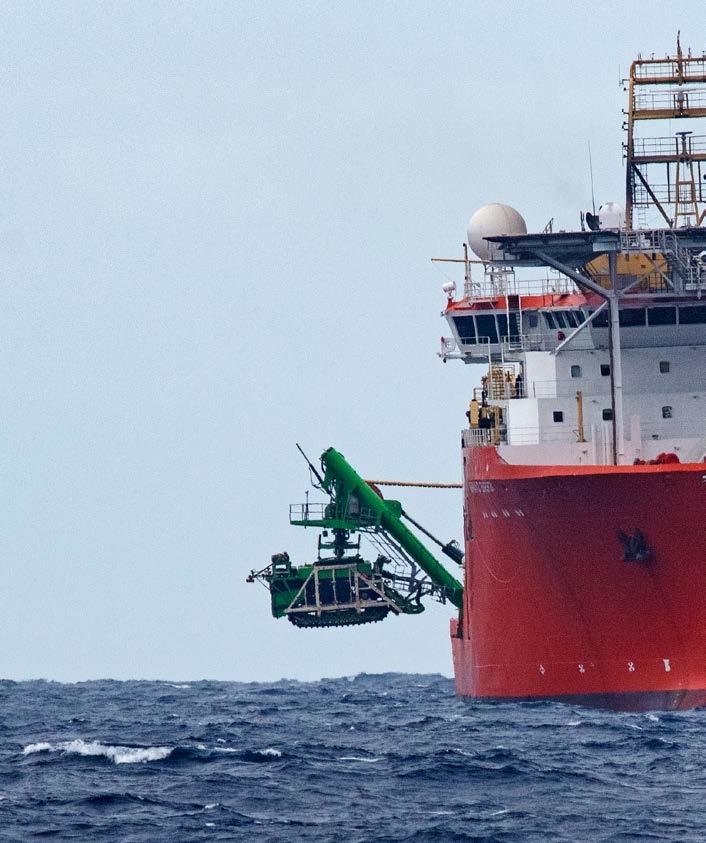
Nodule extraction by crawler harvesting of nodules and sediment has been demonstrated on a pilot scale, while nodule extraction by theoretically less-destructive pickers is considerably less technically advanced. Substantial development time is expected to determine if the latter technology is in fact viable. Working at depths 3 times greater than the Deepwater Horizon and >15 times deeper than North Sea oil recovery poses significant challenges to reliable operation.
Capital and operating costs suggested by project proponents show a high likelihood of economic losses for extraction and sale of Cook Island nodules. A sensitivity analysis for picking technology suggests the average outcome is negative. Estimated operating costs for a crawler project (PFS-level) are at or above nodule estimated market value, also indicating negative economics.
INTRODUCTION
In October 2025, Trytten Consulting Services was engaged by Greenpeace International to provide a review of the economic potential of seabed manganese nodules in the Cook Islands. Trytten Consulting Services, with 30 years of experience in the mining and metals industry, is well-positioned to consider the value of nodules, the available processing technologies, market structure, and potential demand for metals of interest, and the likely economic outcomes of resource development. This document draws on work recently completed1 on the topic for another client in another region.
Unless otherwise indicated in the footnotes, the findings and conclusions in this report reflect the author’s professional expertise and judgment. Additional information about the author can be found at the end of this report.
METALS MARKETS
Manganese, nickel, cobalt, and copper are all expected to be growing markets to supply a growing decarbonization of the world’s energy systems2,3. Demand is expected to continue to grow, but future demand is difficult to forecast amidst the backdrop of varying levels of global action on electrification, changing battery forms and chemistries (growing lithium iron phosphate and sodium-ion batteries, declining nickel-cobalt-manganese battery market share but rising nickel intensity within the segment).
Many companies forecast future demand, with a wide range of outcomes, illustrated by a report from the International Energy Forum and Payne Institute of Public Policy which compares a number of scenario models from different organizations and timeframes4 The International Energy Agency (IEA) is a non-partisan market reviewer that publishes periodic reviews of critical metals demand for various scenarios including the STEPS (Stated Policies) and APS (Announced Pledges); their 2025 Critical Minerals Outlook (CMO) report which includes these two scenarios is used as a primary source on future demand scenarios for this report, however it is acknowledged that there are a wide range of demand estimates which depend on the selected assumptions for any given future scenario. The above scenarios would require additional measures to meet climate objectives under the Paris Agreement.
1 A Techno-Economic Assessment of Seabed Mining – American Samoa and Global Implications; Barnard, M and Trytten, L; 2025. https://www.oceanprotectioncoalition.org/ dsmfeasibility
2 Global Critical Minerals Outlook 2025; International Energy Agency; 2025; https://www.iea. org/reports/global-critical-minerals-outlook-2025
3 Bend the trend: Global Resources Outlook 2024; United Nations Environment Programme; 2024. http://wedocs.unep.org/handle/20.500.11822/44901
4 Critical Minerals Outlooks Comparison; International Energy Forum and The Payne Institute for Public Policy, Colorado School of Mines; 2023. https://www.ief.org/reports/criticalminerals-outlooks-comparison
Manganese is dominantly used in the steel industry5; manganese ore concentrate is used to convert iron ore to steel, and refined manganese alloy products produced from manganese ore (ferromanganese and silicomanganese) are used in producing certain grades of steel. High-purity manganese metal and compounds are a minor use case. The IEA CMO2 suggests that total demand from clean energy technologies (primarily batteries) for manganese is expected to be perhaps 2 Mt in 2040 (STEPS) - about 10% of total demandwith processing capacity expected to be largely provided by China. Currently only about 2-3% of manganese use is in the full range of battery chemistries (rechargeable such as for electric vehicles as well as single-use alkaline)6.
Manganese demand is expected to be more stable than the primary metals required for the energy transition. With expected high production rates of manganese from any commercial scale nodule project, the most likely market is steel-making, not high-purity products such as those used in specialty alloys and chemicals (including batteries) which might see only a fraction of the total project output.
Battery trends remain unclear for manganese: the evolution of lithium iron phosphate (LFP) and sodium-ion batteries and decreasing manganese in nickel-manganese-cobalt (NMC) batteries dampens the growth rate of manganese, but the development of manganese-dominant batteries such as LMFP and LNMO may reduce those impacts somewhat2.
Manganese ore production (~20 Mt/y Mn content) is dominated by Australia and African countries, while manganese alloy production is globally distributed across more than 20 countries7. Mined supply is not considered to be a key constraint. World Steel8 noted that steel market growth to 2040 is expected to be more modest, with declining iron ore consumption due to increased recycling through electric arc furnaces which reduces manganese consumption. A recent McKinsey report 9 showed minor expected growth in manganese demand through 2035 per Figure 1.
5 Manganese in Steel; The Manganese Institute; https://www.manganese.org/en/manganese-steel
6 Manganese in Batteries; The Manganese Institute; https://www.manganese.org/en/manganese-and-batteries7 Mineral Commodity Survey data and Minerals Yearbook (multiple years and commodities); USGS; https://www.usgs.gov/ centers/national-minerals-information-center/key-publications
7 Mineral Commodity Survey data and Minerals Yearbook (multiple years and commodities); USGS; https://www.usgs. gov/centers/national-minerals-information-center/key-publications
8 Glass half full or half empty? Steel industry decarbonization to 2040; World Steel Dynamics; Jun 2024; https:// worldsteel.org/wp-content/uploads/1c.-Opening-session_Glass-half-full-or-half-empty_John-LITCHENSTIEN_World-SteelDynamics_vFINAL.pdf
9 Global Materials Perspective 2025; McKinsey & Company; October 2025; https://www.mckinsey.com/industries/ energy-and-materials/our-insights/global-materials-perspective
Cobalt
Cobalt is a small market, with current supply at 250-300 kt/y7, and sees relatively high use in batteries for both clean energy technologies such as EVs and portable electronics, with alloys and other uses lagging; EVs account for 30% of current demand2. The CMO report2 shows the expected supply requirements and mine supply from announced projects (Figure 2). The analysis suggests that demand is likely to rise for the balance of this decade and then fall to about the current production level. The gap between announced project cobalt supply and likely demand is small and effectively eliminated in the high production scenario they have included in the CMO2.
Cobalt geostrategic issues are those of a minor metal, in that cobalt is largely produced as a byproduct of nickel and copper mining. The Democratic Republic of the Congo is the leading mining jurisdiction (from copper production), with Indonesia-Chinese projects following (from nickel production)2. While nickel and copper supply chains are growing, cobalt supply is expected to grow as well10.
The battery chemistry evolution scenarios (increased LFP share and reduced NMC shareprimarily related to cost - as well as decreased cobalt share in NMC batteries due to both cost and sourcing concerns related to both geographic dominance and responsible practices) are more likely to reduce demand (and therefore any supply-demand gaps) for cobalt than nickel.
Nickel
Nickel is predominantly used to make stainless steel, with batteries growing to become the second-leading consumption sector followed by high-nickel alloys (such as for aerospace and gas turbine use as well as high-corrosion environments). Total production is in the range of 3.5 Mt/y7. Stainless steel is primarily served with iron-nickel alloys, while refining to high purity is required for battery and high-nickel alloy use. The expected demand under the CMO2 scenarios is shown in Figure 3 (found next page).
10 How global copper, nickel markets will drive the outlook for cobalt in 2025; Fastmarkets; 2024. https://www. fastmarkets.com/insights/how-global-copper-nickel-markets-will-drive-the-outlook-for-cobalt-in-2025
Copper
Copper, a 25 Mt/y market7, is widely used in electricity transmission, for transmission and distribution systems as well as within building construction, and within manufactured goods that produce or consume electricity (motors, generators, electronics). Market supply is less concentrated than for nickel and cobalt, although China still holds the largest share of copper refining (but less than 50%)7. The IEA scenario modelling2 suggests a significant gap, which is only slightly reduced in the high production scenario. Significant new copper production from currently unidentified sources would be required in this scenario, which does not consider new strategies for demand reduction like substitution or dramatically boosting recycling - but increased recycled supply as a proportion of the total supply is incorporated in the CMO2 scenario (25.5% of total demand vs 16.6% in 2024).
Nickel contd.
Recently the IEA has started modelling a high production scenario which closes the forecasted 2035 gap significantly as shown in the CMO2.
Nickel today is dominated by the IndonesiaChina axis, with >65% of mined production in Indonesia7 being largely processed by Chinese-owned facilities and with refining of intermediates to high-purity end products largely occurring in China. Commercial nickel deposits are widespread, but low prices resulting from supply growth has resulted in closures and lack of development of nickel projects outside of Indonesia in recent years11. It is anticipated that eventual demand shortfalls could be largely met by re-starts and projects that are currently in the development process.
SEABED MANGANESE NODULES
IN THE
COOK ISLANDS
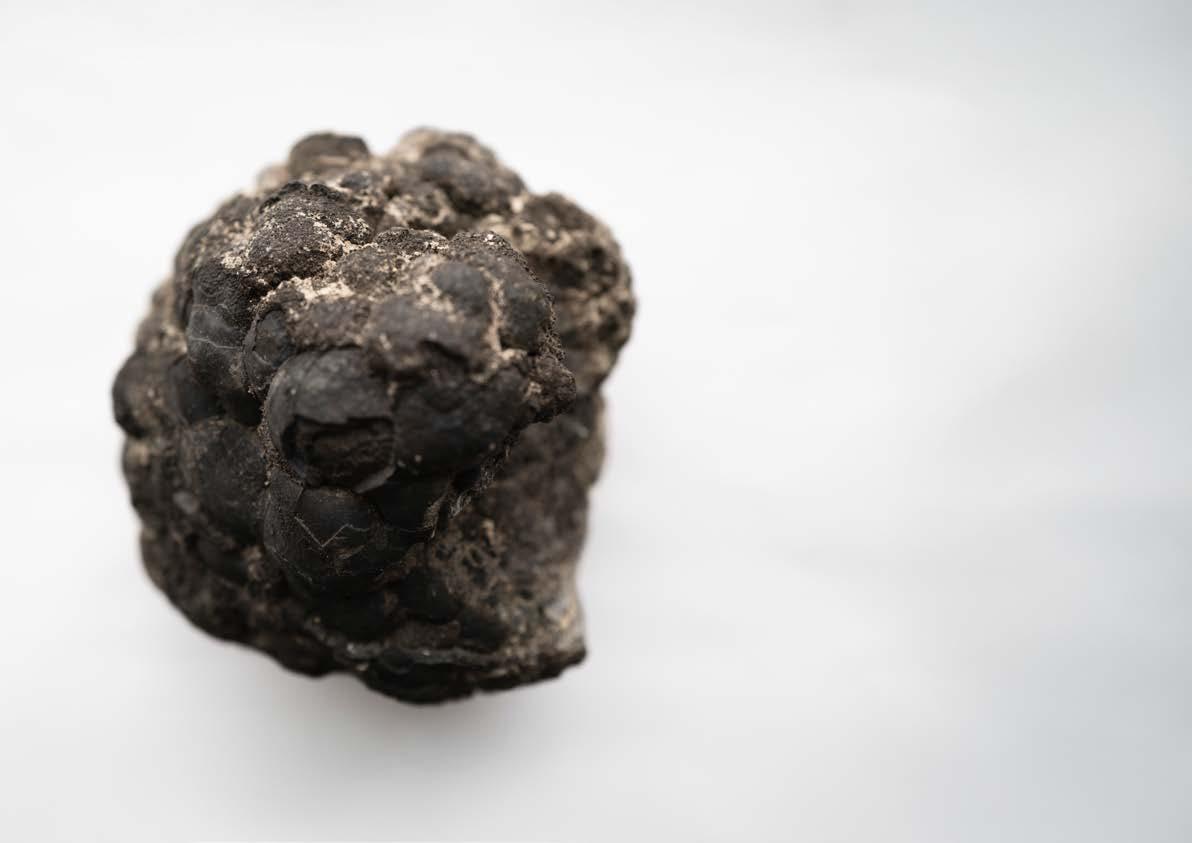
Seabed nodules in global ocean basins, like other mineral deposits, vary in their composition and physical quantity/concentration. Nodules are frequently referred to as “potato-sized”, but the vast majority are quite small; a boxby-box analysis of recovered nodules disclosed in a recent prefeasibility study12 showed that on a weight basis, 90% (mass) of the nodules in the surveyed area were below 5 cm in the longest dimension (weight average across 24 core boxes); 50% of the core boxes had no nodules greater than 5 cm. A full particle size distribution of 287 core boxes showed that 80% of the nodules (by count) were below 5 cm (95% of the dominant Type 1 nodules). Nodule dimensions tend to the flattened ovoid, with the intermediate and short axes approximately 75% and 42% of the major axis; nodule volume is consequently 15-20% of a sphere of the major axis diameter.
In the Cook Islands, a paper13 surveying nodules collected between 1985 and 2000 by a range of researchers noted similar sizing with samples ranging from <1 to ≈8 cm in diameter. Mean compositions of Cook Islands nodules (>100 samples) are given in Table 1.
Hein notes nodule depths in the area averaging 5200 m below surface. For depth comparison, consider offshore wind turbines commonly installed at up to 60 m depth14, North Sea oil platforms operating at 100 – 300 m15, and the Deepwater Horizon oil rig which operated at 1500 m16.
12 Technical Report Summary of Prefeasibility Study of NORI Area D, Clarion Clipperton Zone; TME the metals company Inc.; 2025. https://metals.co/wp-content/uploads/2025/08/0225054-TRS-PFS-for-NORI-Area-D_31-July-2025_FOR-FILING.pdf
13 Critical metals in manganese nodules from the Cook Islands EEZ, abundances and distributions; Hein et al; Ore Geology Reviews 68 (2015); http://dx.doi.org/10.1016/j.oregeorev.2014.12.011
14 Offshore Wind Energy; US Department of Energy webpage; https://windexchange.energy.gov/markets/offshore
15 5 Biggest North Sea Oil Platforms; Ahmed, Z; Marine Insight Jan 12, 2025. https://www.marineinsight.com/knowmore/biggest-north-sea-oil-platforms/
16 Deep-Sea Benthic Footprint of the Deepwater Horizon Blowout; Montagna et al; PLoS ONE 8(8); 2013. https://doi. org/10.1371/journal.pone.0070540
Cook Islands
*Compiled
TABLE 1: COMPOSITION OF NODULES FROM COOK ISLANDS
NODULE EXTRACTION AND PROCESSING TECHNOLOGIES
The economics of seabed nodule harvesting are inextricably linked to the technology used to recover and process the nodules, and the market which governs such processing. The proposed cost, maturity, and risk of the technologies is crucial to economic outlooks.
Extraction Technologies
Recovery of seabed nodules from great depth is generally considered by one of two technology routes: dredging and picking. The summary below is based on work done by Barnard and Trytten1.
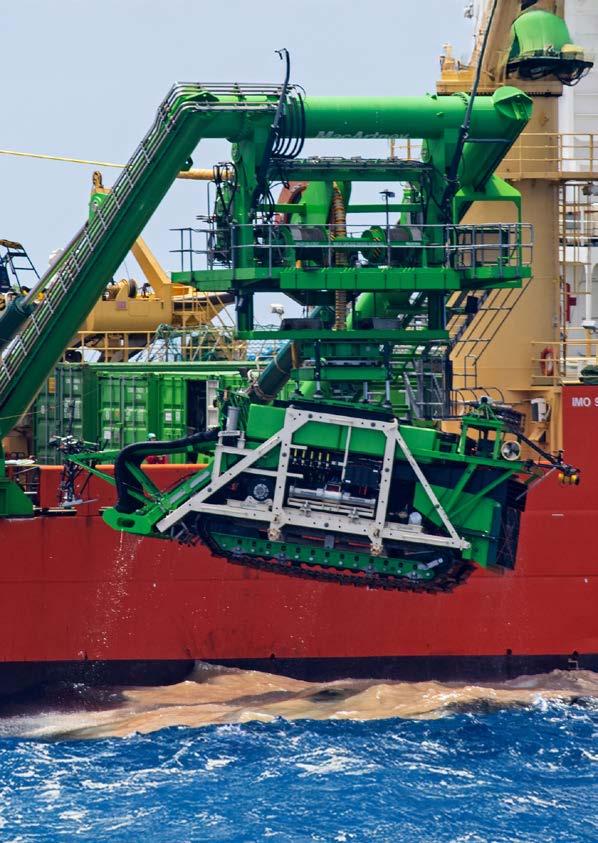
Dredging, as envisaged by The Metals Company as one example and described in their recent pre- feasibility study12, uses a low number of large, tethered crawler devices (15 metre width) to move across the seabed and extract the top few to several cm of material including sediment and nodules.Primary separation of nodules and sediment occurs at the crawler. The extracted material is moved up an air-injection riser pipe to the support vessel, where the remaining sediment and nodules are separated and the sediment and water returned and discharged at a depth of 2 km. Crawlers are designed to operate under remote control for long periods without return to the production support vessel on the surface, with power sourced from high-voltage conductors on a multi-kilometre umbilical.
Picking technologies, as envisaged by Impossible Metals and others, employ a high number of autonomous underwater vehicles (AUV) to roam the seafloor in the collection vicinity, visually identify nodules, and pick them out of the sediment. The picked nodules are deposited in a holding bin on the AUV, and when full the AUV returns to its production support vessel for servicing. The service cycle includes AUV retrieval, hopper emptying, visual system cleaning, battery replacement, any other maintenance, and AUV re-launch17.
Neither technology has been commercially demonstrated, and therefore economics of extraction remain uncertain. The crawler approach has had a longer development time and is considered more mature, and a 40% scale prototype has harvested a few thousand tonnes of nodules in another seabed nodule zone13. Picker technologies are considerably less developed1 and have not yet been proven in true field conditions; according to the company they have harvested rocks from a harbour and navigated at 1-mile (1.6 km) depth but not yet harvested significant quantities of nodules from the abyssal plain (>3 km depth)17
17 Impossible Metals website; https://impossiblemetals.com/technology/robotic-collection-system/; Press Releases May 13, 2024, Nov 12, 2024, Nov 25, 2024, and June 6, 2023
Processing Technologies
Nodules comprise a unique resource with no defined terrestrial processing capacity today — there are no single facilities which can take nodules and process them from raw form to finished metals or chemicals. However, the processing routes are reasonably wellunderstood and facilities which accomplish each of the necessary steps do exist globally.
The most likely processing route is rotary kilnelectric furnace (RKEF) smelting of the nodules to make a nickel-copper-cobalt alloy (sulfurfree) or nickel-copper-cobalt matte (sulfur added) and manganese slag byproduct for further refining. High-pressure acid leaching is also possible, but unlikely to provide as much value as manganese recovery to paying product is more difficult. A schematic of the most likely routes is given in Figure 5 below. As operated today, this route is highly carbon-
intensive, with coal used for thermal energy in the drying and reduction steps, coal or coke used as a chemical reducing agent, and coal-fired power used in most smelters 18 . Some locations operate on lower-carbon electricity systems, but globally, coal-fired is dominant. This technology operates in many countries today, with the vast majority of such installations having been built by Chinese entities in Indonesia in the last 10 years19,20: the top 3 producing sites built from 2015 to 2025 have a combined production capacity over 2.5 Mt/y nickel; 347 lines reportedly were in operation or under construction as of 202421, with a further 203 in planning. Indonesian mine production was 300 kt nickel in 2010-14 rising to over 2 Mt nickel in 2023/24, primarily to feed nickel pig iron smelters7. Processing of nickel-copper-cobalt from matte
to individual metals is well demonstrated in industry, while alloys would require conversion to matte or novel processing steps.
This is analogous to how nickel laterite ores are treated today, with rotary kiln-electric furnace operation to dry and melt the ore and chemically reduce the metal oxides to a molten phase, converting of the molten alloy to matte in the same facility, and refining of the matte in a separate facility22.
Manganese-rich silicate slag, a byproduct of processing 12, is analogous to current manganese ore, which is used directly in producing steel, or smelted to mid-value refined ferromanganese and silicomanganese products for use in making specialty steel alloys. Although conversion to high-purity manganese chemical products is possible, that is a very small fraction of the global market and likely not the key market for commercial-scale nodule operations.
Market Structure
One significant challenge for nodule processing is market structure. Today, smelters buy lowvalue feeds (nickel laterite ore containing in the range of 1.5-2% nickel and 0.05% cobalt) which they then process to final products (i.e. ferronickel alloy) and sell. Cobalt is not generally monetized (losses to slag are relatively high), and copper is not present in economic quantities23.
The processor operates on the margin between buying a low-value feed and selling a final product suitable for the stainless-steel industry. Some facilities choose to convert their iron-nickel alloy to nickel matte when economic conditions are suitable – i.e. when nickel matte prices are sufficiently higher than ferronickel prices – but these operate on the margin as swing producers, producing matte only when conditions warrant24. Some producers are integrated with mining and own the full supply chain from resource extraction to finished product.
18 Paving the way to cleaner nickel; Transport&Environment; October 19, 2023; https://www.transportenvironment.org/ articles/paving-the-way-to-cleaner-nickel
19 The World Nickel Factbook 2024; INSG; https://insg.org/wp-content/uploads/2024/09/publist_The-World-NickelFactbook-2024.pdf
20 How Indonesia Used Chinese Industrial Investments to Turn Nickel into the New Gold; Tritto, A; Carnegie Endowment for International Peace; 2023. https://carnegieendowment.org/research/2023/04/how-indonesia-used-chineseindustrial-investments-to-turn-nickel-into-the-new-gold?lang=en
21 Recent Growth of Nickel Laterite Processing in Indonesia; Hidayat, T et al; Keynote Presentation at Alta 2024; available at https://d3e2i5nuh73s15.cloudfront.net/wp-content/uploads/2024/06/01.02-RECENTGROWTH-OF-NICKEL-LATERITE-PROCESSING-IN-INDONESIA.pdf
22 Nickel Industry Part 1: Processing Nickel Laterites and Sulfides; Nickel Magazine (39)1; 2024
23 Development of laterite ore processing and its applications; Bahfie, F et al; Indonesian Mining Journal (25)2; 2022. DOI:10.30556/imj.Vol25.No2.2022.1261
The nickel laterite smelting industry does not currently operate in a toll-processing capacity, where the mineral owner pays them to process minerals and return products. This latter approach has been suggested by some enterprises operating in the nodule space but is not a proven viable route to market. For the fees would have to be more lucrative than the current proven business model of buying low-value ore and selling high-value products. An example of relative valuation of ores vs intermediates and final products is shown in Figure 625 (previous page).
Alternatively, the proponent can choose to develop owned processing facilities, designing and building a new nodule smelter, metals refinery, and manganese smelter. This allows control of the full supply chain and production of products which the proponent chooses. Developing new process facilities for atypical or new (nickel-copper-cobalt) products in Western countries (such as Australia and New Caledonia) has a poor track record of success26. Even experienced operators have had very difficult projects which have led to long delays and massive corporate write offs, both from initial start-up issues and prolonged cost issues27. A prolonged ramp-up period to achieve design capacity is to be expected28 — after a prolonged period of process design and testing and facility design through traditional staged engineering studies. There is no quick commercial market route to a domestic facility with expected rapid startup and operational success.
Should the proponent own the entire processing chain, with all its costs and complexities, nodule valuation can be done based on recovered metal and the value of that metal in its product form. If the proponent is making a final product, they will control its marketing and the value of the final product – i.e. the recovered metal from the nodules – is relevant for financial evaluation.
A proponent considering non-owned processing would most likely be selling nodules at a fraction of their contained metal value, similar to open-market ore purchases made today. As the proponent is not themselves making final products - and therefore not incurring the capital and operating cost of the processing facilities - the value of the final products (i.e. cobalt metal or sulfate) is not the relevant metric for financial evaluation of nodule extraction.
NODULE VALUATION
Nodules can be valued in two ways:
1) in-situ value of the contained metals (ignoring the viability, cost, and recovery in processing); and
2) market value (considering sale to a proven supply chain).
From the perspective of developing an economic extraction-only project, only the market value is relevant. As discussed above, there is no current market route to pay a processing fee and maintain ownership of the metals from nodule to refined product. The market structure dictates that a market value approach is most relevant.
In-situ value is based on market prices for end products. In general, cobalt prices have been the most variable (due to small market and very low primary production), copper prices have been more stable (large liquid market), and nickel has been of moderate volatility (smaller market with limited liquidity). The markets are characterized by a median price below average (due to periodic brief periods of high prices) which is the most dramatic for cobalt (median = 79% of average last 10 years). The average prices for the last 2, 3, 5, and 10 years are shown in Table 2 below29.
Noting that cobalt supply has shown an ability to keep up with - and outpace - demand growth resulting in recent market actions to withhold cobalt from the market to support prices30, and that increasing supply from Indonesian nickel projects will be largely inelastic to cobalt pricing, a price below the top of this range is suggested as a rational guideline for project consideration.
Similarly for nickel, supply growth has outpaced demand, depressing prices and closing facilities which could return to production should prices rise. Allowing that nickel supply has shown an ability to keep up with - and outpace - demand growth but that the long-term growth prospects are higher for nickel than for cobalt, a price near the top of this range is suggested as a rational guideline for project consideration; today’s prices reflect a stressed industry and should be considered a long-term floor.
25 Polymetallic Nodule Valuation: A report for the International Seabed Authority; CRU; 2020. https://www.isa.org.jm/ wp-content/uploads/2022/12/CRU_ISA-Polymetallic-nodule-valuation-report_24Aug2020.pdf
26 HPAL: Upping the Pressure; Gabb, J.; Global Mining Research; 2018; https://gigametals.com/site/assets/ files/4861/2018-03-19-hpal.pdf
27 Examples in the nickel-cobalt business include: HPAL - Ravensthorpe (BHP), Ambatovy (Sherritt), Goro (Vale), Koniambo (Glencore); and ferronickel - Onca Puma (Vale), Cerro Matoso (South 32), and Barro Alto (Anglo American). More information on some of these available in Why heap leach nickel laterites?; Oxley et al; Mineral Engineering 88 (2016); https://www.braziliannickel.com/wp-content/uploads/2017/09/why-heap-leach-nickel-laterites.pdf
28 Plant Ramp-Up Profiles — An Update with Emphasis on Process Development; T. McNulty (2014); in Proceedings of the 2014 Conference of Metallurgists, COM 2014:1
For copper, where supply growth has not kept up with demand growth (due partly to unanticipated but expected temporary closures of two major global mines), a price above the top of this range is considered rational. 29
Although there is wide acknowledgement that terrestrial grades are falling, improvements in operating efficiency may not raise costs to the same degree, and ultimately market prices are independent of operating costs up to the point that enough high-cost producers elect to close production. This has been seen recently in the nickel business, with no dramatic resulting change in market pricing.
Considering the market dynamics, appropriate long-term market prices in current dollars for the metals of interest are considered to be US$18,000/t nickel, US$40,000/t cobalt, US$10,000/t copper31. These are considered to be reasonable, and not overly optimistic or conservative. These prices are above average recent prices (last 12 and 24 months). Effects of higher and lower prices are examined through the sensitivity analysis conducted (-25% to +50% of nodule value).
Manganese is unlikely to be refined to a pure product, so is best considered as analogous to manganese ore, with a market value of US$450/t contained manganese. The value of the ore varies with grade; higher-grade products command a higher price. 5-year data sourced from tradingeconomics.com was used along with exchange rates to determine the reasonable value above (based on 32% manganese ore). Cook Islands nodules are about half of this grade, and slag that would be
produced from smelting these nodules would also be expected to be below this market grade; pricing might correspondingly be lower than suggested above.
Market value is based on analysis of the value of similar ores. Nickel-cobalt oxide ores (nickel laterites) sell at 20-30% of the contained metal value for nickel per Figure 6 and other sources. Cobalt recovery is generally lower than nickel, so payments are less – but the Cook Islands nodules are unique with a high cobalt content so cobalt will be optimistically considered to be paid as per nickel.
Current pricing suggests that an ore with 1.3 to 1.7% combined nickel and cobalt would sell for 18-28% of contained metals value (lower payment for lower grade). The combined nickel + cobalt + copper head grade for Cook Islands nodules is quite low, only 1.0%, implying lower percentage valuation. Optimistically, 25% payment for nickel and cobalt is assumed. Copper ore purchase is not a common market structure but considering that in the industry copper payability tends to be marginally higher than nickel payability, a payment structure of 30% is assumed. Manganese, exiting the first processing stage as a byproduct, is considered to carry the manganese ore value identified above. The prospective nodule valuation is shown in Table 3. Stricter comparison to actual ore sales suggests a lower value of $100/t.
TABLE 3:
DERIVED VALUATION OF NODULES FROM THE COOK ISLANDS (BASED ON GRADES AND PRICES ABOVE)
31 Impossible Metals v6.2 Economic Model uses $19,358/t nickel, $40,959/t
in sulfate, $55,198/t cobalt in sulfate, $11,440/t Cu metal, and $545/t Mn in byproduct for economic modelling.
The relative value proportion for nodule sales is shown in Figure 7 below.
One key element not included here is rare earths. Hein13 noted that the high rare earths concentration of Cook Islands nodules compared to others could increase the value; the study noted that the in-situ value of rare earths (if produced to pure products at 100% recovery and no cost) was second to manganese. Considering that there is no proven route to market for rare earths from seabed nodules (as generally stable oxides, rare earths in nodules would be expected to deport to smelter slag – the manganese byproduct – in processing, which may or may not be recoverable depending on whether processing of the manganese silicate slag is considered) and that the rare earths content of the Cook Island nodules (0.17%) is well below that of more readily accessible terrestrial deposits32, no accretive value is assigned to rare earths. It remains a hypothetical resource.
32 A review of rare earth elements and yttrium in coal ash: Content, modes of occurrences, combustion behavior, and extraction methods; B. Fu et al. Progress in Energy and Combustion Science, 88(100954); https://doi.org/10.1016/j.pecs.2021.100954
cobalt, $8,483/t copper, and $1,367/t manganese for nodule valuation with a recovery of 80% and assumed production to full metal products for each element. The Metals Company PFS uses $21,632/t nickel
ECONOMIC SENSITIVITY
ANALYSIS
The economic sensitivity analysis needs to consider if extraction and processing of the nodules is profitable.
A comparison can be drawn to the detailed economic model used in the pre-feasibility study12 previously mentioned. This study represents a low-capital crawler collection depending on the contract operator bearing the capital cost with payback through operating fees. In this model, the operating cost at fullscale operation (collection, delivery to port, corporate costs) is in the range of $200/dry tonne. The operating costs at 30% greater depth would be higher. These costs are above the valuation estimates above for Cook Islands nodules. No profitable operation seems likely for the Cook Islands nodules.
A picking technology has also been considered. The economic analysis was conducted based on a proponent’s economic model for shallower operation (4000 m), modified to reflect optimistic real-world project and cost schedules for the nominal 6.8 million dry tonnes per year rate. No detailed analysis of the capital and operating cost assumptions was completed, but technology analysis suggested that the AUVs were unlikely to deliver the productivity suggested by the proponent1. Consequently, a sensitivity analysis approach was taken with variation of productivity from 50% to 125% of suggested nominal and variation of nodule value from 75% to 150% of that identifiedabove. Although there are cases that could be economic, the average discounted net present value of the sensitivity analysis is negative.
Although it is possible that an economic collection and processing system could be derived, analysis of the projected plans by two leading proponents1 coupled with analysis of the available market structure suggest that it is more likely than not that the ultimate economic return for Cook Islands nodules would be negative. This analysis is in broad agreement with some of the arguments posed in a 2024 article in the Cook Islands News33, which notes that the economic returns from deep sea mining alone are quite uncertainwithout accounting for negative attributes such as impact on tourism and environmental and cultural impacts, that “the cost of actually doing it is probably much higher than we’ve been estimating”, and that “the future for those mineral prices is perhaps not as strong”.
33 Economist cautions Cook Islands amid US$467M net benefit findings; Cook Island News; Nov 2, 2024. https://www.cookislandsnews.com/internal/national/environment/economist-cautions-cook-islands-amid-us467m-netbenefit-findings/
DISCLAIMER
This summary economic assessment was substantially based on a prior techno-economic assessment prepared using publicly available information for different seabed areas1 . Consequently, it contains uncertainties typical of early-stage analyses.
The evaluation draws on established engineering principles, publicly disclosed test data, market information, and widely accepted industry benchmarks. However, detailed proprietary designs, operational test data, and confidential cost breakdowns were not accessible. Accordingly, the conclusions presented should be regarded as indicative guidance for stakeholder discussions and own due diligence, not as definitive engineering validation.
Certain aspects of the report (especially where statements are not referenced) rely solely on the author’s significant expertise as a chemical engineer and metallurgical consultant.
To achieve investment-level confidence, further work is required, including rigorous engineering validation, detailed cost analysis, operational testing, and environmental assessments incorporating findings from the subsequently published Feasibility Studies (FS) and Impact Assessments (IA).
The author has no financial or other interests in any seabed mining proponents. The author has minimal investments in terrestrial mining companies and has a small advisory contract with a terrestrial project development company exploring for copper. This assessment was commissioned on an independent basis.
BIOGRAPHY
Lyle Trytten is a chemical engineer and metallurgical consultant with over three decades of experience in sustainable battery metals development. He has worked globally across R&D, engineering design, project startup, operations, and techno-economic and life-cycle assessment roles in critical minerals including nickel, cobalt, copper, lithium, and graphite.
Lyle specializes in holistic lifecycle analysis and equitable supply chain design. He has contributed technical articles and reports, detailing smelting processes, tailings management, responsible mining and metallurgy considerations, and lifecycle emissions trade-offs. As “The Nickel Nerd,” he regularly participates in industry forums advocating transparency, critical due diligence, and traceability in mineral production and refining, and writes an ongoing series on production technology and sustainability for the Nickel Institute.
He is featured in The Elements of Deep Sea Mining and the Redefining Energy – Tech podcast series, where he discusses processing, tailings, and decision-making across the battery metals supply chain, interpreting complex trade-offs and lifecycle impacts. Lyle contributed to the information base underpinning the recent Rand Corporation report34 on seabed mining, and has been interviewed by noted financial, news and industry journals including Bloomberg, Time Magazine, The Economist, and the Wall Street Journal. Lyle’s public-facing podcasts, webcasts, articles, and reports for which he has been interviewed, as well as his more detailed writing on the commodities businesses are provided on a public drive.
Beyond publishing and podcasting, Lyle advises national and international agencies on sustainable mineral strategy. His commentary and guest posts articulate the nuances of processing vs mining, the spectrums of environmental impact, and the engineering realism behind policy decisions.
Lyle combines deep technical understanding, real-world project experience, and public thought leadership in battery metal development and sustainability. His profile ensures rigorous, system- aware analysis of seabed mining proposals, anchored by engineering practicality, lifecycle transparency, operational integrity, and independence.
34 The Potential Impact of Seabed Mining on Critical Mineral Supply Chains and Global Geopolitics; Rand Corporation; April 2025.; https://www.rand.org/pubs/research_reports/RRA3560-1.html