Facing obesity stigma
The need to address obesity stigma in healthcare settings was highlighted on World Obesity Day, reports Niamh Quinlan
All part of the narrative
Valerie Ryan examines the developing concept of ‘narrative medicine’ and speaks to leaders of Columbia University’s innovative programme
The healthcare casualties of war
Russia’s horrific invasion of Ukraine has sparked a humanitarian and healthcare crisis, writes Dr Muiris Houston
HSE decide to terminate IFMS implementation contract
KIERAN FEELY
The HSE has decided to terminate the contract with DXC Technology for the provision of implementation services for the Executive’s new integrated financial management system (IFMS), the Medical Independent (MI) can report.

DXC Technology was engaged by the HSE in December 2019 to provide implementation services for the IFMS, based on SAP software, under a contract worth €19.1 million.
The matter was discussed at the December 2021 meeting of the HSE performance and delivery committee, according to minutes.
Ms Valerie Plant, HSE Assistant Chief Financial Officer and IFMS Programme Director, told the committee there were ongoing commercial and contract discussions with the current
systems integrator following notice of termination.

The committee was told the procurement process for an alternative systems integrator to continue delivery of the IFMS had already commenced and was expected to be completed by June 2022.
Potential difficulties with the existing contract had been signalled at a meeting of the Dáil public accounts committee (PAC) on 23 September 2021.
Mr Stephen Mulvany, HSE Chief Financial Officer, told the PAC the project timeline had been pushed back by the pandemic and cyberattack on the HSE.
“The current systems integrator, as I have said, has indicated commercial issues about living within the fixed price contract,” according to Mr Mulvany.
He said the entire contract was for €19 million, including VAT, stating that approximately 30 per
cent was due at design phase, which was completed in July 2021.
Termination of the contract with DXC was discussed by HSE CEO Mr Paul Reid at a meeting of the joint Oireachtas committee on health last month.
“We have had issues with the systems integrator, which we are in discussions with about termination,” said Mr Reid.
A HSE spokesperson confirmed to MI it had decided to terminate the contract “under its right to do so on a no-fault basis”.


DXC was asked to comment on this development, but no reply had been received by the time of going to press.
The IFMS project is intended to replace legacy systems in the HSE, many of which pre-date its establishment.
The project, which has been beset by numerous delays, was due to be fully rolled out to the


HSE and section 38/39 bodies by March 2023, according to a plan from February 2020.
The latest plan, published with the contract notice for a new
Medical workforce ‘crisis’ needs acknowledgement –Council CEO
CATHERINE REILLY
The Medical Council CEO has called for greater acknowledgement of the medical “workforce crisis”.
Mr Leo Kearns, who took up the post in April 2021, told the Medical Independent (MI): “We need to see people within the Department [of Health], at Government level, HSE, clinical sites, training bodies, medical schools, Medical Council, other regulators, saying actually workforce is our fundamental issue – there are lots of other areas as well… but what we would be particularly focused on is the workforce because that is at the heart of safety and patient care so we have to get that right….
“And I have to say there is a strong sense emerging that people are beginning to take this very seriously.”
The Council was “working very closely” on workforce issues with stakeholders, such as the HSE, the Department, and training bodies. In this regard Mr Kearns emphasised the importance of a comprehensive medical workforce strategy.
“While we can focus on our regulatory role in relation to education and training, professional competence, and providing ethical frameworks, and managing complaints as they arise, it really is very clear to us that some of the more fundamental problems we have in the health service, directly related to patient safety, is our ability to recruit and retain a high calibre workforce, and for them to be working in a system that actually supports and helps them deliver care at the level people would expect,” he informed MI See news interview, p10-12.
systems integrator, indicated it would be the end of 2028 before the IFMS was fully implemented across the health service. See news feature, P4-5.

Legal Category: S1A. Marketing Authorisation Holder: Pfizer Europe MA EEIG, Boulevard de la Plaine 17, 1050 Bruxelles, Belgium. For further information on this medicine please contact: Pfizer Medical Information on 1800 633 363 or at medical.information@pfizer.com
▼ This medicinal product is subject to additional monitoring. This will allow quick identification of new safety information. Healthcare professionals are asked to report any suspected adverse reactions. See section 4.8 of the SmPC for how to report adverse reactions.
XELJANZ® is indicated for the treatment of adult patients with moderately to severely active ulcerative colitis (UC) who have had an inadequate response, lost response, or were intolerant to either conventional therapy or a biologic agent.

XELJANZ® in combination with methotrexate (MTX) is indicated for the treatment of moderate to severe active rheumatoid arthritis (RA) in adult patients who have responded inadequately to, or who are intolerant to one or more disease-modifying antirheumatic drugs.
XELJANZ® in combination with MTX is indicated for the treatment of active psoriatic arthritis (PsA) in adult patients who have had an inadequate response or who have been intolerant to a prior disease-modifying antirheumatic drug (DMARD) therapy.
PP-XEL-IRL-0668

Date of preparation: September 2021

OUR PAPER IS NOW COMPOSTABLE, AS WELL AS RECYCLABLE NEWS 1-16 ● OPINION 18-22 ● MCQ s 22 ● CLINICAL 25-32 ● LIFE QUIZZES 34 ● FOOD & DRINK 35 ● GALLERY 36-37 ● RXDX 31 ● RECRUITMENT 38-39 17 MARCH 2022 ● ISSUE 6 VOLUME 13 ● NEXT ISSUE 28 MARCH 2022 €5.95
INDIC A T E D FOR UC | RA | Ps A PAGE 14
PAGE 16 PAGE 21
Minister for Health Stephen Donnelly; Prof Shane Higgins, Master, National Maternity Hospital (NMH), Dublin; and Ms Martina Cronin, Labour and Birthing Unit Manager (via Facetime) at the launch of the refurbished labour and birthing unit, NMH.











‘Enormous strain’ on NRH occupational health service


 CATHERINE REILLY


The occupational health department at the National Rehabilitation Hospital (NRH) in Dún Laoghaire had difficulty providing staff with “all the services necessary”, due to pandemic pressures and increased hospital staffing.
The “enormous strain” on the department was acknowledged by board Chairperson, Mr Kieran Fleck, at a meeting in November.
The board heard a presentation from the department’s Clinical Nurse Manager (CNM) Ms Rose Curtis, which described the major impact of Covid-19 on hospital staff, including “staff illness, managing with reduced staff, staff being close contacts and staff unable to return home to visit sick or dying relatives overseas”. The department had medically assessed 280 new staff members who had commenced employment since March 2020.
Currently, the NRH has 595 whole-time equivalent staff (663 employees including job-share and part-time positions).
“The board were advised that, due to the pressure from the pandemic and increased hospital staffing, it is difficult for the occupational health department to provide the hospital and staff with all the services necessary,” according to minutes obtained under Freedom of Information law.
Public health appointments imminent
DAVID LYNCH
The first public health consultants are expected to begin taking up their roles by the end of this month, with 34 posts due to be filled by the end of June.

In May 2021, public health specialists in the IMO voted to approve an agreement with the Department of Health, which included a commitment to establish 84 consultant posts. The recruitment process was to take place in three phases between June 2021 and December 2023.
In November, the Medical Independent reported that campaigns for 12 of 34 ‘phase one’ posts had closed and were progressing through the selection process.
This month, an Executive spokesperson said “campaigns for 34 of the phase one posts have been advertised and are progressing through the recruitment process. Onboarding of the first posts are expected to commence by the end of Q1 and completion of all 34 posts by the end of Q2.”
According to the HSE National Service Plan 2022, the 34 posts in phase one will have “a priority focus” on health protection and public health area leadership.
The HSE would work in “collaboration” with the Department of Health to “demonstrate evidence of reform” and progress sanction by the Department of Public Expenditure and Reform of phase two recruitment (30 whole-time equivalent posts).
The plan aims to recruit phase two consultant posts by June 2023 to deliver clinical leadership and capacity across public health practice.
The final 20 posts (phase three) are due to be in place by the end of December 2023.
Consultants in public health medicine appointed prior to the introduction of the Sláintecare contract will be on the common consultant contract, the HSE stated in late 2021.



The department had a part-time physician, CNM and staff nurse. Ms Curtis advised the board of a need for administrative support and another occupational health CNM and staff nurse.

Mr Fleck stated that the board would seek to address her concerns, while CEO Mr Derek Greene said he was working with Ms Curtis on developing a review of the department and its additional resource requirements.
A NRH spokesperson told the Medical Independent: “The
occupational health department staffing consists of a CNM2, a staff nurse, administrative support, and a part-time occupational health physician. Due to the pandemic, the hospital assigned additional staff to supplement the occupational health department to provide assistance with staff screening, Covid-19 vaccination, swabbing, and contact tracing.”
The hospital was in the process of implementing the “workforce planning recommendations from the review to recruit additional staff” for the department.
Rapid Access Lung Clinic
Consultant-led assessment and diagnosis for patients with suspected lung cancer


Now available at Mater Private Hospital, Eccles St, Dublin. Consultation and initial diagnostic testing completed within one week.
High quality care for the early detection, diagnosis and treatment of lung cancer





• Rapid access to the expertise of lungspecialised Consultants












GP referral required

• Appropriate for patients where there is concern for lung cancer based on symptoms or imaging findings.
• Referrals triaged within 2 days; appointment ordinarily within one week
All-inclusive package includes:
• Specialist Consultation
• Computed Tomography Chest Scanning
• Full Pulmonary Function Testing
• Nurse Specialist Assessment

• Onward referral for Specialist Diagnostics/Services as required

33
For more information, please visit www.materprivate.ie
THE MEDICAL INDEPENDENT | 17 MARCH 2022 3 News
Mater Private Network | Dublin e lungrapidaccess@materprivate.ie t
22 23
1800
Specialist Team Respiratory Consultant & Clinical Lead for Lung Cancer Thoracic Surgeon Director of Radiation Oncology Lung Cancer Nurse Coordinator Dr. Dermot O’Callaghan
Dr. Daniel Cagney
Josephine
Prof. Donna Eaton
Reilly
Contract termination is latest blow to IFMS project
The decision by the HSE to terminate the contract for the implementation of the planned integrated financial management system could cause problems for the Government as it faces criticism over its inability to control health spending. Kieran Feely reports
The integrated financial management system (IFMS) project underway in the HSE has suffered a serious setback with the revelation that the contract with the systems integrator, DXC Technology, is being terminated.
Termination of the contract was discussed by Mr Paul Reid, HSE CEO, in reply to a question from Social Democrats Co-leader, Deputy Roisín Shortall, at a meeting of the joint Oireachtas health committee on 16 February 2022.

“We have had issues with the systems integrator that we are in discussions with about termination,” according to Mr Reid. “We are going through a procurement for a further systems integrator. However, the process is continuously moving on seamlessly.”
The matter had previously been discussed at the December 2021 meeting of the HSE’s performance and delivery committee, according to recently published minutes.
The minutes stated that Ms Valerie Plant, Assistant Chief Financial Officer of the HSE and IFMS Programme Director, told the committee that there were ongoing commercial and contract discussions with the current systems integrator following notice of termination.
The committee was told that the procurement process for an alternative systems integrator to continue delivery of the IFMS had already commenced and was expected to be completed by June 2022. A contract notice was published by the HSE on 8 December 2021. It invited requests to participate in a “competitive procedure with negotiation” for the provision of SAP build and implementation support for the IFMS. Potential difficul ties with the existing contract had been signalled at a meet ing of the Dáil public accounts committee (PAC) in September 2021. The issue was raised by the Chair person of the PAC, Sinn Féin Deputy Brian Stanley, at a meeting on 23 September 2021. Mr Stephen Mulvany, Chief Financial Officer of the HSE, told the PAC that the project timeline had been pushed back by Covid-19 and the cyberattack on the HSE.
“The current systems integrator, as I have said, has indicated commercial issues about
living within the fixed price contract. One of the options may be, as the Chairman indicated, that we will have to secure a different company,” Mr Mulvany said.

A spokesperson for the HSE confirmed to the Medical Independent (MI) that the Executive has decided to terminate the contract with DXC Technology “under its rights to do so on a no fault basis”.
DXC Technology was asked to comment on the termination of the contract. No reply had been received at the time of going to press.
Problem for Government
This development will come as a deep disappointment to the Government and to the board and management of the HSE, who are under continuing pressure to control healthcare spending.
The latest setback comes on top of other delays owing to the Covid-19 pandemic and the cyberattack on HSE systems in 2021. The project was due to be completely rolled out to the HSE, section 38/39 bodies by March 2023, according to a plan issued by the HSE in February 2020. The latest plan, published with the contract notice for a new systems integrator, indicates that it will be the end of 2028 before the IFMS is fully implemented across the health service.
Implementation of the finance reform programme, including progressing the design and implementation of the IFMS for the HSE, Tusla, and section 38/39 voluntary bodies, was one of the key non-clinical priorities in the HSE Na -
tional Service Plan 2021.
According to the document, the IFMS was expected to complete its detailed design in the first quarter of 2021, followed by a build and test phase of approximately six months. The latter phase was due to be completed by September 2021 and deployment was set to begin in October 2021.
“It is anticipated that the IFMS programme will have successfully been rolled out to 80 per cent of the public health system by the end of quarter 3 2024 with rollout prioritised by areas of significant expenditure,” stated the service plan.
According to the HSE National Service Plan 2022, which was published earlier this month, the process to procure a systems integrator will be completed in the second quarter of this year. It is now hoped the building and testing phrase will commence later in 2022.
The IFMS was raised at another meeting of the Oireachtas committee on health on 24 February. Deputy Shortall referred to recent media coverage of recordings of meetings in the Department of Health. Deputy Shortall told Minister for Health Stephen Donnelly that officials in his Department did not have confidence in HSE financial management and asked what issues needed to be addressed in relation to financial accountability. Minister Donnelly replied that “we need to do more urgently on modernising financial reporting” within the health service.
Deputy Shortall said: “It is just extraordinary that an organisation with 120,000 staff and a budget of €21 billion doesn’t have an
integrated financial management system. So we don’t know if we’re getting value for money. We don’t know if the money is going where it is intended to go.”
Financial management requirements

The need for an integrated financial system to account for health spending has long been recognised. The Report of the Commission on Financial Management and Control in the Health Service (2003), one of the foundation documents for the establishment of the HSE, recommended that such a system be implemented.
Following the establishment of the HSE, the financial information systems project was undertaken. This project was suspended in October 2005 after the Department of Finance wrote to the Department of Health requesting a review of the project, as it had cost €30 million to date and was not operational. The project was formally ended by the Department of Finance in 2006. There were subsequent attempts to procure a single financial system, but these did not prove successful, with the economic crisis in 2008 and subsequent recession proving an additional stumbling block.
IFMS project schedule
The current IFMS project is based on a SAP S/H4HANA software application platform. A contract for the supply of the software was awarded to SAP UK Ltd in 2017, following a competitive tendering process.
A contract was awarded to Global EntServ Solutions Ireland Ltd T/A DXC Technology in 2019 for SAP implementation support for a new integrated financial management system following a competitive tendering process. The HSE also entered a contract with SMX Consulting for project management services.
The original project schedule provided to MI by the HSE shows that the project was to be implemented in stages. The design stage was originally due to be completed in July 2020. The build and test stages were meant to be completed by January 2021. The deployment was divided into four groups encompassing the HSE, Tusla, section 38/39 bodies. The final deployment date for these groups was originally set for 2 March 2023.
The contract for implementation support was awarded to DXC Technology in December 2019 and the preparation stage began on 9 December 2019. Documents disclosed under Freedom of Information law indicate that the project was beset by difficulties from the outset. The Covid-19 pandemic in early 2020, the cyberattack on the HSE in May 2021, disagreements over change requests and the implementation of the SAP procurement module out of schedule all contributed to delays.
A spokesperson for the HSE informed MI
THE MEDICAL INDEPENDENT | 17 MARCH 2022 4
News Feature
Mr Stephen Mulvany
Deputy Roisín Shortall
that the project was subject to a re-plan in September 2020 after the first wave of the pandemic. This resulted in the project being pushed out by six months. A second replan was done in July 2021 which resulted in the project being delayed by 12 months, with a revised date for deployment of 1 March 2024.
Documents published in December 2021 with the contract notice for a new systems integrator, obtained by MI, show that the revised project schedule envisages complete implementation across the health system by the end of 2028. This suggests that the delivery of the IFMS will be almost five years later than originally planned.
When the Covid-19 pandemic began it was decided by the HSE to fast-track implementation of the procurement functionality using SAP Ariba SNAP. In a project status update, released under Freedom of Information (FoI), the Programme Director stated that in March 2020 the IFMS project moved to fast-tracking the procurement system as a direct response to the public health crisis. The reason for this was to reduce the administrative burden on services due to the pandemic.
considered that a substantial number of change requests were within the scope of the fixed-price contract.
A spokesperson for the HSE confirmed to MI that internal and external due diligence reviews were undertaken for the purpose of validating change request costs.
“The outcome of the internal due diligence exercise confirmed that a number of the change requests raised by the systems integrator were not valid as the functionality was specified in the HSE’s statement of requirements and therefore already included in the fixed-price contract. The result was a reduction of €1 million in the cost of change requests from €1.99 million to €0.99 million following review by the HSE,” the spokesperson said.
The impact of the Covid-19 pandemic on the IFMS was considered by the finance reform programme steering committee meeting on 22 January 2021. A special briefing was presented by the Chief Financial Officer on challenges being experienced because of the surge in cases, including in nursing homes, hospitalisations, and ICU admissions. The CFO advised that it was not appropriate for the IFMS project
Catherine Murphy, to the then Minister for Health Simon Harris on 23 July 2019. These were pre-procurement estimates that were five years old, according to Minister Harris’s response. This means that the budget for the project was set as far back as 2014.
This figure was reiterated by Mr Mulvany at a PAC hearing on 16 September 2021. Sinn Féin Deputy Matt Carthy asked Mr Mulvany if he expected the project cost to be within the budget of €82 million. “We do,” replied Mr Mulvany. “We have spent about 20 per cent of that budget so we are at about €15 million or €16 million of the €82 million. At this point, I am not flagging any threat to the overall budget.”
The contract for the supply of software with SAP UK Ltd was for €27 million (ex VAT). The contract for systems integration with DXC Technology was for €15.5 million (ex VAT). A contract notice was issued for a wide range of SAP specialist services up to 2027, but no costs are indicated. Two contracts were entered into with IBM for a combined total of €1.5 million (ex VAT).
In relation to the contract with DXC Technology, Mr Mulvany said that the entire contract was for €19 million, including VAT. Mr Mulvany was unable to say how much of the contract had been paid to date, but told the committee that about 30 per cent (€5.7 million) was due at design phase, which was completed in July 2021.
The contract notice for the new systems integrator to replace DXC Technology was published on 8 December 2021. The estimated value of this contract is stated as €19 million (ex VAT), which is an increase over the amount of the contract with DXC Technology.
MINDO NUMBERS
120,000 additional hours of personal assistant supports, and 30,000 additional hours of home support, will be delivered in disability services, according to the HSE National Service Plan 2022.
42 critical care, 813 acute and 73 sub-acute beds were fully funded and opened in 2020/2021, according to the Sláintecare progress report for 2021, published by the Department of Health.
Change requests
However, delays continued to mount as the project progressed. In October 2020 it was reported to the finance reform steering committee that the biggest area of challenge was the implementation of the SAP Ariba procurement module, as the HSE had no in-house expertise. Delays were also reported with the integration design between the payroll system and IFMS, and the impact of change requests.
A change request arises where a system of packaged or off-the-shelf software, such as SAP, needs to be modified to suit the specific needs of an organisation. If the modifications required by an organisation are not specified in the initial request for tender they can cause costs to increase substantially, as they represent additional effort on the part of the systems integrator that had not been anticipated when the contract was signed. The effort to design unplanned modifications can also lead to delays. The effects can result in the assignment becoming commercially unviable for a service provider, especially when operating under a fixed-price contract.
The issue of change requests was discussed again at the December 2020 meeting of the finance reform steering committee. Estimated costs of change requests had been submitted by DXC Technology and a due diligence exercise was undertaken to confirm the validity of the change requests in the context of the fixed-price contract. It was reported that the HSE
to add any unnecessary further burden on stakeholders by attempting to conclude the design stage by 5 February 2021. It was decided, with the agreement of DXC, that the contract would be suspended for just over one month, from 22 February to 6 April 2021. In addition, all governance meetings and engagements with stakeholders involved in the delivery of services were suspended with immediate effect.
The next meeting of the committee was held on 22 March 2021 when it was decided to re-commence the project and a new date of 12 May 2021 was set for finalisation of the design stage.
The committee was informed by the IFMS Project Manager at a meeting on 5 July 2021 that there were delays in the production of the build and test plan and that further delays had arisen because of the impact of the cyberattack on the wider HSE ICT infrastructure. It was reported that the project was nine months behind at this stage. In addition, the build and test stages were now expected to take nine months instead of six, adding a further three months delay to the overall project timeline, resulting in a total delay to the project of 12 months.
Project costs
The overall budget allocation approved by the Government for the IFMS is €82 million. This information was conveyed in a reply to a parliamentary question from Social Democrats Co-Leader, Deputy
The HSE was asked what requests for implementation resources and funding had been made by the section 38/39 bodies. A spokesperson for the HSE replied that some voluntary bodies had indicated that the implementation of the IFMS will give rise to a need for implementation resources and funding.
“The HSE has committed that the onceoff local implementation and change management cost of the new standard processes will be supported by a contribution from nationally available resources, as appropriate. Detailed resource requirements will be assessed in advance of individual deployments with each voluntary organisation as part of detailed deployment planning and scheduling,” said the spokesperson.
There is a requirement to upgrade desktop computers because SAP will not operate on Windows 7 PCs. The HSE told MI that it expects to spend €17 million on replacing Windows 7 devices. The HSE pointed out that this is a core infrastructure upgrade and not related to an individual programme. The HSE also said that the cost to upgrade PCs in section 38/39 bodies was €9.9 million over three years.
MI sought to clarify the confusing and incomplete IFMS project financial picture. The HSE was asked to provide updated overall project costs and to say what impact the termination of the contract with DXC had on project costs. The HSE spokesperson replied that total project lifecycle costs for build, test and deployment to all entities will be confirmed on completion of a full project plan by the incoming systems integrator.
9 primary care centres opened in 2021 and a further 28 were in construction, stated the Sláintecare progress report.
138,000+ radiology scans were delivered in the community in 2021, according to the report, which noted that the GP direct access to diagnostics scheme went live in January 2021.
92 medicines were recommended for marketing authorisation by the European Medicines Agency in 2021. Of these, 53 had a new active substance which had never been authorised in the EU before, a 35 per cent increase compared to 2020.
THE MEDICAL INDEPENDENT | 17 MARCH 2022 5 Feature News
It is just extraordinary that an organisation with 120,000 staff and a budget of €21 billion doesn’t have an integrated financial management system
Rise in NIMS reporting following cyberattack impact
DAVID
LYNCH
There was a “sharp rise” in reporting to the national incident management system (NIMS) following the initial impact of the cyberattack in May 2021, the HSE has informed this newspaper.
“It is evident from looking at the data that there was a sharp rise in incident reporting after July 2021 as the backlog of incidents were reported onto the electronic system,” said a HSE spokesperson.
According to the Executive, the contingency arrangement for events such as the cyberattack was use of paper forms.
“This ensures that the incident is captured initially
and staff have means of reporting such events for the purpose of learning,” outlined the spokesperson. “Additionally, we know that there can be a time delay in reporting of community incidents onto the electronic national system as they utilise paper forms given the nature of their work and work environment.”
At a meeting of the HSE safety and quality committee last November, a report from the State Claims Agency highlighted “a significant drop-off in reporting of incidents to NIMS in the wake of the cyberattack”.
According to the meeting minutes, the committee noted that all locations had a drop-off in incident reporting from 1 July to 23 August as compared to the two previous years. Hospital Groups were “down 58.2 per cent,
IBTS reviewing incident report process after HPRA inspection
CATHERINE REILLY

The Health Products Regulatory Authority (HPRA) raised a major deficiency following an inspection of the Irish Blood Transfusion Service (IBTS) tissue bank, which related to the management of incident reports (IRs) within the quality system.
This deficiency consisted of “a combination of eight minor incident report deficiencies which, when viewed together, were graded as a major deficiency”, an IBTS spokesperson told the Medical Independent (MI)
The matter was an item at the IBTS board meeting in November 2021.
The spokesperson for the IBTS said responses for the eight minor incidents have been submitted to the HPRA. The response includes a commitment to complete a full review and update of the IR process and “formal implementation of the quality partnering initiative”, which is also an initiative in the IBTS’s strategic plan.
“The ultimate aim of partnering by quality is to further develop relationships with the various business units in the organisation and work with those units as customers to ensure that the IBTS has a compliant, effective and efficient quality management system,”
VOX BOX
Alzheimer Society of Ireland interim CEO, Ms Siobhan O’Connor, commenting at a briefing to an all-party Oireachtas group on dementia.
outlined the IBTS’s spokesperson.
Meanwhile, the IBTS has appointed Prof Tor Hervig as its new Medical and Scientific Director. Prof Hervig graduated in medicine from the University of Bergen, Norway, in 1979. He undertook specialist training in immunology and transfusion medicine and worked as Head of Department and senior consultant at Stavanger University Hospital and Haukeland University Hospital, Norway.
In 2007 he was appointed Professor in Transfusion Medicine at the University of Bergen. He has also worked in Tanzania and served on several national and international committees. His main interests include blood donor care, blood components, stem cell therapies and clinical transfusion practice.
The IBTS confirmed to MI that Prof Hervig has relocated to Dublin to take on the role.
Community Healthcare Organisations were down 62.5 per cent in 2021 from 2020, and other locations down 29.4 per cent”.
A HSE spokesperson said when reviewing the statistics for 2019-21, the number of incidents reported in 2019 and 2020 showed a 0.3 per cent increase. However, from 2020 to 2021 there was 7 per cent drop.
“This can be explained in some part by a lag in the time to report an incident on NIMS from when it occurred. It would be expected that incidents which have occurred in the latter part of 2021 can take some months to report owing to paper reporting or the fact that staff are not immediately aware of the incident. We will continue to monitor this,” said the spokesperson.
Higher engagement with online alcohol services during pandemic
DAVID LYNCH
There was an increase in engagement with the self-assessment tool on the HSE’s askaboutalcohol.ie website and the drug and alcohol helpline during the first year of the pandemic, according to statistics provided to this newspaper.
In 2018 there were approximately 7,000 completions of the alcohol intake self-assessment tool on askaboutalcohol.ie, based on Google analytics data. The number increased to 19,000 in 2019 and rose substantially to 62,000 in 2020. The number last year was 18,000.
The HSE drug and alcohol helpline noted 1,536 alcohol-related contacts in 2018; 2,143 in 2019; 2,208 in 2020; and 2,214 contacts last year.
The HSE cautioned that because of the impact of the cyberattack, “the 2021 figures are therefore an underestimate.”
In response to the changing patterns of alcohol use at home during the pandemic, the HSE alcohol programme “produced two blog posts on www. askaboutalcohol.ie offering expert advice, and promoted them through its social media channels and network of partners”, a HSE spokesperson told the Medical Independent (MI)
The post titled ‘Alcohol advice for the
coronavirus outbreak’ has had 19,106 views, stated the HSE. The page titled ‘Covid-19 coping tips and supports for people in recovery’ has had 1,573 views.
“In 2021, the HSE Corporate Plan 2021-24 stated that we will establish nine new community-based integrated alcohol services and roll-out a digital support service for harmful and hazardous alcohol consumption to reduce harmful alcohol consumption,” said the HSE’s spokesperson.
“In 2021 and as part of the Sláintecare healthy communities programme, funding was secured from the Department of Health to develop two new community-based integrated alcohol services which will be established early this year in Mid West Community Healthcare (Community Healthcare Organisation (CHO3)) and Cork Kerry Community Healthcare (CHO4).”
Earlier this year, MI reported that a review and update of the weekly lowrisk alcohol guidelines is upcoming. Changes in drinking patterns during the pandemic will inform the process.
“An implementation plan for the HSE alcohol programme is currently in development and will include an action to review and update the low-risk drinking guidelines,” a Department of Health spokesperson said.
6 THE MEDICAL INDEPENDENT | 17 MARCH 2022 News
If we address early risk factors, such as hearing loss, high blood pressure, diabetes, smoking, and depression, then according to The Lancet Commission, 40 per cent of dementias are preventable.”
We know that if a patient is on a trolley for more than five hours it can have a significant knock-on impact on their health and indeed their mortality.”
Irish Nurses and Midwives Organisation General Secretary, Ms Phil Ní Sheaghdha, speaking ahead of a meeting with the Oireachtas joint committee on health in regard to “stark levels” of overcrowding.
Medicine, like many professions, has traditionally been male dominated, and I know of many women doctors who face gendered assumptions daily, when a patient might be expecting a male surgeon or specialist.”
Medical Council President Dr Suzanne Crowe, speaking on International Women’s Day about the need for gender parity in the medical profession, challenging gender stereotypes, and greater work-life balance for all.
Cardiology Masterclass
Saturday, 26th March | 9 am – 12:30 pm
Speakers
Session 1 | 9 am – 10:10 am
Heart Failure & Structural Heart Disease
Introduction – Prof. Robert Byrne




Heart Failure: We Need a Better Name for this Condition!
– Prof. Jim O’Neill
Resistant Hypertension
– Dr. James Dollard
Structural Heart Disease: What is it?

– Prof. Mark Spence
Session 2 | 10:15 am – 11:20 am
Cardiac Arrhythmia
Update on Arrhythmia Guidelines
– Dr. Usama Boles
Recognizing Different Types of Atrial Arrhythmias
– Dr. Jim O’Brien
Atrial Fibrillation Cases: When Rhythm Control is Superior to Rate Control
– Dr. Mahesh Pauriah

Each session to be followed by Panel Discussion / Q&A, moderated by Dr. Róisín Lyons, Dr. Ken Fitzpatrick, Dr. Mike Thompson and Dr. Pauline Diamond. Questions can be submitted in advance to events@materprivate.ie or online during the live webinar.
Registration on www.materprivate.ie/news-events/events/ For more information, email events@materprivate.ie

Session 3 | 11:25 am – 12:30 pm

Coronary Disease & Device Management


Impact of COVID-19 Pandemic on Hospital Admissions with Heart Attack and Out of Hospital
Cardiac Arrest
– Dr. Ronan Margey
Practical Issues in the Management of Implantable Cardiac Devices in the Community






– Ms. Gráinne Pelly



Left Main Coronary Artery Disease; Bypass Surgery or Stenting?
– Dr. Róisín Colleran

 Prof. Robert Byrne Director of Cardiology
Dr. Ronan Margey Consultant Cardiologist
Dr. Usama Boles Consultant Cardiologist
Prof. Jim O’Neill Consultant Cardiologist
Ms. Gráinne Pelly Chief II Cardiac Physiologist
Prof. Mark Spence Consultant Cardiologist
Prof. Robert Byrne Director of Cardiology
Dr. Ronan Margey Consultant Cardiologist
Dr. Usama Boles Consultant Cardiologist
Prof. Jim O’Neill Consultant Cardiologist
Ms. Gráinne Pelly Chief II Cardiac Physiologist
Prof. Mark Spence Consultant Cardiologist
Webinar Mater Private Network
Online event only. CPD applied for.
Dr. James Dollard Consultant Cardiologist
Dr. Róisín Colleran Consultant Cardiologist
Dr. Mahesh Pauriah Consultant Cardiologist
Dr. Jim O’Brien Consultant Cardiologist
New system sought to address deficiencies in anticoagulation clinics
PAUL MULHOLLAND
Gaps in the current processes at the anticoagulation clinics in Naas General Hospital and Connolly Hospital have prompted a tender for a new clinical information system, the Medical Independent can report.
According to tender documents, the numbers of patients attending the anticoagulation clinic at Naas General Hospital has increased “threefold” over the last 10 years.
In addition, the European Working Time Directive has resulted in “decreased availability” of doctors to attend the clinic.
The tender stated that this has led to the consideration of using other trained healthcare professionals, supported by appropriate protocols, to help operate the service as occurs at other units in Ireland and abroad.
“The manual paper-based system currently in place is very labour intensive for nursing and secretarial staff,” according to tender documents.
“This places a significant burden on the hospital’s anticoagulation service….Audits of the current system have identified quality gaps. There is no central electronic storage of patient demographics, blood test results, anticoagulation medication (warfarin or equivalent), dosing decisions or disease register for patients on anticoagulation medication (warfarin or equivalent).”
The anticoagulation clinic is held five days a week. It is physically located outside of the hospital and is based on the ground floor of the Vista Primary Care Centre,
Ballymore Eustace Road, Naas. It is a nurse-managed service with clinical governance provided by general medical and haematology consultants.
There are approximately 250 patients per week attending the clinic and 100 new patients joining per year.
The tender for the new system is initially for Naas
‘Purpose’ of second Healthy Ireland council being considered
DAVID LYNCH
The “broad purpose” of a second Healthy Ireland council is being considered by the Department of Health, with a new council expected to be established by next year, the Medical Independent (MI) can report.
The final meeting of the first Healthy Ireland council, chaired by former Irish rugby international Mr Keith Wood, took place in December 2017. The council was formed to provide advice and input on the Government’s Healthy Ireland strategy.
The Healthy Ireland Strategic Action Plan 20212025 , published last May, included an action to establish a second Healthy Ireland council “to provide intersectoral leadership to implement actions to realise the strategic outcomes of Healthy Ireland”. In the timeframe for implementation actions, between 2021 and 2023, the plan committed to setting out “the terms of reference and the appropriate membership” of the Healthy Ireland council and convening the council.
A Department spokesperson told MI officials “are presently considering the broad purpose of the council and the resources required to manage and facilitate it”.
“It is expected that a second Healthy Ireland council will be established and will convene prior to the 2023 deadline. At present there is no other body that performs the same role.”
The strategic action plan contains 56 actions across six themes which will be implemented over the next five years. Each action has a lead Government department from across 14 separate Government departments.
“Since the publication of the Healthy Ireland framework seven years ago, significant progress has been made to implement our vision where everyone can enjoy physical and mental health and wellbeing to their full potential,” Minister for Health Stephen Donnelly said last year on the launch of the action plan.
The original Healthy Ireland framework was published in 2013.

Separately, the Department informed MI that “no decision has been made regarding the next topic on the work programme” for the national advisory committee on bioethics (NACB). The NACB published its last paper, titled Nudging in Public Health – An Ethical Framework , in April 2016. It has not met or published any further papers since.
General Hospital, then for Connolly Hospital, with the option to extend to other hospitals.
The Connolly Hospital anticoagulation clinic is held four days a week and is run by medical NCHDs and nurses with clinical governance provided by the cardiology consultants.

On average 750 patients attend the service per month with over 8,500 patients seen each year since 2019.
“The current manual paper-based system is very labour intensive for medics, nursing and secretarial staff,” outlined tender documents.
“Patient information is held on a roller-deck and dosing information [is] manually adjusted and recorded. As such, the process is highly manual and the data is subject to confidentiality, integrity and availability risks.
The introduction of IT systems to facilitate the management of outpatient anticoagulation in other HSE sites has been demonstrated to improve patient safety, be cost-effective by reducing patient admissions, increase clinic efficiency and provide ongoing auditable data to ensure key performance indicators are maintained.
“Equally an electronic system would reduce the dependency of NCHDs for the service and allow them to spend more time in other areas in the hospital, ie, wards and outpatient clinics.”
The new system must provide an integrated computerised decision support system, which will interface with the hospital’s patient administration system and laboratory information system.
The deadline for a response to the tender is 23 March.
Search for HSE banking provider underway
DAVID LYNCH
The HSE has begun the process of selecting a new banking provider, the Medical Independent (MI) has been informed.
Ulster Bank has provided banking services to the HSE since 2007. At the November meeting of the HSE audit and risk committee, there was a discussion regarding Ulster Bank’s plans to leave the Irish banking market this year.
An Executive spokesperson told MI that the “initial review process” to find a new banking provider will be completed before the end of March.
The November meeting of the audit and risk committee heard that the HSE Treasury had “engaged with HSE Procurement and the Office of Government Procurement (OGP) regarding the HSE’s banking contract”.
“Additionally, the OGP have advised that the HSE may use the Government framework agreement that has been established with Danske Bank. The committee noted that work is ongoing to ensure the organisation is ready for the transition and is working to an understanding that the HSE will receive notice of termination of banking services in early 2022 giving the HSE six months to move to a new provider.
“It has been noted that the HSE’s banking services will not be moved by Ulster Bank to an alternative provider.”
A HSE spokesperson told MI last month that it had yet to receive formal notice of termination from Ulster Bank. They added that use of the Government framework agreement with Dankse Bank “is under consideration”.
8 THE MEDICAL INDEPENDENT | 17 MARCH 2022 News
HEALTHY DATA MEANS HEALTHY WORKFLOWS AND HEALTHY PATIENTS.

InterSystems makes your data healthy so it’s accessible, useable, and ready for action.

HealthyData.com
Changing times at the Medical Council
Medical Council CEO Mr Leo Kearns speaks to Catherine Reilly about medicine’s workforce crisis and the significant upcoming changes in regulatory processes

Amajor shift in how the Medical Council investigates complaints against doctors, and a new model for maintaining professional competence, are on the near horizon for medical regulation in Ireland.

Overseeing implementation of these reforms and a wider “change programme” is Medical Council CEO Mr Leo Kearns, who took up post in April 2021. Mr Kearns will be known to many doctors as a former CEO of the RCPI. He came to the Council from Vhi Health and Wellbeing where he was Chief Operating Officer, and previously worked in the HSE as National Lead for Transformation and Change.
Workforce crisis
Mr Kearns knows the medical profession is facing several deep-rooted problems, including recruitment and retention, excessive working hours, burnout, and bullying. These issues have been documented in the Medical Council’s Your Training Counts surveys, workforce intelligence and training site inspection reports. Ultimately, however, these outputs have had a limited impact. How does the Council help address this?
“I don’t think we need a lot more data on this; we absolutely don’t,” Mr Kearns told the Medical Independent (MI). “I think what we need is an acknowledgement that we are in a workforce crisis; and why is that important? These are the people who are delivering the care to patients and I think maybe what we haven’t got across well enough in the past is just how deep this crisis is….”
The “markers” of the crisis included unfilled consultant posts, not enough doctors on training programmes, and the growth of the medical register’s general division. These problems have “been there for a long time”, he acknowledged.
“While we can focus on our regulatory role in relation to education and training, professional competence and providing ethical frameworks and managing com-
plaints as they arise, it really is very clear to us that some of the more fundamental problems we have in the health service, directly related to patient safety, is our ability to recruit and retain a high calibre workforce, and for them to be working in a system that actually supports and helps them deliver care at the level people would expect,” surmised Mr Kearns.
The Council was “working very closely” on these issues with stakeholders such as the HSE, Department of Health and training bodies. In this regard, Mr Kearns emphasised the importance of a comprehensive medical workforce strategy.
He commented: “We need to see people within the Department, at Government level, HSE, clinical sites, training bodies, medical schools, Medical Council, other regulators, saying actually workforce is our fundamental issue –there are lots of other areas as well… but what we would be particularly focused on is the workforce because that is at the heart of safety and patient care so we have to get that right….
“And I have to say there is a strong sense emerging that people are beginning to take this very seriously. I would hope we are going to look back in two or three years’ time and say the reports are finally being acted on.”
There was “a reasonable chance we
can get some meaningful action on this, and when I say meaningful action, it is at multiple levels”.
For instance, some findings from Your Training Counts related to the absence of “basic” requirements, such as timely receipt of rosters, access to lockers and food out-of-hours. “These things have to be addressed; they have to be sorted. It says something about how we value people… people need to see there is change at ground level….”
However, the Council holds significant powers as the accreditor of clinical training sites and training programmes – could it take stronger action on the problems identified during inspections, such as withdrawing accreditation temporarily?
“Well we wouldn’t take precipitous action,” stated Mr Kearns, who added “this is where right-touch regulation comes in”.
“There are a lot of good things going on across the health service. There are a lot of people doing great work, both management and clinical staff and so on, and you want to encourage that and facilitate that.
“I think the Council won’t be acting precipitously by any means, but we will be using our regulatory powers where we think we need to use them, to protect patients and to effect the kind of change that is needed; change in a more strategic way.”
Rebalancing the grade composition of
the medical workforce was a fundamental requirement for the health service, indicated Mr Kearns.
“It is out of step with other comparable countries in terms of numbers of consultants per 100,000 of the population. It is out of kilter between the number of consultants and doctors in the general division, and so on.”
He noted the lack of an overall plan that longitudinally examined medical school intakes, internship places, training places, and consultant post requirements.
“That actually was, believe it or not, a central recommendation in the Fottrell report [in 2006]… which said there needed to be joined-up thinking across education and health that was continually looking at the numbers and then taking actions in that context.”
One of the responses to the European Working Time Directive was recruiting more doctors onto the general division – “no joined-up thinking”, according to Mr Kearns.
The general division was “never intended to be as big as it is”, he said. In 2020 some 37.3 per cent of doctors were registered in the general division, with 42.7 per cent of doctors registered as specialists and 13 per cent as trainees.
“There is certainly a proportion of those on the general division who want to and absolutely are at the standard to be on a training programme. And as you know, some of the changes made last year [relating to residency stamp 4 holders] should help in that regard,” said Mr Kearns.
“But it is not addressing the overall problem, which is that from a workforce point of view, the ratio of consultants to NCHDs, and ratio of consultants to training scheme doctors and non-training scheme doctors, is way out of kilter with comparable countries.
“That then has an impact on the makeup of the team. It has an impact, we believe, on safety as well because on the general division, while there are many doctors on it who have excellent credentials and experience and so on, the baseline qualification to get onto the general division is an internship or equivalent….
“It is something we are looking at fairly intensively; we think it is part of the issue that has to be addressed in a workforce strategy. It is not going to be addressed in an isolated way, which I think has been a problem for many years.”
Investigations
A “major” focus for the Council is upcoming change in complaint and investigation management.
The Regulated Professions (Health and Social Care) (Amendment) Act 2020 has provided that the Council CEO will take on a new role in investigating com-
THE MEDICAL INDEPENDENT | 17 MARCH 2022 10 News Interview Continued on p12 ▸
I think what we need is an acknowledgement that we are in a workforce crisis
Mr Leo Kearns

MAR 26
Continued from p10 ▸
plaints, with the assistance of ‘authorised officers’. The provisions aim to ensure a more efficient process. Currently all complaints are investigated by the preliminary proceedings committee (PPC), but it will have less involvement at an early stage under the new measures.
“It clearly places a much greater responsibility on the CEO and the office of the CEO to investigate and then bring the results of that investigation to the PPC,” explained Mr Kearns of the provisions, which are likely to be commenced in late 2022.
“That is a major focus for us at the moment and we have a major plan in relation to it. So we will absolutely need to put additional resources in… and we are working on that at the moment very closely with the Department.”
Implementing this reform would also involve “changing how we structure the whole function”.
“We are also looking at other areas we feel are quite important as well, for instance how do we triage queries and complaints coming in, so how do we make sure that we're dealing with them in the most appropriate way.”
The Council needed to focus “the full weight” of its regulatory investigative function on serious patient safety issues. Mr Kearns said a significant number of complaints could be addressed at local level if there was a procedure for patients. The Council was working with various parties including the ICGP and HSE “to see how they can provide those kinds of [complaints] services and link people into it. There’s also the potential of using mediation or mediation services.”
The Council was also developing a “liaison-type service” for complainants and doctors, which would be separate to the complaints process. This service would provide people with further information about investigation and fitness to practise (FTP) processes and signpost support services for patients and doctors.
More broadly, Mr Kearns expressed concern about the length of the complaints process to completion. The Council will be looking at how to address this “while still making sure we are making the best decisions we can in the interests of patient safety”. According to internal Council documentation from April-May 2021, the median number of weeks from date of receipt of a complaint to PPC decision was 20.3 weeks in the previous 12 months. The median number of months from PPC decision to FTP committee inquiry was seven, and the median number of months from completion of FTP committee inquiry to a Council decision on sanction was 1.5 months.
Another area under the spotlight is undertakings. These are agreements by a doctor with the Council to remediate or cease some or all of their practice. Under the Medical Practitioners Act 2007 the FTP committee may accept undertakings from doctors, while undertakings may also be accepted by the High Court. The PPC will also be able to accept undertakings under the 2020 Act.
In late 2019 the then High Court President criticised the Council in the case of a doctor who had undertaken to its health committee not to practise medicine, but worked for a mental health service. Mr Justice Peter Kelly stated there was no way for patients or employers to find out about this undertaking to the health committee.
MI asked Mr Kearns which types of undertakings were made public on the medical register.
“That is actually something we are looking at in a lot of detail at the moment,” he said. “As you say there are multiple different ways undertakings can be given, conditions can be set, we can have hearings that are in private, we can have hearings that are in public.” He said a decision to hold a FTP hearing in private “is not lightly done” and this “might have an influence on what is published around a sanction or an undertaking and so on”.
“…. We are going to be putting in place systems to try and coordinate all of that…. It is an area we recognise we need to do a lot of work on and it is part of our plan.”
Mr Kearns emphasised during the interview that the Council’s “fundamental” remit was patient safety. This role involved a wide range of activities and the Council had “embarked on a significant programme of change”, which involved examining “everything we are doing” to ensure it was fulfilling its remit.
Professional competence
For several years, the Council has been working on developing a new model for maintaining professional competence, which is expected to be implemented in May 2023. It is envisaged the new framework model will have annual minimum requirements, but a three-year cycle will be initiated as a “more effective righttouch regulatory approach when monitoring compliance”.
Mr Kearns said the model would emphasise “more reflection in CPD activities and practice-based activity”.
“We have also made sure the new scheme is in line internationally with where CPD is going…. We have provided a framework and within that framework people can modify that or apply it to their own situation and I think that is to reflect the fact there are so many different clinical settings and so many different scopes of practice.”
A comprehensive review of the Council’s role in education and training is also underway, with a view to developing a “right-touch regulatory approach”, which will be more “risk-based and targeted”. For a number of years the Council has been highlighting an unsustainable workload in regard to the scale of its accreditation activities in education and training.
As part of its review, the Council will be assessing its approach to clinical site in-

spections with a view to reducing duplication and “utilising valid data to identify where risk may lie”.
In future, some processes might be carried out by training bodies on behalf of the Council, indicated Mr Kearns.
“As part of our change programme, [we are] looking at processes we might be doing that actually they [training bodies] might just as easily do, or maybe do better, and we just need to have some kind of an arrangement with them.
“So for instance, clinical site inspections where there is probably duplication…[and] I think there is a lot of good knowledge and expertise within the training bodies….”
“We are confident that issues, such as conflict of interest and fair procedures, will be fully addressed as we go through this process of change.”
Mr Kearns said the regulator had “massively committed” staff, members of Council and committees, but it did not have “the level of resource to do what we need to do”. The Council was funded by fees from registered doctors and there may be activities “where actually we should be seeking funding from other entities”, he added.
There were no plans to raise the registration/retention fees. The Council was “looking at being a bit more flexible” in regard to the registration model for doctors who “might not be practising at the moment” due to maternity leave or family commitments, etc.
“We are definitely looking at that and seeing how we can help people in that regard,” said Mr Kearns.
Global events
As Mr Kearns noted, research from 2018 found 30 per cent of doctors were experiencing burnout. The situation will only have been exacerbated by the Covid-19 pandemic. In addition, Russia’s invasion of Ukraine and resultant humanitarian crisis has caused more anxiety and distress in the population. Council President Dr Suzanne Crowe recently wrote to Ukrainian doctors on the medical register to offer words of solidarity.
“I think [with] the last two years, we are only probably beginning to see the impact this has had on people and particularly in the health service,” reflected Mr Kearns.
“I can see it in staff in the Medical Council as well and in other areas connected to the health service. It has been incredibly difficult. It has been difficult for people across the country, but incredibly difficult for people working in the health services. And all those underlying issues there before Covid are simply just emerging and will be more difficult than ever….”
Many people were beginning to contemplate a period of repair and replenishment before the war in Ukraine erupted, he observed.
“We have a number of doctors from Ukraine working in Ireland or who trained in Ireland…. These are colleagues…. I think it is impacting on a lot of people. It is very difficult to divorce the day-today from these bigger events that are out there…. I am very conscious of that.”
THE MEDICAL INDEPENDENT | 17 MARCH 2022 12 News Interview
It clearly places a much greater responsibility on the CEO and the office of the CEO to investigate and then bring the results of that investigation to the PPC
Medical Council
Think Once-Weekly Ozempic for People with Type 2 Diabetes who have Atherosclerotic Cardiovascular Disease1-3
Ozempic® provided a significant 26% risk reduction of MACE# in people with type 2 diabetes* and cardiovascular disease.1,2,§
This includes a 39% relative risk reduction in non-fatal stroke.1,2,‡
Ozempic® also has superior blood glucose and weight-loss efficacy across all head-to-head clinical trials in the SUSTAIN program.1-9,†,‡
* 26% CV risk reduction in patients with type 2 diabetes and high CV risk, compared to placebo, in addition to standard treatment.
# Major Adverse Cardiovascular Events
† Results apply to Ozempic® across SUSTAIN trials, which included placebo, sitagliptin, dulaglutide, canagliflozin, exenatide PR and glargine U100.1-9
§ p=0.02 for superiority
‡ p<0.05

Ozempic® is recommended by the ADA/EASD Consensus Report for people with type 2 diabetes who have established atherosclerotic cardiovascular disease10
PR = Prolonged Release; ADA = American Diabetes Association; EASD = European Association for the Study of Diabetes.
SUSTAIN = Semaglutide Unabated Sustainability in treatment of Type 2 Diabetes.
*SUSTAIN was the phase 3 clinical trial programme investigating the effects of once weekly semaglutide versus other anti-diabetic agents.
ABBREVIATED PRESCRIBING INFORMATION
Ozempic®t semaglutide

Please refer to the Summary of Product Characteristics (SmPC) before prescribing. Ozempic® 0.25 mg solution for injection in pre-filled pen. Ozempic® 0.5 mg solution for injection in pre-filled pen. Ozempic® 1 mg solution for injection in pre-filled pen. One ml of solution contains 1.34 mg of semaglutide (human glucagon-like peptide-1 (GLP-1) analogue). Indication: Ozempic® is indicated for the treatment of adults with insufficiently controlled type 2 diabetes mellitus as an adjunct to diet and exercise • as monotherapy when metformin is considered inappropriate due to intolerance or contraindications • in addition to other medicinal products for the treatment of diabetes. For study results with respect to combinations, effects on glycaemic control and cardiovascular events, and the populations studied, see sections 4.4, 4.5 and 5.1 of the Ozempic® SmPC. Posology and administration: Administered once weekly at any time of the day, with or without meals. Injected subcutaneously in the abdomen, thigh or upper arm. Starting dose: 0.25 mg once weekly. After 4 weeks the dose should be increased to 0.5 mg once weekly. After at least 4 weeks with a dose of 0.5 mg once weekly, the dose can be increased to 1 mg once weekly to further improve glycaemic control. When Ozempic® is added to existing metformin and/ or thiazolidinedione therapy or to an SGLT2 inhibitor, the current dose of metformin and/ or thiazolidinedione or SGLT2 inhibitor can be continued unchanged. When Ozempic® is added to a sulfonylurea or insulin, a reduction in dose of sulfonylurea or insulin should be considered to reduce the risk of hypoglycaemia. Blood glucose self-monitoring is necessary to adjust the dose of sulfonylurea and insulin, particularly when Ozempic® is started and insulin is reduced. A stepwise approach to insulin reduction is recommended. Children: No data available. Elderly: No dose adjustment required, therapeutic experience in patients age ≥75 is limited. Renal impairment: No dose adjustment is required for patients with mild, moderate
or severe renal impairment. Experience in patients with severe renal impairment is limited. Not recommended for use in patients with end-stage renal disease. Hepatic impairment: No dose adjustment is required for patients with hepatic impairment. Experience with severe hepatic impairment is limited. Caution should be exercised when treating these patients with semaglutide. Contraindications: Hypersensitivity to the active substance or to any of the excipients. Special warnings and precautions for use: Should not be used in patients with type 1 diabetes mellitus or for the treatment of diabetic ketoacidosis. Not a substitute for insulin. Diabetic ketoacidosis has been reported in insulin-dependent patients whom had rapid discontinuation or dose reduction of insulin. There is no experience in patients with congestive heart failure NYHA class IV and is therefore not recommended in these patients. Use of GLP-1 receptor agonists may be associated with gastrointestinal adverse reactions. This should be considered when treating patients with impaired renal function as nausea, vomiting, and diarrhoea may cause dehydration which could cause a deterioration of renal function. Acute pancreatitis has been observed with the use of GLP-1 receptor agonists. Patients should be informed of the characteristic symptoms of acute pancreatitis. If pancreatitis is suspected, semaglutide should be discontinued; if confirmed, semaglutide should not be restarted. Caution should be exercised in patients with a history of pancreatitis. Use of semaglutide in combination with a sulfonylurea or insulin may have an increased risk of hypoglycaemia, therefore consider reducing the dose of sulfonylurea or insulin when initiating treatment with Ozempic® In patients with diabetic retinopathy treated with insulin and semaglutide, an increased risk of developing diabetic retinopathy complications has been observed. Caution should be exercised when using semaglutide in patients with diabetic retinopathy treated with insulin. These patients should be monitored closely and treated according to clinical guidelines. Rapid improvement in glucose control has been associated with a temporary worsening of diabetic retinopathy, but other mechanisms cannot be excluded. When semaglutide is used
in combination with a sulfonylurea or insulin, patients should be advised to take precautions to avoid hypoglycaemia while driving and using machines. Fertility, pregnancy and lactation: Women of childbearing potential are recommended to use contraception when treated with semaglutide. Should not be used during pregnancy or breast-feeding. Discontinue at least 2 months before a planned pregnancy. Effect on fertility unknown. Undesirable effects: Very common (≥1/10): Hypoglycaemia when used with insulin or sulfonylurea, nausea, diarrhoea. Common (≥1/100 to <1/10): Hypoglycaemia when used with other oral antidiabetic medications, decreased appetite, dizziness, diabetic retinopathy complications, vomiting, abdominal pain, abdominal distension, constipation, dyspepsia, gastritis, gastrooesophageal reflux disease, eructation, flatulence, cholelithiasis, fatigue, increased lipase, increased amylase, weight decreased. Uncommon (≥1/1,000 to <1/100): Hypersensitivity, dysgeusia, increased heart rate, acute pancreatitis, injection site reactions. Rare (≥1/10,000 to <1/1,000): Anaphylactic reaction. Not known (cannot be estimated from available data): Angioedema. The SmPC should be consulted for a full list of side effects. MA numbers Ozempic® 0.25 mg pre-filled pen EU/1/17/1251/002. Ozempic® 0.5 mg pre-filled pen EU/1/17/1251/003. Ozempic® 1 mg pre-filled pen EU/1/17/1251/005. Each pre-filled pen delivers 4 doses and includes 4 disposable NovoFine® Plus needles. Legal Category: POM. For complete prescribing information, please refer to the SmPC which is available on www. medicines.ie or by email from infoireland@novonordisk.com or from the Clinical, Medical and Regulatory Department, Novo Nordisk Limited, 1st Floor, Block A, The Crescent Building, Northwood Business Park, Santry, Dublin 9. Date last revised: March 2021.
tAdverse events should be reported to the Health Products Regulatory Authority. Information about adverse event reporting is available at www.hpra.ie. Adverse events should also be reported to Novo Nordisk on Tel: 1850 665 665 or complaintireland@novonordisk.com
versus once-daily insulin glargine as add-on to metformin (with or without sulfonylureas) in insulinnaive patients with type 2 diabetes (SUSTAIN 4): a randomised, open-label, parallel-group, multicentre, multinational, phase 3a trial. Lancet Diabetes Endocrinol 2017;5: 355–66. 7. Sorli C et al. Efficacy and safety of once-weekly semaglutide monotherapy versus placebo in patients with type 2 diabetes (SUSTAIN 1): a double-blind, randomised, placebo-controlled, parallel-group, multinational, multicentre phase 3a trial. Lancet Diabetes Endocrinol 2017; 5: 251–60. 8. Ahrén B et al. Efficacy and safety of once-weekly semaglutide versus once-daily sitagliptin as an add-on to metformin, thiazolidinediones, or both, in patients with type 2 diabetes (SUSTAIN 2): a 56-week, double-blind, phase 3a, randomised trial. Lancet Diabetes Endocrinol 2017; 5: 341–54. 9. Pratley RE et al. Semaglutide versus dulaglutide once-weekly in patients with type 2 diabetes (SUSTAIN 7): a randomised, open-label, phase 3b trial. Lancet Diabetes Endocrinol. 2018;6275-286. 10.Buse JB et al. 2019 update to: Management of hyperglycaemia in type 2 diabetes, 2018. A consensus report by the American Diabetes Association (ADA) and the European Association for the Study of Diabetes (EASD). Diabetes Care 2020 Feb; 43(2):487-493.
Ozempic® is indicated for the treatment of adults with insufficiently controlled type 2 diabetes mellitus as an adjunct to diet and exercise • as monotherapy when metformin is considered inappropriate due to intolerance or contraindications • in addition to other medicinal products for the treatment of diabetes. For study results with respect to combinations, effects on glycaemic control and cardiovascular events, and the populations studied, see sections 4.4, 4.5 and 5.1. of the SmPC.1 tThis medicinal product is subject to additional monitoring. This will allow quick identification of new safety information.
Novo Nordisk Limited, First Floor, Block A, The Crescent Building, Northwood Business Park, Santry, Dublin 9, D09 X8W3, Ireland.
Tel: 01 8629 700, Fax: 01 8629 725, Lo call: 1 850 665665. infoireland@novonordisk.com
Ozempic® and the Apis bull logo are registered trademarks owned by Novo Nordisk A/S.
Date of preparation: October 2021. IE21OZM00098
www.novonordisk.ie
References: 1. Ozempic® Summary of Product Characteristics www.medicines.ie 2. Marso SP, et al; Semaglutide and cardiovascular outcomes in patients with type 2 diabetes. (SUSTAIN 6) N Engl J Med. 2 2016;375:1834-1844. 3. Marso SP, Bain SC, Consoli A, et al. Semaglutide and cardiovascular outcomes in patients with type 2 diabetes. N Engl J Med. 2016;375(suppl1):S1-S108. 4. Lingvay I et al, Once weekly Semaglutide vs Canagliflozin in type 2 diabetes (SUSTAIN 8) : a double blind phase 3 randomised control trial: Lancet Diabetes Endocrinol 2019; 7: 834–44. 5. Ahmann AJ et al. Efficacy and safety of once-weekly semaglutide versus exenatide ER in subjects with type 2 diabetes (SUSTAIN 3): A 56-Week, Open-Label, Randomized Clinical Trial. Diabetes Care 2018;41:258-266. 6. Aroda VR et al. Efficacy and safety of once-weekly semaglutide
Facing obesity stigma in healthcare
The need to address obesity stigma in healthcare settings was highlighted on World Obesity Day. Niamh Quinlan reports
Obesity stigma is the “negative related attitudes, beliefs, assumptions and judgements in society that are held about people living in large bodies”, according to researcher with the RCSI’s obesity research and care group, Ms Niamh Arthurs (BSc, MSc).

This stigma or bias can be expressed implicitly, explicitly or is internalised. It potentially affects everyone, according to Ms Arthurs, including those working in healthcare and patients.
“In the general population, about 44 per cent have internalised obesity bias,” Ms Arthurs said, referencing a study published in Obesity, the journal of the Obesity Society in the US.
“Those with obesity were even more likely to have internalised weight bias.”
Ms Arthurs was speaking to the Medical Independent (MI) in advance of World Obesity Day, which took place on 4 March.
In Ireland, 60 per cent of the adult population live with overweight and obesity, as well as one-in-five primary school-aged children.
Attitudes
According to the Rudd Centre for Food Policy and Health at the University of Connecticut, US, up to 70 per cent of adults with obesity have reported experiencing stigmatisation in the healthcare setting.
“It's really important for health professionals to be aware of their own attitudes and behaviours towards people with obesity,” said Ms Arthurs. “We [healthcare professionals] don't study for ‘x’ number of years to do harm. One of the first things you learn in medical school or on healthcare professional courses is ‘do no harm’.” However, she said there was a lack of awareness and understanding that attitudes about obesity are causing patient harm.
Research published in Obesity Reviews in 2015 ('Impact of weight bias and stigma on quality of care and outcomes for patients with obesity') noted there were several ways in which the attitudes of healthcare professionals may affect patient-centred care for people with obesity.
For example, healthcare professionals “may allocate time differently, spending less time educating patients with obesity about their health”. The research also found healthcare professionals “may overattribute symptoms and problems to obesity and fail to refer the patient for diagnostic testing or to consider treatment options beyond advising the patient to lose weight”. In addition, they may not engage in patient-centred communication with patients living with obesity, due to the belief these patients are “lazy, undisciplined and weak-willed” and will not adhere to treatment.
A joint international consensus statement for ending the stigma of obesity, published in Nature Medicine in 2020, stated that weight stigma “can mislead clinical decisions, and public health messages, and could promote unproductive allocation of limited research resources”. Weight bias and stigma can result in “discrimination and undermine human rights, social rights, and the health” of the individual.
The longer a period in which a person does not receive appropriate care and treatment, the greater the risk of complications developing, said Ms Arthurs. This negatively affects the person’s quality-of-life, as well as plac-
ing more demands on the health service.
Stigma or bias in primary and secondary care appointments has led to patients missing or cancelling subsequent appointments, which “on occasion” also resulted in “exacerbation of minor ailments to more serious medical issues”, noted a November 2021 study in PLOS One ('A qualitative exploration of obesity bias and stigma in Irish healthcare; the patients’ voice').
After experiencing stigma “more often than not, [patients] resorted to unhealthy behaviours, such as binge eating and increased sedentary time”.
Dr Gráinne O’Donoghue, Assistant Professor at the School of Public Health, Physiotherapy and Sports Science in University College Dublin, was the lead on this study.
“We need to move away from solely focusing on diet and [physical activity] levels,” Dr O’Donoghue told MI “While an individual's choices about exercise or food are important, weight has more to do with genetics, what we are exposed to in the womb and environmental factors, than what we eat and how much we move.”
The study also found patients had a positive experience when engaging with specialty services for weight management in tertiary care, compared to primary and secondary care.
“And that again, I suppose, highlights the importance of education across all healthcare professions in this area,” said Dr O’Donoghue.
Training
“The inclusion of obesity education needs to happen within the curricula of… healthcare professional courses and in medical school,” said Ms Arthurs. “We know from the research it's not being covered, it's not in the curricula of students.”
A 2014 study in Academic Medicine ('Are medical students aware of their anti-obesity bias?'), which surveyed medical students in the US, found nearly two-thirds were unaware of their obesity bias.
"We know that for the most part, stigma is not intended,” Ms Susie Birney, an advocate with the Irish Coalition for People living with Obesity (ICPO), told this newspaper. “But the problem is that it still causes harm."
Dr O’Donoghue underlined the role of educators and ensuring students are exposed to the competencies and learning outcomes required to care for people with obesity, so they have a better experience in healthcare.
“You need [education] driven from every level, it doesn't just come from undergraduate education,” she commented, in relation to healthcare professionals working in the system. "We change our practice all the time; look at how we were able to change our practice around the pandemic," she added.

Model of care
Dr O’Donoghue said the HSE model of care for the management of overweight and obesity, which was officially launched on World Obesity Day, is helping obesity management to become a priority.
The mode of care was approved in December 2020 and is aligned with Sláintecare principles, providing “person-centred care”.
The main objectives of the model are “to define specific services for the effective management of obesity and overweight in children, young people and adults across the life course incorporating prevention, early identification and treatment to prevent progression of disease and complications”. It also aims “to ensure effective integration and support across levels of services, across the lifespan and with services for high-risk groups”.
The model states all management of overweight and obesity will be underpinned by “non-judgemental and non-stigmatising conversations with all healthcare professionals” and in collaboration with patients, “individualised treatment options and supports will be available”, along with follow-up support.
Covid-19
The National Child Measurement Programme, England 2020/21 School Year, published in November 2021, showed that while childhood obesity had plateaued in recent years, there was an increase in the prevalence of childhood obesity during the pandemic.
“We don't have the stats [for Ireland] yet,” said Ms Arthurs, “but we would track quite closely to the UK."
"The effects of the lockdown and the Covid-19 pandemic over the past two years are yet to be seen. Undoubtedly, we know that they have placed a greater demand on our health service,” she noted.
Ms Arthurs also works on a Sláintecare project led by Dr Grace O’Malley, Clinical Lead for the Child and Adolescent Obesity Management Team in Children’s Health Ireland, which provides “free, online and CPD-accredited training in childhood obesity for all health staff in Ireland” (visit childhoodobesity.ie for further information).
During the pandemic, a high number of people with obesity have been admitted to ICU with Covid-19, according to the HSE. It is known that people with obesity have an increased risk of experiencing a more severe form of Covid-19. The US Centres for Disease Control and Prevention has said obesity may triple the risk of hospitalisation due to Covid-19 infection.
People who have obesity with a body mass index greater than 40 are included in the HSE’s ‘extremely vulnerable’ category in respect of the potential impact of Covid-19.
THE MEDICAL INDEPENDENT | 17 MARCH 2022 14
News Feature
It's really important for health professionals to be aware of their own attitudes and behaviours towards people with obesity
Dr Gráinne O'Donoghue
Ms Niamh Arthurs
VYNDAQEL® 61MG LAUNCH MEETING
A paradigm shift in the diagnosis & treatment of ATTR-CM

A Pfizer Virtual Symposium
VYNDAQEL® is indicated for the treatment of wild-type or hereditary transthyretin amyloidosis in adult patients with cardiomyopathy (ATTR-CM)*
*VYNDAQEL® Summary of Product Characteristics
Thursday 31 st March 2022 at 6-9pm local time
Speaker Topics:
• Diagnosis & management of ATTR-CM patients
• Patient case examples
• Results of the long-term data of tafamidis & follow up of ATTR-CM patients
SPEAKER PANEL
To view the full agenda and to register, scan the QR code or visit bit.ly/3hkw93D
When registered, you will automatically receive a confirmation email with a calendar appointment and information on how to access the event.
Consultant Cardiologist at St. James’s Hospital, Dublin and Clinical Senior Lecturer at TCD. Special interests include cardiac imaging and valve disease and cardiac CT; research interests include the genetics of cardiomyopathy, newer echo modalities, and the vascular biology of coronary plaque.

Consultant Cardiologist specialising in Heart Failure, Mechanical Circulatory Support and Cardiac Transplantation at Mater University Hospital Dublin. She is the National Clinical Lead in Advanced Heart Failure and an Assistant Clinical Professor at UCD.



Vyndaqelq 61 mg soft capsules (tafamidis) Prescribing Information: Before prescribing Vyndaqel please refer to the full Summary of Product Characteristics. Presentation: Vyndaqel 61 mg soft capsules. Each soft capsule contains 61 mg tafamidis. Uses: Vyndaqel is indicated for the treatment of wild-type or hereditary transthyretin amyloidosis in adult patients with cardiomyopathy (ATTR-CM). Dosage: Treatment should be initiated under the supervision of a physician knowledgeable in the management of patients with amyloidosis or cardiomyopathy. When there is a suspicion in patients presenting with specific medical history or signs of heart failure or cardiomyopathy, etiologic diagnosis must be done by a physician knowledgeable in the management of amyloidosis or cardiomyopathy to confirm ATTR-CM and exclude AL amyloidosis before starting Vyndaqel, using appropriate assessment tools such as: bone scintigraphy and blood/urine assessment, and/or histological assessment by biopsy, and transthyretin (TTR) genotyping to characterise as wild-type or hereditary. The recommended dose is one capsule of Vyndaqel 61 mg (tafamidis) orally once daily. Vyndaqel 61 mg (tafamidis) corresponds to 80 mg tafamidis meglumine, tafamidis and tafamidis meglumine are not interchangeable on a per mg basis. Vyndaqel should be started as early as possible in the disease course when the clinical benefit on disease progression could be more evident. Conversely, when amyoid-related cardiac damage is more advanced, such as in NYHA Class III, the decision to start or maintain treatment should be taken at the discretion of a physician knowledgeable in the management of patients with amyloidosis or cardiomyopathy. There are limited clinical data in patients with NYHA Class IV. If vomiting occurs after dosing, and the intact Vyndaqel capsule is identified, then an additional dose of Vyndaqel should be administered if possible. If no capsule is identified, then no additional dose is necessary, with resumption of dosing the next day as usual. There are no recommended dosage adjustments for elderly patients or patients with renal or mild and moderate hepatic impairment. Limited data are available in patients with severe renal impairment (creatinine clearance less than or equal to 30 mL/min). Tafamidis has not been studied in patients with severe hepatic impairment and caution is recommended. There is no relevant use of tafamidis in the paediatric population. Method of Administration: The soft capsules should be swallowed whole and not crushed or cut. Vyndaqel may be taken with or without food. Contra-indications: Hypersensitivity to the active substance or to any of the excipients as listed in section 6.1 of SPC. Warnings and Precautions: Contraceptive measures should be used by women of childbearing potential during treatment with tafamidis and for one month after stopping treatment. Tafamidis should be added to the standard of care for the treatment of patients with transthyretin amyloidosis. Physicians should monitor patients and continue to assess the need for other therapy, including the need for organ transplantation, as part of this standard of care. As there are no data available regarding the use of tafamidis in organ transplantation, tafamidis should be discontinued in patients who undergo organ transplantation. Increase in liver function tests and decrease in thyroxine may occur. This medicinal product contains no more than 44 mg sorbitol in each capsule. Sorbitol is a source of
cardiomyopathies.
fructose. The additive effect of concomitantly administered products containing sorbitol (or fructose) and dietary intake of sorbitol (or fructose) should be taken into account. The content of sorbitol in medicinal products for oral use may affect the bioavailability of other medicinal products for oral use administered concomitantly. Pregnancy and Lactation: Tafamidis is not recommended during pregnancy and in women of childbearing potential not using contraception. Available data in animals have shown excretion of tafamidis in milk. A risk to the newborns/infants cannot be excluded. Vyndaqel should not be used during breastfeeding. Interactions: In a clinical study in healthy volunteers, 20 mg tafamidis meglumine did not induce or inhibit the cytochrome P450 enzyme CYP3A4. In vitro tafamidis inhibits the efflux transporter BCRP (breast cancer resistant protein) at the 61 mg/day tafamidis dose with IC50=1.16 μM and may cause drug-drug interactions at clinically relevant concentrations with substrates of this transporter (e.g. methotrexate, rosuvastatin, imatinib). In a clinical study in healthy participants, the exposure of the BCRP substrate rosuvastatin increased approximately 2-fold following multiple doses of Page 2 of 2 2020-0065522 61 mg tafamidis daily dosing. Likewise, tafamidis inhibits the uptake transporters OAT1 and OAT3 (organic anion transporters) with IC50=2.9 μM and IC50=2.36 μM, respectively, and may cause drug-drug interactions at clinically relevant concentrations with substrates of these transporters (e.g. nonsteroidal anti-inflammatory drugs, bumetanide, furosemide, lamivudine, methotrexate, oseltamivir, tenofovir, ganciclovir, adefovir, cidofovir, zidovudine, zalcitabine). Based on in vitro data, the maximal predicted changes in AUC of OAT1 and OAT3 substrates were determined to be less than 1.25 for the tafamidis 61 mg dose, therefore, inhibition of OAT1 or OAT3 transporters by tafamidis is not expected to result in clinically significant interactions. No interaction studies have been performed evaluating the effect of other medicinal products on tafamidis. Undesirable Effects: The following adverse events were reported more often in 176 ATTR-CM patients treated with tafamidis meglumine 80 mg compared to placebo: flatulence [8 patients (4.5%) versus 3 patients (1.7%)] and liver function test increased [6 patients (3.4%) versus 2 patients (1.1%)]. A causal relationship has not been established. Safety data for tafamidis 61 mg are not available as this formulation was not evaluated in the double-blind, placebo-controlled, randomised phase 3 study. Legal category: S1A. Marketing Authorisation Numbers: EU/1/11/717/003– 61mg (30 capsules). Marketing Authorisation Holder: Pfizer Europe MA EEIG, Boulevard de la Plaine 17, 1050 Bruxelles, Belgium. For further information on this medicine please contact: Pfizer Medical Information on 1800 633 363 or at EUMEDINFO@pfizer.com. For queries regarding product availability please contact: Pfizer Healthcare Ireland, Pfizer Building 9, Riverwalk, National Digital Park, Citywest Business Campus, Dublin 24 + 353 1 4676500. Last revised: 04/2021
q This medicinal product is subject to additional monitoring. This will allow quick identification of new safety information. Healthcare professionals are asked to report any suspected adverse reactions. See section 4.8 of the SmPC for how to report adverse reactions. Ref: VY 61MG 2_0.
Prof. Emer Joyce
Dr. Sarah Cuddy Cardiologist at the Brigham and Women’s Hospital Amyloidosis Program and Instructor of Medicine at Harvard Medical School, Boston, MA.
Dr. Pablo Garcia-Pavia
Director of the Inherited Cardiac Diseases and Heart Failure Unit at Hospital Universitario Puerta de Hierro, Madrid, Spain. Areas of research include heart failure, amyloidosis, and
PP-VYN-IRL-0120 - February 2022 © 2022 Pfizer Inc. All rights reserved. SAVE
THE DATE
Dr. Ross Murphy
12215_Vyndaqel_LaunchMeetingAd_A4_FEB22_01.indd 1 28/02/2022 15:08
All part of the narrative
Valerie Ryan examines the developing concept of ‘narrative medicine’ and speaks to leaders of Columbia University’s innovative programme
The influence of ‘narrative medicine’ as a concept in clinical practice has grown over the past two decades. It has regularly emerged as a topic at clinical meetings or as a methodology in teaching of medicine. More recently, narrative medicine has been proposed as a potential response to the pressures on clinicians due to the pandemic.
The surge of interest in the discipline also comes with uncertainty around what narrative medicine encompasses. How narrative medicine is generally seen or referred to in clinical practice varies widely. Some describe the field as narrative in clinical practice, underlining the value of sharing doctors’ and patients’ stories; others stress how literature and storytelling may act as a support for wellbeing to mitigate burnout. A benchmark programme in New York city’s Columbia University is looking more broadly at building doctors’ narrative skills to support better healthcare.
Leading founder
Tracing the field back to the founding days of the programme, the phrase ‘narrative medicine’ was first coined in 2000 by Prof Rita Charon, the leading founder of the discipline, to refer to clinical practice fortified by narrative competence, or as she is so often quoted as saying, the ability to acknowledge, absorb, interpret, and act on the stories and plights of others.
Trained at Harvard Medical School, Prof Charon is the founding Chair and Professor of Medical Humanities and Ethics and Professor of Medicine at Columbia University Irving Medical Centre. She went on to launch the first Master of Science (MS) in Narrative Medicine at Columbia University in 2009.
A required narrative medicine curriculum now runs across all four years of Columbia’s medical school. Last autumn, the Keck School of Medicine of University of Southern California (USC) introduced the country’s second MS in Narrative Medicine; Prof Charon and the core faculty from Columbia University are part of the advisory board.
A specialist in internal medicine and Executive Director of the Division of Narrative Medicine at Columbia, she has proved to be a sought-after speaker, reiterating her thinking to doctors and other healthcare sectors on the development of narrative training as a tool for enhancing clinical practice.

The model for teaching narrative skills at Columbia’s MS programme has been used beyond the university and formed the basis of international workshops and courses.
Definition
Co-leaders of the international programme – noted American writers and professors Ms Nellie Hermann and Ms Catherine Rogers – spoke to the Medical Independent (MI) to discuss the principles and practice of the Columbia University model.
While a universal definition may be elusive, both Ms Hermann and Ms Rogers were clear the objective of the Master’s programme in narrative medicine was not specifically to teach doctors and others creative writing or to target improved self-reflection, deliver arts therapy, or directly analyse the impact of doctors/patients’ experiences.
Instead, Ms Hermann, co-author of The Principles and Practice of Narrative Medicine (2017) and Creative Direc-
tor of the Programme in Narrative Medicine at Columbia, offered the definition of narrative medicine “as a field that uses the tools of creativity and storytelling in order to enhance healthcare”.
“What does it mean to tell a story, to listen to a story? Of course, we also define ‘story’ very broadly and we use the creative arts as a way to open up those conversations and begin to think about what does that mean,” she said.
The Division of Narrative Medicine suggests the field helps physicians, and others in healthcare, to deepen their self-awareness, clinical attunement, collaborative skills, and creative capacities through rigorous narrative training and practices.
They outline that “narrative medicine is based on the idea that human beings understand themselves primarily in terms of the stories they tell to others and themselves. According to this idea, joy or suffering, and the meanings we attribute to these, do not arise from events alone.”
Origins
Ms Rogers, who is Associate Director and Lecturer in the Programme in Narrative Medicine, explained the origins of the programme to MI. She outlined how Prof Charon went to medical school and studied anatomy physiology, chemistry, and pharmacology, but later on, as she saw patients, she began to feel there was something missing. While stories were what her patients were coming with, nobody had told her how to dissect these stories. It was at that point Prof Charon made the decision to go to the English department to learn about stories.
Undertaking a PhD, which she completed in 1999, she specialised in the works of Henry James and became convinced that the skills that she developed were necessary to good medicine.
“You do have to have anatomy and physiology; you do have to know what medication is going to work. But you also need to know what you’re being told and how you’re being told. And there are scientific ways of understanding this,” said Ms Rogers.
Prof Charon’s argument was that storytelling was a deep science that could be learned and must be learned for there to be good medicine. One very strong aspect of the practice of narrative medicine is having a signature method.
Narrative medicine training stresses ‘close reading’ of literary texts to support doctors and others to gain greater skills in paying attention to patients and their stories. It also highlights ‘close listening’ or radical unframed listening, to boost self-knowledge and deepen professional relationships with healthcare colleagues.

Close reading in narrative medicine is paired with ‘prompted writing’, which “does not aim to foster future novelists”, but to develop a deeper appreciation of patients’ stories, and a more informed personal response to those stories.
Ms Hermann and Ms Rogers described how they work with a group of doctors sitting around a table, where they would bring in a poem or artwork. They then ask participants to look closely at the text, or piece of art, and respond to it.
Ms Rogers said: “This is ‘close reading’, but only if facilitated by narrative medicine specialists. We have a Master’s programme to train people to do that, both medical and healthcare people, artists, and scholars. After looking at this artwork, it could be a visual artwork or music, we give them a writing prompt. Then they write for four minutes and read to each other what they have written and we respond to what they have written.”
Reflection is part of the work, but Ms Hermann said they were focused more on creative work. A common misconception is that participants would be asked for a writing prompt to reflect on a recent patient encounter and what they might have done differently if they could do it again.
“That’s not what we’re doing at all. For us, a prompt might be, usually, quotes from the text that we’re reading. It’s connected to what just happened in the room,” said Ms Hermann, who is also a Lecturer in the Department of Medical Humanities and Ethics at Columbia University’s Irving Medical Centre. She underlined that it is very open-ended with participants deliberately asked to write whatever came to them.
“They may write about a recent patient encounter if that’s what comes to them, but they also might write about their childhood or their father – a very important part of what happens, because then people connect to one another in a much deeper way and are able to see each other as human beings.”
Ms Rodgers and Ms Hermann believe the best way to understand the method more clearly is by trying it out.
A framework of the skills of narrative medicine in practice has been discussed extensively by Prof Charon in her lectures, books, and journals and they are learning to better attend, represent, and affiliate.
In The Principles and Practice of Narrative Medicine , Prof Charon and co-authors stated their goals were “to increase the capacity of our learners to notice things, to be curious about words, to enter alien narrative worlds without fear or indifference, to gain insight into their own characterological moves in interpreting stories, and to be open to the beauty of what they receive”.
THE MEDICAL INDEPENDENT | 17 MARCH 2022 16
News Feature
Narrative medicine training stresses ‘close reading’ of literary texts to support doctors and others to gain greater skills in paying attention to patients and their stories
Ms Catherine Rogers
The Evolution of Precision Science
The E volution of Precision Science
Contains a unique combination of two clinically researched synergetic strains

Contains a unique combination of two clinically researched synergetic strains.

Calcium: Contributes to the normal function of digestive enzymes.

Pantothenic Acid, Vitamin B6: Contribute to the reduction of tiredness and fatigue.
✝Calcium: Contributes to the normal function of digestive enzymes.
Pantothenic Acid, Vitamin B6: Contribute to the reduction of tiredness and fatigue.
New
+ TM Group
NEW
ScientificallyStudied 1714
ScientificallyStudied
DR CRISTINA WARREN
Developments in ENT services in primary care and the acute setting
Dr Cristina Warren outlines the benefits of the Fellowship in ear, nose, and throat skills for the community and the new emergency department at the Royal Victoria Eye and Ear Hospital, Dublin

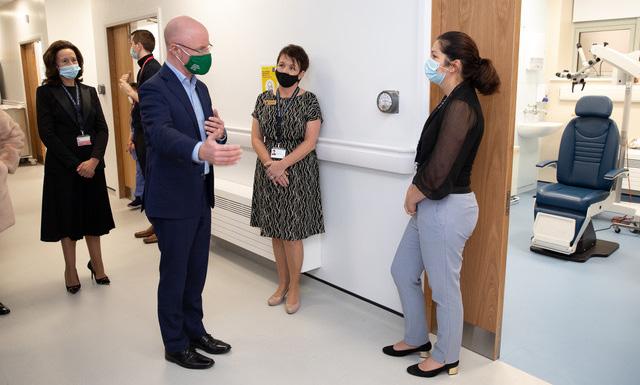
In July 2021 a Fellowship for ear, nose and throat (ENT) skills for primary care, funded by HSE National Doctors Training and Planning and accredited through RCSI, was created through the Aspire Programme.
The Fellowship was open to applications from recently qualified general practitioners who had a special interest in otolaryngology and in systems development. The Fellowship programme has been renewed for a second year and is currently accepting applications.
I applied for the Fellowship in 2021 and was lucky enough to gain the position. Fellowships of this kind are not about upskilling a single individual, but are intended to have a wider impact on the healthcare discourse. It is hoped that by the end of the programme, the Fellow in ENT skills for the community will be able to provide education on ENT conditions to their peers in general practice.
With the skills acquired, they will have the capacity to become a referral resource for non-complex ENT conditions. It is envisioned that the Fellow will become an advocate for GPs with special interests and for the creation of a formalised framework of GP specialists that are locally accessible to their colleagues for appropriate referrals.
The Fellowship this year, and hopefully in years to come, aims to support the upskilling of the general practitioners who wish to make ENT their special interest, promoting accessibility to ENT expertise through an educational domino effect.
In the past few months we have embarked on a four-part webinar programme in conjunction with Medcafe for community healthcare workers, which provides education on ENT-related topics and look forward to providing content for an ICGP webinar.
in the Irish system and data which suggested that one-third of patients referred for specialist opinion had non-complex ENT issues, which could be safely evaluated and treated in the community by upskilled practitioners.
The article pointed hopefully to the training of GPs and nurses through the RCSI postgraduate credentialing certificate in ENT skills for primary care practitioners, as well as the GP trainees who receive supervised procedural experience during ENT rotations. The idea that a shift towards diagnosis and treatment in the community would be beneficial to our healthcare system is at the heart of Sláintecare. The Aspire Fellowship for ENT skills in primary care was created on foot of this impetus to upskill community healthcare workers.
To my mind, advocating for the resourcing of primary care, to ensure that conditions with the lowest level of complexity are delivered in the community safely, is the most important part of this role. Inadequate resources are frequently cited by GPs as the biggest barrier to sub-specialist service provision. The Fellowship provides space for a general practitioner to input on the feasibility of services and skills that can be reasonably provided in an average GP surgery.
Resourcing is a barrier that must be addressed if we are to follow through on the vision set out in the Sláintecare document.
Victoria Eye and Ear Hospital (RVEEH) in Dublin. On 10 November 2021 Minister for Health Stephen Donnelly was invited to open the new ED at the hospital. The Minister was met by a group of healthcare workers who were proud of the work they were doing and keen to impress upon him the changes the department had undergone.
Far from simply a change of aesthetic, this is a department that has negotiated major operational changes. On a physical level, the building complies with the gold standards of pandemic care: The treatment rooms have been optimised to minimise disease transmission through the installation of a negative pressure airflow systems. Ameliorating the risk of disease transmission to patients and staff is paramount in a department that deals with the airways of an often elderly and therefore vulnerable demographic.
There has also been seismic change in ethos and style of healthcare implementation. The ENT ED now finds itself operating in a manner that decisively breaks with the past and applies the Sláintecare principles of an integrated healthcare setting to a working hospital environment. The ED utilises the skills of a range of healthcare professionals including staff nurses, clinical nurse specialists, surgical trainees, GP trainees and the GP Fellow, all under the direction of a senior ENT surgeon.
diagnostic evaluation or procedural management. This rationalisation of resources provides the healthcare staff with a controlled environment where time is appropriately allocated to allow for safe treatment as well as professional development and learning. This approach utilises recommendations made in the ENT model of care document, published in 2018, and acknowledges the importance of welltrained and motivated staff.
Through the pandemic, telehealth triage has emerged as a new and valuable modality. In the context of the RVEEH ED, it highlighted to senior ENT clinicians the benefits of direct primary care access to timely specialist opinion and identified the need for a specialist e-referral form. The department is currently developing a form to enable access to urgent ENT services. The Fellowship provides an opportunity for the specialist to collaborate directly with a GP to create a user friendly proforma that optimises appropriate triaging. Templates under consideration seek to offer guidance and teaching to users in an intuitive manner, as well as clarity regarding prioritisation rationale.
Being an outsider to the ENT service and to hospital medicine provides opportunities for reflection and observation. This is a department constantly seeking to improve its messaging to patients and referring clinicians. It is heartening to see the efforts of the ENT ED at the RVEEH uphold and further the goals of Sláintecare. Its leaders are constantly re-examining how they operate and how best to provide the right care, by the right person, in the right place, at the right time.
The staff continue to modify care strategies in response to the new challenges the pandemic presents and this flexibility of approach is serendipitously bringing them closer to creating an equitable, accessible health system.
Through a combination of engagement with GP trainees, the support of postgraduate certification, the creation of the fellowship and the development of an instructive e-referral tool, a cultural shift is occurring.
ENT services and primary care
In 2020, an article appeared in this publication which outlined the challenges facing ENT services that were being exacerbated by the Covid pandemic. Among the issues highlighted were the below EU average number of ENT specialists
A healthcare system rooted in its principles embraces practitioners with a mix of skillsets and champions healthcare roles with new competencies. “Expansion and substitution of traditional and new cadres is important to deliver quality care,” according to Sláintecare.
New ED
A large proportion of the clinical exposure afforded to the Fellow takes place in the emergency department (ED) of the Royal
A hub and spoke model of leadership and resource allocation has been implemented. This emerged organically in response to the necessity of halting ‘walk-in’ presentations in conjunction with the success of telehealth triage. Triaged patients are all discussed at a ‘navigation hub’ meeting, where a consultant ENT surgeon decides on the most appropriate healthcare pathway for each case.
The range of options includes audiology, vestibular physiotherapy, a nurse specialist clinic or an appointment for definitive
Primary care operating in an enhanced capacity, and the gradual move away from our current hospital-centric system will be advantageous to patients. To me, it seems obvious that formalised GP specialisation is an important step along the road to a high functioning health system. Like many general practitioners I am eager to see a safe and sustainable expansion of services offered by primary care through similar engagements with secondary care. The Fellowship has been a wonderful experience and I would encourage anyone interested in upskilling in community ENT to apply.
THE MEDICAL INDEPENDENT | 17 MARCH 2022
Opinion
Minister for Health Stephen Donnelly meeting staff at the opening of the new emergency department at the Royal Victoria Eye and Ear Hospital, Dublin, in November 2021
Dr Cristina Warren is a GP undertaking a Fellowship in ENT skills for the community in the Royal Victoria Eye and Ear Hospital, Dublin.
Recruitment difficulties in health service persist
Recent media coverage has shone a spotlight on the health service’s recruitment targets. On 13 February, the Sunday Business Post reported that Department of Health officials said the HSE’s stated target of 10,000 additional whole-time equivalent (WTE) staff in 2022 was unlikely to be achieved.
The matter was discussed at the joint Oireachtas health committee meeting on 16 February. Secretary General at the Department Mr Robert Watt explained that a minimum target of 5,500 WTEs was set, but that a “stretch target” of 10,000 was also in place. However, Mr Watt admitted the latter “will be very difficult to meet”.
The HSE National Service Plan 2022 “is based on the 10,000 figure and for the moment that money is allocated to that subhead”, Mr Watt stated, in relation to funding for the posts.
If the 10,000 figure is not reached, he added the Minister for Health can give a direction to the HSE about reallocating that funding to another area.
The service plan, which was published on 1 March, also states that HSE’s resourcing strategy sets out a lower target of 5,500 WTEs and a maximum target of at least 10,000 WTEs.
“The [service plan] works to the maximum target as the HSE is fully committed to deliver to the greatest extent the maximum of the range, acknowledging the significant and unpredictable challenges to workforce supply in 2022,” according to the document.
The document states that there is a “limit to the level of new staff” that can be successfully recruited in 2022.
“For example, it will remain a challenge to fully recruit all new service development funded posts in 2022,” according to the document.
“There will remain a challenge to recruit certain categories of staff,
eg, consultant posts, health and social care professionals, health/ homecare assistants, etc, due to labour market shortages. Recruitment of consultants for hospital and mental health services is at least a 12-month process and will be pursued on an ongoing basis.”
Recruitment difficulties will impact on 2022 strategic developments in areas such as mental health services, some acute specialist services and disability services, according to the plan.
Regarding consultants, it says a report will be compiled to address consultant recruitment and retention challenges in model 3 hospitals through a structured review with recommended actions for implementation.
It will also publish a review of the consultant workforce in Ireland and an “in-depth medical workforce plan” for the specialties of anaesthesiology and ear, nose and throat, and “projections to meet the unmet demand for pathology”.
There are few references in the plan to the proposed consultant contract, although its implementation (in consultation with representative bodies) is included in the annual statement of priorities as directed by the Minister for Health. The document outlines how the HSE supports the “agreement and roll-out of industrial relations frameworks within which sectoral bargaining options can be debated and agreed, including the public consultant contract”.
The service plan will do little to appease doctor representative bodies, who argue that the chief reason behind numbers of consultant vacancies has been the pay cuts imposed on those appointed after October 2012. Progress on the stalled contract negotiations is crucial to address this issue, which has lingered for almost a decade.
MINDO CARTOON
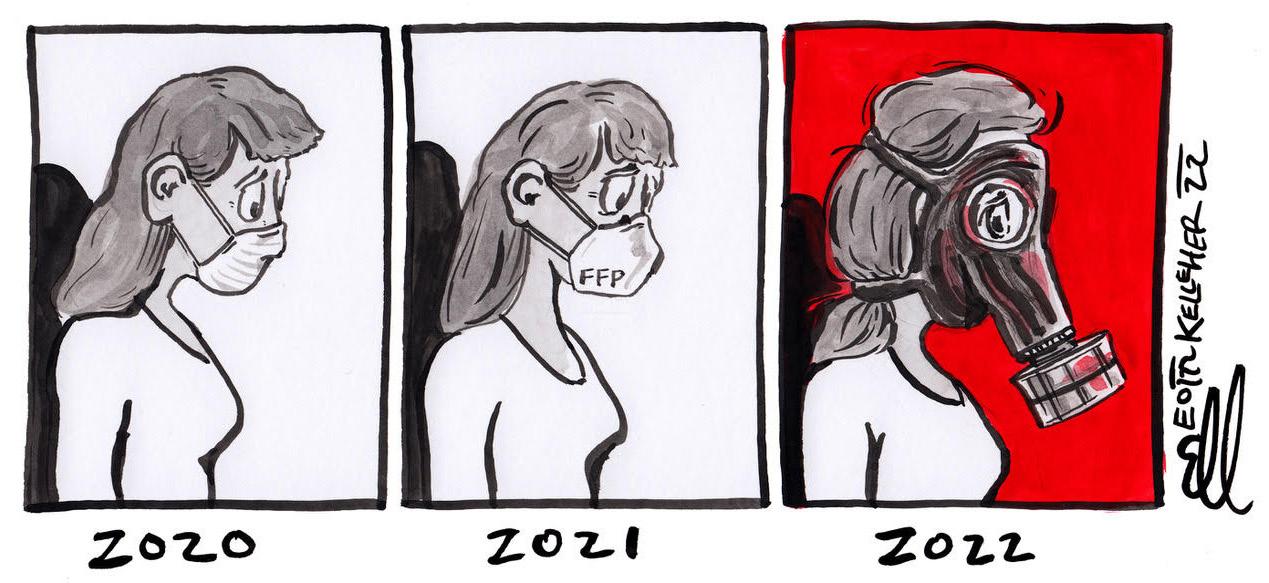
READER COMMENTS
REACTION TO OUR NEWS FEATURE, 'PHYSICIAN ASSOCIATES: A SOLUTION TO DOCTOR BURNOUT?', 7 MARCH
“Interesting read for doctors and nurses working in hospitals and community care." Jackie O’Connell, @JackieMeath, 4 March
“Wonderful article by @med_indonews with @mustone_lisa @AoifeSartini and Shaneika!! #physicianassociate #healthcare."
The Irish Society of Physician Associates, @ISPA, 4 March
REACTION TO PROF MARY HORGAN'S ARTICLE, 'LESSONS ON LEADERSHIP DURING A PANDEMIC', 7 MARCH
“Lessons on #leadership during a #pandemic from the excellent @profmaryhorgan." Prof Ursula Kilkelly, @Ukilkelly, 4 March
REACTION TO OUR NEWS STORY, 'RISK WASTE INCREASED BY OVER 40 PER CENT DURING PANDEMIC', 7 MARCH
“Healthcare as a sector is responsible for an enormous amount of emissions, we really have to prioritise getting our house in order as the negative health consequences of the climate and biodiversity crises mount." Irish Doctors for the Environment, @IrishDocsEnv, 6 March
REACTION TO OUR NEWS INTERVIEW, 'A NEW VISION FOR POSTGRADUATE TRAINING', 24 FEBRUARY
“‘The only way to retain trainees is to support them through – a good educational experience, communication skills, human factors, leadership, team building, management skills’ – Wise words from Mr Ken Mealy."
Prof Gaye Cunnane, @profgayecunnane, 25 February
REACTION TO DR SARAH FITZGIBBON'S COLUMN, 'WHEN THE "SHOCKING" IS NOT SURPRISING', 24 FEBRUARY
“Dr Sarah Fitzgibbon properly calls out any politician who claims to be surprised or shocked about our public secondary care system…. Credible, delivered with insight and focus…." Dr Brendan O'Shea, @drbosheaGP, 24 February
“Sarah my goodness you are always good, but this is just a fantastic piece. Not a wasted word. Thank you so much for putting it the way I could only hope to." laucullen, @laucullen, 24 February
“This article will resonate with every doctor…. That is what is shocking."
Dr Lily Cogan, @lilycogan, 24 February
Editor: Paul Mulholland paul@mindo.ie
News Editor: Catherine Reilly catherine@mindo.ie
Clinical Editor: Priscilla Lynch priscilla@mindo.ie
Journalists: David Lynch, david@mindo.ie Pat Kelly, pat@greenx.ie Niamh Quinlan niamh.quinlan@mindo.ie
Sub-Editor: Emer Keogh emer@greenx.ie
Designer: Laura Kenny laura@greenx.ie
Advertisements: Graham Cooke graham@greenx.ie
Recruitment: Louis O’Hegarty louis@mindo.ie
Digital Marketing: Dermot Garland dermot@greenx.ie
Digital Sales Executive: Gemma Tyrrell gemma@greenx.ie
Managing Director: Graham Cooke graham@greenx.ie

facebook.com/MedicalIndependent
twitter.com/med_indonews
If you have anything you would like to share, please email: info@mindo.ie
The Medical Independent is published by GreenCross Publishing Ltd., Top Floor, 111 Rathmines Road Lower, Dublin 6, Ireland Tel: 01 441 0024 Web: www.medicalindependent.ie. GreenCross Publishing (est. 2007) is owned by Graham Cooke (graham@greenx. ie). © Copyright GreenCross Publishing Ltd. 2022. No part of this publication may be reproduced, stored in a retrieval system, or transmitted in any form by any means –electronic, mechanical or photocopy recording or otherwise – whole or in part, in any form whatsoever for advertising or promotional purposes without prior written permission of the publishers. The Medical Independent endeavours to ensure accuracy of information given and of claims made in articles and advertisements. Nevertheless, no responsibility is accepted in respect of such information or claims. Any opinions expressed by contributors are entirely their own and do not purport to be the views of The Medical Independent
For subscriptions, contact: Daiva Maciunaite, daiva@greenx.ie Ireland €200 incl VAT. UK and International €275.00
THE MEDICAL INDEPENDENT | 17 MARCH 2022 19 Letters to: The Editor, The Medical Independent, Greencross Publishing Ltd, Top Floor, 111 Rathmines Road Lr, Dublin 6 or email paul@mindo.ie Editorial PAUL MULHOLLAND
HSE doctors: Are you really protected?
Dr Rachel Birch , Medico-Legal Consultant at Medical Protection, illustrates
through a case study
HSE doctors who rely on their State indemnity –otherwise known as the clinical indemnity scheme (CIS) – may be unaware of its limitations. The CIS only protects against clinical negligence claims in the public sector; if you receive a complaint from the Medical Council, are investigated by the gardaí or are subject to a disciplinary hearing, you are on your own. The CIS will not cover you for claims for any private work.

According to the most recently published Medical Council Annual Report, there were 279 new complaints in 2020, involving in total 311 doctors. Despite the challenges presented by the Covid-19 pandemic, the Medical Council concluded 27 fitness to practise inquiries in 2020. Having representation at fitness to practise inquiries can cost a considerable amount of money. It may be difficult for you to self-fund your defence where you do not have adequate indemnity arrangements in place.
What to look out for
A key consideration should be whether your indemnity or insurance provider is an organisation that is focused on your interests. At Medical Protection, with our philosophy of supporting safe practice in medicine by helping to avert problems in the first place, we try to help reduce risks for our members with a wide range of learning resources.
With more choice in professional protection than ever before, it may be tempting to consider new insurance entrants, which offer low pricing. Unfortunately, in
AS A MEMBER OF MEDICAL PROTECTION, YOU CAN REQUEST ASSISTANCE WITH:
Medical Council investigations
Specialist legal advice and representation in relation to claims*
Disciplinary processes
Handling complaints
Coroner’s report writing*
Inquest preparation*
Media and press relations
Gardaí investigations arising from the provision of clinical care
Ombudsman investigations
Good Samaritan acts
*where not supported by CIS
OTHER BENEFITS:
Free confidential counselling to members experiencing workrelated stress, or stress that they feel could impact their practice
Webinars/e-earning/ masterclass/workshops to navigate ethical and legal problems that may arise from your practice
Wellbeing resources
the last decade, Ireland has seen such entrants exiting the market or limiting the service they provide and thereby leaving practitioners unprotected.
Members of Medical Protection are part of an organisation, run for and owned by members; our focus is on protecting members’ careers and reputations, not generating profits. Members who are HSE doctors pay subscriptions and if they face a complaint, regulatory investigation or any other matter listed in the previous table, members have a right to request assistance.
Besides, we actively campaign for regulatory and legal reforms that benefit members and the wider healthcare professions.
Reputation management – a case study Dr K was working in the emergency department of a busy hospital on a demanding Saturday night when a patient, Mr O, arrived in a semi-conscious state. His medical notes revealed a history of
alcohol abuse. History-taking was difficult as Mr O seemed very sleepy and incoherent, but the smell of alcohol was enough for Dr K to dismiss the patient’s symptoms as simply the effects of excessive alcohol consumption.
Bloods were taken and sent to the laboratory, and an entry was made in the notes to follow up later. Dr K then took Mr O to a quiet corner to sleep it off and continued to attend to other patients. The next morning, Mr O was found dead. When Dr K had assumed Mr O was drunk, he had actually been ketoacidotic, meaning his death that night had been very likely preventable.
Outcome 1:
If Dr K had CIS indemnity only Dr K spoke to his employer, but they were not able to provide him with the support that he needed. By the time the hospital’s internal review commenced six months later, Mr O’s medical notes had gone
missing. This left Dr K feeling extremely vulnerable, as he had no access to his contemporaneous notes to back up his actions. Given the timeframe, his recollection of events was unclear.
As expected, the patient’s family brought a claim against the hospital. The hospital solicitors acting on behalf of the HSE requested a statement from Dr K, but, without the medical notes, he found it difficult to defend his actions.
The family also made a complaint about Dr K to the Medical Council, who commenced an investigation. Dr K was not entitled to advice or support with this process through the CIS.
The story attracted some media interest and once Dr K’s local community found out that he was being investigated by the Medical Council, he lost the trust of many of his patients. The damage to his reputation – and, potentially, his livelihood – was difficult to repair.
Outcome 2: If Dr K had been a
Medical Protection member
When Dr K was told that Mr O had died, he immediately phoned Medical Protection’s 24-hour helpline for advice:
A medico-legal consultant recommended that Dr K write up a draft report of the circumstances leading to the patient’s death and asked him to forward this and a copy of Mr O’s anonymised medical notes (with permission from the hospital) to Medical Protection for review.
When the hospital’s internal review started, Medical Protection provided the investigatory team with a copy of the anonymised notes (even though the originals had subsequently gone missing) and the full report written by Dr K immediately after the event had occurred.
The CIS managed the claim on behalf of the hospital. Medical Protection reviewed the member’s draft report prior to submission.
A complaint to the Medical Council was still made by the family; however, Medical Protection guided Dr K through the process. Medical Protection instructed solicitors to represent Dr K and a meeting was arranged at their offices to go through the case with him. Thereafter, the solicitors drafted a letter on Dr K’s behalf to the Medical Council setting out his position.
Our press office was also on hand to help Dr K deal with the media intrusion: A statement was issued to the press.
Following the ordeal that Dr K went through, he could also access Medical Protection’s free confidential counselling service.
As Dr K is committed to learning and self-improvement, he attended a few free risk management webinars by Medical Protection.
For more information, visit Medical Protection at medicalprotection.org/Ireland
Opinion Medico-Legal THE MEDICAL INDEPENDENT | 17 MARCH 2022 20
the importance of having the right professional protection
According to the most recently published Medical Council Annual Report, there were 279 new complaints in 2020, involving in total 311 doctors
The healthcare casualties of war
The horrific invasion of the Ukraine has sparked a humanitarian and healthcare crisis
DR MUIRIS HOUSTON

Read more by Dr Muiris Houston at www.mindo.ie
@muirishouston
Right now, we have electricity, right now we have water and heating in our houses. But the infrastructure is destroyed to deliver food and medication.
Kyiv Mayor Vitali Klitschko, warning supplies of food and medicine are running low, 28/2/22
ust as we see a bit of light after two years of Covid-19, Vladimir Putin decides to add completely unwarranted layers of misery by invading Ukraine. As I write, the situation in Ukraine is delicately balanced. Some five days post-invasion by Russian military forces, stern Ukrainian resistance has seen off the expected quick rollover and victory for Putin.
It is horrific to see the unnecessary destruction of a European State. Looking at neighbourhoods, roads, and cars, it could be Ireland we are watching. And, of course, in the midst of the carnage, health services struggle on to the best of their ability.
The World Health Organisation (WHO) says Ukrainian hospitals could run out of oxygen supplies as Russia’s invasion disrupts transportation across the country, putting thousands of more lives at risk. It said trucks are unable to transport oxygen supplies from plants to hospitals around the country.
“The oxygen supply situation is nearing a very dangerous point in Ukraine,” WHO Director-General Tedros Adhanom Ghebreyesus and Europe Regional Director Hans Kluge said in a joint statement on 27 February. “The majority of hospitals could exhaust their oxygen reserves within the next
24 hours. Some have already run out. This puts thousands of lives at risk,” they said.
Ukraine requires a 25 per cent surge of oxygen supplies compared to the country’s needs before Russia invaded, according to the WHO. The global health agency called for the creation of a safe transit corridor to increase oxygen supplies to Ukraine via a logistics route through neighbouring Poland.
Critical hospital services are also under threat from electricity and power shortages. TV pictures showed a children’s cancer ward operating in the freezing basement of a building in the north-eastern city of Kharkiv after the hospital was hit by Russian rockets.
Oxygen supplies are critical for patients with Covid-19, as well as for people with health complications stemming from pregnancy, chronic illness, sepsis, injuries, and trauma, according to the WHO.
While there are currently 1,700 people hospitalised with Covid in Ukraine, the WHO said Ukraine had made significant progress in strengthening its healthcare system before Russia’s invasion, including scaling up oxygen therapy to treat patients critically ill with Covid-19.
Since the fall of the Soviet Union in 1991, much work has been done to improve the health and wellbeing of Ukrainian people. According to The Lancet, the health system has undergone major reforms in financing and primary care. All 44
million citizens and residents of Ukraine are entitled to receive free publicly funded health services. Primary care, which under the Soviet Union was weak, is now delivered increasingly by family doctors and community paediatricians, making provision more efficient. The under-five mortality rate has fallen by more than half – from 18·3 per 1,000 livebirths in 2000, to 8·4 in 2019. But more than 50 per cent of total health spending still comes from out-of-pocket payments that increase inequalities in access to health services.
Ukraine has faced a surge of Omicron Covid infections, with cases rising a massive 555 per cent between 15 January and 25 February. And the country faces an increased risk of Covid contagion as civilians flee the Russian invasion. Another Covid outbreak combined with increasing numbers of people injured in the war will put even more pressure on Ukraine’s already stretched healthcare system, according to the UN.
At least 500,000 people have already fled Ukraine to neighbouring European countries. The Ukrainian government estimates that the Russian invasion could result in five million refugees in a worst-case scenario.
Many Ukrainians are fleeing to Hungary, Poland, Romania, and Slovakia, which may test the capacity of these countries.
In downtown Kharkiv, 86-year-old Olena Dudnik said she and her husband were nearly thrown from their bed by the pressure blast from a nearby explosion.
“Every day there are street fights, even downtown,” with Ukrainian fighters trying to stop Russian tanks, armoured vehicles, and missile launchers, Ms Dudnik told ABC news. And she said the lines at pharmacies were hours long.
Take a moment to imagine what it must be like to be a GP, an emergency medicine doctor or an obstetrician in Ukraine right now. And take your hat off to these medics, as they attempt to deal with the consequences of sharing a border with Russia and having to suffer for the whims of a paranoid megalomaniac.
A darkly humourous portrayal of a life in medicine
BBC’s new drama, ‘This Is Going to Hurt’, is required viewing for medical students and trainees
DR NEASA CONNEALLY
Read more by Dr Neasa Conneally at www.mindo.ie @neasaconneally
Anyone I have met recently has had to endure my exhorting them to watch the new BBC drama
This Is Going To Hurt, based upon the book of the same name by Adam Kay. Written by a former NHS obstetrics and gynaecology trainee, it is a hilarious but affecting memoir of his experiences before tragic events led him to leave clinical practice. The book came out when I was an intern and was a huge overnight success; it immediately became our generation’s The House of God. Like The House of God, those not in the field accused it of being hyperbolic and derogatory to patients whereas those within could only remark on how true to life it all was.
Descriptions like “You’re up on the wards, sailing the ship alone. A ship that’s enormous, and on fire, and that no one has really taught you how to sail” perfectly embodied that overwhelming terror of your first set of intern nights. Kay’s descriptions of his training years encapsulated the sheer exhaustion of having to drive home after a 26-hour shift and enduring a blistering post-call ward round that was akin to being cross examined in court when you were past the point of even being able to speak.
Although the television show is genuinely laugh-out-loud funny, it has serious topics at its core. I truly believe it should be required viewing for all medical students and trainees as it
explores themes, such as trying to keep your work-life balance even remotely on an even keel and dealing with mistakes when they have serious consequences for your patients. It even covers the dread and trauma of being called in front of the Medical Council, which surely must be one of every doctor’s greatest fears. Without too many spoilers, the show does go to a much darker place than even the book and covers topics such as doctors’ mental health, burnout, and all the warning signs that are missed and ignored until it’s too late. After the last two years, burnout amongst Irish doctors is a greater issue than it ever was before. A recent study carried out by the IMO found that 77 per cent of training doctors reported symptoms of burnout and that 96 per cent of all doctors reported that challenges of staffing and workload negatively affect how they treat their patients.
Praise for both the show and the book have not been uniform, however. It has recently met with accusations of reflecting the misogyny that can be found within healthcare settings.
Referring to the specialty as ‘brats and twats’, it is fair to say that the patients are indeed a secondary concern at times to the protagonist. These accusations were something that did not initially occur to me, as a ‘woke’ millennial who thought I was attuned to sexism in all its forms. Yet, as someone who has briefly worked in, but has not had to personally use, gynaecology or maternity services it was something I really had to ponder and sit with. It is still my view that although it was written by an obstetrics trainee, the same themes could have been written by a surgical or medical trainee or anyone in healthcare that has been broken by the system. Medicine is known for its black humour and I do think if the public heard how doctors can talk about patients on occasion they would be horrified. The character as written for TV is not an admirable figure. His approach to medical ethics and basic human decency is deeply skewed and not to be emulated. It is well known that high levels of burnout lead to depersonalisation and lack of empathy. There was zero focus on the patients, but it can be argued that that’s what happens when people in a bad system are doing whatever they can to survive.
It does strike me that such a TV show or book could only be written by someone who has left medicine. Such levels of honesty, even wrapped in humour, from someone in the early stages of their profession would likely be career-ending. However, it is crucial that people continue to speak out about dangerous working environments for both patients and staff at a time when exhaustion and burnout is at an all-time high. Good people are continuing to leave specialties and medicine at times when they are needed most. Poor mental health and suicide in training doctors and medical students are still happening and that is not a laughing matter.

Opinion THE MEDICAL INDEPENDENT | 17 MARCH 2022 21
It is horrific to see the unnecessary destruction of a European State
It does strike me that such a TV show or book could only be written by someone who has left medicine
PROF SEAMUS O’MAHONY

The under-recognised value of death
Through its programme of commissions, The Lancet identifies “the most pressing issues in science, medicine, and global health, with the aim of providing recommendations that change health policy or improve practice”. The Report of the Lancet Commission on the Value of Death www.thelancet. com/journals/lancet/article/PIIS0140-6736(21)02314-X/fulltext was published online on 31 January, 2022: I am proud to be one of the authors. My fellow commissioners come from all over the world, and from diverse backgrounds, including healthcare, religious life, social science, economics, and philosophy; patients and carers are represented too. We have gathered physically on a few occasions, but over the last two years, it’s all been online. I was invited to join the commission back in 2017 by the co-chair Richard Smith, former editor of the BMJ, who was intrigued that a gastroenterologist had written a book on death (The Way We Die Now).
The title of the commission, Value of Death, came about because The Lancet had also been planning a commission on Value of Life. There is a long philosophical and religious tradition of valuing death – without death, there would be no life. The fact that we all die reminds us of our fragility and sameness. Much of the value of death is no longer recognised in the modern world, but rediscovering this value can help care at the end of life and enhance living.
Our starting point was that many societies and healthcare systems have developed an unhealthy relationship with death and dying. There is often over-treatment at the end of life, which only increases suffering; many doctors find it difficult to be honest and open with people with life-limiting dis-
MULTIPLE CHOICE QUESTIONS
Question 1
Question 2
Question 3
Question 4
Question 5
ease and are reluctant to have ‘the difficult conversation’. In high-income countries, death has become primarily a medical event, with families, communities, culture, and ritual increasingly marginalised. Meanwhile, people in low-income countries commonly die without access to opioids, let alone palliative care.

How we die – at least in high-income countries – has changed dramatically since the 1950s: Death comes much later in life; death is slower; the technology to fend off death has increased dramatically; death occurs mainly in institutions (hospitals and care homes). Relationships and networks are being replaced by professionals and protocols. Palliative care can provide better outcomes for patients at the end of life, but broadly remains a service-based response to this social concern. The Covid-19 pandemic has only reinforced the idea of healthcare as the custodian of death.
Climate change, the pandemic, and attitudes to death in high-income countries have similar roots – our delusion that we are in control of, and not part of, nature. Large sums are being invested to dramatically extend life, even achieve immortality, for a small minority in a world that struggles to support its current population.
We argue that death and dying should be rebalanced, with more attention given to the relief of suffering and the cultural aspects of death, and less to the technical and the medical. This rebalancing will depend on changing ‘death systems’ –the many inter-related social, cultural, economic, religious, and political factors that determine how death, dying, and bereavement are understood, experienced, and managed.
We have set out five principles of a ‘realistic utopia’: (1) The
In meniere’s disease, the episodes of vertigo are characteristically
A. Precipitated by head movements.
B. Short-lived, lasting less than 15 minutes.
C. Associated with tinnitus in the affected ear.

D. Associated with loss of consciousness.
E. Suppressed (in the acute phase) by vestibular sedatives, such as prochlorperazine and cinnarizine.
Adult-onset squints
A. Invariably cause diplopia.

B. Are typically concomitant (non-paralytic).
C. May develop as a result of thyrotoxicosis.
D. Cause may be diagnosed after testing for diabetes.
E. Will not be helped in any way by occlusive patching of the affected eye.
In patients suspected of having dementia, the following associated problems would support the diagnosis
A. Taking longer to ‘extract’ memories.
B. Disorientation in time.
C. New onset non-specific anxiety.
D. Making notes for oneself.
E. Difficulties carrying out complex tasks.
Characteristic features of myasthenia gravis
A. Weakness progressively more marked as effort is maintained.
B. Onset in the over-40s.
C. Muscle wasting.
D. Proximal muscles of limbs affected before the distal ones.
E. Good response to anticholinesterase drugs.
Advice that is likely to help a patient sleep better includes


A. Take a ‘stiff’ alcoholic drink before retiring.
B. Ensure adequate exposure to natural light.
C. Keep the bedroom as cold as possible.
D. Take vigorous exercise in the morning or late afternoon.
E. Have a good nap in the daytime.
social determinants of death, dying, and grieving are tackled; (2) Dying is understood to be a relational and spiritual process rather than a medical event; (3) Communities and families become once again the main support for people dying, caring, and grieving; (4) Conversations and stories about death, dying, and grief are shared; (5) Death is recognised as having value.
Something very close to this realistic utopia has been achieved in Kerala, India, over the past three decades, through its community-based palliative care programme, a social movement comprised of tens of thousands of volunteers, supported by health professionals. The programme has led to changes in Kerala’s political, legal, and health systems, and has reclaimed death and dying as a social concern and responsibility. Kerala has inspired other initiatives around the world, such as ‘Compassionate Communities’.
Not surprisingly, there wasn’t consensus on everything among the commissioners and the report includes a figure showing the extent of agreement with several statements – for example, support for assisted dying, where there was considerable disagreement. There was, however, broad agreement for most statements. The document concludes with a set of recommendations for civil society, for healthcare systems, for researchers, and for governments and policy makers. The report is about 30,000 words in length, but it is (I hope) engaging and readable.
If death, dying, and grieving are to be rebalanced, radical changes across all death systems are needed. We all have a stake in this. The report may be out, but that’s only a start: The commission’s work will continue.
E. FALSE. Can disturb normal sleep/ wakefulness pattern.
D. TRUE. A relaxing exercise like yoga can be done before bed.
C. FALSE. Room not too hot, cold or bright.
B. TRUE. Helps maintain a healthy sleep-wake cycle.
A. FALSE. Speeds the onset of sleep, but disrupts sleep in the second half as body metabolises the alcohol causing arousal.
ANSWER 5
E. TRUE. Pyridostigmine acts in 15-to-30 minutes for up to four hours.
D. TRUE. Difficulty getting out of chair; going up stairs; hanging up washing.
C. FALSE. Not common. Tendon reflexes generally preserved and power may appear normal in a resting patient.
B. FALSE. All ages, but commonest in early 20s.
A. TRUE. Maybe no weakness at all after rest.
ANSWER 4
E. TRUE. Or difficulties finding words.
D. FALSE. Normal response to counteract benign forgetfulness.
C. TRUE. Or new low mood.
A. FALSE. After middle age this is normal as greater effort is needed to concentrate.
ANSWER 3
E. FALSE. Relieves diplopia and useful as surgery normally only performed if condition static after six months.
D. TRUE. May be caused by diabetes.
C. TRUE. Also myasthenia gravis or from neurogenic causes like DS, tumours, trauma.
B. FALSE. Incomitant (paralytic) due to paralysis of extraocular muscles.
A. TRUE. Have binocular vision, so have lost ability to suppress vision of squinting eye, so get diplopia.
ANSWER 2
E. TRUE. But should not be continued between episodes, as long-term use carries the risk of extrapyramidal sideeffects.
D. FALSE. Never causes this.
C. TRUE. And reduced hearing.
B. FALSE. Tend to last from 20 minutes to several hours.
A. FALSE. Unlike benign positional vertigo, not precipitated by movement.
B. TRUE. Evidence of more widespread brain dysfunction.
ANSWER 1
Read more by Prof Seamus O’Mahony at www.mindo.ie THE MEDICAL INDEPENDENT | 17 MARCH 2022
If death, dying, and grieving are to be rebalanced, radical change is required
Opinion
Fictional patient, for illustrative purposes only
For COPD patients on treatment with ICS/LABA and at risk of exacerbation* 1
*A worsening of symptoms or a history of exacerbation treated with antibiotics or oral corticosteroids in the past 12 months
It’s the things you do today that

make a big difference to their tomorrows1-3
TRELEGY Ellipta provides your patients with statistically superior improvements in lung function and health-related quality of life, and reduction in annualised rate of moderate/ severe exacerbations** vs. budesonide/formoterol***1–3

**Moderate exacerbation is a worsening of symptoms or a history of exacerbation treated with antibiotics or oral corticosteroids. A severe exacerbation is a worsening in symptoms that required hospitalisation.
TRELEGY Ellipta (FF/UMEC/VI) 92/55/22 mcg OD is indicated for maintenance treatment in adult patients with moderate to severe COPD who are not adequately treated by a combination of an ICS and a LABA or a combination of a LAMA and a LABA1
▼This medicinal product is subject to additional monitoring. This will allow quick identification of new safety information. Healthcare professionals are asked to report any suspected adverse reactions.
***Co-primary endpoints were change from baseline in trough FEV1 and SGRQ at week 24 (n=1810). A subset of patients (n=430) remained on blinded study treatment for 52 weeks. Trelegy showed an improvement in trough FEV1 of 171mL versus budesonide/formoterol (p < 0.001, 95% CI 148,194) at week 24. Trelegy showed an improvement in health-related quality of life (SGRQ) of 2.2 units (p <0.001, 95% CI 3.5, 1.0) at week 24. At week 52 in a subset of patients Trelegy showed a 44% reduction in annualised rate of moderate/severe exacerbations versus budesonide/formoterol (95% CI 15,63, p=0.006, Absolute difference 0.16).
TRELEGY Ellipta is generally well tolerated. Common adverse reactions include: pneumonia, upper respiratory tract infection, bronchitis, pharyngitis, rhinitis, sinusitis, influenza, nasopharyngitis, candidiasis of mouth and throat, urinary tract infection, headache, cough, oropharyngeal pain, constipation, arthralgia, back pain1
FF, fluticasone furoate; ICS, inhaled corticosteroid; LABA, long-acting ß2-agonist; LAMA, long-acting muscarinic antagonist; OD, once-daily; UMEC, umeclidinium, VI, vilanterol
References: 1. TRELEGY Ellipta SmPC 2019. 2. Lipson DA et al. Am J Respir Crit Care Med 2017; 196:438–446. 3. Lipson DA et al.N Engl J Med 2018; 378:1671–1680.
Trelegy▼ Ellipta (fluticasone furoate/umeclidinium/vilanterol [as trifenatate]) Prescribing information.

Please consult the full Summary of Product Characteristics (SmPC) before prescribing Trelegy Ellipta (fluticasone furoate/umeclidinium/vilanterol [as trifenatate]) inhalation powder. Each single inhalation of fluticasone furoate (FF) 100 micrograms (mcg), umeclidinium bromide (UMEC) 62.5 micrograms and vilanterol as trifenatate (VI) 25 mcg provides a delivered dose of 92 mcg FF, 55 mcg UMEC and 22 mcg VI. Indications: Maintenance treatment in adult patients with moderate to severe COPD who are not adequately treated by a combination of an inhaled corticosteroid (ICS) and a long-acting ß2-agonist (LABA) or a combination of a LABA and a long acting muscarinic antagonist. Dosage and administration: One inhalation once daily at the same time each day. Contraindications: Hypersensitivity to the active substances or to any of the excipients (lactose monohydrate & magnesium stearate). Precautions: Paradoxical bronchospasm, unstable or life-threatening cardiovascular disease or heart rhythm abnormalities, convulsive disorders or thyrotoxicosis, pulmonary tuberculosis or patients with chronic or untreated infections, narrow-angle glaucoma, urinary retention, hypokalaemia, patients predisposed to low levels of serum potassium, diabetes mellitus. In patients with moderate to severe hepatic impairment patients should be monitored for systemic corticosteroid-related adverse reactions. Eye symptoms such as blurred vision may be due to underlying serious conditions such as cataract, glaucoma or central serous chorioretinopathy (CSCR); consider referral to ophthalmologist. Increased incidence of pneumonia has been observed in patients with COPD receiving inhaled corticosteroids. Risk factors for pneumonia include: current smokers, old age, patients with a history of prior pneumonia, patients with a low body mass index and severe COPD. Patients with rare hereditary problems of galactose intolerance, the Lapp lactase deficiency or glucose-galactose malabsorption should not take Trelegy. Acute symptoms: Not for acute symptoms, use short-acting inhaled bronchodilator. Warn patients to seek medical advice if short-acting inhaled bronchodilator use increases. Therapy should not be abruptly stopped without physician supervision due to risk of symptom recurrence. Systemic effects: Systemic effects of ICSs may occur, particularly at high doses for long periods, but much less likely than with oral corticosteroids. Interactions with other medicinal products: Caution should be exercised with concurrent use of ß-blockers. Caution is advised when co-administering with strong CYP3A4 inhibitors (e.g. ketoconazole, ritonavir, cobicistat-containing products), hypokalaemic treatments or non-potassium-sparing diuretics. Co-administration with other long-acting muscarinic antagonists or long acting ß2-adrenergic agonists is not recommended. Pregnancy and breast-feeding: Experience limited. Balance risks against benefits. Side effects: Common (≥1/100 to <1/10): pneumonia, upper respiratory tract infection, bronchitis, pharyngitis, rhinitis, sinusitis, influenza, nasopharyngitis, candidiasis of mouth and throat, urinary tract infection, headache, cough, oropharyngeal pain, arthralgia, back pain. Uncommon (≥1/1,000 to <1/100): viral respiratory tract infection, supraventricular
Start
tachyarrhythmia, tachycardia, atrial fibrillation, dysphonia, dry mouth, fractures. Rare (≥1/10,000 to <1/1,000): Hypersensitivity reactions, including anaphylaxis, angioedema, urticaria, and rash. Not known (cannot be estimated from the available data): vision blurred. Marketing Authorisation (MA) Holder: GlaxoSmithKline Trading Services Limited, 12 Riverwalk, Citywest Business Campus, Dublin 24, Ireland. MA No. [EU/1/17/1236/002]. Legal category: POM B. Last date of revision: September 2020. Code: PI-6725. Further information available on request from GlaxoSmithKline, 12 Riverwalk, Citywest Business Campus, Dublin 24. Tel: 01-4955000.
Adverse events should be reported to the Health Products Regulatory Authority (HPRA) using an Adverse Reaction Report Form obtained either from the HPRA or electronically via the website at www.hpra.ie. Adverse reactions can also be reported to the HPRA by calling: (01) 6764971. Adverse events should also be reported to GlaxoSmithKline on 1800 244 255.
your
today, expect more from tomorrow 1,2 Today. Tomorrow. TRELEGY. 2-3 Find out more here: www.trelegy.ie or request a visit from a GSK representative ©2020 GSK Group of Companies or its licensor Trademarks are owned by or licensed to the GSK Group of Companies PM-IE-FVU-ADVT-200014 | October 2020
Ellipta was developed in collaboration with
patients on TRELEGY Ellipta
TRELEGY
Genuair®-has it ‘clicked’ yet?

The ONLY prefilled inhaler with visual and audible feedback for confirmed dose delivery1-4
Genuair - a simple to use inhaler for patients with COPD4
Abbreviated Prescribing Information
Eklira® Genuair® 322 micrograms inhalation powder. Please consult the Summary of Product Characteristics (SPC) for the full prescribing information. Presentation: Inhalation powder in a white inhaler with an integral dose indicator and a green dosage button. Each delivered dose contains 375 µg aclidinium bromide equivalent to 322 µg of aclidinium. Also, contains lactose. Use: Maintenance bronchodilator treatment to relieve symptoms in adult patients with chronic obstructive pulmonary disease (COPD).
Dosage: For inhalation use. Recommended dose is one inhalation of 322 micrograms aclidinium twice daily. Patients should be instructed on how to administer the product correctly as the Genuair inhaler may work differently from inhalers used previously. It is important to instruct the patients to read the Instructions for Use in the pack. No dose adjustments are required for elderly patients, or those with renal or hepatic impairment. No relevant use in children and adolescents. Contraindications: Hypersensitivity to aclidinium bromide or to any of the excipients. Warnings and Precautions: Stop use if paradoxical bronchospasm occurs and consider other treatments. Do not use for the relief of acute episodes of bronchospasm. Use with caution in patients with myocardial infarction in the previous 6 months, unstable angina, newly diagnosed arrhythmia within the previous 3 months, or hospitalisation within the previous 12 months for heart failure functional classes III and IV. Dry mouth, observed with anticholinergic treatment, may be associated with dental caries in the long term. Use with caution in patients with symptomatic prostatic hyperplasia or bladder-neck obstruction or with narrow-angle glaucoma. Do not use in patients with rare hereditary problems of galactose intolerance, total lactose deficiency or glucose-galactose malabsorption. Interactions: Do not administer with other anticholinergic-containing medicinal products. No other interactions expected. Please consult the SPC for more details. Fertility, pregnancy and lactation: No data on use in pregnancy. Risk to newborns/infants cannot be excluded. Consider risk-benefit before using during lactation. Unlikely to affect fertility at the recommended dose. Side-effects: Common (1-10%): Sinusitis, nasopharyngitis, headache, cough, diarrhoea, nausea. Uncommon (0.1-1%): Dizziness, blurred vision, tachycardia, palpitations, dysphonia, dry mouth, stomatitis, rash, pruritus, urinary retention. Rare (0.01-0.1%): hypersensitivity. Not known: angioedema, anaphylactic reaction. Pack sizes: Carton containing 1 inhaler with 60 unit doses. Legal category: POM Marketing Authorisation Number: EU/1/12/778/002
Marketing Authorisation holder: AstraZeneca AB, SE-151 85 Södertälje, Sweden. Marketed by: A. Menarini Pharmaceuticals Ireland Ltd., Castlecourt, Monkstown Farm, Monkstown, Glenageary, Co. Dublin A96 T924. Further information is available on request to A. Menarini Pharmaceuticals Ireland Ltd. or may be found in the SPC. Last updated: February 2020
This medicinal product is subject to additional monitoring. This will allow quick identification of new safety information. Healthcare professionals are asked to report any suspected adverse reactions to: HPRA Pharmacovigilance, Earlsfort Terrace, IRL - Dublin 2, Tel: +353 1 6764971, Fax: +353 1 6762517, Website: www.hpra.ie, e-mail: medsafety@ hpra.ie. Adverse events should also be reported to A. Menarini Pharmaceuticals Ireland Ltd. Phone no: 01 284 6744.
Date of item: November 2020. IR-BRI-09-2020
Abbreviated Prescribing Information Brimica® Genuair® 340 micrograms/12 micrograms inhalation powder. Please consult the Summary of Product Characteristics (SPC) for the full prescribing information. Presentation: Inhalation powder in a white inhaler with an integral dose indicator and an orange dosage button. Each delivered dose contains 396 µg aclidinium bromide (equivalent to 340 µg of aclidinium) and 11.8 micrograms of formoterol fumarate dihydrate. Also, contains lactose. Use: Maintenance bronchodilator treatment to relieve symptoms in adult patients with chronic obstructive pulmonary disease (COPD). Dosage: For inhalation use. Recommended dose is one inhalation of 340 µg/12 µg twice daily. Patients should be instructed on how to administer the product correctly as the Genuair inhaler may work differently from inhalers used previously. It is important to instruct the patients to read the Instructions for Use in the pack. No dose adjustments are required for elderly patients, or those with renal or hepatic impairment. No relevant use in children and adolescents. Contraindications: Hypersensitivity to the active substances or to any of the excipients. Warnings and Precautions: Do not use in asthma. Stop use if paradoxical bronchospasm occurs and consider other treatments. Do not use for the relief of acute episodes of bronchospasm. Use with caution in patients with myocardial infarction in the previous 6 months, unstable angina, newly diagnosed arrhythmia within the previous 3 months, or hospitalisation within the previous 12 months for heart failure functional classes III and IV. Discontinue if increases in pulse rate, blood pressure or changes in ECG occur. Use with caution in patients with a history of or known prolongation of the QTc interval or treated with products affecting the QTc interval. Use with caution in patients with severe cardiovascular disorders, convulsive disorders, thyrotoxicosis and phaeochromocytoma. Hypokalaemia may occur, is usually transient and supplementation not needed. In patients with severe COPD, hypokalaemia may be potentiated by hypoxia and concomitant treatment. Use with caution in patients with symptomatic prostatic hyperplasia, urinary retention or with narrow-angle glaucoma. Dry mouth, observed with anticholinergic treatment, may be associated with dental caries in the long term. Do not use in patients with rare hereditary problems of galactose intolerance, the Lapp lactase deficiency or glucose-galactose malabsorption. Interactions: Do not administer with other anticholinergic and/or long-acting β2-adrenergic agonist containing medicinal products. Caution in use with methylxanthine derivatives, steroids, non-potassium-sparing diuretics, β-adrenergic blockers or medicinal products known to prolong the QTc interval. Please consult the SPC for more details. Fertility, pregnancy and lactation: No data on use in pregnancy. Consider risk-benefit before using during lactation. Unlikely to affect fertility at the recommended dose. Side-effects: Common (1-10%): Nasopharyngitis, urinary tract infection, sinusitis tooth abscess, insomnia, anxiety, headache, dizziness, tremor, cough, diarrhoea, nausea, dry mouth, myalgia, muscle spasms, peripheral oedema, increased blood creatine phosphokinase. Uncommon (0.1- 1%): Hypokalaemia, hyperglycaemia, agitation, dysgeusia, blurred vision, tachycardia, electrocardiogram QTc prolonged, palpitations, angina pectoris, dysphonia, throat irritation, stomatitis, rash, pruritus, urinary retention, increased blood pressure. Rare (0.01-0.1%): Hypersensitivity, bronchospasm, including paradoxical. Not known: anaphylactic reaction, angioedema. Pack sizes: Carton containing 1 inhaler with 60 unit doses. Legal category: POM Marketing
Authorisation Number: EU/1/14/963/001 Marketing Authorisation holder: AstraZeneca AB, SE-151 85 Södertälje, Sweden. Marketed by: A. Menarini Pharmaceuticals Ireland Ltd., Castlecourt, Monkstown Farm, Monkstown, Glenageary, Co. Dublin A96 T924. Further information is available on request to A. Menarini Pharmaceuticals Ireland Ltd. or may be found in the SPC. Last updated: October 2019
This medicinal product is subject to additional monitoring. This will allow quick identification of new safety information. Healthcare professionals are asked to report any suspected adverse reactions via HPRA Pharmacovigilance,
Earlsfort Terrace, IRL - Dublin 2; Tel: +353 1 6764971; Fax: +353 1 6762517. Website: www.hpra.ie; E-mail: medsafety@ hpra.ie. Adverse events should also be reported to A. Menarini Pharmaceuticals Ireland Ltd. Phone no: 01 284 6744. References: 1. MIMS Ireland November 2020 2. Eklira® Genuair® Summary of Product Characteristics, last updated November 2019 3. Brimica® Genuair® Summary of Product Characteristics, last updated August 2019 4 Magnussen, H et al. COPD. 2019 Apr;16(2):196-205
LAMA + LABA
LAMA
The End to End Model of Care for Asthma –what it means for general practice
Asthma is the most common chronic respiratory disease in Ireland, with approximately one-in-10 of the population having asthma. Asthma control remains suboptimal in a large proportion of patients, which places significant health, social, and economic burden on the community and on healthcare. The reasons why asthma control remains poor is multi-factorial, but fragmented and unstructured care is believed to be an important contributory factor. The cost of asthma care in Ireland is over €500 million per annum, most of which is in secondary care.
The HSE’s new End to End Model of Care (MOC) for Asthma has been developed in consultation with a wide range of stakeholders including nurses, consultants, GPs, physiotherapists, patients, and patient support organisations. It covers the full spectrum of care provided in both hospital and in the community with a focus on developing partnerships between acute hospital services, general practice and community services, with the patient and his/her family being central to the model.
The End to End MOC for adult asthma has been developed in tandem with the HSE strategy for chronic disease. It outlines the structures that we should adhere to and adopt in the care of patients with, or at risk of, asthma. This MOC is guided by national and international best practice.
The document is not meant to be a guideline document outlining interventions to be used in varied clinical circumstances that present when managing patients with asthma. In this regard the National Clinical Care Programme (NCP) Respiratory endorses the guidelines produced and updated regularly by the Irish Thoracic Society (ITS), the ICGP, and Global Initiative for Asthma (GINA). However, the MOC document details how patients should be able to access care at various stages of their asthma and also outlines the roles and responsibilities of the healthcare professionals (HCPs) providing this healthcare. It is envisaged that the implementation of this MOC will result in a reduction in the variation of care delivered to patients with asthma in Ireland and additionally result in an improvement in their asthma control, clinical outcomes and quality-of-life.
The MOC seeks, through the implementation of its guidelines, to improve the standard of care provided to adult asthma patients in all healthcare settings, with a particular focus on primary care where the majority of asthma is managed. This MOC will place a particular focus on the ‘at-risk’ patients who are vulnerable to developing asthma and those at risk of
experiencing an acute asthma event. This includes those in lower socio-economic groups, smokers, patients with multiple co-morbidities, and those with psychological problems.
The MOC is a guide for best practice in the care of those at risk of developing asthma as well as those diagnosed with the condition across the continuum of care and includes both acute and chronic management of asthma in primary, secondary, and tertiary care settings.
The implementation of the MOC aims to ensure that optimum care is delivered using the principles of Sláintecare; so people with asthma receive the right care at the right time in the right place.
The spectrum of services, ranging from primary prevention to tertiary care, includes:
Primary prevention and health promotion.
Risk factor identification and management.
Early detection of asthma and its diagnosis.
Secondary prevention.
Primary care management of asthma.
Shared primary and secondary care management of asthma.
Secondary care management of chronic asthma.
Tertiary care.
The aims of the NCP for Respiratory specific to adult asthma are:
Maximise health and quality-of-life of people with asthma.
Minimise future risk for patients.
Prevent avoidable mortality due to asthma.
Standardisation of care for asthma patients in Ireland.
The objectives of the NCP for
Respiratory include:
To improve access to structured integrated asthma care for patients diagnosed with asthma, which will address asthma education in the most appropriate setting.
To facilitate the provision of guideline concordant care, based upon a patient’s level of asthma control.
To maximise the proportion of patients with asthma whose asthma is controlled.
To identify the appropriate resources needed to deliver on the aims of the NCP for Respiratory in relation to asthma.
In addition to guiding the delivery of the aforementioned objectives, this End to End MOC for adult asthma reflects the key reform themes identified by the HSE to improve the health of the population and to reshape where and how healthcare services are provided in Ireland. These themes include improving population health, delivering care closer to home, developing specialist hospital care networks, and improving quality, safety, and value.
MOC scope
The scope of this MOC is to define the services required to support the general population of adults in the management of their asthma. It includes health services operated and funded by the HSE and includes community-based services as well as access to hospital-based secondary and tertiary care services if required. It acknowledges that specific health and social care settings, high-risk and vulnerable groups will require additional interventions and support. Working with other relevant national clinical programmes (paediatric and neonatal) and services, this MOC will inform the future development of shared pathways, policies, strategies and services to improve health outcomes in these settings. Supporting documents include clinical guidelines published by the ICGP, ie, Asthma – Diagnosis, Assessment, and Management in General Practice Quick Reference Guide. The National Clinical Guideline for the Management of an Acute Asthma Attack in Adults (NCEC) is also referred to in this document. International clinical guidelines, such as those from GINA (2021), underpin the diagnosis and management of asthma.
Future development includes the NCP Respiratory collaborating with NCP Paediatrics and Neonatal to form a paediatric working group to develop Part 2: Paediatric Asthma.
Download the End to End MOC at: www.hse.ie/eng/about/who/cspd/ncps/ asthma/resources/end-to-end-model-ofcare-for-asthma.pdf for more information.
Respiratory Clinical THE MEDICAL INDEPENDENT | 17 MARCH 2022 25
MS RUTH MORROW, Registered Advanced Nurse Practitioner (Primary Care); Respiratory Nurse Specialist (WhatsApp Messaging Service Asthma Society of Ireland); and Nurse Educator and Consultant
This document details how patients should be able to access care at various stages of their asthma, and also the roles and responsibilities of the healthcare professionals (HCPs) providing this healthcare
The HSE’s new End to End Model of Care document for adult asthma outlines the structures that healthcare professionals should adhere to and adopt in the care of patients with, or at risk of, asthma
MS RUTH MORROW, Registered Advanced Nurse Practitioner (Primary Care); Respiratory Nurse Specialist (WhatsApp Messaging Service Asthma Society of Ireland); and Nurse Educator and Consultant
Women and asthma
This article explores the care and management of women who have or develop asthma, including asthma during pregnancy and menopause, as well as addressing common situations which women encounter throughout their lifetime whilst living with asthma
During childhood, boys have near twice the risk of developing asthma over girls. This changes once children reach the age of 12/13 years. Sex hormones, genetics, social and environmental factors, and responses to asthma treatments are important factors in the sex differences observed in asthma incidence, prevalence, and severity. In childhood, obesity, regardless of physical fitness, is associated with higher asthma prevalence and morbidity in girls, but not in boys. In girls older than 11 years and women, asthma is five-toseven times more common in obese people compared to those of normal weight (Koper et al, 2017).
Asthma prevalence is higher in women who have multiple pregnancies, women whose periods started earlier in life and women with hormonal disturbances, such as polycystic ovarian syndrome (Morales-Estrella et al, 2018). Women who are diagnosed with endometriosis also have an increased risk of asthma. A study by Morales-Estrella et al (2018) showed that 23.8 per cent of women who had endometriosis developed asthma, compared with 13.2 per cent of women who were taking oral contraceptives (OCS).
Testosterone, which increases in boys from the age of 12/13 years, has an anti-inflammatory effect in the airways and is thought to be one of the reasons why asthma is less prevalent in boys at this age. Female hormones increase at this age in girls, which is thought to increase the risk of developing asthma and increase symptoms in those who are already diagnosed with asthma.
As adults, women have an increased prevalence and severity of asthma. For women, fluctuations in sex hormone levels during puberty, the menstrual cycle, pregnancy, and menopause are associated with asthma (Nowrin et al, 2021). Later in life, asthma incidence and severity are higher in women than in men, and highest in women between the fourth and sixth decade of life. During adulthood there is a shift to a female predominance, which affects mainly non-atopic asthma. In the elderly, the gender-related differences decrease. As testosterone levels decrease in older men, the incidence of asthma can also increase in this age group (Koper, 2017)
In addition, pathophysiological abnormalities can be seen which includes blood eosinophilia, which seems to be more prominent in girls with asthma, but in adipose tissue. Girls with asthma tend to have a higher prevalence of non-eosinophilic asthma (60 per cent) compared to corresponding boys (30.8 per cent).
Is asthma worse for women?
Severe asthma affects primarily boys before and at school entry age as well as women around the time of menopause. Women also develop ‘corticosteroid-resistant’ or difficult-to-treat asthma more often than men (Moore et al, 2007). Studies show that compared to men, women can have worse symptoms more often:
Women are more at risk of acute asthma flare-ups and are admitted to hospital more often with their asthma.
Women who develop asthma for the first time later in life, after menopause, are more likely to have asthma that is difficult to control, and to need specialist care and treatments to help deal with their symptoms.
Lung function starts to decline after about the age of 35 years in both males and females. For women it declines more quickly after the menopause.
Statistics show that women with asthma over 65 years of age, are more at risk of life-threatening asthma attacks.
Women who develop asthma at peri-menopause tend to be less atopic, less corticosteroid responsive, and obese, with steroid refractory asthma (Moore et al,
2007, Wu et al, 2014). These women frequently require high doses of inhaled corticosteroids (ICS) to manage their asthma. Their asthma tends to be difficult to manage and have a higher rate of healthcare utilisation and poorer health outcomes.
Hormones and asthma
Women are more likely to notice worse symptoms around times of hormonal change like puberty, menstruation, pregnancy, and perimenopause. Not all women are affected.
One-third of women report worse asthma symptoms before or during a period.
Some women, particularly those with severe asthma, have worse symptoms during pregnancy. Although many women notice an improvement or no change at all when they’re pregnant.
Asthma symptoms can get worse during peri-menopause.
Women who have never had asthma can develop asthma at peri-menopause.
Hormones can be an asthma trigger in their own right, but they can also make the woman more sensitive to other triggers, such as hay fever or colds and flu. It is not yet clear why this is the case. It could be because it increases inflammation in the body and causes inflammation in the airways.
Do women have different asthma triggers?
Women can also have all the same triggers as men, but some of these triggers may be worse for women or affect them more often. For example:
Food allergies are more common in women than men with female hormones making them worse.
Cigarette smoke can affect women more than men. Women and girls may be more sensitive to cigarette smoke and girls with asthma who start to smoke may take longer and need more help to quit.
Stress, anxiety, and depression are more common in women, particularly older women who tend to be carers more often.
Indoor triggers, such as cleaning products, cooking fumes and house dust mites may affect women more as statistics show they’re more likely to be doing the cleaning at home.
How can women lower their asthma risk?
Having an annual asthma review including assessment of symptoms, checking adherence and inhaler technique and a review of their asthma ‘Action Plan’ can benefit women. At other times women should be advised that as they approach the peri-menopause, symptoms and asthma control may worsen and they should be advised to have an asthma review with adjustment of treatment if required.
Risk can also be lowered by:
Taking the controller medicine every day as prescribed so that they are less likely to react to any asthma triggers, including hormones.
Keeping a symptom diary to help find out if hormones are triggering asthma symptoms around their menstrual period.
Keeping an eye on weight. Being obese increases the risk of asthma symptoms worsening as women get older. It also increases the risk of women getting asthma for the first time around menopause.
Discussing the woman’s risk of osteoporosis. Being on higher doses of inhaled steroids or needing regular or long-term courses of steroid tablets increases the risk of osteoporosis. Women are four times more at risk than men of developing osteoporosis. In women who have
asthma, the chances of developing osteoporosis are slightly higher than average.
Being aware how other conditions could make asthma worse - for example, acid reflux, which is more common in women.
Pain relief, contraceptives, HRT and asthma
Around 20 per cent of women with asthma experience worsening of their asthma premenstrually. These women tend to be older and have more severe asthma, a higher BMI and have had asthma for a longer time (GINA, 2021). They also tend to have more menstrual abnormalities, such as dysmenorrhoea, shorter menstrual cycles, and longer menstrual bleeding. Paracetamol is usually safe, but non-steroidal anti-inflammatory tablets (NSAIDs), such as ibuprofen (eg, Nurofen), and mefenamic acid (eg, Ponstan), and aspirin, may worsen asthma symptoms or trigger an asthma flare-up in some women. Oral contraceptives and leukotriene receptor antagonists may be helpful for these women.
Oral contraceptives (either the combined pill or the progestogen-only pill) are safe to take. Taking them at the same time as usual asthma medication will not affect the efficacy of either medication.
The morning-after pill, ellaOne, is not recommended for women with severe asthma. Some oral contraceptives are not recommended for women taking theophylline as plasma concentrations of theophylline are increased.
Data from 3,257 pre-menopausal Scottish women showed that hormonal contraceptives reduced asthma incidence and decreased asthma-related healthcare utilisation, driven by a significant decrease in lean women, as well as decreased wheezing in asthma patients (Nwaru BI, Sheikh A, 2015). In a study by Morales-Estrella et al (2018), the prevalence of asthma was higher in women taking OCS than those who weren’t (14.3 per cent vs 8.8 per cent).
HRT also has asthma benefits and asthma risks:
Some research shows that HRT may increase the risk of women getting asthma for the first time.
Some studies show that HRT improves symptoms in women who already have asthma.
Generally, symptoms improve after the menopause, but this is not the case for women taking HRT.
Asthma and pregnancy
Asthma control often changes during pregnancy – in approximately a third of women their asthma symptoms worsen, a third may improve, and the remaining third remain unchanged.
Exacerbations are common in pregnancy, particularly in the third trimester. Uncontrolled asthma and exacerbations may be due to mechanical or hormonal changes or due to the stopping or reduction of medications due to concerns by the mother or healthcare provider.
Pregnant women appear to be more susceptible to viral respiratory infections including influenza.
Poor asthma control and exacerbations are associated with worse outcomes for the baby (low birth weight, preterm weight, increased perinatal mortality) and the mother (pre-eclampsia). If asthma is well controlled during pregnancy, there is little or no increased risk of adverse maternal or foetal complications (GINA, 2021).
The advantages of actively treating asthma in pregnancy outweighs any potential risks from regular controller and reliever medications. Using medications to achieve good asthma control and prevent exacerbations is justified even if their safety in pregnancy has not been proven. The use of ICS, montelukast or theophylline is not associated with an increase of foetal abnormalities. There is plenty of evidence which shows that ICS reduce the risk of exacerbations during pregnancy and stopping ICS during pregnancy is a significant risk factor for exacerbations.
During labour and delivery, women should be advised to continue their usual controller medications and use their reliever if needed (GINA, 2021). Acute exacerbations are not common during labour, but bronchoconstriction may be induced by hyperventilation and should be managed using short-acting bronchodilators.
References on request
Clinical Respiratory THE MEDICAL INDEPENDENT | 17 MARCH 2022 26
For patients not adequately controlled on dual therapy with moderate to severe COPD
UNLEASH THE PROTECTION OF TRIXEO1,2
Significant protection against exacerbations*
TRIXEO Aerosphere is indicated as a maintenance treatment in adult patients with moderate to severe chronic obstructive pulmonary disease (COPD) who are not adequately treated by a combination of an inhaled corticosteroid and a long-acting beta2-agonist or combination of a long-acting beta2-agonist and a long-acting muscarinic antagonist.1

*Significant reductions in the rate of moderate or severe exacerbations vs LAMA/LABA (24%, n=2137 vs n=2120, annual rates 1.08 vs 1.42, 95% CI 0.69–0.83; p<0.001) and ICS/LABA (13%, n=2137 vs n=2131, annual rates 1.08 vs 1.24, 95% CI 0.79–0.95; p=0.003).1,2 COPD, chronic obstructive pulmonary disease; ICS, inhaled corticosteroid; LABA, long-acting beta2-agonist; LAMA, long-acting muscarinic antagonist. In the clinical trial programme for TRIXEO, LAMA/LABA refers to glycopyrronium/formoterol fumarate and ICS/LABA refers to budesonide/formoterol fumarate. ©AstraZeneca 2021. All rights reserved.
ABRIDGED PRESCRIBING
INFORMATION
TRIXEO AEROSPHERE ® 5 micrograms/7.2 micrograms/160 micrograms pressurised inhalation, suspension (formoterol fumarate dihydrate/glycopyrronium/budesonide)
Consult Summary of Product Characteristics (SmPC) before prescribing
Indication: Trixeo Aerosphere is indicated as a maintenance treatment in adult patients with moderate to severe chronic obstructive pulmonary disease (COPD) who are not adequately treated by a combination of an inhaled corticosteroid and a long acting beta2 agonist or combination of a long-acting beta2 agonist and a long acting muscarinic antagonist.
Presentation: Pressurised inhalation, suspension. Each single actuation (delivered dose, ex-actuator) contains 5 micrograms of formoterol fumarate dihydrate, glycopyrronium bromide 9 micrograms, equivalent to 7.2 micrograms of glycopyrronium and budesonide 160 micrograms.
Dosage and Administration: The recommended and maximum dose is two inhalations twice daily (two inhalations morning and evening). If a dose is missed, take as soon as possible and take the next dose at the usual time. A double dose should not be taken to make up for a forgotten dose. Special populations: Elderly: No dose adjustments required in elderly patients.
Renal impairment: Use at recommended dose in patients with mild to moderate renal impairment. Can also be used at the recommended dose in patients with severe renal impairment or end-stage renal disease requiring dialysis, only if expected benefit outweighs the potential risk. Hepatic impairment: Use at recommended dose in patients with mild to moderate hepatic impairment. Can also be used at the recommended dose in patients with severe hepatic impairment, only if expected benefit outweighs the potential risk. Paediatric Population: No relevant use in children and adolescents (<18 years of age). Method of administration: For inhalation use.
To ensure proper administration of the medicinal product, the patient should be shown how to use the inhaler correctly by a physician or other healthcare professional, who should also regularly check the adequacy of the patient’s inhalation technique. Patients who find it difficult to coordinate actuation with inhalation may use Trixeo Aerosphere with a spacer to ensure proper administration of the medicinal product..
Contraindications: Hypersensitivity to the active substances or to any of the excipients.
Warnings and Precautions: Not for acute use: Not indicated for treatment of acute episodes of bronchospasm, i.e. as a rescue therapy. Paradoxical bronchospasm: Administration of formoterol/glycopyrronium/budesonide may produce paradoxical bronchospasm with an immediate wheezing and shortness of breath after dosing and may be life threatening. Treatment should be discontinued immediately if paradoxical bronchospasm occurs.
Assess patient and institute alternative therapy if necessary. Deterioration of disease: Recommended that treatment should not be stopped abruptly. If patients find the treatment ineffective, continue treatment but seek medical attention. Increasing use of reliever bronchodilators indicates worsening of the underlying condition and warrants reassessment of the therapy. Sudden and progressive deterioration in the symptoms of COPD is potentially life threatening, patient should undergo urgent medical assessment.
Cardiovascular effects: Cardiovascular effects, such as cardiac arrhythmias, e.g. atrial fibrillation and tachycardia, may be seen after the administration of muscarinic receptor antagonists and sympathomimetics, including glycopyrronium and formoterol. Use with caution in patients with clinically significant uncontrolled and severe cardiovascular disease such as unstable ischemic heart disease, acute myocardial infarction, cardiomyopathy, cardiac arrhythmias and severe heart failure. Caution should also be exercised when treating patients with known or suspected prolongation of the QTc interval (QTc > 450 milliseconds for males or > 470 milliseconds for females), either congenital or induced by medicinal products. Systemic corticosteroid effects: May occur with any inhaled corticosteroid, particularly at high doses prescribed for long periods. These effects are much less likely to occur with
inhalation treatment than with oral corticosteroids. Systemic effects include Cushing’s syndrome, Cushingoid features, adrenal suppression, decrease in bone mineral density, cataract and glaucoma. Potential effects on bone density should be considered particularly in patients on high doses for prolonged periods that have co existing risk factors for osteoporosis. Visual disturbances: May be reported with systemic and topical corticosteroid use. If patient presents symptoms such as blurred vision or other visual disturbances, consider ophthalmologist referral for evaluation of possible causes which may include cataract, glaucoma or rare diseases such as central serous chorioretinopathy (CSCR). Transfer from oral therapy: Care is needed in patients transferring from oral steroids, since they may remain at risk of impaired adrenal function for a considerable time. Patients who have required high dose corticosteroid therapy or prolonged treatment at the highest recommended dose of inhaled corticosteroids, may also be at risk. These patients may exhibit signs and symptoms of adrenal insufficiency when exposed to severe stress. Additional systemic corticosteroid cover should be considered during periods of stress or elective surgery. Pneumonia in patients with COPD: An increase in the incidence of pneumonia, including pneumonia requiring hospitalisation, has been observed in patients with COPD receiving inhaled corticosteroids. Remain vigilant for the possible development of pneumonia in patients with COPD as the clinical features of such infections overlap with the symptoms of COPD exacerbations. Risk factors for pneumonia include current smoking, older age, low body mass index (BMI) and severe COPD. Hypokalaemia: Potentially serious hypokalaemia may result from ß2-agonist therapy. This has potential to produce adverse cardiovascular effects. Caution is advised in severe COPD as this effect may be potentiated by hypoxia. Hypokalaemia may also be potentiated by concomitant treatment with other medicinal products which can induce hypokalaemia, such as xanthine derivatives, steroids and diuretics. Hyperglycaemia: Inhalation of high doses of ß2-adrenergic agonists may produce increases in plasma glucose. Blood glucose should be monitored during treatment following established guidelines in patients with diabetes.
Co-existing conditions: Use with caution in patients with thyrotoxicosis. Anticholinergic activity: Due to anticholinergic activity, use with caution in patients with symptomatic prostatic hyperplasia, urinary retention or with narrow-angle glaucoma. Patients should be informed about the signs and symptoms of acute narrow-angle glaucoma and should be informed to stop using this medicinal product and to contact their doctor immediately should any of these signs or symptoms develop. Co-administration of this medicinal product with other anticholinergic containing medicinal products is not recommended. Renal impairment: Patients with severe renal impairment (creatinine clearance of <30 mL/min), including those with end-stage renal disease requiring dialysis, should only be treated with this medicinal product if the expected benefit outweighs the potential risk. Hepatic impairment: In patients with severe hepatic impairment, use only if the expected benefit outweighs the potential risk. These patients should be monitored for potential adverse reactions..
Drug Interactions: Co-treatment with strong CYP3A inhibitors, e.g. itraconazole, ketoconazole, HIV protease inhibitors and cobicistat-containing products are expected to increase the risk of systemic side effects. Should be avoided unless the benefit outweighs the increased risk, in which case patients should be monitored for systemic corticosteroid adverse reactions.
This is of limited clinical importance for short-term (1-2 weeks) treatment.
Since glycopyrronium is eliminated mainly by the renal route, drug interaction could potentially occur with medicinal products affecting renal excretion mechanisms. Other antimuscarinics and sympathomimetics: Coadministration with other anticholinergic and/or long-acting ß2-adrenergic agonist containing medicinal products is not recommended as it may potentiate known inhaled muscarinic antagonist or ß2-adrenergic agonist adverse reactions. Concomitant use of other beta-adrenergic medicinal products can have potentially additive effects. Caution required when prescribed concomitantly with formoterol. Medicinal product-induced hypokalaemia: Possible initial hypokalaemia may be potentiated by xanthine
derivatives, steroids and non potassium sparing diuretics. Hypokalaemia may increase the disposition towards arrhythmias in patients who are treated with digitalis glycosides. β -adrenergic blockers: ß-adrenergic blockers (including eye drops) can weaken or inhibit the effect of formoterol. Concurrent use of ß-adrenergic blockers should be avoided unless the expected benefit outweighs the potential risk. If required, cardio-selective ß-adrenergic blockers are preferred. Other pharmacodynamic interactions: Concomitant treatment with quinidine, disopyramide, procainamide, antihistamines, monoamine oxidase inhibitors, tricyclic antidepressants and phenothiazines can prolong QT interval and increase the risk of ventricular arrhythmias.
L-dopa, L-thyroxine, oxytocin and alcohol can impair cardiac tolerance towards beta2-sympathomimetics. Concomitant treatment with monoamine oxidase inhibitors, including medicinal products with similar properties such as furazolidone and procarbazine, may precipitate hypertensive reactions. Elevated risk of arrhythmias in patients receiving concomitant anaesthesia with halogenated hydrocarbons.
Pregnancy and Lactation: Administration to pregnant women/women who are breast-feeding should only be considered if the expected benefit to the mother justifies the potential risk to the foetus/child.
Ability to Drive and Use Machines: Dizziness is an uncommon side effect which should be taken into account.
Undesirable Events: Consult SmPC for a full list of side effects. Common (≥ 1/100 to < 1/10): Oral candidiasis, pneumonia, hyperglycaemia, anxiety, insomnia, headache, palpitations, dysphonia, cough, nausea, muscle spasms, urinary tract infection. Uncommon (≥ 1/1,000 to < 1/100): Hypersensitivity, depression, agitation, restlessness, nervousness, dizziness, tremor, angina pectoris, tachycardia, cardiac arrhythmias (atrial fibrillation, supraventricular tachycardia and extrasystoles), throat irritation, bronchospasm, dry mouth, bruising, urinary retention, chest pain. Very Rare (< 1/10,000): Signs or symptoms of systemic glucocorticosteroid effects, e.g. hypofunction of the adrenal gland, abnormal behaviour. Not known: Angioedema, vision blurred, cataract, glaucoma.
Product subject to prescription which may be renewed (B)
Legal Category:
Marketing Authorisation Number: EU/1/20/1498/002 120 actuations
Marketing Authorisation Holder: AstraZeneca AB, SE-151 85, Södertälje, Sweden. Further product information available on request from: AstraZeneca Pharmaceuticals (Ireland) DAC, Block B, Liffey Valley Office Campus, Dublin 22. Tel: +353 1 609 7100.
TRIXEO and AEROSPHERE are trademarks of the AstraZeneca group of companies.

Date of API preparation: 10/2021
Veeva ID: IE-3166
Adverse events should be reported directly to; HPRA Pharmacovigilance, Website: www.hpra.ie Adverse events should also be reported to AstraZeneca Patient Safety on Freephone 1800 800 899
1. TRIXEO AEROSPHERE 5 micrograms/7.2 micrograms/160 micrograms pressurised inhalation, suspension. Summary of Product Characteristics. Available at www.medicines.ie
2. Rabe KF et al. Triple inhaled therapy at two glucocorticoid doses in modeate-to-very-severe COPD. N Engl J Med. 2020;383:35–48. doi: 10.1056/ NEJMoa1916046 COPD. N Engl J Med. 2020;383:35–48. doi: 10.1056/NEJMoa1916046
Veeva ID: IE-3300 Preparation Date: November 2021
J13768 AZ Trixeo Advert IE-3300 250x346.indd 1 22/11/2021 10:11
MR DAVID REGAN, Chartered Physiotherapist and Clinical Exercise Specialist; MR EOIN LOMBARD, Chartered Physiotherapist and Clinical Exercise Specialist; and MR ANDREW DUNNE, Chartered Physiotherapist and Clinical Exercise Specialist, Personal Health – Medical Exercise Clinic, Rathmines, Dublin 6
Can an exercise prescription improve COPD outcomes?
In the past chronic obstructive pulmonary disease (COPD) was thought to be an untreatable condition. While it is still incurable, pharmacological management alongside exercise prescription is proven to enhance the lifestyles of individuals living with this condition.
Pathophysiology
The Global Initiative for Chronic Obstructive Lung Disease (GOLD) guidelines’ definition of COPD is a disease state characterised by airflow limitation that is not fully reversible. The airflow limitation is usually both progressive and associated with an abnormal (magnified) inflammatory response of the lungs to noxious particles or gases.
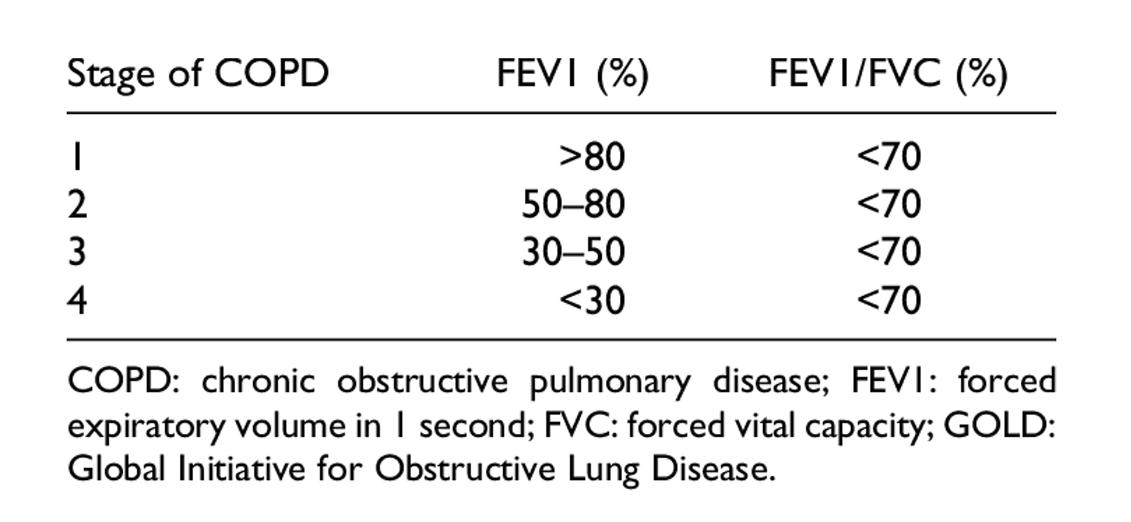
As a result, physiological abnormalities in the lungs include mucus hypersecretion, ciliary dysfunction, airflow limitation, hyperinflation, and gas exchange abnormalities. At advanced stages of the condition pulmonary hypertension and cor pulmonale are evident.
Medical management
The most commonly prescribed medications for COPD are bronchodilators, corticosteroids and antibiotics. In more severe cases supplemental oxygen
CASE REPORT
A 63-year-old woman presented with worsening shortness of breath along with wheezing and chronic cough. She was diagnosed with COPD in 2017 and has had multiple exacerbations and two hospitalisations in the last two years. Her GP referred her for an exercise prescription in a bid to improve her quality-of-life.
She is currently working full-time as a civil servant. She describes work as a stressful environment with limited time for exercise. She has accumulated a smoking pack year history of 40 years. She admits to only being active during ‘short strolls’ with friends at the weekend. She experiences shortness of breath and a wheeze that worsens during these walks with minimal sputum expectorated. She has to take breaks throughout these short strolls. She drives a short distance to work (approximately a five-minute drive) because she reports that she cannot walk 100 metres without taking a
rest. She would love to walk to work, but currently is unsure whether this is attainable. Regardless, she is currently planning for retirement in the next 18to-24 months and her primary goal is to be fitter and stronger upon retirement, without underlying concerns about hospitalisation and poor quality-of-life.
In addition, her medical history includes osteoporosis (her most recent T-score reading being -2.7 on a DEXA scan at neck of femur bilaterally), hypertension and hyperlipidaemia. These conditions are medicated with a combination of denosumab, amlodipine, and atorvastatin, respectively. Recently she has been prescribed salbutamol to be taken PRN and tiotropium for longer term management.
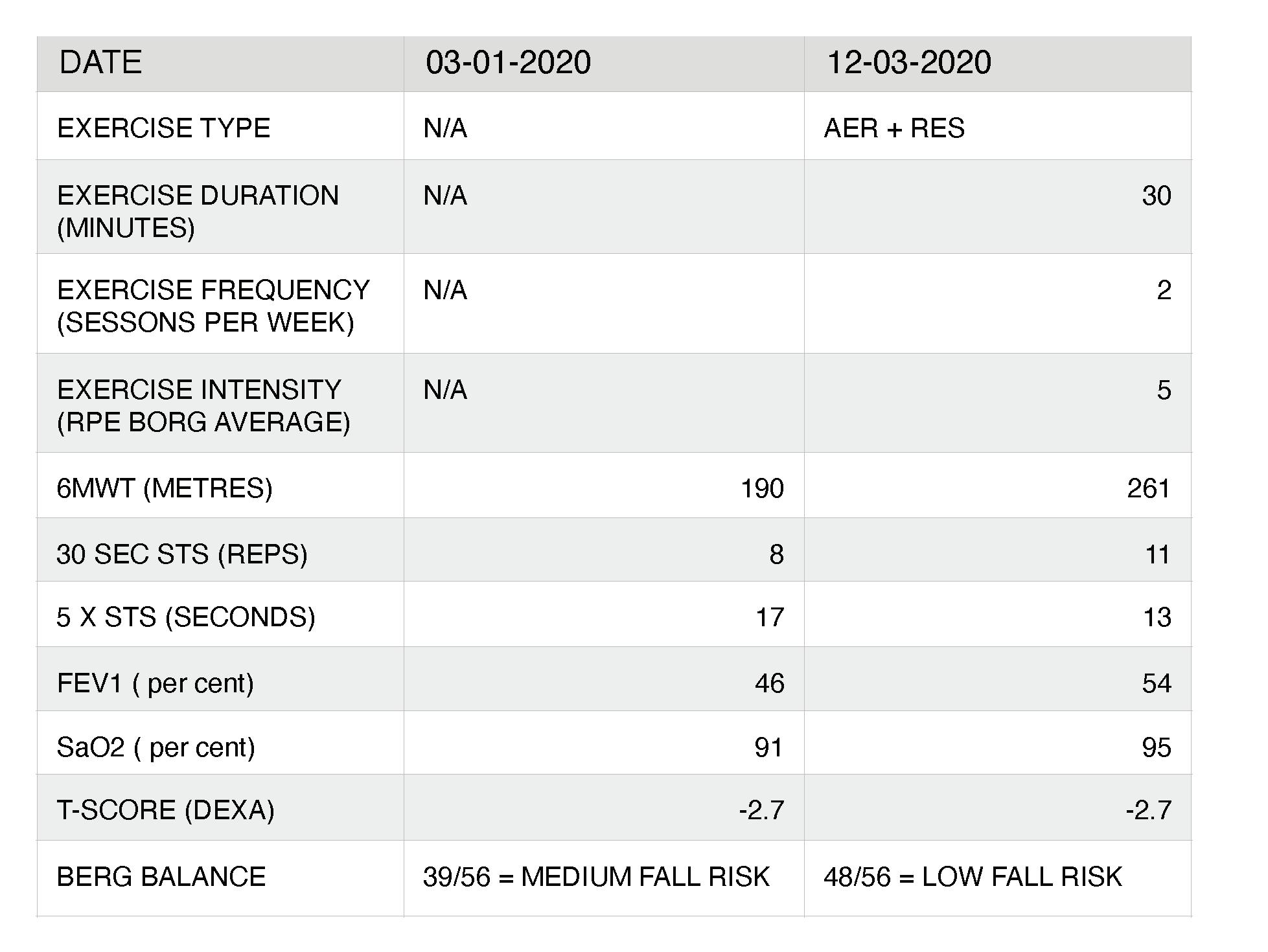
Previous investigations from her last hospital stay included a chest x-ray which showed evidence of hyperinflation and mild consolidation in lower zones. Her FEV1 score was 46 per cent, putting her into GOLD stage 3 for COPD. Upon discharge her arterial
therapy may be required.
Bronchodilators are central to the symptomatic management of COPD. Short-acting bronchodilators are considered to relieve intermittent or worsening symptoms. Similarly, by using short-acting bronchodilators immediately before exercise training (in those with airflow limitation) pulmonary function can be maximised. This can reduce dyspnoea and improve exercise tolerance.
Despite ongoing debate over the effectiveness of corticosteroids, this treatment has shown favourable responses during an acute exacerbation, primarily by breaking down phospholipids involved in the inflammatory process. However, chronic treatment with systemic corticosteroids should be avoided because of unfavourable side-effects; hyperglycaemia, osteoporosis, muscle myopathy, and peptic ulcer.
While the exact mechanisms by which antibiotics reduce exacerbations are not fully understood, their effectiveness may be due to altering mucus production, reducing oxidative stress and/or bacterial infection while simultaneously altering the inflammatory process.
Exercise prescription as part of the medical treatment plan
Before giving guidance on physical activity or formal exercise, a number of COPD considerations must be addressed. It is essential to determine the level of hypoxia during rest and
oxygen saturation was SaO2 = 95 per cent post oxygen therapy.
On presenting to the clinic for her proposed exercise prescription, her SaO2 had decreased to 91 per cent, explaining her recent subjective history of worsening symptoms. This was again reflected in her subjective outcome measures, the CAT (a COPD assessment scale) and mMRC (dyspnoea scale) scored 18 and grade 3, respectively.
Initial assessment included:
Six-minute walk test (6MWT).
30-second sit to stand (STS).
Five-time (reps) STS (5xSTS). With a score of <200m (in 6MWT) increasing the likelihood of a COPDrelated hospitalisation, the patient walked 190m with frequent breaks required during the test. Her STS and 5xSTS were also below age-specific normative values. Her 30-second STS score was eight reps (15 reps being the average for her age group) and 17 seconds for her 5xSTS (11 seconds being the average for her age group).
physical activity, as well as cardiac risk stratification. As a result, if the patient is deemed to require supplemental oxygen during exercise it is best that the patient is seen in a formal, hospital-based pulmonary rehabilitation setting (as an outpatient). Otherwise the patient can appropriately and safely be referred to a chartered physiotherapist or clinical exercise specialist.
Collaborating with a physiotherapist/ clinical exercise specialist (who has the benefit of greater time available per consultation with patients) can significantly impact adherence, behaviour change and motivation for the COPD patient. Furthermore, the medic can outsource the time-consuming assessment work, such as taking objective outcome measures. Finally, specificity around frequency, intensity, type, and time (FITT) principles of the proposed exercise can also be determined by the chosen allied health professional.
Aerobic exercise (AER)
Aerobic exercise is recommended for individuals in all stages of COPD. Exertional dyspnoea is a common symptom in COPD, therefore the modified Borg Category Ratio 0-10 (CR10) is used extensively for accuracy and patient reassurance. Individuals should be given specific, standardised instructions on how to relate the wording on the scale with their
Clinical Respiratory THE MEDICAL INDEPENDENT | 17 MARCH 2022 28
Continued on p30 ▸
FIGURE 1: COPD definition (GOLD)
FIGURE 2: Case report patient results/outcomes
umeclidinium/vilanterol


HAS POSITIVE HEAD-TO-HEAD DATA VS. ANOTHER ONCE-DAILY LAMA/LABA* 1
In symptomatic patients with moderate COPD
*Anoro Ellipta compared to tiotropium/olodaterol showed statistical superiority on pre-specified secondary endpoint of trough FEV1 at 8 weeks in the Intent to Treat population. ITT population n=236 (180mL vs. 128mL in trough FEV1; Difference 52ml (p<0.001, 95% CI:28,77).
The primary endpoint of non-inferiority on trough FEV1 at Week 8 in the PP population was met. Non-inferiority was met for the primary endpoint at Week 8 in the PP population (n=227) (175mL Anoro Ellipta and 122mL tiotropium/olodaterol, 95% CI: 26, 80; p<0.001)1
Learn more by visiting:
www.anoro.ie/headtohead
Anoro Ellipta is contraindicated for patients who are hypersensitive to the active substances or to any of the excipients. Anoro Ellipta is not indicated for the treatment of acute episodes of bronchospasm. Cardiovascular events, such as cardiac arrhythmias, may be seen after the administration of muscarinic receptor antagonists and sympathomimetic agents, including umeclidinium/vilanterol. Therefore, Anoro Ellipta should be used with caution in patients with severe cardiovasular disease. Due to antimuscarinic activity (i.e. LAMA class activity), umeclidinium/vilanterol should be used with caution in patients with urinary retention or with narrow-angle glaucoma.2
An 8-week, randomised, open-label, two-period crossover in symptomatic patients with moderate COPD (post bronchodilator FEV1 ≤70% and ≥ 50% of predicted value, mMRC≥2) and not receiving ICS at inclusion.1
COPD, chronic obstructive pulmonary disease; FEV1, forced expiratory volume in 1 second; LABA, long-acting beta2-agonist; LAMA, long-acting muscarinic antagonist; mMRC, modified Medical Research Council scale; ITT, intent to treat; PP, per protocol.
Anoro Ellipta 55/22mcg is indicated as a maintenance bronchodilator treatment to relieve symptoms in adult patients with chronic obstructive pulmonary disease (COPD)2
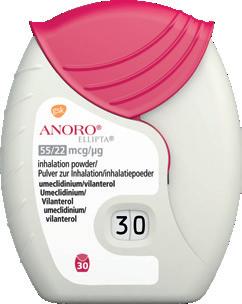
▼This medicinal product is subject to additional monitoring. This will allow quick identification of new safety information.
Anoro®▼ Ellipta® (umeclidinium bromide/vilanterol [as trifenatate]) Prescribing information (Please consult the full Summary of Product Characteristics (SmPC) before prescribing)
Anoro® Ellipta® 55/22mcg (umeclidinium bromide/vilanterol [as trifenatate]) inhalation powder. Each single inhalation of umeclidinium bromide (UMEC) 62.5 micrograms (mcg) and vilanterol (VI) 25mcg provides a delivered dose of UMEC 55mcg and VI 22mcg. Each delivered dose contains approx. 25 mg lactose. Indications: COPD: Maintenance bronchodilator treatment to relieve symptoms in adult patients with COPD. Dose and administration: Inhalation only. COPD: One inhalation once daily at the same time of the day. Contraindications: Hypersensitivity to the active substances or to any of the excipients (lactose monohydrate and magnesium stearate).
Precautions: Anoro Ellipta should not be used in patients with asthma. Treatment with Anoro Ellipta should be discontinued in the event of paradoxical bronchospasm and alternative therapy initiated if necessary. Cardiovascular effects may be seen after the administration of muscarinic receptor antagonists and sympathomimetics therefore Anoro Ellipta should be used with caution in patients with severe cardiovascular disease. Anoro Ellipta should be used with caution in patients with urinary retention, narrow angle glaucoma, convulsive disorders, thyrotoxicosis, hypokalaemia, hyperglycaemia and severe hepatic
References:
impairment. No dose adjustment is required in renal or mild to moderate hepatic impairment. Patients with rare hereditary problems of galactose intolerance, the Lapp total lactase deficiency or glucose-galactose malabsorption should not use Anoro Ellipta. Acute symptoms: Anoro Ellipta is not indicated for acute episodes of bronchospasm. Warn patients to seek medical advice if short-acting inhaled bronchodilator use increases, a re-evaluation of the patient and of the COPD treatment regimen should be undertaken. Interactions with other medicinal products: Interaction studies have only been performed in adults. Avoid β-blockers. Caution is advised when co-administering with strong CYP3A4 inhibitors (e.g. ketoconazole, clarithromycin, itraconazole, ritonavir, telithromycin). Anoro Ellipta should not be used in conjunction with other long-acting β2-adrenergic agonists or medicinal products containing long-acting muscarinic antagonists. Caution is advised with concomitant use with methylxanthine derivatives, steroids or non-potassium-sparing diuretics as it may potentiate possible hypokalaemic effect of β2adrenergic agonists. Fertility, pregnancy, and breast-feeding: No available data. Balance risks against benefits. Side effects: Common: Urinary tract infection, sinusitis, nasopharyngitis,
1. Feldman G.J et al. Adv Ther. 2017 Nov;34(11):2518-2533. 10.1007/s12325-017-0626-4.
2. Anoro Ellipta Summary of Product Characteristics. Available from: www.medicines.ie. Accessed April 2021.
ANORO ELLIPTA was developed in collaboration with ©2021 GSK group of companies. All rights reserved.
pharyngitis, upper respiratory tract infection, headache, cough, oropharyngeal pain, constipation and dry mouth. Uncommon: Hypersenstivity reactions including rash, tremor, dysgeusia, dysphonia, atrial fibrillation, supraventricular tachycardia, rhythm idioventricular, tachycardia, supraventricular extrasystoles and palpitations. Rare: Anaphylaxis, angioedema, urticaria, vision blurred, glaucoma, intraocular pressure increased, paradoxical bronchospasm, urinary retention, dysuria and bladder outlet obstruction. Frequency not known: Dizziness. Marketing Authorisation (MA) Holder: GlaxoSmithKline (Ireland) Limited, 12 Riverwalk, Citywest Business Campus, Dublin 24, Ireland. MA Nr: 55/22mcg 1x30 doses [EU/1/14/898/002]. Legal category: POM B. Last date of revision: January 2021. Job Ref: PI-3826. Further information available on request from GlaxoSmithKline, 12 Riverwalk, Citywest Business Campus, Dublin 24, Tel: 01-4955000.
Adverse events should be reported directly to the Health Products Regulatory Authority (HPRA) on their website: www.hpra.ie. Adverse events should also be reported to GlaxoSmithKline on 1800 244 255.
Anoro and Ellipta are registered trademarks of the GlaxoSmithKline group of companies PM-IE-UCV-ADVT-210001


Date of Preparation: April 2021

Cutterguide: N/A Printing Process: Offset GD: AB 447551 Size: 214 x 275 mm (W X H), Pages: 1 Colors: C M Y K (4 Color) Native File: Indesign CC Windows Generated in: Acrobat Distiller 11.0
LOC_IRELAND PRINT APR 21 - PM-IE-UCV-ADVT-210001_D1.indd 1 4/16/2021 7:09:28 PM
level of breathlessness.
Given that these Borg dyspnoea scales are subjective, some caution is advised in their interpretation. For example, an inexperienced ‘exerciser’ may have an ‘up-regulated’ sympathetic nervous system response to their underlying dyspnoea. As a result, further shallow breathing can cause unnecessary panic
for the participant. This can result in a loss of confidence, leading to the all too familiar fear/avoidance cycle with exercise.
Strength/resistance training (RES)
It is well-documented that pulmonary disease has a negative effect on the lungs. Crucially, however, it can also have a negative effect on the skeletal muscles, through lack of usage, resultant atrophy, and weakness. Therefore strength training is the most potent
Metastatic colorectal cancer
intervention to address the level of muscle dysfunction seen in COPD. It should be an integral part of the overall exercise prescription.
Furthermore, because individuals with COPD may experience greater dyspnoea while performing ‘activities of daily living’ (ADLs) involving the thorax and upper extremities, it is advisable to include strength training exercises for the upper body in particular.
Balance training
Peripheral muscle dysfunction contributes to exercise intolerance among medical patients in general. And in those with COPD, sarcopaenia is commonplace. The prevalence of falls is thus widespread in COPD patients. Given the widespread prescribing of corticosteroids, and the resultant loss in bone mineral density, the prevention of falls are of paramount importance. Falls are multifactorial, but certainly involve muscle weakness, gait, and balance abnormalities among the risk factors. Therefore, lower extremity strength and balance training are highly effective countermeasures. As such, coherent exercise advice in the medical setting ought to include some reference to aerobic training, subjective exertion levels, strength training (for the upper and lower extremities), and balance retraining.
After an exercise intervention of two 30-minute (combined AER + RES) sessions per week over a sixweek period, there were significant and positive improvements in our case report patient (see Figure 2). Testing showed an improvement in 6MWT score from 190m to 261m. This new score takes the patient out of the ‘at risk of hospitalisation’ group. The score is still below average (all patient COPD average=380m), but her prognosis with the disease has improved as a result. 6MWT scores have been shown to be significantly correlated with FEV1 and other spirometry measures as reflected in her new FEV1 of 54 per cent, lowering her into GOLD stage 2, further reflecting an improved prognosis. Her Sa02 has returned to 95 per cent and with consistency in her exercise routine, she should be able to maintain this level independently. Notably there are significant improvements in strength and function shown in the improved scores for STS and 5xSTS. Finally, the Berg balance assessment has also seen a statistically significant shift in the patient’s falls risk status.
Summary
Empirical evidence shows that exercise is a beneficial intervention for COPD patients. Reducing risk of hospitalisation can be considered a profoundly beneficial outcome in the COPD cohort, particularly in the current public health environment.
Authors: Dr Patrick Owens and Prof Deborah McNamara
However, the literature suggests that exercise intervention does not improve overall prognosis for lung function, given the pathophysiological trajectory of the condition. The lasting and practical benefits are seen in (patient reported) improved quality-of-life scores. For example, upper limb strength training can restore independence and dignity around ADLs. Similarly, peripheral muscle strengthening in the lower limbs can improve walking duration, distance and speed despite negligible changes in lung function.
It is widely acknowledged that time constraints (in a medical consultation) cannot and will not lend themselves to this level of lifestyle intervention. However, with an overwhelmingly positive evidence-base in favour of exercise as a COPD management strategy, it is vital that physicians refer patients onward for appropriate intervention. Furthermore, the new HSE primary care chronic disease management programme for COPD patients provides scope for individualised patient reviews and lifestyle management as a key part of a holistic approach to treating this disease.
References on request
Acknowledgement: Thanks to Dr Gordan Cantwell, GP; and Dr Fergal McNamara, GP, for their input.
Clinical Respiratory THE MEDICAL INDEPENDENT | 17 MARCH 2022 30 A B C Latest module Successful completion of this module will earn you 2 CPD credits doctorCPD.ie Visit www.medilearning.ie/doctorcpd Free CPD – now accessible on android, iPhone and tablet
This CPD module gives a comprehensive expert overview of the latest treatment strategies in metastatic colorectal cancer (mCRC), including diagnosis, staging, surgery and drug regimens.
Continued from p28 ▸
ACCORD HEALTHCARE LAUNCH ICATIBANT ACCORD 30MG SOLUTION FOR INJECTION IN 3ML PRE-FILLED SYRINGE
tools to help them treat and manage this complex disease. It is very welcome to now have an additional treatment option in upadacitinib available for moderate to severe atopic dermatitis patients in Ireland. The degree and early onset of skin clearance and itch relief in the upadacitinib phase 3 clinical studies are very encouraging.”
tion is being made available to Irish citizens.”
Accord Healthcare has announced the launch of another high-tech medicine to its already extensive portfolio in this area: Icatibant Accord 30mg, which comes in a pack of one 3ml pre-filled syringe.
This medicine is indicated for symptomatic treatment of acute attacks of hereditary angioedema (HAE) in adults, adolescents and children aged two years and older, with C1-esterase-inhibitor deficiency.
Please refer to the Summary of Product Characteristics (SPC) for further information. The SPC will be available from the launch date at www. hpra.ie and for healthcare professionals at www.accord-healthcare.ie
Icatibant Accord will be available from both fullline wholesalers from its launch. For further information, contact Accord in Cork on 021 461 9040 or visit www.accord-healthcare.ie
AbbVie’s Ireland General Manager Mr Andres Rodrigo said: “I very much welcome the HSE’s timely approval of upadacitinib for patients with atopic dermatitis, which is a highly debilitating condition with limited therapeutic options currently. Ireland will be among the first European countries to provide access to upadacitinib for atopic dermatitis, which was approved by the EMA in August 2021.
*The recommended dose of upadicitinib is 15mg once daily for adolescents weighing at least 30kg. The safety and efficacy of RINVOQ in children with atopic dermatitis below the age of 12 years have not been established. No data are available. No clinical exposure data are available in adolescents <40kg. The posology in adolescent patients 30kg to <40kg was determined using population pharmacokinetic modelling and simulation.
teams at BioMarin are focused all-year-round on the people they support and are motivated by a shared drive to make a real difference.
“We are privileged to have a team with exceptional life sciences expertise at BioMarin and a dedicated workforce, which we are currently expanding through an active recruitment campaign.”
Speaking about Rare Disease Day, Ms Vicky McGrath, CEO of Rare Diseases Ireland, said: “With well over 6,000 documented rare diseases, many people living with rare conditions are left feeling confused, isolated, and alone as they struggle to get information on their condition and link with people in a similar position.”
BOOTS IRELAND OFFERS HPV VACCINATIONS
IRISH
REIMBURSEMENT
GRANTED
FOR RINVOQ (UPADACITINIB), AN ORAL JAK INHIBITOR APPROVED FOR THE TREATMENT OF BOTH ADULTS AND ADOLESCENTS ≥12 YEARS* WITH MODERATE-TO-SEVERE ATOPIC DERMATITIS
AbbVie has announced the availability in Ireland of upadacitinib, an oral, selective and reversible Janus kinase (JAK) inhibitor, for the treatment of moderate to severe atopic dermatitis in adults and adolescents 12 years and older who are candidates for systemic therapy. This is now available to prescribe via the HSE Medicines Management Programme under a HSE managed access protocol.**
On August 24 last, the European Commission (EC) approved a recommended dose of upadacitinib for atopic dermatitis in adults of 15mg or 30mg once daily based on individual patient presentation, and 15mg once daily for adolescents (12-to-17 years of age) and adults 65 years and older Upadacitinib can be used with or without topical corticosteroids (TCS).
The EC approval was supported by data from one of the largest registrational phase 3 programmes in atopic dermatitis with more than 2,500 adults and adolescents with moderate to severe disease. These studies evaluated the efficacy
and safety of upadacitinib monotherapy (Measure Up 1 [MU1] and Measure Up 2 [MU2]) and with topical corticosteroids (AD Up [AU]) compared to placebo. In all three studies, the co-primary endpoints were at least a 75 per cent improvement in the Eczema Area and Severity Index (EASI 75) and validated Investigator’s Global Assessment for Atopic Dermatitis (vIGA-AD) score of 0/1 (clear or almost clear) at week 16.
Prof Alan Irvine, Professor of Dermatology, Trinity College Dublin, who was a upadacitinib clinical study investigator, welcomed the availability of a new treatment option for Irish patients with atopic dermatitis.
He stated: “Eczema is a chronic relapsing inflammatory skin disease, characterised by intense itch, dry skin and typically distributed skin lesions. The burden experienced by patients and their caregivers is significant, with chronic itch and sleep disturbance, negatively affecting overall quality-of-life.
“Clinicians need more
“It will provide significant improvement to patients’ quality-of-life, impacting positively on both their physical and psychological wellbeing. Our company’s Irish employees support the manufacture of upadacitinib for global supply and it is very encouraging that locally made innova-
** Reimbursement of RINVOQ on the high-tech arrangement under a managed access protocol is confined to the treatment of moderate-to-severe refractory AD in adults and adolescents 12 years and older for whom immunosuppressant treatment has failed or is not tolerated or is contraindicated. The prescribing of RINVOQ under the high-tech arrangement is confined to consultant dermatologists who have agreed to the terms of the HSE managed access protocol and have been approved by the HSE Medicines Management Programme.
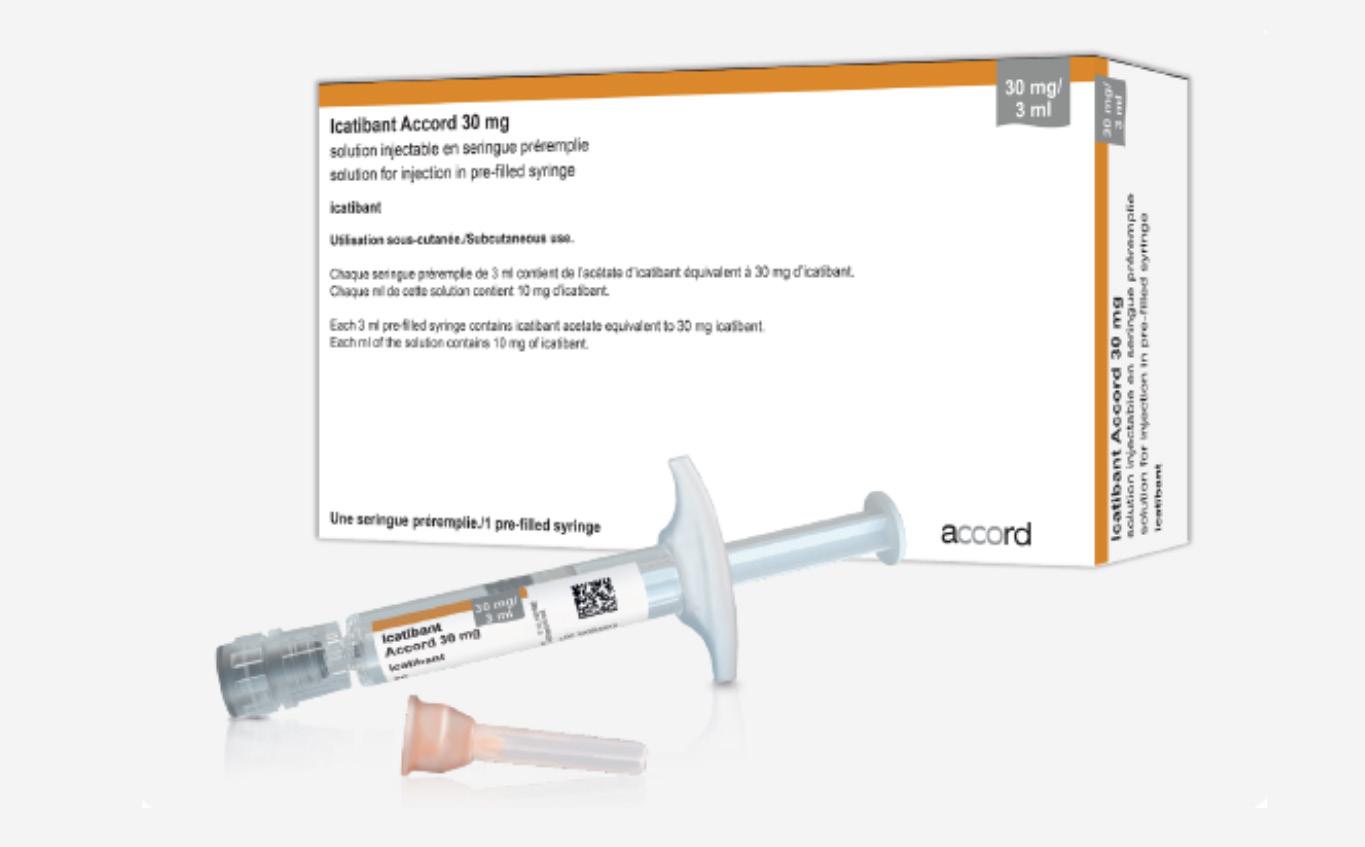
BIOPHARMACEUTICAL COMPANY BIOMARIN JOINS GLOBAL ‘SHINE A LIGHT’ CAMPAIGN ON RARE DISEASES
BioMarin Pharmaceutical has illuminated its sites at Shanbally, Co Cork and Earlsfort Terrace, Dublin, as part of a Rare Disease Day campaign to create a chain of lights across the world, uniting the global rare disease community. The initiative is being driven by Rare Disease Ireland and EURORDIS (Rare Disease Europe) in collaboration with international rare disease groups.
Rare Disease Day is marked annually on the last day of February and aims to highlight the experience of those who live with rare conditions. A rare disease is defined as a life-threatening or chronically debilitating disease that affects less than one-in-2,000 people. There are more than 6,000 rare diseases affecting up to 6 per cent of the EU population and it is estimated that up to 300,000 people in Ireland have a rare disease. However, only 5 per cent of rare conditions have an approved therapy.
According to BioMarin: “Over the past two years,
Boots Ireland became the first pharmacy chain in Ireland to offer human papillomavirus (HPV) vaccinations when the new service launched in 14 pharmacies nationwide from 23 February. The vaccine is available to customers who are not covered by the national immunisation programme and can be booked online via www.boots.ie/hpv HPV is a group of more than 100 viruses that causes one-in-20 cancers worldwide. Most people will contract HPV at some stage in their lives and it is most common among people in their late teens and early 20s. Each year in Ireland, HPV causes more than 400 cases of cancer in both men and women.
throughout the global pandemic, BioMarin’s commitment to individuals and families living with, or affected by, a rare disease has driven its determination to develop and deliver therapies to the patients who depend on them.
“Work has also continued on the establishment of a drug product-filling facility at Shanbally, Co Cork. 2022 will see the new facility become fully operational following a €38 million investment.”
BioMarin provides treatments to people living with rare genetic diseases. Ireland is home to its headquarters for operations in Europe, the Middle East, and Africa and the facility at Shanbally is BioMarin’s only manufacturing base outside the US.
Mr Jim Lennertz, Senior Vice President, EMEA Commercial Operations, and one of BioMarin’s global leaders based in Dublin, commented: “While Rare Disease Day aims to put the spotlight onto those living with rare disease, our
cal, shingles and travel vaccinations. We look forward to applying this expertise and experience to vaccinating people against HPV.”
The national HPV vaccination programme in Ireland aims to vaccinate all girls and boys in their first year at secondary school on an annual basis and is available free of charge. The national programme also facilitates vaccination to men who have sex with men up to the age of 44 through sexual health clinics.
Mr Stephen Watkins, Managing Director of Boots Ireland, commented: “Vaccination against HPV plays an important role in the prevention of different forms of cancer amongst the male and female population and we are delighted to be able to play our part in reducing the burden that cancer can have on the individual and society.”
Ms Caoimhe McAuley, MPSI, Director of Pharmacy and Superintendent Pharmacist at Boots Ireland, said: “Our experience in delivering vaccinations has been well-established through the provision of the Covid-19, flu, pneumococ-

According to Boots, it recognises that some people may wish to consider vaccination against HPV, either for themselves or their children, but are outside the inclusion criteria for the national HPV vaccination programme. The Boots HPV vaccination service is available privately for both men and women aged 16to-44 inclusive, subject to eligibility criteria.
To avail of the service, customers will need to complete a HPV vaccination consultation with their doctor. This can be completed online (see boots.ie/ hpv for more details and a link to complete an online consultation). Once the consultation has been completed, customers can book an appointment in their chosen Boots pharmacy and a prescription will be sent via Healthmail ahead of the appointment.
Product Focus RXDX THE MEDICAL INDEPENDENT | 17 MARCH 2022 31
Ms Caoimhe McAuley
The drive towards better immunotherapeutics
Attendees at UCD’s Charles Institute Seminar Series heard a presentation by Prof Caroline Le Poole on advances in research to identify better treatments for melanoma and other skin conditions


The Charles Institute, Ireland’s national dermatology research and education centre, hosts a range of guest speakers who cover a variety of topics ranging from skin cancer to psoriasis, among many others. The series, which is sponsored by RELIFE (part of the A.Menarini group), is designed to provide expert advice from a range of distinguished national and international experts in their respective fields and is chaired by Prof Desmond Tobin, Full Professor of Dermatological Science at UCD School of Medicine and Director of the Charles Institute of Dermatology. The seminars are broadcast to attendees with a special interest in dermatology and cutaneous science in other locations, who access the talks remotely via an audio-visual link.
The seminars are held using a hybrid model, combining in-person attendance with interactive online access.
Attendees heard a presentation by Prof Caroline Le Poole of the Department of Dermatology at Northwestern University, Chicago, on the topic of ‘Vitiligo Patients Harbour T-Cell Receptors Suitable for Melanoma Treatment’. Research in Prof Le Poole’s laboratory is focused on the aetiology and treatment of a number of skin conditions, such as melanoma, vitiligo and lymphangioleiomyomatosis (LAM), including tuberous sclerosis complex (TSC), with the aim of designing effective immunotherapeutics for the conditions.
Prof Le Poole explained that whilst it is widely known that the T-cell receptor plays a decisive role in host T-cell responses to cognate antigen through its variable regions, she and her team have isolated T-cells from vitiligo skin. They have also isolated and cloned a T-cell receptor from this process and successfully introduced it into donor T-cells. The resulting T-cells were then included in preclinical studies on melanoma and LAM, explained Prof Le Poole, comparing their therapeutic potential to T-cells expressing TCRs from melanoma patients.
In the course of the research it was found that in vivo, T-cells reactive to differentiation antigens have remarkable therapeutic potential, while the same T-cells can also mediate vitiligo to serve as an indicator of ongoing activity. Conversely, she told the seminar, regulatory T-cells reactive to antigens shared by normal and transformed melanocytes can temper ongoing depigmentation in mouse models of vitiligo. Therefore, she said, the natural immune responses in one disease can inform the means of moderating ongoing immune activity in another.
Vitiligo
Prof Le Poole presented slides showing vitiligo skin, with some remaining melanocytes and T-cells that infiltrate the skin and get close to these remaining melanocytes. “That sounds pretty obvious, especially if you are involved in melanoma research, but it took a long time before this was an accepted step in the pathogenesis of vitiligo,” said Prof Le Poole. “Since we now know that this is a common event, we can discover more about what these T-cells are actually doing — obviously, they are getting really close to the melanocytes, but we also want to know if those are cytotoxic cells.” She noted that the cytotoxic cells are the ones that get closer to the epidermis, which prompted the idea that these may be able to be used in melanoma research, because the two conditions are closely related in terms of the melanogenic pathway.
Prof Le Poole outlined the laboratory process in identifying cultures that contained T-cell receptors on the surface, and isolation of the T-cell receptors themselves.
“If we can identify the T-cell receptor and we know that it would be reactive to the melanocyte lineage-specific protein gp100, it might become an off-the-shelf agent that we can use for the treatment of melanoma if we put it into lymphocytes from patients and give those back to the patients,” explained Prof Le Poole.

“It’s important to note that if we put these T-cell receptors into primary cells, we then have three cultures of T-cells from the same donor that express a T-cell receptor recognising the same peptide in the context of the same MHC molecule,” she told the seminar. “The targets that we use would be the same so really, the only thing that’s different between them is the variable regions of their T-cell receptor.”
Prof Le Poole briefly discussed newer developments in her research, which are focused on minimising potential side-effects. “You really don’t want side-effects such as vitiligo when you deal with melanoma patients with any type of therapeutic,” she said. “We know that this is a problem with any type of immunotherapy with which we attack melanoma cells. We were interested in how to divert the response to where we need it (the melanoma cells) and not have it go towards healthy melanocytes. Now, we have a chimeric antigen receptor that we are developing that would attack melanoma cells more selectively.” A chimeric antigen receptor has only the variable region portion of the antibody molecule and that is important, because they have a much higher affinity for their antigen than the T-cell receptors, she pointed out.
They also use part of the T-cell receptor to help them pass through the cell membrane and some domains from post-immunomodulatory molecules that help these molecules react when they see their target. “This has become very popular for CD19, but we are really trying to make this work for solid tumours too,” Prof Le Poole explained.
Receptors
She presented case studies in humans and rodents, and examples of research in which she has been involved. She told the seminar that vitiligo and melanoma share the
expression of melanosomal target antigens, and T-cells with receptors to melanomal antigens are found in skin affected by vitiligo. “One such receptor, the SILv44, which can bind the gp100 peptide, mediates superior responses to melanoma cells both in culture and in vivo,” she told the seminar. “We see that this response is associated with IL-17 production, and that these gp100-reactive T-cells might also be used in the treatment of patients with LAM. Transgenic T-cells are reactive to the tyrosinase molecule, and these have been used to treat patients with stage 4 melanoma in a trial that we were involved in. One patient survived for six years after receiving this adoptive transfer of T-cells.”
Prof Le Poole continued: “Mid-way, the patient’s T-cells were reactivated by high-dose IL-2. This led to the development of vitiligo, and we saw that this was associated with transgenic T-cells infiltrating their skin. We went on to see if there would be a way to target melanoma cells that would not create some side-effects, such as vitiligo, and we see that TRP1 might be a candidate molecule to target, because it is expressed on the surface of tumour cells and not melanocytes. Primary antigen receptors really rely on the expression of that target on the surface, and not inside the cell, because they are antibody-based. So, this could be helpful in treating melanoma as well as LAM.
“In this seminar, we did not discuss transgenic regulatory T-cells, but we have also taken the reverse approach to try to see if we can treat vitiligo with these Tregs.”
Alopecia areata
During an interactive Q&A session and clinical discussion following the presentation, Prof Tobin commented on a generic question that often arises with many autoimmune conditions. “In alopecia areata, for example, there is the strange experience of an ‘active’ hair loss patch, and active hair regrowth in another area of the scalp,” said Prof Tobin. “There may be another area of that scalp that has done nothing for years. Presumably, the blood is flowing relatively similarly through the entire scalp in alopecia areata… regarding your comment on vitiligo that happens as a side-effect of anti-melanoma treatments, do you tend to see this vitiligo effect restricted to the primary or secondary melanoma sites, or is this irrelevant?”
Prof Le Poole replied: “That’s a very interesting question, as to what makes the melanocyte damaging T cells to a particular site,” she said. “It’s also a good point in general, even with completely different tumours that we haven’t discussed [in the seminar]. For example, if you give anti-PD1 therapy, you get these skin rashes — that’s just immunocytes trying to go somewhere where they are not wanted and create havoc there,” Prof Le Poole continued. “As far as the skin is concerned — and of course we see this in other sites where it can be much more detrimental — there is something about these sites that makes them an ‘attractive’ place to go. We are also interested in transgenic T-cells; you can code them in terms of where you want them to go — Tregs in vitiligo don’t seem to want to go to the skin, but they love to go to tumours… you can code your T-cells so that they know where they are supposed to go, and that’s something that we are also trying to do.”
RELIFE has had no input into the content of this article or series of seminars
Clinical Dermatology THE MEDICAL INDEPENDENT | 17 MARCH 2022 32
Article and series in association with UCD CHARLES INSTITUTE SEMINAR SERIES
Prof Caroline Le Poole
RELIFETM. MY SKIN SAYS HOW I FEEL.






ECZEMA, DERMATITIS, SENSITIVE SKIN & BABY CARE.







DRY, VERY DRY, ROUGH AND CRACKED SKIN.*
OILY, BLEMISHED AND ACNE PRONE SKIN.



HYPERPIGMENTATION AND MELASMA.

Pigment Solution ProgramTM www.relife.ie Distributed by: A.Menarini Pharmaceuticals Ireland Ltd, Castlecourt,Monkstown Farm,
Glenageary,
RelizemaTM U-LifeTM PapiXTM
Monkstown,
Co. Dublin.
Date of item Sept 2021 IE21055 IR-REL-186-2021 Not to be used on broken skin @RELIFEIreland @relife_ireland @RELIFEIrl
OUR NEW ADDRESS
Post your answers to: Mindo Quizzes, The Medical Independent , Greencross Publishing Ltd, 1 Mortons Lane, Wicklow Town, A67RX38 Closing date for entries is 28 March 2022
SPORTS QUIZ WIN €50 17 March 2022
Q1 Which Australian spin bowler, who is widely regarded as the best cricketer of all time, sadly passed away at the aged of just 52 recently?
Q2 Which horse won the Champion Hurdle at this week’s Cheltenham Festival?
Q3 Name the German male tennis player who was thrown out of the Mexican Open after repeatedly smashing his racket off the umpire’s chair?
Q4 Name the Irish outhalf who signed a new contract with the IRFU, which will run until the end of next year’s Rugby World Cup?
Q5 Name the Premier League club that Danish international Christian Eriksen has joined, in his long-awaited return following heart surgery?
Q6 Who replaced Nikita Mazepin at the Formula One team Haas?
CROSSWORD COMPETITION
17 March 2022
The winner of the 24 February 2022 Sporting Quiz Competition is Dr Fionnuala Toal, Co Cavan The winner of the 24 February 2022 Crossword is Rosemary Bradley, Co Offaly
Q1 Who won the FAI President’s Cup, the curtain raiser to the new League of Ireland season? A: Shamrock Rovers
Q2 Who made his debut for the Ireland men’s rugby team against Wales and backed that up with a try against France in Paris? A: Mack Hansen
Q3 Which racetrack will host the opening race on the new F1 season next month? A: Bahrain
Q4 Who was named Superbowl LVI most valuable player, as the LA Rams defeated the Cincinnati Bengals? A: Cooper Kupp
Q5 Grand National winning horse Tiger Roll will not attempt to win the race for a third time this year. Who is the only horse to have won the showpiece on three occasions? A: Red Rum
Q6 Name the American men’s sprinter who won Olympic and World Championship gold medals either side of a drugs ban, who announced his retirement last week, at the age of 40. A: Justin Gatland
DOWN
2 Prepare and issue for sale (7)
3 Given generously (7)
4 Medical treatment centre (6)
5 Taut (5)
6 Command (5)
7 Milieu (11)
8 Instantly (11)
14 Learner (7)
15 Act of turning up (7)
17 Step down from a job (6)
19 Quantitative relation between two amounts (5)
20 Distinguishing characteristic (5)
Life Mindo Quizzes THE MEDICAL INDEPENDENT | 17 MARCH 2022 34 Solution to Crossword Competition
Answers to Sports Quiz Competition Solution to Sudoku P O S S I B L Y L E S S A Q N I N T S T U F F Q U A R T E R S A L U I A R U I N H E R I T P R E T E N D U E E H N R G Y S C S U R G E R Y S Q U E E Z E I M I M T C E A C O M M E N T A R R O W A I L N G A L A T E S E V E R E L Y 3 4 8 1 5 7 2 6 9 9 5 2 6 8 4 3 1 7 1 7 6 3 2 9 5 4 8 5 9 1 7 3 6 8 2 4 2 6 3 9 4 8 1 7 5 7 8 4 5 1 2 9 3 6 8 2 9 4 6 1 7 5 3 6 3 7 2 9 5 4 8 1 4 1 5 8 7 3 6 9 2 4 1 3 7 9 6 8 9 2 4 1 3 9 6 4 5 6 8 7 9 1 8 6 5 4 1 SUDOKU SCRIBBLE BOX 24 FEBRUARY 2022 ANSWERS, SOLUTIONS, AND WINNERS WIN €50 1 2 3 4 5 6 7 8 9 10 11 12 13 14 15 16 17 18 19 20 21 22 23 24 Across 1 - Piece of software (11) 9 - Living thing (5) 10 - Water barrier (3) 11 - Innate worth (5) 12 - One more than two (5) 13 - Investigate (8) 16 - Standards (8) 18 - Worthiness (5) 21 - Propel forwards (5) 22 - Ten (anag) (3) 23 - Continuing in existence (5) 24 - Luckily (11) Down 2 - Prepare and issue for sale (7) 3 - Given generously (7) 4 - Medical treatment centre (6) 5 - Taut (5) 6 - Command (5) 7 - Milieu (11) 8 - Instantly (11) 14 - Learner
15
of
-
19 - Quantitative
20
Distinguishing
ACROSS 1 Piece of software (11) 9 Living thing (5) 10 Water barrier (3) 11 Innate worth (5) 12 One more than two (5)
Investigate (8)
Standards (8)
Worthiness (5)
Propel forwards (5) 22 Ten (anag)
Continuing in existence
24 Luckily
(7)
- Act
turning up (7) 17
Step down from a job (6)
relation between two amounts (5)
-
characteristic (5)
13
16
18
21
(3) 23
(5)
(11)
Leave the poverty talk to the experts
The latest example of a really annoying phenomenon is brought to us by the Honourable Kirsty Allsop, eldest child of the 6th Baron Hindlip. Kirsty is best known as the presenter of Location, Location, Location, and rather less so for being an enthusiastic Brexiteer.
She has been in the news of late for saying that she is “enraged” when young people say they can’t afford a house, insisting that all they need do is to ditch their Netflix subscription, gym membership, and takeaway coffee. If this doesn’t work, she says, they should “move somewhere cheaper”.
I can’t quite put my finger on when this tendency to lecture the young and the poor about economy actually started. But I seem to remember a ludicrous claim, that gained currency a few years ago, that if you merely skipped your avocado on toast and coffee – there is an obsession with coffee – you were well on your way to owning a two-bedroom apartment in a desirable area.
The patience of young people when faced with this kind of patronising twaddle is impressive; if I were them, I’d be marching on the multi-million pound homes of such advisors with pitchforks and flaming torches.
It’s not just avocado on toast and flat whites that get mentioned in this context. It’s food in general when it comes to the poor. Why can’t they cook wholesome nutritious meals from cheap ingredients? Why are poor people so insistent on eating highly processed food when they could be tucking in to a Tuscan bean stew or Cuisine Grandmere riff on pigs’ feet?
Now, I like Jamie Oliver. I’ve met him and he’s as pleasant in person as on the television screen. But bear in mind that his personal net worth is northwards of £150 million, all of it, no doubt, thoroughly deserved. And here he is talking about poverty and food back in 2013: “I’m not judgmental,” he says (and I think we’ll be the judge of that) “but, I’ve spent a lot of time in poor communities and I find it quite hard to talk about modern-day poverty”. My advice to Jamie would be, don’t do it then.

“You might remember that scene in Ministry of Food , with the mom and the kid eating chips and cheese out of styrofoam containers and behind them is a massive TV. It just didn’t weigh up.”
“The fascinating thing for me is that seven times out of 10, the poorest families in this country choose the most expensive way to hydrate and feed their families. The ready meals, the convenience foods.”
More recently, Jamie has developed some sense about this issue and now believes that there’s no point in applying middle class logic to the problems of the poor and childhood obesity. “What you see is parents who aren’t even thinking about five fruit and veg a day,” he commented. “They’re thinking about enough food for the day.” Adding that it’s very easy to buy poor quality food as it’s heavily discounted and that it’s no surprise that many poor people “eat crap”. It’s not about willpower, he said, because these people “think in a different gear, almost a different country”.
I prefer to listen to people who really know what they are talking about when it comes to poverty. I hero worship Jack Monroe who just over 10 years ago was living on benefits as a single mum, teaching herself to cook. She did an interview with The Daily Star because they were offering £200 for her story. “They were looking for someone who was about to have a really shit Christmas,” she told The Guardian , “and my friend said: ‘That sounds like you.’”
Cooking on a Bootstrap
From there, she became a recipe columnist, blogger, and commentator, making her name with an excellent book, Cooking on a Bootstrap, funny, informative, distinctive and – unusually and sensibly – very positive about inexpensive tinned foods.
Recently she persuaded the supermarket chain Asda to make their cheapest white label food items more widely available. On Twitter she wrote: “I’ve cried in supermarkets plenty in the last 10 years. Putting back jam that had crept up by sixpence, meaning SB [small boy, her young son] and I faced a week of bone dry toast. Trying to work out what to put back, what to do without, out of a tenner’s worth of groceries that weren’t enough to start with.”
“I’ve cried tears of humiliation when a shelf-edge label turned out to be advertising an expired promotion, tipping my shopping over what I could afford from the six pounds or so in change – the only money I had in the world – in my hand.”

Bear in mind that this is a strong person, with a great deal of willpower and, moreover, someone who
can cook. And cook really well.
In 2013, Jack was doing ambassadorial work for Oxfam on poverty in Britain and was invited to address a parliamentary committee meeting. “While I was speaking, I cried,” she said in an interview. “I was so ashamed and embarrassed to be in this fancy building talking about using socks as sanitary towels. When I went back to my seat, I was shaking and still crying. Iain Duncan Smith said something to the person next to him and they both laughed so hard. His shoulders were shaking with laughter.”
Bad diets are very common in poorer communities, as is childhood obesity, running at 50 per cent more than in the middle classes. There’s no point in trying to wrestle with what people eat if poverty itself isn’t tackled. It all comes down to lack of money.
And please, no more lecturing from our warm homes with their well-stocked kitchens.
WINE OF THE MONTH
Now, even if you’re not on a tight budget, there’s always a certain pleasure in snaffling a bargain. May I suggest the elegant and lightly oaked Limoux Chardonnay (€8.99, Aldi) that I will confess to buying in bulk. It has Southern French ripeness tempered by high altitude acidity and a touch of toastiness that suggests a much higher price tag.

Food & Drink Life THE MEDICAL INDEPENDENT | 17 MARCH 2022 35 TOM DOORLEY Read more at www.mindo.ie @tomdoorley
There’s no point in trying to wrestle with what people eat if poverty itself isn’t tackled
Trinity College Dublin 4th Med Stethoscope Ceremony, Trinity Health Sciences, St James’s Hospital






Life Gallery THE MEDICAL INDEPENDENT | 17 MARCH 2022 36
Photos: David Coleman – Bobby Studio
Prof Colin Doherty
Pictured L to R: Prof Rose Anne Kenny; Prof Noel McCarthy; Prof Joe Harbison; Prof Colin Doherty; Prof Joe Keane; Prof Michael Cullen; and Ms Sarah Early
Basel Al-Rajhi; Salman Bin-Ihsan; Mahmoud Salama; Raymond Fuller; Bahram Khan; Basem Fouda; and Emad Alsaleh
Ms Sarah Early
Alannah O’Reilly; Clodagh Brophy; Dr Cathy Cunningham; Ms Sarah Early; Prof Joe Harbison; Rachel Huijsdens; and Orla Fitzgerald
Laura Ryan; Ciara Leavy; Prof Joe Keane, President, Biological Association, TCD; and Aisling Cadden. Back Row: Kevin McDonnell; Camille Christle; Sue-Ann O’Beirne; William Farmer; and Peter Flanagan

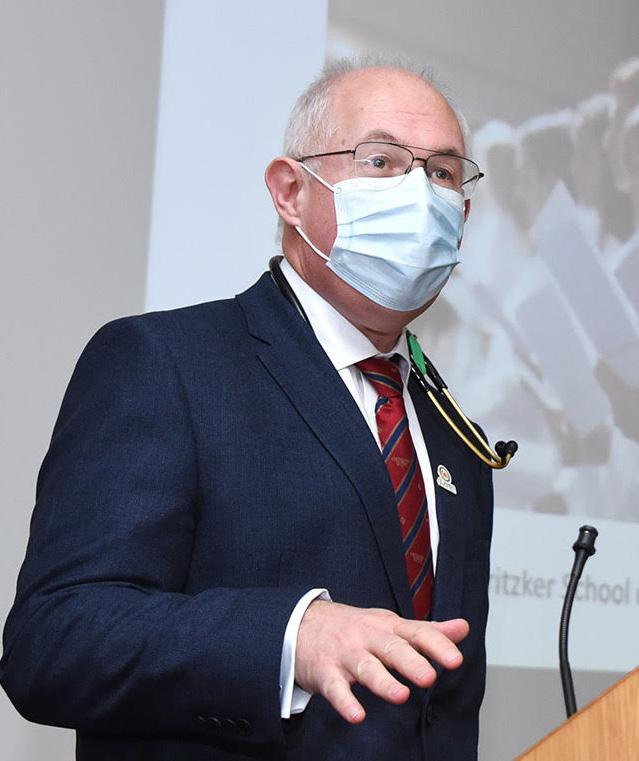




Gallery Life THE MEDICAL INDEPENDENT | 17 MARCH 2022 37
Prof Joe Keane
Dr Naomi Beard
TCD 4th Med Stethoscope Ceremony, Trinity Health Sciences, St James’s Hospital
Prof Joe Harbison
Conor Farrell held by Mahmoud Salama; James Crabtree; Max White; Lorcan Mulkerrin; Liam Mariga; Oisin O’Connor; and Imad Mirza
Sophie Lawlor; Prof Joe Keane; Saffron O’Neill; Ciara Owens; and Sean Clarke
GP
For further information on this position contact Dr Seamus Kelly via email skelly@millbraesurgery.ie
Millbrae Surgery, Carndonagh, Co Donegal
Specialist Medical Accountant, RCSI Lecturer and author of Fit moneythe key to financial freedom
Now offering:
ASSISTANT REQUIRED SHANE O’TOOLE GP REQUIRED
• Monthly Profit Growth Model
• Annual Accounts and Tax Returns
• Outsourced Bookkeeping and Payroll
• Support in Selling and Buying a Practice
Contact 01 801 3116 for help and support
GP required for a well-established practice in East Galway (6-8 sessions).

20 minute commute from Oranmore.
Fully computerised with Socrates and great practice support. Generous remuneration available to the right candidate.
Contact our Practice Manager Mary on 091 842144 or 087 203 5825 or email your CV to maryhoran.mh@gmail.com
We are currently seeking a vocationally trained (MICGP or equivalent) GP for 3-4 sessions (flexible) per week, with possible additional holiday cover in Falcarragh, Co Donegal, for immediate start. Our practice is fully computerised (Helix Practice Manager) with three GPs, two full-time practice nurses, practice manager, and administration staff. Falcarragh is a busy market town surrounded by beautiful scenery and mountains, near to white sandy beaches for surfing/watersports etc. Great work/life balance. If interested, please send CV to Sheila O’Donnell Practice Manager at falcarraghmedicalMC21@gmail.com Tel 086 310 0732
EXCELLENT GP JOB OPPORTUNITIES

Louth, Meath, Cavan, and Monaghan
GP out-of-hours (NEDOC) and daytime surgery jobs
Great rates available Contact us on 046 924 1533, Email: info@medsource.ie Visit our website: www.medsource.ie

MEDICAL SUITES AVAILABLE IN DUBLIN 2 (close
Medical Suites available at 26 Clare Street, Dublin 2. Adjacent to the National Gallery.
Suitable for a range of medical uses including GP practice - Private or GMSOut-of-hours service or walk-in clinic – physio clinic – beauty clinic, etc.
Full medical planning permission.
These suites would suit many uses due to the high footfall passing the door every day.
The suites are 5 minutes walk from Grafton Street with several amenities close by. There is direct access from all areas of Dublin to the suites via the Dart and bus and the Luas runs to Dawson Street, 5 minutes walk away. There is a big concentration of new businesses in the area. Trinity College, Merrion Square, and Pearse Street are on the doorstep.
Vocationally trained GP required for Sutton Cross Surgery. 4-6 sessions. Flexible, friendly, coastal, Dublin teaching practice with a mix of GMS/private patients. We are fully computerised using Health One software and 15 minute appointments. Supported by excellent nursing and administrative staff. An attractive package is available for suitable candidates. Enquiries or CVs to manager@suttoncrosssurgery.ie 01 832 6438 Specialist Reg General Reg Family Medicine Women’s Health Aesthetics Telemedicine Call me and let’s discuss a solution to your GP staff shortage!

Very favourable and flexible terms.
2 Suites available ● self-contained ● bathroom/waiting room/consulting rooms
440sq feet and 690sq feet both newly renovated ● high speed broadband, etc
Classifieds & Recruitment THE MEDICAL INDEPENDENT | 17 MARCH 2022 38
to Dawson Street Luas)
Please contact Mr Aidan Ringrose on +353 87 951 9786 or mornwill26@gmail.com for further information or to arrange viewing GP
REQUIRED
GP assistant required in North Inishowen with a view to partnership. Short-term position also considered. Group practice/ fully computerised, full ancillary staff (APN, practice nurses, medical technicians and administration staff) in a purpose-built primary care centre.
GP REQUIRED WE RECRUIT DOCTORS EXPERIENCED GP s AVAILABLE Contact Shirley +353 86 8030891 shirley.osullivan@matchmedics.com
PRACTICE NURSE REQUIRED
Practice nurse sought for Bayview Medical, Killiney Shopping Centre, Killiney, Co Dublin. 8-24 hours/week, depending on your availability. Basic clinical skills and ability to work as part of a team essential. New medical centre in good central location with plenty of parking and shops (bayviewmedical.ie). Position available immediately.
Salary €32-40K p.a. (for 24 hr week).
Interested applicants please contact sconroymedical @gmail.com with your CV
Fancy a summer GP locum job in West Cork?
Would you like to work and enjoy the summer in West Cork near the sea?
GP locum sessional or full-time work available in a GP group practice. On-call commitment optional. Very supportive nursing and admin staff.
Please email any queries and cv to: westcorkmedical@gmail.com
PRACTICE NURSE REQUIRED
Part-time general practice nurse sought for Rathgar Medical Practice, Dublin 6.


Competitive rates and flexible hours for the right candidate. Friendly working environment. Previous practice nurse skills desirable, but not essential. Training can be provided. Position available immediately.
Interested applicants please contact osullym@yahoo.ie with your CV
Tipperary Primary Care is looking for a GP to join our team.
We will facilitate your needs and time available.


For a salaried or partner GP please contact Tom Purcell 062 51657 www.tipperaryprimarycare.ie
GP REQUIRED
Waterford Medical Centre are looking for a vocationally trained GP to join our dynamic and friendly team for 8 sessions per week Monday-to-Friday. Lovely wellestablished large practice in a modern purpose-built premises located in Waterford City, near the Eco Park. The practice is fully computerised using Socrates package and operates a 15-minute appointment system. Supported with excellent nursing, medical technician, and administrative support. No out-of-hours commitment and free onsite parking. Good remuneration package for the right candidate.
Email CV or enquiries to our Practice Manager Jean Hubbard practicemanager@waterfordmedicalcentre.com
EVENT
BEACON HOSPITAL
APRIL
GP EDUCATIONAL MORNING
When: Saturday 2nd April 2022
Where: The O’Reilly Hall, UCD
This will be a hybrid event.
We look forward to welcoming a limited number of GPs to attend in person again!
The event will also be available to watch online.
To advertise, email Louis at louis@mindo.ie
For more information or to reserve your place, visit: www.beaconhospital.ie/information-for-gps/studyevents/april-2022-gp-educational-morning
Classifieds & Recruitment THE MEDICAL INDEPENDENT | 17 MARCH 2022 39
medilearning www.medilearning.ie
independent CPD for doctors, nurses, and pharmacists… all under one roof
Free,
GP LOCUM REQUIRED GP LOCUM REQUIRED
If you have anything you would like to share, please email: info@mindo.ie
A round-up of news and oddities from left field by Dr Doug Witherspoon
Hunger games: The fast track to an early grave
As far as health fads go, fasting has popped up throughout history as a purported means to boost cognitive performance, reduce inflammation, and a host of other supposed benefits. Wherever you stand on fasting, history shows us that it was also taken to lethal extremes by some who should never have had a licence to practise medicine.
Take the case of Linda Hazzard (1867-1938), otherwise
known as 'The Starvation Doctor', for example.
It would be more correct to describe Hazzard as a charlatan rather than a doctor. She was issued a licence to practise medicine thanks to a legal loophole that allowed her to operate as a 'fasting specialist'. Her lack of a medical degree or formal training were overlooked. She even published two books, titled Fasting for the Cure of Disease and Scientific Fasting: The Ancient and Modern Key to Health
For the treatment of active rheumatoid arthritis, severe recalcitrant disabling psoriasis & severe psoriatic arthritis in adult patients. Induction of remission in moderate steroid-dependent Crohn’s disease in adult patients, in combination with corticosteroids and for maintenance of remission, as monotherapy, in patients who have responded to methotrexate
For the treatment of active rheumatoid arthritis, severe recalcitrant disabling psoriasis & severe psoriatic arthritis in adult Induction of remission in moderate steroid-dependent Crohn’s disease in adult patients, in combination with corticosteroids and for maintenance of remission, as monotherapy, in patients who have responded to methotrexate

THE METHOTREXATE AUTO-INJECTOR WITH THE PATIENT IN MIND
THE METHOTREXATE AUTO-INJECTOR WITH THE PATIENT IN MIND

Hazzard believed that the root of most illnesses lay in food, specifically consuming too much of it. Her theory was that the digestive system needed to 'rest' for periods lasting days or more. She also established her own sanatorium – what could possibly go wrong, I hear you ask – and her unfortunate patients were made to fast for anything from days to months. Their diet typically consisted of small portions of tomato and asparagus juice, an occasional teaspoon of orange juice and sometimes a small amount of vegetable broth.
Hazzard's sanatorium was dubbed 'Starvation Heights', and for good reason. Adjunct therapies included daily enemas that lasted for hours and massages that were so vigorous that her nursing staff said it sounded like the patient was being physically beaten.
Among the more notable case studies of Hazzard's patients were two English sisters, Claire and Dorothea Williamson. Dorothea sought help for her swollen glands and rheumatic pains, whilst Claire had been previously diagnosed with a uterine prolapse. The two sisters were quite wealthy, being the orphaned offspring of a well-heeled British Army officer. Both were staunch believers in alternative medicine and in a bid to 'cure' themselves, had already given up red meat.
Hazzard's institute was pitched to prospective patients as a countryside facility, with roaming horses and lush, rolling green pastures. However, on arrival, the sisters were informed that it was not ready for use yet. Instead, they were installed in an apartment in Seattle, fed two cups of canned tomato-based broth per day, and subjected to gruelling enemas that lasted for hours. The bathtub where these enemas were administered was covered in canvas, as the women regularly fainted during the procedure.
Nordimet (methotrexate) Solution for injection in pre-filled pen
Please refer to the Summary of Product Characteristics (SmPC) for full prescribing information. Further information is available on request.
pen Please refer to the Summary of Product Characteristics (SmPC) for full prescribing information. Further information is available on request.
initiation of therapy is recommended. Recommended initial dose 7.5 mg methotrexate once weekly. The dose is to be increased gradually but should not, in general, exceed a weekly dose of 25 mg of methotrexate.
initiation of therapy is recommended. Recommended initial dose 7.5 mg methotrexate once weekly. The dose is to be increased gradually but should not, in general, exceed a weekly dose of 25 mg of methotrexate.
Once the desired therapeutic result has been achieved, dose should be reduced gradually to the lowest possible effective maintenance dose.
Presentation: Pre-filled pen containing 7.5 mg (in 0.3 ml), 10 mg (in 0.4 ml), 12.5 mg (in 0.5 ml), 15 mg (in 0.6 ml), 17.5 mg (in 0.7 ml), 20 mg (in 0.8 ml), 22.5 mg (in 0.9 ml) and 25 mg (1.0 ml) methotrexate in solution for injection. Indications: Active rheumatoid arthritis in adult patients. Polyarthritic forms of severe, active juvenile idiopathic arthritis, when the response to nonsteroidal anti-inflammatory drugs (NSAIDs) has been inadequate. Severe recalcitrant disabling psoriasis, which is not adequately responsive to other forms of therapy such as phototherapy, PUVA, and retinoids, and severe psoriatic arthritis in adult patients.
Presentation: Pre-filled pen containing 7.5 mg (in 0.3 ml), 10 mg (in 0.4 ml), 12.5 mg (in 0.5 ml), 15 mg (in 0.6 ml), 17.5 mg (in 0.7 ml), 20 mg (in 0.8 ml), 22.5 mg (in 0.9 ml) and 25 mg (1.0 ml) methotrexate in solution for injection. Indications: Active rheumatoid arthritis in adult patients. Polyarthritic forms of severe, active juvenile idiopathic arthritis, when the response to nonsteroidal anti-inflammatory drugs (NSAIDs) has been inadequate. Severe recalcitrant disabling psoriasis, which is not adequately responsive to other forms of therapy such as phototherapy, PUVA, and retinoids, and severe psoriatic arthritis in adult patients.
Induction of remission in moderate steroid-dependent Crohn’s disease in adult patients, in combination with corticosteroids and for maintenance of remission, as monotherapy, in patients who have responded to methotrexate. Dosage and administration: Nordimet should only be prescribed by physicians with expertise in the use of methotrexate and a full understanding of the risks of methotrexate therapy. Patients must be educated and trained in the proper injection technique when self-administering methotrexate. The first injection of Nordimet should be performed under direct medical supervision. Nordimet is injected once weekly, administered subcutaneously. Rheumatoid arthritis:
Once the desired therapeutic result has been achieved, dose should be reduced gradually to the lowest possible effective maintenance dose.

In a few exceptional cases a higher dose than 25 mg might be clinically justified, but should not exceed a maximum weekly dose of 30 mg of methotrexate. Crohn’s disease (adult patients): 25 mg/week administered subcutaneously. Once patients have adequately responded to combination therapy, the corticosteroids should be tapered. Maintenance treatment: 15 mg/week administered subcutaneously, as monotherapy, if the patient has entered remission. Renal impairment, hepatic impairment or elderly patients: Please refer to SmPC.
Induction of remission in moderate steroid-dependent Crohn’s disease in adult patients, in combination with corticosteroids and for maintenance of remission, as monotherapy, in patients who have responded to methotrexate. Dosage and administration: Nordimet should only be prescribed by physicians with expertise in the use of methotrexate and a full understanding of the risks of methotrexate therapy. Patients must be educated and trained in the proper injection technique when self-administering methotrexate. The first injection of Nordimet should be performed under direct medical supervision. Nordimet is injected once weekly, administered subcutaneously. Rheumatoid arthritis:
Note: When switching from oral to parenteral use, a reduction in the dose may be required, due to the variable bioavailability of methotrexate after oral administration.
Contraindications: Hypersensitivity to methotrexate or to any of the excipients. Severe hepatic impairment, if serum bilirubin is > 5 mg/dl (85.5 µmol/l). Alcohol abuse. Severe renal impairment (creatinine clearance < 30 ml/min). Pre-existing blood dyscrasias (e.g. bone marrow hypoplasia, leukopenia, thrombocytopenia or significant anaemia). Immunodeficiency.
In a few exceptional cases a higher dose than 25 mg might be clinically justified, but should not exceed a maximum weekly dose of 30 mg of methotrexate. Crohn’s disease (adult patients): 25 mg/week administered subcutaneously. Once patients have adequately responded to combination therapy, the corticosteroids should be tapered. Maintenance treatment: 15 mg/week administered subcutaneously, as monotherapy, if the patient has entered remission. Renal impairment, hepatic impairment or elderly patients: Please refer to SmPC. Note: When switching from oral to parenteral use, a reduction in the dose may be required, due to the variable bioavailability of methotrexate after oral administration.
Contraindications: Hypersensitivity to methotrexate or to any of the excipients. Severe hepatic impairment, if serum bilirubin is > 5 mg/dl (85.5 µmol/l). Alcohol abuse. Severe renal impairment (creatinine clearance < 30 ml/min). Pre-existing blood dyscrasias (e.g. bone marrow hypoplasia, leukopenia, thrombocytopenia or significant anaemia). Immunodeficiency. Serious, acute or chronic infections such as tuberculosis & HIV. Stomatitis. Ulcers of the oral cavity and known active gastrointestinal ulcer disease.
Recommended initial dose is 7.5 mg of methotrexate once weekly.
Depending on the individual activity of the disease & patient tolerability, the initial dose may be increased. A weekly dose of 25 mg should in general not be exceeded. Once the desired therapeutic result has been achieved, the dose should be reduced gradually to the lowest possible effective maintenance dose. Polyarthritic forms of severe, active juvenile idiopathic arthritis: The recommended dose is 10-15 mg/m² body surface area (BSA) per week. In therapy-refractory cases the weekly dose may be increased up to 20mg/m² BSA per week. Use in children < 3 years of age is not recommended. Psoriasis vulgaris and psoriatic arthritis: A test dose of 5 - 10 mg subcutaneously administered one week prior to
Recommended initial dose is 7.5 mg of methotrexate once weekly. Depending on the individual activity of the disease & patient tolerability, the initial dose may be increased. A weekly dose of 25 mg should in general not be exceeded. Once the desired therapeutic result has been achieved, the dose should be reduced gradually to the lowest possible effective maintenance dose. Polyarthritic forms of severe, active juvenile idiopathic arthritis: The recommended dose is 10-15 mg/m² body surface area (BSA) per week. In therapy-refractory cases the weekly dose may be increased up to 20mg/m² BSA per week. Use in children < 3 years of age is not recommended. Psoriasis vulgaris and psoriatic arthritis: A test dose of 5 - 10 mg subcutaneously administered one week prior to
Date Of Preparation: Aug 2021
IE/21/NOR/011-00


Serious, acute or chronic infections such as tuberculosis & HIV. Stomatitis. Ulcers of the oral cavity and known active gastrointestinal ulcer disease. Pregnancy. Breast-feeding. Concurrent vaccination with live vaccines. Special warnings and precautions: Patients must be clearly advised that the therapy is to be administered once a week, and not every day. Patients receiving therapy should be appropriately monitored. Doses exceeding 20 mg/week can be associated with significant increase in toxicity, especially bone marrow suppression. The possible risks of effects on reproduction, pregnancy loss and congenital malformations should be discussed with male and female patients of childbearing potential.
Pregnancy. Breast-feeding. Concurrent vaccination with live vaccines.
Special warnings and precautions: Patients must be clearly advised that the therapy is to be administered once a week, and not every day.
effects: See SmPCs for full list of undesirable effects. Very common: Stomatitis. Dyspepsia. Appetite loss. Abdominal pain. Nausea. Abnormal liver function tests (increased Alanine aminotransferase (ALAT), Aspartate aminotransferase (ASAT), alkaline phosphatase and bilirubin). Common: Leukopenia. Anaemia. Thrombopenia. Headache. Tiredness. Drowsiness. Pneumonia. Interstitial alveolitis/pneumonitis. Oral ulcers. Diarrhoea. Exanthema. Erythema. Pruritus. Uncommon: Pharyngitis. Pancytopenia. Precipitation of diabetes mellitus. Depression. Confusion. Dizziness. Enteritis. Pancreatitis. Gastrointestinal ulceration and bleeding. Cirrhosis, Fibrosis and fatty degeneration of liver. Arthralgia, myalgia, osteoporosis. Inflammation and ulceration of bladder. Renal impairment. Rare: Infection. Conjunctivitis. Sepsis. Allergic reactions. Anaphylactic shock. Hypogammaglobulinaemia. Visual disturbances. Pericarditis. Pericardial effusion. Pericardial tamponade. Thromboembolic events. Pulmonary fibrosis. Pneumocystis carinii pneumonia. Shortness of breath and bronchial asthma. Pleural effusion. Acute hepatitis. Renal failure. Anuria. Very rare: Lymphoma. Agranulocytosis. Lymphoproliferative disorders. Severe courses of bone marrow depression. Acute aseptic meningitis. Convulsions. Paralysis. Impaired vision. Retinopathy. Haematemesis. Toxic megacolon. Hepatic failure. Stevens-Johnson syndrome. Toxic epidermal necrolysis. Not known: Eosinophilia. Encephalopathy/Leukoencephalopathy. Pulmonary alveolar haemorrhage. Jaw osteonecrosis (secondary to lymphoproliferative disorders). Legal classification: POM. MA numbers: EU/1/16/1124/001 – 008. Further information available from: Nordic Pharma Ltd, 4045 Kingswood Road, Citywest Business Park, Co Dublin. Date of Prescribing Information: July 2021. Item code: IE/21/NOR/008-00.
Methotrexate contact with skin and mucosal membranes is to be avoided; in cases of contamination rinse the area with plenty of water. Interactions: Consult SmPC for detailed information on interactions. Undesirable
Patients receiving therapy should be appropriately monitored. Doses exceeding 20 mg/week can be associated with significant increase in toxicity, especially bone marrow suppression. The possible risks of effects on reproduction, pregnancy loss and congenital malformations should be discussed with male and female patients of childbearing potential. Methotrexate contact with skin and mucosal membranes is to be avoided; in cases of contamination rinse the area with plenty of water. Interactions: Consult SmPC for detailed information on interactions. Undesirable
effects: See SmPCs for full list of undesirable effects. Very common: Stomatitis. Dyspepsia. Appetite loss. Abdominal pain. Nausea. Abnormal liver function tests (increased Alanine aminotransferase (ALAT), Aspartate aminotransferase (ASAT), alkaline phosphatase and bilirubin). Common: Leukopenia. Anaemia. Thrombopenia. Headache. Tiredness. Drowsiness. Pneumonia. Interstitial alveolitis/pneumonitis. Oral ulcers. Diarrhoea. Exanthema. Erythema. Pruritus. Uncommon: Pharyngitis. Pancytopenia. Precipitation of diabetes mellitus. Depression. Confusion. Dizziness. Enteritis. Pancreatitis. Gastrointestinal ulceration and bleeding. Cirrhosis, Fibrosis and fatty degeneration of liver. Arthralgia, myalgia, osteoporosis. Inflammation and ulceration of bladder. Renal impairment. Rare: Infection. Conjunctivitis. Sepsis. Allergic reactions. Anaphylactic shock. Hypogammaglobulinaemia. Visual disturbances. Pericarditis. Pericardial effusion. Pericardial tamponade. Thromboembolic events. Pulmonary fibrosis. Pneumocystis carinii pneumonia. Shortness of breath and bronchial asthma. Pleural effusion. Acute hepatitis. Renal failure. Anuria. Very rare: Lymphoma. Agranulocytosis. Lymphoproliferative disorders. Severe courses of bone marrow depression. Acute aseptic meningitis. Convulsions. Paralysis. Impaired vision. Retinopathy. Haematemesis. Toxic megacolon. Hepatic failure. Stevens-Johnson syndrome. Toxic epidermal necrolysis. Not known: Eosinophilia. Encephalopathy/Leukoencephalopathy. Pulmonary alveolar haemorrhage. Jaw osteonecrosis (secondary to lymphoproliferative disorders). Legal classification: POM. MA numbers: EU/1/16/1124/001 – 008. Further information available from: Nordic Pharma Ltd, 4045 Kingswood Road, Citywest Business Park, Co Dublin. Date of Prescribing Information: July 2021. Item code: IE/21/NOR/008-00.
Adverse events should be reported. Reporting forms and information can be found at www.hpra.ie. Adverse events should also be reported to Nordic Pharma Ireland; info@ nordicpharma.ie or +353(0)1 4004141
Adverse events should be reported. Reporting forms and information can be found at www.hpra.ie. Adverse events should also be reported to Nordic Pharma Ireland; info@ nordicpharma.ie or +353(0)1 4004141
By the time the sanatorium was ready two months later, the sisters weighed a little under 32 kilos each. The women's childhood nurse became concerned following incoherent telegrams she received from them, and on the way to visit the sisters, she found out that Claire had unsurprisingly passed away. When the nurse got to 'Starvation Heights', she found that Theodora weighed a little over 22 kilos and her bones were protruding to the point where she found it difficult to sit down. Finally, Hazzard was convicted of manslaughter, but only after approximately 40 people had died whilst in her 'care'.
You may have suspected this already, but subsequent investigations of her office revealed that Hazzard had forged Claire's will to make her the beneficiary, and had stolen her valuables. This was common for Hazzard; she and her husband Samuel (a former Army lieutenant who served jail time for bigamy after marrying her) often took over patients' estates by declaring them mentally unfit.
She served only two years in prison for the manslaughter charge and moved to New Zealand, where she continued to practise as an 'osteopath' and 'dietician'. Ironically, she died in 1938 whilst fasting in an effort to cure herself of an illness.
For further reading, check out the book Starvation Heights by Gregg Olsen.
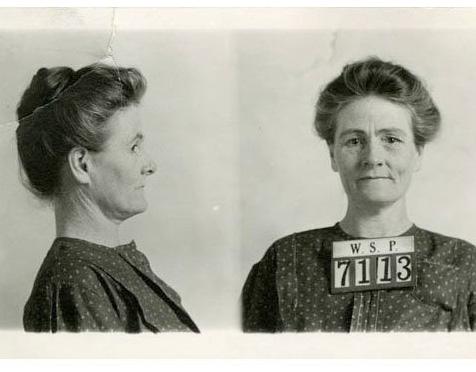
The Dorsal View THE MEDICAL INDEPENDENT | 17 MARCH 2022 40
Nordimet (methotrexate) Solution for injection in pre-filled
Linda Hazzard
Date Of Preparation: Aug 2021 IE/21/NOR/011-00
Photo courtesy of Washington State Archives