|
1
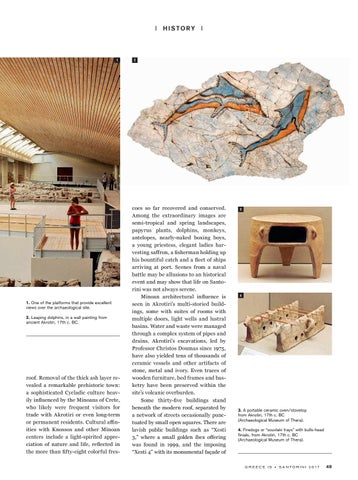
1. One of the platforms that provide excellent views over the archaeological site. 2. Leaping dolphins, in a wall painting from ancient Akrotiri, 17th c. BC.
roof. Removal of the thick ash layer revealed a remarkable prehistoric town: a sophisticated Cycladic culture heavily influenced by the Minoans of Crete, who likely were frequent visitors for trade with Akrotiri or even long-term or permanent residents. Cultural affinities with Knossos and other Minoan centers include a light-spirited appreciation of nature and life, reflected in the more than fifty-eight colorful fres-
HISTORY
|
2
coes so far recovered and conserved. Among the extraordinary images are semi-tropical and spring landscapes, papyrus plants, dolphins, monkeys, antelopes, nearly-naked boxing boys, a young priestess, elegant ladies harvesting saffron, a fisherman holding up his bountiful catch and a fleet of ships arriving at port. Scenes from a naval battle may be allusions to an historical event and may show that life on Santorini was not always serene. Minoan architectural influence is seen in Akrotiri’s multi-storied buildings, some with suites of rooms with multiple doors, light wells and lustral basins. Water and waste were managed through a complex system of pipes and drains. Akrotiri’s excavations, led by Professor Christos Doumas since 1975, have also yielded tens of thousands of ceramic vessels and other artifacts of stone, metal and ivory. Even traces of wooden furniture, bed frames and basketry have been preserved within the site’s volcanic overburden. Some thirty-five buildings stand beneath the modern roof, separated by a network of streets occasionally punctuated by small open squares. There are lavish public buildings such as “Xesti 3,” where a small golden ibex offering was found in 1999, and the imposing “Xesti 4” with its monumental façade of
3
4
3. A portable ceramic oven/stovetop from Akrotiri, 17th c. BC (Archaeological Museum of Thera). 4. Firedogs or “souvlaki trays” with bulls-head finials, from Akrotiri, 17th c. BC (Archaeological Museum of Thera).
G R E E C E IS
•
S A N TO R I N I 2 017
49