Do I look good in this? For smart office apparel, the human touch still trumps technology BY SONIA MENDES PHOTOS BY MARK HOLLERON
I
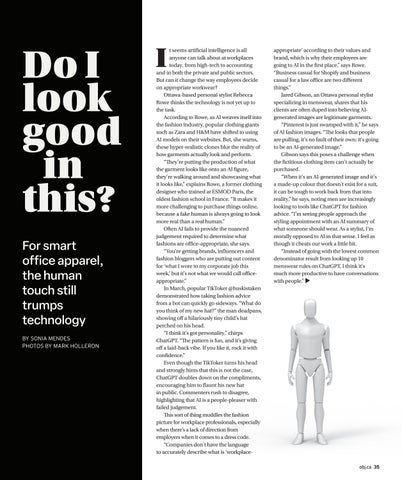
t seems artificial intelligence is all anyone can talk about at workplaces today, from high-tech to accounting and in both the private and public sectors. But can it change the way employees decide on appropriate workwear? Ottawa-based personal stylist Rebecca Rowe thinks the technology is not yet up to the task. According to Rowe, as AI weaves itself into the fashion industry, popular clothing giants such as Zara and H&M have shifted to using AI models on their websites. But, she warns, these hyper-realistic clones blur the reality of how garments actually look and perform. “They’re putting the production of what the garment looks like onto an AI figure, they’re walking around and showcasing what it looks like,” explains Rowe, a former clothing designer who trained at ESMOD Paris, the oldest fashion school in France. “It makes it more challenging to purchase things online, because a fake human is always going to look more real than a real human.” Often AI fails to provide the nuanced judgement required to determine what fashions are office-appropriate, she says. “You're getting brands, influencers and fashion bloggers who are putting out content for ‘what I wore to my corporate job this week,’ but it's not what we would call officeappropriate.” In March, popular TikToker @huskistaken demonstrated how taking fashion advice from a bot can quickly go sideways. “What do you think of my new hat?” the man deadpans, showing off a hilariously tiny child’s hat perched on his head. “I think it’s got personality,” chirps ChatGPT. “The pattern is fun, and it’s giving off a laid-back vibe. If you like it, rock it with confidence.” Even though the TikToker turns his head and strongly hints that this is not the case, ChatGPT doubles down on the compliments, encouraging him to flaunt his new hat in public. Commenters rush to disagree, highlighting that AI is a people-pleaser with failed judgement. This sort of thing muddles the fashion picture for workplace professionals, especially when there’s a lack of direction from employers when it comes to a dress code. “Companies don't have the language to accurately describe what is ‘workplace-
appropriate’ according to their values and brand, which is why their employees are going to AI in the first place,” says Rowe. “Business casual for Shopify and business casual for a law office are two different things.” Jared Gibson, an Ottawa personal stylist specializing in menswear, shares that his clients are often duped into believing AIgenerated images are legitimate garments. “Pinterest is just swamped with it,” he says of AI fashion images. “The looks that people are pulling, it's no fault of their own; it's going to be an AI-generated image.” Gibson says this poses a challenge when the fictitious clothing item can’t actually be purchased. “When it's an AI-generated image and it's a made-up colour that doesn't exist for a suit, it can be tough to work back from that into reality,” he says, noting men are increasingly looking to tools like ChatGPT for fashion advice. “I'm seeing people approach the styling appointment with an AI summary of what someone should wear. As a stylist, I'm morally opposed to AI in that sense. I feel as though it cheats our work a little bit. “Instead of going with the lowest common denominator result from looking up 10 menswear rules on ChatGPT, I think it's much more productive to have conversations with people.” u
obj.ca 35