A GREAT REGION ON A GREAT LAKE
THE EUCLID
MODEL
A CASE STUDY
SHORING UP PUBLIC LAKEFRONT ACCESS AND THE SHORELINE
THE WATERFRONT IMPROVEMENT PLAN SET A NEW TEMPLATE FOR GREAT LAKES DEVELOPMENT
THE EUCLID
A CASE STUDY
SHORING UP PUBLIC LAKEFRONT ACCESS AND THE SHORELINE
THE WATERFRONT IMPROVEMENT PLAN SET A NEW TEMPLATE FOR GREAT LAKES DEVELOPMENT
BY LAURA DEMARCO
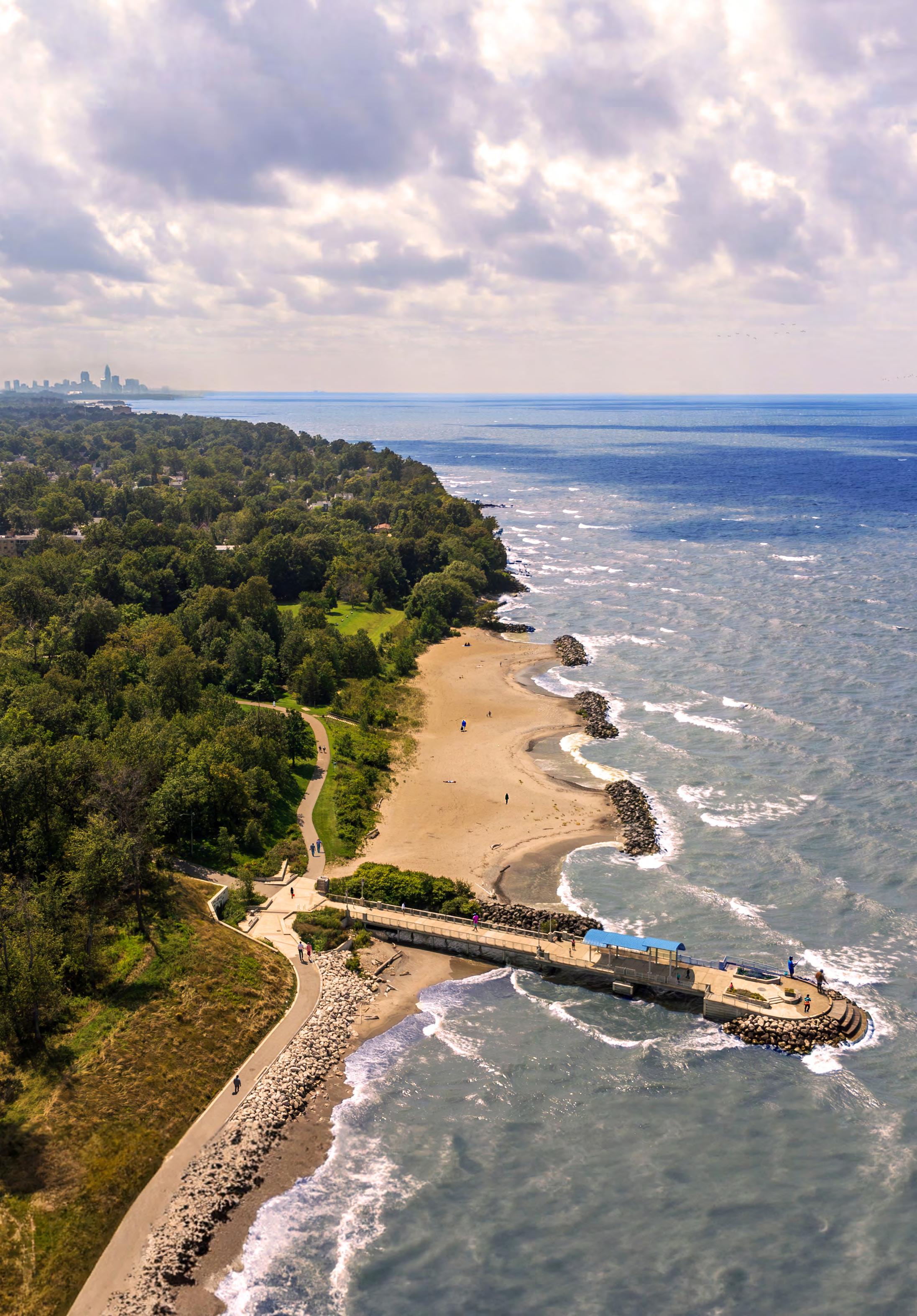
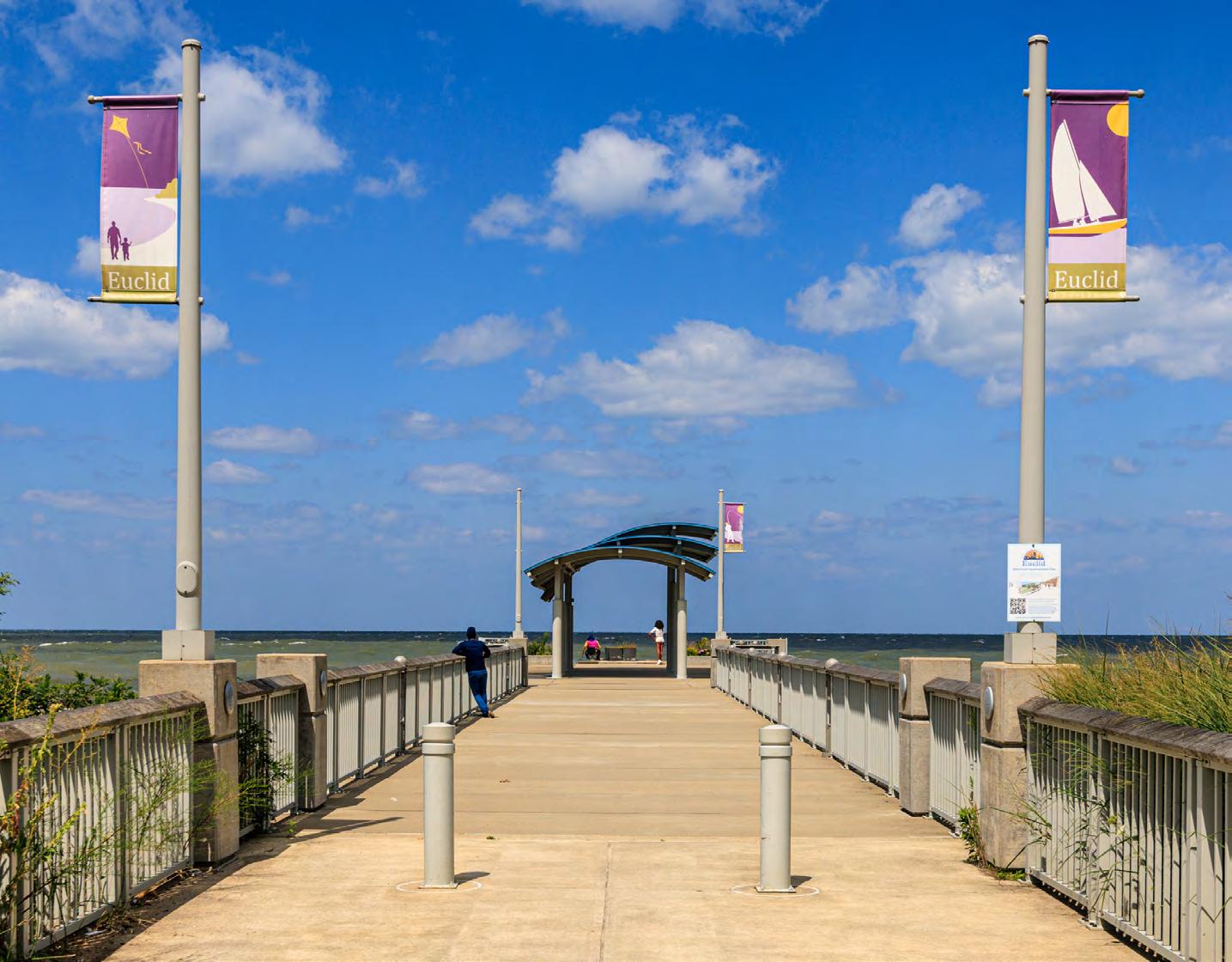
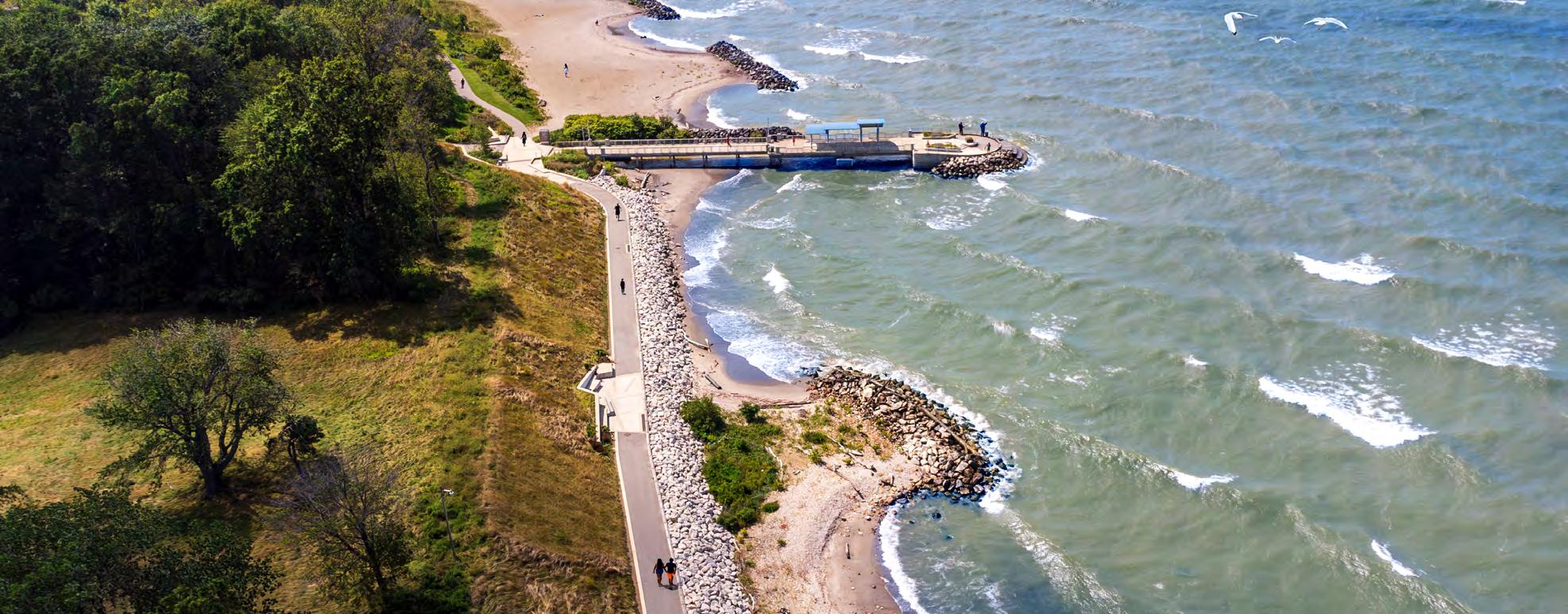
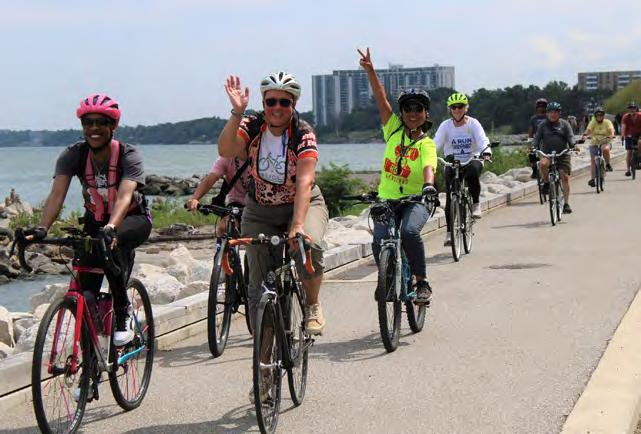
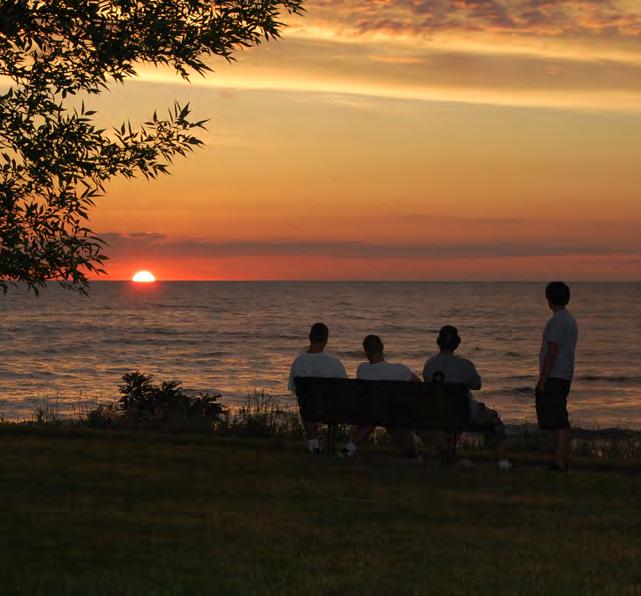
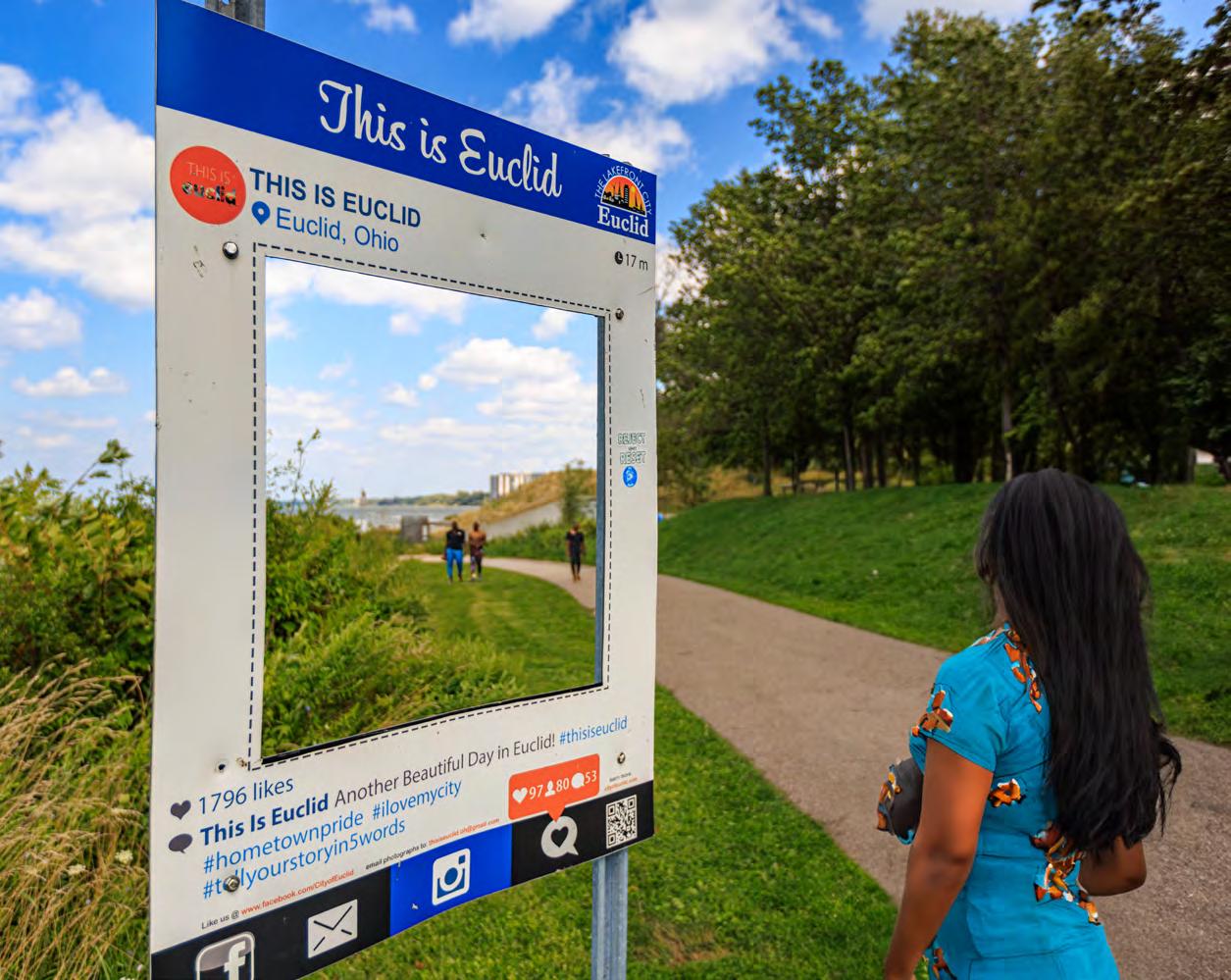
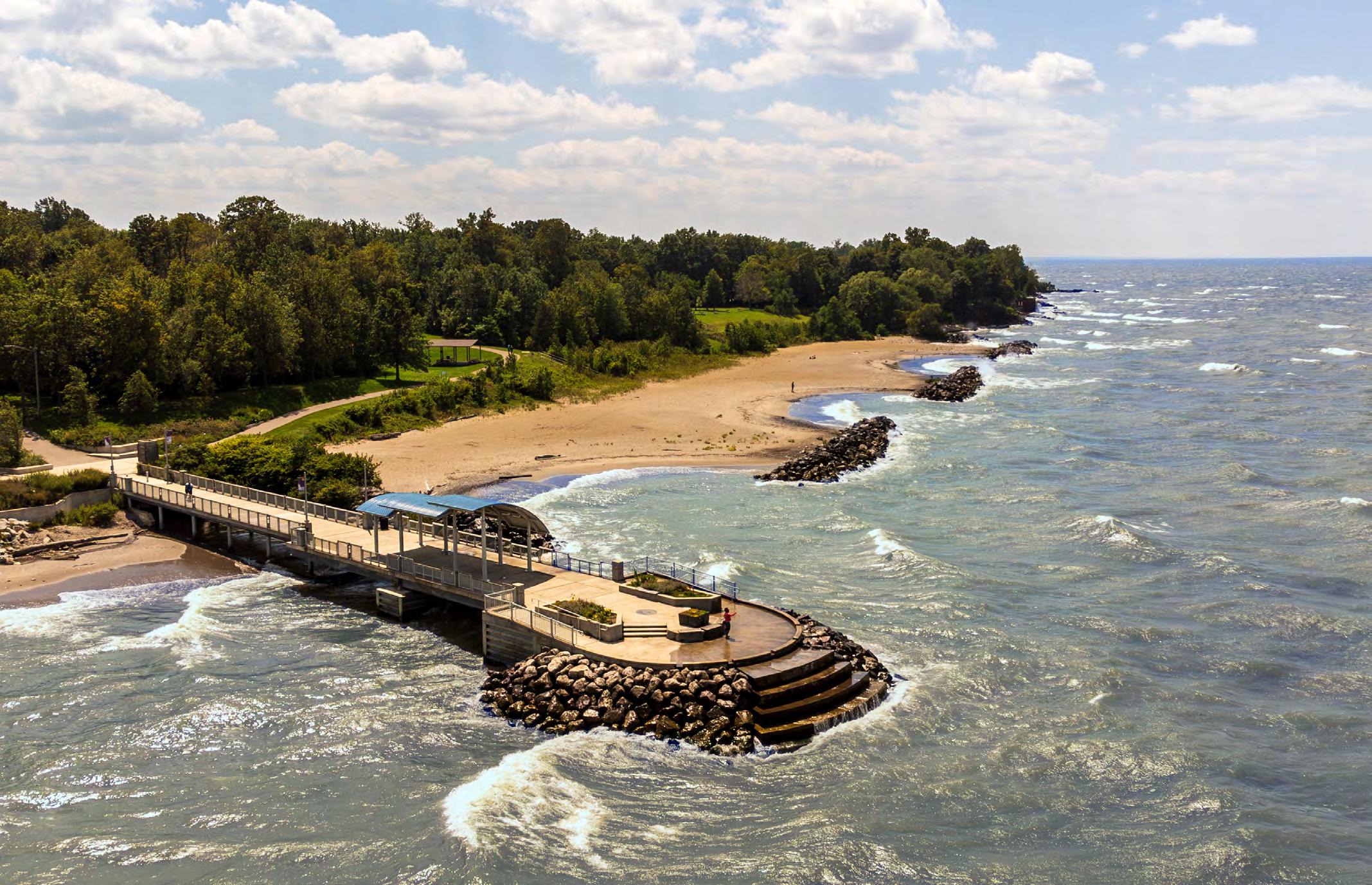
It’s mid-afternoon on a sunny weekday in June, and Sims Park in Euclid is bustling: young kids are running down the lakefront trail, senior citizens sit fishing at the end of the pier, a middle-aged couple is walking hand-in-hand, more kids play on the sand. Young and old and from diverse backgrounds, they are all here, engaging with the lake and beautiful park in an All-American scene that could be straight out of a movie.
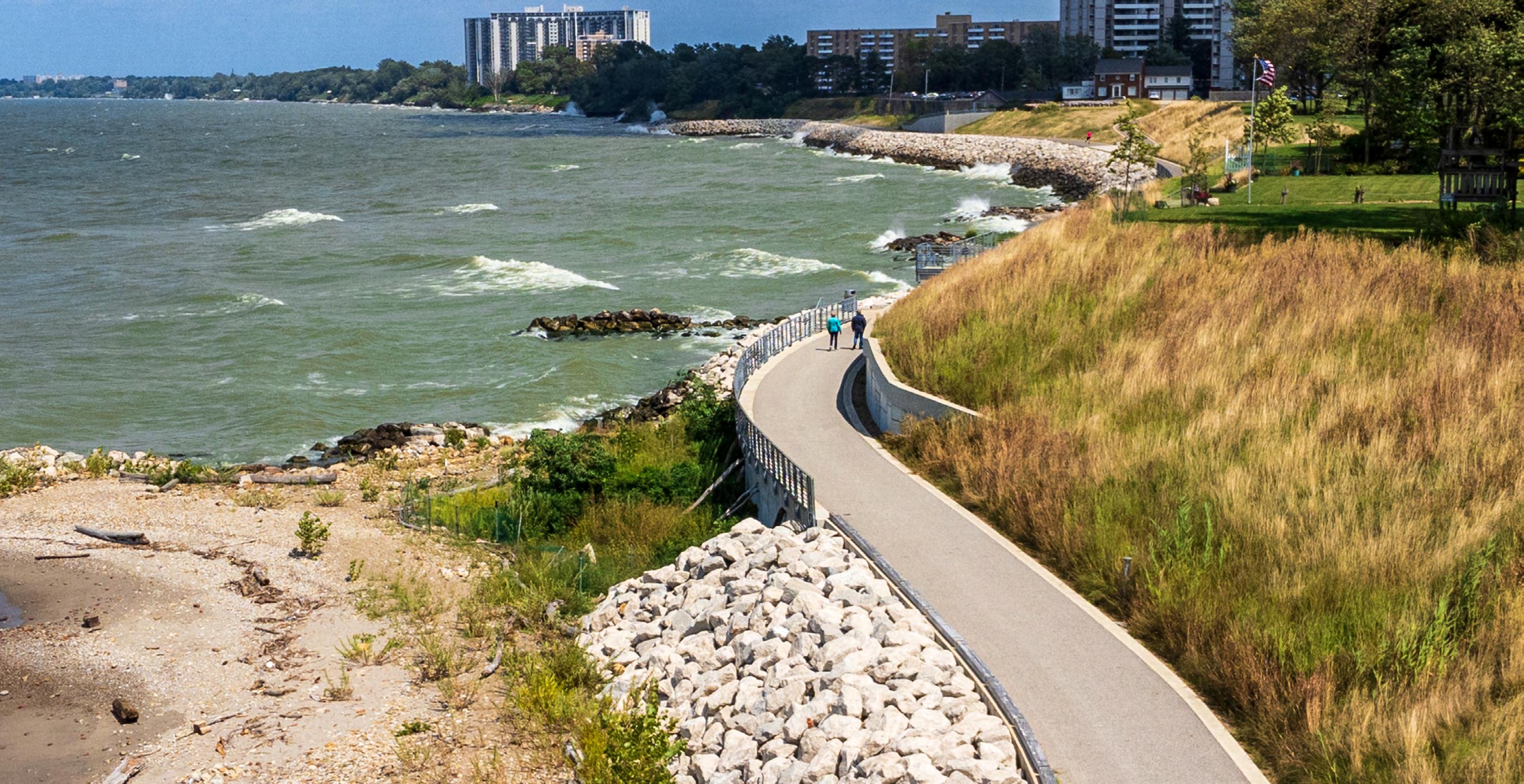
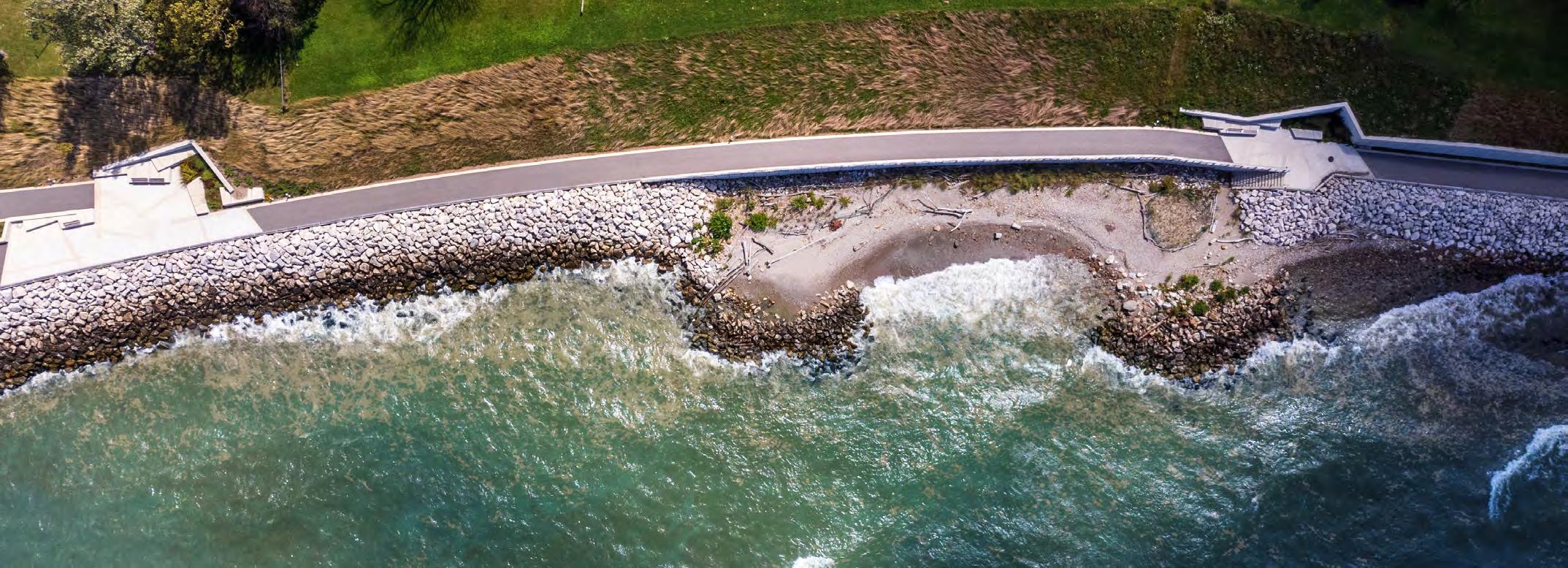
It’s quite a change from 15 years ago when Euclid had little public access to the lake, the trail was private land and erosion was claiming lakefront properties. Thanks to a unique publicprivate partnership, lakefront access has been opened, the eroding land has been stabilized, and the park has brought vibrant new life into the neighborhood –and city.
“I never knew this area was here before,” says an older man named John who is fishing for walleye and catfish. He lives further inland, but makes the drive to Sims Park several times a week. “It’s a great place to fish –and very welcoming.”
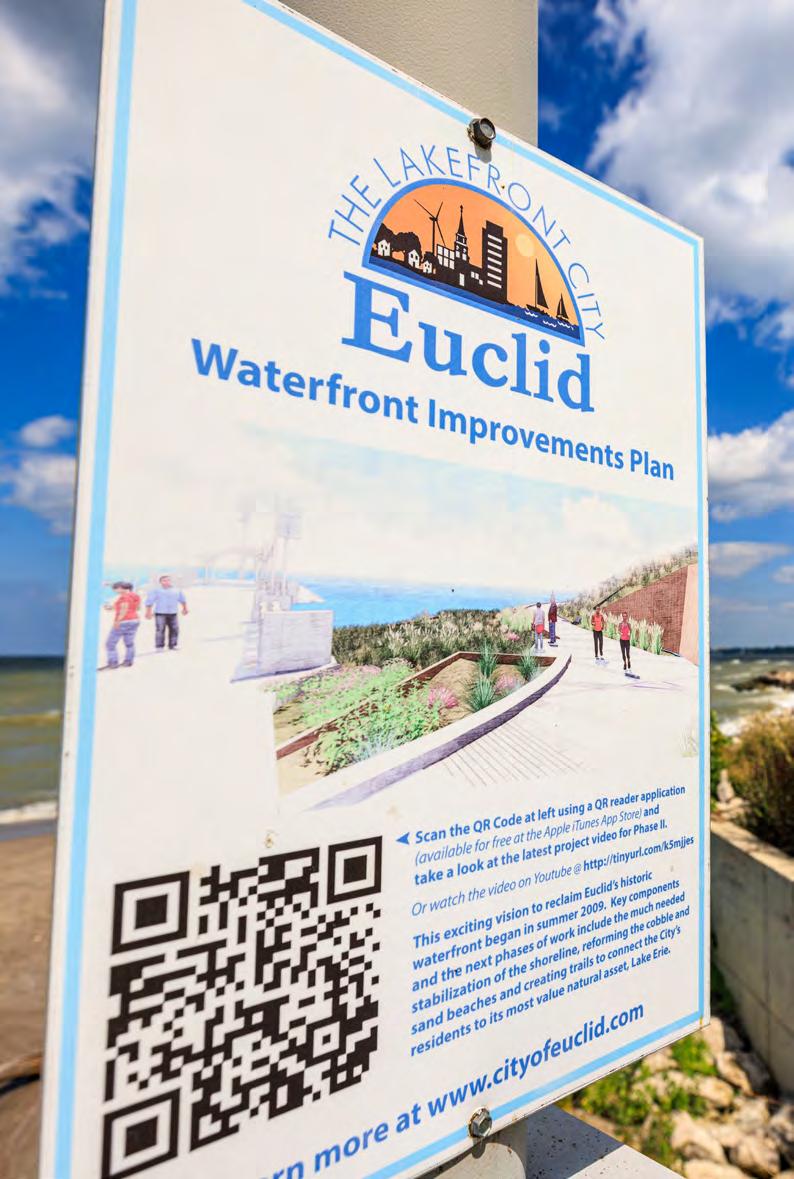
The city announced the $30 million Euclid Waterfront Improvement Plan vision in 2009. Structured in three phases on 30-acre Sims Park in downtown Euclid, the novel vision utilized city, state and federal funding (see chart). In addition, it required buyin from nearly 100 private
stakeholders, who granted easements for public use of their land in exchange for erosion control. The unprecedented, and successful, approach, is now being used as a model for Cuyahoga County’s lakefront access plan, as well as by communities across the country. They call it “The Euclid Model.” In a state with nearly 300 miles of shoreline, and only 20% publicly accessible, it’s revolutionary.
“We as a community had been talking about lakefront development for decades,” says Euclid Mayor Kirsten Holzheimer Gail. “We have nearly five miles of shoreline and we are a large suburb of 50,000 people. Having little access to the lake did not make sense.
“The plan came at a time that was critical in terms of showing reinvestment in an older community, showing that we can do big projects and demonstrating that the community wants to see investment and revitalization. It created a broader renewed sense of pride and optimism for the future.”
In order for the plan to work, private landowners had to be convinced to sign easements that would allow the city to construct and maintain a trail for public use on their land – in exchange for erosion mitigation. Communication was key in getting more than 100 stakeholders to vote in favor of the plan.
“This was a big lift for a community of our size, so it really depended on the [private] partnerships,” notes Mayor Holzheimer Gail.
Convincing people to hand over their land for costly erosion control was easy. Allowing public use of their property was a harder sell. Open and consistent communication was key.
“The community engagement –involving not just the immediate property owners but the community at large – was important so that everybody really felt like they were part of the project, and bought into the
project,” says the Mayor.
“It ended up being 100 different stakeholders that were (directly) impacted by this entire project. That’s not something for which you have one meeting and say, ‘OK, this is how we’re doing it,’” says Charlene Mancuso, Euclid City Council President and a resident of Lake Edge Drive, one of the beach club streets that signed over easement rights.
“It was very important that the community knew what we were doing as we were doing it … People came to meetings because they wanted to hear for themselves and be able to ask questions.”
Eventually, all 100+ stakeholders agreed to the long-term easements.
Joe Martin lives near the shore on Lake Edge Drive, and was president of his street’s HOA at the time.
“We had countless meetings with different people from the city, with developers, with the construction manager and others, and we developed a memorandum of understanding as a first step to signing the easements. Everybody voted – we got unanimous approval – and we moved forward from there.
“Everybody was pretty much on board. The tradeoff was worth it.”
Now that trail construction is complete, the reaction has been almost universally positive.
“We are very pleased with the result,” says Martin. “But the greatest thing about this whole project is that the people – from the Mayor to the Planning Director – were transparent. If we had concerns as either individuals or as an association, they were addressed. And everything came out as envisioned. The trail gets a lot of use by the public, which is a nice thing.”
Erosion mitigation also played a role in helping secure public funding – as did equity.
The state of the shoreline meant that the project was eligible for FEMA pre-mitigation disaster funding. Euclid became the first community in the Great Lakes to successfully access multiple millions of dollars from this federal source for erosion control.
“Equity was a big piece of helping us get funding,” says Mayor Holzheimer Gail. “With FEMA, a big part of our access was because of the erosion happening in front of the highrise apartment buildings, which
house 1400 people who are low-to-moderate income. If the buildings were in jeopardy, it would jeopardize the housing for a number of people.”
Euclid is a majority-minority community, with a median household income of $42,056. Lakefront living and public lakefront access do not usually happen in communities like this.
The project is helping draw newcomers to Euclid, say civic leaders.
himself. Swanson-Sawyer is on the City Planning Commission today, but when the lakefront redevelopment was launched a decade ago, he was a Euclid school kid.
WE ALWAYS HAD THE LAKE, BUT PEOPLE DIDN’T ALWAYS KNOW HOW TO GET THERE OR WHAT WAS THERE.”
TY JUAN SWANSON-SAWYER
“There are definitely people who have moved here because of it. We actually have had people who’ve reached out,” says the Mayor. “One person moved from Arizona. He had family in the region and came across our waterfront project, visited, loved it and bought a condo across the street.
“I’ve heard several people say this is what attracted me back to the City of Euclid. And there are other people who probably are staying because of it. We’ve seen new housing development happen both in that area, and the city in general.”
Ty Juan Swanson-Sawyer says the lakefront development is also helping retain and attract younger residents such as
“Lake access is definitely helping younger people be attracted to Euclid,” he says. “I have heard so many people who don’t even live in Euclid talk about the development and how nice it is and how they bring their kids here. We always had the lake, but people didn’t always know how to get there or what was there. There wasn’t much action, but with the pier and walking path, that has all changed.”
Euclid residents who were not direct stakeholders are also seeing the benefits of the development. Carrie Bennett has lived in Euclid for 18 years, after moving from the west side.
“I just enjoyed a lunch break hour-long walk at Sims Park,” she said on a recent call. “We frequent this park often since the new trail and path has been developed.
“The new development at Sims has led us to walking more along the lake and also in taking the opportunity to take family and friends to the park to visit,” she adds. “The lake is what connects
Euclid, and residents take great pride in having the lake as our ‘backyard.’ It’s awesome to see people out on the new lakefront path and sharing a friendly hello with others. Euclid has had it struggles, no doubt, but I think the attention to our beautiful lakefront is a selling point. Euclid had a unique opportunity to gather up that much lakefront property along the lake, which is a huge benefit to the community. ” The project is also benefiting the business community.
“We had been starting to see disinvestment,” says Mayor Holzheimer Gail. “[Due to the waterfront development] there are new businesses in downtown and new investment and excitement because people see the project as a demonstration of investment in the future, the revitalization of Euclid and the sense that it is a vibrant community.”
Dana Heil, Executive Director of the Euclid Chamber of Commerce, agrees.
“The collaborative nature of the waterfront project demonstrates the amazing possibilities that surface when a community comes together to complete a project that truly does serve the common good.”
“From a business perspective, the additional foot traffic in the downtown area will certainly translate into increased business, especially for local restaurants
and bars. The lake is one of our most unique assets and Euclid is small enough geographically that you can visit a restaurant on E. 185th Street, E. 222nd Street or Babbitt Road and be on the waterfront trail in 10 minutes. You can stop at the Lakeshore Coffee House downtown and grab a coffee or an ice cream cone to enjoy on your walk to the lake.”
Business growth near the lake
facilities and opening a taproom in a formerly vacant warehouse on Babbitt Road.
Research supports the benefits of building an appealing community –and suggests Ohio should do more.
A 2022 Brookings report noted that “Improving quality of life—not just business—is the best path to Midwestern rejuvenation,” stating “ …there is compelling new data that these traditional economic
is apparent. Two new locations have opened directly across the street from Sims Park – a local franchise of Pulp Juice & Smoothie Bar and Wing Stop. Upscale, locally-owned eatery Tupelo Honey also recently opened, on East 222nd Street.
City-wide, Euclid is also seeing additional growth in the industrial and manufacturing corridor, including Weston purchasing and demolishing the former GE Tungsten plant as well as other business expansions. Collision Bend Brewery is expanding its production
development tools may be ineffective compared to investments in quality of life and place. …Many of the towns with higher estimated quality of life are places with natural amenities, such as lakes or mountains. … across the nation, natural amenities are associated with higher growth. Yet there are some areas, including in the industrial Midwest, where natural amenities exist but have not been leveraged.”
“Right now, we have the incomparable opportunity, alignment, tenacity and expertise to center our region towards the lake
and to do so with a priority for public space and public access,” says Allison Lukacsy-Love, former Planning and Development Director for the City of Euclid who now serves as the Managing Director of Major Projects at the Greater Cleveland Partnership.
“This is our moment to embrace Lake Erie for an equitable, resilient and vibrant future that will appeal to the next generation of talent. Public spaces are unique equalizers, they attract people from different economic, racial and ethnic backgrounds and foster interaction and connection with each other and nature. We need more of these intentionally designed, welcoming spaces across our community and especially around our waterfronts. Fortunately, there is precedent for getting the work done with ‘The Euclid Model’.”
Other municipalities and regions have begun to take note of the success of The Euclid Waterfront Improvement Plan. Notably, Cuyahoga County, which has used the model as inspiration for its Lakefront Public Access Plan.
“We looked to Euclid as a model because we knew that they had the expertise in working with private property owners. SmithGroup [a design firm with a newly opened Cleveland office] brought an ‘A-Team’ together with landscape architects and coastal engineers to round out the team at the City of Euclid and to again work with us at the County,” says Trevor F. Hunt, Senior Project Manager, Cuyahoga County Lakefront Projects.
“We kept ‘The Euclid Model’ in mind as a great place to start as we expand public access across the County. We do need to tweak it in some ways because circumstances and opportunities across the county shoreline are different.”
The work in Euclid is not over.
Phase III of the plan, the construction of Senator Yuko Park on 5.5 acres of lakefront property at Lakeshore Boulevard and E. 247th Street, will begin later this year.
“For more than a century, there has been no shortage of planning to better connect community to our region’s greatest natural resource, Lake Erie. Better connectivity to the lakefront is critical to the success of any future public/private development, be it lakefront greenspace or vertical investment, as evidenced in the City of Euclid,” says LukacsyLove.
“Understanding and undoing the physical and social barriers that have historically prevented people from accessing the lakefront will absolutely unlock Cleveland’s potential to become a great region on a Great Lake.”
This case study, designed and curated by Greater Cleveland Partnership and our partners, is the second study in a series about the transformational impact of public-private partnerships in and around Cleveland’s waterfront.
This feature is the second case study in a series on the transformational impact of public-private partnerships in and around Cleveland’s waterfronts. Long-term commitments and engagement are essential to the success of these complex visions. We look forward to sharing other stories of redevelopment and growth in upcoming chapters that will include:
- Vision for the Valley and Bedrock’s Cuyahoga Riverfront
- CHEERS! (Cleveland Harbor Eastern Embayment Resilience Study)
- North Coast Master Plan