Last week, staff and community members gathered to celebrate a beam-signing milestone at Tri-County Mennonite Homes (TCMH) in New Hamburg. Wilmot Township Mayor Natasha
Salonen was the first to sign and addressed staff and the community, noting her support for continued growth across Wilmot.
“This vision serves our community and continues to grow as part of our community,” she said. “When I drive down
Arnold Street, I’m always excited to see this vision come to life.”
The facility promises high-quality, compassionate care for the community’s elders and represents a commitment to dignity and family proximity.
“Today is one of those moments where
This winter’s snow, wind and cold temperatures haven’t been seen in years, and according to an area meteorologist, predicting approaching weather systems is proving to be a challenge.
Julie Atchison has kept CTV London viewers up to date on the weather for a dozen years, and the first question the Gazette asked her was whether last week’s heavy snow sneaked up on her and other forecasters.
“It’s funny you should ask that because I said to my boss last week there is this sneaky, low pressure that’s coming in and it didn’t show up until the afternoon.”
Atchison said she was reviewing the forecast model in the morning. Initially, an Arctic cold front was expected to pass through, accompanied by some lake-effect snow, resulting in more localized snowfall amounts. Then, something changed.
“At about 1 p.m. I was looking at some forecast models and mine here in the weather centre started reading 30 centimetres. I was
Wilmot Township Mayor Natasha Salonen, Tri-County Mennonite Homes board members, staff, construction crew members and TCMH CEO Steven Harrison pose in front of the signed beam during a milestone event in New Hamburg.
(AMANDA NELSON PHOTO)
AMANDA NELSON Gazette Reporter
Community gathers to mark construction milestone at Tri-County Mennonite Homes
you pause and look around and feel both a sense of pride and gratitude,” said Steven Harrison, TCMH CEO. “Not long ago, this was a vision — conversations around tables, sketches on paper, hopes being shared by family, staff and community members who knew you could do better for those in our community.”
TCMH received approval to construct one year ago, on Jan. 20, 2025. Once approval to construct was in place, the tender was awarded to Melloul-Blamey of Waterloo, and construction began in
February 2025.
“The speed of this progress matters,” said Harrison. “It speaks to the urgency, it speaks to the commitment and it speaks to a shared understanding of the need for compassionate, high-quality, long-term care in our community.”
The new space will create 63 more beds to better serve elders in the community and increase long-term care capacity in the area.
Each resident floor is called a resident home area (RHA). Each RHA will have 32
beds, a lounge, dining room, servery, nursing station, care room and a harvest room, a multi-use room for activities or expanded dining space.
The main floor of the building will be dedicated to service spaces such as offices, the kitchen, laundry, maintenance and receiving. The main floor will also include reception and common spaces such as the café and the spiritual room, similar to a chapel.
The grounds at the back of the building will overlook the Nith River and will
include a seating area, a garden and accessible pathways for residents and families to enjoy. The pathways will connect to future pathways on the river flats.
“Now that we’ve signed this beam, we are leaving our mark, not just on a piece of steel, but on the future,” said Harrison. “Long after construction crews are gone, the dust has settled and residents have moved in, this beam will quietly support moments of care, comfort and laughter.”
Those interested in making a donation can visit www.newnithview.ca/donate.
Wellesley’s Mary Lichty-Neeb to be presented with Len and Ida Patterson Memorial Award
GARY WEST
Wellesley’s Mary Lichty-Neeb has been named the recipient of the 2026 Len and Ida Patterson Memorial Award, recognizing her many decades of dedication to agricultural fairs and volunteer service across Ontario.
Lichty-Neeb serves as secretary-treasurer of the Wellesley-North Easthope Agricultural Society and has long been a driving force behind the success of the Wellesley-North Easthope Fall Fair.
The Len and Ida Patterson Memorial Award is presented to a secretary, treasurer, dedicated fair volunteer or individual
who has worked tirelessly at the district level within the Ontario Association of Agricultural Societies (OAAS). The award is open to members across Ontario, making Lichty-Neeb’s selection a notable honour among her peers. She will be formally recognized at the annual OAAS convention this February.
Sponsored by Paul Nother of Encore Promotional Products and Nother Awards, the award is presented in memory of Len and Ida Patterson. Lichty-Neeb said she is deeply grateful for the many congratulatory messages she has received since the announcement and credits the fair community for its continued encouragement and support.
As a longtime participant in the Wellesley Township Fall Fair, a member of District 7 within OAAS, and a former OAAS board member, Lichty-Neeb said she has had the privilege of meeting many remarkable people over the years, many of whom have become close friends. When asked why she devotes so much time and energy to organizing a fair that runs just a day and a half, her answer is simple.
“It’s the joy in the eyes of the children at the fair,” she said, pointing to youngsters proudly showing parents and grandparents their ribbons and stickers, the excitement of the midway and inflatables, and the hands-on fun of livestock shows, and corn and bean bins filled with toys. She believes
considering
Let’s talk about
these experiences play an important role in teaching young people about agriculture and food.
Lichty-Neeb added that fair season shapes much of her family’s calendar.
“If you ask my husband, Richard, about plans for spring, summer and fall weekends, they revolve around which fair is happening,” she said, noting that visiting other fairs is both enjoyable and a valuable way to see new ideas and approaches.
Lichty-Neeb extended her thanks to fellow fair board volunteers Wendy, Joanne, Susan and Barb for their continued support and for standing behind her nomination for the award.
Gazette Correspondent
Rapidly changing winter weather disrupts roads, services and travel
like, what is happening. Within an hour, there were snowfall warnings and everything just went like gangbusters. Things changed and escalated quickly as the day went on.”
She explained forecast models are always ingesting new data and information and a lot can change in a short period of time.
“We could see a wind shift and that could change how a snowsquall develops. We are surrounded by the Great Lakes and you can’t imagine how difficult it is to forecast because of them. It’s a difficult question to answer; why a system like that would develop so quickly.”
Atchison added that when a system tracks farther south, snowfall amounts tend to be lower. However, a northward shift over the Great Lakes can bring a mix of rain and snow due to warmer water temperatures. Looking ahead to this weekend and beyond, a deep freeze is expected with temperatures well below normal.
“We are going to see a big ridge develop in the atmosphere along the Pacific coast and a huge dip in the Jet Stream over the Great Lakes. This allows the Polar Vortex to sink south, and when that happens, a cold wave of air comes in, bringing bitterly cold air.”
The Great Lakes are currently open, but Atchison explained the frigid temperatures could change that in a hurry, something that could play a role in the extended forecast.
“When frozen, the lakes can’t moderate temperatures which is why the air is colder towards the Ottawa area and Eastern Ontario. In the extended forecast through Feb. 2, we’re seeing temperatures staying below seasonal norms. The deep freeze is officially here.”
Environment and Climate Change Canada say windchill values could range from -16°C to -30°C over the next few days. Cold temperatures elevate the risk of cold-related injuries like frostbite and hypothermia. Cold weather can also worsen existing health conditions among the homeless, older adults, infants and children.
Area municipalities have been busy dealing with last week’s storm and another blast of winter this week. On Jan. 20, Oxford County put out a statement warning people of changing conditions.
“Environment Canada has issued a Yellow snow squall watch for the county with the potential for blowing snow and more flurries this afternoon. The rapidly falling temperatures have resulted in icy conditions on our roadways. Wind gusts this afternoon could reach 50 to 70 km/ hr. Please remember to drive according to the weather conditions and always be prepared for possible power outages.”
The county also reminded motorists to turn on full lights to make sure they can
see and be seen.
“Give yourself extra time to get where you are going, ensure your vehicle is clear of snow and always carry a vehicle emergency kit. Each kit should include basic tools along with warm blankets and clothes in case you get stranded,” it added.
The Township of Wilmot declared a snow event at 2 p.m. on Jan. 15.
“All on-street parking is prohibited during a snow event to allow plows to clear roads safely and efficiently. Vehicles parked on the street during the snow event may be ticketed and/or towed,” the township wrote in an alert posted on the municipality’s social media.
On Jan. 15, Oxford County closed its libraries in Tavistock, Brownsville, Ingersoll, Innerkip, Thamesford and Tillsonburg and cancelled Ox on the Run stops. Garbage and recycling pickup was also delayed in some areas, including the north portion of East-Zorra Tavistock. Crews were out on Saturday instead of Friday.
Perth County declared a Significant Weather Event on Monday afternoon due to challenging weather conditions.
“The region is currently under an Orange-level Blizzard Warning with strong westerly winds gusting to 80 km/hr. Blowing snow is causing near zero visibility in areas of the county road network,” a port to the county’s Facebook page said.
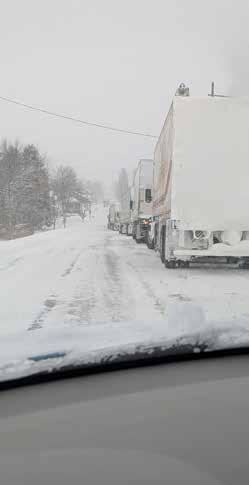
Several transport trucks were lined up on County Road 59 between Shakespeare and Tavistock last Thursday as another wintery blast created havoc on area roads.
(PHOTO COURTESY OF PEOPLE OF TAVISTOCK FACEBOOK GROUP)
Costing likely to be included in mayor’s 2026 budget
LEE GRIFFI Local Journalism Initiative Reporter
After two years of meetings and public consultations, East Zorra-Tavistock’s (EZT) recreation advisory committee (RAC) has put forward a motion to council which includes budget dollars.
Among the eight recommendations the committee is submitting for council’s consideration during the 2026 budget deliberations is a communication strategy for recreation. EZT does not currently have any communication professionals on staff or under contract, so what happens with that portion of the motion remains to be seen.
In terms of actual recreation options for residents, the committee is recommending maker classes, drop-in exercise classes, outdoor movie nights and drop-in sports education courses. The committee is also asking for $5,000 for programming start-up costs and a cost-recovery model for anything outside of those costs. The committee is also asking for consideration to be given to evening and weekend programming.
Committee member Meaghan Lichti said communication with residents will be key should council approve the motion.
“We found there are quite a few programs (currently), but a lot of the feedback is people don’t know about them. We talked about a few different ways for people to access information. A key one is using social media more effectively, a dedicated
recreation page on the (EZT) website and a recreation newsletter that could be sent out either four or six times a year.”
Lichti said, ideally, residents would be able to subscribe and unsubscribe to a digital newsletter. She added there are benefits to working with community partners like public libraries for maker classes, such as pottery and painting.
“Libraries generally are more than willing to provide programming if they know what the community is interested in. We also thought it could potentially be a partnership with the library and township to offer township spaces bigger than the library, such as the Memorial Hall for the kitchen or the upper hall at the arena, which has a kitchen.”
She also mentioned teaming up with schools to offer basketball and volleyball programs, along with the use of an app for people to sign up for activities. Evening yoga classes and pickleball are also priorities should the township go ahead with the committee’s plan.
“We know there are quite a few pickleball offerings in Tavistock, but they really aren’t accessible for adults. The majority of people on the survey who want it are between the ages of 35 and 64, so we are assuming they are working. We thought an evening drop-in pickleball would be a good addition,” added Lichti, who also advised the township to get a communications plan implemented before offering any recreation options.
The Wilmot-Tavistock Gazette
Publisher
Stewart Grant • stew@granthaven.com
Editor
Galen Simmons • galen@granthaven.com
EZT/Oxford Reporter
Lee Griffi • leegriffi@rogers.com
Wilmot/Wellesley Reporter
Amanda Nelson • amandajanewriter@gmail.com
Graphic Design / Sales Inquiries
Erin Parsons • thewtgazette@gmail.com
Business Development
Heather Dunbar • heather@granthaven.com
Billing Administrator
Cindy Boakes • boakescindy1576@gmail.com
Administrative Assistant
Wendy Lamond • wendylamond74@gmail.com
Contributors
Gary West, Diane Danen, Mercedes Kay Gold, Julia Paul
36 Water St. St. Marys, ON, PO Box 2310 N4X 1A2 thewtgazette@gmail com | 519.655 2341 | granthaven com
Committee chair and Hickson resident Kyle Smith said it feels good to have another round of recommendations heading to council for consideration, and he’s proud of the committee’s work over the past year.
“As you can tell from the meeting, the group was very aligned with what they feel are the best options for recommendations,” he said.
Smith said members believe council will get behind the recommendations, but also respect whatever decisions are made.
“Council has shown a very keen interest in moving forward with recreation programming on the agenda, so we have every belief we would meet very little resistance. Ultimately, our responsibility for programming ends with our recommendations in terms of implementing recreation activities.”
The current committee’s mandate comes to an end once a new council is elected in the fall.
“The next committee would have the ability to make sure the plans move forward,” added Smith, who hopes some new faces will come forward as committee members.
“Speaking from my own experience, I would encourage anyone who may have some interest in the future of recreation in the township to apply when the time comes. I also want to say a thank you from
the committee to the staff who have been tremendous with their time and efforts in helping us achieve our goals.”
Some of the options are expected to have user fees, particularly if a facilitator needs to be hired for something like a cooking class.
“The $5,000 is a start-up cost to get us advertised, to solicit partnerships. That (money) is to get programming up and running and the programs themselves will look at a cost-recovery (model), so recovering the cost of the facilitator or renting the Thames Valley (District School Board) gym or something,” said township CAO Karen DePrest.
She added the current township facility allows for free use of facilities from Monday to Friday, as long as admission isn’t being charged and it's open to the public.
“I understand that right now there aren’t evening opportunities, but that’s probably because those facilities aren’t available for free in the evenings, so people aren’t organizing drop-in activities at night,” she added.
The motion came to council at Wednesday night’s meeting and next week’s Gazette will have a full report on the outcome. The next RAC meeting is scheduled for Wednesday, April 8, at 7 p.m. Among the agenda items will be a debrief on council’s decision.
Assistive technologies helping WRDSB students learn with confidence at school and at home
GALEN SIMMONS
Local Journalism Initiative Reporter
A growing range of assistive technologies available through the Waterloo Region District School Board (WRDSB) is helping students across the region strengthen reading, writing, organization and study skills, while giving families practical ways to support learning at home.
Designed to remove barriers and build independence, assistive technologies are digital tools that help students better access the curriculum and demonstrate what they know. While often associated with individual education plans, many of the tools promoted by the WRDSB can benefit a wide range of learners, regardless of ability or learning style.
“These technologies give families practical tools they can use at home,” said WRDSB communications officer Estefanía Brandenstein. “Parents and caregivers can help their children review classwork, practice skills, complete assignments more
efficiently, or explore additional learning opportunities. When used at home, these tools support task completion and help build a child’s confidence in their ability to demonstrate learning in the classroom.”
The board has been expanding its focus on assistive technology since 2021, aligning with its strategic plan to strengthen student engagement and success by working closely with families. The school board’s assistive technology team also collaborates with teachers to integrate these tools into everyday classroom learning, ensuring students encounter consistent supports at school and at home.
The technologies themselves cover a wide range of learning needs. Text-tospeech tools allow students to hear written material read aloud, supporting comprehension and reducing fatigue for struggling readers. Speech-to-text tools help students turn spoken ideas into written work, easing the challenge of writing for those who think more clearly out loud. Highlighting, vocabulary builders and
digital note-collection tools help students organize information and focus on key ideas when studying or researching.
Organization and planning tools are another major focus. Digital supports such as task lists, reminders and note-keeping apps help students manage assignments, prepare for tests and break large projects into manageable steps. These tools can be especially helpful for students who feel overwhelmed by deadlines or who struggle with time management.
“These technologies can support learning across all subject areas,” Brandenstein said. “They are particularly effective for reading, writing, studying, organization and test preparation, but because they’re flexible and customizable, they can be adapted to different subjects, grade levels and learning styles.”
To help families better understand what’s available, the WRDSB assistive technology team has been offering a series of short online learning sessions throughout January, aimed at families with children in
grades seven to 12. While the sessions are optional, the board encourages families to explore the tools whether or not they attend.
The final session in the current series, focused on planning and organization tools such as Google Tasks and Google Keep, will take place on Monday, Jan. 26, from 12:30-1 p.m. No registration is required and details are available through the WRDSB website.
A similar three-part series is planned for February for families with children in grades four to eight.
“The board recognizes that when parents, caregivers, educators and students work together, learning is strengthened both at school and at home,” Brandenstein said. “We’ll continue offering opportunities like this throughout the school year.”
More information about assistive technologies and upcoming learning sessions can be found at wrdsb.ca or through the board’s social media channels.
Louis takes part in meeting with dairy industry officials with CUSMA top of mind
Tensions high over future or free trade deal with the US
LEE GRIFFI
Local Journalism Initiative Reporter
Kitchener-Conestoga MP Tim Louis recently attended a high-level huddle with federal government officials and leading dairy industry players.
The meeting came as U.S. President Donald Trump continues to push against Canada’s dairy industry and its quota system. Louis said it was part of the preparation for a review of the Canada-United States-Mexico Agreement (CUSMA).
“It’s important to make sure the government and industries are all speaking with one voice. There are round table discussions around the country and I attended a recent national dairy round table in Montreal,” Louis said.
Louis, the parliamentary secretary responsible for Canada-U.S. trade, was joined by his minister, Dominic LeBlanc, outgoing U.S. Ambassador Kirsten Hillman, other government officials and representatives from the dairy processing and production sectors.
“It was an important conversation. At a high level, we talked about protecting our food sovereignty, protecting Canadian farmers, supply management and protecting rural economies,” he said.
While Louis could not go into detail about the discussions, Trump has been clear in his opposition to Canada’s system and his desire for greater access for American dairy products in Canada.
“It is a concern. I can’t negotiate everything in public with you, but what we
are looking for is that solidarity between all levels of government and those in the dairy industry. We want to make sure we are speaking as one voice,” Louis said.
Canada’s dairy supply management system is a policy framework designed to match domestic dairy production with Canadian demand, while ensuring stable incomes for farmers and predictable prices for consumers.
Canadian dairy farmers operate under a quota system that limits production and is adjusted nationally to match domestic demand. Farmgate prices are set based on production costs, while limited imports are allowed through tariff rate quotas under trade agreements like CUSMA.
Louis said uncertainty when it comes to actions south of the border is the number one word on his government’s mind as Canada prepares for a scheduled review of CUSMA, something Trump has said isn’t on his mind.
“It’s not a renegotiation. The agreement was signed in 2020, requiring Canada, the U.S. and Mexico to review how things were working. The review doesn’t mean we are reopening it or trading away concessions. Our government has made it clear supply management is not on the table.”
The MP said while he has some experience with the dairy industry, he is working hard to do what’s best for the dairy and other agricultural industries, learning as he goes.
“I was first elected in 2019, and I was on the House of Commons Agriculture
Committee. That helped me learn how to protect our farmers and programs like supply management.”
Louis said the government is committed to protecting Canada’s economic interests throughout the negotiations.
“Our objective is clear. Securing the best possible deal for Canada – one that provides certainty for Canadian workers, businesses and investors while protecting our unique Canadian advantage. These discussions help ensure farmers’ voices are reflected in decisions that protect our farmers, strengthen the industry and keep Canadian dairy strong.”
CUSMA allows most goods to move between the three countries tariff-free, sets rules for labour standards, environmental protections and intellectual property, and includes updated provisions for digital trade.
Louis and all other members of parliament are heading back to Ottawa as the House of Commons begins sitting for its winter session on Monday. He added his time away from the nation’s capital has been full of stakeholder meetings.
“It’s an everyday responsibility,” he said. “From housing and transportation to global events, local projects, and health care, I need to hear from everyone. When I’m in Ottawa, my job is to be the voice of Kitchener-Conestoga and bring those concerns forward.”
When asked if he has seen the level of uncertainty in politics, mainly due to American influence, Louis admitted these are difficult times.
“I was elected a few months before a global pandemic and there was a level of uncertainty there. This uncertainty exists in every meeting and every conversation I have. But what I am also seeing is Canadians seem to be more united than they were in the past.”
He added he is confident people of all political stripes can come together to address the issues of the day.
“The meetings I am having are more challenging and that uncertainty is in every conversation. That’s the nicest way I can say it in print.”
Kitchener-Conestoga MP Tim Louis (TIMLOUISMP.CA PHOTO)
Ukrainian artist Viktoriia Makarova connects with community through art
Viktoriia Makarova is a Ukrainian artist who now calls New Hamburg home along with her 18-month-old daughter, Eva, and her mother, Olha Polusmiak. The three came to Canada seeking safety from the ongoing war in Ukraine.
When war broke out in February 2022, Makarova’s hometown of Kherson was among the first to fall under occupation. After living in fear for months, they were finally forced to flee. Makarova and her mother initially went to Poland. They attempted to apply for a Canadian visa but were told their application was unlikely to succeed. With few options left, they travelled to Germany and spent several months living in a refugee camp. While in Germany, Makarova checked her visa status and discovered it had been approved.
Upon arriving in Canada, Makarova and her mother stayed in a hotel for two weeks made possible through a Canadian government program. With only four days left and no permanent housing secured, she reached out to Grassroots Response to the Ukrainian Crisis as a last hope.
A Grassroots volunteer soon connected Makarova and her mother with a family in Hespeler. She describes them as “a wonderful family.”
“We lived with them for eight months,” she said. “They helped us settle, were there when my little daughter, Eva, was born, and supported us in everything. I will never forget their care and kindness.”
Makarova's mother suffered a stroke, which meant the family needed to find housing with everything on one level to support her recovery. With the continued support of Grassroots Ukrainian Response, Makarova and her family have settled in the New Hamburg Guest House, a space that meets their needs and offers Makarova a place to continue her artistic work and give back to the organization and her new community.
Makarova is a talented artist and designer who graduated from the National AcadeArts in Ukraine. Her artwork features vibrant colours and detailed patterns inspired by her Ukrainian heritage. The Guest House includes a space at the back of the house perfect for an art studio that Makarova now uses to lead creative workshops for church groups, community members and local organizations. These workshops give her a chance to share her culture and her artistic abilities while connecting with her new community.
In Ukraine, Makarova occasionally led art workshops for youth and is looking forward to working with young people in Canada as well. She says children aged
10-12 are especially well suited for art workshops because they are open to ideas and not afraid to try new things. These sessions are a great fit for birthday parties, church groups and community organizations, offering a fun and encouraging way for young artists to discover and develop their creative talents.
The end of January is shaping up to be a busy and exciting time for Makarova.
On Jan. 27, she will lead a free art workshop, the second offered in a series at the Ukrainian Cultural Hub in New Hamburg. The workshop runs from 5-7:30 p.m. and invites participants of all skill levels to explore traditional Ukrainian art styles. Makarova provides all materials and
guidance, creating a welcoming space filled with creativity, conversation and cultural connection
Once again, Makarova has been invited to take part in The Brush Off, a live art competition held at THEMUSEUM in Kitchener on Jan. 31. During the event, artists create paintings live as guests watch, vote for their favourite artwork and participate in a silent auction. Proceeds from the competition support THEMUSEUM.
This is not Makarova’s first time participating in public art events. In Ukraine, she took part in many group exhibitions in Kherson. Since coming to Canada, she has competed in ArtBattle in Toronto and The Brush Off in Kitchener in 2025, and her work has been shown in St. Jacobs and at a Ukrainian Canadian Congress exhibition in Toronto. Her artwork is currently on display at the Ukrainian Cultural Hub in New Hamburg.
Makarova also gives back by volunteering with Grassroots Ukrainian Response’s Healing Art program. This program offers women creative art sessions designed to support emotional healing, build resilience and foster a sense of belonging. Sessions are held in person in Waterloo every Friday.
As a Ukrainian newcomer, Makarova is thankful to have a home where her daughter can grow up in peace. For Makarova and her family, Canada is not just a place to live, but a place of hope. Through her art, teaching and volunteer work, she continues to build a new life in Canada while sharing her culture and creativity with the community she now proudly calls home. Anyone interested in participating in her upcoming workshop or arranging a workshop for friends or community organizations can contact Olga Strasburger of Grassroots Response to the Ukrainian Crisis at 519-778-6401 or marketing@ grassrootsresponse.ca. More information about Grassroots Response can be found on its website at www.wrgrassrootsresponse.ca.
Viktoriia Makarova poses with some of her art pieces in the studio at the Ukrainian Cultural Hub in New Hamburg.
DIANE DANEN Gazette Correspondent
(DIANE DANEN PHOTO)
Ballpark pavilion in Shakespeare offers winterskating fun for all ages
GARY WEST
What once felt like long, quiet winter afternoons for some Shakespeare-area youth has been replaced by skates on ice and sticks on pucks thanks to the busy skating rink inside the Shakespeare ballpark pavilion.
Skaters and hockey players of all ages are regularly filling the covered pavilion, located beside the ball diamonds, for everything from casual laps around the ice to lively pickup scrimmages. The rink has become a winter gathering place for families from the village and beyond, encouraging healthy activity and social connection during the colder months.
The facility traces its roots back several decades when the Shakespeare Community Athletic Association (SCAA) decided to pour a concrete pad and eventually add a roof, largely through volunteer labour and donated materials. Over time, the structure evolved into a true year-round space. Local company Faromor later added curtained sides and ends, allowing the pavilion to be enclosed during winter while remaining open and well ventilated in summer.
That flexibility has turned the pavilion into a multipurpose community hub. In
warmer months, it hosts activities such as pickleball, basketball and floor hockey, along with SCAA Field Day events, family celebrations and meetings for local organizations. Use of the pavilion is by donation, helping keep it accessible to everyone.
Many local families contributed financially to the project over the years, and their names are etched into the block sidewall in recognition of their support. The result is a facility that stays busy 12 months of the year and continues to grow as a focal point of community life.
During winter, a larger rink is maintained alongside a smaller surface for those just learning to skate, helping ensure safety while encouraging beginners to build confidence on the ice. Keeping the rink in top condition requires steady effort, and a dedicated group of volunteers is responsible for flooding and maintaining the ice throughout the season.
Those volunteers include SCAA president Paul Bender along with Deb Bell, Nicholas Hergott, Wesley Johnston, John Williamson, Justin Reed, Rob Fleming, Mitch Fleming, Nick Weber and Terry Glaab. Their ongoing commitment ensures the pavilion remains a welcoming, wellused space where residents can stay active and connected all winter long.
Hosted by:
Kris Wilkinson
Councillor
for Ward 2
All Wilmot Citizens Welcome
Bring your compliments, comments, suggestions, amendments, questions. Are these your questions too?
+Are expenditures = $31,699,081 as tabled or $34,659,248?
+Do the tabled revenues of $26,185,061 create a balanced budget?
+Is the tax hike 9.7% as tabled, or 15.42%?
+Of 379 capital projects, how were 44 picked?
+Is there a fire station in New Hamburg big enough to hold a $2.6 million, 100-foot aerial ladder truck?
+Did Wilmot get a $10 million grant from the Province? Where is it in the budget?
+Is sta compensation $14.3 million, 41.3% of total budget? Where is the reporting of existing, vacant, need to hire FTE?
+Visit the website, “Wilmot 2026 Budget” to do your research.
Tuesday, January 27, 2026
6:30 - 8:30 pm
Wilmot Recreation Centre Community Room
Ad brought to you by Wilmot Citizen, Wilmot Tax Payer, Barry Wolfe
The historic Truss Bridge in downtown New Hamburg on a cold winter’s day.
A bridge into downtown New Hamburg
( MIKE GRUMMETT PHOTO)
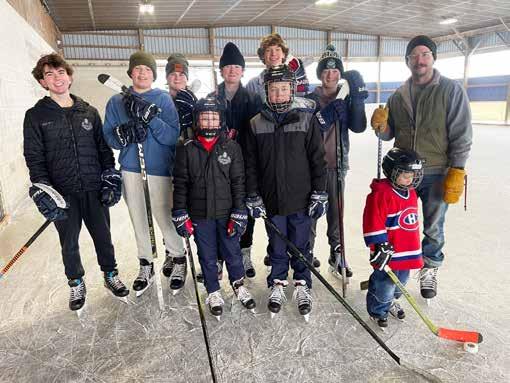
Skaters and hockey players of all ages take advantage of the ice at the Shakespeare ballpark pavilion. From left are Graham Ranton, Parker Glitz, Wade Keller, Kolby McLeod, Brayson Binkle, Cole Parish, Henry Borman with his son Eric, Matthew Adair and Bentley Dentstic.
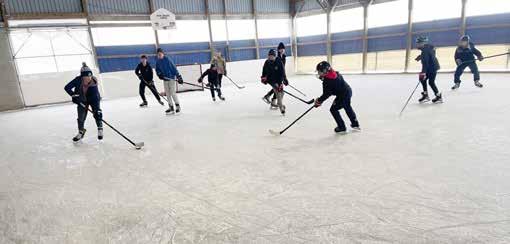
The Shakespeare ice pavilion features a full-size rink alongside a smaller surface for new skaters, allowing everyone to enjoy the ice safely throughout the winter.
Gazette Correspondent
(GARY WEST PHOTOS)
Wellesley councillors express concerns over prospect of cameras inside township vehicles
GALEN SIMMONS Local Journalism Initiative Reporter
Township of Wellesley councillors have expressed concerns over employee privacy around the potential installation of frontand driver-facing cameras in all township vehicles with an enclosed cab.
These concerns were brought up during a discussion around the township’s new electronics monitoring policy, which was ultimately approved by council at its Jan. 13 meeting.
Though the township already has the ability to monitor staff through their mobile and desk phone data, internet usage, email, data from township vehicles, key cards/fobs, and security cameras, the policy in question formalizes the township’s practice of collecting information through electronic monitoring for business purposes, which is defined as collecting data for the purpose of supporting township business as it relates to project delivery, employee performance, legal liability, IT security, financial implications and trade secrets.
“The Province of Ontario requires
employers with 25 or more employees to have an electronic-monitoring policy,” township CAO Rik Louwagie said. “Basically, it’s just a written form where council approves and then staff can then see all ways the municipality can monitor their activities through electronic means.
“So, internet usage, telephone usage, GPS in vehicles, things like that … and then we will do training with staff so they’re all fully aware of the various ways that they can be monitored once this policy is passed by council.”
Within the staff report to council, it was mentioned the township is in the process of adding dash cameras to all township fleet vehicles that will be able to monitor the driver of the vehicle and their surroundings. The report said dash cameras are effective in the event a staff member is involved in an incident while in a company vehicle, footage from which could be reviewed to see exactly what happened.
While Louwagie clarified a separate dash-camera policy will come to council for approval before the township can begin using these dash cameras – especially for those installed in fire trucks, which are
involved in more sensitive activities that could require a higher level of privacy –councillors expressed concerns about the cameras and their potential to invade the privacy of township employees while in their vehicles.
Coun. Claude Hergott asked whether the cameras would be able to record audio as well as video, to which Louwagie said only video would be recorded while the vehicle is running. Should employees seek privacy while on their break, say to make a phone call, Louwagie said they can simply turn off the vehicle during that time.
“There should be driver consent,” Hergott said. “What’s the feeling of the drivers? Have they expressed concerns or have you reached an agreement with the union?”
“Without getting too deep on it, yes, there are some concerns from the drivers themselves, however there is no requirement that we’ve been made aware of anywhere that requires consent. It’s a portion of the responsibility of working for the municipality,” Louwagie said. “And it is for liability purposes, why the cameras are going in. They are not meant to be
monitored on a regular basis whatsoever.
“There’s basically three times we plan to monitor these, and that’s the three C’s – in the event of a collision, a claim, or a complaint. If we get one of those three events occurring, then we will have to take a look at those cameras. Other than that, there’s no intention of sitting there watching cameras.”
In response to questions from councillors around why the township needs both front- and driver-facing dash cameras, Louwagie said they allow the township to review both what was happening outside the vehicle from the driver’s perspective, and what the driver was doing immediately before, during and after a collision or an event that led to an insurance claim or complaint, allowing the township to defend their employees in those instances.
Louwagie said council will have another opportunity to explore the township’s planned use dash cameras when the dash camera policy is officially brought to council for consideration at its Jan. 27 committee of the whole meeting. All township vehicles are expected to be quipped with dash cameras this year.
How did the Region of Waterloo end up in a water crisis?
LEE GRIFFI
Local Journalism Initiative Reporter
“There is definitely a water shortage. It’s a crisis when your city announces it’s closed for business.”
Those are the words of Kevin Thomason, the vice chair of the Grand River Environmental Network. Much has been made of the water situation in Waterloo Region recently and concerns are being raised by politicians, developers and members of the public. Thomason said a report from a third-party consultant paints a grim picture.
“The report made it clear it is much worse than the region is letting on. The region consistently overpumped in 2023, 2024 and 2025, exceeding sustainable levels. They are taking out more water than is being replenished and now they are at a point where it's too low.”
He added pumping needs to be reduced to allow the water supply to restore acceptable levels and find water from another source.
“But there is record demand and there is no other source and they are continuing to pump it at unsustainable levels, hence the dire action of stopping all future development approvals.”
The region has identified a water
capacity constraint in the Mannheim service area, which supplies water to parts of Kitchener, Waterloo, Cambridge, Wilmot and Woolwich. This means the existing water system may not have enough sustainable capacity to support future growth and development as currently planned. Because the system is operating near its limits, the region has paused approval of some new development applications until solutions are in place.
“We can’t underestimate the seriousness of this. We’re not in the middle of an August drought where it hasn’t rained for two weeks. We are complaining about record snowfalls and we’re still in this trouble. We can’t underestimate this crisis,” Thomason said.
Thomason criticized the region’s handling of the water supply but said responsibility largely rests with the province, dating back roughly three decades.
“They wanted to build a pipeline to Lake Erie that was going to cost $1 billion, which was just an unfathomable amount of money at that time. We realized we should be living within the capacity of our watershed, and if we properly managed our water, there would be lots of it here.”
He added the Ford government has approved a large number of gravel pits with no regard for the effects on water tables,
including one in Shingletown. Another issue is the amount of growth being forced on municipalities.
“We continue to see stupid things like this forced boundary expansion where Doug Ford didn’t like a regional official plan because it was too sustainable and didn’t have enough urban sprawl. Instead, he ordered over 6,000 acres of expansion which is destroying farms in ground recharge areas.”
Thomason also said the province can’t produce a single page of justification, study or research as to where the water would come from.
“Ford has approved the region for 1.3 million people when you look at the amount of land he’s okayed for development, but there has never been a study for water over 900,000. This is what we have been warning about for years.”
Thomason said one of the most concerning areas is the Mannheim service area, which hit a dangerously low level on Monday.
“We had less than four per cent of a water reserve left in the Mannheim area. All the water for Kitchener, Waterloo, most of Cambridge, part of Wilmot and most of Woolwich comes from there. If any single well had gone offline, we probably would have had people with no water coming out
of their taps.”
He added developers and others in the business lined up for eight hours of delegations at last week’s regional council meeting to express their dismay at the economic effects of the situation, and he said as of now, there is no plan B, meaning conservation is key.
“To me, the number one solution is to be more efficient with the water we’ve got. Maybe we need to be like Cape Town, South Africa, or Phoenix, Ariz., and tell people, ‘Sorry, you have to start having shorter showers and wash your car less.’ ”
He also suggested aggregate pit permits could be revoked to prevent millions of litres of water a day from being pumped from below the water table. Thomason said the water shortage is another nail in the coffin of the region’s 770-acre land grab in Wilmot Township.
“Who in their right mind is going to come and invest billions of dollars in a new plant that will likely need at least hundreds of thousands of litres of water a day when the region can’t even provision its own citizens? There’s no way anyone is coming anytime soon, and it's absolutely asinine to see the region still spending millions of dollars on trying to purchase those lands.”
OBITUARY
Deborah Carol Kidd (McNeil)
Deborah Carol Kidd (McNeil) passed away peacefully on January 16, 2026, at Waterloo Regional Health Network @ Midtown. She was born on July 8, 1953, in Kitchener, Ontario. Deb Kidd of New Hamburg in her 73rd year.
Family was always at the heart of Deb’s life. She was the cherished sister of Gary McNeil and Stephen McNeil and his wife Connie, all of New Hamburg. She will be lovingly remembered by her stepfather, Ken Schatz of New Hamburg; her stepbrothers Kevin Schatz of Tavistock and David Schatz of Kitchener; and her stepsister Karen Schmidt and her husband Dale Lang of Stratford.
Deb will be sadly missed by her nieces and nephews and their families: Danielle and her husband Evan McLeod, and their children Ellie, Remington, and Emory; Daryl and his wife Sarah Schmidt, and their sons Parker and Paxton; Jamie and her husband Malcolm Vincent, and their children Thaddeus and Eva Rae; and Brett McNeil and his partner Mycke. Deb will be also missed by Dale’s son Andrew Derks and his partner Kate and their son Caleb and deeply missed by her beloved dog and constant companion, Jaxson.
Deb was predeceased by her loving mother, June (McNeil) Schatz, on April 18, 2015, and by her brother Michael “Mick” McNeil on April 4, 2018.
Deb spent many years working in the admitting department at Kitchener-Waterloo Hospital, where she made lifelong friends. She later worked for ODG in New Hamburg for 20 years and truly enjoyed her role bartending for Wilmot Township at weddings and buck and does, where her warm, sociable nature shone brightly.
Deb treasured time spent with her family, especially her nieces and nephews and their growing families. She found great joy in life’s simple pleasures—relaxing on the deck with her furry companion by her side and a nice glass of wine in hand.
At Deb’s request cremation has taken place and no formal service will be held. Interment at Riverside Cemetery at a later date.
As expressions of sympathy, and in lieu of flowers, memorial donations can be made to the KW Humane Society and can be done through the funeral home.
Funeral arrangements have been entrusted to the Mark Jutzi Funeral Home, New Hamburg. Personal condolences can be posted for the family at www.markjutzifuneralhomes.ca
SIMPSON: Blanche Rose
Rose Simpson at Nithview Community Care, New Hamburg at the age of 93 on January 18, 2026. Beloved wife of the late James (Jim) Simpson (January 17, 2001). Precious memories are left with her children, Elizabeth (Stan) Platz of Kingston, Joy (Tim) Swartzentruber of New Hamburg, Heather (Grant) Poll of New Dundee, Scott Simpson of Plattsville, Patricia (Paul) Bowman of New Dundee. Loving Grandmother of Ben (Christa) and Holly Platz, Nathan (Stefanie), Kristin, Tyson (Melissa) and Jonathan (Alysha) Swartzentruber, Michelle Swartzentruber, Joshua (Cassy) and Daniel (Amy) Poll, Scott (Sasha), Michael and Jacob Simpson, David (Theresa), Zachary and Matthew Bowman. Special Great Grandmother of London and Kirche Platz, Dylan and Luke Swartzentruber, Eden and Clara Swartzentruber, Mason and Layla Poll, Allie and Breanne Poll, Aurelia, Elise and Chloe Bowman, Owen and Corbyn Bowman. Also remembered by her sister-in-law Diana Simpson and by her many nieces, nephews and their families.
Predeceased by her parents Herbert and Millie (Stuart) Hiller, her sister Jean (Ralph) Michalofsky, father and mother-in-law James and Hilda Simpson, brothers and sisters-in-law, Howard and Loretta Simpson, Wesley and Margaret Simpson and Peter Simpson.
Blanche was born July 26, 1932 at Perry's Corners, Ontario where she grew up. Blanche and Jim were school sweathearts, they married July 14, 1951. Together they lovingly built their home and life in New Dundee where they raised their five children. Blanche was a faithful member of Bethel Missionary Church, a lifetime member of the New Dundee Womans Institute and contributed to the Prayer Blanket Ministry. Mom found great pleasure in knitting and giving away many pairs of slippers. Blanche was employed at the former New Dundee Creamery for 28 years where co-workers became lifetime friends. Family was most important to her, and she found much joy sitting in the bleachers of ball parks and arenas cheering for her children and then grandchildren.
We deeply mourn mom's passing, but we celebrate her life and count ourselves blessed to have shared it with her. Mom was grateful for God's love, grace and forgiveness and now lives in the presence of her Lord.
Relatives and friends will be received at Bethel Evangelical Missionary Church Saturday January 24, 2026 from 1:00 - 2:45 p.m. Funeral Service will be conducted at Bethel Evangelical Missionary Church, 1531 Bridge Street, New Dundee, on Saturday, January 24, 2026 at 3:00p.m. Reception to follow. Private interment will take place at a later date.
Family and friends can watch livestream by going to the funeral home website to Blanche's obituary and there will be a link to click to watch the service. In lieu of flowers, donations to Canadian Bible Society or Heart and Stroke Foundation of Ontario would be appreciated by the family. Personal condolences can be posted at www.markjutzifuneralhomes.ca .
Thank you CARD OF THANKS
The family of the late Claudette Wettlaufer wish to express their sincere thanks to all relatives, friends, and neighbours for their many acts of kindness following the passing of our mom. Thank you for all your memorial donations, floral tributes and cards.
To the staff at peopleCare, thank you for mom's care while she lived there, especially those that took the time to comfort her or just sit and chat.
Thanks to Rev Marilyn who guided us through mom's journey this past year, especially for your visits and words of comfort. To the ladies of Grace United Church for the wonderful spread of food and refreshments at mom's funeral and all those who helped in any way.
Thanks to Jeff Glendinning and his staff for their guidance and compassion during this difficult time.
You are now home Mom. We miss you.
The Old Gazettes
By Sydney Grant
Slowly but surely, I’m reading through the past pages of the Tavistock Gazette (est. 1895). Within this weekly column I’d like to share with you some of my findings.
January 20-27, 2021, Edition (5 years ago)
On New Year’s Eve 1999, at the turn of the 21st century, Mike Churchward created a time capsule with his thoughts, family photos and items of interest, and placed them in a banker’s box. With 2020 behind us, Churchward and his family decided it was time to open it and share what he found. The capsule contained three letters, one authored by him, as well as letters from his mother and father, and other assorted items. “I hope that the world is still here. This letter is moot otherwise,” he first wrote, followed by 15 other hope-filled comments.
The five-corner traffic signals in Tavistock just got a lot smarter. Since the installation of the lights in Tavistock in September of 1990, residents and visitors have been baffled by the system which saw a continuous cycle of traffic control starting from north, south, east, west, then west with a pedestrian cycle, when triggered, where all traffic stopped. Over the years, there have been tweaks to the system with durations of time changed for each direction. Last Wednesday, a joint statement to the Gazette from David Simpson, Oxford County director of public works, and Frank Gross, manager of transportation and Waste, said, “Traffic signal cycle times will now automatically adjust based on traffic demand.”
January 19-26, 2011, Edition (15 years ago)
Walter Kropf and his daughter, Melissa, will spend two and a half weeks in Matangwe, Kenya, next month as part of an initiative with Caring Partners Global (CPG). This Kitchener-Waterloo based charity began by delivering much-needed primary, emergency and diagnostic health care as well as HIV/ AIDS prevention education to the residents in a remote area of Western Kenya. But the Kropfs are going there on a different mission – to restart a chicken-layer operation. That program began some years ago with the construction of a chicken coop that can house approximately 250 laying hens. The building consists of three rooms, each 12-by-24 fit, with perches and nest boxes for egg
laying.
You’ve heard of the extreme makeover? Well, it’s hard to believe that a five-year-old could share that kind of experience, but Cadence Trotter of Shakespeare has done just that to a certain degree. She also put her experience to good use by donating to charity. Along with recently getting eyeglasses, Cadence had decided to donate her hair to the “Angel Hair for Kids” program. Hair donations must generally be over 10 inches in length, however, Cadence had between 15 inches and 16 inches available.
January 17-24, 1996, Edition (30 years ago)
After several years of having been known as the Tavistock Tavern Inn, the Arlington Hotel name is being revived by the establishment’s new owners, the van Boekels. John and daughters Deb and Barbara van Boekel are presently finalizing the purchase of the near 100-year-old hotel business from Mr. Bob Todorovic. The van Boekels took over management of the property several weeks ago and have hosted weekend entertainment with live local bands and karaoke nights, as well as daily food specials.
Starting Feb. 19, 1996, Canadians will be using their first bi-metallic circulation coin featuring a favourite design choice, the Canadian polar bear. Research showed bi-metallic or “two-tone” coins were popular among Canadians. The $2 coin will have a nickel outer ring and a round aluminum-bronze core, giving it a silver and gold appearance. The Government of Canada decided to introduce the $2 coin to save money.
January 19-26, 1966, Edition (60 years ago)
The $141,000 addition to the Tollgate School in East Zorra was officially opened last Friday night, and on Friday night of this week, the $235,000 addition to the school at Hickson will be officially opened. Opening of the threeroom addition at Tollgate and the eightroom addition at Hickson was delayed last September due to a construction strike during the summer months, and as a result, the students were given an extra week’s vacation until the interiors could be sufficiently completed for use. More than 300 pupils are attending the Hickson school, and close to 200 are attending the Tollgate school. The additions were required owing to the program of centralization now in operation throughout the province.
TOWNSHIP OF EAST ZORRA-TAVISTOCK
GRACE UNITED CHURCH
116 Woodstock St. S., Tavistock Phone: 519-655-2151
All are welcome
Service led by Rev. Marilyn Arthur Music by Marilyne Nystrome
TRINITY LUTHERAN (ELCIC)
Sebastopol - Tavistock 2210 Perth Line 29
Pastor Steve Hoffard Worship In Person or on Zoom Sundays at 10:00 AM (519) 655-2372 trinitylcoffice@gmail.com www.trinitytavistock.com
TAVISTOCK MENNONITE
Pastor Julie Ellison White
131 Wettlaufer St., Tavistock 655-2581
Sunday Worship services begin at 9:45am, with coffee and fellowship to follow at 11am.
All ages Junior Sunday School will follow after the service.
All are Welcome Stream services online at www.tavistockmennonitechurch.ca
EAST ZORRA MENNONITE 677044 16th Line Road, East Zorra Pastors Ray Martin & Mike Williamson www.ezmennonite.ca
Service audio recordings available at: https://ezmennonite.ca/worship/
WILMOT TOWNSHIP
ST GEORGE’S ANGLICAN CHURCH
Corner of Waterloo St and Byron St, New Hamburg Weekly Sunday services at 10:15 am. All are welcome. https://www.stgeorgesnewhamburg.com
St James Chapel of Ease 4339 Huron Rd Wilmot Township
All are welcome. Contact Carol Massel: 519-502-8648 carol@masselsmarine.com
ST AGATHA MENNONITE CHURCH
1967 Erb's Road St Agatha 519-634-8212 Pastor Jim Brown Worship service 10am followed by coffee hour and sermon discussion. All are welcome
The Wilmot-Tavistock Gazette
PJHL Roundup: Firebirds drop two straight as battle for second takes a hit
LEE GRIFFI Gazette Reporter
New Hamburg dropped a pair of home games on the weekend, keeping them in third place in the Provincial Junior Hockey League’s (PJHL) Doherty Division.
The Firebirds dropped a 4-1 decision to division-leading Woodstock on Sunday, despite firing 45 shots at Navy Vets goalie Tyler Bouck. Woodstock led 1-0 after 20 minutes, but Owen Bruder’s 12th of the season on a powerplay tied it up early in the second period. The Navy Vets added shorthanded, powerplay and even-strength goals to seal the win.
The teams combined for 120 penalty minutes, including seven misconducts in the third period, all for unsportsmanlike conduct.
On Friday, a frantic third-period comeback fell short as New Hamburg dropped a 5-4 home-ice decision to Norwich. The Firebirds trailed 5-1 with only three minutes remaining in the third period. Rhett Calder and Ezra Fischer, with a pair, tallied in a span of 96 seconds but the Merchants were able to hang on and earn the two points.
Fischer was recently acquired from the Ayr Centennials of the Greater Ontario Hockey League (GOHL) and is the brother of former captain Owen and current forward Jayden. The 19-year-old forward has also played for the Listowel Cyclones, Brantford Bandits and Cambridge Redhawks.
“He’s a great kid,” said current captain Andrew Gear. “I’m good buddies with Owen, I’ve been around Ezra for quite some time now and Jayden has been here for the past couple years. It’s nice to get
the third Fischer brother here to complete the trio.”
Gear explained the team was confident heading into the weekend after a 6-2 win in Tavistock, but they didn’t bring their best game into Norwich.
“They outplayed us for most of the game but we found our game in the third. That’s the next level we have to reach but it was too late. I do think coming back showed our character. The Sunday afternoon game didn’t go the way we wanted it to. The game was tight and we had our chances, but the puck just didn’t go in the net.”
Gear said he told the team on Sunday they need to play a full 60 minutes to beat anyone in the Doherty.
“At the same time, we need to just flush these moments and get ready for the next game, which is a big one in Tavistock on Friday. It’s important we gear up for that one.”
The Tavistock Braves won their only game of the weekend, but it came at a cost as defenceman Nate Brenneman suffered a broken leg just two minutes and 11 seconds into the opening period. He fell into the boards awkwardly after a shove from behind on a play that led to a five-minute major penalty for boarding against a Hespeler Shamrocks player.
“The Braves organization would like to thank our trainers, the trainer from the Hespeler Shamrocks, as well as numerous first responders in attendance, for their quick response in assisting with the medical emergency,” said a team statement on its social media channels.
“Obviously, it is a massive blow to our team and back end. Losing Nate, likely for the season, is a big blow to our club. You don't wish that on anyone, the way it
happened Friday night,” said Braves general manager Brent Lange.
“The game and plays happen so fast now, and it was a scary incident that happened and could have been avoided. You just knew right away it was a serious injury. Nate is a great young man, great player, great team-first guy who is very well respected in that dressing room by his teammates, friends, coaching staff and other players in the league.”
Brenneman was operated on Saturday and Lange said he will have a tough recovery ahead of him.
“It will be a long road to even get back to a normal daily routine for him. He is a tough kid and I know he will do whatever it takes to get back to normal. Our whole team was huddled around him for the 2030 minutes until he was taken off the ice by the EMS workers.”
Lange said his troops were clearly shaken up for the rest of the first period but regrouped and refocused.
“We came out firing in the second, scoring two quick goals and adding a couple later in the period and stayed strong for the win. It was good for the guys to be able to respond and get a win for Nate. The game did get a bit chippy after that, as guys are on edge and emotions are high from losing a friend and teammate.”
The Braves won the game by a score of 5-1 and were led by Even Palubeski’s three-point performance. Ryan McKellar added a goal and an assist while recent acquisitions Nathan Siebert and Jack Hodge picked up their first goals of the season.
Tavistock outshot Hespeler 49-15 in a game that was tied 1-1 after the first period, but the Braves scored four times in the second to take control.
Wellesley split a pair of weekend matchups, starting with a 2-1 loss in Woodstock on Friday. The Navy Vets led 2-0 four minutes into the second period, but Ben Morton gave the Applejacks a chance with his 15th of the season 11 minutes later. Woodstock goalie Kobe Nadalin was solid in the game, stopping 35 of 36 shots, including all 12 he faced in the third period. Wellesley bounced back on Sunday with a 7-2 victory in Paris. Moron and Dimitri Eleftheriadis led the offence with two goals and an assist each with Ian Speiran and Luke Schofield adding a goal and assist each.
CURRENT STANDINGS
New Hamburg has acquired Ezra Fischer from the Ayr Centennials of the GOHL. Fischer is the third brother to skate for the Firebirds, joining current player Jayden and former captain Owen.
(NEW HAMBURG FIREBIRDS PHOTO)
Tavistock Royals mark 30th anniversary with successful pork barbecue and home-ice win
GARY WEST Gazette Correspondent
The Tavistock Royals senior hockey team scored big on and off the ice Saturday night, serving hundreds at their 30th annual pork barbecue before skating to a 6-3 win over the Milverton Four-Wheel Drives.
The long-running fundraiser once again proved to be the Royals’ biggest event of the winter, drawing steady support from fans who lined up for the popular drivethrough meal. Players were happy to greet supporters and expressed appreciation for the continued backing that has helped sustain the team for three decades. The Royals also credited their wives, partners and volunteers, whose behind-the-scenes work is key to making the event run smoothly each year.
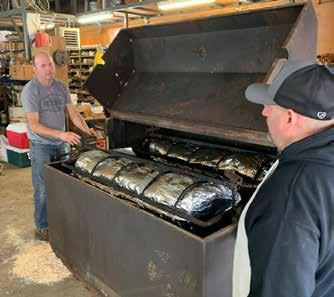
The menu featured a locally raised hog barbecued at the nearby Jack and Jane Danen farm, along with scalloped potatoes, Tavistock Men’s Club sauerkraut, baked beans, dinner rolls and apple pie served with Saputo cheese for dessert. For many, it has become a can’t-miss tradition on the local hockey calendar.
Once the final meals were served, Royals players crossed the parking lot, laced up
Tavistock Royals players, volunteers and supporters work together to serve the annual pork barbecue. From left are Zach Shomphe, Devin Kropf (A), Tristan Hohl (C), Tyson Zehr (coach), Trevor Sauder (A), Lucas Bast, Duane Kropf, Kyle Wynette (club president), Michael Capicotto, Pauline Bender, Ron Saunders, Kristopher Meadows, Drew Gerth (A), Tyler Sutter, Matt Zilke, Derek Wagler, Heidi Danen (treasurer) and Grant Meadows. Missing is Verlus (John) Bender.
their skates and brought that same energy to the ice. The result was a strong team effort and a 6-3 victory over Milverton. Milverton players were later overheard
Royals claim fourth straight win
LEE GRIFFI Gazette Reporter
The Tavistock Royals downed the Milverton Four Wheel Drives 6-3 on home ice Saturday to earn their fourth straight win and take over sole possession of fourth place in the Ontario Elite Hockey League’s Southern Division. Michael Capicotto and Drew Gerth scored two goals each in the winning effort, while Trevor Sauder and Cam Leslie added single markers. Sauder’s goal, his fourth of the season, came just nine seconds into the game. Tavistock’s leading scorer, Mitch Atkins, added two assists to up his season point total to 29 points in 17 games.
joking that next year, they plan to get in on the barbecue as well, hoping it might provide the same boost enjoyed by the Royals.
The Royals led 3-1 after the first and 4-2 after 40 minutes while outshooting the Drives 43-27. Tavistock has a tough weekend coming up, beginning with a road game in Petrolia to face the second-place Jets on Friday night. Saturday doesn’t get any easier as the first-place Seaforth Centenaires are in town for a 7:30 p.m. start.
Jack Danen takes instructions from longtime barbecue leader Rodney Ramseyer during preparations for the Tavistock Royals’ 30th annual pork barbecue.
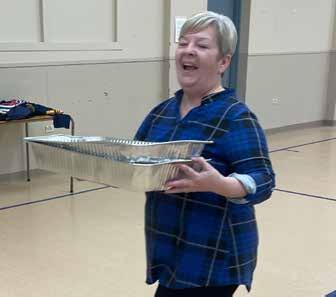
Kim Zehr restocks pork dinners for takeout boxes as hundreds of supporters pass through the drive-through at Tavistock Memorial Hall.
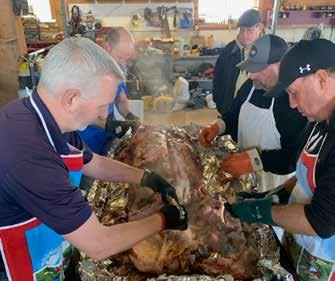
Cooking the Oxford County pork at the Jack Danen shop are, from left, Martin Van Griensven, Jack Danen and Rodney Ramseyer with Mike Yaworski. In the background is Brian Swartzentruber, a well-known barbecue boss from years past.
(GARY WEST PHOTOS)
Remembering Tavistock hockey and figure skating through the years
Tavistock has produced many talented hockey players and figure skaters over the decades, leaving behind a rich sports legacy the community can be proud of.
One of the best records of that history can be found in Raising the Rafters, a beautifully produced hardcover book written by Tavistock author Paul Bartlett. The book chronicles 25 years of local hockey history, but as Bartlett himself notes, it is about much more than the game.
“This book is more than a history of hockey in Tavistock,” Bartlett writes. “It is a history of Tavistock itself. It is an account of how arenas and hockey are central to the life and community spirit of every small town in Canada.”
From packed arenas and minor hockey
teams to figure skating performances that drew crowds to their feet, the photographs and stories capture generations of athletes in their younger years. While many of those faces are now well known in the community, their contributions on the ice helped shape a strong, close-knit sports culture that continues today.
Bartlett’s work was supported by longtime Gazette owners William J. and Sherry Gladding, whose commitment to preserving local history helped bring the project to life. Together, they ensured the stories, names and moments that defined Tavistock’s hockey and skating past would not be forgotten.
Copies of Raising the Rafters are available at all Tavistock Braves home games for those interested in revisiting — or discovering — an important chapter of the community’s history.
Dakota Maue unloads a wrist shot off the rush during the U13 LL 2 Tavistock Titans game this past Monday.
(ALEC RICHARD PHOTO)
Levi Stacey backhands the puck towards the net during last Saturday’s U13 LL 2 New Hamburg Huskies game.
(ALEC RICHARD PHOTO)
Hudson Waters launches a shot from the point during this past Sunday’s U11 LL 2 New Hamburg Huskies game.
(ALEC RICHARD PHOTO)
Mason Durling fires a shot from the wing during the U13 LL 1 New Hamburg Huskies game last Saturday.
(ALEC RICHARD PHOTO)
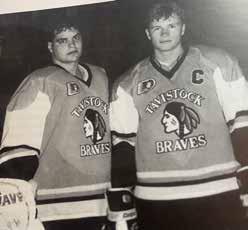
Former hockey standouts Jeff Roth and Dale Brenneman remain familiar faces in Tavistock. Brenneman, shown during his playing days as captain, was known for his calm demeanour — though fans might be surprised to learn he could still give referees an earful when needed.
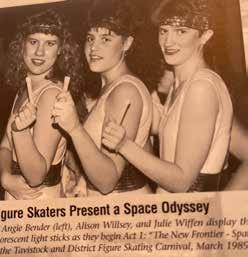
Figure skaters Angie Bender, Alison Willsey and Julie Wiffen brought elegance and excitement to the ice in Tavistock, impressing spectators with their precision and creativity during performances.
GARY WEST Gazette Correspondent
(CONTRIBUTED PHOTO)
Winter fun draws families to Shakespeare’s Optimist Hill
GARY WEST Gazette Correspondent
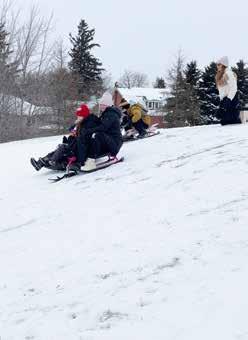
Fresh snowfall over the weekend brought plenty of winter fun to Shakespeare as families from the village and surrounding area made the most of ideal outdoor conditions.
One of the busiest spots was the Optimist Hill, located beside and north of the Optimist Hall, where children and parents alike enjoyed a full day of tobogganing. The popular hill, developed years ago through the efforts of the Shakespeare Optimist Club in partnership with Perth East Township and support from an Ontario Trillium Foundation grant, continues to be a focal point for winter recreation in the community. A light at the top of the hill allows for safe evening use, extending the fun well beyond daylight hours.
Former Optimist of the Year and charter member Murray McTavish said the club has always believed in investing in spaces that promote healthy, active living for local youth. Along with the toboggan hill, the adjoining soccer field was also developed so children could enjoy both winter and summer activities. The Shakespeare Optimist Club has now been serving the community for more than 52 years.
McTavish noted the original inspiration for the hill dates back to 2002, when the late Ruth McNeil, a much-loved kindergarten teacher at nearby Sprucedale Public
conditions as sledders head down the snow-packed
School, expressed a wish for a small hill where her students could play. That simple idea sparked a larger vision. With support from her husband, Gil, who helped establish the local Optimist Club, plans were set in motion for a toboggan hill, walking path and soccer field. Heavy equipment was brought in to shape the hill residents enjoy today, with funding shared among the Optimist Club, the township and the
Trillium
The park continues to evolve with an exercise pad and an upgraded, six-foot-wide paved walking path that now stretches roughly a kilometre around the perimeter of the grounds. Club members say the ongoing improvements reflect the Optimist commitment to creating positive spaces for families.
The Optimist Club also notes that new members are always welcome, inviting anyone interested in supporting youth and community initiatives to get involved.
Stratford Social Services helping renters bridge the gap toward home ownership
GALEN SIMMONS Local Journalism Initiative Reporter
Stratford Social Services is continuing to offer financial assistance to residents of Stratford, St. Marys and Perth County, as well as prospective area residents, looking to make the jump from renting to home ownership.
The City of Stratford recently posted to its Facebook page about the social services department’s affordable homeownership loan program, a provincially funded initiative first launched in 2007 that offers loans of up to five per cent of the purchase price of a home to those with low-to-moderate income who are currently renting and meet the program’s eligibility requirements.
“There’s been different pots of provincial money over the years, and then what happens is when the loans get paid back, it goes into a revolving fund that goes back out (in the form of loans),” said Stratford Social Services business integration manager Shannon Archer. “Right now, we’re just in the revolving fund; there hasn’t been any new funding in several years – probably 2017 was the last time we allocated provincial funding to homeownership.
“The idea behind the program is to recognize the fact there are people in the rental market where their only barrier to homeownership is that downpayment. So, the idea is to provide them with a downpayment assistance loan in order to free up the rental market for those who truly can’t
afford homeownership.”
Those loans, Archer explained, are either forgiven after 20 years if the owners remain residents of either Stratford, St. Marys or Perth County and retain that home as their sole and primary residence, or they are paid back when the home is either sold or transitioned into a rental property at five per cent of the value or sale price of the home.
One recent change to the program is the option for outof-area renters to apply to the program with proof they have employment or an offer of employment in Stratford, St. Marys or Perth County. The program now also offers downpayment assistance loans on new builds – another recent change.
“(The program) has not been used a lot in the last several years, and I think that is more a sign of what’s going on with the market and the craziness through the pandemic, but since 2007, we have extended out 90 loans totalling just over $1.1 million,” Archer said. “We have seen 41 of those repaid to us over the years, so that brought about $650,000 back into the pot and some of that money has been re-extended out.
“Right now, we do have a healthy chunk of money sitting there. We did three loans in 2025 and then we did two from 2020-2025 – there was a gap there when it wasn’t really well used … when homeownership wasn’t affordable for anybody. And back in the early inception, it was
so popular we would run out of money.”
As a result of the soaring housing prices during the COVID-19 pandemic, Archer said there were a number of program participants who chose to sell their homes, which led to an influx of repaid loans and money being funnelled back into the program. Now, she said the social services department is once again promoting the program not only to free up rental housing and encourage those who work in the area to also live here, but because there is funding available now.
For more information and to review program eligibility requirements, visit www.stratford.ca/en/inside-cityhall/housing.aspx, scroll down and click the “Affordable Homeownership” option.
Foundation.
Enjoying a day on the Shakespeare Optimist Hill are, from left, Chloe Cutone, nine, Rylee Willock, nine, Sydney Langis, 11, Summer Cutone, 11, and Ben Willock, 11, with parents
Jenna Cutone, Kaleigh Willock and Sean Willock looking on.
(GARY WEST PHOTOS)
Families take advantage of perfect winter
Optimist Hill on Sunday.
Pfennings Organic Farms supplies produce locally and beyond
GARY WEST
Gazette Correspondent
One of the busiest farms in Waterloo Region is Pfennings Organic Farms, located along the curve between Baden and New Hamburg in Wilmot Township.
Started in 1981, the operation grows and harvests a wide range of organic fruits and vegetables on its Waterloo Region farmland, which is also home to its busy head office.
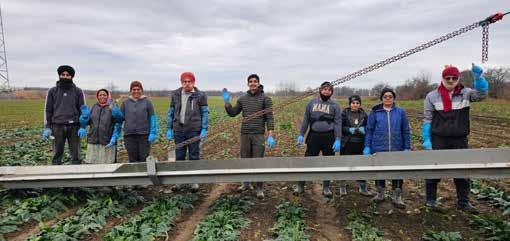
According to marketing specialist Bernadette Antoniou, Pfennings employs roughly 40 seasonal agricultural workers each year through the Temporary Foreign Worker Program. Workers from Jamaica make up about one-quarter to one-third of the farm’s total workforce. Antoniou said the seasonal team also includes a large number of local workers from KitchenerWaterloo and surrounding communities, as well as summer students and other local residents. The farm strives to maintain a ratio of three to four local workers for
every migrant worker.
Owner Jenn Pfenning emphasized local food security depends heavily on the expertise of migrant workers. Some Jamaican workers have been returning to the farm since 2005 and now hold experienced, skilled positions, including leadership roles that involve training new staff. Over the years, Pfennings has found it increasingly difficult to recruit enough local workers to meet the labour demands of farming, making foreign workers a critical part of ensuring food reaches consumers’ tables.
As with all farms, each growing season brings its own challenges. Weather conditions can significantly affect crop yields, and 2025 was no exception. Antoniou said strawberries were particularly affected this year, while carrot yields were also slightly below average. In contrast, spinach and beets thrived, with conditions aligning well throughout the growing season. Despite the yearly ups and downs,
Pfennings Organic Farms continues to be a strong economic driver in Wilmot Township and the broader Waterloo Region area. The farm has built a reputation over decades for producing high-quality, certified organic fruits and vegetables,
supplying both local markets and more distant consumers.
Its ongoing success reflects both careful management and the vital contributions of a diverse workforce committed to sustainable agriculture.
Workers at Pfennings Organic Farms near Baden harvest organic spinach during the early fall of 2025.
(SYLVIA POND/BERNADETTE ANTONIOU PHOTO)
Happy Birthday to me
I turned 40 this week, and I feel happy and sad — and not nearly as “at peace” as I once thought I’d be at this point in my life. But the older I get, the more I realize that might actually be the whole point. How boring would life be if we truly had it all together? How small would it feel if everything followed a neat, predictable path — if there were no wrong turns, no pivots, no heartbreak or loss, no moments where you had to pause and ask yourself, “Is this still working for me?” I wouldn’t have learned nearly as much about myself if I hadn’t been forced to rethink what stability, success and happiness actually mean.
Life at 40 carries this strange, steady feeling, not because things are simple, but because I’ve learned that complexity is part of the deal. Life is built from false starts and recalibrations, from incredible people and difficult moments, from choices that make sense only in hindsight. When I look back now, I can see how those chaotic moments shaped me and sharpened my instincts, softened my expectations, and taught me how to adapt. And somehow, that’s okay with me.
When I was 20, I worried constantly. I thought I’d never have enough money, never be successful enough, and that by 40 or 50 I’d finally have life figured out. I believed security came from plans, timelines and knowing exactly where I was headed. But here I am at 40 and I don’t have it figured out at all. What I do have is
something I didn’t expect: trust in myself. I have no idea where life will lead me. I don’t know exactly when I’ll retire, where my kids will settle, or what the world will look like in a few years. All of that used to overwhelm me. Now, it doesn’t. I’ve learned that the only real safety net I have is my ability to adapt, to make thoughtful choices and to keep going even when the path isn’t clear.
I remember looking at my parents in their 40s and thinking they had everything together. They seemed certain and secure. But now I understand something I couldn’t see then: everyone is improvising. No one really knows what’s coming. We can’t predict illness or loss or unexpected success.
And maybe this is what I’ve finally figured out at 40; life isn’t something you solve. It’s something you live. It’s something you respond to, adjust to and sometimes sit with. And that’s okay.
So happy birthday to me — the 40-yearold who changed direction a million times, recalibrated her expectations and learned that starting over isn’t a bad thing. Sometimes it just means choosing differently.
What I do know is that I have a big heart, work that feels meaningful, a family I’m grateful for, incredible kids, amazing friends and a healthy and reliable body.
The 40-year-old version of me isn’t failing. I’m figuring it out as I go — learning that not knowing where life will lead isn’t a weakness, it’s actually the whole point. Have a thought or want to connect? Email me at amandajanewriter@gmail. com.
Snow, snow and more snow
Arts and Crafts Baking
Board Games
Building Forts Colouring Dancing Drawing Journaling
Lego Building
Reading Video Games
AKIRA
Akira is a beautiful Husky with a soft and sensitive heart. She can be shy and nervous in new situations, but with patience and a calm approach, she slowly begins to show her true self. True to her Husky roots, she has an independent spirit and expressive personality, along with a growing love for movement and exploration as her confidence builds. Akira will thrive in a quiet, understanding home where she can settle in and build trust at her own pace. If you’re looking for a gentle, loyal companion and are willing to let her come out of her shell in her own time, Akira will reward you with a truly special bond. Visit kwsphumane.ca to learn more!
BY:
Sponsored by:
AMANDA NELSON Gazette Reporter
Winter made a strong return to Perth County in mid-January with more than 30 centimetres of snow falling overnight along Perth Road 106 near Shakespeare. The heavy snowfall delighted snowmobilers and skiers while keeping snowplow crews busy clearing roads once again.
(GARY WEST PHOTO)
How can I stave off the inevitable need for reading glasses?
HEAPS OF HEALTHY TIPS
By Mercedes Kay Gold
I’m fast approaching the age of reading glasses. Is there anything I can do naturally to slow down the inevitable?
Exceptional eye health is an indicator of overall health. Good vision supports day-to-day living. From reading and writing to driving to daily activities, it’s imperative to have regular eye exams. Changes in the optic nerve and vessels for example can serve as red flags for multiple sclerosis and cardiovascular disease.
Holistic health offers natural options and can be added to your daily protocol for prevention power.
First off, smoking and vaping is a resounding no.
Cutting down on alcohol consumption supports overall
health, not just the eyes. Limiting screen time and syncing the brightness to your surroundings is crucial. Experts recommend the 20-20-20 rule; for every 20 minutes of screen time, look at something 20 feet away for at least 20 seconds. Blue light glasses are inexpensive and offer headache and eye-strain relief while working on the computer.
Nighttime sleeping or breaks for a little shut eye during the day are crucial for rest and repair. Managing stress reduces inflammation throughout the body.
Tired and dry eyes? Soothe with herbal remedies. Cooled chamomile-tea compresses are anti-inflammatory.
Eating a nutrient-dense diet focusing on key vitamins,
minerals and antioxidants promotes overall health.
Yellow and orange fruit and vegetables are outstanding for eyes; ask Bugs Bunny. Carrots, sweet potatoes, pumpkins, mangoes and apricots have an array of nutrients, but are best known for beta-carotene, the pre-cursor to essential eye-helper vitamin A. Greens are also a go-to for boatloads of beta-carotene but look to loads of lutein love found in lush, leafy greens. Speaking of lutein, blueberries are a bodyboosting bonanza and this crucial carotenoid can prevent agerelated vision loss and cataracts.
Vitamin A is tied to vision quality in low-light conditions. Vitamin A or retinol is only found in animal products – egg yolks, dairy, and liver are top sources.
Vitamin C is concentrated in the aqueous humor fluid in front of the eye-lenses. Incorporate citrus and a rainbow of bell peppers for ample vitamin C.
Selenium is linked to preventing age-related macular degeneration and cataracts. Seafood, raw nuts and seeds are sensational choices.
Healthy fats in the diet alleviate dry-eye syndrome. Fats don’t make you fat, so focus on add
Nutrition, rest and good lifestyle choices are crucial in supporting longterm eye health.
cold-water fish favourites such as salmon, sardines, trout and anchovies. A handful of flaxseeds and raw nuts adds a nice crunch to salads.
As a certified holistic nutritionist, here’s my top-three foods to tick the eye-health helping boxes. These three super foods contain healthy fats, selenium and vitamin E, and can be eaten daily for fuel with slews of sensational side effects that benefit the eyes.
First up is tahini. Whether it’s a substitute for nut butters or poured all over rice and shawarma meat, tahini is truly topnotch. Sardines are a superfood; high-protein, all fabulous fats, super high in selenium, and a side of extra sunshine in the winter months with marvelous, mood-boosting vitamin D. Brazil nuts are full of healthy fats, protein and a boost of brain-food fabulousness. Restoring rebuilds and rest repairs the whole body, reducing inflammation cell by cell.
The need for mandated winter-driving training in Canada
By Galen Simmons FROM
THE
EDITOR'S DESK
Driving in the winter and driving the rest of the year are two very different beasts in Canada. While driving always comes with inherent dangers – distractions, impaired or entitled drivers, weather, road conditions and the like – the mere fact that snow and ice are pretty much ever-present on road surfaces in the winter cranks those dangers up several notches.
Stopping takes more time, visibility can reduce to almost nothing in the blink of an eye and there is no way to know if the driver behind you is experienced enough to know how to handle the sudden appearance of break lights ahead of them. Both inexperience and overconfidence can be killers in the winter, and in my opinion, our driver-education system falls short in pre -
paring drivers for what they will face after the first snowfall in November.
I consider myself a fairly adept winter driver, not because I learned that set of skills while taking drivers-ed at age 16, but because I spent the first year and a half of my career in Saskatchewan.
Before I left the relatively mild winters I grew up with in Hamilton for the frigid hellscape that is Saskatchewan in the wintertime, I had the good fortune of discovering Canada’s Worst Driver, a show that aired on the Discovery Channel from 2005-2018. The show, its host, Andrew Younghusband, and its panel of driving and legal experts identified the most dangerous drivers across the country, attempted to rehabilitate them with the skills and
knowledge they needed to be safe on the road, and confiscated the license of the driver who, at the end of each season, was deemed Canada’s Worst Driver. While this show taught me a lot about what not to do on Canadian roads, the most important lesson I took away from it was what to do when you find yourself skidding on ice and snow. The advice I retained somewhere deep in my subconscious about staying calm, easing off the gas and steering in the direction I want to go, which I then put into practice numerous times while driving the icy roads of our middle prairie province, has saved me from wrecking my car and injuring myself time and again. But why did I have to learn that from a television show? Shouldn’t winter driving be part of the standard drivers-ed training we all receive, and not just an extra course you can pay for after becoming fully licensed? Should it not be mandatory for newcomers to Canada, especially those immigrating from much-warmer climates who are not used to Canadian winters, to learn how to skid safely and with control?
Understanding the concepts and putting them into practice
A vehicle cautiously makes its way through snowy, slick conditions, a reminder that winter driving demands added skill, patience and preparation on Canadian roads.
are two very different things, and the first time a new driver or a driver who is new to Canadian roads puts those concepts into practice should not coincide with the first snowfall of winter. Driving and stopping on ice and snow should be practiced in a controlled setting or, at very least, with a trained driving instructor in the passenger seat. There are many other lessons Canadian drivers need to learn, including the importance of
winter tires, how to prepare your car for the colder months and what to do if you end up stuck in a ditch or a snowbank at the side of the road in the winter. While that information is all readily available online, including on the Transport Canada website at tc.canada.ca/en/ road-transportation/stay-safewhen-driving/winter-driving, we could all use a little more practice to keep ourselves and others safe on the road.
(VECTEEZY PHOTO)
(VECTEEZY PHOTO)
Enjoying a tropical destination in the centre of Canada
OH, THE PLACES WE'LL GO
By Paul Knowles
As we enter the heart of our beloved Canadian winter, a lot of us are dreaming about visiting tropical destinations; places like Barbados, Cuba, Costa Rica or … Winnipeg.
Winnipeg?
Okay, I admit Manitoba’s capital city is better known for what Randy Bachman highlighted in his song, “Prairie Town.” “Portage and Main, 50 below,” he sang. But a few months ago, I discovered a tropical paradise in the heart of Winnipeg. It’s called The Leaf and while you might not want to travel to this prairie city in January or February, The Leaf is definitely a must-see in Winnipeg in the warmer months.
The attraction offers one more excellent reason to visit Assiniboine Park, also home to the Assiniboine Park Zoo and in the wonderful district that includes The Forks shopping and dining area, the Canadian Museum of Human Rights and the Children’s Museum.
In locating all of these attractions in the same area, at the forks of the Assiniboine and Red rivers, Winnipeg has definitively demonstrated the right way for a city to create public spaces that are compelling destinations yet also provide opportunities for leisure and relaxation. Visitors to Winnipeg will inevitably find their way here and they will be mingling with many, many local residents, for whom the area is a perfect getaway. Personally, I love it there.
The Leaf is the latest addition to this district – and “latest” may be the operative word, here. The $130-million attraction had a lengthy growth period; it finally opened two years behind schedule in December 2022.
And what is The Leaf, exactly? It’s best understood as two distinct parts. The heart of the attraction is the soaring, swirling, steel and glass building that houses four distinct “biomes” which are home to plants and trees from around the world.
And outdoors, all around the building, are many hectares of unique gardens as well.
Let’s start indoors – an area that is open all year round.
The unique, individual spaces in The Leaf building include a tropical biome, a Mediterranean biome, a “display house” and a butterfly garden.
The tropical biome – officially the “Hartley and Heather Richardson Tropical Biome” – is the most dramatic, in part because it features a six-storey indoor waterfall that plays a role in keeping this space at the right level of humidity – “right” meaning “really high.”
The “welcome” sign posted near the waterfall says a lot about the multiple aims of The Leaf. “Welcome” is stated in three languages – English, Cree and Ojibwe, reflecting both Manitoba’s heritage and the province’s current multi-cultural reality. There is an educational note about the tropics: “The tropics cover a large part of the world and include a variety of environments such as rainforests, seasonal forests, grasslands, savannas and more.”
The sign points out everyday products we consume that come from the tropics like coffee, tea, spices and fruits. And the welcome also makes the point that “many recent immigrants to Winnipeg come from tropical regions, including Central America, the Caribbean, Africa, parts of the Middle East and Asia.” I quote this information at some length because I think this “welcome” tells us a lot about the intentions of the people who planned and built “The Leaf.” It’s more than an educational institution, it’s an inclusive, welcoming space.
We strolled around the tropical biome, marvelling at the beauty of the flowers and foliage, and quite impressed with the size of the plants that soared over our
heads. We learned that many of them were full-size when they were transported to The Leaf.
We moved on into the Mediterranean biome, where eager docents are happy to tell visitors all about the plants, including “Dinosaur Trees” – actually Wollemi Pines from Australia, prehistoric conifers which were thought to be extinct until they were discovered in Australia in 1994. Today, offspring of those rare, ancient trees are growing right here in Winnipeg.
Everyone loves an enclosed butterfly garden, and the “Shirley Richardson Butterfly Garden” at The Leaf is no exception. Children and adults alike enjoy watching the many tropical butterflies, and everyone, of course, hopes a flying friend would come to rest on their shoulder.
The Leaf does not end at the exit from the impressive building. Outdoors, there are six gardens to explore, including the Indigenous Peoples Garden, a Kitchen Garden, a Sensory Garden, the Performance Garden, the Seasonal Garden and “The Grove.” Some of the outdoor gardens are open 24/7, others from 9 a.m. to dusk, and all the outdoor spaces are of charge. Admission to the biomes is $17.20 for adults, $9.40 for kids three to 17, and $14.90 for seniors. You can save a buck or two in each category by buying in advance online. And there is another advantage to buying online because admission to The Leaf is by timed tickets, so having tickets in advance guarantees prompt entry.
Do you want to visit Winnipeg when it’s 50 below at Portage and Main? Maybe not – although if you do, the biomes will feel like paradise. But in the warmer months, The Leaf and all of its neighbours in Assiniboine Park and The Forks will make for a day full of delight.
Paul Knowles is an author and travel writer, and past president of the Travel Media Association of Canada. To contact Paul about travel, his books, or speaking engagements, email pknowles@ golden.net.
(PAUL KNOWLES PHOTOS)
The biomes are replete with tropical blooms.
Prehistoric "dinosaur trees," once thought extinct, are now carefully tended at The Leaf.
tropical biome.
The $130 million The Leaf opened in Winnipeg in December 2022.
Cold comfort
VINTAGE VIEWS
By Tim Mosher Tavistock and District Historical Society
The rigours of winters 100 years ago or more are hard to imagine today because of modern central heating, hot water 24 hours a day, snowplows big enough for Goliath to drive, efficient designs of insulation and enclosed transportation with heaters. Thoughts of rising repeatedly to stoke a fire throughout the night, single pane windows, midwinter personal hygiene and heating bricks to put in the family buggy to warm everyone are from a very different era but hey, that was reality a century ago or more. Our forebears were a hardy bunch!
The pioneers of the local counties came mostly from moderate to cold weather climes of central and Northern Europe and so were largely accustomed to cool or cold winters. They had to be self-sufficient producing a wide variety of products themselves or buy locally made creature comforts to make the bitter winters and steamy summers comfortable. York (later Toronto), Berlin (Kitchener), Cassel (New Hamburg), Georgiana (London), Little Thames (Stratford), The Town Plot (Woodstock) and surrounding communities provided functional and fashionable clothing of all sorts for the local princesses and plowman. Freiburg (later Inkerman and then Tavistock) produced socks of all sorts for over a century at the J.G. Field knitting mill starting in 1868.
Many of the fashions of Tavistock and the district were recorded by at least five itinerant photographers between 1878 and 1905: McEwen, Davidson, Elliot, Sutherland and Murray. Plus, one longtime lensman, John 'Jack' Lemp, from 1905-1952. It appears that each photographer bought out the previous one, acquiring their glass negatives (the precursor of plastic film and digital photography), their props, backdrops, developing equipment, perhaps their cameras and they likely used two of their photo studios on Woodstock Street.
The repeating backdrops, studio furnishings and props were used and passed on to the next photographer, making it difficult to know who took the photos as many were used year after year, photographer after photographer. There seems to be no surviving written records of photo appointments so unless they're well-known people, we have difficulty naming them today.
Though the photos of Jack Lemp comprise the vast majority of images in the Lemp Studio Collection, housed at the Tavistock and District Historical Society archive, these photographers created an invaluable set of images that are almost two-dimensional time machines recording life as it was. Very nominal image manipulation was possible then, compared to Photoshop today and AI (Artificial Intelligence), so we know that these 2,000 negatives in the village collection are accurate.
Wide-angle and telephoto lenses were in their infancy at the time, so their inherent distortion of depth that's prevalent today – wide angles deepening it and telephotos flattening depth – is non-existent or nominal at best.
Surprisingly, one photographer named Adrian O. 'Addie' Murray of East Zorra, started his career with a bang. When he was 18 in 1896, he took a picture of the governor general descending briefly from his train at the Tavistock station (Vintage Views, Aug. 28, 2025). In 1903, Murray moved to Detroit and worked in real estate, becoming executive secretary of the Elizabeth, N.J., Chamber of Commerce, a position that he kept for five decades. A.O. Murray passed away in 1980 at age 98. The community is blessed to have such a large collection of images, as the early photos of many other centres have been lost in fires, floods or disinterest.
The Lemp Studio Collection gathered dust for decades in the attic of the Lemp drug store on Hope
Street, however, in the late 1970s the druggist/photographer's son, Lenny, who took over his father's pharmacy, allowed interested local individuals to remove the glass negatives. A short time later, Lenny passed away. The negatives are now protected by the efforts of many individuals cataloguing, scanning and studying our forebears for today and the future.
The last History Mystery: The question was "Which clothing item's name in the picture with three children has a Dutch etymology?" No one answered this by publication time despite numerous attempts. The answer is: The boy's coat is called a pea jacket, which is derived from the Dutch pijjakker. The thick, rough, wool cloth that's used is called pij, and jakker means jacket. Double-breasted pea jackets these days are widely adopted by multiple navies, as well as fashion-conscious civilian men and boys.
This week’s History Mystery: This question is open to all ages. What rare physical ailment does one of the people posing have? The first person to answer this will have their name and the name of their community or rural route number published in the next Vintage Views article. Send your answers to: tim_mosher@ hotmail.com.
Tim is travelling overseas and will resume the Vintage Views series upon his return.
This couple could be siblings, as a married couple might show affection. Oddly, the man's coat has one button that's not showing and he's wearing a Coke (pron. "Cook") or Bowler hat, designed to replace the taller top hat. The women's hat with an enormous pin is almost big enough to be an umbrella.
The new-looking snowshoes add an interesting element but what's the purpose of this picture? There's no record of this, so today we can only guess. The fur rug and white, wicker chair repeat in many of the studio portraits of this era in Tavistock. The man's fisherman's cap is rare among the 2,000 glass negatives in the collection.
Real fur used for clothing is highly controversial today, but it was very fashionable in the decades leading up to 1915. The farming of dozens of types of mustelids included fox – like this women's stole and muff – mink and even skunks, and they often included the head and feet, like hers. Her 'picture hat' is so named because of how it frames the face. Circa 1905.
Their expressions perhaps show the discomfort of posing for a mid-winter portrait due to photo studios of the time being so cold having high ceilings, lots of windows for illumination and – if you were lucky – a wood stove for heat. This mother and son appear unamused despite the toy lion that the photographer provided that appears in other photos of children.
(LEMP STUDIO COLLECTION #3573)
(LEMP STUDIO COLLECTION #3515)
(JOHN 'JACK' LEMP #2656)
(LEMP STUDIO COLLECTION #2285)
THURSDAY, JANUARY 22
Tavistock Men's Club
Dinner at 6.15
3rd Thursday of Every Month (Except July and August). Welcome to attend. For more information call 519-655-3573 or visit tavistockmensclub.ca
78 Woodstock St N
MONDAY, JANUARY 26
Wilmot Council meeting
7-10p.m.
Council chambers
60 Snyder’s Road W., Baden
WEDNESDAY, JANUARY 28
Community Care Concepts invites you to
TUESDAY, FEBRUARY 3
Perth East council meeting
7 p.m.
Council chambers
25 Mill Street East, Milverton
WEDNESDAY, FEBRUARY 4
East Zorra-Tavistock Council meeting
9 a.m.
Council Chambers 89 Loveys Street East, Hickson
SATURDAY, FEBRUARY 7
Hicktown Hoedown 2.0
8 p.m. - 1 a.m.
Raffles and prizes, food and local beer, line dancing. Event is 19+, proceeds go to Wellesley
EVERY WEDNESDAY
TOPS - Taking off Pounds Sensibly Wednesdays at 10:30 a.m.
TOPS is a non-judgmental weight loss support group. Need help on your weight loss journey. For info call Cathie 519-662-9273. St James Church, Baden
Wednesday Night Euchre at the New Hamburg Legion Wednesdays at 7 p.m.
65 Boulee St., New Hamburg
STAMP CLUB
Oxford Philatelic Society
Meetings: 2nd Tuesday (2-4 p.m.) and 4th Tuesday (7 to 9 p.m.) September to May
FREE SENIORS ACTIVITIES
Tavistock Seniors Activities @ Tavistock Memorial Hall, 1 Adam St. Tavistock ON, except Shuffleboard
Pickleball Monday, Wednesday and Friday afternoon, 12-4 p.m. Contact: Don Junker 519-535-7052
Cards Monday , Wednesday afternoon 1-4 p.m., euchre, crib (bring board), etc. Just drop in to play, good to bring someone . Contact: Bob Routly 519-301-2118
Inside walking Monday & Wednesday morning 8.30 a.m. - 12 p.m. Contact: Larry Brown 519-240-6715
Crokinole Monday , Wednesday morning 8.30 a.m. - 12 p.m., Just drop in to play, good to bring someone. Contact: John Schultz
Deadline: Tuesday prior at 3 p.m. Contact: thewtgazette@gmail.com The Community Calendar allows non-profit organizations to promote their free admission community events at no charge. Event listings can include your event name, date, time and location as well as contact information (ie phone number, email address or website). If your event is not free admission or you would like to include more details than stated above, The Wilmot-Tavistock Gazette offers the following options for promoting your community events:
CLASSES
KARATE!
CLASSES BEGIN FEB. 9TH
SALE
I will pay cash for antiques and collectibles. Coca Cola, Pepsi, any pop company, Brewery items Kuntz, Huether Labatts, etc. Old radios and gramophones, Wristwatches and pocket watches, Old fruit jars, Beaver Star Bee Hive etc. Any old oil cans and signs Red Indian Supertest etc Any small furniture. If you are moving or cleaning out stuff please contact me - 519-570-6920. FOR
SCHWEITZER'S MARTIAL ARTS
Hundreds of shade trees, fruit trees, apples, pears, peaches, plums, sweet and sour cherries, apricots, nectarines, blueberries, haskapp grapes, raspberries, elderberries etc. Lots of spruce, pine, cedars for windbreak and privacy hedges. Sizes 1-8 ft. in containers ready to go. Flowering shrubs and much more. MonSat 7:00am to 6:00pm Martin’s Nursery, 42661 Orangehill Rd Wroxeter, ON N0G 2X0 (1 Conc. North of Wroexter on Belmore Line)
Self-defense, Self-discipline, Self-confidence GROUP CLASSES FOR AGES 4 TO ADULT
Taught by Renshi Becky Schweitzer, 5th Degree Black Belt and 12X World Karate Champion
Location Trinity Evangelical Lutheran Church23 Church Street, New Hamburg EARLY BIRD SPECIAL ONLY $105+HST FOR 9 WEEKS