That soybeans – which are one of Ontario’s major field crops – are one of the richest sources of plant-based protein? They provide all nine essential amino acids, and are low in saturated fats.
That Ontario has around 6 per cent of Canada’s total beef cattle population? DID YOU KNOW?
That forage crops, like hay, alfalfa and feed corn, make up about 10 per cent of Ontario’s agricultural output?
That Ontario is the top producer of poultry and eggs in Canada? Each year, the province produces over 2.4 billion individual eggs! DID YOU KNOW?
36 Water St. St. Marys, ON, PO Box 2310 N4X 1A2 norfolkfarmsnewspaper@gmail.com | 519.655.2341 | granthaven.com
36 Water St. St. Marys, ON, PO Box 2310 N4X 1A2 norfolkfarmsnewspaper@gmail.com | 519.655.2341 | norfolkfarmsnews.ca
Restoring small-town journalism, one community at a time!
DID YOU KNOW?
That while most of Canada’s hazelnuts are grown in British Columbia, there is a concentrated effort to expand Ontario’s hazelnut
That Ontario greenhouses produce over half of the nation’s flowers? Some of the most popular varieties grown include chrysanthemums, roses, gerberas, and alstroemeria?
Brady and Ontario Green Party leader discuss proposed farmland preservation bill with farmers in Simcoe
By Diane Baltaz
Two MPPs who are actively seeking legislation to preserve Ontario’s shrinking prime food land insist that it will protect rural communities and culture, and quash developer speculation in farmland.
Haldimand-Norfolk MPP and Ontario Green Party leader and Guelph MPP Mike Schreiner discussed their private members’ bill on farmland preservation, entitled Bill 21 -- the Protect Our Food Land Act, 2025 – at a packed farmers’ meeting held in Simcoe on March 9.
The meeting, sponsored by the local National Farmers’ Union, was one of a series of public discussions on Bill 21 that the two MPPs are holding across Ontario. The bill passed first reading at Queen’s Park last May, and waits second reading this spring.
The Protect our Foodland Act proposes to create a farmer-led task force to develop the Foodbelt Protection Plan consisting of farmers, agricultural experts, and land-use planners to develop recommendations for a strong food belt protection plan that would ensure the preservation and enhancement of a geographically continuous land base. The task force will address key priorities, including reducing land speculation, maintaining soil health, and enhancing and protecting farmland.
The bill also amends the Planning Act with respect to land that is zoned for prescribed agricultural uses. It provides that the land cannot be rezoned, and the uses permitted on the land cannot be changed, unless an Agricultural Impact Assessment has been carried out. The restriction applies to any municipality passing a zoning bylaw and to the Minister making a Ministerial Zoning Order (MZO).
To date, Bill 21 has been endorsed by the Ontario Farmland Trust, Ontario Federation of Agriculture (OFA), NFU and the Christian Farmers Association of Ontario, as well as
several municipalities including Hamilton.
Brady and Schreiner fingered farmland speculation as a major motivation for the bill, saying that purchases by developers and investors drives up land prices, making land purchases for succession programs unattainable for many established farming families.
“In fact, this bill is farmer-led and would give farmers the ability to have more say about what they want to do with their farm for succession planning,” said Schreiner
The two MPPs said that protecting farmland strengthens Canadian food sovereignty and helps to tariff-proof Ontario’s economy in light of the current global trade instability. They said that one of nine Ontario jobs depend upon agriculture, contributing $52 billion annually to the Ontario economy.
Yet currently, Ontario Farmland Trust and Canada Census statistics reveal that Ontario – which contains most of Canada’s most productive farmland --is losing approximately 319 acre per day, or the equivalent of 390 farms per week from urban sprawl, aggregate development, warehousing and other nonagricultural uses, Schreiner said.
“If a nation can’t feed itself, it can’t defend itself,” said Schreiner. “We need to feed ourselves and those around the world, especially with US tariffs.
Both MPPs referred extensively to federal Senator Robert Black’s “Critical Ground”, issued in June, 2024, and the federal government’s 1984 “Soil at Risk” report.
The “Critical Ground” report, issued by the Senate Standing Committee on Agriculture and Forestry, warned that Canadian soil faced degradation risks from pressures such as climate change and urbanization that jeopardize food security. Its 150 expert witnesses listed 25 recommendations to the federal government,
asset and as a resource essential to food security.
Currently, a federal bill based on “Critical Ground”, entitled “National Strategy for Soil Health” is expected to pass third reading as Bill S-230, the National Strategy for Soil Health Act this spring.
“The Canadian Senate says it’s Code Red for the Canadian landscape,” said Brady. “Ontario now has a record number of MZOs (Ministerial Zoning Orders) in the current office and the Cutting Red Tape Bill (Bill 46), which bypasses normal planning procedures regarding agricultural lands and the environment. Rural
MPPs Bobbi Ann Brady and Mike Schreiner spoke about Bill 21 with farmers at a meeting at Riversyde 83 in Simcoe.
Haldimand-Norfolk MPP Bobbi Ann Brady describing how Bill 21 can reduce farmland speculation prices.
Brady and Ontario Green Party leader discuss proposed farmland preservation bill with farmers in Simcoe
identity is being lost forever.”
Audience reaction varied; some farmers praised the concept; others questioned their right to sell farmland or expand their operations should their land be included within a food belt. The resulting discussion included comparisons of the more rural, agriculturally diverse Norfolk with farms elsewhere in Ontario.
Larry Davis, the OFA director for BrantHaldimand-Norfolk, agreed that high farmland prices throughout Ontario are “primarily the result of investor speculation, resulting in preventing farm families from expanding their operations.”
While Norfolk County is more agriculturally diverse and is “blessed with significant production soil”, Davis said that there is “still a concern about other areas in Ontario.”
“Ontario takes the best land for development. Only five per cent of Ontario is suitable for food production and less than one percent of that is prime farmland.” Davis also described how both sides of his family lost land to non-agricultural purposes in Brant County.
Langton farmer Frank Schonberger took much of the group’s discussion time by declaring that farmland loss to development is not a problem in Ontario, nor in the county. He argued that the statistic that Ontario is losing 319 acres of farmland per day to urban development
is a “false narrative”, saying that the perceived loss of farmland actually results in government classification changes and changing ownerrental relationships for active farmers.
Schonberger said that he reached these conclusions after weeks of research. He first presented his findings to Norfolk County Council’s Feb. 10 Council-in-Committee meeting, and has since written letters to the editor to newspapers across southern Ontario and made at least one presentation to another county council.
He argued that more Norfolk farmland has been lost through the downsizing of the tobacco industry in Norfolk, with thousands of farmland acres purchased by conservation groups such as the Nature Conservancy of Canada or donated to the Long Point Basin Land Trust across the county. Also, some farms were sold to investment companies, which in turn rent land out to area farmers, he added.
Another Langton farmer, John Wolfe, added, “We must protect farmland from conservation too.”
“Conservation land is still protected soil – it’s not paved over,” countered Schreiner.
“Conservation lands aren’t lost forever – we can bring them back to farming,” added Brady.
Brady and Schreiner repeated that Bill 21’s resulting farmer-led task force would investigate
the issues farmers raised.
“Bill 21 isn’t the only answer – a broader approach is still needed for issues such as conservation measures,” said Schreiner.
“Bill 21 is not just a piece of paper but a shield for our future,” said Brady.
Guelph MPP and Green Party leader Mike Schreiner co-wrote Bill 21 with MPP Bobbi Ann Brady
Langton Farmer gainsays proposed foodbelt legislation at Norfolk County Council – and Brady refutes his ideas
By Diane Baltaz
Langton farmer Frank Schonberger has questions about Bill 21 – the Protect Our Foodland Act -- which Haldimand-Norfolk MPP Bobbi Ann Brady co-wrote with Guelph MPP and Green Party leader Mike Schreiner.
Schonberger appeared before the Norfolk County council-in-committee on Feb. 15 to discuss concerns over the bill, which is up for second reading later this year. There, he publicly debuted his own document outlining his interpretation of how Bill 21 will impact Norfolk
If passed, the bill establishes a Foodbelt Protection Plan Advisory Committee,
consisting of farmers and farm organizations, soil scientists, land use planners and other experts. This committee’s function is to make recommendations for a Foodbelt Protection Plan that would ensure the preservation and enhancement of a geographically continuous land base.
The bill also amends the Planning Act with respect to land that is zoned for prescribed agricultural uses. Bill 21 provides that such lands cannot be rezoned, and the uses permitted on the land cannot be changed,
the minister making a Minister’s Zoning Order. To date, several farm and non-profit organizations endorsed the bill, including the Ontario Federation of Agriculture, Christian Farmers Association of Ontario, the National Farmers Union and the Ontario Farmland Trust. Across the province, 12 municipalities passed motions endorsing Bill 21, with several more municipalities, including Stratford, expected to. Schonberger told council that urban development is not presenting a major threat to farmland loss in rural Ontario, and that BradySchreiner’s statement that Ontario is losing 319 acres of farmland a day to urbanization is a “false narrative.”
He said that the 319 acres statistic results from changes between the 2016 and 2020 StatsCan Census of Agriculture and its relation to other data. His research indicates that the loss to non-agricultural development amounts to 12 acres daily.
“There is no argument that some farmland is lost to development,” said Schonberger. “There is a significant difference in reported farmland area between StatsCan and Municipal Property Assessment Corporation (MPAC) data, which shows an increase in taxable farmland.”
He noted the downsizing of the tobacco industry in Norfolk, with thousands of farmland acres purchased by the Nature Conservancy of Canada, or donated to the Long Point Basin Land Trust. Also, some farmers have donated land to the Long Point Region Conservation Authority, he said.
Schonberger said that the number of Norfolk farm acres given over to such groups is 500 per cent higher than the approximately 1,500-2,000 acres that may have been used for urban development in the county over the same period of time.
“On average, 200 to 300 acres per year is being permanently set aside for conservation in Norfolk,” he said. “Much of this land is removed from the StatsCan census on agriculture.”
Schonberger added that when investors buy farmland and lease fields back to farmers, they only report the acreage rented for crop production to StatsCan.
“The woodlots, wetlands, and other areas go unreported.”
The Langton farmer said he found similarly unreported statistics by retired farmers who rent out and urbanites who move to small farm parcels and “plant the entire property with trees so they can qualify under the managed forest tax class.”
Schonberger added that cannabis production was left out of the 2021 Census on Agriculture, questioning the bill’s nonfood crop restrictions.
“Would a food belt be so restrictive as to eliminate non-food activities such as Christmas tree farms, horse farms, flowers and other ornamental crops, wineries, tobacco, etc.?
“A food belt designation will not solve any of the problems facing agriculture and
Langton Farmer gainsays proposed foodbelt legislation at Norfolk County Council – and Brady refutes his ideas
may cause harm to rural communities,” said Schonberger. He added that the proposed AIA would add “more bureaucracy and red tape for farmers.”
Schonberger encouraged councillors to forward his research to other municipalities and to the Rural Ontario Municipal Association. He also sent his research to Ontario’s Premier Doug Ford, Minister of Agriculture Trevor Jones and Minister of Municipal Affairs and Housing Rob Flack.
Although Mayor Amy Martin admitted that she was “intrigued” by his findings about woodlot tax breaks and conservation land exemptions, she moved an alternative motion to Schonberger’s request.
Council’s motion called for a detailed staff report on the status of agricultural lands, data sources, and tax impacts.
But the local co-author of Bill 21 said that the Ontario-wide response to Bill 21 by farm organizations and municipalities vastly outweighs its detractors.
“We’re dealing with people who have their agendas,’ said Brady. “In my opinion, anyone who may have a problem has either not read the bill, or has their own personal agenda that does not involve saving farmland.”
The MPP said she and Schreiner have been travelling across Ontario to discuss the bill. Locally, the National Farmers Union hosted a packed meeting attended by farmers from the surrounding counties in addition to Norfolk.
“The response from the municipalities has been incredible,” said Brady. “We (Schreiner) can’t make all of the councils that want us to appear due to proximity or timing, but sometimes a councillor who is passionate about it will make the pitch. People are so heartened that two members of the Legislature see eye-to-eye on it and are willing to work on it together.”
“We can debate the numbers and whose numbers we should be using but the reality is we are losing Class One farmland. It’s like what one farmer said to me, ‘Are my eyes deceiving me but that piece of farmland is now a parking lot.’“
She called Paris, which experienced massive urban sprawl onto Brant County’s top farmland in recent years, “the poster child.”
“We can question does it really matter if we’re losing 319 acres or 272 acres daily – the truth is we’re losing farmland across Ontario.
“From 1996-2021 we lost 2.1 million acres of farmland -- the size of Algonquin Park,” stressed Brady. “It is forecasted that over next 10 years, based on the 1996-2021-2.1 million acres figure, we’re going to lose an even greater area of farm land than Algonquin Park.”
Brady dismissed Schonberg’s claim that the bill’s proposed agricultural impact assessment creates “unnecessary red tape”, as “a purely speculative claim.” She said that the AIA process would be linked with the similar environment impact assessment process which is already
part of rezoning protocols.
Brady cited an Alliance for a Livable Ontario report that states that Ontario already has a 30year supply of development land within existing urban boundaries
“We are protecting our Class One farmlandthat is what this bill is about. “It doesn’t matter if there are horses on it, cannabis on it, productive farmland is productive farmland.”
At press time, Councilor Mike Columbus predicted that the staff report on Schonberger’s paper will be available prior to council’s summer break.
“You won’t get any clear answer from council until we get that report.”
& Magister, offering broad spectrum mite control, along with the advantage of control on Powdery Mildew.
MINDFUL OF MITES POWDERY MILDEW
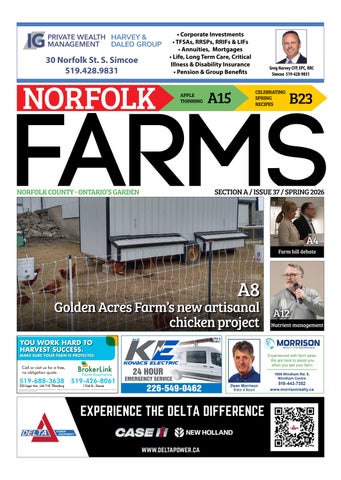
Golden Acres Farm’s new artisanal chicken project provides an alternative meat option for Norfolk residents
tobacco
By Diane Baltaz
A third-generation Delhi area farm family is going artisanal this spring – with chickens. On April 21, Kyle and Leigh-Anne Mauthe are bringing in 200-day-old White Rock brooder
chicks to Golden Acres Farm, located on Highway 3 west of Delhi. After brooding them inside a temperature-controlled, bio-secure barn for approximately three weeks, the fledglings will spend the rest of their lives outdoors – and
Extended hours on select Fridays until 8 pm – call for
Horario extendido algunos viernes hasta las 8 p m – llame para que le indiquen qué fechas
then be marketed as “artisanal chickens”. The Mauthe birds are part of the Chicken Farmers of Ontario (CFO) Artisanal Chicken Program –which allows entrants to grow small
A converted
elephant wagon provides shelter, food and water for the Golden Acres laying hens.
The Golden Acres artisanal caretakers: Kyle and Leigh-Anne Mauthe and children Warren and Blaire.
Golden Acres Farm’s new artisanal chicken project
batches of chickens for sale locally without having to purchase quota required by larger, commercial poultry farms.
The flock and family are part of a select niche farming group.
CFO communications officer Kory Preston explained, “The first of its kind in Canada, the Artisanal Chicken Program was created in 2016 with small-scale farmers and consumer interests in mind. In 2025, there were 135 active Artisanal Chicken farmers, representing communities across Ontario, including 88 farmers in Western Ontario.”
CFO created the program in response to calls for the CFO to be more responsive to demands for chicken produced locally, using alternative methods to conventional broiler barns.
“Artisanal Chicken farmers meet rigorous standards for animal health and welfare, and food safety, as do all Ontario chicken farmers,” added Preston.
“The program lets people who can’t afford quota or who want to diversify their operation or farm part time,” said Leigh-Anne. “They’re artisanal -- they’re not just barn chickens.”
Participants are licensed to raise 600 to 3,000 meat birds annually which they then market to targeted consumers groups, offering people additional options in their local communities, including off-farm retail locations such as farmers’ markets and restaurants.
The Mauthes are beginning with the minimum, bringing in the chicks in three groups of 200 each. They expect the last batch to be out by Thanksgiving.
Processed birds will be sold as pastured chickens for farm gate pick up, both as whole chickens as well as boxes of breasts and wings.
They posted their intentions on a community Facebook page and already received queries, including two asking about soup birds and backs from the “parted birds”, said Leigh-Anne.
The couple chose to raise artisanal chickens in part because it suited their lifestyle: both have full time, off-farm jobs in the conservation field, with Kyle working as a Ministry of Natural Resources conservation officer while Leigh-Anne does watershed land use planning with the Long Point Conservation Authority.
They also want to have a farm-raised white meat alternative for their freezer: Kyle hunts fowl – ducks and geese which have dark meat. The family also prefers the taste of pastured-raised chickens over more conventionally-raised poultry.
Their 101-acre farm is in its third generation of Mauthe ownership: Kyle’s grandparents, Harold and Doris purchased it as a tobacco farm in 1972; parents Paul and Cindy bought them out in 1980, eventually participating in one of the tobacco buy-out programs. LeighAnne and Kyle bought them out in 2025 and
Growers, we hear you.
Every year, you share new characteristics you’d like to see in pumpkins and winter squash. Our in-house breeding program keeps those in mind as we work to bring new and better varieties to market.
Top Picks from Our Breeding Program
Find these varieties and more at ruppseeds.com/PK25
Questions/Orders 1-800-700-1199
We GROW what we sell, so we KNOW what we sell.
Every year, we conduct real-world field trials at our office/research farm. These trials allow us to plant, monitor, and harvest vegetables - just as you do. We collect data from these trials so, when you’re ready to order, we can help you make the best decisions.
Our goal is your successful harvest!
A brother-owned business operating on
This “Cackellac tractor” is one of several portable pens that will pasture the chickens in a new location daily.
BODIE CORTEZ CRISSON
Golden Acres Farm’s new artisanal chicken project
moved onto the farm, renting much of the land out to a neighbouring potato farmer.
“I had no interest in growing tobacco. But I’ve always loved chickens but not the barn-raised kind, “said Kyle. “I tried my hand at pastured and broilers in the past.”
Therefore, as soon as they returned to the farm last year, the couple got chickens, nurturing “a small batch just for us,” as they called it.
With assistance from CFO staff, the Mauthes embarked upon the chicken agency’s detailed application process, which they said involved interviews, an onsite inspection, and then awaited the results of CFO’s discernment procedures.
“I had no interest in growing tobacco. But I’ve always loved chickens but not the barn-raised kind“ - Kyle Mauthe
They also obtained laying hens, starting with six layers for their children, Warren, four and Blaire, seven. The Mauthes then expanded the flock to approximately 90 hens; surplus eggs are sold at a roadside stand.
These “layers” similarly go outside to peck at the earth. They wander about an electrified meshfenced in area outside the barn, where a reconverted tobacco “elephant wagon” in the centre of their yard provides shelter, food and water.
“Therefore, we decided to try the CFO artisanal program,” concluded Leigh-Anne.
“You must meet specific CFO standards to raise chickens,” said Kyle. The criteria include water tests and participation in four training webinars regarding food and barn care, cleaning and disinfection standards.
Applicants must arrange a slaughter date with a processor for the finished chickens prior to program approval. The first group of Mauthe birds have a butchering date in June, after they reach the standard six to eight-pound range.
Participants must perform farm various audits throughout the year, including one of chicken sales.
“There are penalties if you request too many birds and you cannot market them – although the CFO makes provisions for you to reserve some chickens for your family,” explained Kyle. “We intend to reserve 40 birds for ourselves.”
The chickens must be pasture-raised to meet the artisanal standards, said Kyle.
“There are differences between the terms of barn-raised and free range – they are not moved about as in pasture-raised.”
Kyle and his father built several moveable chicken pens which they dub “chicken tractors” which will be moved daily. Leigh-Anne said that each pen “holds around 25 birds each to allow plenty of room for them to move around in. “
They also purchased a “Cackellac”
movable pen from Good Nature Eco-Farms in Thamesford, who also provided advice for their new venture.
“The Cackellac tractor says it will hold 150 meat birds, but we don’t expect to have that many in it to allow for more room for each bird,” said Leigh-Anne.
“Our pasture-raised chickens will be managed with light mesh and we’re strong with manure management. You can see where the chicken tractor was by greenness of the soil once it’s moved.”
They hope to move their birds beyond the barn area to pasture across South Creek, which bisects the farm.
“We have the land available for it and rest of our meat is hunted, so we’ll keep it all on the farm,” said Leigh-Anne.
Golden Acres Farm eventually intends to work with ALUS (Alternative Land Use Services) Norfolk regarding means of pasturing future chickens in the farm’s naturalized areas. The Mauthe family participated in three previous ALUS projects involving wildlife and South Creek on the farm since 2008.
Once they complete the raising and sale of their 600-bird allotment for this year, CFO program rules require the Mauthes and similar producers to re-apply to be in the program in 2027, which CFO staff assured is “standard to get back in annually.”
“It’s a learning process for us in Year One but we are going to make sure you get a good product,” concluded Kyle.
Diseases, crop insurance covered at tobacco board AGM
By Jeff Helsdon, Editor
Tobacco Mosaic Virus was the first virus identified more than a century ago, but it’s still around and causing problems today.
Dr. Mayphem AL-Amery, team lead at the Canadian Tobacco Research Foundation, presented those in attendance at the annual meeting of the Ontario Flue-Cured Tobacco Growers’ Marketing Board with a primer on the virus.
In the 1890s, tobacco mosaic virus was the first virus identified when Russian and Dutch researchers showed the symptoms of infected plants weren’t coming from a bacterium. TMV affects tobacco, peppers, potatoes, and ornamental plants. It is a single-strand RNA virus.
“Even weeds in your field can hold it,” ALAmery said.
Worse still, TMV can survive 40 to 50 years in a field before reappearing on plants.
TMV is different than potato virus (PVY) and results in a mosaic, or mottled, pattern on the leaf. It is spread mechanically, and is not insect or airborne. This means it is spread on hands, tools, gloves, and machinery. It can survive on clothes, tires and greenhouse benches.
“Even the smallest contact can spread the virus,” AL-Amery explained.
The 2025 growing season saw 13 confirmed cases of TMV, all of which were in Norfolk except for one in Oxford. Most of the cases were concentrated in one area. TMV led to 1,300 acres being destroyed.
The last outbreak of TMV was in 2000. That outbreak was of a similar intensity, with about 18 cases. Crops were destroyed at the infected farms. Seeds sourced from North Carolina were blamed for the cases.
Last year’s outbreak was different, and it’s likely it was spread through clippings and float tray water. The challenging issue with TMV is plants can look fine in the greenhouse, but then the infection can show in the field. Secondary spread is then possible in the field.
AL-Amery said prevention is the best way to combat TMV. This means greenhouse sanitation and using TMV-resistant varieties. Field rotation and weed control are also good preventative measures. AL-Amery emphasized there is no cure once plants are infected.
CTRF has one TMV resistant variety registered and is working on two more. AL-Amery said anyone who had TMV should use only the resistant varieties.
AL-Amery also provided an update on the registration for new tobacco chemicals being worked on, and those that were going through re-evaluations.
Other presentations at the AGM were an update from the Ministry of Finance about its online system, Eric Remler of Underhill Farm Supply about mitigating stress during tobacco production, and an overview of the services available through Agricorp.
Board chair’s report
Tobacco board chair Anthony De Carolis informed growers the 2025 season saw 140 licensed growers produce 17,977 contracted acres. This was a slight increase from 137 growers and 17,700 acres in 2024.
Crops yields were above average and quality was good, except for those who had TMV. Pricing was good for the better grades due to a shortage of tobacco globally.
The board has been working to improve its administrative processes. It has also been working with a legal team to advance the claims in the lawsuit against the cigarette manufacturers that was launched by the board in 2009 on behalf of growers that sold tobacco between 1991 and 1995.
De Carolis closed by giving a preview of the 2026 season, including the uncertainties from trade wars and changing American policy, tariffs and the review of the free trade agreement.
Agricorp
Jeff Smith of Agricorp told attendees that the Ontario government agency helps protect the livelihood of 47,000 Ontario farmers.
“As a company, we respond when individuals and government need us,” he said.
The company has underwritten $6 to $8 billion in risk annually. It has paid out $8 billion in claims out to farmers since it started in 1997.
Benefits of using Agricorp products include:
• Production loss – this covers both yield and quality loss
• Replanting – covers cost of replanting due to crop damage
• Salvaging – covers items like hail damage
• Price protection – Covers if prices are lower due to quality or low commodity prices.
In 2025, Agricorp insured 142 tobacco growers for 17,202 acres. There were claims for frost damage, resulting in replanting, and limited salvage claims for total claims of $8.28 million. A typical year’s payouts are about $4 million.
Eric Remler of Underhill Farm Supply was one of the speakers at the annual meeting of the Ontario FlueCured Tobacco Growers’ Marketing Board. Other speakers were from the Canadian Tobacco Research Foundation, board officials and from Agricorp.
“5Rs” of nutrient management efficiencies, benefits of sap testing part of 2026 NSCIA Grower Day
By Diane Baltaz
Cash crop farmers who attended this year’s Norfolk Soil and Crop Association (NSCIA) growers’ day in Courtland on March 12 gleaned many nutrient tips from agrologists, and even heard a long-term weather forecast. But the morning began with a British Columbia-based agrologist who grounded the day with his primer on the “Five Rights (5Rs)” of balanced nutrient management.
Agrologist and “self-confessed nutrient geek”, Rick DeJong, works for Rowena, a Spanish-based agricultural firm that operates in 80 countries. He began his presentation on “making fertilizer dollars count” by outlining the Five Rights for fertilizer applications: right nutrient, right place, right form, right mix and right time.
“I am science-driven,” said DeJong, while explaining how he derived the 5Rs. “They follow the core principles of nutrient management: better application equals better outcome, higher yields, better quality fruit… “
DeJong advocated for “timely nutrient testing” in order for assist the application of the 5Rs, from determining the right nutrient down to the right form, mix and timing of its application. Soil testing should be done every three to five years; he also recommended fruit testing for apples. He added that multiple crops benefit from plant tissue testing and sap testing to determine the right nutrient combinations –including micronutrients.
“Micronutrients help the big three -nitrogen, potassium and phosphorus -- work and then you may need less of these macros. Macronutrients by themselves are never 100 per cent efficient; it’s how we manage the micros that we get more response.
“Every nutrient has a role to play.”
Using tomatoes as an example, DeJong said that the micronutrient manganese, which
is required for chlorophyll formation in plants, “slows down and regulates the potassium.”
“Some nutrients play well with others in the sandbox while others don’t,” explained DeJong about right mix.
For example, while some micronutrients “don’t mix well with potassium, but calcium and boron do.” Potassium moves through plant when needed; this movement becomes more efficient when combined with a calciumboron application, two nutrients that work symbiotically. However, improper mixes such as excessive applications of boron often leads to cell mortality.
Using the right form of fertilizer ensures that
the right nutrients go into the right place. For example, many micronutrients (iron, copper, zinc, molybdenum, copper, calcium) are best managed through the use of drop and foliar sprays in order to maximize rapid absorption into plants when they most need it. But liquid forms of EDTA chelated iron works well in soil for plants to access, but not when applied on leaves.
Because every field and crop has different needs; their conditions vary annually. DeJong suggested that growers should consider adding sap analysis to their nutrient efficiency tool box.
“Sap testing is different from tissue tests,” said DeJong. “I recommend sap analysis for determining nutrition for 200 crops.”
Sap analysis measures the active liquids in the vascular tissues, the xylem and phloem. It provides a nearly real-time assessment of the nutrients available in the plant.
Proponents state that sap analysis can detect nutrient issues often long before visible symptoms appear. For example, sap analysis detects nitrogen deficiencies long before a plant’s older leaves turn yellow due to prolonged, insufficient chlorophyll synthesis.
Sap reports, as DeJong indicated in his talk, identify the deficiency long before the visual symptoms occur. Sap reports also identify when nitrogen has persistent levels, thereby indicating when fertilizer rates can be decreased. This helps reduces problems of pests and disease associated with excess nitrogen.
By contrast, plant tissue analysis measures nutrient concentrations in plant tissue. It is most useful when combined with visual inspections of the crop and soil conditions, knowledge of past field management and current soil testing.
“Sap testing protocols are different from those of a tissue test,” said DeJong. “You send in the leaves and the sap is extracted.”
DeJong discussed related issues related to the 5Rs, from the use of different solvents in spray tanks to plugged nozzles: “Plugged nozzles are a common problem. I see a lot of that in Ontario.”
The talks ended with atmospheric physicist-meteorologist Ron Bianci outlining how to read cloud formations to determine if a severe storm is forming nearby, and this growing season’s long term weather forecast. He said that all of the international weather models indicate a cool, wet spring which extends into the summer with the “heat moving in during the autumn.”
Bianci indicated that alterations in the jet stream and a “significant” heat dome that will dominate the US mid-west and the prairies throughout the spring and summer constitute two major factors for the southwestern Ontario growing season.
NSCIA is affiliated with the Ontario Soil and Crop Association (OSCIA) which is involved in the delivery of many education workshops, financial assistance programs, demonstrations and applied research. OSCIA’s vision is “farmers actively seeking testing and adopting optimal farm production and stewardship practices”.
British Columbia agrologist Rick DeJong discussed crop nutrition at the Norfolk Soil and Crop Growers’ Day.
Young farmer award finalists just a small sample of what Ontario has to offer, says Spoelstra
‘Countless others who could be recognized’
By Luke Edwards
Simply put, he’s a farmer, but ask Drew Spoelstra what kind of farmer he is and be prepared to wait a while as he responds.
That’s because he and his family are dairy farmers, beef farmers, veal farmers, cash croppers, seed dealers, and they raise about 50 clydesdales. Oh, and Spoelstra’s also the president of the Ontario Federation of Agriculture.
“It is kind of a complex business structure,” Spoelstra admits. But it’s a structure that works for him and his family.
“We’ve always had a kind of diverse practice…It kind of spreads the risk and spreads the workload,” he said.
That diverse approach has landed the Binbrook farmer on the shortlist to represent Ontario in the Outstanding Young Farmers competition. Drew and Heather Spoelstra are finalists alongside Tyler and Allison McBlain.
“I’m excited to work through the process and see what happens, it’s certainly an honour to be nominated, I’m humbled by it and looking forward to the challenge,” Spoelstra said.
The Spoelstras recently installed a robotic milking system for their 60 Holsteins.
The nomination has given Drew and Heather a chance to take a step back and remind themselves of their business and community accomplishments.
“It’s cool to reflect on what you’ve done,” he said.
Taking on all the responsibility, between the various aspects of the farm business and his role with OFA, keeps Spoelstra busy, and he said he wouldn’t be able to succeed without a strong support system.
“You need to have a good team of people both at home and at OFA and I’m lucky to have both,” he said.
At home that team involves his wife Heather, as well as his parents, who Drew said are still active on the farm.
And while he’s humbled by the honour, Spoelstra was quick to point out the many other young farmers in Ontario who are ensuring Ontario agriculture has a strong future.
“There are a lot of young farmers working across the province doing great things and it’s certainly cool to be recognized but there are countless others that could be recognized too,” he said.
“It’s definitely important to highlight them all.”
His fellow finalist also deserves all the recognition they’re receiving, Spoelstra said.
“They’re a generational farming family, which is awesome and they do good work,” Spoelstra said, describing the McBlains as staples of the Brant farming community.
The finalists will present before a panel of judges with the winner being announced at
an event in St. Jacobs on Wednesday, April 8.
The winner will go on to represent Ontario at a national competition in B.C. in November.
Spoelstras to host Breakfast on the Farm
Win or lose, Roy-A-Lea Farms will host a celebration later this year when the Spoelstras welcome the public for a Breakfast on the Farm event.
Taking place Saturday, June 13, visitors will
be able to tour the Binbrook farm after enjoying a farm-fresh breakfast.
The Spoelstras recently installed a robotic milking system for their 60 Holsteins, and visitors will get a chance to learn about the technology along with the other aspects of the farm. It runs from 9 a.m. to 1 p.m. and more information, including tickets, can be found at farmfoodcareon.org/binbookbreakfast.
Drew and Heather Spoelstra are finalists for the Ontario Young Farmer title. They run a diverse farm operation in Binbrook, and are pictured here with their kids: Hadlea, Harper, and Kasey.
‘Buzzing with biodiversity’: ALUS program coming to Haldimand
By Luke Edwards
A four-year effort to bring the ALUS program to Haldimand may seem like a long time, but for Anna Haupt, it was much longer than a quadrennial.
Haupt, a dairy farmer with 50 milking Holsteins and 360 acres of land in Canfield, was one of a few farmers who have shown some interest in joining the partnership advisory committee (PAC), a key step in implementing the program in Haldimand.
“The idea of the program always appealed to me,” she said, recalling first learning about it when she was a teenager through a cattlemen’s association.
ALUS is a program that works with farmers and ranchers in participating communities to develop nature-based solutions to build climate resilience and biodiversity on their land. The goal is to use marginal farmland that isn’t terribly productive for agricultural purposes to do so, with the landowner receiving technical and financial support through ALUS.
For Haupt, it’s the shared responsibility aspect that attracted her to the program. A lot of the responsibility of enhancing biodiversity or building climate resilience can tend to fall on the landowner’s shoulders, but with ALUS that load is lightened.
The Haldimand Stewardship Council began work on bringing ALUS to the county back in 2022. Several steps are required before the program becomes active in a community, including the creation of a legal entity to manage the program and a PAC to guide which projects are supported and how much payout a farmer receives.
With a meeting held last month at Shelley’s Diner in Kohler, council member Cathy Blott said they’re well on their way to start accepting project applications, likely later this year.
“We’re really pleased with that,” she said.
Farmer buy-in is a key aspect of the program, something that came up a few times at the meeting. Fortunately, Haldimand has a neighbour in Norfolk with a very strong and long running ALUS program. In fact, it’s the oldest continuously running ALUS program in Canada, dating back to 2007 and with more than 190 farm families involved.
For the first three years ALUS Norfolk will act as the legal entity for Haldimand, though Haldimand will maintain its own PAC. That will allow Norfolk to provide the expertise and experience they’ve gained since their inception 20 years ago, but Haldimand farmers will maintain control over local decisions.
Ron Niville is the chair of ALUS Norfolk and grows soybeans and corn on his 100 acres of land. He’s implemented several ALUS projects on his property such as a buffer strip on a drain and planting areas around a pond with tallgrass prairie. The projects have helped reduce invasive species like fleabane, kept nutrients on his fields and out of the drainage and brought plenty of beneficial wildlife back to his property.
“We’ve created a nice little biosphere on my property,” he said.
Niville’s experience with ALUS goes back to 2009.
“When they first approached me, I was a little hesitant,” he admitted.
But as he realized the benefits - not just the financial payments farmers receive but
also a boost to yields on the lands he kept as agricultural and overall improvement of biodiversity on his property - he pursued more and more projects. Niville encourages farmers in Haldimand to give it a try, as well.
“Jump in with both feet,” he said.
ALUS’ senior hub manager for the Great Lakes region Alyssa Cousineau said there are also benefits for those who raise livestock by extending how long pasture land is grazeable. Adding cool weather grasses with warmer weather grasses means farmers can move their animals to a new pasture when that grass is in season.
The local PAC will determine payment structures, but Cousineau said it typically ranges from $100 to $250 per acre for lands that are completely turned over to nature projects. In some situations, such as where tallgrass prairie is planted, the farmer may choose to hay that land or use it for pasture. In that case, they’d receive a smaller payment, perhaps in the $30 to $75 per acre range.
The goal, said Cousineau, is to focus on those smaller parcels of land that’s not productive for agriculture. The rest should stay farmland.
“We want to keep the farmers farming,” she said.
To give local farmers a sense of what projects would look like, several funders helped implement a trial project on Elaine Gosnell’s 30-acre farm. They planted seven acres of tallgrass prairie. By the end of the second year after planting, Gosnell said they already noticed a difference, with the beautiful tallgrass prairie being home to all kinds of birds.
“By year three it was looking fantastic,” she said. “We really enjoy it, we really love it. It’s beautiful.”
A lot of the birds nest in the fields, but when farmers take their crops off, the nesting area disappears. The trial project gives those birds another option.
“It’s like this refuge for grassland birds looking for habitat,” she said.
Cousineau described a similar project and the quick effect it had on biodiversity.
“The tallgrass prairie is just buzzing with biodiversity,” she said.
ALUS Haldimand is still accepting members for the PAC, and Cousineau encouraged anyone interested to come out to a meeting to see if it’s a fit. They have enough members to get started, but don’t have a limit on how many members they can have. However, farmers must make up at least 50 per cent of the committee.
For more information visit alus.ca/alus_ community/alus-norfolk.
Members of the Haldimand Stewardship Council, ALUS and local farmers met last month in Kohler, as the group attempts to get an ALUS Haldimand program started.
Size matters when it comes to apple thinning
Humans will likely always be needed, but Finite Robotics developing a tool that can take over a large chunk of orchard thinning
By Luke Edwards
For anyone worried about the robot takeover, fear not. Matt Stevens has a perfectly simple solution should the machines try to rise up against humanity.
Bamboo.
Stevens, president and head grower at Finite Robotics, presented at last month’s Ontario Fruit and Vegetable Convention, showing off robotic orchard thinning technology his team has developed. While playing a video of the machine in action, the robot came up against a bamboo stake in the orchard. The stake baffled the robot, leading Stevens to joke to the audience that should the robots ever rise up, just get your hands on some bamboo.
But while the robot takeover talk is all presumably with tongue firmly placed in cheek, it gets to a significant point Stevens makes about the robotic thinning technology.
“There are things robots are incredibly good at, and there are things humans are incredibly good at, and they’re not the same thing,” he said.
To further the point, Stevens had the audience perform a bend and twist motion with their arms. Unsurprisingly, every human managed the task with ease. Had he been in a room with robots, however, he said they would have overwhelmingly failed.
Gerbe Botden is the vice president of the Blue Mountain Fruit Company in Thornbury, where Finite Robotics did some testing. Better thinning processes, completed earlier, will mean a better, more consistent end product, he said. Earlier thinning can also improve the chances of return blooms, improving yields for future years.
While humans might be able to contort their arms in ways robots can’t, human eyes fail in detecting millimetre differences in fruit size.
The solution, therefore, is fairly straightforward.
“Get them (the robots) to do 50, 60, 70 per cent of the work, and then get them out,” said Stevens.
“We want this to be a tool, not something that makes it more complex for the grower,” added Botden.
Finite Robotics took their prototype robot through what Stevens called a skills bootcamp. The skills included movement, vision, decision making, reach, removal and disposal.
lighting, but Stevens said they’ve been able to overcome those challenges.
With solid vision systems, decision making becomes interesting.
“This is where there’s a difference. When you’re using a robot, they can do sizing very accurately. You can start to do some logic that
Matt Stevens comes from an orchard background and his robotics company is developing technology he hopes will be able to provide better thinning processes for his fellow apple growers.
Update on the 2025 Canadian potato variety trial presented at Canadian Potato Summit
By Tamara Botting
The Canadian potato variety trial is an essential cross-country information gathering and testing practice that has been shaping the nation’s potato industry for decades.
The influence the variety trials have on the nation’s agricultural industry can’t be understated when one considers the fact that potatoes are Canada’s largest vegetable crop. Furthermore, according to the Government of Canada website, in 2023, potatoes accounted for $1.96 billion in farm gate receipts.
Potatoes in Canada hosted its annual Canadian Potato Summit in January 2026. One of the sessions for that virtual event was the 2025 Canadian Potato Variety Trials: Industry Overview.
Jen McFarlane was the first presenter. She’s an integrated pest management (IPM) consultant for ES Cropconsult (an IPM company in British Columbia that does that province’s portion of the variety trials), and is the national coordinator for the variety trials.
McFarlane gave credit to all of those who contributed to the process, saying, “These field trials don’t take place without grower collaborators, seed producers, and everyone else who works hard in the field to make these trials happen.”
She also noted how expansive the trials are.
“These really do span the breadth of the country, from Vancouver on the west coast all the way to PEI on the east side. There’s a trial site in every province.”
This helps with the data collection, since each site has a unique climate and experiences different weather patterns. For instance, in 2025, Manitoba had some higher temperatures in May, and wildfires meant smoky conditions throughout the middle of the summer. While western Canada’s temperatures and rainfall were fairly average, New Brunswick and Prince Edward Island had drought conditions in the late summer; Quebec had high rain levels in July, but then it was very dry for the rest of the season.
The fields in the eastern trials are not irrigated, meaning that they were relying on rainfall.
While the conditions for the eastern side of Canada were hard for the growers to experience, McFarlane noted that there was a sliver lining in it for the variety trials, because it gave researchers “an opportunity to test drought tolerant varieties and see if there’s anything there that can be of use.”
She emphasized how much of a benefit it is to have trails in all of the provinces, because it allows for a broader data set; “2025 was a great year to compare these different conditions, because what we saw across the country was very varied.”
It wasn’t just the weather patterns that were diverse across the country, but also the varieties being grown.
Not only were up-and-coming varieties planted, but a short list of industry standards were also grown.
McFarlane said growing both types “really gave us an opportunity to provide a baseline to growers to compare from something like Yukon Gold with the newer varieties that are coming out, and I think that was helpful, so we will continue to do that.”
Also, not every variety will be grown at every site across the country. Some may grow as many as nine or ten varieties, while others may only grow one or two.
“We needed to have flexibility for the local market and industry for that area, so we’re not forcing someone to grow a potato that just isn’t relevant to them,” McFarlane said.
Throughout the trials, the parameters being measured include:
• Total yield – hundredweight (cwt) per acre
• Marketable yield
• Uniformity of shape and size
• Diseases observed
• Growth deformities observed
• Comments and other observations
McFarlane gave a quick rundown of some highlights of the varieties that were grown across Canada.
With red skinned potatoes, AG 1540 and Fenway both had great yields in BC, which made
Jen McFarlane is an integrated pest management (IPM) consultant for ES Cropconsult, an IPM company in British Columbia that does that province’s portion of the Canadian potato variety trials, and is the national coordinator for the variety trials.
During the Canadian potato variety trials, field days – like this one in Ontario – are an opportunity for stakeholders to come out to the growing sites and see firsthand how the trials are being conducted, and how the different varieties are doing in real-world conditions.
There’s a lot of planning and data recording that goes into the Canadian potato varieties trials each year. This is necessary, as this information is vital to track the performances of different varieties over multiple years, in different places and with varying weather, soil, etc.
Update on the 2025 Canadian potato variety trial presented at Canadian Potato Summit
sense, as the weather was so favourable. The Dark Red Norland variety was grown in seven different sites, so there was a lot of opportunity for comparison.
With yellow varieties, Yukon Gold, which is the industry standard, had a better yield in Manitoba, but was lower in Ontario and Quebec. Colomba also did well in Manitoba.
Constance had great yields in the western part of Canada, but there wasn’t as much of a basis for comparison, as it wasn’t grown in many sites; this was also true of Alegria.
Russet varieties were split into two categories, processing and fresh. Burbank had a lower yield in the eastern provinces due to the drought conditions; the other three varieties looked at were mostly grown in western Canada, which again, had good results because of favourable weather conditions.
It was a similar story with white varieties; Eva, Alliston and Audrey were limited as far as where they were grown, so the comparison data is lacking; Audrey did produce well in BC.
Kennebec had a poor yielding in Quebec, but did much better in BC, Alberta and Manitoba.
As far as chip varieties are concerned, two old favourites – Atlantic and Lamoka – both performed well; so too did SP327, which did especially well in BC and Alberta, and McFarlane described as “a promising new variety.”
She added, “Maybe this is something we’ll be seeing a little more of in the future.”
There were two other speakers during the webinar. Dr. Chandra Singh, from Lethbridge Polytechnic, spoke specifically about the field trials that took place in Alberta, while Samuel Gagnon with Progest spoke about the variety trials in Quebec.
While Ontario’s varieties trials results were not covered in the webinar, the March 2026 Canadian Agriscience Cluster for Horticulture 4 update report did have some details about some new promising potato varieties that were found through the province’s varieties trials.
(The report, which discusses testing results for a number of commodities, can be read here: bit.ly/4rr9ILr)
F180085-04 was described as “a standout early to mid chip line with high yield and gravity and low sugar levels at harvest.” Furthermore, the report noted, this variety “reduces the likelihood of processors rejecting a crop due to high sugar levels.”
Meanwhile, AG1540 proved to be “the highest-yielding late-maturing fresh market line in trials,” and “VF180073-13 is highly resilient, ranking as a top yielder in both the standard and heat-stress trials. This variety allows growers to better manage the risks associated with increasingly frequent summer heatwaves.”
Three varieties – VF19006-002, AG1601.05, and Kingsman – “were found to be the strongest dual-purpose varieties for boiling and baking in trials,” according to the report.
Testing is currently underway for the 20252026 long-term commercial storage trials, the results of which are expected to be released in December 2026.
The varieties trials are a lot of work – not only at each individual site, but also considering the coordination that has to happen across the nation.
Also, “It takes a long time to get a variety from the beginning stages all the way to being a commercial variety that can be grown,” McFarlane said, adding that the process is generally 15 years from start to finish.
However, she added, there’s a lot of value in the work being done.
“It keeps Canada at the forefront of producing new varieties,” she said. On top of that, it gives the growers the opportunity to see firsthand what grows well locally for them.
It was an extremely dry growing season in the Maritimes during the 2025 Canadian potato varieties trials. While this is never easy for farmers to contend with, it did give an opportunity to see which varieties are more drought tolerant.
Many of the potato varieties tested in British Columbia did very well in the trials, as the weather conditions were very favourable.
Customized real-time visibility dataloggers designed to help farmers save time, money and stress
By Jeff Tribe
Rola Elghonimy’s role as Farmer Outreach for Apidae Systems has allowed her to discover just how busy her clients are.
“They can’t catch a break, they’re always working, they’re very busy.”
One beef farming client will return her emails at 4 a.m. says Elghonimy, and alternatively, call at 10:30 p.m.
“Even on Sundays. He never gets a break.”
The fully-Canadian Ottawa-based company looks to help answer that reality through providing producers real-time ‘electronic eyes on their crops’ connection to fields or growing environments along with customized datalogging, all accessed through their phones or computers.
Although the company’s branding centres around an ability to measure anything, anywhere from concrete to composite materials, her presence at the 2026 Ontario Hazelnut Association Symposium Thursday, March 19 inside the University of Guelph’s Arboretum focussed on that crop.
She and company founder and CEO Ming Chen brought along an illustrative weatherproof datalogger combination. Although Apidae can source over 100 unique sensors, a more-typical farm-based unit may include in-ground monitors reading/recording soil humidity, compaction, temperature, pH levels and electrical conductivity (an indication of mineral levels). The unit will also likely feature
an electronic rain gauge, solar radiation sensor and possibly a camera, the combination powered by solar cells and batteries or a standard wall plug if one is easily accessible.
The units are connected to clients either through WiFi or cellular data.
Some assembly may be required, but it is of
Farmer Outreach for Apidae Systems Rola Elghonimy (left) and Founder/CEO Ming Chen (right) show off some of the hardware associated with their customized real-time visibility dataloggers.
a plug-and-play nature Elghonimy emphasized, simpler in practice she says than products from a popular furniture manufacturer.
Laughing, she described her secondary role as company guinea pig. Considered to be among its less tech-savvy members, she acted as ‘the monkey in the maze.’
“Even the low-tech person can set it up easily.”
Accurate, quantifiable and storable data allows producers to take an educated approach says Elghonimy, saving time by reducing on-site monitoring. For instance, a hazelnut producer whose orchard is 45 minutes away from their home can make real-time informed decisions about supplemental watering.
“He knows when he has to go irrigate.”
Proactive measures including adequate watering are seen as a line of defence against disease including blight, maintaining resistance through tree health.
cameras.
“You can relax, you have have that peace of mind of what’s going on in your fields without actually being there,” said Elghonimy.
Apidae’s approach is to sell and service the hardware, not a subscription system.
“It’s kind of like a tractor, you own it.”
Sensors can be added or upgraded to reflect new technology or changing requirements.
“We’ll do our best to integrate it into your system.”
In general, the company recommends one system for each type of growing environment.
A 5,000 acre farm with one soil type, elevation, sun and slope conditions may only require one unit. However, if a farm has, for example, three distinct zones, three would be recommended
to reflect the reality in each.
Cost is dependent on hardware requirements, but as a rough example, Elghonimy pointed to a weatherproof solarpowered system with a rain gauge, and electrical conductivity, soil temperature and moisture and air humidity sensors running around $2,000. One put together for her busy beef farming client featuring 11 sensors and a camera was in the $3,000 range.
“It gets rid of a lot of the guesswork,” Elghonimy summed up, the bonus being, reducing stress on crops may also reduce associated stress on those responsible for producing them. “It can help save a ton of time.”
“They can’t catch a break, they’re always working, they’re very busy.”
Field data can assist in informing fertilizer application rates, potentially an avenue for significant cost savings. There is also the security or additional level of insurance component, greenhouse operators able to monitor conditions for potentially sensitive crops, others able to identify pests through either standard or thermal imaging
Bringing the Rodeo Back to Norfolk: The Timmerman’s
By Leah Bauer
When Krista Timmerman first moved to Norfolk County to take on a teaching job at Walsh Public Elementary School she might not have guessed what she and her family would bring to the community outside of the classroom.
Teaching French Immersion at Walsh Public was what initially brought her to Norfolk. However, her love of the community and people of Norfolk helped her decide to make it her home. Initially, the Timmermans settled in St. Williams, though the young couple, who both grew up on farms, quickly outgrew their St. Williams home and purchased land in Nixon. Krista grew up on a dairy farm outside of St. Thomas, and horses have always been a part of her life, though she prefers a relaxing trail ride over rodeo competitions.
The Timmermans’ vision for the rodeo initially began as a way to get involved with the local community. Krista remarked, “We wanted to figure out how to get involved in this community. Norfolk is such a western and equestrian area, and there was no rodeo here at the time, so I thought it would be a way to kind of bring that culture back to the community.”
For nine years (accounting for a small break during the COVID-19 pandemic), the Timmermans have taken their horse ranch and completely transformed it every third weekend in July for the Norfolk Pro Rodeo. The Norfolk Pro Rodeo is a part of the Rawhide Rodeo Tour and boasts all of the classic rodeo events such as bull riding, bareback and saddle back bronc riding, barrel racing, team roping, and steer wrestling.
Since its inception. the competition portion of the rodeo has remained the same. The Norfolk Pro Rodeo has always been centred around high-quality professional rodeo competition. That being said, the high-quality competition might be one of the only aspects of the event that has remained unchanged as it continues to grow in popularity each year.
Krista reflected on the evolution of the rodeo, stating, “The very first year, it was just the rodeo, only the contestants. We had a couple wooden bleachers around it and two food trucks, and that was that. Slowly, we started adding in music, more vendors and more entertainers. Later, we started doing partnerships with the local 4-H Club, and they brought out animals and set up displays so we could incorporate agricultural awareness at the event.”
prided ourselves on not increasing ticket prices as the cost of the event has gone up. We’ve been able to do that because we’ve gotten so involved with the community, and have so many local sponsors supporting us. That sponsorship money goes directly to improving the event, while keeping the tickets affordable.”
Country music has always gone hand in hand with the Norfolk Pro Rodeo. Initially, the rodeo featured smaller-scale concerts with local performers. As demand and popularity grew, so did the interest in the concerts at the rodeo. Now, the event hosts two first rate country concerts on both Friday and Saturday night. This year, George Canyon will play on Friday night, and Aaron Pritchett on Saturday night.
One of the most important tenets of the Norfolk Pro Rodeo for Krista and her family “is continuously improving the quality of the event and elevating the event itself by bringing more opportunities and different things to see. At the same time, we are keeping the ticket prices low. We have really
Krista expressed immense gratitude to “Norfolk Tractor and Kubota, the presenting sponsor, who has supported us and the Norfolk Pro Rodeo since day one.”
As the mother of two young boys, aged nine and seven, Krista experiences first-hand what this event brings to the summer itineraries of families across Norfolk County. She laughed that her children “have a countdown for months” and that their favourite part of the rodeo is
“They just love the whole atmosphere. It’s a very safe place to explore. They go from the
bouncy houses to the mechanical bull, to the food and the ice cream, then watch some barrel racing, then the music and then they run around again, then they watch the bull riding. I think just being able to do so much, and they’re not going to see one thing and get bored.”
The process of turning their backyard into a rodeo is a labour of love for the Timmerman family. The most difficult part, Krista says, is “all the months of planning and organizing. Some of the best laid plans just don’t go as expected. If you have really bad weather, it can be a really big risk, and can cause a lot of stress. But it’s really rewarding just seeing it all come together and everyone enjoying it.”
The Norfolk Pro Rodeo is held every year on the third weekend in July. This year, it will run from July 17 to 19, with each day bringing a different lineup of events. The event offers tiered ticket pricing, with an early-bird discount available until June 19. It is a good idea to get tickets early, as the Saturday event has sold out for the past two years. Tickets can be purchased online at: norfolkrodeo.com/tickets
From Farm to Face: The Story Behind The Tallow Twins
By Leah Bauer
Megan and Maddison, two twins who live and operate their business on Cockshutt Road, have turned beef tallow, an often-forgotten by-product of cattle farming, into a skincare business.
The origins of their business are founded in a belief that what we put on our skin is just as important as what we put on our body. In considerations of health, it is common to question the ingredients of our foods, but less common to question what is in the products we use on our skin.
The
creation of their products, and the growth of their business is something that the twins take on as a team.
The ‘lightbulb moment’ to use beef tallow as a natural alternative came to Megan when she was working as a doula. A doula is a person who provides support to women before, during and after pregnancy. In this position, Madison was often asked by expectant mothers, “What skincare products are clean enough to use on my pregnant belly, and on the skin of my baby?” When investigating this question for her clients, Madison found that many of the products offered in ‘wellness’ stores were not actually clean or safe, and they often relied on toxic chemicals that were detrimental to the health of the mothers and their babies. From there, the journey began. Madison discovered beef tallow as a genuinely clean skincare alternative that she could, in good conscience, offer to her clients. From that point on, her kitchen was a mess as she created small batches of tallow products. However, the messy kitchen was a small price to pay for Madison who was content to see that her clients were no longer being exposed
to harsh chemicals.
It was around this time that her twin, Megan, returned from studying business, and playing rugby in Nova Scotia. After Megan’s return home, the twins jetted off on a post-grad trip to Mexico where Megan said “there was a lot of creativity flowing.” Whether it was the creativity, or the margaritas we may never know, but either way the two returned with a business plan, a logo, a website, and a passion for clean skincare products.
Originally, the twins rendered and purified the tallow themselves, though they have transitioned to using tallow from Norpac in Norwich, who do the rendering process. The
twins are grateful to work with local producers, and to be familiar with the cattle from which they source their tallow. They began working with Norpac in 2023. When the twins originally reached out to Norpac they were told that the company just recently started keeping the tallow in the last six months. Before that, it it was being thrown away. The twins believe in the importance of “nose to tail” use of animals, which is the belief that if you are going to kill an animal then try to use all of its parts.
Nutrition and wellness are the central tenets of why Madison and Megan founded The Tallow Twins. The incredible benefits that
Meghan (left) and Madison (right) standing in front of shelves of their many different Tallow products.
From Farm to Face: The Story Behind The Tallow Twins
come from Ontario-grown cattle is not lost to them, they believe that our society needs to revert back to using all parts of the animal stating: “We’re throwing away the organs. We’re not using the hide. We’re not using the tallow. We’re not using all the incredible parts of the animal that are actually arguably a million times more nutrient than muscle meat. So it’s crazy. It’s crazy. We’ve definitely become very lost in the last little while of how we harvest animals and what nutrition means.” The twins argue that humans evolved on natural animal products and a progression towards more processed foods and products has accelerated the rise of poor health and health complications in our modern world.
The creation of their products, and the growth of their business is something that the twins take on as a team. While they have a shared passion for their product, and delegate responsibilities for business operations and believe that “they wouldn’t be able to do it without each other.” When asked if they ever fight when running a business together the reply was simple, “The personal relationship between us is more important than the business relationship. So, you have to pick your battles.”
The Tallow Twins’ social media has garnered significant traction, with their videos often receiving thousands of views. This goes to show, in Madison’s opinion, the “hole in the market” for good quality, clean skincare. Originally, the twins received most of their sales from local farmers markets,
though with their growing online popularity, a lot of their sales have shifted online. As their business grows and their ability to be at the farmer’s markets has dwindled, they still believe that local farmers’ markets are “why they are here.”
The twins offer 28 products, including soaps, body butters, exfoliants, deodorants, and lip balms. The quality of their products is demonstrated in the amount of repeat customers they have. One of the best parts of their business according to them is interacting with their customers and hearing reviews such as, “Thank you for making this. I’ve been using it for two years now, or it healed my baby’s eczema or I had psoriasis for years and it’s been the only thing that has helped me.”
It is reviews like these ones that keep the twins going, when they hear about the impact of their product they often think, “Yeah, that’s why we’re doing this. It’s not just like a business. It’s so cool that we made a thing that is making people happier and healthier and more confident in their skin.”
The Tallow Twins have come a long way from their origins in 2023, and they are just getting started. Their goal is to one day include makeup in their line of tallow products, and to continue to educate and enlighten people on the importance of clean products.
Check out their website at: tallowtwins. ca, or find them on Instagram @tallowtwins.
Seeds You Can Count On. Proven genetics, field‑tested for real farms. Satisfaction guaranteed.
Selection & Innovation
Our Research and Breeding Teams evaluate thousands of varieties each year in trials on our farm in Maine and in regions across Canada and the US to ensure we offer you only the best varieties with exceptional flavors, eye catching colors, and critical disease resistances. We grow and know what we sell.
Year-Round Support
Our Canada Support Team is ready to assist you with variety selection, growing information, and getting orders over the border.
Explore our Grower’s Library for resources on every crop for your best season yet!
Johnnyseeds.com/growers-library
The twins began their business in their kitchen, they have since upgraded to a shop in their front yard.
Guest speakers share stories, wisdom at GFO March Classic
Grain farmers event sees successful move to Niagara
By Luke Edwards
The word uncertainty was thrown around a lot at the Grain Farmers of Ontario March Classic last month, and for good reason given the state of the world.
It’s a word that might evoke fear and concern, but guest speakers suggested uncertainty can be a feature as much as it can be a bug.
It was a, perhaps, appropriate theme for this year’s event, considering some uncertainty around the classic itself as it moved to a new location at the Niagara Falls Convention Centre. However, the new home proved successful with a strong turnout and full crowd to listen to guest speakers Arlene Dickinson, Catherine Murray, Eric Termuende and George Stroumboulopoulos.
The speakers themselves often lauded the farmers in the room, acknowledging the hard work, challenges and sacrifices they make to put food on the tables of people here and around the world.
“To me, you are the foundation of our nation,” Dickinson told the farmers in attendance.
“The world needs farmers, and the world needs Canadian farmers.”
‘Things are going to be hard’ but opportunity is there: Dickinson
Calling farmers some of the best BS detectors out there, Dickinson - who created a successful marketing company before becoming a prominent investor and star of the TV show Dragon’s Dendidn’t sugarcoat things for those in attendance. Global unrest and an increasingly antagonistic neighbour to the south means we’re in for some turbulence.
“Things are going to be hard,” she said. “We live north of unrest.”
However, within that difficulty are seeds of opportunity, especially in a country like Canada. It’s something she learned when her family arrived here from South Africa with $50 to their name and nothing else. While Canada can always improve, she said the country and the people who call it home create an atmosphere where success is possible.
And she said other countries value Canadian goods and expertise. A recent trip to several Asian countries proved that to her.
“I found countries that wanted what we have to sell,” she said, adding it will be increasingly vital as Canadian exporters - farmers included - try to wean themselves off American trade.
That all may be uncomfortable, but Dickinson said opportunity often lies in the uncomfortable. Her own role on Dragon’s Den almost never came to be because she was, for a time, unwilling to step outside her comfort zone.
In fact, the only reason she agreed to do the audition was because she’d always encouraged her own children to try new things, and realized she had to walk the walk.
Still, throughout the process her fears of putting herself in the public eye and being judged kept a hold on her. When, during auditions she got in an argument with co-star Kevin O’Leary over what she said was unfair treatment of a guest, Dickinson figured she’d got her wish. The producers would thank her for her time, send her home and Dickinson could return to her former life while telling her children she tried.
Except, the producers liked what she offered the show and wanted more. Dickinson said she tried to turn it down, but eventually realized she couldn’t. And the rest, as they say, is history.
“It was because I walked through a door I wasn’t comfortable with,” she said.
Find the right time to push against the consensus view: Murray
Most of the time, the consensus view is a consensus for a good reason, says Catherine Murray, business analyst and former anchor of BNN’s The Close. The key is to figure out when the consensus is wrong, or when it’s about to become wrong.
“When it changes, it’s fast and furious,” she said. Pushing back on the consensus at the right times can turn “pain into prosperity.”
Murray said she’ll be keeping her eyes on global markets as a weathervane of how things are going. The renegotiation of the Canada-United StatesMexico Agreement, government policy and the ongoing rollout of AI and technology will all be key aspects that determine where things go from here.
“With this upcoming trade deal, I hope we have
Arlene Dickinson
Catherine Murray
Eric Termuende
Guest speakers share stories, wisdom at GFO March Classic
some great negotiators,” she said.
Even as Canada pivots away from the U.S., opening up some canola access to China and other smaller deals with Asian countries for example, Murray said Canada is too intertwined with our neighbours to the south to completely abandon Canada-U.S. trade.
“They are still our biggest trading partners,” she said.
In this new technological world, and as Canada looks to find more trade partners, Murray said traceability will have a renewed focus. She also suggested the two can work hand in hand, as blockchain offers a potential way to use technology to combat the misinformation and disinformation that can flourish in the digital age.
“Blockchain is the building block of what is real and what is not,” she said.
No point in trying to predict the future: Termuende
As the March Classic was taking place there were no shortage of uncertainties in the world. The Strait of Hormuz remained closed and no one knew how long the America/Israeli war against Iran would last. The future of AI still hasn’t been written. However, rapid, and accelerating, advancements in technology means the world is changing at an ever greater clip.
That may lead people to think it’s becoming more important to understand where the world is heading so businesses can adjust.
Termuende thinks that’s a fool’s errand.
“If you think the world is moving fast, wait until later tonight. It will be moving faster,” he said.
So if the world’s moving faster and faster, and there’s no point in trying to predict where things are going, what do we do?
“Build a team so good that it doesn’t matter what the future looks like,” he said.
A strong team can react and adjust to changes when they happen, leading to success in every version of the future the universe can offer.
Termuende promoted the idea of one degree shifts to build that team. Small changes to address issues eventually add up in a big way, he said.
Strombo: We’re not so different, you and I
The presentations wrapped up with a discussion with one of Canada’s biggest cultural voices.
Some know George Stroumboulopoulos from his days as a VJ on MuchMusic. Others from his talk show, or his stint as Hockey Night in Canada host.
What fewer people may know is his longstanding connection with the food system. He’s worked with the United Nations World Food Programme, becoming the first Canadian National Ambassador Against Hunger. He’s also part of a project in South Africa that’s growing hemp to be used in a variety of ways, including hemp milk.
This variety has given him a unique perspective
he said.
And while that never really stopped in the private sector - Stroumboulopoulos said Canadian agricultural technology and expertise is found across the globe - he sees an opportunity for the country to re-establish itself on the political stage.
Closer to home, Stroumboulopoulos said feelings of a country divided are overblown.
“We’re not nearly as divided as we think we are,” he said. Canadians may not have completely common ground, but by and large they have common goals, he added.
The key is to listen, and to do so with intent. Instead of trying to “win” a conversation, he encouraged people to actively listen and consider
“What one degree shifts can we take right now to get us a little closer to our goal?” he said.
Yesterday’s best practices may not hold up today, he added, so constantly looking at where a business can start something new, stop something that no longer holds value, or continue doing what works is key.
George Stroumboulopoulos
Free program helps farmers be ‘In
Know’ about mental health
By Tamara Botting
A decade ago, two researchers from the University of Guelph, Dr. Andria Jones and Dr. Briana Hagen, conducted a study on the mental health of farmers across Canada.
This included a survey of farmers, which received over 1,100 responses.
“It came back with some very jarring statistics,” said Amelia Cassimatis, Bilingual Engagement Manager with Agriculture Wellness Ontario (AgWO), part of Canadian Mental Health Association (CMHA).
Almost half of the respondents – 45 per cent – were found to have high stress, and 35 per cent had depression. Farmers were also found to be two times as likely to have experienced suicidal thoughts (this can range from a brief, passive thought, like wishing to not wake up the next morning, to actively planning or preparing to die by suicide).
Jackie Ralph, Youth and Adult Awareness and Education Supervisor with CMHA Grey Bruce Mental Health and Addictions Services, said the statistics around the mental health challenges faced by farmers are alarming, but not necessarily surprising.
“There’s a quote we reference a lot in our work at CMHA by Dr. Rachel Naomi Remen that says, ‘The expectation that we can be immersed in suffering and loss daily and not be touched by it is as unrealistic as expecting to be able to walk through water and not get wet.’ How can farmers be surrounded by so much
uncertainty and stress and responsibility and not be affected? We are constantly checking the markets, the news and the weather. Our brains rarely get a rest. These are heavy weights to carry on a daily basis, and the stats show the effects,” Ralph said.
“But as any good farmer will do, it’s innate in all of us to approach the issue in a problemsolving lens.”
Out of the University of Guelph study came the In the Know program, which was first delivered in 2019. Since 2021, the program has been delivered in Ontario through AgWO.
The team at Agriculture Wellness Ontario, part of the Canadian Mental Health Association, offers variety of mental health supports for those in the agricultural community.
Free program helps farmers be ‘In the Know’ about mental health
Cassimatis explained that In the Know was “really designed to be an introduction to mental health,” specifically geared towards those in the agricultural industry.
During an In the Know session, topics including stress, anxiety, depression, suicide, substance abuse, and how to start a conversation around mental health (whether your own or someone else’s) are each discussed for about 20 to 30 minutes, over the course of three to three and a half hours.
Cassimatis noted that since In the Know is open to those who are agriculturally adjacent as well, there have been a wide range of people who have participated, including veterinarians, people who work in sales of agricultural products, municipal workers, etc.
“We get a lot of people from financial institutions as well; money’s stressful for everybody, so they will often encounter a farmer who could be in distress, struggling with finances,” she said.
Cassimatis noted that the In the Know program is “a way to educate (participants) about the specific stressors that farmers face and how mental health is different in the industry. The cool thing about this program is it’s really tailored to the ag community. So, all the examples, all the tools, everything that we use is relatable and practical.”
While other mental health programs might offer suggestions like ‘take time off of work,’ there’s a recognition in the program that that
isn’t feasible for those who work in farming.
“It’s really working with the community and giving them tools to be proactive, and then what to do in case they have to be reactive,” Cassimatis said.
The practical tools offered include things like teaching people how to ground themselves, breathing exercises, and encouragements to connect with others, such as reaching out to neighbours, going to community events, being a part of community organizations like ag federations or faith groups, etc.
Ralph has facilitated In the Know sessions, both virtually and in person.
She said a big part of the education is helping participants see how many opportunities there are in the normal course of a day on the farm to have a meaningful conversation.
“When we remind them that talking about your mental health can happen on a road trip to pick up parts, while cleaning out the stalls, or fixing a piece of equipment, it gives them more comfort and confidence in doing so,” Ralph said.
While mental health might feel like a taboo topic, “Stigma can only exist out of lack of knowledge. It really is just about you only know what you know until you know it. The more we learn about the stats and signs and how we all have mental health and that it’s not an exclusive membership club, stigma is decreased,” Ralph said.
Of course, different people will have different
comfort levels, she added.
While some people might be concerned that if they attend an In the Know session, they’ll be put on the spot to share, Ralph said that’s not the case at all, and instead compared it to attending a dinner party.
“Whether it’s being the life of the party or just chilling in the background enjoying the music and the food, you can come and attend in whatever capacity works for you. Sharing our stories is such an incredible way to learn about the topic of mental health, but there is no pressure to do so,” she said, adding that rather than asking participants to share their stories to serve as examples, the course has pre-written scenarios for the group to engage with.
Each month, AgWO hosts virtual In the Know sessions.
Ralph noted, “You literally can take the course from the cab of your tractor, your couch, or your kitchen table.”
In the Know and AgWO’s other mental health programs and services are offered free of charge, thanks to funding through the Ontario Ministry of Agriculture’s Sustainable Canadian Agricultural Partnership (SCAP).
For more information about these programs and services, visit agriculturewellnessontario. ca.
You can also look for the AgWO booth at the International Plowing Match, which will be taking place Sept. 22 to 26 in Walkerton, ON.
Agriculture Wellness Ontario offers variety of mental health supports for those in the ag community
By Tamara Botting
A couple of weeks without rain might be celebrated by the general public as great weather, while at the same time causing anxiety for farmers as they watch their crops – and family’s livelihood – wither in the field.
Weather isn’t the only challenge that might weigh on a farmers’ mind in a way that most people just don’t have the context to understand.
That’s why Agriculture Wellness Ontario (AgWO), part of the Canadian Mental Health Association (CMHA), offers a suite of programs and services that are specifically designed to support the mental health of those who work in the agricultural sector.
In the Know, an information session that was designed to be an introduction to mental health for farmers and those who work in the ag sector, started being delivered in Ontario through AgWO in 2021.
Since then, AgWO has added four other programs and services to its roster.
Amelia Cassimatis, Bilingual Engagement Manager with AgWO, noted that during the In the Know sessions, participants are urged to connect with the Farmer Wellness Initiative.
This is a completely free and unlimited counselling line for any farmers, farm workers, and/ or their families in Ontario. It’s available 24 hours a day, seven days a week, 365 days a year. Services are offered in English, French and Spanish.
The line is available for anyone aged 16 and older, though youths aged 12 to 15 can also access it, with parental consent, Cassimatis said.
“They don’t have to disclose what they’re talking about, but they do need the green light from the parent.”
She noted that the service is primarily given by phone and video, although there are certain areas in Southwestern Ontario where in-person sessions are an option, subject to counsellor availability.
When a person calls in, they’ll go through a confidential intake process. They’ll be asked for their name, where they live, the reason they’re calling. There is no insurance information required, and no farm membership number will be taken; the information that is collected is for demographics tracking.
“The only farm-identifying question a person will be asked will be if they identify themselves as part of the farming community. If they answer yes, they will be connected to support,” Cassimatis said.
If a person is identified as being at immediate risk on the intake call, there is always a crisis counsellor who is available 24/7, and they will be connected to crisis support then and there.
If they are not in crisis, and they are looking for ongoing counselling support, they’ll be connected with a counsellor within three to five business days, typically. If a person doesn’t mesh well with the counsellor they’re connected to, they can request a change to a different one.
Cassimatis said. “We really, really try to encourage people, if you’re feeling stressed one time, or continuously and you need ongoing support, to just call in.”
Sessions can be booked in the evenings and on the weekends, recognizing that farmers might have tricky schedules to accommodate; that’s also why the sessions are primarily offered through phone calls and online video calls, as that removes transportation as a barrier to seeking help, as well as scheduling conflicts.
“They can take (the call) from the tractor, if they want,” Cassimatis said.
There’s a variety of therapies offered through the Farmer Wellness Initiative, including family therapy, couples’ therapy, cognitivebehavioural therapy (CBT), etc.
All of the counsellors on the line are registered psychotherapists, counsellors, and social workers, and what’s more, they are all “are either from an ag background themselves,
Agriculture Wellness Ontario offers variety of mental health supports for those in the ag community
or have been trained specifically in ag literacy, so they really understand what the community is facing,” Cassimatis said.
“They stay up to date with current events in the community. So, the idea is when a farmer calls in, they can get down to the support, rather than explaining this is why it’s stressful to be a farmer for an hour. They really just understand.”
The counsellors are also kept up to date on current events impacting the agricultural community, such as animal influenza outbreaks, poor weather seasons, and – especially lately –international situations causing uncertainty and rising costs for local producers.
Another newer program offered by AgWO is the Guardian Network.
The initial program is a seven-hour suicide prevention training. It’s based on the Sentinel program that came out of Quebec.
Cassimatis said this program can best be likened to a mental health first aid course.
‘In the Know’ an information session that was designed to be an introduction to mental health for farmers and those who work in the ag sector
“The idea is that these are typically very passionate individuals who care both about agriculture and mental health, and we teach them to identify the signs of mental distress; how to react to someone who might be at risk, somebody that you care about, what to do if they are experiencing suicidal ideation; and then how to connect them with appropriate resources,” she said. They learn how to care for others while also being cognizant of their own personal limits.
“Of course, it does not qualify anybody to be a counsellor; it’s only a single day of training. But the idea is, it acts like a bridge to get that person to their next step and get them connected with support.”
Those who complete the training are then designated as Guardians. At that point, they can be done with the program, or they can opt in to ongoing training.
Each month, AgWO holds Guardian Connect sessions online. These are a chance for Guardians from around the province to come together and learn more about an aspect of mental health. Following the formal instruction portion of the meeting, they have a chance to discuss, debrief and connect with other like-minded people.
They can also attend the annual symposium, which is typically held each October in Guelph. The conference has several speakers who present on different aspects of mental health, and they can have a chance to network with other Guardians. Besides being equipped to support others in their communities who might be struggling with their mental health, many Guardians will in turn be conduits to help others be better prepared.
Cassimatis said they will often advocate
with AgWO to bring trainings to their communities, and will do the outreach portion to get people to attend.
“Word of mouth is so powerful in this community. We find that when one person takes it and they get really excited about it, and they tell their network – this could be coworkers, volunteers, neighbours, friends, family – we’ve found some of those to be the most engaging trainings,” she said.
Effective engagement with its audience has been a big strength for AgWO as it has developed its programming.
One of the newer additions are the Growth Workshops.
“One thing we were hearing when we were only offering In the Know is, ‘Farmers don’t have three hours to take this training.’ Absolutely understandable,” Cassimatis said.
So in response, AgWO developed the Growth Workshop series. At the moment, there are three sessions that range from 30 to 60 minutes of instruction, and are focused on specific topics: Introduction to Mental Health and Agriculture, Navigating Stress in Agriculture, and the newest one, Preparing for Uncertainty.
“We really try to listen to what the community needs and created those workshops as the response,” Cassimatis said.
She noted that several agricultural organizations had hosted the workshops, as a special community event, or as part of regular meeting, like an annual general meeting.
AgWO is currently piloting a new program, International Agricultural Worker Wellness. It’s being tested in Brant, Haldimand and Norfolk counties, as well as Windsor-Essex.
These workshops are being offered in English and Spanish, and are specifically geared towards international agricultural workers and the unique stressors they face, such as being away from their families; experiencing cultural differences; and possibly experiencing difficult living situations, if they’re housed with people
they don’t get along with.
These workshops focus on topics like team building, building community, and managing loneliness.
“We’ve found this to be very successful as well,” said Cassimatis, adding that they’ve already delivered the program to several hundred workers already, and are looking to expand the program to more communities across Ontario.
Whatever your situation, Cassimatis and her colleagues want you to know that there’s help available, and you’re not alone.
“Our goal is to just break down the stigma around mental health,” Cassimatis said; farming is hard enough, there’s no need to try and do it alone.
“We want people to feel comfortable talking about it and checking in on each other. The ag community is so supportive and encouraging to each other, and incredibly hard workers. They support each other in so many different ways; mental health shouldn’t be any different.”
All five of AgWo’s programs are offered free of charge, thanks to funding through the Ontario Ministry of Agriculture’s Sustainable Canadian Agricultural Partnership (SCAP).
For more information about the programs offered by AgWO, visit agriculturewellnessontario.ca.
You can also look for the AgWO booth at the International Plowing Match, which will be taking place Sept. 22 to 26 in Walkerton, ON.
To access the Farmer Wellness Initiative support line, call 1-866-267-6255.
While making the initial call can be daunting, Cassimatis encourages everyone connected to the ag community to do so.
“Our ultimate goal is to provide support, mental health education and counselling to Ontario’s agriculture community; to make it more accessible and ultimately break down that stigma that exists in many communities, but very prominently in the agricultural community.”
Innovation and youth focus highlight Canadian Dairy XPO 2026
By Amanda Nelson
The Canadian Dairy XPO was held in Stratford from April 1 to 3, drawing a record 18,000 attendees. The show, considered Canada’s largest dairy showcase, featured more than 350 exhibiting companies from around the world, bringing innovation, education, genetics and hospitality to Canadian dairy producers.
Opening ceremonies included several Canadian dignitaries, among them Heath MacDonald, Rob Black and Stratford Mayor Martin Ritsma.
“It’s really great to see these people show up and stick their neck out,” said Jordan Underhill, CDX director. “Getting in front of and speaking to the people who produce their food means a lot to the farmers and everyone they talk to.”
Underhill said the record attendance is notable at a time when the dairy sector is consolidating across Canada, with farms growing larger.
“We don’t have fewer cows or less milk being produced; we just see small farms getting bigger and medium farms getting even bigger,” he said.
“We’re seeing consolidation in the dairy and agricultural sector by up to five per cent a year, so the fact that we’re holding attendance and even slightly growing each year is pretty incredible. It really comes down to the quality of the audience, which obviously we have with dairy farmers, but we’re still seeing more people attending each year.”
Event features included the Canadian Dairy Business Summit, held March 31. The one-day educational program focused on discussions about the future of Canadian dairy, including market outlooks, trade pressures, artificial intelligence, profitability and farm succession.
DairyFEST also hosted its annual Irish-themed opening night, presented by Enterprise Ireland, featuring food, networking and entertainment.
Youth Day was held April 2, offering students a career-focused program connecting them with dairy employers for résumé reviews and networking.
“It’s a chance for youth to drop off résumés at the companies that are hiring,” said Underhill. “Over half of the 150 companies that participate in CDX are actively hiring. There are a lot of great job opportunities not only in agriculture but also in agri-food.”
Featured events also included the Youth Dairy Showing Clinic, Calves for a Cause sale, producer pancake breakfast, Hoof Trimming Corral show presented by Diamond Hoof Care, Blondin Sires Youth Clipping Clinic, John Deere Kids Zone, Genetics in Motion showcase and international pavilions from Germany and the Netherlands.
“The Canadian Dairy Expo is for Canadian dairy producers, but the idea is that we give them access to international innovations,” said Underhill. “We’ve had the German pavilion for
years, and this year we added a Netherlands pavilion showcasing companies interested in doing business in Canada and North America.” Underhill emphasized the importance of encouraging youth to consider careers in dairy farming, noting innovation is helping improve work-life balance on farms.
“You hear people say this is an industry show, and it’s become the place to be seen, whether you’re an agribusiness or a producer,” he said. “You see families walking around with their sons and daughters, and it becomes more than just a trade show. There’s a cultural component — a real need for it.
“With farms getting bigger and dairy farmers having less time off, this is a chance to get away, network and share ideas. That camaraderie has become really important.
“The magical thing about the dairy industry in Canada is that it’s attracting young people. Whether it’s robotics or the ability to have some work-life balance — which is important to younger people now — those opportunities weren’t really part of agriculture in the past, but with robotics, they are.”
Underhill said innovation plays a key role in attracting and retaining the next generation of dairy farmers.
“It’s attracting and keeping intelligent young people on dairy operations. Youth and innovation go hand in hand. I don’t think we’d have the youth without the innovation, but we do.
“The show’s concept is giving Canadian dairy producers access to international innovation to make them more efficient and help them produce a safer product for consumers. In turn, that’s keeping young people on these dairy operations.
“I think the Dairy Expo does a good job of capturing and showcasing the Canadian dairy industry to the rest of the world. We have so much to be proud of living here in Canada and being dairy farmers in Canada. It’s a great snapshot of what the industry has to offer.”
EastGen, based in Guelph, Ont., has long been a major sponsor of CDX, along with parent company Semex. From left are retiring CEO Brian O’Connor, Amanda Stokes, recently hired as EastGen’s CEO, and EastGen director of sales Jamie Howard.
Sue Orr, mayor of South Perth and deputy warden for Perth County, stands with Stratford Mayor Martin Ritsma. Both say they are pleased Stratford and Perth County continue to host the international show each year and are grateful CDX is held in a region that boasts one of the highest numbers of dairy cows per capita in Canada.
Be the bee, rethinking the pollenizer-pollinator model
Precision pollination could supplement, eventually replace, reliance on insects
By Luke Edwards
A Washington State University researcher sees opportunity in a new approach to a key step in agriculture that has remained virtually unchanged for thousands of years.
By creating a pollen spray that can be applied to trees that require pollination, Matt Whiting says struggling bee and pollinator populations can be supported in the short term, and possibly replaced in the long term. Precision pollination could address range, transfer and viability challenges of traditional pollination systems.
“This (traditional) pollinizer-pollinator model is fraught with variability on both sides of the equation,” he said during a session at last month’s Ontario Fruit and Vegetable Convention.
Precision pollination requires three steps: collecting the pollen, suspending the pollen and then dispersing the pollen. The first step is relatively easy, but it’s steps two and three that have required some expertise.
Fortunately, Whiting has developed a liquid pollen suspension that can be applied by an electrostatic sprayer. Since so little pollen is required over a relatively large patch of land, putting it in the liquid suspension allows growers to disperse the pollen at an appropriate rate.
Using electrostatic spray aids the process by replicating the way nature uses electric charges to attract pollen to the stigma to increase fertilization.
While he calls the technology “crop agnostic” and potentially useful for any crop that requires pollination, he acknowledged it’s not required all the time.
“There are some situations where natural pollination was enough,” he said.
However, in tests, he said there have been yield increases of 23 and 27 per cent in cherries, and 48 per cent in apples (DOUBLECHECK).
And to prove artificial pollination sprays are effective, Whiting turned to a test that resembled a daytime talk show. What essentially amounted to a paternity test found that 25 per cent of the fruit in a sample came from the artificial spray.
Ongoing work to refine the process includes
robotic pollinators that can identify flowers and target them for the spray, reducing waste and hopefully improving successful pollination rates.
Declining pollinator populations, namely bee colony collapses, have been cause for concern for growers who rely on pollination. Currently, Whiting is using his process to supplement the natural pollinators, but in the future he foresees a world where natural pollination isn’t required.
“The long term goal is replacement pollination,” he said.
Attention Farming Community! MEMBER FLEET
DISCOUNT PROGRAMS ARE AVAILABLE!
During one of the sessions at last month’s Ontario Fruit and Vegetable Convention, attendees learned of efforts to develop a precision pollination system that could supplement, and someday perhaps replace, the need for natural pollinators like bees in agricultural settings.
Oversupply and trade issues drive down dry bean prices for Ontario growers
By Amanda Nelson
The 2026 Ontario Bean Growers annual general meeting was held in Stratford last month, where dry bean growers from across the region came together to discuss growing concerns around exports, particularly trade, transportation and domestic demand.
Alvin Klassen of Dry Bean World outlined current challenges as Canada continues to navigate overproduction of black beans and ongoing tariff changes that are limiting trade and creating uncertainty for growers.
“In the last five years, we’ve experienced several severe ups and downs in commercial markets related to supply and demand, with the influence of producer and dealer pricing,” said Klassen.
Despite steady global demand for dry beans, many growers are finding it harder to turn a profit.
Prices across North America have dropped sharply in recent years — in some cases by nearly half — while input costs such as fuel and fertilizer have remained high.
“Throughout North America, we are now sitting where bean prices are half of what they were three years ago, and the cost of production hasn’t gone down at all,” said Klassen. “In fact, seed pricing hasn’t gone down, and it’s making it very difficult to sustain production.”
The issue, Klassen said, comes down to supply and demand. A strong harvest has left a surplus of beans in storage — known in the industry as “carryover” — giving buyers less
Oversupply and trade issues drive down dry bean prices for Ontario growers
incentive to pay higher prices.
At the same time, export challenges and limited processing options in Canada are making it harder for farmers to move their crops efficiently, adding further pressure to an already strained market.
Jeff English of Pulse Canada said the organization is working to increase domestic consumption through its “Love Canadian Beans” campaign, which aims to raise
awareness that many beans sold in stores are grown in Canada and encourage more people to include them in their diets.
“It’s not about telling people how to eat, but showing them how beans can be incorporated into everyday foods we already know and love,” said English. “It’s about giving some familiarity to supporting what we see as a great, sustainably grown Canadian crop.”
English added that advancements in bean processing technology could also help grow the domestic market.
calling them beans, but using them as a highprotein ingredient,” he said.
Bill Rosenberg, parliamentary assistant to the minister of agriculture, food and agribusiness, also addressed growers, highlighting the significant role Ontario’s bean producers play in the province’s agri-food sector.
“Our agri-food sector now generates around $52 billion in annual GDP,” he said. “This is why Ontario is known around the world for safe, nutritious and delicious food.
“Now that we have companies extracting proteins and starches from pulse crops, we should have an opportunity to put more protein into different foods — not necessarily
“Eighty to 90 per cent of the beans grown here in Ontario are exported around the world, and that is something to be proud of,” he added.
Overall, the message to growers was clear: while global demand is growing, the industry must navigate trade instability, supply chain risks and the need to build stronger domestic markets to remain competitive.
Research, education at the heart of EFAO’s growth
By Luke Edwards
Grassroots organization includes a diverse group of farmers
An organization that started with a small handful of Ontario farmers who wanted to share ideas on how to grow food responsibly has grown over the years to include 1,000 members, offering a wide variety of research and education.
But throughout it all, the Ecological Farmers Association of Ontario has kept one thing top of mind: the farmer.
“It’s still very much farmer led,” said Ali English, EFAO executive director.
“Education is at the heart of what we do.”
EFAO began in 1979 with a group of farmers who wanted to learn from each other. In those days, the nascent ecological agriculture movement still had a lot of growing to do. Back then English said ideas like cover crops weren’t nearly as mainstream as they are today. Those who started EFAO were the early adopters to organic farming practices, and other approaches that have gained traction in the ensuing years.
Nowadays, EFAO tries to stay true to its grassroots founding, but has grown and evolved to offer more expertise, education and research for farmers. Webinars are offered, mostly in the winter when farmers have a little more time, and a December conference usually welcomes about 400 attendees.
Farmer-led research programs utilize a small but mighty EFAO team, covering topics like soil health, seed selection, disease and pest control, cover crops and pasture regeneration.
They also just wrapped up the final intake for a successful small grains program, which encouraged farmers to try including small grains like oats, rye and barley into their crop rotations.
Using a reverse bidding process, farmers would receive payments for using small grains, and give them a chance to see the potential benefits of incorporating such crops. Research has suggested these small grain crops can increase yields for later corn or soybean crops, reduce pesticide use, build soil health and improve water quality.
Significant growth for EFAO membership
in recent years has been driven by a few factors, English suggested. The first was an organizational push, moving from an allvolunteer organization to hiring dedicated staff. However, she also said there’s more interest among the farming community.
“There’s no doubt there’s been increased interest from all avenues,” she said.
One area the organization has focused on are the demographics not traditionally associated with farming in Ontario, such as Indigenous farmers or people of colour.
They also have a mix of experience level, with
many new and aspiring farmers alongside those who’ve been doing it for a while.
“It’s a diverse group of folks,” English said. The organization is in the midst of finalizing a new five-year strategic plan, which includes a focus on three priorities: financial viability, new farmers, and strengthening a sense of belonging for farmers, especially among Indigenous and people of colour.
For more information on the organization, visit efao.ca. They maintain a newsletter and have information on their various research projects and education sessions.
The Ecological Farmers Association of Ontario offers a variety of research and education opportunities for farmers in the province interested in trying more sustainable agricultural practices.
By Jeff Tribe
One size does not fit all, particularly when it comes to hazelnut farming.
But as the one company looking to source equipment for producers on a national level, Produce Tech Technical Representative Olivier Noel believes he can find the right piece for producers of all sizes.
“We have pretty small sizes for smaller guys up to large machinery. It’s important to have different sizes for different customers.”
Founded in 2013, 70 per cent of the company’s business is in the apple industry, 20 per cent represented by vineyard support, with the remaining 10 per cent divided between a number of crops including blueberries, strawberries and hazelnuts.
“Our main goal is to find a solution for our
Ontario hazelnut industry
growers,” said Noel. “The best solution at the right price but also help them to reduce labour costs and pesticide use.
“That is really important for us.”
Ontario, Quebec and British Columbia are the main Canadian provinces in terms of hazelnut production, Oregon the primary American state for the same. Produce Tech is the main North American seller of related equipment says Noel.
“We’re probably the only one for hazelnuts in Canada.”
The company’s approach says Noel, is responding when need arises to find solutions.
“We like to try new technology and bring new technology into the industry.”
The commitment to hazelnuts is an allencompassing equivalency to the menu-based adage ‘from soup to nuts.’
FAMILY MATTERS
The agriculture specialists at Millards will help you pass along your family business, assist your children or grandchildren with the financial operations, and make sure the transfer is fair to your family members who aren’t continuing with your farm business.
TAX ADVISORS
The Millards team has farm tax expertise to guide you through the changes to the small business deduction as well as advising you on issues that a ect your lifetime capital gains exemption when it comes time to sell or transfer your farm.
SPECIALIZED EXPERTISE
The farm specialists at Millards have a long history assisting clients with government farm programs and accounting software, enabling you to focus on managing your business.
“We start in the field and finish at the end,” said Noel, a description including ground preparation, planting, orchard care and harvesting equipment, along with processing machinery from cleaners through calibration and cracking.
Equipment is imported, 95 per cent of it from Europe, 60 per cent from Italy.
“We do have lots of companies that have good solutions and help us adapt to what we’re doing in Canada.”
For example, if a producer is looking to harvest 40 hectares of hazelnuts a day, Noel can hook them up with a range of sophisticated units costing somewhere between $200,000 and $500,000. At the lowest end of the scale, the company also sells simple roller baskets on a handle, hand-operated models running around $100. And for the small but growing producer, there’s a self-propelled unit converted from use as a designed apple ‘sweeper’, priced around $4,500 to $6,500 based on options. It can be powered by an attachment for an
Olivier Noel shows off a self-propelled harvester, originally designed for apples, employable in the small-scale hazelnut industry.
zelnut cracker.
Produce Tech offers ‘soup to nuts’ equipment for growing Ontario hazelnut industry
This hazelnut harvester can be powered by a drill attachment or e-bike battery. electric drill or an e-bike battery says Noel, variations offering 3045 minutes of operation up to six to eight hours, respectively.
“Depending on the size of the battery.”
Its capacity is between one and two tons of apples per hour Noel estimated.
“For hazelnuts, probably half of that.”
A state-of-the-art calibration and cracking system might run into the hundred thousand dollar range or well beyond. But smaller producers can also get by with an all-manual system for around a grand, $400 of that being a small cracker.
“You don’t do like tons for that, but for a smaller producer it can work well.”
For years, planting and growing trees was the main focus for Ontario
hazelnut producers. But with their maturation, a growing focus is on harvesting and processing, a good problem to have, but one still requiring solutions. That portion of the industry has begun to evolve organically. However, given the amount of investment required for large-scale operation compared to what have been to date, with the exception of Glenridge Hazelnuts near St. George, smaller operations, some form of collective investment or service may be an ongoing reality.
“I think a co-op can be a good way of doing it,” said Noel.
Regardless, as the industry continues to evolve, Produce Tech stands ready to service whatever level of need arises.
“It always depends on the size and what you want to do.”
Ontario Agri-Food Discovery Centre releases early concept drawings for future STEM-based learning centre
By Amanda Nelson
At the Ontario Agri-Food Discovery Centre’s 2026 annual general meeting March 26, board chair Steve Dolson introduced the team from Moriyama Teshima Architects, which developed concept designs for the future 10-acre site in Listowel.
The Ontario Agri-Food Discovery Centre aims to become a place for learning and play that showcases the innovation and importance of the agriculture and agri-food sector across Ontario, while highlighting what Huron and Perth counties have to offer.
Although still in the conceptual phase, the centre is already drawing attention and praise from local politicians, including Matthew Rae.
“This centre will showcase the strength of Ontario’s agri-food sector and the people behind it,” he said. “It’s an industry that drives our economy and puts food on our tables every day.”
The STEM-based centre is envisioned as a hub for science, education and community engagement, promoting curiosity and bridging the gap between consumers and agricultural practices. It will also highlight diverse career opportunities in the agri-food industry.
At the meeting, plans were discussed for an expanded facility, growing from 20,000 square feet to 34,000 square feet, with estimated costs increasing to $38 million.
The board secured $100,000 in grants from the Gay Lea Foundation and the Agricultural Adaptation Council, allowing the project to move forward with architectural proposals and the concept phase.
A total of 41 proposals were received before selecting Moriyama Teshima Architects. The overall project is expected to raise $40 million to $50 million, including $100,000 for concept design, $300,000 for planning and $150,000 for fundraising support.
The firm has worked on a number of civic and cultural institutions, including the Canadian War Museum, the Aga Khan Museum, the Discovery Centre and the Honey Bee Research Centre. They are currently leading new design work at Science North, as well as the Rouge National Urban Park Visitor, Learning and Community Centre.
Their approach to the project focuses on helping the public better understand Ontario agriculture and making food systems more visible.
“Food is everything. Food is national security. Food is economy. It’s employment. It is energy, history. If we approached many of today’s issues understanding the importance our food makes, we would be making much better decisions,” said Diarmuid Nash, partner. “Food is
infrastructure, its climate resilience, its economic strength and its community stability, and yet, for something so fundamental to our lives, much of this food system remains invisible to the public.”
He reiterated that the centre is about making the agri-food system visible to everyone, including those in urban centres, like Toronto.
“It’s a place for agriculture, technology, sustainability and education to come together — a place where Ontarians can better understand the land that sustains them, the systems that support it and the innovation shaping its future,” he said. “While the building is about agriculture, it’s also a civic institution about stewardship. It reflects resilience, and it’s about the future of food in Ontario.”
Olivia Keung, director of sustainability, said the concept will focus not only on the agrifood sector but also on sustainability and land use.
“Our projects focus on public engagement, learning and connections to the landscape,” she said. “We were inspired by the conversations during the tour and throughout the months we have been working together with the board, and we are deeply committed to sustainability and innovation.”
Keung said sustainability is a top priority for the concept.
“Architecture must embody environmental sustainability. That same belief — that buildings can actively demonstrate stewardship, innovation and responsibility to the land — is central to how we approach the Ontario AgriFood Discovery Centre,” she said.
The project began in 2020 with a feasibility study conducted for the Municipality of North Perth. A non-profit organization was formed in 2021, gained charitable status in 2022 and developed a strategic plan in 2023. In 2024, the Municipality of North Perth committed 10 acres of serviced land as the project expanded to a provincial scope.
The board plans to launch a capital campaign next year.
More information is available at oafdc.ca.
Pictured, from left, Ehsan Naimpour, Diarmuid Nash and Olivia Keung from Moriyama Teshima Architects and Steve Dolson, board chair announce new concept designs of the Ontario Agri-Food Discovery Centre at the 2026 AGM in March.
Farm succession is an ongoing process, not a one-time conversation “succession quarterback” tells OFA members
By Diane Baltaz
Start early, talk often with your family, consult your accountant and legal experts and have a written business plan if you want a smooth farm transition to the next generation, says a Chatham-Kent succession mediator and farmer.
Len Davies of the Davis Legacy Planning Group of Muirkirk told Ontario Federation of Agriculture members from Brant, Haldimand and Norfolk at a workshop on March 3 that he prefers using the term “business continuity success” rather than succession planning because “farmers don’t want to retire as their life is their farm and they don’t have other hobbies.”
“Farm business continuity is a journey, not an event,” Davies said, adding that farm operations evolve and change.
The Norfolk Federation of Agriculture (NFA) hosted the event at the Waterford Legion, with support from the Haldimand and Brant County Federations of Agriculture. The event featured Davies and a panel of local farmers who are at different phases and discovering different issues with farm transition plans.
NFA president Jennifer Schooley notes that succession is complex and sometimes a highly emotional affair in some families but it is “the real gritty part about success.”
The Ontario Federation of Agriculture (OFA) and its county affiliates have been advising their members to proactively put a succession plan into place that reflects the best interest of the involved parties.
The OFA states in an on-line press release that “succession planning is a crucial step to ensure every farm’s longevity and food sovereignty for our province.”
However, the OFA warns that statistics point to a potential of up to 40 per cent of farmers retiring by 2033 with approximately 66 per cent of farmers not prepared for succession with no plan in place.
“These statistics are staggering and further emphasizes the importance of having a succession plan organized to ensure Ontario farmers can continue to produce food, fiber, fuel and flowers for future generations.”
Davies recommended that farm owners do not delay considering and discussing transition goals and timelines and to ensure that everyone is on the same page.
“Don’t take anything for granted,” warned Davies.
Using his extensive mediation experience with farm families across Canada, Davies described examples of unfulfilled farm transitions that occurred because owners delayed doing it, unexpected deaths of a son or divorces resulting in farm sales or transfers outside of the family due to improper planning or wills. Changes in farm probate law, capital gains tax conditions, changing land values, sibling or cousin partnerships, consideration of legacies for off-farm children and the parents’ retirement plans were a few of the many circumstances Davies highlighted.
Davies said that both generations that are actively involved within farm enterprises must put careful thought and effort into discussing the farm as a business.
Calling himself a “succession quarterback”, Davies begins his work with each family “team” by privately interviewing individual members to sort out financial matters and relationship dynamics; this determines how well that family blends together. “I do this as some members don’t like each other and that creates tensions.”
This process may reveal a farm management “divorce” between the generations, which Davies said usually happens between the father and son. Often the mother is caught in-between the two as they typically vent about the other one to her. “It’s stressful for her, but often the mother tells me the real story.”
Davies outlined four factors for achieving a seamless farm transition: a mutually-agreed upon business plan; a “clear vision of the farm’s management”; constant communication including family meetings regarding managing risk; and utilizing SMART goals (Specific, Measurable, Achievable, Relevant, Time-bound) for decision making, such as whether or not to purchase additional quota.
“It’s not just about getting everyone on the bus, but getting people in the right seat on the bus – there’s some things that people just can’t agree on,” he said.
Adding tax, legal and other third-party advisors to the decision-making process assists in minimizing risk pre and post succession and for implementing a time line to complete it, Davies advised.
Much of Davies’s advice given in Waterford centred on the need for a current financial analysis of the farm.
“Take a snap shot of where you are today,” he advised, while describing the need for a current financial analysis of factors such as project cash flows and key financial ratios. “Take another snap shot of where the farm would be at transition - for instance, will you take the money to live in town?”
Davies also outlined tips on retirement income, estate equalization involving non-farm children, wills (one for the farmer, another for the farm, and a possibly a third for the land if the business is incorporated), capital gains and farm buyout considerations, and the need to resist having children influence one’s estate decisions.
Farm Succession Resources from the Norfolk Federation of Agriculture
Additionally, below are some links, attachments and information to help you with your succession journey.
• Succession Podcast Series on Huron County Economic Development Site – Section on Farm Succession (good ideas and tips shared) https://www.huroncounty.ca/economic-development/lifeonthecoast/
• County of Wellington has a great guidebook they just launched on their website - https:// www.wellington.ca/business-development/environment-agriculture/transition-planning#online (Attached as well)
• Farm Credit Canada has some information on their website on transition planning - https:// www.fcc-fac.ca/en/resources/transition-planning
• Banks typically will have information on their website or have someone that would look after that. I would encourage you to reach out to your bank.
• MNP has some information on their site as well. https://www.mnp.ca/en/clients/agriculture/transitionsmart
• OFA put on a workshop on Succession Planning and you can watch the re-
cording here https://www.youtube.com/ watch?v=196q305WV-I
• OFA’s Viewpoint – Why Transition Matters
• Succession Planning Guide that OMAFA has put out
If there are further questions, Please feel free to reach out to Joanne Fuller at 519-821-8883 Ext. 319, or cell: 519-8685368; or email: joanne.fuller@ofa.on.ca ; or NFA secretary Rinske Peeters; email: nfasecretary1936@gmail.com
Len Davies at the NFA farm transition event in Waterford.
Jersey Canada adds third-generation Brant Jersey booster—mentor to their honorary lifetime member roster
By Diane Baltazr
In a time when Holsteins dominate the Canadian dairy industry, and hockey sweaters and not cows come up first in internet searches for Jerseys, the Kyles of Ash Lawn Farm south of Ayr stuck to raising premium Jersey cows for a century. Moreover, its current patriarch, George Kyle, earned Canada-wide recognition for promoting the breed.
Jersey Canada declared Kyle, a thirdgeneration Jersey breeder, as one of its three 2025 honourary lifetime members.
Nominated by Jersey Ontario (formerly the Ontario Jersey Club), Jersey Canada cited multiple examples of Kyle’s commitment to the breed, including his term as a director of the Ontario Jersey Club and then as its president in 1999. The association referenced several ways how he encouraged Ontario youth to consider raising Jerseys, in conjunction with his late wife, Nancy.
“I’m the second Kyle to receive this honour,” said Kyle while sitting in the home farm’s kitchen with his Jersey Canada plaque. Jersey Canada previously listed his father, Robert, on the national honour roll in 2008. That tribute happened just months after the Brant County Federation of Agriculture declared the Kyles as the Brant Farm Family of the year.
Kyle’s innate Jersey love intensified when he began exhibiting Jersey calves in 4-H and at Jersey calf rallies. George became a partner in Ashlawn Farms when he graduated from Ontario Agricultural College and married Nancy in 1975.
The family got into Jerseys in the mid1920s when Kyle’s grandfather, Jack and his great-uncle James switched their farm’s beef operation on the Brant-Oxford Townline to a Jersey dairy farm. Ash Lawn Farm had 25 to 30 milking cows by the time of Kyle’s birth; today they have 55 milking cows which are primarily tended to by Carmen, who is one of two sons operating the farm.
Jack and James Kyle chose Jersey cows for their higher protein and butterfat content. This is their descendants’ motive for keeping this breed, along with increasing public demand for higher-protein milk products.
In fact, as part of his personal promotion of Jersey milk, Kyle invested in, and as a director in the former Quality Jersey Products, an allJersey cheese and dairy product plant in Seaforth several decades ago.
This involvement occurred in a period when Jersey breeders and some dairy processors lobbied the Ontario Milk Marketing Board (now Dairy Farmers of Ontario or DFO) to allow
Jersey milk to be separated from the province’s common milk pool in order to make specialized product, as some other provinces were allowing.
“The greater fat and butter content in their (Jersey) milk makes for better cheese and butter production. In those days, around 1968, the Milk Marketing Board said that ‘milk is milk’,” he explained.
Quality Jersey Products no longer exists -- the Millbank Cheese and Butter Company purchased its cow milk supply quota in 2004.
“But it helped lead us to where we’re at now,” said Kyle. “Initially the lobbying was unsuccessful; now there are on-farm milk processors.”
But most of Kyle’s breed promotion work involved mentoring youth, according to Jersey Canada.
“His most significant contribution to the Ontario Jersey Club would have to be his dedication to the Jersey Youth Seminar, a three-day seminar for teenaged youth across Ontario. He and his wife Nancy helped organize and chaperone this event for over a decade,” states Jersey Canada’s press release on Kyle’s election to their Honour Roll.
The youth seminar is a three-day weekend event for teens aged 16 to 20, which Kyle linked
George is the second Kyle to make Jersey Canada’s honorary life time member roster.
Jersey Canada adds third-generation Brant Jersey booster—mentor to their honorary lifetime member roster
with the annual Jersey Club sale. Kyle said that he and Nancy took youth on farm and business tours and brought in guest speakers “to learn what the Jersey business is all about for the breeding and the promotion of this breed.”
For more than 10 years, Kyle also served as a 4-H leader for the Brant 4-H Dairy and even the Sheep Clubs. He raised Dorset sheep, beginning with six ewes and growing the herd in Kyle’s words, “until they became a meaningful part of the operation by the early 2000s when they became more than a hobby.”
He joined the Drumbo Agricultural Society, showing livestock and eventually becoming the fair’s president.
This dairy farmer also participated as an intensive grazing expert in the Ontario Ministry of Agriculture, Food and Rural Affairs’ Pasture Mentorship Program. He offered suggestions about rotation practices and planting to farmers across Southern Ontario, including multiple Juno and Canadian Country Music Hall of Fame winner George Fox, whose family runs a cash crop-beef operation.
Ash Lawn Farm achieved further recognition with Jersey Ontario’s select Ontario Invitational Sale (OIS) – a major annual consignment sale which has ran each spring since 1965. Open to buyers from across Canada and the United
States, a designated Ontario Jersey selection committee chooses 30 to 50 of the top cattle of members’ herds to consign.
Ashlawn consigned some of their top heifers to the sale over the years, several of which were later nominated as the “All-Canadian” at the Royal Agricultural Winter Fair.
“It’s an honour thing,” said Kyle, grinning.
Other Ash Lawn cattle or their offspring which Kyle sold through the OIS went to the World Dairy Expo in Wisconsin.
“We’ve watched these Jerseys or their offspring in some cases move around North America in some cases.”
Kyle also purchased many OIS calves for his children to enter in the affiliated OIS Youth Production Contest, which encourages youth to gain skills in herd management and milk production. In one year, he purchased an OIS heifer for all four of his children—Carmen, Christopher, Kathryn and Curtis.
“4-H kids can enter the Youth Production Contest,” said George. “Parents buy the heifer with the hope she calves and produces a lot of milk. All four of my children were involved in this.”
Consequently, three of Kyle’s children actively breed Jersey stock and are involved with both Jersey Ontario and Jersey Canada: Carman and
Christopher run Ashlawn Farm, with extensive day-to-day help from their father; Kathryn milks a mixed Jersey-Holstein herd several kilometers away. Curtis works locally as a mechanic.
Today, the family’s bank barn is gone, having been replaced last year by a new barn with a robotic milking system that is set up to milk up to 60 cows. Training the cows to go the robots for milking was “no problem as they were easily attracted to the high-protein, sweeter treat that appears before them in the milking spot,” said Kyle. “And besides, Jerseys have higher intelligence!”
But he admitted that, “It took some getting used to the fact that the robots’ sensors go by numbers on the cow tags, not by their names, after decades of calling them by name. The cows still have names, but we’ve got to match the number with the cow, instead of wondering ‘Which cow is this?’”
Off-farm, Kyle visits other farms for morning coffee each Wednesday, plays pickle ball in Paris, mentors his grandchildren and local sports teams.
Kyle is prepping a fifth generation to continue the family’s Jersey breed connection: his grandchildren Maddie and Kallum recently got OIS heifers transferred into their names.
TDI New Homes Presents
The Bridges of Tillsonburg Golf Course and Tillsonburg Developments Inc. present “The Bridges Estates” The Best Place to Live OUR MODEL HOMES ARE NOW AVAILABLE FOR VIEWING! LOCATIONS: 15 Greenhill Drive, 18 Greenhill Drive, Tillsonburg. We have a staged townhome as well as a bungalow. Come by and see our floor plans!
Nested within The Bridges property, The Bridges Estates will be comprised of Exclusive Premier detached homes on a variety of lots and sizes as well as Executive Freehold Town Homes.
The Bridges Estates represents an opportunity to have your Exclusive New Home built using “Craft” style designs representing a timeless brand of stunning homes.
Our Design Team will work with you to achieve your goal of creating a truly defining Home.
Please contact our Sales Team for further information or to make an appointment for Your Future at The Bridges Estates.
‘Waiting out the storm’ mentality seems to persist among Ontario farmers
By Luke Edwards
Third annual OFA business confidence survey shows some worrying trends
Ongoing economic uncertainty is likely one of the main reasons farmers in Ontario are continuing to spend less on new machinery and other farm investments, and otherwise staying the course.
Results of the Ontario Federation of Agriculture’s third annual business confidence survey were released recently, and OFA economist Ben LeFort said there’s some cause for concern, though the province’s farming community remains resilient and relatively confident in their own operations. However, economic uncertainty, trade wars, and geopolitics continues to be a drag on Ontario farmers.
“I think we can read that across the board. There’s less investment, there’s lower confidence. More folks are saying ‘I’ll probably just stay the same,” said OFA economist Ben LeFort.
“You take all those three things together and really what it paints a picture of is waiting out the storm to see what happens.”
The survey saw more than 850 farmers respond, sharing their insights on investments, confidence and plans to expand or contract. They also answered questions on what the top issues were and what they would like to see the federation to focus on.
LeFort said they received a good cross section of farm operations, with most commodity groups and regions represented, along with a good mix of income levels.
The survey ran from Dec. 1 to Jan. 16. Last year, the survey came out just as U.S. President Donald Trump’s tariff plans started making headlines.
“There was a huge amount of uncertainty at the time we ran last year’s survey,” LeFort said. It looks like that uncertainty is remaining.
The percentage of farmers who reported investing in machinery has dropped each year of the survey, going from 48.4 per cent in 2024, to 44.5 per cent last year and down to 42.7 per cent this year.
“This certainly is a concerning trend,” LeFort said.
Investments in structures are also down from two years ago, but basically flat from last year.
For ag tech, investments rebounded slightly from last year’s survey, but at 13 per cent remains down from the 15.6 per cent mark for the first year of the survey.
Those who are investing in tech are mostly young - more than one quarter said they were under the age of 35 - and large. Farms that reported $500,000 or more in income made up more than 30 per cent of those investing in technology.
A lack of access to cell service is a huge barrier for technology adoption, LeFort said. Northern Ontario is far below the rest of the province in terms of adopting technology for their farm businesses, and they’re also far more likely to live in a digital desert with no signal, or a weak and unreliable signal.
“It has nothing to do with desire to adopt it, it has everything to do with the infrastructure and availability of the broadband that’s required to run these technologies,” he said.
Large farms are also getting larger, with the
$500,000-plus category far more likely to be looking at expansion.
Overall, however, roughly three quarters of respondents said they’re neither planning to grow nor downsize.
“More and more of the members saying they’re basically staying the same,” LeFort said.
In each of the three years of the survey, LeFort noted an ongoing trend that farmers reported being more confident in their own business than in the sector as a whole. On both fronts, confidence ticked up from last year, but remains down from 2024. For the industry as a whole, 57.7 per cent expressed some level of confidence (up from 54.9 last year and down from 62.9 in the inaugural survey), while confidence in their own business hit 76.4 per cent (up from 74.6 per cent last year and down from 78.6 per cent in 2024).
“We see a persistent trend for farmers being a lot more confident in their own business than in the sector,” he said.
Younger farmers seemed more confident
both with their own operations and the sector as a whole than their over-35 counterparts.
LeFort also noted an interesting split that saw Northern Ontario farmers more confident in the sector than those in the rest of the province, a number that’s been rising in each of the three surveys.
In terms of priorities, farmers once again placed taxes at the top of their list.
“For the third year in a row, reducing farm taxes not only was number one, but runs away with number one. It’s run away with number one each year we’ve done the survey, it’s not even remotely close,” LeFort said.
Just under 70 per cent of respondents said they want OFA working on getting farm taxes reduced. Specifically, farmers identified property tax as the main challenge by a large margin, LeFort said.
It’s something OFA has been working on for several years, with LeFort crediting local
Rising input costs was once again the top concern for Ontario farmers heading into 2026, according to the third annual business confidence survey conducted by the Ontario Federation of Agriculture.
‘Waiting out the storm’ mentality seems to persist among Ontario farmers
farmers in many municipalities for helping get their councils to lower the tax ratios for farms. However, he described it as mostly being in a holding pattern now, with the ongoing freeze of MPAC assessments.
Other policy priorities for government that farmers mentioned the most included pushing for more buy local, addressing energy costs, succession planning and interprovincial trade. Protecting the right of property was also top of mind for many farmers.
Outside of government policy, the survey found farmers are far and away more concerned about rising input costs than anything else. Other top issues included commodity prices and the cost of insurance.
“This has risen each of the three years we’ve done this. This has continued to rocket up the charts in terms of issues that members are telling us they’re worried about,” LeFort said.
Nearly half of respondents identified insurance costs as a top issue.
Drilling into the insurance issue, LeFort said they’ve also found a mismatch between what farmers think is covered under the plans, and what is actually covered when they try to make a claim.
Perhaps surprising to some, cost of insurance even topped trade and tariffs.
However, having rising input costs at the top wasn’t surprising, LeFort said. Between 2018 and 2024 Ontario farm total expenses after
rebates increased 53.5 per cent to just under $21 billion.
“So it’s not too surprising, especially since COVID…that these rising costs are increasingly concerning to members,” he said.
LeFort plans to keep running the survey,
and encouraged farmers to keep an eye out for when the next survey opens later this year.
”This is your chance to really tell us ‘these are the most important issues,’” he said.
Producers learn more about effective carrot storage
By Tamara Botting
When carrots are harvested, it may be months before they reach the consumers.
To help Canadian farmers have the best final product and the least amount of avoidable loss, Fruit and Vegetable magazine presented the Fresh from the Field: Post-Harvest Best Practices for Carrots and Potatoes webinar for producers in November 2025, sponsored by Wyma Solutions.
Vikram Bisht, Potato and Horticulture Crops Pathologist with Manitoba Agriculture, was one of the presenters.
His portion of the presentation focused on the best post-harvest practices for carrots, and as he noted right away, “The storability of carrots is greatly influenced by the in-season practices and handling of carrots prior to storage … To have the best product for our customers, it is quite important that we bring in healthy, disease-free material. For that, we need welldrained soils; balanced fertility; good disease, insect and weed control.”
One of the big dangers to carrots while they’re still in the field is Sclerotinia disease, which can lead to severe rotting if preventative measures aren’t taken.
Bisht noted that in Manitoba, some producers have reported losing nearly half of their product in storage due to this rot. That’s why both infield and post-harvest management is essential. He suggested trimming the foliage between rows to improve airflow and to keep the under canopy dry, noting that this can help reduce the risk of infection of the carrots.
Bisht said there aren’t many in-field chemical
During his presentation, Vikram Bisht reminded his audience that, “The storability of carrots is greatly influenced by the in-season practices and handling of carrots prior to storage … To have the best product for our customers, it is quite important that we bring in healthy, disease-free material.”
options available for carrots when it comes to fungicides. While Switch 62.5 WG and Button (Cyprodinil+Fludioxonil) were effective against Botrytis grey mold and Sclerotinia white mold, there’s a limit of a maximum of two sprays in the field per season. Allegro 500F or Vantana (Fluazinam) are recommended at no more than three sequential applications.
If the disease pressure in a particular year is high, Bisht said it might be helpful to have a post-harvest treatment with the fungicide Scholar (Fludioxonil), which is registered for a dipping or drench treatment. The efficacy of the spray vs. drench treatments will be impacted by the amount of soil or mud on the carrots; it
is most effective on washed carrots, but not all carrots are washed prior to storage.
Of course, that’s another question that carrot producers have to consider when they’re harvesting their crop: to wash or not to wash? There are advantages and disadvantages for each option.
Bisht stressed the importance of not harvesting carrots when it’s hot, and also to of cooling carrots down quickly when they’re brought in from the field, calling it a “critical thing to do.”
Washing the carrots means hydro-cooling them, which is a lot faster and more efficient than
Producers learn more about effective carrot storage
using forced air cooling. With forced air cooling, you’d need to be in the range of 1,000 to 3,000 cubic feet per minute (CFM)/ ton.) However, there are fewer risks of spreading pathogens when you leave the carrots unwashed until just before shipping. Moreover, soil has beneficial microbes, which are left intact to compete with harmful pathogens when the carrots are left unwashed.
Washing the carrots when they’re harvested eliminates a step when they’re being processed for shipment later – before they go out, they’ll need to be washed at some point, disinfected and packaged into breathable bags or cartons for shipping.
Since shipping often happens in the wintertime, if the washing area isn’t heated, holding off on washing until later can mean an unpleasant experience for those doing the work.
At the same time, when the carrots are being washed, there’s a greater chance that they’ll be damaged during the process, and physical injuries to carrots can create entry points for rot pathogens, meaning that delaying washing can mean a better product for consumers.
Ultimately, each producer will have to determine what the best approach is for their own operation.
Bisht did offer some broad suggestions that are good for any producer to keep in mind as they harvest, so that they can have the best possible outcome:
• Reduce mechanical damage as much as possible when handling the carrots during harvest, so as to not create entry points for rot pathogens
• Monitor and manage the temperature and relative humidity of your carrot storage facility well
• Apply a post-harvest fungicide (again, being aware that the efficacy of this will be determined by how much soil is on the carrots, if washing is being done later)
• Trim the greens on the carrots, otherwise they’ll draw the moisture out of the carrots and make them rubbery or flaccid
• Carrots should never be stored near ethylene-producing fruits, such as apples and pears, as the gas can cause a bitter flavour in carrots.
When carrots are being put into storage for a while, it’s common for them to be put in large wooden or plastic boxes or containers. If that’s the case, there should be gaps between the container stacks, so air can freely circulate through the bottom of the stacks and escape through the top.
If the carrots are being stored in bulk on the floor, then there needs to be aeration pipes on the ground. Air circulation prevents buildup of condensation or hot spots.
Either way, “Air flow is extremely important. Stale air can lead to condensation on the carrots and create anaerobic conditions, and that would lead to soft rot issues,” Bisht said.
He added that high-capacity fans and ducts should be configured to move cold air through the storage space and extract metabolic heat and gases. Control systems help ensure uniform conditions throughout the storage space.
The ideal storage temperature for carrots is near 0 to 1 degree C (32 to 34 degrees F). Once
that temperature is achieved, the airflow should be at 5 to 10 CFM/ ton.
Carrot storages also should have a relative humidity level of 95 percent-plus.
Bisht said it’s common for humidification systems for carrots to use an ultra-fine fog that is non-wetting. This allows there to be adequate moisture in the air, which prevents the carrots from dehydrating.
He noted that there are some companies in Canada that offer equipment rentals to help with managing things like temperature, relative humidity and airflow, and that without a good refrigeration system, it would be almost impossible to hold carrots for over six to nine months.
It’s not just about checking gauges, though – Bisht recommended actually going into the storage space fairly regularly and searching for signs of spoilage, whether by look or smell, and removing them immediately.
Inadequate storage can cause losses for carrot producers in several ways, most commonly:
• Weight loss, due to drying out or mould infestation
• Quality deterioration, due to humidity and temperature differences
• Waste of energy, due to inefficient cooling and ventilation
• Risk of spoilage and losses in bulk storage (diseases include Sclerotinia and soft rot)
However, taking steps to make sure your storage is operating properly will help to reduce or even eliminate these kinds of losses.
Calves for a Cause grosses over $484,000 for Children’s Health Foundation – London
By Amanda Nelson
The Canadian Dairy XPO’s annual Calves for a Cause auction raised more than $484,000 during this year’s live sale April 1 in the Cow Coliseum at the Stratford Agriplex. Thousands attended to show their support and submit bids on this year’s lineup.
Calves for a Cause is a live auction featuring elite dairy calves, embryos and genetics from breeders across Canada. Proceeds from the sale support programs and care for children at London Children’s Hospital.
The initiative was started by dairy producers Darryl and Sarah Markus to give back after their son, Brooks Markus, received care at the hospital.
The average sale price was $6,942 across 47 live lots, with a total gross of $484,248, including frozen genetics. Jordan Underhill, CDX director, said more than $72,000 will be directly sent to Children’s Health Foundation.
“The cool part about it is that this donation helps people outside of the agricultural industry,” said Underhill. “It’s a bigger picture. Everybody knows somebody who’s had a child who’s been in a children’s hospital, and it’s such an important cause. I like the fact that the cause is helping all children, even those outside of the ag industry.”
Top sellers at this year’s auction included Lot 20, Hilrose-I Altitude Red Annalee, which sold for $19,000 to Alphie Stoltzfus of Penn-
sylvania. Coming in second was Lot 21, Budjon-Vail Ec Citron, purchased for $17,000 by Mark-A-Valley Holsteins in Arthur. Third was Lot 44, Echo Glen Major Irene, which sold for $13,500 to Martin-View — David Martin, also of Arthur.
“The calves are selected for a combination of conformation, but also genomics,” said Underhill. “So some of it is about physical appearance, and some of it is genomics. The top-selling calf happened to have both, and when you get that combination, then you hit those kinds of sale numbers.”
The sale attracted buyers from across Canada and the United States, something Underhill said is encouraging.
“The show definitely started off in the first couple of years mostly with southwestern Ontario farmers, and obviously, there’s a high concentration of dairy farms in this region,” said Underhill. “But over time, it’s definitely pulling from the East Coast to the West Coast of Canada, and other parts of the world as well. It’s pretty cool to see that it’s become the industry show.”
Those in attendance who purchased calves included dairy farmers from Quebec, New Brunswick, Prince Edward Island, Manitoba, Saskatchewan, Pennsylvania and California.
“We want to say a huge thank you to everyone who attended our sale last night,” the Markus family wrote in a follow-up post on Facebook on April 2. “Thank you to all the consignors and the buyers who invested in these great heifers. As a family, we are also so grateful for everyone who has played any part in this sale. Your dedication to our sale does not go unnoticed.”
The Markus family also thanked the Canadian Dairy XPO for its support and for providing a platform to run the Calves for a Cause auction.
Sales crew and staff join Darryl and Sarah Markus and family at Wednesday’s CDX Calves for a Cause. Some of the money raised from the sale supports London-based Children’s Health Foundation.
Brooks Markus kicks off the Calves for a Cause live auction with Lot 1, Fraholme Apollo Aneeda-P, consigned by Fraholme Farms and born Jan. 6, 2026. Bidding opened strong, and the Holstein calf sold for $4,200.
Thrips can multiply quickly and be tough to root out
The No. 1 pest for greenhouses can also cause headaches for nectarine growers
By Luke Edwards
When Sun Tzu wrote about the importance of knowing one’s enemy, he probably didn’t have stone fruit on his mind.
But it’s just as important for growers and the pests that disrupt their crops as it is for generals who wage war on the battlefield. And though thrips may be a familiar foe for many, we may not know quite as much about the insect as we previously thought.
At last month’s Ontario Fruit and Vegetable Convention Rose Buitenhuis, director of the biological crop protection program at Vineland Research and Innovation Centre, and Justin Renkema, a research scientist in entomology with Agriculture and Agri-Food Canada, shared some research on how thrips impact nectarines and some options to control and limit their populations.
“We don’t have a solution yet, but we are thinking a lot about what solutions there could be,” said Buitenhuis.
While she said thrips are “pest number one” in greenhouses, they can also be found in orchards. Their feeding and egg laying can injure buds and flowers, and lead to fruit surface russeting.
Some of the challenges growers face include the fact that when they enter buds they’re more or less protected, and due to the Ontario Bee Act sprays can’t be applied during bloom.
Additionally, a single thrip can lay seven eggs a day and live for a month.
“One thrip can multiply to 200 thrips in a really short time,” Buitenhuis said. And even a single larva can cause significant damage.
When most people think of thrips they tend to think of the western flower thrip. However, Buitenhuis said research shows Ontario has a much more diverse population.
“We have a whole bunch of thrips species in Ontario,” she said.
Integrated pest management follows a fairly simple process, starting with forecasting, then prevention, and finally curative control.
Renkema shared a few options to help control the populations. Trap plants can act as a sink for thrips, he said. The use of reflective mulch in New Zealand has also shown promise.
Spraying entomopathogenic nematodes on trees may also be effective, but it’s failed in other crops.
There are also some native predators, but Renkema said they don’t tend to come out as early as growers would prefer. Similarly, there are three sprays available, though they can also harm the beneficial
Rose Buitenhuis is the director of the biological crop protection program at Vineland Research and Innovation Centre and was one of the presenters at last month’s Ontario Fruit and Vegetable Convention, where she discussed thrips and their impact on nectarine crops.
Thrips are a major challenge for greenhouse growers, but can also injure buds and flowers on nectarine trees, and cause fruit surface russeting.
Ten years of Canadian agricultural innovation through EMILI
By Tamara Botting
This year marks the tenth anniversary of EMILI (Enterprise Machine Intelligence and Learning Initiative), the culmination of a group of community leaders working towards a common goal: to grow Canada’s economy, with a specific focus on advancing agtech in the Prairies.
Jacqueline Keena, Managing Director, explained that EMILI “is an industry-led non-profit committed to driving agriculture innovation, partnership, and engagement. We provide innovators access to leadingedge equipment, technology, and production practices to increase productivity, sustainability, and profitability across the agriculture and agri-food sector.”
At the heart of it all are the partnerships that EMILI cultivates between producers, industry leaders, investors and innovators. These stakeholders work together “to grow a sustainable, economically resilient digital agriculture industry.”
This work is done in a number of ways.
“We know that Canadian agriculture can lead the world through transformative innovation. This vision fuels our work. EMILI supports projects and people working to develop and increase the adoption of innovative technologies, with projects and partnerships that span the country,” Keena said.
One example of this is the annual Agriculture Enlightened conference, which brings together key stakeholders, including agri-food and technology experts, industry leaders, producers, decision-makers, researchers and students from across the prairies.
“Since 2020, we have brought together approximately 1,450 attendees to hear from over 144 agri-food and agtech experts in more than 47 sessions including keynotes, panel discussions, and fireside chats,” said Keena.
Information about the conference and videos of past sessions are available on EMILI’s website. The next Agriculture Enlightened is scheduled for November 5.
Another example is EMILI’s Innovation Farms powered by AgExpert. The first one, located on Rutherford Farms, a 5,500-acre seed farm in Grosse Isle, Manitoba, was launched in 2022.
It’s been such a successful model that the second site – on J.P. Wiebe Ltd. in MacGregor, Manitoba, which is 10,000 acres, with approximately 3,000 dedicated to potatoes – was opened in July 2025.
“This space provides innovators across industry and academia with access to leading-edge equipment, technology, and production practices to increase productivity, sustainability, and profitability across the agriculture and agri-food sector,” Keena said. “We collaborate with a number of agtech innovators on these sites to test, validate, and demonstrate technology.”
The current list of collaborators is available on the EMILI website at https://emilicanada. com/innovation-farms/activities/
“As an industry-led non-profit we are in a unique position to provide innovators with
From left, EMILI Managing Director Jacqueline Keena and Innovation Farms Manager Leanne Koroscil in a canola field at EMILI’s Innovation Farms.
EMILI’s annual Agriculture Enlightened event is Canada’s agtech conference. The next event takes place in Winnipeg, November 5, 2026.
Ten years of Canadian agricultural innovation through EMILI
access to leading-edge equipment, technology, and production practices along with unbiased feedback on how their innovation works on a full-scale farm,” Keena said.
Keena explained that EMILI’s work is guided by three strategic objectives: innovation, partnership and engagement.
• Innovation: We provide innovators with access to leading-edge equipment, technology, and production practices to advance the development and adoption of digital agriculture in Canada at EMILI’s Innovation Farms.
• Partnership: We drive innovation through cross-industry collaboration to empower people with digital skills, support startups to grow in the prairies, and accelerate Canada’s growth as a leader in digital agriculture through initiatives like the Manitoba Digital Agriculture Table.
• Engagement: We host events such as field tours and an annual conference to bring together agri-food and technology experts, industry leaders, producers, decision-makers, researchers and students to increase understanding and adoption of digital tools. Since 2020, we have fostered connections and knowledge sharing at our annual Agriculture Enlightened Conference.
To work out these objectives, there has to be financial support. The contributors include (but are not limited to) Farm Credit Canada, FCC AgExpert, BASF, Enns Brothers, Family of Jake Enns Ag Innovation Legacy Fund, Elmer’s Manufacturing, John Deere, MacDon, MLT Aikins, OCP North America, Simplot, Think Shift, J.P. Wiebe Ltd., Rutherford Farms, the Government of Canada, and the Province of Manitoba.
Keena noted that all of the support “represents a big investment in the future of digital agriculture in Canada.”
Every year, EMILI collaborates with over 30 agtech innovators – both startups and established companies – to test and validate tools to make Canada’s agricultural industry stronger, like new technologies and production practices. The work is done on the Innovation Farms, and “aims to provide farmers with solutions that meet the unique needs of their farm operation, including different crops, weather patterns, and soil types.”
The investment has already been paying off, and while EMILI’s focus is on the Prairies, the impact has been global.
For example, in 2023, EMILI began working with Geco Strategic Weed Management (Geco); it was tested on three farms in Western Canada. Just three years later, it’s commercially available in North America and is being used on over 160 farms in seven countries.
Last July, Bushel Plus (soon to be BranValt) installed a prototype of a split frame concave on a John Deere X9 combine at an Innovation Farm. Now, it’s commercially available for this year’s growing season.
being tested, validated and demonstrated on the Innovation Farms during the 2026 season.
“This testing allows EMILI to evaluate the return on investment of agriculture technology in a real-world commercial farm setting. Results from the season will be published as project summaries once all of the data is collected,” Keena said. See EMILI’s website for information on featured projects.
EMILI hosts events throughout the season to provide interested parties the opportunity to learn more about new agricultural technologies, and to increase their understanding and adoption of digital tools.
There are also field tours and demonstrations at the Innovation Farms in Manitoba, which are opened to interested farmers, businesses and
other stakeholders.
“This is a great way to learn first-hand about EMILI’s work and connect with our staff and others in the industry,” Keena said.
Besides visiting EMILI’s website, interested parties can keep up to date with highlights of the work being done by subscribing for the newsletter.
Also, “If an emerging or established company is interested in testing or demonstrating technology with us at Innovation Farms, there are details on collaboration eligibility on our Innovation Farms webpage,” Keena said.
When it comes to Canada’s role in the agricultural industry on the world stage, organizations like EMILI are working to make the nation a headliner.
More is expected on the horizon.
For instance, last year, Redekop began a three-year project to test and validate its Seed Control Unit (SCU). This testing will provide Canadian farmers with third-party research as to the benefits and efficacy of this technology.
There are around 30 other technologies
The rising cost of fertilizer and its local impact
By Leah Bauer
Norfolk County is affectionately known as Ontario’s Garden, and for good reason. The region is home to 194,403 acres of crops, and according to a recent census it is “Canada’s leading grower of asparagus, cabbage, tart cherries, ginseng, peppers, pumpkins, rye, squash and zucchini, strawberries, and other vegetables,” not to mention its massive livestock population.
Given the importance of Norfolk County’s agriculture sector to both local food supply, and the broader Canadian market, what local farmers are able to produce, and the input costs they face has a direct impact on the community and Canadian agriculture as a whole.
The shock of the closure of the Strait of Hormuz, a retaliatory measure by the Iranian government, has impacted both the price of fuel and the global supply of fertilizers. This disruption
O N T A R I O B E E F F A R M E R S : W E N E E D Y O U
to the global fertilizer market could significantly affect input costs for Canadian growers at a critical time, as the seeding season approaches.
The Strait of Hormuz is a vital passage for global trade located in the Middle East. For context, according to BBC reports, around “20 per cent of the world’s oil and liquified natural gas (LNG) usually passes through the strait.” As a result, fuel prices have been on a steady incline since the beginning of the conflict, a surge that is being felt worldwide.
Of equal importance, the Middle East is a major exporter of nitrogen fertilizers. Recent reports from Farm Credit Canada (FCC) indicate that the region accounts for “12 per cent of global production and 25 per cent of global nitrogen fertilizer trade.” The closure of the Strait of Hormuz places additional strain on an already-pressured global fertilizer market, which has been further exacerbated by Russia’s war in
Raising beef is vital to your family, your farm, your community, and Ontario as a whole The product you raise deserves to reach appreciative family tables close to home, ensuring you r eceive the best value for your hard work At VG Meats, we’ve partnered with small beef farmers across Ontario who share our commitment to quality, sustainability, and continuous improvement Now, we’d like to work with you
We’re looking to purchase your finished cattle and provide you with valuable data on each animal’s tenderness, yield, quality, and weight This information not only helps you secure a premium for your beef but also supports better management and genetic decisions for generations to come By working together, we can help regenerate the lives, profits, and land of Ontario’s beef farming families
Ukraine, and China’s decision to “restrict fertilizer exports to meet domestic needs.”
Canada is a net exporter of nitrogen. A 2022 report examining the impact of the RussiaUkraine war on Canadian fertilizer trade stated that “...45 per cent of nitrogen production is exported.” The report also notes that “production is concentrated in Western Canada, and it is often more cost effective for Eastern Canada to import fertilizer than transporting it by rail from Western Canada.” Nitrogen fertilizer is produced domestically at nine ammonia and nitrogen facilities in Alberta, Saskatchewan, Manitoba and Ontario. Despite the national surplus Canada is still import-dependent.
Tyler Evanschuk, general manager of AgriServices East at Sylvite, offered his expertise to the conversation stating, “The disruption in the Strait of Hormuz has shifted global trade patterns, particularly because surrounding Middle Eastern countries account for roughly 30 per cent of global urea exports, much of which moves through that corridor. With some of those flows constrained, it limits access to key supply regions and puts added pressure on the remaining sources available to Canada. That pressure is amplified by the fact that key products like phosphate are not produced in significant volumes domestically. As a result, Canada remains heavily reliant on imports.”
Over t he years, we’ve also expanded our connections across Ontario’s retail landscape, creating more opportunities for locally raised beef to reach appreciative consumers You can learn more about this exciting initiative and how it benefits Ontario farmers at harvesttogather ca
If your family finishes cattle and you’re ready to explore this opportunity, reach out to me, Cory Van Groningen, at cory@vgmeats ca, and I’ll share the details of our program Let’s schedule a time to discuss how VG Meats can help bring your beef to market while supporting your farm’s growth We look forward to hearing from you soon
So, what does this mean locally? Are Norfolk County farmers feeling the effects of strain in the global fertilizer market as they head into planting season?
Jen Schooley, president of the Norfolk Federation of Agriculture, noted that fertilizer “plays a crucial role in growing food in our country, and is one of the biggest costs in food production. According to FCC economics, it accounts for 20-25 per cent of the total cost of growing crops like corn, soybeans, and wheat in Ontario in 2025. She also highlighted the potential local impact of this global disruption stating that “this poses a number of challenges for farmers across Norfolk, including supply chain challenges and production costs, which are already significant.”
Drew Spoelstra, president of the Ontario Federation of Agriculture, offered some cautious optimism, stating that “many farmers have already secured at least a portion of their fertilizer supply for the spring planting season… others are working closer with retailers and suppliers. This means that for now, and aside from rising prices, we’re not feeling the crunch too hard.”
Schooley reiterated this sentiment, emphasizing the importance of Spoelstra’s use of the phrase “for now.” She explained, “This may have future implications. A dwindling supply of fertilizer as the season progresses might mean farmers need to make the tough decisions about when and how much fertilizer to use, potentially resulting in lower yields. Lower yields means lower income from their crops, and combining that with higher production costs and rising interest rates, it means that farmers might be lucky to break even this year.”
Evanschuk offered a similar perspective on the situation, noting that the impact of the fertilizer prices increasing is compounded with the rising price of fuel.
“At the same time, rising fuel costs are adding further pressure,” he said. “We’re already seeing this at the pump, and since
Don’t forget to test for molybdenum in your soil, BC agrologist advises Norfolk farmers
By Diane Baltaz
Although molybdenum, or Mo by its symbol in the periodic table, is a trace mineral, with an amazingly large job in growing successful crops. Yet, many Ontario farmers fail to add molybdenum to their routine soil tests, warns an Okanagan Valley agrologist.
“I call molybdenum the forgotten nutrient,” said British Columbia’s Richard DeJong, a self-confessed “nutrient geek” and Canadian regional manager for the Spanish-based Rovensa Corporation.
Speaking at the recent Norfolk Soil & Crop Improvement Association’s annual grower day in Courtland, DeJong said that molybdenum is a trace element that improves nitrogen uptake and conversion in crops. It assists in converting nitrates to ammonium. While important for most crops, the trace element is particularly vital for legumes for the processing of atmospheric
nitrogen fixation by the rhizoidal bacteria in the roots’ nodules.
Deficiencies in plants often resemble those of nitrogen, including stunted growth, distorted leaf margins and yellowing of older and middle leaves; brassicas present narrow, misshapen leaf blades, while other crops exhibit marginal leaf scorch.
Sometimes deficiencies in this trace element are confused for nitrogen deficiencies in soils, resulting in farmers applying unnecessary levels of nitrogen, said DeJong.
“It shows up in soil samples, but I can gamble that not many of you test for it,” said DeJong. “It is seldom added to the soil tests, and molybdenum really struggles to get into the crop. North American labs aren’t analyzing for molybdenum as an essential nutrients as farmers aren’t asking for it even though it’s only an extra $3 to $5 for the test; compared with Africa, where it is
known to be an essential nutrient for nitrogen conversion (due to the acidic soils in many regions of that continent).”
“Molybdenum efficiency is important, but how do you know what your levels are if you don’t test for it?” said DeJong.
“So maybe you’re applying more nitrogen than necessary as you don’t have enough molybdenum,” he said. “Remember that insects and disease look for high nitrogen and a high nitrate building up in crops as that attracts them. Therefore, your nitrogen management may end in requiring more pesticide management.”
“You will see less disease and insects in your crops if you test for micronutrients like molybdenum.”
DeJong advocates for soil testing and sap analysis to determine molybdenum levels as well as for other trace nutrients such as boron.
The rising cost of fertilizer and its local impact
fertilizer has to be transported from vessels to end users, higher transportation costs affect our operations.”
Anxiety surrounding input costs is a common theme for farmers in Ontario right now. Evanschuk highlighted that, “What we’re hearing from farmers right now is a lot of concern around
both supply and cost. There’s uncertainty about whether a product will be available when they need it, but just as importantly, there’s real pressure from rising input costs. Fertilizer and fuel prices have both increased significantly, and that’s driving up the overall cost of production this season.”
The Strait of Hormuz may be thousands of kilometers away, but the impact of the conflict
surrounding this vital passage is being felt globally, even in Norfolk County. This global disruption has translated directly into rising costs, and uncertainty for local farmers as a fertilizer shortage may lead to lower yields this season. As mentioned by community experts in the field, only time will tell what this season will hold, and how this conflict will continue to shape Canadian agriculture.
Stone fruit thinning spray could offer growers a helping hand
At Ontario Tender Fruit Growers meeting, producers learn of new product likely to come to Canada in 2027
By Luke Edwards
Use of an amino acid that’s already naturally occurring in fruit trees could help tender fruit farmers offset rising labour costs associated with hand thinning.
Attendees to the Ontario Tender Fruit Growers annual general meeting last month in Niagara-on-the-Lake learned about research into how 1-aminocyclopropanecarboxylic acid (ACC) could reduce the need to hand thin peach and plum trees by as much as 50 per cent. It’s a process already used with apple trees in Canada and stone fruit south of the border. With labour costs rising and availability dropping, John Cline said there’s some optimism around a product called Accede that has ACC as its active ingredient.
“Right now hand thinning is really the only option for thinning peaches,” said the professor of pomology and tree fruit physiology at the University of Guelph. Cline was a guest speaker at the March 26 tender fruit growers AGM.
In addition to offering relief for labour needs, Cline said research suggests the product could also improve other aspects, namely by offering earlier thinning opportunities.
“If you get your fruit off earlier, (the remaining fruit) should be able to size better,” he said.
Researchers are continuing to study the product on local farmers. Research began a few years ago on peach and plum orchards. It’s already been labeled for apple growers in Canada for two years, Cline said. The plan from Valent was to release it for stone fruit growers this year, but that has now been pushed back to 2027.
ACC naturally occurs in fruit trees, and seems to lead to an increase in ethylene production, which causes fruit drop. Thinning fruit trees is a key step to ensure the tree’s energy is most efficiently utilized.
The research of Cline and his team looked at several aspects and variables, including spray rate. It’s already used in the United States,
where a 300 to 600 parts per million application is recommended. Cline said he and his team wanted to be more precise.
“We wanted to optimize or find the ideal rate,” he said.
For peaches, he said their research suggested a 400 to 500 ppm application, done once sometime from pink bud to petal fall.
For plums, the rates were a little lower, to a maximum of 450 ppm. However, it can be applied on fruit up to 10 mm.
There were some issues with the product, though, Cline said, that could affect Canadian
growers. They’ve tested the product over multiple years, and while in some years on some varieties they were able to approach the target of reducing hand thinning by 50 per cent, in other instances the impacts were more negligible.
The culprit, as is often the case in this part of the world, was Mother Nature.
“It’s likely much related to the weather,” he said.
It seems cooler temperatures can have a negative impact on effectiveness, so Cline cautioned growers to be careful if they choose to employ the spray when it becomes available.
The product can also cause leaf yellowing or leaf drop, though Cline said it seems the trees recover within a month or so.
Some research Cline has come across suggests the pedicel, which is the stalk that attaches to the flower, is the mode of action. This produces an added challenge, Cline said, as it’s a small target to reach, especially for peach trees.
The product is registered, More study on the product will be taking place in 2026.
Tender fruit growers learned of a new option for thinning peaches and plums coming to Canada that could reduce labour pressures and improve fruit quality.
A farm girl at heart: Getting to write about rural Ontario
By Amanda Nelson
Recently, with my change in title to Director of Community Engagement for Grant Haven Media, I’ve had the opportunity to connect with more of our local papers than ever before, including our rural publications and farming papers. It’s something I don’t take for granted — in fact, I feel incredibly lucky to now be writing about rural Ontario and the agricultural communities that shaped me.
Although people often look at me and assume I’m a city girl, I actually grew up on a small beef farm in Chesley, Ont. The only thing Chesley is really known for is Chesley Lake — which, ironically, isn’t even in Chesley and is actually located about a half-hour northwest of the town.
We had about 30 head of Simmental cattle, and at one point I even had six of my own cows and calves. Raising them gave me a head start on saving for college, but it also opened the door to countless pets along the way, including a pot-bellied pig named Jamie, a donkey named Francis and even a peacock named Iago. My sisters and I loved living on the farm, but I think I was the most animal-loving out of all of us.
Growing up, I showed calves in 4-H and even went to The Royal Winter Fair a few times. I also generally came home from livestock sales with at least a few rabbits or chickens. At one point, my dad blocked off an entire pen just for my animals. Through one winter, I kept Jake, Iago, several ducks and chickens, and a few guinea hens together before letting them roam free around the farm — including up by the house — in the spring.
One of my favourite things about being the local animal-loving farm kid was that whenever someone had a newborn animal whose mother died, I was usually the first person they called. At one point, I had a pet sheep named Oscar that I raised from birth. He sucked on a soother, knew how to unlatch gates and sometimes slept outside with my dog. He even tried to sit in my lap when he was fully grown.
I loved living on the farm. I loved the scratches down my legs every summer from unloading hay, and I loved connecting with the land in a way few people ever get to experience. Beyond all the pets, farm life grounded me, and I feel blessed to have grown up that way.
Now, through journalism, I’ve been able to reconnect with those roots in a completely unexpected way. Writing for our rural community newspapers and farming publications has allowed me to re-establish that connection more every day. Recently, I attended the annual general meeting for the Ontario AgriFood Discovery Centre concept — a future STEM-based learning centre designed to teach kids where their food comes from. I’ve written about soybeans and the challenges farmers across Ontario face, as well as issues affecting dry bean producers. I’ve spoken with local representatives and community leaders who care deeply about supporting rural communities and agriculture.
In a roundabout way, I’ve come back to farming — not by working the land, but by telling the stories of those who do. And I feel incredibly fortunate to be able to connect with farmers and those in the agri-food industry after leaving that life so many years ago.
Through my work, I’ve also been reminded of the emotional connection farmers have
with their land and livestock. Recently, there was a fire on a local farm, and I felt deeply for the family. I know the pain of losing livestock. I think the first time I ever saw my dad cry was when we lost a cow during a difficult birth. While animals provide income, they also become part of the family, no matter the size of the operation. It’s something people who haven’t lived it don’t always understand.
The same goes for the land. Yes, crops represent livelihood, but farmers also care deeply about their growth. They prepare the soil, plant the seeds and watch them grow. They wake up at night hoping frost won’t damage early crops and pray rain holds off after hay is cut. Farmers know their land, their crops and their livestock better than anyone. Now, I’m privileged to write about them from a new perspective — someone who no longer lives on a farm, but still appreciates it deeply and wants to share their stories.
While farming isn’t the path I see for myself now, I still dream of owning a home with a bit of land — maybe a few chickens and perhaps another pot-bellied pig someday. My parents no longer have livestock and now focus on soybeans and grain, but they still own more than 200 acres. When I return, my shoulders drop and I finally relax. That’s the feeling of going home, I suppose.
And for me, home will always be the farm.
Horse Tales
BY LISA WRIGHT
Spring cleaning for your horse and paddock
By Lisa Wright
An ounce of prevention is definitely worth a lot when looking after your equines, particularly through spring:
The sun’s warmth is getting stronger and we have more hours of daylight, but a sure sign of spring is the blanket of hair around your horse or pony after a good currying! Spring cleaning doesn’t just mean the house; there are important things to do to keep you and your horse healthy and safe.
With spring comes mud or wet conditions and pastern dermatitis, commonly known as mud fever or scratches: painful scabs and cracks usually starting around the heels or back of the pastern, sometimes extending up almost to the knees and hocks. If left untreated the horse’s legs will swell and ooze often causing lameness and the condition can become chronic cellulitis.
An ounce of prevention can save weeks of treatment or lost spring riding time. First, avoid having your horse or pony continually standing in dirty bedding, mud or wet grass. Ideally, have a well-drained area for turn-out during wet weather or heavy dew. Dry lower legs as necessary with a towel and apply a barrier cream before there is any sign of infection. Hair stylists rely on the effectiveness of barrier creams to protect their hands against both a wet environment and chemicals. A few drops of vitamin E oil and tea tree oil added to thick, zinc oxide-based diaper rash cream is an effective home-remedy to prevent mud fever or ask for barrier cream at your local tack or farm supply store. Apply a thin coat to the skin around the pasterns and heels daily.
Horses getting frequent baths can benefit from drying their legs immediately afterwards and
spraying on a 50:50 mix of baby oil and apple cider vinegar. Bell boots, particularly used in the spring to prevent horses pulling shoes, can rub the pastern allowing bacterial or fungal access through the skin. Inspect your horses’ legs daily, particularly white ones, for any redness; this takes less time than treating even a mild case of mud fever.
Dry winter air is hard on equipment. Spring is a good time to thoroughly inspect halters, leads, tack or harness. Go over every piece of equipment you use on your horse, paying particular attention to the stitching while looking for dry rot, broken or loose threads. A timely, inexpensive repair can prevent serious injury. Clean and condition leather items, watching for any signs of wear, thinning or cracking. Repair or replace those pieces.
Often forgotten is your horse’s bit. Check any areas that swivel, making sure the joints are still snug and there are no gaps that might pinch your horse’s mouth or lips. Non-metal bits such as plastic, nylon and rubber need to be checked for damage like burrs and rough spots from the horse chewing. Look at the bit on a flat surface – is it still square and balanced? I have seen bits become twisted due to metal fatigue or the horse catching the bit or bridle on something and pulling. Check the bit rings – are they still round (or their proper shape) and of even thickness? If not, drop the bit off at a metal recycler and replace it!
Spring is a good time to walk your horse’s pasture or paddock and fence line, even if you board your horse. Look for loose fence boards, slack or hanging wire, protruding screws or nails and note these for repair. Learn to identify common plants, shrubs and trees that are toxic to horses. Red maple, buttercup, burdock and nightshades
are among these, and common in Ontario. Remove them if found. Effective prevention is having clean hay constantly available! Horses usually choose good hay over unhealthy plant options as long as they always have access to hay. Clean up any garbage that may have blown into the pasture over the winter, particularly if the fence line is near a road. Plastic bags can blow a long way and while your horse refuses to eat those expensive treats you bought, it just might taste test a plastic or potato chip bag. If you’re lucky, you might find a horse shoe or two as well!
It’s time to book spring vaccinations and do a fecal test to determine whether your horse needs deworming and with which product. By only deworming when necessary and using the appropriate active ingredient, we delay resistance in parasites and prevent quickly recurring infestation. Rabies vaccines are mandatory in Ontario for horses in public places like boarding stables, conservation areas and showgrounds. While there are exceptions for horses kept on private property, accessible only by their caretakers, if your horse can come into contact with bats, raccoons, foxes, skunks or coyotes why take the risk? Prevention definitely beats losing your horse to an untreatable disease. Your veterinarian will suggest other vaccines based on your horse’s age, risk in your area, whether and where your horse is travelling, and the frequency they come into contact with new horses.
Most of all, spring is the time to enjoy your horse after the cold, snowy, short days of winter! Perhaps learn a new discipline or polish your skills by attending a clinic? We are fortunate to have English, western, driving, in-hand and liberty clinics or lessons all available nearby. If you can’t bring a horse, consider auditing or attend theory-based clinics such as equine bodywork, nutrition, first aid or conformation. Have you always wanted to go overnight camping with your horse? Several places offering this are within a few hours’ drive. Invite some friends and plan your trip!
Make sure you’re prepared by schooling at a local obstacle course, a great way to safely introduce your horse or pony to things they would commonly encounter on trails. Even young or very green horses on a lead or lunge line benefit from these outings. If you would like to compete with your equine partner, check out your local Saddle Clubs, discipline or breed Associations or Pony Club. Competitions always need volunteers; a great way to meet new people, observe what is expected before you attempt it, or encourage the next generation of equestrians. Recently while judging a show, my scribe was a former Olympian. Therapeutic riding and equine assisted learning programs also rely heavily on volunteers. Whether you’re highly experienced or just learned the difference between a halter and bridle, events need you!
Have fun, stay safe, thank your horse or pony for the privilege of their companionship.
Moose Lodge Farm to Table
BY LAURA RICHARDSON
By Laura Richardson
Soon, our gardens will be bursting with produce. Soon, it will be our own cucumbers and leaf lettuce in these recipes. Soon, leaves will bud on the trees and rows of green will defy gravity sprouting from fields. Until that time, we can begin to think of days with bright sunshine and green grass. Inspired by the colours of the sun and the grass, both of which we will see more of very soon, I have included here three tried and tested recipes enjoyed here at the Moose Lodge Farm.
The first is a sweet-savoury combo which features oranges. On a wonderful visit to see child sponsorship in action a few decades ago in Kenya, I was stunned to be served green oranges and learned that some oranges are actually green-skinned. That’s right; some oranges don’t come with orange on the outside naturally. In fact, the green pigment is due to chlorophyll which is therein to protect the fruit from sun exposure!
It is only because we North Americans associate green with fruit not being ripe that many of the ‘orange oranges’ we get today are treated with dyes, cold-shock treatments, or ethylene gas in order to make them have eye/ purchase appeal. Thankfully, we don’t often eat the rinds, and this recipe just calls for the vitamin rich insides!
The second recipe is a poppyseed salad dressing, which is far cheaper and healthier than the grocery store varieties. You can play with the flavours by using different oils and vinegars, but if you don’t mind the flavour of olive oil, the health benefits of this dressing does go through the roof.
Interestingly, poppy seeds are an underrated superfood, possessing qualities which are touted to help with heart health (good fats), bone health (they have high calcium), sleep help, anxiety reduction and even better digestion.
Elbows up was a huge push last year, and farmers did reap some rewards, but it has been
difficult to support local through a Canadian winter. Although we don’t currently grow a great deal of produce in Ontario during this season, year-round our dairy cows are producing Canadian milk and cheese products, and the third recipe is a good supporter of the important dairy industry.
Not only does buying Canadian dairy help our local farmers, but it is also healthier since a zero-tolerance policy for antibiotic residue in milk is strictly adhered to, and every tanker of milk is tested before being accepted in Canada. Know where your food comes from with this healthy “Super Easy Greek Dip”, great for parties or to pack in lunches!
Sunny-Side Breakfast Accompanyment
Four oranges, peeled, pith removed, sliced
1 T. olive oil (or less strong oil if you don’t like olive flavour)
1/8 t. Salt
1 T. honey
½ cup light cream cheese
4 slices quality, seedy toast
Pour 1 T. olive oil over orange slices and put in a 400 degree oven for 10 minutes. Toast bread slices and then spread cream cheese evenly over each slice. Put orange slices on top of the cream cheese and sprinkle with salt. Drizzle with honey and serve warm.
Beat The Winter Blues Poppyseed Dressing
8 T. vinegar
The other half of the onion, diced small
5 T. honey
3 T. poppy seeds
1 T. dijon mustard
¾ t. Salt
4 T. mayo
¾ cup olive oil (can substitute other)
This can all be mixed up in a Mason jar with a few good shakes, and stored easily that way too!
Super Easy Greek Dip
1 container of hummus
1 container of tzatziki sauce
½ cup green pepper, chopped (or hot pepper if you prefer)
½ cucumber, chopped
½ cup slices olives, chopped
1 cup of crumbled Canadian feta
Optional: green onions, diced small for garnish
Mix hummus and tzatziki and pour in a bowl. Layer the other ingredients. Serve with nachos or Triscuits or any cracker that can hold up to a big scoop of deliciousness!