SPORTS, A7
ARTS, A6


STUDENT-RUN

STUDENT-RUN
BY SARAH HILLENBRAND ASSOCIATE@LANTHORN.COM
Recent controversy at Grand Valley State University has brought to question free speech on campus and if administrators consider any topics off-limits for discussion.
While the GVSU administration claims to uphold students’ First Amendment right to free speech, the Foundation for Individual Rights in Education, known as FIRE, reported that the university’s policies compromise this right.
According to FIRE’s website, GVSU has earned a “red stoplight” rating — the worst rating for free expression on campus — after analysis of policies in 2013.
“I don’t understand FIRE’s action because there is no free speech issue on campus,” said Matt McLogan, vice president for university relations at GVSU. McLogan said the university’s policy on free speech is the First Amendment, which “entitles people to express views and supports those who may not agree with those views and other contrary opinions.”
Peter Bonilla, director of FIRE’s individual rights defense program, said the sole reason GVSU was given that rating was because of the university’s bias incident protocol.
“The ratings that we give universities don’t have to do with any one instance on campus, but are made on the basis of university policies,” Bonilla said. “Red light means that the university has one or more policies on its books that, the way they’re written on their face, violates the First Amendment. It’s in the subtleties in how the policies are written. Red light is clearly a violation as written and is unconstitutional, a yellow light is vague, and a green light doesn’t pose any threat to freedom of expression.”
Bonilla said that attorneys review all policies, and GVSU’s bias incident protocol is a red light policy.
“We note that many of the acts classified as bias incidents by the policy include speech that is protected by the First Amendment. Many ‘expres-
sions of hate or hostility,’ for instance, constitute protected speech, as do incidents that cause ‘anger’ or ‘resentment,’” Bonilla said. “Further, there is no constitutional right to not be made to feel ‘belittled’ or ‘disrespected’ by another student’s expression. The sheer number of factors considered by the policy, including gender identity, gender expression, religion and even political affiliation makes it highly possible that intellectual debates or honest statements of opinion on sensitive topics can constitute a bias incident under the policy.”
Mark Richards, professor in the political science department, said that principles of equality and freedom are often seen to be in contrast and have tension with one another.
“The price of freedom of expression is that, inevitably, people’s feelings will be hurt,” Richards said. “However, that freedom does not include the right to harass others or discriminate against them. This is a balancing act that requires some fine lines to be drawn.”
Bart Merkle, vice provost for student affairs and dean of students, said the university tries to create a policy that facilitates free speech.
“They’re entitled to their opinion, but I think our bias incident reporting mechanism is a reasonable process,” he said. “We certainly don’t censor speech. (Bias incidents) are usually related to hateful speech. We fully subscribe to the notion that speech is a good thing, and we want to use speech to engage people in further speech.”
While freedom of expression is important, Merkle said, hateful speech should not be acceptable on campus.
“I’m not one that likes or appreciates hateful speech, but I respect people’s right to express themselves as they want to,” he said. “There can be consequences for that, and when people engage in hateful speech, it prompts a conversation of why they want to be so hateful. In an academic environment where ideas are expressed openly, I think that’s a good thing.”
BY PETER CHHUM PCHHUM@LANTHORN.COM
Grand Valley State University has a diverse collection of buildings — academic and professional, big and small, old and new. GVSU also has a diverse gathering of eating options from Papa Johns to Subway and campus dining. But how diverse is the student population?
Statistically, the cultural breakdown of the student body proves to be quite homogeneous. According to the GVSU Office of Institutional Analysis, 91 percent of the undergraduate population reported to be white.
The next highest demographic is African Americans at 7 percent. Hispanic students make up 4.4 percent of undergraduate students and Asian or Pacific Islanders are at 3.3 percent.
The smallest ethnic group is American Indians or Alaskan Natives at 1.8 percent. Students are allowed to report more than one ethnicity and can be counted in multiple demographics.
To some, this level of diversity is not well seen.
“I’m halfway through my junior year and in over half of my classes I have been in, I am the only non-white person sitting in class,” said junior Grayson Deyoung. “Every time I’m in class with another minority student, we end up talking about this fact that we always have in common. There needs to be a greater sense of community that goes beyond racial barriers.”
Dmitri Westbrook is a graduate assistant through Freshmen Academy, an organization aimed to assist underrepresented students with the transition from high school to college.
Westbrook said he tells incoming students that they will likely experience culture shock at GVSU.
“There is a clear distinction between being diverse and having diversity,” Westbrook said. “Diversity means that you do have people of different backgrounds and people who know different languages. It is different to say we have diversity on campus compared to ‘we are a diverse campus.’”
GVSU houses different cultural groups to help spread knowledge and awareness for students who have an affinity for cultural exploration, but some feel these groups are not enough.
Jennifer Stewart, a professor in GVSU’s sociology department, is the founder and director of the theatre group, “Act on Racism.” The social justice group focuses on bringing awareness to racial prejudice and discrimination.
Stewart noted that discussions of race and ethnicity are often touchy, and many students and faculty try not to address them in an effort to hide the issue.
“Race is one of the few things we don’t talk about,” Stewart said. “Colorblindness is the argument that talking about race is the problem. If we didn’t talk about it, it wouldn’t be an issue. That’s ridiculous. While we tend to shy away from discussing issues of class, gender and sexuality as well, there is no suggestion that if we
BY CLAIRE FODELL
recent law signed
Snyder requires that public schools in the state of Michigan can cancel up to six full days before that time has to be made up. But the “public school” requirement does not extend to universities. There are no written rules in Michigan’s state laws or the Grand Valley State University Manual about what needs to be done when there are multiple cancellations of classes due to inclement weather, but professors at GVSU are already shifting around lesson plans to make up for lost time.
Professor Len O’Kelly teaches a Monday night class that has only met once since this semester because of cancellations and the Martin Luther King, Jr. holiday.
“Missing the time is a special sort of problem for a once a week class,”
don’t see or talk about males and females, for example, that sexism would disappear.”
Institutional policies such as the cost of tuition and cultural practices limit diversity at GVSU, said Stewart.
“Students don’t talk to each other after class,” she said. “They immediately look at their phones and check out Facebook. Faceto-face interactions are important for the building of community. We need to challenge ourselves to make contacts that would help build a sense of togetherness.”
Though 2014 began near-
ly a month ago, the Grand Valley State University Asian Student Union is getting ready to celebrate the Chinese New Year tomorrow.
“It’s like renewal, a start over,” said Charlie Gendron, public relations offi
cer of the Asian Student Union.
We celebrate with eating, relaxing and having (fun).
CHARLIE GENDRON ASU OFFICER
“Most Asian people use the Gregorian calendar, but it’s still a tradition to celebrate. We celebrate with eating, relaxing and having a good time. In a lot of celebrations, you see burning of incense. It honors the ancestors.”
The evening of celebration will feature traditional Chinese food and entertainment with Asian ties.

“We have quite a few traditional cultural dances planned,” Charlie Gendron said. “There will be bhangra (dancing) from Michigan State, a skit about the year of the wooden horse, Chinese yoyo, and a lot of different food. We’ll have a little traditional Nepali dance — that’s really interesting. Delta Phi Lambda will put on a little performance, too.”
“For us, it’s a celebration,” Charlie Gendron said. “We put (the event) on to sit back, eat, relax, watch some great performances and have a great time.” The new year will be the year of the wooden horse, according to the Chinese zodiac.
O’Kelly said. “We’ll be heading into February and only having our second meeting.”
So far, O’Kelly hasn’t heard anything from administration about specific procedures for this type of problem. Still, he is working hard to find a way to catch up his Monday class with the scheduled syllabus. “On the one hand you don’t want to trim the material; if the material wasn’t important, we wouldn’t be discussing it in the first place,” he said. “On the other hand, with a course that leans heavily on discussion and synthesis, you don’t want to ‘rush’ the process. I want to be sure that we have enough time as a class to be able to wrap our heads around the various topics and share ideas.”
past. He doesn’t want to cut anything else out if he doesn’t have to. This means that students in his Monday night capstone class may have to do more work on their own time.
O’Kelly said he has already spent time creating a curriculum with topics that his students have enjoyed most in this course in the
misconceptions of the ‘snow day’ is that we put everything off. I still strive to get the students the same experience that any other group of students taking my class in the fall would receive.”
“It’s very likely that students will have to do some extra reading outside of class,” he said. “One of the

The only instruction for making up canceled classes at GVSU is when it happens on the day of a final exam.
According to GVSU’s severe weather procedures page in the manual, if there is a closing on the day of a scheduled exam, the exam will be taken on the next available day. For example, if the university is closed on the Tuesday, the exam would be taken on the following Saturday.
BY CARLY SIMPSON NEWS@LANTHORN.COM
Every year, one senior at Grand Valley State University is awarded the Kenneth R. Venderbush Student Leadership Award. Venderbush came to GVSU in 1969 as an associate professor and acting dean of the William James College. He was also the vice president of student affairs from 1969-1973.
Since 1983, the award has been presented in honor and memory of Venderbush and his concern for student affairs.

“He was an advocate of leadership and believed that participation should be used as a tool for learning,” said Sue Willemsen, administrative assistant in the Dean of Students Office.
The Dean of Students Office is accepting nominations up until Feb. 7 at 5 p.m.
Candidates for the award must be of senior status and enrolled in classes for either the fall
or winter semester. They should demonstrate a significant contribution to student life through volunteer work, committee involvement, student organization leadership, residence hall leadership or athletic leadership or participation. They must also be in good academic standing.

Finalists will be interviewed in March by a committee of faculty and staff selected by the dean of students. The award will be presented at the Annual Awards Celebration on Monday, April 7. To nominate someone, students and faculty can visit

www.gvsu.edu/dos. The form is located under the
The Women’s Center is hosting “Stalking: Know It. Name It. Stop It” tonight from 6 p.m. to 7:30 p.m. in the Kirkhof Center Room 2266. The event is in conjunction with National Stalking Awareness Month. Tara Aday, a Grand Valley State University alumna and the development and communications associate for Safe Haven Ministries in Grand Rapids, will lead the discussion part of the event. For more information, visit www.gvsu.edu/women_cen.
GV opens Electromagnetic Compatibility Center The Electromagnetic Compatibility Center at Grand Valley State University is working with companies in West Michigan to develop and test new technology entering the marketplace. The center is the first of its kind in the area and pairs engineering students with local companies. Complete with a compliance lab and a seminar room, the center is located on Watson Street near the Pew Campus.
GV’s Van Andel Global Trade Center receives grant
The Van Andel Global Trade Center of Grand Valley State University has been awarded a $460,000 Michigan Export Grant by the state of Michigan. The trade center has been helping small and medium-sized, local companies reach out to international markets since 1999. The new grant will give companies from West Michigan the opportunity to participate in free international market research to find potential opportunities in global markets.

BY HANNAH LENTZ
The Grand Rapids Police Department’s Recruit Class 13-01, including three Grand Valley State University Police Academy graduates, has completed its inhouse training. The 10 new officers took their oath of office on Jan 22.
Due to budget cuts, this is the first recruitment in five years. “It’s exciting to get some new officers into the program,” said Lt. Michael Maycroft of the GRPD. “We’re looking forward to having our new recruits as a part of the force.”
military police personnel.
This program is the first in Michigan to provide a specialized opportunity for veterans to make the transition from military to civilian law enforcement.
The Grand Valley Police Academy is based on the traditional 16-week training program, with currently employed police officers as instructors.
It’s exciting to get some new officers into the program.
MAYCROFT
LIEUTENANT
After an extensive interviewing process, Katie Laurie and Ryan Manser, both graduates of the Grand Valley Police Academy, and Scott Sale of the newly opened Grand Valley Veteran’s Academy were formally inducted into the force. These three graduates are now a part of the 70 individuals employed through the GRPD.
The veteran’s academy, which opened this summer, features a six-week training program as opposed to the regular 16-week process, and it provides training for
Students applying for the academy must first go through a lengthy and competitive application process.
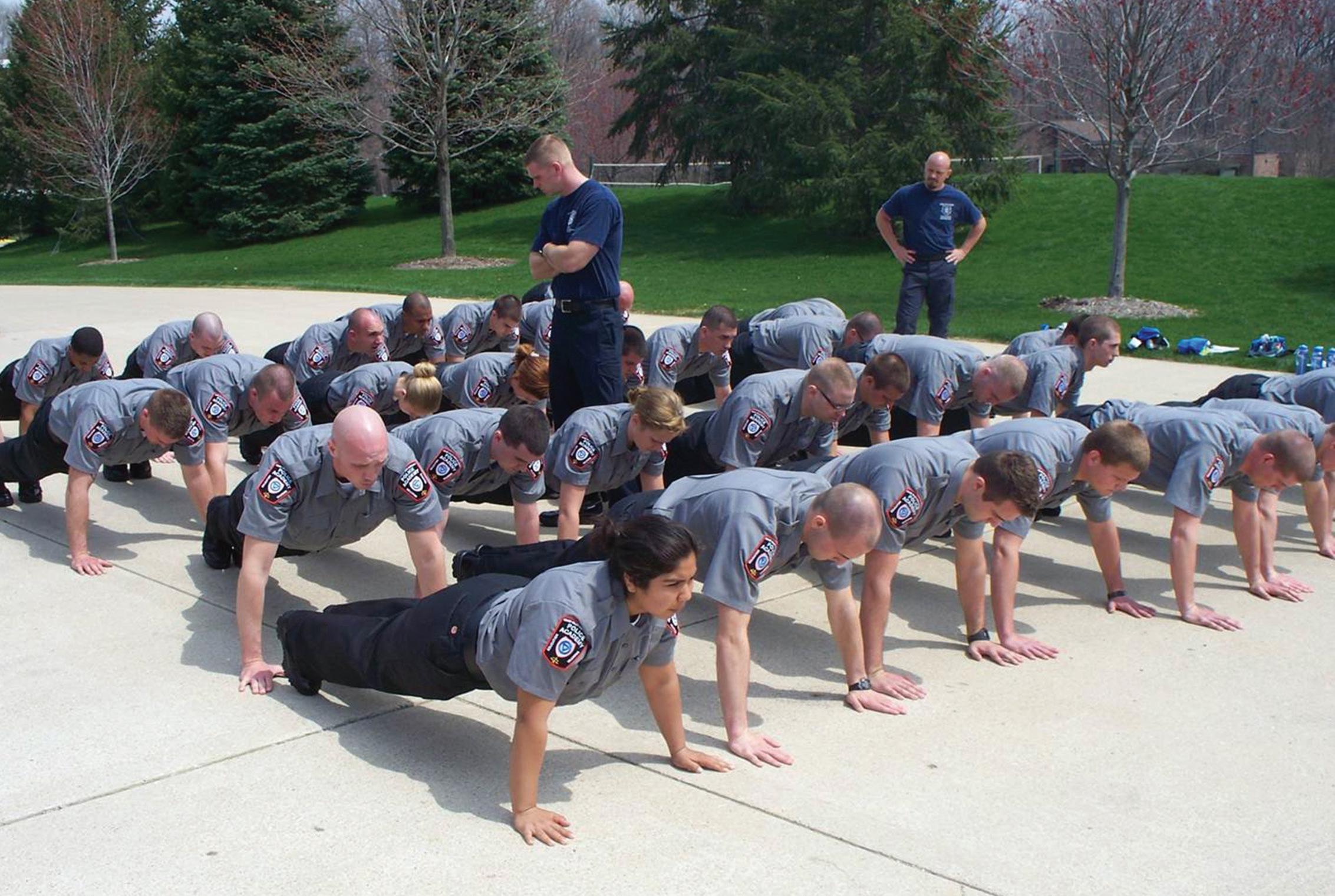
Students enrolled in the police academy are faced with grueling 12-hour days. Monday through Friday they start training at 6 a.m. Some weeks they come in on Saturday, too.
“Dedication is a key quality in the students we accept into the program,” said Director of Criminal Justice Training Julie Yunker. “This program is mentally and physically challenging. If someone isn’t strong in these aspects, they will want to quit.”
Training is 60 percent hands-on education with a limited amount of classroom instruction so that students can gain experience that will
help them apply their skills to a future job.
Around 80 to 85 percent of students are employed with a police force after graduation. From the class of 2013, 28 of the 31 students have been hired.
Before they have solo patrol rights, Laurie, Manser and Sale will have to
complete eight weeks of inhouse training sessions with firearms, local ordinances and equipment familiarity. They will then ride along with an officer for an additional 16 weeks, followed by a year of probation.
“When these officers get on the street they have a solid understanding of the
BY ERIN GROGAN EGROGAN@LANTHORN.COM
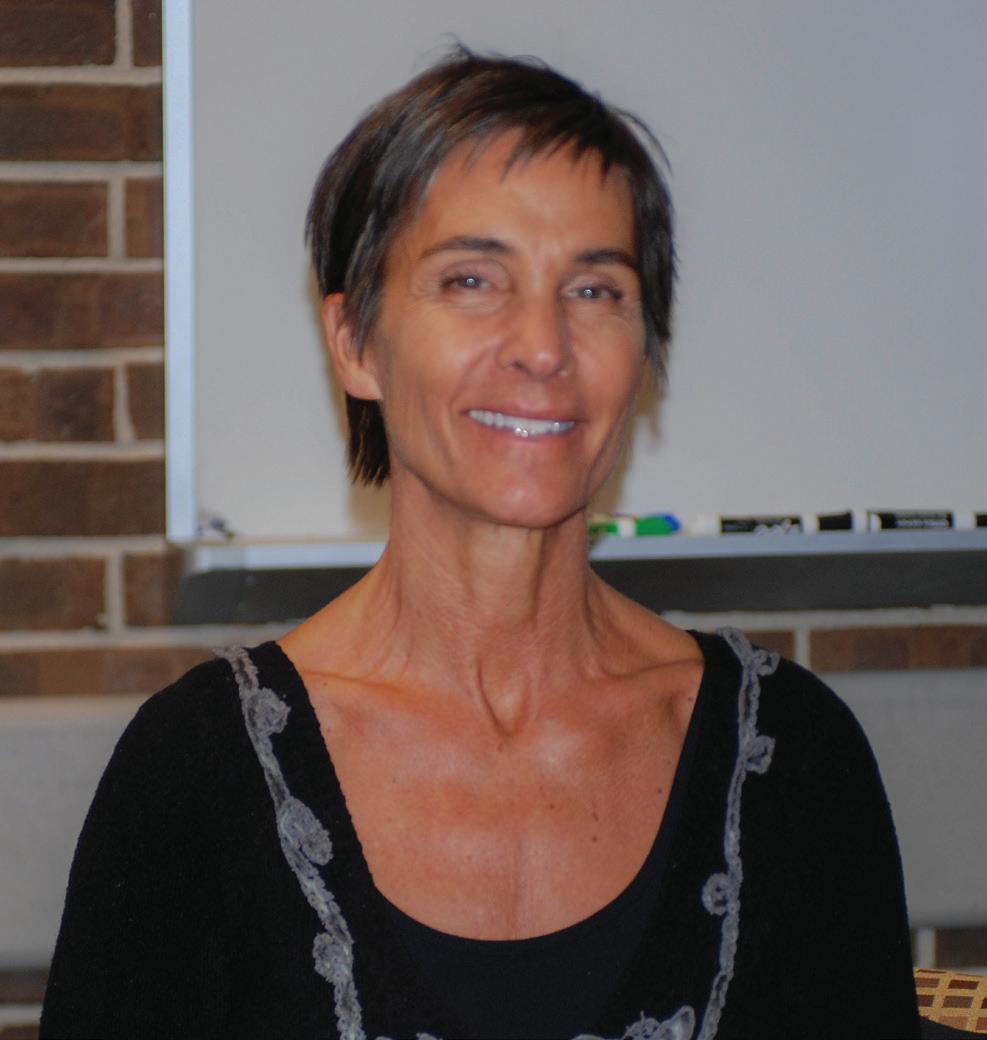
A mother of three young adults, businesswoman, researcher and teacher, professor Claire Crowley twists through life with an intent to help others experience the same depth and richness that she has been able to experience, herself. Crowley has been an adjunct professor in the movement science department at Grand Valley State University for the past 10 years. She is currently teaching classes in yoga, Pilates and meditation — her favorite of the three. Crowley is also an adjunct professor at Aquinas College, where she teaches yoga and Pilates.
Unlike many full-time professors, Crowley does not possess a Ph.D. Instead, she received her master’s degree in marketing from Aquinas and completed 500 hours of training in yoga and meditation through the Yoga Alliance, the largest yoga nonprofit
association.
“What I’m teaching (students) is to be more present in every opportunity that arises,” Crowley said. “That’s the lesson. I teach that whether I teach yoga, Pilates or meditation.”
Crowley said she not only teaches for her students’ emotional well-being, but also their spiritual well-being. She offers space for her students to define their own paths, refusing to define the exact spiritual paths for them.
Crowley’s work in the classroom led her to begin her own business to bring the benefits of mediation, which include elevation of moods and reduction of anxiety, to others within the community.
Her business, Moment of Peace, offers small group workshops that weave together meditation and psychological techniques.
Crowley teaches these meditation workshops to others in yoga studios, therapist offices and natural paths
by
offices. Each workshop is about four sessions long, with the individual sessions lasting about one hour and 15 minutes each.
One technique used in the workshops is restorative meditation. Crowley said she will take a topic
such as gratitude and use guided material to keep her students’ minds alert, while also resting their minds on the chosen subject and facilitating their meditation.
The practice helps stu -
Professor advises students to learn about Chinese culture
BY STEPHANIE BRZEZINSKI
Political science professor Yi Zhao presented his “Five Reasons We Should Learn About China” Tuesday at the Grand Valley State University Office of Multicultural Affairs as part of the Asian American and Pacific Islander Heritage Celebration.
Zhao has been teaching at GVSU since 2006, and he said he realized the importance of learning about China after seeing what his students


already knew, did not know and assumed about the culture.
“This experience also made me realize the immense but maybe hidden benefits that our students could gain by learning about China,” Zhao said.
“On the other hand, our students should also think about what they can learn from the Chinese.”
He listed five reasons why GVSU students and others should learn about China. First, Zhao said this knowledge could help students be
come more informed citizens. Second, it could help them have a better understanding of their own culture. Zhao also said observing China could help students become more resourceful, and it is a good way to enrich their lives. Finally, students can open the door to new opportunities by increasing their knowledge about China.
“In general, there is a gap between

Grand Rapids Police Department,” Maycroft said.
GRPD is looking to add more police officers to the force with a new grant for an additional 10 officers.
The application deadline for the next recruit class is Jan. 31, with an anticipated start date of June 2014.
“We are looking for po-
BY GABRIELLA PATTI GPATTI@LANTHORN.COM
On Friday afternoons, Muslim students of Grand Valley State University gather upstairs in the Kirkhof Center. They kneel towards the Kaaba and say prayers in unity with other Muslims around the world.
The Muslim Students’ Association (MSA) has made this prayer time possible by offering support to Muslim students on campus. The mission of the group is simple, said Jenna Stoken, one of MSA’s two presidents.
lice officers with a strong academic background who show leadership qualities that are important to the force,” Maycroft said. “Our officers have good recommendations from people involved with their training and real life experiences that make them well equipped for the job.”
“That is, as we learn about different values and principles in Islam, we try to embody them within us so those around us can learn from us not only through our words but also actions.”
The MSA also actively seeks to educate... about Islam.
JENNA STOKEN MSA CO-PRESIDENT
“The Muslim Students’ Association provides GVSU students with the opportunity to come together in a supportive Muslim environment,” Stoken said. “The MSA also actively seeks to educate and raise awareness about Islam in GVSU and surrounding communities through various events and activities.”
The MSA consists of about 50 to 60 students, including international students and members who have graduated.
“On a personal level, I think we try to emphasize the statement ‘practice what you preach,’” said Amina Mohamed, copresident of the MSA.
Nargilya Gasanova, a nursing student at GVSU and vice president of MSA, said the group has a lot of diversity both in the sense that it has members of different sects of Islam and also because the group includes practicing Muslims and some people who are not Muslim at all.
“We have both Sunni and Shia within the group and both on the e- board,” Gasanova said. In addition, the group has representation from a variety of backgrounds and ethnicities. Some people within the U.S. believe that Muslims are only from the Middle East, Gasanova said.
“There is a misconception that all Muslims are Arab and all Arabs are Muslim,” she said.
Gasanova and Mohamed both expressed that they do not like to stereotype those who are not Muslim as one group, as that is something that they are accustomed to


BY NIKKI FISHER NFISHER@LANTHORN.COM
Over winter break, I had this moment where I realized that all the papers and assignments I’ve written over the past four years will likely not be read by anybody but my professors and will probably never go anywhere but my Google Drive, where they will gather pixelated dust forever (or at least until Google’s servers crash).
For the more pragmatic of among us, the seeming irrelevancy of this process is an annoyance, perhaps even an obstacle. Sometimes, I fear that we’re living in a bubble here in Academia. We learn to analyze literature, generate mathematical proofs, and write academic essays that are, at face value, a currency only valuable within the system.
I’m a writing major, I work at the writing center, and I hope one day to be a writing professor. This fear haunts me. If this is true, if the value of academia is purely self-contained, doesn’t this invalidate all of my career choices? What is the use in teaching students to better
themselves at writing essays which they will stay up all night writing, turn into other professors, and then allow to rot in their hard drives?
These fears are real, but perhaps not as black and white as I have painted here.
For me, writing assignments are practice for what I hope to be doing the rest of my life. But beyond this self-indulgent perspective, I like to believe that there are skills which even the most pragmatic among us can obtain from analyzing literature, generating mathematical proofs, and writing academic essays. For openminded—or in the very least ambitious—students, these
activities can lay the foundation for skills such as critical thinking and creating effective arguments.
Haven’t we all heard this before? The value of liberal education as listed in mission statements, professor lectures, etc.
It’s abstract, that’s for sure, but there is some validity to this argument. Take the WRT 150 classroom, for example, where you’re forced to write three papers in which you engage with arguments in the world at large. Knowing how to express your opinions and persuade others is a valuable skill, regardless of the field or context. It can help you get a promotion, write convincing emails, or persuade
your friends into believing you (though there’s more to writing than manipulating others, I assure you).
That being said, you can go through the motions of writing a paper without truly learning anything. Trust me, if I’m being honest here, I’ve done it many times. In this way, critical thinking requires mental, not just physical effort.
If you choose to view the skills acquired in school as simply a means to an end, then you may never glean the indirect rewards of the system. School, in this case, may truly be an empty trophy, an expensive and colossal waste of time.
I understand, however, those who view school as a means to end. I do. Not all of us are in the game or wired for obtaining abstract skills like critical thinking. Many of us are here because we’re in a society where most entry-level jobs necessitate college degrees. I’m not arguing that this societal prerequisite is fair one or economically viable for all careers. That being said, something to consider when doubting the value of your education: somewhere down the line, many employers decided a college education was a valuable thing. Otherwise, they wouldn’t ask their employees to get a degree before applying. That means we have to be doing something right here.
Does GVSU do enough to promote diversity not just of race and color, but of religion, politics and general thought?
JONESHA MITCHELL Freshman Nursing Chicago, Illinois QUESTION OF THE ISSUE
“GVSU does not do enough to promote diversity, neither color or religious based. I suggest if they post more things about religions it could increase.”
“I personally do not think GVSU does enough to promote diversity regarding anything. I feel like every activty that goes on outside of the classroom is split up between color, race, religion, and politics.”
DONNA SISCO Freshman Special Education Detroit, Mich.
“GVSU as a whole doesn’t promote diversity in religion and politics, that may be because these are sensitive subjects for many.”
BRETT OTRIZ Junior Psychology Grandville, Mich.
“Yes, I believe GVSU does. In many of my classes that involve discussion diversity is heavily promoted and encouraged.”
ASHLEY CANIFF Senior Psychology Jenison, Mich.
“I think that GV does promote diversity. We have a solid LGBT community so far.”
JESSICA BOYER Junior Advertising and Public Relations Battle Creek, Mich.
GVL OPINION POLICY
The goal of the Grand Valley Lanthorn’s opinion page is to act as a forum for public discussion, comment and criticism in the Grand Valley State University community. Student opinions published here do not necessarily reflect those of the paper as an entity. The Grand Valley Lanthorn aims to be a safe vehicle for community discussion. The Lanthorn will not publish or entertain any forms of hate speech, but will not discriminate against any other views, opinions or beliefs. The content, information and views expressed are not approved by nor necessarily represent those of the university, its Board of Trustees, officers, faculty or staff. Reader submissions on the opinion page appear as space permits, and are reserved for letters to the editor only, all other reader-
generated content can be submitted to the Grand Valley Lanthorn’s YourSpace page by emailing community@lanthorn.com. Letters to the editor should include the author’s full name and relevant title along with a valid email and phone number for confirming the identity of the author. Letters should be approximately 500-650 words in length, and are not edited by the staff of the Grand Valley Lanthorn outside of technical errors for clarity. To make a submission, email at editorial@lanthorn.com or by dropping off your submission in person at:
0051 KIRKHOF CENTER GRAND VALLEY STATE UNIVERSITY ALLENDALE, MI 49401 616-826-8276
The Foundation for Individual Rights in Education recently gave GVSU a “red light” rating because of its biased incident protocal, and this warning should not be ignored.
Grand Valley State University emphasizes diversity and inclusion, but often people only associate those terms with questions of identity, such as race, sexual orientation or religion. Diversity, it seems, is rarely associated with ideas or opinions.
But the success and function of a university depends entirely on the open exchange and celebration of diverse thoughts, so, to GVSU and any other school, diversity of ideas and opinions should be highly valued and sought after. Recently, GVSU was charged with neglecting its responsibility to encourage free expression as its policies were deemed unconstitutional by a national advocacy group.
This month, the Foundation for Individual Rights in Education released its annual report listing which American universities are and are not acting in compliance with First Amendment rights. GVSU received a “red light” rating — the worst possible rating — for what a FIRE representative said was a policy that compromised freedom of expression.
In an effort to encourage diversity at GVSU, the university implemented a “biased incident” policy. According to this policy, “Bias incidents can cause alarm, anger, fear or resentment in others or endanger the health, safety or welfare of anyone in the university community. They are directed toward an individual or group because of their race, color, national origin, sexual orientation, sex/gender, gender identity, gender expression, political affiliation, religion, familial status, marital status, disability, age, height, weight or veteran status. Bias incidents take many forms — words, signs, symbols, threats or actions — electronic or in person. They include acts of intimidation, vandalism, harassment, and expressions of hate or hostility; they have an adverse impact on a learning environment that is inclusive of all.”
The staff of FIRE has expressed concerns that this type of vague language may discourage students from speaking their piece if it in any way may be perceived as offensive. Peter Bonilla, director of FIRE’s individual rights defense program, said in Sarah Hillenbrand’s article, “Fire issues GV worst student rights rating for bias incident protocol,” that many of the acts considered to be bias incidents in the policy include speech protected by the First Amendment.
“Many ‘expressions of hate or hostility,’ for instance, constitute protected speech, as do incidents that cause ‘anger’ or ‘resentment,’” Bonilla said. “Further, there is no constitutional right to not be made to feel ‘belittled’ or ‘disrespected’ by another student’s expression. The sheer number of factors considered by the policy, including gender identity, gender expression, religion and even political affiliation, makes it highly possible that intellectual debates or honest statements of opinion on sensitive topics can constitute a bias incident under the policy.”
Perhaps FIRE is correct.
The policy doesn’t outline the limits of certain topics that are known to generate heat but are still up for debate in the U.S. Consider, for example, the ongoing conversations about LGBT rights, women’s abortion rights, immigration and even obesity. No matter what stance is taken on these topics, there is room for someone to feel “alarm, anger, fear or resentment.” Can advocates or opponents of these causes file biased incident reports against students who express differing views? Are students allowed to express pro-Palestinian opinions while among Jewish classmates or proIsraeli views around Muslims?
Some students might maintain views that others deem “offensive” or that might “cause alarm, anger, fear or resentment,” but public debates of almost any topic can
generate heat and angst. So what exactly defines a biased incident? A very specific answer to this question needs to be worked out by the GVSU administration. It is so crucial that students feel that their identities are protected — whether they be black or white, gay or straight, atheist or polytheist, conservative or liberal — so that they are welcomed as valued contributors of the GVSU community. But the way that GVSU implements this protection must be well defined so as not to trump constitutional rights. And to prevent the sacrifice of spirited debate that inevitably arises from critical thinking. For many students, including some of us at the Lanthorn, a fear of crossing the line has left us silent in the classrooms. And if students can’t raise their hands, then the idea of diversity is compromised. If students can’t hear an opinion different from their own without feeling hostility or offense, then the idea of diversity is compromised.
And then our liberal arts education has failed to expose us to new ideas and foster true critical thinking. As GVSU serves as a safe haven for diverse groups, it should be a breeding ground for different ideas, not a shiny factory pumping out the latest model of “critical thinking” robots, who really repress opinions to avoid being offensive.
So diversity? GVSU appears to do a decent job promoting diversity of some forms. But while color and ethnicity are often the most “visible” ways to show that a school is diverse, if students are all of the same mindset with the same views — whether they actually agree with everyone else or feel pressured into doing so in order to fit in — it makes for dull debate and conversation.
If everyone has a like perspective and those who don’t conform are brushed aside, then the university does not have or accept diversity.

“To
the Heroes at the Grand Valley/Lake Superior State Basketball Game”
In my two years as a participant in the basketball pep band, we (and the cheer team) have never been joined in loudening an otherwise silent gym. It is not often that students make an active effort to create a home-team advantage at basketball games. For the past few years, the game ended with the band trying to coax students on their feet – the gym rang with a resounding, “Stand up, students”!
However, the Lake Superior State Basketball game last Thursday was abnormal – there were early fights,
several injuries, competitive dunks, and most importantly, cheering students. The scruff that was started on court in the first ten minutes brought many students to their feet, and, admittedly, we were in shock. In my memory, it was the first time that the student body ever came to their feet of their own accord. Excitement flooded the air. Then, select students in the front row, a few of whom were sporting chest paint spelling “GVSU”, began to cheer – “We Are… GV!” Encouragement filled the gym; it was the loudest I have
ever heard chanting at Grand Valley. For the remainder of the game, these select students in the front continued to stand, cheer, shout, and generally participate in the game. It was jaw-dropping. To you students who have started this trend – I commend you. Grand Valley, the pep band, and the basketball team are happy to have you. Our team works hard and performs well; they have earned their support from the student body. If every remaining home game this season is filled with the same enthusiasm as
Thursday, and if our team performs with the same precision as they did, I have hopes of a NCAA playoff berth this year. I beg of you, unmasked and unshirted heroes, do not stop – do not yield. Other students seemed surprised or annoyed at your participation, but unrightfully so; our team deserves your support, and, with your model, I hope all students will soon join. Grand Valley could use more students like you.
Nik Schroeder Sophomore
BY ERIN GROGAN EGROGAN@LANTHORN.COM
Slavery is usually thought of as being a thing of the past, but it is still prevalent today — even in West Michigan. Throughout January, which is Human Trafficking Awareness month, some have dedicated their time to eliminate the issue.
The International Justice Mission Chapter at Grand Valley State University is a student organization committed to raising awareness about human trafficking. The group raises money to support the nationally-based human rights group of the same name.
“IJM is a faith-based organization, but we accept and welcome people of all faiths,” club president Melanie Govan said. “This is an issue that affects people of all faiths. We love to have everyone there.”
The group meets every Thursday night in the Kirkhof Center to discuss upcoming events and different ways to fundraise. Every month, it holds a prayer walk in the Grand Rapids area.
also sold bracelets, and the funds of those sales went toward the larger IJM human rights group.
“My life goal, and the goal of IJM, is to give a voice to those who are voiceless,” Govan said.
Human trafficking includes sex trafficking, slave labor and any forced enslavement regardless of the season.
“Students can participate in anti-human trafficking efforts by educating themselves on the topic, knowing what to look for and knowing who to call if they perceive a situation as being indicative of human trafficking,” Jones said.
This is an issue that affects people of all faiths.
According to UNICEF, those who are forced into human trafficking average between 12-14 years of age. As Govan pointed out, that means that a lot of those trafficked are young children, though many are older than 14, as well. There is no concrete demographic that portrays those who are victims.
The goal of IJM is to give a voice to... the voiceless.
On Human Trafficking Awareness Day, Jan. 11, the students showed ”The Whistleblower,” a movie in which an officer from the United Nations uncovers a sex trafficking ring. They
MELANIE GOVAN IJM CHAPTER PRESIDENT
MELANIE GOVAN IJM CHAPTER PRESIDENT
Govan agreed with Jones’ advice, adding that students can make a difference even when they are shopping.
“We buy products every day knowing where they come from. Research where you can get products not made with slave labor,” she said.
“People think of it as someone dragging you off into the street, but the reality is a lot of times perpetrators are people you know,” Govan said.
Tonisha Jones, assistant professor of criminal justice at GVSU, has focused some of her research on human right’s issues, especially human trafficking.
CONTINUED FROM A3
perception and reality,” Zhao said. “Sometimes that gap could be huge. These reasons are important because they are directly related to the career and life of our students.”
He added that the larger connections between the U.S. and China are important, especially as the two countries have created “close and deep economic ties” that are broadening today.
“The rise of China and the U.S. rebalance to Asia could result in tensions between the two countries,” Zhao said. “More than ever before, for both countries there needs to be a strong and firm commitment to cooperation, consultation and collaboration.”
The Polaris Project, an organization that helps to push for stronger state and federal laws against human trafficking, has identified human trafficking victims in each of the 50 states and Washington, D.C. The group provides the National Human Trafficking Resource Center Hotline and works directly with victims. The hotline is 1-888-3737888.
Groups nearby that support victims of human trafficking include the Manasseh Project, Women at Risk International, Better Way Imports, Michigan Abolitionist Project, Hope of the Voiceless, Hope Project and Eve’s Angels.
important because it is “increasingly interlocked.”
“My sense is that the identities of the U.S. and China are being redefined at the moment,” Zhang said. “The U.S. can see China as a strategic partner or a potential rival, or both. The one view is a recipe for regional peace; the other, conflict.” Zhang added that the connection between language and perception is important in shaping how we learn about China. We tend to see other countries as ideas, he said, because we are removed from the realities.
The one view is a recipe for regional conflict...
PETER ZHANG PROFESSOR
Peter Zhang, assistant professor of communications, agreed with Zhao that learning about the U.S.-China relationship is
CONTINUED FROM
within their religion. Both acknowledged that many people do not have a clear understanding of Islam.
“It can be hard for other non-Muslim students to know a lot about Islam because it is definitely a minority group and one that has gone through stereotypes and generalizations,” Gasanova said. “It gets tough for a non-Muslim to know any Muslims and to fully
“The more our students get in touch with actual people in China, the less they’ll be inclined to speak in the voice of this or that fiction,” Zhang said. “I think it’s beneficial for students to take the initiative and go see China for themselves, simply because the real China is hidden from us by a symbolic complex.”
and comprehensively understand the religion and the people.”
This semester, during the week of March 10, the MSA will be hosting Islam Awareness Week. The week will consist of different speakers and discussions that will focus on Muslims in the media and women in Islam.
Gasanova said that one of the main events of the week will be a day where scarves are passed out to women around campus to wear on
their heads like the traditional Muslim hijab. At the end of the day, there will be an opportunity for all those who participated in the event to discuss their experience while wearing the hijab.
“Ignorance, yes it exists, but GVSU does a pretty good job of promoting understanding and diversity on campus,” Gasanova said. “We are finally, very slowly, getting to a point where it is not considered to be appropriate to talk negatively about the group.”
CONTINUED FROM A3
dents become opened to the beauty of life by allowing the mind and body time to relax, reflect and renew, she said.
After seeing many positive effects of meditation among college students, Crowley decided to share her ideas with other universities. She started two projects, one qualitative and the other quantitative, to measure the effects that prolonged meditation has on students.
Crowley said she hopes that “more universities will start looking at offering mindfulness and meditation and seeing it as a really strong way to support students emotionally as they
move through their years in the university.” While the projects are still underway, Crowley is pleased to notice positive results that support her original opinion about the subject. She said most students reported feeling more gratitude and compassion for other people as well as more self-acceptance as a result of their direct, long-term involvement with meditation.
Really what shifts is their sense of well being.
CLAIRE CROWLEY PROFESSOR
“Really what shifts is their sense of well-being,” she said. “It’s not anything
on the outside; it’s literally how they experience their days.” As the semester starts to pick up and stress starts to build, Crowley had a few words of advice. “Our minds tend to create our own pain and suffering by the stories that it spins,” she said. “Be aware of where your mind goes. Use your breath as a way to anchor yourself and stay steady and recognize that a lot of our pain comes from the thoughts that arise.”
In other words — breathe. Just breathe.
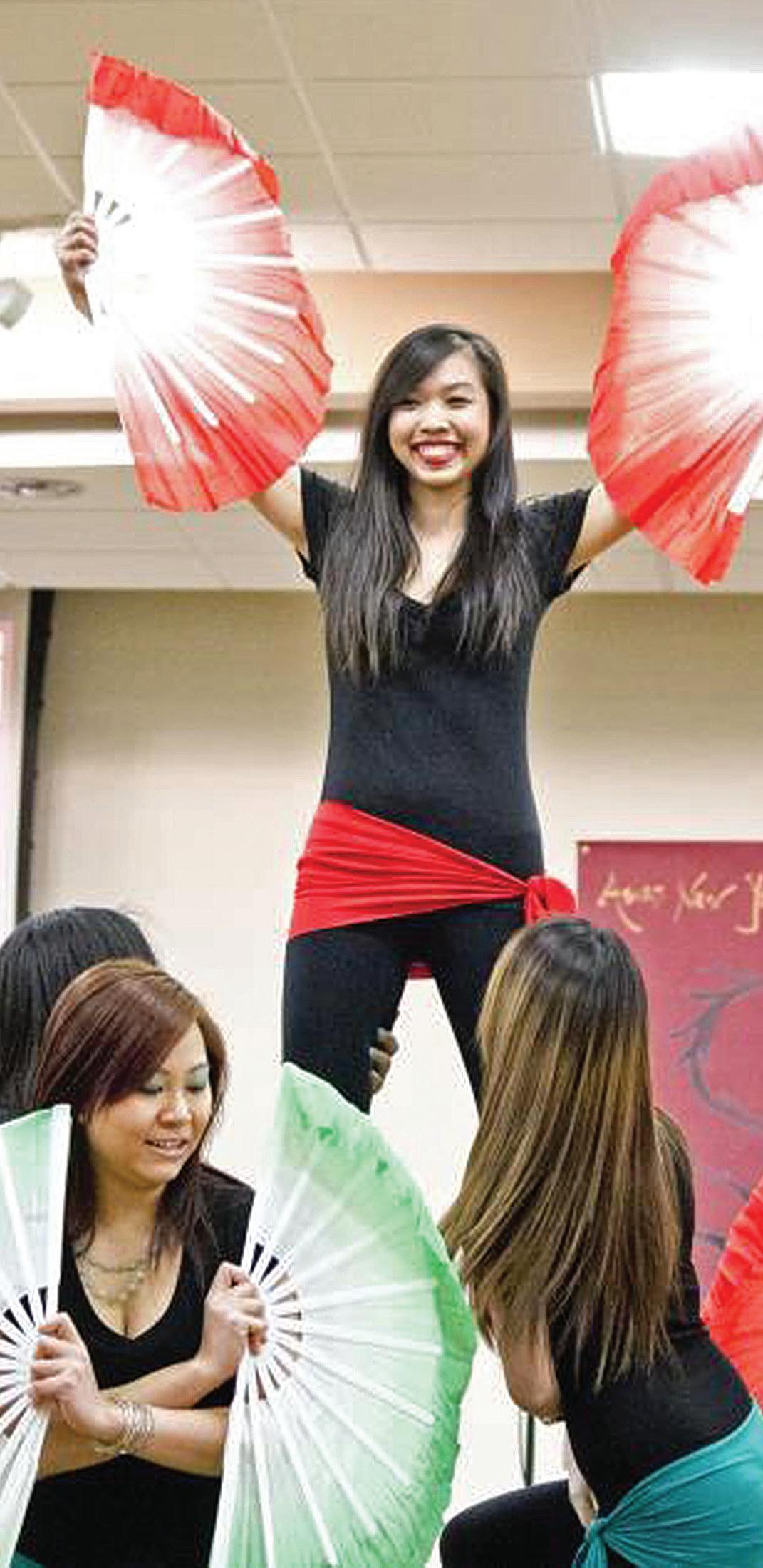
“In China there is the Chinese zodiac which represents 12 animals. I am sure you have seen it at a Chinese restaurant or something,” said Nathanael Sage Gendron, president of the Asian Student Union. “Every other lunar new year, the cycle changes to a new animal; last year the snake, this year the horse. At the same time though, there is a cycle of five elements (fire, water, wood, earth, and metal) that revolves as well. So this year ends up being the (year of the) wood horse.”
Each animal and element are imbued with special meaning and characteristics.
“Those characteristics will combine and interact each year for a new, reformed set of astrological characteristics,” Nathanael Gendron said. “For example, this new year it will be the year of the wood horse. That is characteristic of confidence, surprising romance and enthusiasm. For people it can mean fast victories
in competition and unexpected adventures. Having a high tempo in life and being dedicated to finishing things quickly can bring good fortune.”
While the new year celebration is hosted at GVSU, the event will include other Michigan colleges. The GVSU Asian Student Union is planning the event, but students and performers from Michigan State University and the University of Michigan will also attend.
The event begins at 6 p.m. in the Grand River room of the Kirkhof Center. The celebration is scheduled to last three hours, and Nathanael Gendron urges participants to experience the entire event.
“Our biggest, most exciting events are toward the end, specifically MSU’s bhangra dance club and U of M’s Revolution Chinese yo-yo team,” he said.
Students from all ethnicities and backgrounds are encouraged to attend.
“Something we try to get out there is that it’s not just for Asians,” Charlie Gendron said. “We try to open it up more for all students. One of our biggest goals is to promote diversity and cultural awareness. We try to fight cultural incompetence.” The goal of fighting this incompetence goes further than the Chinese New Year celebration. The Asian Student Union welcomes all students to join its meetings and other events planned throughout the year, including the conference held in March.
“We try to plan our meetings taking in account that there are other ethnicities in our organizations,” Charlie Gendron said. “We make it so everyone is involved.”
For those interested in attending the Asian Student Union’s meetings, they are held every Wednesday at 6 p.m. in Kirkhof 2270.

Although the popularity of soul music may have died down since the ‘60s, it continues to shine through DJs Josh Breuer, Andrew Christopoulos and Mike Saunders, who represent the heart and, well, soul of the Grand Rapids Soul Club.
For two years, the GRSC has gathered on the fourth Friday of each month — typically at The Pyramid Scheme or Billy’s Lounge — to highlight rare funk and soul via turntables and crates.
“We like to play a lot of stuff from this region,” Saunders said. “Even old Grand Rapids artists like Spot and the Blotters or People’s Choice, who have gone relatively unknown on a national stage.”
Throughout the ‘60s, soul artists dominated the African-American music charts, but by the end of the decade, “soul” had become
an umbrella term for an array of R&B-based styles. The soul movement fractured toward the early ‘70s, and though the number of musicians performing traditional soul today is scarce, the genre continues to influence musicians worldwide.
According to Saunders, the crew spins vinyl from unknown artists to more wellknown artists such as Curtis Mayfield, The Isley Brothers and The Supremes. And while DJs typically start their set with a handful of choice records on deck, the activity on the dance floor is the deciding factor as to what tracks are next in the lineup.
“It’s a party with really great music,” Saunders said. “Sometimes our featured guests will play a special set to really get folks moving; other times we all just play records and try and keep a good vibe and keep the dance floor moving.”
Though the soulful grooving is a key ele-
ment to the GRSC’s gatherings, Christopoulos said he believes that exposing people to music they might not hear elsewhere is equally important. And while the three core members of the GRSC are typically the ones doing the musical enlightening, they sometimes invite other soul-spinning DJs to the party. The club has even featured nationally known artists such as Eric Cooke, also known as E Da Boss, of Myron & E.
“We like to have guests as often as possible to mix things up,” Christopoulos said. “Most of them have been from the Midwest. It was special to have Eric come in from the Bay Area. We’ll definitely continue to bring guests in, whether local or national.”
Christopoulos said the night has grown in many ways since it began in 2012. Attendance is up, and there is, now more than ever, a great energy and flow to the evening.
“People come out to dance, socialize, and
generally just have a good time,” he said. “That’s our ultimate goal and we’ll always strive to keep that up.”
And while their consistency has helped the Grand Rapids soul community grow, Christopoulos said the group tries to keep the experience fresh from month to month.
“Sometimes we’ll bring in someone on visual effects; other times we’ll create a new mix CD or we’ll possibly have some new merchandise available,” he said. “We’ll keep evolving while keeping the basics intact.”
While the music industry did experience what appeared to be a reemergence of neosoul in the early ‘90s, mainstream support for soul-related genres seemed to once again diminish shortly thereafter. But if you happen to wander into one of the monthly soul music dance parties hosted by the GRSC, you’ll see that people’s love for that funky funk hasn’t faded a bit.
After its sudden eviction last July, some people may have thought that was the end of the Division Arts Avenue Collective. But with the implementation of a crowdfunding campaign, DAAC board members have not given up the search for a new location.
“With the majority of the music industry relying more on alcohol sales, audiences under 21 across the country are being routinely shut out of live music,” said Mike Wolf, a DAAC board member. “As organizers and music fans ourselves, we think that it’s bogus to exclude anyone because of arbitrary factors like age.”
The Division Avenue Arts Collective is an all-ages venue that hosts everything from music performances to art galleries to do-it-yourself projects. The DAAC was evicted from its home on 115 S. Division Avenue after the building was sold to Harris Lofts LLC. In January, a Rockethub campaign was put into place to raise $20,000 toward a new home for the DAAC.
“It was kind of like community-based thing. (When I was in a band), before we could play there we went to a meeting with (the board)… and introduced ourselves,” said Aaron Mace, a senior at GVSU who used to at-
tend shows at the DAAC.
“They were big on bringing people in and getting people involved — not having bands showing up, doing their thing and then leaving.”
The DAAC traditionally operated as a volunteerpowered venue, and for 10 years it was able to function without outside funds.
Before the venue’s eviction, board members were discussing plans to raise money to expand programming and make improvements on the Division space.
“After we got kicked out of our venue, we spent the following weeks getting feedback from the community and meeting with local arts organizers to see what people want out of a new venue, because we just didn’t want to quit,” said Wolf, a 2011 GVSU alumnus.
Wolf began to take over “a sort of transitional lead role,” and the board continued to discuss community feedback and future goals.
“Through the help of a former professor, I was connected to an entertainment lawyer who I began meeting with to get a better grasp on potential routes to continue our work,” he said. “Through our conversations, it turned out that he was just finishing up work on a New York music festival and was looking for his next pro bono project, so we immediately signed on to work with him.
Complete game changer.
With his suggestion, we applied and were accepted as a fiscally sponsored project of Fractured Atlas.”
Fractured Atlas is a nonprofit service organization located in New York City. The organization offers support to independent artists and arts organizations through services such as fiscal sponsorship, liability insurance and online courses on arts-related topics.
From there, the board launched a Rockethub campaign, an online crowdfunding platform that has a partnership with Fractured Atlas.
“Traditionally with crowdfunding campaigns there is a middle man when dealing with the money,” Wolf said. “So instead of having to use a middle-man like Amazon Payments, money given on our campaign goes right to Fractured Atlas. Following that transaction Fractured Atlas sends tax receipts to the contributor. Once we go to use that money, Fractured Atlas takes a flat administrative fee.”
The campaign was initially launched on Jan. 15. The project was given forty days to reach its projected goal of $20,000 and so far has raised 20 percent of its total goal.
People who donate to the campaign have the opportunity to be awarded a number of “perks.” Gifts include homemade art such as a ce-

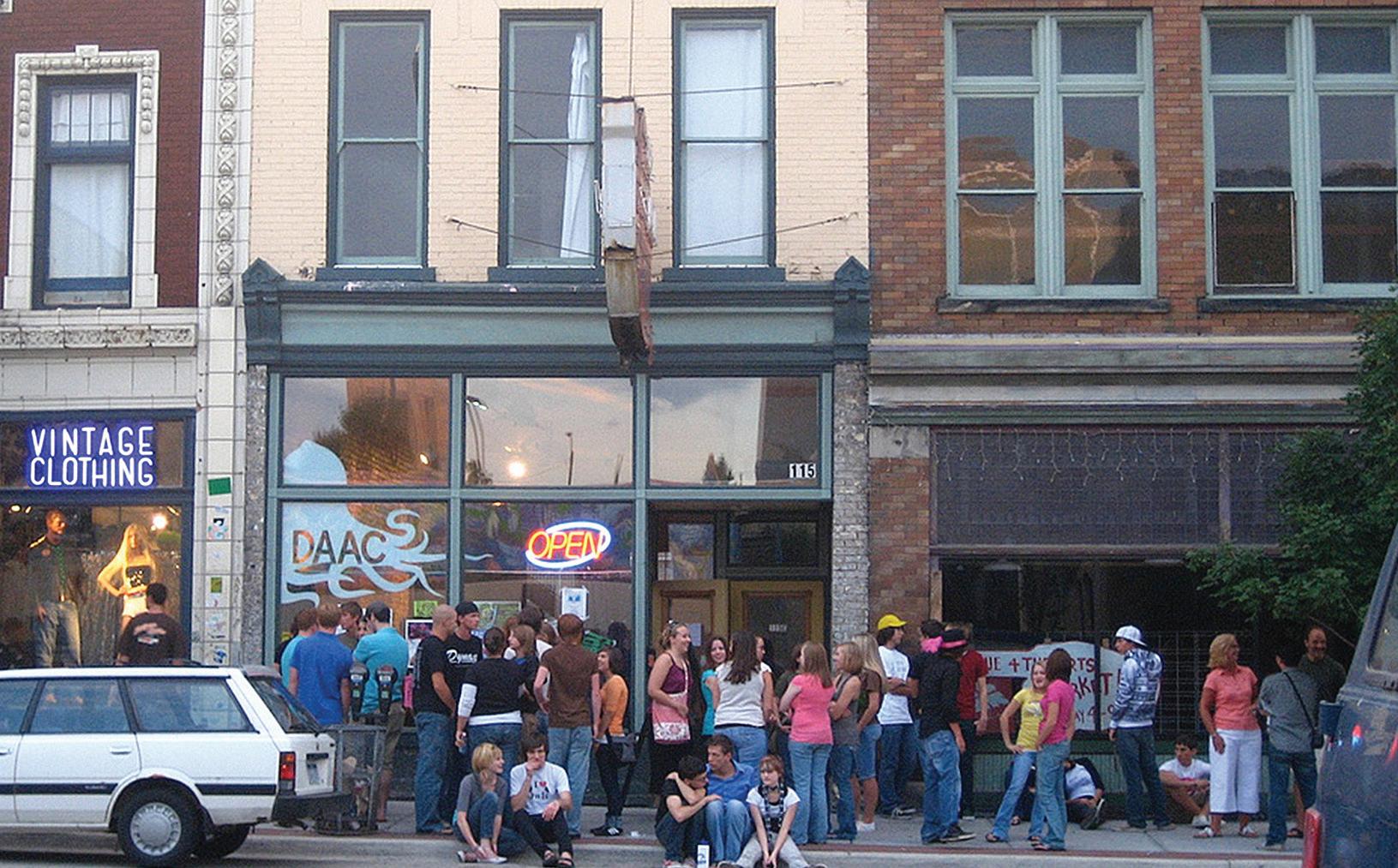
ramic necklace, courtesy of an artist of the Many Hands Clay Cooperative, for a donation of $25. Other gifts are more personal, such as A Song For You, an original song written to individual donors of $500 or more. Through the campaign, the hope is that one day
the DAAC will reopen in Grand Rapids.
“There’s a lot of places where people can play music (in Grand Rapids), places where local bands can play, but the DAAC was the most welcoming,” Mace said. “It’s not a bar so it’s not trying to make a ton of money or sell out shows; (it was a) place where any local band can get involved.
“It is important for people to have a place for people who want to go see music, who aren’t there just to have a drink or something... They’re there to see the bands play.”
It begins with a barren stage, a blank canvas ready for transformation. The addition of props, costuming, staging and actors blend together to create the Grand Valley State University production of “Urinetown: The Musical.”
“Urinetown” was created in 2001 and takes on the issue of troubling economics in a satirical way. The production’s music won three Tony Awards, including Best Original Score.
Dale Schriemer, artistic director of the GVSU Opera Theater, made the decision to produce “Urinetown.”
“We’ve done modern pieces before,” Schriemer said. “We have 23 people onstage... that is the reason to choose the piece because the amount of face time (cast members are) getting. I did want to do a modern comedic piece, so this is very hilarious and silly. We have done a lot of serious pieces in the past, and I thought the winter is so dark; let’s do something more fun.”
After a few days of auditions in September, the choice was made to double cast each lead role. Amanda Furstenberg received the role
of Hope, double cast with Cora Papas. This method made preparation that much trickier, Furstenberg said.
“It is always difficult to be double cast because it is less rehearsal time because you are splitting it between the two people,” she said.
Each cast member not only had to memorize lines but also memorize each song and the choreography to go with it.
“This particular production, because there are dance and movements, a lot of time is spent with choreography,” Schriemer said. “And it is real people dancing, not like ballet dancers or jazz dancers; these are like real characters who dance in their character...so all this character work is being built into the choreography, which is an intense amount of work.”
At the start of the winter semester, the cast and crew began to tackle the production by preparing the costumes, sets and staging, and combining the dialogue with the choreography and music.
“We have a working relationship where everyone knows what they are (and) what the expectation is and we work very, very hard to support each other and
to make sure those things happen in a good way,” Schriemer said. Taking the stage in front of the GVSU community isn’t the end of the cast’s preparation. Backstage, the cast is running lines and songs and making sure props are where they need to be in order to perform the best possible show.
“Based on the title, it sounds like a really weird play,” Furstenberg said. “It is written very (smartly) so the words are chosen and there are all of these little jokes and under-terms under everything, and it has a really important message.”
The production is unlike anything the GVSU theater department has put together in the past.
“It is going to be a fun evening in the theater,” Schriemer said. “It is a sly political drama. It is topical and modern.”
The GVSU cast will perform the show Jan. 31 and Feb. 1, 7 and 8 at 7:30 p.m., and then Feb. 2 and 9 at 2 p.m. Tickets cost $14 for adults, $12 for seniors, faculty, staff and alumni, and $6 for students and groups of more than 10.
University in the finals. GVSU will remain as the No. 1 squad in the National Collegiate Volleyball Federation (NCVF). The team may have to take on the Buckeyes once again on their home court, as 24 NCVF teams will come together in another ranking tournament on Feb. 15-16. The Lakers will finish their season in the NCVF National Championships in Reno, Nev. from April 2-6.


Lakers to host four Division II squads before Michigan, MSU tango in nightcap
The women’s track and field programs of Grand Valley State University and Lincoln University will have some unfinished business to address come Saturday. One of the two programs will be able to claim its dominance over the other as No. 1 Lincoln makes the 560-mile trek to face off against No. 2 GVSU in what figures to be a neck-and-neck showdown at the Kelly Family Sports Center in the GVSU five-way.
The Lakers and Blue Tigers both capped off impressive fall seasons with exactly 51 points
in the NCAA Division II Outdoor National Championships eight months ago, which was good enough to tie for third place.
“It’s going to be one of the most exciting days of track and field at Grand Valley in quite some time,” senior pole-vaulter Kristen Hixson said. “It has a Nationals-type feel with Lincoln competing in the meet. I think we’re all ready to embrace the moment.”
The Lakers are going to have to find a way to win without senior sprinter Kalena Franklin, who went down with an injury while competing in the 60-meter hurdles in a meet at Saginaw Valley State University on Friday.
Head coach Jerry Baltes said his team is going to have to dig deep without one of its key leaders.
“I challenged our athletes this week in practice to respond,” Baltes said. “That’s exactly what it’s going to be — a challenge. She’s a huge part of our team and it’s going to take a huge effort from our entire team to make up for her absence.”
The atmosphere will also be electric on the men’s side as the No. 4 Lakers look to defend their home track against Lincoln, No. 11 Lewis University,
BY LUCAS RAINS LRAINS@LANTHORN.COM
he Grand Valley State University swimming and diving program will be as dangerous as any in the conference — and perhaps in the nation — if its swimming and diving teams can click at the same time in the postseason.
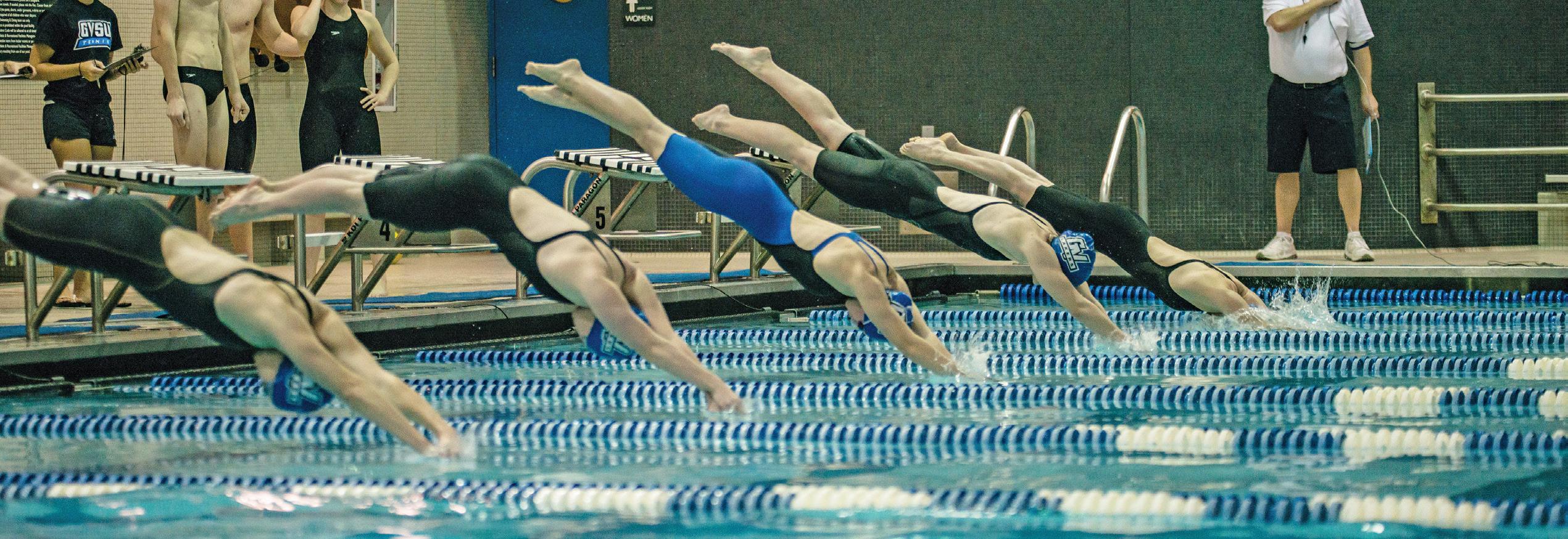
GVSU will host its first ever “Last Chance Dive Meet” at 10:30 a.m. on
Saturday at the GVSU Pool as part of an effort to ensure both of its diving teams are more than ready to do their part when the teams travel to both championships in the coming months.
The purpose of the event is to give GVSU divers a chance to experience a format similar to the one used in the conference and national meets.
Assistant coach Steve Burciaga,
the diving coach, thought of the idea for the meet and said he believes it will significantly benefit the Lakers. Burciaga said becoming familiar with the format will be a crucial aspect of the program’s postseason success.
“This will give our divers a chance to gain experience in the 11-dive format,” he said. “This will prepare them for conference and nationals.
The players on the Grand Valley State University women’s club ice hockey team have had 12 days off to reflect on what has been a record-damaging 2014 portion of the season so far.
GVSU (12-7) will attempt backto-back wins against the University of Michigan at home this weekend after dropping three of four games thus far in the month of January — a stretch that dropped the team into seventh place in the ACHA Division I standings.
GVSU most recently dropped a two-game set against Michigan State University, which now holds the sixth-place spot, just two points more than the Lakers have accumulated.
The Lakers may have been swept, but they skated well in the series and hope their performance will

carry over into the bout with the Wolverines — and beyond.
“We’ve been playing well and we want to take out all our frustration on Michigan and Robert Morris,” sophomore forward Karyn Schmaltz said. “We have a lot of team chemistry, and we’ve been working on our communication on the ice.”
The Lakers will have to tap into that chemistry and produce strong play with a second consecutive powerhouse coming to town. The team may have struggled to beat MSU in recent history, but it’s had Michigan’s number since the start of last season.
The teams squared off three times — twice in the regular season and once in the in the ACHA playoffs.
The Lakers swept the season series, pulling out hard-fought victories in three neck-and-neck games.
The teams are held together even
The Laker men are currently ranked No. 2 in the latest NCAA Division II polls while the Laker women currently hold the No. 9 spot in the rankings.
Senior diver Katie Vulpetti said
“Two weeks outside of conference, it’s a great time to do this. When nationals come around, we will have this in the back of our minds.”
tighter this season, as both squads are hovering near the top of the ACHA standings.
GVSU is in seventh place with 24 points, while the Wolverines are in ninth place with 20 points. The Lakers hold a plus-53 goal differential, while Michigan is right behind with a plus47 mark.
GVSU head coach Sean McKernan said he knows his team has the talent to take care of the Wolverines, but not without start-to-finish intensity in both games.
“We need to look to play 60 minutes, and one period at a time,” McKernan said. “We’ve proven that we are a great team and we have a lot of depth. Our freshmen and defense have stepped up big time.”
They couldn’t have picked a better time to step up.
The year-to-date schedule has not been kind to the Lakers. The team has
been pinned up against the University of Massachusetts, Liberty University and Michigan State University.
“It’s definitely a tough schedule, but I feel like the schedule from our first semester helped us prepare for the bigger games that are coming up,” sophomore forward Hilary Daniels said.
GVSU will follow up the Michigan series with a clash against another top divisional rival, Robert Morris University. RMU is in third place and trails the University of Rhode Island by just two points atop the standings. It won’t be easy, but GVSU has an opportunity to put itself in prime position to make a deep playoff run if it can rack up a few wins in its final four games.
“We’re all excited for the weekend, but we definitely want to come away with wins and prepare for the playoffs,” Daniels said.


BY TATE BAKER
The Grand Valley State University women’s track and field program has had an All-American pole-vaulter in every year since 2005, and that streak figures to stay intact this season with two-time national champion polevaulter Kristen Hixson leading the way in her senior season.
Hixson posted a height of 4.15 meters in her first meet of the indoor season, which not only earned her an automatic qualifying mark but also a trip to the NCAA Division II Indoor National Championships on March 14 and 15 in Salem, N.C.
GVSU had such an accomplished pole vaulting program was one of the main reasons I wanted to be a Laker,” she said. “Coach Andreadis does an amazing job of improving us in his program. He really focuses on us taking small steps, which allows us to make consistent improvements.”
We are constantly pushing each other...
CALEY FAULKNER
“That was really remarkable for her to open up her season in that fashion,” said classmate and roommate Caley Faulkner. “We are constantly pushing each other in practice — and it’s showing.”
She was named a GLIAC Women’s Indoor Field Athlete of the Week on Jan. 23. It seems the Remus, Mich., native’s knack for paying attention to detail began a long time ago.
“When I was in high school, the fact that
CONTINUED FROM A7
Hillsdale College and St. Joseph’s College.
“This will be a great chance for our guys to continue to gain momentum as they will be going up against a number of good teams,” Baltes said. “It’s going to be a great atmosphere the entire day; hopefully we will seize the opportunity.”
Shortly after the GVSU five-way meet is finished, the
CONTINUED FROM A7
she is looking forward to the event.
“We are pretty excited. It’s something new for us and it’s a little different,” Vulpetti said. “I really don’t know what to expect. It’s going to be a good experience, especially at our home pool.”
She also said how important it will be for some of the younger Laker divers.
“It will definitely be a confidence booster for the
She began her career as a freshman with a second-place finish at the 2011 GLIAC Indoor Championships before finishing her first indoor campaign with a fourthplace finish at the DII National Championships.
She then burst on the scene in the spring by winning the GLIAC outdoor championships by clearing a height of 3.87 meters. She duplicated her 3.87-meter performance weeks later at the DII National Championships, which was good enough for a second-place finish.
“My first year of collegiate track was a big learning curve for me,” she said. “It was so much more work than high school, but toward the
venue will play host to a dual meet between the University of Michigan and Michigan State University.
The pair of in-state rivals also collided at GVSU in 2013 at the Winter Classic, which was the first time the men’s teams had gone headto-head in a dual meet since 1982 and the first time ever between the women’s teams.
“This is an event that will bring a lot of people to Grand Valley. It’s really a unique opportunity,”
freshmen,” she said. “Our main goal is to get another 11dive meet under our belts.”
Sophomore standout
Taylor Wiercinski said the meet will be a chance for GVSU to get national cuts out of the way in one final opportunity to compete before the big meets.
“We’re all hoping to do well,” Wiercinski said.
“The main thing is getting consistent with our dives and eventually placing well at conference and nationals.”
Alma College and Hope
junior Jessica Janecke said. “Hopefully the Kelly Family Sports Center will be packed from the start of the day leading up to the dual between Michigan and Michigan State.”
The GVSU five-way will begin at 1 p.m. and will be promptly followed by the Michigan/MSU dual meet at 6 p.m. Day-of-the-meet ticket prices will be $10 for adults and $5 for students, children and seniors. VIP Track Level tickets will be $15.
College will also compete in the event, and Burciaga said he hopes more teams will participate in the future.
“It’s something that I want to grow,” he said. “We’re looking to get five or six teams next year.”
After the meet, GVSU will gear up for the GLIAC Championships, which start on Feb. 12 in Geneva, Ohio. The NCAA Division II Championships will follow one month later on March 12.
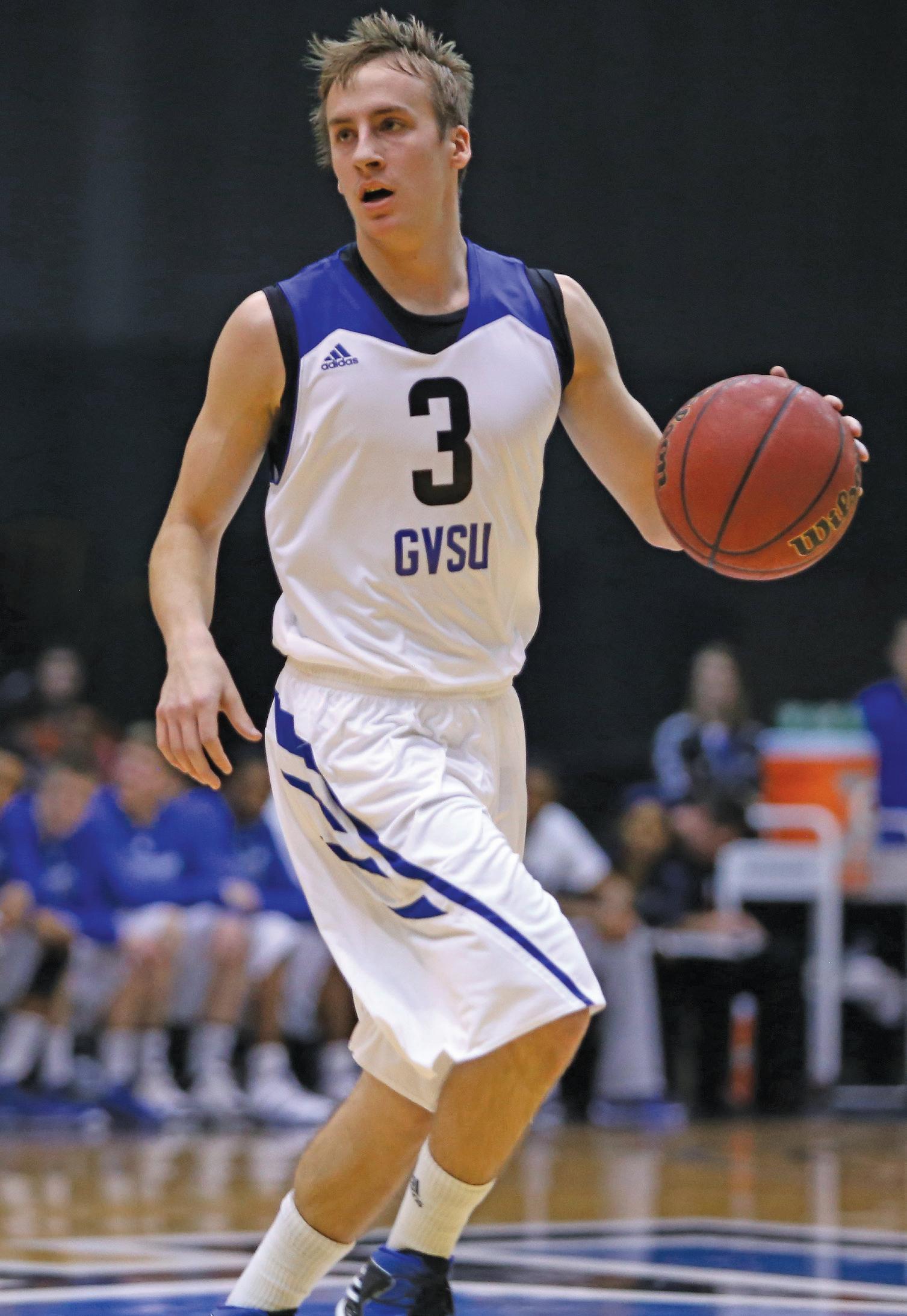



Lakers rely on shooter off the bench for crunch time wins
BY JAY BUSHEN SPORTS@LANTHORN.COM
Late-game heroics don’t spontaneously take place in the final minute — they’re the byproduct of a process.
That process began more than 100,000 shots ago for sophomore guard Darren Kapustka of the Grand Valley State University men’s basketball team, and by now, he’s a stone-cold sharpshooter with ice water in his veins.
Kapustka, one of the first players off the bench for GVSU, has shown a knack for knocking down the big shot late in games so far this season, and he is one the team’s most dangerous perimeter shooters along with junior guard Ryan Sabin.
“He’s always been a clutch player,” Sabin said. “He doesn’t shy away from big moments, which is huge, especially being a bench guy. He doesn’t lack confidence at all, and that helps the team out a lot. If he has a shot, he’s going to take it — and we love that.”
Opposing teams have been doing everything in their power to blanket Sabin with time winding down, which has led to big opportunities for Kapustka, who averages a teamhigh 2.5 points in the final five minutes of GLIAC contests so far this season.
He and Sabin have both connected on 4-of-8 attempts from beyond the arc in those situations, but Kapustka holds a slight edge in free-throw shooting percentage after sinking 14-of-17 (.824 percent) in crunch time.
Head coach Ric Wesley said it all starts with preparation.
“He puts in a lot of time,” Wesley said. “He gets a lot of extra shots up and has his whole career. It’s not by accident that he makes those shots. He’s a guy we expect to make every one he takes because you see him do it at a high rate in and outside of practice.”
Kapustka has been doing it for years. He said he used to shoot 100 free throws a day in high school and has carried a similar habit over to his collegiate career. He and the starting guards are usually some of the first players in the gym an hour before practice starts.
“He looks for his own shots and he knows he needs to shoot them,” Sabin said. “When he goes up, you know it’s going in. He loves it at the end of the game, too, which is great.”
Kapustka’s first opportunity to be the hero just so happened to take place in his hometown.
GVSU opened GLIAC play against Ashland University this season in a game played at Grand Rapids Community College due to a scheduling conflict. Kapustka felt right at home and broke a 62-62 tie by delivering the game-winning layup with 12 seconds left before ending the game with a steal on the other end of the floor.
His next game-winning performance also came with 12 seconds remaining.
GVSU was tied 80-80 with Lake Erie College when an opposing player inexplicably fouled him. He knocked both free throws, grabbed the defensive rebound on the other end of the court, then sealed the
game with two more freebies for an 84-80 win.
“Guys like that have to have swagger,” Sabin said. “It’s not really a quiet confidence or a cocky confidence — it’s a cool confidence.”
Kapustka’s third game-winning effort was served up cold for No. 12 University of Findlay. This time it was a 74-74 game with 20 seconds left on the clock. Fifth-year senior guard Rob Woodson drove the lane and kicked it out to Kapustka who, with a hand in his face, buried a 3-pointer right in front of the GVSU bench.
He also helped the Lakers upset No. 23 Lake Superior State University by connecting on some key free throws down the stretch after Sabin went off for a career-high 28 points.
“We all trust each other,” Kapustka said. “Sabin hit some huge shots last week, Woodson has hit some huge shots this year. We can all hit them — it’s just whoever gets the opportunity.”
Kapustka, who averages 6.9 points in 20.1 minutes per game, has had to work hard to earn his opportunities.
The 5-foot-9 guard is the shortest player listed on the team’s roster, a factor his coach hardly took into consideration when recruiting him.
“Size is certainly one of the variables, but he has so many other things going for him like his ability to handle the ball or shoot the ball,” Wesley said. “He’s got a great work ethic. He’s probably the best student in our program, and he’s got so many positive traits and brings so much to the table.”
BY PETE BARROWS
When freshmen first arrive at Grand Valley State University, they are rounded up during an orientation program called “Transitions” and tagged with lanyards — filled with schedules, maps and other guiding content — to be worn around the neck.
The lanyards are for the benefit of the incomers, as is the Transitions program, but both leave a mark. Freshmen, who have a tendency to travel in flocks, can be identified with ease anywhere they go until they build up enough courage and comfort to remove the lanyards.
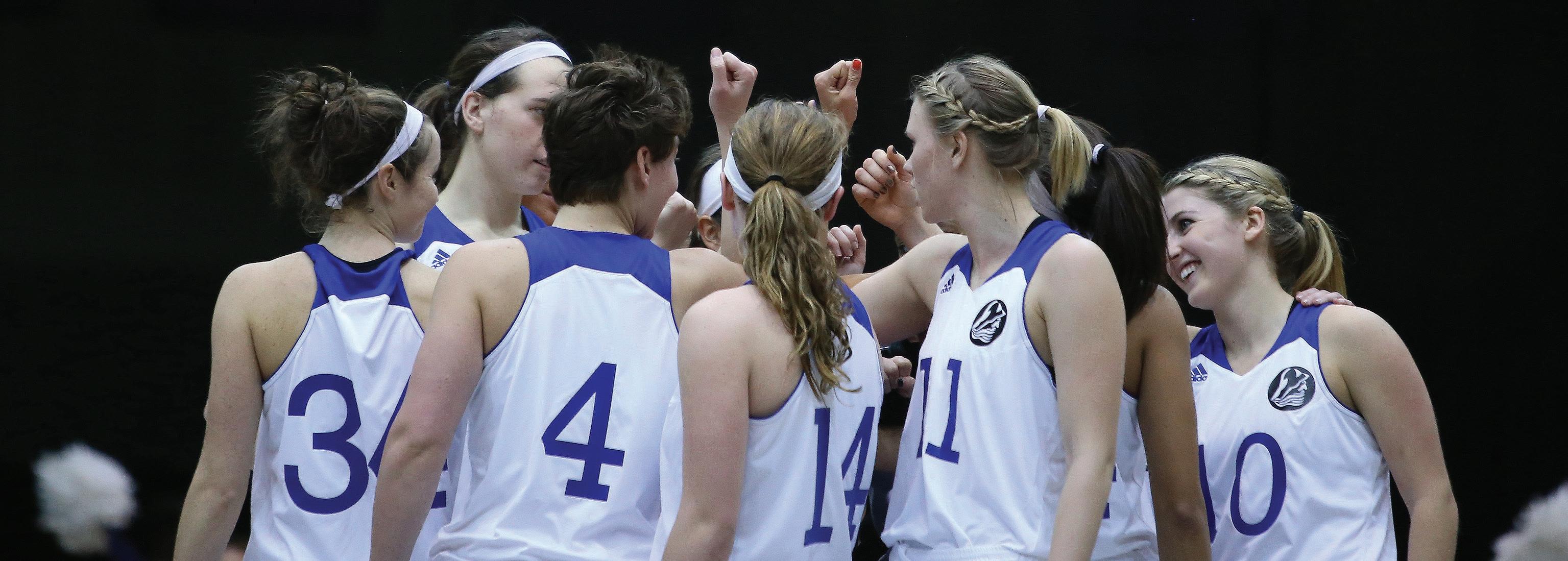
However, the 2013-2014 GVSU women’s basketball team is not a division of classes seen on the court. There are no sheep. There are no lanyards.
When the five members that compose the Laker class of 2017 — forwards Kayla Dawson and Piper Tucker, guards Taylor Lutz, Keyara Wiard and Janae Langs — have been identified, it hasn’t been for being rookies.
“Our freshmen have been great for us,” lone senior Dani Crandall said. “They came in with a ton of talent but had to transition from high school basketball to college basketball, where the pace is so much faster, there’s a shot clock and other nuances.
“They have handled themselves very well and have made the transition with ease.”
The freshmen outnumber Crandall 5-to-1 and, by count, make up a third of the roster. They also, by count, have accounted for about a third of the team’s statistical production in a variety of categories, despite only making 10 combined starts.
As a collective unit, the freshmen have logged 30.6 percent of the Lakers’ available minutes on the court; have scored 21.4 percent of the points; collected 27.4 percent
of the year it really paid off.
I was somewhat shocked of how well I did in my first year.”
It wasn’t until her sophomore season that she decided to dedicate the majority of her time to pole-vaulting and removed herself from future pentathlons.
The decision may have allowed her to make her biggest leap forward as an athlete, because she went on to win both the indoor and outdoor national championships with vaults of 4.00 and 4.15 meters.
of all rebounds; and contributed 31.4 percent of all assists, 26.7 percent of steals and 41.0 percent of all free throws made.
Freshmen members have also led GVSU in scoring six times in 16 games this season and in rebounds nine times.
“To have three freshmen in the rotation on a consistent basis is huge,” Crandall said.
“Extremely huge. That doesn’t happen at other programs. Our freshman are truly that good, and they’re building their confidence — getting more comfortable with the ball and being on the court — every time out.”
In a season-opening performance against Truman State University on Nov. 22, Tucker led GVSU with a game-high 15 points and six rebounds. The Lakers won the game 81-68.
In a 74-67 victory against Lake Superior State University on Jan. 23, Dawson tallied a career-high 24 points and 11 rebounds to become the first Laker to record a double-double on the season. It was her fourth time leading the Lakers in scoring in the last five games.
In that same victory, Lutz made her first career start as a
when she made her big leap forward,” head coach Jerry Baltes said. “We all knew what type of potential she had. It was really fulfilling for her to reach that point of success in that point of her career.”
Her junior season was a bit of a set back because she was unable to defend her conference or national titles, but she continued to improve.
We all knew what type of potential she had.
She also finished second in the pole vault at the 2012 GLIAC Indoor Championships and then went on to win her second GLIAC pole vault title of her career in the spring at the GLIAC Outdoor Championships.
“Once she got a feel for the program and what she had to do to be successful is really
She reached heights of 4.23 meters in the 2013 GLIAC Indoor Championships and 4.25 meters in the spring at the GLIAC Outdoor Championships.
“My junior season was somewhat disappointing, especially (with) all the success that I had in my sophomore season,” she said. “However, it has given me extra motivation for this season. Finishing my career with another couple of national championships to go along with another team national championship would be great.”
Laker and produced 14 points, six rebounds and five assists.
Not just freshmen, but starters. All three have started together in the Lakers’ last two games and have improved with every game and every practice.
“They’re doing great things that are pushing the older kids to get better, and there’s friendly competition all over our team,” Crandall said. “It’s nothing personal, and more times than not, when somebody shows someone else up, there’s a pat on the butt afterwards, but it’s that healthy competition that makes us better.”
The freshmen categorize themselves as “close” but have been also categorized by their work ethic. They frequently visit the gym together to get in extra repetitions and have also noticed the value of the exchange between upper- and underclassmen.
Not entitled. Not satisfied. Hungry.
“Our leadership that we have on our team has helped us to transition as much as anything,” Dawson said. “Without Dani or Meryl (Cripe) or Kat (LaPrairie), our captains, we wouldn’t be producing or adjusting the way that we are. They’re leading us through it
She has certainly accumulated a ridiculous amount of accolades in her first three seasons as a Laker: two national titles, two conference championships, six separate All-American honors, four team championships at the national level, and all women’s pole vault records at GVSU.
Perhaps the most outstanding accomplishment, however, was her ability to maintain a 3.96 GPA in finance, which led to her being tabbed as the 2013 Academic All-American of the Year.
and helping us to become better players.
“The older girls will point things out to us and teach as we go, but we also learn just watching.”
Head coach Janel Burgess has also noticed the dynamic.
“The thing that makes them special as a class is their collectiveness,” Burgess said. “They’re a driven group, probably the hardest-working class that I’ve ever recruited, and their success has come because they’re gym rats.
“They were talented when they got here, but they’ve really bought into the system, learned from more experienced teammates and have grown a ton since they got on campus.”
Dawson is the team’s third leading scorer with 9.1 points per game, and she ranks fifth in rebounds. Tucker is fifth in scoring with 6.3 points per game and fourth in rebound ing. Lutz is tied for sixth in scoring with 5.6 points per
game and is second on the team in assists.
Not novelty outliers, but consistently relied upon producers.
“They’re getting so many valuable minutes — minutes that in all reality, have made them sophomores for us,” Burgess said.
Dawson was a semifinalist for Miss Basketball of Wisconsin as a senior — a two-time team captain who was not only rated as a top-five defender in the state, but also a state champion in 2012. Lutz was a two-time Northern Indiana Conference firstteam selection and finished runner-up in the state finals.
Tucker was a member of the Lansing State Journal ‘Dream Team’ and helped her team finish in the state quarterfinals as both a sophomore and a junior.
Not just producers, but winners.
itive and refuse to think about anything that doesn’t concern the team’s benefit.”
GVSU’s version of the “fabulous five” have not donned high-top fades, intentionally baggy shorts or black socks, but they have left an identifiable mark. The kind of mark that can be seen from afar — like a lanyard.
It will be interesting to see how bold of a mark the five can leave with 10 regular season games left and three full years of eligibility to follow. Not freshmen. Studentathletes. Ready and able now, brimming with talent and potential.
“We’re representing pretty well as a class, pushing the upperclassmen, and it’s good for the team,” Tucker said. “I’m glad to be a part of it.
“We’ll hopefully get more wins in upcoming seasons, go further in the GLIAC, win some championships, but we also want to continue to play well together like we are now.”


“Receiving that honor was quite fulfilling,” she said. “I don’t want my academic achievements to be overshadowed by my performances in pole vault. It was an amazing feeling to be recognized for all my hard work in school as well.”
Whether or not Hixson finishes her GVSU career with one, two or three more athletic accolades, she will be recognized as one of the most decorated women’s pole vaulter ever to put on a Laker uniform, and more importantly, as a graduate who excelled on and off the athletic field.

responsible for scheduling, ordering, and training staff.
Ideal candidates will possess two years experience in pizza and/or restaurant locations with strong customer service, communication, and supervisory skills. Computer and some administrative skills are required. Must be skilled in time management, organization, and multi-tasking. Must be able to work exible hours, weekends, and be a student at GVSU with a minimum of 6 credits.