Swine Grist
A PERIODIC NEWSLETTER PRODUCED BY GRAND VALLEY FORTIFIERS VOLUME 22, ISSUE 1 | SPRING 2020
Dear Friends, In many parts of Ontario, this winter has been one of much less snow and warmer temperatures than we’re used to. Talking with producers this month, many hope that we won’t end up “paying for” this easy winter, once the spring months arrive. Thus far 2020 has definitely been an unpredictable year with the challenges of COVID -19 now being felt around the world and a surprisingly suppressed hog price, despite the significant decrease in the China hog population due to ASF. We pray the price will increase very soon as pork producers everywhere are feeling the pinch. In spite of all these challenges we push on and work hard at the prospect of what the future may hold and reflect on the Lord’s goodness to us over the many years. This is especially real for all of us at Grand Valley Fortifiers this year as June 2020 will mark 60 years of us being in business. While it has not always been easy, it’s always been rewarding to work with those whom I believe to be the best part of our population, the farmers. We have enjoyed 60 years of business and relationships with many of you and for that we are extremely grateful. Our new 60th anniversary logo (displayed here) will begin popping up on all our communications shortly and I encourage you to stay tuned for a potential anniversary event later this year! Thank you to all of you who have made 60 years of GVF possible with your patronage. Sincerely, Jim Ross, Founder & Chairman
ECONOMIC IMPACTS AT THE HAND OF INVISIBLE VIRUSES
by: IAN ROSS President & CEO, Grand Valley Fortifiers
T
he outbreak of coronavirus (COVID-19) in Wuhan, starting on December 31st, 2019 has dominated news headlines so far in 2020. At the time of the writing of this article, COVID-19 has spread to 25 countries, with over 100,000 confirmed cases and over 3000 confirmed deaths attributed to the virus. Certainly, our thoughts and prayers are with all of the families that have been impacted by this new virus. The human impact of this virus is significant and tragic. The economic impact of COVID-19 is now beginning to be felt. Many airlines have cancelled flight schedules to China and more recently additional countries, travellers are now wary to travel to numerous countries in the world and airlines are predicting a 30 billion dollar impact on their industry. In the last week of February global stock markets dropped in value significantly (7 trillion dollars) with major U.S. indices (Dow Jones, S&P, Nasdaq) down 10 - 14% from their recent highs. It is at times like this that we are reminded just how many goods are sourced from China. With factories of all kinds being shuttered in various parts of China, keeping employees at home to mitigate the spread of the virus, global shortages of many types of goods are starting to be felt. Many brands of electronics are manufactured in China, including the Apple iPhone. Human and livestock grade pharmaceuticals, feed ingredients, including vitamins are all sourced from China. With shortages and delays already occurring, vitamin prices are back on the rise. Empty sea containers are piling up in Asia as North American goods continue to GRAND VALLEY FORTIFIERS PO Box 726 Cambridge ON N1R 5W6 1-800-567-4400 grandvalley.com
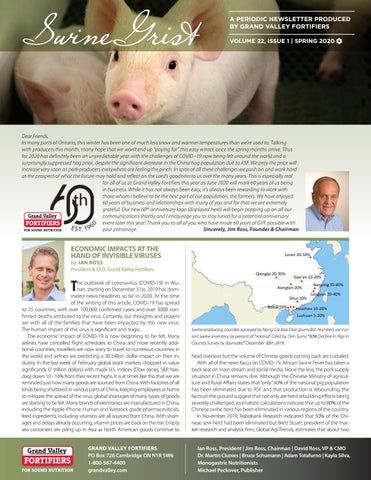
Swine-producing counties surveyed by Nong Cai Bao Dian journalist: Numbers are current swine inventory as percent of “normal” Cited by Dim Sums “80% Decline in Pigs in Country Survey by Journalist” December 30th 2019.
head overseas but the volume of Chinese goods coming back are curtailed. With all of the news focus on COVID-19, African Swine Fever has taken a back seat on main stream and social media. None the less, the pork supply situation in China remains dire. Although the Chinese Ministry of agriculture and Rural Affairs states that “only” 40% of the national pig population has been eliminated due to ASF and that production is rebounding, the facts on the ground suggest that not only are herd rebuilding efforts being severely challenged, journalistic calculations indicate that up to 80% of the Chinese swine herd has been eliminated in various regions of the country. In November 2019, Rabobank Research indicated that 50% of the Chinese sow herd had been eliminated but Brett Stuart, president of the market research and analysis firm, Global AgriTrends, estimates that about two Ian Ross, President | Jim Ross, Chairman | David Ross, VP & CMO Dr. Martin Clunies | Bruce Schumann | Adam Totafurno | Kayla Silva, Monogastric Nutritionists Michael Peckover, Publisher
thirds (66%) of the Chinese swine herd has been lost. If Stuart is correct with his estimate, this pork production elimination would represent close to the equivalent all of the U.S.A. and E.U. pork production combined! Given the global pork supply situation, and the resulting extreme values of pork globally, it is unconscionable that the CME lean hog price and resulting Canadian hog price is so comparatively low. The North American to global pork price differential is simply not sustainable. If we are able to keep ASF out of North America, there will be numerous years of high profit for pork producers here as well as for our pork producing counterparts throughout the world. CFIA and other government agencies have taken steps to reduce the risk of ASF being introduced to the swine herd in Canada. However, as one can imagine, the governmental priority now, is to mitigate the risk of spread of COVID-19 to the Canadian human population. Recognizing the devastating impact of ASF on the Canadian swine industry, an industry that exports 70% of its production, the entire industry needs to remain vigilant in its efforts to mitigate the risk of ASF introduction into North America. Notwithstanding China’s extreme need for pork, the Chinese government continues to refuse to import pork from ASF positive countries. ASF has been found within a number of kilometers of the German border. Germany is currently providing about 17 percent of China’s pork imports. Some people have stated that Canada simply needs to be the last pork producing country to have a confirmed of ASF in order to protect its export markets. This philosophy is likely naïve at best. A confirmed case of ASF in Canada, at any time in the future will most certainly disrupt export trade at least for a number of weeks and this would have a very immediate and deleterious affect on pork prices. We are aware of some excellent work by a consortium of industry groups and commercial businesses that are putting plans in place to respond swiftly and in a coordinated manner in case ASF is ever confirmed in Canada. We applaud these efforts and yet we pray that these plans will never need to be enacted. Are we, as an industry, doing enough to mitigate the risk of introduction of ASF to North America? Both CFIA and ANAC have provided recommendations to the feed industry regarding the importation of feed ingredients from ASF and FAD positive countries. Unfortunately, to date these remain unregulated and monitored recommendations. Should the industry impose peer pressure on itself by launching an ASF risk mitigation strategy certification process? Should producers insist that their suppliers embrace the CFIA and ANAC ASF risk mitigation recommendations or move their business elsewhere? How do we best ensure that ALL practical and pragmatic steps are being taken in the industry to mitigate the risk of ASF and best protect the livelihoods of thousands of pork producing, and pork processing families across the nation? All practical measures should be deployed by both the government and the feed industry to mitigate the risk of introduction of ASF into Canada. The industry can not afford to find itself in a position of saying “would have, could have, should have” when it comes to the potential introduction of ASF into this export dependent Canadian pork industry. n
of you there. In honor of their 20th Anniversary the London Swine Conference team has planned a 20th Anniversary Banquet taking place on March 31st at 6:30 pm. It light of this, Grand Valley Fortifiers has decided to forgo hosting our own pork producer banquet after the first day of the conference and instead support this special dinner. If you are a GVF customer looking for more information or tickets for this event, please speak with your GVF Swine Specialist. We hope to see you there!
DRAYTON FARM SHOW March 25th & 26th, 2020
N
ew this year, Grand Valley Fortifiers will be exhibiting at the Drayton Farm Show on Wed. March 25 11 AM – 10 PM and Thurs. Mar 26 11 AM – 9 PM. This show takes place in the Drayton PMD arena. Make sure to stop by if you’re in the area.
RAISING PIGS WITH LOW INCLUSIONS OF ZINC OXIDE
by: KEVIN DOLAN & VICTORIA SEIP Nursery Feeds Specialist, Primary Diets
A
s farming livestock continues to be an environmental concern along with regulating antimicrobial resistance, the changes in use rate of zinc oxide (ZnO) are on the forefront of the research being done at Grand Valley Fortifiers. Over this past fall and winter, we have been testing a new range of nursery feeds: “XP” known for their Extra Protection against post-weaning scour and reduced levels of ZnO. These diets have been developed and tested over the last few years by Primary Diets in the UK, but we wanted to prove their efficacy within Ontario swine units as well. The Canadian Food Inspection Agency has “signaled” that our new maximum level of zinc that can be used in hog production will be 150 ppm. We needed to be proactive and so we investigated ways to feed weaned pigs with only 150 ppm of ZnO versus the standard 2500 ppm of ZnO that is commonly fed in most nursery programs, but will no longer be allowed come the new feed regulations enactment. Two side by side trials were conducted as all-in-all out with approximately 500 pigs on the XP program with only 150 ppm of ZnO and 500 pigs on a BioSure™ program with 2500 ppm of ZnO. These pigs were weaned at ~24 days at 6.6 kg. The BioForce® 180, BioForce® 240 XP and BioForce® 32 were all manufactured on-farm. The pigs were weighed at weaning, 14 days, 35 days and 42 days in the nursery. The budget fed to the pigs was as follows.
Feed
BioSure™
BioSure™ XP
Surge
1 kg
—
—
1 kg
BioForce® 180
4 kg
—
BioForce® 240
—
4 kg
BioForce® 32
Balance
Balance
Surge XP
LONDON SWINE CONFERENCE March 31st & April 1st, 2020
T
his is an exciting year for the London Swine Conference as they celebrate 20 years of providing a forum for the exchange of credible, science-based information for decision makers and influencers in the pork industry. This year’s two-day event schedule is packed with some excellent speakers and timely topics. We look forward to visiting with many
The pigs had similar performance in terms of weight gain (kg) and average daily gain (g/d) on both programs proving that the XP with reduced levels of ZnO was able to successfully raise pigs with the lower inclusion of ZnO. Performance results over the 42 days spent in the nursery can be seen in Figure’s 1 and 2. In the second trial, the pigs were faced with
Swine Grist a scour and the performance on the group that was fed the XP range of diets did out perform the pigs on the regular BioSure™ program with a standard level of ZnO. Over the course of the scour, these pigs also combatted disease more effectively by not showing as severe clinical signs and having the scour clear up more quickly. Figure 1: Nursery Average Daily Gain Over 42 Days Spent in the Nursery
g/d
Average Daily Gain 555 540 525 510 495 480 465 450
547
549 507
490
BioSure™
BioSure™ XP
BioSure™
Overall
BioSure™ XP Smalls
Figure 2: Feed Conversion Over 42 Days Spent in the Nursery 1.49 1.48 1.47 1.46 1.45 1.44
FCR 1.48 1.46
BioSure™
BioSure™ XP
Overall
1.46
1.46
BioSure™
BioSure™ XP
Smalls
We are continuing to test our XP range of diets in our efforts to prove that we can successfully raise pigs with a 150 ppm ZnO inclusion rate. We look forward to seeing further positive results of how our different phases of starter feeds will perform. n
PRECISION PORK PRODUCTION MADE POSSIBLE WITH REDVAN
by: VICTORIA SEIP Production Improvement Specialist, Grand Valley Fortifiers
side using a mobile device. Once the litter is registered, each piglet is listed under a specific sow id and individual weights are tracked and growth is calculated. Using birth weights and weaning weights, this data is used to calculate individual gain on the sow to categorize pigs within their growth category. The system works with a colour coding system. It’s important that we don’t forget the sow and the importance of her condition to produce the highest birth weights and weaning weights possible. With this system, sows are weighed going into and out of the farrowing crate to determine the impact of her weight loss during lactation. This measurement can be used to try and help her stay in the best condition to produce as much milk and prolific pigs as possible. In the nursery, we have taken a subset of pigs and collected individual weights. This has helped us to once again sort and precision farm pigs through finishing, along with making conclusions from the data we collect. Did you know that we now have the numbers to prove that out of ~700 feeder pigs, males grow faster than females? Once the pig has reached market weight and all data is collected, each pig has enough information to have created an individual passport through their production cycle. In that 6-month period, on the farm level, we can track back to: parity, sow id, birth weight, weaning weight, feeder pig weight, market weight, gain on the sow, gain in the nursery and cumulative average daily gain. Pretty amazing data to help us become more efficient producing pork! To continue with our goal of knowing how efficiently that pig will grow and turn into the best quality market hog, we have been working with a packer to get exact days to market on these tagged animals and be able to correspond that information to individual carcass traits and iodine value. Results have shown that pigs within the >260 g/d gain on the sow are able to make it to market in 12 days less than animals gaining <125 g/d on the sow.
T
he variation in a pig’s growth can truly be a mystery and every day we work to understand how to better utilize the resources associated with raising these animals. We need to determine how we can improve gain and performance to get the animal to market as quickly and efficiently as possible. In 2019, Grand Valley Fortifiers and Farmers’ Farmacy started working with RedVan, a form of software and equipment from the Netherlands used to track the growth of pigs from birth to market. Indication Gain/Pig (g/d) >260 190-260 125-190 <125
By using the RedVan system, pigs are tagged with an ultra high frequency (UHF) tag and weighed at birth. This tag stays in their ear until slaughter to track individual pig data. The data is collected sow-
grandvalley.com
The RedVan system has allowed us to embark on precision pork production like we’ve never been able to before. It will help our industry produce as much quality pork as possible in the most efficient manner and resourceful way. This technology has helped us learn a lot about the individuality of the animal and how we can manage and raise that animal to stay as healthy and viable as possible. For more information about the RedVan system talk to a GVF Swine Specialist or contact Farmers Farmacy at info@farmersfarmacy.com or call 1-866-527-6229. n
There is one caveat here, and that is for any hog producer marketing their hogs under the low-iodine program. DDGS has double the iodine value of corn and double the 18:2 omega6 content of corn. Using DDGS will increase the iodine value in the carcass, so you need to take this into consideration. If you have a spare “opportunity bin” on your operation, it is a good time to consider using DDGS again to minimize the cost of your rations and put more dollars into your pocket. For more information contact your Grand Valley Fortifiers swine specialist or nutritionist today. n
IT’S TIME TO CONSIDER DDGS AGAIN
by: BRUCE SCHUMANN B.Sc. (Agric.), M.Sc., Monogastric Nutritionist, Grand Valley Fortifiers
H
og prices in Ontario (that are CME-based) continue to be supressed due to trade complications between the US and China, so producers continue to look for ways to reduce costs, while they wait for the promise of more profitable days ahead. Since feed contributes the largest percentage of the cost to raise pork, producers are always looking to reduce feed costs wherever possible. The use of new-crop corn in feeds is well underway and while some of the corn has tested at significantly lower weight per bushel than previous years, its quality, from a mycotoxin contamination point-of-view, is very good this year. Good quality corn used in ethanol production directly translates into good quality DDGS coming out. Most of the DDGS production facilities have reported DON testing between 0 - 3ppm. In Ontario, there has never been a time when DDGS has been an uneconomical choice. The decision on whether or not to use DDGS in rations for swine was largely based upon whether producers had a spare bin that they could accommodate DDGS and if there were significant levels of mycotoxins in the DDGS that could potentially negatively affect performance on their operation. Direct Source Commodities (DSC), a division of the GVF group of companies, publishes and distributes a weekly email shadow pricing report. The shadow pricing report provides the current market cost for commodities that producers would purchase for use on their farm. Adjacent to the cost is a shadow price of that ingredient. The shadow price is the economic replacement value of an ingredient if it was to displace corn, soybean meal (SBM) and tallow in a ration. This value takes into consideration both the energy content of ingredients such as DDGS as well as its amino acid profile, specifically lysine, total sulfur amino acids, threonine and tryptophan. The nutrients from an ingredient ex DDGS are given an economical value and it is compared against the economic value of removing those nutrients in the ration from the corn, soybean meal and tallow contribution. The spread between the value of an ingredient and its purchase price gives you the savings that can be obtained by using that ingredient ($/MT). The shadow price from February 20th places a value of DDGS at $320.46/MT when DDGS has a purchase price of $252.00. We also know that DDGS are inherently deficient in lysine, because corn itself is deficient in lysine, so when we place an economic value on our DDGS we include additional lysine (and its cost) into the shadow price. This does artificially inflate the value of DDGS, but it is still representative of the savings that can be obtained in the diet when included. Using those numbers, the spread between the value and the cost of DDGS is $68.46/MT. Therefore, when DDGS is used at 20% of the diet there is a savings of $13.69 per tonne of complete feed or about $3.80 per hog (assuming 278 kg of feed consumed between 25-130 kg body weight).
ASF - INGREDIENT RISK MITIGATION STRATEGY
by: BRUCE SHUMANN & IAN ROSS
I
n the wake of African Swine Fever (ASF) and other Foreign Animal Disease (FAD) threats, the control of potential biological risks (viruses, bacteria) in feedstuffs have taken center stage. Dr. Scott Dee initiated studies that demonstrated some ingredients commonly used in the manufacturing of livestock feed, if contaminated, could maintain a virus (ex. PEDv) and allow it to survive a transatlantic voyage. The Canadian Food Inspection Agency (CFIA) has increased its oversight and inspection of high-risk ingredient importation including a mandatory CFIA facility questionnaire for the importation of unprocessed/raw grains and oilseeds into Canada from specific countries including processing temperatures and storage time/temperatures. The importation of grains, especially organic grains are coming under the most scrutiny, by the CFIA because of their perceived risk of carrying ASF or other FADs. The GVF group of companies does not import any high-risk ingredients as defined by CFIA, from any country of concern with respect to African swine fever. For any other ingredients (ex: choline chloride, amino acids, etc.) that do come from overseas. Grand Valley Fortifiers and Fortified Nutrition Limited, have either put additional risk mitigation procedures in place ourselves, or in partnership with our manufacturers/suppliers. Ingredients, purchased from overseas, have a mandatory hold procedure in our warehouses at 20 degrees Celsius for 20 days at minimum (CFIA/ ANAC recommendation), but often these are held for 60 days prior to use. In addition, manufacturers and/or distributors who receive products from overseas have provided declarations that speak to ASF security procedures including additional storage time/temperatures of their products, vehicle disinfection procedures etc. As an industry we need to do as much as we can to keep ASF out of Canada. If you are looking for more information on how you can further protect your farm operation against ASF and other FADs, please check out the link below to the Animal Nutrition Association of Canada’s Biosecurity Guide, which is a National guideline, adopted by most of the feed industry. n http://bit.ly/ANACBiosecurityGuide
Thought for the Day being strengthened with all power according to his glorious might so that you may have great endurance and patience, 12and giving joyful thanks to the Father, who has qualified you to share in the inheritance of his holy people in the kingdom of light. – Colossians 1:11-12 11