

Overcoming the barrier of vision: approaching architecture beyond ocularcentrism and through phenomenology

Περίληψη
Abstract
Key-words:
Ocularcentrism - PhenomenologyPerception - Spatiality - Visual Impairment
The aim of this research thesis is to investigate the position of vision in society, as it has been composed in the past and examine the variation of this position up to date. The concept of ocularcentrism is being analyzed, utilizing different philosophical theories. Also, the research is examining the importance of vision and other sensory stimuli for perception. After studying the way in which ocularcentrism was established over time, the research investigates the philosophical theories that initiated its dispute. In particular, Phenomenology, which attempted to decipher vision from the pedestal of being perceived as the primary sense and introduced the notion of lived experience. Architecture is being studied from a phenomenological point of view and through the writings of Pallasmaa, Zumthor and Tanizaki that seem to strengthen its empirical side.
In order to understand how the composition of a spatial image
is being formed beyond ocularcentrism, perception, sensory stimuli and architectural meaning are being explored through the lens of blindness and visual agnosia. A non-ophthalmic prism is created by utilizing these approaches which is used in order to grasp a better understanding about architectural space. Notions and concepts are being derived from existing research and research through the questionnaires that were composed for the purpose of this paper. One can argue that these notions are somehow connected to the theories of phenomenological architects and Japanese writer Tanizaki. The aim is to formulate a new series of notions related to perception and multi-sensorial architectural design by utilizing the information that occurred from the previously investigated, non-ophthalmic prism. It is an attempt to approach a phenomenological, inclusive architectural intellect while in search of architectural essence, beyond the barrier of vision.
Pallasmaa, Tanizaki
1. Houlgate, S. (1993) Vision, reflection and openness: The “hegemony of vision” from a Hegelian point of view. In: Levin, M. ed.1993 Modernity and the Hegemony of Vision. University California Press , Berkeley p. 96
2. Levin, M. (1993) Decline and fall: ocularcentrism in Heidegger’s reading of the history of metaphysics. In: Levin, M. ed.1993 Modernity and the Hegemony of Vision. University California Press , Berkeley p. 205
3. Kavanagh, D.(2004) Ocularcentrism and its Others: A Framework for Metatheoretical Analysis [online], Sage Journals, available at: https://journals. sagepub.com/doi/pdf/10.1177/0170840604040672 , downloaded on January 4, 2022, p. 6
4. Warnke, G. (1993) Ocularcentrism and social critisism. In: Levin, M. ed.1993 Modernity and the Hegemony of Vision. University California Press , Berkeley p. 287


5. Kavanagh, op. cit.,, p. 6
6. Pallasmaa, J.(2012 edition) The eyes of the skin, John Wiley and Sons Ltd, Great Britain, p.15

7. Pallasmaa, op. cit., p. 16
8. Kavanagh, op. cit., p. 8
9. Warnke, op. cit., p. 287
10. Brook, I. (2002) Experiencing Interiors: Ocularcentrism and Merleau-Ponty’s Redeeming of the Role of Vision, ReasearchGate, available at:https://www.researchgate.net/publication/280795441_Experiencing_Interiors_Ocularcentrism_and_Merleau-Ponty%27s_Redeeming_of_the_Role_of_Vision , downloaded on October 14, 2020, p. 1
11. Locke, J. (1990) An Essay Concerning Human Understanding London: Dent and Sons, pp. 57-65
13. Kaijo, Ch. (2007) Primary and Secondary qualities [online], Frensostate, available at https://www.fresnostate.edu/artshum/philosophy/documents/Kaijo-CUPR1-1.pdf , downloaded on November 11, 2021, pp. 51-52
“Observations in the cogitationes privatae” (1619)
14. Brook, op.cit., p. 2
15. Houlgate, op. cit., p. 111
16. Judovitz, D. (1993) Vision, Representation and Technology in Descatres, In: Levin, M. ed.1993 , Modernity and the Hegemony of Vision. University California Press , Berkeley, pp. 63-66
17. Ibid., p. 65

18. Ibid., p. 66

Francis Bacon

Rene Descartes
20. Warnke, op. cit., p. 287

21. Pallasmaa, op. cit., p. 42 7.
George Rousse

22. Houlgate, op.cit., p.
Descartes,
24. Nietzsche, F. W., & Kaufmann, W. (1995). Thus spoke Zarathustra: A book for all and none. New York: Modern Library.
25. Kavanagh, op. cit., p. 12
26. Saphiro, G. (1993) In the shadows of philosophy: Nietzsche and the question of vision. In Levin, M. ed.1993 Modernity and the Hegemony of Vision. University California Press , Berkeley, p.139
27. Tanabe, M. (2019) Between Ocularcentrism and Anti-ocularcentrism : Nietzsche’s concept of Vision, volume 118, p. 60
28. Bergson, H. and Pogson F. L. (1971) Time and free will: An essay on the immediate data of consciousness. London: Allen & Unwin
29. Houlgate, op. Cit., p. 87
30. Ibid., p. 115
31. Levin, M. (1993) Introduction. In: Levin, M. ed.1993 Modernity and the Hegemony of Vision. University California Press , Berkeley p. 21
Martin Heidegger,
32. Levin, D. M. (1999) The Philosopher’s Gaze: Modernity in the Shadows of Enlightenment [e-book] The Regents of the University of California, Berkeley-Los Angeles-Oxford, available at : https://publishing.cdlib.org/ucpressebooks/view?docId=ft896nb5sx&chunk.id=d0e1859&toc.depth=1&toc.id=d0e1555&brand=ucpress , last viewed on January 4, 2022, p. 67
33. Britannica (1999) Origin and development of Husserl’s phenomenology [online] (2017) available at : https://www.britannica.com/topic/phenomenology/ Origin-and-development-of-Husserls-phenomenology , last viewed on January 4, 2022\
34. Συγκεκριμένα,
35. Jay, M. (1993) Sartre, Merleau-Ponty and a new ontology of sight. In Levin, M. ed.1993 Modernity and the Hegemony of Vision. University California Press , Berkeley p. 144
Δυτικό
37. Houlgate, op.cit., pp. 89-90
38. Kavanagh, op. cit., p. 19

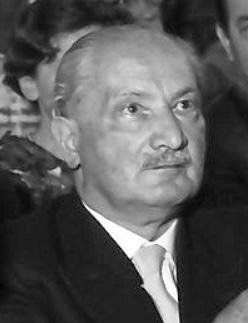
39. Jay, op.cit., p. 146
40. Levin, Decline and fall: ocularcentrism in Heidegger’s reading of the history of metaphysics, University California Press , Berkeley, 1993, p. 205
41. Ibid., p. 213
42. Pallasma, op. cit., p. 22
φιλόσοφος Maurice Merleau-Ponty,
Jean-Paul Sartre
43. Jay, op.cit., p.149
44. Pallasma, op.cit., p. 20
45. Jay, op. cit., p.149
Sartre
46. Ibid, p.
47. Cologni, E. (2004) The artist’s performative practice within the anti-ocularcentric discourse, Phd Thesis [online] The London Institute : Central Saint Martins College of Art and Design, pp. 112-121, available at : https://ualresearchonline.arts.ac.uk/id/ eprint/2279/1/Cologni_thesis.pdf , last viewed on January 5, 2022, p.114
48. Brook, op. cit., p. 7
49. Jay, op.cit., p. 160
O Merleau-Ponty
Merleau-Ponty, M. (1993) ‘Eye and Mind’. In Johnson, G. ed, The Merleau-Ponty Aesthetics Reader Illinois: Northwestern University Press, 1993, p.124.
52. Merleau-Ponty, M. (2002) Phenomenology of perception, translated from French to English by Smith, C. Routledge: London and New York, pp. 60-74
Merleau-Ponty
Merleau-Ponty,


53. Ibid., pp. 5-14
54. Ibid., p. 159
55. Erciyes, op. cit., p. 5
56. Absurd Being (2015) Maurice Merleau-Ponty : 1908-1961 [online] available at : http://absurdbeing.com/merleau-ponty.php , last viewed on January 5, 2022
57. Dufrenne, M., (1980) Eye and mind [online] , translated by Gallager, D.J , Research in phenomenology: BRILL vol. 10, p.167-173 . available at: https://www.jstor.org/ stable/24654313?seq=1#metadata_info_tab_contents, last viewed on January 11, 2022, p. 168
59. Dufrenne, M. , (1980) Eye and mind [online] , translated by Gallager, D.J , Research in phenomenology: BRILL vol. 10, p.167-173 . available at: https://www.jstor. org/stable/24654313?seq=1#metadata_info_tab_contents, last viewed on January 11, 2022, p. 168
60. Ibid., p. 169
(insight, intuition, theory, idea, speculation, evidence
61. Ong, W. and Hartley, J. (2012) Orality and literacy. London: Routledge. 62. Brook, op. cit., p. 3
63. Soukup, P. (2005) Looking Is Not Enough: Reflections on Walter J. Ong and Media Ecology [online] Proceedings of the Media Ecology Association, Volume 6, available at: https://media-ecology.org/resources/Documents/Proceedings/v6/v6-08-Soukup. pdf , downloaded on January 8, 2022, p. 1
64. Pallasmaa, op. cit., p. 24

13.
1936
65. Foucault, M. (1977) Discipline and Punish. Trans. Alan Sheridan. New York: Vintage
66. Kavanagh, op. cit., p.14
67. Ibid., p. 13


14 &15. Οπτικές απεικονίσεις του Foucault στο “The order of things”
68. Flynn, R. T. (1993) Foucault and the eclipse of vision. In: Levin, M. ed.1993 Modernity and the Hegemony of Vision. University California Press , Berkeley p. 273
69. Pallasmaa, op. cit., p. 22
70. Houlgate, op. cit., p.87


71. Ibid., p. 87
72. Pallasmaa, op. cit., p. 21
73. Houlgate, op. cit., p. 96
74. Levin, Decline and fall: ocularcentrism in Heidegger’s reading of the history of metaphysics, University California Press , Berkeley, 1993, p. 205
75. Houlgate, op. cit., p. 96
76. Pallasmaa, op. cit, p. 36

19. Εικόνα από “Downcast eyes” p. 1
78. Flynn, op.cit., p. 287
79. Jay, M. (1994) Downcast Eyes: The Denigration of Vision in Twentieth-Century French, p. 1
80. Brook, op. cit., p. 1
81. Pallasmaa, op.cit., p. 20
82. Jay, Downcast Eyes: The Denigration of Vision in Twentieth-Century, 1994, pp. 2-3
83. Ibid., p. 6
84. Flynn, op. cit., pp. 287-288
85. Η
Ashley Montagu,
86. Jay, Downcast Eyes: The Denigration of Vision in Twentieth-Century, 1994, pp. 7-8
87. Brook, op. cit., p. 2
H Brook,
88. Flynn, op. cit., pp. 274
89. Pallasmaa, op.cit., p. 16
90. Brook, op.cit., p.5

20. Weissenhof estate, Stuttgart, Le Corbusier
91. Robinson, J. (2012) On Being moved by architecture [online], The Journal of Aesthetics and Art Criticism, FALL 2012, Vol. 70, The American society of aesthetics, pp. 337-353, available at: https://www.jstor.org/stable/43496529 , downloaded on 31 January, 2022, p. 338

21.
Lα Haine
93. Pallasmaa, op.cit., p. 26
94. La Haine (1995) Directed by Mathieu Kassovitz [film] Canal

95. Koyaanisqatsi: life out of balance (1983) Directed by Godfrey Reggio [feature film] Island Alive, New
97. Pallasmaa, op.cit., p. 11
98. Robinson, op. cit., p. 339
99. Pallasmaa, op.cit., p. 30
100. Pallasmaa,


102. Norberg-Schulz, C. (2009) Genius loci
103. Pallasma, op.cit., 11
104. Pallasma, op.cit., 13
105. Zumthor, P. (2006) Atmospheres, Birkhauser, Berlin, p. 13
106.
του
Junichiro Tanizaki, όπως
(2016). Αναφορές
Pallasmaa,
Tanizaki
Tanizaki,

107. Zumthor, op.cit., p. 19

1.
2. “Material compatibility”
3. “The
4.
5. “Surrounding Objects” (αντικείμενα
6. “Between composure and seduction” (μεταξύ
7. “Tension Between interior and exterior” (ένταση
8. “Levels of intimacy” (επίπεδα
9. “The light of things”
10. “Architecture as
11. “Coherence”
12. “The beautiful form” (η
Pallasmaa στο “Eyes of the skin” (2012)110.
1. “Τhe body in the center” (Το
2. “Multi-sensory experience” (πολυαισθητηριακή
3. “The significance of shadow” (η
4. “Acoustic Intimacy”
5. “Silence, time and solitude” (ησυχία,
6. “Space of scent” (ο
7. “The shape of touch”
8. “The taste of stone” (η
9. “Images of muscle and bone” (εικόνες
10. “Images of action”
11. “Bodily identification”
12.
13. “Space of memory and imagination”
111. Pallasmaa, op.cit., pp. 56-58
Tanizaki,
112. Mandal, A. (2019) What is visual impairment? [online] News-Medical, available at: https://www.news-medical.net/health/What-is-visual-impairment.aspx. , last viewed on January 13, 2022
113. Davis, Ch. P. (2021) Medical Definition of Blindness [online], MedicineNet, available at: https://www.medicinenet.com/blindness/definition.htm , last viewed on January 13, 2022
114. American Psychological Association. (n.d.). Apa Dictionary of Psychology. American Psychological Association, available at: https://dictionary.apa.org/ cognitive-impairment, last viewed on January 15, 2022
115. Farah, Martha J. (1990) Visual agnosia : disorders of object recognition and what they tell us about normal vision, Mass. : MIT Press, Cambridge, p6
116. Ibid., p.149
117. ibid., p. 19
118. Ibid., p. 20
119. Ibid., pp.57-58
120. Ibid. p. 59
121.
123. Pop, D. (2013) Space Perception and Its Implication in Architectural Design [online journal] Acta Technica Napocensis: Civil Engineering & Architecture, Vol. 56, No 2, pp. 211-221, available at: https://www.academia.edu/10935249/Space_ Perception_and_Its_Implication_in_Architectural_Design , downloaded on January 20, 2022, pp. 214-215


27.
124. Ibid., p.215
125. Dischinger, M.(2000) Designing for all senses -Accessible spaces for visually impaired citizens, thesis, Chalmers University Of Technology, Sweden, p. 68
126. Karlsson, G. (1996) The Experience of Spatiality for Congenitally Blind People: A Phenomenological-Psychological Study, Human studies 19, p. 303-330, Kluwer Academic Publishers, Netherlands, p. 303
127.
128.
129.
130. Gibson, J. J. (1966) The Senses Considered as Perceptual Systems, Boston: Houghton Mifflin
131. Pop, op.cit., p.213
132. Karlsson, op. cit.., p. 79
133. Ibid., p. 92
134. Ibid., p. 95
1) Do you have any visual impairments? If so, what kind? -
1. Nearly blind
2. Yes, I’m totally blind.
3. Yes, I’m blind
4. Blind
5. My left eye is an artificial eye and with my right eye I can see only 20%, if I wear my glasses. Without glasses, I can see 10%.
6. Totally blind. No light perception.
7. Blind without light perception
8. Undiagnosed- no central vision
9. I am total blind, I have no light perception.
10. blind
11. Ολική Απώλεια όρασης
12. Τύφλωση
13. Oλική τύφλωση
14. Ολική
2)What is your preferred sense when interacting with a new space?

3) How do you recognize a space? - Πως αναγνωρίζεις
χώρο;
1. Not really possible,
2. by hand (touch the things), by hearing (hear the echoes, the acous¬tics of the space), by footsteps (moving around in the space), and by voice description (someone describe me the space details, the things within it, the colours, materials, distances etc., so I can make a mental picture of the space)
3. Usually with my white cane, but if it’s not possible i ask my friends to describe the space around us.
4. I use a white cane, but I also ask to my friends and family what is around us. And I am looking from the navigation
5. When I was a child my father used to tell me that I can’t see depth well. During time I think my mind started to compensate that. Since I can’t see with my left eye, sometimes I have to turn left to see more on that side, but I’m fine to go to new places alone. Usually I have to go closer to things to see them in details but all together I recognize the overall space even if the picture is not that sharp.
6. Through sound changes mainly
7. Sounds & smells
8. Touch
9. Indoor: Walls, carpets, location of the objects: tables, furniture, etc.
10. Outdoor: sidewalk, corners, location of buildings, or an interesting objects that are important for my orientation.
11.
4) What is your favourite place in your house? Explain what do you 4) What is your favourite place in your house? Explain what do you sense/ perceive there.
1. I like my whole house, because I know, I feel free to move, I feel safe
2. my own room: it gives the most comfortable atmosphere, it’s calm, safe, simply feels relaxing to be there. It represents my taste: contains colors, ma¬terials, decorations and furniture which I like,
whichever position I prefer.
3. I think it’s the balcony. This is the place where i usually sit down and think it over what happened during the day or what i have to do tomorrow. I really like it cause i can hear the voices around myself, for example the birds and the children playing in the school. It’s usually relaxing for me.
4. It’s a kitchen, because I love cooking and I can do anything in there.
5. I love design, so I design my apartment to be modern. I love my living room because I painted one wall for turquoise blue , and I have modern furniture, modern colorful paintings on the wall which makes me think a lot. I like my bad room, because on one of the walls there is a huge wallpaper about the ocean covering the whole wall, I love to wake up and go to be seeing that. And finally I like my lobby, because I made a colorful graffiti with one of my friend on the wall there. So all together I love colors, modern design, I love to see things, what I like, like ocean and I love to see art if it’s mine or if it’s others.
6. Kitchen. More items available and recognizable to me in a smaller space. Touch becomes very important in my kitchen.
7. The kitchen table, which is in the kitchen. I enjoy sitting at the table to read, draw & think. The smell of coffee & spices & the tinkling sound of the wind chime that hangs above the kitchen window are calming & peaceful.
8. My bed- comforting. My living room- safe space
9. My room. I know all the things.
10. I like my room because is not large but i can find anything
5) What is your least favourite place in your house? What is the source of discomfort for your senses/perceiving mechanism?
1. None
2. The bathroom: it’s too small, there’s no space to move or turn around, it could be easily watery, its air is often humid, and there are lot of small things on shelves all around the walls (usually in little glasses) which I can easily push off and break down by my hands.
3. I don’t have this kind of place. I can find something that i like in every place.
4. Actually, I really don’t have that kind of place in my house. Everywhere is comfortable for me
5. The kitchen is long and not that much designed by myself as other places, There is a green corner there though. I like to kitchen too, but if I have to choose a place that would be the one.
6. I guess I would say the bathroom, but my house is pretty comfortable to me all over I know it so well. There is more to do with personal care in my bathroom which takes a little more time and effort than in other places.
7. The living room. The room is loud with the Tv/radio playing, kids playing video games & it is where everyone family & friends hang out. It is a place of overwhelming fatigue for me.
8. Kitchen- too much stuff! Cabinets all over , kitchen island
9. None. It is a difficult question. I live here more than 30 years.
10. None
11.
6) Do you feel like sunlight changes the atmosphere/the way you feel in your house? If so, how?
1. Sometimes it makes my feeling worse because it hurts my eyes,
2. Yes, but not visually. I can perceive the incoming sunlight on my skin, or on the temperature of the room, or the warmness of the lighted furniture or piece of floor. If the sun is shining right through the window sharply, I can feel the warmness of that, and it gives me a positive mood. Because it means that the weather is great outside, the air is fresh, and the birds is singing. Or at least I pair this kind of mental picture next to the sense of the incoming sunshine.
3. Yes, i can believe in it. I realize every morning when i wake up if it’s shin¬ing or not. For sure it helps me a lot when I’m going out to the balcony.
4. I can see the lights and shades, so I always see sunlight changing. whenever sunlight come to my house, I feel happy. I feel like that will be a good day for me
5. Walls and objects are lighter and darker.
6. In some cases yes. Although I can’t see it directly I can tell it’s there in certain parts of my house and it makes me feel more comfortable when I can notice that warmth it gives off and it seems to better my mood as well if I know it’s a sunny day outside.
7. Yes, Sunlight with its warmth makes me feel happy & cozy.
8. Yes-warmer, comforting
9. I have no light perception at all. I like when the sunlight shining in my window. I unable to describe it
10. - Αισθάνομαι
11. -Όχι
12. -Ναι, κάνει
13. -Ναι
7) What is the most interesting building/interior space you have been to, and why?
1. Cathedrals, because of smell and acoustic atmosphere
2. It was a football stadium. It was full of people (20.000 approximately), and the atmosphere was amazingly mind blowing (the sounds created by the crowd, the acoustics of that huge interior space, the temperature, and the feeling as little as an ant within that space)
3. It’s so hard for me because i visited too many interesting places to choose. But it’s true that i can remember for a long time how i can orientate myself in some places i visited. I think it can be because of the nice memories i have from these places.
4. It was a camping place in USA, because everything was accessible and comfortable. especially blind people can do anything they want.
5. My apartment, because here everything is designed as I wanted.
6. On the positive side I would say exhibit halls or museums that have tac¬tile displays as part of the experience. On the negative side, probably indoor malls. There is not set pattern to the construction and it’s difficult to find direction inside where you have a large central open space with high ceilings and then branches off of that space for shops. It is very difficult to navigate by cane and the sounds and echoes are so different in there as well.
7. The CoCa Cola museum in Atlanta, Ga. All exhibits had audio description & at the end of the tour I was able to sample Cola from different countries of the world.
8. Museums- they tend to be more tactile
9. Old castle. Statues, old carpets, old furniture. Everything was
interest¬ing.
10. our house of parliament because we have many-many big places there
11.
12.
8) What is your least favorite building/interior space you have been to, and why?
1. Noisy ones, lack of orientation then
2. University buildings: there are several floors with lots of similar corridors and lots of similar doors, there are often a lot of people around. The classes are often too small (and full of tables and chairs, so it has narrow space to navigate, or it can easily become too hot because of the too many people). So navigate as a blind isn’t very easy within it, or being within it isn’t so comfortable for a whole day.
3. Those kinds of places where i can’t do anything. I visited so many of them where it was beautiful as some of my friends tried to explain but i didn’t hear anything strange. Mostly these are the exhibitions
4. Mostly shopping centers. Because they are so big, confusing and not accessible.
5. Old apartments with old furniture and dark colors or with colors with doesn’t match.
6. Again, it would be indoor malls. Frustrating to an extent.
7. Department stores or malls. The different sounds & smells from all of the different departments/stores blending together is a hearing smell sensory overload.
8. Amusement parks- too many people
9. Every supermarket. A lot of people, noisy.
10. house of parliament and the museums
11.
9) What is something that you appreciate in an interior space (design wise)
1. Clear structure
2. If there aren’t so many things which I can push down and break with my hand. If there are enough free space to move around, no obstacles on the floor.
3. If i can touch the things around myself usually i have opinion, but it’s really depended in the place. I prefer the things which i can use.
4. I think every place needs to have a navigation system. and cafe’s and restaurant’s need a braille menu. That would make our life’s easier. Also, the school supplies and libraries should be an accessible for the blind people so can use it.
5. Modern design, Colors. Not too crowded space.
6. Open area but with set angles of walls and minimal openings of door¬ways.
7. An open floor plan with rooms along the perimeter & items in the floor space not crammed together. Tactile markers & print/braille signs.
8. Big open spaces with comfortable seating
9. I have fears that it is not a “design”: rows on the floor which helps me.
10. Βig places and sound
11.
12.
13.
10) Can you describe a moment when you connected memory and/ or imagination with an interior space?
1. I’m always doing this, because I’ve seen before I’ve lost my
sight (at age 19). I usually try to build a mental picture of the interior space (ask the colours, the materials, walk around, touch the furniture), and after that when I would like to remember that space I use that mental picture. It usually come up my dreams as well in that way which I imagined. (when I’m dreaming about that space)
2. It’s quite usual for me. For example when i change my flat and i came here for the first time to check right after I went back to my old flat i started to equip the rooms in my head.
3. When I was a child, there was a movie it has spaceship in there. I asked my sister how it looks like? she explained to me, and I remember I imagined it
4. Mainly when it was similar to another place or there were certain as¬pects of the place which reminded me for another place or memory. I believe there is a huge role of our current feelings if we find similarities or not.
5. Since I had sight for 19 years there are numerous times I can connect memory and imagine interior spaces as they would be visually. I do this on a regular basis to help with my perspective of an interior space or area.
6. When we took my children to the museums in CO. The smells & sounds of the museum, their curiosity & laughter brought back memories of our fam¬ily trip to IL & our visit to the museums there & the fun we had as a family.
7. N/a
8. Rows on the floor and walls, every door has own sign.
9. I don’ know
10. No I can’t
11.
11) Need to add something more?
1. I’ve been totally blind for 27 years now. I have learned to use my other senses to allow me to overcome a lot. I find blindness more of an inconve¬nience now than a disability as it was for me at first.
2.
135. Pallasmaa, op.cit., p.67
136. Downey, C. (2015), An Architects story: Chris Downey, AIA National YouTube channel [online video], available at: https://www.youtube.com/ watch?v=zrtfXDk0L8A&ab_channel=AIANational , accessed at January 16 , 2022
137. ibid.
138. Ibid.
139. Marquez, A. (2017) Introduction to multi-sensory design [online] available at: http://www.aknamarquez.com/blog/2017/7/23/what-is-multi-sensory-design , last viewed on 09 December 2021
140. Bloomer, M & Kent C. (1979) Body, Memory, and Architecture. Yale University Press

28. The mind and the body, Designing Design, Kenya Hara
141. Ibid.
Jinsop
142. Hara, K. (2011) Designing Design. Baden: Lars Müller Publishers, p. 15
143. Marquez, A., op.cit.
144. Lee, J. (2013) Design for all 5 senses [online video] Official TED Conference 2013, Available at: https://www.ted.com/talks/jinsop_lee_design_for_all_5_ senses#t-86313 , Accessed on 09 December 2021

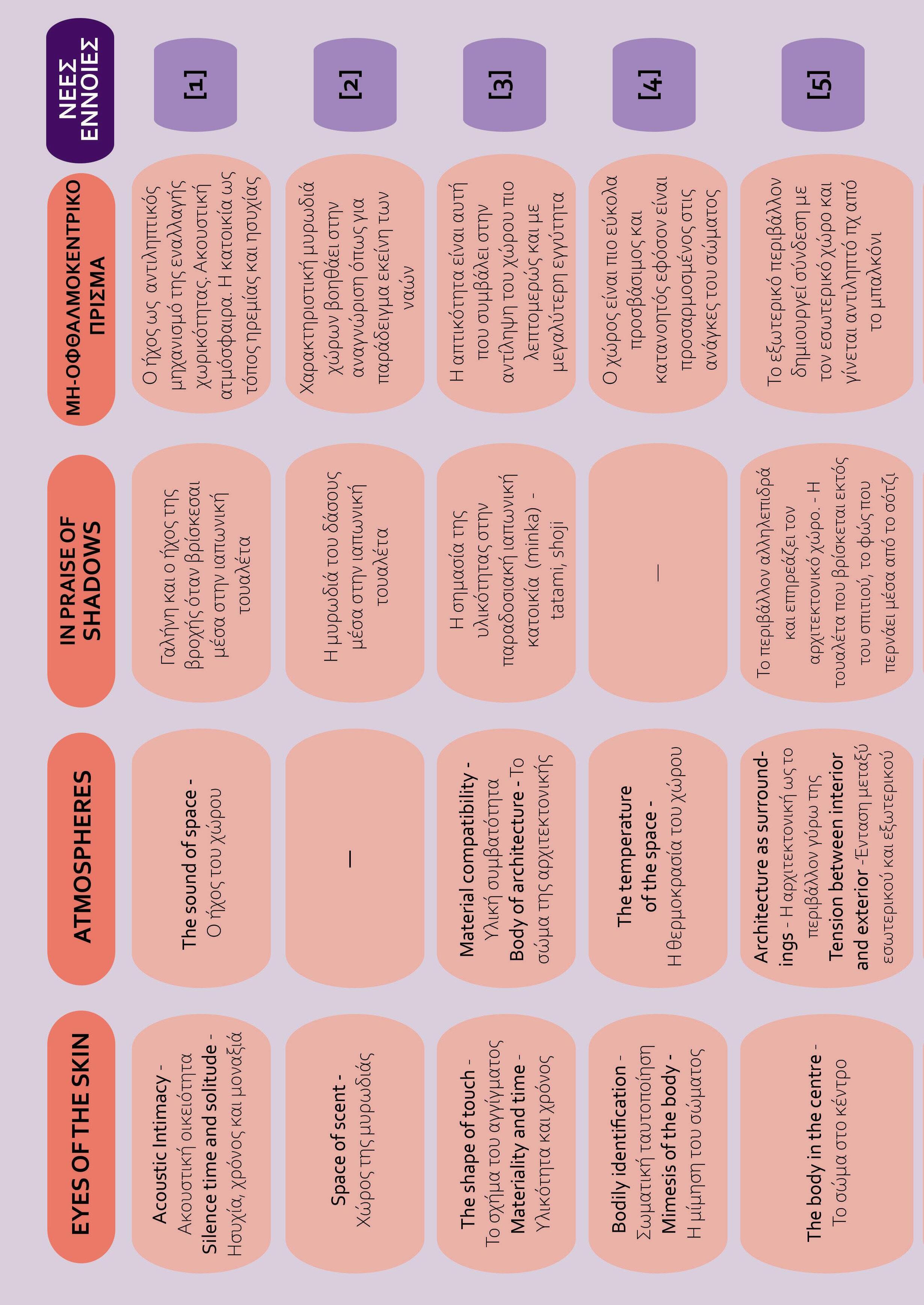
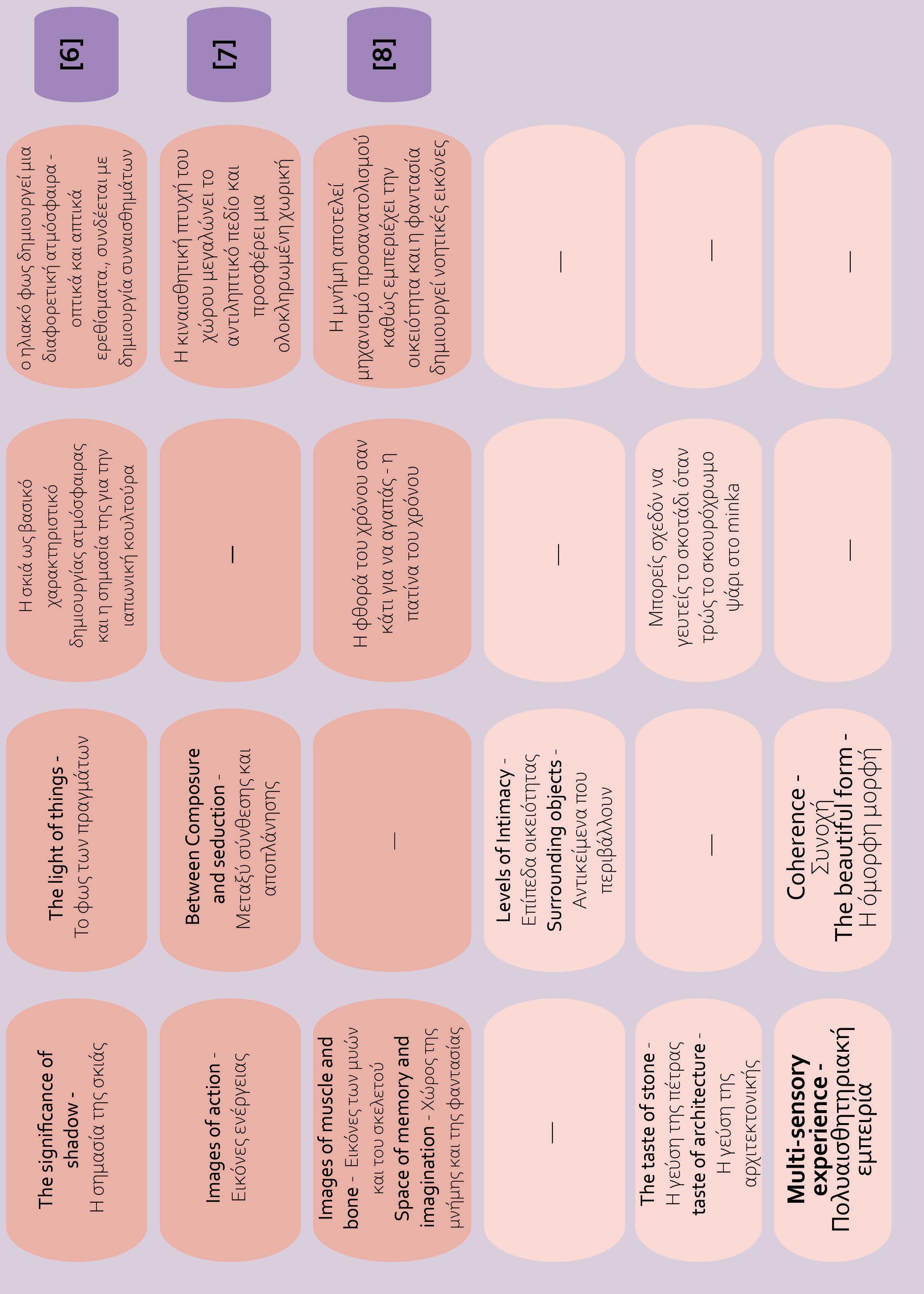

145. Pallasmaa, op. cit., p. 50
146. Ibid., p. 52

147. Ibid., p. 54
148. Ibid., p. 56
149. Zumthor, op. cit. p. 20


150. Ibid., p.

151. Pallasmaa, op.cit., p. 40
152. Rear Window (1945) Directed by Alfred Hitchcock [film] Paramount pictures
153. Zumthor, op.cit., p. 49
154. Ibid., p. 58

155. Pallasmaa, op.cit., p. 63


156. Ibid.
στην
Pallasmaa
Zumthor
Οφθαλμοκεντρισμός:
Bergson, H. & Pogson F. L. (1971) Time and free will: An essay on the immediate data of consciousness. London: Allen & Unwin
Brook, I. (2002) Experiencing Interiors: Ocularcentrism and Merleau-Ponty’s Redeeming of the Role of Vision, ReasearchGate, available at:https://www.researchgate. net/publication/280795441_Experiencing_Interiors_ Ocularcentrism_and_Merleau-Ponty%27s_Redeeming_of_the_ Role_of_Vision , downloaded on October 14 ,2020
Cologni, E. (2004) The artist’s performative practice within the anti-ocularcentric discourse, Phd Thesis [online] The London Institute : Central Saint Martins College of Art and Design, pp. 112-121, available at : https://ualresearchonline.arts.ac.uk/id/ eprint/2279/1/Cologni_thesis.pdf , last viewed on January 5 , 2022
Dufrenne, M. , (1980) Eye and mind [online] , translated by Gallager, D.J , Research in phenomenology: BRILL vol. 10, p.167-173 . available at: https://www.jstor.org/ stable/24654313?seq=1#metadata_info_tab_contents, last viewed on 11 January, 2022
Donncha, K. (2004) Ocularcentrism and its others: A framework for a metatheoretical Analysis [online], Sage Journals, available at: https://journals.sagepub.com/doi/ pdf/10.1177/0170840604040672 , downloaded on January 4 , 2022
Foucault, M. (1970) The Order of Things, New York, Pantheon
Foucault, M. (1977) Discipline and Punish. Trans. Alan Sheridan. New York: Vintage
Foucault, M. (1985) The Use of Pleasure, V2, New York. Pantheon.
Jay, M. (1988) The rise of hermeneutics and the crisis of ocularcentrism [online] Poetics Today, Vol. 9 , No 2, pp. 307326, Duke university press, available at : https://www.jstor. org/stable/1772691?seq=1#metadata_info_tab_contents , last viewed on January 4 , 2022
Jay, M. (1994) Downcast Eyes: The Denigration of Vision in Twentieth-Century French Thought, Berkeley: University California Press
Kavanagh, D.(2004) Ocularcentrism and its Others: A Framework for Metatheoretical
Levin, David Michael editor (1993) Modernity and the Hegemony of Vision, University California Press , Berkeley
Blumberg, H. (1993) Light as a metaphor for truth: at the preliminary stage of philosophical concept formation. In: Levin, M. ed.1993 Modernity and the Hegemony of Vision. University California Press , Berkeley, pp. 30-62
Flynn, T. R. (1993) Foucault and the eclipse of vision. In: Levin, M. ed.1993 Modernity and the Hegemony of Vision. University California Press , Berkeley, pp. 273-286
Houlgate, S. (1993) Vision, reflection and openness: The “hegemony of vision” from a Hegelian point of view. In: Levin, M. ed.1993 Modernity and the Hegemony of Vision. University California Press , Berkeley, pp. 87-123
Jay, M. (1993) Sartre, Merleau-Ponty and the search for a new ontology of sight. In: Levin, M. ed.1993 Modernity and the Hegemony of Vision. University California Press , Berkeley, pp. 143-185
Judovitz, D. (1993) Vision, Representation and Technology in Descatres, In: Levin, M. ed.1993 , Modernity and the Hegemony of Vision. University California Press , Berkeley
Levin, M. (1993) Decline and fall: ocularcentrism in Heidegger’s reading of the history of metaphysics. In: Levin, M. ed.1993 Modernity and the Hegemony of Vision. University California Press , Berkeley
Saphiro, G. (1993) In the shadows of philosophy: Nietzsche and the question of vision. In Levin, M. ed.1993 Modernity and the Hegemony of Vision. University California Press , Berkeley, pp. 124-142
Warnke, G. (1993) Ocularcentrism and social critisism. In: Levin, M. ed.1993 Modernity and the Hegemony of Vision. University California Press , Berkeley
Levin, D. M. (1999) The Philosopher’s Gaze: Modernity in the Shadows of Enlightenment [e-book] The Regents of the University of California, Berkeley-Los Angeles-Oxford,
available at : https://publishing.cdlib.org/ucpressebooks/ view?docId=ft896nb5sx&chunk.id=d0e1859&toc.depth=1&toc. id=d0e1555&brand=ucpress , last viewed on January 4 , 2022
Locke, J. (1990) An Essay Concerning Human Understanding London: Dent and Sons
Nietzsche, F. W. & Kaufmann, W. (1995). Thus spoke Zarathustra: A book for all and none. New York: Modern Library.
Nietzsche, F. W. (1997) On the genealogy of morality, Third Essay, Cambridge University press
Ong, W. and Hartley, J. (2012) Orality and literacy. London: Routledge
OxfordReference, Ocularcentrism [online] available at: https://www.oxfordreference.com/view/10.1093/oi/ authority.20110803100245338 , last viewed on December 16 , 2021
Rajchman, J. (1988) Foucault’s Art of Seeing . [online], The MIT press, V44, pp. 88-117, available at: https://www.jstor.org/ stable/778976?origin=crossref&seq=1#metadata_info_tab_ contents , downloaded on 31 January, 2022
Robinson, J. (2012) On Being moved by architecture [online], The Journal of Aesthetics and Art Criticism, FALL 2012, Vol. 70, The American society of aesthetics, pp. 337-353, available at: https://www.jstor.org/stable/43496529 , downloaded on 31 January, 2022
Shevtakova, M. (1995) Reviewed Work: Downcast Eyes: The Denigration of Vision in Twentieth-Century French Thought by Martin Jay [online], Science & Society , Vol. 59, No. 1 (Spring, 1995), pp. 95-97, available at: https://www.jstor.org/stable/ pdf/40403469.
Tanabe, M. (2019) Between Ocularcentrism and Antiocularcentrism: Nietzsche’s concept of Vision, volume 118, p. 55-61
Φαινομενολογία:
Absurd Being (2015) Maurice Merleau-Ponty : 1908-1961 [online] available at : http://absurdbeing.com/merleau-ponty. php , last viewed on January 5 , 2022
Britannica (1999) Origin and development of Husserl’s phenomenology [online] (2017) available at : https:// www.britannica.com/topic/phenomenology/Origin-anddevelopment-of-Husserls-phenomenology , last viewed on January 4 , 2022
Erciyes, E. (2019) Three pillars of phenomenology : Husserl, Heidegger and Merleau-Ponty [online], The university of Memphis, available at : https://www.memphis.edu/philosophy/ opo2019/pdfs/erciyes-erdem.pdf , downloaded on 4 January 2022
Gehl, J. (1972)
Heidegger, M. (1938) The age of the world picture [online], translated by W. Lovitt, The Question Concerning Technology and Other Essays, Harper Torchbooks, 1977, p. 115-154. available at: http://www.compilerpress.ca/Competitiveness/ Anno/Anno%20Heidegger%20The%20Age%20of%20the%20 World%20Picture.htm , last viewed on November 25 , 2021
Heidegger, M. (1993) Basic concepts. Bloomington: Indiana University Press
Holl S., Perez-Gomez A., Pallasma J. (2006) QUESTIONS OF PERCEPTION - Phenomenology of Architecture, WILLIAM STOUT PUBLISHERS, San Francisco
Husserl, E. (2010) The idea of phenomenology. Dordrecht: Kluwer Academic
Merleau-Ponty, M. (1964) Eye and mind: in The primacy of perception, J. M. Edie (ed.), Evanston, Ill.: Northwestern University Press, pp. 159-190
Merleau-Ponty, M. (1988) The Visible and The Invisible trans. Lingis, A. Ed. Lefort, C. Evanston: Northwestern University Press
Merleau-Ponty, M. (1993) ‘Eye and Mind’. In Johnson, G. ed, The Merleau-Ponty Aesthetics Reader Illinois: Northwestern University Press
Merleau-Ponty, M. (2002) Phenomenology of perception, translated from French to English by Smith, C. Routledge: London and New York
Norberg-Schulz, C. (2009) Genius loci : το
Pallasmaa, J. (2012 edition) The eyes of the skin, John Wiley and Sons Ltd, Great Britain
Soukup, P. (2005) Looking Is Not Enough: Reflections on Walter J. Ong and Media Ecology [online] Proceedings of the Media Ecology Association, Volume 6, available at: https://mediaecology.org/resources/Documents/Proceedings/v6/v6-08Soukup.pdf , downloaded on January 8, 2022
Zumthor, P. (2006) Atmospheres, Birkhauser, Berlin Πολυαισθητηριακός
American Psychological Association . (n.d.). Apa Dictionary of Psychology. American Psychological Association, available at: https://dictionary.apa.org/cognitive-impairment, last viewed on January 15, 2022
Big Rentz (2019) The Ultimate Guide to Designing and Navigating Spaces for People with Vision Impairment [online], available at: https://www.bigrentz.com/blog/ultimate-guidedesigning-navigating-spaces-people-vision-impairment , last viewed on December 05 , 2021
Bloomer, M & Kent C. (1979) Body, Memory, and Architecture. Yale University Press
Bucknell, A. (2018) Architecture you can smell? A brief history of multisensory design, Metropolis [online e-journal], available at https://metropolismag.com/viewpoints/multisensoryarchitecture-design-history/ , last viewed on 05 December 2021
Davis, Ch. P. (2021) Medical Definition of Blindness [online], MedicineNet, available at: https://www.medicinenet.com/ blindness/definition.htm , last viewed on January 13 , 2022
Dischinger, M. (2000) Designing for all senses -Accessible spaces for visually impaired citizens, thesis, Chalmers University Of Technology, Sweden
Farah, Martha J. (1990) Visual agnosia : disorders of object recognition and what they tell us about normal vision, Mass. : MIT Press, Cambridge
Gibson, J. J. (1966) The Senses Considered as Perceptual Systems, Boston: Houghton Mifflin
Hara, K. (2011) Designing Design. Baden: Lars Müller Publishers
Karlsson, G. (1996) The Experience of Spatiality for Congenitally Blind People: A Phenomenological-Psychological Study, Human studies 19, p. 303-330, Kluwer Academic Publishers, Netherlands
Mandal, A. (2019) What is visual impairment? [online] NewsMedical, available at: https://www.news-medical.net/health/ What-is-visual-impairment.aspx. , . retrieved on January 13, 2022
Marquez, A. (2017) Introduction to multi-sensory design [online] available at: http://www.aknamarquez.com/ blog/2017/7/23/what-is-multi-sensory-design , last viewed on December 09 , 2021
Paivio, A. (1969). Mental imagery in associative learning and memory. Psychological Review, No 76: 241-263.
Pop, D. (2013) Space Perception and Its Implication in Architectural Design [online journal] Acta Technica Napocensis: Civil Engineering & Architecture, Vol. 56, No 2, pp. 211-221, available at: https://www.academia.edu/10935249/Space_ Perception_and_Its_Implication_in_Architectural_Design , downloaded on January 20, 2022
Sainte anastasie (2018) Οι 6
συμπτώματά της [online] available at: https://el.sainteanastasie.org/articles/psicologa-clnica/los-6-tipos-deagnosia-visual-y-sus-sntomas.html , last viewed on January 15, 2022
Άλλο:
Ashworth, W. B. (2016) Scientist of the day – Jean Francois Niceron [online], LINDA HALL LIBRARY, available at: https:// www.lindahall.org/jean-francois-niceron/, Last viewed on December 20, 2021
Bou-Nahara, B. (2020) Anamorphic Perspective Museum [online] available at: https://boutrosbounahra.com/ anamorphicperspectivemuseum, last viewed on November 22, 2021
Kaijo, Ch. (2007) Primary and Secondary qualities [online], Frensostate, available at https://www.fresnostate.edu/ artshum/philosophy/documents/Kaijo-CUPR1-1.pdf , downloaded on November 11, 2021, pp. 49-54
Lynch, K. (1960) The image of the city, Cambridge, Mass. : M.I.T. Press
Tanizaki, J. (2016) Το
Downey, C. (2013) Design with the blind in mind [online video] New York, New York TED Conference, available at:https:// www.youtube.com/watch?v=apiScBmE6rA&ab_channel=TED, Accessed on December 09 , 2021
Downey, C. (2015), An Architects story: Chris Downey, AIA National YouTube channel [online video], available at: https://www.youtube.com/watch?v=zrtfXDk0L8A&ab_ channel=AIANational , accessed at January 16 , 2022
Lee, J. (2013) Design for all 5 senses [online video] Official TED Conference 2013, Available at: https://www.ted.com/ talks/jinsop_lee_design_for_all_5_senses#t-86313 , Accessed on December 09 , 2021
Koyaanisqatsi: life out of balance (1983) Directed by Godfrey Reggio [film] Island Alive, New Cinema
La Haine (1995) Directed by Mathieu Kassovitz [film] Canal +
Rear Window (1945) Directed by Alfred Hitchcock [film] Paramount pictures
Ευρετήριο
