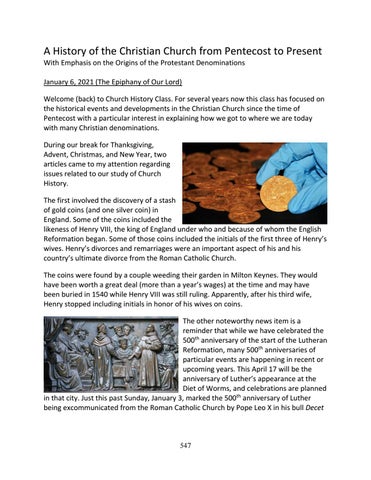
A History of the Christian Church from Pentecost to Present With Emphasis on the Origins of the Protestant Denominations January 6, 2021 (The Epiphany of Our Lord) Welcome (back) to Church History Class. For several years now this class has focused on the historical events and developments in the Christian Church since the time of Pentecost with a particular interest in explaining how we got to where we are today with many Christian denominations. During our break for Thanksgiving, Advent, Christmas, and New Year, two articles came to my attention regarding issues related to our study of Church History. The first involved the discovery of a stash of gold coins (and one silver coin) in England. Some of the coins included the likeness of Henry VIII, the king of England under who and because of whom the English Reformation began. Some of those coins included the initials of the first three of Henry’s wives. Henry’s divorces and remarriages were an important aspect of his and his country’s ultimate divorce from the Roman Catholic Church. The coins were found by a couple weeding their garden in Milton Keynes. They would have been worth a great deal (more than a year’s wages) at the time and may have been buried in 1540 while Henry VIII was still ruling. Apparently, after his third wife, Henry stopped including initials in honor of his wives on coins. The other noteworthy news item is a reminder that while we have celebrated the 500th anniversary of the start of the Lutheran Reformation, many 500th anniversaries of particular events are happening in recent or upcoming years. This April 17 will be the anniversary of Luther’s appearance at the Diet of Worms, and celebrations are planned in that city. Just this past Sunday, January 3, marked the 500th anniversary of Luther being excommunicated from the Roman Catholic Church by Pope Leo X in his bull Decet
547
Romanum Pontificem. In honor of this anniversary, a group called the Altenberg Ecumenical Roundtable asked the Pope to reverse the excommunication of Luther in the interest of their ecumenical goals. They also asked the Lutheran World Federation to abolish Luther’s judgment that the Pope (the office of the papacy) is the Antichrist. Neither the Roman Catholics nor the Lutherans did as requested. The Age of Lutheran Orthodoxy 89. Introduction and Overview We are resuming our study of Church History with a return to German Lutheranism and its period of Orthodoxy. Specifically, this period comprises the time from the publication of the Formula of Concord (1577) until the publication of Jakob Philip Spener’s Pia Desideria (1675). Technically, this takes us past the years previously listed for our “Reformation” unit, which ends at 1648 with the conclusion of the Thirty Years War. As much as anything, this is a reminder for us that historical developments and stages are not always clearly delineated. Any year that makes sense as an ending point from one perspective may not when considered from a different context. To discuss Lutheran Orthodoxy, we must understand the term Orthodoxy. The word comes to English from Greek and Latin, meaning sound doctrine or right teaching. It is an appropriate goal for any church to be truly orthodox. We mean in that phrase that what the church teaches is faithful to what the Bible teaches. That’s a good thing. But orthodoxy, unfortunately, can give way to orthodoxism. This issue stems from being so concerned with orthodox doctrine that it gets pushed to a dangerous extreme. This may involve clinging to a form or insisting on a fixed vocabulary. In other words, someone understanding what you say about the Bible might even become less important to you than using the “right words” to describe a doctrine. You might likewise assume that someone else is wrong whenever they use any other words when they speak about a doctrine. Another form of orthodoxism would focus only on getting things right rather than on reaching people with the gospel and having a genuine concern for others and for real-life applications. Orthodoxism, then, is a real danger. It is a trap into which some Lutheran theologians have fallen (and no doubt continue to fall). That can and has led to charges of “dead orthodoxy.” That phrase is an oxymoron. True orthodoxy demands gospel motivation and leads to reaching out to others. 548