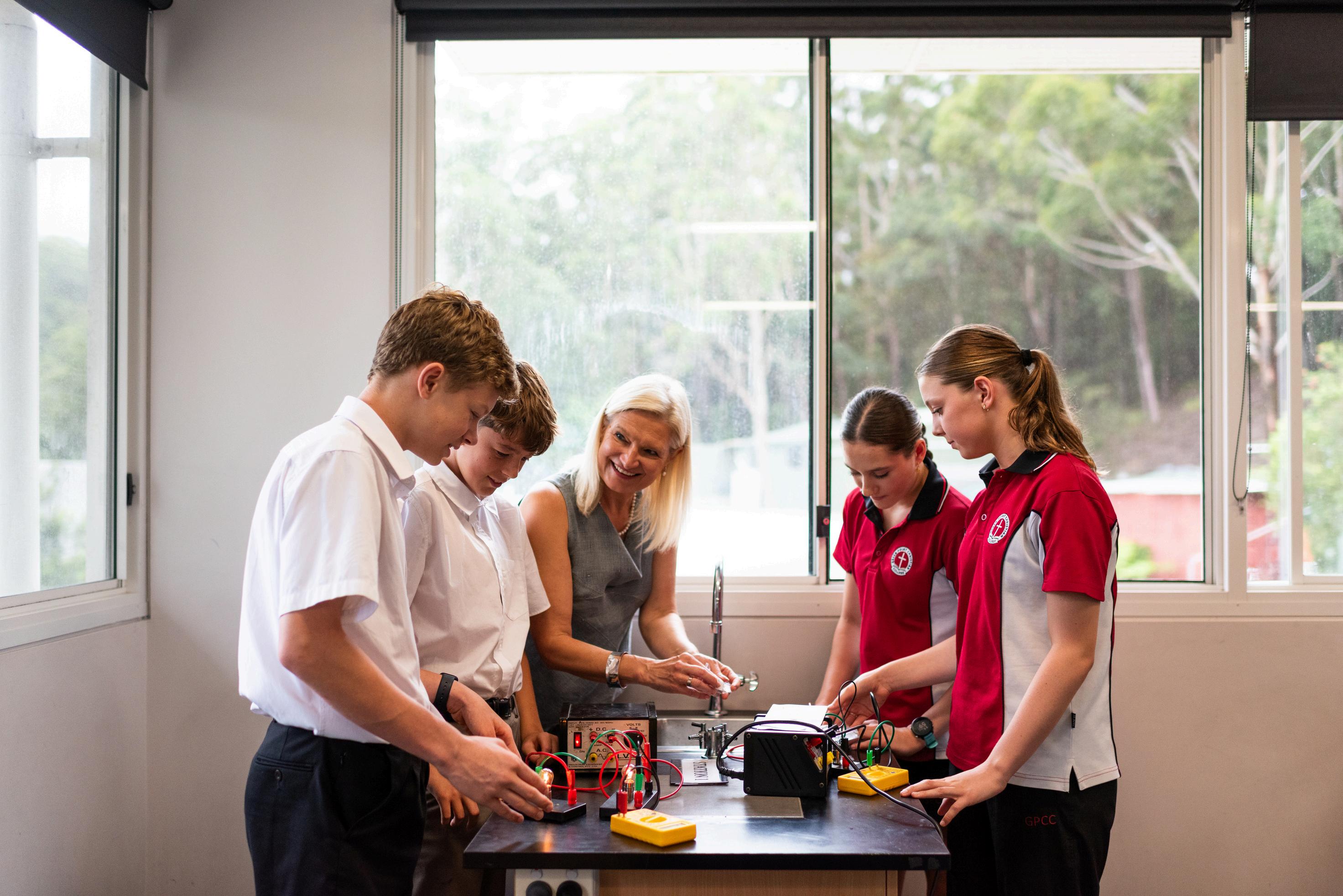
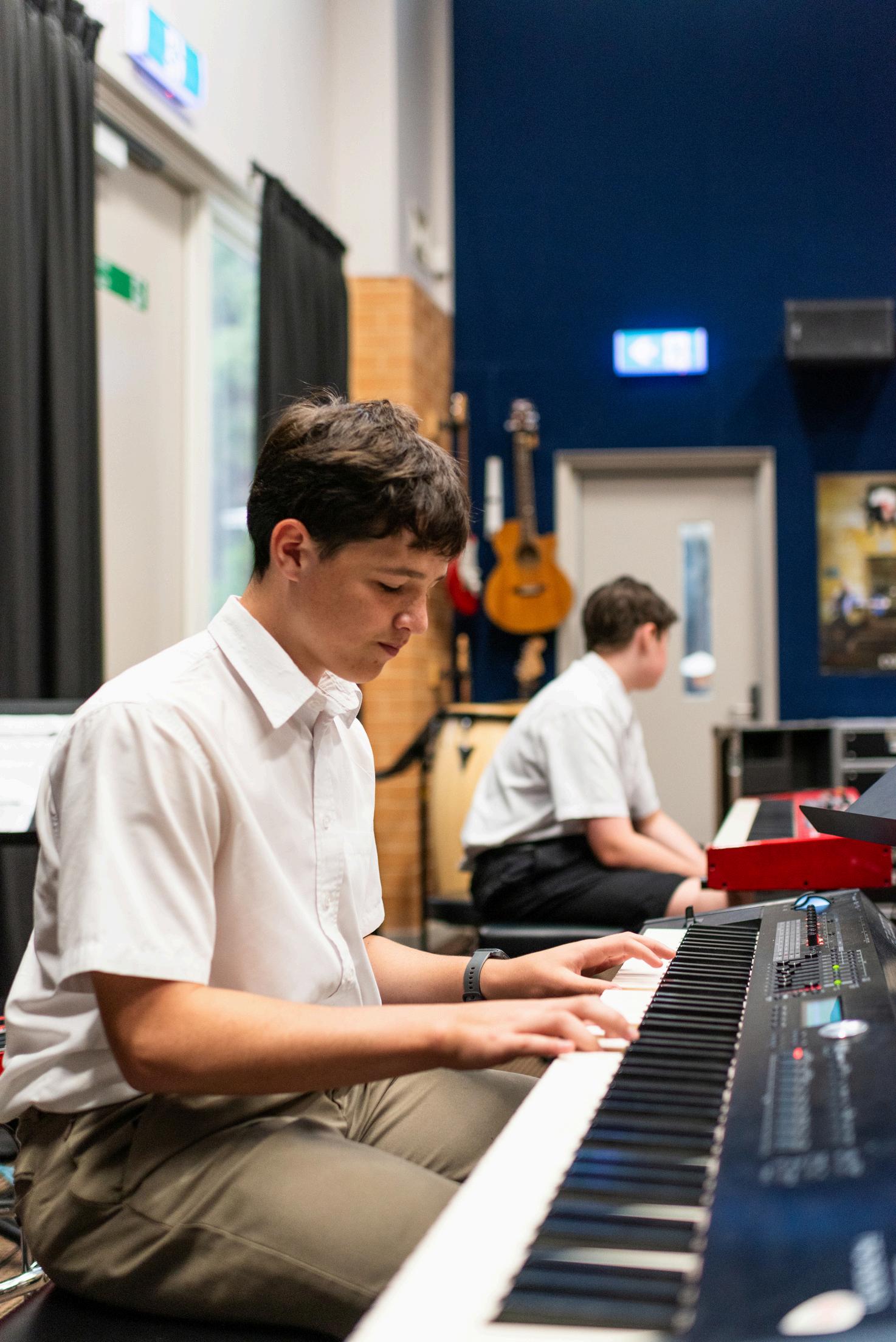
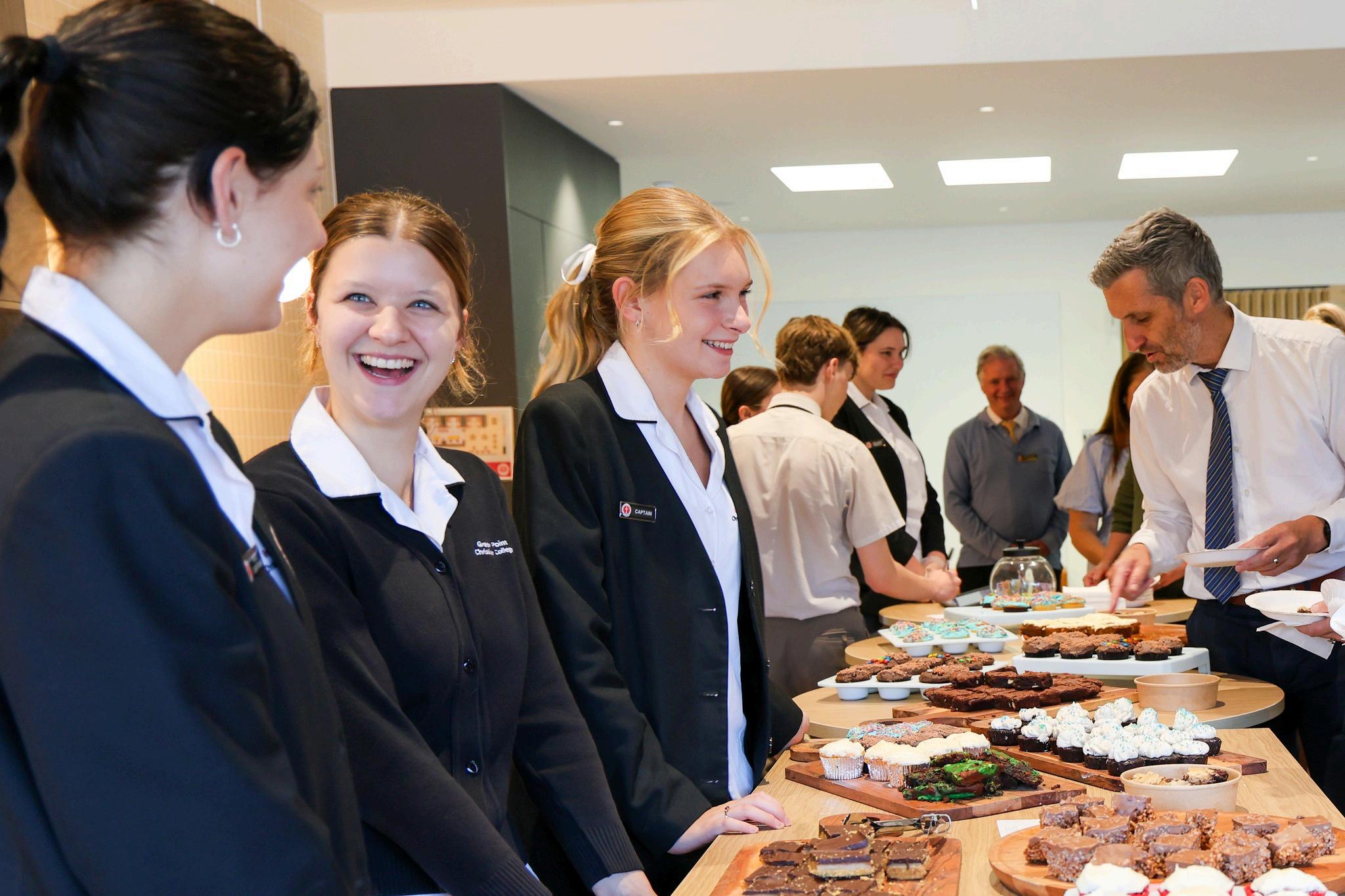
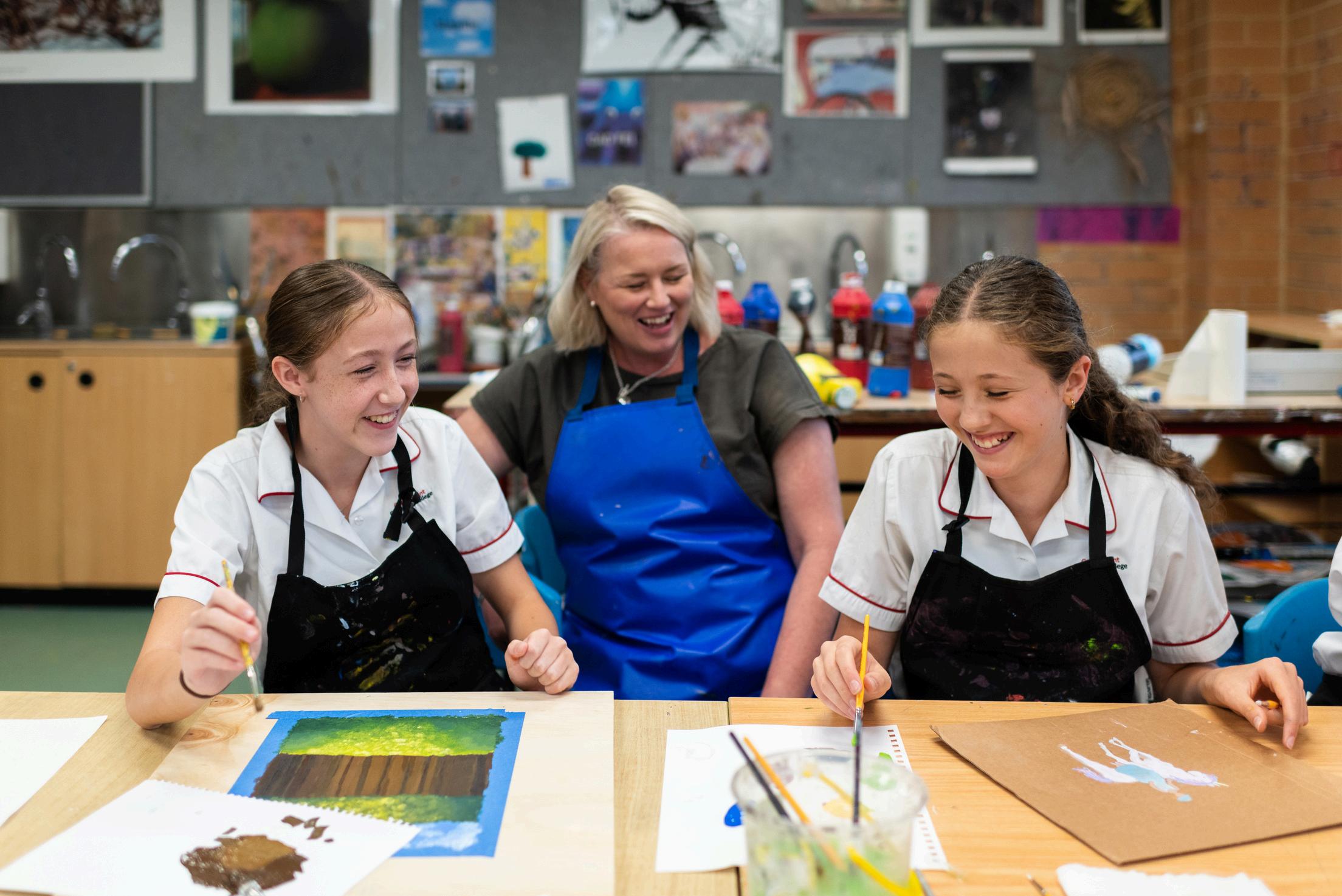
Moving out of Primary School begins a new phase in the life of a student. It presents our young people with an exciting and challenging time of growth and development that will carry them into adulthood. Secondary School is the place where students can learn at their individual level while having opportunities to explore their developing passions.
Green Point Christian College believes that an education based on a Christian worldview enables the best opportunity for students to develop a wider understanding of the world that will facilitate their ability to meet the complexities presented in our rapidly changing society. Each student participates in an extensive range of
subjects that will stimulate and challenge them.
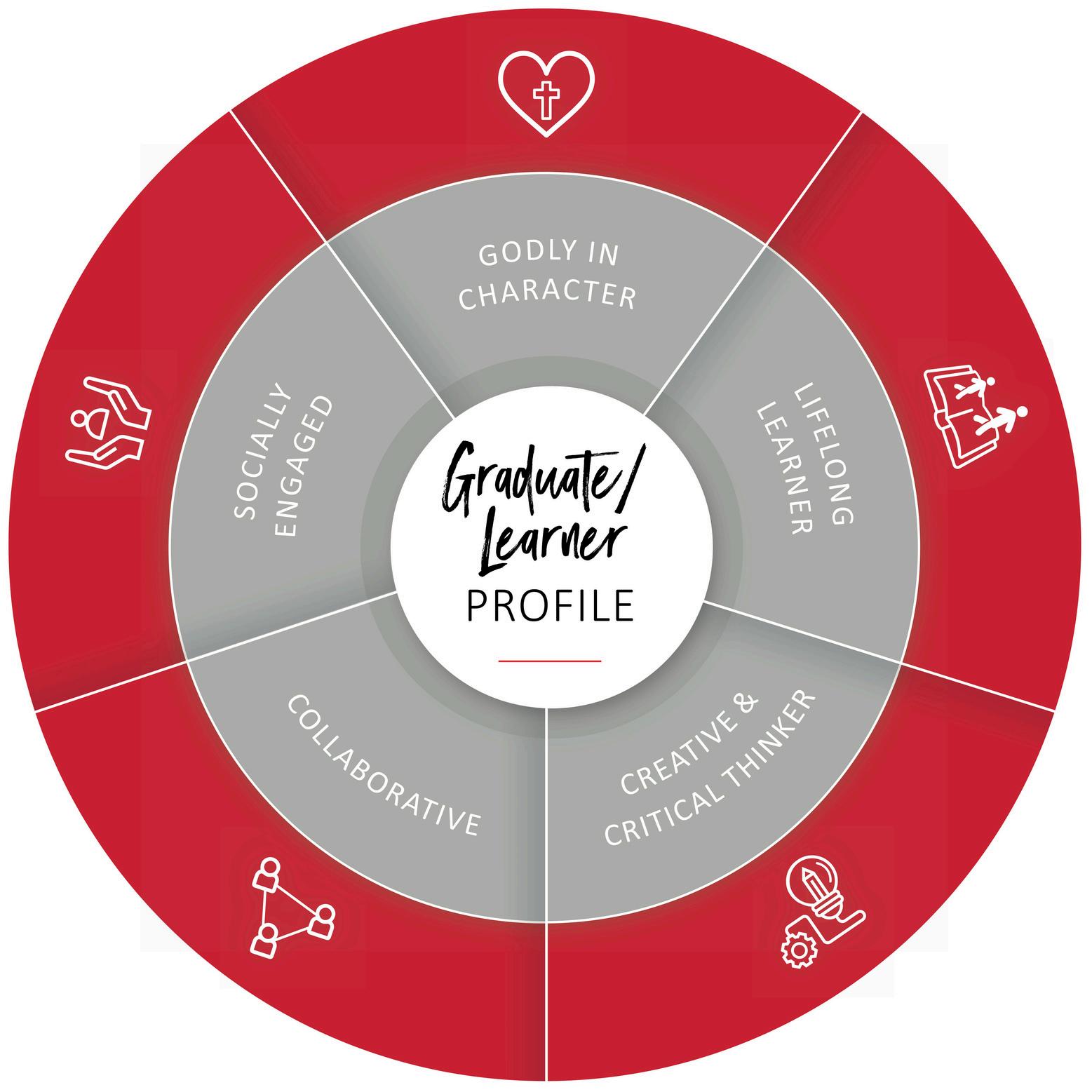
Our safe, caring, learning environment enables students to grow into adults who have at their core, the principles of Godly character; who understand that learning is a life-long endeavour; who are outward looking and care about the well-being of others within society; who can work with others in strong mutually supportive relationships and who find solutions to the issues of life through creative and critical problem solving. Our graduates are equipped to be well rounded mature adults who can influence positive change in the world.
KeyStaff
EXECUTIVE TEAM
OTHER KEY STAFF
Mr Joel van Bentum
Mrs Jane McCarthy
Wood
Mrs Sarah Brown
Mrs Gretchen Taylor
Mrs Carolyn Omayao
Mrs Fiona Fordyce
Mrs Helen Mayhew
Mrs Teri Ulbricht
Elyse Barber
Mr Steve Lobsey
YearAdvisors
Mrs Georgina Kratochvil Mrs Jacqui Melck
Mrs Eurydyka Beaman
Mr Dane Roberton
Mr Paul Chambers Miss Lauren Hay
Mrs Zoe Anderson
Miss Emma Gough
Mr Raynard Vale
Faculty
COORDINATORS
CREATIVE ARTS
Mrs Angela Scott
ENGLISH
To be advised
HUMAN SOCIETY AND ITS ENVIRONMENT (HSIE)
Mrs Naomi Walls
LANGUAGES
Mr Paul Chambers
MATHEMATICS
Mr Troy Kastelan
PDHPE
Mr Sam Hedges
SCIENCE
Mr Stuart Drennan
SOCIAL SCIENCE
Mr Richard Hall
CHRISTIAN MINISTRY
Mrs Rebecca Gavin
TECHNOLOGIES (TAS)
Mr Jeffrey Ogden
ENRICHMENT
Mrs Sarah Brown
LIBRARY - TEACHER/LIBRARIAN
Mrs Nicole van Wyk
CorePurpose
AND MISSION GOALS
CORE PURPOSE STATEMENT
The purpose of GPCC is to equip students for a life of redemptive action through a holistic education grounded in a Biblical perspective.
OUR MISSION GOALS
Students: The formation of students who display the attributes of the GPCC Learner/Graduate profile (see below)
Staff: The development of quality staff who serve our students well.
Parents: The support of families as the cornerstone of a flourishing society.
GPCC GRADUATE/LEARNER PROFILE
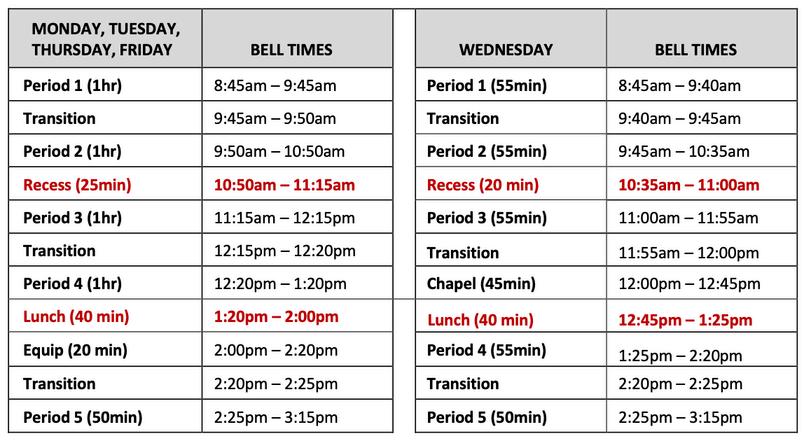
DAILY PERIOD TIMES
The College operates with a 2-week timetable cycle – Red Week and Blue Week. The first school week of the new year is always a RED week. The School Calendar in Parent Lounge indicates the appropriate Week. Please note that Wednesday has different times as noted below.
SECONDARY
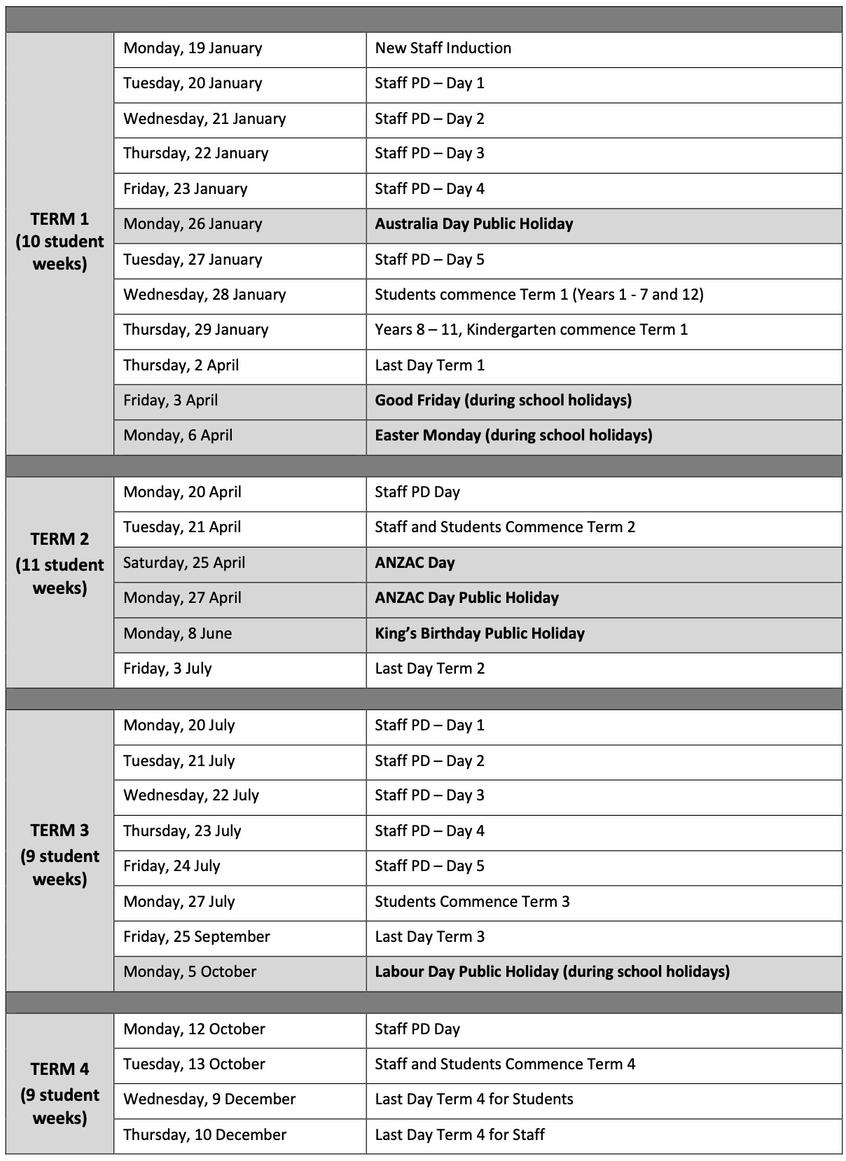
TermDates
ContactingUs
College Office
Absentee Line Fees Email
Address
Mailing Address
4363 1266
4367 9950
4367 9934
office@gpcc.nsw.edu.au
absentees@gpcc.nsw.edu.au
8:30am to 4:00pm
382 Avoca Drive, Green Point NSW 2251
Locked Bag 1, Kincumber NSW 2251
NOTE: All College Policies are available in full on the College website www gpcc.nsw.edu.au.
Lines
OFCOMMUNICATION
SITUATION
Student absence
Students to leave school early
ACTION
Prior to the day: Submit absence vis the GPCC APP, phone the absentee line 4367 9950, or email absentees@gpcc.nsw.edu.au.
After 9:30am on the day: Please phone the College office 4363 1266
Unless a prior ongoing arrangement has been made (only for special medical appointments etc), a letter should be brought to the Student Reception and the student will be signed out
Student unable to undertake sport or other physical activity
Student experiencing a need in pastoral care/discipline area
Student experiencing problems not able to be resolved by Equip teacher
Pastoral care/discipline matters of a more serious nature
Letter carried with student and shown to relevant staff
Contact Equip Teacher in the first instance
Contact the relevant Year Advisor
Contact School Counsellors
Contact Year Advisor. If not resolved, contact Head of Secondary School, Deputy Principl and Principal
Student needs schoolwork during extended sickness
Matters relating to a specific subject class
Matters related to a specific subject and not able to be resolved by subject Teacher
Concerns relating to levels of a subject studied
Matters relating to subject choice and NESA requirements
Contact Year Advisor
Contact subject Teacher
Contact subject Coordinator
Contact Subject Coordinator or Curriculum Coordinator/Student Advisor
Contact the Curriculum Coordinator/Student Advisor
GENERAL NOTE: Should parents need to see a teacher, an appointment needs to be made through the Receptionist at the College Office.
Curriculum
Our College follows the guidelines set out through the NSW Education Standards Authority (NESA) in all matters of curriculum.
Within the common guidelines set out by NESA, there is freedom for each school to design, in part, its own curriculum. All subjects are taught from a Christian perspective by Christian teachers.
OVERVIEW OF CURRICULUM
YEAR 7
English, Mathematics, Science, Human Society and its Environment (HSIE), Personal Development, Health and Physical Education (PDHPE), Technology Mandatory (Food Technology, Engineering, Textiles, Digital Technology), Music, Visual Arts, Biblical Studies.
YEAR 8
English, Mathematics, Science, Human Society and its Environment (HSIE), Personal Development, Health and Physical Education (PDHPE), Technology Mandatory (Food Technology, Digital Technology, Textiles, Timber), Drama, Music, Visual Arts, Biblical Studies, Languages (French).
YEAR 9
Equip, Biblical Studies, English, History, Geography, Maths, Science, PDHPE and two Elective Subjects.
YEAR 10
Equip, Biblical Studies, English, History, Geography, Maths, Science, PDHPE and two Elective Subjects.
Lists of Elective Subjects current for each year will be available from the Registrar and on the College Website.
ASSESSMENT HANDBOOKS
Early during each course of study, students can access an Assessment Handbook through Student Portal and Schoolbox, showing the timing of assessment tasks for each subject studied in the year If there are any changes concerning the tasks to be done, students will be notified in writing by their teacher. Accessing Student Cafe will help in planning time, in being prepared for tests and tasks and in completing work by the due date.
Attendance
ATTENDING SCHOOL
The school has a legal obligation to maintain accurate attendance records for all students. If a student is absent, parents must provide an explanation through one of the following methods:
1 Absence Notification via the Parent Portal (accessible through the GPCC Phone App)
2.Email to absentees@gpcc.nsw.edu.au
3 Phone the College’s Absentee Line at 4367 9950 before 9:30 AM on the day of the absence.
If no contact is made, the school will send a text message to the parent’s mobile requesting they call the College. For extended absences, parents should inform the Year Advisor in advance.
If a student arrives late to school, they must go to Student Reception to receive a late slip, which should be shown to their teacher for roll marking. Secondary students need to present their Student Card at Student Reception for scanning. A note from a parent is required for any late arrival.
For early departures, students must have a signed note from a Parent or Carer. This note must be presented at Student Reception, and the student must sign out before leaving. If a student feels unwell and wishes to go home, they should report to Student Reception. The school will contact the parent on the student's behalf. Students may not make their own
Homework
The school supports the value of homework as a learning tool. Homework can be used to reinforce concepts taught at school and teach students the value of self discipline in the education process. We do not believe that homework tasks should be onerous or too demanding, so that homework becomes a disruption to the family. If there is a problem in this area, parents should feel free to make contact with the school.
HOMEWORK’S VALUE
For the Teacher: The value of homework for the teacher is that it is a check that what is being taught at school is being absorbed and understood by the student and being exercised by the student.
For the Student: Homework consolidates what is being taught at school. It also produces qualities of self discipline and time management.
For the Parent: Homework keeps parents in touch with what is happening at school and helps the parent to monitor the child’s development. It also provides a forum for discussion over issues raised at school and over problems that are occurring. It provides a situation where parents can encourage their child and see what is being taught at school.
WHAT IS HOMEWORK?
Homework is work to be done outside of the school sphere without supervision of the teacher. It must be stressed that each subject will have different homework requirements, different types of homework, and different levels of parental encouragement required.
HELP FROM PARENTS
Parents should never be asked to do homework for their child, but they may give encouragement and some assistance. It should be noted that assessment tasks in Years 7 to 12 and HSC Major Works must only contain work produced by the student.
Behaviour
AND EXPECTATIONS OF STUDENTS
BEHAVIOUR
At Green Point Christian College, in light of God being our Almighty Creator and in response to all He has done for us, we as a school community desire to honour God in our daily lives and relationships. Therefore we seek to Love the Lord our God with all our heart, soul, and mind. We also seek to love our neighbour as ourselves. (Matthew 22: 37-39)
The responsibilities and expectations of each individual within our community have been centred on the desire to have relationships that are pleasing and honouring to God. These responsibilities and expectations are Biblically based to ensure our school community operates so that all individuals grow in their relationships with God and others in a safe, uplifting environment.
Parents are an integral part of any discipline within the school because of their Biblical responsibility to raise their children and we seek to encourage their participation and support within this area. In addition, we seek to assist and support parents in the Godly development of their children.
Understanding that we all fail and fall short of God’s expectations, the cornerstones of this Behaviour Management Policy will be Love, Grace, Mercy and Justice.
When a parent delegates to a teacher the responsibility of assisting in bringing up their child he also delegates the right to honour and respect and the responsibility to discipline the child. Proverbs 22:6 commands parents, and by extension teachers, to “Train up a child in the way he should go, And even when he is old he will not depart from it.” This is what parents have been commanded to do.
The letter in Ephesians (Ephesians 6: 1-3) instructs children in their responsibility. “Children obey your parents in the Lord, for this right. Honour your father and mother – which is the first commandment with a promise – that it may go well with you and that you may enjoy long life on the earth.”
Our aim is to encourage students to follow this principle and redirect them when they struggle. Our goal in training students according to the Biblical principles above is so that, “We proclaim Him, admonishing and teaching everyone with all wisdom so that we may present everyone perfect in Christ.” Colossians 1: 28
REDIRECTING STUDENT BEHAVIOUR
At Green Point Christian College, the following methods for redirecting student behaviour will be employed:
Verbal correction – e.g. teacher names student, restates the relevant, desired behaviour, asks the student what they are doing, asks the student what they should be doing.
Immediate action – e.g. relocating the student’s position in the classroom or playground.
Isolation of the disobedient student - sending them for a time to a withdrawal area within the classroom; to the room of a colleague; to Administration.
Withdrawal of privileges – e.g. use of sports equipment; partial loss of recess or lunch time.
Consequential Community Care – e.g. cleaning activities in the classroom, around the grounds. A warning - issued to students for minor offences and accumulating towards a detention. Detention – 20 minutes at lunch, where students sit quietly under the supervision of a nominated teacher.
Behaviour monitoring: Students who persist with inappropriate behaviour may be placed on a behaviour sheet for a period of one or two weeks.
Afternoon detention, currently held from 3.30pm - 4.30pm on Fridays. This is a serious matter involving inconvenience for a number of people, so is arranged via the Head of School who ensures that adequate notice is given to parents and student.
Further poor behaviour will lead to a student being the subject of a disciplinary interview, involving parents, the Year Advisor and as appropriate, Head of School or the Principal. In-school suspension - with the Principal’s (or Head of School’s) and the parents’ knowledge, the student attends school for the agreed period of time but is withdrawn all day long from normal school activities. The student works separated from their usual social contact in class and in recreation time.
Suspension - through the Principal, the parents and student are told that the child is not to attend school for a period of time. The student is re-admitted on a probation basis.
Expulsion - the parents of the child are told by the College Board that, on the recommendation of the Principal, their child is to be removed from the College community.
EXPECTATIONS
MYSELF
1. I am responsible for my own learning by being prepared for each lesson with the correct equipment
2. I am responsible to be on time for each lesson
3. I am responsible for helping to create a positive learning environment
4. I am responsible for my belongings
5. I am responsible for having homework and assignments submitted on time
6. I am to enter and exit the classroom quietly and safely
7. I am responsible for my mobile phone - so that it is not seen or heard in the classroom
PEERS
1. I am to stay on task without disturbing or distracting others
2. I am to treat students with respect at all times and accept individual differences
3. I am not to interfere with other people’s property
STAFF
1. I am to treat staff with respect and accept their authority at all times
2. I am to follow the instructions of all staff whether in the classroom or playground
3. I am to actively listen when the teacher is speaking
COLLEGE
1. I am responsible for keeping the classroom and playground clean
2. I am not to damage or interfere with school property
3. I am responsible for wearing my uniform correctly in and out of school
4. I am responsible for positively reflecting the attitudes and values of our school
PLANNING AND ORGANISATION
Effective planning and efficient time management of student activities promotes good discipline. Lack of classroom organisation is a major catalyst for misbehaviour.
MobilePhone
AND DEVICE MANAGEMENT
Increasing concerns have been expressed by K-12 parents and staff about the on-going use of electronic devices by students at GPCC especially during break times. Concerns relate to the social impact of the use of phones and laptops taking the place of real time social interaction, of the use of devices for bullying and harassment and the lack of physical activity and interaction many students experience.
This plan sets out guidelines to address this issue. It centres on minimising student device usage during school breaks and doing so in a way that helps students to recognise the dangers of overuse and the need for self-control and imposed control at times. This is targeted at Secondary students in particular, as Primary students are already not permitted devices at school.
GUIDELINES
1.GPCC bans the use of mobile phones and smart watches (or similar devices such as ear buds when not required for class work) during school operating hours (8:45am – 3:15pm). Phones (and earbuds) may be used for classroom work under the direction of a teacher. Devices must be in lockers or bags and not seen or used.
2 Laptops (and ipads or similar) are also banned from student use during break times with the exceptions listed below:
a. Years 11/12 students
b. Students with permission to use laptops/ipads for study/work purposes in the Library or designated classrooms with permission by a teacher/staff member and under their supervision.
3.Students are encouraged to engage in other organised lunchtime activities to act as a substitute for device use and to enhance social interaction.
4 Breaches of the guidelines be dealt with as follows:
a. An initial breach of the guidelines will lead to confiscation of the device and its being held securely in the main office to be returned that day at 3:15pm. A note will be made on TassWeb in relation to this. Refusal to hand in a device escalates the issue to level b.
b. A further breach means a parent phone call/interview and a requirement to hand the device in at the office each morning to be collected each afternoon for a week.
c. Any further breach will lead to an internal suspension of the student at school until assurances are gained from the student and family that no further breaches will occur.
d. Should such actions not have sufficient impact to lead to a general adherence to the guidelines, a system such as mobile phone pouches will be considered.
Parents will be regularly informed, and directions given for how they might contact their child during theschool day with phones banned (such as through the office).
MobilePhone
AND DEVICE MANAGEMENT
Introduction:
Increasing concerns have been expressed by K-12 parents and staff about the on-going use of electronic devices by students at GPCC especially during break times. Concerns relate to the social impact of the use of phones and laptops taking the place of real time social interaction, of the use of devices for bullying and harassment and the lack of physical activity and interaction many students experience.
This plan sets out guidelines to address this issue. It centres on minimising student device usage during school breaks and doing so in a way that helps students to recognise the dangers of overuse and the need for self-control and imposed control at times. This is targeted at Secondary students in particular, as Primary students are already not permitted devices at school.
Guidelines:
GPCC bans the use of mobile phones and smart watches (or similar devices such as ear buds when not required for class work) during school operating hours (8:45am – 3:15pm). Phones (and earbuds) may be used for classroom work under the direction of a teacher. Devices must be in lockers or bags and not seen or used. Laptops (and ipads or similar) are also banned from student use during break times with the exceptions listed below:
a. Years 11/12 students
b. Students with permission to use laptops/ipads for study/work purposes in the Library or designated classrooms with permission by a teacher/staff member and under their supervision.
Students are encouraged to engage in other organised lunchtime activities to act as a substitute for device use and to enhance social interaction.
Breaches of the guidelines be dealt with as follows:
a. An initial breach of the guidelines will lead to confiscation of the device and its being held securely in the main office to be returned that day at 3:15pm. A note will be made on TassWeb in relation to this. Refusal to hand in a device escalates the issue to level b.
b. A further breach means a parent phone call/interview and a requirement to hand the device in at the office each morning to be collected each afternoon for a week.
c. Any further breach will lead to an internal suspension of the student at school until assurances are gained from the student and family that no further breaches will occur.
d. Should such actions not have sufficient impact to lead to a general adherence to the guidelines, a system such as mobile phone pouches will be considered.
Parents will be regularly informed, and directions given for how they might contact their child during the school day with phones banned (such as through the office).
Bullying
OUR ANTI-BULLYING POLICY
IN SUMMARY - POLICY IN FULL AVAILABLE ON OUR WEBSITE
INTRODUCTION
The Anti-Bullying policy of Green Point Christian College is an essential aspect of student welfare and pastoral care with the College and augments the College’s Behaviour Management and Code of Conduct policies. This policy is intended to provide students, staff and parents with appropriate mechanisms to address the issue of bullying. Green Point Christian College does not tolerate bullying in any form.
RATIONALE
As a Christian school our God given mandate is to create an environment that develops an ethos of care and encouragement and an environment where all students and staff feel safe. One in which their right to be respected and treated as individuals is to be protected. The purpose of this policy is to promote consistency of approach and to create a climate in which all types of bullying are regarded as unacceptable. It is to provide a structure and strategies by which students, who believe they are bullied, are counselled sensitively and effectively. It is also to provide structure and strategies by which students that are identified as bullies are dealt with promptly and the outcomes achieved are in the best interests of the student and the College.
AIMS OF THE ANTI-BULLYING POLICY
To promote a secure and happy environment free from threat, harassment and any type of bullying behaviour.
To take positive action to prevent bullying from occurring through a clear College policy
To show commitment to overcoming bullying by practising zero tolerance.
To inform pupils and parents of the College’s expectation and to foster a productive partnership which helps to maintain a bully free environment.
To make staff aware of their role in fostering an environment of care and develop in them an appropriate knowledge and attitudes which will assist to achieve the above aims.
BIBLICAL GUIDELINES
At Green Point Christian College we follow the guidelines that are laid out to us in the Bible:
1. Bullying is never acceptable behaviour and will not be tolerated. Get rid of all bitterness, rage, anger, brawling and slander along with every form of malice. Be kind and compassionate to one another, forgiving each other Ephesians 4:31
2. The Bible tells us that each member of Green Point Christian College is made in the image of God and that we are His precious creation, which we need to honour. Let us make man in our image, in our likeness. Genesis 1:26 But you are a chosen people, a royal priesthood, a holy nation, a people belonging to God. 1 Peter 2:9
3. Therefore all students, parents and teachers have the right to feel and be safe going to and from school as well as in the playground and classroom. Live in harmony with one another, be sympathetic, love as brothers, be compassionate and humble, do not repay evil for evil or insult with insult, but with blessing because to this you were called so that you would inherit a blessing. 1 Peter 3:15
4. Each member of the school community has a responsibility of assuring the safety of other members of the community.
DEFINITION OF BULLYING
The following definition of bullying reflects the position of the College: Bullying is when someone or a group of people with more power repeatedly and intentionally causes hurt or harm to another person or group of people who feel helpless to respond. Bullying can continue over time, is often hidden from adults and will probably continue if no action is taken.
The key features of bullying are that it, causes hurt and distress, is repeated and involves the use of power in an unfair way.
Bullying is not:
Single episodes of social rejection or dislike or
Single episode acts of nastiness or spite
Random acts of aggression or intimidation
Mutual arguments, disagreements or fights.
A helpful resource is “The National Centre Against Bullying” http://www.ncab.org.au/ This policy specifically deals with bullying amongst students, but the College recognises that bullying may occur at all levels and in all relationships.
FORMS OF BULLYING
1. Physical Bullying - Includes hitting, kicking, rude gestures, extortion, pushing and shoving, taking or damaging belongings, i.e. any form of physical behaviour that hurts others or their property
2. Verbal Bullying - Name-calling, insulting, repeated teasing, racist remarks, threatening, sexual harassment and any other form of verbal behaviour designed to hurt another
3. Social (Covert) Bullying – Includes spreading lies, slander, rumours, playing nasty jokes, mimicking, excluding someone from the group, isolating someone and isolating others by preventing others from befriending them. Damaging a person’s social reputation or social acceptance.
4. Psychological Bullying - Includes threatening, manipulative and stalking behaviours.
5. Cyber Bullying – Cyber bullying is causing hurt via modern technologies such as the Internet and other forms of social media and through the use of smart phones and other mobile devices.
Examples of Cyber Bullying:
Sending hateful or threatening comments or pictures via MSN, mobile phone or the Internet and by social networking sites such as MySpace and Facebook.
Using modern technologies to engage in the social exclusion of someone.
Posting rude, explicit or embarrassing messages or pictures about someone on the Net.
Stealing someone’s identity in order to harm them in some way.
Putting pressure on a person to send revealing or compromising pictures of themselves.
Covertly filming, recording or taking a picture of someone and posting the images on the Net to cause hurt.
‘Outing’ and disseminating confidential information about someone.
‘Flaming’ and multi-messaging to clog up a person’s electronic system and to cause them distress.
Using aliases and pseudonyms in chat rooms and on social networking sites in order to harass and upset.
Engaging in cyber-stalking and the invading of privacy
Sexting - Another expression of cyber bullying is sexting. Sexting is taking sexually explicit photos and making them available for others to see via a carriage service such as mobile phone or computer. Sending explicit images of anyone, including yourself, is a crime if you are under the age of 18 years.
If the person in the picture is under 16 years, it can be a very serious crime resulting in charges of paedophilia.
WHAT CAN PARENTS DO TO HELP?
WHAT ARE THE SIGNS?
How to identify if your child is being bullied. Your child’s behaviour can change for a variety of reasons. However, the following signs could indicate your child is being bullied:
Not wanting to go to school or participate in school activities
Does not appear to have friends
Is missing belongings
Has torn clothing
Seems to have become fearful and anxious
Has more mood swings and seems to be crying more
Seems to have a drop in academic performance
Has poorer physical health and changes in sleep habits
Has increased negative self-perception.
The signs of possible cyber bullying can be the same as signs of other bullying, but include certain behaviour with phones and computers, for example:
Being hesitant about going online
Seeming nervous when an instant message, text message or email appears
Being visibly upset after using the computer or mobile phone, or suddenly avoiding it
Minimising the computer screen, or hiding the mobile phone when you enter the room
Spending unusually long hours online in a more tense, pensive tone
Receiving suspicious phone calls, emails or packages
Withdrawing from friends, falling behind in schoolwork, or avoiding school
WHAT YOU CAN DO
If your child is bullied, you need to:
Work with the College to support your child
Contact the College not the other child’s parents
Report the incidents even if your child does not want this
Tell your child that bullying is wrong
They have the right to attend school without fear and the problem is unlikely to stop without adult intervention
Do not advise your child to fight with the other child
Help your child learn to stand up against bullying behaviour
Use the Internet and books and ask the College for resources to support your child
Schools must follow privacy laws and may not be able to tell you everything that has taken place, especially about any other children involved. These laws also keep you and your child’s information private too. http://www.bullyingnoway gov.au/index.html
If your child Bullies another student, you need to:
Discuss with your child why they might be behaving this way
Sometimes a student who bullies other children in one situation may themselves be bullied in another
Try to understand why they may be behaving in this way
Think about any issues or problems your child might be experiencing
The College takes a proactive approach to bullying by ensuring an environment in which bullying does not occur. Whilst not wanting to distinguish levels of bullying, the College recognises that physical bullying is different to verbal and psychological bullying. The College’s reactive response to bullying therefore is twofold:
PHYSICAL BULLYING
The bullying student and the victim are immediately taken by whoever is in authority to the office.
A record of the incident is made.
One of the following staff members (Year Advisor, Home teacher, Head of School or Counsellor) interviews the students to establish what happened. They advise the bullying student/s that there is no justification for his/her actions. Dependant on the severity of the incident, if necessary, through consultation with the Principal or Head of School, the student may be excluded from the College (or its general routine) until an interview is conducted with the parents/guardians.
At the interview with parents/guardians it is made clear that the student must modify their behaviour or leave, as the College has to be a safe place (see further “Response to Bully”).
The student may be placed on a contract (please also refer to Green Point Christian College Behaviour Management Policy): further defaults may mean he/she is asked to leave the College.
The victim is followed-up by the appropriate Year Advisor, Home Teacher, Head of School and or the College Counsellor. Records of interviews are kept in written or in digital form (eg. School Pro)
VERBAL OR PSYCHOLOGICAL BULLYING
Class Teacher/Home Teacher/Teacher on Duty/Year Advisor – deal with incident as it occurs and reports the incident.
The staff member involved notifies the Year Advisor or Coordinator. The School Counsellor is also notified if deemed necessary.
Repeat offenders should be referred to the relevant Head of School and an interview is conducted with parents/guardians.
At the interview with parents/guardians it is made clear that the student must modify their behaviour or leave, as the College has to be a safe place (see further “Response to Bully”).
The student may be placed on a contract: (please also refer to Green Point Christian College Behaviour Management Policy) further defaults may mean he/she is asked to leave.
Depending on the circumstances the victim and or bully/ies may be followed-up by the College Counsellor. 25
Encouragement
GPCC Teachers seek opportunities to encourage students in good behaviour.
At the College, the following methods for encouraging appropriate student behaviour will be employed:
Non-verbal encouragement methods – e.g. teacher glance, smile, nod
Verbal encouragement – e.g. a “well-done”
Granting of an in-class privilege – e.g. use of particular equipment; opportunity to do additional challenging work
Compliment - issued to students for particular actions deserving of commendation and accumulating towards further recognition
Merit Certificates - issued by the College after a student gains three compliments
Recognition and Appreciation of other achievements and service are presented at Secondary Assemblies
Prayer
AND PRAISE
CHAPEL LIFE AND ASSEMBLIES
Secondary staff and students meet together on a weekly basis. This is a time of prayer, singing, drama and regular guest speakers. Assemblies are held at the throughout the year where some of our students are presented with certificates for particularly outstanding efforts throughout the term.
PRAYER AND PRAISE AT THE POST
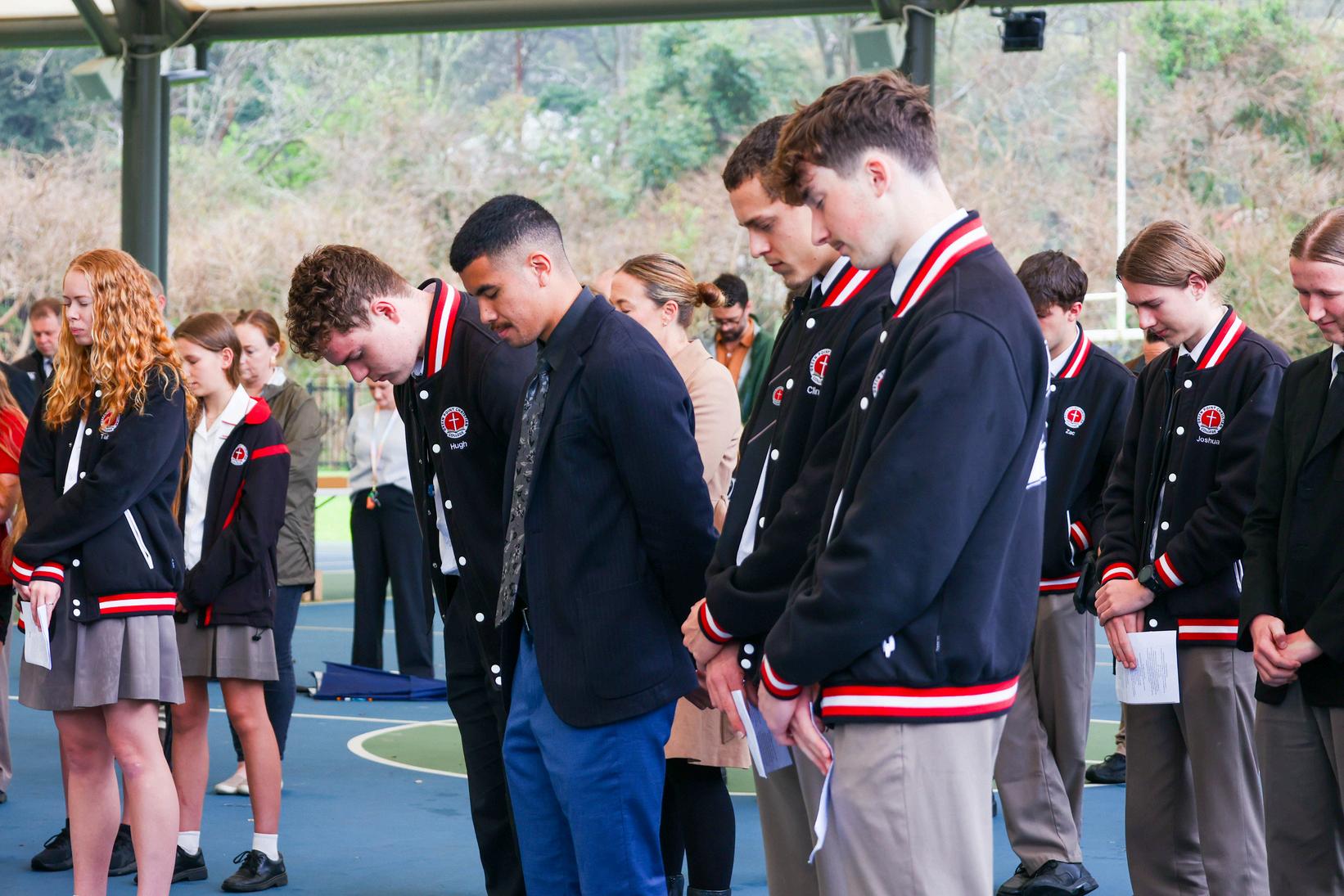
Once per Term we invite our GPCC community and beyond to join us on the basketball courts for Prayer and Praise at the Post. This is a wonderful opportunity to gather as we practice gratitude and pray for our school, our community and beyond.
Houses
TALOA WARRIORS
House Colour: RED
EUA EAGLES
House Colour: GREEN
HA’APAI HURRICANES
House Colour: YELLOW
VA’VAU BREAKERS
House Colour: BLUE
SECONDARY HANDBOOK
Canteen
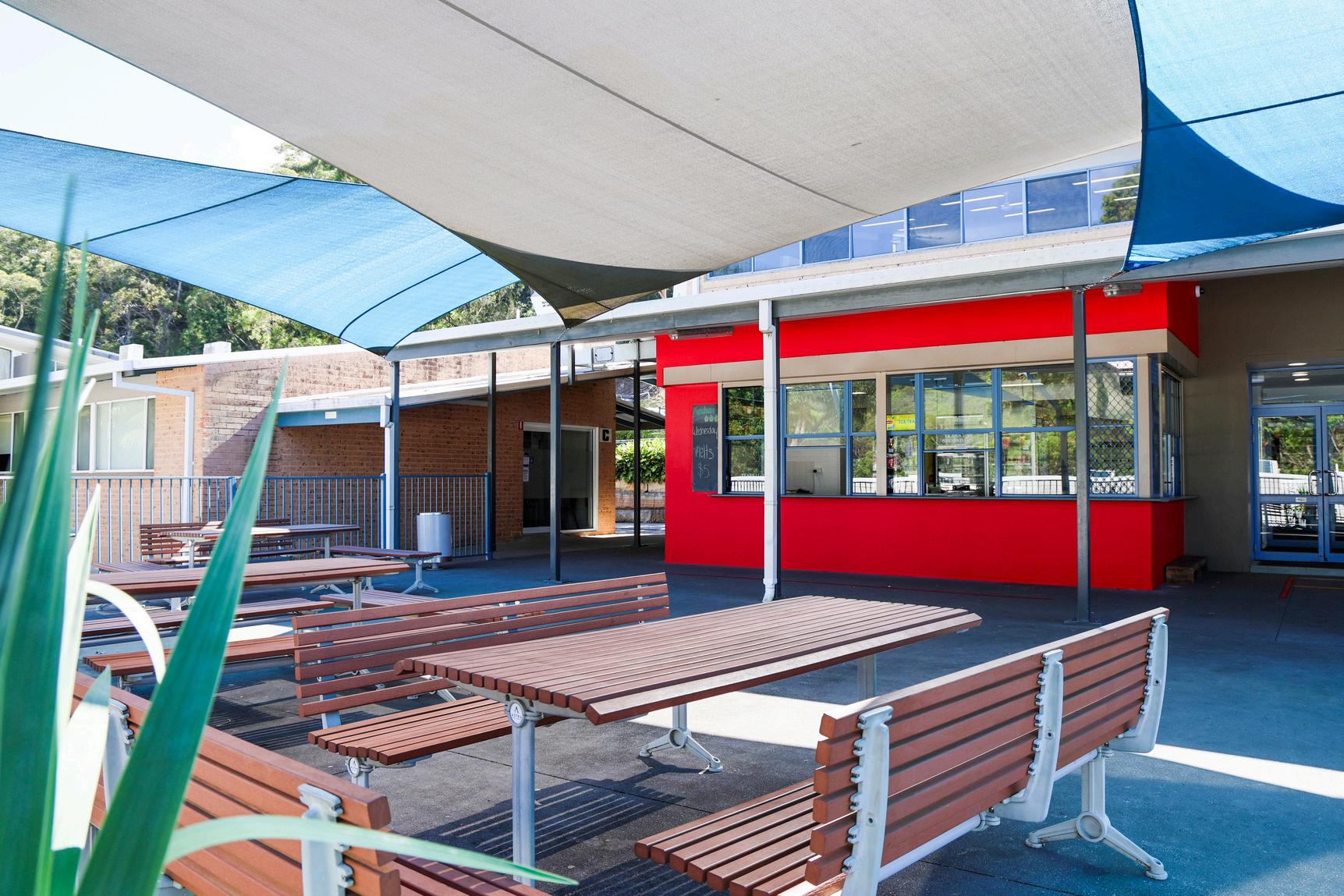
‘THE MUNCHERY’
Open every day from 8:30am to 2:00pm.
The Munchery have partnered with Munch Monitor (www.munchmonitor.com) to provide an online ordering and payment system. Parents access this system via the Munch Monitor website (munchmonitor.com).
Advance Orders - can be placed online at any time Same day Orders - must be ordered by 8:30am that morning
FOR A NEW ACCOUNT
School ID: greenpoint School Password: munch2251
The canteen menu and more information on The Munchery is on the College Website at www.gpcc.nsw.edu.au
Library
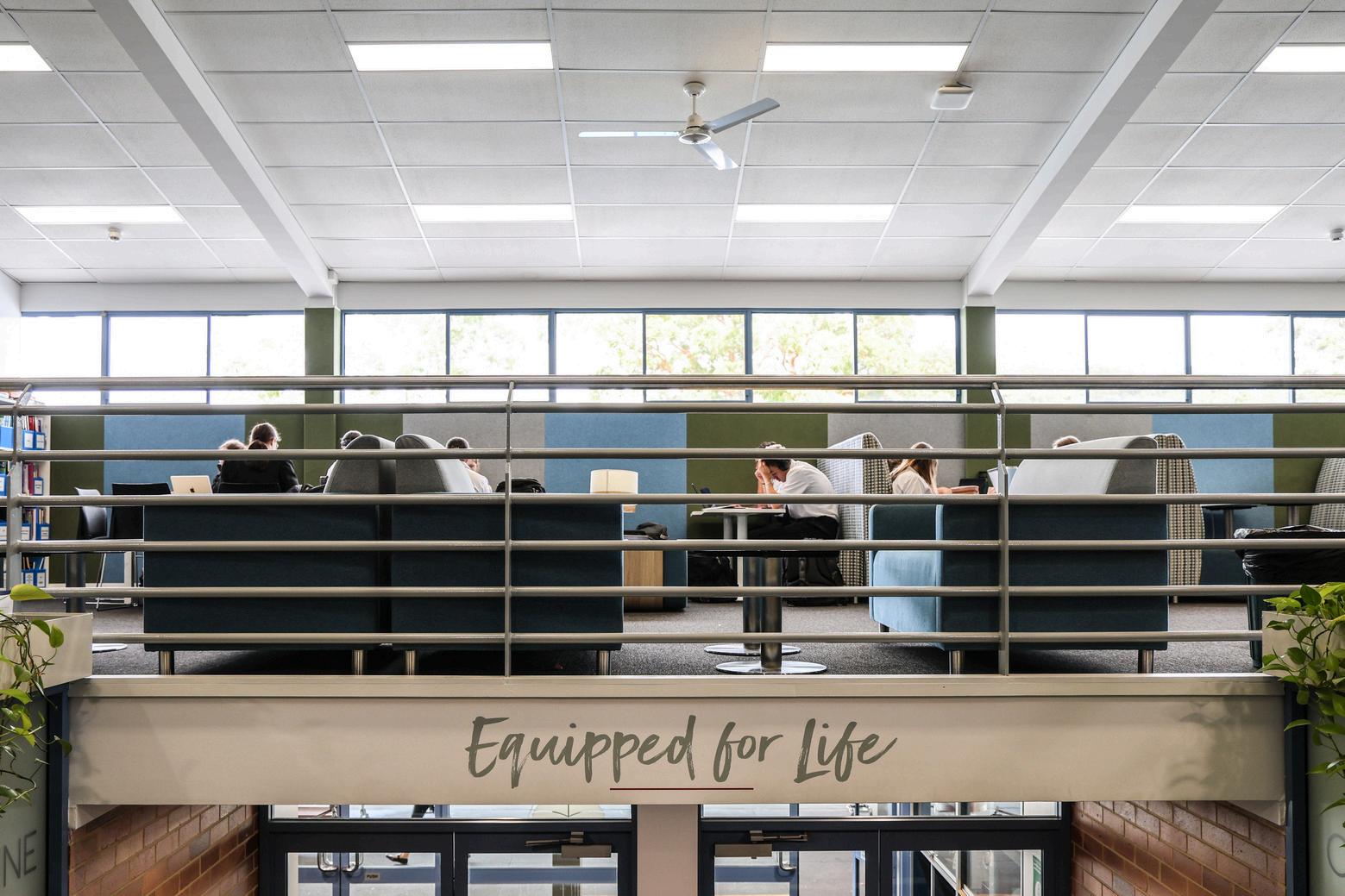
The Library has many resources and people to help our students.
Resources include books, magazines, journals, newspapers, encyclopaedias and computers. Computers can be used to type up assignments and for research.
Access to the internet, electronic encyclopedias, scanning facilities, black-and-white and colour printers, and photocopying facilities are features of the Library.
The Library is open for individual research and borrowing from 8.30am each morning, recess, lunch and after school until 4.00pm.
Senior students have their own area and should use these during Study Periods. There are a few computers set aside for the sole use of Seniors.
Staying
CONNECTED
Communication plays an important role in helping parents feel connected to our College community and to know what’s going on in your child’s school environment. One of our goals is to partner with families as we equip students for life. With this in mind, we aim to communicate with you regularly, in a variety of helpful and informative ways.
Below is an explanation of how we use our key methods of communication, so you are aware of how and when the College will communicate to you.
COLLEGE WEBSITE
Our College Website is a great resource for both existing and new parents to the GPCC community. It contains helpful, up to date information and is often where we link parents to from other sources for further details.
You can use the College Website to find out more about who we are, access education and learning resources, better understand our College community, read our latest Newsletter, learn more regarding enrolment and new parent Information, and view current employment opportunities. GPCC Website: www.gpcc.nsw.edu.au.
GPCC PHONE APP
Our GPCC Phone App is a key channel of communication to our parent community Via the App, you will receive notifications for important information and reminders regarding the following items:
Whole School updates and changes
Whole School events and fundraisers
Whole Secondary events and fundraisers
Emergency information
Student specific notifications (e.g. Pastoral Care entries)
Newsletter (The Messenger)
Schoolbox
Bus delays
We highly recommend all Parents and Carers download the free GPCC Phone App to ensure you can stay up to date with relevant information regarding your child.
THE MESSENGER (NEWSLETTER)
Our Newsletter is a great way to stay in touch with the life of the College. Sent out weekly on Friday afternoons for the week ahead, we provide you with the following information:
A snapshot of the great things happening around the College
An article from the Principal and Heads of School
Details about what’s coming up in the week ahead (including Primary, Secondary, Library, Sport, and Community announcements)
Keep an eye out for Newsletter releases on the GPCC App (sent out every Friday afternoon of school terms).
SMS MESSAGES
If the College needs to contact a group of parents urgently, we may send an SMS to the mobile phone number(s) listed in our records. This is usually only used if there is no other effective way to contact you quickly. For example, if a bus is returning more than 30 minutes early or late from an excursion, an email or Parent Lounge notification may not be as effective. In this instance, the College would send an SMS message direct to your phone.
PRIVATE FACEBOOK GROUPS
A private Facebook group is created for each Primary grade, so that parents can easily connect and communicate with each other throughout the year. You will be sent the link to the relevant Facebook group upon enrolment.
The Grade Facebook groups are primarily for the parent community, however GPCC will occasionally post in these spaces regarding event reminders or upcoming volunteer opportunities. Note that some parent grades have also set up WhatsApp groups, but the College is unable to monitor all these groups or use them effectively to communicate important information.
PUBLIC SOCIAL MEDIA
We use our public social media sites (Facebook, Instagram, LinkedIn) to celebrate high-level College achievements, notify parents of fundraising outcomes, and share about the wonderful things happening across different year groups.
We love sharing our College highlights with you, so we encourage you to follow us on our social media pages. However, we realise that not everyone wants to be on social media, so this method of connecting with the College is optional and you will not miss any important information about upcoming events by not being on our social media channels.
The College has an online administration system with a portal for parents called “Parent Lounge” All new parents will be sent a User ID to enter this system. This facility will include the ability to view assessment tasks, homework, student diaries, The Messenger and academic school reports. There will also be access to directly email teachers and book Parent/Teacher Interviews. Please note that access to the parent portal is not available until a student commences at GPCC.
PARENT INVOLVEMENT
Parents have many opportunities to be involved in their child’s schooling. Of particular concern is the monitoring of their academic work. Parents may have other opportunities to be involved in the school, such as assisting at particular sporting events and carnivals. Information on these and other areas of importance to parents will be advised through the Messenger. All parents are encouraged to be involved when possible.
STUDENT LEARNING INTERVIEWS
Also known as Parent Teacher Interviews. Student Learning Interviews are conducted during the year, where parents have an opportunity to talk to their child’s teacher(s) regarding their progress. These evenings allow parents to talk to more than one teacher at one venue. Parents are notified through the Newsletter when this night is approaching and appointments can be booked in Parent Lounge. Should parents require further discussions on their child’s progress than can be provided on these interview nights, then they would need to make an appointment with the appropriate teacher through the College Office.
REPORTS
Access Reporting in Schoolbox, stay updated with your child's learning progress and academic results.
VISITORS
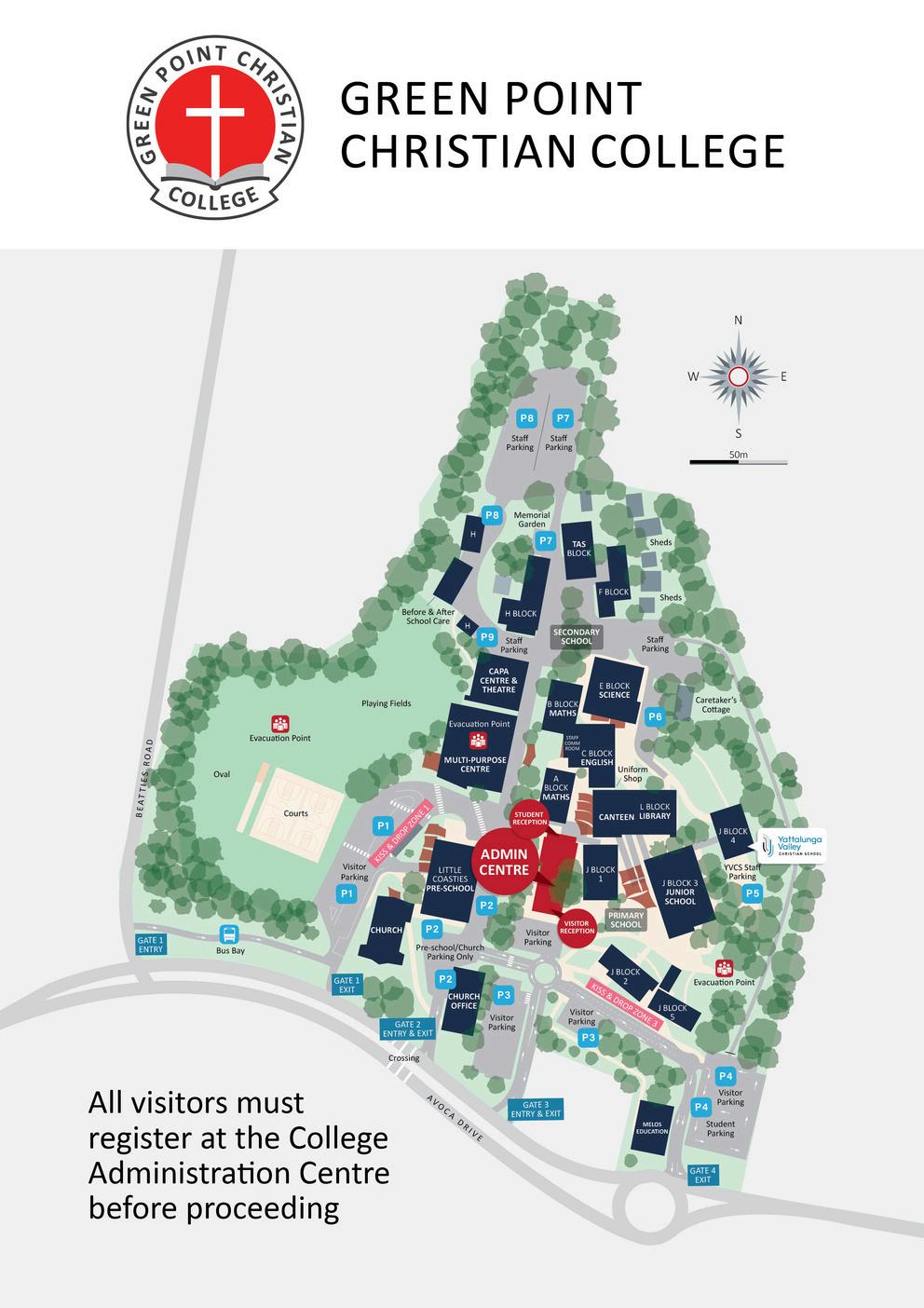
All visitors to the College should report in at Reception at the Administration Centre, sign in and collect a visitor’s badge. These must be worn whilst on the property and you may be approached and questioned as to your visit if you do not have a badge on.
StudentTechnology REQUIREMENT
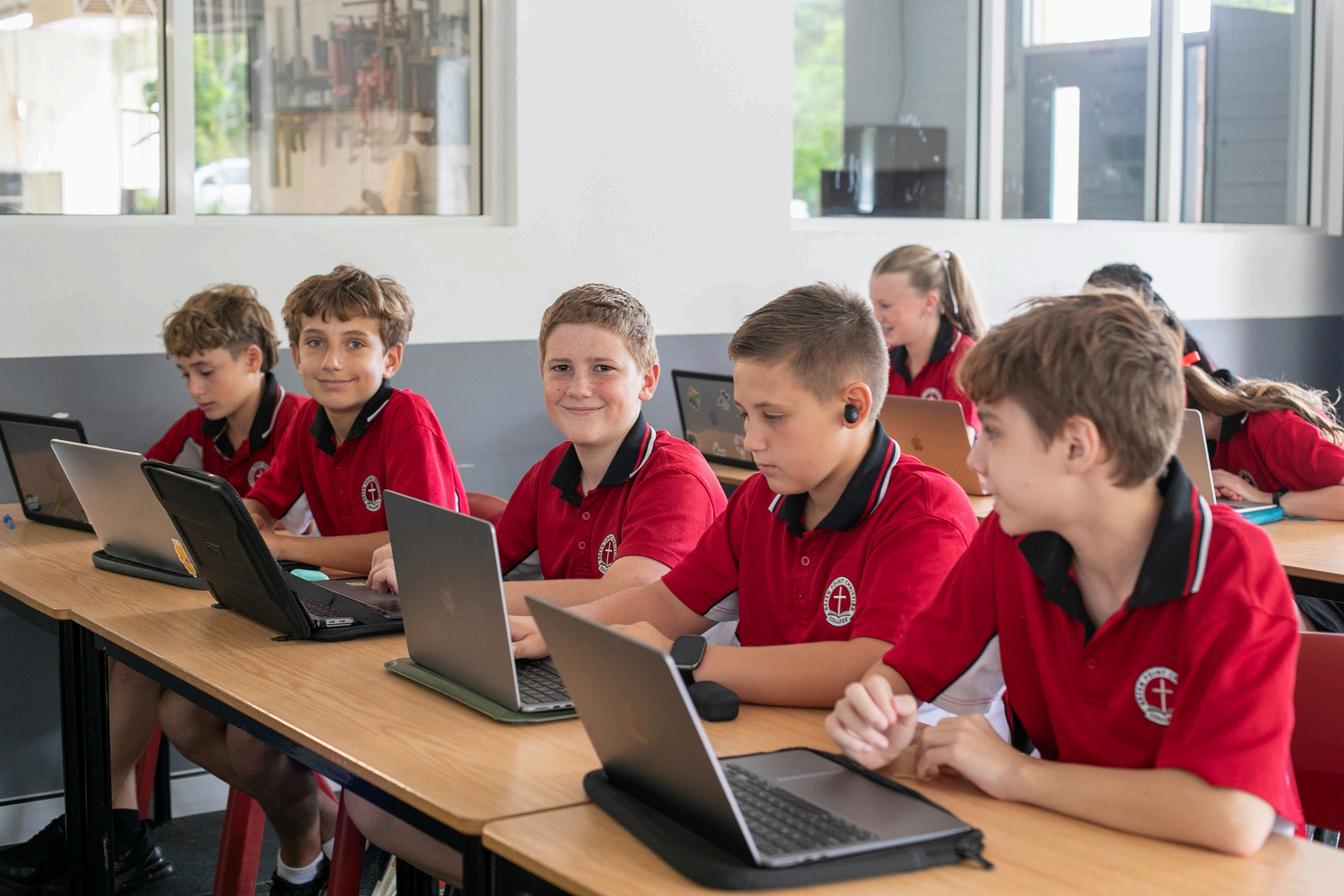
Student Technology requirements are driven by curricular and learning objectives. Our vision is that this program will present students with a device which enables them to acquire the skills that empower them in all phases of the learning process, including research, problem solving, content creation, communication and collaboration. Students and families may already have a device that meets these requirements or may purchase a new device to meet these requirements. All students in Years 7 to 10 are expected to bring a digital device that meets these requirements each day.
The recommended minimum device requirements for new devices coming into the College are updated on our College website: https://www.gpcc.nsw.edu.au/enrolment/student-technology
If you are unsure or unclear about the specifications, we recommend that you take up the MacBook program offering via https://www.jbeducation.com.au/byod/?code=GPCCBYOD. These are the latest generation of M1 MacBooks with significant improvements in battery life and performance.
To ensure an excellent educational outcome, we require minimum specifications. These will best support students’ needs in the classroom, encourage teachers to innovate, and provide a stable and reliable platform.
Stationery REQUIREMENTS
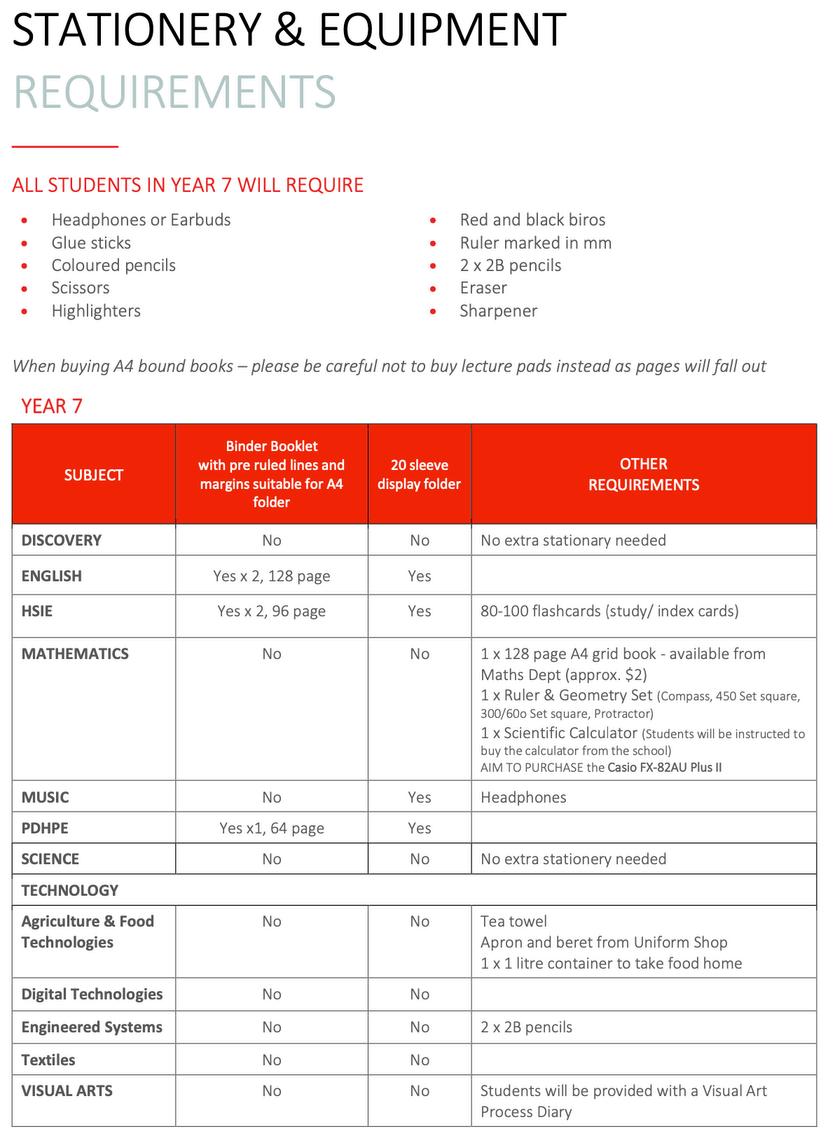
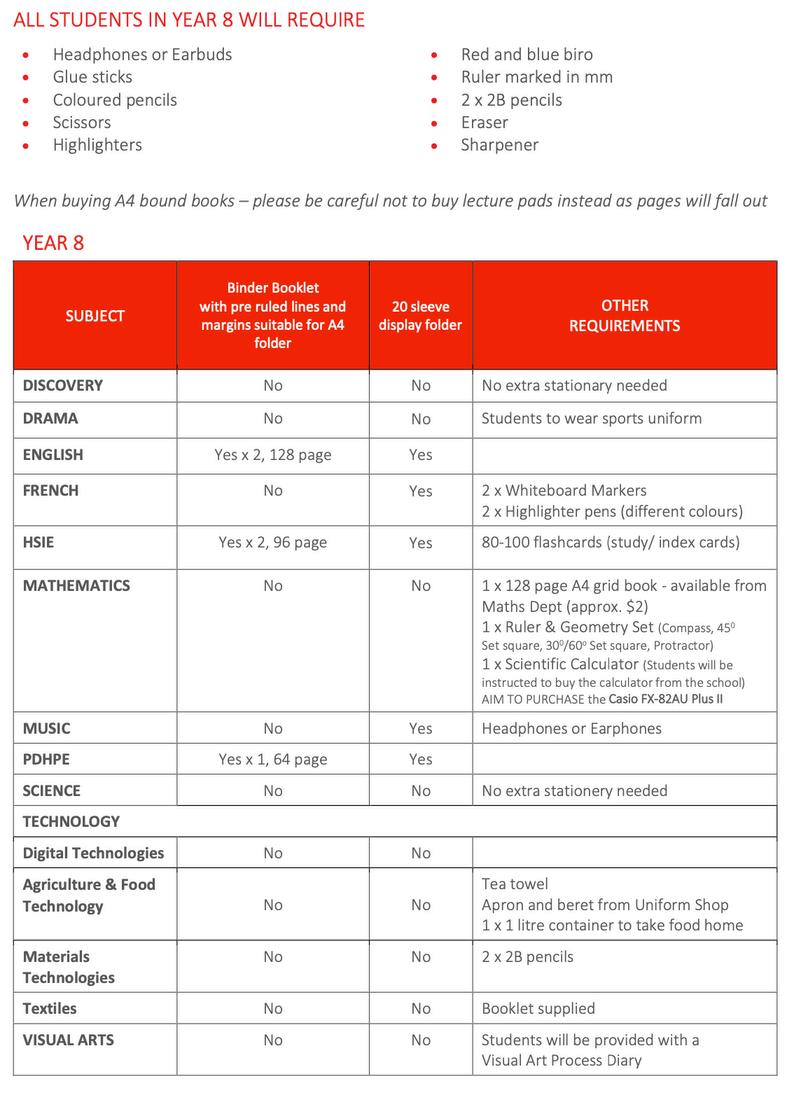
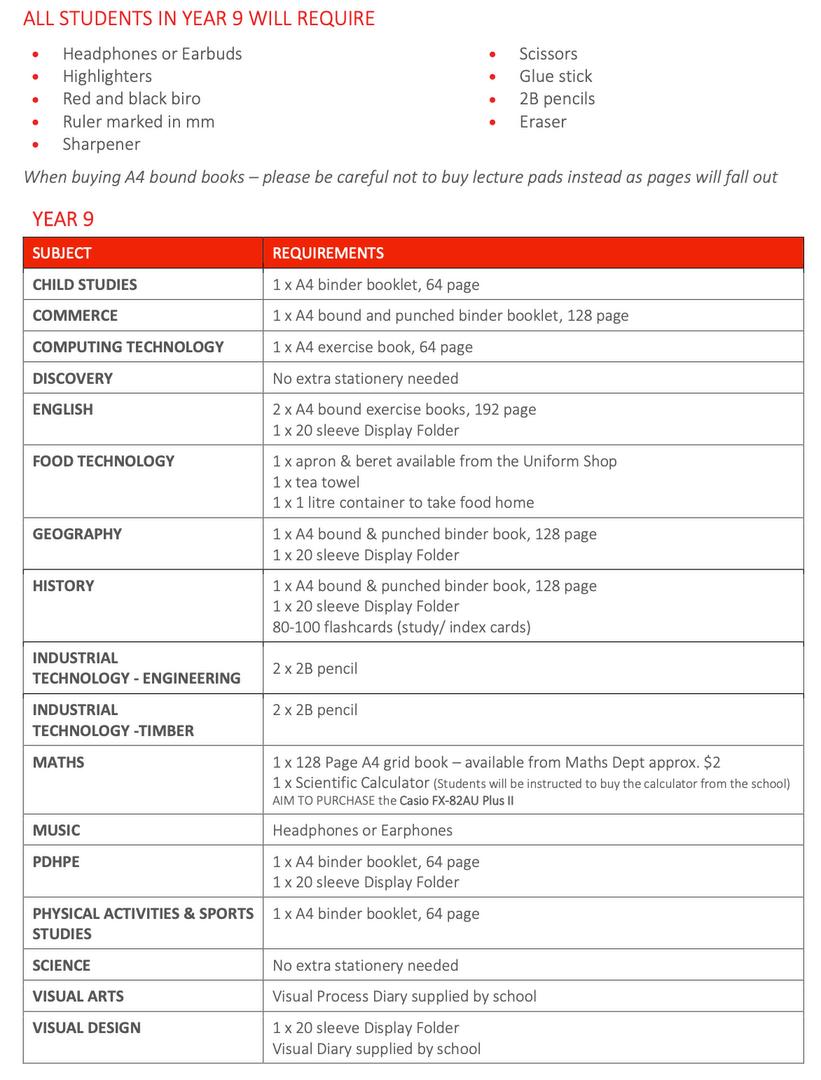
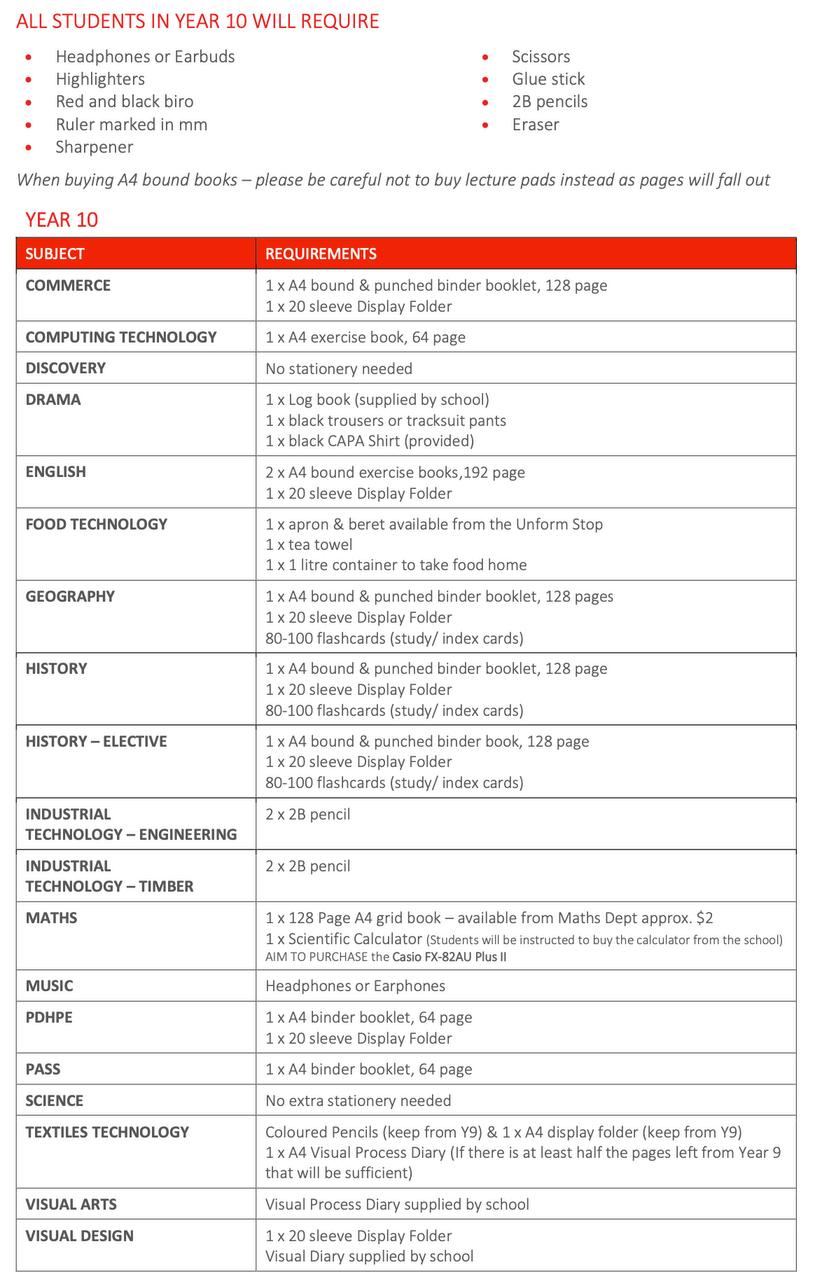
A list of stationery requirements appears in the following pages for Years 7-10.
Generally, all textbooks for students in Years 7-10 are provided by the College. For students in Year 10, a preparation day for those going on to Year 11 is held near the end of the year, part of which includes the opportunity to purchase Year 11 texts.
Uniform
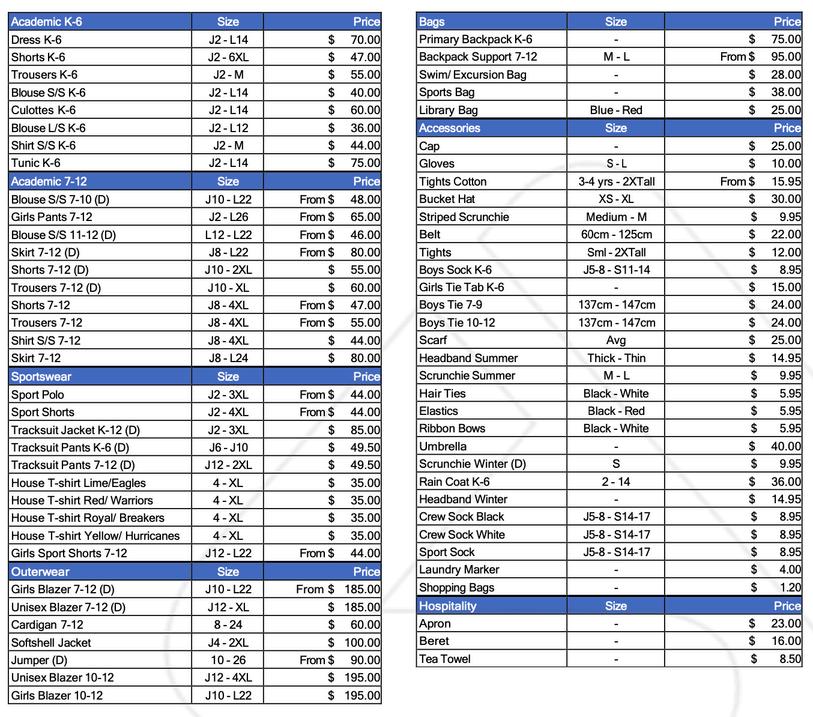
UNIFORM SHOP
The Uniform Shop, operated by Alinta Apparel, is located on our campus.
Opening Hour
Uniform FITTING INFORMATION
Uniform
Uniform
GENERAL INFORMATION
Green Point Christian College is committed to maintaining an environment where students recognise that they are valued and unique individuals but are also integral members of a community. Within this environment, students are encouraged to develop their individual talents and gifts and to explore how to use these gifts in the growth of the community as a whole. One of the ways that students demonstrate their commitment to the College community is by the wearing of a uniform. It is a visible reminder of the connection and commitment to the vision and values of the College.
Benefits of wearing a uniform:
It provides a common standard of appropriate dress that reduces the opportunity for superficial comparisons to be made.
It provides a standard of appropriate dress that is modest but functional, therefore removing the opportunity for others to be negatively impacted e.g. some clothing items highlight the human body in a sexual way, or may contain offensive slogans or pictures.
Provides students with a tangible and positive symbol that they belong to our school community.
Assists the students in their roles as ambassadors of the College, whether in or out of school
Students are expected to be in formal uniform each day and are to be wearing it appropriately without modifications. Students are permitted to wear their sports uniform on days where they are involved in:
Practical PDHPE classes
Drama classes
Days they may have a lunch time sport training
Students who have non school sports training after school are expected to wear their formal uniform and make provisions to change into appropriate clothing after school.
INCORRECT UNIFORM
Students who present to school with incorrect uniform may be issued with a demerit from a teaching staff member. Usually, uniform will be checked at the start of the day in Equip. Should a student have a situation where the uniform cannot be worn, then a parental note should be provided on the day with an explanation and timeframe. This note can be shown to staff members who question the student about their uniform. When a uniform item cannot be worn for an extended period then a letter should be forwarded to the Year Advisor.
BACKPACK MANAGEMENT PROCEDURE
Secondary Student’s Backpack Management Procedure
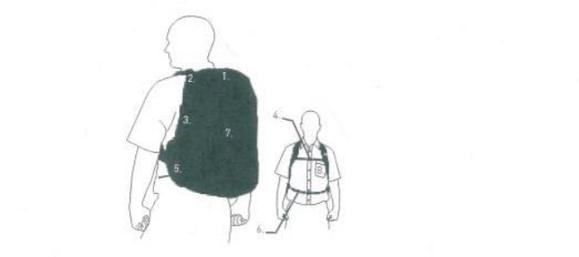
All students are required to carry a College backpack supplied by the uniform shop. It is each student’s responsibility to manage the weight and fit of their backpack. Our bags are endorsed by the Australian Physiotherapy Association and come in two sizes based on the size of the student and their requirements for carrying capacity. The weight of your backpack can be a problem. The Australian Physiotherapy Association states that a student should not carry more than 10% of their bodyweight. In order to minimise the weight please:
1.Do not carry your backpack around the campus, only take what you need for the lesson.
2 Use a locker, located in various places around the campus. There is time between each period to visit your locker.
3 Unpack your backpack each night and only carry the items you need for the day – this should equal no more than 4 x workbooks, your laptop with texts loaded on to it, lunch and a layer of warmth.
4.Carry extra-curricular sport requirements in a separate bag.
5.Carry musical instruments separately.
6 Use the water filling stations around the campus – do not carry excess water
A poorly adjusted backpack will cause shoulder/back pain. When fitted correctly your backpack will sit above your hips, be close to your spine and the weight distribution will be 80% hips and 20% shoulders. To ensure a good fit:
7.Ensure all zips are closed.
8 Wear both shoulder straps at all times.
9.Adjust the load compression straps every time.
10 Connect your sternum straps for a long walk.
11.Don’t allow the pack to fall below hip level.
12.Use your waist strap to keep the pack against your spine.
13 Always pack the heaviest items against your spine.
14.Never carry more than 10% of your body weight.
Uniform
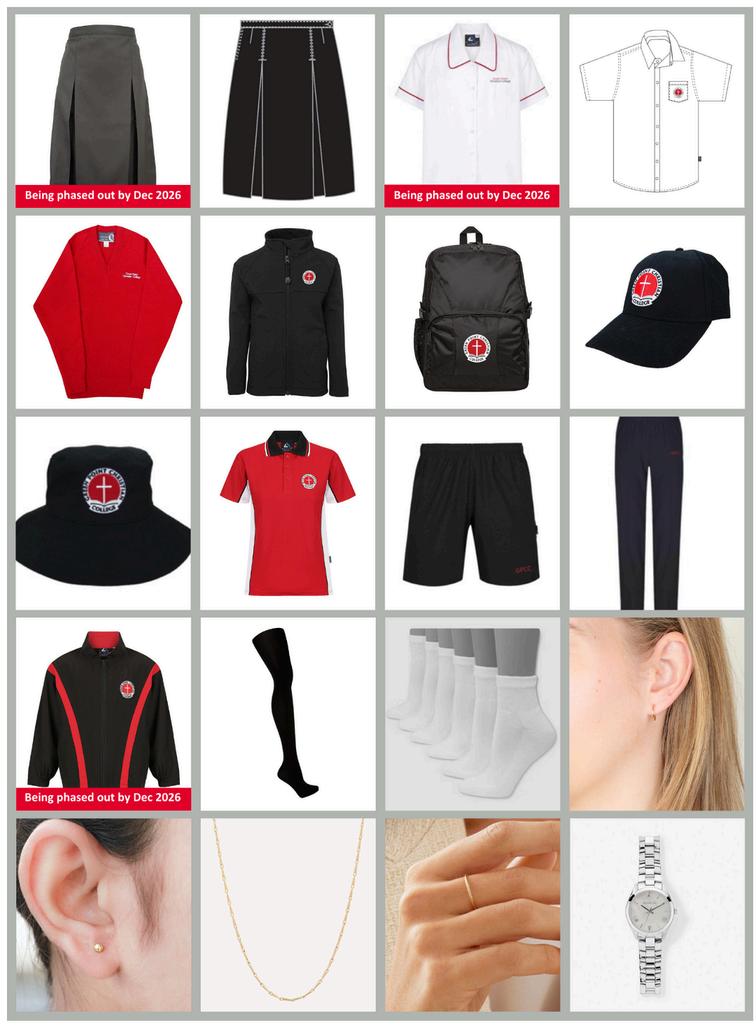
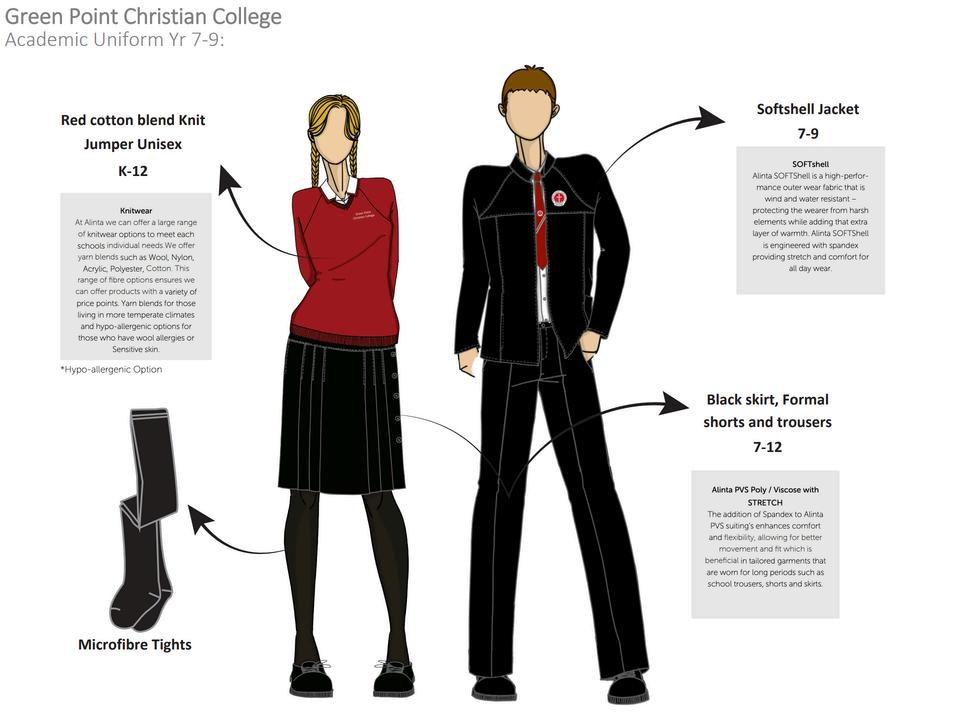
GIRLS - YEARS 7 TO 9
From the commencement of the 2026 school year, there will be a transition period of 1 year (end of 2026) from the current uniform into the new uniform.
GIRLS - SUMMER/WINTER
Skirt
Replaced with Blouse Replaced with
Jumper Replaced with
Cardigan
Jacket
Socks
Stockings
Shoes
Hair
Bag
Taupe skirt with logo and adjustable waist (length to be modest in length, be no shorter than touching the top of the knee. (phasing out)
Black skirt with logo and adjustable waist (length to be modest in length, no shorter than touching the top of the knee cap.)
White short- sleeved blouse with red piping and logo
White self-stripe short-sleeve blouse with red piping and logo
Red wool blend jumper with embroidered logo (optional) (phasing out)
Red cotton blend jumper with embroidered logo (optional)
Black cardigan with logo has been discontinued
Black soft-shell jacket with logo
Short, plain white ankle socks to be worn above the ankle. No stripes or logos
Black opaque stockings (70+ Denier)
Polishable black leather lace up shoes with a hard sole and a small heel. Fully enclosed and protecting the foot
Hair that is longer than the shirt collar must be tied back. Hair must be of a neat and tidy appearance and should not draw attention in colour, cut or style. Hair accessories should be simple such as hair elastics, bobby pins or ribbons and should be red, black or white in colour
Black school bag with logo.
Uniform
GIRLS - YEARS 7 TO 9
GIRLS - SPORT
Shirt
Shorts
Replaced with
Socks
Cap
Shoes
Jacket
Replaced with
Track Pants
Replaced with
JEWELLERY AND MAKE-UP
Red cotton backed polo shirt with white panels and school logo.
Unisex black cotton backed mesh shorts with red GPCC logo (phasing out)
Girls fit stretch sport shorts K-12. Shorts should not be tight fitting, or shorter than mid-thigh in lengty
White sport socks – no stripes or logos
GPCC hat: Choice of bucket hat or sports cap
An appropriate lace up sports shoe which provides supported protection for the feet. This does not include canvas shoes, flat sole shoes, skate shoes or basketball boots
Red and black sports jacket with logo (phasing out)
Black soft-shell jacket with logo
Black microfiber track pants (phasing out)
Black performance fleece trackpants with logo
Girls in Years 7-12 are limited to one set of either plain gold or plain silver studs or sleepers worn in the ear lobe and a watch. Girls in Years 7-12 who choose to have other visible body piercings need to be able to remove any studs etc during school time.
Girls in Years 7-12 may wear:
• A watch.
• One pair of either gold or silver studs or sleepers in the lobe.
• One fine chain (under blouse – not visible).
• One silver or gold ring.
• Discreet cosmetics (natural skin tones).
• No bracelets.
• False eyelashes are not permitted
• False and or coloured (painted) or coated nails (shellac, or gel) are not permitted
Uniform
GIRLS - YEARS 7 TO 9
Uniform
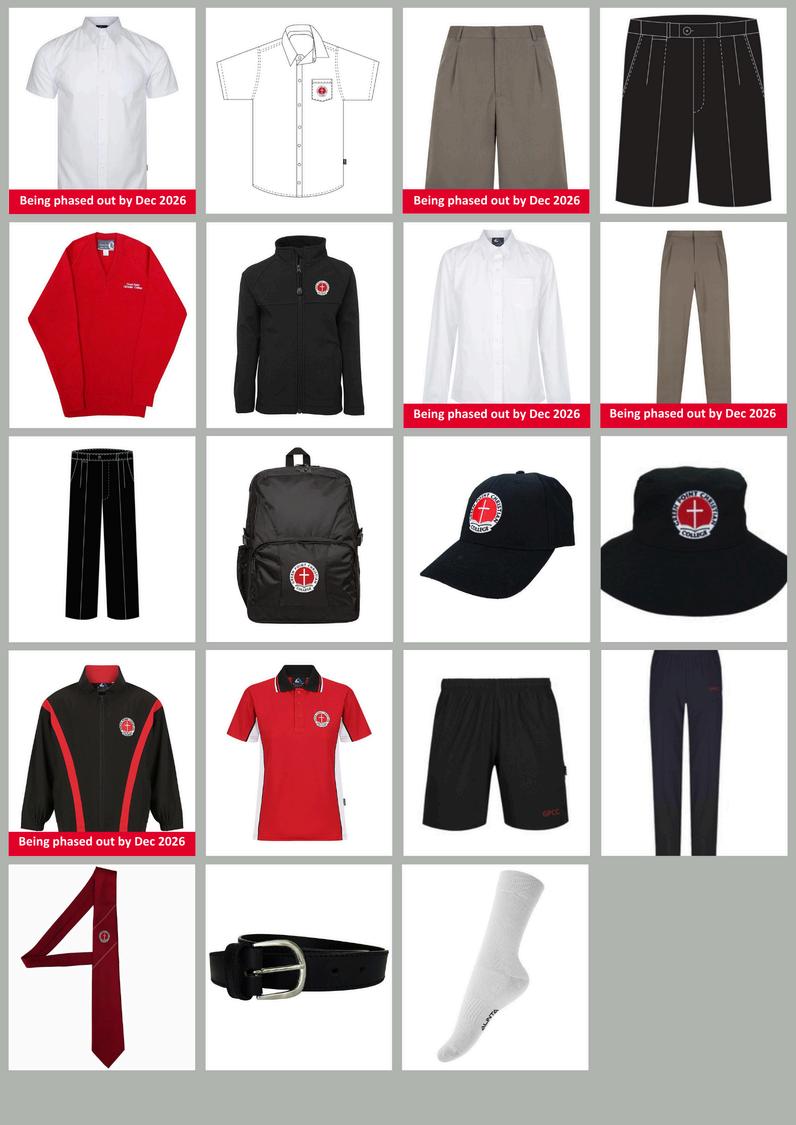
BOYS - YEARS 7 TO 9
From the commencement of the 2026 school year, there will be a transition period of 1 year (end of 2026) from the current uniform into the new uniform.
BOYS - SUMMER
Shirt
Replaced with
Shorts
Replaced with
Pants
Replaced with
Tie
Belt
Jumper
Replaced with
Jacket
Replaced with
Bag
White short-sleeved shirt – (no logo) to be worn tucked in (phasing out)
White self-stripe short- sleeved shirt with logo, to be worn tucked in with black leather belt
Taupe shorts with logo and black leather belt. (phasing out)
Black shorts with logo and black leather belt
Taupe pants with logo and black leather belt. (phasing out)
Black pants with logo and black leather belt
Boys in Years 7-9 are not required to wear a tie in Summer when wearing the formal shorts
Dress belt, black leather or leather substitute - no logos
Red wool blend jumper with embroidered logo (optional) (phasing out)
Red cotton blend jumper with embroidered logo (optional)
Red/black microfiber jacket with logo. (phasing out)
Black soft shell College jacket with logo
Black school bag with logo.
Uniform
BOYS - YEARS 7 TO 9
BOYS - WINTER ALTERNATIVE
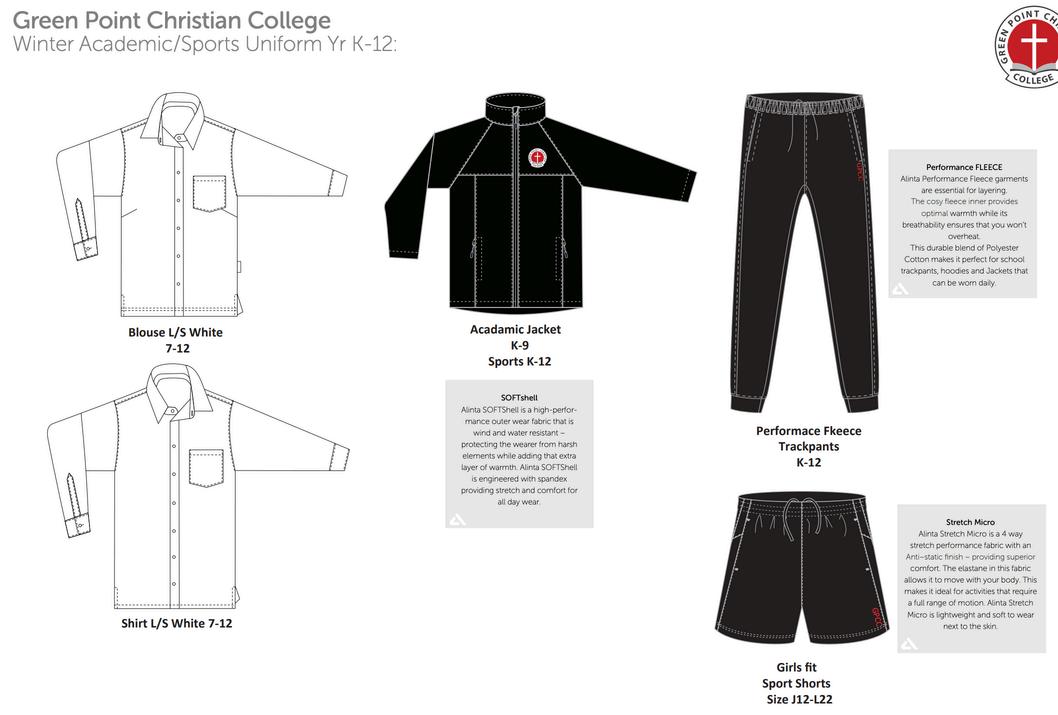
All items for the Secondary 7-9 Boys winter uniform remain the same with the alternatives of wearing black long pants with red logo tie and a long-sleeved white self-stripe shirt with logo, to be worn tucked in with black leather belt.
Socks
Shoes
Hair
Short black socks to be worn with black shorts or long pants
Low profile, polishable black lace up shoes with a hard sole and a small heel. Fully enclosed and protecting the foot
Hair that is longer than the shirt collar must be tied back. Hair must be of a neat and tidy appearance and should not draw attention to themselves in colour, cut or style. Boys must be clean shaven during school terms.
BOYS - SPORT
Shirt
Shorts
Socks
Cap
Shoes
Jacket
Replaced with
Track Pants
Replaced with
Red cotton backed polo shirt with white panels and school logo
Unisex black cotton backed mesh shorts with red GPCC logo
Plain white sport socks – no stripes or logos
GPCC hat: Choice of bucket hat or sports cap
An appropriate lace up sports shoe which provides supported protection for the feet. This does not include canvas shoes, flat sole shoes, skate shoes or basketball boots
Red and black microfiber jacket with logo (phasing out)
Black soft-shell jacket with logo
Black microfiber track pants. (phasing out)
Black polyester cotton performance fleece trackpants with logo.
SECONDARY HANDBOOK
Uniform
BOYS - YEARS 7 TO 9
JEWELLERY
Boys in Years 7 – 12 who choose to have visible body piercings need to be able to remove any studs etc during school time.
Boys in Years 7-12 may wear: A watch
One fine chain (under shirt – not visible)
One gold or silver ring
Boys in Years 7-12 may not wear:
Earrings Bracelets
Uniform
BOYS - YEARS 7 TO 9
Uniform
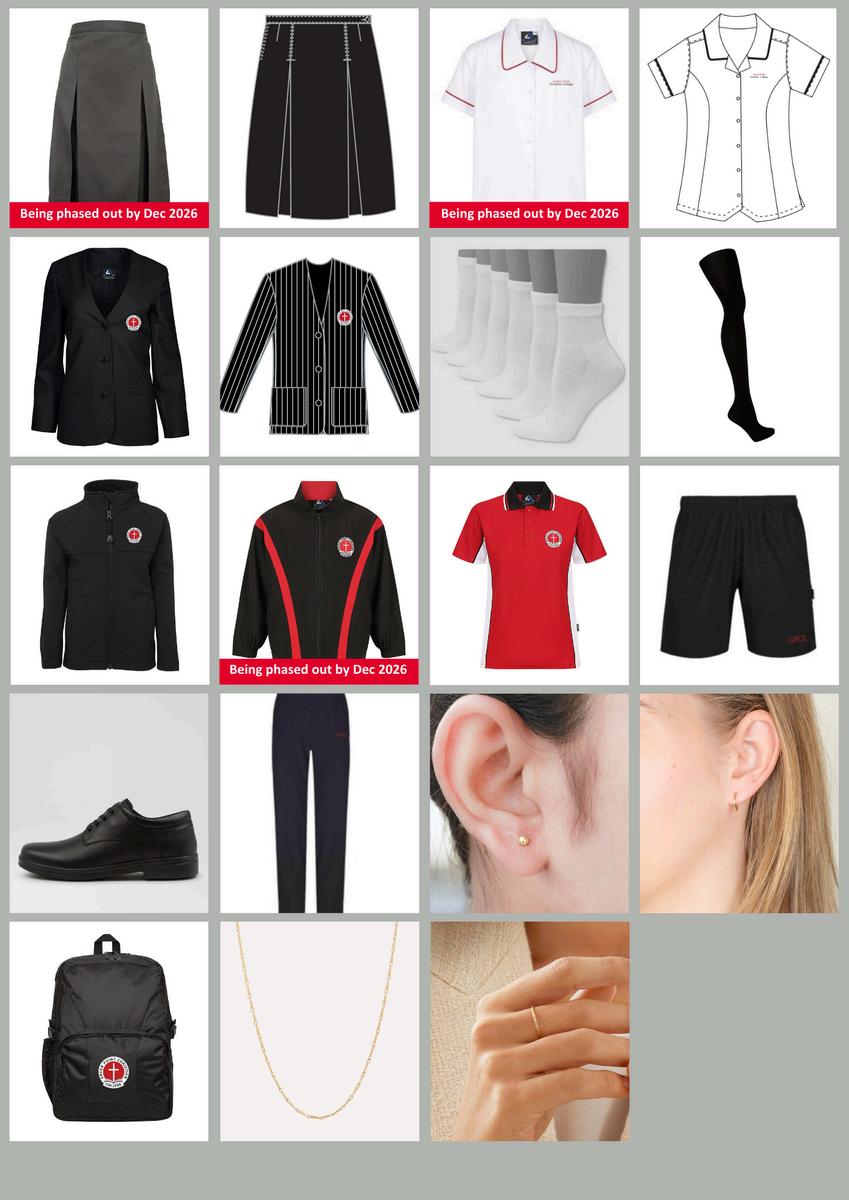
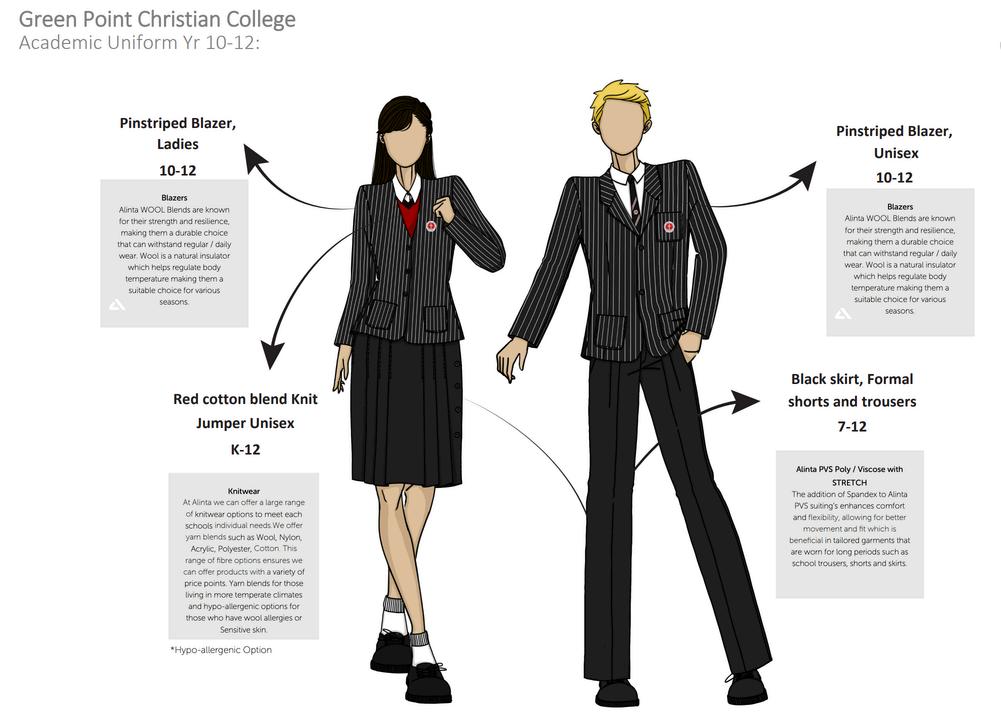
GIRLS - SENIOR SECONDARY YEARS 10-12
GIRLS - SUMMER/WINTER
Skirts
Replaced with
Blouse
Replaced with Jumper
Replaced with Cardigan
Blazer
Replaced with
Socks
Stockings
Shoes
Hair
Bag
Taupe skirt with logo and adjustable waist, length to be modest in length, and no shorter than the top of the knee cap (phasing out)
Black skirt with logo and adjustable waist (length to be modest in length, and no shorter than the top of the knee cap
White short-sleeved blouse with black piping and logo (phasing out)
White self-stripe short-sleeved blouse with black piping and logo
Red wool blend jumper with embroidered logo (optional) (phasing out)
Red cotton blend jumper with embroidered logo (optional)
Black cardigan with logo is discontinued
Black, shaped girl’s blazer with logo (optional) (phasing out)
Short white ankle socks to be worn above the ankle
Black opaque stockings (70+ Denier)
Low profile, polishable black lace up shoes with a hard sole and a small heel. Fully enclosed and protecting the foot
Girls in Years 10-12 are allowed to wear their hair out. In PDHPE or practical subjects as required, hair that is touching the collar must be fully tied back. Hair must be of a neat and tidy appearance and should not draw attention to themselves in colour, cut or style. Hair accessories should be simple such as hair elastics, bobby pins or ribbons and should only be red, black or white in colour
Black school bag with logo.
SECONDARY HANDBOOK
Uniform
GIRLS - SENIOR SECONDARY YEARS 10-12
GIRLS - SPORT
Shirt
Shorts
Replaced with
Socks
Cap
Shoes
Jacket
Replaced with
Track Pants
Replaced with
Hair
Red cotton backed polo shirt with white panels and school logo
Unisex black cotton backed mesh shorts with red GPCC logo (phasing out)
Girls fit stretch sport shorts K-12. Shorts should not be tight fitting, or shorter than mid-thigh in length
Plain white sport socks – no stripes or logos
GPCC hat: Choice of bucket hat or sports cap
An appropriate lace up sports shoe which provides supported protection for the feet. This does not include canvas shoes, flat sole shoes, skate shoes or basketball boots
Red/black microfiber jacket with logo. (phasing out)
Black soft shell jacket with logo
Black microfiber track pants. (phasing out)
Black polyester cotton performance fleece trackpants with logo
In PDHPE or practical subjects as required, hair that is touching the collar must be fully tied back. Hair must be of a neat and tidy appearance and should not draw attention to themselves in colour, cut or style. Hair accessories should be simple such as hair elastics, bobby pins or ribbons and should only be red, black or white in colour.
JEWELLERY AND MAKE-UP
PERMITTED
A watch
One pair of either plain gold or plain silver studs or sleepers in the lobe
One fine chain (under blouse – not visible)
One silver or gold ring
Dicreet cosmetics (natural skin tones)
NOT PERMITTED
Bracelets
False eyelashes
False and/or painted or coated nails
Visible piercings need to be removed during school time
Uniform
GIRLS - SENIOR SECONDARY YEARS 10-12
Uniform BOYS
- SENIOR SECONDARY YEARS 10-12
BOYS - SUMMER/WINTER
Shirt
Replaced with
Shorts
Replaced with
Pants
Replaced with
Tie Belt
Jumper
Replaced with
Blazer
Replaced with
Jacket
Replaced with
Socks
Shoes
Hair
Bag
White short-sleeved shirt – (no logo) to be worn tucked in (phasing out)
White self-stripe short-sleeved shirt with logo, to be worn tucked in with black leather belt
Taupe shorts with logo and black leather belt. (phasing out)
Black shorts with logo and black leather belt.
Taupe pants with logo and black leather belt. (phasing out)
Black pants with logo and black leather belt.
Compulsory black tie with crest to be worn with shorts and pants.
Dress belt, black leather or leather substitute - no logos.
Red wool blend jumper with embroidered logo (optional) (phasing out)
Red cotton blend jumper with embroidered logo (optional)
Red/black microfiber jacket with logo. (phasing out)
Black soft shell College jacket with logo (optional)
Short black socks to be worn with black shorts or long pants.
Low profile, polishable black lace up shoes with a hard sole and a small heel. Fully enclosed and protecting the foot.
Hair that is longer than the shirt collar must be tied back. Hair must be of a neat and tidy appearance and should not draw attention to themselves in colour, cut or style. Boys must be clean shaven during school terms.
Black school bag with logo.
Uniform BOYS
- SENIOR SECONDARY YEARS 10-12
BOYS - SPORT
Shirt
Shorts
Socks
Hat
Shoes
Jacket Replaced with Track Pants
Replaced with
JEWELLERY
PERMITTED
A watch
Red cotton backed polo shirt with white panels and school logo
Unisex black cotton backed mesh shorts with red GPCC logo
Plain white socks- no stripes or logos
GPCC hat: Choice of bucket hat or sports cap
An appropriate lace up sports shoe which provides supported protection for the feet. This does not include canvas shoes, flat sole shoes, skate shoes or basketball boots
Red/black microfiber jacket with logo (phasing out)
Black soft shell College jacket with logo
Black microfiber track pants (phasing out)
Black polyester cotton performance fleece trackpants with logo
One fine chain (under shirt - not visible)
One gold or silver ring
NOT PERMITTED
Earrings
Bracelets
Visible piercings need to be removed during school time
Uniform VISUALS
Uniform VISUALS
Uniform VISUALS
Uniform VISUALS
Traffic MANAGEMENT PLAN
FOR OUR CHILDREN’S SAFETY
This Traffic Management Plan has been produced with the paramount aim of the safety of children when they arrive or leave the College. Compliance with this Plan will also improve traffic flow in peak periods.
SPEED LIMIT is strictly 10kph and is a share pedestrian/vehicle area. Please take great care in the carpark to avoid injury or inciden
Use gate 1 for Kiss and Drop 1 (years 4-12) and P1 and gate 3 for Kiss and Drop 3 (K-2 and Yattalunga Valley Christian School) and P3
TRAFFIC WARDENS will be on duty during peak periods to supervise the movement of students and vehicles. Please follow their instructions
PEDESTRIAN CROSSINGS, monitored by Traffic Wardens, should be used in order to promote the safe separation of pedestrians and vehicles
Any PRE-SCHOOL AGE CHILDREN are to be supervised at all times, including holding hands whenever possible
Kiss and Drop zones are supervised
Display your surname in your windscreen
If your children are not ready for collection you will need to park and collect for P3, or flow back around for P1
As is the case on public roads, MOBILE PHONES should not be used whilst driving in the car park area
Please take care when OPENING CAR DOORS as that can injure pedestrians and/or cause damage to vehicles
Do not park in adjacent business
Gate 2 and P2 is only for the Little Coasties parents and those on Church Business
Students are to park in student designated carparks – P4
Students travelling on BUSES must use the covered walkway when walking to or from buses and must not use the car park
Observations or suggestions in relation to pedestrian safety and traffic flow are welcome and should be emailed to aritchie@gpcc.nsw.edu.au
Carpark PROCEDURE
AFTERNOON
The College has three entrances and four exits. The entrances and exits are numbered so that they correlate with the carpark numbers and the Kiss and Drop numbers. Eg. Gate 1 Entry relates to P1 and Kiss and Drop 1.
Collection of K-2 students, their siblings, and Yattalunga Valley Christian School students
Entry via Gate 3 from 3:15pm - Kiss and Drop 3 will be in operation
Please do not arrive before 3:15pm to queue for collection as this places congestion on Avoca Drive
Use Gate 4 Exit to the roundabout on Avoca Drive (only turn left to Kincumber) or you may loop around and use Gate 4 exit (to use the roundabout to Saratoga and Green Point)
Use Gate 3 and P4 to park and collect
Collection of all other students
Entry via Gate 1 from 3:15pm - Kiss and Drop 1 will be in operation
It would be helpful if you do not park in the Kiss and Drop zone before 3:15pm
If your student is not at Kiss and Drop 1 use P1 to park and collect. Or you may cycle back around and rejoin the queue for Kiss and Drop 1
Use Gate 1 Exit to Avoca Drive
Collection from Little Coasties Pre-School
Use Gate 2 Entry and P2 to park and collect
Siblings who are students at the College can be collected from 3:15pm at the bottom of the Admin stairs
Use Gate 2 Exit to Avoca Drive
KISS AND DROP RULES
Follow all instructions of staff
Display your surname (provided by GPCC) on your dash – this allows us to quickly call your child/ren over to meet you
If your child/ren are not at the Kiss and Drop 3 point, you will need to park in P4 and collect them
Staff will have two-way radios and can locate your children if they are at the wrong Kiss and Drop zone or at the Bus Bay.