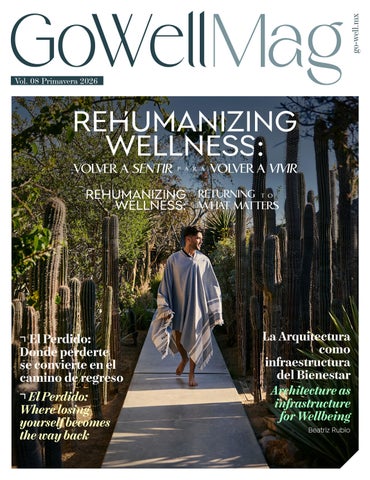
GoWellMag Spring 2026

Page 1


BODY STRATEGIST

BODY (SKIN) WELLNESS

EN INTERIOR/INSIDE

El Perdido: Donde perderte se convierte en el camino de regreso
El Perdido: Where losing yourself becomes the way back

GOWELL MAG ES UNA PUBLICACIÓN DE GOWELL®. REVISTA TRIMESTRAL, AÑO 2, NO 8, ABRIL 2026

LAS OPINIONES EXPRESADAS POR LOS AUTORES NO NECESARIAMENTE REFLEJAN LA POSTURA DEL EDITOR DE LA PUBLICACIÓN. QUEDA ESTRICTAMENTE PROHIBIDA LA REPRODUCCIÓN PARCIAL O TOTAL DE LOS CONTENIDOS E IMÁGENES DE LA PUBLICACIÓN SIN PREVIA AUTORIZACIÓN DE GOWELL®.

GOWELL MAG IS A PUBLICATION OF GOWELL®. QUARTERLY MAGAZINE, YEAR 2, NO 8, APRIL 2026. THE OPINIONS EXPRESSED BY THE AUTHORS DO NOT NECESSARILY REFLECT THE POSITION OF THE PUBLISHER OF THE PUBLICATION. THE PARTIAL OR TOTAL REPRODUCTION OF THE CONTENTS AND IMAGES OF THE PUBLICATION WITHOUT PRIOR AUTHORIZATION FROM GOWELL® IS STRICTLY PROHIBITED.

Editorial

Rehumanizing Wellness: Volver a Sentir para Volver a Vivir

Durante años, la industria del bienestar se enfocó en optimizar, medir y prometer resultados. Y aunque la ciencia y la tecnología han impulsado avances importantes, algo esencial se fue diluyendo: la capacidad de sentir.

En GoWellMag, esta conversación no es nueva. Hemos creído desde el inicio en un bienestar centrado en lo humano. Hoy, lo que el mundo comienza a llamar Rehumanizing Wellness, para nosotros es una confirmación.

Esta travesía, como la primavera, marca un nuevo ciclo. Más consciente, más maduro, más claro para decir no a lo que no funciona y sí a lo que realmente es sostenible.

El crecimiento del wellness ha atraído tendencias, innovación y expectativa. Pero este último año dejó algo evidente: no todo lo que brilla transforma. Muchas tendencias se prueban y, al no sostenerse, nos devuelven a lo esencial. Hoy el viajero busca menos medición y más reconexión. Menos estímulo y más sentido. Evolucionar no es seguir tendencias, es integrar con criterio lo que realmente aporta valor en cada contexto.

Esta edición es una invitación a volver. A recordar que el bienestar no se construye desde afuera, sino desde la experiencia profunda de estar vivos.

Rehumanizing Wellness: Feeling Again as the Path to Living Fully

For years, the wellness industry has focused on optimizing, measuring, and promising results. While science and technology have driven important progress, something essential has faded: the ability to feel.

At GoWellMag, this conversation is not new. We have always believed in a human-centered approach to wellness. What the world now calls Rehumanizing Wellness is, for us, a confirmation.

This journey, like the arrival of spring, marks a new cycle. More conscious, more mature, and more empowered to say no to what does not work and yes to what is truly sustainable.

The growth of wellness has brought trends, innovation, and expectation. Yet this past year revealed something important: not everything that shines transforms. Many trends rise and fall, returning us to what is essential.

Today, travelers seek less measurement and more reconnection. Less stimulation and more meaning. Evolution is not about following trends. It is about integrating, with discernment, what truly creates value within each context.

This edition is an invitation to return. To remember that wellbeing is not built externally, but through the deep experience of feeling alive.

– Fran Lugo

Primavera

Pulso del Bienestar Wellness Pulse

Latinoamérica: bienestar, identidad y la fuerza del slow beauty. Latin America: Wellness, Identity, and the Power of Slow Beauty.

El Negocio de la Certeza… El Fin del Bienestar como Anestesia… The Business of Certainty…The End of Wellness as Anesthesia…

Tendencias de bienestar 2026, entre la hiperoptimización y el regreso a lo humano.

Wellness Trends 2026, Between Hyper-Optimization and the Return to the Human.

Cuidado Mental Mind Matters

Respirar es vivir… Breathing Is Living...

Tus hijos saben cómo entras por la puerta de casa. Your Children Know How You Walk Through the Door.

¿Te gustaría ser feliz? Would you like to be Happy?

Spa Oasis Oasis Spa

Mii amo Spa: El Santuario Donde Sedona Susurra Sanación. Mii amo Spa: Where Sedona’s Energy Becomes a Journey of Healing.

La Travesía The Journey

The Broadmoor Spa: Bienestar que se une a la grandeza de las Montañas.

The Broadmoor Spa: Wellness Framed by Mountain Grandeur

Spa Ojai: Un Santuario Atemporal en el Corazón del Valle

Spa Ojai: A Timeless Sanctuary in the Heart of the Valley

En Forma y Fabuloso

IV drips después de las modas. IV Drips Beyond the Trend.

La longevidad: entre la narrativa aspiracional y la realidad operativa.

Longevity: Between Aspirational Narrative and Operational Reality.

Bases genéticas del envejecimientoen medicina de longevidad.

Genetic Foundations of Aging in Longevity Medicine

Curativos

La Arquitectura como Infraestructura del Bienestar Architecture as Infrastructure for Wellbeing

Regenerativo por Diseño: El Nuevo Estándar del Bienestar Moderno.

Regenerative by Design: Across the global wellness landscape, a quiet but profound shift is taking place.

Cuando un temazcal deja de ser temazcal. When a Temazcal Stops Being a Temazcal.

Más allá del estilo wellness: Lugares donde el bienestar no depende de cómo se ve el espacio, sino de cómo se vive. Beyond the Wellness Aesthetic: Designing Restorative Environments.

El Perdido: Donde Perderte Se Convierte en el Camino de Regreso.

El Perdido: Where Losing Yourself Becomes the Way Back.

Punta Nayaá: Intimidad, Diseño y Naturaleza Viva en La Punta.

Punta Nayaá: Intimacy, Design, and Living Nature in La Punta.

Casa Arca: Habita la Calma en el Corazón de San Miguel de Allende.

Casa Arca: Live in Stillness in the Heart of San Miguel de Allende.

CIGNO Mejorada: El Arte del Descanso Pausado en el Corazón Histórico de Mérida

CIGNO Mejorada: The Art of Unhurried Rest in the Historic Heart of Mérida

CURATED ACCESS AS A LIFESTYLE

Black North Signature Membership.

El ya no se trata de poseer. Se trata de mejor.

Colaboradores Collaborations

Diego Tomatis:

Diego Tomatis es consultor, conferencista internacional y Vicepresidente de la World Spa Organization. Con más de dos décadas impulsando el crecimiento del bienestar en Latinoamérica, ha acompañado a profesionales, escuelas, universidades y congresos cientificos a elevar sus modelos de negocio y crear experiencias con propósito.

Diego Tomatis is a consultant, international speaker, and Vice President of the World Spa Organization. With more than two decades driving the growth of the wellness industry across Latin America, he has supported professionals, schools, universities, and scientific congresses in elevating their business models and creating purpose-driven experiences.

Paulina Mercader:

Es ejecutiva internacional especializada en bienestar, hospitalidad y medicina de longevidad. Con más de 19 años de experiencia en marcas como Clinique La Prairie, SHA Wellness y Four Seasons, ha liderado proyectos de wellness y longevidad en Europa y Medio Oriente. Posee un máster en administración de spas y centros wellness por la Universidad de Nebrija (Madrid) y actualmente cursa un máster en ciencias de la longevidad con el Geneva College of Longevity Science.

Is an international executive specializing in wellness, hospitality, and longevity medicine. With over 19 years of experience at brands such as Clinique La Prairie, SHA Wellness, and Four Seasons, she has led wellness and longevity projects across Europe and the Middle East. She holds a

Master’s degree in Spa and Wellness Management from Nebrija University in Madrid and is currently pursuing a Master of Science in Longevity at the Geneva College of Longevity Science. congresses in elevating their business models and creating purpose-driven experiences.

John Toomey:

John Toomey es conferencista, educador en salud y líder de pensamiento en bienestar. Actualmente es Global Chair de la Men’s Wellbeing Initiative del Global Wellness Institute. Su misión es impactar positivamente a miles de familias a través de educación, guía e inspiración para trabajadores, ayudándoles a ser más seguros y productivos en el trabajo, más presentes y felices en casa, y más comprometidos con sus comunidades, para que vivan grandes vidas y empoderen a sus hijos a hacer lo mismo.

John Toomey is a speaker, health educator, and thought leader in wellbeing. He currently serves as Global Chair of the Global Wellness Institute’s Men’s Wellbeing Initiative. His mission is to positively impact thousands of families by providing practical education, guidance, and inspiration to workers, helping them be safer and more productive at work, more engaged and content at home, and more supportive within their communities, so they can live great lives and empower their children to do the same.

Beatriz Rubio:

Beatriz Rubio es arquitecta de interiores, fundadora de Studio Azul. Especializada en neuroarquitectura, biofilia y diseño sensorial, desarrolla proyectos públicos,

residenciales, culturales y de hospitality centrados en el bienestar. Su trabajo integra investigación científica y práctica profesional para diseñar espacios que influyen positivamente en la percepción, el sistema nervioso y la experiencia emocional de quienes los habitan.

Beatriz Rubio is an interior architect and founder of Studio Azul. Specializing in neuroarchitecture, biophilia, and sensory design, she develops public, residential, cultural, and hospitality projects centered on wellbeing. Her work integrates scientific research and professional practice to design spaces that positively influence perception, the nervous system, and the emotional experience of those who inhabit them.

Dr. Nick Kennedy:

El Dr. Nick Kennedy es médico formado en el Reino Unido y consultor en medical wellness, con más de una década de experiencia en atención médica, medicina del estilo de vida y práctica estética. Su trabajo se sitúa en la intersección entre la medicina, el bienestar mental y la hospitalidad, apoyando a spas y destinos de bienestar mediante conocimiento basado en evidencia, formación y diseño con enfoque clínico. Es fundador de WARM Oasis®

Dr. Nick Kennedy is a UK-trained physician and medical wellness consultant with over a decade of experience across healthcare, lifestyle medicine, and aesthetic practice. His work sits at the intersection of medicine, mental well-being, and hospitality, supporting spas and wellness destinations with evidence-aligned insight, education, and clinically informed design. He founded WARM Oasis®.

Bettina Valeria

Mondragón

Ruiz :

Es arquitecta, investigadora y consultora especializada en diseño basado en evidencia desde la arquitectura emocional, la psicología ambiental y la neuroarquitectura. Su trabajo investiga cómo el entorno construido influye en la experiencia humana y traduce conocimiento científico en estrategias de diseño orientadas al bienestar, la salud y la calidad de vida.

Is an architect, researcher, and consultant specializing in evidence-based design through the lenses of emotional architecture, environmental psychology, and neuroarchitecture. Her work explores how the built environment influences human experience, translating scientific knowledge into design strategies that support wellbeing, health, and quality of life.

Alejandro Perez Bolaños:

Alejandro Pérez Bolaños es life coach, escritor, conferencista y guía de procesos de transformación personal con más de 27 años de experiencia. Creador de la metodología “7 Pasos para la Autoliberación”, ha acompañado a miles de personas en su camino hacia una vida con mayor claridad, propósito y bienestar. Peregrino del Camino de Santiago en múltiples ocasiones, integra en su trabajo herramientas de coaching, meditación y espiritualidad práctica para ayudar a las personas a reconectar con su esencia y vivir con mayor conciencia.

Alejandro Pérez Bolaños is a life coach, author, speaker, and guide in personal transformation with more than 27 years of experience. Creator of the “7 Steps to Self-Liberation” methodology, he has supported thousands of individuals in discovering greater clarity, purpose, and wellbeing in their lives. A multi-time pilgrim of the Camino de Santiago, he

integrates coaching, meditation, and practical spirituality to help people reconnect with their essence and live with deeper awareness.

María Pilar Sanz:

Es ingeniera industrial, coach ejecutiva y conferencista especializada en gestión del estrés y bienestar profesional. Tras más de 20 años liderando equipos en distintos sectores y vivir en primera persona el impacto del estrés laboral, decidió enfocar su carrera en ayudar a ejecutivos y profesionales a reconectar con el equilibrio entre trabajo y vida personal. Es creadora de meapasionanloslunes.es, del movimiento #salta+ y de la Escuela de Ejecutivos Primero Tú, donde acompaña a líderes a priorizar lo importante y disfrutar de su vida y su trabajo. Su misión es contribuir a un mundo donde los niños crezcan en hogares emocionalmente sanos, con padres presentes y libres del peso del estrés laboral.

Is an industrial engineer, executive coach, and speaker focused on stress management and professional wellbeing. After more than 20 years leading teams across multiple industries and experiencing firsthand the impact of workplace stress, she shifted her career to help executives reconnect with balance between work and life. She is the creator of meapasionanloslunes.es, founder of the #salta+ movement, and the Primero Tú Executive School, where she supports leaders in prioritizing what truly matters and rediscovering joy in both work and life. Her mission is to contribute to a world where children grow up in emotionally healthy homes with present parents, free from the burden of workplace stress.

de 17 años de experiencia en el sector wellness internacional. Ha trabajado en programas de bienestar y optimización metabólica en cruceros de lujo y ha colaborado en el desarrollo de contenido científico sobre suplementación para envejecimiento saludable en España. Actualmente impulsa proyectos de medicina preventiva y longevidad en Latinoamérica.

Hernán Sosa García is a physician specialized in aesthetic medicine, functional medicine, and longevity, with more than 17 years of experience in the international wellness sector. He has worked in wellness and metabolic optimization programs aboard luxury cruise lines and has collaborated in the development of scientific content on supplementation for healthy aging in Spain. He currently leads preventive medicine and longevity initiatives across Latin America.

Carmelina Montelongo:

Carmelina Montelongo es diseñadora de negocios y estratega financiera especializada en la industria global del wellness. Combina una visión inspiradora con rigor financiero para desarrollar marcas que integran alma, estrategia y resultados medibles. Tras una trayectoria como Financial Controller en Nestlé México y Suiza, fundó Sisi Studio, firma desde la cual ha liderado proyectos emblemáticos como Chablé Yucatán y diversas propiedades de lujo, además de formar profesionales en gestión financiera aplicada al bienestar.

Carmelina Montelongo is a business designer and financial strategist specialized in the global wellness industry. She combines an inspiring vision with financial discipline to build brands that integrate soul, strategy, and measurable results. After a career as Financial Controller at Nestlé Mexico and Switzerland, she founded Sisi Studio, where she has led landmark projects such as Chablé Yucatán and other luxury developments, while also educating professionals in financial management for the wellness sector.

Hernán Sosa García es médico especializado en medicina estética, medicina funcional y longevidad, con más

Dr. Hernán Sosa:

JUNTOS POR L A SALUD. APOYEMOS L A CIENCI A.

Together for health. Stand with science.

La salud del futuro se construye con evidencia, colaboración y confianza. Una sola salud para las personas, los animales, las plantas y el planeta.

The future of health is built on evidence, collaboration, and trust. One Health for people, animals, plants, and the planet.

Pulso del Bienestar

Wellness Pulse

El pulso del bienestar se acelera, pero también se redefine. Entre la hiperoptimización y el regreso a lo humano, esta sección pone sobre la mesa una conversación necesaria. Diego Tomatis nos invita a mirar a Latinoamérica desde su identidad, donde el slow beauty se convierte en una declaración cultural más que en una tendencia. Carmelina Montelongo cuestiona el modelo que ha sostenido la industria, señalando el paso de un bienestar anestésico hacia uno basado en certeza y datos. Y, al observar las tendencias 2026, se hace evidente una tensión: tecnología, longevidad y medición conviven con una necesidad profunda de conexión, regulación y autenticidad. Este no es un momento de extremos, sino de integración. El bienestar evoluciona hacia un terreno más consciente, más exigente y, sobre todo, más humano.

The pulse of wellness is accelerating, yet being redefined. Between hyper-optimization and a return to the human, this section brings a necessary conversation to the forefront. Diego Tomatis invites us to see Latin America through its identity, where slow beauty becomes a cultural statement rather than a trend. Carmelina Montelongo challenges the industry’s foundations, pointing toward a shift from anesthetic wellness to a model grounded in certainty and data. And in the 2026 trends, a clear tension emerges: technology, longevity, and measurement coexist with a growing need for connection, regulation, and authenticity. This is not a moment of extremes, but of integration. Wellness is evolving into something more conscious, more demanding, and ultimately, more human.

Wellness, Identity, and the Power of Slow Beauty

Diego Tomatis, es consultor, conferencista internacional y Vicepresidente de la World Spa Organization.

Latinoamérica: bienestar, identidad y la fuerza del slow beauty

Durante años, Latinoamérica fue presentada en los informes internacionales como un mercado emergente del bienestar. Una categoría funcional para la lectura financiera, pero claramente insuficiente para comprender la complejidad, profundidad y singularidad de lo que ocurre en la región. Hoy, el ecosistema de la estética, el spa y el wellness latinoamericano atraviesa una etapa distinta: ya no se trata únicamente de crecer, sino de definir identidad, propósito y modelo propio. El verdadero punto de inflexión del sector no está en el volumen del mercado, sino en su proceso de maduración cultural, profesional y estratégica. Latinoamérica dejó de mirarse como una versión tardía de otros modelos y comenzó a reconocerse como un territorio creador de bienestar.

Un modelo que nace del ADN latino

La región no intenta alcanzar un paradigma ajeno. Está construyendo uno propio, atravesado por contradicciones, desafíos estructurales y asimetrías, pero también por una enorme capacidad de innovación cultural y sensibilidad humana. En este contexto, conceptos como el slow beauty no aparecen como una moda importada, sino como una evolución natural del ADN latinoamericano. Aquí, el bienestar no se concibe desde la urgencia ni desde la estandarización extrema. Se construye desde el vínculo, el tiempo compartido, la escucha activa y la experiencia. La estética no es solo corrección; es acompañamiento. El spa no es solo evasión; es contención. El wellness no es tendencia; es una respuesta concreta a realidades sociales, emocionales y culturales profundas.

Tiempo, proceso y experiencia como valor

A diferencia de otros polos globales del bienestar, donde prima la velocidad y la eficiencia productiva, en Latinoamérica el tiempo sigue siendo parte esencial del tratamiento. El slowbeauty —entendido como una belleza consciente, sostenible, personalizada y no acelerada— encuentra aquí un terreno fértil, no por teorización académica, sino por práctica histórica.

En muchos centros de la región, el valor no está en la cantidad de servicios ofrecidos, sino en la calidad del encuentro. La pausa, el ritual, la explicación, el seguimiento y la coherencia ética forman parte del resultado. El tiempo no es un enemigo del negocio; es un componente estratégico de la experiencia.

Lejos de ser una postura antitecnológica o anticomercial, este enfoque es profundamente competitivo. En un mundo saturado de propuestas homogéneas, el slow beauty se consolida como un diferencial real y sostenible.

Un consumidor más consciente y participativo

El consumidor latinoamericano también evolucionó. Hoy se informa, pregunta, compara y exige coherencia entre discurso y práctica. Busca resultados visibles, pero también ética, empatía y propósito. Ya no compra solo tratamientos; elige proyectos con sentido.

En este contexto, el slow beauty no significa “hacer menos”, sino hacer mejor. Implica educar al cliente, acompañarlo en el tiempo y priorizar la salud cutánea y corporal a largo plazo por sobre la satisfacción inmediata. Esto obliga a los negocios a repensar su propuesta de valor: desde la selección de tecnologías y cosméticos hasta la formación del equipo y la narrativa de marca.

Modelos propios, no copias aceleradas

Durante años, el sector intentó replicar modelos europeos o asiáticos sin adaptación local: spas de lujo descontextualizados, clínicas estéticas centradas exclusivamente en volumen, discursos aspiracionales alejados de la realidad del consumidor latinoamericano.

Hoy, los proyectos más sólidos de la región son justamente los que dejaron de correr detrás de la tendencia y comenzaron a diseñar modelos coherentes con su entorno. Centros que integran estética, bienestar emocional y educación del cliente; spas boutique con identidad territorial; propuestas híbridas que combinan servicios, retail consciente y programas de fidelización basados en experiencia, no en descuento.

Desafíos estructurales y una oportunidad histórica Latinoamérica aún enfrenta retos profundos: informalidad, marcos regulatorios dispares, brechas en la formación profesional y modelos de negocio frágiles. Muchos emprendimientos siguen naciendo desde la intuición, sin planificación estratégica ni gestión financiera sólida.

Sin embargo, estos desafíos representan una oportunidad histórica. Profesionalizar el sector no implica perder identidad, sino sostenerla en el tiempo. Aplicar el slow beauty al negocio significa crecimiento responsable, decisiones conscientes y modelos sostenibles, tanto económica como humanamente.

Tecnología al servicio del ritmo humano

La región avanza con rapidez en la adopción de tecnología estética, diagnóstico digital e inteligencia artificial aplicada a la personalización. Pero su verdadero diferencial no está en la tecnología en sí, sino en cómo la integra.

En Latinoamérica, la innovación más poderosa no es la máquina, sino su uso consciente. La tecnología acompaña, no sustituye. Optimiza, pero no deshumaniza. Este equilibrio —tecnología con humanidad— es uno de los mayores activos estratégicos del wellness latinoamericano y un pilar natural del slow beauty.

Un futuro con identidad latina

El futuro del bienestar global no será uniforme. Y Latinoamérica tiene todo para liderar un modelo alternativo: rentable, consciente, tecnológico y humano a la vez. Más que un mercado emergente, la región es un territorio de sentido, donde el bienestar se construye con identidad, tiempo y propósito.

En un mundo acelerado, el mensaje es claro: la belleza y el bienestar no necesitan ir más rápido; necesitan ir más profundo.

Diego Tomatis, is a consultant, international speaker, and Vice President of the World Spa Organization.

Latin America: Wellness, identity, and the power of slow beauty

For years, Latin America was presented in international reports as an emerging wellness market. A functional category for financial analysis, yet clearly insufficient to capture the complexity, depth, and uniqueness of what is truly unfolding in the region. Today, the Latin American aesthetics, spa, and wellness ecosystem is entering a different phase: it is no longer only about growth, but about defining identity, purpose, and a model of its own.

The real turning point for the sector is not market size, but its cultural, professional, and strategic maturation. Latin America has stopped seeing itself as a delayed version of other models and has begun to recognize itself as a creator of wellness.

A Model Rooted in Latin DNA

The region is not trying to catch up to someone else’s paradigm. It is building its own—shaped by contradictions, structural challenges, and asymmetries, but also by an extraordinary capacity for cultural innovation and human sensitivity. In this context, concepts such as slow beauty do not emerge as imported trends, but as a natural evolution of Latin American DNA. Here, wellness is not conceived through urgency or extreme standardization. It is built through connection, shared time, active listening, and lived experience. Aesthetics is not just correction; it is guidance. A spa is not merely escape; it is containment. Wellness is not a trend; it is a concrete response to deep social, emotional, and cultural realities.

Time, Process, and Experience as Value

Unlike other global wellness hubs, where speed and productivity dominate, in Latin America time remains an essential component of treatment. Slow beauty—understood as conscious, sustainable, personalized, and unhurried beauty—finds fertile ground here, not because of academic theory, but because of historical practice.

In many centers across the region, value lies not in the number of services offered, but in the quality of the encounter. The pause, the ritual, the explanation, the follow-up, and ethical coherence are all part of the outcome. Time is not the enemy of business; it is a strategic component of the experience. Far from being anti-technology or anti-commercial, this approach is deeply competitive. In a world saturated with homogeneous offerings, slow beauty has become a genuine and sustainable differentiator.

A More Conscious and Participatory Consumer

The Latin American consumer has evolved as well. Today, they research, question, compare, and demand coherence between discourse and practice. They seek visible results, but also ethics, empathy, and purpose. They no longer purchase treatments alone; they choose projects with meaning. In this context, slow beauty does not mean “doing less,” but doing better. It implies educating the client, accompanying them over time, and prioritizing long-term skin and body health over immediate gratification. This compels businesses to rethink their value proposition—from technology and cosmetic selection to team training and brand narrative.

Homegrown Models, Not Accelerated Copies

For years, the sector attempted to replicate European or Asian models without local adaptation: decontextualized luxury spas, aesthetic clinics focused exclusively on volume, aspirational narratives disconnected from the Latin American consumer’s reality. Today, the most solid projects in the region are precisely those that stopped chasing trends and began designing models aligned with their environment. Centers that integrate aesthetics, emotional wellbeing, and client education; boutique spas with territorial identity; hybrid proposals that combine services, conscious retail, and loyalty programs based on experience rather than discounts.

Structural Challenges and a Historic Opportunity

Latin America still faces significant challenges: informality, uneven regulatory frameworks, gaps in professional training, and fragile business models. Many ventures continue to be born from intuition, without strategic planning or solid financial management. Yet these challenges represent a historic opportunity. Professionalizing the sector does not mean losing identity, but sustaining it over time. Applying slow beauty to business means responsible growth, conscious decision-making, and sustainable models—economically and humanly.

Technology in Service of Human Rhythm

The region is rapidly adopting aesthetic technology, digital diagnostics, and artificial intelligence applied to personalization. However, its true differentiator is not the technology itself, but how it is integrated.

In Latin America, the most powerful innovation is not the machine, but its conscious use. Technology supports rather than replaces. It optimizes without dehumanizing. This balance— technology with humanity—is one of the greatest strategic assets of Latin American wellness and a natural pillar of slow beauty.

A Future with Latin Identity

The future of global wellness will not be uniform. And Latin America has everything it needs to lead an alternative model: profitable, conscious, technological, and human at the same time. More than an emerging market, the region is a territory of meaning, where wellness is built with identity, time, and purpose.

In an accelerated world, the message is clear: beauty and wellness do not need to move faster; they need to go deeper.

Carmelina Montelongo, es diseñadora de negocios y estratega financiera especializada en la industria global del wellness. Combina una visión inspiradora con rigor financiero para desarrollar marcas que integran alma, estrategia y resultados medibles.

El Negocio de la certeza…

El Fin del Bienestar como Anestesia…

Crecí acompañada por mi abuelo materno, un neurólogo-neurocirujano que me enseñó a ser libre a través del pensamiento. El primer libro que puso en mis manos fue Un Mundo Feliz, de Aldous Huxley. En esa novela aparece el soma, una droga capaz de adormecer las emociones para garantizar la estabilidad y el funcionamiento de la sociedad. En el fondo, la historia plantea una pregunta inquietante, cómo la humanidad puede terminar perdiendo su libertad a cambio de placer, distracción y anestesia emocional.

Al observar la industria del bienestar actual, resulta difícil no notar ciertas similitudes. Una parte importante del sector parece haberse convertido en su propia versión del soma, una colección de parches

de placer inmediato que prometen relajación rápida y estética vacía para evadir el estrés. Me atrevo a decir que, en muchos casos, hemos construido un modelo basado en el entretenimiento y el consumo como formas de anestesia. Pero, como bien me decía mi abuelo, anestesiar no es sanar.

Históricamente, la rentabilidad en la industria del wellness se ha calculado bajo una premisa frágil, la recurrencia del síntoma. Si el cliente está estresado, vuelve por un masaje; si se siente inflamado, compra un detox. El modelo funciona porque el malestar regresa. En términos financieros, se trata de un negocio de bajo valor retenido, cuya sostenibilidad depende, paradójicamente, de que el cliente no termine de sentirse bien.

En 2026, esta lógica comienza a colapsar. El consumidor moderno, hiperinformado y saturado de estímulos, está desarrollando una creciente inmunidad al soma. Ya no busca una pausa de sesenta minutos para olvidar su vida; busca una intervención capaz de devolverle el control de su biología. Es en este punto donde comienza la transición hacia lo que denomino El Negocio de la Certeza.

Desde la neurología, “sentir bienestar” no es un concepto etéreo ni poético; es una respuesta fisiológica concreta. Es el momento en que el sistema nervioso autónomo, tras procesar millones de señales del entorno y del interior del cuerpo, detecta seguridad.

Cuando el cuerpo percibe seguridad, el nervio vago activa el modo de ‘reposo y reparación’. En este estado, la regeneración celular se favorece, la inflamación disminuye y la claridad mental regresa. El problema es que el bienestar tradicional intenta inducir este estado mediante placer sensorial inmediato, sin abordar la raíz del sistema. El Bienestar Consciente, en cambio, utiliza la tecnología no para deshumanizar, sino para verificar que esa seguridad sea real y medible.

Aquí es donde el bio-data y la Inteligencia Artificial comienzan a jugar un papel revolucionario. En el modelo que propongo, los datos obtenidos a partir de wearables accesibles o de pruebas clínicas de bajo costo, funcionan como el sexto sentido del profesional.

Imaginemos a un entrenador, un nutricionista o un terapeuta que ya no necesita adivinar. Al analizar la Variabilidad de la Frecuencia Cardiaca (VFC) o los niveles de cortisol de un cliente antes de iniciar la sesión, el profesional obtiene una claridad casi quirúrgica sobre su estado fisiológico. Si los datos indican que el sistema nervioso se encuentra en modo de supervivencia, aplicar un tratamiento intenso no solo resulta ineficaz, sino que es un desperdicio de recursos. La tecnología ofrece certeza sobre el estado real del cliente y orienta al terapeuta, quien entonces puede desplegar lo que ninguna máquina puede sustituir, su empatía en la entrega del cuidado.

Ahora bien, surge una pregunta inevitable, ¿cómo se traduce esto en los estados financieros? La transición hacia el Negocio de la Certeza impacta directamente en tres pilares económicos: Ӻ Lealtad neurobiológica Cuando un centro de bienestar logra regular el sistema nervioso de un cliente, en lugar de simplemente anestesiar sus síntomas, se genera un vínculo de lealtad que ninguna campaña de marketing puede replicar. El cliente no regresa por costumbre; regresa porque su organismo reconoce ese espacio como una fuente de estabilidad.

Ӻ Margen por especialidad. La certeza permite salir de la guerra de precios de los commodities. Un ‘Protocolo de Regulación Neural’ posee un valor percibido y por lo tanto un precio muy superior al de un masaje de relajación convencional. En este modelo, no se venden únicamente minutos de camilla, se ofrece algo mucho más valioso, años de vida funcional.

Ӻ Eficiencia operativa Al utilizar bio-data para prescribir con precisión, se reduce drásticamente el riesgo de ‘servicio fallido’. Cada hora de trabajo, cada insumo y cada espacio operativo se utilizan donde tendrán mayor impacto fisiológico, optimizando así el retorno sobre cada metro cuadrado del establecimiento.

A diferencia del mundo imaginado por Huxley en Un Mundo Feliz, donde la verdad se sacrificaba en el altar de la comodidad, el futuro del bienestar exige que usemos la biología para alcanzar la libertad. El Negocio de la Certeza que propongo aquí no es una utopía fría, es la evolución necesaria hacia un modelo que sana de raíz. Como dueños y líderes de esta industria, tenemos la oportunidad de dejar de ser proveedores de anestesia para convertirnos en los custodios de un mundo donde los datos nos sirven para volver a sentirnos, de manera profunda y auténticamente, vivos. Me atrevo a decir que estamos en la antesala de ‘Un Mundo REALMENTE Feliz’.

Carmelina Montelongo, is a business designer and financial strategist specialized in the global wellness industry. She combines an inspiring vision with financial discipline to build brands that integrate soul, strategy, and measurable results.

The business of certainty…

The end of wellness as anesthesia…

I grew up alongside my maternal grandfather, a neurologist-neurosurgeon who taught me to be free through thought. The first book he placed in my hands was Brave New World by Aldous Huxley.

In that novel, soma appears, a drug capable of numbing emotions to guarantee social stability and functionality. At its core, the story raises a disturbing question: how humanity might end up losing its freedom in exchange for pleasure, distraction, and emotional anesthesia.

When observing today’s wellness industry, it is difficult not to notice certain parallels. A significant portion of the sector seems to have become its own version of soma, a collection of quick-fix

pleasures that promise rapid relaxation and empty aesthetics as a way to escape stress. I would even argue that, in many cases, we have built a model based on entertainment and consumption as forms of anesthesia. But as my grandfather used to say, anesthesia is not healing.

Historically, profitability in the wellness industry has been calculated under a fragile premise: the recurrence of symptoms. If the client is stressed, they return for a massage; if they feel inflamed, they purchase a detox. The model works because discomfort returns. Financially, this is a low-retentionvalue business, whose sustainability paradoxically depends on the client never fully feeling well.

In 2026, this logic is beginning to collapse. The modern consumer, hyper-informed and overstimulated, is developing a growing immunity to soma. They are no longer seeking a sixty-minute pause to forget their life; they are seeking an intervention that restores control over their biology. This is where the transition toward what I call The Business of Certainty begins. From a neurological perspective, “feeling well” is not an abstract or poetic concept; it is a concrete physiological response. It is the moment when the autonomic nervous system, after processing millions of signals from both the external environment and the internal body, detects safety.

When the body perceives safety, the vagus nerve activates the “rest and repair” mode. In this state, cellular regeneration is supported, inflammation decreases, and mental clarity returns. The problem is that traditional wellness attempts to induce this state through immediate sensory pleasure, without addressing the system at its root. Conscious Wellness, on the other hand, uses technology not to dehumanize, but to verify that this sense of safety is real and measurable. This is where bio-data and Artificial Intelligence begin to play a transformative role. In the model I propose, data obtained from accessible wearables or low-cost clinical tests functions as the practitioner’s sixth sense. Imagine a trainer, a nutritionist, or a therapist who no longer needs to guess. By analyzing Heart Rate Variability (HRV) or cortisol levels before a session begins, the professional gains near-surgical clarity about the client’s physiological state. If the data indicates that the nervous system is operating in survival mode, applying an intense treatment is not only ineffective, it is a waste of resources. Technology provides certainty about the client’s real condition and guides the practitioner, who can then deliver what no machine can replace: empathy in the act of care.

An inevitable question arises: how does this translate into financial performance? The transition toward the Business of Certainty directly impacts three economic pillars:

Ӻ Neurobiological loyalty

When a wellness center succeeds in regulating a client’s nervous system, rather than merely anesthetizing symptoms, it creates a level of loyalty that no marketing campaign can replicate. The client does not return out of habit; they return because their organism recognizes that space as a source of stability.

Ӻ Margin through specialization Certainty allows providers to move beyond commodity price wars. A “Neural Regulation Protocol” carries a perceived value, and therefore a price, far greater than a conventional relaxation massage. In this model, what is offered is not minutes on a treatment table, but something far more valuable: years of functional life.

Ӻ Operational efficiency

By using bio-data to prescribe with precision, the risk of “service failure” is significantly reduced. Every working hour, every resource, and every operational space is deployed where it will generate the highest physiological impact, optimizing return per square meter.

Unlike the world imagined by Huxley in Brave New World, where truth was sacrificed at the altar of comfort, the future of wellness requires that we use biology to achieve freedom. The Business of Certainty I propose is not a cold utopia; it is the necessary evolution toward a model that heals at its root.

As owners and leaders of this industry, we have the opportunity to stop being providers of anesthesia and become custodians of a world where data helps us feel, deeply and authentically, alive again. I dare say we are standing at the threshold of a truly Brave New World.

CTendencias de bienestar 2026

Entre la hiperoptimización y el regreso a lo humano

ada año el Global Wellness Summit publica su informe de tendencias con la intención de anticipar hacia dónde se mueve la industria del bienestar. Algunas tendencias representan verdaderas innovaciones; otras son evoluciones naturales de conversaciones que llevan años gestándose; y otras, si somos honestos, simplemente nombran fenómenos que ya estaban ahí pero aún no habían sido reconocidos por el mercado. El informe 2026 confirma algo que muchos profesionales del sector venimos observando: el bienestar está entrando en una etapa de madurez y corrección. Después de años dominados

por métricas, biohacking, longevidad clínica y optimización constante —lo que el propio reporte describe como hardcare— emerge una reacción clara: el regreso a lo humano, lo sensorial, lo emocional y lo colectivo.

La pregunta importante, especialmente para quienes trabajamos en México y América Latina, no es solo qué tendencias dominarán el mercado global, sino cuáles son realmente viables en nuestra región y bajo qué modelos.

A continuación, las diez tendencias que marcarán el bienestar en 2026 y una mirada crítica sobre su verdadero potencial.

1

El rechazo a la hiperoptimización

The Over-Optimization Backlash

Durante años el bienestar se convirtió en una carrera por optimizar cada variable del cuerpo humano: sueño, glucosa, frecuencia cardíaca, edad biológica, estrés. Sin embargo, este modelo comienza a mostrar sus límites.

El exceso de métricas ha generado una nueva forma de ansiedad: la presión de hacerlo todo perfectamente.

La tendencia apunta hacia un bienestar menos performativo y más humano, donde la regulación emocional y la experiencia sensorial vuelven a ocupar el centro.

Este cambio es particularmente relevante para América Latina. Nuestra región nunca abrazó completamente la obsesión tecnológica del biohacking que domina en Silicon Valley. En muchos casos, nuestras prácticas tradicionales, desde rituales hasta terapias manuales, ya respondían a esta lógica más humana.

El sistema nervioso como nuevo territorio del bienestar

2 3

The Rise of Neurowellness

La longevidad empieza a centrarse en la salud femenina Women Get Their Own Lane in Longevity

Durante décadas la investigación médica y los protocolos de longevidad se desarrollaron principalmente a partir de datos masculinos.

La nueva ola de investigación reconoce que el envejecimiento femenino sigue dinámicas biológicas distintas, especialmente vinculadas al papel del ovario como centro regulador del sistema hormonal.

La longevidad femenina deja de enfocarse únicamente en la menopausia para estudiar todo el ciclo de vida de la mujer.

Esta tendencia no es una moda: es una corrección histórica.

Pero también plantea un desafío importante para la región: la mayoría de los países latinoamericanos aún carecen de clínicas especializadas y protocolos médicos sólidos en este campo.

La regulación del sistema nervioso se posiciona como la próxima gran frontera del bienestar.

La exposición constante a estímulos digitales, incertidumbre social y estrés crónico mantiene a muchas personas atrapadas en un estado permanente de “lucha o huida”.

Neurowellness integra neurociencia, prácticas somáticas, diseño sensorial y tecnología para restaurar la regulación fisiológica.

Esta tendencia conecta profundamente con el mundo del spa y la hospitalidad, pero también corre el riesgo de convertirse en un concepto excesivamente técnico.

Muchos spas ya trabajan sobre el sistema nervioso sin llamarlo así.

5

La preparación ante crisis como nuevo bienestar

Ready Is the New Well

Con el aumento de desastres climáticos y ansiedad colectiva, el bienestar comienza a incorporar la resiliencia ante emergencias. Desde arquitectura resiliente hasta entrenamiento psicológico para enfrentar crisis.

Este enfoque puede parecer extremo, pero refleja una realidad creciente.

En América Latina, donde muchas regiones ya enfrentan eventos climáticos severos, esta tendencia podría tener gran relevancia, especialmente en: wellness real estate, desarrollo urbano y comunidades resilientes.

4

La nueva cultura del aroma personalizado

Fragrance Layering

La mezcla de fragancias para crear identidades olfativas únicas está transformando la industria del perfume.

Más allá del lujo, el aroma comienza a verse como un lenguaje emocional capaz de modificar estados de ánimo y construir identidad. Aunque es una tendencia interesante desde el punto de vista cultural, su impacto en el bienestar profundo tiene otras aristas como los disruptores endocrinos y el uso medicinal, en la cual en América Latina tenemos avances importantes y se encuentran ya en el campo de juego.

Sin embargo, abre oportunidades en hospitalidad sensorial.

7

6

De anti-aging a longevidad cutánea

Skin Longevity

Redefines Beauty

El concepto de “anti-edad” está siendo reemplazado por el de longevidad de la piel.

La piel se entiende como un órgano clave del sistema de salud general.

La tendencia integra biotecnología, diagnósticos avanzados y terapias regenerativas.

Esta es una de las tendencias con mayor impacto inmediato en América Latina, donde la industria estética es enorme.

El bienestar como experiencia colectiva

The Festivalization of Wellness

Festivales, raves sobrios, encuentros masivos de movimiento, música y ritual están redefiniendo el bienestar como una experiencia social.

La tendencia responde a un fenómeno profundo: la necesidad humana de comunidad.

Este movimiento tiene una afinidad natural con América Latina, donde la cultura colectiva es fuerte.

Sin embargo, el riesgo es convertir el bienestar en entretenimiento superficial.

El auge global del deporte femenino

Women & Sports: The Revolution Continues

El deporte femenino vive un punto de inflexión cultural y económico. Nuevas ligas, mayor visibilidad mediática y comunidades de entrenamiento lideradas por mujeres están redefiniendo el fitness.

Más importante aún: el ejercicio femenino comienza a enfocarse menos en la estética y más en la capacidad física y la longevidad.

Esta tendencia tiene un enorme potencial en América Latina, donde el fitness femenino crece rápidamente, pero aún enfrenta barreras culturales y de acceso.

El wellness puede jugar un papel clave integrando programas específicos para mujeres.

La longevidad llega al hogar Longevity Residences

Una nueva categoría inmobiliaria busca integrar diagnósticos médicos, tecnología de salud y diseño terapéutico directamente en la vivienda.

La idea es simple: el bienestar no ocurre en un retiro de una semana, sino en los lugares donde vivimos todos los días.

Hoy es una tendencia dominada por desarrollos de lujo.

Pero podría transformar la forma en que diseñamos ciudades en el futuro.

Las tendencias del bienestar suelen presentarse como visiones del futuro. Pero la verdadera pregunta no es cuáles dominarán el mercado global. La pregunta es cómo cada región reinterpretará esas ideas.

En América Latina, el bienestar tiene una ventaja que muchas economías desarrolladas apenas comienzan

Los microplásticos como crisis de salud Tackling Microplastics as a Human Health Issue

Los microplásticos ya se detectan en sangre, pulmones y cerebro.

La industria del bienestar comienza a explorar soluciones para reducir su impacto en el cuerpo humano.

Es una tendencia más cercana a la ciencia y la política pública que al wellness tradicional.

Pero podría impulsar innovaciones en alimentos, arquitectura y productos de consumo en el mediano y largo plazo.

a redescubrir: cultura, comunidad, naturaleza y ritual. Si algo deja claro el informe 2026 es que, después de años de obsesión por optimizar el cuerpo como una máquina, el bienestar empieza a recordar algo fundamental. El futuro no será más tecnológico. Será más humano.

EWellness Trends 2026

Between HyperOptimization and the Return to the Human

ach year, the Global Wellness Summit releases its trends report to anticipate where the wellness industry is heading. Some trends represent genuine innovation. Others are simply the natural evolution of conversations that have been unfolding for years. And some, if we are honest, are phenomena that were already present but had not yet been named.

The 2026 report confirms something many professionals in the industry have been sensing: wellness is entering a phase of maturity, and correction.

After years dominated by metrics, biohacking,

longevity clinics, diagnostics and the constant pursuit of optimizationwhat the report itself describes as hardcare, a counterforce is emerging. Wellness I, s rediscovering the human dimension: emotion, community, sensory experience, and meaning. For those of us working in Mexico and across Latin America, the key question is not simply which global trends will dominate the market, but which ones are truly viable in our region—and within which business models.

Below are the ten trends shaping wellness in 2026, along with a critical perspective on their real potential.

1

Women Get Their Own Lane in Longevity

For decades, medical research and longevity protocols were largely built on male biological data. Women’s health was often extrapolated from those findings, ignoring fundamental physiological differences. That era is ending.

New research increasingly recognizes that women age differently, with ovarian health acting as a central regulator of systemic aging.

As a result, longevity science is shifting toward female healthspan, moving beyond menopause management toward interventions that support women across every life stage.

This trend is less a novelty than a long-overdue correction. However, implementing it will require deeper scientific infrastructure and specialized expertise—something still limited in much of Latin America. We will be experiencing this trend in longevity clinics, functional medicine and medical wellness spas.

3

The Rise of Neurowellness

2

The Over-Optimization Backlash

For years, wellness culture has been driven by measurement. Sleep scores, glucose tracking, biological age metrics, and constant data streams promised a new era of personal optimization.

But the result has been a paradox: the more measurable wellness becomes, the more psychologically demanding it feels.

The new wave of wellness emphasizes regulation over results, sensation over scores, and emotional repair over performance metrics.

This shift resonates strongly in Latin America, where many traditional healing practices already prioritize experience, connection and ritual over data.

The risk, however, lies in romanticizing “human wellness” while still ignoring scientific rigor. This trend has high potential in wellness destinations, hospitality experiences, and spa programming rooted in ritual and sensory care.

Modern life places the nervous system under relentless pressure. Constant digital stimulation, blurred work boundaries and global uncertainty leave many people stuck in chronic stress states.

Neurowellness focuses on training the nervous system before breakdown occurs, integrating neuroscience, somatic practices, behavioral science and sensory design.

For the spa and hospitality industries, this trend is both promising and familiar. Many wellness practices, from hydrotherapy to breathwork, have always worked with the nervous system, even if they were never described in neuroscientific language.

Right now we are experiencing this trend in spa and wellness resorts, hospitality design and corporate wellness programs.

5

4 Fragrance Layering|

Fragrance layering, the practice of combining scents to create personalized olfactory identities, is redefining fragrance as a form of self-expression. Driven largely by younger consumers, scent is becoming a cultural language that shapes mood, identity and social interaction. While culturally interesting, this trend sits closer to the beauty and lifestyle sectors than to core wellness.

However, it opens new possibilities in sensory hospitality and experiential design.

Climate disasters, social instability and collective anxiety are reshaping the definition of wellbeing. Preparedness, both psychological and practical, is becoming a new dimension of wellness, where resilience includes disaster readiness, adaptive architecture and community support networks. At first glance, this trend may feel distant from traditional wellness. Yet in regions already experiencing climate volatility, the connection between resilience and wellbeing becomes undeniable. This trend sets the line for wellness real estate, resilient community design, and hospitality infrastructure.

6

Ready Is the New Well nuevo bienestar Skin Longevity Redefines Beauty

The beauty industry is moving away from the concept of “anti-aging” toward skin longevity. Rather than attempting to reverse time, the new paradigm focuses on optimizing the skin’s long-term health through biotechnology, diagnostics and regenerative treatments. This trend has immediate relevance for Latin America, where aesthetic medicine and dermatology are already highly developed. The rise of this trend is now present in aesthetic clinics, medical spas, and dermatology centers.

7

The Festivalization of Wellness

Wellness is moving beyond individual routines toward collective experiences: dance gatherings, sober raves, multi-day retreats and immersive events centered on joy, creativity and community.

Critical Perspective

Latin America’s cultural DNA, deeply social and celebratory, aligns naturally with this movement. However, the challenge will be maintaining depth and authenticity rather than reducing wellness to entertainment. En Latin América we have already a diverse offer of wellness festivals, destination experiences, and retreat programming, specially in Mexico.

8

Women & Sports: The Revolution Continues

Women’s sports are reaching a long-anticipated turning point.

Increased visibility, investment and participation are reshaping the global sports economy while redefining fitness around strength, capability and longevity rather than aesthetics.

For the wellness industry, this trend signals a broader cultural shift: fitness is no longer just about appearance—it is about performance, healthspan and empowerment.

10

Longevity Residences

9

Tackling Microplastics as a Human Health Issue

Microplastics have moved from environmental concern to human health crisis. These microscopic particles are now being detected in blood, lungs and even the brain.

As awareness grows, the wellness sector is beginning to explore solutions—from detox protocols to plastic-free product innovations.

While still in early stages, this trend may ultimately reshape industries far beyond wellness, including architecture, food systems and fashion.

We observe a long-term potential, particularly in sustainable product innovation and wellness-focused consumer goods

A new category of wellness real estate, longevity residences, is emerging.

These developments integrate medical diagnostics, preventive healthcare, AI-enabled health monitoring and therapeutic environments directly into residential design.

At present, most projects exist at the luxury level. Yet the idea may fundamentally reshape how cities and homes are designed in the future.

Currently limited in Latin America, but promising for high-end developments and wellness-focused communities.

Wellness trends often present themselves as visions of the future. But the real question is not which trends will dominate globally.

The real question is how each region will interpret them.

Latin America holds a quiet advantage that many developed markets are only beginning to rediscover: culture, community, nature and ritual.

If the 2026 report teaches us anything, it is this:

After years of treating the human body like a machine to be optimized, the wellness industry is remembering something essential.

The future of wellness will not be defined by more technology. It will be defined by how human we allow wellness to become.

Cuidado Mental Mind Matters

La mente no se detiene, pero puede aprender a habitarse de otra manera. En esta sección, el bienestar comienza en lo más esencial: la conciencia. Alejandro Pérez Bolaños nos recuerda que la respiración es el acceso más directo a la presencia. María Pilar Sanz pone en evidencia cómo lo que no gestionamos internamente impacta a quienes más queremos. Y John Toomey nos confronta con una verdad simple: la felicidad no se espera, se asume. Tres miradas que convergen en un mismo punto: el bienestar mental no es un destino, es una práctica diaria. En un mundo que exige velocidad, esta es una invitación a pausar, observar y elegir con mayor claridad cómo queremos vivir.

The mind never stops, but it can learn to be lived differently. In this section, wellness begins with awareness. Alejandro Pérez Bolaños reminds us that breath is the most direct path to presence. María Pilar Sanz reveals how what we fail to manage internally impacts those closest to us. And John Toomey challenges us with a simple truth: happiness is not something we wait for, it is something we choose. Three perspectives that converge in one idea: mental wellbeing is not a destination, but a daily practice. In a world that demands speed, this is an invitation to pause, observe, and consciously choose how we want to live.

Respirar es vivir…

Breathing Is Living

Alejandro Pérez Bolaños, es life coach, escritor, conferencista y guía de procesos de transformación personal con más de 27 años de experiencia. Creador de la metodología “7 Pasos para la Autoliberación”, ha acompañado a miles de personas en su camino hacia una vida con mayor claridad, propósito y bienestar. Peregrino del Camino de Santiago en múltiples ocasiones, integra en su trabajo herramientas de coaching, meditación y espiritualidad práctica para ayudar a las personas a reconectar con su esencia y vivir con mayor conciencia.

Respirar es vivir…

La respiración consciente como el camino más simple y profundo para recuperar claridad,

equilibrio y presencia en medio del ritmo acelerado del mundo

moderno.

Respirar parece algo tan simple que casi nunca pensamos en ello. Lo hacemos desde el momento en que nacemos hasta el último instante de nuestra vida. Sin embargo, muy pocas personas aprenden realmente a respirar, y ahí comienza una de las grandes paradojas de nuestra existencia. Vivimos en una época donde se habla mucho de longevidad, de biohacking, de suplementos, de dietas milagro y de tecnologías para vivir más años. Pero olvidamos algo esencial: la calidad de nuestra respiración determina en gran medida la calidad de nuestra vida. Respirar no es solo un acto biológico. Es un puente entre el cuerpo, la mente y el espíritu.

Cada inhalación es una oportunidad de renacer. Cada exhalación es una oportunidad de soltar y ese ciclo nos da claridad mental, algo tan necesario en este mundo moderno donde tenemos que aprender a caminar con prisa por fuera pero con pausa por dentro…

Cuando respiramos de forma superficial, como lo hace la mayoría de las personas hoy en día, el cuerpo vive en alerta. El sistema nervioso se acelera, la mente se llena de ruido, el estrés se vuelve crónico y poco a poco nos desconectamos de nosotros mismos.

Pero cuando respiramos con conciencia, algo extraordinario sucede: El cuerpo se calma, la mente se ordena, el corazón se abre. Después de más de 27 años acompañando procesos de transformación como coach integral y como maestro de meditación, he podido observar algo profundamente revelador: cuando una persona vuelve a su respiración, vuelve también a su esencia. En Miami, cada mes, tengo el privilegio de acompañar a un grupo de almas en encuentros de meditación bajo la luna llena. Nos reunimos frente al mar, bajo las estrellas, respirando juntos. Más de doce mil almas han decidido detenerse por un momento en medio del ruido del mundo exterior y respirar con conciencia y algo mágico siempre ocurre…

Las respiraciones se sincronizan, las tensiones comienzan a disolverse, las lágrimas aparecen en algunos rostros y las sonrisas en otros.

La respiración empieza a hacer su trabajo silencioso… recordarnos quiénes somos realmente. He visto personas liberar ansiedad, encontrar claridad en decisiones importantes, sanar heridas emocionales y reconectarse con la alegría de estar vivos, simplemente aprendiendo a respirar con presencia.

Porque respirar conscientemente no solo oxigena el cuerpo, oxigena la vida…

La ciencia hoy confirma lo que muchas tradiciones espirituales han enseñado durante miles de años: una respiración profunda y consciente mejora el sistema inmunológico, reduce el estrés, regula la presión arterial, mejora la calidad del sueño y fortalece nuestra salud emocional.

Pero más allá de todos esos beneficios físicos, la respiración tiene un regalo aún mayor y es que nos devuelve al momento presente, y es en el presente

donde realmente ocurre la vida.

Quizás hoy, al terminar de leer estas líneas, puedas hacer algo muy simple: Detente por un momento.

Cierra los ojos e inhala profundamente por la nariz y exhala lentamente por la nariz.

Hazlo tres veces, solo tres y observa qué cambia dentro de ti.

Tal vez descubras algo que siempre estuvo ahí esperando ser escuchado: tu propia vida respirando… Porque al final, la verdadera pregunta no es cuántos años vamos a vivir.

La pregunta es: ¿qué tan vivos estamos hoy mientras respiramos?

Respirar sin duda alguna es vivir y vivir cuando se hace con conciencia, es el acto más profundo de amor hacia nosotros mismos.

Así que a respirar, a amar y a vivir…

Buen Camino!!!

Alejandro Pérez Bolaños, is a life coach, author, speaker, and guide in personal transformation with more than 27 years of experience. Creator of the “7 Steps to Self-Liberation” methodology, he has supported thousands of individuals in discovering greater clarity, purpose, and wellbeing in their lives. A multi-time pilgrim of the Camino de Santiago, he integrates coaching, meditation, and practical spirituality to help people reconnect with their essence and live with deeper awareness.

Breathing seems so simple that we almost never think about it. We begin doing it the moment we are born and continue until the very last instant of our lives. Yet very few people ever truly learn how to breathe, and therein lies one of the great paradoxes of our existence. We live in a time when people speak constantly about longevity, biohacking, supplements, miracle diets, and technologies designed to extend life. But we often forget something essential: the quality of our breath determines, to a great extent, the quality of our life.

Breathing Is Living

How conscious breathing restores clarity, calm, and presence in a fast-moving world, and why returning to the breath may be the most powerful act of wellbeing we often overlook.

Breathing is not only a biological act. It is a bridge between the body, the mind, and the spirit. Every inhalation is an opportunity to be reborn. Every exhalation is an opportunity to release. And that cycle gives us mental clarity, something deeply needed in today’s world, where we must learn to move quickly on the outside while remaining calm and centered within.

Today, science confirms what many spiritual traditions have taught for thousands of years: deep, conscious breathing strengthens the immune system, reduces stress, regulates blood pressure, improves sleep quality, and supports emotional health.

But beyond all these physical benefits, breathing offers an even greater gift: it brings us back to the present moment. And it is in the present where life truly happens.

Perhaps today, when you finish reading these lines, you can do something very simple.

Pause for a moment. Close your eyes. Inhale deeply through your nose, and slowly exhale through your nose. Do it three times, just three, and observe what changes inside you.

You may discover something that has always been there, quietly waiting to be heard: your own life breathing.

When we breathe shallowly, as most people do today, the body lives in a state of alert. The nervous system accelerates, the mind fills with noise, stress becomes chronic, and little by little we disconnect from ourselves.

But when we breathe consciously, something extraordinary happens: the body relaxes, the mind becomes clear, and the heart begins to open.

After more than 27 years accompanying transformation processes as an integral coach and meditation teacher, I have observed something deeply revealing: when a person returns to their breath, they also return to their essence.

In Miami, every month, I have the privilege of guiding a group of souls in meditation gatherings under the full moon. We meet by the ocean, beneath the stars, breathing together. More than twelve thousand souls have chosen to pause for a moment in the midst of the noise of the outside world and breathe with awareness, and something magical always happens. Breaths begin to synchronize. Tension starts to dissolve. Tears appear on some faces and smiles on others.

The breath begins its silent work… reminding us who we truly are.

I have seen people release anxiety, find clarity in important decisions, heal emotional wounds, and reconnect with the joy of being alive simply by learning to breathe with presence. Because conscious breathing does not only oxygenate the body, it oxygenates life itself.

Because in the end, the real question is not how many years we will live.

The question is: how alive are we today while we breathe?

Breathing, without a doubt, is living. And living, when done with awareness, is the deepest act of love we can offer ourselves.

So breathe, love, and live. Buen Camino.

María Pilar Sanz, es creadora de la plataforma meapasionanloslunes.es, del movimiento #salta+ y de la Escuela de Ejecutivos Primero Tú, además de coautora del libro Enfoca tu Norte y autora de la charla TED El jardín de la empatía.

Tus hijos saben cómo entras por la puerta de casa

Lo que el estrés del trabajo deja en casa… aunque nadie lo explique.

Muchos padres creen que dejan el trabajo en la puerta de casa.

Pero no es verdad.

El trabajo entra con nosotros. En la tensión de los hombros, en el tono de voz, en el silencio cuando algo nos preocupa.

Yo lo entendí muy pronto. Tenía tres años, estaba en casa sola con mi madre. La puerta se abrió y mi padre entró rojo de ira. Era un hombre muy pasional. Muy divertido cuando estaba bien… y con la misma intensidad cuando no.

Entró gritando:

“¡Esto es una casa de putas y la culpa la tienes tú!”

Aquella era su manera de gestionar lo que sentía.

No recuerdo qué había pasado en el trabajo ni qué problema llevaba encima aquel día. Lo que sí recuerdo es la tensión que llenaba la casa.

Mi padre estaba físicamente ausente gran parte del tiempo. Tenía una empresa que ocupaba casi toda su vida.

Y cuando estaba en casa, seguía mentalmente en el trabajo.

Mi madre tampoco lo tenía fácil. Éramos nueve hermanos y ella se encargaba sola de todo lo que ocurría en casa. La recuerdo estresada, en mil cosas a la vez.

Muchos años después entendí algo: mis padres hacían lo que podían con las herramientas que tenían. Pero crecer en una casa donde los adultos viven constantemente tensos deja huella. Años después, sin darme cuenta, repetí el mismo patrón. Cuando era directora de ingeniería y estaba embarazada, viví una etapa de estrés tan grande que puso en riesgo el crecimiento de mi hijo. Afortunadamente pude parar a tiempo. Pero en aquel momento todavía no entendí del todo lo que estaba pasando.

La comprensión llegó años después, cuando tomé acción y entendí con claridad cuál era mi propósito: inspirar a los padres y madres para que sus hijos crezcan con progenitores presentes.

Los niños sienten lo que ocurre, aunque nadie lo explique

Muchos padres intentan proteger a su familia ocultando lo que sienten. Llegan a casa preocupados o tensos por algo del trabajo, pero hacen un esfuerzo por disimular. Creen que así evitan preocupar a sus hijos. Pero, los niños perciben mucho más de lo que imaginamos. Notan tu emoción. Y cuando nadie explica lo que ocurre, tienden a pensar que esa emoción tiene que ver con ellos. Esto también ocurre con la pareja. Piensa por un momento en cuándo te ha pasado a ti. Cuando notas que a tu pareja le ocurre algo, preguntas qué sucede… y la respuesta es “nada”. La sensación que queda no es tranquilidad. Al contrario: aparece distancia, inquietud, duda de si uno mismo tendrá algo que ver. Con los hijos ocurre lo mismo.

La buena noticia

La buena noticia es que esto no depende de tener un trabajo perfecto ni de no tener conflictos o retos profesionales. Depende de aprender a gestionar las emociones que el trabajo nos genera y de crear pequeñas transiciones entre la vida profesional y la vida familiar.

Pequeños gestos pueden marcar una gran diferencia.

Tres herramientas sencillas para volver a casa de verdad

Ӻ La primera empieza antes de salir del trabajo. Al terminar la jornada, dedica unos minutos a escribir todo lo que queda pendiente: decisiones que tomar, problemas sin resolver, conversaciones que tendrás que tener mañana.

Dejarlo por escrito le dice a tu mente algo importante: esto no se pierde, mañana seguirá aquí.

Y te permite cerrar mentalmente el día.

Ӻ La segunda herramienta ocurre al llegar a casa. Antes de entrar, detente un momento en el felpudo. Respira. Y de forma consciente imagina que dejas ahí las preocupaciones del trabajo.

No significa ignorarlas ni negarlas. Significa reconocer que durante las próximas horas tu papel principal es otro. Ese pequeño gesto ayuda a tu mente a cambiar de rol.

Ӻ La tercera herramienta es la sinceridad. Explicar con sencillez cómo te sientes puede ser profundamente tranquilizador:

“Hoy he tenido un día difícil y estoy un poco cansado, pero no tiene nada que ver contigo.”

A veces basta con unos minutos para aterrizar. Y luego sí, poder jugar, conversar o simplemente estar. Estar de verdad.

Sin el móvil en la mano.

Sin la cabeza todavía en el trabajo.

Lo que los hijos recordarán de verdad

Cuando los padres viven constantemente preocupados por el trabajo, a veces intentan compensarlo con regalos o caprichos.

Pero los niños no necesitan más cosas. Necesitan presencia.

Con el tiempo no recordarán los juguetes, ni los caprichos que les dimos. Recordarán algo mucho más importante: cómo se sentían cuando estaban con nosotros. Si podían hablar.

Si nos reíamos juntos.

Si cuando estaban con nosotros, estábamos allí.

Porque los niños no saben qué ha pasado en tu trabajo.

Pero sí saben cómo entras por la puerta de casa.

María Pilar Sanz, is the creator of meapasionanloslunes.es, founder of the #salta+ movement, and the Primero Tú Executive School, now in its 10th edition. She is also co-author of the book Enfoca tu Norte and creator of the TED talk The Garden of Empathy.

Your Children Know How You Walk Through the Door

What work stress brings home… even when no one explains it

Many parents believe they leave work at the front door of their home.

But the truth is, we don’t.

Work walks in with us. It shows up in the tension in our shoulders, in the tone of our voice, in the silence when something is weighing on our minds.

I understood this very early in life.

I was three years old, at home alone with my mother. The door opened and my father came in, red with anger. He was a very passionate man. Very funny when he was in a good mood… and just as intense when he wasn’t.

He came in shouting:

“This house is a mess, and it’s all your fault!”

That was his way of dealing with what he felt.

I don’t remember what had happened at work that day or what problem he was carrying with him. But I do remember the tension that filled the house.

My father was physically absent most of the time.

He ran a business that took up nearly all his life. And when he was home, his mind was still at work. My mother didn’t have it easy either. There were nine of us siblings, and she carried the responsibility of everything that happened at home. I remember her stressed, juggling a thousand things at once.

Years later I came to understand something important: my parents were doing the best they could with the tools they had.

But growing up in a home where adults are constantly tense leaves a mark.

Years later, without realizing it, I repeated the same pattern.

When I was working as a director of engineering and was pregnant, I went through such an intense period of stress that it put my son’s development at risk.

Fortunately, I was able to stop in time.

But at that moment, I still didn’t fully understand what was happening.

The real understanding came years later, when I took action and realized clearly what my purpose was: to inspire mothers and fathers to raise their children with present parents.

Children Feel What Is Happening, Even When No One Explains It

Many parents try to protect their families by hiding what they feel.

They come home worried or tense about something at work, but they try to mask it, believing that this way they will avoid worrying their children.

But children perceive much more than we imagine.

They sense your emotions. And when no one explains what is happening, they tend to assume that the emotion has something to do with them.

The same thing happens in couples. Think for a moment about a time when you noticed something was wrong with your partner. You ask what’s going on… and the answer is “nothing.”

That response rarely brings calm.

Instead, it creates distance, uncertainty, and the quiet doubt of whether we ourselves might have something to do with it.

The same happens with children.

The Good News

The good news is that this doesn’t depend on having the perfect job or living a life without challenges or professional conflict. What matters is learning how to manage the emotions that work generates and creating small transitions between our professional life and our family life.

Small gestures can make a big difference.

Three Simple Tools to Truly Come Home

Ӻ The first one begins before you leave work. At the end of the day, take a few minutes to write down everything that remains pending: decisions to make, problems to solve, conversations you’ll need to have tomorrow.

Writing it down tells your mind something important: nothing is being forgotten. It will still be there tomorrow.

And that allows you to mentally close the day.

Ӻ The second tool happens when you arrive home.

Before walking through the door, pause for a moment on the doormat. Take a breath. Consciously imagine leaving your work concerns there.

This doesn’t mean ignoring them or pretending they don’t exist.

It simply means recognizing that for the next few hours, your most important role is a different one.

That small gesture helps your mind switch roles.

Ӻ The third tool is honesty.

Explaining simply how you feel can be incredibly reassuring:

“Today was a difficult day and I’m a little tired, but it has nothing to do with you.”

Sometimes just a few minutes are enough to settle.

And then you can truly play, talk, or simply be present.

Really present.

Without a phone in your hand.

Without your mind still at work.

What Children Will Truly Remember

When parents live constantly worried about work, they sometimes try to compensate with gifts or treats.

But children don’t need more things. They need presence.

Over time, they won’t remember the toys or the gifts we gave them. They will remember something far more important: how they felt when they were with us.

Whether they could talk.

Whether we laughed together.

Whether, when they were with us… we were really there.

Because children don’t know what happened at your job that day.

But they do know how you walk through the door of your home.

John Toomey, es conferencista, educador en salud y líder de pensamiento en bienestar. Actualmente es Global Chair de la Men’s Wellbeing Initiative del Global Wellness Institute. Su misión es impactar positivamente a miles de familias a través de educación, guía e inspiración para trabajadores, ayudándoles a ser más seguros y productivos en el trabajo, más presentes y felices en casa, y más comprometidos con sus comunidades, para que vivan grandes vidas y empoderen a sus hijos a hacer lo mismo.

T¿Te gustaría ser feliz?

La felicidad no es un derecho pasivo, es una responsabilidad

odos tenemos derecho a ser felices. Pero ¿qué pasaría si dijera que también es responsabilidad de cada uno ser feliz?

Contrario a la creencia popular, y al deseo, el mundo no está aquí para hacernos felices. Las demás personas tampoco están aquí para cumplir esa función. Ese trabajo nos corresponde a nosotros.

Este tema puede resultar confuso. Muchas personas culpan a sus padres por su infelicidad. Pero si observamos con perspectiva, el rol de los padres es asegurarse de que nos sintamos seguros, amados, alimentados y que aprendamos las lecciones básicas de la vida. Si hemos

personal

llegado a la adultez, lo más probable es que hayamos recibido lo suficiente para avanzar.

Yo adoraba a mis padres. No eran perfectos, pero hicieron un buen trabajo. Ojalá aún estuvieran aquí.

La conclusión es simple: la felicidad es un resultado directo de cómo nos conducimos en el mundo. Incluye cómo lo experimentamos. A veces, nuestros juicios automáticos convierten un evento en algo negativo antes de que siquiera seamos conscientes de ello.

Si no desarrollamos curiosidad por nuestra mente y por cómo funciona, ella dominará nuestra vida y todas nuestras experiencias.

Quizá nuestro mayor desafío es nuestra propia mente. Detente un momento y obsérvala. ¿Está ocupada, llena de pensamientos? ¿Te mantiene despierto por la noche?

Cuando estamos en el mundo, nuestros ojos ven y nuestros oídos escuchan. Antes de notarlo, lo que observamos se registra en nuestra memoria y emitimos un juicio inmediato y espontáneo. Por ejemplo, nos encontramos con un semáforo en rojo y nuestra reacción automática puede ser pensar que nos están retrasando. Pero otra respuesta podría ser: “Ahora avanzan quienes estaban esperando. Pronto será mi turno.” Una reacción genera angustia; la otra, gratitud.

Si observas a un bebé, simplemente mira el mundo. Su mirada vaga sin reacción. Observa sin juzgar. Hace muchos años aprendí un ejercicio en The Avatar® Course llamado “Ojos de Bebé”. Consiste en imaginar cómo sería mirar el mundo a través de los ojos de un bebé. Luego, salir a caminar y notar cómo te sientes.

También aprendí que la atención lo es todo. Nuestra atención fluye a través de la vista, el oído y todos nuestros sentidos, incluso nuestra intuición.

La mente, con sus creencias, resistencias, recuerdos y posibles traumas, coloca filtros sobre nuestra atención y transforma el mundo exterior (personas, eventos, situaciones) en percepciones familiares que validan lo que ya cree. Pero eso es solo la mente. No eres tú.

Cuando alguien dice algo ofensivo o incluso brutal, tienes una elección. Puedes permitir que tu mente construya una historia desagradable, o puedes detenerte y pensar: “Me pregunto qué le habrá sucedido para reaccionar así.”

Al elegir esta segunda opción, dejas la experiencia en el universo de la otra persona y no la incorporas al tuyo.

Podrías preguntarte: ¿Cómo se logra esto? Yo desarrollé mucha habilidad tras realizar The Avatar® Course, pero también se puede cultivar practicando virtudes a diario. Cuando hablo de virtudes, me refiero a practicar la amabilidad, la gratitud, el aliento, la aceptación, el reconocimiento, la cordialidad, el desprendimiento, la humildad, el perdón, la paciencia y el buen humor.

La idea es clara. Al practicar la virtud, mejoramos el día de otras personas. ¿Qué ocurre cuando eres amable con alguien o reconoces su esfuerzo?

Hace unos días caminaba y vi a una madre agachada a la altura de su hijo pequeño, hablándole con paciencia y amor, ayudándolo a comprender algo. Observé unos instantes. Fue hermoso ver cómo lo acompañaba en su molestia sin tratarlo como víctima de sus circunstancias. Cuando terminó, me acerqué y le dije en voz baja: “Eres una muy buena madre. Vi cómo lo hiciste. Él crecerá y será un gran hombre.”

Ella me regaló una sonrisa agradecida. Yo seguí mi camino sintiéndome bien, sabiendo que la había hecho sentirse vista y que quizás había fortalecido su confianza.

Ahí está el momento de oro. Cuando tratamos a otros con belleza, nos sentimos bien con nosotros mismos. Cuanto más lo hacemos, más centrados nos volvemos y más se aquieta esa mente crítica. Y cuando vives de esta manera, al acostarte por la noche te gustará quién has sido durante el día. Tu mente se calmará y te permitirá dormir en paz.

Mi último punto es este: no esperes que otros sean virtuosos contigo. Esa no es la condición. Simplemente continúa dando y sigue siendo la mejor versión de ti. Eso es lo único que realmente importa.

Avatar® es una marca registrada de Star’s Edge Inc. Todos los derechos reservados.

John Toomey, is a speaker, health educator, and thought leader in wellbeing. He currently serves as Global Chair of the Global Wellness Institute’s Men’s Wellbeing Initiative. His mission is to positively impact thousands of families by providing practical education, guidance, and inspiration to workers, helping them be safer and more productive at work, more engaged and content at home, and more supportive within their communities, so they can live great lives and empower their children to do the same.

Would you like to be Happy?

Everyone has the right to be happy. But what if I said that it is everyone’s responsibility to be happy.

Contrary to popular belief, and desire, the world is not here to make any of us happy. Other people are not here to make us happy. That is our own job.

This topic can get very confusing. Many blame their parents for their unhappiness. But when you stand back and look at it, your parent’s role is to make sure you feel safe, feel loved, feed you and ensure you learn life’s basic lessons. If you made it to adulthood, then you most likely received enough of what you needed.

I adored my parents. They were not perfect, but I reckon they did a good job. I wish they were still here.

Here is the bottom line. Happiness is a direct result of how we conduct ourselves in the world. This includes how we experience the world. Sometimes, our automatic judgements turn an event negative before we realise it.

Perhaps our biggest challenge is our own mind. Stop for a moment and watch. Is your mind busy and filled with thoughts? Does it sometimes keep you awake at night?

When we are out in the world, our eyes see things and our ears hear things. Before we realise, the things we observe register in our memory banks and we immediately and spontaneously cast a judgement on them.

For example, we encounter a red traffic light, and our automatic response might be that we are being held up. But another response might be, “Other people who have been waiting, are getting to move now. My turn soon.” One response creates angst, the other gratitude.

If we fail to get curious about our mind and how it behaves, it will dominate our lives and all our experiences.

If you watch a baby, they just look at the world. Their gaze wanders and they have no response. They are just watching without judging. I learned a great exercise in The Avatar® Course many years ago called Baby Eyes. Simply feel what it might be like to look at the world through a baby’s eyes, then go for a walk and notice how you feel.

Further, I also learned in The Avatar Course that attention is everything. Our attention flows out through our vision, our hearing and through all our senses, including our sensory envelope and our intuition.

Our mind, with all its beliefs, resisted experiences, memories and perhaps traumas, places filters on our attention and turns the outside world, events, people, situations into familiar perceptions that validate the mind. But it is just the mind. It is not who you are.

So, when someone says something to you that might be offensive or even brutal, you have a choice. You can allow your mind to turn it into a nasty story, or you could stop and think, “I wonder why they did that. Something must have upset them.”

When you chose the latter, you leave the experience in the other person’s universe and don’t allow it into your own.

You may well ask, “How do I get good at this?” I got very good at it after doing The Avatar Course, but you can also get there by practicing virtues daily. By virtue, I refer to practicing kindness, gratitude, encouragement, acceptance, acknowledgement, friendliness, selflessness, humility, forgiveness, patience and good humor.

The bottom line here is clear. By practicing virtue, we are improving other people’s day. What happens to another person when you are kind to them, or you acknowledge them?

I was walking a few days ago and I saw a mum crouched down to eye level and talking to her little boy, helping him to understand something, with patience and love. I watched for a little while. It was so cool to watch how she supported him through an upset without treating him like he was a victim of his circumstances. When she finished, I walked over and quietly said, “You are a really good Mum. I saw how you did that. He will grow to be a fine young man.”

She gave me a grateful smile, and I walked away feeling good because I know I had let her know she was seen, and I feel I had been able to elevate her confidence, her belief in herself.

And this is the gold coin moment. When we treat others beautifully, we feel good about ourselves. The more we do it, the more grounded we become and the more that critical mind quiets down.

And when you conduct your life in this way, as you lay down at night, you will like who you have been today, and your mind will leave you be and allow you to sleep peacefully.

My final point. Do not wait for others to be virtuous toward you. That is not part of it. Just keep giving and continue to be the best version of you. That is all that matters.

Avatar® is a registered trademark of Star’s Edge Inc. All rights reserved.

Spa Oasis Oasis

Spa

En esta edición de primavera, Spa Oasis nos invita a viajar hacia algunos de los santuarios de bienestar más inspiradores del mundo. Desde spas enclavados en paisajes desérticos hasta refugios entre montañas y valles donde la naturaleza marca el ritmo de cada experiencia, cada propiedad nos recuerda que el bienestar es un arte que se vive con intención.

Aquí, el spa es la puerta de entrada a una travesía más profunda: gastronomía consciente, movimiento en la naturaleza, rituales holísticos y espacios diseñados para restaurar cuerpo, mente y espíritu.

Más que destinos, estos lugares representan una filosofía de hospitalidad donde el bienestar se integra a cada detalle, invitándonos a detenernos, respirar y reconectar con lo esencial.

In this Spring edition, Spa Oasis invites readers on a journey through some of the world’s most inspiring wellness sanctuaries. From desert retreats to mountain hideaways where nature sets the rhythm of the day, each destination reveals how intentional hospitality can shape transformative wellbeing experiences.

In every story, the spa becomes the gateway to a deeper journey that unfolds through nourishing cuisine, movement in nature, holistic rituals, and spaces designed to restore body, mind, and spirit.

More than destinations, these properties represent a philosophy of wellness-centered living, reminding us that true restoration begins when we slow down, breathe deeply, and reconnect with what truly matters.

The Broadmoor Spa:

Bienestar que se une a la grandeza de las Montañas.

The Broadmoor Spa: Wellness Framed by Mountain Grandeur

PRIVACIDAD DISEÑO SILENCIO

Sarab no es un hotel.

Es una experiencia diseñada para desconectar del ruido y reconectar con lo esencial.

Suites y glampings integrados al paisaje, jacuzzis privados y vistas abiertas crean un lujo que no busca impresionar—se siente.

En un destino dominado por el vino, Sarab introduce una narrativa distinta: agave, origen y autenticidad.

Sarab es para quienes no buscan quedarse… sino vivir el lugar.

•Suites y glampings privados

•Jacuzzis y fogateros

•Experiencia íntima en Valle de Guadalupe

Mii amo Spa:

El Santuario Donde Sedona

Susurra Sanación

Un viaje de bienestar donde la energía del desierto, la espiritualidad y el cuidado personal se encuentran en perfecta armonía.

En el corazón del impresionante Boynton Canyon, donde las rocas rojas de Sedona parecen custodiar el silencio del desierto, se encuentra uno de los santuarios de bienestar más emblemáticos del mundo: Mii amo Spa, dentro de Enchantment Resort. Aquí, el bienestar no es una

actividad más del itinerario; es la esencia misma de la estancia. Desde el primer momento, el spa se convierte en la puerta de entrada a una travesía de reconexión profunda. La arquitectura abierta, los tragaluces y los ventanales que se elevan del suelo al techo permiten que la luz del desierto inunde cada espacio, creando una atmósfera donde la naturaleza y el bienestar se integran sin esfuerzo. No es casualidad que Condé Nast Traveler haya llamado a Mii amo “the mothership of all spas.” Aquí comienza un viaje donde cada detalle está diseñado para restaurar cuerpo, mente y espíritu.

Un spa que guía tu camino

El corazón de la experiencia en Mii amo es profundamente personal. Cada huésped es acompañado por un Journey Guide, un guía de bienestar que diseña un itinerario totalmente personalizado. No hay dos experiencias iguales. Las sesiones pueden incluir meditaciones guiadas, terapias energéticas, equilibración de chakras o tratamientos corporales holísticos que responden a las necesidades físicas y emocionales de cada persona.

Uno de los espacios más emblemáticos del spa es el Crystal Grotto, una cueva de cristal concebida para la reflexión espiritual y el trabajo energético. Sentarse en silencio dentro de este espacio es experimentar un momento de profunda introspección, donde el ritmo del mundo exterior parece detenerse. Las instalaciones también incluyen salas de vapor, saunas y piscinas de inmersión que complementan la experiencia terapéutica, creando un circuito donde el descanso y la restauración se viven de forma natural.

El movimiento como parte de la sanación

En Mii amo, el bienestar no ocurre únicamente dentro del spa. El movimiento forma parte esencial de la experiencia.

Un estudio de movimiento de más de 3,300 pies cuadrados ofrece clases diarias de yoga, sesiones de entrenamiento funcional y programas personalizados. Pero el verdadero gimnasio se encuentra fuera.

Desde el resort parten senderos que serpentean entre las formaciones rocosas del cañón. Caminar por estos paisajes, rodeado de cactus, flora desértica y ocasionalmente venados que cruzan el camino, se convierte en una forma de meditación activa. El Trail House, ubicado a pocos pasos del spa, organiza ecoaventuras que incluyen rutas de senderismo, ciclismo de montaña y exploraciones guiadas del entorno natural. Aquí, el movimiento no es solo ejercicio; es una manera de conectar con la energía ancestral de Sedona.

Un santuario de bienestar con impacto consciente

El compromiso con el entorno también forma parte de la filosofía del resort. Desde el uso de ingredientes locales para reducir la huella de transporte, hasta su planta de tratamiento de agua para riego y su colaboración con granjas locales para compostaje de residuos orgánicos, la propiedad integra prácticas sostenibles que respetan el delicado ecosistema del desierto.

Estas acciones reflejan una visión de bienestar que trasciende al individuo y abraza al entorno.

Un viaje que transforma

En Mii amo, cada día es una invitación a reconectar con uno mismo.

Comienza con un desayuno consciente elaborado con ingredientes locales. Continúa con un momento de introspección en el Crystal Grotto, una sesión de yoga o un tratamiento energético diseñado especialmente para ti. Por la tarde, el paisaje de Sedona se abre como un espacio de exploración y silencio. Y al final del día, el spa vuelve a recibirte para cerrar el ciclo con un tratamiento restaurador o simplemente con un momento de quietud.

La cocina como medicina

El bienestar también se cultiva desde la mesa.

Los restaurantes del resort siguen un enfoque farm-to-table que privilegia ingredientes locales provenientes de agricultores y productores de Arizona. Incluso existe un huerto del chef dentro de la propiedad, que abastece a la cocina con hierbas y vegetales frescos.

Cada plato está diseñado para nutrir, no solo para satisfacer.

Los huéspedes pueden reunirse con el chef para personalizar su experiencia culinaria, adaptando los menús a sus necesidades nutricionales o preferencias alimentarias.

Opciones veganas, vegetarianas y libres de gluten están disponibles en todos los restaurantes, junto con jugos naturales y smoothies preparados con ingredientes frescos.

Este santuario de bienestar en Sedona demuestra que la sanación puede surgir cuando se integran alimentación consciente, naturaleza, movimiento y terapias holísticas personalizadas.

Una filosofía que define la esencia de Mii amo y que hoy también está respaldada por su reconocimiento como propiedad con el sello WITT Certified , un estándar que distingue a los destinos que elevan el bienestar a una experiencia integral y transformadora.

La comida aquí forma parte del proceso de sanación.

Dormir, respirar y reconectar con la naturaleza

Las casitas y suites de Enchantment Resort y Mii amo han sido diseñadas para integrarse con el paisaje del desierto.

Cada habitación conecta directamente con el exterior, permitiendo que el silencio del cañón, el aroma de la vegetación desértica y el cielo estrellado formen parte de la experiencia cotidiana.

Al caer la noche, sumergirse en una tina exterior bajo el cielo de Sedona se convierte en un ritual de calma absoluta.

Aquí, la naturaleza no es un escenario: es un elemento activo en el proceso de bienestar.

Mii amo Spa:

Where Sedona’s Energy Becomes a Journey of Healing

A wellness sanctuary where desert landscapes, spiritual renewal, and holistic care guide a deeply personal transformation.

Hidden within the dramatic red rock formations of Boynton Canyon, one of Sedona’s most sacred landscapes, lies a wellness destination that has quietly become legendary. Mii amo Spa, located within Enchantment Resort, is more than a spa—it is a

place where the journey inward begins. From the moment guests arrive, the experience unfolds as a carefully curated path toward reconnection. Architecture designed with skylights and expansive floor-to-ceiling windows allows the desert light to flood the interiors, dissolving the boundary between indoors and the vast natural beauty outside.

It is no surprise that Condé Nast Traveler once called Mii amo “the mothership of all spas.”

Here, wellness is not an activity on the itinerary—it is the atmosphere that shapes every moment.

A Spa Experience Guided by Intention

At the heart of Mii amo’s philosophy is personalization. Every guest is paired with a Journey Guide, a wellness concierge who designs a bespoke itinerary of experiences tailored to individual goals and intentions.

The offerings extend far beyond traditional spa treatments. Guests can explore energy healing sessions, chakra balancing, meditation practices, and deeply restorative body therapies, all rooted in holistic traditions and delivered with thoughtful precision. One of the most symbolic spaces within the spa is the Crystal Grotto, a contemplative chamber designed for reflection and energetic alignment. Sitting quietly within this circular sanctuary, surrounded by crystals and soft light, many guests describe an immediate sense of grounding and emotional release.

Complementing these experiences are steam rooms, saunas, and soaking pools that support physical restoration while encouraging stillness and introspection.

Movement as a Path to Renewal

Wellness at Mii amo extends far beyond the treatment rooms. Movement is seamlessly woven into the daily rhythm of the resort. A 3,300-square-foot fitness and movement studio hosts daily classes ranging from yoga and strength training to guided mindfulness practices. Personalized coaching sessions are also available for those seeking a more tailored approach to physical wellbeing.

Yet the most profound movement experiences take place outdoors. From the resort grounds, hiking trails wind through Sedona’s iconic red rock formations, inviting guests to explore the desert landscape at their own pace. The quiet presence of native wildlife, the scent of desert flora, and the vast canyon views transform each walk into a moving meditation.

For those seeking deeper exploration, the Trail House organizes ecoadventures including guided hikes, mountain biking routes, and immersive nature experiences. Here, movement becomes a gateway to reconnecting with the land itself.

Wellness with Environmental Awareness

Beyond personal wellbeing, Enchantment Resort embraces practices that respect the delicate desert ecosystem. Locally sourced ingredients reduce food miles, a private wastewater treatment system provides reclaimed irrigation water, and partnerships with regional farms support composting initiatives and responsible sourcing. These practices reflect a philosophy of wellness that extends beyond the individual to the land itself.

A Sanctuary for Personal Transformation

At Mii amo, every day unfolds as an invitation to reconnect with oneself.

Mornings may begin with a nourishing farm-to-table breakfast followed by quiet reflection in the Crystal Grotto. Midday invites movement— whether through yoga, hiking the canyon trails, or exploring Sedona’s natural beauty.

Nourishment That Honors the Land

Wellbeing is also cultivated at the table.

Dining across Enchantment Resort follows a farm-to-table philosophy, highlighting seasonal ingredients sourced from Arizona farmers, ranchers, and regional producers. The resort even maintains an on-site chef’s garden, ensuring that herbs and vegetables arrive at the kitchen at peak freshness.

Meals are designed to nourish both body and mind. Guests are encouraged to consult with the chef to tailor their culinary experience, ensuring menus align with personal dietary goals.

Vegan, vegetarian, and glutenfree options are thoughtfully integrated across every restaurant, alongside fresh juices and smoothies available throughout the property.

Evenings return guests to the spa for restorative treatments or peaceful moments beneath the desert sky.

It is a rhythm rooted in healthy nourishment, connection to nature, mindful movement, and personalized spiritual and holistic therapies—a philosophy that defines the essence of Mii amo.

Today, this extraordinary destination is also recognized as a WITT Certified property, a distinction that honors wellness destinations around the world that embody a truly integrated and transformative approach to wellbeing.

Food here is not simply indulgence—it is part of the healing journey.

Living in Harmony with the Landscape

The guest casitas and suites at Enchantment Resort are intentionally designed to blend into the surrounding desert environment. Every room connects directly to the outdoors, allowing guests to wake to canyon views, desert air, and the quiet rhythms of nature.

Even the architecture invites stillness, with outdoor spaces and natural materials that reflect the tones and textures of Sedona’s landscape.

As night falls, soaking beneath the stars becomes a ritual of deep relaxation, completing the cycle of restoration that defines the Mii amo experience.

The Broadmoor Spa: Bienestar que se une a la grandeza de las Montañas.

Un viaje entre montañas, donde la serenidad del spa convive con la energía de la aventura y la excelencia de la hospitalidad clásia.

Al pie de las Rocky Mountains, donde el aire es más limpio y el horizonte se abre sobre bosques, lagos y montañas, se despliega uno de los resorts más emblemáticos de Estados Unidos: The Broadmoor. Más que un destino, es un universo de experiencias cuidadosamente orquestadas donde la naturaleza, el lujo y el bienestar conviven en perfecta armonía. Dentro de este vasto escenario de más de 3,000 acres, el punto de partida para explorar esta filosofía de vida es The Broadmoor Spa, un santuario de calma que introduce al huésped a un viaje de bienestar que luego se expande por toda la propiedad.

Aquí, el spa no es solo un espacio de tratamientos: es el lugar donde comienza una experiencia que equilibra restauración, energía y descubrimiento.

Un santuario de calma frente a las montañas

Desde el primer momento en que se cruzan las puertas del Broadmoor Spa, el ritmo cambia.

La arquitectura evoca la elegancia clásica del resort, con candelabros venecianos, espacios de descanso silenciosos y grandes ventanales que enmarcan las montañas de Colorado. La atmósfera invita a desacelerar y a permitir que el cuerpo recupere su propio ritmo natural.

El spa ofrece una experiencia integral que combina tratamientos corporales, bienestar holístico y recuperación física. Sus instalaciones incluyen sauna seca de sal del Himalaya, salas de vapor, piscinas terapéuticas, un plunge frío, whirlpools y salas de oxigenación, creando un circuito que revitaliza profundamente el organismo.

Uno de los espacios más apreciados es el gran salón de relajación mixto con vista a las montañas, donde el tiempo parece detenerse frente al paisaje. Las terapias también integran una dimensión más sutil del bienestar. Las sesiones de sonoterapia con gongs, cuencos y campanas buscan liberar tensiones acumuladas, ayudando a equilibrar el sistema nervioso y a restaurar claridad mental. Cada tratamiento utiliza productos orgánicos y fórmulas naturales, muchas de ellas inspiradas en ingredientes locales, reafirmando el compromiso del resort con prácticas conscientes.

Movimiento en un paisaje que invita a explorarlo todo

Una vez restaurado el equilibrio interior en el spa, la energía del lugar invita a moverse. El entorno de The Broadmoor convierte el movimiento en una experiencia extraordinaria. Más allá de un gimnasio completamente equipado y de una agenda extensa de clases, que incluye entrenamiento funcional, ciclismo guiado, yoga y sesiones acuáticas, el verdadero escenario de actividad es el paisaje que rodea el resort.

Senderos que serpentean entre montañas, rutas de ciclismo, campos de golf de campeonato y el circuito natural que rodea Cheyenne Lake permiten que el movimiento ocurra de forma natural.

Pero aquí la aventura también tiene otra escala. Los huéspedes pueden explorar las montañas mediante excursiones guiadas de escalada, rafting en ríos de aguas bravas, ciclismo de montaña o rutas ecuestres. Incluso existen dos circuitos de tirolesa que atraviesan el paisaje montañoso, con líneas que alcanzan hasta 1,800 pies de longitud, ofreciendo una perspectiva completamente distinta del entorno.

Para quienes buscan una experiencia aún más inmersiva, el programa Broadmoor Wilderness Experience abre las puertas a refugios remotos como Cloud Camp, donde el contacto con la naturaleza se vuelve absoluto.

Una cultura culinaria profundamente arraigada en la tierra

El bienestar en The Broadmoor también se expresa en la mesa. La propiedad ha desarrollado una impresionante red de invernaderos, huertos y granjas propias que abastecen gran parte de los ingredientes utilizados en sus más de doce conceptos gastronómicos.

Cada día, los chefs seleccionan productos frescos directamente de estos espacios, reduciendo el impacto ambiental y elevando la calidad culinaria.

Uno de los pilares de esta filosofía es Broadmoor Farm, donde se cultivan vegetales que luego aparecen en los menús del resort, desde platos frescos de crudités hasta elaboraciones más sofisticadas.

El resort también opera un rancho privado dedicado a la crianza de ganado Wagyu, alimentado de manera natural y libre de antibióticos o hormonas.

Paralelamente, un apiario con 40 colmenas produce miel que se integra en múltiples creaciones gastronómicas.

Entre los espacios más encantadores se encuentra Café Julie’s, una pastelería de inspiración parisina donde se elaboran baguettes, panes rústicos y una sorprendente variedad de más de 75 tipos de pan horneados dentro del resort.

Una visión de hospitalidad con impacto

Más allá de la experiencia del huésped, The Broadmoor ha construido un modelo de hospitalidad profundamente comprometido con su entorno y su comunidad.

La propiedad opera un sistema integral de sostenibilidad que abarca gestión energética, reciclaje, reducción del consumo de agua y uso de materiales responsables. Más de 30,000 luminarias han sido reemplazadas por sistemas de bajo consumo, y un sofisticado sistema de gestión energética regula iluminación y climatización para

optimizar el uso de recursos.

El compromiso social también es parte esencial de su cultura. El resort mantiene programas de becas educativas para empleados, bancos de alimentos internos, donación de mobiliario y amenidades a organizaciones locales, además de iniciativas de voluntariado coordinadas por el comité Broadmoor Cares.

Este enfoque refleja una visión donde el lujo no se mide únicamente por la experiencia del huésped, sino también por el impacto positivo que una propiedad puede generar en su entorno.

Donde el bienestar se vive en gran escala

Un día en The Broadmoor puede comenzar con una caminata alrededor del lago mientras el sol ilumina las montañas de Colorado. Más tarde, el spa invita a un momento de restauración profunda, seguido de una tarde explorando senderos, ríos o campos abiertos.

Al caer la noche, la experiencia culmina con una cena elaborada con ingredientes cultivados en la propia tierra del resort, cerrando el círculo entre naturaleza, bienestar y hospitalidad.

En The Broadmoor, cada experiencia, desde el spa hasta la aventura al aire libre, se construye con una intención clara: ofrecer un bienestar que combina descanso, exploración y propósito.

Una visión que hoy también se reconoce con su distinción como propiedad con el sello WITT Certified , un reconocimiento reservado para destinos que integran el bienestar de forma auténtica y transformadora.

The Broadmoor Spa:

Wellness Framed by Mountain Grandeur

A restorative journey where refined spa rituals open the door to a world of outdoor adventure, culinary craftsmanship and purposeful hospitality.

At the foot of the Rocky Mountains, where crisp alpine air meets sweeping landscapes of forests and lakes, The Broadmoor stands as one of the most celebrated destination resorts in the United States. For over a century, this iconic property has welcomed travelers seeking a rare balance of elegance, adventure and restoration. Spread across more than 3,000 acres, the resort offers an extraordinary range of experiences. Yet the true gateway to its wellness philosophy begins at The Broadmoor Spa, a serene sanctuary designed to reset the rhythm of the body and mind before guests step into the broader landscape of the resort. Here, wellness unfolds as both a retreat and an invitation to explore.

A mountain sanctuary dedicated to restoration

Entering The Broadmoor Spa feels like stepping into a quiet world suspended between luxury and nature. The interiors reflect the classic elegance of the resort. Venetian chandeliers glow softly above tranquil relaxation lounges, while expansive windows frame the mountain landscape beyond. The atmosphere is calm and restorative, encouraging guests to slow down and reconnect with themselves.

The spa’s facilities create a comprehensive wellness circuit that supports deep physical recovery. Guests move between a Himalayan salt dry sauna, steam rooms, whirlpools, a cold plunge pool and oxygen rooms, all designed to stimulate circulation, reduce stress and restore balance.

One of the spa’s most beloved spaces is the co-ed relaxation room overlooking the mountains, where guests can spend hours unwinding beside the fireplace while taking in views of Colorado’s rugged terrain.

Treatments incorporate organic and environmentally conscious products, many inspired by regional ingredients. The spa also offers therapeutic experiences that address emotional and mental wellbeing. Sound therapy sessions using gongs, chimes and singing bowls help release tension and calm the nervous system, providing a powerful reset for both body and mind.

Movement inspired by the surrounding wilderness

Once guests leave the serenity of the spa, the energy of the surrounding mountains invites movement.

The Broadmoor offers an extensive fitness program, including yoga, stretching sessions, cycling classes and guided training programs inside a fully equipped fitness center. Walking paths around Cheyenne Lake provide a scenic route for gentle activity, while the resort’s tennis and pickleball facilities are consistently ranked among the top tennis resorts in the United States.

Beyond the traditional fitness experience lies the true spirit of the property. The surrounding wilderness transforms physical activity into adventure.

Guests can join guided excursions organized by Broadmoor Outfitters, including rock climbing expeditions, mountain biking tours, horseback riding and whitewater rafting. Hiking trails wind through nearby natural landmarks such as Garden of the Gods, Red Rock Open Space and North Cheyenne Cañon, offering access to some of Colorado’s most striking landscapes.

For those seeking a more exhilarating perspective, the resort operates two zipline courses, with lines stretching up to 1,800 feet across the terrain.

The Broadmoor also offers immersive stays through its Wilderness Experience properties, such as Cloud Camp, where guests spend time in remote mountain settings surrounded by the quiet grandeur of the Pike National Forest.

A culinary philosophy rooted in the land

Wellness at The Broadmoor continues at the dining table, where food reflects a deep connection to the land.

The resort operates multiple greenhouses and gardens that supply fresh vegetables and herbs directly to its kitchens. Chefs select ingredients daily, ensuring that dishes reflect both seasonal freshness and responsible sourcing.

The property’s culinary ecosystem extends beyond gardens. Broadmoor Farm produces vegetables featured throughout the menus, while the resort’s private ranch raises Wagyu cattle without antibiotics or growth hormones. This exceptional beef is served exclusively at the resort.

A network of 40 beehives located on the ranch provides honey used in desserts, sauces and breakfast dishes.

Across the resort’s more than twelve dining venues, guests encounter a wide variety of culinary experiences. Among the most charming is Café Julie’s, a Parisian-style patisserie where bakers produce rustic loaves, baguettes and pastries. In total, the resort creates more than seventy-five varieties of bread in-house, celebrating the craft of traditional baking.

Menus throughout the property also feature vegan, vegetarian and gluten-free options, along with fresh-pressed juices and plantbased alternatives.

A destination where wellness meets discovery

A day at The Broadmoor might begin with a quiet walk along the lake as sunlight touches the peaks of the Rocky Mountains. Later, the spa provides a moment of deep restoration before the afternoon unfolds in exploration, whether hiking mountain trails, rafting down river rapids or cycling through forest paths. As evening arrives, guests gather around exceptional meals prepared with ingredients cultivated within the resort’s own ecosystem.

At The Broadmoor, wellness is not confined to a treatment room. It expands into landscapes, cuisine and experiences that invite guests to reconnect with nature, movement and purpose.

Today, this philosophy is further recognized through the property’s distinction as a WITT Certified destination, honoring resorts that integrate wellness in a meaningful and transformative way.

Hospitality with a commitment to people and place

Behind the scenes, The Broadmoor has developed an extensive sustainability and community impact strategy.

Energy management systems regulate lighting, heating and cooling across the resort to reduce consumption. More than 30,000 lighting fixtures have been converted to energy-efficient technologies. Recycling programs and responsible sourcing policies extend throughout the property. The resort also supports its employees through

initiatives that reflect a strong social commitment. Educational scholarships of up to $6,000 are available to team members pursuing higher education. Furniture and appliances from renovations are donated to employees, while partially used amenities are redirected to local shelters.

Programs coordinated by the Broadmoor Cares Committee support volunteer efforts across numerous community organizations in Colorado Springs.

This holistic approach ensures that the resort’s impact extends far beyond the guest experience.

Un Santuario Atemporal en el Corazón

del Valle Spa Ojai:

Donde la naturaleza de California, el bienestar consciente y los rituales de descanso se entrelazan en una travesía profundamente restauradora.

En el sereno paisaje del Ojai Valley, donde los robles centenarios se mezclan con olivares y el aire se perfuma con salvia silvestre y lavanda, se encuentra Ojai Valley Inn, un refugio de bienestar que parece suspendido entre la elegancia clásica de California y la calma de la naturaleza. Extendida sobre 220 acres de jardines, senderos y paisajes verdes, esta histórica propiedad, cuyos orígenes se remontan a la década de 1920, ofrece un escenario donde el tiempo parece moverse con otra cadencia. En el centro de esta experiencia se encuentra Spa Ojai, un santuario de bienestar de 31,000 pies cuadrados, rodeado por un encantador Spa Village que invita a detenerse, respirar y comenzar un viaje de reconexión.

Aquí, el bienestar no se limita a un tratamiento. Se vive en cada rincón de la propiedad.

El spa como puerta de entrada al bienestar

La experiencia en Ojai Valley Inn comienza naturalmente en Spa Ojai, un espacio diseñado para cultivar presencia y calma.

Los huéspedes que reservan un tratamiento en el spa o en el salón de uñas obtienen acceso durante todo el día a las áreas húmedas, piscinas y espacios de relajación, permitiendo que el tiempo se dilate y que el bienestar se viva sin prisa.

El menú de tratamientos combina terapias corporales tradicionales con prácticas holísticas que exploran dimensiones más profundas del equilibrio interior. Entre las experiencias disponibles se encuentran sesiones de Reiki, baños de sonido, sanación con cristales y asesoría espiritual, todas concebidas para restaurar cuerpo y mente.

La atmósfera del spa refuerza esta intención. Los dispositivos electrónicos permanecen en silencio y el entorno invita a desconectarse del ruido exterior para volver a la quietud interior. Las saunas de vapor, las piscinas y las áreas de descanso crean un circuito de relajación que fluye de manera natural.

Incluso los detalles más sutiles reflejan esta filosofía: productos de belleza naturales libres de químicos agresivos, espacios públicos sin fragancias artificiales y ropa de cama hipoalergénica Frette, diseñada para favorecer un descanso profundo.

El movimiento como parte del equilibrio

El bienestar en Ojai Valley Inn se expresa también a través del movimiento.

Los huéspedes pueden participar en hasta seis clases diarias incluidas en la estancia, abarcando disciplinas que equilibran cuerpo y mente. Las mañanas suelen comenzar con Vinyasa yoga, Tai Chi o sesiones de meditación. Más tarde, el programa incluye Pilates, entrenamiento funcional o clases de alta intensidad.

Para quienes buscan experiencias más aventureras, el resort colabora con Ojai Rock Climbing, ofreciendo escalada guiada en los impresionantes paisajes de la región.

El movimiento también se integra en actividades recreativas como ciclismo, tenis, equitación o golf, todas ellas rodeadas por el paisaje sereno del valle.

Una conexión constante con la naturaleza

En Ojai Valley Inn, la naturaleza no es un paisaje distante: es el hilo conductor de la experiencia. Cada habitación y suite cuenta con balcón o terraza privada, ofreciendo vistas hacia patios ajardinados, campos de golf, montañas o jardines interiores.

Caminar por la propiedad es recorrer un entorno vivo donde con frecuencia se observan conejos, aves y otras especies que habitan el valle.

La propiedad también invita a la exploración. Senderos que serpentean entre los jardines y las colinas permiten caminatas contemplativas o aventuras más activas.

A solo unos kilómetros se

encuentra el Los Padres National Forest, ampliando las posibilidades de conexión con el entorno natural.

Aquí, cada paso se convierte en una forma de reconectar con el paisaje.

Nutrición inspirada en la tierra

La filosofía de bienestar del resort continúa en la mesa. Los restaurantes de la propiedad siguen un enfoque farm-to-table, priorizando ingredientes de temporada provenientes de agricultores locales y del propio huerto orgánico del resort, donde se cultivan vegetales y hierbas aromáticas utilizados en jugos, smoothies y platos frescos.

Los menús contemplan una amplia variedad de preferencias alimentarias, incluyendo opciones veganas, vegetarianas, sin gluten y sin lácteos.

Un refugio donde el tiempo se desacelera

Un día en Ojai Valley Inn transcurre con naturalidad.

Uno de los espacios más emblemáticos es The Farmhouse, un centro culinario donde la gastronomía se convierte en una experiencia que celebra los sabores del valle y la riqueza agrícola de la región. Cada plato refleja una relación respetuosa con la tierra que lo produce.

Bienestar con conciencia ambiental

El compromiso de Ojai Valley Inn con el bienestar va más allá del huésped y se extiende al entorno natural.

La propiedad participa activamente en el Native Restoration Arundo Project, un programa de restauración ecológica que reemplaza especies invasoras por plantas nativas, fortaleciendo la biodiversidad y ayudando a prevenir incendios forestales. Sistemas avanzados de irrigación permiten un uso eficiente del agua mediante tecnologías de goteo y captación de lluvia. Los residuos orgánicos se transforman en compost que nutre los jardines del resort, mientras que las iniciativas de reciclaje y las operaciones libres de plásticos de un solo uso reducen el impacto ambiental. Estaciones de carga para vehículos eléctricos y amenidades ecológicas en las habitaciones completan esta visión de hospitalidad consciente.

La mañana puede comenzar con una sesión de yoga seguida de un desayuno al aire libre preparado con ingredientes frescos del valle. Más tarde, los senderos del resort invitan a caminar entre robles y jardines o a explorar experiencias únicas como el programa de apicultura, donde los huéspedes descubren el fascinante mundo de las abejas y degustan miel recién cosechada. La tarde conduce inevitablemente a Spa Ojai, donde tratamientos restauradores devuelven al cuerpo su equilibrio natural. Y al caer la noche, la propiedad ofrece placeres sencillos: cine bajo las estrellas, conversaciones junto al fuego o una noche de descanso profundo en un entorno de absoluta calma. Todo aquí refleja una misma filosofía: un retiro atemporal que integra bienestar, naturaleza y prácticas sostenibles con profundo respeto por el entorno. Una visión que hoy también se reconoce con su distinción como propiedad con el sello WITT Certified , que identifica a los destinos que elevan el bienestar a una experiencia auténticamente transformadora.

A Timeless Sanctuary in the Heart of the Valley Spa Ojai:

IWhere California’s natural beauty, mindful living, and restorative rituals unfold across a landscape designed for wellbeing.

n the gentle embrace of the Ojai Valley, where oak groves stretch toward the mountains and the scent of wild sage drifts through the air, Ojai Valley Inn emerges as a retreat that feels both timeless and deeply restorative. Spread across 220 acres of lush landscapes, this iconic property—first welcoming guests nearly a century ago—captures the effortless elegance of Southern California while grounding every experience in nature.

At the heart of this sanctuary lies Spa Ojai, a 31,000-square-foot haven that invites guests into a slower rhythm of wellbeing. Surrounded by a charming Spa Village, the spa becomes the natural entry point into the resort’s holistic approach to wellness. Here, healing is not confined to treatment rooms—it unfolds across gardens, pools, trails, and quiet corners designed to reconnect body, mind, and spirit.

A Spa Designed for Presence

Entering Spa Ojai feels like stepping into a world where time softens.

Guests who book a spa or nail salon treatment gain access to the spa’s wet areas and relaxation facilities for the entire day, encouraging a pace that prioritizes lingering rather than rushing.

The treatment menu blends traditional bodywork with holistic therapies that address deeper dimensions of wellbeing. Guests may choose from restorative massages, sound baths, Reiki, crystal healing, or spiritual counseling sessions, each designed to bring balance and clarity.

The spa’s environment reinforces this intention. Electronics are silenced, encouraging guests to be fully present. Steam saunas, tranquil pools, and serene relaxation areas invite moments of quiet reflection.

Even the smallest details reflect the property’s wellness philosophy: natural beauty products free from harmful chemicals, scentfree public spaces, and hypoallergenic Frette bedding and linens designed to support restful sleep.

Movement in Many Forms

Wellbeing at Ojai Valley Inn embraces movement as both energy and expression.

Guests can participate in up to six complimentary classes daily, spanning a range of practices designed to meet different intentions and levels of intensity. Mornings might begin with Vinyasa yoga, Tai Chi, or a mindfulness meditation session. Later in the day, guests can explore Pilates, strength training, or high-intensity interval workouts.

For those seeking something more adventurous, the resort partners with Ojai Rock Climbing to offer guided climbing experiences in the surrounding landscape.

Biking trails, tennis courts, and a fully equipped fitness center ensure that movement remains a natural and joyful part of the wellness journey.

Rituals Rooted in Nature

Nature is not simply the backdrop of Ojai Valley Inn, it is the central character.

Every room and suite features a private balcony or patio, offering views of gardens, courtyards, mountain ridges, or the nearby golf course. Across the grounds, winding paths invite guests to explore a landscape alive with birds, rabbits, and the quiet movement of the valley. Adventure is equally accessible. Extensive trails connect guests with hiking routes and outdoor experiences, while activities such as golf, tennis, cycling, horseback riding, and rock climbing create opportunities for movement in the open air.

Just beyond the property lies Los Padres National Forest, adding another dimension to the landscape’s sense of scale and serenity.

Whether exploring the trails or simply walking through the oaklined gardens, the connection to nature is constant.

Nourishment Inspired by the Land

At Ojai Valley Inn, wellness continues at the table.

The resort’s culinary philosophy centers on farm-totable dining, sourcing seasonal ingredients from local farmers, markets, and the Inn’s own organic vegetable and herb gardens. Fresh produce harvested on-site frequently appears in juices, smoothies, and vibrant dishes served throughout the property.

Menus thoughtfully accommodate a wide range of dietary preferences, including vegan, vegetarian, gluten-free, and non-dairy options.

Dining venues such as The Farmhouse, the resort’s culinary event center, celebrate the region’s agricultural richness while creating immersive epicurean experiences.

The result is food that nourishes with intention while honoring the land from which it comes.

A Living Commitment to Sustainability

Ojai Valley Inn’s wellness philosophy extends far beyond personal restoration, it includes a deep commitment to the health of the surrounding ecosystem.

The property actively participates in responsible forest management through the Native Restoration Arundo Project, replacing invasive plant species with native vegetation to enhance biodiversity and reduce wildfire risk.

Advanced irrigation systems conserve water through drip technology and stormwater capture, while composting initiatives transform food waste into nutrient-rich soil that nourishes the resort’s gardens.

Additional initiatives—from EV charging stations to plastic-free operations and eco-friendly bath products—reinforce a holistic approach that balances luxury with environmental stewardship. These efforts ensure that the beauty of the Ojai Valley remains protected for generations to come.

A Retreat That Feels Both Classic and Conscious

A day at Ojai Valley Inn unfolds naturally.

Morning might begin with a yoga session followed by a sunlit farm-to-table breakfast featuring ingredients harvested just steps away. Midday invites exploration, perhaps a hike through the valley’s trails or a visit to the apiary, where immersive beekeeping experiences reveal the delicate balance of the ecosystem.

Afternoons belong to Spa Ojai, where treatments restore and ground the body, while evenings offer simple pleasures: a film beneath the stars, a quiet moment beside a fireplace, or a peaceful night wrapped in crisp linens.

Throughout the journey, the property reveals a rare balance, a timeless retreat shaped by eco-conscious practices and a deep respect for the land.

It is this integration of wellness, nature, and sustainability that defines the experience at Ojai Valley Inn.

Today, that commitment is further recognized by the resort’s distinction as a WITT Certified property, honoring destinations that elevate wellbeing through thoughtful, integrated hospitality.

En Forma y Fabuloso

Fit & Fabulous

La conversación sobre longevidad está cambiando. De la promesa rápida a la comprensión profunda. En esta sección, exploramos cómo el bienestar evoluciona de la estética a la estructura, de la tendencia al criterio. Desde la mirada clínica del Dr. Hernán Sosa, que cuestiona el uso indiscriminado de terapias como los IV drips, hasta la visión operativa de Paulina Mercader, que nos recuerda que la longevidad no es un producto, sino un sistema. Y, en paralelo, la ciencia avanza con propuestas como la de N-GENE, que integran la genética como base para la medicina preventiva. Este es un momento de transición. Menos espectáculo, más precisión. Menos promesas, más fundamentos. El bienestar deja de ser aspiracional para convertirse en una práctica informada, medible y profundamente humana.

The conversation around longevity is shifting. From quick promises to deeper understanding. In this section, we explore how wellness is evolving from aesthetics to structure, from trend to discernment. From Dr. Hernán Sosa’s clinical perspective, questioning the overuse of IV therapies, to Paulina Mercader’s operational insight that longevity is not a product, but a system. At the same time, science advances through approaches like N-GENE, integrating genetics into preventive medicine. This is a moment of transition. Less spectacle, more precision. Fewer promises, stronger foundations. Wellness moves beyond aspiration into an informed, measurable, and deeply human practice.

La longevidad: Longevity:

Entre la narrativa aspiracional y la realidad operativa

Hernán Sosa García, es médico especializado en medicina estética, medicina funcional y longevidad, con más de 17 años de experiencia en el sector wellness internacional.de spas y centros wellness por la Universidad de Nebrija (Madrid) y actualmente cursa un máster en ciencias de la longevidad con el Geneva College of Longevity Science.

IV drips después de las modas

Durante un tiempo, la sueroterapia intravenosa ocupó el centro del imaginario wellness contemporáneo, con espacios minimalistas, sillones confortables, bolsas de sueros suspendidas como símbolos de modernidad biomédica y la promesa implícita de energía inmediata o recuperación acelerada. Como suele ocurrir cuando una práctica se expone en exceso, el interés mediático se desplazó hacia nuevas tendencias. Sin embargo, mientras la conversación pública se atenuaba, la práctica clínica

De la estética del wellness a la medicina con criterio: cómo la sueroterapia intravenosa evoluciona hacia programas de longevidad y medicina de precisión.

continuaba evolucionando en silencio. Hoy, lejos de aquella etapa más estética que estratégica, las terapias intravenosas se integran en programas de longevidad y medicina de precisión con un enfoque considerablemente

más maduro. Ya no se trata de ofrecer una experiencia llamativa, sino de comprender cuándo, por qué y para quién la vía intravenosa tiene verdadero sentido fisiológico. Hemos pasado, en definitiva, del entusiasmo al criterio.

El resultado transformador ¿mito o realidad?

Existe una expectativa silenciosa de que una infusión pueda producir una transformación inmediata. Sin embargo, ningún protocolo intravenoso wellness aislado revierte en minutos los efectos acumulados del estrés crónico, la fragmentación del sueño o una alimentación desordenada.

La literatura en medicina del estilo de vida ha demostrado consistentemente que la reducción de inflamación sistémica, la mejora en sensibilidad a la insulina o la modulación del eje neuroendocrino requieren intervenciones sostenidas. Recordemos que la fisiología no se consigue con atajos sino con compromiso.

De igual modo, la idea de que mayores dosis de antioxidantes se traducen automáticamente en mayor beneficio ignora la complejidad del equilibrio redox. Las especies reactivas

Más allá de la biodisponibilidad

La fascinación inicial por los IV drips descansaba en una lógica aparentemente impecable. Así, si un nutriente se administra directamente al torrente sanguíneo, su efecto será más rápido y más potente. Desde la farmacocinética, esto es correcto, ya que la biodisponibilidad intravenosa evita el primer paso hepático y ciertas limitaciones de absorción intestinal. Sin embargo, mayor biodisponibilidad no equivale necesariamente a mayor resultado. En contextos hospitalarios, la vía intravenosa resulta indispensable cuando se requiere efecto inmediato o cuando el tracto digestivo no puede cumplir su función. En individuos sanos o en programas de optimización, en cambio, la indicación exige mayor reflexión, ya que la biología humana responde a equilibrios sostenidos más que a impulsos aislados. Por ello, la vía intravenosa no debería entenderse como sustituto de la vía oral, sino como complemento estratégico. En la mayoría de los escenarios coherentes, ambas conviven, ya que la infusión puede corregir o apoyar un proceso puntual, mientras que la nutrición y la suplementación oral sostienen la homeostasis y el hábito a largo plazo. El intestino, lejos de ser un obstáculo, constituye un eje inmunológico y metabólico cuya integridad debe preservarse.

de oxígeno cumplen funciones de señalización necesarias y esenciales, debido a ello, una intervención indiscriminada puede alterar procesos

adaptativos fundamentales. De aquí se desprende que la verdadera sofisticación no consiste en añadir más, sino en ajustar con precisión.

NAD + y la promesa de la biología celular

El interés creciente por el NAD + dentro de programas de longevidad refleja una transición hacia intervenciones fundamentadas en biología molecular avanzada. Esta coenzima desempeña un papel central en la producción de energía mitocondrial y en la activación de enzimas relacionadas con reparación del ADN y regulación epigenética. Diversas investigaciones han mostrado que sus niveles disminuyen con la edad y que esta reducción podría asociarse con disfunción mitocondrial y menor resiliencia celular. Aunque los estudios preclínicos son prometedores, la traducción clínica exige prudencia y una evaluación individualizada, como siempre deberíamos hacer en medicina. Su utilización debe responder a coherencia biológica y supervisión médica, no a la lógica de una tendencia de moda. Para clínicas, centros wellness y entornos hoteleros, integrar IV therapies implica asumir una responsabilidad médica y ética proporcional a la sofisticación de la experiencia ofrecida. El lujo contemporáneo no se mide únicamente por el diseño del espacio, sino por la solidez del criterio clínico que lo sustenta.

La evolución hacia el criterio

La sueroterapia intravenosa no ha desaparecido, sino que ha dejado de ser espectáculo para convertirse en una herramienta especializada y en continua evolución. En esta nueva etapa, la conversación ya no gira en torno a la promesa inmediata, sino a la integración inteligente dentro de programas de salud estructurados, donde la medicina de precisión y el uso de biomarcadores reemplazan a los protocolos genéricos. En definitiva, el lujo más alto no es la bolsa suspendida sobre un sillón impecable, sino la medicina ejercida con criterio, conocimiento profundo y respeto por la complejidad biológica individual.

Hernán Sosa García, is a physician specialized in aesthetic medicine, functional medicine, and longevity, with more than 17 years of experience in the international wellness sector.

IV Drips beyond the trend

For a time, intravenous nutrient therapy occupied the center of the contemporary wellness imagination: minimalist spaces, comfortable recliners, IV bags suspended as symbols of biomedical modernity, and the implicit promise of immediate energy or accelerated recovery. As often happens when a practice is overexposed, media attention eventually shifted toward newer trends. Yet while the public conversation softened, clinical practice continued to evolve

From wellness aesthetics to clinical judgment: how intravenous therapy is evolving into a tool within longevity and precision medicine.

quietly. Today, far removed from that stage where aesthetics often overshadowed strategy, IV therapies are increasingly integrated into longevity programs and precision medicine with a far more mature

approach. The goal is no longer to offer a striking experience, but to understand when, why, and for whom the intravenous route truly makes physiological sense. In short, the field has moved from enthusiasm to clinical judgment.

Transformational Results: Myth or Reality?

There is a silent expectation that a single infusion can produce an immediate transformation. However, no isolated wellness IV protocol can reverse within minutes the accumulated effects of chronic stress, fragmented sleep, or disordered nutrition. The literature in lifestyle medicine has consistently demonstrated that reducing systemic inflammation, improving insulin sensitivity, or modulating the neuroendocrine axis requires sustained interventions. Physiology does not respond to shortcuts; it responds to commitment.

Likewise, the belief that higher doses of antioxidants automatically translate into greater benefit overlooks the complexity of redox balance.

Beyond Bioavailability

The initial fascination with IV drips rested on a seemingly flawless logic: if a nutrient is delivered directly into the bloodstream, its effect should be faster and more powerful. From a pharmacokinetic perspective, this is correct. Intravenous bioavailability bypasses first-pass liver metabolism and certain intestinal absorption limitations. However, greater bioavailability does not necessarily translate into greater outcomes. In hospital settings, the intravenous route is indispensable when an immediate effect is required or when the digestive system cannot perform its function. In healthy individuals or within optimization programs, however, the indication requires greater reflection. Human biology responds to sustained balances rather than isolated impulses. For this reason, intravenous therapy should not be understood as a substitute for oral intake, but rather as a strategic complement. In most coherent scenarios, both coexist: an infusion may correct or support a specific physiological process, while nutrition and oral supplementation sustain long-term homeostasis and lifestyle habits. The intestine, far from being an obstacle, is a central immunological and metabolic axis whose integrity must be preserved.

Reactive oxygen species play essential signaling roles within the body. For that reason, indiscriminate intervention may

disrupt fundamental adaptive processes. True sophistication, therefore, lies not in adding more, but in adjusting with precision.

NAD + and the Promise of Cellular Biology

The Evolution Toward Clinical Judgment

Intravenous therapy has not disappeared. Rather, it has moved beyond spectacle to become a specialized tool in continuous evolution. In this new stage, the conversation no longer revolves around immediate promises, but around intelligent integration within structured health programs, where precision medicine and biomarker analysis replace generic protocols. Ultimately, the highest form of luxury is not the IV bag suspended above an impeccable chair, but medicine practiced with discernment, deep knowledge, and respect for the biological complexity of each individual.

Biography: Hernán Sosa García is a physician specialized in aesthetic medicine, functional medicine, and longevity, with more than 17 years of experience in the international wellness sector. He has worked in wellness and metabolic optimization programs aboard luxury cruise lines and has collaborated in the development of scientific content on supplementation for healthy aging in Spain. He currently leads preventive medicine and longevity initiatives across Latin America.

The growing interest in NAD+ within longevity programs reflects a transition toward interventions grounded in advanced molecular biology. This coenzyme plays a central role in mitochondrial energy production and in the activation of enzymes related to DNA repair and epigenetic regulation.

Various studies suggest that NAD + levels decline with age and that this reduction may be associated with mitochondrial dysfunction and reduced cellular resilience. Although preclinical research is promising, clinical translation requires prudence and individualized assessment—as should always be the case in medicine. Its use must respond to biological coherence and medical supervision, not to the logic of a passing trend.

For clinics, wellness centers, and hospitality environments, integrating IV therapies implies assuming a medical and ethical responsibility proportional to the sophistication of the experience being offered. Contemporary luxury is measured not only by the design of a space, but by the strength of the clinical reasoning that supports it.

Paulina Mercader, es ejecutiva internacional especializada en bienestar, hospitalidad y medicina de longevidad. Con más de 19 años de experiencia en marcas como Clinique La Prairie, SHA Wellness y Four Seasons, ha liderado proyectos de wellness y longevidad en Europa y Medio Oriente. Posee un máster en administración de spas y centros wellness por la Universidad de Nebrija (Madrid) y actualmente cursa un máster en ciencias de la longevidad con el Geneva College of Longevity Science.

La longevidad se ha convertido en una de las narrativas más seductoras en la industria del bienestar. Conferencias, inversiones, nuevas clínicas y conceptos hoteleros prometen un futuro en el que no solo viviremos más años, sino que también podremos optimizar nuestra salud, energía y calidad de vida a lo largo del tiempo. Sin embargo, cuando uno observa el fenómeno desde la operación , el diseño, la apertura y la gestión real de proyectos, la conversación adquiere otra dimensión. Hoy la longevidad vive un momento interesante: es una tendencia poderosa, pero todavía está en proceso de maduración. El concepto atrae capital, atención mediática y expectativas muy altas, pero no siempre viene acompañado de la estructura clínica, científica y operativa necesaria para sostenerlo. En los últimos años he tenido la oportunidad de participar en proyectos de longevidad en distintos mercados, desde Europa hasta Medio Oriente. Y una de las primeras conclusiones que aparecen cuando uno está dentro de estos proyectos es que la longevidad no es un producto. Es un sistema.

Esto significa que no basta con incorporar tecnologías avanzadas, terapias regenerativas o programas de biohacking para afirmar que un proyecto opera en el ámbito de la longevidad. La longevidad exige integración clínica, diagnóstico profundo, seguimiento médico y, sobre todo, coherencia entre el discurso y la experiencia real del paciente. Uno de los errores más frecuentes que estamos viendo es reducir la longevidad a una colección de terapias. La crioterapia, la terapia IV, NAD, los exosomas

La longevidad: entre la narrativa aspiracional y la realidad operativa

o los protocolos detoxpueden ser herramientas interesantes dentro de un enfoque médico más amplio. Pero cuando estas intervenciones se presentan como soluciones aisladas, el concepto pierde profundidad y credibilidad.

Esto explica por qué muchos proyectos que utilizan el término “longevity” terminan enfrentando dificultades. No porque la longevidad sea una promesa vacía, sino porque su implementación exige algo mucho más complejo: una estructura médica sólida, un

En última instancia, la longevidad no se construye con tendencias. Se construye con sistemas.

modelo operativo claro y una narrativa honesta sobre lo que realmente puede lograrse. También es importante reconocer que la longevidad no funciona igual en todos los contextos. Los modelos que prosperan en Europa o en Estados Unidos no siempre pueden replicarse directamente en otros mercados. Factores culturales, regulatorios y de comportamiento del consumidor influyen profundamente en cómo se entiende y se adopta la longevidad.

En Medio Oriente, por ejemplo, el interés por la longevidad está creciendo rápidamente, pero el consumidor busca credibilidad médica y resultados tangibles. No basta con una narrativa aspiracional; el mercado exige rigor clínico, tecnología validada y una propuesta de valor clara. Algo similar ocurre cuando la

longevidad entra en el ámbito de la hospitalidad. Muchos desarrollos inmobiliarios y resorts ven en este concepto una oportunidad de diferenciación. Pero la pregunta relevante no es si un hotel puede ofrecer programas

de longevidad, sino hasta qué punto resulta viable integrar un verdadero enfoque médico en una propiedad hotelera.

La longevidad, en su forma más rigurosa, requiere diagnóstico, seguimiento clínico y protocolos personalizados. Esto implica estructuras médicas que no siempre son compatibles con la lógica operativa de la hospitalidad tradicional.

Por eso, más que replicar modelos existentes, el verdadero desafío está en diseñar ecosistemas híbridos en los que medicina, bienestar y hospitalidad puedan coexistir sin diluir sus estándares. En mi opinión, la industria de la longevidad se encuentra en una etapa necesaria de transición: el paso de la narrativa aspiracional a la consolidación operativa.

Durante los próximos años veremos cómo algunos proyectos desaparecen, mientras que otros evolucionan hacia modelos más sólidos, clínicamente integrados y financieramente sostenibles.

La longevidad no desaparecerá como tendencia. Al contrario, probablemente se convertirá en uno de los pilares de la medicina preventiva y del bienestar avanzado.

Pero para que esto ocurra será necesario algo que todavía escasea en el discurso actual: menos promesas y más estructura.

Paulina Mercader, is an international executive specializing in wellness, hospitality, and longevity medicine. With over 19 years of experience at brands such as Clinique La Prairie, SHA Wellness, and Four Seasons, she has led wellness and longevity projects across Europe and the Middle East. She holds a Master’s degree in Spa and Wellness Management from NebrijaUniversity in Madrid and is currently pursuing a Master of Science in Longevity at the Geneva College of Longevity Science.

Longevity has become one of the most compelling narratives in the wellness industry. Conferences, investments, new clinics, and hospitality concepts promise a future where we notonly live longer, but also optimize our health, energy, and quality of life over time.

However, when the phenomenon is examined through the lens of operations, design, project development, and real-world management, the conversation takes on a different dimension. Today, longevity stands at an interesting point. It is a powerful trend, yet still in the process of maturing. The concept attracts capital, media attention, and high expectations, but it is notalways supported by the clinical, scientific, and operational structures required to sustain it. Over the past few years, I have had the opportunity to work

Longevity: between aspirational narrative and operational reality

on longevity projects across different markets, from Europe to the Middle East. One of the first conclusions that emerges fromwithin these projects is that longevity is not a product. It is a system.

This means that integrating advanced technologies, regenerative therapies, or biohacking programs is not enough to claim a position within longevity. Longevity requires clinicalintegration,

Ultimately, longevity is not built on trends. It is built on systems.

deep diagnostics, ongoing medical supervision, and, above all, alignment between what is promised and what is actually delivered to the patient.

One of the most common mistakes we are seeing is the reduction of longevity to a collection of therapies. Cryotherapy, IV therapy, NAD, exosomes, or detox protocols can be valuabletools within a broader medical framework. But

when these interventions are presented as standalone solutions, the concept loses both depth and credibility.

This helps explain why many projects labeled as “longevity” face challenges. Not because longevity is an empty promise, but because its implementation demands something far more complex: a solid medical foundation, a clear operational

model, and an honest narrative about what can truly be achieved. It is also important to recognize that longevity does not operate the same way in every context. Models that succeed in Europe or the United States cannot always be directly replicated in other regions. Cultural, regulatory, and behavioral factors deeply influence how longevity is understood and adopted.

In the Middle East, for example, interest in longevity is growing rapidly, but consumers prioritize medical credibility and tangible results. An aspirational narrative alone is not enough. Themarket demands clinical rigor, validated technologies, and a clear value proposition.

A similar dynamic appears when longevity enters the hospitality space. Many real estate developments and resorts see it as a differentiating opportunity. But the key question is notwhether a hotel can offer longevity programs, but to what extent it is viable to integrate a truly medical approach within a hospitality environment.

Longevity, in its most rigorous form, requires diagnostics, clinical follow-up, and personalized protocols. This implies medical infrastructures that are not always compatible with theoperational logic of traditional hospitality. For this reason, rather than replicating existing models, the real challenge lies in designing hybrid ecosystems where medicine, wellness, and hospitality can coexist withoutcompromising their respective standards.

In my view, the longevity industry is currently in a necessary stage of transition. It is moving from aspirational narrative toward operational consolidation. In the coming years, someprojects will disappear, while others will evolve into more robust, clinically integrated, and financially sustainable models.

Longevity will not disappear as a trend. On the contrary, it will likely become one of the central pillars of preventive medicine and advanced wellness, as highlighted in global industryoutlooks such as the Global Wellness Summit’s 2026 trends report .

But for that to happen, something still missing in today’s discourse will be required: fewer promises and more structure.

Bases genéticas del envejecimiento en medicina de longevidad

En longevidad, el objetivo no es únicamente retrasar la aparición de enfermedades, sino preservar función fisiológica durante el mayor tiempo posible. Desde esta perspectiva, la práctica clínica se orienta menos hacia diagnósticos y más hacia la identificación de trayectorias biológicas que condicionan el healthspan.

Estas trayectorias se construyen a partir de la interacción entre predisposición genética, entorno metabólico y exposición acumulada a factores de riesgo. Con el paso de las décadas, esta interacción se traduce en fenómenos bien descritos en la biología del envejecimiento, como disfunción metabólica, inflamación crónica de bajo grado, pérdida de flexibilidad vascular o alteraciones en la señalización endocrina y energética.

La evidencia muestra que estos procesos raramente evolucionan de forma aislada. Con frecuencia aparecen interconectados en torno a determinados dominios fisiológicos, especialmente el eje cardiometabólico, la regulación inflamatoria y la resiliencia neurocognitiva, que actúan como nodos centrales del envejecimiento. En este contexto, la información genética permite comprender qué dominios fisiológicos podrían mostrar mayor susceptibilidad a lo largo del tiempo, incluso cuando los biomarcadores todavía se mantienen dentro de rangos clínicamente normales.

Plataformas como N-GENE permiten incorporar esta información dentro de programas de longevidad mediante genotipado de alta densidad, modelos de riesgo poligénico y visualización directa de variantes genéticas respaldadas por la literatura científica. De este modo, la genética se convierte en una herramienta que ayuda a contextualizar el fenotipo del paciente dentro de una trayectoria biológica más amplia.

PRS: cuantificar predisposición de enfermedades complejas

Dentro de este marco, los Polygenic Risk Scores (PRS) aportan una herramienta cuantitativa para estimar predisposición genética a enfermedades complejas. A diferencia de las enfermedades monogénicas, donde una única variante puede tener un efecto determinante, la mayoría de las patologías asociadas al envejecimiento responden a la contribución acumulativa de múltiples variantes genéticas, cada una con efectos modestos pero relevantes cuando se analizan de forma agregada. Estos modelos se construyen a partir de estudios de asociación de genoma completo (GWAS), que identifican variantes genéticas asociadas a rasgos o enfermedades en grandes cohortes poblacionales. Mediante la ponderación estadística de estas variantes, es posible estimar el riesgo relativo de un individuo respecto a una población de referencia. El valor de un PRS no reside en predecir con certeza la aparición de una enfermedad, sino en modificar la probabilidad basal de riesgo y aportar contexto a la interpretación del fenotipo.

El eje cardiometabólico como determinante del healthspan

Una parte significativa de la carga patológica asociada al envejecimiento se articula en torno a alteraciones del metabolismo energético, la inflamación sistémica y la función vascular. Dislipidemia, resistencia a la insulina, inflamación de bajo grado o hipercoagulabilidad son procesos que, con frecuencia, preceden durante años al desarrollo de enfermedad cardiovascular manifiesta. Al mismo tiempo, estos mismos mecanismos influyen de forma directa en la salud cerebral y en la velocidad de deterioro funcional. Integrar predisposición genética con biomarcadores clásicos, como LDL, triglicéridos, homocisteína o proteína C reactiva, permite interpretar con mayor

precisión la trayectoria cardiometabólica del paciente. Nutrigenética y regulación metabólica

La relación entre nutrición, metabolismo y envejecimiento ha sido ampliamente documentada. Sin embargo, la respuesta metabólica a la dieta no es uniforme entre individuos. Variaciones genéticas en rutas relacionadas con metabolismo lipídico, sensibilidad insulinémica o metabolismo del folato pueden modular esta respuesta y explicar parte de la heterogeneidad observada en la práctica clínica. La nutrigenética, más que definir una intervención dietética específica, permite contextualizar por qué algunos pacientes muestran mayor susceptibilidad a alteraciones cardiometabólicas o inflamatorias frente a exposiciones ambientales similares.

Seguimiento longitudinal y medicina preventiva de precisión

La incorporación de información genética en programas de longevidad representa una forma de medicina de precisión con enfoque preventivo y longitudinal. Biomarcadores, composición corporal, indicadores funcionales y estilo de vida siguen siendo elementos centrales en la evaluación clínica, pero la genética aporta una referencia estable sobre la arquitectura de vulnerabilidad biológica del paciente.

Integrada con el seguimiento clínico, esta información permite observar cómo la predisposición genética interactúa con el entorno metabólico y cómo evoluciona en respuesta a intervenciones o cambios en el estilo de vida. En este contexto, plataformas como N-GENE facilitan la integración de datos genéticos con biomarcadores y métricas clínicas, permitiendo interpretar con mayor precisión la trayectoria biológica del paciente dentro de programas de medicina preventiva y longevidad.

Neuroprotección y envejecimiento cerebral

La preservación de la función cognitiva constituye uno de los pilares de los programas de longevidad.

Aunque los procesos neurodegenerativos tienen una etiología multifactorial, existe un consenso creciente sobre la importancia del control vascular, la regulación metabólica y la inflamación sistémica en la trayectoria del envejecimiento cerebral. La predisposición genética a determinadas entidades neurológicas, como enfermedad de Alzheimer, Parkinson o migraña, puede aportar una dimensión adicional a la interpretación clínica, especialmente cuando se integra con antecedentes familiares, perfil cardiometabólico y estilo de vida.

El caso de APOE en enfermedad de Alzheimer es probablemente el ejemplo más conocido. La presencia de determinadas variantes no determina la aparición de la enfermedad, pero sí modifica el riesgo relativo y obliga a interpretar con especial atención los factores vasculares y metabólicos que pueden modular la expresión clínica del deterioro cognitivo a lo largo de las décadas.

Genetic foundations of aging in longevity medicine

In longevity, the objective is not only to delay the onset of disease, but to preserve physiological function for as long as possible. From this perspective, clinical practice shifts away from diagnosis and toward the identification of biological trajectories that shape healthspan.

These trajectories are built through the interaction between genetic predisposition, metabolic environment, and cumulative exposure to risk factors. Over time, this interaction manifests in well-documented hallmarks of aging biology, including metabolic dysfunction, chronic low-grade inflammation, reduced vascular flexibility, and disruptions in endocrine and energy signaling.

Evidence shows that these processes rarely evolve in isolation. They are often interconnected across key physiological domains, particularly the cardiometabolic axis, inflammatory regulation, and neurocognitive resilience, which act as central nodes in aging. In this context, genetic information enables a deeper understanding of which domains may show greater susceptibility over time, even when biomarkers remain within clinically normal ranges.

Platforms such as N-GENE integrate this information into longevity programs through high-density genotyping, polygenic risk modeling, and direct visualization of genetic variants supported by scientific literature. In doing so, genetics becomes a tool to contextualize the patient’s phenotype within a broader biological trajectory.

PRS: Quantifying Predisposition to Complex Diseases

Within this framework, Polygenic Risk Scores (PRS) provide a quantitative tool to estimate genetic predisposition to complex diseases. Unlike monogenic conditions, where a single variant can have a decisive effect, most agerelated diseases result from the cumulative contribution of multiple genetic variants, each with modest but meaningful effects when analyzed collectively.

These models are derived from genomewide association studies (GWAS), which identify genetic variants linked to traits or diseases across large population cohorts. By statistically weighting these variants, it becomes possible to estimate an individual’s relative risk compared to a reference population. The value of PRS lies not in predicting disease with certainty, but in refining baseline risk and adding context to phenotypic interpretation.

The Cardiometabolic Axis as a Determinant of Healthspan

A significant portion of the pathological burden associated with aging is rooted in disruptions of energy metabolism, systemic inflammation, and vascular function. Dyslipidemia, insulin resistance, low-grade inflammation, and hypercoagulability often precede the onset of overt cardiovascular disease by years. These same mechanisms also directly influence brain health and the pace of functional decline.

Nutrigenetics and Metabolic Regulation

Integrating genetic predisposition with traditional biomarkers such as LDL, triglycerides, homocysteine, or C-reactive protein allows for a more precise interpretation of the patient’s cardiometabolic trajectory.

The relationship between nutrition, metabolism, and aging has been widely documented. However, metabolic responses to diet are not uniform across individuals. Genetic variations in pathways related to lipid metabolism, insulin sensitivity, or folate metabolism can modulate these responses and explain part of the heterogeneity observed in clinical practice. Rather than defining a fixed dietary intervention, nutrigenetics provides context for why certain individuals may be more susceptible to cardiometabolic or inflammatory disruptions under similar environmental exposures.

Neuroprotection and Brain Aging

Preserving cognitive function is a central pillar of longevity programs. While neurodegenerative processes are multifactorial, there is growing consensus on the role of vascular control, metabolic regulation, and systemic inflammation in shaping brain aging trajectories.

Genetic predisposition to neurological conditions such as Alzheimer’s disease, Parkinson’s disease, or migraine adds an additional layer to clinical interpretation, particularly when integrated with family history, cardiometabolic profile, and lifestyle factors. The case of APOE in Alzheimer’s disease is one of the most well-known examples. While certain variants do not determine disease onset, they modify relative risk and require closer attention to vascular and metabolic factors that may influence cognitive decline over time.

Longitudinal Monitoring and Precision Preventive Medicine

The integration of genetic information into longevity programs represents a form of precision medicine with a preventive and longitudinal approach. Biomarkers, body composition, functional indicators, and lifestyle remain central to clinical evaluation, but genetics provides a stable reference for understanding the patient’s biological vulnerability architecture. When integrated with clinical follow-up, this information allows practitioners to observe how genetic predisposition interacts with the metabolic environment and how it evolves in response to interventions or lifestyle changes. In this context, platforms such as N-GENE enable the integration of genetic data with biomarkers and clinic al metrics, supporting a more precise interpretation of the patient’s biological trajectory within preventive and longevity-focused care models.

Horizontes Curativos

Healing

Horizons

Healing Horizons reúne miradas que exploran el bienestar desde una dimensión más profunda: aquella donde el diseño, la ciencia y la cultura se encuentran. En esta edición, Beatriz Rubio nos invita a entender la arquitectura como una infraestructura capaz de regular el sistema nervioso. Valeria Ruiz cuestiona la estética wellness para recordarnos que los espacios restaurativos se viven más allá de cómo se ven. Ulisis Báez y Valeria Ruiz nos llevan al origen del temazcal, mostrando cómo tradición y diseño deben coexistir con respeto. Finalmente, el Dr. Nick Kennedy plantea el bienestar regenerativo como el nuevo estándar, donde ciencia, hospitalidad y cultura se integran para apoyar la resiliencia humana. Juntas, estas perspectivas dibujan una pregunta esencial para la industria: ¿cómo diseñamos espacios que realmente restauren a quienes los habitan?

Healing Horizons brings together perspectives that explore wellness at a deeper level, where design, science, and culture converge. In this edition, Beatriz Rubio examines architecture as an infrastructure capable of regulating the nervous system. Valeria Ruiz challenges the visual language of wellness, reminding us that restorative environments depend on lived experience rather than appearance. Ulisis Báez and Valeria Ruiz return to the origins of the temazcal, revealing how tradition and design must coexist with cultural integrity. Dr. Nick Kennedy introduces regenerative wellness as the emerging standard, where science, hospitality, and cultural intelligence support human resilience. Together, these voices pose an essential question for the industry: how can we design spaces that truly restore the people who inhabit them?

La Arquitectura como Infraestructura del Bienestar Architecture as Infrastructure for Wellbeing

Beatriz Rubio, es arquitecta de interiores, fundadora de Studio Azul. Especializada en neuroarquitectura, biofilia y diseño sensorial, desarrolla proyectos públicos, residenciales, culturales y de hospitality centrados en el bienestar.

Terraza donde la vegetación autóctona, los materiales locales y la continuidad interiorexterior construyen una experiencia sensorial vinculada al paisaje mediterráneo de Mallorca.

Proyecto de interiorismo sensorial: Beatriz Rubio. Studio Azul. Promotora: Naterra. Mallorca.

Renders: MAP Renders (Proyecto en construcción).

La Arquitectura como Infraestructura del Bienestar

Cómo el espacio construido influye en el sistema nervioso humano y por qué la arquitectura debe pasar de ser una estética del bienestar a convertirse en una verdadera infraestructura de regulación y restauración.

Vivimos en una sociedad que ha perdido la capacidad de percibir con claridad lo que ocurre en su propio cuerpo. No porque falten estímulos, sino porque los hemos multiplicado hasta saturarnos. La velocidad, la productividad constante y la hiperconectividad han generado una forma de desconexión silenciosa: estamos permanentemente activados, pero rara vez regulados. En este contexto, hablar de Rehumanizing Wellness no es una consigna estética ni una tendencia más dentro de la industria del bienestar. Es una necesidad estructural. Sentir no es un concepto abstracto ni romántico, es un proceso neurobiológico. Las investigaciones de Antonio Damasio demostraron que la emoción no es algo que ocurre después del pensamiento, sino el fundamento mismo de la conciencia. A través de los marcadores somáticos, el cuerpo evalúa

Lo que antes era un espacio de paso residual se transforma mediante la vegetación en un recorrido biofílico donde arquitectura y naturaleza dialogan para generar una experiencia más serena.

Proyecto de interiorismo sensorial: Beatriz Rubio. Studio Azul.

Promotora: Naterra. Mallorca. Renders: MAP Renders (Proyecto en construcción)

continuamente el entorno antes de que la mente racional intervenga. La conciencia emerge, en gran medida, de esa cartografía corporal interna. Sentir implica interocepción, la capacidad de percibir señales internas como la respiración, el pulso o la tensión muscular. Cuando esta capacidad se afina, mejora la regulación emocional y disminuye la ansiedad y cuando se debilita, aparece la desregulación crónica.

No sentir no significa ausencia de estímulo, significa hiperactivación sostenida del sistema nervioso simpático, sobrecarga sensorial constante y dificultad para acceder al estado parasimpático, ese estado en el que el cuerpo descansa, digiere, repara y se reorganiza. Es una sociedad funcional y eficiente, pero tensada y agotada.

El corazón del stand se articula alrededor de un jardín interior que introduce naturaleza y sensorialidad en el espacio, generando una atmósfera de pausa y bienestar en contraste con el ritmo intenso del entorno ferial.

Diseño y ejecución:

Beatriz Beatriz. Studio Azul.

Fotografía: Victoria Gil.

Cliente: Niessen (ABB).

El wellness ha crecido como respuesta a esta tensión colectiva. Sin embargo, gran parte de la arquitectura asociada al bienestar ha quedado atrapada en una fórmula reconocible: madera clara, iluminación cálida, curvas suaves, vegetación estratégica. Son espacios agradables, pero la pregunta es si son verdaderamente reguladores. La investigación sobre entorno construido y sistema nervioso muestra que el cuerpo responde a variables más profundas que la imagen: la calidad acústica, los gradientes lumínicos, las transiciones espaciales, la proporción, la textura y la presencia real de naturaleza. Estudios recientes evidencian que la exposición a entornos naturales reduce la actividad cerebral asociada al estrés, que la iluminación alineada con ritmos circadianos influye en parámetros fisiológicos y que determinadas configuraciones espaciales pueden modular la percepción de amenaza. El espacio impacta en el sistema nervioso incluso cuando no lo registramos conscientemente.

La apertura hacia el jardín permite que la luz natural, la vegetación y las texturas orgánicas formen parte de la experiencia interior, reforzando la conexión con la naturaleza.

Proyecto de interiorismo sensorial: Beatriz Rubio. Studio Azul.

Promotora: Naterra. Mallorca. Renders: MAP Renders (Proyecto en construcción)

Lobby sensorial diseñado para Interihotel 2025 donde la neuroarquitectura guía la experiencia a través de la

las formas orgánicas y la materialidad sostenible de una estructura realizada casi íntegramente en cartón.

Diseño y ejecución: Beatriz Beatriz. Studio Azul.

Fotografía: Victoria Gil.

Cliente: Niessen (ABB).

La arquitectura, por tanto, no es un fondo neutro. Es una mediadora constante entre el entorno y el cuerpo. Un vestíbulo puede activar o contener según su escala, su luz y su acústica; un pasillo puede tensar si es estrecho y reverberante o acompañar si introduce ritmo y transición; una secuencia espacial abrupta puede acelerar la respiración mientras que una progresión gradual puede facilitar que esta se profundice. Diseñar no es únicamente organizar metros cuadrados, es intervenir en la experiencia de vida de las personas. Cada decisión espacial coreografía microestados internos.

Rehumanizar el wellness implica aceptar que el bienestar no surge de la acumulación de estímulos, sino de la calidad de la regulación. No se trata de añadir más impacto sensorial, sino de diseñar gradientes capaces de sostener procesos internos más sutiles y de crear espacios coherentes con la biología humana, más allá de su optimización para la fotografía. Si el diseño reproduce la misma sobreestimulación que domina la vida cotidiana, el espacio wellness se convierte en una extensión del problema.

Para operadores y desarrolladores, esto supone un cambio de enfoque concreto: trabajar la acústica como elemento estructural y no residual, diseñar iluminación regulable que acompañe los ritmos biológicos, pensar las secuencias espaciales como procesos progresivos, introducir materialidades táctiles auténticas que inviten a la percepción consciente y crear pausas

El corazón del stand se articula alrededor de un jardín interior que introduce naturaleza y sensorialidad en el espacio, generando una atmósfera de pausa y bienestar en contraste con el ritmo intenso del entorno ferial.

Diseño y ejecución: Beatriz Beatriz. Studio Azul.

Fotografía: Victoria Gil.

Cliente: Niessen (ABB).

reales dentro del recorrido. El bienestar no es una imagen, es una experiencia encarnada que ocurre en el sistema nervioso.

El futuro del wellness no será más espectacular, será más humano. Y lo humano empieza en el cuerpo. Si la arquitectura quiere formar parte de ese futuro, tendrá que diseñar para que el cuerpo vuelva a sentirse a sí mismo.

luz,

Beatriz Rubio, is an interior architect and founder of Studio Azul. Specializing in neuroarchitecture, biophilia, and sensory design, she develops public, residential, cultural, and hospitality projects centered on wellbeing.

Architecture as Infrastructure for Wellbeing

How the built environment influences the human nervous system and why architecture must move beyond the aesthetics of wellness to become a true infrastructure for regulation and restoration.

We live in a society that has lost the ability to clearly perceive what is happening within the body. Not because stimuli are lacking, but because we have multiplied them to the point ofsaturation. Speed, constant productivity, and hyperconnectivity have generated a form of silent disconnection: we are permanently activated, yet rarely regulated. In this context, speaking about Rehumanizing Wellness is not an aesthetic slogan or another trend within the wellness industry. It is a structural necessity.

Lo que antes era un espacio de paso residual se transforma mediante la vegetación en un recorrido biofílico donde arquitectura y naturaleza dialogan para generar una experiencia más serena. Proyecto de interiorismo sensorial: Beatriz Rubio. Studio Azul. Promotora: Naterra. Mallorca. Renders: MAP Renders (Proyecto en construcción)

Feeling is not an abstract or romantic concept; it is a neurobiological process. Research by Antonio Damasio demonstrated that emotion does not occur after thought, but rather formsthe foundation of consciousness itself. Through somatic markers, the body continuously evaluates the environment before the rational mind intervenes. Consciousness emerges, to a large extent, from this internal bodily mapping. Feeling involves interoception—the ability to perceive internal signals such as breathing, pulse, or muscle tension. When this capacity isrefined, emotional regulation improves and anxiety decreases; when it weakens, chronic dysregulation appears. Not feeling does not mean the absence of stimuli. It means sustained hyperactivation of the sympathetic nervous system, constant sensory overload, and difficulty accessing theparasympathetic state—the state in which the body rests, digests, repairs, and reorganizes itself. It is a society that is functional and efficient, yet tense and exhausted. Wellness has grown as a response to this collective tension. However, much of the architecture associated with wellbeing has become trapped in a recognizable formula: light wood, warm lighting, soft curves, and strategically placed vegetation. These are pleasant environments, but the question remains whether they are truly regulating.

Research on the built environment and the nervous system shows that the body responds to variables far deeper than visual appearance: acoustic quality, light gradients, spatialtransitions, proportion, texture, and the authentic presence of nature. Recent studies show

Terraza donde la vegetación autóctona, los materiales locales y la continuidad interiorexterior construyen una experiencia sensorial vinculada al paisaje mediterráneo de Mallorca.

Proyecto de interiorismo

sensorial: Beatriz Rubio. Studio Azul.

Promotora: Naterra. Mallorca.

Renders: MAP

Renders (Proyecto en construcción).

El corazón del stand se articula alrededor de un jardín interior que introduce naturaleza y sensorialidad en el espacio, generando una atmósfera de pausa y bienestar en contraste con el ritmo intenso del entorno ferial.

Diseño y ejecución: Beatriz Beatriz. Studio Azul. Fotografía: Victoria Gil. Cliente: Niessen (ABB).

that exposure to natural environments reduces brain activity associated with stress, thatlighting aligned with circadian rhythms influences physiological parameters, and that certain spatial configurations can modulate the perception of threat. Space affects the nervoussystem even when we are not consciously aware of it.

Architecture, therefore, is not a neutral background. It is a constant mediator between the environment and the body. A lobby can activate or contain depending on its scale, lighting, and acoustics; a corridor can create tension if it is narrow and reverberant, or guide calmly if it introduces rhythm and transition; an abrupt spatial sequence can accelerate breathing, while a gradual progression can allow it to deepen. Designing is not merely organizing square footage; it is intervening in the lived experience of people. Every spatial decisionchoreographs internal microstates.

Rehumanizing wellness means accepting that wellbeing does not emerge from the accumulation of stimuli, but from the quality of regulation. It is not about adding more sensoryimpact, but about designing gradients capable of supporting subtler internal processes and creating environments coherent with human biology—beyond their optimization forphotography. If design reproduces the same overstimulation that dominates everyday life, the wellness space becomes an extension of the problem. For operators and developers, this implies a concrete shift in approach: treating acoustics as a structural element rather than an afterthought, designing adjustable lighting thatsupports biological rhythms, conceiving spatial sequences as progressive processes, introducing authentic tactile materials that invite conscious perception, and creating genuine pauses throughout the spatial journey. Wellbeing is not an image; it is an embodied experience that occurs within the nervous system.

The future of wellness will not be more spectacular; it will be more human. And what is human begins in the body. If architecture wishes to be part of that future, it must design spacesthat allow the body to feel itself again.

Promotora:

Renders: MAP Renders (Proyecto en construcción)

La apertura hacia el jardín permite que la luz natural, la vegetación y las texturas orgánicas formen parte de la experiencia interior, reforzando la conexión con la naturaleza.
Proyecto de interiorismo sensorial: Beatriz Rubio. Studio Azul.
Naterra. Mallorca.
El corazón del stand se articula alrededor de un jardín interior que introduce naturaleza y sensorialidad en el espacio, generando una atmósfera de pausa y bienestar en contraste con el ritmo intenso del entorno ferial.
Diseño y ejecución: Beatriz Beatriz. Studio Azul. Fotografía: Victoria Gil. Cliente: Niessen (ABB).

Dr. Nick Kennedy, es médico formado en el Reino Unido y consultor en medical wellness, con más de una década de experiencia en atención médica, medicina del estilo de vida y práctica estética.

Su trabajo se sitúa en la intersección entre la medicina, el bienestar mental y la hospitalidad, apoyando a spas y destinos de bienestar mediante conocimiento basado en evidencia, formación y diseño con enfoque clínico. Es fundador de WARM Oasis®.

Regenerativo por diseño:

El nuevo estándar del bienestar moderno

En el panorama global del bienestar, está ocurriendo un cambio silencioso pero profundo.

Durante años, las experiencias de spa y hospitalidad estuvieron definidas por la indulgencia: entornos estéticamente impecables, placer sensorial y una promesa de escape de la vida cotidiana.

Más recientemente, la estética clínica y la biooptimización entraron en la conversación, aportando resultados medibles e intervenciones orientadas al rendimiento.

Hoy, sin embargo, está emergiendo un modelo más sofisticado.

Los huéspedes ya no eligen entre relajación o resultados. Buscan experiencias que restauren, regulen y regeneren, física, psicológica y culturalmente.

Aquí es donde entra el bienestar regenerativo.

Integrar ciencia, cultura y sistema nervioso como centro de la experiencia

Más allá del anti-aging: el giro hacia la longevidad

El lenguaje del anti-aging está siendo reemplazado por el de la longevidad. No porque envejecer sea indeseable, sino porque el huésped contemporáneo es cada vez más alfabetizado en salud.

Comprende la inflamación. Habla de equilibrio del sistema nervioso. Busca vitalidad cutánea más que corrección superficial. Valora la seguridad emocional tanto como el resultado estético.

En este contexto, la estética regenerativa, tratamientos como polinucleótidos, terapias estimuladoras de colágeno y protocolos inteligentes de activación cutánea, representa algo más que innovación cosmética. Señala un cambio filosófico.

El foco ya no está en perseguir la perfección, sino en apoyar la capacidad intrínseca del cuerpo para reparar, renovarse y adaptarse.

Lo mismo ocurre en la programación de bienestar en general. Respiración consciente, exposición al frío, optimización del sueño, rituales de regulación del estrés, cuando se integran con criterio, trascienden la tendencia y se convierten en alfabetización biológica.

El sistema nervioso como el nuevo lujo

Una de las evoluciones más significativas en el diseño de spas y hospitalidad es el reconocimiento creciente de la regulación del sistema nervioso.

El lujo ya no se define únicamente por pisos de mármol o fragancias cuidadosamente seleccionadas. El verdadero lujo es la seguridad psicológica. Esto se manifiesta de formas sutiles pero poderosas:

» Un lenguaje que empodera en lugar de diagnosticar.

» Trayectorias de tratamiento que reconocen el estado emocional, no solo la necesidad física.

» Formación del terapeuta que incluye límites claros y conciencia de escalamiento.

» Protocolos internos que generan confianza operativa. Cuando la perspectiva médica se integra de manera adecuada —no para dominar, sino para ofrecer un marco de tranquilidad— los equipos trabajan con mayor seguridad. Los huéspedes se relajan más profundamente. Los resultados mejoran.

Y la confianza aumenta. La confianza, a su vez, impulsa la lealtad.

Inteligencia cultural en un mercado global

A medida que el bienestar se expande por distintas regiones —de América al Medio Oriente y más allá— la fluidez cultural se vuelve tan importante como la credibilidad clínica.

Lo que resulta reconfortante en una cultura puede sentirse invasivo en otra. Lo que comunica profesionalismo en un entorno puede parecer excesivamente clínico en otro.

El bienestar regenerativo, por tanto, no es solo biológico. Es contextual. Exige colaboración interdisciplinaria: médicos, terapeutas, diseñadores, estrategas y líderes de hospitalidad alineados en una intención compartida —apoyar el bienestar humano sin despojar al wellness de su esencia.

El

argumento comercial de la credibilidad

Desde una perspectiva de negocio, integrar un diseño de bienestar con respaldo médico y sensibilidad psicológica ya no es opcional.

Los consumidores son cada vez más exigentes. La regulación se endurece en muchos mercados. Las redes sociales aceleran tanto el reconocimiento como el escrutinio. Rutas clínicas alineadas, claridad en contraindicaciones y educación basada en evidencia no limitan la creatividad. La protegen. Permiten que las marcas innoven con responsabilidad, y escalen con sostenibilidad.

El futuro del bienestar no está en convertir los spas en clínicas.

Tampoco en conservar modelos de indulgencia desconectados de la ciencia.

Está en la integración.

En diseñar experiencias regenerativas por intención, que apoyen la salud cutánea, la resiliencia al estrés, la inteligencia emocional y la vitalidad a largo plazo. La primavera, simbólicamente, representa renovación.

Para la industria del bienestar, renovarse puede significar abrazar un nuevo estándar: uno que honre la tradición, integre la ciencia y coloque al sistema nervioso humano en el centro del lujo. Cuando el bienestar es regenerativo por diseño, deja de ser solo bello. Se vuelve perdurable.

Dr. Nick Kennedy, is a UK-trained physician and medical wellness consultant with over a decade of experience across healthcare, lifestyle medicine, and aesthetic practice. His work sits at the intersection of medicine, mental well-being, and hospitality, supporting spas and wellness destinations with evidence-aligned insight, education, and clinically informed design. He founded WARM Oasis®.

Regenerative by design:

The new standard for modern wellness

Across the global wellness landscape, a quiet but profound shift is taking place.

For years, spa and hospitality experiences were defined by indulgence - beautiful environments, sensory pleasure, escape from daily life. More recently, clinical aesthetics and bio-optimisation entered the conversation, bringing measurable results and performance-focused interventions. Today, however, a more sophisticated model is emerging.

Guests are no longer choosing between relaxation and results. They are seeking experiences that restore, regulate, and regenerate - physically, psychologically, and culturally.

This is where regenerative wellness comes in.

Beyond Anti-Ageing: The Longevity Shift

The language of anti-ageing is being replaced by longevity. Not because ageing is undesirable - but because modern guests are increasingly literate in health.

They understand inflammation. They talk about nervous-system balance. They want skin vitality rather than surface correction. They value emotional safety as much as aesthetic outcome.

In this context, regenerative aesthetics - treatments such as polynucleotides, collagen-stimulating therapies, and intelligent skin pathways - represent more than cosmetic innovation. They signal a philosophical shift.

The focus is no longer on chasing perfection, but on supporting the body’s own capacity to repair, renew, and adapt.

The same is true across wellness programming more broadly. Breathwork, cold exposure, sleep optimisation, stress-regulation rituals - when thoughtfully integrated - move beyond trend and into biologicalliteracy.

The Nervous System as the New Luxury

One of the most significant evolutions in spa and hospitality design is the growing recognition of nervous-system regulation.

Luxury is no longer defined solely by marble floors and curated scent. True luxury is psychological safety.

» This shows up in subtle but powerful ways: Language that empowers rather than diagnoses

» Treatment journeys that acknowledge emotional state, not just physical need

» Therapist training that includes boundaries and escalation awareness

» Protocols that create confidence behind the scenes When medical insight is integrated appropriately - not to dominate, but to provide a framework of reassurance - teams operate more confidently. Guests relax more deeply. Outcomes improve. And trust increases.

Trust, in turn, drives loyalty.

Cultural Intelligence in a Global Wellness Market

As wellness expands across regionsfrom the Americas to the Middle East and beyond - cultural fluency becomes as important as clinical credibility. What feels grounding in one culture may feel intrusive in another. What signals professionalism in one setting may feel overly clinical elsewhere. Regenerative wellness, therefore, is not just biological. It is contextual. It requires interdisciplinary collaboration: physicians, therapists, designers, strategists, and hospitality leaders aligning around a shared intention - to support human wellbeing without stripping wellness ofits soul.

The Commercial Case for Credibility

From a business standpoint, the integration of medically credible, psychologically informed wellness design is no longer optional. Consumers are increasingly discerning. Regulation is tightening in many markets. Social media accelerates both praise and scrutiny. Clinically aligned pathways, clear contraindication guidance, and evidence-informed education do not diminish creativity. They protect it. They allow brands to innovate responsibly - and scale sustainably.

The future of wellness does not lie in turning spas into clinics.

Nor does it lie in preserving outdated models of indulgence detached from science. It lies in integration.

In designing experiences that are regenerative by intention - supporting skin health, stress resilience, emotional intelligence, and long-term vitality. Spring, symbolically, represents renewal.

For the wellness industry, renewal may mean embracing a new standard: one that honours tradition, integrates science, and places the human nervous system at the centre of luxury. When wellness is regenerative by design, it becomes not just beautiful - but enduring.

Ulises Omar Baez Valero, (Zitlalkalli) es maestro tolteca, guardián de la tradición y facilitador de ceremonias ancestrales con más de 28 años de experiencia. Portador de la medicina ancestral mexicana, ha dedicado su camino a la conducción de temazkalli, la práctica de la Danza del Sol y la formación de guardianes de ceremonia. Es fundador de Ancestro, empresa dedicada a la consultoría, construcción y operación de temazcales en proyectos contemporáneos de bienestar.

Daniela Maza, (Zitlalquiahuitl) acompaña procesos de transformación personal a través de ceremonias de medicina ancestral mexicana, terapia sonora y espacios de integración profunda. Su trabajo se enfoca en apoyar a las personas en procesos de sanación y reconexión con su esencia. Colabora también en espacios ceremoniales tradicionales como el temazcal, acompañando y sosteniendo el proceso de los participantes.

Cuando un temazcal deja de ser temazcal

En los últimos años el temazcal se ha convertido en una de las experiencias más buscadas dentro del turismo de bienestar. Hoteles, spas y centros wellness lo incorporan como parte de su oferta para conectar a los visitantes con prácticas ancestrales de purificación y renovación. Sin embargo, a medida que su popularidad crece, también han surgido interpretaciones que, al separarlo de su contexto cultural y

funcional, terminan diluyendo su propósito original. No todo espacio circular con piedras calientes es un temazcal. En su forma tradicional, el temazcal es una arquitectura ritual donde espacio, fuego, ceremonia e intención funcionan como un sistema coherente. Comprender esa coherencia es fundamental para quienes desean integrarlo de manera responsable dentro de un proyecto de hospitalidad o bienestar.

¿Qué define realmente a un temazcal?

Más allá de su forma exterior, un temazcal se sostiene en tres pilares fundamentales: la arquitectura del espacio, el fuego ceremonial y la estructura ritual que guía la experiencia.

La arquitectura responde a una lógica simbólica y funcional. Tradicionalmente, el temazcal representa el vientre de la tierra: un espacio contenido que invita a la introspección y al proceso de renacimiento simbólico. Su tamaño y proporción generan una sensación de contención que permite que el calor se distribuya de manera envolvente. El fuego, por su parte, no es únicamente un medio para calentar las piedras. Dentro de la cosmovisión

mesoamericana representa el principio transformador que permite que el proceso ocurra. Las piedras volcánicas absorben ese calor y lo liberan gradualmente en forma de vapor cuando se les ofrece agua y plantas, creando el ambiente característico del temazcal.

A esto se suma la estructura ceremonial. La experiencia suele desarrollarse en diferentes momentos o “puertas”, que permiten que el calor aumente progresivamente mientras los participantes se adaptan al proceso. Los cantos, rezos y la conducción del facilitador sostienen la intención del espacio. Cuando alguno de estos elementos desaparece, la experiencia pierde coherencia con la tradición de la que proviene.

Principios constructivos que no pueden ignorarse

Desde la perspectiva de diseño, un temazcal no es solo una cámara de vapor. Su funcionamiento depende de la relación entre arquitectura, fuego y circulación del calor.

La proporción del espacio es un elemento clave. Cuando la estructura se dimensiona únicamente para aumentar la capacidad de personas, puede alterarse la dinámica térmica del lugar y perderse la sensación de contención que caracteriza al temazcal tradicional.

La materialidad también juega un papel importante. Los materiales deben ser capaces de sostener la acumulación y liberación gradual del calor sin comprometer la seguridad de los participantes. Asimismo, la relación entre el espacio interior, el fuego exterior y el manejo de las piedras es parte fundamental del sistema. Estos elementos no funcionan de forma aislada; dependen de una coherencia entre diseño arquitectónico y uso ceremonial.

Errores comunes al replicarlo fuera de contexto

A medida que el temazcal se ha incorporado a la industria del bienestar, han surgido adaptaciones que priorizan la estética o la capacidad operativa por encima de su funcionamiento real.

Uno de los errores más frecuentes es sobredimensionar el espacio para recibir a más personas. Aunque esto puede parecer conveniente desde un punto de vista comercial, muchas veces compromete la experiencia térmica y simbólica del temazcal. También es común encontrar modificaciones interiores, como bancas elevadas, que cambian la manera en que el calor se percibe dentro del espacio. En algunos casos se reemplaza el fuego alimentado con leña por sistemas de gas o se introducen tratamientos cosméticos que transforman la ceremonia en una experiencia de spa.

Estas adaptaciones pueden resultar atractivas visualmente, pero tienden a alejar la experiencia de su lógica original.

Integrar autenticidad y viabilidad comercial

Incorporar un temazcal dentro de un hotel o centro wellness puede convertirse en una de las experiencias más memorables para los visitantes cuando se implementa con respeto por su origen cultural y su funcionamiento real. Integrar un temazcal dentro de un proyecto de hospitalidad no debería entenderse únicamente como la construcción de una estructura arquitectónica. Se trata de crear un sistema donde arquitectura, fuego, ceremonia y conducción ritual funcionen en armonía. Cuando estos elementos se consideran desde el diseño del proyecto y se sostienen mediante una operación responsable, el temazcal puede convertirse en una de las experiencias más profundas y auténticas dentro del bienestar contemporáneo. En un momento donde el turismo wellness busca cada vez más experiencias significativas, preservar la coherencia cultural de estas tradiciones no solo es una cuestión de respeto, sino también de visión.

Ulises Omar Báez Valero, (Zitlalkalli) is a Toltec teacher, guardian of tradition, and facilitator of ancestral ceremonies with more than 28 years of experience.

Daniela Maza, (Zitlalquiahuitl) supports personal transformation processes through Mexican ancestral medicine ceremonies, sound therapy, and spaces designed for deep integration.

When a Temazcal Stops Being a Temazcal

In recent years, the temazcal has become one of the most sought-after experiences within wellness tourism. Hotels, spas, and wellness centers increasingly incorporate it into their offerings as a way to connect visitors with ancestral practices of purification and renewal. However, as its popularity grows, interpretations have emerged that—when detached from their cultural and

functional context—end up diluting the practice’s original purpose. Not every circular structure with heated stones is a temazcal. In its traditional form, the temazcal is a ritual architecture where space, fire, ceremony, and intention operate as a coherent system. Understanding that coherence is essential for those who wish to integrate it responsibly into a hospitality or wellness project.

What Truly Defines a Temazcal?

Beyond its external shape, a temazcal is sustained by three fundamental pillars: the architecture of the space, the ceremonial fire, and the ritual structure that guides the experience.

The architecture follows both symbolic and functional logic. Traditionally, the temazcal represents the womb of the Earth: a contained space that invites introspection and a process of symbolic rebirth. Its size and proportions create a sense of enclosure that allows heat to circulate in an enveloping way.

The fire, meanwhile, is not merely a means of heating stones. Within the Mesoamerican worldview, it

represents the transforming force that allows the process to occur. Volcanic stones absorb this heat and release it gradually in the form of steam when water and plants are offered to them, creating the characteristic environment of the temazcal.

This is accompanied by a ceremonial structure. The experience typically unfolds in different stages, often referred to as “doors,” allowing the heat to increase progressively while participants adapt to the process. Songs, prayers, and the guidance of the facilitator sustain the intention of the space. When any of these elements disappears, the experience loses coherence with the tradition from which it originates.

Construction Principles That Cannot Be Ignored

From a design perspective, a temazcal is not simply a steam chamber. Its functionality depends on the relationship between architecture, fire, and heat circulation.

Spatial proportion is a key element. When the structure is sized only to increase the number of participants, the thermal dynamics of the space can be altered, and the sense of containment that characterizes a traditional temazcal is often lost.

Materiality also plays an important role. Materials must be capable of sustaining the accumulation and gradual release of heat without compromising the safety of participants.

Likewise, the relationship between the interior chamber, the external fire, and the management of the stones forms a fundamental part of the system. These elements do not function independently; they depend on coherence between architectural design and ceremonial use.

Common Mistakes When Recreating It Out of Context

As the temazcal has entered the wellness industry, adaptations have emerged that prioritize aesthetics or operational capacity over authentic functionality. One of the most common mistakes is oversizing the structure to accommodate more people. While this may appear commercially convenient, it often compromises both the thermal experience and the symbolic intimacy of the temazcal.

Interior modifications are also common. Elevated benches, for example, can alter the way heat is experienced within the chamber. In some cases, the traditional wood-fired heating method is replaced with gas systems, or cosmetic treatments are introduced, transforming the ceremony into a spa-style service. While these adaptations may appear visually appealing, they often distance the experience from its original logic.

Integrating Authenticity with Commercial Viability

Incorporating a temazcal within a hotel or wellness center can become one of the most memorable experiences for visitors—when implemented with respect for its cultural origins and functional integrity. Integrating a temazcal into a hospitality project should not be understood simply as building an architectural structure. It means creating a system where architecture, fire, ceremony, and ritual guidance operate in harmony.

When these elements are considered from the earliest stages of design and sustained through responsible operation, the temazcal can become one of the most profound and authentic experiences within contemporary wellness.

At a time when wellness tourism increasingly seeks meaningful experiences, preserving the cultural coherence of these traditions is not only a matter of respect—it is also a matter of vision.

Valeria

es

investigadora y consultora especializada en diseño basado en evidencia desde la arquitectura emocional, la psicología ambiental y la neuroarquitectura.

El wellness se ha convertido en uno de los lenguajes más visibles del desarrollo inmobiliario contemporáneo. Hoteles, residencias, oficinas y comunidades completas se presentan hoy como espacios diseñados para el bienestar. Este fenómeno no es menor. El bienestar se ha consolidado como una industria global en expansión.

México ocupa el primer lugar en turismo wellness en América Latina (Revista Negocios, 2024). El sector genera miles de millones de dólares anuales y continúa creciendo de forma sostenida (Global Wellness Institute, 2024). Sin embargo, en medio de esta expansión surge una pregunta fundamental: ¿qué significa realmente diseñar para el bienestar?

Muchos proyectos incorporan spas, salas de yoga, áreas de meditación o gimnasios. Estos servicios responden a una necesidad real de descanso y equilibrio. Sin embargo, con frecuencia el bienestar queda concentrado en estos programas específicos, mientras que el resto del entorno no necesariamente está diseñado para favorecer la restauración.

El problema no es la existencia de espacios wellness, sino la tendencia a reducir el bienestar a tres elementos: servicios, estilo y marketing. En paralelo, se ha consolidado un estilo wellness global reconocible: materiales naturales, vegetación abundante, iluminación cálida, aromas suaves, música ambiental y paletas de colores neutros. Este lenguaje visual puede comunicar calma y bienestar, pero no siempre garantiza que

Más

allá del estilo wellness:

diseñar entornos restaurativos

Lugares donde el bienestar no depende de cómo se ve el espacio, sino de cómo se vive.

el espacio funcione realmente como un entorno restaurativo. Un espacio puede parecer tranquilo sin serlo. Puede verse natural sin gestionar adecuadamente la acústica. Puede proyectar serenidad mientras genera sobreestimulación lumínica o desorientación espacial. En estos casos, el bienestar se convierte más en una imagen cuidadosamente construida que en una experiencia

restaurativa real. Además, los perfiles de quienes visitan estos espacios también están cambiando rápidamente. Trabajadores híbridos, nómadas digitales, adultos mayores activos, jóvenes hiperconectados, familias multigeneracionales y personas neurodivergentes comparten hoy los mismos entornos que comúnmente son diseñados para una estructura

familiar convencional. Sus ritmos, necesidades de equilibrio y formas de descanso no son homogéneas. Por ejemplo:

Para algunos, el bienestar significa silencio y desconexión. Para otros, implica comunidad y pertenencia. Para un nómada digital puede significar un espacio que combine concentración y sociabilidad. Para una persona mayor puede depender

de claridad espacial y accesibilidad. Para alguien sometido a alta presión laboral puede estar vinculado a la posibilidad de desacelerar sin sentirse aislado. El bienestar no es una experiencia única ni universal. Es dinámica, situada y profundamente contextual. En este escenario resulta fundamental distinguir entre escenografía y restauración. La escenografía opera

en el plano del estilo. El entorno restaurativo opera en el plano de la experiencia integral orientada a la salud. Diversas investigaciones han demostrado que ciertos factores espaciales influyen directamente en los procesos de recuperación y restauración de las personas. La presencia de naturaleza, la legibilidad espacial, la posibilidad de alternar entre exposición y refugio o la capacidad de modular estímulos ambientales pueden contribuir a disminuir el estrés y favorecer la recuperación cognitiva, emocional y también fisiológica (von Lindern, Lymeus, & Hartig, 2016).

Esto ocurre porque la experiencia del espacio no solo afecta cómo pensamos o cómo nos sentimos, sino también cómo responde el cuerpo, incluso a nivel inconsciente. La manera en que percibimos el entorno puede influir en variables como la atención, el comportamiento, la tensión muscular, la activación del sistema nervioso y los niveles de estrés.

En este contexto han cobrado relevancia enfoques como el diseño basado en evidencia, especialmente desde la psicología ambiental y la neuroarquitectura, que buscan comprender cómo las características del entorno construido influyen en las personas.

En otras palabras, el bienestar no depende únicamente de cómo se ve un espacio, sino de cómo se vive. Rehumanizar el wellness implica desplazar la atención desde el estilo aspiracional hacia la capacidad restaurativa del entorno.

Esto requiere al menos tres reconsideraciones:

Ӻ Primero, diseñar para la diversidad de ritmos. Un entorno orientado al bienestar debe admitir múltiples intensidades: zonas activas y zonas de pausa, espacios abiertos y áreas de recogimiento. La flexibilidad no es solo funcional; también es experiencial.

Ӻ Segundo, comprender el bienestar como proceso, no como imagen. La llegada, la transición, la permanencia, las actividades y la salida forman parte de una secuencia espacial que puede facilitar o dificultar la experiencia de equilibrio.

Ӻ Tercero, asumir una responsabilidad frente a la mercantilización del bienestar. Cuando un proyecto se presenta como wellness, está prometiendo algo más que una atmósfera agradable: está prometiendo cuidado.

Además, el crecimiento del sector también ha comenzado a generar discusiones institucionales. En México, algunos especialistas han señalado la necesidad de establecer marcos regulatorios para diversas prácticas y servicios asociados al bienestar, lo que muestra que el wellness está dejando de ser únicamente una narrativa aspiracional para convertirse también en un sector con implicaciones económicas y regulatorias (El Universal, 2023).

Entonces, de todo lo anterior podemos afirmar que:

el verdadero lujo del futuro no será el estilo wellness, sino la capacidad de los espacios para restaurar a quienes los habitan.

an

and consultant specializing in evidencebased design through the lenses of emotional architecture, environmental psychology, and

ellness has become one of the most visible languages of contemporary real estate development. Hotels, residences, offices, and entire communities are now presented as spaces designed for wellbeing. This phenomenon is significant. Wellness has established itself as a rapidly expanding global industry.

Mexico ranks first in wellness tourism in Latin America (Revista Negocios, 2024). The sector generates billions of dollars annually and continues to grow steadily (Global Wellness Institute, 2024).

Yet amid this expansion, a fundamental question arises: what does it truly mean to design for wellbeing?

Many projects incorporate spas, yoga rooms, meditation areas, or fitness facilities. These amenities respond to a genuine need for rest and balance. However, wellbeing is often concentrated within these specific programs, while the broader environment is not necessarily designed to support restoration.

The issue is not the existence of wellness spaces, but the tendency to reduce wellbeing to three elements: services, style, and marketing. At the same time, a recognizable global wellness aesthetic has emerged— natural materials, abundant vegetation, warm lighting, soft aromas, ambient music, and neutral color palettes. This visual language can communicate calm and wellbeing, yet it does not always ensure that a space truly functions as a restorative environment.

Beyond the Wellness Aesthetic:

Designing Restorative Environments

Places where wellbeing is not defined by how a space looks, but by how it is experienced.

A space can appear tranquil without actually being so. It can look natural while poorly managing acoustics. It can project serenity while generating excessive

lighting stimulation or spatial disorientation. In such cases, wellbeing becomes more of a carefully constructed image than a genuine restorative experience.

At the same time, the profiles of those who inhabit these spaces are changing rapidly.

Hybrid workers, digital nomads, active older adults, hyperconnected young people, multigenerational families, and neurodivergent individuals now share environments that were often designed for a conventional family structure. Their rhythms, needs for balance, and ways of resting are not homogeneous.

For example:

For some, wellbeing means silence and disconnection. For others, it means community and belonging.

For a digital nomad, it may mean a space that supports both concentration and sociability. For an older adult, it may depend on spatial clarity and accessibility.

For someone under intense professional pressure, wellbeing may lie in the ability to slow down without feeling isolated.

Wellbeing is not a single or universal experience. It is dynamic, situated, and deeply contextual. Within this landscape, it becomes essential to distinguish between staging and restoration. Staging operates at the level of style. A restorative environment operates at the level of an integrated experience oriented toward health.

Research has demonstrated that certain spatial factors directly influence people’s processes of recovery and restoration. The presence of nature, spatial legibility, the ability to alternate between exposure and refuge, and the capacity to modulate environmental stimuli can help reduce stress and support cognitive, emotional, and even physiological recovery (von Lindern, Lymeus, & Hartig, 2016).

This occurs because the experience of space affects not only how we think or feel, but also how the body responds, often at a subconscious level. The way we perceive our environment can influence variables such as attention, behavior, muscle tension, nervous system activation, and stress levels. In this context, approaches such as evidence-based design have gained relevance, particularly through environmental psychology and neuroarchitecture. These disciplines seek to understand how the characteristics of the built environment influence human experience.

In other words, wellbeing does not depend solely on how a space looks, but on how it is lived. Rehumanizing wellness means shifting the focus from aspirational aesthetics toward the restorative capacity of environments.

At the same time, the rapid growth of the sector has begun to generate institutional discussions. In Mexico, some specialists have pointed to the need to establish regulatory frameworksfor certain practices and services associated with wellness, highlighting how the industry is evolving from an aspirational narrative into a sector with economic and regulatoryimplications (El Universal, 2023).

From all of this, one conclusion becomes clear: the true luxury of the future will not be the wellness aesthetic, but the capacity of spaces to restore those who inhabit them.

This requires at least three reconsiderations.

Ӻ First, designing for a diversity of rhythms. A wellbeing-oriented environment must accommodate multiple intensities: active zones and pause zones, open spaces and areas of retreat. Flexibility is not only functional; it is experiential.

Ӻ Second, understanding wellbeing as a process rather than an image. Arrival, transition, stay, activities, and departure form part of a spatial sequence that can either facilitate or hinder a sense of balance.

Ӻ Third, recognizing a responsibility in the face of the commercialization of wellness. When a project presents itself as wellness-oriented, it is promising more than a pleasant atmosphere—it is promising care.

Viajes de Bienestar

Wellness Journeys

En esta travesía, el wellness deja de ser concepto para convertirse en experiencia vivida. De los paisajes crudos de El Perdido a la sensibilidad curada de Casa Arca, pasando por la conexión orgánica de CIGNO y la esencia expansiva de Punta Naya, emerge un hilo común: volver a lo humano. En este nuevo ciclo que abre el equinoccio de primavera, el sol ilumina destinos donde el bienestar no se diseña para verse, sino para sentirse. Aquí, la pausa, la naturaleza, la comunidad y el silencio reconstruyen nuestra relación con el tiempo y con nosotros mismos. Es la rehumanización del wellness, vivida paso a paso, destino a destino.

In this journey, wellness moves beyond concept into lived experience. From the raw landscapes of El Perdido to the curated sensitivity of Casa Arca, through the organic connection of CIGNO and the expansive essence of Punta Naya, a common thread emerges: returning to what is human. As the spring equinox marks a new cycle, sunlight welcomes travelers into destinations where wellbeing is not designed to be seen, but to be felt. Here, pause, nature, community, and silence reshape our relationship with time and self. This is the rehumanization of wellness, experienced one destination at a time.

Where Losing Yourself

the Way Back

Losing Yourself Becomes the Way Back

Fran Lugo, es curador de experiencias de bienestar y estratega en hospitalidad, especializado en wellness travel y en diseñar y narrar destinos que conectan con el viajero consciente.

EEl Perdido: Donde Perderte Se Convierte en el Camino de Regreso

Una travesía en Baja

California Sur donde la naturaleza, el fuego y la comunidad reconstruyen la experiencia del bienestar desde lo esencial.

l viaje hacia El Perdido no comienza al hacer la maleta. Comienza cuando el paisaje empieza a transformarte. El camino se abre entre la arena cálida, los cardones que se elevan como esculturas vivas del tiempo, los toritos firmes y los cactus lápiz que dibujan líneas sutiles contra el cielo. Hay una estética cruda, honesta, profundamente viva. El entorno no adorna, revela. No hay señalética evidente. No hay una llegada ceremonial. Solo intuición. Y cuando finalmente aparece, lo hace como debe: una puerta sencilla, casi doméstica, construida con madera, acompañada de un timbre discreto. No es una entrada, es un umbral. Al cruzarlo, algo cambia. La

velocidad disminuye. La percepción se afina.

Los anfitriones reciben con una calidez que no se entrena, se siente. No es hospitalidad, es familiaridad. Una infusión fresca de lemongrass recién cortado, con notas cítricas, activa el cuerpo desde el primer momento. Es el inicio de una experiencia donde el bienestar no se comunica, se encarna.

El corazón del lugar no es una recepción. Es una sala compartida, un comedor que funciona como epicentro social. Aquí comienza la comunidad. Las conversaciones surgen sin esfuerzo. Las miradas se cruzan. Las historias se comparten. El diseño no obliga a interactuar, lo facilita.

El recorrido hacia las habitaciones es un tránsito sensorial. Senderos envueltos por vegetación nativa que impone presencia y, al mismo tiempo, protege. Las cactáceas acompañan el camino como metáfora viva del equilibrio: espinas que resguardan, cuerpos que almacenan agua, estructuras que sobreviven con lo mínimo y aun así embellecen el paisaje. Los jacales aparecen integrados al entorno. No hay contraste, hay continuidad. Materiales naturales construyen cada espacio: palma, barro, fibras, piedra, madera. La arquitectura respira. No es casualidad que El Perdido haya sido reconocido por Architectural Digest con el Icon of Design Award, celebrando su contención, honestidad material y claridad arquitectónica en diálogo con la naturaleza. La luz entra en fragmentos, filtrada por pérgolas y aberturas que respetan el ritmo natural del día. Aquí, el cuerpo encuentra su propio compás. La mente desacelera sin esfuerzo. Es una experiencia de neuro-wellness que no se anuncia, simplemente sucede.

Caminar descalzo no es una sugerencia, es una invitación implícita. Las texturas activan la sensibilidad. El silencio se convierte en protagonista. Se escucha todo: aves, viento, insectos, el mar a lo lejos. Es una experiencia de atención plena sin instrucción. El cuerpo simplemente entra en ella.

La bienvenida en la habitación conecta de inmediato con el territorio. Mezcal servido en jícaras tradicionales, acompañado de naranja, sal y chile piquín. Preparar guacamole con ingredientes dispuestos en la cocina se convierte en un ritual personal. Aquí, el huésped deja de ser espectador. Participa.

La noche se extiende hacia la piscina climatizada, donde el agua y el desierto encuentran equilibrio. A unos pasos, la fogata convoca. El fuego ilumina rostros, las estrellas completan la escena. Se asan bombones, se crean conversaciones, se sostienen silencios cómodos. No hay otra luz. No hace falta. En los rincones menos esperados, frases aparecen. Mensajes simples, pero precisos. No buscan adornar, buscan despertar. Son recordatorios que conectan con algo interno, con una reflexión que quizá llevaba tiempo esperando. El servicio acompaña este ritmo con una precisión poco común. El equipo es casi invisible, pero profundamente presente. No interrumpe, anticipa. No invade, cuida. Y en ese equilibrio, aparecen detalles sorpresa que elevan la experiencia sin romper su intimidad.

El despertar ocurre sin interrupciones. No hay alarmas necesarias. El cuerpo se alinea con su propio ritmo. El desayuno es un ritual en sí mismo. Pan artesanal, frutas frescas, preparación en vivo. No es farm-to-table, es interacción real, directa, humana.

El bienestar también se experimenta en la intimidad. Los tratamientos de spa ocurren dentro del jacal, en total discreción. No hay necesidad de trasladarse a otro espacio. La habitación, el entorno, la calma… todo funciona como un santuario.

La experiencia gastronómica encuentra su punto más alto en Coyote, el restaurante al aire libre concebido por el chef Paul Salazar Villalvazo. Aquí, el fuego es el lenguaje central. No solo cocina, transforma. Reúne. Marca el ritmo de la noche. Ingredientes locales, técnicas ancestrales y una propuesta honesta construyen una narrativa culinaria que conecta con el territorio.

La mixología incorpora elementos de todo México, creando una travesía sensorial que va más allá del plato.

Pero antes del fuego, está la tierra. Los huertos de El Perdido no son una simple área de cultivo.

Su diseño circular crea una especie de laberinto vivo, donde caminar se convierte en meditación, respirar en presencia y contemplar en conexión. Podríamos llamarlo un ritual botánico de introspección. Aquí, el alimento nace, pero también la pausa.

En un punto elevado de la propiedad, el observatorio se convierte en espacio de encuentro al atardecer. El Pacífico se despliega en tonos que cambian lentamente. Abajo, una poza caliente redefine la experiencia térmica. Sumergirse completamente y observar el cielo a través de una apertura circular genera una sensación de suspensión absoluta. Agua, aire, temperatura y luz convergen en un momento que trasciende lo físico.

El bienestar aquí no está estructurado en una agenda. Es consecuencia del entorno. El Perdido funciona como un ecosistema donde el diseño, la naturaleza y la comunidad generan condiciones para la reconexión profunda. La desconexión digital ocurre sin imposición. La conexión interna emerge de forma natural.

A unos minutos, El Pescadero y sus alrededores amplían la experiencia. Propuestas gastronómicas, arte local, playas abiertas, rutas de exploración. Este territorio se posiciona como una extensión auténtica de Baja, un complemento para quienes buscan equilibrio entre la energía vibrante de Los Cabos y una experiencia más introspectiva, arraigada y consciente. El verdadero lujo de El Perdido no es tangible. Es la calma. La sorpresa. La capacidad de volver a sentir. Aquí, perderte no implica ausencia de dirección. Implica dejar de buscar afuera para reencontrarte adentro. Y en ese proceso, algo se activa. La claridad. La inspiración. La vida.

Fran Lugo, is a wellness experience curator and hospitality strategist, specializing in wellness travel and in shaping and storytelling destinations that resonate with the conscious traveler.

TEl Perdido: Where Losing Yourself Becomes the Way Back

A journey in Baja California Sur where nature, fire, and community redefine wellness from its most essential roots.

he journey to El Perdido does not begin when you pack your bags. It begins when the landscape starts to shift something within you. The road unfolds through warm desert sands, towering cardón cacti that stand like living sculptures of time, resilient toritos, and slender pencil cacti tracing delicate lines against the sky. There is a raw, honest, deeply alive beauty here. The environment does not decorate. It reveals.

There are no obvious signs. No grand entrance. Only intuition. And when it finally appears, it does so as it should: a simple wooden door with a discreet bell. Not an arrival point, but a threshold. The moment

you cross it, something shifts. The pace softens. Perception sharpens. Hosts welcome you with a warmth that cannot be trained, only felt. This is not hospitality. It is familiarity. A freshly cut lemongrass infusion with citrus notes awakens the body from the very first moment. Wellness here is not explained. It is embodied.

The heart of the space is not a reception desk. It is a shared living and dining area, a social core where connections naturally unfold. Conversations emerge effortlessly. Eyes meet. Stories are exchanged. The design does not force interaction. It invites it.

The path to your jacal becomes a sensory transition. Walkways framed by native vegetation that feels both powerful and protective. Cacti line the way as living metaphors of balance. They carry water within, endure extreme conditions, and still express a quiet, striking beauty. The jacales dissolve into the landscape. There is no contrast, only continuity. Natural materials define every space. Palm, clay, stone, fibers, wood. The architecture breathes. It is no coincidence that El Perdido was awarded the Icon of Design Award by Architectural Digest, recognizing its restraint, material honesty, and architectural clarity in harmony with its surroundings.

Light filters through pergolas and openings, following the natural rhythm of the day. The body begins to recalibrate. The mind softens without effort. This is neuro-wellness in its most organic expression, not something announced, but something experienced.

Walking barefoot is not suggested. It simply happens. Textures awaken sensitivity. Silence becomes the protagonist. You hear everything. Birds, wind, insects, the distant ocean. It is a form of mindfulness that requires no instruction. The body naturally enters presence. Inside your jacal, the welcome is unmistakably rooted in Mexico. Mezcal served in traditional gourds, accompanied by orange slices, salt, and chili. Preparing guacamole with fresh ingredients becomes a personal ritual. You are no longer observing. You are participating. Wellness extends into privacy. Spa treatments take place within your jacal, in complete discretion. There is no need to move elsewhere. The room, the textures, the stillness, everything becomes part of the healing environment.

The culinary experience reaches its peak at Coyote, the open-sky restaurant conceived by chef Paul Salazar Villalvazo. Here, fire is the language. It does more than cook. It transforms, gathers, and sets the rhythm of the night. Local ingredients, ancestral techniques, and an honest approach create a sensory narrative deeply connected to the land. The mixology reflects a journey across Mexico, where flavors, aromas, and cultural elements converge.

Before the fire, there is the land. The gardens at El Perdido are not simply for cultivation. Designed in circular formations, they function as a living labyrinth. Walking through them becomes a meditative act. Breathing deepens. Awareness expands. It is more than farm-to-table. It is a botanical ritual of introspection.

As night unfolds, the heated pool offers a gentle transition. Nearby, the fire pit draws people in. Flames illuminate faces while the sky reveals its stars. Marshmallows roast. Conversations flow. Silence feels natural. No artificial light is needed. In unexpected corners, phrases appear. Simple, intentional, precise. They are not decorative. They are reflective. Small reminders that connect you back to something within.

Service follows the same philosophy. The team is almost invisible, yet deeply present. They do not interrupt. They anticipate. They respect space, while offering thoughtful surprises at just the right moment.

Morning arrives without urgency. No alarms. The body wakes on its own rhythm. Breakfast becomes a ritual. Fresh bread, seasonal fruits, dishes prepared in front of you. This is not farm-to-table. It is direct, human interaction.

Just minutes away, El Pescadero expands the journey with culinary spaces, art, beaches, and open landscapes. This region is becoming a natural extension of Baja for those seeking authenticity, calm, and meaningful experiences, a complement to the energy of Los Cabos, without replacing it. The true luxury of El Perdido is intangible. It is calm. It is surprise. It is the ability to feel again. Here, getting lost does not mean losing direction. It means returning to yourself. And in that return, something awakens. Clarity. Inspiration. Life.

At the edge of the property, the observatory rises as a gathering point for sunset. The Pacific reveals itself in slow, shifting tones. Beneath it, a hot soaking pool transforms the thermal experience. Submerging completely and looking up through a circular opening into the sky creates a sensation of suspension. Water, air, light, and temperature converge into something difficult to name, yet impossible to forget. Wellness here is not scheduled. It emerges. El Perdido is an ecosystem where design, nature, and community create the conditions for deep reconnection. Digital disconnection happens naturally. Inner connection follows.

Punta Nayaá:Intimidad, Diseño y Naturaleza Viva en La Punta

Un refugio donde el bienestar emerge de la autenticidad del entorno, la arquitectura consciente y el ritmo orgánico del Pacífico.

En La Punta, Puerto Escondido, donde el territorio aún conserva su carácter indomable, Punta Nayaá redefine la experiencia de hospitalidad desde la intimidad. Con solo diez llaves entre habitaciones y villas, este espacio adults-only no busca impresionar desde la escala, sino desde la profundidad. Aquí, el bienestar no se estructura; se revela de forma natural en cada interacción con el entorno.

El viaje comienza antes de llegar. Las calles de terracería y piedra actúan como un umbral sensorial. El cuerpo desacelera sin esfuerzo. El sonido del tráfico desaparece y es reemplazado por una sinfonía viva: el viento entre palmeras, el canto del gallo al amanecer y el pulso constante del océano. Este primer contacto no es menor; es el inicio de una regulación natural, donde el entorno se convierte en el primer terapeuta. Punta Nayaá se integra con el paisaje desde su propia materia. Sus muros, construidos con una técnica ancestral de cal enriquecida con mucílago de nopal, respiran. Esta bioconstrucción no solo elimina químicos y plásticos; crea un microclima que regula la temperatura de manera orgánica. El cuerpo lo percibe de inmediato: frescura estable, texturas vivas, una sensación de coherencia entre lo que se ve y lo que se siente. Es arquitectura que no invade, acompaña.

La experiencia espacial continúa en su infinity pool, donde el horizonte se diluye y la mente encuentra un punto de quietud. Aquí, el agua no es solo recreativa; es un elemento de restauración. Sumergirse al atardecer, con la luz dorada reflejándose en la superficie, genera un estado de presencia difícil de replicar en contextos urbanos. El descanso en Punta Nayaá está profundamente vinculado a su baja densidad. La ausencia de saturación permite que el cuerpo entre en un estado de recuperación sostenida. No hay sobreestimula ción. No hay ruido innecesario. Solo espacios que favorecen el descanso real. Para quienes buscan intervenciones más específicas, el hotel facilita sesiones de masaje que, al integrarse con el entorno, amplifican su efecto. Un tratamiento al atardecer, con la brisa del Pacífico, se convierte en una experiencia de regulación profunda.

La vitalidad se activa de forma orgánica. La proximidad al mar invita al movimiento, pero no desde la exigencia, sino desde el disfrute. El surf aquí es más que un deporte; es una práctica de atención plena. Leer las olas, sincronizar el cuerpo con el ritmo del océano, sostener el equilibrio en movimiento. Es una meditación activa que conecta respiración, enfoque y presencia.

La nutrición en Punta Nayaá se vive como una extensión del territorio. La gastronomía oaxaqueña, honesta y rica en tradición, nutre desde lo esencial. Cada ingrediente cuenta una historia. Cada platillo conecta con la cultura local. Comer aquí no es solo alimentarse; es integrarse a un sistema vivo que honra el origen.

Pero uno de los elementos más sutiles y poderosos del lugar es su comunidad. La Punta tiene una energía particular, donde las barreras sociales se diluyen. No hay pretensión. Hay una conexión espontánea entre quienes llegan. Se comparte el espacio, el momento y la intención. Esta comunidad efímera genera una sensación de pertenencia inmediata, algo que hoy se reconoce como un componente clave del bienestar emocional. El huésped que llega a Punta Nayaá no busca exceso. Busca coherencia.

Parejas, viajeros conscientes y surfistas sofisticados encuentran aquí un equilibrio entre estímulo y calma. Entre movimiento y descanso. Entre exploración y refugio.

Los momentos del viaje se vuelven memorables por su simplicidad. Despertar con vista a la reserva ecológica “El árbol protegido”. Caminar descalzo sobre materiales que conectan con la tierra. Sumergirse en agua que refleja el cielo. Regresar del mar con el cuerpo activado y la mente en silencio.

Punta Nayaá no propone un wellness estructurado. Propone algo más complejo y valioso: un entorno donde el bienestar sucede como consecuencia natural. Un espacio donde el diseño, la naturaleza y la cultura se alinean para recordar algo esencial. El cuerpo sabe cómo estar bien cuando el entorno deja de interferir.

Punta Nayaá puntanayaa.com @puntanayaa

Calle Héroes Oaxaqueños SN

Colonia Brisas de Zicatela, reservaciones@odentio.com

Punta Nayaá: Intimacy, Design, and Living Nature in La Punta

An adults-only sanctuary where well-being unfolds through bioclimatic architecture, cultural authenticity, and the natural rhythm of the Pacific.

In La Punta, Puerto Escondido, where the landscape still holds its raw and evolving character, Punta Nayaá offers a different kind of arrival. With only ten keys between rooms and villas, this boutique property is not defined by scale, but by intention. Here, well-being is not programmed or imposed. It emerges from the relationship between space, nature, and the guest’s own rhythm.

The experience begins before check-in. The unpaved and stone roads leading to the property act as a sensory threshold. The body begins to slow down. Urban noise fades, replaced by a living soundscape of wind moving through palm trees, roosters marking the morning, and the distant pulse of the Pacific Ocean. This transition is not incidental. It initiates a subtle recalibration, grounding the guest in the present moment.

Architecture at Punta Nayaá is not decorative. It is functional, ecological, and deeply sensory. The walls, finished with a traditional lime-based technique enriched with cactus mucilage, breathe. This ancestral bioconstruction method eliminates synthetic materials while naturally regulating indoor temperature. The result is a stable, fresh environment that the body immediately recognizes as comfortable. Texture, color, and materiality connect directly to the land, creating a cohesive sensory experience.

The infinity pool extends this dialogue with the landscape. Water meets horizon, dissolving visual boundaries and quieting mental activity. Immersion beco mes a tool for resto ration. Floating at sun set, as the light softens and reflects across the surface, invites a state of stillness that supports emotional and physiological balance.

Rest at Punta Nayaá is defined by absence. Absence of excess, of noise, of overstimulation. The low density of the property allows the nervous system to downregulate naturally. Sleep deepens. Attention sharpens. Recovery becomes continuous rather than episodic. For those seeking additional support, personalized massage sessions can be arranged, often timed with sunset, where the environment itself enhances therapeutic impact.

Movement arises organically from the setting. The ocean calls, not as an obligation, but as an invitation. Surfing becomes a form of active meditation. It demands presence, breath awareness, and physical alignment with a dynamic natural force. The body engages fully, while the mind releases distraction.

Nutrition follows the same philosophy of integration. The culinary experience centers on authentic Oaxacan cuisine, where local ingredients and traditional techniques create nourishment that is both grounding and energizing. Meals are not separated from place; they are an expression of it.

Community at La Punta adds another layer to the experience. There is an unspoken understanding among those who gather here. A shared intention to be present, to disconnect from excess, and to engage with the moment. This temporary yet meaningful sense of belonging contributes to emotional wellbeing in a way that structured programming often cannot replicate. The guest profile reflects this alignment. Couples, designconscious travelers, and experienced surfers arrive seeking balance. They value authenticity, privacy, and environments that support both activation and restoration.

Punta Nayaá

puntanayaa.com @puntanayaa

Calle Héroes Oaxaqueños SN

Colonia Brisas de Zicatela, reservaciones@odentio.com

Key moments define the journey. Waking to views of the protected ecological reserve. Feeling the organic textures of the architecture under hand and foot. Immersing in water that mirrors the sky. Returning from the ocean with the body activated and the mind clear.

Punta Nayaá does not present itself as a wellness destination in the traditional sense. It offers something more refined. A space where wellbeing is not an add-on, but a natural outcome of thoughtful design, cultural depth, and environmental coherence. A place where the body is given the conditions it needs to return to balance.

Casa Arca:

Habita la Calma en el Corazón de San Miguel de Allende

Un refugio de lujo silencioso donde el bienestar se experimenta a través del diseño, la cultura y la regulación natural del ritmo interno.

En San Miguel de Allende, donde la estética es parte del lenguaje cotidiano, Casa Arca redefine la forma de estar en un destino. Ubicada en la histórica Casa Cohen y distinguida con una Llave MICHELIN, esta propiedad propone una experiencia que va más allá de la hospitalidad tradicional. Aquí, el bienestar se construye desde la sensibilidad del espacio y la relación con el entorno.

La ciudad se siente viva al exterior. Dentro, la experiencia invita a un cambio de frecuencia. Casa Arca funciona como un filtro que reduce el ruido, organiza los estímulos y permite que el cuerpo encuentre su propio ritmo. Su filosofía, “ser el lugar del habitante”, se traduce en algo concreto. No se trata de pasar, se trata de integrarse.

Las suites están diseñadas como entornos de restauración. La combinación de materiales, color y temperatura crea condiciones ideales para la regeneración del sueño. Las sábanas de algodón de 520 hilos envuelven el cuerpo, mientras la iluminación tenue favorece la producción natural de melatonina. La presencia de chimeneas eléctricas aporta una sensación térmica estable que invita a la relajación profunda.

El agua, armonizada por Casa del Agua, forma parte de una experiencia de hidratación consciente. Este detalle, aparentemente simple, contribuye a procesos de desinflamación y equilibrio interno. En habitaciones selectas, las tinas al aire libre permiten una inmersión que estimula la relajación muscular y la regulación del sistema nervioso, amplificada por el contacto visual con el cielo abierto.

El concepto Spa in Your Suite refuerza la continuidad del descanso. Los tratamientos ocurren sin interrupciones, dentro del mismo espacio donde el huésped ya se encuentra en un estado de calma. Esto permite que el cuerpo sostenga los beneficios terapéuticos por más tiempo, optimizando la experiencia de recuperación. El bienestar en Casa Arca también se activa a través de la cultura. En la planta baja, Dôce-18 Concept House ofrece una experiencia inmersiva en el diseño, la moda y la artesanía mexicana contemporánea. No es un espacio comercial convencional. Es una curaduría que conecta al viajero con creadores locales e internacionales, generando un estímulo creativo que forma parte del equilibrio emocional. La propuesta gastronómica

continúa esta lógica de bienestar integral. En el Restaurante Casa Arca, los chefs Misael Canché y Massimiliano Menossi desarrollan una cocina que combina tradición mexicana con influencias mediterráneas. El enfoque en ingredientes frescos y de temporada permite una alimentación que favorece la vitalidad, evitando excesos y priorizando la digestión ligera.

Casa Arca lotel-casaarca.com

@lotel_casaarca

Relox 18, Zona Centro, 37700

San Miguel de Allende, Gto. frontdesk@casaarca.mx

El día encuentra su punto de integración en Altar Rooftop. Desde este espacio, la vista de 360 grados sobre las iglesias y la arquitectura de San Miguel genera un momento de contemplación que impacta directamente en el estado mental. La propuesta culinaria del chef Jorge Avendaño acompaña este cierre con una experiencia sensorial que combina sabor, temperatura y entorno.

Para quienes buscan una conexión más profunda con la naturaleza, las cabalgatas en la Reserva Natural Cañada de la Virgen ofrecen una extensión del bienestar hacia el exterior. La amplitud del paisaje, el contacto con el aire abierto y la desconexión digital natural que ocurre en estos entornos fortalecen la sensación de arraigo y claridad mental.

Casa Arca atrae a un perfil claro. El coleccionista de experiencias. Un viajero que prioriza la autenticidad, el diseño con intención y la inmersión cultural. Su concepto de bienestar se centra en la contemplación, la estética y la capacidad de desconectar sin aislarse del entorno. La travesía se construye en momentos precisos. El despertar en un entorno diseñado para la regeneración. La inmersión en agua bajo el cielo abierto. El recorrido sensorial entre piezas de diseño. La contemplación del atardecer como cierre natural del día.

Casa Arca no plantea el bienestar como un servicio adicional. Lo integra como una consecuencia del espacio, de la cultura y de la forma en la que el huésped interactúa con todo ello. En San Miguel de Allende, este lugar confirma que el verdadero lujo está en cómo se siente el tiempo cuando todo está en equilibrio.

Casa Arca:

Live in Stillness in

the Heart of San Miguel de Allende

An expression of quiet luxury where well-being unfolds through design, culture, and the natural regulation of inner rhythm.

In San Miguel de Allende, where beauty shapes daily life, Casa Arca redefines how a destination is experienced. Set within the historic Casa Cohen and awarded a MICHELIN Key, this property moves beyond traditional hospitality. Here, wellbeing is not programmed. It emerges from the space itself and from the way guests relate to it. Outside, the city pulses with energy. Inside, the experience shifts the pace. Casa Arca acts as a filter that softens noise, organizes sensory input, and allows the body to recalibrate. Its philosophy, “the place of the inhabitant,” translates into something tangible. This is not a place to pass through. It is a place to settle into.

The suites function as environments for restoration. Materiality, color, and temperature work together to support sleep regeneration. High-threadcount cotton bedding enhances physical recovery, while low, warm lighting supports natural melatonin cycles. Electric fireplaces create a stable thermal comfort that invites the body into deeper states of relaxation. Water becomes part of a conscious ritual. Harmonized by Casa del Agua, hydration here is intentional and aligned with internal balance. In select suites, outdoor soaking tubs offer a form of immersion that relaxes the muscular system and supports nervous system regulation, amplified by the visual openness of the sky.

The Spa in Your Suite concept

reinforces continuity. Treatments take place within the same environment where the body has already entered a calm state. This avoids disruption and allows therapeutic benefits to extend beyond the session, supporting deeper recovery.

Well-being at Casa Arca also flows through culture. On the ground floor, Dôce-18 Concept House creates a curated immersion into Mexican design, fashion, and craftsmanship. It is not a retail space in the traditional sense. It is a platform for creative dialogue, connecting guests with local and international talent. This interaction stimulates creativity and contributes to emotional balance.

The culinary experience follows the same intention. At Restaurante Casa Arca, chefs Misael Canché and Massimiliano Menossi bring together Mexican tradition and Mediterranean refinement. The focus on fresh, seasonal ingredients supports vitality, encouraging lightness and ease in digestion while maintaining depth of flavor.

As the day evolves, Altar Rooftop becomes a natural point of integration. With panoramic views of San Miguel’s iconic architecture, this space invites a state of contemplation that directly influences mental clarity. The culinary offering by chef Jorge Avendaño complements the experience, balancing flavor, atmosphere, and timing.

Casa Arca lotel-casaarca.com @lotel_casaarca

Relox 18, Zona Centro, 37700

San Miguel de Allende, Gto. frontdesk@casaarca.mx

For those seeking a deeper connection with the land, horseback journeys through the Cañada de la Virgen Natural Reserve extend the experience outward. The scale of the landscape, the presence of open air, and the natural digital disconnection support grounding and mental reset.

Casa Arca attracts a specific kind of traveler. The experience collector. Individuals who value authenticity, intentional design, and cultural immersion. Their definition of well-being is rooted in contemplation, aesthetic depth, and the ability to disconnect without losing connection to place.

The journey unfolds through key moments. Waking in a space designed for regeneration. Immersing in water under the open sky. Moving slowly through curated design. Closing the day in stillness, watching the city soften at sunset.

Casa Arca does not position wellness as an added feature. It is the natural outcome of the environment, the culture, and the way each element interacts with the body. In San Miguel de Allende, it reveals a simple truth. Luxury is measured by how time feels when everything is in balance.

CIGNO Mejorada:

El arte del descanso pausado en el corazón histórico de Mérida

En el barrio de La Mejorada, donde la historia se percibe más que se observa, CIGNO Mejorada se revela como un santuario urbano para quienes entienden el viaje como una experiencia que se siente, no que se consume. A pasos del antiguo convento franciscano y del renovado Parque La Plancha, la travesía comienza en la calle, entre aromas cálidos, bicicletas que avanzan sin prisa y una Mérida que invita a bajar el ritmo.

Aquí, el bienestar no se impone. Se descubre. Se vive en ese primer café de la mañana sin interrupciones, en el acto de recorrer sin mapa, en el permiso de habitar el tiempo.

Al cruzar el umbral, todo cambia. La casona patrimonial restaurada recibe con un silencio contenido, donde el exterior deja de pesar. El jardín central se convierte en el corazón del espacio, un punto de equilibrio donde la biofilia se experimenta de forma natural. La vegetación no decora, acompaña. Regula. Envuelve.

La arquitectura es un diálogo sutil entre pasado y presente. Los suelos de pasta suavizan cada paso, mientras que las texturas artesanales y materiales locales conectan con la tierra yucateca. La luz entra con intención, dibujando sombras que invitan a la contemplación. Las terrazas íntimas se abren como espacios de pausa, y las albercas, extendidas como espejos de serenidad, ofrecen una frescura que no solo refresca el cuerpo, sino que desacelera la mente.

Aquí, el descanso profundo no es un servicio, es una consecuencia natural del entorno. Leer bajo la sombra, permanecer sin hacer, dejar que el tiempo transcurra sin estructura, se convierte en parte esencial de la experiencia.

El bienestar en CIGNO también se saborea. La propuesta gastronómica honra los ingredientes locales desde una mirada contemporánea que respeta su origen. Cada platillo es una expresión del territorio, una forma de nutrir el cuerpo mientras se celebra la identidad culinaria de Yucatán. No hay artificio, hay intención.

CIGNO Mejorada

Cignomejorada.com

@cignohotelmejorada

Casa #439 Calle 43 entre 50 y 52

reservaciones@odentio.com

El arte y la artesanía se integran como parte viva del espacio. Piezas curadas dialogan con la arquitectura, conectando al huésped con los talleres locales y con la riqueza cultural de la región. No es un gesto decorativo, es una relación consciente con la comunidad.

El viajero que llega a CIGNO es un explorador sofisticado. No busca saturación ni itinerarios rígidos. Busca autenticidad. Valora el diseño con sentido, la historia que se respira en los muros, la posibilidad de conectar con el barrio y regresar a un refugio que lo sostiene. Su concepto de wellness es claro: el lujo del tiempo.

La experiencia se construye a través de momentos. La inmersión al recorrer La Mejorada en bicicleta, sintiendo la ciudad en su forma más cotidiana. El refugio al regresar y cruzar el umbral hacia el jardín central, donde el ritmo cambia. La frescura de una tarde en las albercas íntimas, protegidas por muros que resguardan la privacidad. El arraigo en una cena serena, donde el sabor y el arte se encuentran. CIGNO Mejorada no redefine el bienestar. Lo recuerda. Nos devuelve a lo esencial: a sentir el espacio, a habitar el tiempo, a reconectar con una forma de estar más consciente. En el corazón de Mérida, el descanso no es una pausa del viaje. Es el viaje mismo.

CIGNO Mejorada:

The art of unhurried rest in the historic heart of Mérida

In the La Mejorada neighborhood, where history is felt more than observed, CIGNO Mejorada reveals itself as an urban sanctuary for those who understand travel as something to be lived, not consumed. Just steps from the old Franciscan convent and the renewed Parque La Plancha, the journey begins outside, among warm aromas, slowmoving bicycles, and a Mérida that invites you to soften your pace.

Wellness here is not imposed. It unfolds. It lives in the first morning coffee without interruption, in wandering without a map, in allowing time to be experienced rather than managed.

Crossing the threshold, everything shifts. The restored heritage home welcomes with a quiet sense of containment, where the outside world dissolves. The central garden becomes the heart of the space, a living expression of biophilia. Nature is not decorative. It regulates, surrounds, and restores. The architecture moves in a subtle dialogue between past and present. Historic tile floors soften each step, while local materials and artisanal textures connect the senses to the land of Yucatán. Light enters with intention, casting shadows that invite stillness. Intimate terraces open as spaces for pause, and the pools, stretching like mirrors of calm, offer a freshness that goes beyond the body and gently slows the mind.

Here, deep rest is not a service. It is a natural outcome of the environment. Reading in the shade, lingering without purpose, allowing time to pass without structure becomes part of the experience itself.

Wellness at CIGNO is also expressed through taste. The culinary offering honors local ingredients through a contemporary lens that respects their origin. Each dish becomes a reflection of the territory, nourishing the body while celebrating Yucatán’s culinary identity. There is no excess, only intention.

CIGNO Mejorada

Cignomejorada.com

@cignohotelmejorada

Casa #439 Calle 43 entre 50 y 52

reservaciones@odentio.com

Art and craftsmanship are integrated as a living presence within the space. Carefully curated pieces create a dialogue between the guest and local artisans, fostering a conscious and sustainable connection with the community. This is not decoration. It is cultural continuity.

The guest who arrives at CIGNO is a sophisticated explorer. They are not seeking density or rigid itineraries. They seek authenticity. They value meaningful design, heritage architecture, and a genuine connection to the neighborhood. Their idea of wellness is simple and refined: the luxury of time.

The experience unfolds through moments. The immersion of cycling through La Mejorada, sensing the city in its most authentic rhythm. The return to the residence, where crossing the threshold into the central garden resets the pace. The freshness of an afternoon spent in the intimate pools, protected by walls that preserve privacy. The grounding of an evening meal, where flavor and art converge.

CIGNO Mejorada does not redefine wellness. It reminds us of it. It brings us back to what matters: to feel the space, to inhabit time, to reconnect with a more conscious way of being. In the heart of Mérida, rest is not a pause in the journey. It is the journey itself.

LA EJECUCIÓN ES LA VENTAJA

Las empresas que crecen más rápido no trabajan más.

Operan mejor.

Black North Technologies diseña sistemas de automatización e inteligencia artificial para ejecutar con velocidad, precisión y menos fricción.

Tecnología práctica. Resultados medibles.

• Automatización

• Integración

• Optimización operativa

Transforma tu operación.

www.blac knorth.tech

LA INFRAESTRUCURA DETRÁS DE LA EJECUCIÓN MODERNA.

Turn static files into dynamic content formats.

Create a flipbook
GoWellMag Spring 2026 by GoWellMag - Issuu