
Potters EMERGING



Introduction

Welcome to a new edition and a New Year.
The report which looked into the Government handling of Covid is now out and we wait to see what the recommendations will be. We thought it would be interesting to see how ceramic makers coped with the first outbreak. I would like to thank those organisations who have shared their experiences.

The magazine is an independent journal. The publishers do not accept any liability for errors or omissions. The views expressed in the features are not necessarily those of the editor. Reproduction in part or whole must be with the consent of the editor. All rights reserved. 2026.


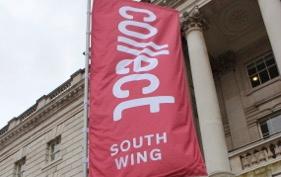
The first of the big national shows opens at the end of February and it is hoped we can review the show for the next edition of the magazine. Entitled ‘Collect’ it is brought to you by the Crafts Council of England and is at Somerset House in central London.
It is good to see that ceramic organization are still strong and working towards shows in 2026. Featured in this edition is the Southern Ceramic group which was started in 1975. By a small group of enthusiastic potters
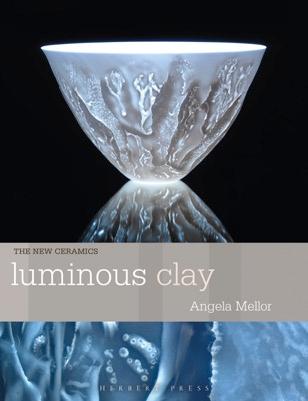
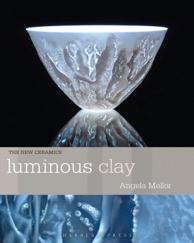
The new books for 2026 are ‘Luminous Clay’ by Angela Mellor and Throwing Clay by Rebecca Proctor, and both are published by the Herbe rt Press. They are beautifully designed and offer an insight for potters as to methods and the stories of others.

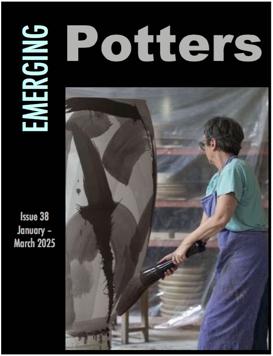
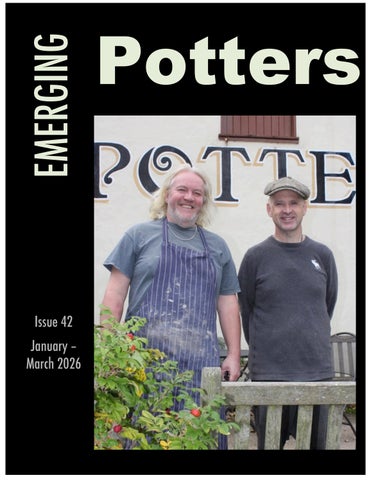
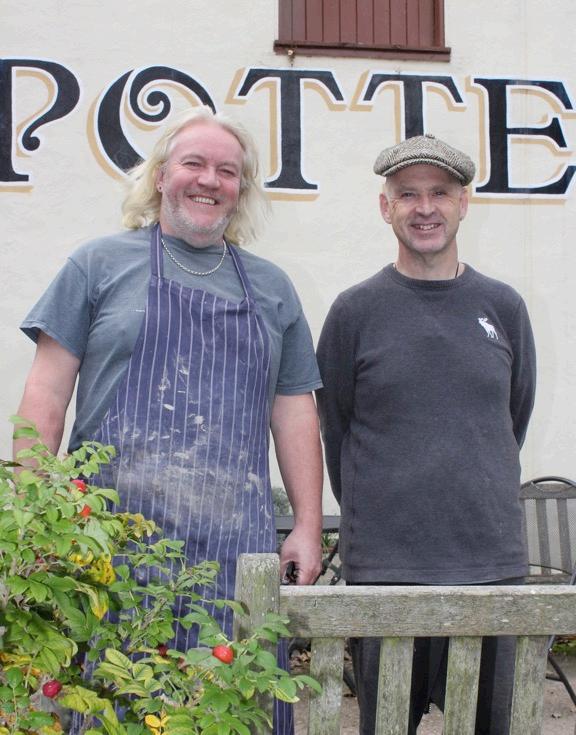
Front cover: Alan Parris and Billy Byles from Aylesford Studio in Kent.





The Impact of Covid


The affect that Covid has had on businesses has been fundamental and has brought many changes to how businesses are run. Here we have asked potters what it has meant to them.

Aylesford Pottery, Kent
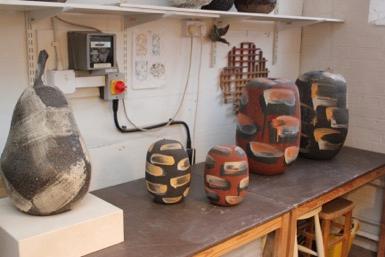
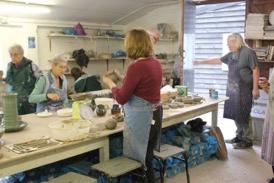
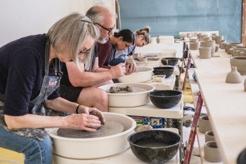
This pottery has two functions. One is a commercial studio making ceramic things to order, together with gallery for selling the domestic ceramics made in the studio. The second is a teaching studio for makers wanting to improve their work, or just starting out. A second building accommodates the teaching work. It is owned by two master potters; Alan Parris and Billy Byles.
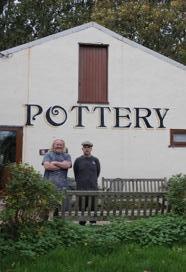
They commented: “As soon as the government rules for business and Covid were announced we knew we were in trouble due to the new social distancing rules. Nobody knew how they would be enforced. To comply we would have to reduce the teaching class size by 50% which would make it financially unviable. The only solution was to re-configure the existing space and have a maximum of 10 people per class They continued, “The main production studio which we work in has plenty of space and houses the kilns has not been an issue. He cost materials has not been a specific problem, but Brexit has been, with some materials impossible to order.
Looking at the profile of students during this period, the commented, “The influence of TV has kept the student numbers consistent through this period and up to this point in time. There is always a waiting list and we run three classes per day, four days a week, with special demonstration classes at weekends whe n possible. These are main based on Raku work with the students”.
this issue. We have grown (so need to fill more spaces) and it's clear that there are far more options available so whilst demand remains high it's also a very different landscape in London”

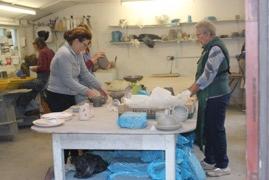
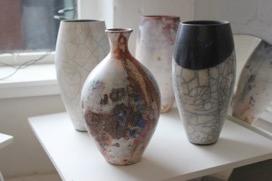
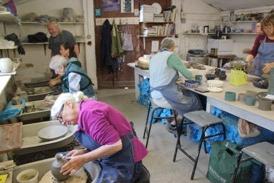
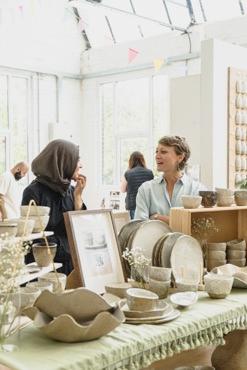
Kiln Rooms, London

There are now three studios they offer in south east London, and one in central London in Farringdon. Noe just over ten years old and run by Stuart Carey and Ben Cooper.
Ben commented, “Demand for classes and membership was strong before Covid, and during it. All of the studios has remained high since. I haven't seen much of a change throughout the Covid outbreak, but we were very involved with the day to day running of o perations.
It's difficult to piece together what the changes in demand were between March 2020 - end of 2021, as we had to postpone so many courses, and were working with restricted numbers on courses and had to chop and change courses dates when lockdowns were announced. Summer 2021 saw us open another studio, so our capacity increased, again meaning it was hard for us to track.
What I would say is that post pandemic there's been lots more studios like our opening in London, bringing far more competition . This is great for the user/customer but we don't have waiting lists as we did prior to 2020. Whereas pre -pandemic we rarely had this issue. We have grown (so need to fill more spaces) and it's clear that there are far more options available so whilst demand remains high it's also a very different landscape in London”.
International maker Kate Malone

Kate Malone is an international ceramic maker living and working in the UK. For many years she has had a studio in London, which she still uses but more recently has moved to a second studio and home in Kent for the production of her work. This studio is only open by invitation, with the sale of work being through her gallery owned by Adrian Sassoon in central London. Again it is only open by appointment.
Far from the international ceramics world is her other work with the FiredUp4. It is a charity which ra ises funds to introduce clay to young people, providing ceramic equipment and training in clay within a network Youth Zones across the UK being for the Clay Clubs.
With the impact of Covid this early introduction to ceramics is now even more important for young people. The traditional outlet for these young people used to be ‘Night Schools’ run by Local Authorities, which have almost disappeared and even art colleges themselves are closing or reviewed ceramic courses and their related cost.
On a positive note initiates like Fired`Up4 is a new outlet, as are the children’s courses run by independent makers who can give some time to teaching and have the space in their studios to comply with regulations.

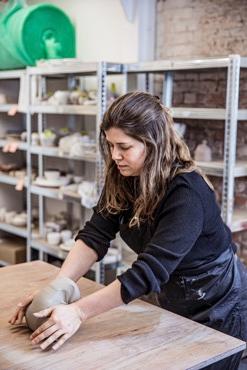
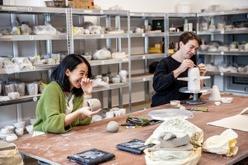
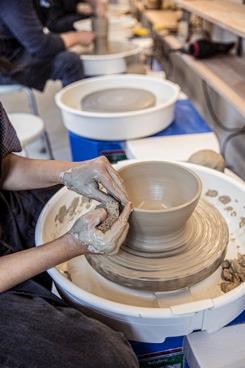
Turning Earth Ceramics Studios – North and East London
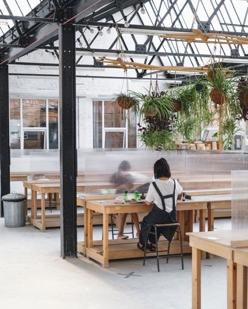
When the government first reacted to Covid, the business model at Turning Earth had to learnt how to adapt. We are an open-access studio: members can come and go whenever they want during our opening hours (students are in the studio too, but only during their class times).
The first problem was how to manage the social distancing directive. This impacted the number of students we could take, so we had to reduce them. We had to impose wearing masks for the whole time while being in the studio. We distributed bottles of hand disinfectant around the studio, built plastic and wood 'separators' between the tables and the wheels (to create some sort of more independent 'cubicles'). The cleaning and disinfecting duties were constant during the whole day.
The Covid -scare had an influence on members and students, radically decreasing the bookings and sign -ups. The situ ation changed when the lockdown was lifted, and numbers started to increase again, but as of today, we haven’t gotten back to our original pre -Covid numbers.
One of the first questions we had was the same as any other business – will the government and ba nks offer any financial support while closed at the start of the outbreak? Thankfully, we were able to successfully apply for a CBILS loan from our bank, and then we utilised the furlough scheme to pay our staff while our studios were closed. We were initially denied funding under the leisure, hospitality and retail grant scheme, but after considerable effort and campaigning, we eventually managed to obtain it.
TfL, the landlord at our Hoxton site, generously gave us an extended rent-free period at a new site, which we opened in order to give us the space to run socially distanced ceramics classes. While this support was crucial in allowing us to survive the Covid restrictions, equally crucial was the choice of many of our members to support us by continuing to pay their memberships voluntarily during lockdowns, a gesture of trust and generosity for which we will always be grateful.
One of the key lessons from the whole experience was discovering once again the importance of being able to connect with othe r people and use your hands and creative mind. We think that crafts and art in general kept many people sane during a very unstable period of our lives.



Book Review: Luminous Clay


Working with Bone China and Porcelain Paperclay
By Angela Mellor
Published January 2026. Paperback. 192 pages. £25. ISBN 9781789943894. Published by the Herbert Press, an imprint of Bloomsbury Publishing.


A contemporary guide to creating beautiful, translucent ceramics.
Porcelain and bone china are known and prized for their fineness, delicacy and translucence, but can be difficult to use. In Luminous Clay, Angela Mellor demystifies this exciting medium, encouraging more ceramists to work with these clays.
This essential guide presents the main methods of working with bone china, including mould making and slipcasting, along with techniques that have allowed Mellor to play with the transparency and surface of clay. Decorating methods, firing procedures and using electrical lighting to maximise translucency are also covered alongside examples from other ceramists.
Luminous Clay explores a unique way of working with bone china, where the introduction of paper pulp transforms the clay, allowing freedom of expression through hand- building. Gorgeous photography throughout the book demonstrates how ceramists around the world take full advantage of the whiteness and translucency of paperclay, creating extraordinary pieces that ripple and bend light.
Angela Mellor started working in bone china in 1991. Moving to Australia in 1995, she conducted research at the University of Tasmania, Hobart, and completed an MA at Monash University, Melbourne in 2000.
During this time she pioneered the use of bone china paperclay, gaining honourable mentions in Japan and Korea. Angela set up a studio in Perth in 2000 and was awarded a Crafts Council Grant to work with a lighting designer, culminating in a solo exhibition at Craftwest. She returned to the UK in 2006 to work in her studio in Cambridgeshire.


Book Review: Luminous Clay


There is much to commend this book, from its story of one potter who decides to change the course of her life and ceramic work, to the history and changes that porcelain has undergone.
Mellor points out that “Porcelain was not used by the studio potters until the md twentieth century, Before that, pottery was massed-produced in factories like Meissen and Sevres for high-end decorative pieces and tableware, sought after by the gentry”.
She notes in her journey with bone china – “Before the 1980s, only a few potters in England – notably Glenys Barton, who worked for Wedgwood, and Jaqueline Poncelet – had attempted to explore the potential of slipcast bone china for individual work. Since then, others have been attracted to its response to light, experimenting and trying to solve its inherent practical changes.
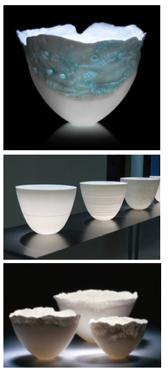

My first encounter with bone china was during the 1970s, when I visited Angela Verdon’s studio at the Gladstone Pottery Museum I Stoke-on-Trent. When illuminated the light passes through the pieces,
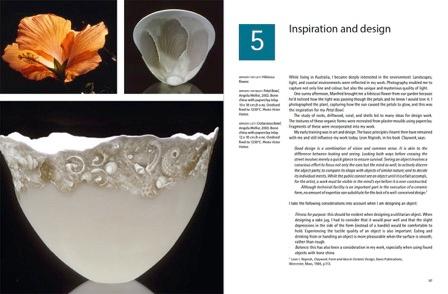
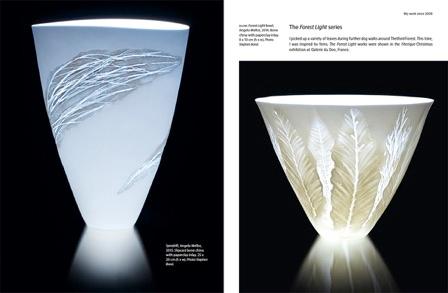
(above: pages from the book )

In 2006 she returned to England and decide to buy the gallery in Ely that belonged to Ronald Pile. The gallery is situated in a Grade II listed building, dating from 1658, opposite Ely Cathedral, and overlooking St Mary’s Church and Oliver Cromwell’s House.

Profile: James Hake



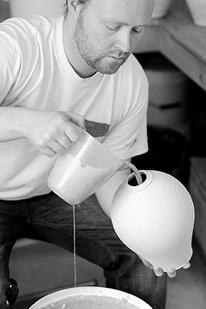
My studio is in a formerly derelict barn in rural Lancashire. After many years of renting a studio, I was able to renovate a former farm building to use as my workspace.

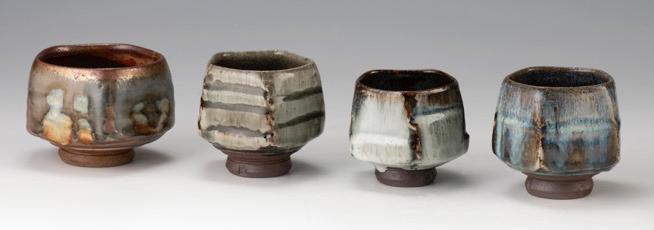
Over the last couple of years have made a range of wheelthrown stoneware ceramics decorated with oriental glazes.
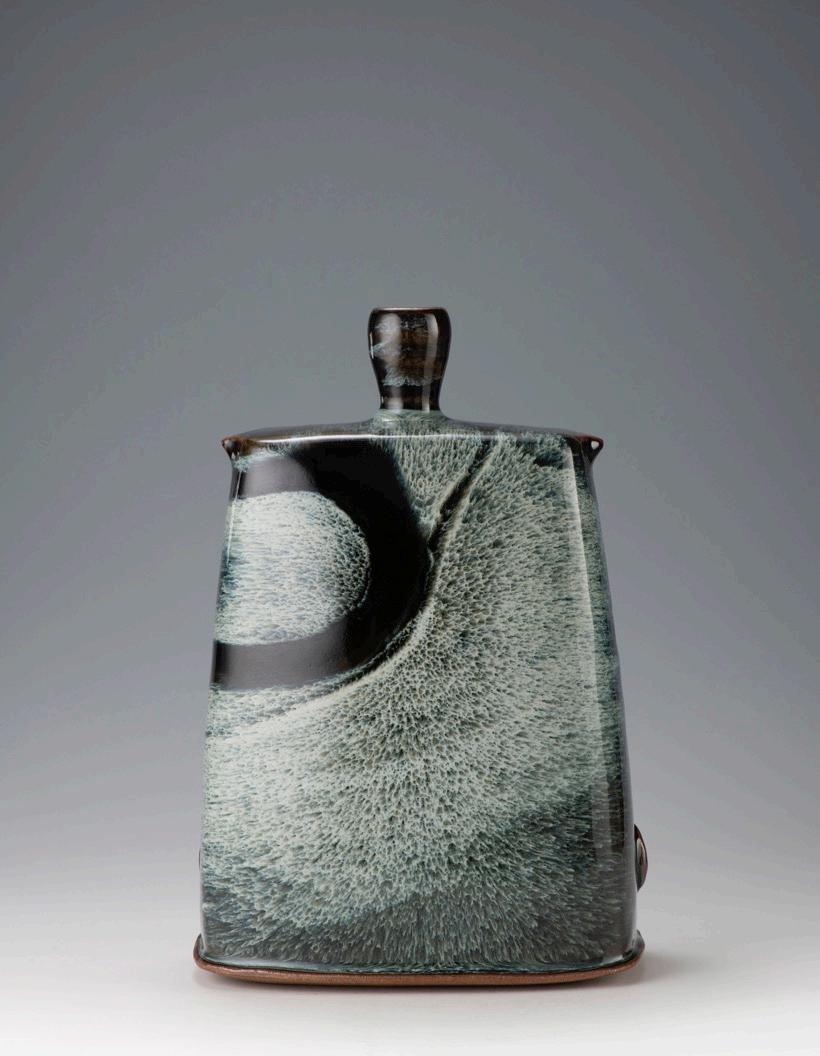
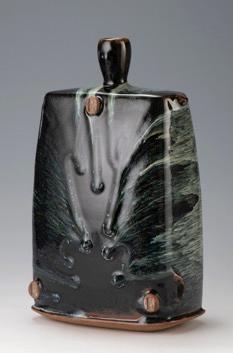
My work ranges from huge platters and bottles to delicate bowls and tiny lidded jars. Working at the wheel I produce work in a series, making families of similar forms each with their own subtle variations. Many of my glazes are made using local materials, gathered from quarries and clay seams in the countryside around my studio. Glazes are applied spontaneously by dipping, pouring and brushing in different combinations. During the firing the glazes fuse together producing fluid dynamic surfaces.
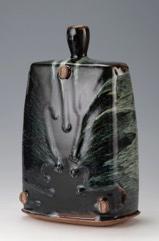
Recently I have been making thrown flasks which are fired on their sides allowing the glazes to run around the form instead of vertically. These pieces a created by joining together thrown components and then carefully propped on their sides in the kiln.
In my next collection of work, I would like to continue developing these thrown composite forms to create more sculptural asymmetric shapes. I would like to explore glazing these forms with my existing glaze pallet and perhaps fire them at different angles to make interesting glaze flows.

Where you can see his work
York Ceramics Fair 2026

Ceramics Art London 2026
Potfest Shows Oxford Ceramics Fair 2026

Profile: James Hake

Profile: Tanya Gomez


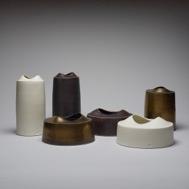
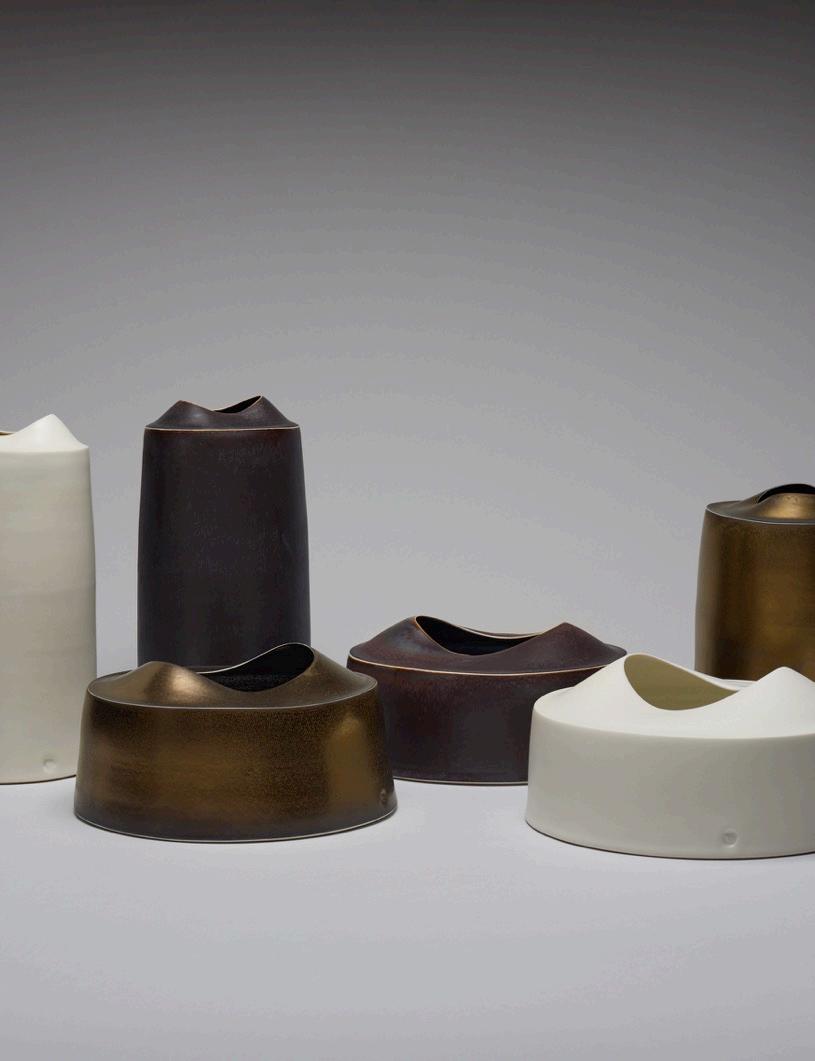
After exhibiting the bronze and dark glazes of Night Sea for the first time at Ceramic Art London in May 2025, I would like to create more and continue learning about the glazing process. I’m still experimenting with it, as it is so unpredictable. This is what makes it exciting, but also sometimes disastrous, as it can completely destroy a piece.
I have been fortunate to have some wonderful adventures this year. One to Yosemite at Easter, experiencing the vast, cascading granite facades and Half Dome, with a scattering of snow around the high peaks; and another to the Spanish Pyrenees in Ordesa, Monte Perdido, marveling at the ancient glacial limestones, with their layers upon layers of history. These visuals have been seeping into my new Glacier collection.
I’ve been making larger porcelain works and pushing the forms further by using slips and agate to create layered surfaces, and combining smooth and rough textures. I’m always challenging my thoughts and directions, exploring new ideas in my own ceramic way.

The works will be rich with textures and illuminating glazes that bring you in closer and observe and want to touch.

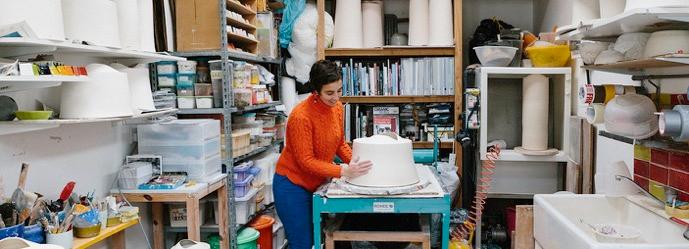
I currently have a studio at the back of my house in Lewes, East Sussex. It’s a converted garage measuring 6m x 3m, with a raised roof that makes all the difference, allowing in more light and featuring two dome windows above. I call my studio, The Ship. E verything has its place, though there’s a lot of juggling involved; throwing and joining clay, drying, glazing, and holding one- to-one lessons. The great thing of it being so close is that I am able to pop in to check how pieces are drying or to do an hour’s work when needed out of hours.
However, I’m always looking for a larger space that can better accommodate my needs as a ceramicist, which I can hold larger classes.
For 2026 I plan to continue developing the Night Sea works and exhibiting them more wid ely in galleries and exhibitions. I am exploring larger pieces that reflect my experiences in the mountains, bringing new textures and forms into the work. I have applied for Ceramic Art London and will have travelled to Jingdezhen, China, in October 2025! A trip that may lead to new ideas and future collaborations.

Profile: Tanya Gomez

Profile: Verity Howard



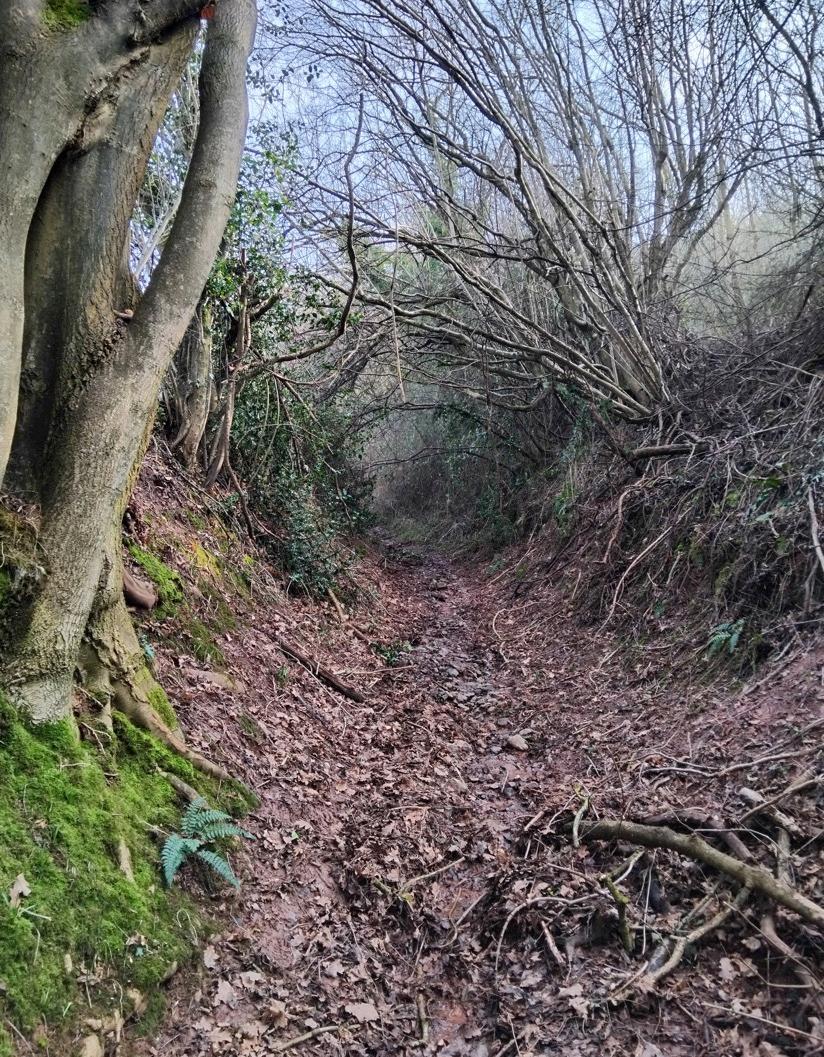
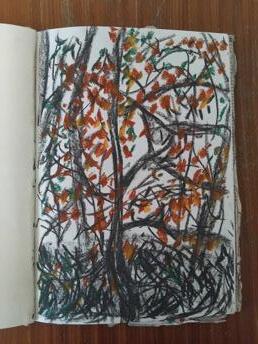
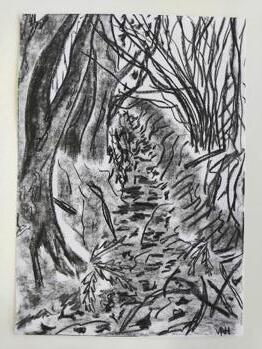
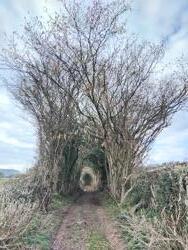
I have recently started a new body of work whilst undertaking a year long ‘ Developing Your Creative Practice’ (DYCP) project, funded by Arts Council England. As part of this project, I started new research into Herefordshire’s rural social history and I have become fascinated with old routes such as green lanes, hollow -ways and drove roads. I have walked and continue to walk many of the old drovers’ roads that still exist in the Herefordshire countryside today.
I love the feeling of walking through these old spaces and I am interested in how they are contained by our contemporary lives. While walking you can sense how much these routes have been used, the ground worn down and shaped by the people who have travelled through them. I am fascinated by this trace of human physicality and how the feeling of the past and the space it occupies is held by the landscape around it.


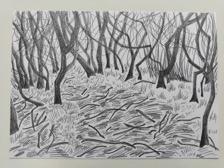
As well as taking many photographs whilst out walking I have also spent a lot of time drawing. I find drawing with time limits useful when trying to better understand a subject. The time restriction helps me to quickly get down what is most important to me on the page.
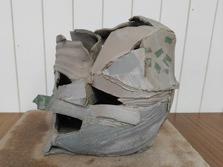
My new ceramic work of 2026 investigates my fascination with walking these old routes. For my colour palette I have taken inspiration from items I’ve seen such as wild flowers, lichen, farmers string, plants and trees. The surfaces of my ceramic sculptures explore the words trace, line and rhythm through mark making, texture and monoprinting using coloured slips. The form of my slab-built sculptures explores containment of space.
I have also been influenced by the many forms, structures and accidental compositions seen whilst walking in the Herefordshire countryside. I am interested in how my clay slabs come together and can capture the trace of the human hand, echoing the traces of humanity and the past imprinted on the landscape.
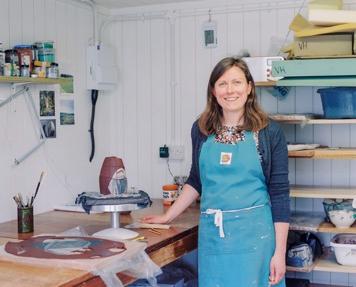
My studio is in my garden in rural Hereford. This is a great base to return to after walking in the Black Mountains surrounding Herefordshire, bordering England and Wales. I feel very lucky to be surrounded by such inspiring landscape to which I feel a deep connection.

Profile: Verity Howard




Profile:
Verity Howard




For the past year I have been taking part in ‘Made In The Middle’, a touring exhibition around the East and West Midlands, organised by Craftspace. ‘Made In The Middle’ will conclude at Midlands Arts Centre Birmingham, 14th February-11th April 2026.
I will be exhibiting in ‘Conversations with Ancient Landscapes’ at The Turner House Gallery, Penarth from 28th May to 28th June 2026. This group exhibition, curated by Nick Davies, involves a collaboration between Welsh and Cornish arts practitioners who are responding to themes of ancient landscapes and civilisations, liminal spaces, and geology viewed through a contemporary lense.
Exhibitors include: Kate Bell (Painter), Nia Bennett (Sculptor), Ellie Brown (Sculptor), Matt Cook (Lens Based Artist), Yas Crawford (Fine Artist Photographer), Nick Davies (Visual Artist), Maryanne Trefern (Hawes) (Painter), Verity Howard (Ceramicist), Sasha Kingston (Paper Artist), Sarah Person (Writer), Philippine Sowerby (Sculptor), Paul Wearing (Ceramicist).


I am aiming to take part in ‘Border Lands’, April to July 2026, an ambitious exhibition organised by Meadow Arts at Hay Castle, Hay-on-Wye. This exhibition will bring together a range of artistic voices and mediums that confront the emotional, political, and cultural dimensions of borders and boundaries. Border Lands is a three-year, place-based partnership project inspired by Offa’s Dyke and the Welsh Border region. It challenges the idea of borders dividing territory and communities and instead sees them as places of connection and shared identity.
In 2026 I am aiming to present a solo exhibition of my new body of work at Herefordshire Archive and Records Centre (dates to be confirmed). This will be my first solo exhibition in a museum setting and in a venue that holds an incredible range of important archive collections documenting Herefordshire’s past.

Profile: Tim Fluck



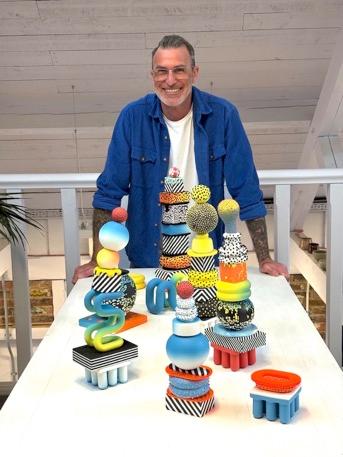
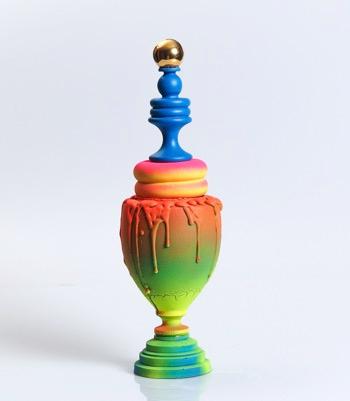
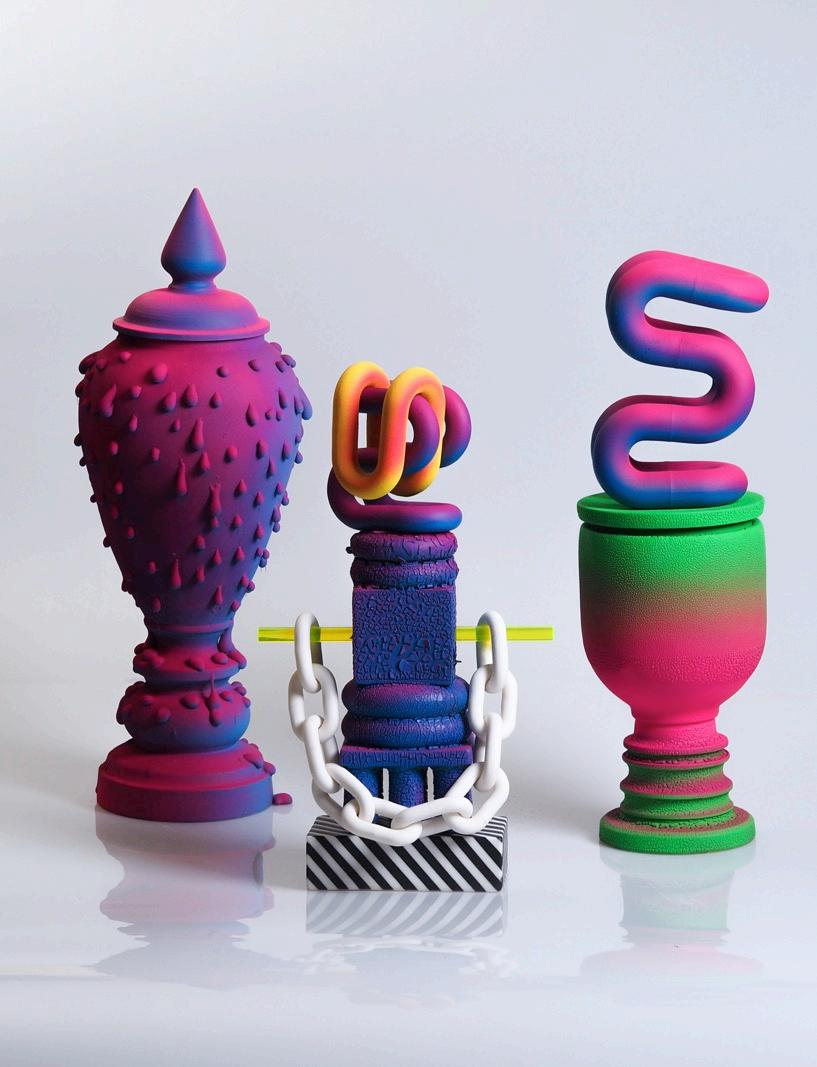
In creating art which explores an abstract interpretation of utopian theory, the work invites the viewer to use the art object as catalyst for exploring a different way of experiencing the world.
The attempt to set in motion, balance and juxtapose experience in order to real ise an outcome which conceptualises the process of ‘arriving’ as opposed to the ‘destination’. The importance of thinking about how we get ‘there’ not what ‘there’ looks like.
My practice developed from an interest in Brutalist architecture and the psychology of space. Research led me to investigate the concept of utopia and its relationship to architecture. Critical theorists, Juhani Pallasmaa, author of ‘Eyes of the Skin’ and Ruth Levitas (Utopia as Method), were a huge influence on my practice. Levitas’ s definition of ‘utopia as a process’, introduced the notion of a perpetual reach for an everelusive outcome.
Utopian thought is an essential part of peering over the horizon and into the future. My interpretation of utopia as process invites the viewer to use the art object as a catalyst for imagining different futures, where art creates a realm of hope.


Profile: Tim Fluck




Profile: Lucy Baxendale
My work starts as detailed automatic drawings in my sketchbook. I am fascinated by the journey from two-dimensional sketches to three-dimensional sculptures and I enjoy exploring the shifting relationships between the lines in my drawings as they are translated into 3D forms. The outcomes of these explorations are one-of-a-kind 3D drawings, intentionally unglazed and stained to echo the essence of a sketch.
It's important to me that I am constantly pushing myself to explore new things, challenging myself and the material I use (porcelain). In 2025 this has been the subtle introduction of colour into my work, and another avenue (since 2023) has been combining electronics & ceramics to create interactive pieces. These are both things I look forward to investigating further in 2026.
I’m really lucky to live and work in a beautiful building built in 1851 in rural Herefordshire. There are lots of lovely walks just on my door step and the environment around me has a definite influence on my work.

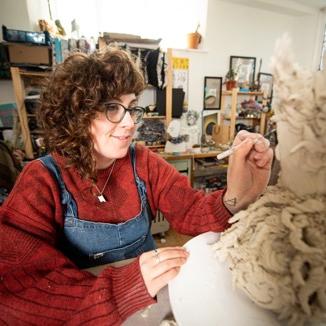
Not everything is in place yet for 2026, but a full list of events can be found on my website as they are confirmed.

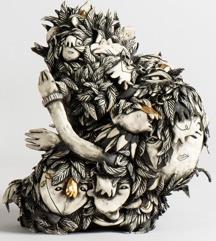
I’m excited to be part of ‘Kinetic’ at MAKE Southwest - A large-scale exhibition showing the possibilities of movement and making, where craft meets engineering. The exhibition runs from the 24th January – 18th April.
I’m really looking forward to returning to Ceramic Art London for my third year, and I’m also hoping to take part in my first international fair.


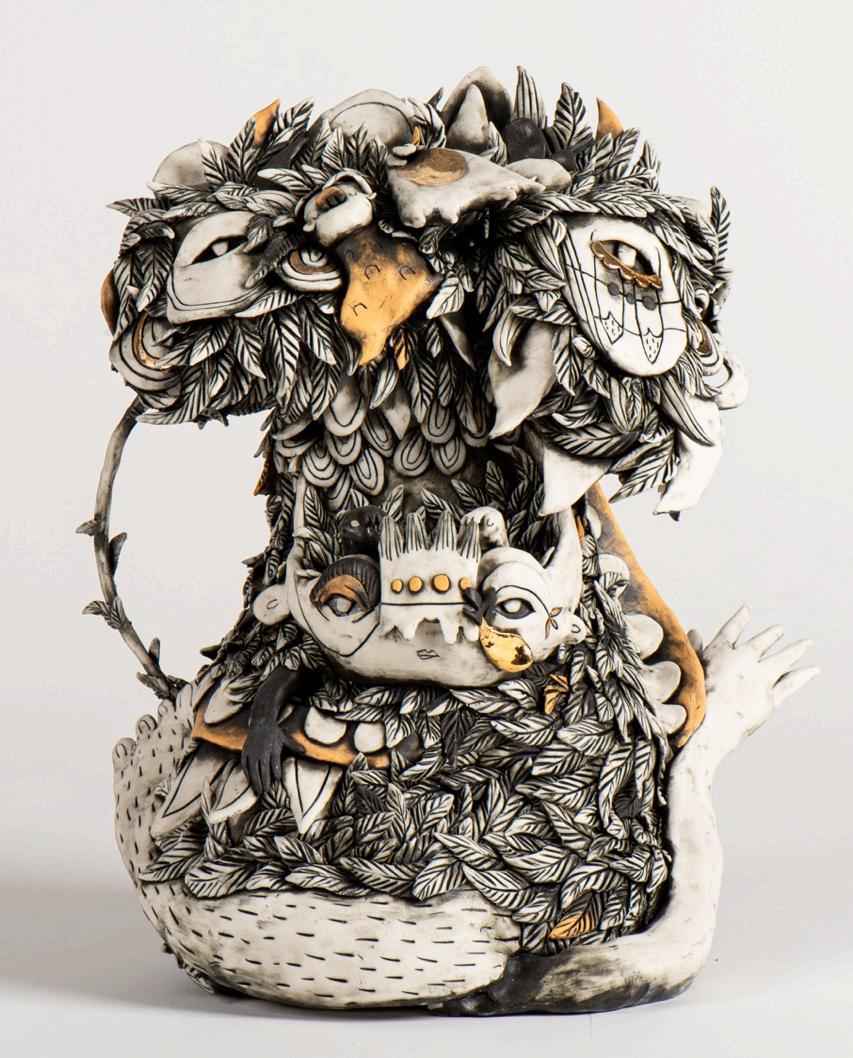

Profile: Lucy Baxendale
Photo: Dan Barker
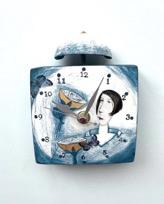
My new work is an exploration of illustrated clocks, and a range of brooches. Using a porcelain stoneware clay I am combining different forms with my detailed illustrations, which are layers of incised line with washes of underglaze, decals and onglaze enamels.
I work from my studio, in our old farmhouse home, up a single track road in the beautiful Renfrewshire countryside, 20 miles from Glasgow.
As well as selling online I’ll be applying for Potfest in the Park, one of the top ceramic shows in the UK. In October 2026 I will be teaching my ceramic illustration course at the International Ceramics Studio in Hungary .

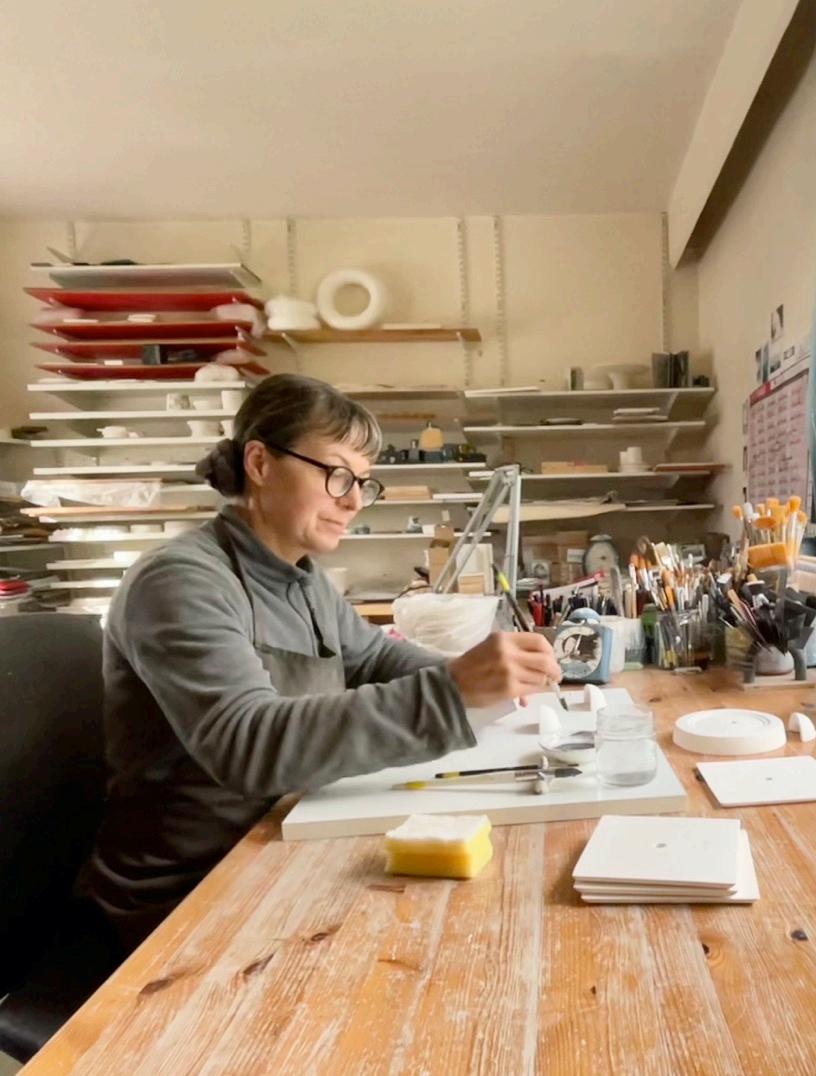
Profile: Wendy Kershaw




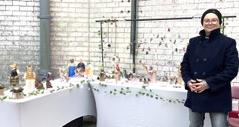
Wendy commented on the success of this year’s Potfest in Glasgow, “No one knew what to expect from a new venue, but a new city based Potfest, was the first of its kind. I was so surprised when it turned out to be my best show of the year. It was packed with visitors right from when the doors opened, and a lot of work was sold. There was even a potter from France. At least one stand sold out.
Glasgow’s Briggait, the old fish market, was a great choice of venue, large, spacious, and full of natural light. Right in the city, and with parking nearby. The show used one of two halls, and because of the success Matt Cox is planning to use both of the halls next year, going from 70 to 100 potters.
Most Potfests that I go to have an older demographic of established potters, who I know, but Potfest in the City was predominantly new young potters. It was great to see them, a whole fresh and vibrant upcoming group. I took lots of photos, but not as many as planned, as I was too busy restocking my stand!


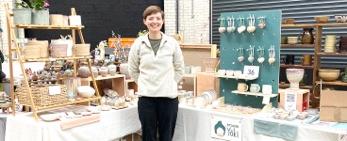

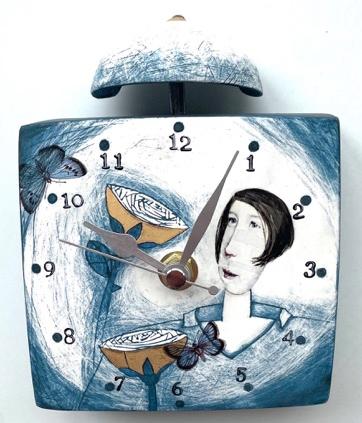
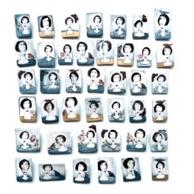
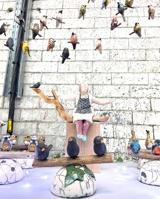




Clock series by Wendy Kershaw
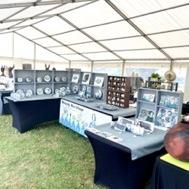
Below: one of the new makers taking part. Centre and right: French maker who sold out. Above centre: Wendy Kershaw stand.
Gallery Profile
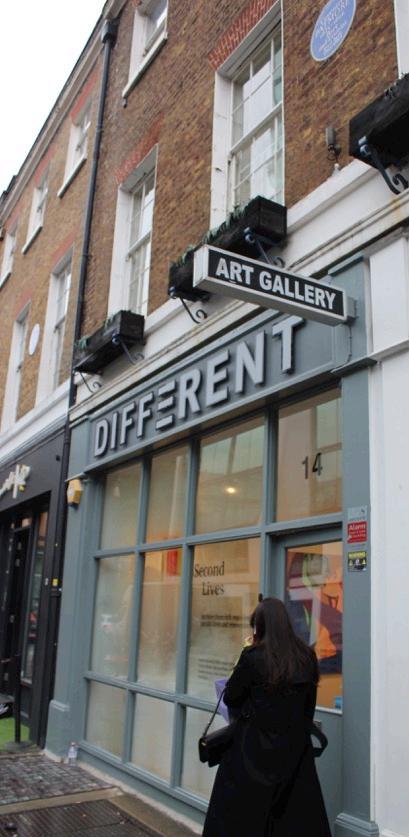
The DIFFERENT
Art Gallery –
Second Lives

Amongst all the shows looking to makes sales just before Christmas ’95 is a small gallery in central London called ‘Different’.

Their show was a mixed media presentation with two ceramic makers eing represented, Lucille Lewin and Nicole Farhi.
The show organisersare putting forward a proposition with their ten artists in Second Lives in that they all have had past or have parallel careers. In this show of paintings, sculpture, photography and installation, some of the atyists engage directly with their dual lives, others have used aspectsof their experience to inform their work. Tey have reimagined not only their world, but also themselves.
Lucille Lewin’s work was well represented at the Second Lives show. She completed her MA at the Royal College of Art in 2017 where she won the prestigious Young Masters Award at the age of 69. Her previous career had been in fashion retail with considerable success.

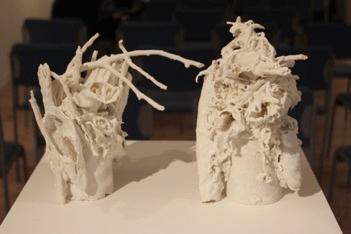
She founded the high-street chain Whistles, before becoming the creative director of Liberty. Her work can be associated with the tradition of Dehua in China and Sevres in France. The fine quality of the porcelain has an edgy contemporary quality.
Her work seemingly fragile has a forceful organic sculpture quality and demonstrates a power that controls the natural world. It also explores a warning of the dangers of reckless technological advances.
Nicole Farhi is synonymous with the worldfamous fashion brand she launched in the 1980’s. It was also the decade she embraced sculpture , studying under Jean Gibson and Eduardo Paolozzi. After leaving the world of fashion in 2012 she works full-time in her North London studio on both portrait busts and more minimalist approaches to her work.
For more than twenty-five years she had to fit sculpting around fashion. After her fashion label was sold. Her furst debut exhibition was at Bowman Sculpture in London in 2014, and since then she has gone on to have many successful solo exhibitions.
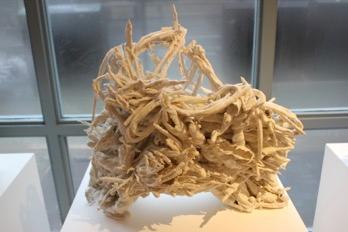

Second Lives ran from19 -24 November 2025.


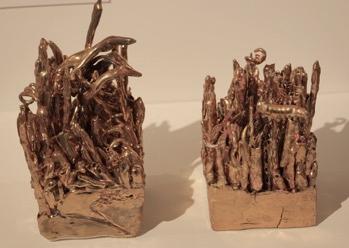
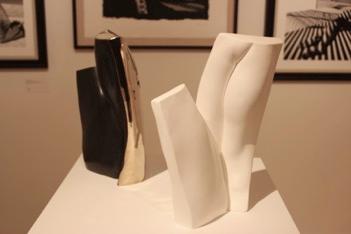

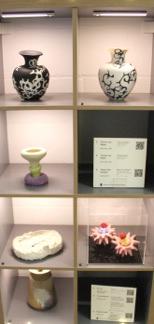
Top left: Lucille Lewin. Intimate Conversation 2025. Porcelain.
Top right: Lucille Lewin. Conundrum of Perception 1, 2019. Porcelain.
Above centre: Lucille Lewin. Langguage of Tears X, 2024
Above: Nicole Farhi. Vice Versa 2024
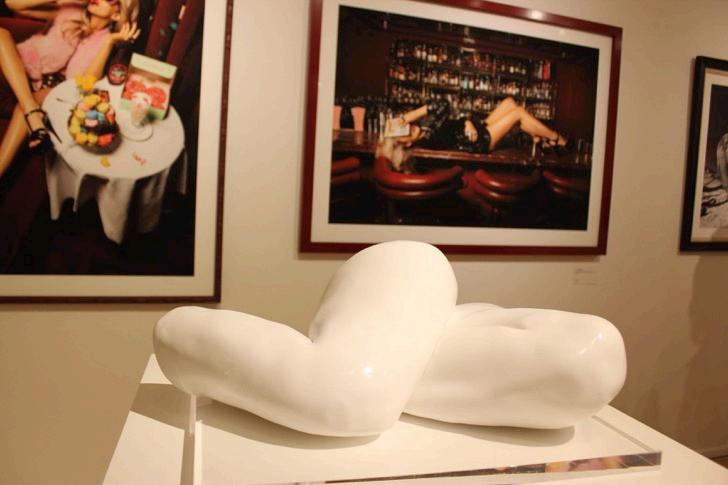
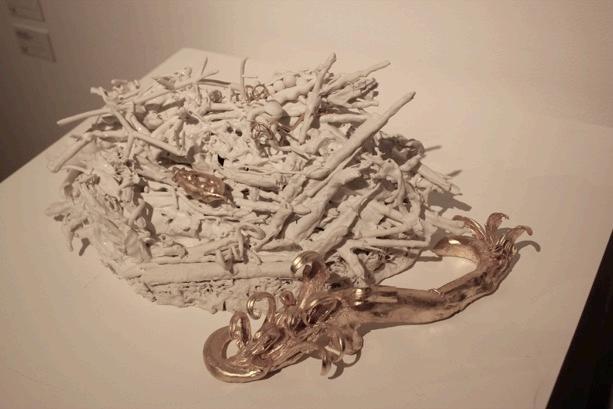


Above: Nicole Farhi. Recto Verso, 2024.
Left: Lucille Lewin. The Sacred Stillness, 2025
Craft Council: Collect show
26 th February to 1st March 2026
Somerset House, London
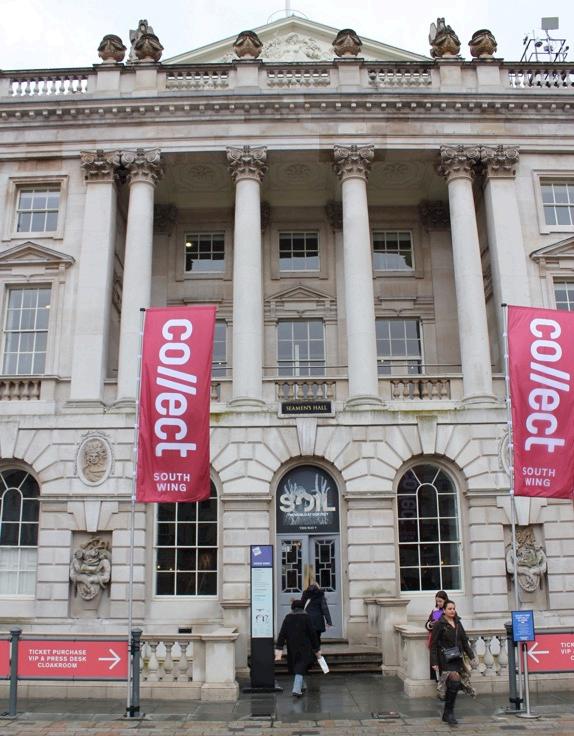

Image from the 2025 show

Craft Council: Collect show 2026
Tickets on sale Mid January 2026

Collect is the leading international art fair for contemporary craft and design. The fair is presented by Crafts Council and takes place annually at Somerset House, London.
Proudly positioned at the forefront of the contemporary craft movement since 2004, Collect brings together collectors, patrons, curators, art advisors and interior designers, and features international and British galleries showing museum-quality works in curated presentations.
Through the Collect Open initiative, the fair provides a platform for experimental installations by individual artists and collectives.
Each editi on of Collect showcases the work of over 400 exceptional living contemporary artists and designers, made from a range of materials with rich narratives.
These span ceramic, furniture, glass, jewellery, metalwork, sculpture, textiles, woodwork and more. Over 80% of work is made in the previous five years, with many pieces commissioned for the fair.
Collect has announced the 11 artists selected for Collect Open 2026, the annual showcase of bold, craft- led installations by artists and collectives.
Collect Open champions work that tells stories challenging material, social, political or personal perceptions, and cements Collect’s broader commitment to platforming artists who push the boundaries of traditional craft techniques, as seen this year in works which span from contemporary embroidery to silversmithing. Collect Open 2026 is presented in partnership with Spinocchia Freund.
TF Chan, Director of Collect, said: “This year’s Collect Open presentations stand out not only for their exceptional craftsmanship but for the compelling stories they tell.
Our eleven artists push the boundaries of their chosen materials, while expressing ideas of personal resilience, cultural heritage, ecological vitality and social change.
Together they offer a wonderful reflection on the richness and relevance of contemporary craft and design. I'm particularly pleased that our newly established bursaries have enabled us to include more UK-based artists from global majority backgrounds.
I'd also like to thank our Collect Open partner, Brigitta Spinocchia Freund, whose ambition and enthusiasm have helped bring the programme to new heights.”


50th Anniversary of Southern Ceramic Group

The Southern Ceramic Group was started in 1975 by a small group of enthusiastic potters. Their aim was to enable potters and sculptors normally working alone to meet other likeminded people and share ideas and techniques.
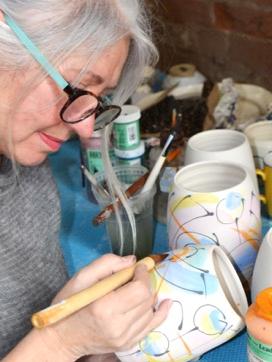


The idea worked so well that the Southern Ceramic Group now has over 200 members from Hampshire, West Sussex and the surrounding counties.
Members are potters, sculptors, professional and amateurs, teachers and students, collectors and enthusiasts. The group consists of keen ceramicists who live and work in the South of England and share a passion for creating in clay.
They are as diverse as the objects they create. Some have spent a lifetime perfecting their craft while others have come to it only recently, after careers ranging from engineering to medicine to dance and teaching. What they all share is intense creativity and a love of clay.


Lynn Nicholls working at Art Space Portsmouth
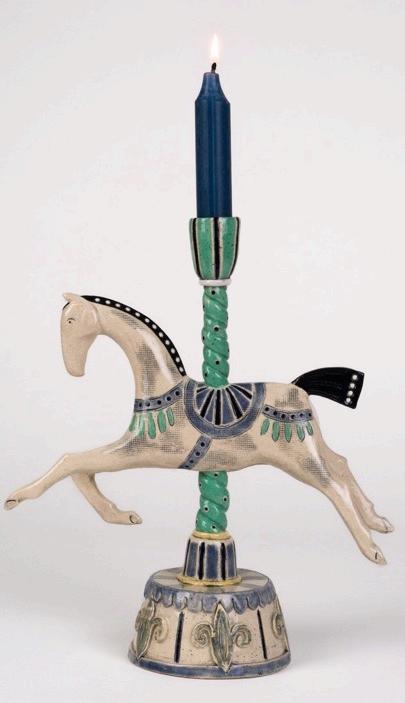
‘Carousel holder by Lois Mahoney
50 th Anniversary of Southern Ceramic Group
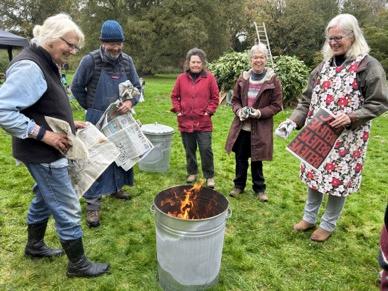





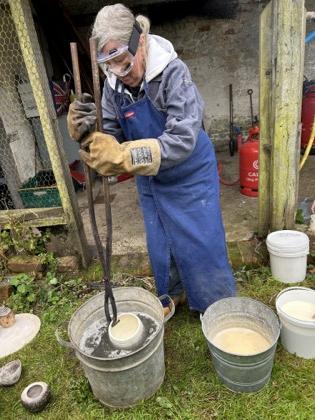


SCG Members at smoke firing session led by Margaret Newton
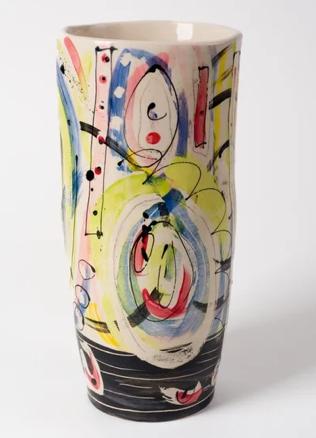
‘Tutti Frutti’ earthenware vase by Lynn Nicholls
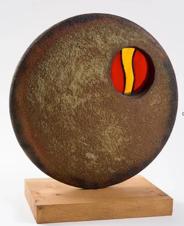
‘Suncatcher’ by Anton Page
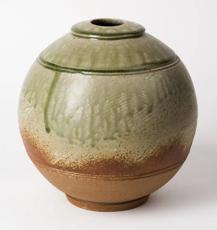
Ask glazed moon jar by Mick Dixon
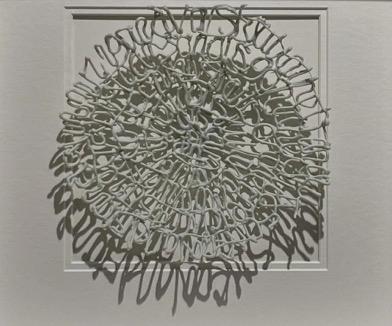
‘Words came off the page’porcelain piece by Teresa Munn
Jan Griffiths demonstrating obvara firing
Book
Review :

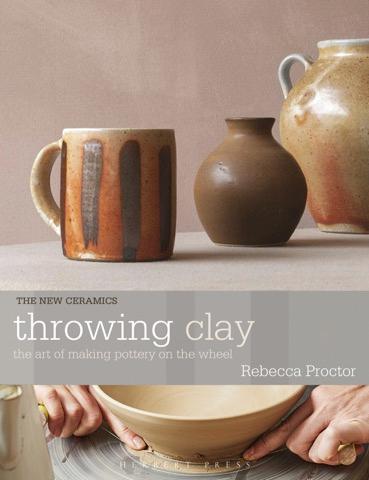
Throwing Clay: The Art of Making Pottery On The Wheel


By Rebecca Proctor

Published 26 February 2026. Paperback. 192pp. £25 ISBN9781789943535. The New Ceramics Series Published by the Herbert Press.
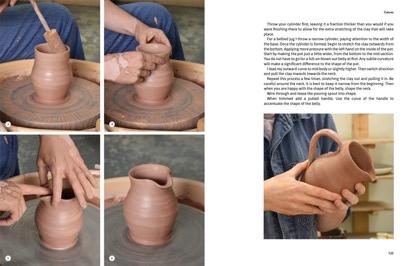
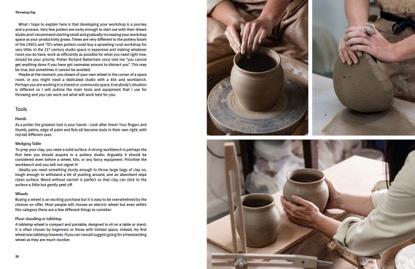
While a potter shaping clay on the wheel is both the iconic and familiar image we associate with ceramics, the skill is notoriously hard to learn. Using step-by-step photos and illustrations, Rebecca Proctor shows you how to master the potter’s wheel.
With an emphasis on craftsmanship, Throwing Clay demonstrates the specific techniques required to make a range of elegant modern tableware – mugs, jugs and plates as well as vases and more complex forms such as teapots. In addition, Proctor shares her insights on the art and practice of pottery and conducts interviews with other contemporary makers from around the world.
Including a combination of projects and gorgeous inspirational photographs, Throwing Clay is the ultimate guide for complete beginners and advanced ceramicists alike.
Rebecca Proctor is a potter and pottery teacher specialising in wheelthrown ceramics. Frequently commissioned by chefs and stylists, her tableware is used in some of Britain’s finest restaurants, as well as being found in homes around the world. Prior to making pottery, Proctor worked as a design writer and author. A lifelong fascination with craftsmanship led her to making pots as well as writing about them.


Book Review: Throwing Clay
The title of the book would imply that it is for people starting with ceramics. That is not the case, even if the basic points are covered. View it as a series of journeys to becoming a professional potter.
It is also routed in the craft side of ceramics and not the fine art interpretation. It looks at function, technical ability and truth for purpose. It is also a very attractive book to read and dive in and out of.
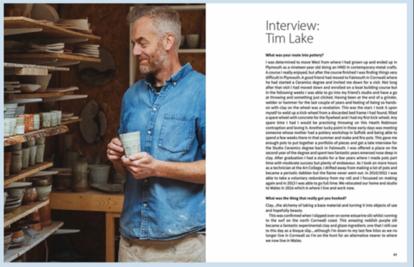
One of the things which makes it stand out is a series of interviews with makers working today and examples of each type of method in making things that have a use. They are:
Anne Mette Hjortshoi, Flenn Doran, Frances Savage, Yim Lake, Jessica mason, Julianne Ahn, Kate Whitaker, Malo Atelier, Sara Delesie, Peter Montgomery.
The technical aspects are covered with chapters on centring, bowls, cylinder, curves, flat out, jars and lids, teapots. Other areas of importance include environmental safety.
The start of the book covers the history and development of Rebecca Proctor. She starts her journey as follows, “For some people the backdrop of their youth is filled with hills, valleys, and beaches. For me it was bricks. Beautiful red bricks .. I grew up in the North West of England surrounded by handsome red brick Victorian houses.” She goes on to say, “ In Cornwall I was introduced to real craftspeople, who lived in dusty old houses and wore old clothes with holes in.I was fascinated by this breed of ‘The Unknown Craftsman”.
This is an informative and well deigned book and should be on every potters bookshelf.




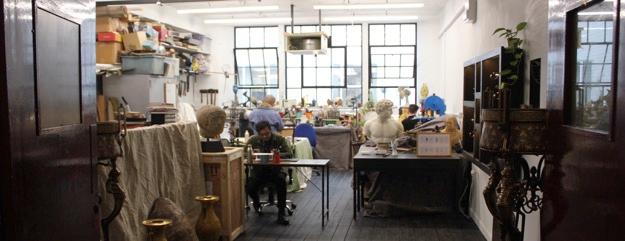
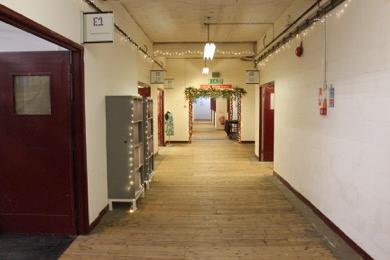
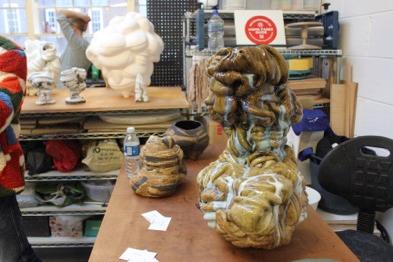
Cockpit Studios, London
At last I have managed to attend the studio open days at Bloomsbury . For some years I have made it to the second studio in Deptford. Both in London.
For over 30 years Cockpit has been nurturing creative talent in individual makers in a warren of corridors and studios. Given the cost of property in London it is a credit to them that studio space remains affordable and offers a platform for makers to launch their careers.
The Open Studio system is home to 175 artistmakers working across more than twenty craft disciplines. Cockpit is an award-winning charity that has been nurturing creative talent for nearly 40 years.



Cockpit Studios, London