From the Director of Development
Leadership is the theme of the 25th edition of Once a Caian…, which celebrates some of the many excellent leaders who have passed through the Gates of our College and have carried their Humility, Virtue and Honour forth to make a difference in the world.
As many of you are aware, Caius has recently undergone a period of transition in its own leadership as we welcomed our new Master, Professor Richard Gilbertson (page 6), in October 2025 to succeed Professor Pippa Rogerson. Richard brings a blend of ambition, intellect and humour to the role, and we all look forward to working with him over the coming years.
This year has also seen the appointment of Sarah Tebbutt as our new Senior Bursar (page 8). Sarah took up the role in March and has made a strong start at a time rife with development opportunities – and challenges – for Caius.
Caius’ alumni body boasts a great many leaders across the whole range of sectors, and shortlisting our interviewees for the magazine proved, as ever, a challenging task. Stories of other Caian leaders we have spoken to will be published on the News pages of our website, where you can read about the achievements of many of our students, Fellows, staff and alumni.
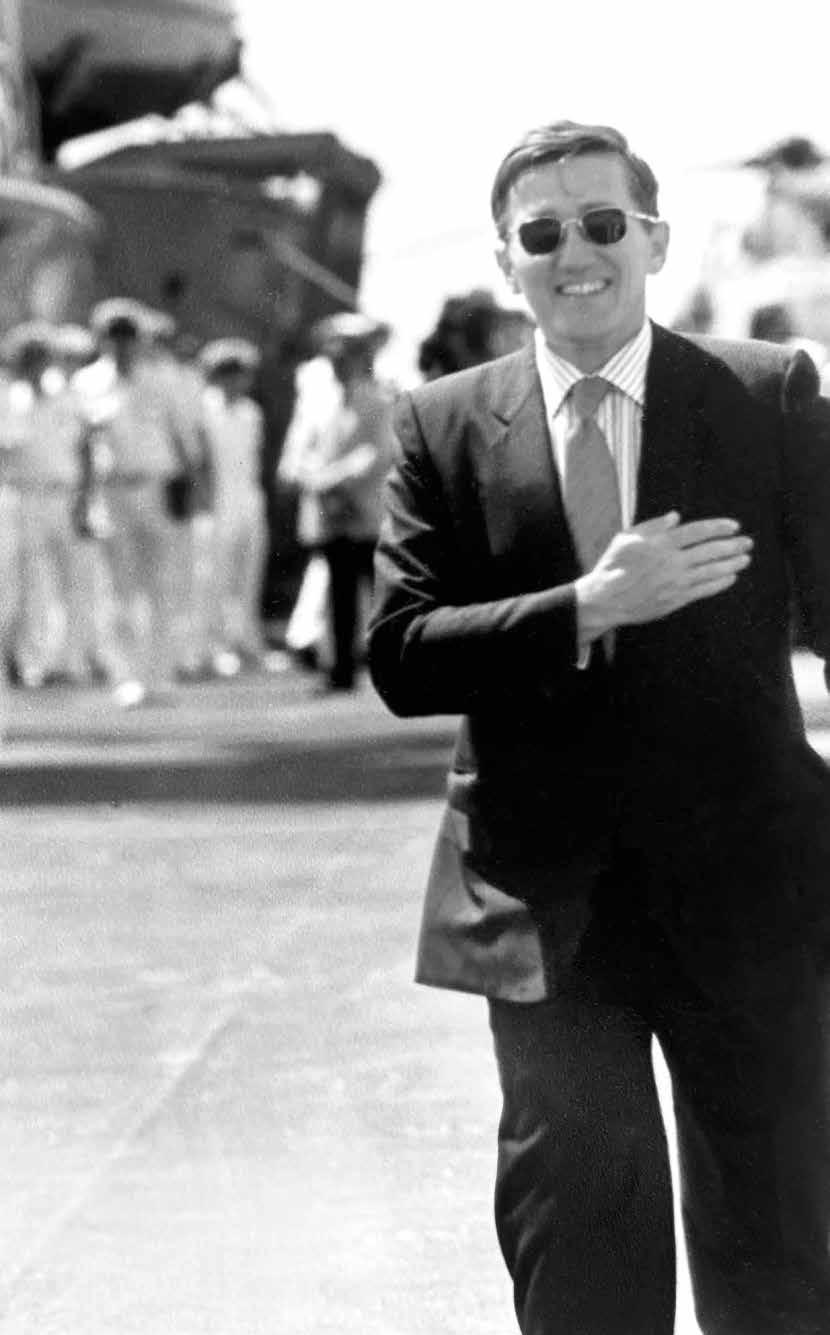
Featuring in all his glory on our cover this year is John Lehman (Law 1965), who shares insights into his illustrious career in the United States Government, particularly his time serving as Secretary of the Navy during the Reagan administration (page 10). Likewise making her mark in public service is Tor Garnett (Natural Sciences (Physical) 2004), recently appointed Commander National at the City of London Police following years of dedicated work to drive change and improvement in British policing (page 12).
From global television (page 16) to international finance (page 18) to world-class sport (page 20) and beyond, the presence and impact of Caian leaders is ubiquitous – and that is hardly a coincidence. All alumni featured in this magazine look back on their time at Caius as formative years for their leadership skills, and the College prides itself on offering diverse opportunities for students to develop these attributes. Postgraduate student
All alumni featured in this magazine look back on their time at Caius as formative years for their leadership skills, and the College prides itself on offering diverse opportunities for students to develop these attributes.
The College could not hope to thrive as it does without our donors and volunteers, and we remain ever grateful for the generosity of Caians.
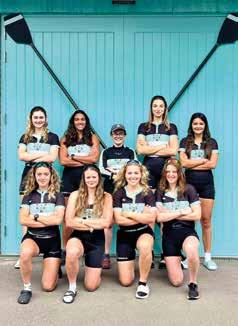
Lucy Havard (History PhD 2022) reflects on the challenges involved in leading the Cambridge University Boat Club women’s boats to success on the river (page 22).
It has been another busy and successful year here at Caius. The College could not hope to thrive as it does without our donors and volunteers, and we remain ever grateful for the generosity of Caians. A full list of those who have given their time or money to Caius in 2024–25 is published in this magazine, along with fundraising news to keep you up to date on our current priorities and recent achievements.
Once a Caian… is just one way of showcasing members of the College and keeping the Caius community alive. We know that many more Caians have their own fascinating stories to tell. The Development team is always keen to hear about and share what our alumni are up to on our website, on social media and in our e-newsletters. You can get in touch with us on development@cai.cam.ac.uk or +44 (0)1223 803720.
As the new academic year kicks off, we very much look forward to welcoming many of you back to the College over the coming months and to reconnecting in person.
DR MAŠA AMATT
College News
‘MISSING PIECE’ CARTOUCHE MOUNTED ON GATE OF VIRTUE
When the Gate of Virtue underwent forensic restoration in 2022, funded by Janice Hu (Oriental Studies 1992) – see Issue 22 of Once a Caian… for more information – the cartouche was so weathered that some of it disintegrated “like Weetabix”. The poor condition of what may have been the Elizabethan original, or a Victorian copy of the original, necessitated extensive research and dialogue on the design.
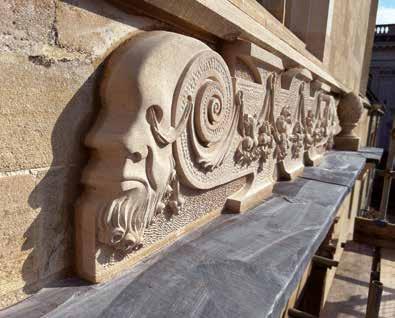
The restoration of the Gate is now complete following the installation in March of a new cartouche, funded by Eva (History 1982) and Roy Strasburger and carved by Master stonemason Richard McCrone. While computer technology could have carved a version of the cartouche, it was felt a hand-drawn, hand-carved ‘live’ work was most appropriate to preserve the integrity of the Gate and its historical significance.
CAIAN ACTOR MADE HONORARY DOCTOR OF LETTERS
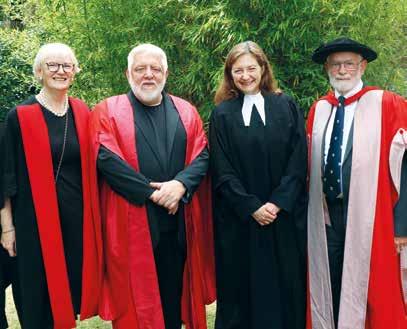
Sir Simon Russell Beale (English 1979) received an Honorary Doctorate in Letters from Cambridge in June. Renowned for his stage, film and television roles, Sir Simon is an Honorary Fellow of Caius, where he studied for his undergraduate degree.
A hand-drawn, handcarved ‘live’ work was most appropriate to preserve the integrity of the Gate.
ALUMNUS APPOINTED PEMBROKE DIRECTOR OF MUSIC
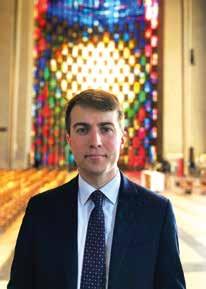
Luke Fitzgerald (Music 2016) has been appointed the next Janeway Director of Music at Pembroke. He will take up the post from September, moving from his role as Acting Director of Music at Coventry Cathedral to succeed Anna Lapwood.
HONOURS FOR CAIUS ACADEMICS
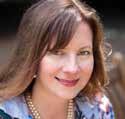
Professor Annabel Brett (Classics 1985 and History PhD 1989), Cambridge’s Professor of Political Thought and History and a Co-Director of the Cambridge Centre for Political Thought, has been elected a Fellow of the British Academy. She is one of 92 distinguished scholars, and one of 12 from Cambridge, elected to the Fellowship in 2025, in recognition of their outstanding contributions to the humanities and social sciences.
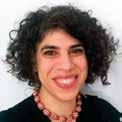
Dr Ruth Scurr, an Associate Professor and Director of Studies in Human, Social and Political Sciences, has been named Chair of the Royal Society of Literature, of which she has been a member since 2015.
Bye-Fellow Professor Mina Ryten is one of 54 exceptional biomedical and health scientists elected to the prestigious Fellowship of the Academy of Medical Sciences – one of four from the University of Cambridge – which now numbers 1,450 researchers.
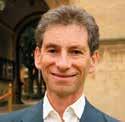
Caius Emeritus Fellow Professor Morris Brown, now Professor of Endocrine Hypertension in the Department of Clinical Pharmacology and Precision Medicine at Queen Mary University of London, was elected a Fellow of the Royal Society in May.
OUTSTANDING RESULTS FOR CAIUS UNDERGRADUATES
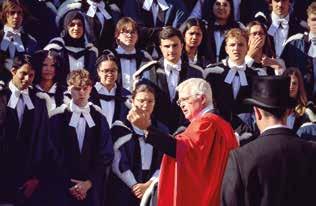
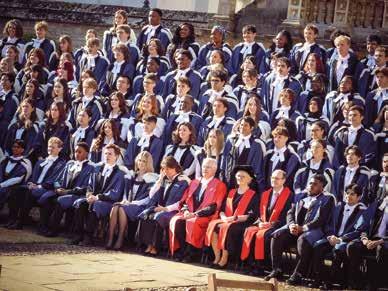
At their General Admission in July, this year’s Caius graduands celebrated exceptional academic achievement. Six Caius students topped their Tripos, with 46 per cent of the graduating cohort achieving Firsts. There were 17 students in the top five of their Tripos, and 32 in the top 10.
Dr Andrew Spencer, the Senior Tutor, said: “We are delighted for the graduands this year who have produced the strongest set of finalist results in the College’s history. Particularly remarkable is the very large number of students whose results strengthened through their time here to gain a First in their finals.”
“Rabbi Sacks, an alumnus of our College, was a towering intellectual figure whose ideas continue to resonate deeply.”
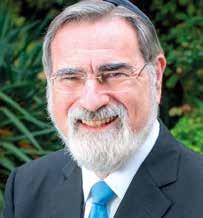
LAUNCH OF THE SACKS SEMINARS
Rabbi Dr Reuven Leigh delivered a lecture in May to launch The Sacks Seminars, a new collaborative initiative between Caius and The Rabbi Sacks Legacy. The series will begin in November and is designed to ensure that the ideas of Caius Honorary Fellow Rabbi Lord Jonathan Sacks (Philosophy 1966), who died in November 2020, continue to enrich the intellectual and moral life of Cambridge.
Caius Senior Tutor Dr Andrew Spencer says: “We are delighted to partner with The Rabbi Sacks Legacy on The Sacks Seminars.
Rabbi Sacks, an alumnus of our College, was a towering intellectual figure whose ideas continue to resonate deeply. This series not only honours his legacy but also enriches the academic life of Cambridge by inviting students and scholars to engage with his profound insights on moral responsibility and communal ethics.”
Introducing the 44th Master of Caius…
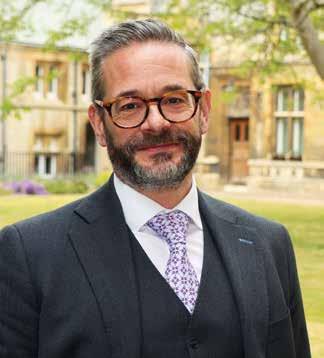
Professor Richard Gilbertson is the 44th Master of Gonville & Caius College, succeeding Professor Pippa Rogerson. Richard shares his story and his future plans.
Asick child, an artwork and a conversation with a friend in a pub proved seminal moments for Professor Richard Gilbertson. Richard, the incoming Master of Caius, was a student doctor when the death of an eight-year-old girl on a ward left a lasting impression. He felt helpless, like the medic in Luke Fildes’ 1891 painting The Doctor And he shared his feelings with a friend, Nigel, whose encouragement shaped Richard’s career.
“Watching this little girl Katie die of a brain tumour just completely changed my life. It was the most horrific experience watching her family go through it,” Richard says.
“I paint, and I was in the Tate Gallery in London and the painting reconstructed exactly what I had just witnessed: very sick child, helpless doctor, weeping parents.
“And then my friend Nigel said to me in the pub, after a few drinks: ‘Richard, it doesn’t matter what you do with
“
The single most useful thing I learned at St Jude’s is to get to know who you are leading, what motivates them and how together you can tackle the world’s biggest challenges.
your life, you’ve got to be responsible for a 15 per cent reduction in mortality of a disease’.
“Those three things happened in short order.”
This was 1986; 39 years on, Richard continues to be driven by those events.
Richard was Head of the Department of Oncology at the University of Cambridge and Director of Cancer Research UK (CRUK) Cambridge Centre, and a Fellow at St John’s College, until his appointment as the 44th Master of Caius. He will retain the Li Ka Shing Chair and continue his research career, focusing on understanding the link between disordered development and the multiple different brain tumour types observed in children.
Richard was born and raised in High Lane, between Manchester and the Peak District. While his elder brother attended a grammar school and went on to Oxford, Richard went with his friends to Marple Ridge High School, the local comprehensive. More likely to be found in the school lab than on the football pitch, his work ethic and talent were recognised by his teachers, who supported his love of science and ambitions to study medicine.
Childhood visits to his grandparents in the North East had left their mark and Richard applied to study medicine at Newcastle University, then the leading medical school in the country. He was also attracted by learning from the start in a clinical setting, where one moment influenced Richard’s whole career. He is uncertain why Katie’s death with medulloblastoma, the most common malignant childhood brain tumour, had the impact that it did.
“I don’t fully understand it,” Richard says. “I just felt a deep calling at the time to improve the outcome for children with these devastating cancers.”
Richard trained as a paediatric oncologist, combining clinical work on the wards with research and attaining membership of the Royal College of Physicians. In 2000, he moved to the United States. When he was recruited to St Jude Children’s Research Hospital in Memphis, Tennessee, Richard realised that to achieve his aim of a 15 per cent reduction of mortality – discussed in the pub with Nigel – he would need to transfer full-time from the wards to the laboratory.
“I have always missed seeing patients, but I love research and the impact we’ve had through it,”
Richard adds.
Richard embraced leadership roles at St Jude’s, the world’s largest children’s cancer research hospital, as he was promoted frequently in his 15 years there, becoming the institution’s Cancer Centre and Scientific Director, and Executive Vice President. He seeks to lead with altruism, infused with kindness and respect, while empowering others to excel.
Richard adds: “The single most useful thing I learned at St Jude’s is to get to know who you are leading, what motivates them and how together you can tackle the
To be able to put my head on the pillow at night and think I did the best possible thing I could for those around me, and for that community, brings a level of peace that is really important to me.
world’s biggest challenges. Only then can you create a vision for the institution that everyone gets behind and owns. If you can do that, it’s fantastic.”
Joining Cambridge as Head of Oncology in 2015, Richard developed a programme structure to make the most of the “intellectual powerhouse” and make a difference for the world. The CRUK Cancer Centre grew under his direction and continues to do so. It is in receipt of £100 million in grants which facilitate world-leading research.
One piece of advice from a senior colleague in Memphis which stuck was a 10-year rule.
“Eventually you need refreshing. But more importantly, the role needs refreshing,” says Richard. “Almost the moment you start to think ‘This is going really well’, it’s probably time you should think about moving on.”
September marked 10 years since Richard’s arrival in Cambridge, and a suitable moment for his move to Caius. He did not wish to leave Cambridge, given the complexity of running a laboratory with genetic mouse modelling, and his research is at his core. With Caius continuing a decarbonisation project and prospective developments of Radcliffe Court, it is an exciting time to join.
Richard paid tribute to Pippa, his predecessor, who joined Caius as a postgraduate student in 1986. “I think Pippa has done a brilliant job,” he says. “I already take size 11 shoes, but filling her shoes will be a big task!
“The approach that she’s brought in terms of thinking through how the College functions, how you can professionalise some aspects of it while retaining the traditions, is really important.
“And Pippa genuinely and clearly cares about individuals. That is something we share and that she’s done very well.”
Richard is unfazed about being new to Caius, as he will be able to bring a fresh approach. His ambitions for Caius centre on excellence, unity and financial sustainability, allied to the charitable objects of education, learning, religion and research.
Richard has had faith throughout his life but shares the sentiment of William Wilberforce, the abolitionist and his historical hero, who, Richard says, described God as “a gross inconvenience!”. For Richard, this is in the context of his work – the death of innocent children from a devastating brain disease – and his private life, after the end of his marriage of more than 30 years with the mother of his three children.
Richard says: “In most of these situations in life, the most important thing is to be honest. And if you don’t know the answer, you just say ‘I don’t know’.”
Richard’s honesty brings contentment.
“For me to be able to put my head on the pillow at night and think I did the best possible thing I could for those around me, and for that community, brings a level of peace that is really important to me,” he says.
SMALL WORLD AND PUBLIC SERVICE
Patrick Chinnery does not recall the moment he first met fellow first-year undergraduate student Richard Gilbertson at Newcastle University in 1986. But the new Master of Caius, where Patrick has been a Fellow since 2016, left a lasting impression.
“I couldn’t say that I can remember that very moment when I first met him, but I very much remember him,” Patrick says.
“He is the same person that he was then. His warmth, his interest in you as an individual, his humour, his fierce intellect – it was all there when I first met him.
“I didn’t see him for 20 years when he went to the States, and it was only when we were both recruited back to Cambridge that we reconnected, in 2015. He was the same genuine person that I knew all those years before.
“He’s a man of enormous energy, integrity, intellect and humanity. And I think he’ll be brilliant for Caius.”
The pair took similar, but divergent, career paths, in different areas of medicine.
“It’s a small world, the saying goes, and I think it’s very true,” Patrick adds.
“He trained in paediatrics and I’m an adult neurologist. They’re very different worlds in medicine. But what’s remarkable is just how small the world is and how, despite the fact that you’re in ostensibly very different disciplines, you can come together.”
Like Richard, Patrick has combined his clinical and research specialties with leadership positions. Patrick’s key research interest concerns the role of mitochondria in human disease and investigating ways to develop new treatments for mitochondrial disorders.
He is now the Executive Chair of the Medical Research Council (MRC), while also running his own research group and working as a clinician at Addenbrooke’s. Clinician scientists have to learn to compartmentalise and rely on their team from an early stage, says Patrick, whose role with the MRC is about influencing the whole of medicine.
He says: “I hope that my scientific background and my clinical background give me a perspective that ensures the decisions are in the right direction. Ultimately this is about improving the lives and the health of people across the UK and beyond.
“Although I thoroughly enjoy research and we’re still doing very exciting things, I’ve just been drawn to look beyond my own little niche area and try and have an impact beyond the immediate space I can influence in my clinic or in my research lab.
“The motivation is around public service: trying to make the best decisions, influence the best decisions so that we can have the greatest impact.”
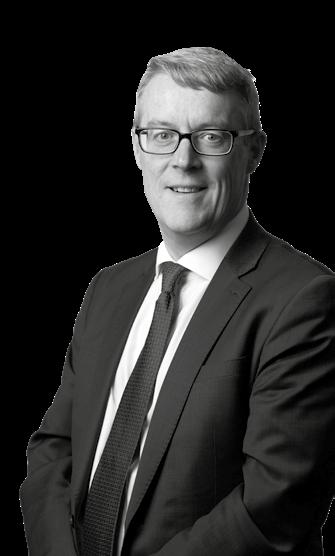
A sense of purpose
Sarah Tebbutt was appointed Senior Bursar of Gonville & Caius College in March 2025. She discusses her career story and her initial impressions of the role as the College’s most senior financial and legislative official.
Cambridge has long had an allure for Sarah Tebbutt.
As a child growing up in Ely in the 1970s, Sarah recalls visiting the city and seeing long-haired students on King’s Parade and wanting to be one. She moved to Shropshire and attended Shrewsbury High School for Girls before matriculating at New Hall (now Murray Edwards) to read Biological Natural Sciences.
Summer internships saw a change in direction –unsuccessfully growing algae at the Science Park was a dispiriting process – so Sarah initially worked in IT before joining the Civil Service fast track scheme. Cambridge continued to be attractive to Sarah, and after a varied and stimulating career in the Civil Service, she applied to be the Senior Bursar at Caius, taking up the position in March 2025.
Speaking at the end of her first full term in post since succeeding Robert Gardiner, who retired in January, Sarah reflects on being embraced by the friendly community and the challenges of the role.
She says: “The role is even more varied than I thought it would be when I went for the job. What can turn up from hour to hour can be anything from someone wanting to talk about a will, to a problem with a carpet in a building.
“Some of the best things are people trying to work out how we can support students, or how a new Fellow can be supported. Even the smallest things can build something that will have an impact.”
Sarah’s career took her from IT consulting, to HM Treasury, the Foreign and Commonwealth Office, the Department of Culture, Media and Sport (DCMS) and National Savings and Investments (NS&I).
Latterly, she was Director of People and Strategy at NS&I, and People and Workplace Director at DCMS, and she has a reputation for calmness in a crisis. Sarah brings to Caius her people skills as she bids to enhance the sense of community which she has already felt in her short time in post.
She has dealt with national and international challenges in her career: the financial credit crisis and NS&I’s website being overwhelmed by the clamour for over-65s bonds among them. She also played a role at DCMS in the behind-the-scenes support for events ranging from the funeral for Queen Elizabeth II and the Coronation of King Charles III, to the Birmingham 2022 Commonwealth Games and Eurovision. And she has balanced this with family life, bringing up four children, now aged from graduates to current university and A-Level students, with her husband, a Deacon for the Catholic Diocese of East Anglia. Faith is important to her.
Having been a student of the University of Cambridge herself, Sarah knows the value of small group teaching, learning from experts, and the instant friendships which form and last. Her Director of
Studies, Janet Moore, was “wonderful, enthusiastic, extremely kind and encouraging”, and David Summers of Caius was among her lecturers. Now he is a colleague. Many of the friendships she made have endured.
She attended debates at the Cambridge Union and wrote for Varsity newspaper, while enjoying life alongside her academic commitments.
“You’d cycle down the hill every day and find something amazing at the bottom of it,” she says.
Promoting and supporting the student experience is highly motivating, despite the financial challenges. Tuition fees fall short of covering the academic offering at Caius, a College which has a significant endowment but relies on assets and investments, from retail and food and beverage tenants, to farms, offices and an aviation technology venture, to supplement the core academic needs.
“You have to strike a balance between Caius now –today – and all the different needs of students and Fellows, maintaining the wonderful buildings, and bringing in income,” Sarah adds.
“You have to balance that against the need to have the endowment for future generations and not draw down too much from it or there won’t be anything for the next intake. I bring forward recommendations and it’s for the Fellowship and the Council to decide what’s best.”
Projects at Caius include the redevelopment of Radcliffe Court, on Rose Crescent and Market Hill.
Sarah adds: “It’s a very exciting opportunity to do something both for the College and for Cambridge. That’s what drew me to the role in particular.
“I’m quite fussy about who I work for or who I work with. An organisation has to have a really good sense of purpose and great values. It’s really important to me to work somewhere that has a sense of service and giving to others.”
Sarah believes that she has found that at Caius.
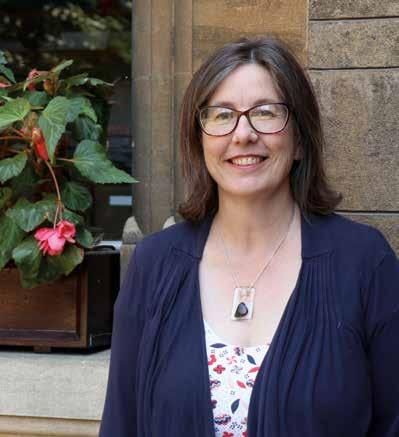
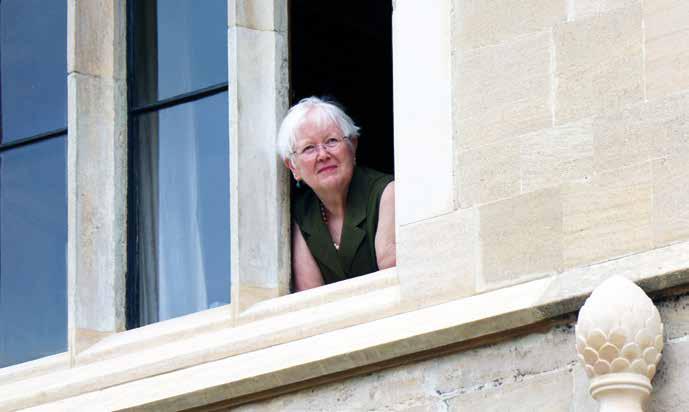
Community leadership
A DEAN’S ROLE
The Revd Dr Carolyn Hammond is the Dean of Gonville & Caius College, the religious lead. She explains how and why the Chapel is central to the College.
When students matriculate at Caius, The Revd Dr Carolyn Hammond introduces herself.
She explains her role and why, whatever students’ religious or non-religious beliefs, she is a resource and help for them. Their football allegiances are of as much interest to Cally, as she is known, a devout Arsenal supporter.
“We’ve been multicultural and multifaith for a long time, long before I got here,” says Cally, who has been at Caius for 19 years.
“One of the biggest problems about trying to explain my existence to people is that if we’re a multicultural, multifaith institution, why do we have a Church of England priest? And that is partly a historical thing. Religion is one of the College’s statutory purposes, and religion means ‘the ties that bind us together’.”
Cally also does some Classics teaching and academic writing. She says her role as Dean is about making the Chapel, in the centre of Old Courts, a centre point of the community and “as open and inclusive as it can be”.
“
All of us should be building up the community of Caius; we do it in different ways, depending on our roles.
“We are bound together by this identity, as members of this ancient institution,” she says. “All of us should be building up the community of Caius; we do it in different ways, depending on our roles.”
She describes her role as like that of the traditional parish priest, to be “there as a support for everybody”.
She adds: “We all need someone to talk to, somebody who is there to be a listener and can point you in the direction of help that you might need. What really matters is that everybody can see that I’m here for them. That’s why I wear my dog-collar.”
The wider University takes its provision of sufficient chaplaincy seriously for all faiths. Caius also has a prayer room, a quiet space for non-Christian people of faith, or people of no faith.
Cally says morning and evening prayer is a pattern of daily life, “as routine as brushing one’s teeth”. The Chapel is a venue where the community can gather and be aware of the historical significance of the College and the people who have gone before us, like Edward Wilson, John Venn, Jeremy Taylor and many other eminent alumni.
She adds: “The Chapel is the place where we do the things that matter most to us. If you ever go into a church or a chapel, you should be able to feel the presence of the past. In Caius Chapel, I think you do.”
Camaraderie at Caius & in the US Navy
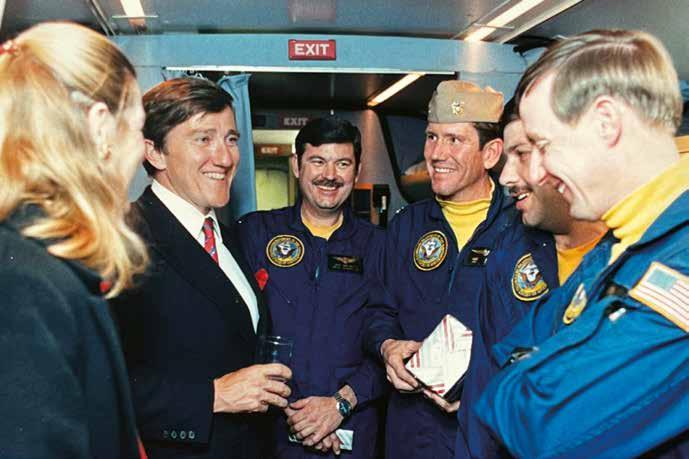
Throughout his life, John Lehman (Law 1965) has excelled as a leader in the United States Government, as Secretary of the US Navy and in his own business ventures. Openness to the people he works with has always been fundamental to his conception of strong leadership.
“
Ihave always been a firm believer that leaders are born not made, and from the time I was 10 years old I wanted to lead,” says John Lehman, founder of private equity firm J F Lehman & Company and former Secretary of the US Navy (SECNAV). An early determination to make a difference in spheres of international importance led him to attain his first degree in International Relations in Pennsylvania, where he grew up. He then set his heart on continuing his education at Cambridge, which he felt was the ideal place to learn vital leadership skills. Caius did not disappoint and provided John with ample training. In addition to serving in the US Air Force Reserve during his years as a Cambridge student, he was elected Captain of Boats at Caius Boat Club after suggesting
major transformations to the club’s method of training, with a significant positive impact on their success. On the academic side, he found engaging in supervisions crucial to developing his ability to articulate ideas compellingly and publicly, which has been of the utmost importance in his career.
Above all, it was the people and the intellectual conversations he enjoyed at Caius and Cambridge more broadly that left an impact. John says: “Your peers are an important part of your education, and my years at Caius were some of the best of my life because you would go to the pub and start arguing about things that were important. You would be hardpressed to find any organisation you are part of as you grow older that has the mix of fascinating human beings that there is at Caius.”
After Cambridge, John returned to the US to complete his military
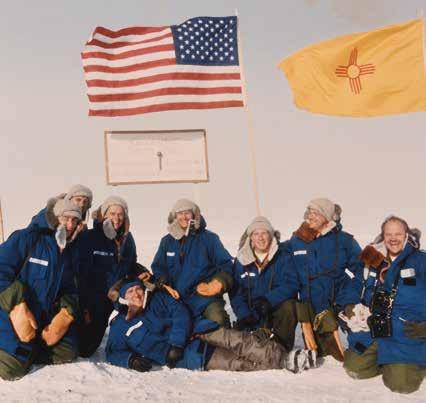
training, receiving his gold wings as a Navy aviator. He served as a ‘weekend warrior’ in the Navy Reserve for 25 years including duty in Vietnam, the Middle East and Antarctica, retiring with the rank of Captain.
John’s lifelong dream of succeeding in leadership has unquestionably been fulfilled. His first job after Cambridge was a position working for Henry Kissinger on the National Security Council, and in 1977 he founded his own aerospace consulting company, the Abington Corporation. After four years heading the latter organisation, John was appointed SECNAV in 1981 under President Ronald Reagan and remained in office until 1987.
With responsibility for managing 1.2 million people and an annual budget of US$95 billion, while also facing ever-growing tensions at the height of the Cold War, John’s job was no easy task. While in office he developed the Lehman Doctrine, a plan for a military response to a Soviet invasion of Europe promoting the building of a 600ship Navy which would allow the American military to gain the upper hand in the Cold War. His proudest achievement is that the strength of the US Navy provided Reagan with the military edge necessary for negotiating with the Soviet Union and avoiding the need to resort to fighting.
In recognition of John’s services, the Navy is naming its next Arleigh Burke-class guided-missile destroyer USS John F Lehman. John feels “very honoured indeed” to have received this accolade.
As in his time at Caius, John found the people he worked with to be the best part of leading the Navy. “To be a successful leader, you have to like people,” he says. “The military services attract innovative, interesting people you like to be around. I tried to hire people who were better than me at certain things so that I had a team around me that I really respected. There was nothing more exciting than to be seen by them as a leader and to provide the leadership to help them to succeed.”
John admits that, being by nature highly open to and trusting of people, he has on occasion made misjudgements in appointing personnel and his trust has been betrayed. Continuing in the face of such mistakes is for him a core aspect of leadership. He adds: “You have to be fully aware that everybody makes mistakes and that you can’t succeed over a long time without failing and blundering sometimes. But you can’t let that shake your confidence that, by and large, you know what you’re doing. If you have good people around you and proper preparation, it gives you that confidence to proceed.”
Besides his government and military career and his investment work, John has amassed an impressive array of leadership credentials. He is Chairman of the Princess Grace Foundation, a charity offering financial support to emerging performers, established to honour the legacy of John’s cousin Princess Grace of Monaco. John was also a member of the 9/11 Commission and has served on the boards of multiple companies.
Drawing on his extensive life experience, he has authored nine books to date on matters relating to the American military and national security. He is writing a new work, Saints and Sinners I Have Known, which focuses on inspiring figures who have had a significant impact on John’s life. One of these individuals is the late Professor Sir Elihu Lauterpacht, who was a Law Fellow at Trinity College and John’s Director of Studies during his time at Caius.
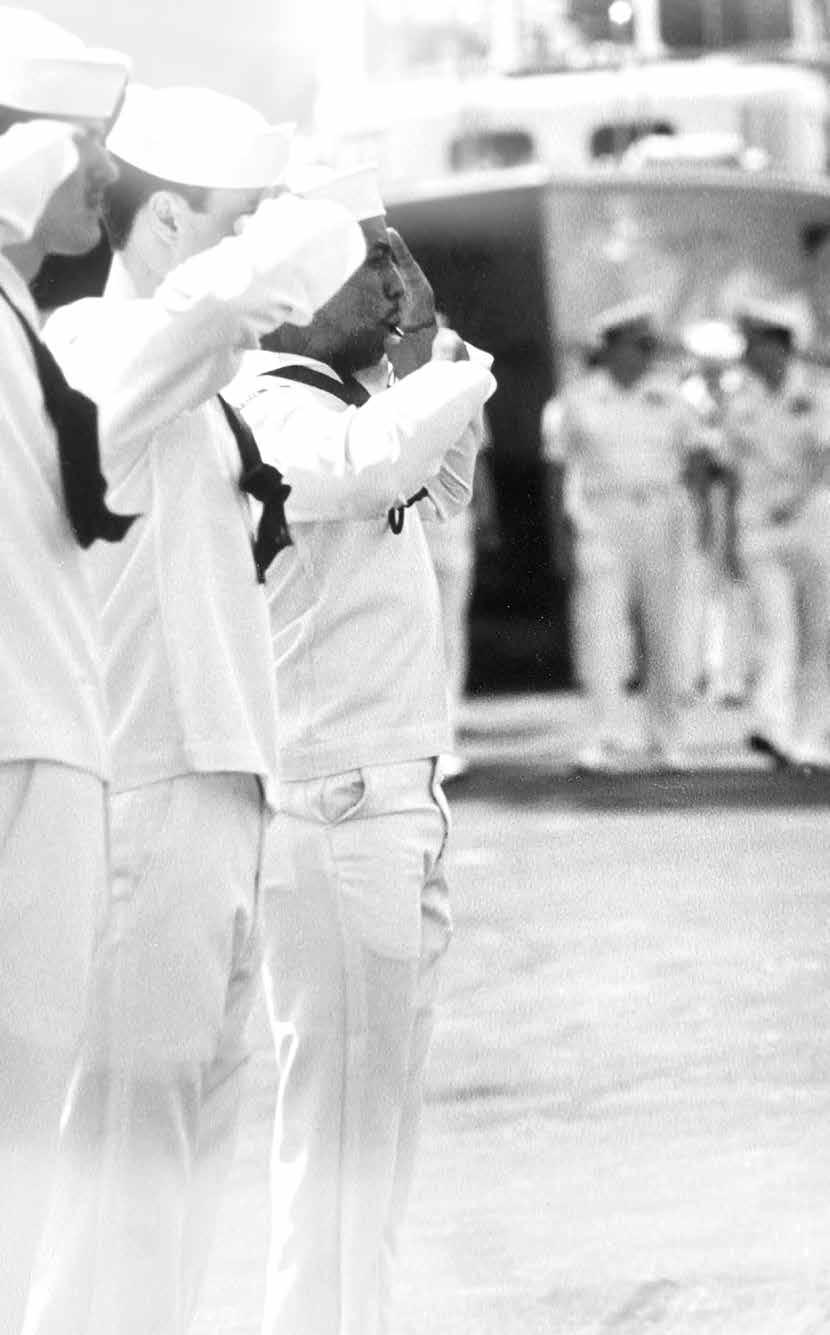
John and his crew at the South Pole, 1986
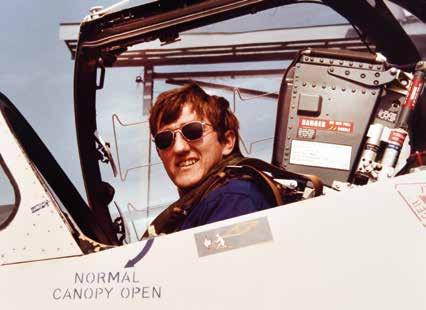
About to take off in an RAF Hawk trainer
Pioneering in the police
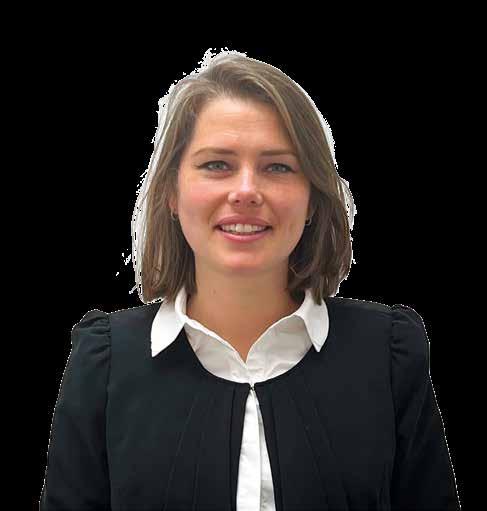
Driving change and improvement has been the cornerstone of Tor Garnett’s (Natural Sciences (Physical) 2004) career in policing. Recently appointed Commander National at the City of London Police, Tor now leads the national policing response to economic and cybercrime.
Tor Garnett is on a mission to serve the public through reducing crime and supporting frontline officers to have the tools to make the difference during some of the toughest moments of people’s lives. She started out trying to make practical adjustments during her first role as a police constable in Hackney, London, where she established a Borough Improvement Team. Since then, her CV has only grown more impressive as she has founded and led a number of initiatives and programmes to make a positive difference to policing.
A passion for public service was instilled in Tor after her father died on a family holiday when she was 11. Inspired by the positive impact that professionals who respond to life-changing events can have, she began to explore policing as a potential career route. At 16, she undertook a day of work experience with Cressida Dick, later the first female Commissioner of the Metropolitan Police.
“I thought her behaviours and her character and how she led was fantastic and undoubtedly trained through years and years of policing and managing that sort of risk, that kind of mission,” says Tor. “So I said to people when they asked, ‘Maybe I’ll go into the police’. And then I thought, ‘I’m going to have to back my chat and do it’.”
Much of Tor’s attitude in her work has been underpinned by the ways of thinking and learning which grew at Caius. As GCSU President and Head of Security on the May Ball Committee, she gained practical experience in leadership, learning to organise, problemsolve and make persuasive cases to authority figures. She also found herself surrounded by inspiring people. She singles out Professor Pippa Rogerson, her Tutor from whom she has learned a great deal about leadership.
“Policing often says to follow the evidence without fear or favour, and I think Professor Rogerson’s legal background, her value set and how she leads are exactly that,” says Tor. “What does the evidence say, what’s the objective point of view? She listens to everything and then makes a decision in the best interest of the mission.
“She leads without fear, and you have a real respect for her because she’s ultimately values-based and will go into the fight if it’s needed, while also being pragmatic.”
In 2015, Tor, at the time a Metropolitan Police Detective Inspector (DI) in Waltham Forest, cofounded Police Now, the UK’s only national graduate programme into policing, with fellow DI Dave Spencer. At Cambridge, Tor had seen big banks and consultancy firms bend over backwards to recruit talented graduates, and the lack of any similar recruitment scheme into the police force left her puzzled.
“Policing is one of the most fascinating jobs,” she says. “In terms of leadership, and intellectual and practical stretch, it’s almost unparalleled. And yet we weren’t managing to sell that well enough.”
Police Now was Tor’s solution. Modelled on the Teach First programme, the course offers graduates two years of fast-paced on-the-job training as neighbourhood officers, after which they can choose to continue in the police or follow a different career path. Across the two years, young, high-octane leaders learn to build trust and confidence, balance limited resources and develop their problemsolving skills – all while boosting local policing efforts.
Tor adds: “Police Now has recruited over 3,000 incredible officers in the last 10 years, and it’s made a real difference in terms of innovation. Some great leaders have now come all the way through from the programme to be sergeants and inspectors and chief inspectors and superintendents. I’m very proud of it.
“What I learned from Police Now was real respect and enjoyment of working with other leaders who have similar beliefs but different skill sets. Working out how you build teams that don’t descend into grubby compromises but consult and collaborate to get an even better, more impactful product or process – now that I am a chief officer in policing, that’s what I think is really exciting and really hard.”
Police Now is just one of Tor’s many achievements. She also founded the Commissioner’s 100, a programme where frontline officers and staff pitch and then lead strategies for improving policing, and launched and led Take:90, a campaign uniting over 90 businesses and charities to reduce everyday acts of aggression and violence. Ever determined to expand her knowledge of policing methods and gain new perspectives, Tor spent five months at the evidence-based policing centre in George Mason University, Virginia on a Fulbright Scholarship, and after this served for six years as a Fulbright Commissioner.
Tor was named Commander National of the City of London Police in February 2025, and now oversees the response to fraud, illicit finance and cybercrime.
Reflecting on her first few months in the role, she says: “I have really enjoyed the size of the challenge, and I’ve enjoyed – and on occasion felt overwhelmed by –the scale of what I need to understand, the details, the numbers of people I need to know, and how policing can continue to be part of the solution.
“It’s a fascinating time in policing for tackling fraud and cybercrime and money laundering – particularly cyber-enabled fraud, as the IT is becoming more sophisticated. But really, like most of the big improvements in tackling crime over the last 20 or 30 years, it’s about working between the public sector and businesses to design it out where possible. It’s not a traditional policing set-up. It’s complicated, and it needs a very modern sort of policing and a lot of collaboration with other agencies, nationally and internationally.”
Policing is one of the most fascinating jobs. In terms of leadership, and intellectual and practical stretch, it’s almost unparalleled. “
FAILURE POSITIVE RESULTS VS
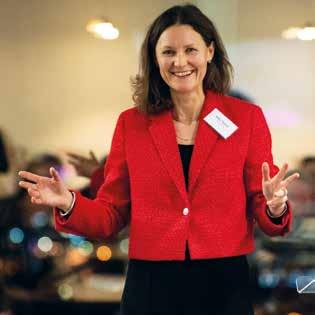
Leadership has been the defining feature of Katy Tuncer’s life and career.
Katy Tuncer (Natural Sciences (Physical) 1999) has forged a gritty and varied career path as a serial founder and now as an innovation leader, speaker and coach. By guiding others in their own leadership journeys, she finds fulfilment in being a catalyst for positive change in the world.
Leadership has been the defining feature of Katy Tuncer’s life and career. In addition to her more ‘traditional’ leadership roles as a Troop Commander (Second Lieutenant) in the Royal Signals, and Head of Planning, Performance and Risk Management at the Metropolitan Police, she has founded nine business ventures of her own. The latest of these, Horizon37, established in 2017, offers bespoke leadership coaching programmes to improve the performance and results of scale-up businesses.
Katy remembers her student days at Caius as a very happy time of her life. She loved everything about her undergraduate years and was awarded the Lock Tankard for general contribution to College life, but she admits that she tended to prioritise athletics over her academic work. This was only partly to her detriment, however, as her presidencies of the Cambridge University Athletic Club and the Women’s Blues Committee allowed her to develop skills that have been integral to her career. In particular, her confidence in public speaking – which she now does to audiences around the world, presenting on leadership – grew in these roles.
On one occasion, Katy had to speak in front of Prince Philip when he visited Cambridge to meet the captains of women’s sports at the University. She says: “Formal presentations like that gave me that starting point of being able to command an audience and land a message. That was pretty formative.”
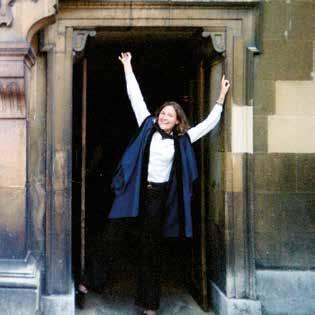
“If you can be generating leadership in others, the impact you can have is bigger.”
Though her focus was on the running track, Katy also developed beneficial skill sets from her studies that she has carried forward into her professional life. The intensity of her student workload was valuable training for her work over the years as an advisor and coach to hundreds of different leadership teams, where on a regular basis she must rapidly get to grips with new businesses and figure out how she can best help them.
“We have a central promise of results at pace at Horizon37, and if you’ve been in an environment like Caius, you can’t muck around,” Katy says. “You learn how to get the key substance of something quickly, and you get belief in yourself that you can do that, and that it’s a normal and good thing to do. That gives you a level of conviction and willingness to embrace new things more quickly.”
Thanks to this ability to work at speed, Katy thrives in her coaching role, having guided over 300 growthbusinesses since founding Horizon37. Realising outcomes quickly without “getting bogged down in the process or being right or looking a certain way” has always been central to her idea of leadership. The HorizonMethodTM, which Katy invented and launched to underpin Horizon37’s programme content, facilitates the development of this fast pace while also ensuring that coaching is interactive and personally relevant to each leader.
Katy sees great coaching as being a leader of other leaders, defining leadership as “generating positive results through others”. As an entrepreneur herself, she has always been driven to make sustainable differences to communities, and as a coach she enjoys using the expertise she has built up to help others make their own positive impact where it matters to them. The chief executives and senior leaders Katy coaches have scaled and exited innovation businesses, transformed global teams in corporate and public sector organisations, and aligned strategies to achieve outstanding commercial success in growth businesses at all stages.
She says: “If you can be generating leadership in others, you’re an even bigger catalyst, and the impact that you
can have is bigger. That’s why I’ve chosen the career that I have, because it’s all about having the maximum impact on results.”
Using her wealth of experience as a founder and a coach, Katy has authored seven aides-memoire on business leadership, identity, culture and other themes. More recently, she has combined her expertise with her creative side and is writing a business fiction book. The book, which is in preparation, follows the founder of an innovation medical technology business. It is set in the future and explores what it takes to go on a founding journey while also reflecting on how current human-led innovation differs from the way the world might be for the generations ahead.
In her work, Katy has been able to maintain a connection to Cambridge and has been a Visiting Lecturer for the Judge Business School’s MBA course since 2018. Among the range of leadership themes on which she speaks both here and in her Horizon37 coaching is how failure can be a platform for daring. Of the nine ventures Katy has founded, she considers only two – Horizon37 and a consulting firm operating across three continents to support sports leaders – to have been unambiguous successes. The others have either succeeded in ways different from their intention – such as Ready Steady Mums, which failed as a commercial company but became a community programme to connect and empower women –or have not taken off for various reasons.
“You’ve got to realise that you can fail and you’re still okay,” Katy says. “As soon as you can say ‘I’ve made some failures and that’s fine’, you then have the freedom to take many more risks, to innovate more and to be able to make a better assessment of what is an unacceptable level of risk because the failure would be genuinely catastrophic.
“The key to being great at leading innovation is to be able to take a balanced view, not to fall into despair or to go into denial about having failed. All my failures are failures, and I’m cool with calling them that because they have always given me the platform for all the next things I want to do.”
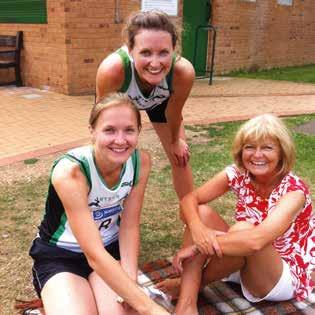
“You’ve got to realise that you can fail and you’re still okay.”
From sales to A
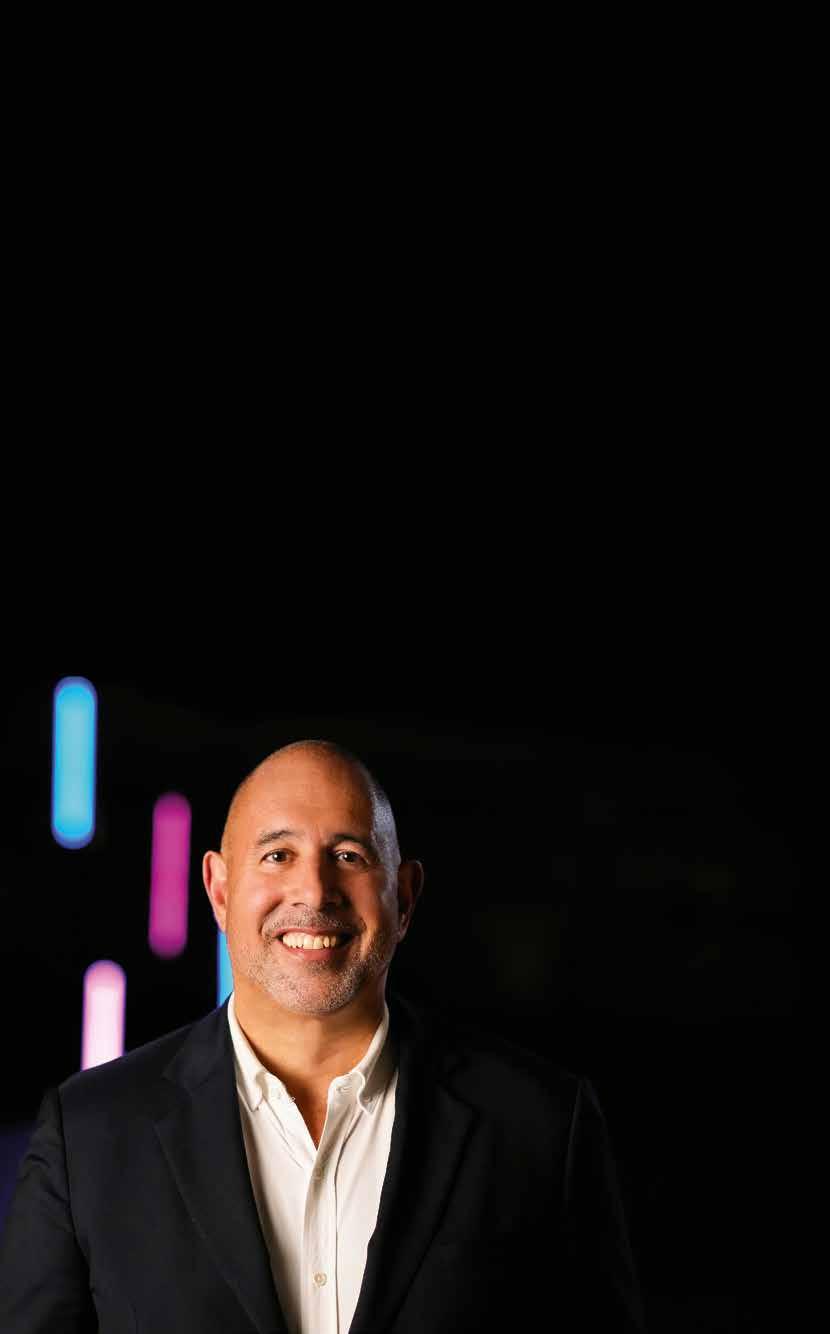
Keith Le Goy (Economics 1980) has thrived in his leadership career at Sony, where he was appointed Chairman of Sony Pictures Television in January 2025. Maintaining the success of an entertainment business involves perseverance, embracing technological change and, most importantly, connecting with audiences.
Saying yes to life has been something that has worked very, very well for me.
career in the television industry was not on Keith Le Goy’s radar when he graduated from Caius brimming with confidence that his pop band, the Wobbly Jellies, would be his ticket to fame. When this musical dream failed to become reality, Keith began working in sales for Londonbased media- and advertisingrelated companies and was later headhunted to interview for a job at Disney, selling programming in smaller nations across Europe, the Middle East and Africa. Within three years, he was invited to move to Sony, where he has held numerous positions over the past 26 years and became Chairman of Sony Pictures Television in January 2025.
As a leader at Sony, Keith has been an unquestionable success. In 2024 alone, while he was Chairman of Worldwide Distribution & Networks at Sony Pictures Entertainment, the company’s digital home entertainment business achieved its highest ever global annual revenue for films, while its anime subscription service Crunchyroll reached 15 million paying subscribers.
Based in Los Angeles, Keith is now responsible for the production groups behind a range of scripted and unscripted television shows, including Amazon Prime Video’s The Boys, Netflix’s The Night Agent, and game shows like Who Wants to Be a Millionaire? and Wheel of Fortune, among countless others. He also manages the distribution of Sony’s film and television output and is responsible for their cable networks around the world.
Overseeing the transformation of rudimentary ideas into entertaining –and profitable – media is both a thrill to relish and an intimidating challenge. Recalling the original pitch of the popular crime drama Breaking Bad to Sony in 2007, when he was President of International Distribution, Keith says: “It was the most crazy, uncommercial idea you could ever

Sony success
think of; and yet, 18 years later, it’s one of the most iconic shows on television. It’s always exciting to be part of creating such stories that are going to resonate with people globally.
“What’s challenging is that that’s very hard to do. You have to accept that if you make 10 shows, a lot of them are not going to succeed – some will be okay, some will completely fail. But the ones that work, when they really work, make everything else worthwhile.”
As technological developments change the ways film and television are consumed, Keith must constantly look ahead at how Sony can make the most of this shifting landscape. Anticipating the rise of autonomous cars over the next decades, for instance, which will open up a space for more varied entertainment during commutes, Keith led the launch of Sony’s in-car entertainment system, RIDEVU, in 2024. RIDEVU gives consumers access to hundreds of films and television series to view on a system that can be integrated into vehicles.
Keith is also very mindful of the growth in popularity of YouTube, which has come to outrank broadcast and cable networks and even streaming services as a platform for content consumption. In light of this, Keith can see that Sony must consider exploring more flexible content formats beyond traditional two-hour films, one-hour dramas and 30-minute sitcoms, and create shorter-form media more compatible with YouTube streaming habits.
“Technology and storytelling have always gone hand in hand,” says Keith. “At our core, as Hollywood studios, we are storytellers, but the way in which we are able both to tell those stories and to get those stories in front of as many people as possible has evolved a lot. What are the types of stories people are interested in seeing and hearing and consuming? What are the places they’re going to in order to get those stories? You can’t ignore these things.”
When leading a global entertainment studio, what audiences want and what is best for audiences
must always be paramount when considering business decisions around what content to create and which distributors to sell it to, Keith stresses. “What’s always fascinating is the actual impact this work makes on culture,” he says. “People really do have an incredible affinity with their favourite TV show or their favourite movie, and you can’t lose sight of that.”
Keith recalls his time at Caius with fondness, having thoroughly enjoyed learning the art of intellectual debate from his supervisors – particularly economic historian Iain Macpherson, whose sense of humour combined with his intense challenging of his students’ ideas left a lasting impression.
He also looks back at the College as a world of opportunity where seemingly anything could happen. He says: “It gives you a great sense of confidence that you’re part of something that’s been around for hundreds of years, and the people you’re with are brilliant in their own distinctive ways. And that’s a bit daunting in some ways but very inspiring in others, because you then feel that you can do anything.”
This confidence that he can succeed when offered unexpected opportunities has stuck with Keith throughout his life. “Every time Sony asked me to do something, I said yes,” he says. “They asked me to move to Miami, I said yes. They asked me to move to LA, I said yes. They asked me to take on more and different things, and I said yes. Saying yes to life has been something that has worked very, very well for me.”
Strong leadership in exchange for purposeful followership
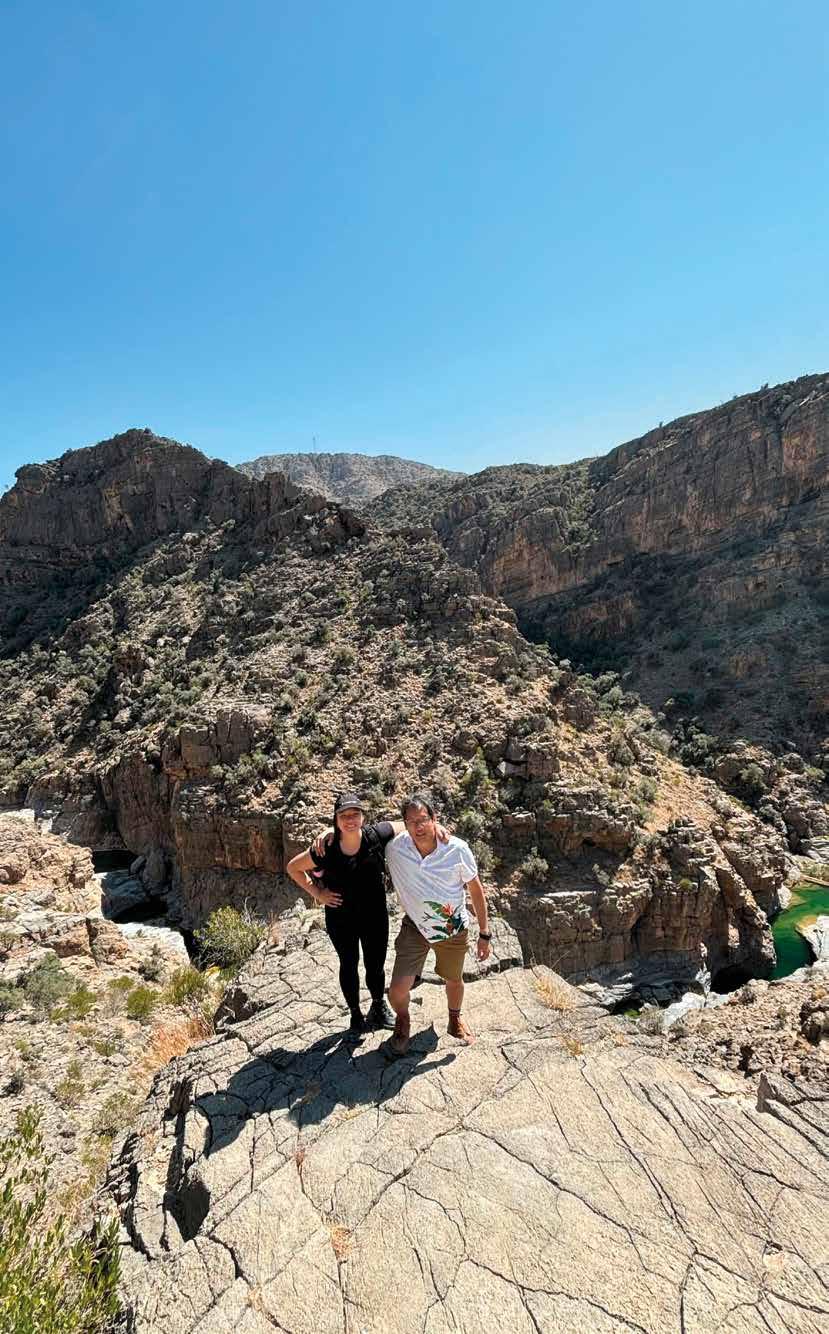
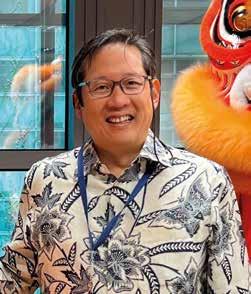
Ongoing technological advancements and geoeconomic developments keep Mike Syn (Engineering 1990) busy in his role as President of the Singapore Exchange. He believes that maintaining strong and purposeful leadership and followership is essential to the ongoing success of the Exchange.
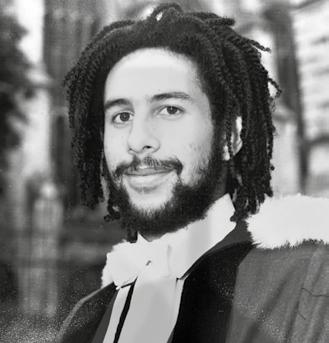
When Mike Syn left Caius with an undergraduate degree and PhD in Engineering, his decision to enter the City was nothing out of the ordinary. His journey from there, however, has been remarkable: since his first investment banking job at the Swiss Bank Corporation (now part of UBS), he has moved roles and location to the Singapore Exchange (SGX Group), where he now serves as President.
As Singapore’s domestic economy is relatively small, international trade and commerce define its capital marketplace, which provides exciting challenges for Mike and his team. SGX Group operates equity, fixed income and derivatives markets and is Asia’s leader in foreign exchange. With about 40 per cent of their listed companies and over 80 per cent of their listed bonds originating outside Singapore, maintaining operating compatibility between Singapore and other jurisdictions is the key success factor.
“Future-proofing is the biggest part of the job,” says Mike. “The thing that changes insistently is the technological implementation of your systems and your services.” Increasing use of machine intelligence, a general shift from hardware-defined to software-defined technology ‘stacks’ and the application of skills and tooling in anomaly detection and reliability engineering are all ongoing developments that require “a massive mindset change, even an educational change”, Mike says.
Equally crucial is anticipating the likely direction of the global economic climate. Mike adds: “The current challenge of trying to look around the corner from where we sit in Asia is that commercial ‘rails’ are being disrupted in a messy way. While each nation looks to its permanent interests, economic statecraft is battered by great power contestation. Because economic resources and capabilities are key determinants of power and influence, it is entirely necessary for capital market infrastructures like exchanges to start thinking in geoeconomic terms.”
When managing a complex organisation and customer ecosystem, Mike believes that the key to success is trust and alignment between leaders and followers, achieved by paying attention to the individual’s need for growth, meaning and sense of contribution.
He adds: “You are challenged with constant learning as a leader. It begins
with self-awareness, some willingness to take feedback and change, and some experience of other organisations that are high-functioning and others that are not, so that you have an intrinsic sense of what is better and what is worse.”
“
Caius grounded me very much in a way of life that was collegiate, competitive and populated with highly talented people of different stripes who were selforganising.
For Mike, an orchestra provides the perfect analogy for running a successful organisation. He says: “You need to make sure that each section understands that its job is to play out the score in synchrony. They should be competitive with each other, but not to the extent where one person says ‘I’ll play louder than you’ or ‘I’ll play at a faster tempo’. The test is for the audience to hear sweet music. This doesn’t work without leadership and followership at all levels.”
Alongside his work at SGX Group, Mike is Chairman of the Mount Faber Leisure Group and also a Board Member at the Sentosa Development Corporation. Mount Faber, with its cable cars, and Sentosa Island, with its beaches and tourist precincts, are two of Singapore’s most popular attractions. Through overseeing the running of activities such as firework shows, beach music festivals, cable car dining and even hilltop Pokémon hunts, Mike keeps his emotional energy constantly renewed in the face of a busy calendar and important leadership responsibilities.
Mike looks back at the Caius student body as a fascinating example of a cohesive and high-functioning community. He says: “Caius grounded me very much in a way of life that was collegiate, competitive and populated with highly talented people of different stripes who were self-organising. If I were to put together a team and to try to find a group of people as diverse as a cohort in Cambridge, it wouldn’t work because the customs and cultures of behaviour wouldn’t have been codified.
“One of the most daunting experiences was arriving as an undergraduate on day one, after a two-year bubble in the military, realising that everyone is so incredibly talented in multiple ways. You establish an appetite for new achievements and experiences, and you have a model of what ‘really good and diverse’ looks like when it works well.”
Building confidence through fencing
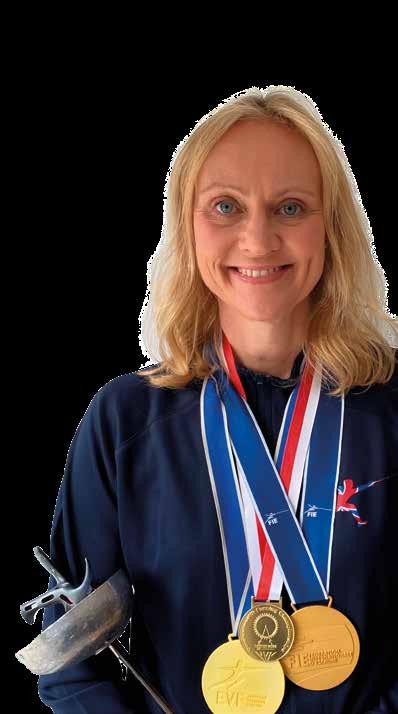
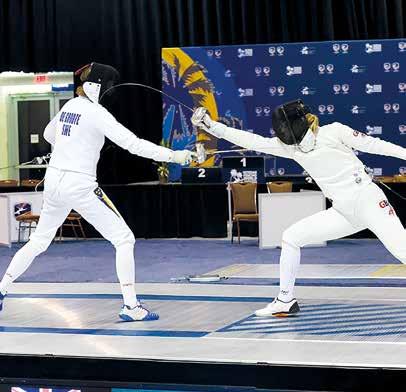
Georgina Usher (Computer Science 1991), British Fencing’s Chief Executive, has learned important lessons from decades of fencing. In her role, she helps others to grow and improve their physical and mental wellbeing through sport.
When she began fencing as a child, Georgina Usher developed an instant passion for the sport, despite a lack of natural proficiency. She attributes this to the lack of pressure from her parents and coaches, allowing her simply to have fun, and to the confidence boost that fencing gave her. Wearing a mask allowed Georgina to hide her acne, and while she struggled with bodily coordination, fencing offered an outlet where she could be taught movements from scratch with no expectations of prior ability.
By the time Georgina arrived at Caius, fencing was an integral part of her life, and as a student she fenced both for the University of Cambridge and on the UK circuit, progressing to become one of the country’s top fencers.
Her trajectory was almost halted after graduation, when she found herself trapped working long and demanding hours at a consulting firm, which she did not enjoy. Determined to stay true to herself and her passions, however, she decided that she was unwilling to sacrifice her fencing and longed to know whether she could succeed at international level.
Since then she has represented Great Britain at multiple European and world championships and won several Commonwealth medals (including Gold in 2014), and she has won 10 individual Senior National Championship titles. She has balanced this international fencing journey with roles as a chief operating officer, project manager, strategist and business consultant for various companies, before landing her “dream job” in 2014 as Chief Executive of British Fencing, the sport’s national governing body.
Although the two may seem worlds apart, Georgina feels that her fencing experience has complemented her work as a business leader.
“Leadership is about inspiring people,” she says. “In fencing, the medal’s there, the trophy’s there, so you immediately get to build this vision where everybody is inspired by what you can collectively achieve; there’s a passion and a heart behind it. And that’s what I try to bring into my work: what is the thing that makes you go, ‘It’s more than my head invested in my job, it’s my heart’?
“In the same way that a successful fencing team is built by challenging each other to continually improve in training, I like to surround myself in business with people who challenge me in a positive way and bring the energy to support a shared vision.”
For over a decade, Georgina has striven to improve accessibility to fencing and, looking back on the impact that fencing had on herself as a child, to use it as a tool for developing self-confidence in others.
The projects Georgina runs at British Fencing work with groups underrepresented in the sport, such as Muslim women and girls, young people with autism and people with physical impairments. Under her leadership, British Fencing has supported the design and launch of the SwordSeatTM, a lowcost, adaptable and easily transportable chair that makes
In the same way that a successful fencing team is built by challenging each other, I like to surround myself in business with people who challenge me in a positive way and bring the energy to support a shared vision. “

fencing accessible to participants who face mobility challenges. Most recently, the organisation also took over the multi-Paralympic medalwinning Wheelchair Fencing World Class Programme, uniting the full British Olympic and Paralympic pathways for the sport under one governing body.
For all the groups Georgina works with, fencing can be a transformative experience. “I think it’s the holding of the sword,” she says. “You’ve got a weapon, it’s exciting, and suddenly you’re imbued with confidence.”
In addition to physical confidence, Georgina aims to encourage creative confidence through fencing. Her projects offer participants the opportunity to engage with how fencing makes them feel through visual or verbal art, and Georgina is often moved by the work produced. Of the poetry written by participants in the Muslim Girls Fence programme, she says: “When you listen to some of the quotes, they’re saying things like ‘Lunging is taking a step forward in life, and now I’ve done fencing I can do anything’. And you think, ‘Wow, they’ve really connected with this idea’.”
Being a Chief Executive is, of course, not without its challenges. In 2016, British Fencing lost its funding from the UK Sport World Class Programme, which supports Olympic and Paralympic athletes to realise their potential. Ever an “eternal optimist”, however, Georgina was undeterred. She says: “Every time something bad happens, you can ask: what’s the opportunity, and how can you build?”
Without funding for the top athletes, she has been able to refocus British Fencing’s efforts towards enhancing the confidence and abilities of those new to the sport and building a pathway for a new group of young athletes, whose talents have helped British Fencing to secure funding again.
Georgina would never have achieved her successes in business and fencing without taking risks and remaining true to herself, and her steadfastness in pursuing her own path is something that Caius helped to teach her.
She says: “Caius was quite a large College and there were so many different, interesting people who shaped who I am today. It never felt judgemental – even though I was one of the very few women doing Computer Science, I was made to feel like I belonged. Caius allowed people to be who they wanted to be, helping me to learn more about myself and what I enjoyed, rather than making me feel, ‘I have to do this to fit in’. This is reflected today in one of the taglines we use at British Fencing to promote the sport: ‘Be you, be different’.”
Leading through
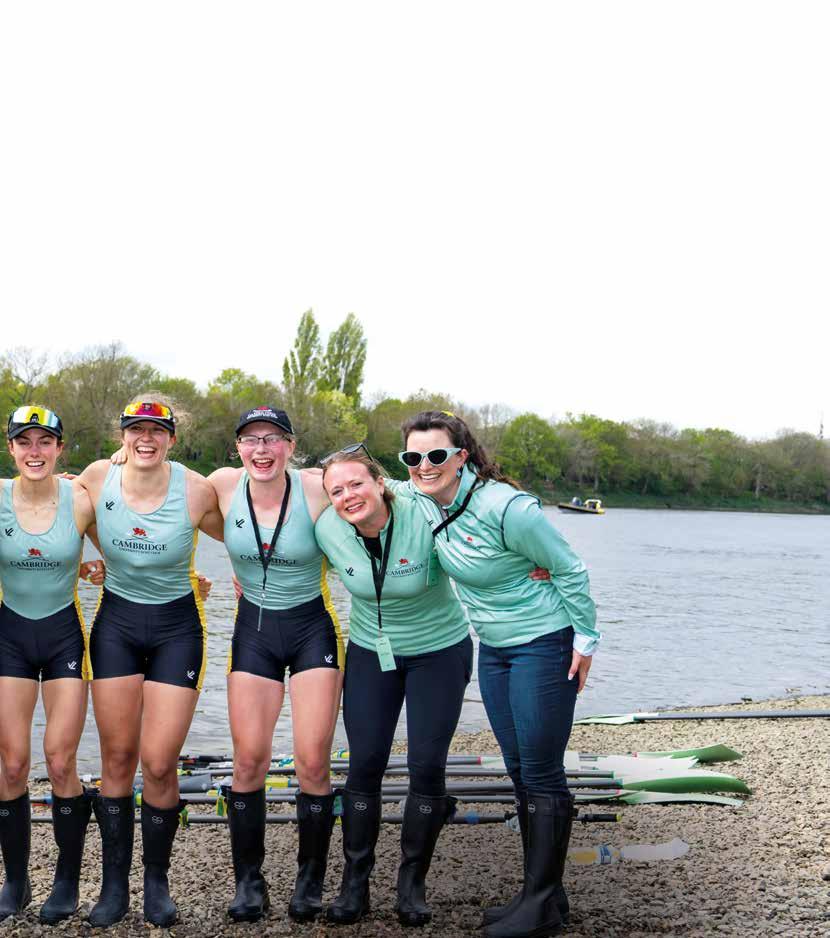
Six wins in six events for Cambridge University Boat Club tells only a fraction of the tale of the 2025 Boat Races. Lucy Havard (History PhD 2022), as the club’s Women’s President, was privy to challenges on and off the water as the Light Blues dominated.
When Cambridge women’s Blue Boat crossed the finish line at Mortlake as one of six wins in six races on the Boat Race weekend, the main emotion for Lucy Havard was pride.
“Lots of things could have easily derailed us,” says Lucy, the Women’s President of Cambridge University Boat Club in 2024–25. “But we had the strength, both mentally and physically, and I was just so impressed and proud of how the squad conducted themselves through what has actually been quite a tumultuous year.”
Lucy was elected President in May 2024, tasked with extending a long winning streak for Cambridge women.
As well as the sporting skills of building togetherness and a team targeting a collective goal, she required political, legal and diplomatic skills in abundance.
Being fairly new to rowing – taking up the sport at Lucy Cavendish College during her Master’s in a Covid-19 affected 2019–20 – but with a background in triathlon and cycling at a national level, Lucy’s idea for the presidency was to lead “from the middle” of the group, to bring together the world-leading oars-people with those who took up the sport with their Colleges.
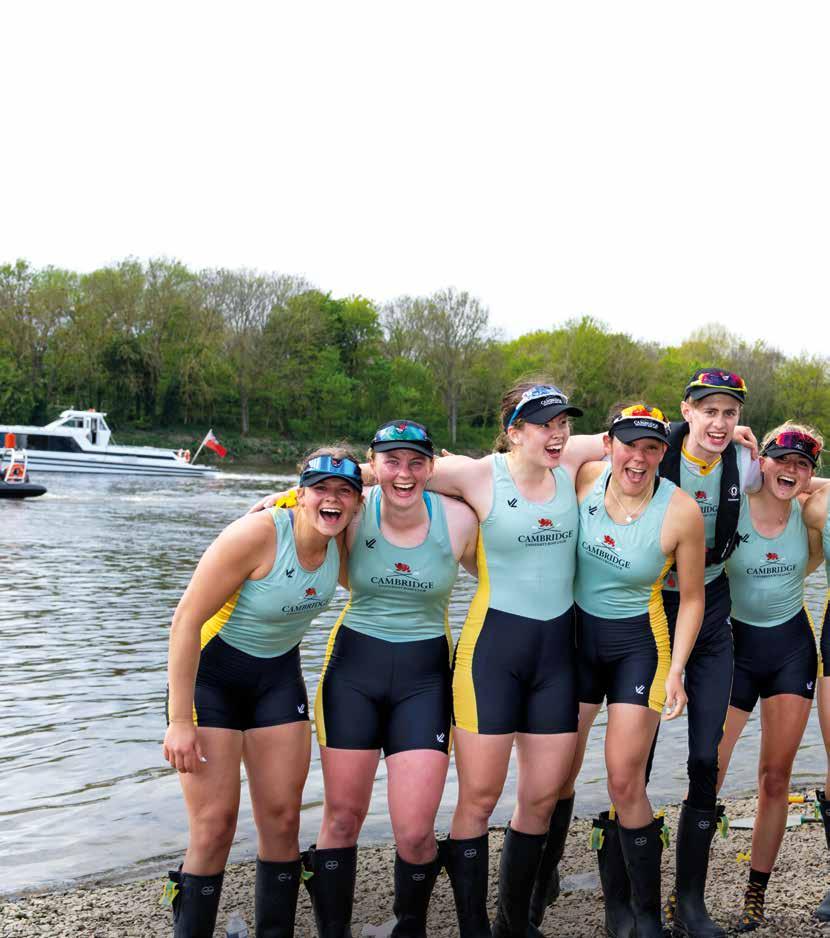
Cambridge’s women had won seven successive Blues Boat Races heading into 2024–25, a winning run that will end at some point. Lucy did not want that to be under her leadership, but she was determined the season would be about continued improvement and striving for excellence, not a single focus. An eighth win, as part of a Cambridge clean sweep of lightweight, reserve and Blue boat wins, followed.
“The overall focus is making our boats as fast as possible, because we cannot control who Oxford have in their boat,” Lucy adds.
Which leads to the controversy. It appears Oxford did try to control who was in the Cambridge boats.
A post-Olympic year often leads to an abundance of talent in the crews of Cambridge and Oxford. Since James Cracknell’s selection as a 46-year-old two-time Olympic gold medallist and six-time world champion in 2019, eligibility criteria has been tightened.
The 12-year rule, which prevents anyone competing more than 12 years after beginning an undergraduate degree, meant Olympic champion Tom Ford was ineligible for Cambridge; also not eligible were Lucy and Jenna Armstrong, her predecessor as President.
Lucy’s academic journey is a remarkable tale. She began her undergraduate medical degree at UCL in 2007, intercalated in History of Medicine, and next undertook Master’s degrees in Medical Education, History and Philosophy of Science, and then Early Modern History.
She is now undertaking her History PhD, while working as a locum in renal medicine at Addenbrooke’s Hospital. Longer-term, she hopes to be a part-time consultant specialising in renal medicine and to also be an academic historian.
She has successfully combined her academic and medical commitments with her rowing responsibilities, which meant liaising with athletes, coaches, administrators, and, unexpectedly, the University senior leadership, lawyers and KCs.
Ordinarily, the President has a seat in a boat. Lucy led the club with her eligibility status a discussion point.
Lucy adds: “Jenna and I clearly weren’t the kinds of athletes that this rule was supposed to prevent competing because neither of us are at the peak of our career. We just learned to row a bit later in life.”
A new issue, focusing on whether a Postgraduate Certificate in Education (PGCE) was a degree-level qualification, dominated much of the off-the-water discussions over the season, affecting three Cambridge students. PGCE students had long taken part in the race, without a question over their status. Not in 2025.
Despite being unable to take to the water herself, Lucy played a pivotal role as Cambridge enjoyed a superlative season.
“There are elements of this year that were kind of bittersweet and I would have loved to be able to race,” she says.
“But having the role of President has been amazing. This year has shaped me in ways that I never, ever thought it could. It’s an experience that I will treasure for my lifetime.”
stormy waters
Lucy, second right, pictured with the Blondie crew following Cambridge women’s win in the reserve race
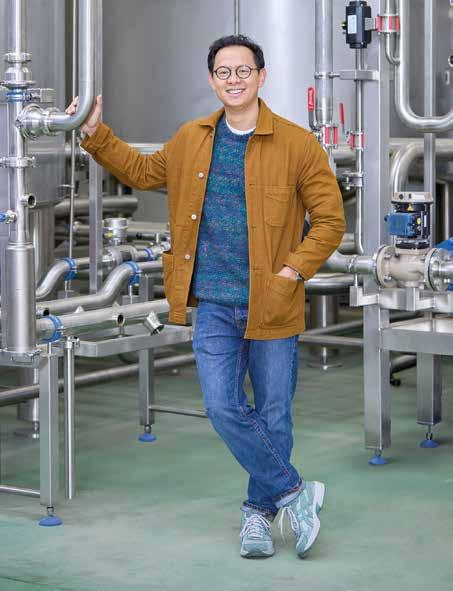
ICE CREAM , MOCHI DOUGH & SOCIAL MEDIA FAME
A recipe for success
Growing up in his parents’ bakery in London, Howard Wong (Economics 2004) developed a passion for food and a business mindset. As co-founder of mochi ice cream company Little Moons, his life as an entrepreneur has been an exciting learning experience – though not without its major surprises…
After graduating from Cambridge, Howard Wong initially pursued a career in finance, working as an investment banking analyst for JP Morgan. However, he soon found that this role did not offer him scope for the creative thinking that he so enjoyed.
“I had a lot of ideas, but ideas don’t mean anything if you don’t put them into action,” he says. “Where my creativity lies is in that I’m very curious about all aspects of the world and a wide range of topics, and I’m able to connect the dots from lots of different sources of inspiration.”
Putting his ideas into action, then, was the obvious next step for
Howard. Taking a leap of faith, he left his banking job and, together with his elder sister Vivien, cofounded Little Moons in 2010. The company produces hand-crafted bite-sized balls of gelato ice cream wrapped in chewy rice flour dough, an original twist on Japanese mochi.
Little Moons has grown to be a thriving business, with around 300 employees, a turnover of
£51.4 million in the last financial year, and a 2022 investment from US private equity company L Catterton that valued the business at more than £100 million.
When establishing his own business, Howard was inspired by his parents, in whose bakery he had worked as a child and whose pride in their work gave them a high level of life satisfaction. He adds: “Working at my parents’ bakery gave me quite a practical and entrepreneurial way of looking at the world, which you might not necessarily get if you didn’t have that exposure. From product development to plotting the right delivery route, it taught me how to think practically about things and consider how everything works.”
Studying Economics at Caius was also invaluable training, not only in the course content but in the transferrable skills it offered. The intensity of the Cambridge terms honed Howard’s time management skills, and as Treasurer of ABACUS (Association of British and Chinese University Students) Cambridge, he became adept at managing finances, organising events and marketing.
But Howard’s childhood and university experiences had not taught him everything, and he has enjoyed the learning process involved in building a successful business. He quickly learned to stop aiming for perfection from the start and to embrace the 80/20 rule, which states that 80 per cent of desired outcomes often arise from 20 per cent of the work. The remainder of his efforts, then, can be exerted where they matter the most.
Howard says: “When it comes to product development, we sweat the small stuff. ‘Where’s the pistachio coming from? Let’s try out eight different ones!’ And if you use the 80/20 rule on that, it wouldn’t quite work. We really care about the flavour.”
Little Moons reached a significant turning point during the Covid-19 pandemic. Amidst a range of challenges stemming from the lockdown – losing business from the restaurants they supplied to, reconfiguring their manufacturing to account for social distancing, furloughing their staff – the brand went viral on TikTok in January 2021, leading
to an explosion in sales figures. Howard recalls one day seeing queues at Selfridges stretching all along Oxford Street, filled with people eager to buy his mochi balls.
Following the initial rush of excitement at this spike in success, Howard was struck by the realisation of what it meant for the business. Increased customer demand meant that Little Moons had to grow three times in size over the course of a few months, rapidly recruiting and training nearly 100 new staff members.
“The business started to really go under pressure when we were trying to meet that demand,” Howard adds. “We were just in Tesco and Waitrose and Ocado at the time; we’d been trying to get into Sainsbury’s for years, and Asda and Morrison’s were aims down the line. All of a sudden they were calling us saying ‘When can we stock you?’. We couldn’t even supply Tesco with enough!
“There was a lot of discussion behind the scenes: should we risk
annoying Tesco or would things have calmed down in three months’ time so that we could commit to doing this? It was exciting and riveting but really overwhelming and tiring at the same time.”
The Little Moons team took the gamble to list at the three additional supermarkets, staggering the listings to give time for the demand to subside. However, demand remained high, far outstripping Little Moons’ capacity to supply. Fortunately, the increased publicity that ensued made the retailers more sympathetic in the face of supply issues.
It is in such moments, when faced with the onus of making crucial business decisions, that Howard is grateful to have Vivien as a co-founder working alongside him. Two brains are certainly better than one, in his opinion. He adds: “My sister thinks a lot with her gut, and I’ve always been quite analytical. Bouncing ideas off each other can lead to tension, but if channelled in the right way, you can get some really positive ways of thinking.”
“When it comes to product development, we sweat the small stuff. ‘Where’s the pistachio coming from? Let’s try out eight different ones!’”

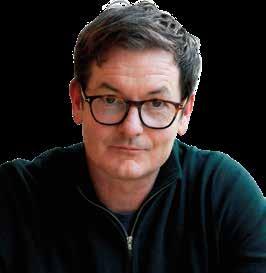
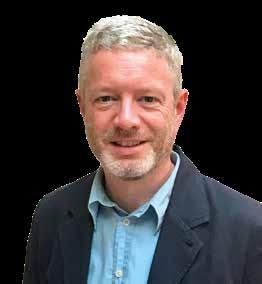
Richard Moyes and Jon Fell (both History 1991), friends since their time at Caius, have worked together for over a decade as a Director and a Board Member respectively at Article 36, a non-profit organisation dedicated to reducing harm caused by weapons.
The lifelong friendship between Richard Moyes and Jon Fell began during their undergraduate days, both living in F staircase in Harvey Court and studying History together. Years later, they also united professionally when Richard co-founded Article 36 and sought out Jon, who since graduating had been working in the financial sector, to join the governing board.
Article 36, established in 2011, comprises a small team of UK-based policy experts working to prevent harm from weapons. Richard’s interest in such work was sparked during his MPhil in Social Anthropology, also undertaken at Caius, when he saw a poster for the landmine clearance organisation Mines Advisory Group. It was with this group that he then began his career coordinating and managing humanitarian explosive ordnance disposal projects.
Now a Director of Article 36, Richard works to develop strategies and political movement around international law and policy on weapons and the protection of civilians in conflict. Focus areas include new ‘autonomous weapons systems’ as well as long-standing issues, like the use of heavy explosive weapons in towns and cities. Richard previously played an important role in the International Campaign to Abolish Nuclear Weapons (which won the 2017 Nobel Peace Prize for its work developing the 2017 Treaty on the Prohibition of Nuclear Weapons), and in creating the 2015 Safe Schools Declaration and the 2008 Convention on Cluster Munitions.
Making an impact through an organisation like Article 36 is no easy task given the role that weapons play on a global scale. “At
Retaining confidence & belief
Article 36 stands out for its “intellectual rigour”, something both Richard and Jon attribute to their education at Caius.
one level, the legal status of nuclear weapons is tied up with the structures of power internationally,” Richard says. “At a different level, the role of Artificial Intelligence in weapons systems affects how we think about the role of human decision-makers in taking life, how the structures of the law work and how we imagine human responsibility. Negotiating rules around weapons systems is negotiating our societal relationship to law and international conflict.”
Rather than letting conversations about harm from weapons press “so heavily and so stiflingly on you that you can’t break out of that”, Richard tries to focus on retaining confidence and belief that progress can be made on international agreements.
He adds: “Conflict is always going to be problematic and it’s always going to cause harm to civilians. All we can do is try to pull expectations of protection as far in one direction as we can. But that does create a challenging mode of work.”
Jon, now closely involved with various charities since leaving finance, believes that Article 36 stands out for its “intellectual rigour”, with the team constantly inviting the board to interrogate their strategies and question their approach. This is something both Richard and Jon attribute to their education at Caius. Richard adds: “Until I came to Caius, no rigour. Caius just instilled rigour. And from then on, permanent rigour!”
Richard Moyes
Jon Fell
Working together to move forwards
IN UNIVERSITY LEADERSHIP
Throughout his career, Doug Bailey (Archaeology 1985) has deftly balanced his academic commitments with departmental leadership, working tirelessly to improve the experiences of students and staff in his field.
Following an undergraduate degree in Classical Archaeology at Dartmouth College in New Hampshire, Doug arrived at Caius for his MPhil and PhD. Here he was equally fascinated by his course and by the rituals embedded in the day-to-day life of a centuries-old College, which influenced the development of his academic interests. His curiosity about the “strange principles, characters and histories” associated with Caius was a key factor in precipitating his eventual shift to more anthropological studies.
Following his PhD, Doug spent over a decade as a Professor in the School of History and Archaeology at Cardiff before becoming the school’s Head of Archaeology in 2004. Since 2008, he has been Professor of Visual Archaeology at San Francisco State University (SFSU), where he has also acted in turn as Department Chair, Graduate Coordinator and Undergraduate Coordinator.
Doug sees significant overlap between the skills required for field-based archaeology and for leadership. He says: “As an archaeologist, at the end of every academic year you’ll be leaving the next week to run an excavation somewhere. You’re constantly working, and while you’re teaching you’re writing grant applications, lectures, reviews, book chapters and proposals; you’re doing 700 things at once and it’s exhausting! But you exercise this muscle which is an ability to do many complex things almost at the same time. To be in a position of leadership in a modern institution, one has to do that.”
In his roles at SFSU, Doug has restored the Department of Anthropology to a highfunctioning state after a problematic period, reformed and popularised the subject’s degree programmes (the graduate programme was facing the threat of closure) and made his department a model for others at SFSU to follow.
Reflecting on how he resolved the initial issues he faced in the Department
Include everyone in the decisionmaking process ... get other people to buy in. “
of Anthropology, Doug says: “It’s easy to identify the problem; the challenge is to get other people to see a way through that problem. There was a lot of dissention within the department, and I realised that what I would have to do was include everyone in the decision-making process. You can’t just drive it yourself, you have to get other people to buy in.
“I stimulated conversation so that people would develop policies and procedures that they had all agreed on, or at least that we had voted on and the majority had accepted. Once you have those policies and procedures, that makes things much easier because it’s not about individuals. When someone comes to you with an issue, you say, ‘We have a procedure, so let’s just follow the procedure’.”
For Doug, it is encouraging these collective efforts towards progression or “shared governance”, rather than burdening oneself with all the responsibility for an enterprise, that defines what we tend to call leadership. “‘Lead’ is not a great verb,” he says. “I’m working with other colleagues to move the institution forward.”
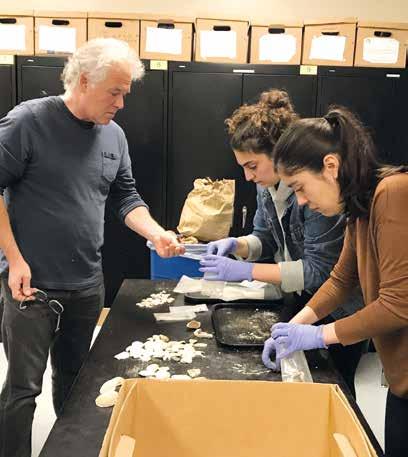
Doug working with SFSU students
Many ways of giving back
While multimillionpound gifts often make headlines, there are plenty of other meaningful ways to support your alma mater. Over the past year, Caians have demonstrated their generosity by offering time and talent, alongside donations, to benefit the College in diverse ways.
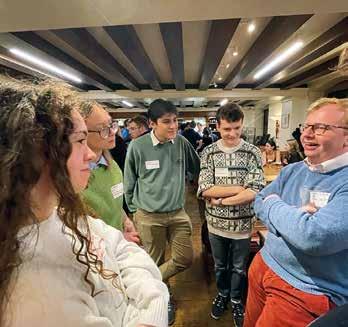
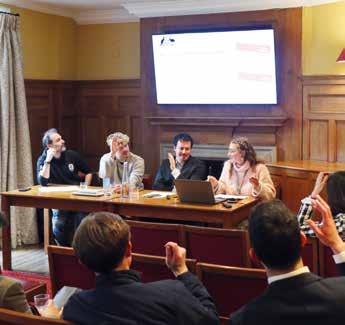
You can give time through attending events, spreading awareness or giving feedback. It is thanks to enthusiastic Caians like Adrian Pegg (Philosophy 2001) that the Development team has expanded its event offerings to connect with alumni beyond traditional gatherings. Caius Cocktails events are open to all, complemented by local meet-ups hosted by generous alumni and often featuring inspiring speakers, both alumni and Fellows.
Constructive feedback from alumni on what we can do better has given rise to events such as the MCR Research Day, relaxed Family Fun Days at Harvey Court and the Young Alumni Formal Hall. Many alumni have become informal ambassadors and play a vital role in encouraging peers to engage with College events. Thank you for your initiative and energy.
Sharing your expertise opens doors. Caians have always known to go to their peers for expert and/or professional
and
Our key fundraising priorities remain student support, widening participation and the Maths Fellowship.
guidance; this is now offered more widely, beyond friendship groups, to current students and young alumni. Our mentoring programme offers the chance to connect with Caians from a range of industries, in person at our annual ‘pizzalumnight’ event in Cambridge and/or via our website. Experts also support College committees or give talks in their fields, further enriching College life.
Financial support is equally important and appreciated. Feedback and stories from donors help raise awareness of the College’s funding gap. Though the endowment is still considerable, drawing on it on a regular basis is not a sustainable strategy. We are sincerely grateful to the many alumni who contribute financially to the College.
Special thanks go to those who participate in the annual Telephone Campaign. All of you who pick up the phone teach the students important life lessons through meaningful conversations, before you decide (we hope) to make a gift. Alumni volunteers who help prepare student callers, discuss their giving with peers or speak at Annual Gatherings serve as fundraising ambassadors, encouraging broader support. We thank you for these crucial efforts.
Our key fundraising priorities remain undergraduate and postgraduate support, widening participation and the Maths Fellowship, which still requires additional
Postgraduate students at the MCR Research Day
Recent graduates
Caians connecting at our ‘pizzalumnight’
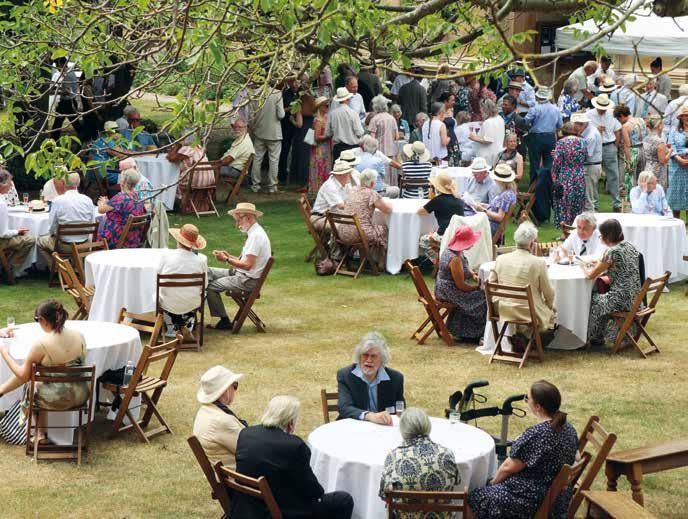
funds towards full endowment. In February, thanks to your generosity, we surpassed our Giving Day goal for supporting our Clinical Medicine students.
Postgraduate funding remains a challenge. In response to government cuts, we have been actively fundraising for the Rogerson Studentship and the History Studentship funds. Your donations have allowed us to surpass the halfway mark towards the target of £700,000 for each. When we reach the target, both funds can be endowed to fund a student in perpetuity.
Pippa Rogerson’s friends, students and colleagues have volunteered to organise dinners and parties; their time and gifts have made a difference. Collaboration with History alumni has sparked renewed engagement with the community and connections with Fellows and students, culminating in a Historians’ dinner in October. We hugely appreciate the effort and work put in by those of you who organised and attended events, shared your stories and donated to support this worthwhile cause. You have inspired and enabled future generations.
Legacy giving also plays a vital role, and much of the Caius endowment has been built over centuries on bequests from alumni, Fellows and friends. This year highlighted some excellent alumni legacy stories: David Hulbert (Mathematics 1969) and Penny Nagle (History 1987) offered wonderful examples and perspectives that have resulted
Thank you for helping to ensure the longterm health and strength of our great College.
in an increase in pledges. Thank you for helping to ensure the long-term health and strength of our great College.
Knowing that your capacity and ways in which you give back may change throughout your life, we invite you to explore different avenues to deepen your lifelong connection with Caius through enjoying what is on offer and giving back when and where you can.
If you would like discuss giving options with us, please contact us on +44 (0)1223 803720 or development@cai.cam.ac.uk.
Thank you!
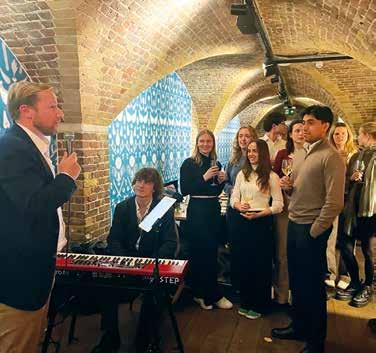
Benefactors enjoying the May Week Party
Alumni gather at a Caius Cocktails event in London
DONORS
TELEPHONE CAMPAIGN 2024 £418,216
GIVING DAY 2025 £254,541 UG BURSARY RECIPIENTS
Different Ways to Give
ATTENDED EVENTS 1,913
ATTENDED REUNIONS 444
ALUMNI GATHERINGS AROUND THE WORLD
THANK YOU
The Master and Fellows wish to express their warmest thanks to all Caians, parents and friends of the College who have generously made donations or volunteered their time in the period between JULY 1, 2024 AND JUNE 30, 2025. Your gifts and support for Caius are greatly appreciated as they help to maintain the College’s excellence for future generations.
DONORS
1945
The late Professor C N L Brooke
The late Mr J J H Everitt
1946
The late Mr K Gale
1947
The late Mr A C Barrington Brown
The late Mr E J Chumrow
The late Mr A C Struvé
1949
The late Mr M E Gaisford
1950
The late Professor K G Denbigh
Dr M I Lander+
Canon J Maybury
1951
Mr S H Cooke
The late Dr J E Godrich
The late The Revd P T Hancock+
The late Mr J K Moodie
1952
Professor J E Banatvala+
Dr M Brett+
Dr T W Gibson+
Mr P J Murphy+
Professor M V Riley+
Mr R P Wilding+
1953
Mr J M Aucken
Mr S F S Balfour-Browne+
Mr P R Dolby+
Dr D H Keeling+
Mr J E R Lart+
Mr R Lomax+
Mr T I Rand+
Mr J P Seymour+
1954
Mr J Anton-Smith+
Mr P A Block
Mr D W Bouette+
Mr D J Boyd+
Professor D P Brenton
Mr D I Cook+
Dr A E Gent+
Professor R J Heald+
Mr R W Montgomery+
Sir Gilbert Roberts Bt
Mr R J Silk
Mr D A Smith
Mr M H Spence+
The late Mr B Tytherleigh
1955
Mr A L S Brown
Dr M Cannon+
Mr D J Clayson+
Mr A A R Cobbold+
Dr R A Durance+
Professor R E W Halliwell+
Dr T G Jones+
The Rt Hon Sir Paul Kennedy
Mr J H Mallinson
Mr J J Moyle+
Lt Col C B Pritchett
Mr A B Richards+
1956
Dr R Cockel+
Mr J A L Eidinow
Professor G H Elder+
Mr M J L Foad
Professor J A R Friend+
Mr R Gibson+
Mr M L Holman+
Professor A J Kirby+
Dr R G Lord+
Mr B J McConnell+
Canon P B Morgan+
Mr A J Peck+
The late Mr J V Rawson
Mr C Ridsdill Smith
Mr J P Woods+
Dr D L Wynn-Williams+
1957
Dr I D Ansell+
Dr N D Barnes+
Mr J C Boocock
Dr J P Charlesworth+
The Revd D H Clark+
Dr T W Davies+
Mr E J Dickens+
Mr R E Gadsby
Dr A N Ganner+
The Very Revd Dr M J Higgins+
Mr E M Hoare+
Professor F C Inglis+
Mr A J Kemp+
Professor A J McClean+
Mr C B Melluish
Mr A W Newman-Sanders+
Mr T Painter
Mr G R Phillipson+
The Rt Hon Sir Mark Potter+
Mr P W Sampson+
The Rt Hon Lord Tugendhat+
Dr A Wright
1958
Mr C Andrews+
Professor R P Bartlett
Dr J F A Blowers+
Mr T J Brack
Mr J P B Bryce+
Mr J D G Cashin
Mr D M Henderson+
Mr J A Honeybone
Dr P F Hunt
Dr R P Knill-Jones+
Mr R D Martin
Mr C P McKay+
Dr J V Oubridge
Mr G D Pratten+
Dr G R Rowlands
Mr M P Ruffle+
Dr F D Skidmore
Mr A Stadlen+
Mr A J Taunton+
Professor B J Thorne
Mr F J W van Silver+
1959
The late Mr D Beck
The Revd K N Bradley
Professor D S Brée
Dr D E Brundish+
Dr A G Dewey+
Mr T H W Dodwell+
Mr B Drewitt+
The Revd T C Duff+
The Rt Revd D R J Evans+
Mr G A Geen+
Mr M J D Keatinge+
Mr C J Methven+
Mr P Neuburg+
Mr B M Pearce-Higgins
The late Mr J E Trice
Professor P Tyrer+
Mr J T Winpenny+
Dr M D Wood+
Mr P J Worboys
1960
Dr N A Bailey
Mr J G Barham+
Mr R A A Brockington
His Hon Peter Cowell
Mr J M Cullen
Mr T E Dyer
Mr N Gray+
Dr P M Keir+
Mr A Kenney+
Dr M J Lindop
Dr P Martin+
Mr M B Maunsell+
Dr H F Merrick+
Dr C H R Niven+
Professor A E Pegg+
Dr J D Powell-Jackson+
Dr A T Ractliffe+
Dr R A Reid+
Dr F H Stewart
Dr M T R B Turnbull+
Professor P S Walker
Dr A M Zalin+
1961
Mr C E Ackroyd+
Mr P A Bull
The late Dr J S Denbigh
Mr D K Elstein+
Mr J A G Fiddes+
Mr M J W Gage+
Dr M P Halstead
Dr A B Loach+
Professor R Mansfield+
Professor P B Mogford+
Mr A G Munro+
Professor R J Nicholls
Mr J Owens+
Mr C H Pemberton
Mr D C W Stonley+
Mr V D West+
Mr P N Wood+
Mr R J Wrenn+
1962
Mr D J Bell+
Dr C R de la P Beresford+
Mr M D Braham
Mr R A C Bye+
Mr J R Campbell+
Dr D Carr+
Mr R D Clement
Mr P D Coopman+
Mr T S Cox+
Mr M Emmott+
Dr C A Hammant+
Mr D Hjort+
Dr J B Hobbs
Professor A R Hunter+
Mr J W Jones+
Professor J M Kosterlitz
Mr A R Martin+
The late Mr J R Matheson
Professor Sir Andrew
McMichael+
Dr C D S Moss+
The Revd Dr P C Owen
Mr R Smalley+
Mr R B R Stephens+
Mr A M Stewart+
Mr J D Sword+
Mr W J G Travers
Mr F R G Trew+
Mr G J Weaver+
The late Mr R G Williams
1963
The late Dr P J Adams+
Dr B H J Briggs
Mr P J Brown+
Mr R M Coombes+
Mr T R Drake
The late Dr R P Duncan-Jones
Dr S Field+
Mr J E J Goad+
Mr M S Kerr+
Dr R Kinns+
Dr R W F Le Page+
Mr D A Lockhart+
Mr J d’A Maycock+
Mr D B Newlove
Dr J R Parker+
Dr J S Rainbird
Mr P F T Sewell+
Dr J B A Strange+
Dr J Striesow
Professor D J Taylor+
Mr P H Veal+
Mr D J Walker
Dr M J Weston+
1964
Mr P Ashton+
Dr J E Chisholm+
Mr J M Dalgleish
Mr H L S Dibley+
Mr R A Dixon
Dr P G Frost+
Dr H R Glennie
Mr A K Glenny
Professor N D F Grindley+
Professor K O Hawkins
Professor Sir John Holman+
The Revd Canon R W Hunt
Mr A Kirby+
Dr R K Knight+
Dr H M Mather
Mr S J Mawer+
Mr J R Morley+
Mr R Murray+
Mr A K Nigam+
Dr W T Prince
Mr S D Ritter
Mr J F Sell+
Dr R Tannenbaum+
Mr A N Taylor+
Mr K S Thapa
Mr C W Thomson
Dr T B Wallington+
The late Dr F J M Walters+
Mr R C Wells+
1965
Dr P J E Aldred+
Dr J E J Altham
Professor L G Arnold+
Professor B C Barker+
Mr R A Charles+
The Rt Hon Sir
Christopher Clarke+
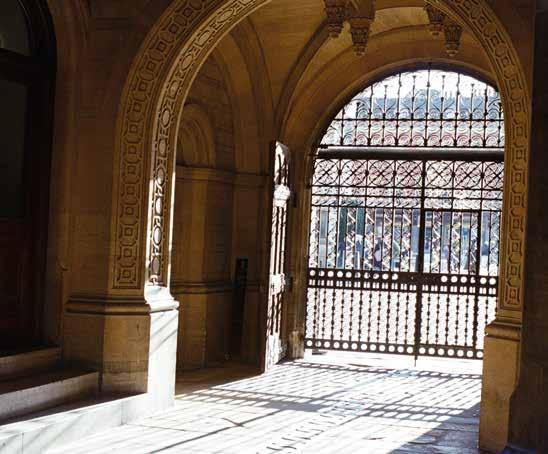
Dr C M Colley+
Mr G B Cooper
Mr J Harris+
Dr D A Hattersley+
His Hon Richard Holman+
Mr R P Hopford+
Dr R G Jezzard+
Mr K E Jones+
Dr R R Jones
Dr H J Klass+
The Hon Dr J F Lehman+
Dr M J Maguire+
Dr P J Marriott+
Mr J J McCrea
His Hon Judge Morris
Mr T Mullett+
Dr J W New+
Dr K J Routledge
Dr D J Sloan+
Mr I D K Thompson+
Professor J S Tobias+
Mr I R Whitehead
Mr A T Williams+
Mr D V Wilson+
Lt Col J R Wood+
1966
Mr M J Barker
Mr D C Bishop
Dr D S Bishop+
Mr P Chapman+
Dr K R Daniels+
Dr T K Day+
Mr C R Deacon+
Mr D P Dearden+
Mr R S Dimmick
Mr P S Elliston+
Mr D R Harrison+
Dr L E Haseler+
Mr R E Hickman+
Mr R Holden+
Professor R C Hunt+
Dr W E Kenyon+
The late Mr D C Lunn+
Dr P I Maton
Dr A A Mawby+
Professor P M Meara
Mr P V Morris+
Dr K T Parker
Mr S Poster+
Dr R L Stone+
Mr N E Suess+
Mr D Swinson+
Dr A M Turner+
Mr J F Wardle+
Mr S M Whitehead+
Mr J M Williams+
Mr N J Wilson
The Revd R J Wyber
1967
Mr G W Baines
Mr N J Burton+
Mr P G Cottrell+
Mr G C Dalton+
Dr W Day
Mr A C Debenham+
Mr P E Gore+
Dr W Y-C Hung+
Mr J R Jones
Mr N G H Kermode+
Mr R J Lasko+
Mr D I Last+
Dr I D Lindsay+
Mr R J Longman+
Mr T W Morton
Mr W M O Nelson+
Mr J S Richardson
Mr H J A Scott+
Mr G T Slater+
Mr C A Williams
The Revd Dr J D Yule
1968
Dr M J Adams+
Mr P M Barker+
Mr P E Barnes
Dr F G T Bridgham+
Mr A C Cosker+
Mr J P Dalton+
Mr S M Fox
The late Mr D P Garrick+
Mr D S Glass
Mr M D Hardinge
Dr P W Ind+
The Revd Fr A Keefe
Professor R J A Little+
Dr D H O Lloyd+
Professor J I McGuire
Dr J Meyrick-Thomas+
Professor J F Roberts
Mr E Robinson
Mr P S Shaerf+
Mr P J Tracy
Dr G S Walford+
Mr C Walker+
Dr D P Walker+
Mr P E Wallace
Mr V Wineman
1969
Mr L R Baker
Dr S C Bamber+
Dr A B E Benjamin
Dr A D Blainey+
Mr S E Bowkett+
Mr A C Brown+
Mr M S Cowell+
Dr M K Davies+
Mr S H Dunkley+
Dr M W Eaton+
Mr R J Field+
Professor J P Fry+
Dr C J Hardwick+
Mr J S Hodgson+
The late Mr T J F Hunt+
Mr S B Joseph+
Mr A Keir+
Mr C J Lloyd+
Mr S J Lodder+
Mr R G McGowan+
Dr C M Pegrum+
Dr D B Peterson+
Mr P J M Redfern
Mr B A H Todd
Mr P B Vos+
Mr A J Waters+
Dr N H Wheale+
Professor D R Widdess+
Mr C J Wilkes+
Mr D A Wilson
Mr P J G Wright+
1970
Mr J Aughton+
Mr R Butler+
Dr D D Clark-Lowes+
Mr G J H Cliff+
Mr R P Cliff+
Mr L P Foulds+
Mr P J Robinson+
Mr C D Sullivan
Mr A H M Thompson+
Mr S V Wolfensohn+
The late Mr S Young
1972
Mr M H Armour
Mr A B S Ball+
Mr J P Bates+
Mr S M B Blasdale+
Mr N P Bull
Mr I J Buswell
Mr J G Cooper
Mr C G Davies
Mr P A England+
Mr P J Farmer+
Mr C Finden-Browne+
Mr R H Gleed+
Mr R S Handley+
Mr A M Hunter Johnston
Professor W L Irving+
Mr J K Jolliffe+
Mr P B Kerr-Dineen
Dr D R Mason+
Mr J R Moor+
Mr D J Nicholls
Mr S J Roberts
Mr J Scopes+
Mr M J Spinks
Dr T D Swift+
The Revd Dr R G Thomas+
Dr N A R Watt
Canon Dr J A Williams
Mr O A B Green+
Mr J D Gwinnell+
Mr D P W Harvey
Mr J W Hodgson+
Professor J A S Howell+
Mr S D Joseph+
Mr C A Jourdan
Mr N R Kinnear+
Professor J MacDonald
Mr B S Missenden+
Dr S Mohindra+
Mr A J Neale
Mr J C Needes
Mr J S Robinson+
Mr B Z Sacks+
Dr R D S Sanderson+
Professor R W Whatmore+
Professor G Zanker
1971
Dr J P Arm
Mr M S Arthur+
Mr S Brearley+
Mr J A K Clark+
Dr R C A Collinson
Mr C P Cousins
Mr J A Duval+
Professor A M Emond+
Mr J-L M Evans+
Mr L J Hambly
Professor B Jones+
Dr P Kinns+
The late Dr N P Leary
Dr G Levine+
Dr P G Mattos+
Mr R I Morgan+
Mr L N Moss+
Mr N D Peace+
Mr S R Perry
Mr K R Pippard
1973
Dr A P Allen+
Dr S M Allen+
Mr N P Carden
Professor P Collins+
Mr S P Crooks+
Mr M G Daw+
Mr A G Fleming+
Mr J R Hazelton
Dr R J Hopkins+
Mr F How
Mr K F C Marshall
Mr J S Morgan+
Mr J S Nangle+
Professor T J Pedley+
Mr J F Points+
Dr W A Smith+
Mr C P Stoate
Mr H B Trust+
Mr D G Vanstone
Mr G A Whitworth+
1974
Mr H J Chase
The Revd Dr V J Chatterjie
Dr L H Cope+
Mr M D Damazer+
Professor J H Davies+
Professor A G Dewhurst+
Dr E J Dickinson+
Mr R J Evans
Professor J Gascoigne
Mr P A Goodman+
Mr S J Hampson+
Dr W N Hubbard
Mr P Logan+
Mr R O MacInnes-Manby+
Mr G Markham+
Dr C H Mason+
In a typical year, the College faces a shortfall of about £6 million between income received from, and spending on, students. Donors play a crucial role in bridging this gap, enabling Caius to do all it does for its students. Thank you!
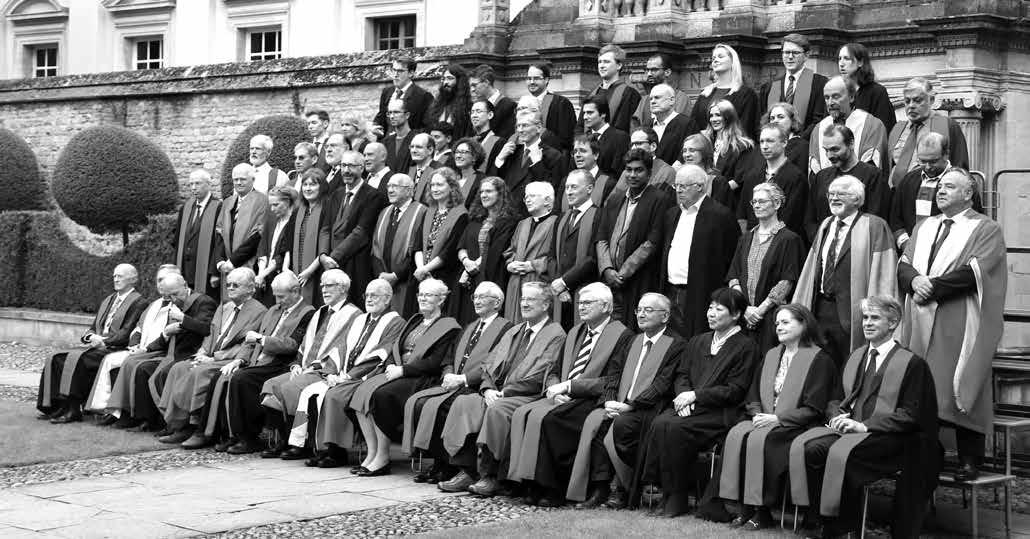
Mr R B N Smither
Dr T G Powell+
Professor J G H Fulbrook
Professor B Reddy
Mr N J Roberts
Professor D S Secher+
Mr C L Spencer+
The Rt Hon The Lord Turner of Ecchinswell
Dr A M Vali+
Mr D K B Walker+
Mr S T Weeks+
1975
Dr C J Bartley+
Mr P S Belsman
Mr D A L Burn
Mr S D Carpenter
Mr S Collins
Sir Anthony CookeYarborough Bt+
Dr M J Franklin+
Mr N R Gamble+
Mr M H Graham+
Professor J F Hancock
Dr N Koehli
Mr D M Mabb KC
Dr R G Mayne+
Mr K S Miller+
Dr C C P Nnochiri+
Dr H C Rayner
Mr D J G Reilly+
Professor J P K Seville
Dr F A Simion
Mr B J Warne
1976
Mr G Abrams+
Mr J J J Bates+
Dr M P Clarke+
The Revd Canon B D Clover
Mr D J Cox+
Mr R J Davis+
The Hon Dr R H Emslie+
Dr M J Fitchett+
Mr S D Flack+
Dr G C T Griffiths+
Dr I C Hayes
Dr A C J Hutchesson+
Mr R A Larkman+
Mr M des L F Latham
Dr B E Lyn
Dr P B Medcalf+
Dr S J Morris
Dr D Myers
Mr J S Price
Mr S Thomson+
Mr J P Treasure+
The Rt Hon N K A S Vaz
Professor O H Warnock
Mr A Widdowson+
1977
Mr J H M Barrow+
Mr A C Boulding
Dr M S D Callaghan+
Dr P N Cooper+
Professor K J Friston+
Mr A L Gibb+
Mr K F Haviland+
Mr R M House+
Dr P H M McWhinney+
Dr L S Mills
Dr R P Owens+
Professor A Pagliuca+
Mr I M Radford
Dr L F M Scinto
Mr M J Simon
Dr P A Watson+
Mr D J White+
Mr L M Wiseman+
Professor E W Wright+
1978
Mr J C Barber+
The Revd Dr A B Bartlett
Mr M D Brown+
Mr B J Carlin+
Mr C J Carter+
Mr J M Charlton-Jones+
Mr S A Corns+
Mr M J Cosans+
Dr P G Dommett+
Dr J A Ellerton+
Mr J S Evans
Mr R J Evans+
Professor P M Goldbart
Mr A B Grabowski
Dr M Hernandez-Bronchud
Dr C N Johnson+
Mr P R M Kavanagh
Mr D P Kirby+
Mr R A Lister+
Dr D R May+
Dr A A M Morris
Mr A J Noble+
Mr S Preece
Mr P J Reeder+
Mr M H Schuster+
Mr P A F Thomas
Dr D Townsend+
Mr R W Vanstone
Dr P Venkatesan
Dr W M Wong+
Mr P A Woo-Ming+
1979
Mr D J Alexander
Mr A J Birkbeck+
Dr P J Carter
Dr I M Cropley
Mr W D Crorkin+
Dr A P Day+
Mrs C E Elliott
Professor T J Evans+
Mr P C Gandy+
Dr M de la R Gunton+
Mr N C I Harding+
Mr R P Hayes+
Mr T E J Hems+
Ms C J Jenkins
Mr P J Keeble+
Mr D L Melvin
Professor C T Reid
Mr C S Rigby
Ms A M Roads+
Dr C M Rogers+
Ms H Tierney
Professor R P Tuckett
Mr N A Venables
1980
Mr C P Aldren
Dr L E Bates+
Dr N P Bates+
Mr C R Brunold+
The Revd Dr P H Donald
Dr S L Grassie+
Mr M J Hardwick
Dr E M L Holmes+
Mr R H Hopkin
Dr J M Jarosz+
Dr S C Jarvis
Mr K M C Le Goy
Dr J Marsh
Professor Sir Jonathan Montgomery+
Dr J N Pines+
Mr J H Pitman
Mr T N B Rochford
The Rt Hon The Lord Rockley
Ms J S Saunders+
Mr J M E Silman+
Mr R L Tray+
1981
Mrs J S Adams
Professor N M Crickmore
Mr J M Davey+
Dr M Desai+
Mr D P S Dickinson+
Mr N J Farr
Mr R Ford+
Mr A W Hawkswell+
Mr W S Hobhouse+
Mr R H M Horner+
Mr P C N Irven+
Professor T E Keymer+
Ms F J C Lunn
Mr P J Maddock+
Dr M Mishra+
Mr T G Naccarato
Dr A P G Newman-Sanders
Mr G Nnochiri+
Mr G A Rachman+
Mrs B J Ridhiwani
Mrs M Robinson
Dr R M Roope+
Mrs D C Saunders+
Mr T Saunders+
Dr L A Silcock
Dr N A Silcock
Dr D M Talbott+
Mr K J Taylor+
Ms L J Teasdale+
Ms A M Tully+
Ms S Williams+
1982
Dr A K Baird+
Mr D Baker+
Mr J D Biggart+
Dr C D Blair+
Mr P A Cooper+
Mr G A Czartoryski+
Professor S M Fitzmaurice
Mr D A B Fuggle+
Mr J C Gordon
Mr T K Gray
Mr M Hall
Mrs C H Kenyon
Mr P Loughborough
Professor M Moriarty+
Ms N Morris+
Mr D H O’Driscoll
Mr R J Powell+
The Rt Hon Professor
The Lord Roberts of Belgravia+
Mr J P Scopes+
Mrs A J Sheat+
Ms O M Stewart+
Mrs E I C Strasburger+
Dr J G Tang+
Professor M J Weait
Mr A M Williams
1983
Dr R F Balfour
Dr J E Birnie+
Mrs K R M Castelino+
Professor S-L Chew+
Professor J P L Ching+
Dr S A J Crighton+
Dr N D Downing
Mr A L Evans+
The Hon Sir Timothy Fancourt+
Mr P E J Fellows+
Dr S F J Fellows+
Dr W P Goddard+
Mr W A C Hayward+
Mr R M James+
Mrs H M L Lee+
Mr J B K Lough+
Dr R C Mason
Mr A J McCleary+
Mr R H Moore
Dr L S Parker
Mr R M Payn+
Mr J A Plumley+
Mr A B Porteous
Mr A I Porteous
Mrs S D Robinson+
Dr C P Spencer+
The Revd C H Stebbing+
Mr A G Strowbridge
Mr R B Swede+
Mr C H Umur
Dr S C Warburton
Dr K M Wood+
1984
Mr D Bailey
Mr R A Brooks+
Mr G C R Budden+
Dr R E Chatwin
Professor H W Clark+
Dr A R Duncan+
Professor T G Q Eisen+
Dr J R B Leventhorpe
Mr G C Maddock+
Mr A D H Marshall+
Mr J R Pollock+
Dr K S Sandhu+
Mr G N Wallace
Dr H E Woodley+
1985
HE Mr N M Baker+
Ms C E R Bartram+
Dr I M Bell+
Mrs J C Cassabois
Mr A H Davison+
Dr J P de Kock
Mr K J Fitch
Mr J D Harry+
Ms P Hayward
Mr P G J S Helson+
Mr J A Howard-Sneyd+
Dr C H Jessop+
Mr C L P Kennedy+
Mr W P L Lawes
Mrs C F Lister
Dr G K Miflin
The Very Revd N C Papadopulos+
Dr R J Penney+
Ms S L Porter+
Mr R Sayeed
Dr J A Scrine+
Mr E J Shaw-Smith
Dr P M Slade+
Mr B M Usselmann
Mr W D L M Vereker
Dr M J J Veselý+
Mrs J S Wilcox+
Dr J M Wilson
Dr E F Worthington+
1986
Professor K Brown+
Mr M T Cartmell
Mr H D E Clark
Mr J H F & Mrs A I Cleeve
Mr A J F Cox+
Professor J A Davies+
Professor R L Fulton Brown
Mr T Hibbert
Dr M P Horan
Professor J M Huntley+
Mr M C Jinks
Dr H V Kettle
Professor J C Knight+
Professor M Knight+
Ms A Kupschus+
Professor J C Laidlaw+
Dr G H Matthews
Dr D L L Parry+
Professor P Rogerson
Mr J P Saunders+
Professor A J Schofield
Ms V H Stace
Dr A J Tomlinson+
Dr M H Wagstaff
Mr S A Wajed+
Mr C Zapf+
1987
Mr J P Barabino
Mr N R Chippington+
Mrs H J Courtauld
Mr A J Coveney+
Dr L T Day+
Dr H L Dewing
Dr K E H Dewing
Mr C H Dodwell
Dr J A Ewbank
Mr C P J Flower
Mr J W M Hak
Mr S L Jagger
Dr M Karim+
Dr S L Kenyon-Slade
Dr P Kumar+
Mr D M Lambert+
Mr S P Leo
Mrs U U Mahatme
Mr L M Mair
Ms P A Nagle
Dr W P Ridsdill Smith+
Dr J Sarma
Professor M Shahmanesh+
Mr D W Shores+
Mr A B Silas
Mr S Sinclair
Mr J M L Williams
Dr T J A Winnifrith
1988
Dr F B Ahmed
Dr K J Brahmbhatt
Mr J C Brown+
Mrs C Chancellor+
Mrs A I Cleeve
Mr N P Dougherty
Mr N D Evans
Mr E T Halverson
Dr E N Herbert
Ms R C Homan+
Dr A D Hossack+
Dr O S Khwaja
Mr F F C J Lacasse
Mr F P Little+
Dr I H Magedera
Mr A P Parsisson
Mr A D Silcock
Dr R C Silcock
Mrs A J L Smith+
Mr A J Smith+
Mr R D Smith+
Dr R M Tarzi+
Ms F R Tattersall+
Mr M E H Tipping
Mrs L Umur
Miss C Whitaker
Dr F J L Wuytack+
1989
Dr C L Abram
Mr S P Barnett+
Dr C E Bebb+
Ms M S Brown
Professor M J Brown+
Dr E A Cross+
Dr S Francis+
Mr G R Glaves+
Mr S M S A Hossain+
Professor P M Irving+
Mr G W Jones+
Mr J P Kennedy+
Dr H H Lee+
Dr S Lee+
Mrs L C Logan+
Mr B J McGrath
Mr P J Moore+
Ms J H Myers+
Dr S L Rahman Haley+
Mr N J C Robinson+
Mrs C Romans+
Mr A M P Russell+
Ms R Sakimura
Mrs D T Slade
Dr N Smeulders+
Mr J A Sowerby
Mr A S Uppal+
Mrs E H Wadsley+
Mrs T E Warren+
1990
Mr A Bentham
Mrs C M A Bentham
Mrs E C Browne+
Mrs S C Butcher
Professor L C Chappell+
Mrs Z M Clark
Dr A A Clayton+
Mr I J Clubb+
Mr P E Day+
Mrs S V Dyson
Professor M K Elahee
Dr E A Evans
Professor A Ferro
Dr D S Game+
Dr J Griffiths+
Mrs C L Guest+
Mr A W P Guy+
Mr R D Hill+
Mr H R Jones+
Dr P A Key KC
Mr D H Kim
Mrs G Konradt
Dr S H O F Korbei+
Mr G C Li
Ms R Mandal
Dr D H McIlroy
Miss M L Mejia
Mr T Moody-Stuart KC+
Mr G O’Brien
Mr S T Oestmann+
Dr C A Palin+
Dr J M Parberry+
Mrs L J Sanderson
Professor M C Smith
Mr G E L Spanier
Mr D S Turnbull
Dr J C Wadsley+
Ms R M Winden
1991
Mr B M Adamson
Dr D G Anderson
Dr R D Baird+
Dr A A Baker+
Mr A M J Cannon+
Mr D D Chandra+
Mrs B Choi
Dr C Davies
Dr A H Deakin+
Mrs C R Dennison+
Dr S Dorman+
Dr D L A Doyé
Dr S C Francis+
Mr I D Griffiths+
Dr A J Hodge+
Dr M H Jones Chesters
Professor F E Karet+
Professor K-T Khaw
Mr I J Long+
Mrs L P Parberry+
Mr D R Paterson
Mrs C J Richards
Dr J E Rickett
Ms I A Robertson
Miss V A Ross+
Mr A Smeulders+
Mr J G C Taylor+
Ms G A Usher+
Mr C S Wale+
Mr M N Whiteley
Mr S J Wright+
1992
Dr M R Al-Qaisi+
Ms E H Auger+
Mr D Auterson
Mrs R Auterson
Mrs S P Baird+
The late Mr J P A Ball
Ms S F C Bravard+
Mr N W Burkitt+
Ms J R M Burton+
Mr P E Clifton
Mr R A H Grantham+
Mrs F M Haines+
Ms K A Harrison Rowe
Mr O Herbert+
Dr S L Herbert+
Ms J Z Z Hu
Mr E M E D Kenny
Dr R M Lees
Mr J Lui+
Dr S Mandal
Mr A J Matthews
Mrs J A O’Hara
Dr K M Park+
Dr M S Sagoo+
Mr J D Saunders+
Mr P Sinclair
Mrs S L Sinclair
Mrs R C Stevens+
Mrs J M Walledge+
1993
Dr A C G Breeze+
Dr C Byrne+
Mr C M Calvert
Mr P M Ceely+
Mr P I Condron
The number of PhD studentships at Cambridge funded by the Arts & Humanities Research Council will fall from 30 to three as of next year. Raising support for these postgraduate students is therefore more urgent than ever.
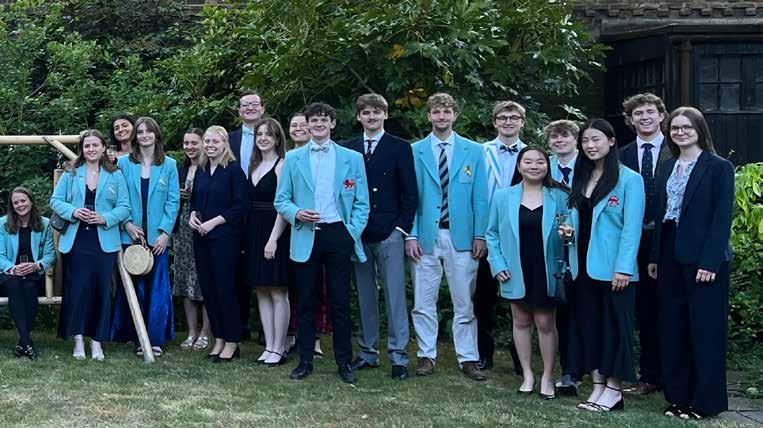
Dr E A Congdon
Mrs J L Crowther
Mr B M Davidson+
Ms A D M de Chassiron
Mr P A Edwards
Dr A S Everington+
Professor I R Fisher
Mr J C Hobson
Mr C E G Hogbin+
Dr A B Massara+
Dr S B Massara+
Dr A J Penrose+
Mr R B K Phillips+
Dr J F Reynolds+
Mrs L Robson Brown+
Dr R Roy+
Mrs A Worden
Mr T J A Worden
1994
Mr J H Anderson
Dr R A Barnes
Professor D M Bethea
Mr R P Blok
Dr L Christopoulou+
Dr D J Cutter+
Mr N Q S De Souza+
Ms V K E Dietzel
Dr S C Dyton
Mr D R M Edwards+
Professor T C Fardon+
Dr J A Fraser
Mr S S Gill
Mrs E Haynes
Mr R J M Haynes
Dr P M Heck+
Dr A P Khawaja+
Mr P A J Phillips
Professor S G A Pitel+
Mr P D Reel+
Dr P J Sowerby Stein
Professor M A Stein
Dr K-S Tan
Mr M A Wood+
1995
Mr C Aitken+
Dr R A J Carson
Ms S S-Y Cheung
Mr C Chew+
Dr P A Cunningham
Dr S L Dyson
Dr J S Feuerstein
Mrs J A S Ford+
Dr Z B M Fritz+
Mr C K Goater
Mr J R Harvey+
Dr N J Hillier+
Ms L H Howarth+
Ms M C Katbamna-Mackey
Dr P Krishnamurthy
Mr B J Marks Canon Prof J D McDonald+
Dr D N Miller+
Dr M A Miller+
Professor K M O’Shaughnessy+
Mr S M Pilgrim+
Dr B G Rock+
Mrs G Rollins
Ms T J Sheridan+
Mr M J Soper
Dr C H Williams-Gray+
Miss M B Williamson
Dr X Yang
1996
Mr M Adamson
Mrs S E Birshan
Dr J R Bonnington
Miss A L Bradbury+
Ms C E Callaghan+
Mr K W-C Chan+
Mr A E S Curran
Mr G D Earl+
Dr D A Evans
Professor J Fitzmaurice
Mrs J H J Gilbert
Professor D A Giussani+
Mr J D Goldsmith
Dr V P Gunasekera
Mr I R Herd+
Mr T M Lock
Miss F A Mitchell+
Ms J N K Phillips+
Dr S Rajapaksa+
Mr A J T Ray+
Ms V C Reeve+
Mr J R Robinson+
Mr A K Saha
Mr C M Stafford
Mr D J Tait
Dr P G Velusami
Mr B T Waine+
Dr S Walke
Mr M-H Wong
Mr K F Wyre+
1997
Mrs L J Allen
Mr P J & Mrs L J Allen
Mr A J Bower+
Mr J D Bustard+
Miss J M Chrisman
Mrs R V Clubb+
Mr I Dorrington+
Mrs J R Earl+
Dr E J Fardon+
Mr J Frieda
Dr D M Guttmann+
Ms A M Hart
Mr G P Lyons
Mr G D Maassen
Dr E A Martin+
Ms V E McMaw+
Dr A L Mendoza+
Dr S Nestler-Parr+
Ms R N Page+
Ms E D Sarma
Mr J P A Smith
Mr B Sulaiman+
Mr J P Turville
1998
Ms H M Barnard+
Mr A J Bryant+
Mr D W Cleverly+
Mr B N Deacon
Dr P J Dilks+
Mr J A Etherington+
Dr S E Forwood+
Mr A R Hood
Mr H R F Nimmo-Smith
Dr A J Pask+
Mrs J C Wood+
Mr R A Wood+
1999
Mr P J Aldis+
Mr I Anane+
Dr A E Bamji
Mr R F T Beentje+
Miss C M M Bell+
Mr D T Bell+
Dr C L Broughton+
Ms J W-M Chan+
Mr J A Cliffe+
Mr J D Coley+
Visit the Caius Networking and Mentoring web pages: cai.cam.ac.uk/ networking. Your professional advice and experiences could be of enormous benefit to current students and recent graduates.
Ms H B Deixler
Ms L M Devlin+
Mr P M Ellison
Ms S Gnanalingam+
Mrs H C Jeens
Mr R C T Jeens
Mr A F Kadar+
Ms R M Knight
Mr C M Lamb+
Mr M W Laycock+
Mr N O Midgley+
Dr C Parrish
Mr C Patton
Mr N E Ransley
Ms A J C Sander
Dr J D Stainsby+
Mrs L N Williams
Mr P J Wood+
Dr P D Wright+
2000
Mr R D Bamford
Mrs R A Cliffe+
Mr M T Coates+
Dr A D Deeks
Miss J L Dickey+
Mr E W Elias
Mr T P Finch+
Mr M J Harris
Mrs S Hodgson
Mrs J M Howley+
Dr N S Hughes+
Mr G P F King+
Mrs V King+
Ms M Lada+
Miss N O-L Lee
Dr R Lööf+
Dr A G P Naish-Guzmán+
Lt Col D N Naumann+
Mr H S Panesar+
Mr O F G Phillips+
Dr C J Rayson+
Dr J Reynolds
Mr C E Rice+
Mr M O Salvén+
Mr A K T Smith+
Mr H F St Aubyn
Dr M Tosic
Dr H E Weston-Simons
2001
Dr D M Bolser
Mr J J Cassidy+
Dr J W Chan+
Dr C J Chu+
Mr E H C Corn
Mr H C P Dawe+
Dr M G Dracos+
Mrs A C Finch+
Mr D W M Fritz
Miss E Goulder
Ms L D Hannant+
Mr G A Herd
Dr D P C Heyman
Mr C Liu
Dr A Lyon+
Mr M Margrett
Mr A S Massey+
Dr A C McKnight+
Mrs J C Mendis
Mr R J G Mendis
Professor R J Miller+
Mr H M I Mussa+
Mr C P Normand
Mrs S Normand
Mr A L Pegg+
Dr R A Reid-Edwards
Dr C L Riley
Ms A E C Rogers+
Mrs J M Shah+
Mr K K Shah+
Dr S J Sprague+
Mr M R P Thompson
Ms F A M Treanor+
Dr C C Ward+
Dr R A Weerakkody
Mr C P Weston-Simons
Dr H W Woodward+
2002
Mr C D Aylard+
Dr J T G Brown
Mr M L C Caflisch
Dr N D F Campbell+
Miss C F Dale
Mr J-M Edmundson+
Mrs K M Frost+
Mr Y Gailani
Dr E Galinskaya
Mrs J H Gilbert+
Dr A C Ho
Mr O J Humphries
Mr T R Jacks+
Ms H Katsonga-Woodward+
Miss H D Kinghorn+
Dr M J Kleinz+
Dr M F Komori-Glatz
Mr T H Land+
Mr R Mathur
Dr A Plekhanov+
Mr S Queen+
Mr R E Reynolds+
Professor D J Riches
Mr N A Shah
Mr A Singh
Dr N Sinha
Dr D L Smith
Dr S Ueno+
Dr L L Watkins+
Miss R E Willis
2003
Mr J E Anthony+
Ms C O N Brayshaw+
Mr C G Brooks
Dr E A L Chamberlain
Ms S K Chapman+
Ms V J Collins+
Mr J M Corby
Dr B J Dabby
Mrs L R Draper
Mr A L Eardley+
Mr T H French+
Miss A V Henderson+
Dr M S Holt+
Mr R Holt
Mr D C Horley+
Dr S M Huisman
Mr D J John
Dr A R Langley+
Mr J A Leasure
Mrs J Lucas Sammons+
Mr R A K MacDonald
Mr C A J Manning+
Mr M McKenna
Dr D J McKeon+
Miss V K C Scopes+
Miss N N Shah
Ms M Solera-Deuchar+
Mr T N Sorrel+
Mr S Tandon
Mr J L Todd+
Dr R C Wagner+
Mr C S Whittleston+
Mrs S S Wood+
2004
Mr S R F Ashton+
Mr M G Austin
Dr E F Aylard+
Mrs D M Cahill
Mr G B H Silkstone Carter+
Mrs H L Carter+
Mrs R C E Cavonius+
Dr T M-K Cheng
Dr J A Chowdhury
Dr C W J Coomber
Dr L C B Fletcher+
Ms C L Lee+
Mr W A Leslie
Ms C M C Lloyd-Griffiths+
Dr G C McFarland+
Mr P E Myerson+
Ms Z Owen
Mr J W G Rees
Dr C Richardt
Mrs L R Sidey+
Master B Silver
Dr S M Sivanandan
Miss N J M-Y Titmus
Mr H P Vann+
Mr L B Ward
2005
Ms P D Ashton+
Dr E T Aw
Mr B Barrat
Mr R R D Demarchi
Mr M W Evans
Miss E M Fialho+
Dr P Hakim
Mr I J A Heames
Mr J M Hunter+
Mr M E Ibrahim
Mr M T Jobson+
Dr E Lewington-Gower+
Dr S A Li
Miss E C L Lister
Dr A H Malem+
Mr A J McIntosh
Dr E M McIntosh
Dr T J Murphy+
Mr L J Panter+
Mrs E L Rees
Mr J L J Reicher+
Mr Y P Tan
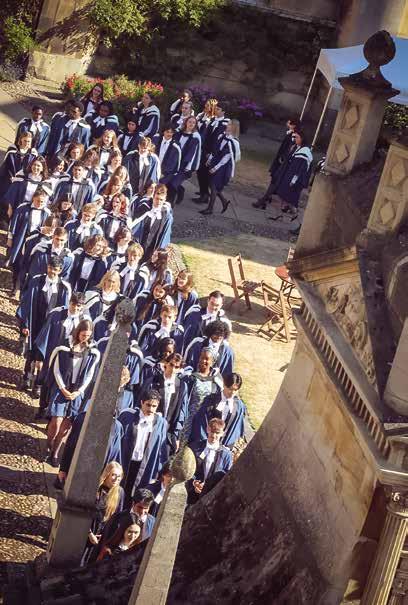
Caius’ student bursary expenditure has increased by 25 per cent overall in the last two years due to the rising cost of living. Support from alumni allows us to keep our doors open to the brightest minds, regardless of background.
2006
Dr D T Ballantyne
Miss W K S Cheung
Mr B E N Crowne
Mrs R M de Minckwitz
Mr P C Demetriou+
Mr R N Dover
Mr M A Espin Rojo+
Mr R J Granby+
Mr P I Hill
Mr V Kana
Miss Y N E Lai
Dr C E S Lewis
Mr E P Peace+
Mr J R Poole+
Miss H K Rutherford+
Mr W J Sellors
Mr S S Shah+
Dr S K Stewart+
Dr E P Thanisch
Mrs J B A Winthrop
Mr H L H Wong
2007
Mr H Bhatt+
Mr H Y Chen
Dr J P A Coleman+
Mr D W Du
Dr J Edwards
Ms A E Eisen+
Dr E Evans
Dr S S Huang
Mr D T Nguyen+
Ms S K A Parkinson+
Dr S X Pfister+
Dr T J Pfister+
Miss S Ramakrishnan+
Mr D G R Self+
Dr B D Sloan+
Dr V Vetrivel
Mr O J Willis+
Dr S E Winchester
2008
Mr O T Burkinshaw+
Dr O R A Chick
Mrs E C Davison+
Dr H G Füchtbauer
Mrs J A Goodwin
Mr J E Goodwin+
Dr M A Hayoun
Miss H Kearney
Dr R S Kearney
Dr J W G Ketcheson
Mr K R Lu+
Dr A W Martinelli+
Mr M Mkandawire
Mr J M Oxley+
Mrs V C Small
Dr M C Stoddard
Mr X Xu+
2009
Mr G M Beck
Dr S E Cope
Mr E D Cronan
Mr C A Gowers
Mr J H Hill+
Mr J R Howell+
Dr S Khosla
Mr C Li
Mr A W C Lodge
Dr E A Mayne
Dr O C Okpala
Miss F G Sandford
Dr C E Sogot+
Mr J P J Taylor
2010
Mr B D Aldridge
Mrs J H E Bell
Dr C Chen
Ms H R Crawford+
Dr T A Ellison
Miss A A Gibson
Mr J Goblet
Mr W R Jeffs
Miss L M C Jones
Mr S D Kemp+
Dr J A Latimer+
Dr A I Leal Cervantes
Mrs C E Matthews
Miss H M Parker
Dr J O Patterson
Ms J Tang
Miss J D Tovey
Miss C M C Wong
Dr S P Wright
2011
Mr A S Bell
Mr F A Blair+
Mr A J C Blythe
Miss L E Cassidy
Mr K A P-S Chew
Mr J A Cobbold
Miss K E Collar
Miss C Y Hu
Mr J C Robinson
Dr B B Walker
Miss H Zhang
2012
Dr M A W Alexander
Dr L K Allen
Dr H R Simmonds
Dr B Stark
Dr R I Wakefield
2013
Dr J D Bernstock
Dr L Bibby
Dr C E Gascoigne
Mr M M Gill
Mr A Miller
2014
Miss R G T Davies
Dr S V Long
Mr K Purohit
2015 onwards
Mr E Adair
Mr A Boruta
Mr T J Charnley
Mr M Coote
Miss A E M Edwards-Knight
Dr T A Fairclough
Miss N J Holloway
Mr D A Le
Mr H J Mitson
Mr T Reiter
Mr B A Tompkins
Mr V R Tray
Miss E Diamanti
Professor E Dimson
Mrs M J Fairclough
Mr M A Khan
Mr J J L Mok
Dr M Sanguanini
Ms J Cheng
Miss P C T Green
Mr P Myers
Mr P Rattanasirivilai
Dr T Tachatirakul
Mr W Tapanakornwut
Mr T L Kelly
Mr Y X Lim
Dr A M Spencer
Dr M Amatt
Mr L MacCallum-Webb
Mrs K Grabowska Hongwei Li
Miss N Beney
Parents & Friends
Ms T Arsenault
Mr K & Mrs M Azizi
Mrs A J Barnett
Mr S & Mrs S L Barter+
Miss L Barwell
Dr S Basha & Dr M Palaniappan
Mrs L M Bernstein+
Mr S M & Mrs A Bhate+
Mr R L Biava & Dr E J Clark
Mr D Boyd
Mr R L Buckner
Mr M C & Mrs C M Burgess+
Mr J W & Mrs A Butler+
Mrs T Caflisch
Mr D M & Mrs A J Cassidy+
Dr M D & Mrs E A Chard+
Mr A & Mrs G Corsini+
Mr R N & Mrs A J Crook
Dr T G & Mrs A J Cunningham+
Mr C H Jones & Mrs E L Davies
Mrs E M Drewitt
Mr P Evans+
Mr P J & Mrs S M Everett+
Ms O Fitzsimons
Mr H D & Mrs B A E Fletcher
Dr D & Mrs H Frame+
The late Susan Fay Gaisford
Mrs A Galea
D Golden
Mr N & Mrs V M Gordon+
Ms S Gorman
Mr D Gubb
Ms E Hamilton
Mrs E A Hogbin
Mrs A E Howe+
Mr M & Mrs E Howells
Mrs A Kelly
Mr K W & Mrs L Lau+
Mr G Lawrenson
Mr A & Mrs A Lilienfeld+
Mr P Lyons
VOLUNTEERS
Hosts
Dr K F Achermann (2019)
Mr M E Boyle (1996)
Mr K W-C Chan (1996)
Ms M H L Chan (1992)
Dr S E Chua (1984)
Mr A D Coups (1990)
Ms H B Deixler (1999)
Mrs S V Dyson (1990)
Mr S S (1994) & Mrs T Gill
Mr P G J S Helson (1985)
Mr A K Nigam (1964)
Mr A L Pegg (2001)
Mr N E (1966) & Mrs K Suess
Dr M H M Syn (1990)
Professor P S (1960) & W S Walker
The Caius Foundation
Mr S Mahatme
Mrs J Mantle
Mr P C & Mrs S M Marshall+
Mr W P & Dr J O Mason+
Mr A & Mrs J McBeath
Mr J & Mrs E Miller+
Mr E W S Mok
Dr P Monck Hill+
Mrs H Moore
Mr J E Moore+
Mr M Myere
Mr P Nash
Mrs L Naumann
Professor P E Nelson
Mr P F & Mrs S J Newman+
Ms T D Oakley+
Miss E H Parton+
Mr K G Patel+
Mrs E A Peace+
Mrs K E Plumley+
Mr D H Ratnaweera & Mrs
R A Nanayakkara+
Mr S M & Mrs L M Reed+
Dr G & Mrs D Samra
Mr A & Mrs C Scully+
E Shalley
A Shcherbakova
Mr M & Mrs L J Spiller+
Mrs K Suess+
Mr P R & Mrs W P Swinn+
Mr C S Tamkin Jr
Mr J E Thompson+
Dr A Thrush & Dr H Bradley+
Mr M & Mrs V Wood+
Mr P M & Mrs J A Woodward+
Dr A R & Dr H A Wordley+
Mr S M Zinser
Corporations, Trusts & Foundations
Anthos Amsterdam
Barclays Bank Caius Club
Charles McCutchen Foundation Google Labcorp LinkedIn
Sir Simon Milton Foundation
The Chumrow Charitable Trust
The Ganton Furze Settlement
+ Denotes member of the Ten Year Club
Development & Alumni Relations
Committee
Ms M H L Chan (1992)
Mr W D L M Vereker (1985)
Caius Foundation
Mr J P Barabino (1987)
Mr I Dorrington (1997)
Mr S S Gill (1994)
Ms K A Harrison Rowe (1992)
Mr C E G Hogbin (1993)
The Hon Dr J F Lehman (1965)
Mr G P Lyons (1997)
Ms C S Spera (2012)
Mrs E I C Strasburger (1982)
Professor P S Walker (1960)
Development Advisory Group
Mr C D Aylard (2002)
Mr M D Damazer (1974)
Mrs S V Dyson (1990)
Ms V J Exelby (1991)
Mr D R Hulbert (1969)
Dr J P Kaiser (1991)
Mrs C F Lister (1985)
Dr A P Marsden (2008)
Mr W D L M Vereker (1985)
Mrs S J Watt (1999)
Mr S M Zinser
Speakers
Dr E F Aylard (2004)
The Rt Hon Sir Christopher Clarke (1965)
Mr M D Damazer (1974)
Mr Y Gailani (2002)
Mrs V O H Garnett (2004)
Mr M McKenna (2003)
Dr M Sanguanini (2016)
Scan to make a gift to Caius

This QR code links to this address: cai.cam.ac.uk/ make-gift.
RECOGNISING OUR BENEFACTORS
Caius is the only ancient College of the University of Cambridge named after its major benefactors, Edmund Gonville and John Caius. To this day, the College depends on the generosity of alumni and friends to ensure that it provides a thriving environment for outstanding teaching and research.
We are delighted to recognise your generosity to Caius through the Court of Benefactors. Membership is organised by giving levels:
ASSOCIATE MEMBER
MEMBER
PATRON
FOUNDER
GONVILLE FELLOW BENEFACTOR
£12,500
£30,000
£100,000
£250,000
£1 MILLION
THE JOHN CAIUS GUILD . . . . . . . . . £2 MILLION
All legacy donors are recognised with membership of the Edmund Gonville Society.
Alongside distinct recognition at each level, all donors will receive invitations to special College events from time to time, as well as being mentioned in the roll of benefactors in College publications. Donors are, of course, welcome to remain anonymous, according to individual preference.
If you would like to find out more, or discuss your recognition or support for Caius, please contact us on development@cai.cam.ac.uk or +44 (0)1223 803720.
Caius Giving Day 2025
This year’s Caius Giving Day focused on raising money for our Clinical Medicine students. Thanks to the generosity of the Caius community, we celebrated our most successful Giving Day to date and can now better support the doctors of the future.
The Caius community rallied around supporting tomorrow’s doctors during this year’s Giving Day, held on February 26 and 27, 2025. We all greatly appreciate your generosity, which enables exceptional achievement amongst our students, exemplified by the outstanding academic success we have seen in Medicine this year.
This year’s record-breaking performance in Medicine at Caius – with an unprecedented 12 out of 22 graduating Medics achieving a distinction – reflects both the exceptional teaching by our Fellows in Medicine and the transformative impact of your donations.
On Giving Day, 276 of you came together to raise £254,541, making this our most successful campaign to date. The response demonstrated the strength of your support irrespective of discipline: medical alumni increased their donations by 128 per cent, while alumni across 38 different subjects also contributed generously to the campaign. Helping the next generation of doctors matters to everyone.
As well as financial contributions, our community showed tremendous support in
We are deeply grateful to all who took part and helped to make a real difference to the College and to the doctors of tomorrow.
Students with our Giving Day mascot, Napoleon Bonyparte
other ways. Practising alumni including Dr Paul Kaiser (Medicine 1991) and Dr Linda Parker (Medicine 1983) shared invaluable insights about how the shortage of doctors affects the profession today, reinforcing Caius’ critical role in training the next cohort. Dr Chris Fang (Medicine 1991) and student Carys Earl (Medicine 2021) reminded us why it is crucially important to support Clinical Medics like herself. You can read their stories on the College website. Giving Day was a community effort. We held a tournament of the board game Operation at Harvey’s Café in which students, staff and Fellows participated with enthusiasm – in particular, Clinical Medicine Director of Studies Dr John Latimer’s competitive streak reared its head! Caius blue ribbons tied on the President’s apple tree in Tree Court for each donation served as a reminder of the difference your support makes to the everyday life of Caius. Many volunteered their names for the giving wall, inspiring their peers to give. Social media engagement, personal conversations and informal sharing throughout the Caius community all contributed to the campaign’s momentum and excellent outcome.
Thanks to all the alumni, Fellows, students, staff and friends of the College who donated and/or volunteered, this Giving Day was a fantastic success.
We are deeply grateful to all who took part and helped to make a real difference to the College and to the doctors of tomorrow.
The Doctor
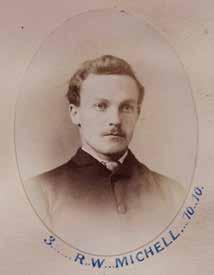
College Archivist James Cox shares the story of army surgeon Robert Williams Michell (Medicine 1880), whose legacy endures in the Cambridge rowing world.
Every year, the Michell Cup is awarded by the Cambridge University Combined Boat Clubs to the College club that gives the best overall performance on the river. Thus the rowing community maintains the legacy of the Cup’s Caian namesake, Robert Williams Michell – known affectionately as ‘The Doctor’. But how many, I wonder, know who this man was, what he achieved, and how many lives he touched and left his mark on?
Born in Cornwall and schooled in Honiton, Devon, Robert came to Caius in 1880. He initially studied the Arts but later switched to Medicine. He was a great friend of Richard Threlfall (Natural Sciences 1880), scion of a significant Caian family, who said of him: “I do not remember to have ever seen him angry or anything but just his kindly cheerful self.”
After gaining his BA in 1884, MA in 1889, MB and BC in 1894 and FRCS in 1985, Robert was the House Physician at St Bartholomew’s Hospital in London and also worked at the Lying-In Hospital on York Road. He returned to Cambridge to a practice at 3 Trinity Street and was a Demonstrator in Anatomy at the University Laboratory from 1889 to 1892. His practice had many students, and he specialised in diseases of ‘athletic men’.
A keen rower, he was a boat captain in his third year, rowing in the first boat and in the winning University Trial in 1884. He spent his leisure hours heavily involved with the Boat Club, an interest he was keen to keep all his life. He had a great affinity, and cheerful
How many, I wonder, know who this man was, what he achieved, and how many lives he touched and left his mark on?
disposition, with the rowers, and is fondly remembered in their history. The Michell Cup was presented in 1923 in his memory. Robert’s son, Robert Gillies Michell, was also a Caian and a rowing Blue.
The photograph below shows Robert as a coach with the 1904 Caius crew. The man to his left, the man in the white suit (though not the Alec Guiness character in the 1951 Ealing classic of the same name!), is our very own Harold Gillies (Natural Sciences 1901), who became Robert’s brother-in-law in 1905. Harold was also a great supporter of the Boat Club and the College, and he performed untold miracles for those so gravely injured in both World Wars.
Robert served in the Royal Army Medical Corps (RAMC) in the Boer War. One story tells that he suffered from a lack of supplies and in his annoyance said that, since he was a volunteer, he would return to England at once if the supplies were not forthcoming and would report the situation to the War Office. The supplies arrived.
In October 1914, Robert volunteered again to serve in the RAMC. Like so many others, he died of his injuries, on July 20, 1916 while serving at the front in the Battle of the Somme. He was buried with full military honours in the Ascension Parish Burial Ground off Huntingdon Road and is commemorated on Bartholomew’s Hospital War Memorial in London – as well as on Caius’ own memorial. It is said that he was recommended for the Victoria Cross but that it was not awarded.
He died doing what he always did in life: helping others, even at so great a cost.