Understanding Perimenopause: Guidance From a Leading Expert

Perimenopause is one of the most confusing and often misunderstood stages of a woman’s life. It can appear unexpectedly, present with a wide range of symptoms, and vary considerably from one person to another. For many women, finding clarity during this transition requires the insight of a seasoned clinician who has devoted decades to the study of women’s hormonal health.
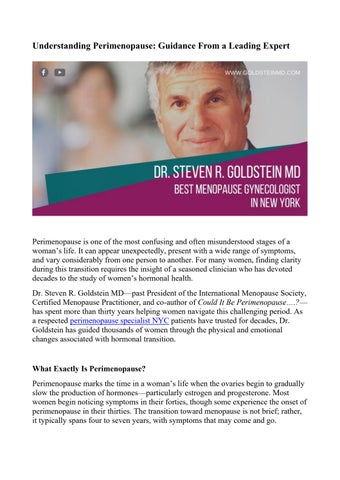
Dr. Steven R. Goldstein MD past President of the International Menopause Society, Certified Menopause Practitioner, and co-author of Could It Be Perimenopause….? has spent more than thirty years helping women navigate this challenging period. As a respected perimenopause specialist NYC patients have trusted for decades, Dr. Goldstein has guided thousands of women through the physical and emotional changes associated with hormonal transition.
What Exactly Is Perimenopause?
Perimenopause marks the time in a woman’s life when the ovaries begin to gradually slow the production of hormones particularly estrogen and progesterone. Most women begin noticing symptoms in their forties, though some experience the onset of perimenopause in their thirties. The transition toward menopause is not brief; rather, it typically spans four to seven years, with symptoms that may come and go.
A common misconception is that perimenopause is simply “early menopause.” In reality, these are two very different concepts. Early menopause is defined as the complete cessation of menstruation for twelve consecutive months before age fortyfive. Perimenopause, on the other hand, is the fluctuating, unpredictable prelude to menopause.
Why Perimenopause Is So Difficult to Diagnose
One of the biggest challenges with perimenopause is that it cannot be definitively diagnosed through a simple blood test. Unlike menopause when hormone levels stabilize at a low level perimenopause is characterized by what Dr. Goldstein calls “irregularly irregular” hormone fluctuations. Levels may be high one week and low the next, making lab results unreliable as sole indicators.
Because of this, perimenopause is one of the least understood and most misdiagnosed stages of a woman’s reproductive life. Two women the same age may have completely different patterns, intensities, and timelines. The key to diagnosis lies in recognizing the pattern of symptoms rather than any single complaint.
Common Symptoms Women May Experience
Perimenopause affects every woman differently, but some symptoms appear more frequently than others. These include:
• Irregular periods – perhaps the most noticeable sign. Cycles that were once consistent may suddenly become unpredictable, with missed periods followed by unusually frequent ones.
• Hot flashes – though often milder and more sporadic than those of menopause.
• Sleep disturbances – difficulty falling asleep or staying asleep.
• Vaginal dryness – a result of fluctuating estrogen levels.
• Mood changes – including irritability, low mood, and bouts of anxiety.
• Foggy memory or difficulty concentrating – often described by patients as “I just don’t feel like myself.”
• Free-floating anxiety – a sense of unease without a specific trigger.
One of the most dramatic changes involves the menstrual cycle itself. A woman may notice very light periods, followed by unusually heavy ones. She might skip two months only to have two periods in the same month later on. These irregular cycles are often due to the absence of ovulation. Without ovulation, the body does not produce progesterone, which is necessary to balance estrogen. As a result, estrogen
remains relatively constant, and the endometrium may build up for long stretches before shedding irregularly.
The Importance of Recognizing Symptom Patterns
Although these symptoms are common during perimenopause, they are not diagnostic on their own. Missing several periods does not automatically indicate perimenopause; nor does anxiety or sleep trouble. Physicians look for a cluster a “family” of symptoms that follow a recognizable pattern over time.
This is why many women benefit from consulting an experienced clinician. A knowledgeable physician can distinguish between perimenopause and other medical issues, ensuring women receive the proper guidance and treatment.
Expertise That Makes a Difference
Dr. Goldstein has spent more than 25 years in private practice on Manhattan’s East Side, treating women from across New York City and the tri-state area. As both a perimenopause specialist NYC women rely on and a highly regarded Hormone Replacement Therapy (HRT) expert, he has authored multiple books on hormonal health and has successfully treated countless patients struggling with menopausal and perimenopausal symptoms.
Too often, women seeking help are told that their symptoms are “just stress” or “all in your head.” Dr. Goldstein strongly emphasizes that perimenopausal symptoms are real, physically driven, and rooted in hormonal instability. The goal is not only to validate women’s experiences but to provide solutions that help them regain control over their health and daily functioning.
When Should You Seek Medical Guidance?
Any woman who suspects she may be entering perimenopause should start by speaking with her primary care provider or gynecologist. Keeping a menstrual calendar, tracking symptoms, and noting changes in mood or sleep can help guide the conversation.
However, if symptoms persist, feel overwhelming, or cause significant disruption in daily life, it may be time to consult a specialist someone with the expertise and experience to identify perimenopause’s subtle but recognizable patterns. For those in or near New York City, Dr. Goldstein’s midtown practice offers access to one of the most respected perimenopause specialist NYC has to offer.
Perimenopause is a natural part of aging, but it doesn’t have to be a bewildering or isolating experience. With the right guidance, women can understand what their bodies are going through and receive the support they need to navigate this stage with confidence and clarity.