The Year of Passion (The final week)
Sample Lesson: Level 2
Matthew 27:32-56
This sample lesson is from the Level 2 course Following Jesus: The Life of Christ (5): Year of Passion (The final week).
This course is offered in partnership with SEAN UK and with permission of SEAN International. This course can also be obtained from SEAN UK. For further details see www.sean.uk.net
Copyright © SEAN International
All rights reserved. No part of this publication may be reproduced, stored in a retrieval system, or transmitted in any form or by any means, electronic, mechanical, photocopying, recording or otherwise, without written permission from SEAN International (contact details above).
SEAN UK is a UK Registered Charity (No 1102491)
SEAN International is a UK Registered Charity (No. 286965).
Scripture taken from THE HOLY BIBLE, NEW INTERNATIONAL VERSION®, NIV® Copyright © 1973,1978, 1984, 2011 by Biblica, Inc.™ Used by permission. All rights reserved worldwide.
Published (2024) by: www.goldproject.org © GOLD Project 2024
This course is the fifth of a series of six books on the Life of Christ called “Following Jesus”, based on the Gospel according to St. Matthew. It combines lessons for home study with group discussion. The lessons are arranged in blocks; each block being a week’s work. After each block there is a group meeting, which should be led by a Group Leader, who follows the companion Group Leader’s Guide.
Book 5 studies the events and teachings of Jesus last week, day by day, including his trials and the crucifixion. It also gives teaching about the geography of Jerusalem and how it was during the Passover, with the function and history of the Temple. The course deals with Christ as prophet, priest and king, the significance of the Last Supper and the death of Christ.
The Method
The course uses a very simple method. It is specially aimed at ordinary people with a basic school education but is useful for all types of people. All our GOLD Project courses are designed to help you learn by means of:
Home Study plus Group Meetings and Practical Application
Home Study
Each course is made up of 10 Blocks of two or three lessons each that you need to complete on your own at home. These lessons require you to read and interact with the course material as well as with your Bible.
Each lesson is programmed to help you check your progress as you work through. To get the maximum benefit it is important that you use the course in the way it was intended:
1. Read the section numbered 1 (often referred to by the technical term ‘frame’ 1).
2. Make the response required, if there is one.
3. Check that your answer corresponds with the feedback given in the ‘feedback’ section at the end.
4. Proceed to section 2.
Note that the course is programmed you are not being programmed! The aim of programming is that:
1. you can check frequently that you have understood the material presented;
2. you are stimulated to active and critical thinking;
3. you reinforce what you learn and are better able to remember it.
At the end of each lesson, we encourage you to spend some time in reflection on how what you have learnt applies to you in the situation where God has placed you.
Group Meeting
Regular group meetings take place where you will have the opportunity to discuss points of interest that have arisen and think through with others how your learning may be applied. The group meetings give the opportunity for you to clarify ideas and to share your own thoughts and to listen to the ideas of others. The process of learning from the Bible in a group is an essential part of the programme. It is here that you are able to think through areas of application and to pray and support each other in your studies.
Practical Application
During each group meeting, you will discuss what practical application task you will try and complete before you next meet. You will have an opportunity to review the practical application each time you meet.'
Additional instructions are provided in these boxes. Please pause to read them thoroughly. Now it’s time to get started!
Block 9 Lesson 3
Jesus’ Victory of Death and the Grave
We have just concluded our study of Jesus’ death and burial, with all its sin and suffering. But this apparent defeat was in fact the greatest victory ever won by a human being. By it, the Lord unleashed a surge of redeeming power that would reach the ends of the Earth. This will, of course, be the subject of Book 6 on Jesus’ resurrected life; but we cannot finish Book 5, on the Year of Passion, without briefly anticipating this by considering the glorious effects of Christ’s sacrificial death on our behalf.
Following
Preparing for this lesson:
• Take a moment to pray
• Remember to keep a notebook handy to note down any questions or issues for discussion.
Objectives At the end of this lesson you will be able to:
1. State the condition of humanity before Christ redeemed us and the price he paid for our redemption;
2. Explain how we should respond to this redemption;
3. Explain how fear holds humanity in slavery and Jesus shared our humanity to free us from it;
4. Identify those whom Christ defeated on our behalf and explain what he did to them to render them harmless.
A. Christ redeemed us from slavery to sin
1. It sounds incredible, but it’s true, that in God’s eternal plan, from the creation of the world, Jesus was the Lamb that was to be slain (Rev. 13:8b).
So it was to fulfil this plan that Jesus had devoted his whole life, culminating in his journey to a) ___________________ at the end of his Semester of b) __________________.
2. Amazing as it may seem, it was in order to die for us that “the Word became a) _____________ and made his dwelling among us” (John 1:14). John the Baptist had announced this clearly at the beginning of Jesus’ ministry, saying, “Look! The b) ____________ of God who takes away the c) __________ of the world” (John 1:29).
3. Let’s think again what sin has done to us.
a) John 8:34. It has made us into _________________.
b) Romans 5:12. Through sin, ____________ came to all men.
c) Isaiah 59:2. Our sins (or iniquities) have _______________ us from God.
4. So in taking away the sin of the world, Jesus was overcoming the human problem of a) s_____________ to sin which brings b) d____________ and c) s________________ from God.
5. The fact that many people are unaware that they are slaves to sin in no way alters the situation! Indeed, it is precisely because people are so blind to their true condition that they are in such danger. So let’s see what Jesus has to say about it.
a) According to Jesus, in John 8:34, who are slaves to sin?
Everyone who has _______________
b) And according to Romans 3:23, who have sinned?
c) So how many are by nature slaves to sin?
a) Only those who are slaves to drink, drugs or other excesses.
b) Everyone, even those who are quite oblivious to the fact.
c) No one.
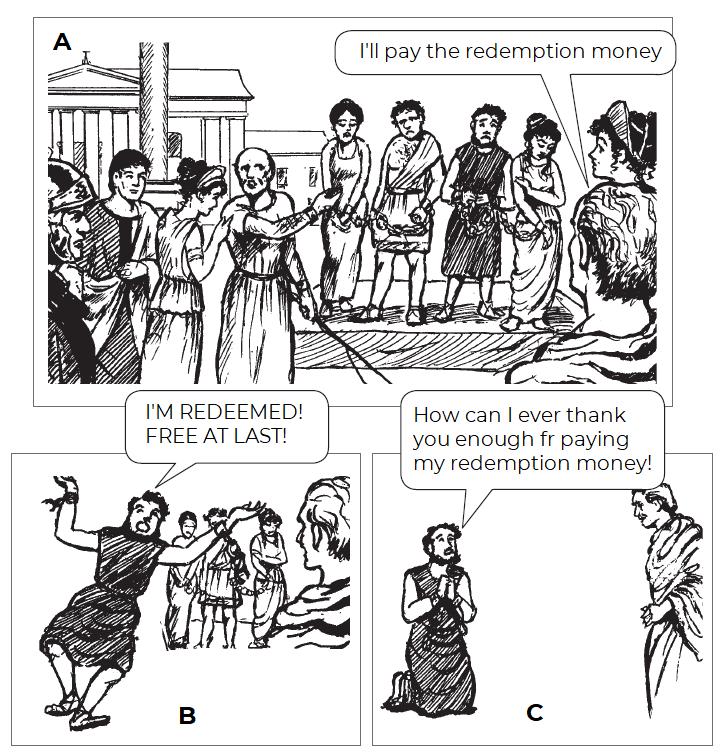
6. For us today the word “slavery” may not be a very emotive term. This, however, was not the case in Bible times when men and women could sometimes be seen herded like cattle into the market place to be sold into slavery as mere chattels of the rich.
a) Which picture on the Title Page illustrates the abject misery of those being sold into slavery?
Picture _____
b) So the New Testament uses this hateful practice to illustrate how hopeless was our state before we were redeemed by Christ.
At that time we were in spiritual ______________.
7. To be a slave meant you had absolutely no rights of your own. Slaves were considered to be the possession of their owners, along with inanimate objects like tables and chairs. The owner could even put a slave to death if they so desired. It was an appalling situation. The slave’s only hope was to buy freedom by paying a large sum of money to their owner. Any slave who did this was redeemed.
a) So redeemed meant to buy one’s f____________ with ___________.
b) If someone else paid the money to the owner, they were called the r________________ of the slave.
c) Which picture on the Title Page illustrates the ecstatic joy of the slave who has been redeemed? Picture _____
8. When it was just a case of physical slavery, terrible as that was, one could be redeemed with money. However, when it is a question of deep-seated slavery to sin, this is quite another matter.
1 Peter 1:18–20 tells us that the only price sufficient to redeem us from slavery to sin was – “...not with perishable things... but with the precious a) __________ of Christ, a lamb without blemish or defect.” Indeed, it was for this that “He was chosen b) _______________ the creation of the world.” So now can you see why Christ was so committed to laying down his life on our behalf? This is why, at the beginning of the Semester of Surrender, he resolutely set out for c) ____________________ (Luke 9:51).
9. The price of our redemption from slavery to sin could be nothing less than the precious blood of Jesus Christ – and this could only be achieved by his a) birth.
b) death.
c) baptism.
10.
a) Our condition before we were redeemed was one of being in _________________ to sin.
b) The price paid to set us free was the precious _____________ of Christ, which he shed on the _____________ at his death.
11. Being redeemed by Christ from slavery to sin brings with it other glorious bonuses; for example it means we are now also freed from slavery to __________ (Rom. 8:15).
And how varied are the causes of this fear – fear of sickness, of failure, of losing one’s job, of separation, etc., etc.
12. It was to redeem us from such fears that Jesus became a man:
“Since the children have flesh and blood, he too shared in their humanity so that by his death he might break the power of him who holds the power of death that is, the devil and free those who all their lives were held in slavery by their fear of death.” (Heb. 2:14–15)
a) Yes, being slaves to sin means we are also slaves to fear.
In this passage, the fear of what? The _________ of ___________
b) Who shared our flesh and blood to free us from this slavery?
c) By what supreme sacrifice did he destroy the one who holds the power of death?
d) Who was the one he destroyed? ___________________________
13. So again we see how, in redeeming us from our sin, Jesus was overcoming the human problem of a) _________________ to sin, with its tragic consequence of b) _____________.
Following Jesus: The Life of Christ (5)
14. Another consequence of our sin that we saw, is separation from God. But here again, by redeeming us, Jesus removed our sin which was the root cause of this separation.
1 Peter 3:18 says that Jesus died for sins once for all, that he might a) ________________ us to _________.
Galatians 4:7 amplifies this wonderful truth by saying: “You are no longer a b) _________________, but c) __________ ____________; and since you are his child, God has made you also an d) ______________.”
And, in John 8:35, Jesus says: “A e) ________________ has no f) ___________________ place in the family, but a son belongs to it g) ____________________.”
So clearly, in redeeming us from slavery, Christ did not intend us to be inde pendent!
15. Read 1 Corinthians 6:19–20
a) Do those who are redeemed now belong to themselves? _________
b) To whom does the Christian believer belong? __________________
c) He belongs to Christ because, according to 1 Corinthians 6:20, believers have been ____________ with a _________.
d) On the basis of what we have seen in the Scriptures, what was the price paid to redeem us? _________________________________
e) 1 Corinthians 6:20 says that as a result we must ________________ God with our bodies.
f) Which picture on the Title Page illustrates the gratitude and allegiance of the freed slave to his redeemer? Picture _____
16. What should motivate our service to Christ?
a) Deepest gratitude for our redemption.
b) An attempt to earn our salvation by good works.
17.
Activity To Think About:
Although we like to put a bold face on it, unhappily the “fear of death” is widespread, even among Christians. Why do people fear death? Is it confined to one group of people: the young or the old, men or women? Rich or poor?
Educated or uneducated? One particular race, etc., etc.? Why not?
Read what Paul wrote in Philippians 1:20–23, when he was in prison awaiting possible execution. How can you demonstrate that Paul had been gloriously freed from the slavery of the “fear of death?” Have you this wonderful freedom? If not, in view of what we have just learned, how can you achieve it?
So far, we have concentrated on what Christ has freed us FROM by his death. Now briefly we must look at what he has freed us FOR. So now let’s turn to another great benefit of his death.
B. Christ won a total victory for us over all the powers of evil
18. a) In 1 Corinthians 15:55–56, Paul asks a key question about death:
“Where, O death, is your victory? Where, O death, is your sting?”
He then gives us the answer – “The sting of death is _____________.”
b) But we have just seen how, through Christ’s death, we have been redeemed from our slavery to sin. So Paul continues,
“But thanks be to God! He gives _____ the ________________ through our Lord Jesus Christ.”
Following Jesus: The Life of Christ (5)
19. As we have already seen, Hebrews 2:14–15 not only tells us that Jesus freed us from the slavery of fear of death but that he destroyed, through death, the devil who had the power of death. “Destroy” here means to render powerless, to cripple.
a) Who entered the devil’s domain of death? _____________________
b) Who was crippled and rendered powerless? ____________________
c) Who was victorious in this encounter? _____________________
20 So, by his death, not only has Jesus redeemed us from the misery of our past slavery to sin; he has also set us free to share, from then on, the marvellous fruits of his victory. Was ever such apparent defeat turned to such total victory as at the cross? In Colossians 2:15, Paul spells out the extent of this victory – it was over all the spiritual powers and authorities of evil.
a) What did he do to these spiritual powers on our behalf?
He d________________ them.
b) When did he win this total victory? _________________________
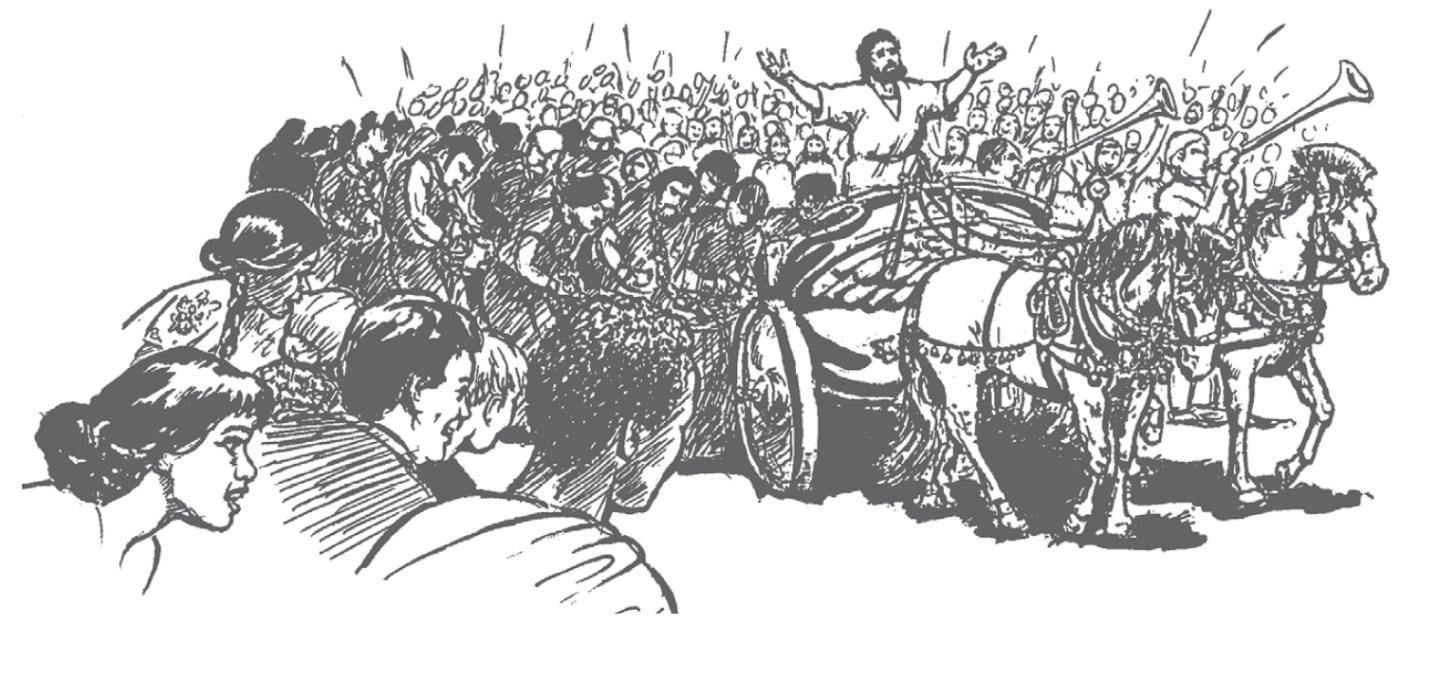
21. Once again the Bible uses graphic imagery, drawn from the customs of the times, to bring home the magnitude of Christ’s achievements on our behalf. The reference is to a Roman army returning home triumphant after a battle, bringing with them their disarmed prisoners of war. These they paraded through the city of Rome in a glittering spectacle, to demonstrate publicly the greatness of the victory they had won.
a) On Title Page 5B, we actually examined a sculpture of one of these victory parades. In it, Roman soldiers are carrying through their city, in the year 70 A.D, the golden furnishings of the temple in Jerusalem. According to the description there, where is this sculpture still to be found?
On the inside of the Arch of T____________, in _____________.
b) Colossians 2:15 says, “And having disarmed the powers and authorities, he made a public spectacle of them, triumphing over them by the cross.”
According to this verse, this public victory display took place when Christ __________.
c) 2 Corinthians 2:14 says, “But thanks be to God, who always leads us as captives in Christ’s ___________________ ________________ and uses us to spread the aroma of the knowledge of him everywhere.”
22. According to Hebrews 2:14 and Colosians 2:15, who were the disarmed prisoners in Christ’s victory parade?
a) The Roman soldiers.
b) The Jewish authorities.
c) The devil.
d) All the spiritual powers and authorities of evil.
23. a) What custom of the Romans is used in Colossians 2:15 to illustrate this victory? ______________________________________________
b) Where can a sculpture of this Roman custom still be seen?
c) What did Christ do to those he had defeated to render them harmless?
24. So, on the cross, Christ not only a) ___________________ us from our b) _______________ to sin; he also won a mighty c) _____________, in which he totally defeated and disarmed all the powers of d) __________.
25. Furthermore, Christ shares his victory with us. Read Romans 8:37–39. a) What does Paul say we are, in v.37? More than __________________.
b) This is because nothing can now ___________________ us (v.39) from the love of God in _____________ _______________. We are now his sons and heirs with a permanent place in his family forever. (John 8:35)
Activity To Think About:
We have come a long way since, in Book 4, Frames 1A.1, 7A.2 and 7B.9, we saw Jesus resolutely setting out for Jerusalem (Luke 9:51). Again and again, Satan attempted to divert him from his commitment to pay the redemption price to free us from slavery to sin. In the quiet depths of the olive grove of Gethsemane, Jesus battled against his human emotions as he contemplated the agony of bearing the sin of the whole world. But he was not to be deflected even by this.
Now the mighty act of redemption is accomplished, our spiritual enemies have been disarmed; we are swept up with Christ in his magnificent victory parade over all the powers of evil. We are made participants in his surge of redemptive power as it reaches out to the ends of the earth. So let’s finish with a pictorial presentation of this glorious truth. Ponder its meaning in the drawing below. Then, by faith, set yourself alongside your triumphant Saviour and share in his mighty victory over Satan and all his devious ways. Praise God! What a Saviour!
Glory to Christ, who has disarmed all our enemies.
Now do Test 9.3.
Congratulations on finishing Lesson 9 3 successfully.
Reflecting on this lesson
Note down in your notebook anything from today’s lesson:
• that you want to discuss in your group meeting;
• that is significant for your own personal faith.
Spend some time in prayer asking God to help
Feedback to Lesson 3.1
1. a) Jerusalem
b) Surrender
2. a) flesh
b) Lamb c) sin
3. a) slaves
b) death
c) separated
4. a) slavery
b) death
c) separation
5. a) sinned
b) All of us
5. c) b.
6. a) A
b) slavery
7. a) freedom with money
b) redeemer
c) B
8. a) blood
b) before c) Jerusalem
9. b.
10. a) slavery
b) blood/ cross
11. fear
12. a) The fear of death
b) Jesus
c) By his death
d) The devil (Satan)
13. a) slavery
b) death
14. a) bring us to God
b) slave
c) God’s child
d) heir
e) slave
f) permanent
g) forever
15. a) No
b) To Christ
c) bought/ price
d) Christ’s blood
e) honour
f) C
16. a.
18. a) sin
b) us/ victory
19. a) Jesus
b) The devil
19. c) Jesus
20. a) disarmed
b) On the cross
21. a) Titus/ Rome
b) died
c) triumphal procession
22. c. d.
23. a) Their victorious parading of the prisoners of war and the loot
b) On the Arch of Titus in Rome
c) He disarmed them
24. a) redeemed
b) slavery
c) victory
d) evil
25. a) conquerors
b) separate/ Christ Jesus
26. Feedback in Group
Whatever your educational level or knowledge of the Christian faith, we have courses that can enable you to grow in your faith.
As a group you can choose the level at which you want to study. We will train your group leader how the courses work.
All our courses combine:
✔ Home Study: using carefully designed workbooks
✔ Group Meetings: with a trained facilitator
✔ Application: Activities and opportunities to practice what you are learning
Level 1 Courses
For those who are new to the Christian faith and want an easily accessible form of study.
Level 2 Courses
For those who want to learn what it is to follow Jesus through an in-depth study of his life and ministry.
Level 3 Courses
For those who want to take the study of the Bible further and engage with its meaning for today.