
Eli Sharabi Visits NJ After 491 Days In Hamas Captivity
By Noah Cytrynbaum ‘28
Israeli Eli Sharabi, who spent 491 days as a hostage of Hamas in Gaza, visited New Jersey to speak about his experience and his faith for attendees from Golda Och Academy, Kushner Academy and Gottesman RTW Academy this month.
“It was important and inspiring to hear the first-hand recounts of a story from someone who has been through so much. It gave me a new understanding of faith, optimism and perseverance,” said junior Violet Berman.
Freshman Hanna Laufer said, “I found it especially meaningful to hear of his reconnection to Judaism within a time of extreme pain, which should inspire the rest of us Jews worldwide to remain faithful and proud of their identity, even when it is mercilessly challenged.”
When Sharabi entered the auditorium at JKHA/ RKYHS, students and faculty rose to their feet, partly out of respect and partly to see the man who went through unimaginable hardship. The reception was overwhelming as he calmly and confidently walked to the stage.
Sophomore Leo de Picciotto described “the vibrant environment and the loud cheers and music.” Sharabi spoke in a matter-of-fact tone, introducing himself in a simple and straightforward manner,
considering the horrific nature of his experience.
“I’m Eli Sharabi, a member of Kibbutz Be’eri. I was in Hamas captivity for 491 days, my wife and my daughters were murdered on October 7. My brother Yossi, my older brother, being kidnapped as well on October 7 and was murdered a hundred days later in captivity,” he said.
Regarding life in Be'eri before the attack he said that his kibbutz, “looked like a magical place…a very supportive community…it looked like heaven for me…Our heaven turned into hell on October 7.”
Sophomore Logan Gladstone said, “It’s amazing to see what they felt and did to survive together, and it’s inspiring to think about what Jews can do unified as a people.”
“Every moment in captivity tests you as a human being, testing your faith, faith in God, faith in your ability to survive,” said Sharabi.
“I didn’t choose what happened to us on October 7, but I always choose how to react on this 491 days and what to hold on in memories, in faith, in God, and I chose how to stay a human being in a very extreme condition of starvation and humiliation, and violence against us.”
After being taken into the tunnels under Gaza,
Shirabi was grouped with three other Israeli captives.
“It was a very optimistic moment for me,” he said. “It was optimistic because it was belonging, it was to hear Hebrew again, and to be able to speak Hebrew, and it was optimistic because you believe in that group that you can survive together.”
Freshman Tamar Ashkenazi said, “One moment that hit me was when he remarked that he was so grateful that he could wake up in the morning, open his fridge, and take whatever he wants from it— something we might take for granted.”

Varsity Volleyball Raise Banner for SEC Division Title
By Mia Eskin ‘27
The 2025 volleyball season has been outstanding for Golda Och Academy’s varsity and junior varsity girls teams. They finished with a record of 9-1, putting them at the top of their division.
Under the inspiring leadership of Coach Ms. Endlich, these athletes have performed skillfully and showcased growth, teamwork and dedication from the start of the season.
Over the past few seasons the team has suffered many losses, but this year the team has flourished, growing from a small roster into a powerhouse of 20 talented athletes.
This expansion has created an unbeatable team spirit that is consistently complimented by other coaches and athletes.
The varsity lineup, captained by juniors Mia Eskin and Alma Adiel, features star players Violet Berman, Tara Langer, Sagan Shapiro, Liora Goldberg and Remy Friedberg.
In October the team suffered their single loss against Bard High School Early College Newark, but it only highlighted their continued determination and refusal to back down.
Captain Alma Adiel said, “This season has been incredible for all of us. Losing to Bard was incredibly tough but it showed us exactly where we need to
Golda Och Welcomes Mr. Michael to Math and English Departments
This school year, nine new faculty members have joined Golda Och Academy across the Upper and Lower School campuses.
improve. We will come back stronger next season and our team will not back out without a fight.”
Golda Och Academy athletes have won many banners over the years but none for volleyball until now.
With playoffs on the horizon and the team’s spirit they are bound to make a run for a win and a banner

that no one will forget.
Meanwhile, the junior varsity team has been a force of its own. The girls continue to build skills, teamwork and a strong foundation to continue the program’s future.
They have had an incredible amount of wins, but above all, they continue to learn each other’s style on the court and adapt to different situations.
Each player on the team brings their own strength, from powerful spikes to precise serves, the team creates a seamless environment keeping them on top.
One of the strengths of the Varsity team is their ability to communicate and keep their opening on their toes. The team is incredible at adjusting mid game and supporting each other despite the score.
The girls on the volleyball team love doing bonding activities like team dinners to build stronger connections, especially between players in different grades.
The mix of grades and experience on the team has created friendships unlike any other.
Sophomore Tara Langer said, “We’ve all gotten so close this season. It feels like a family more than a team.”
GOA Girls Varsity Volleyball team
GOA students hear Sharabi speaking
Trump Continues Deportations Despite Challenges
By Noah Cytrynbaum ‘28
The Trump Administration has deported more than 400,000 immigrants who entered the U.S. illegally, using measures that have changed the landscape of law enforcement and immigration policy.
According to the Department of Homeland Security (DHS), over two million illegal immigrants have been deported or have “self-deported” as of September 2025. Government figures estimate

President Trump
1.6 million people have willingly left the United States.
“It is interesting that so many leave on their own considering the treacherous journey they took to get here,” said sophomore Logan Gladstone.
The administration’s goal was to deport 1,000,000 immigrants who have entered illegally within a year. There have been numerous limits to its abilities including budget restraints, administration, diplomatic (with other countries) and legal challenges.
The Immigration and Customs Enforcement (ICE), which has been the force tasked with executing Trump’s plan, has a budget of around $9 billion. This budget is not sufficient to fund all deportations or ICE’s other focuses, like cybercrime, immigration related crime and drug trafficking.
To solve this, the military has sealed the border to prevent new border crossings and are using bases to house detainees.
The Trump Administration has also eliminated the sensitive location policy, which made arrests harder in schools, hospitals and places of worship.
Sophomore Remy Friedberg said, “I think it’s unfair to sneak up on people and attack them, whatever the crime, especially in places they consider the most safe. These sensitive locations are supposed to be safe for everyone; it sets a dangerous precedent.”
Part of the diplomatic effort has been forcing
other countries to accept the migrants who left their countries. However, legal, diplomatic and political challenges have arisen from rare cases of people being sent to countries that they are not from.
Earlier in the year, the United States imposed a 25 percent tariff on Colombia because it denied entry to the military planes carrying migrants.
Many states and civil rights groups have filed lawsuits against President Trump’s ban on birthright citizenship (meaning someone born in the United States is automatically a citizen) regarding children of illegal immigrants.
A major change is that city-wide raids have become more common and more publicized.
Another change is that advertisements, either encouraging Americans to join ICE or undocumented immigrants to self-deport, have become much more common.
Part of the encouragement of Americans to join ICE is also the quality base salary and partial college debt relief.
The campaign portrays illegal immigrants as criminals, with some advertisements using the words, “rapists,” “murderers” and “gang members.”
Americans Debate Free Speech, Political Polarization After Charlie Kirk’s Death
By Alma Adiel ‘27 and Paul Raskin ‘27
C
harlie Kirk’s assassination in September deepened the partisan divide between Democrats and Republicans while changing the way Americans view political violence.
Sophomore Remy Friedberg said, “Although I did not agree with his political views, I believe that no one should be killed for expressing their beliefs.”
Kirk’s assassination during a visit to Utah Valley University this fall drew both criticism and support from Democrats and Republicans alike.
Memorials were held across the nation in tribute to his passing, while receiving fervent support from prominent Republican leaders, such as President Donald Trump. In addition, many of his opponents and critics came together to condemn his assassination and political violence in general.
Editor-In-Chief: Violet Berman
Asst. Editor-in-Chief,
News Editor: Noah Cytrynbaum
Asst. Editor-in-Chief,
Israel Editor: Remy Friedberg
Chief Layout Editor: Layla Sharret
Asst. Layout Editors: Theo Buber, Liora Goldberg, Morgan Sternthal, Kayla Brach, Perri Mayer
News Editors: Noah Cytrynbaum & Caleb Lebeau
GOA Life Editor: Tali Herbert
Asst. GOA Life Editor: Sagan Shapiro
Israel Editor: Remy Friedberg
Asst. Israel Editor: Tamar Ashkenazi
Opinion/Editorials Editor: Logan Gladstone
Features Editor: Alma Adiel
Asst. Features Editor: Jordana Lorrime
Buisness Editor: Paul Raskin
Asst. Business Editor: Noah Berkowitz
Pop Culture Editor: Mia Eskin
Sports Editors: Dov Brown & Jackson Meirzon
Online / Social Media Editors: Naomi Allen, Jordana Lorrimer, Jude Ornstein
Staff Photographer: Theo Buber
Faculty Advisor: Mr. Langer
National newspapers ran headlines emphasizing the tragedy and the need for unity, and numerous op-eds debated the implications of political assassinations in modern America.
On the contrary, across social media and the world, many mocked his death citing what they see as bigotry on Kirk’s part. Many who mocked his death were punished by institutions.
For example, MSNBC fired its senior political analyst after he made “insensitive remarks” about Charlie Kirk’s death.
Another instance was when Jimmy Kimmel’s show was suspended due to his commentary about Kirk’s death.
Several high-profile social media accounts also were suspended or flagged, sparking a nationwide debate on whether censorship or moderation was being applied fairly.
Many free speech advocates argue that criticism of Charlie Kirk’s beliefs is valid and doesn’t mean supporting his assasination. However, it is difficult to discern between what language is acceptable and not, highlighting the greater conflict between freedom of speech and sensitivity toward political violence.
Legal scholars have weighed in, noting that the U.S. has no absolute boundaries on speech, but the cultural and political context often dictates what is considered socially acceptable, particularly in moments of tragedy.
The debate over online reactions became one of the most discussed aspects of the aftermath. X and TikTok faced backlash for allowing memes and celebratory posts to spread unchecked, while others accused platforms of excessive censorship when they removed posts that simply criticized Kirk’s politics.
The blurred line between incitement and legitimate expression has raised new questions about how social media companies should respond in moments of national crisis.
Still, his death remains a divisive political issue between Republicans and Democrats in America.
Many Republicans framed his death as an attack on conservatives.
The President said at a memorial in Arizona that Kirk is, “a martyr now for American freedom.”
Some, like Mr. Trump, believe his death serves as a political martyr.
Other Republican leaders echoed this sentiment, emphasizing that Kirk’s vision and activism should continue to inspire conservative youth and shape political discourse.
In contrast, many Democrats condemned his death; however, they feared that Republicans were using his death to gain support and push their narrative. Former Presidents Barack Obama and Joe Biden condemned his killing.
The vote on a House resolution to honor Kirk counted 58 votes against and 38 abstained, showing that opinions about Kirk are still very diverse.
Political analysts noted that the abstentions and opposition reflected broader concerns about politicizing the tragedy for partisan gain rather than addressing the deeper societal issues of violence and polarization.
The assassination has left a deep emotional scar on college campuses, as Kirk’s presence had often sparked
intense debate.
Students from both conservative and liberal backgrounds organized vigils emphasizing peace and the need for civil discourse.
Sophomore Noah Cytrynbaum said, “I think that Charlie Kirk’s death didn’t divide or unite—it showed the division through mixed reactions, while it also united Americans across the aisle, showing that we are capable of friendship and bipartisanship.”
Following the assassination, Turning Point USA, which Kirk founded, announced temporary leadership changes, and discussions about its future direction became public.
Analysts suggest that Kirk’s death could fundamentally alter the organization’s approach to advocacy and campus outreach.
He was a major figure on social media, particularly connecting with younger Americans to persuade them to consider conservative leaders, and played a significant role in Mr. Trump’s successful 2024 presidential campaign.
Kirk’s presence on platforms like X and TikTok allowed him to build a network of supporters that spanned multiple states, and his speeches often drew large audiences, both in person and online.
However, he was often seen as a polarizing figure due to his hardcore opinions on sensitive issues, which regularly drew critics, who called his views dangerous and hateful.

Charlie Kirk
Relief Organizations Rush to Aid Jamica, Jamaican People
By Logan Gladstone ‘28
Jamaicans and non-Jamaicans are finding unique ways to cope and rebuild after the island was hit by a massive hurricane.
To keep optimistic attitudes amid such hard times, Jamaicans are turning to online humor to cope with the trauma.
Junior Sagan Shapiro said, “I think it’s really uplifting to see a community use humor to make it through hardship. When a situation seems awful or inescapable, it can be nice to have a good laugh.”
Jamaican TikTok user @thompsonsplumbing posted a video showing four women dancing to Gyal You a Party Animal, a Jamaican reggae song by Charly Black.
This video amassed 1.3 million likes and 6.6 million views within a week.
“This is Jamaica! The people are amazing, resilient, and beautiful,” one commenter wrote.
Another commenter wrote, “This is so culturally representative of the Caribbean and how most of us learn to cope with anything.”
Despite the humor being portrayed on social media, the nation still needs help to rebuild.
Hurricane Melissa formed on October 21, north of Brazil & Venezuela, and dissipated on November 4 in the North Atlantic Ocean. Melissa reached wind speeds up to 185 miles per hour and 16 feet of water.
Non-profits like UNICEF and Project HOPE are requesting donations to support the reconstruction of cities and help children in Jamaica, Haiti and Cuba.
Project DYANMO is a non-profit organization based in South Florida that specializes in assistance in crisis zones, providing aid and often evacuating American citizens.
Their leadership landed in Montego Bay with 5,000 pounds of aid, including meat, bread, generators and water-filter systems.
They currently plan on working with local churches and businesses to distribute aid to people in need.
Sophomore Noah Cytyrynbaum said, “It
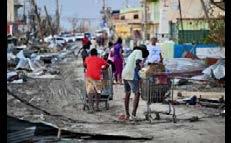
is important that the U.S. gives immediate emergency relief to Jamaica in the short-term, but for the long term, it is important to help rebuild infrastructure that can endure natural disasters and take action on the ever-worsening climate crisis.”
Montego Bay, one of the hotspot destinations for American travellers, is in the priority area
for humanitarian response. This is leading to the resorts being closed because of damage, which could have an additional negative effect on the Jamaican economy.
Jamaican officials are rushing to restore the resorts in time for the peak tourist season, which starts in December and goes through April.
Besides the physical damage, 500,000 Jamaican Public Service customers, making up 72 percent of their customer base, were left without power.
The capital city of Kingston is faced with flooded roads; cleaning this is a necessity in order to transport aid and relief out west towards the parishes that were heavily affected.
At peak number, tens of thousands were living in shelters.
On October 28, Hurricane Melissa made landfall in Southwestern Jamaica. Melissa’s epicenter was the city of Black River, the capital of the Saint Elizabeth parish.
Over 60 lives were lost in Jamaica because of Hurricane Melissa. Damages caused by Melissa are equivalent to 30 percent of Jamaica’s GDP.
In Black River, buildings, businesses and homes were destroyed left and right. Prime Minister of Jamaica, Andrew Holness, said that 90 percent of structures in Black River and the nearby towns have been damaged in the aftermath. Alessandra, a three-year-old from Jamaica, told CNN, “It’s all mashed up,” while pointing to the remains of what was her bed.
Trump Fires FTC Commissioner, Expanding Powers and Limits
By Hanna Laufer ‘29
President Donald Trump fired the last Democratic members on the Federal Trade Commission before their terms ended, testing a 90-year-old precedent that protects FTC commissioners from being removed by a president without cause.
History and Government teacher at GOA, Mr. Ober called this “an unprecedented power grab,” saying that Mr. Trump has no right to “rewrite or interpret” the preexisting laws.
In March 2025, commissioners Rebecca Kelly Slaughter, as well as her colleague Alvaro Bedoya, were dismissed from their positions, sparking controversy throughout the political climate.
Many people are referring to the legal precedent that members of the FTC can only be fired for inefficiency, neglect of duty or malfeasance in office.
In this case, Trump’s justification for firing Slaughter and Bedoya did not follow any of the sanctioned grounds, which is a direct violation of this law.
Additionally, the law states that of the five FTC commissioners, no more than three can be of the same party; currently there are two vacant seats and three Republican members.
FTC Chair Andrew Ferguson stated that the president had the “constitutional authority to remove commissioners from agencies that wield substantial executive power,” emphasizing that such authority is “necessary to ensure democratic accountability for our government.”
Mr. Ober also said that this is, “being accomplished because our institutions are ignoring a fundamental constitutional principle – that each branch of government should jealously guard its power and prevent another branch from claiming too much power.”
Slaughter sued Trump in response to her and Bedoya’s firing, basing their case on a 1935 Supreme Court decision Humphrey’s Executor v. United States which led to the creation of the law that prevents firing an FTC commissioner without the reason being addressed.
Although the Supreme Court temporarily ruled that
Trump is allowed to fire FTC commissioners despite the necessary means, in an emergency order in September 2025, Humphrey’s Executor will be the key determiner of the official ruling. The trial will occur in December 2025.
Sophomore Logan Gladstone said, “It’s shocking how he seems invincible and immune to laws because the people around him continue to enable it.”
Judge Loren AliKhan, who has served as a district judge for the District of Columbia since 2023, called
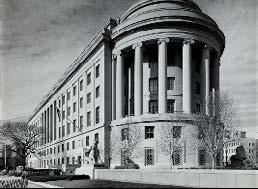
Slaughter’s removal unlawful.
Critics disapprove of this sudden presidential inexperience with a long-standing federal law, and are concerned about its effect on our country. For instance, the third highest-ranking official in the Department of Justice, D. John Sauer, wrote that “The president and the government suffer irreparable harm when courts transfer even some of that executive power to officers beyond the president's control.”
Trump is pushing unparalleled boundaries within the presidential position, therefore he is in uncharted waters.
This debate raises questions among Americans as to
what the limits actually are; Trump is paving new powers and setting new precedents in presidency, leading to confusion as to what is unconstitutional and legal.
The Supreme Court, which is considered the most conservative-leaning court in American history with 6 Republican appointed Justices and 3 Democrat appointed, momentarily allowed Trump to fire Slaughter until December, despite legal challenges. Supreme Court Justice Elena Kagan, a Trump appointee, is joined by Justices Sotomayor and Jackson in criticizing this decision.
“The Supreme Court is the ultimate arbiter of executive decision making. The President is obeying the law by waiting for the Supreme Court to make its ruling. As has been the case with previous rules and regulations, new circumstances often necessitate changes,” said junior Paul Raskin. “Any other opinion before the Supreme Court decision is speculation until they decide.”
Another debate revolves around Trump’s clawing back of money from agencies that was constitutionally given to Congress. This concept is called Power of the Purse, in which money is allocated to the congressional branch for spending authority.
The United States Constitution states: “No money shall be drawn from the Treasury, but in Consequence of Appropriations made by Law.” This means that only Congress can authorize the distribution of money; ergo, any other branch of government cannot.
The Supreme Court will decide whether the president can extend into congressional powers in such a manner.
Justice Kagan said, "The stakes are high: At issue is the allocation of power between the Executive and Congress over the expenditure of public monies."
The future Supreme Court cases regarding Trump’s expansion of presidential powers and limits will determine how future presidents may utilize their position in office.
Black River, Jamaica
Critics Accuse Trump Admin of Restricting Free Speech
By Remy Friedberg ‘28
Growing backlash from the Trump administration toward people expressing their opinions online has renewed public concern over the limits of free speech in America.
Freedom of speech is a protected Right under the First Amendment. This encompasses all types of verbal and written speech, including digital media.
In light of Charlie Kirks’ death, there have been instances in which federal workplaces have threatened and punished their employees over what they post online.
An employee at the Federal Emergency Management Agency (FEMA) was placed on administrative leave after creating a derogatory Instagram post that said, “Half staff for the literal racist homophobe misogynist,” according to Fox News.
FEMA explained that this behavior contradicted their values of professionalism, respect and integrity.
Sophomore Aeden Pinsker said, “I think this is wrong because it’s a federal company, and they have to uphold the right of freedom of speech.”
Similarly, the Federal Commission subtly threatened Jimmy Kimmel and ABC over comments made about Charlie Kirk through his platform, leading to the suspension of his show.
“I was not happy when they pulled me off the air onwards. I did not agree with that decision and I told them that and we had many conversations. I shared my point of view. They shared theirs … They welcomed me back on the air and I thank them for that,” Jimmy Kimmel said on an E! News broadcast.
Trump has even gone as far as to suggest television licenses be revoked from stations that portray him negatively.
“They’re licensed. They’re not allowed to do
By
that … They're an arm of the Democrat Party” Trump said, according to USA Today.
While the Federal Communications Commission (FCC) has jurisdiction over television programming, they can only censor or condemn programming deemed “obscene, indecent or profane.”
These standards encompass swear words and inappropriate sexual portrayals. The comments made on Jimmy Kimmel Live! do not fall under these categories, therefore the FCC has no ability to remove their licenses.
“It shows where we are as a country that someone could be fired for saying something controversial," said sophomore Logan Gladstone.
Attorney General Pam Bondi attracted criticism over comments she made on Katie Miller's podcast, saying, “There’s free speech, and then there’s hate speech – and there’s no place, especially now, especially after what happened to Charlie, in our society.”
To reiterate, hate speech that doesn’t contain a threat, incite violence or isn’t classified as harassment is protected under the first amendment.
Junior Violet Berman said, “People are getting punished for saying what they believe and that is not what free speech is supposed to mean. Even if someone says something others don't agree with, they still deserve the right to express their beliefs without being afraid of the consequences.”
The people have shown their frustration and worry through various demonstrations: on September 18, over 300 writers stood in front of Disney Headquarters in Burbank, California to fight Jimmy Kimmel's suspension, and the No Kings Movement has continued to exercise their 1st amendment rights through peaceful protests all over the country.

“They say they're fighting back through demonstration and reconsidering their support for Disney. I know a lot of people who don't want to put money in the pockets of a company that is so willing to, you know, turn their backs on their own employees out of fear and out of bullying by the government,” said a protester in front of Disney headquarters.
Democrats Secure Key Victories Across the Northeast
Violet Berman ‘27 and Caleb Lebeau ‘27
The Democratic Party won two major electoral victories in the Northeast, as Representative Mikie Sherrill was elected governor of New Jersey and Zohran Mamdani was elected mayor of New York City.
Democrat and Former U.S. Representative Abigail Spanberger was elected governor of Virginia, as well.
Leading up to November 4, the Democratic Party hoped to strengthen its political reign over the Northeast. As the country became more divided and people grew frustrated about issues like the economy, housing and safety, these elections were an opportunity for Democrats to show they could still earn support across a range of political beliefs.
Sophomore Noah Cytrynbaum said, “After such a landslide victory for Republicans last November, I was quite surprised to see Democrats winning many elections in the Northeast.”
Mikie Sherril and Zohran Mamdani have significant differences in their backgrounds and ideologies.
Sherrill is a former Navy helicopter pilot whose values align with those of a moderate Democrat. However, Mamdani is an immigrant from Uganda and a member of the Democratic Socialists of America.
Despite their contrasting styles and beliefs, both candidates won their elections decisively.
Sherrill defeated Republican Jack Ciattarelli by a decent margin, which was surprising to many residents of the state. Sherrill’s victory extended the party’s hold on the New Jersey governorship for a third straight term.
Mamdani defeated former New York Governor Andrew Cuomo, running as an independent, and Republican Curtis Sliwa.
Each of these elections is monumental in its own way, as Sherrill was elected as the first female governor of New Jersey, and Mamdani is New York City’s first Muslim mayor.
Junior Jude Ornstein said, “I can’t believe we finally have a female governor in New Jersey. It felt like we were going to be run by men forever, but this change is quite refreshing.”
Many people like Ornstein are quite surprised or
even worried by the results of the two elections. Jews in the Northeast are especially frightened regarding Mamdani’s stance on Israel as a Jewish homeland and his policies as a socialist leader.
Mamdani’s victory could mark a significant shift in government policy in NYC, as his open democratic socialist platform is a significant change from the former leaders, who were primarily moderate Democrats. His win suggests that many voters were ready for change, but it also makes others nervous about what those changes could mean.
Some people worry that his policies, like raising taxes on wealthy white neighborhoods, could exacerbate the city’s economy. He has also had criticism regarding cutting police funding, as many people believe that without as many police officers, the crime rate will go up and the city will not be as safe.
On the other hand, his supporters think he can fix problems like the widening wealth gap between the rich and the poor.
Sophomore Noa Rejwan said, “As a Jewish resident of New York, I am not only worried about the city’s economy as a whole under Mamdani, but I am worried about his views regarding Israel and how that will affect his policies.”
In the past, Mamdani has refused to explicitly recognize Israel as a Jewish state, but rather “a state with equal rights for all.”
He also has shown support for the Boycott, Divestment and Sanctions movement, which is a global campaign that calls for economic and cultural boycotts of Israel. His lack of support for Israel became especially obvious when he called several of the country’s actions “genocide.”
Junior Kayla Brach expressed her dissatisfaction with Mamdani’s views, saying, “Mamdani is blatantly against Israel, and I can’t stand it. It feels so wrong living next to a city where more than half of the voting population is willing to elect a person against the Jewish homeland.”
Brach said, “I am afraid that as mayor, he is going to create even more antisemitism in this region of the country, and that is the last thing we need right now.”
Before the election, Cuomo made it clear that he was relying on New York’s Jewish population to
help him win. He ended up receiving 63 percent of the Jewish votes; however, this was not as much of a majority as he had hoped for prior to November.
One of the key factors in Mamdani’s victory was his support from younger voters. Because he is only 34 years old, a great number of young adults resonated with him, instead of 67 year old Cuomo. Although reactions to both races have been extremely mixed, it is safe to say that the Democratic Party has been capable of appealing to both moderates and progressives alike.
Supporters of the party argue that Democrats can strongly adapt to the needs of two very different places. These victories showed that Democrats can still win in both the traditional and more liberal areas, despite different voters' beliefs. Sherrill promised to strengthen New Jersey’s economy, expand access to affordable childcare and improve public education during her time as governor. She also discussed working with both political parties and finding “common-sense solutions” that could unite people.
The outcomes of the two elections highlight the party’s diversity, but simultaneously unite the party over shared economic concerns. Both candidates focused on reducing property taxes, creating affordable housing and enforcing greater reliance on public transportation, as those issues impact people's daily struggles in the Northeast.
President Trump
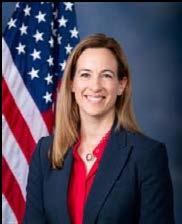
NJ Governer Elect Mike Sherrill
Israeli Efforts to Annex West Bank Continue
By Noah Cytrynbaum ‘28
Israel has continued to expand control over the West Bank, a move that many observers see as part of a broader plan to gain full authority over the territory.
In recent months, Israel has faced both support and resistance over its efforts to annex parts of the territory and establish new settlements.
Defense Minister Israel Katz confirmed that the Israeli government approved plans to construct 22 new settlements in Judea and Samaria (the Israeli term for the West Bank) in May 2025, including constructing towns on land already settled by religious nationalist pioneers.
These initial settlements, called outposts, are considered illegal under Israeli law until they are formally recognized and supported.
Katz said, “The new settlements are all placed within a long-term strategic vision, whose goal is to strengthen the Israeli hold on the territory, to avoid the establishment of a Palestinian state, and to create the basis for future development of settlement in the coming decades.”
Senior Boaz Passner said, “It looks like the government has abandoned any notion of working for a 2 state solution, and has become more open about its goals.”
In July, the Knesset passed a symbolic motion calling to, “[apply] Israeli sovereignty to Judea, Samaria and the Jordan Valley.”
A few months later, Finance Minister and Religious Zionist Party Chairman Bezalel Smotrich succeeded in getting a new cluster of settlements, commonly known as a settlement block, approved for construction that would cut the West Bank in half.
Netanyahu said, “There will be no Palestinian state,” while celebrating the extension of Maale Adumim, an Israeli settlement in the West Bank, as part of the new settlement block.
Smotrich, a settler himself, proposed a plan to annex 82 percent of the West Bank, in response
to Western countries’ recognition of a Palestinian State, according to the Times of Israel.
This plan stated that Palestinians not in the six major Arab cities(Ramallah, Jenin, etc), instead residing in the newly annexed lands, would be able to manage civil affairs but would not receive citizenship or voting rights in Israeli elections. This has been the case for Palestinians in East Jerusalem since its annexation in 1967.
Sophomore Aeden Pinsker said, “If we’re going to annex the West Bank, we need to give everyone the exact equal rights as Jewish Israelis. Otherwise, it’s literally apartheid.”
“It wouldn’t be apartheid. Apartheid refers to a system rooted in a racist belief in the superiority of an ethnic group, like whites over blacks in South Africa. This is directly and indirectly for the security and preservation of the only Jewish State,” said another student in response.
In response to the plan and the denial of political rights for Palestinians, the UAE called this a “red line” regarding their peaceful relationship with Israel.

In late October, U.S. President Donald Trump said that he would not allow Israel to annex the West Bank.
Palestinian and international observers and politicians have said that a peace in Gaza would have to be as part of a deal to reach a two-state solution.
Sophomore Gilad Gefen said, “It’s a big question [whether to annex or not]. I’m pro two-state solution because I believe both sides deserve a real home and a sense of peace and safety. But at the same time, I think it’s hard to imagine how we actually get there right now because there’s so much anger, fear and division that it doesn’t feel possible right now.”
The two-state solution is the term for an Israeli state beside an independent Palestinian state, according to the 1949 ceasefire lines. In theory, the West Bank and Gaza would be part of Palestine. Israel agreed to attempt to reach this in the 1993 Oslo Accords, and the United Nations has passed numerous non-binding motions in support of this.
However, settlements, which are illegal under international law, have cut up the West Bank in what experts refer to as “swiss cheese.”
Settlements originated in the months and years after the Six Day War, in which Israel captured territory from Syria, Egypt and East Jerusalem and the West Bank from Jordan. Most were founded by religious nationalists, who felt that they had a duty to settle the land that G-d promised to them in the Torah.
Bezalel Smotrich and his Religious Zionism Party hold this belief.
The Israeli government eventually allowed them to continue and began protecting, funding, recognizing, constructing and subsidizing them when they became part of a policy to ensure Israel’s security.
Analysts say if Israel used settlements to convert the West Bank from Palestinian to Jewish/Israeli, then there would be no Palestinian state to threaten Israel’s existence.
The Violence Everyone Sees and Nobody Stops
By Logan Gladstone ‘28
Violence has intensified sharply in Arab communities since the October 7 attacks, with gang activity and homicidal attacks reaching record levels.
Unbridled manslaughter within Arab communities has become a crucial issue. As of October 2025, 210 Arab-Israelis were killed, 178 of them being shot and 103 were below the age of 30. According to NGO Abraham Initiatives, this is a seven percent rise from 2024.
“It’s heartbreaking to see so many young people losing their lives,” sophomore Salomon Messulan said. “No one should have to grow up in a place where violence like this feels normal.” Arab Israelis face a much higher risk of homicide than Jewish Israelis, largely due to the rampant gang violence and criminal activity within Arab cities across Israel.
On October 20, 2025, 18-year-old Qasem Asala, a resident of Arraba in the Lower Galilee, was shot dead in his car on his way to work. His father, present at the scene, witnessed his murder. Authorities believe this to be another of many criminally motivated cases that continue to wreak havoc in many Arab towns.
Sophomore Noah Cytrynbaum said, “This reminds me of crime in towns predominantly lived in by poorer minorities in the United States. Arab Israelis are poorer, and the police seem to do nothing about crime.”
38-year-old and mother of three, Suha Mansour, was known for keeping a padlock on the door of her beauty salon in the Arab-Israeli town, Tira. Two of her clients were present as she was shot
five times by a “hooded attacker”. No arrest has been made, according to BBC and the Times of Israel.
Activist, and Mansour’s friend, Maisam Jaljuli said, “It’s shocking... we used to think that for these criminals, women and children are the red line, it’s not the way anymore.”
As of January 2024, Lod had the highest violence and crime rate, with 18 murders, followed by Nazareth and Rahat. Many of the victims were young women or minors, according to the Jerusalem Post.
Tel Aviv University commissioned a survey of Arabs in Israel, with results showing 75.4% of participants saying they felt like they lacked personal security, and 54% of them saying the most pressing issue was the violence and crime in Arab communities.
According to a report from the Jerusalem Post, “Other reasons behind the increase in violence are internal factors, such as some inherited customs in the Arab community, like revenge and family honor. The local Arab authorities and the institutions of civil society do not do enough to fight this phenomenon either through education, awareness, creating ways to peacefully solve the arguments and conflicts, or effective actions to deter people from being violent.”
Since 2024, as the war in Gaza continued, crime organizations have gained momentum as they rampantly take over Arab towns again due to a lack of policemen stationed in Arab streets.
Some suspect that police officers and officials may be working in cahoots with Arab crime lords.
Sada said for the Jerusalem Post, “Whenever we call the police, they come only after the criminals have had enough time to clean their tracks.”
According to an article by The Times of Israel, police have failed to solve most murder cases in the Arab sector, allowing violent crime to go unpunished.
Member of the Israeli Knesset for the Democrats, MK Gilad Kariv, accused National Security Minister Itamar Ben Gvir, who oversees the police, of deliberately ignoring violent crime in Arab society, after seven people were killed in one weekend, according to an article from The Times of Israel.
Many attribute Ben Gvir’s lack of effort in Arab communities to his ultranationalist Jewish beliefs, which are seen as bigoted towards Arabs.
However, he has backed a bill labeling criminal organizations as terrorists, according to Haaretz magazine. This would allow Israeli security agencies to use the same tools used for national security in fighting crime.
Israeli Arabs feel that their government has left them behind, especially with the 2018 Nation State Law. This law put in writing that Israel was the Jewish State, but completely left out mention of Israeli Arabs, including Muslims, Christians, and Druze. Many saw this as a sign of Jewish supremacism, that Arabs are second class citizens.
There is hope however, as Israeli Arabs will remain an integral part of Israeli society, which means that we can solve these problems eventually, however long it takes.
GOA Introduces New Tefillah Options for High School Students
By Tali Herbert ‘27
This year, Golda Och added new tefillah options for tefillah to become a much more personal and engaging experience for every student.
Instead of Tefillah Shleimah every Monday and Thursday, students are able to choose from a variety of tefillah electives that reflect different ways to connect, both spiritually and creatively.
Unlike past years, when tefillah electives have followed a more traditional format, this year's programming has allowed students to see the full possibilities of tefillah.
Options used to be limited and didn’t speak to every student’s interests or passions. Now, GOA’s new and expanded Tefillah electives offer something for everyone.
“Being part of the new Tefillah options has given me the chance to explore what really inspires me,” said junior Mia Eskin. “Through Community Service Tefillah, I’ve connected more deeply with helping others and discovered new interests through Moot Beit Din, where I can think critically and make an impact in a meaningful way.”
The new electives introduced this year include The Golden Ochtaves, Moot Beit Din, Community Service, Midrash Fab Lab and Artists Make Change, while several established offerings, such as Soul Talk, Ethics and Tefillah Shleimah, remain part of the program.
Each elective offers students a distinct opportunity to connect with Jewish values and practices in innovative ways. The Golden Ochtaves, GOA’s high school choir, gives students the opportunity to express their spirituality through music.
Junior Max Lefkowitz said, “Choir used to take place during lunch and study hall, which took away opportunities for me to get work done or meet with teachers. Because of the new tefillah options, we get a lot more done
in choir, and I’m still able to enjoy my lunch and study halls.”
In Moot Beit Din, students act as lawyers, studying real Jewish legal cases and presenting arguments in a mock court setting.
“In Moot Beit Din, our class studies biblical texts and discusses real-life scenarios, like the ethics of organ donation,” said junior Avi Kutten. “It has allowed me to think critically and apply Jewish law to modern-day issues.”
The Community Service tefillah focuses on GOA's values of Kehilla, community, and Tikkun Olam, repairing the earth. In this elective, students have been preparing community service projects in small groups and organizing fundraisers for organizations they feel passionate about.
“Community Service Tefillah has allowed me to expand my involvement beyond the classroom. It has allowed me to connect my work in Tefillah with the Breast Cancer Awareness Club by organizing fundraising ideas and reaching out to the community about fundraisers,” said sophomore Eloise Goldberg.
Midrash Fab Lab combines Torah learning with STEAM, allowing students to apply their creativity and technical skills, bringing jewish texts to life.
In Artists Make Change, the students are creating artwork that raises awareness, supports fundraising and connects directly to the community.
Longstanding electives, like Soul Talk, Ethics and Tefillah Shleimah, continue to offer students a place for prayer, reflection, and discussion.
Together, these diverse electives reflect GOA’s commitment to creating a Tefillah program that speaks to the individuality of its students.
Through the expansion of choice, students are encouraged to explore their spirituality and interests and grow their appreciation for tefillah.
GOA Journalism Uses Student-Created Code of Ethics
By Violet Berman ‘27 and Tali Herbert ‘27
“Even though The Flame is a school newspaper, we must create a microcosm of what real journalism is. Articles should be humancreated, human-sourced and human-edited,” he said.
The journalism class also studied examples of irresponsible journalism in national publications, such as The New York Times, USA Today, The Wall Street Journal and The New York Post, which helped students identify red flags, including bias, inflammatory language and factual inaccuracy.
Journalism student Alma Adiel said, “While I was investigating irresponsible journalism, I came across many instances of bias in articles. These articles depicted a situation from one specific perspective without the same detail from the other side. Opinion phrases like ‘finally’ or ‘unfortunately,’ and subjective adjectives like ‘misguided’ or ‘important’ showed clear bias.”
To combat this issue, The Flame emphasizes a commitment to balanced reporting, ensuring a safe environment where students feel valued and seen.
“The Flame places a firm priority on representing all perspectives,” Alma added. “The Code of Ethics we created ensures that our publication reflects the diversity of thought within our school.”
The Code also seeks to empower newer writers and editors with clear expectations. By establishing shared and transparent standards, students in the journalism class aim to prevent confusion and inconsistency.
Mr. Langer said, “To have something actually codified and written and solidified, I think it can only help new students as they come on and give them guidance.”
This approach was strongly supported by the
former leadership of The Flame, who experienced the challenges of managing without a written code.
Former Flame Co-Editor-in-Chief Henry Sacks explained, “Ensuring that articles are written with a strong moral compass and that writers exemplify empathy and honesty are critical to producing a strong newspaper. If there was a Code of Ethics in place when I was Editor-in-Chief, I would’ve had an easier time making decisions in a leadership position.”
To enforce these ethical guidelines, The
specific document we can refer back to. It’s more of an unwritten system—something you learn through experience.”
While other schools operate with unspoken expectations, GOA’s codified approach provides students with a concrete foundation, making it easier to uphold shared standards.
In addition to ethical principles, the students also studied the legal foundations of student journalism. They explored the First Amendment, which guarantees freedom of the press, and relevant court cases such as Tinker v. Des Moines and Hazelwood v. Kuhlmeier.

Flame will
undergo a three-tier editing process, progressing from writer to section editor, then to Editor-inChief, with oversight from the faculty advisor. Any violations of the code will be addressed with feedback, revision requirements and, when necessary, removal of the article before publication.
While GOA now has a formal, student-created code, some nearby schools do not have an official, written code of ethics for student journalism.
Izzy Suelto, an editor for The Mountaineer, Montclair High School’s student newspaper, explained, “We have rules to follow, but not a
In Tinker, the court ruled that students do not “shed their constitutional rights to freedom of speech or expression at the schoolhouse gate.” However, in Hazelwood, the court allowed school administrators more control over school-sponsored student publications.
GOA students are especially impacted by New Jersey’s “New Voices” law, which gives student journalists the right to publish freely without interference from school administrators.
“Knowing that student journalists are legally protected to report the truth made me realize I have to use that power responsibly,” said junior Mia Eskin.
As the GOA Journalism Code of Ethics officially takes this school year, the students behind it hope to create a lasting impact on the school, effectively enforcing responsible journalism and maintaining GOA and Jewish values.
The Code reflects Jewish principles such as emet (truth), kavod (respect) and achrayut (responsibility). By following these principles, The Flame staff is not only promoting ethical journalism but also honoring the moral foundation of the GOA community.
Golda Och Welcomes Mr. Michael to Math and English Departments
By Logan Gladstone ‘28
This school year, nine new faculty members have joined Golda Och Academy across the Upper and Lower School campuses.
Ranging from the Math to Judaic Studies departments, these faculty members bring a wide range of expertise and a diverse field of subjects, marking a new wave of passionate teachers at GOA.
One new teacher, Mr. Michael, teaches Grade 7 Language Arts, Grade 10 Algebra 2 and Grade 12 Calculus, sharing his vast experience with all ages.
Michael said, “So far, I love it! The kids are amazing, classes are small and all the students work hard to achieve their goals, which I appreciate.”
He also showed appreciation towards the community at school, sharing that his favorite teaching moment is when, after struggling with a concept or topic, a student finally figures it out—“the ah-ha moment.”
Emily Himber, a sophomore in Mr. Michael's Algebra 2 class, said, “I like his class because his class’s style allows me to complete my schoolwork efficiently and understand everything. It’s amazing to have teachers who go based on the individual needs of the students.”
Mr. Michael and the other new faculty members strive to provide their students with the necessary skills to become happy, productive and fulfilled young adults.
Sophomore Jordana Lorrimer said, “Mr. Michael is a great teacher, even though we move very quickly. He is very funny during class and has a great teaching style.”
The new faculty have come from a variety of backgrounds, having worked at both religious and secular schools. Each school’s different perspective provides the new teachers with valuable experience and new insights to apply at GOA.
Mr. Michael likes that GOA offers a large variety of unique electives that little to no other schools offer, such as Moot Beit Din, a tefillah elective that combines Jewish law with modern day issues.
Mr. Michael said, “I am very excited to watch the seniors graduate, get into college, the GOA play and musical and see my 10th graders take the PSAT and begin practicing for the SAT.”
With the help of our new faculty, the GOA community looks forward to the things that they will contribute to the school over the next few months, both inside and outside of the classroom.
GOA Journalism Students
Business

Major AI Investments to Affect Economy
By Paul Raskin ‘27
Major companies are investing billions of dollars into artificial intelligence, notably in ChatGPT’s creator OpenAI. But as enthusiasm increases, many worry that an AI Bubble could be forming, and may lead to economic ruin.
Over the course of 2024, companies are estimated to have invested $252.3 billion into AI, representing a substantial 26 percent increase from the previous year, according to Stanford HAI.
These investments are driven by expectations for higher profitability and efficiency from companies. Competition to capitalize on the popularity surrounding AI investment further fuels this growing trend.
“AI is the wave of the future, and the wave of the present. By investing in AI, you are inherently investing in the profitability of the company, and by not you are essentially signing its death warrant. A company not adapting to the popular use of AI will be left in the dust,” said Language Arts teacher Mr. Hefetz, an avid AI advocate.
In 2025, the largest investment occurred when chip-maker Nvidia announced its $100 billion partnership with OpenAI. This partnership allows OpenAI to expand its data centers while also purchasing Nvidia’s chips, strengthening Nvidia’s position as a hardware supplier for AI expansion. Similarly, Microsoft has invested $13 billion into OpenAI in addition to integrating its own AI, Copilot, across Microsoft 365. Microsoft’s investments now represent a 49 percent stake in the private company, providing OpenAI with its Azure service, which trains ChatGPT.
These examples of large corporations establishing their presence in AI highlight the growing race for AI integration with expectations of massive profits.
However, expectations of AI performance now mirror the dotcom era, where markets and stocks continue to rise disproportionately to company performance due to speculation. Investors be-

come disillusioned by bull markets and anticipate that good markets will continue to do well despite all of the warnings that say otherwise.
During the late 1900s to early 2000s, people invested in shares because they did not want to miss out on the money being made rather than believing the company was doing well.
“There is nothing so disturbing to one’s well-being and judgment as to see a friend get rich,” said financial crises historian Charles Kindleberger.
Even though investors knew there was a bubble, the market’s performance suggested otherwise. But in the early 2000s, when investors realized that “get rich quick” was not real, panic set in, which led to a massive sell-off and the bubble burst. Likewise, nowadays, high-tech and AI-related stocks like Nvidia, Palantir and Microsoft are well overpriced, leading to market volatility, yet the market continues to rise with seemingly no end in sight.
“ Investing in AI companies like Nvidia seems exciting because they’re behind all the new tech everyone’s talking about, but it also feels risky since the prices are already really high, and things could change fast,” said senior Simeon Migdal.
Today’s market conditions can only be considered a bubble once it pops and people panicsell. However, if AI services become widely adopted and something people are willing to pay for, then the price can be justified.
This can happen since there are expectations for widespread AI adoption due to many possible applications.
“I think AI will make the world a better place because it will save time and help us accomplish important things,” said freshman Bryson Skolnick. “However, AI can also take away jobs from people who really need them to survive.” Now, AI is already transforming industries, such as in medical research for faster diagnoses, drug discovery and in finance for trade automation. AI has the potential to revolutionize modern-day technology; but it can also lead to one of the biggest financial crises ever seen.
High Tuition Costs Affect College Decisions
By Noah Stoch ‘27
As high school students across the country begin choosing where to apply to college, one factor weighs heavier than any other: the cost.
Students often spend months making this challenging decision, considering affordability, student debt and what the cost actually provides.
“I’m leaning toward private schools because they usually have smaller classes and a stronger sense of community,” said senior Simeon Migdal.
Generally, public colleges are cheaper to attend.
Rutgers University's in-state tuition is roughly $35,000 per year. While expensive, students find the lower price compared to other private universities to be enticing.
Alternatively, a private university like New York University (NYU) has a tuition of roughly $90,000, a massive increase. When price is the deciding factor, in-state public universities tend to be more affordable.
The average student at an in-state public university graduates with about $27,000 in debt, while the average private university graduates with about $42,000 in debt, according to an AI search. It should be noted that this statistic is likely skewed, as more students who can afford to pay for a larger portion of tuition are more likely to attend private universities.
While in-state public universities tend to be significantly cheaper than private universities, out-of-state public universities can be equally as expensive as private universities, taking the cost factor out of the equation.
Another important consideration is the long-term impact of private versus public universities. According to the U.S. Department of Education, the median income two years after graduating from private universities was $40,000, as opposed to $37,000 from public universities.
This slight income difference causes many students to doubt the benefits of private universities.
Some of the common benefits of private universities include smaller class sizes, which allow for the chance to gain stronger connections to professors.
“I would want to develop a strong connection to my peers and professors at a university,” said junior Dov Brown.
However, others prefer the notable benefits of public universities, which can include a large array of majors, huge sports programs, and more funding for undergraduate research.
“I would like the opportunity to participate in research and support my school’s sports teams at a university,” said junior Jude Ornstein.
One common misconception is that private
universities are always more prestigious.
While private universities like Harvard, NYU and Tufts have a strong name recognition, major public universities such as the University of Michigan, the University of California, Los Angeles and the University of Virginia do as well. Many believe that employers and graduate programs tend to focus far more on what you did in college, as opposed to where you did it, though some believe that name recognition can be the difference maker when applying for a job.
Whether a private university is worth the cost largely depends on a student’s financial situation. For those who may not receive enough financial aid, attending an in-state university may make more sense, as they offer lower prices to in-state students while still offering world-class academics. However, moving beyond finances, it’s important to consider what type of university you would prefer. Students who prefer a tight-knit community with close student and faculty relationships may prefer private universities.
Alternatively, students who seek a zwide range of majors, large undergraduate research funding, and world-class college sports programs may prefer public universities.
Chat GPT Logo

K-Pop Demon Hunters Dominates the Charts
By Alma Adiel ‘27
Netflix’s animated hit K-Pop Demon Hunters has shattered streaming records since its August 2025 release, becoming the platform’s most-watched film of all time with over 236 million views worldwide.
Less than two months after it premiered on Netflix on June 20th, the film broke previous streaming records. According to Netflix, it surpassed the 236 million-view mark, beating Red Notice as the mostwatched film in the platform’s history.
In its debut week, the film logged about 9.2 million views, then more than doubled that number in week two. By week three, it was still pulling more than 22 million weekly views, an unusual consistency for a streaming title.
Junior Liora Goldberg said, “I can definitely see why other kids are obsessed with this movie. The songs are super catchy, and the characters have a lot of energy that keeps you watching.”
Few Netflix films have ever maintained comparable momentum past their debut.
The film also achieved an unprecedented milestone on the music charts. According to Billboard, its soundtrack became the first in history to feature four songs in the Top 10 of the Hot 100 simultaneously, with the lead single “Golden” reaching No. 1.
Netflix reports that the soundtrack’s release boosted global streams by more than 180 percent during the film’s opening month.
The soundtrack’s popularity even sparked online dance trends and fan covers, contributing to the film’s continued success.
The movie’s success extended beyond streaming platforms: its official hashtag trended for over a month on TikTok and Instagram, accumulating more than two billion combined views.
What makes this achievement especially striking is how the film defied typical streaming trends. Many platform hits spike high, then fade quickly, but according
to streaming analysts, this film maintained a very steady weekly view count.
For comparison, Red Notice debuted with a huge number of hours viewed but declined steeply in subsequent weeks.
Streaming analysts say the film’s staying power sets it apart from typical Netflix releases. Many titles experience sharp viewership declines after their debut week, but K-Pop Demon Hunters maintained steady growth, suggesting high repeat-view rates.
Sophomore Jordana Lorrimer says, “The kids I babysit make me play the songs over and over again. They love the movie so much, but I’ve never seen it myself.
The box-office story adds another layer: the film had a two-day limited theatrical “sing-along” release on August 23-24, and pulled in an estimated $18 million, marking the first time a Netflix film hit Number 1 at the U.S. box office in its limited release.
Screenings sold out across several major cities, including Los Angeles, New York and Seoul, with fans dressing as their favorite characters and singing along to the soundtrack in packed theaters.
Globally, the film’s reach was undeniable, appearing in the daily Top 10 in all 90+ regions for multiple weeks.
It became the first animated Netflix film to stay in the platform’s global Top 10 for eight consecutive weeks.
“I’ve watched the movie multiple times. It never gets old!” said freshman Elie Sangster.
Critics also note that the film’s global success highlights the growing influence of Korean pop culture in mainstream media. The blend of K-pop aesthetics, fantasy storytelling and stylized animation helped it appeal to a broad international audience.
According to The New York Times, the film represents a “perfect fusion of global pop sensibilities and
distinctly Korean mythology.”
Beyond its entertainment value, industry analysts see the film as a sign of shifting media consumption patterns. Streaming viewers are increasingly drawn to cross-cultural stories and K-Pop Demon Hunters capitalized on that by combining action, music and modern mythology.
At the heart of K-Pop Demon Hunters is the fictional girl-group HUNTR/X, with members Rumi, Mira and Zoey, who lead a double life as K-Pop idols and demon-hunters.
The story follows the trio as they balance fame with secret missions to protect humanity from demonic forces.
While Netflix has not announced a sequel, reports from Deadline suggest a follow-up project is already in early development, with the original creative team expected to return.

Omer Adam Unites Thousands at Sold-Out Concert
By Violet Berman ‘27
Israeli-American singer Omer Adam filled Madison Square Garden for a one-night sold-out performance that became a powerful display of support for Israel amid the ongoing war.
The concert opened with a video tribute featuring footage from the war in Israel, including videos of Israeli soldiers, an Israeli flag being raised in Gaza and clips of hostages being reunited with their families, shifting the concert into a night of unity and strength for the global Jewish community.
“Seeing videos of the Israel Defense Forces and the hostages with their families was incredibly meaningful,” said senior Brandon Schall. “The video reminded me that the concert was not only about music but also about being unified with many other Jews and showing support for Israel together.”
The montage also included short clips of United States President Donald Trump giving a speech at the Knesset in Israel the previous week, where President Trump expressed continued support for Israel and its people.
During the show, Adam thanked American Jewish supporters and honored Israeli soldiers, calling them “the strongest and most moral army in the world.” The crowd responded with cheers and chants of “Am Yisrael Chai,” meaning “long live Israel.”
Junior Alma Adiel said, “When I heard what Omer Adam said at the concert and how everyone started cheering, I felt so proud to be part of such a strong and supportive nation. Especially with a brother who
has served in the Tzahal (IDF) for many years, I was grateful to hear such a powerful voice acknowledge their importance.”
At one point, as images of returned hostages reappeared on the screens, Adam asked the crowd to keep the missing hostages in their thoughts, saying, “May they soon be brought back for burial in Israel.”
Senior Henry Sacks said, “Seeing Madison Square Garden, the ‘world’s most famous arena’ united under one cause was truly inspiring. The Israeli flags and passionate singing truly demonstrated the resilience and unity of the Jewish people in times of struggle.”
Approximately 20,000 fans attended the concert on October 19, 2025, completely filling Madison Square Garden, with tickets selling out within minutes of their release.
Fans from around the world traveled to New York City for the concert. “I flew in from Los Angeles with my family just for the concert,” said senior Emily Klein. “It was amazing to see how many Jews flew to New York City from different places for a concert.”
The setlist included many of Omer Adam’s most popular hits, along with tracks from his latest album. The crowd sang together, waving Israeli flags and dancing in their seats.
Adding to their excitement, Adam surprised fans by bringing out Israeli pop star Odeya. They performed their hit “Shosho” together before Odeya sang her solo hit “Ben Adam.”
Sophomore Noa Rejwan said, “I was
shocked when Odeya came out and the crowd went crazy. Hearing Odeya sing with Omer Adam was such a fun and memorable part of the night!”
Throughout the night, fans showed their Israeli spirit by waving flags and singing traditional songs and prayers together. Adam sang “Vehi Sheamda,” a prayer about God’s protection for Jews from people who tried to destroy them, typically sung on Passover.
As many fans were walking out of the concert, the sense of unity continued. Crowds of fans stayed outside the venue, continuing to sing and wave Israeli flags in celebration.
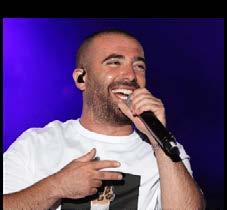
Omer Adam in concert

Exploring New Jersey’s Top Public Golf Courses
By Paul Raskin ‘27 and Jackson Meirzon ‘27
Although many of New Jersey’s best golf courses are private and exclusive, there are dozens of exceptional public courses offering top-tier playing conditions for golfers.
“Public golf courses are really important because they let everyone play, not just people in private clubs,” said junior Caleb Lebeau. “I love golfing with my dad, and I think everyone deserves to build connections like ours on any course.”
Ballyowen - Crystal Springs Resort (Hamburg)
Spread across 250 treeless acres, Ballyowen plays 7,094 yards from the tips and features rolling fairways, tall fescue and dramatic elevation changes.
The course is designed by Roger Rulewich (who used to work under hall of fame designer Robert Trent Jones), who was inspired by features of some of the first golf courses created.
Holes 5 through 7 are particularly challenging, requiring precision to avoid water and deep bunkers.
Junior Jackson Meirzon said, “Playing Ballyowen was awesome because the course was maintained nicely, views were spectacular and I had an amazing overall experience there. It was a very challenging course, but the joys of playing there certainly make it the number one course in New Jersey.”
Neshanic Valley Golf Course (Neshanic Station)
Neshanic Valley, designed by Dr. Michael Hurdzan and Dana Fry, is divided into three nine-hole courses: The Lake, The Ridge and The Meadow.
These can be played in different 18-hole combinations.
The 350-acre layout showcases open fairways, thick fescue and wetlands that protect the site’s natural topography.
The signature hole, the par-4 7th on The Lake, doglegs left with fairway bunkers and water, demanding both strategy and accuracy.
Wild Turkey - Crystal Springs Resort (Hamburg)
Also designed by Roger Rulewich, Wild Turkey offers a distinctive basin-like layout and diverse terrain, measuring 7,202 yards.
Measuring 7,202 yards, it is known for its dramatic vistas and the strategic use of bunkers and water hazards.
The par-3 7th hole, requiring a forced carry shot to a protected green, is a standout feature.
Well-maintained and scenic, Wild Turkey challenges
even the most seasoned golfers while remaining playable for beginners.
Twisted Dune (Egg Harbor Township)
Located in Southern New Jersey, Twisted Dune is a links-style course with many turns and heights.
Designed by Archie Struthers, who moved two million cubic yards of earth to create towering dunes, deep bunkers and rolling fairways, the course is a par-72 7,200-yard course from the back tees.
It is a challenging course, featuring over 100 bunkers, varying elevations and thick fescue, yet it is playable for golfers of all skill levels due to the different tee boxes.
The course is filled with many memorable holes, which are fully isolated from each other. One of the toughest holes on the course is the par-5 fourth hole, which features a dogleg right toward a green that is surrounded by deep bunkers.
Hominy Hill Golf Course (Colts Neck)
Built on former farmland, the course stretches nearly 7,000 yards and features sloping fairways, colorful flower beds and over 130 bunkers.
Designed by Robert Trent Jones, Hominy Hill is one of the most celebrated public courses in the state.
The course has hosted numerous tournaments, most notably the New Jersey State Open Championship, and is praised for combining beauty with difficulty.
This course is the model of Jones’ signature balance between playability and precision.
Bay Course at Seaview Golf Resort (Galloway)
Home to the ShopRite LPGA Classic and once the site of the 1942 PGA Championship, won by Sam Snead, the Bay Course’s par-4 13th, with crisscrossing bunkers and a tiered green, is a standout.
Designed by Donald Ross, the course sits along the Atlantic coast and delivers a true Scottish-links experience.
The par-71, 6,250-yard layout rewards accuracy and finesse over distance, with ocean breezes and tricky greens testing every shot.
Architects Golf Club (Phillipsburg)
Opened in the early 2000s, Architects Golf Club is a creative homage to golf’s “Golden Age” (1885–1955).
Designers Stephen Kay and Ron Whitten crafted each hole to honor a legendary course architect, from Donald Ross to Alister MacKenzie.

The course is designed right along Warren County’s rolling hills, creating very treacherous yet flowing fairways. Similar to Balleyowen, the Architects Golf Club is a links-style golf course with little to no trees blocking the fairway or greens.
Berkshire Valley Golf Course (Oak Ridge)
The Berkshire Valley Golf Course’s par-71 layout blends scenic fairways with tricky elevation changes, rewarding players who take risks.
Senior Josh Berelowitz said, “On the tee box of the first hole at Berkshire Valley, the view overlooking the rest of the 17 holes is extraordinary. I thought that the course was in beautiful condition, alongside friendly staff and to top it all off, it even had a driving range.”
Owned by the Morris County Park Commission and designed by Roger Rulewich, Berkshire Valley opened in 2004 and features sweeping views of northern Jersey.
Royce Brook Golf Club
Royce Brook Golf Club recently combined its two courses—East and West—into one renovated 36-hole championship layout, featuring new bunkers and improved greens.
This update has modernized the club while still keeping the same traditional style of the original courses.
The improved single-course layout and renovated bunkers allow for golfers of all levels to enjoy the beauty and challenges of Royce Brook Golf Club.
Beyond the course, golfers enjoy a well-stocked pro shop, professional coaching and extensive practice facilities. With its mix of classic design and modern upgrades, Royce Brook remains one of the most complete golf experiences in the state.
Preakness Valley
Located just 30 minutes from the Golda Och Academy campus, Preakness Valley offers 36 holes across 377 acres of beautiful parkland. Lined with mature trees and traditional fairways, it is both inviting and challenging for players of all levels.
Accessible, scenic and well-maintained, Preakness Valley provides a championship-caliber experience at public-course prices, earning its place as one of New Jersey’s top public golf destinations.
Students Manage Studies, Athletic Schedules
By Tara Langer ‘28
For some students at Golda Och Academy, the day ends when the bell rings at 4:00 p.m. But for those balancing athletics, academics and everything in between, that bell often signals the start of an entirely new challenge.
At GOA, student-athletes are learning that success does not just come from skill or intelligence but rather it takes discipline, sacrifice and many late nights.
Sophomore Remy Friedberg juggles honors classes, volleyball, competitive gymnastics, a coaching job and several school clubs. Her days begin at 6:45 a.m. and often do not end until after midnight.
“After a long day of school from 8:30 to 4:00, I go straight to volleyball practice until 6:00,” Friedberg said. “Then I head to gymnastics, which ends at 8:30. By the time I get home, I still have hours of homework left so I usually go to bed around midnight.”
It is a schedule that would exhaust almost anyone. Between classes, practices and work, Friedberg barely has time to rest, often using her bus rides to squeeze in a quick nap and her lunch period to study.
Friedberg said, “It’s definitely a hard schedule, especially trying to find time to hang out with my friends and be social between all my work. It gets stressful.”
Despite the exhaustion, she said she wouldn’t trade her packed schedule for anything.
“I love being active and doing what I’m passionate about. Even when it’s tough, I feel proud that I’m managing it all.”
Sophomore Rebecca Luftig faces a similar challenge, as she spends most of her days balancing
school, sports and extracurriculars.
Luftig plays soccer and basketball while staying involved in several GOA clubs.
“It’s very stressful and difficult because practice times change all the time,” Luftig said. “I need to have good time management skills so I can get everything done, so when I accomplish everything, it feels amazing.”
Both students agree that their athletic commitments, while demanding, have taught them valuable lessons in organization and perseverance.
Managing multiple responsibilities has forced them to develop habits that will serve them far beyond high school, from time management to teamwork to staying motivated even when tired.
GOA has taken steps to support busy students by providing built-in opportunities to get work done.
Study hall electives and athletic exemptions from gym give students extra time to complete assignments or meet with teachers during office hours.
The school culture encourages communication between teachers and students, which helps athletes stay organized and on top of their workload.
Teachers often offer flexibility for practices, tournaments or late-night games, acknowledging that balancing it all is not easy.
Still, student-athletes agree that the lifestyle, while challenging, is deeply rewarding.
The rush of a big win, the pride of turning in a hard-earned essay and the friendships built through the teams make the busy schedule worth it.
For students like Friedberg and Luftig, finding balance is not just about keeping up; rather, it is about growth. Every late-night study session and early-morning wake-up builds resilience,
focus and confidence.
At the same time, maintaining a packed schedule requires careful attention to mental health.
The constant pressure to perform academically and athletically can be overwhelming, and even highly motivated students sometimes experience stress, fatigue or burnout.
GOA encourages students to find time for selfcare, whether that means taking short breaks between activities, practicing mindfulness or talking with guidance counselors and teachers when schedules feel unmanageable.
Learning to recognize and manage stress is as important as any physical or academic accomplishment.
Teaching students that mental health and well-being are essential components of long-term success.

Mamdani’s New York Will Backfire On Working Class
By Remy Friedberg ‘28
Though Zohran Mamdani campaigned on reducing the cost of living in New York City, his proposals risk making life harder for the working class and driving them out of their homes.
Mamdani identifies as a democratic socialist; he believes that profit-driven capitalism should be replaced by a democratic, publicly owned economy.
He is a radical who was chosen over moderate liberal Andrew Cuomo and moderate conservative Curtis Sliwa.
“I have run a campaign that speaks about the tools that city government actually has to deliver [...] affordability in the wealthiest city, in the wealthiest country in the world. And it’s time that we have a mayoral administration that follows through and actually delivers that,” said Mamdani in an interview for Forbes Breaking News.
“Even though it is extremely necessary to have affordable housing in a city as expensive as New York City, I have skepticism how he is going to be able to accomplish this as mayor considering how many higher-up politicians have reacted to him,” sophomore Logan Gladstone said.
His platform is largely focused on reducing the cost of living in New York City so that lowincome New Yorkers can live comfortably. Despite the noble objective, his proposals will accomplish more harm than good.
A potentially disastrous proposal is the 30 by 30 policy. It intends to raise the minimum wage by $13.50 over the next 5 years until it reaches $30 per hour, a rate of approximately $2.70 a year: 440 percent higher than previous minimum wage increases. Rather than putting more money in the working class’s pockets, this policy will do the opposite.
Employers will simply try to find individuals who are “worth” the $30 per hour salary – those who don’t meet their much higher standards will lose their jobs. This affects vulnerable populations like disabled people, immigrants and refugees who
might not speak English proficiently, and the youth. This adds fuel to one of the most competitive job markets in the world.
“I wanted to find a job, but I couldn’t find one that would hire a 15-year-old, so I babysat instead,” said sophomore Noa Rejwan, a New York City resident.
If she thinks finding a job is difficult now,
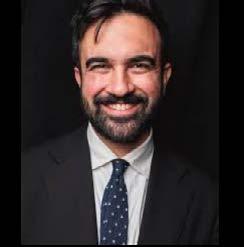
raising the standard by $13.50 per hour would make it even more demanding.
Businesses may choose to use automated job positions to save money and maximize profits with a large minimum wage in place, which in turn contributes to the shortage of jobs.
Mamdani also proposes to make the public bus system city-sponsored and free for users.
Supporters argue that free buses will benefit low-income workers. Unfortunately, publicly funded services often face struggles with maintenance and inadequate funding, especially when it runs constantly
like NYC buses.
Without the revenue brought in by customers, there will be less funding available for maintenance and upgrades.
In addition, bus fares restrain non-transportation uses of the system.
If anyone can ride for free, there is nothing to deter unhoused people from using the bus as a temporary shelter. This will make the bus experience unpleasant for frequent users.
“New York transit is already disgusting as it is. There are homeless people, rats and disorganization. I hate having to use it,” said sophomore Salomon Messulan.
The funding for this proposal would come from a 2 percent tax on taxpayers earning more than $1,000,000 and by increasing the corporate tax rate to 11.5 percent. These tax adjustments also need to be approved by the state.
This part of the population generally doesn’t use public buses and has the greatest ability to relocate, with many already planning to relocate to Florida, a state with no state income tax. Specifically to cities with similar New York qualities, like Miami and Palm Beach.
If they decide they don’t want to be taxed so high on a service that doesn’t benefit them, they’ll just move out of the city. This source of funding is unreliable and risky.
This is happening in the United Kingdom, where tens of thousands of high-net-worth individuals are relocating to places like Monaco and the United Arab Emirates due to rising taxes. A similar move will happen with Mamdani.
Unlike this population, those in need of these free services cannot afford to relocate whenever there is inflation or tax raises. If they have discontent towards the quality of the system, they’re left to deal with it.
Fareless NJ Transit Would Be Costly for New Jersey
By Lyla Smith ‘27
Throughout New Jersey, debates over whether to implement free fares on NJ Transit have become a hot topic, but NJ Transit should not adopt a free-fare policy.
There are concerns regarding funding and fairness alongside rising inflation. Many believe that the cons, such as economic and logistical consequences, outweigh the benefits of free transportation.
Junior Violet Berman said, “Eliminating the fees would raise taxes across New Jersey, and create a huge funding gap that would take away from government affairs. If the people who use NJ Transit pay the fee themselves, it will keep the system running without messing with other essential programs.”
One of the economic challenges of free transportation is the loss of revenue from fares. Revenue is significant to the operation of a public transportation system like NJ Transit, which has already been facing financial challenges since the COVID-19 pandemic.
For the 2026 fiscal year, NJ Transit is projecting an operating deficit of nearly $1 billion.
If the free NJ Transit went into place, the money to fund the system, and pay the employees, would have to come from the state government. State funding is a risky and unsustainable option.
For decades, NJ Transit has been underfunded by the state to cover operating expenses.
There would be significant budget cuts to other important public services, like road repairs, to subsidize the costs of
transportation.
This could also cause an increase in the price of toll booths to make up for the gap in revenue.
Additionally, with the removal of NJ Transit fees, the number of passengers using public transportation can become overwhelming.
With the increase in commuters on board, trains and buses may experience more mechanical issues, become easily overcrowded and encounter more delays, ultimately affecting NJ Transit’s profits.
The NJ Transit system has t ested out what a transportation system without fares would be like through “Fare Holidays.” These are week-long periods when fares are lifted on buses and trains.
Sophomore Logan Gladstone said, “When I was on a train during the fare holiday, I remember it being packed beyond belief; there was barely room to stand, let alone sit. Some homeless people were causing chaos all around. The train also faced many delays on the way.”
Crime and security are also large issues with a free NJ Transit.
In July 2025, three people were stabbed on a Newark Light Rail near Norfolk Street Station stations at 12:30 AM. It is seemingly difficult to maintain the transportation systems now with high fares; with no fares, the number of violent crimes would only increase.
Supporters of a free NJ Transit often state that free transport will help low-income New Jersey residents. However,

nobody benefits from deteriorating systems riddled with crime; it only decreases the quality of life.
There are ways to make public transportation more affordable and user-friendly.
Freshman Hallie Mann stated, “I think train tickets are too expensive for people who work in the city, especially if they are not as financially stable and commuting every day.”
To maximize affordability, quality and safety while maintaining a high ridership, many propose reforms on the NJ Transit system.
The reforms include more of the revenue focusing on maintenance and updates of the trains and buses, lowering prices as much as possible and increasing security at high-risk stations and lines.

NYC Mayor Elect Zoharn Mamdani
Cancel Culture is an Evil to Society
By Aeden Pinsker ‘28
We, as a society, should hold Cancel Culture in the same regard as public humiliation. Humiliation is considered cruel and unusual punishment. It scars people for life, and it is widely considered taboo; however, internet Cancel Culture perpetuates and repackages it.
Cancel Culture is defined as “a social environment in which publicly boycotting or withdrawing support for people, organizations, etc., regarded as promoting socially unacceptable beliefs, is widespread practice.”
This means that when enough people disagree with someone’s belief or action, it is socially acceptable to ostracize, condemn and boycott them.
Junior Leo Milch said, “I think Cancel Culture has become way too popularized and normalized. Just because someone doesn’t share your beliefs doesn’t mean they should be cast away by society.”
Freedom of speech and expression are severely hindered because of the fearful environment it creates. Individuals are also pressured into believing the society’s consensus rather than free thinking. Free thinking is one of the most important aspects of a modern society, and removing that is extremely dangerous for our future.
Free thinkers challenge the norm and bring more ideas, innovation and knowledge, allowing for evolution. With an environment becoming less tolerant of separate beliefs, free thinking is endangered.
Junior Sagan Shapiro said, “Free thinking should be expressed freely and you shouldn’t police people on what they say. Limiting free thinking and policing people creates an endless cycle where people constantly spew hate towards each other. If there is an opinion you don’t agree with, just ignore it instead of interacting with it.”
Supporters of Cancel Culture defend it by
saying it attacks “bad people,” but that is exactly the point. “Bad people” is subjective, and to attack them based on their views is hypocritical. This means everybody.
We live in a fair and equal nation, and everybody must have an equal right to speech. Speech is different from actions.
Cancel Culture assumes that the beliefs that the punishers have, which are the reason for cancelling the accused, are correct.
It is arrogant to believe that any human belief is foundationally right or wrong.
Cancel Culture doesn’t only attack beliefs but also shames bullies, especially past bullies.
Individuals shouldn’t be punished for actions they have done years prior and have grown from.
Since Cancel Culture is largely online, these videos consistently affect the cancelled individual for years, if not decades afterward.
It is important to condemn people for bad actions, but it crosses a line where constructive criticism turns into destructive hate.
Alexander Rogers, aged 20, committed suicide due to Cancel Culture in January 2024. The Oxford student faced ostracization after a woman stated she felt “discomfort” in a sexual encounter with him.
According to the BBC, Rogers faced name-calling, exclusion and targeted behavior while rejecting the allegations.
This tragic suicide raises concern that Rogers' suicide won’t be the last if Cancel Culture continues to run rampant.
Sophomore Leo de Picciotto said, “It’s terrible how an accusation today can ruin someone's life.”
Cancel Culture gives people an unhealthy mindset that people are guilty regardless of whether they
are innocent. It is poisonous and costs lives like Rogers.
“Cancel culture directly contradicts our 1st amendment rights. It’s a shame an opinion will make an entire community go up in arms at me if I disagree with something they agree with,” said de Picciotto.
Other than the threat to freedom of speech, Cancel Culture enables vigilantism.
Vigilantism is defined as law enforcement undertaken without legal authority by a self-appointed group of people.
Vigilantism didn’t use legal precedent for punishment and was largely common between the 1870s to 1930s, when lynching was common. It causes people to be punished by others who are emotionally compelled to do so. In hindsight, it will not punish the prosecuted to a degree that is considered acceptable by society.
Today, we live in an era of digital vigilantism, where riled-up users try to take down others for opinions and beliefs rather than the social media platforms themself. They disregard logic and follow pure human emotions.
Vigilantism, then, would give petty theft a death sentence. Digital vigilantism gives ostracization from society.
Not only is it hypocritical to cancel others for beliefs different from the rest of society, but it also causes extreme harm to others. Cancel Culture is a repackaged version of witch trials disguised as social justice.
If we continue down this dangerous path our society will replace freedom with fear. To continue to progress we must choose dialogue rather than destruction, our future depends on it.
Pros and Cons of Recognizing Palestinian State
By Noah Cytrynbaum ‘28
In September 2025, 10 Western countries opted to recognize a Palestinian State, leading many to view this move as risky and believe it can lead to future consequences.
This group includes Australia, the United Kingdom, Canada and France, among others. Their decisions come amid international pressure to officially recognize Palestine.
Freshman Hanna Laufer said, “I think that the recognition of Palestine as a state is used to diminish Israel’s authority and sovereignty, but it could lead to the eventual two-state solution, which would be better for both sides, ending a conflict that has ravaged both peoples for decades.”
From Western leaders’ perspectives, the Israeli government has held the West Bank since 1967 without any real policy of annexation. Prime ministers have dedicated themselves to peace, and even Netanyahu pledged his support for the twostate solution years ago.
Israeli control combined with expanding settlements means eventual annexation, which would either mean denying Palestinians rights, expelling them or losing Israel’s political, cultural and national Jewish character by giving Palestinians full rights.
To most people in the world including many Israelis, all three of those options are highly im-
moral.
Their main argument is that the Palestinian state would not be given to a Hamas-controlled Gaza, but rather to the Palestinian Authority, which Israel signed a peace deal in 1993 to hand over to them the Palestinian territories.
While these countries encourage Hamas’s violence, they are also supporting one of Hamas’ biggest enemies: the Palestinian Authority.
Giving Hamas legitimacy as the group who won Palestinian independence then stripping it of legitimacy as the group without any real backing.
Ultimately, Western leaders recognizing Palestine are holding Israel to its own promises, trying to prevent a Palestinian catastrophe, while recognizing the PA over Hamas.
However, many are skeptical of this decision.
Junior Violet Berman said, “Anti-Zionism already exists in the West so recognition of a Palestinian state would worsen those tensions rather than promote peace.”
Sophomore Zachary Nadel said, “It’s a very dangerous move because it could lead to more killings.”
The danger lies in the fact that it encourages and enables Hamas to continue its campaign against the Israeli people.
Jihadist groups’ leaders commenced the slaughter-invasion of Israel to kill as many people as possible.
New documents show that they wanted to try destroying Israel if Hezbollah and Iran joined in. Their strategy is to maximize the death toll to gain support against the Zionist enemy.
Recognition of a Palestinian state is giving them what they want. The fear is that they will continue to kill Israelis and get Gazans killed.
Also, whereas the PA constantly fights for “real change”, meaning full independence for Palestine, Hamas seems satisfied with useless international support. This is a strictly diplomatic move, so the only ones who get any real benefit is Hamas.



By Avi Kutten ‘27
This year’s Golda Och boys varsity soccer season was one to remember. From their opening game against Eagle Academy to the final tie with Orange, the players gave it everything they had and grew stronger as a team.
The team started off strong with two early wins, defeating Eagle Academy 10-6 and West Side 3-1. Those victories set a positive tone for the season and displayed the team’s potential
Despite facing tough losses against Shabazz, Technology, Newark Central and Newark Tech, each game helped the players learn how to work together and stay resilient no matter the score.
Captains Sam Sharret and Josh Berelowitz constantly raised team morale, showing real leadership both on and off the field.
As the season went on, GOA took one more victory against West Caldwell Tech, where they managed to squeeze out a 4-3 win.
The team lost a tough battle against WoodRidge, but then came out hard with a 2–1 victory over Newark Global Studies. By the end of the season, the record stood at four wins, six losses and one tie, but those numbers only tell part of the story.
Every practice and every game helped the team grow closer and improve skills.
Freshman Eyal Suskauer said, “Working together with the team and coach during every practice helped me feel more confident. The skills I learned during practice made me better at soccer and built strong bonds between me and my teammates”.
One of the most exciting days of the season was Och Fest. GOA played against Kushner Academy and pulled off a huge win that fired everyone up.
It was one of those games where everything came together. The passes were clean, communication was sharp and the whole team played with heart.
Captain and senior Josh Berelowitz said, “This game was super fun and I loved having the GOA fans there to support us the whole time.”
After the game, Och Fest was an absolute blast. There was a soccer clinic where kids got to play and learn new skills, and a petting zoo that brought everyone together for some fun off the field.
It was a great celebration of school spirit and community, and it made the victory even sweeter.
Throughout the season’s ups and downs,
Boys Varsity Soccer Celebrates Successful Season
the team remained strong as a family and forged friendships that will last well beyond the field. The captains led with dedication, the players gave their best effort in every game and together they created memories that will endure for many years.
The 2025 boys varsity soccer season indeed was one to remember.
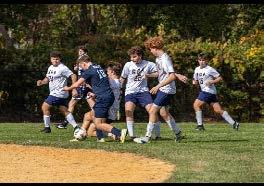
Ryder Cup Sparks Friction Between US Fans, European Players
By Jackson Meirzon ‘27
American golf fans, known for their energy and passion, transformed the Ryder Cup into an uproarious sporting event at its return to the United States.
The American fans proudly backed their team; sometimes, too much for Europe’s liking.
This year, tensions between American fans and European players were at an all-time high. Throughout the week, there were multiple instances of fan-on-player interactions, many leading to arguments and even to physical altercations.
These situations continued throughout the day, ending with a fan throwing an alcoholic beverage at Rory McIlroy’s wife after he finished his match.
Junior Naomi Allen said, “It’s really sad that some American fans felt the need to start physical altercations just because they didn’t like certain players. Verbal stuff is one thing, but getting physical is completely wrong, especially because the fans threw the beer at McIlroy’s wife, who isn’t even part of the competition.”
During one of the most intense matches of the event between Northern Irish McIlroy and American Scotty Shefeler, McIlroy had multiple arguments with American fans, who continuously taunted him on bad shots and mistakes.
Junior Paul Raskin said, “It’s great to see golfers being invested in the Ryder Cup and to show
nationality, but some of the behavior coming from the American fans crossed the line. You can show spirit without being disrespectful, and the European players deserve better than that.”
The actions of some of the American fans left a looming shadow over a very enjoyable tournament. With the next Ryder Cup coming up in 2027 in Ireland, fans hope that the team spirit and competitiveness of the competition will remain the same, minus the physicality and animosity.
The Ryder Cup is held every two years, where both the United States and Europe each create a team of their best respective players, and pit them against each other in a team-style tournament. This special format features team play, as well as one-on-ones.
What Drives the Driving: How Formula One Teams Earn Profit
By Noah Cytrynbaum ‘28
Formula
One may appear as simply as fast cars going around a track and trying to win a race, but behind these races lies a complex and very profitable business.
Each team owes its success to its hundreds or thousands of employees as well as its parent company.
Regarding employees, a large team like Ferrari employs between 1,000 to 1,500, not including those working on the engine. However, a small and less financially able team like Haas only has around 300 or 350 employees.
With Formula One being an incredibly high-stakes business, a driver’s minuscule errors or slight imperfections can often be the difference in millions of dollars.
The biggest source of income for the Formula One brand and for the teams is sponsorships. Companies big and small pay anywhere from hundreds of thousands to hundreds of millions of dollars.
Depending on the performance of the team, companies with more money to spend might be more eager for their brand name and logo to be on the cars, tracksuits, and merchandise.
“I would say that brand appearances on cars help my knowledge of the brands and make me want to go and buy those products,” said junior Paul Raskin.
Teams also make their money through bonuses from Formula One. There is an initial bonus given equally to the top 10 teams (as long as they have been in the top 10 for the past two years), the purpose being to exclude the lowest or newest teams from getting extra money.
On top of that, every team gets paid, with the lowest team getting the least and the nexthighest teams receiving an incremental increase. For example, McLaren earned over $130 million, Ferrari earned just under $100 million, but Williams and Sauber earned around $52 million and $46 million, respectively.
The Constructors Champions (the team that is most successful during a season) can negotiate to receive extra payment, while teams in the sport for a long time, like Ferrari (the oldest team), can also receive such payment.
Some teams, like Ferrari and Mercedes, sell their engines and technology to smaller and less financially feasible teams, often for tens of millions of dollars, depending on what is being
sold.
Merchandising, though a much smaller source of revenue than sponsorships, still makes millions. People buy shirts, shorts, hats and more for $50 or more, and one can see them around town, especially during race weekend.
Sophomore Theo Buber said, “I would say that I do buy a lot of F1 merch because it has very cool logos and graphics on it, as well as many different kinds.”
A cap on team expenditure that began in 2021 in order to level the playing field has drastically changed teams’ finances.

GOA Boys Varsity Soccer at practice