Volume 7, Issue 4, April – 2022
5G Mobile Networks Applications and Health Implications
Obi IBETO
Computer Science and Information Science Department, Lead CityUniversity, Ibadan, Oyo State Nigeria
Wumi AJAYI
Software Engineering Department, Babcock University, Ilisanremo, Ogun State Nigeria
Abstract:-
Background and Aim: Countries around the world like China, South Korea, the United States, Switzerland, and the United Kingdom have already started utilizing 5G, Other countries are either in the process of implementing 5G Mobile Networks or concluding on 5G license frequency spectrum allocation to telecommunication providers. This push is driven to become technologically superior or have a competitive advantage in widespread Innovation. This study helps identify the recent applications of 5G and the health implication if any of the fifth-generation network.
Methods: The methodology used for this study was based on literature search and analysis, we also used model adaptation from generic ones.
Results: Our finding shows that 5G Mobile Networks will improve the lives of people and increase collaboration and communication in diverse ways, it will also usher in the metaverse which is an immersive version of the interconnected networks where users and consumers will experience an immersive experience powered by virtual and augmented realities. Our study highlights some concerns that there may be health implications, but further study in the long-term effects of 5G isrequiredto uncover theseconcerns.
Conclusion: In conclusion, the aim of this present review is to explore the more recent applications of 5G across industry verticals and the health implications that might arise from the massive rollout of 5G mobile networks across countries.
I. INTRODUCTION
Recent years have encountered an unrivaled advancement of technology known as Information and Communications Technology (ICT), which incorporate remote correspondence utilized for cell phones and, for instance, Wi-Fi utilizing electromagnetic fields (EMF). The original of handheld cell phones were accessible in the last part of the 1980s. Along these lines, the second (2G), third (3G), and fourth (4G, Long-Term Evolution = LTE) ages drastically expanded their infiltration rates in the public arena, with the goal that today there are a greater number of gadgets than occupants in Europe. Moreover, Wi-Fi and different types of remote information move have become
Mariam GBADEGESIN and Israel FAKUNLE
Computer Science and Information Science Department, Lead CityUniversity, Ibadan, Oyo State
pervasive and are around the world accessible. At present we are beginning to present the up-and-coming age of radio recurrence, 5G, on versatile organizations. 5G isn't innovation, however a development of previously existing 1st generation to 4th generation advances.
5G innovation is the current age of portable interchanges innovation, and it is intended to surpass the former 4G architecture with new capacities and determinations preparing the innovation to help new and inventive solutions and applications[5]
5G is perhaps the most rewarding development endorsed out by Federal Communications Commission (FCC) which will be another quicker telecom innovation. The speed as far as Gbps and the proficiency expected by fifth Generation innovation would be exceptionally high. The need of 5G innovation increments step by step because of colossal augmentation in the quantity of clients, constant information estimation and beneficiary intricacy, and so forth These days 4G is the innovation taken on all over globe however as an interest of number of clients and gadgets will increment step by step; there will be such many clients in 4G range. To oblige the expanded interest, the execution of 5G innovation should be prepared. In India, for instance the execution of 5G will open in 2022[6]
The greater part of the human openness to ionizing radiation happens from regular sources including infinite beams and earthly radiation [6]. As examined in past areas that 5G innovation is fixated on high recurrence range i.e., millimeter wave range, it is important to break down the way of behaving of something very similar over human body. There are sure qualities of mm wave flags that influence the human body parts like the millimeter wave can undoubtedly be consumed by the human skin inside 1~2 millimeter [4]
II. PROBLEM STATEMENT
The central problem to be researched by the proposed study is the health implication of deploying 5G Mobile Network. This has a lot to do with the exposure of both low and high frequency radiation to the skin of human beings and the adverse effects of radio frequency (RF) electromagnetic energy (EME) emitted from wireless technologylike 5G on humans.
4,
The first prevailing issue we identified is the lack of research in the wider body of knowledge on the health implications of 5G and the conclusion by the Australian radiation protection and nuclear safety agency stating categorically that there is no established short term or longterm health effects to humans or the environment from radio waves at the power level associated for 5G. Other agencies like the Federal Communication Commission (FCC) who sets exposure limits for radiofrequency (RF) exposures from cell phones and antennas in the United States concludes that the radio frequency (RF) emissions from 5G Mobile Networks fall within the acceptable exposure range covered byFCC limits.
However, “Significant concern is emerging over the possible impact on health and safety arising from potentially much higher exposure to radiofrequency electromagnetic radiation arising from 5G. Increased exposure may result not only from the use of much higher frequencies in 5G but also from the potential for the aggregation of different signals, their dynamic nature, and the complex interference effects
that may result, especially in dense urban areas. The 5G radio emission fields are quite different to those of previous generations because of their complex beamformed transmissions in both directions – from base station to handset and for the return. Although fields are highly focused by beams, they vary rapidly with time and movement and so are unpredictable, as the signal levels and patterns interact as a closed loop system. This has yet to be mappedreliablyforreal situations,outsidethelaboratory”
This research paper seeks to demystify this paradigm around 5G and analyze if any the health implications as well as the economic benefits of deploying a robust 5G Mobile Network.
III. AIM
The aim of this paper is to identifyand describe the diverse applications of 5G Mobile Networks and the health implications if anyon human beings.
IV. METHODOLOGY
The methodology used for this study are literature search and analysis and model adaptation (from generic ones).
V. LITERATURE REVIEW
Information technology has become an indispensable part of our lives, if the futurist and technology experts are correct with their analysis and predictions, every physical object(cars, television, fridges, apparels) will be connected to the internet bythe end of the decade [8]
5G is a system of extremely high capacity and ultrahigh-speed data with new specification requirements designed for energy elicited systems and decreased operational expenses for operators [8] IHS Markit sees 5G as a significant impetus that will impel versatile innovation
into the selective domain of General-Purpose Technologies (GPTs) [9]. 5G mobile networks explicitly represents an upgrade from the conventional 4G Long Term Evolution (LTE) standard and will introduce new service offerings for mobile network operators (MNOs) [9].
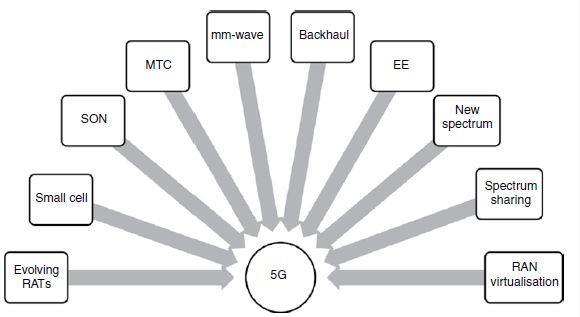
Fifth generation (5G) is not an incremental advance of fourth generation (4G) but a total shift that supports ultrahigh frequency (such as 60Hz), large bandwidth, extreme node densities and large-scale antenna array [13]. Quite recently the unprecedented growth in the total number of connected devices and mobile data and the continuous development in technologies to address this massive data demand, the organized wireless industry consortium has initiated a detailed roadmap for transition from 4G to 5G [13]. The world wide web (Internet) now connects an unprecedented number of devices in fact according to [15] there are more devices than people in the world.
Fig. 1: 10 pillars of 5G(Source [10]
A. Potential Economic Contributions of 5G
According to IHS Markit, three (3) categories of potential economic contributions the 5G technology can make to the global economyby 2035 includes [9]:
a) Deals of Products and Services that will empower broad utilization of 5G across a wide scope of enterprises to make new plans of action and streamline center cycles
b) A Buzzing 5G Value Chain will uncover the underlying 5G technology base through focused R&D efforts, application development and infrastructure investment.
c) Versatile innovation upgraded by 5G conveys with it the ability to impel long haul practical development of worldwide GDP - a definitive check of solid monetaryadvancement.
B. 5G use cases
This study will take a gander at 21 (21) use cases which fall into three (3) general classifications in particular: Enhanced Mobile Broadband (EMBB), Massive Internet of Things (MIOT) and Mission Critical Services (MCS).
C. Enhanced Mobile Broadband (EMBB)
The finish of the two aspects of EMBB [9] is that buyer of 5G will have an improved, more viable experience utilizing portable broadband applications, regardless of their area. These upgrades would be revolved around:
Improved indoor remote broadband inclusion
Improved open air remote broadband
Fixed remote broadband organizations
Enterprise cooperation/joint effort/correspondence
Training/schooling
Augmented and computer-generated reality(AR/VR)
Extending portable processing
Enhanced advanced signage
D. Massive Internet of Things (MIoT)
5G leverages upon earlier improvements in traditional IoT applications and M2M to ignite significant increased in economies of scale that are utilized across all sectors and drive adoption [9]. Some of the use cases covered by MIoT where we begin to witness the Innovative impact of 5G are [10]:
Asset Tracking
Smart farming
Smart Cities
Energy/UtilityMonitoring
Physical Infrastructure
Smart Homes
Remote Monitoring
Beacons and associated customers
E. Mission Critical Services (MCS)
This addresses an enormous development region for 5G to help applications that need high dependability, exceptionally low inactivity availability with solid security and access, this application incorporates:
Autonomous Vehicles
Drones
Industrial Automation
Remote Patient Monitoring /Telemedicine
Smart Grid
The figure below shows a graphical representation on how 5G will unlock $12 trillion in global economic activities in 2035. [9].
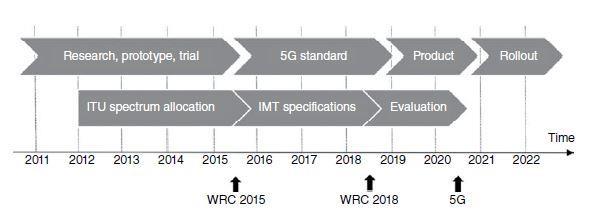
Fig. 2: Roadmap of 5G (Source: [6])
Volume 7, Issue 4, April – 2022
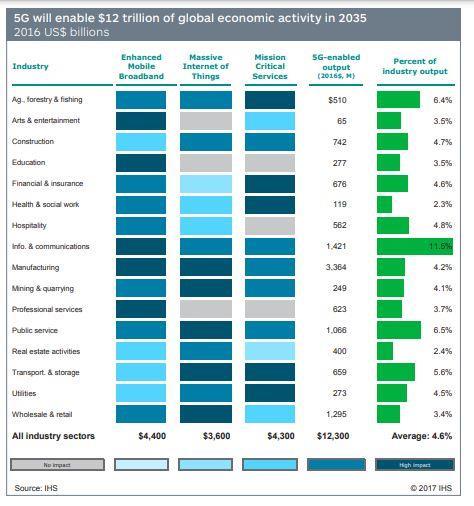
Source: [9]
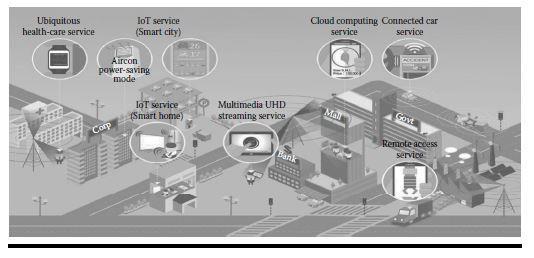
Fig. 4 5G services vision Source: [13] G. 5G and the Metaverse [20] defines the Metaverse as an immersive version of the interconnected networks where users and consumers will experience an immersive experience powered by virtual and augmented realities. 5G will provide the superfast connection that will be required to connect users directly to the metaverse, speeds of up to 100s of Mbps which is only possible through the ultra-high frequency provided by 5G [20].
4G provides about 50ms of steady latency which translates in a frame rate of around 20FPS. This level of latency is somewhat limited for a smooth experience required by the metaverse [20]. With 5G, the latency will decrease to just about 10ms and the frame rates will reach an unprecedented level of 90FPS, making the difficult task of remote rendering possible.
Fig. 3
F. 5G Services
Also, with 5G connection, consumers and users will be able to connect to an experience and stream it to a specially designed headset optimized with reduced heat-generating components, cooling, and power requirements.
It's obviously true that brilliant vehicles are outfitted with gigantic registering limit and progressed sensors, web associated vehicles, or shrewd vehicles with 5G could outperform vehicle-to-vehicle associations and interface with the metaverse [14], giving drivers an immersive connected experiences and driver-less capabilities as never seen before.
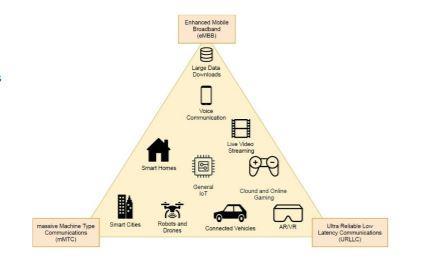
H. 5G Traffic Classes and Metaverse Applications
The Metaverse will utilize the maximum capacity of 5G traffic classes, with applications spreading over every one of the whole finishes of the range [14], namely:
a) Low-Latencyapplications
AR/VR
Connected and Autonomous Vehicles
Cloud gaming
b) General Networking
Video Streaming
Voice Communication
c) Massive MTC
Smart Cities
Smart Homes
IndustryIoT
Drones Swams
I. Internet of Things
Around 2025, the sum of IoT connected devices in the whole world will reach 30.9 billion devices with a surge from 13.8 billion devices as at 2021 [14]
5G remote innovation will interface everything around us through a super quick profoundly compelling and completely responsive network. IoT gadgets associated through portable applications to the web gives clients more command over what's going on around their current circumstance [10].
Typical examples of IoT devices includes smart thermostats, smart home devices, motion sensors, smart security systems, IoT enabled GPS devices and many other devices with both domestic and industrial applications.
VI. GAPS IN LITERATURE
[15] purely focused their study on the how IoT devices will be positively impacted by 5G,[16] buttresses the dependence of other technology like business applications, industrial applications, and AR/VR on 5G but neither of them discusses the possible health implications if any of 5G on humans or states their position to agree or disagree on the negative effects of ultra-high frequency radiation on humans. [17] having had personal experiences with the adverse effects of 5G stated categorically of the industry’s push to declare 5G safe for humans and that scientist globally have called on governments to place a ban on the deployment of 5G due to these adverse effects.[17] categorically stated that “the United States Government has never seen fit to establish either “safe” standards or guidelines to protect the American public or its workers from radio frequency or electromagnetic radiation. Instead, this responsibility has been left to a civilian organization known as the IEEE”. On the other hand [18] used MATLAB,Simulink to dissect the ingestion and entrance
Fig. 5G Traffic classes and Metaverse applications, Source [14]
levels of 5G electromagnetic energy into natural tissues Deoxyribonucleic Acid (DNA), the exploration presumed that the electromagnetic energy produced by 5G is unequipped for breaking the synthetic obligation of any organic tissue of Deoxyribonucleic Acid (DNA) or influence critical changes to sell that will result in one or the other malignant growth or viral-related sickness all together words 5G radiation has no unfriendly consequences for human wellbeing
VII. POSSIBLE HEALTH IMPLICATIONOF 5G
A new examination survey on the wellbeing dangers of Radio Frequency Radiation (RFR), including autonomous confirmation considering 5400 investigations in the Medline store, infers that the writing shows there is a lot of substantial justification for worry about the unfriendly clinical impacts from both 4G and 5G innovation [11]. The paper suggests that both beneficial biological effects and adverse effects of radio frequency radiation have been demonstrated in both animals and humans. On a to some degree minuscule level adverse consequences on both the cell capacity and construction have been believed to emerge from cell phone radiation especially 5G. Likewise, on the tissue level of the living being (person), Electromagnetic recurrence openness has been connected to debasement of the cancer prevention agent guard framework [12]. [10] also suggest that there is potential health effect with 5Gnetworks that will be hopefully addressed in the future but the numerous advantages and advancements for humanity far outweigh the possibilityof an adverse impact on humanity.
However [1] concludes that there is no established short term or long-term health effects to humans or the environment from radio waves at the power level associated for 5G. Globally renowned agencies like the Federal Communication Commission (FCC) based in the United States who sets exposure limits for radiofrequency (RF) exposures from cell phones and antennas concludes that the RF emissions from 5G Mobile Networks fall within the acceptable exposure range covered byFCC limits [2].
In support of the claim made by [10] we humbly suggest also that further research is required to uncover both short term and long-term effects of 5G in humans and in the environment. This research should be a joint task force effort amongst member of the academia, government, and mobile network operators (MNOs).
VIII. CONCLUSION
We do not seek to dispute the numerous advantages of 5G and its extensive benefits to our everyday lives. The applications mentioned in this paper will make life easier and more meaningful in many ways. There will be enormous improvements in communication, machine learning, artificial intelligence, defense, computing, selfdriving cars, IoT devices andhuman security.
The future holds significant breakthrough and 5G will propel some incredible innovations like Smart Homes, Smart Cites and Metaverse which is an immersive version of
the internet that consumers can feel using virtual and augmented realities.
With 5G being on the ultra-high frequency end of the radio wave spectrum we believe more study is required as countries continue to adopt 5G as a standard for mobile communication. This study should be focused on the longterm effects of 5G and should be done in close collaboration with the academia, government, and industrystakeholders.
REFERENCES
[1.] Australian radiation protection and nuclear safety agency (2020) “) Five facts on 5G digital,”. [Online]. Available:https://www.arpansa.gov.au/news/5g-newgeneration-mobile-phone-network-and-health [Accessed: 04-May-2020], pp1
[2.] Connecticut Department of Public Health (2018) 5G and public health.[Online]. Available:https://portal.ct.gov/-/media/Office-of-theGovernor/ct5g/5G-and-Public-Health.pdf [Accessed: 04-May-2018], pp1
[3.] Belpoggi F., Sgargi D., Vornoli A. (2021) Health impact of 5G. European Parliamentary Research Service, pp 12 – 44, Doi: 10.2861/657478, ISBN: 97892-846-8030-6
[4.] Mian M. S., Rahman M.S., Islam J., Sakib K.N.,Tasnim M.M., Yeasmin S., (2019) In-Situ Environment Gamma Radiation Monitoring at Ramna Thana, Dhaka, Bangladesh.
[5.] Nigerian Communication Commission. (2020) “Consultation Document on Plan for 5G Deployment in Nigeria”. [Online], Avaliable:https://www.ncc.gov.ng/docman-main/legalregulatory/legal-other/918-draft-deployment-plan-for5g-network-in-nigeria/file [Accessed:12-April-2020] , pp 8 - 81
[6.] Belyaev, "Main Regularities and Health Risks from Exposure to Non-Thermal Microwaves of Mobile Communication," 2019 14th International Conference on Advanced Technologies, Systems and Services in Telecommunications (TELSIKS), 2019, pp. 111-116, doi: 10.1109/TELSIKS46999.2019.9002324.
[7.] Blackman C., Forge S., (2019) 5G Deployment: State of play in Europe, USA, and Asia. In depth analysis requested by the ITRE committee. Policy Department for Economic, Scientific and Quality of Life Policies, Directorate General for Internal Policies. PE 631.060.
[8.] Rodriguez J., (2015) Fundamentals of 5G Mobile Networks. John Wiley& Sons, pp 15 - 292
[9.] Campbell, K., Diffley, J., Flanagan, B., Morelli, B., O’Neil, B., & Sideco, F. (2017). The 5G economy: How 5G technology will contribute to the global economy. IHS economics and IHS technology, 4, 16.
[10.]Pisarov, J., & Mester, G. (2020). The impact of 5G technology on life in 21st century. IPSI BgD Transactions on Advanced Research (TAR), 16(2), 1114.
[11.]Ishai, P. B. Public Health implications of Cellphone Radiation and the rollout of 5G. [Online]Avaliable:
Volume 7, Issue 4, April – 2022
https://emfkeepers.co.il/wpcontent/uploads/2020/09/O PINION_PAUL_BEN_ISHAI.pdf pp 2-6
[12.]E. G. Kıvrak, K. K. Yurt, A. A. Kaplan, I. Alkan, and G. Altun, (2017) “Effects of electromagnetic fields exposure on the antioxidant defense system,” J. Microsc. Ultrastruct., vol. 5, no. 4, pp. 167–176, doi: 10.1016/j.jmau.2017.07.003.
[13.]Hu, F. (Ed.). (2016). Opportunities in 5G networks: A research and development perspective. CRC press. Pp 187 - 539
[14.]Lik-Hang L., Tristan B., Pengyuan Z., Lin W., Dianlei X., Zijun L., Abhishek K., Carlos B., and Pan H., (2021). All One Needs to Know about Metaverse: A Complete Survey on Technological Singularity, Virtual Ecosystem, and Research Agenda. ArXiv, abs/2110.05352, pp 10 - 66
[15.]PINTO, G. E., Lopes Rosa, R., & Zegarra Rodriguez, D. (2021). Applications for 5G Networks. INFOCOMP Journal of Computer Science, 20(1). Available:https://infocomp.dcc.ufla.br/index.php/infoc omp/article/view/1445 pp 3-6
[16.]Zhengmao, L., Xiaoyun W., and Tongxu, Z. (2021). 5G+:How 5G Change the Society, Springer; 1st ed. 2021 edition, ISBN-10: 9811568189, ISBN-13: 9789811568183, pp44 - 259
[17.]Flynn F., (2019). Hidden Dangers 5G How governments, telecom and electric power utilities suppress the truth about the known hazards of electromagnetic field (EMF) radiation. Jck Publishing 2019, ISBN: 1775394514, 9781775394518, pp 12 - 226
[18.]Aru, Okereke & Adimora, Kyrian & Nwankwo, F. (2021). Investigating the Impact Of 5G Radiation on Human Health Using Machine Learning. Nigerian Journal of Technology. 40. 694-702. 10.4314/njt. v40i4. pp 2- 10.
Other online sources:
[19.]https://www.wired.com/insights/2014/12/enterprisesbillions-of-devices-internet/ [20.]https://www.gizbot.com/internet/features/5g-tounleash-full-potential-of-the-metaverse/articlecontentpf133273-078033.html
[21.]https://www.arpansa.gov.au/sites/default/files/tr178.pd f (2017)