Between The Wines October 2022
hidden Treasures
Hidden Treasures
Trends & observations
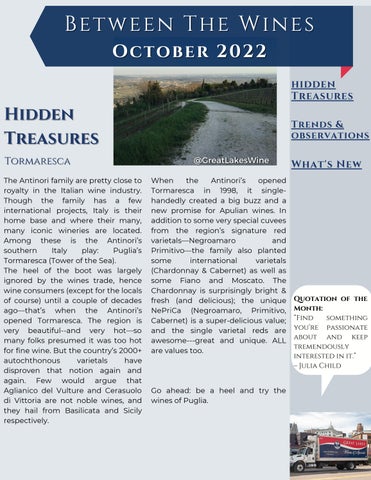
Tormaresca The Antinori family are pretty close to royalty in the Italian wine industry. Though the family has a few international projects, Italy is their home base and where their many, many iconic wineries are located. Among these is the Antinori’s southern Italy play: Puglia’s Tormaresca (Tower of the Sea). The heel of the boot was largely ignored by the wines trade, hence wine consumers (except for the locals of course) until a couple of decades ago—that’s when the Antinori’s opened Tormaresca. The region is very beautiful--and very hot—so many folks presumed it was too hot for fine wine. But the country’s 2000+ autochthonous varietals have disproven that notion again and again. Few would argue that Aglianico del Vulture and Cerasuolo di Vittoria are not noble wines, and they hail from Basilicata and Sicily respectively.
What's New When the Antinori’s opened Tormaresca in 1998, it singlehandedly created a big buzz and a new promise for Apulian wines. In addition to some very special cuvees from the region’s signature red varietals—Negroamaro and Primitivo—the family also planted some international varietals (Chardonnay & Cabernet) as well as some Fiano and Moscato. The Chardonnay is surprisingly bright & fresh (and delicious); the unique NePriCa (Negroamaro, Primitivo, Cabernet) is a super-delicious value; and the single varietal reds are awesome---great and unique. ALL are values too.
Go ahead: be a heel and try the wines of Puglia.
Quotation of the Month: “Find something you’re passionate about and keep tremendously interested in it.” – Julia Child
Trends & Observations Grand Marques* vs Grower Champagnes With the addition of Champagne Lanson to our portfolio, we thought it might be a good time to put the ‘big house’ versus ‘farmer fizz’ into perspective again. Generally speaking, and everything being equal, wine lovers seem to gravitate towards smaller producers. There is a general belief that smaller production means higher quality, and to the extent that there is indeed a limited amount of higher quality fruit, we suppose that is potentially true (plus its always fun to serve a wine that is rare or unique). But the flip side of this is that making high-quality wine-consistently and dependably-- is a technical feat, so having more resources (money) for modern technology and talent is a big plus which usually leads to high quality outcomes. And more money usually comes from doing more volume. For example, most reading this would probably like to own a Porsche, that rare, German-engineered auto brand. But Porsche is part of Volkswagon/Audi…a VERY large auto producer (and they make the lowly Volkswagon!), so how can it be that Porsches are so revered? For those that think only small production, family-owned wine brands are worth exploring, this means rather than a Porsche, you’d rather drive a car from ‘Tim’s Car Company’? We don’t think so.
Between The Wines October 2022
Though we love, love, love some of the bubbles we’ve drunk from growers over the years, we have had some that were… meh. And though a House like Veuve Clicquot or Moet et Chandon put out significant volume at modest prices, they also produce La Grand Dame and Dom Perignon, respectively (not to mention Krug)…would anyone reading this turn their nose up at any of those? We don’t think so! With Champagne…we have something for everyone! *The term ‘Grand Marques’ was born out of a trade association comprised of the largest Houses in Champagne. For various reasons, the group dissolved around the turn of the millennium, but the term is still commonly used when referring to the larger producers.
What's New
Lanson 'it's all about love' Lots of the conversation about Champagne over the last decade or so has been about ‘Grower Champagne’ vs what are known as ‘The Grand Marques’, which we have a little missive about elsewhere in this newsletter. Happily, both categories can co-exist, but more importantly, we now have another Grand Marque in our house. Champagne Lanson is one of the oldest ‘Houses’ in all of Champagne—founded in 1760 to be exact. Unsurprisingly, there have been several ownership changes since the founder’s heirs sold in 1980, and today Lanson is owned by the Bruno Paillard group, with Bruno himself overseeing the property. But the house style— bright, crisp and age-worthy—has remained. Lanson is one of the relatively few Grand Marques which grow a large percentage of their fruit—142 acres of vineyards to be exact. Combined with their long-term partnerships with scores of growers, more than half of their fruit comes from Premier Cru & Grand Cru vineyards…and much of this is organically or biodynamically farmed (and organic aint easy in Champagne). Indeed, Lanson is one of the very few producers of organic Champagne: ‘Le Green Label’. Interestingly, in spite of their obvious quality regimen, Lanson ‘Black Label’ has long been known as one of the great value plays in all of Champagne: it is quite common to see Lanson ‘Black Label’ as the House Champagne at many prestigious restaurants in NYC, DC, LA, Miami, et cetera.
Between The Wines October 2022
They also produce the private label Champagne for the Reims’ famed ‘Les Crayeres’ restaurant/resort, a distinct honor. Based on current pricing for most of their competitors, Lanson is indeed a steal. The recent ‘supply chain issues’ have created shortages and availability gaps for many of our top Champagne brands; Lanson will help alleviate this, as well as give our clients more options to serve their customers. Choice is good…choose Lanson!
Quotation of the Month: “Find something you’re passionate about and keep tremendously interested in it.” – Julia Child